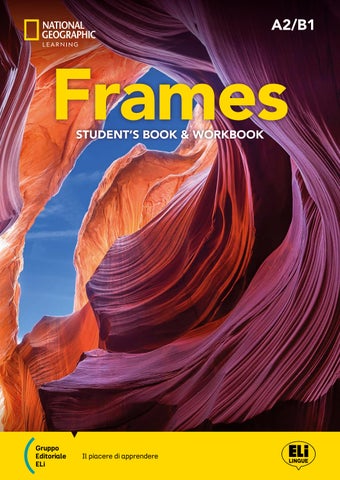

Frames
STUDENT’S BOOK & WORKBOOK
Welcome to
What’s in the frame?
Bring the world to the classroom and the classroom to life
Frames è una finestra sul mondo che invita gli studenti ad affacciarsi sul futuro. Inoltre, Frames offre l’opportunità di sviluppare il pensiero critico e sviluppare abilità linguistiche e trasversali
VISIBLE THINKING
Un’attività di lead in, una thinking routine che fa subito immergere la classe nell’immagine e nei contenuti dell’unità.
Un video autentico introduttivo per coinvolgere la classe.
Frame A
Testi e articoli autentici, storie dal mondo, collegamenti con temi di Educazione civica e attività di preparazione alle certificazioni e all’INVALSI.
Un’attività di warm up presenta l’area lessicale del testo autentico di lettura.
Utili spunti e consigli per affrontare tutte le tipologie della prova di certificazione Cambridge Preliminary e dell’INVALSI B1.
Frame B
STUDENT’S BOOK
STARTER UNIT
Una sezione iniziale dedicata al ripasso del lessico, della grammatica e delle funzioni comunicative di base con un’introduzione ai paesi anglofoni.
UNITS 1-12
Unit opener
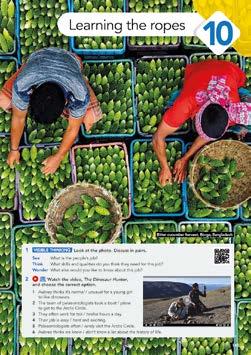
Ogni unità si apre con un’immagine significativa che presenta il tema generale dell’unità.
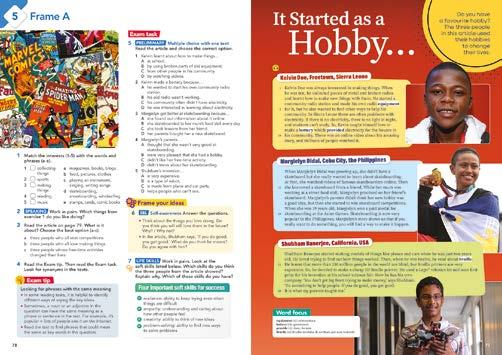
Testi e articoli autentici, quiz, email, recensioni, blog, brani letterari, collegamenti con temi di educazione civica e attività di preparazione alle certificazioni e all’INVALSI. E un irresistibile vlog!
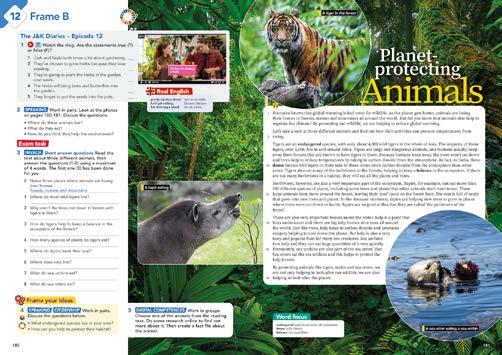
Nel vlog The J&K Diaries Josh e Kayla si divertono a coinvolgerci nei loro esperimenti quotidiani. I loro interessi sono quelli di tutti gli adolescenti della loro età… o quasi! Nel box Real English un focus sulla lingua viva parlata dai giovani.
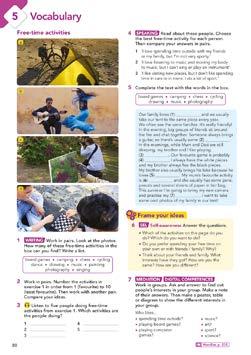
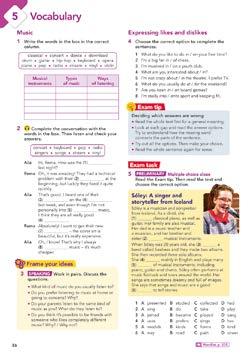
Tutte le tipologie della prova di certificazione Cambridge Preliminary e dell’INVALSI B1 sono affrontate nel corso.
Tutti i testi di lettura possono essere ascoltati.
Numerose attività comunicative di personalizzazione che aiutano a forgiare il pensiero, a sviluppare le proprie idee e a prendere consapevolezza di sé grazie al focus su social and emotional learning e sulle life skills
Vocabulary
Due pagine dedicate al lessico in ogni unità, che presentano anche le espressioni della lingua viva usata in contesto.
Numerose attività di personalizzazione e spunti per le attività di speaking
Attività di mediazione e debate collegate al lessico appreso, per esercitarlo in contesto.
In ogni unità del workbook un esaustivo elenco del lessico e delle espressioni incontrate, con un focus sulle collocations
Grammar
Due pagine dedicate alla grammatica in ogni unità, che presentano anche numerose attività comunicative in contesto.
La grammatica è parzialmente induttiva, con rimando alle spiegazioni dettagliate e ricche di esempi presenti nel workbook
Le risorse digitali del corso includono un focus sulla pronuncia e numerose video-animazioni e video-mappe di grammatica
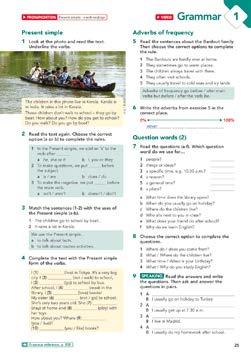
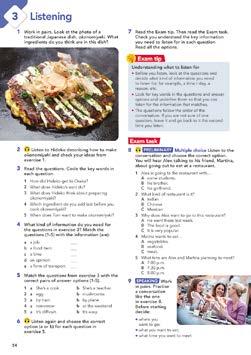
Attività di preparazione alla produzione.
Numerose attività di mediazione e debate
Espressioni utili per aiutare gli studenti con la produzione orale e scritta.
OGNI DUE UNITÀ
Towards INVALSI
Una pagina dedicata alla preparazione della prova INVALSI.
Revision
Due pagine dedicate al ripasso del lessico e della grammatica studiati nelle due unità precedenti.
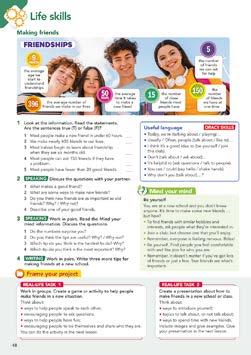
Life skills
Una pagina dedicata allo sviluppo delle competenze trasversali, delle life skills e delle soft skills, per favorire la crescita individuale.
Un inserto dedicato alla mindfulness per imparare a prendersi cura del proprio benessere.
Una scelta tra due compiti autentici da realizzare con la classe.
Listening
Una pagina in ogni unità interamente dedicata alla prova di ricezione orale per far sì che gli studenti possano concentrarsi sulle diverse insidie che un ascolto può presentare.
Esercizi di preparazione all’attività di ascolto principale collegata a una tipologia delle certificazioni.
Numerose attività di follow up incentrate sulla produzione orale o scritta.
Communication
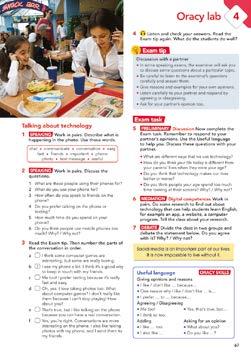
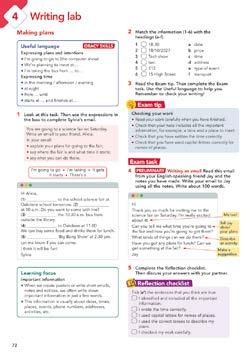
Due momenti dedicati alla comunicazione orale e scritta: al termine del Frame A una pagina di Oracy lab dedicata allo speaking e al termine del Frame B una pagina dedicata al writing
Spunti e consigli per affrontare tutte le tipologie di speaking e writing della prova di certificazione Cambridge
Preliminary
Ogni unità si chiude con un momento di riflessione sul proprio apprendimento e di autovalutazione.
Citizenship
Una sezione finale dedicata ai temi di Educazione civica e cittadinanza attiva e agli obiettivi dell’Agenda 2030 con un focus sulle thinking routines e sulle life skills
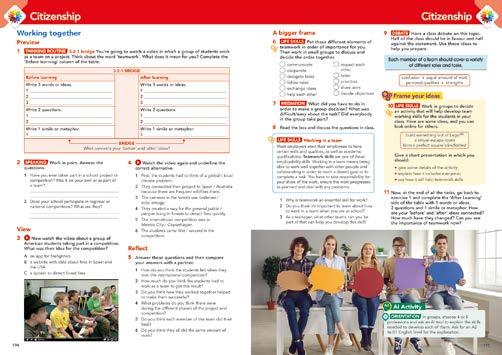
Gli argomenti sono introdotti da un video autentico
Spunti per attività da realizzare con l’ausilio dell’intelligenza artificiale, per favorire un approccio critico al suo utilizzo.
• Ogni unità si apre con un esaustivo Grammar reference affiancato dalla Wordlist
• Numerose attività di pratica abbinate a ogni sezione delle unità nello Student’s book e con le stesse tipologie di prove di certificazione e INVALSI.
0 Starter p. 8
Frame A
Frame B
Frame C
Frame D
Frame E
Frame F
1 My life in a day
My School Days p. 21
2 Looking good!
A Taste of India p. 33
• English-speaking countries
• Countries and nationalities
• Cardinal numbers; Days and months; Time
• Appearance
• Personal possessions; Personality adjectives
• School places; School subjects
Frame A The Boat Is Their Home • Daily routines
Frame B Elephant Families: Big, Strong and Female!
The J&K Diaries – Episode 1
Frame A Festival Time
Frame B Talk to Dr Xavier
The J&K Diaries – Episode 2
Towards INVALSI p. 45 Revision 1-2 pp. 46-47
3 Tastes great!
It Was Delicious! p. 49
4 Tech life
Gadgets that will Change the World p. 61
Frame A Food of the Future
Frame B Around the World in Three Soups
The J&K Diaries – Episode 3
Frame A Technology Changes Lives
Frame B Social Media and Me
The J&K Diaries – Episode 4
• Family
• Clothes and colours
• Adjectives to describe people
Life skills: Making friends p. 48
• Food
• Cooking and measurements
• Technology
• Adjectives to describe technology / The media
5 Time off The Activity for Me p. 77
6 Action!
Climbing El Capitán p. 89
Frame A It Started as a Hobby…
Frame B What’s on This Weekend…
The J&K Diaries – Episode 5
Frame A Keeping Fit and Doing Good
Frame B An Unusual Friendship
The J&K Diaries – Episode 6
Towards INVALSI p. 101 Revision 5-6 pp. 102-103
• Free-time activities
• Music / Expressing likes and dislikes
• Sport / Sports equipment / Sports people
• Parts of the body / Health problems
skills: Get fit, feel well p. 104
Grammar Pronunciation Listening Communication
• Subject pronouns; Verb to be; Questions words (1)
• there is/there are; prepositions of time (1)
• have got; Possessive adjectives
• Possessive ‘s; Object pronouns;
• Prepositions of place; can (ability and permission); Imperative
GRAMMAR VIDEO VIDEO MAP
Present simple and Present continuous
• Present simple / Adverbs of frequency / Question words (2)
• Present continuous / like + -ing form
GRAMMAR VIDEO VIDEO MAP
Past simple and Past continuous
• Past simple (was/were and regular verbs)
• Past simple (irregular verbs)
• Past continuous
GRAMMAR VIDEO will
VIDEO MAP Quantifiers
• will
• Countable and uncountable nouns / Quantifiers
GRAMMAR VIDEO will and be going to
VIDEO MAP will and be going to
• be going to
• Present simple and Present continuous for future / Prepositions of time
Zero and First conditional
• Zero conditional / First conditional
• Verb patterns: -ing, to + infinitive
Modals
• Modals of obligation and necessity
• can, could and may / should / shouldn’t
PRONUNCIATION
Present simple: -s endings
PRONUNCIATION
Past simple: -ed endings
Listening for data (numbers, dates, time)
• Talking about countries
• Introducing yourself and others
• Talking about schedules
• Describing people
• Talking about possession
• Talking about your school / Mediation
Oracy lab
• Talking about yourself
Writing lab
• Expressing likes and reasons / Fill in a form with personal information
Identifying the correct answer
Oracy lab
• Describing people
Writing lab
• Describing an activity / Writing an email
PRONUNCIATION
Contrastive stress
PRONUNCIATION
long and short vowel sounds: /i…/ & /I/
Understanding what to listen for
Choosing the correct picture
Oracy lab
• Ordering food in a restaurant / Describing a picture
Writing lab
• Suggestions, promises, invitations / Writing an email
Oracy lab
• Talking about technology / Debate on social media
Writing lab
• Making plans / Writing an email
Listening for information to fill in the gap
Oracy lab
• Talking about free-time activities / General conversation
Writing lab
• Expressing opinions / Writing an email
PRONUNCIATION
Weak and strong forms: can
Listening for numbers, dates and prices
Oracy lab
• Talking about sport / Debate on sport stars / General conversation
Writing lab
• Describing experiences / Writing an article
GRAMMAR VIDEO VIDEO MAP
GRAMMAR VIDEO VIDEO MAP
7 No place like home
Homes on Wheels p. 105
8 City vibes
Things to Do in My Town p. 117
Towards INVALSI p. 129
9 Come rain or shine
Record Hot Weather p. 133
10 Learning the ropes
The Dinosaur Hunter p. 145
Towards INVALSI p. 157
11 On the move!
London Public Transport p. 161
12 A world of beauty
The Grand Canyon p. 173
Frame A Living Underground • Houses and parts of a house
Frame B Eight Great Places to Stay in the UK
The J&K Diaries – Episode 7
Frame A This Weekend, Let’s Visit… Tbilisi, Georgia
Frame B How to Be a Good Tourist
The J&K Diaries – Episode 8
Revision 7-8 pp. 130-131
• Furniture
Towards INVALSI p. 185
Frame A Striking Weather!
Frame B Climate Change: The Facts!
The J&K Diaries – Episode 9
• Places in a town
• Tourism, sightseeing and entertainment / Prepositions of movement
Life skills: Eat well p. 132
• The weather
• Extreme weather / Weather collocations
Frame A Our Working Lives • Jobs
Frame B Schools Around the World
The J&K Diaries – Episode 10
• School and education
Revision 9-10 pp. 158-159
Life skills: Finding happiness p. 160
Frame A A Greener City • Transport (nouns)
Frame B All Aboard!
The J&K Diaries – Episode 11
Frame A Forest Bathing
Frame B Planet-protecting Animals
The J&K Diaries – Episode 12
• Transport (verbs)
• Natural places
• Animals / The environment
Revision 11-12 pp. 186-187
Life skills: Problem solving p. 188
Communication activities p. 189 Citizenship pp. 190-199 Irregular verbs p. 200
Workbook pp. 201-297
Wordlist pp. 298-302
Grammar Pronunciation Listening Communication
GRAMMAR VIDEO VIDEO MAP
Present perfect
• Present perfect simple / been vs gone / for and since
• already, just, (not) yet, ever, never / Possessives
GRAMMAR VIDEO Articles
Past simple and Present perfect
• Articles / one and ones
• Past simple vs Present perfect
PRONUNCIATION
Weak and strong forms: have, has
GRAMMAR VIDEO VIDEO MAP
Comparatives and superlatives
• Comparatives
• Superlatives
GRAMMAR VIDEO
Relative pronouns
• Relative pronouns
• Indefinite pronouns / Adverbs of manner / Comparatives and superlatives of adverbs
PRONUNCIATION
The schwa sound /´/
Choosing the correct picture
Listening for days, times and numbers
Oracy lab
• Describing your room / Role-play an interview
Writing lab
• Planning your ideas to write a story
Oracy lab
• Giving directions / Discussion with visual stimulus
Writing lab
• Describing places / Writing an article
The passive
• The Present simple passive
• The Past simple passive
GRAMMAR VIDEO
Adjectives
• Ordering adjectives / both, either, neither
• Adjectives ending in -ing or -ed
PRONUNCIATION /dZ/ in connected words
Choose the correct picture option
Give and discuss different options
Oracy lab
• Talking about the weather and seasons / Interview
Writing lab
• Describing a trip / Writing an article
Oracy lab
• Talking about jobs / Interview
Writing lab
• Writing an essay
PRONUNCIATION
Weak and strong forms: was, were
Listening for clues
Listening to how speakers respond
Oracy lab
• Talking about advantages and disadvantages / Discussion with visual stimulus
Writing lab
• Writing a story
Oracy lab
• Talking about food and the environment / Holding a debate
Writing lab
• Writing an essay on the environment
GRAMMAR VIDEO VIDEO MAP
S Starter unit
English-speaking countries
1 SPEAKING Work in pairs. Cover the pages and name five countries where people speak English.
2 Read and complete the country fact files with the words in the box.
Abuja • Ottawa • sterling • dollar • Malta million • rand • Washington • billion
The United Kingdom
Population: 69 million
Capital city: London
Nationality: British
Currency: Pound (1) sterling
Australia
Population: 27 million
Capital city: Canberra
Nationality: Australian
Currency: Australian (3)
New Zealand
Population: five (5)
Capital city: Wellington
Nationality: New Zealander
Currency: New Zealand dollar


Canada
Population: 41 million
Capital city: (2)
Nationality: Canadian
Currency: Canadian dollar
The United States of America
Population: 345 million
Capital city: (4) D.C.
Nationality: American
Currency: American dollar
India
Population: 1.46 (6)
Capital city: New Delhi
Nationality: Indian
Currency: Rupee

Nigeria
Population: 235 million
Capital city: (9)
Nationality: Nigerian
Currency: Naira
South Africa
Population: 65 million
Capital city: Pretoria
Nationality: South African
Currency: (7) (8)
Population: 574,000
Capital city: La Valletta
Nationality: Maltese
Currency: Euro
3 Listen to four people. Where are they from? Choose from the countries in the box. There are two countries that you do not need to use. the United Kingdom • India South Africa • the United States Nigeria • New Zealand




Use an online tool (such as Canva, Piktochart, or similar) to design an infographic with relevant data about English and its spread around the world. Include information such as: number of native speakers, countries where it is an official language, presence of English on the Internet and social media, and interesting facts about its learning and use.
4 CITIZENSHIP Work in pairs. Write a fact file about your country. Use the fact files in exercise 2 to help you.
Country:
Population:
Capital city:
Nationality:
Currency:
5 SPEAKING Work in pairs. Ask and answer questions about your country.
Frame your ideas
6 SEL Cultural awareness How many nationalities are there in your classroom? What would you like to know about your classmates’ countries of origin?
Uluru (Ayers Rock), Australia
Janet Rishi
Elizabeth Mike
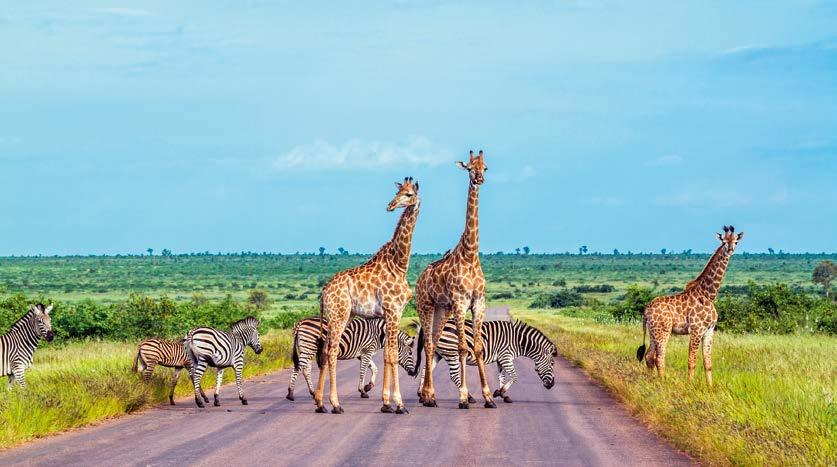
Kruger National Park, South Africa
Starter unit S
Welcome to your new school
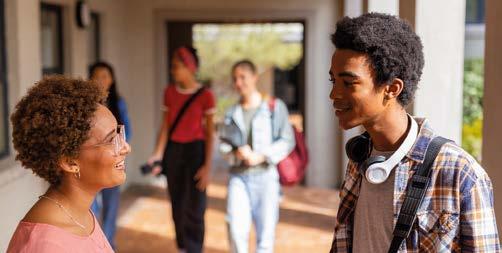
Michael Mrs Gibbs? Hello, I’m a new student here.
Mrs Gibbs Hello and welcome to your new school. What’s your name?
Michael I’m Michael Gomes.
Mrs Gibbs Good to meet you, Michael. OK Gomez… let me find your room number.
Michael Thank you.
Mrs Gibbs Oh, that’s bizarre, there’s another Michael Gomez on the list. When is your birthday?
Michael It’s on the 3rd of August. And I’m fifteen.
Mrs Gibbs No way! That’s the same day and age as the other Michael! Is your surname G-O-M-E-Z?
Michael No, it isn’t. It’s G-O-M-E-S, with an S at the end.
Mrs Gibbs Are you Spanish?
Michael No, I’m not. I’m English, from Leeds. But my dad’s Brazilian, he’s from San Salvador.
Mrs Gibbs Oh Brazil, what a beautiful country! Well Michael Gomes, you are in Room 4.
Michael Where is Room 4?
Mrs Gibbs It’s on the second floor, next to the library. Oh, and this is your badge.
Michael Thank you for your help, Mrs Gibbs.
Mrs Gibbs Any time! Bye.
1 Read and listen to the dialogue between Michael, a new student, and Mrs Gibbs, the school secretary. Complete the factfile about Michael.
Vocabulary Countries and nationalities
Write the nationality next to the country. American • Argentinian • Australian • Brazilian British • Canadian • Chinese • Egyptian English • French • German • Greek
• Italian • Japanese • Moroccan
Portuguese
Spanish
2 Can you spell your surname? Listen to the example and work in pairs.
My name is Betty Jones. That’s B-E-double T-Y and J-O-N-E-S.
I nomi dei paesi e gli aggettivi di nazionalità si scrivono sempre con l’iniziale maiuscola: England, English 4 Complete the table with the nationalities in exercise 3. Can you add other words?
No way! Non ci credo! Any time! Figurati!
Communication
Useful language
Meeting people
• Hi/Hello, I’m Pawel.
• This is my friend, Duc.
• Nice to meet you.
• See you./Bye.
ORACY SKILLS
5 SPEAKING Work in pairs. Practise the conversation. Use the model. Change the words in bold.
A Hi, Francisco. I’m Juan and this is my friend Lisa
B Hi, Juan! Hi, Lisa. Nice to meet you.
A Nice to meet you too.
B Are you Brazilian?
A No, I’m not Brazilian. I’m from Madrid and she’s from Barcelona
B You’re Spanish!
A Yes, that’s right.
B How old are you?
A We’re sixteen
B Me too! OK, see you Juan.
A Bye!
Grammar VIDEO
Verb to be
Affirmative form
I You/We/They He/She/It (1) / am ’re / are ’s / (2) from Leeds. Spanish. from Australia.
Negative form
I You/We/They He/She/It ’m / am not are not / (3) is not / (4) fifteen. in Room 4. on the first floor.
Question form and short answers
Am I
Are you/we/ they
Is he/she/it in your class? fourteen? from England?
Yes, you (5) . / No, you aren’t. Yes, you/we/ they are. / No, you/we/they (6) . Yes, he/she/it is. / No, he/she/it (7)
Question words (1)
What’s your name? How old are you? When is your birthday? Where is Room 4?
Grammar reference, p. 20
6 Choose the correct option.
1 Where is / are Lola from?
2 Hello, I ’s / ’m Mr Roberts.
3 No, Jay and Louis aren’t / isn’t new students.
4 My cats is / are black and white.
5 A Is / Are your friend French?
B No, he isn’t / aren’t. He’s German.
6 A Where is / are Marie and Sue?
B They ’m / ’re at home.
7 Complete the sentences with the verb to be.
1 Canada in North America.
2 I’ Nigerian.
3 A you from Rome?
B Yes, I
4 A your surname McCann?
B No, it .
5 A When your birthday?
B It in September.
6 Mario and Janis are from Barcelona. They French.
8 A WRITING SEL Self-awareness
Write a short presentation about yourself. Write about:
• your nationality;
• your city / town;
• your age;
• your school.
My name is ... and I’m...
8 B MEDIATION
Read your partner’s presentation. Report it to the class with your own words.
AI Activity
Use an artificial intelligence tool to create an identity profile (name, age, nationality, interests, etc.). From this profile, write a brief first-person introduction. Example: Hello, my name is Clara. I am 15 years old and I live in Mexico. I like reading and playing football. What about you? Then, share your introduction with your partner and ask them questions to learn about their simulated identity.
Starter unit S
What’s your phone number?

Sally Hello, my name’s Sally Cooper and I’m here to join the gym.
Woman Hi, Sally. Welcome to Vox Fitness Centre. So, how old are you?
Sally I’m fifteen years old.
Woman OK. And what’s your phone number, please?
Sally My phone number is 071 3466 7090
Woman … 7090. OK, thank you. Can I have your home address, please?
Sally Sure. It’s 15, Brompton Road, Oxford.
Woman Wonderful. So, Sally. Here at our centre there are fitness classes, as well as yoga, pilates, and boxing, every week from Monday through to Saturday.
Sally When is pilates? I really like it.
Woman Pilates is on Tuesdays and Thursdays, from 5 to 6.30 p.m.
Sally I’m always busy on Thursday. There’s a yoga class on Friday, am I right?
Woman Yes, there’s a class at 4.15. Is that good for you?
Sally That’s perfect. What about dance? Are there any classes?
Woman No, I’m afraid there aren’t any dance classes here at the centre.
Sally OK, never mind. Are there any special prices for students?
Woman Yes, of course. There’s a 30% discount on all courses if you are a student. Here’s your membership card.
Sally Thank you very much.
See you.
Woman Bye, Sally.
Real English
1
Read and listen to the dialogue. Match questions and answers.
1 How old are you?
2 Can I have your home address, please?
3 When is pilates?
4 Is there a yoga class on Friday?
5 Are there any classes?
6 Are there any special prices for students?
a It’s on Tuesdays and Thursdays.
b Yes, there’s a class at 4.15.
c Yes, there’s a 30% discount
d Sure. It’s 15, Brompton Road, Oxford.
e I’m fifteen years old.
f No, I’m afraid there aren’t.
Vocabulary
Cardinal numbers
2 Write the numbers in the correct order in your notebook. Then listen and check.
eighty-two • fifty-eight • forty-one one hundred • nine • ninety-five • seventy-four
sixteen • sixty-three • thirteen • thirty-seven twelve • twenty-two • two thousand nine, …
3 Write the number next to the word.
1 fifteen
2 twenty-two
3 forty-six
4 seventy-one
5 one hundred and thirteen
6 six hundred and sixty
7 one thousand one hundred ten
8 three thousand and eight
CLIL Maths With the help of artificial intelligence, generate math problems using numbers. Are the problems you create correct or do they contain errors? Justify your answer. Then, solve them.
Days and months
4 Complete. Then listen and repeat. Friday • Saturday • Tuesday • Thursday
5 Reorder the months. Then listen and check.
September January March
June May October
July November August
February April
Communication
Useful language
Talking about schedules
• What time is your yoga class?
It’s at 4.15 p.m.
• When is the break?
It’s from 10.15 to 10.45.
• When is Science?
December
ORACY SKILLS
It’s on Mondays and Wednesdays at 9 a.m.
• I giorni e i mesi si scrivono sempre con la lettera maiuscola.
• Quanto parliamo di eventi che si ripetono, usiamo i giorni della settimana al plurale.
6 Work in pairs. Answer the questions.
1 What day is it today?
2 What day is it tomorrow?
3 Christmas is in
4 My birthday is in
5 There’s no school on .
6 Halloween is in .
7 History is at
8 School finishes at
7 SPEAKING Work in pairs. Ask and answer about your schedules. Think about school, sports practice, art or music classes.
When is football practice?
It’s on Tuesdays and Fridays from 6 p.m. to 7.30 p.m.
Grammar
there is/there are
Singular Plural
There’s a yoga class on Friday.
There isn’t a new teacher. Is there a gym in the school? There are fitness classes. There aren’t any dance classes. Are there any special prices?
Short answers Short answers
Yes, there is. / No, there isn’t. Yes, there are. / No, there aren’t.
There is/There are corrispondono all’italiano c’è/ci sono.
Grammar reference, p. 20
Nelle frasi negative e nelle domande si usa spesso any Unit 3
8
Complete the text about Mia’s ideal town with the positive or negative form of there is/there are. Then listen and check.
In my ideal town, (1) any cars. (2) a car park, but (3) trees and gardens. (4) also a library and a cinema. (5) many shops but (6) cafés and restaurants. It’s always sunny and (7) artists and musicians in the streets.

9 SPEAKING Work in pairs. Ask and answer the questions using short answers.
1 Is there a cinema in your town?
2 Are there any parks?
3 Is there a book on your desk?
4 Are there any computers in your school?
5 Is there a science class at 11 a.m.?
6 Are there any musicians in your classroom?
Starter unit S
He’s got blue eyes




1 Read and listen to the dialogue. Write the names under the pictures. Which one is Lynn?
Tabby What’s that?
Lynn It’s a photo of my music class. Look, I’m here, I play the cello.
Tabby Cool! And who’s he?
Lynn He’s my friend Richard. He’s incredibly handsome. He’s got blue eyes and long, black hair. He’s very tall. He’s great fun.
Tabby Has he got a nice girlfriend?
Lynn No, he hasn’t! Tina, his girlfriend, isn’t very nice, but she’s pretty. She’s in our music class, too.
Tabby Where is she, in the photo?
Lynn She’s here. She’s a pianist.
Tabby Oh, I see. She’s got long, blonde hair, she’s very slim, perfect smile. Classic. What about this guy here, with the guitar?
Lynn This one? His name’s Caleb. He’s not bad.
Tabby Well, I think he’s gorgeous!
Lynn Really? But he’s got glasses and braces! His hair is red and he’s got a lot of freckles…
Tabby So what? I’ve got red hair and freckles too! Am I not pretty?
Lynn Of course you are, Tabby, sorry!
Tabby Don’t worry, I’m kidding.
Tipico./Ovvio. Really? Davvero? So what? E allora? I’m kidding. Sto scherzando.
Lynn OK. And you’re right, Caleb’s not bad at all. Now you’ve got your soul mate!
Tabby Lynn! Stop it!
2 Read the dialogue again. Correct the sentences.
1 Richard’s got black eyes.
2 He’s very short.
3 Richard’s girlfriend’s got short hair.
4 Caleb and Tabby have got blond hair.
5 Lynn has got braces.
Vocabulary Appearance
3 A Listen and repeat.
Hair colour and style black • blond/blonde brown • red • grey dark • fair • long short • medium-length straight • curly • wavy
Eye colour black • blue brown • green
APPEARANCE
Size and height slim • plump medium-weight short • tall medium-height
Other features glasses • braces freckles • beard moustache
3 B SPEAKING Use the words in exercise 3A to describe yourself.
I’ve got medium-length, brown hair and blue eyes. I’m tall and plump.
3 C SPEAKING Work in pairs. Now describe your partner.
Luca has got … hair and … eyes. He is…
Prima si descrive la lunghezza dei capelli, dopo il colore.
Classic.
Grammar have got
Affirmative form
I/You/We/They He/She/It ’ve / have got ’s / has got glasses. blue eyes.
Negative form
I/You/We/They He/She/It haven’t got hasn’t got freckles. green eyes.
Question form and short answers
Have I/you/we/ they got
Has he/she/it got a sister? a brother?
Grammar reference, p. 20
Yes, I you/we/ they have. / No, I/you/we/they haven’t. Yes, he/she/it has. / No, he/ she/it hasn’t
4 Complete the sentences with the correct form of have got.
1 Susan and Paul a new pet.
2 she long, blonde hair?
3 My dad a moustache, but he (not) a beard.
4 I freckles, but I (not) red hair.
5 Use the prompts to write sentences with have got and has got.
1 we / not / money
2 your teacher / grey hair?
3 Sally / a brother / in 3A?
4 my brother / not / a music lesson / today
5 I / not / a computer / in my bedroom
6 Jack and Leo / short, brown hair
Communication Describing people
6 A Describe a member of your family to your partner. Include information about these things:
• age
• hair length
• hair colour • hair style • eye colour
• beard / glasses / moustache / braces / freckles
My uncle is fifty-two years old. He’s got…
6 B MEDIATION Listen to your partner’s description and draw a picture. Then exchange pictures. How accurate is your partner’s picture?
Possessive adjectives
my you your he his she her
its
our you your they their Grammar reference, p. 20
7 Choose the correct option.
1 A Are Amy’s trainers blue or black? B Their / Her trainers are blue.
2 It’s Peter’s dog. Your / Its name is Patch.
3 David and her / his friend Richard are from Sydney.
4 They are Spanish. Our / Their names are Manuel and Felipe.
5 That’s Elena’s phone. Its / Her phone is pink.
6 That is not Sam and Lou’s house. Their / Your house is very big.
7 This is my cat. My / Its name is Socks.
8 We are Jane and Sylvia, and this is her / our friend Ali.
8 A WRITING Write a paragraph about two friends or two members of your family. Write about their appearance and their pets.
8 B MEDIATION Read your partner’s paragraph. Report it to a third student using your own words.
Starter unit S
It’s my favourite thing
1 Read and listen to the texts. Which person has got a pet?
I’m very sporty and active. I’ve got a collection of trainers in many colours. The best ones are green. They’re awesome. I’ve got a lot of T-shirts and baseball caps, too. On my desk are all my favourite things: a bouncy ball, my wireless earbuds, my water bottle, and my sunglasses. Oh, and there’s always an apple – I love apples!
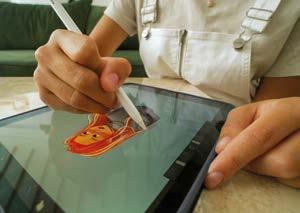
My Apple Pencil is my favourite thing. I’m into comics and graphic novels. I’m a creative person, and with the Apple Pencil I make my own comic strips on my iPad. I love it! I’ve also got a collection of Pokémon and One Piece cards, but Pete, my sister’s dog, isn’t very good with them – he eats them! He’s a very friendly dog, but he’s a bit naughty.
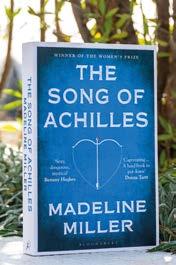
I’m a very good reader and I’ve got a lot of books. Madeline Miller’s novel The Song of Achilles is my favourite book. I’m not on social media because I haven’t got a mobile phone –it’s my parents’ decision – but it’s OK; I don’t mind. My other favourite things are my diary, my Labubu bag charm, and my Instax camera. Photography is one of my hobbies, and I’ve got a lot of photos of Fluffy, my white rabbit. He’s shy and kind.
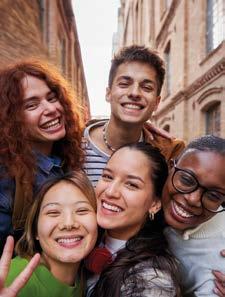
My mobile phone is my favourite possession. I’ve got hundreds of photos and videos on it; it’s my life. My parents aren’t very happy, but I’m very serious about it. I’m a big fan of Instagram. I’ve got a lot of friends there, and we share a lot of information. I’ve also got an e-reader. Suzanne Collins’s trilogy
The Hunger Games is my favourite series. She’s such a clever writer.
2 Read the texts again. For questions 1-8 choose the person a-d.
Which person…
1 hasn’t got a mobile phone?
2 is very popular on social media?
3 has got a desk with their favourite things?
4 has got a favourite book series?
5 has got a collection of cards?
6 hasn’t got a social media account?
7 has got a lot of sport accessories?
8 is very artistic?
Ricorda che l’articolo indeterminativo a/an (a bouncy ball, an e-reader) indica una cosa generica, mentre l’articolo determinativo the (the Apple Pencil) indica una cosa in particolare.
Vocabulary
Personal possessions
3 A Write the words in the box under the pictures.
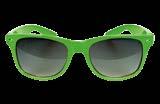
Apple Pencil • bag charm • bouncy ball comic books • earbuds • e-reader instax™ camera • sunglasses • travelcard • wallet
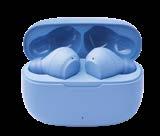
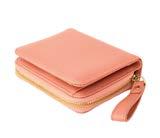

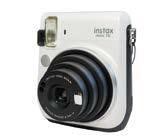
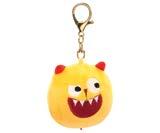


3 B SPEAKING Work in pairs. Ask and answer questions about your favourite things.
A What are your favourite things?
B My earbuds, my bag charm and my sunglasses.
A Have you got them in your bag now?
B I’ve got my bag charm and my sunglasses, but I haven’t got my earbuds.
Grammar
Possessive ’s
Pete is my sister’s dog. It’s my parents’ decision.
• In inglese si usa ’s per parlare di possesso.
• Ai sostantivi plurali regolari si aggiunge semplicemente l’apostrofo ’.
Grammar reference, p. 20
4 Write the word in brackets adding ’s or the apostrophe ’ .
1 cat is very cute. (Janet)
2 trainers are new. (Rory)
3 My bedroom isn’t very clean. (brothers)
4 earbuds are very expensive. (Lucas)
5 Your bicycles are awesome! (friends)
6 T-shirt is red and white. (Sylvia)
Communication Talking about possession
5 A Make sentences using the ideas in the circles. Use the possessive ‘s. Then read them out to your partner.
my friend
Julia the cats
my parents Marcus new in the bedroom red awesome at school earbuds toys bags sunglasses wallet
Object pronouns
Subject pronouns Object pronouns
I you he she it we you they me you him her it us you them
Grammar reference, p. 20
6 Complete the sentences with an object pronoun.
1 I can’t do this exercise, please help !
2 That is my friend Nat, let’s go and speak with
3 The history book? Sorry, I haven’t got .
4 This is Eva. I study with
5 Please visit at our new house.
6 You like Susie and she likes
Vocabulary Personality adjectives
7 A MEDIATION Work in pairs. What are these adjectives in your language? Give definitions. active • bossy • brave • clever confident • friendly • hard-working • kind lazy • popular • serious • shy
7 B Choose the correct alternative. Then listen and check.
1 Sara is very serious / friendly. She never smiles.
2 My mother is very clever / active. She goes jogging every morning.
3 Your dog is so clever / shy; he understands me when I speak!
4 Jo’s dad is very kind / naughty, he always helps people.
5 I am very bossy / active and I always tell people what to do.
6 Jack is so popular / brave, he’s got a lot of friends.
7 Louis is such a hard-working / lazy student, he studies all day.
8 Mary’s so shy / bossy; she never speaks in class.
Frame your ideas
My friends’ bags are at school.
5 B Listen to your partner’s sentences and write them down. Check that you put the possessive ‘s in the correct place.
8 SPEAKING SEL Self-awareness Work in pairs. Which adjectives describe your personality and your best friend’s personality? Ask your teacher for more words. I’m very shy, but my best friend is very friendly.
Starter unit S
Can I use my phone at school?
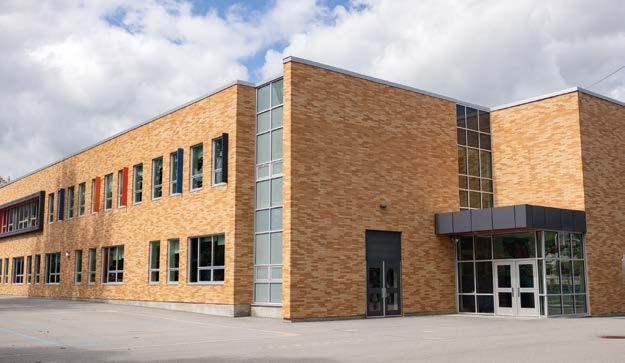
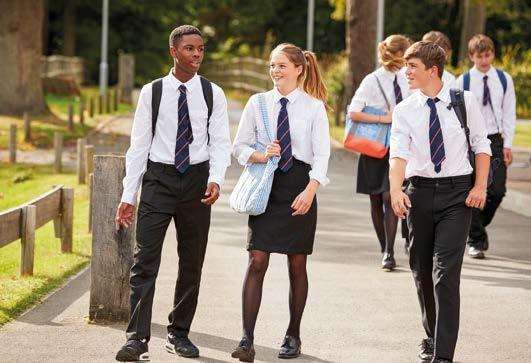
1 Read and listen to the FAQ page of Rodmell School. What can you use during the break?
Welcome to Rodmell School – Frequently Asked Questions (FAQs) Page
Q Where are the classrooms?
A All classrooms are on the first floor. Take the stairs on the left, or use the lift next to the reception.
Q Is there a library?
A Yes, there is a library with over 10,000 books on the first floor, opposite the Computer Science Room. Take the corridor on the left.
Q Are there any special meals at the canteen?
A Yes, there are. At Rodmell, we serve vegetarian and vegan meals, as well as gluten and lactose-free foods. The canteen manager’s name is Mrs Donovan. Please go and see her when you arrive.
Q What can I do if I am late?
A If you are late, go to the school office to sign in. It’s on the ground floor, at the end of the corridor on the right.
Q Can I leave school during the day?
A No you can’t, but if you have permission from your parents and the school, you can leave.
Q Can I use cash to pay for lunch?
A No, you can’t. You can use an online system to pay for lunch. Get your credentials to pay for food at the reception. You can add money online or at the school cashier.
Q Are there any after-school activities?
A Yes! We have sports, music, and clubs. Ask the P.E. teacher, the Music teacher and the Art teacher for more information.
Q Is there a school uniform?
A Yes, there is. Ask for the uniform list when you join the school.
Q How can I get to school?
A If you can ride a bicycle, you can use the bike rack. You can also take the school bus. Go to the school office and ask for information.
Q Can I use my phone at school?
A You cannot use your phone in class. You can use it during breaks.
2 Read the text again. Are the sentences true (T) or false (F)? Correct the false ones.
1 The reception is on the first floor.
2 You can eat at the canteen if you are allergic to gluten.
3 At the end of the corridor on the ground floor there’s the IT Room.
4 You pay online to eat at the canteen.
5 You can’t stay at school in the afternoon and do activities.
6 The school encourages students to use sustainable transport.
Vocabulary School subjects
6 A Look at the school subjects in the box. Which ones are not in your school course? art
chemistry • citizenship
English
Latin






Grammar Prepositions of place



4 SPEAKING Work in pairs. Look at the prepositions of place. Think about places in your school. Ask and answer questions in turn. opposite between next to behind




A Where’s the gym?
B It’s on the ground floor, between the laboratory and the IT room.
Per dare indicazioni, in inglese usiamo l’imperativo Take the stairs on the left.
Use the lift next to the reception.
Grammar reference, p. 20
5 SPEAKING Work in pairs. You are at the reception in your school. In turns, give directions to your partner to reach these places.
the library
your classroom
the toilets
the teachers’ room
French
literature
6 B WRITING Work in pairs. Read the definition of one subject. Write three more definitions.
In maths, we learn about algebra and geometry. In…, we learn about…
Affirmative form
I/You/He/She/It/We/They can speak Spanish. Negative form
I/You/He/She/It/We/They can’t (cannot) use a mobile phone. Yes/No questions Can I/you/he/she/it/we/they pay online?
Short answers
Yes, I/you/he/she/it/we/they can. No, I/you/he/she/it/we/they can’t.
Question words
What can I do?
• Il verbo modale can/can’t è uguale per tutte le persone.
Grammar reference, p. 20
7 WRITING Write questions with can using the prompts. Then give true answers.
1 you / speak French
2 your grandmother / play video games
3 you / use your mobile phone at school
4 your parents / ride a bicycle
5 your best friend / sing
6 you / go out with friends at night
Communication
8 MEDIATION There’s a new student in your class. Tell him/her three essential things he/she needs to know about your school to be happy and confident.
Grammar reference S
Verb to be
Si usa il verbo to be per:
• parlare di nazionalità I’m from Italy.
• dire l’età Paul is 17 years old.
• dire la professione Mrs Gibbs is a history teacher.
• dire/chiedere l’ora What time is it?
• dare descrizioni fisiche We aren’t very tall.
• parlare di personalità e sentimenti My friends are very kind, and I’m happy.
• dire/chiedere se si ha fame o sete Are you hungry/ thirsty?
• dire/chiedere se si è in ritardo o in anticipo Am I late/early?
• parlare/chiedere di luoghi Where’s the gym?
Question words
Per chiedere delle informazioni specifiche, si possono usare le question words all’inizio della domanda. Fai attenzione: essendo domande, il verbo e il soggetto sono sempre invertiti.
What quale, cosa
Who chi
How come
How old quanti anni
When quando
Where dove
Why perché (nelle domande)
Because perché (nelle risposte)
What’s your surname? How are you?
there is/there are
• Per dire che ci sono una o più cose si possono usare there is (c’è – singolare, spesso nella forma contratta there’s) o there are (ci sono – plurale, non esiste la forma contratta).
There’s a very tall girl in my class. There are a lot of animals in the park.
• Quando facciamo delle liste, utilizziamo il singolare there is:
In my school there is a gym, a library, an art room and a canteen.
This/That/These/Those
Per presentare una persona, o per indicare una persona o una cosa vicino a noi si usa this. Alla forma plurale si usa these:
This is your new teacher, Mr Lewis. These are my new classmates.
Per indicare una persona o una cosa lontano da noi si usa that. Alla forma plurale si usa those: That girl with red hair is Lisa. Those books are very old.
Verb have got
Il verbo have got è lo stesso per tutte le persone, tranne che per la terza persona singolare, per cui diventa has
Si usa il verbo have got per:
• descrivere le persone They’ve got long, brown hair with blue eyes.
• esprimere possesso Have you got a skateboard?
• parlare della famiglia She’s got a sister and two brothers.
Possessive adjectives
Ricorda che:
• i possessivi non sono mai preceduti dall’articolo
This is my friend Luca.
• sono invariabili nel numero e nel genere my book, my books; your sister, your brother…
• concordano sempre con il possessore, non con la cosa posseduta Lisa and her brother; John and his mother.
Possessive ’s
Per indicare che un oggetto appartiene ad una persona, si aggiunge ’s al nome di questa, seguito da ciò che possiede: Mary’s notebook; our family’s house
Se a possedere è più di una persona, si aggiunge ‘s all’ultima persona: This is Louis and Jimmy’s classroom.
Ai sostantivi plurali regolari si aggiunge solo l’apostrofo: my parents’ car
Attenzione: ai nomi propri che finiscono per -s devi aggiungere ’s: St. James’s Park is in London.
can/can’t
Quando il verbo modale can si usa per parlare di abilità, significa ‘essere capace di, riuscire a, sapere’: My father can sing, but I can’t.
Quando invece can si usa per chiedere un permesso o per parlare di ciò che è possible fare, si traduce con il verbo ‘potere’: Can I go to the toilet, please?
Imperative
L’imperativo affermativo corrisponde alla forma base del verbo senza to.
Open your books. Close the door.
L’imperativo negativo si forma con l’ausiliare don’t seguito dalla forma base del verbo senza to Don’t use your phone.
My life in a day

1
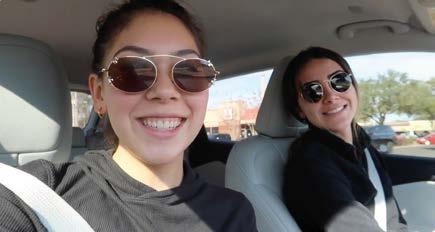
1 VISIBLE THINKING Look at the photo. Discuss in pairs.
See What can you see in the photo?
Think Where do you think the girls are?
Wonder Would you like to know more about teens’ lives in other countries?
2 Watch the video My School Days from Isa’s blog and answer the questions.
1 What time does Isa get up?
2 What is she wearing today?
3 What is she making for breakfast?
4 What does she love doing?
5 How many classes does she have today?
6 What are she and her friend doing at the gym?
1 VISIBLE THINKING Look at the photos on page 23. Discuss in pairs.
See Where are these people?
Think Are they in a cold or a warm place?
Wonder What do you think they are doing in this place?
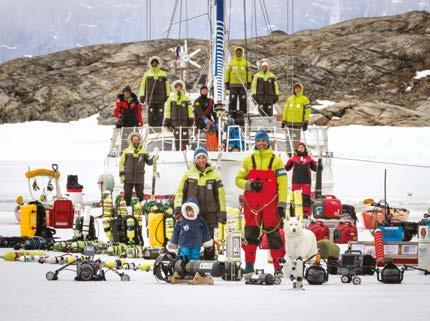
2 Look at the photos. Which of these activities do you think the people do on their boat?



3 Read the article on page 23 and check your answers to exercise 2.
4 Which is the best description of the Bardout family?
1 Ghislain, Emmanuelle, Robin and Thomas live in France, but they have got a boat in Greenland.
2 Ghislain, Emmanuelle, Robin and Thomas are from France, but they live on a boat.
3 Ghislain and Emmanuelle live on a boat and their children stay at home in France.
5 A Work in small groups. Do you think you would enjoy living on a boat? Why? / Why not?
5 B DEBATE Debate the following statement. Think about the aspects mentioned in the box.
Living on a boat is the best life ever.
space and privacy • clothes • friends school • food • weather
Exam tip
Reading for main ideas
• It’s easier to understand a text if you can find the most important information.
• Read each paragraph for the main idea.
• Underline key words in each paragraph that refer to the main idea.
Exam task
6 PRELIMINARY Multiple choice with one text Read the Exam tip. Then read the text on page 23 and for each question, choose the correct option.
1 What do Ghislain and Emmanuelle study?
A people
B boats
C homes
D the sea
2 Under the Pole is the name of
A a new film.
B a group of people.
C a scientific project.
D a boat.
3 Why do Ghislain and Emmanuelle visit schools?
A to learn about new ideas
B to find people for their team
C to share information
D to work as teachers
4 The boat is their sons’ home because
A they travel a lot.
B they love swimming.
C they are with their parents.
D they don’t go to school.
Frame your ideas
7 SPEAKING Answer the questions.
• Think of some advantages (good things) and disadvantages (bad things) about living on a boat.
• Which places would you prefer to visit –warm countries like Hawaii and Tahiti or cold countries like Greenland and Antarctica? Why?
The Boat Is Their Home
Ghislain Bardout and Emmanuelle Périé-Bardout are explorers and divers. They are French and they have got a home in France. They are hardly ever at home because they travel all around the world on their boat. They are the leaders of a team called Under the Pole. There are more than one hundred people in this team – some people are scuba divers, some are scientists and some are sailors. Ghislain and Emmanuelle want to explore the sea. They usually travel to cold seas and icy lands in parts of the world like Greenland and Antarctica, but sometimes they go to warm places like Hawaii and Tahiti.
The Bardouts make films, take photos and write books about their adventures. Sometimes they go diving under the sea ice and swim underwater, and sometimes they travel across the land. When they return to France, they often visit schools. They like telling students about their work.
Ghislain and Emmanuelle are also parents and their children always travel with them. They have got two sons – Robin, who is seven, and Thomas, who is three. ‘The boat is their home,’ says their mum, Emmanuelle. ‘Our children are happy to be where we are.’ Of course, the boys are very good at swimming and they enjoy jumping and diving off the boat. There is also one more very important member of their team – their dog Kayak. Kayak has a special job – he barks when he sees a polar bear

Vocabulary 1
Daily routines
1 A Complete the sentences with the correct phrases in the box.
do my homework • get dressed get up • go home • go to bed have a shower • have a snack • have lunch leave home • prepare dinner • take the bus wake up • watch TV
My typical day
wake up get up
1 I at 6.30 in the morning, but I don’t until 7.00, because I like to lie in bed and read a book for half an hour.
2 I before breakfast and then I
3 I at 8.00. I walk to school or I if it rains.
4 I at 12.30 and my lessons finish at 3.30. After school, I
5 When I get home, I – an apple or some toast – and then I go to my bedroom and
6 My brother and I help to and in the evening I I at 10.30.
1 B Listen and check your answers.
2 Match the phrases (1-5) with the photos (a-e).
1 do exercise
2 study 3 visit friends




3 A SPEAKING Work in pairs. Compare your daily routines. What time do you do the activities in the box?
get up • get dressed • have breakfast brush your teeth • have lunch • do homework
I get up at six o’clock.
I get up at half past six.
3 B MEDIATION Take note of your partner’s answers and tell the class. Marco gets up at six o’clock. He has breakfast at …
4 SPEAKING Work in pairs. Look at the phrases. Which of these do you do at the weekend? When do you do them?
5 Listen to a boy talking about his favourite day of the week. Put the phrases from exercise 4 in the order he mentions them.
Frame your ideas
6 SPEAKING Work in pairs. Plan your dream day.
• When do you get up?
• What do you have for breakfast?
• Who do you visit?
• What do you do?
Present simple
1 Look at the photo and read the text. Underline the verbs.
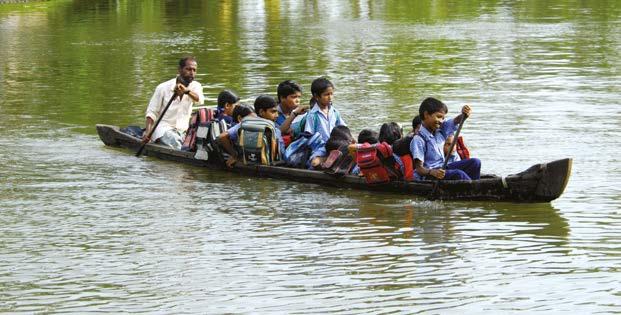
The children in this photo live in Kerala. Kerala is in India. It rains a lot in Kerala. These children don’t walk to school – they go by boat. How about you? How do you get to school? Do you walk? Do you go by boat?
2 Read the text again. Choose the correct option (a or b) to complete the rules.
1 In the Present simple, we add an ‘s’ to the verb after a he, she or it b I, you or they
2 To make questions, we put before the subject.
a is / are b does / do
3 To make the negative, we put before the main verb.
a isn’t / aren’t b doesn’t / don’t
3 Match the sentences (1-2) with the uses of the Present simple (a-b).
1 The children go to school by boat.
2 It rains a lot in Kerala.
We use the Present simple... a to talk about facts. b to talk about routine activities.
4 Complete the text with the Present simple form of the verbs.
I (1) (live) in Tokyo. It’s a very big city. I (2) (not / walk) to school, I (3) (go) to school by bus. After school, I (4) (read) in the library. I (5) (love) books!
My sister (6) (not / go) to school. She’s only two years old. She (7) (stay) at home and (8) (play) with her toys.
How about you? Where (9) (you / live)?
(10) (you / like) books?
Adverbs of frequency
5 Read the sentences about the Bardout family. Then choose the correct options to complete the rule.
1 The Bardouts are hardly ever at home.
2 They sometimes go to warm places.
3 The children always travel with them.
4 They often visit schools.
5 They usually travel to cold seas and icy lands.
Adverbs of frequency go before / after main verbs but before / after the verb be.
6 Write the adverbs from exercise 5 in the correct place.
Question words (2)
7 Read the questions (a-f). Which question word do we use for…
1 people?
2 things or ideas?
3 a specific time, e.g. 10.30 a.m.?
4 a reason?
5 a general time?
6 a place?
a What time does the library open?
b When do you usually go on holiday?
c Where do the children live?
d Who sits next to you in class?
e What does your friend do after school?
f Why do we learn English?
8 Choose the correct option to complete the questions.
1 Where do / does you come from?
2 What / Where do the children live?
3 What time / When is your birthday?
4 What / Why do you study English?
9 SPEAKING Read the answers and write the questions. Then ask and answer the questions in pairs.
1 A
B I usually go on holiday to Turkey.
2 A B I usually get up at 7.30 a.m.
3 A B I live in Madrid.
4 A B I usually do my homework after school. never
Listening 1
1 Listen and choose the correct option.
1 What is the woman’s surname?
a Suarez b Eswares
2 What is her address?
a 245 Vidalino b 245 Widaleno
3 What is her first name? a Isobel b Isabella
4 What is the man’s surname?
a Curry b Carey
5 What town does he live in?
a Bristol b Bristle
6 What is his first name?
a Ted b Todd
2 Listen to six people and write the places or names. Check your answers with a partner.
4 Read the questions (1-4). What kind of information do you need to answer each one? Choose the correct words in the box.
a date • a name • a price • a time
1 When does the next course begin?
2 What time do the lessons start?
3 How much do the lessons cost?
4 Who is teaching the course?
Exam task
5 PRELIMINARY Gap fill Listen and for each question, write the correct answer in the gap. Write one word or a number or a date or a time. You will hear a teacher talking about a new photography course at her school.
Riverside College Courses
Place: Riverside College Course: Photography
3 Read the Exam tip. Then listen to the instructions for the Exam task. Are the sentences true (T) or false (F)?
1 You will hear a man speaking.
2 The talk is about photography lessons.
3 You need to listen and choose the correct option, a, b or c.
Exam tip
Listening to instructions
• Before a listening task begins, you will hear some important instructions.
• The instructions may tell you who is speaking and where the listeners are. Listen carefully as this will help you understand the task.
• You will hear the instructions and the listening text twice.
Total number of lessons: (1) lessons
Dates of course: 15th September to 13th (2)
Time of lessons: (3) to 5.45 p.m. Tue and Fri
Total cost of course: (4) £
Teacher: (5) Mrs

Sunrise over Angkor Wat, UNESCO World Heritage Site, Cambodia
Talking about yourself
1 Work in pairs. Look at the photo. Then complete the sentences with these words. five • get up • live • school • weekend
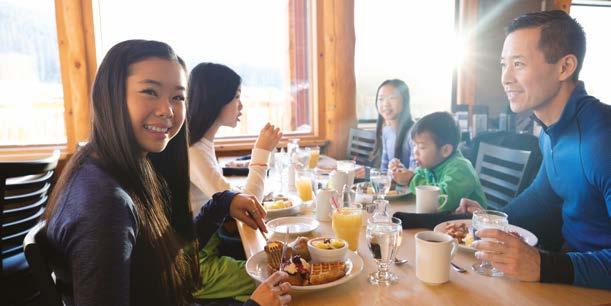
1 I in Seoul.
2 There are people in my family.
3 I go to high in Seocho-gu.
4 I at half past six in the morning.
5 At the we usually get up late.
2 Read the Exam tip. Match the extra information in sentences a-e with the sentences in exercise 1. Then listen and check your answers.
a We sometimes go to a café for breakfast.
b It’s a big city in South Korea.
c My lessons start at eight o’clock.
d I’ve got one sister and one brother.
e I like my school, but I get a lot of homework!
3 Look at the answers from students in a speaking exam. Which sentence is correct, a or b?
1 a There is five people in my family.
b There are five people in my family.
2 a I get up at seven o’clock.
b I am get up at seven o’clock.
3 a I’m in secondary school three year.
b I’m in the third year at secondary school.
4 a I watch usually TV in the evening.
b I usually watch TV in the evening.
5 a I meet my friends at the weekend.
b I meet at the weekend my friends.
4 Look at the sentences in exercise 3. Complete the examiner’s questions. Then listen and check your answers.
1 How many ?
2 What time ?
3 Which year ?
4 What ?
5 When ?
5 SPEAKING Work in pairs. Ask and answer the questions from exercise 4. Try to give extra information.
6 Work in pairs. Complete the Exam task. Take turns to ask and answer questions. Student A: Ask Student B the questions in the Exam task. Then listen and answer Student B’s questions. Student B: Turn to page 189. Use the Useful language to help you.
Exam tip
Giving details about yourself
• When talking about yourself, don’t just answer ‘yes’ or ‘no’.
• Give extra information or give reasons for your answer.
• Practise talking about yourself with your friends in class.
Exam task
7 PRELIMINARY Interview Work in pairs. Use the prompts to ask and answer questions.
• Where / live?
• Brothers or sisters? If yes, how many?
• When / your birthday?
• What / favourite subject at school? Why / like it?
• What / do / in your free time? Why / like these activities?
Useful
language
Talking about yourself
• I’m from…
• I live in…
• I’ve got one sister. She’s older / younger than me…
• My birthday is on…
• My favourite subject is…
ORACY SKILLS
• In my free time I usually…
• We usually go to…
• My favourite food is…
• I always (study / watch TV) with my dad / friends.
Frame your ideas
8 SEL Self-awareness Self-management Answer the questions.
• Describe your typical day. What’s your favourite part of the day? Why?
• What do you do when you want to relax? Do you prefer to be with other people or to be on your own?
The J&K Diaries – Episode 1
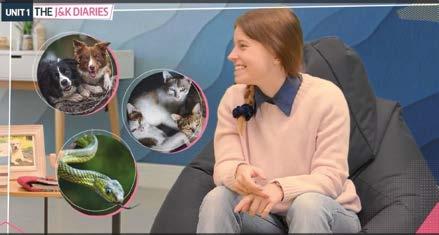
1 Watch the vlog and answer the questions.
1 How many pets has Kayla got?
2 How many people are in Josh’s family?
3 Who does Kayla write songs with?
4 What’s Josh’s favourite activity?
5 Who does Kayla usually visit on Saturday mornings?
6 What time does Josh get up on Saturday mornings?
2 You are going to read an article about elephant families. Discuss the questions with your partner. Then read the article quickly to check your ideas.
1 How many elephants are in an elephant family?
2 Are there male and female adult elephants in an elephant family?
Exam task
3 INVALSI Multiple matching Read the article again. Parts of the text have been removed. Choose the correct part (A-H) for each gap (1-6). There is one extra part that you should not use. The first one (0) has been done for you.
A make one really big group
B other elephants join the group
C walk over 150 kilometres in one day
D in big family groups
E in the middle of the group
F leads the other elephants
G live on their own
H a very low deep sound
4 MEDIATION Work in pairs. Make notes about the key information in the text. Cover the text and use your notes to give a short presentation about elephant families. Listen to your partner’s presentation and check that their facts are correct.
Frame your ideas
5 SEL Social awareness Self-awareness Work in pairs. Discuss these questions.
• How are elephant families like human families? How are they different?
• What does the word ‘family’ mean to you? Are your friends part of your family?
Real English
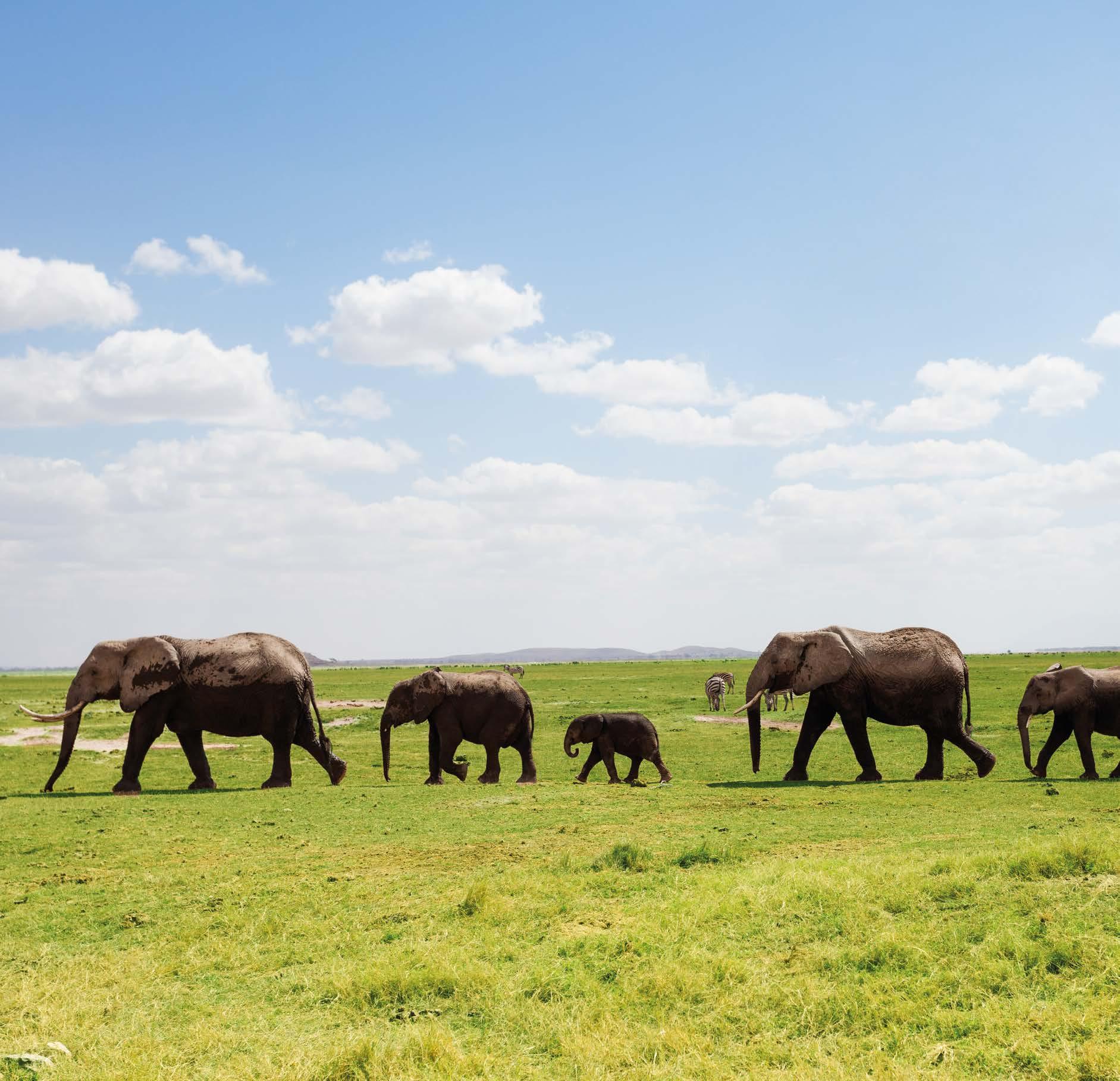
These elephants are walking single file. The babies are in the middle.
We’re crazy about Ci piace/piacciono tantissimo bestie (best friend) migliore amico/a Come on... Ma dai/Piantala…
Elephant Families: Big, Strongand Female!
Most humans live in family groups and we can also find strong families in the animal world. Elephants, for example, often live together (0) . The leader of the group is the ‘matriarch’ –an important, large female elephant. Other elephants in the family are the matriarch’s sisters, daughters and the baby elephants. There are usually between three and 25 elephants in a family group. Sometimes (1) , even when they are not part of the family. However, the adults are nearly always all females. So where are the male elephants? They usually leave the family group when they are about twelve years old and (2) , or sometimes with other male elephants.
The matriarch in an elephant family makes all the big decisions. She (3) to find food and water. The matriarch also has a very good memory, helping her return to the same important places like water holes or safe paths. When they walk, they often move ‘single file’ – in a line with one elephant in front of another. The babies always stay (4) , where they are safe. The bonds between the elephants in a family group are very strong and all the female elephants in a family group work together to look after the babies. When an elephant dies, the other elephants spend time with the dead body, sometimes returning to it several times over a few weeks.
Sometimes, several elephant families join together to (5) . These groups can have more than 500 elephants in them.
If an elephant wants to communicate with other family groups, it makes (6) . It’s difficult for humans to hear this sound, but the noise travels a very long distance – sometimes several kilometres.

Vocabulary 1
Family
1 Complete the groups (1-4) with the words in the box. Then choose the correct option in sentences a and b.
dad • daddy • grandad • grandma grandpa • granny • mum • mummy
1 grandmother, , 2 grandfather, , 3 mother, , 4 father, ,
a The people in 1 and 2 are parents / grandparents
b The people in 3 and 4 are parents / grandparents
2 Read the descriptions and write the words for family members.
1 This child is a boy: s
2 This child is a girl: d
3 A woman who is married: w
4 A man who is married: h
5 He is your mother’s or father’s brother: u
6 She is your mother’s or father’s sister: a
7 This is your mother’s sister’s child: c
3 Look at the family tree. Choose the correct options to complete the text.
The Leakey family is very famous. They are scientists and conservationists. Richard Leakey is a conservationist. He lives in Kenya. His (1) wife / mother, Meave, is a scientist. Richard’s (2) parents / sons, Louis and Mary Leakey, were also famous scientists. Richard has got two (3) sons / brothers: Jonathan and Philip. Louise and Samira are Richard’s (4) daughters / aunts. Louise’s (5) husband / uncle is Emmanuel. He is Belgian. Jonathan and Philip Leakey are Louise’s (6) nephews / uncles. Samira is Louise’s (7) sister / aunt and she is Philip’s (8) cousin / niece
4 WRITING Work in pairs. Make sentences about the people in the family tree. Use the words in the box.
brother • father • grandfather grandmother • mother niece • sister • uncle
Mary is Samira’s grandmother.
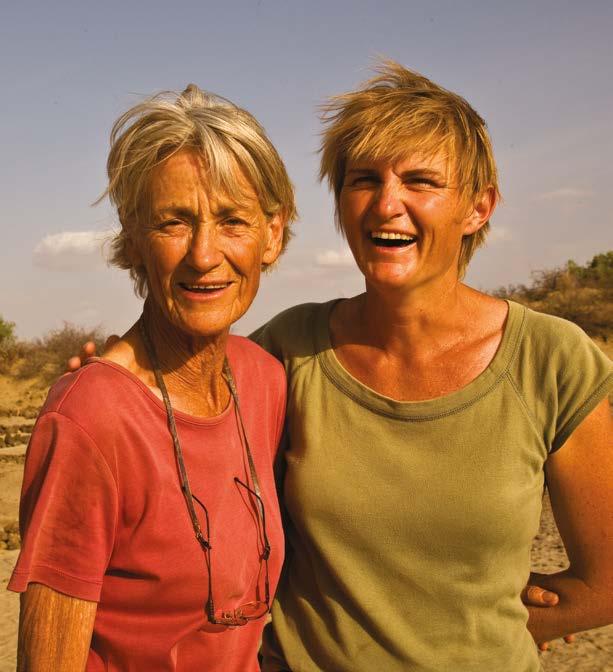
5 VISIBLE THINKING Look at the photo of Meave and Louise and answer the questions.
See Who can you see in the photo?
Think Where do you think they are?
Wonder Would you like to know anything about Louise’s grandparents? Why? / Why not?
Frame your ideas
6 A SPEAKING Write the names of four family members. Tell your partner about them.
6 B WRITING Write a short description of one of the family members from 6A. Include information about:
• their relationship to you (e.g.: aunt, cousin, grandfather, etc.);
• their age;
• their interests and hobbies;
• what they look like.
Louis Leakey Mary Leakey
Jonathan Leakey Richard Leakey
Philip Leakey Meave Leakey
Emmanuel de Merode
Louise Leakey
Samira Leakey
Meave and Louise Leakey
Present continuous
1 Work in pairs. Read the text. Tell your partner what Yusuf and his sisters are doing today.
Yusuf is studying English at college this year. Today, he’s working at home. He isn’t reading a book. He’s writing a letter to his penfriend. His sisters are sitting in the kitchen. They aren’t eating. They’re listening to music. What are you doing? Are you listening to music?
2 Look at the text again. Then choose the correct options to complete the rules.
a We use the Present continuous to describe actions that happen every day / are happening now
b We form the Present continuous with the verb be / do and the infinitive / -ing form
3 Complete the telephone conversation with the Present continuous form of the verbs. Then listen and check your answers.
Jordi Hi, Rosa. Where are you?
Rosa I (1) (sit) in the garden.
Jordi (2) (you / listen) to music?
Rosa No, I (3) (finish) my geography project.
Jordi What (4) (you / study) at the moment?
Rosa We (5) (learn) about Greenland. It’s really interesting.
Jordi Cool. So, what (6) (your brother / do) today? Some kind of sport?
Rosa No, not exactly. He (7) (not / play) football at the moment because he hurt his foot. He (8) (watch) tennis on TV instead!
like + -ing form
4 Read the conversation. Choose the correct option, a or b, to complete the rule.
A What do you like doing at the weekend?
B I love swimming and I really enjoy watching films. How about you?
A I don’t like swimming. I’m really bad at it. I like watching films and I love playing video games.
B Really? I hate playing video games. They’re really boring. What about playing board games?
A I don’t mind playing board games. They’re OK.


To describe our likes and dislikes we use love / like, enjoy / don’t mind / hate + a verb + -ing; b infinitive form.

5 SEL Self-awareness Work in pairs. Take turns to make sentences with love / like / enjoy / don’t mind / hate about the activities below. do exercise • do homework • go shopping play football • prepare lunch • speak English ride my bike • visit grandparents
6 Use the Present simple or the Present continuous form of the verbs to complete the email.
Hi Blake!
What (1) (you / do) at the moment? I (2) (make) a cake. I usually (3) (do) my homework on Sunday morning, but I (4) (not / study) today because it’s my sister’s birthday and she wants a cake. She (5) (not / usually / wake up) early at the weekend because she loves sleeping. But today is different! She’s very excited about her birthday presents. My parents usually (6) (go) to the supermarket on Saturday morning, but today we’re all at home. My sister (7) (open) her presents and my parents (8) (take) lots of photos with their phones.
Exam tip VIDEO
Writing the missing words
• Read the text first to get the general idea.
• Look at each gap. What type of word do you think goes in the gap?
• Read the text again and fill in the gaps. Check your answers make sense.
• When you’ve finished, read the email again and check your spelling.
Exam task
7 PRELIMINARY Open cloze Read the Exam tip. Then read the email and for each question, write the correct answer. Write one word for each gap.
Hi Lucy!
How are you? (1) are you doing today? I (2) staying with my granny at the moment. She usually comes (3) our house at the weekend, but it’s (4) birthday today – she’s 72 –and there’s a big family party. My uncle, aunt and two cousins are here. My cousins (5) making Granny’s birthday cake!
Love
Sandra
Writing lab 1
Expressing likes and reasons
Useful language
Expressing likes
• I like + -ing form
• I enjoy + -ing form
• I love + -ing form
• I like … because…
ORACY SKILLS
Expressing reasons
• I want to … because…
• My goal is to…
• I think it’s important to…
• … helps me
1 Look at the advert. Then listen to the interview and complete the sentences below with a maximum of four words.
Join our under-18 volunteer project in Mexico
Spend two weeks in Mexico with our team of scientists and divers.
• learn how to dive
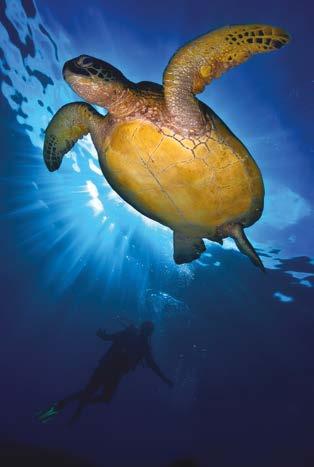
• help look after sea turtles and other marine life
• explore the beautiful Caribbean Sea
1 Matt loves swimming and in the sea.
2 Being helps him to relax.
3 He thinks it’s important to
4 His goal is to become a
5 He enjoys finding out about different animals and
6 He wants to learn how to .
2 Work in pairs. Student A: You want to take part in the Under-18 Volunteer project. Explain why. Student B: You are interviewing Student A. Ask questions to find out why they are interested in the project.
Learning
focus
Focusing on accuracy
When you complete a form, you often need to give the following information:
• title (e.g. Mr, Mrs, Ms, Miss)
• first name and surname
• age and/or date of birth (DOB)
• place of birth
• home address
• phone number
• email address
You must learn to write this information in the correct place.
3
SUPERFIT GYM
Listen to a conversation at a gym. Complete the form with the correct information.
Membership Application
First name:
Surname:
Home address:
Email address:
Phone number:
Date of birth: 15 Grove Road, Manchester, M5 2
4 Complete the form with your own information.
TURNER ACADEMY SCHOOL of ENGLISH
Do you want to improve your English?
• Join our new four-week English language course.
• Speak, read, listen to and write English every day!
• Meet other students from different countries.
• Have fun with English games, videos and songs! Complete the application form with your details and tell us why you want to learn English.
SUMMER SCHOOL APPLICATION FORM
Title:
First name:
Surname:
DOB: / /
Nationality:
Address:
Email:
Phone:
Course level: Beginner Pre-intermediate Intermediate Advanced
5 DEBATE Have a class debate on this statement. English is the most important school subject
Work in two groups. Group 1: Think of four reasons in favour of the statement. Group 2: Think of four reasons against the statement. Take turns to give reasons for your opinions. Finally have a class vote.
6 Complete the Reflection checklist.
Tick (4) the sentences that you think are true. I wrote the information in the correct place. I checked that the information was accurate. I completed all parts of the form. Reflection checklist
2 Looking good!

1 VISIBLE THINKING Look at the photo. Discuss in pairs.
See How many different colours can you see?
Think How do you think she feels about her clothes?
Wonder What do you want to find out about the festival?
2 Watch the video A Taste of India and answer the questions.
1 How do 18 million people in India travel every day?
2 How many official languages does India have?
3 What colour do women in India wear when they get married?
4 What colour do they wear if their husband dies?
5 What percentage (%) of Indian people live in cities?
6 Why do international tourists visit India?
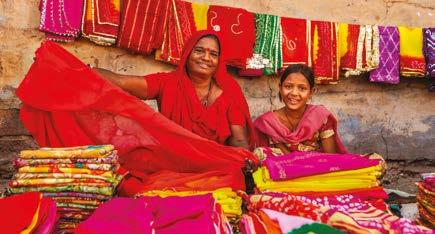
A girl in traditional costume at a festival in Chile
1 SPEAKING Work in pairs. Think of a festival from your country. Which of these things do you do?

a b
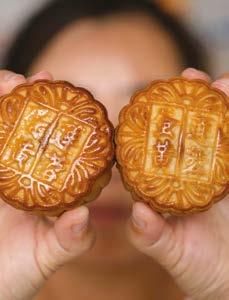
wear traditional clothes eat special food
c d

sing special songs dance
e f
visit a special place watch a parade
2 VISIBLE THINKING Look at the photos on page 35. Discuss in pairs.
See What are the people doing?
Think Which countries do you think they are from?
Wonder Which place do you want to visit and why?
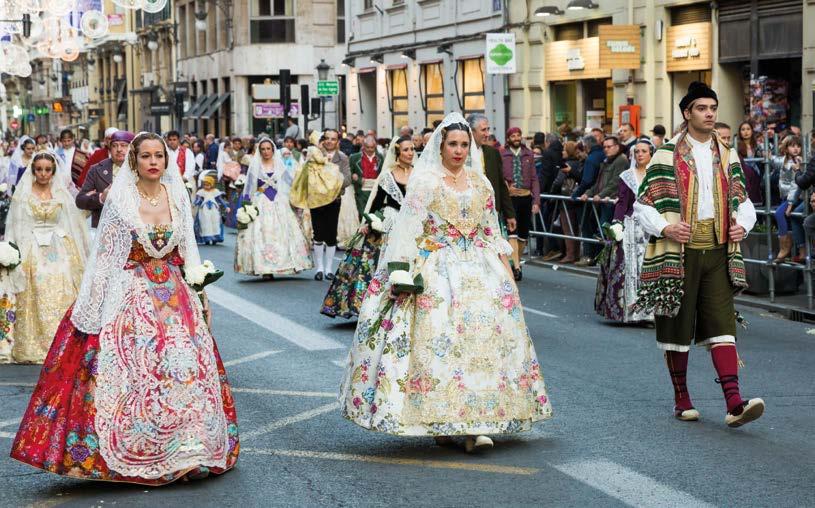
3 Work in pairs. Look at the photos on page 35 again. Match the photos (a–c) with the countries (1–3). Read the texts quickly to check your ideas.
1 Trinidad
2 Japan
3 Spain
Exam tip
Identifying the topic
• In some exam tasks you have to complete the text with missing sentences.
• Read the whole text first to get an idea of the general meaning.
• Then look at each paragraph and think about the topic of that paragraph.
• Read the sentences and think about the topic of each sentence.
• After completing the text, read it through and check that it makes sense.
Exam task
4 PRELIMINARY Gapped text Read the Exam tip. Then read the texts on page 35. Four sentences have been removed. For each question, choose the correct answer. There are two extra sentences which you do not need to use.
A Some of the children were in animal costumes.
B The music was very loud and everyone was happy.
C There is a special coming-of -age ceremony to celebrate this.
D On these days, lots of men and women danced on the streets.
E There were some special dances as well.
F My favourite day of the Carnival was Saturday.
Frame your ideas
5 SPEAKING Answer the questions.
• Which of the three festivals do you want to see? Why?
• Citizenship In Japan, young people become adults when they are twenty. At what age does a young person become an adult in your country?
Festival Time
I was at the Las Fallas Festival in Valencia last year. It’s a nineteen-day street festival in March and it’s amazing! There were some big paper models of animals and people, and there were beautiful fireworks. The best days of the festival were from the 15-19th March when lots of people were in traditional clothes. (1) The women were in long dresses and the men were in and black suits with special waistcoats.
Last February, I visited Trinidad. It was a wonderful trip because it was during the Carnival. There were some amazing parades. (2) Hundreds of children danced through the streets because it was the Children’s Carnival. Their costumes were in lots of bright colours. (3) They were birds, insects and fish. I loved them! At the end of the day there were prizes for the best costumes.

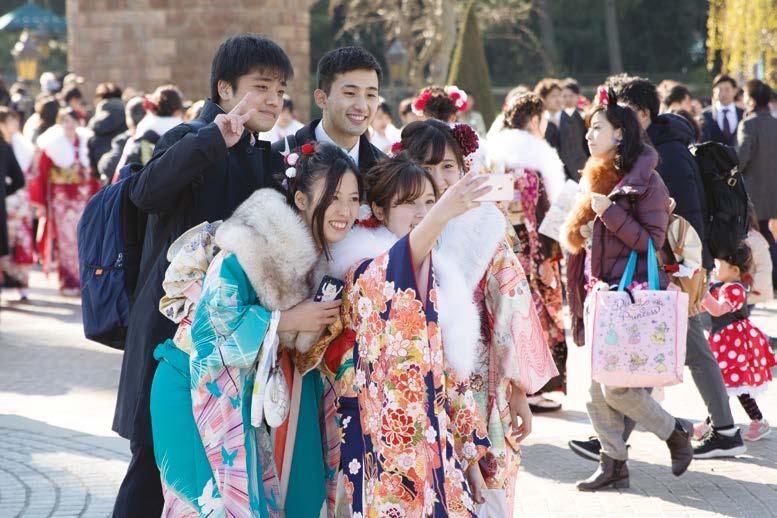
When young people are 20 years old in Japan, they become adults. (4) It is always on the second Monday in January. I was in Kyoto last year to see the ceremony. The girls were in traditional Japanese kimonos in bright colours. Many of the men were in dark suits with white shirts and ties. Everyone looked amazing. I’ve got some great photos of all the young people and their beautiful clothes.

Vocabulary 2
Clothes and colours
1 Listen and match the descriptions (1-2) with the photos (a-b).
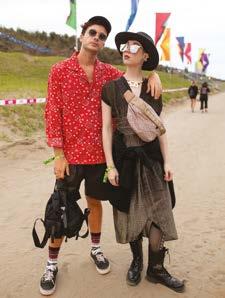
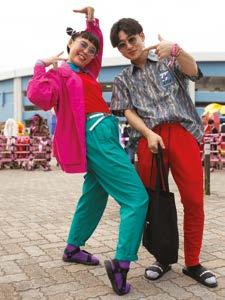
2 Look at the photos again. Who is wearing…
1 a red jumper? the girl in photo b
2 black sandals with purple socks?
3 stripy socks?
4 a stripy shirt?
3 Write these words under the correct heading. belt • boots • cap • dress • handbag • hat jacket • jumper • necklace • sandals • shirt shorts • skirt • suit • trainers • trousers
6 Complete the text with the words in the box. dress • handbag • jumper • necklace • sandals • suit
What are you wearing today?
Tell us about your clothes. Is it a special day? Are you wearing something amazing? Or are you staying at home and chilling? Comment below!
It’s my cousin’s 21st birthday today and we’re having a party to celebrate! We’re ready to go out and I think we all look amazing! My brother is wearing a dark blue (1) with a white shirt and a purple tie. My cousin is wearing a yellow (2) and big black boots. Her mum – my aunt – is wearing a long pink skirt and a stripy green and pink (3) . She’s got my cousin’s present in her (4) – it’s a beautiful silver (5) . And me? I’m wearing a T-shirt, shorts and (6) . I don’t like wearing formal clothes!
7 A CRITICAL THINKING Work in pairs. Look at the statement. Think of two reasons to agree with it and two reasons to disagree. You can use the ideas in the box or your own ideas.
‘Clothes are like a language – we use them to tell the world about our personality and interests.’
• can’t always choose our clothes
• clothes can be expensive
• colours mean different things in different cultures
• what you say is more important than what you wear
• you don’t need a lot of money to make your clothes look different
4 SPEAKING Work in pairs. Take turns to choose one of the people in the photos in exercise 1. Describe the person’s clothes. Can your partner guess the person?
This person is wearing a brown…
5 Choose the correct option to complete the sentences.
1 I want to wear a jumper / sandals today because it’s very cold.
2 When I go running, I usually wear a dress / trainers
3 I can’t find my phone. Maybe it’s in my cap / handbag
4 I’ve got a job interview today, so I’m wearing a cap / suit
5 I can’t find a belt for these trousers / trainers
6 My dad always wears shorts / boots – even in the middle of winter!
• everyone can be creative with clothes
7 B DEBATE SEL Self-awareness Divide the class in two groups. Work in your group to make a short speech in favour of / against the statement. Group 1 is in favour of the statement. Group 2 is against the statement.
7 C Listen to each other and ask questions. Finally, have a class vote.
Frame your ideas
8 SPEAKING Answer the questions.
• Do you think clothes are important? Why? / Why not?
• Work in pairs. Describe your favourite clothes. Say when and why you like wearing them.
Past simple (was/were and regular verbs)
1 Read the sentences. Then complete the rule below with was or were.
1 My friends and I were in traditional Japanese kimonos.
2 My favourite day of the Carnival was Saturday. The past form of be is was/were We use (1) after I, he, she, it We use (2) after you, we, they
2 Read the conversations. Then choose the correct option to complete the rules (a-e).
A Did you finish your homework yesterday?
B No, I didn’t. I watched a film with my brother and then we played football in the park.
A You weren’t at the party last night. Were you ill?
B No, I wasn’t. I was really tired and I didn’t want to go out.
the verb be • infinitive • did • -ed • finished
a We use the Past simple for a action in the past.
b To make the Past simple of regular verbs we add to the infinitive form.
c To make a Past simple negative sentence, we use did + not +
d To make a question in the Past simple, we use + subject + infinitive.
e We don’t use did in Past simple questions and negatives with
3 Complete the sentences with the Past simple form of the verbs in brackets.
1 We (watch) a really interesting film about the Las Fallas Festival last night.
2 He (not / visit) his grandparents at the weekend because he (be) ill.
3 A (be /you) at the concert last night?
B No, I . I (stay) at home and (study) for my exams.
4 A (your friends / walk) home after school?
B Yes, they
5 My brother and I (play) video games yesterday after school.
6 Katya and Irina (not / be) on the bus this morning.
4 Read the answers. Then write questions.
1 When ?
He moved to Rome in 2024.
2 Who ? I called my aunt.
3 Where ? They stayed at their friend’s house.
4 What time ? The exam finished at 4.30.
5 How ? I travelled to Italy by boat.
6 Why ? I used Joe’s computer because mine isn’t working.
5
Complete the text with the Past simple form of the verbs in the box. Then listen and check your answers.
answer • arrive • be (x 2) • close • fail • happen look • miss • not want • open • start
Tarek Hi, Faye. Are you OK?
Faye No, I’m not. I (1) my history test.
Tarek Oh no! What (2) ?
Faye Well, I (3) my bus, so I was late for the exam. It (4) at 9 o’clock and I (5) there at 9.30.
Tarek That’s not good.
Faye I (6) the first question very quickly. It (7) really easy.
Tarek Well done!
Faye But then I (8) at the next three questions. They (9) all impossible! I (10) to get the answers wrong, so I (11) my eyes and tried to think calmly. When I (12) my eyes, it was eleven o’clock and that was the end of the exam!
Tarek What a disaster!
6 SPEAKING Work in pairs. Talk about your day yesterday. Use the verbs in the box and your own ideas. Make three true sentences and two false sentences. Can your partner spot the false sentences?
I didn’t walk to school yesterday. failed
listen (to) • play • study • talk (to) travel (by) • visit • walk • watch
I think that’s false. You always walk to school!
7 SPEAKING Work in pairs. How is your life today different from your parents’ and grandparents’ lives in the past? Frame your ideas
Listening 2
1 Read the sentences. Underline the important words and think about what you might hear. Then listen to the speakers, but don’t choose your answer yet.
1 Jack’s new shoes are… a black. b brown.
2 The girl’s brother is wearing… a a big hat. b a small hat.
3 Jodie has got… a a new skirt. b a new dress.
4 When he was younger, the boy liked… a playing computer games. b riding his bike.
5 The girl’s necklace is… a expensive b small.
6 The girl didn’t visit the beach yesterday because… a it wasn’t hot. b she wanted to finish her homework.
2 Listen again to the first two conversations. Complete the sentences.
1 A I like your shoes, Jack. Are they ?
B Yes, they are. My brown ones too small.
A Well, these ones much nicer.
2 A Is that your over there? The boy wearing a ?
B Yes, it is. I don’t know why he always wears it. It’s too for him!
A Well, maybe you can buy him a new, hat for his birthday.
3 SPEAKING Work in pairs. Compare your ideas from exercise 2.
4 Listen to all the conversations again. Choose the correct options in exercise 1.
5 Read the Exam tip. Are the sentences true (T) or false (F)?
1 Read only the first question before you listen.
2 You will probably hear words from all the answer options.
3 You should choose your answers as quickly as possible.
4 You should listen to the complete conversation before you choose your answers.
Exam tip
Identifying the correct answer
• In some listening tasks you will hear five different conversations or speakers and answer a question on each one. Read the questions first and look at the options.
• You usually hear words from the different options for each question. Listen carefully to identify which option is correct.
• You will hear the conversation twice. The first time, listen to the complete conversation and choose your answer.
• Then listen again and check that the other answers are incorrect.
Exam task
6 PRELIMINARY Multiple choice with five conversations Listen and for each question, choose the correct answer.
1 You will hear a man talking to a friend about a new suit. Why did he want it?
A for a wedding
B it was on sale
C to go to a job interview
2 You will hear a woman talking to a friend about a party. What does she need?
A a present
B a necklace
C a new dress
3 You will hear a man talking to a shop assistant. Why doesn’t he buy the T-shirt?
A It’s too expensive.
B It’s too small.
C It’s the wrong colour.
4 You will hear a man talking on the phone. Why is he upset?
A He missed the train.
B His bus was late.
C He didn’t have his jumper.
5 You will hear a woman talking to her friend about ordering something online. What does she want to buy?
A boots
B sandals
C trainers
British Punk British punk started in the 1970s. It was loud music with strong messages. Bands like the Sex Pistols and The Clash were very popular. Punk music talked about problems in society and made young people feel powerful. Punk fans wanted to be different. They wore ripped clothes, leather jackets, and big boots. Bright hair colours and mohawks were popular. Some people had piercings and strong makeup.

BritCult

Describing people
1 SPEAKING Work in pairs.
Student A: Choose a person from the photo. Don’t say who it is.
Student B: Ask yes/no questions about the person. Try to find out who it is. Then change roles.
Is the person wearing… ? Has the person got… ?
2 Read the questions. Decide if each question is asking about appearance (A), interests (I) or activities (AC).
1 What does your best friend look like?
2 Do you like doing the same things?
3 What kind of music does your friend like?
4 How often do you see your best friend?
5 Where do you go together?
6 Does your best friend look similar to you?
7 What kinds of clothes does your friend like to wear?
8 Do you both go to the same school?
3 Read the Exam tip. Then work in pairs. Ask and answer the questions in exercise 2.
4 With your partner, choose the correct linking words to complete this description.
‘He’s a really good friend. We like a lot of the same things. We both love music, (1) for example / but, and we play together in a band. He loves unusual clothes (2) or / and he’s got lots of amazing big hats (3) but / so he doesn’t usually buy his clothes from shops – he makes them! We live in the same street, (4) or / so we see each other nearly every day. We like playing computer games together (5) or / for example football.’
Giving a description of a friend
• If the examiner says, ‘Tell me about your friend’, describe your friend’s appearance, interests, likes and dislikes.
• If the examiner says, ‘What is your best friend like?’, describe your friend. Do not answer ‘My best friend likes…’.
• Use lots of adjectives to describe your friend.
• Don’t give one-word answers. Give reasons and examples.
• Use linking words such as and, but and or
Exam task
5 PRELIMINARY Interview Work in pairs. Student A: Ask Student B the questions. Student B: Answer the questions. Use the Useful language to help you. Then change roles and repeat the interview.
Tell me about a friend.
• What is your friend like?
• What kind of clothes and fashions do they like?
• How do you spend your time when you are together?
• Do you have the same interests? What are they?
• What do you like best about your friend?
• What do you and your friend disagree about?
Useful language
Describing a person
• She’s (tall / blonde / quiet). He’s got (long hair / glasses).
• She usually wears (trousers / black).
• He understands me / listens to my problems.
• She loves (animals / science / volleyball).
• He doesn’t like (cooking / parties / winter).
Frame
your ideas
6 SPEAKING Answer the questions.
• Do you and your friend wear similar clothes?
• Which activities do you like to do with friends? Which activities do you prefer to do on your own?
ORACY SKILLS
The J&K Diaries – Episode 2
1 Watch the vlog and complete the sentences with Kayla or Josh.
1 is kind and helpful.
2 was a model for the show.
3 is very busy at the moment.
4 designed a stripy shirt for the fashion show.
5 is creative.
6 was dancing and fell over.
2 Read the text on page 41 quickly. What type of text is it?
A an article about the brain for a science magazine
B a message asking for advice and a reply giving advice
C a story about someone’s memory of being a teenager
Reading tip
For some tasks you have to complete sentences.
• Read the instructions and text carefully.
• Identify key information by looking for keywords or specific phrases.
• Use words from the text to complete the sentences. Use no more than four words.
• Complete the easy sentences first, and then return to the more difficult ones.
Reading task
3 Read the text again. Complete the sentences (1-5), using a maximum of four words from the text. The first one (0) has been done for you.
0 Jun wants Dr Xavier to explain why his
mood keeps changing
1 Jun felt when he was with his classmates in the morning.
2 Your brain doesn’t grow in size after you are
3 When you are a teenager, the limbic system in your brain is
4 Your pre-frontal cortex helps you to
5 It’s difficult for teenagers to and so they sometimes do dangerous things.
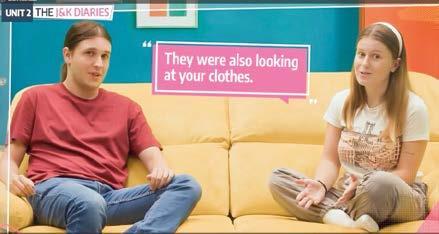
Real English
So, anyway comunque hysterical super-divertente in fact in effetti
4 SEL Self-awareness Self-management Work in groups. Discuss these questions.
1 Do your moods change often during the day?
2 What do you do if you feel angry and want to calm down?
3 What do you do if you feel sad and want to be happier?
4 Describe a time when you did something dangerous because you made a bad decision.
5 SPEAKING SEL Self-awareness Keep a record of the different emotions you feel during one day. Then compare your list with a classmate. How many different emotions do you feel in one day?
7 a.m. I’m feeling tired. 8.30 a.m. I’m feeling …


Talk to Dr Xavier


Hi Dr Xavier
I’m fifteen years old and I don’t understand why my mood keeps changing. For example, yesterday I woke up in a bad mood and didn’t want to speak to anyone in my family. I was feeling sad and tired, but I didn’t know why. Then when I got to school, I spent some time with my classmates. We were laughing together and telling jokes, and I felt friendly and happy. But in the afternoon, my mood changed, and I was suddenly getting angry with everyone and shouting at my friends. What’s happening to me? Please help! Thanks, Jun
Hi Jun
Don’t worry – you’re not alone. When you’re a teenager, your emotions can change very quickly and sometimes it’s difficult to understand why. But in fact, there is a scientific reason for this, and it’s connected to your brain. Your brain stops growing in size when you are about eight years old. But it continues to develop and change until you are about 24. The part of your brain that makes you feel emotions – the limbic system – is already very strong when you’re a teenager. But the part of your brain that helps you to plan and make decisions – your pre-frontal cortex – is still growing and changing. So, you feel lots of different emotions, but your brain doesn’t know what to do with these emotions or how to manage them. That’s also why sometimes teenagers do dangerous things – because they can’t control their impulses


I hope that helps you to understand why your mood keeps changing. Now here’s some advice for you. When you feel worried, or angry, try to do some breathing exercises. Close your eyes, listen to some calm music and breathe in and out slowly.
Good luck!
Dr Xavier
Vocabulary 2
Adjectives to describe people
1 Complete the sentences with these words. clever • friendly • funny • happy • kind • quiet
1 Senu makes me laugh. She loves telling jokes. She’s so .
2 Paolo doesn’t talk very much. He’s very
3 Tania smiles and is all the time.
4 Kuba always helps other people. He’s very .
5 Katerina loves meeting new people and going to parties. She’s very .
6 Omar always gets good marks in his exams. He’s very .
2 Choose the correct options to complete the definitions.
1 A person who doesn’t make mistakes and doesn’t do things too fast is useful / careful
2 A person who does dangerous things and isn’t afraid is brave / tired
3 A person who speaks loudly and isn’t quiet is noisy / heavy
4 A person who is always doing lots of things is boring / busy
5 A person who has lots of ideas and likes making things is creative / angry
6 A person who says unkind things to another person is lively / rude
7 A person who is very good at something is brilliant / lazy
8 A person who always does their homework is hard-working / calm
It is easy to confuse adjectives ending in -ed (e.g. bored, interested) and adjectives ending in -ing (e.g. boring, interesting).
-ed adjectives describe emotions, or how someone feels;
-ing adjectives describe the cause of the emotion.
This book is boring. I am bored. This lesson is interesting. I am interested.
3 Complete the table with the adjectives. Noun Adjective 1 beauty 2 care 3 friend 4 love 5 noise 6
4 SPEAKING Work in pairs. Take turns to describe people you know (e.g. your dad, your best friend). Talk about the clothes they usually wear and their personality.
My dad usually wears jeans and a T-shirt. He’s really kind because he helps me with my homework.
5 Listen to the conversation. Are the sentences true (T) or false (F)?
1 Tomasz’s new school isn’t very big.
2 His classmates are really friendly.
3 Tomasz usually loves maths.
4 He doesn’t think history is boring.
5 His art teacher is very quiet.
6 Ursula hasn’t got much homework at the moment.
6 SPEAKING Think about a time when you were brave, kind or funny. Tell your partner about it. Frame your ideas
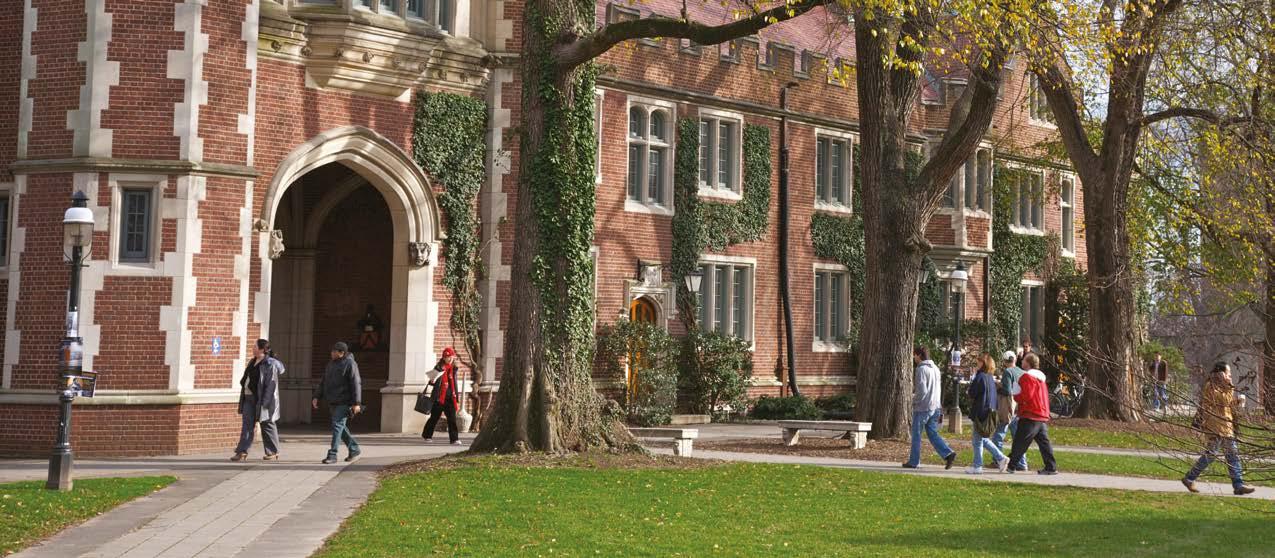
Wordlist p. 211
Past simple (irregular verbs)
1 Read the sentences. Find a regular Past simple verb (ending -ed) and an irregular Past simple verb.
1 I spent some time with my classmates.
2 In the afternoon, my mood changed.
2 Complete the table with the Past simple form of the irregular verbs.
Infinitive Past simple
1 bring 2 buy 3 catch 4 drink
Past continuous
3 Read the sentences and underline examples of the Past continuous. The first one is done for you.
1 I was studying in Singapore last February when my friend invited me to a Chinese New Year festival.
2 The children were wearing amazing costumes and the band was playing loud music.
4 Complete the rules with these words. Then match the verbs in exercise 3 with the uses (i-iv).
action • information • past • the same time • be
a We use the Past continuous…
i to describe actions that were happening at a specific time in the . ii to show two or more actions that were happening at in the past.
iii to give background in a story.
iv with the Past simple to show an action that was interrupted by another
b We form the Past continuous with the past tense of the verb and the -ing form of the main verb.
5 Complete the Past continuous sentences with was or were.
1 The cat sleeping in the garden.
2 We walking to school when we saw a snake on the road.
3 My friend and I doing our homework together yesterday evening.
4 Ben watching a film and his sister listening to some music.
6 Complete the conversations with the Past continuous form of the verbs.
1 A Why did you go home early?
B Because I (not / feel) well.
2 A Why didn’t you answer your phone last night?
B Because I (have) dinner with my family.
3 A What was Nadia doing at the weekend?
B She (work) on her science project.
4 A you (sing) in the shower this morning?
B No, I wasn’t. I (listen) to my favourite song on the radio.
5 A Rafa, can you read your story to the class, please?
B It was a beautiful day. The sun (shine) and lots of people (sit) on the beach.
6 A Why you (laugh) in the science lesson today?
B Because my friend told a really funny joke.
7 Look at the family photo. Choose the correct options to complete the description.
Look at this old photo! It’s really funny. I think your grandad’s sister (1) took / was taking this photo in about 1977. We (2) stood / were standing in our garden on a summer’s day – I remember the sun (3) shone / was shining and we were all really hot. I (4) had / was having long hair when I was a child and I (5) loved / was loving that stripy T-shirt. It was my favourite! My brother always (6) hated / was hating family photos. You can see he (7) was smiling / smiled in this photo, but just a few minutes later he (8) was getting / got really angry and (9) ran / was running away into his room. Your grandmother really (10) didn’t like / wasn’t liking that shirt, but your grandad (11) bought / was buying it for her birthday and so she (12) was choosing / chose it specially for that photo.
8 SPEAKING Think of a funny, true story about your family. What happened? What were the different people doing / wearing / saying? Why was it funny? Frame your ideas
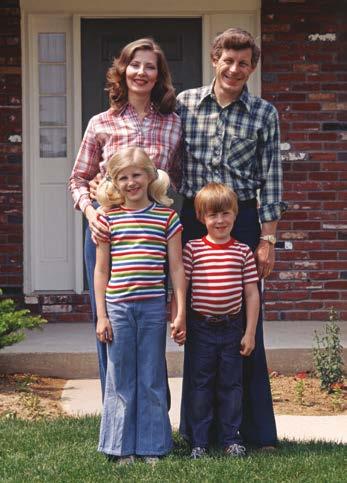
Writing lab 2
Describing an activity
Useful language
Greetings
• Hi Jack • Hello! • Dear Jack
Sign-offs
• Love, Emily • See you soon / on Saturday!
• Best wishes
Describing experiences
• It was (amazing / exciting / fun).
• We had (a lot of fun / a great time).
1 Look at the email. Tick (4) the information that is included.
1 Sarah’s clothes
2 Claire’s clothes
Hi Emma!
3 Sarah’s personality 4 Claire’s personality
I went to my cousin Claire’s party last Saturday. It was really great and we had a lot of fun! I was wearing my favourite blue dress and black boots. Claire’s very friendly, so there were lots of people at her party. She’s noisy too, but she’s very funny.
See you soon!
Sarah
Learning focus
Writing about personality
• When you describe someone’s personality, you can write about their good and bad qualities.
• Give examples to support your descriptions.
• Use linking words and phrases to connect your descriptions and examples (so, and, but, because, that’s why, for example).
2 Choose the correct linking words to complete the sentences.
1 Farhad is very quiet, so / but it’s sometimes difficult for him to make friends.
2 Antonella makes everyone laugh but / because she’s really funny.
3 Alicia isn’t very kind and / for example sometimes upsets her friends.
4 Berat is very careful, because / and that’s why he makes very few mistakes.
5 Khrista is usually a happy person, and / but she was really sad yesterday.
6 Dan is always really busy; for example / but yesterday he played chess, tennis and football.
3 Underline the linking words in the email in exercise 1.
4 Work in pairs. Tell your partner about an activity you did recently. Include information about:
• where you went / what you did
• when you went there / did the activity
• what you were wearing
I played basketball on Saturday with my friend Rahul. We …
Exam tip
Including all the points
• There are usually four points in the writing task and you must include all of them in your answer.
• Underline the key words to make sure you understand each point.
• Remember to write a draft first before you write the final email on your answer sheet.
Exam task
5 PRELIMINARY Writing an email Read the Exam tip and make a plan for your task. Use the Useful language to help you. Read this email from your English-speaking friend Sam and the notes you have made. Write your email to Sam using all your notes. Write about 75 words.
Hi
Thanks so much for your email. I really enjoyed the party last weekend.
I hope you had a good time at the music festival on Sunday. Who did you go with?
It was very cold on Sunday! Did you wear your jeans with your favourite blue top?
Tell me about some of the things you did at the festival.
See you soon!
Sam
6 Complete the Reflection checklist. Then discuss your answers with your partner.
Reflection checklist
Tick (4) the sentences that you think are true. I wrote a plan first. I wrote a first draft. I used linking words. I included all four points. I wrote the correct number of words.
Me too –say why No, because …
Describe an activity Say who
Towards INVALSI
Reading
1 Work in pairs. Read the definition of second-hand in the Word focus below. Discuss the questions.
1 How often do you buy second-hand clothes?
2 Where do you buy them from?
2 Read the text and the sentences (1-6) and decide if the sentences are true (T), false (F) or if the information is not given (NG). The first one (0) has been done for you.
The Speed of Fashion
In the early 2000s, there was a focus on fast fashion. People wanted to buy the latest trainers or T-shirts and they didn’t want to pay a lot of money for their clothes. They wore these cheap clothes three or four times and then the fashions changed, or they got bored and they wanted to buy something new and different. They threw away their old clothes and didn’t really think about what happened to them or where they went. In fact, between 2000 and 2014, we bought 60% more clothes and wore them for 50% less time.
However, the way we buy our clothes is changing. Many influencers and fashion bloggers today are encouraging young people to think in a different way about their clothes. There is more of a focus on slow fashion. Second-hand clothes are becoming much more popular. In the past, most people usually only bought second-hand clothes when they didn’t have enough money for new clothes, or because they were looking for a particular vintage style. Young people today want to buy second-hand, or ‘pre-loved’ clothes because they can get good quality clothes at a low price and also because it’s better for the environment and more sustainable.
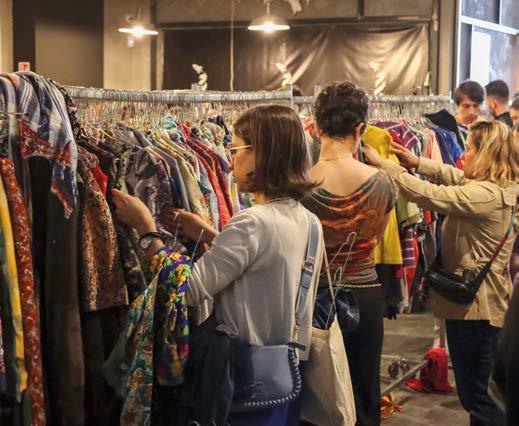
As well as buying second-hand clothes on the high street and online, young people are selling their old clothes online instead of throwing them away. They’re also learning how to repair their old clothes or how to ‘upcycle’ them – making them into something new and different. In this way, they’re saving money and helping to save the planet.
0 Fast fashion was a popular trend in the early 2000s.
1 Trainers and T-shirts were much cheaper in the early 2000s.
2 During the period of fast fashion, people bought fewer clothes.
3 Many young people today want to become fashion bloggers.
Word focus
second-hand (adj): di seconda mano, usato/a
4 Second-hand clothes in the past were popular because they were cheaper than new clothes.
5 Today, second-hand clothes are usually quite expensive.
6 People today throw away fewer clothes than in the early 2000s.
Listening
3 Listen to Nathan, who is talking about how he started his business. Complete the sentences (1-6) using a maximum of four words. The first one (0) has been done for you.
0 Nathan met Tom when he was
1 At school, Tom and Nathan both liked
2 Nathan went to university to study
3 Tom designed the displays for a department store .
4 They became popular when a famous singer wore one of their suits in a .
5 They opened their second shop in Edinburgh in
6 Nathan doesn’t like wearing
Vocabulary
1 Choose the correct option to complete the sentences.
1 I usually wake up / have lunch at 6 in the morning.
2 My brother often prepares dinner / watches TV for the family.
3 When I get home after school, I always get up / have a snack
4 My dad goes for a run every morning and then he does his homework / has a shower
5 It’s raining today, so I’m leaving home / taking the bus to school.
6 After my shower, I go to bed / get dressed and have breakfast.
2 Match the sentence halves.
1 My sister and I usually go to bed
2 At the weekend, we sometimes have lunch
3 I do my homework after dinner and then
4 My friends and I are taking the bus
5 On Sunday morning, I don’t get up
6 Sometimes I don’t eat breakfast but then I a watch TV.
b before 10.30 am.
c to the shopping centre.
d at 10 pm.
e have a snack at 11 am.
f at our favourite pizza restaurant.
3 Write the correct family words.
My father’s sister is Mary. She is my (1) . Her husband Tim is my (2) They have got a daughter, Emma, and a son, Oliver. They are my (3) Emma is my father’s (4) . Oliver is my father’s (5) My father’s mother is Anna. She is my (6)
4 Choose a member of your family and write a similar text.
5 Look at the photos. Complete the descriptions with words for clothing and accessories.
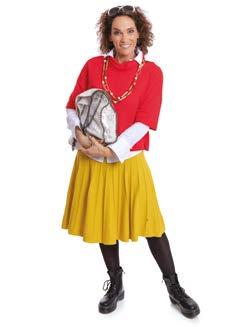

She’s wearing a yellow (1) s and a red (2) j .
Her (3) b are black and her (4) h is white. She’s also wearing a long (5) n
He’s wearing blue and red (6) s and yellow football (7) b
His T-shirt is red and his (8) s are blue.
He’s wearing a grey (9) s and a blue (10) s . His (11) s are blue and his (12) s are blue too.
6 Complete the sentences with the words in the box. There are three words you don’t need.
beautiful • careful • clever • friendly funny • kind • noisy • quiet • tired
1 Kiara is very . She always helps other people.
2 Alex is always first in his class. He’s very
3 I did a lot of work today and now I’m very
4 Toby always talks very loudly! He’s very
5 Lara never makes mistakes. She’s very
6 Karel doesn’t talk a lot. He’s very .
Grammar
1 Choose the correct options to complete the text.
Hi!
My name is Ivan and I (1) live / lives in Rio de Janeiro. I (2) takes / take the bus to school every day. My brother (3) doesn’t / don’t take the bus. He (4) go / goes by bicycle. My parents (5) work / works in a hospital. They (6) is / are very busy. Do you (7) live / lives in a big city? How (8) do / does you get to school?
2 Write questions using the Present simple.
1 where / live / you ?
2 what time / your lesson / start ?
3 when / have lunch / they ?
4 why / she / study / English ?
5 who / with you / to school / go ?
3 Put the adverbs of frequency in the correct place and rewrite the sentences.
1 I have lunch at 1.00 p.m. (usually)
2 They are late for school. (hardly ever)
3 We go to the seaside in the summer. (always)
4 My mother goes shopping on Saturdays. (often)
5 My parents are at home during the day. (never)
6 I go to the cinema with my friends. (sometimes)
4 Complete the sentences with the Present continuous form of the verbs. Use contracted forms.
1 What Susi (do) right now?
2 She (talk) to her friend.
3 you (eat) dinner at the moment?
4 I (watch) TV.
5 My parents (not / work) today.
6 We (play) football right now.
5 Complete the text with the Past simple of the verbs.
I (1) (have) an amazing time at the Glastonbury Music Festival last year.
I (2) (go) there with my best friend and we (3) (stay) there for three days. We (4) (see) lots of different bands and (5) (eat) some delicious food. There were shops with interesting clothes and jewellery, but I (6) (not buy) anything. The only bad thing was that it (7) (rain) a lot, so I (8) (wear) my boots for three days! (9) you (go) to any music festivals last year? Which bands (10) you (see)?
6 Choose the correct options to complete the sentences.
1 What kind of toys did / are you use to like when you were little?
2 I use / used to collect toy dinosaurs.
3 Were / Did you use to be afraid of the dark when you were small?
4 We didn’t use / used to play outside when we were young.
5 Did you use / used to have a favourite toy when you were small?
7 Complete the sentences with the verbs. Use one Past simple verb and one Past continuous verb in each sentence.
1 We football, when it to rain. (play, start)
2 When I home, my parents dinner. (arrive, cook)
3 I when you me yesterday evening. (sleep, phone)
4 We to the band, when suddenly there a loud bang. (listen, be)
5 What you at on your phone when you to school this morning? (look, go)
6 What you at when I you with your friends yesterday? (laugh, see)

Life skills
Making friends
FRIENDSHIPS
the average age we start to understand friendships 9 months

1 Look at the information. Read the statements. Are the sentences true (T) or false (F)?
1 Most people make a new friend in under 60 hours.
2 We make nearly 400 friends in our lives.
3 Most babies begin to learn about friendship when they are six months old.
4 Most people can ask 150 friends if they have a problem.
5 Most people have fewer than 20 good friends.
2 SPEAKING Discuss the questions with your partner.
1 What makes a good friend?
2 What are some ways to make new friends?
3 Do you think new friends are as important as old friends? Why? / Why not?
4 Describe one of your good friends.
3 SPEAKING Work in pairs. Read the Mind your mind information. Discuss the questions.
1 Do the numbers surprise you?
2 Do you think the tips are useful? Why? / Why not?
3 Which tip do you think is the hardest to do? Why?
4 Which tip do you think is the most important? Why?
4 WRITING Work in pairs. Write three more tips for making friends at a new school.
Frame your project
Work in groups. Create a game or activity to help people make friends in a new situation. Think about:
• ways to help people speak to each other;
• encouraging people to ask questions;
• ways to help people have fun;
• encouraging people to be themselves and share who they are. You can do the activity in the next lesson.
the number of friends we can ask for help
Useful language
• Today, we’re (talking about / playing)…
• Usually / Often, people (talk about / like to)…
• I think it’s a good idea to (be yourself / join this club).
• Don’t (talk about / ask about)…
• It’s helpful to (ask questions / talk to people).
• You can / could (say hello / shake hands).
• Why don’t you (talk about)…?
Mind your mind
Be yourself
You are at a new school and you don’t know anyone. It’s time to make some new friends … but how?
• To find friends with similar hobbies and interests, ask people what they’re interested in.
• Join a club, but choose one that you’ll enjoy.
• Remember, everyone is feeling nervous. Relax!
• Be yourself. Find people you feel comfortable with and like you for who you are.
• Remember, it doesn’t matter if you’ve got lots of friends or just a few. True friends are what’s important.
Create a presentation about how to make friends in a new school or class. Think about:
• ways to introduce yourself;
• topics to talk about, or not talk about;
• ways to spend time with new friends. Include images and give examples. Give your presentation in the next lesson.
ORACY SKILLS
3 Tastes great!

1 VISIBLE THINKING Look at the photo. Discuss in pairs.
See What can you see in the photo?
Think What do you think she is eating?
Wonder What’s her expression? Can you guess how she feels?
2 Watch the video It Was Delicious! Are the sentences true (T) or false (F)?
1 Lee hasn’t eaten much unusual food.
2 Fred ate a sheep’s eyeball.
3 The Maasai make a drink from blood and milk.
4 Enric loves American fast food.
5 Bradley has never eaten tortillas.
6 Bradley thinks that bee larvae tastes like tuna.

Frame A 3
1 SPEAKING Work in pairs. Compare the two photos. Talk about how people prepared food in the past and how they prepare food now. Use the words in the box to help you.
book • online • parents social media • supermarket

a
5 Read the Exam tip. Then read the questions in the Exam task. Decide which questions are about details. Then find the part of the article you need to answer each question.
Exam tip
Reading for detail
• Some questions ask about a specific detail in the text.
• Underline the key word in a question that refers to a detail. Then look for the word, or a word that means the same, in the text.
• Read the sentences before and after the key word to understand the meaning.
• Go back to the question and decide which answer option is the best match.
Exam task

A woman reading a recipe in a cookbook b Online recipe on a laptop
In the past, people read recipes in cookbooks, but today…
2 VISIBLE THINKING Look at the photo on page 51. Discuss in pairs.
See Where is the woman?
Think What is unusual about her trolley?
Wonder What do you want to know about ‘smart trolleys’?
3 Read the first paragraph of the article on page 51 quickly. Does it include your ideas from exercise 1?
4 Read the rest of the article. Number the ideas (1-5) in the order they appear in the article.
a shopping in the future
b preparing food in the past
c something that won’t change in the future
d using technology today to prepare food
e planning recipes in the future
6 PRELIMINARY Multiple choice Read the article and choose the correct option.
1 The article is mainly about…
A cooking and shopping for food.
B getting new ideas for recipes.
C healthy ways to cook.
D using the Internet to help you cook.
2 The writer thinks that smart cameras will…
A cook meals for us.
B buy ingredients.
C take photos of our food.
D watch us while we prepare food.
3 Why do some people prefer to go to the supermarket?
A They can look and decide what to buy.
B They can use a trolley.
C They don’t need a credit card.
D They can find more ingredients there.
4 What will the supermarket trolley do?
A It will tell you what to buy.
B It will help you save money.
C It will give you recipe ideas.
D It will add up the cost of your shopping.
5 The article concludes that in the future…
A our diet will change a lot.
B food technology will change our eating habits.
C enjoying meals will still be important.
D we won’t cook for ourselves.
Frame your ideas
7 SPEAKING Answer the questions.
• How often do you try new food? What kind of food would you like to try?
• What do you think about the future technology described in the article? Do you want to use this technology in your house? Why? / Why not?

Food of the Future
In the past, people usually learnt how to cook from their parents, or they read the recipes in a cookbook. Once a week, they wrote a shopping list and then went to the supermarket to buy their food for the week. Today, people are learning about preparing food in many different ways. They watch videos on YouTube, find recipes on the Internet, share photos on social media and they order their food online.
But how will we prepare our food in the future? As technology develops, we are finding new ways of planning, preparing and shopping for our meals. By 2040, we will probably have smart cameras in our cupboards and in our fridges. They will look at our food and then send us recipes. For example, imagine that you have some tomatoes, an onion, some potatoes and some eggs. Your smart camera will look at these ingredients and send you a recipe for a delicious Spanish omelette. Oh … but you need some butter. No problem, the smart camera will automatically order it online, and it will be at your home an hour later. Perhaps you’d prefer to go to the shop to choose your own ingredients. In the future, you will choose the food at the supermarket, put it in your trolley and then just walk out. The technology in the trolley will weigh your food, calculate the price and automatically take the money from you. In fact, there are now a few supermarkets in the USA that are already using ‘smart trolleys’. The trolleys have screens with information about the food and a map of the supermarket so that you can find what you are looking for.
But some things won’t change. Food is part of our daily life and our culture. We will probably always enjoy sharing a meal with our family, discovering new recipes and talking about our favourite food.
A customer pushes a smart trolley at a food store in New York, USA
Vocabulary 3
1 A Work in pairs. Look at the photo. Find the food items in the box. butter • cheese • chillies • eggs • fish garlic • grapes • lemons • meat • milk

1 B Work in pairs. Look at the photo again. How many other food items can you find and name?
2 Complete the tables with the words from exercise 1.
4 Listen. Which dish is the boy going to prepare for his aunt?


5 Complete the text with the words in the box. butter • eggs • fish • fruit • oranges peppers • rice • tomato
I love staying with my grandparents because they’re both amazing cooks and we always have delicious food at their house. They’re vegetarians, so they don’t eat any meat or (1) . Yesterday, we had (2) for breakfast: bananas, (3) and strawberries. I also had some bread and (4) because I’m always very hungry in the mornings. They’ve got chickens in their garden, so we had fresh (5) for lunch. My grandad made a delicious omelette! We ate it with a (6) salad. And in the evening, we had (7) with vegetables – onions, (8) and garlic.
6 SPEAKING Work in groups. Look at the eating habits. Which of these do you sometimes do? How do they affect your mood?
‘When I feel stressed, I eat a lot of sweet food.’
‘I always eat meals at the same time every day.’
Frame
3 Work in pairs. Think of at least one more food item for each column in the tables in exercise 2.
‘Sometimes
I get up late and I don’t have time for breakfast.’
‘I often have a snack just before I go to bed.’
your ideas
7 MEDIATION Work in small groups. Plan a meal using some of the ingredients you can see on this page. Tell another pair of students about your meal and ask them to report it to the class.
will
1 Read the conversation. Match the underlined sentences (1-3) with the uses (a-c).
A I don’t feel very well. I’m really tired and hungry.
B Oh dear. (1) I’ll make a sandwich for you Do you want something to drink as well?
A No, thanks. Actually, yes, (2) I’ll have a glass of water, please.
B No problem. I’m sure (3) you’ll feel better soon
We use will…
a to make predictions about the future. We often use think, hope and be sure before will
b to make offers and promises.
c to make sudden decisions.
2 Use the prompts to make questions with will. Then complete the short answers.
1 he / have a party on his birthday this year?
A
B No,
2 you / eat pizza / for lunch tomorrow?
A
B Yes,
3 she / start work next year?
A
B Yes, .
4 they travel to Melbourne next winter?
A
B No,
5 we / move house in the future?
A
B Yes,
6 you / be a teacher when you grow up?
A
B No,
3 A Listen and match the sentences (1-4) with the correct option (a-d).
a Don’t worry. I won’t drop it.
b I’ll probably do maths or science.
4 Complete the conversation with these phrases. ’ll do • ’ll have • ’ll make • will be (x2) won’t buy • won’t eat
A Hi, Gabriella! What are you doing?
B I’m writing an article about food in the future.
A That sounds interesting. Do you think our food (1) different in the future?
B Yes, I do. For example, in the future, we (2) meat because it (3) very expensive.
A Yes, you’re probably right.
B And we (4) our food from supermarkets. We (5) all our shopping online.
A I like the idea of that! I hate shopping.
B Me too. Anyway, talking of food, I’m really hungry.
A Are you? I (6) you a sandwich. Do you want cheese or ham?
B Thank you! I (7) a ham sandwich please.
5 SPEAKING Work in pairs. Make questions from the prompts and then answer them so that they are true for you.
1 What / you / think / have for lunch today?
2 Who / you / live with / when you’re an adult?
3 Where / you / be / at seven o’clock tomorrow evening?
4 When / you / move / out of your parents’ house?
5 What / kind of house / you / live in / when you’re older?
6 How many children / you / hope / have / in the future?
Frame your ideas
6 SPEAKING SEL Decision making Make some predictions with will about the future. Give reasons for your predictions. Think about:
• education;
• transport; • food; • homes.

Listening
1 Work in pairs. Look at the photo of a traditional Japanese dish, okonomiyaki. What ingredients do you think are in this dish?

2 Listen to Hideko describing how to make okonomiyaki and check your ideas from exercise 1.
3 Read the questions. Circle the key words in each question.
1 How did Hideko get to Osaka?
2 What does Hideko’s aunt do?
3 What does Hideko think about preparing okonomiyaki?
4 Which ingredient do you add last before you cook okonomiyaki?
5 When does Tom want to make okonomiyaki?
4 What kind of information do you need for the questions in exercise 3? Match the questions (1-5) with the information (a-e).
a a job
b a food item
c a time
d an opinion
e a form of transport
5 Match the questions from exercise 3 with the correct pairs of answer options (1-5).
1 a She’s a cook. b She’s a teacher.
2 a egg b mushrooms
3 a by train b by plane
4 a tomorrow b at the weekend
5 a It’s difficult. b It’s easy.
6 Listen again and choose the correct option (a or b) for each question in exercise 5.
7 Read the Exam tip. Then read the Exam task. Check you understand the key information you need to listen for in each question. Read all the options.
Exam tip
Understanding what to listen for
• Before you listen, look at the questions and decide what kind of information you need to listen for, for example, a time / day, a reason, etc.
• Look for key words in the questions and answer options and underline them so that you can listen for the information that matches.
• The questions follow the order of the conversation. If you are not sure of one question, leave it and go back to it the second time you listen.
Exam task
8 PRELIMINARY Multiple choice Listen to the conversation and choose the correct option. You will hear Alex talking to his friend, Martina, about going out to eat at a restaurant.
1 Alex is going to the restaurant with…
A some students.
B his brother.
C his girlfriend.
2 What kind of restaurant is it?
A Indian
B Chinese
C Mexican
3 Why does Alex want to go to this restaurant?
A He went there last week.
B The food is good.
C It is very popular.
4 Marina wants to eat…
A vegetables.
B seafood.
C meat.
5 What time are Alex and Martina planning to meet?
A 7.00 p.m.
B 7.30 p.m.
C 8.00 p.m.
9 SPEAKING Work in pairs. Practise a conversation like the one in exercise 8. Before starting decide:
• where you want to go;

• what you want to eat;
• what time you want to meet.
Ordering food in a restaurant
1 SPEAKING Discuss the questions with a partner.
1 How often do you go out to eat?
2 Do you like trying new food when you eat out?
3 Which do you prefer – eating food at a friend’s house or eating out at a restaurant? Why?
2 Complete the conversation with the phrases in the box.
a dessert • anything to drink • could I have kinds of • ready to order • some water the same • to start with
Waiter Hello, are you (1) ?
Woman Yes, thank you. I’d like the mushrooms with garlic (2) , please. And then vegetarian chilli tacos.
Man And I’ll have nachos with cheese and then spicy chicken with rice.
Waiter Would you like (3) ?
Man I’ll have a fruit smoothie, please.
Woman Just (4) , thanks.
…
Waiter Would you like (5) ?
Woman Yes, please. What (6) ice cream have you got?
Waiter Chocolate, vanilla or strawberry.
Woman (7) strawberry, please?
Man I’ll have (8) , thanks.
3 Listen and check your answers.
4 SPEAKING Work in groups of three. Use the menu to act out a similar conversation in a restaurant.

5 MEDIATION Work in pairs. You are visiting Jimmy’s Diner with a friend who doesn’t speak English. Look at the menu and take turns to explain the different dishes in Italian.
Describing a picture
Exam tip
Describing a picture
• In some exams, you may be asked to describe a picture.
• Before you begin talking, look carefully at the picture for a few moments.
• Focus on describing the place and what people are doing in the picture.
• Don’t worry if you don’t know the words for everything in the picture.
Exam task
6 PRELIMINARY Picture description Read the Exam tip. Look at the photo and describe it. Try to talk for one minute. Use the Useful language box to help you.

JIMMY’S
DINER
Starters
Garlic bread
Tomato soup
Nachos with cheese
Main courses
Mediterranean pasta with tuna and peppers
Five-bean burger and chips
Thai chicken curry with rice
Desserts
Apple cake
Chocolate brownie
Strawberries with cream
Task 1: Describe the restaurant.
Task 2: Tell me about a restaurant you went to.
Task 3: Some people like to eat out in a restaurant. Other people prefer to get a takeaway and eat at home. Which do you prefer to do and why?
Useful language
Describing a picture
• This is a picture of … I can see…
• Two people are … One of them is…
• It looks (bright / dark / friendly / busy / crowded).
Describing where things are
• On the left, there is / are…
• In the background, I can see…
• Behind the table, there is…
ORACY SKILLS
The J&K Diaries – Episode 3
1 Watch the vlog and answer the questions. 1 Where are Josh and Kayla?

Why are they there?
Tick (4) the ingredients they use.






spinach
4 Does Kayla like the smoothie?
5 Is there any smoothie for Josh?
2 Read the article on page 57 quickly and match the photos to the correct names.

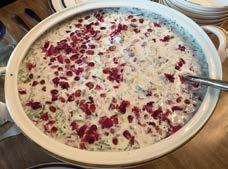
Exam task
3 INVALSI PRELIMINARY Multiple choice with one text Read the article again. Choose the correct option (A, B, C or D) for questions 1-5. The first one (0) has been done for you.
0 According to the article…
A soups around the world are all very similar.
B many countries don’t have their own type of soup.
C everyone usually eats soup at the same time.
D there are many different varieties of soup.
1 Gazpacho is…
A a hot spicy soup.
B a thick, yellow soup.
C a cold Spanish soup.
D an Eastern European soup.
2 The article says that soup is…
A not expensive and good for you.
B cheap but not very healthy.
C expensive and difficult to make.
D not difficult to make but not very healthy.
3 People usually have mohinga…
A after their main meal.
B in the morning.
C when they go to restaurants.
D before their main meal.
4 Which ingredient is NOT part of abdoogh khiar?
A raisins
B eggs
C water
D cucumber
5 The main ingredients in maafe are…
A meat and vegetables.
B herbs and yoghurt.
C lentils and potatoes.
D noodles and onions.
4 DIGITAL COMPETENCES Internet research
Choose one of the countries from the article: Myanmar, Iran or Nigeria. Go online and find out about another popular dish from this country. Tell the class about your research.
Frame your ideas
5 SEL Self-awareness Self-management
Work in pairs. Follow the instructions and create your recipes.
• Make a list of your favourite ingredients.
• Create a recipe for a soup using some of these ingredients.
• Compare your recipes with another pair. Are they healthy / cheap / unusual / easy to make?


Around the World in Three Soups
Nearly every country in the world has its own special soup. From bright pink borscht in Eastern Europe, to thick, yellow spicy mercimek corbası in Turkey; from cold gazpacho in Spain to hot, clear miso soup in Japan, there are hundreds of ways to prepare this dish. In some cultures, people begin their meal with soup, in others, soup comes at the end of the meal. It is usually cheap to make, full of healthy ingredients and easy to prepare. So, let’s look at three soups from three different countries around the world. Mohinga is a soup from Myanmar and people often eat it for breakfast. The main ingredients are fish and thin noodles, but sometimes people add a few eggs and some onions. They also use flour to make the soup thicker. In Myanmar, it is a very popular street food. A bowl of mohinga is a great way to start the day. There are versions of cold cucumber soup in many countries, including Greece, Bulgaria and Iran. This recipe for abdoogh khiar comes from Iran. To make it you will need some chopped cucumbers, some thick yoghurt, some raisins and lots of chopped herbs. Mix these together in a bowl and put it in the fridge. When you want to eat it, add some cold water and a cup of ice cubes. It’s the perfect soup on a very hot day. In Nigeria, maafe is very popular. Some people eat it on its own as a soup and some people have it with rice as a stew. You make a peanut and tomato sauce and add some chicken, fish, or beef, carrots and sweet potatoes. It’s a little bit spicy and very healthy. Some people like to add some extra chopped peanuts to the soup just before they eat it. So which soup do you want to try?
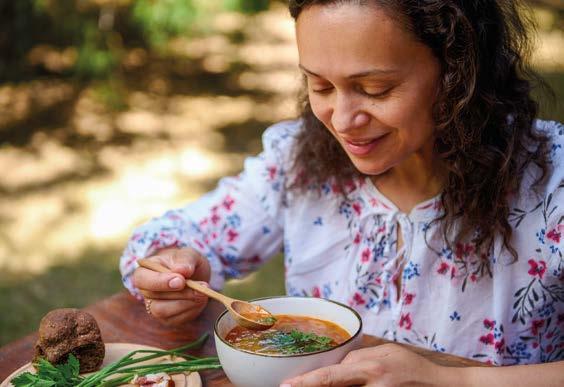
Vocabulary 3
Cooking and measurements
1 Number the sentences in order.

Kourabiethes – traditional Greek biscuits
a Pre-heat the oven to 160°C.
b Cut the butter into small pieces and add it to the sugar and the egg.
c Then add the almonds to the butter, sugar and egg.
d 7 Put the biscuit dough into the oven and bake for fifteen minutes.
e 1 To make these biscuits you will need 75 grams of chopped almonds, 250 grams of butter, 125 grams of icing sugar, 1 egg, 300 grams of flour, and some orange flavouring.
f Finally, add the flour and orange flavouring. Mix all the ingredients together with a spoon.
g Roll out the dough on a board and cut it into moon shapes.
2 Listen and check your answers.
3 Match the words and phrases (1-5) with the pictures (a-e).
1 cut into pieces
2 add the flour
3 bake in the oven
4 mix together with a spoon
5 roll out the dough
4 SPEAKING Greek people eat kourabiethes biscuits on special occasions. Work in pairs. Describe a special biscuit or cake from your country. Discuss the questions.
1 When do you eat it?
2 Have you ever tried to make it?
3 What are the main ingredients?
5 Complete the table with these measurements. 15 centimetres • 4 metres • 125 grams 12 kilos • 150 degrees • 1 kilometre

Length Weight Temperature

6 Complete the message with these words. add • bake • degrees • flour • grams mix • oven • spoon
Hey Mum – help! It’s Rick’s birthday tomorrow. How do I make a yoghurt cake? ��
Have you got a pot of yoghurt, (1) , sugar, oil and three eggs?
I think so. How much sugar do I need?
200 (2)
Yes, I’ve got that.
First of all, pre-heat the (3) to 180 (4) Celsius.
OK, done that!
OK. What do I do next?
Then (5) together the yoghurt, the sugar and the eggs with a big (6) (7)
200 grams of flour and then half a cup of oil. And finally, you (8) it for an hour.
Great! Thanks, Mum. I’m sure it’ll be delicious. xx ❤
Countable and uncountable nouns
1 Read the conversation. Choose the correct option to complete the rules (a-e).
A We’ve got some sugar, five eggs, some butter and six bananas.
B Great! We can make a banana cake!
A No, we can’t. We haven’t got any flour.
Egg and banana are countable nouns.
a Countable nouns can / cannot be singular and plural.
b We can / cannot use them with numbers and singular indefinite articles: ten euros, a chair, an apple
Sugar, butter and flour are uncountable nouns.
c Uncountable nouns refer to things that we can / cannot count.
d They have / do not have a plural form.
e We can / cannot use them with numbers and singular indefinite articles: some bread, some milk, some time
2 Complete the table with these words. bed • bus • cat • dollar • food • fun furniture • game • grape • homework information • money • table • time
3 Read the conversation. Add the highlighted nouns to the table in exercise 2.
Marie We haven’t got any rice or biscuits. Are you going to go to the supermarket today?
Olivier Yes, I am. I’ll make a shopping list. Have a look in the fridge. Have we got any milk?
Marie Yes, we’ve got a little milk, some cheese, and a lot of eggs. But we’ve only got a few mushrooms
Olivier So, I’ll get some milk and some mushrooms. What about fruit? Have we got any apples?
Marie Yes, we’ve got lots of apples, and bananas
Olivier How many apples have we got? Perhaps I’ll make an apple cake tonight.
Marie Good idea! We’ve got seven apples, and I know we’ve got some sugar and some flour
Olivier How much butter have we got? I’ll need lots of butter for the cake.
Marie It’s OK, we’ve got 500 grams of butter.
Quantifiers
4 Find examples of the words (1-7) in exercise 3. Then write C (countable), U (uncountable) or B (both) next to each word.
1 how much
2 how many
3 a lot of / lots of
4 any (questions and negatives)
5 some (affirmative sentences)
6 a few
7 a little
5 Choose the correct option to complete the conversations.
1 A How many / much / little children are going to be at the party?
B Ten, so we’ll need lots of / many / a few food.
2 A How many / any / much money have you got?
B Just a little / a few / much euros. I’ll go home and get some more.
Some very common words are uncountable in English: money, information, advice, luggage, news, equipment
Some uncountable nouns end in -s: maths, news
Some plural countable nouns are irregular and do not end in -s: men, women, children, people, sheep
3 A There isn’t some / any / a few food in the cupboard.
B Yes, I know. I’m going to buy any / a / some bread later.
4 A Do you like a few / a little / many sugar in your coffee?
B Yes, I do. Actually, I like two / many / lots of sugar in my coffee!
Writing lab 3
Suggestions, promises, invitations
Useful language
Making suggestions
ORACY SKILLS
• Why don’t we go to the cinema?
• How about meeting at the museum?
• Let’s have a picnic in the park. Making promises
• I won’t forget!
• We’ll look after your cat for you.
• I promise I’ll be on time.
Inviting
• Can you come?
• You can come too!
• Would you like to come with us?
1 Listen to Yana’s voice message to Sophie. Then read her answer. Then complete the notes.
Sounds amazing! Yes please! Why don’t we all have lunch first at the Japanese Noodle Bar �� on Cherry Street? It’s quite expensive but the food’s really delicious! Let’s meet at the station at 1.00 p.m. and then we can walk there together.
I promise I won’t be late again! ��
Yana’s Plans for Saturday
– Meet Sophie and (1) at (2) at 1.00 p.m.
– Walk to the (3) on Cherry Street.
– After lunch, watch the new Zendaya film at the (4)
2 Work in pairs. You want to plan an activity for the weekend. Take turns to make suggestions. Use the ideas in the box or your own ideas. go to a café/the beach • listen to music • play a sport • cook together • visit friends • watch TV
Why don’t we go to the beach this afternoon?
Learning focus
Using adjectives
Great idea! Let’s invite Riccardo to come with us.
• When you describe past activities or future plans, try to use adjectives.
• Express your opinion by using positive (it’ll be fun, it was exciting) or negative (it was very difficult) adjectives.
• Use qualifiers like very, really, quite to make the meaning of the adjective stronger.
3 Underline these adjectives and phrases in the note from exercise 1.
quite expensive • sounds amazing the food’s really delicious
Exam tip
Using short forms, punctuation and greetings
• When you write an email (for example, to a friend), you should use short forms, e.g. It’ll be fun
• You can use exclamation marks (!) in emails to show you are excited or annoyed, e.g. It was amazing!
• Remember to use short greetings in emails, e.g. Hi Jack, Hello, Dear Lucy. You can sign off with just your name.
Exam task
4 PRELIMINARY Writing an email Read the Exam tip. Then read this email from your English-speaking friend Tom and the notes you have made. Write your email to Tom using all the notes. Write about 75 words.
Hi,
Thanks for your email! Did you have a good time at the beach?
I sometimes visit my grandparents at the weekend, but I haven’t got any plans for this weekend. Do you want to do something?
Maybe we can go to the cinema on Saturday evening?
Have you got any ideas for Marie’s birthday present? I don’t know what to get her. Alex
Yes – give some information
No, because … Make a suggestion Invite Tom to come to the park with you on Sunday.
5 Complete the Reflection checklist. Then discuss your answers with your partner.
Reflection checklist
Tick (4) the sentences that you think are true. I wrote a plan first.
I used adjectives to make my writing more interesting.
I used positive and negative adjectives. I used some qualifiers. I used short forms correctly.
I included all three points. I wrote the correct number of words.
1 VISIBLE THINKING Look at the photo. Discuss in pairs.
See Describe the technology you can see in the photo.
Think What do you think the man can do with this technology?
Wonder Imagine your life without technology. What can you do? What can’t you do?
2 Watch the video Gadgets That Will Change the World and complete the sentences.
1 Make a sketch, and you have a house in ten days!
2 Turn on the and instead of staring, you can read a book or just have a nap!
3 I literally can’t wait to try the for the first time.
4 New science allows us to make prosthetic implants which with your thoughts.
5 I took a normal collar, , and connected some electronic parts.
4 Tech life
Frame A
1 SPEAKING Work in pairs. Think about the apps on your phone and discuss the questions.


1 Which apps do you use most often?
2 Which apps do you not use very often?
3 Think of apps that might help: a farmer, a taxi driver, a student, a poet, a teacher.
2 VISIBLE THINKING Look at the photo on page 63. Discuss in pairs.
See What technology can you see?
Think What do you think the people are using the technology for?
Wonder How can technology like this change people’s lives?
3 Read the article on page 63 quickly. Does it include your ideas from exercise 2?
4 Read the Exam tip. Then look at the questions and possible answers in the Exam task. For each question, find the incorrect answer and cross it out.
Exam tip
Eliminating the wrong answers
• Multiple-choice exam tasks usually have three or four possible answers. One of the possible answers is often obviously incorrect.
• Read the options and immediately cross out the answer that you know is incorrect first.
• Then focus on the remaining answers.
• Even if you are not sure about the correct answer, always choose an option.
Exam task
5 INVALSI PRELIMINARY Multiple choice
Read the text and choose the correct option.
1 Why do the Samburu people move to different places?
A Because they are looking for their animals.
B Because they need to find food and water.
C Because they want to buy animals from other places.
D Because they are looking for work.
2 Samburu farmers…
A buy and sell mobile phones to help pay for their animals.
B use technology to learn more about their animals.
C can’t use their phones in remote areas.
D don’t have their own phones.
3 In the past, on the Samburu Reserve…
A the primary school had some basic technology, but no one used it.
B there was nowhere for the students to sit and study.
C there was no primary school.
D there was a primary school but not all children went there.
4 Today, the Samburu women go to school…
A after their children.
B with their children.
C at the weekend.
D before their children.
5 According to the article…
A the Samburu people’s lives are now completely different because of modern technology.
B the Samburu people don’t want to use mobile phones or tablets.
C there are some changes to the Samburu people’s lives, but some things are the same.
D technology will never change the Samburu people’s lives.
6 SPEAKING Work in pairs. Think about the changes in technology in the last twenty years. Then imagine the changes that will happen in the next twenty years.
• Make a list of five predictions for technology in the future.
• Rank your list from 1 (most likely) to 5 (least likely).
• Compare your list with another pair of students.

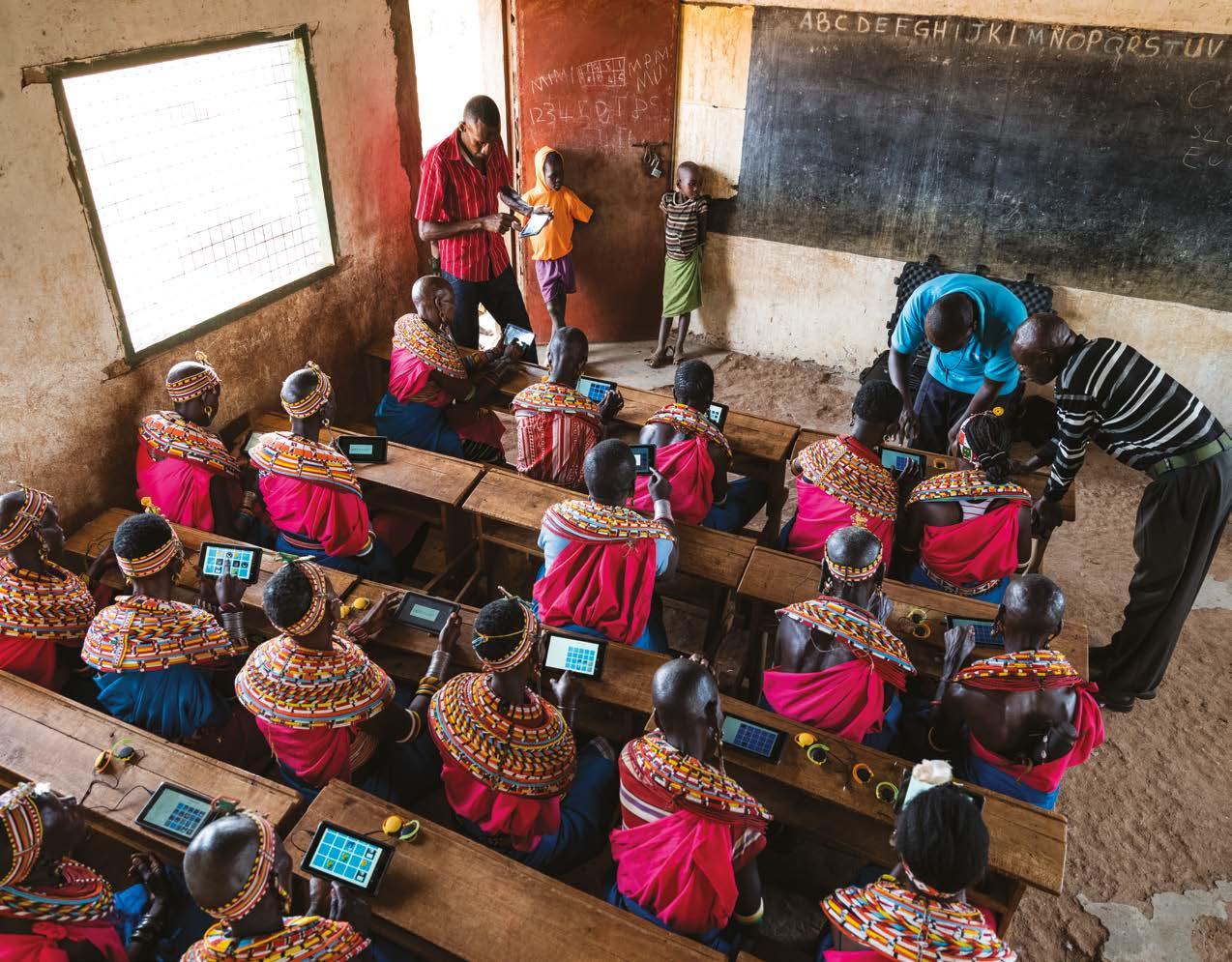
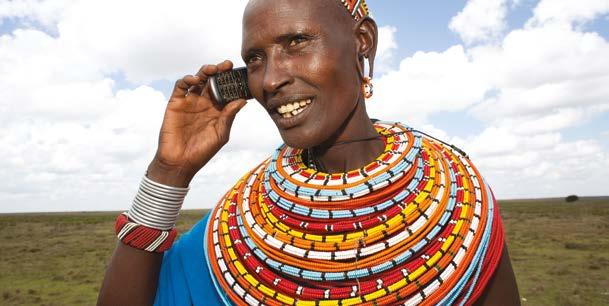
Technology changes lives
The Samburu people are from northern Kenya, but they don’t stay in one place. They are nomadic, and follow their cows, sheep and goats, looking for food and water because the land is very dry. This is the traditional way of life for the Samburu people, and it was the same for hundreds of years.
But now, their lives are going to change because of technology. The introduction of phones and tablets into their community is making a big difference to the way that they live and work.
Today, like over 80% of the population in Kenya, many Samburu farmers own a mobile phone. Although the Samburu Reserve is very remote, farmers can use their phones to buy and sell their animals. They also have special apps on their phones. These help them to find useful information about how to look after their animals better.
Life for the Samburu children and women is also going to be very different in the future. The small primary school on the Samburu Reserve – Kiltamany Primary School – had only a few desks and chairs and no technology. Many children didn’t go to school, and fewer than 30% of the Samburu people knew how to read and write. But now the primary school has tablets for the children to use. They are learning how to read and do basic maths using these tablets. By using the Internet, they are also finding out more about the world.
When the children finish their school day, it’s time for the women to go to school. They are also taking lessons in how to use this new technology. At the same time, they are showing their children that it is always possible to learn new skills.
Samburu traditions are still very important to these people, but technology is helping them to find out more about the world around them.
Vocabulary 4
Technology
1 Match the words (1-6) with the technology (a-f) in the picture.
2 Choose the correct options. Then match the phrases (1-6) with the correct icon (a-f).
1 download a file / a friend
2 send a web page / an email
3 text online / a friend
4 enter a password / the Internet
5 go online / the web
6 call a friend / an email
3 Complete the technology tips with the words in the box.
online
TOP TEEN TECHNOLOGY TIPS
STAY HEALTHY
Switch off your (1) one hour before bedtime. The bright light from them can make your brain very active.
STAY SAFE
Stay safe (2) . Don’t give personal information, for example your address or your age. Be careful when you (3) a file or a program from the Internet. Do you know where it’s from?
Change your (4) regularly and don’t write it down.
STAY SOCIABLE
Have some technology-free time with your family. Put your (5) and your mobile phones away and talk to each other!
STAY KIND
Remember that words can hurt. Think before you send a text or an (6) . Are you being kind?
4 Read the Exam tip. Then read the Exam task and think of the words that can go in each gap.
Exam tip
Compound nouns
• Compound nouns are words that we put together to make another noun. The words are often noun + noun.
• In texts with gaps, the missing word is sometimes one word from a compound noun, e.g. social media.
• Look at the sentence and at the words before and after the gap.
• Read the answer choices and choose the best answer.
• Then try the other choices to make sure they don’t fit.
Exam task
5 PRELIMINARY Multiple-choice cloze For each question, choose the correct option.
Do teenagers worry about spending too much time on (1) media? Many teens (2) their messages constantly throughout the day and they feel sad if they don’t get any. Parents also worry about their children spending too much time looking at the (3) of their tablet, laptop or mobile. Instead of talking with their friends, they play (4) games, or (5) video and music files. On the other hand, some teenagers say that their parents don’t have time to talk to them … because they’re busy (6) someone on the phone.
1 A social B laptop C email D web
2 A write B check C
Frame your ideas
6 A SEL Self-awareness Self-management Answer the questions below.
• Do you like using social media? Why? / Why not?
• How much time do you spend online? Is it too much? Why? / Why not?
6 B Read the statements below. Decide if you agree (A), disagree (D) or are not sure (NS).
1 I spend too much time on social media. 2 My friends spend more time on social media than me. 3 My parents spend too much time on social media.
4 I often argue with my parents about my use of social media.
5 I stop looking at screens before I go to bed.
be going to
1 Read the conversation. Choose the correct option to complete the rules (a-b).
A I’m going to make lunch for my aunt tomorrow.
B That’s nice. What are you going to cook?
A Pasta with tomato sauce.
B Well, you’re really good at cooking, so I know it’s going to be delicious.
a We use be going to ... i to describe future promises / plans ii for predictions for the near / distant future based on present situations.
b We use the infinitive / -ing form after be going to.
2 Complete the conversation with be going to and the correct verbs in the box.
come • do • finish • help • stay
are you going to do
A What (1) (you) at the weekend?
B I (2) my friend Patrice. He wants to prepare a surprise meal for his parents.
A That’s cool!
B How about you?
A I (3) at home. I (4) my history project in the morning and then my cousins (5) to my house.
3 A Look at the table. Complete the sentences about Rosa’s and Oscar’s plans for the weekend.
4 Write questions from the prompts. Then write answers using the verb in brackets.
1 you / send / a text / to Maria (call) Are you going to send a text to Maria? No, I’m going to call her.
2 she / study / computer science / next year (teach)
3 they / watch / the film / now (download)
4 we / buy / a birthday cake / later today (make)
5 he / play football / next summer (watch)
6 you / cycle / to the park (walk)
5 Read the statements and make predictions with be going to. Use the expressions in the box.
be angry • feel hungry • get very wet • have a great time • not get a good grade • not win the game
1 We didn’t eat any breakfast today.
2 She didn’t study for her exams.
3 I forgot to reply to my friend’s text.
4 My team is playing really badly.
5 You’ve got tickets to see your favourite band tonight.
6 It’s raining and I forgot my umbrella.
6 A SPEAKING Write questions from the prompts. Then ask and answer them in pairs.
1 What time / get up / tomorrow morning?
2 Where / go / for your next holiday?
1 Rosa some songs.
2 Oscar his friends.
3 Rosa and Oscar shopping.
4 Oscar for a bike ride.
5 Rosa and Oscar play basketball
6 Rosa pizza for dinner.
3 B SPEAKING Work in pairs. Look at the table and talk about your own plans for the weekend.
I’m not going to download any songs at the weekend.
3 How / get home from school / today?
4 What / eat / for dinner tonight?
5 you / play / any computer games today?
6 you / do your homework / tonight?
What time are you going to get up tomorrow morning?
I’m going to get up at six o’clock.
6 B MEDIATION Find a new partner. Tell them about your first partner’s plans.
Marco is going to get up at six o’clock tomorrow morning.
Listening
1 SPEAKING Work in pairs. Look at photos (a-c). Discuss the similarities and the differences.



2 Listen and choose one or two photos (a, b or c) for each sentence.
Exam tip
Choosing the correct picture
• In some exam tasks you have to listen and choose the correct picture from three options.
• Read the questions and look carefully at each set of pictures. Think of a key word or phrase for each picture.
• Think about the similarities and differences between the pictures in each set.
• You will hear each conversation twice. Read the question. Then listen and choose the correct picture.
• Listen again and check your answer.
Exam task
5 PRELIMINARY Multiple choice Listen and choose the correct option.
3 Read the question. Then listen and choose the photo (a, b or c) from exercise 1 that shows the correct answer. What is the woman going to do on Saturday morning?
4 Read the Exam tip. Then look at the Exam task. Note down vocabulary connected to the pictures. Think about any similarities and differences.
Frame your ideas
6 CREATIVE THINKING Work in pairs. Choose one of the photos from exercise 1. Discuss the questions. Then role-play a short conversation between the two people.
• How do the people know each other?
• What are they talking about?
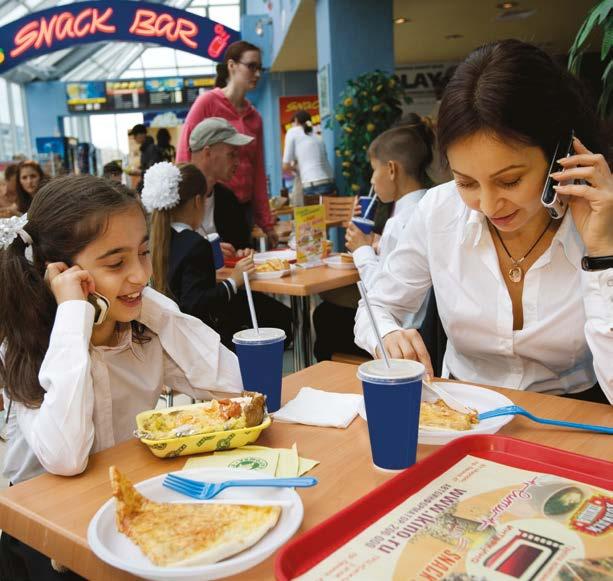
Talking about technology
1 SPEAKING Work in pairs. Describe what is happening in the photo. Use these words. chat • communicate • conversation • easy fast • friends • important • phone photo • text message • useful
2 SPEAKING Work in pairs. Discuss the questions.
1 What are these people using their phones for?
2 What do you use your phone for?
3 How often do you speak to friends on the phone?
4 Do you prefer talking on the phone or texting?
5 How much time do you spend on your phone?
6 Do you think people use mobile phones too much? Why? / Why not?
3 Read the Exam tip. Then number the parts of the conversation in order.
a I think some computer games are interesting, but some are really boring.
b 1 I use my phone a lot. I think it’s a good way to keep in touch with my friends.
c Me too! I prefer texting because it’s really fast and easy.
d Oh, yes. I love taking photos too. What about computer games? I don’t really like them because I can’t stop playing! How about you?
e That’s true, but I like talking on the phone because you can have a real conversation.
f Yes, you’re right. Conversations are more interesting on the phone. I also like taking photos with my phone, and I send them to my friends.
4
Listen and check your answers. Read the Exam tip again. What do the students do well?
Exam tip
Discussion with a partner
• In some speaking exams, the examiner will ask you to discuss some questions about a particular topic.
• Be careful to listen to the examiner’s questions carefully and answer them.
• Give reasons and examples for your own opinions.
• Listen carefully to your partner and respond by agreeing or disagreeing.
• Ask for your partner’s opinion too.
Exam task
5 PRELIMINARY Discussion Now complete the Exam task. Remember to respond to your partner’s opinions. Use the Useful language to help you. Discuss these questions with your partner.
• What are different ways that we use technology?
• How do you think your life today is different from your parents’ lives when they were your age?
• Do you think that technology makes our lives better or worse?
• Do you think people your age spend too much time looking at their screens? Why? / Why not?
6 MEDIATION Digital competences Work in pairs. Do some research to find out about technology that can help students learn English, for example an app, a website, a computer program. Tell the class about your research.
7 DEBATE Divide the class in two groups and debate the statement below. Do you agree with it? Why? / Why not?
Social media is an important part of our lives. It is now impossible to live without it.
Useful language
Giving opinions and reasons
• I like / don’t like … because…
ORACY SKILLS
• One reason why I like / don’t like … is…
• I prefer … to … because… Agreeing / Disagreeing
• Me too!
• I think so too.
• Yes, that’s true, but… Adding
• I like … too.
• I also like …
Asking for an opinion
• What about you?
• Do you like …?
Frame B 4
The J&K Diaries – Episode 4
1 Watch the vlog. Are the statements true (T) or false (F)?
1 Kayla and Josh are at a party in London.
2 They’re going to talk to a vlogger called Flora.
3 Josh thinks that he doesn’t spend a lot of time online.
4 Kayla says that social media sometimes makes us feel unhappy.
5 Flora isn’t in London.
6 Their interview is at eight o’clock tomorrow morning.
2 A SPEAKING Work in pairs. You are going to read an article about social media. Predict which of the topics in the box will be in the article. advertisements • blogs • fashion money • photos • travel • videos
2 B Read the article quickly and check your predictions.
3 Read the article again and the statements (1-8) below. Are the sentences true (T), false (F) or not given (NG). The first one (0) has been done for you.
0 Hasan uses social media more often than his friends.
1 He uses social media to communicate about his hobby.
2 He likes to learn about news stories online.
3 Chen has the same personality in real life and online.
4 He is using social media to help plan his trip to Australia.
5 People around the world read his travel blog.
6 Lukas uses social media every day.
7 He changed his opinion about social media.
8 He wants to stop using social media for a day.
4 A What is your opinion of social media? Think of two positive ( ) and two negative ( ) points.
4 B SPEAKING Compare your ideas in pairs.
I think social media is good because…
5 WRITING Work in groups. Think of some advice to help people use social media. Think about:
• staying safe;
• being kind to other people;
• sharing information.
Create a list of tips with your ideas.
Real English

Social Media and Me

Hasan

1 5 10
I go on social media every day – like most of my friends, but I’m quite careful about what I post there. I use it to share photos of my art. I love painting and drawing cartoons and I’ve got lots of online friends who are also very creative. It’s a really good way to see other people’s ideas and learn more. I also use social media to find out about what’s happening in the world. At the same time, I know that what you read or see on social media isn’t always true, so I always try to check the facts.
looking fire stare benissimo (di aspetto) pros and cons pro e contro bring someone down demoralizzare
Does social media make your life better or worse? And how often do you use it? We talked to three young people about their experiences of social media.


Lukas Cheng
I like social media because I can change when I’m online. At school, I’m usually very quiet and I don’t like speaking in class. I don’t have lots of friends, like some other people in my class. But I love talking to people on social media and I don’t feel so shy. I like the fact that I can talk to people from all around the world and I think it helps me to understand different people and different ways of life. I’m travelling to Australia next summer to visit my cousins, and I think I’ll start a travel blog. It will be a really good way of remembering everything I see and do there.


I think social media can be really fun and interesting, and I love watching my friends’ funny videos. When I first got a social media account, I was using it all the time. I had a blog and I spent hours online every day. But I don’t have the same feelings about it now. I think there are definitely also some bad things about being on social media. For example, some people can be quite unkind and rude when they write things online. I’m doing a ‘digital detox’ with my friends next month. We’re going to come off social media for 24 hours. I think it will be very interesting.
Vocabulary 4
Adjectives to describe technology
1 Match the adjectives (1-6) with the correct opposite (a-f).
excellent
modern
different
difficult
unusual
the same
boring
2 SPEAKING Work in pairs. Use some of the words from exercise 1 to describe these things.
1 maths homework






The maths homework in ‘a’ is easy, but the maths homework in ‘b’ is difficult.
3 A WRITING Look at the photo. Write sentences to describe it. Use as many adjectives as possible. Include information about:
• the people in the photo • the buildings • your opinion.
3 B Work in pairs. Compare your sentences from exercise 3A.
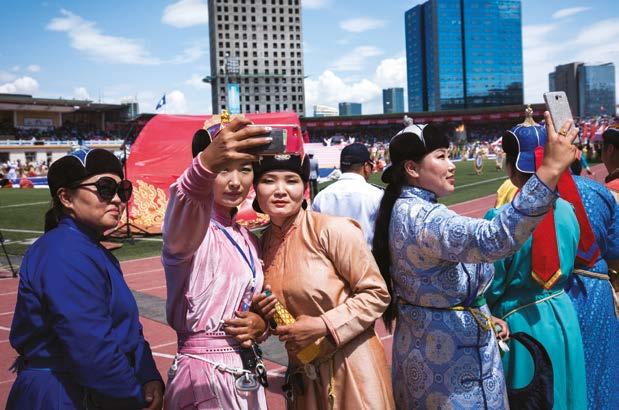
The media
4 Match the words to the definitions. 1 advertisement 2 advice column
headline
8 the news
a a person who introduces different parts of a radio or TV show
b information about recent events
c a person who watches TV or a video
d a summary of the most important part of a news story
e a notice or short film that is trying to sell something
f a famous person
g talk to someone and ask them questions
h part of a newspaper/magazine that helps people with problems
5 Choose the correct words from exercise 4 to complete the sentences. Change the form if necessary.
1 When you read an article about , it’s important to read the whole text, not just the
2 If you have a problem and you don’t want to talk about it with friends, you can write in to a(n) .
3 Before he was an English teacher, Mr Granger worked as a(n) on a TV show, He my favourite –a singer from Argentina.
4 This TV show has over seven million every week.
5 I bought this tablet because I saw a(n) for it on TV.
Frame your ideas
6 SEL Decision making Self-awareness Answer the following questions.
• How do you find out about news?
• Do you read newspapers / watch TV / look at social media?
• Do you sometimes buy things because you like the advertisement for them?
• Describe a possession that’s important to you. Why is it important?
Women at the Naadam Festival at the Ulaanbaatar Stadium, Mongolia
Present simple and Present continuous for future
1 Read the conversation. Choose the correct option to complete the rules (a-c).
A What are you doing at the weekend?
B We’re going to the Computer Show in London.
A What time does it open?
B It starts at 9.00 and finishes at 18.00.
a The people are talking about the present / the future
b They use the Present continuous to talk about definite arrangements / timetabled events
c They use the Present simple to talk about definite arrangements / timetabled events
2 Complete the sentences with the Present simple or the Present continuous form of the verbs.
1 The film (start) at 7.30 –don’t be late!
2 I (go) swimming with Kasia this afternoon.
3 (you / do) anything this weekend?
4 What time (the plane / arrive)?
5 The computer shop (open) at 9.30.
6 They (visit) their grandmother tomorrow afternoon.
3 A SPEAKING Make a plan for the weekend. Use these ideas or your own ideas. Then ask and answer to find out about your partner’s plans.
call a friend / relative • meet friends go to art club • play a computer game go to music practice • play a sport go to a party
What are you doing on Saturday morning?
I’m playing in a basketball match at school.
3 B MEDIATION Report your partner’s plans to the class.
Prepositions of time
4 Complete the sentences with at, on or in.
1 It’s starting eight the evening.
2 I sent you an email 10th April.
3 We’re visiting the Science Museum January.
4 It’s a good idea to switch off your tablet night.
5 The printer shop opens 9.30 Saturdays.
6 My mum bought her first TV 1975.
7 The plane is leaving five minutes!
8 He usually texts his friends lunchtime.
5 Read the Exam tip. Then read the Exam task and think of the words that can go in each gap.
Exam tip
Choosing the correct preposition
• Quickly read the whole text first.
• Then go back and read each sentence carefully. Look at the word before and after the gap.
• If a preposition is missing, decide if it is connected to time, place or movement.
• Write the preposition, then read the complete sentence to yourself and check your answer.
Exam task
6 PRELIMINARY Open cloze Complete the email with one word for each gap.
From: Tania To: Becky Re: Robotics club
Hi Becky!
Our school robotics club is having a meeting (1) Tuesday next week to choose team projects for the National Robotics Competition (2) October. Do you want to work on a project together? Last year, our school team went (3) Tokyo for the International Robotics Fair! Why don’t you come to the meeting? It starts (4) 6 p.m. and it’s in the computer lab (5) the first floor (6) the end of the building.
See you there!
Tania
Writing lab 4
Making plans
Useful language
Expressing plans and intentions
ORACY SKILLS
• I’m going to go to (the computer show)
• We’re planning to meet at…
• I’m taking the bus from … to… Expressing time
• in the morning / afternoon / evening
• at night
• from … until
• starts at … and finishes at…
1 Look at this task. Then use the expressions in the box to complete Sylvia’s email.
You are going to a science fair on Saturday. Write an email to your friend, Alicia. In your email:
• explain your plans for going to the fair;
• say where the fair is and what time it starts;
• say what you can do there.
I’m going to go • I’m taking • It gets It starts • There’s a
Hi Alicia,
(1) to the school science fair at Oakdene school tomorrow. (2) at 10 a.m. Do you want to come with me?
(3) the 10.30 a.m. bus from outside the library.
(4) to Oakdene at 11.00.
We can buy some food and drinks there for lunch.
(5) ‘Big Bang Show’ at 2.30 pm.
Let me know if you can come.
I think it will be fun!
Sylvia Learning focus
Important information
• When we create posters or write short emails, notes and notices, we often write down important information in just a few words.
• This information is usually about dates, times, places, events, phone numbers, addresses, activities, etc.
2 Match the information (1-6) with the headings (a-f).
1 18.30
2 18/10/2027
3 Tech show 4 taxi 5 £12 6 15 High Street a date b price c time d address e type of event f transport
3 Read the Exam tip. Then complete the Exam task. Use the Useful language to help you. Remember to check your writing!
Exam tip
Checking your work
• Read your work carefully when you have finished.
• Check that your note includes all the important information, for example, a time and a place to meet.
• Check that you have written the time correctly.
• Check that you have used capital letters correctly for names of places.
Exam task
4 PRELIMINARY Writing an email Read this email from your English-speaking friend Jay and the notes you have made. Write your email to Jay using all the notes. Write about 100 words.
Hi
Thank you so much for inviting me to the science fair on Saturday. I’m really excited about it!
Can you tell me what time you’re going to the fair and how you’re going to get there? What kinds of things can we do there?
Have you got any plans for lunch? Can we get something at the fair?
Jay
Describe an activity Tell Jay about your plans
Me too! Make a suggestion
5 Complete the Reflection checklist. Then discuss your answers with your partner.
Reflection checklist
Tick (4) the sentences that you think are true. I identified and included all the important information.
I wrote the time correctly.
I used capital letters for names of places. I used the correct tenses to describe my plans.
I checked my work carefully.
Towards INVALSI
Reading
1 Work in pairs. Discuss the questions.
1 Do you ever use AI (artificial intelligence) to help with your school work?
2 What are the advantages ( ) and disadvantages ( ) of using AI?
3 Do you think AI will be more intelligent than humans in the future? Why? / Why not?
2 Multiple matching Read an article about tips for using AI to help you learn English. Choose the correct heading (A-I) for each paragraph (1-6). There are two extra headings that you should not use. The first one (0) has been done for you.
AI: the Future of Learning English?
Check out these top tips for how you can use AI to help you learn English.
1
(0)
It’s all about you

Do you have a special interest? Maybe you’re interested in computer games, basketball or dance music? Ask AI to find texts on your favourite subjects. It can then change the texts to make them easier. It’s always more interesting to read about something that you already love!
(1)
AI can help you to improve your pronunciation. It will listen to you speaking and then tell you how to speak more clearly. You can also ask AI to write sentences with words that are difficult for you to pronounce. Then read these sentences aloud to practise the difficult words.
(2)
Learning new vocabulary is a very important part of learning a language. Online dictionaries can help you to translate new vocabulary into your own language. You can also use AI to make or find pictures for each new word that you want to learn, or to write vocabulary quizzes.
A What did I do wrong?
B Make a video
C Watch out!
Listening
(3)
Everyone makes mistakes when they’re learning a language. And it’s a good idea to talk to your teacher if you don’t understand why you got an incorrect answer for your homework. But AI can also help to explain grammar and show you where your mistakes are. Don’t forget, though, … AI also makes mistakes sometimes!
(4)
One of the best ways to learn a language is to speak to other people in that language. But it isn’t always easy to find good speakers of English. Ask AI to have a conversation with you. You can choose the subject of the conversation and the level. An AI conversation will never be the same as a conversation in real life, but it is a good way to get regular speaking practice.
(5)
Ask AI to write a song for you, using the vocabulary and the grammar that you want to practise. Then try singing it! It’s a great way to practise listening and pronunciation and it’s also fun! You can even record your song and then share it with other students.
(6)
AI will never be the same as a real-life teacher. It doesn’t know how you feel and it isn’t always correct. It’s also important to think about the information that you share with AI. Who can see it? What is it going to do with this information? Always think before you give it any personal information.
D The way that you say it
E 0 It’s all about you
F Get talking
G Write it down
H Words, words, and more words
I Make music
3 Sentence completion Listen to a conversation between Ewa and her friend Adam about their plans for the weekend. While listening, complete the sentences (1-5) using a maximum of 4 words.
1 Ewa and Marco usually every Saturday morning.
2 Adam had some at the new café.
3 He didn’t have a smoothie because they were
4 Adam and Dan are taking to the Science Fair.
5 Adam is going to meet Ewa at the Science Fair at half past twelve.
6 Ewa’s ticket for the Science Fair will cost . play tennis
Vocabulary
1 Complete the text with the words in the box.
carrots • cheese • chillies • fish
meat • milk • oranges • pasta
I try to eat lots of fresh food. For example, I eat a lot of vegetables like (1) and onions. I usually have some fruit for lunch, such as (2) or grapes. I love dairy foods and drink (3) and eat yoghurt and (4) for breakfast every day. I try not to eat a lot of carbohydrates like (5) or bread.
I’m a ‘pescatarian’, so I don’t eat any (6) , but I love (7) and all kinds of seafood. I love really spicy food with (8) or garlic.
2 Match the beginnings of the instructions (1-8) with the endings (a-h).
1 First, make sure
2 You need to cut
3 Then mix the butter
4 Then add
5 Roll out
6 Put it on
7 Bake it
8 Take it out
a and the flour together.
b in the oven for 40 minutes.
c of the oven and enjoy!
d some sugar.
e the apples into pieces.
f the dough.
g top of the apples.
h you have all the ingredients.
3 Choose the correct word to complete the sentences.
1 Heat the oven to 160 degrees / metres.
2 My weight is about 65 centimetres / kilos
3 There are 1,000 metres / degrees in one kilometre.
4 There are 1,000 centimetres / grams in one kilo.
5 My house is about 500 metres / degrees from the station.
6 There are 100 centimetres / kilometres in one metre.
4 Complete the sentences with words for technology.
1 Do you prefer to t your friends, or call them?
2 How often do you d files from the Internet?
3 How much time do you spend looking at a computer s every day?
4 Do you usually work on your l at home?
5 How often do you change your p ?
6 Do you prefer taking photos with a d c or with a phone?
5 Match sentences 1-6 with sentences a-f.
1 This phone isn’t different from yours.
2 This test isn’t difficult.
3 My new computer is really good.
4 This computer game is boring.
5 My old phone is really bad.
6 This camera isn’t modern.
a It isn’t interesting.
b It’s easy.
c It’s excellent.
d It’s terrible.
e It’s the same.
f It’s very old.
6 Choose the correct option to complete the sentences.
1 Millions of watch the programme every week.
A viewers
B presenters
C advertisements
2 I sent an email to because I didn’t know what to do.
A a headline
B the news
C an advice column
3 There were lots of at the Oscars party last night.
A news
B celebrities
C viewers
4 Before he became an actor, he was the of a nature programme on TV.
A headline
B presenter
C viewer
5 I bought the bag because I saw it in online.
A an advertisement
B an advice column
C a headline
6 She read the , but she didn’t read the whole article.
A celebrity
B advice column
C headline
Grammar
1 Make sentences from the prompts with will.
1 He / be / the best footballer in the school / when he’s older.
2 We / help you / to move house / next weekend.
3 I / not win / the prize
4 My friend / have / a coffee and a doughnut, please.
5 She / not help / me / cook dinner
6 This meal / taste / really good.
2 Match the sentences with the functions of will. Write P (prediction), S (sudden decision) or O/P (offer or promise).
1 I think my team will win the match.
2 Are you hungry? I’ll make you a sandwich.
3 Don’t worry, I won’t forget my uncle’s birthday.
4 I think I’ll have some soup for lunch.
5 They’ll love this meal.
6 We’ll help you with your homework.
3 Choose the correct option to complete the sentences.
1 How much / many butter do we need for this cake?
2 Who is going to eat all of this / these food?
3 I’m going to go to the shop to buy a / some milk.
4 Can you add a little / a few more salt to this rice?
5 She hasn’t got many / much time to do the cooking.
6 Have you got some / a few money to buy food?
7 How many / much people are coming for lunch?
8 There isn’t any / some bread in the kitchen.
4 Complete the conversations with the correct form of be going to and the verbs.
1 A What (you / do) at computer club tonight?
B We (not/ go) to the club tonight. We (stay) at home and finish our homework.
2 A (Lisa / meet) us for lunch tomorrow?
B No, she isn’t. She (visit) her aunt because it’s her birthday.
3 A (you / download) that game?
B No, I’m not. I (play) it online with my friends.
5 Complete the sentences with the Present simple or the Present continuous form of the verbs.
1 I (go) to a computer club after school. It (finish) at 4.30.
2 We (not / meet) our friends tonight because we (study) for a test on Monday.
3 The match (start) at 6.00 p.m., but my brother (not / watch) it with us.
4 Kathy (not / buy) a phone because her parents (give) her a new one for her birthday.
5 Hurry up! Our train (leave) in ten minutes!
6 Jo and Lisa (go) to the concert next weekend.
6 Complete the sentences with the correct preposition of time in the box. at (x 3) • in (x 3) • on
1 The Tech Club starts 5 p.m.
2 My sister’s birthday is November.
3 I’ll be outside the cinema half an hour.
4 He bought a new laptop Saturday.
5 We’re interviewing a celebrity two o’clock the afternoon.
6 Josh and Kayla usually make videos for their vlog the weekend.

Life skills
Managing screen time
Screen time
On average, children in the UK spend 32 hours a week looking at screens. Is it always a bad thing?
The positives
• Research in the US shows that watching TV as a family can be good for you. It can help with your emotions and your education.
• The study shows that online games can help make you more creative and work better with people.
• It also shows that children think social media has a positive effect on them, because they can communicate with friends.
The negatives

• In the US, 80% of young people use social media by the age of 12. Research shows that children who spend more time on social media often feel less happy.
• A UK study has shown that 75% of children spend less than one hour playing outside every day.
• In the UK, 46% of 13–17-year-olds say that they have seen things such as unkind comments that they think should not be online.
So, how can we manage our own screen time?
• Try to socialise with friends in real life and online.
• Read books and online articles.
• Don’t look at a screen during meal times.
• Try to do activities with friends outside.
• Don’t look at a screen one hour before bed.
Mind your mind
How social media makes us feel
• When you get ‘likes’ on social media, you get a ‘happy feeling’. This is due to a chemical called dopamine.
• Many teenagers think that fewer than 30 ‘likes’ on a post is bad. They think that if you get a lot of ‘likes’, you’ve got a lot of friends.
Frame your project
Work in groups. Think of three ways we can use the Internet, AI, or social media in the classroom to help us learn.
Think about:
• fun games or activities;
• working together or alone;
• helping people to speak to each other. Make a presentation to give to your classmates.
1 Work in pairs. Read the information. Are you surprised by any of it? Why? / Why not?
2 Discuss the questions with your partner.
1 Do you think social media has a positive or negative effect on young people? Why?
2 Do you think you look at screens too much or the right amount? Why?
3 How do you feel when you look at a screen for a long time? Why?
3 SPEAKING Look at the suggestions for managing screen time. Tick (4) the ones you think you could try. Think of one more. Compare with your partner.
4 SPEAKING Work in pairs. Which of these things is the most important to you? Why?
• having ‘real life’ friends
• having lots of ‘likes’ on your social media posts
• playing computer games with online friends
• ‘liking’ lots of your friends’ posts
Useful language
• The Internet / social media can be (helpful / fun).
• We can use the Internet / social media to…
• It can be useful / helpful for…
• How much time do you (spend…)?
• How often do you (go online / play computer games...)?
• Do you like…?
• When / What time of day do you (go online / look at social media)?

SEL Self-management Planning and organisational skills
Write 6-8 survey questions to ask people of different ages about using the Internet.
Think about:
• what they use the Internet for;
• how much time they spend online / on social media / playing computer games;
• how much time they spend online at the weekend / during the week.
Make a poster with the information you find.
REAL-LIFE TASK 1
REAL-LIFE TASK 2
ORACY SKILLS
Players at the Electronic Sports World Cup in Katowice, Poland
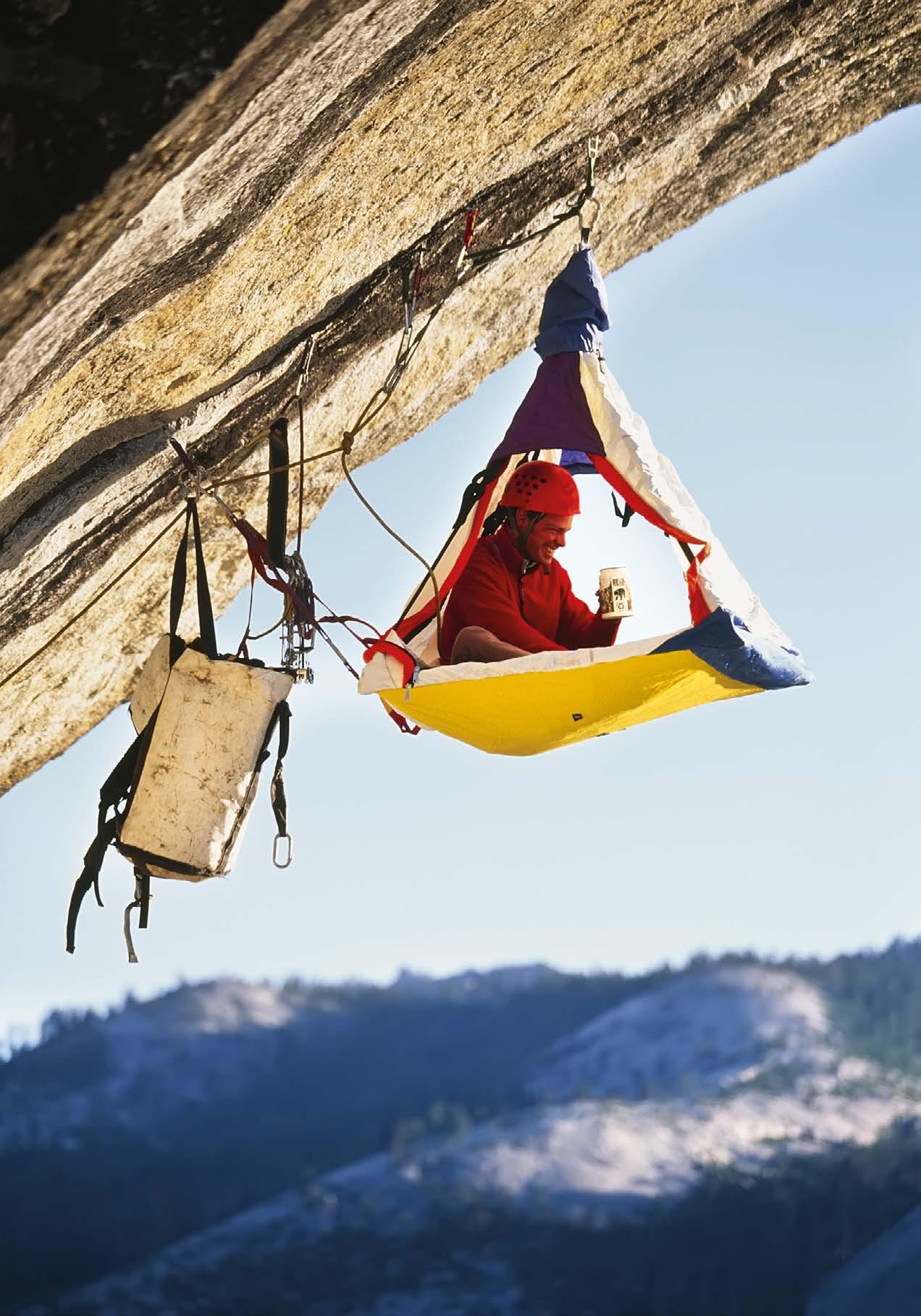
1 VISIBLE THINKING Look at the photo. Discuss in pairs.
See Where is the man? What is he doing?
Think Do you think he feels relaxed? Why? / Why not?
Do you think he will sleep here as well?
Wonder What else do you want to know about this image?
2 SEL Self-awareness Watch the video The Activity for Me and answer the questions.
1 Which are the exciting activities mentioned in the video?
2 Which creative activities are mentioned?
3 Is there an activity from the video you dislike? Why?
4 Which activities from the video do you do? How often?
Rock climber resting in his bivouac

1 Match the interests (1-5) with the words and phrases (a-e).
1 collecting things 2 sports 3 making things 4 reading 5 music
a magazines, books, blogs
b food, pictures, clothes
c playing an instrument, singing, writing songs
d skateboarding, snowboarding, windsurfing
e stamps, cards, comic books
2 SPEAKING Work in pairs. Which things from exercise 1 do you like doing?
3 Read the article on page 79. What is it about? Choose the best option (a-c).
a three people who all won competitions
b three people who all love making things
c three people whose free-time activities changed their lives
4 Read the Exam tip. Then read the Exam task. Look for synonyms in the texts.
Exam tip
Looking for phrases with the same meaning
• In some reading tasks, it is helpful to identify different ways of saying the key ideas.
• Sometimes, a noun or an adjective in the question can have the same meaning as a phrase or sentence in the text. For example, it’s popular = lots of people saw it on the Internet
• Read the text to find phrases that could mean the same as key words in the question.
Exam task
5 PRELIMINARY Multiple choice Read the article again and choose the correct option.
1 Kelvin learnt about how to make things…
A at school.
B by using broken parts of old equipment.
C from other people in his community.
D by watching videos.
2 Kelvin made a battery because…
A he wanted to start his own community radio station.
B his old radio wasn’t working.
C his community often didn’t have electricity.
D he was interested in learning about electricity.
3 Margielyn got better at skateboarding because…
A she found out information about it online.
B she skateboarded to her mum’s food stall every day.
C she took lessons from her friend.
D her parents bought her a new skateboard.
4 Margielyn’s parents…
A thought that she wasn’t very good at skateboarding.
B were very pleased that she had a hobby.
C didn’t like her free-time activity.
D didn’t know about her skateboarding.
5 Shubham’s invention…
A is very expensive.
B is a type of robot.
C is made from plane and car parts.
D helps people who can’t see.
Frame your ideas
6 SEL Self-awareness Answer the questions.
• Think about the things you love doing. Do you think you will still love them in the future? Why? / Why not?
• In the article, Shubham says, ‘If you do good, you get good.’ What do you think he means? Do you agree with him?
7 LIFE SKILLS Work in pairs. Look at the soft skills listed below. Which skills do you think the three people from the article showed? Explain why. Which of these skills do you have?
Four important soft skills for success
resilience: ability to keep trying even when things are difficult
empathy: understanding and caring about how other people feel creativity: ability to think of new ideas problem-solving: ability to find new ways to solve problems
It Started as a Hobby…
Kelvin Doe, Freetown, Sierra Leone
Kelvin Doe was always interested in making things. When he was ten, he collected pieces of metal and broken radios and learnt how to make new things with them. He started a community radio station and made his own radio equipment for it, but he also wanted to find other ways to help his community. In Sierra Leone there are often problems with electricity. If there is no electricity, there is no light at night, and students can’t study. So, Kevin taught himself how to make a battery which provided electricity for the houses in his community. There was an online video about his amazing story, and millions of people watched it.
Margielyn Didal, Cebu City, the Philippines
Do you have a favourite hobby?
The three people in this article used their hobbies to change their lives.

When Margielyn Didal was growing up, she didn’t have a skateboard but she really wanted to learn about skateboarding. At first, she watched videos of famous skateboarders online. Then she borrowed a skateboard from a friend. While her mum was working at a street food stall, Margielyn practised on her friend’s skateboard. Margielyn’s parents didn’t think her new hobby was a good idea, but then she started to win skateboard competitions. When she was 19 years old, Margielyn won a gold medal for skateboarding at the Asian Games. Skateboarding is now very popular in the Philippines. Margielyn’s story shows us that if you really want to do something, you will find a way to make it happen.
Shubham Banerjee, California, USA


Shubham Banerjee started making models of things like planes and cars when he was just two years old. He loved trying to find out how things worked. Then, when he was twelve, he read about Braille He learnt that more than 200 million people in the world are blind, but Braille printers are very expensive. So, he decided to make a cheap 3D Braille printer. He used a Lego® robotics kit and won first prize for his invention at his school science fair. Now he has his own company. ‘You don’t get big from trying to make money,’ says Shubham. ‘Do something to help people. If you do good, you get good. It is what my parents taught me.’

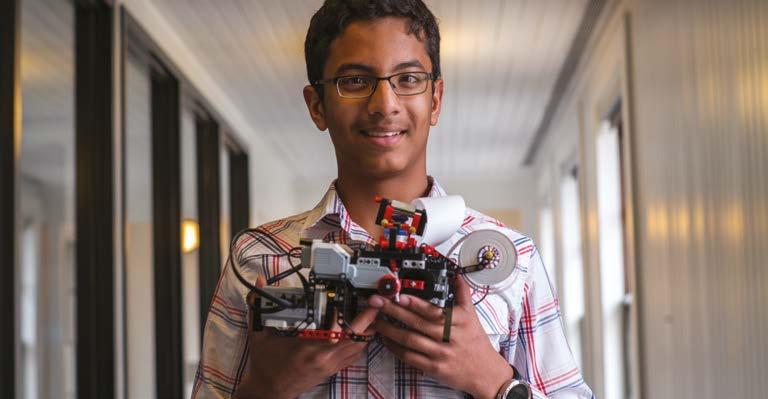

Vocabulary 5
Free-time activities

1 WRITING Work in pairs. Look at the photos. How many of these free-time activities in the box can you find? Write a list.
board games • camping • chess • cycling dance • drawing • music • painting photography • singing
2 Work in pairs. Number the activities in exercise 1 in order from 1 (favourite) to 10 (least favourite). Then work with another pair. Compare your ideas.
3 Listen to five people doing free-time activities from exercise 1. Which activities are the people doing?
4 SPEAKING Read about these people. Choose the best free-time activity for each person. Then compare your answers in pairs.
1 ‘I love spending time outside with my friends or my family, but I’m not very sporty.’
2 ‘I love listening to music and moving my body to music, but I can’t sing or play an instrument!’
3 ‘I like visiting new places, but I don’t like spending time in cars or in trains. I do a lot of sport.’
5 Complete the text with the words in the box.
board games • camping • chess • cycling drawing • music • photography
Our family loves (1) and we usually take our tent to the same place every year. We often see the same families. It’s really friendly! In the evening, big groups of friends sit around the fire and chat together. Someone always brings a guitar, so there’s usually some (2) In the mornings, while Mum and Dad are still sleeping, my brother and I like playing (3) . Our favourite game is probably (4) . I always have the white pieces and my brother always has the black pieces. My brother also usually brings his bike because he loves (5) . My mum’s favourite activity is (6) and she usually has some pens, pencils and several sheets of paper in her bag. This summer I’m going to bring my new camera and practise my (7) . I want to take some cool photos of my family in our tent!
Frame your ideas
6 SEL Self-awareness Answer the questions.
• Which of the activities on this page do you do? Which do you want to do?
• Do you prefer spending your free time on your own or with friends / family? Why?
• Think about your friends and family. What interests have they got? How are you the same? How are you different?
7 MEDIATION DIGITAL
COMPETENCES
Work in groups. Ask and answer to find out people’s interests in your group. Make a note of their answers. Then make a poster, table or diagram to show the different interests in your group.
Who likes…
• spending time outside?
• playing board games?
• playing computer games?
• music?
• art?
• sport?
• science?
Zero conditional
1 Read the sentences (1-2). Choose the correct option to complete the rules (a-d).
1 If you’ve got a smartphone, you don’t need a camera.
You don’t need a camera if you’ve got a smartphone.
2 When the weather’s good, my brother and I often go cycling.
My brother and I often go cycling when the weather’s good.
a We form the Zero conditional with If + Present simple + Present perfect / Present simple
b We use a comma when if is at the beginning / in the middle of the sentence.
c We use the zero conditional to talk about facts / future possibilities
d In zero conditional sentences, we can replace if with how / when
2 Complete the sentences using the zero conditional.
1 When you a picture, you paints and paper. (paint, need)
2 If Dad chess, he usually . (play, win)
3 When we cycling, we always our helmets. (go, wear)
4 If my sister , everyone the room. (sing, leave)
5 Raoul if he computer games. (not sleep, play)
6 I to music when I happy or excited. (dance, feel)
First conditional
3 Read the sentences (1-3). Complete the rules (a-c) with the words in the box. can • comma • will
1 If we go camping on Saturday, we’ll take our bikes.
2 You won’t pass your exam if you don’t practise the guitar every day.
3 If Jaime brings his bike, we can all go cycling later.
a We form the First conditional with if + Present simple + + infinitive.
b When if is not at the start of a conditional sentence, you don’t need a
c In First conditional sentences we can replace will with , may, might or could
4 Look at the first sentence in each pair. Complete the second sentence so that it has the same meaning. Use the first conditional.
1 The winner of this game will be the person who finishes first.
If you first, you the game.
2 Come to our club tomorrow and learn how to draw cartoons.
If you to our club tomorrow, you how to draw cartoons.
3 Answer the next question correctly and win €5,000.
If you the next question correctly, you €5,000.
4 Read this book and laugh out loud!
If you this book, you out loud.
5 Remember to bring a tent so that we can go camping! We camping if you to bring a tent.
5 Match the beginnings of the sentences (1-6) with the endings (a-f).
1 When it rains,
2 You’ll feel better in the morning
3 If she wins this game,
4 If you talk in class,
5 If he likes skateboarding,
6 They usually make a sandwich
a if you go to bed early.
b if they feel hungry.
c he’ll love snowboarding.
d I usually take the bus to school.
e she’ll win the whole competition.
f the teacher will send you out.
6 WRITING Complete the sentences so that they are true for you. Then compare your answers with a partner.
1 If I’m late for school,
2 When I feel hungry,
3 I won’t watch TV this weekend if
4 I’ll play some board games with my friends if
5 If I get a good mark in my English test, my teacher
Listening
1 Match the free-time activities with the photos.

1 making models
2 making videos


3 playing computer games
4 making jewellery
5 doing robotics
6 drawing cartoons
2 SPEAKING Work in pairs. Which hobbies from exercise 1 could you try if you like…
1 spending time with other people?
2 spending time on your own?
3 creating things?
4 science and maths?
5 playing competitive games?
3 Listen to the conversations. In each one, do the two people have the same opinion or a different opinion?
Conversation 1
Conversation 2
Conversation 3
Conversation 4
Conversation 5
Conversation 6
4
Do you use these phrases to show that you agree (A) or disagree (D)? Write A or D. Then listen again and tick (✔) the ones you hear.
1 actually 2 that’s true
3 but 4 in fact
5 absolutely 6 you’re right
Exam tip
Preparing to listen
• For some exam tasks, you have to listen to one person giving some information and then complete some notes about it.
• Read the gapped text carefully before you listen.
• You must complete each gap with exactly the same words as you hear. However, the words around the gap may be different. For example, you may hear: ‘Please remember to bring your sketchbook,’ and the notes for you to complete are: ‘Don’t forget your sketchbook.’
• Read the completed notes again when you finish and check that they make sense.
Exam task
5 PRELIMINARY Gap fill You will hear a teacher talking about clubs for the summer term. For each question, write the correct answer in the gap. Write one or two words or a number or a date or a time.
Summer Term School Clubs
Most clubs are in Room (1) Robotics Club is at 4 pm on (2) School orchestra is in the main hall on Wednesdays. Don’t forget your (3) ! Street Dance takes place in the (4) (5) club is on Thursday afternoons. Give your completed form to the (6) by Monday morning.
Talking about free-time activities
1 Read the sentences (1-4). Match the words in bold with the definitions (a-d).
1 I’m always scared before I walk onto the stage
2 I’d really love to take part in the school show
3 My painting’s in an exhibition at the library.
4 My sister won a music competition last year.
a A collection of things in a public place for people to look at.
b An event in which people try to win prizes by being the best.
c The place in a theatre where the actors, dancers or singers are.
d A performance at a theatre, usually with singing and dancing.
2 Match the sentences (1-5) with the extra information (a-e).
1 My favourite hobby is drawing cartoons.
2 I usually draw cartoons of animals.
3 Next month I’m going to enter an art competition at school.
4 I joined a drawing club at the library last month.
5 I really enjoy the club because I’m learning lots of new things about drawing.
a I think our teacher is really helpful.
b The prize is a new sketchbook and a set of really good pens.
c I started about two years ago and it’s a great way to relax.
d I don’t really like drawing people.
e I go every Wednesday afternoon at four o’clock.
3 A Look at the diagram. Read the statement in the middle. Think about the extra information you can add to the statement. Use the ideas to help you.
3 B SPEAKING Work in pairs. Discuss listening to music. Use your ideas from exercise 3A. where I listen to music play instruments favourite style of music I really enjoy listening to music. how I feel when I listen when I listen to music
4 Read the Exam tip and sentences (1-5). Think about the extra information you can add to each one. Then compare your ideas in pairs.
Exam tip
Giving extra information
• In a speaking exam, the examiner will ask you general questions about your home, family, friends and free-time activities.
• Listen carefully to the question and ask the examiner to repeat it if you don’t understand.
• When you answer their questions, try to give extra information. For example, if you are talking about a free-time activity, explain why you enjoy it, where you do it and when you started.
1 I don’t really like playing board games.
2 I’m quite good at sports.
3 I play the violin and I’m in the school orchestra.
4 My aunt gave me a really good video camera for my birthday.
5 I love acting and singing and I was in the school show last term.
Exam task
5 PRELIMINARY General conversation
Work in pairs. Take turns to ask and answer the questions. Try to give extra information for each answer. Use the Useful language to help you.
1 What do you usually do when you want to relax?
2 Do you prefer spending time outside or inside?
3 Do you think you have enough time for your hobbies?
4 Do you prefer watching sport or playing sport?
5 What kinds of free-time activities do your friends do?
Useful language Expressing likes
• I really love…
• I like … very much.
• My favourite … is… Talking about the past
• Last year, I went to…
• Six months ago, I saw…
• In the summer, we went to… Talking about future plans
• Next time, I want to…
• I hope we’ll … again.
• I really want to go back to…
ORACY SKILLS
Frame B
The J&K Diaries – Episode 5
1 Watch the vlog. Complete the sentences with one word in each gap.
1 Josh is learning to play the
2 He is a of metal.
3 Kayla plays the and the .
4 Josh’s brother can’t do his homework because it’s too .
5 Kayla suggests that Josh uses when he practises.
2 Read the texts on pages 84-85 quickly and find the following information.
1 two activities that mention sport
2 two places that sell food
3 two activities that mention history
4 three activities that mention music
5 two activities that mention birds
Exam task
3 INVALSI Read the texts again. The people (1-5) want to find an activity for the weekend. Choose the best activity for each person.




Bella is looking for an activity during the day. She is really interested in sport. She doesn’t want to spend any money and she’d like to try a few different sports.
Kelly is planning a birthday weekend activity for herself and nine friends. She loves music and cooking and doesn’t want to spend the day indoors. She’s not keen on children.
James wants to find an activity for himself and his two young children. He hasn’t got a lot of money and he doesn’t really enjoy sport. He wants to buy lunch for them all while he’s there.
Phil wants to visit an interesting place and also buy a present for a friend. He’s interested in sport and art. He would prefer to spend the day indoors.
Ulrika loves birds, flowers and nature. She also wants to learn a new skill. She’s only free on Saturday afternoon.
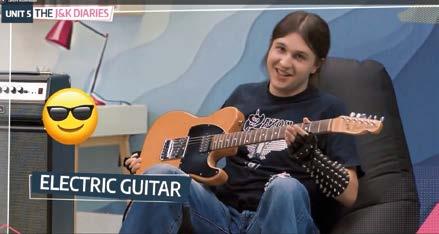
No way! Assolutamente no! Fair enough. Ci sta. / Capisco. How strange! Che strano! I know, right? Lo so!
4 A Work in groups. Choose a weekend activity from the texts for your group. Make sure that everyone in your group is happy with the choice.
4 B MEDIATION In your groups, explain to the class which activity you chose and why. Prepare a written report. Choose one student to present the report to the class.
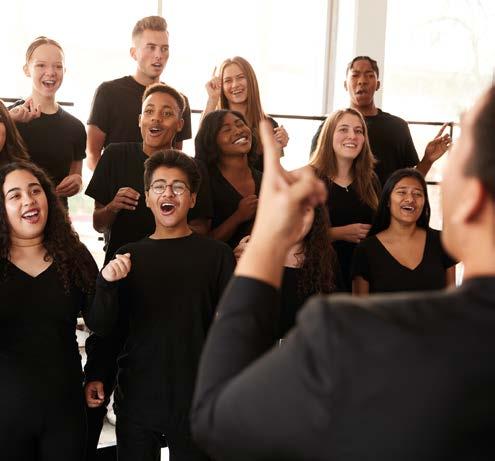
Do you love to sing? If you enjoy listening to music … and making music, you will love SongFest! More than 20 singing teachers from around the country are going to teach us their favourite songs. Starting at 11.30 on Saturday and finishing at 5.30, at Blackfields Hall. Free entry! Bring your own food.
What’s On This Weekend…

The History of Baseball
If you’re keen on sport, you’ll love this free exhibition at the Reece Gallery. Using photographs, paintings and newspaper articles, it explores the history of baseball, from its early days in the 1700s up to the present day. And don’t forget to visit the Gallery Shop, where you can buy some fantastic postcards, T-shirts and mugs.
On Saturday morning only, Trewbridge Manor is opening its famous gardens to the public. Enjoy walking around the gardens, full of colourful flowers and beautiful birds. Why not bring a picnic and have your lunch by the lake? Only £8 per person, or £25 for a family ticket (Two adults and two children).
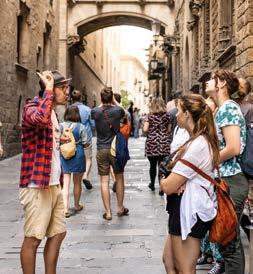
Party in the Park
Bring the whole family to enjoy a day of free fun at Victoria Park! There’ll be food stalls, live music and folk dancing. You can play giant chess or try to win some prizes at the tombola. And don’t forget to visit our Art Tent, where you can buy paintings and drawings by local artists.
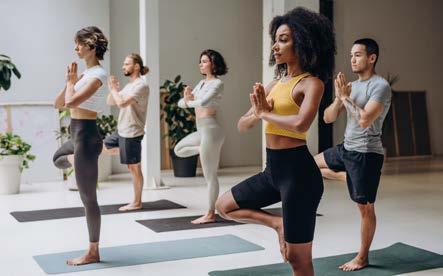
The Story of our Town Get
Join our guide on a walking tour around the town. For just £15 per person, you can find out about the history of the town and visit some beautiful old buildings. The walk starts at 9.30 am on Saturday and takes 120 minutes. Please wear comfortable shoes and bring an umbrella! Maximum six people.
From 10-6 this Saturday, come to Ardington Sports Centre and try out some of our amazing classes – for free! You can do some yoga, go to a dance class or play tennis at our indoor court. Our friendly instructors will be there to help you.
Some amazing bands are playing at our campsite on Saturday night, starting at 9.30 pm. Don’t worry about getting home after the concert – bring a tent and camp in the field. You can buy some food at our farm shop and prepare your own breakfast on Sunday morning. Just £35 per person, including music and camping. 18+ only.
Come to the Bird Centre at 2.30 pm on Saturday for a two-hour workshop on bird photography. Our photography expert, Jamie Rednall, will show us some of his most famous photographs and explain how he took them. He will then lead you around the Centre, helping you to find and photograph some amazing birds. Cost: £75 per person.

Vocabulary 5
Music
1 Write the words in the box in the correct column.
classical • concert • dance • download drum • guitar • hip hop • keyboard • opera piano • pop • radio • stream • vinyl • violin
Musical instruments Types of music Ways of listening
Expressing likes and dislikes
4 Choose the correct option to complete the sentences.
1 What do you like to do in / on your free time?
2 I’m a big fan in / of chess.
3 I’m involved in / on a youth club.
4 What are you interested about / in?
5 I’m not crazy about / in the theatre. I prefer TV.
6 What do you usually do at / for the weekend?
7 Are you keen in / on board games?
8 I’m really into / onto sport and keeping fit.
Exam tip
Deciding which answers are wrong
• Read the whole text first for a general meaning.
2 Complete the conversation with the words in the box. Then listen and check your answers.
concert • keyboard • pop • radio singers • songs • stream • vinyl
Alia Hi, Rema. How was the (1) last night?
Rema Oh, it was amazing! They had a technical problem with their (2) at the beginning, but luckily they fixed it quite quickly.
Alia That’s good. I heard one of their (3) on the (4) last week, and even though I’m not personally into (5) music, I think they are all really good (6)
Rema Absolutely! I want to get their new (7) – the cover art is beautiful, but it’s really expensive. Alia Oh, I know! That’s why I always (8) music – it’s much cheaper.
Frame your ideas
3 SPEAKING Work in pairs. Discuss the questions.
• What kind of music do you usually listen to?
• Do you prefer listening to music at home or going to concerts? Why?
• Do your parents listen to the same kind of music as you? What do they listen to?
• Do you think it’s possible to be friends with someone who likes completely different music? Why? / Why not?
• Look at each gap and read the answer options. Try to understand how the missing word connects the parts of the sentence.
• Try out all the options. Then make your choice.
• Read the whole sentence again for sense.
Exam task
5 PRELIMINARY Multiple-choice cloze Read the Exam tip. Then read the text and choose the correct option.
Sóley: A singer and storyteller from Iceland


Sóley is a musician and songwriter from Iceland. As a child, she (1) classical piano, as well as guitar. Her family are also musical. Her dad is a music teacher and a musician, and her brother and sister (2) musical instruments. When Sóley was 20 years old, she (3) a band called Seabear and they made two albums. She then recorded three solo albums. She (4) mainly in English and plays many (5) of musical instruments, including piano, guitar and drums. Sóley often performs at music festivals and tours around the world. Her songs are sometimes dreamy and full of images. She says that songs and music are a good (6) to tell stories.
1 A presented B studied C collected D had
2 A sing B do C take D play
3 A joined B became C played D sang
4 A uses B prefers C sings D has
5 A models B kinds C forms D kind
6 A way B road C path D street
Verb patterns: -ing, to + infinitive
1 Read the sentences (1-6). Complete the rules (a-c).
1 I enjoy playing basketball with my friends.
2 He started to move the chess piece but then stopped.
3 He started learning chess five years ago.
4 We decided to join the robotics club.
5 She wants to buy a new tent.
6 I finished reading my new book last night.
a We use an -ing form after some verbs, e.g. practise, imagine, and
b We use to + infinitive after some verbs, e.g. need, promise, hope, help, and
c We can use either an -ing form or to + infinitive after some verbs, e.g. love, hate and
2 Complete the sentences with the correct form of the verbs.
1 I‘m going to practise (throw) the ball before the basketball match tomorrow.
2 She promised (go) to his art exhibition at the weekend.
3 We need (buy) a new chess board.
4 I can’t imagine (spend) every weekend playing football.
3 Read the sentences. Is the meaning of the underlined verbs the same or different?
1 I stopped to drink some water.
2 I stopped eating meat last year.
4 Read the explanation. Then match the sentences in exercise 3 with the explanations (a-b).
With some verbs, like stop, we can use an -ing form or to + infinitive, but the meaning is different.
a stop one thing in order to do another thing
b not do something any more
5 Match the sentences (1-3) with the uses (a-c).
1 I’m happy to stay at home and play computer games.
2 He went to the shops to buy a bike.
3 Enrico isn’t old enough to drive.
a an infinitive of purpose
b an infinitive after too + adjective or adjective + enough
c an infinitive after an adjective
6 Complete the sentences with the correct form of the verbs.
1 Do you like (play) board games?
2 I’m too tired (go) out tonight.
3 Amelia hopes (win) the singing competition.
4 Johann went to the library (look) for a book about chess.
5 It was very difficult (answer) all the questions in that exam.
6 Sue is clever enough (pass) all her exams.
7 Read the Exam tip. Then read the Exam task. Identify which words are followed by an -ing form or to + infinitive.
Exam tip
Writing the
correct verb form
• In a gap fill, the word before the gap will help you decide what word to write.
• Check the word before each gap to see if it is a verb or a preposition.
• If it is a verb, is that verb usually followed by to + infinitive or an -ing form?
• If it is a preposition, it is usually followed by an -ing form.
Exam task
8 PRELIMINARY Open cloze Complete the email with one word for each gap.
Hi Hayley
How are you? Are you excited about your new dance class?

I’ve got some news! Last week I decided (1) start guitar lessons. I’m going to borrow a guitar from my cousin. I know it will (2) hard at first, but I really want (3) write my own songs one day!
Do you know about the guitar concert this Friday? I’m looking forward to (4) some real Spanish guitar music! How about (5) there together?
Don’t forget (6) text me!
Maya
Writing lab
Expressing
opinions
Useful language
Expressing opinions
• I believe…
• In my opinion…
• I think that…
ORACY SKILLS
Expressing strong opinions
• I strongly believe…
• I’m convinced that…
• I’m sure that…
1 Read the sentences. Which sentences express opinions (O) and which express facts (F)?
1 There are usually more than fifteen different types of instrument in an orchestra.
2 The violin sounds much more beautiful than the guitar.
3 Music helps you make friends and feel happy.
4 The school orchestra meets every Thursday from 3.30.
5 Joining a musical group is a great idea.
6 Membership of the orchestra is free, but there is a $5 fee per term for music.
2 Rewrite the opinion sentences from exercise 1, using the Useful language.
3 A Work in pairs. Look at the information about clubs. Think of one reason in favour of and one reason against joining each club. Use the Learning focus box.
Robotics Club
Cost: $15 per term
Place: Room 15
Time: Tuesday afternoons, 3.30-4.30

Drawing cartoons
Cost: $5 per session
Place: Arts Centre
Time: Saturday mornings, 9.00-11.00
Skateboarding club
Cost: Free
Place: Skate park
Time: Wednesday afternoons, 3.30-4.30

Learning
focus Explaining choices and contrasting ideas
When you are making a choice between two or three different options, it’s important to explain your reasons. Try to think about good and bad points for each option.
• On the one hand, … On the other hand, …
• The good thing about … is …
• … is interesting. However, it is also …
• If you do …, you won’t be able to …
Exam tip
Planning
your ideas
• Some exam tasks ask you to give a friend advice / your opinion.
• Read the task carefully and underline the key words.
• Think of ideas for each part of the task. Include reasons for your opinions.
• Think of adjectives to express your opinions.
• Make brief notes before you begin writing.
Exam task
4 PRELIMINARY Writing an email Read this email from your English-speaking friend Alex and the notes you made. Write your email to Alex using all the notes.
Hi
How are you? Did you enjoy the concert last week?
Can you give me some advice? I can’t decide which after-school club to join – the robotics club or the skateboarding club?
What’s your favourite free-time activity? How often do you do it?
Do you want to do something at the weekend? Let me know!
Alex
5 Complete the Reflection checklist. Then discuss your answers with your partner.
Reflection checklist
Yes, because…
Say which you prefer
Explain Suggest an activity
Tick (✔) the sentences that you think are true. I used phrases for expressing my opinion. I used the correct words to contrast my ideas. I included reasons for my opinions. I included all the points in the notes.
3 B Listen to Phil and his mum discussing the clubs. Which club does Phil decide to join?
6 Action!

1 VISIBLE THINKING Look at the photo. Discuss in pairs.
See What are the people doing? Why are they covered in blue paint?
Think How do you think they feel?
Wonder Would you like to do something like this?
2 Watch the video Climbing El Capitan. Are the sentences true (T) or false (F)?
1 Many people like climbing in Yosemite National Park.
2 This is Jimmy Chin’s first visit to Yosemite.
3 Jimmy already knows some of the other climbers at Yosemite.
4 Jimmy, Tommy and Kevin aren’t going to spend the night on El Capitan.
5 They don’t use any ropes when they climb.
6 Jimmy takes photos, but he doesn’t climb with Tommy and Kevin.
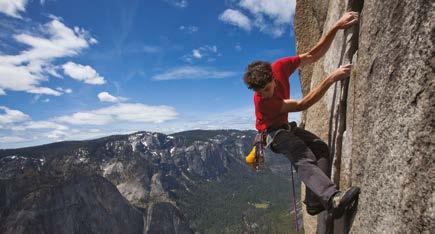
People participating in the Colour Run, Prague, Czech Republic
Frame A
1 SPEAKING Work in pairs. Look at the pictures and answer the questions.
go for a run with other people do an individual sport run on your own


watch sport on TV play a team sport go to sports events
1 Which of these activities do you do?
2 Which would you like to do?
3 Which would you not like to do? Why?
2 VISIBLE THINKING Look at the photos on page 91. Discuss in pairs.
See What are the people doing?
Think Do you think they are enjoying themselves?
Wonder What would you like to find out about the ‘GoodGym’?
3 Read the article on page 91 quickly. Which of the activities from exercise 1 are mentioned?
5 A MEDIATION DIGITAL COMPETENCES
Work in pairs. Imagine you want to start a GoodGym project in your community. Design a poster to explain what the GoodGym is and how it helps people.
5 B Present your poster to the class.
Exam tip
Identifying reference words
• When you have to complete a text with missing sentences, try to identify the reference words in the text.
• Reference words like: he, she, they, these, those can help you to link the gaps in the text to the correct missing sentence.
• For example, if the sentence before a gap is: The members of the GoodGym enjoy running and helping people, then the sentence to fill the gap will probably include the pronoun they, which refers to the members
• Always read through your completed text when you have finished, and check that it makes sense.
Exam task
6 PRELIMINARY Gapped text Read the article on page 91 again. Five sentences have been removed. For each question (1-5), choose the correct answer (A-H). There are three extra sentences which you do not need to use.
A However, they still wanted to help other people.
B Running is one of the most popular sports in the UK.
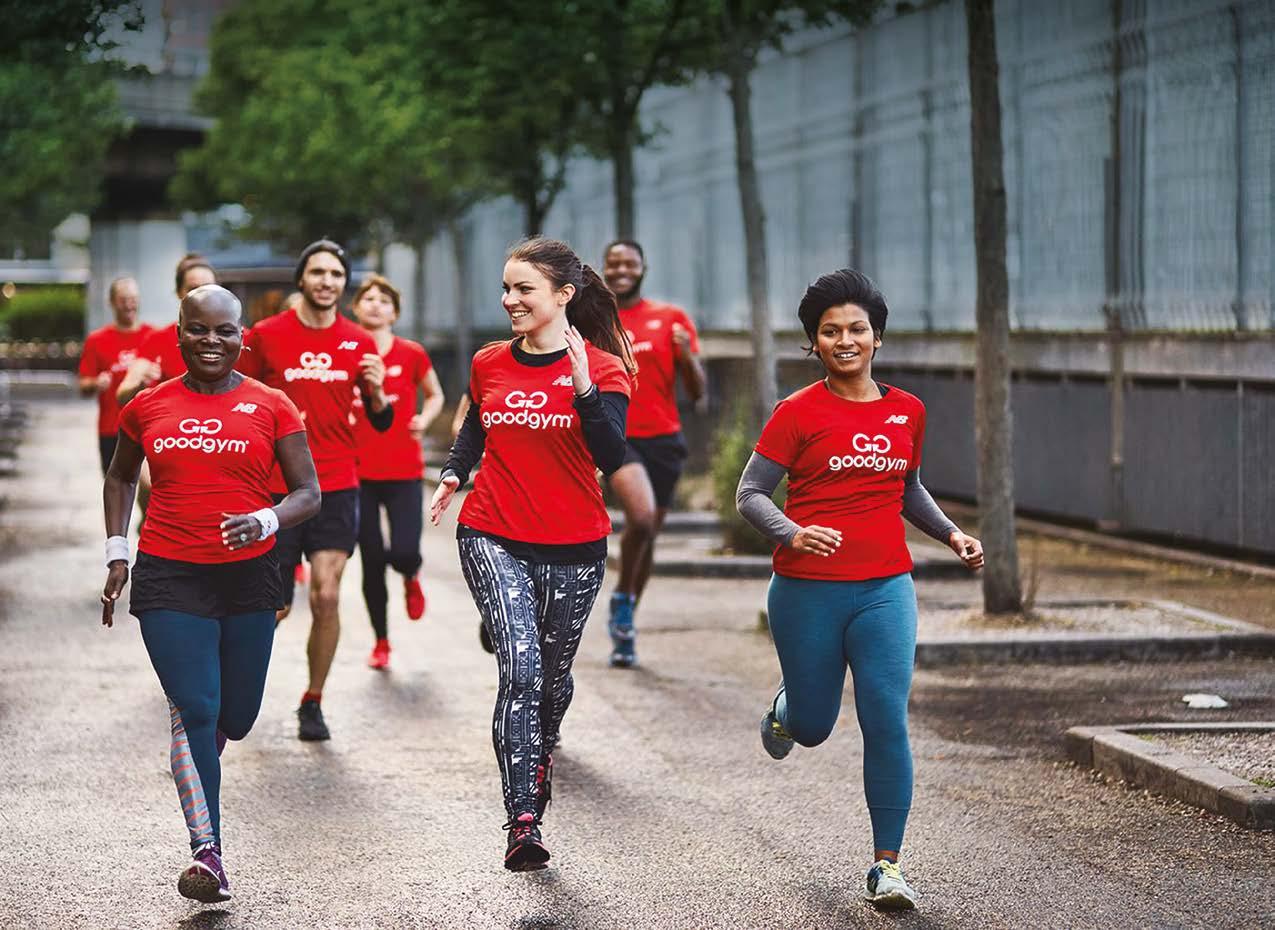

4 Read the article again. Answer the questions.
1 In which country is the GoodGym?
2 Name three different types of places that GoodGym runners visit.
3 What do runners do when they visit these places?
4 How do some runners help older people?
5 How do the older people help the runners?
6 Who first had the idea for the GoodGym?
C When they arrive there, they spend some time helping with a community project.
D It gave Ivo a reason to run, and it gave his friend some company at the same time.
E It is sometimes difficult to find the motivation to do exercise.
F Many of these people live on their own and sometimes feel lonely
G The youngest GoodGym member is 18, and the oldest is over 75!
H The GoodGym also organises social events, parties and races for its members.
7 CITIZENSHIP Can you remember any charity or volunteering activities in your area during the 2020-2021 pandemic? Frame your ideas
Keeping Fit and Doing Good
You don’t have to be very fit to join the GoodGym, but you must have a pair of trainers, and you must be ready to work hard! The GoodGym is a community of runners and cyclists all around the UK and there are people of all different ages and abilities. (1) These people don’t want to run on their own in a gym, they want to exercise and help others and their community at the same time.
The runners arrange times to meet and run together. Sometimes they run to a local hall, sometimes they run to a park and sometimes they run to a school. (2) In Brighton, runners look after a school garden; in Barnsley, they clean a local river. They can do all sorts of different tasks, like planting trees, delivering food, moving furniture or picking up litter. It’s a great way to meet new people and to get fitter.
Some runners at the GoodGym run to visit older people. (3) A GoodGym runner runs to an older person’s house, stops for a drink and a chat and then returns home. The older people are called ‘coaches’, because they give advice, and they encourage the runners to keep running. In this way, they all help each other.
During the 2020-2021 pandemic, it wasn’t possible for GoodGym runners to meet and do exercise together. (4) They worked together with other charities to buy and deliver food and medicine to people who were ill or vulnerable.
The idea for the GoodGym came from Ivo Gormley, in 2007. He wanted to keep fit and he also wanted to help his friend, Terry, who was ill. So, he decided to buy a newspaper for Terry and then run to his house to deliver it. (5) Now there are GoodGyms in 63 areas all across the UK and every day, GoodGym members are working to help others.
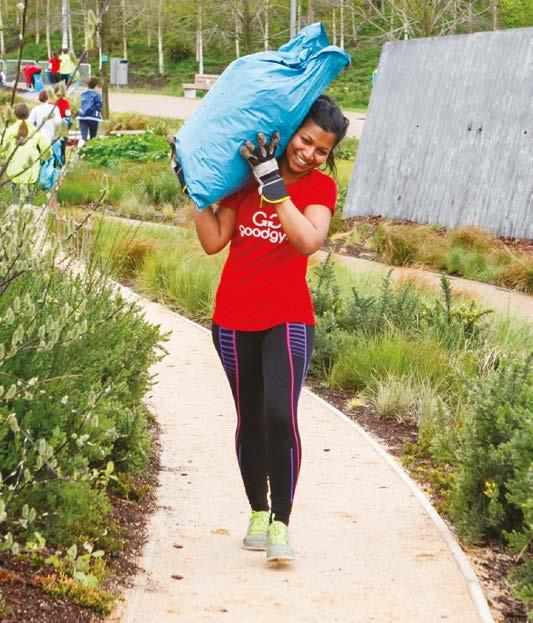
Vocabulary 6
Sport
1 Work in pairs. Which of the sports in the box can you see in the photos?
badminton • baseball • basketball • cricket cycling • golf • rugby • snowboarding swimming • volleyball
Sports equipment

2 Match the equipment (1-5) with the sports (a-f) in exercise 1. 1 ball 2 bat
bike
club
3 Work in pairs. Discuss the questions.
1 Which of the sports from exercise 1 do you do?
2 Which are team sports?
3 Which are individual sports?
4 Read the sentences (1-2). Choose the correct option to complete the rules (a-b).
1 My sister plays football and cricket every Saturday afternoon.
2 Do you want to go swimming tomorrow or would you rather go skateboarding?
a We use the verb play / go with sports that use a ball.
b We use the verb play / go with sports that end in -ing
5 Complete the sentences with the correct form of play or go.
1 I sailing last year.
2 We’re going to baseball in the park after school today.
3 If the weather’s good at the weekend, we surfing at the beach.
4 I love golf, but I’m not very good at it.
5 Do you want to skiing next month?
Sports people
6 Match the words (1-6) with the definitions (a-f).
coach
player
a a person who plays a sport, a game or a musical instrument
b a person who likes someone or something very much
c a person who comes first in a competition
d a person who trains a sports player or a team
e a group of people who play a sport or a game together
f a person who is part of a team or an organisation
7 Complete the text with the words in the box. coach • fans • goes • member play • players • team • volleyball
Last year, I started playing (1) at a local club. At first, I wasn’t very good at it, but the (2) gave me lots of good advice and I really enjoy it now. There are six (3) in our (4) and we (5) every Saturday afternoon. My mum and dad are big (6) of the team, and they come to watch us every weekend. My brother never comes because he always (7) swimming on Saturday afternoon. He’s a (8) of a swimming club and they swim in the sea every Saturday of the year, even in the middle of winter.
Frame your ideas
8 A Make a class sports survey Work in pairs. Ask and answer the questions below. Make a note of your partner’s answers.
• Which kinds of sport do you prefer, team sports or individual sports? Why?
• Do you prefer to do sport indoors or outdoors? Why?
8 B Compare the answers to find the most popular sports in the class.
VIDEO
Modals of obligation and necessity
1 Read the sentences (1-5). Then complete the rules (a-c) with the correct verb in the box.
1 You have to wear a helmet when you go climbing.
2 You must wear a lifejacket when you go sailing.
3 You mustn’t ride a bike without a helmet.
4 You needn’t put lights on your bike if you don’t ride in the dark.
5 You don’t have to run on the road – you can run in the park.
don’t have to • have to • must mustn’t • needn’t
a We use to say that something is not allowed.
b We use and to say that it is a rule to do something (obligation).
c We use and to say that it is not necessary to do something, but you can if you want.
2 Choose the correct option to complete the sentences.
1 In football, players mustn’t / needn’t touch the ball with their hands.
2 You must / don’t have to wear goggles in the pool, but they will protect your eyes.
3 We mustn’t / have to be at the park by 2.15 because the game starts at 2.30.
4 Team members must / needn’t listen to the coach and follow her instructions.
5 Students needn’t / have to bring their own rackets to the tennis lesson – we have rackets at the club.
6 All skateboarders at this park must / needn’t wear helmets at all times.
3 Look at the poster for the Green Park fun run. Complete the rules with must, mustn’t and don’t have to.
1 You be aged between 11 and 16 to take part in the teens fun run.
2 You use bikes or scooters in the race.
3 You bring water – there are drink stations at the park.
4 Dogs join the race.
5 Children aged between 4 and 10 come with an adult.
6 You pay to do the Green Park fun run.
4 Complete the conversations with mustn’t, don’t have to and have to.
1 A Do I need to buy a tennis racket?
B You buy a new one; you can borrow mine.
2 A I wear boots for my riding lesson?
B Yes, you wear riding boots.
3 A Players practise every day.
B That’s right. All players rest sometimes.
4 A I want to go to an exercise class at the sports centre.
B Good idea, but you become a member first.
5 A You run around the swimming pool. It’s dangerous!
B OK, sorry.
6 A If you’re under 14, you bring an adult with you to football practice. It’s a rule.
B OK – I’ll ask my grandad to come with me.
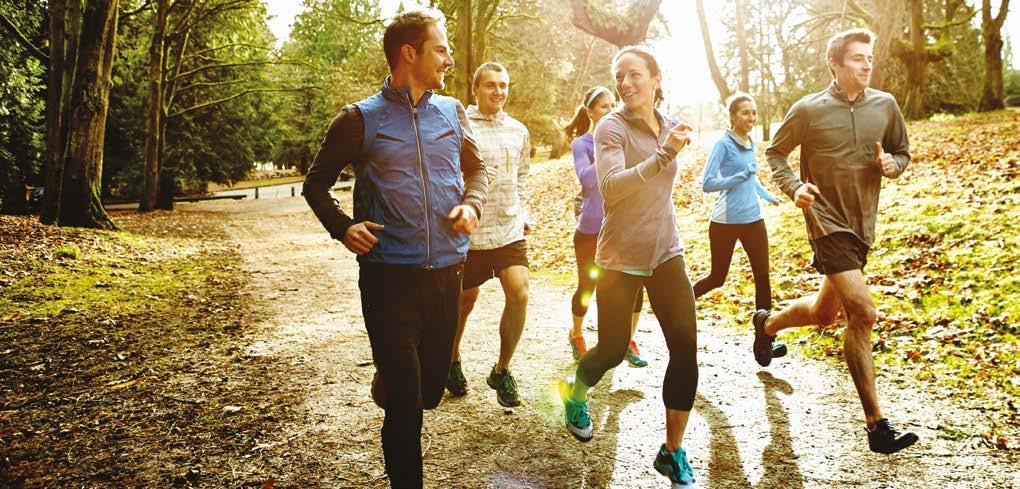
Do you like running?
Come to the Green Park family fun run on Saturday 5th April.
Junior 2 km fun run for children aged 4-10 @ 10 a.m.
Teens 5 km fun run for young people aged 11-16 @ midday
Adults 10 km fun run for everyone aged 17+ @ 2 p.m.
• All junior runners need a parent / adult at the race to watch them.
• No bikes or scooters.
• No dogs allowed in any of the races.
• No need to bring water – we have water stations at the park.
Listening
1 Look at these numbers. Practise saying them with a partner.
1 13 30 13th 30th
2 15 50 15th 50th
3 18 80 18th 80th
4 1st 21st 31st
5 2nd 22nd 32nd
6 3rd 23rd 33rd
2 Listen and circle the numbers in exercise 1 that you hear.
Dates and prices
3 Look at the pairs of numbers. Listen and underline the part of each word that is stressed.
1 forty fourteen
2 a hundred a thousand
3 second twenty-second
4 eighty eighteen
5 seven seventeen
6 sixteen sixty
4 Work in pairs. Take turns to say a number from exercise 3. Write the number your partner says.
5 Listen to a conversation about a first-aid course. Are the sentences true (T) or false (F)?
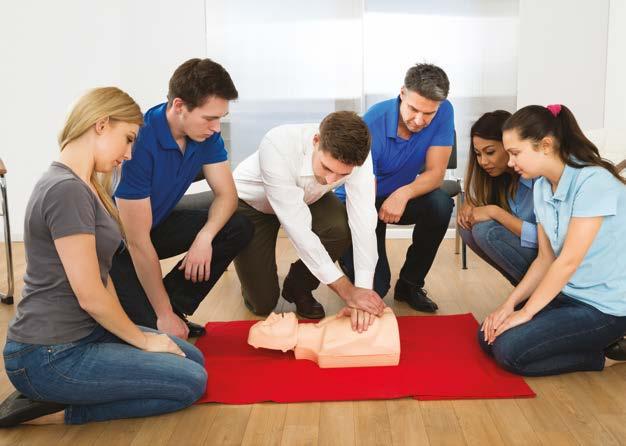
1 Sofia and Kurt are sports coaches.
2 The course starts on 2nd April.
3 It is from 10 a.m. to 5 p.m. for five days.
4 It is for students who are older than seventeen.
5 It costs £150.
6 There is a discount of twenty per cent if Sofia books before the beginning of March.
6 CRITICAL THINKING SEL Social awareness Work in pairs. Play ‘The Numbers Game’.
• Write six numbers that are important for you, for example, an important date, a lucky number, the number of people in your family, etc.
• Read out your numbers to your partner. Can they guess why they are important?
The tenth of May, 2015.
That’s right!
Exam tip
I think that’s important because your sister was born then.
Listening for numbers, dates and prices
• Be careful with numbers like fifteen and fifty, which sound similar.
• Make sure your answer is logical. For example, sixty isn’t a likely age for a young climbers club.
• Remember that ordinal numbers for 1, 2 and 3 are 1st (first), 2nd (second) and 3rd (third).
• We say prices such as £43.25 in different ways. We can say: forty-three pounds and twenty-five pence, or forty-three pounds twenty-five or forty-three twenty-five
Exam task
7 PRELIMINARY Gap fill Listen and write the correct answer in the gap. Write one or two words, a number, a date or a time.
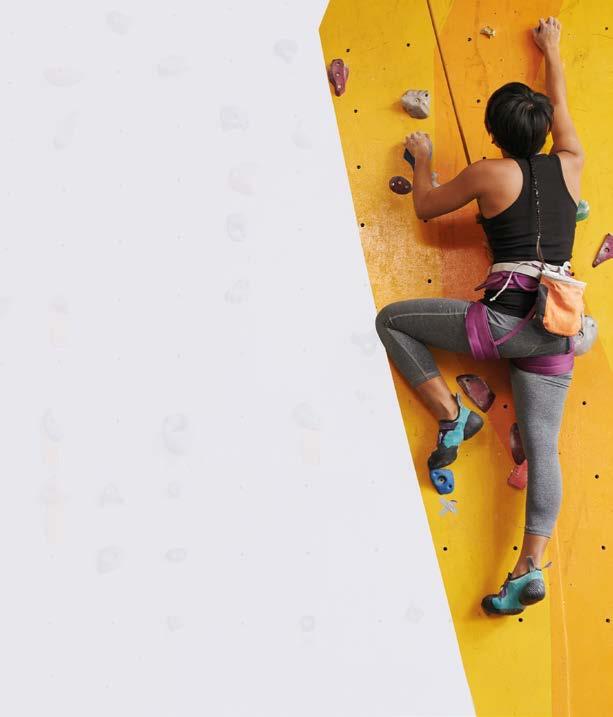
Brook sports centre: climbing club
Young climbers club
Age: For climbers aged 9 to (1)
Meeting times: On Saturdays from 10 to 11.30 a.m.
First meeting: September (2)
Team climbers club
Age: Any age
Meeting times: Tuesdays and Thursdays from 5 to 8 p.m.
First meeting: September (3)
Cost: Clubs are (4) £ each per month
Contact: Go to our website or call (5) to register
Talking about sport
1 Which of these sports do you like best and least? Number them from 1 (best) to 8 (least). table tennis running basketball swimming football zumba tennis cycling
2 Work in pairs. Compare your answers.
3 Read the sentences. Which sports in exercise 1 do they describe? Discuss your ideas with your partner.
1 It’s good fun to dance when you do exercise.
2 Team sports help people work together and think about each other.
3 This is a great sport because you can do it inside or outside.
4 One reason for choosing this sport is that a lot of people love to do this when they go on holiday.
5 This sport is great because it’s not just a sport, it’s a way of getting to different places.
6 It’s a good idea to learn this sport because the rules are very easy and everyone can do it.
4 SPEAKING Make more sentences about the sports in exercise 1. Use the phrases in the box.
can play it with friends • not expensive
• don’t need special equipment
• there aren’t winners or losers
• you can enjoy nature at the same time
5 Read the instructions and make notes about your ideas. Then work in pairs. Take turns to talk about the activities you want to do.
You are helping to organise a sports weekend for younger children. You each have to choose four activities for the weekend. Tell your partner:
• which activities you want to do
• why you want to do these activities
6 A CRITICAL THINKING Work in pairs. Look at the statement below. Think of two reasons to agree with it and two reasons to disagree with it.
Sports stars get too much money.
6 B DEBATE Divide the class in two groups. Work in your group to make a short speech in favour of / against the statement.
Group 1 is in favour of the statement. Group 2 is against the statement.
6 C Listen to each other and ask questions. Finally, have a class vote.
7 Read the Exam tip. Then read the Exam task and think about your answers to the questions. Think of reasons to support your answers.
Exam tip
Giving your opinion
• In some speaking tasks, you have to express your opinion and ask your partner about their opinion.
• State your opinion clearly. There is no right or wrong answer, but you should have an opinion.
• Support your opinion with clear, relevant reasons.
• Introduce each new reason using first of all, secondly, finally
• Remember to ask your partner for their opinion and to listen to them.
Exam task
8 PRELIMINARY TRINITY General conversation Work in pairs. Discuss your opinions on these questions.
• Which sports do you think we should learn at school? What do these sports teach people?
• What are the benefits of playing a team sport?
• What are the benefits of playing an individual sport?
• Do you think some sports are too dangerous? Why? / Why not?
• Do you think some sports stars get too much money? Why? / Why not?
Useful language
Presenting your opinion
ORACY SKILLS
• I believe / don’t believe that … is a good idea because…
• I think / don’t think … is important / useful / a good idea because… In my opinion, … Explaining results and effects
• If we …, we can / will…
• It can have a good effect on…
• It can help everyone to… Asking for your partner’s opinion
• What do you think?
• Do you agree with me?
9 Some sports can be fun to do with other people. Do you do any sports like these, or do you prefer to do exercise on your own? Give reasons for your answer. Frame your ideas
The J&K Diaries – Episode 6
1 Watch the vlog and match the beginnings of the sentences (1-5) with the endings (A-G). There are two extra endings that you should not use.
1 Kayla has got
2 Kayla asks Josh for
3 Josh gets Kayla
4 Josh is talking about
5 Josh think Kayla should
A go to bed.
B a cold and a headache.
C some cold water.
D feeling ill.
E ways to stay fit and healthy.
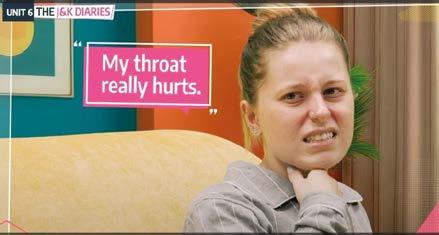
F a cup of hot water with honey.
G go to the party.
2 DIGITAL COMPETENCES Josh suggests hot water and honey for Kayla’s cold. Find out about three other ways to treat a cold at home. Which ones did you already know about? Which ones do you want to try?
3 Read the review on page 97 quickly. Choose the best summary of the film.
A Philippe and Driss have very different lives but they become good friends.
B Driss helps Philippe learn to walk again after a terrible accident.
C Philippe and Driss are good friends who fall in love with the same woman.
Exam task
4 INVALSI Multiple choice Read the review again. Choose the correct answer (A, B, C or D) for questions 1-7. Only one answer is correct. The first one (0) has been done for you.
0 Philippe wants to find…
A a doctor who can make his arms and legs move.
B a businessman who can help him with his hotel.
C a friend who can take him paragliding.
D a person who can help him with his daily routine.
1 What does Philippe think about most of the people he interviews?
A They don’t have enough experience.
B They aren’t interesting.
C They are very funny.
D They don’t really want the job.
2 During the interview, Driss…
A talks about his qualifications.
B isn’t very polite.
C seems very serious.
D is very interested in the job.
3 Philippe and Driss…
A help each other in different ways.
B have very similar personalities and experience.
C have a lot of big arguments.
D don’t have the same ideas about most things.
4 Driss thinks that Philippe…
A shouldn’t write letters to Eleonore.
B shouldn’t tell Eleonore about his accident.
C should tell the truth to Eleonore.
D should end his friendship with Eleonore.
5 Driss returns to his home because…
A he argues with Philippe about Eleonore.
B he doesn’t enjoy his job.
C Philippe finds a different carer.
D other people need his help.
6 At the end of the film, we find out…
A some information about the real-life Philippe and his carer.
B that Philippe and Eleonore get married.
C about Driss’s problems at home.
D about Philippe’s other carers.
7 The writer likes the film because it…
A is about real people.
B helps us to understand a different world.
C is serious and important.
D shows that we shouldn’t make quick decisions about other people.
5 SPEAKING SEL Social awareness Discuss these questions in pairs.

1 In The Intouchables Philippe uses a wheelchair . What problems do you think people with wheelchairs might have in their daily lives?
2 Why do you think Philippe offers Driss the job of carer?
3 What are some common stereotypes about people with disabilities?
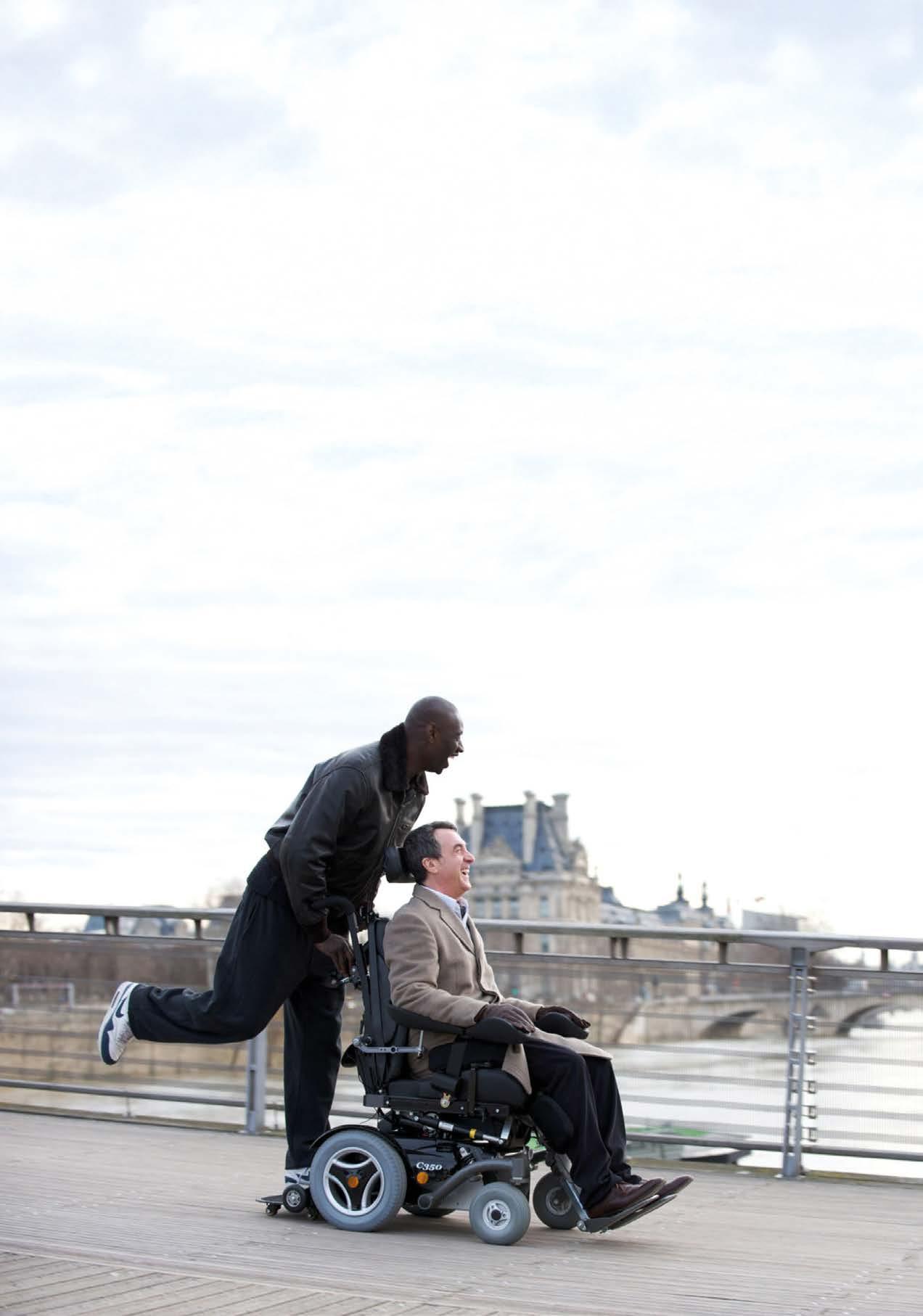
Hang on! Aspetta! No worries Nessun problema What on earth Ma che cavolo
An Unusual Friendship
One of my favourite films is the French film The Intouchables from 2011. It is about an unusual friendship between Philippe, a French businessman and the young man who works as his carer. The film is based on a true story. Philippe is a rich hotel owner who has an accident when he goes paragliding. After the accident, he is quadriplegic – he can’t use his arms or his legs. He needs help with a lot of activities like washing, getting dressed and eating. He interviews many people, looking for the best person to be his carer. Most of the candidates for the job have experience and qualifications, but they are very serious and boring.
Then he meets Driss. Driss is a young French Algerian man, from a poor and dangerous part of Paris. He doesn’t really want the job and he doesn’t have any experience. When Philippe interviews him, he is quite rude and makes lots of jokes. But, to his surprise, Philippe immediately offers him the job.
Throughout the film, a friendship grows between the two men. Although Driss has to help Philippe with many practical things, Philippe also helps Driss with advice about his life and introduces him to many new ideas and experiences.
At the same time, Philippe starts writing to Eleonore, a woman who lives in another part of France. She doesn’t know that he is quadriplegic and he doesn’t want to tell her. He sends Eleonore photographs of himself before his accident and he starts to fall in love with her. Driss tells Philippe to be more honest about his life now.
When Driss has some family problems, he has to go back to his home. Other carers come to help Philippe, but he feels sad and lonely without Driss. Finally, Driss returns and secretly organises a meeting between Philippe and Eleonore. The film ends with a picture of Philippe di Borgo and Abdel – the real people behind the story of the film. We learn that they are still good friends today.
I love this film because it is funny and it shows that we shouldn’t make judgements about people who look or seem different. Philippe and Driss come from different worlds, but their friendship is real and strong.
Omar Sy as Driss and François Cluzet as Philippe in the 2011 film, The Intouchables
Vocabulary 6
Parts of the body
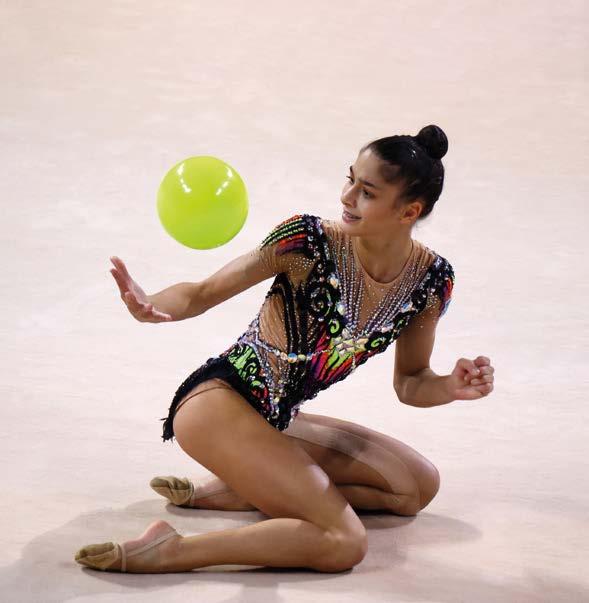
1 Work in pairs. Look at the photo. Find the body parts in the box. arm • back • ear • eye • face • finger foot
hand
2 Read the animal facts. Then complete the table with the correct numbers.
Fun animal facts!
Everyone knows that spiders have got eight legs. But did you know that most spiders have also got eight eyes?
Cows have got four … yes, four … stomachs! It isn’t easy eating all that grass. Most monkeys have got five fingers on each hand, like humans. But the spider monkey has only got four fingers on each hand.
Legs Stomachs Eyes Fingers
Health problems
3 Find the wrong word in each group.
1 break: your arm / your leg / your nose / your ear
2 feel: tired / cut / sick / ill
3 have: a stomach ache / a cold / a temperature / a tooth
4 cut: your cold / your hand / your foot / your face
5 go to: hospital / medicine / the doctor’s / bed
6 hurt: your headache / yourself / your back / your leg
4 Listen to the conversation. Choose the correct option to complete the sentences.
1 Daria feels ill / cold
2 She’s got a headache / stomach ache.
3 She has / hasn’t drunk a lot of water.
4 She thinks she has / hasn’t got a temperature.
5 Complete the text with the words in the box. broke • doctor • feel • hand • head headache • hospital • medicine
We asked our readers to tell us about their worst summer holiday. Coco, from Switzerland, shares her story below. I love lots of different sports – playing football, cycling, running. Last year, after my end-of-term exams, I was cycling to my friend’s house. We wanted to make plans for all our summer sports. But then, I fell off my bike, hit my (1) and (2) my arm. I also cut my (3) quite badly. My friend’s mum took me to (4) . While I was waiting, I started to (5) sick and I had a really bad (6) . The (7) gave me some (8) for the pain, but I had to stay there for 24 hours. The worst thing was that I couldn’t do any sport for the whole summer. What a disaster!
Frame your ideas
6 Work in pairs. Answer the questions.
• Describe a time when you, or someone you know broke a bone. What happened?
• What makes you feel sick? Think of things you smell , taste �� or see ��
a person
a spider
a cow
a spider monkey
• What gives you a headache? Think of things you eat ��, hear or do.
• Do you know what a ‘normal’ body temperature is? What is a ‘dangerous’ body temperature?
Sofia Raffaeli during the FIG Rhythmic Gymnastics World Championships in September 2022
can, could and may
1 Read the conversations. Are they making a request (R) (asking somebody else to do something) or asking for permission (P) (asking if they can do something)?
1 A Can I borrow your racket, please?
B Yes, of course.
2 A May I leave early for football, please?
B No, you can’t. The lesson hasn’t finished.
3 A Could you take me to the hospital?
B Yes, let’s go!
4 A Can I watch the game after dinner?
B OK, if you’ve finished all your homework.
2 Read the sentences in exercise 1 again. Choose the correct option to complete the rules (a-c).
a We use can / may / could + subject + infinitive / -ing form to ask for permission.
b May is more / less formal than can or could.
c We use can / could + subject + infinitive / -ing form to make a request.
3 Complete the questions for these situations.
1 You want to have a drink of water.
May I ?
2 You want to borrow your friend’s football boots.
Can I ?
3 You want your dad to drive you to the swimming pool.
Can you ?
4 You feel cold and the window is open. Could you ? should / shouldn’t
4 Read the conversations. Choose the correct option to complete the rules (a-b).
A I’ve got a really bad stomach ache.
B You shouldn’t eat so many sweets!
A I feel very hot and my eyes hurt.
B You should go to bed.
A I’ve got a cold. Should I go to the doctor?
B No, you shouldn’t. You should stay at home.
a We use should to give or ask for advice / permission
b After should, we use the infinitive / to + infinitive.
5 Read the situations. Write conversations with should.
1
Sam broke his leg on the volleyball court.
Sam: go / hospital?
You: Yes. You / call / an ambulance.
2
Sue wants to learn to ski.
Sue: take / skiing lessons?
You: Yes. You / look for / a good teacher.
3 John wants to enter a marathon.
John: run / every day?
You: No. You / run / three or four days a week.
4 Andy feels sick.
Andy: have / some orange juice?
You: No. You / drink / some water.
6 Rewrite the sentences with the modal verb in brackets.
1 Is it OK if I go fishing? (may)
2 Please run faster! (could)
3 It’s a good idea to bring your swimsuit. (should)
4 Do you think it’s a good idea to go cycling? (should)
5 Bring me a drink of water, please! (can)
6 It’s a bad idea to swim in this water, children. (shouldn’t)
Frame your ideas
7 SPEAKING Work in pairs. Think of some advice for these situations. Use should and shouldn’t.
• Your friend is often tired. He eats a lot of sweets, chocolate and cake.
He should go to bed earlier. He shouldn’t eat unhealthy food.
• Your friend has got a temperature of 40°C.
• You friend fell down the stairs and now his leg hurts.
• Your friend often doesn’t understand the homework.
Writing lab 6
Describing experiences
Useful language
Describing emotions
• What an incredible (race / match / game)!
• I was so (excited / surprised / happy).
• It was really (exciting / interesting / incredible).
• It was a / an (wonderful / awesome / amazing) experience.
Linking ideas
• Unfortunately, … • Luckily, … • Amazingly, …
Concluding
• At the end of the (day / match / game / race), …
• I really want to … again.
1 Listen to the conversation about the World Skate Games in Rome. Match the adjectives to the things Mick describes.
1 photos
2 fans
3 Hinano Kusaki
4 weather 5 experience a awesome b friendly c incredible d interesting e unlucky
Learning focus
Using the correct tense
You may want to describe an event that happened in the past in an exam task (for example, an email or article), or in a blog, or a post on social media. When you describe events in the past, make sure you use the correct tense.
• Use the Past simple to talk about a series of actions that happened one after the other, or for an action that began and ended in the past.
• Use the Past continuous to give background information about an event or to set the scene.
2 Read the description of an event and choose the correct option.
Velodrome drama!
Monday, 18th November
I was both surprised and happy to win tickets to the track racing championships at the Velodrome. We (1) arrived / were arriving early and (2) were getting / got some seats at the front. The cyclists (3) were practising / practised and lots of people (4) took / were taking photos. It was a very exciting race. Leandro and Kaufman (5) led / were leading for ten minutes. Then, in the final lap, Fairchild and Summers suddenly (6) moved / were moving forward and (7) won / were winning easily. Unfortunately, the popular Spanish cyclist, Garcia, (8) fell / was falling off his bike at the beginning of the race and (9) was breaking / broke his leg. But for us, it was a wonderful day out!
3 Look at the description in exercise 2 again. Write the adjectives and adverbs used to make the description more interesting.
Adjectives Adverb
Making notes
4 Read the Exam tip and task and begin making notes.
Exam tip
Making notes
• Before you begin writing, make some notes to help you plan your ideas.
• Your notes will not receive any marks, but they will help you organise your writing.
• Spend at least two or three minutes on your notes.
• Remember to write short phrases, not sentences, for each idea.
• Number your ideas in the best order.
Exam task
5 PRELIMINARY Writing an article You see this notice in an English-language magazine.
Articles wanted! Sports Events
Describe an exciting sports event you went to recently. Describe the event and say when and where it took place. Say what you enjoyed and didn’t enjoy about the event.
Write an article answering these questions and we will put it on our website! Write about 100 words.
6 Complete the Reflection checklist. Then discuss your answers with your partner.
Reflection checklist
Tick (4) the sentences that you think are true. I used the Past simple and Past continuous correctly. I used adjectives and adverbs correctly. I made notes before I began. I used different words for linking my ideas. I used appropriate language to conclude my article.
Towards INVALSI
Reading
1 Work in pairs. Look at the title of the article. What do you think are the benefits of having a hobby? Which hobbies do you think the article will mention?
2 Multiple matching Read again. Parts of the article have been removed. Choose the correct part for each gap (1-7). There are two extra parts that you should not use. The first one (0) has been done for you.

Why We Should All Have a Hobby
Do you have a hobby? Do you think that hobbies are important? Maybe you think that having a hobby is just a fun way to fill your time when (0) . But research shows that many popular hobbies do more than simply entertain us – they help to improve our mental and our physical health.
Of course, sport is a great way (1) . One of the oldest sports (and also one of the cheapest) is running. All you need is a pair of trainers, a T-shirt and some shorts, and you can start running immediately. As well as being good for your body, (2) to work better and studies show that it makes people feel happier. Swimming is another popular sport that is great for all ages and helps to exercise your whole body. If you want to live longer, though, the best sport may be tennis. The Copenhagen City Heart Study of 2018 followed thousands of people for 25 years and found that people who played tennis regularly (3) than average.
If you’re not interested in sport, another hobby that is good for your body and your mind is gardening. Gardening not only provides physical exercise, but it has an end result that you can see … and often smell! If you (4) , you are also more likely to eat a healthy diet – home-grown food is always tasty! It is a way of connecting to nature, and research shows that spending time outside and in nature helps people to feel happier and calmer. Being in a place where you can see trees, hear birds and feel the warmth of the sun is good for your brain and even improves your memory.
Creative hobbies like drawing, painting or playing music are also great ways to feel happier and healthier. In a recent study, people who spent just 45 minutes making art (5) . Playing and listening to music is another popular hobby which can affect your emotions. It can help you to feel better when you are ill or in pain, and studies with very small babies show that they often sleep better and grow faster if they (6)
So, even when you are busy with your work or your studies, remember take some time to go outside, enjoy nature, and then (7) while you listen to some music!
A come back home and draw a picture
B running also helps your brain
C worrying about your problems
D 0 you’re not studying or working
E lived nearly ten years longer
Listening
F to stay strong and healthy
G enjoying your free time
H grow fruit and vegetables
I listen to music regularly
J felt more confident and less stressed
3 Multiple matching Listen to an English woman talking about football. First you will have 1 minute to study the task below, then you will hear the recording twice. While listening, match the interviewer’s questions (A-I) with the answers (1-7). There is one extra question that you do not need to use. The first one (0) has been done for you. After the second listening, you will have 1 minute to check your answers.
Questions
A Why do you enjoy playing football?
B Do you do any other physical exercise?
C Do you watch football as well as play it?
D How do you feel if you lose a game?
E What interests do you have apart from sport?
F How often do you play?
G How do you prepare before an important game?
H 0 When did you first develop an interest in football?
I What does your family think about your love of football?
Vocabulary
1 Match the pictures (1-8) with the words (a-h).


a chess



b photography
c dancing d music e cycling f camping g painting h drawing
2 Complete the sentences with the words in the box.
classical • concert • disco • keyboard MP3 player • opera • pop • radio
1 I love listening to music on the
2 Sonia plays the piano and she also plays the in a band.
3 My dad loves music like Mozart and Beethoven.
4 My mum always cries when she listens to songs from her favourite Italian
5 music was very popular in the 1970s.
6 My sister is going to play the violin in the school at the end of the year.
7 I usually download music onto my .
8 ‘Hello’ by Adele is my favourite song.
3 Complete the sentences with the correct preposition.
1 I’m not crazy hip hop. I prefer dance music.
2 I’m really classical music – I love it.
3 He’s a big fan Taylor Swift.
4 What do you do your free time?
5 Are you interested guitar music?
6 I sometimes go to a disco the weekend.
4 Write the letters in order to make the names of sports.
5 Complete the text with the words in the box. coach • fans • go • match • member players • playing • winner
I’m a (1) of the football club at school. Our (2) helps us train for the football (3) every weekend. We practise with five (4) on each side. It doesn’t matter who’s the (5) . We all just enjoy (6) the game. We sometimes (7) running together too. Our friends and family are our biggest (8) !
6 Label the picture with the correct words. 7 Match the sentence beginnings (1-5) with the endings (a-e).
Grammar
1 Choose the correct option to complete the sentences.
1 You will make a lot of friends if you go / will go to a summer camp.
2 If Martin goes on holiday, he usually takes / will take his laptop with him.
3 Omar gets really upset if he doesn’t / won’t win at chess.
4 If I go cycling, I always wear / will wear a helmet.
5 Dina won’t / doesn’t go to dance school if she doesn’t pass the entrance exam.
6 If Sasha gets / will get up early, she goes running in the park.
7 We won’t go camping if it rains / will rain this weekend.
8 If we don’t hurry, we miss / will miss the match.

2 Complete the sentences. Use an -ing form or to + infinitive.
1 We decided (go) to an art class this summer.
2 She stopped (play) football because she hurt her leg.
3 I enjoy (make) paper models of planes.
4 You promised (help) me with my music exam.
5 We need (buy) tickets for the concert tomorrow.
6 She started (work) at the cinema this week.
7 I’m not good enough (be) in a band, so I need to practise more.
8 My friends are going to a studio (record) their song.
3 Complete the second sentence in each pair. Use must, mustn’t or don’t have to.
1 For children 6 and over. You be over 6.
2 Tickets are free. You pay.
3 No food or snacks. You eat any food.
4 Sports clothing only. You wear sports clothing.
5 No phones. You use your phone.
6 Open to everyone. You be a member.
4 Choose the correct option to complete the sentences.
1 I’m hungry. Can you / Could I make a sandwich for me, please?
2 This bag is heavy. Can I / Could you help me carry it, please?
3 I have to go to the doctor. Can you / May I leave class early today?
4 I can’t find my purse. Could you / Can I lend me some money, please?
5 I need to go to the station. May I / Could you give me a lift, please?
6 I’m thirsty. Can you / May I have a drink, please?
5 Write sentences or questions using the correct form of should.
1 A I feel sleepy. B go to bed early.
2 A I’m hungry. B eat some fruit.
3 A I’ve got an exam tomorrow. B stay up late tonight.
4 A I’ve got a headache. call a doctor? B No, you take some medicine.

Life skills
Get fit, feel well
Tai chi
This exercise from China focuses on breathing, stretching and relaxing. You move slowly into different positions to balance and become stronger. It can help your body and mind to focus and slow down.
Swimming
This activity is good for your heart, your strength and can be at your own speed – fast or slow. It can be relaxing, or you can push yourself harder.
Spin
In a spin class, you use a lot of energy cycling on an indoor bike to music. You can make it more difficult, or easier to ride.
High-intensity interval training (HIIT)
This is any exercise that has very fast activity for a short time, then a rest, then more exercise, then a rest. You usually do 30-40 minutes in total of very heavy exercise which makes your heart beat fast.
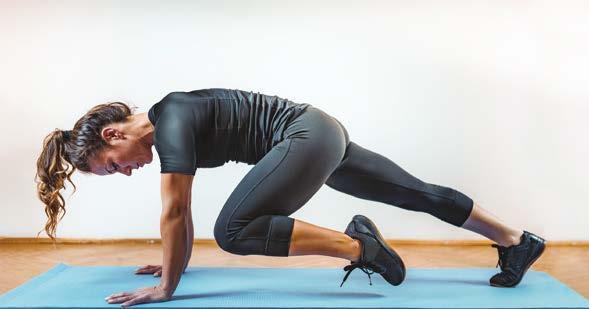
1 Work in pairs. Read the information. Put the types of exercise in order from 1 (the most interesting) to 4 (the least interesting). Compare your answers. Give reasons why.
2 SPEAKING SEL Self-management
Work in pairs and read the Mind your mind information. Discuss the questions.
1 What type of exercise do you enjoy doing? Why?
2 How do you feel before and after exercise?
3 What are the benefits of exercising?
Frame your project
REAL-LIFE TASK 1
Work in groups. Think of a sport or exercise that the class can do together to help practise their English and stay healthy.
Think about:
• working in a team;
• speaking in English;
• exercising the body and mind. Plan the activity for the whole class to join in with.
3 SPEAKING Work in pairs. Take turns to describe a sport or exercise you do. How important is it to you?
Mind your mind
Exercise and the brain
Exercise is good for your physical and mental health. Studies show it can help us to feel less stressed, to feel better about ourselves, to think more clearly and to remember things more easily.
• Doctors say people of any age or ability should do 30 minutes of exercise, five days per week, to keep both their body and mind healthy.
• When we exercise, our bodies make something called endorphins. These make us feel happy.
4 A Work in pairs. Look at the statement below. Think of two reasons to agree with it and two reasons to disagree with it.
Everyone should do some kind of sport every day.
4 B DEBATE Divide the class in two groups. Work in your group to make a short speech in favour of / against the statement. Listen to each other and ask questions. Finally, have a class vote.
Group 1 is in favour of the statement. Group 2 is against the statement.
Useful language
ORACY SKILLS
• We / You need to (do exercise) because…
• This game helps us (work together / stay healthy…
• Instead of (taking the bus / going by car) I can…
• I won’t (take the lift), I’ll (go up the stairs).
• You have to / ought to / should … three / four / five times per day / week … is really good for you / your…
REAL-LIFE TASK 2
Think of five different ways you can add more exercise into your own daily life. Think about:
• ways of getting to places, e.g. going by car vs walking;
• choosing more active options, e.g. using the stairs;
• different types of activities that might help you relax or have more energy.
Present your ideas to the class.
No place like home
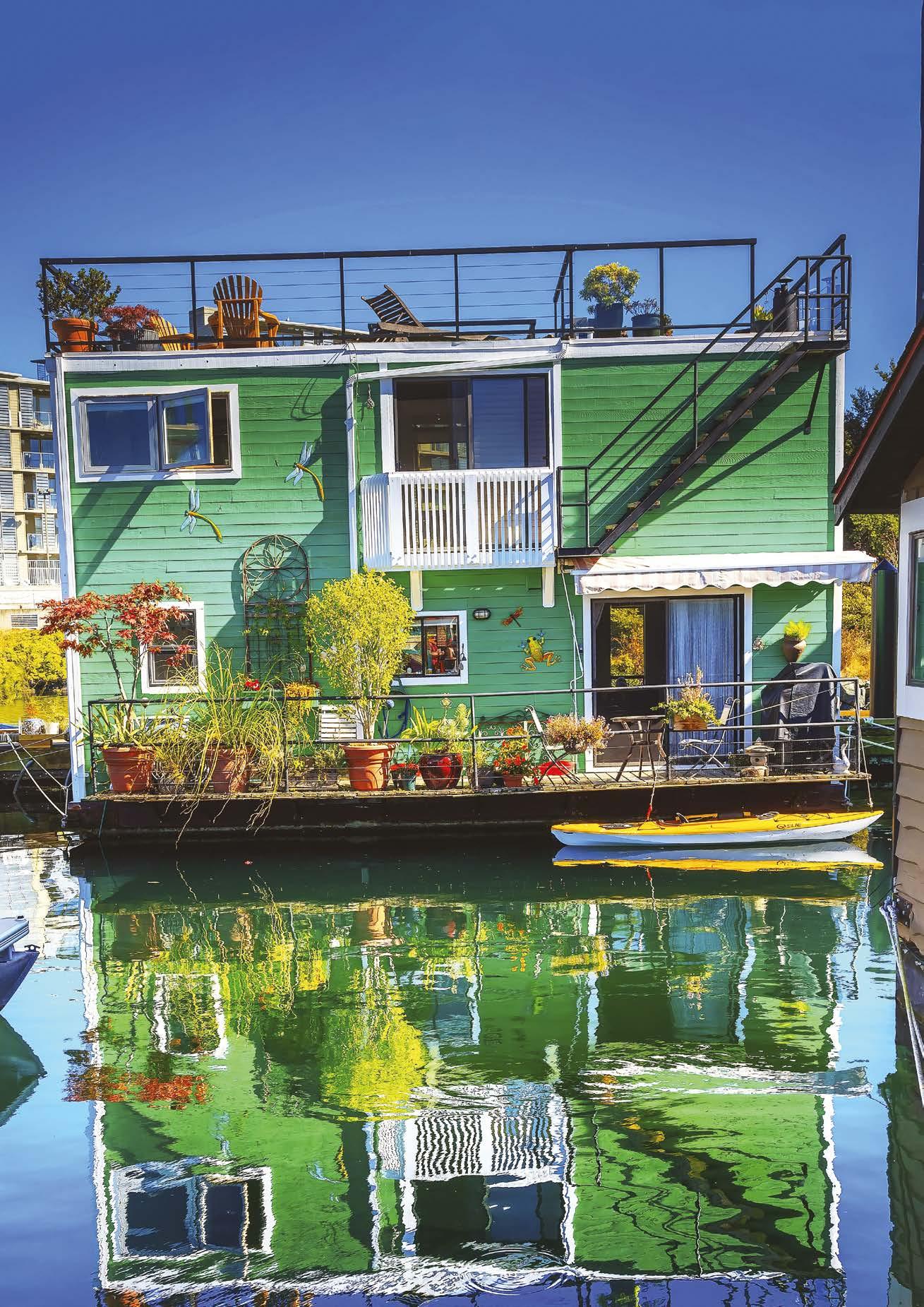
1 SEL Self-awareness Social awareness Work in pairs. What is the difference between a ‘house’ and a ‘home’? What is it that makes your house feel like home?
2 VISIBLE THINKING Look at the photos on page 107. Discuss in pairs.
See What do you notice about the houses in all three photos?
Think What factors might make people want to live in these houses?
Wonder Which house would you choose to live in? Why?
3 SPEAKING You are going to read an article about three places with underground houses. Discuss the questions with your partner.
1 Why do people live in underground houses? Think of at least three possible reasons.
2 What are the disadvantages of living under the ground?
4 Read the article on page 107 quickly. Which place would you most like to visit? Why?
5 Read the Exam tip. Then read the sentences in the Exam task and underline the key words.
Reading tip
Identifying the key words
• In some tasks, you have to complete a sentence with words from the text.
• Read each sentence carefully and underline the key words.
• Look for these key words, or their synonyms, in the text. Then think about which words from this part of the text could complete the sentence.
• The missing words will probably not be at the end of the sentence in the text.
• Remember that you should always use words from the text to complete the sentences.
Reading task
6 Read the article again, then complete the sentences (1-8), using a maximum of four words from the text. The first one (0) has been done for you.
0 Some underground houses have been here for hundreds of years, while others are
new, modern developments
1 In Guadix, some farmers live in underground houses with
2 The cave houses here are no longer just for
3 Today, the houses in Guadix have kitchens, bathrooms, electricity and
4 People learnt about the underground houses in Matmata after they watched .
5 During the winter, the houses are .
6 Most people in Matmata now prefer to live in the cities in .
7 People first came to Coober Pedy because they were looking for .
8 In the underground houses in Coober Pedy, there aren’t any .
Frame your ideas
7 SPEAKING Answer the questions.
• Do you think you would like to live in an underground house? Why? / Why not?
• What other unusual places to live can you think of? Why do you think people choose to live in these places?
A shepherd’s house in a rock in Portugal
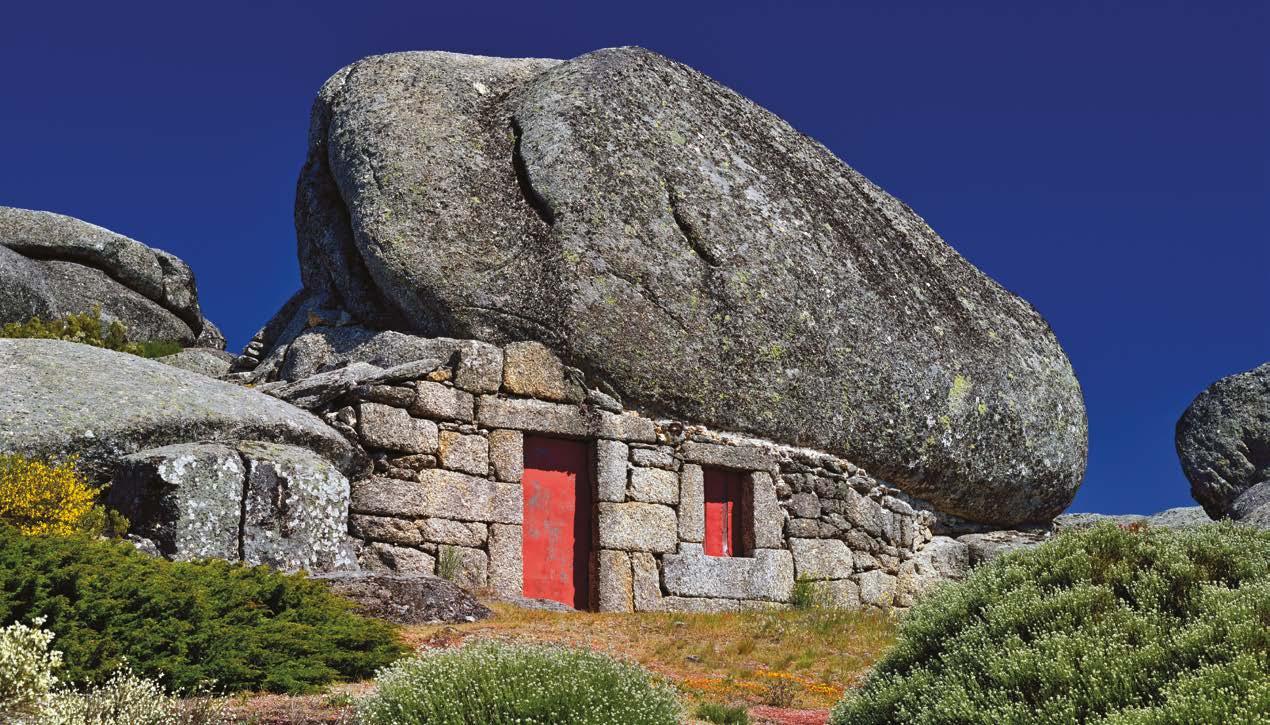
Livingunderground
More than 60 million people around the world live underground. Some underground houses and communities are new, modern developments, others have been here for hundreds of years. Let’s visit three underground towns and find out about how people live beneath the ground.
Guadix, Spain
There are more than two thousand underground houses in Guadix, Spain, and some of them are more than one thousand years old. Some of the residents are farmers, and they live with their animals in these cave houses. Many of the cave houses here are light and bright, with high ceilings and white walls. In the past, the cave houses were for poorer people, but today many people want to buy a cave house and most houses come with electricity, internet access and new kitchens and bathrooms!
The underground houses in Matmata, Tunisia, first became famous when people saw them in the film Star Wars in 1977. But people have lived here for many hundreds of years. The houses are very unusual. The builders dug out a big hole in the ground and then built houses into the sides of the hole. The houses are cool in the summer and warm in the cold winters. Today, few people live here, as many families have moved to more modern houses in the cities.
Coober Pedy, Australia
People have lived in underground houses in Coober Pedy since 1915. They came here to mine for opals. It was very hot outside, so they built underground houses, which are dark and cool. The houses haven’t got any windows, but they’ve got electricity, water and the Internet. If you want a new bookcase, a shelf or even a new room, you can dig a hole in your wall. More than one thousand people live under the ground here. The most famous house in Coober Pedy is Faye’s Underground Home. It’s got a kitchen, three bedrooms, a living room and a small swimming pool!

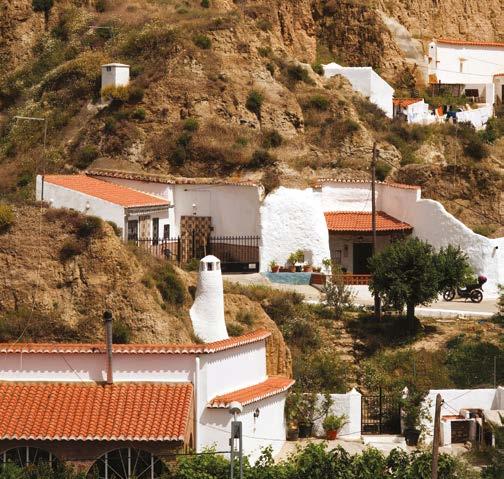
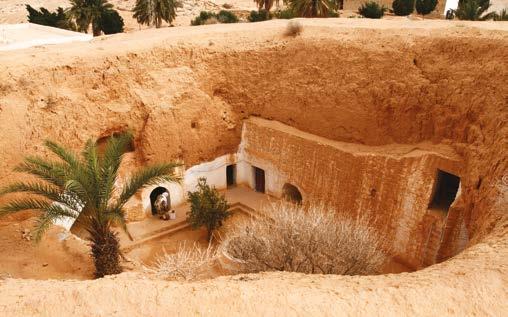
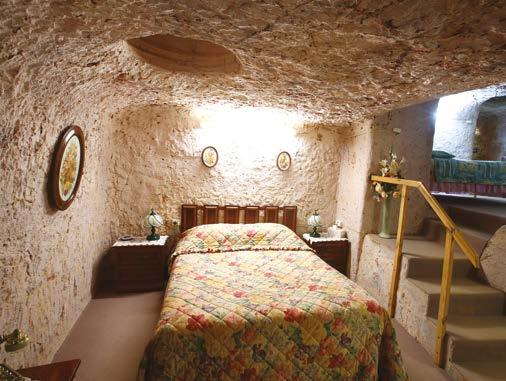

Vocabulary
Houses and parts of a house
1 Work in pairs. Look at the picture. Match these words with the parts of the house (a-n).
2 Complete the sentences with words from exercise 1.
1 I usually sleep in my
2 We prepare lunch in the
3 We watch TV in the .
4 The go from the bottom of the house to the top of the house.
5 I have a shower or a bath in the
6 We put our car in the
7 We have a small outside, with some trees and flowers.
8 We eat our dinner in the 3 Work in pairs. Listen and discuss. Where is each person? No, I think he’s in the hall.
I think Speaker 1 is in the garden.
4 Complete the text with words from exercise 1.
I think my favourite room in our house is the (1) . It’s where the whole family relaxes at the end of the day. When my friends come round, we watch TV in there, or we play computer games. It’s got a big (2) , so it’s a really light room and I can look out and see the birds in the (3) . My mum’s an artist and lots of her pictures are on the (4) . In fact, she even painted a picture of the sky on the (5) ! I think it’s really cool. My little brother spends all his time in his bedroom. He’s put a sign on the (6) : ‘Rob’s room – don’t come in!’ My older sister’s favourite room is the (7) because she’s got an old motorbike and she’s always working on it in there. And my dad? Well, my dad is an astronomer – he studies the stars in the sky. So he loves lying on the (8) of the house and looking at the night sky!
Frame your ideas
5 WRITING Think about your home. Which room is your favourite? Describe it and explain why you like it.
Present perfect simple
1 Read the sentences (1-3) and look at the underlined verbs. Then match the sentences with the uses of the Present perfect simple (a-c).
1 People have lived in underground houses in Coober Pedy since 1915.
2 I’ve seen lots of pictures of underground houses.
3 He’s moved out of his house and doesn’t have anywhere to live.
We use the Present perfect simple to talk about…
a experiences – things you have done in your life.
b something that happened in the past but has a connection with the present
c something that happened in the past and is still happening today
2 Complete the sentences with the Present perfect simple form of the verbs in brackets.
1 We (finish) painting the bathroom walls.
2 Why (the teacher / give) us so much homework?
3 My father (not / travel) to many different countries.
4 She (send) all her emails.
5 I (not / eat) all my food.
6 (you / see) my keys?
been vs gone
3 Read the sentences (1-2). Complete the rules (a-b) with been and gone.
1 Tim’s gone out. He’ll be back in 15 minutes.
2 I’ve been to the US. It was amazing!
We use…
a has/have to say that someone went somewhere and came back.
b has/have to say that someone went somewhere and is still there.
4 Complete the sentences with have/has been or have/has gone.
1 A Where Alicia ?
B She’s at the supermarket.
2 Alex in hospital, but he’s better now.
3 I’m trying to finish my project, so my friends to the cinema without me.
4 A you to that new Italian restaurant?
B Yes, I have. It’s great!
for and since
5 Read the sentences (1-2). Choose the correct option to complete the rules (a-b).
1 I’ve lived in this house for twelve years.
2 I’ve lived in this house since 2014.
a We use for / since to talk about a point in time.
b We use for / since to talk about a period of time.
6 Complete these phrases with for or since.
1 a few days 2 a long time 3 years 4 2010
5 3rd January
6 four o’clock
yesterday 8 24 hours 9 five minutes 10 last month
7 Read the Exam tip. Then read the Exam task. What type of word goes in each gap?
Exam tip
Identifying what type of word is missing
• Open-cloze activities test what you know about grammatical structures.
• First, read the text all the way through.
• Think about what type of word goes in each gap. For example, is it a noun, a verb or a preposition?
• If it is a verb, look carefully at the subject. Is it singular or plural?
Exam task
8 PRELIMINARY Open cloze Read the email and write the correct answer. Write one word for each gap.
Hi Katia
How are you? Are you having a good time in France? We’re having an amazing time here in Antalya in Turkey. We’re staying with my cousin. She (1) lived here (2) five years, and she loves it! We’ve been here (3) Saturday and, so far, we (4) visited an old Roman city and eaten some delicious Turkish pizza. We (5) swim in the sea yesterday because it was too cold, but we’re going to do that later today. I’ve bought a Turkish phrase book and I’ve learnt some useful phrases but I (6) tried using them … maybe tomorrow!
That’s all for now. See you soon.
Emmy
Listening
1 Match the questions (1-6) with the answers (a-f).
1 Have you painted your bedroom?
2 Where do you want to put the bed?
3 Has your new desk arrived?
4 When are you going to buy a poster for your room?
5 Do you want to change the colour of the ceiling?
6 Are you going to keep this chair?
a Yes, I am. I really like it.
b I’m not sure. Maybe under the window?
c Yes, I do. White’s really boring.
d Yes, it has. It looks really good.
e No, I haven’t. I can’t decide on the right colour.
f I’ll get one when I’ve finished painting the walls.
2 Listen to the conversation. What colour has Filip painted his room? Write the correct colours. There are three extra colours. black • blue • green • grey • orange purple • red • white
1 the walls
2 the ceiling
3 the chairs
4 the desk
5 the door

3 Look at the Exam task and read the Exam tip. Then look at the pictures and think of one or two words for each picture.
Exam tip
Reading the question
• In some exam tasks, you have to choose the correct picture from three options.
• Before you listen, look at the pictures and think of one or two words for each picture.
• You will probably hear words relating to all three pictures when you listen. Make sure you read the question carefully and choose the picture that answers the question.
• Then listen again and check your answers.
Exam task
4 PRELIMINARY Multiple choice with picture options Listen and for each question choose the correct option.









Describing your room
1 SPEAKING Work in pairs. Discuss the questions.
1 What’s the most important thing in your room? Why is it important?
2 What does your room say about you?
3 What colours are in your room? Do you think different colours make us feel different emotions? Why? / Why not?
2 Match the sentences (1-6) with the extra details (a-f).
1 Our living room is quite small.
2 The living room walls are white.
3 There are a few paintings on the walls.
4 The living room is usually tidy.
5 There’s a TV and a small sofa.
6 The living room is my favourite room.
a They are all of boats because my dad loves sailing!
b There’s not much space for a lot of furniture.
c I love the sofa because it’s really comfortable.
d I like it because the TV is there, and my computer games.
e There’s a big window too, so it’s very light.
f My parents get annoyed when it’s untidy.
3 VISIBLE THINKING SEL Social awareness
Self-management Work in pairs. Look at the photo. Discuss the questions.
See What can you see in the room? Think about:
• the furniture;
• the possessions;
• the colours.
Think What does the room say about the person?
Wonder Would you like to have this room as your bedroom? Why? / Why not?
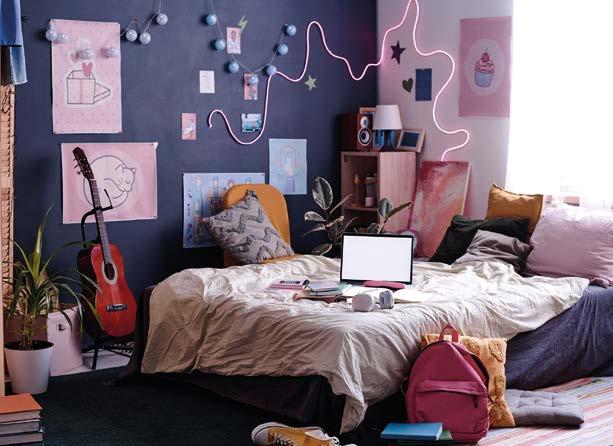
4 Work in pairs. Read the Exam tip and task. Take turns to be the examiner and ask the questions. Use the Useful language to help you.
Exam tip
Describing your room
• In some speaking exams, you will answer questions from the examiner.
• If the examiner asks you about your room, answer with two or three sentences. Don’t just give short answers.
• Give as many details as you can, for example, the colours, the furniture and the things you have there.
• Use adjectives and qualifiers (e.g. really, very, quite, fairly, a little, a bit).
• Describe your feelings about your room and explain why using because
Exam task
5 PRELIMINARY TRINITY Interview
Now role play the interview.
• Tell me about your room at home.
• What is your room like?
• What colours are there in your room?
• What kind of posters or pictures do you have on the walls?
• Would you like to change anything in your room?
• What’s the best thing about your room?
6 MEDIATION Work with another pair of students. Tell them about your partner’s room. Can you remember all the details? How does your partner’s room show their personality?
Useful language
Describing my bedroom
ORACY SKILLS
• My bedroom is quite / really / very / a bit (noisy, quiet, small, large, comfortable).
• I like / don’t really like my bedroom because…
• The walls are (white) and the bed is (green).
• I keep … on a shelf / in my cupboard.
• I really love my posters of…
• My room is usually tidy / untidy because…
The J&K Diaries – Episode 7
1 Watch the vlog. Tick (4) the things that Josh and Kayla have done to prepare for the party. What have they forgotten to do? make a cake prepare food make a playlist
invite friends pick up the present wrap the present
2 Read the information on page 113 quickly and choose the correct option. The information is about…
A types of holiday accommodation in the UK.
B houses for sale in London.
C interesting places to visit in the UK.
Exam task
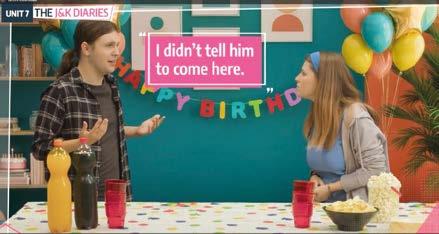
Real English
3 PRELIMINARY Multiple matching Read the information again. For each question, choose the correct answer. These people all want to find somewhere to stay in the UK. Decide which home would be the most suitable for each person.



Tom and Amy want to be near the city but not in the middle of it. Amy has recently been ill and she is in a wheelchair.
The Cooper family always go on holiday together with their neighbours, the Prestons. They are looking for a large house with space for four adults and six children and need a safe place to keep their cars.
Sadie is learning to drive but she hasn’t passed her driving test yet. She wants to stay somewhere different or unusual and she wants to be near the city centre.

The Rossi family are visiting the UK from Italy. They have one daughter and no car. They don’t want to be in a busy town, but there must be a small shop that they can walk to. They want to spend some time in the countryside.

Didier is trying to finish writing his novel. He wants to be alone somewhere with no other people around him. He has recently got a dog and wants to bring the dog with him.
4 Work in groups. Imagine you are planning a holiday in the UK. Which place will you choose? Why?
5 A WRITING Work in pairs. Write a description of your dream holiday house. Include information about the number of bedrooms, garden / no garden, location (near a town / city / countryside?) and public transport.
5 B SPEAKING Work with another pair of students. Compare your dream house descriptions. Which ideas were the same? Which were different?
Nice one!
Questa è buona! blow someone’s mind sbalordire, lasciare a bocca aperta You’ve got to be kidding! Starai scherzando!
Eight Great Places to Stay in the UK

This one-bedroomed flat is in the heart of the city. Just five minutes’ walk to Baker Street Station, with shops, cafés, restaurants, museums and art galleries all within easy walking distance. There is a small kitchen and the sofa in the sitting room can also be used as an extra bed. Please note: the flat is on the fifth floor and there are no lifts.
A charming, old cottage in the middle of the Peak District. Enjoy the beautiful views from every window and explore the English countryside. In the large garden there is a barbecue and children’s play equipment. The cottage has three bedrooms, a sitting room, bathroom and kitchen. The nearest village is twenty minutes’ drive away. There is also a bus, that arrives every two hours.

A large house in the town centre with five bedrooms, living room, dining room, two bathrooms and a large kitchen. Perfect for families, with both a garden and a large garage. From here, the beautiful national park is just an hour’s drive away. Two wellbehaved dogs allowed.
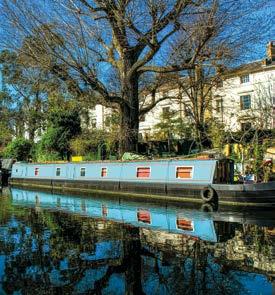
If you want to stay somewhere out of the ordinary, this is the place for you. This houseboat is on the river in the middle of the city. It has a small bedroom, a very basic kitchen, a bathroom and a living room.
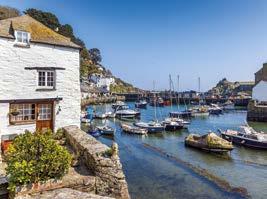
This lovely house is in a tiny village in Cornwall with access to beautiful walks along the coast. With two bedrooms, a kitchen, bathroom, living room and sitting room, this house is perfect for two couples or a small family. The village shop sells basic food and there is a local bus which goes to the larger town of Newquay every half hour.
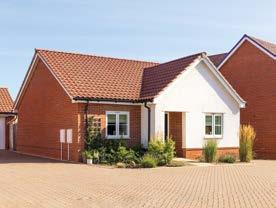
Just fifteen minutes by bus into the city centre, this small bungalow has everything on one floor: bedroom, kitchen, bathroom and living room. No dogs allowed.
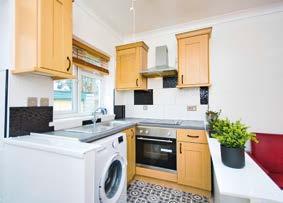
If you want peace and quiet, this is the place for you. This unusual tiny studio in the mountains has all the basic equipment: bed, cooker, fridge, sofa, but there is no internet access and it is half an hour’s drive to the nearest town. One small dog is allowed.

This one-bedroom apartment in an old castle is perfect for lovers of history and beautiful furniture. There is plenty of parking outside and you can take a free tour around the rest of
the castle and find out about its history. No dogs allowed. Nearest town is eight kilometres away. No public transport.
Vocabulary 7
Furniture
1 Work in pairs. Look at the two photos and find the things in the box.
armchair • bath • bookcase • carpet curtain • lamp • mirror • painting • shelf shower • sofa • toilet • towel a b
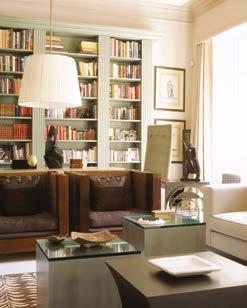
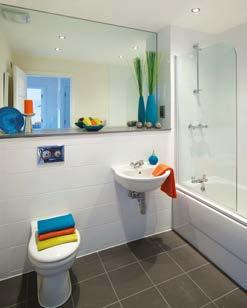
2 Complete the sentences with words from exercise 1.
1 On Sunday mornings, I usually lie on the and read a magazine.
2 I’m going to have a because the shower isn’t working.
3 I’ve already switched on the , but it’s still very dark in here.
4 Please take off your shoes – I don’t want to get dirt on the
5 Your hair’s very wet from the rain – do you want a ?
6 There are some cups on the in the kitchen.
3 Listen to Fatma and Arda. Are the sentences true (T) or false (F)?
1 Arda likes his new flat.
2 Arda’s bed is in the sitting room.
3 There isn’t a bookcase in the living room.
4 There aren’t any curtains in the living room.
5 The bathroom hasn’t got a shower.
6 Arda doesn’t know where the towels are.
4 SPEAKING Choose the correct option to complete the questions. Then work in pairs. Take turns to ask and answer the questions.
1 When do you usually listen to / for music?
2 Where do you usually look on / at photos?
3 Do you ever think about / at where you will live when you are older?
4 What kind of home do you dream of / over having in the future?
5 Read the Exam tip. Then read the Exam task. How many gaps have a preposition after them?
Exam tip
Verbs with prepositions
• This type of exam task tests your knowledge of vocabulary. It often tests how different words are used, for example, what preposition is used with what verb.
• Read the whole text to get the main idea.
• Then look at each gap. Is there a preposition after the gap?
• Look at the answer options. Decide which option is correct with the preposition. Some of the answer options may use no preposition or a different one.
Exam task
6 PRELIMINARY Multiple-choice cloze Read the text and choose the correct answer.
Living on a houseboat
Have you ever (1) about living on a houseboat? Imagine waking up every day and having a view of the water! If you don’t like the view, just (2) to a different place. There’s no garden, but you can grow plants on the roof. Some houseboats have a kitchen, a bathroom and a living room where you can (3) to music or (4) TV. The sofa (5) a bed to sleep on at night. Other kinds of houseboats have several rooms with lots of furniture. Many people (6) of living on a houseboat. Why not give it a try?
1 A thought B told C wished D said
2 A live B choose C move D change
3 A hear B listen C play D have
4 A see B look C guard D watch
5 A turns B becomes C changes D makes
6 A wish B hope C dream D want
Frame your ideas
7 WRITING Answer the questions and describe your dream house.
• Is it big or small?
• Is it in the countryside or in the town?
• What furniture have you got in your dream house?
already, just, (not) yet, ever, never
1 Look at the underlined adverbs in sentences 1-4. Then use the correct adverb to complete the rules (a-e).
1 Don’t touch the wall! I’ve just painted it!
2 Has Erik finished his homework yet?
3 A Have you ever lived in another country?
B No, I haven’t. I’ve never lived in a different country.
4 A Do you want to go out for pizza?
B No, thanks. I’ve already eaten.
We use...
a in questions to mean ‘at any time’.
b in questions and negative sentences to mean something hasn’t happened, but you expect it to.
c to mean ‘not at any time’.
d to mean ‘before now’.
e to mean ‘very recently’.
2 Complete the conversations with the words in the box.
already • ever • just • never • yet (x2)
1 A Have you won any money?
B No, I’ve been very lucky.
2 A Do you want to see this TV programme?
B No thanks, I’ve seen it. I watched it at my cousins’ house last week.
3 Why haven’t you left ? You’ll be late.
4 A How long have you been home?
B About one minute! I’ve got in, and I haven’t sat down !
Possessives
3 Read the sentences. Circle the apostrophes (‘) that show possession.
1 John’s book is on the table.
2 It’s a beautiful garden.
3 She’s bought a new sofa.
4 The children’s dinner is ready.
5 The boys’ bikes are in the garage.
6 Isabella’s just painted her bedroom.
7 The man’s house is very small.
8 Jess’ cat is ten years old.

4 Look at the sentences in exercise 3 again. Complete the rules (a-d) with these words.
irregular • plural • -s • singular
a We use an apostrophe followed by -s to show possession with nouns.
b We use an apostrophe after -s for regular nouns.
c We use an apostrophe followed by -s for plural nouns, e.g. men
d We use only an apostrophe after a name ending in
5 Complete the sentences with ‘s, s’ or ‘ .
1 The dog bed is in the hall.
2 My parent bedroom is next to their bathroom.
3 James new lamp was very expensive.
4 The children books are on the desk.
5 The boy dinner is nearly ready – can you call them, please?
6 The student new classroom is very cold. They aren’t happy!
6 Read the conversations (1-3). Choose the correct option to complete the rules (a-b).
1 A Is this your book?
B Yes, it’s mine.
2 A Whose towel is this? Is it yours?
B No, it isn’t. It’s Stella’s. My towel’s in the bathroom.
3 A Have we got our tickets for the show?
B Yes, we’ve got ours. And Jon and Anne have got theirs too.
a My, your, his, her, its, our and their are examples of possessive adjectives. We use them before / in place of a noun.
b Mine, yours, his, hers, its, ours and theirs are examples of possessive pronouns. We use them before / in place of a noun.
7 Complete the text with possessive pronouns, possessive adjectives, ‘s, s’ or ‘ .
Mr and Mrs Georgiou have got two children – a boy, Niko, and a girl, Eris. They live in Thessaloniki, in Greece. (1) house has got three bedrooms, one bathroom, a living room and a kitchen. Eris (2) bedroom is green with a yellow ceiling. There’s a computer on (3) desk, but it isn’t (4) , it’s (5) brother (6) computer. Niko (7) bedroom is grey and blue. There’s a picture of an elephant on (8) door. Niko and Eris love animals. They’re playing with a cat in the garden at the moment, but it isn’t (9) , it’s the neighbour (10) cat.
Writing lab 7
Writing a story
1 Number the parts of the story in order (1-8). Use the time sequence words to help you.
a After three hours, Jun was very hungry, so he decided to have some lunch.
b Then he put newspaper on the carpet because he didn’t want to get paint on it.
c 1 Last weekend, Jun decided to paint his bedroom, so he went to the shops and bought some paint.
d Unfortunately, there was some paint on his shoes, so the paint went onto the carpet as he was walking down the stairs.
e He opened the bedroom door and walked down the stairs.
f 8 Jun’s mum was very angry!
g He took the furniture out of his room first.
h After that, he started to paint the walls.
Learning focus
Reasons and results
We use because and so to give reasons and describe results.
• We use because to give a reason for something. action reason He went shopping because he needed a new sofa.
• We use so to describe the result of something. reason result
He needed a new sofa, so he went shopping.
• We use a comma after the reason clause and before so
2 WRITING Rewrite these pairs of sentences as one sentence. Use because or so.
1 I was hungry. I made a sandwich. I was hungry, so I made a sandwich.
2 We visited Guadix. We wanted to see the underground houses.
3 Peter’s laptop didn’t work. He bought a new one.
4 Lena was cold. She closed the window.
5 They went to the shops. They wanted a new lamp.
Useful language
Introducing the scene
• Yesterday… / Last weekend… / A few days ago… Linking words
• because / so
• and / but
• Unfortunately, / Luckily, Time sequence words
• First, / Then, / Next, / After that,
• After three hours, …
• In the end, …
3 Read the Exam tip. Then read the Exam task and make notes of your ideas. Use the Useful language to help you.
Exam tip
Planning your ideas
• Before you begin writing, look carefully at the first sentence. Think about:
• the characters in your story (who is in it)
• the setting of your story (where it is)
• the plot of your story (what happens)
• Make a plan for the beginning, middle and end of your story.
Exam task
4 PRELIMINARY Writing a story Your English teacher has asked you to write a story. Your story must begin with this sentence: It was Joe’s birthday, and his friends decided to organise a party for him. Write your story. Write about 100 words.
5 Complete the Reflection checklist. Then discuss your answers with your partner.
Reflection checklist
Tick (4) the sentences that you think are true. I looked carefully at the first sentence before I began.
I thought of linking words to connect the parts of my story.
I thought of a good beginning and ending. I used because and so to talk about reasons and results.
6 They live underground. It’s very hot outside.
I wrote the correct number of words.
8 City vibes

1 VISIBLE THINKING Look at the photo. Discuss in pairs.
See What can you see in the photo?
Think Where do you think they took this photo?
Wonder Would you like to live here? Why? / Why not?
2 Watch the video, Things to Do in My Town, and decide if the sentences are true (T) or false (F).
1 She lives in the centre of Chicago.
2 She takes part in the school play.
3 At the weekend, she goes shopping with her friends.
4 People have more time to do things in Chicago.
5 She’s very good at skateboarding.
6 There are no parks in Glenview.

Aerial view of Chicago skyline
Frame A
1 SPEAKING Work in pairs. When you visit a new town or city, what things do you like to do? visit old buildings go to the theatre look at some art try new food walk in a park go shopping
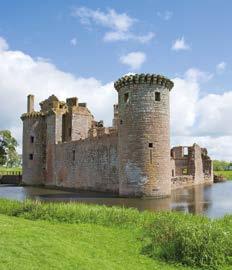

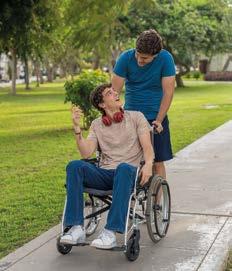
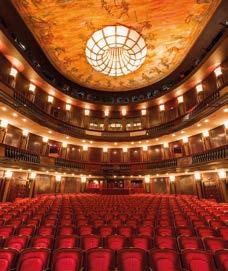


2 Read the article on page 119. Where, in Tbilisi, can you do each activity from exercise 1?
3 Read the article again and answer the questions.
1 What is khachapuri?
2 Where can you find out about Georgian films?
3 What was Fabrika in the past?
4 Where can you eat outside?
5 Why is it a good idea to go to the Bridge of Peace in the evening?
4 Read the Exam tip. Then read the article about the city of Tbilisi and think about the topic of each paragraph.
Exam tip
Identify the paragraph topic
• In some exam tasks you have to match each paragraph of the text to the correct heading.
• Sometimes words in the headings match words in more than one paragraph. Think about the meaning of the whole paragraph, not just a few words.
• Read the text carefully first, and write one or two words next to each paragraph to summarise the topic.
• Then read the headings and think about which topic they match.
Exam task
5 INVALSI Multiple matching Read the article again. Choose the correct heading (A-J) for each paragraph (1-8). There are two extra headings that you should not use.
A Find out about traditional culture
B Enjoy the green spaces
C Take some exercise
D When did it all begin?
E Go to the theatre
F Try the food
G Do some shopping
H Go back in time
I And finally…
J Spend some time with creative people
Frame your ideas
6 SPEAKING CITIZENSHIP Work in pairs. How can you be a responsible tourist when you travel? Discuss the following topics.
• where you spend your money
• how you travel
• the food you eat
• where you stay

This Weekend, Let’s Visit… Tbilisi, Georgia

1
With beautiful old buildings, street markets, lively cafés, amazing restaurants and interesting museums, Tbilisi is the perfect place for a weekend visit.
1
Tbilisi has been on the map since the 5th century, when King Vakhtang I of Iberia decided to build a city here. He chose the place because it had natural hot springs and in fact the name Tbilisi means a warm place. Today it is a city proud of its past and welcoming to visitors from around the world.
2
For a perfect beginning to your weekend in Tbilisi, start your morning with some khachapuri for breakfast. This is a delicious Georgian bread filled with cheese and eggs. Another popular type of breakfast bread is kikliko, which is fried and then served with peppers and garlic.
3
Then go to the Art Palace, a museum of art where you can learn all about Georgian music, theatre, cinema and dance. The museum is a beautiful 19th century building and holds more than 300,000 objects.
4
After that, walk to Fabrika – an old factory which is now a cool cultural centre. There are lots of artists’ studios, small shops and interesting cafés. This is where musicians, photographers, artists and travellers meet to talk about their work and learn from each other.
5
In the evening, you can watch a traditional puppet show at the Tbilisi State Puppet Theatre. You don’t have to be a child to enjoy the magical shows here and admire the puppets and their amazing costumes.
6
On Sunday morning, visit the Botanical Gardens. This huge park has got a river and a waterfall and has paths for walking and for cycling. Why not stop here for a picnic and take some photos of the flowers, trees and birds?
7
Spend your afternoon in the Old Town, walking along the cobbled streets and looking at the beautiful old houses. Many of the houses here are made of wood and painted in bright colours. There are also plenty of old churches to visit.
8
For your last evening in Tbilisi, say goodbye to this wonderful city from the modern glass and metal Bridge of Peace. The bridge crosses the Kura River, linking the old town with the newer part of the city. Enjoy the show as it starts to get dark and thousands of lights on the bridge shine brightly.
Vocabulary 8
Places in a town
1 Write the places in a town from the box next to the correct sentence.
bakery • bank • bookshop • charity shop college • department store • DIY store electronic goods shop • hospital • library pharmacy • post office • sports centre stationer’s • supermarket
1 You buy books at this shop.
2 You go here to buy stamps or post a parcel.
3 You can go swimming here or play a game of badminton.
4 You stay at this place if you are very ill.
5 This shop sells lots of different things, for example, clothes, furniture, gifts and items for your home.
6 This is a school for students aged sixteen or older.
7 You can borrow books from this place and you can read them, but you can’t buy them.
8 This is a large food store. It also sells other things for your home.
9 This place keeps your money safe.
10 You go here to buy medicine when you are ill.
11 You can buy clothes, toys, books and furniture here, but they aren’t new.
12 You can buy things here to help you decorate your house or fix broken items.
13 This shop sells bread, cakes, biscuits and pies.
14 You can buy a lot of useful things for school here, for example, pens, pencils, paper and notebooks.
15 This shop sells items like laptops, TVs, washing machines and fridges.
2 SPEAKING Work in pairs. Look at these things. Where can you buy them? Think of as many places as possible.


3
Work in pairs. Listen to the conversations. Discuss where the people are.
I think they’re in a supermarket, because they’re talking about food.
1 supermarket / hospital / pharmacy 2 stationer’s / bookshop / library
Hmm. I’m not sure.
3 sports centre / supermarket / charity shop
4 post office / department store / DIY store
5 bookshop / sports centre / college
4 Complete the conversations with words from exercise 1. Then listen and check your answers.
1 A Will you come to the (1) with me? I want to buy a new dictionary for my Spanish class at (2) .
B Why don’t you look in the (3) ? I’m sure you can borrow a dictionary from there.
A That’s a good idea.
2 A Hurry up! Your tennis lesson at the (4) starts in ten minutes.
B Oh, sorry, I forgot to tell you. There isn’t a lesson today. My coach fell off his bike yesterday and hurt his leg, so he’s in (5) at the moment.
3 A I’m going to the (6) – do you want anything?
B Yes, please. Can you get some more milk and some pasta? Oh, and can you take this parcel to the (7) for me at the same time?
OK.
Frame your ideas
5 CRITICAL THINKING Answer the questions.
• Which do you think is better for the environment – shopping online or shopping in local shops? Why?
• Shopping ‘sustainably’ means shopping in a way that is good for the environment and for society. Think of ways that you can shop ‘sustainably’.
Use AI to expand your vocabulary and practise describing a neighbourhood. You can ask it things like:
• ‘Can you give me a list of adjectives to describe a neighbourhood?’
• ‘What amenities does a neighbourhood typically have?’
• ‘What phrases can I use to express what I like or dislike about my neighbourhood?’
Articles
1 Read the sentences (1-2) and underline the articles (a, an, the). Then answer the questions (a-b).
1 A good hotel should be warm and comfortable.
2 The hotel was dark and cold.
a Which sentence is about one hotel?
b Which sentence is about all hotels (hotels in general)?
2 Read the sentences (1-6). Match them with the rules (a-f).
1 The main road out of the village is closed today.
2 Federico lives near Lake Como in Italy, and he usually has lunch at two o’clock.
3 There’s a castle in my town and there are also two museums.
4 The castle is very old, but the museums are modern.
5 The president wants to send a rocket to the moon.
6 I love beautiful music, delicious food and good friends.
a We use a / an before singular nouns when we are introducing new information.
b We use the before singular, plural and uncountable nouns when we have already mentioned them.
c We use the before singular, plural and uncountable nouns when we are talking about something which everyone knows about.
d We also use the before:
• some countries: the UK, the Czech Republic, the USA, the Netherlands, the UAE
• rivers: the Thames, the Metoba, the Amazon
• famous organisations: the BBC, the army, the government
• things where there is only one: the moon, the sun, the King of England
• instruments: the piano, the guitar, the saxophone
e We use no article before plural and uncountable nouns when we are talking about them in general.
f We also use no article before:
• names, most countries, towns, lakes: Joseph, Singapore, New York, Lake Ontario
• meals: breakfast, lunch, dinner
• some time expressions: tomorrow, next week, last year, on Tuesday, at seven o’clock.
3 Choose the correct option to complete the sentences.
1 There’s a / the small guest house next to – / the library. A / The guest house is very comfortable.
2 My uncle lives in the / a Czech Republic and he’s going to visit us the / – next month.
3 The / A food in this restaurant is amazing, but a / the waiters aren’t very friendly.
4 I know that the / – football is popular, but I don’t really like playing it.
5 Have you been to a / the new department store in a / the shopping centre yet?
6 She can’t play a / the piano, but she’s a / the very good singer.
4 Complete the text with a, an, the or – (no article).
Cine Thision is (1) amazing open-air cinema, in (2) Athens, Greece. It first opened in 1935 and is still very popular today. (3) cinema isn’t open all year round – it’s closed between (4) November and (5) April but, when it’s warm, (6) people love to come and watch (7) good film while (8) moon shines above them! You can also get (9) delicious food there and eat it while you watch your film. We visited (10) cinema last year. It’s only ten minutes’ walk from (11) Acropolis and lots of tourists were there. We really enjoyed (12) experience!
one and ones
5 Read the conversations (1-2). Choose the correct option to complete the rules (a-b).
1 A Let’s go to the supermarket.
B OK. Which one do you want to go to – the big one by the post office?
2 A Which shoes are yours? These ones here?
B No. Mine are the ones by the door.
a We use one or ones when we don’t want to repeat an adjective / a noun.
b We often use one or ones after the, this, that, these, those, which and adjectives / nouns
6 Rewrite the sentences using one or ones
1 I usually go to the shop next to our college, but it’s closed, so I’ll go to the shop by the bank.
2 She doesn’t like red apples; she likes green apples.
3 We want to visit a museum tomorrow, but we haven’t decided which museum yet.
1 Match 1-9 with a-i.
1 every day
2 on weekdays
3 at the weekend
4 every month
5 half an hour
6 every week
7 a quarter to twelve
8 a century
9 half past eight
a weekly
b monthly
c Saturday and Sunday
d eight thirty
e thirty minutes
f Monday to Friday
g a hundred years
h eleven forty-five
i daily
2 VISIBLE THINKING Work in pairs. Look at the photo of this bookshop. Discuss the questions.

See What can you see in the photo?
Think What do you think the building was in the past?
Wonder How old do you think the building is?
3 Listen and check your ideas.
4 Listen again and choose the correct options.
1 The building first opened in 1919 / 1920.
2 It had 150 / 1,050 seats.
3 More than 120,000 / 1,000,000 people visit the bookshop every year.
4 It opens at nine o’clock daily / six days a week
5 Read the Exam tip. Then read the Exam task carefully. What type of information is missing in each gap?
Exam tip
Listening for days, times and numbers
In gap-fill exam tasks, you will hear the audio twice. First, listen and write as many answers as you can. Then listen again to check the ones you aren’t sure about.
• Read the text all the way through to get the general idea.
• The missing information will often be a day, a time or a number.
• We say the number ‘0’ as ‘oh’ or ‘zero’.
• In phone numbers, we usually say each number separately. If two numbers are the same, e.g. 33, we can say ‘double three’.
Exam task
6 PRELIMINARY Gap fill Listen and write the correct answer in the gap. Write one or two words or a number or a date or a time. You will hear a recorded message with some information about a museum.
Museum of Science in Boston
Opening hours:
9 a.m. to (1) p.m. daily and on Fridays until 9 p.m.
Tickets:

Discounts for children (2) years old and for groups of 15 or more.
Planetarium:
Shows are twice a day at 12.30 and at 3.30 p.m. The show is (3) minutes long.
Drop-in Science Lab: Every (4) from 1.30 p.m. to 3.30 p.m. No more than 15–20 students per group.
Contact:
To book tickets, phone (5) or visit our website.
7 A DIGITAL COMPETENCES Do some online research about a local bookshop, museum, art gallery or interesting old building. Find out:
• how old it is;
• what the opening hours are;
• how much it costs to get in;
• other unusual or interesting facts.
7 B MEDIATION Present your facts to the class.
7 C Hold a class vote to find the place that most people want to visit.
El Ateneo Grand Splendid bookshop, Buenos Aires, Argentina
Giving directions
1 Tick (✔) the places (1-8) you find in your town. What do you think about each place? Choose an adjective from the box.
Exam tip
Expressing your opinion
• In some exam tasks, you have to look at a picture that shows several different options and discuss each option with a partner.
• It’s important to express your opinion about each option and give reasons.
• Remember to listen to your partner’s opinions and respond to them.
• You don’t have to agree with your partner but you do have to show that you are listening to them.
2 SPEAKING Work in pairs. Compare your answers from exercise 1. What can you do in each place? Which is your favourite place?
3 Listen to Maya giving directions to Leon. Complete the sentences with the words in the box. at
opposite • straight take • turn
1 It’s the library.
2 the first on your left.
3 Then go on at the crossroads.
4 left the traffic lights.
5 It’s the right.
4 SPEAKING Work in pairs. Turn to page 189. Look at the map of Washington DC. You are at the Washington Monument. Take turns to ask for and give directions to these places. Use the phrases in the box to help you.
Go straight on at Take the first / second / third turning It’s opposite / next to the It’s on your left / right 1 Capital One Arena
2 the National Gallery of Art
3 the Warner Theatre
4 the Smithsonian National Museum of Natural History
Expressing your opinion
5 SPEAKING Which places in Washington DC do you want to visit? Why? Discuss your choices with your partner. Use adjectives from exercise 1.
6 Work in pairs. Read the Exam tip. Then look at the Exam task and think about your opinion on each option.
Exam task
7 PRELIMINARY Discussion with visual stimulus A family with two young children are visiting a city for an afternoon. They only have two hours free. Here are some activities that they could do. Talk together about the different activities and choose the best one for the family.
Activities for the family to do in the city

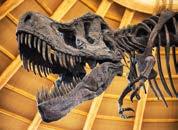



Useful
language
Describing options for people
• I think they’d like to / wouldn’t like to visit... because it’s so / too (crowded / noisy / expensive).
• I think they’d prefer to … because… Saying what you can do in a place
• It’s a brilliant place to (meet friends / have lunch).
• It’s a place where they can (buy clothes / have coffee).
Disagreeing politely
• I know what you mean, but…
• That’s a good point, but…
• On the other hand, …
ORACY SKILLS
The J&K Diaries – Episode 8
1 Watch the vlog. Choose the correct option to complete the sentences.
1 Josh and Kayla are asking / answering some questions in this week’s vlog.
2 Kayla thinks she saw a ghost in a very old hotel / castle
3 Josh’s family always go camping / stay in a hotel when they go on holiday.
4 Kayla once missed a plane because she / her mum forgot her passport.
5 Josh fell asleep when he was at the theatre / school
2 SPEAKING Work in pairs. Think about the last time you visited a different big town or city and discuss these questions.
• Which places did you go to in the city?
• Did you find out anything about the city’s history?
• Where did you eat when you were there?
• Did you buy anything there? What?
Exam task
3 INVALSI Multiple matching Read the article about being a good tourist. Parts of the text have been removed. Choose the correct part (A-J) for each gap (1-8). There is one extra part that you should not use. The first one (0) has been done for you.
A where you spend your money
B dressed in beautiful, traditional clothes
C communicate with the people
D fly to another city
E travel together in large groups
F travel around the city
G find out about the history
H when the most popular places
I language of every country
J take the bus
4 SPEAKING CITIZENSHIP Work in pairs. Discuss the ideas in the article. Do you think that you are a good tourist? How can you be a better tourist?
5 MEDIATION Work in groups. Read through the text again. Choose the four most important pieces of advice. Design a poster to share this advice. Find photos or illustrations to illustrate your poster.
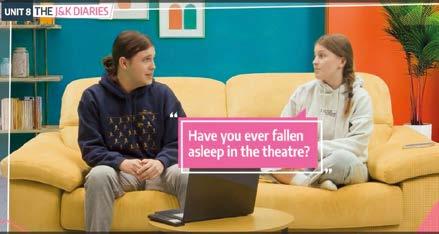

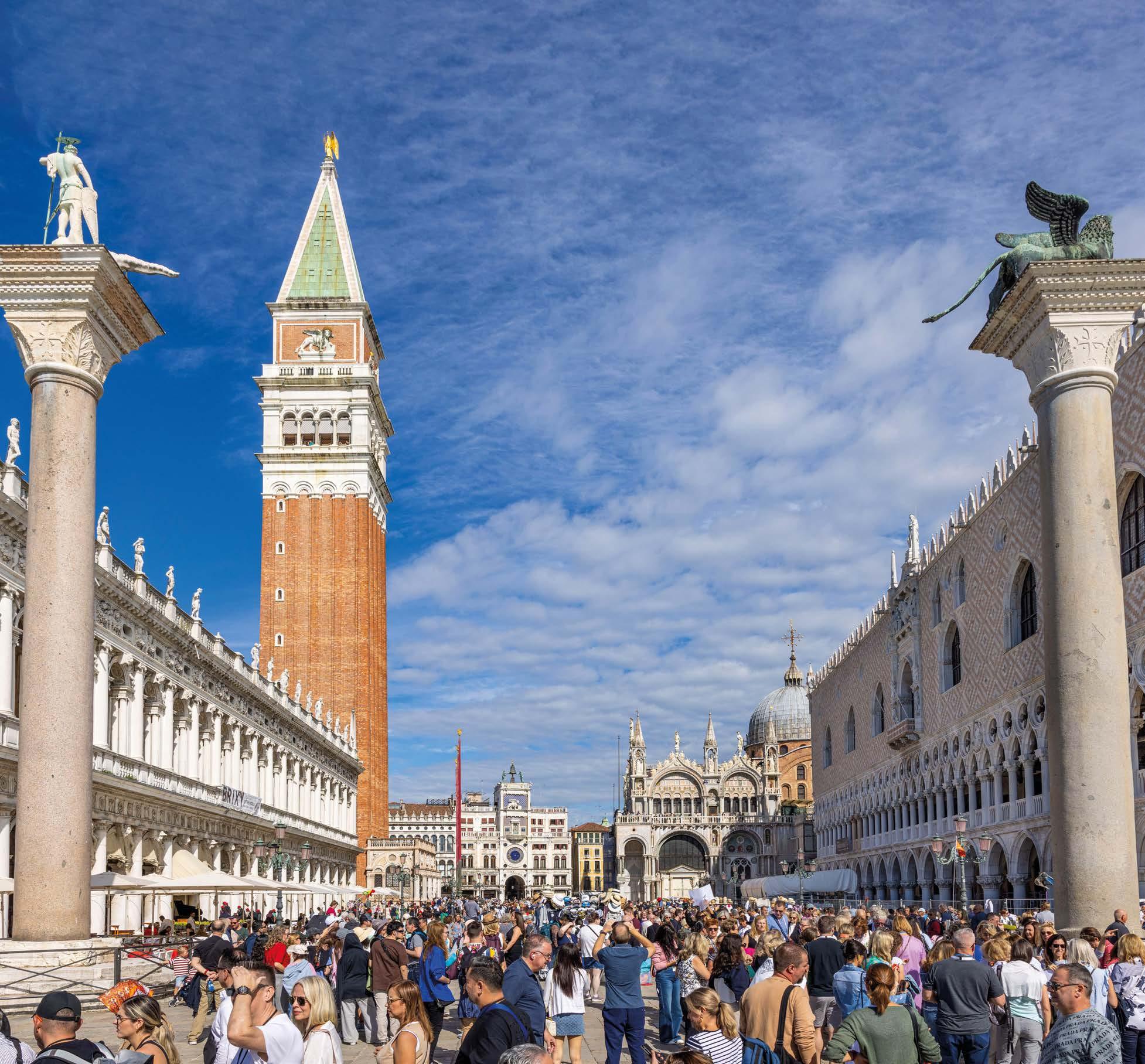
For real? Davvero?
Spooky! Spaventoso! out of our league fuori dalla tua portata It was a nightmare. È stato un incubo.
How to Be a Good Tourist
I love travelling, and I’ve been to different countries all around the world. It’s always exciting to go to a new city. You can visit old buildings, (0) of a country, try new food and of course, just relax and have a good time.
But tourism isn’t always a great experience for the people who live in that city. Tourists are often noisy, especially when they (1) ; they sometimes leave litter on the streets; and they can add to the traffic on the roads. In this article, I’m going to share some ways to enjoy your trip while at the same time being a responsible tourist.
First of all, think about (2) . Buy food and souvenirs that come from the country you are visiting. Look for local independent shops and local restaurants. Then you know that your money is going back into the city.
Find sustainable ways to travel around the city. Walk, (3) or hire a bike. And if you are cycling around the city, remember to follow the rules of the road and look out for pedestrians!
Of course, you can’t learn the (4) that you visit. But it isn’t difficult to learn one or two phrases like ‘Thank you very much’ or ‘Where is the museum?’ It shows that you’re interested in the country and that you want to (5) there.
Find out (6) are going to be very busy, and arrange to go to them at a quieter time, perhaps early in the morning or later in the evening. Also, do some research before you travel and look for places that aren’t on the tourist map.
Remember to pack a water bottle and a couple of cloth bags in your suitcase. Take these with you when you (7) instead of buying plastic bottles of water or putting your shopping in plastic bags.
Think before you take photos. Perhaps you’ve seen someone (8) , and you want to take a photo for your social media. Ask their permission first. And try to spend some time just looking at a place and the people before you take any photos. Sometimes the best experiences are the ones that are just in your memory.
Vocabulary 8
Tourism, sightseeing and entertainment
1 Write these words in the correct category.
airport • bus station • café • castle cinema • guest house • hotel museum • restaurant • theatre
Places to stay:
Places to eat:
Places to learn about art or history:
Places to travel from:
Places to watch entertainment:
2 SPEAKING Work in pairs. Read the speech bubbles and say where these people are. Choose from the places in exercise 1.
1 These walls are more than five hundred years old. Now, let’s climb up these stairs and here’s a wonderful view of the whole city from the top.
2 Please switch off your mobile phones. The play is about to begin. Thank you.
3 Flight number FR56 to Tbilisi is boarding now. Please go to Gate 22 immediately.
4 Here are your room keys. Breakfast is from 7 to 9.30 in the restaurant on the ground floor. Have a nice stay!
5 I’d like the chicken soup to start with, please, and then the fish with rice and beans.
Prepositions of movement
3 Choose the correct option to complete the sentences.
1 We were looking for the library, but we walked into / past the post office by mistake.
2 The horse jumped over / through the gate and ran away.
3 Raj ran along / under the road quickly because he was late for school.
4 The boat sailed across / under the bridge and on towards the sea.
5 That’s very strange! My friend walked into / past me and didn’t say hello!
6 He kicked the ball across / along the street to the other side.
7 We rode our bikes over / through the park and enjoyed the sunshine.
4 Complete the email with the words in the box. across • along • castle • guest house • hotel into • museum • over • theatre • restaurant
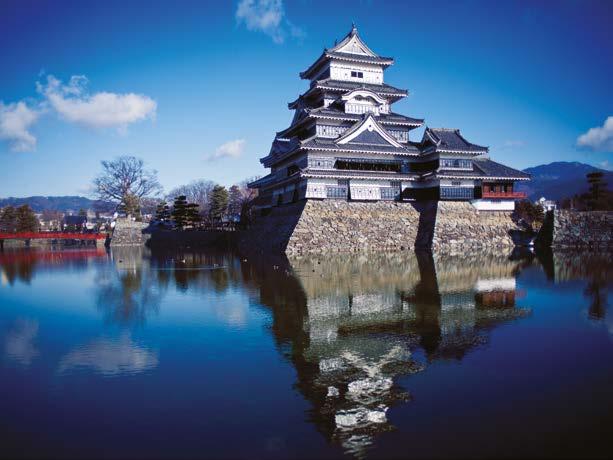
Hi!
We’re having a fantastic time in Matsumoto! Yesterday we visited the (1) in the morning. It’s more than four hundred years old and is really beautiful. Then we spent some time in the (2) and learnt all about Japanese history. From there, we walked (3) Daimyomachi street and (4) the bridge (5) the Metoba River. We had lunch at a traditional Japanese (6) and then we went (7) some really interesting small shops. I bought you a great present! In the evening we saw a Japanese play at the (8) I didn’t really understand it, but it looked amazing! Our (9) is small, but friendly, and I’m so glad we decided not to stay at a big expensive (10)
See you soon!
Edmundo
Frame your ideas
5 SEL Decision making Self-awareness Answer the questions.
• What places in your local town do you want to show to visitors? Are they modern places or old places?
• Describe some places that are important to you. Why are they important? Think about places where:
- you first met your friends; - you had an amazing experience; - you feel happy; - you feel safe.
Past simple vs Present perfect
1 Read the sentences. Write PS if the underlined verb is in the Past simple and PP if it is in the Present perfect.
1 He went to Rome last week.
2 They had a picnic in the park last Saturday.
3 I’ve had too much to eat.
4 Did you have a good time in Prague?
5 Has she been to the post office yet?
6 We’ve visited lots of countries in Europe.
7 They didn’t have cereal for breakfast.
8 I saw a beautiful painting at the art gallery this morning.
2 Read the sentences (1-2). Complete the rules (a-b) with Past simple or Present perfect simple.
1 She has stayed in this hotel several times.
2 He visited Tbilisi in 2025.
a We use the to talk about events that started and finished in the past and to say when it happened. We often use this tense with time expressions like: five months ago, in 2017, yesterday, last year
b We use the when we don’t know or are not interested in when it happened in the past or when the past action is connected with the present. We often use this tense with for and since and time expressions like: today, in the last week, so far, until now
3 Complete the sentences with the Past simple or Present perfect simple form of the verbs in brackets.
1 We (go) to this art gallery last month, but we (not / see) the new exhibition yet.
2 (we / visit) this restaurant for your birthday last year? No. We (never / eat) here before.
3 Last month, I (fall) in the garden and I (walk) with a stick since then.
4 I (know) Jenny since we (be) at school together.
5 (you / cut) your hair since the last time I (see) you?
6 Nina (not / visit) any countries in Africa, but she (go) to China three times last year.
4 Choose the correct option.
1 She knew / has known him for ten years.
2 I haven’t / didn’t finished yet.
3 Did you seen / see the documentary about Athens on TV last night?
4 I ate / have eaten my lunch before I went shopping.
5 Has he meet / met the new student from Portugal?
6 Has she ever been / went to Asia?
5 Write sentences with the Past simple or Present perfect.
1 Nina / go / Beijing / last year
Nina went to Beijing last year.
2 She / never / eat / Thai food.
3 He / go / to the museum / yesterday
4 I / go / to the theatre / twice this year
5 The Cooper family / move / into the castle / in 2012
6 Lee / know / how to speak Japanese / since he was six.
6 Use the Past simple or Present perfect simple form of the verbs in brackets to complete the text.
Henry (1) (live) in New York City for two months. He (2) (come) to the city because he (3) (get) a job at the airport. His friends (4) (not / visit) him yet, but they hope to come and see him soon. He (5) (meet) lots of new people in the last few months. His neighbours are very friendly, and they even (6) (make) a cake for him on his birthday!

Writing lab
Describing places
1 Match the questions (1-3) with the answers (a-c).
1 What do you like about living in your town?
2 Describe your favourite place where you live.
3 Describe the last time you went to your favourite place.
a The sports centre is probably my favourite place. It looks quite old and boring, but it’s got a big swimming pool and a great gym.
b The people are very friendly and it’s also got a beautiful park.
c I went there last Saturday. I played basketball with my friends and we went swimming.
Useful language
Talking about frequency
ORACY SKILLS
• I often / usually / sometimes go there.
• I don’t go there very often.
• I hardly ever go to (museums) because I’m too busy.
Describing places
• My favourite café is (friendly / quiet / lively).
• It’s usually very (crowded / interesting / noisy).
• The food there is (delicious / unusual / spicy / fresh).
Talking about past time
• Last year / summer / month / weekend, I…
• A few weeks / days ago, I…
• When we went to…
2 WRITING Write answers for these questions in your notebook. Then compare your sentences in pairs.
1 What places do you like to visit when you go on holiday?
2 Describe a place you visited recently.
3 What places do you want to visit in the future?
Learning focus
Adding and contrasting information
You should use linking words to contrast different pieces of information and add new information.
• You can add information by using words like also and too
The town has got a large museum and some old buildings. It’s also got a castle. / It’s got a castle too
• You can contrast information by using words like but, however and although
The theatre is modern and comfortable. Although the theatre is modern and comfortable, tickets are very expensive.
The theatre is modern and comfortable, although tickets are very expensive.
3 Connect the sentences using but, however, although, too and also. Then compare your answers in pairs.
1 The food was delicious. It was very expensive.
2 There are two hotels in the town. There are five guest houses.
3 There are lots of buses. The buses get very busy at the weekend.
4 The museum is a beautiful building. It’s very interesting.
5 The bookshop is small and friendly. It’s only open on Mondays and Thursdays.
6 Our trip to Matsumoto Castle was amazing. We loved the museum.
Exam tip
Planning your article
• Some exam tasks ask you to write an article about a certain topic. They will usually include some questions that you should answer in your article.
• Read the task carefully and think about each question.
• Take a couple of minutes to write down two or three key words for each question.
• Remember to use the past tense to describe your experiences.
• Read through your article again and check that you have covered all the questions.
Exam task
4 PRELIMINARY Writing an article You see this notice on an English-language website. Write an article following the notice. Write about 100 words.
Articles wanted! My Favourite Place
What is your favourite place to visit in your town? What do you like about it and why? Describe the last time you went there. Write an article answering these questions and we will put it on our website!
5 Complete the Reflection checklist. Then discuss your answers with your partner.
Reflection checklist
Tick (✔) the sentences that you think are true. I read the whole task carefully before I started. I planned my answers carefully before I started. I used the correct tenses to describe past experiences.
I used a variety of linking words to add and contrast information.

Marmalade Lane
Cambridge is probably most famous for its university and beautiful old buildings, but since 2019, it has also been the home city of Marmalade Lane – the biggest co-housing project in the UK.
One hundred people live in Marmalade Lane, in 42 homes – a mixture of houses and apartments. There’s a large, shared garden with a children’s playground, an area to grow fruit and vegetables, and a special space for picnics and outdoor cooking. Around this garden, there is a quiet street with modern houses and apartments but no cars. Although some families in Marmalade Lane own their own cars, they can also join a shared car club. And if you don’t know how to drive, you can use the community ‘cargo bike’ – an electric bike with space to carry children and shopping.
There’s also a ‘Common House’ – a big building that is for the whole community to use. Every house and apartment in Marmalade Lane has its own small kitchen, but they can also use the large, shared kitchen in the ‘Common House’. People meet regularly there to prepare and eat community meals in the dining room together. They can also use the washing machines in the ‘Common House’; they can keep fit in the gym; work in the shared office space and children can meet and play in a special room, full of toys. There are even three guest bedrooms for visitors.
If you need to do some DIY, you can go to the workshop, which has plenty of tools for the whole community to use. And if you don’t know how to do DIY, there will be someone in the community who will share their skills with you.
Marmalade Lane is an eco-friendly, sustainable way of living. The residents have started their own community shop, where they join together to buy food and other basic goods in bulk to save money. Buying and preparing shared meals, using a car club, growing food in the community garden all help to reduce waste and pollution.
Perhaps most importantly of all, Marmalade Lane gives its residents a feeling of belonging and community. There is space here to have a private life, but you can also get to know your neighbours and spend time together. In the words of one resident: ‘Kind, loving neighbours who really want to connect with and support each other are the heart of co-housing. The children are out playing, and people are chatting in backyards, and it feels like a dream come true.’
Towards INVALSI
Reading
1 Work in pairs. What do you think ‘co-housing’ is? Discuss your ideas. Then read the article below quickly to check.
2 Read the article about a co-housing project. Choose the correct answer (A, B, C or D) for questions 1-7. Only one answer is correct. The first one (0) has been done for you.
0 Most people know Cambridge because…
A it has a very old co-housing project.
B it became very famous in 2019.
C it is one of the biggest cities in the UK.
D there are some lovely buildings in the city.
1 The people in Marmalade Lane…
A all live together in one big house.
B have their own homes but also share some things.
C live in houses but don’t have a garden.
D prepare all their food outside.
2 The car club is for…
A people who don’t have their own cars.
B anyone who lives in Marmalade Lane.
C people who are very interested in old cars.
D people who want to share their own cars.
3 People use the kitchen in the Common House…
A when they want to share meals with other people in Marmalade Lane.
B if they haven’t got a kitchen in their home.
C to prepare food for people outside the community.
D if they prefer to eat on their own.
4 The guest bedrooms in the Common Room are for…
A children.
B people who live in Marmalade Lane.
C people who have come to stay with friends or family.
D people who work in the offices.
5 You can learn new skills by…
A asking other people in Marmalade Lane.
B going to the workshop.
C doing some DIY.
D helping to prepare meals for the community.
6 People in Marmalade Lane buy food together because…
A they like spending time with each other.
B it’s difficult to find good food in Marmalade Lane.
C they can share a car when they drive to the supermarket.
D they want to get to cheap food for the community shop.
7 The article’s writer believes that the main advantage of living in Marmalade Lane is…
A having time to be on your own.
B helping the environment.
C being part of a larger group of people.
D spending more time with your children.
Vocabulary
1 Choose the correct option to complete the sentences.
1 We put our bicycles in the living room / garage
2 Our flat is on the second floor, so please go up the ceiling / stairs
3 There is a door / roof from the kitchen to the garden.
4 We’ve got a lot of beautiful pictures on our walls / halls
5 I need to wash my hands. Where’s the bathroom / dining room, please?
6 We watch TV in the living room / garage
7 There’s an apple tree and lots of flowers in our garage / garden
8 I make my lunch in the bedroom / kitchen
2 Complete the description with the words in the box. armchair • carpet • curtains • lamp mirror • painting • shelves • sofa
I’ll describe my bedroom for you. It’s quite small, but it’s sunny in the mornings. I switch on my (1) when it gets dark in the evenings. There’s a bed and a comfortable (2) , which I sit in when I listen to music.
There are three (3) for my books. There’s a large (4) on the wall, so I can check what I look like before I go out! I’ve got a green (5) on the floor and the (6) at the windows are also green. On the wall, there is a (7) of my mum and dad!
I would like a (8) , but the room is small and there isn’t any space.
3 Complete the sentences with the prepositions in the box. about • at • of • to
1 She listened some music while she was doing her homework.
2 Have you ever thought moving to another country?
3 I dream living in a small cottage in the countryside.
4 My mum loves looking other people’s houses online.
4 Complete the words.
1 We’re going to play basketball at the s c .
2 Can you go to the s and get some milk, please?
3 We need to go to the b to get some money.
4 I’m going to the p o to buy stamps and send a letter.
5 I like studying at the l because it’s quiet.
6 My dad usually buys his clothes in a d s .
7 Can you get some medicine for me at the p , please?
8 When I broke my leg, I had to stay in h for a week.
5 Complete the sentences with the words in the box.
café • cinema • guest house museum • restaurant • theatre
1 Are you going to watch a play at the later?
2 Have you eaten at that new Indian yet?
3 Shall we watch a film at the this weekend?
4 You can see a lot of old paintings at the
5 Let’s meet at the for a coffee.
6 Our serves breakfast at 8 a.m.
6 Choose the correct option to complete the sentences.
1 He ran across / over the street to talk to his friend.
2 This road goes under / into the river, not over it.
3 Our dog ran out of the house and under / into the street.
4 We walked across / past the cinema, but we didn’t notice what film was on.
5 He jumped over / along the wall and into the garden.
6 We walked home along / through the river and looked at the boats.
Grammar
1 Complete the conversations with the Present perfect form of the verbs and the words in the box. Use each word only once.
already • ever • just • never • since • yet
1 A you (find) a new flat?
B No, we haven’t. We (not sell) our old flat
2 A How long they (live) in that house?
B I think they (live) there 1990.
3 A you (visit) Paris?
B No, I haven’t. I (be) there.
4 A you (decide) what to have for dinner?
B Yes, look! I (see) this recipe for chicken soup. I’ll make that!
5 A your son (start) university in Germany?
B Yes! He (finish) his first year there.
2 Write the apostrophe in the correct place in each sentence.
1 The childrens room is on the top floor.
2 Jasons sister works at the library.
3 Rosas new laptop was very expensive.
4 My friends names are Eric and Ken.
5 Carlos teacher is from Argentina.
6 My fathers car is in the garage.
3 Complete the sentences. Use the possessive adjective or possessive pronoun form of the words in brackets.
1 Where are tickets? I put them here, but these tickets aren’t . (us)
2 Julia, is that bag? It looks like , but I’m not sure. (you)
3 Is this ? I can’t remember what number was! (I)
4 Is that Eric’s jacket? I think jacket is blue, but is also quite old. (he)
4 Complete the conversations with one or ones.
1 A Which trainers would you like? These are quite cheap.
B Can I have the blue , please?
2 A Do you want a green apple or a red ?
B I don’t like green . Can I have this red , please.
5 Complete the sentences with a, an, the or –if no article is necessary.
1 There’s new restaurant that I want to try. Everyone says food is really good.
2 When you visit Egypt, don’t forget to take a cruise on River Nile.
3 I watched interesting documentary about Rome.
4 Many people go climbing in Himalayas, but not all of them try to climb Mount Everest.
5 I’m so excited! In July, we’re going to fly to United States for our holiday!
6 car Max bought is Mercedes and he’s telling everyone about it!
7 Kelly is very sporty; she plays tennis every day and basketball on Thursdays.
6 Choose the correct option to complete the sentences.
1 I have never flown / never flew in a plane.
2 We have visited / visited the museum in the morning and the castle in the afternoon.
3 She has lived / lived in this city since she was twelve years old.
4 Have you been / Did you go to the post office yet?
5 They have turned / turned left and have crossed / crossed the bridge.
6 Jason hasn’t bought / didn’t buy anything at the department store last weekend.

Life skills
Eat well
Price: around $80 per cup 1 2 3 4 5
Densuke watermelon
From Japan
Price: between $250 and $6,000 each
Matsutake mushrooms
From Japan
Price: around $600 per kilogram
White truffles
Usually grown in Italy
Price: around $2,000 per kilogram
Moose cheese
From Sweden
Price: around $1,000 per kilogram
Kopi Luwak coffee
From Indonesia


1 Read the information and look at the food and drink in the photos. Tick (✔) the ones you think are healthy. Compare your answers with a partner.
2 Discuss the questions with your partner.
1 Why do you think the food in the photos is so expensive?
2 Do you think you need to spend a lot of money to eat well? Why? / Why not?
3 What do you think about when you buy food –price, health or taste? Why?
Frame your project
REAL-LIFE TASK 1
Work in groups. Plan a healthy three-course meal for your school canteen.
Think about:
• starters, main courses, desserts;
• vegetarian / vegan food options;
• how much it will cost to make;
• how much it will cost the students.
Present your menu to the class. Vote on the best food.
3 Think of a food that is good for you, but that you don’t eat enough of. Tell your partner:
• why you don’t eat enough of it;
• if it’s expensive or cheap;
• how you could include it, or something else that is also healthy, in your diet.
4 SPEAKING Work in pairs. Read the Mind your mind information. Discuss the questions.
1 Which of the foods do you eat?
2 How do you feel when you eat junk food?
3 Do you feel better when you eat healthy food?
Mind your mind
Improve your diet!
Boost your brain and body with these healthy foods.
• Blueberries can help you to remember things.
• Eggs can help to stop your brain becoming smaller when you get older.
• Nuts can help to give you a healthy heart.
• Dark chocolate can make you feel happy.
• Avocado can help your brain to stay young.

5 Brainstorm other foods you think are good for the brain and body. Write a list.
Useful language
• You can eat / have it for (breakfast / lunch / dinner).
• You should / ought to eat it because…
• It’s (healthy / nice / good for your brain / body) because...
• It grows (under the ground / on a tree).
• You can eat it with…
• You can buy / find it in…
REAL-LIFE TASK 2
SEL Self-management Planning / organisational skills
Create a poster for healthy food you enjoy.
Think about:
• why it’s good for you;
• how / where it grows or is produced;
• how it’s prepared;
• how / when people eat it, e.g. in the morning, as a snack
Present your poster to the class.
ORACY SKILLS
9 Come rain or shine
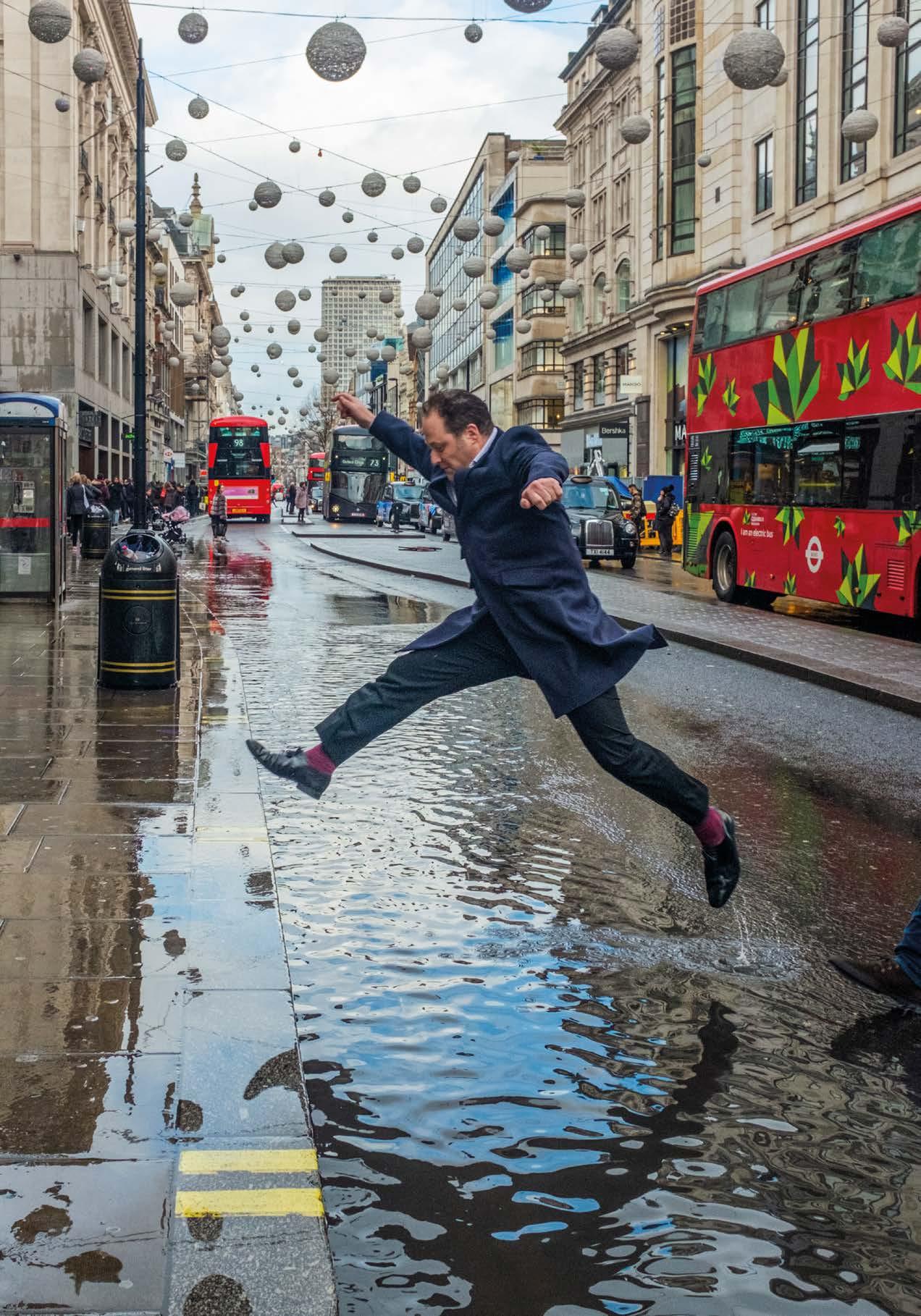
A
1 VISIBLE THINKING Look at the photo. Discuss in pairs.
See Describe what you can see in the photo.
Think What do you think has happened?
Wonder Have you ever experienced extreme weather?
2 Watch the video, Record Hot Weather and choose the correct options to complete the sentences.
1 The video is about the weather in the UK in August / October.
2 The boy is / isn’t enjoying his ice cream.
3 Winds are blowing dry air into England from the south / north
4 One of the biggest supermarkets in the UK hopes to sell three million burgers / ice lollies
5 The weather wasn’t hot and sunny in Scotland / Wales

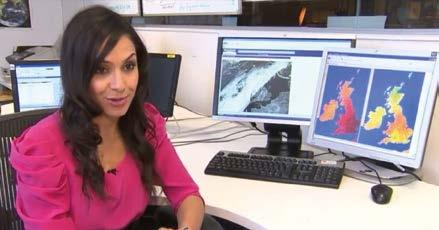
man jumping a puddle after a storm in Oxford Street, London
Frame A
1 Work in pairs. Match the descriptions (1-4) with the places (a-d). Then listen and check your answers.
1 One of the hottest places in the world.
2 One of the wettest places in the world.
3 One of the coldest places in the world.
4 One of the driest places in the world.
a The Atacama Desert, Chile
b Death Valley, USA
c Mawsynram, India
d Dome Fuji, Antarctica
2 Read the article on page 135. What is it about? Choose the best option (a-c).
a raining frogs
b strange weather
c thunderstorms around the world
3 Read the article again. Answer the questions.
1 Why do tourists like to visit Lake Maracaibo?
2 Which two things create the unusual weather?
3 What strange weather event is mentioned in paragraph two?
4 According to scientists, how were the fish pulled up into the sky?
5 When are you likely to see a moonbow?
6 Where are you likely to see a moonbow?
4 Read the Exam tip. Then read the statements in the Exam task and underline the key words.
Exam tip
Answering true, false, justification questions
• In some exam tasks you have to read statements about a text and decide if they are true or false, and then justify your answer with words from the text.
• The questions are usually in the same order as the information in the text.
• Read the statements first and look for the key words. Then find the part of the text with the information to answer each question.
• The key words in the statements may be different from the words in the text. Remember to look for synonyms, e.g. big / large and antonyms, e.g. hot / cold
Exam task
5 INVALSI True, False, Justification Read the article again and decide if the statements (1-8) are true (T) or false (F). Then identify the sentence in the text which supports your decision and write the first four words of this sentence in the space provided.
1 The sun isn’t as hot as lightning when it strikes.
2 The lightning strikes in Lake Maracaibo cause strong winds over the Andes.
3 Frogs from Rakoczifalva rained down in Australia in June 2010.
4 The fish that rained down in Laiamanu came from a river in another place.
5 Not many people have seen a moonbow.
6 The colours in a moonbow are usually very bright.
6 A Work in groups. Choose one of these strange weather events and find out more about it. Find out where it happens and why.

6 B MEDIATION Make a short presentation to the class about the weather event you chose.
the Northern Lights dust devils
lenticular clouds

Striking Weather!
In today’s Weather Focus, we’re going to find out about three places with really extraordinary weather. Every day, lightning strikes 8.6 million times. And when it strikes, it’s very very hot – hotter than the sun. The best place to experience lightning is Lake Maracaibo in Venezuela. It’s famous for its thunderstorms and has more lightning strikes than anywhere else in the world. For three hundred days a year, you can see lightning over the lake. This is because of its warm, humid climate and the strong winds that come from the Andes. Tourists come from all around the world to see the lightning at Lake Maracaibo.
Did you know that it can sometimes rain frogs or small fish? In June 2010, it rained frogs in Rakoczifalva, a small town in Hungary. And Lajamanu, in Australia, became famous when hundreds of tiny fish rained down on people during a storm. How did this happen? Scientists believe that it probably started with a tornado near a river many kilometres away. A tornado is a kind of storm with very strong winds which spin round. As the tornado moved over the river, it pulled up small fish from the water into the sky. Then, as the tornado moved away, the winds got weaker, and the fish fell back down to earth!
Everyone has seen a rainbow. When the sun shines through a drop of water, the light separates into different colours and this makes the rainbow effect. But fewer people have seen a moonbow. This happens at night when the light from the moon shines through a drop of water. It also creates an arc of colours, but the colours are paler because the light from the moon isn’t as strong as the light from the sun. If you want to see a moonbow, you should go to the Victoria Falls in Zimbabwe and Zambia. The best time of year to go is probably between June and August when the skies are usually clear and there is a lot of spray from the waterfall.

Vocabulary 9
The weather
1 Complete the table.
2 Choose the correct option to complete the sentences.
1 It’s going to rain / rainy later today – look at those clouds.
2 What a beautiful sun / sunny day!
3 Please drive carefully, there’s a lot of ice / icy on the roads.
4 I can’t open my umbrella because the wind / windy is so strong.
5 It didn’t snow / snowy at all last winter.
6 It’s very fog / foggy this evening; I can’t see anything at all.
7 Our window was broken in the storm / stormy last night.
8 It’s very cloud / cloudy today – I can’t even see the sun.
3 Match adjectives in the box with the temperatures they describe (1-6). boiling • cold cool • freezing
1 35°C or more
2 28°C-35°C
3 15°C-28°C
4 10°C-15°C
5 0°C-10°C
6 0°C or less
4 Match the beginnings of the questions (1-4) with the endings (a-d). 1 What’s it
How
What’s
Is it
a cold is it?
b raining?
c like outside?
d the weather like?
5 SPEAKING Work in pairs. Take turns to ask questions about the weather last week. Use the table for your answers. Student B begins. Student A: You went to Athens last week. Student B: You went to Zurich last week. It was raining.
What was the weather like in Athens on Monday?
6 Complete the email with these words. Use each word once only. clouds • hot • icy • like • rain snowing • sunny • windy
Hi Mum and Dad
I’m having a great time in Santiago. Yesterday, it was really bright and (1) , so we climbed up to the top of Cerro San Cristobal and took lots of photos. There weren’t many (2) in the sky and we had an amazing view of the city. It was very (3) , though, and I lost my hat when it blew away down the hill! Today, it’s still very (4) – 30°C – but I think it’s going to (5) this afternoon. What’s the weather (6) in Italy? Is it (7) ? Have you been skiing yet or is it too (8) and dangerous?
The weather is one of the most popular topics of conversation in the UK. In fact, the average Brit spends ten minutes a day talking about the weather … that’s one hour a week – or four months in a lifetime! And what’s the most popular phrase? ‘Lovely day, isn’t it?’
Comparatives
1 Read the sentences (1-5). Look at the underlined comparative adjectives. Then complete the rules (a-g) with the correct word or letters.
1 Mountain roads are usually more dangerous than city roads. City roads are usually safer.
2 The weather in Sydney, Australia is warmer in January than in July.
3 This holiday is better than last year’s.
4 Today, the weather is much wetter than yesterday.
5 It’s hot and humid in Japan during the summer but much drier in the winter.
consonant • -er • -i • irregular • more • -r
a We form most comparative adjectives by adding : warm warmer
b If the adjective ends in -y, change the -y to and add -er : dry drier
c If the adjective ends in one vowel and a consonant, double the final and add -er: wet wetter.
d If the adjective ends in -e, add : safe safer.
e If the adjective is three or more syllables long, use + the adjective: dangerous more dangerous
f Some two-syllable adjectives use more + adjective: careful more careful
g Some adjectives have comparative forms: good better, bad worse, far further
2 Write the comparative forms of these adjectives.
3 Complete the sentences with the comparative form of the adjectives in brackets.
1 It’s (sunny) today than yesterday.
2 August in Lisbon is usually (hot) than August in London.
3 Your snowman is (nice) than mine!
4 The rain last week was (bad) than today.
5 Our garden looks (beautiful) in the winter than in the summer.
4 Read the sentences (1-2). Complete the rules (a-b).
1 The temperature by the sea isn’t as high as the temperature in the city.
2 The winter sun is as bright as the summer sun.
a We can use as + adjective + to show that two things are similar.
b We can use not as + + as to show that a person or thing has less of a quality than another.
5 Find and correct the mistakes in these sentences.
1 The weather today is good than it was yesterday.
2 It isn’t foggy as it was last week.
3 The weather in India is hoter than in the UK.
4 It was warm and sunny this morning, but now it’s more cloudier.
5 Helena is as tall than her brother.
6 Our car is faster that the bus.
7 The garden is prettyer in the summer than in the winter.
8 I think it will get more colder tonight.
6 SPEAKING Work in pairs. Make comparisons using the adjectives in brackets. Use (not) as … as
Paris isn’t as big as Tokyo.
1 Tokyo / Paris (big)
Yes, I think you’re right.
2 English / maths (difficult)
3 my house / your house (far from school)
4 pop music / reggae (good)
5 dogs / cats (friendly)
6 weather today / weather yesterday (warm)
Frame your ideas
7 SEL Self-awareness Work in pairs. Do you feel happier on sunny days? Think about how the weather changes the way you feel – both physically and mentally.
Listening
1 Work in pairs. Read the pairs of sentences. Is the meaning the same (S) or different (D)?
1 a It isn’t as hot as it was yesterday. b It was colder yesterday.
2 a I won’t see you before five. b I’ll see you after five.
3 a She hardly ever goes out in the snow. b She never goes out in the snow.
4 a It didn’t start raining until the afternoon. b It didn’t rain in the afternoon.
2 Listen to the conversation. Are the sentences true (T) or false (F)?
1 The girl doesn’t like the weather at the moment.
2 The boy hates the rain.
3 The boy has done his history project.
4 The boy thinks it won’t be as cold in the afternoon.
5 The girl isn’t happy about the weather forecast.
3 Read the question. Listen to the conversation again. Choose the correct photo, a or b.
What is the boy going to do in the afternoon?


4 Read the Exam tip. Then read the Exam task.
Exam tip
Listening for negative verbs
• Some listening tasks ask you what a person did or plans to do.
• The speakers may talk about events or plans using a negative verb and words such as until, almost or nearly. For example, We almost didn’t go to the park. = We went to the park.
I’m not going until later this evening. = I am going, but later
• Be careful of verbs that use almost, nearly or until with a negative verb.
Exam task
5 PRELIMINARY Multiple choice with picture options For each question, choose the correct answer. 1 What was the weather like last weekend?



Where are they going for their day out?

When is the woman planning to go on holiday?
How much are the sunglasses?
When are they going to have lunch?
Talking about the weather and seasons
1 SPEAKING Work in pairs. Choose a photo. Tell your partner if you have experienced this type of weather. Which weather is most common in your country?
2 Discuss the questions with your partner.
1 What’s your favourite kind of weather?
2 What do you do at the weekend when it rains?
3 What do you do at the weekend when it’s sunny and hot?
4 Do you prefer hot weather or cold weather? Why?
3 SPEAKING Work in pairs. Turn to page 189. Take turns to ask and answer questions about the weather.
4 Read the Exam tip. Think about what you can say on the topic of weekend and seasonal activities.
Exam tip
Answering yes / no questions and giving more details
• In some exam tasks, the examiner will choose two topics from a list and ask you some questions.
• Make sure you can talk about all the topics on the list.
• Respond with short answers, then add two or three sentences with more details. For example, Examiner: Do you like winter sports?
You: Yes, I do. I really enjoy snowboarding. Last winter, I went snowboarding with my friends in the mountains.
• Remember to thank the examiner and say goodbye at the end.
Exam task
5 TRINITY Interview Work in pairs. Act out the interview.
Student A: You are the examiner. Read the instructions and questions in Task 1.
Student B: You are the student. Answer the examiner’s questions. Use the Useful language to help you.
Then change roles. Use the questions in Task 2.
Task 1
Now we’re going to talk about weekend activities.
• What do you like doing at the weekend?
• What do you usually do at the weekend if it is raining?
• Do you sometimes go walking or cycling?
• Tell me about what you did last weekend.
Task
2
Now we’re going to talk about seasonal activities.
• What do you like doing in the winter?
• What is your favourite season and why?
• Do you like to go to the beach in the summer?
• Tell me about a summer or winter holiday that you enjoyed.
Useful language
Stating preferences
• I prefer (summer) to (winter) because…
• I prefer to (go cycling in the spring) because…
• I don’t like (hiking in the winter) because (it is more dangerous).
Talking about possible situations
• If it is raining, I usually…
• I always … if it is sunny and warm.
• We don’t usually … if the weather is bad.
Talking about past experiences
• Last winter, we went on holiday to…
• A few weeks ago, we visited…
• I really enjoyed my visit to … because…
Some weather myths might be true...
Read these ones: can you guess their meaning?
1 Red sky at night, shepherd’s delight. Red sky in the morning, shepherd’s warning.
2 If cows lie down, it’s going to rain.
3 If it rains on St Swithin’s Day (15 July), it will rain for 40 days.
4 If bees stay home, rain will come soon. They fly away, fine will be the day.
What about your culture? Can you find similar sayings in your language? Are they true?
ORACY SKILLS
BritCult
Frame B
The J&K Diaries – Episode 9
1 Watch the vlog and answer the questions.
1 What is the weather like?
2 What does it mean when frogs start making more noise?
3 How many kilometres per hour can wind blow in a thunderstorm?
4 How many metres of snow per year do they get in Aomori, Japan?
5 How tall was the tallest snowwoman?
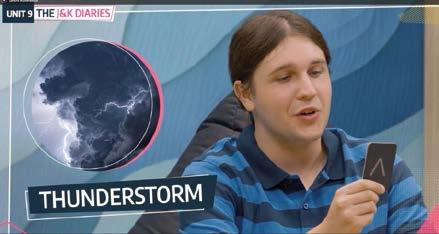
2 You are going to read an article about climate change. Before you read, match the two halves of the sentences.
1 greenhouse gases
2 fossil fuels
3 to trap something
4 to melt
5 deforestation
6 solar power
Exam task
a means to keep something or someone in a place where they can’t escape.
b is cutting down lots of trees.
c comes from the sun.
d make the Earth’s temperature higher.
e means to turn from a solid into a liquid.
f come from plants and animals that lived millions of years ago.
3 PRELIMINARY Multiple matching Read the article on page 141. Match each sentence (A-J) with the correct gap (1-7). There are two extra sentences. The first one (0) has been done for you.
A This is called the greenhouse effect.
B Companies around the world are using alternatives to fossil fuels, like wind power and solar power.
C But as the weather gets hotter, it also gets wetter.
D There are more than 1.5 billion cows in the world.
E This is a mixture of gases that surround Earth.
F The rise in temperatures in the sea means that hurricanes are more frequent and they are getting stronger.
G The climate on Earth has changed in the past.
H We can walk or use public transport, rather than travel by car.
I Over the last 170 years, the Earth’s temperature has risen by about 1.5ºC.
J This makes it more difficult for polar animals to live and find food.
4 Read again and answer the questions.
1 Why is global warming alarming?
2 What does wetter weather imply?
3 What are the two main causes of hotter weather?
4 Which animals are suffering, according to the article? Why?
5 What solutions are scientists trying to find?
6 Which of the good habits mentioned in the last paragraph do you usually follow?
5 SPEAKING Work in pairs. Read the last paragraph of the article again. Discuss these questions.
• What do you already do to help look after the planet?
• What more could you do in the future?
• How can you try to encourage other people to look after the planet?

I’m up for it. Ci sto. I haven’t got a clue. Non ne ho idea. Sick! Forte! / Figo!
Climate Change:the Facts
Our planet is getting warmer. (0) . This may not sound like a lot, but in fact it affects people, places and animals all around the world.
Some people believe that the rise in temperatures will simply mean that we will all enjoy sunnier weather and longer summers. (1) . This rise in heat and rain is already causing more extreme weather events around the world.
So, why is the world getting hotter, and what can we do about it? Our planet has an atmosphere. (2) . These gases help to keep our planet just the right temperature – not too hot and not too cold. But human activity like farming and burning fossil fuels creates ‘greenhouse gases’ like methane and carbon dioxide. These gases go up into the atmosphere and stay there. They trap the heat from the sun, making the planet hotter. (3) . At the same time, we’re cutting down lots of trees, especially in the Amazon Rainforest. Why is that bad for the planet? Because trees take in carbon dioxide and change it into oxygen, which is good for the planet.
As the planet gets warmer, ice in the North and South Poles is melting. (4) . Deforestation is also taking away the natural homes of rainforest animals like orangutans and jaguars. People, as well as animals, are feeling the effects of climate change. (5) . There are also more droughts around the world, making it difficult to grow food.
The good news is that people are beginning to understand more about climate change and are looking for ways to be kinder to the planet. (6) . Scientists are working on new ways to take greenhouses gases out of the atmosphere. Young people are talking about climate change and encouraging governments to look after the planet better.
We can all make a difference, even if it’s only in a very small way. We can try to save energy at home. (7) . We can reduce food waste and eat less meat. All of these things can help to protect the planet.
Vocabulary 9
Extreme weather
4 Read the Exam tip. Then read the Exam task.
Exam tip
a a long period of time where there is no rain
b a very strong storm
1 Match the words (1-4) with the meanings (a-d). 1 wildfire 2 thunder 3 drought 4 hurricane
c loud noise during a storm
d fire in an area of land that is difficult to control
2 Complete the sentences with words from exercise 1.
1 Suddenly, I heard the and I knew the storm was very close.
2 All the plants in the field died during the and we had almost no food.
3 A lot of trees fell during the last night. 4 suddenly hit the building and destroyed it.
Weather collocations
3 Look at the photos and choose the correct option to complete the sentences.
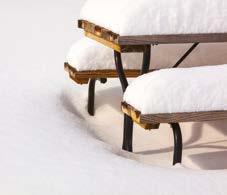

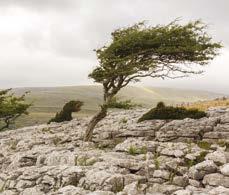
1 The snow was deep /


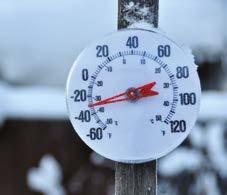
2 There is often light / heavy rain in autumn.
3 Look at the white / dark clouds in the sky!
4 The sun is very weak / strong in summer.
5 In spring there are often strong / weak winds in the hills.
6 The temperature is very low / high in winter.
Recognising common phrasal verbs
• In a multiple-choice gapfill task, the missing word can sometimes be part of a phrasal verb.
• Phrasal verbs combine a verb with a particle such as up or down to make a verb with a different meaning. For example, the verb go can be combined with particles away, out, up, down, in and on to make a variety of verbs with different meanings.
• Make a note of common phrasal verbs and write their synonyms to help you remember the meaning.
Exam task
5 PRELIMINARY Multiple-choice cloze Read the text and choose the correct answer.
Extreme weather
Extreme weather events, such as (1) rain, floods, hurricanes and drought happen more often now than in the past.
Hurricanes are more frequent because sea temperatures are (2) up, and this means there is more water in the air. Hurricane winds are also getting (3) Recent hurricanes in the Caribbean, for example, had winds of almost 300 kilometres per hour.

While some places have too much water, some countries in Africa don’t have enough, and farmers can’t grow enough food. Wildfires in countries such as Spain, Australia and Brazil are bigger and more difficult to stop because the trees and plants are so dry. Last year, fires (4) thousands of homes, as well as trees and farms.
Climate change is a problem for everyone in the world today. It is (5) for us all to start (6) of ways to work together to save our planet before it is too late.
VIDEO
Superlatives
1 Read the sentences (1-6). Look at the underlined superlative adjectives. Then complete the rules (a-e) with the correct word or letters in the box.
1 Today was the hottest day for twenty years.
2 The best weather for tennis is a warm, dry day.
3 That’s the bluest sky I’ve ever seen.
4 The earliest flowers appear in winter.
5 Yesterday was the coldest day of the year.
6 Last night’s storm was the most frightening storm I’ve ever known.
double • -est • most • -st • the
a We form most superlative adjectives by adding + adjective + -est: cold the coldest.
b If the adjective ends in -y, change the -y to -i and add : early the earliest.
c If the adjective ends in a vowel and a consonant, the final consonant and add -est: hot the hottest
d If the adjective ends in -e, add : blue the bluest
e If the adjective is three or more syllables long, use the + adjective: frightening the most frightening
2 Write the superlative forms of these adjectives.
1 safe 2 wet 3 foggy 4 difficult 5 light 6 far 7 strong
8 bad
3 Complete the questions with a superlative adjective.
1 Which ocean is (deep)?
2 Where does (heavy) rain fall?
3 Which month is (sunny)?
4 Which country has (long) winter?
5 Which is (short) night?
6 Where is (beautiful) beach in the world?
4 Choose the correct option to complete the sentences.
1 He’s man I’ve ever seen.
A the taller B the tallest C tallest
2 It was day of the year.
A hotter B the most hot C the hottest
3 The River Nile is one of rivers in the world.
A the longest B the longer C longest
4 Greg got marks out of everyone in the class.
A the better B best than C the best
5 It wasn’t storm this year, but it was still very scary.
A the worst B worse C the bad
6 Julia is person in our class!
A laziest B the laziest C the most laziest
Exam tip
Writing the correct grammar words
• In an open-cloze task, the missing words are often ‘grammar’ words. For example, in: It’s colder this year than last year, ‘than’ helps show the comparison between this year and last year
• If there is a comparative or superlative adjective, the missing word might be more, most, than, as or the.
• Other gaps may include determiners (a, the, some, many), pronouns (it, they), prepositions (to, for) and conjunctions (when, after).
Exam task
5 PRELIMINARY Open cloze Read the Exam tip. Then read the text and write the correct answer. Write one word for each gap.
Hi Leo,
How are you and how’s your holiday going?
We’re spending our summer here at my uncle’s house in the south of France. The weather’s amazing, but it’s much hotter (1) last year. Everyone says it is (2) hottest summer they’ve ever had! The weather here doesn’t change as often (3) it does in England. It’s sunny almost every day and it doesn’t rain a lot. In fact, we haven’t had enough rain, so we have to use water (4) carefully than usual. I love going down to the river, which isn’t far (5) my uncle’s house. It’s one of the (6) popular places for swimming, but the water is really low this year. I hope it will rain soon! Write soon and tell me about your holiday.
Max
Writing lab
Describing a trip
Useful language
Beginning your description
• Berlin is the capital city of Germany.
• We spent two days in the beautiful city of Lima.
Describing a town
• There are lots of museums and art galleries here.
• The city is famous for its gardens and cafés.
Ending your description
• Next time we come here, I want to …
• For my next trip, I’m going to …
1 Read the online article about a trip to Anchorage. Underline all the verbs. Which tenses does Aleksei use?
Anchorage Alaska by
Alexsei Chernov
Last month, I visited Anchorage in Alaska. Anchorage is one of the biggest cities in the USA and some people call it the Big Apple of the North. On my first day there, I went to the Anchorage Museum. It’s a really interesting museum, with lots of information about the history and the people of Anchorage. The next day it was sunny, so I went on a guided bike ride to Kincaid Park. The views are amazing and visitors to the park can also play golf or spend some time on the beach. On my final day, I visited Anchorage market. There are more than three hundred small shops there, and I bought some great presents for my friends.
It was a great trip! In September, I’m going to visit Toronto in Canada. I really want to go to the top of the CN Tower!
Learning focus
Using different tenses
When you write an online article, a story or an email, it’s important to use the correct tense.
• To give general information about a place, use the Present simple: Madrid is the capital city of Spain.
• To talk about things you did in the past, use the Past simple. Yesterday we went to the zoo.
• To talk about future activities, use be going to or the Present continuous.
We’re flying to Zurich next weekend. We’re going to visit my aunt.
2 Read the Exam tip. Then read the Exam task and make your own notes.
Exam tip
Ordering events and adding interest
• In this type of article, you can describe a sequence of events.
• Use time adverbs like On the first day, … In the afternoon, … to show when each event happened.
• Use conjunctions such as before, after and while to connect events within a sentence.
• Use adjectives and facts to make your article interesting.
• Finish your article with an opinion about the trip, and an idea about future plans.
Exam task
3 PRELIMINARY Writing an article You see this notice on an English-language website. Write your article. Write about 100 words. Use the Useful language to help you.
Articles wanted!
School trip
Write about a school trip to your country or another country. Where did you go? Why is this place interesting? What did you do there?
Write an article answering these questions and we will put it on our website.
4 Complete the Reflection checklist. Then discuss your answers with your partner.
Reflection checklist
Tick (4) the sentences that you think are true. I made notes before I began.
I used different tenses to give general information, to talk about past events and to talk about the future.
I used time adverbs to put the events in order.
I used conjunctions to connect events. I used adjectives to describe places and events.
I included facts to interest my reader. I finished my article with an opinion. I included all three points in the task.
10 Learning the ropes

1 VISIBLE THINKING Look at the photo. Discuss in pairs.
See What is the people’s job?
Think What skills and qualities do you think they need for this job?
Wonder What else would you like to know about this job?
2 Watch the video, The Dinosaur Hunter, and choose the correct option.
1 Aubrey thinks it’s normal / unusual for a young girl to like dinosaurs.
2 The team of palaeontologists took a boat / plane to get to the Arctic Circle.
3 They often work for ten / twelve hours a day.
4 Their job is easy / hard and exciting.
5 Palaeontologists often / rarely visit the Arctic Circle.
6 Aubrey thinks we know / don’t know a lot about the history of life.
Bitter cucumber harvest, Borga, Bangladesh
1 Match the words (1-6) with the photos (a-f).

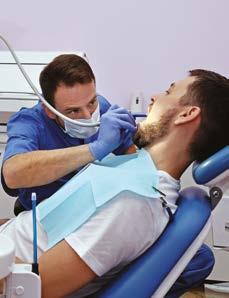
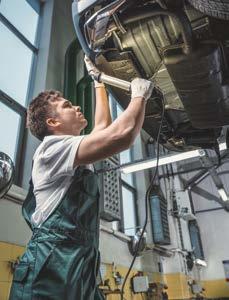
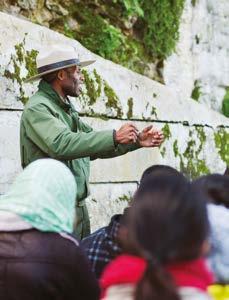
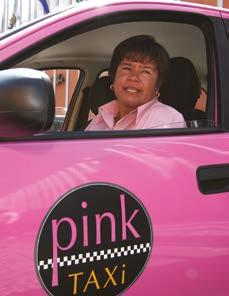
2 SPEAKING Work in pairs. Which of the jobs in exercise 1 is the most…
difficult?
interesting?
exciting?
3 SPEAKING Work with another pair. Compare your ideas from exercise 2.
4 Read the article about unusual jobs on page 147 quickly. Which of the jobs in exercise 1 are mentioned?
5 Read the Exam tip. Then read the Exam task. Try to guess the meaning of unfamiliar words.
Reading tip
Dealing with unfamiliar words
• Read through all the sentences so that you know what information to look for to complete them.
• Then read the text.
• Don’t panic if there are some words you don’t know. Understanding the general sense of each paragraph will help you guess their meaning.
• Underline any words you don’t know. Use the words before and after the unfamiliar word to help you guess the meaning.
Reading task
6 Read the article again, then complete the sentences (1-6), using a maximum of four words from the text. The first one (0) has been done for you.
0 You should start to think about your career now before you .
1 As well as working with pets, veterinary dentists also look after the teeth of animals which live in
2 Large animals can become very dangerous when they are in
3 Abseil window cleaners clean the windows on
4 There isn’t much work for abseil window cleaners in
5 Working as an overland truck driver means you can earn money and also
6 If there is a problem with their trucks, overland truck drivers need to be . leave school or college
Frame your future
7 ORIENTATION Work in pairs. In the text, the writer says that it is a good idea to get some career advice. Discuss these points.
• What kind of job do you want to do?
• Do you know anyone who does this job?
• Where can you find useful career advice about it?
• What questions about the job could you ask a careers advisor?
Our Working Lives
Do you know what you want to do in the future? Maybe you’ve already started to think about your dream job. It’s a really good idea to make some plans for your future before you leave school or college and to get some career advice. But before you make your final decision, why not check out these VERY unusual jobs! Maybe one of them could be the perfect job for you!
Veterinary dentists are dentists who look after the health of animals’ teeth. They usually work with pets, for example, dogs, cats and horses, but sometimes they visit zoos or wildlife parks to check on the teeth of the animals there. It isn’t an easy job, especially with large animals like bears or tigers. However, dental health is very important. If a large animal, like a tiger, has problems with its teeth, it will be in a lot of pain and this can make the tiger very angry and dangerous.
Many tall buildings in big cities have got lots of glass windows, and cleaning them is a difficult job. The window cleaners who work on these tall buildings have to have special skills and they have to be very fit. They are called abseil window cleaners, because they have to abseil down from the top of the building on a rope in order to reach the windows. They usually take a training course in ‘rope skills’ – where they learn how to abseil safely and work together in a team. Abseil window cleaners can earn a lot of money in the summer, but they don’t usually work in the winter.
If you want to travel around the world and earn some money at the same time, why not become an overland driver? Overland drivers are truck drivers who take tourists on tours of Africa, Asia or South America. They drive very big trucks, with 15–25 passengers. They have to be guides for the tourists, cook their food and help to put up their tents when they stop for the night. They also have to be mechanics if their truck breaks down in the middle of a jungle or a desert!

Vocabulary 10
Jobs
1 Complete the descriptions with the jobs in the box.
doctor • engineer • farmer • journalist • nurse painter • photographer • pilot • police officer receptionist • shop assistant • waiter
This person…
1 takes your order and serves you food in a restaurant.
2 helps you when you are ill. This person usually works in a hospital.
3 designs roads, railways, bridges or machines.
4 writes articles for newspapers or magazines.
5 takes photos.
6 works in a hotel or an office.
7 helps people who want to buy something in a shop.
8 flies planes.
9 tries to find out why you are ill and makes you better.
10 grows fruit or vegetables and looks after animals.
11 puts paint on the walls and ceilings of a house.
12 wears a uniform and helps keep people safe.
2 Listen to the conversations. Decide who is talking. Choose from the jobs in exercise 1.
3 Complete the text with the words in the box.
earn • hospital • job • nurse pilot • student • uniform • waiter
When I was younger, I wanted to be a (1) because I loved planes and I thought flying was really exciting. But now I think I’d like to be a (2) I like helping people and I want to work in a (3) . I know that I won’t (4) a lot of money, but I think it’s more important to enjoy your (5) I’m still a (6) at college at the moment, but I work as a (7) at a local restaurant on Saturdays and Sundays. It’s fun, and the people are very friendly, but I don’t like my (8)
I have to wear black trousers and a boring white shirt.

4 Choose the correct option to complete the phrases.
1 earn a job / money
2 work as a mechanic / an occupation
3 give a presentation / an office
4 work in a factory / a tour guide
5 wear a presentation / a uniform
6 work for a company / a job
5 Read the Exam tip. Then read the Exam task. What kind of word is after each gap?
Exam tip
Choosing the correct verb
• Sometimes you can decide which verb goes in the gap by looking at the word after the gap.
• Is the word the object of the verb? e.g. They a present. Which verbs take an object and which don’t?
• Is it a preposition? e.g. I about my home Which verbs take that preposition?
• Is it to + infinitive, infinitive or an -ing form? e.g. I cooking. Which verbs take which form?
Exam task
6 PRELIMINARY Multiple-choice cloze Read the text and for each question, choose the correct answer.
Choosing the right job
Choosing a job is an important decision. Here are a few (1) to help you find the right job.
First of all, take time to (2) about your skills. Are you good at (3) presentations? Do you (4) working in a team? Make a list of things you do well.
Secondly, find out what is important to you. Do you want to be creative or help people? Do you want to (5) a lot of money?
Finally, do some research. Find out about jobs that interest you. Try to speak to people who can tell you what the job is like. (6) companies or workplaces to find out more.
1 A tips B ways C dreams D options 2 A plan B think C study D know 3 A giving B working C getting D speaking 4 A want B hope C enjoy D believe 5 A arrive
Relative pronouns
1 Read the pairs of sentences. Look at the underlined relative pronouns. Then complete the rules (a-c) with the correct relative pronoun.
1 a I work at a restaurant. It’s very famous.
b I work at a restaurant which / that is very famous.
2 a People come to the restaurant. They are friendly.
b The people who / that come to the restaurant are friendly.
a We use relative pronouns to join two sentences.
b We use or when we talk about people.
c We use or when we talk about things.
2 Complete the sentences with who or which.
1 The girl was in the bookshop is a receptionist at my mum’s office.
2 I fixed the truck broke down yesterday.
3 The journalist wrote that article lives near the library.
4 Who threw the ball hit my aunt?
5 We ate the food was in the fridge.
6 She met the teacher works at my school.
3 Read the pairs of sentences. Choose the correct option to complete the rules (a-c).
1 a A tour guide showed us the city. She was very interesting.
b The tour guide that showed us the city was very interesting.
2 a We met a tour guide yesterday. She was very interesting.
b The tour guide (that) we met yesterday was very interesting.
a In sentence 1b, ‘tour guide’ is the subject / object of the underlined clause.
b In sentence 2b ‘ tour guide’ is the subject / object of the underlined clause.
c When the relative pronoun is the subject / object of the relative clause, we can leave it out.
4 Read the sentences. Cross out the relative pronoun where it is not needed.
1 We spoke to the mechanic who fixed our car.
2 The book that you lent me is in my bag.
3 The farmer who lives in my village came to speak at our school in February.
4 Did you go to the meeting that was in the library yesterday?
5 I’m looking for the waiter who I spoke to last night.
6 She works at the factory which we visited on Saturday.
5 Look at sentence (a) in 1-6. Then complete sentence (b) using a relative clause.
1 a I read a book yesterday. It was about veterinary medicine.
b The book veterinary medicine.
2 a She works with a man. He used to be a pilot.
b She works a pilot.
3 a This is the uniform. I wear it when I work at the factory.
b This is the when I work at the factory.
4 a That’s the taxi driver. He drove us to the airport.
b That’s drove us to the airport.
5 a We ate some food at the restaurant. It was delicious.
b The food was delicious.
6 a He got a new job. It was at the hospital.
b The new job was at the hospital.
6 Look at your completed sentences in exercise 5 again. In which sentences can you leave out the relative pronoun?
7 A WRITING Work in pairs. Complete the sentences with your own ideas.
1 The homework that we did last week
2 I’d like a job which
3 Some of the students who are in my class
4 The last book that I read
A relative pronoun replaces another pronoun. You can’t say, ‘This is the mechanic who he fixed our car’, as who and he refer to the same person.
7 B SPEAKING Compare your sentences with your partner. which / that I read yesterday was about
Listening
1 Work in pairs. Look at the photos and say what each person’s job is.
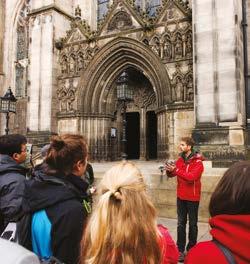
2 Match the words with the jobs in exercise 1. Some words match more than one job.
5 PRELIMINARY Multiple choice with picture options Listen and for each question, choose the correct answer. 1 What time does Jasmin start work today?
How much was the woman’s order?
3 Listen to two people talking about summer jobs. For each conversation, choose the correct photo in exercise 1.
Conversation 1 Which job did the girl do last summer?
Conversation 2 Which job does the girl want to do this summer?
Conversation 3 Which job does the girl do now?
4 Read the Exam tip. Then read the Exam task.
Exam tip
Words that show a change
• In a listening task, you often hear people giving different opinions or discussing different options. You will need to listen for which opinion or option is the answer to the question.
• Speakers often use the word but to signal a change, e.g. I was working in a hotel, but now I’m working in a café.
• Listen for words that show a change of opinion or a correction like sorry or actually, e.g. Let’s meet at six. Oh sorry, I mean half past six.
6 A ORIENTATION Work in pairs. Make a list of summer jobs that students can do in your country. Discuss these points.
• Which job do you want to do? Why?
• What personal qualities do you need for each job?
• Which job is the most difficult? Why?
• Which job is the best paid?
6 B SPEAKING Work with another pair of students. Talk about your list.
We made a list of seven jobs. We think the most difficult job is…
Talking about jobs
1 Work in pairs. Look at the photos and think about the jobs. Then match the statements with the photos. Discuss your ideas together.
1 I like working with animals.
2 I like using technology.
3 I like being outside / inside.
4 I like physical activity.
5 I like being creative.
6 I like working on my own / with other people.
7 I like staying in one place / moving to lots of different places.
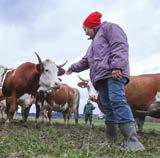


2 Read the questions. Choose the correct option (A-C).
1 Some students get jobs in the summer holidays. What kind of summer job would you like to do?
A I’d really like to work as a shop assistant in a clothes shop.
B I love going to the beach with my friends or visiting my relatives.
C In the summer, some people work as waiters.
2 When you work or study, do you like spending time with other people or working on your own?
A In my free time, I like spending time at the gym or going to the cinema with my friends.
B I usually study for two hours after school on weekdays, but I always go out with my friends on Saturdays.
C I like being with my friends when I’m not working, but when I do homework, I prefer to be on my own.
3 Do you think it’s more important to do a job that you love or to earn a lot of money?
A No, I don’t earn a lot of money in my job, but I enjoy it because it’s very creative.
B Money is very useful, but I believe that you should really enjoy your work.
C I like working with animals, but it is very difficult to earn a lot of money doing this in my country.
4 Can you tell me about a time when you worked very hard?
A Last year I took an exam to be a tennis coach. It was very difficult and I had to work hard, but I passed it, so I was very happy.
B English is difficult for me, but I think I work very hard at school and I always do my homework.
C I agree that it is very important to work hard, but it’s also necessary to take some time off.
3 SPEAKING Work in pairs. Ask and answer the questions in exercise 2. Give true answers.
4 Work in pairs. Read the Exam tip. Look at exercise 2. Discuss why the other answers are incorrect.
Exam tip
Using tenses correctly
• In this part of the exam, the examiner will choose a topic and ask you some questions.
• Listen carefully to the question. If you don’t understand, ask them to say the question again.
• The examiner will listen to how well your answers match the questions. For example, if the question is about something in the past, you should answer using the past tense.
Exam task
5 PRELIMINARY TRINITY Interview Now we’re going to talk about work.
• What kind of work do you like doing at school or at home?
• Do you think it is better to work in an office or at home?
• What kind of jobs are you interested in doing in the future?
• Tell me about some jobs you have done in the past.
Useful language
Giving opinions
• I enjoy working with other people because...
• It’s good to work alone because...
• I prefer (working outside) to (being in an office).
Talking about experiences
• Last summer, I had a part-time job. I worked as a...
• Last weekend, I worked at the (animal shelter).
• It was a good way to meet people and...
Talking about future plans
• In the future, I hope to…
• My plan is to … in the future.
• I really want to learn how to…
your future
6 ORIENTATION What was your ‘dream job’ when you were a child? What about now? Do you still have the same dream? If not, how has it changed over time?
ORACY SKILLS
The J&K Diaries – Episode 10
1 Watch the vlog. Are the statements true (T) or false (F)?
1 Kayla and Josh are at sixth form college together.
2 Josh says that he’s going to be a famous basketball player.
3 Josh thinks that online career quizzes aren’t very helpful.
4 Kayla did a quiz to find out the best career for her.
5 Josh doesn’t agree with the results of Kayla’s quiz.
6 Kayla shows Josh the results of the quiz on her computer.
2 Work in pairs. Look at the sentences below. Guess if they are true (T) or false (F). Then read the article on page 153 quickly to check your answers.
1 The school year usually starts in January in the USA.
2 Japanese students often help to make the school lunch.
3 Most students in the UK wear a school uniform.
4 2% of children in the world can’t go to school.
Exam task
3 INVALSI Multiple matching Read the article again. Choose the correct heading (A-J) for each paragraph (1-8). There are two extra headings that you should not use.
A Lunch time
B Clothes
C How much does it cost?
D The school year
E The classroom
F Homework
G No school
H Beginning and end of the day
I Starting school
J Exams
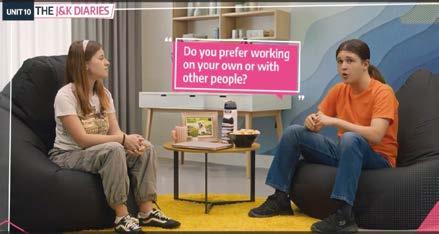
Real English
That goes without saying Ovviamente. back-up plans piani alternativi Spill the beans Vuota il sacco. My computer’s crashed Il mio computer si è bloccato / impallato.
4 SEL Social awareness Decision making Discuss these questions in pairs.
1 Which fact from the article was the most surprising? Which was the least surprising?
2 How is your country different from other countries in the article?
3 Imagine you could design the perfect secondary school. What would it be like?
Think about these things:
• when the day starts and ends;
• homework;
• uniform;
• rules;
• what the classroom looks like;
• compulsory school subjects;
• exams.
5 DIGITAL COMPETENCES Work in groups.
Use the headlines from the article to make an information sheet about education in Italy. Do some online research to find out some facts and figures for your information sheet.
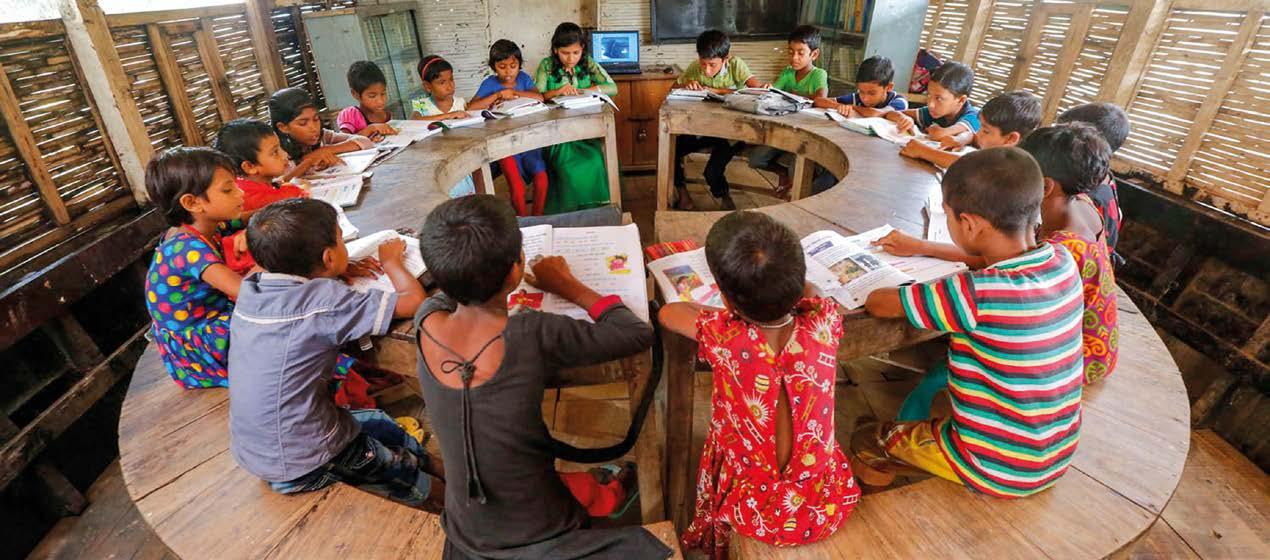
Schools Around the World
All around the world, children go to school, where they learn how to read, write and do some basic maths. But school means different things for people in different countries. Let’s have a look at some interesting facts about schools around the world.
(1) In the Southern Hemisphere, countries like Australia, Brazil, and South Africa all start their school year in January or February and finish in December. In most European countries, however, and in the USA, the first term of the year is usually in August or September, after the summer holidays.
(2) The earliest start time for school is in Brazil, where lessons begin at 7 am. However, by midday school is over and students go home for their lunch and then start their homework. The longest amount of time in school is in China, where lessons usually start at 7.30 am and finish at around 5 pm.
(
3) 90% of secondary school students in the UK have to wear a school uniform – usually a shirt, jacket and tie. In some countries, for example, Bhutan, students wear their national dress. But in countries like the USA and Germany, most schools allow students to wear what they want.
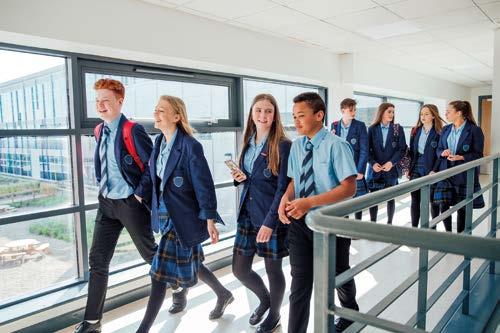
(4) France is famous for its cuisine, and it should be no surprise that French students eat four courses at midday: a salad, a main course, cheese with bread and a dessert. In Japan, students learn about healthy eating by helping to prepare and serve the school meal every day.
(5) Even when the school day is over, most students still have to write essays or complete worksheets at home. Students in Italy or Russia, for example, have one or two hours of extra work every night. In South Korea or Finland, however, most students only get three hours of extra work per week.
(6) In most countries, children begin their education when they are five or six years old. The youngest age for compulsory education is in France and Hungary, where students go to school at the age of three. In Finland and Estonia, however, students don’t have to go to school until they are seven.
(7) Not every school in the world looks the same. In Bangladesh, some children have their lessons on boats because there are so many floods in the country. In Sweden, many primary school children study nature in forest schools.
(8) 58.4 million children – 8% of primary schoolaged children in the world, cannot go to school. There are different reasons for this – sometimes it is because of war, or because they have to work or help their families. Sometimes it is because there is no school near them.
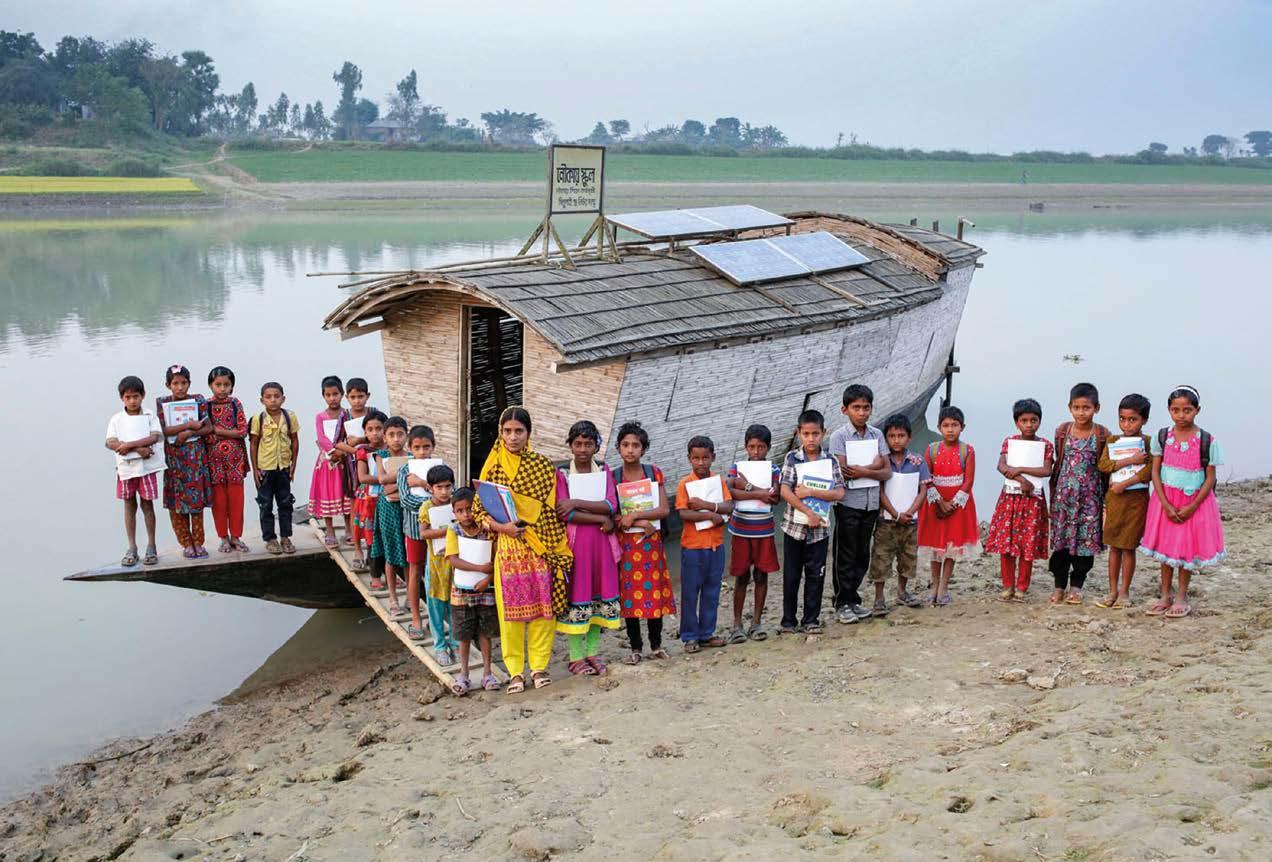
Word focus
Students in front of the Horondarpur Boat School, B L Bari Faridpur, Pabna, Bangladesh
BritCult
Ninety per cent of secondary school students in the UK have to wear a school uniform.
Vocabulary 10
School and education
1 Match the words and phrases (1-10) with the definitions (a-h).
1 boarding school 2 evening class 3 further education
a a school where parents have to pay for their children’s education
b a school that provides education for free
c a school for students who need extra help of some kind
d a school for students aged 11-16/18.
e a school for students aged 4-11
f education at university
g education for people who have left school but aren’t at university
h a school where students live during the school year
i a school for students aged 16-18
j a course for adults that usually happens between 6-9 pm
In the UK, a public school is a type of traditional, private, boarding school. In the USA and in Italy, a public school is a state school, where the education is free.
2 Complete the sentences with the words in the box.
boarding • evening classes • primary • private secondary • sixth form • special • state
1 I left my school when I was sixteen and then studied maths, physics and science at college.
2 My parents wanted me to go to school, but it was too expensive, so I go to the local school.
3 I didn’t understand maths at school, but now I’m at secondary school, it’s my favourite subject.
4 My parents sent me to school when I was 11 years old. I only went home for the school holidays.
5 My aunt hated school and failed all her exams when she was a teenager, but then she went to when she was in her twenties, and now she’s studying chemistry at university.
6 David’s brother can’t hear or speak very well and he goes to a school.
3 Complete the phrases with the verbs in the box. answer • do • follow • get • go
4 Choose the correct options to complete the conversation. Then listen and check your answers.
A Have you done your (1) project / subject yet?
B No, I haven’t. Actually, I didn’t really understand the (2) marks / instructions
A I’m sure the teacher can explain them to you.
B You’re right. I’ll talk to her tomorrow. How did you do in that chemistry (3) exam / information?
A I (4) passed / answered, but I didn’t get a very good (5) mark / exam
B Oh, OK. Do you know why?
A Well, I (6) studied / passed really hard and I (7) remembered / followed all the information.
B So what was the problem?
A I didn’t have time to (8) get / answer all the questions.
Frame your ideas
5 SPEAKING Work in pairs. Look at the different types of school and education in exercise 1. Are there similar schools in your country? Which things are the same? Which things are different?
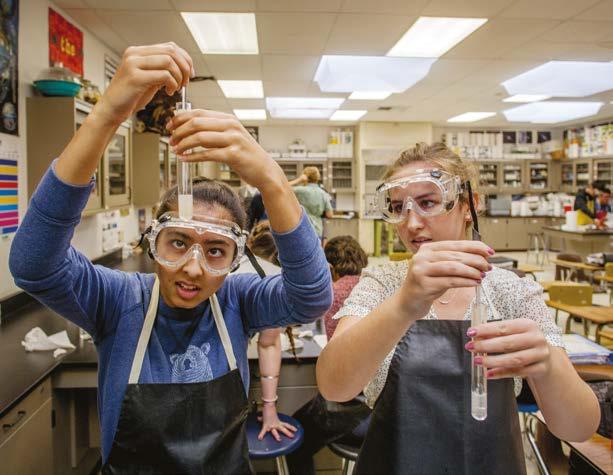
Indefinite pronouns
1 Read the dialogue. Then complete the rules with the words in the box.
people • places • things
A Is anyone going to go to the careers fair this afternoon?
B Yes, I am! I want to find out everything I can about how to be a writer.
A Do you know where it is? There’s nothing on the noticeboard about it.
B I think it’s somewhere near the town hall.
We use indefinite pronouns like someone, everywhere and nothing for unspecified people, things and places.
1 : something / anything / nothing / everything
2 : someone / anyone / no one / everyone
3 : somewhere / anywhere / nowhere / everywhere
Adverbs
of manner
2 Read the sentences. Circle the adjectives and underline the adverbs.
1 a Tania is a careful driver.
b Tania drives carefully.
2 a It was easy for Raquel to pass the exam.
b Raquel passed the exam easily.
3 a The bus journey to school was very slow.
b The bus moved very slowly.
4 a The football player was fast.
b The football player ran fast.
5 a The waiter made good coffee.
b The waiter made coffee well.
3 Look at the sentences in exercise 2. Complete the rules (a-e).
a Adjectives describe nouns, and adverbs describe
b To form an adverb, we usually add to the adjective.
c If the adjective ends with -y, the -y changes to and we add -ly
d With the verb be, we use , not adverbs.
e Some adverbs are irregular. early – early, fast – , good –, hard – hard, late – late
4 Complete the sentences with the adverb form of the adjectives.
1 The cars went (fast) along the road.
2 The sun shone (bright) on the sea.
3 A lot of people were working (hard).
4 The children played (happy).
5 Teresa did very (good) in her exam.
6 We ate very (healthy) on holiday.
5 SPEAKING Work in pairs. Tell your partner about a time when you have…
• run fast.
• worked hard.
• sung loudly.
• done badly in a test.
• done well in a test.
Comparatives and superlatives of
adverbs
6 Read the sentences (1-5). Then complete the rules (a-d).
1 The bus goes more slowly than the cars but the bikes go the most slowly.
2 The bus goes faster than the bike, but the cars go the fastest.
3 The motorbike doesn’t go as slowly as the bus.
4 The person in the blue car drives better than the person in the red car.
5 The rain falls the most heavily in spring.
a When adverbs end / do not end in -ly, we form the comparative with more + adverb and the superlative with the most + adverb: slowly more slowly the most slowly
b When adverbs end / do not end in -ly, we form the comparative with adverb + -er and the superlative with the + adverb + -est: fast faster the fastest
c Some adverbs have irregular comparative and superlative forms: well good / better the best badly worse the worst far further the furthest
d We can also use (not + verb) + as + adverb + than / as to form comparatives.
7 Complete the sentences with the comparative or superlative form of the adverbs in the box.
dangerously • fast • late • well
1 Petra arrived out of all our friends because she didn’t finish work until 7.
2 I usually run when I listen to music.
3 We often feel on sunny days than on rainy days.
4 Eva doesn’t drive safely. In fact, she drives out of all my friends!
Writing lab
Writing an essay
1 Read the question and the student’s notes. Does each point describe an advantage (A) or a disadvantage (D)?
Should students take a gap year before university to go travelling? Give reasons for your answer.
Taking a gap year
• find out about other cultures
• learn a new language
• can be very expensive
• more difficult to study after a long break
• get good work experience
• your friends will start university before you
Learning focus
Advantages and disadvantages
• When you write about advantages and disadvantages, you can use these phrases to introduce advantages:
The main advantage of … is that… It’s also important / useful / good to… A good point about … is that…
• You can use these phrases to introduce the disadvantages:
One disadvantage of … is that… Another negative point is…
2 Complete the essay with the expressions in the box.
also useful • disadvantage • main advantage negative point • positive point
Many students decide to take a gap year after they have left school and before they start university. There are both advantages and disadvantages to this.
The (1) is that students can find out about other cultures and people from around the world. Another (2) is that they can learn a new language. It’s (3) for students to get some work experience. However, there are also some disadvantages. One (4) is that it can be very expensive. Another (5) about taking a break is that it can be difficult to start studying again. Also, your friends will start university before you. Although there are some disadvantages, I think that having a gap year would be a very useful experience.
Useful language
Giving advantages
• You can find out about (other cultures).
• You might learn (a new language).
• It can help you to meet interesting people.
Giving disadvantages
• It is sometimes (expensive).
• It can be difficult to (start studying again).
• It might be (dangerous).
Giving a final opinion
• I think it would be a (good / useful / amazing) experience.
• In my opinion, it’s a good idea to…
Exam tip
Planning your time
• Check the amount of time you will have.
• Plan your time carefully. For example, allow five minutes for planning, fifteen minutes for writing and five minutes for checking your work at the end.
• Make a brief outline before you write.
• Remember to check your work.
Exam task
3 PRELIMINARY Writing an article Read the Exam tip. You see this notice on an English-language website. Write an article. Use the Learning focus and Useful language to help you.
Articles wanted! Part-time jobs
Give your opinion about part-time jobs for students during their summer holidays. Write about the advantages and disadvantages and say whether you think it’s a good idea.
Write an article and we will put it on our website!
Write about 100 words.
4 Complete the Reflection checklist. Then discuss your answers with your partner.
Reflection checklist
Tick (4) the sentences that you think are true. I used a variety of phrases to talk about advantages and disadvantages. I spent some time planning my answer. I wrote an outline.
I gave examples to support my opinion. I checked my work carefully at the end.
Towards INVALSI
Reading
1 Work in pairs. Look at the title of the article. Have you ever heard of the ‘Human Library’? How do you think it is different from a normal library?
2 Multiple matching Read the article about the Human Library. Parts of the text have been removed. Choose the correct part for each gap (1-7). There are two extra parts that you should not use. The first one (0) has been done for you.
The Human Library
How do you find out about people (0) to yours?
How do you learn about their culture, their opinions, their experiences and their beliefs? Of course, you can read articles about different kinds of people, and you can watch TV programmes or online videos. But perhaps the best way to learn about real people and their lives is to talk to them. The Human Library gives people all around the world the opportunity to do exactly that. Instead of (1) , you can ‘borrow’ people and talk to them for 30 minutes.
The idea started in Denmark in 2000. Ronni and Dany Abergel, and their friends Asma Mouna and Christoffer Erichsen organised a four-day Human Library event in Copenhagen. There were over fifty different ‘books’ (people). More than a thousand people (2) and spent time ‘borrowing’ the ‘books’ and learning more about their own prejudices and beliefs.
There are now Human Library projects in more than 80 countries around the world. The people who volunteer to be books (3) against them. It might be because someone is an immigrant, because of the colour of their skin, the way that they dress, or because of their political opinions. This is a chance for them (4) , explain their beliefs and share their experiences with other people.
A including Texas, Tokyo, Bangladesh and Berlin
B came to the event
C after the event
D there are some rules for the readers
E to tell their stories
Listening

It’s important that the Human Library is a safe space, where people know that they can speak honestly about their lives. For that reason, (5) . They can ask any question at all, but they have to be polite and treat the ‘books’ with respect. They are not allowed to make videos or audio recordings of their conversations, and they must ask permission if they want to take a photo.
Sometimes companies invite the Human Library to organise an event at their offices or place of work. For example, the University of Glasgow, in Scotland, recently held a Human Library session (6) . Dr Lynsay Crawford, a lecturer at the University, said that it was important for all medical students to develop empathy, communication and listening skills.
‘Thank you so much for this experience!’ said one student, (7) . ‘I think this will stay with me for a long, long time, quite possibly forever.’
For further information, visit www.humanlibrary.org
F who live very different lives
G have often experienced discrimination or hatred
H want to learn about unusual people
I for their 300 medical students
J borrowing books from this library
3 Short answer questions Listen to a podcast about job interviews. While listening, answer the questions (1-5) with no more than four words or numbers. You will hear the recording twice. The first one (0) has been done for you.
0 What should you check before an online interview?
your internet connection
1 If you’re applying for a part-time job at a café, what two things should you find out before the interview?
2 What should you read very carefully before a job interview?
3 Who can help you with a practice interview at school or college?
4 What might an interviewer ask at the end of an interview?
5 What can you ask the interviewer to describe for someone doing the job?
Vocabulary
1 Match the pictures (1-8) with the words (a-h).

a sun b rain c ice d fog e snow f freezing g wind h cloud

2 Complete the sentences with the words in the box.
cloud • cloudy • ice • icy • sun • sunny
1 The roads were very yesterday.
2 I took some wonderful photos because there wasn’t a single in the sky.
3 Make sure you wear sun cream because the is very strong today.
4 Be careful that you don’t slip and fall over on the
5 The forecast for tomorrow is warm and
6 Don’t forget your umbrella. It’s very and I think it’ll rain later.
3 Choose the correct option to complete the sentences.
1 The wildfires / floods burnt all the trees.
2 Farmers could not grow food because of the drought / rain
3 There was a rainstorm and thunder / lightning lit up the sky.
4 There was a lot of deep / heavy rain last night.
5 The temperatures were very high / big last summer.
6 There will be some strong / large winds from the north.
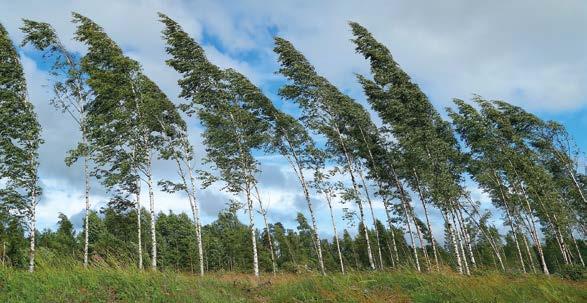
4 Choose the correct job to complete the definitions.
1 A doctor / pilot works in a hospital.
2 A journalist / shop assistant works for a newspaper.
3 A farmer / An engineer works with animals.
4 A pilot / painter flies a plane.
5 A police officer / receptionist works to keep people safe.
6 A painter / waiter works in a restaurant.
7 A nurse / An engineer works with medicines.
8 An engineer / A photographer works with a camera.
5 Complete the sentences with the words in the box.
earns • giving • wear • work works • works
1 My dad for a big company in the city.
2 Most nurses must a uniform when they are at work.
3 My mum loves her job! She money by taking photos.
4 My uncle in a factory that makes cars.
5 When I’m older, I want to as a teacher.
6 Rahul doesn’t like speaking in public and he hates presentations.
6 Match the sentence beginnings (1-6) with the endings (a-f).
1 When I was eleven, I moved from my primary school to my
2 After she got her first job, she decided to study Spanish at a(n)
3 We don’t have to pay for our classes because our school is a(n)
4 He only comes home during the holidays because he goes to a(n)
5 When children are four years old in the UK, they go to
6 My brother didn’t want to go to university, but he studied car mechanics at a(n)
a evening class.
b primary school.
c secondary school.
d further education college.
e state school.
f boarding school.
Grammar
1 Complete the sentences with one word.
1 This summer was very hot. It was than last year.
2 The climate in Cornwall is milder in the rest of England.
3 The roads are dangerous in winter than in summer.
4 This winter wasn’t as cold last year.
5 The temperatures in the north are not high as they are in the south.
6 Denmark isn’t warm as Spain or Italy.
2 Choose the correct option to complete the sentences.
1 You should walk more careful / carefully when the street is icy.
2 We’re getting so much rain. Today it’s raining more hard / harder than ever.
3 Cars drive more slow / slowly when they go through the town.
4 Cyclists go more fast / faster when they go downhill.
5 Most people feel well / better in summer than in winter.
6 The snow has never melted as quick / quickly as it did this spring.
3 Complete the sentences with the superlative form of the words.
1 Which is (good) place to go for a summer holiday?
2 I think today is (wet) day of the year!
3 Is Everest (dangerous) mountain to climb?
4 We had snow in October this year. That’s (early) it’s ever snowed here.
5 At the Equator, the rain falls (heavy) at midday.
6 It rains here (frequent) in the month of December.
7 Costa Rica is the country where people live (happy).
8 Jo can run (far) of all my friends – he ran a marathon last month.
4 Choose the correct word to complete the sentences.
1 The new uniform which / who we have to wear is very smart.
2 The receptionist which / who started today is only twenty years old.
3 Piotr kicked the ball which / who scored the winning goal in the match.
4 I made the salad which / who everyone enjoyed.
5 The nurse which / who looked after me in hospital was very friendly.
6 Daniele gave the presentation which / who won the final prize.
5 Complete the words with -thing, -one, or -where.
1 I haven’t spoken to any about my job interview.
2 She has looked every for her phone but she can’t find it.
3 I read some online about how to find your dream job.
4 Do you know any about how to become a pilot?
5 No told me about the careers fair this afternoon!
6 We haven’t found any to stay for our weekend in Milan yet.
6 Three of these sentences are incorrect. Find and correct the mistakes.
1 The teacher we met last week he is my father’s friend.
2 The woman who she works in the library is my friend’s aunt.
3 The factory which makes these machines is near my house.
4 We ate the sandwiches you gave us for lunch.
5 The waiter who served our dinner was very funny.
6 She works at the shop that which we visited last weekend.

Life skills
Finding happiness
Find a job that makes you happy
When Andy Woodruff was seven, his dad worked in Hawaii. Andy decided to draw a map of all the islands to understand more about the geography of the country. He always loved maps and loved to read books about the weather, the sea and the times of sunrise and sunset.
Later, Andy went to university to study geography. He focused on the study of maps, or cartography. He decided he wanted to work as a cartographer, so he got a job at a map company. He now makes maps about the things he enjoys – the weather and the sea –and even fun things like goals in basketball matches. Andy made his hobby his job and found happiness in his work. But there are other ways to find happiness at work.
• Understand what you like and don’t like, and what makes you comfortable or uncomfortable.
• Think about your work environment – do you want to work with people or work alone? In an office or outside?
• Try things first, to find out what you might enjoy.
Frame your project
Work in groups. Plan a ‘Happiness Day’ for the class. Create a poster to advertise the day. Tell people what to bring, what to wear and what they will do on the day. Think about:
• why Happiness Day is important;
• what makes people happy (ask your friends and family!).
Show your poster in the next lesson and vote on the best Happiness Day.
1 Work in pairs. Read the text. Do you think Andy enjoys his job? Why? / Why not?
2 SPEAKING What would make you happy at work? Look at bullet points 1 and 2 in the text. Share your ideas with your partner.
3 SPEAKING Discuss the questions with your partner.
1 What hobbies or interests have you got that could become a job?
2 What things are you good at, and not so good at?
3 What jobs do you think you would enjoy? Why?
4 Work in pairs. Read the Mind your mind information. Do these things make you happy? Why? / Why not?
Mind your mind
The science of happiness
Scientists have found that people are happiest when they:
• do something good for another person;
• can smell flowers;
• wear bright colours, especially yellow;
• are outside, especially near water in warm weather.
5 SEL Self-awareness Write three things that make you feel happy. Write three things that make you feel better when you’re unhappy. Compare with your partner.
Useful language
• What makes you happy?
ORACY SKILLS
• Why does it / do they make you happy?
• What is important to you?
• Where do you feel happy?
• Do you prefer working with other people or working on your own?
• People said that…
• … makes them happy because…
• Happiness / Happiness Day is important because…
• When you are happy, you…
Create a quiz to help students find their dream career.
Write questions to find out about their:
• happy places;
• favourite activities;
• interests;
• working styles (team player vs working independently);
• values (money vs job satisfaction).
Then share your quiz with the class.
REAL-LIFE TASK 1
REAL-LIFE TASK 2
a map of Africa and the surrounding oceans by Andy Woodruff
a map drawn by Andy Woodruff, aged 7
On the move!
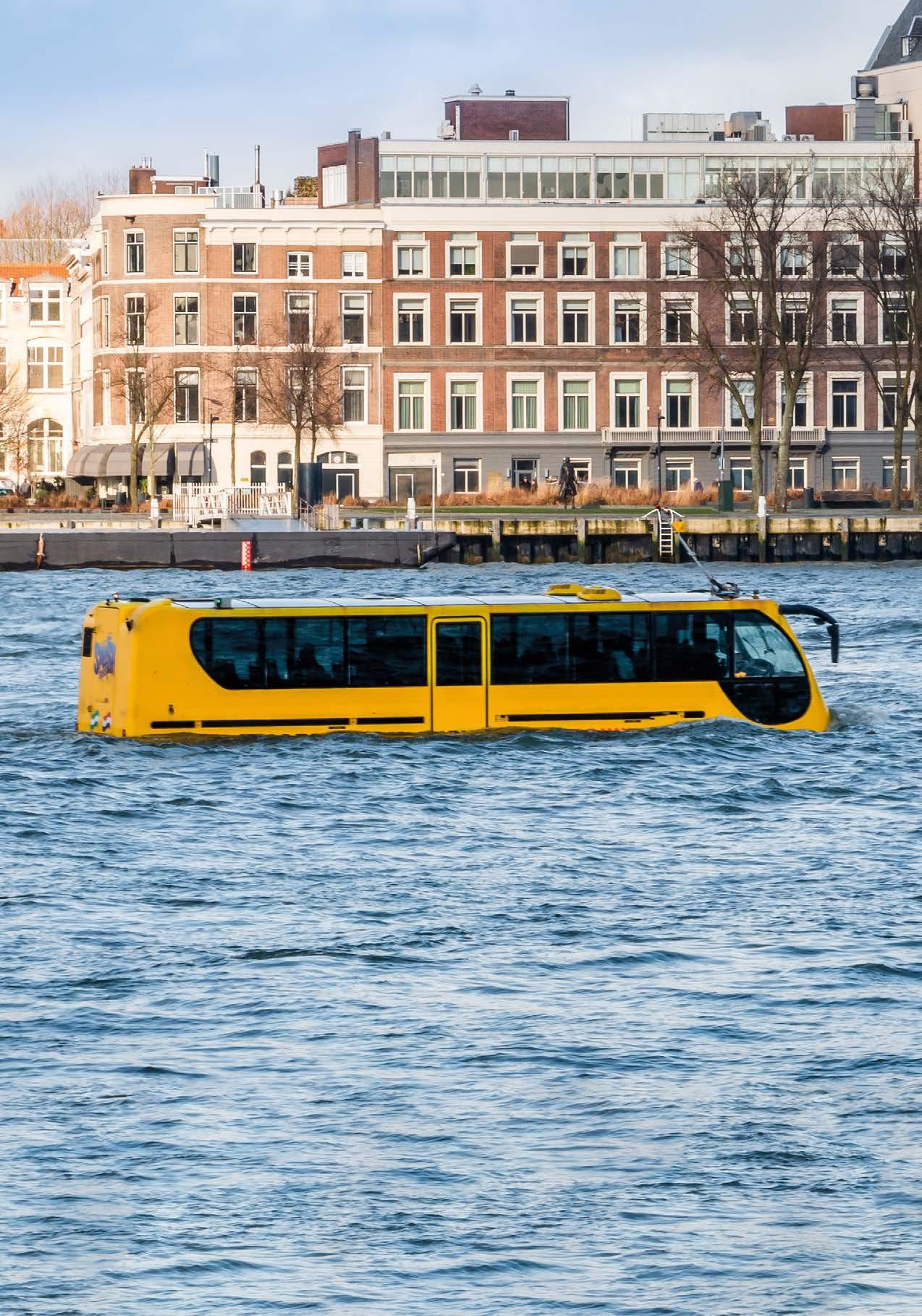
1 VISIBLE THINKING Look at the photo. Discuss in pairs.
See What can you see in the photo?
Think Why do you think people use this form of transport here? Wonder Would you like to travel this way? Why? / Why not?
2 Watch the video, London Public Transport and decide if the sentences are true (T) or false (F).
1 The whole Tube network is below the ground.
2 The first Tube trains used electricity.
3 You can stop any taxi in the street.
4 Taxi drivers know all the important destinations in the centre of London.
5 You can’t get on a bus if it is already full.
6 River buses offer views of some important monuments in London.
Rotterdam attraction: an amphibious vehicle on the Nieuwe Maas river
Frame A
1 Work in pairs. Look at the phrases. What do they mean? Are these community resources available in your nearest big city?
• cycle paths
• cycle training courses
• bike sharing schemes
• bike parking stations
• walking trails
• community gardens

2 Read the article on page 163 quickly. How many of the phrases from exercise 1 are included?
3 Read the article again. Complete the summary with the words in the box. There are two extra words.
bikes • cars • libraries • traffic transport • trees
People like living in Bucheon today because there are lots of (1) and gardens; they can walk to public (2) ; they can share (3) and it is easy to travel by public (4) .
Exam tip
Finding words with opposite meanings
• Some of the questions in this exam task test your understanding of details.
• The questions may use words or phrases that are the opposite of those in the text, e.g. It was quiet. = It wasn’t noisy. It wasn’t easy. = It was difficult.
• Look for questions that use words with the opposite meaning to the words in the article.
Exam task
4 INVALSI PRELIMINARY Multiple choice with one text Read the Exam tip and the article again. For each question, choose the correct option.
1 Before 2010, people didn’t want to cycle around Bucheon because…
A the air was too dirty.
B it wasn’t safe enough.
C they didn’t have bikes.
D the roads were in a bad condition.
2 Why was it difficult to walk around Bucheon before 2010?
A There were a lot of new buildings.
B There were too many bikes.
C The river was dangerous.
D The pavements weren’t wide enough.
3 The changes in Bucheon make it easier to…
A travel around the city by bike.
B drive a car to work.
C perform music or dance.
D share a car ride.
4 What do people in Bucheon have now?
A more places to buy books
B a better system of buses and trains
C more places to park their cars
D cheaper cars
5 Today, Bucheon is well-known for its…
A stations.
B cafés.
C parks.
D libraries.
5 A Work in pairs. Look at the statement. Think of two reasons to agree with it and two reasons to disagree with it.
We should ban all cars in city centres.
5 B DEBATE Divide the class into two groups. Work in your group to make a short speech in favour of / against the statement.
Group 1 is in favour of the statement. Group 2 is against the statement.
5 C Listen to each other and ask questions. Finally, have a class vote.
Frame your ideas
6 SPEAKING CITIZENSHIP Answer the questions.
• Think about your town. Has it got a good public transport system? Can you think of ways to make it better?
• Is it safe to cycle in your town? Why? / Why not?
A Greener
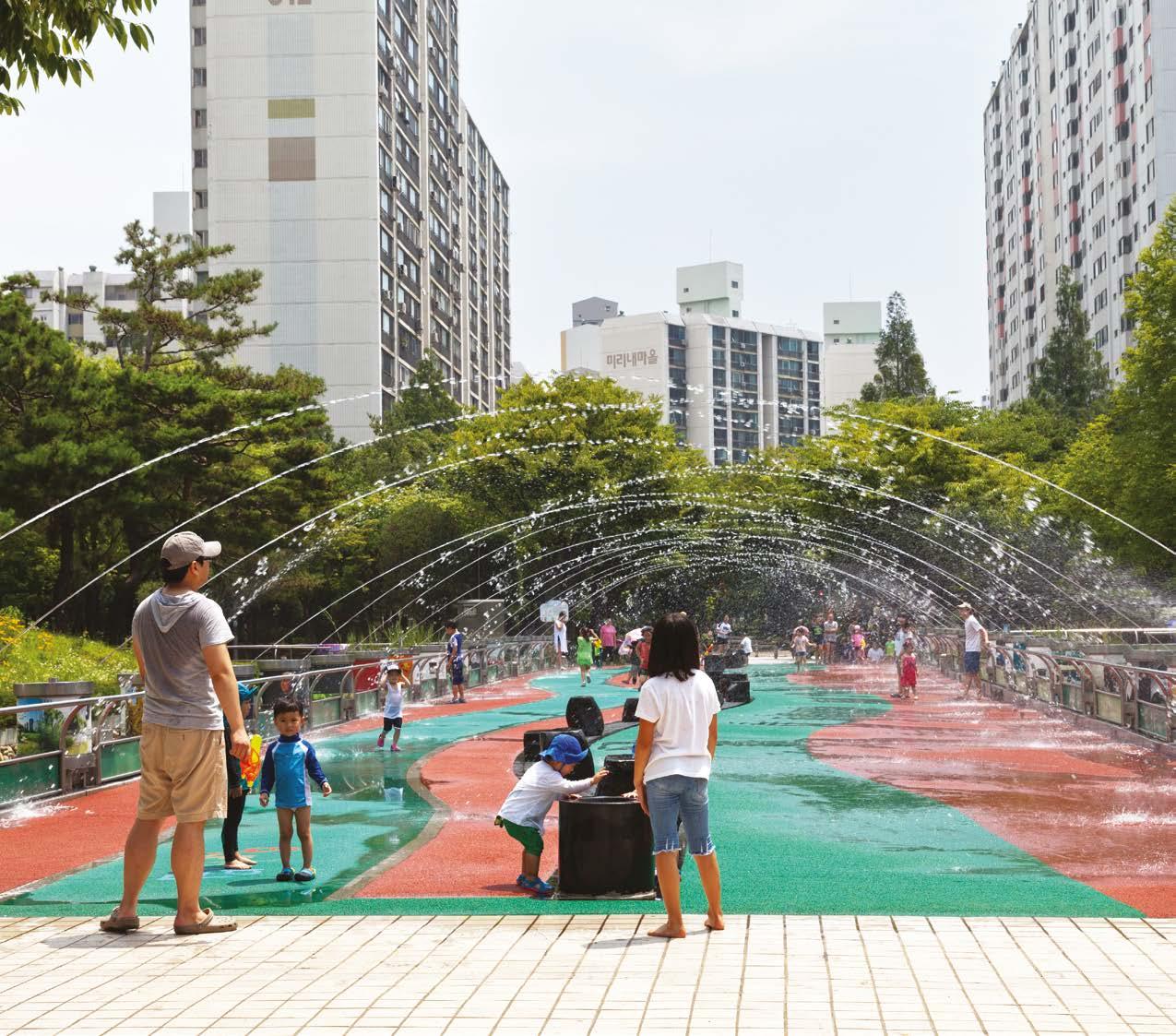
Bucheon is a big, busy city in South Korea with a population of around 900,000 people. It has several universities, many libraries, museums and theatres. However, until recently, it also had some problems. Many people drove cars around the city, so there was a lot of traffic and it was dangerous to ride bikes. The Simgokcheon river, which ran through the centre of the city, was covered and used as a road. Because of the traffic, the air was polluted. The pavements on the streets were narrow, so people didn’t want to walk in the city.
But in 2010, the city decided to make big changes to its transport systems, giving more importance to sustainability. New subway stations were opened with connections to bus and taxi services, so that it was easier to travel by public transport. The areas around these new stations were made into community squares, where there are regular music performances and hip-hop dance shows. Two hundred kilometres of cycle paths were built, and today there are free cycle training courses for people who live in the city. There are also bike sharing schemes and bike parking stations at every subway station and there’s even a Grand Bike Festival every autumn.
Today, people love walking around Bucheon because there are special beautiful walking trails which connect the city’s 188 public libraries. There are also special cafés on the streets where you can borrow books, and libraries in busy subway stations. Fewer people drive and more people take public transport, walk, or cycle around the city. This has reduced the number of traffic accidents in the city and has improved the air quality. The city has become greener as people have planted trees and developed community gardens. Part of the Simgokcheon River was restored and trees and flowers are now growing around it. Bucheon is now famous for its clean air, good public transport and green spaces and it has won more than 135 awards in the last ten years. More importantly, people love to live here!
Vocabulary 11
Transport (nouns)
1 Look at the photos. How many of the forms of transport in the box can you find?
bus • coach • helicopter • lorry • motorbike plane • ship • taxi • train • tram
2 Look at the words in exercise 1 again. Write them under the correct heading. Road Rail Air Water
4 Match the words in the box with the definitions.
driving licence • map • passport petrol • ticket • wheel
1 You have to have this when you drive a car.
2 You have to show this when you travel to a different country.
3 You have to buy this when you use public transport.
4 You look at this when you want to know where to go.
5 You have two of these on a motorbike and four on a car.
6 You put this in a car to make it work.
5 Listen to the three conversations. Match them with the places (a-c).
3 Complete the sentences with the words in the box. coach • helicopter • lorry motorbike • ship • taxi
1 When the arrived at my house, I wasn’t ready and the driver had to wait.
2 Sometimes, when there is a traffic report on the news, the reporter is in a and can see any problems from above.
3 I don’t like flying, so I often travel by . It’s very comfortable and I can see the countryside.
4 We put all our furniture into a when we moved to our new house.
5 In the past, people used to travel to other countries by
6 You should always wear a helmet to protect your head when you ride a
Frame your ideas
6 Work in pairs. Discuss the questions.
• Which forms of transport in exercise 1 do you often use?
• Which do you never / very rarely use?
• Which would you like to use?
• Do you ever use a map to find a new place?
• How many people in your family have got a driving licence?
The Present simple passive
1 Read the pairs of sentences. Choose the correct option to complete the rules (a-d).
Active sentence
Passive
sentence They sell tickets at the station. Tickets are sold at the station. My mum usually drives our family car. Our family car is usually driven by my mum. Bad weather sometimes delays flights. Flights are sometimes delayed by bad weather.
a The object / subject of the active sentence becomes the subject of the passive sentence.
b In passive sentences, we use the preposition by / at to show who does the action.
c In Present simple passive sentences, we use the present tense of be / do before the past participle of the main verb.
d We use passive sentences when i We don’t know who does the action. ii The object / subject of the action is more important than who does it.
2 Are these sentences active (A) or passive (P)?
1 My uncle’s car isn’t cleaned very often.
2 The cheapest petrol is sold at the petrol station by the college.
3 People today don’t often use paper maps – they usually use maps on their phones.
4 Coaches to Brighton depart from stop C.
5 The public libraries are connected by walking trails.
6 This train leaves the station at four o’clock.
3 Complete the sentences with the correct passive form of the verbs.
1 These trains (make) in South Korea.
2 Your ticket (not / always / check) on the trains.
3 How many passports (steal) every year?
4 This new car (drive) by a computer.
5 At what time meals (serve) on this flight?
6 This train (delay) because of problems on the line.
4 Complete the second sentence in each pair with the passive. Use the word by if necessary.
1 Passengers leave hundreds of umbrellas on trains every month. Hundreds of umbrellas on trains every month.
2 Robots make cars in this factory. Cars robots in this factory.
3 The police often stop lorries on this road. Lorries the police on this road.
4 This machine checks your passport. Your passport this machine.
5 Do they sell snacks at the station? at the station?
6 The ticket inspector checks tickets on the train. Tickets the ticket inspector on the train.
5 Work in pairs. Complete the sentences in the quiz. Use the Present simple passive and the correct country. Then listen and check your answers.
Quiz – What do you know?
1 Audi cars (make) in .
2 Italian (speak) in 3 Thanksgiving (celebrate) in
4 Sushi (eat) in
5 Seville oranges (grow) in
Listening
1 Match the sentences (1-5) with the situations (a-e).
1 It leaves from Platform 6 at a quarter past three.
2 We can take the 72 bus from the airport to the city centre.
3 The train is faster, but the coach is much cheaper.
4 The museum opens at nine o’clock, so we can go there after breakfast.
5 Can I see your ticket, please?
a comparing different forms of transport b planning an activity
c giving information about a train
d checking that someone has bought something
e planning how to get from one place to another
2 You are going to listen to a conversation. Read the questions (1-5). Choose the correct situation (a-c) for the conversation.
a two friends are talking about a recent trip b two friends are deciding which city to visit c two friends are planning a trip to a big city
1 At what time will their flight arrive in Budapest? a 4.00 b 6.30
2 How are they going to get from the airport to their hotel?
a by taxi b by bus
3 How many days are they going to spend in Budapest?
a one day b two days
4 How are they going to travel around the city on Saturday?
a by bike b by tram
5 How can they get to the castle?
a take a tram and then walk b walk and then take a bus

3 Now listen to the conversation. Answer the questions in exercise 2.
4 Read the Exam tip. Then read the Exam task. Think of words that can give you clues to the answer.
Exam tip
Listening for clues
• In this exam task, you will hear five different conversations and answer a question about each conversation.
• Each conversation will be about a different topic. Read the question and options carefully and think about what the topic will be.
• You may not hear the words in the answer options. Listen for other clues that tell you which option is correct. For example, if the answer option is by plane, you may hear words like airport, flight, check in, passenger, etc.
Exam task
5 PRELIMINARY Multiple choice with five conversations Listen, and for each question, choose the correct option.
1 You will hear a man leaving a phone message for a friend.
What type of transport did the man take yesterday?
A coach
B car
C train
2 You will hear a woman talking about a trip. Why did the woman miss her flight?
A She was late.
B The plane was full.
C The plane was delayed.
3 You will hear two friends talking about going on a holiday.
Where is the woman going?
A a big city
B a beach
C the mountains
4 You will hear a man talking about his journey to work.
Why did the man decide to take the train?
A It is faster.
B It isn’t crowded.
C It is cheaper.
5 You will hear a woman talking about a trip to New York.
What does the woman recommend doing there?
A doing a bus tour
B visiting a museum
C going to a park
Talking about advantages and disadvantages
1 Work in pairs. Match each conversation (1-6) with a photo (a-c).
1 A Where does it depart from?
B It departs from Gate D34.
2 A Which platform do I need?
B The train leaves from Platform 1.
3 A Where do we buy a ticket?
B There’s a machine over there.
4 A How far is it to Krakow?
B It’s about 300 km away. We’ll be there for lunch.
5 A When does the flight to Hong Kong leave?
B It leaves at five to nine.
6 A Where are the next services? We need more petrol.
B I don’t know. It doesn’t say on the sign.
2 Complete the conversation with the phrases in the box. Then listen and check your answers.
coming back next weekend • how long the journey is here you are • when the next bus to Toronto is how much is a ticket • where does it leave from
A How can I help you?
B Could you tell me (1) ?
A Yes, of course. The next bus is at a quarter to four.
B And (2) ?
A It leaves from Stop 15. It’s just over there, opposite the bookshop.
B Oh yes, I can see it. Do you know (3) ?
A Let me see. It arrives at half past six, so it’s two and three quarter hours long.
B Great, thank you. So, (4) , please?
A Single or return?
B Return. I’m (5)
A A return ticket to Toronto is $45.
B OK, (6)
A Thank you very much. Enjoy your trip!
3 Work in pairs. Act out conversations at a train station. Use the model conversation in exercise 2. Student A and B: Turn to page 189.
Exam tip
Talking about advantages and disadvantages
• In some speaking exams you will be asked to look at different suggestions and choose the best idea.
• The examiner will explain the situation and give you a picture showing the different suggestions. Look at the picture and think of advantages and disadvantages for each suggestion.
• Listen to your partner and respond to their ideas.
Exam task
4 PRELIMINARY Discussion task with a visual stimulus Work in pairs. Take turns to talk about the advantages and disadvantages of each suggestion. Use the Useful language to help you.
A friend is planning to do a trip around the world. He wants to visit every continent. Here are some different ways that he could travel. Talk together about the different forms of transport and say which would be the best.
Ways your friend can travel


Useful language
Talking about positive points
• It’s a good idea to…
• It’s better to travel by train because…
• I think we should all try to (help the environment).
Talking about negative points
• Air travel causes a lot of pollution, so…
• Plane travel is bad for the environment because…
• One problem with the train is…
• Another possible problem is…
• I think it might be difficult to…
Giving your opinion
• I think … is the best idea.
• In my opinion, … is the best form of transport for him.
ORACY SKILLS
Frame B
The J&K Diaries – Episode 11
1 Watch the vlog. Choose the correct option to complete the sentences.
1 Josh’s aunt and uncle are very interested in museums / transport
2 Kayla thinks Josh’s aunt and uncle probably enjoyed / didn’t enjoy the museum.
3 The horse bus at the museum was built in the 1880s / 1890s
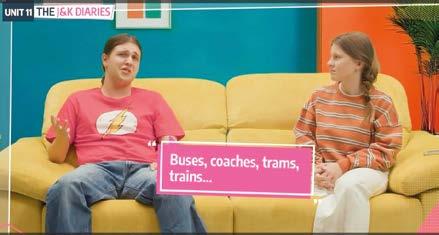
4 Josh and his aunt and uncle travelled to the city centre by bus / tram
5 Josh’s aunt and uncle were talking to people / looking at their phones on the tram.
6 They were / weren’t annoyed because the museum was closed.
2 Work in pairs. Look at the photo. Label the different parts of the tram with the words in the box. carriage • overhead cables • seat • track
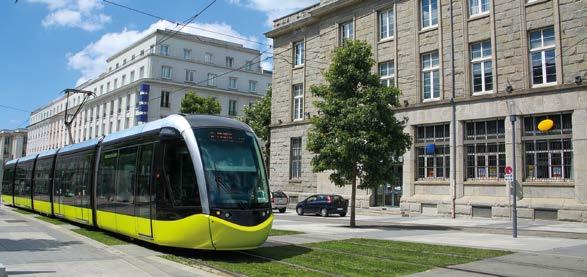
Exam task
3 INVALSI Read the article about trams in the UK. Match each sentence (A-J) with the right gap (1-8). There are two extra sentences.
A The buses were also often more comfortable and could carry more passengers.
B There were more than 220 million tram journeys in the UK last year.
C But with this new system, engineers only have to dig 30 centimetres.
D In the last thirty years, trams have become popular again in the UK.
E In fact, the first tram tracks were installed in London more than 150 years ago.
F No, It’s not an e-bike, or an e-scooter; it’s a tram.
G There is also a battery-powered tram system in Florence, Italy.
H It was built in 1885 and is one of the oldest tram systems in the world.
I Electric trams provided a cheap form of public transport and were very popular.
J This tiny tram only has twenty seats, with space for another 36 standing people.
be really into essere appassionato/a di you name it dinne uno (riferito a una lista, lascia intendere che c’è di tutto) I’m afraid so temo di sì / mi dispiace ma è così Total disaster! Un disastro!
4 Read the article again and complete the sentences with a number, a place, a date or a word.
1 A CVLR tram can hold people in total.
2 When engineers install a traditional tram track, they have to dig metre into the ground.
3 London first had an electric tram system in
4 In the past, were cheaper and more comfortable than trams.
5 still has its original old tram system.
6 cities in the UK have tram systems.
Frame your ideas
5 A Work in groups. The article mentions that in the future the CVLR trams could be ‘driverless’. Discuss these questions.
• What are the possible benefits of driverless vehicles?
• What are the possible dangers?
• Would you be happy to travel in a driverless vehicle? Why? / Why not?
5 B MEDIATION In your groups, prepare a short report on your discussion. Choose one student to present the report to the class.
6 SPEAKING CITIZENSHIP Work in pairs. Discuss these questions.
1 How many forms of sustainable transport can you think of?
2 Which of these exist in your town or city?
3 Which of these do you use regularly?
4 Which have you never used?


All Aboard!
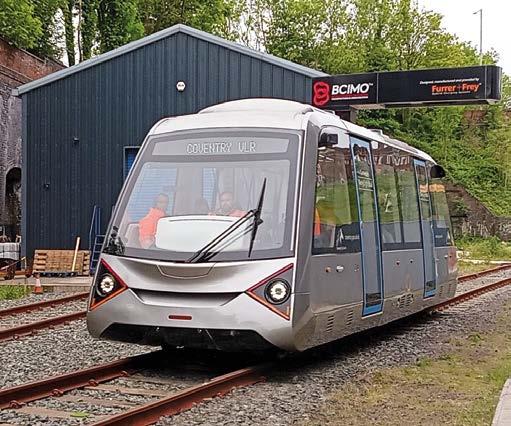
There are now tram services in eight cities, including Manchester, Nottingham, Sheffield and Birmingham.
It is smaller than a bus, lighter than a train, quieter than a car and it is powered by an electric battery. (1) The Coventry Very Light Rail (CVLR) vehicle was specially designed to provide a cleaner, greener and more reliable public transport option for the narrow streets of Coventry city. (2) Because it has only one carriage and is small and light, it can turn round corners easily and its battery means that it doesn’t need overhead electric cables. In the future, there is the hope that these trams could work autonomously – without drivers. But perhaps the most important feature of this new style of tram is that it is much cheaper and quicker to install the track. With traditional, heavy trams, it is necessary to dig one metre into the ground to lay the track. (3) This means that when they are installing the track, they don’t have to worry about possibly damaging underground cables or pipes for water, gas or electricity.
A hundred years ago, there were tram systems in many towns and cities in the UK. (4) And even before electric systems, there were horse-pulled trams in London. (5) Then, in 1901, an electric system was introduced and by the 1920s, London had the largest tram system in the world, with over 580 km of track and more than 3,000 trams. But as electricity prices rose, it became cheaper to use buses. (6) It was expensive to look after the tram tracks, and trams were thought to be a more dangerous form of transport than buses. The last tram journey in London was made in 1952 and tram systems in most other major UK cities were closed in the following ten years. Today, there is only one original tram system remaining from the 19th century, and that is in Blackpool. (7)
(8) There are now tram systems in eight cities, including Manchester, Nottingham, Sheffield and Birmingham. Perhaps the CVLR system will inspire more cities and towns to bring back trams, providing a cleaner, greener form of public transport in the future.
Vocabulary 11
Transport (verbs)
1 Choose the correct option to complete the conversations.
1 A When did you learn how to drive / ride a car?
B My dad taught me a few years ago.
2 A If the pilot is out here, who is driving / flying the plane?
B Don’t worry. There’s a co-pilot.
3 A I drove / rode a motorbike last week.
B Really? Where did you do that?
4 A My grandfather was the captain of a big ship.
B Did he sail / ride to many different countries?
5 A I think we’re going to be late for the match.
B Let’s take / ride a taxi.
6 A I can’t drive you to school tomorrow.
B It’s OK. I can catch / go the bus.
7 A It’s 3 o’clock.
B Oh no! We’re going to delay / miss our train!
8 A Can I park / stop my bike at the station?
B Yes, there are lots of spaces there for bikes.
2 Complete the sentences with the verbs in the box.
arrive • cross • get back • get off get on • leave • pick up • return
1 To go to the town centre, the road and wait at the bus stop by the post office.
2 The taxi will you from outside the train station.
3 We’ve missed the last train – I don’t know how we’ll home.
4 I decided not to the train because there were no free seats.
5 If you want to go to the museum, the bus at the next stop.
6 The flight from Zurich has been delayed by thirty minutes and will now at 18.20.
7 They left the country a week ago and they won’t before the end of May.
8 Most trains to Milan from Platform 9.
3 Match the sentence halves.
1 Call me when you
2 Don’t cross the road here;
3 We can pick you up
4 The traffic is really bad and I don’t think we’ll
5 My parents returned from
6 We need to run – the train
a their holiday at 3 am this morning.
b there’s too much traffic.
c leaves in five minutes!
d get off the bus and I’ll come and meet you.
e from the airport.
f get back home before midnight.
4 Listen to the conversations and choose the correct options.
1 The person wants to a catch a coach. b park their car.
2 The person can travel to Athens today by a train. b bus.
3 The person at the bus station is a waiting for a bus. b waiting for a car.
4 The correct bus for the museum is the a number 37. b number 42.
5 Complete the email with these words. arrives • catch • get • leaves • off • pick
Hi Francisco
I’m so happy you’re coming to visit us in Barcelona next weekend! I’ve bought your tickets already – you can (1) them up from the train station. Remember to (2) on the fast train – it (3) from Platform 12 at three o’clock and (4) at Sants Estacio at half past four. Then you need to (5) a number 78 bus from Sants Estacio. Get (6) at Major Montjuic. Our house is just opposite the bus stop.
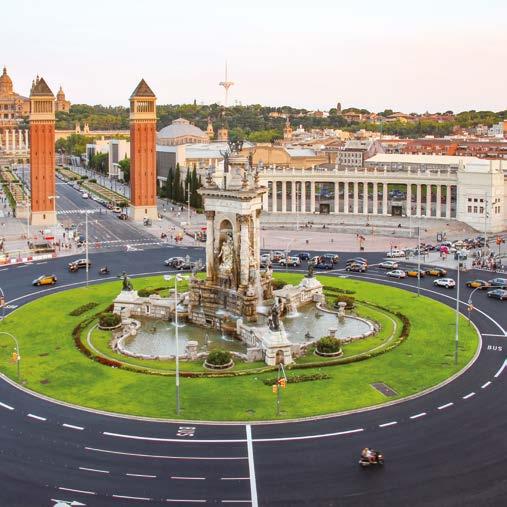
Frame your ideas
6 SPEAKING Answer the questions. Work in pairs. Describe your journey. How do you get from your house to...
• your school / college?
• the supermarket?
• your friends’ houses?
• your aunt / uncle / grandparents’ houses?
The Past simple passive
1 Read the sentences. Choose the correct options to complete the rule.
1 The city became greener as trees were planted.
2 A community garden was developed.
In Past simple passive sentences, we use the past tense of (a) be / have before the (b) infinitive / past participle of the main verb.
2 Complete the sentences with the Past simple passive form of the verbs.
1 My luggage (lose) by the airline.
2 My flight (book) online.
3 A new community centre (build) last year.
4 Passengers (not / tell) about the delays.
5 your passport (check) at the airport?
6 A large lorry (park) outside our house.
7 Why the station (close) yesterday?
8 Public libraries (open) near the subway stations.
3 Match the questions (1-6) with the replies (a-f).
1 Did you pay for your ticket?
2 Did you lose your passport?
3 Where did you get that hat?
4 Who left their bike here?
5 Where were your sunglasses?
6 Where did they send your ticket?
a It was parked here by a tourist.
b No, the trip was paid for by my dad.
c It was sent to my email address.
d No, it was taken from my bag.
e It was given to me by a friend.
f They were found on the bus.
4 Put the words into the correct order to make present or past passive sentences.
1 because / were / The / weather / of / delayed / trains / bad
2 produced / Honda / in / cars / are / Japan
3 under / This / seat / suitcase / left / the / was
4 stolen / month / My / was / bike / last
5 tourists / Electric / lots / in / bikes / London / of / used / are / by
6 end / cleaned / every / The / is / at / day / bus / the / of
5 SPEAKING Work in pairs. Read the questions. Then think of possible answers using the Past simple passive of the verbs.
1 Where did you get those flowers? (send)
2 Did you make that scarf? (give)
3 Why were you late for school? (delay)
4 Where is my banana? (eat) They were sent to me last weekend.
Where did you get those flowers?
6 Complete the text with the Present or Past simple passive form of the verbs.
In every country, roads (1) (need) to connect places. In Bolivia, the city of La Paz (2) (connect) to Coroico by the Yungas Road. This narrow mountain road (3) sometimes (call)
‘The Road of Death’ because in the past, many people (4) (kill) on it. It (5) (build) in the 1930s and it follows the edge of the mountain. Fortunately, in 2006, a new, safer road (6) (open) and parts of the old road (7) (make) wider. Some people still choose to travel on the old Yungas Road. It (8) (use) by mountain bikers and motorcyclists, who love the amazing views and the adventure of riding along this road.
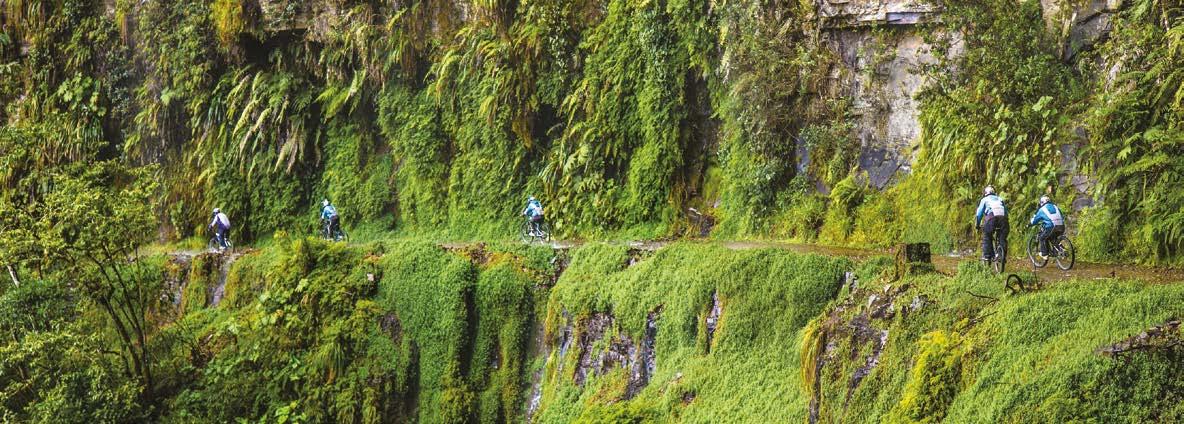
Writing lab 11
Writing a story
1 Work in pairs. Read the first line of a story. Think about the following:
• Who is Ewa?
• What does she decide to do?
• What happens at the end of the story?
When Ewa woke up, it was a beautiful day and the sun was shining.
Learning focus
Conjunctions: before, after and while We use conjunctions when we are telling a story to make the order of actions clear. Look at the timeline. Then read sentences (1-3).
3 Read the Exam tip and task and make some notes of your ideas.
Exam tip
Adding extra details
• Read the first sentence of the story and think about your main character(s) and what will happen to them.
• Use the Past simple to describe the main series of events.
• Use the Past continuous to describe background events.
• Use adjectives to describe the feelings of the people in the story.
• Adding extra details will make your story more interesting.
Exam task
4 PRELIMINARY Writing a story Your English teacher has asked you to write a story. Your story must begin with this sentence:
Adam got on the train and looked for an empty seat. Write your story. Write about 100 words. Use the Useful language to help you.
Useful language
Introducing the scene
1 Amy fell asleep after she got on the train. / After Amy got on the train, she fell asleep.
2 Her purse was taken while she was sleeping. / While she was sleeping, her purse was taken.
3 She looked for her purse before she got off the train. / Before she got off the train, she looked for her purse.
2 Choose the correct option to complete the story.
When Ewa woke up, it was a beautiful day and the sun was shining. She decided to visit her friend in the country and have a picnic with her. (1) Before / After she left home, she prepared some food. (2) Then / Before she walked to the station and waited for the train. (3) After / While she was waiting for the train, she ate a sandwich. The train journey was very long. (4) While / Before she was sitting on the train, she ate another sandwich and a biscuit.
(5) At first / Finally, the train arrived. Ewa’s friend was waiting for her. They walked to the park and found a seat. (6) After / While they sat down, Ewa opened her bag. There was only one small apple for her lunch!
• Yesterday, …
• Last Tuesday, …
• A few weeks ago… Describing feelings
• He was surprised because…
• He … because he was happy.
• He was worried, so he…
• He … , so he was disappointed.
Describing the scene
• It was raining.
• The sun was shining.
• Some people were waiting for (a bus).
5 Complete the Reflection checklist. Then discuss your answers with your partner.
Reflection checklist
Tick (4) the sentences that you think are true. I looked carefully at the first sentence before I began. I used the Past simple for the main events. I used the Past continuous for background events. I used conjunctions to connect the parts of my story. I used adjectives to add extra details to my story. I wrote the correct number of words.
A world of beauty
12

1 VISIBLE THINKING Look at the photo. Discuss in pairs.
See What can you see in the photo?
Think Where do you think this is?
Wonder How does this photo make you feel? Do you want to visit this place?
2 Watch the video, The Grand Canyon, and choose the correct option to complete the sentences.
1 The Grand Canyon is 446 / 456 kilometres long and 29 / 92 kilometres wide.
2 The rocks at the top of the Grand Canyon are around 230 million / billion years old.
3 If you walk to the bottom of the Grand Canyon and back, it’s a 27 / 37 -kilometre journey.
4 There are more than 150 / 250 kinds of birds.
5 More than 15 / 5 million visitors come here every year.
6 The village of Supai has got a population of 208 / 802
A large Northern Lights (aurora borealis) display reflected on a lake at night
Frame A
1 SPEAKING SEL Self-management
Work in pairs. What do you do when you feel worried or stressed? Choose from these ideas. Think of advantages and disadvantages for each suggestion.
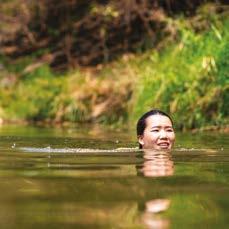
walk in the woods or a forest go swimming

d talk to a friend share my problems on social media


listen to music stay in my room
2 SPEAKING With your partner, think of two more ideas. Then work with another pair and share your ideas.
3 Read the article on page 175 quickly. Which idea from exercise 1 does it include?
4 Read the article again. Complete the summary with one word in each gap.
The article is about forest bathing. It first became popular in the 1980s in (1) . People who live in (2) often feel worried or tired. Forest bathing can help them. When you go forest bathing, you shouldn’t walk (3) through the woods. You should breathe (4) and look around you. Shinrin-yoku (5) can teach you more about forest bathing.
Exam tip
Answers summarising parts of a text
• Some multiple-choice questions in the exam may ask you to choose a summary of information in the text.
• The answer options may correspond to a whole sentence or more.
• You need to read the whole section carefully, and then choose the option that matches the overall meaning. For example, Jo gets up at 6 a.m., starts work at 8 a.m., finishes work at 6 p.m. and goes to sleep at 10 p.m. every day. The correct answer option might be: Jo has a regular daily routine.
Exam task
5 INVALSI PRELIMINARY Multiple choice with one text Read the Exam tip. Then read the article again and for each question, choose the correct option.
1 Why do people have less contact with nature nowadays?
A They spend less time outside.
B They don’t have enough energy.
C They feel too stressed.
D They’re less interested in nature.
2 Going to a park or a garden can help you…
A learn facts about nature.
B get fitter and stronger.
C organise your time.
D improve your mood.
3 When you go forest bathing, you shouldn’t…
A move quickly.
B think about nature.
C look at the trees.
D sit on the ground.
4 When you go forest bathing, you should…
A take photos with your phone.
B use your eyes and ears.
C fall asleep under a tree.
D listen to music.
5 In some countries, local forest bathing guides help you…
A exercise your body.
B forget your problems.
C find the right path.
D learn facts about the trees in the forest.
Frame your ideas
6 SPEAKING Going into a forest is one way to make a connection with nature. Think of some other ways. Discuss your ideas with a partner.
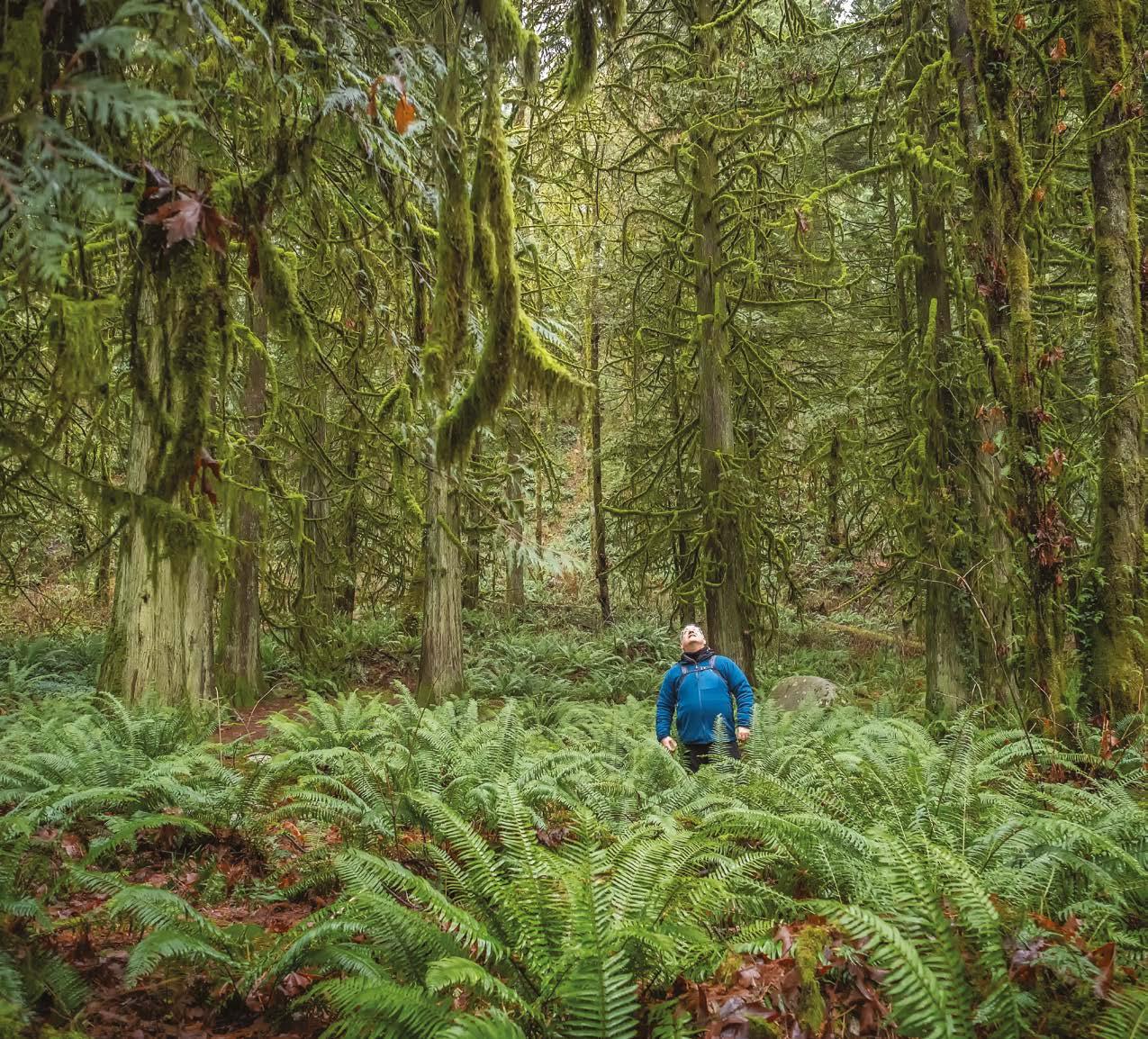
Forest Bathing
I stop in the middle of the forest and look at the beautiful tall green trees all around me. I breathe deeply and close my eyes. I listen to the sound of the wind in the leaves and the quiet bird song. I feel calm and happy. What am I doing? I’m forest bathing.
By 2050, 75% of the world’s population will live in cities. Even today, many people, especially teenagers and working adults, spend more and more time away from nature. In fact, the average American spends over 90% of their time indoors. City life often makes people feel anxious, tired and stressed. However, scientists and doctors have found that spending time outside, looking at the sky and listening to birdsong can help people to feel happier and healthier. Shinrin-yoku, or ‘forest bathing’ in English, became part of a national Japanese health programme in the 1980s and is popular around the world today. So what exactly is ‘forest bathing’? It means spending time in a forest, thinking about nature and focusing on the natural world around you. Forest bathing isn’t the same as going for a quick walk in the woods. With forest bathing, you walk slowly, or sit in the forest. You leave your mobile phone at home and you listen to the sounds of the forest. You look at all the different colours and patterns. Sometimes, people lie on the ground and look up at the sky through the trees.
Today, in Japan, there are more than 1,700 shinrin-yoku guides. They can show you special exercises to help you relax your mind and focus on the present moment while you walk quietly through the forest. You can also find forest bathing guides in many other countries, including the USA, the UK, Kenya, New Zealand and Costa Rica. So what are you waiting for? Why not find your nearest forest today and spend some time forest bathing?
Vocabulary 12
Natural places
1 Match the words in the box to the correct photos.

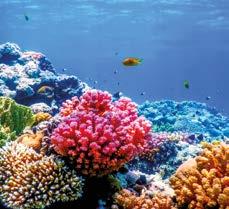

2 SPEAKING Work in pairs. Choose a place from exercise 1. Say three activities you can do there. Can your partner find the place?
3 Listen and match the descriptions (1-10) with the words (a-j).
beach
4 Cross out the incorrect word in each group.
1 You can swim in this. sea / river / hill
2 It’s got trees in it. desert / wood / forest
3 You can climb up this. hill / lake / mountain
4 You can walk through this. wood / field / river
5 Complete the compass with the words in the box. east • north • south • west
6 Look at the picture and complete the text with words from exercises 1 and 3.
I live in a small village on a beautiful (1) There are lots of things to do there. In the north east there are some (2) and there’s also a large (3) . I sometimes go swimming there in the summer, but it’s very cold! I prefer to go to the (4) and swim in the (5) . In the south west there’s a small (6) Sometimes, we drive there and then we walk along the (7) and look at the trees. It’s very beautiful. In the south east, there’s a (8) . If you climb to the top, there are some amazing views … in fact, you can see my house!
Frame your ideas
7 SEL Self-awareness Decision-making
Think about the places in exercises 1 and 3. Which places do you like to visit to...
• have fun?
• relax?
• do exercise?
• feel calm?
• be with friends?
• be alone?
Ordering adjectives
1 Underline the adjectives in these sentences.
1 There were some old plastic nets on the beach.
2 I found a strange square metal chair in the park.
3 Please put paper and cardboard into the big green bin.
4 My sister gave me a beautiful Chinese painting of a mountain for my birthday.
2 Complete the rule with the adjectives from exercise 1.
When we use more than one adjective before a noun, they usually come in this order.
1 opinion, e.g. ,
2 size, e.g.
3 age, e.g.
4 shape, e.g.
5 colour, e.g.
6 nationality, e.g.
7 material, e.g. , We don’t usually use more than two or three adjectives before a noun. strange plastic
3 Write the adjectives in the correct order. Then listen and check your answers.
1 T-shirt grey lovely small
2 box plastic rectangular
3 meal delicious French
4 bag cotton medium-sized
5 cat black unfriendly
6 building big square old
5 Look at the photos (a-c). Write a sentence for each photo with two or three adjectives. Use the adjectives in the box or your own ideas. Then compare your ideas with a partner.
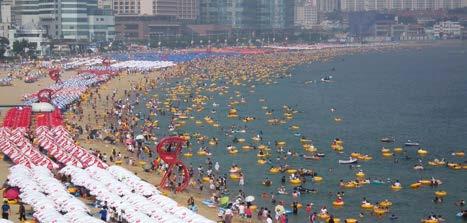
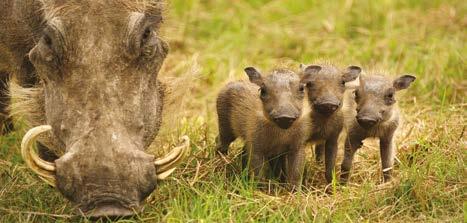

both / either / neither
6 Match the sentences (1-3) with the correct meaning (a-c). Then complete the rules with both, either or neither.
1 Both Jim and David / Both of them want to swim in the lake.
4 Work in pairs. Read the sentences. Decide if the order of adjectives is correct (✔) or incorrect (✘). Say the correct order to each other.
1 My aunt lives in a little sweet house with a big lovely garden.
2 The tall young man was talking to a very angry old lady.
3 She keeps her silver favourite earrings in that wooden interesting box.
4 We’ve got a black round table in our living room.
5 My friend works for a big German company. a lovely small grey T-shirt
2 Neither Jim nor David / Neither of them wants to swim in the lake.
3 Either Jim or David / Either of them wants to swim in the lake.
a Jim won’t swim in the lake and David won’t swim in the lake.
b Jim will swim in the lake or David will swim in the lake.
c Jim and David will swim in the lake.
We use both, neither and either to talk about two people, animals or things.
4 means one or the other.
5 means one and the other.
6 means not one and not the other.
1 SPEAKING Work in pairs. Describe the photo. Use the words in the box. bears • beautiful • calm dangerous • frightened • heights sand • sharks • trees
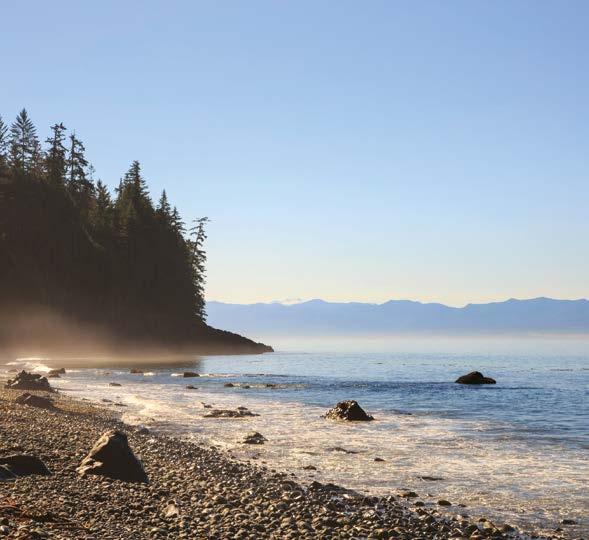
2
Listen to the conversation. Tick (✔) the words in exercise 1 that you hear. Where is the boy going to go camping next summer?
3 Listen to the conversation again. Match the opinions (1-4) with the speakers, girl (G) or boy (B).
1 This person doesn’t like being in cold places.
2 This person is scared of something in the sea.
3 This person thinks the sea isn’t dangerous.
4 This person really likes being in the mountains.
4 Listen and choose the correct option for each question.
1 Which activity does the girl prefer?
A swimming in the sea
B climbing in the mountains
2 What must you bring on the camping trip?
A a blanket
B a tent
3 What are they going to do on Wednesday?
A go on a boat trip to the island
B spend a day in the forest
4 How does the boy feel now about camping?
A He wants to go.
B He doesn’t want to go.
5 Read the Exam tip. Then read the Exam task. Read the answer options carefully.
Exam tip
Listening to how speakers respond
• In this part of the exam, you will hear a conversation between two people.
• The speakers may ask each other questions.
• Listen carefully to how the speakers respond to questions. They may use other ways of saying yes and no. For example, A: Was it dangerous?
B: Not if you follow the instructions. (= no, it wasn’t very dangerous); A: Was it cold?
B: We had to build a fire. (= yes, it was cold).
Exam task
6 A INVALSI Multiple choice You will hear Jack talking to his friend, Hayley, about a trip to Costa Rica. Listen and for each question, choose the correct option.
1 Who did Jack go on a trip with?
A members of his family
B all of his classmates
C students from his school
D some of his friends
2 Jack was expecting the rainforest to be…
A humid.
B cool.
C noisy.
D rainy.
3 What clothing did Jack plan to wear?
A shirts
B shorts
C trousers
D sandals
4 Jack thinks that zip-lining in Costa Rica is…
A scary.
B dangerous.
C expensive
D popular.
5 What kind of wildlife did Jack not see?
A snakes
B monkeys
C insects
D birds
6 B SPEAKING Work in pairs. Role-play the conversation in exercise 6A.
Record yourself acting out the role-play dialogue. Use a voice recognition tool (e.g. Google Speech-to-Text, Voice Dictation, or ChatGPT's read-aloud feature) to convert the speech to text. Then read the text to check whether your pronunciation was clear and correct.
Talking about food and the environment
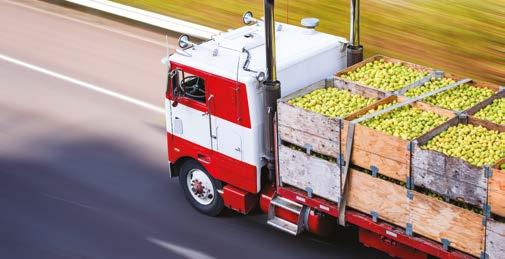
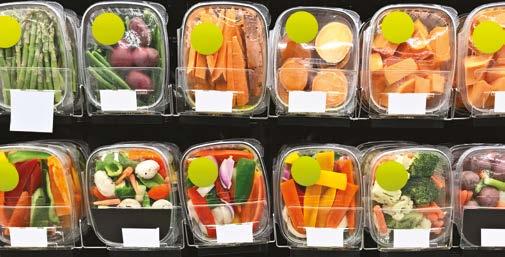
Plastic packaging: how much plastic is used to cover your food
1 Work in pairs. Match the opinions (a-d) with the topics (1-2) in the photos. Then discuss the opinions together. Do you agree with them? Why? / Why not?
a It’s important to think about where our food comes from.
b We should try to reuse the plastic that comes into our homes.
c We can buy more food from farms near us.
d It’s a good idea to take small bags to the supermarket for fruit and vegetables.
2 SPEAKING Work in pairs. Discuss the questions with your partner.
1 When you buy food, do you look at the label to find out where it is from?
2 Can you name five food items that are produced in your country and five food items that come from another country?
3 Think of three ways to reuse a plastic food container.
4 Can you think of ways to cover food without using plastic?
3 SPEAKING CITIZENSHIP With your partner, discuss what effect our food has on the environment.
• Think about plastic packaging and food miles.
• Discuss changes that you can make.
4 Read the advice in the box. Then read the debate topic. Think about the advantages and disadvantages of this idea.
Holding a debate
• When you debate a topic, you have to give your opinion about something and give clear reasons.
• Look at the statement below and think about what you want to say.
• Try to give at least two or three reasons for your opinion.
• Remember to listen to the other side of the debate and respond to their ideas.
Supermarkets should only sell food produced from their own country.
5 DEBATE Now hold a debate on the statement. Work in two groups.
Stage 1
Group 1: You are in favour of the statement. Make a list of reasons why. Choose one person in your group to present your ideas.
Group 2: You are against the statement. Make a list of reasons why. Choose one person in your group to present your ideas.
Stage 2
Listen to the other group’s reasons and make notes.
Stage 3
Group 1: Explain your arguments against Group 2’s reasons.
Group 2: Explain your arguments against Group 1’s reasons.
Stage 4
Hold a class vote.
Useful language
Describing problems
ORACY SKILLS
• (Food miles) are a serious problem because…
• It’s bad for the environment because…
• The problem with (buying only local food) is that… Reasons for
• Everyone should (buy local food).
• Shops can help by (labelling food).
• It’s a good idea to (think about where food comes from).
• It’s easy to (make your own favourite dishes). Reasons against
• It may be difficult to…
• At first, there could be some problems because…
The J&K Diaries – Episode 12
1 Watch the vlog. Are the statements true (T) or false (F)?
1 Josh and Kayla both know a lot about gardening.
2 They’ve chosen to grow herbs because they love cooking.
3 They’re going to plant the herbs in the garden next week.
4 The herbs will bring bees and butterflies into the garden.
5 They forget to put the seeds into the pots.
2 SPEAKING Work in pairs. Look at the photos on pages 180-181. Discuss the questions.
• Where do these animals live?
• What do they eat?
• How do you think they help the environment?
Exam task
3 INVALSI Short answer questions Read the text about three different animals, then answer the questions (1-8) using a maximum of 4 words. The first one (0) has been done for you.
0 Name three places where animals are losing their homes.
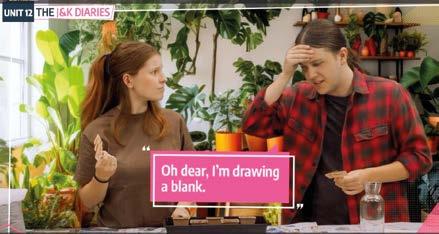
1 Where do most wild tigers live?
2 Why aren’t the trees cut down in forests with tigers in them?
3 How do tigers help to keep a balance in the ecosystem of the forests?
4 How many species of plants do tapirs eat?
5 Where do tapirs leave their scat?
6 Where does kelp live?
7 What do sea urchins eat?
8 What do sea otters eat? forests, oceans and mountains
Frame your ideas
4 SPEAKING CITIZENSHIP Work in pairs. Discuss the questions below.
• What endangered species live in your area?
• How can you help to protect their habitat?
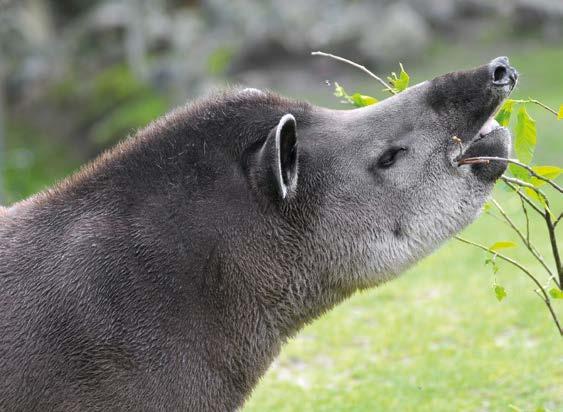
5 DIGITAL COMPETENCES Work in groups. Choose one of the animals from the reading text. Do some research online to find out more about it. Then create a fact file about the animal.

A tapir eating

Planetprotecting Animals
Everyone knows that global warming is bad news for wildlife. As the planet gets hotter, animals are losing their homes in forests, oceans and mountains all around the world. But did you know that animals also help to regulate the climate? By protecting our wildlife, we are helping to reduce global warming.
Let’s take a look at three different animals and find out how their activities can prevent temperatures from rising.
Tigers are an endangered species, with only about 4,000 wild tigers in the whole of Asia. The majority of these tigers, over 3,000, live in and around India. Tigers are large and dangerous animals, and humans usually keep away from forests that are known to have tigers in them. Because humans keep away, the trees aren’t cut down and trees help to reduce temperatures by taking in carbon dioxide from the atmosphere. In fact, in India, these dense forests with tigers in them take in three times more carbon dioxide from the atmosphere than other areas. Tigers also eat many of the herbivores in the forests, helping to keep a balance in the ecosystem. If there are too many herbivores in a habitat, they will eat all the plants and trees.

Herbivores, however, are also a very important part of the ecosystem. Tapirs, for example, can eat more than 200 different species of plants, including some trees and plants that other animals don’t want to eat. These large animals then move around the forest, leaving their ‘scat’ (poo) on the forest floor. The scat is full of seeds that grow into new trees and plants. In the Amazon rainforest, tapirs are helping new trees to grow in places where trees were cut down or burnt. Tapirs are so good at this that they are called ‘the gardeners of the forest’.
There are also very important forests under the water. Kelp is a plant that lives underwater and there are big kelp forests in oceans all around the world. Just like trees, kelp takes in carbon dioxide and produces oxygen, helping to cool down the planet. But kelp is also a very tasty and popular food for many sea creatures. Sea urchins love kelp and they can eat huge quantities of it very quickly. Fortunately, sea urchins are also part of the sea otters’ diet. Sea otters eat the sea urchins and this helps to protect the kelp forests.
By protecting animals like tigers, tapirs and sea otters, we are not only helping to look after our wildlife, we are also helping to look after the planet.
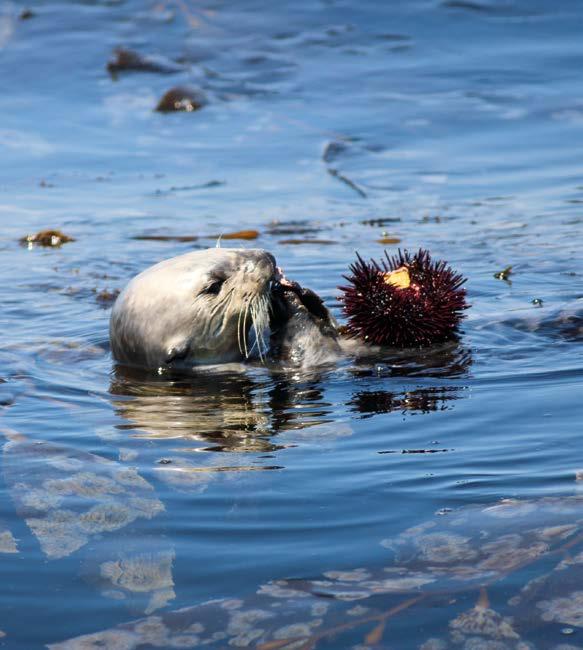
A sea otter eating a sea urchin
Vocabulary 12
Animals
1 Match the words in the box with the photos. bear
butterfly
dolphin
duck lizard
mouse
2 Write the words from exercise 1 in the correct categories.


3 Read the descriptions. Write the correct animal.
1 It hasn’t got any legs or arms. It usually lives on land.
2 It can be brown, white or grey. It’s very small. It can’t fly.
3 It often has many beautiful colours.
4 It moves on the water, but it doesn’t live under the water.
The environment
4 Choose the correct option to complete the poster.
Four easy ways to (1) fill / look after the planet … in your garden
(2) Plant / Save wildflower seeds in your garden. Bees and butterflies love wild flowers!
(3) Use / Make a bird feeder from an old plastic bottle, (4) fill / use it with nuts and put it in your garden.
(5) Look after / Save water when it rains and (6) use / grow it in your garden when the weather is dry.
If you don’t have a garden, (7) grow / fill some flowers in a window box or get some houseplants.
5 SPEAKING Complete the questions with verbs from exercise 4. Then ask and answer the questions with a partner.
1 How do you electricity or water in your house?
2 Can you think of other ways to the wild animals in your local area?
3 What other useful things can you from an old plastic bottle?
4 Have you ever your own fruit or vegetables? Would you like to try?

Frame your ideas
6 SEL Decision-making Work in pairs. Think of other ways to help the environment.
Adjectives ending in -ing or -ed
1 Read the sentences (1-2) and answer the questions (a-c).
1 The documentary about dolphins is interesting
2 I’m really interested in wildlife, so let’s watch this documentary about dolphins.
a Which adjective describes the documentary?
b Which adjective describes how the speaker feels?
c Which sentence describes the speaker’s opinion of the documentary?
Adjectives ending in -ing and -ed form the comparative with more: This trip is more tiring than the last trip. I’m more frightened of snakes than I am of spiders.
2 Write the adjectives for these verbs.
Choose the correct word to complete the sentences.
1 The gorillas were frightening / frightened and ran into the forest.
2 Seeing a gorilla up close can be very frightening / frightened
3 After the long walk through the forest, the travellers were tired / tiring
4 Walking through the forest is tired / tiring
5 We need some help to clean up the beach; please call if you are interesting / interested
6 This programme about plastic in the sea is very interesting / interested
7 The view from the top is amazed / amazing
8 I didn’t expect the island to be so beautiful, but I was amazed / amazing
9 The children were very exciting / excited when they got onto the bus for their school trip.
10 The school trip to the zoo was really exciting / excited for the children.
4 Complete the sentences with the correct adjectives in the box. Two adjectives are not needed.
bored • boring • frightened • frightening interested • interesting • tired • tiring
1 I didn’t enjoy the book. It was very long and
2 He’s a great teacher, and his lessons are always really
3 They felt very when they heard a strange, loud noise outside their tent.
4 I’m not surprised you’re – you went to bed very late last night!
5 I didn’t like the film Jaws because I think sharks are really
6 If you’re in the environment, you should read this article about climate change.
5 Read the story. Then complete the story with the correct form of the verbs.
Su-Lin was really (1) (tire) after work – her job as a teacher was very (2) (tire). She fell asleep on the train home and, while she was sleeping, she had a very strange dream! In her dream, she saw an (3) (amaze) view. There were beautiful mountains and trees. Suddenly, a huge bear appeared out of the trees. She felt very (4) (frighten), but she didn’t know what to do. Then an (5) (interest) thing happened – the bear turned into a tiny cat! Su-Lin was (6) (amaze), but she was very happy that the (7) (frighten) bear wasn’t there any more. When she woke up, she phoned a friend and told him about the dream. He was very (8) (interest) in the story. ‘If you come over to my place,’ he said, ‘I’ll tell you what the dream means. I’ve got a great book about dreams.’


6 SPEAKING Work in pairs. What do you think the dream meant? Compare your ideas with another pair.
Frame your ideas
7 SEL Self-awareness Work in pairs and discuss the following things. Think of:
• a time when you were frightened;
• a book that’s really interesting;
• a time when you were bored;
• a place that’s really amazing.
Writing lab 12
Writing an essay on the environment
1 Read the questionnaire. Then interview different people in your class. Take turns to ask and answer the questions.
Class environment questionnaire
1 How often do you eat meat?
2 Which bags do you use at the supermarket?
3 How often do you throw food away?
2 Work in small groups. Discuss the answers to the questionnaire. Do students in your class help the environment?
Learning focus
Structuring an essay
When you write an essay, you need to organise your ideas into clear paragraphs.
• Introduce the topic in the first paragraph.
• Describe your ideas and give reasons for them in the second paragraph.
• Summarise your ideas and state your opinion in the third paragraph.
Use full forms and formal language.
3 Read the essay question and the essay. Match the paragraphs (1-3) with the summaries (a-c).
a The writer suggests different ways in which students can help the environment.
b The writer summarises his / her ideas.
c The writer introduces the topic.
How can the students at your school help the environment?
1 We all know that many environmental problems are caused by what people eat and how they shop. However, many students don’t understand how they can help the environment.
2 One way in which we can help is by eating less meat. This is because farming animals uses a lot of food and water. Another idea is to use less plastic. For example, we can bring our lunch to school in reusable bags. We should also think about how much we eat. Many students put too much food on their plates and then throw it away at the end of the meal. We should take smaller portions and try to use all the food that is in our fridges or cupboards at home.
3 I am sure that we can all make these small changes in our lives. By eating less meat, using less plastic and wasting less food, we can really help the environment.
Useful language
Making suggestions
• One way in which we can…
• Another idea is to…
• We should also think about…
Expressing opinions
• I am sure that…
• In my opinion, …
• From my point of view, …
4 Read the Exam tip and task and decide if you agree or disagree.
Exam tip
Organising your ideas
• When you have to write an essay in an exam, read the essay question carefully. Underline the key words.
• Decide what your opinion is on the question.
• Make some notes before you begin writing. Think of at least three main ideas.
• Number the ideas from 1 to 3: 1 = most important, 3 = least important.
Exam task
5 PRELIMINARY Writing a short essay You see this notice in an English-language magazine.
Plastic packaging
Do you think there should be a tax on plastic so that these products are more expensive? Why? / Why not? What are the advantages and disadvantages of this idea?
Write a short essay answering these questions and we will publish it in our magazine!
6 Complete the Reflection checklist. Then discuss your answers with your partner.
Reflection checklist
Tick (✔) the sentences that you think are true. I read the essay question carefully. I made notes before I began writing.
I organised my essay into three paragraphs. I used full forms and formal language. I checked my work carefully at the end.
Towards INVALSI
Reading
1 Work in pairs. Think of two reasons in favour of zoos and two reasons against. Then read the essay quickly. Are your ideas included in the text?
2 True, False, Justification Read the essay about zoos and decide if the statements are true (T) or false (F), then write the first four words of the sentence which supports your decision in the space provided. The first one (0) has been done for you.
0 About 10,000 people per year visit zoos in the UK.
There are more than
1 Polar bears have ten times more space in the wild than they do in zoos.
2 Animals’ behaviour in zoos can be different from their behaviour in the wild.
3 Zebras often move from one family group to another in the wild.
4 Zoos can help scientists find out more about animal health problems.
5 Some animals spend some time in zoos and then go back into the wild.
6 All zoos care more about money than their animals.
Listening
3 Short answer questions Listen to a woman talking about her hero, Rachel Carson. While listening, answer questions (1-8) with no more than four words or numbers. You will hear the recording twice. The first one (0) has been done for you.
0 When did Rachel Carson die?
1 Where did she live?
2 What was the subject of her first story?
3 Who wrote to her in 1957?
4 Who was using pesticides?
5 Why were the fields silent?
6 How long did Carson’s research into pesticides take?
7 What was the title of her famous book?
8 When was it published?
Zoos: Good or Bad?
There are more than 300 zoos and safari parks in the UK with 32 million visitors a year, and about 10,000 zoos worldwide. But although zoos are popular with many people, not everyone agrees with them.
One of the main arguments against zoos is that the enclosures are too small for the animals. Polar bears, for example, have a habitat of about 1,000 square kilometres in the wild, while in zoos they have a space that’s probably around 100 square metres. The zoo environment is also very unnatural – with fences and glass around the enclosures. Then there is the constant presence of humans, the smell, sight, and the sound of them. This unnatural environment and lack of space can affect how the animals behave. Sometimes they walk up and down in their enclosures for long periods of time, or they pull out their own fur. In some zoos, animals are trained to perform tricks to entertain visitors. This is often stressful for the animals and sometimes bad for their physical health. Social animals, like zebras, live and stay in the same large family groups in the wild. But in zoos, they are usually in much smaller groups and they are sometimes moved to other zoos several times during their lives, forcing them to make new connections.
On the other hand, there are also some strong arguments in favour of zoos. Scientists visit zoos to study animal behaviour and to do research into different animal health problems. Zoos also help to educate people about different animals. Some people believe that zoos can inspire people to behave in a more eco-friendly way or to give money to conservation charities. If an animal in a zoo gets sick, it will get medicine and care to help it get better, and it will always have enough food and drink. Zoos also provide a safe environment for some endangered animals. Many zoos now have programmes to breed animals in captivity and then release them back into the wild.
It’s important to remember that not all zoos are the same. Some provide plenty of space for the animals, and work with conservation programmes around the world. Other zoos are more interested in making money than they are in the welfare of the animals. Do your research before you visit a zoo, and make sure that it is a place that really cares for its animals.
Giraffes outside their enclosure at London Zoo – the oldest zoo in the UK
Vocabulary
1 Read the descriptions. Write the transport words.
1 This travels on the road and it has got four wheels. c
2 You go to the airport to get in this, usually for longer trips. p
3 You pay the driver of this, usually for a short trip. t
4 This has got two wheels and you need to wear a helmet. m
5 This travels on water, usually on the sea. s
6 This travels on the road and has sometimes got two floors. b
7 This takes boxes or containers and travels for long distances. l
8 This uses electricity, not petrol, and you find it in some cities. t
2 Complete the sentences with the verbs in the box.
catch • drive • fly • leave • miss park • ride • sail • take
1 I learnt to a car when I was 18.
2 I need to the bus at 6 p.m.
3 On my next holiday, I’m going to up the River Nile in a boat.
4 We’re late. Let’s a taxi.
5 I don’t my motorbike on the motorway.
6 Hurry up or we’ll the bus.
7 You can your car for free at the train station.
8 There are usually two pilots who the plane.
9 The trains for London from Platform 5.
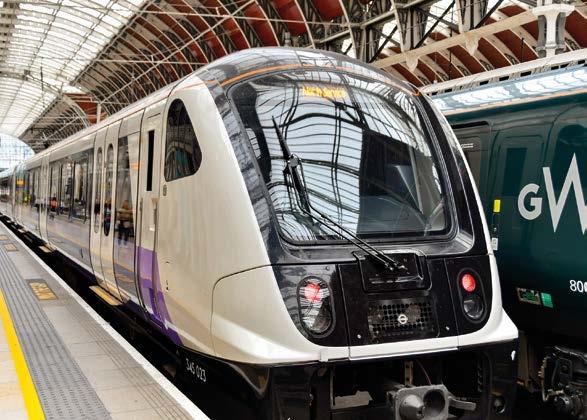
3 Choose the correct option (a-c) to complete the sentences.
1 Let’s go swimming in the… a field. b river. c mountain.
2 I love walking in the… a lake. b path. c forest.
3 They grow wheat and corn in this… a cave b desert. c field.
4 We often go climbing in the… a beaches. b fields. c hills.
5 It’s fun to go sailing on the… a lake. b waterfall. c hill.
6 We swam in the sea and explored the… a glacier. b coral reef. c valley.
4 Complete the sentences with words for wild animals.
1 S live in the ocean and have lots of teeth.
2 D live on lakes and rivers and eat plants and small fish.
3 B help fruit and flowers to grow.
4 M like eating cheese and they’re afraid of cats!
5 D like swimming in groups, and they communicate by clicking.
6 B are insects with four wings.
7 B are large mammals that sleep in the winter.
8 S are reptiles that are often poisonous.
5 Complete the conversation with the words in the box.
grow • look after • make • plant • save • use
Ted I want to do more to (1) the planet. What do you think we can do?
Ali One thing we can do is to (2) less plastic.
Nala Yes, and we could also (3) things from old bottles.
Ali I think we should also (4) our own vegetables.
Ted And we should (5) flowers to feed the bees.
Ali And don’t forget we should also (6) water.
Grammar
1 Are these sentences active (A) or passive (P)?
1 The passengers were angry about the delays.
2 A new manager was hired last year.
3 The traffic is sometimes stopped by the police.
4 The buses usually leave on time.
5 You need to put your ticket into this machine.
6 Boarding passes are scanned electronically.
2 Rewrite the sentences. Use the Present simple passive and by where necessary.
1 They sell train tickets over there.
2 They don’t serve breakfast after nine o’clock.
3 Every day, the traffic delays drivers.
4 Someone stole my passport last year.
5 Where do they make these cars?
6 The driver checks the tickets.
7 What language do they speak in Austria?
8 They don’t drive the coaches every day.
3 Complete the sentences with the Past simple passive of the verbs.
1 All trains (delay) by thirty minutes.
2 I (not tell) about the new timetable.
3 Our tickets (check) at the gate.
4 The cars (not park) in the correct place.
5 Where the luggage (find)?
6 Why the coach (stop)?
7 passengers (give) any information about the delay?
8 the airport (close) because of bad weather?
4 Complete the sentences with the adjectives in the correct order.
1 cute • French • little I’ve got a bulldog.
2 brown • scary • long Mum found a snake in the garden!
3 cloudy • grey • miserable It was another day.
4 round • wooden • pretty Before the fire, there were some cabins here.
5 metal • big • square What’s inside that box?
6 old • Italian • red Grandpa still drives his sports car.
5 Complete the sentences with both, either or neither.
1 my sister and I love animals. We want to be vets when we’re older.
2 I’ve got two tickets for the zoo, so I can take Emma or Libby with me.
3 of them enjoyed their trip to the park. They thought it was really boring.
4 A Do you want cheese sandwiches or ham sandwiches for your picnic?
B . I hate sandwiches.
5 You are wrong. The answer isn’t 98, it’s 89.
6 Complete the conversations with the correct adjective form of the words.
1 A Were you really lost in the forest? What was it like?
B It was (fright)!
2 A Are you looking forward to visiting the Amazon?
B Yes, I’m very (excite) about it.
3 A How long did it take you to climb the mountain?
B A week! We were all so (tire) when we got to the top.
4 A Did you enjoy your trip to the zoo?
B Not really. It was quite (disappoint) actually.
5 A Look at all the snow that fell last night!
B That’s (annoy). I have to get to work!
Life skills
Solving environmental problems
Every year, the Google Science Fair asks teenagers around the world to solve a problem they care about.
In 2019, eighteen-year-old Fionn Ferreira won for creating a way to remove microplastics from the ocean. Here’s how he did it.
Identify the problem
Fionn found a rock covered in oil and lots of plastic in the sea in his hometown.
Explore information and plan ideas
Fionn thought about how small microplastics are and how they get into rivers, seas and oceans.
Check your results
Fionn tried more than 1,000 different tests. In the end, he removed 88% of microplastics from each sample of water.
Fionn entered the Google Science Fair to share his idea and won the competition! 1 2 4 3 5
Choose an idea and try it He made a plan and tried very hard to take the microplastics out of the water. He had to change his plan each time it didn’t work.
Share your solution

Frame your project
REAL-LIFE TASK 1
Work in groups. Think about a problem, big or small, that you would like to solve. Use the diagram in exercise 1 to help you. Think about:
• how you can solve the problem;
• how you can try your idea;
• how you can share your solution. Make a diagram to present in the next class.
Problem solving
1 Read the information. Do you think Fionn solved a big problem? What was it?
2 Look at the diagram (steps 1-5). Do you think these are useful steps to follow? Why? / Why not?
3 SPEAKING Work in pairs. Discuss the questions.
1 If you’ve got a problem, do you think it’s a good idea to share it? Why? / Why not?
2 Who would you share your problem with? Why?
3 Describe a problem you, or someone you know, has solved. How did you / they do it?
4 Would you use these problem-solving steps in the future? Why? / Why not?
4 Work in pairs. Read the Mind your mind information. Which quote do you think is the best? Why?
Mind your mind
Learn from your mistakes
Read these quotes about making mistakes.
• ‘The only mistake is not learning from your mistakes.’
• ‘I’ve learnt so much from my mistakes, I’m thinking of making some more.’
• ‘The only person who never makes mistakes is a person who does nothing.’
5 SPEAKING Work in pairs. Brainstorm some ways making mistakes can be helpful.
Useful language
ORACY SKILLS
• I think that (litter) is a big problem.
• We could organise (a litter pick).
• Let’s try and (collect some rubbish) this weekend.
• We could put the information (on social media).
• This person made a mistake when…
• They learnt to become / be better by…
• We can learn from this character because…
REAL-LIFE TASK 2
Think of a time when you made a choice that was not a good choice for the environment. It could be:
• the way you travelled;
• something unnecessary that you bought;
• not recycling something;
• wasting food.
Think about why you made that choice, how you would make a different choice now, and what you learnt from it. Create a presentation to show in the next class.
Communication activities
Unit 1 Oracy lab, Exercise 6, page 27
Student B: Listen and answer Student A’s questions. Then ask Student A these questions.
Any pets? If yes, what? Name?
When / your mum’s birthday?
Where / usually / go on holiday?
What / favourite food?
What / your hobbies?
Unit 8 Oracy lab, Exercise 4, page 123
Unit 9 Oracy lab, Exercise 3, page 139
Student B
1 Ask these questions about Student A’s forecasts.
• where / weather forecasts for?
• what / temperature / Monday?
• which city / colder / Tuesday?
• when and where / rain?
• which city / best weather in your opinion? / Why?
Where are your weather forecasts for? What will the temperature be on Monday?
2 Look at the weather forecasts for Oslo and Cairo. Answer Student A’s questions.
Unit 9 Oracy lab, Exercise 3, page 139
Student A
1 Look at the weather forecasts for Bangkok and Lima. Answer Student B’s questions.
Unit 11 Oracy lab, Exercise 3, page 167
Student A
3 You work in the Amsterdam ticket office. Look at the information and answer Student B’s questions.
2 Ask these questions about Student B’s forecasts.
• where / weather forecasts for?
• which city / colder / Monday?
• what / temperature / Tuesday?
• when and where / storm?
• which city / best weather in your opinion? / Why?
Where are your weather forecasts for? Which city will be colder on Monday?
4 You want to take a train from Madrid to Seville. Ask Student B for information.
Unit 11 Oracy lab, Exercise 3, page 167
Student B
1 You want to take a train from Amsterdam to Brussels. Ask Student A for information.
2 You work in the Madrid ticket office. Look at the information and answer Student A’s questions.
Sustainable cities

Preview
1 VISIBLE THINKING Work in pairs. Look at the two photos and answer the questions.
See What can you see in the two photos? Think What differences do you think there are in living in these two places?
Wonder Which looks most similar to where you live? What would you like to know about living in a different place from yours?
View
2 Now watch the video on page 117 again. Cameron talks about where she lives. Choose the correct alternative.
1 Cameron lives in Chicago / Glenview
2 She used to live in Chicago / Glenview.
3 Now answer the questions.
1 What different activities can you do in Chicago and Glenview?
2 How is the pace of life different in the two places?
3 How did she feel when she first moved?
4 How does she feel about where she lives now?

Reflect
4 Answer these questions and then compare your answers with a partner.
1 Which place would you like to live in – Chicago or Glenview? Why?
2 Are you still living in the town or city you were born in?
3 What do you like about where you live? What things don’t you like?
4 In the future, would you like to live in the countryside or a big city? Why?
5 DEBATE Have a class debate on this topic. Half of the class should be in favour and half against the statement.
It is better for young people to live in a big city rather than the countryside.
Use the ideas in the box to help you prepare. being close to things • boredom • fresh air meeting new people • safety • shopping things to do • traffic
6 Work in groups. Write down the class’ ideas in the following table.
Pros Cons
A bigger frame
7 A VISIBLE THINKING Work in small groups. What services and facilities should a town or city offer its inhabitants? Complete the map with your ideas. Remember to think about different generations and their needs.
Nurseries, schools and universities
Services and facilities
Museums and theatres
Public transport
7 B Share and compare your ideas with the rest of the class, trying to find common points.
8 CRITICAL THINKING Read the information in the 2030 Agenda box. Think about your ideas from exercise 7 again. How can they help to reach the goal of making a city safe and sustainable?

Today, more than half the world’s population lives in cities and it is estimated that seven out of ten people will live in urban areas by 2050. For this reason, Sustainable Development Goal 11 is focused on making cities and urban areas safe, inclusive and sustainable, with decent infrastructure, efficient and reliable public transport, affordable housing and plenty of green spaces.
9 MEDIATION Work in small groups. Link the different situations you can find in a town or city to the results they can have. Sometimes, more than one option is possible. Explain your reasoning. For me, with an efficient police force, the city is safer. This means there is a better quality of life because people are not worried about crime.
Situations
• efficient police force
• renewable energy for public buildings
• cheap flats and apartments to buy or rent
• lots of parks and trees
• free public transport
• cycle lanes
• recycling facilities
• cultural events
• decent hospitals
• good schools
Frame your ideas
Results
• better job prospects
• equal opportunities
• better air quality
• more social interactions
• good mental health
• less traffic
• improved quality of life
• safe environment
• better use of resources
• less litter on the streets
10 Work in groups to make a proposal on how your town/city can be safer, more sustainable and more inclusive.
• Identify a problem.
• Brainstorm as many solutions as possible.
• Think about the advantages and disadvantages of each solution and then decide on one.
• Prepare a slide/paper presentation of your idea and its benefits.
Citizenship
Getting an education
1 ORIENTATION SPEAKING Work in pairs. Answer the questions.
1 Would you like to go and study in another country for an extended period?
2 Where would you like to go?
3 Does your school offer opportunities for exchange programmes or study trips abroad?
View
2 Now watch a video where Sophie talks about her school exchange experience in Japan and answer the questions.
1 Where is Sophie from and where did she go on the exchange programme?
2 What is her opinion of the experience overall?
A bigger frame
3 Watch the video again and complete the table. What are the positive and negative aspects of Sophie’s experience?
Positive aspects
Negative aspects
Reflect
4 LIFE SKILLS Cultural awareness Discuss these questions in pairs. Then share your ideas with the rest of the class.
1 When you visit or study in another country what aspects of the life there can be different?
2 How can you make sure you respect the people and value their culture?
5 DEBATE Have a class debate on this topic. Half of the class should be in favour and half against the statement. Use these ideas to help you prepare.
Everyone should take part in a school exchange programme while they are at secondary school.
different subjects • difficulty catching up with marks homesickness • independence know new people and cultures • learn a language teaching methods
6 VISIBLE THINKING Work in small groups. Half the group should discuss and make notes on the first question, the other half on the second question.
1 Why is education so important?
2 Why don’t some children and teenagers have access to education?
Education
right
Citizenship
7 MEDIATION Now get together as a whole group and share your ideas. What links can you make between your ideas? What are the consequences of not being able to have an education?
Ensuring free and quality education for everyone is the aim of Sustainable Development Goal 4. In particular, it focuses on making sure there is no disparity between the access that girls and boys, people with disabilities, and indigenous people have to all levels of education and training. The education at both primary and secondary levels must lead to relevant and effective learning outcomes that will empower people and allow them to succeed.
8 CRITICAL THINKING Read the information in the 2030 Agenda box. What should education be like? What categories does the Goal focus on in particular? In pairs, put these steps to achieving education for all in order of importance for you. Can you think of any other ideas?
Provide free equipment and books to all primary and secondary school students.
Increase government investment in school buildings and facilities.
Have more specialist teachers for students with specific educational needs.
Increase international pressure to change laws in countries/regions where education is not open to girls.
Put students in groups according to their learning level.
Develop new educational strategies.
What steps can we take to achieve this Goal?
• increase investment in public education
• change laws
• provide free equipment
Frame your ideas
• hire more teachers
• make education more accessible for everyone
• develop new educational strategies
9 A MEDIATION Work in pairs. Read the lists of the facilities and resources schools in Italy might have and the subjects they might teach. Put them in order of importance for you.
Facilities and resources
digital books wi-fi
comfortable chairs and large desks
outside/recreational space
gym
science/language labs
9 B Share your ideas with another pair. How similar were your lists? Do you have any other ideas for important resources and subjects?
10 LIFE SKILLS Work in pairs to prepare a short oral presentation on changes you would like to see in your school or to the Italian education system in general. Remember that your ideas must be inclusive, relevant and effective for learning.
Subjects art
practical skills, e.g. cooking foreign languages financial literacy

Citizenship Working together
1 THINKING ROUTINE 3-2-1 bridge You’re going to watch a video in which a group of students work as a team on a project. Think about the word ‘teamwork’. What does it mean for you? Complete the ‘Before learning’ column of the table.
3-2-1 BRIDGE
BRIDGE
What connects your ‘before’ and ‘after’ ideas?
2 SPEAKING Work in pairs. Answer the questions.
1 Have you ever taken part in a school project or competition? Was it on your own or as part of a team?
2 Does your school participate in regional or national competitions? What are they?
View
3 Now watch the video about a group of American students taking part in a competition. What was their idea for the competition?
A an app for firefighters
B a website with data about fires in Spain and the USA
C a system to detect forest fires
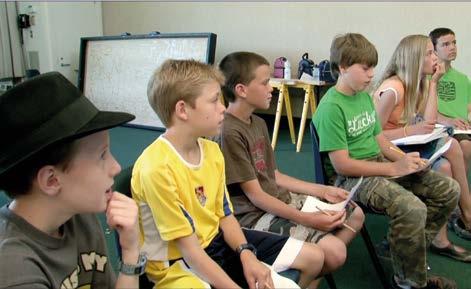
4 Watch the video again and underline the correct alternative.
1 First, the students had to think of a global / local climate problem.
2 They connected their project to Spain / Australia because there are frequent wildfires there.
3 The cameras in the forests use batteries / solar energy
4 They created a way for the general public / people living in forests to detect fires quickly.
5 The international competition was in Mexico City / Copenhagen
6 The students came first / second in the competition.
Reflect
5 Answer these questions and then compare your answers with a partner.
1 How do you think the students felt when they won the international competition?
2 How much do you think the students had to work as a team to get this result?
3 Do you think how they worked together helped to make them successful?
4 What problems do you think there were during the different phases of the project and competition?
5 Do you think each member of the team did their best?
6 Do you think they all did the same amount of work?
Citizenship
A bigger frame
6 LIFE SKILLS Put these different elements of teamwork in order of importance for you. Then work in small groups to discuss and decide the order together. communicate cooperate delegate tasks follow rules exchange ideas help each other respect each other listen prioritise share aims decide objectives
7 MEDIATION What did you have to do in order to make a group decision? What was difficult/easy about the task? Did everybody in the group take part?
8 Read the box and discuss the questions in class.
LIFE SKILLS Working in a team
Most employers want their employees to have certain skills and qualities, as well as academic qualifications. Teamwork skills are one of these employability skills. Working in a team means being able to work well together with other people and collaborating in order to reach a shared goal or to complete a task. You have to take responsibility for your share of the work, ensure the work progresses as planned and deal with any problems.
1 Why is teamwork an essential skill for work?
2 Do you think it’s important to learn about how to work in a team when you are at school?
3 As a teenager, what other teams can you be part of that can help you develop this skill?
9 DEBATE Have a class debate on this topic. Half of the class should be in favour and half against the statement. Use these ideas to help you prepare.
Each member of a team should cover a variety of different roles and tasks.
confusion • equal amount of work personal qualities • strengths
Frame your ideas
10 LIFE SKILLS Work in groups to decide an activity that will help develop team working skills for the students in your class. Here are some ideas, and you can look online for others.
build something out of Lego™ a virtual escape room form a perfect square blindfolded
Give a short presentation in which you should:
• give some details of the activity;
• explain how it includes everyone;
• say how it will help teamwork skills.
11 Now, at the end of all the tasks, go back to exercise 1 and complete the ‘After Learning’ side of the table with 3 words or ideas, 2 questions and 1 simile or metaphor. How are your ‘before’ and ‘after’ ideas connected? How much have they changed? Can you see the importance of teamwork now?

ORIENTATION In groups, choose 4 or 5 professions and ask an AI tool to explain the skills needed to develop each of them. Ask for an A2 to B1 English level for the explanation.
Citizenship
Responsible consumers
Preview
1 VISIBLE THINKING Work in pairs. Look at the two photos and answer the questions.
See Where are the people? What type of clothes and fabrics can you see?
Think What do you think they are doing? Wonder What else would you like to know about these people?
View
2 Now watch a video in which Ade goes to Ghana. What is he investigating? Choose the correct option.
A how traditional Ghanaian clothes are made
B what happens to the clothes we don’t want
C how clothes are recycled into other products
3 Watch the video again and answer the questions.
1 What reasons do the two customers give for buying second-hand clothes?
2 What changes are the people making to the second-hand clothes?
3 What was the cultural importance of traditional Ghanaian clothes in the past?
4 What does the historian think could happen to traditional clothing in the future?
5 How does the office worker feel about traditional clothes today?
Reflect
4 SPEAKING Discuss these questions in pairs.
1 What do you think about second-hand clothes?
2 Do you wear them?
3 Where can you buy or sell second-hand clothes?
5 CRITICAL THINKING In the video Ade says ‘Even though we give away our second-hand clothes for free, some of the world’s poorest people pay good money for them.’ Do you think this is fair? Discuss this statement in small groups, using these ideas to help you.
gives local people a job • cheaper than new clothes takes advantage of people clothes are not thrown away
Even though they pay for the clothes, they are still cheaper than buying new ones.
A bigger frame
6 A THINKING ROUTINE Think about these questions on your own and then share your thoughts with a partner.
On the video, you saw trucks and huge piles full of second-hand clothes. How did that make you feel? What can it tell us about the society we live in?
Consumption and production are very important for the world’s economy, but they can be negative for our well-being, the environment and the planet’s resources. Experts believe that, with the growing population, we would need about three planets to provide the natural resources if we continue to live as we do now. The objectives of Sustainable Development Goal 12 are to ensure sustainable production and consumption, to reduce waste and to inform people about how to live sustainably. Reducing the level of consumerism in our lives is the first step we can take.
6 B THINKING ROUTINE Pair Read the information in the 2030 Agenda box. Work in small groups. How can second-hand clothes help towards this Sustainable Development Goal? Complete the map with your ideas.
6 C THINKING ROUTINE Share and compare your ideas with the rest of the class. What points do you have in common?
7 LIFE SKILLS Self awareness Discuss these questions in small groups.
1 What do you do with your old clothes or clothes you don’t like anymore?
2 What recycling facilities are there for clothes and textiles where you live?
3 Do you buy a lot of things? What have you bought this week? List everything from a snack to a pen, school book or pair of jeans. Do you think you bought any unnecessary things?
4 What changes can you make to be a more responsible consumer?
Frame your ideas
8 A MEDIATION Work in groups to prepare a multiple-choice quiz for your classmates about responsible consumption. Think of five questions, each with 3 options, to see how much they know or what they do.
Your socks have got holes. What do you do?
A I sew them.
B I throw them away.
C I put them in the textiles recycling bin
8 B MEDIATION Carry out the quiz, collect and analyse the data and then present the results to the rest of the class.
Seven people say they throw their socks away, and ten people say they put them in the recycling.
Second-hand clothes
Citizenship A creative mindset
Preview
1 VISIBLE THINKING Work in pairs. Look at the two photos and answer the questions.
See What can you see in the two photos? Think What do you think they are for? How difficult do you think they are to make? Wonder What questions have you got about them or the person who made them?
View
2 Now watch a video about Jack Hackney, an ice sculptor, and a difficult project he had to work on. What did he have to make out of ice? Was he successful?

3 Watch the video again and fill in the gaps.
1 Jack compares ice to a
2 Ice sculptures are popular at
3 Jack has to work in .
4 The car company hopes the video will go .
5 Jack and his team have to do a lot of before the final day.
6 The get some good footage for the commercial.

Reflect
4 A Answer these questions.
1 In your opinion, did the car company have a good creative idea or was it too strange?
2 Do you think this was an easy project for Jack to work on?
3 How do you think Jack and his team felt when the wheel broke the first time?
4 How do you think they stayed motivated during the project?
5 What do you think their reaction was when the wheel broke during filming?
6 What would you do in a similar situation?
4 B Compare your answers with a partner.
5 SPEAKING Discuss the questions in small groups.
1 In English, there is a popular saying ‘If at first you don’t succeed, try, try again.’ What do you think it means? Do you agree with this? Why? / Why not?
2 Is there a similar expression in your language?
3 Do you think you give up too easily when you are faced with a problem or difficult situation?
4 It’s common to find memes of this saying but with different endings, for example ‘If at first you don’t succeed, destroy all the evidence.’ Think of some serious or fun ways to complete the saying.
A bigger frame
6 In pairs, complete the flow chart with the verbs in the box.
analyse • examine • generate gather • identify • select take • test
7 In small groups, discuss how these different things could help you to become better at problem-solving. Which ones do you think work best for you?
being inquisitive • brainstorming ideas challenging ideas • not giving up paying attention to detail • taking risks using mind maps
8 Read the information in the box and discuss the questions in class.
1 Why is problem-solving important in the world of work?
2 What kind of qualities do you need to have?
3 Do you think it is easier to identify solutions on your own or as part of a team? Why?


LIFE SKILLS Problem-solving
Problem-solving is a key employability skill that employers look for today because it means you will be able to handle unexpected problems and deal with complex challenges that happen in the workplace. You need to be able to assess the situation, brainstorm solutions, identify the best one and then take action. Problem-solving requires motivation, self-possession and logic, but also creativity and the ability to think outside the box, both on your own and as part of a team.
9 DEBATE Have a class debate on this topic. Half of the class should be in favour and half against the statement. Use these ideas to help you prepare.
Problem-solving is something you need when you are an adult not a teenager. learn to deal with problems independently • only useful for serious and big problems useful in a work environment • parents are responsible for finding solutions for their children develop useful strategies for friendships • better communication with family members
10 LIFE SKILLS Work in groups. Think of (or invent) a challenge/problem your school/class is facing and work together to find a solution. Give a short presentation where you: • present the problem • share your ideas for solutions • explain the best course of action to take
11 THINKING ROUTINE – 3 2 1 CLOSING ACTIVITY Write 3 things that you have learnt about problem-solving. Write 2 things you will do when you are faced with a problem in the future. Write 1 question you still have about problem-solving. Can you see the benefits of different problem-solving techniques now?
Irregular verbs
Infinitive Past simple Past participle be was / were been become became become begin began begun break broke broken bring brought brought build built built buy bought bought can could –catch caught caught choose chose chosen come came come cost cost cost cut cut cut do did done draw drew drawn dream dreamed / dreamt dreamed / dreamt drink drank drunk drive drove driven eat ate eaten fall fell fallen feel felt felt find found found fly flew flown forget forgot forgotten get got got give gave given go went gone grow grew grown have had had hear heard heard hit hit hit hold held held hurt hurt hurt keep kept kept know knew known learn learned / learnt learned / learnt leave left left lend lent lent let let let lie lay lain lose lost lost mean meant meant make made made meet met met pay paid paid put put put read read read ride rode ridden run ran run say said said see saw seen sell sold sold send sent sent show showed shown shut shut shut sing sang sung sit sat sat
Infinitive Past simple Past participle sleep slept slept speak spoke spoken spend spent spent stand stood stood steal stole stolen swim swam swum take took taken teach taught taught tell told told think thought thought throw threw thrown understand understood understood wake woke woken wear wore worn win won won write wrote written
Phrasal verbs
come back return to a place come round go to a place fall off move quickly down from something, usually by accident find out discover get back return to a place get in arrive home get off leave, e.g. a bus / train get on go onto, e.g. a bus / train get up get out of bed go out leave your house to go somewhere look after take care of someone or something look for search for someone or something
move away move in a different direction pick up meet someone and take them somewhere put away put something in the place where you usually keep it roll out make something flat run away run in a different direction sit down move yourself into a seat switch off stop something that uses electricity switch on start something that uses electricity take off remove, e.g. shoes take out remove something from a place throw away put something in a bin wake up stop sleeping walk out leave a place by walking write down write something on a piece of paper
1 My life in a day
Grammar reference
Present simple
Affirmative
I / You / We / They play. He / She / It plays.
Negative
I / You / We / They don’t play. He / She / It doesn’t play.
Questions
Do I / you / we / they play? Does he / she / it play?
Short answers
Positive Yes, I / you / we / they do Yes, he / she / it does
Negative No, I / you / we / they don’t No, he / she / it doesn’t.
Si usa il Present simple per parlare di
• fatti generali e sempre veri In winter it rains a lot.
• situazioni permanenti I live in Italy.
• situazioni o azioni abituali I usually go to school by bus.
• preferenze I love pizza.
La forma affermativa è uguale alla forma base del verbo per tutte le persone, tranne che per la 3ª persona singolare. I work in London. We play basketball. La 3ª persona singolare si forma con l’aggiunta di -s. He works in Paris. She plays football. Alcuni verbi presentano variazioni ortografiche per la 3ª persona singolare:
maggioranza dei verbi + -s drinks, speaks terminanti in -ch, -o, -sh, -ss, -x, -z + -es washes, goes terminanti in consonant + -y -y -ies studies, cries
It rains. He teaches maths. She flies from Rome to Paris.
La forma negativa si forma con don’t / doesn’t + forma base del verbo.
They don’t study German. He doesn’t speak Italian.
La forma interrogativa si forma con do / does + soggetto + forma base del verbo.
Do you live in Milan? Does she love music?
Nelle risposte brevi, si utilizza solo l’ausiliare do / does
No, I don’t. Yes, she does.
Si usano le wh- question words quando si fa una domanda aperta, ovvero quando si richiede una risposta completa.
Si usa
• what time per domande relative a un orario specifico
What time do you finish school?
• when per domande relative al tempo
When is your birthday?
• where per domande relative a luoghi o posizioni
Where do you live?
• who per domande relative a persone
Who is your teacher?
• what per domande relative a cose, azioni o idee
What do you do in the evening?
• why per chiedere ragioni o motivi
Why do you like him?
Present continuous
Affirmative
I am playing
He / She / It is playing
You / We / They are playing.
Negative
I am not playing
He / She / It isn’t playing
You / We / They aren’t playing.
Questions
Am I playing?
Is he / she / it playing?
Are you / we / they playing?
Short answers
Positive Yes, I am Yes, he / she / it is. Yes, you / we / they are
Negative No, I am not No, he / she / it isn’t. No, you / we / they aren’t
Si usa il Present continuous per parlare di
• cose che stanno accadendo al momento dell’enunciato
I’m studing right now.
• cose che accadono all’interno dell’arco temporale attuale
He is learning German this year.
• situazioni temporanee
We’re not working this week.
• progressione o cambiamento nel tempo
Winters are becoming more and more hotter.
Alcune forme in -ing presentano delle variazioni ortografiche.
Maggioranza dei verbi + -ing speaking, seeing
Terminanti in -e muta -e -ing making, living
Terminanti in 1 vocale + consonante raddoppio della consonante stopping, travelling
Terminanti in -ie -ie -y dying, tying
We’re eating pizza for dinner. Jake is cutting paper. She’s lying about it.
Le forme affermativa e negativa si formano con il presente del verbo (not) be + la forma in -ing del verbo principale.
I’m not studying. I’m reading a book.
La forma interrogativa si forma anteponendo il verbo be al soggetto, a sua volta seguito dalla forma in -ing del verbo principale. Le wh- question words si antepongono al verbo be
Are you going to the gym?
What is he doing at the moment?
Nelle risposte brevi si utilizza solo il verbo be (Ricorda che le risposte brevi affermative non prevedono la forma contratta).
Yes, I am. No, we aren’t.
Di solito, il Present continuous è accompagnato da espressioni di tempo come now, right now, at the moment, today, this week, this year, ecc.
I verbi statici non prevedono la foma in -ing: love, like, know, want, hate, ecc.
Likes and dislikes
Per esprimere gusti e preferenze si utilizzano verbi come love, (don’t) like, don’t mind, hate, can’t stand, ecc. Questi, possono essere seguiti da
• verbi in -ing
I like watching TV series.
• sostantivi
We hate junk food
• pronomi comlemento I can’t stand it
I verbi di preferenza possono essere preceduti dagli avverbi really e quite, mentre very much segue sempre il complemento oggetto.
I really like dancing. I love books very much
Il verbo modale can’t stand non può essere usato nelle domande.
Do you like football? No, I can’t stand it, but I love tennis.
Daily routines
brush your hair She brushes her hair every morning. brush your teeth Don’t forget to brush your teeth tonight. do exercise I do exercise at the gym daily. do homework He always does his homework after dinner. get dressed I get dressed quickly after my shower. get up We get up early on school days. go home I go home at four o’clock. go to bed They go to bed at half past ten. go to school My sister goes to school by bike. have a shower He has a shower before breakfast. have a snack Let’s have a snack before studying. have breakfast I usually have breakfast at seven. have lunch We have lunch in the school canteen. leave home I leave home at a quarter to eight. prepare dinner Dad prepares dinner on Sundays. study She studies English every afternoon. take the bus We take the bus when it rains. visit friends/grandparents I visit my grandparents every weekend.
wake up He wakes up at six o’clock every day. watch TV They watch TV after doing homework.
Family
aunt My aunt is my mother’s sister.
brother My brother is my mother’s son.
cousin My cousin is my uncle’s child.
daughter My parents have two daughters. father / dad / daddy My father is married to my mother. grandfather / grandpa / grandad My grandfather is my mum’s dad. grandmother / grandma / granny My grandmother is my mother’s mum.
husband My dad is my mum’s husband.
Miss Our teacher is called Miss Jones. mother / mum / mummy My mother is married to my father.
Mr Our maths teacher is called Mr Davis.
Mrs Our science teacher is called Mrs Lark.
Ms Our drama teacher is called Ms Dee.
nephew My uncle's son is my dad's nephew.
niece My mum’s niece is her sister’s child.
sister My sister is my father’s daughter.
son My parents have one son.
surname My surname is Walker.
uncle My uncle is my father’s brother.
wife My mother is my father’s wife.
Collocations and expressions
stay at home (p22) share information (p22) do research (p22) take photos (p23) go on holiday (p25) meet my friends (p27) play football (p27) spend the weekend (p27) spend time with (p29)
study English (p31) read a book (p31) write a letter (p31) listen to music (p31) play games (p31) ride a bike (p31) go shopping (p31) look after (p32) find out (p32)
1 Frame A
1 Read the Exam Reminder. What can you do with the key words in each paragraph of a text?
Tip reminder
Reading for main ideas
See SB p. 22

Exam task
2 PRELIMINARY Multiple choice with one text
Read the text and for each question, choose the correct answer.
1 What country do the von Engelbrechtens live in?
A Tonga
B New Zealand
C Australia
2 What nationality is Karyn?
A German
B British
C Tongan
3 Why is their house on a hill?
A to have a good view
B to keep it safe from the sea
C to be close to drinking water
4 The family get their food
A from only their island.
B from a smaller island.
C from their island and another island.
5 Jack goes to school in New Zealand
A to get a better education.
B to spend time with other students.
C to be around nature.
Alone on an Island
The von Engelbrechten family live in a very unusual place. Their home is on the small island of Fofoa and they are the only people who live there. Fofoa is about one kilometre long and the island is part of Tonga, a country in the South Pacific Ocean. It is quite close to other islands in Tonga, but it is about 1,800 kilometres from New Zealand and around 4,000 kilometres from Australia.
There are five people in the von Engelbrechten family – Karyn, the mother, who is from the UK; Boris, the father, who is from Germany; and their three sons Jack, Luca and Felix. They’ve got a two-bedroom home on a small hill with an amazing view of the ocean. The house is high up because they don’t want the ocean to come into their living room!
The family drink rainwater and grow fruit and vegetables on the island. Sometimes, they travel to a larger island nearby to bring back food.
Karyn and Boris are happy to have nature around them, and Luca and Felix enjoy their life on the island. Jack, the oldest son, lives in New Zealand now. He goes to school there because he wants to be around other young people. Karyn teaches Luca and Felix on the island. She makes sure that they get a good education, just like children who go to school.
Fofoa island
Vocabulary 1
1 Match the verbs (1-11) to the correct word or expression (a-j).
do
f my grandparents
g dressed
h my homework
i the bus
j a snack
2 Put the letters in order to make verbs.
1 I usually egt pu at about half past six in the morning.
2 My mum ash a rwoseh when she gets home from work every evening.
3 My brother and I usually ehva ulchn at school.
4 I weka pu at 9 am at the weekend and I lie in bed until 10!
5 My friends and I od eeersixc every day to keep fit.
6 Sometimes we tsuyd in the school library because it’s very quiet.
3 Complete the sentences to write about daily routine.
1 I br u s h m y t e e t h after breakfast, lunch and dinner.
2 My little sister g to b at nine o’clock.
3 If the weather isn’t good I t t b to school.
4 My dad usually p d in the evenings.
5 We usually h a s mid-morning.
6 On Sundays my brother and I often v our g
4 Complete the sentences with the verbs in the box in the correct form. get up • brush • have • go • take • watch
1 I usually at seven o’clock on school days.
2 My brother always his teeth after breakfast.
3 We the bus every morning at 7.45
4 In the afternoon I my favourite TV series.
5 We all dinner at about eight o’clock.
6 At the weekend my sister to the park with my friends. a dinner b to bed c TV d home e my teeth
5 Complete the text with the verbs in the box. have • leave • get up • have lunch brush (x2) • study • prepare • have breakfast wake up • watch • take • get dressed • go
8 weekends / sleep / I / late / at/ often get up wake up get up
Every morning, I (1) at 7.15 a.m. Then I (2) and (3) a shower to wake myself up properly.
I (4) my teeth, (5) my hair, and (6) (I wear a uniform to school – I hate it!).
After that, I (7) – usually cereal or toast. Then I (8) home and (9) the bus to school with my friends.
At noon, I (10) with my friends in the school canteen. When the day’s over,
I (11) home, (12) (a little!) and then (13) TV until about 6.
I (14) dinner for my family— usually something quick like pasta or a salad –and finally, I go to bed, ready to do it all again tomorrow...

6 Reorder the words and write the sentences. Write the verb in the correct form.
1 up / usually / get / I / 7.30 / at I usually get up at 7.30.
2 to / go / She / school / bus / by
3 have / breakfast / family / My / together
4 homework / do / I / my / after / dinner
5 bed / to / go / We / at / ten / o’clock
6 TV / sometimes / watch / They / in / the / evening
7 prepare / dinners / always / Dad / delicious
1
Grammar / Listening
Present simple; Adverbs of frequency
1 Put the words in order to make sentences.
1 Zeineb / Does / go / ever / to the theatre / ? Does Zeineb ever go to the theatre?
2 travels / often / on / My mum / abroad / business
3 I / are / late / to school / go / never / by bus / they / because / always
4 money / spends/ shoes / a lot of / Chloe / on
5 often/ England/ your/ do/ and/ see/ How/ in/ you/ grandparents/ go / ?
6 she’s/ busy/ works/ She/ in an ice-cream kiosk/ so/ always/ at the weekend
7 buy / do / usually / Where / you / clothes / your / ?
8 films / always / on Netflix / She / watches / or Prime
2 Complete the sentences with the Present simple form of the verbs in brackets.
Question words
3 Complete the questions with the question words in the box.
what • what time • when • where who • why
1 A is your favourite book?
B Charlotte’s Web.
2 A is Murat?
B He’s in the library.
3 A is the new student?
B His name is Alexis.
4 A do you usually study?
B After school or at the weekend.
5 A Fabio, do you have photography lessons?
B Because I really like taking photos.
6 A does your music lesson start?
B 6.30 p.m.
Tip reminder
Listening to instructions
Listening
1 Look at the Tip reminder. What do we sometimes find out about the conversation from the instructions?
1 Where (you / have) lunch?
do you have
2 I (not usually / take) the bus to school. I prefer to walk.
3 What time (they / get up) at the weekend?
4 Zaineb (always / have) a shower in the evening.
5 (he / study) every day after school?
6 Youssef (not / like) English food.
7 (Chen / play) the piano?
8 My brother (be / always) late for football practice!
9 They (never / go) to the library.
10 We (hardly ever / travel) abroad for holidays.

Exam task
2 PRELIMINARY Gap fill For each question, write the corret answer in the gap. Write one word or a number or a date or a time. You will hear a teacher telling her students about a reading club at a library.
Summer clubs
Place: Wellington Library Club: Reading
Number of times per week:
(1) One / 1
Total number of weeks: (2) weeks
Dates of club: 20th July to 31st
(3)
Start time of club: (4) a.m.
Cost to join club: (5) £

Frame B / Vocabulary
Family
1 Choose the correct words to complete the text.
My family
My name’s Miguel. I’m thirteen years old and I live in Guatemala. I love playing football – I play for the boys’ team at school. I’ve got a (1) brother / sister, Maria, and she is eleven years old. She likes swimming. I’ve also got a (2) sister / brother, Diego, and he’s nine. Maria, Diego and I live with our (3)cousins / parents in a house in the countryside. My (4) father / mother, Luis, is 43 and he is a teacher. My (5) father / mother, Lucinda, is 38 and she’s a scientist. My (6) grandparents / parents also live with us, which is great because Maria, Diego and I get on really well with them. Frida is my (7) grandmother / grandfather and she’s 68. Pedro is my (8) grandmother / grandfather and it’s his seventieth birthday party today. My father’s brother is here for the party — that’s my (9) aunt / uncle Juan. He’s with his son, my (10) nephew / cousin Enrico. My mother’s sister, my (11) aunt / uncle Yolanda, is here as well.
We like big family parties!
2 The words in bold are wrong. Write the correct word. Use the text in exercise 1 to help you.
1 Miguel is Luis’s daughter son
2 Maria is Lucinda’s niece.
3 Luis is Lucinda’s son
4 Lucinda is Luis’s nephew
5 Miguel is Juan’s husband
6 Maria is Yolanda’s wife.
3 Complete the sentences with the correct words.
4 Complete the text with the words in the box.
step-mum • step-sister • sister step-brother • dad • half-sister
1 Miguel is Maria’s , Lucinda’s , Yolanda’s and Enrico’s
brother cousin nephew son
2 Maria is Diego’s , Luis’s , Juan’s and Enrico’s
3 Lucinda is Maria’s , Enrico’s and Yolanda’s
4 Luis is Diego’s , Juan’s and Enrico’s
5 Frida is Pedro’s and Maria’s
6 Enrico is Miguel’s , Juan’s and Lucinda’s
7 Yolanda is Lucinda’s and Diego’s
8 Pedro is Frida’s and Miguel’s
Hi, I’m Kyle and this is my family. My mum’s name is Ann and my (1) ’s name is Ben. I’ve got a (2) – her name’s Zoe. My parents are divorced and I’ve got a (3) – her name’s Claire and I’ve got a (4) , Alice. Claire has got two children and so I’ve got a (5) , Tom and a (6) , Freya.
1
Grammar
Present continuous
1 Complete the sentences with the Present continuous form of the verbs in brackets.
1 Tomas (buy) a new pair of trousers for school.
2 I (write) an email to my friend Annika in South Africa.
3 Dana and Sam (not / chat) online. They (play) computer games.
4 Mum’s ill. (Dad / make) dinner tonight?
5 There are a lot of people here for the school play. Where (your parents / sit)?
6 Why (Yuri / wait) for Erika? She’s not at school today.
7 Hijumi (spend) the weekend with her cousin.
8 Tadeo (not do) his homework. He (watch) TV.
2 Complete the sentences with the Present continuous form of the verbs in the box. get • have • listen • not answer not watch • study
1 I a film.
2 Kim for his exam.
3 We ready for the party.
4 (you) to me?
5 They usually go home for lunch, but they lunch at school this week.
6 Ahmed his phone.
Present continuous vs Present simple
3 Complete the sentences with the Present simple or continuous of the verbs in brackets.
1 ‘Why ?’ (not eat) ‘Because we aren’t hungry.’
2 Davide often the bus in the morning. (miss)
3 I don’t want to go out – ! (rain)
4 Damian (get up) early most days but today is Saturday and he . (still sleep)
5 Mo today. It’s his day off. (not work)
6 Some people too much time on social networks. (spend)
7 ‘ his homework?’ (do) ‘No, he’s playing video games!’
like + -ing form
4 Choose the option.
8 I’m listen to music in my room. is buying ’m not watching aren’t you eating hates getting up
8 I’ve got an English test tomorrow so I’ hard. (study)
1 My dad works / is working in a bank, but today he works / is working from home.
2 We usually go / are going to the gym on Fridays, but we don’t go / aren’t going this week.
3 Listen! The birds sing / are singing in the garden.
4 Sam never wears / is wearing jeans at school.
5 I do / am doing my homework right now, please don’t disturb me.
6 We read / are reading a really good book at school.
7 The school bus always arrives / is arriving late in the morning.
8 They study / are studying for their English exam which is next week.
5 Complete the sentences with the correct form of the expressions in the box.
not like / take • like / do • not mind / travel enjoy / watch • hate / get up • love / visit like / stay • not mind / walk
1 Giada early in the morning.
2 We museums when we go to London.
3 (you) the underground when there are a lot of people?
4 I by train – I can relax and read.
5 My parents in hotels when they go on holiday.
6 I wildlife documentaries on TV.
7 What (you) when you go on holiday?
8 She to school if the weather’s good.
6 Find and correct the mistake in each sentence.
1 She’s usually going to school by bus. She usually goes to school by bus.
2 Look! The dog chase the cat!
3 I am not believe you!
4 What you are doing now?
5 They are play football in the garden.
6 My mum is cooks dinner at the moment.
7 It rains today – we can’t go out.
4 Complete the form with your own information.
3 Read the example form and correct the eight mistakes.
Watch Programme
Title (please tick)
Check the title is correct.
Check the first name and surname are in the correct gaps.
Check the date format.
Check the parts of the address are in the correct order.
Miss Mr Ms Mrs
First name
Hendricks
Surname Sam
Date of Birth 2000, 7th May
Street address 18 Montpelier Road
City, Postcode, Country CF10 1AC, UK, Cardiff
Explain why you want to help with our programme: I like visit the beach, but I don’t like seeing rubbish on the beaches. I really want to help tidy it up.
Questions When the next clean-up? Do I need to bring anything with me?
Help older people and their pets
We are looking for kind volunteers to help older people look after their pets.
• buy pet food
• take dogs for walks and play with other animals
• spend time with the owners and their pets
Complete the application form with your details and tell us why you want to help people and their pets.
Application Form
Title:
First name:
Surname:
DOB: / /
Nationality:
Questions: your name
Address:
Email:
Phone number:
Explain why you want to join our project:
2 Looking good!
Grammar reference
Past simple
VERBO BE
Affirmative
I / He / She / It was
You / We / They were
Negative
I / He / She / It wasn’t. You / We / They weren’t
Questions
Was I / he / she / it?
Were you / we / they?
Short answers
Positive Yes, I / he / she / it was Yes, you / we / they were
Negative No, I / he / she / it wasn’t No, you / we / they weren’t
He was in Berlin in August. Were you at school yesterday? No, I wasn’t
VERBI REGOLARI
Affirmative
I / You / He / She / It / We / They played
Negative
I / You / He / She / It / We / They didn’t play
Questions
Did I / you / he / she / it / we / they play?
Short answers
Positive Yes, I / you / he / she / it / we / they did
Negative No, I / you / he / she / it / we / they didn’t
John and Tim visited their grandparents yesterday. Molly started her new English course
Si usa il Past simple per parlare di:
• azioni ed eventi iniziati e conclusi nel passato
Last year, I worked in a shop.
• routines e abitudini passate
Usually, we played football on Saturdays.
• azioni consequenziali avvenute nel passato He opened the door and walked into the house.
Alcune forme dei verbi regolari presentano delle variazioni ortografiche.
Maggioranza dei verbi + -ed talked, watched
Terminanti in -e + -d liked, lived
Terminanti in consonante + y -y -ied studied
Terminanti in vocale + consonante
Raddoppio della consonante + -ed stopped, travelled
It rained all day. I copied the file on the drive. We chatted all the summer.
VERBI IRREGOLARI
Alcuni verbi irregolari (pag. 191) presentano una forma specifica per il Past simple buy bought drive drove keep kept, ecc.
Altri verbi irregolari, invece, presentano al Past simple una forma invariata rispetto alla forma base, come cut cut let let put put
La forma affermativa del Past simple del verbo be ha due forme: was per la prima persona e la terza persona singolari e were per tutte le altre persone.
Per i verbi regolari e irregolari, la forma affermativa ha un’unica forma per tutte le persone. She was very tired after the long journey. We danced together at the party. I met Frank a couple of days ago.
La forma negativa del Past simple del verbo be si costruisce con was / were + not. Le forme contratte wasn’t e weren’t sono le più usate.
La forma negativa dei verbi regolari e irregolari, invece, si forma per entrambi allo stesso modo, utilizzando l’ausiliare, con didn’t + forma base del verbo.
Kylie wasn’t at school this morning. I didn’t study for the test. He didn’t go to school yesterday.
La forma interrogativa del Past simple del verbo be si forma anteponendo was / were al soggetto. Con i verbi regolari e irregolari si costruisce anteponendo l’ausiliare al soggetto, con la costruzione did + soggetto + forma base del verbo.
Were you at the cinema last night? Did they work last weekend?
Did you meet Julia last Sunday?
Past continuous
Affirmative
I / He / She / It was playing
You / We / They were playing
Negative
I / He / She / It wasn’t playing
You / We / They weren’t playing
Questions
Was I / he / she / it playing?
Were you / we / they playing?
Short answers
Positive Yes, I / he / she / it was Yes, you / we / they were.
Negative No, I / he / she / it wasn’t. No, you / we / they weren’t
Si usa il Past continuous per
• azioni o eventi in corso nel passato in un momento preciso
I was sleeping at 11 pm.
• situazioni, azioni o eventi in corso nel passato interrotti da o simultanei ad altri
They were looking for me when I phoned them. She was studying while I was cooking.
• dare informazioni di contest in una storia
The sun was shining and the children were palying
• situazioni durate un lungo periodo di tempo
From 2019 to 2023, he was living in Manchester.
Il Past continuous si forma con il Past simple del verbo be + la forma in -ing del verbo principale.
Clothes
belt She’s wearing a silver belt.
boots He’s wearing black boots.
cap She’s got a red cap.
dress She’s wearing a green and gold dress. handbag She’s holding a large handbag. hat She’s wearing a large black hat on her head. jacket She’s got a pink jacket.
jeans My dad usually wears jeans. jumper His jumper is stripy.
necklace She’s got a gold necklace. sandals He’s wearing brown sandals on his feet. shirt He’s wearing a blue shirt.
shorts She’s wearing yellow shorts.
skirt Her skirt is pink and green. socks He’s got green shoes and purple socks. suit His suit is dark blue.
sunglasses He’s wearing red sunglasses. tie My dad always wears a tie for work.
trainers She’s wearing white trainers on her feet. trousers He’s wearing black trousers. T-shirt I’ve got lots of white T-shirts.
Colours
black, blue, brown, dark, green, gold, pink, purple, red silver, stripy, white, yellow
Adjectives to describe people
beautiful Mei has beautiful long hair. boring He's boring when he talks about cars. brave He’s really brave because he does lots of dangerous things. busy 've got lots to do – I’m very busy. careful Dee doesn’t make mistakes – she’s very careful. clever Susi is clever – she always gets good marks. friendly Ken is friendly – he loves talking to people. funny Lee always make me laugh – he’s funny. happy I’m really happy – I passed my exam! interesting My classmates are all very interesting. kind She’s very kind and often helps other people. lovely My sister has a lovely little daughter. noisy Chris speaks very loudly – he’s so noisy! quiet Tom is very quiet – he doesn’t talk much. worried I’m worried about the maths exams.
Collocations and expressions
work in the fields (p34) play in a band (p35) street festival (p35) traditional clothes (p35) long dress (p35) bright colours (p35) formal clothes (p36) make somebody laugh (p39) spend time (p39)
look like (p39) be like (p39) make clothes (p39) make friends (p44) make mistakes (p44) have lunch (p44) play a computer game (p44) go to the cinema (p44) play a sport (p44 )
2
Frame A
1 Match the sentences.
1 We used kilts during the festival.
2 The sports event was fun to watch.
3 I tasted shortbread for the first time.
4 Tourists asked lots of questions about our traditions.
5 We stayed until the fireworks ended.
Tip reminder
Finding specific information
Exam task
See SB p. 35
a It looked quite difficult though!
b It was absolutely delicious.
c They were spectacular.
d People usually wear these at festivals or special events in Scotland.
e We talked about the music and the clothes.
2 PRELIMINARY Gapped text Read the text. Five sentences have been removed from the text. For each gap, choose the correct sentence. There are three extra sentences which you do not need to use.
A It helped me understand how important these traditions are.
B We also watched the famous caber tossing event.
C It was my first time wearing traditional clothes.
D My friends and I danced to the music.
E I talked to tourists and explained our traditions.
F Some people didn’t enjoy the sports events.
G They were very loud and colourful.
H We stayed at home the next day to rest.
My World, My Clothes
I come from a town called Dunoon in Scotland, and every year, we celebrate the Cowal Highland Gathering. Last year’s festival was amazing. My dad, my brother, and I all had kilts — a type of skirt that Scottish men first used in the 1700s.
(1) . We walked through the town and we played traditional Scottish instruments called bagpipes. The festival attracted many visitors.
(2) . It’s a sports event where players in kilts have to throw large wooden poles. There were prizes for the winners. It seemed hard, but it entertained everyone! I loved the energy and tradition of it all.
Later, we explored the food stalls and tasted some typical Scottish food like shortbread.
(3) . They were really interested and enjoyed the friendly atmosphere. In the evening, we relaxed, listened to more music, and watched fireworks (4)
It was a wonderful way to end the day. I’m definitely going again next year. (5) .
Clothes and colours
1 Complete the sentences with words for clothing and accessories.
1 Hélène, don’t leave the house without your j . It’s cold today.
2 We’re going to the beach. I’m wearing a white T-shirt and my new pair of blue s
3 These s are not good for my feet. I don’t like walking in them.
4 You can put many things in this h , such as your mobile phone, pens and paper.
5 Frank is wearing a black s and a tie for his first day of work.
6 Those t look great on you, but they are a bit too long.
7 That gold n is lovely. It looks like it cost a lot of money.
8 It’s sunny today, so I will wear a big h to keep the sun off my face.
9 I wear t for basketball practice because I run a lot.
10 I’m ready for the party. I’m wearing a beautiful, long d .
2 Look at these lists of clothes and accessories. Which is the odd one out? Why?
1 A necklace C silver B belt D handbag Silver: it is a material, not an item.
2 A sandals C sneakers B trainers D jacket
3 A dress
skirt B suit
necklace
4 A stripy
skirt B t-shirt
5
6
3 Read the sentences and choose the word that does not fit.
1 I’m a bit cold. Can I borrow your jumper / handbag / jacket?
2 At the ceremony the President wore a suit / a shirt / trainers
3 She’s going for a run and she needs her skirt / socks / trainers
4 The sun is very strong today. Have you got a belt / hat / cap to cover your head?
5 We’re going for a walk in the forest and we need good boots / trainers / sandals
6 Is that what you’re planning to wear to your sister’s wedding? I think you also need some accessories, like a nice dress / hat / necklace
7 In summer, I usually wear sandals / shorts / a jumper
4 Complete the sentences with your own ideas.
1 For school, I wear
2 When I do sports, I wear
3 On special days, I wear
4 My favourite clothes are
5 Today, I’m wearing
6 I don’t like wearing
5 Complete the text with the words in the box. There are two extra words you do not need to use.
A Special Day
It’s Saturday morning and I’m getting ready for my cousin’s wedding. The weather is warm and sunny, so I don’t need my heavy (1)
I’m wearing a long blue (2) and matching shoes. My mum says I look really elegant! She’s also wearing a beautiful white satin blouse and a pair of smart black (3)
Before leaving, I take my small (4) – I’ve got my phone, some make up and a tissue inside. My dad looks great in his dark grey (5) and shiny shoes. He’s even wearing the silver (6) that my mum gave him for their anniversary.
My little brother doesn’t like dressing up; he’s wearing his favourite (7) and a pair of (8) , but Mum says that’s OK because he’s only six! a c k e t jacket
2
Grammar / Listening
Past simple (was/were and regular verbs)
1 Complete the sentences with the Past simple form of the verbs in brackets.
1 There’s still some milk in the fridge. I (not drink) it all!
2 What time (she arrive) home last night?
3 Our English teacher (show) us a film about Malala Yousafzai at school this morning.
4 My mum (study) chemistry at university.
5 The party (not be) very exciting so we (not stay) long.
6 The concert (start) at 8 pm and (finish) at 11 – It (be) awesome!
7 I really (enjoy) my holiday last year – I (stay) at a lovely hotel on the seafront.
8 ‘ (it rain) yesterday?’ ‘Yes, the weather (be) awful all day!’
2 Read the answers and write questions for the underlined words.
4 I to walk to school in the rain so I waited for the bus.
5 Dan to do the exercise but it was too difficult.
6 They the design from a magazine for their art project.
Listening
1 Read the text and answer the question.
Last Sunday I went to the river with my family – it is a long way from here – about an hour in car but it is beautiful! It’s dangerous for swimming but it’s fantastic just to sit and eat surrounded by nature. Some people prefer to go to places where there are lots of activities but we just like the peace and quiet of the countryside.
A girl is talking about a day out with her family. Why did they choose to go to the river?
A There are a lot of things to do.
B It’s a good place for a picnic.
C It’s near their house.
Tip reminder
1 ? Chris travelled to Milan by train.
2 ? We visited the Colosseum when we were in Rome.
3 ? Jim arrived home at 6 pm.
4 ? I played tennis three times a week when I lived in London.
5 ? Only 5 students passed the test.
6 ? I visited my aunt and uncle last weekend.
7 ? My mum studied in Madrid and my dad studied in Paris.
8 ? They finished the project on Sunday evening.
3 Complete the sentences with the correct form of the verbs in the box.
finish • start • try • work • want • copy • stay
How did Chris travel to Milan didn’t work
1 My dad last week – he was on holiday.
2 The film at 8.30 and at 11.
3 We in a beautiful hotel in Mykonos this summer.
C a pair of shoes didn’t drink
Exam task
2 PRELIMINARY Multiple choice Listen and choose the correct option.
1 You will hear a girl talking to a friend about her new dress. What is she unhappy about?
A the colour
B the way it looks
C the belt
2 You will hear a boy talking to his dad about his trainers. What is his problem?
A The boy’s trainers are at school.
B They are too small.
C They are very old.
3 You will hear a girl talking to her mum about an accident. How did she travel home?
A She walked home.
B In a friend of the family’s car.
C In her mum’s car.
4 You will hear a girl talking to her brother. What does she want to borrow?
A a jumper
B a jacket
C a hat
5 You will hear a woman talking about a present from her friend, Sophie. What was the present?
A a summer dress
B a handbag
Frame B / Vocabulary
Adjectives to describe people
1
a loves talking to people b needs to sleep or rest c pays attention to what he or she is doing d understands and learns quickly e doesn’t talk much f always has a lot to do g always helps other people h makes other people laugh a lot i talks loudly
j isn’t easily scared
2 Choose the correct words to complete the sentences.
1 Carolina gets good marks at school because she’s clever / busy
2 Mert doesn’t talk much. He’s a rather quiet / kind person.
3 Billal is really funny / happy. He knows some great jokes and he always makes me laugh.
4 My mum is a police officer and her job is sometimes dangerous. I think she’s really quiet / brave.
5 Selena, your notes are very boring / useful. I can understand the lesson much better now!
6 Please be useful / careful when you take this exam. The questions are not easy.
7 She is a very hard-working / lazy student and gets excellent grades.
8 The shop assistant was very heavy / rude to me – I complained to the manager!
3 Complete the sentences with the correct adjectives. Use -ed or -ing and the verb in brackets.
1 I often get (bore) when I go shopping. I only go when I need to buy something.
2 That film was very (interest). I loved the ending!
3 Some classes are (bore), but it’s still good for you to learn about the subject.
4 Shelley was really (tire), so she decided to go to bed early.
5 Jean-Luc wasn’t (interest) in the programme so he switched off the TV.
6 I think exercise is very (tire), but it’s good for our health.
4 Complete the sentences with the correct form of the words in the box.
beauty • care • friend • love • noise use • create • anger
boring j bored
1 My dog looks angry, but she’s actually quite
2 That’s a dress. Where did you buy it?
3 My dad is very in his work. He wants to do everything right.
4 It’s quite in here, Naomi. I can’t hear you.
5 My grandmother is and I really like spending time with her.
6 Thank you so much – this information is very
7 Our teacher was very today because we arrived late to class.
8 They designed a poster for the school fair.
5 Complete the sentences with the words in the box.
beautiful • brave • busy • clever friendly funny • happy • noisy
1 My mum is always very and she often works until late.
2 The children are extremely quiet today. Tell them to be quiet.
3 Amy’s so funny and she always makes her little brother laugh.
4 I’m glad everybody in my new school is very everyone in my new school is really friendly.
5 Granny says that when she was young, you needed to be very to go to the dentist.
6 That’s a picture. You’re good at drawing.
7 Ahmed likes people and he’s always in large groups.
8 She’s super and I’m sure she knows.
6 Write all the adjectives you know that mean the opposite. 1 scared
Grammar
Past simple (irregular verbs)
1 Complete the sentences with the correct form of the Past simple of the verbs in the box.
go • see • sleep • get • drink • buy have • come
4 Choose the correct option.
Lucia What (1) last weekend Mateo?
Mateo I (2) to the town festival. It was brilliant. I really (3) it.
Lucia That sounds fun! Tell me more about it. What (4) ?
1 I Carlos Alcaraz in the town centre yesterday!
2 Where those sneakers? They’re really cool!
3 Zaineb was angry because she a bad mark in her English test.
4 I very well last night – I’m really tired today.
5 It was so hot yesterday – I three litres of water!
6 (you) on holiday abroad last summer?
7 Olmo to school today – he was ill.
8 The party was fantastic – we a great time!
2 Complete the sentences with the correct form of the Past continuous of the verbs in brackets.
saw was swimming
1 Adam (swim) in the sea when he saw a shark in the distance.
2 The teacher (explain) grammar but I (listen).
3 Who (you wait) for outside the cinema?
4 I (not chat) with my friends on Insta. I my homework!
5 This time last month we (lie) on the beach in Puglia.
6 (your brother, sleep) when you arrived?
3 Choose the correct option.
1 When we arrived / were arriving at the cinema, the film was just about to start.
2 I was doing / did my homework when my mum called me for dinner.
3 It rained / was raining all day yesterday, so we stayed at home.
4 While the teacher was explaining / explained the new rule, two students were laughing / laughed at the back of the class.
5 I was seeing / saw a famous actor while I was walking / walked through the park.
6 We were not watching / didn’t watch TV last night because there was a power cut.
Mateo Well, there was a really cool parade. Fortunately, we (5) somewhere to stand on the side of the street and suddenly lots of people (6) in front of us! They (7) blue and white costumes. They (8) and playing music.
Lucia Well, I’m glad you had a good time! Was the festival on Leandro Street?
Mateo No, they (9) it there this year. Last year it (10) on Leandro Street, but it’s on Florida Street now.
Lucia Oh, I see. That’s why I (11) any preparations in Leandro Street! C
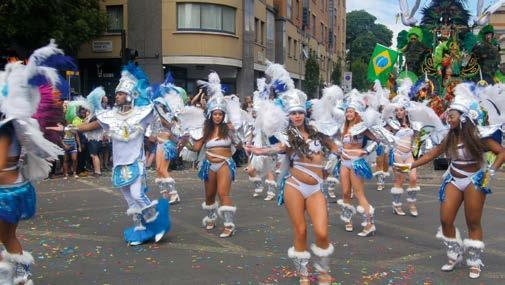
1 A were you doing B do you do C did you do
2 A went B was going C didn’t go
3 A was enjoying B enjoyed C didn’t enjoy
4 A did happen B happened C was happening
5 A didn’t find B were finding C found
6 A was appearing B were appearing C appeared
7 A wore B was wearing C were wearing
8 A were dancing B danced C was dancing
9 A hadn’t B didn’t have C weren’t having
10 A was B were C wasn’t
11 A didn’t see B saw C wasn’t seeing
5 Think about a festival or a special day. Write five sentences about what happened and what the people were doing / wearing. Name of festival / special day:
Describing people
1 Match the questions (1-8) to the answers (a-h).
1 What is your best friend like?
2 Do you like doing the same things?
3 What kind of music does your friend like?
4 How often do you see you best friend?
5 Where do you go together?
6 Does your best friend look like you?
7 What kind of clothes does your friend like to wear?
8 Do you go to the same school?
a Yes, we’ve both got long dark hair and blue eyes.
b We often go out for a walk or for something to eat.
c Usually just jeans and T-shirts.
d Every day.
e She’s very funny, kind and hard-working.
f Not really – I love sport but she hates it!
g Yes, we do, but we’re not in the same class.
h All kinds, actually.
Writing an email
Including all the points Tip reminder
4 Put these expressions in the correct column.
What about …? • Hello • but • See you soon Take care • so • How about…? • Hi there because • Can you…? • Could you…? And Love • why don’t we…? • Hi
Describing a person
Tip reminder See SB p. 39
2 Complete the sentences with these linking words and phrases in the box. and • because • but • for example • so • that’s why
For example
1 Ayman is a good student. , he studies every night and he also helps other students.
2 Maguette is a bit shy, she doesn’t go out much.
3 Daniella isn’t a good friend she said horrible things about me to Rosa.
4 I usually wear colourful clothes, today I decided to wear black.
5 Michelle spends a lot of time playing basketball, and she’s a really good player.
6 I spend time with Oscar at the weekends we chat online during the week.
3 WRITING Choose a classmate, a friend or a member of your family and describe him/her.
5 PRELIMINARY Writing an email Look at the Tip reminder and this email from your Englishspeaking friend, Paul and the notes you have made. Write your answer in about 100 words.
From: Paul Subject: My best friend
Hi!
We’re doing a project at school about friendship and our teacher asked us to write about somebody who is important to us. I want to include stories about friends in other countries, too. That is why I’m writing to you! (1) What do you think about my idea?
(2) Can you tell me what your best friend is like? Is he or she funny or friendly for example?
I’m also interested in what your friend likes doing – (3) does he or she have any special interests or hobbies?
And finally – (4) what kind of clothes does your friend like wearing? Thanks so much for helping me with my project!
Take care
Paul
Say what you think describe your best friend say what your friend likes wearing say what interests he or she has
3 Tastes great!
Grammar reference
will
Affirmative
I / You / He / She / It / We / They will play.
Negative
I / You / He / She / It / We / They won’t play.
Questions
Will Yes, I / you / he / she / it / we / they play?
Short answers
Positive Yes, I / you / he / she / it / we / they will
Negative No, I / you / he / she / it / we / they won’t.
Si usa il futuro con will per
• decisioni che si prendono al momento dell’enunciato
I’m hungry. I’ll make a sandwich.
• fare previsioni sul futuro
In the future, people won’t go to school, they’ll learn online.
• fare promesse
We’ll help you with your homework.
• parlare di fatti certi
You’ll be 17 in June.
• offrirsi o rifiutarsi di fare qualcosa
Don’t worry, I’ll do the washing-up. Stop asking! I won’t tell you our secret.
• formulare ordini
You will send the report by Friday.
• fare richieste
Will you help me with this form, please?
• fissare appuntamenti in contesti formali
I will meet you at 3 p.m. in the office.
Il futuro con will ha un’unica forma per tutte le persone.
La forma affermativa e la forma negativa si formano con will / won’t + forma base del verbo. It’ll be a great party! I won’t go to the concert.
La forma interrogativa si forma anteponendo will al soggetto + la forma base del verbo. Will you play at 5 p.m. on Saturday?
Le risposte brevi si formano solo con l’ausiliare will / won’t
No, I won’t. I’ll play at 7 p.m.
Quando si intende fare previsioni, è molto comune che will venga usato con i verbi di opinione come think, hope, be sure, believe, doubt, suppose, ecc. I’m sure they will come to the party. I doubt he will finish on time.
La forma negativa si costruisce ponendo sempre in forma negativa il verbo principale e in forma affermativa will I don’t believe granny will like the etnic food.
Countable nouns
I countable nouns sono sostantivi numerabili che possono, quindi, essere contati e presentano la forma sia al singolare che al plurale.
I bought a new book yesterday. For the recipe, we need five apples
Nella forma al singolare, sono preceduti da a / an o one. one cup a bottle an egg
Nella forma al plurale, sono preceduti da some, any o un numero.
some pens any cats three cars
Alcuni nomi hanno una forma irregolare per il plurale, come child > children, person > people, foot > feet
In base al numero del sostantivo di cui si parla, il verbo andrà al singolare o al plurale.
Uncountable nouns
Gli uncountable nouns sono sostantivi non numerabili e, quindi, non possono essere contati. Essi presentano solo la forma al singolare. information advice news history salt
Il verbo che accompagna gli uncountable nouns è sempre al singolare.
The information is wrong.
The cheese tastes delicious.
Non sono MAI accompagnati da un articolo indeterminativo, né da un numerale, ma possono essere accompagnati dall’articolo determinativo the. Music makes me happy.
The information we received was very useful.
Pur non avendo una forma plurale, quando si vuole indicare un quantitativo indefinito, si usano i quantificatori some e any, lasciando sempre il verbo al singolare.
She bought some sugar for the cake. Is there any juice in the fridge?
Quantifiers
Some è usato sia con gli uncountable nouns che con il plurale dei countable nouns. Indica una quantità indefinita e si utilizza per • frasi affermative
I need some butter for the cake.
I’ve got some sweets in the bag.
• richieste
Could I have some water, please?
Can I take some books?
• offerte
Would you like some money for the shopping? Would you like some colours for your paint?
Anche any è usato sia con gli uncountable nouns che con il plurale dei countable nouns. Si utilizza per
• frasi negative
There isn’t any information about this.
There aren’t any T-shirts left. Let’s try another shop.
• domande
Have you got any homework for tomorrow?
Are there any supermarkets in this area?
A lot of / lots of sono usati sia con gli uncountable nouns che con il plurale dei countable nouns Indicano una grande quantità indefinita. Your uncle drinks a lot of tea. There are lots of tomatos in the bowl.
A little è usato con gli uncountable nouns, mentre con il plurale dei countable nouns si usa a few Indicano una piccola quantità indefinita ed entrambi si utilizzano in frasi affermative.
I usually put a little milk in the coffee. There are a few biscuits in the tin.
Much è usato con gli uncountable nouns, mentre many è usato con il plurale dei countable nouns. Indicano una grande quantità indefinita e si utilizzano per
• frasi negative
There isn’t much time – we have to hurry! There weren’t many people at the shop.
• domande
How much cheese do you want?
How many rooms are there in you house?
countable uncountable affirmative sentences some
any
much
many
(sometimes) a lot/lots of
(a) few
(a) little
negative sentences questions some
(sometimes) any
much
many
a lot/lots of
(a) few
(a) little
Food
butter I put butter on my toast.
carbohydrates Pasta and potatoes both contain carbohydrates.
cheese Sue had a cheese sandwich for lunch.
chillies There are too many chillies in this dish – it’s very spicy!
dairy We eat a lot of dairy products, like cheese, in our family.
eggs I had two boiled eggs for breakfast. fish I love fish and chips!
flour You use flour to make cakes. fruit Fruit is very good for you.
garlic Italians use a lot of garlic in food.
grapes My sister took grapes to my mum when she was in hospital.
lemons You can use lemons to make real lemonade. meat I don’t eat a lot of meat.
milk Most people put milk in their tea.
mushrooms My mum made a mushroom omelette.
onions My grandmother makes delicious onion soup. I love onions!
oranges My dad eats two oranges every day!
pasta We often have pasta for dinner.
peppers Peppers can be red, green, yellow or orange. potatoes I eat potatoes every day.
rice In some countries, people eat rice with every meal.
sugar There’s a lot of sugar in these biscuits.
tomatoes You can use tomatoes to make a great pasta sauce.
vegetables You should eat vegetables every day.
Cooking and measurements
add Add the almonds to the butter.
bake Bake in the oven for 25 minutes. centimetre There are 100 centimetres in a metre. cut Cut the cake into pieces.
degrees Pre-heat the oven to 180 degrees Celsius.
gram There are 1,000 grams in 1 kilogram. kilo / kilogram You need 1 kilo of sugar for this recipe.
metre He can run 100 metres very fast.
mix Mix the ingredients together.
oven The oven was very hot. roll out Roll out the biscuit dough.
Collocations and expressions
prepare food (p50) take pictures (p50) save money (p50) eating habits (p50) shopping list (p51) share photos (p51) order food online (p51) make coffee (p53) birthday cake (p53) make lunch (p53) a glass of water (p53) cook in a pan (p54) mix together in a bowl (p57) chop hebrs (p57) pre-heat the oven (p58) cut into pieces (p58) add the flour (p58) bake in the oven (p58) mix together with a spoon (p58) roll out the dough (p58) look forward to (p60)
1 Read the text and decide if the sentences are true (T) or false (F).
At The Meadows Farm in the Lake District, technology is helping farmers grow food more efficiently. They use special machines to plant the seeds and to water the crops automatically. These machines also check the weather and they decide when is the best time to plant. The farm has special sensors that tell the farmers if the plants need more water or nutrients. Now The Meadows Farm produces a lot of food and the farmers save a lot of time!
Tip reminder
Rading for details
Exam task
2 PRELIMINARY Multiple choice with one text
Read the text and choose the correct option.
1 The article is mainly about…
A growing plants with lights.
B saving water.
C a new way of growing food.
D the history of farming in different countries.
2 What problem do traditional farms have?
A The farms are too small.
B They can only sell one type of fruit and vegetable.
C It can be difficult to find farm workers.
D They use too many machines and robots.
3 On vertical farms, where do the plants grow?
A A on shelves in big fields.
B B in special buildings.
C C in hot places.
D D in underground tunnels.
1 The Meadows Farm is a traditional farm.
2 The farmers water the crops by hand.
3 The machines can tell the farmers if it will rain.
4 The farmers spend more time now at the farm
4 Why do farmers look at photos of the plants?
A to check when to change the lights
B to check how healthy the plants are
C to check that the plants always receive water
D to send pictures to customers online
5 The article concludes that in the future people will…
A think more about nature.
B stop eating meat.
C only eat food from vertical farms.
D grow their own food at home.
3 Find words in the text which match the following definitions.
1 the number of people who live in a place population
2 not difficult
3 to cultivate
4 pieces of open land for growing crops
5 people who buy goods or services
6 the answer to a problem
The Future of Farms
Scientists believe that the number of people in the world – the population – will be about 10 billion by 2050. That’s a lot of people! How will we have enough food for everyone to eat? There are some big problems with farms today. Traditional farms need a lot of land and use a lot of water, and this means many problems for nature. Plus, farmers can only grow food when it is the right time of the year, and they often grow just one kind of fruit or vegetable. And then it is not always easy to find farm workers to pick it when it is ready. People know that the way we grow food – and what we eat – needs to change. But how will this happen?
One idea is vertical farming. Instead of growing fruit and vegetables in large fields that need good weather and use a lot of water, scientists are making farms inside buildings. These farms grow fruit and
vegetables on many shelves. Farmers put special lights near the plants. The lights aren’t very hot, they don’t need much electricity and farmers don’t need to change them very often. The plants also receive water, but they only get the water that they need, when they need it. This is because cameras take photos of the plants. The photos go into computers that tell the farmers how well the plants are growing and how much light and water they need. All this means that farmers can grow more food in a short time and in good and bad weather.
Customers are going to become much more careful about the food that they buy in the future. People will probably eat less meat and they will want to choose food that is good for nature. Perhaps vertical farming will be the solution.
Food
1 Choose the correct option to complete the sentences.
1 I usually put a little rice / lemon / butter on my bread.
2 Do you like pizza with lots of grapes / milk / cheese?
3 Oranges / Onions / Peppers are my favourite fruit.
4 Fish / Pasta / Garlic with a tomato and mushroom sauce is a healthy carbohydrate for dinner.
5 I don’t like chillies / eggs / bananas because they are spicy.
6 Miranda doesn’t eat salad / meat / potatoes She’s a vegetarian.
2 Write a word from exercise 1 next to each photo.





3 Write food words for the definitions.
1 This can be brown or white and we use it to make an omelette. egg
2 We use the juice of this yellow fruit with water and sugar to make a drink. It’s really good when the weather is hot.
3 This vegetable has a strong taste. We add pieces of it when we cook food so it tastes good.
4 This vegetable can be green, red or yellow. We sometimes put it on a pizza.
5 This vegetable is brown or white and the top is round. Only some types are safe to eat.
6 This vegetable is red and we use it for many things. We can eat it fresh in a salad, or we can cook it and make a sauce.
7 These are small round fruits and they can be green, red or purple. People eat them fresh and make juice or wine from them.
8 This is a round vegetable with layers. It usually has a red, white or brown skin and a strong smell.
4 Complete the coversations with the correct words.
1 A Are you OK? Why are you crying?
B Don’t worry. I’m just cutting these
2 A Is it OK if I put in the tomato sauce?
B Yes, I love spicy food!
3 A I always have a piece of at the end of a meal.
B Me too. I love apples and bananas.
4 A What did you have in your sandwich?
B ˆOh, just some lettuce, tomato and a slice of - it was delicious!
5 A Here’s your tea.
B Thank you. Oh, you put in it –I like it black. Are you sure this is for me?
6 A How many do we need to make the omelette?
B Five. We also need some or oil. Have we got any?
7 A What’s that in the bowl?
B Oh, it’s some I boiled some to go with the curry.
8 A What was the best thing you ate when you were in England?
B and chips of course!!
3
will
Grammar / Listening
1 Read the dialogue. Underline the sentences which match the definitions (1-4).
Henry Oh no, I forgot 3my science homework again. Miss Ryder will be so angry…
Elle Don’t worry, I’ll talk to her with you.
Henry Really? Thanks. I’ll do it tonight and hand it in tomorrow.
Elle Good idea. Oh! Don’t forget we have a group project too. Are you free this weekend?
Henry Let me check… Okay, I’ll come over on Saturday afternoon.
Elle Great! I think we’ll finish it quickly if we start early.
Henry Yeah, and I hope we’ll get a good mark this time.
Elle So do I! Just don’t forget to bring it to school!
1 to make decisions at the moment of speaking
2 to make offers
3 to make promises
4 to make predictions (x 3)
2 Put the words in the correct order to make sentences.
1 never / Liu / forget / the day / she / 10 / in English / got / will Liu will never forget the day she got 10 in English!
2 your book / to bring / forget / I / you / won’t
3 be / the beach / go to / I / will / too windy / it / think / to
4 help / I’ll / with / you / homework / maths / your / like / if / you
5 her / phone / Fatma / let / I’ll / the train / and / is late / know
6 dinner / microwave / your / the / in / leave / we’ll
3 Complete the sentences with will or won’t and one of the verbs in the box.
do • get • give • go • happen help • rain • sleep
will go
1 I think I to that new market that sells organic food on Saturday.
2 A This physics homework is impossible.
B Ask Jill – she you!
3 I you a lift to the station if you like.
4 Sorry I’m late – I missed the bus. It again!
5 If you drink too much coffee you
6 Do you think it this evening?
Listening
1 Look at the Tip reminder. What do you need to find in the questions?
Tip reminder
Understanding what to listen for
See SB p. 54
2 Match the questions (1-5) with the answers (a-e).
1 What kind of cake will you make?
2 Do you want a snack?
3 When will she be back?
4 How long it will take to make the cake?
5 Where do you work?
a Soon, I think about 1 o’clock.
b I don’t know – there are so many recipes!
c About 30 minutes.
d Next to the restaurant where Harry works.
e Thanks, but I’m not very hungry.
Exam task
3 PRELIMINARY Multiple choice with one conversation Listen and choose the correct option.
You will hear Paloma talking to her friend Sebastian about cooking something together.
1 Paloma will make a cake with
A strawberries and bananas.
B chocolate and bananas.
C lemons and cream.
2 When are Paloma and Sebastian meeting?
A one o’clock
B quarter past one
C quarter to two
3 What will Paloma eat?
A snacks
B pizza
C sandwiches
4 Paloma asked Sebastian for help because
A he works in a restaurant.
B his mum has a cake shop.
C he makes cakes all the time.
5 How long does the cake need to cook?
A twenty minutes
B thirty-five minutes
C about one hour
Cooking and measurements
1 Match the verbs (1-5) with the correct definition (a-e).
1 mix
2 bake
3 add
4 pre-heat
5 roll out
a cook (bread or cakes) in the oven
b heat the oven before cooking
c make dough flat
d stir ingredients together
e put something more in
2 Complete the expressions with the verbs in the box.
add • bake • make • mix pre-heat • roll out
1 the oven
2 a hot snack
3 in the oven
4 the eggs to the flour
5 the ingredients together
6 the dough
3 Match the first part of the sentences (1-7) with the second part of the sentences (a-g).
A simple, tasty lemon biscuit recipe!
1 First, cut 115 grams of butter .
2 Then, put the butter with 200 grams of sugar in a bowl and .
3 Next, add 1 large egg and 3 tablespoons of lemon juice .
4 Add 245 grams of flour and ½ teaspoon of baking soda. Mix everything together .
5 Preheat
6 Roll the dough
7 Bake for ten minutes
a with a large spoon
b into small round balls
c in the oven
d mix them together
e into small pieces with a knife
f the oven to 175° C
g to the butter and sugar
Frame B / Vocabulary
4 Choose the correct words to complete the sentences.
1 My cake was terrible! I forgot to add / mix the eggs to the dough.
2 Preheat the oven to 200 grams / degrees celsius.
3 You can cook many things in an oven / a spoon, such as pizza, cakes and biscuits.
4 You need to use yoghurt / flour to make cake and biscuit dough.
5 Each biscuit is about 5 centimetres / kilometres round.
6 You need around 200 grams / kilos of cheese to make this delicious omelette.
5 Write L (length), W (weight) or T (temperature) next to the measurements.
1 180° C
2 30 centimetres
3 200 grams
4 5 kilometres
5 1 kilo
6 10 metres
6 Complete the conversation with the words in the box.
Add • cut • grams • make • Mix pre-heat • roll • spoon
Aya Lyn, can you show me how to (1) your chocolate biscuits? I want my family to try them.
Lyn Of course. They’re really easy. You’ll need 50 grams of butter, 50 grams of sugar, some flour, an orange and a little chocolate. Have you got everything?
Aya I think so. How much flour do I need?
Lyn 120 (2)
Aya OK. I’ve got everything we need.
Lyn Great. So, first you need to (3) oven to 190° C. Then juice the orange and I’ll cut the chocolate into pieces.
Aya Okay. What do I do now?
Lyn (4) the butter and sugar together with a (5)
Aya Like this?
Lyn Yes, perfect. Now (6) the flour, two spoonfuls of orange juice and the pieces of chocolate. (7) out the dough on a board and (8) out round shapes.
Aya OK – how do they look?
Lyn Great! Now let’s bake them in the oven!
Grammar
Countable and uncountable nouns
1 Write C (countable) or U (uncountable) next to the words.
1 rice
2 biscuit
3 grape
4 water
5 egg
6 cheese
7 chocolate
8 furniture
9 mushroom
10 fruit
2 Circle the odd one out.
1 news / maths / subjects
2 food / biscuit / dinner
11 cake 12 equipment
traffic 19 advice 20 chair
3 lesson / homework / test
4 sugar / water / apple
5 child / boy / girl
6 furniture / equipment / bike
Quantifiers
3 Choose the correct option.
1 How people are at the party?
A few B many C much
2 We might need cheese and biscuits.
A little B few C some
3 There isn’t coffee in the cupboard. I’ll go to the shop and buy some.
A any B some C many
4 Do you like milk in your tea?
A much B lots of C a few
5 We haven’t got time because the shops are closing soon.
A many B much C a little
6 There are bananas in the kitchen.
4 Correct the mistakes in the sentences.
1 Do you have any informations about cooking classes?
Milena Lots of those – I love them! U information some many
A a little B any C a few
7 How luggage are you taking with you?
A many B little C much
8 I like cheese on my pasta.
A much B a lot of C many
9 Is there yoghurt in the fridge?
A any B some C many
10 I’m going to cook rice for dinner.
A a few B any C some
2 I’m reading book about vertical farms. Do you know anything about them?
3 Dad, I need some money to buy some snack for school.
4 We haven’t got any foods for dinner. I’ll go and buy something.
5 Our kitchen is small, so there isn’t much furnitures.
6 Hank has dinner after he finishes his homeworks.
7 There were six child at the party, but only five chairs.
8 Maths and science are my two favourite subject.
5 SUM UP Complete the conversation with the words in the box. any • few • little • lot many much • some
Andrej What are we going to have for lunch? How about a pizza?
Milena Well, we’ve got (1) flour, but we haven’t got (2) cheese.
Andrej Well, I can go to the supermarket. What else do we need?
Milena Can you get a (3) onions?
Andrej OK. What about tomatoes for the sauce?
Milena Yes, of course. I like a (4) of sauce on my pizza.
Andrej Me too. What else? Ham?
Milena Yes, let’s have ham.
Andrej Great. How (5) ham do you want on it?
Milena Just a (6) . And what about some chillies?
Andrej How (7) do we need?

Ordering food in a restaurant
1 Complete the sentences. Then put the dialogue in the correct order.
Oracy and Writing
reminder
Using short forms, punctuation and greetings
Just
a some water for me, thanks.
b Yes, we’re ready. I’ll have the garlic prawns to , and the grilled chicken as a main.
c Perfect. Would you like to drink?
d I’ll the pumpkin soup and the spaghetti carbonara.
e I’ll have the tiramisu, please.
f Good evening! Are you ready to
g Yes, please. What of desserts do you have?
h And I’ll have a lemonade,
i Tiramisu, chocolate lava cake, fruit tart.
j And I’ll have the chocolate lava cake.
k Thank you! your meal!
l you like a dessert?
3 PRELIMINARY
From: Alex To: Yo
Subject: My Birthday Party
Hi there!
I’m having a party next Saturday and (1) I really hope you can come! It’s going to be at my house in the afternoon.
Accept the invitation
Suggestions, promises, invitations
2 WRITING Follow the prompts and write two short dialogues.
Friend A Greet your friend and ask if they’re free this weekend ?
Friend B Say you’re free and suggest doing something
Friend A React to the idea. Express an opinion.
Friend B Agree or disagree and give an opinion.
By the way, (2) do you think your parents could give you a lift here? Also, I was thinking it would be great if you could bring some food – (3) what kind of food do you think you could bring?
Let me know what you’d like to do at the party txoo –(4) maybe we can play some games or watch a movie?
No problem
Say what you can take 1
Friend A Greet your friend and invite him/her to a party.
Friend B Accept and react to the invitation.
Friend A Ask your friend to bring some food or drink.
Friend B Promise you’ll bring some snacks.
Writing an email Read this email from your English friend Alex and the notes you have made. Suggest
Write back soon!
Alex
Write your email to Alex using all the notes.
From: Yo To: Alex
Subject: My Birthday Party
4 Tech life
Grammar reference
be going to
Affirmative
I am going to play.
He / She / It is going to play.
You / We / They are going to play.
Negative
I am not going to play.
He / She / It isn’t going to play.
You / We / They aren’t going to play.
Questions
Am I going to play?
Is He / She / It going to play?
Are You / We / They going to play?
Short answers
Positive Yes, I am.
Yes, He / She / It is.
Yes, You / We / They are.
Negative No, I am not.
No, He / She / It isn’t.
No, You / We / They aren’t.
Si usa be going to per
• parlare di intenzioni e piani per il futuro
I’m going to visit my grandma on Sunday.
• fare previsioni sul futuro basate sul presente
Look at the time – we’re going to miss the train!
• esprimere un avvertimento in relazione al futuro imminente
Watch out! That glass is going to fall!
• esprimere ordini e rifiuti in modo enfatico
You’re going to finish your homework before you go out!
I’m not going to apologize for something I didn’t do!
La forma affermativa e la forma negativa si formano con (not) be + going to + forma base del verbo.
I’m going to visit the museum tomorrow. He isn’t going to take the bus – he prefers walking.
La forma interrogativa si forma anteponendo il verbo be al soggetto + going to + la forma base del verbo. Le wh- question words si antepongono al verbo be
Are you going to watch the film tonight?
When are you going to start the lesson?
Nelle risposte brevi si utilizza solo il verbo be. (Ricorda che le risposte brevi affermative non prevedono la forma contratta).
Yes, we are No, I’m not
Solitamente, be going to non si usa con i verbi go, come e leave, in quanto ridondante. Con i verbi di movimento si tende a utilizzare il Present continuous con valore futuro.
We’re going to the cinema tonight.
I’m leaving tomorrow morning.
Prepositions of time
Con le prepositions of time si specifica il momento in cui avviene l’azione.
Si utilizza at con
• orari at 7 o’clock
• momenti specifici della giornata at lunchtime
• festività at Christmas
• le seguenti espressioni at the weekend / at night / at the moment
• i pasti at breakfast / at dinner
• l’età at (the age of) 15
Si utilizza in con
• mesi, anni, stagioni, decenni, secoli in May / in 2015 / in winter / in the 90s / in the 19th century
• un arco temporale in 10 minutes
• le seguenti espressioni in the morning / in the afternoon / in the evening
• - i periodi storici in the Middle Ages
Si utilizza on con
• giorni della settimana on Monday / on Saturday night
• date on 10th November
• giorni specifici o particolari on Christmas day
Present simple for future
Il Present simple può essere utilizzato anche per parlare di azioni future quando si tratta di eventi certi o già programmati. Il Present simple con valore di futuro si utilizza per
• orari fissi
The train leaves at 7 a.m.
• orari programmati Dinner is at 8 p.m. tomorrow.
• orari o eventi ufficiali The conference begins next week.
• nelle temporali introdotte da congiunzioni temporali come when, after, before, while, as soon as, until Before you go to bed, brush your teeth.
Technology
AI (Artificial Intelligence) AI helps me practise my English.
app I use an app to learn English. blog She writes a blog about travel. call Can you call Tina? She wants to see you. chat I use an app to chat with my friends. digital camera My brother has a new digital camera because he likes taking photos. download Can you download last night’s movie for me?
email Don’t forget to send me an email. file I’ve got lots of files on my computer. the Internet It’s very easy to find things on the Internet.
laptop My new laptop is quite light and I can carry it in my bag.
mobile phone Susi’s mobile phone is really old, but it works OK.
online I usually go online several times a day. pages On this page you can find all the information. password I forgot my password and I couldn’t get onto the website.
printer Don’t use too much paper when you use the printer.
screen My computer has a large screen, so I can read text easily.
social media Teenagers spend a lot of time checking social media every day.
tablet I use a tablet when I read books online. text I’ll text you when I get there. the web The web is another word we use to talk about the internet.
Adjectives to describe technology
boring The talk was very boring. different I don’t think your new phone is different from your old one. difficult The homework was really difficult. easy My mum’s new phone is very easy to use.
Il Present simple for future si forma esattamente come il Present simple utilizzato per il presente. Nel caso del futuro, però, le espressioni che lo accompagnano sono tomorrow, this morning / afternoon / evening, tonight, next week / month / year, when, ecc.
excellent This is an excellent computer game – I love it!
interesting Our technology lessons are really interesting.
modern Dean’s laptop isn’t very modern – it’s about five years old.
normal I think it’s normal to check your social media a lot.
old My phone is very old – I bought it years ago. the same Are these two computers the same?
terrible The exhibition was terrible – it really wasn’t very good.
unusual This computer game is very unusual –it isn’t like any others.
The media
advertisement I saw an advertisement for a new phone.
advice column He wrote to the advice column for help.
celebrity That celebrity is very famous. headline I read the headline of the news story. interview The man gave a short interview on TV. viewer This show has many viewers.
presenter The presenter is talking on the radio. the news I watch the news every day.
Collocations and expressions
download a file (p64) text a friend (p64) send an email (p64) enter a password (p64) go online (p64) call a friend (p64) bright light (p64) personal information (p64) be careful (p64) meet friends (p65) go shopping (p65)
go for a ride (p65) keep in touch (p67) take a photo (p67) visit friends / relatives (p68) digital detox (p69) have a blog (p69) go to a party (p71) science fair (p72) spoon (p58) roll out the dough (p58) look forward to (p60)
Frame A
1 Match the words (1-5) with the definitions (a-e).
1 podcast
2 editing software
3 nterview
4 post-production
5 episode
a the work done after recording to improve the sound or video.
b the single part of a podcast or TV series.
c a digital audio show you can listen to online.
d a conversation where questions are asked and answered.
e a computer programme used to edit content.
2 INVALSI PRELIMINARY Multiple choice Read the text and choose the correct option.
Our New Podcast
Next week, our English teacher is going to launch a new project — a podcast produced entirely by students! It sounds exciting, and although we’re not really sure what to expect, we still think it will be an amazing experience!
We are going to work in teams and focus on different parts of the production. Some of us are going to plan topics and write scripts, while others are going to learn how to use microphones and editing software. I will probably be on the post-production team. We are going to choose the best parts of each recording and put them together. It definitely won’t be easy, but I think it will be a lot of fun and a chance to learn something new.
1 What does the writer say about how the podcast will start?
A It won’t be fun at first.
B Some students may be unsure in the beginning.
C Everyone is confident.
D Teachers will do most of the work.
2 What will the writer’s team do in the project?
A Interview football players.
B Record audio in the studio.
C Choose and edit parts of the podcast.
D Help teachers organise the podcast.
3 Why do students expect the football coach interview to be interesting?
A It will be about his personal experiences.
B It might include useful advice for athletes.
C The teacher will ask him difficult questions.
D It will be the longest episode in the series.
4 What does the writer hope will happen?
A That it will become popular outside the school.
B That students will keep it private.
C That the show will be shared on social media.
D That teachers will promote it in class.
Something I’m really excited about is that we are planning to record interviews with teachers and students. People are going to share some really interesting stories. For example, one of my friends is going to interview a football coach about how his players stay confident and manage pressure. We think that episode will be really useful and will connect with a lot of students.
The podcast will come out every two weeks. If everything goes well, it may even attract listeners from outside the school, which would be really cool! We don’t know exactly how it will go yet, but one thing’s for sure — it is going to be a project we’ll never forget!
5 What is the writer’s overall opinion of the project?
A It’s going to be a memorable and enjoyable experience.
B It won’t be very useful for school.
C It may be a bit boring at times.
D It will be better with professional help.
3 Complete the sentences with the words in the box.
editing • episode • interviews recording • topics
1 We’re going to discuss different like music, sport, and school life.
2 Students will do with teachers and classmates.
3 My job will be helping with after we finish recording.
4 I think the most exciting will be the one when the football coach is interviewed.
5 We’ll redo the if the sound quality isn’t good enough.
Technology
1 Choose the correct option.
1 My eyes hurt from looking at a screen / printer all day.
2 Can I use your digital camera / mobile phone to make a call?
3 You need to put paper in the laptop / printer before you can use it.
4 I can’t check my email because I forgot I don’t have password / file
5 I do my work the internet / a tablet so I can work anywhere I like.
6 I prefer laptops / screens to ordinary computers because they’re smaller.
7 I’ve got a lot of big video screens / files on my computer.
8 Can you send / call me tomorrow morning?
9 I always go online / the web at weekends.
10 I entered / downloaded the film last night. We can watch it together.
2 Complete the sentences with the words in the box. change • chat • check download • send • text
1 How often do you with friends online?
2 I need to my password. It’s too easy to guess.
3 I a lot of messages to my friends at the weekends.
4 It takes a long time to big files.
5 Can you me when you get home?
6 I my email every morning after breakfast.
3 Complete the sentences with the correct words for technology or compound nouns.
1 I taught my granny how to a file from the internet.
2 Lisa still sends , but I prefer messaging.
3 Which media are you on?
4 I used to use my mobile phone to take photos, but now I have a great , and the photos are much better.
5 The yellow light means that your has almost no ink.
6 Can you your email and see if my message arrived?
7 I sometimes change my because I want to stay safe online.
8 I always files to my teacher by email when I finish my homework.
Tip reminder Exam task
Compound nouns
4 INVALSI PRELIMINARY Multiple-choice cloze Look at the Exam reminder. Then read the text and for each question, choose the correct option.
Passwords are important for keeping our information safe. We have to (1) a password to use our email and other things on computers. We sometimes need one to use our (2) phones when we want to (3) a friend. We use passwords when we use social (4) . But there is a problem with having a lot of passwords. People get tired of using them because they (5) online many times a day. So, they want something easy to remember. Can you believe that a lot of people choose 1234567 for their password? Many services ask people to make strong passwords and use letters, numbers and special characters like @, & or *. They might be more difficult to remember, but it’s the best way to stay safe (6)
5 WRITING Write five or six sentences about how you use technology every day. Use at least three of the words or expressions in the box. go online • download • laptop social media • chat • file • password phone • send emails enter
I usually go online in the evening. I check my social media and chat with my friends. I often download music to my phone, and I sometimes send emails to my English teacher.
Grammar / Listening
be going to
1 Complete the sentences with the correct form of be going to and the verbs.
’m going to do
1 I (do) the shopping this evening.
2 Ann (make) dinner.
3 The pizza in that restaurant was terrible. We (not eat) there again.
4 (you / clean) the kitchen soon?
5 Rani (not help) us prepare for the party. She’s busy.
6 (he / try) a new recipe?
2 Choose the correct option.
1 I do the shopping tomorrow. Can you come with me?
A ’m going B won’t C ’m going to
2 I think I buy these lemons. They look quite nice.
A ’m going to B ’ll C ’m going
3 That pasta looks delicious. I’m sure everyone love it!
A ’re going to B ’re going C will
4 It’s really hot here in the kitchen. I open a window.
A ’m going to B ’ll C ’m going
5 Ebru just called. He and Yasmin make a cake for Esra’s birthday.
A are going to B ’s going to C will
6 In the future, I believe our food healthier.
A are going to be B will C will be
be going to vs
will
3 SUM UP Complete the conversations with be going to or will.
1 A I don’t understand this sentence.
B Don’t worry, I help you.
Listening
Tip reminder
Choosing the correct picture
See SB p. 66
1 Look at the Exam reminder. When you look at the pictures before you listen, what do you need to think about?
2 Look at the pictures in exercise 3 and answer the questions. 1 What can you see?
can you see?
’m going to a printer ’ll
2 A I left my maths book at your house yesterday.
B Yes. I saw it. I go out in twenty minutes. I can bring it to you.
3 A I’m going to be late for basketball practice.
B OK, I tell the coach.
4 A I forgot to bring money for lunch.
B I lend you some.
5 A It’s granny’s birthday on Sunday and I don’t know what to get her.
B I do. I give her a sun hat.
Exam task
3 PRELIMINARY Multiple choice with pictures Listen and choose the correct option.
1 What is the man having a problem with?
2 What time does the film start?
3 What did the boy buy online?
4 What are Rakesh and his friend doing this afternoon?
Frame B / Vocabulary
Adjectives to describe technology
1 Complete the sentences with the words in the box.
easy • interesting • normal old • terrible • the same
1 This computer is very . My dad bought it years ago and it’s quite slow!
2 Most mobile phones are to use. You just turn them on and you can call friends or go online.
3 My computer class is so . Now I like computers more than I did before.
4 This camera is ! The photos are really dark.
5 That isn’t a different tablet. That’s one!
6 When you turn on a computer, it’s to wait a few seconds before it starts.
2 Complete the blog post with the words in the box. blog • careful • computers • difficult downloads • internet • laptop • mobile phone modern • normal • old • video
My aunt Gabriella is 82 years old and she used to say that she wasn’t interested in learning how to use (1) . “I’m too (2) for these (3) things,” she used to say. Computers are too (4) for me to understand. Then I moved to this country to study. She didn’t have a (5) and, for a while, she called me on her (6) phone, but it was very expensive. However, a month ago, her son, my cousin Ricky, gave her a (7) , and so she discovered the (8) . Now we see each other on a (9) call once a week and she tells me all about the results of her research – on everything! News, the place where I live, the place where she lives, history (two weeks ago she found a (10) that talks about her father) – she even (11) music now! I had to tell her to be (12) !
3 Choose the correct option to complete the text.
The first computer was called ENIAC, and a group of scientists built it in the 1940s. It was much larger than the (1) computers of today. The machine was (2) because it filled a very large room. In fact, a (3) two-bedroom home in the UK is half the size of this room. Can you imagine having a computer that’s bigger than your house? It’s really (4) ! How did this computer work? It was not (5) to use and several people used it at the same time. Also, it didn’t have a screen or a printer. It put holes in paper cards, and people had to read the cards to get information. That sounds (6) , doesn’t it?
1 A old B modern C interesting
2 A excellent B unusual C boring
3 A different B normal C terrible
4 A old B careful C difficult
5 A easy B modern C excellent
6 A excellent B normal C terrible
4 Choose the correct option.
1 The TV introduced the weather forecast after the sports report.
A celebrity B presenter C viewer
2 My mum always reads the in the magazine to see what the writer says about relationships.
A advertisement B headline C advice column
3 We saw a funny for a new phone during the break.
A interview B advertisement C viewer
4 After the match, the footballer gave an about the team’s performance.
A episode B interview C advice column
5 A famous came to our school and signed autographs.
A presenter B viewer C celebrity
6 I watch every morning to find out what’s happening in the world.
A the news B a headline C a presenter
7 The main in the newspaper today is about flooding in Tuscany.
A advertisement B advice C headline column
8 As a regular YouTube , I always leave comments on the videos I like.
A viewer B celebrity C presenter
5 Complete the table with the words in the box. Some can go in more than one category.
a presenter • the news • a viewer an interview • a headline • an advertisement a celebrity • an advice column • journalist people things you read things you listen to or watch a presenter
6 SUM UP Write sentences using adjectives to describe these things.
your mobile phone
Grammar
Present simple and Present continuous for future
1 Look at Fatima’s diary and read sentences (1-6). Three of these sentences are incorrect. Find and correct the mistakes.
APRIL
Monday 8th Email Trisha
Tuesday 9th Study for computer exam
Wednesday 10th Write blog
Thursday 11th Meet Isha
Friday 12th Have dinner at Zehra’s house
Saturday 13th Visit Yusuf and Elif
Sunday 14th Go cycling with Berat
1 Fatima is emailing Trisha on Monday.
2 She isn’t writing her blog on Wednesday.
3 Berat and Fatima are going cycling on Sunday.
4 Isha and Fatima aren’t meeting on Saturday.
5 Fatima is going swimming on Tuesday.
6 Fatima and Zehra aren’t having dinner together on Friday.
2 Use the prompts to write questions for each answer. Use the Present continuous form.
4 Complete the sentences using the correct form of the verbs in the box. Use the Present simple or the Present continuous.
arrive • come • finish • go • go back not use • start • travel • visit
1 When (you) to school after the summer?
2 Jim to see us tomorrow. He by coach and the coach at Lime Street at 7.15.
3 What time (the match) tomorrow?
4 The art exhibition on the 30th September. I next week.
5 I can pick you up if you like. My mum the car so I can have it.
6 We the Uffizi when we go to Florence next week. I bought the tickets online this morning.
5 Find and correct the mistakes in each sentence.
1 We always go skiing in Monday.
do you go back on
2 The shop closes on midnight.
3 I usually do my homework on the evening.
4 They first met at 2016.
5 My sister’s birthday is in 4th May.
6 People often eat too much chocolate in Easter.
1 A ?
(Katerina / meet / Andrea / tomorrow evening)
B No, she isn’t.
2 A ? (you / study / for the maths test)
B On Monday.
3 A ? (people / go / to Carolina’s party)
B About twenty.
4 A ?
(you / do / after school today)
B I’m going to the 3D cinema with Sara.
3 Complete the sentences using the correct form of the Present simple for the future.
Is Katerina meeting Andrea tomorrow evening leaves
1 The plane (leave) at 6.45 tomorrow morning.
2 Our English class (start) at 10 a.m.
3 This film is so boring – what time (it finish)?
4 When (you go) back to school?
5 The library (not close) until 7 p.m. on weekdays.
6 (the bus, stop) here on Sundays?
6 SUM UP Choose the correct option to complete the sentences.
1 ‘What will you have / do you have to eat?’ ‘Oh, er… I think I ’ll have / ’m going to have a baked potato and salad.’
2 ‘Where are you going / do you go this summer?’ ‘Mmm, not sure yet. I think we ’ll probably go / ’re probably going to Greece again.’
3 ‘These documents are for Beth.’ ‘OK, I ’ll give / ’m giving them to her. I ’ll see / ’m seeing her later today’
4 The school assembly starts / is starting at 9.00. Let’s get going!
5 You look really tired. Sit down and I ’ll make / ’m going to make you a cup of tea!
6 ‘There’s no fruit left’ ‘I know, I ’ll buy / ’m going to buy some now.’
7 Do you think we ’ll see / ’re seeing Axel before he’s leaving / leaves for Australia?
8 ‘Somebody’s at the door and I’m cooking dinner!’ ‘It’s OK, I go / ’ll go!
Oracy and Writing lab
Talking about technology
1 Answer the questions.
1 What are different ways you use technology in your daily life? I use technology to ...
2 How is your life today different from your parents’ lives when they were teenagers? My life is different because ... My parents didn’t have ... but I ...
3 Do you think technology makes life better or worse? Why? In my opinion, it makes life ... because ...
4 Do people your age spend too much time on screens? Why / Why not? I think we ... because ...
Making plans
2 Read the poster and the email. Then choose the correct option.
ShelbyTech Museum
Grand Opening
On Saturday 22nd May, from 12 p.m. to 8 p.m. Come and help us celebrate our opening! Free entrance
Presentation
The History of Computers by Museum Head Peter Langley
• Free food and drinks
• Interactive displays For more information, visit www. shelbytechmuseum.com
From: Bethany
To: John
Dear John
Do you want to go to the new Tech Museum’s Grand Opening on Saturday? It sounds interesting and you love computers. It’s on 141 Easton road in shelby city centre from twelve p.m. to 8 p.m. It takes twenty minutes to get there from your home. Write back soon!
Bethany
1 You can find out where the museum is from the poster / email.
2 You can find out what event is taking place at the opening from the poster / email
3 You can find out about other events from the poster / by emailing the museum
3 For each question write the correct word. Write one word for each gap.
Next week, we (1) starting a new media club at school, which aims to (2) students hands-on experience with digital storytelling. We (3) learn how to produce podcasts and short-form video content.
A local expert (4) coming to our school to give a talk and tell us how to set up our own mini studio. I think it (5) be a really valuable experience for everyone!
Our first episode is (6) Thursday afternoon. Some students (7) deal with the technical aspects of recording, while others, myself included, with the editing (8) the post-production work. Needless to say, I am (9) forward to this opportunity with great excitement!
Exam task
4 PRELIMINARY Writing an email Read this email from your friend Emma and the notes you have made. Write your email to Emma using all the notes. Write about 100 words.
Hi, Thanks for inviting me to the Technology Workshop next Saturday – I’m really looking forward to it! What time are you going to the workshop, and how are you getting there?
What kind of activities can we try at the event?
Have you got any ideas for what we can do after the workshop finishes?
See you soon!
Ella
5 Complete the Reflection checklist.
Reflection checklist
Me too!
Share your travel plans
Mention an activity
Suggest something fun to do after
Tick ( ) the sentences that you think are true. I said how and when I’m going. I described an activity at the workshop. I suggested something to do afterwards. I used time expressions and future forms.
5 Time off
Grammar reference
Zero conditional
If clause Main clause
Present simple
Present simple
If you mix blue and yellow, you get green.
Si usa lo Zero conditional per parlare di fatti o azioni le cui conseguenze generalmente sono sempre uguali, certe e vere.
If you heat ice, it melts.
Lo Zero conditional prevede l’uso di due verbi al Present simple
When it rains, the street gets wet.
Lo Zero conditional si forma con una if (o when) clause, che esprime l’ipotesi o il fatto di partenza, e una main clause, che esprime il risultato.
L’ordine delle due frasi è indifferente; tuttavia, si utilizza sempre una virgola quando la if clause è posta per prima. If / When you ride a motorbike, you need a helmet. You need a helmet if / when you ride a motorbike.
First conditional
If clause
Main clause
Present simple will
If I study hard, I will pass the exam.
Si usa il First conditional per parlare di fatti o azioni che hanno una certa probabilità di accadere a una determinata condizione.
If you take music lessons, you’ll learn to read music.
Si forma con il verbo al Present simple nella if clause e il futuro con will / won’t nella main clause. La if clause non richiede MAI il verbo al futuro.
If you don’t finish your dinner, you’ll be hungry. If it rains, we won’t go to the park.
Nel First conditional la if clause esprime la condizione necessaria per far sì che ciò che viene espresso nella main clause accada.
Nel First conditional è possibile sostituire if con when quando si è certi che ciò che viene espresso sta per accadere.
When he goes to London, he will visit Buckingham Palace.
Anche qui, l’ordine delle due frasi è indifferente, ma va utilizzata la virgola quando la if clause è posta per prima.
Verb patterns: -ing, to + infinitive
Si usa to + infinitive per
• esprimere uno scopo o intenzione
I’ve bought some food to cook for dinner.
• esprimere volontà, desiderio o scelta
I want you to listen carefully.
to + infinitive viene utilizzato SEMPRE
• dopo gli aggettivi
It’s important to study for your future.
• nelle frasi con enough e too
He’s too young to understand this film.
She isn’t tall enough to play basketball.
• dopo alcuni verbi come agree, forget, help, invite, need, offer, promise, remember, etc.
I forgot to lock the door this morning.
Si usa la -ing form per
• esprimere esperienze e azioni già compiute
I enjoy reading in the evening.
• sostantivare verbi che fungano da soggetto
Swimming is a great way to stay fit.
La -ing form viene utilizzata SEMPRE
• dopo le preposizioni
Thanks for understanding
• dopo verbi che esprimono abitudine
She kept on studying all weekend for the test.
• dopo verbi di opinione
I don’t mind helping you with your homework.
• dopo alcuni verbi come avoid, deny, risk, miss, finish, stop, etc.
He just finished cleaning the kitchen.
La -ing form e to + infinitive possono essere usati indistintamente con i verbi start, begin, continue, like, love, hate, prefer senza che avvenga un cambio di significato.
They hate waking up early.
They hate to wake up early.
Con in verbi remember, forget, stop, try, go on, regret, mean possono essere utilizzate entrambe le forme, ma comportando un cambio di significato.
-ing form to + infinitive
remember Ricordare di aver fatto qualcosa. Ricordarsi di fare qualcosa.
forget Dimenticare di aver fatto qualcosa. Dimenticarsi di fare qualcosa.
stop Smettere di fare qualcosa. Fermarsi per fare qualcos’altro.
try Provare a fare qualcosa per sperimentare.
Cercare di fare qualcosa con impegno.
regret Pentirsi di aver fatto qualcosa. Dispiacersi per dover fare qualcosa.
mean Implicare, voler dire. Avere l’intenzione di.
• esprimere un avvertimento in relazione al futuro imminente
• esprimere ordini e rifiuti in modo enfatico
I remember locking the door. Remember to lock the door.
Being late means losing points.
I didn’t mean to hurt you.
Free-time activities
art My brother enjoys painting because he loves art. board games We always play board games when we visit my grandparents.
camping We go camping every summer. chess I play chess with my grandad.
collect My brother collects old movie posters – he has a huge collection now!
collection My collection of vinyl records keeps growing every year.
create She loves to create short videos and post them online.
cycling My brother loves cycling – he’s got two bikes. dancing They go dancing every weekend. doing robotics My brother is really good at doing robotics.
drawing cartoons I love drawing cartoons. drawing Sue loves drawing outside.
enjoy I really enjoy spending my free time outdoors. free-time In my free time, I like to read comics or go for a walk.
hobby I have lots of different hobbies. join I decided to join a photography club to meet new people.
making jewellery My sister enjoys making jewellery. making models Lots of people love making models as a hobby.
making videos My friends and I enjoy making videos on our phones.
music She listens to music every evening after school. painting I’m not very good at painting. photography I really enjoy doing photography – I have a great new camera. play We usually play board games together on Saturday evenings.
playing computer games (also called video games) I love playing computer games. practice He practices the guitar for at least one hour every day.
science Tom goes to a science club in his free time. singing Dave has started singing lessons at school. sketchbook I always carry my sketchbook when I go out; you never know when inspiration strikes. spending time outside I like spending time outside with my friends in the park.
sport Doing sport after school helps me relax.
Music
CD I’ve got a collection of old CDs. classical My parents love listening to classical music. concert We went to a great concert last night. Dance I love to dance at parties.
disco My aunt loves disco music.
drum My brother plays the drums in a band. guitar I’m learning to play the guitar. headphones I always wear my headphones on the bus so I can listen to podcasts. hip hop I love hip hop – it sounds amazing. instrument Learning a musical instrument takes patience and dedication.
keyboard It’s easy to move a keyboard, so lots of people learn to play it.
listen to We listen to podcasts when we travel by car. MP3 player I use an MP3 player to listen to music when I’m running.
opera I can’t stand opera!
orchestra Our school orchestra is preparing for a big performance next month.
piano I can play the piano.
play She can play the piano and listen to music for hours.
pop Do you like listening to pop music?
radio My mum listens to the radio when she’s working.
Vinyl My dad listens to music on vinyl.
violin My cousin plays the violin really well.
Singer Taylor Swift is my favourite singer.
Songs I like singing songs at the karaoke.
Entertainment and media
actor The actor gave an incredible performance on stage last night.
competition Our class won the singing competition. Download I like to download music to listen offline.
exhibition Our art class has an exhibition of paintings in the school hall.
fan She’s a huge fan of science fiction movies. noise There was so much noise at the concert that I could barely hear my own voice.
performance The school band gave an amazing performance at the festival.
prize He won a prize for the best short film at the youth festival.
show We saw the show three times.
stage He loves going on stage.
Stream I usually stream movies on the weekend. youth club We meet every Friday at the youth club to plan weekend activities.
Using prepositions
in your free time I love dancing in my free time. be a fan of My grandma is a fan of opera. be interested in Ken is interested in photography. be involved in Jen is involved in the theatre club. be crazy about Dina is crazy about chess. at the weekend We often go out at the weekend. be into sport Sunita is really into sport.
be keen on Jean is keen on singing.
Collocations and expressions
collect stamps / cards (p78)
play an instrument (p78) gold medal (p79) radio station (p79) online video (p79) make models (p79)
sheet of paper (p80) make videos (p82) enter a competition (p83) join a club (p83) draw cartoons (p83) fix a problem (p84)
Frame A
1 Match the words (1-5) with their meanings (a-e).
1 competition
2 magazine
3 b winner
4 draw
5 prize
a something you get if you win
b the person who comes first
c a group of judges decide who is the best d to make a picture with a pencil or pen e a printed book or paper with articles and photos
Tip reminder
Looking for phrases with the same meaning
Exam task
2 INVALSI PRELIMINARY Multiple choice Read the text and choose the correct option.
1 What inspired Susanna’s picture?
A A photo in a magazine.
B The night sky and stars.
C A documentary about space.
D A competition theme.
2 Why does Susanna say her picture was difficult to draw?
A It was her first ever drawing.
B The instructions were not easy to follow.
C It took her a long time to draw.
D She had very little time to do the drawing.
3 How does Susanna think her friends will react when they see the magazine?
A They will be surprised by her win.
B They will ask her to draw them a picture.
C They will say it’s not her best work.
D They will want to enter the same contest.
4 What does Ari usually like drawing?
A People in different costumes.
B Wild animals.
C Buildings and cities.
D Planets and rockets.
I entered a drawing competition a few weeks ago and guess what? I won! The judges loved my work – a picture of the moon. If you look at the night sky, you often see stars and the moon. That’s why I like drawing space. It was really difficult to get the picture right because I spent a long time on it but I think if you work hard on something, the result is usually good. My picture is going to be in a magazine. If I show it to my friends, they’ll be surprised!
Ari
5 Why did Ari feel pleased about his result?
A He got his picture in a magazine.
B His brother helped him win.
C He came third and won some money.
D He was the only person who drew a dinosaur.
6 What is Ari planning to do next year?
A Visit a dinosaur museum.
B Enter the same competition again.
C Draw a new picture of a castle.
D Stop drawing.
7 What was the best prize in Nikos’s competition?
A A painting set.
B A trip to a castle.
C Publication in an art magazine.
D £60 in cash.
8 What does Nikos believe about working hard on something?
A You don’t always win, but you learn.
B If you work hard, you will get results.
C It is important only if the prize is big.
D You can always enter again.
Nikos
My brother Isaac saw a drawing competition in a magazine and he told me about it. We both draw a lot in our free time – Isaac’s into space stuff like rockets but I prefer to draw animals like tigers, lions and elephants. If I see a new animal in a book, I usually try to draw it. For this competition, I decided to draw a dinosaur. I got third place – I won £30, so I felt really happy! The winner’s drawing of a castle was amazing. Anyway, I’m going to take a short break from drawing now because I’ve got some important exams at school but if I enter the drawing competition again next year, I’ll try to draw an even better picture!
There’s an amazing castle in our town, and I chose to draw it for a local art competition. Every year the prizes include an art book for third place and £60 for second. If you win first place, they print your picture in their magazine so I was really excited. I really hoped to win the money to be honest but when I heard I won first prize, I felt so pleased! If you put your heart into something, it shows in your work. It was great to see my castle picture in such a cool magazine.

Susanna
Free-time activities
1 Match the descriptions with the free-time activities in the box. painting • camping • singing • cycling • drawing
1 We do this outside, and we sleep in tents under the stars.
2 For this, we use pencils to make pictures on a piece of paper.
3 To do this, we ride on something that’s got two wheels, and we often go really fast.
4 To do this, we make sounds using our voices.
5 We use lots of colours for this, and we make forests and mountains, a person’s face or a beautiful building.
2 Complete the dialogue with the words in the box.
chess • dance • music • photography
Angie Look at this. The community centre has some really great summer courses for young people. They’re all free. Look at their website.
Lucy Oh, that’s cool! I didn’t know that. Let me see. Oh, wow – there’s a course called ‘How to take great pictures’. I’ve always wanted to learn more about (1) . My dream is to work for National Geographic.
Angie And look at all the (2) classes: guitar, drums, saxophone … I’ll join the guitar one.
Lucy And what about this? I don’t like going to the gym – it’s so boring, but they do salsa classes! I really want to do that – I love (3) .
Angie Can you believe it? There’s a programme on board games too! I’ve always wanted to learn how to play one of the difficult ones, like (4) .
Lucy Oh, yes – that is difficult to play well. Why don’t we join it together?
3 VISIBLE THINKING Complete the map with the activities in the box. Some of these activities belong to more than one category.
board games • camping • chess • cycling • dance • drawing • music painting • photography • singing
Grammar / Listening
Zero conditional
1 Use the prompts to write sentences with the Zero conditional.
1 if / it / rain / at weekends / we / often / play / board games If it rains at weekends, we often play board games.
2 when / Jenny / go / camping / she / usually / take / her MP3 player
3 if / Jeff / go / to a museum / he / always / visit / all the exhibitions
4 Karl / always / lose / when / he / play / chess with Dan
5 Kyle / not go / cycling / when / the weather / be / bad
6 I / always / feel / sad / if / I / listen / to that song
First conditional
2 Complete the sentences with the First conditional form of the verbs in brackets.
1 If you (buy) the puzzle, I (help) you do it.
2 If Aunt Jamila (visit) us this weekend, we (play) cards together.
3 I (buy) a new board game if Dad (give) me the money for it.
4 If Amadou and Aminata (not get) here soon, we (leave) without them.
5 Jaime (save) us a seat at the theatre if we (ask) him to.
6 If they (not clean) this pool, I (not swim) here again.
7 I (make) you some sandwiches if you (be) hungry.
8 Sheetal’s mother (be) worried if she (not call) soon.
3 Choose the correct option to complete the sentences.
4 I will come / come to school by bike unless it won’t rain / rains.
5 If I don’t feel / won’t feel better tomorrow, I won’t go / don’t go to volleyball practice.
6 If I will work / work at the computer too much without taking breaks, I get / will get backache by the end of the day.
Listening
Preparing to listen Tip reminder
1 Complete the sentences with the expressions in the box.
although • and • as well as • because but • luckily • unfortunately
buy 10 and
1 Didier always gets / will always get a banging headache if he sits / will sit in the sun for too long.
2 Will you do / Do you do the Preliminary course if there will be / are enough students signing up before the end of the month?
3 You will feel / feel sick if you eat / will eat all that chocolate cake in one go!
1 Sam enjoys painting he’d like to try pottery next term.
2 He plays padel on Saturdays. , he doesn’t have to wake up very early.
3 He finds IT and maths hard physics is the most difficult subject for him.
4 He does around two and a half hours of homework each evening. , he sometimes works longer on presentations.
5 he wasn’t sure about joining a drama club at first, it’s his favourite part of the week now.
6 padel he also plays tennis and volleyball.
7 Sam has a piano exam in June. he doesn’t have much time to practise during the week.
8 The workload is heavier this year he started studying for his GCSE exams in September.
Exam task
2 PRELIMINARY Open cloze You will hear a student, Jenny, talking about her school week and free time. For each question, fill in the missing information. Write one or two words, a number, a date or a time.
My
week
Jenny is in Year (1)
The subject she finds most difficult is (2)
The after-school club is on (3) . She usually spends (4) hours every evening on her homework. The football match starts at (5) a.m. on Saturdays. Her next piano exam is on (6)
Frame B / Vocabulary
Music
1 Complete the table with the words in the box. Some words can go in more than one category.
classical • concert • dance • drums • guitar hip hop • keyboard • opera • piano • pop singers • violin
Live performance Music genres People & instruments
2 Complete the sentences with the words in the box.
classical • hop • MP3 • opera piano • pop • radio
1 My parents took me to the . I didn’t want to go, but, actually, I liked the story.
2 Can you turn on the ? The news is on in five minutes.
3 On long car journeys, we always play songs and we all sing together loudly.
4 My dad doesn’t like music by people like Mozart. He prefers hip .
5 Do you listen to music on your player or on your phone?
6 I’m learning to play the .
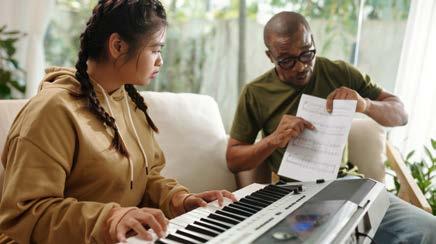
Expressing likes and dislikes
3 Choose the correct option.
1 Are you interested at / to / in writing songs? There’s a school club for it.
2 I’m not a big fan to / at / of that band.
3 Everybody’s crazy about / in / for him, but I don’t like his films.
4 Which sport clubs are you involved at / to / in right now?
5 Paulo’s really for / into / in skateboarding. He goes skateboarding almost every day.
6 Are you keen at / in / on disco music?
4 PRELIMINARY Multiple-choice cloze Read the text and choose the correct option.
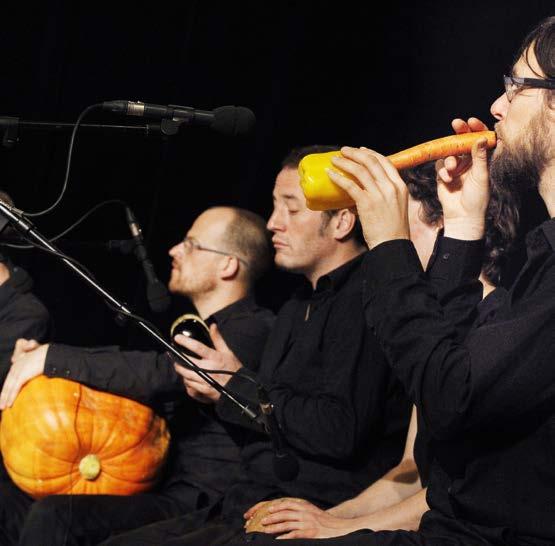
The Vegetable Orchestra
A group of musicians in Austria do some interesting things in their free (1) . They play vegetables! Their band uses carrots, peppers, onions and even garlic to make many (2) of instruments. The band started with four members, and now there are ten. They have played in about three hundred (3) over the past twenty years. The band spends two hours (4) new instruments for every show. They use almost fifty kilograms of vegetables every time, and each vegetable (5) different when they play it. What do the band members do when they finish with the vegetables? They often (6) them in water and make a soup!
1 A hour B time C moment D space 2 A varieties B models C types D sorts
Grammar
Verb patterns: -ing, to + infinitive
1 Choose the correct option to complete the sentences.
1 We practise to throw / throwing the ball before every match.
2 I can’t imagine to live / living in a big city.
3 He avoided to answer / answering the teacher’s question.
4 We need to buy / buying a new digital board for the classroom.
5 They promised to help / helping us with the science project.
6 I hope to visit / visiting Morocco next year.
7 Do you want to join / joining the new robotics club?
8 She hates to get up / getting up early on Sundays.
2 Complete the sentences with the -ing form or the to + infinitive form of the verbs in brackets.
1 I can’t imagine (draw) a picture of my whole village.
2 I promised (go) running with Itzel tomorrow, but it’s going to rain a lot.
3 Ayoob really enjoys (make) models of aeroplanes.
4 Camilla decided (work) as a nurse.
5 Ricardo hopes (start) his guitar lessons next week.
6 Lisa avoids (listen) to opera music.
3 Complete the sentences with the correct form of the verbs in the box. draw • enter • finish • go • join make • play • win
1 I need three paintings for the school exhibition. It’s next week.
2 My friend Intan suggested the theatre club on Monday afternoons.
3 It’s difficult chess really well.
4 Hande agreed cycling with Lorenzo on Saturday morning.
5 Branca’s team was pleased the basketball match.
6 Liu really enjoys cartoons.
7 Rosaura started practising this song a year ago so now she’s ready the singing competition.
8 Lara likes videos on her phone.
4 Use the prompts to write answers.
1 A Where are you going?
B I / go / to the park / meet / my friends I’m going to the park to meet my friends.
2 A Have you got any plans for this evening?
B I / promise / look after / my baby sister
3 A I’m going to stay at home all day and study.
B Really? I / not / can / imagine / do / that.
4 A Do you want to play basketball with us?
B it / be / too hot / do / sport
5 A Does your brother go to the same gym as you?
B No, he / not / be / old enough / join.
Exam task
5 PRELIMINARY Open cloze For each question, write the correct answer. Write one word for each gap.
Hi Oscar
How are things? Are you enjoying your robotics club?
I don’t (1) to basketball any more. Maybe I’m just too old (2) start now. I’d like (3) do photography instead. I love (4) photos of all sorts of things. I hope to (5) a lot of new things about cameras, black and white photos and things like that. Don’t forget to (6) me photos of the concert.
Stephen
6 Choose the correct option.
1 I really enjoy books in the evening.
A to read B reading C read
2 This exercise is too hard without help.
A doing B do C to do
3 She’s old enough a car now.
A drive B to drive C driving
4 They agreed us with the project.
A help B helping C to help
5 He isn’t tall enough the shelf.
A to reach B reaching C reach
6 I’m not interested in to that concert.
A go B going C to go
7 It was too cold outside last night.
A going B go C to go drawing go to finish reading
Oracy and Writing lab
Talking about free-time activities
1 Match the sentences (1-5) with the extra information (a-e).
1 My favourite hobby is playing the guitar.
2 I mostly play pop and rock songs.
3 I’m going to perform in a school concert next Friday.
4 I joined a music club in my town last term.
5 I love going there because I’ve made some great friends.
a We meet every Saturday morning at the community centre.
b I started playing when I was about ten.
c I like the energy of fast, modern music.
d I’m a bit nervous, but I’m practising a lot.
e We sometimes go out together after school.
2 Look at the statement in the diagram. Think about extra information that you can add to the statement. Use the ideas in the circles.
4 WRITING
Write two short dialogues between friends who are planning something fun to do at the weekend. Follow the example to help you. Use the ideas in the box for help.
play football • go shopping play video games • have a picnic go swimming • bake a cake
You Hey! Do you want to go to the cinema on Saturday? There’s a new action film!
Friend Sounds great! What time shall we meet? You Maybe at 5? We could get a pizza after the film!
Expressing opinions
Writing an
Exam task
5 PRELIMINARY
Writing an email Read this email from your English-speaking friend, Jeff and the notes you have made. Write your email to Alex using all the notes. Write about 100 words.
Hi!
How are you? Did you enjoy the school concert last week?
I’ve just joined a new film club at school – we watch and review different movies each week.
I know you love watching films too. Do you prefer comedies or action films?
3 WRITING Choose three activities you enjoy and write full sentences about them. Add more information (e.g. where, when, who with, why, and how you feel).
listening to music • running • cooking • playing computer games reading • drawing watching films playing sport • travelling • taking photos
I play basketball at the sports centre every weekend with my friends because it helps me relax.
I want to organise a fun evening this weekend – maybe we could watch a film or do something else. What do you think?
My cousin is coming too and it’s his birthday. I’m trying to choose a birthday present for him. Should I get him a book or a game? What’s your opinion?
Write soon!
Jeff
Say whether you prefer comedies or action films, and why Suggest a fun activity for the weekend
Give your opinion about the birthday present –a book or a game
MY FAVOURITE HOBBY
Grammar reference 6 Action!
Modals of obligation and necessity
have to e must
Si usa have to o must + forma base del verbo per esprimere obblighi, doveri, necessità e ordini.
We have to be at school at 8 o’clock a.m.
You must buy a present for your sister.
Solitamente, nell’inglese parlato e informale si utilizza have to nelle frasi interrogative
Do I have to wear a uniform at this school?
must invece si usa solo quando si vuole dare enfasi alla domanda.
Must I finish the project in two days?
Nella forma affermativa, must e have to hanno significati molto simili, ma c’è una leggera sfumatura riguardo all’intenzione. Si utilizza
• must quando l’obbligo è imposto da chi parla
You must finish your homework tonight.
• have to quando l’obbligo è stato imposto da qualcun altro rispetto a chi parla
Mom said I have to finish my homework tonight.
Nelle frasi affermative non si usa mai la forma contrata di have to
They have to get up early tomorrow. L’unica eccezione può avvenire con l’espressione have to go, a causa della sua alta frequenza d’uso. It’s really late - I’ve to go!
mustn’t
Si usa mustn’t + forma base del verbo per esprimere divieti e proibizioni.
Players mustn’t run with the ball. Visitors mustn’t enter this room.
don’t have to e needn’t
Si utilizzano don’t have to o needn’t + forma base del verbo per esprimere qualcosa che non è necessario o d’obbligo, ma è comunque permesso. She doesn’t have to take the test today – she can take it tomorrow.
You needn’t buy a tennis racket – you can have mine.
Nella forma negativa, la differenza di significato tra don’t have to e mustn’t è, quindi, molto più netta. Mentre don’t have to si utilizza quando c’è assenza di necessità, mustn’t si utilizza quando c’è divieto o proibizione.
You don’t have to get up early tomorrow – it’s Saturday.
You mustn’t use your phone during the exam.
can, could and may can
Si usa can + forma base del verbo per
• parlare di abilità nel presente e nel futuro
Rob can already read, and he’s only four.
• richieste
Can I have a coffee, please?
• per chiedere e dare il permesso
‘Can I leave class early today?’ ‘Yes, you can.’ could
Si usa could + forma base del verbo per
• parlare di abilità nel passato
Tom could ride a bike when he was six.
• richieste più formali
Could you lend me your dictionary, please?
• chiedere il permesso
Could I leave class early today?
Per rispondere alle richieste di permesso NON si usa could, ma may / can.
Yes, you may/can No, you can’t
may
Si usa may + forma base del verbo per
• richieste formali con I e we
May I come in?
• per chiedere e dare il permesso in modo formale
May I leave the class early today?
È possibile trovare la forma negativa o interrogativa negativa con may not
• in contesti scritti ufficiali
You may not enter the room without permission.
• in situazioni molto formali
May I not attend the meeting if I have another class at the same time?
I verbi can, could e may possono essere utilizzati al posto di will nel first conditional
If it rains, we may stay at home.
If you study, you can pass the test.
If she finishes early, she could join us.
should / shouldn’t
Si usa should + forma base del verbo per
• dare consigli
You shouldn’t ride without a helmet.
• per chiedere consigli
Should runners eat a big meal before a race? No, they shouldn’t
Sport
badminton Badminton is a very fast sport.
baseball They play a lot of baseball in the USA.
basketball Basketball players are often very tall.
climbing Climbing is a great way to build strength and balance.
cycling We go cycling every weekend.
cyclist That cyclist is very fast on the mountain road. cricket People often wear white when they play cricket.
exercise Doing regular exercise helps you stay healthy. fishing David often goes fishing in the river.
football We all play football at school.
gym We go to the gym twice a week to keep fit.
golf My dad plays golf.
individual sport Tennis can be both a team and an individual sport.
marathon Running a marathon requires a lot of training and energy.
play I play football with my friends every weekend.
race She won the 100-metre race at school yesterday.
rugby My brother plays rugby at school.
runner Doing regular exercise helps you stay healthy.
running I go running every morning.
sailing We sometimes go sailing on holiday. skateboarder The skateboarder did an amazing trick in the park.
skiing We went skiing in January.
snowboarding I tried snowboarding last winter.
surfing My brother goes surfing at the beach. swimming I love swimming in the sea.
table tennis We play table tennis at the youth club. team sport Volleyball is a team sport that needs good cooperation.
tennis I watched the tennis match on TV.
volleyball We played volleyball on the beach. zumba My mum does Zumba every Friday to stay in shape.
Sports equipment
ball Lots of sports use a ball. bat You use a bat when you play cricket.
bike You need a bike to go cycling.
club You need more than one club to play golf. football boots My football boots are too small, I need to buy a new pair.
racket You use a racket to play tennis. scooter A scooter is faster than a bike.
snowboard I have a new snowboard this year. swimsuit My mum bought a new swimsuit. Songs I like singing songs at the karaoke.
Sports people
coach Our football coach is really good. fan I’m a big fan of baseball.
member My mum is a member of the tennis club.
player There are eleven players in a football team. team Two teams play against each other in rugby. winner The winner got a gold medal.
Ordinal numbers
first, second, third, twenty-first, twenty-second, twenty-third, thirty-first, thirty-second, thirty-third
Parts of the body
arm My mum put her arm around me. back I lay on my back on the bed. ear You hear with your ears. eye You see with your eyes. face Everybody’s face is different. finger There are five fingers on one hand. foot / feet You put shoes on your feet. hand Your hands are at the end of your arms. leg Spiders have got eight legs.
neck Giraffes have got very long necks. nose We all have one nose. stomach I ate too much and now my stomach hurts.
Health problems
ambulance Please call the ambulance – it’s an emergency. break I broke my leg when I was skiing. cold I can’t go swimming today, I’ve got a bad cold. cut I cut my hand with a knife.
doctor You should see a doctor if the pain doesn’t stop.
feel I feel sick because I ate too much. go to I’m going to the doctor’s today because I don’t feel well.
headache I have a really bad headache. hospital He went to the hospital after breaking his arm.
hurt How did you hurt yourself?
ill He felt ill after eating too much chocolate. medicine I took some medicine for my cold. stomach ache I couldn’t finish my lunch because I had a bad stomach ache.
temperature The nurse said he has a high temperature.
Collocations and expressions
go for a run (p90) go to a sports event (p90)
sports equipment (p90) football pitch (p90) get/keef fit (p91)
swimming club (p92) do sport indoor / outdoor (p92) fun run (p93) climbers club (p94)
have a stomach ache / a cold / a temperature (p96)
team sport (p98) break your arm (p98) feel tired / sick / ill (p98) go to hospital / the doctor’s (p98) hurt yourself (p98) be in pain (p101)
1 Match the first sentences (1-3) to the second ones (a-c) with complete the idea. Use the reference words (that, they’re, it) to help you.
1 If you’re not sure you’ll use the gym regularly, think carefully before joining.
2 Make sure you check out the staff at the gym.
3 Many gyms offer short-term deals for new members.
Tip reminder
Identifying reference words
CHOOSING A GYM
See SB p. 90
a That way, you can decide if you like the gym before paying for a full year.
b They’re the ones who give advice and help you stay motivated.
c It might be a waste of money if you don’t go very often.
The first thing you must do when choosing a gym is find out how much it costs to join. Some gyms ask for a joining fee in addition to a monthly membership. Think carefully before you sign up – will you really go often enough to make it worth the money? (1) You have to be realistic so you don’t waste time or money. Many gyms offer a free trial so you can try it out before joining. Some also offer short-term deals for new members. You don’t need to pay for a full year immediately (2) This is useful if you are ill, injured, or go on holiday and can’t use the gym for a while.
Next, find out how many people use the gym regularly. (3) You mustn’t assume that bigger is better. A gym with fewer members who actually go
Exam task
2 PRELIMINARY Gapped text Five sentences have been removed from the text. For each question, choose the correct answer. There are three extra sentences which you do not need to use.
A It is essential that the location of your gym is convenient.
B Some clubs have 5000 members but if only 500 are ‘active’, it might not be a very good gym.
C However, it is best is to check out a few different gyms in your area.
D You need to check out the gym at busy times.
E It’s the instructors and trainers that make a gym, not the luxury facilities.
F Gym memberships can vary in cost depending on what type of plan you choose.
can be better than a large gym where most people never turn up.
Make sure to check the equipment, too. Most gyms have lots of machines, but that doesn’t always mean they are easy to use or available when you want them. (4) That way, you’ll know what it’s really like when it’s full.Finally, talk to the staff. You must feel comfortable asking for help. Are they trained to support people and give good advice? (5) It’s not just the building or machines that matter — it’s the people who work there that make the difference.
G Some gyms also offer flexible membership options.
H If not, forget it – it will be a waste of money.
3 Read the sentences and decide if they are true (T) or false (F). Correct the false ones.
1 All gyms charge a joining fee.
2 Some gyms let you try a session for free before joining.
3 The number of total members is more important than the number of active members.
4 It’s not so important to look at the equipment before joining.
Sport; sport equipment
1 Cross out the equipment that we do NOT use for these sports.
1 badminton ball racket club
2 snowboarding snowboard bike ball
3 volleyball bat ball racket
4 rugby ball snowboard bat
5 cricket bat club racket
6 golf bike racket club
2 Complete the table with the words in the box.
basketball • baseball • cycling • football • golf rugby • sailing • skiing • snowboarding surfing • swimming • volleyball go play
3 Complete the sentences with the words in the box.
course • court • doubles • field • match pitch • relay • singles • track • water
1 Swimming, surfing and sailing are sports.
2 A match is a tennis match with two players.
3 A match is a tennis match with four players.
4 You play baseball and cricket on a
5 You play basketball and tennis on a
6 You can take part in a in swimming and running.
7 You play golf on a
8 You play football and rugby on a
9 You play a football or rugby , but a baseball game.
10 You can run on the road or on a
Sport people
4 Choose the correct option to complete the sentences.
1 I really like my football fan / player / coach a lot. She helps us to be a good team.
2 Laila’s an excellent football player and she’s got a lot of members / winners / fans who really love her.
3 How many players / fans / winners are there on a cricket team?
4 Do you prefer individual or member / fan / team sports?
5 Are you a player / member / winner of any sports clubs?
6 Amy was the member / player / winner of last year’s swimming competition.
5 Complete the text with words for sport, sports equipment and sports people.
There are no sports centres where I live, so last year my friends Samira, Jim and I decided to form a (1) club. You can do it on the road, so you don’t need a (2) to train on. Also, you don’t need a lot of (3) –only a pair of good trainers. Jim’s aunt knows a lot about running, so we asked her to be our (4) and she said yes.
At first, it was just the four of us. We trained every day before going to school, and we became good enough to enter competitions. Samira (5) the silver medal in the first one we did, and the local newspaper wrote about her. Also, people saw us training in the park and asked to join us. Now we have more than twenty (6) , and a local shop offered to support us and bought us uniforms. We even have lots of (7) who follow us to every event! We had nothing and we created something with the support of our community –that’s real team work!
6 Read the sentences and decide if they are true (T) or false (F). Correct the false ones.
1 You play volleyball with a bat. You play volleyball with a ball, not a bat.
2 A golf match is played on a court with a racket.
3 Snowboarding and skiing are winter sports you can do on a slope.
4 A football pitch is where you play football and rugby.
5 Players always wear helmets to play basketball.
6 You go windsurfing in a pool.
7 You play baseball with a racket and a ball.
8 Coaches are the people who run a team and help players improve.
Grammar / Listening
Modals of obligation and necessity
1 Match the sentences (1-6) with the correct situations (a-f).
1 You mustn’t talk loudly.
2 You have to show your ticket.
3 You don’t have to wear formal clothes.
4 You must wash your hands before entering.
5 You needn’t bring any food – it’s included.
6 He doesn’t have to work at the weekend.
a You’re going to a music festival, and food is provided in the ticket price.
b You’re visiting a hospital, and there are strict hygiene rules.
c You’re in the school library.
d Your friend is self-employed and can take time off whenever he wants.
e You’re entering a museum and need to show you paid.
f You’re invited to a party, but it’s casual, so no special outfit is needed.
2 Choose the correct option to complete the sentences.
Welcome to East Oak Riding Club
• Everybody is welcome. If you volunteer to feed the horses or work at our café, you (1) have to / don’t have to pay for the lessons – it’s all free!
• You (2) don’t have to / must buy your own boots and helmet because we’ve got everything here.
• Before you get on the horse, you (3) must / don’t have to check that the riding equipment is on correctly.
• You (4) must / needn’t worry about checking the equipment alone. Someone will help you with it.
• You (5) mustn’t / have to stay on the horse paths. You (6) needn’t / mustn’t leave the paths because it isn’t safe.
• You (7) don’t have to / mustn’t give the horses any food.
• You (8) needn’t / must return your boots and helmet at the end of the lesson.
• Join us soon or click here for more information.
3
Complete the sentences.
don’t have • has • have • must • must mustn’t • needn’t
1 The last day to enter the competition is Saturday, so you do it before then.
2 The match starts at 6 p.m., so we be there before 5 p.m.
3 Mateo to train really hard if he wants to win.
4 We eat a big meal right before swimming.
5 It will be quite warm today, so you to bring your jacket.
6 Allie wear the right kind of boots when she goes hiking.
7 Do I to go to the baseball game? I hate baseball!
Listening
Tip reminder
Listening for numbers, dates and prices
See SB p. 94
1 Match the words to the correct definitions. lesson • course • fee • join • contact
1 a period of learning something
2 new
3 a time when you learn a new skill or subject
4 to phone or write to someone
5 to take part in an activity or group
6 the money you pay for a service or activity
Exam task
2 PRELIMINARY Gap fill Listen and write the correct answer in the gap. Write one word or a number or a date or a time.
You will hear a woman giving a presentation about hockey lessons.
Fall Creek Sports Centre: hockey lessons
First class: On the (1) of next month.
must course 16th
Number of players: Up to (2)
Age: Must be at least (3)
Fee: (4) £ for a five-week course.
Contact: Call (5)
Frame B / Vocabulary
Parts of the body / Health problems
1 Write the parts of the body in the correct order from the top of the body to bottom of the body. arms • eyes • feet • fingers • handslegs • neck 1 2 3 4 5 6
2 Match the words from the box to the correct category. Add one extra word to each category. arm • back • break • cold • cut • doctor • ear • eye • face • feel • finger • headache • hospital • hurt
ill
BODY PARTS
leg
nurse
stomach
stomach ache • temperature
HEALTH
PLACES/PEOPLE
3 Choose the correct option.
1 Mr da Silva, I don’t have / feel well. I think I need to go home.
2 Paul felt / broke his nose, so he had to go to hospital.
3 Lisa broke / cut her hand with a knife. She held a towel on it for a few minutes.
4 If we fall when we ride our bikes, we may hit / feel our heads, so we must wear helmets.
5 I think I take / have a temperature. My face feels very warm.
6 Those boxes are very heavy. I’ll help you, so you don’t hurt / cut your back.
4 Each of these people have got something wrong with them. Choose the correct option.
1 Denny ate something bad for dinner. Now he’s got . a cold b headache c stomach ache
2 If Donna can’t hear very well, she may have a problem with her a nose b ears c eyes
3 Vincente went out on his bike in the rain. Now he doesn’t feel well at all. He may have a . a cold b toothache c broken bone
4 Christina was sleeping on the sofa with her head up in a bad position. Now her hurts. a neck b eye c nose
5 Tom went on a 10 km fun run yesterday. Now it’s hard for him to walk! His are really tired. a hands b legs c arms
6 When Helga looks at her computer screen for hours, her hurt. a fingers b hands c eyes
5 Match the verbs (1-5) to the correct expressions (a-e). 1 break
get
cut
go to the 5 feel a her finger b his leg c doctor d ill e a headache
6 Complete the sentences with the correct expressions from exercise 5. Use the correct form of the verbs.
1 After working on the computer all morning, I , so I sat down for a few minutes.
2 When Emma was slicing vegetables, she accidentally and had to put a bandage on it.
3 Leo fell badly while he was skiing and .
4 If your sore throat gets worse, you should probably to get it checked.
5 I this morning so I didn’t go to school. b eyes arm feel headache got a headache
can, could and may; should / shouldn’t
1 Correct the mistakes in these sentences.
1 You can’t running in the school building.
2 I may use your snowboard this weekend?
3 We could have a rest? I’m really tired.
4 May I borrowing your football boots?
5 Could Jason coming over to play basketball?
6 Manuela and Maria-José can spend the night?
2 Write sentences with these words and the correct modal for the prompts in brackets. More than one answer is possible.
1 I / watch / the match on Sunday? (ask for permission, not formal) Can / Could I watch the match on Sunday?
2 I / borrow / your badminton racket? (ask for permission, formal)
3 they / practise / volleyball every day (give advice)
4 I / join / the chess club? (ask for advice)
5 you / go in / the pool today (say no to a request)
6 you / carry / my baseball bat for me? (make a request, not formal)
3 Write a question for these situations.
1 You want to borrow your friend’s bike helmet.
2 You need to leave football practice ten minutes early.
3 You want advice about buying new trainers.
4 You want your sister to help you with your maths homework.
4 Complete the conversations with should / shouldn’t and a proper verb.
1 A I want to learn how to play badminton.
4 A My eyes hurt from looking at the computer screen.
B You at the screen for a long time.
5 A I think we’re playing cricket tomorrow at 4 p.m., but I can’t remember.
B You Jim and ask – I’m sure he knows.
6 A I love this dress – I think I’ll buy it!
B I don’t think you it – it’s too expensive
5 Match the situations (1-6) with the most appropriate sentences (a-f).
1 Your classmate never takes notes and often forgets what the teacher said.
2 A tourist starts walking into a restricted staff area of a museum.
3 You’d like to stay after class to review something written on the board.
4 A friend wants to go to the beach even though the weather looks stormy.
5 A boy at school isn’t sure if he’s allowed to leave the classroom early.
6 Your younger cousin is playing video games all night and looks really tired at school.
a You should write down important things – It’ll help you remember.
b Could I stay a few more minutes to copy the diagram, please?
c You really shouldn’t go if the weather’s that bad – it’s dangerous.
d May I leave a little earlier today? I have an appointment.
e You should get more sleep – staying up that late isn’t healthy.
f I’m sorry, but visitors can’t go beyond that point.
6 Complete the sentences with may, can, could, should, or shouldn’t.
can
1 Hey Kevin, my battery’s dead I borrow your charger just for a moment before class starts?
2 You drink so much coffee late at night.
3 If you’re feeling unwell, you really stay at home.
4 Excuse me, we use our phones in this section of the library, or is it not allowed?
B You a badminton class.
should take / join
2 A Joaquin hurt his shoulder badly yesterday while he was playing rugby.
B You so much in the beginning. Just start slowly.
3 A Joaquin fell and hurt his foot.
B He to the hospital straight away!
5 To improve your diet, you eat more fresh vegetables.
6 Excuse me, Miss – I open the window? The room is hot and stuffy.
7 If you’re not sure about the assignment, you speak to your teacher.
8 you explain that again, Mr Walton? I didn’t quite catch the last part. a
Talking about sport
1 Complete the text with the words in the box. because • Finally • First of all • in my opinion • Secondly • since
In my opinion
(1) , sport plays a crucial role in young people’s lives.
(2) , it helps improve both physical health and mental well-being. (3) , team sports, especially, such as football or basketball encourage cooperation and communication. People often choose team sports because they enjoy working with others.
(4) , individual sports like swimming or running promote independence and motivation. Personally, I love swimming
(5) it makes me feel free. To sum up, I believe that, (6) sport has such a wide range of benefits, everyone, both young and old, should try at least one.
2 Match the two parts of the sentences.
1 I think football is challenging because
2 In my opinion boxing is risky because
3 I enjoy running alone because
4 I think swimming is relaxing because
5 I believe team sports are useful because
6 I enjoy skateboarding because
a you don’t depend on others.
b it’s a contact sport.
c you work closely with others.
d the water helps you feel calm.
e it requires skill, speed and strategy.
f it takes focus and balance.
Describing experiences
3 Match the adjectives (1-5) with the events (a-e).
1 incredible 2
a a very fast race
b meeting nice people at a tournament
c a last-minute goal
d losing a race because of injury
e winning tickets to a big match
4 Choose the correct option.
1 I arrived / was arriving early to get a good seat.
2 While the players were warming up / warmed up, the fans sang and cheered.
3 Suddenly, the goalkeeper jumped / was jumping and saved the ball from going into the net.
4 Everyone was shouting / shouted when the race finished.
5 I was feeling / felt really excited after the match.
Tip reminder
Exam task
5 PRELIMINARY Writing an article You see this notice in your school English-language magazine.
Articles Wanted! SPORT
Describe an exciting sports event you took part in. Describe the event and say when and where it took place.
Say what you enjoyed and didn’t enjoy about the event.
Write an article answering these questions and. Write about 100 words.
• What sport did you take part in? (sport – when – where)
• What happened during the event? Something exciting/unlucky/surprising:
• What did you enjoy most?
• Was there anything you didn’t enjoy?
Making
7 No place like home
Grammar reference
Present perfect
Affirmative
I / You / We / They have played
He / She / It has played
Negative
I / You / We / They have not played
He / She / It has not played
Questions
Have I / you / we / they played? Has he / she / it played?
Short answers
Positive Yes, I / you / we / they have Yes, he / she / it has
Negative No, I / you / we / they haven’t No, he / she / it hasn’t.
Si usa il Present perfect per parlare di
• azioni avvenute nel passato con effetti sul presente I’ve lost my key – I can’t open the door.
• azioni e situazioni iniziate nel passato e ancora in corso
They have worked here since 2021.
• azioni e situazioni avvenute in un passato non precisato
We’ve visited Rome – it’s a fantastic city.
• azioni avvenute in un periodo di tempo non ancora concluso
She has met Tim twice this week.
• esperienze
I have travelled by plane many times in my life.
La forma affermativa e la forma negativa del Present perfect si formano con have/has (not) + il participio passato del verbo principale.
I’ve studied for the test this weekend.
She hasn’t finished her book – she’s still writing it.
La forma interrogativa si forma anteponendo l’ausiliare have/has al soggetto, seguito dal participio passato del verbo principale.
Have you had breakfast this morning?
Nelle risposte brevi si utilizza solo l’ausiliare have/has (not).
Yes, I have. No, I haven’t.
been and gone
Il Present perfect del verbo be si forma con have/has (not) + been. Il Present perfect del verbo go, invece, si forma con have/has + gone. L’utilizzo di questi due verbi produce una differenza di significato. Si usa
• be per sottintendere che qualcuno è andato da qualche parte ed è tornato
Mum has been to the supermarket – she’s in the kitchen now.
• go per sottintendere che qualcuno è andato da qualche parte e non è ancora tornato
Mum has gone to the supermarket – if you need something, call her.
since and for
Si utilizzano since e for con il Present perfect per esprimere cose avvenute in un determinato momento nel passato o periodo di tempo e che sono ancora in corso. Si utilizza
• since per indicare il momento iniziale dell’azione o situazione
We have worked here since 2021.
• for per indicare il periodo di tempo o la durata dell’azione o situazione
She has lived in London for three years.
already, just, (not) yet, ever, never
Il Present perfect è spesso accompagnato da avverbi di tempo.
• already si utilizza nelle frasi affermative (e talvolta nelle frasi interrogative) per parlare di azioni o situazioni già accadute nel passato; si frappone tra l’ausiliare have e il verbo principale
We’ve already watched this film.
• just si utilizza nelle frasi affermative (e talvolta nelle frasi interrogative) per parlare di azioni o situazioni appena accadute o accadute molto di recente; si frappone tra l’ausiliare have e il verbo principale I have just woken up
• yet si utilizza nelle frasi negative e nelle frasi interrogative per parlare di qualcosa che non è ancora accaduto, ma che ci si aspetta accadrà; è posto a fine frase
I haven’t studied English yet – I’ll do it tomorrow.
Have you arrived at home yet?
• ever si utilizza nelle frasi interrogative (e talvolta nelle frasi affermative) per chiedere se qualcosa sia mai accaduto prima; si frappone tra il soggetto e il verbo principale
Have you ever eaten sushi?
• never si utilizza nelle frasi affermative con valore negativo per parlare di qualcosa che non è mai accaduto prima; si frappone tra l’ausiliare e il verbo principale e non va MAI utilizzato con la negazione not I have never studied German.
Possessives
Possessive ’s
Il genitivo sassone si usa
• quando si parla di appartenenza o possesso
This is Sarah’s car.
The teacher’s desk is near the window.
• per indicare parentela o appartenenza a gruppi di persone
James’s brothers are really friendly.
• per indicare quando qualcosa è destinato a una categoria specifica di persone
A children’s library is next to the park.
• in alcune espressioni geografiche
The island’s coastline is very long and beautiful.
• per alcune espressioni di tempo o distanza Yesterday’s meeting was very long.
They live an hour’s drive from the city.
Può avere due variazioni ortografiche. Si usa
• ’s dopo i nomi singolari e i nomi plurali irregolari
This is John’s bag.
The children’s school is very small.
• ’ dopo i nomi plurali regolari e i nomi che terminano in -s
Those houses’ gardens are wonderful
That’s Lucas’ book.
Il genitivo sassone non si usa MAI per
• esprimere una relazione tra cose
• esprimere una relazione tra persone e luoghi (si usa of) The students of the school are on a trip.
Possessive adjectives and possessive pronouns
Subject pronoun Possessive adjective Possessive pronoun I my mine you your yours he his his she her hers it its –we our ours you your yours they their theirs
I possessive adjectives si antepongono a un nome per indicare possesso o appartenenza e hanno lo scopo di evitare la ripetizione del soggetto.
This is Sarah’s phone. This is her phone.
I possessive pronouns si utilizzano in sostituzione di un nome per indicare possesso o appartenenza e hanno lo scopo di evitare la ripetizione del nome stesso. This is my book. This is mine.
Sia gli aggettivi che i pronomi possessivi
• rimangono sempre invariati per genere e numero
Our teacher, our school and our classmates are great. This book is mine, and those pencils are mine too.
• concordano sempre con il possessore
His teacher is very kind, and his classmates are nice. That big house is theirs, and the garden is theirs too.
• non sono mai preceduti da articoli
Your book is on my desk.
Ours is older than yours
Houses and parts of a house
apartment Their apartment has a big balcony. bathroom I have a bath in the bathroom.
bedroom I sleep in my bedroom.
bungalow They moved to a bungalow.
ceiling My mum painted stars on my ceiling!
cottage My grandparents have a lovely cottage.
dining room We don’t often eat in the dining room.
door Please close the door.
flat We live in a small flat in the centre of London.
floor Our flat is on the third floor.
garage My dad keeps our car in the garage.
garden My aunt has a beautiful garden.
hall Our house has a very small hall.
houseboat We spent our holiday on a houseboat.
kitchen We have breakfast in the kitchen.
lift There’s a lift in our building.
living room We watch TV in the living room.
modern Their new kitchen is very modern and bright.
old They live in an old house near the river.
roof Our house needs a new roof.
sitting room We watch TV together in the sitting room every evening.
stairs I climbed the stairs to my bedroom.
underground house hey live in an underground house to keep cool in summer.
wall Please don’t put pictures on the walls.
window There are two big windows in the living room.
Furniture
armchair The armchair is very comfortable.
barbecue We keep the barbecue.
bath There is a big bath in the bathroom.
bookcase There are lots of books in the bookcase.
carpet There is a pink carpet in my bedroom.
cooker The new cooker in the kitchen works really well.
curtain Please close the curtains.
desk I’ve got a desk in my bedroom.
fridge There’s some juice in the fridge if you’re thirsty.
lamp Can you switch on the lamp?
mirror My sister always looks in the mirror before she goes out.
painting There are lots of paintings in the museum.
shelf Please put the plates on the shelf.
shower I had a shower this morning.
sofa I often lie on the sofa in the living room.
toilet There is a toilet in the bathroom.
towel My hair is wet – can I use a towel, please?
Collocations and expressions
feel like home (106)
dig a hole (p107) live underground (p107) have a shower / bath (p108)
move house (p109) dream house (p112) wrap the present (p112)
make a playlist (p112) invite friends (p112) peace and quiet (p113) out of the ordinary (p113) grow plants (p114)
Frame A
1 Match the words (1-8) with the correct definitions (a-h).
1 treehouse
2 ceiling
3 bridge
4 climb
5 view
6 level
7 unusual
8 heating
a what you can see from a place
b to go upward using your hands and feet
c a system used to make a place warm
d the top inside part of a room
e not normal or common; special or different
f floor in a building or structure
g a small building built up in a tree
h structure built to go over something (e.g. a road or river)
Fantastic Treehouses
Treehouses are every child’s dream. It is so much fun to go up a tree and be in a little area that’s all your own. The view is amazing, of course! It is quiet, calm and relaxing and you can be near nature. It’s also a great place to spend time with your friends. Here are some interesting treehouses around the world.
Between Alder and Oak, Osnabrück, Germany
This treehouse sits between two different types of trees, an alder tree and an oak tree, in a forest in the Osnabrück area of Germany. The two trees grew in a ‘V’ shape, so it was a perfect place to build a treehouse! It’s not a very big house. It’s only got one room. The room has got a bed, and there are windows in most of the walls. The ceiling is round – that’s unusual –and it’s got a small window in the top. It’s a great place to sleep, read books and enjoy nature. There is also heating, so the treehouse is very warm in winter.
Reading task
Tree Dragon, Miyagi Prefecture, Japan
A few years ago, the Japanese town of Higashi Matsushima asked a company to help them build a new school – a treehouse. This became the ‘Tree Dragon’. The treehouse has got stairs that go up three levels, and there are classrooms on each one. The building company asked children in the town to help build it because they wanted the children to experience nature. They certainly did! After some time, the children knew the names of the birds, flowers and animals and the names of the trees around the forest.
2 Complete the sentences using a maximum of four words from the text.
1 The German treehouse is built between two trees that grew in a
2 Although the treehouse in Osnabrück is small, there is a in the room.
3 A feature that makes the German treehouse special is the in the ceiling.
4 The Japanese project invited children to help so they could
5 As a result of the Japanese treehouse experience, children became familiar with the
The Alnwick Garden Treehouse, Northumberland, UK
The Alnwick Garden Treehouse is in a very large park in the town of Alnwick. Many people visit the treehouse because it’s a very large, fun building with trees all around it. Visitors can’t stay here, but anyone can walk around and see its rooms. It’s got a great view of the area, and people can climb up very high and walk on small bridges near the treehouse. The bridges go through the trees and over roads. There is also a restaurant at the top of the treehouse with delicious meals for both adults and children and trees growing through the floor!
6 The ‘Tree Dragon’ includes multiple levels connected by
7 In Alnwick, visitors can visit and explore the treehouse even though they .
8 At the UK treehouse, people can enjoy meals where trees actually .
3 Complete the answers with your own ideas.
1 Which treehouse would you most like to visit? I would like to visit... because...
2 What is one special feature of the German treehouse? One special feature is...
3 What can visitors do in the UK treehouse? Visitors can...
4 Why was the Japanese treehouse built? It was built so that...
Alnwick Garden Treehouse
Houses and parts of a house
1 Complete the map with the words in the box.
bathroom • bedroom • ceiling • dining room
door • garage • garden hall • kitchen living room • roof stairs • wall • window
4 Complete the text with the words in the box. bathroom • ceiling • dining room • door garage • garden • stairs • window
THE HOUSE door
OUTSIDE INSIDE
CONNECTING ELEMENTS ceiling
2 Choose the correct option to complete the sentences.
1 When I go upstairs to my room, I always turn off the light at the bottom of the…
A hall B stairs C roof
2 We moved the table because we wanted more space in the…
A dining room B garage C bathroom
3 We opened the … to let some fresh air into the room.
A window B door C garden
4 My dad likes working on his motorbike, so we had to clear the…
A garden B garage C living room
5 The … is decorated with clouds and stars because my sister wanted it to look like the sky. A ceiling B wall C dining room
6 You can see the trees and flowers outside through the large … in the living room. A stairs B window C roof
3 Complete the definitions with the parts of a house.
1 We sleep, do homework and listen to music in this room. bedroom
2 We go up these to get to a higher part of a house.
3 This part of the room is above our heads.
4 This part of the house is on the top.
5 We brush our teeth and have a shower in this room.
6 This is where you are when you open the door and walk in.
7 We open this to go from one room to another.
8 This is between two rooms or between the inside and the outside.
When I get home from school, I usually go in through the back (1) , which leads straight into the kitchen. I drop my schoolbag on the floor bag and go up the narrow wooden (2) . My little brother is usually in his (3) doing his homework, but today he was playing in the (4) with our dog. I went in my bedroom and got changed to go to hockey practice. I noticed a small crack in the (5) above my bed — I’ll have to tell my dad about that! Then I got my bike and went to the hockey club. After hockey practice, I came back home and helped set the table in the (6) , where we eat all our family meals. Just before dinner, I looked out of the (7) and saw that the lights were still on in the (8) , so I went to switch them off.
My favourite room in our house is because Frame your ideas
5 Complete the sentence with your own ideas.
Grammar / Listening
Present perfect simple
1 Complete the sentences with the Present perfect form of the verbs in the box.
break • buy • go • lose • take
1 Katy to the library with her friends.
2 (you) my purse by any chance?
3 It seems my brother his phone once again – he can’t find it anywhere!
4 Wow – (you) a new TV recently? It looks really high-tech!
5 Jess can’t come to ballet classes for a while –she her ankle.
2 Complete the sentences with have/has been or have/has gone.
1 Tom and Lucy aren’t at home. Where they ?
2 My sister to London twice.
3 Jenny to the doctor’s. She’ll be back soon.
4 We to that café before. The cakes are amazing!
5 Noah isn’t here. He to the station to meet his cousin.
6 I to the museum, so I can tell you where the best exhibits are.
for and since
3 Complete the sentences with for or since.
1 My brother has lived in Barcelona 2015.
2 Edita has been at university two years.
3 We haven’t visited Andrea’s house March.
4 We have been in the kitchen two hours!
Tip reminder
Identifying what type of word is missing
Exam task
4 PRELIMINARY Open cloze For each question, write the correct answer. Write one word for each gap. has gone have gone for
At the moment, I’m staying with my aunt and uncle in New York City. Their apartment has an incredible view over the skyline. I’ve been here with them (2) the beginning of the month, and they (3) taken me to all sorts of fascinating places. We’ve wandered through Central Park and I’ve (4) a few museums as well — the art collections are fantastic. I haven’t (5) a Broadway play (6) I arrived, but I’m really hoping to see one before I leave!
Take care and write back soon, Jacob
Listening
Tip reminder
Reading the question
Exam task
1 PRELIMINARY Multiple choice with picture options Listen and choose the correct option.
1 Where will the man put the new furniture?


See SB p. 109



Hi Anthony,
How have you been? Well – I’ve finally made it to the USA! I’ve been here (1) a few weeks now, and I’m honestly enjoying every moment of the experience.



SB p. 110
Frame B / Vocabulary
Furniture
1 Complete the map with the objects in the box. Some objects can go in more than one room. armchair • bath • bed • bookcase • carpet • chair • curtain • lamp • mirror • painting • shelf • shower • sofa • table • toilet • towel
2 Coose the correct option to complete the sentences.
1 This mirror / desk is so dirty; I can’t even see myself!
2 I like sitting in the shelf / armchair and reading my favourite book.
3 We’ve got towels / carpet on our floor, so it’s quite soft.
4 My mum bought some really nice soap. I put it in the bookcase / shower
5 Tomas filled the bath / lamp with warm water.
6 Our bathroom needs a new toilet / sofa.
7 My hands are wet. Have you got a curtain / towel?
8 Those are lovely curtains / paintings you’ve got on your windows.
3 Complete the sentences with the words you didn’t use in exercise 1.
1 I love sitting on this . It’s really comfortable!
2 That is full of books. There must be over one hundred!
3 Can you turn on the , please? I can’t see very well because it’s a bit dark.
4 Can you put these books on the in the living room?
5 Those are beautiful on your wall. I love all the amazing colours.
6 I always keep my tidy. I keep my schoolbooks on the right and my laptop on the left.
4 Write five sentences to describe your living room.
Exam task
5 PRELIMINARY Multiple-choice cloze For each question, choose the correct answer.
The Uros people (1) on some very unusual islands in the middle of Lake Titicaca in Peru. They built the islands from reeds, a special type of grass which grows in water. They (2) fish in the lake and cook on open fires outside their houses. Their homes have modern technology and people can watch TV, (3) to music on the island’s local radio station and (4) to each other on mobile phones. Tourists like visiting the islands and (5) about the local culture. Visitors can also buy souvenirs and (6) for a ride in a reed boat.
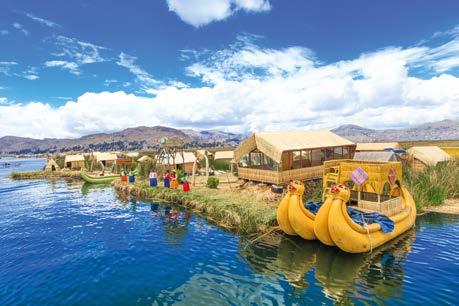
Verbs with prepositions Tip reminder
already, just, (not) yet, ever, never
1 Complete the sentences with already, yet, just, ever or never.
1 A Hasn’t Dominic arrived ?
B No, apparently there’s been a delay — his train is running late.
2 A Have you eaten Thai food before?
B No, . But I’d really like to try it one day!
3 I asked my dad to pick up some meat for the barbecue, but he hasn’t gone to the supermarket
4 It’s not even the end of June, and I’ve finished my summer homework! Looks like I’ve got the rest of the break to relax.
5 A Would you like some ice cream?
B No thanks — I haven’t even had lunch !
6 A How about checking out that new water park tomorrow?
B I’ve been there — I actually went last week with some friends.
7 Can you believe it’s September and Nicolò hasn’t even started on his summer homework ?
8 A Excuse me, is the doctor available? I need to speak with him urgently.
B I’m afraid you’ve missed him — he finished his shift about ten minutes ago.
2 Read the sentences and decide if they are right (R) or wrong (W). Correct the wrong ones.
1 A Where and when did you go on the school trip?
B We’ve been to Madrid two weeks ago. We went to Madrid.
2 I’ve never had the chance to go rafting, but it’s something I’d definitely love to try one day!
Possessives
3 Complete the sentences with the words + ‘s or ‘ .
yet neighbour’s his Their
3 My sister just went to live in Dublin. She loves it!
4 It’s by far the best film I’ve never seen!
5 Daisy has just finished decorating her bedroom – it looks fantastic now.
6 Did you start your new holiday job yet or are you still waiting?
7 Where have you lived before you came to settle in Italy?
8 Mrs Dodds taught history for over 20 years before retiring last summer.
1 I feel bad because I broke my (neighbour) lamp.
2 (Juan) dog often plays in the garden.
3 These are the (children) toys. They need to put them in the bedroom.
4 Do you know where the (girls) books are?
5 What’s your (cat) name?
6 That’s not my painting. That’s painting. (James)
4 Complete the conversations with the correct possessive adjectives or possessive pronouns.
1 A Which car is Michael’s?
B That’s red car over there.
2 A Is this your bag?
B No. is on the shelf.
3 A Anna, Ben, are these your tennis rackets?
B No, are in the garage.
4 A Are you going to buy that jumper?
B Yes. I want to give it to my mother for birthday.
5 A Is that my science book?
B No, I put in the bookcase.
6 A We have just got a new carpet. Isn’t it lovely?
B Yes, it is. I’ll take shoes off so it will stay clean.
5 Complete the text with one word for each gap.
In northern Scandinavia, there is a group of people called the Sami. (1) homes are known as lavvus. They look a little bit like the tents that we use for camping. The difference is that (2) are much stronger than camping tents. They look much cooler too! The lavvu works well for the life of the Sami. Large families live in them and they move from place to place. The Sami follow the animals – reindeer –that (3) look after, so they need a home that they can take with them. The Sami build lavvus so that they don’t get cold from the strong wind. In the past, they used animal skins to make the walls of a lavvu, so (4) walls kept them very warm. Today, they don’t often use animal skins for their tents. Their tents are more like (5) modern tents. Of course, it gets very cold outside and the Sami make fires inside the lavvu. For this reason, (6) got a hole at the top where the smoke can leave safely.
Oracy and Writing lab
Describing a room
1 Look at the photo on page 111 and answer the questions.
1 What can you see? Write 8-10 objects or details.
2 What do you think about the person who lives here?
3 What questions could you ask about the room or the person?
2 WRITING Answer the questions.
1 What’s your bedroom like?
2 Do you share your room with anyone?
3 What things do you keep on your shelves or desk?
4 What do you like or dislike about your room?
Writing a story
3 There are eight mistakes in this story. Find and correct the mistakes.

Yesterday
Last yesterday, my friend Tadeo and I moved some furniture in my bedroom so I wanted my room to look different. Luckily, the bed was very heavy and we couldn’t move it, because I asked my dad to help us. The three of us pushed the bed really hard. It almost flew across the room and Tadeo fell down on the floor! We laughed a lot so it was really funny. I guess my dad is very strong! After, Tadeo and I moved the bookcase and my desk without dad so he wanted to go into town. At the end, we had fun and my bedroom looks great!
4 Number the parts of the story in the correct order.
MOVING HOUSE
a While the movers were lifting the furniture, one of the boxes suddenly opened and books fell everywhere.
b As soon as we arrived at the new house, we ran upstairs to see our bedrooms.
c Last Saturday morning was a very long, tiring day. We all woke up early and finished packing the last few things.
d My parents checked the list and gave instructions while I played outside with my little sister.
e Luckily, nothing was damaged, and the movers carefully repacked everything.
f After breakfast the removal van came, and two men started putting the boxes into it.
g After a long morning, the van was finally full and ready to go.
h After exploring the house we all sat on the floor, ate takeaway pizza, and watched a movie together.
5 PRELIMINARY Writing a story Your English teacher has asked you to write a story. Your story must begin with this sentence:
It was our first night in the new house, and something strange happened.
Before you write, answer these questions to organise your ideas.
• Who is in the story?
• Where does the story take place?
• What goes wrong?
• How is the problem solved?
• How does the story end?

8 City vibes
Grammar reference
Articles
The indefinite article: a / an
Si usa l’articolo indefinito a / an
• con il singolare dei countable nouns a book/table/tree an island/apple/idea
• per riferirsi a qualcosa in modo generico
This is a phone.
• quando si menziona qualcosa per la prima volta I’ve bought a new jacket.
• quando ci si riferisce a un lavoro, stato, ecc. Jane’s got a temperature. He’s an architect.
Si utilizza a davanti ai nomi che iniziano per
• consonante a lamp/box/plant
• h- aspirata a house/holiday
• vocali con suoni consonantici a European city/university/year
Si utilizza an davanti ai nomi che iniziano per
• vocale an animal/email/umbrella
• h- muta an hour/holiday/honour
L’articolo a viene utilizzato anche davanti espressioni numeriche come hundred, thousand, million e così via anche quando sono utilizzate come espressioni approssimative.
a hundred / thousand / million years ago
The definite article: the
Si usa l’articolo determinativo the
• con il singolare e il plurale dei countable nouns the pen/cat/bus the pens/cats/buses
• con gli uncountable nouns the milk/information/money
• per parlare di qualcosa di specifico Is the phone on the table yours?
• per parlare di qualcosa che è già stato menzionato
I wear a uniform at school. The uniform is blue and red.
• con i nomi unici the moon/sun/universe
• con i nomi propri di luoghi naturali e artificiali the Himalayas/Thames/Pacific Ocean the Odeon Cinema/Palace Hotel/National Museum
• con nomi propri plurali di paesi e nazioni the United Kingdom/U.S.A./Philippines
• con gli strumenti musicali
Do you play the guitar?
• per parlare di un popolo o etnia
The French are proud of their cooking.
• davanti a morning, afternoon e evening I’ll go to Julia at 7 in the morning.
• davanti ai numeri ordinali the first/second/tenth
L’articolo NON si usa davanti a
• nomi propri di persona
Tim is Sarah’s brother.
• sport e giochi
Tennis requires many abilities.
Chess is popular in many countries.
• colori,
I like blue more than red
• giorni, mesi, festività
We usually meet on Monday.
My birthday is in July.
We always celebrate Christmas with family.
• bevande e pasti
I don’t like coke.
I usually have breakfast at 7 o’clock.
• materie di studio e lingue
They like both history and geography. They speak English and French
• nomi propri di Paesi e città
Tokyo is the capital of Japan
• nomi propri di strade e piazze
The hotel is on Oxford Street, near Trafalgar Square
• nomi propri di parchi e ponti
Central Park is very big.
London Bridge is very beautiful at night.
• nomi propri di montagne, isole, laghi, continenti
Mount Elbrus is the highest mountain in Europe
Sicily is a beautiful island.
Lake Garda is in northern Italy.
• bed, church, school, hospital, prison, university, college, court quando si fa riferimento allo scopo specifico del luogo/dell’oggetto
Jane is in hospital – she’s sick.
• mezzi di trasporto con by
Can we go by car? The train is too expensive.
one / ones
Si usa one / ones per evitare la ripetizione di un nome. ‘I like that T-shirt.’ ‘Which one?’ ‘The blue one.’
one si usa con i nomi singolari, mentre ones si usa con i nomi plurali.
I like this dress, but that one is cheaper.
Your shoes are old – you need to buy new ones.
Solitamente, one e ones seguono
• l’articolo the
Look at that cat, the one on the wall – it’s so cute!
• i dimostrativi this, that, these, those + aggettivo
I don’t like this dress. I prefer that one
• gli aggettivi
I like the blue shirt, but I’ll buy the green one
• l’interrogativo which
There are some books, here. Which ones are yours?
Past simple vs Present perfect
Past simple Present perfect momento passato definito momento passato indefinito
azione iniziata e conclusa nel passato
azione iniziata nel passato e ancora in corso non collegato al presente collegato al presente
espressioni temporali che indicano un momento preciso (on Monday, in 2022, last month, ecc.)
accompagnato da espressioni temporali che non si legano al presente (when, then, ago, yesterday, ecc.)
espressioni temporali che indicano un passato indefinito (never, recently, ecc.)
accompagnato da espressioni temporali che si legano al presente (already, so far, since, for, this week, ecc.)
Quando per parlare di un’azione passata viene specificato il momento dell’azione si utilizza il Past simple. I visited London in 2023
Quando l’azione avviene nel passato ma NON si specifica il momento esatto si utilizza il Present perfect. I have visited London.
Quando un’azione del passato si è già conclusa si utilizza il Past simple I lived in Milan three years ago – I live in Rome now.
Quando l’azione è iniziata nel passato ma è ancora in corso si usa il Present perfect
I have lived in Milan since January – it’s almost a year!
Quando un’azione passata non ha (più) impatto sul presente si usa il Past simple She broke her leg – she’s OK now. Quando un’azione ha ancora conseguenze nel presente si usa il Present perfect She has broken her leg – she can’t walk.
Quando viene indicato un momento ben preciso del passato si usa il Past simple. They visited their granny on Sunday Quando si utilizzano espressioni che indicano un passato non ben definito si usa il Present perfect They have visited their granny recently.
Solitamenteil Past simple è accompagnato da espressioni temporali che si riferiscono a momenti conclusi nel passato (quindi l’azione è terminata e passata).
I met John three times last week
Il Present perfect è accompagnato da espressioni che fanno riferimento a periodi che non sono ancora conclusi (quindi l’azione può ancora svolgersi).
I have met John three times today
Places in a town
bakery I go to the bakery every morning to buy fresh bread.
bank My parents save money in the bank.
bookshop The bookshop sells comic books. charity shop We donated some books to the local charity shop.
college My sister goes to college in the US. department store We went to the department store to buy make-up and clothes.
DIY store My dad went to the DIY store to buy some paint.
electronic goods shop I bought my new phone at the electronic goods shop.
hospital My grandad is in hospital.
library I borrowed a book from the library.
pharmacy Can you get some medicine from the pharmacy?
post office I need to go to the post office.
sports centre We play tennis at the sports centre every week.
stationer’s She always gets her school supplies at the stationer’s.
supermarket I’m going to the supermarket to buy some food.
Tourism, sightseeing and entertainment
airport We flew to Tbilisi from London. bus station The bus station is near the train station. café We went for a coffee in my favourite café.
castle Don’t forget to visit the old castle.
cinema We went to the cinema to see a film. guest house We stayed in a guest house in Dublin.
hotel The hotel was very expensive.
museum The Science Museum is fantastic.
restaurant We had a delicious meal at the restaurant. theatre We’re going to the theatre to see a play.
Prepositions of movement
across The cat walked across the road. along I ran along the path by the river. into We walked into the shop. over The dog jumped over the gate. past He walked past the shop, and didn’t go in. through He rode through the field on his motorbike. under The ship went under the bridge.
Collocations and expressions
visit buildings (p118) try new food (p118) go to the theatre (p118) walk in a park (p118) go shopping (p118) science museum (p118) enjoy a show (119) street market (p119) take photos (p119)
borrow books (p120) main road (p121) open-air cinema (p121) book tickets (p122) meet friends (p123) have coffee (p123) have a picnic (p127) move in/out/into (p127)
Frame A
1 Match the words (1-5) with the correct definitions (a-e).
1 castle
2 heritage
3 park
4 burek
5 graffiti
Exam task
a a green space in a city
b traditional food of a country
c art painted on outside walls
d a large building where kings lived
e history, culture and traditions
Identify the paragraph topic
2 INVALSI Read the text about Ljubljana. Choose the correct heading (A-J) for each paragraph (1-8). There are two extra heading that you should not use.
A Find out about local traditions
B Go shopping in the city’s modern shopping malls
C Enjoy the parks and river
D Go and see a play
E A taste of Slovenia
LJUBLJANA
With its historic centre, green spaces, street art, great food, and friendly locals, Ljubljana is one of Europe’s hidden gems. Perfect for a weekend!
1 I
Ljubljana has a long and rich history. It began over 2,000 years ago as a Roman military camp. Later, it grew into an important medieval town. After many changes, it became Slovenia’s capital in 1991, when the country became independent.
2
Start your weekend the Slovenian way: try burek, a traditional pastry filled with cheese or meat, and enjoy it with a cup of coffee in one of the city’s many bakeries. Later, taste potica, a sweet nut roll often served during holidays.
3
To understand the country’s culture, head to the Slovenian Ethnographic Museum, where you’ll discover the traditions, costumes, music and crafts that make up Slovenian heritage.
4 Visit Metelkova, a former military base that is now a creative space for artists and musicians. The buildings are covered in colourful graffiti and sculptures. It’s the perfect place to see how young Slovenians express themselves through art.
F End your visit in style
G Spend time with artists
H Explore the old part of the city
I Discover the past
J Visit an art gallery
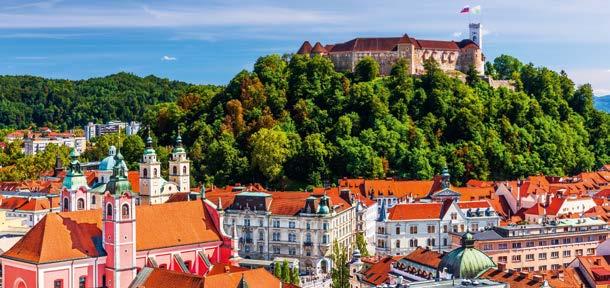
5
If you love theatre, check out the programme at the Ljubljana City Theatre. They perform plays in Slovenian, but many are also performed in English. It’s a great chance to experience modern European theatre in an intimate space.
6
Ljubljana is one of Europe’s greenest cities. Walk or cycle along the Ljubljanica River, or relax in Tivoli Park. The city is small and peaceful, and most of it is car-free!
7
Wander through the Old Town, where beautiful baroque buildings, open-air markets and small bridges line the streets. Don’t miss the castle on the hill – the view from the top is worth the walk!
8
Finish your visit with a sunset drink at one of the riverside cafés. As the lights reflect on the water, you’ll understand why so many travellers fall in love with Ljubljana.
Places in a town
1 Complete the Venn diagram with the words in the box. bakery • pharmacy • hospital • bookshop • post office • bank • department store • supermarket college • DIY store • stationer’s • sports centre • electronic goods shop • charity shop • library
1: you buy goods here
2 Choose the correct option.
1 Paulo went to the post office / pharmacy to buy some stamps.
2 My dad is going to the college / bank because he has lost his credit card.
3 I’m going to the bookshop / library to buy something by Agatha Christie. I don’t know any of her books, but the films are great, so I’m curious about them.
4 My cousin is a nurse and he works in a hospital / department store.
5 My friends and I play basketball at the supermarket / sports centre every Wednesday afternoon.
3 Complete the sentences with the words you didn’t use in exercise 2.
1 I’m going to the to get some medicine.
2 Gina visited a to look at some clothes, a new desk, some gifts and a few other things.
3 After school, Juliana is planning to go to the local to study science and maths.
4 We need cheese, milk, bread, bananas and pasta. We can get that at the near my house.
5 I can’t study here – it’s too noisy. I’m going to the
4 Write the places where you do these things.
1 play basketball
2 post a parcel
3 take some money out
4 buy trainers
5 buy rice
6 read a book
5 Complete the text with the words in the box. bank • college • hospital library • post office • sports centre
Guntur had a lot of things to do on Monday. First, he went to the (1) to send a postcard to his friend Suharto. Then he went to the (2) to get some money. After that, he went to his morning classes at his (3) During the afternoon break, he went to the (4) to pick up a book. After his afternoon classes finished, he met Setia at the (5) to play badminton. He visited his uncle in (6) in the evening. It was a busy day!
6 Complete the conversations.
1 A I’m going to the Do you need anything?
B Actually, yes. Could you get me some yoghurt, please?
2 A I want to send this birthday card to Selma. Do you know how much the stamp is?
B No, sorry. You’ll need to go to the and ask.
3 A What did the doctor say?
B She ordered some medicine. I’ll go to the now and get it.
4 A The rang while you were having your shower.
B Please don’t tell me they cancelled the swimming class again!
5 A I can’t find my card!
B I think you put it in the book you borrowed.
6 A Are you going to go to after you finish school?
B Yes. I want to study computer animation.
Circle
Circle
Grammar / Listening
Articles
1 Choose the correct option.
1 Is there anyone sitting in seat right here?
a this b these c that
2 Look at buildings over there. They’re over eight hundred years old.
a this b these c those
3 bookshop here has great discounts.
a This b These c Those
4 Do you know girl across the street? I’ve seen her before, but I can’t remember her name.
a this b these c that
5 students over there are on the same university course as me.
a That b Those c These
6 Do you like shoes? I think they make my feet look big.
a this b those c these one and ones
2 Four of the sentences are incorrect. Find and correct the mistakes.
1 I don’t like the pizza restaurant near my house, but I like the one across town.
2 My friends João and Leonor work in a library. It’s the ones next to the college.
3 The only German language dictionaries in the shop are the one on that shelf.
4 That department store doesn’t sell furniture, but the ones on Richmond Street does.
5 The pool at my local sports centre isn’t very big. I prefer the one in the city centre.
6 That café doesn’t sell sandwiches anymore, so I buy the one from the supermarket now.
3 Complete the conversation with this, that, these, those, one or ones.
Ali Bea, have you got a minute? I need some advice for a school project.
Bea The (1) about the history of London?
Ali No, I finished (2) project last month. I have to give a talk about two Oxford colleges.
Bea Which (3) ? Magdalen? Balliol? Trinity?
Ali Are you going to listen to me or not?
Bea Sorry. Go ahead. It’s just that I know a lot about (4) topic.
Ali That’s why I’m asking you. So, I have to choose a new (5) and one of the really old (6)
Bea OK. Can you get me (7) two books on the top shelf over there?
Ali (8) two?
Bea No, the (9) next to them. They’ll be very useful.
Listening
1 Match the words to the correct definitions.
monthly fee • address • starts at • contact • yoga class
1 when something begins
2 how much you pay each month
3 where a place is located
4 a telephone number or person to talk to
5 a relaxing kind of exercise
Tip reminder
Listening for days, times and numbers
See SB p. 122
2 Look at the form. What kind of information do you expect in each gap? Write the type (e.g. time, number, date, ...).
You will probably hear a…
Exam task
3 PRELIMINARY Gap fill You will hear a recorded message with some information about a sports centre. For each question, write the correct answer in the gap.
Bell Sports Centre
Opening hours 7 a.m. to (1) p.m. daily
Address (2) Shelton Road
Monthly fee Starts at (3) £ Yoga class Begins on (4) September
Contact For yoga class, phone (5)
4 INVALSI Listen to Sebastian and decide if the information is true (T), false (F) or not given (NG).
0 Sebastian has lived in Dublin for four years.
1 He lives with his aunt.
2 He went to university in Liverpool.
3 He works for a phone company.
starts at F
4 He never drives in Dublin because of the traffic.
5 He says that many restaurants in Dublin are not cheap.
6 You don’t have to pay to walk around Trinity College.
Frame B / Vocabulary
Tourism, sightseeing and entertainment
1 Choose the correct option.
1 Let’s stop at this hotel / café on the corner and have an ice cream.
2 The cinema / bus station in Athens has buses to many towns across the country.
3 I love this old castle / museum. Do you know who used to live here?
4 We’re staying at a really nice guest house / airport on our holiday in Kyoto.
5 This theatre / restaurant is amazing. It’s got the best chicken in the city!
2 Write the places you didn’t use in exercise 1 to say what places these people are talking about.
1 Students pay just £2 on Wednesdays, so we go and see a film every week.
2 We arrived four hours before our flight, but it wasn’t too bad.
3 I didn’t want to go, but it’s actually quite interesting, especially the cooking equipment from hundreds and hundreds of years ago.
4 I’ve never seen a play before, so I’m looking forward to seeing actors at work.
5 It wasn’t very expensive and the room was comfortable.
3 Complete the conversations with the correct places.
1 A Hello. Could you please send a taxi to 45, Green Street, going to the ?
B Certainly. National or international flights?
2 A Where should we take Mum and Dad for their anniversary?
B I’ve heard the Indian in South Street has a new chef and she’s very good.
3 A What time does the film start?
B 8.15. Let’s meet outside the at 8. I’ve booked the tickets online.
4 A Let’s not spend a lot of money on a room.
B I agree. Ashok told me there’s a nice little across the river. The rooms are comfortable and the breakfast is great.
5 A What do you want to do tomorrow? Not visit another museum, please!
B OK, but I think we should visit the . The website says it’s over 1,500 years old, with secret doors to underground rooms.
Prepositions of movement
4 Complete the sentences with the words in the box.
across • along • into • over • past through • under
1 I think we’re lost. The map says that Sandro’s house is here, but I think we walked it.
past
2 It’s a nice day. Do you want to walk the park and have lunch at the restaurant on the other side?
3 Can we go the road and look at that new shop?
4 I saw all of Barcelona when our plane flew the city. It was really amazing!
5 Hussein walked the restaurant and asked the waiter for a table by the window.
6 We have to sail the bridge to get to the other side of the lake.
7 Mansour walked the path by the river.
5 SUM UP Choose the correct option.
Horacio There’s a new (1) in my area. I hear they’ve got great burgers. How about we try it?
Kyle Sure, that sounds great. Where is it?
Horacio It’s close to my house. You just walk (2) the street, turn left, continue for about ten minutes and you’re there.
Kyle You know, it’s almost lunchtime, so why don’t we go today?
Horacio That’s a great idea. I’ll text my parents to let them know.
Kyle Is it OK if I invite my friend Nour? We’re going to the (3) this afternoon. We’re working on a history project for school.
Horacio Yes, of course. I know Nour. We had a class together last year. I walked (4) her the other day outside the library, but I couldn’t stop because I was late for my maths class.
Kyle Great, then we can all go together. I’ll call Nour, and then we can walk (5) the park so we can meet her and walk to the restaurant together.
Horacio: That sounds great!
1 A cinema B restaurant C castle
2 A into B under C along
3 A museum B guest house C airport
4 A through B over C past
5 A into B under C across
Grammar
Past simple vs Present perfect
1 Choose the correct option.
1 I haven’t spoken / didn’t speak to Daniel since our argument at the party last month.
2 She has travelled / travelled to over 15 countries before she turned 25.
3 We have waited / waited outside for nearly 30 minutes before someone opened the door.
4 ‘Have you read / Did you read the book I lent you last week? ’‘Yes, I read / have read it in two days!’
5 He lived / has lived in three different cities since graduating from university.
6 They have just announced / just announced the winner, so let’s go check!
7 ‘How long have you been / were you at that school?’
‘I was / have been there from 2014 to 2021.’
8 I have never liked / never liked horror films, even when I was a teenager.
9 She has worked / worked here for six years, but now she’s found a new job.
10 The weather has been / was really bad all week — I hope it improves soon.
2 Complete the dialogues with the Past simple or Present perfect of the verbs in brackets.
1 A (you / ever / take) the underground in Milan?
Have you ever taken
B Yes, I . I (use) it last weekend to go to a concert.
A (it / take) long to get there?
B No, it — I (get) there in just 15 minutes from the Central station!
2 A Where’s Marco?
B He (just / go) . He (leave) a few minutes ago.
A And Chiara?
B Oh, I (not / see) her today.
3 A (you / be) to that new café near the museum?
B Yes, I (be) there twice.
A What (you / think) of it?
B I (like) it. I (go) with my cousin last Friday — the atmosphere (be) really nice.
4 A (you / ever / live) in a big city?
B Yes, I (live) in Rome for a year when I (be) a student.
A (you / enjoy) it?
B Not really. I (always / prefer) smaller towns.
5 A Hi, Carol! I (not see) you for ages! Where (you be)?
B I (be) in Australia. I (want) to send you a postcard but I (forget) your address. Sorry!
6 A I (just hear) that William is working in Argentina.
B Oh, (you not know)? He (fly) out at the beginning of April.
A (you hear) from him? Does he like the job?
7 A How long (you know) Professor Linton?
B Since he (come) to work here five years ago.
8 A I (cut) my finger! Have you got a plaster?
B Here you are – how (you do) that?
9 A I (lose) my iPad. (you see) it anywhere?
B No, when (you last have) it?
A Well, I (use) it this morning but I (not see) it since.
3 SUM UP Correct the mistakes in the sentences.
1 I’ve been in love with photography since I’ve bought my first camera in 2015. I’ve been in love with photography since I bought my first camera in 2015.
2 We didn’t see Marta today yet – have you seen her?
3 It’s the first time I tried sushi, it’s delicious!
4 A How long did you live in Berlin?
B I came here eight years ago.
5 Tom has worked here for ten years, but he left the company a few months ago.
6 Have you gone to the concert last night?
7 I never met anyone as funny as your cousin!
8 She’s really tired because she just finished playing tennis.
9 We’ve moved to Spain in 2017, and we love it here.
10 It’s ages since I have last spoken to him.
Giving directions
1 Give directions to reach the indicated destinations using the expressions in the box. go straight on take the first turning on your left/right opposite • next to
Oracy and Writing lab
Describing places
Tip reminder
Planning your article
Exam task
3 PRELIMINARY
Give directions from the ‘You are here’ point to:
1 the theatre Go straight on and take the second turning on your left. The theatre is on your left.
2 You are meeting a friend at one of these places in your town: the library, the park, or the sports centre. Choose a starting point (e.g. your home or school). Write directions to your chosen place. Use at least five expressions from the box. go straight on • turn left • turn right opposite • next to • at the crossroads on your left • on your right
See SB p. 128
Writing an article You see this notice on an English-language website. Write an article following the notice. Write about 100-120 words.
Articles wanted!
A Perfect Afternoon in My Town
Imagine a friend is visiting your town for the first time. They only have one afternoon to explore.
Write an article recommending two places to visit.
Say what they can do there, why they’re a good choice, and give a few tips or suggestions.
We’ll publish the most helpful articles on our class website!
Before you write your article, answer the following questions.
Place 1
1 What is the name of the place?
2 What kind of place is it? (e.g. café, park, museum, cinema)
3 What do you like about it? (Use adjectives) 4 What can people do there?
5 How often do you go there?
6 When was the last time you went? What did you do?
Place 2
1 What is the second place you want to recommend?
2 Why do you like it?
3 What do people usually do there? 4 When did you last go there, and who did you go with?
9 Come rain or shine
Grammar reference
Comparatives
Comparative adjectives
Si usa il comparativo per paragonare due cose o persone.
Il comparativo di maggioranza si può formare in due modi: aggiungendo -er a fine parola oppure con more prima dell’aggettivo, mantenendo l’aggettivo invariato. Per fare la comparazione, dopo l’aggettivo si utilizza than Si usa -er
• con gli aggettivi monosillabici
warm warmer short shorter
My sister is taller than me.
• con gli aggettivi bisillabici terminanti in -y, in cui la -y varia in -i happy happier lucky luckier
This maths homework is easier than the last one.
Si usa more con tutti gli altri aggettivi di due o più sillabe.
more expensive more dangerous
Taylor Swift is more famous than Ava Max.
I comparativi monosillabici possono presentare un raddoppio della consonante finale quando sono composti da consonante + vocale + consonante. big bigger hot hotter
That film was sadder than the one we saw yesterday.
Gli aggettivi che terminano in -e prevedono solo l’aggiunta di -r nice nice safe safer Russia is larger than Italy.
Alcuni aggettivi presentano una forma irregolare del comparativo (alcuni aggettivi presentano la stessa forma irregolare).
good / well better bad / ill worse far farther/further little less many / much more
Il comparativo può essere utilizzato per descrivere cambiamenti progressivi e graduali.
In questo caso, la struttura dipende dal numero di sillabe dell’aggettivo.
Per gli aggettivi che formano il comparativo con l’aggiunta di -er finale, la struttura prevista è quella di aggettivo comparativo + and + aggettivo comparativo.
The weather is getting colder and colder. Per gli aggettivi che formano il comparativo con more + aggettivo, la struttura prevista è quella di more and more + aggettivo.
This book is getting more and more difficult to understand Comparative with (not) as … as Il comparativo di uguaglianza si utilizza per paragonare due cose o persone che presentano qualità simili. Si forma con la struttura as + aggettivo/ avverbio + as. I am as smart as Frank. This book is as interesting as yours.
Si utilizza la struttura not as + aggettivo/avverbio + as per indicare che qualcosa o qualcuno presenta una qualità inferiore rispetto a qualcun altro o qualcos’altro. She can’t run as fast as her friend. Your test wasn’t as difficult as mine.
Quando si vuole indicare che una qualità è inferiore rispetto al secondo termine di paragone, in alternativa a not as … as si può anche utilizzare il comparativo con less. My white cat is less fat than the black one
Il comparativo con less si forma sempre anteponendo less alla forma base dell’aggettivo, a prescindere dal numero di sillabe dell’aggettivo. Per fare il paragone si utilizza sempre than Jane’s house is less big than Bob’s This test is less difficult than the last one much + comparative
Per sottolineare una differenza maggiore tra due aggettivi o avverbi si utilizza much prima della comparazione.
My dad is much taller than my mum. We can travel much more quickly by train than by car.
Superlatives
Superlative adjectives
Si usa il superlativo per paragonare tre o più cose o persone. Si utilizza per indicare che qualcosa o qualcuno presenta una qualità maggiore rispetto a un insieme.
Il superlativo si può formare in due modi: aggiungendo -est a fine parola oppure con most prima dell’aggettivo, mantenendo l’aggettivo invariato. Prima del paragone si usa sempre l’articolo the
Come per il comparativo, si aggiunge -est
• con gli aggettivi monosillabici
cold coldest tall tallest
The hummingbird is the smallest bird in the world.
• con gli aggettivi bisillabici terminanti in -y, in cui la -y varia in -i happy happiest lucky uckiest
He’s the friendliest boy in may class.
Si usa most con tutti gli altri aggettivi di due o più sillabe.
most interesting most expensive
That was the most amazing film I’ve ever seen.
I superlativi monosillabici possono presentare un raddoppio della consonante finale quando sono composti da consonante + vocale + consonante. hot hottest wet wettest
Rome is the biggest Italian city.
Gli aggettivi che terminano in -e prevedono solo l’aggiunta di -st blue bluest wide widest
She’s the bravest person I know.
Anche per il superlativo, alcuni aggettivi presentano una forma irregolare (alcuni aggettivi presentano la stessa forma irregolare).
good / well the best bad / ill the worst far the farthest/furthest little the least many / much the most
Solitamente, dopo il paragone con il superlativo, si indica il gruppo all’interno del quale è stato fatto il paragone.
He’s the best actor of the cast!
Per fare il riferimento al gruppo possono essere utilizzate le proposizioni in o of, in base al contesto. Si utilizza in per indicare luoghi grandi o gruppi generali.
The Pacific is the deepest ocean in the world
Joe is the tallest student in the school. Si utilizza of per indicare gruppi specifici o insiemi limitati.
I’m the sportiest of the family
This is the oldest of the buildings.
Weather collocations
dark clouds There are really dark clouds, so I’m sure it’s going to rain.
deep snow It snowed all night, so there’s very deep snow outside.
high / low temperatures There were very high temperatures all last summer.
light / heavy rain It didn’t rain much – it was only light rain.
strong / weak sun Wear a hat – the sun is really strong today.
strong winds There were very strong winds in the storm.
Weather
boiling It was 40˚C at the weekend – it was boiling!
cloud There aren’t any clouds in the sky today.
cloudy It was very cloudy yesterday.
cold Put on a coat – it’s cold outside.
cool It’s quite cool today, but it isn’t really cold.
dry The roads are dry – it hasn’t rained for weeks. fog I can’t see anything – there’s a lot of fog.
foggy It’s so foggy I can’t see anything!
freezing It’s -10˚C outside – it’s freezing!
hot Our summers are usually very hot.
ice There’s a lot of ice on the roads
icy The roads are very icy.
rain There was a lot of rain last night.
rainy It’s very rainy today.
snow There’s a lot of snow so we can make a snowman!
snowy It’s really snowy today.
storm There’s going to be a big storm tomorrow.
stormy It’s very stormy today.
sun The sun was really hot yesterday.
sunny It’s a beautiful day – it’s really sunny.
warm It’s a lovely day – it’s nice and warm.
wet It rained last night, so everything is wet.
wind There was a lot of wind last night.
windy It’s so windy today.
Extreme weather
drought There hasn’t been any rain for months, so there’s a drought.
flood There has been so much rain there are floods everywhere.
hurricane A hurricane is a really strong storm. lightning Tourists come from around the world to see the lightning at Lake Maracaibo.
thunder We could hear the thunder for a long time. thunderstorm You can hear thunder and see lightning in a thunderstorm.
tornado A tornado is a very strong wind that goes round in a circle.
wildfire There are terrible wildfires in Australia.
Seasons
autumn Leaves fall off the trees in autumn.
spring Leaves start to grow on the trees in spring.
summer It’s usually quite hot in summer.
winter Sometimes it snows in winter.
Collocations and expressions
record temperatures (p133) weather event (p135) lightning strikes (p135) solar power (p140) climate change (p141) rise in temperature (p141)
9 Frame A
1 Match the words (1-5) with the correct definitions (a-e).
1 freezing
2 remote
3 engine
4 residents
5 journey
Exam task
a people who live in a place
b extremely cold
c far from other places
d the act of travelling from one place to another
e the motor in a car or vehicle
2 INVALSI True, False, Justification Read the text about Oymyakon. Decide if the sentences are true (T), false (F) . Then identify the sentence in the text which supports your decision and write the first four words of this sentence.
1 Oymyakon is the coldest place in the world where people live all year.
2 People often leave their cars running to stop them from freezing.
3 Every home in Oymyakon has a modern bathroom.
4 Schools stay open until the temperature drops to −52°C.
5 A wide variety of vegetables are grown in Oymyakon.
6 The sun never shines in summer in Oymyakon.
7 It takes at least two days to reach the town by car.
8 Tourists never visit Oymyakon because it’s too cold.
Oymyakon
Have you ever heard of a place called Oymyakon?
It’s a small village in northeastern Siberia, Russia. There are colder places in Antarctica, but no one lives there all year. Oymyakon is the coldest town in the world where people live permanently. In winter, temperatures often drop below −50°C, and the lowest ever recorded was −67.7°C — colder than anywhere else with permanent residents.
Only about 500 people live in Oymyakon, and life there isn’t easy. In winter, you can’t turn off your car for long, or the engine might freeze. Some people even leave their cars running while they shop. Pipes freeze too, so most houses don’t have regular bathrooms. Instead, people use outdoor toilets, which isn’t very pleasant on freezing nights!
Schools stay open even in really cold weather. In fact, they only close if the temperature drops below −52°C — much colder than what would close a school in most countries.
Even though the weather is extreme, people in Oymyakon have learned how to live with it. They eat a lot of meat and fish, because it’s almost impossible
to grow fruit or vegetables there. Winters are long and dark, but in the summer, the sun shines almost all day, which is unusual compared to most places.
Getting to Oymyakon isn’t simple. The nearest airport is around 900 kilometres away, and driving there takes at least two days on icy, dangerous roads. Still, some brave tourists visit every year to see what life is like in one of the coldest places on Earth.
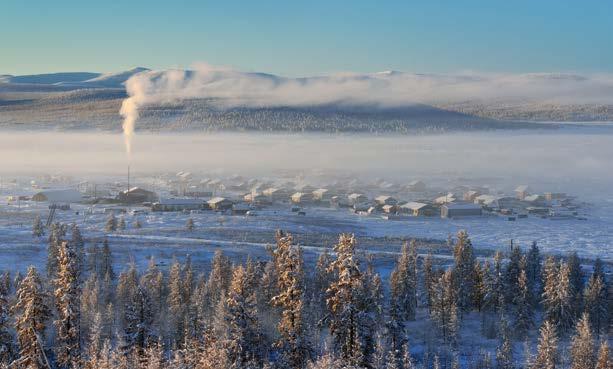
The weather
1 Complete the Venn diagram with the words in the box.
2 Look at the pictures and complete the sentences.

1
4 It’s really right now. I can’t see the hills at all!
3 It’s quite and
5 The skies are rather at the moment.
3 Complete the email with the words in the box. cloudy • cool • hot • like • rain storm • sunny • wet
Hi Levi
We are having a great holiday. It’s (1) here – about 28° C – and it’s wonderful to see the sun after all those months of (2) weather back home. Yesterday evening we had dinner outside, at a street market. It was great, although it was a bit (3) and I didn’t have my jumper. Two nights ago, there was the most amazing (4) and there was a lot of (5) . I couldn’t sleep because of the noise on the roof! The next morning it was bright and (6) again, so we went to the beach. What’s the weather (7) there? Has it stopped raining? Are you and Nadar going camping this weekend or is it going to be too (8) ?
See you soon Yanisa
6 There’s a lot of today. It isn’t a good day for swimming.
4 Complete the conversation with weather words. More than one answer may be possible.
A Hey! Come and see. Here’s the weather forecast.
B Wow! What should we pack? High temperatures at the weekend … look: 39°C during the day, with sunshine.
A That’s (1) ! But look at the night temperatures: 5°C. That will feel really (2) , especially after the day temperatures.
B That’s not too bad – it’s better for sleeping. But look at the wind: 30 kilometres per hour!
A Ah, that’s (3) – let’s hope the tent stays down! But it’ll only be like that on Sunday, and then it’ll be OK.
B True, but then the rain will come …
A Yes, it looks like a (4) Monday with no sunshine, but Tuesday will be the worst – heavy rain all day … It’ll be very (5) ! Wait –is that snow on Thursday?
B I’m sure that will be high up in the mountains. The lowest temperature we’ll have is 5°C, which is too (6) for snow. But rain in high temperatures may mean it’ll be (7) when the rain stops, so we won’t be able to see far.
A Maybe we should wait and go away a different week.
Madrid is having some weather at the moment.
2 There’s all over the park. It’s so white!
warm today.
boiling
Grammar / Listening
Comparatives
1 Complete the sentences with the correct comparative form.
1 Today’s maths test was a lot (hard) the one last week.
2 It’s very windy today, and the wind is much (strong) it was yesterday.
3 Is too much rain (good) no rain at all?
4 My computer isn’t (fast) as it used to be.
5 Her house is from the station I thought.
6 Icy roads are always (dangerous) wet ones.
7 I’m not a very good driver, but my brother Hal drives (badly) I do.
2 Complete the sentences using the correct comparative form of the words in the box. beautiful • careful • dangerous early • easy • friendly • funny • hot
1 The exam was not as we expected, but we all managed to pass.
2 That road is at night than during the day – you really have to be careful.
3 The weather today is much than it was on Monday.
4 Let’s take the train. I don’t want to get home too late.
5 Unfortunately, our new neighbours don’t seem as the last ones.
6 You really need to be when doing your homework!
7 I think that the romcom film was than the book.
3 The words in bold are incorrect. Write the correct form.
San Francisco has quite unusual weather. It’s not as (1) warmer as some people might think, even in the summer. It’s in California, but it’s on the Pacific Ocean and it’s (2) cold than the city of Los Angeles to the south. There is also a lot of fog. It comes from the ocean, so it is (3) foggy than many other places in California. It’s amazing to see the fog over the city. Some people there want it to be (4) sunny than it usually is. There is often so much fog that it covers the sun, though the fog is (5) quick than normal clouds do. The rain is (6) heavy there than places in the south, so if you’re looking for some hot weather, go south!
4 Write sentences comparing the weather where you are with the weather in San Francisco.
Listening icy harder than as easy
TIp reminder See SB p. 138
Listening for negative verbs
Exam task 1 PRELIMINARY Multiple choice with picture options Listen and for each question, choose the correct answer.
What did Billy do yesterday?
How much did Javier pay for his jumper?
2 Listen again and find the correct words to the definitions (1-5). 1 very cold and slippery 2 the opposite of cheap
not on time 4 very bad weather
5 a person who helps plan holidays or book flights
Frame B / Vocabulary
Extreme weather
1 Write the extreme weather that these people are talking about.
drought • hurricane • thunder • wildfire
1 ‘We got the news two days before it arrived. We put wood on the windows, and we drove to my grandparents’ house. It rained for three days and a lot of trees fell down because of the strong winds. Then we returned home and I’m happy to say that our house was still there.’
2 ‘It was late at night and I was sleeping. Suddenly I heard it. It was so loud. I almost jumped out of bed! It started raining a few minutes later. It was just a quick storm, but it was above the house and the noise I heard … wow!’
3 ‘I saw it in the forest at the top of the mountain. I was really afraid. We left the house to go to my aunt and uncle’s place across town. We waited for a few hours, and then we heard that it was out. Luckily, our home was OK and everybody was safe, but there’s no forest now. What a disaster!’
4 ‘We planted lots of vegetables in the spring, but it was a really bad summer and by August, everything was dead. Some of the trees also looked quite unhealthy as the leaves were brown. It didn’t rain until September. I hope we don’t have another summer like that again.’
Weather collocations
2 Cross out the word that does NOT fit with the noun after it.
1 Paris was covered in light / soft / strong snow.
2 A hurricane usually brings very heavy / high / strong winds.
3 It may be better to stay inside when there are very low / high / weak temperatures.
4 I can see dark / deep / white clouds today.
5 Umbrellas are useful in heavy / high / light rain.
3 Complete the sentences with adjectives from exercise 2.
1 There are often temperatures here, so you should bring warm clothes.
2 Look at those clouds. It’s going to rain soon.
3 It’s just some rain – I won’t get very wet.
4 Put a hat on today – the sun is very .
5 We can go sailing. There will only be winds.
6 If you drive on snow, it won’t be or soft any more.
TIp reminder
4 PRELIMINARY Multiple-choice cloze Read the text and for each question, choose the correct answer.
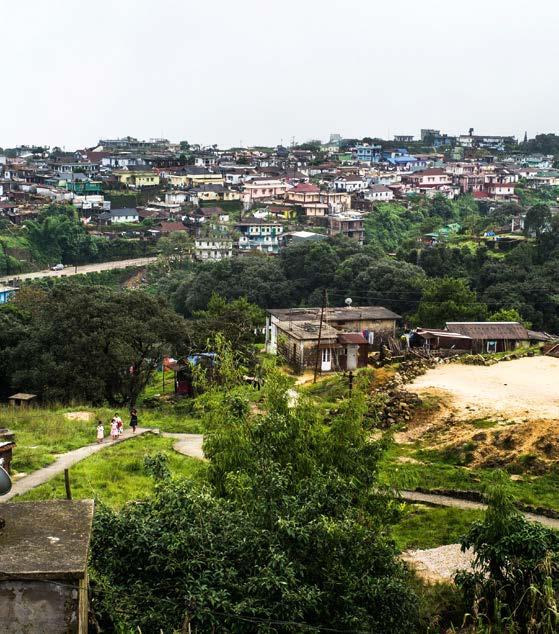
Which place in the world gets the most rain? Mawsynram is the correct answer. Mawsynram is a village in eastern India, very (1) to Bangladesh, with a population of 1,300. It gets 1,187.1 centimetres of rain every year. For that reason, the area around it has a lot of (2) . Mawsynram is between high (3) and low fields. In the rainy season, very warm wet air (4) to the north. It hits the hills behind Mawsynram and it turns into rain. And the rainy season (5) usually nine months long. That’s why people always (6) on a raincoat and take an umbrella when they go out.
Grammar
Superlatives
1 Complete the sentences with the superlative form of the adjectives in the box.
beautiful • bright • cold frightening sunny • wet
1 Put on some warm clothes! It will be day of the week today.
2 That storm last night was awful. It was storm all year!
3 In Greece it rains a lot in December. It’s month of the year.
4 There are many bright stars in the night sky, but Sirius is
5 Many areas of Europe are pretty in the spring, but I think the Spanish countryside is
6 Yuma, in the US, gets over four thousand hours of sun in a year. It’s place on Earth.
2 Complete the sentences with the superlative form of the adjectives in brackets.
1 My mum always tells me that school days are days of your life! (happy)
2 Hugh is one of people I have ever met. (unpleasant)
3 The Cartoon Museum is one of museums in London. (fascinating)
4 Mandarin Chinese is one of languages in the world. (complex)
5 Alaska is state in the USA. (big)
6 What’s way to send a parcel to the UK? (cheap)
3 Complete the sentences with the superlative form of the adjective or adverb and your own ideas.
1 The (funny) person I know is
2 The (beautiful) city in my country is
3 The (sun) month in my country is
4 The (hard) worker in my class is
5 The (bad) weather in my country is in
6 The (interesting) place I have ever visited is
4 SUM AP Complete the sentences with the adjectives in the box. Use the comparative or superlative form.
cold • dry • hot • wet • windy • sunny
1 Winter in Norway is much than winter in Italy.
2 July is usually month of the year in Saudi Arabia.
3 This year has been than last year so there have been more forest fires.
4 It was day we’ve had all year –the rain never stopped!
5 Spain is usually and than the UK.
6 Tarifa is one of places in the world – it’s really popular with kitesurfers.
reminder See SB p. 143
the correct grammar words
5 PRELIMINARY Open cloze For each question, write the correct answer. Write one word for each gap.
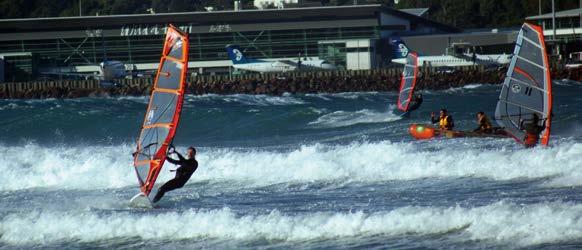
Hi Ali
How are you?
Here’s some more news about my holiday (1) New Zealand. Today we’re in Wellington, which my guidebook says is (2) windiest city in the world. I didn’t know that, but I can tell you that it’s windier (3) any other place I’ve ever been. That explains why so many people (4) surfing in the ocean – windsurfing seems very popular too. I’ve never tried that, but I’m sure riding the waves is a great feeling. And it’s the (5) amazing sport to watch.
How are things in Riyadh? We’re getting (6) on 22nd July, so I’ll see you then.
Bye for now, Nasser in
Writing
Tip
Exam task
Oracy and Writing lab
Talking about the weather and seasons
1 Answer the questions. Use ‘I prefer…’ and ‘because...’ to explain your choices. Write at least two sentences for each question.
1 Do you prefer summer or winter? Why?
2 Do you prefer to go to the beach or the mountains? Why?
3 What kind of activities do you enjoy most in spring or autumn?
2 Complete the sentences with your own ideas. Write at least two sentences for each question.
1 If it rains all weekend, I usually
2 If the weather is sunny and warm, I often
3 If it’s snowing, I sometimes
Describing a trip
3 Look at the statement in the map. Think about the information you can add to the statement. Use the ideas in the circles.
4 Put these sentences in the correct order (1-6) to create an article.
a Later in the afternoon, we climbed to the top of the old tower and enjoyed an amazing view of the lake.
b To start the day, we took a relaxing boat tour that went around the whole lake.
c Overall, it was one of the most enjoyable day trips I’ve ever had, and I’d love to go back.
d Last month, I spent a day at Lake Como with my family, and it was the perfect escape from the city.
e After the boat trip, we found a quiet spot under the trees and had a picnic with local food.
f The best part of the day was feeding the ducks by the water – my little brother loved it.
Tip reminder
Ordering events and adding interest
See SB p. 144
Exam task
5 PRELIMINARY Writing an article You see this notice on an English-language website. Write your article. Write about 100 words.
Articles Wanted!
MY FAVOURITE DAY TRIP
Have you ever been on a great day trip with your family? Tell us about it! Where did you go? What did you do? Why do you think this place is special? Write an article answering these questions and we’ll publish the best ones online.
10 Learning the ropes
Grammar reference
Relative pronouns
I relative pronouns si utilizzano per introdurre le frasi relative, le quali danno informazioni in riferimento al nome che le precede.
Si utilizza
• who quando ci si riferisce alle persone
The girl who lives near my aunt is very funny.
• which quando ci si riferisce agli oggetti
The car which makes that noise is very old.
• that che può sostituire sia who che which
He’s the boy that plays the guitar in our band.
This is the book that I read last summer.
• where quando ci si riferisce ai luoghi
This is the house where I grew up.
• whose in caso di possesso
She’s the girl whose phone was stolen.
I pronomi relativi possono svolgere sia la funzione di soggetto che di complemento oggetto della frase relativa. Quando svolgono il ruolo di complemento oggetto, possono essere omessi.
This is the film (which/that) I saw with Emma yesterday. She’s the doctor (who/that) we met at the hospital.
Indefinite pronouns
Gli indefinite pronouns si utilizzano per indicare persone, cose o luoghi in modo generico.
Someone is singing – I can hear the voice. There’s nothing for dinner – let’s order a pizza.
I pronomi indefiniti sono composti dai quantificatori some-, any-, no- e every- e dalle desinenze pronominali -one, -body, -thing e dall’avverbio -where
I quantificatori, che fungono prefissi, determinano la portata del pronome/avverbio che ne segue, indicando genericamente quantità, presenza o assenza.
• some-, quantificatore indefinito, si utilizza nelle frasi affermative e nelle offerte
Someone is waiting for you outside. Would you like something to drink?
• any-, anch’esso quantificatore indefinito, si utilizza nelle frasi interrogative e nelle frasi negative
Do you know anyone in this city?
She doesn’t want to go anywhere tonight.
• no-, quantificatore negativo, si utilizza per indicare l’assenza totale
Nobody answered the phone.
• every-, quantificatore universale, si utilizza per indicare la totalità
Everyone in the class passed the test.
Quando si utilizza il quantificatore no-, il verbo non vuole MAI la forma negativa, ma sempre affermativa. There is no one here.
I did nothing, this morning – I just relaxed.
I pronomi indefiniti richiedono sempre il verbo al singolare.
Everybody is waiting for you.
Adverbs of manner
Gli avverbi si utilizzano per descrivere un verbo. Possono essere usati prima del verbo o dopo l’oggetto, ma MAI tra il verbo e l’oggetto.
The vet examined the dog carefully.
The vet carefully examined the dog.
Gli avverbi regolari si formano aggiungendo -ly agli aggettivi.
slow slowly polite politely
Alcuni avverbi prevedono delle variazioni ortografiche.
• quando un aggettivo termina in -y, la -y si modifica in -i- a cui si aggiunge -ly easy easily
• alcuni aggettivi terminanti in -e perdono la -e prima di aggiungere -ly, ma non tutti true truly terrible terribly surevsurely
L’aggettivo good è l’unico ad avere una forma avverbiale specifica, ossia well He can sing very well.
Gli avverbi irregolari, invece, hanno la stessa forma dell’aggettivo da cui derivano.
Aggettivo Avverbio Aggettivo Avverbio fast fast low low hard hard deep deep late late wide wide straight straight wrong wrong long long right right high high
Alcuni degli aggettivi sopraelencati presentano una variante terminante in -ly che ha, però, un significato differente.
Avverbio Esempio hardly I hardly know him – we only talked once.
lately Have you seen her lately? nearly I didn’t hear the alarm clock, this morning – I nearly missed the train. deeply I’m deeply sorry.
widely The new theory was widely accepted.
Gli aggettivi temporali terminanti in -ly rimangono anch’essi invariati, sebbene prendano il ruolo di avverbi.
Aggettivo Avverbio
Aggettivo Avverbio early early yearly yearly daily daily hourly hourly weekly weekly nightly nightly monthly monthly
Comparative adverbs
Il comparativo degli avverbi si forma sempre con l’uso more quando l’avverbio termina in -ly quickly more quickly carefully more carefully The bus is travelling more slowly than the cars.
Quando gli avverbi non terminano in -ly si aggiunge -er a fine parola. Fast faster late later He worked harder than others to finish the project first.
Anche alcuni avverbi, come gli aggettivi, sono irregolari. well better badly worse far farther/further little less many / much more late later early earlier
Superlative adverbs
Così come per il comparativo, il superlativo degli avverbi si forma sempre con l’uso the most quando l’avverbio termina in -ly. slowly the most slowly happily the most happily The rain fell the most heavily in the south.
Quando gli avverbi non terminano in -ly si aggiunge -est a fine parola hard hardest fast fastest They arrived at the latest possible moment.
Anche alcuni avverbi, come gli aggettivi, sono irregolari. well the best badly the worst far the farthest/furthest little the least many / much the most late the latest early the earliest
Jobs
cleaner My aunt is a cleaner in an office.
dentist A dentist looks after your teeth.
doctor A doctor works in a hospital.
driver My dad is a train driver.
engineer An engineer designs things like bridges. farmer A farmer grows things and also looks after animals.
guide A guide gives information to people when they visit a place.
journalist A journalist works for a newspaper or magazine.
mechanic A mechanic fixes cars.
nurse A nurse looks after you when you are ill.
painter A painter came and painted the outside of our house.
photographer A photographer takes photos. pilot A pilot flies a plane.
police officer A police officer helps to keep people safe.
receptionist A receptionist welcomes people to an office or hotel.
shop assistant A shop assistant helps people in shops. vet A vet makes animals better.
waiter A waiter serves food in restaurants, cafés and hotels.
School and education
exam She studied hard for the math exam. instructions Read the instructions before starting the exercise.
mark I got a good mark in the test.
project We’re doing a science project together. subject My favourite subject is English.
School
verbs
answer Can you answer the questions? fail I failed my exam. follow Don’t forget to follow the instructions. pass I passed my exam.
remember You have to remember lots of facts in history.
study I study English at university.
Collocations and expressions
take an order (p148) give a presentation (p148) serve food (p148) write articles (p148) fly a plane (p148) make somebody better (p148) earn money (p148) wear a uniform (p148) boarding school (p154) evening class (p154) further education (p154)
higher education (p154) primary school (p154) private school (p154) secondary school (p154) sixth form college (p154) special school (p154) state school (p154) take a break (p156) work experience (p156) gap year (p156) a part-time job (p156) work on your own (p159)
Frame A
1 Read the title of the text and complete the sentences with your own ideas. Then, read the text and check your answers.
1 Young photographers often take pictures of
2 To edit photos, you usually need a
3 Some people start taking photos when they are
4 A photographer may travel to for new images.
5 A good photo can show in everyday things.
6 Nature photography often includes animals, trees, or
Tip reminder
Dealing with unfamiliar words
Reading task
1 Who is hardly ever at home?
2 Who uses technology to change their photos?
3 Who started taking photos at the youngest age?
4 Who did something difficult with a child?
5 Who took photos inside their home?
6 Who works as a photographer?
See SB p. 147
2 Read the text again. For each question choose the correct answer.
Martin Nittala Becca Skinner Nico Daniels
Young Photographers
Nico Daniels
Nico Daniels is a young photographer from Houston, USA. He started taking pictures with a camera he got for his eleventh birthday. Over the years, he saved money to buy a really nice camera. When he was fifteen years old, he decided to do a photography project in his brother’s old bedroom. He asked friends to sit for the photos, and they wore beautiful red clothes. Then he added blue and purple lights behind them and, with all the different colours, his photos looked like wonderful dreams.
Becca Skinner

3 Read again and complete the sentences with a maximum of four words using information from the text.
1 Nico Daniels’ was given a camera
2 The lights made the photos seem like
3 Becca developed her interest in photography while
4 She takes photos of nature and
5 Martin Nithala uses computer software to make his photos
6 He sometimes takes photos of sunsets nature, people, buildings for his eleventh birthday
Becca Skinner is American and became interested in photography when she was at university. Nature is her passion, and she became a photojournalist and an outdoor adventurer. She spends a lot of her time travelling and sleeping in her truck. She often takes photos of remote places of great natural beauty. Once she went on a climbing and camping trip in the mountains with her best friend and her friend’s son, who was then fourteen months old. You can see her photos on the National Geographic website and in magazines.
Martin Nittala
Martin Nittala is a young photographer from Rajahmundry, India. At fifteen he started taking photos with his brother’s mobile phone. He loved it so much that he soon bought a camera to take better photos. With his computer, Martin adds colourful butterflies or bright lights to photos to make them more interesting. He takes many photos in the city streets. He might take a photo of an old bus, or a bird in a tree, or the evening sun over apartment buildings – each photo is beautiful in its own way.
1 Complete the Venn diagram with the words in the box. Some words can go in both categories. doctor • engineer • farmer • journalist • nurse • painter • photographer pilot • police officer • receptionist • shop assistant • waiter
indoor jobs outdoor jobs
2 Complete the dialogues with the words from the box. engineer • journalist • nurse police officer • receptionist • shop assistant
1 A What does your mum do, Yousef?
B She’s a(n) . She designs bridges.
2 A A man just stole something from that bag.
B We should tell a immediately.
3 A What’s your dad’s job, Eleni?
B He’s a and writes for a newspaper.
4 A Did you call the hotel about our room, Devin?
B Yes, I spoke to the . He was very helpful.
5 A There are so many phones to choose from! I don’t know which one to buy.
B We should ask a to help us.
6 A I’ve hurt my arm and I think it’s broken.
B Please sit over there – a will be with you to take your details first.
3 Choose the correct option.
1 Do you take / earn / work a lot of money in your job?
2 I’m going to give / make / earn a presentation about travelling safely.
3 My father used to work in / on / to a factory.
4 Do you have to give / make / wear a uniform at work?
5 I want to work for / on / as a software company.
6 Would you like to work at / as / in a nurse?
Exam task
4 PRELIMINARY Multiple-choice cloze For each question choose the correct answer.
Castle jobs!
What do you think is the best job ever? How about (1) in a castle? There are many castles in Scotland which need people to (2) lots of different jobs. It’s also a great way to (3) about Scottish history. You need different skills for each job. You may need to (4) after the gardens or show people where they can park their cars. For castles that are in the (5) of lakes, you may need to drive a small boat. You may also (6) to tourists who visit the castle. Does it sound interesting? Have a look at our website to find out more.
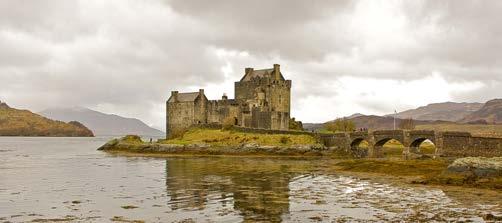
Choosing the correct verb
Tip reminder
See SB p. 148
Grammar / Listening
Relative pronouns
1 Combine the sentences using relative pronouns. More than one answer is possible.
1 I know a farmer. He lives in my village. I know a farmer who/that lives in my village.
2 My mum works in a factory. The factory makes cars.
3 That’s the man. He helped me when I lost my keys.
4 Priya saw a famous journalist. The journalist works for the Times.
5 Layla made a cake. It’s on the table.
6 She scored a goal. It won the match.
2 Complete the text with who, which, that or –. More than one answer is possible.
who / that
Jack Randall is an adventure lover (1) works with wild animals. He’s a zoologist, which means he’s a person (2) studies and works with animals. He has a passion for reptiles – animals (3) are born from eggs and have a hard skin, like snakes, turtles or, in the past, dinosaurs. He makes videos about snakes and other animals (4) people are often afraid of, and he puts them on YouTube every week. He also visits places (5) are difficult to get to, such as the deserts in Australia’s Northern Territory. He loves filming the animals (6) people don’t often see.
3 Match the two parts of the sentences using who, which --. More than one answer is possible.
1 Wasn’t that the scientist
2 I visited the museum
3 Do you remember the student
4 During our summer trip, we stayed at a hotel
5 That man over there is the professor
6 This is the nursery school
7 Our next door neighbours adopted a dog
a we saw in the documentary last night?
b moved to Australia to study English for a year?
c had a rooftop swimming pool.
d teaches chemistry at the University of Liverpool.
e had a large collection of Egyptian art.
f my aunt went to as a child.
g was found injured in the street.
Listening
Tip reminder
Exam task
1 PRELIMINARY Multiple-choice with picture options Read the Exam tip. Then, listen, and for each question choose the correct answer.
1 Where does Yolanda’s brother work?
2 When does Abraham’s new job start? 14th April 6th April 13th April
3 How much did Grigor pay for his laptop?
4 What time should Francesca call again?
5 What is the woman’s job?
2 Listen again and decide if the sentences are true (T) or false (F). Correct the false ones.
1 Yolanda’s brother was having dinner when he was at the Blue Café. He was having lunch.
2 Abraham made a mistake when he said the date of his new job.
3 Grigor chose the cheapest laptop he could find.
4 Francesca is calling about a reservation.
5 The woman wants to become a history teacher.
Frame B / Vocabulary
School and education
1 Complete the conversations with the school subjects in the box.
art • biology • drama • geography history • maths
1 A What did you learn in today, Malcolm?
B We watched a video about what London was like in the 1700s.
2 A What’s your favourite subject, Aryan?
B . I love learning about the world and other countries.
3 A Why do you like so much, Lina?
B I don’t know. I just think numbers are really cool.
4 A That’s a lovely painting, Anton. Where did you learn how to paint like that?
B I learned in my class at school.
5 A What things do you do in your lessons with Mr Fernandez?
B We study plays and we learn how to act out scenes.
6 A I just love plants and animals. I think I want to be a vet or a zoologist.
B Well, you must really like lessons.
2 Complete the sentences with the words in the box.
boarding school • evening class further education • higher education private school • secondary school special school • state school
1 Because I work full-time during the day, I’ve enrolled in a/an to improve my Spanish.
evening class
2 When she left school at 16, she didn’t go to university but chose to become a pastry chef.
3 His parents live abroad, so he studies and sleeps at a/an in the countryside.
4 He supports children who need extra help and works at a/an with trained staff and therapists.
5 Education in a/an is paid for by the government and open to all students.
6 My parents believed in small class sizes and paid for me to attend a/an
7 She’s applying to study law at university, so she’s planning to continue into next year.
8 After primary school, students in the UK move on to until they are around 16.
3 Complete the sentences with the words in the box.
exam • information • instructions • mark project • question • subject • university
1 I’m so happy! I passed my biology !
2 If you don’t follow the correctly, the machine won’t work.
3 I’m sorry, I forgot to answer your .
4 I hope to go to a good after I finish school.
5 I didn’t get a good in my exam. I’ll have to spend more time studying next time.
6 What school do you prefer –maths or history?
7 You can get about a lot of different things at a library.
8 Can we meet at my house to do our for art class?
4 Complete the text using a suitable verb in the correct form.
When I finished high school, I decided I wanted to (1) to university and (2) biology. If you’re interested in any subject linked to science, it’s good to know English well because so many research articles are in English, so I decided to do a course and take an exam. The day of the exam I was very nervous. I can (3) lots of information very easily, which is a good thing if you like science and facts, but to (4) an English exam you need more than information, and I didn’t want to (5) it. I (6) the instructions on the exam paper very carefully, and I (7) all the questions. And then we got to the Speaking task. I became very scared because you do the Speaking task with another student. But then I remembered about all the times we (8) a project and I worked with other students, and I realised it was the same thing. So I relaxed. And I even (9) a very good mark.

Grammar
Indefinite pronouns
1 Complete the sentences with the most appropriate indefinite pronoun.
1 I know about this topic, but not enough to explain it well.
2 Did you hear unusual last night coming from the basement?
3 The room was completely silent. wanted to speak first.
4 We were completely lost and couldn’t see that looked familiar.
5 She offered me to drink, but I wasn’t thirsty.
6 has left their jacket in the classroom — it’s on the chair.
7 I searched the whole flat, but my phone was to be found.
8 I can’t find quiet to study in this house!
Adverb of manner
2 Complete the sentences with the adverb form of the adjectives in the box.
angry • bad • beautiful • careful • early • polite
1 Caleb shouted at the taxi driver who almost hit him.
2 Meltem was very tired after work, so she went to bed .
3 If you ask , I’ll help you.
4 Please check your projects so there are no mistakes.
5 Monica was upset because she did in her exam.
6 Tomas sang during the concert.
3 Choose the correct option.
Hi Veronica
Here are the photos I promised you from the (1) day trip I took with Amy. We went to Sherwood Forest – you know … Robin Hood’s forest! – because her brother Tim works there as a guide. We walked through the forest (2) and we saw some (3) birds and animals. We walked (4) because we didn’t want the animals to be scared. You can (5) imagine Robin Hood and his Merry Men living there! And it was a perfect day because the sun was shining (6) . I think I would like to work there. I’m going to work (7) at biology this year, and I’m going to ask Tim how (8) it is to get a job looking after the forest. Talk soon, Ekaterina
1 A amazed B amazing C amazingly
2 A slowly B fast C slow
3 A beauty B beautiful C beautifully
4 A loudly B loud C quietly
5 A easily B easy C ease
6 A brightly B bright C light
7 A good B hardly C hard
8 A easily B difficult C close
Comparatives and superlatives of adverbs
4 Complete the sentences with the comparative or superlative form of the adverb in brackets.
1 Maria runs than Luca. (fast)
2 Of all the students, Giulia writes . (neatly)
3 He arrived than we expected. (early)
P.S. Maybe we could go (8) together after school sometimes. Let me know! something angrily a
4 This printer works than the old one. (good)
Tip reminder
Writing the correct determiner
Exam task
5 PRELIMINARY Open cloze For each question write the correct answer. Write one word for each gap.
From: Salman To: Ajaya
Hi Ajay,
How’s it going? When we last spoke, you were worried about moving into (1) different chemistry class. That’s not (2) you really enjoy, is it? I hope the class isn’t too difficult.
I’m going to do (3) new and exciting this term – I’ve decided I’m going to join the music and drama clubs at my school! (4) says they’re a great way to meet new people. I love acting, and I’ve already done (5) school plays before, but not many. Will you have time to join (6) clubs this year? And are you still in (7) school swimming team?
I have to go now, but write soon and tell me how things are going. Take care,
Salman
Oracy and Writing
Talking about jobs
1 Match the sentences (1-6) to the correct situation (a-f).
1 Helped animals and learned useful skills.
2 Served customers at the weekend.
3 Worked with a team to complete a shortterm project.
4 Had a job related to my future career.
5 Gained confidence and independence.
6 Volunteered to help others.
a Last summer, I worked at a café every Saturday. I was responsible for taking orders and taking food to the tables.
b During my school holidays, I took part in a volunteering event at a local food bank. It was hard work but extremely rewarding.
c I spent a week doing work experience at a design company during the school break. It helped me understand what it’s like to work in that field.
d I joined a group of students on a weekend project to paint the school library. We worked really well together.
e I had a part-time job last month and travelled to work on my own. I had to solve problems and make decisions by myself.
f I volunteered at an animal shelter. I cleaned cages, helped feed the animals and even learned how to care for sick pets.
Frame your ideas
2 SEL Self-awareness Underline the alternative which is true for you and complete the sentences with your own ideas.
1 I enjoy working with other people/alone because
2 I prefer working inside/outside because
3 I think it’s better to work in an office/at home because
3 ORIENTATION Use the prompts to complete the sentences about your future.
• In the future, I hope to
• My plan is to
• I really want to learn how to
• In a few years, I would like to
Writing an essay
Tip reminder
Planning your time
4 Read the statement and write two advantages and two disadvantages that come to your mind. Use the words in the box for help.
Students should get a part-time job during their summer holidays.
earn • experience • tiring • responsibility time • money • study • social life
5 Write three sentences giving your own opinion.
Exam task
6 PRELIMINARY
Writing an article You see this notice in an English-language website. Write an article.
Articles Wanted!
Volunteer work
Some people think volunteering is a great idea for students. Do you agree? What are the advantages and disadvantages of volunteering in your free time?
Write an article and we will put it on our youth blog! Write about 100 words. Write about: - at least two advantages (e.g. helping others, learning new skills, meeting people…) - at least one disadvantage (e.g. takes time, no payment…) - a final opinion (Is it worth it? Would you do it?)
11
On the move!
Grammar reference
The passive
La forma passiva si usa
• quando l’azione è più importante del soggetto che la compie (complemento d’agente)
All trains are delayed because of bad weather.
• quando il complemento d’agente non è conosciuto o irrilevante
English is spoken all over the world.
• quando il soggetto che compie l’azione è ovvio
Homework is given every day.
• per descrivere procedure o esperimenti
The powder was dissolved in water.
• per istruzioni, avvisi o divieti
Access is not allowed
La struttura passiva si può costruire solo il presenza dei verbi transitivi, ovvero quei verbi che reggono un complemento oggetto.
Nelle costruzioni passive, infatti, il complemento oggetto del verbo della frase attiva diventa il soggetto della frase passiva, mentre il soggetto della frase attiva diventa il complemento d’agente della frase passiva.
The chef cooks the meal The meal is cooked by the chef.
They made these cars in Italy. These cars were made in Italy.
La forma passiva dei verbi si forma con il verbo be + il
Past participle del verbo principale.
Pizza is eaten in Italy.
Il tempo verbale della costruzione passiva viene stabilito coniugando il verbo be
My car is washed every Sunday. My car was washed yesterday.
Quando si menziona il complemento d’agente nella frase passiva, questo è solitamente introdotto da by English is taught by Ms Smith.
Quando si fa riferimento a uno strumento si utilizza with
Photos aren’t taken with mobile phones, but with professional cameras.
Se si fa riferimento a materiali si utilizza of o from
The table is made of / from wood.
Generalmente, il complemento d’agente viene omesso quando
• è ovvio
The first Apple iPhone was sold in 2007 (by Apple).
• non è importante
The classroom was painted last week – walls are clean now.
• è sconosciuto
My phone was stolen yesterday.
Present simple passive
Affirmative
I am given
He / She / It is given.
You / We / They are given Negative
I am not given
He / She / It isn’t given.
You / We / They aren’t given Questions
Am I given?
Is He / She / It given?
Are You / We / They given?
Short answers
Positive Yes, I am Yes, He / She / It is Yes, You / We / They are
Negative No, I am not No, He / She / It isn’t No, You / We / They aren’t
Il Present simple passive si utilizza per
• fatti sempre veri
The Earth is covered by water.
• azioni regolari, abitudini e routines
The newspaper is delivered to our house every morning.
• descrivere procedimenti e processi
Products are packaged before they are delivered.
• regole e norme
Uniforms are required during lessons.
• descrizioni di prodotti
The device is designed to save energy.
• date, orari e programmi fissi
Christmas is celebrated on December 25th.
Lunch is served at 12.30 in the school canteen.
La forma affermativa e la forma negativa del Present simple passive si formano con il Present simple del verbo (not) be + il Past participle del verbo principale. The concert is held every New Year’s Eve.
Italian isn’t spoken in China.
Nella costruzione passiva, il verbo be funge da ausiliare, che nella forma interrogativa si antepone al soggetto + Past participle del verbo principale. Are the tickets sold online?
Allo stesso modo, per le risposte brevi si utilizza solo il verbo be in funzione di ausiliare.
Yes, they are. / No, they aren’t.
Generalmente, il Present simple passive viene utilizzato nelle frasi impersonali con verbi come say, know, believe, think, tell, ecc.
It is said that the Bermuda Triangle is cursed. It is known that the volcano is still active.
Past simple passive Affirmative
I / He / She / It was given You / We / They were given Negative
I / He / She / It wasn’t given You / We / They weren’t given Questions
Was I / He / She / It given? Were You / We / They given?
Short answers
Positive Yes, I / He / She / It was Yes, You / We / They were. Negative No, I / He / She / It wasn’t No, You / We / They weren’t.
Il Past simple passive si utilizza per
• descrivere azioni passate
The TV series was shot in Los Angeles.
• fatti storici
Rome was built many centuries ago.
• eventi o procedimenti passati
The orders were delivered in the morning.
• testi informativi
Recycling is encouraged in many European countries.
La forma affermativa e la forma negativa del Past simple passive si forma con il Past simple del verbo (not) be + il Past participle del verbo principale. The castle was built in the 15th century. The book wasn’t translated into English.
Allo stesso modo che per il Present simple passive, anche la forma interrogativa del Past simple passive si costruisce con il verbo be + soggetto + il Past participle del verbo principale. Were the documents sent yesterday?
Anche le risposte brevi si formano allo stesso modo, utilizzando solo il verbo be in funzione di ausiliare. Yes, they were. / No, they werent’t
Transport (nouns)
bike Everybody used their bikes on the new cycle paths.
bus I go on the school bus every day.
car My dad has three cars.
coach We went to Paris by coach.
driving licence I don’t have a driving licence yet, so I can’t drive.
helicopter Reporters sometimes fly in helicopters so they can see things from above.
lorry The oranges are taken by lorry from Spain to the UK.
map Look at the map – I don’t know where we are. motorbike Motorbikes can go very fast.
passport You need a passport to go to other countries.
petrol You put petrol in a car. plane Planes fly in the sky.
platform The train leaves from platform 2.
ship It is slower to travel by ship than by plane. taxi I got a taxi from the station to the theatre. ticket I bought a train ticket to go to Berlin. train I travelled by train from Paris to Madrid.
tram Some cities have trams in the streets.
wheel A car has four wheels.
Transport (verbs)
arrive The train arrives at ten thirty. catch You can catch the bus outside the station. cross You can only cross the road here.
delay The plane is delayed by one hour.
drive My mum usually drives our car.
fly Pilots fly planes.
get back We got back from holiday a week ago. get off Get off the train at the next station. get on We got on the school bus. leave The train leaves at ten. Don’t be late! miss I think we’re going to miss our train.
park You can park the car outside the house. pick up Mum will pick you up from the bus station. return We decided to return home early. ride I learned to ride a bike when I was five. sail I have never sailed a boat.
stop.The bus stopped near the station. take Shall we take a taxi to the museum?
Collocations and expressions
cycle paths (p162) bike sharing (p162) bike parking (p162) walking trial (p162) community garden (p162) public transport (p162) public library (p163) subway station (p163)
green space (p163) air quality (p163) wear a helmet (p164) ticket inspector (p165) petrol station (p165) city centre (p166) single / return ticket (p167) have a picnic (p172)
11
Frame A
1 Look at the title of the text and the photo and answer the questions.
1 What do you think ‘The Dream Machine’ might be?
2 What do you notice about the van in the photo?
3 Why do you think someone would cover a van with cameras?
4 Do you think this machine is real or imaginary?
5 Have you ever had a strange dream that gave you an idea?
Tip reminder
Finding words with opposite meanings
Exam task
2 INVALSI PRELIMINARY Multiple choice Read the text and choose the correct option.
The Dream Machine
One night in 1993, Harrod Blank had a dream about a van, but it was not a normal van – it was covered in cameras. In his dream, he drove around while the van took pictures. People were very surprised and the photos showed that on their faces. When Harrod woke up, he decided to make this dream come true.
He spent two years building this van and he put hundreds of cameras on it. When the van was ready, he travelled around with it, just like in the dream. No one thought the cameras were real. Actually, ten of them worked perfectly. It wasn’t difficult for Harrod to take a lot of funny photos.
Harrod used different types of cameras. Some were made in the 1990s, but others were older. He arranged white cameras on top of the car to spell ‘Smile’, which is what people often say before they take someone’s photo. The people along the side of the road, the ones
1 Harrod dreamed he was a...
A famous artist painting a car.
B man flying a helicopter over a city.
C man driving a van covered in cameras.
D photographer taking pictures of the stars.
2 Harrod’s funny van photos were...
A difficult to make.
B easy to take.
C boring to take.
D expensive to make.
3 People could see Harrod’s written message...
A from the air.
B from the road.
C on side of the van.
D on television.
he took pictures of, couldn’t see it, but anyone in a plane or helicopter could see it when they flew over the van.
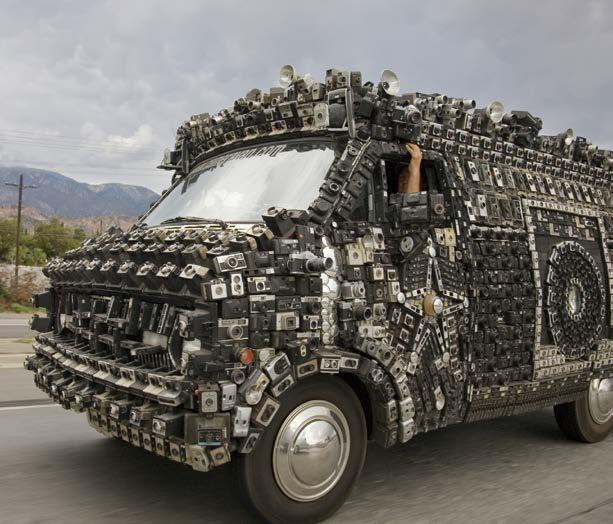
4 Where has Harrod been with his van?
A Across an ocean.
B From New York to California.
C To different countries in Europe.
D Only around his hometown.
5 Harrod’s film shows...
A how he built his first camera.
B the story of people who have made art cars.
C a history of art cars around the world.
D instructions for making your own art van.
Harrod Blank’s van
Transport (nouns)
1 Match the definitions (1-6) with the words in the box.
bycicle • coach • motorbike • plane taxi • train
1 This type of transport often has two wheels, an engine, and can be very fast. You must wear a helmet. motorbike
2 This form of transport is often used for long road journeys and can carry 40–50 passengers.
3 This is a fast form of transport used for longdistance journeys. It takes off and lands at special locations.
4 You usually pay for this transport per ride, and it takes you directly to your destination, often in cities.
5 You ride this using your legs, and it’s popular for short distances and exercise.
6 This transport runs on rails and is commonly used to travel between cities or across countries.
2 What type of transport did these people take? Choose the correct option.
1 We had an amazing trip across the ocean from Sydney to Hawaii.
a motorbike b ship c coach
2 When we arrived we went straight down on the roof of the building.
a helicopter b tram c plane
3 We got one from the airport. When we arrived at the hotel, I went straight to the reception with our bags while Jim paid the driver.
a coach b lorry c taxi
4 I went with my friend Clare. She’s an excellent rider and always carries an extra helmet.
a tram b ship c motorbike
5 There were probably thirty other passengers with us, and it took about twenty-five minutes from the hotel to the city centre. You can get a day ticket.
a lorry b taxi c tram
6 There were some great views of the mountains on the two-day journey from Vancouver to Banff.
a ship b train c tram
7 It was really busy on the roads from London to Birmingham and we arrived two hours late.
a train b helicopter c coach
8 Number 5 goes to the city centre, but sometimes it’s full and it drives past my stop.
a bus b car c taxi
3 Complete the conversation with the words in the box.
driving licence • map • passport petrol • tickets • wheels
Tom Hey, Liu! When did you get back from Dublin?
Liu Late last night. We missed our … what do you call the ships that take your car?
Tom Ferries?
Liu Yes, we missed our ferry because Mum left her (1) at the hotel, so we had to drive back to get it. Luckily, we didn’t have to buy 2) again.
passport
Tom But did you have fun in Dublin?
Liu Oh, yes, But we had some problems there too. One day the police stopped us because one of our (3) was moving in a strange way. They asked to see my father’s (4) , but he couldn’t find it ...
Tom What happened then?
Liu He found it, and we called a mechanic who fixed the car. Then we had very little (5) , and we arrived at a petrol station just before the car stopped.
Tom It sounds like you had an adventure there!
Was it easy to find your way around?
Liu Oh, yes, although we didn’t have a (6) because Mum prefers her phone app, but then one day all our phones lost the internet connection …
Tom Ha ha! But what about Dublin?
Liu I loved it! I want to go back, but not with my parents!
Frame your ideas
4 WRITING Answer the questions with your own ideas.
1 How do you travel to school? Describe what you do from when you close your door to when you arrive at school. .
2 Do you ever use public transport? Why? / Why not?
3 What’s the traffic like where you live? Is it safe for children? Give examples to support your opinion.
Grammar / Listening
The passive
1 Complete the sentences using the Present simple passive form of the verbs in brakets.
1 This new type of bus (drive) by a computer. I think it’s scary.
2 Passports (check) when you arrive in a new country.
3 These days, train tickets (often / buy) online.
4 The inside of a train (always / clean) before passengers get on it.
5 Food (not serve) on this train.
6 The bus you’re waiting for (usually / delay) because of traffic.
2 Rewrite these sentences using the Present simple passive.
1 They close the car park at the station at night. The car park at the station is closed at night.
2 Thousands of people visit the Great Wall of China every year.
3 They send train tickets by email
4 They sell books and magazines at the airport shop.
5 They usually show bus timetables in the information centre.
6 Passengers turn off their mobile phones during flights.
3 Complete the sentences using the Present simple passive form of the verbs in the box. award • clean • produce • protect • sell send • speak • store • teach • write
1 Several international prizes each year for scientific research.
2 French and Arabic in parts of North Africa.
3 Most of the world’s coffee in just a few countries.
4 The classrooms carefully every evening.
5 All the information about school trips directly to the students.
6 Important documents in secure archives.
7 Safety rules to all new employees.
8 Letters to the editor by the public and selected by journalists.
Listening
Tip reminder See SB p. 166
Listening for clues
5 The man originally bought his plane ticket online because there was a is driven are awarded
1 Read the Exam tip on page 166 again. When you listen, do you always hear the words in the answer options?
Exam task
2 PRELIMINARY Multiple choice with five conversations Listen and for each question choose the correct option.
1 You will hear a man talking to his friend about Rome. Why did he go there?
A to try the food
B to see a football match
C to visit old buildings
2 You will hear two friends talking about visiting a castle. How does Katerina want to go there?
A by taxi
B on foot
C by bus
3 You will hear a woman talking about a trip to Madagascar. What advice does her friend give her?
A visit the countryside
B explore the capital
C go to a small island
4 You will hear two friends talking about a postcard. What’s on the postcard?
A a city centre
B a bridge
C a castle
5 You will hear a man talking. Why is he angry?
A He bought the wrong ticket.
B His trip was cancelled.
C The ticket may cost more.
3 Listen again and complete the sentences.
1 In Rome, Jim didn’t enjoy the traffic, the noise, and the number of
2 The castle is located at the top of a
3 The woman went to Madagascar two years ago with her
4 Clare gave them a of the city and showed them hidden places.
Transport (verbs)
1 Cross out the words that do not go with the verbs.
1 get on a coach / a car / a bus
2 take a taxi / a bike / the tram
3 ride a bike / a helicopter / a motorbike
4 catch a lorry / a bus / a plane
5 leave from the bus station / platform 2 / public transport
6 miss a motorbike / a plane / a coach
7 fly a ship / a plane / a helicopter
8 get back from school / airport / home
9 pick up tickets / a helicopter / a friend
10 cross the wheel / the river / the road
2 Complete the sentences with the verbs in the box. catch • drive • fly • get off • miss park • return • ride • sail • stop
1 There are no direct buses. We’ll need to in the town centre and take the number 7 bus.
2 We had to run to the bus.
3 Do you think it’s fun to a motorbike?
4 How long does it take to learn how to a plane?
5 While we were in Greece, we learned how to a boat.
6 Look at the traffic. Do all these people really need to to work?
Frame B / Vocabulary
4 Match the beginning of the sentences (1–8) with the end of the sentences (a–h).
5 Complete the email with the correct verbs. c get off got back
7 If we our train, we’ll have to wait two hours for the next one. So hurry up!
8 There’s a place to your bike in front of the museum. You can leave it there and walk straight in.
9 Does the bus outside the train station?
10 We really want to to Krakow soon. It’s a lovely city.
3 Use a dictionary and find the meaning of the words you don’t know. Then link each type of transport with the place where you get them. Write the chains, as in the example.
1 train rank gate
2 coach harbour top of the queue
3 flight railway station dock
4 taxi bus station platform
1 The taxi is on the other side of the street, so we should
2 Our stop is the next one, so we need to
3 The hotel guests are at the airport, so the driver will
4 This place is wonderful. I want to
5 Sai is coming by coach, and he will
6 I’m afraid I’m lost and I don’t know how to
7 We don’t have time to do any shopping because our plane’s going to
8 My feet are so tired, and I’ll be glad to
a pick them up and bring them here.
b arrive at the bus station at 4.00 p.m.
c cross here to get to it.
d get on the train and sit down.
e get back to my hotel.
f leave in thirty minutes.
g get off very soon.
h come back again soon.
From: Kitty
To: Yvonne
Hi Yvonne
How are you? I (1) from my holiday yesterday. We had a great time, but I’m really tired from the journey. The train to Florence was (2) by two hours, and as a result we (3) the train from Florence and all the other trains home. So we (4) Florence at 9 p.m. and we didn’t (5) here until 9 a.m. the next morning. You can (6) a bus from the train station to near our home, but yesterday we were too tired for that and we decided to take a taxi. So we (7) the street outside the station to where the taxi rank is, ready to queue, but there was only one taxi there and no queue. So we (8) it and we didn’t have to wait –for the first time in two days!
What about you? How was your holiday?
Speak soon.
Kitty
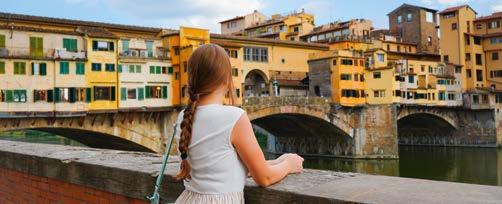
Grammar
The past simple passive
1 Complete the sentences using the Past simple passive form of the verbs in the box.
build • complete • delay • film • find not send • pay for • steal • take • not tell
1 Raj and Nina had an accident and they to hospital.
3 They were chosen because they’re Mum’s favourite. (these flowers)
4 It was used for making bread. (this strange thing)
5 They were checked yesterday. (the tests)
2 The oldest bridge in the world more than 2,800 years ago in Turkey.
3 Our new computers by our school.
4 Where this video ?
5 The tickets to the correct address.
6 We’re so upset! Both of our bikes last night!
7 The Shard building in London in 2012.
8 My passport outside the train station by another passenger.
9 You’re an hour late! the train ?
10 I that I could buy my ticket on the bus.
2 Choose the correct option.
were taken B
Barra Airport is in the Outer Hebrides, a group of islands that are part of Scotland, and it’s quite an unusual airport. It’s on a beach which (1) by the sea twice a day and when the sea goes down, the beach (2) by planes to bring passengers to the area. The airport (3) in 1936, and it only flies to and from one city, Glasgow, the city with the largest population in Scotland. The flights are short, so food and drinks (4) on the plane. The airport is small, and it (5) by about 10,000 passengers every year. People love the airport, and it is (6) by travellers as the best airport to visit. Filmmakers love it too, and many films and TV programmes (7) there.
1 A cover B is covered C covers
2 A used B was used C is used
3 A is opened B was opened C were opened
4 A are served B don’t serve C aren’t served
5 A is only visited B was visited C only is visited
6 A often chose B often chosen C chosen often
7 A was filmed B is filmed C are filmed
3 Write questions for the underlined words using the past simple passive and the words in brackets.
1 It was taken at a park in Bangkok. (this photo) Where was this photo taken?
2 It was built in 1492. (this castle)
6 It was made in Peru. (your handbag)
7 It was parked on the path because the bike park was full. (the bike)
8 Yes, I was given it for my birthday last year. (painting of Lake Titicaca)
4 Find and correct the mistakes in the sentences.
1 The rooms are cleaning by the hotel staff every afternoon. The rooms are cleaned by the hotel staff every afternoon.
2 Our flight was delay for more than three hours.
3 Sometimes the luggage don’t be checked properly.
4 Museum tours are gave in several languages.
5 All guests is given a welcome drink on arrival.
6 My passport wasn’t stamp at the border last night.
7 The beach were closed early yesterday because of the storm.
8 A lot of photos are took by tourists near the monument.
9 The hotel was decorate with flowers for the festival.
10 Meals are serves in the garden during the summer.
Oracy and Writing lab
Talking about advantages and disadvantages
1 Match the means of transport (1-5) with one advantage (a-e) and one disadvantage (I-V).
Transport 1 plane 2 train 3 coach 4 bicycle
5 motorbike
Advantage
a Offers flexibility and independence.
b A budget-friendly option.
c You can reach far places very quickly.
d It’s comfortable and eco-friendly.
e It’s sustainable and keeps you fit.
Disadvantage
I Long journeys can be tiring.
II Airports can be stressful and costly.
III Not available in all countries.
IV Not practical for long distances.
V Weather and safety can be problems.
2 Write two full sentences about two different transport options. Add a short personal comment or example to make your sentence more meaningful.
A plane allows you to reach far places quickly, but airports can be expensive and stressful –especially during busy seasons.
Writing a story
3 Match the problems (1-5) with the possible reactions (a-e).
1 You lost your passport in the airport café.
4 Now add extra details. Complete the notes for two of the situations in exercise 3. Say:
• when it happened;
• what you were doing;
• how you felt;
• what happened in the end;
I lost my passport in the airport café just before boarding. I was buying a coffee. At first I panickedbut then I found it under a table.
Tip reminder
extra details
Exam task
5 PRELIMINARY Writing a story Your English teacher has asked you to write a story. Your story must begin with this sentence: We had just arrived at the airport when 1 1 b
2 Your flight was delayed.
3 You spilt coffee on your seat on the plane.
4 You got on the wrong train.
5 You forgot your suitcase at home.
a I asked the flight attendant for some tissues.
b I immediately went back and looked under the table.
c I decided to wait and read a book.
d I called my mum and asked her to bring it to the station.
e I got off at the next stop and took another

12 A world of beauty
Grammar reference
Ordering adjectives
Gli aggettivi si utilizzano per descrivere persone, cose, piante e animali.
Quando un aggettivo ha funzione di attributo, questo precede il sostantivo a cui fa riferimento.
We live in a small house near the lake.
Quando un aggettivo è utilizzato con funzione di nome del predicato, questo segue il verbo be. The lake in front of my house is deep
A volte più di un aggettivo viene utilizzato davanti a un nome. Generalmente, non si utilizzano più di due o tre aggettivi prima di un nome.
It’s a beautiful Japanese bowl. She gave me a small square wooden box.
Alcuni aggettivi danno un’opinione generale. That is a lovely bag. I had a horrible day!
Altri aggettivi danno ulteriori informazioni riguardo al nome cui si riferiscono.
He’s a very friendly dog. Rome is an ancient city.
Quando si intende utilizzare più aggettivi, questi devono seguire un ordine specifico. Solitamente, gli aggettivi di opinione vengono posti prima degli aggettivi che danno informazioni sul nome.
Pyramids are amazing old Egyptian monuments.
L’ordine da seguire è il seguente:
opinion great, beautiful size little, long age old, new shape square, round colour red, green nationality Italian, British material wooden, cotton
Quando gli aggettivi appartengono alla stessa categoria, di solito questi vengono separati da una virgola, mentre aggettivi appartenenti a categorie differenti non prevedono l’uso della virgola.
It’s a horrible, boring film.
It’s an interesting old book.
Spesso è possibile trovare nomi (sia propri che comuni) e sigle che vengono utilizzati con funzione di aggettivi. In questi casi, proprio come funziona con gli aggettivi, il primo sostantivo qualifica il secondo. You can admire the Paris skyline from the Eiffel Tower. She bought a chocolate cake for her party.
I need an EU passport to go on holiday this summer.
Gli unici due sostantivi che presentano una forma specifica per l’aggettivo sono wool e wood, le cui forme aggettivate sono rispettivamente woollen e wooden
I bought a woollen scarf because it’s very cold today. There is a wooden table in Granny’s kitchen. Gli aggettivi rimangono sempre invariati sia per genere che per numero.
I was very tired after the concert, and when I called Jake and Rose they said they were tired too.
both, either, neither
Per specificare quali tra due elementi vanno presi in considerazione in un contesto, si utilizza
• both accompagnato dalla forma affermativa del verbo quando si intende considerare sia l’uno che l’altro elemento
These books are both really interesting.
Both Tim and Jack have got blue eyes.
• either accompagnato dalla forma affermativa del verbo quando si intende considerare solo l’uno o l’altro elemento
You can either stay or leave.
Did you eat either pasta or pizza?
• either accompagnato dalla forma negativa del verbo quando si intende escludere sia l’uno che l’altro elemento
She didn’t tell either her mum or her dad. They didn’t go to either restaurant.
• neither accompagnato dalla forma affermativa del verbo quando non si intende considerare nessun elemento
I like neither the book nor the film.
‘I didn’t go to the party.’ ‘Me neither.’
È importante sottolineare che both e neither non si utilizzano MAI con il verbo in forma negativa.
I like them both I like neither of them.
Quando i due elementi menzionati differisco per numero, il verbo si accorda con il soggetto più vicino. Neither the teacher nor the students are in the classroom.
Neither the students nor the teacher is in the classroom.
Adjectives ending in -ing and -ed
Alcuni aggettivi derivano direttamente da voci verbali. bore boring / bored interest interesting / interested
Quando un aggettivo ha l’intenzione di esprimere l’emozione o la sensazione che viene provata, si utilizza la forma in -ed
They were excited for the match.
He was surprised when I told him about the party.
Quando un aggettivo ha l’intenzione di descrivere ciò che causa un’emozione o una sensazione, si utilizza la forma in -ing
The show is really amazing. There’s a frightening storm outside.
Natural places
bay The hotel has a great view of the bay at sunset.
beach We often go to the beach in the summer.
cave The Blue Grotto is a famous sea cave on the island of Capri.
coral reef The Great Barrier Reef in Australia is the world’s largest coral reef.
desert The Sahara Desert is the largest desert in the world.
field We live in the countryside, with fields all around the house.
forest The Taiga is the largest forest in the world.
glacier We saw a glacier while hiking in the Alps.
hill There are lots of hills where I live.
island My friend lives on an island – she can only get home by boat!
lake Lake Baikal in Siberia is the deepest lake in the world.
mountain Mount Everest is the tallest mountain in the world.
ocean The ocean is home to many fascinating creatures.
path We walked along a path through the wood.
river The Nile is the longest river in the world.
sea We went swimming in the sea yesterday.
valley We drove through a beautiful green valley in Austria.
waterfall Angel Falls is the highest waterfall in the world.
wood There’s a beautiful wood near our house.
Compass points
east Brisbane is in the east of Australia.
north Scotland is in the north of the UK.
south Ushuaia is in the south of Argentina.
west California is in the west of the USA.
Animals
bear There are a lot of brown bears in North America.
bee Bees love wild flowers.
bird There are lots of birds in my garden.
butterfly Butterflies are often beautiful colours.
cat Cats are popular pets because they are independent and playful.
dolphin Many people want to swim with dolphins.
duck There are three ducks on the lake.
fish My dad caught a big fish in the river.
fur Many animals have thick fur to protect them from the cold.
giraffe Giraffes use their long necks to reach leaves high in the trees.
gorilla Gorillas live in family groups in the forests of central Africa.
herbivore A rabbit is a herbivore because it only eats plants.
insect Bees are insects because they have six legs.
lizard The hotel has a great view of the bay at sunset.
mammal Bears are mammals.
monkey A monkey stole my snack.
mouse A mouse is very small.
polar bear Polar bears are threatened because the ice in the Arctic is melting.
reptile Snakes and lizards are reptiles.
shark A shark is a fish, not a mammal.
snake Snakes can be very dangerous.
sea otter Sea otters use rocks to break open shells.
sea urchin Sea urchins live on the ocean floor.
species Many species are at risk of extinction.
spider Spiders build webs to catch insects for food.
tapir Tapirs are shy animals that live in tropical forests.
tiger Tigers are excellent hunters.
whale Whales migrate thousands of kilometers every year to find food.
wildlife We saw amazing wildlife during our trip to the African savannah.
zebra Zebras have unique black and white stripes that help them hide from predators.
zoo Visiting the zoo can teach children about endangered species.
The environment
bag Using reusable bags instead of plastic bags is better for nature.
climate change Climate change is causing glaciers to melt faster than before.
fill You could fill an old plastic bottle with nuts and use it as a bird feeder.
garden My grandmother spends hours in her garden. global warming Global warming is making summers hotter and winters shorter.
grow If you live in a flat, you can grow flowers in a window box.
houseplant I keep a houseplant in my room because it makes the air cleaner.
look after We all need to try to look after the planet.
make You can make things from old plastic bottles.
packaging Reducing packaging can help protect the environment.
pesticide Pesticides can harm bees.
plant Plant wild flowers in your garden.
plastic Many animals die after eating plastic that ends up in the ocean.
recycle We can all recycle lots of things.
reuse Try to reuse the plastic into your home.
reusable Use reusable plastic bags for shopping.
save Save electricity – switch off the lights when you leave a room.
seed A tiny seed can grow into a big tree if it has water and sunlight.
use You can use rainwater to water your garden.
waste Don’t waste food – eat less!
Collocations and expressions
food miles (p179)
plastic packaging (p179)
food container (p179)
global warming (p181) food waste (p184)
reusable bag (184)
12
Frame A
1 Look at the title of the text and the photo and answer the questions.
1 What do you usually do when your clothes, bikes, or shoes are too small or too old?
2 Why do some people give things away instead of throwing them out?
3 What are some benefits of reusing or recycling items instead of buying new ones?
Tip reminder
Answer summarising parts of a text
Exam task
2 INVALSI PRELIMINARY Multiple choice with one text Read the text and choose the correct answer.
1 What problem did the parents want to solve?
A Their children needed new bikes too often.
B Their children wanted new bikes every year.
C Their children were too old to ride bikes.
D Their children didn’t want to share bikes.
2 What new problem did they have?
A Some parents were too slow.
B Too many bikes were picked up late.
C They didn’t have enough space.
D Some children didn’t like used bikes.
Cycle, Recycle and Upcycle
In the late 1990s, some people in Edinburgh in Scotland had an idea. Their children went to Sciennes Primary School, and the parents started a clever way to reuse their children’s good bikes: when a child’s bike became too small for them, their parents gave it to another family with a smaller child and they got a bike from a family with an older child who was too tall for it. So all the children had a good bike that was the right size for them and the parents didn’t need to keep buying new bikes.
The idea became very popular, and more and more people started giving and taking bikes. However, this created another problem: often a bike was given, but it wasn’t taken until a week later or longer, and some parents’ gardens were full of bikes. They decided they couldn’t do this from their homes any more.
That’s how a new organisation was born: first they moved into a small building in the city, then the
3 The parents decided to...
A open shops all over Scotland.
B ask Waverley train station to help them.
C start a business in a public place.
D keep the bikes in schools instead.
4 What does The Bike Station want people to do?
A Use bikes more often.
B Give them their bikes.
C Work in their shops.
D Recycle their old bike parts.
5 Why don’t some people ride bikes in the city?
A Because they haven’t got friends to ride with.
B Because the traffic worries them.
C Because they don’t know how to repair them.
D Because bikes are too expensive.
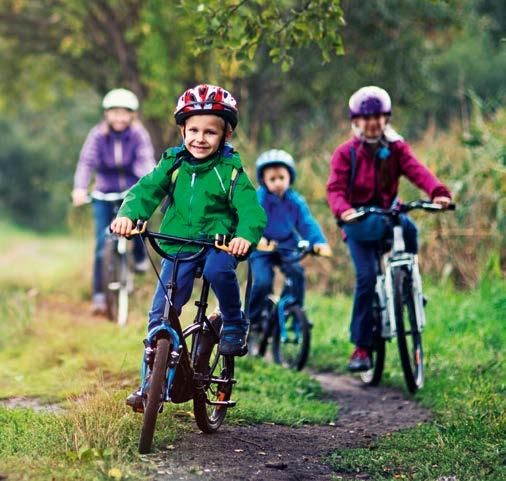
parents opened a shop in Edinburgh’s Waverley train station and they called it The Bike Station. People of all ages started to use it, so they had to move to an even bigger place. Now people give them old bikes and the Bike Station fixes them, recycles them, upcycles them – that is, they make them better than when they were new – and sells them at good prices. Today they have shops in Glasgow and Perth too, and the Bike Station is now the largest bicycle recycling organisation in Scotland. Their purpose is to encourage people to use bikes as a form of transport. They organise classes to teach people how to fix their bikes. They even organise free social rides for people who are a bit scared to ride in the city streets: they start in a quiet area, then go where there’s a bit more traffic and then to the city centre – so people make new friends, keep fit and protect the environment.
Natural places
1 Look at the map and complete the sentences with north, south, east or west.
1 Cardiff is of London.
2 Inverness is of Edinburgh.
3 Birmingham is of Manchester.
4 Glasgow is of Edinburgh.
5 Cambridge is of London.
6 London is of Oxford.
2 Complete the sentences with the words in the box. bay • cave • coral reef • desert forest • glacier • lake • mountain river • sea • valley • waterfall
1 They went swimming in the warm clear waters of the Mediterranean
2 There is a beautiful between two mountains – perfect for camping.
3 A huge slowly moves through the Alps and shapes the land.
4 While diving near the island we explored a colourful full of beautiful tropical fish.
5 Birds, insects and many types of large animals make their home in a
6 The is very hot in the day and very cold at night.
7 There is a small in the park, and you have to use the bridge to cross it.
8 We climbed up the rocks to see the amazing falling into the river below.
9 They explored the , using headlamps to see the walls inside.
10 What is the highest in your country?
11 We swam in a quiet , protected from the wind and waves.
12 The children went rowing on the calm near their campsite.
3 Which places are these people talking about? Choose the correct option.
1 A This looks like a good place to swim.
B Wow, the water is so clear and the rocks are beautiful!
a hill b field
c valley d beach
2 A Let’s walk along here by the river.
B I’d like to see where it goes.
a path b valley
c beach d cave
3 A I’ve never seen a frozen river like this before.
B It’s not a river – it’s a moving block of ice!
a sea b waterfall
c glacier d lake
4 A We have to go down into the darkness!
B Don’t worry – I’ve got a torch.
a mountain b cave
c forest d hill
5 A Look! There’s water falling down those rocks!
B It’s amazing – I’ve never seen a real one!
a waterfall b hill
c river d glacier
6 A This place is full of colourful fish and plants!
B Be careful not to touch anything – it’s very fragile.
a beach b coral reef
c cave d river
7 A These trees are really tall and close together.
B Yes, and you can hear so many birds singing!
a valley b field
c forest d hill
8 A The water here is really still.
B That’s because we’re not in the open ocean.
a bay b glacier
c path d lake
Grammar / Listening
Ordering adjectives
1 Write the adjective categories in the correct order.
4 We watched two films last night, and I didn’t like of them.
5 I spoke to Sarah and Emily. They’re coming to the party.
6 of my friends wanted to go to the museum so I went alone.
Listening
Tip reminder
Listen to how speakers respond
See SB p. 178
2 Choose the correct words to complete the sentences. Remember the rules of the order of adjectives.
1 She’s got a large lovely / rectangular table in her living room.
2 Benjamin’s got medium-sized comfortable / old chairs in his living room.
3 Is that your new big / red car in front of the school?
4 These items go in the plastic / small blue bin.
5 She’s wearing a comfortable / cotton old T-shirt.
6 Juan keeps some small things from his trip to Cuba in a round metal / strange box.
7 We went to the new Italian / fantastic restaurant last night.
8 Did you see the beautiful horrible / silk dress Jess was wearing?
3 Complete the sentences with the adjectives in brackets. Use them in the correct order.
Exam task
1 INVALSI Multiple choice with one conversation Listen and for each question, choose the correct answer.
You will hear Myra talking to her friend, Paul, about a holiday.
1 Who is Paul going on holiday with?
A a group of school friends C his sister
B a friend of the family D his parents
2 The island is
A south of Italy.
B east of Sardinia. C west of Corsica. D north of Sicily.
3 Paul says that
A there aren’t many tuna fish in the sea now.
B tuna fish are very dangerous.
C the beaches are safe.
D tuna fish swim close to the shore.
4 What does Paul want to do?
1 They are building a garden in our park. (pretty / Japanese / small)
2 She put the box in the recycling bin. (square / ugly / wooden)
3 They sell biscuits at the market. (little / English / delicious)
4 Giuseppe lives in a house. (new / lovely / green)
5 This museum has got vases. (Greek / old / beautiful)
6 Can you give me that plate over there? (white / plastic / round)
both / either / neither
4 Complete the sentences with both, either, or neither.
1 I haven’t been to Paris or Rome. I’d like to visit cities.
pretty small Japanese both
2 You can sit on side of the table –I don’t mind.
3 of my brothers plays tennis. They prefer football.
A go biking in the countryside
B eat ice cream on the beach
C meet new people in the village
D spend time at home reading
5 Paul is going to take photos with his
A digital camera.
B mobile phone. C tablet. D video camera.
2 Listen again and decide if the sentences are true (T) or false (F). Correct the false ones.
1 Paul knows a lot about the house they’ll be staying in.
Paul says he knows nothing about the house.
2 Tuna fish often swim near the beaches.
3 Paul plans to stay at the same beach as his parents every day.
4 The village has places to eat and other young people.
5 Paul is taking his tablet to take photos.
Animals
1 Complete the sentences with the words in the box. bear • bee • butterfly • dolphin duck • mouse • shark • snake
1 Be careful! There’s a flying above your head.
2 We saw a big brown on our camping trip. Luckily it didn’t run towards us.
3 There was a brown and white in the park. That’s a long way from the lake!
4 It looks like a small animal has eaten your bread – you may have a in your home!
5 I saw a purple in the garden today. It was resting on one of the flowers.
6 It is not safe to swim here. Someone saw a in the water the other day.
7 A swam very near our boat, and then lots followed it. They looked very friendly.
8 My brother saw a green in the forest. He got away from it quickly, because he didn’t know if it was dangerous.
2 Write a category for each of these animals –bird, fish, insect, mammal or reptile.
Frame B / Vocabulary
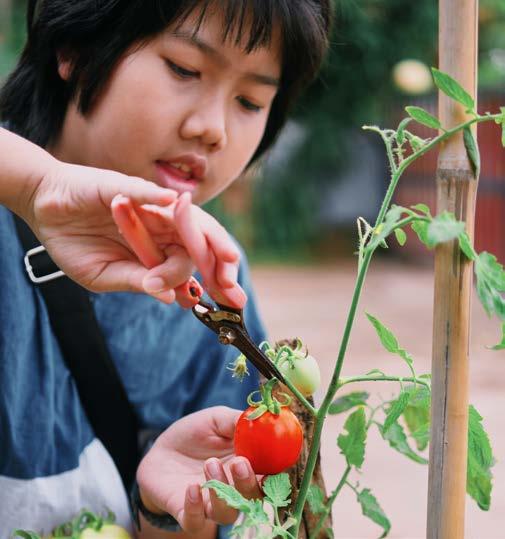
For a class project, we are (1) vegetables in a garden. My mum and dad helped me with it and here’s what we did:
We (2) some seeds in the garden and we (3) after them every day. We gave them (4) a few times during the week, and soon we began to see little green plants. After a few weeks, they turned into lovely plants with small flowers. We started to see some insects in the garden. We saw colourful (5) , and they were beautiful. I wanted to see some birds in the garden too, so my dad and I (6) a bird feeder. My mum gave me some nuts to (7) it with. At some point, we started to see a few (8) . They are good for a garden, but I didn’t get near them.
After about three months, we had some fresh vegetables. I even got some new seeds from them. I will (9) them and use them later for new plants. I’m going to talk about my project in class and I’ll take my favourite vegetable to show everyone – a bright red tomato.
Grammar
Adjectives ending in -ing or -ed
1 Look at the verbs. Complete the conversations with the correct form of the adjectives for each verb.
TIRE
1 A Camping in the forest was fun, but it was also
tiring
B Were you very when you got home?
BORE
2 A I get when I watch documentaries.
B Maybe you’ve only watched ones.
AMAZE
3 A The trip to the nature park was really
B You look in all the photos!
INTEREST
4 A I’m really in dolphins.
B I watched a really programme about them last night. Did you watch it too?
FRIGHTEN
5 A Dilek saw a rather spider in the garden.
B That’s why she looked so when she came in!
EXCITE
6 A Your trip to the rainforest sounds very
B I know! I’m very about going there!
2 Choose the correct option to complete the sentences.
1 The children were very excited / exciting to hold a baby bear.
2 It was really amused / amusing when the monkey took somebody’s drink!
3 I was really frightened / frightening when I saw the snake in the forest.
4 The programme about reptiles was fascinating / fascinating
5 Rainforests are amazed / amazing – so many different kinds of wildlife live in them.
6 I got a great mark in my test. It was really surprised / surprising
7 My dad wasn’t amused / amusing by my joke.
8 Do you understand this film? I’m really confused / confusing by the story.
3 Complete the text with the correct form of the verbs in brackets.
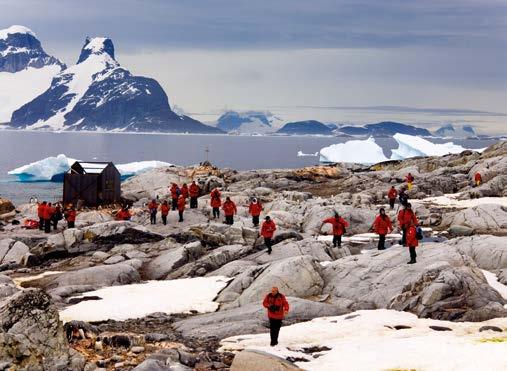
Antarctica is a beautiful place, but some people may find it a bit (1) (frighten), especially in the summer, when you never see the sun. From the end of March until September, you can only see the moon and the stars. So, for six months, there’s very little natural light. Many people visit Antarctica because they are (2) in learning more about it. However, they don’t go until it’s autumn because it’s too dark during the other times of the year.
Travelling around Antarctica is very (3) (tire). There aren’t many roads and they are usually covered in snow. The area is very difficult to explore, but visitors say Antarctica is an (4) (amaze) place that’s full of great adventure. The bright white snow and deep blue ocean are (5) (excite) to see. Of course, there are no cities in Antarctica. If you like life in the city, you might become a bit (6) (bore).
Frame your ideas
4 WRITING Complete the sentences with your own ideas. 1 I’m really interested in 2 I’m very frightened of 3 I was bored when . 4 I was excited when 5 I think is amazing. 6 is really exciting. 7 is boring because 8 was really interesting. 9 are more frightening than . 10 is more tiring than frightening
Oracy and Writing lab
Talking about food and the environment
1 Match the sentences (1-6) to the correct category (A-B).
A Reason in favour of banning plastic bags
B Reason against banning plastic bags
1 They are cheap and easy for customers to carry.
2 Many plastic bags end up in the sea and hurt animals.
3 Some people forget to bring reusable bags.
4 Shops could encourage people to use fabric or paper bags instead.
5 Plastic bags are made from oil, which is a non-renewable resource.
6 Not all reusable bags are easy to clean or carry.
2 Tick (√) the sentences you agree with. Then write one or two sentences for each, giving your opinion. Use the expressions in the box.
In my opinion… • I believe that… It’s important to… • Young people should…
a We should stop buying plastic bottles.
b Using public transport is better than driving everywhere.
c Recycling doesn’t make a big difference.
d Young people can help the planet by changing small habits every day.
3 Write one paragraph in favour of banning plastic bags and one paragraph against it. Use at least two reasons in each paragraph. Give examples if possible.
Useful language
Describing problems
• (Plastic bags) are a serious problem because…
• They’re bad for the environment because…
• The problem with (reusable bags) is that…
Reasons for Reasons against
• Everyone should (try to use less plastic).
• Shops can help by (not offering plastic bags).
• It’s a good idea to (bring your own bag).
• It’s easy to (choose food without packaging).
• It may be difficult to…
• At first, there could be some problems because…
• Some people don’t always remember to…
Writing an essay on environment
4 Read the question. Then complete the essay. Use words and phrases from these notes.
How can people in your family help save water?
Introduction:
- important to save water
- sometimes forget to save water at home
Main ideas
- turn off taps
- have showers not baths
- save shower water and use it in the garden
Conclusion
- not difficult to make small changes and save water
Save Water and the Fut
important to save water
We all know that it’s We need water for life, so we should try use it carefully. However, we (1) One way to save water is by (2) when we aren’t using the water, for example when we are brushing our teeth. Another idea is to (3) , not baths. This is because baths use up more water than short showers. We could also (4) and then use it to water the plants in our garden.
I am sure that it (5) . By turning off taps, having (6) and saving (7) , we can really help the environment.
Tip reminder
your ideas
Exam task
5 PRELIMINARY Writing a short essay You see this notice in your school magazine.
How can we reduce pollution in our cities? What actions can young people take? Why is it important?
Write the article answering these questions and we will publish it in our magazine.
Organising
Wordlist
Aability /əˈbɪləti/ abilità abseil /ˈæbseil/ calarsi across /əˈkrɒs/ attraverso actor /ˈæktər/ attore, attrice add /æd/ aggiungere advertisement /ədˈvɜːtɪsmənt/ pubblicità
advice column /ədˈvaɪs ˌkɒl.əm/ colonna degli annunci
AI (Artificial Intelligence) / ˌeɪˈaɪ ˌɑːtɪfɪʃəl ɪnˈtelɪdʒəns/ IA (Intelligenza Artificiale) airport /ˈeəpɔːt/ aeroporto along /əˈlɒŋ/ lungo amazing /əˈmeɪzɪŋ/ meraviglioso ambulance /ˈæmbjələns/ ambulanza answer (n) /ˈɑːnsər/ risposta answer (v) /ˈɑːnsər/ rispondere anxious /ˈæŋkʃəs/ ansioso apartment /əˈpɑːtmənt/ appartamento app /æp/ applicazione arm /ɑːm/ braccio armchair /ˈɑːmˌtʃeər/ poltrona arrive /əˈraɪv/ arrivare art /ɑːt/ arte aunt /ɑːnt/ zia automatically /ˌɔːtəˈmætɪkli/ automaticamente autumn /ˈɔːtəm/ autunno
B
back (adv) /bæk/ di ritorno, indietro back (n) /bæk/ dietro, schiena badminton /ˈbædmɪntən/ badminton bag /bæɡ/ borsa, sacchetto bake /beɪk/ infornare bakery /ˈbeɪkəri/ forno, panetteria balance (n) /ˈbæləns/ equilibrio balance (v) /ˈbæləns/ bilanciare ball /bɔːl/ palla bank /bæŋk/ banca barbecue /ˈbɑːbɪkjuː/ barbecue, grigliata
baseball /ˈbeɪsbɔːl/ baseball basic /ˈbeɪsɪk/ basilare, semplice basketball /ˈbɑːskɪtbɔːl/ pallacanestro
bat /bæt/ mazza, pipistrello bath /bɑːθ/ bagno, vasca da bagno bathroom /ˈbɑːθruːm/ bagno
battery /ˈbætəri/ batteria bay /beɪ/ baia, banchina beach /biːtʃ/ spiaggia bear /beər/ orso beautiful /ˈbjuːtɪfəl/ bello bedroom /ˈbedruːm/ camera da letto bee /biː/ ape belt /belt/ cintura bike /baɪk/ bici bird /bɜːd/ uccello black /blæk/ nero blog /blɒɡ/ blog blue /bluː/ blu board game /ˈbɔːd ˌɡeɪm/ gioco da tavola
boiling /ˈbɔɪlɪŋ/ bollente bookcase /ˈbʊkkeɪs/ libreria (mobile) bookshop /ˈbʊkʃɒp/ libreria (negozio)
boot /buːt/ stivale
boring /ˈbɔːrɪŋ/ noioso braille /breɪl/ braille brave /breɪv/ coraggioso
break (n) /breɪk/ pausa, intervallo
break (v) /breɪk/ rompere
break down / breɪk daʊn/ guastarsi, cedere
breakfast /ˈbrekfəst/ colazione
breathe /briːð/ respirare brother /ˈbrʌð·ər/ fratello brown /braʊn/ marrone brush (n) /brʌʃ/ spazzola
brush (v) /brʌʃ/ spazzolare bungalow /ˈbʌŋɡələʊ/ bungalow bus /bʌs/ autobus bus station /ˈbʌs ˌsteɪʃən/ stazione degli autobus
busy /ˈbɪzi/ occupato butter /ˈbʌtər/ burro butterfly /ˈbʌtəflaɪ/ farfalla
Ccafé /ˈkæfeɪ/ bar
calculate /ˈkælkjəleɪt/ calcolare call (n) /kɔːl/ chiamata call (v) /kɔːl/ chiamare
camping /ˈkæmpɪŋ/ campeggio cap /kæp/ berretto car /kɑːr/ macchina carbohydrate /kaːbəˈhaidreit/ carboidrato
careful /ˈkeəfəl/ attento/a carer /ˈkeərə/ assistente (di persona)
carpet /ˈkɑːpɪt/ tappeto cartoon /kɑːˈtuːn/ cartone animato castle /ˈkɑːsl/ castello cat /kæt/ gatto
catch /kætʃ/ prendere cave /keɪv/ grotta CD /ˌsiːˈdiː/ CD ceiling /ˈsiːlɪŋ/ soffitto celebrate /ˈseləbreɪt/ celebrare celebrity /səˈlebrəti/ celebrità centimetre /ˈsentɪˌmiːtər/ centimetro charity shop /ˈtʃærəti ʃɒp/ negozio di beneficenza
chat (n) /tʃæt/ conversazione chat (v) /tʃæt/ conversare cheese /tʃiːz/ formaggio chess /tʃes/ scacchi chilli /ˈtʃɪli/ peperonchino cinema /ˈsɪnəmə/ cinema classical /ˈklæsɪkəl/ classico cleaner /ˈkliːnər/ addetto/a alle pulizie
clever /ˈklevər/ intelligente climate /ˈklaɪmət/ clima climate change /ˈklaɪmət ˌtʃeɪndʒ/ cambiamento climatico climbing /ˈklaɪmɪŋ/ arrampicata cloud /klaʊd/ nuvola cloudy /ˈklaʊ·di/ nuvoloso club /klʌb/ circolo, discoteca coach /kəʊtʃ/ pullman, allenatore /trice
cobble /ˈkobl/ ciottolo cold /kəʊld/ raffreddore, freddo college /ˈkolidʒ/ università collect /kəˈlekt/ collezionare, raccogliere
collection /kəˈlekʃən/ collezione competition /ˌkɒmpəˈtɪʃən/ competizione, gara compulsory /kəmˈpʌlsəri/ obbligatorio
concert /ˈkɒnsət/ concerto cool /kuːl/ fresco, alla moda cooker /ˈkʊkər/ fornello, cucina coral reef /ˌkɒr.əlˈriːf/ barriera corallina
cousin /ˈkʌzən/ cugino/a cottage /ˈkɒtɪdʒ/ cottage create /kriˈeɪt/ creare cricket /ˈkrɪkɪt/ cricket cross (n) /krɒs/ croce
cross (v) /krɒs/ attraversare curtain /ˈkɜːtən/ tenda cut (n) /kʌt/ taglio cut (v) /kʌt/ tagliare
cycling /ˈsaɪklɪŋ/ ciclismo cyclist /ˈsaɪklɪst/ ciclista
D
dad /dæd/ papà
daddy /ˈdædi/ papà dairy /ˈdeəri/ diario dance /dɑːns/ ballare dancing /ˈdɑːnsɪŋ/ danza dark /dɑːk/ scuro, buio daughter /ˈdɔːtər/ figlia degree /dɪˈɡriː/ grado, laurea delay (n) /dɪˈleɪ/ ritardo delay (v) /dɪˈleɪ/ ritardare dense /dens/ denso dentist /ˈdentɪst/ dentista department store /dɪˈpɑːtmənt ˌstɔːr/ grande magazzino desert /ˈdezət/ dolce desk /desk/ scrivania, banco development /dɪˈveləpmənt/ sviluppo
different /ˈdɪfərənt/ diverso difficult /ˈdɪfɪkəlt/ difficile dig /dɪɡ/ scavare digital camera /ˌdɪdʒɪtəl ˈkæmrə/ fotocamera digitale
dining room /ˈdaɪnɪŋ ˌruːm/ sala da pranzo
disco /ˈdɪskəʊ/ discoteca DIY store /diː aɪ waɪ stɔː/ negozio per il fai-da-te do /duː/ fare
doctor /ˈdɒktər/ medico dolphin /ˈdɒlfɪn/ delfino door /dɔːr/ porta download /ˌdaʊnˈləʊd/ scaricare drawing /ˈdrɔːɪŋ/ disegno dress (n) /dres/ vestito dress (v) /dres/ vestire drive /draɪv/ guidare driver /ˈdraɪvər/ autista, conducente driving licence /ˈdraɪvɪŋ ˌlaɪsəns/ patente di guida drought /draʊt/ siccità drum /drʌm/ batteria dry (adj) /draɪ/ secco, asciutto dry (v) /draɪ/ asciugare duck /dʌk/ anatra
Eear /ɪər/ orecchio east /iːst/ est easy /ˈiːzi/ facile egg /eɡ/ uovo electronic goods shop /ˌɛlɛkˈtrɒnɪk ɡʊdz ʃɒp/ negozio di elettronica email /ˈiːmeɪl/ posta elettronica emotion /ɪˈməʊʃən/ emozione encourage /ɪnˈkʌrɪdʒ/ incoraggiare endangered /ɪnˈdeɪndʒəd/ in via di estinzione
engineer /ˌendʒɪˈnɪər/ ingegnere enjoy /ɪnˈdʒɔɪ/ godersi, divertirsi equipment /ɪˈkwɪpmənt/ equipaggiamento, attrezzatura exam /ɪɡˈzæm/ esame excellent /ˈeksələnt/ eccellente exercise (n) /ˈeksəsaɪz/ esercizio exercise (v) /ˈeksəsaɪz/ allenarsi exhibition /ˌeksɪˈbɪʃən/ esposizione explore /ɪkˈsplɔːr/ esplorare eye /aɪ/ occhio
Fface /feɪs/ faccia, viso fail /feɪl/ fallire fan /fæn/ tifoso/a farmer /ˈfɑːmər/ agricoltore father /ˈfɑːðər/ padre feel /fiːl/ sentire field /ˈfiːld/ campo file /faɪl/ fascicolo, documento fill /fɪl/ riempire find out /faɪnd aʊt/ scoprire finger /ˈfɪŋɡər/ dito first /fɜːst/ primo fish /fɪʃ/ pesce fishing /ˈfɪʃɪŋ/ pesca flat /flæt/ appartamento flood (n) /flʌd/ allagamento, inondazione flood (v) /flʌd/ allagare, inondare floor /flɔːr/ piano, pavimento flour /flaʊər/ farina fly /flaɪ/ volare focus /ˈfəʊkəs/ concentrarsi fog /fɒɡ/ nebbia foggy /ˈfɒɡi/ nebbioso follow /ˈfɒləʊ/ seguire foot /fʊt/ piede football /ˈfʊtbɔːl/ calcio football boots /ˈfʊtbɔːl buːts/ scarpe da calcio forest /ˈfɒrɪst/ foresta
free-time /ˌfriː ˈtaɪm/ tempo libero freezing /ˈfriːzɪŋ/ gelido friend /frend/ amico fridge /frɪdʒ/ frigorifero friendly /ˈfrendli/ amichevole fruit /fruːt/ frutto, frutta funny /ˈfʌni/ divertente fur /fɜːr/ pelliccia
Ggarage /ˈɡærɑːʒ/ garage garden /ˈɡɑːdən/ giardino
garlic /ˈɡɑːlɪk/ aglio get back /ɡɛt bæk/ tornare indietro get dressed /ɡɛt drɛst/ vertirsi get off /ɡɛt ɒf/ scendere get on /ɡɛt ɒn/ salire get up /ɡɛt ʌp/ alzarsi, svegliarsi giraffe /dʒɪˈrɑːf/ giraffa glacier /ˈɡlæsiər/ ghiacciaio global warming /ˌɡləʊbəl ˈwɔːmɪŋ/ riscaldamento globale go /ɡəʊ/ andare gold /ɡəʊld/ oro golf /ɡɒlf/ golf gorilla /ɡəˈrɪlə/ gorilla gram /ɡræm/ grammo grandad /ˈɡrændæd/ nonno grandfather /ˈɡrændˌfɑːðər/ nonno grandma /ˈɡrændmɑː/ nonna grandmother /ˈɡrændˌmʌðər/ nonna grandpa /ˈɡrændpɑː/ nonno grandparent /ˈɡrændˌpeərənt/ nonno/a granny /ˈɡræni/ nonna, nonnina grape /ɡreɪp/ uva green /ɡriːn/ verde grey /ɡreɪ/ grigio grow /ɡrəʊ/ crescere guest house /ˈɡest·haʊs/ pensione, albergo guide /ɡaɪd/ guida guitar /ɡɪˈtɑːr/ chitarra gym /dʒɪm/ palestra
Hhair /heər/ capelli hall /hɔːl/ ingresso hand /hænd/ mano handbag /ˈhændbæɡ/ borsetta happy /ˈhæpi/ felice hat /hæt/ cappello headache /ˈhedeɪk/ mal di testa headline /ˈhedlaɪn/ titolo headphones /ˈhedfəʊnz/ cuffie
helicopter /ˈhelɪkɒptər/ elicottero herbivore /ˈhɜːbɪvɔːr/ erbivoro hill /hɪl/ collina
hip hop /ˈhɪp·hɒp/ hip hop hobby /ˈhɒbi/ passatempo homework /ˈhəʊmwɜːk/ compiti hospital /ˈhɒspɪtəl/ ospedale hot /hɒt/ caldo hotel /həʊˈtel/ hotel, albergo houseboat /ˈhaʊsbəʊt/ casa galleggiante
houseplant /ˈhaʊsplɑːnt/ pianta da appartamento
humid /ˈhjuːmɪd/ umido hurricane /ˈhʌrɪkən/ uragano hurt (adj) /hɜːt/ ferito hurt (v) /hɜːt/ ferire husband /ˈhʌzbənd/ marito hysterical /hɪˈsterɪkəl/ molto divertente
Iice /aɪs/ ghiaccio icy /ˈaɪsi/ ghiacciato ill /ɪl/ malato/a impulse /ˈɪmpʌls/ impulso in bulk /ɪn bʌlk/ in quantità individual sport /ˌɪndɪˈvɪdʒuəl spɔːt/ sport individuale
ingredient /ɪnˈɡriːdiənt/ ingrediante
insect /ˈɪnsekt/ insetto instruction /ɪnˈstrʌkʃən/ istruzioni instrument /ˈɪnstrəmənt/ strumento (musicale)
interesting (adj) /ˈɪntrəstɪŋ/ interessante
internet /ˈintənet/ internet interview /ˈɪntəvjuː/ intervista, colloquio into /ˈɪntə, ˈɪntu/ dentro island /ˈaɪlənd/ isola
Jjacket /ˈdʒækɪt/ giacca jeans /dʒiːnz/ jeans
jewellery /ˈdʒuːəlri/ gioielli, gioielleria join /dʒɔɪn/ unirsi a journalist /ˈdʒɜːnəlɪst/ giornalista jumper /ˈdʒʌmpər/ maglione
K
keyboard /ˈkiːbɔːd/ tastiera kilogram /ˈkɪləʊɡræm/ chilogrammo kind (adj) /kaɪnd/ gentile kind (n) /kaɪnd/ genere, tipo kitchen /ˈkɪtʃɪn/ cucina
Llake /leɪk/ lago lamp /læmp/ lampada
laptop /ˈlæptɒp/ computer portatile leader /ˈliːdər/ capo leave /liːv/ lasciare, andare via leg /leɡ/ gamba
lemon /ˈlemən/ limone library /ˈlaɪbrəri/ biblioteca lift /lɪft/ ascensore
lightning /ˈlaɪtnɪŋ/ fulmine
lightning strike /ˈlaɪtnɪŋ ˌstraɪk/ colpo di fulmine
listen to /ˈlɪsən tuː/ ascoltare lively /ˈlaɪvli/ vivace living room /ˈlɪvɪŋ ˌruːm/ salotto
lizard /ˈlɪzəd/ lucertola
lonely /ˈləʊnli/ solo, solitario
look after /lʊk ˈɑːftər/ occuparsi, prendersi cura
lorry /ˈlɒri/ camion
lovely /ˈlʌvli/ delizioso, grazioso lunch /lʌntʃ/ pranzo
Mmake /meɪk/ fare
making (n) /ˈmeɪkɪŋ/ fabbricazione mammal /ˈmæməl/ mammifero map /mæp/ mappa marathon /ˈmærəθən/ maratona
mark /mɑːk/ voto meat /miːt/ carne mechanic /məˈkænɪk/ meccanico medicine /ˈmedɪsən/ medicina member /ˈmembər/ membro metre /ˈmiːtər/ metro milk /mɪlk/ latte mine /maɪn/ miniera mirror /ˈmɪrər/ specchio miss /mɪs/ mancare mix /mɪks/ mescolare, mischiare mobile phone /ˌməʊbaɪl ˈfəʊn/ telefono cellulare modern /ˈmɒdən/ moderno monkey /ˈmʌŋki/ scimmia mood /muːd/ umore mother /ˈmʌðər/ madre motorbike /ˈməʊtəbaɪk/ motociclo mountain /ˈmaʊntɪn/ montagna
mouse /maʊs/ topo, mouse
MP3 player /em piː ˈθriː ˌpleɪər/ lettore MP3
Mr /ˈmɪstər/ Sig., Signore
Mrs /ˈmɪsɪz/ Sig.ra, Signora
Ms /mɪz/ Signora, Signorina
mum /mʌm/ mamma
mummy /ˈmʌmi/ mamma
museum /mjuːˈziːəm/ museo
mushroom /ˈmʌʃruːm/ fungo music /ˈmjuːzɪk/ musica
Nnarrow /ˈnærəʊ/ stretto
neck /nek/ collo necklace /ˈnekləs/ collana
nephew /ˈnefjuː/ nipote maschio di zii
news /njuːz/ novità
niece /niːs/ nipote femmina di zii
noise /nɔɪz/ rumore noisy /ˈnɔɪzi/ rumoroso
normal /ˈnɔːməl/ normale
north /nɔːθ/ nord
nose /nəʊz/ naso
nurse /nɜːs/ infermiere/a
Oocean /ˈəʊʃən/ oceano old /əʊld/ vecchio
onion /ˈʌnjən/ cipolla online /ˌɒnˈlaɪn/ in linea, connesso opal /ˈəʊpəl/ opale
opera /ˈɒpərə/ opera orange /ˈɒrɪndʒ/ arancione, arancia orchestra /ˈɔːkɪstrə/ orchestra oven /ˈʌvən/ forno over (adj) /ˈəʊvər/ finito over (prep) /ˈəʊvər/ sopra, oltre, ancora
P
packaging /ˈpækɪdʒɪŋ/ imballaggio page /peɪdʒ/ pagina pain /peɪn/ dolore painter /ˈpeɪntər/ pittore painting /ˈpeɪntɪŋ/ quadro, dipinto, pittura pale /peɪl/ pallido/a park /pɑːk/ parco pass (n) /pɑːs/ permesso, lasciapassare pass (v) /pɑːs/ passare passenger /ˈpæsəndʒər/ passeggero/a passport /ˈpɑːspɔːt/ passaporto password /ˈpɑːswɜːd/ password past /pɑːst/ passato pasta /ˈpæstə/ pasta path /pɑːθ/ sentiero pavement /ˈpeɪvmənt/ marciapiede pepper /ˈpepər/ pepe, peperone
performance /pəˈfɔːməns/ esibizione, prestazione
pesticide /ˈpestɪsaɪd/ pesticida petrol /ˈpetrəl/ benzina pharmacy /ˈfɑːməsi/ farmacia
photographer /fəˈtɒɡrəfər/ fotografo/a photography /fəˈtɒɡrəfi/ fotografia piano /piˈænəʊ/ pianoforte pick up /pɪk ʌp/ prendere pilot /ˈpaɪlət/ pilota pink /pɪŋk/ rosa pipe /paɪp/ tubatura plane /pleɪn/ aereoplano plant /plɑːnt/ pianta, vegetale plastic /ˈplæstɪk/ plastica platform /ˈplætfɔːm/ binario, banchina
play /pleɪ/ giocare, suonare, interpretare player /ˈpleɪər/ giocatore plenty /ˈplenti/ in abbondanza, abbastanza
polar bear /ˌpəʊlə ˈbeər/ orso polare police officer /pəˈliːs ˌɒfɪsər/ poliziotto/a
polluted /pəˈluːtid/ inquinato pop /pɒp/ pop post office /ˈpəʊst ˌɒfɪs/ ufficio postale
potato /pəˈteɪtəʊ/ patata practice /ˈpræktɪs/ esercitarsi prepare /prɪˈpeər/ preparare presenter /prɪˈzentər/ presentatore/trice printer /ˈprɪntər/ stampante prize /praɪz/ premio project /ˈprɒdʒekt/ progetto provide /prəʊˈvaɪd/ fornire, provvedere
puppet /ˈpʌpɪt/ cucciolo purple /ˈpɜːpl/ viola Q
quiet /kwaɪət/ tranquillo, silenzioso
Rrace /reɪs/ gara, corsa racket /ˈrækɪt/ racchetta radio /ˈreɪdiəʊ/ radio rain (n) /reɪn/ pioggia rain (v) /reɪn/ piovere rainy /ˈreɪni/ piovoso receptionist /rɪˈsepʃənɪst/ receptionist
recycle /ˌriːˈsaɪkl/ riciclare red /red/ rosso
remember /rɪˈmembər/ ricordare remote /rɪˈməʊt/ remoto, lontano reptile /ˈreptaɪl/ rettile restaurant /ˈrestrɒnt/ ristorante restore /rɪˈstɔːr/ restaurare, ristabilire
return (n) /rɪˈtɜːn/ ritorno return (v) /rɪˈtɜːn/ ritornare reusable /ˌriːˈjuːzəbl/ riutilizzabile reuse /ˌriːˈjuːz/ riusare rice /raɪs/ riso ride /raɪd/ cavalcare river /ˈrɪvər/ fiume robotics /rəʊˈbɒtɪks/ robotica roll out /rəʊl aʊt/ lanciare roof /ruːf/ tetto rugby /ˈrʌɡbi/ rugby runner /ˈrʌnər/ corridore running /ˈrʌnɪŋ/ corsa
Ssail /seɪl/ navigare sailing /ˈseɪlɪŋ/ navigazione sailor /ˈseɪlər/ marinaio same /seɪm/ stesso sandal /ˈsændəl/ sandalo save /seɪv/ salvare science /ˈsaɪəns/ scienza scientist /ˈsaɪəntɪst/ scienziato scooter /ˈskuːtər/ scooter screen /skriːn/ schermo sea /siː/ mare sea otter /ˈsiː ˌɒtər/ lontra marina sea urchin /ˈsiː ˌɜːtʃɪn/ riccio di mare second /ˈsekənd/ secondo second-hand /ˌsekəndˈhænd/ di seconda mano
seed /siːd/ seme shark /ʃɑːk/ squalo shelf /ʃelf/ scaffale ship /ʃɪp/ nave shirt /ʃɜːt/ camicia shop assistant /ˈʃɒpəˌsɪstənt/ commesso/a shorts /ʃɔːts/ pantaloncini show (n) /ʃəʊ/ spettacolo show (v) /ʃəʊ/ mostrare shower /ʃaʊər/ doccia
silver /ˈsɪlvər/ argento singer /ˈsɪŋər/ cantante singing /ˈsɪŋɪŋ/ canto sister /ˈsɪstər/ sorella
sitting room /ˈsɪtɪŋ ˌruːm/ salotto skateboarder /ˈskeɪtˌbɔːdər/ skater, skateboarder
sketchbook /ˈsketʃbʊk/ album da schizzi
ski /skiː/ sciare
skiing (n) /skiːɪŋ/ sci skirt /skɜːt/ gonna snack /snæk/ spuntino snake /sneɪk/ serpente
snow (n) /snəʊ/ neve
snow (v) /snəʊ/ nevicare snowboard /ˈsnəʊbɔːd/ tavola da snowboard
snowboarding (n) /ˈsnəʊbɔːdɪŋ/ snowboard
snowy /ˈsnəʊi/ nevoso social media /ˌsəʊʃəl ˈmiːdiə/ social media
sock /sɒk/ calzino
sofa /ˈsəʊfə/ divano son /sʌn/ figlio
song /sɒŋ/ canzone
south /saʊθ/ sud
special /ˈspeʃəl/ speciale species /ˈspiːʃiːz/ specie spend /spend/ spendere spider /ˈspaɪdər/ ragno
spin /spɪn/ far ruotare sport /spɔːt/ sport sports centre /ˈspɔːts ˌsentər/ centro sportivo
spray /spreɪ/ spray
spring (n) /sprɪŋ/ primavera spring (v) /sprɪŋ/ scattare, saltare stage /steɪdʒ/ palco stairs /steəz/ scale stationer’s /ˈsteɪʃənəz/ cartoleria stomach /ˈstʌmək/ stomaco stomach ache /ˈstʌmək eɪk/ mal di pancia
stop (n) /stɒp/ fermata stop (v) /stɒp/ fermarsi storm /stɔːm/ tempesta stormy /ˈstɔːmi/ tempestoso stream (n) /striːm/ ruscello, torrente stream (v) /striːm/ fluire stressed /strest/ stressato stripy /ˈstraɪpi/ a righe study /ˈstʌdi/ studiare subject /ˈsʌbdʒəkt/ materia, soggetto sugar /ˈʃʊɡər/ zucchero suit /suːt/ tuta, completo summer /ˈsʌmər/ estate sun /sʌn/ sole sunglasses /ˈsʌnˌɡlɑːsɪz/ occhiali da sole sunny /ˈsʌni/ soleggiato
supermarket /ˈsuːpəˌmɑːkɪt/ supermercato
surfing /ˈsɜːfɪŋ/ fare surfing surname /ˈsɜːneɪm/ cognome swimming /swɪmɪŋ/ nuoto swimsuit /ˈswɪmsuːt/ costume da bagno
Ttable tennis /ˈteɪbl ˌtenɪs/ ping pong tablet /ˈtæblət/ tablet, pastiglia take /teɪk/ prendere tapir /ˈteɪpɪər/ tapiro taxi /ˈtæksi/ taxi team /tiːm/ squadra team sport /ˌtiːm ˈspɔːt/ sport di squadra
temperature /ˈtemprətʃər/ temperatura
tennis /ˈtenɪs/ tennis terrible /ˈterəbl/ terribile text /tekst/ testo theatre /ˈθɪətər/ teatro third /θɜːd/ terzo through /θruː/ attraverso throughout /θruˈaʊt/ dappertutto, interamente
thunder /ˈθʌndər/ tuono thunderstorm /ˈθʌndəstɔːm/ temporale
ticket /ˈtɪkɪt/ biglietto tie (n) /taɪ/ cravatta tie (v) /taɪ/ legare tiny /ˈtaɪni/ piccolissimo toilet /ˈtɔɪlət/ bagno tomato /təˈmɑːtəʊ/ pomodoro tool /tuːl/ attrezzo
tooth /tuːθ/ dente
tornado /tɔːˈneɪdəʊ/ tornado towel /ˈtaʊəl/ asciugamano tradition /trəˈdɪʃən/ tradizione traditional /trəˈdɪʃənəl/ tradizionale train /treɪn/ treno trainer /ˈtreɪnər/ scarpa da ginnastica, istruttore/trice training course /ˈtreɪnɪŋ kɔːs/ corso di formazione tram /træm/ tram trolley /ˈtrɒli/ carrello trousers /ˈtraʊzəz/ pantaloni truck /trʌk/ camion T-shirt /ˈtiː·ʃɜːt/ maglietta
Uuncle /ˈʌŋkl/ zio under /ˈʌndər/ sotto underground house /ˈʌndəɡraʊnd haʊs/ casa sotterranea unusual /ʌnˈjuːʒuəl/ inusuale use /juːz/ usare
Vvalley /ˈvæli/ vallata
vegetable /ˈvedʒtəbl/ verdura vet /vet/ veterinario video game /ˈvɪdiəʊ ˌɡeɪm/ videogioco
viewer /ˈvjuːər/ spettatore/trice
vinyl /ˈvaɪnəl/ vinile
violin /ˌvaɪəˈlɪn/ violino visit (n) /ˈvɪzɪt/ visita visit (v) /ˈvɪzɪt/ visitare volleyball /ˈvɒlibɔːl/ pallavolo
Wwaiter /ˈweɪtər/ cameriere/a wake up /weɪk ʌp/ svegliarsi wall /wɔːl/ muro warm /wɔːm/ caldo, tiepido waste /weɪst/ spreco watch /wɒtʃ/ vedere waterfall /ˈwɔːtəfɔːl/ cascata web /web/ web weigh /weɪ/ pesare well-behaved /ˌwel bɪˈheɪvd/ ben educato west /west/ ovest wet /wet/ bagnato whale /weɪl/ balena wheel /wiːl/ ruota white /waɪt/ bianco wife /waɪf/ moglie wildlife /ˈwaɪldlaɪf/ fauna selvatica wind /wɪnd/ vento window /ˈwɪndəʊ/ finestra windy /ˈwɪndi/ ventoso winner /ˈwɪnər/ vincitore/trice winter /ˈwɪntər/ inverno wood /wʊd/ legno, bosco worried /ˈwʌrid/ preoccupato/a
Yyellow /ˈjeləʊ/ giallo youth club /ˈjuːθ ˌklʌb/ centro giovanile
Zzebra /ˈziːbrə/ zebra zoo /zuː/ zoo zumba /ˈzʊmbə/ zumba
Photo Acknowledgements
Photos: 8-9 bmphotographer/Shutterstock.com; 8(bl) SurangaLK/Shutterstock.com, (br) AlexAnton/Shutterstock.com, (flags) Mint Fox/Shutterstock.com; 9(mr) PACO COMO/Shutterstock.com, (Janet) Lopolo/ Shutterstock.com, (Rishi) Rajesh Narayanan/Shutterstock.com, (Elizabeth) Samuel Borges Photography/Shutterstock.com, (Mike) Asier Romero/Shutterstock.com, (Nigeria flag) Olleg Visual Content/Shutterstock.com, (flags) Mint Fox/Shutterstock.com; 10 Wavebreak Media ltd/Alamy Stock Photo; 12 buritora/Shutterstock.com; 13(l) Rido/Shutterstock.com, (r) arkanto/Shutterstock.com; 14(a) insta_photos/Shutterstock.com, (b) Nadya Koval/Shutterstock.com, (c) AYO Production/Shutterstock.com, (d) ViDI Studio/Shutterstock.com, (e) Xavier Lorenzo/Shutterstock.com; 16(A) SeventyFour/Shutterstock.com, (B) Romanchini/Shutterstock.com, (C) Hamdi Bendali/Alamy Stock Photo, (D) Gigi Delgado/Shutterstock.com, (a) Anton Starikov/Shutterstock.com, (b) Natallia Ploskaya/Shutterstock.com, (c) Purple Clouds/Shutterstock.com, (d) Marso/Shutterstock. com, (e) Refox Photos/Shutterstock.com, (f) New Africa/Shutterstock.com, (g) umitc/Shutterstock.com, (h) svekloid/Shutterstock.com, (i) Mountain Brothers/Shutterstock.com, (j) studiovin/Shutterstock.com; 18(l) AMGSL/Shutterstock.com, (r) Monkey Business Images/Shutterstock.com; 19(A) sirtravelalot/Shutterstock.com, (B) Junial Enterprises/Shutterstock.com, (C) wavebreakmedia/Shutterstock.com, (D) Erickson Stock/ Shutterstock.com, (E) Dragan Mujan/Shutterstock.com, (F) Media_Photos/Shutterstock.com, (G) SeventyFour/Shutterstock.com, (H) Giancarlo Polacchini/Shutterstock.com; 21 Viktoriia Hnatiuk/Shutterstock.com; 22(a) JB Design and Photo/Shutterstock.com, (b) OJO Images Ltd/Alamy Stock Photo, (c) Mayur Kakade/E+ via Getty Images, (d) Stefan Holm/Shutterstock.com, (e) mixetto/E+ via Getty Images, (f) graham jepson/ Alamy Stock Photo; 23(main) © Under The Pole/Lucas Santucci/Zeppelin Network, (inset) © SANTUUCI/Zeppelin Network; 24(a) Valery Sidelnykov/Shutterstock.com; (b) Syda Productions/Shutterstock.com; (c) BearFotos/Shutterstock.com; (d) Ground Picture/Shutterstock.com; (e) Prostock-studio/Shutterstock.com; 25 Robert Harding Library/National Geographic Image Collection; 26 Robert Harding Library/National Geographic Image Collection; 27 Hero Images Inc./Alamy Stock Photo; 28-29 Sergey Novikov/Shutterstock.com; 30 © Mike Hettwer; 32 Zeamonkey Images/Alamy Stock Photo; 33(main) Edwin Remsberg/Alamy Stock Photo, (inset) hadynyah/E+ via Getty Images; 34(tl) StockImageFactory.com/Shutterstock.com, (tr) Zhang Peng/LightRocket via Getty Images, (ml) FOTOGRAFIA INC./E+ via Getty Images, (mr) julianne.hide/ Shutterstock.com, (bl) Ivan Wang/E+ via Getty Images, (br) Fajar Tri Amboro/Shutterstock.com; 35(t) BearFotos/Shutterstock.com, (m) John de la Bastide/Alamy Stock Photo, (b) Imago/Alamy Stock Photo; 36 Matthew Sperzel/Getty Images Entertainment via Getty Images; 38 Ryan McVay/Photodisc via Getty Images; 39 Rawpixel.com/Shutterstock.com; 40-41 Mallika Home Studio/Shutterstock.com; 41 (background) TippaPatt/ Shutterstock.com; 42 Barry Winiker/The Image Bank Unreleased via Getty Images; 43 ClassicStock/Alamy Stock Photo; 45 Massimo Todaro/Shutterstock.com; 46(t) iStock.com/DonnaDiavolo, (m) Chekyravaa/ Shutterstock.com, (b) iStock.com/Hirurg; 47 AYO Production/Shutterstock.com; 48 Inside Creative House/Shutterstock.com, (number icons) TARASIRI/Shutterstock.com, (wellness logo) Afub105/Shutterstock.com; 49 PeopleImages.com - Yuri A/Shutterstock.com, (inset) Danita Delimont/Alamy Stock Photo; 50(a) Harold M. Lambert via Getty Images, (b) Rawpixel.com/Shutterstock.com; 51 Bloomberg via Getty Images; 52(l) Design Pics Inc./National Geographic Image Collection, (a) Thomas Barwick via Getty Images, (b) iStock.com/vanillaechoes, (c) Food Impressions/Shutterstock.com; 53 4Max/Shutterstock.com; 54(t) bonchan/ Shutterstock.com, (b) Ivanko80/Shutterstock.com; 55(l) Charlie29/Shutterstock.com, (r) Drazen Zigic/Shutterstock.com; 56 (milk) Soho A Studio/Shutterstock.com, (berries) Dionisvera/Shutterstock.com, (sugar) Alter-ego/Shutterstock.com, (honey) baibaz/Shutterstock.com, (banana) xpixel/Shutterstock.com, (spinach) Ivan Chistyakov/Shutterstock.com, (yoghurt) Pixel-Shot/Shutterstock.com, (a) Ezume Images/Shutterstock. com, (b) Tibor Bognar/The Image Bank via Getty Images, (c) Tim Bieber/Photodisc via Getty Images; 57(t) YARUNIV Studio/Shutterstock.com, (b) Taras Grebinets/Shutterstock.com; 58(tl) Michalakis Ppalis/ Shutterstock.com, (r) The_Believer_art/Shutterstock.com; 60 Jan Engel/Shutterstock.com; 61 AFP/Stringer/AFP via Getty Images; 62(l) Kaspars Grinvalds/Shutterstock.com, (r) Ciril Jazbec/National Geographic Image Collection; 63 AP Images/Ton Koene/VWPics; 66(a) Vasily Pindyurin via Getty Images, (b) alvarez via Getty Images, (c) Eva-Katalin via Getty Images; 67 Gerd Ludwig/National Geographic Image Collection; 68-69 Gorodenkoff/Shutterstock.com; 68 ShotPrime Studio/Shutterstock.com; 69 Dean Drobot/Shutterstock.com; 70(1a) sharpstock/Alamy Stock Photo, (1b) Anton Gvozdikov/Shutterstock.com, (2a) Umberto Shtanzman/Shutterstock.com, (2b) Hemarat Studio/Shutterstock.com, (3a) Stifani Brothers/EyeEm via Getty Images. (3b) © Hoxton Images/Sam Edwards/Media Bakery; (bl) Christophe Goussard/Agence VU/Redux; 73 Day Of Victory Studio/Shutterstock.com; 76 Przemek Tokar/Shutterstock.com; 77 Greg Epperson/Shutterstock.com; 78 Josef Kubes/Alamy Stock Photo; 79(t) John Lamparski via Getty Images, (m) Liu Ailun/Xinhua/ Alamy Live News/Alamy Stock Photo, (b) David Paul Morris/Bloomberg via Getty Images; 80(a) Dariusz Leszczynski/Alamy Stock Photo, (b) Hugh Sitton/Corbis via Getty Images, (c) Jodi Cobb/National Geographic Image Collection, (d) Dragon Images/Shutterstock.com; 82(a) beeboys/Shutterstock.com, (b) Svitlana Romanenko/iStock via Getty Images, (c) smolaw11/iStock via Getty Images, (d) ShutterStockStudio/Shutterstock. com, (e) Nor Ga/Shutterstock.com, (f) JohnnyGreig/E+ via Getty Images, (logo) Deep_Design/Shutterstock.com; 84(1) Lizardflms/Shutterstock.com, (2) VH-studio/Shutterstock.com, (3) goodluz/Shutterstock.com, (4) Krakenimages.com/Shutterstock.com, (5) maxbelchenko/Shutterstock.com, (br) Monkey Business Images/Shutterstock.com; 85(A) Everett Collection/Shutterstock.com, (B) Carlovis/Shutterstock.com, (C) Oleg Lopatkin/Shutterstock.com, (D) Jacquie Klose/Shutterstock.com, (E) sashafolly/Shutterstock.com, (F) mr_bom/Shutterstock.com, (H) FamVeld/Shutterstock.com; 86 Frank Hoensch/Contributor/Redferns via Getty Images; 87 Rodrigo_Sepulveda/Shutterstock.com; 88(t) Tatyaby/Shutterstock.com, (m) Medesulda/DigitalVision Vectors via Getty Images, (b) Myshkovskyi/Shutterstock.com; 89 l i g h t p o e t/Shutterstock.com; 91 Courtesy of Goodgym; 92(a) Halfdark/fStop via Getty Images, (b) Feline Lim/REUTERS, (c) Shalom Ormsby Images Inc/DigitalVision via Getty Images, (d) IM_photo/Shutterstock.com, (e) Maridav/Shutterstock.com, (f) Roger Sedres/Alamy Stock Photo; 93 Thomas Barwick via Getty Images; 94(l) Andrey_Popov/Shutterstock.com, (r) Dragon Images/Shutterstock.com; 97 Atlaspix/Alamy Stock Photo; 98(t) Belish/Shutterstock.com, (b) khlungcenter/Shutterstock.com; 101 Luis Molinero/Shutterstock.com; 103(l) EugeneEdge/Shutterstock.com, (r) VH-studio/Shutterstock.com; 104 Microgen/Shutterstock.com; 105 William Perry/agefotostock/ Newscom; 106 Cro Magnon/Alamy Stock Photo; 107(t) Robert Harding Picture Library/National Geographic Image Collection, (m) Tino Soriano/National Geographic Image Collection, (br) Mark Kolbe/Getty Images News/Getty Images, (bl) Agnostus/Alamy Stock Photo; 110(l) Richard Drury/Stone via Getty Images, (1A) eyematter/Shutterstock.com, (1B) Dariusz Jarzabek/Shutterstock.com, (1C) hydebrink/Shutterstock.com, (2A) K-FK/Shutterstock.com, (2B) New Africa/Shutterstock.com, (2C) AN Creative/Shutterstock.com, (3A) Collab Media/Shutterstock.com, (3B) djaphoto/Shutterstock.com, (3C) Vostok/Moment via Getty Images, (4A) Laurajessie/Shutterstock.com, (4B) Mistervlad/Shutterstock.com, (4C) tilialucida/Shutterstock.com, (5A) Pixel-Shot/Shutterstock.com, (5B) Ground Picture/Shutterstock.com, (5C) Followtheflow/Shutterstock.com; 111 AnnaStills/Shutterstock.com; 112(1) SeventyFour/Shutterstock.com, (2) Roman Samborskyi/Shutterstock.com, (3) Krakenimages.com/Shutterstock.com, (4) fizkes/Shutterstock.com, (5) Milan Ilic Photographer/ Shutterstock.com; 113(A) Dariusz Jarzabek/Shutterstock.com, (B) CDK Photos/Shutterstock.com, (C) Rob Painter/Shutterstock.com, (D) Alessandro Ricardo Bentivoglio Uva/iStock/Getty Images Plus via Getty Images, (E) jimmonkphotography/Shutterstock.com, (F) David Calvert/Shutterstock.com, (G) property-exposure/Shutterstock.com, (H) sadman/Shutterstock.com; 114(l) Andrew Twort/Alamy Stock Photo, (r) Arcaid Images/ Alamy Stock Photo; 115 Irina Gutyryak/Shutterstock.com; 117 mmac72/E+ via Getty Images; 118(tl) Tamara Kulikova/Shutterstock.com, (tr) momente/Shutterstock.com, (ml) Sorapop Udomsri/Shutterstock.com, (mr) Surachet Jo/Shutterstock.com, (bl) Guillermo Spelucin R/Shutterstock.com, (bm) Prostock-studio/Shutterstock.com, (br) Snova/Shutterstock.com; 119 Robert Harding Library/National Geographic Image Collection; 120(tl) Coprid/iStock via Getty Images, (tml) You Touch Pix of EuToch/Shutterstock.com, (tmr) Sezeryadigar/iStock via Getty Images, (bl) Creative Crop/DigitalVision via Getty Images, (bml) Stockbyte via Getty Images, (bmr) Stokkete/Shutterstock.com, (br) AtlasStudio/Shutterstock.com; 121 © Cine Thision; 122 Paul Hahn/laif/Redux; 123(main) My Ocean Production/Shutterstock.com, (tl) Arcady/Shutterstock.com, (tr) antoniodiaz/ Shutterstock.com, (bl) kikujungboy CC/Shutterstock.com, (bm) xyfen/Shutterstock.com, (br) Albert Pego/Shutterstock.com; 124-125 Andrea Prott/Alamy Stock Photo; 126 Matthew Stewart Bennett/Moment via Getty Images; 127 blvdone/Shutterstock.com; 129 View Pictures/Universal Images Group via Getty Images; 130 Monkey Business Images/Shutterstock.com; 131 DC Studio/Shutterstock.com; 132(1) Carlos Osorio/Toronto Star via Getty Images, (2) AP Images/Kyodo, (3) luri/Shutterstock.com, (4) RT Images/Shutterstock.com, (5) Chonnipa Aranwari via Getty Images, (berries) Creativeye99 via Getty Images, (nuts) goh seok thuan/ Shutterstock.com, (avocado) RedHelga via Getty Images; 133 iStock.com/lorenzo grifantini; 134(tl) Yuksel Photography/Shutterstock.com, (tr) sabine_lj/Shutterstock.com, (b) Miguel Angel RM/Shutterstock.com; 135 christianpinillo/Shutterstock.com, (inset) Brina L. Bunt/Shutterstock.com; 136 Ground Picture/Shutterstock.com; 138(t) Ljupco Smokovski/Shutterstock.com, (b) Africa Studio/Shutterstock.com; 139(a) Toshi Sasaki via Getty Images, (b) Sam Firth/Shutterstock.com, (c) Sorbis/Shutterstock.com, (d) Design Pics Inc./National Geographic Image Collection; 140-141 Tarcisio Schnaider/Shutterstock.com; 142(1) James Brey via Getty Images, (2) Brian A Jackson/Shutterstock.com, (3) Xuanyu Han via Getty Images, (4) fhm via Getty Images, (5) PHILMACDPHOTOGRAPHY via Getty Images, (6) Gary Whitton/Shutterstock.com, (r) Paul Soders/Stone via Getty Images; 143 Oliverouge 3/Shutterstock.com; 144 Kevin G. Smith/AGE Fotostock; 145 Somchai_Stock/Shutterstock.com; 146(a) © Cultura Images/Zero Creatives/Media Bakery | Zero Creatives, (b) Zoonar GmbH/ Alamy Stock Photo, (c) ANDREW CABALLERO-REYNOLDS/AFP via Getty Images, (d) © Matthew Wakem/Cavan Images, (e) Africa Studio/Shutterstock.com, (f) AP Images/Joel Merino; 147 RozochkaIvn/Shutterstock. com, (top inset) Darek Szuster/ZUMA Press/Mulhouse/France/NEWSCOM, (bottom inset) © Damien Raggatt; 148 PeopleImages/Shutterstock.com; 150(a) David Butow/Corbis via Getty Images, (b) SeventyFour via Getty Images, (c) Peter Ptschelinzew/Alamy Stock Photo; 151(a) Thomas Warnack/picture alliance via Getty Images, (b) Alistair Berg via Getty Images, (c) Klaus Vedfelt via Getty Images; 152 Majority World CIC/Alamy Stock Photo; 153(t) SolStock via Getty Images, (b) Majority World CIC/Alamy Stock Photo; 154 Spencer Grant/Science Source; 157 PA Images/Alamy Stock Photo; 158 Antero Aaltonen/Shutterstock.com; 159 Vergani Fotografia/Shutterstock.com; 160 © Andy Woodruff/Axis Maps; 161 Henk Hulshof/iStock/Getty Images Plus via Getty Images; 162 AerialPerspective Images/Moment via Getty Images; 163 Katvic/Shutterstock.com; 164(1a) Blaine Harrington III/Alamy Stock Photo, (1b) Shaun Finch - Coyote-Photography.co.uk/Alamy Stock Photo, (1c) Peter Titmuss/Alamy Stock Photo, (5a) John Davidson Photos/Alamy Stock Photo, (5b) Den Rozhnovsky/Shutterstock.com, (5c) Jon Feingersh/The Image Bank via Getty Images; 165 dvoevnore/iStock/Getty Images Plus via Getty Images; 166 _ultraforma_/E+ via Getty Images; 167(1a) Sopotnicki/Shutterstock. com, (1b) Brian A Jackson/Shutterstock.com, (1c) Julian Elliott Photography via Getty Images, (map) frees/Shutterstock.com, (boy) VaLiza/Shutterstock.com, (icons) kura2021/Shutterstock.com, (bubble) ChristianChan/ Shutterstock.com; 168 Lisa Strachan/Shutterstock.com; (inset) wideonet/Shutterstock.com; 169 Trillianx/Shutterstock.com, (inset) Carlogold; 170 Romeo Reidl/Moment via Getty Images; 171 master2/Alamy Stock Photo; 173 solarseven/Shutterstock.com; 174(tl) Puripat Lertpunyaroj/Moment via Getty Images, (tr) AlivePhoto/Shutterstock.com, (ml) martin-dm/E+ via Getty Images, (mr) Jorge Pérez/Alamy Stock Photo, (bl) SeventyFour/iStock/Getty Images Plus via Getty Images, (br) Red/Connect Images via Getty Images; 175 PamelaJoeMcFarlane/E+ via Getty Images; 176(1) Eric Gevaert/Shutterstock.com, (2) Katiekk/Shutterstock.com, (3) Buddy Mays/Alamy Stock Photo, (4) nblx/Shutterstock.com, (5) Western61 GmbH/Alamy Stock Photo, (6) Jaros/Shutterstock.com, (7) Allexxandar/Shutterstock.com, (8) Alex Tao Wang/Shutterstock.com, (r) HobbitArt/Shutterstock.com; 177(a) CHOI JAE-HO/AFP via Getty Images, (b) Rudi Hulshof/Shutterstock.com, (c) Roman Larin/EyeEm via Getty Images; 178 Jumping Rocks/Universal Images Group via Getty Images; 179(1) vitpho/iStock/Getty Images Plus via Getty Images, (2) gerenme/iStock/Getty Images Plus via Getty Images; 180-181 Teo Tarras/Shutterstock.com; 180 Christian Musat/Shutterstock.com; 181(t) Hung Chung Chih/Shutterstock.com, (b) Geoff G. Wildlife Photos/Shutterstock.com; 182(1a) JCElv/Shutterstock.com, 1(b) Eric Isselee/Shutterstock.com, (1c) cbpix/Shutterstock.com, (1d) Lana Langlois/Shutterstock.com, (1e) irin-k/ Shutterstock.com, (1f) Stargazer/Shutterstock.com, (1g) Alina Cardiae Photography/Shutterstock.com, (1h) Tony Wear/Shutterstock.com, (1i) amine chakour/Shutterstock.com, (1j) Oleksandr Lytvynenko/Shutterstock. com; (2) glyph/Shutterstock.com; 183 baona/E+ via Getty Images, (inset) James Balog/Stone via Getty Images; 185 Kamira/Shutterstock.com; 186 Ceri Breeze/Shutterstock.com; 188 Franziska Reinhardt/Shutterstock. com; 190(a) JaySi/Shutterstock.com, (b) pics721/Shutterstock.com; 193 Dean Drobot/Shutterstock.com; 195 Studio Romantic/Shutterstock.com; 204 Manfred Gottschalk/Alamy Stock Photo; 205 Just Life/Shutterstock. com; 206(l) Marcos Castillo/Shutterstock.com, (r) skynesher/E+ via Getty Images; 207(t) Tempura/E+ via Getty Images; 212 Hemis/Alamy Stock Photo; 216 Eterna Images/Shutterstock.com; 221(1) Dmitrydesign/ Shutterstock.com, (2) National Geographic Society, (3) Glenn Price/Shutterstock.com, (4) cristi180884/Shutterstock.com, (5) yellowrail/Shutterstock.com, (6) Bozena Fulawka/Shutterstock.com; 224 Monkey Business Images/Shutterstock.com; 233 kosmofish/Shutterstock.com; 236(l) Andrew Makarenko/iStock/Getty Images Plus via Getty Images, (m) Jozef Klopacka/Shutterstock.com, (r) Terriana/iStock/Getty Images Plus via Getty Images; 239(l) Dragon Images/Shutterstock.com, (r) PATRICK BERNARD/Stringer via Getty Images; 244 Ground Picture/Shutterstock.com; 246(icon) Fresh_Studio/Shutterstock.com, (b) Manfred Grebler/Alamy Stock Photo; 252 ATGImages/Shutterstock.com; 253 Sergii Kumer/Shutterstock.com; 254(1A) Kinek00/Shutterstock.com, (1B) Followtheflow/Shutterstock.com, (1C) K-FK/Shutterstock.com, (2A) ridersuperone/Shutterstock. com, (2B) gustavomellossa/Shutterstock.com, (2C) larisa Stefanjuk/Shutterstock.com, (3A) Xavier Lorenzo/Shutterstock.com, (3B) Eduard Goricev/Shutterstock.com, (3C) Procreators/Shutterstock.com, (4A) Photo Hedge/Shutterstock.com, (4B) Fotosr52/Shutterstock.com, (4C) Javier Crespo/Shutterstock.com, (5A) emirhankaramuk/Shutterstock.com, (5B) wavebreakmedia/Shutterstock.com, (5C) 1000 Words/Shutterstock.com; 255 Pakhnyushchy/Shutterstock.com; 257(l) Seregam/Shutterstock.com; 260 SCStock/Shutterstock.com; 268 Spiridon Sleptsov/Shutterstock.com; 269(1) Niyom Napalai/Shutterstock.com, (2) John A. Anderson/ Shutterstock.com, (3) Zoonar GmbH/Alamy Stock Photo, (4) MICHAEL LOFENFELD Photography/Moment via Getty Images, (5) Takuma Higashide/Moment via Getty Images, (6) Andrew McArthur/iStock/Getty Images Plus via Getty Images; 270 3DBear/Shutterstock.com; 271 Bloomberg/Contributor/Bloomberg via Getty Images; 272 Dragan Keca/Alamy Stock Photo; 276 Nico Daniels; 277 leonardo_da_gressignano/Shutterstock. com; 279 LStockStudio/Shutterstock.com; 284 Matthew Bamberg; 287 Alina Mosinyan/Shutterstock.com; 292 Imgorthand/E+ via Getty Images; 295 Cavan Images/Cavan via Getty Images; 296 Michel Setboun/ Contributor/Getty Images News via Getty Images; 297 Yuri Samsonov/Shutterstock.com.
Apple Pencil is a trademark of Apple Inc., registered in the U.S. and other countries and regions.
Illustrations: 207, 257(r), 265 created by ELI. All other illustrations created by SPi Global, © Cengage. Videos: 21, 61, 77, 105, 117, 161, 192, 194, 196 and 198 https://digitallearningassociates.com/ ; 33 © Jorgo Kokkinidis; 49, 89, 145 and 173 National Geographic Learning; 133 Video supplied by Sky News via Getty Images; 28, 40, 56, 68, 84, 96, 112, 124, 140 and 180 copyright of Studio IMMAGINA ON THE COVER
Sandstone formations in the Lower Antelope Canyon on Lake Powell, American Southwest, Arizona, USA, Bill45/Shutterstock.com
National Geographic Learning, a Cengage Company
Frames A2/B1 Student’s Book & Workbook
Adapted from: New Close-up A2 Student’s Book and Workbook
Author: Katherine Stannett with Ingrid Wisniewska (Student’s Book), Janet Harmer with Phillip McElmuray (Workbook)
Director, ELT Portfolio Management:
Rachael Gibbon
Senior Development Editor: Clare Roberts
Senior Content Project Manager: Phillipa Davidson-Blake
Original Composition: SPi Global
This edition Composition: ELi Editorial Department
Editorial Manager: Simona Franzoni
Project Manager: Simona Pisauri
Editors: Simona Pisauri, Rebecca Raynes, Laura Puleio (Workbook)
Picture Editor: Giorgia D’Angelo
Editorial Coordination: Marco Mauri
Production Manager: Francesco Capitano
Page Layout: Sergio Elisei (Student’s Book), Marinella Carzaniga (Workbook)
© 2026 Cengage Learning, Inc.
ALL RIGHTS RESERVED. No part of this work covered by the copyright herein may be reproduced or distributed in any form or by any means, except as permitted by U.S. copyright law, without the prior written permission of the copyright owner.
“National Geographic", "National Geographic Society" and the Yellow Border Design are registered trademarks of the National Geographic Society ® Marcas Registradas
For permission to use material from this text or product, submit all requests online at cengage.com/permissions
Further permissions questions can be emailed to permissionrequest@cengage.com
Student’s Book & Workbook ISBN: 978-88-536-4724-5
Source ISBNs:
New Close-up A2 Student Book 9780357433973 New Close-up A2 Workbook 9780357434024
National Geographic Learning Cheriton House, North Way, Andover, Hampshire, SP10 5BE United Kingdom
Locate your local office at international.cengage.com/region
Visit National Geographic Learning online at ELTNGL.com
Visit our corporate website at www.cengage.com
The Publisher would like to extend a very special thank you to Daniela Cerroni, Grazia Cerulli, Valentina Chen, Giovanna Da Villa, Pamela Gallio, Maria Giannini, Sabrina Moretti and Emanuela Ungaro for their feedback during the development of Frames
We would also like to thank the following teachers, their colleagues and their students for the invaluable feedback they provided: Dina Francesca, Drei Ilena, Forlì Maria, Furetti Rita, Giannelli Angelica, Giovannini Stella, Sambi Elisabetta, Santucci Simona and Taverna Luca.
Printed by Tecnostampa – Pigini Group Printing Division – Loreto, Trevi – Italia Print Number: 26.83.039.0