All rights reserved. No part of this publication may be reproduced, stored in a retrieval system, or transmitted, in any form or by any means, electronic, mechanical, photocopying, recording or otherwise, without the prior written permission of ELI.
This book is sold subject to the condition that it shall not, by way of trade or otherwise, be lent, resold, hired out, or otherwise circulated without the publisher’s prior consent in any form of binding or cover than that in which it is published and without a similar condition being imposed on the subsequent purchaser.
While every effort has been made to trace all copyright holders, if any have been inadvertently overlooked, the publisher will be pleased to make the necessary arrangements at the first opportunity.
Producing educational material is a complex procedure. While every effort has been made to ensure the correctness of our materials, experience has shown us that inaccuracies are still possible. Every comment or suggestion that we receive will be valuable to us and will allow us to improve our future publications. Please write to us at: support@elipublishing.com
ACKNOWLEDGMENTS
Design: ELI Publishing Composition: The Content Station Illustrations by: Sacco Vallarino, Studio Bluedit Torino
The author would like to thank Nina Lauder, Cristina Quincy, The Content Station, and the ELI editorial department for their invaluable contribution on the course at various stages of the development of Buddies1.
Printed by Tecnostampa Pigini Group Printing Division, Loreto - Trevi 26.83.013.0
Around the World Episode 4 - Food Around the World Picture Dictionary page 112 1 2 3 4 5 6 7 8
This is my ... Is this your …? Yes, it is. / No, it isn't.
big, new, old, small, bike, kite
What's this? It's a / an ...
Where's ...? He's / She's in ...
couch, rug, table, TV, grandma, grandpa
Where's the ...? It's in / on / under ...
I have ... I don't have …
arms, hands, legs, feet, long hair, short hair
Do you have …? Yes, I do. / No, I don't.
He / She has … He / She doesn’t have …
cute, fast, funny, slow, tired, young
I can ... I can't ...
catch, climb, jump, run, swim, throw
Does he / she have …? Yes, he / she does. No, he / she doesn't.
Can you ...? Yes, I can. / No, I can't.
There's a ... There are ...
Numbers 11-20
I like ... I don't like ... banana, bread, cheese, chocolate, eggs, milk
How many ... are there?
There's ... There are ...
Do you like ...? Yes, I do. / No, I don't.
Social awareness: Learning to share
Introduction
Buddies presentation
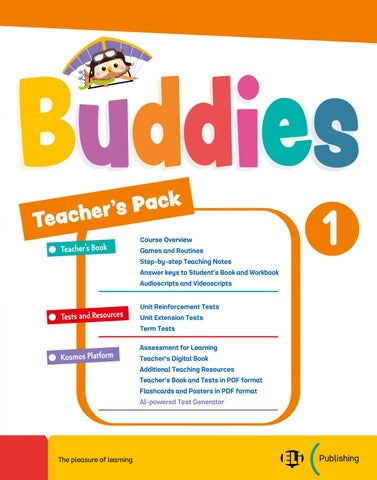
Welcome to Buddies, a six-level primary school course that promotes language learning through the values of friendship and collaboration, within the context of real-world discovery and cultural exploration.
Buddies is an American English course developed for schools with between three and six hours of English a week. The course provides core lessons, as well as additional focus on skills development, social and emotional learning (SEL), STEAM projects, exam support, and cultural lessons.
The Buddies course provides a solid language learning syllabus which corresponds to the following levels:
• Buddies 1 and Buddies 2: pre-A1 (Starters)
• Buddies 3 and Buddies 4: A1 (Movers)
• Buddies 5 and Buddies 6: A2 (Flyers)
1 My School
This Teacher’s Book includes clear teaching notes for each lesson and is designed to provide advice and strong guidance for teachers with classroom management tips, language and cultural tips, and extra ideas for mixed abilities (reinforcement and extension activities).
Buddies: Learning together! Learning for life .
This course explores the lives of young learners through the eyes of the Buddies family and their friends. These characters grow alongside the students, supporting them throughout their language learning journey. The memorable characters mirror young learners’ real-life experiences and facilitate long-term retention and language acquisition as well as personal development.
Buddies allows us to see inside the kids’ world where a diverse cast of characters models the values of friendship, collaboration, and support through their everyday adventures. Outside this world, students go on a journey of real-world discovery and cultural exploration guided by their trusted mascot, Ollie the owl, who links the familiar world with the new.
With well-structured lessons and engaging content, Buddies helps all students to develop their English language skills in a supportive and motivating environment.
Meet the Buddies family
At the heart of this course are four siblings: Milo, Emma, Leo, and Holly. The siblings take turns as the main characters in different levels of the course. As students develop through their primary school years, the characters accompany them, providing a sense of continuity and connection. The adult characters in the course provide a background of stability, confidence, and gentle guidance as the main characters and students move forward in their learning journey.
Who’s who in the family?
Milo is the youngest sibling. He features in the first two levels of the course, Buddies 1 and Buddies 2, and appears in other levels as the youngest member of the family.
Emma is eight years old. She’s Leo’s twin sister and features along with him in the next two levels of the course, Buddies 3 and Buddies 4. She also appears in other levels with Leo and her other siblings.
Leo is Emma’s twin brother and features alongside her in Buddies 3 and Buddies 4. He also appears in other levels alongside Emma and his other siblings.
Holly is the older sister and features in Buddies 5 and Buddies 6. She also appears in earlier levels.
Meet the Buddies for levels 1 and 2
In levels 1 and 2, our main character, Milo, has two friends who accompany him on his everyday adventures. These friends are Ava and Zoe.
Meet the Buddies mascot, Ollie the owl
The course mascot, Ollie, acts as the students’ study-buddy throughout the series, providing a link between the students’ everyday experiences and the wider world around them by:
• providing guidance through core grammar lessons with explanatory videos.
• providing tips on the Skills pages.
• introducing hands-on project work in real-world STEAM projects.
• fostering respect and interest in different cultures by exploring the different continents in the Around the World lessons.
Ollie
Milo Ava Zoe
Buddies methodology
What is the Buddies System?
Much like the traditional “buddy system,” which pairs individuals to support one another’s well-being, the Buddies System is rooted in active learning principles that promote student autonomy, peer collaboration, and a flexible, inclusive approach to learning.
The Buddies approach offers a flexible and inclusive framework that supports language acquisition in young learners through exploration, real-world connections, and meaningful interaction. It fosters creativity, critical thinking, and communication – essential skills for today’s diverse primary classrooms. Drawing on social and emotional learning (SEL), STEAM education, and a commitment to learner autonomy, the Buddies System helps students take ownership of their learning journey.
Through structured routines, collaborative roles, and engaging tasks, the Buddies System builds a culture of connection, curiosity, and cooperation. It’s more than simply working in pairs – it’s about creating a classroom environment where students learn with and from each other, developing independence and interpersonal skills in a safe, supportive space.
Flexible framework adaptable to different contexts
• Buddies integrates real-world input, functional language use, and cultural content to create purposeful, engaging activities.
Focus on connection, creativity, and curiosity
• Students collaborate with each other when they plan, build, problem-solve, and present their STEAM projects, Show and Tell activities, and other language-skills tasks.
Promote reflection, agency, and emotional safety
• With SEL themes, learner-centered roles, and consistent routines, Buddies nurtures independence, accountability, and a sense of belonging. Students grow together through peer support, shared goals, and emotional well-being.
The Buddies System is not just about pairwork or teamwork, but about creating a classroom culture of connection, curiosity, and collaborative well-being. When learners feel safe and supported, they become active participants in their own learning journey, they become confident, curious participants in their own education.
21st-century skills in Buddies
The Buddies course helps create a classroom environment where students can develop the key life skills they need for their future. Through carefully structured lessons, students learn how to learn by being curious and solving problems, they develop skills on how to work well with others, and how to express themselves confidently both inside and outside the English class. By using fun activities like songs, stories, and games, learners build a strong foundation in English while growing into resourceful and active young people. In particular, Buddies focuses on the following competences:
Communication skills
Buddies includes a variety of oral comprehension, spoken production, and interaction activities such as chants, songs, games, and pairwork activities. In addition, opportunities for real-world communication are provided in the Let’s talk! tasks.
In the Show and Tell activities, students present their projects to the class in a collaborative communicative setting. Speaking presentations on the STEAM and Around the World pages provide opportunities for students to prepare projects and present them to their class.
Teamwork
Working together is a key feature in the Buddies System. Course characters model teamwork, fostering an environment of support and collaboration from which students can learn. In turn, students are given a wide range of opportunities to work in pairs and small groups through various social interaction activities throughout the course.
Thinking skills
Buddies encourages students to develop their language skills through project-based learning related to the topic of each unit. The STEAM lesson in each unit integrates Science, Technology, Engineering, Arts, and Math, promoting problem-solving, critical thinking, and creativity through engaging, real-life projects.
Creativity
Projects in each unit encourage students to use their initiative and be inventive by designing and making their own hands-on projects. These projects help students combine imaginative thinking and creative problem-solving skills.
Cultural learning
Around the World lessons offer students the chance to learn about new cultures and understand the world around them by encouraging intercultural dialogue.
Social and emotional learning (SEL)
The social and emotional learning curriculum is built around the five core competencies of the CASEL (Collaborative for Academic, Social, and Emotional Learning) Framework, which guides the Buddies approach to developing the whole student. Through carefully crafted stories, students learn about the CASEL competencies of: self-awareness, self-management, social awareness, relationship skills, and responsible decisionmaking. Personalization tasks then allow students to reflect on these areas, fostering deep understanding and providing opportunities to apply their learnings to their own lives and relationships. This scaffolded approach ensures that students not only understand the skills needed for social and emotional learning but can also practice them effectively.
Assessment for learning
The unit activities, the Review games, and the Unit Tests and Term Tests all aim to improve performance and develop learner autonomy as students gradually gain awareness and independence in learning English. Other Assessment-for-learning techniques that can be used in the classroom include the following:
RoundtheRoomQuestioning: The teacher walks around the classroom, asking quick questions to individuals or small groups. This allows for immediate checks of students’ understanding and quick correction of any confusion or learning gaps.
Whole-ClassQuestioning(ShowMe!): The teacher asks a question (often with simple answers, such as “yes/no,” or “A/B/C”). The whole class then show their answers simultaneously. This allows for a quick scan of the entire class’s comprehension.
Peer and Self-Assessment: Students use simple checklists, rubrics, or “I Can” statements to evaluate their own work or a partner’s work. Comparing against learning criteria helps them recognize quality and understand lesson goals.
3-2-1 Format: At the end of a lesson, students note down: 3 things they learned, 2 things they found interesting, and 1 question they still have. This gives teachers quick, clear feedback on key learning and curiosity.
TeacherObservation(Informalmonitoring): The teacher listens carefully to student discussions and responses during tasks and group work. This informal monitoring helps gauge progress and adjust pacing or activities as needed.
Learning objectives
By the end of the Buddies course, students will have reached CEFR A2 level. They will be able to:
• Understand everyday language: comprehend short, simple spoken and written communication about familiar topics like family, school, hobbies, and shopping.
• Engage in routine conversations: participate in brief, everyday exchanges by asking and answering questions, making basic requests, and discussing likes, plans, and personal experiences.
• Describe themselves and their world: use simple sentences to talk about personal information, daily routine, and their immediate environment.
• Understand simple texts: read short, basic materials (stories, emails, or notices) and identify the key information.
• Create simple written content: produce brief texts, messages, or descriptions about familiar topics using basic grammar and vocabulary.
Components for Buddies 1
Book (including audio and video materials)
Student’s components
Stickers insert in the Student’s Book
Flashcards pack with 128 cards
• KOSMOS Platform
Poster pack for presenting or revising vocabulary and language
[Insert placeholder of Posters 1 and 2 (landscape format) from level 1]
At ELI Publishing, we believe education should be accessible, flexible, and exciting. That’s why we created KOSMOS, a platform that brings together all the tools you need to organize classes, grade assignments, communicate with your students, and manage your institution in one place – all with a modern, user-friendly interface. With KOSMOS, teachers can:
• have creative freedom, simplify lesson planning, and save time on administrative tasks;
• decide which activities to display, how many attempts to allow, and how to grade them;
• use our weekly planner to make lesson planning intuitive and straightforward;
• interact with an AI assistant available to help simplify your class planning.
• Digital Student’s Book (with audio and video material, plus interactive activities)
• Digital Workbook (with audio tracks and interactive activities)
• Digital Teacher’s Book
• Extra online resources
• QR codes in each unit with access to audio and video resources
Features in Buddies 1
Vocabulary 1
Topic-based active learning
The course is structured around engaging, relevant topics from students’ lives, ensuring that new language and concepts are taught in an integrated and relatable way. These topics form a connecting thread across each unit, allowing students to build on their previous knowledge as they progress. The units use storytelling to introduce and reinforce language, through the recurring adventures of the Buddies family and friends. Each unit opens with a large, detailed illustration that sets the scene for the new vocabulary and links to a story later on. Students actively engage with the topics and content, participating in all aspects of the lessons. Each lesson offers students the opportunity to interact with their teacher and classmates, as they take part in shared tasks.
Vocabulary presentation
2 At the Toy Store
Key vocabulary related to the unit topic is clearly presented in the main illustration and labeled and supported with audio and video. The new lexical items are then practiced by students in a chant.
Working with chants
Chants in every unit reinforce and practice the pronunciation of new vocabulary. They provide an easy and effective way to boost memory and engagement in the classroom. The rhythm and repetition make it simple for students to learn and retain new vocabulary quickly. In addition, chanting creates a fun and confident atmosphere, where all learners can actively participate.
Grammar 1
Grammar presentation
The first grammar presentation is introduced through a listening activity featuring the main Buddies characters and set within the context of the main illustration. It is then presented in the Grammar box, which highlights key structures. After each presentation, there is an opportunity for students to synthesize the meaning of the language point and work out its form, as well as watch fun grammar videos with Ollie. The presentation is then followed by practice activities that range from guided to semi-guided to free practice as students reach the production stage of their learning.
Grammar video s
To make grammar clear and engaging, each grammar lesson is reinforced with a short animated video. Presented by the Buddies mascot, Ollie the owl, these fun animations break down language rules in a simple and memorable way. This helps build a strong, positive foundation and keeps students motivated to learn.
Story Time
Working with stories
Buddies offers a topic- and values-based comic story in every unit that follows the lives of the Buddies family and friends in their everyday adventures. The bold, captivating comic frames and fun, playful storylines grab students’ attention. Language from the units is reinforced and recycled in the stories, aiding retention. The captivating illustrations are clearly supported with speech bubbles, audio, and video.
Social and emotional learning
Story Time
The Toy
Each story aims to foster human connection and personal growth in students through the inclusion of social and emotional learning in the storylines. The CASEL (Collaborative for Academic, Social, and Emotional Learning) Framework has been used to highlight the broad areas of competence in the stories including self-awareness, social awareness, relationship skills, and responsible decision-making. The storylines in Buddies encourage students to reflect on the values they present and to relate them directly to their own lives in follow-up personalization activities.
How to get the most out of the Buddies stories
1 Warm up
• Introduce context to set the scene: Show the story pages and introduce the setting, characters, and key vocabulary (objects, feelings, etc.). Activate prior knowledge by asking students to name other things they can see in the illustrations.
• Predict and engage: Ollie is always hidden in one of the scenes. Ask students to look closely to find him. Ask students to predict what the characters are doing or what might happen.
2 Listening & Watching
• First Exposure: Play the audio. Encourage students to follow the words/pictures in their books without interrupting.
• Guided Comprehension: Play the story a second time, pausing after each key event. Ask simple comprehension questions and point out actions that relate to the social and emotional learning theme.
• Play the video and ask students to focus on what they can see, for example, the characters’ expressions, actions, backgrounds, and colors.
3 Post-Listening: Practice and Reinforcement
• Active Reading: Have students listen again and read the lines for assigned characters (role-play reading).
• Check Understanding: Use the related exercise (like matching or sequencing) to check vocabulary and plot understanding.
• Act it Out: Divide the class into groups to act out the story using props and body gestures. This brings the language to life and boosts fluency.
4 Focus on Life Skills
• Discuss the social and emotional learning theme: Refer back to the pictures or plot points that illustrate the life skill (e.g., patience).
• Reflect and Apply: Ask students to discuss why the skill is important and identify examples in their own lives. Use the simple recognition exercise to reinforce the concept.
Vocabulary 2
Working with stickers
The second set of vocabulary in each unit is introduced with six clear individual illustrations in the form of stickers and is accompanied by a listening activity. The routine for this lesson uses stickers as a highly engaging and hands-on method to reinforce listening comprehension and vocabulary retention . Students then practice and produce the new words through a fun song.
Sticker Routine
1 Find the Stickers: Tell students, Find the stickers for Unit 1.They should tear off the correct section but do not peel the stickers yet.
2 Listen and Point: Play the audio once. Point to the pictures in the book as you hear the words and have students point with you. This connects the sound to the image.
3 Listen and Stick: Play the audio again, pausing after each word. Students find the correct sticker and place it in their book.
4 Check Your Work: Point to each picture and ask a simple question to check their understanding, for example, Is this a classroom? Students can answer Yes,itis or No,itisn’t.
Working with songs
Songs are a powerful tool offering multiple benefits that enhance language acquisition and whole child development. Songs can help students:
• Boost language: Students use new words and phrases naturally and spontaneously, increasing confidence and fluidity.
• Aid memory: Music helps students remember what they learn.
• Support all learners: Songs are great for different learning styles. Students see (visual), hear (auditory), and move (handson).
• Create a positive mood: Singing helps students relax, concentrate, and feel a sense of belonging to the class. It creates a happy, calm environment for learning.
Grammar 2
Presentation, Practice, and Production
The main Buddies characters present the second grammar point within the context of the unit topic. A “Look!” feature activates known vocabulary as students think about the context before the main grammar presentation. The presentation, practice, and production (PPP) model is effective in the primary classroom because it offers a clear and supportive structure. This predictable, step-by-step routine helps young learners feel secure and builds their confidence with new language.The model acts as a scaffold, guiding students from understanding a new grammar point to practicing it in a controlled way, and finally, to using it freely on their own. This gradual process ensures students feel successful at each stage, giving them a sense of achievement when they can finally use the new language to express their own ideas. As with Grammar 1, the key structures are supported by a clear grammar box, audio, and video. Two practice and production activities follow the main presentation, allowing students to apply the Buddies System by first working individually and then helping each other in pairs.
Skills
Listening and Speaking
Skills development
Clear skills development is promoted throughout all units with dedicated Listening and Speaking, and Reading and Writing lessons.
The first skills lesson focuses on Listening and Speaking. The activities consolidate the unit’s language and vocabulary while teaching practical functional language for real-life communication through the Let’s talk! feature. Students first build oral comprehension skills by listening to short dialogues that model language appropriate for everyday situations before moving on to the spoken production stages.
Let’s talk!
Teaching functional language gives students useful everyday English for real situations. Students learn key phrases to express a need or an idea, for example, Where’smypencil? / Look! There it is! This approach focuses on communication, not just memorization. By practicing these ready-to-use phrases in role-plays, students gain the confidence to interact naturally and see English as a relevant, useful tool.
Following the listening stage, students practice spoken production using the new language through pairwork activities. This page integrates both individual and pairwork tasks and includes a focused listening and pronunciation activity dedicated to the unit’s Phonics sound, which is clearly illustrated and supported with audio.
Reading and Writing
The second skills lesson in each unit is dedicated to building reading and writing proficiency through an integrated, scaffolded approach.
Reading
Students work with an engaging range of topic-based texts that are designed to activate their prior knowledge and spark curiosity. These texts gradually increase in length and complexity throughout Buddies 1, ensuring the challenge is always appropriate. The activities develop essential reading sub-skills such as: identifying the main ideas and supporting details, skimming for general understanding, and scanning for specific information.
Writing
The engaging reading texts also serve as clear and achievable models to guide students in developing their own written production. Writing skills are developed in a systematic progression that coordinates directly with reading. In Buddies 1, students start by tracing words to build fine motor skills and letter recognition, and gradually progress to writing single words from prompts. This step-by-step process builds confidence, ensuring students feel successful as they learn to produce their own written work.
The value of STEAM in the classroom
The STEAM approach (Science, Technology, Engineering, Arts, and Math) is highly effective in English classes because it makes language acquisition hands-on and purposeful. These lessons address different curricular areas within one integrated topic, giving students the opportunity to see how these areas are connected and work together. For example, in a lesson on making a shaker, the different STEAM areas are integrated in the following ways:
Science: Students explore the concept of sound, discovering how different materials (like beans, rice, or pasta) create different sounds when they vibrate inside the bottle.
Technology: Students use simple tools like a plastic bottle and a funnel to assemble their instrument.
Engineering: They design and build their shaker, testing how the amount of beans inside changes the sound. They can modify their design to get the perfect sound.
Arts: Students express their creativity by decorating their shakers and then using them to create rhythms and make music with the class.
Math: They can count the number of beans they add, or create colourful patterns and shapes on their shaker as part of their design. The teacher’s notes for each STEAM lesson clearly show how the different areas are integrated.
STEAM Projects
STEAM: a shaker
Science materials
Technology safety with classroom tools
Engineering design
Arts colors, decoration
Math counting
By engaging in practical, hands-on projects, students gain an immediate, real-world context for using English. This active process requires more than just language recall; it involves comprehending concepts and instructions, forming simple guesses (or hypotheses) about outcomes, designing and planning work, and organizing skills and knowledge to solve a problem.
This approach enhances motivation, strengthens vocabulary and language in a non-traditional way, and develops essential 21st-century skills such as critical thinking, collaboration, and communication
Each STEAM lesson ends with a final Show and Tell activity, where students have the opportunity to present their projects to the class in a collaborative, communicative setting. For more information on using Show and Tell activities in the classroom, see page 17.
Exam Practice
Buddies is aligned with the three levels of the YLE exams, ensuring that students are developing the appropriate skills and language at each stage of their learning journey.
Buddies 1 and 2 prepare students for Starters (Pre-A1 CEFR level).
Buddies 3 and 4 prepare students for Movers (A1 CEFR level).
Buddies 5 and 6 prepare students for Flyers (A2 CEFR level).
To ensure early preparation and build confidence, each unit includes a dedicated YLE-style exam practice page. Each unit practices different parts of the Starters, Movers, and Flyers tests, giving students exposure to and practice of most YLE exam tasks throughout the course. This systematic inclusion familiarizes students with common task formats, which, in turn, helps them build a strong foundation in specific listening, reading, writing, and speaking skills and helps to reduce anxiety about future testing.
Review
The final page of each unit ensures vocabulary, grammar, and skills consolidation through engaging activities.
Entertaining games help students review the unit’s vocabulary and language in a fun way, encouraging them to use critical thinking skills. The Picture Dictionary offers a clear visual presentation of all the vocabulary from each unit and can also be used as a review tool.
Assessment for learning
Following the Review lesson, students complete the “I can” box activities. This is their first step toward self-evaluation, allowing them to reflect on their progress and take responsibility for their own learning.
For more formal evaluation, students can assess their progress by completing the Unit Tests (available at Reinforcement and Extension levels in the Teacher’s Guide) and three comprehensive Term Tests to use throughout the year, in addition to everyday classroom assessment.
World Aroundthe
Buddies integrates culture and society, showing students that language is a global instrument for connection and exploration.
After every two units, a special double-page Culture section allows students to explore a different part of the world. Ollie, the course guide, introduces students directly to their buddies in different continents, making global learning feel personal and immediate.
Students engage with the content by reading the texts and watching a video, completing comprehension exercises, and then consolidating their knowledge through a personalization activity and class Show-andTell presentation.
This progressive focus encourages curiosity and discovery. Students learn how their peers around the world go about their daily lives and are stimulated to discover and compare their own traditions with those of others in different cultures. As they actively learn about their global buddies and explore diverse societies, this process helps students appreciate shared human experiences and fosters the crucial awareness needed to become global citizens.
Using Show and Tell in the classroom
Project presentations using the Buddies System give students a real reason to use English and are a great way to build speaking confidence and celebrate students’ hard work. To get the most out of these activities, you can adopt the following routine:
1 Get students ready . Give students simple sentence starters to practice before they present. This provides a clear structure and builds their confidence. For example: Thisismyfavoritetoy. It’s name is It is
2 Provide a model Show students what to do by presenting your own project first, using the same sentence starters.
3 Create a special place Have a “Presenter’s spot” at the front of the class to help everyone focus.
4 Support the speaker Support the students as much as you can during their presenations. If a student gets stuck, gently prompt them with a question about their work. Focus on encouraging communication, not on correcting every mistake.
5 Involve the rest of the class . Teach the rest of the class a simple question they can ask the speaker about their presentation. For example, Whatcolorisit?Howmany ... are there?
6 Finish positively . Make sure every presentation ends with a warm round of applause to celebrate the student’s hard work.
Games and routines
Following are some guidelines and ideas for greeting your students at the beginning of a lesson, as well as further instructions for playing the games mentioned in the Teacher’s Book.
Opening routines
An engaging greeting sets the tone for a positive learning environment, helping students feel welcome and ready to participate. Using different approaches to greet students fosters interaction.
These are example routines for greeting students at the beginning of a lesson:
Opening routine 1: The Hello Circle
Students stand around the classroom or sit in a circle.
Stand in the center and choose a student to start: Hello, (Ana). Howareyoutoday?
The student responds: I’m(happy/sleepy/good/sad),thank you!
Then that student greets the next person. Continue with the chain of greetings until everyone has had a chance to answer.
Options: Change the follow-up question to things like: How’stheweathertoday?What’syourfavoritecolor?
Always end the opening routines with the same call and response question: What time is it children? to which the class always answers: It’stimeforEnglish! To offer variety, ask the question each day in a different way (whispering, yelling, in a silly voice) so that the class answers in the same manner.
Opening routine 2: Action Greeting
Display a few action flashcards or make gestures (waving hello, a high-five, a fist bump, a silly dance, a bow). As students enter or as the class begins, they choose one and you greet them that way. For example: Goodmorning,(Ana andJohn)!Wouldyoulikeahigh-five,awave,oradance today?
End the routine with the call and response question: What time is it children? (It’stimeforEnglish!)
Opening routine 3: Sing-Along Greeting Song
Sing a short, repetitive greeting song to start class, for example, to the tune of Ifyou’rehappyandyouknowit: Hel-lo,hel-lo,howareyou? (clap, clap)
Enthusiastically end with the call and response routine: What time is it children? (It’stimeforEnglish!)
Opening routine 4: Greeting Guest
Use different puppets or stuffed animals to greet each student or to ask about their classmates: Hello,whoare you?;What’syour/his/hername?;Who’sthis?
Students respond and can ask the puppet a question in return.
End the routine by having the greeting guest do the call and response question: What time is it children? (It’s time for English!)
Games
Show me!
Call out a word. Students respond by pointing to the item named.
Optiontoadaptthegame: Students race each other to show the item.
Extension: Students play in groups, taking turns saying a word.
Correct the Teacher
Make a correct or incorrect statement: Lookatthe(doll). It’s (green) Students clap for correct statements and stamp for the incorrect ones.
Optiontoadaptthegame: Students verbally correct the mistakes.
Memory Chain Game
In a chain around the class, each student repeats the previous words and adds one more.
Example:
• Student 1: Abigdrum.
• Student 2: Abigdrumandaredkite.
• Student 3: Abigdrum,aredkite,andanoldball.
Find Your Partner/Group
Write a question on the board, such as: What’syourfavorite color? Students think of their answer, and then move around the class asking the question until they find one or more students with the same answer. Then they sit down together.
Guess the Word
Place flashcards face down on a table. Ask a student to guess the item without looking. Ask: What’s this?
Optionstoadaptthegame:
• Show the card after the student has answered. If correct, award a point.
• Don’t show the card until someone gives the correct answer. Award a point to that student.
Extension:
• Have a student ask the question.
• Students play in groups and answer together.
Simon Says
Students only respond to instructions preceded by “Simon says.” Students who respond incorrectly are eliminated.
Extension: Students take turns giving the instructions.
Stand up! Sit down!
Students stand if a statement is true for them and stay seated if it isn’t.
Mime and Say
Mime an action. Students respond with the word for the action.
Optiontoadaptthegame: Say a word. Students respond by miming the action.
Extension: Students play in pairs or small groups.
Statues
Play music. Ask students to mime an action while the music plays. Turn off the music suddenly. Anyone caught moving is eliminated.
Picture Dictation
Describe a scene using the target language. Students draw what they hear.
Optiontoadaptthegame: Students describe a scene.
Hide-and-seek
Say: Closeyoureyes! Hide flashcards or objects around the classroom. Then say: Openyoureyes! Ask: Where’s the (redbook)? Students search, point, and describe its position: There it is! It’s under the table.
Draw My Picture
Each student draws a simple picture from a limited list of items. Students play in pairs, with their pictures hidden from one another. One student asks questions and tries to draw their partner’s picture. Then they swap.
Find and Circle
Divide the board into two halves. Write the words to practice in random order on each half of the board. Divide the class into two teams. A student from each team comes to the board and they stand on either side. Give each student a board pen. Call out a word from the board. Award a point to the team of the student who circles the word first. Repeat until all the words have been circled. Each time a different student from each team comes to the front.
Listen and Draw
Describe a simple picture using target language (for example, of a person, an animal, or a scene). Students draw what they hear. Students compare their drawings at the end.
Optionstoadaptthegame:
• A volunteer describes a picture for the class to draw.
• In pairs, students take turns to describe and draw.
Match the Word
Write the vocabulary on the board in a random order. Hold up a flashcard. Ask a student to say the word and find it on the board. Continue with the rest of the words.
Optiontoadaptthegame: Play this as a team game, awarding points for the correct answers.
Pass the Card
Distribute the flashcards. Play some music. Students pass the card to the student on their left. Stop the music. Point to a student who is holding a flashcard and ask: Whatdoyou have? Students say the word.
Which picture?
Put the flashcards on the board and write a number under each one. Say a word or sentence, and students say the number. Reverse the exercise. Say a number, and students say or write the word/sentence.
Welcome
Unit objectives
At the end of this unit, students will be able to …
In this unit, students are introduced to the characters who will guide them through the book: Milo and his two friends, Ava and Zoe, along with the course mascot, Ollie the owl. These are the friends, or Buddies, that give the course its name. Students will also be introduced to members of Milo’s family who will appear in the course.
As an introduction to English, students learn how to introduce themselves and say their age, and they are exposed to simple classroom language like “Listen!” and “Look!”
Students use language for numbers, colors, and the weather to describe their surroundings and interact with their classmates.
Receptive language: Let’s sit down!, Let’sget ready!, It’s time for school!, Let’s count!
Materials: Flashcards: Ava, Dad, Emma, Grandma, Grandpa, Holly, Leo, Milo, Mom, Ollie, Teacher, Zoe; Digital Book
Teaching Tip
Reinforce the meaning of classroom instructions using mime: look: point to your eyes; read: mime holding and reading a book; pointto: stretch out index finger; listen: cup a hand behind your ear; sit down: bend your knees; standup: gesture with hands moving up. You can also use the Classroom Language poster from the Poster Pack to provide students with visual prompts of typical classroom instructions.
Warm up
• Wave and say: Hello! Encourage students to wave back and respond: Hello! Say: WelcometoEnglish!
• Point to yourself and say: I’m(yourname). Write your name on the board. Wave and say: Hello,class! Encourage students to respond: Hello, (yourname)!
• Hold up the Student’s Book and say: ThisisyourEnglish book. Hold up the flashcards and say: Thesearethepeople in the book.
• Show Milo first and say: This is Milo. Repeat with the members of Milo’s family. Explain that they are all part of the same family.
• Show Zoe and Ava and say: Thisis(Ava).She’sMilo’s friend. Show the teacher and explain: This is Milo’s teacher.
• Show Ollie and say: Ollieisourspecialfriend. Explain that Ollie is a guide through the book.
• Play the audio for the song on p. 4 of the Student’s Book. Encourage students to join in with words and actions.
Hello! I’m Milo!
Hi! I’m Zoe. What’s your name?
Hi! My name’s Ava.
1 Look! What can you see?
• Read the title of the Student’s Book and say: Buddies are friends. Hold up the flashcards of Ava, Milo, Zoe, and Ollie. Ask students to find pictures in their books of the characters and show them to you.
• Point to pp. 4 and 5 of the Student’s Book and say: It’s a school. Ask: CanyouseeOllie? (Ollie is by the main entrance.)
• Ask students to identify the characters from the flashcards. Say: Icansee(Milo). Point to Milo.
• Find out if students know any English by naming elements in the picture: For example, point to a boy and say: Look! Aboy!
2 Listen, read, and say. Then watch.
• Point to the children in the picture. Say: Look at the buddies.
• Say: Listen. Play the audio and point to the text in the speech bubbles. Students follow with their fingers.
• Divide the class into three groups and assign a character to each group.
• Play the audio again. Students join in with their character.
• Divide the class into groups of three. Students read the dialogue.
• Say: Now let’s watch a video! Play the video.
3 Listen and sing.
• Say: Now,let’ssingasong! Play the audio and do actions: Lines 1 and 5: wave; Lines 2 and 6: clap in time; Line 3: take off coat; Line 4: sit down.
• Say: Nowjoinin! Play the audio again. Students join in with the actions and words.
• Divide the class into two groups and assign three lines to each group. Play the audio. Students join in with their lines.
4 Listen and say. Then find.
• Point to p. 5 of the Student’s Book. Say: Look at the numbers. Play the audio and point to each number as it is named.
• Say: Nowyousaythenumbers. Play the audio again and point to the numbers. Students join in.
• Point to pp. 4 and 5 of the Student’s Book. Say: Find number(1). Students point to the number in the illustration and say: (One!) . Repeat with the rest of the numbers 2–10.
Ending the lesson
• Point to yourself and say: I’m(yourname).Myname’s… Ask each student: What’syourname? Encourage students to answer using: I’m … or Myname’s…
• Assign a number 1–10 to each student. Say: Let’s count to 10! Students say their numbers in ascending order. Then say: Let’s count from 10 to 1. Students say their numbers in descending order.
• Say: That’stheendofthelesson.Goodbye! Encourage students to respond: Goodbye!
Extra activities
• Reinforcement: Write a number on the board and say: Let’s count! Pick up and count (pencils): (one, two,three). Ask students to count with you. Repeat with a different number and object. Ask volunteers to count alone.
Play MimeandSay with classroom instructions. See pp. 18–19 of your Teacher’s Book.
• Extension: Draw 10 pencils and 10 rulers on the board. Give instructions to make number sets: Draw acirclearound(5)(pencils). Students draw a circle that only includes the number set. Use a scrunched-up piece of paper as a ball. Students take turns throwing the ball at another student and ask: What’syourname?
Now go to Workbook 1 page 2.
Lesson 2
Audioscript
1 Adult: Hello, Milo. How old are you? Milo: I’m six!
Lesson 2 objectives
Objectives: To ask and answer about age; To identify feelings.
Grammar: Howoldareyou? / I’m …
Vocabulary: Numbers; happy, OK, sad Materials: Digital Book
Warm up
• Say: Hello,children! Students reply: Hello!
2 Adult: Hi, Ava! How old are you? Ava: I’m six!
3 Adult: Hi, Zoe. How old are you? Zoe: I’m seven!
2 Ask and answer.
• Ask students: Howoldareyou? Ensure they use the full answer: I’m …
• Divide the class into small groups. Students ask and answer: Howoldareyou?I’m
3 Listen and read. Then say.
• Point to Exercise 3 in the Student’s Book. Play the audio and point to the text. Students follow with their fingers.
• Assign a number 1 (happy), 2 (OK), or 3 (sad) to each student. Say a number. Students mime the expression and say: I’m(happy).
4 Match. Then circle and say for you.
• Point and ask students to mimic the expressions. Ask: Are you(happy)?
• Read the first sentence. Say: Matchtothepicture. Repeat.
• Call out emotions in a sequence: happy,sad,happy,OK. Students respond with mime.
• Say: That’stheendofthelesson.Goodbye! Encourage students to respond: Goodbye!
Extra activities
• Reinforcement: On the board, write 6 and 7. Students point to a number and say: I’m …
• Write the numbers 1–10 on the board in a random order. Say: (Six)! Ask a student to circle the number. Repeat.
1 Listen and circle.
• Point to the children in Exercise 1 on p. 6 of the Student’s Book. Ask: What’s(his)name?
• Ask: Howoldis(he)? Say: Listen! Play the audio. Point to the numbers as they are said.
• Say: Now listen and circle. Play the audio again. Students circle the correct number. Ask: Howoldis(Milo)?
• Extension: Play FindYourGroup. See pp. 18–19 of your Teacher’s Book. Draw faces for happy, OK, and sad. Put them in an envelope. Students take one and find their group saying: I’m(happy).
Lesson 3 objectives
Objectives: To describe the weather; To name colors.
• Say: Hello,children! Students reply: Hello! Ask: What’s yourname?Howoldareyou?
• Draw three expressions on the board and name them: Happy.OK.Sad.
• Say: I’mhappy! Draw a check mark under the icon. Have students come to the front and say: I’m(happy) and draw a check mark.
Lesson 3
1 Listen and read. Then point and say.
• Point to Exercise 1 on p. 7 of the Student’s Book.
• Play the audio and point to the text. Students follow along with their fingers.
• Play the audio again. Students read out loud.
• Assign a picture to each student. Ask individual students: What’stheweatherliketoday? Students respond according to their picture.
Teaching Tip
Students can volunteer by raising their hands. Choose the first student to respond or a student who doesn’t often participate. Don’t let the overconfident students dominate the activity. Shyer students can whisper their answers in your ear.
2 Listen and say.
• Play the audio and point to the balloons. Students point.
• Play the audio again. Students point to the balloons and say the colors.
• Point to each color in Exercise 2 and ask: What color is it?
3
Point, ask, and answer.
• Point to each balloon and ask: What color is it?
• In a chain, students point to any of the balloons and ask the next student: What color is it?
Ending the lesson
• Point to different classroom items and ask: What color is it?
• Say: That’stheendofthelesson.Goodbye! Encourage students to respond: Goodbye!
Extra activities
• Reinforcement: Play Show me! with the colors of classroom items. See pp. 18–19 of your Teacher’s Book. Ask: Showmesomething(blue). Volunteers point to something in the classroom that is (blue) and say: (Theruler)is(blue)
• Extension: Draw a sequence of colored circles using two colors such as: red, red, yellow, red, red. Name the colors. Ask students to continue the sequence. Repeat with other color combinations. Now go to Workbook 1 page 3.
2
Lesson 4 Vocabulary 2
1 Listen and stick.
Is
Is
Is
• Say: Let’slookatourEnglishbooks. Say: Find the stickers for Unit 2. Students should not peel off the stickers yet. Play the audio and point to the pictures. Play the audio again, ensuring students have time to place their stickers in the correct position.
• Point to each picture and ask: Isthisa(bigteddybear)?
2
Listen, point, and say.
Lesson 4 objectives
Objectives: To learn more words for toys; To learn adjectives to describe toys.
Vocabulary: big, bike, kite, new, old, small
Recycled language: Toys; Isthisyour...?
This is/isn’tmy.../Yes, it is /No, it isn’t
Materials: Flashcards: ball, boat, doll, drum, robot, rocket, teddybear, truck; Stickers: big, bike, kite, new, old, small; Digital Book
Warm up
• Greet the class. Cover a flashcard with a piece of paper. Ask: What’s this? as you slowly remove the piece of paper. Repeat. Have students take over your role covering a flashcard and asking: What’s this?
• Play the audio. Students should hold up their books and point while naming the pictures.
Audioscript
old small new bike kite big
3
Listen and sing.
• Point to the picture and say: Is thisa(new)(bike)? Encourage the students to say: Yes, it is./No, it isn’t
• Say: Let’slearnasong. Play the audio. Mime actions for riding a bike and flying a kite, and for yes and no. Encourage students to copy the actions.
• Say: Nowjoinin! Divide the class into two groups: one for the questions and one for the answers. Play the audio again. Students join in with the actions and words assigned to them. Change groups and play the audio again.
• Divide the class into groups. Ask them to invent new lyrics by using different toys. Say: Thinkofactionsforthetoys. Once students have practiced in their groups, ask them to perform for the rest of the class.
Ending the lesson
• Dictate adjective and toy combinations: A(big)(robot). Students draw the toys. Collect the drawings and ask students: Isthisyour…?
• Say: CloseyourEnglishbooks.Goodbyefortoday!
Extra activities
• Reinforcement: Draw pairs of contrasting toys on the board, e.g., abigdoll/a small doll. Describe and ask a student to find the correct picture. Ask students to describe the toys.
• Extension: In pairs, students dictate and draw adjective and toy combinations.
Now go to Workbook 1 page 15.
English is better with Buddies! 1
Buddies is a six-level course for young learners that promotes language learning through the values of friendship and collaboration, within a context of real-world discovery and cultural exploration. It is designed to help primary students understand themselves, build friendships, and make kind, smart choices.
Aligned to the Common European Framework, Buddies provides a solid foundation in English through a variety of dynamic and motivating activities. Engaging, meaningful topics support language development while helping students build essential 21st-century skills.
With well-structured lessons and inclusive content, Buddies supports all learners in developing their English language skills within a supportive and engaging environment.
The course offers core language lessons, as well as additional focus on skills development, social and emotional learning (SEL), STEAM projects, and exam support.
Inside level 1:
• 8 units based on topic-based active learning
• A great variety of engaging video material (Vocabulary, Story Time, Grammar, and Culture videos)
• Chants and songs to learn new vocabulary and support pronunciation in a playful way
• Stories that aim to foster human connection and personal growth through SEL
• STEAM projects that involve students in stimulating, creative tasks
• Preparation for the YLE suite of exams
• End-of-unit games for evaluating progress
• Culture pages with a global perspective
For students:
• Student’s Book with Digital Book
• Workbook with Digital Book
For teachers:
• Teacher’s Book
• Flashcards
• Posters
• Digital Book
• Digital resources
• Digital platform with AI Tools (Test Generator, Lesson Planning, Resource Bank)
Scan the QR codes inside the book to listen to the recordings and watch the videos.