
Elia Summer Outlook 2026
With a focus on incompressibility risks

Executive summary
The Summer Outlook 2026 assesses the risk of incompressibility in Belgium during the coming spring and summer period, i.e. situations where excess generation cannot be fully absorbed by demand, flexibility or exports. Compared to last year’s outlook, the overall situation appears less tense, mainly due to the maintenance foreseen on the remaining 2GW of nuclear in the framework of the Long-term Operations (LTO) of Doel 4 and Tihange 3 to happen between April and November 2026 included
Several additional evolutions shape the context for the upcoming summer Electricity demand in Belgium is assumed to be higher compared with 2025, pumped hydro facilities are expected to show higher availability than last year, and installed battery capacity increases, both small scale and large scale, the latter driven by the volume of batteries contracted in CRM auctions for the first delivery period 2025–26 The system is expected to integrate more renewable generation, with around 1 GW of additional solar PV and roughly 180 MW of new onshore wind capacity being installed last year
The assessment comprises two types of analysis. The first examines ‘perfect foresight’ conditions (Type A), while the second evaluates deviations from the initial forecast (Type B).
Under Type A (perfect foresight) conditions, where system dispatch is optimised based on assumed knowledge of generation, demand and availability patterns, incompressibility risks for the coming summer appear less tense than last year. This is primarily driven by the absence of nuclear generation from April onward, which significantly reduces inflexible baseload. In this context, flexibility and storage assets play a key role in limiting both the frequency and severity of excess-generation episodes. Exports continue to help mitigate domestic surpluses, although their contribution is increasingly constrained by simultaneous excess conditions in neighbouring countries After accounting for large-scale RES curtailment, remaining excess episodes are limited, mainly occurring around midday during weekends, with the highest risk shifting from summer toward spring, continuing an already observed trend. Together, these elements describe a system that remains exposed to excess-generation situations
The Type B assessment builds on perfect foresight conditions by evaluating system performance under real-time deviations, such as (extreme) forecast errors from renewable generation and demand, or unexpected outages. It quantifies flexibility shortages in downward flexibility when predictable structural surpluses interact with shortterm uncertainties, highlighting worst case situations in which market-based mechanisms alone will not be sufficient and operational fallback measures are required. In this context, uncovered flexibility needs are observed during spring and summer, typically appearing during weekends with low load, low wind (leading to lower downwards flexibility) and high solar infeed. To bridge these remaining gaps, Elia must structurally rely on last resort measures, including emergency support from neighbouring TSOs, redispatching bids for balancing and TSO/DSO technical measures Additional flexibility must be unlocked to cover “worst case” solar driven excess scenarios These needs will further increase as uncovered shortages are expected to worsen in the coming years with the continued expansion of renewable capacity mainly PV and the seasonal return of nuclear generation during spring and summer from 2029 onward.
Despite that Elia welcomes the effort of market players to respond to market conditions and new products being installed in the market, situations with uncovered flexibility needs remain Therefore, existing technical measures on controllability of end-users and PV need to maintain and anchored in a solid legal framework Additionally, the measures need to be extended to smaller decentralised generation units to cover increasing needs towards the years to come Aligned with European legislation, Elia (together with the DSOs) are elaborating the first Flexibility Needs Assessment (FNA) which will look into 2030 and 2035.
1 Setting the scene and situation of oversupply
1.1 Incompressibility – operational reality
The summer outlook focuses on anticipating and managing periods of excess electricity generation, a growing challenge known as incompressibility. This contrasts with the winter outlook, which centers on operational scarcity and security of supply. In the National Control Center (NCC), incompressibility has become a key operational concern. With renewable generation especially solar and wind continuing to rise, these situations are expected to occur more often. This increasingly limits the NCC’s means to maintain system stability, particularly once export is no longer possible and the remaining options to balance supply and demand become scarce. During critical periods such as sunny weekend afternoons with low consumption but peak solar output the risk increases that the system cannot absorb or export all excess energy. If a forecasting error (e.g. PV generation significantly exceeding the prediction) occurs on top of this, it createshighly challenging conditions for real-time operations
To mitigate these risks, the NCC relies on explicit flexibility (activating available FRR means) and implicit flexibility (market participants reacting to price signals), supported by the European balancing platforms (MARI for mFRR and PICASSO for aFRR). Beyond these flexibility sources, cross-border exchanges in the wholesale markets are used to send excess energy to neighbouring countries when possible. Reduction of decentralized generation units on TSO/DSO level, referred as TSO/DSO technical measures, remain as last resort solution when all other means are insufficient
Incompressibility raises two key challenges:
(A) Can the market handle predictable situations of high renewable generation and low demand without intervention? Issues arise when the market can’t balance portfolios, shown by negative prices or self-curtailment of renewables.
(B) Can the system stay flexible enough for unexpected outages or forecast errors? This depends on available downward flexibility.
1.2 Summer review: key observations in market and balancing
1.2.1 Observed export vs summer outlook projection
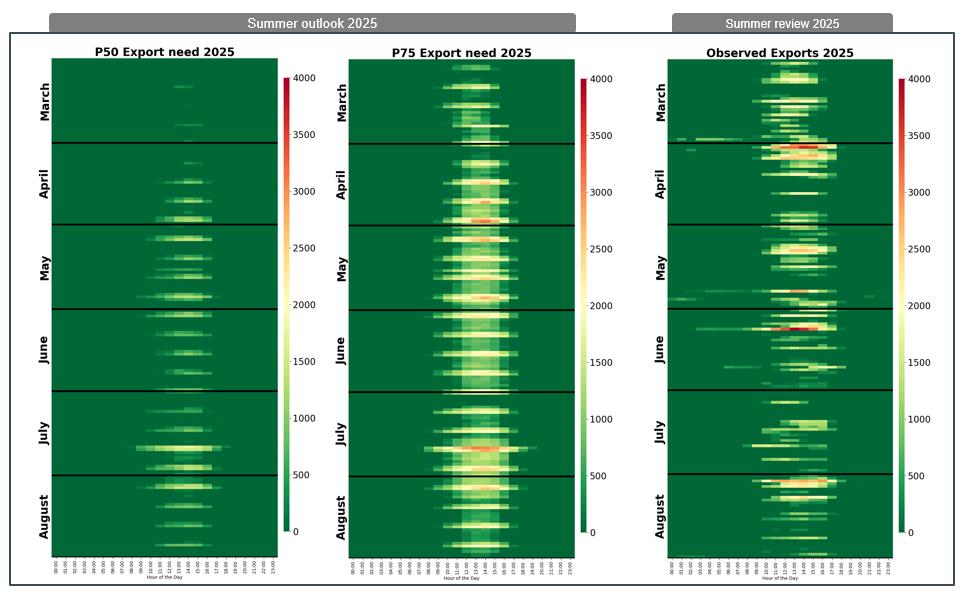
The 2025 summer outlook (SO25) results were obtained by a probabilistic economic dispatch simulation, showing Belgium’s theoretical export need (i.e. before actual exports but including available system flexibility in Belgium) during incompressibility risk periods Last year’s analysis identified the end of April, early May, and July as the periods with the highest risk. When comparing the outlook results on the left side of Figure 1 (P50 and P75 scenarios) with the actually observed exports shown on the right side of the figure, the summer review confirmed that spring was indeed the most critical period for export needs, in line with the projection of the outlook.
Other main conclusions were: (i) the magnitude of actual export volumes in 2025 aligned closely with the simulated needs of the summer outlook, with similar patterns observed, (ii) actual export levels were constrained by major infrastructure works on the Elia grid (notably the Avelgem project), limiting export capacity and impacting dayahead market results (minRAM), (iii) The drop in nuclear generation in early July decreased export needs, a factor clearly reflected in the observed export data.
It’s important to note when comparing these results that, firstly, the outlook results are based on a probabilistic simulation across a wide range of synthetic meteorological years to estimate periods of greatest risk, providing a
robust probabilistic forecast. In contrast, the observations reflect one historical meteorological year (2025) Secondly, observed exports are influenced by actual real-time market flows, including day-ahead, intraday, and balancing markets. Therefore, they differ from the theoretical perfect foresight scenario, which doesn’t include the impact from the intraday market or deviations in the real-time/balancing time period. For further details, please refer to the Summer Review ’251
1.2.2 Negative price evolution in the DA-market
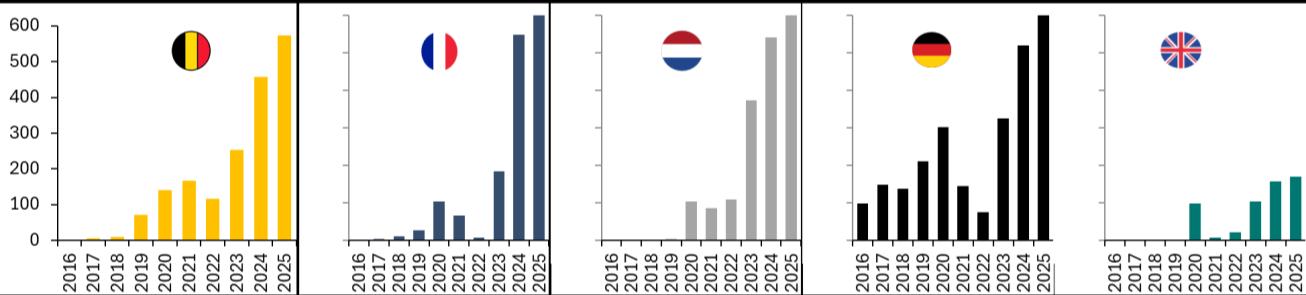
As mentioned above, the difficulty for the market to manage low residual demand are reflected in negative prices on day-ahead and imbalance markets. Negative prices have become a structural feature of the European electricity system due to rapidly growing renewable generation. As shown in Figure 2 below, in Belgium recorded 574 negative-price hours (+26% vs. 2024), while France (+34%), the Netherlands (+19%), and Germany (+16%) all saw further increases in negative-price occurrences Even the UK, historically less affected, reached 170 hours. This simultaneous rise in negative prices across neighbouring markets shows that high renewable output often exceeds demand regionally Given the expected further deployment of solar and wind, this trend may intensify in the coming years.
Summer_Review_'25
Figure 1: Summer outlook ’25 - P50 and P75 export need projections vs Summer review ‘25 observed exports
Figure 2: Amount of hours with negative prices in DA-markets (BE, FR, NL, DE)
Source: ENTSO-E and EMBER
1.2.3 Evolution of implicit and explicit flexibility reactions
Elia is monitoring the market reaction to negative prices. On the one hand by analyzing the spread between recent forecast errors and system imbalances. Over time, an increasing trend has been observed during periods of incompressibility risk. In Figure 3 below, the observed market reaction in 2024 averaged around 530 MW during incompressibility risk periods. In 2025, this average increased to around 570 MW, with the minimum observed value rising to about 290 MW.
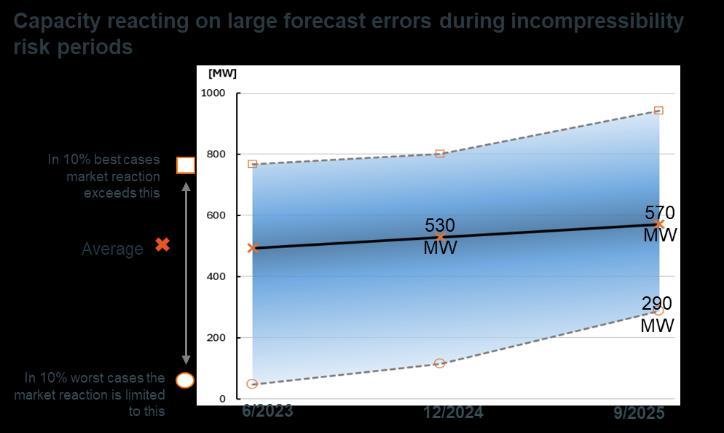
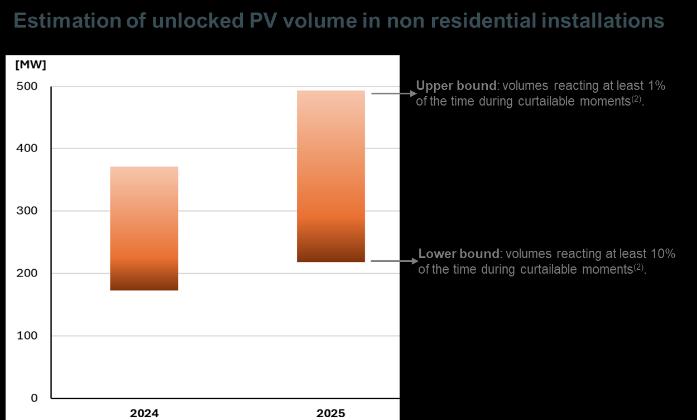
Figure 3: Market reactions during incompressibility risk periods in ID & RT increased over the last three summers (left) and individual non-residential solar parks between 25 MW and 0.01 MW (right)
On the other hand by analyzing the reaction the individual generation profiles of installations with expected generation during negative price moments on sunny days An extrapolation of the results of the PV parks under study (representing 18% of the fleet) allows to estimate that the total volume of non-residential PV installations, which have reacted in the past, is 200 to 500MW in 2025, showing a slight increasing trend compared to 2024
1.3 Improvements brought by this summer outlook compared to the previous one
There are two main improvements in this year’s outlook (SO26) compared to the previous outlook (SO25)
Accounting for impact of neighbouring countries
In SO25, Belgium was treated as an isolated system, with the ‘export need’ as main indicator. Although the simulations already relied on the same European CE CCR model as in Elia’s latest Adequacy and Flexibility Study hereafter referred to as “AdeqFlex’25”2 , the analysis did not consider interactions with neighbouring countries In the SO26, the same model is used, but now export possibilities are explicitly analyzed based on the output of the model, which makes it possible to capture the correlation with neighbouring systems This is important because incompressibility conditions in Belgium often coincide with similar situations in neighbouring countries.
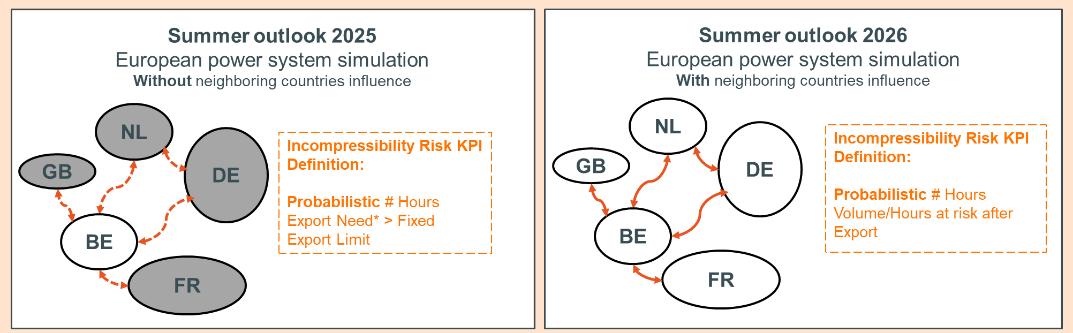
4: Difference SO25 vs SO26 in the analysis of neighouring countries
2 Adequacy and flexibility study for Belgium (2026-2036) by Elia Group - Issuu
Figure
Modelling of type B issues, on top of type A issues
A second difference concerns the modelling of type B issues. In SO25, type B was not quantified; only the evolution of the forecast error was used as an indication, correlated with the increase of the installed capacity. In SO26, an improved methodology based on the short term flexibility methodology from AdeqFlex’25 and the methods to be used by the upcoming Flexibility Needs Assessment (FNA) for Belgium. It allows for a quantitative assessment of type B issues, and both issue types are now analysed jointly under one consolidated metric.
2 Methodology
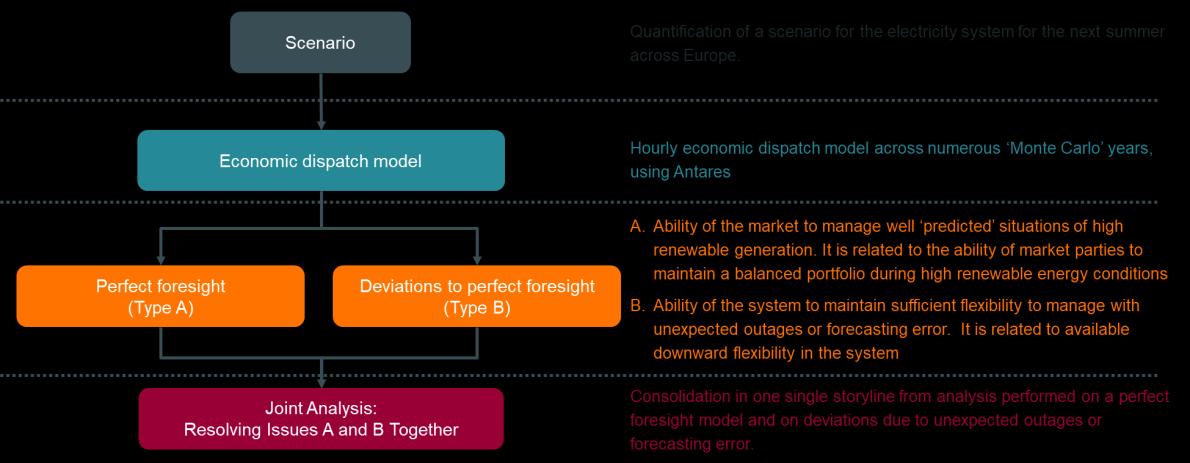
Figure 5: Summer outlook methodology overview
Figure 5 presents an overview of the Summer Outlook methodology. The scenario for summer 2026 is constructed using the best available forecasts for electricity consumption, generation, supply, demand flexibility and crossborder capacity between countries. It incorporates the latest planned outage periods provided by REMIT and a set of randomly sampled forced outages for the individually modelled units The scenario is constructed not only for Belgium but for all simulated bidding zones, following the same approach as used in AdeqFlex’25
Based on this scenario framework, the European hourly unit-commitment and economic-dispatch model is run using Antares Simulator. Antares optimises the system-wide dispatch by minimising total operational costs while respecting unit-level technical constraints, network constraints (NTC or flow-based), and energy-limited resource constraints. A Central Europe CCR flow-based modelling is applied, considering only XB CNEC and assuming a 70% minRAM. In addition, to capture short-term impact on grid, an additional constraint is added to the system. This constraint includes in the simulation the limitations that a set of impacting outages will have on the ability to exchange energy across cross-border regions. These outages are part of Elia’s project of grid reinforcement. They are necessary for the evolution of the grid but could limit at some point Belgium’s ability to import or export energy when it is economically interesting.
The model is run over 25 Monte-Carlo climate years, each representing a different combination of renewable generation, consumption profiles, and outage patterns. More details, including the limitations of the model, the software used, and the formulation of the problem can be found in Appendix A of AdeqFlex’25.
The model outputs include hourly dispatch for all units, charging/discharging schedules for storage, activation of demand flexibility, commercial exchanges between zones, and hourly marginal prices reflecting both the merit order and the binding network constraints. These outputs allow the derivation of detailed dispatch and economic indicators required to quantify incompressibility moments.
Building on these model outputs, the analyses of type A and type B incompressibility are conducted. As mentioned above, type A focuses on situations with predictable excess supply; type B assesses the capacity of the system to cope with deviations from perfect foresight, such as forecasting errors or unexpected outages. Type A and B analysis methodology are outlined separately first and are then merged in a combined assessment integrating both effects to evaluate the joint likelihood and severity of incompressibility phenomena
2.1 Type A – perfect foresight
This section outlines the analytical framework used to identify moments of structural electricity oversupply in Belgium under perfect foresight conditions. Perfect foresight assumes that renewable generation, demand, unit availability and interconnection capacities are known one week in advance for the whole European system. The market is therefore dispatched optimally in a cost-efficient manner, meaning that storage, demand flexibility, hydro reservoirs and thermal dispatch are optimised knowing all this in advance The optimization solves the whole system (i.e. the whole geographical perimeter) at once.
The objective of the Type A analysis is to calculate relevant parameters to quantify incompressibility issues in perfect foresight, to determine in which conditions they occur, how frequently they appear across climate years, and the magnitude of the challenge they represent for the Belgian system.
2.1.1 Oversupply identification framework
The methodology follows a stepwise approach, gradually narrowing down the conditions that lead to curtailment Each hour simulated across all Monte-Carlo years is passed through a series of filters, allowing the identification of periods where structural domestic excess remains after all levers have been activated. All the steps are represented on Figure 6
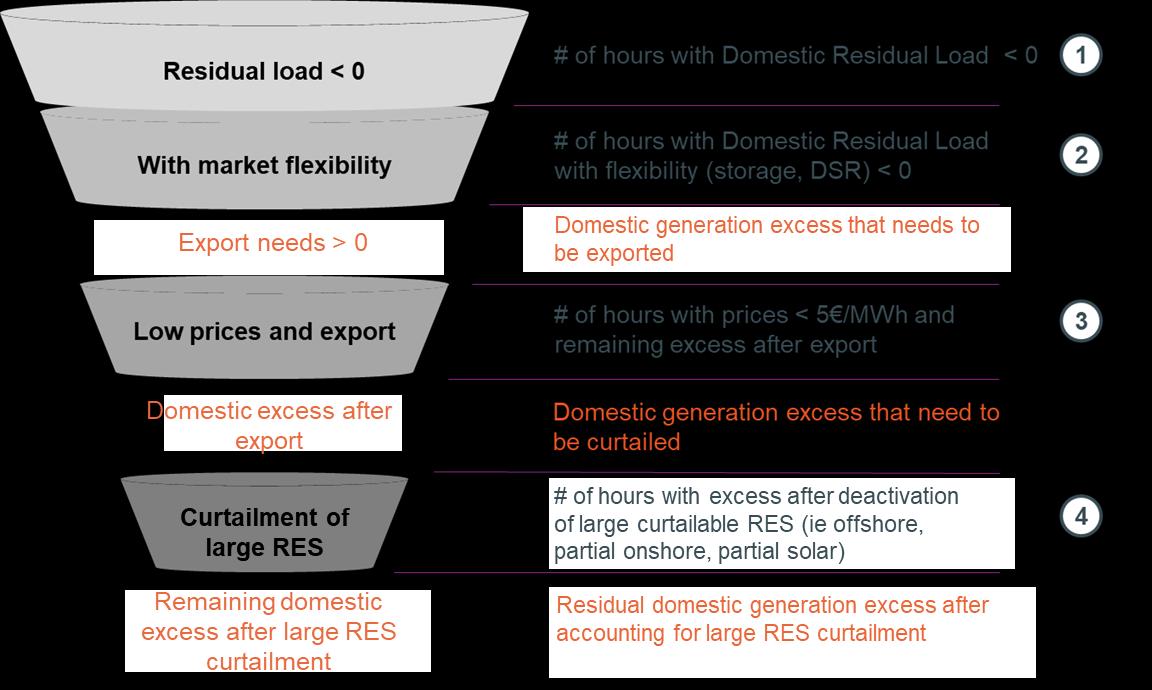
Figure 6: Type A analysis overview
Step 1 - Negative Domestic Residual Load
A key element of this analysis is the residual load, which offers a simplified representation of the domestic balance between electricity demand and non dispatchable generation
The demand or load corresponds to the total Belgian electricity consumption (including self-consumption of local generation) and includes all non-flexible usages – domestic and industrial. Note that it does not include adaptation of flexible usages in view of market prices such as storage or end-user flexibility from electric vehicles and heat pumps.
Starting from this definition, the residual load can be calculated. The residual load is equal to the load from which RES generation, domestic nuclear generation and thermal ‘must run’ generation is removed. This latter includes gas fired units and individually modelled biomass and waste units which have ‘must run’ constraints. RES includes solar PV, onshore wind, offshore wind, hydro run-of-river, and small decentralised non-dispatched biomass and waste units. The Residual load computation process is represented on Figure 7. The calculation is performed on an hourly timestep for all Monte Carlo years.
Among all hours, the ones with negative residual load (i.e. structural domestic generation excess before flexibility levers are applied) are isolated. This gives an idea of the number of hours for which there is an excess by the sole contribution of non-dispatchable generation (RES generation, domestic nuclear generation and thermal ‘must run’ generation)
Step 2 - Activation of Market Flexibility
Another definition that will be used in this study is the residual load with flexibility. The residual load with flexibility is equal to the residual load for which the flexibility that reacts to the market signals and storage dispatch is accounted for. Market flexibility includes industrial demand response, electrolysers, and residential assets connected to the grid (V1M, V2M and HP1M). Storage includes pumped storage and batteries. On the one hand, if those capacities increase their generation or lower their consumption, their value is subtracted from the residual load. On the other hand, when they result in additional consumption, the value of this consumption is added to the residual load. For instance, a battery in charging mode results in higher residual load with flexibility, whilst the discharging mode results in lower residual load with flexibility. The residual load with flexibility computation process is represented on Figure 7
When the residual load with flexibility is positive, it means that some electricity demand is still not covered. This must be filled by dispatchable generation or electricity imports and is referred to as a “generation shortage”. Conversely, when the residual load is negative after flexibility measures, it indicates there is more non-dispatchable generation than can be used.
The second step of the analysis therefore investigates to what extent market-driven flexibility can absorb the surplus. As illustrated in the scenario part (Section 3.3 and 3.4), the two main drivers associated with this step are the contribution of pumped-storage (Coo and Plate-Taille) and batteries. If after full activation of these assets the system still displays excess, the domestic flexibility available in perfect foresight is insufficient to resolve the imbalance.
The remaining hours are referred to as hours with export needs greater than zero These correspond to domestic generation excess during which electricity must either be exported to neighbouring systems or curtailed domestically
The load, residual load and residual load with flexibility concepts are illustrated on Figure 7
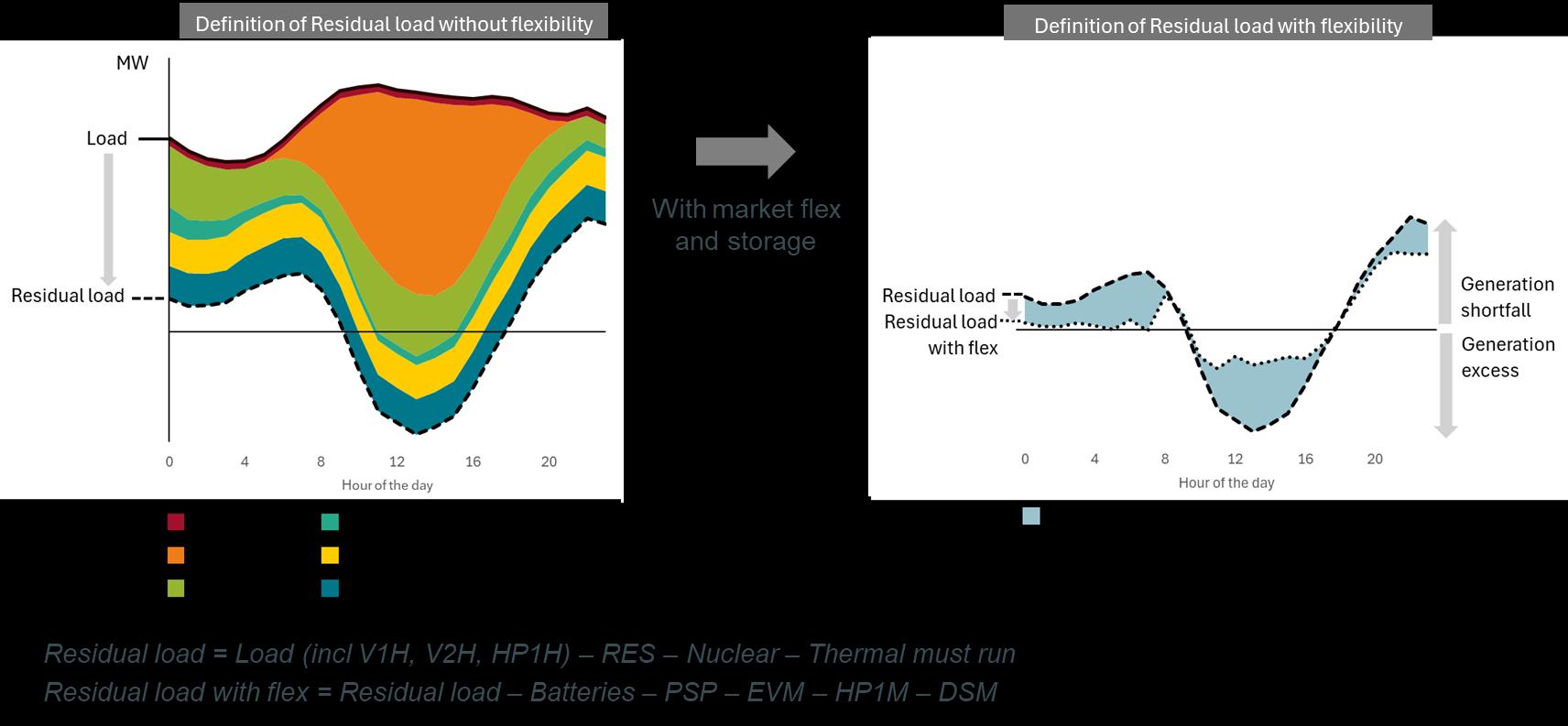
Figure 7: Illustration of how the residual load and the residual load with flex are built (source : AdeqFlex’25, Figure 10-16)
Step 3 – Integration of prices and export
The third step identifies hours with simulated marginal prices below 5€/MWh. Simulated marginal prices serve as a useful signal for identifying periods of potential excess. When the simulated marginal price is high, it implies that dispatchable generation is still operating, meaning all non-dispatchable (e.g., renewable) generation is already being used. To account for potential cross-border exports, it is assumed that if a country's marginal price exceeds 5 €/MWh, no ‘Type A’ incompressibility risk is assigned for the country that hour. The 5 €/MWh threshold is chosen because it is lower than the marginal cost of any generating unit in Belgium or its neighbouring countries. As a result, at this price level, only low marginal cost generation units such as renewables or must-run thermal units remain in operation
For a subset of these low-price hours, available cross-border capacity in neighbouring countries is sufficient to absorb the domestic surplus. These hours are therefore filtered out at this step. The remaining hours are referred to as hours with domestic excess after export. These correspond to domestic generation excess during which electricity must be curtailed.
Step 4 - Curtailment of large Renewable Generation
If oversupply persists after the activation of domestic flexibility and the use of available export capacity, curtailment of some of the renewable generation is examined. It is assumed that all renewable assets larger than 25 MW are already controllable (as participation in the balancing market is obligatory). This applies for all offshore wind generation, and part of the solar and onshore wind The remaining hours are referred to as hours with remaining domestic excess after large RES curtailment. These correspond to domestic generation excess during which additional curtailment options must be activated.
2.1.2
Oversupply classification
Characterization of generation excess
For the main steps of the analysis, those events are characterised based on several indicators, including their time of occurrence within the day or season, the severity of the surplus expressed in megawatts, the domestic generation mix present at the time of the event, the behaviour of flexibility assets, and the correlation with neighbouring countries. This characterisation provides detailed insights into the drivers of incompressibility and supports the assessment of the system’s flexibility needs during summer periods.
Meteorological classification of generation excess
Export needs and incompressibility hours can subsequently be classified according to their underlying meteorological drivers as shown on Figure 8 First, events with low RES generation are excluded from the analysis and classified as other (for the meteorological classification, RES only includes wind and solar generation). Among the remaining events, three categories are defined.
Solar-driven events are those in which solar generation accounts for more than 65% of RES generation
Wind-driven events are those in which wind generation represents more than 65% of RES generation
Both-driven events include all remaining moments
This classification helps to understand the operational complexity associated with each type of event. Wind-driven oversupply tends to be easier to mitigate as wind generation can be curtailed more smoothly, whereas solar-driven oversupply is typically more challenging.
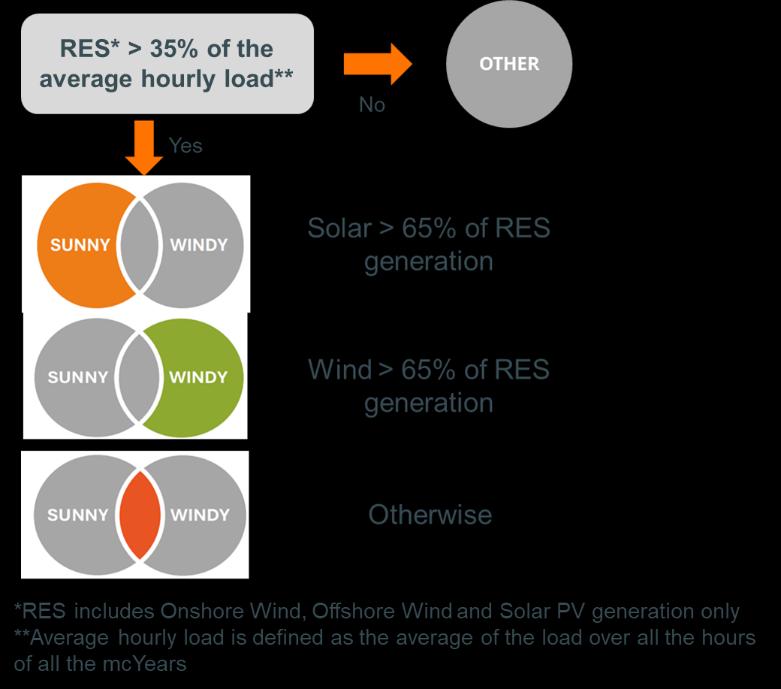
Figure 8: Weather categorisation methodology
2.2 Type B – deviations to perfect foresight
Type B incompressibility events refer to the ability of the system to maintain sufficient flexibility to manage unexpected outages or forecasting errors. It is related to available downward flexibility needs in the intra-day and balancing time frame to manage the real time balance between generation and offtake. These needs come on top of the of the needs to manage well ‘predicted’ Type A incompressibility events with high renewable generation, as these translate to system imbalances if not well managed by market parties to maintain a balanced portfolio during high renewable energy conditions
The assessment of the Type B incompressibility events is based on the methodology to determine the short-term flexibility needs presented in AdeqFlex’25. It is based on an assessment of the flexibility needs determined by uncertainties based on the variability and uncertainty of demand; the variability and uncertainty of renewable and distributed generation unexpected generation unit or transmission asset outages
These needs are compared with the results of an assessment of the flexibility means, i.e. available flexibility resulting from the unit’s generation, storage and demand schedules in the economic dispatch simulations. It represents the available margins which can be delivered by these assets in the intra-day and balancing time frame. After comparison with the needs, results can be represented by uncovered needs expressed in periods (hours), volumes (MW) and capacities to be unlocked decentralized assets.
Note that the Type B incompressibility events already account the flexibility needs following the Type A. Expected overgeneration which cannot be handled by the market translates into additional imbalances. These imbalances are captured trough the RES curtailment indicator specified in the section 2.1.1
Figure 9 represents the previously introduced flexibility needs and flexibility means that are combined into a unified assessment of short-term system flexibility. The method quantifies in first instance the periods and volumes at risk of not covering a large forecast error or outage event due to a flexibility shortage. In second instance, it evaluates the flexibility that needs to be unlocked on decentralized capacity (assuming all large installations are already controllable), including on end-users, solar and wind capacity, that would need to be unlocked to address the uncovered needs. The assessment is carried out in four structured steps, as outlined below:
Flexibility needs
The assessment of flexibility needs is based on historical forecast error data of all assets subject to variability and uncertainty, including load, wind, and solar generation This data is first scaled to reflect the projected installed capacity levels for 2026, thereby ensuring that the analysis corresponds to the system conditions expected in that year. Following this scaling, the forecast errors, supplemented by an assessment of forced outages, are analysed to determine the 99.9th percentile of the total deviation caused by forecast errors and forced outages Note that this percentile value, then defines the required level of system flexibility, representing the flexibility needed to accommodate 99.9% of all anticipated forecast errors and outage events in 2026.
Building on this approach, the flexibility needs assessment further distinguishes between slow, fast and very fast (ramping) flexibility requirements. Slow flexibility addresses expected deviations in demand and generation arising from intra day forecast updates or outages announced several hours before real time These are typically managed via the intra-day market. Fast flexibility covers unexpected real time deviations and forced outages occurring between the last intra day forecast (15 minutes before real-time) and real time. These are typically managed via the balancing market. Very fast flexibility covers the minute-to-minute variations of the forecast errors and is typically related to aFRR activations.
Flexibility means
The flexibility means analysis starts from the hourly dispatch schedules of all generation, storage, and demandside assets resulting from the economic dispatch simulations. These schedules are assumed to represent the market schedules under perfect foresight with an hourly resolution. They allow us to determine the remaining flexibility which is available to deal with unexpected variations in the intra-day and balancing time frame. Together with the technical constraints of these assets in view of upward or downward ramping of their capacity, these are used to calculate the available remaining flexibility from hour to hour.
Note that a similar distinction is made between slow and fast flexibility as in the flexibility needs. Slow flexibility can be provided by most of the controllable installed capacity, as there are several hours during which it is possible to change the output of a generation, storage, or demand unit and even to start or stop a power plant. In contrast fast flexibility can be provided by generation units which are already dispatched and are able to modify their output within a few minutes, or by units which have start or stop times of a few minutes, as well as storage units (pumped storage hydropower and batteries) and demand side response units which are considered to be very flexible.
Uncovered short-term flexibility needs
By comparing the quantified flexibility needs with the available flexibility means, the assessment identifies the extent to which the system may face short term flexibility challenges in 2026. For each hourof the year, the required slow and fast flexibility, derived from the forecast error and outage assessment, is matched against the remaining downward flexibility margins calculated from the dispatch schedules. Whenever the flexibility needs exceed the available means, the system is considered to be at risk. This comparison yields two key indicators: hours at risk, representing the number of hours in which flexibility shortages occur, and volumes at risk, reflecting the magnitude of the unmet flexibility needs in each of those hours.
Note that uncovered fast and slow flexibility needs can be complemented with RES curtailment, for which a distinction is made between gross RES curtailment and net RES curtailment, the latter already accounting for large controllable generation units. Net RES curtailment are to be covered by decentralized assets or translate into system imbalances.
In a further step the RES curtailment indicator derived from the Type A (perfect foresight) analysis as specified in section 2.1.1 is combined with the Type B assessment, ensuring that periods of structural oversupply and short term flexibility constraints are jointly reflected in the evaluation.
Capacity to unlock
To mitigate the identified short term flexibility shortages, the additional controllable capacity that must be unlocked from decentralized capacity in the system, particularly end-users, solar and wind generation, to address uncovered flexibility needs. This assessment builds on the previously calculated hours and volumes at risk and evaluates, for each hour in which a shortfall occurs, how much additional adjustment capability from small scale solar or wind units (< 25 MW) would be required to eliminate the flexibility gap, if not covered via end-user flexibility. Since curtailment of renewable generation can provide this flexibility, at least if controllable, the analysis also quantifies the incremental renewable capacity that would need to be made flexible, either through technical adjustments, market incentives, or operational measures.
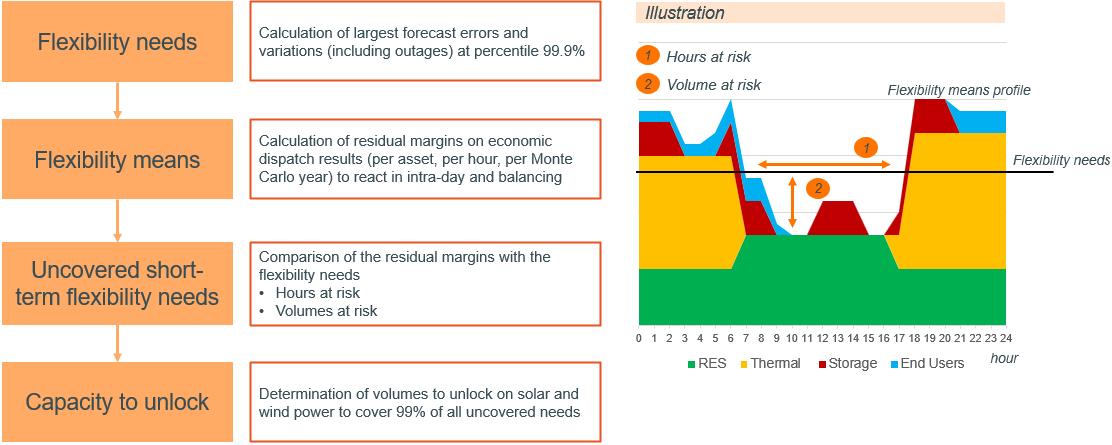
9: Method of calculating flexibility needs, flexibility means and uncovered short-term flexibility leading to a capacity to un-lock on solar and wind.
Figure
3 Evolution of assets & grid
3.1 Evolution of load
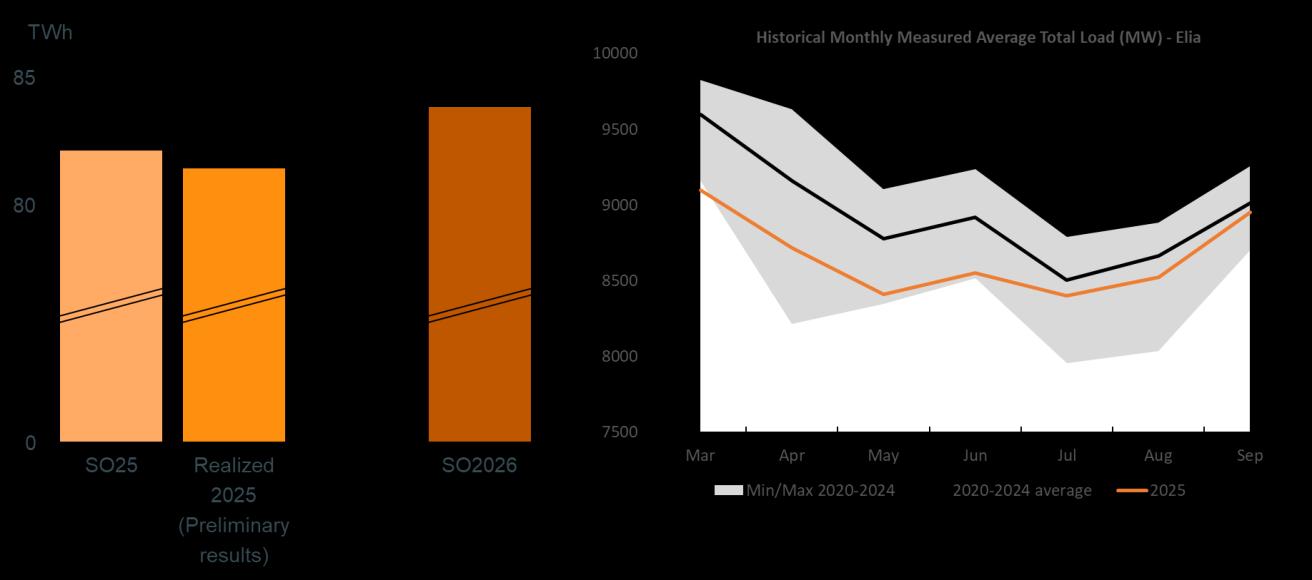
Compared to last year’s normalized observation (81,4 TWh), total load is expected to increase with 2,4 TWh in 2026 (83,8 TWh), as presented on Figure 10 This reflects a steady increase in total consumption, consistent with the ongoing trend of growing electrification. Projections such as SO2026 are always based on normalized load
3.2
Evolution of renewable energy installation
The overall pace of growth of renewables aligns with the expectations set out in the AdeqFlex’25 projections In Figure 11, best estimation for the Summer Outlook period can be found
The evolution of solar capacity is growing, with an expected increase of 0.8 to 1 GW in 2025 Onshore wind development estimations is based on the capacity being installed in 2025, accounting for 183 MW being installed in 2025 Offshore wind capacity remains unchanged during this period, because there was no commissioning of new projects, as expected.
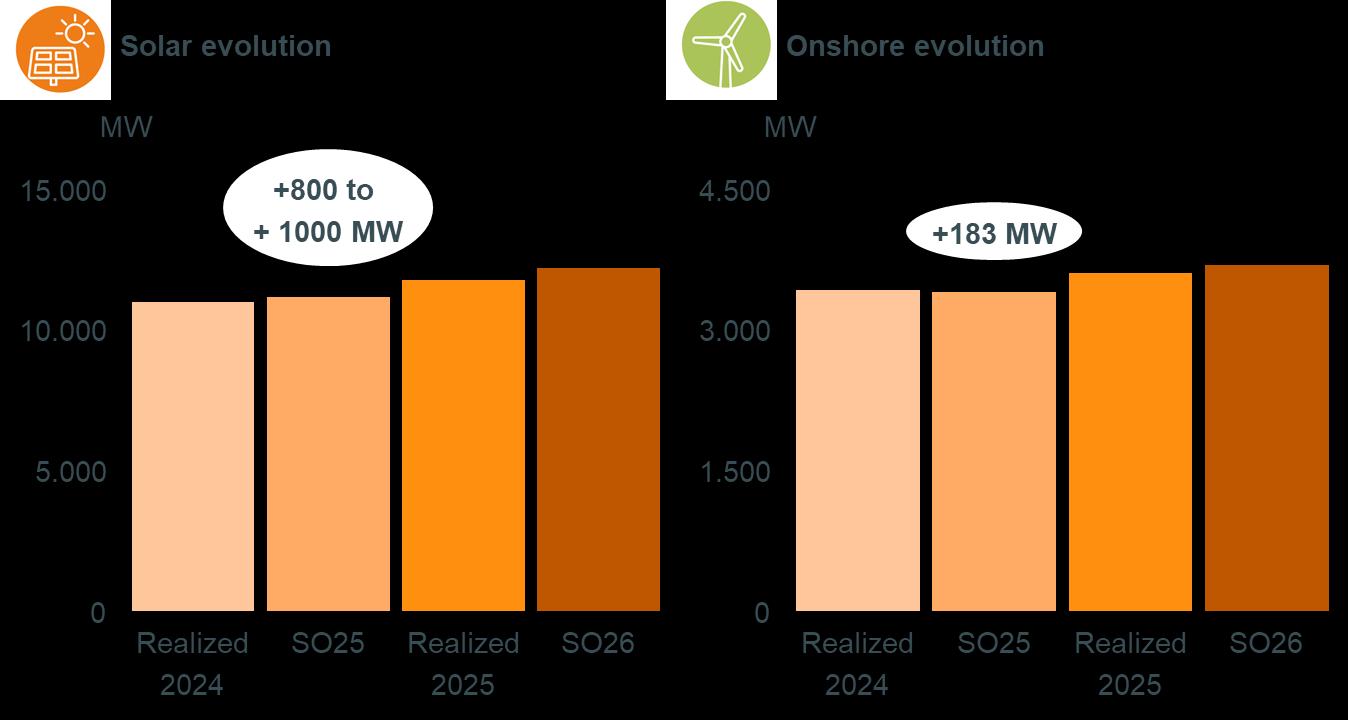
Figure 10: Normalize load comparison SO25 vs SO26
Figure 11: Solar & Wind Onshore evolutions compared to realized SO25 scenario
3.3 Availability of nuclear and pumped storage throughout the summer
The availability of nuclear and hydro pumping has a significant impact on incompressibility, nuclear power plants contribute to inflexible generation, limiting the ability to reduce generation during periods of low demands and high renewable output. In contrast, pumped hydro storage facilities, such as the basins of Coo and Plate-Taille are key providers of flexibility in Belgium.
In 2026, pumped storage availability will be higheroverall compared to last year over the whole period, as illustrated on Figure 12 Pumped storage availability is generally around 200 to 300 MW higher than in 2025, mainly because outages Coo basins 1, 2 and 3 are shorter and less constraining than the long sequences observed in 2025, while they still undergo maintenance in 2026 Plate-Taille also has a few brief outages, yet these are limited in duration.
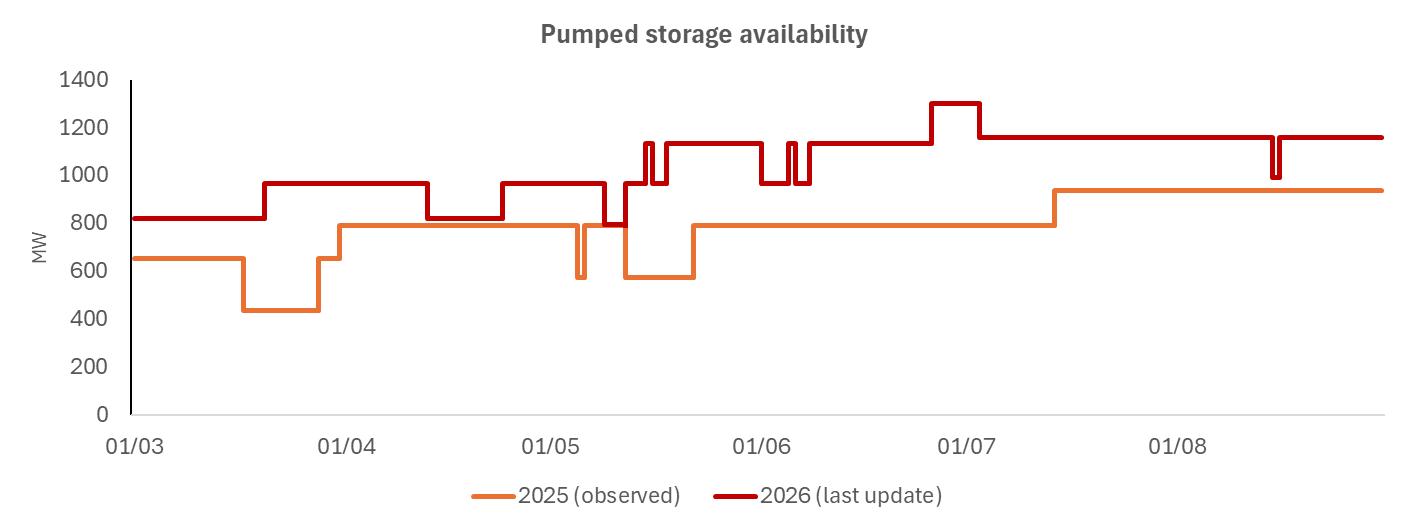
Figure 12: Pumped storage availability in '25 vs '26 (Snapshot of outage planning 16th of March)
Source: Nord Pool - UMM Platform
Disclaimer: Simulations use outage planning as of January 20th (REMIT) Recent updates do not significantly affect the results of the study
On the other hand, nuclear generation will be much lower, as from begin April, Belgian nuclear generation drops to zero as both Doel 4 and Tihange 3 go in maintenance in the framework of their Long-Term Operation (LTO) programs, as presented on Figure 13
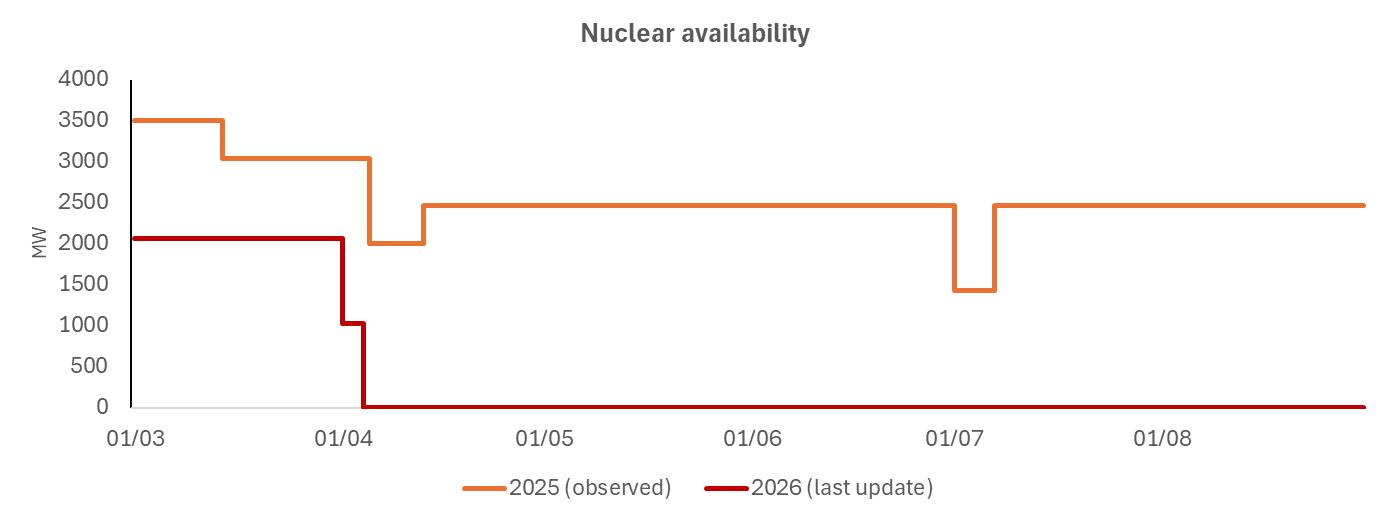
Figure 13: Nuclear availability in Belgium in '25 vs '26 (Snapshot of outage planning 16th of March)
Source: Nord Pool - UMM Platform
The estimated non-nuclear thermal must run volume (i.e., the inflexible generation from gas units, biomass and CHP installations, excluding nuclear), are derived from a historical analysis of generation running during
negative price periods. This allows to determine the volume of thermal units which are expected to run during incompressibility hours.
3.4 Battery storage installation evolution
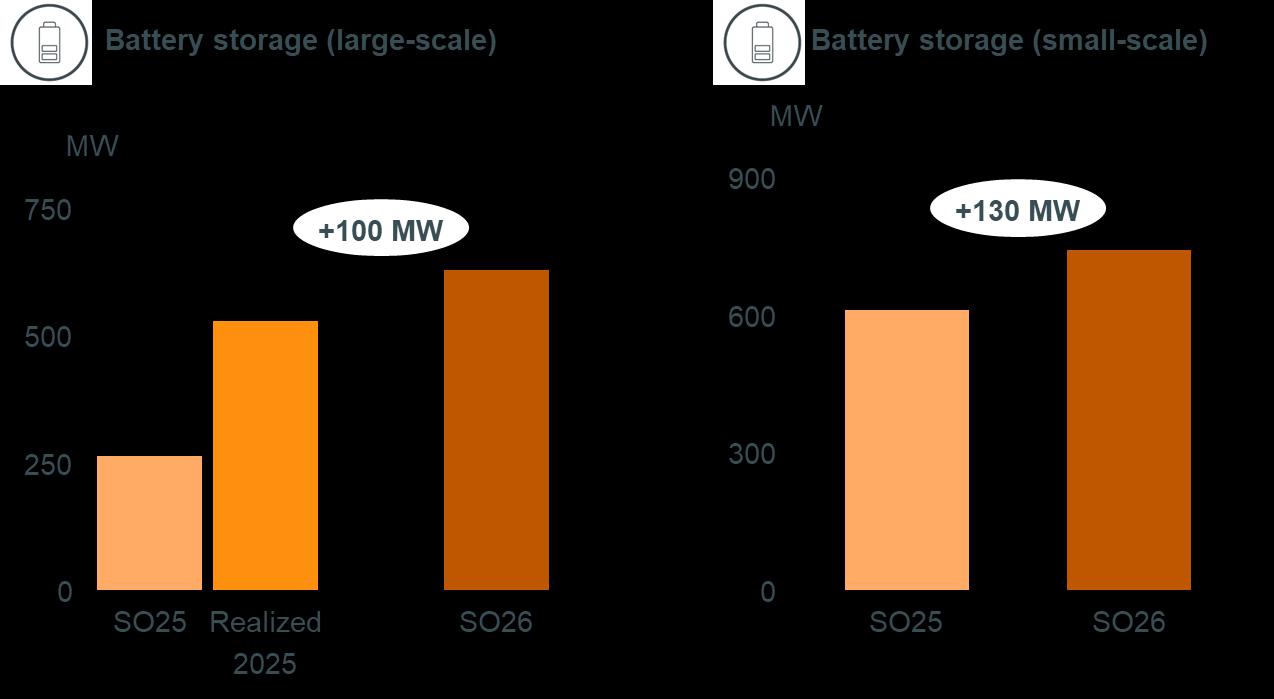
The installed capacity of batteries in Belgium is steadily increasing. Compared to the SO25 scenario (As can be seen from figure 14), small-scale batteries continue to grow each year (+130 MW), while large-scale battery projects are expanding more rapidly (+367 MW) The contracting of multiple batteries project in the CRM for the first delivery period contributes to the important increase of the installed capacity. The volume of batteries is completed by batteries projects expected to be commissioned for the Summer Outlook timeframe, as presented on figure 14. The volume of small-scale batteries being installed in 2025 was not consolidated at the time of the analysis.
3.5 Summary assets & grid evolutions compared to SO25
To summarize the asset and grid evolutions with respect to their impact on next summer’s incompressibility (see Figure 15), we observe the following positive (green) and negative (red) evolutions compared to last year’s outlook:
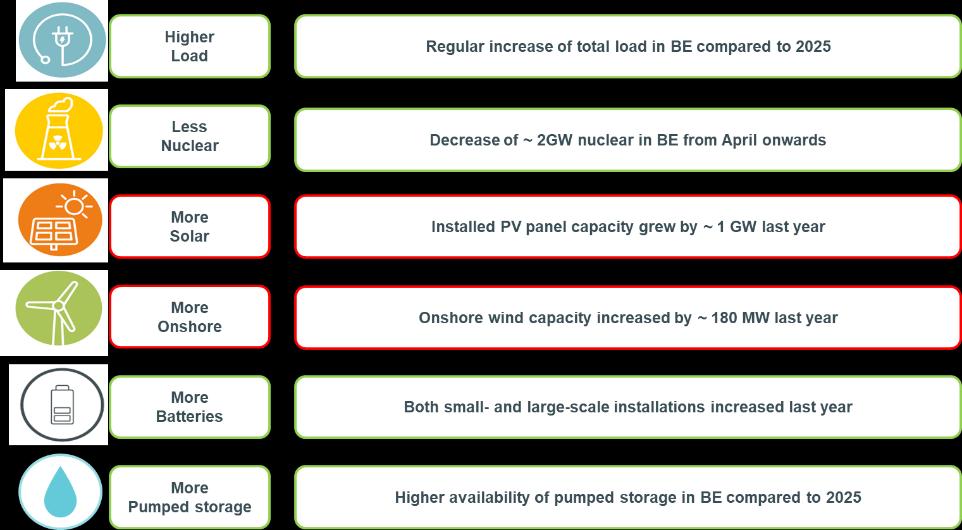
Figure 15: Summary of assets & grid evolutions compared to SO25
Figure 14: Small and large scale assumed battery evolutions '25 vs '26
4 Results
4.1 Type A – perfect foresight analysis
This section presents the main results for the perfect foresight analysis. The results presented on Figure 16 are obtained by applying the methodology described. The red diamonds in the figure represent the average number of hours in each step of the funnel across all Monte Carlo years, while the green rectangles illustrate the range, from the minimum to the maximum value observed, in order to reflect the impact of meteorological conditions
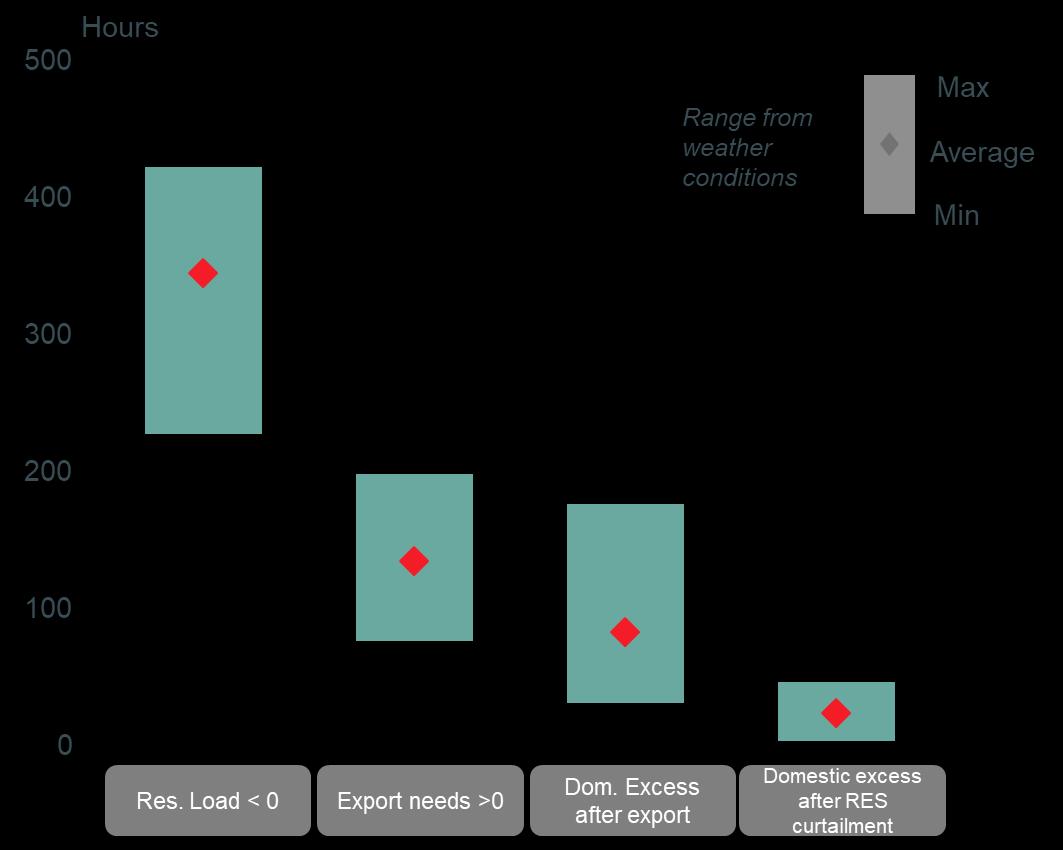
To build these results, the residual load, residual load including flexibility, exports, and curtailable RES volumes are computed for every hour of every Monte Carlo year, from March to August. The number of hours in each category of the funnel is then counted according to the criteria defined in section 2.1.1.
Hours with negative residual load
The analysis indicates that there are, on average, around 350 hours with negative residual load for the period from March to August. For those hours, the load is fully covered by non-dispatchable generation, thermal must-run and nuclear generation, with additional excess on top. Across Monte Carlo years, the number of hours with negative residual load ranges from roughly 220 to about 420, depending on the meteorological conditions.
Figure 16: Number of hours for each step of the Type A analysis (for the period from March to August)
Hours with export needs greater than zero
Including market flexibility and storage constitutes the next step of the funnel. A negative residual load with flexibility indicates that even after subtracting market-driven flexibility and storage in addition to non-dispatchable generation, a domestic excess remains and must be exported or curtailed. In this context, flexibility and storage absorb more than half of the initial excess hours and reduce the spread of results across meteorological years. On average, the number of hours decreases to about 140, although this value ranges from approximately 90 to 200
Hours with domestic excess after export
The next step takes export possibilities into account. The domestic excess identified previously is reduced based on available export capacity during the corresponding hours. The export calculation accounts for the import capacities of neighbouring countries, which depend on their own domestic excess situations. On average, the number of hours with remaining domestic excess after export falls to around 80. The upper bound, however, decreases only marginally. This is due to specific Monte Carlo years exhibiting very high renewable generation simultaneously in Belgium and its neighbouring countries, which limits Belgium’s ability to export.
Hours with remaining domestic excess after large RES curtailment
The final step introduces large RES curtailment. Offshore wind is assumed to be fully curtailable, while solar PV and onshore wind can only be curtailed for units larger than 25 MW. After applying this curtailment potential, the number of hours with domestic excess drops significantly, reaching an average of approximately 25 hours over the March-to-August period. Depending on meteorological conditions, the range extends from about 5 to 50 hours. This indicates that only a limited number of hours may still require additional curtailment during the coming spring and summer. This number is lower than last year, mainly because nuclear generation is absent from April onwards. Weather categorization and monthly distribution
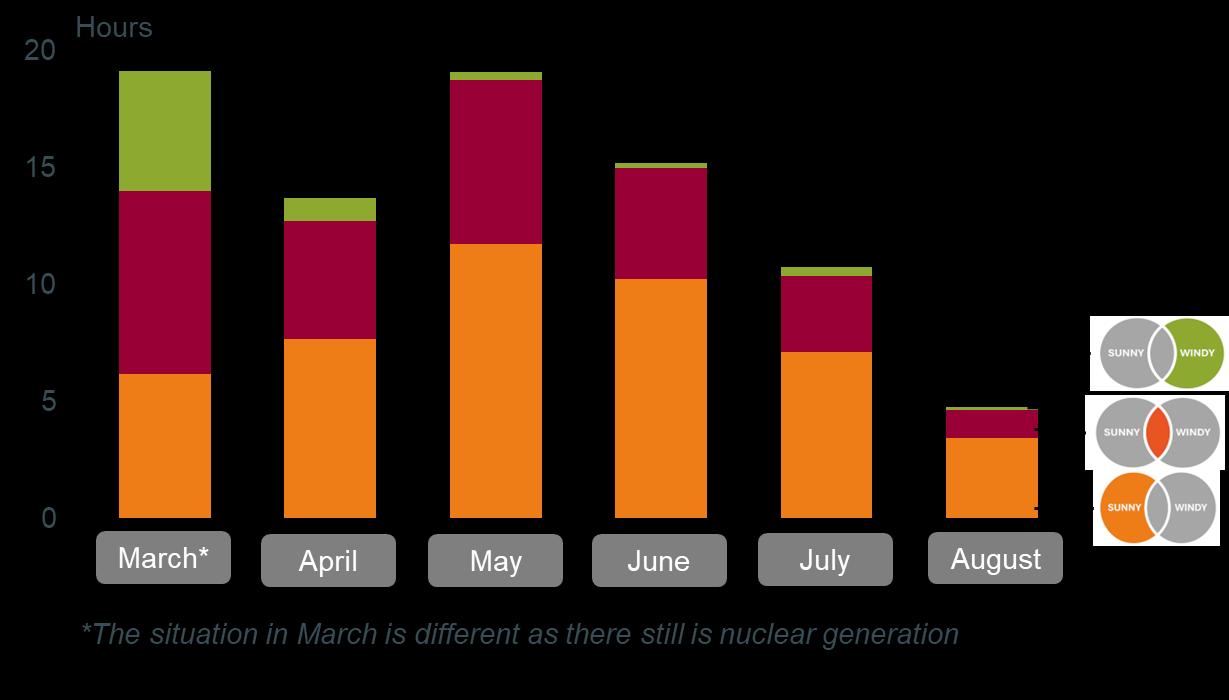
Figure 17 provides a monthly overview of the average number of hours with domestic excess after export, broken down using the weather-categorisation approach described in Section 2.1.2 This distinction helps identify whether solar, wind, or a combination of both is driving the excess. Wind-driven situations are easier to resolve thanks to the curtailment potential of wind generation, whereas solar-driven situations are more challenging due to limited solar curtailment possibilities. Combined wind-and-solar events depend on the relative contribution of each technology and the severity of the excess.
The peak appears in May, coinciding with the annual maximum of combined renewable generation. The value in March is high as well, driven by the presence of nuclear generation and typically higher wind generation. Other months show lower values. As already observed in the Summer Outlook 25 and confirmed by operational data last year, the peak of domestic excess has gradually shifted from summer towards spring. Most excess moments are either solar-driven or mixed, reflecting the high installed solar capacity and the prevalence of low-demand hours in months where wind generation is moderate, yet midday solar output is significant.
Distribution over the week:
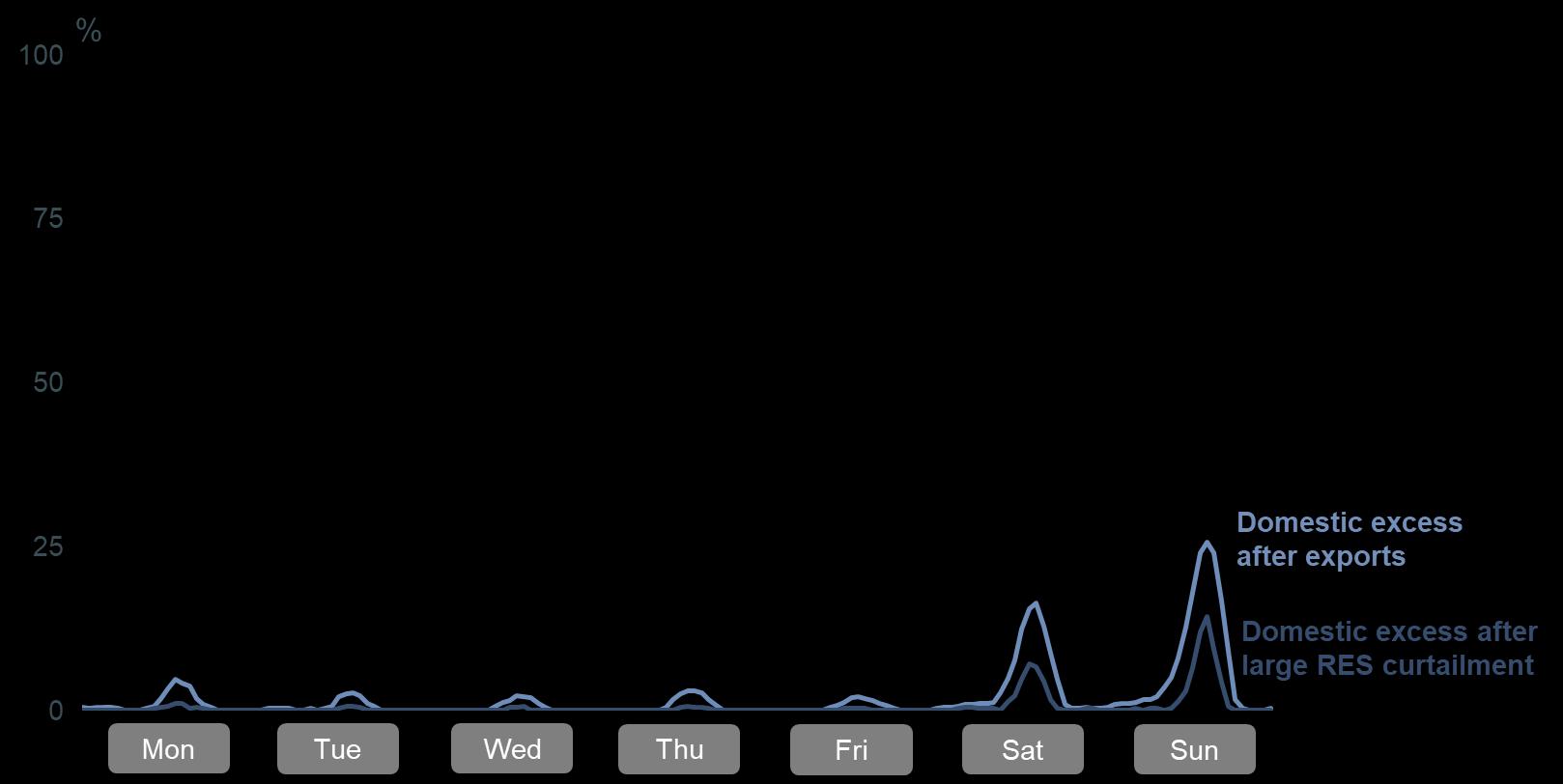
Figure 18 displays the probability of negative residual load and the probability of having export needs higher than zero for each hour of the week, computed across all Monte Carlo years between March and August. Negative residual loads occur most frequently around noon, when solar generation is high, and during night hours, when demand is low. Weekend days especially Sundays exhibit higher probabilities due to lower overall consumption and a less pronounced morning demand peak. When flexibility and storage are taken into account, the same temporal patterns persist, although the reduction in excess probability is more pronounced around noon. Night-time excess is easier to export, whereas midday periods often coincide with solar generation peaks in neighbouring countries, reducing export capacity and increasing reliance on domestic flexibility. The probability of negative residual load around noon can reach up to 25% on weekdays and up to 50% on weekends, and flexibility reduces this by more than half.
Figure 19 then shows the probability of domestic excess after export and after large RES curtailment. Exports bring the probability at night close to zero, except for small weekend values, and they reduce probabilities at other times as well, except around noon on weekend days. These remaining hours correspond to moments when surrounding countries simultaneously experience domestic excess, limiting export possibilities. The curve after large RES curtailment confirms that weekday probabilities remain low and concentrated around noon, whereas weekend midday hours particularly on Sundays retain a significantly higher probability of excess. These are the hours during which the domestic system may experience tense situations.
Figure 17: Average number of hours with domestic excess after export by month and by weather situation
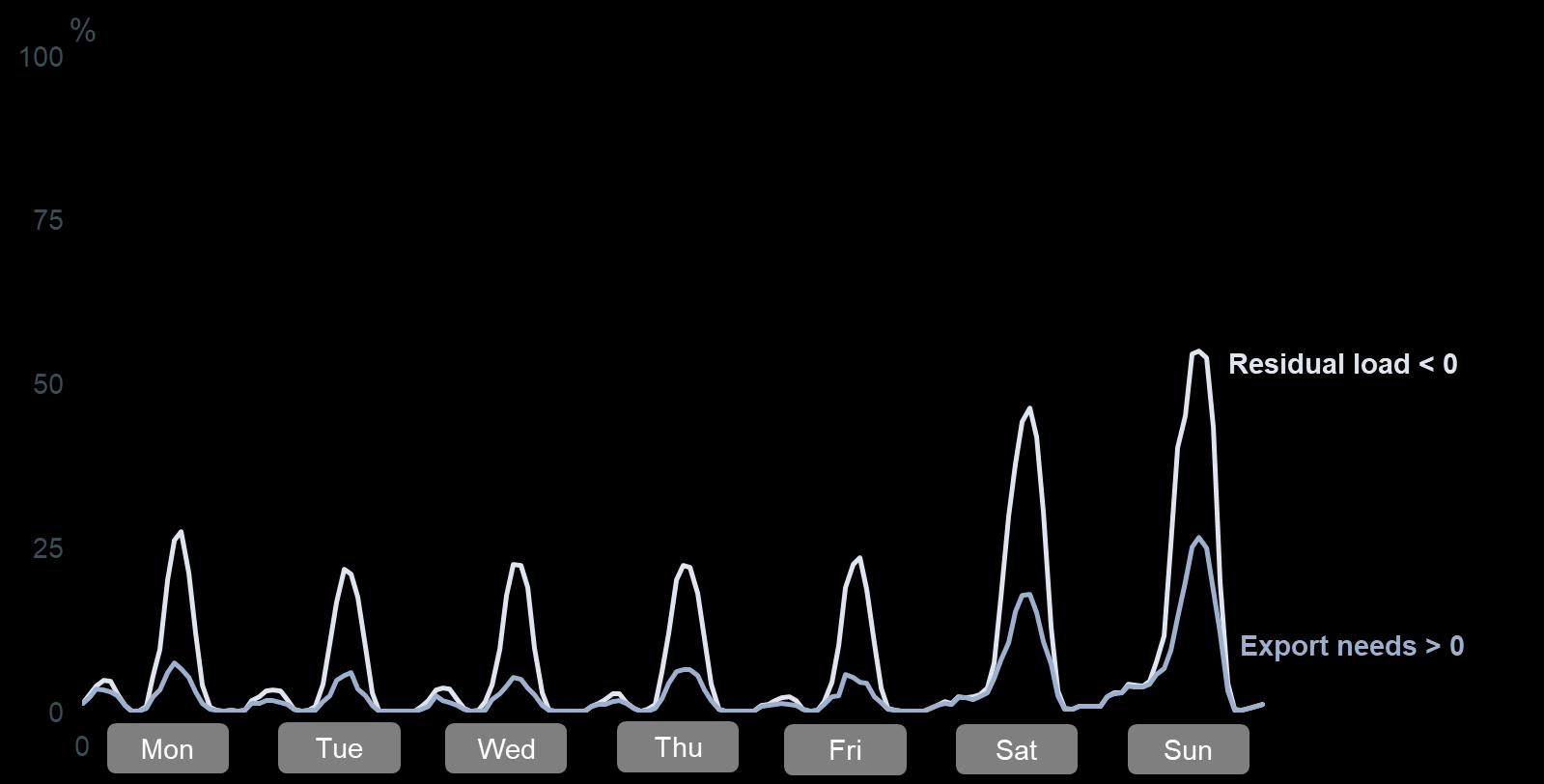
18:
of
for each hour of the week (taken from March to August over all the Monte Carlo years)
19:
for each hour of the week (taken from March to August over all the Monte Carlo years)
Figure
Probability
excess
Figure
Probability of excess
Excess heatmaps
Figure 20 combines the occurrence and severity of domestic excess through heatmaps of Belgium’s export needs from March to August. Hours of the day appear on the horizontal axis and dates on the vertical axis, and the values shown represent the 50th, 75th and 90th percentiles across all Monte Carlo years. The P90 heatmap highlights three major episodes of domestic excess. The first occurs in March, driven by nuclear generation still being on and strong wind conditions. Although the most severe values appear around noon and on weekends, occasionally reaching up to 4000 MW, excess episodes also occur at night and on weekdays The second major episode takes place in May and June, corresponding to the annual peak of renewable generation; the excess is concentrated around midday on weekends and during bank holidays, generally remaining below 2000 MW. The third episode occurs during the summer holiday period, when lower demand leads to likelier domestic excess, again centered on weekend midday hours and typically remaining below 2000 MW.
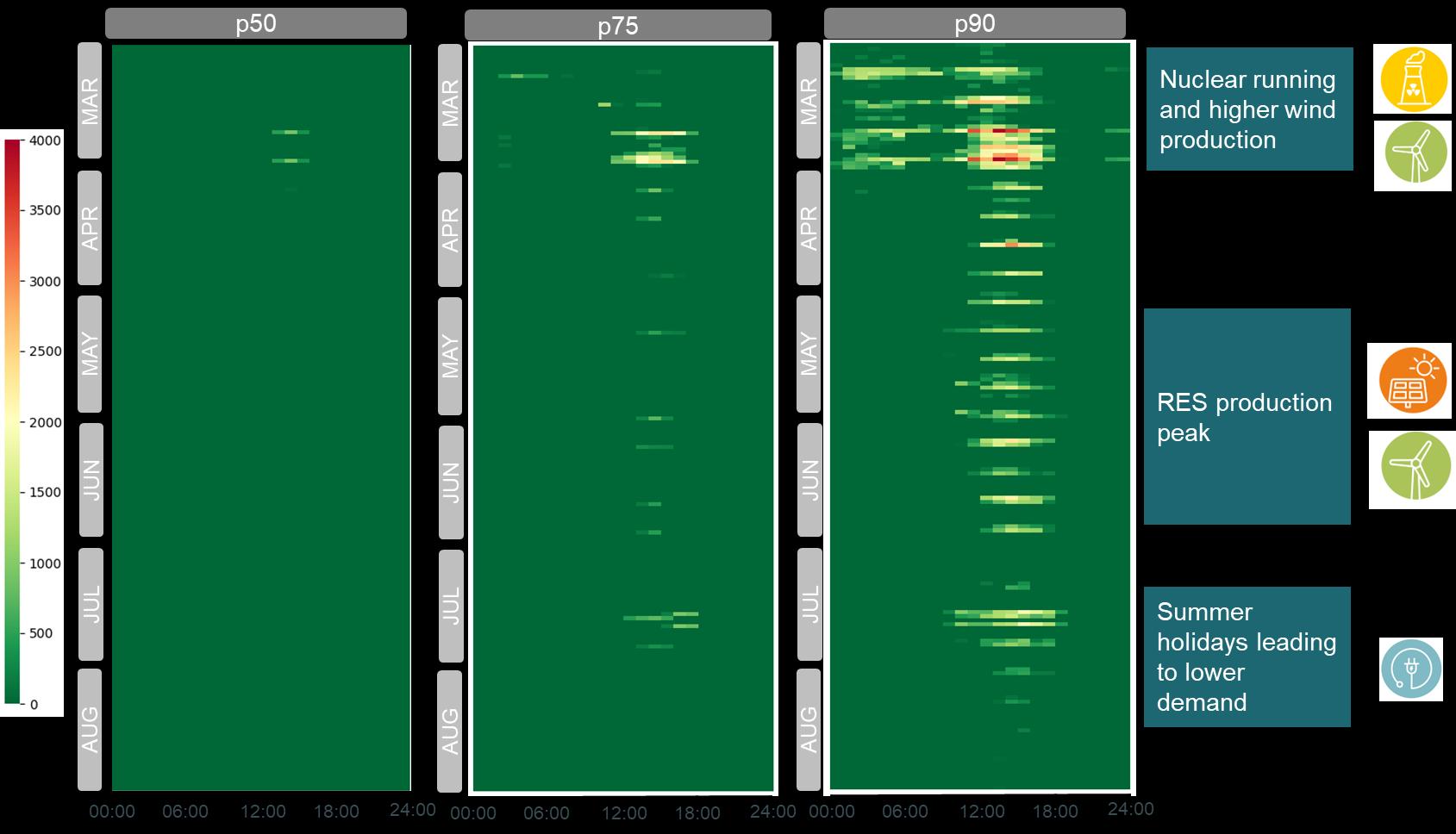
Figure 20: Percentile 50, 75, and 90 of the export needs (in MW), taken across all the Monte Carlo years
As mentioned previously, the outlook for this year appears less tense than last summer. Figure 21 compares the 90th percentile of Belgium’s export needs (computed across all Monte-Carlo years from March to August) between the Summer Outlook 2025 and the Summer Outlook 2026. For reference, the chart also displays the running nuclear capacity. The contrast with last year is clear: greater than zero export needs episodes are far less frequent, and when they do occur, they are considerably less severe. The reduced nuclear capacity profile largely explains this change
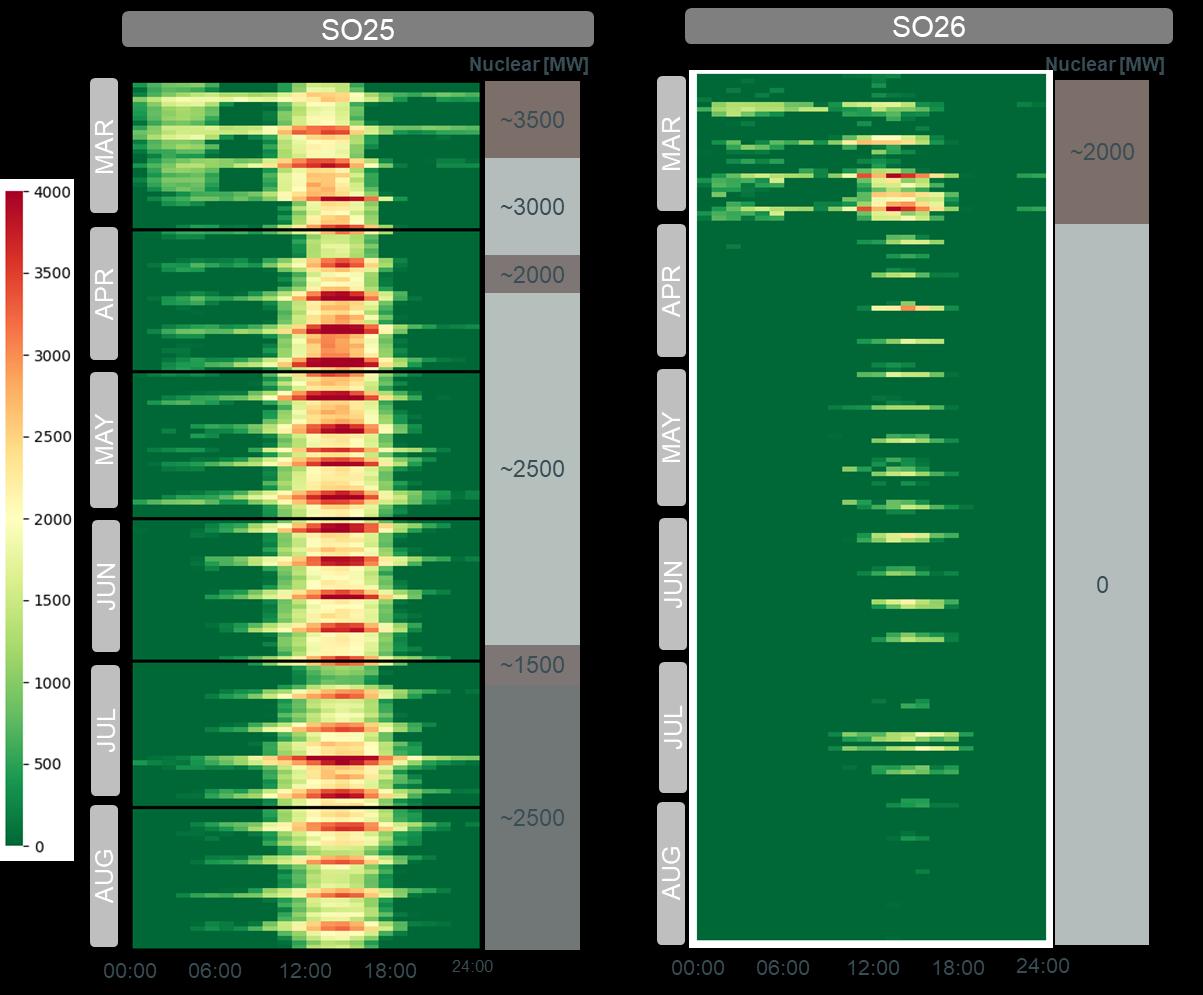
Figure 21: Comparison of the 90th percentile of the export needs between the Summer Outlook 2025 and the Summer Outlook 2026 (in MW)
Figure 22 then presents the corresponding heatmaps for domestic excess after export, illustrating the remaining energy volume that must be curtailed. Compared with the situation before export, both the frequency of these occurrences and their magnitude decrease substantially. Only a limited number of specific hours notably around noon during the last two weekends of March remain relatively pronounced. This behaviour aligns fully with the probability analysis discussed earlier. The same three recurring episodes of domestic excess March, May, and the summer holiday period are still visible, though clearly less intense than in the previous step. Night-time occurrences almost entirely disappear from the maps.
The results also show that export not only reduces the number of hours with excess but also mitigates the severity of the remaining episodes, even when export capacity only partially alleviates the excess. As previously mentioned, and elaborated further below, export capacity remains constrained during certain hours due to regional RES generation patterns. This is precisely what happens during the March hours where the values are highest.
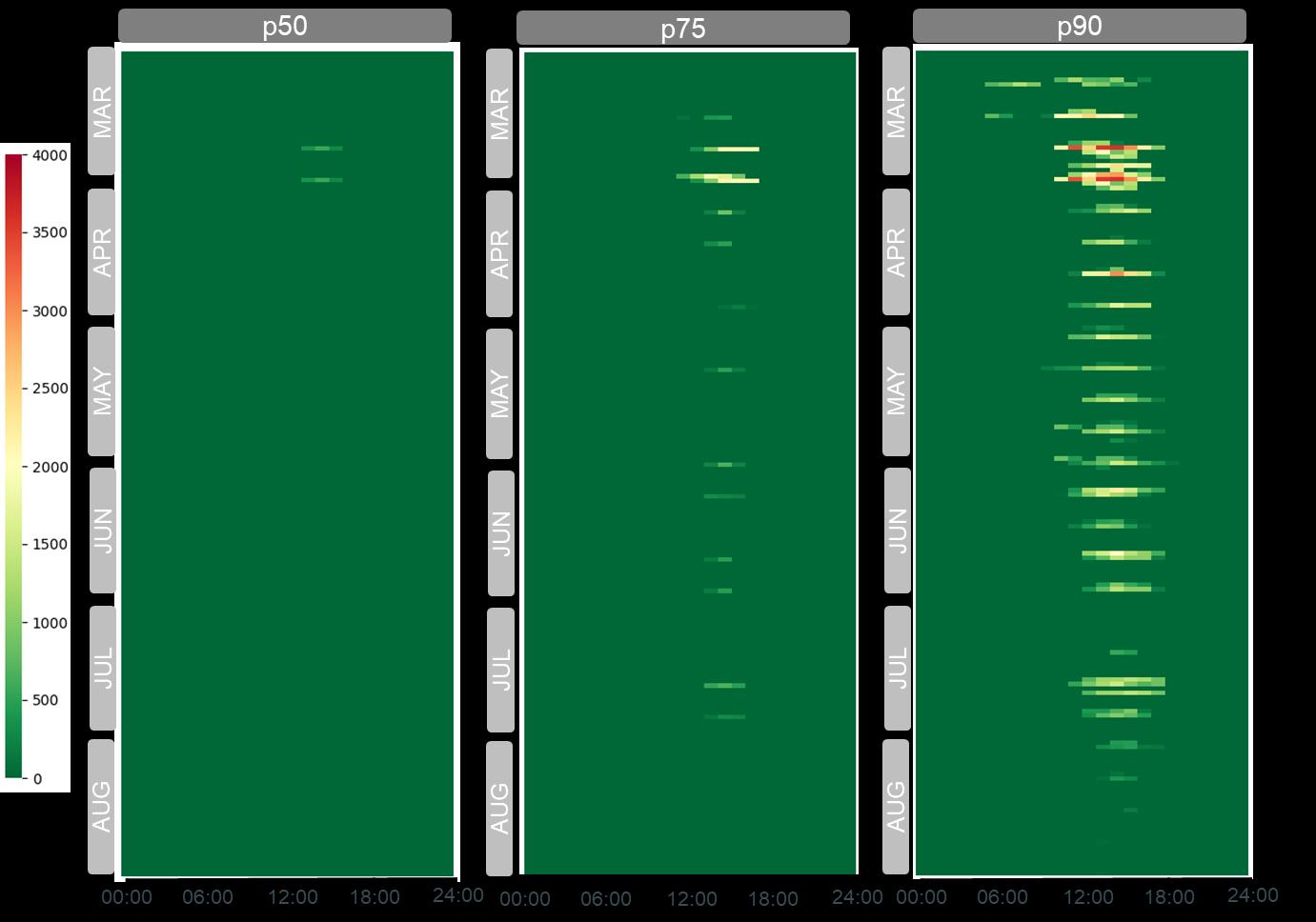
Figure 22: Percentile 50, 75, and 90 of the domestic excess after exports (in MW), taken across all the Monte Carlo years
The final step is shown in Figure 23, which depicts the situation after large RES curtailment. As a reminder, only the large RES generation is removed, meaning offshore wind and large-scale onshore and PV units as defined earlier. At this stage, the occurrence of excess moments is further reduced, and their severity becomes significantly lower than in the two preceding steps. The same three seasonal episodes remain visible, but nearly all of the remaining hours cluster around midday during weekends. The magnitude of the remaining excess stays below 2000 MW for all hours, with most values well below this threshold. As before, large RES curtailment not only reduces the number of hours with domestic excess but also mitigates the intensity of the remaining ones, in the sense that the residual excess on top of large RES curtailment is lower than in the previous step.
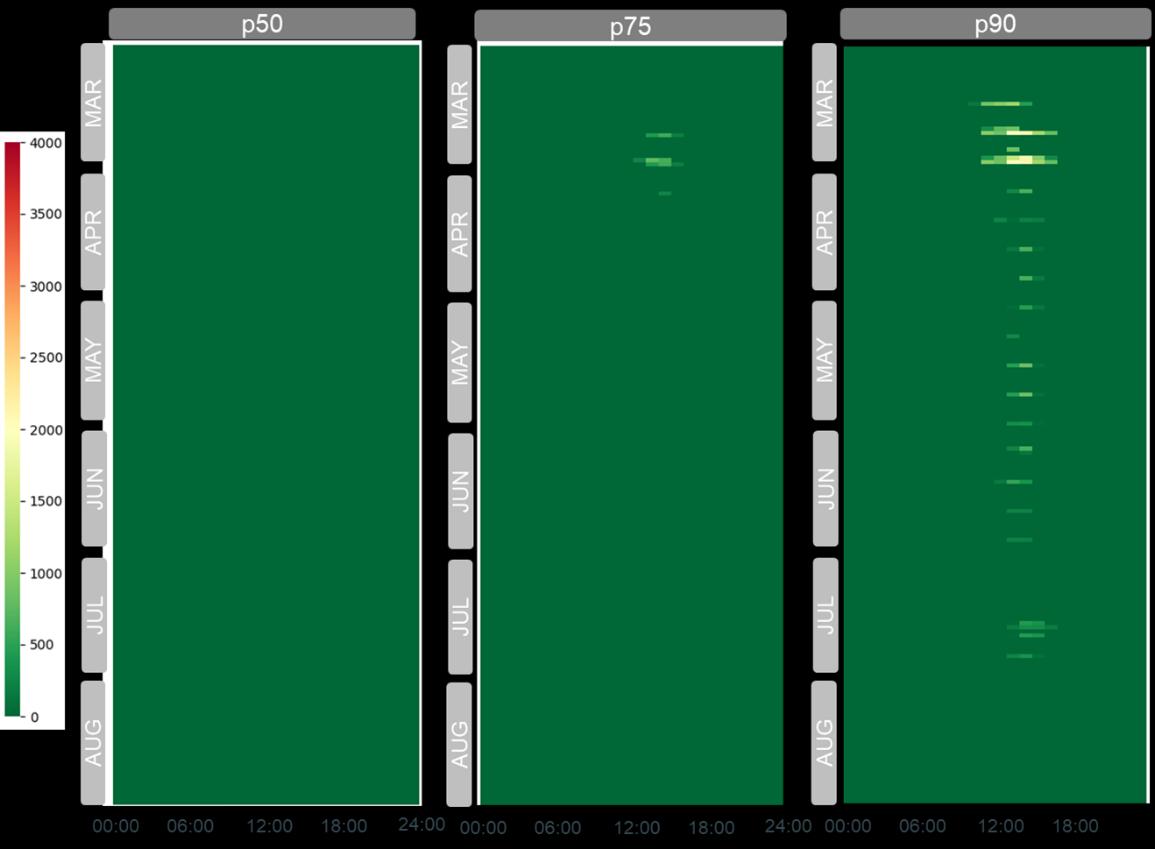
Figure 23: Percentile 50, 75, and 90 of the remaining domestic excess after large RES curtailment (in MW), taken across all the Monte Carlo years
Export limitations
Figure 24 shows the range of probabilities that, when Belgium experiences domestic excess after exports, neighbouring countries face similar situations. This illustrates the trend observed earlier: due to strong correlations in renewable generation patterns, neighbouring countries often experience domestic surpluses simultaneously with Belgium. As a result, export capability is significantly constrained during these moments. The correlation is particularly strong with Germany and the Netherlands, which frequently face excess at the same time as Belgium. Although exports remain a valuable means to alleviate excess both in terms of occurrence and severity it is important to recognise that the synchronisation of RES output across the region structurally limits Belgium’s export possibilities during certain critical hours.
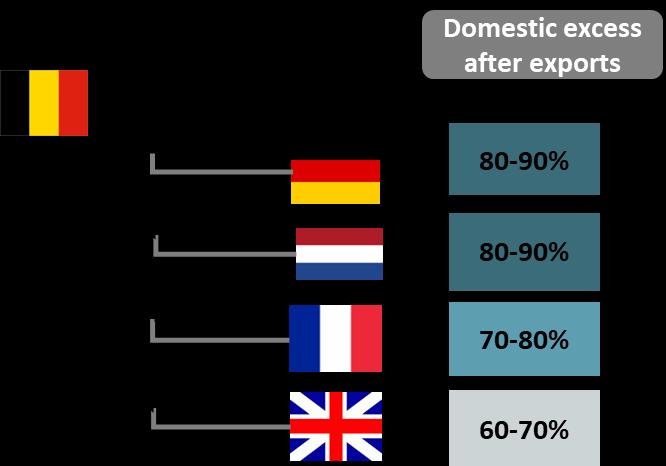
Figure 24: Probability range that a neighbouring country experiences domestic excess after export at the same time as Belgium
4.2 Type B – deviations to perfect foresight
The following section presents the results of the Type B incompressibility risk assessment, following the four step methodology described in Section 2.2 The results first show the flexibility needs for 2026, based on forecast errors, variability and outage risks, which are combined with the available flexibility means derived from the dispatch simulations. By comparing flexibility needs with available flexibility means derived from economic dispatch simulations, the analysis identifies the hours and volumes at risk where downward flexibility may be insufficient, accounting the contribution of Type A structural oversupply through the RES curtailment indicator. Finally, the required decentralized controllable capacity to cover the uncovered needs is quantified.
4.2.1 Flexibility needs & means
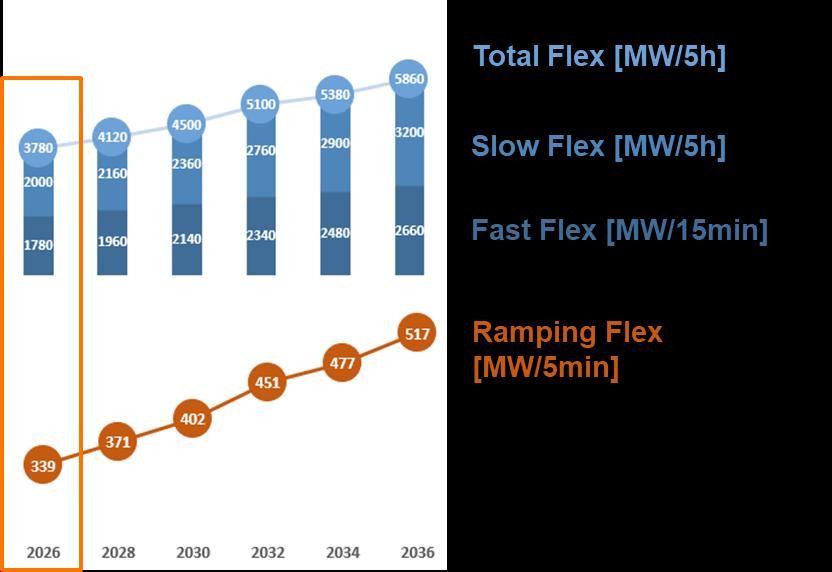
This study represents an update of AdeqFlex’25, maintaining the same methodological backbone with a zoom on uncovered downward flexibility means in 2026. The flexibility needs are derived from the AdeqFlex’25 framework. These needs cover several dimensions of downward system flexibility and are illustrated in Figure 25, which shows 339 MW of very fast (ramping) flexibility needs, 1780 MW of fast flexibility needs and, 2000 MW of slow flexibility needs. These flexibility needs cover all needs of the system, including flexibility provided by the market and flexibility provided by the TSO through reserve capacity and exceptional last resort measures.
The flexibility means have been updated following the scenarios in Section 3, in line with the scenario and simulations used for the Type A analysis. This allows to reassess the extent to which flexibility means are sufficient to cover the flexibility needs, and consequently to identify any uncovered downward flexibility needs for 2026.
4.2.2 Uncovered flexibility
As previously mentioned by comparing the flexibility needs and flexibility means, the hours and volumes at risk where downward flexibility may be insufficient can be identified. During these periods, insufficient flexibility is present in the system to cover largest forecast errors and forced outages which can potentially occur. It already accounts for the available flexibility of generation, storage, demand response and large renewable generation assets in the system. In 2026 the uncovered hours at risk from fast or slow shortages reach up to 525 hours of which 254 hours related to slow flexibility to cover day-ahead to last forecast errors and 391 hours related to fast flexibility to cover last to real time forecast errors as seen in Figure 26. Note the last forecast update is received 15 minutes before real time.
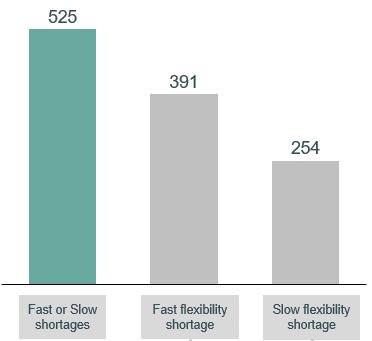
Figure 25: Evolution of downward flexibility needs (AdeqFlex'25)
Figure 26: Uncovered hours at risk in 2026
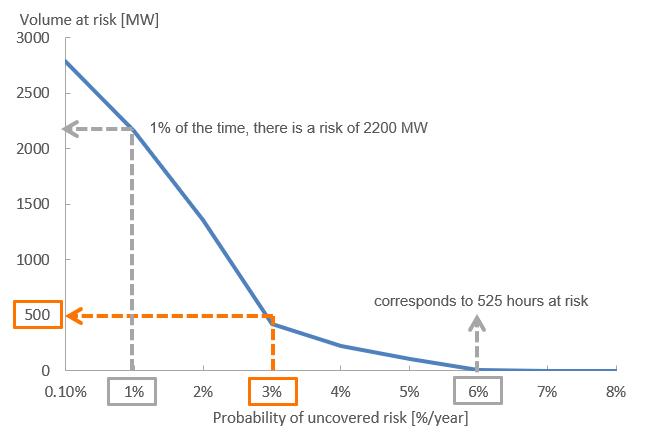
When analyzing the volumes associated with hours at risk, it is observed that an uncovered volume at risk of approximately 2200 MW occurs in about 1 % of the hours, driven by combined shortages in fast and slow downward flexibility. Volumes at risk exceeding 500 MW occur in less than 3 % of the hours. In addition, Figure 27 indicates that the previously mentioned 525 hours correspond to a probability of 6 %. These volumes represent the real-time excess when largest forecast error or forced outage would occur, and represent the required need for additional controllability, including decentralized assets.
In line with the Type A indicators for excess, Type B uncovered volumes at risk predominantly arise during spring and summer periods, coinciding with conditions characterized by low system load, limited wind generation, and high solar infeed. These situations occur most frequently during weekends, when reduced demand amplifies the impact of renewable generation surpluses. This temporal clustering is clearly visible in the heatmap shown in Figure 28, which highlights recurring patterns of elevated downward flexibility needs during spring and summer weekends
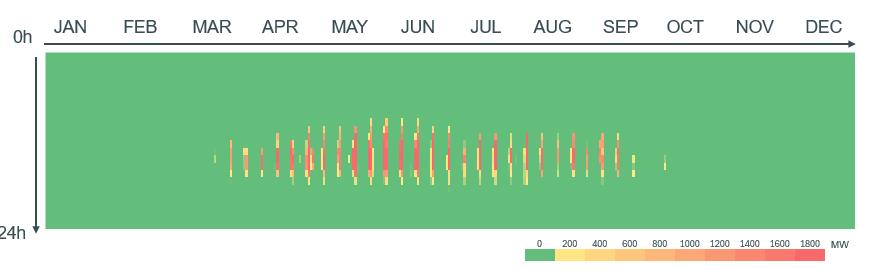
Figure 27: Uncovered volumes at risk in 2026
Figure 28: Heatmap of the total volumes at risk taken as the 50th percentile across all the Monte Carlo years.
4.2.3 Capacity to unlock
The following section presents the results of the analysis that quantifies how much additional controllable capacity would be required to cover the identified short term flexibility shortages. Building on the previously discussed hours and volumes at risk, the results indicate, for each hour with a shortage, the amount of additional downward flexibility that small scale solar or wind generation units (< 25 MW) would need to provide Note that these results show how much additional decentral renewable capacity would need to become controllable to close the remaining flexibility gap, on top of the contribution already coming from large scale renewable units.
Referring to the total flexibility needs presented in Section 4.2.1, the overall requirement amounts to 3,8 GW Within this total, part of the need can be covered by the flexibility already available, also during hours with incompressibility risk. However, after accounting for this contribution, a remaining volume at risk of 2,2 GW of uncovered flexibility needs persists corresponding to a probability of 1%, or almost 90 hours at risk, as detailed in Section 4.2.2 Note that this implies that a worst case forecast error during such hour might result in an operational challenge.
Building on this, for the upcoming summer period, only limited additional end-user flexibility is expected beyond what is already included in the AdeqFlex’25 scenarios. As a result, approximately 2,1 GW of the remaining flexibility gap will need to be delivered by decentralized renewable flexibility, complementing the contributions already provided by large-scale renewable units.
In addition to the above, incompressibility risk periods occurring under low-wind conditions require the availability of 1,3 GW of effective decentralized solar capacity, together with 0,8 GW of decentralized PV or wind generation as shown in Figure 29. “Effective capacity” here refers specifically to generation that can contribute, i.e. effectively injecting, during incompressibility situations.
As these volumes are not expected to be supplied by the market in 2026, Elia will need to rely on last resort system-level fallback measures to close this remaining gap. This consists firstly of requesting (emergency) support from neighbouring TSOs to secure sufficient downward regulation. If such support is insufficient or unavailable, Elia will use redispatch bids for balancing, such as the shutdown of any remaining ‘coordinable’ power plants, incl. those offering downwards reserves. Finally, even if these would turn out to be insufficient, Elia may then have to activate technical measures, both on TSO level and in coordination with the DSOs, covering smaller decentralized generation assets.
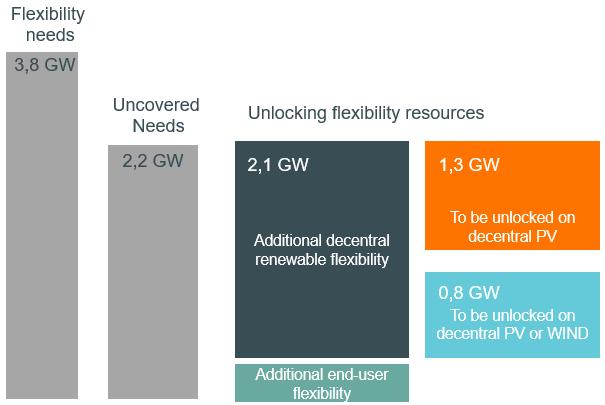
Figure 29: From flexibility needs to unlocking flexibility on decentral RES generation
Finally, when combining the results on the volumes at risk from the type B assessment related to uncovered flexibility to cover large (p99.9) forecast errors, with the type A perfect forecast curtailment of Section 2.1.1 shows a limited impact on the total flexibility need to unlock, at least in 2026. This is because the perfect forecast needs are facing limited hours at risk in 2026, and remain well under the Type B needs.
4.2.4 Need for last resort measures
Subsequently, a view is given how 2.2 GW of uncovered needs, representing worst case situations, can be covered with a reaction of decentralized RES and other exceptional measures:
1. Market reaction on decentralized wind and PV assets
2. Support from neighbouring TSOs via EU balancing platforms (if intraday cross-border capacity available in the export direction), Reserve Sharing, or Emergency Assistance.
3. Use of redispatch bids (normally used for congestion) for balancing, including the shutdown of remaining coordinable power plants, even those providing downward balancing reserves.
4. As a last resort measure, activation of TSO/DSO technical measures targeting a subset of smaller decentralized assets.
Current controllable decentral RES units reacting through the market or TSO/DSO technical measures are shown in Figure 30 Decentral wind assets are on track to cover wind driven shortages identified in Figure 29, but this is not the case for flexible solar power to cover solar-driven shortages, at least without accounting other decentralized technologies such as CHPs, hydro units and batteries.

Figure 30: Installed decentral RES controllable volumes in MW reacting through the market or TSO/DSO technical measures Installed capacities based on information received from DSOs for spring and summer 2026
As shown in Figure 30, Elia and DSOs access a volume of 2870 MW of decentralized wind power installed which largely covers the uncovered flexibility needs which can be covered by wind power or photovoltaics. However, volume of PV accessed is still limited to around 940 MW installed capacity, where actual reduction potential will be lower. Together with the 450 MW volumes from CHPs, run of river, and other decentralized assets, these are more or less sufficient to cover the remaining needs in 2026. Nevertheless, this still means that Elia structurally depends on extreme ‘last resort’ measures to close this remaining gap
Furthermore, uncovered flexibility shortages are expected to become worse in the coming years with increasing renewables (mainly PV) and the return of nuclear during spring & summer (as from 2029), requiring additional volumes of controllable decentralized capacity. This was shown in AdeqFlex’25 as observed in Figure 31
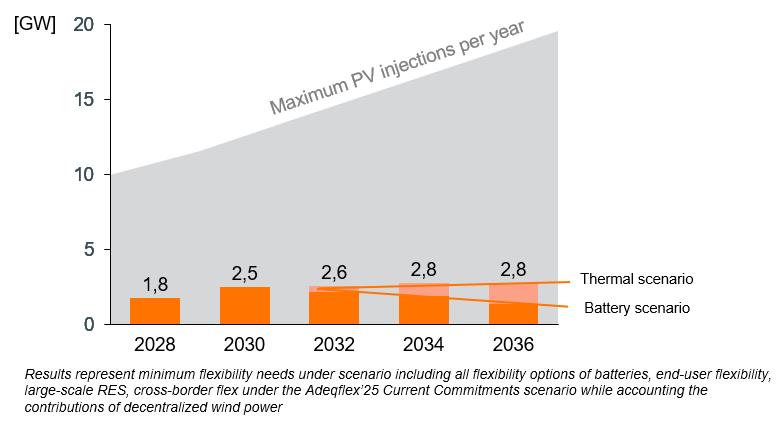
Figure 31: AdeqFlex'25 decentralized PV or consumer flexibility to be unlocked during incompressibility risk periods
4.2.5 Call for action
Despite that Elia welcomes the effort of market players to respond to market conditions and new products being installed in the market, situations with uncovered flexibility needs remain
The existing technical measures on controllability of end-users and PV, need to be anchored in a solid legal framework and extended to smaller decentralised generation units, to cover the increasing needs towards the years to come
Aligned with European legislation, Elia (together with the DSOs) will present this Summer an update of the longterm Flexibility Needs Assessment (BE) towards 2030 and 2035.
5 Conclusion
Regarding type A issue, the analysis confirms that the situation is generally less strained than last summer, largely due to the absence of nuclear generation from April to October included Also, the period during which the highest excess episodes tend to happen is gradually shifting from the summer months toward spring, continuing the trend already observed in the last summer outlook. Flexibility and storage remain essential elements for reducing both the frequency and severity of excess-generation episodes. Exports also contribute to alleviating domestic excess, although to a lesser extent, as neighbouring countries frequently face similar surplus conditions at the same time as Belgium. After large RES curtailment, the remaining episodes of domestic excess largely occur around midday during weekends, which consistently emerge as the most sensitive moments
Overall, the type B assessment shows that uncovered flexibility needs occur predominantly during spring and summer periods, when low load conditions coincide with low wind generation and high solar infeed. To cover the remaining gap, Elia structurally relies on extreme last resort measures, such as (emergency) support from neighbouring TSOs, redispatch activations for balancing and the activation of TSO/DSO technical measures. Covering ‘worst case’ solar-driven surplus situations in the future will require unlocking additional flexibility. Indeed, looking ahead, these flexibility shortages are expected to intensify as renewable generation, especially PV, continues to grow, compounded by the planned return of nuclear capacity from spring and summer 2029 onward.