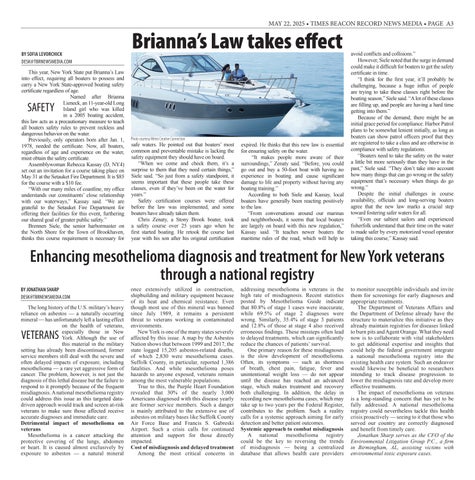
This year, New York State put Brianna’s Law into effect, requiring all boaters to possess and carry a New York State-approved boating safety certificate regardless of age.
SAFETY
Named after Brianna Lieneck, an 11-year-old Long Island girl who was killed in a 2005 boating accident, this law acts as a precautionary measure to teach all boaters safety rules to prevent reckless and dangerous behavior on the water.
Previously, only operators born after Jan. 1, 1978, needed the certificate. Now, all boaters, regardless of age and experience on the water, must obtain the safety certificate.
Assemblywoman Rebecca Kassay (D, NY4) set out an invitation for a course taking place on May 31 at the Setauket Fire Department. It is $85 for the course with a $10 fee.
“With our many miles of coastline, my office understands our constituents’ close relationship with our waterways,” Kassay said. “We are grateful to the Setauket Fire Department for offering their facilities for this event, furthering our shared goal of greater public safety.”
Brennen Siele, the senior harbormaster on the North Shore for the Town of Brookhaven, thinks this course requirement is necessary for
Brianna’s Law takes effect
safe waters. He pointed out that boaters’ most common and preventable mistake is lacking the safety equipment they should have on board.
“When we come and check them, it’s a surprise to them that they need certain things,” Siele said. “So just from a safety standpoint, it seems important that these people take these classes, even if they’ve been on the water for years.”
Safety certification courses were offered before the law was implemented, and some boaters have already taken them.
Chris Zenaty, a Stony Brook boater, took a safety course over 25 years ago when he first started boating. He retook the course last year with his son after his original certification
expired. He thinks that this new law is essential for ensuring safety on the water.
“It makes people more aware of their surroundings,” Zenaty said. “Before, you could go out and buy a 50-foot boat with having no experience in boating and cause significant damage to life and property without having any boating training.”
According to both Siele and Kassay, local boaters have generally been reacting positively to the law.
“From conversations around our marinas and neighborhoods, it seems that local boaters are largely on board with this new regulation,” Kassay said. “It teaches newer boaters the maritime rules of the road, which will help to
avoid conflicts and collisions.”
However, Siele noted that the surge in demand could make it difficult for boaters to get the safety certificate in time.
“I think for the first year, it’ll probably be challenging, because a huge influx of people are trying to take these classes right before the boating season,” Siele said. “A lot of these classes are filling up, and people are having a hard time getting into them.”
Because of the demand, there might be an initial grace period for compliance. Harbor Patrol plans to be somewhat lenient initially, as long as boaters can show patrol officers proof that they are registered to take a class and are otherwise in compliance with safety regulations.
“Boaters need to take the safety on the water a little bit more seriously than they have in the past,” Siele said. “They don’t take into account how many things that can go wrong or the safety equipment that’s necessary when things do go wrong.”
Despite the initial challenges in course availability, officials and long-serving boaters agree that the new law marks a crucial step toward fostering safer waters for all.
“Even our saltiest sailors and experienced fisherfolk understand that their time on the water is made safer by every motorized vessel operator taking this course,” Kassay said.
Enhancing mesothelioma diagnosis and treatment for New York veterans through a national registry
BY JONATHAN SHARP DESK@TBRNEWSMEDIA.COM
VETERANS
The long history of the U.S. military’s heavy reliance on asbestos — a naturally occurring mineral — has unfortunately left a lasting effect on the health of veterans, especially those in New York. Although the use of this material in the military setting has already been discontinued, former service members still deal with the severe and often delayed impacts of exposure, including mesothelioma — a rare yet aggressive form of cancer. The problem, however, is not just the diagnosis of this lethal disease but the failure to respond to it promptly because of the frequent misdiagnosis. A national mesothelioma registry could address this issue as this targeted datadriven approach would track and screen at-risk veterans to make sure those affected receive accurate diagnoses and immediate care. Detrimental impact of mesothelioma on veterans
Mesothelioma is a cancer attacking the protective covering of the lungs, abdomen or heart. It is caused almost exclusively by exposure to asbestos — a natural mineral
once extensively utilized in construction, shipbuilding and military equipment because of its heat and chemical resistance. Even though most use of this mineral was banned since July 1989, it remains a persistent threat to veterans working in contaminated environments.
New York is one of the many states severely affected by this issue. A map by the Asbestos Nation shows that between 1999 and 2017, the state logged 15,205 asbestos-related deaths, of which 2,830 were mesothelioma cases. Suffolk County, in particular, reported 1,386 fatalities. And while mesothelioma poses hazards to anyone exposed, veterans remain among the most vulnerable populations.
True to this, the Purple Heart Foundation revealed that 30% of the nearly 3,000 Americans diagnosed with this disease yearly are former service members. Such a danger is mainly attributed to the extensive use of asbestos on military bases like Suffolk County Air Force Base and Francis S. Gabreski Airport. Such a crisis calls for continued attention and support for those directly impacted.
Cost of misdiagnosis and delayed treatment
Among the most critical concerns in
addressing mesothelioma in veterans is the high rate of misdiagnosis. Recent statistics posted by Mesothelioma Guide indicate that 80.8% of stage 1 cases were inaccurate, while 69.5% of stage 2 diagnoses were wrong. Similarly, 35.4% of stage 3 patients and 12.8% of those at stage 4 also received erroneous findings. These missteps often lead to delayed treatments, which can significantly reduce the chances of patients’ survival.
One primary reason for these misdiagnoses is the slow development of mesothelioma. Often, its symptoms — such as shortness of breath, chest pain, fatigue, fever and unintentional weight loss — do not appear until the disease has reached an advanced stage, which makes treatment and recovery both challenging. In addition, the delay in recording new mesothelioma cases, which may take up to two years per the Federal Register, contributes to the problem. Such a reality calls for a systemic approach aiming for early detection and better patient outcomes. Systemic approach to combat misdiagnosis
A national mesothelioma registry could be the key to reversing the trends of misdiagnosis — being a centralized database that allows health care providers
to monitor susceptible individuals and invite them for screenings for early diagnoses and appropriate treatments.
The Department of Veterans Affairs and the Department of Defense already have the structure to materialize this initiative as they already maintain registries for diseases linked to burn pits and Agent Orange. What they need now is to collaborate with vital stakeholders to get additional expertise and insights that could help the federal government integrate a national mesothelioma registry into the existing health care system. Such an endeavor would likewise be beneficial to researchers intending to track disease progression to lower the misdiagnosis rate and develop more effective treatments.
The impact of mesothelioma on veterans is a long-standing concern that has yet to be fully addressed. A national mesothelioma registry could nevertheless tackle this health crisis proactively — seeing to it that those who served our country are correctly diagnosed and benefit from timely care.
Jonathan Sharp serves as the CFO of the Environmental Litigation Group P.C., a firm in Birmingham, AL, assisting victims with environmental toxic exposure cases.