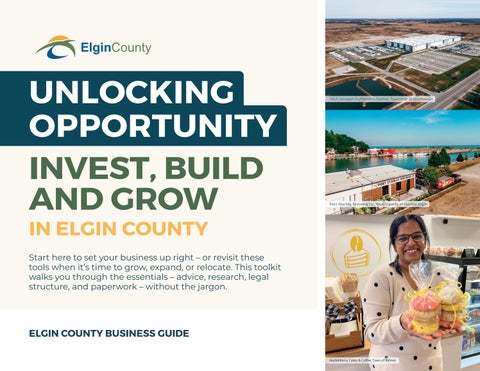
Start here to set your business up right – or revisit these tools when it’s time to grow, expand, or relocate. This toolkit walks you through the essentials – advice, research, legal structure, and paperwork – without the jargon.
ELGIN COUNTY BUSINESS GUIDE
Port Stanley Brewing Co., Municipality of Central Elgin
Huckleberry Cakes & Co ee, Town of Aylmer
YXU1 Amazon Fulfillment Centre, Township of Southwold
MADE FOR YOU.
Through conversations and surveys, the business community told us that navigating planning and building processes can be complicated. In response, we brought together representatives from the local business community to help shape this guide –reviewing drafts, sharing real experiences, and ensuring it reflects what matters most to you.
This is a resource requested by the business community, written with your input, and designed for your success.
HOW TO USE THIS GUIDE
This guide is your roadmap to success. Use it to navigate every stage of your business journey – from start-up to expansion.
Here’s how to make the most of it:
1. Start with the Basics
• Explore Planning Tools for advisory services, market research, and business planning.
• Check Business Structures & Registration to choose the right legal setup.
2. Understand Local Rules Early
• Review Zoning & Land Use Planning before buying property or starting construction – and why pre-consultation matters.
• Learn about Elgin’s settlement areas and doing business in rural Elgin.
3. Plan for Permits and Approvals
• The Permits & Licenses section explains what you may need for new construction, renovations, and even change of use.
4. Organize Your Finances
• Explore Financial Tools for budgeting, funding, and incentives.
5. Build Your Team
• Use People Tools for hiring, training, and compliance.
6. Grow Your Business
• Use Growth Tools to expand your business, choose new locations, and strengthen your marketing.
• Expand your reach by connecting with partners and customers through Local Business Networks.
7. Think Ahead
• Safeguard your success with Risk & Transition Tools for insurance, continuity planning, and succession strategies.
Tip: You don’t have to read this guide cover-to-cover. Jump to the sections that fit your current stage – and bookmark it for later.
Every time your business grows or changes, this guide can help you navigate the next step with confidence.
Top: Wayside Dining Lounge, Township of Southwold Bottom: Natterjack Brewing Company, Municipality of West Elgin
PLANNING TOOLS
Advisory Services
You don’t have to do this alone. Elgin County is full of people and programs ready to cheer you on, offer advice, and point you in the right direction.
Elgin County Economic Development
Think of them as your business matchmakers. Whether you’re brand new or looking to grow, they can connect you to resources, funding, local data, and other helpful partners. Visit Business Supports & Partnerships.
Small Business Enterprise Centre (SBEC)
Free help for entrepreneurs at every stage. The SBEC team offers one-on-one consultations, business plan reviews, and small business grants for youth and startups.
Elgin Business Resource Centre (EBRC)
These folks specialize in personalized support. Need advice? Training? Financing? A reality check? They’ve got it all. Explore EBRC Services.
Data Sources (Market Research)
Know your market before you dive in. Market research helps you figure out who your customers are, what they want, and how you can stand out from the crowd.
Canada.ca – Market Research Hub
A goldmine of free data: customer trends, industry stats, competitor directories, financial benchmarks, and more. A great place to start when building your business plan. Visit Canada.ca Business Research.
BDC – Business Development Bank of Canada
Short, practical guides on doing research, validating your idea, and marketing it well. Includes templates, how-to articles, and even free courses. Explore BDC’s Marketing Tools.
Quick Reminder: Market research is Step 1 on Ontario’s official Start a Business checklist –because when you know your audience, you can build with confidence.
The Business Plan: Write Your Game Plan
A business plan is your roadmap: it captures your idea, goals (today and down the line), and the “how” of making it happen—plus what you’ll need to make it real.
Ready-to-use Tools: Looking for a head start? Canada.ca has free business plan templates and examples to help you build your plan without starting from scratch.
BUSINESS STRUCTURES & REGISTRATION
Pick the structure that fits your style. Before you start making money, you’ll need to decide what type of business you’re running and make it official.
Your Options:
• Sole proprietorship: Easy and affordable, but you’re personally responsible for any debts.
• Partnership: Share ownership and responsibilities with someone else.
• Corporation: Separate from you legally, which limits your personal risk – but comes with extra paperwork.
Registering Your Business:
You can register online through the Ontario Business Registry – you’ll need an email and payment method.
Tip: Talk to a business advisor before incorporating. They can explain the steps and help you choose the best option.
Lay of the Land
Elgin County boasts 85 km of Lake Erie shoreline, rich farm land, and small towns that attract both residents and visitors.
• 389,260 acres of prime farmland generate over $900M annually and support 2,400 jobs.
• Manufacturing, logistics, and warehousing strengthen the economy.
• Tourism thrives in destinations like Port Stanley, Port Burwell, and Sparta.
Planned Growth: Most new development is focused in serviced communities, while farmland and rural character are protected for future generations.
More on structures from the CRA
Register Online
The Daily Press Cafe, Municipality of Dutton Dunwich
Aylmer Express Ltd., Town of Aylmer
Post-Harvest Field Preparation, County of Elgin
ZONING
Every property in Elgin County is subject to zoning by-laws and provincial policies that guide land use.
Important to Know:
• Commercial or industrial zoning doesn’t mean every business is permitted.
• Each zone has its own rules; some uses require extra approvals.
• Some properties have legal non-conforming status (existing uses can continue even if they don’t match today’s zoning).
To avoid costly delays, always confirm zoning first with your municipality or the County’s planning team, including whether or not your property has legal non-conforming status.
Land Use Planning
If your project involves building, expanding, or changing how land is used, planning approvals may be required.
Common Applications
• Minor Variance – Small zoning changes (e.g., setbacks, height).
• Zoning By-law Amendment – To change how land is used.
• Official Plan Amendment (OPA) – Needed if a project doesn’t align with long-term land-use plans.
• Site Plan Control – Required for most commercial, industrial, and multi-unit residential projects. Reviews layout, landscaping, parking, and servicing.
Tip: Reviewing this guide early helps you see why
• Severance (Consent) – To create a new lot, adjust a boundary, or grant an easement. Larger divisions may require subdivision approval.
Tip: Review zoning and the Official Plan early. These shape what’s possible and help keep Elgin’s growth balanced and sustainable.
Learn more: Curious how zoning, Official Plans, and applications all fit together? Ontario has a clear guide to help you understand the big picture.
Ontario Land Use Planning Guide
Top: The Turkey Shoppe, Township of Southwold Bottom: Mistyglen Creamery, Township of Malahide
ONE-ON-ONE SUPPORT
Starting or expanding a business can feel overwhelming — but you don’t have to do it alone. The best first step is to ask early so you know what approvals, permits, or processes apply to your project.
Ask First: We’re Here for You
• Buying property for a business, planning an expansion, or changing the use of a building? Check zoning with the Planning Office.
• Building, renovating, or changing how a building is used? Contact your local Building Department to confirm requirements under the Ontario Building Code.
• Not sure where to start? Contact Elgin County Economic Development and we’ll connect you with the right people.
Why Pre-Consultation Matters
A pre-consultation meeting with planning staff is strongly encouraged before you submit:
• Official Plan Amendments (OPA)
• Zoning By-law Amendments (ZBA)
• Draft Plans of Subdivision
• Site Plan Control applications
• Consent applications
Pre-consultation helps you understand what’s needed, saves time, and avoids costly surprises.
Work with the Right Professionals
Once you know what approvals are required, make sure you have the right team:
• Planners – prepare planning applications and ensure your proposal fits local and provincial policies.
• Engineers – required for many multi-residential, commercial, and industrial projects to ensure construction meets the building code.
• Designers – provide detailed building designs that meet Ontario Building Code standards.
• Builders – reach out early to secure a contractor who understands your project requirements and can commit to your timeline.
Tip: Do your due diligence. Hire professionals with experience in your type of project and check their references. Remember, each role is distinct — a planner cannot replace an engineer, and an engineer cannot take the place of
Erie Flooring & Wood Products, Municipality of West Elgin
Guenther Homes Inc, Township of Malahide
Construction Site, County of Elgin
DOING BUSINESS IN RURAL ELGIN
Elgin County’s communities are organized into three tiers that determine where different types of growth and business development can happen:
Tier I Settlements
Main centres with full municipal services (water, sewer, roads). These are the best locations for most new businesses, offering infrastructure, customers, and workforce.
Tier II Settlements
Smaller towns with limited services. These can support modest growth, such as small shops or service businesses.
Tier III Settlements
Hamlets without services. Development here is limited to small-scale infill.
Opportunities in Rural Areas
Outside of towns, farming remains the primary land use, but it also creates space for business opportunities, including:
• Agricultural Operations – Crop or livestock farms.
• Agriculturally-Related Uses – Businesses that support farming, such as grain dryers, farm supply stores, or equipment repair.
• On-Farm Diversified Uses (OFDUs) – Small-scale, farm-based businesses like markets, wineries, agri-tourism experiences, or home-based businesses.
What Counts as an OFDU?
To qualify, your business must meet these provincial criteria:
• Located on a working farm
• Secondary to the farm’s primary agricultural use
• Limited in area (up to 2% of the farm lot, maximum 1 hectare)
• Can include home occupations, home industries, agri-tourism, or value-added uses
• Must be compatible with neighbouring farms and not interfere with agricultural operations
Why This Matters for You
If you’re opening or expanding a business, knowing the tier system helps you pick the right location with the right services.
In rural Elgin, business opportunities exist—but they must respect and support agriculture.
OFDUs give farm families flexibility to diversify income and attract visitors, while offering entrepreneurs unique opportunities to build businesses rooted in Elgin’s agricultural identity.
Tip: Not sure if your business qualifies as an OFDU? Contact your local municipality to find out.
Left: Redtail Golf Club, Township of Southwold Right: Elgin County Engineering Department, County of Elgin
PERMITS & LICENSES
In addition to planning approvals, your project may need other permits or licenses:
• Building Permits – New construction, renovations, or change of use
• Health Unit Approvals – Food service, salons, personal services
• Liquor or Business Licenses – Through AGCO or municipality
• Conservation Authority Permits – Near rivers, valleys, wetlands, shoreline
• Ministry of Transportation (MTO) Permits – For highway access
• Heritage Approvals – If property is designated
• Fire Department Approvals – Safety compliance for commercial/ assembly spaces
Helpful Tool: Not sure what you need? Try BizPaL—an online tool that helps you figure out what licenses or permits are required based on your location and industry.
Check licenses and permits
Learn More: Building Permits
Thinking about new construction, renovations, or a change of use?
A building permit is often required.
Ontario Citizen’s Guide to Building Permits
Tip: Contact your local Building Department before starting. This saves time and ensures your project meets the Ontario Building Code and zoning rules.
Two Forks, Municipality of Central Elgin
Municipality of Dutton Dunwich
ETBO, Municipality of Bayham
FINANCIAL TOOLS
A solid financial plan is one of the most important tools you can have as a business owner. It helps you understand your costs, prove your business case to funders, and prepare for growth.
Here are the key tools and supports available in Elgin County and beyond:
Budgeting Basics
Every business should start with a clear budget that covers all of its operating costs. Just as important, you need to make sure you’re paying yourself — because personal living expenses don’t stop while you build your business.
Budget for:
• Equipment, workspace, and utilities
• Marketing and promotion
• Insurance, permits, and legal fees
• Property taxes
• Payroll (including your own salary or draw)
6 Steps for Making Financial Projections – BDC
Tip: When budgeting for property taxes, review Municipal Property Assessment Corporation (MPAC) data for properties of similar size and business type. Comparing assessments can help you estimate your potential tax obligations and avoid unexpected costs.
Funding & Growth Incentives
There are many financing options available for Elgin businesses, but “free money” is rare. Most programs are competitive, conditional, or repayable, and require you to show a strong business case. Funders typically look for:
• Solid financial projections
• Personal investment in the business
• Ability to meet reporting or audit requirements
• An innovative idea, new technology, or project with clear community benefits (job creation, stronger supply chains, sustainability)
Local Programs:
Elgin Business Resource Centre (EBRC) – Loans and business advisory services
Elgin-St. Thomas Small Business Enterprise Centre (SBEC) – Advisory, workshops, and the Starter Company Plus program (mentorship + up to $5,000 in grants)
Elgincentives Community Improvement Plan (CIP) –Coming in 2026, with support for business expansions
Provincial
and Federal Supports
FedDev Ontario – Growth and innovation funding
OMAFA Programs – Agricultural and rural business supports
NRC-IRAP – Support for R&D and technology adoption
Southwestern Ontario Development Fund –Expansion and job creation
Tip for Business Owners: Apply early and be prepared. Funders want to see not just that your business is viable, but that your project will have a measurable impact — whether it’s creating jobs, driving innovation, or strengthening the local economy.
Bookkeeping
Resources
Accurate record-keeping is essential for tracking performance and staying compliant with CRA rules. Set up your bookkeeping from day one—don’t wait until tax season. Options include:
Hiring a bookkeeper
Free or low-cost accounting software
Using templates and financial management guides
BDC – Manage Finances Hub Resources to learn more:
Bookkeeping 101 – BDC
Tip: Good bookkeeping makes it easier to access funding, since lenders and grant programs require clear financial records.
Consulting for Financial Planning
Financial advisors can help you build a stronger plan by:
• Refining your projections
• Managing cash flow
• Preparing loan or grant applications
Local Support:
Elgin Business Resource Centre (EBRC) – Business loans and advisory services
Elgin-St. Thomas SBEC –Workshops, training, and one-on-one advice
National Resources:
Tip for Business Owners:
Start with projections:
• Keep your books in order
• Explore funding early.
Funders want to see accurate projections, that you’ve invested in your own business and that you can back up your plan with real numbers.
PEOPLE TOOLS
Employees are the backbone of any business. Whether you’re hiring your first worker, subcontracting, or building a team, it’s important to understand your responsibilities as an employer — and the supports available to help you succeed.
Hiring vs. Subcontracting
Before bringing someone on board, decide whether they will be an employee or an independent contractor. This impacts your payroll obligations, liability, and tax reporting.
BDC – Are Your Workers Employees or Independent Contractors?
WSIB, Payroll & Employer Responsibilities
As soon as you employ staff, you take on legal and financial responsibilities.
Employment Standards Act (ESA) – Sets rules for wages, hours of work, vacation, leaves, and termination.
CRA Payroll Guide – Employers must withhold and remit deductions (income tax, CPP, EI).
Workplace Safety and Insurance Board (WSIB) – Most employers must register for workplace insurance coverage.
Workplace Safety & Prevention – As a business owner, you have legal obligations when it comes to the health and safety of your workplace.
Recruitment, Onboarding & Retention
Finding and keeping the right people is one of the biggest challenges for small businesses.
BDC HR & Employees Hub –Resources for job postings, interviews, onboarding, and retention strategies.
Structured onboarding helps new employees succeed faster.
Ongoing training and communication improves retention and employee satisfaction.
Tip: Even if you only employ one person, these responsibilities apply.
Left: Straffordville Library, Municipality of Bayham Right: Davey & Davey Cabinetry Inc, Municipality of West Elgin
Hiring & Training Supports
Elgin businesses can access wage subsidies, hiring supports, and training programs locally and nationally.
Government of Canada – Hiring Programs – Information on payroll, job postings, wage subsidies, apprenticeships, and workplace standards.
Employment Services Elgin – Local employment services and job postings.
Fanshawe Community Employment Services (St. Thomas & Aylmer) – Job matching, training, and placement support.
Fanshawe Corporate Training – Short-term courses and customized workforce training.
Learn More: Your Legal Responsibilities
As an employer, you must also follow Ontario’s broader workplace laws:
Occupational Health and Safety Act (OHSA) – Sets workplace health and safety requirements.
Accessibility for Ontarians with Disabilities Act (AODA) –Requires accessible hiring, customer service, and workplace practices.
Ontario Human Rights Code – Protects employees from discrimination in the workplace.
Tip: Even small businesses with only one employee must comply with these laws.
Grit Fit, Municipality of Dutton Dunwich
GROWTH TOOLS
Growing your business means thinking ahead — from building your brand to choosing the right location, planning for expansion, and connecting with networks that open new doors.
Marketing & Branding
Strong marketing sets your business apart. A clear brand and marketing plan help you attract customers and grow sales.
BDC – Marketing, Sales & Export Resources
Government of Canada –Marketing Plan Outline
Tip: A written marketing plan helps you focus your efforts and measure results.
Expansion Planning
When it’s time to grow, planning is key. Consider whether to expand products, services, markets, or locations.
BDC – How to Grow Your Revenues
Choosing a New Location
Tip: Funders want to see an expansion plan backed by market research and financial projections.
Where you operate matters — for visibility, zoning, and access to customers.
BDC – How to Choose the Right Location
Government of Canada – Choosing and Setting Up a Location
Remember: Always check zoning rules before you sign a lease. Even if a neighbouring business looks similar, your use may not be permitted.
Business Networks
Strong connections can help you find customers, suppliers, mentors, and partners.
BDC – Improve Your Networking Skills
Top: Ontario Plants Propagation, Municipality of Southwold Bottom: Erie Shores Wind Farm, Municipality of Bayham
Local Networks in Elgin:
A strong business thrives on connections. Elgin County offers a vibrant ecosystem of local networks designed to connect you with customers, partners, and resources:
Elgin County Economic Development & Tourism — Hosts rural networking events and gatherings to connect businesses across the region.
Aylmer & Area Chamber of Commerce — Supports local businesses through networking, advocacy, and community promotion.
St. Thomas & District Chamber of Commerce — Includes the Young Entrepreneurs Initiative (YEI), which fosters vibrant peer networks for entrepreneurs under 40.
Port Stanley BIA — Enhances and sustains Port Stanley’s commercial district through promotions, events, and beautification projects.
Elgin Federation of Agriculture (EFA) – Advocates for farmers, provides agricultural resources, and promotes public awareness of the local food system.
Business Card – County of Elgin
Impact Awards, Railway Museum – St. Thomas
RISK & TRANSITION TOOLS
Running a business means preparing for the unexpected — from protecting your assets, to planning for emergencies, to eventually selling or passing on your business. These tools can help you manage risk and transition smoothly when the time comes.
Insurance
The right insurance protects your business from financial loss due to accidents, theft, liability, or natural disasters. Coverage may include property, liability, business interruption, or cyber insurance.
BDC – What Business Insurance Do You Need?
Business Continuity & Emergency Planning
Tip: Review your coverage annually as your business grows or changes.
An emergency plan helps you prepare for disruptions such as power outages, supply chain issues, or natural disasters. A strong continuity plan keeps your business running and protects your staff and customers.
BDC – 8 Steps to a Business Continuity Plan
Succession Planning
At some point, every business owner needs to step away. Succession planning ensures your business continues smoothly, whether passing it to family, employees, or a new owner.
Tip: Start planning early — it often takes years to prepare a business for transition.
Top: Country Grocery, Township of Southwold Bottom: Debackere Farm Market, Municipality of Central Elgin
Selling or Closing a Business
When it’s time to move on, careful planning can help you maximize value and meet your legal obligations.
BDC – Preparing to Sell Your Business
BDC – How to Sell a Business
Government of Canada –
Closing or Selling Your Business
CRA – Closing Accounts
Takeaway: Whether you’re protecting your business today or preparing for tomorrow, planning ahead reduces risk, increases resilience, and ensures your hard work pays off.
Downtown Dutton, Municipality of Dutton Dunwich
Business Card – County of Elgin
Elgin County Cultivating Success Event – Municipality of West Elgin
Bottom: Phil Mauer & Associates, Municipality of Bayham
ADDITIONAL CONTACT INFORMATION
You can find contact information throughout the guide by following the QR codes/links, but here is a list of some key contacts to keep at your fingertips.
Advisory Services:
From planning and preparing to securing your finances, growing your business and transitioning or closing your business, we’ve got you covered
• Elgin Business Resource Centre 519-633-7597
• Elgin/ St. Thomas Small Business Enterprise 226-386-5249
Understanding the Rules:
• Public Health Requirements: Southwestern Public Health 1-800-922-0096
• WSIB: In person (appointment required) 148 Fullarton Street, 7th Floor, London 1-800-387-075
• Employer Responsibilities: Ministry of Labour — Employment Standards Information Centre 1-800-531-5551