

While the landscape may have shifted, the core values of DEI ...
remain crucial to Your Success.
Despite the headlines, companies remain committed to advancing Diversity, Equity, and Inclusion (DEI) initiatives, recognizing these efforts are proven to drive business success and serve as a powerful tool for connecting people and fostering a more inclusive workplace culture. And yes, while some organizations are taking a more short-sighted approach to DEI in response to changing political landscapes, many forward-thinking organizations are doubling their commitment.
But the DEI landscape has shifted ... and there is a lot to consider.

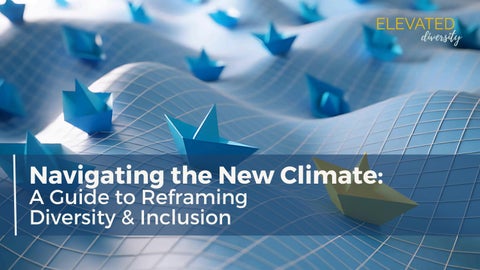
To help you, we've developed Navigating the New Climate: A Guide to Reframing DEI. This quickstart resource offers valuable insights, key considerations, and actionable strategies to enhance your organization's diversity and inclusion efforts.
Use it to refine your approach, update your initiatives, and achieve greater success in fostering a more inclusive corporate culture.
Many companies are adjusting their language and terminology to reflect their commitment to diversity and inclusion while avoiding negative headlines and potential legal challenges. For instance, over half of the executives surveyed by the Conference Board reported modifying their DEI terminology, often removing "equity" -- a word that tends to attract criticism -- first. While these types of changes in language may seem like a step back, they can instead be seen as an evolution of DEI efforts, moving toward more nuanced and effective strategies that resonate with all employees and stakeholders.
Instead of Saying:
“DEI uplifts historically disadvantaged groups to ensure equal outcomes.”

Consider Saying:
“DEI removes unfair barriers that prevent disadvantaged groups from competing on a level playing field.”
Instead of Saying:
“We use diversity hiring to recruit people from underrepresented racial and ethnic backgrounds.”
Consider Saying:
“While we strive for a diverse mix of candidates, all employment decisions are made without regard to ability, gender, age, race, sex, or other protected characteristics.”
Instead of Saying:
“We will increase the percentage of women leaders by 30% in the next five years to ensure our leadership reflects the demographics of our society.”
Consider Saying:
“We aspire to increase our percentage of women leaders by 30% over the next five years.”
In today's climate, organizations offering DEI training should prioritize programs that cultivate a workplace culture of inclusivity, fostering an environment where all employees feel valued and empowered to contribute.
Compliance: Ensure all training programs comply with federal and state regulations, avoiding language that could be seen as divisive or stereotyping.
Framing: Frame trainings as a tool for improving decisionmaking (for example, reducing unintentional biases, rather than implying inherent racism or sexism).
Business Case: Emphasize the business benefits of these trainings, such as improved employee engagement, retention, and customer satisfaction.


A revised approach to common DEI topics for organization’s to consider include:
Focus: Emphasize leadership skills that foster an inclusive environment, focusing on merit-based decision making and avoiding race- or sex-based preferences.
Compliance: Ensure training materials do not imply preferential treatment based on protected characteristics.
Focus: Teach employees about different cultures and how to interact respectfully, avoiding stereotypes and biases. Compliance: Frame the training as promoting understanding and respect rather than emphasizing DEI-specific language.
Focus: Provide employees with insights on the behaviors and actions that foster a culture where all team members feel valued and empowered to contribute, focusing on shared values and organizational goals.
Compliance: Ensure all initiatives are framed as promoting a positive work environment rather than emphasizing DEI programs.
Focus: Instead of focusing on unconscious bias as a DEI initiative, reframe it as a tool for improving decision making and reducing errors.
Compliance: Avoid language that could be seen as implying inherent racism or sexism.

Many organizations are strategically transforming their Employee Resource Groups (ERGs) into Business Resource Groups (BRGs) or Employee Engagement Groups (EEGs). This transition aims to maintain the crucial elements of employee engagement and diversity while simultaneously placing an emphasis on generating measurable business impact. By aligning group activities with corporate objectives, these employee groups offer a dual benefit: fostering inclusive communities and contributing directly to organizational success.
Employee groups provide a platform for team members to build relationships and networks, fostering a sense of belonging and community.
These groups promote inclusivity and understanding, allowing employees to connect and grow over shared experiences and mission.
Employee groups should align with company objectives, driving business growth and innovation while maintaining employee engagement.
Of Note: All groups should be open to all employees -- regardless of an individual’s background, identity, or role within the organization.
Recommended Strategies:
Align with business objectives: Reframe group activities to directly contribute to company goals while preserving identity-based support (ex., a BRG focused on global market expansion could leverage members' cultural insights).
Foster cross-functional collaboration: Encourage groups to operate in various areas throughout the organization, addressing a wider range of needs and contribute to overall business success.
Maintain inclusivity: While focusing on business objectives, continue providing space for employees to build meaningful relationships based on shared identities.
Address intersectionality: Recognize the complexity of employee identities and structure groups to reflect this reality, promoting a sense of belonging.
Emphasize professional development: Support the growth of members, enabling them to contribute effectively to business initiatives while advancing their careers.
Focus on shared interests: Form groups around shared interests or professional development themes rather than specific identities, which may include:
Sustainability
Innovation
Professional Development
Caregivers
Wellness
To transform a singular cohort-focused mentorship program into a more inclusive initiative that reflects the evolution of DEI, consider taking the following recommended steps:
Expand the scope: Broaden the program to include all aspects of diversity, including gender, age, disability, sexual orientation, and other dimensions of identity.
Implement inclusive mentoring principles: Adopt a mentee-centered approach that considers each individual as a whole person, including their unique identities, backgrounds, and aspirations.
Provide inclusive mentorship training: Offer comprehensive training for mentors on cultural humility, unconscious bias, and effective cross-cultural communication.
Establish collaborative expectations: Encourage mentors and mentees to jointly define and communicate their mutual goals and expectations throughout the mentorship journey.
Address power dynamics: Recognize and mitigate the implications of power dynamics present within the organization's hierarchical structures.
Promote a growth mindset: Apply a strengths-based approach that focuses on the ability of both mentors and mentees to learn and develop.
Foster a sense of belonging: Create safe spaces for exploration and welcome diverse identities and life experiences.


Implement equitable matching algorithms: Utilize technology to create mentorship pairings that prioritize diversity and inclusion.
Encourage reverse mentoring: Create opportunities for junior employees to share their perspectives and experiences with senior staff, promoting mutual learning and understanding.
Measure and iterate: Regularly assess the program's effectiveness through surveys, feedback sessions, and outcome tracking. Use this data to continuously improve and adapt the mentorship initiative.
Q: Are DEI programs still legal for private companies?
A: Yes, DEI programs remain legal for private companies. However, the recent Executive Orders have increased scrutiny on certain DEI practices, particularly for federal contractors.
Q: How should we review our existing DEI initiatives?
A: Conduct an attorney-client privileged legal review of your DEI programs and related training materials with your legal counsel. Assess policies for legal exposure and prepare for potential pressure to modify certain DEI programs.
Q: What changes should we make to our DEI programs?
A: Focus on reframing DEI efforts to emphasize workplace culture, leadership development, and equitable access to opportunities as sustainable business practices rather than preferential treatment. Ensure hiring, promotion, and compensation decisions are transparent and well-documented.
Q: Are there any new compliance requirements for federal contractors?
A: Yes, federal contractors must now certify they do not operate DEI programs that violate federal antidiscrimination laws. Review all existing state and federal contracts to determine DEI-related obligations.
Q: How can we maintain our commitment to diversity while mitigating legal risks?
A: Continue to prioritize diversity initiatives that drive business success and profitability. Modify any existing activities, programs, policies, contracts, and grants in coordination with legal counsel to ensure compliance.

Q: What should we communicate to our employees about changes to DEI programs?
A: Be transparent about any necessary changes while reaffirming your commitment to an inclusive workplace. Emphasize your DEI efforts are being adapted to align with current legal requirements and business objectives.
Q: How might these Executive Orders affect DEI in higher education institutions?
A: The Executive Orders have specific implications for higher education institutions, particularly those receiving federal funding or participating in federal contracts. Institutions should review their admissions practices and DEI programs to ensure compliance with recent Supreme Court rulings and new federal guidance.
Q: Is public opinion still supportive of DEI initiatives?
A: Yes, recent surveys indicate nearly 60% of Americans still favor diversity initiatives. Many employees and customers continue to expect businesses to champion equitable opportunities and reflect the diversity of their communities.
Q: How can we demonstrate the value of our DEI efforts to stakeholders?
A: Focus on the business case for DEI, highlighting its positive impact on innovation, decision making, and company performance. Share data on how DEI efforts will positively affect your organization's bottom line, as many global CEOs have reported.
Q: What steps should we take to prepare for potential DEI-related investigations?
A: Train hiring managers and HR personnel on legally compliant DEI practices that support your business objectives. Maintain thorough documentation of all DEI-related decisions and programs. And if you're a federal contractor, establish ongoing contact with contracting officers.


Organizational Assessments and Audits
Pay Equity Analysis and Recommendations
Policy Review and Development
Data Analytics and Reporting
Strategy Development and Implementation
Culture Development & Change Management
Learning & Development
Leadership Training and Coaching on Inclusive Practices
Cultural Competency Workshops
Customized E-learning Modules
Employee Engagement
Mentorship/Sponsorship Program Design
ERG/BRG Support and Development
Inclusive Recruitment and Hiring
Effective Communication
Internal Communication
Crisis Management and Response Planning
Inclusive Customer Experience Consulting