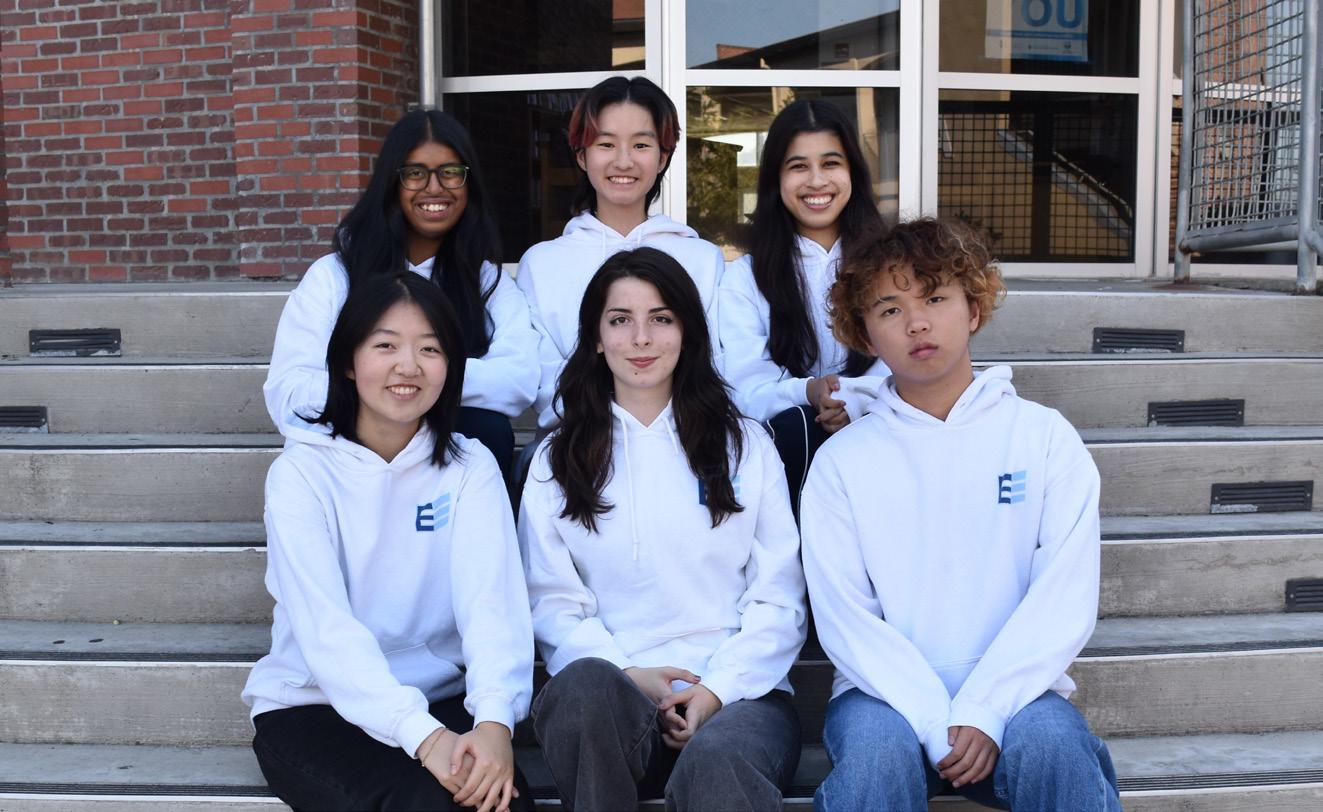
Meghna Dixit, Sana Karkhanis, Vaishnavi Katukam, Kate Yang
Sports Editors:
Leah Desai, Ananda Singh, Raj Thapliyal, Ethan Yang
Copy Editors:
Emmy Harimoto, Lora Lee, Ellie Wang
Staff Writers:
Shreejay Arja, Fiona Chen, Maahi Dev, Rafaella Fantine Vargas Machuca Vento, Nylah Gehani, Suryansh Gupta, Anish Khinvasara, Leo Lee, Juju Ling, Owen Liu, Lucas Liu, Emma Ma, Srinikaa Naveenraj, Sania Nadkarni, Alexandra Perrault, Alexandra Qiu, Divina Pandita-Raina, Ritik Shenoy, Kai Tsuchida, Elizabeth Yang, Olivia Zhang
Advisers:
Vennessa Nava, Julia Satterthwaite, MJE
Mission Statement:
El Estoque will accurately inform our community through well-researched, unbiased and in-depth accounts of stories of the student body and staff, local news and developments and taboo topics prevalent in and near the MVHS realm. By investigating a variety of voices and credible perspectives, we hope to foster active discussion, effect positive change and spread awareness of timely and relevant content. As a trustworthy, consistent and reliable source of information, we strive to be accountable, adaptable and ready to correct and address our mistakes. Constantly striving for improvement, we will uphold integrity and ethics to be respectful and empathetic to one another, our sources and our readers. We will exercise our press freedoms guaranteed by the First Amendment and California Ed Code 48907 while maintaining a community of reporters with a strong passion for our work and journalism as a whole.
LETTER FROM THE
EDITORS
PHOTO | MELODY LIN
There’s something in the air (and it’s not just the sni e-inducing pollen) that marks the start of spring. We’ve been welcomed back from winter break with bright blue skies and billowing clouds. Seniors have been getting our college decisions back. Spring is a season that has us looking towards into the future.
In our Opinion section, we examine our increasingly complicated relationship with the online world. We take a closer look at TikTok’s policy and government data collection concerns. We struggle to balance our screen time with school life, as we weigh the benefits and drawbacks of staying up to date on the news in a constantly changing world.
Yet as the weather warms and the days lengthen, we become hopeful for the new season and the changes that it could bring. In our Sports section, our coverage of CCS championships and Olympic dreams celebrates the achievements. In our News section, we explore the work behind FUHSD’s Green Ribbon School recognition and dive into the community discussions shaping the construction of Mary Avenue Villas.
In our Features section, we turn our attention inwards to learn more about MVHS’ grind culture and the pressure to continue changing, something many students are all too familiar with. But in speaking with MVHS alumni who has returned to MVHS as teachers, we learn that moving forward sometimes means circling back.
We’re constantly caught between celebrating our progress and chasing what comes next. But the stories in this issue remind us to slow down and look closely at what we already have: the accomplishments we have earned, communities we’re part of and the discussions ers, both literally and figuratively, a breath of fresh air.
Liz Liu
Jillian Ju
PHOTO | GRISHMA JAIN
PHOTO COURTESY OF MIKE WHITE |
PHOTO ILLUSTRATION | ISABELLE KOK
GOING GREEN FOR GOLD
FUHSD advances to Gold level in California’s sustainability recognition program, highlighting its district-wide climate, health and environmental education initiatives
BY GRISHMA JAIN AND SRINIKAA NAVEENRAJ
The California Department of Education awarded FUHSD as a 2026 Green Ribbon Schools Gold-level honoree on Friday, Feb. 12, advancing from its Silver-level honoree in 2023. The award recognizes FUHSD among a select group of districts statewide for its e orts towards sustainability, student wellness and environmental education.
The California Green Ribbon Schools program evaluates districts
sustainability at scale, embedding it into governance, facilities management and instructional programs rather than limiting e orts to isolated projects.
“Gold-level districts show measurable results, strong policies and systemic implementation — not isolated projects across the program’s three pillars,” Garcia said in an email. “This includes reducing
extensive proof such as utility data, curriculum framework, board policies and performance metrics aligned with the three pillars. He says the thorough process encourages schools to improve in practicing long-term sustainability.
SCAN FOR MORE COVERAGE
“Beyond recognition, the application process itself is transformative,” Garcia said in an email. “It encourages
PHOTO | GRISHMA JAIN
is to elevate students’ voices,” Gupta said. “This initiative came from students. They wanted to learn more about their environment, the climate and its impact on them. Students feel a certain anxiety when climate issues and our changing planet are not addressed. So at the Climate Collective, we make sure that all of the decisions that we’re making as a group are student-led.”
Junior and MVHS Climate Collective site lead Suhani Nirwal says many students experience eco-anxiety, which is a sense of hopelessness about climate change, as well as lack of control over the situation. She says students frequently internalize climate responsibility as an individual burden rather than as a shared collective responsibility.
“I’ve noticed that a lot of the climate-related events are getting responses from the government,” Nirwal said. “There are symposiums that Climate Collective members go to where they give opportunities for students to come and have workshops and increase climate education, but a lot of them have now been postponed because they aren’t receiving the right funding or support. I definitely think that it’s going to be an issue.”
The organization has expanded to all five campuses with students, teachers, administrators and district o cials who meet monthly to discuss sustainability goals, shape policies and implement initiatives. These student-led initiatives include annual Earth Day celebrations with students presenting projects on local and global issues revolving around the environment and a standardized
paper recycling program operating in more than 500 classrooms across the district. Students have monitored real-time energy consumption, identified energy ine ciencies and even flagged a faulty utility meter — a device used to record electricity and gas consumption — that had been inflating costs at MVHS, saving tens of thousands of dollars.
about the best practices in designing some lesson data samples from other teachers who are doing the work. Maybe a science teacher is doing it a di erent way, or a history teacher is incorporating environmental work di erently, so they learn about it during that day.”
ARE
“ AT THE CLIMATE COLLECTIVE, WE MAKE SURE THAT ALL OF THE DECISIONS THAT WE’RE MAKING AS A GROUP
“We weren’t really tracking our carbon footprint,” Gupta said. “How do you go about reducing something that you don’t know about? So students took 10 years’ worth of reports, created a program and fed data to the program to find out where and how much our energy goes.”
STUDENT-LED.
CLIMATE COLLECTIVE ADVISER KAVITA GUPTA
Nirwal notes the recognition from the CDE validates the e orts students at Climate Collective have been working on for the past three years since its formation. With more than 100 volunteers across the district, the collective plans on increasing its outreach.
“ WE AIM TO INCREASE THAT AWARENESS, NOT JUST WITHIN THE SCHOOLS OR ON CAMPUS, BUT ALSO IN OUR COMMUNITIES. JUNIOR SUHANI
In response to student advocacy through Climate Collective, the district has expanded environmental education through a professional development workshop called the Environmental Learning Playground. During this session, teachers collaborate across subject areas to integrate sustainability topics into existing course material.
NIRWAL
“Teachers come there, they create lessons and they learn about things,” Gupta said. “We even call the San Jose State University professors to talk
“We want to start including our parents,” Nirwal said. “We want to start including other community members, not just district stakeholders. Our main focus is definitely on increasing environmental education within the district, mostly targeted at our students, but we aim to increase that awareness, not just within the schools or on campus, but also in our communities.”
For Gupta, the Gold-level recognition reflects student momentum rather than an end goal. She says the award validates the years of student-driven progress and motivates students to enhance initiatives.
“We want to give a message of hope,” Gupta said. “We have challenges, but we need to adapt and deal with them, and I believe in all of you as our next generation of planetary stewards, you’ll keep it well and good for you and for us.”
MARY AVE VILLAS
GRAPHIC|ELLIEWANG
BY LORA LEE AND LIZ LIU
TThe housing development, which provides 19 units for intellectually and developmentally disabled individuals, progresses despite concerns from residents
he Cupertino City Council approved Mary Avenue Villas’ Architectural and Site Approval Permit on Feb. 3. The Mary Avenue Villas construction consists of 40 units of housing, 19 units of which are reserved for individuals with intellectual and developmental disabilities. The Cupertino City Council also found the project exempt from the California Environmental Quality Act, which means the city is not required to complete reports on the development’s impact on the environment.
However, many residents have concerns, including tra c and environmental implications, about the construction. Lina, the spokesperson for Coalition for Mary Avenue Safety and a resident near the Garden Gate community, says the city is often unresponsive to their questions and suggestions. For example, Lina said that she — as well as other neighbors — suggested creating a crosswalk to accommodate the new influx of people in the community, but she said she han’t received a response to her concern.
“They haven’t given us any sense that they are approaching this with an open mind,” Lina said. “They try to shut us down before the hearing is even done. So it really breaks the trust with our neighbors. We’re trying to be helpful. We really know the neighborhood, because we drive here in and out every day. We’ve been giving them really detailed suggestions about some things to look into, not even telling them that necessarily, to stop this project here. They even ignored our suggestions on how you can make it safer. They
don’t respond to our emails, to our letters.”
Lina also expressed concerns about the net loss of 89 parking spots that would come as a result of completing the construction. Lina says the street sees overflow parking from Memorial Park and the Westport project multiple times a year during large events and festivals. However, previous two-time mayor and Cupertino Rotary Club member Orrin Mahoney believes that the choice to move the 89 parking spots is clear because the parking spots aren’t used on a daily basis.
“You’re balancing some issues with some good things on any project,” Mahoney said.
favor of the project at a city council meeting, saying it would expand housing opportunities for IDD individuals.
“ THE DEVELOPMENT WILL GIVE THEM A NEW SENSE OF IDENTITY, A NEW SENSE OF DIGNITY AND A NEW SENSE OF SELF-WORTH.
LIFE SERVICES ALTERNATIVES VP HADIYAH FAIN
“But housing for intellectually and developmentally disabled individuals is very much needed. It’s the only site in the housing element for the extremely low-income. Tra c will be better because of the street configuration, and people will drive more slowly. We’re keeping the bike lanes, adding a sidewalk and fixing any environmental issues. The only disadvantage is really moving 89 unused parking spaces.”
The developer of Mary Avenue Villas is Charities Housing, which specializes in housing for low-income individuals. Charities Housing works in partnership with the Cupertino Rotary Club, which has provided early financial support for the project. Mahoney has personally worked with sta and di erent city councils since 2019 to support the Mary Avenue Villas development.
Housing Choices, another project partner for the Mary Avenue Villas, will manage services for the IDD population. VP of Marketing and Development at Life Services Alternative Hadiyah Fain, spoke in
“We believe everyone has the right to live their lives to the fullest in the community,” Fain said. “Sometimes, you find the most forgotten people unable to advocate or speak up for themselves. Because of the housing scarcity, they are competing against organizations and people who have more ability, means and resources, and this doesn’t leave a lot of space or room for them.”
Cupertino Planning Commission member Santosh Rao also supports the city’s e orts to build more housing. However, he raises legal concerns regarding the procedures for properly acquiring the land from the city.
“We need housing in the city for all income levels and for all individuals,” Rao said. “However, if we are going to vacate the public right of way, we set a precedent, then the following situations that come after the first precedent may end up even further diluting the process that is followed. State law exists to ensure that the public has input.”
California Department of Housing & Community Development must be notified to conduct a bid with all the interested vendors, and only after that can the city begin negotiations with a specific vendor for the land.
To emphasize the potential financial consequences that may be inflicted on Cupertino if legal sequences are not followed, Rao referenced a SLA violation in Ontario, Calif. In this example, the city engaged in negotiations with another party for the disposition of the public rightof-way before it had completed the required steps in the SLA. As a result, the city of Ontario had to pay a large amount of fines to cure the notice of violation. Lina said neighbors have hired an attorney and are considering legal actions.
“A lawyer has been hired by neighbors of the Garden Gate community, and we are certainly pursuing a lawsuit,” Lina said. “They are violating legal procedures. For example, they’re approving the project first, and then they’re asking the planning commission if the plans are legitimate. There wasn’t even an unbiased, open review of the facts before they approved the project.”
Above all, Rao believes residents have a right to express themselves and that the council members should represent the interests of all stakeholders. Fain emphasizes the importance of having homes for individuals with IDD.
SCAN FOR MORE COVERAGE
Rao states that when a public right-of-way — land like sidewalks or roads — is converted to commercial use, there are legal procedures to be followed under the Surplus Land Act. According to Rao, the city must declare the land as “vacated” first. Afterwards, the city must declare the land as “surplus land” or “exempt surplus land.” Subsequently, the
“When I say the development would be life changing, I think that would be an understatement,” Fain said. “Some of these individuals have lost a family member. They’ve lost a sense of belonging and identity. For the first time ever we are getting adults with IDD a place to call home within the borders of Cupertino, as if they’re real people who deserve to live side by side with other real people. It will give them a new sense of identity, a new sense of dignity and a new sense of self-worth.”
FUNDING LOCAL CHANGE
Cupertino’s Community Funding Grant Program closes application for 2026-2027 fiscal year, as past awardees demonstrate how city funding helps expand services for local nonprofits
BY GRISHMA JAIN
TProgram Sunday, Feb. 12, marking the end of this year’s submission cycle for local nonprofits seeking city support. The
program provides funding to ering services that benefit Cupertino residents, including food assistance, health education, arts programming and other community-
According to the city, applications open every January to eligible nonprofits.
The Parks and Recreation Commission reviews and evaluates proposals before sorting them into a tiered funding structure based on dollar amount requested. They then make
000 $1, GRAPHIC | GRISHMA JAIN 5 , 0 00 $ Awarded to Remember theToothFairy Awarded to No Time to Waste
recommendations to the City Council, which determines the final funding amounts. The commission evaluates applications based on factors such as community need, the number of Cupertino residents served, the organization’s financial stability and how clearly the proposed funds will be used. The final funding decisions are typically made by the City Council in June.
“Funding is contingent upon the City Council’s General Fund allocation to the program and funding is not guaranteed,” The city said in an email. “To be eligible for a Community Funding Grant, grant requests must be from a 501(c)(3) non-profit organization with experienced members capable of implementing and managing the program. Nonprofits can only be awarded once per project for specific needs, not ongoing, operational costs, or endowment funds.”
Although this year’s applicants are still awaiting a decision, past recipients say the funding has played a key role in expanding their services and supporting their operations. The city awarded $35,500 to 13 nonprofits through the program during the 2025-2026 fiscal year. Remember the ToothFairy, a studentled nonprofit focused on early dental education, received $1,000 through the program. Catherine Xu, a junior at UCLA and
Cupertino High School alum who founded the organization and serves as executive director, said her organization uses the funding to host interactive oral health presentations and distribute “Smile Bags” filled with hygiene supplies and handwritten cards with encouraging notes.
grant helps us provide engaging education, positive reinforcement and
$35,000
Awarded to 13 non-profits in Cupertino Funding Grant for the 2025-2026 fiscal year
“This grant from the City of Cupertino will directly support approximately 1,000 children,” Xu said. “Since our cost is about $2 per child per event, the full amount goes directly toward assembling Smile Bags, purchasing arts and crafts supplies and supporting presentation materials that benefit students immediately.”
*According to City of Cupertino
essential hygiene tools so children can build healthy habits early.”
“ IT OFFERS GREATER STABILITY AND PREDICTABILITY, WHICH ALLOWS US TO PLAN PROGRAMMING FOR THE FULL YEAR WITH CONFIDENCE.
Xu said the organization hosts about four presentations per month, including engaging games like BINGO and Jeopardy and creative arts and crafts related to oral health. Xu hopes that by pairing education with fun activities, students begin to see dental hygiene in a positive light. Each presentation hosts an average of 50 students, helping address early childhood oral health diseases such as untreated cavities and infections caused by poor dental hygiene. With the projection of serving at least 2,400 children in 2026, this grant will play a key role by making dental education engaging and accessible to students, according to Xu.
“Tooth decay remains one of the most common chronic illnesses in children, and many students do not receive consistent dental education or supplies at home,” Xu said. “This
No Time to Waste, a food recovery organization, received support from the Cupertino Community Funding Grant for its “Feed The Need” program, which collects surplus food from grocery stores, hospitals and restaurants and delivers it to agencies serving Cupertino residents.
Founder and Director Paul DiMarco said securing funding requires constant e ort. He said he wrote 110 grant applications last year in order to secure funding for the organizations programs. DiMarco said the organization receives about 33% of its funding from Santa Clara County and applies for grants from corporations, banks and foundations.
“It takes a lot of work, but we are definitely fiscally strong, and the city of Cupertino was one of those organizations that supported us for our program,” DiMarco said. “It’s a
yearly program that we do with our food recovery e orts. On a weekly basis, we’re reaching over 2,000 people who need food. There are no questions asked. There is no fee for this service. It’s a free service for the city of Cupertino, and we’re proud of our collaboration and our partnership with the city.”
According to the city, grant recipients are also required to submit a report the following year to the Parks and Recreation Department detailing how the funds were used and how many residents were served. DiMarco added that an advantage of having a fiscal sponsor is that they provide one year of guaranteed funding if you have a clear goal what to achieve with those funds. If the organization meets those goals, then the sponsor may renew the funding for another term. Ultimately, the City Council determines the amount granted each year, as well as whether the program expands, though at its discretion.
“My suggestion is that if someone is starting in this business, they would want to get a fiscal sponsor,” DiMarco said. “It’s almost like getting a loan for a business to help you grow and build credibility. It o ers greater stability and predictability, which allows us to plan programming for the full year with confidence. You can’t do this alone, and the more the merrier,” DiMarco said. “Everyone is in it together, and it’s a wonderful business to be in because you are surrounded by people who are trying to do something good.”
PETITIONING 55
California districts and educators aim to extend Prop 55 past its 2030 expiration in the upcoming November 2026 ballot to sustain school funding
BY
EMMY HARIMOTO AND YIXUAN (JOYCE) LI
When California voters approved Proposition 55 in 2016, they voted to extend a tax on the state’s highest earners to protect public school funding. Now, with the measure set to expire in 2030, public school districts like FUHSD could face more than $2 million in losses. Due to the threat of funding loss, district educators and the California Teachers Association,
voters through 2030. According to a representative from the California Teachers Association, Prop 55 extended higher personal income tax rates on the state’s top 1-2% of California earners: single filers with earnings over $250,000, joint filers over $500,000 and heads of
SCAN FOR MORE COVERAGE
$340,000. Moreover, according to the California Department of Finance, California’s education funding has more than doubled to $114 billion annually because of the tax enacted
Revenue flows into the State Education Protection Account before being distributed to K-12 schools and community colleges, with spending plans made public and subject to audits. While funds are primarily directed to education, districts have broad discretion over how to use the money, as long as it covers education and administrative costs. According to Fremont Education Association President Carley Stavis, in FUHSD, that funding translates to $2 million and is largely used to erent roles’ salaries in
“These roles include teacher mentors who help brand new teachers go through their induction process and faculty who are curriculum leads in
our district have leadership roles in departments like literature and science,” Stavis said. “We have someone who’s in each of those roles across the district. We also have people in other kinds of roles where they get this kind of money that’s not from our regular salary money, but from other one-time or temporary funds.”
Unlike programs with more visible line items, Prop 55 funding in FUHSD largely supports behind-the-scenes roles. Many of these roles are filled by veteran teachers who step partially or fully out of the classroom to lead district initiatives.
“What would practically happen if Prop 55 went away is that people would no longer be able to stay out of the classroom,” Stavis said. “That likely means newer teachers we’ve hired in the last few years won’t have a job anymore, potentially because we’re moving people out of these leadership roles into the classroom again. It makes it hard for us to retain our newer teachers, and that’s what we’re trying to prevent.”
According to MVHS Librarian, FEA MVHS Site President and CTA member Laura Utile, projections rely on enrollment from feeder elementary and middle schools, where the ripple e ect could extend beyond sta ng. With declining enrollment already pressuring budgets across Bay Area districts, district leaders would need to reallocate or cut funds to compensate, as the loss of funding would force di cult trade-o s during annual budget planning.
“There’s not necessarily programs
that get direct funding from Prop 55 that are student-facing, but the work we do to keep revising our curriculum makes it more engaging and relevant,”
Stavis said. “That’s the kind of stu that people in these roles are helping make happen.”
The CTA is leading a petition to place a new measure on the November 2026 ballot that would extend — and potentially remove the expiration date of the tax. The union had filed the ballot initiative in late August for the 2026 ballot. The e ort, titled the California Children’s Education and Health Care Protection Act of 2026, requires roughly 875,000 valid signatures across the state to qualify.
“We’re really focused on the signature gathering process right now,” the CTA representative said. “It’s an inperson petition gathering — inperson because people need education. Not everybody understands the tax or the goals of the tax. We’re hoping to have 85% of our members educated, aware and signed to support the extension of Prop 55, and it’s going really well. We had a deadline for the end of March and we’re tracking for that.”
and some are really small. Because we represent 1,200 local unions throughout the state, the process really depends on the region, sizing, how many teachers are in the school, and a myriad of other factors.”
If approved by voters for the November 2026 ballot, the new measure would prevent what supporters of the petition describe as a looming “funding cli ” for districts, estimated at $2 to $5 billion annually statewide. However, critics argue that the tax was originally intended as a temporary recession-era measure and warn that relying on a small number of wealthy taxpayers creates a volatile and unstable budget.
24% of MVHS students are aware of Proposition 55
*According to a survey of 120 people
According to Stavis, if Prop 55 doesn’t pass on the November 2026 ballot, the November 2028 ballot still remains a significant opportunity for the CTA to pass the Prop before the 2030 expiration. Still, local educators and the CTA remain optimistic about the passing of the Prop.
WHAT’S PROP 55?
Prop 55 is a CA ballot measure approved in 2016.
Prop 55 extended higher income tax rates for the state’s top 1–2% of earners.
The tax was originally enacted in 2012 under Prop 30 and was set to expire.
Prop 55 extends the higher tax rates through 2030.
Utile recognizes the importance of pushing for the signatures and taking actions seriously, due to the di culty of renewing Prop 55 if it were to expire. As a result, Utile collects signatures from both CTA members and faculty at MVHS. Districts across the state have coordinators and representatives specific to each school site, with the petition progressing at di erent rates at each site.
“There have been several schools that have met their goals,” the CTA representative said. “However, throughout California, school sizes vary — some schools are really large
“The likelihood that it’ll be on the ballot is really, really high,” Stavis said. “The organization of the petition that CTA is doing is amazing. That’s one of the strengths of CTA and of teachers’ unions, especially when we know it matters a lot to us. Part of the high likelihood can also be attributed to the fact that we’re in California, where a lot of people are really supportive of public education, so that gives me a lot of faith. For the most part, I think people in California appreciate taxes on the wealthiest individuals and most profitable companies for the purpose of other public services, such as public education.”
The tax funds K-12 public schools and community colleges.
Districts are subject to public transparency and audits.
FUHSD largely uses this funding to support curriculum leads’ salaries.
The MVHS community discusses the causes and effects of grind culture
BY EMMA MA AND ANGELA POON
On the nights leading up to the auditions for her middle school’s advanced orchestra, sophomore Amy Bastola would sit in front of her music stand for hours, revisiting sheet music over and over again and running scales until her hands ached. By morning, some of her classmates were so overwhelmed they stayed home from school. The relentless pressure to always be productive, known as grind culture, had already taken hold, and Bastola says it carries over into students’ daily lives at MVHS. She emphasizes that the pressure of grind culture often stems from unspoken expectations.
“Something we don’t talk about a lot is the implicit culture where you’re expected to do things that your parents don’t necessarily force on you,” Bastola said. “Even if your parents are chill, you still want to please them or make them proud.”
Corroborating Bastola’s experience, a 2024 nationwide survey of 1,545 teens conducted by Common
exceptional and impressive through their achievements,” whether it be through honors classes, good grades or jobs. Teens reported themselves as the primary source of achievement pressure, with 48% describing it as self-imposed.
Though junior Aeshna Chatterji believes grind culture can be beneficial to an extent, she says it can easily take a negative toll on students if they fail to be thoughtful about their own limits and how much they’re playing into grind culture. She points out that whereas grinding is an individual choice – pushing yourself beyond a healthy boundary and something that can be pursued alone – grind culture is what the community cultivates and collectively pushes as constant productivity.
However, PTSA secretary Cathy Chen says she has noticed a positive shift in the culture at MVHS recently, particularly in how parents approach their children’s academic paths. She attributes this to declining enrollment,
“Because of AI, parents are realizing that even if they push their kids, they still don’t know what the job landscape is going to be like when they graduate,” Chen said. “They’ll be more easygoing with what their kids want to do now than before.”
Nonetheless, Bastola and Chatterji have observed the e ects of academic burnout on students’ physical and mental health at MVHS. They believe the burnout stems from the guilt many feel when spending time on hobbies or interests that don’t directly advance their academic goals. Nationally, the CSM survey found that 27% of American teens struggle with burnout, indicating the pervasiveness of burnout amongst teens.
“The pressure to be productive is always on your mind, even during times when you shouldn’t expect yourself to be constantly doing something,” Bastola said. “You always feel like you’re missing out, or you’re behind other people. You’re imagining, ‘What are other people doing during the break?’ You always think somebody else is doing something really important.”
CAUGHT IN THE GRIND N T
Chatterji agrees, noting that school events often have to be planned around students’ academic priorities and extracurricular commitments. For this reason, rallies are purposefully scheduled during tutorials. She believes that students’ mindset of “any time spent not doing things to forward themselves academically is useless” contributes to the lack of spirit at MVHS. Chatterji notes the delayed gratification mentality that many students at MVHS have, which she believes undervalues the importance of having fun in the moment and taking opportunities as they come.
“
extends into internships and careers.
“If you burn out right now, you’re going to have a hard time,” Chen said. “It’s a marathon, not a sprint. People are thinking, ‘Once I get through that door, once I get into college, then I’m all set.’ That is totally not true. It’s a really long road ahead of you.”
IT’S A MARATHON, NOT A SPRINT.
After Bastola was exposed to the competitiveness of MVHS, she found that helping peers during class and building a strong support system alleviated her stress. She’s also found that playing soccer on the Junior Varsity team has allowed her to take her mind o of school stress.
PTSA SECRETARY CATHY CHEN
“Students think, ‘I’ll grind through high school, and then I’ll have fun in college,’” Chatterji said. “But at college, you also have to grind. After that, you have to look for a job. It’s not all fun. You can’t wait and expect delayed gratification. What are you waiting for?”
Chen, having guided her own children through high school and beyond, agrees with Chatterji that applying for college is not the end. Rather, she says that it’s a continuous process of growth and struggle that
“My experience has been more positive than I would expect,” Bastola said. “Even in my classes where you would expect it to be very challenging, the classmates I’ve surrounded myself with have been really helpful. It’s really underrated how important it is to make the school environment and time in class more supportive and productive.”
Chatterji combats burnout by identifying the sources of her stress and prioritizing her well-being. Instead of letting herself get caught
BURNOUT BY THE NUMBERS
FEATURES
up in the constant push to grind, she schedules fun activities for herself at the end of the week and tries to get full nights of sleep.
“It’s important to recognize that grinding is really negative for your health,” Chatterji said. “Grind culture can be good, and you should work hard and make the impact you want to, but that shouldn’t come at the expense of having good, healthy habits.”
Chen emphasizes that grind culture a ects each individual di erently, noting that some students have the drive and capability to thrive in a competitive environment. However, she also recognizes that each person has di erent strengths, interests and learning styles. The key, she says, is to respect those who enjoy and succeed in grind culture without imposing the same expectations on everyone else.
“The problem is when you treat everyone the same, saying either everyone should relax, or everyone should work really hard,” Chen said. “Don’t measure up with the smartest person you know in your school, which is an unrealistic expectation for a lot of parents and kids. On the other hand, don’t judge the people who are working really hard. The main thing is to realize that everyone is di erent and you need to choose a path suitable for you.”
*According to a survey of 113 people 82% 70%
of MVHS students have experienced academic burnout of students believe grind culture is extremely common at MVHS
OF AN
END ERA
After years of guiding students and shaping campus traditions, the longtime activities leader prepares to step away BY FIONA CHEN
After more than three decades in education — and nearly as long shaping student life at MVHS — Assistant Principal Mike White will be retiring at the end of the school year. Since first stepping onto campus as a student teacher in 1989 and continuing that work at James Logan High School and Lynbrook High School before returning in 2012, White says that he has always centered his work on ensuring students feel a genuine sense of belonging to a place they can call home on campus. Drawn to the role of activities leadership, he was especially interested in the chance to coordinate campus traditions and the chance to work directly with students.
“I met Mike Malcolm, the activities director and assistant principal at JLHS,” White said. “I said, ‘Dude, I want your job someday.’ Then he left, and I became an activities assistant principal from there on.”
Principal Ben Clausnitzer, who joined MVHS the same year as White, says that White’s responsibility since he arrived has always been to work with student activities. According to him, over
time, White has become a resource not just for MVHS but for the district.
“People have questions for the district — ‘Hey, what do we do for field trips in this particular case? What needs to happen?’ — and it can be unique sometimes,” Clausnitzer said. “So, who do you call? You call Mr. White.”
For students like senior and ASB president Elaine Chen, who has worked with White extensively in both leadership and Link Crew initiatives, White’s impact is indelible.
“Since he is assistant principal, he’s really busy,” Elaine said. “But when he does come into the leadership room, you can feel a whole wave of energy all of a sudden. He’s always fun and tries not to take things too seriously.”
According to Elaine, that presence has followed him o campus to statewide leadership conferences at the California Association of Directors of Activities and the California Association of Student Leaders. In Clausnitzer’s eyes, however, there is a whole other side of White.
“Mike is typically not shy by nature, but he’s not necessarily an extrovert either,” Clausnitzer said. “When he speaks, he’s being reflective and thinking about 30-plus years in education, coupled with knowing that as time
change.”
Elaine describes White as someone who guides ideas rather than shutting them down. She says he o ers advice based on experience, helping students shape their vision while encouraging creativity.
“Instead of saying no to something, he’ll be like, ‘Oh, this is how you can do it,’ or ‘Maybe we’ll have restrictions on this, but we can do it this other way,’” Elaine said. “With this year’s Winter Formal, we had to cancel it because of a variety of issues, but throughout the whole process, he communicated a lot with ASB execs and was really supportive of us. It didn’t feel like he was an assistant principal. It felt like a team thing.”
Even after years of leading events and guiding students, White says it’s the unnoticed moments that make all the e ort worthwhile. Hearing an old student recall advice from their freshman year or seeing the energy of a successful orientation reminds him why he continues to do his work.
When working with sophomore class o cer Sophie Chen, White considered the vision behind each event, thinking carefully about how students wanted to see it unfold. To her, White’s commitment reflects a saying in leadership when reminding themselves to stay grounded: “Lead
“If he thinks that something may not go as planned, he’ll tell you,” said. versa, if
Assistant Principal Mike poses alongside former Leadership Adviser Jenna Smith and former Financial Tech Calvin Wong. PHOTO COURTSEY OF MIKE WHITE | USED WITH PERMISSION
something is really good, he’ll be like, ‘Hey, this is a great idea.’ When you have Mr. White’s reassurance, you know for sure your event can happen, because he’ll work hard to support you in any way possible. He makes it happen.”
While Elaine and Sophie focus on White’s encouragement and the way he helps turn ideas into reality, their praise centers on what he does in the moment. White, however, measures his legacy by something less tangible.
“
events; he says White’s work was always about shaping the school’s culture and prioritizing relationships between community members rather than a structured and traditional way of executing activities.
from his own high school experience to foster a sense of belonging among students.
“I always like to think that the kids thought I would help them try whatever they wanted to try and that we would do our best to make it work,” White said. “Even if it meant simple acts like being fair in decision making or helping them guide us to make things happen.”
I ALWAYS LIKE TO THINK THAT THE KIDS THOUGHT I WOULD HELP THEM WITH WHATEVER THEY WANTED TO TRY AND THAT WE WOULD DO OUR BEST TO MAKE IT WORK.
ASSISTANT PRINCIPAL
Clausnitzer emphasizes that White’s influence at MVHS extends far beyond organizing successful
“Mr. White is one of the most hardworking people I know and he’s constantly pushing himself behind the scenes, not just for the students at our school, but even while organizing CASL. No matter how much he has on his plate, he still comes to class with a bright smile and positive energy. That dedication and attitude have meant so much not only to me, but to everyone in the Class of 2027.”
“In terms of Mike’s influence on my work, I suppose it’s always been a little bit about, ‘How do we make Monta Vista a little less business-like and more relationshipfocused?,’ ‘How do we make students feel a sense of belonging and feel at home on campus in some kind of way?’” Clausnitzer said. “He has always been focused on the student experience over the course of their four years, and has always wanted students to have a sense of belonging at their school.”
“It was a small moment, but it was special to all of us because it was personal to him and was a moment where we could bond with him,” Sophie said. “I think what students and sta will miss the most is just how easy he gets along with everyone. Even if you’re meeting Mr. White for the first time, he’s easygoing and easy to talk to.”
As he prepares to leave, White says the hardest part isn’t the paperwork or the logistics of transitioning his responsibilities, but leaving the relationships he’s built over the decades. Even as he reflects on the challenges of leaving, he hopes the traditions he helped nurture in homecoming, class colors and Link Crew will endure. While White may notice his own decline in energy, the constant presence of students reminds him that each day brings new energy and perspective, a feeling that keeps him engaged.
MIKE WHITE
White’s attention to students’ experience wasn’t limited to structured leadership meetings. Sophie recalled one such instance during leadership training camp, when White shared lengthy stories
“Mr. White was the perfect balance of guidance and encouragement. He wanted us to come up with new, creative ideas that went beyond what other schools are doing which really pushed us to put out the events we did. I’m so grateful for having been under his guidance because his humor and advice really made our school’s leadership class.”
“My adult friends always laugh at me and say, ‘Do you have a real job?’” White said. “But every day I get to see students grow and succeed. So I really think I do.”
“I still remember the very first CADA trip where he drove us to UCSB and he was so encouraging and easy to talk to that even as a freshman, I knew leadership was the community I wanted to be in. He has enabled so many kids in leadership to fulfill their passions and is the backbone for the leadership class. We will miss you, Mr. White.”
LINKED in
NETWORKING
MVHS students turn to LinkedIn to connect with professionals and build communities
BY RITIK SHENOY
When sophomore Jason
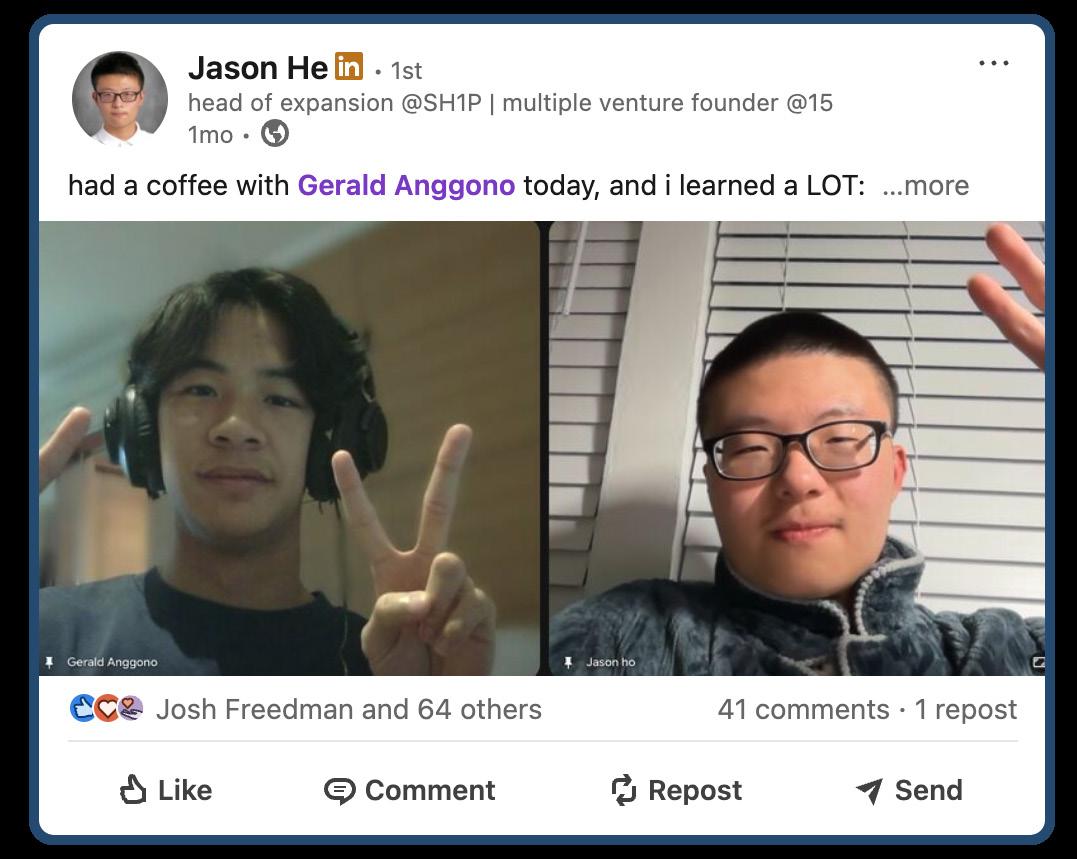
He started using LinkedIn in November of 2025, his goal was simply to connect with other MVHS students. Within weeks, he started building a diverse network, with young founders from across the world reaching out to him about their projects. The interactions felt di erent from when he used Instagram or Twitter, where people just had opinions but were never actually building anything. Now, he logs into LinkedIn five times per day, scheduling virtual meetings or “co ee chats” with people he meets and continuing to build out his network and work on di erent projects.
LinkedIn is a professonal networking platform where users can create profiles listing their work experience, education and skills. Launched in 2003, the app allows users to post content, message, build communities, seek jobs and meet new people digitally. Although the app is mostly used by adults, high school students are also permitted to create accounts.
Initially, He started posting to spread awareness about UtilFlow, an AI document summarizer app that he founded and works as a solo developer on. According to He, his daily routine includes posting and interacting with content and scheduling in-person or online co ee chats with startup founders and other app developers. During these chats, He discusses topics such as school and advice in
what he says is a professional, yet casual manner.
“People were actually coming to me and hitting me up for stu they were building,” He said. “Some people wanted to ask me for feedback and then we just bonded. I thought that was some really genuine progress.”
Similar to He, senior Ria Sethi started her LinkedIn with a purpose in mind. She made her account shortly after she founded Cyber For Youth, a nonprofit focused on cybersecurity education. Running her nonprofit required partnerships and credibility, which she didn’t believe that other social media, such as Instagram or TikTok, could fully provide. Sethi instead decided to use multiple platforms strategically to promote her nonprofit: Instagram and TikTok for a younger and casual audience, and LinkedIn for an older and professional audience. Furthermore, Sethi has received podcast invitations and job interviews through LinkedIn — opportunities that the other social media platforms could not provide.
59% of MVHS students
think that MVHS students should start networking in high school
*According to a survey of 102 people
approached networking di erently in his high school years. Although Gupta created a LinkedIn profile before college, his prime usage of the platform was during his first two years at Stanford, when he was applying for internships. During his high school years, he noted that most students, including himself, prioritized summer programs over internships, eliminating the need for a professional online resume. Instead, Gupta built connections and networked through community engagement, attending Cupertino City Council meetings and working on journalism projects. Gupta hypothesizes that high school students’ shift to LinkedIn has to do with students having the ability to be more involved in impactful projects.
MVHS alum ‘22 and Stanford University senior Devin Gupta
“When I was in high school, we didn’t have ChatGPT,” Gupta said. “That’s obviously changed a lot of things. Now, a high school student equipped with some sort of large language model is equally as competent as a 30-year-old who is not. I think there is a much greater potential for intelligent Bay Area kids to go and actually contribute to
di erent organizations, whether that’s a volunteer organization or a small company.”
This increased ability to contribute has changed how students interact with professionals. Both He and Sethi note that adults on LinkedIn are encouraging to students starting out on the platform. Sethi found that adults were impressed by young people entering professional spaces early, and He views being a high school student as an advantage since most individuals enter the startup world in their mid20s.
“ NETWORKING FOR NETWORKING’S SAKE IS PROBABLY NOT THAT USEFUL. YOU NEED TO HAVE A DIRECTION FIRST.
MVHS ALUM ‘22 DEVIN GUPTA
Both He and Sethi have also discovered more MVHS students active on LinkedIn than they anticipated. The discovery especially surprised Sethi, who sees the platform as a space where students can share their work and opinions with broader audiences beyond their immediate community.
“I know at least with the MVHS community, there’s a tendency for people to gatekeep what they’re doing,” Sethi said. “But I think it’s actually something we should share more. I think it connects us all together and makes us more human, especially in our polarized world.”
Despite their di erent uses of LinkedIn, Sethi, He and Gupta all emphasize the importance of networking with
purpose rather than only for the numbers. When Sethi first started using LinkedIn, a mentor advised her to connect with as many people as possible so that she didn’t look like a bot. Although she followed this at first, once she reached over 500 connections, she started becoming more selective, only connecting with people whose work actually interested her. Similarly, He maintains a trusted circle of loyal connections who react to his posts and boost engagement, focusing mainly on building long-term relationships with fellow builders. Gupta shares
that when high school students reach out to him about something they are passionate about, his conversations with them become more meaningful and authentic.
“Networking for networking’s sake is probably not that useful,” Gupta said. “You need to have a direction first and then network towards that goal. I think the mistake a lot of people make is thinking that building out their network in this sort of ambiguous way is helpful. There’s no harm in it, but it isn’t that productive. If you have some specific thing you’re interested in, it comes o as more interesting and genuine to the person that you’re talking to and it feels more real.”
Sophomore Jason He posts on LinkedIn after attending an online “coffee chat.” PHOTO COURTESY OF JASON HE | USED WITH PERMISSION
RETURNING TO THEIR
Staff reminisce about their time at MVHS and discuss changes and similarities
BY CORINNA KUO AND STELLA PETZOVA
Student teacher Leilani Gabriel sits in Scott Victorine’s classroom, where she was first inspired to become a teacher. Photo | Stella Petzova
CORINNA KUO AND STELLA PETZOVA
Scott Victorine’s history class as a sophomore that she knew what subject she wanted to teach: history. Now, seven years later, she’s back in his classroom as his World History student teacher, fulfilling her dream where it began.
Gabriel says because she was part of the MVHS community before, she shares a similar perspective on the pressure her students face due to MVHS’s academic rigor. Due to this connection, when Gabriel’s student teaching year for her master’s program at Santa Clara University started, she told the university she preferred to teach at MVHS, because she would be able to structure her assignments around her understanding of her students.
MVHS alum ‘99 and math teacher Katie Collins agrees that her experience as a student at MVHS was one of the factors that led her to get her job. Although Collins says she loved working at her inner-city public school in Los Angeles, she knew she wanted to leave L.A. She began searching for jobs during a period of teacher layo s and budget cuts, when many public schools were not hiring new sta , but MVHS was one of the few that was.
“I think MVHS actually chose me,” Collins said. “I think that I was able to use what I knew about teaching in an inner-city school to inform what I’ve thought about curriculum and teaching and learning, but I was also able to use what I knew about this area and about my general feeling about coming to the school, which is not unlike the feeling that many of you guys have. This is why I think I’m super fortunate to be here, and I think I have a unique perspective.”
coach, working at MVHS reminds him how much being a student here impacted him.
“
“I have a lot of memories here, and a lot of the extracurricular things that I did impacted me,” Voigt said. “For example, I was in SNL as a student here, and then a few weeks ago, I was hosting SNL, so that was really nostalgic. I made my friends here, and being back on the field and coaching as opposed to playing feels well-rounded for me.”
I’M SUPER FORTUNATE TO BE HERE, AND I THINK I HAVE A UNIQUE PERSPECTIVE.
in an educational program or graduate school, but actually applying learning techniques or teaching techniques comes from the guidance of your peers and other people that have done it. Especially in this environment, in this school culture, it’s really helpful.”
MATH TEACHER KATIE COLLINS
Collins shares that while her experience at MVHS was marked by academic rigor, being able to do things that aligned with her passions was more fulfilling. To her, Middle College, which she attended during her junior and senior years, allowed her to pursue those goals.
SCAN FOR MORE COVERAGE
“My sense of MVHS was that it was too competitive,” Collins said. “I really like learning, and I didn’t like the idea of comparing my grade to someone else’s at all. I think that going to Middle College allowed me to actually pursue this love of learning without having to focus on competition.”
This academic rigor also impacted Gabriel’s experience as a student. However, she says teachers like Victorine allowed her to enjoy the learning process, showing her what kind of teacher she aspires to be. Voigt feels the same way about his teachers-turned-colleagues, such as social studies teacher Ben Recktenwald.
Despite having many of the same sta , Collins, Voigt and Gabriel say MVHS has also changed in many ways, with Gabriel appreciating the addition of advisories, and Voigt citing the removal of double cheeseburgers from the lunch line. Both Gabriel and Voigt also note that MVHS has worked on becoming more supportive of its sta and students.
To Gabriel, a major benefit of being a student teacher at her alma mater is the unique opportunity to go to school with her younger sister, senior Anelia Gabriel. Gabriel says it’s been a highlight of her experience as a student teacher.
“When I was in elementary school, I would always be like, ‘Man, I wish I could go to school with my sibling,’” Gabriel said. “Fast forward to over 10 years later, and I found out I had a position here, and I was grinning ear to ear. It’s so much fun to get to go to school with your sibling — even though I’m not a student, it’s just fun to have her here and know that she’s here, and I’m glad that she knows I’m here too if she needs anything. But I told her she’s lucky that I wasn’t her teacher.”
CHANGES FOR THE WORSE
TikTok’s new privacy policy under U.S. management raises concerns about data protection
BY ASHA WOJCIECHOWSKI
TiikTok users opened up the app on Friday, Jan. 23, ready to start another scroll session, only to be met with a pop-up: “Updates to our Terms of Service and Privacy Policy.” The pop-up featured three bullet points announcing an updated corporate entity, referring to the switch to majority U.S.-based management following U.S. government pressure, as well as the collection of new types of data like exact locations and user information being used to curate targeted ads outside of TikTok.
Now that user data is in the hands of U.S.-based software company Oracle, the new privacy policy shows some changes to how that data will be used and collected on the app. Specifically, TikTok will now collect precise location data where only approximate location was used before. Additionally, the app will now collect all data and metadata associated with interactions with AI tools on the app, and TikTok will use user data to influence ads seen outside the app, where it previously only targeted users in-app. Prior to these changes, TikTok’s privacy policy already allowed for all personal data given by the user through content or collected through interactions to be used to personalize the algorithm, which this broader data collection could potentially bolster.
The policy change came with little fanfare, but is a major development in the progression of the controversy over TikTok’s parent company, ByteDance Ltd., storing U.S. users’ data and managing TikTok’s algorithm in China. The controversy, based on concerns that the Chinese government could misuse U.S. user data or tamper with TikTok’s algorithm to spread propaganda and misinformation, led to President Joe Biden signing legislation into law in 2024
demanding that ByteDance either sell TikTok to a U.S.-based owner or be banned by January 2025. ByteDance filed a lawsuit, and President Donald Trump signed four executive orders extending negotiations until a deal was met. The result of this deal was the formation of TikTok USDS Joint Venture LLC, a group of investors including Oracle, Silver Lake and MGX made to manage TikTok in the U.S. Considering the original TikTok controversy was about data handling and algorithm control, there has been wariness among users that the expanded data collection of the updated policy may allow further exploitation of U.S. users’ information. Sophomore Sofia Grigolia first downloaded TikTok in 2019 and recently uninstalled the app for mental health reasons. She says that, given the context leading to the management switch, there is a hypocrisy to the situation on the part of the U.S. government.
“
Timothy Edgar, a Harvard Law lecturer and cybersecurity expert, told Harvard Law Today that the switch in management avoids none of the security risks of foreign adversaries gaining access to U.S. user data and performing espionage, as there are many other ways to gain access.
IF THE GOVERNMENT IS WORRIED ABOUT DATA, THEN WOULDN’T THEY BE ALLOWING THE EXACT THING THAT THEY WERE WORRIED ABOUT?
SOPHOMORE
SOFIA GRIGOLIA
Additionally, Edgar emphasized that the U.S. doesn’t have uniform privacy regulations, so it may be easier to access that data now that TikTok isn’t under as much scrutiny for data protection. Given this, Special Education and English teacher
Doug Leresche agrees with Grigolia. He expresses dubiousness at the involvement of the U.S. government in facilitating the change.
“If they’re worried about data, then wouldn’t the government be allowing the exact same thing that they were worried about?” Grigolia said. “For the U.S. to say China’s doing anything di erent than that, I feel like it’s kind of dumb.”
“It seems like just McCarthyism,” Leresche said. “That all comes from this hegemonic idea that China is going to take over the world, when really, they just would like to be a developed nation. We don’t know that China was doing anything too serious with the data. So I think the U.S. is really just strong-arming them for controlling the money.”
Senior Candace Chiu also worries how sensitive user data like immigration status — which is listed in the privacy policy as OK to be collected from content users
make on the app since before the update — may be used in the midst of ICE raids and surveillance e orts targeting illegal immigrants unfolding across the country. In the worst-case scenario, she fears such data could be used to track people. She says that this may compel users to censor themselves on TikTok for fear of being targeted, whether they are at risk or not, which feels unfair.
“TikTok users will probably have to be really careful with what they share online, and what kind of photos or videos they’re going to post,” Chiu said. “The only problem for me is that I’m very used to TikTok’s interface and how things work there — even if my For You page is very curated, because I mainly use it for niche content, like my interests, it still poses a risk that my data will be exposed.”
However, Leresche points out that TikTok isn’t the only entity that collects such data. Other social media platforms like Instagram collect the same data, and much of people’s sensitive information already exists online in various places. As an immigrant, he says that information like his face and fingerprints is already in government systems. Grigolia thinks that this fact will influence how TikTok users will react to the changes in the policy.
“I feel like the problem itself is alarming, but I feel like TikTok users don’t really care, considering data collection is done by every company,”
33% of MVHS students use TikTok regularly
*According to a survey of 117 people
Grigolia said. “It’s all just based on what you’re watching. If you’re that worried about protecting your data, then you shouldn’t be using social media at all.”
Leresche agrees, adding that undocumented immigrants would be more unlikely to be on social media — or at least wouldn’t post about it — if they’ve already avoided being documented in other systems. He says that, as technology and online spaces develop further, protecting all of one’s sensitive information online will become increasingly unrealistic.
“There’s not much you can do,” Leresche said. “I’m not happy about it, but I succumb to the reality that online sources know a lot more about me than I’d like — we can’t really avoid that. But I don’t think TikTok alone is the problem. It’s just adding on to a pile of other problems that are already in place.”
However, for users of TikTok who want to protect their privacy to the highest degree possible while still engaging with the app, an e ective practice could be to read the privacy policy thoroughly for themselves so they understand the risks of using it, and to be mindful of those risks while using the app. There are also options to submit requests to delete collected data, and to customize ad settings which are linked in the privacy policy under “Your Rights and Choices.”
While this still doesn’t constitute full protection of user data, it is a realistic
step users can take.
Ultimately, TikTok’s change in management and updated privacy policy are but another disappointment in the fight for user data protection. Although the switch was framed by the U.S. government as a necessary move to increase national security, the expansion of TikTok’s data collection complicates the narrative. What can be surmised, though, is that regardless of who holds the data, a private online experience for users is unlikely to be prioritized.
56% of MVHS students
are concerned about TikTok’s new privacy policy
*According to a survey of 43 people
*According to a survey of 117 people
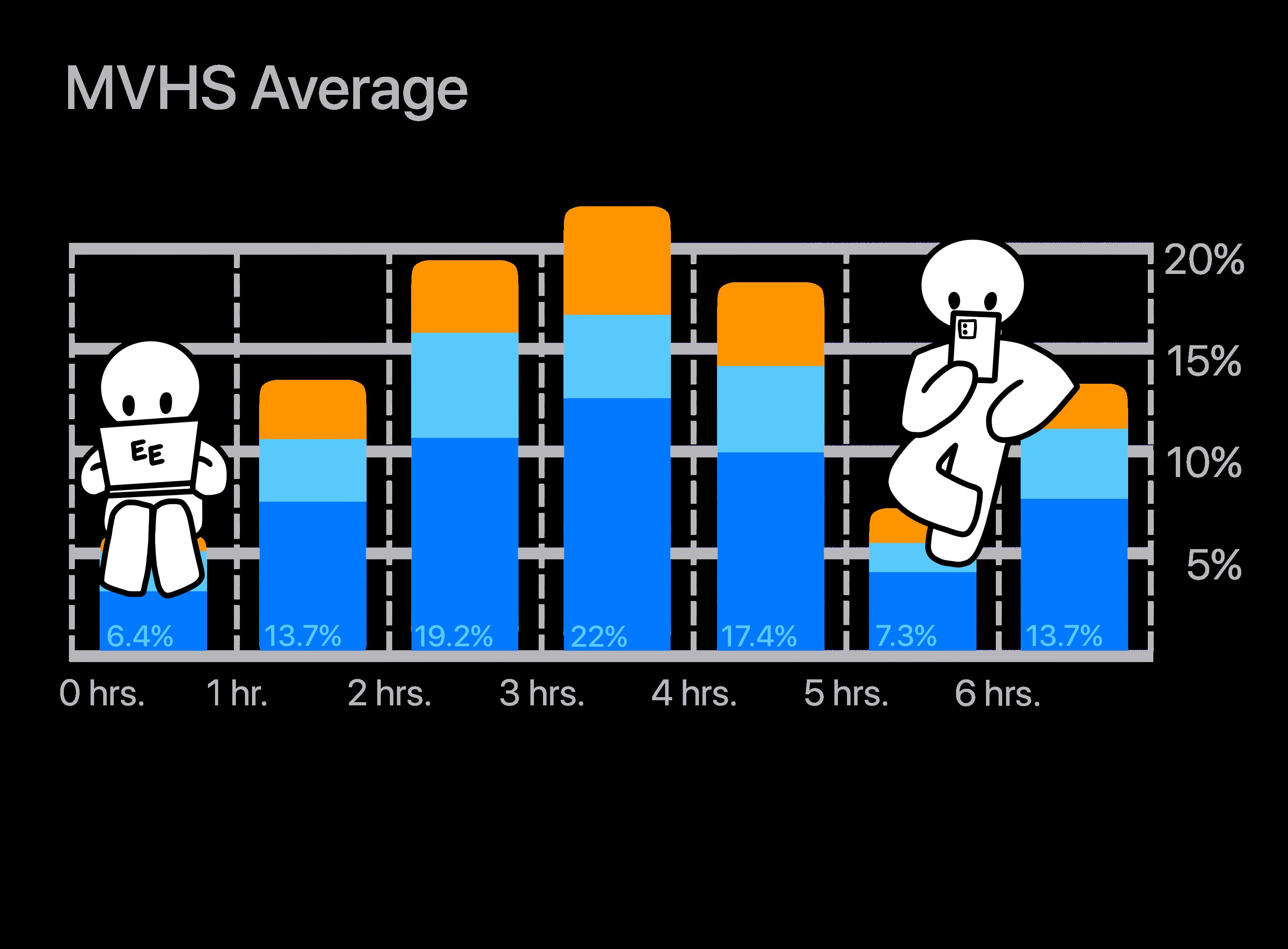
As the bell rings across campus and the students get up from their seats, they all walk to the same place: the phone jail. When they find and unlock their phones, students quickly work through piles of notifications from apps like TikTok, Instagram and Discord as they file out of the classroom. Despite the district’s e orts to help students detach from their phones and focus on learning, many still struggle with controlling their screentime outside the classroom.
Students spend roughly eight hours a day on technology-based entertainment. School districts have started to take this into consideration with actions like the Phone Free School Act, which was initiated in late September of 2024. Since then, schools have continued implementing policies to help reduce access to
phones during class time, such as phone jails or bins, to improve students’ academic focus, social interaction and reduce depression. Because extended periods on phones can disrupt learning, the need for controlling students’ screentime is clear, but solutions that are mindful of students’ obligations to online spaces are rarer.
Students sometimes allude to having concerns about their screen time, but these concerns often take the form of half-hearted resolutions or self-deprecating jokes rather than progress. While products designed to control screentime are a burgeoning industry, many solutions don’t account for students’ online needs in the digital age, leaving them overwhelmed when they seek out improvement.
Some conventional screentime principles are applicable across
demographics. Most social media apps are designed to lead users, especially teens, into addictive spirals, promoting doomscrolling for the sake of their engagement metrics. These platforms, increasingly populated by bots, have begun superficially catering to users’ desire for human connection — for example, Instagram added visible likes on Reels and a map feature to give people the impression of physically interacting with real people. However, while social media can be a useful tool for keeping up with others, it can’t replace in-person hobbies and socializing. The Pew Research Center reported that a majority of teens report feeling happy or peaceful when they don’t have their phone, indicating that teens would benefit from reducing screentime.
However, framing screentime as a binary choice between “real
life” and digital spaces can be counterproductive for students in particular. Technology is unavoidable for students — assignments, extracurriculars and events all demand digital attention, and being easily reachable by phone has become synonymous with responsibility and proactiveness. But tracking screentime is often conceptualized as tracking the amount of time spent on a phone, which doesn’t account for productive phone usage or unproductive time on other devices, such as laptops.
On top of that, it can be di cult to cleanly distinguish between productive and unproductive screentime — for example, club updates are sent through group chats on Instagram, and classmates talk about homework on Discord. When choosing to tackle their screentime, students can feel like they are made to choose between reducing the number and feeling connected to their community. Additionally, students could successfully cut down their time spent on phones, but still sustain their problematic habits — falling back on doomscrolling on a di erent device rather than practicing discipline.
Beyond that, there are some strategies that people can incorporate to manage their phone usage. One of the most common strategies is apps that help regulate phone usage. The accountability that comes from installing and setting up apps can help create discipline towards screen time usage, especially when combined with being honest with friends and family and asking them to help keep yourself accountable. Being willing to take initiative and find solutions that work for you can help give you a boost in reducing screentime and being more aware of your phone usage.
Although phones provide access to many useful and necessary functions, creating boundaries between work and leisure time online can create stronger digital habits. This could look like leaving a phone in another room while studying, or even asking someone else to watch it for a while.
76
%
of MVHS students
feel the need to lower their screentime
*According to a survey of 117 people
But while the battle over phone usage seems almost impossible considering the importance of being online in day-to-day life, students who are motivated to work on their online habits still have options. The most important step is noticing the problem and being able to identify how their time can be better spent in other areas. That means being specific with one’s unique motivations for cutting down screentime by considering how that time can go towards individual hobbies and interests, keeping that personal goal at the forefront of the approach.
APPS TO HELP LOWER YOUR SCREENTIME SCREENZEN
Students can prevent scrolling on browsers by logging out of social media accounts on school devices and turning o notifications, along with designating specific devices for school and entertainment. With these boundaries, students can spend dedicated time on their phone, keeping up with their community without sacrificing their productivity.
The bell will keep ringing, and the phone jail will fill and empty with phones day after day. But after the school day ends, students are the ones who are in control of their own screentime. It’s up to them to learn how to use devices rather than impulsively using them — a skill that reaches far beyond the classroom. Minding your screentime simply means taking the initiative to build discipline and regulate one’s own screentime — the numbers will naturally follow.
Platform: Mac, Windows, Android and iPhone free to use
Can require you to do a mindful activity before opening certain apps
FOCUS FRIEND
Platform: iOS and Android free AND PAID OPTIONS gamified features to incentivize focusing
Platform: iPhone, Mac and Android free AND PAID OPTIONS Has deep focus sessions that can’t be bypassed
NEWS CURRENTEVENTS OPINION WORLD
OPINION WORLD
UPD TED STAYING A
CURRENTEVENTS OPINION
MVHS students and staff share their thoughts on the importance of staying updated on current events
BY SIH YU (MELODY) LIN
Amidst the swirl of constant global events and news outlets expanding to social media, the number of ways to stay updated on current events has also increased. While some individuals regularly scan headlines or subscribe to news publications, others may be less updated on current news because they check the news less frequently. However, these habits are often built over time; for instance, social studies teacher Hilary Barron started building a daily habit of checking select news sources later in her life.
“My parents would sporadically get the newspaper, while my grandparents got it religiously every day so we would occasionally talk about news,” Barron said. “But I didn’t really think that following news was too important, and even in college, I just followed politics a little. It really took until I started teaching AP Government for me to find a way to bring it into my life.”
In contrast, sophomore Myra Malik built her habit of following current news in her freshman year, when she also joined the MVHS Speech team. After building a habit of regularly checking current events, she has found that she not only can better converse with her classmates on more topics, but also develop her own opinions on politics and events as well.
“I realized that when I wasn’t really following current news, I had absolutely no idea how the world worked,” Malik said. “From the way politics work to economic policies and foreign policies, I had no clue about what was going on in the world around me, and I felt pretty lost.”
Similarly, freshman Nitika Karandikar also emphasizes the importance reading current events has on formulating perspectives on politics and the economy, believing that news literacy helps individuals form opinions about their community after
having a more educated background on the topic.
However, Barron, Malik and Karandikar all agree that reading current news may be a stressful experience. Barron acknowledges the importance of finding the balance between following current events and maintaining one’s own wellbeing.
“There’s a lot of sad, depressing, awful things that happen,” Barron said. “I’ve talked to a lot of people who feel like they’ve needed to take a break from the news because there might be some heavy things happening in the world. Because we only have so many minutes in a day, it also becomes part of the challenge — to actually find ways to get enough of the news so that you generally understand what’s happening, but to also not overwhelm yourself.”
understand that some might choose to not frequently read about current events. To ease into building a habit of reading news, Malik suggests entering the process with an open mind, and taking the time to understand the information before proceeding to research more about a topic.
21% of MVHS students
check professional news publications daily
*According to a survey of 114 people
For a similar reason, Karandikar’s regular sources for her news updates have shifted from social media to becoming more centered around news articles, and she realizes the importance of finding her own balance — to process the information but still stay mindful of her own mental health.
SCAN FOR MORE COVERAGE
“A lot of the news on social media was just people’s hot takes or information that wasn’t accurate, and it became very stressful for me to keep looking at Instagram,” Karandikar said. “It can definitely be very stressful looking at the news and seeing a lot of bad things that are happening, maybe even take a toll on your mental health and make you feel sort of blown out of proportion to what you should be worrying about as a student.”
Barron, Karandikar and Malik all
“You have to realize that there are some things that are just completely out of your control,” Malik said. “You can’t immediately teleport to another country and change their political environment, but understanding that there are avenues for you to make a change is pretty impactful as well. It’s hard to keep track of everything happening in the world and find the positives, but understanding that these are big issues that we have to tackle as an entire community can help you be a more communityminded person.”
Apart from checking the news throughout the day, Barron consistently encourages her classes to follow current events through various activities by comparing current events with the historical events to hosting ballot-style voting in class in her World History curriculum.
“We’re all humans,” Barron said. “We all want similar things, so naturally it’s important to be aware of major events and trends that are happening worldwide. Learning about the news plays out in our politics, such as who we elect, and ultimately trickles down to the policies that a ect our lives. There are always overarching stories that connect, and learning about what’s happening around us helps us develop the skill to find bigger themes and trends across events, seeing connections and how they impact your life.”
THE FIVE PERCENT FIASCO
BY ANISH KHINVASARA AND LUCAS LIU
California billionaires say they will leave the state, but history tells a different story
“It could wipe me out.”
This is what DoorDash cofounder and billionaire Andy Fang said in response to a potential one-time 5% tax on his $1.5 billion net worth, a statement that may stretch the definition of a “wipeout.” His comments push a broader parroted narrative on the proposed “California Billionaire Tax Act” — that raising taxes on the rich will make billionaires flee, taking their businesses with them.
This proposed legislation looks to levy a one-time 5% tax on all California residents with a net worth of over $1.1 billion. The statewide proposal is spearheaded by Service Employees International Union-United Healthcare Workers West and needs to receive roughly 900,000 signatures to be on California’s November ballot, a threshold they are confident to reach.
This proposed legislation comes in response to substantial funding cuts at the federal level from the Republicanled “Big, Beautiful Bill.” The federal bill, signed into law on July 4, 2025, cut crucial government programs like
California’s Medicare, Medi-Cal and Supplemental Nutrition Assistance Program benefits. According to the Californian Health Care Foundation, more than 15 million Californians rely on Medi-Cal for health insurance, and more than 5.5 million rely on SNAP benefits for groceries. In light of federal reduction, the state must find a way to raise taxes to fund these public foundations. According to the “Billionaire Tax” initiative, the act would raise nearly $100 billion from the more than 200 billionaires who reside in the state, making up for federal funding lost in the gutted social programs. With this lack of funding, the fact remains that billionaires pay lower taxes in proportion to the general public. According to the National
THE TOP
400 RICHEST AMERICANS PAY AROUND 24% IN TAXES, COMPARED TO THE GENERAL POPULATION, WHICH PAYS AROUND 30%.
Bureau of Economic Research, when measuring taxes using an e ective tax rate that accounts for capital gains — profits from investments that aren’t liquidated — the top 400 richest Americans pay around 24% in taxes, compared to the general population, which pays around 30%. On the other hand, higher-paid professionals, including lawyers, doctors and engineers, who make up a large majority of the Cupertino community, pay around 45%.
Billionaires who pay far less in proportion to their income in taxes through loopholes in the tax code are e ectively taking advantage of higher-paid professionals, who earn far less but pay much more in proportion to their actual income than billionaires.
Opponents of the bill argue that
e ect, instead reducing California’s tax base by encouraging billionaires and businesses to exit. However, Newsom has a vested political interest regarding the wealth tax. According to Forbes, billionaires like former Netflix CEO Reed Hastings, Fang and former Google CEO Eric Schmidt have each dumped millions of dollars into Newsom’s political campaigns. For the MVHS community, where family employment depends on the technological sector, billionaire companies matter. If tech companies decide to move elsewhere, MVHS families may approach a crossroad between employment and living in California. However, there is little evidence to suggest that billionaires will actually leave if California imposes the Billionaire Tax. In 2022, Massachusetts passed the “Fair Share Amendment” into e ect, imposing a 4% surtax on annual income exceeding $1 million. According to a report by the Institute for Policy Studies, the millionaire population in Massachusetts has
52% of MVHS students
have people in their house hold working in billionare-led companies
*According to a survey of 106 people
According to Mercury News, the Bay Area itself is home to 131 billionaires. During the pandemic, remote work led many to speculate if Silicon Valley’s dominance was fading, as several big tech companies began opening o ces in Austin, Texas, enticed by lower taxes. This period sparked a broader narrative that Austin was going to replace Silicon Valley as the next major technology hub. However, according to the Wall Street Journal, Austin is now “bleeding tech talent,” with lowerquality technology events and poorer networking opportunities in comparison to San Francisco’s AI boom, causing many to move back to San Francisco.
The idea that Silicon Valley will move to a di erent area has occurred before. But with the limited success Austin faced as a “new Silicon Valley,” it’s reasonable to assume billionaires will not move if they want to stay in business. NVIDIA CEO Jensen Huang had a similar sentiment regarding Silicon Valley’s future, saying that he would be perfectly fine with paying the wealth tax, again citing that the
startups, innovation and billionaire companies, which means the proposition will lighten the burden on struggling families on SNAP benefits and Medi-Cal, in an already expensive state to call home.
Paying the tax should be an obligation for billionaires to give back to the talented workforce who have lifted their companies from the ground up, especially due to the tax disparity between them and higher-paid professionals that allows billionaires to pay less. In order to make sure billionaires cannot continue to ignore the working class, we should support the California wealth tax despite the billionaires’ likely empty threats to leave.
MORE TO EXCELLENCE
MVHS’s academic nature leads to our dismissal of athletic achievements
For a school obsessed with numbers — GPA, how many AP classes we're taking, our SAT score — we’ve forgotten about a crucial one: be it soccer, football or tennis, over 40% of the student population participates in school sports. And yet, like artistic extracurriculars, sports are often viewed inferior to the more academic pursuits we care about. At MVHS, we pride ourselves on excellence, but only in the areas we’ve chosen to value. When the topic of school-sanctioned sports comes up, we’re quick to dismiss our teams, suggesting that all MVHS teams are terrible or attending games or tournaments for fun is pointless.
Generalizing all of our sport teams as “terrible” is not only dismissive of the hours spent training, at practice and at games, but is also blatantly untrue. The average high school student athlete spends between 10 to 15 hours weekly on their sport. In the past month, Varsity Girls Basketball, Varsity Boys Basketball and Varsity Girls Soccer (for the first time in 14 years!) made it to CCS. Countless other MVHS teams excel at the local and state levels — achievements clearly spelled out in the school emails and social media posts we scroll past.
seen as the “easier route” to getting into college — there is an assumption that student athletes aren’t held to the same academic standards as students who get in traditionally.
And yet, getting into a college for sports doesn’t mean that someone didn’t get in based on their own merit. Student athletes do the same amount of work as another student, just in a di erent way. To diminish that strips them of their achievements. After all, considering that only 6% of all high school athletes go on to play a collegiate sport, it’s an incredible feat to even get to that stage of athleticism. It’s not only false to assume athletics is an easier path, it’s disrespectful to the discipline, sacrifice and talent needed to compete at that level.
Overlooking our athletes’ successes fosters an environment that skates around uplifting hard work and pushes a close-minded view of “success." Celebrating these achievements and personal bests exists within individual teams, but we should strive to integrate them in MVHS’s culture as a whole.
Our dismissal of sports feeds into our view of collegiate athletics as well. In common conversation, being athletically recruited from a school is
IT'S NOT ONLY FALSE TO ASSUME ATHLETICS IS AN EASIER PATH,
it’s a rare occurrence instead. When considering how to build a culture that accepts that success and prestige may look very di erent for people, we can turn to MVHS’s Student Athletic Senate, who have put significant e ort into initiating supportive environments, including hosting annual signing ceremonies for committed seniors.
IT'S
DISRESPECTFUL TO THE DISCIPLINE, SACRIFICE AND TALENT NEEDED TO COMPETE AT THAT LEVEL.
Furthermore, when someone is recruited, eyes turn towards that college’s academic rigor or their presumed “prestige” rather than their teams. But people choose their college for vastly di erent reasons. Viewing a college solely in terms of their U.S. News ranking overshadows the other countless amenities a college has to o er. Before asking why someone would commit to a given school, we need to look beyond what we consider “prestige” and look at their teams, coaching or facilities. At any other high school in the U.S., heading to a game after school might be seen as a fun hangout. At MVHS,
This year, the SAS introduced a point system to increase game attendance from other athletes, culminating in a pizza party for the winning team. Following their example, students should strive to attend these games.
Full student sections bolster athletes’ motivation. Celebrating others’ achievements beyond our narrow view of what “achievement” looks like constructs a community with school pride. It constructs a community that feels excitement at lifting each other up. The divisiveness that arises when someone casually dismisses sports or playing collegiately pits students against each other. We need to strive for a school where everyone’s achievements are celebrated, not only by shifting our mindsets but by physically showing up.
IN THE MAKING
Prioritizing my hobbies has allowed me to lead a more fulfilling and well-rounded life
BY MEGHNA DIXIT
It was 3:20 p.m. Like any typical weekday afternoon, I flung my door open and rushed inside, throwing myself on the couch and immediately whipping out my phone. After a long and stressful school day, I was anxious to take a well-deserved break — and for me, that was endless hours of doomscrolling on social media. But as I robotically swiped through videos, I only unglued my eyes after reaching a lull of boring videos to check the time.
7:30 p.m.
It struck me how little time I had to finish my homework, but I wasn’t surprised. This wasn’t the first time I had let myself succumb to the emptiness of doomscrolling, yet I never cared enough to actively try to escape that state; my fatigued body and heavy eyelids made pulling myself o the couch impossible. I was resting — or so I thought — because I thought this was how I prioritize rest to counteract my daily stress.
The next afternoon, I made my way to the living room. I glanced at my mom’s room, her door left slightly ajar. I noticed a thin oval brush soaked in dark blue paint moving carefully up
Intrigued, I walked into her room to find her painting a rough, intense waterfall. Each stroke she made was intentional, her eyes focused on each minute detail of the raging water. Watching the paintbrush move transported me to my youth, when my mom and I went to art classes. As we both naturally became more preoccupied with school and work, my mom said she hated not being able to do what she loved. Surprised, I asked her how she had the time to paint again.
IT’S A PLEASURE TO
She turned to me and replied, “Being so busy is precisely why I decided to pick up art again.”
She explained that as someone who has always struggled with managing stress, art was a refreshing escape from daily life. Yet I still wondered how she had the time to dedicate herself, given her overflowing to-do list.
star. At first, it was unusual doing something that I hadn’t spent time on since I was a child. But eventually I got lost in the folds, completely forgetting about the heaps of homework due the next day. By the end of the hour, my table was overflowing with paper stars. I looked at my progress, feeling more refreshed than I did initially: it was freeing to set aside my unrelenting thoughts about school to indulge in something that unlocked my creativity, even if it was something as seemingly trivial as creating paper stars.
Feeling creatively charged, I had a surge of motivation to start my homework. Doing something productive with my time had compelled me to continue the momentum, and by the end of the day, I had enough time to go to sleep earlier.
Every day, I noticed my mom entering her room promptly at 3:30 p.m. to work on her many hobbies, from painting a large scenery to crocheting a blanket. Rather than letting work engulf her free time, she made the time to do the things she loves.
Inspired by my mom’s newfound state of relaxation, I decided to take her advice and return to arts and crafts. Following my mom’s steps, I set aside an hour after school for art. I was hesitant at first, thinking that this hour of my hobbies would take away from resting. But I believed that a creative outlet was worth it, so I started small with a craft I hadn’t tried since quarantine: making paper stars.
I started the next afternoon, carefully folding the paper over and over again until I made the perfect
Contrary to my initial belief, it wasn’t that I didn’t have the time to do the hobbies I loved to do; I was simply wasting my time under the impression that I was resting. In reality, indulging in my creative hobbies was the rest that I required. I needed to take a break from the hectic life of a high schooler, immersing myself in a creative activity to counteract the intense critical thinking I do at school. By setting time aside for my interests, I realized that arts and crafts was a worthwhile activity to devote time to, as it became my form of self-care. And so my new routine began. I still flung the door open every weekday afternoon at 3:20 p.m., but not because I was eager to get sucked into my phone. I was eager to do what I loved and start prioritizing myself: the real well-deserved break.
There’s no denying that first times are scary.
First experiences are undoubtedly scary, but they’re also full of possibilities BY MELODY LIN
I remember writing my first story in Journalism, my first time riding a roller coaster and my first time sharing my comics.
Walking into class, stepping into the line for the ride
and hitting “post” for my first animation
I felt thrown into spotlights, where everyone’s attention was focused on my actions.
Every post that got only a couple hundred views and ten likes made me question my content,
Because after all, what kind of content could a first-time creator make? made me more selfconscious than ever. and left me more confused than before.
But I’ve found that those first times teach other things and give me other experiences as well.
I’ve learned to transform those spotlight moments into learning moments, and learned to use that attention to develop, grow and improve any skill.
Because it’s through first times that I’ve learned:
frst times are not just scary.
They’re exhilarating and emotional, they’re learning moments
and are when dreams become real-life.
So take that first step, try something out and experience a first time every day. Trust me, it’ll be worth it.
notes from albert, ep. 5
BY GRACE LIN
OSC RS’ BLIND SPOT
This year’s nominations highlight a long-standing pattern of the Oscars’ underrepresentation of Asian international films and performances
BY KAI TSUCHIDA AND ELLIE WANG
“The aperture must widen to reflect our diverse global population in both the creation of motion pictures and in the audiences who connect with them,” reads a page of the Oscars’ o cial website, quoting Academy President David Rubin and CEO Dawn Hudson’s comments about the Academy Awards.
Although the Academy Awards pledges a commitment to recognize global storytelling and foster inclusion, this year’s nominations show a di erent story: international Asian films and actors, despite their feats, are completely absent. The worst part? This isn’t the only year of questionable omissions — the underrepresentation is only magnified as the accomplishments of Asian films have become undeniably great.
According to Screendaily, since the International Feature category was created (formerly Best Foreign Language Film), Asian submissions have won only three times. Japan’s “Gate of Hell” was the first in 1954, and the next two — South Korea’s “Parasite” (2020) and Japan’s “Drive
My Car” (2022) — came more than half a century later. European entries dominate over 80% of wins, despite Asia producing a huge number of internationally acclaimed films. Furthermore, Southeast Asian cinema has earned only two nominations in the Academy Awards’ history, highlighting how rare recognition still is for films from most of Asia.
2025 was not a dry year for Asian media, yet these incredibly accomplished international Asian films remain absent from nomination categories. The Chinese 3D animated film “Ne Zha 2” became the highestgrossing animated film and entered the top five highest-grossing films, yet failed to receive a nomination. Similarly, Japan’s “Demon Slayer: Infinity Castle” set records as the highest-grossing 2D animated film, with additional global fan support compared to “Ne Zha 2,” which was a box-o ce hit mainly in China. South Korea’s “No Other Choice,” a Golden Globe nominee praised by critics and widely labeled one of this year’s biggest snubs — most notably from director Guillermo Del Toro speaking
out on the film being overlooked — also made no appearance. These omissions underscore how even when Asian films see such groundbreaking achievements, success does not reliably translate into recognition.
Past milestones show that there has been progress, but that progress is rare and movies that get recognized are often “firsts.” Many Asian wins, international or not, are breakthroughs — and have stayed that way. Although we should be proud of these momentous accomplishments, they happen inconsistently and sometimes decades apart. Nominations and wins of Asian films and actors, especially in recent years, should not be something out of the ordinary.
Japanese films are the most consistently nominated out of films produced in Asia. This may be attributed to Japan’s advantageous cultural “soft power” in the U.S. and the country emphasizing marketing in the West, which has worked in their favor. This makes “Demon Slayer: Infinity Castle” being omitted from this year’s Academy Awards even more shocking, provoking anger to many.
A presenter talks on stage during the 2026 Academy Awards.
PHOTO COURTESY OF THE ACADEMY AWARDS
ARTS & ENT
In comparison, some attribute the lack of recognition for “Ne Zha 2” to U.S. tensions with China, with some critics believing that the Academy considers politics when choosing nominations and wins. Meanwhile, “No Other Choice” was shortlisted for International Feature, but was ultimately not chosen as one of the final o cial five nominees. As a result, there remains not a single international Asian film nomination this year.
Other reasons that Asian films have been omitted from nomination may include language barriers and limited resources for higher production, marketing or making their films more accessible to audiences outside their country. But this explanation doesn’t fully hold up. Western European films continue to earn nominations and wins despite also being non-English.
to a survey of 111 students), when these stories are not featured on a major global stage, it sends a message that Asian media and experiences are not considered mainstream enough to be recognized.
92% of MVHS students
believe international Asian movies are somewhat or significantly underrepresented in the Oscars
*According to a survey of 90 people
Fortunately, it’s not impossible to bring change to the industry. Some advocacy has proven e ective. The 2015-16 #OscarsSoWhite movement was started after all acting categories only had white nominees. After the movement, seven out of 20 acting nominees in the 2023 and 2024 Academy Awards were actors of color. If audiences continue to advocate for better representation and support diverse storytelling, there are chances that the industry once again takes notice.
NOTABLE ASIAN FILM AND ACTOR BREAKTHROUGHS
FIRST ASIAN NOMINEE
Merle Oberon, “The Dark Angel”
Year: 1937
Category: Best Actress
FIRST ASIAN WINNER
Miyoshi Umeki, “Sayonara”
Year: 1958
Category: Best Supporting Actress
Some may also argue that representation is improving, pointing to nominees like “KPop Demon Hunters,” a film with an all-Korean cast that gained notable recognition this awards season. However, the film is still American-produced and primarily in English, reflecting how international visibility often depends on their ability to cater to Western audiences.
It’s important to note that awards are not just shiny statues handed out on a stage. They influence which films get attention from the public, which cultures receive recognition worldwide and drive an incentive for countries to fund future projects. At MVHS, where 80% of students are Asian, and where 83% of students watch media made in Asia (according
At the same time, while awards from the Academy carry influence, they are not the only measure of a film’s value. Critics, independent awards and international film festivals continue to celebrate global cinema, often highlighting international Asian films that significant Western institutions overlook.
Ultimately, although cultural impact and global recognition of films and performers don’t depend solely on Western institutions, the Academy Awards still play a major role in determining what kinds of films gain visibility, funding and long-term recognition. If the Academy wishes to continue presenting itself as global and comprehensive, its nominations must better reflect the breadth of stories and audiences that define the industry today.
FIRST ASIAN BEST ACTOR WINNER
Ben Kingsley, “Ghandi”
Year: 1983
Category: Best Actor
FIRST ASIAN BEST PICTURE WINNER
Bong Joon-ho’s “Parasite”
Year: 2020
Category: Best Picture
FIRST ASIAN BEST ACTRESS WINNER
Michelle Yeoh, “Everything Everywhere All at Once”
Year: 2023
Category: Best Actress
GRAPHIC | KAI TSUCHIDA
Dubs & Snubs
The 2026 award show season leading up to the Academy Awards is a heated race
BY VAISHNAVI KATUKAM
36% of MVHS students
either watch or look up the winners of award shows
*According to a survey of 102 people
Notably Neglected
Despite “Wicked” winning two Oscars and being nominated for 10, “Wicked: For Good” was left out completely from the Acdemy Awards.
Director of “Frankenstein” Guillermo del Toro was overlooked from a Best Directer nomination even though “Frankenstein” was nominated for nine awards, including Best Picture.
Paul Mescal (“Hamnet”) and Odessa A’zion (“Marty Supreme”) were also omitted from supporting cast nominations.
Although they are recognized for Best Picture, Jesse Plemons (“Bugonia”) and Chase Infiniti (“One Battle After Another”) were snubbed from Best Actor/ Actress.
Jan. 4
THE 31ST ANNUAL CRITICS CHOICE AWARDS
Best Picture: One Battle After Another Best Actor: Timothée Chalamet
Best Actress: Jessie Buckley
Jan. 11
Feb. 7
Feb. 22
Feb. 28
March 1
THE 83RD ANNUAL GOLDEN GLOBES
Best Motion Picture: Hamnet & One Battle After Another
Best Male Actor: Wagner Moura & Timothée Chalamet
Best Female Actor: Jessie Buckley & Rose
Byrne
THE 78TH ANNUAL DIRECTORS GUILD OF AMERICA AWARDS
Outstanding Directorial Achievement
Theatrical Feature Film: Paul Thomas
Anderson
THE 79TH BRITISH ACADEMY FILM AWARDS
Best Film: One Battle After Another Leading Actor: Robert Aramayo
Leading Actress: Jessie Buckley
THE 37TH ANNUAL PRODUCERS GUILD AWARDS
Outstanding Producer of Theatrical Motion Picture: Adam Somner, Sara Murphy and Paul Thomas Anderson
THE 32ND ACTOR AWARDS
Cast in a Motion Picture: Sinners
Male Actor in a Leading Role: Michael B. Jordan
Female Actor in a Leading Role: Jessie Buckley
March 15
The 96th Academy Awards
Historic Happenings
A new rule was introduced for 2026 that required all voters to watch all nominated films in a certain category to be eligible to vote for that category in the final round.
“Sinners” surpassed the previous record for most nominations — tied at 14 by “All About Eve,” “Titanic” and “La La Land” — receiving 16 nominations at the 98th Academy Awards.
Timothée Chalamet is the youngest actor with three Best Actor nominations at age 30 — “Marty Supreme” (2026), “A Complete Unknown” (2025) and “Call Me by Your Name” (2018).
For the first time since 2002, where Best Animated Feature was established, The Academy introduced a new category with Best Casting. The category Best Stunt Design is set to be added for the 100th Academy Awards.
40% of MVHS students
chose “Sinners” as their winner at the Academy Awards for Best Picture
*According to a survey of 65 people
The Nine Other Nominations
Marty Supreme
One Battle After Another
Frankenstein
Hamnet
Bugonia
Sentimental Value
The Secret Agent
PUBLIC EYE IN THE
The MVHS community discusses the role of celebrities in activism
BY SOPHIA D’SA AND KATE YANG
“Ifeel like we just need to keep fighting and speaking up and protesting, and our voices really do matter, and the people matter, and f--- ICE.”
Musician Billie Eilish included this statement as part of her acceptance speech for Song of the Year at the Grammy Awards on Sunday, Feb. 1. Eilish’s speech came after the shootings of Renée Nicole Good and Alex Pretti in Minneapolis, Minn., and Keith Porter Jr., in Northridge, Calif., sparking debates on whether Eilish’s acceptance speech was a worthwhile form of political activism.
Sophomore Sofi McQuirk values how Eilish took time to speak out at the Grammy Awards, further citing Eilish’s speech against billionaires at the Wall Street Journal Magazine Innovator Awards on Oct. 29, 2025. McQuirk believes that the public often dismisses global issues because they feel they will not be a ected — and while she posits that artists are not personally responsible for raising awareness, she feels inspired by Eilish using her platform as an artist to voice her opinions.
“I think artists are more free with the way that they express their thoughts and opinions through their art,” McQuirk said. “A lot of people choose to box up their opinions and not really share them, and that’s why I think art is so cool. We see current issues on our feed, and then we tap a like and then we scroll. We see the issue, we acknowledge it, but we don’t act.”
Eilish isn’t the only public figure who has used awards shows and
other prominent events to speak out about political issues — since the beginning of the Israel-Hamas conflict on Oct. 7, 2023, celebrities like comedian Ramy Youssef and actress Ayo Edebiri have worn “Artists4Ceasefire” pins on red carpets. Actress Hannah Einbinder, in her acceptance speech at the 2025 Emmy Awards, said “Go Birds, f--- ICE and Free Palestine.” Musician Bruce Springsteen released the song “Streets of Minneapolis” in protest to ICE’s raids in Minnesota, singing, “Here in our home they killed and roamed / In the winter of ’26 / We’ll remember the names of those who died / On the streets of Minneapolis.”
Sophomore Ahmad Subeh’s willingness to consume content from public figures changes based on whether they speak out. Subeh, whose family is deeply intertwined with current political issues — his father participated in medical missions to Palestine last year and in 2024, and he and his mother protested for the Free Palestine movement — believes that public figures have a responsibility to utilize their unique opportunities and privileges to advocate for those who cannot.
“At the end of the day, we’re all part of humanity and we should all be helping one another,” Subeh said. “Speaking out changes my want to actually see and get happiness from an artist’s work, because there’s an actual person behind the art. The actor may be playing a character, but at the end of the day, they’re a real human being who has certain viewpoints that they come from.”
While he acknowledges that awards shows aren’t inherently designed to be places for political activism, Subeh believes they provide opportunities for artists to maximize their outreach
and serve as representation for the people who aren’t in a place where they can speak out for themselves.
For English teacher Randy Holaday, speaking out on current issues isn’t a responsibility for artists, but he believes that it showcases strong moral character for artists to make a stand for what they believe in. Holaday says that it makes sense for artists to speak up about issues directly pertaining to their identity, citing the messaging of Latin American diversity and unity behind Bad Bunny’s Super Bowl performance. Even so, he recognizes that some artists choose not to speak up about issues they do not have personal stakes in out of fear of public backlash for not doing enough.
in Holaday’s eyes, profiting from songs and music videos capitalizing on the LGBTQ+ community, such as 2019’s “You Need to Calm Down,” comes with responsibility to speak out more consistently on its behalf.
49% of MVHS students
believe that artists have a responsibility to speak out on political issues
*According to a survey of 99 people
Holaday and Subeh agree that for most artists, wearing pins at awards shows and media appearances comes across as a show of solidarity, especially in a world where most people hardly participate in activism at all.
the public side, because if it’s just for the public, then it’s less moral of them. Having a pin at all is good, but having a pin and acting with that’s better.”
Holaday says that while he appreciates public figures speaking out against injustice, he does find it di cult to continue following artists who oppose his political views. Subeh agrees, recalling actors Jack Black and Jerry Seinfeld, among others, speaking out in favor of Israel.
Ultimately, Holaday says some artists’ expression of political views, whether or not he agrees with them, has inspired him to educate himself more deeply. McQuirk and Subeh agree, noting that artists have the power to bring issues like the ICE deportations to light, whether through their art or at awards shows.
“The internet is such a horrible, toxic place where we’re constantly looking for reasons to tear people down,” Holaday said. “My problem with saying that it’s performative is this over-critique, where we expect all people to be perfect about everything at once. Why should some of these celebrities who just make music be the primary person that’s there advocating for some of these really large social issues that are outside out of any one person’s control, when you would have to put yourself at personal risk in order to do so?”
To him, the line between performativeness and genuine displays of support is whether the artist profits from their choices. Taylor Swift is an example who stands out to him — Swift has largely remained politically silent throughout her career, only breaking that silence occasionally, such as when she spoke out against Tennessee senator Marsha Blackburn in 2018. However,
“If we can change something with our hands, we should change it with our hands,” Subeh said. “If we can’t, we should use our tongue to change it, and if not, then change it with our heart or at least feel bad about it. These people are trying to use their voices, so that is good compared to what most people are doing.”
McQuirk, on the other hand, sees such gestures as more performative bids for approval from the public rather than substantial activism. She cites Billie Eilish as an example of taking activism a step further — Eilish donated $11.5 million from her “Hit Me Hard and Soft” tour to charities tackling climate change and food insecurity. Yet even such monetary actions come with caveats — the donations came from Changemaker tickets, which were priced higher than regular tickets, passing the cost of Eilish’s apparent altruism on to fans.
“You can wear a pin, but that won’t mean anything if you don’t do anything besides the photo shoots or big televised programs,” McQuirk said. “It depends on whether they do things outside of
“I didn’t know too much about the ICE deportations until artists used their platforms, and then I think my family got more involved,” Subeh said. “We’ve been politically involved for quite a bit of time, but this support definitely pushes people towards finding out more about these di erent topics, and trying to learn what’s happening around the world.”