Entertainment Editors: Meghna Dixit, Sana Karkhanis, Vaishnavi Katukam, Kate Yang
Sports
Editors:
Leah Desai, Ananda Singh, Raj Thapliyal, Ethan Yang
Copy Editor:
Ellie Wang
Staff
Writers:
Shreejay Arja, Fiona Chen, Maahi Dev, Rafaella Fantine Vargas Machuca Vento, Nylah Gehani, Suryansh Gupta, Emmy Harimoto, Grishma Jain, Aletheia Ju, Rachel Kim, Anish Khinvasara, Lora Lee, Leo Lee, Juju Ling, Owen Liu, Lucas Liu, Emma Ma, Srinikaa Naveenraj, Sania Nadkarni, Alexandra Perrault, Alexandra Qiu, Divina Pandita-Raina, Ritik Shenoy, Kai Tsuchida, Leo Wei, Elizabeth Yang, Olivia Zhang
Advisers:
Vennessa Nava, Julia Satterthwaite, MJE
Mission Statement:
El Estoque will accurately inform our community through well-researched, unbiased and in-depth accounts of stories of the student body and staff, local news and developments and taboo topics prevalent in and near the MVHS realm. By investigating a variety of voices and credible perspectives, we hope to foster active discussion, effect positive change and spread awareness of timely and relevant content. As a trustworthy, consistent and reliable source of information, we strive to be accountable, adaptable and ready to correct and address our mistakes. Constantly striving for improvement, we will uphold integrity and ethics to be respectful and empathetic to one another, our sources and our readers. We will exercise our press freedoms guaranteed by the First Amendment and California Ed Code 48907 while maintaining a community of reporters with a strong passion for our work and journalism as a whole.
The days are getting shorter, the line for the library during tutorial longer and campus wetter, which can only mean one thing: fall semester is trudging to a close. As the end of the year draws closer, it’s hard to stop our moods — like our shoes — from becoming soaked in the torrential downpour of finals expectations and academic pressure.
Step into our Opinion section to explore the detriments of silence around mental health through the eyes of those who’ve lost children and classmates to suicide. As we navigate the self-doubt that follows this academically stressful season, this story reminds us that each uncomfortable step towards vulnerability is a step towards reaching healing and breaking the stigmas that often silence us.
As we delve deeper into our discussions, our Features section guides us through the unseen nuances of our student body, from the hidden experiences of color blind students to an exploration of the deeply harmful e ects of AI deepfakes on an alum.
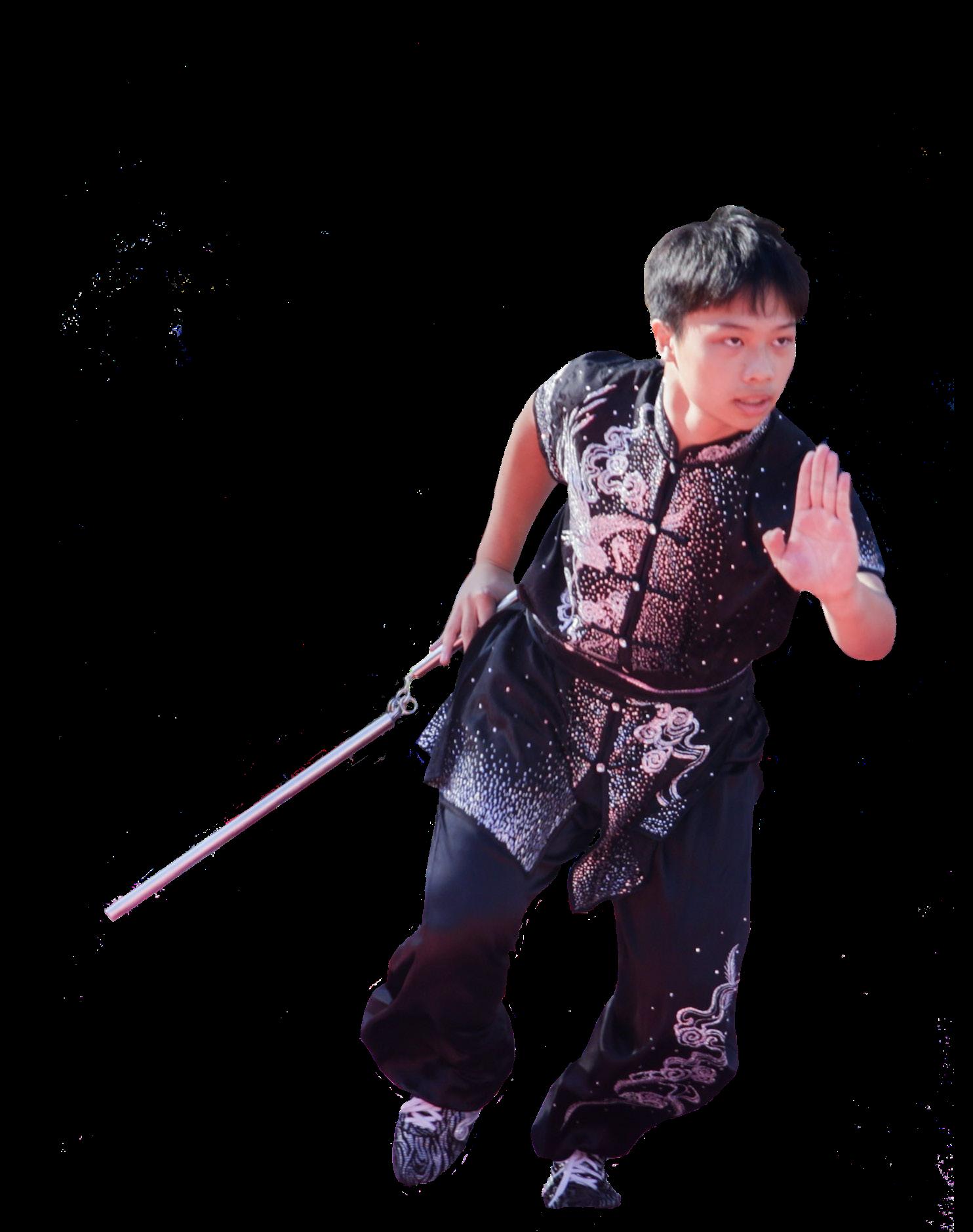
For all its tumult, this semester has been equally transformative, filled with as many firsts for our freshmen as lasts for the seniors. Our Arts & Entertainment section’s package of holiday stories reminds us to prioritize our connections, spending time with loved ones and chosen family. And as much as this can be a time of fear of failure, it’s also one of celebration — honoring our heritage through our Sports section’s coverage about kung fu, and celebrating inclusivity in our News section’s story about a vote for funding healthcare.
So, before we race toward the new year, let’s take a closer look around us. We’ve come a
Jillian Ju
Liz Liu Stella Petzova
GRISHMA JAIN
PHOTO | FIONA CHEN
NAVIGATING SOLIDARITY
A Fremont Education Associaton statement of solidarity with Palestinians sparks debate over the ethicality and implications of teachers taking a stance on controversial issues
BY STELLA PETZOVA AND KAI TSUCHIDA
A teacher source is anonymous due to potential backlash and will be referred to as Teacher A.
Excerpt from the FEA solidarity statement
History shows us that in times of deep fracture and division, educators have often been among the truth tellers. Across eras of war, oppression, and struggle for civil and human rights, courageous teachers and schools have refused to let society look away. We are living through such a moment now. Our responsibility is not only to transmit knowledge to our students each day, but to insist on the power, magic, & dignity of learning itself, especially when it is being denied so brutally to children, families, and educators in Gaza.
FEA PRESIDENT
CARLEY STAVIS
remont Education Association
President Carley Stavis released a statement addressed to FEA
members via email on Oct. 9, which reflected on the Israel-Hamas conflict and stated that the FEA — the FUHSD teachers’ union — stands in solidarity with Palestinian students and educators. In response, community members spoke at FUHSD Board meetings throughout October to discuss the statement, and some opponents of the statement sent Stavis, FUHSD administrators and FUHSD Board members hundreds of emails calling for Stavis’ resignation or a formal apology.
Carley Stavis declined to speak with El Estoque. In the statement, Stavis emphasized the importance of educational opportunities and the harmful e ects of being indi erent towards injustice. While acknowledging the controversial nature of the statement, she invited FEA members to discuss the issue further.
“In the interest of personal transparency as a leader in this system, I have wrestled with whether or how to write about this as your union president throughout the past two years — not because I question my own solidarity with Palestinians, but because I know the 500 or so of you who make up our FEA hold diverse perspectives, each of you with the right to think and feel what do,” Stavis wrote in the statement. “Some may not want to hear from me on an issue that is so charged and painful. I honor that. But I also
know that silence has consequences.”
Sophomore Ahmad Subeh, who frequently speaks at community and City Council meetings, spoke at a FUHSD Board meeting on Oct. 21 to commend Stavis for using her platform to bring attention to underprivileged and oppressed people. Subeh, who is Palestinian, says that it’s important to him to stand up for what he believes is right — something he thinks should be expected of everyone, not just those directly a ected by events like the war.
“People are silent about the genocide that is currently happening in Gaza, and it really makes me angry,” Subeh said. “And I thought, ‘Why are people not speaking up about this?’ This is happening in real time. We learn about genocides in history textbooks, and people are not doing anything. Then, I saw the FEA president send out a letter, and I thought, ‘It’s good to know that some people are actually waking up.’”
FEA representative and math teacher Kathleen McCarty says the statement “came out of left field,” since there wasn’t a union-wide vote or discussion on whether to release the statement or take a stance on the Israel-Hamas conflict. However, McCarty says Stavis probably discussed it with union executives, rather than just releasing it without consulting anybody. To McCarty, the FEA making a statement of solidarity around controversial issues is “awkward,” due to the immense
emotional charge surrounding these
Teacher A shares McCarty’s sentiment, saying that many of their conversations with colleagues following the statement’s release centered around the erasive and silencing e ect of solidarity statements made on the behalf of union members without their input or consent. As a Jewish person, Teacher A says their feelings about the war are nuanced, though they stand with Palestinians. However, they feel it is their duty as an educator to not discuss their views in the classroom to ensure all their students are treated equally.
“I don’t mean that we turn a blind eye to what is happening in the world, particularly when those things impact the community that we serve,” Teacher A said in an email response. “But I do think that my job is to serve all students, fairly and without bias. To focus on creating a welcoming and safe environment where all of my students can succeed academically. And the truth is, there are many Jewish students on our campus — and I’d imagine, throughout our district — who don’t feel safe, or even comfortable, identifying themselves as Jewish. Students who do not feel they can bring their whole selves to school each day. This is not speculation; I have heard students share this. This is heartbreaking to me.”
In addition, they believe that teachers making political statements contributes to the belief that public schools indoctrinate students, potentially eroding public trust in the union’s credibility.
Board Trustee
“ A KEY THING THAT PEOPLE HAVE TO REALIZE IS WE ALL HAVE A VOICE. WE CAN CHOOSE NOT TO USE IT, OR WE CAN CHOOSE TO USE IT.
45% of MVHS students
believe the teachers’ union should not take stances in support of or against political controversies
*According to a survey of 79 people
To Teacher A, the diction of the letter, which focused on solidarity with Palestinians, felt as though it intentionally erased alternate perspectives, leaving Jewish students, sta and families feeling unsupported.
Rosa Kim states that the Board does place restrictions on speech like this, such as through FUHSD Board Policy 4119.25. This policy states that while school employees have the right to engage in political discussion, they cannot act as representatives of the district when doing so. However, Kim points out that Stavis’ statement was on behalf of the union, not the district. Thus, there is no legal issue with it, and the controversy is unrelated to the Board and district leadership. Nevertheless, Kim says many community members came to the Board, through emails and in person, to state their concerns and ask for recourse. To her, the Board’s and Superintendent Graham Clark’s responses are emblematic of the district’s commitment to ensuring a safe learning environment for all students.
Kim explains the turmoil this caused within her, as she was powerless to resolve the issue despite wanting to help community members. Although Board members are prohibited from speaking to community members during public comments in meetings, Kim says that if she could speak to them, she would thank them for their bravery.
SOPHOMORE AHMAD SUBEH
“As a Board member, it’s my duty and my responsibility to read all the emails,” Kim said. “I feel their emotions in the email. When I hear very negative comments, I feel stressed. People have strong emotions about this, and it’s a really serious issue. Receiving so many emails is hard for the Board, but I understand how stressful this topic is for other people, too.”
The pushback against Stavis’ statement disheartens Subeh, who thinks the statement is self-evident and important in nature. While Teacher A views the lack of mention of Israeli victims in the war as a major erasure of their experiences, Subeh believes that not focusing on them doesn’t discredit the su ering of Israelis. He likens this to the Black Lives Matter versus All Lives Matter debate, arguing that focusing on one doesn’t negate the other.
Kim, along with other Board members, district leaders and Stavis, received hundreds of emails calling for Stavis’ firing and removal from her position as president of the union.
“A key thing that people have to realize is we all have a voice,” Subeh said. “We can choose not to use it, or we can choose to use it, and if we do use it, we have to make sure that we are still responsible for what we don’t speak out against. If we witness injustice, we have to take action against it.”
COOKIES, PLEASE
Deck goes here — it should be a sentence without a period BY FIRSTNAME LASTNAME
The California Opt Me Out Act is set to roll out in early 2027
COOKIES, PLEASE
BY SIH YU (MELODY) LIN AND RITIK SHENOY
The California Opt Me Out Act is set to roll out in early 2027
BY SIH YU (MELODY) LIN AND RITIK SHENOY
REJECT ALL CUSTOMIZE
Governor Gavin Newsom signed the California Opt Me Out Act (AB 556) on Wednesday, Oct. 8, requiring all internet browsers to implement features that allow Californian users to easily refuse the sharing or selling of their personal data by Feb. 2027. The act would require web browsers, such as Safari and Chrome, to include a simple, userfriendly setting called an Opt-Out Preference Signal (OOPS) that allows users to automatically communicate their privacy preferences to every website they visit, aiming to give consumers, including younger internet users, more control over their personal data where websites and companies are mandated to accept the signal as a valid opt-out response.
Under current practices, each website provides a unique method to opt out of sharing data, most commonly a pop-up for first-time users that prompts users to “Accept all,” “Reject non-essential” or “Customize my preferences” in accordance with how much information they wish to provide to the website or platform. Rather than continuing with these pop-ups, the California Opt Me Out Act provides users with a one-time way of opting out of data collection where users are able to toggle their
preferences for their browsers rather than every website they visit.
Math and AP Computer Science A teacher David Greenstein consistently opts out of data tracking on every website he visits, often resetting his cookies as well. He believes that although websites make opting out far more di cult than accepting all permissions, as each website has a di erent interface, he emphasizes the importance of opting out of unnecessary cookies and data collection.
“The interface is di erent for every website, where some websites give you an optout button to turn them o , while others you have to specifically click on all the things that you don’t want, and the list can get quite long and bothersome,” Greenstein said. “I go through my cookies every once in a while and delete them all. I know that causes some problems, such as when you
ACCEPT ALL
revisit a website, it won’t know it’s you. But frankly, I find that kind of refreshing, and every once in a while, when I go to a website after I’ve erased my cookies, it’s actually kind of nice to visit it as though it’s seeing me for the first time.”
82% of MVHS students
do not clear their cookies on a regular basis
In contrast, senior Savir Malhotra opts out of data collection based on the type of website he visits. For example, he’s more willing to share his data with websites that will use that data to personalize his experience compared to websites that may use his data to push out targeted advertisements and try to profit o of him.
*According to a survey of 100 people
“It depends on what website I’m going on, since usually for retail websites like Macy’s or Nordstrom, I definitely say no, because I don’t want to share with them what I’m looking up or have them be tracking me,” Malhotra said. “In general, if I want them to know that a certain type of content is what I like,
and I want to see more of this, I’ll be willing to accept certain permissions.”
Greenstein believes that personalization is a worthy sacrifice for data protection. He notes how he has not seen any substantial di erence in his browsing experience between opting in or out of data collection, which is why he continues to opt out of data collection.
“Occasionally, I’m confused about whether or not to opt in or opt out, because sometimes I’m on a website that I want to interact with, and I know that I’m going to have to give them certain information either way,” Greenstein said. “But I’ve actually gone to websites when I want to get information, such as buying tickets on airplanes. You would think that they need all of your cookies, but I’ve opted out, and it still serves me just fine, so I don’t see the advantage of opting in on everything.”
Similar to Greenstein, as an individual with a computer science background, senior Aarnav Agrawal believes that although there can be potential perks to more personalized
experiences, the Opt Me Out Act will simplify the process of data protection. Both Agrawal and Malhotra also agree that having an easier way to opt out of all data collection would be more beneficial because it simplifies the current process of opting out and ensures consistent data protection.
Agrawal also consistently opts out of all data tracking on websites he visits, and believes that the law would be a good improvement but its e ectiveness will heavily rely upon the user’s awareness, and thinks that passing digital privacy laws must be accompanied by teaching people how to use them in order to be successful.
law is a step in the right direction, but I think it would only be e ective if people actually know that it exists.”
Despite the potential improvements that the Opt Me Out Act will include, Agrawal, Malhotra and Greenstein all believe that it should not be the only method of e ective data protection.
SCAN FOR MORE COVERAGE
Agrawal and Greenstein both highlight the importance of educating youth on cybersecurity and online safety, and emphasize how cookiebased tracking is only one method in which user data is collected online.
“I think in the current state, the Opt Me Out Act might not do much,” Agrawal said. “Especially if there isn’t any kind of increased awareness, people won’t know much about it or won’t realize that their browser has this new setting to stop companies from tracking their data. I think the
“Obviously, this one law isn’t going to solve all data privacy issues, but it is definitely one step toward the right direction,” Agrawal said. “People need to learn to make smarter decisions instead of just clicking the button that lets these companies track all your data, and ultimately, it’s also the mix of laws like this act that would help move toward accomplishing that goal.”
WHAT IS THE CA OPT ME OUT ACT?
MEASURING MEASURE A
The tax measure aims to close funding gaps for Santa Clara County public hospitals
BY SOPHIA D’SA
Santa Clara County voters passed Measure A in the special election on Nov. 4, with 57% voting in favor. Measure A proposes a 0.625% increase in sales tax in response to the funding gap for public hospitals caused by H.R. 1, also known as the One Big Beautiful Bill, which included cuts and changes to Medicare, Medicaid and Supplemental Nutrition Assistance Program food benefits. At the county level, this means a $1 billion funding gap in healthcare alone — and Measure A is projected to partially fill this gap by raising approximately $330 million in revenue over the next five years.
Santa Clara County was particularly impacted by cuts to Medicare as the four local public hospitals — O’Connor Hospital, Santa Clara Valley Medical Center, Regional Medical Center and St. Louise Regional Hospital — all make up a safety net hospital system. Broadly speaking, this means they accept patients regardless of income or insurance, admitting a disproportionate amount of patients who are low income or uninsured. Despite only 6% of California’s hospitals being public, they provide 36% of all Medi-Cal and uninsured care, making them particularly essential to the more than 450,000 people registered for Medicaid in Santa Clara County.
Public hospitals also shoulder a disproportionate burden of acute care, with over 50% of California’s trauma and burn centers operating under the public health system. Since
barriers in preventative care also make lower income patients more likely than higher income patients to go to the emergency room, the public hospitals that serve them also take on the more expensive costs of emergency care. As a result, Danielle Mahabir, a nurse at O’Connor Hospital and area representative chair for the Registered Nurses Professional Association, supported Measure A as a way to ensure care for people from lower income brackets.
“As nurses on the board of RNPA, we decided collectively that this would be a huge benefit to our patient population, and that the benefits would drastically outpace the risks associated with the bill,” Mahabir said. “That’s when we decided to throw our full support behind Measure A and donate our time, our money and our all of our energy toward getting this measure passed, and we did it.”
Mahabir notes that the federal cuts harm not just patients, but nurses as well. According to her, Santa Clara County’s public hospitals already come close to violating their nurse-topatient ratios, which are negotiated between the nurses’ union and county to ensure adequate bandwidth to care for each patient. She says nurses often go without adequate rest periods or have to take on additional responsibilities within their teams. As a result, she and other RNPA members mobilized nurses via a leadership summit and supplied them with campaigning kits that included flyers, postcards and buttons.
While supporters backed Measure A as essential for maintaining care, Cupertino City Councilman Ray Wang argues that Measure A fails to address the county’s financial mismanagement regarding healthcare. He notes that the county has already overextended itself in recent years by buying the now public hospitals from private companies to prevent permanent closures, yet has not balanced the hospital budgets, instead allowing them to take up an outsized portion of the county budget. Coming from a background in hospital management, he says a county should spend approximately 20% of its overall budget on healthcare — in Santa Clara County, that number is 55%.
“ THEY HAVE NOT RUN THE HOSPITALS IN A PROFITABLE MANNER, LET ALONE A BREAKEVEN MANNER.
CUPERTINO CITY COUNCILMAN RAY WANG
“We centered it around the fact that as nurses, we’re really trusted in the community,” Mahabir said. “When we tell people, ‘You need to vote yes on this,’ they listen.”
someone to cut costs, but everyone’s afraid to do that, so they figured we’ll raise taxes on people and we can get away with it.”
“ YOU DON’T HAVE TO GO STRAIGHT TO CLOSING A HOSPITAL. COMMUNITIES WILL RALLY TO CARE FOR ONE ANOTHER, AND THAT IS EXACTLY WHAT SANTA CLARA COUNTY DID HERE.
RNPA AREA REPRESENTATIVE CHAIR DANIELLE MAHABIR
As all four public hospitals continue to lose money, Wang says unsustainable sta ng ratios and high salaries for supervisors are significant factors in the deficit. However, he also worries that the lack of an earmark — a specified purpose for which Measure A tax revenue will be used — could make it even more di cult to hold the county accountable for its financial decisions. Despite ultimately voting in favor of Measure A, math teacher Melinda Gaul shares Wang’s concern.
“They have not run the hospitals in a profitable manner, let alone a breakeven manner,” Wang said. “There’s a lot of hard decisions that need to be made, but it’s harder to make them if you’re owned by the county than if you’re a private entity. They made the decision because they were told they had to — because there were union jobs at stake, there was health care at stake, there was federal funding at stake. They should have appointed
“Some people were like, ‘Well, that money for the sales tax can be used for anything. They didn’t really specify exactly,’” Gaul said. “That is concerning, because we don’t know for sure if the funds will end up going to where they said they would. My hope would be that people are honest and won’t redirect the funds to other causes.”
Gaul says she understands how many residents may have voted against Measure A out of concern that as a sales tax, Measure A would be regressive, meaning it would be toughest on lower income communities, like much of the county hospital patient population. Mahabir says that while the RNPA board initially shared this concern, it ultimately decided that by protecting public healthcare, which largely serves lower income communities, Measure A is progressive rather than regressive. Even so, Wang says, rushing the
measure without earmarking funds was not the best decision.
“I think everybody felt empathy for the fact we might lose beds, we might lose care, we might lose access,” Wang said. “I think people were sympathetic to making sure that everybody got care, even if they were legal or illegal. The majority of people I talked to were just worried about the principle of actually taxation without specific allocation.”
Now that Measure A has already passed, Wang sees educating the public on the root causes of the public hospital deficits — financial mismanagement, care to undocumented immigrants and federal funding cuts, according to him — as the necessary next step. He believes that if voters want a sustainable public healthcare system, they should educate themselves on the Board of Supervisors’ role and vote for supervisors who are willing to make tough decisions — a rare find given the political nature of the job.
Meanwhile, Mahabir says she and the RNPA will continue to advocate for state legislators to earmark additional funding for the state public health system to avoid having to cut care or put further strain on nurses. Even so, she emphasizes that Measure A is a good start for the county and California as a whole.
“They really taught a lesson to any other county health and hospital system that you don’t have to take the e ects of H.R. 1 laying down,” Mahabir said. “You can fight back. You can save your community from the disastrous e ects of the Trump regime. You don’t have to go straight to closing a hospital. Communities will rise up, and they will rally to care for one another, and that is exactly what Santa Clara County did here.”
Data courtesy of the County of Santa Clara.
0.625% Measure A includes a tax increase to fund our… county public hospitals which account for…
4
55% of the county budget and care for…
465,000 80% residents on Medi-Cal, plus… of the county’s trauma cases
DIVING INTO DEEPFAKES DIVING INTO DEEPFAKES
MVHS alum ‘25 Lotus Wu shares her experience confronting deepfakes other students made of her BY
ELLIE WANG
*Trigger warning: This story mentions sexual abuse.
As MVHS alum ‘25 Lotus Wu scrolls through the Discord server, the app’s dark backdrop throws the white text in stark contrast. Message after message flashes across her screen — all paired with usernames like “rape all women,” “I f*** children at the park” and “Lotus’s Hubby.” Sexual remarks, jokes and photos pile up, and she is hit with the realization that this server was made for the sole purpose of sexualizing her.
Toward the end of her junior year, Wu was contacted by a Lynbrook High
School student, who informed her of a Discord server created about her. After she joined the server, Wu found more than 20 students sharing photos of her and making sexual comments about her body. Wu immediately took screenshots to document what she saw with the intent of pursuing disciplinary action. By the end, she had more than 70 screenshots. Later, the student who alerted her also claimed that some members had created or circulated deepfakes and AI-generated nudes of her.
SCAN FOR MORE COVERAGE
Initially, Wu was hesitant to confront her parents about what she had found out, afraid that they would demand she take her Instagram account down and steer away from all social media. Although Wu herself had also considered taking down her social media accounts or taking more serious protective measures, she ultimately decided against it.
“I don’t know how much more I can do,” Wu said. “I don’t want to not be on social media just because of the fear of having AI deepfakes made of
GRAPHIC | ELLIE WANG
me. But I feel like nowadays, it’s a little unavoidable.”
With rapid advancements in generative AI, deepfake content has become more widespread, identified as a major global risk by the World Economic Forum in 2024. People are now encountering more and more AIgenerated images replicating the likeness of others, which primarily target teenage girls. A report by Thorn, a child safety nonprofit, found that 2% of surveyed youth created deepfakes. Among them, 74% targeted women and more than 30% depicted minors. Over half were shared with peers.
“
“ I DON’T WANT TO NOT BE ON SOCIAL MEDIA JUST BECAUSE OF THE FEAR OF HAVING DEEPFAKES MADE OF ME.
considered under Title IX or under the sexual harassment policy. They are severe and would absolutely be addressed immediately, and because those terms are also within the penal code, the district response would be to work alongside law enforcement as well.”
hard to give people detention or suspensions because it’s finals season and it would just be very complicated. But I didn’t feel like I received justice. There were barely any repercussions or punishment toward them, so I felt it was really unfair.”
School districts across the country are increasingly facing cases involving sexual deepfakes made of students. Recently, the Beverly Hills Unified School District in California expelled five middle school students for creating and circulating explicit deepfakes of female classmates. Deepfake victims in Laguna Beach High School report feeling that responses from their administrative board were insu cient.
California law guarantees all students an education free from discrimination and harassment, regardless of gender or sexual orientation, and requires each district to appoint a Title IX coordinator. In FUHSD, Title IX cases are handled by the Director of Education and Title IX Coordinator Trudy Gross, who says that determining whether a situation qualifies as a Title IX case can sometimes be di cult.
“If a circumstance is simply persistent or pervasive, then it might mean corrective action will not occur immediately and that further investigation will be needed,” Gross said. “But something like sexual assault, sexual battery and rape are the types of situations that would be
MVHS ALUM ‘25
Gross says that each case can be evaluated based on how often incidents occur, whether they involve one or multiple o enders, if the incidents di er from person to person and the extent to which the situation disrupts a student’s education. However, according to Gross, the California Education Code specifies that a school’s jurisdiction extends only to conduct occurring during school hours or that directly a ects a student’s ability to learn. Incidents that occur entirely online or o -campus are often di cult to determine whether they fall under the school’s responsibility to address.
Before eventually deciding to inform her parents about what she discovered, Wu emailed the evidence to Vice Principal Mike White and later met with him in person to explain the situation. Wu said she would have preferred more transparency throughout the process, but White notified her that he had reached out to LHS’ principal.
LOTUS WU 92%
Later, Wu received a call from the Santa Clara County Sheri ’s O ce, which contacted her after LHS reported the incident and o ered to investigate further. At the time, Wu said she was still unaware of the alleged deepfakes, and because the server had already been forcefully taken down by the school district, she and her family thought it was unnecessary to open a case. She notes that had she known about the alleged deepfakes — or learned of the situation earlier in the school year — she likely would have filed a report herself or pursued legal action.
“At that point, it was already the end of my junior year, and I was just so burnt out,” Wu said. “I was so drained and didn’t have time to really process it. In senior year, I was busy with college applications, and by the second semester, the incident just seemed so far away — there wasn’t really a point anymore.”
92% of MVHS students think AI deepfakes can be harmful/dangerous
*according to a survey of 169 people
“At least 20 boys were involved in this, but only two of them got in trouble, and they only got a one-day suspension,” Wu said. “I know that, because it’s the end of the year, it’s
According to School Resource O cer Aalok Patel, a deputy sheri with the SCC Sheri ’s O ce, if the department had been notified of the alleged deepfakes, they would have opened a case themselves, as both the possession and distribution of child pornography is illegal. Patel noted that while the FUHSD has not made any new concrete procedures and consequences for cases regarding AI deepfakes, he says that the process is handled similarly to cases involving online harassment, with the first step being an investigation rather than immediate disciplinary action.
“For law enforcement to make
“For law enforcement to make an actual arrest, we need cause,” Patel said. “Witnesses are very important. With witnesses, even though there’s no physical evidence of a crime, we have probable cause to believe something did occur. We will take the perpetrator’s phone and do some forensic search of the photo to try to locate it. And if they do something inappropriate? Well, not just us police o cers but also the FBI will do, hopefully, whatever we can to locate those images and take them o the internet.”
Patel explains that deepfake technology is still new enough that FUHSD has not yet developed procedures specifically tailored to them. In the cases he has addressed so far, which were less severe than Wu’s, he followed the standard Title IX process, which includes giving the perpetrator situationspecific education and warnings. He emphasizes that when misused, deepfakes can rise to the level of an arrestable o ense and felony. Although FUHSD has not yet adapted to deepfakes, California has
taken actions to protect students. Patel mentions the two of the first state laws passed to prevent the misuse of AI replicating people’s likeness are Assembly Bills 2602 and 1836. A larger measure, Senate Bill 942 — the California AI Transparency Act. Most recently, on Oct. 13, 2025, Governor Gavin Newsom signed AB 853, which updates the AI Transparency Act by creating new obligations for AI-hosting platforms and device manufacturers to clearly label AI features and raise technical safeguards.
Gross says that disciplinary action for cases falling under Title IX also depends on the circumstances. Sometimes, the district provides counseling for both parties, allowing them to reconcile. Other times, the district recognizes that the victim may not want any contact with the perpetrator and prioritizes keeping them separated, making it the perpetrator’s responsibility to avoid the victim on school grounds by assigning specific routes to the perpetrator around campus.
“The district wants to learn di erent ways to interact,” Gross said.
“We don’t just want to suspend and move on because we want this to not happen again — not only to the victim but to anybody. So a lot of what we try to do is restorative, where we’re trying to create new behavior patterns so that this doesn’t repeat again.”
Ultimately, Wu expresses gratitude for the support she received from friends, a trusted teacher and her parents during the remainder of high school. However, although she believes that the timing of the incident happening during a busy period of finals and college applications helped lessen its immediate impact, her experience still a ected how she now views social media and online safety.
“I saw pictures of them,” Wu said. “Those kids do not look like they would do anything wrong. But the development of AI and this whole thing with deepfakes is really scary, and I’ve heard of people in our school who have been a ected by it. Make sure you’re double-checking your social media — and if you hear anything bad about someone, immediately block them. Take extra steps with cybersecurity.”
GRAPHICS| BENJAMIN ZHANG
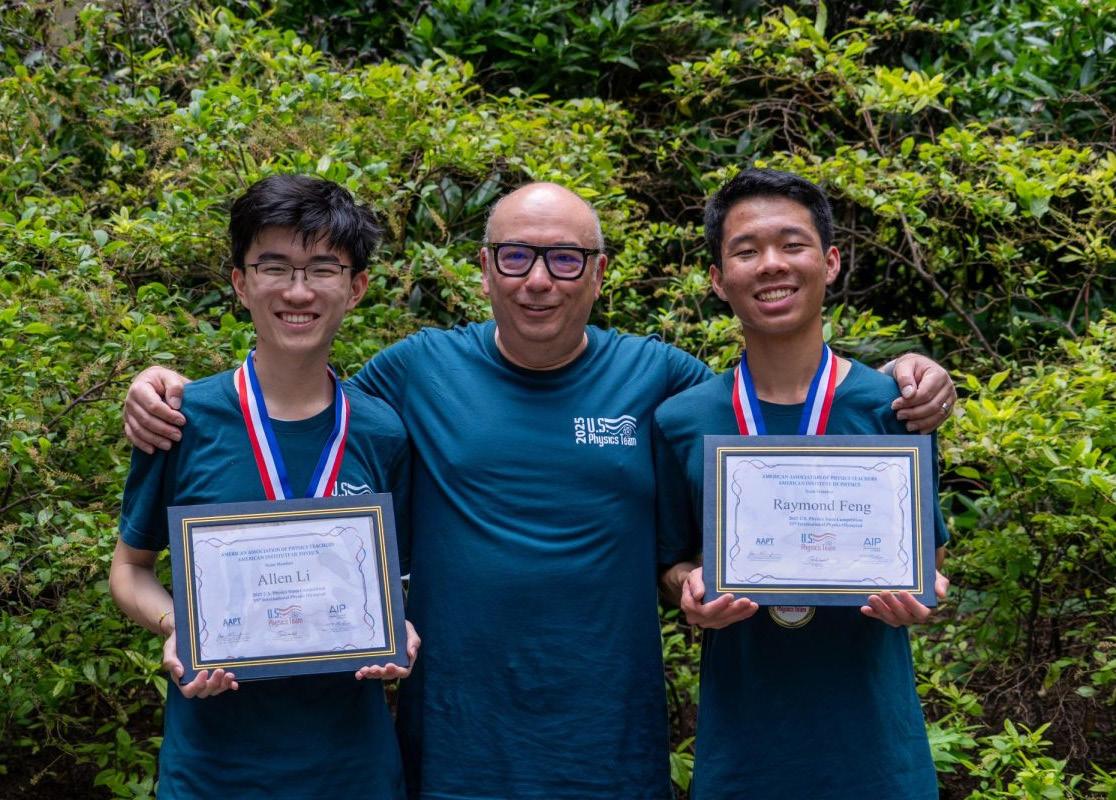
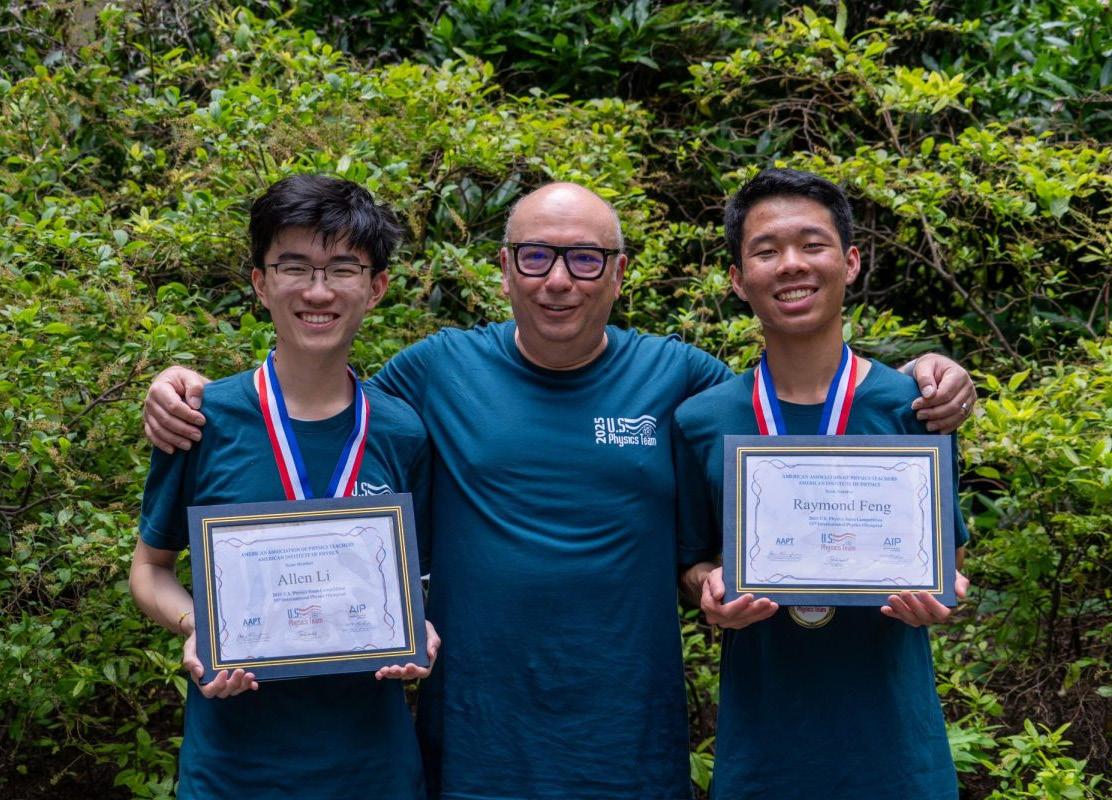
Li poses with Bibilashvili and Feng, celebrating their positions on the 2025 U.S. Physics Team.
PHOTO COURTESY OF RAYMOND FENG | USED WITH PERSMISSION
BY ANISH KHINVASARA
As a child, MVHS alum ‘18 Gautam Ajjarapu dreamed of standing on stage, giving his million-dollar elevator pitch on Shark Tank. Years later, he finds himself in New York City, part of a wave of MVHS alumni tech entrepreneurs. Driven by ambition, these alumni aspire to make a significant impact in the tech industry.
Ajjarapu is the cofounder and CEO of Glide AI, a financial technology startup that helps banks and credit unions automate their backo ce operations. Glide AI recently announced raising $15 million in Series A funding, the first major round of venture capital used to help a startup scale its product and operations. Ajjarapu attributes his success partly to the skills he gained from his four years in MVHS DECA.
Ajjarapu also learned about the mindset of an entrepreneur through DECA, helping him better understand what was required to achieve business success.
“There were these late nights at conferences, staying up to one, two in the morning, working on the slide deck, making sure every square, font and color all look right and just being a perfectionist,” Ajjarapu said. “That’s an attitude I learned and by default, I’ve practiced since then.”
“ I NEVER THOUGHT, ‘HEY, HOW CAN I OUTSOURCE THIS TO SOMEONE ELSE?’ THE WAY I WAS TRAINED WAS, ‘HOW CAN I CODE THIS MYSELF?’
CO-FOUNDER
OF GLIDE
GAUTAM AJJARAPU
“One of the games that we used to play in DECA was speech baseball,” Ajjarapu said. “We would get three random terms, and we were given 10 seconds to prep, and then we had to give a presentation in front of everybody. There’s just something about being in front of all these smart people that brings the best out of you, because you don’t want to embarrass yourself.”
MVHS alum ‘14 Matt Cheung, founder of Ceviche, a financial technology startup that helps automate private equity firm operations, also credits DECA with giving him a peek into the entrepreneurial world. Cheung had also played varsity tennis for all four years of high school, which he believes taught him the work ethic that led the way to his entrepreneurial dreams. Specifically, competitive sports provided him discipline, enabling him to maintain focus on a single area over long periods of time.
Ajjarapu believes there are two key skills to being an entrepreneur in the technology industry. The first is the
PHOTO COURTESY OF GAUTAM AJJARAPU | USED WITH PERMISSION
MVHS alum ‘18 Gautam Ajjarapu, CoFounder and CEO of Glide.
technical aspect, where individuals have to be able to build things themselves and quickly develop new skills. The second key skill is the storytelling aspect. It’s the ability to pitch a small idea to something much bigger to capture attention. He believes that clubs like DECA and Speech and Debate hone in on those specific skills.
“Many entrepreneurs have an idea, and then they bring in technical people to build the product for them,” Ajjarapu said. “That doesn’t work in today’s world. Founders must be immensely close to the product for it to be successful. I never thought, ‘Hey, how can I outsource this to someone else?’ The way I was trained was, ‘How can I code this myself?’”
MVHS alum ‘09 Vrinda Gupta, the CEO and co-founder of Sequin AI, had spent the bulk of her career maintaining focus in the financial technology sector. Sequin AI is the second iteration of her company and is a part of the Y Combinator’s Summer 2021 batch, a startup accelerator
ALUMNI ENT
MVHS alumni describe their experiences in building tech startups
program and venture capital firm. She began her career at VISA, where she developed popular credit cards and collaborated with numerous financial institutions.
“I realized that banking and financial services are really core to our day-to-day lives,” Gupta said. “But there are many parts that are pretty expensive and hard to personalize at that scale and that’s what AI helps with.”
Gupta later founded multiple companies in that sector. She was named Top 10 Women To Watch in Fintech, WIN Innovator of the Year and 55 Most Inspiring Fintech Women. She traces her success back to the work ethic she built during her time at MVHS. This allows her to take work head-on, an aspect she loves about being an entrepreneur. While
Gupta acknowledges the importance of the work ethic fostered in MVHS’s environment, Ajjarapu highlights the unique set of specialized skills and opportunities that students have in MVHS due to it being located in Silicon Valley.
“I think people are becoming real specialists in their craft, and they can improve at their kind of specific things as quickly as a lot of the startups are in the Bay Area,” Ajjarapu said. “So I think there are many opportunities for students, for example, interning at a Silicon Valley startup.”
“ THERE’S NO BETTER TIME THAN RIGHT NOW TO FOUND A COMPANY. CO-FOUNDER OF SEQUIN VIRINDA GUPTA
Even within the environment of opportunities, the path to entrepreneurship wasn’t straightforward for Cheung and Gupta. They initially struggled to envision themselves as entrepreneurs, due to a lack of representation in their respective fields at that time.
“I’m a female and a first-generation immigrant, and I didn’t see any founders who looked like me, despite us being in the land of Steve Jobs,” Gupta said. “I respect Steve Jobs so much as an entrepreneur, but I didn’t necessarily see myself in him.”
Similarly, Cheung’s dreams of founding a company emerged later in college. He felt that he needed to see what was possible by his MVHS alumni peers, to see himself as the entrepreneur he is now.
“When I was in high school, I didn’t actually think I was going to start my own company after graduating,” Cheung said. “The ambition definitely
stemmed more so in college. Seeing a lot of the other MVHS students starting their own companies definitely was a pushing factor.”
Many of the friends Ajjarapu made at MVHS remain his closest friends today. Whenever he returns to San Francisco, he enjoys spending time with the many MVHS alumni whom he feels are achieving amazing things and whose connections can be invaluable in the startup world.
“It’s essential to have a founding team or a co-founder,” Cheung said. “Startups are a long journey and are very stressful. It’s always helpful to have a strong co-founder who balances your skill set. Stay in touch with close friends, smart friends and always be experimenting with new projects.”
Cheung also emphasizes that working consistently and making some progress every day is key to finding the right product-market fit. Similarly, Gupta emphasizes that having momentum in a startup is crucial.
“There’s no better time than right now to found a company,” Gupta said. “Don’t overthink it. It doesn’t have to be anything fancy or require technical skills. There are so many tools out there to get you some validation around anything you’re passionate about that you think should exist in the world. There’s no need to wait.”
REPRENEURS
MVHS alum ‘14 Matt Cheung, CoFounder and CEO of Ceviche.
MVHS alum ‘09 Vrinda Gupta, CoFounder and CEO of Sequin AI.
PHOTO COURTESY OF MATT CHEUNG | USED WITH PERMISSION
PHOTO COURTESY OF VRINDA GUPTA | USED WITH PERMISSION
OUTSIDE THE LINES COLORI NG
MVHS students with red-green color blindness explain how they see the world
BY CORINNA KUO AND ANGELA POON
When a person with normal color vision sees Van Gogh’s 1888 painting “Roulin’s Baby,” they see it as a light green-skinned baby with clothes of the same color that almost blend into the background. But senior David Settles sees the painting the way Van Gogh intended — a baby with pale skin wearing white clothes against a green background.
Like Van Gogh, Settles has a form of red-green color blindness, or deuteranomaly, which is the most common. For people with deuteranomaly, shades of red and green look more similar to other colors, causing them to be di to di
grandfather is also color blind, Settles says his mother always knew there was a chance of him being color blind as well. This was later confirmed after she gave him an Ishihara test, or color blind dot test.
Sophomore Vihaan Srivastava, who is also red-green color blind, sees some shades of green as closer to yellow and finds dark reds and greens di cult to distinguish. He believes improved color blind accessibility can be achieved through increased contrast, such as using brighter reds and lighter greens.
Both Srivastava and Settles say they do not usually mention being color blind to other people unless they need accommodations in classes or others ask. According to Settles, like many people with hidden disabilities, he stays quiet as a way
to protect himself from bullying and discrimination.
“I’m not going around saying, ‘Hello, here I am. I’m Mr. Colorblind, nice to meet you,’” Settles said. “I’ve had issues with it, because people are a-------. In Florida, when I mentioned I was color blind, people proceeded to make fun of and point at me, which has happened here, too. People will still point at a black shirt and say, ‘Hey, what color is this,’ knowing full well
doesn’t affect my dayto-day life in a super noticeable or significant way.” Steve Antony, a
green color blind has given him a di erent relationship
COLORVISION
books, he likes to think intentionally and abstractly about how he uses color, focusing on patterns, shapes and emotions rather than the “correct” color. Often, in books like his Mr. Panda series, he makes sure to include animals that are typically black and white, like pandas and skunks, and choose a select few other colors to keep consistent throughout the series.
He says that many things in the world often revolve around red and green — for example, when he took part in a first aid training course and had to practice CPR on a dummy, where, if he was doing his compressions correctly, a light would turn from red to green. However, he had to ask someone else to tell him when the light changed.
44% of MVHS students know
somebody who has color blindness
graphs and doing chemistry labs, can be frustrating for him. Graphs that use similar or low-contrast colors and labs with color-changing reactions can often be inaccessible to those with color blindness. In contrast, he commends certain game developers for their color-blindness awareness, such as for Wordle and Hades. These subtle adjustments not only make products easier and more enjoyable to use, but also ultimately increase the quality of life for those with color blindness.
*According to a survey of 100 people
Unlike Settles, Antony enjoys talking about color blindness when he visits schools to spread awareness. Since color blindness is no longer being screened for in UK schools, many colorblind children are most likely undiagnosed. On a more national scale, he worked with Colour Blind Awareness to launch a campaign in 2022, encouraging children to redesign the Queen’s hat through coloring sheets. They then used an app called Color Vision Simulator to show viewers what their images would look like in normal vision and color blind vision. Antony hopes it raised awareness and inspired teachers to do some research into color blindness.
“I always tell people with color blindness that you can do almost anything that anybody else can do, even if you have to do it a bit di erently, and to know that sometimes what you might perceive to be a limitation might actually become your strength in some way,” Antony said. “It might be the thing that drives you and allows you to kind of do things a bit erently. But actually, in doing that, you’re actually showing other people that there are other ways that you can see and experience the world, because we all experience the world
NOT JUST for THE STUDENTS
What MVHS teachers do to take care of their emotional health
REPORTING AND GRAPHICS BY ALEXANDRA PERRAULT
Dasha Plaza
P.E. teacher
“Since I was young, I was introduced to meditation. I’m also a dancer, and my release of any negative emotions or feelings has always been through the form of dance. My focus shifts from my mind and into my body, and it takes away that feeling of frustration.”
SCAN FOR MORE COVERAGE
POOYA HAJJARIAN
BIOLOGY TEACHER
“I think meditation has helped me a lot. I’ve noticed that stress doesn’t get to me the same way that it used to. I want to make sure that I’m at my best for all of my students because it’s not fair to that 20th or 30th kid who’s coming up to me with a request at that point to get a negative response from me.”
DOREEN BONDE
WELLNESS SUPPORT SPECIALIST
“I went back to school to earn my MA in Health Education, and through that program I explored both Western and integrative medical approaches. I draw on a wide range of practices, including meditation, yoga, movement, breathwork and
GRATITUDE FIRST
Tlhe average American says “thank you” six times a day. Yet despite its prevalence within our vocabulary, its use cases are specific and limited. “Thank you” is used when someone holds the door for you, when something goes well, at the Thanksgiving table with your extended family when asked what you’re grateful for this year. “Thank you” is reactive and bounded, and therefore, our limited displays of gratitude follow suit.
rethink how we approach joy and gratitude. Gratitude shouldn’t be just a passive response; it should be an active practice to sustain and build joy. Social psychologist Barbara Fredrickson coined the 3-to-1 positivity ratio, explaining that for every negative emotion one experiences, we need three positive experiences to thrive.
Counteracting this requires flipping our positivity ratio and focusing on increasing the positive numerator over negating the denominator. Gratitude is one of the simplest ways to introduce positivity within our lives and can help us regulate our anxiety responses. Studies have found that people who participate in gratitude practices, like gratitude journaling, are happier and emotionally stronger than those who don’t. Gratitude encourages focusing on positive emotions over negative ones that inhibit our daily lives. By consciously practicing gratitude, we act as “joy soldiers,” coined by Wood in her TEDx Talk. Joy soldiers spread joy within their circles through deliberate gratitude. Gratitude visits, like writing a thank you letter to someone and delivering it to them, have been found to increase levels of happiness and purpose, as well
When approaching gratitude, we must be relational. Wood views gratitude through two lenses: connection and reflection. Building joy arises from being a good listener, while also reflecting and building internal self-awareness. Here, Wood pinpoints the di erence between happiness and joy — happiness is external, joy is built within.
As humans, we su er a negativity bias, where our minds are conditioned to focus on negative stimuli over positive stimuli. In turn, the positivity we experience is filtered through a We need to actively practice gratitude in order to build a community that celebrates joy as improve relationships. Practicing gratitude also fosters a larger culture of kindness and recognition.
THOUGH THANKSGIVING IS OVER, GRATITUDE DOESN’T HAVE TO END WITH IT.
Considering our student body’s financial privilege, practicing gratitude to build joy may feel dismissive when others face more severe struggles. But to consciously apply gratitude doesn’t sugarcoat struggle; it establishes resilience and kindness even if a “thank you” isn’t required. Though Thanksgiving is over, gratitude doesn’t have to end with it. We can be more conscious of thankfulness in order to develop a community that celebrates it. It’s easy to get lost in MVHS’ hustle culture. But by actively seeking out joy, we set ourselves up for a future as emotionally stronger adults who are flourishing.
It doesn’t have to be big — gratitude journaling, writing down three things you’re grateful for or a thank you note all set you up as a joy soldier. Within your community, try having appreciation moments and reflection sessions with those you care about. By treating gratitude as a commitment to joy, we establish a society that builds joy together. “Thank you” doesn’t have to be a reflex; it can be a tool to move past negativity and forge joy.
STUDYFIRST,SCROLLLATER
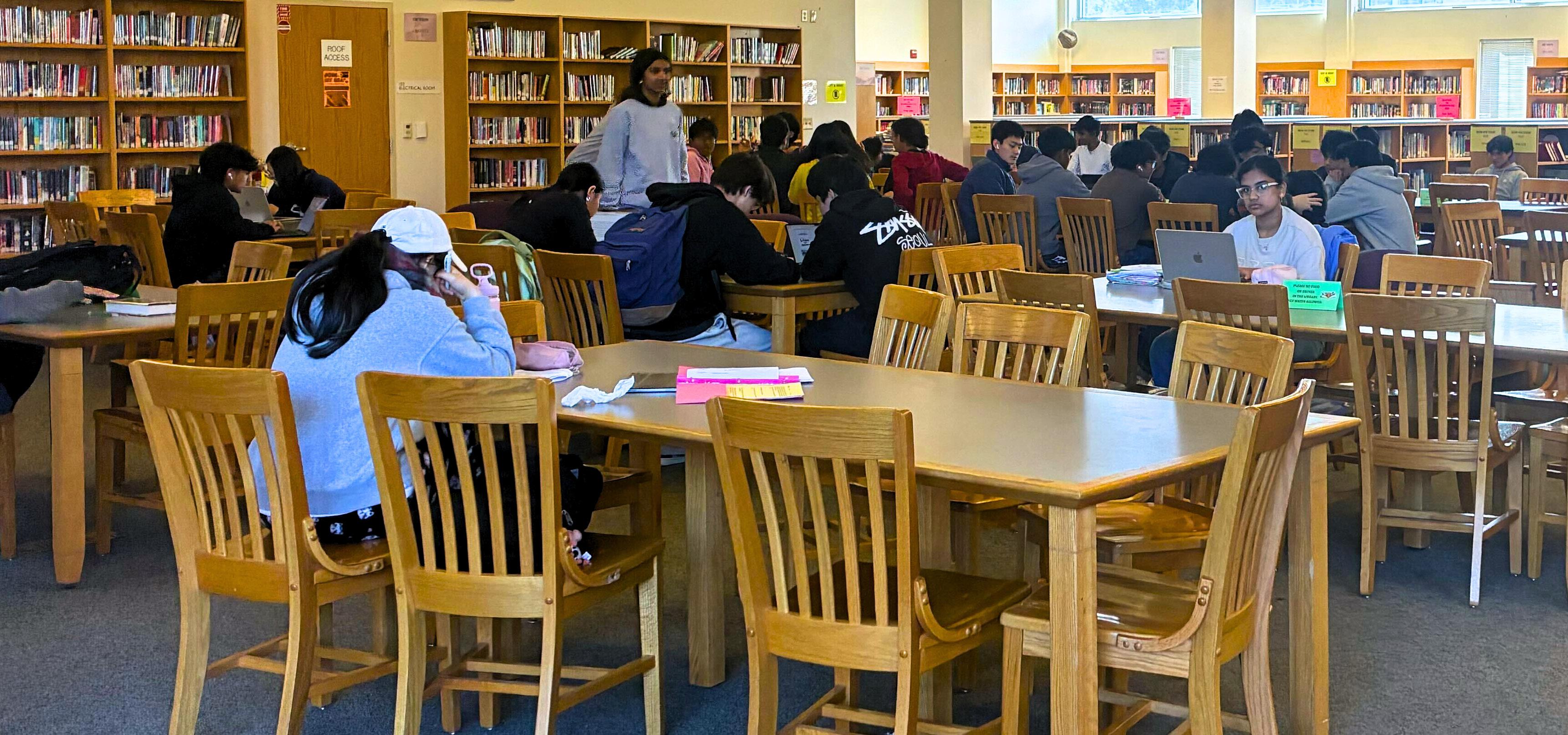
After the new check-in system was put into place, the library environment has become more study-oriented.
MVHS students and librarians discuss how the library check in system changed its environment
BY RAFAELLA VENTO AND ASHA WOJCIECHOWSKI
Since his freshman year, senior Tanay Kumar has been a regular visitor to the library, attending almost three times a week during tutorial to work on homework with friends. He had never thought much of using his phone occasionally to check messages or take photos to submit on Schoology — but this year, on a routine visit to the library, Kumar was caught by surprise.
“I pulled out my phone to check some of the assignments, because my laptop had died, and then one of the librarians just came and said, ‘Hey, you’re not allowed to use your phones. You have to keep that away,’” Kumar said. “That was kind of just jarring to me, since I haven’t really seen much surveillance to that extent in the library before.”
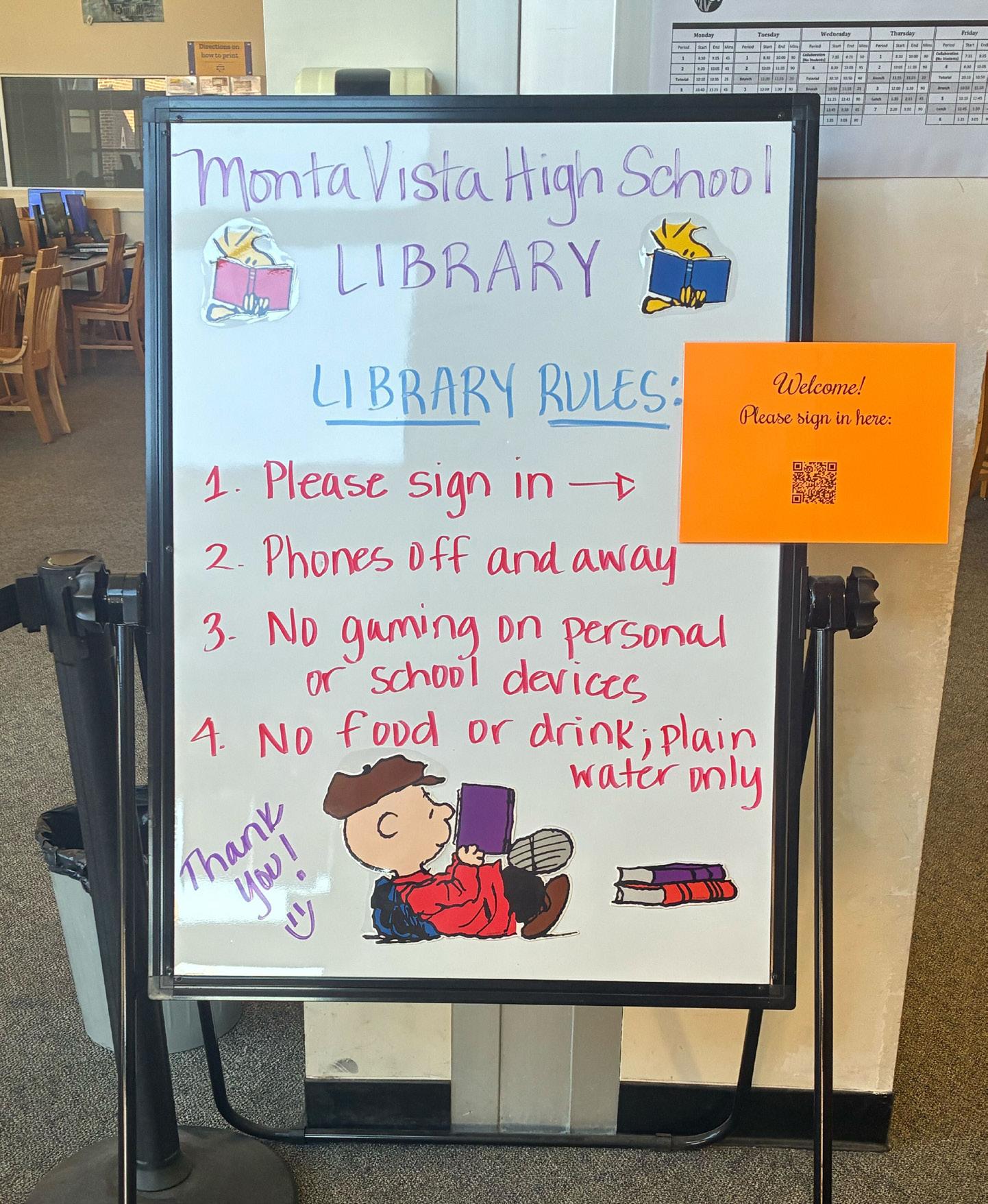
Following the passing of the PhoneFree Schools Act and MVHS’s new ‘o and away’ policy, at the beginning of the school year, the library instated a new sign-in system at entry, where students can scan a QR code or use
an available device to fill out a form. The form features questions, including the reason for library use, open periods and agreements to keep cell phones o and away. It also includes agreements not to bring in food or drinks, and not to game or misuse library desktop computers. This is in addition to the tickets that are distributed during times of higher occupancy, such as rainy days and tutorials, to reduce the time required to sign in.
Teacher
and increasing noise and crowding when students gather to play video games or use phones to socialize.
49%
of MVHS students
“We want this space designated for quiet study and collaboration,” Pangelina said. “For years we’ve noticed issues, and with the phone policy, it made sense to implement a policy and a check-in to shift this space back to what it should be like.”
no longer go to the library since the check-in system was added
*According to a survey of 98 people
Librarian Laura Utile and Library Media Specialist Maria Pangelina said that phones have long posed an issue in the Library, distracting students seeking to get work done
Beyond just making the library a more academic space, the librarians highlighted that the stricter system was also put in place as a response to data relating worse mental health in teens with phone usage in schools.
“The library under our supervision
is dedicated to making sure students are healthy and have a focus on what they should be doing in school,” Utile said. “To support their mental wellness, we believe that limiting their access is beneficial.”
Since implementing the new system and limiting occupancy, Utile and Pangelina said that they have noticed a marked positive di erence in the library environment, highlighting that the issues of overcrowding, volume and device misuse are notably lessened, alongside fewer problems with trash and ants. However, Kumar points out a di erent perspective on the change in the library environment.
“It feels more controlled,” Kumar said. “I feel like the library used to be a lot more of an open place for people to come and study or write essays as they please. But now it feels almost like a study hall place where you have to go and sign in and just do a specific task and leave.”
He also mentions that the signin system has discouraged him and others from using the library, calling it over-the-top. According to Kumar, since more restrictions were placed on how many students could come in at a time, people who used to go to the library are going less often.
Kumar says he understands this shift to enforcing academic focus, especially during tutorial times and to minimize volume and distractions. However, he still believes that students should be given more trust to self-regulate their phone usage while studying.
“I feel like, as high schoolers, we can have our own autonomy in terms of choosing when we need to use our phone versus when we’re studying,” Kumar said. “Some people would study for an hour, and look at their phone for five minutes, and that’s fine.”
He also pointed out that having to fill in a check-in form with questions like “reason for library use” and asking for students’ open periods can feel invasive at times. However, Utile clarified that the question asking for “reason for library use” is there as
a way to fulfill a requirement for the school’s WASC accreditation next year. This provides data to know where to make improvements, such as adding charging stations in the library to provide for the continuous improvements, called for by WASC’s Standard A4. Utile further adds that in an emergency situation, knowing who is in the library at a given time is important.
Utile and Pangelina acknowledge student reactions like Kumar’s, but Utile maintains that the policy is a net positive. According to her, the policy is simply an extension of existing
guidelines for library etiquette.“Some students are not happy with the policy, or may feel they are getting something taken away from them,” Utile said. “But we’re making an atmosphere for students to do what they really need to focus on in the library: studying. We’re not taking the right to use the phone. If a student needs to do it, they can also use the Student Union instead. It’s always been a policy and an expectation not to use the cellphone in the library.”
BPILLED LACK
The manosphere is increasingly encouraging hypermasculine and misogynistic behavior in young men
BY SUHANA MAHABAL AND ELLIE WANG
In recent years, the manosphere — a community of online networks promoting hypermasculinity, antifeminism and rigid traditional gender roles — has surged into the spotlight in social media. Platforms like TikTok, YouTube, Instagram and podcasting platforms like Spotify and Apple Podcasts, have especially helped the manosphere become more mainstream, pumping out endless loops of black pill edits and podcasts pushing alpha male monologues from prominent figures like Andrew Tate and Joe Rogan.
School psychologist Glenn Fisher attributes this rise partly to today’s increasingly right-wing political climate. However, he also believes that this issue stems from deep historical roots of gender roles — which were
never completely overcome.
“It’s how we’ve seen ourselves as Americans, which probably predates the 60s and 70s, going back to 50s and 40s and beyond that, where roles were very well defined,” Fisher said. “Men are one way and women are the other way — and men do this and women do that. The government wants to pigeonhole people because it’s easier to control people that way.”
While the origin of the manosphere can be traced back to the Men’s Liberation Movement in the 60s and 70s, it is now primarily seen through online networks and groups such as Men’s Rights Activists, Men Going Their Own Way and Pick Up Artists. Through short-form content, podcasts and even songs, these groups work to fan the flame in each other and
hope to influence young boys to join their cause. For example, MGTOW believes that society is rigged against them and aims to change the course of politics to further benefit them over women, while PUA are built on hypermasculinity and see “picking up” women as a game with strategies and techniques.
Fisher explains that when boys grow up conditioned to believe they can’t show vulnerability, they often struggle to form close friendships or talk honestly about their struggles. Over time, that has contributed to what some may call the “male loneliness epidemic,” where men feel isolated from others yet don’t know how to or are discouraged from seeking support. However, though the epidemic focuses on the exclusive loneliness
of men, it is actually a growing issue that impacts all Americans by fueling resentment between genders and di erent ideologies. By framing the manosphere and its result of isolation as things that only impact men, we diminish the true extent of its harm.
For women, the e ects of the manosphere look di erent but are just as serious. Many manosphere spaces promote the reductive idea that women exist to be controlled, judged and ranked. This often escalates into physical violence, harassment and threats — especially toward female creators who speak out or challenge these beliefs, turning sexism into a normal part of life. As the manosphere continues to push more intensely for extreme misogyny, it will continue to fester outside of social media and seep into physical violence toward women and further define America’s political standings. This was seen as early as 2018, where a self-proclaimed incel — short for involuntary celibate, another online manosphere group — killed 11 people due to his hatred for women.
The habit of closing oneself o , objectifying women and resorting to violence is an easy habit to pick up.
THE MANOSPHERE RESTRICTS MEN’S EMOTIONAL LIVES, NARROWING THEIR FUTURES AND PRESSURING THEM INTO HYPERMASCULINE ROLES.
The rapid growth of both critics and supporters of the manosphere is a reminder that the patriarchy harms everyone, not just women. As Fisher points out, it restricts men’s emotional lives, narrowing their futures and pressuring them into hypermasculine roles that are often unattainable and unhealthy. Similarly, it reveals how feminism is not an attack toward men but rather a movement that hopes to benefit everyone. Though it is often mischaracterized in manosphere spaces — seen as the primary cause of the male loneliness epidemic and misandry — ultimately, its goal is grounded in building equity and community across all genders.
in discovering for yourself. The e ect also changes within the U.S. based on region and even culture. If you live in a more educated metropolitan area, your understanding of the world is broader than living in a small town in the Midwest — which is someplace where everyone’s experienced and learned the same thing — and if that message is to be hypermasculine, then that’s all you know. So for them, the manosphere is just reinforcing what they’ve already been taught or observed.”
We need to take this cultural shift — or rather, regression — seriously. Social media algorithms will continue to amplify these messages that prey on insecurity to garner profit, so viewers have the responsibility to use critical thinking to recognize narratives that ultimately help no one.
Even people who don’t follow manosphere creators are not removed from their influence. This ideology may also show up subtly in casual jokes insulting feminism or TikToks romanticizing controlling behavior. Netflix’s hit series “Adolescence,” a show that critiques the encouragement of hypermasculinity and independence in young boys, is a clear manifestation of the manosphere’s gaining popularity, displayed through its criticism of black pill ideology as well as the backlash it’s received from many male viewers, who feel misrepresented by the show’s commentary. These ideas influence all genders and contribute to a school climate where gender stereotypes are harmfully reinforced.
But why do boys latch onto the manosphere when it condemns their insecurities, undermines their emotions and encourages division among genders?
52% of MVHS students
According to Fisher, this vulnerability gap is why many young boys find the manosphere so enticing. For boys looking for belonging, the manosphere and its ideas can feel reassuring.
are worried about their siblings encountering the manosphere
*According to a survey of 56 people
“Especially if you’re at the adolescent age, one of the challenges of students is really finding out who you are and what path you’re going to take,” Fisher said. “And when someone gives you easy answers, it’s like, ‘Oh, OK, that’s who I am,’ as opposed to doing the deeper work
Our challenge — not just as students trying to create a safer school environment but also as members of a society — is to hold ourselves and our peers accountable in the face of social media brainwashing. However, acknowledging and resolving the harmful impacts of the manosphere shouldn’t be done by demonizing boys or policing what students watch online. When discussing the underlying issues, we must tackle them not through us versus them arguments or sweeping generalizations, but through communal e orts to prioritize empathy and communication. These honest conversations are the first step to finally diminishing a societal structure which divides genders and restricts emotional expression.
let’s talk about
Breaking the silence around suicide is a necessary step in creating a safer environment
BY LIZ LIU AND SANIA NADKARNI
*Trigger warning: This story contains mentions of suicide.
A small slip of paper sits on the corner of Palo Alto resident and parent Mare Lucas’ desk. The handwriting is uneven and messy — it belongs to a student, thanking Lucas for speaking up about mental health at a school board meeting. Eight years after losing her son to suicide, the fight to protect other students has not gotten easier, but the note reminds her why her work is important.
Although students at MVHS and other Bay Area schools often discuss academic pressure, they rarely discuss the toll this pressure takes on their mental health. Gunn High School alum ‘25 Kiyon Zebarjadi, who both saw and experienced these impacts at GHS, says this issue and the consequences are rarely talked about in-depth.
“There’s a stigma about using the resources available for mental health,” Zebarjadi said. “I honestly think it
comes from a lack of understanding. Personally, I only really became comfortable talking about mental health after I myself had started going to therapy for depression and anxiety.”
However, Lucas says the stigma surrounding mental health discussions extend to parents and families as well.
According to a survey conducted by Gallup between March 13 to 20 in 2024, 92% of Gen Z children said it was helpful when their parents talked to them about their mental health.
“When my son was going through some really, really challenging and hard times, I was afraid to let people know what was going on because I thought that they wouldn’t let their kid play with his younger brother,” Lucas said. “People tend to judge families of people who have family members with behavioral health problems. I was very afraid of the impact of people knowing and how that might a ect my younger son.”
Lucas does have more hope for
younger generations as she believes talking about mental health has become slightly more normalized. She believes conversations about mental health are crucial, which is why she herself has been so open about her son’s death, as she believes that not talking about incidents like this sends the message that mental health emergencies should be kept secret. Palo Alto High School junior and Bring Change to Mind member Dylan Wilson agrees with Lucas that dialogue is necessary and has noticed the impacts of a lack of conversations surrounding mental health resources.
“No one is gonna say, ‘Oh, you go to the Wellness Center, you must be depressed,’” Wilson said. “I don’t think anyone is thinking anything negative about the actual resources. It’s just that people don’t really talk about if they go or if they don’t go. Then everyone assumes that if they’re thinking that they should go, they’re alone in that thinking. But I don’t think that’s true.”
Lucas perceives this stigma as a gap between how the school and society tend to handle physical health and how they respond to mental health. After a PAHS student died by suicide last school year, Lucas gave a speech to students and sta at PAHS urging teachers to give students the same grace for anxiety or depression they would for a physical injury, saying the unintentional double standard keeps teens from opening up about their struggles. Although FUHSD has not had a student die by suicide since 2022, conversations surrounding mental health are still extremely valuable. According to the 2025 CA Healthy Kids Survey, the CDC’s 2023 Youth Risk Behavior Survey showed that 20.4% of teenagers seriously considered attempting suicide. Lucas says that if a fifth of a school’s population had another life-threatening illness, this lack of urgency would be unimaginable.
“A student died by suicide right before school started, and I cried for two days,” Lucas said. “Two weeks later we had a recent graduate do it, and I didn’t have any tears left. I just had anger. And I was like, ‘What are we going to do with this anger?’”
After these suicides, Lucas often heard community members o er “thoughts and prayers.” She grew tired of this mindset, and wanted to pursue a more active role in suicide prevention and encourage her community to do the same. As a result, she founded Community Action Group earlier this year with the intent to use this platform to address the mental health issues in her community. But simultaneously, other mental health resources have recently been experiencing cuts, such as Allcove, a youth mental health center in Palo Alto facing major funding cuts by Santa Clara County. These cuts are in response to President Donald Trump’s One Big Beautiful Bill, which requires the county to make large budget cuts across all departments.
These actions become more concerning when examined with recent data on student mental health.
For example, Palo Alto Union High School District’s 2023-2024 California Healthy Kids Survey shows that 6% of students made a plan about how they would die by suicide in the past 12 months. In MVHS’s 2024-2025 California Healthy Kids Survey, 8% of respondents said they had seriously considered suicide in the past 12 months. While 8% is a concerning number, this percentage shows a decline when compared to 13% in 2023 and 9% in 2024. This decline can be attributed to an increase in the percentage of students who feel safe asking for help from an adult at school, showing the importance of teachers and administration in preventing death by suicide.
“I think I speak for most of my peers by saying that the collective opinion is that the school administration is not really doing enough,” Zebarjadi said. “More so than just creating some resources and trying to pilot programs, all of which are a step in the right direction and certainly come from a place of good intentions, the necessary change is an entire shift in the culture of the school, and the administration certainly plays a role in what that culture is.”
LGBTQ+ community. Overall, Lucas says that any show of support to mental health discussions is helpful.
She said students could also receive guidance on how to respond when a friend is struggling and when it’s necessary to involve an adult. She also believes that it is the duty of the community to take small, intentional actions, which all together could make a di erence. She believes that regular mental health checkups should be normalized among parents and considered just as essential as a student’s annual physical checkup.
8%
of MVHS students
said they had seriously considered suicide in the past 12 months
*According to MVHS’s 2024-2025 California Healthy Kids Survey
“If what we were doing was working, we wouldn’t be here,” Lucas said. “I want the world to accept that, no, we aren’t doing enough. I wish I felt more confident that the world now was better than it was eight years ago. But I’m not. I’m not sure we have made the progress that we needed to make in nearly a decade. But the reason that I have the strength to continue advocating for this is because I just cannot stand to think of another person in so much pain that they think suicide is the answer. I have to do anything I can do to try and help lessen that pain and potentially change that outcome.”
Zebarjadi’s frustration with the pace of change reflects what Lucas has seen on a wider level. She says as institutions tend to take action only after harm has already occurred, they are inevitably falling behind. For students, Lucas highlighted simple e orts like lunch clubs encouraging conversations surrounding mental health to benches painted in rainbow colors as a show of solidarity with the
If you or someone you know is currently struggling, help is available.
Call or text 988 for the National Suicide & Crisis Lifeline, available 24/7 for confidential support. Visit 988lifeline.org for more information.
HOPPER STOPPER
Schools’ promise that SV Hopper would make student transportation more efficient proves to be false
BY GRISHMA JAIN
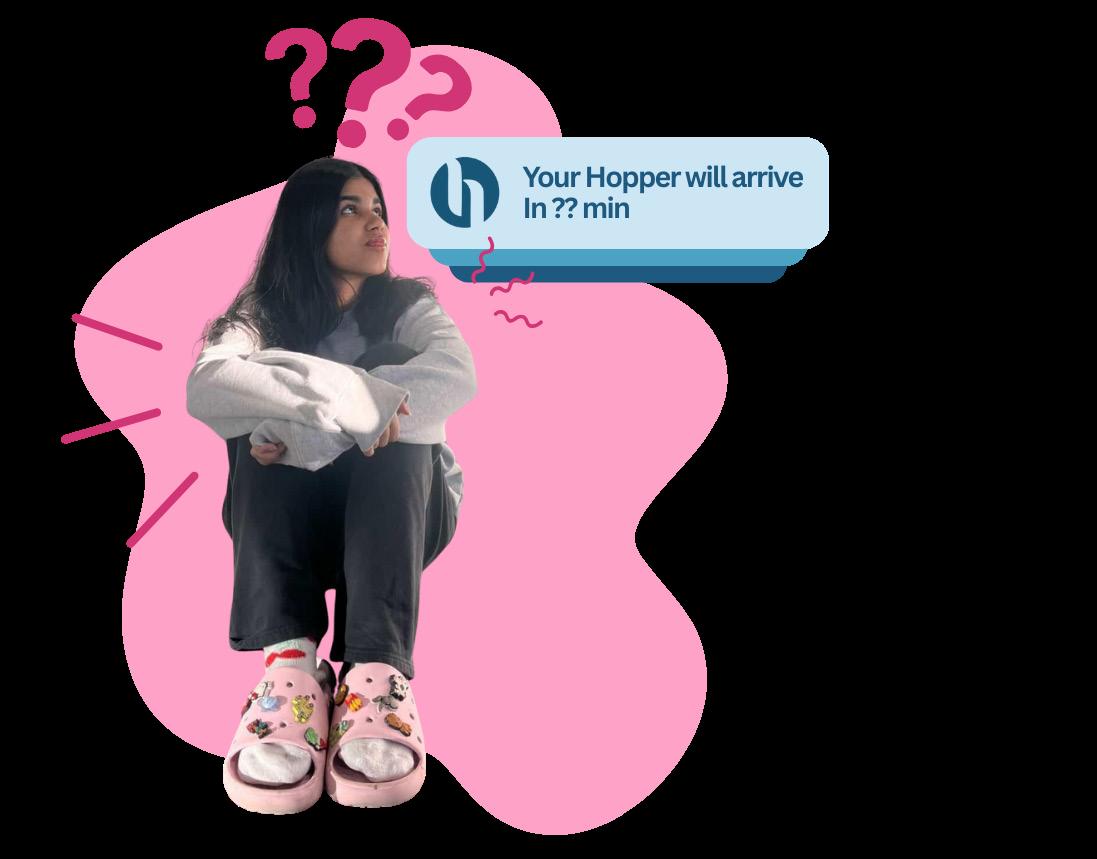
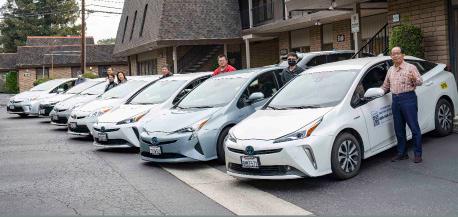
Right after the bell rings at 3:50 p.m., senior Suhana Pathak rushes to grab her phone from the phone holder and opens the SV Hopper app, refreshing the screen repeatedly in hopes of securing a ride. Sometimes she gets lucky when a ride appears within the first couple of tries. Other days, she waits in an empty bus circle for over 30 minutes, long after most students and sta have left campus. While schools like Cupertino High School mention that SV Hopper would bring faster, more accessible transportation to students, experiences like Pathak’s tell a di erent story.
Introduced in partnership with the City of Cupertino, SV Hopper is an app that o ers micro-transit service to residents within the city. Transit and Transportation Planner Matt Schroeder mentions
that the program is funded significantly by grants from the Transit and Intercity Rail Capital Program and the Transportation Fund for Clean Air. Although SV Hopper aims to improve mobility and reduce solo car trips, students say the service is unpredictable and slow, often leaving them alone on campus with little clarity about when, or if, their ride will arrive.
“SV Hopper was not designed as a student-only
“
I COULDN’T GET A RIDE HOME IN TIME. I THOUGHT IT WOULD TAKE ME 30 MINUTES, BUT IT ENDED UP TAKING AN HOUR JUST TO GET HOME.
Hopper more frequently this year for academic and extracurricular commitments, such as after-school chemistry tutoring. With both of her parents working, she depends on SV Hopper but it is di cult for her to get a ride on time. The unpredictability disrupts her schedule and sometimes makes her miss important meetings.
SENIOR
SUHANA PATHAK
“It eats into my homework time or my other commitments,” Pathak said. “This one time, I had to cancel an important college counselor meeting because I couldn’t get a ride home in time. I thought it would take me 30 minutes, but it ended up taking an hour just to get home.”
Junior Oishani Chatterjee has used SV Hopper since her freshman year and waits around 20 minutes every day for a ride. On busier days like Tuesdays and Thursdays after school, her wait can stretch to 45 minutes, often with no one else around. Chatterjee says ride availability has become even more di cult due to the district’s new phone policy. Without access to phones during the day, students can no longer book rides early. As a result, now students can only book rides after the bell, when wait times spike and ride availability drops, making finding rides even more frustrating.
“You never know when the ride is going to actually come,” Chatterjee
said. “If you start booking it 20 minutes before the bell rings, you can get picked up within 10 to 15 minutes after school ends. But if you wait after the bell, since we can not use our phones because of the phone policy, the ride takes so long, you won’t get home before five. Either way, I end up waiting, or if my friends are still at school, I’ll ask them to drive. It is sometimes uncomfortable when the o ce closes soon after school ends and I’m all alone.”
Aside from long delays, Chatterjee and Pathak report inconsistent pickups and drop-o s, presenting another challenge. Cars often arrive farther away from the indicated pick up point on the app, forcing students to cross heavy tra c hurriedly, and in some cases, drivers mark riders as “no show” even when the student was waiting in the correct spot. Riders also note that although driver phone numbers are provided to them, attempts to contact them often go unanswered. Schroeder acknowledged these ongoing issues, noting they are actively trying to improve these inconsistencies in wait times, pick-up locations and communication.
“Both the Cities of Cupertino and Santa Clara are aware that wait times can be long right after school,” Schroeder said. “Demand spikes in a very short window when the bell rings, and many ride requests come in at once. We’ve made adjustments, like relocating and consolidating some pickup points away from crowded school entrances to help vehicles move more e ciently, and we continue to monitor after-school performance to tweak the service.”
Despite frustrations, students agree the app’s interface is user-friendly. They appreciate its features like live location tracking, and they note that driver interactions are usually positive. Still, students suggest that more cars and clear pickup locations would help make their rides more e cient.
To address that, Schroeder also mentions that as part of the TIRCP
grant, SV Hopper is scheduled to expand service into north Santa Clara starting July 1, 2026. The vehicle fled will increase as part of this expansion. But for now, students who use SV Hopper say that the service is not the “faster and easier” mode of transportation it was advertised to be. Instead, it has become a new daily uncertainty, one that students hope will be addressed soon. Schroeder encourages riders to continue reporting such issues so adjustments can be made.
“A few things can make a di erence,” Schroeder said. “These include: Be at your pickup spot before your driver arrives. Board quickly when the vehicle arrives. Cancel requests right away if your plans change, instead of holding a ride ‘just in case.’ If in a group, avoid requesting multiple trips at once from di phones. Use the feedback tools, inapp or through the city, to let us know about recurring issues. When riders do these things, it helps the system move faster and reduces wait times for everyone.”
15 minutes
23% of MVHS students use Hopper for school or their extra curriculars
*According to a survey of 107 people of MVHS students have to wait an average time of 20 minutes for SV Hopper
*According to a survey of 107 people
PHOTOGRAPHIC|
GRISHMA JAIN
notes from albert, ep. 3
BY GRACE LIN
THINLY VEILED
How I came to terms with my body image
BY MEGHNA DIXIT
Istumbled behind my mom as she walked around an unfamiliar room, socializing with friends we hadn’t seen in over five years. Three aunties caught sight of me, convincing me to come out from behind my mom. I stared up in bewilderment as they looked me up and down, carefully examining every feature of my body and how I had changed from the 6-year-old they had last seen.
“She’s still so thin,” one said, before turning to my mom and asking, “Are you still having trouble getting her to eat?”
As those gut-wrenching words left their lips, I wanted nothing more than to escape my own skin. My mom stared at them, confused, and chuckled along with them awkwardly as they returned to their conversation about work, leaving me to wonder if that remark was simply meaningless small talk in their eyes.
This wasn’t the first time people had commented on my thin physique; it seemed as though the first thing anyone noticed about me was my skinniness. To my peers, skinniness is commonly associated with weakness or fragility, so my lack of fat, or lack of muscles, in their eyes, warranted jokes about how my peers could “snap me like a twig if they tried.” Adults poked fun at my eating habits, calling me “string bean” because I, like any kid my age, had trouble eating my vegetables. My body shape was constantly perceived as a quality that I could easily fix by “just eating more” — a misconception that I began to believe.
I started to write down what I was eating and when, trying to find a solution so I could feel beautiful. Yet, I noticed that even though I ate an adequate amount of food — the same as my peers — I still couldn’t seem to gain weight. I thought I was the
problem, that there was something wrong with that led to my inability to gain weight, so I relied on baggier clothes to hide myself under.
Even though it aligned with my preferred style, I couldn’t bear to leave the house without loose pants that hid my biggest insecurity. I loathed shorts; they made me feel naked because everyone could see my true body type instead of a faint silhouette under my large clothes. But the comments from others wouldn’t stop. Everywhere I went, people would tell me to eat more with a sour look of pity in their eyes, as if my body was cloaked in unhealthy habits.
IT’S A PLEASURE TO
With growing frustration, I finally mustered up the courage to stand up for myself. But instead of an apology, adults would respond with, “Why are you so upset? It’s a compliment.” But when they pointed out my size, I didn’t feel more confident in myself — I felt judged, as if setting me apart from the others as “skinnier” carried the implicit message that my body type was abnormal. I knew I was healthy, but I couldn’t help but feel smaller than I already was, wishing I could wither away to escape the spotlight.
As the incessant criticism flooded my head, I started to grapple with the idea that comments about my body shape were perceived as both compliments and criticism. While scrolling on my phone one night, I came across a video of a girl with a similar body type to mine, her comment section overflowing with compliments. I stumbled across a couple of hate comments, stating that she looked like “a sack of bones” rather than a real person. I scrolled through
her feed, scouring the comments to discover similar statements under her old videos. Even though she had received negative comments about her body, that didn’t stop her from posting herself and feeling confident in her skin. To some, being skinny is the beauty standard, whereas others have nothing but negative criticism. I’ve realized that it’s unrealistic to be accepted by society: there will always be something that people can point out about my body, no matter what I look like. Being healthy matters to me more than “fitting in,” and as my priorities changed, I’ve stepped into the body I was naturally given rather than hyperfixating on fixing something that isn’t broken. I can’t change my size, no matter what I do — I can only change the way I perceive myself and how I handle criticism from others. I can finally look at myself without a lens of hatred, learning to create my own definition of beauty.
GRAPHIC | MEGHNA DIXIT
PHOTO | BENJAMIN ZHANG
PHOTO | RADHIKA DHARMAPURIKAR
HOLIDAY
HURRAH!
Exploring how the MVHS community celebrates different holidays
GRAPHICS|ISABELLEKOK
GOBBLE GOBBLE
Students and staff discuss their Thanksgiving plans
BY SHREEJAY ARJA AND VAISHNAVI KATUKAM
As the leaves turn from green to vibrant reds and yellows, people begin to embrace the fall weather. With that comes the staples of Thanksgiving season like pumpkin spice, football and turkey. Spending time with family and friends is consistent across most Thanksgiving celebrations, but students and sta at MVHS have drastically di erent holiday plans.
CYNTHIA HIRANO
Relaxing at the beach, ziplining and sleeping in may be unconventional during the holiday season, but these practices have become an annual tradition for sophomore Cynthia Hirano. Hirano’s first Thanksgiving vacation was a spontaneous trip to the Disney Resort in Hawaii when she was in elementary school. Hirano’s family enjoyed it so much that they decided they would return every year, and now the family
goes to Hawaii every Thanksgiving break.
“I think the older generation has this idea of a Thanksgiving dinner,” Hirano said. “But I feel like a lot of people nowadays don’t necessarily do that, my family being an example. I feel like today’s generation is more willing to try new things and step out of the traditional aspects of Thanksgiving.”
NOAH GUAN
Sophomore Noah Guan’s family started celebrating Thanksgiving after moving from Taiwan. The food they eat is more
SCAN FOR MORE COVERAGE GRAPHICS |
especially if they’re immigrants.”
Relatives of Guan don’t share the same emphasis around Thanksgiving, as Thanksgiving is more of a family gathering to them rather than a time of gratitude. But even in simple gatherings, Guan says they show their appreciation and gratefulness not in fancy toasts, but in the food they make and eat.
72% of MVHS students
celebrate Thanksgiving
*According to a survey of 99 people
Chinese than American, like tomato tofu and water spinach. Because only some of his family is able to attend Thanksgiving dinner, their celebrations often diverge from the traditional Thanksgiving dinner.
ISABELLE KOK
“Some parts of the American tradition should be kept, and other parts can be changed to fit one’s circumstances,” Guan said.
“Not everyone can a ord a Thanksgiving turkey every single year, and not everyone can a ord to assimilate within the culture,
“While at dinner, I can feel that their mood starts to lift after everyone starts getting their food.” Guan said. “I believe food is an integral part of who you are, as well as what your family dynamic is. And my grandparents like to express their love and their gratitude using the food they give.”
SCOTT DERUITER
Math and computer science teacher Scott DeRuiter celebrates a traditional Thanksgiving dinner with his family. This year, DeRuiter’s family hosted around 20 people for the holiday, including his sons, his sister and his wife’s sister. Over the last 15 years, they have celebrated Thanksgiving on Friday rather than Thursday to provide more time to travel for family members who live farther away. This allows them to have time with family on Thursday before the actual celebration.
“We try to incorporate the name of the holiday in our gathering,” DeRuiter said, “to be thankful for all that we have.”
HO HO HO!
How the MVHS community spends the
BY LUCAS LIU AND KATE YANG
As pop tunes are slowly replaced by Mariah Carey’s “All I Want For Christmas Is You,” Christmas festivities start to build up around us and the holiday spirit begins to bloom. Mistletoes are hung, and stars are secured. As the holiday season approaches, let’s take a look at how the MVHS community celebrates this joyous occasion.
ALPHONSA ROSE PHILIP
Sophomore Alphonsa Rose Philip sees celebrating Christmas as a combination of her devotion to Christianity and love for her family. Over the past few years, Philip’s family has fashioned their now-beloved family traditions. To Philip, Christmas means a chance to make memories with family that she’ll keep with her forever.
One of Philip’s favorite family traditions in December is viewing homes across the Bay Area with Christmas decorations, like holiday lights and front-yard sculptures. Philip deeply cherishes the tradition, and believes it has helped her connect with her parents.
Another family tradition ties in directly with their Catholicism. When the family travels during Christmastime, they visit other parishes to celebrate the holiday with other Catholics from across the country. While Philip says that these celebrations di er from parish to parish, she enjoys how she gets to take part in and honor the holiday in di erent ways.
“Our family has a tradition of when we go to a new church, we make three new wishes,” Philip said. “It’s cool seeing how people celebrate Christmas at di erent churches. I remember when we went to a small church in Utah that was packed on Christmas day. Even
jolliest time of year
though they didn’t have a choir, they still had recordings of church songs and were still celebrating to their fullest.”
Catholicism and its influences extends to how Philip honors her friends and family on Christmas. Philip treats the holiday as a time of giving, taking the time to spread love to those around her.
“Catholicism is about sharing your religion,” Philip said. “It’s fun seeing their reactions, which is the spirit of Christmas; giving back to the community. Connecting with my religion, and being able to do that with my family, we’re able to create memories and traditions that we can always think of and maybe even pass on later.”
COURTNEY MASLI
As senior Courtney Masli has grown up, her Christmases have become more and more untraditional. For the past few years, the Masli family typically spent their Christmas traveling to tropical paradises, which Masli attributes to the growing ages of her and her siblings.
“We typically go to Mexico,” Masli said. “Each year, our Christmas celebrations change. When we were younger, we spent more time at home, but as we’ve gotten older, it’s been more traveling. Our Christmases that we’ve spent outside of the country have been pretty unique — we like to go to places with warmer weather.”
SCAN FOR MORE COVERAGE
Masli spends the days before heading out on the family’s annual trip opening presents. Gifting is one of Masli’s favorite Christmas activities, because she’s received some of her most sought-after or touching items, like the viral Lululemon dance studio pants.
Masli also enjoys putting up her Christmas tree and ornaments. When they’re not overseas, they get together with extended family in San Francisco and enjoy gift exchanges and Asian cuisines like dim sum.
“Christmas is more of a time where we get together and just hang out,” Masli said. “In my family, we don’t get a lot of opportunities to do that. I think Christmas is the best holiday.”
GRAPHICS| ISABELLE KOK AND EMMY
MVHS students and staff share how they celebrate New Year’s through festive feasts, family gatherings and traditions
As the presents are opened, the ornaments taken down and the string lights dimmed, Christmas comes to a close and it is time to welcome the new year. Full of ups and downs, memorable experiences and new discoveries, reflections naturally follow. With joy and anticipation filling the air as 2025 comes to an end and 2026 comes to light, here’s how some MVHS students and sta celebrate the upcoming year.
RYAN BAO
Although freshman Ryan Bao stays closer to home for the holidays, he celebrates two New Years each year: the traditional New Year’s on Jan. 1 and Chinese New Year, which typically falls from late January to mid February and holds deeper significance to him and his family.
“We watch the New York ball drop and say ‘Happy New Year,’ but after that we don’t do anything special,” Bao said. “It’s more an
BY EMMY HARIMOTO
acknowledgement for us rather than a big celebration.”
However, Chinese New Year is the one holiday when Bao’s family celebrates to the fullest. From cleaning the house, wearing red for luck and gathering around a large dinner table full of savory dishes, Bao says his favorite tradition is watching the Chinese Media Group Spring Festival Gala, an annual program described to be a celebration of humanity and heritage through various performances broadcasted nationally on Chinese New Year’s Eve.
“All the plays, songs and comedies are such lively events,” Bao said. “I learn a lot of Chinese through asking my parents about what some of the words mean, and it’s a really great way for me to connect with my culture.”
While Chinese New Year remains the core of his family’s traditions, Bao still finds something special in watching people all over the world welcome the new year with joy.
“Everyone is so excited for the New Year,” Bao said. “Every year brings new challenges, new surprises, new friends and new relationships, and I feel like that’s something that resonates with me, and something that I feel so deeply about.”
HARIMOTO
CHIAKI VANASUPA
For Japanese teacher Chiaki Vanasupa, New Year’s has long been a celebration with food, family and Japanese traditions. Unlike Bao, she enjoys a good night’s rest on New Year’s Eve so she can wake up fresh to start the holiday by eating osechi. Osechi is an assortment of Japanese traditional New Year’s dishes, commonly including simmered vegetables, black beans and kuri kinton — a traditional Japanese dish made from sweet potato and candied chestnuts — each carrying its own dishes for me,” Vanasupa said in Japanese. “But now, because I can’t cook, I can only order them.”
designated area in the shrine after reading her fortune, but when she draws the best luck — daikichi (大吉) — she keeps the slip in her wallet until her next visit back at the shrine.
Some of Vanasupa’s favorite memories include playing Japanese traditional games such as flying kites, playing card games and especially the hagoita, a traditional shuttlecock game. But overall, Vanasupa loves cherishing the time with her loved
90% of MVHS students
celebrate the new year
*According to a survey of 107 people
“The best thing is to be able to celebrate with my cousins and relatives,” Vanasupa said in Japanese. “We would gather to eat together, pass presents and give each other otoshidamas (New Year’s money), and celebrating with them is one of my greatest pleasures.”
DEEKSHA SINGH
Due to Vanasupa’s change from homemade dishes to ordered ones, she usually travels to Japan for the holiday, where she also participates in hatsumode, a Japanese tradition to visit the shrine at the beginning of the year. There, she wishes for a good year ahead before drawing an omikuji, a fortune slip. Usually, she ties it to a
With only a minute left before midnight in Barcelona, sophomore Deeksha Singh goes under the table with her family with a handful of grapes. As the clock begins its final chimes to midnight, she eats 12 grapes — one for every month — to commemorate a Spanish New Year’s tradition thought to bring good luck
DESIGN|JILLIANJU
and success for the year ahead.
Singh first discovered the custom during her trip, when her family strolled through a little market selling pre-packaged sets of 12 grapes for New Year’s, and they’ve kept the tradition ever since.
Singh is often away from home during New Year, so celebrations depend on where she travels. Most often, she visits her family in Dubai, and typically goes to Jumeirah Beach to stay up till midnight to watch the countdown.
Other years, Singh has celebrated with her family friends in India, or in California, where her family and close friends play one of her favorite yearly games called 3-2-1, where everyone brings five $1 bills to a pile and rolls three dice until one person wins the entire stack.
Whether she is travelling around the world or staying at home, Singh believes the di erent atmospheres during each New Year’s celebration — shaped by where she is, the people around her and the unique traditions she experiences — is what makes the holiday meaningful.
“Every year is so di erent for me, because I’m always in a new place, doing something di erent,” Singh said. “I think all of them are really fun in their own way, so no matter who I’m with or what I’m doing, just celebrating New Year’s makes time for new beginnings.”
YOU LIKE THE COLD
YOU’RE MORE OF AN EARLY BIRD
YOU GET THINGS DONE ON TIME
YOU’RE A GOOD GIFTER
YOU ENJOY CHRISTMAS TUNES
YOU STAY QUITE HYDRATED
YOU PREFER HOT COCOA OVER COFFEE
YOU LIKE DECORATING AND CRAFTS
YOU PREFER SWEET OVER SAVORY
YOU PREFER ICED DRINKS OVER HOT
YOU HAVE A FAVORITE HOLIDAY FILM
YOU ENJOY THE OUTDOORS
QUIZ AND GRAPHICS BY JILLIAN JU
when I see a fish bite. I get a rush of adrenaline, and that’s what keeps me motivated after waiting for at least 30 minutes sitting on a bench.”
In the U.S., Zhang usually fishes on piers near the ocean, where he catches and releases a wide variety of fish — even sharks, which he says are mostly harmless. He now has over a decade of experience in fishing, but his journey has required patience and determination.
“My first year in the U.S., I fished for an entire day every single week, and I hadn’t caught a fish for the whole year and a half,” Zhang said. “But I’d see people catch a fish, and I’d tell myself, ‘One last cast, one last cast, one last cast.’ That really kept me going.”
For Zhang, the wait was worth the
fishing rod. That moment boosted his confidence and determination, reminding him that success in fishing doesn’t come from buying elaborate or expensive gear.
Zhang says there’s a sense of community out on the pier. Fishing isn’t just a sport for the elderly, but for people of all ages to bond over a common passion. He’s met many people through the hobby, exchanging contacts to come out and fish together. He’s also introduced friends to the sport by inviting them to join him on his trips.
“Fishing is a really good time to
FISHING LET’S GO
MVHS fishermen share the challenges and rewards of their hobby
BY EMMA MA
to talk about stu that you usually don’t, because you’re in the open and there’s no one really next to you. Most of the time, you’re probably not going there to strike gold. You’re probably going to be there to talk to people.”
RIU YAMADA
When he was 7 or 8 years old, sophomore Riu Yamada started fishing on the Santa Cruz pier with his dad. Most of the time, he only caught anchovies and other small fish, but this early experience built the foundation for him to continue fishing independently.
“Back when I was small, I had no clue how to use all my gear, and my dad was the one who taught me everything,” Yamada said. “He is my mentor and my inspiration.”
When Yamada had free time over the summer, he returned to fishing at the Stevens Creek Reservoir and other local private ponds. At that time, he found himself fishing almost every day, but because the reservoir’s mercury pollution makes the fish unsafe to eat, he always released whatever he caught.
“During the summer, fishing was really tough,” Yamada said. “Most of the time, I never really caught anything. Just sitting there alone, waiting for the fish to bite, is a pretty rough experience. But one day, I caught one, and I was really hooked on it. And I continued going.”
With the start of the school year, it became unrealistic for Yamada to spend long afternoons at the reservoir, so he now sets aside Sunday mornings to fish. Nonetheless, his hobby has become a steady part of his routine.
Yamada views persistence as the key to success in fishing. To him, thorough research, technical skill and luck all play a part, but above all, successful fishing is about the ability to wait patiently by the shore. For example, Yamada often fishes for up to eight hours each time.
“Fish will eventually come if you keep trying harder,” Yamada said. “Be patient with it. Fishing involves a lot of luck, but you also need to stay and keep at it for longer to eventually get better.”
OLIVER D’SOUZA Sophomore
Oliver D’Souza is a regular at Stevens Creek Reservoir.
to use, what bait or lures would attract fish and where to find the best fishing spots. Luckily, he researched extensively to learn the basics, but he still recommends going with someone experienced to make it less di cult and overwhelming.
“ IT’S A VERY NICE LANDSCAPE, ESPECIALLY WHEN THE SUN RISES. YOU FORGET ABOUT ALL THE PROBLEMS YOU HAVE WHILE YOU’RE OUT THERE.
SOPHOMORE
OLIVER D’SOUZA
With winter coming up, the colder weather has made fishing more challenging, but he still frequents the reservoir whenever he finds time.
“You don’t regret getting up for fishing,” D’Souza said. “You never feel bad that you got a little bit less sleep. It’s a very nice landscape, especially when the sun rises. You just forget about all the problems you have while you’re out there.”
41% of MVHS students have gone fishing at least once in their lives
*According to a survey of 106 people
D’Souza was first introduced to fishing by a family friend on a trip to Canada. Six months later, when he decided to try it out by himself, he had to figure almost everything out on his own. He was initially unsure about what equipment
“When I went on my own, it was a lot harder to know how to do things,” D’Souza said. “You have to watch a YouTube video, and it’s just not the same as if someone’s there with you in person helping you do it.”
Over a couple of months, D’Souza has gotten to know other fishers and gained a lot of experience, helping him make more successful catches. For instance, he often walks several miles to get to good spots where he knows he can quickly catch fish, instead of popular areas the fish avoid.
“If you want to get into it, don’t be depressed if you didn’t catch a fish the first time,” D’Souza said. “Once you get experienced enough, when you go and you cast out your line, you can get one right away. It takes experience and lots of research, but when you catch a fish, it’s really exciting. It’s addictive after a while.
Cupertino’s International KUNG FU DAY
Performers and families came together for a day of showcases and cultural exchange, featuring live performances, interactive activities and diverse cuisines
BY FIONA CHEN AND ISABELLE KOK
Tlhe Northern California Chinese Culture and Athletic Federation hosted its first International Kung Fu Day and Cultural Carnival on Saturday, Nov. 8 at Memorial Park. The event ran from 10 a.m. to 5 p.m. and featured performances of Chinese martial arts and music. Recreational activities also included traditional demonstrations in tai chi and baduanjin, both Chinese wellness practices, simple kung fu classes for children, authentic flavors from local food vendors, interactive booths and hands-on activities like spin the wheel.
Tharun Arya Mahesh, a junior at Mission San Jose High School in Fremont, participated in one of the early afternoon performances with his martial arts school Dragon Rhythm Shaolin Kung Fu. DRSKF participated in two separate performances at the celebration: one simple showcase and another more technically challenging audition for a separate performance program. The routines included students of various ages and multiple unique segments like the iconic Chinese lion dance.
Mahesh, who has been studying kung fu for 10 years, says that although his school only had three weeks to prepare for this event, the students’ performances were a culmination of years of dedication and discipline. Reflecting on his athletic journey, Mahesh believes that the community of kung fu has given him many transferable life skills beyond martial arts itself.
“I love how the audience goes crazy for the things that we think
my double whip,” Tang said. “And honestly, seeing everybody else
With a sword in hand, a student from Evergreen Wushu weaves through a series of swift strikes and spins. In the study of wushu, the sword is a weapon that tests the precision and focus of the performer.
Tharun Arya Mahesh, a junior at Mission San Jose High School in Fremont, performs in a group showcase with Dragon Rhythm Shaolin Kung Fu in the early afternoon.
A young student demonstrates a fan routine during the early afternoon showcase. In kung fu, the fan is utilized as an extension of the body to execute fluid movements, highlighting agility and control.
A drum troupe member performs on traditional Chinese barrel drums. In Chinese culture and kung fu, these barrel drums have historically been used to set a rhythm for battle or uplift spirits during festivals.
FANTASY FRIENDSHIP MEETS
Members of the MVHS community discuss their experiences playing fantasy sports
BY LEAH DESAI AND ETHAN YANG
Fantasy sports are a genre of online games in which participants draft their own teams and compete against others in a league. Teams of real professional players are drafted by fantasy players at the beginning of each season, and every week, participants must choose to start, bench or cut players on their roster. Points are earned for players’ successes, such as scoring a touchdown in football or getting a rebound in basketball. Over the last couple of years, fantasy sports have become increasingly popular.
While the game evolved through developing strategies, punishments and a changing sports landscape, one thing remains the same according to senior Avyan Mahajan. He believes it’s about the fun of following a sport you are passionate about, even when your actual favorite team is losing.
fantasy sports allowed him to watch new players and teams he wouldn’t have ordinarily followed. Even though he is primarily a fan of the NFL team the Philadelphia Eagles, Mahajan still finds himself cheering for players on other teams because of his fantasy roster.
Math teacher Josh Kuo, who played fantasy basketball and baseball in college, shares this perspective. As a result of playing fantasy sports, he began to pay closer attention to other elements of the game.
“ WHEN WATCHING, YOU’RE MORE FOCUSED ON THEIR STATS VERSUS HOW THEY ACTUALLY PLAY.
MATH TEACHER
JOSH KUO
“You’re more likely to watch teams and players that you don’t usually watch,” Kuo said. “Fantasy gives you a more number-based view of how the player is performing. When you’re watching, you’re more focused on their stats versus how they actually play.”
choosing which players to start each week. Over time, Garg learned that accounting for matchups, the di erent fantasy teams one will play each week, when choosing teams can make a di erence.
“If a player on my team is going to play against a bad team, I’m going to pick them over someone who’s going to play against a good team,” Garg said. “They will score more and get more yards because the other team is crap. That has made my entire fantasy team better.”
Fantasy sports have allowed many groups to connect with one another. Kuo played in three leagues, two in person and another online with strangers. Surprisingly, he found the league with unfamiliar people more engaging.
Mahajan, who plays fantasy football, baseball and basketball, says that
Senior and fantasy football participant Nimai Garg also analyzes the strength of opposing teams when
“I think the people you don’t know, ironically, care more about the game,” Kuo said. “At some point, people have too many things going on, and they don’t have time to keep changing their roster. Playing online means you’re interested in playing, so I actually had more fun playing online with other people at the time because of how many more active participants there were.”
On the other hand, Garg prefers the social experience of playing with his
more dedicated friends. He originally began with online leagues, but later decided to create his own within his friend group to have more inperson discussions and enjoy the game together.
“I built friendships by talking about stu that is fun for us, because we get excited to watch football,” Garg said. “Public leagues were really boring because nobody really cared about their teams. That’s what made me start this league — I wanted to be with people who talked about football.”
“ I BUILT FRIENDSHIPS BY TALKING ABOUT STUFF THAT IS FUN FOR US, BECAUSE WE GET EXCITED TO WATCH FOOTBALL.
nearby, which for us is a Denny’s, and you stay there for 24 hours, but every pancake or wa e you eat takes an hour o the time.”
people in my friend group played, so I thought I should play as well.”
For Garg, his most memorable moment came when he was watching a close NFL game. He recalls a particularly intense matchup during which a player on his roster scored a game-winning touchdown.
“My biggest memory was when the match was really close, down to a fivepoint di erence,” Garg said. “One of my players got a touchdown, which gave me more points. I was really hopeful that the player would get a touchdown, and when it happened, I felt really happy.”
Some leagues have begun adding punishments to increase the stakes. Mahajan’s current league has each player put $10 on the line, meaning if they lose the fantasy matchup, they must pay the winner. However, he has participated in leagues with other, more creative challenges as well.
“In the league with my baseball team, the loser had to participate in the Wa e House challenge,” Mahajan said. “That’s when you have to go to a wa e house
SENIOR NIMAI GARG
While some penalties can be a fun twist to fantasy sports, Kuo says that players should be careful of blurring the line with gambling through the introduction of financial rewards. Garg also had this concern before he started playing, initially deterred by the stigma between fantasy sports and sports betting.
“I thought you would use money and have to bet things,” Garg said. “That’s why I never played fantasy football. When I understood that you don’t need to use any money, I thought it was really fun, and realized that a lot of
IN THEIR COACHING DAYS
MVHS teachers reflect on their journey and experiences as sports coaches
BY GRACE LIN AND LEO WEI
CLAY STIVER
After attending college at Cal Poly San Luis Obispo, where school counselor Clay Stiver played intramural and club basketball, he began coaching basketball at MVHS. There he connected with one of the MVHS Field Hockey coaches, history teacher Bonnie Belshe, and went on to build a successful basketball program. Stiver recalls one of the pieces of advice given by history teacher and former MVHS coach Bonnie Belshe as something he would “never forget.”
“She said, ‘As a new coach, it usually takes about four years,’” Stiver said. “‘You have to take a full cycle of classes to come through at the high school level before everything sets your rules and expectations as a coach.’”
With all that he learned from Belshe, Stiver notes that coaching requires adapting to students’ needs and learning to be flexible — lessons that have carried into his current role as a school counselor. While Stiver emphasized skill-building and
strategic play, he also prioritized fun and creativity, often devising innovative plays that energized the team.
As time went on, Stiver took on additional responsibilities, including completing his teaching credentials and earning a master’s degree in counseling. The workload and desire for more of a social life led him to step down from head coach of the basketball program.
“It was a tough sacrifice to make,” Stiver said. “But life just happens, I was in my early 30s at the time, things change.”
Although his coaching career is over, the lessons that Stiver learned along the journey stayed with him. Stiver notes his greatest takeaway from his years of coaching is to find a balance between competition and having fun.
“More than anything, it is always just to make sure it’s fun, it should be fun,” Stiver said. “Because if I’m not having fun for whatever reason, then the students probably aren’t having
fun either. So whatever you need to do to spice it up, make it fun, be creative.”
ROBBIE HOFFMAN
In his four years of attending Homestead High School, history teacher and former MVHS baseball assistant coach Robbie Ho man split his time playing basketball and baseball, but the two sports contrasted each other. Unlike his basketball coach, who Ho man remembers as strict and self-centered, his baseball coach gave players room to grow and make decisions, allowing Ho man to enjoy the sport more than basketball.
Ho man applied that philosophy when he began coaching baseball at MVHS in 2011. Over the next several years, he guided the team with a focus on personal development, such as being vocal and taking on leadership roles. Ho man valued working alongside longtime MVHS Baseball Coach and Athletic Director Nick Bonacorsi in his journey as a coach. In the two years that they spent coaching together, Ho man learned di erent approaches that made practices and games feel collaborative and enjoyable.
“My favorite part was the opportunity to interact with students outside of a classroom,” Ho man said. “You get to see their personalities come out, and it was a nice change in the day.”
Ho man saw parallels between his role as a teacher in the classroom and his role as a coach on the baseball field. According to Ho man, he attempted to create an environment where players felt comfortable taking risks.
“I never talked about winning and losing very much, it was more about the coming out and improving our skills, improving as individuals,”
Ho man said. “It was definitely a teacher mentality, not just that of a coach.”
Ho man eventually stepped away from coaching at MVHS as he gained more responsibilities through the years. Although Ho man had stepped away from coaching high schoolers, it ultimately led to him working with his own kids in youth sports. Coaching his kids brought a new experience: shorter practices, more energy to manage and having a fun experience.
“With my kids, it’s more about letting them have fun,” Ho man said. “There’s no pressure — just go play. It’s kind of more about interacting with other people and learning how to be on a team.”
BONNIE BELSHE
About 15 years ago, a spot opened up for a JV Field Hockey Coach position at MVHS — Belshe recalls it as an opportunity to revisit one of the brightest times in her life. As a coach, Belshe emphasized sportsmanship and personal responsibility, drawing from lessons she learned from her coach in high school. Her coaching mentality was rooted in the idea that JV sports should be about growth and character development rather than wins and losses: a philosophy that Ho man mirrored and later became a common coaching approach at
MVHS. Additionally, Belshe placed a large emphasis on the sportsmanship of her students, focusing on their mentality and behavior outside the playing field.
“A large focus that my coaches had is that we represent our team even when we are in the classroom, when it is in our season,” Belshe said. “We are representative of our team. We want students to have that understanding that we want you to be good representatives for Monta Vista field hockey, not just on the field, but in the classroom and as part of the
school culture as well.”
Belshe cites her greatest accomplishment as not just the Matadors’ victories on the field but the recognition she shared with her colleague Denise Eachus through a national coaching award from the Positive Coaching Alliance. Belshe worked closely alongside Eachus to create a strong culture of grit and development. The two collaborated on everything from warmups to game strategy, with both coaches assisting each other’s teams, an arrangement Belshe described as vital in her growth as a coach.
For Belshe, coaching also brought challenges distinct from teaching. Practices and games demanded her evenings and weekends, and Belshe notes it was often di cult to balance that with classroom responsibilities and her career development in becoming Social Studies Department Lead. Yet she found joy in watching her athletes form connections.
“My favorite part of coaching field hockey was working with the athletes and watching their development,” Belshe said. “We were like a family spending so much time together as a group. Seeing how quickly they developed in their skills and as athletes and as teammates working together was always the best part.”
PHOTO COURTESY OF ROBBIE HOFFMAN | USED WITH PERMISSION
PHOTO COURTESY OF EL VALEDOR | USED WITH PERMISSION
CROSSWORD @elestoque
BY JILLIAN JU
ACROSS
Units of computer memory: Abbr.
Future doc’s exam
Archetypical SoCal girl
Dubai’s country, for short
The New Yorker cartoonist Peter “haha”
They proverbially “finish last”
Apt rhyme for “lumberjacks”
Smoothed (over)
Major highway from Fla. to Calif. Helvetica is one ___ Festival (final day of the Chinese New Year)
Word before “the radar” or “the weather”
Magic 8 Ball response
Young bloke
“My Cousin Vinny” Oscar winner
Marisa
Not properly explained
Tandoori bread
Mother in a stable family?
It hangs over the ocean
Something that may be up one’s sleeve
TV, newspapers, streaming services, etc.
Miss identification?
Record number of gold medals won by the U.S. team at the 2025 International Physics Olympiad (pg. 14-15)
Pride : lion :: gang : ___
Grass in a roll
“I wouldn’t touch that with ___foot pole!”
Day before pg. 36-37 holiday, for short DOWN
Cupertino’s International ___ Day (pg. 41-42)
Fail to meet at the planned time
Most common U.S. street name, surprisingly They have issues, in brief
Like Taylor Swift’s summer
Very soon now
How-___ (instruction manuals) Get o! to ___ start
“Animal Farm” horse
School Psychologist Fisher (pg. 24-25)
British singer who collaborated with Kanye West on the 2008 hit
“American Boy”
“My treat!”
Butterfly collector’s need
Singer Carly ___ Jepsen
Brit’s rats?
Word before name or voyage
Without breaking a sweat
Consumption of food and drink
Amherst campus, familiarly
“What do you call cheese that’s not yours? ___ cheese!”
“Assassin’s ___” (video game franchise)
Christopher who played Superman
Word of agreement
Nonprofit that recruits college grads into education: Abbr.
PLATINUM SPONSORS: Syed Askari
Raza Baqar, Avik Basu, Yan Cen, Lili Chen, Jake Dutton, Bhaskar Katukam, Anoushka Nadkarni, Dinesh Nettar, Purneet Thapliyal, Sandy Wang, Jie Yao