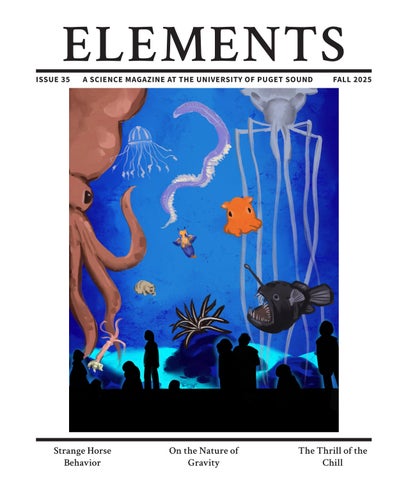
A SCIENCE MAGAZINE AT THE UNIVERSITY OF PUGET SOUND
With this statement, we acknowledge that the University of Puget Sound was founded on the unceded lands of the Puyallup Tribe and lands of the Coast Salish Nations, who have stewarded and continue to steward these lands since time immemorial. We further acknowledge that UPS must proactively act to remedy the illegitimately acquired land that is crucial to the operation of our university.
“ ʔuk’ʷədiid čəł ʔuhigʷəd txʷəl tiiɫ ʔa čəɫ ʔal tə swatxʷixʷtxʷəd ʔə tiiɫ puyaləpabš. ʔa ti dxʷʔa ti swatxʷixʷtxʷəd ʔə tiiɫ puyaləpabš ʔəsɫaɫaɫlil tul’al tudiʔ tuhaʔkʷ. didiʔɫ ʔa həlgʷəʔ ʔal ti sləx̌il. dxʷəsɫaɫlils həlgʷəʔ gʷəl ƛ’uyayus həlgʷəʔ gʷəl ƛ’uƛ’ax̌ʷad həlgʷəʔ tiiɫ bədədəʔs gʷəl tix̌dxʷ həlgʷəʔ tiił ʔiišəds həlgʷəʔ gʷəl ƛ’uʔalalus həlgʷəʔ gʷəl ƛ’utxʷəlšucidəb. x̌ʷəla···b ʔə tiiɫ tuyəl’yəlabs. ” - Puyallup Tribe of Indians, text written in the Twulshootseed language
We commend campus initiatives like the Seeding Lushootseed Project, creating permanent signage in the Puyallup Language on campus for their efforts to educate our campus community and amplify the voices of the Puyallup Tribal Language Program, and join in their calls for a permanent Indigenous Studies program here on campus.
As students of science at the University of Puget Sound, it is our responsibility to educate ourselves on the role of western science in the discrediting of indigenous traditional knowledge. A true solution to climate change must implement both lenses. Local indigenous efforts to combat and adapt to climate change must especially be heard, and we must commit to amplifying and supporting them. The Puyallup Tribe of Indians has created a Climate Change Impact Assessment and Adaptation Options, highlighting sector-specific impacts to people, infrastructure, traditions, and resources, alongside mitigation strategies, crafted with an intersection of indigenous ecological knowledge specific to the region and western science findings.
In order to properly acknowledge the land we occupy and the people who actively steward it, it is also the responsibility of our university and magazine to have genuine discussion about the troubling history of western educational systems, and our university specifically, with the erasure of indigenous cultures and peoples. The Cushman Residential School was one of seventeen residential schools in Washington state, removing indigenous youth from their homes and cultures to assimilate them into Western society, stripping them from their native languages, communities, and ways of life. We urge the University to reconcile with its student groups’ relationships with the Cushman Residential School, address this history publicly, and take appropriate further measures to begin to remedy the harm of actions on indigenous communities.
On the next page, we include further information regarding specific present initiatives and historical information to our region and University’s history. We hope you will take a moment to educate yourself further on these.
PUYALLUP TRIBE CLIMATE CHANGE IMPACT ASSESSMENT AND ADAPTATION OPTIONS
PUYALLUP TRIBAL LANGUAGE PROJECT ON THE BOARDING SCHOOL & CUSHMAN PROJECT
LEARN MORE ABOUT THE UNIVERSITY OF PUGET SOUND’S HISTORY OF EUGENICS
LEARN MORE ABOUT GEOTHERMAL ON OUR CAMPUS
HAVE AN IDEA TO IMPROVE SUSTAINABILITY ON CAMPUS? GREEN FUND CAN PROVIDE UP TO $10,000 FOR ELIGIBLE PROJECTS.
The writing of this acknowledgement was very much a collaborative process that, crucially, not only broadened its scope, but also clarified its intent. What began as statements of fact about climate change became, in the next draft, assertions of values, followed by promises of action. It should be taken as just the start of a conversation, because there is much more to do along these lines. I would encourage you to think of it as a little like a communal prayer: it’s something the best versions of us dare to believe in. In fact, I think an acknowledgement that contains an apology, as this one does, has the potential to build community in unique ways. Of course, it’s right and fair to apologize when we have done something wrong (how else can trust be built?). But an acknowledgement that recognizes misdeeds can also lift up unheard voices it’s the enemy of erasure. And it can invite others to share their values and aspirations too.
- Steven Neshyba
“We deeply regret the extreme hardships that coming generations of people and non-humans will endure as a result of the present-day damage being inflicted on the global climate system. We recognize that this damage is a known consequence of the pervasive exercise of wealth-enabled carbon privilege, perpetuated by the economic and ideological dominance of Western colonialist nations. We recognize that BIPOC/marginalized communities are most vulnerable to the harms of climate change, and do not share the same burden of responsibility. We commit to exercising our individual agency and our collective power now, to build the best possible future and avert the worst consequences of climate damage.”
-
Steven Neshbya, Climate Alliance of the South Sound, and Elements Team
The University of Puget Sound is currently in a Climate Action Planning process being led by Lexi Brewer, our director of sustainability. The plan will identify the barriers we need to overcome and investments that need to be made to decarbonize our campus. Around 80% of campus is heated using fossil fuels, making up the majority of campus’ greenhouse gas emissions. Geothermal heating and cooling is being explored as a step to reaching net-zero emissions, replacing outdated natural gas systems in our residence halls.
Letter from the Editors
Confluence, in the literal sense, is the joining of two rivers into one. In the context of us as humans, scientists, writers, artists, and more, it is the melding of many ideas into something greater. The creation of this issue could not happen without confluence, and neither could the creation of Elements as a whole. Writers meld with other writers, editors’ ideas intertwine with authors’, artists’ visions mingle with articles’ content, staff and contributors join together to produce this issue, and your Editors-in-Chief melded minds to create this letter to you. We make it a mission to synthesize the ideas of Puget Sound’s students to present to any audience. As you are picking up this issue, your knowledge is experiencing a confluence with ours. We hope the current of this new waterway is exactly what you’re looking for.
In our 35th issue of Elements, our writers and artists took our theme in stride. “Nurtured by Nature” and “The Thrill of the Chill” pair science writing with full page illustrations representing the essence of each article. In “Where the Surf Meets the Shore” and “On the Nature of Gravity,” our authors wrote poems on their scientific passions (who knew you could work the word exoskeleton into a limerick!) We are so proud to get to showcase these students’ work; they embody confluence in their specialties.
We chose this theme not only for its environmental roots, but because it represents a goal for us as Elements contributors, scientists, writers, and artists to aspire to. We can look to the river for inspiration, it is unbiased in its sharing and at one with its surroundings. The environment of science today can be resistant to this. We can cling to our sense of individuality and our accomplishments, hesitant to let others into our own channel. By promoting confluence through Elements, we hope to fight against this current. We believe that science should be accessible at all levels, and that art and science are inherently intertwined. We put this issue out to you with the hope that you can see the beauty in confluence and apply it to the river that is your own.
The production of Elements Magazine is possible due to the funding of the Associated Students of the University of Puget Sound and the Green Fund. Printed and bound in Lakewood, WA at Print NW on FSC Certified 100% post-consumer recycled paper.
Puget Sound is committed to being accessible to all people. If you have questions about event accessibility, please contact 253.879.3931 or accessibility@pugetsound.edu, or visit pugetsound.edu/accessibility.
Protein Folding
Why Biology Will Never Be the Same
BY JOHN LUU
In biology, shape is everything. This is especially true for proteins, where structure dictates function. These molecular machines execute nearly every task that keeps an organism alive, from metabolism to immune response. But a protein’s ability depends entirely on the folding of its amino acid chain into a precise three-dimensional form—a form that will shape a protein’s potential activation site, allow it to attach or detach from membranes, enable it to carry out its job, and much more. With thousands of amino acids, a protein can twist and coil in astronomical numbers of ways. This folding process, which gives proteins their form, is so complicated that it took scientists in the 1950s more than a decade of laborious experiments to solve the first protein structures using X-ray crystallography (1). Although complex, some biologists claimed that solving the “protein-folding problem” and having the ability to predict the structure formed by any string of amino acids could open doors to breakthroughs in how we approach climate change, nanotechnology, and medicine.
Up until 2020, about 150,000 protein structures had been determined experimentally (2). Each structure required years of painstaking work, using techniques like X-ray crystallography or cryo-electron microscopy.
That was until 2021, when in an instant, the 3-D structures of hundreds of thousands of proteins were accurately predicted by an artificial intelligence program named AlphaFold. Since then, the database has grown to cover over 200 million predicted structures (3). Overnight, biology was revolutionized.
ACE 2: SARS-CoV-2 enters human cells by binding to the ACE2 receptor; structural knowledge of ACE2 guides vaccine and antiviral drug development.
CYCLIN DEPENDENT KINASE 20 (CDK20): regulates the cell cycle and is implicated in liver cancer; structural knowledge enables drug designers to target its ATP-binding pocket and develop cancer therapies.
HEMOGLOBIN BETA
SUBUNIT: Hemoglobin carries oxygen in red blood cells; understanding its structure helps explain how mutations cause diseases like sickle-cell anemia.
AlphaFold, developed by Alphabet-owned DeepMind, accurately predicted the 3-D structures of almost every protein found in nature. The program utilizes a combination of deep neural networks full of information alongside rigorous machine learning. The program approaches protein folding by studying vast amounts of existing data. By comparing amino acid sequences to their known 3-D shapes, AlphaFold built an internal “knowledge base” on the hidden rules that dictate how a protein will fold (4). So, when given a new amino acid sequence, AlphaFold looks to those learned patterns to make extremely informed predictions about how the chain will twist, bend, and lock into place to create a structure.
However, what makes AlphaFold unique and exceedingly accurate is its means of refining its predictions. Using its deep neural networks, the program can calculate the physical feasibility of a structure by testing different distances and angles between amino acids based on the laws of chemistry and physics. Through trial-and-error, Alphafold adjusts aspects of a protein structure prediction, discarding impossible and unlikely folds that would cease to exist under these laws, like how one adjusts individual pieces of a puzzle until the whole picture fits (5). The product is a tool that utilizes known structural data along with the laws of chemistry and physics to generate accurate protein structures within hours.
As anticipated, the implications of solving the protein-folding problem are massive. Being essential to almost every biological process, knowing protein structures has allowed scientists to better understand how they work at a fundamental level. With AlphaFold, researchers can study proteins in a way that was previously inaccessible, providing insights into the unseen, from the nuances of how viruses use proteins to invade cells to how enzymes drive metabolism structurally. In medicine, this opens up new possibilities in drug designs that precisely target disease-causing proteins, helping accelerate the discovery of treatments for conditions such as cancer, Alzheimer’s, and antibiotic resistance (6). In fact, just this year, the structure of the huntingtin protein was used to understand its formation, guiding the development of preventative gene and drug therapies aimed at slowing the progression of Huntington’s disease (7).
Beyond human health, AlphaFold’s reach extends to agriculture, biotechnology, and even environmental science. By predicting the structures of plant proteins, scientists can develop crops that are more resistant to drought or disease (6). By understanding enzymes that break down plastics or capture carbon, researchers can engineer solutions to pressing environmental challenges. For many,
In fact, just this year, the structure of the huntingtin protein was used to understand its formation, guiding the development of preventative gene and drug therapies aimed at slowing the progression of Huntington’s disease (7).
40-kDa
HUNTINGTIN-ASSOCIATED PROTEIN
the arrival of AlphaFold feels like the start of a new era—one where questions that were once impossibly slow to answer can now be explored at the speed of computation.
Looking ahead, the possibilities of AlphaFold are only beginning to unfold. Researchers are expanding their reach to entire proteomes—the full set of proteins in humans, plants, and microbes—creating encyclopedias of molecular structures that were once unimaginable. As the system improves, we can envision a future where the ability to design and print custom proteins for medicine, sustainable energy, or materials science to solve humanity’s problems becomes routine, rather than revolutionary. While challenges remain, the foundation has been laid for a new era in biology. For decades, the protein-folding problem was a mark of scientific impossibility; now, with AlphaFold, it has become a trophy of what is possible when human perseverance and artificial intelligence converge. And because of this, biology will never be the same.
Still Calling Home
Voyager 1’s 50-Year Journey to the Stars
BY ALYSSA CHUNG
Right now, as you read this sentence, a spacecraft approximately the size of a Volkswagen Beetle is hurtling through the cosmic void at 38,000 miles per hour (1). It has been traveling for nearly 50 years, covering a distance exceeding 15 billion miles from its point of origin in Cape Canaveral, Florida (2). Despite this extraordinary remoteness, it continues transmitting data back to Earth (though admittedly, the signal delay is considerable). Its name is Voyager 1, and it holds the distinction of being the most distant humanmade object in existence, carrying with it a golden record intended as an interstellar message. Together, the Voyager 1 and the Golden Record embody a legacy that makes every other exploratory space mission seem modest by comparison.
When NASA Had Big Dreams and Bigger Budgets
The story of Voyager 1 can be traced to the 1960s, when engineers at NASA’s Jet Propulsion Laboratory (JPL) recognized an extraordinary celestial opportunity: the outer planets were approaching an alignment that would not recur for another 176 years (3). This rare geometric alignment meant that a single spacecraft could conduct a “Grand Tour” of Jupiter, Saturn, Uranus, and Neptune, utilizing gravitational assists from each planet to slingshot itself toward the next (Figure 1). If achieved, it would essentially be an extraordinary application of orbital mechanics that would be impossible to replicate within our lifetimes. However, the mission didn’t come without difficulties. NASA faced a narrow launch window opening in 1977, and engineers understood they were designing a system that would need to operate flawlessly for at least a decade in one of the most hostile environments imaginable. There would be no possibility of repair missions, no capacity for substantial software updates; only a carefully engineered machine, the interstellar void, and a considerable amount of luck. The Voyager program emerged from this confluence of scientific ambition and practical opportunity. While the mission’s stated objectives centered on planetary science—studying the outer planets, their satellites, and their magnetospheric
1. THE TRAJECTORIES OF VOYAGER 1 AND 2 THROUGH THE OUTER SYSTEM (NASA/JPLCALTECH)
2. VOYAGER 1 LAUNCHED ATOP ITS TITAN/ CENTAUR VEHICLE FROM THE KENNEDY SPACE CENTER LAUNCH COMPLEX IN FLORIDA ON 7/5/1977 (NASA/JPL-CALTECH)
environments—it also pursued something more philosophically ambitious: extending humanity’s reach beyond the heliosphere—the protective bubble created by solar winds and magnetic fields that surround and extend beyond the solar system—itself. NASA constructed two identical spacecrafts, Voyager 1 and Voyager 2, though despite its numerical designation, Voyager 1 actually launched second, on September 5, 1977, sixteen days after its twin (Figure 2) (3). This seemingly counterintuitive naming convention reflected their planned trajectories rather than their launch sequence; Voyager 1 was designed to reach Jupiter and Saturn more quickly via a shorter, faster route.
Building a Spacecraft Able to Withstand
The assembly of Voyager 1 required engineers at JPL to anticipate virtually every conceivable failure mode and incorporate redundancy into nearly every critical system. The spacecraft has a mass of 1,820 pounds and is equipped with an impressive array of scientific instrumentation: imaging systems, spectrometers, magnetometers, and particle detectors, all designed to acquire data about planetary systems that had never been observed at close range (Figures 3 &4) (4).
The power system demonstrates particularly elegant engineering. Voyager 1 could not rely on solar panels once it ventured beyond the inner solar system since the Sun’s radiance decreases with distance, rendering solar power impractical in the outer planetary belt. Instead, the spacecraft carries three radioisotope thermoelectric generators (RTGs), which convert thermal energy from the radioactive decay of plutonium-238 into electrical power through thermoelectric conversion (5). Aside from the plutonium-238 dioxide fuel, Voyager 1 also uses hydrazine as a second source of fuel for its thrusters, mainly used for orienting the spacecraft (6). The JPL engineers, having anticipated the gradual decay of the plutonium fuel over time, were faced with difficult engineering decisions at the time of the Voyagers’ construction: NASA mission controllers systematically deactivated instruments to preserve power for the most scientifically valuable systems, essentially determining which components of Voyager’s scientific payload must be sacrificed to extend the mission’s duration.
The golden record represents perhaps Voyager’s most fascinating feature (Figure 5). In 1977, NASA determined that since these spacecraft would persist long after human civilization, drifting through interstellar space for billions of years, and thus should carry a message representing humanity, our way of leaving our mark on the cosmos, or in case intelligent life encountered Voyager. The task for creating this
3. VOYAGER 1 SPACECRAFT IN ITS ENTIRETY, SHOWING THE PLACEMENT OF THE GOLDEN RECORD (NASA/JPL-CALTECH)
4. SCHEMATIC OF THE VOYAGER SPACECRAFT, ILLUSTRATING ITS SCIENTIFIC INSTRUMENTS (NASA/JPL-CALTECH)
message was assigned to a committee chaired by the astronomer Carl Sagan, with key contributions from creative director Ann Druyan (who would later become Sagan’s wife), artist and designer Jon Lomberg, writer and former editor of Rolling Stone Timothy Ferris, and several other collaborators (Figure 6) (7). The committee faced a seemingly impossible task: encapsulating human civilization on a 12-inch gold-plated copper disk. What constitutes an appropriate message to extraterrestrial intelligence? Which musical traditions should be represented? Which images? The committee worked under considerable time pressure, engaging in intense deliberations about each selection, aware that their choices would constitute humanity’s permanent representation to the cosmos.
What’s on the Golden Record?
The golden record, constructed of gold-plated copper and 12 inches in diameter, contains 115 analog-
encoded images and an assortment of natural terrestrial sounds, including but not limited to meteorological phenomena (thunder, wind), biological sounds (avian calls, cetacean vocalizations), and distinctly human sounds (a mother’s kiss, a human heartbeat) (Figure 6) (8). The record also includes spoken greetings in 55 languages, spanning from ancient Sumerian to modern Mandarin Chinese (9). Among these is a child’s voice in English stating, “Hello from the children of planet Earth.”
The musical selections comprise 90 minutes of recordings representing diverse human cultures and historical periods. The compilation includes Western classical compositions by Bach and Beethoven, Chuck Berry’s rock and roll classic “Johnny B. Goode,” Javanese gamelan, Peruvian panpipes, a Navajo night chant, and Blind Willie Johnson’s blues recording “Dark Was the Night, Cold Was the Ground” (10). The selection process involved extensive debate. Should contemporary popular music be included, or would it seem either too primitive or too culturally specific to hypothetical alien listeners? Each decision reflected competing values: cultural representativeness, aesthetic quality, technical recording fidelity, and the fundamental impossibility of the task itself. Sagan later reflected on this process with humility, acknowledging that the committee could not possibly represent the full spectrum of human experience but felt compelled to make the attempt nonetheless (11).
The record’s cover, made of aluminum, also includes multiple notable engravings and symbols.
First is the hand-etched inscription “To the makers of music—all worlds, all times.” Second are encoded instructions for playback, accompanied by a pulsar map indicating Earth’s galactic location (12). Presumably, any alien civilization capable of intercepting Voyager in interstellar space would possess sufficiently advanced technology to decode these instructions. Also, electroplated upon the cover is an ultra-pure sample of the isotope uranium-238 (which has a half-life of 4.468 billion years), intended as a “radioactive clock” so that any intelligent life might be able to deduce when the record and Voyager were created (12).
Still Calling Home
Since its launch, Voyager 1 has given us spectacular views and measurements of our universe that we could never before imagine. For one, on February 14, 1990, when Voyager 1 was 3.7 billion miles (6 billion km) away from the Sun, it took the famous “Pale Blue Dot” photo of Earth. (Figure 7) (13). This photo resonated with many, including Carl Sagan himself, because it poetically represented “Earth’s vulnerability and that our home world is just a tiny, fragile speck in the cosmic ocean” (14). In August 2012, Voyager 1 achieved a historic milestone: it crossed the heliopause, the outer boundary of the heliosphere, and entered interstellar space, becoming the first human-made object to leave the heliosphere (2). The spacecraft had departed our solar system’s protective plasma bubble and now occupies the space between stellar systems (Figure 8). The transition was detected
5. MOUNTING OF THE GOLDEN RECORD IN 1977 (NASA/JPL-CALTECH)
6. EXPLANATION OF THE DIAGRAM ON THE COVER OF THE GOLDEN RECORD (NASA/JPL-CALTECH)
through measurements showing increased cosmic ray flux and decreased solar wind particle density, which are clear indicators of a fundamentally different plasma environment.
Today, Voyager 1 continues transmitting scientific data back to Earth, though the signal currently takes 22 and a half hours to traverse the distance to Earth at light speed (15). The spacecraft has given humanity’s first in situ measurements of local interstellar space, gathering data on cosmic ray composition, magnetic field characteristics, and particle populations in this previously unexplored region. These observations have revealed that the local interstellar medium is far more complex and influenced by solar activity than theoretical models predicted, with the interstellar environment appearing “agitated and influenced by the sun” rather than exhibiting the quiet, pristine conditions scientists expected (16).
Despite these groundbreaking data being collected by Voyager, the mission duration is inevitably going to come to an end. NASA projects that declining power generation will necessitate deactivating the final scientific instruments sometime between this year and 2030 (17). Following this inevitable power depletion, Voyager 1 will cease active communication, continuing its trajectory as an inert artifact carrying its golden record through the interstellar void. In approximately 40,000 years, it will pass within 1.6 light-years of the red dwarf star Gliese 445 (18). By that distant time, human civilization as we know it will likely be incomprehensibly remote history, if it persists at all.
Yet Voyager 1 will endure as a testament to scientific curiosity and human ambition, drifting through the Milky Way for billions of years. Somewhere
7. AN ENANCED VERSION OF "THE PALE BLUE DOT," MADE FOR ITS 30TH ANNIVERSARY IN 2020. THE ORIGINAL WAS TAKEN ON 2/14/1990 WHEN VOYAGER 1 WAS 3.7 BILLION MI (6 BILLION KM) AWAY FROM THE SUN, CREATING A "FAMILY PORTRAIT" OF OUR SOLAR SYSTEM (NASA/JPL-CALTECH)
in the vast darkness between stars, a small spacecraft carries our music, our voices, and our hope that we aren’t alone in this expansive cosmos. And for now, at least, it continues its faint transmission back to Earth, declaring: I’m still here. Perhaps one day it too will echo humanity’s existence to other intelligent life.
Author’s Note and Conclusion
Excitingly, the story of the Voyager 1 and the Golden Record is so much more expansive than just what I’ve been able to scratch the surface of here. To learn more about the history of the mission, what kind of data the Voyagers have been collecting, what’s being done with the current data, the eventual fate of both Voyager crafts, and pretty much anything related, NASA and JPL’s websites are a great place to explore down a rabbit hole of your own! NASA’s web page even has an interactive, live map for each of the Voyagers’ positions in the interstellar medium. For more about the making of the Golden Record and behind the scenes, the NASA website is a great place to start, too; they have a great image archive entitled “The Making of the Voyager Golden Record” with tons of interesting photos from which I pulled figure 5. NASA’s website also has a page where you can listen to recordings of the 55 different greetings in the Record (19). You could also check out Murmurs of Earth: The Voyager Interstellar Record, a book authored by Carl Sagan, F. D. Drake, Ann Druyan, Timothy Ferris, Jon Lomberg, and Linda Salzman; it documents the creation and contents of the Voyager Golden Record from the people who were directly involved (20). If you feel so inclined, have fun exploring the edges of the universe with the Voyager 1! The interstellar space is your limit!
8. POSITION OF THE VOYAGER PROBES RELATIVE TO THE HELIOSPHERE, A PROTECTIVE BUBBLE CREATED BY THE SUN THAT EXTENDS PAST PLUTO'S ORBIT. VOYAGER 1 PASSED THE EDGE OF THE HELIOSPHERE IN 2012 (NASA/ JPL-CALTECH)
Seeking protection under rocks, Countless creatures watch the clock. Waiting patiently for Earth’s rotation, Hoping the moon pulls in salvation. The absence of the tide is quite a shock.
Hunkered down against the sun The harsh light is kind to none. Exoskeletons protect against crunches, Limpets, mussels and anemones cluster in bunches. Low tide is hard for everyone.
A sticky, flowery body
Plumose or aggregating, each are equally gaudy. Duplicated clones, These guys lack bones! What an intertidal oddity.
Segmented and stony,
A foot to creep around every crevice and weathered testimony.
Suspiciously alive, Yet somehow they thrive
On the crust of the salty beach below me.
Nestled in a borrowed home
A soft body curled inside a cone. Legs and claws facilitate a skitter, A pretty shell is perfect for this critter. Well equipped to survive in the intertidal biome.
Celestially bodied, Arms removed can be recopied. Sunset colors, tube feet and suckers, Creeping through the clutter Of intertidal odyssey.
Synesthesia
BY KATRINA GIBBS-EGAN
of color, those who have lost their sight but remember being able to see can still experience visual color in response to triggering sensation if they are color-seeing synesthetes (2).
This activation of the visual cortex is not unique to synesthetic adults. During the first three months of life, all infants’ visual cortices responds to non-visual stimuli such as sound (3).
We–like all creatures–experience our world through our many senses: touch, taste, smell, sight, and hearing, as well as senses like balance, pain, acceleration, temperature, and proprioception (1). For most of us, these occur as distinct, separate feelings (2). For others, these senses become linked, resulting in an experience called synesthesia, from the Greek words for “together” and “sensation” (2).
There are five main categories of synesthesia: colored sequences (seeing a color for a certain part of a sequence), colored music (a coupling between sight and sound), affective perceptions (a coupling between a sensation and emotions), nonvisual couplings (couplings between any two senses, neither of which are sight), and spatial sequences (the perception of a three-dimensional location in space for a part of a sequence) (2).
Colored sequences, the most commonly studied category of synesthesia (3), is the coupling of overlearned sequences–such as days of the week, letters of the alphabet, and numbers–and perception of color (2). This color is seen not with the eyes, but occurs at the level of visual interpretation in the brain (3).
Our reality is the interpretation our brain makes from sensory input. Despite this, the color sensation is not seen the way a color that occurs in the environment is seen, nor is it in the mind’s eye, but is rather a different experience altogether (3).
For those whose synesthesia involves the perception of a color associated with a trigger sensation, their visual brain areas become more active when the triggering sensation is present (2). These other sensations induce the brain to create the experience of a color (2). Because it does not rely on the eyes to produce this experience
The prevailing theory is that this means that all people are born synesthetic, but that most lose any crossed senses during synaptic pruning
(3).
We are born with a vast array of neural connections in our brains (4). When we are still quite young our brain undergoes synaptic pruning, in which these connections are altered, allowing for useful pathways to become more strongly connected and for unnecessary pathways to fade (4). This specializes the brain for the life one will lead and is required for the proper formation of many important functions in the body, including sight (4). Whether or not this is due to nature (the genome encoding for the maintenance of synesthetic pathways and allowing synesthetic parents to be more likely to have synesthetic offspring) (2) or nurture (the experiences and environment of an infant determining whether or not synesthetic pathways are helpful, such as how those whose first language contains conflicting rules and exceptions are more likely to become synesthetic) (2) is unknown. The reality is likely to be a bit of both, as well as contributions from a variety of other factors (2).
The mechanisms that result in the synesthetic experience are still being studied, but with our brains being the amazing, dynamic, fluid, living beings that they are, it is not difficult to imagine that there must be more to this incredible experience than meets the eye.
Strange Horse Behaviors
BY MAGNUS MANSFIELD
You may have come across a video, or any number of ones like it, with a so-called “horse of absolute agreement” nodding vigorously in its stall to the tune of “Pagan Poetry” by Björk. Although this may look quite funny, this is unfortunately no horseplay. Nodding, and similar head shaking behavior is most likely due to discomfort or physical pain (1). Fortunately, there are other possible causes. Horses are intelligent social animals and a nod could be an attempt at communication. Like all animals, horses have their quirks, but, for many of their strange behaviors we have humans to blame. How we train horses, and what conditions we expose them to can determine their behavior, whether it be amusing acts or more troubling tendencies.
There is the case of the horse Clever Hans, who was believed to be able to perform arithmetic, among other advanced tasks. A New York Times article from 1904 reads: “Hans is an expert in numbers, even being able to figure fractions. [...] When asked how many 3’s there are in 7 he stamps down his foot twice and for the fraction once” (2). Hans was clever, but not as clever as people believed at the time (and at the Times). The trainer would be watching Hans paw the ground, and once Hans arrived at the correct number, the trainer would be relieved, unconsciously providing cues. Hans would notice these cues, and would stop his stomping at the correct number (3). It was only until 1907, after rigorous study, that a biologist and psychologist Oscar Pfungst became wise to Clever Hans’ game (4). Hans was likely not much more intelligent than any other horse, it was humans who imposed his particular status. Hans was later drafted as a military horse at the beginning of World War One, and in 1916 met his end either in battle or to some particularly hungry soldiers (4).
them so trainable and able to adapt to a life in stalls. For some horses however, the life of the stall is too much, and they develop ‘stable vices’.
Clever Hans had a varied career for sure, which is not unusual as horses are very capable of adapting to a variety of environments. This is partially what makes
Some horses when restless, or otherwise not given time or space to be active, will exhibit a weaving motion back and forth, shifting their weight from one foreleg to the other in a way that reminds of a “no” head-shaking motion—“Horse of absolute disagreement”, if you will (5). These weaving episodes often begin as pacing within the stall, drawing circles in the hay, until the horse stops at one point, usually facing out of the stall, and starts the swaying motion from side to side (1). As noted earlier, discomfort need not be the only reason for this head shaking, it may be learned behavior or an attempt at communication. Horses may seek other forms of self-stimulation too, such as with cribbing. This stable vice involves the horse biting onto a solid surface, arching its neck, and sucking in air, often done rhythmically (1). Isolation and a confined space is not the only determiner of these behaviors, other stressors may elicit similar responses. Horses can also become depressed (1). While we can’t exactly have a horse sit down on a chaise longue and have it tell us how it's been doing, we can look for typical depressive behaviors such as a withdrawn posture or otherwise apathetic behavior over time (6). However, we should be careful in determining whether a horse, or any other animal for that matter, is depressed merely by behavior. Just as with head shaking and other actions, the explanatory force of behavior alone is limited.
Today, Clever Hans remains a cautionary tale for researchers on their own presence and influence on subjects and the value of the double-blinded experiment. When making judgments on the behavior of animals it is important to note our own role and what we might be projecting onto their behaviors. What in one context might be a sign of distress could be a friendly gesture in another.
Natural History Exchange
A comparison of scientific values between China and the west using 17th and 19th C. encyclopedias (1, 2, 3).
BY BENNETT FITZGERALD
Tracking the evolution and development of scientific knowledge throughout a culture’s history gives important insight into their values, traditions, and development as a society. When another culture is involved in that development, especially in an imperial context, the interaction makes the insight all the more complex and valuable. China’s development of a classification system of organic beings and European naturalists influence on said development is a unique and representative case. By tracking what information was preserved after the globalization of European natural history and sciences, we can see which values held steady under the effect of imperialism. The change in knowledge systems throughout history reflects how values change in the face of globalization, cultural encounters, and exchange.
But what counts as knowledge? What counts as discovery? What sort of knowledge was deemed valuable and therefore powerful?
It differs between cultures based on their religion, traditions, value systems, and how they collected said knowledge. Just as values are attached to currencies, information on plants, medicine, livestock, and minerals, and more had values varying in the eyes of those possessing them and those wanting to possess them. Especially in the context of knowledge on plants and animals, European science and taxonomy and Chinese folk-biology differed significantly. An important aspect to the interaction between the Chinese and the Europeans is the fact that their scientific encounter was not colonial but imperial. China was never formally colonized by any European power. On one hand, these encounters carried imperialist connotations; on the other, these exchanges between the two parties show varying degrees of equality. To understand the development of Chinese natural history, we must
acknowledge the nuances of intercultural interactions. To fully understand the nuances of globalization, we need a brief history.
British naturalists arrived in China when the Qing court opened the port of Canton to Western trade in 1757. Until the Opium War, this port would be Britain’s only access to China. By trading with Hong merchants, the only Chinese people licensed to trade with Westerners, and exploring the array of shops fit between factory builds belonging to Western organizations like the English East India Company, these naturalists could “explore” what plants and animals were around them. They explored fish markets, drugstores, plant nurseries, gardens, curiosity shops, and more. What they couldn’t find in stores, they acquired from independent Chinese specimen collectors. While these interactions were tainted by imperialism and the ability to hold this knowledge as an advantage, it is important to acknowledge that much of these interactions were on the Chinese terms. The merchants in Canton had control over what to share with these newly arrived naturalists, especially information that would allow them to rear these plants abroad. While many of the naturalists that were stationed in Canton stayed for decades and eventually developed Chinese proficiency, the gaps in communication influenced what knowledge was obtained.
Encounters between the Chinese and British were fraught with suspicion. One of the integral challenges of the exchange of knowledge was the differences in what science should and shouldn’t be. The state of scientific discovery in Europe was starkly different from the methods of collecting information in China. European naturalists made this apparent in accounts of their collection efforts. Not only was there a strong belief held that the Chinese weren’t truthful in the first place, but the information presented to the British was deemed unscientific and worthless by many naturalists. At this point in time, boundaries and methods to taxonomic classification in Europe were widely accepted as the standard. Of course, these
standards were not yet established in China, so when the British were met with categorizations different to theirs, they expressed frustration and criticism from a point of superiority. To the foreigners, the Chinese operated in bad faith. Not only did they withhold facts, they did not even know the value of “fact”.
Tracking how knowledge systems and the kind of information attributed to subjects has changed throughout time, and especially throughout imperial influence from other countries, can show how cultural and scientific exchange has influenced a society. By looking at Chinese encyclopedias, or leishu, before European naturalists arrived and after their globalization of Linnean taxonomy and organization, we can see what changes exist between publications and what those changes mean in terms of the evolution of scientific knowledge. Information that has been preserved between the centuries of European globalization was deemed valuable and necessary to keep, and information lost was deemed the opposite. We can compare two encyclopedias: 三才圖會 (Sancai tuhui), written and published from 1607-1609 by Wang Qi and his son Wang Siyi, and 辭源 (Ciyuan), published
鸞 — luán — Mythical bird related to the Phoenix (三才圖會)
白鷴 一 bái xián — White Pheasant (三才圖會)
by The Commercial Press in 1915 with supplemental editions in 1931 and revisions in 1979-1984. Sancai tuhui was the last encyclopedia published before the arrival of European naturalists, and Ciyuan was published around the time natural history in China was becoming its own field, independently yet heavily influenced by globalized European science and scientific values.
Chosen as a representative category, the bird sections will be compared between the two publications. The birds described cover an ideal range of animals relevant to Chinese people and culture, including “every-day” birds, mythological creatures, birds with superstitious value, and birds within the realm of husbandry and livestock.
The first comparison happens to be between the first bird listed in Sancai tuhui; 鳳 (fèng), which can be translated as male phoenix or firebird. It presents a stark contrast between the encyclopedias. In Sancai tuhui, the description lists the phoenix’s position (first), a detailed description of its appearance using through comparison. The bird is described to have a snake neck, a fish tail, a dragon pattern, a turtle back, and to be five-colored. Its call is described to be akin
to the sound of a flute and details of its behaviors such as not being caught in traps, not living in groups, only eating bamboo fruits, and only living in certain trees. To contrast this description, the entry on fèng in Ciyuan lists it as a legendary auspicious bird, includes quotes about the bird attributed to Confucius and Li Li Yun (from the Spring and Autumn period and Five Dynasties period respectively), and describes the character’s use as a surname. The most obvious difference between the encyclopedias that will remain constant through all other descriptions of birds is the use of illustration. Sancai tuhui attaches illustrations to every entry, and while Ciyuan does contain illustrations, none are attached to entries of birds.
The description of 鴟鴞 (chī xiāo) in Sancai tuhui, better known today as Strigidae (a member of the owl family), includes an array of superstitious and personifications of the bird. It describes the bird as both evil and clever, and when the bird cries out, someone will die. Not only are personality traits attributed to an animal, connections to humans and impacts of the bird's presence are an important aspect to its existence. Strangely, Sancai tuhui lists this bird as a cormorant, describing its diet consisting of fish and hunting methods as diving into the water. In Yuan Jia, the bird is grouped with herons and cranes and likens the bird to the mandarin duck. Those with general knowledge of birds understand that these descriptions do not quite fit the behaviors of typical owls. In Ciyuan, it is described as a duck or goose. It cites two different schools of classification. The first, a citation to Lu Ji in The Three Kingdoms. It describes how people in Youzhou detail the bird (a clever woman, a female craftsman). It also acknowledges the alternative: according to Guo Pu, it is a kind of owl. These naming differences are notable. Conclusions as to why chī xiāo has been used for both owls and cormorants, and now exclusively to describe owls, would require further research. Within the scope of this analysis, it can be concluded that the existence of both uses confirms the presence of fluidity and change within the history of natural science within China. The push for a globalized and standardized system for taxonomy, animal classification, and natural history is simultaneously beneficial to those involved and oppressive to the unique approach individual cultures have towards nearly every field of discovery and knowledge.
Traditional Chinese practices with plants are still its own developing genre of knowledge and remained comparatively individual thanks to the European’s fascination with Chinese botany, but the study and knowledge of fauna did not follow the same path. Animal taxonomy became standardized to European’s expectations for the sake of unified
progress and the culturally unique approach seen in Sancai tuhui was retired. Whether or not this approach and globalization was best for the sake of progress in the field of natural history, the effort was deeply intertwined with scientific imperialism and Euro-centric ideals. Chinese studies of natural history and animal classification before the arrival of European naturalists was rich with cultural values and history. While some of it has been preserved in the face of globalization and the throes of imperialism, standardization ultimately damped the individual progress within Chinese culture, and one can now only wonder what the progression of natural history within China could have been without imperial interference.
鶴 — hè — Crane (三才圖會)
On the Nature of Gravity
BY STELLA DORMER
The object I hold has mass and so, It is attracted to others before I let go.
The Earth with all its mass and might, Has a strong attraction, even from great height. So when my hand no longer holds it back, The object falls down like an attack.
But the Earth falls too just a little, To try and meet the object in the middle.
Though because the Earth’s mass is just so large, It tends not to get that far.
For the mass is what determines the speed, But the mass of the other is what it really needs.
Because every object is attracted to one another,
Some cancel out, some not all, rather,
This attraction depends on the distance I say, It gets weaker when the objects are further away.
The pattern goes on at an inverse squared rate,
But there’s one more thing than just distance and weight.
There is a gravitational constant or so it is called, 66.743 pico, it’s not that odd.
That gets multiplied by the masses and inverse square distance, See aren’t you glad that you listened.
Now you can find the gravitational force, Thank you for coming to this physics course.
For a long time, the idea of designer babies has seemed like science fiction or a fascist nightmare. However, as the years roll on, it becomes clearer that we have the technology. Now, the question is not if, but when?
A designer baby is a term that describes an idea of parents picking out different genetic traits about their child, ranging from eye color to inherited diseases rather than leaving it to chance. However because we live in a world that if rife with bias it becomes tricky to try to create the perfect baby. For just one example how can one decide the perfect eye or hair color for their babies without falling into racist tropes.
Embryos have already been edited, and modified babies have been born. In 2018, a doctor in China named He Jiankui used CRISPR on human embryos. He modified a pair of twins with the hope that he would be able to make them resistant to the HIV/ AIDS virus. This decision was not received well by most including the scientific community, and He Jiankui received intense criticism along with a three-year prison sentence with restrictions on his future scientific work. Whether or not this use of CRISPR was successful is still unknown because it would be deeply unethical to test this specific modification, as it would require infecting children with HIV/AIDS. The two girls who were born from the modified embryos are living normal lives as far as anyone knows. As for He Jiankui's take on his actions, he commented in an NPR article, "I did it too quickly. Yeah, I have just been thinking a lot in the past four years. Yeah, I did it too quickly" (1).
Another recent development in science with similar implications to CRISPR when thinking of
designer babies is the genetic testing of embryos. One of the most common genetic tests that is done is for Trisomy 21 or Down Syndrome. In places where genetic testing during pregnancy has become more common, the percentage of people born with Down Syndrome has decreased. Much of this is due to the perception that having a child with a disability is burdensome. While having a child with a disability has additional challenges, this pervasive idea shows the broader negative views of disability in society. Really, what these future parents are expressing is fear over the lack of support offered, unfortunately often a valid concern. There have been more recent uses of CRISPR to treat genetic diseases on already born babies instead of embryos. In 2025, a baby born with a rare genetic disorder was treated with three infusions of gene editors specifically made to target the specific genetic mutation. The billions of editors were targeted to the baby's liver to change a specific mutation. Although only time will tell, the infusions appear to have worked to prevent future brain damage (2). This example shows that while gene editing has many moral and ethical questions that have not been answered, there are definitely exciting positive use cases that can not be ignored out of fear.
The line between scientific progress and eugenics is much thinner than we would like to think.
Even historically, much of the life-saving scientific progress still used today was made for reasons that we would now see as vastly unethical, yet still, we continue to utilize the knowledge that was gained in positive ways. Tools like CRISPR are here to stay, and scientific progress is not slowing down, so the question is, how will people view human gene editing ten, twenty, or fifty years from now?
Beginner's Guide to CRISPR-Cas9
This technique works in organisms from bacteria, to nematode worms, to humans!
MADE IN BIO-RENDER BY DOMINIQUE LANGEVIN (CERTIFIED C. ELEGANS CRISPR-ER)
MEET THE KEY PLAYERS:
Cas9 Enzyme "Molecular Scissors"
1. Cas9, sgRNA, and repair template are injected into germline cells
Single-guide RNA "sgRNA"
Single-stranded DNA "Repair Template"
Protospacer-Adjacent Motif "PAM"
3. Cas9 cuts at PAM (usually NGG) downstream of target sequence
2. sgRNA (17-20 bases) binds to complementary DNA sequence
5. New DNA is copied from the template to repair the gap
4. Repair template binds to cut DNA with complementary ends
6. Repair template leaves, DNA rewinds and fills in gap on second strand
Nurtured By Nature
BY MOIRA OLMSTEAD
Have you ever found yourself in a better mood while you’re outside? Or maybe you’re drawn to working and simply existing outside when you can. Maybe this thought has never crossed your mind. Whether you notice this in yourself or not, it is a scientific phenomenon that is felt by all humans. This phenomenon is referred to as biophilia, coined by Erich Fromm and hypothesized by E.O Wilson as humans' possession of an innate, genetically based affinity for nature and life, originally stemming from our evolutionary history (1).
Biophilia is the link between repeated patterns, like fractals and the fibonacci sequence, in nature and the human desire to be in nature.
One of the most common recurring patterns in nature is fractals. Fractals are objects that have self-similarity, meaning they look similar at any scale; these are most noticeably recognized as tree branches, clouds, snowflakes, and coastlines (2). Fractals are known to be stress reducers for the brain, partially because it only takes the brain 50 milliseconds to detect the presence of a fractal (3). This quick detection is commonly known as fractal fluency and happens when the fractal dimension falls somewhere between one and two integers. Furthermore, superior pattern processing is the reasoning behind fractal fluency. Superior pattern processing (SPP) uses the prefrontal cortex to encode, integrate, and transfer perceived or mentally fabricated patterns that our eyes see (4). Our eyes enjoy looking at fractals and use fractal fluency because our bodies and minds are inherently fractal. We see fractals in our lungs, blood vessels, and nervous system. Similarly,
the human body and brain have evolved alongside the natural world, leading to the geometric familiarity that is known as fractals (5). Similar to fractals, the fibonacci sequence shows up more often than not. The fibonacci sequence is a mathematical sequence that creates a perfect spiral. The fibonacci spiral is seen within many natural structures such as shells, flowers, and pinecones. While the fibonacci sequence itself is not a fractal, its mathematical formula is used to construct fractal-like patterns, and the fibonacci sequence exhibits selfsimilarity (6). The biomimicry seen in fractals and the fibonacci sequence brings out the success of biophilia. The natural environment activates the parasympathetic nervous system, which is part of the autonomic nervous system (7). This system lowers the heart rate and reduces stress. These lower stress levels enhance working memory and task-switching, both of which can be boosted by visual and auditory nature cues, leading to less mental fatigue (4). A functional MRI study was done in 2023 to strengthen this, and it was shown that individuals exposed to nature scenes had increased activity in the prefrontal cortex. This area, while where SPP happens, is also responsible for executive decisionmaking and emotional regulation (8). The restoration of mental fatigue caused by natural environments can additionally be proposed by the Attention Regulation Theory (ART), which states that by shifting attention from demanding “directed attention” to a more effortless “soft fascination” restores many cognitive functions (9). Rachel and Stephen Kaplan, the theorists of ART, state that the natural environment must have four properties for this theory to exist correctly. For the restorative effects to work, nature must have extent (scope to feel immersed), an escape from habitual activities, soft fascinations, and compatibility (9). ART helps with the human capacity to direct attention and to help with cognitive resilience.
Biophilia is an important captivation for nature felt by humans that should not, and cannot, go unnoticed.
Biophilia highlights our special human connection to the environment, which in turn helps our physical and mental well-being. Scientific studies by E.O. Wilson and others have proven and further confirmed how nature completes us. Humans should honor this connection and invite this balance into the Earth's ecosystems and our own inner lives.
Sugar Squalene
Shark Saving Skincare Superhero!
BY CADE YANO
Do you like skincare? Do you hate shark hunting? Well have I got the molecule for you! It's called squalane! You might recognize this legendary lipid from a popular skincare brand, Biossance, where squalane is their ‘hero ingredient’ and is included in all of their products.
Squalane is not just good for your skin, it’s also good for the planet!
The shift to biosynthetic squalane use rather than hunted squalene (yes there is a difference, which we will get to) is both efficient environmentally and saves around 2-3 million sharks a year (1)!
Squalene is a naturally occurring skin lipid, which is part of the reason it is so popular. It is an amazing natural emollient, which means it absorbs deep into the skin, helping with skin elasticity and
suppleness. Since it is a lipid, it also has antibiotic and hydrating properties! It helps create a barrier, along other skin lipids, which prevents germs and other nasty things from entering through the skin. This barrier also prevents water from escaping and helps the skin retain water, which in turn makes the skin more hydrated (2). Squalene has also been found to be an excellent antioxidant, meaning that it protects the skin against ‘free radical’ molecules, which are unstable molecules caused by things like UV radiation (3). They cause chain reactions of instability by stealing other molecules electrons, called oxidative stress. Oxidative stress causes damage to a cell’s proteins, lipids, and even DNA, which can in turn cause illness, prominently cancer (4). But don’t fret, due to the structure of squalene, it has many readily donable electrons, so it can ‘quench’ these free radicals and prevent any further damage to the cell (3). If all of these amazing properties aren’t already good enough, squalene leaves no oily residue or heavy feeling on your face when applied, which makes it commercially popular!
However, this commercial popularity was quite disastrous for our finned friends in the ocean, the sharks. Fun fact, actually really sad fact, squalene actually got its name from the species of shark it has been mainly hunted from, Squalus spp (3). Yes, you heard that right. The world's main squalene source for many years had been sharks! Squalus spp, more commonly
BIOSSANCE SYNETHIC SQUALANE (1)
DOG SHARK, SQUALUS SPP (3)
known as dogfish or dog sharks have squalene rich livers. Many fishing countries, notably Japan, hunted these dog sharks for squalene, making up 40% of the global squalene market in the early 2000s alone! This resulted in around 3 million annual shark deaths, which is obviously not good for the sharks. This hunting was, thankfully, halted due to ethical concerns around overfishing in general. That somewhat eliminated the world’s main source of squalene, which is also an issue. Banning this type of hunting resulted in a major dip in global squalene supply. Squalene suppliers were forced to switch to plant derived alternatives (5). These alternatives, although more ethical, were unreliable. The plants from which the squalene was extracted, such as walnuts or almonds, do not grow all year, disqualifying them as a suitable year round source. Other plants like olives or soybeans seemed promising to be the successor to the squalene market throne, however mass purification is expensive and could result in price increases, which would make illegal shark hunting more appealing to corporations (6).
This is where biotechnology steps in. In 2003, the biotechnology company Amyris created a way to cheaply produce an accessible malaria cure. They bioengineered yeast to create a molecule, Artemisinic Acid, through fermentation pathways. Artemisinic Acid is easy and cost effective to turn into the malaria cure, Artemisinin (7). They use the same tech to synthesize skincare molecules, in our case, squalane.
CHEMICAL STRUCTURE OF SQUALANE (8)
Biossance synthesized its squalane through a process called sucrose fermentation, which is why the ending product is often referred to as ‘sugar squalane’. Very similar to the technology of their parent company, they used bioengineered yeasts to create squalane through engineered chemical pathways, all derived from their small patch of Brazilian sugarcane. First, sucrose from the sugarcane is fermented by yeast, which creates farnesene. Farnesene is then put down complex chemical reaction pathways. One of which
include distillation, which is the separation of a liquid using evaporation. Hydrogenation is another reaction in the process, which is the saturation of a molecule with hydrogen atoms. Some of these reactions are heavy chemical reactions that are difficult to achieve. But thanks to the bioengineered yeast, they are easily accomplished. After all of these reactions, the result is squalane (8).
Just a reminder, all of this process was sourced from small patch sugarcane, which is solely grown on rainfall, so it leaves virtually no mark on the planet (1)! Much better than hunting sharks!
The resulting squalane of Biossance is a pure, clear substance, which is much better than the cloudy, generally impure qualities of shark squalene (8). But the purity and the clearness of the two oils are not the only differences. The composition and structure of the two is a striking difference. They both share the same 24-carbon backbone; however the difference lies in what is attached to that backbone. Squalane is a hydrogenated version of squalene, which means it is saturated with hydrogen atoms along that backbone. This surplus of hydrogen atoms comes with some extra electrons, which means that squalane is less prone to oxidation than squalene (9). Remember, as I mentioned before squalene is still an antioxidant, but due to the extra electrons tacked onto squalane, squalane is a better antioxidant. This is a very desirable characteristic in skincare, because factors like heat and oxygen also cause oxidation and affect the product’s shelf life. Over time these products slowly oxidize, creating nasty oxidation products, in this case squalene monohydroperoxide (SQOOH). This peroxide is proven to cause skin roughness and wrinkles (3). So, since squalane is a better antioxidant, it is more stable and can have a longer shelf life because it can fend off oxidation for longer than squalene can! Is this biotechnologically made squalane really more pure, stable, commercially usable, and better for the environment? Yes indeed, it really is our skincare superhero!
The Thrill of the Chill
What Makes Horror Media So Enjoyable?
BY MALIA BRUAN
There’s something oddly satisfying about the rush of a good scare. Whether it’s the heart pounding tension of a slasher film, the creeping dread of psychological horror, or a jump scare that makes us flinch, millions of people actively seek out this fear through horror movies, books, and videogames. Despite knowing the terror is fictional, our bodies act as if it’s real; even with our palms sweaty, hearts racing, and eyes wide, we always come back for more, but why?
What makes fear, a response tied to danger, such an enjoyable experience when it’s in the form of entertainment?
The thrill that horror provides is often a main source of enjoyment that people love. We know the monster or killer isn’t actually there, but feeling the same tension and anxiety that the protagonists are feeling keeps people coming back. Horror media triggers a “fight or flight" response within the body since the brain perceives threats faster than it can distinguish whether it’s real or fake (1). When this feeling happens, the autonomic nervous system is activated, causing an increase in adrenaline. Within real life-threatening situations, this increase in adrenaline causes an increase in oxygen being supplied to the brain and provides you a “mental boost” to get yourself out of situations with better verbal and cognitive performance. When the brain realizes the threat is not real, the parasympathetic nervous system is activated to calm you down, releasing endorphins and dopamine (2). This is where the addictive false high that people get from watching horror movies arises from; the calm felt after feeling extreme stress feels extremely rewarding and even better than an average release of these hormones–this exact feeling is what keeps people coming back. Ever been asked to watch a scary movie for a first date? There’s actually a psychological reason for the closeness you feel after the movie ends with the person you’re watching with! This is referred to as the
“tend and befriend” system; when a threat is detected, the body is prompted to produce oxytocin, the love hormone, to create social bonds with those around you for comfort and protection (3). They additionally can be seen as bonding with others due to facing a traumatic experience. The increase in attraction and connection with others from the naturally occurring bodily changes can be misconstrued as attraction and arousal with the person you watched the movie with (2). You may think you're attracted to the person you’re watching with, when in actuality, you’re just excited due to the hormone release from watching the movie!
Many people enjoy not only the scares from horror media, but the social commentary and deeper story it provides. From the comments on isolation and “found family” in Midsommar (2019), to the hidden story of guilt and anger found in the Silent Hill games, horror media often seeks to reflect our world and ourselves (1). Additionally, creators and directors often try to make horror protagonists relatable in various ways, allowing you to empathize with them and what they’re going through (4). The horror genre covers many different experiences and diverse backgrounds that many people are able to relate to and understand. Moreover, the genre taps into various fears and insecurities that are not normally talked about, presenting them in nontraditional ways and through different perspectives (1). An example of this can be seen in The Babadook (2014), which explores the struggles a single mother faces as she confronts a “monster” that is representative of her depression and grief spanning from the loss of her late husband. We often feel the emotions of fear, sadness, and relief through the characters we watch, which allows us to release our own emotions by proxy and immerse ourselves in the story.
Ultimately, absorbing horror media offers many benefits to us as people, from adrenaline rushes and dopamine releases, all the way to romantic moments and relieving emotions. It provides more than cheap scares, it gives us a safe space to enjoy ourselves, and address some of our own fears and insecurities as well. No matter what your reasoning is, the vast genre that horror media encapsulates contains media that can be enjoyed by all people of any age!
ILLUSTRATION BY MALIA BRUAN
Bunny Love
BY LUCY MERTZ
How do bunnies show affection?
These sweet creatures are notoriously hard to read, and are known for communicating through body language rather than sound. It is in their instincts to avoid drawing attention to themselves. They tend to shy away from physical affection, and when touched or picked up, many will not act snuggly at all. However, this isn’t due to a lack of love or interest—it is common for them to struggle when feeling restrained, especially as a prey species. When our human methods of showing affection are so different from theirs, how can you connect with a bunny and tell if it loves you?
Bunnies build relationships on trust, and these bonds must be taken slowly. The key to building these relationships is observing their body language (1) and adjusting. They prefer to be petted on their backs and ears, but are generally uncomfortable with being touched on their belly, feet, underside, and inner ears. This, of course, varies greatly depending on the individual rabbit and their level of comfort with you. When a bunny gets comfortable with you, they will show affection by coming to greet you. They will also show their love by licking you to groom you (1), rubbing their
honking or growling noises. When threatened, they will start thumping, as they stomp their hind legs on the floor. Generally, this stomping shows fear or annoyance, but it can sometimes also convey excitement. To distinguish and respond, you must identify the cause of your bunny’s distress by observing their surroundings. In cases where you cannot tell, it may be best to remove the bunny from the environment.
The best methods to express love to your bunny are taking things slow (1) and monitoring their responses to your behavior, along with learning their interests and aversions. They are similar to humans in this way—being overbearing will reduce comfort and trust.
To love your bunny the right way, you must observe their needs and give them space to develop their love for you…Taking your time makes for the strongest relationship, because building trust is crucial. In this way,
THE ALLIUM
The Coolest Department
BY STELLA DORMER*
*UNIVERSITY
OF PUGET SOUND PHYSICS DEPARTMENT
Physics, Chemistry, Biology, Environmental Sciences, and Math: these are the majors that lie within the endless encircling walls of Thompson Hall. Trapped by long labs and fighting the raging river of homework assignments, one may start to compare these departments to find which can claim to be the coolest department.
Students fell into long debates built on shaky, biased, qualitative observations. It seemed there would be no end. But there was one hope to solve this civil war. One type of evidence that could unite the STEM majors. And that evidence was… an experiment.
And thus, workers of each department’s storeroom joined forces to measure the coolness of the departments. The lab rooms were tested, and the data were sorted into each department. But how was this evidence collected, you might ask? What was this evidence, you might ask? One daring student braved all four floors of Thompson between the hours of 2 pm and 3:30 pm on October 22nd, 2025. Outside, it was a clear, yet chilly, 62.41 °F with a relative
humidity of 57.43%. For each lab this bold student entered, she measured the temperature and humidity at three randomly selected spots using a thermometer liberated from the Physics Department. From this work, a winner for the coolest department in Thompson emerged! The Physics department had the coolest average temperature at 68.37 °F (standard deviation of 1.49), while the Biology department was the hottest at 69.52 °F (standard deviation of 1.18). An astute observer might note that due to the standard deviation, all of the departments would fall within the same range of temperatures. However, this overlap of temperature ranges does not give a satisfying answer to declaring the coolest department, and thus, the statistical insignificance will be ignored.
And without further ado, I am proud to announce Thompson Hall’s coolest department: the Physics Department!
ILLUSTRATION BY BENNETT FITZGERALD
4:45 PM
A University of Puget Sound Science Crossword
BY DAISY INNIS
Onion’s genus
16. Important scientific table, or the campus science magazine
17. a popular resident of the Thompson second floor with the scientific name Dipnoi
18. gene-editing technology used to make precise DNA changes
Down
1. The twelfth element
2. pendulum that takes advantage of the Coriolus effect to tell time, or visible on the Harned first floor
3. What’s on the seventh floor
4. a former professor who taught a course in eugenics at UPS in the 1930s
6. The nuclear physicist often called “the father of the atomic bomb,” or a campus café
8. The Golden Record has an ultra pure sample of this element
10. A _____ is a collection of plant specimens (or, next to the museum)
13. A shallow pool of sea water on a rocky intertidal shore
15. Former Thompson roof residents
Connections
An Elements take on the NYT classic
BY BENNETT FITZGERALD
Purple: Ending in O-Chem Suffixes: Famine, Insane, Phone, Scene
Green: Life Cycle Stages: Birth, Growth, Maturity, Death Blue: Parts of Cell Theory: Cell, Life, Structure, Unit
Yellow: U.S. Space Crafts: Apollo, Calipso, Voyager, Challenger
Meet the Specimens
BY BENNETT FITZGERALD
In the depths of Puget Sound’s Natural History Museum… Hidden in drawers last opened decades ago… Among the stiff bodies of specimens long forgotten… Could be your next hot date! Or your next neutrallyattractive best friend if that’s more your vibe. Let’s get to know some special yet hidden bombshells!
HEDGEHOG AFRICA
A prickly gal with a soft heart (and underbelly). From 1963, this hedgehog from Lake Tanqanika it perfect for those who can take a poke or two.
OCELOT RUSTON, WA
A local heartthrob! From just down the street, this ocelot from Tacoma’s own Pt. Defiance Zoo could be your next fuzzy friend.
STUFFED LIZARD AFRICA
Getting with this permanently and stiffly posed stuffed fella is quite the treat. If you can get past the spiny tail and dry skin, they’ll never leave you in the dust.
PICKLED BAT JAR DOMINICAN REPUBLIC
TOBY
200 FT AWAY
Although he’s stretched thin, Toby the Siamang is a hoot! Look deep into his cardboard eyes and just maybe you’ll find true love…
Non-monogamous? Looking for loads of briney embraces? Take a shot at this jar of Parnell’s moustached bats from the Caribbean!
RED TAILED TROPIC BIRD
JOHNSTON ISLAND
With a mysterious black mask and particularly elongated central tail feathers, although found dead on the road in 1996, his squawk is still as lively as ever.
Citations
Land Acknowledgement
(
1) Climate Change Impact Assessment and Adaptation Options Puyallup Tribe of Indians 2016. https://www.puyalluptribe-nsn.gov/wp-content/ uploads/Puyallup-Climate-Change-ImpactAssessment_2016_July-13-v3-pagesV2.pdf.
(2) Puyallup Tribal Language - Cushman Boarding School. https://www.puyalluptriballanguage.org/ history/cushman.php.
(
3) Benoit, A. Seeding Lushootseed Project Aims to Bring Permanent Puyallup Language Signs to Campus The Trail. https://trail.pugetsound. edu/?p=18686 (accessed 2025-04-14).
(
4) The National Native American Boarding School Healing Coalition. US Indian Boarding School History. The National Native American Boarding School Healing Coalition. https:// boardingschoolhealing.org/education/us-indianboarding-school-history/.
(
5) U.S. Department of the Interior. Federal Indian Boarding School Initiative. https://www.doi. gov/priorities/strengthening-indian-country/federalindian-boarding-school-initiative.
(6) Native Governance Center. A Guide to Indigenous Land Acknowledgment. https:// nativegov.org/news/a-guide-to-indigenous-landacknowledgment/.
(
7) Land and Labor Acknowledgement. https:// indigeneity.unc.edu/wp-content/uploads/ sites/3782/2022/11/Land-and-Labor-Acknowledgment. docx (accessed 2025-04-14).
Protein Folding
(1) Minor, W.; Dauter, Z.; Jaskolski, M. The Young Person’s Guide to the PDB. Postepy Biochem 2016, 62(3):242–249. doi:10.18388/pb.2016_1. Accessed Nov. 18, 2025.
(
2) wwPDB / RCSB PDB. Jan 10, 2023. PDB Reaches a New Milestone: 200,000+ Entries. RCSB PDB News. https://www.rcsb.org/ news/639b9e337f8444f313d20414. Accessed Nov. 18, 2025.
(3) Stroe, O. July 28, 2022. AlphaFold Predicts Structure of Almost Every Catalogued Protein Known to Science. EMBL-EBI News. Available from: https://www.
(4) Strauss, E. 2023. AlphaFold for Predicting Protein Structures. Lasker Foundation. https:// laskerfoundation.org/winners/alphafold-atechnology-for-predicting-protein-structures/. Accessed Nov. 18, 2025.
(5) Casadevall, G.; Duran, C.; Osuna, S. AlphaFold2 and Deep Learning for Elucidating Enzyme Conformational Flexibility and Its Application for Design. JACS Au 2023, 3(6):1554–1562. doi:10.1021/jacsau.3c00188. Accessed Nov. 18, 2025.
(6) Yang, Z.; Zeng, X.; Zhao, Y.; Chen, R. AlphaFold2 and Its Applications in the Fields of Biology and Medicine. Signal Transduct Target Ther 2023, 8(1):115. doi:10.1038/s41392-023-01381-z. https://www.nature.com/articles/s41392-023-01381-z. Accessed Nov. 18, 2025.
(7) Ethirajulu, A. K.; Sriramoju, V.; Bhat, A. G.; Ramanathan, M. Evaluating AlphaFold for Clinical Pharmacology and Pharmacogenetics: A CaseStudy of Huntingtin Variants Linked to Huntington’s Disease. AAPS J 2024, 26(6):106. doi:10.1208/s12248024-00969-9. Accessed Nov. 18, 2025.
Still Calling Home
(1) NASA. Where Are Voyager 1 and 2 Now? - NASA Science. https://science.nasa.gov/mission/voyager/ where-are-voyager-1-and-voyager-2-now/.
(2) NASA. Voyager 1 - NASA Science. https:// science.nasa.gov/mission/voyager/voyager-1/.
(3) NASA. Timeline - NASA Science. https://science. nasa.gov/mission/voyager/timeline/.
(4) NASA. Spacecraft - NASA Science. https:// science.nasa.gov/mission/voyager/spacecraft/.
(5) Cofield, C. NASA’s Voyager Will Do More Science With New Power Strategy. NASA Jet Propulsion Laboratory (JPL). https://www.jpl.nasa.gov/news/ nasas-voyager-will-do-more-science-with-new-powerstrategy/.
(6) Cofield, C. Voyager 1 Team Accomplishes Tricky Thruster Swap. NASA Jet Propulsion Laboratory (JPL). https://www.jpl.nasa.gov/news/voyager-1-teamaccomplishes-tricky-thruster-swap/.
(8) NASA. Making of the Golden Record - NASA Science. https://science.nasa.gov/mission/voyager/ making-of-the-golden-record/.
(9) NASA. Golden Record Greetings - NASA Science. https://science.nasa.gov/mission/voyager/goldenrecord-contents/greetings/.
(10) NASA. Golden Record Sounds and Music - NASA Science. https://science.nasa.gov/mission/voyager/ golden-record-contents/sounds/.
(11) Howells, K. The Voyager Golden Records: A cosmic love letter. The Planetary Society. http:// planetary.org/articles/the-voyager-golden-records (accessed 2025-11-22).
(12) NASA. Golden Record Cover - NASA Science. https://science.nasa.gov/mission/voyager/goldenrecord-cover/.
(13) Luabeya, M. Our Pale Blue Dot - NASA. NASA. https://www.nasa.gov/image-article/our-pale-bluedot/.
(
14) Friedlander, B. Iconic “pale blue dot” photo –Carl Sagan’s idea – turns 30. Cornell Chronicle. https:// news.cornell.edu/stories/2020/02/iconic-pale-bluedot-photo-carl-sagans-idea-turns-30.
(15) Cofield, C. NASA’s Voyager 1 Resumes Sending Engineering Updates to Earth. NASA Jet Propulsion Laboratory (JPL). https://www.jpl.nasa.gov/news/ nasas-voyager-1-resumes-sending-engineeringupdates-to-earth/.
(16) J. C. Voyager 1 marks 10 years in interstellar space. Space.com. https://www.space.com/voyager-1marks-10-years-interstellar-space.
(17) NASA. Frequently Asked Questions - NASA Science. https://science.nasa.gov/mission/voyager/ frequently-asked-questions/.
(18) NASA. Interstellar Mission - NASA Science. https://science.nasa.gov/mission/voyager/interstellarmission/.
(19) NASA. Golden Record Greetings - NASA Science. https://science.nasa.gov/mission/voyager/goldenrecord-contents/greetings/.
(20) Sagan, C. Murmurs of Earth : The Voyager Interstellar Record; Random House: New York, 1978.
Synesthesia
(1) Biga, L. M. Bronson, S. Dawson, S. Harwell, A., Hopkins, R., Kaufmann, J., LeMaster, M., Matern, P., Morrison-Graham, K., Oja, K., Quick, D., and Runyeon, J. Anatomy & Physiology 2ed. Oregon State
University, Corvallis, OR. 2025.
(2) Cytowic, R. E. Synesthesia. MIT Press, Cambridge, MA. 2018.
(3) Harrison, J. Synaesthesia. Oxford University Press, Oxford, NY. 2001.
(4) Sakai, J. Core Concept: How synaptic pruning shapes neural wiring during development and, possibly, in disease. Proceedings of the National Academy of Sciences of the United States of America, 117(28), 2020. 16096–16099. doi: 10.1073/ pnas.2010281117
Strange Horse Behavior
(1) MacDonnell, S. M. The Equid Ethogram: A Practical Field Guide to Horse Behavior. 1st ed, Eclipse Press, 2003.
(2) Heyn, T. Berlin's Wonderful Horse: He can do Almost Everything but Talk -- How He was Taught. New York Times. September 4, 1904, p 1.
(3) Budiansky, S. The Nature of Horses: Exploring Equine Evolution, Intelligence, and Behavior. Free Press, 1997.
(4) Samhita, L.; Gross, H. J. The ‘Clever Hans Phenomenon’ Revisited. Communicative & Integrative Biology, 2013, p. 6(6), e27122. https://doi.org/10.4161/ cib.27122.
(5) Waring, G. H. Horse Behavior. 2nd ed, Noyes Publishing, 2003.
(6) Fureix, C. et al. “Towards an Ethological Animal Model of Depression? A Study on Horses.” PLOS ONE, 2012, p. 7(6), e39280. https://doi. org/10.1371/journal.pone.0039280.
Natural History Exchange
(1) Qi, W. 三才圖會 ; 1609.
(2) Guangdong, Guangxi, Hunan, Henan Ci yuan xiu ding zu.; Shang wu yin shu guan. Bian ji bu. 辞源 , Xiu ding di 1 ban, Xiu ding ben.; Beijing: Shang wu yin shu guan: Xin hua shu dian, 1979.
(3) Fan, F. British Naturalists in Qing China: Science, Empire, and Cultural Encounter; Harvard University Press, 2004.
Designer Babies
(1) Ruwitch, J. His Baby Gene Editing Shocked Ethicists. Now He’s in the Lab Again. NPR. June 8, 2023. https://www.npr.org/2023/06/08/1178695152/ china-scientist-he-jiankui-crispr-baby-gene-editing (accessed 2025-11-20).
(2) Stein, R. A Promising Genetic Treatment Tailor-
Made for a Baby Born with a Rare Disorder. NPR. May 15, 2025. https://www.npr.org/sections/shotshealth-news/2025/05/15/nx-s1-5389620/gene-editingtreatment-crispr-inherited (accessed 2025-11-20).
Nurtured by Nature
(1) Rogers, K. Biophilia Hypothesis. Britannica. https://www.britannica.com/science/biophiliahypothesis (accessed 2025-11-20).
(
2) The human brain would rather look at nature than city streets. OregonNews. https://news.uoregon. edu/content/human-brain-would-rather-look-naturecity-streets.
(
3) Team, S. Fractal Patterns: Because Nature is Pretty Amazing. Stok. https://stok.com/news-insights/ fractal-patterns-because-nature-is-pretty-amazing/.
(4) Mattson, M. P. Superior pattern processing is the essence of the evolved human brain. Frontiers in Neuroscience 2014, 8, 265. https://doi.org/10.3389/ fnins.2014.00265.
(6) P, B. Patterns in Nature: The importance and Examples - TerraMai. TerraMai. https://www.terramai. com/blog/patterns-in-nature-and-built-environment/.
(7) Mostajeran, F.; Friedrich, M.; Steinicke, F.; Kühn, S.; Stuerzlinger, W. The effects of biophilic design on steering performance in virtual reality. Scientific Reports 2025, 15 (1), 32485. https://doi. org/10.1038/s41598-025-19113-4.
(8) Araya-Fischel, X. Biophilic living might be quietly rewiring our brains. Forbes. April 19, 2025. https://www.forbes.com/sites/ximenaarayafischel/2025/04/19/biophilic-living-might-be-quietlyrewiring-our-brains/.
(9) Attention Restoration Theory: A systematic review | ECEHH. European Centre for Environment and Human Health | ECEHH. https://www.ecehh.org/ research/attention-restoration-theory-a-systematicreview/.
Sugar Squalene
(1) Tusher, C. High performance without compromise. Biossance-us. https://www.biossance. com/blog/international-squalane-day/.
(2) Feingold, K. R. The outer frontier: the importance of lipid metabolism in the skin, Journal of Lipid Research, 2009.
(3) Huang, Z. et al. Biological and
pharmacological activities of squalene and related compounds: potential uses in cosmetic dermatology. Molecules, 14(1) 540-54, 2009, doi:10.3390/ molecules14010540
(4) Zana, M. Lipid Peroxidation. Lipid Peroxidation - an Overview | ScienceDirect Topics, ScienceDirect, May 2007. www.sciencedirect.com/ topics/medicine-and-detistry/lipid-peroxidation).
(5) Pinatel, C. 70 years of squalane history: Why is olive squalane taking the lead?. Sophim Cosmetic Ingredients Supplier. https://www.sophim.com/en/70years-of-squalane-history/.
(7) A Fermentation-Derived Natural Molecule Used as an Antimalarial. Amyris, June 29 2021, amyris.com/ ingredient/artemisinin.
(8) Nasikwala, Z. et al. Recent Approaches in Synthesizing Cosmeceuticals Activities. World Journal of Pharmaceutical Research, 2022.
(9) Pozzagnolo, E. The Formulator’s Guide to Squalene and Squalane. Formula Botanica, Dec 10 2024. formulabotanica.com/difference-between-squaleneand-squalane.
Bunny Love
(1) 5 ways rabbit body language shows your pet loves you. Petplan. https://www.petplan.co.uk/rabbitinsurance/rabbit-care-and-advice/rabbit-signs-ofaffection.html (accessed 2025-10-18)
The Thrill of the Chill
(1) McArdle, L.; Young, A. 2022. The Science of Why We Love Scary Movies. Everyday Health. https://www. everydayhealth.com/emotional-health/this-is-yourbrain-on-horror-movies/.
(2) Breslin, C. 2022. Why Do People Like Horror Movies? What Is the Psychology Behind It? Psi Chi. https://www.psichi.org/blogpost/987366/479889/ Why-Do-People-Like-Horror-Movies-What-Is-thePsychology-Behind-It.
(3) Kollat, S. 2024. The Psychology of Scary Movies and Haunted Houses. Greater Good Science Center. https://greatergood.berkeley.edu/article/item/the_ psychology_of_scary_movies_and_haunted_houses.
(4) The Psychology of Fear: Exploring the Science Behind Horror Entertainment. 2020. Online Programs from CSP Global. https://online.csp.edu/resources/ article/pyschology-of-fear/.
GOT SCIENCE QUESTIONS? SUBMIT TO OUR BOX IN OPPENHEIMER
CAFE SPRING SEMESTER TO GET YOUR QUESTIONS ANSWERED ON OUR INSTAGRAM @UPS.ELEMENTS