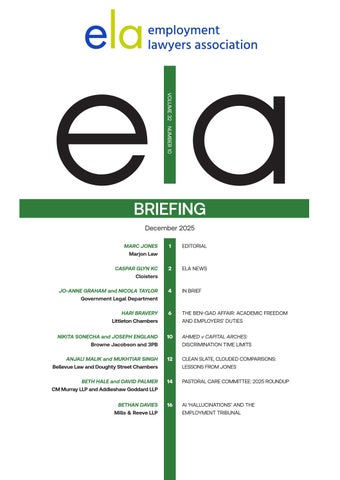
JO-ANNE GRAHAM and NICOLA TAYLOR 4 IN BRIEF Government Legal Department
HARI BRAVERY 6 THE BEN-GAD AFFAIR: ACADEMIC FREEDOM Littleton Chambers AND EMPLOYERS’ DUTIES
NIKITA SONECHA and JOSEPH ENGLAND 10 AHMED v CAPITAL ARCHES: Browne Jacobson and 3PB DISCRIMINATION TIME LIMITS
ANJALI MALIK and MUKHTIAR SINGH 12 CLEAN SLATE, CLOUDED COMPARISONS: Bellevue Law and Doughty Street Chambers LESSONS FROM JONES
BETH HALE and DAVID PALMER 14 PASTORAL CARE COMMITTEE: 2025 ROUNDUP CM Murray LLP and Addleshaw Goddard LLP
BETHAN DAVIES 16 AI ‘HALLUCINATIONS’ AND THE Mills & Reeve LLP EMPLOYMENT TRIBUNAL
IDS
ELA Briefing is published by IDS, part of Thomson Reuters. The IDS legal research team has been providing analysis and information on employment law since 1966.
Tel: 0345 600 9355 www.incomesdata.co.uk
Follow us on Twitter: @IDS_team
The views of the authors in ELA Briefing do not necessarily represent those of the ELA editorial board.
All rights reserved: no part of this publication may be reproduced, stored in a retrieval system, or transmitted in any form or by any means, electronic, mechanical, photocopying, recording or otherwise, without the permission of the Employment Lawyers Association.
Original design concept by Teresa Monachino www.studiomonachino.co.uk
Editor MARC JONES Marjon Law marc@marjonlaw.co.uk
Editorial committee
KATHLEEN BADA Charles Russell Speechlys LLP
CLARE FLETCHER
Slaughter and May
JO-ANNE GRAHAM Government Legal Department
DOUGLAS LEACH
Guildhall Chambers
RICHARD LINSKELL Gunnercooke LLP
CRAIG LUDLOW 3PB
SARA MEYER
DAC Beachcroft
NIKITA SONECHA Browne Jacobson
Advertising CYNTHIA CLERK Cynthiac@elaweb.org.uk
a word from the editor
What a year it has been for employment law, where the pillars of dealing with employment disputes, employment tribunals and the EAT, celebrated their 60th and 50th birthdays, respectively. Tribunals have come a long way since the first Presidents, Sir Diarmaid Conroy (tribunals) and Sir Raymond Phillips (EAT), not only in terms of the claims being litigated, but also in the sheer volume of claims and appeals being made.
‘tribunals have come a long way … not only in terms of the claims being litigated, but also in the sheer volume of claims and appeals being made’
The number of claims and appeals is likely to increase exponentially when the Employment Rights Bill is finally passed, which, as matters stand, looks unlikely anytime soon given the House of Lords is seeking amendments to provisions. According to recent data published by HMCTS, the ‘employment tribunal open caseload’ stood at 61,163 at the end of September; the total in September 2024 was 48,465, an increase of more than 20%. The total number of ‘employment tribunal disposals’ over the preceding 12 months was 35,271, an increase of 11.75% on the same period in the previous year. The number of ‘employment tribunal receipts’ in the 12 months to September was 48,400 against 40,523 in September 2024, an increase of almost 20%.
The Conservatives have just launched their own attack on the Employment Rights Bill by stating that, if in power, it ‘will repeal every job-destroying, antibusiness, anti-growth measure in this Bill by restoring common sense, sending a very clear message that Britain is open for business again’. In other words, by the time the Bill comes into effect and employment lawyers have grappled with changes in the law, it could be repealed.
Legmark’s ‘State of the Legal Sector Survey 2025’ caught my eye last month. It revealed that (i) positive culture and supportive teams are the standout strength; (ii) flexibility and work-life balance are highly valued; (iii) workload and stress are the biggest negatives; (iv) communication and management gaps cause frustration; and (v) limited progression and pay dissatisfaction persist. The survey concluded that law firm staff generally like their colleagues and the flexibility they have – but feel overworked, under-communicated with and uncertain about their long-term prospects. The statement that people agreed with most was: ‘I get on well with my co-workers.’ The one they agreed with least was: ‘I generally feel more productive working from home than in the office.’
This month we say goodbye to Nicola Taylor who is leaving the editorial committee.
If you would like an article to be considered by the editorial committee, please send this to ELABriefingEditor@elaweb.org.uk by 9 January. As this is the last ELA Briefing of the year, on behalf of the editorial committee, I wish all readers seasonal greetings and a prosperous new year.
I sign off this month with a legally compliant Christmas message from Collabor8online: ‘Please accept, with no obligation, implied or implicit, our best wishes for an environmentally conscious, socially responsible, low stress, non-addictive, gender neutral celebration of the winter solstice holiday, practised within the most enjoyable traditions of the religious persuasions of your choice, or secular practices of your choice, with respect to the religious/ secular persuasions and/or traditions of others, or their choice not to practise religious or secular traditions at all.’
MARC JONES, Marjon Law
ela news
You are amazing! I cannot praise you, our members, enough. The Government fired the starting pistol on its avalanche of consultations in October. It launched four consultations, two of which have a really tight turnaround of 18 December. The consultations are on important new rights, concerning bereavement leave, maternity protections, the duty to inform employees of the right to join a trade union and union access. The Legislative & Policy Committee, led by Catrina Smith and populated by experienced lawyers from the association who give up quite ridiculously large amounts of time to chair and lead the consultation responses, are an amazing bunch of dedicated lawyers.
‘more than 60 of you leapt at the opportunity to give up large amounts of your time’
They cannot do it alone. There is too much so, in our usual way, we sent out the call inviting ELA members to put themselves forward for selection to join one of the working parties. The response was overwhelming, as more than 60 of you leapt at the opportunity to give up large amounts of your time drafting, discussing and looking at ways to improve the new legislation as well as warning the Government about proposals that would not work in practice. The numbers of members willing to do this is nothing short of stunning. I am so moved and so proud of ELA that our engaged expert members come forward, for nothing, to give back to the profession by trying to make the law of the future better – so that all our clients, and us, can have a more workable future.
ELA speaks in a quiet voice to the Government on employment law but our responses shout loudly to our expertise and knowledge. I know that no other organisation speaks with ELA’s authority on the shaping of employment law. The reason? You.
The volunteers, both on the Legislative & Policy Committee and the working parties are true experts. Experts on the law and its interpretation, experts on the law and its practical consequences and implementation on the ground: that expertise shines out from all the consultation reports that I read and approve. As most of us are doing the Christmas shopping or getting ready to celebrate other festivities, a large number of us will be drafting responses trying to improve our future and doing it for nothing.
I am acutely aware of the dedication of so many members. The Training Committee, which has put on more training this year than ever before for more members than ever before, and the Pastoral Committee, which gives us the tools to thrive in busy, pressured practices, the regional reps working up and down the country to deliver. The Pro Bono Committee and our hundreds of pro bono volunteers delivers much-needed advice to litigants in person.
The committee that puts out this Briefing 10 times a year, the International Committee with its fantastic ABA conference in October and our In-house Committee driving participation and knowledge with our large community of lawyers who are not in private practice – all these put the future of ELA in good hands. And then there is our Junior Committee and the members who run the whole show such as our Secretary and Treasurer, supported by our members at large driving diversity projects or dealing with HMCTS digitisation.
Our focus on delivering more to members and cutting costs this year has meant that this has been, financially, ELA’s most successful year so far. This will, we hope, allow us to give even more towards pro bono work, and deliver more exciting initiatives to drive employment law and employment lawyers’ interests.
Thank you. I know that it is early but may I wish you a merry Christmas, a happy Hannukah and a joyful holiday season – when it comes after what will be a busy month!
Recent activities
• The Annual Lecture – ‘Reflections on 50 years at the EAT’ by Lady Simler was a fantastic talk by the leading employment jurist in the UK. We were pleased to welcome nearly every past President of the EAT.
• Training Committee webinars included ‘Tricky Termination Payment Tax issues’ on 18 November. A two-day ‘Introduction to Employment Law’ course took place in Birmingham on 10 and 11 November.
• The Pro Bono Committee organised a ‘Voices for Advocate’ panel session with the organisation Advocate in London on 6 November, as part of the Pro Bono Week 2025 celebrations.
• The regions: ‘A view from the ET bench and Q&A’ was held in Cardiff on 4 November. Quiz events took place in Leeds (25 November) and Milton Keynes (27 November).
Looking ahead
• Forthcoming Training Committee webinars include ‘Restrictive Covenants’ on December 3. A ‘Solent Training Day’ is planned for 6 February in Southampton.
• An EAT event, ‘The Employment Appeal Tribunal at 50’ is planned for 5 December.
• The Junior Committee will be holding ‘An Introduction to Advocacy for Junior Employment Lawyer’ course in Manchester on 3 December.
• The Legislative & Policy Committee will be responding to consultations relating to the Employment Rights Bill.
• The regions. There will be quiz events in Birmingham (2 December), Newcastle and Bristol (9 December).
• The ELA Annual Conference and Dinner will be held on 21 May 2026 in London.
CASPAR GLYN KC, Cloisters
in brief
Acas early conciliation period extended
On 4 November, the Employment Tribunals (Early Conciliation: Exemptions and Rules of Procedure) (Amendment) Regulations 2025 (SI 2025/1153) were laid before Parliament and will extend the period of Acas early conciliation from six to 12 weeks. The regulations apply when a prospective claimant has contacted Acas on or after 1 December.
Online HR1 form compulsory
‘the Government has published four Employment Rights Bill consultations’
With effect from 1 December, use of the online version of form HR1 has become compulsory; it is no longer possible to download and email a Word version of form HR1 (the form which must be submitted to the Redundancy Payments Service when an employer plans to make 20 or more employees redundant at an establishment within a 90-day period). In order to comply with the obligation to share the HR1 form with trade union and employee representatives, the summary page of the form must be saved or printed before submission. After submission, the HR1 form cannot be retrieved, saved or printed. Further information and FAQs have been published by the Insolvency Service: https:// www.gov.uk/guidance/advanced-notification-of-redundancies-hr1-form
Employment Rights Bill consultations
On 23 October, the Government published four Employment Rights Bill (ERB) consultations:
• ‘Make Work Pay: Right of trade unions to access workplaces’, covering how trade unions’ expanded right to access workplaces will work in practice. The consultation closes on 18 December with a consultation on a draft code of practice, setting out practical guidance, taking place in spring 2026. Increased rights of access are expected to come into effect by October next year.
• ‘Make Work Pay: Enhanced dismissal protections for pregnant women and new mothers’ is seeking views on the detail around reform which will make it unlawful to dismiss pregnant women, mothers on maternity leave and mothers who return to work for up to six months after they return. The consultation closes on 15 January. Increased protections for pregnant women and new mothers are expected to be implemented in 2027.
• ‘Make Work Pay: Duty to inform workers of right to join a union’ is seeking views on what should be included in the new requirement to provide a written statement of the right to join a trade union. The consultation closes on 18 December and it is anticipated that this reform will take effect by October 2026.
• ‘Make Work Pay: Consultation on leave for bereavement’ is seeking views on eligibility, when and how leave can be taken and notice/evidence requirements. The consultation closes on 15 January and these reforms are anticipated to take effect in 2027.
Although the ERB ‘roadmap’ document had indicated that a number of consultations were expected to take place in autumn or winter 2025 through to early 2026, it is likely that these will now be delayed until 2026.
Anonymity applications
Given the apparent increase in applications for anonymity under rule 49 of the Employment Tribunal Procedure Rules 2024 (SI 2024/1155) (rule 50 under the Employment Tribunals (Constitution and Rules of Procedure) Regulations 2013 (SI 2013/1237)), it is timely to look at two recent decisions which considered the correct approach to these applications. While noting the important principle of open justice, in
Nicola Taylor Jo-Anne Graham
DBP v Scottish Ambulance Service [2025] EAT 147, the EAT found that an employment tribunal was wrong to have rejected an anonymity application where the claimant had not yet obtained medical evidence and had concerns about her family learning of mental health issues which formed part of the factual background to her claim.
On a similar point, the EAT held in F v J [2025] EAT 34 that a tribunal had set the bar too high when it said that a claimant had to prove objectively that he had well-grounded fears about his disability being made public. The EAT said that the claimant had produced sufficient evidence to support his concerns in the form of research which assessed the impact of disclosure of disability on employment prospects. That level of evidential proof was sufficient to show that the claimant’s fears were genuine and reasonable.
Whistleblowing: new and forthcoming developments
On 27 October, the Law Society issued new whistleblowing guidance for inhouse solicitors. The guidance considers some of the complications that can arise for solicitors in the context of reporting wrongdoing against the backdrop of professional duties of confidentiality and/or legal privilege. It includes a checklist of questions and a model whistleblowing policy. Feedback on the draft guidance and model policy is sought by 25 January.
The review of the whistleblowing framework (commissioned by the previous Government and published in July), highlighted several issues with existing whistleblowing protections. Although it is apparent that there is a need for reform in this area, this will not be taken forward under the auspices of the ERB. Reform of the whistleblowing framework is only addressed in the ERB to the extent that clause 23 of the ERB will amend the definition of ‘qualifying disclosure’ in s.43B of the Employment Rights Act 1996 to include disclosures of sexual harassment.
Employment tribunal jurisdiction and early conciliation
In Reynolds v Abel Estate Agents Ltd [2025] EWCA Civ 1357, the Court of Appeal has resolved a conflict in previous case law on acceptance of claims following a failure to engage in Acas early conciliation (EC). The court has confirmed that where there has been a failure to engage in EC and no exemption applies, an employment tribunal will not have jurisdiction to consider a claim. However, a tribunal may, at its discretion, allow a claimant to amend an existing claim to add a new claim, even if EC has not taken place in relation to the new claim. On the facts of this case, the claimant’s claim for unfair dismissal was exempt from EC because it was accompanied by an application for interim relief; but a linked claim that the dismissal amounted to a whistleblowing detriment was not exempt and had not been subject to EC. The Court of Appeal held that the tribunal had no jurisdiction to hear the detriment claim because of the failure to comply with EC, but it was able to consider that claim by way of amendment. Relevant factors in exercising this discretion included that the claimant had been under significant time pressure to comply with the seven-day deadline for her interim relief application and the fact that the detriment claim was closely connected to the claim for automatically unfair dismissal.
JO-ANNE GRAHAM and NICOLA TAYLOR, Government Legal Department
The Ben-Gad affair: academic freedom and employers’ duties
HARI BRAVERY, Littleton Chambers
Employers are increasingly finding themselves under heightened pressure to regulate the protected speech of employees relating to politically sensitive matters. This has become particularly pertinent in academia, a field naturally lending itself to the expression of contested beliefs.
In October, Professor of Economics at City, University of London, Michael Ben-Gad, was the subject of student protests owing to his openly expressed belief in Zionism and his previous military service in the Israeli Defence Force (IDF). The protest group demanded the termination of Professor Ben-Gad’s employment contract.
The example of Professor Ben-Gad is emblematic of increasingly polarised higher education workplaces, teasing out several legal considerations for academic employers:
• it reminds employers of the protections afforded to philosophical beliefs under the Equality Act 2010 (EqA);
• it questions the acceptable remit of academic employees’ expressions of their protected beliefs under EqA, considering Higgs;
• it raises questions on the impact of the Higher Education (Freedom of Speech) Act 2023 (HEA);
• it demands a consideration of whether subjecting an employee to a detriment due to their participation in controversial but mandatory military service is a form of direct discrimination under the EqA; and
• it raises questions about the liability of employers to protect employees from third-party harassment under the EqA and forthcoming Employment Rights Bill, alongside whether targeted student protests can be harassment. This article conducts a legal analysis of such issues for the benefit of higher education institutions, laying out the current law on direct discrimination in relation to the protections afforded to academics’ freedom of speech.
Nationalisms as protected beliefs
Under s.4 EqA, ‘religion or belief’ is a protected characteristic, rendering employer discrimination against an employee on this basis unlawful. This encompasses any ‘philosophical beliefs’ (s.10(2) EqA). Greater clarity on what constitutes a ‘philosophical belief’ worthy of protection was given in Grainger at para 24, establishing five criteria:
• the belief must be genuinely held;
• it must not be an opinion or viewpoint based on current information;
• it must be on a weighty and substantial aspect of human life and behaviour;
• it must have a certain level of cogency, seriousness, cohesion and importance (‘very modest threshold requirements’ – Forstater at para 87); and
• it must be worthy of respect in a democratic society, not be incompatible with human dignity and not conflict with the fundamental rights of others.
As such, it is not the court’s role to inquire into the validity of a belief; rather, it assesses whether it is a belief worthy of statutory protection. A belief in any form of nationalism is certainly a protected philosophical belief under Grainger. Hence, just as anti-Zionism is a protected philosophical belief under the EqA, so too is Zionism in my view. While Miller is currently on appeal to the EAT and there has been no judicial treatment of the
The Ben-Gad affair: academic freedom and employers’ duties
‘the erstwhile heretical idea of an objective justification defence to manifestation of belief direct discrimination, first floated in Page, has become entrenched in domestic law’
proposition that Zionism is a protected belief under the EqA, this seems the correct position in both regards. Thus, subjecting an academic employee to a detriment due to their Zionist beliefs would be an unlawful, directly discriminatory act under s.13(1) EqA.
Manifestations of protected beliefs
However, the legal position is different if an employee suffers a detriment not due to their protected belief, but rather due to their manifestation or expression of this belief. This has been most heavily litigated by ‘gender critical’ academics, most prominently in Forstater
The knotted case law on manifestation of belief discrimination has culminated in Higgs. Underhill LJ’s Court of Appeal judgment has reshaped the law on this matter, in large parts haunted by the Court of Justice of the European Union's (CJEU) decision in Bougnaoui (cited in Higgs para 57), which authoritatively established that the EqA, in implementing the Framework Directive, must protect both the holding of a protected belief and the outward manifestation of it. Under s.10 EqA, only the possession of a protected philosophical belief is subject to direct discrimination protections. As such, Higgs establishes that s.13 EqA must be interpreted by domestic courts to give effect to Bougnaoui. To achieve this, Higgs reads down s.13(1) EqA under s.3 of the Human Rights Act 1998 (HRA) to render it compatible with Article 9(2) of the European Convention on Human Rights. Thus, the erstwhile heretical idea of an objective justification defence to manifestation of belief direct discrimination, first floated in Page, has become entrenched in domestic law.
Higgs is a frustrating judgment. Underhill LJ elides the fact that s.13 EqA is not obviously incompatible with the HRA, so there is no need for human rights legislation to apply, offending the principles in Mercer. Furthermore, the insertion of an objective justification defence into s.13(1) EqA is alien to the wording of the statute. However, since permission to appeal to the Supreme Court has now been refused, Higgs is here to stay.
What does this mean practically for universities as employers? Imagine a hypothetical: an academic employee manifests a protected belief in an objectionable way. The university would justifiably want to impose a sanction on the employee. To this end, the university dismisses the employee. The objective justification reasoning means that if a tribunal finds that dismissal is too severe a sanction, coming to a different view on its proportionality, the employer will automatically have committed an act of direct discrimination. However, a ‘proportionate’, lesser sanction for the same manifestation would not be direct discrimination in the eyes of a tribunal. The objective justification defence renders the sanction, not the manifestation, determinative as to whether a directly discriminatory act has been committed. Higgs means that employers will naturally be more cautious about imposing sanctions on employees who objectionably manifest their beliefs.
Higher Education (Freedom of Speech) Act 2023
Quite apart from manifestations of belief, universities are now bound by the HEA – s.1(2) imposes upon universities a new obligation to secure the freedom of speech of staff members and students. Under ss.1(6)(7) HEA, universities are under an obligation to secure the ‘academic freedom’ of their academic employees by protecting their ability to ‘put forward new ideas and controversial or unpopular opinions’ without risking detriment or dismissal. Under s.1(9) HEA this also applies during the recruitment process for prospective academic employees.
At first blush, the HEA imposes burdensome obligations on universities. However, s.4 HEA, allowing individuals to bring civil claims against higher education providers for breaches of the HEA, is not currently in force. The current Government has indicated that this section will be repealed in its entirety to prevent any financial damage arising out of this statutory tort. Thus, the HEA is, a mere guideline for higher education providers that is toothless from an enforcement perspective.
Mandatory military service
Professor Ben-Gad’s case is not just a matter of manifestations of belief. A large part of the student campaign against him is due to his service in the IDF. Israel is one of 66 nations worldwide requiring its citizens to
The Ben-Gad affair: academic freedom and employers’ duties
'to avoid liability university employers should ensure that they take ‘all reasonable steps’ to prevent protest action from harassing academic staff members'
participate in mandatory military service, which begs the question of whether such mandatory military service is a protected characteristic under EqA?
For nations where military service is a mandatory component of citizenship, it logically follows that this is an indelible part of what it means to hold this nationality. Section 4 EqA lists ‘race’ as a protected characteristic, clarified at s.9(1)(b) to include ‘nationality’. To discriminate directly against an individual on the basis that they participated in mandatory military service for their home nation is, in effect, to discriminate against somebody purely due to their nationality since all citizens of that nation would suffer an employment detriment, as all of them would have participated in mandatory military service. On this basis, to treat an employee differently due to their participation in mandatory military service likely amounts to a directly discriminatory act under s.13(1) EqA.
Protecting employees from third-party harassment
The student protest campaign against Professor Ben-Gad is emblematic of other concerted student campaigns against university employees who hold disputed beliefs. City has specifically stated in response that it ‘will not tolerate the harassment of its staff and students’. What, then, are employers’ duties to protect employees from third-party harassment in the course of their employment?
Such a duty was formerly imposed upon employers by s.40 EqA, though this was repealed in September 2013. As such, the current law on an employer’s liability for third-party harassment of an employee is simply that there is no such liability. However, employers can bring actions preventing such harassment under the Protection from Harassment Act 1997. An example is provided by Ashford, in which an employer succeeded in a claim against a member of the public for harassment of its employees.
However, the non-liability of employers for third-party harassment is set to change owing to clause 20 of the Employment Rights Bill. When clause 20 comes into effect (likely in October 2026), employers will be liable for harassment perpetrated by third parties against an employee in the course of their employment if the employer has failed to take ‘all reasonable steps’ – a high threshold requirement – to prevent such harassment. In the context of student protests, under the forthcoming legislation, employers will be held liable for the actions of such protestors if their actions constitute harassment under s.26 EqA. By statute, protestors will have harassed employees if they engage in unwanted conduct related to a relevant protected characteristic that has the effect of violating the employee’s dignity or creates an ‘intimidating, hostile, degrading, humiliating or offensive environment’ for the employee. In determining whether an action has this effect: (a) the perception of the employee; (b) the other circumstances of the case; and (c) whether it is reasonable for the offending conduct to have that effect will be taken into account.
It is eminently plausible that a concerted protest against an individual employee can satisfy these criteria. In future, to avoid liability university employers should ensure that they take ‘all reasonable steps’ to prevent protest action from harassing academic staff members. This may include increasing security around an employee subject to a concerted protest campaign, limiting protest action to a specific part of the campus and providing pastoral care to the affected employees to ensure that the workplace environment is less intimidating or hostile.
Conclusion
Pirani EJ aptly summarises in Miller at para 314 that the university ‘as [an] academic institution, ought to be prepared to face and to weather criticism and reputational damage which flows from the exercise by its academics of their rights to speak and think freely and lawfully on areas within or connected to their research and expertise’. The statutory and common law protections currently afforded to academic employees’ manifestations of protected beliefs will inevitably lead to instances of student protest.
With an increasingly litigious higher education workforce and against a shifting legal landscape, particularly in relation to manifestation of belief direct discrimination, academic employers are in an invidious position. Considering recent changes in the law, academic employers should take practical steps to ensure that the
The Ben-Gad affair: academic freedom and employers’ duties
‘the statutory and common law protections currently afforded to academic employees’ manifestations of protected beliefs will inevitably lead to instances of student protest’
sanctions arising out of disciplinary processes against academic employees for objectionable expressions of their protected beliefs should be assessed rigorously for proportionality. In relation to protests, universities should be attentive to the impending change in the law in relation to employer liability for third-party harassment, ensuring their internal policies offer sufficient support to employees subject to consistent protest action.
KEY:
EqA Equality Act 2010
Higgs Higgs v Farmor’s School [2025] EWCA Civ 109
HEA Higher Education (Freedom of Speech) Act 2023
Grainger Grainger Plc v Nicholson [2010] IRLR 4
Forstater Forstater v CGD Europe [2022] ICR 1
Miller Miller v University of Bristol ET/1400780/2022
Bougnaoui Bougnaoui v Micropole SA (C-188/15) [2015] ICR 139
Framework Directive
Page
HRA
Mercer
Ashford
Directive 2000/78/EC establishing a general framework for equal treatment in employment and occupation [2000] OJ L303/16
Page v NHS Trust Development Authority [2021] EWCA Civ 255
Human Rights Act 1998
Secretary of State for Business and Trade v Mercer [2024] UKSC 14
Ashford BC v Wilson [2021] EWHC 2542 (QB)
Ahmed v Capital Arches: Discrimination time limits
The EAT’s recent decision in Ahmed offers a useful reminder of time limits in discrimination claims involving ‘continuing consequences’.
As well as the helpful reminder on time limits, Ahmed also clarifies when workplace events constitute one-off acts rather than continuing conduct. The case applied Parr and considered Moustache to determine when time begins to run for discrimination complaints under s.123 of the Equality Act 2010. This judgment will likely have meaningful implications for how practitioners approach claims involving failures to promote, demotions and job/duty reassignments. The case reinforces the strict approach tribunals take to time-limits and highlights the importance of bringing claims promptly, and clearly identifying any alleged continuing conduct from the outset.
Background to the dispute
Mr Ahmed was employed by Capital Arches from October 2018, he went off sick in June 2021 and issued a claim in October 2022. He sought to bring claims of direct race and religion or belief discrimination relating to events which occurred in 2018. Mr Ahmed alleged that he experienced harassment from colleagues and was subsequently subjected to a change in his duties by his manager. Nonetheless, his tribunal claim was submitted nearly four years after the alleged discriminatory conduct occurred.
The case turned on a fundamental question in employment discrimination law: whether the change in Mr Ahmed’s duties constituted a one-off discriminatory act with ongoing consequences, or conduct extending over a period. This distinction is critical because it determines when the statutory time-limit begins to run.
For one-off acts, the three-month time-limit (plus early conciliation extension) runs from the date of the act itself. By contrast, where conduct extends over a period, time runs from the end of that period, potentially allowing claims to be brought much later.
The employment tribunal’s decisions
The tribunal concluded that the claim was presented ‘almost four years after the expiry of the primary limitation period’ which was ‘a very long delay’. It found that the reassignment of duties was a discrete event rather than continuing conduct, despite its ongoing impact on Mr Ahmed’s working life.
The tribunal did not accept that time should be extended on ‘just and equitable’ grounds, finding that allowing the claim to proceed ‘would be seriously prejudicial to the respondent’ because ‘the events in question are more than five years-old’ and ‘memories fade’. It noted particular difficulty in that ‘the bulk of the claimant’s allegations are about verbal conversations in July 2018 between him and his former colleagues, who the respondent says are no longer employed by it, and some had left some years ago’. Balancing the prejudice to the claimant, the tribunal accepted that the refusal to extend time would result in dismissal of Mr Ahmed’s entire claim but this was not ‘by itself’ a valid reason to justify granting the extension.
Mr Ahmed appealed, but the EAT upheld the tribunal’s decision in its entirety, confirming that it had correctly applied the legal principles and was correct in its decision to refuse a time extension.
The legal framework: established authorities
HH Judge Auerbach in the EAT summarised the legal position, noting that ‘the correct legal approach to such issues has been considered in several authorities over the years, notably in Kapur and Sougrin’. These
NIKITA SONECHA, Browne Jacobson and JOSEPH ENGLAND, 3PB
Ahmed v Capital Arches: Discrimination time limits
‘Ahmed underscores the absolute importance of submitting claims promptly and drafting particulars of claim with precision’
authorities ‘establish that there is a distinction between conduct extending over a period, and a one-off act which is not such conduct, even though, after it has occurred, it has continuing consequences’.
The EAT also considered the more recent Court of Appeal decision in Parr, which concerned a claimant ‘demoted from the status of equity partner in the respondent firm to that of ordinary partner’. The court ‘held that there was no logical reason to treat a demotion differently from a dismissal’ and that ‘both were correctly analysed as one-off acts with continuing consequences, and as not being conduct extending over a period’.
The key distinction from Parr
Significantly, Bean LJ in Parr drew a distinction ‘between a case in which an employer applies an ongoing policy which inevitably means that an individual is barred from valuable benefits – which would be a continuing act of discrimination – and one which involves the exercise of a discretion in the particular case’.
Applying this test to Mr Ahmed’s case, the EAT determined that ‘it was never a part of the claimant’s case that [his manager] was following an underlying general policy or practice of the respondent about the duties that were to be allocated to different employees by reference to race or religion, as opposed to [his manager] having taken a specific decision in his case’. Therefore, ‘that decision was correctly viewed in law as being, for the purposes of the claimant’s claim, a discrete decision or act with continuing consequences’.
Implications for practitioners
This judgment carries a number of important lessons for employment law practitioners:
• the case underscores the absolute importance of submitting claims promptly and drafting particulars of claim with precision. Where a change in duties, demotion or failure to promote is alleged, practitioners must carefully consider if evidence exists of an underlying discriminatory policy being continuously applied. If no such evidence exists, the event will be treated as a one-off act. Any allegation of continuing conduct must be clearly articulated in the ET1, with specific details of how and when the conduct continued beyond the initial act;
• it demonstrates the value of challenging the scope and timing of complaints at the earliest opportunity through preliminary hearings. Where claims relate to historic events, respondents should press for clarity on whether continuing conduct is genuinely alleged and supported by evidence of an ongoing policy; and
• the judgment confirms that there is no guarantee that the ‘just and equitable’ discretion to extend time will be exercised, despite its lower threshold than the ‘not reasonably practicable’ test that tribunals consider for extensions of time in other types of claim. Substantial delays require compelling explanations, and tribunals will give substantial weight to evidential prejudice caused by the passage of time, particularly where witnesses have left employment and memories have faded.
Ahmed provides valuable clarification on a frequently contested area of discrimination law. It confirms that workplace events such as reassignments and demotions are generally treated as one-off acts unless there is evidence of an underlying discriminatory policy being continuously implemented. The case reinforces the strict approach tribunals take to time-limits and highlights the importance of bringing claims promptly and clearly identifying any alleged continuing conduct from the outset.
KEY:
Ahmed Ahmed v Capital Arches Group Ltd [2025] EAT 133
Moustache v Chelsea and Westminster Hospital NHS Foundation Trust [2025] EWCA Civ 185, [2025] ICR 1231
Clean slate, clouded comparisons: Lessons from Jones
The Briefing examines the ‘clean slate’ approach to recruitment through the lens of the race discrimination case of Jones, exploring the approach to comparator analysis and the practical implications for employers.
What is the clean slate approach?
In the interests of fairness and equality, many employers apply a clean slate approach in recruitment. A clean slate approach is where, at each stage of a recruitment exercise, an employer conducts a fresh evaluation of each candidate, based on performance at that stage alone. This means that all candidates that progress through to the next stage of recruitment enter that stage with a clean slate; hence, their assessment at the previous stages is disregarded.
The rationale of the clean slate approach is to mitigate any bias, ensure fairness and to enable objective, skills-based decisions. Thus, any preconceived notions based on past performance, credentials or personal connections are eliminated resulting in a level playing field at each stage of recruitment. However, in light of the EAT decision in Jones, it is clear that a clean slate approach does not shield employers from allegations of discrimination and, in order to guard against such allegations, it is crucial for employers to understand the complex area of how the tribunal identifies the correct comparators.
Jones: comparator analysis for clean slate cases
The case concerned a recruitment process in which C, a black candidate, was rejected in favour of a white candidate (B). C contended that he was better qualified on paper and also performed better in the interview. The employment tribunal had concluded that candidates who passed the initial sift stage were then interviewed with a ‘clean slate’; hence, the decision to recruit B was solely due to his performance at interview. The tribunal dismissed the claim, concluding that B could not be an actual comparator due to ‘too many differences in material circumstances’, which included C’s assertion that B’s qualifications and experience were inferior to his and the difference in interview performances (para 33).
The EAT broadly accepted that it was open to the tribunal to separate the sift stage from the interview decision, rather than consider the process as a whole. However, it disagreed that there could be no discrimination at the sift stage simply on the basis that both B and C were progressed to interview; this was an error of law, as it overlooked that B may have been treated more favourably because of race, and further overlooked that the respondent may have overemphasised B’s qualifications and experience. Moreover, having determined that the respondent applied a clean slate approach to interviews, the tribunal erred by then rejecting B as an actual comparator on the basis of different qualifications and service. Furthermore, the tribunal had failed to consider if B might be an evidential comparator, even if he was not an actual comparator. When considering if B was an actual or evidential comparator, the tribunal should have considered how C scored against the scoring matrix compared to B. It irrationally refused to make such a comparison on the basis that the respondent did not conduct a comparison exercise and instead assessed each candidate against a scoring matrix (para 32).
ANJALI MALIK, Bellevue Law and MUKHTIAR SINGH, Doughty Street Chambers
What are the practical implications of Jones?
Even within a clean slate framework, employers should be mindful that earlier stages of recruitment may be subject to scrutiny, where it might be alleged that a candidate was only selected to the next stage due to a potentially discriminatory reason. Having a fresh panel for each stage of recruitment adds integrity to the process and prevents any previous bias and/or discrimination from infecting the next stage. Although a fresh panel should be oblivious to such bias and/or discrimination, which adds a strong layer of impartiality to the process, this will not cure any previous discrimination. Accordingly, robust scrutiny is required at each stage.
While not explicitly recommending a clean slate approach, the Equality and Human Right Commissions Equality Act 2010 Employment Statutory Code of Practice (page 122) and the Chartered Institute of Personnel and Development (in its selection methods factsheet) endorse good record-keeping; structured scoring, applying objective criteria; and anonymised evaluations to help ensure consistency and transparency. Sectorspecific guidance reinforces these principles: the Civil Service Commission’s Recruitment Principles outline that selection for appointment to the Civil Service must be on merit on the basis of fair and open competition; and similarly, the Financial Conduct Authority promotes structured and transparent hiring.
While it is reasonable to mark candidates based on a scoring matrix and not compare answers, employers should be aware that the tribunal is likely to compare answers and thus, accurate note-keeping is crucial.
The clean slate approach limits the employer’s scope to argue that there are material differences between the claimant and the comparator candidate, thus preventing the use of previous scores or qualifications in comparator analysis. This can be problematic where candidates are equally qualified, but as long as the recruitment process in such circumstances is fair, and applied objectively, then that should provide a sound solution.
For employees, Jones highlights the crucial role of comparators in uncovering discrimination. Even where a candidate comparator has ostensibly scored better, it is important to scrutinise how that candidate got to that stage in the first place, and/or whether previous assessments had infected the next stage, despite the purported clean slate. A closer look at the scoring records may reveal that the scores and answers for each candidate do not necessarily correlate as they should.
Should employers adopt a clean slate approach?
We do not recommend that a clean slate approach should be used for all recruitment exercises, recognising that every organisation and vacancy is different, and that employers identify processes which reflect the various skill levels they apply to each role, as well as their own resources. There may be benefits to more holistic approaches which do not lose useful information about performance at other stages. Some candidates might be outstanding at earlier stages, but others simply perform better than them at the final stage, which is often an interview. The final definitive stage of a selection process might put some groups at a disadvantage (for example, neurodivergent candidates).
That said, there can be strong advantages to using a clean slate approach, particularly when those involved in each stage are oblivious to the previous stages. This avoids any anchoring or confirmation bias and ensures objective assessments at each stage. However, it is not a panacea: each stage of selection must be fair to avoid bias and discrimination from infecting the process. Purported procedural neutrality must not come at the expense of evidential scrutiny, especially when the tribunal is likely to identify other candidates as actual comparators or at least evidential comparators.
Clean slate, clouded comparisons: Lessons from Jones ‘procedural neutrality must not come at the expense of evidential scrutiny'
Pastoral Care Committee: 2025 roundup
The ELA Briefing has kindly let us share our highlights from the year to give readers a flavour of the Pastoral Committee’s work.
At the start of 2025, ELA’s Pastoral Care Committee set out to deliver a year packed with more free-formembers webinars. We were fortunate to be joined by a fantastic array of speakers, from best-selling authors to viral social media educators. We were entertained, enlightened and most of all re-assured. No matter how challenging life and work have become, there are techniques and tools to help us thrive.
If you are an ELA member and missed any of these events, you may still be able to access a recording for up to 12 months after the event. Please contact us at ela@elaweb.org.uk for details.
January – Right First Time, Every Time: What gets in the way?
Naomi Latham hosted Greg Fadd from the Accuracy People to discuss why we make mistakes, how we can reduce human error and what tools we need to get it right the first time. Greg explored:
• the physical structure of the human eye and why we can only focus on a very small area at once;
• why our reading skills get in the way – we are brilliant at making sense out of nonsense, which is a real problem when looking for mistakes;
• whether we are hardwired to be distractible; and
• why we misuse our memory, and how it can be very unreliable.
February – Emotional Regulation Techniques for High-Stakes Situations
Clare Walsh hosted clinical psychologist Dr Natalie Isaia who has over 15 years’ experience supporting individuals and teams working in high stress environments and experiencing burnout, particularly in the legal sector. Dr Isaia gave us practical techniques including ‘foundation tools’ such as slow breathing, humming and social connection. We practised some of these grounding techniques and cognitive strategies together during the session to enable us to reverse the fight or flight response. The big take-away was how we could personalise these techniques and ensure that they could be implemented effectively.
March – Embracing Neurodiversity
Coinciding with Neurodiversity Celebration Week, Oliver Spratt hosted Constanza Cecchetti and Michael Leftley (Addleshaw Goddard) to discuss neurodiversity in law firms. Constanza and Michael delivered a highly engaging, thoughtful and helpful webinar, which covered a number of important topics including an overview of neurodiversity and its practical impact; the legal framework surrounding neurodiversity in the workplace and suggestions on how to work effectively with neurodivergent colleagues; some reflections around neurodiversity in the legal profession; and the importance of allyship.
April – Vicarious Trauma
Clare Walsh hosted Mary Jackson from Law Care. Mary is a non-practising solicitor and an accredited counsellor. She has worked with LawCare for 15 years. This session was aimed at legal professionals who work with vulnerable clients or are exposed to traumatic images or experiences. Mary explained the significant
BETH HALE, CM Murray LLP and DAVID PALMER, Addleshaw Goddard LLP
Pastoral Care Committee: 2025 roundup
‘we are always delighted when our members reach out to suggest topics for a webinar or video’
emotional impact legal work can have on us as lawyers. The takeaways were being able to identify the signs of vicarious trauma and what self-care and strategies we could adopt to minimise risk. This included the five steps to improving wellbeing: connect, keep learning, be active, give and take notice.
June – Menopause: The hot topic
Emma Clark hosted Julie Dennis who runs one of the UK’s leading menopause consultants. After providing a brief history of menopause in the workplace, Julie advised us how to support the menopause conversation at work and at home. Her slides setting out 33 examples of menopausal symptoms were extremely informative for many attendees, educating us on the different effects of the menopause. She provided positive and practical strategies to help us to promote a menopause inclusive working environment.
June – Digital Wellbeing
Dave Palmer hosted esteemed mental health leader Petra Velzeboer to discuss her book ‘Digital Wellbeing: Recharge Your Focus and Reboot Your Life’. Petra explained how social media has been designed to hijack our attention and the impact that has on our health. Her conclusion was that we must intentionally switch off from our devices for periods of time. Being present in the real world, especially in nature, is the best way to mitigate the impact screen time is having on our minds, bodies and relationships.
September – Staying Safe in a Digital World: Helping children navigate online life
Moving the focus from our own screen use to how our children interact with the online world, Beth Hale hosted Amit Kalley, co-founder of For Working Parents, a company that helps organisations become more inclusive for working parents and employees. The digital world is shaping how our children connect, communicate and grow – and that brings with it both opportunities and risks. Amit gave us useful insights into how children and young people are using the internet, the language they use (including emojis and acronyms) and the hidden dangers of which we should all be aware. He also provided us with some really valuable guidance on how to discuss these issues with children without creating conflict and how to set boundaries that really work. The key take-away was to keep lines of communication with your kids open – they may not want to talk now, but they need to know that they can.
October – Burnout in Law: The warning signs and preventative measures
Michelle Wooding hosted Hannah Beko, a lawyer, wellbeing and performance coach and the founder of ‘Authentically Speaking’ who supports high-performing professionals to reduce burnout risk and lead with greater confidence and presence.
The discussion centred on how to identify early warning signs of burnout and how to support others, as well as providing practical tools to recognise and rise from burnout. The big take away from the session was how crucial it is to acknowledge the symptoms of burnout early and to proactively use practical tools to help to reclaim energy and purpose. A fundamental commitment to self-care and establishing healthy boundaries is essential to safeguard our wellbeing.
2026 and beyond
The committee plans to deliver more topical webinars and to continue our popular ‘Pastoral Shorts’ videos. We are always delighted when our members reach out to suggest topics for a webinar or video. Please get in touch at ela@elaweb.org.uk
AI ‘hallucinations’ and the employment tribunal
BETHAN DAVIES, Mills & Reeve LLP
The use of generative AI across litigation is a growing phenomenon; many lawyers will have read the judgment in Ayinde with a sense of unease, and the appendix to the judgment details cases concerning problematic AI use within the First Tier Tax Tribunal, High Court and internationally.
Since Ayinde was handed down in June 2025, there have been a number of other domestic cases concerning the use of AI and perhaps most notable are those cases in which professional representatives fall foul of the shortfalls of AI. See, for example, ANPV and AK; also the unpublished judgment in respect of a case brought by a former student against Birmingham City University (www.legalfutures.co.uk – ‘Law firm that cited fake AIgenerated cases to pay wasted costs’).
The use of AI brings with it the risk of what are variably referred to as (more generously) ‘hallucinated’ authorities, or (perhaps more accurately) ‘false’ or ‘fabricated’ authorities. Referring to such authorities as false or fabricated is not intended to suggest malintent on behalf of those who rely upon such cases, rather it reflects the fact that these outputs may not be errors on behalf of AI, but a symptom of programming designed to give the user the answer they are asking for.
AI fabricated authorities can take various forms, and can be surprisingly difficult to identify. Matthew Lee has set out eight common categories of hallucination (see https://naturalandartificiallaw.com), ranging from the purest form of fabricated case and citation, to the more complicated mishmash of real case names with misattributed principles, or real case names with misattributed facts or ratios.
While there is an emerging body of guidance in respect of professional representatives inappropriately using AI, there remains significant uncertainty as to the consequences of litigants in person misusing AI. Arguably, the employment tribunal is positioned to be specifically vulnerable to AI abuse: the percentage of unrepresented litigants (around 40% of claimants and 30% of respondents); the frequency of legal, as opposed to pure factual, arguments; the large wealth of authorities; and significant number of new appeal cases each year.
Kuzniar is the first reported tribunal case dealing with the consequences of hallucinated authorities. The claimant used ChatGPT to draft submissions in respect of a myriad issues, including amendment and whistleblowing jurisdiction. The claimant’s submissions cited over 30 cases, with 15 being non-existent (varying combinations of fabricated case name, fabricated citation, real case name, real citation, with none of the existing cases pertaining in any way to the asserted principle) and 13 inaccurate authorities (where the case existed but on no reasonable reading supported the asserted principle). The claimant also relied upon nonexistent sections of the Dentists Act 1984. Once the issue had been identified (at significant expense to the respondent), the claimant admitted to having used ChatGPT, without verifying the outputs.
An application in respect of the claimant’s conduct had originally been made on a strike-out basis, with an unless order sought in the alternative in terms that all future documents submitted by the claimant must be signed with a statement of truth, and any future submissions must be accompanied by copies of the cited authorities. However, the matter had already been struck out on other grounds by the time Burns EJ turned
AI ‘hallucinations’ and the employment tribunal
‘these are plainly missed opportunities to furnish litigants in person with knowledge as to how the inappropriate use of AI may affect their claims’
to the conduct, therefore an oral application was made for costs. The application was presented on the basis that checks of the AI outputs would have revealed the hallucinations to the claimant; when challenged she had shown herself to be perfectly capable of finding actual cases via BAILII.
In failing to make any checks of her submissions, the claimant had been reckless as to the real risk of misleading the tribunal. The respondent had had no choice but to undertake the extensive exercise of identifying the hallucinations, not least to ensure that the tribunal had all of the relevant authorities before it. Burns EJ found that the claimant’s conduct in using ChatGPT to draft submissions without then conducting any due diligence to be unreasonable for the purposes of costs.
It is a shame that Burns EJ dealt with the matter in Kuzniar with such brevity, as parties remain without clear guidance from the tribunal as to the proper use of AI. Similar concision was recently applied by Khan EJ in respect of another facet of AI use; the drafting of witness statements. The fact that a claimant has used AI to draft a witness statement was raised within a reconsideration application in the matter of Tsikni
Khan EJ recorded that the tribunal had been cognisant of the AI use and ‘gave consideration to this in weighing the evidence’, yet did not set out the practical effects (if any) of the AI use upon the tribunal’s regard for the claimant’s evidence. Perhaps this brevity is symptomatic of a failure to appreciate the scale of AI use within tribunal litigation, or a judicial reluctance to break new ground. Either way, these are plainly missed opportunities to furnish litigants in person with knowledge as to how the inappropriate use of AI may affect their claims, and provide guidance to professional representatives as to how such inappropriate use should be responded to.
In April, brief guidance was issued to Judicial Office Holders, the same was updated on 31 October. Notably, the guidance now provides Judicial Office Holders with a definition of AI hallucinations. The guidance includes the statement:
‘Litigants rarely have the skills independently to verify legal information provided by AI chatbots and may not be aware that they are prone to error. If it appears an AI chatbot may have been used to prepare submissions or other documents, it is appropriate to inquire about this, ask what checks for accuracy have been undertaken (if any), and inform the litigant that they are responsible for what they put to the court/ tribunal.’
Yet still, court users are without guidance as to what the consequences of litigants’ failing to discharge that ‘responsibility’ could, and should be. It seems Presidential Guidance on the use of AI within the employment tribunal would be of significant assistance, otherwise we will have to wait for a similar matter to reach the EAT.
KEY:
Ayinde R. (on the application of Ayinde) v Haringey LBC [2025] EWHC 1383 (Admin)
ANPV ANPV and SAPV v Secretary of State for the Home Department UI-2025003373 and UI-2025-003374
AK AK v Secretary of State for the Home Department UI-2025-002918
Kuzniar Kuzniar v GDC 6009997/2024
Tsikni Tsikni v Kontis and Alphakon Ltd 2212116/2023
SUBMISSION: articles should be emailed as a Microsoft® Word attachment to ELABriefingEditor@elaweb.org.uk by the copy deadline (details on the website or from the editor) in order to be considered for that month’s issue. Articles may be held over to a subsequent month if there are space constraints.
PHOTO: all submitted articles should be accompanied by a highresolution portrait ‘headshot’ photograph of the author(s) in jpeg or tiff format (a minimum of 5cms at a quality of 300dpi).
REFERENCES: at the end of the article, list the short form and full name (with un-italicised case reference) of all cases and legislation, in the order in which they appear in the article. Please provide a hyperlink in the key to any case report cited, and for any reports and legislation you mention (for the digital edition).
CONTENT: articles should examine recent case law developments or legislative proposals, providing succinct analysis and practical tips and keeping the facts to a minimum (for example, there is often no need to summarise the decision of a lower tribunal). Submissions can also be opinion pieces, checklists, overviews of a topic suitable for more recently qualified readers, overviews of foreign laws or discussions of topics related to employment law, such as HR practice. ET decisions are rarely suitable. Articles should be balanced and address both employer and employee viewpoints where possible. They should be written in an accessible style, with short sentences and paragraphs, sub-headings to signpost underlying content, a conclusion and no footnotes.
WORD COUNT: for all articles must be either 600-650, 1,100-1,200 or 1,800-1,900 words (reflecting the page length).
TITLES: should be no more than 50 characters, followed by the author’s name and firm/chambers. The topic should be clear from the title.
INTRODUCTION: begin with a ‘standfirst’ paragraph of 30-40 words, which should introduce the subject covered in the article.
EXTRACTS: suggest a phrase or short sentence for each page, to be extracted as quotes.
SUB-HEADINGS: only use initial capitals for the first word.
BULLETED LISTS: use bulleted lists rather than numbered or lettered paragraphs. Short lists should be introduced with a colon, begin with a lower case letter (unless, for example, there is a name) and have no punctuation at the end. Longer bulleted paragraphs should be punctuated at the end with semi-colons and with a full stop on the final bullet.
ABBREVIATIONS:
• use symbols (%, US$,€ ); do not use ampersand unless it is part of a name
• use numerals for all numbers except one to nine and million/billion
• do not use stops for abbreviations such as etc, ie, eg
• use acronyms where they exist, but with initial capital only: Acas, Ofcom, Nato, Defra
• use standard abbreviations for organisations and the like (CBI, ECJ, EAT, MoJ, BIS, ELA)
• if no standard abbreviation exists, first use its full name, then a short form
• only define short forms (in brackets without quote marks) if not doing so would be confusing
• refer to all legislation and cases (italicised) using an abbreviated form taken from the key
• sections of legislation should appear as follows: s.94 ERA (ERA s.94 at the start of a sentence), ss.94-95 ERA
CAPITALS: use initial capitals for languages, personal titles, names of places, institutions (such as the current Government) and publications, statutory provisions (other than section and paragraph), months and public holidays. Use lower case for job titles (such as director, editor) and legal descriptors such as claimant, defendant, judge, counsel, court, tribunal, etc.
DATES: display in the following format: 24 July 2012.
ITALICS: italicise case names and names of publications.
QUOTES: use single quote marks where quoting from judgments or legislation (except for quotes within quotes). Do not italicise. Include paragraph and page references in brackets after the quote mark (para 12, p.12).