

![]()


What in the world is going on? This was the title of an article published in a past edition of The Roar Post describing the current events of that time period. And even today does that pressing question remain relevant; Israel is under attack. But with this question sprouts another: what can we, as Jews, do to support our homeland? The answer lies in collaboration. (For more information on the above mentioned article written by Bina Sragovicz ‘27, see our website, theroarpost.com!)
Not every Jew is capable of abandoning their friends and family to serve abroad in Israel. It may be that they lack the physical capability to do so. Perhaps they are too young or too old. Even a lack of Hebrew knowledge would delay their induction into the army. But what every Jew can do is work with their peers to serve in some way.
Write letters to IDF soldiers with your classmates. Pack gift boxes with your friends. Check in with your family in Israel to ensure their safety on a routine basis.
One may question the reliability of these activities in actually benefitting the state of Israel during these difficult times. They may also question how something as simple as a gift box sent from Miami, Florida, will come to use halfway across the globe. The answer cannot be sugarcoated: nothing is for certain. However, in the end, what matters is not only that your efforts were physically received on the other end, but also the effort was there in the first place. And, by working in tandem with fellow Jews who care just as much as you, the likelihood of these benefits being reaped is only greater.
Next time you are left without anything to do, think. Think carefully about what you and your community can do to bring the Jewish people together and ensure that our Israeli brethren have a support system. Only with the power of collaboration can we truly be a people.
With Love, Tamar Grobman

By Eva Maleh ‘26

In light of the senior school year coming to an end, the most recent gathering gave the girls a chance to pause and reflect. The girls met at senior Rachel Fishman’s house for a candle-making event led by Ahava, a Jewish traditional naturopath. Each girl filled up mini jars with wax and candle wicks and infused them with different fragrances, colors, and dried flowers. This activity taught them how small choices can make something feel personal, and also gave them time to slow down and appreciate the moment
In addition to making candles, the senior girls also took part in an school Purim project. Together, they baked hamantaschen to celebrate the holiday. Having the dough prepared, they filled the pastries with different fillings and toppings such as jelly, chocolate spread, and chocolate chips. This part of the project brought them excitement and reminded them of the importance of tradition.


Another annual special project that took place was the “Jar of Notes.” Each senior wrote and will receive a jar filled with handwritten messages from her classmates. The notes include things such as encouragement and memories from the past four years. This activity gave the girls a chance to reflect on their friendships and the impact they have had on one another. As the year comes to an end, these activities show the support and connection that have shaped the senior girls’ experience.
By Lyla Faith ‘26

On March 14, 2026, Parashat Vayakhel-Pekudei was read. In this parsha, Moshe gathers the people of Israel and reminds them that they need to keep Shabbat. He then tells them G-d’s instructions to build the Mishkan, a holy place where Hashem’s presence stays among them. The people donated building materials for this structure, including gold, silver, copper, wood, oil, spices, and many others. Moshe even told them to stop donating ! In addition to the Mishkan itself, workers died building the Mishkan as well as making the ark, menorah, table, curtains, and other tools. They also made special clothes. After everything was finished, Moshe set up the Mishkan, blessed it with holy oil, and began the priesthood of Aaron and his sons. At the end of this week’s parsha, a cloud appeared over the Mishkan, which symbolized Hashem’s presence was now with the people.
This parsha is important because it teaches several key lessons for the Jewish people. First, Moshe reminds the people of Israel about the importance of keeping Shabbat, which shows that resting and holiness are important factors in relationships with G-d. The parsha also shows how the Jewish people worked together as a community by coming together and donating many materials to build the Mishkan. This teaches the value of helping others. This parsha is still relevant today because it reminds people to work together, give abundatly, respect Shabbat, and bring holiness into their communities and daily lives.
By Avichai Meisels ‘26

Throughout the year, readers of the Roar Post have been encouraged to embrace learning and growth. An emphasis has been placed on engaging in meaningful introspection regarding goals for the future and deeply analyzing mistakes made in the past, both of which ultimately help individuals become more self aware and better prepared to grow and improve But the success of these strategies is predicated on something integral for bona fide growth: sticking to one’s values. To have a vision for the future is beneficial. Acknowledging faults is certainly admirable. However, without having a proper value system and being aware of it, it is questionable whether an individual can truly grow at all. What are my values? What do I believe in? Without careful consideration of questions such as these, one cannot improve in a genuine, unadulterated manner.
In an intriguing analogy, Pirkei Avot states that anyone whose knowledge exceeds their ma’aseh–their will to act upon their values and cause positive change–is like a tree with many branches…yet few roots. If a person prioritizes possessing knowledge for the sake of having knowledge, or anything else for that matter, they may seem to be well off, but, as the teaching continues, if any wind–a stumbling block or challenge of some kind–were to blow against this tree, it would be overturned, not having the strong, healthy roots needed to stay firmly in the ground. If one grows and acts without prioritizing their values, not wishing to act upon them as a result, they cannot be expected to flourish forever They do not have concrete foundations, values that are the reason they learn and grow, and morals they will remain steadfast and uncompromising in This is not the case with individuals who work on themselves and expand their horizons with their values in mind. Anyone who prioritizes values and chooses to truly live by them has a strong foundation upon which they can grow, “roots,” so to speak, that ensure they will never stumble when faced with challenges or mere vicissitudes. Those who genuinely appreciate their values to the point that they are willing to act upon them are like trees with roots so strong that, “תוחורה לכ וליפא תואב ,םלועבש” - even if all the winds of the world were to push against them… they would not be uprooted from their place.
That values are necessary to keep in mind as one grows is actually reflected in the Jewish calendar. While our modern calendar gives individual months special names, such as Tishrei, it is notable that these names are never used in the Torah itself Rather, the Torah assigns numbers to each month in terms of their order from Yetziat Mitzrayim (ex: Nisan is known as “the first month” from the Exodus), when the Jewish people were freed from their bondage and first became an independent nation. That the original calendar names all point back to Yetziat Mitzrayim, it is clear the events that took place at that time are fundamental to Judaism and therefore important to continuously be remembered. But why? It is evident that the Jewish exodus was not merely a physical redemption of the persecuted Hebrews from their cruel oppressors. As the virtuous people of Am Yisrael were redeemed by G-d from the decadent, hedonistic Mitzrayim, the whole world saw a triumph of good over evil and truth over falsehood.
(Continued on Page 5)


By Leeyah Bitton


well as Am Yisrael, implying that everyone, ppled the corrupt powerhouse that was s a clear manifestation of the values He truly gral for Am Yisrael to recognize this, ositive values that had and would continue played the importance of values such as mental values are. What we believe in, d sacrifice. It is nice to look back and t these activities, amongst all others, when we are eventually faced with g ways, and guarantee that, even when nges–we will stand strong.
Purim is one of Judaism’s happiest holidays, in which Jews celebrate their salvation from Haman’s evil plan to destroy them. On Purim, the Jewish people are obligated to perform four unique mitzvot that reflect this day of joy: reading the Megillah, having a seudah (feast), giving Mishloach Manot (gifts of food), and giving Matanot Levyonim (gifts to the poor). Two out of four of these mitzvot have to do with giving, which is very unlike any other Jewish holiday. Purim’s main mitzvot are based on giving to others.
This presents a significant question: Why is it that Purim, out of all the different Jewish holidays, has its central mitzvot as giving to others? Why is generosity one of the most important ways to honor this holiday, and what messages are these mitzvot meant to convey? According to Pirkei Avot 2:7, “
םולש" –“The more charity, the more peace.” This statement from Pirkei Avot teaches a significant lesson about giving and its connection to unity. The basis of Haman’s plan was the division within the Jewish community, which was very prominent in Shushan. He took this tension and used it as an opportunity to destroy us. This moment warns of the dangers of division and how it leaves populations vulnerable. The only way to combat this is through unity, and one of the most effective ways to accomplish this unity is by giving. By giving gifts to others, Jews actively create unity Mishloach Manot is more than just delivering baskets of food; it is about showing friends that they are cared for, creating lasting bonds and unity When giving Matanot Levyonim, Jews are demonstrating how every person in the community is important, no matter their financial status It shows how they are responsible for one another, which further fosters unity within the Jewish community. This idea is exactly what Pirkei Avot is trying to teach: the more one gives, the more peace they make. This also explains why the mitzvot of giving are so central to Purim. Purim is not just about celebrating the miracles that Hashem made for us. It is about celebrating the unity that Jews had towards the end when coming together against all of the evil people who wanted them destroyed, which is a miracle within itself.
(Continued on Page 6)
(Continued from Page 5)
Today, the Jewish people are spread throughout the world, facing many different challenges. Purim reminds Jews that the way to combat these challenges are through acts of giving. So, the next time that someone gives Mishloach Manot or Matanot Laevyonim on Purim, it should serve as a reminder that this act of tzedakah is the first step towards achieving peace and unity throughout the Jewish community Purim is not just a day of happiness It is a day that reminds the Jewish people that through giving, they become a peaceful, connected, nation
By Julian Sharvit ‘28

In February 2026, tensions betweeen Israel and Iran escalated into a major conflict when Israel launched a large-scale military strike on Iran. Israel, with support from the United States, targeted Iranian military bases, missile sites, and government locations in several cities, including Iran’s capital, Tehran. One of the most significant results of the attack was the death of Iran’s Supreme Leader, Ayatollah Ali Khomeinei, who was killed in the first wave of airstrikes. Several other high-ranking Iranian military leaders were also killed during the attack.
Israeli military officials reported that the strike was meant to weaken Iran’s military power and stop threats against Israel. For many years, Israel has believed that Iran’s weapons programs and influence in the region could be dangerous to its security. After the strike, Iran did not hesitate to respond. Military forces launched missiles and drones towards Israel and American military bases stationed in the Middle East. These attacks also took place in Bahrain, United Arab Emirates, Kuwait, Qatar, Saudi Arabia, and Cyprus.

Photo of the Missile Strikes - Photo Credit: 8am.media
This retaliation increased tensions in the region and caused fears that the conflict could spread into a larger war. The United States played an important role in the conflict by supporting Israel and taking part in some of the strikes. American officials said their goal was to protect U.S. forces and help weaken Iran’s military capabilities.
This conflict has led to significant consequences such as the involvement of world powers and the death of powerful Iranian leaders. This begs the question of whether or not this will lead to further escalation or create a long-awaited gateway to peace in the Middle-East.
By Alexander Miodownik ‘29

It is a cool 64 degrees Fahrenheit in Tehran, Iran on the morning of February 28, 2026, when, out of nowhere, explosions begin to rattle the entire country awake. Just the day prior, as U.S. President Donald Trump boarded the Air Force One aircraft, he had authorized an offensive against Iran, sparking what is now known as Operation Epic Fury.
Tensions between both sides had been slowly escalating throughout the few weeks prior to the attack. The U.S. being concerned regarding the threat that it could pose on its mainland and its allies, had been negotiating with Iran since mid-April last year regarding their enrichment of military-grade uranium, a material that could be used to make high-range nuclear weapons Negotiations continued for months to follow, up until February 2026, when Iran denied most of the United States’ propositions and insisted on continuing its nuclear program with the goal of developing nuclear weapons Trump was left impatient and frustrated as a result of this, saying that he was “not happy with the way [the negotiations are] going.” During his boarding of the Air Force One, the double-decker 747 plane tasked with transporting the president, he w ying “Operation Epic Fury approved ... Good luck.”

The next day, at 1:15 AM Eastern Time, the operation commenced. Not even 10 minutes after missiles started firing, 30 Israeli missiles hit Ayatollah Ali Khomeinei's compound in Tehran, killing him, his Minister of Defense, and the commander of the Islamic Revolutionary Guard Corps (IRGC). The IRGC is a terrorist organization that is tasked with “defending Iran’s regime,” which it often supports through murdering innocent, usually Israeli, civilians. Notably, the IRGC had also been conspiring since November of last year to kill Trump and Jewish citizens of the United States. The strike also killed 2 of Khomeini’s other commanders. Throughout the rest of the day, the U S continued to strike targets throughout Iran, with reports saying that more cities, “including Qom, Kermanshah, Isfahan, and Karaj” had been struck Within only the first 36 hours, over 3,000 precision-guided missiles and interceptors had been used against Iran.
As the war continued to escalate extremely quickly, civilian targets in Saudi Arabia, the UAE, Kuwait, and the Kurd region of Iraq were targeted by Iran in missile strikes. U.S. military bases in Qatar, Kuwait, UAE, and Bahrain were also hit, severely damaging the U.S’ ability to defend itself against future missile attacks from the Middle East and Asia. Trump also called on the Kurds to fight back against the Iranian regime. According to Middle Eastern sources such as Al Jazeera, 13 people have already died as of early March 2026, and over 2,000 people have been reported injured in Israel due to Iranian strikes. As the war has progressed over the past few days, American Democracts have begun to express concerns over how the conflict could affect the U S Among these issues is the heavy usage of U S and Israeli munitions, and how it could affect the U S’ ability to defend itself if another war were to arise In the wake of the death of Ayatollah Khomeini, Iran has elected his son as Supreme Leader of Iran. Additionally, certain countries that have been targeted by Iran in the Persian Gulf have been struggling to defend against the barrages of Iranian missiles being hurled at them. Iranian civilians have started to go out on the streets, partying and celebrating the death of the leader that killed their brothers and deprived them of their human rights. Time is yet to tell what will come out of the current conflict, and whether Trump decides to continue taking the toll of a conflict in Iran is up to chance.
By Melanie Benlolo ‘27 & Sarah Coriat ‘27


Parashat Ki Tisa, read on March 7, 2026, recounts the famous story of the golden galf. While Moshe was on Mount Sinai for 40 days, waiting to receive the the Torah, the people grew worried because he had been away for so long. They asked Aaron, Moshe’s brother, to make something they could see and worship, so he collected their gold and created the golden calf. The people began celebrating and treating it like a god.
When Moshe came down the mountain with the tablets of the ten commandments, he saw what the people were doing and grew angry towards them. He smashed the tablets, though he also prayed to G-D to forgive the people. Later, Moshe went back up Mount Sinai and received a second set of tablets. Thus, from this moment in the parsha, we learn that even when people make mistakes, they can learn from them and make improvements to their lives
By Dylan Cohen
With the reemergence of conflicts within Israel, all eyes have laid back on the country along with its attackers. Many perceive Israel’s biggest threat to be Iran though people tend to skip over others such as Lebanon Specifically, Hezbollah, a terrorist group operating within Lebanon, has continuously been in conflict with Israel, and has shown more activity since the recent attack on Iran This escalation began after rockets and drones were launched from Lebanese territory toward northern Israel, raising concerns for the safety of nearby Israeli communities and the nation as a whole In response to these attacks, Israel carried out operations such as air strikes, targeting sites believed to be used by Hezbollah for storing harmful weapons or developing plans Israel’s motive was to defend itself from Hezbollah while focusing on Iranian attacks


But with these attacks come many civilian deaths. In just one week, the death toll reached a massive 400 deaths, demonstrating the severity of this situation in spite of the small attention it has recieved. Throughout this week and in the future, rockets have and may continue to fly to and from Israel and Lebanon until a peace agreement is signed or another outcome is developed to stop Hezbollah. Although mainly in Israel, powerful leaders throughout the world have called for restraint, hoping for the eventual cease of conflicts between the two sides to avoid a larger war.
By Bina Sragovicz


Extra! Extra! Newsies go on shocking strike against newspaper kingpin Pulitzer!
From March 8-15, 2026, the incredibly talented cast of Scheck Hillel’s upper school spring musical, Newsies Jr, stunned hundreds of audience members over three exciting performances
The vibrant musical follows a group of young, poor newspaper sellers, known as newsies, in 1899 New York City as they go on strike. When Joseph (adapted as “Josie” for this rendition of the play) Pulitzer, the head of the New York World, decides to unjustly raise prices for the already struggling newsies, union leader Jack Kelly and his newsies band together to go on strike against the misdeed and seek true justice. Featuring multiple dance-filled group numbers, powerful solos, and plenty of comedy in between, Newsies Jr. was a soaring success in the community. From vintage costume pieces to humorously antiquated props, the show brought viewers back to industrial America and roused their sense of justice as they watched the courageous newsies fight for what is right. Even more impressive, the sub-20 person cast included a wide range of actors, some performing for the first time, some for the fifth. “For the past six years, [this theater program] has led to my growth in both performance and maturity. It feels bittersweet to be performing for my last time in a Hillel musical theater show, as I’ve made so many friends that I love to perform alongside, and I have a lot of love and passion for the program. I’m very excited to see how my friends step up to be effective leaders in the program next year,” shared senior Nathan S., who played Jack Kelly, the show’s leading male role. “Throughout months of rehearsals, I didn’t just make friends,” added senior Kassandra L., who played lead Katharine Plumber, “I made family.”
By Tali Kiblisky ‘28


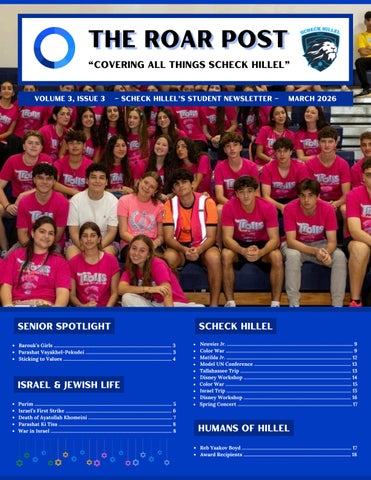
This 2025-2026 school year, Scheck Hillel's annual Color War was filled with spirit and competition. With a theme inspired by the movie Trolls, students were divided into four teams: Pink (Poppy), Green (Branch), Blue (Biggie), and Yellow (Smidge). The first night of Color War began with an “Erev Color War” Arvit service and the reading of the Megillah in the cafeteria. After dinner, students attended an exciting DJ party in the gym. The first day consisted of games, competitions, and celebration, including a game show and carnival on the field and another Megillah reading in the gym. Later on, teams competed in many thrilling events, including tug-of-war, sumo wrestling, and air mattress races. The first day of color war concluded with a dunk tank, water games, and the highly anticipated powdered color fight. On the final day of Color War, teams rotated through sports and activities throughout the morning. Events included kickball, ping pong, trivia, catapult building, art, rock wall climbing, and laser tag The day ended with the final ceremony in the gym Each team presented a Dvar Torah, creative artwork, lip sync performances, and team videos These performances displayed all the pillars of this year's color war: simcha, shalom, tikkun olam, and bitachon
Throughout the competition, the Pink team stayed in the lead However, the Green team made a surprising comeback from last to second place. In the final standings, Pink placed first, Green finished second, Blue took third, and Yellow placed fourth. By the end of the week, Color War once again proved to be one of the most exciting traditions of the school year. It is a tradition not only defined by competition, but also by unity.


By Mia Fishman ‘27 & Charlotte Pery ‘28


As the stage of Scheck Hillel lit up for the 2025-2026 season of theater, students from grades 3-5 filled the stage with their many talents for the Jordan Alexander Ressler Arts Program production of Roald Dahl’s Matilda Jr. After six months of hard work, the lower school cast members illustrated their dedication through their wonderful performances on February 4-8, 2026. The famous musical encompasses the journey of Matilda Wormwood, an intelligent and clever girl who feels pressured by her cruel parents and frightening headmistress, Miss Trunchbull. While fighting for her rights at school, Matilda utilizes her love of knowledge, courage, and friendship to bring justice to all and find a welcoming home with her adoring teacher, Miss Honey These roles were highlighted by a variety of captivating young actors
However, alongside the acting itself, much of the work was conducted behind the scenes. With an amazing production team, consisting of Stuart Rosenthal, John Baldwin, Laura Bass, Diana Quiroz, Eric Marchetta, Analucia Raimont, Nathan Schonfeld ‘26, Chris Sclarandi, Jennifer Naim, Gonzalo Garcia, Brian Ramsey, Tamar Grobman ‘27, and Jaime Fridzon ‘27, the play was a possibility. From this motivated team, two leading technicians, Jaime Fridzon, Nathan Schonfeld, had numerous valuable thoughts and lessons to share

Fridzon, the assistant stage manager with three years of prior experience, not only helped with deck cues but also organized the microphones and cue sheets for the technicians to follow When asked about his struggles during production, Fridzon shared that people tend to underestimate the amount of work that goes into creating the show He also shared that balancing the show and school work can make commitment difficult. This became especially true when the show drew near, as the crew needs to help with set cues while also keeping the actors quiet and safe, ensuring it runs smoothly. Yet, he observed that the kids learned how to be confident, open, independent, and communicative.

Similarly, Schonfeld, a current senior who has also participated in multiple shows on and off the stage, contributed by serving as lead lighting designer, tech support, and assisting the director when needed Schonfeld mentioned that while designing the lights, he worked with “our theater’s incredible Broadway-level technical setup with high-tech microphones, lighting, and projection system,” and stayed in school as late as 10 p.m. at times to fully execute his vision. Students like Schonfeld put a lot of work into Scheck Hillel’s theater program to help make its performances successful and fun for those involved. He further stated that being a senior who has done theater from a young age has given him a different perspective on the show. He can look back a truely appreciate all that theater has given him, and see these younger kids learn skills that they will take with them for the rest of their lives. He believes that even though “showtime is generally one of the smoothest and most fun parts of the process where everyone is just doing what they rehearse,” he “hopes that they actually remember the rehearsal process, the days where they were learning and growing to be better onstage and off, to be better actors and people in real life.


By Annie Slomovitz ‘28


From February 1-3, 2026, six Scheck Hillel High School students attended the Yeshiva University National Model United Nations Conference in Stamford, Connecticut. Here, they competed against several Jewish Day Schools from around the world. These students represented the country of Bolivia in their committees. Participants included Jaia Herdan ‘26, who was in the African Summit, Jeremy Dejman ‘27, in the UN International Children’s Emergency Fund, Tamar Grobman ‘27, in the World Food Programme, Shira Sager ‘27, in the Counter-Terrorism Committee, Annie Slomovitz ‘28, in the Committee on Science and Technology for Development, and Sophia Gruszka ‘28, in the Middle Eastern Summit.
The delegates engaged in deep, intellectual debate and focused on addressing key global issues. From AI-related topics to government stability in Africa, they each successfully voted on three resolutions in our committees throughout the conference. Representing Bolivia required these participants to research policies and advocate for the nation’s beliefs. In addition to debating global policy, this experience helped the delegates improve their public speaking, diplomacy, and teamwork skills, and allowed them to meet peers from Jewish day schools across the country

Throughout the six committee meetings, delegates delivered opening speeches, participated in caucuses, worked with others to draft solutions for their topics, and came up with resolutions to a surprise, unexpected crisis that came up during the conference. Overall, the conference allowed participants to engage in meaningful conversations about global topics while enhancing key skills such as public speaking and debate.
By Gabriella Gorin ‘27
On February 4, 2026, a select group of Scheck Hillel high school students, along with upper school social studies teacher Ms. Schulman and members of the NAACP, ventured to Tallahassee, Florida, to speak on behalf of Jewish students, Black students, and Florida citizens. As one of those students, I speak for the amazing experiences each student and staff member had as the day progressed. The program leader assigned amazing captains who helped organize our day and make it even more special. With the partnership of students such as Jeremy Dejman ‘27, Kimora Ragin, Ethan Dean, and myself, this trip ensured that every student involved had the ability to speak about the issues the group came to present in front of senators, Florida representatives, and legal aides.
(Continued on Page 14)


The bills and grants students presented were ones they felt connected most to their cause. One involves the renewal of a security grant for religious institutions and schools that would make the student population feel safer. The second is a human trafficking bill requiring mandatory training to spot human trafficking among nurses completing their degrees. Alongside learning about the bill, students learned a shocking fact: over 700,000 Florida citizens faced trafficking in 2024. The final bill discussed was for a Title VI Coordinator to be placed among schools, so that students feel like they have a voice that will hear their concerns against discrimination and antisemitism. The importance of such lies in educating the next generation and allowing students to go to school comfortably with a safe learning environment.
A different perspective on this enlightening day can be sourced from the trip’s chaperone, Ms. Schulman. She gave insights that illustrated why it is important for students to take the time and effort to speak to elected officials. The officials want to hear what they have to say, which has brought on a new appreciation for their efforts. Ms. Schulman also mentioned her surprise when “seeing how comfortable students appeared when talking to officials.” I, for one, was highly appreciative of Ms. Schulman's perspectives and guidance throughout the process, as it set an air of comfort and confidence around the students participating.
Furthermore, students also got to experience the Florida House of Representatives being in session and do a mock-vote for a bill. In the case of the trip, students spoke about the Miami-Dade incinerator location in the Senate chamber. It was really fascinating to see how concerned each student was about a different aspect of the conflict. After the day came to an end, I spoke to several students about their experience, and each spoke about how life-changing and great the day had been. This day had taught each student a new lesson; each of them possesses a voice and responsibility to speak up if something is amiss, as oftentimes, it is the students who want to be heard the most.
By Ella Markowicz ‘29

On February 22, 2026, Scheck Hillel’s band and orchestra students went to Orlando, Florida to participate in the Disney Imagination Campus workshop, where they played authentic Disney music. During the workshop, the students worked with professional musicians to understand the reality of filming background music for movies.
The students realized that studio recording is not always very easy due to its costly and time-crunched nature They were able to experience what it feels like to record background music in a professional studio orchestra The students put their skills to the test, learning the music on the spot, and were able to record background music for a portion of the song “Reflection”, featured in Disney’s Mulan

After participating in the workshop, the students were treated to dinner, and the next day, they had a wonderful time enjoying attractions around Disney’s Hollywood Studios. This trip was not only a fantastic opportunity for the students to experience a live studio recording, but it also paved the way for them to bond with one another. The trip allowed students from different grade levels and sections of the program to spend time together outside of school, strengthening friendships and creating lasting memories. “I loved it so much. I was able to connect with kids in older and younger grades and have memorable experiences with them like none other,” shared freshman William K. Together, these moments made the trip both an educational opportunity and a memorable time for the students involved.

Color War at Scheck Hillel Community School, which took place on March 3-4, 2026, was announced approximately one month in advance to build ruach. This year’s theme was Trolls, and each team represented a different character and color: Poppy (Pink), Branch (Green), Smidge (Yellow), and Biggie (Blue) The excitement began the night before with a special Megillah reading led by Rabbi Sprung, which was open to all parents and students, followed by a special performance by DJ Ahki for high school students. This “Erev Color War” created a lot of energy and anticipation for the start of the real Color War.


The first day of Color War was full of fun activities, loud cheering, and lots of team spirit, with students chanting and supporting their teams throughout the day. Students listened to Megillah reading once more to fulfill their obligation, read by one of Scheck Hillel’s very own seniors: Avichai Mesiels ‘26. The highlight of the day, however, was an incredible color run, where everyone ended up a little messy but had a great time! Each team grabbed water balloons and colored powder from their own team and battled with students from other teams. On the second day, the excitement built up to the final ceremony, and students were treated to food from Smash House, along with lip-sync battles, team videos, art, Dvar Torah, and performances that brought everyone together and kept the energy high. In the end, Team Poppy took the win, finishing off an unforgettable Color War.
By Ami Kattan


This year’s 10th grade Israel trip was filled with countless incredible moments, meaningful experiences, and memories that will be with the Class of 2028 for years to come. From the first to the last day, the trip gave them the opportunity to connect with Israel and with each other. Two students who attended the trip, Sophia Gruszka and Annie Slomovitz, shared their favorite days of the trip. Gruszka reflected on the special first Shabbat in Chispin, while Slomovitz described one of the most exciting days.
After having spent upwards of 48 hours in the land of Israel, Shabbat was quickly approaching. The sophomores prepared for what was sure to be one of the most special, unified Shabbats they would experience in their lives. As Shabbat came closer, they took pictures that would be cherished forever. As soon as they turned their phones in, the most surprisingly memorable day had begun. The girls lit candles all together, while the boys recited kiddush. This was followed by an incredible Shabbat dinner where they bonded over songs and new conversations. Later, they played extremely funny games, led by Israeli madrichot, that ended in pure laughter all around the room. The following morning, the students realized they had to get creative, as they were bound by Shabbat. After all, they only had each other to rely on for entertainment. However, their worries were soon eased when they realized the true number of other Israelis staying at the hotel who were also keeping Shabbat.
(Continued on Page 16)


Some of the boys befriended a group of Israeli teenagers, whom they faced off against in a heated basketball match. Meanwhile, other students found adorable babies and toddlers to play with. They even talked to other adults in the hotel. Despite the language barrier, these students were able to have an incredible time meeting new people and sharing experiences over Shabbat This idea of spending time as a grade in the beautiful nature that Israel has to offer truly took a major role in making this trip so special for the 10th graders
Another one of the most memorable days of the trip started early in the morning after the 10th graders spent the night at the base of Masada. They woke up before sunrise to hike up the mountain and view the sunrise from the top. Although the hike was challenging, reaching the top and seeing the beautiful views of the desert and the Dead Sea made it worth it. After the hike, the boys and girls separated to pray Shacharit. Then the two buses met with their tour guides, Shimon and Yoni, for a detailed tour of the ancient site. They explained the history of Masada and described the meaning of why Masada is such an important place in our history After the tour, the students traveled to the Dead Sea, where they had time to float in the water and relax Later in the day, they continued south to Eilat That night, they lit candles together for the second night of Chanukah After, the students went to the Ice Mall, where everyone had time to shop and choose their own dinner, and then to the boardwalk, where many students and teachers, including Dr. Hana Barouk, rode the exhilarating Yaniv Fireball. This was just another glimpse of one of the many full and exciting days students experienced in Israel.
The 10th grade Israel trip was an unforgettable experience that provided the opportunity to explore incredible places and make many new connections. However, this trip would not have been possible without its amazing chaperones: Opher Yunger, Cindy Winterman, Eti Levy, Dr. Hana Barouk, Joshua Miller, Sharon Rabinovitz, and Mo Fisch.
By Benjamin Ynterian
Exciting Educational Adventurous These words best describe Scheck Hillel’s orchestra and band's annual trip to Orlando, Florida On February 22-23, 2026, students produced music using a skill called sight reading. Sight-reading is when one looks at written music and plays it for the first time without practicing. It is similar to reading music as if it were a book. Focusing was one of the main attributes in this workshop, for students had to focus on their sight reading. Students had to pay heavy attention, and sight-reading skills to maximize their learning experience. Disney's Imagination workshop showed what working as a paid musician in the real world is really like Students also learned about the cost of this production, as well as how to balance their time and energy to create a productive music studio session The goal of the Disney Imagination workshop is to improve musicianship while giving students a realistic, behind-the-scenes look at the professional music industry, often culminating in recording a Disney soundtrack piece. By the end of the workshop, students not only gained stronger musical skills, but also created a deeper understanding of what the life of a professional musician like. Orchestra and band students also learned that collaboration is needed to create musical pieces. Overall, this educational trip left students with unforgettable memories and valuable lessons to carry throughout life.


By Tamar Grobman ‘27

On March 19, 2026, Scheck Hillel’s upper school band and orchestra students took to the stage for an exciting musical showcase After months of preparation, these students joined together to perform songs such as Europe’s The Final Countdown and Antonio Vivaldi’s The Four Seasons In addition to the traditional performances by groups such as the Symphonial Band and Preludio Orchestra, one special feature was added to this concert Seniors from both programs banded together to perform A Million Dreams from The Greatest Showman as a final thanks and farewell to their directors, Mr. Matt Villa and Ms. Angelica Losada. As the concert came to a close, each senior was also recognized individually in front of the crowd, and will receive honor cords on their graduation date.
By Ailyn Dejman ‘29

For Reb Yaakov Boyd, upper school Judaics and AP Human Geography teacher, being Jewish was never just an identity It was a journey shaped by hardship, challenges, and experiences that tested his faith Growing up, Boyd experienced antisemitism first hand, forcing him to confront his identity and decide what being Jewish really meant to him He had to overcome many obstacles and challenges, which ultimately shaped his faith into the proud and religious Jew he is today.
Boyd attended an elite Christian boarding school in Chattanooga, Tennessee Although it was technically a Christian school, students from other religious backgrounds like Judaism were still accepted Boyd expresses that he was accepted into the school, but was never truly accepted by his classmates following a number of challenges and instances of open hate Friends broke off their friendship with him because he was a Jew, his locker was vandalized, his clothes were destroyed, and he even had a swastika drawn on his door. He specifically remembers his 10th grade prom, when some attendees told him that Jews were disgusting and barely human. He says that he had never experienced that level of hostility in his life. At the time, Boyd thought it was best to avoid the problem by hiding his jewish identity.
In the face of antisemitism, Boyd felt outnumbered He felt the need to hide his identity in exchange for his safety He tried to downplay his Jewish identity and responded to conversations regarding his religion with vulnerability. His fear was shown and gave antisemites a reason to attack. In his lowest point when he felt in despair, Boyd went to talk to the local conservative Rabbi He was hoping to find a way to escape the hate he was facing for being Jewish
Instead, the Rabbi redirected him and told him that he could not escape being Jewish, and we [the Jews] will always be Jewish to those who don’t like us. You need to invest in being Jewish for it to mean something to you.” This moment marked a turning point in Reb Boyd's journey.

Shortly after, a Catholic teacher, who was also a pastor, called him into his office. At that moment, Reb Boyd grew a deep concern, believing that his teacher would agree with the antisemitism students had shown him. However, it came to Boyd's surprise that the teacher did not discriminate against him, but rather gave him advice He told him that “although he had lived his whole life as a Christian preacher, if he could relive life, he would choose to be an orthodox Jew” He proceeded to give him a stone edition Tanach showing that he valued it In that moment, he was shocked, however, Reb Boyd chose to believe this was a calling from Hashem that could not be ignored. “If you don’t remember you're a jew, Hashem will send you reminders. If you don’t listen to the positive ones, you might need to be shaken to awaken from your slumber,” he stated. This moment motivated Boyd to embrace his religion and defy the hatred presented to him.
(Continued on Page 18)
Although times were still hard at school, Boyd began to use his faith as a source of strength. He says that the most impacting moment of his life was choosing to devote his life to Judaism He learnt to love his religion and began to find comfort in prayer When times were hard, he would go to chapel services and hide in a broom closet to pray He would use a siddur he had bought in a retreat, and it did not matter if he did not pray perfectly; what mattered was that he showed passion and devotion to the Jewish religion, strengthening his connection to Hashem and his confidence to fight back against antisemitism Throughout the process of better understanding his religion, Boyd began understanding himself better.
Looking back today, Boyd says that challenges he faced ultimately shaped him into the happy and observant Jew he is today The twists and turns he encountered lead him to his dream job teaching at Scheck Hillel “Your Judaism is only as valuable as the amount you value it If you work hard at it and show it love, you will receive an infinite response If you neglect it, it will always remain an unreleased point of light in the darkness It's waiting for you to pick up and run with it” said Boyd By hearing Hashem's calling and showing his value to his religion, Reb Boyd was protected.

By Tamar Grobman ‘27

On the morning of March 19, 2026, students and parents gathered in the gymnasium for one special reason: awards! Spanning from academics to athletics, a number of high school students across grades 912 were recognized for their many outstanding achievements
After a quick Dvar Torah by Rabbi Shlomo Sprung, Scheck Hillel’s Rabbinic Head, the ceremony commenced with a round of academic awards. A “record number” of students received a GPA over 3.67, announced Mr. Benjamin Thompson-Echevarria, Director of High School, and were thus placed on the honor roll. Some were recognized as distinguished honor roll students for finishing the first semester with a GPA above 4.0. Other academic awards presented included those for Advanced Placement (AP) Students, as well as for the three seniors–Avichai Meisels, Maia Weitzmann, and Eva Chelminsky–with the highest GPAs in their graduating class Certain students were also given the Hillel Values Award for exemplifying the core values of Scheck Hillel
Additionally, students were eligible to receive awards for their involvement in the arts. Band and orchestra students were granted awards for their leadership and musicianship in the program, presented by Mr. Matt Villa and Ms. Angelica Losada. Yearbook and visual arts students were acknowledged for their artistic talent by upper school art teacher and yearbook advisor Ms Edith Schlesinger Finally, theater students were distinguished for their growth and dedication by Mr Stuart Rosenthal, head of the Jordan Alexander Ressler Arts Program


The final round of awards covered students whose athletic achievements across multiple sports–cross country, soccer, basketball, and others–were worthy of recognition For each sport, awards were distributed to the MIP(s) (Most Improved Player(s)), the MVP(s) (Most Valuable Player(s)), and other students that set records on the field
Editors’ Note: This story has been categorized as a “Humans of Hillel” story in order to honor the many students that received awards this school year Kol KaKavod!


Learn about Science with Leo the Lion!
Sponsored by Scheck Hillel’s Science National Honors Society (SNHS)
What is the FIRST step of MITOSIS?
A. Prophase B. Metaphase
C. Telophase D. Anaphase

Additional Credits:
Featured Student Photographers: Gavriella Derai ‘28, Jake Labbie ‘26, Rebecca Lopez ‘27
Science Trivia: Mr. Luis Comulada, Upper School Science Teacher & SNHS Advisor Leo the Lion: Shira Sager ‘27

Chief Editor and Faculty Advisor
Jason Touvi
Did you know? Due to conservation efforts, the population of the American Crocodile, a species native to Florida, has grown from just a few hundred individuals in 1975 to around 2,000 today!
Source:

What is the LARGEST BIOME in the world?
A. Taiga Biome B. Rainforest Biome
C. Marine Biome D. Savannah Biome

Official Website: theroarpost.com
@theroarpost on TikTok & Instagram