

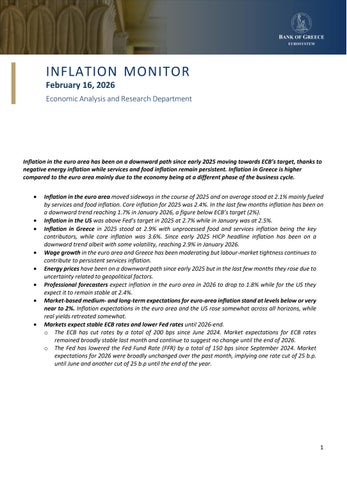
Inflation in the euro area has been on a downward path since early 2025 moving towards ECB’s target, thanks to negative energy inflation while services and food inflation remain persistent. Inflation in Greece is higher compared to the euro area mainly due to the economy being at a different phase of the business cycle.
• Inflation in the euro area moved sideways in the course of 2025 and on average stood at 2.1% mainly fueled by services and food inflation. Core inflation for 2025 was 2.4%. In the last few months inflation has been on a downward trend reaching 1.7% in January 2026, a figure below ECB’s target (2%).
• Inflation in the US was above Fed’s target in 2025 at 2.7% while in January was at 2.5%.
• Inflation in Greece in 2025 stood at 2.9% with unprocessed food and services inflation being the key contributors, while core inflation was 3.6%. Since early 2025 HICP headline inflation has been on a downward trend albeit with some volatility, reaching 2.9% in January 2026.
• Wage growth in the euro area and Greece has been moderating but labour-market tightness continues to contribute to persistent services inflation.
• Energy prices have been on a downward path since early 2025 but in the last few months they rose due to uncertainty related to geopolitical factors
• Professional forecasters expect inflation in the euro area in 2026 to drop to 1.8% while for the US they expect it to remain stable at 2.4%.
• Market-based medium- and long-term expectations for euro-area inflation stand at levels below or very near to 2%. Inflation expectations in the euro area and the US rose somewhat across all horizons, while real yields retreated somewhat
• Markets expect stable ECB rates and lower Fed rates until 2026-end.
o The ECB has cut rates by a total of 200 bps since June 2024. Market expectations for ECB rates remained broadly stable last month and continue to suggest no change until the end of 2026
o The Fed has lowered the Fed Fund Rate (FFR) by a total of 150 bps since September 2024 Market expectations for 2026 were broadly unchanged over the past month, implying one rate cut of 25 b.p. until June and another cut of 25 b.p until the end of the year.
INFLATION MONITOR – 16 February 2026
Section 1: HICP inflation developments
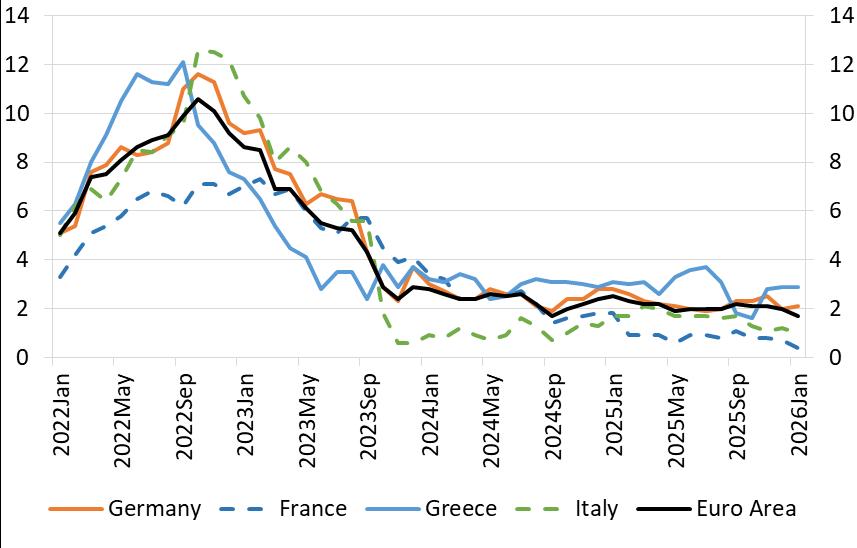
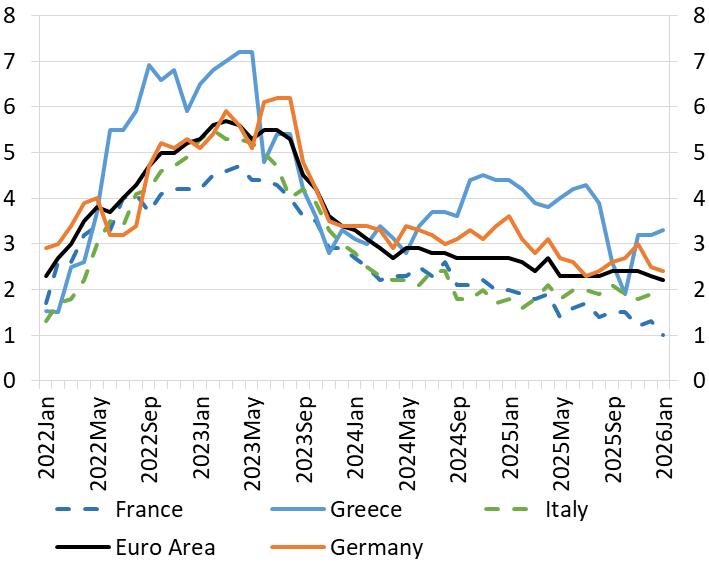
• Inflation in the euro area moved sideways in the course of 2025 and on average stood at 2.1%. It retreated below 2.0% in January 2026. Core inflation, similarly, remained stable for the past eight months of 2025 On average, in 2025, core inflation stood at 2.4%. It remained above 2.0% in January 2026.
• In Greece, headline inflation remained at elevated levels for most part of 2025 with the exception of September and October; this volatility was mainly attributed to fluctuations in services inflation and unprocessed food inflation. Core inflation followed a similar trajectory as it was also affected by the services inflation oscillations On average, headline inflation was 2.9% in 2025 and core inflation 3.6%. Both headline and core inflation figures remained at elevated levels in January 2026.
HICP Headline inflation for selected euro area countries (annual % changes)
The disinflation process has been modest since early 2024
Source: Eurostat. Latest observation: January 2026
Core inflation for selected euro area countries (HICP excluding energy & food) (annual % changes)
… and core inflation tends slowly to converge to headline.
Source: Eurostat. Latest observation: January 2026.
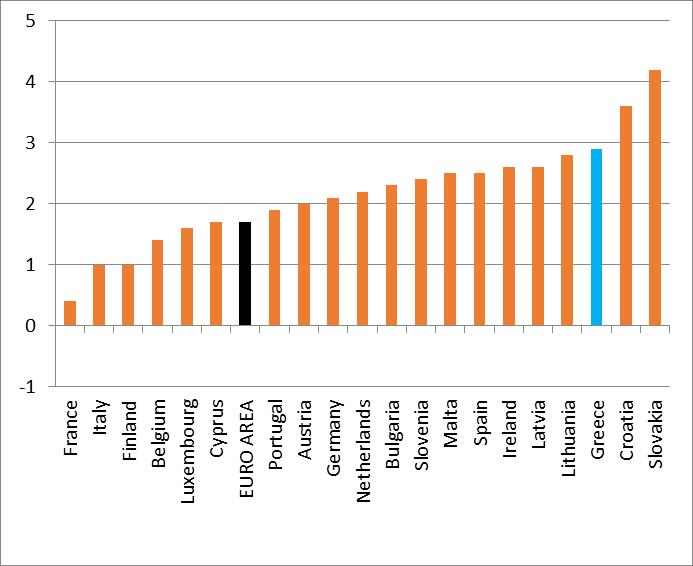
HICP Headline inflation for the euro area countries – January 2026 (annual % changes)
In January 2026, headline inflation in Greece remained significantly above euro area inflation.
Source: Eurostat.
Price developments in the euro area and Greece (annual % changes)
Both headline inflation and core inflation in Greece remained at elevated levels in November and December 2025 and in January 2026, following two months of low rates. This volatility was mainly due to fluctuations in services inflation.
Sources: Eurostat, ELSTAT and BoG calculations.
Price developments in the energy component of the Greek HICP and its subcomponents (annual % changes)
Sources: ELSTAT and Bank of Greece computations.
Section 2: Labour market developments
• Labour markets in major economies are generally showing signs of cooling.
• Wage growth has been moderating, although in several advanced economies, country-specific factors still led to increases in 2025Q3 and Q4. Despite easing from earlier peaks, labour-market tightness continues to contribute to persistent services inflation.
Compensation per employee – major regions globally
(y-o-y % change; sa)
Growth in compensation per employee has either moderated or plateaued across major advanced economies.
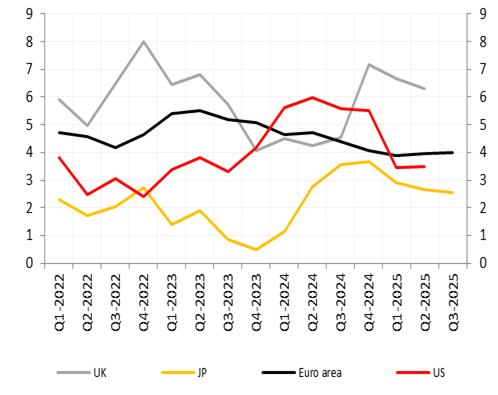
Sources: OECD and ECB. Latest observation: 2025:Q3 for the EA and Japan, 2025:Q2 for the remaining economies.
Compensation per employee – selected euro area countries
(y-o-y % change; sa)
Compensation per employee growth is plateaued in the euro area over the last four quarters, masking diverging trends among the member states.
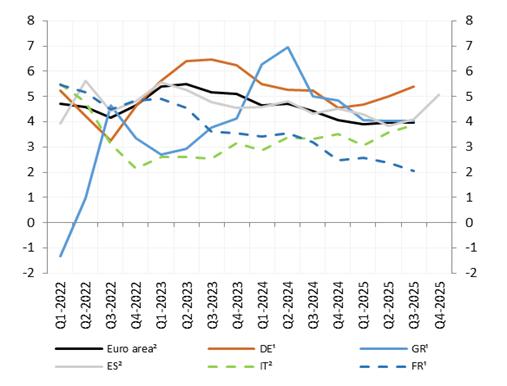
Sources: ECB. Latest observation: 2025:Q4 for Spain and 2025:Q3 for the remaining economies.
Note: 1 data are not calendar adjusted, 2 data are calendar adjusted Employment and hours worked – euro area
Employment growth is on a volatile but easing path.
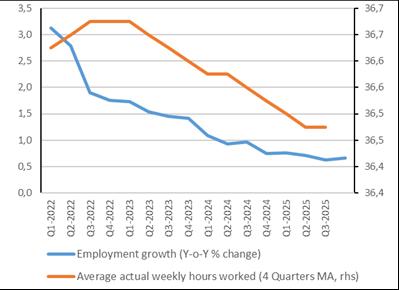
Source: Eurostat. Latest observation: 2025:Q3 for employment and 2025:Q2 for hours worked.
In December 2025, the euro area unemployment rate remained unchanged at 6.3%, while Greece’s rate edged up to 7.9% (+0.2pp) Notable differences in the rates of unemployment among the euro area countries persist.
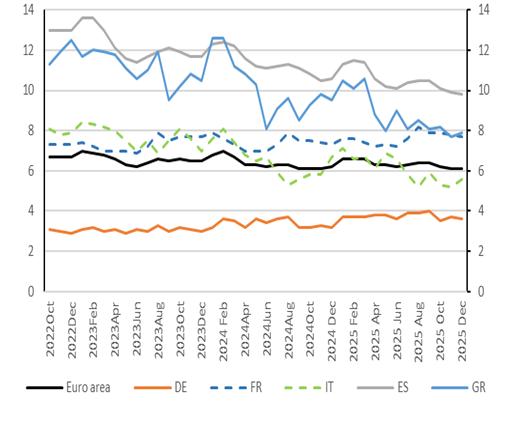
Source: Eurostat. Latest observation: December 2025
• Recent inflation developments remain uneven globally, with a gradual moderation in most advanced economies, a recent easing in Japan, and renewed upward pressure in China and the UK
• Over the past month, crude oil prices were highly volatile, rising to a 12-week high on escalating US-Iran tensions before deescalating on diplomatic progress; European natural gas increased amid colder weather and lower storage levels but declined in early February as weather forecasts turned milder. Industrial metals surged on tight supply conditions, before easing, while agricultural commodities remained broadly stable; gold and silver in 2026-to-date, have risen by 14% and 6%, respectively
• For over two years, transportation costs have remained elevated due to Houthi attacks on vessels in the Red Sea, which prompted several containership companies to suspend transit through the area. Following the seasonal demand that drove transportation costs higher in January 2026, costs retreated in early February 2026. The voyage time hovers at its pre-pandemic level.
During January 2026-December 2025, inflation moderated in the euro area and most major advanced economies, while it edged up in China and the UK
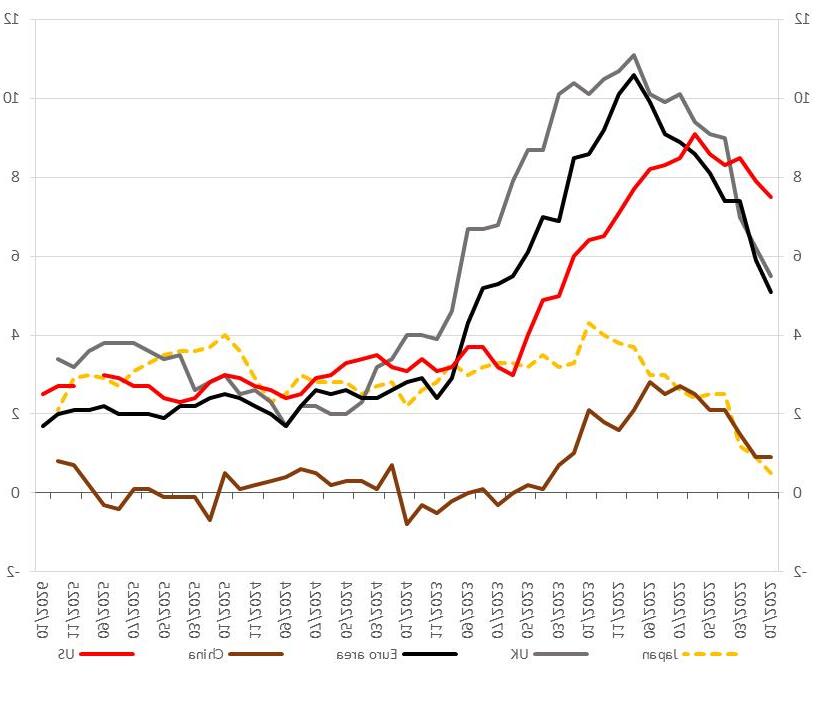
Sources: OECD, Eurostat, UK ONS. Latest observation January 2026 for the EA and US, December 2025 for the remaining economies
The prices of gold and silver have risen by about 70% and more than 100% vis-à-vis their levels one year ago
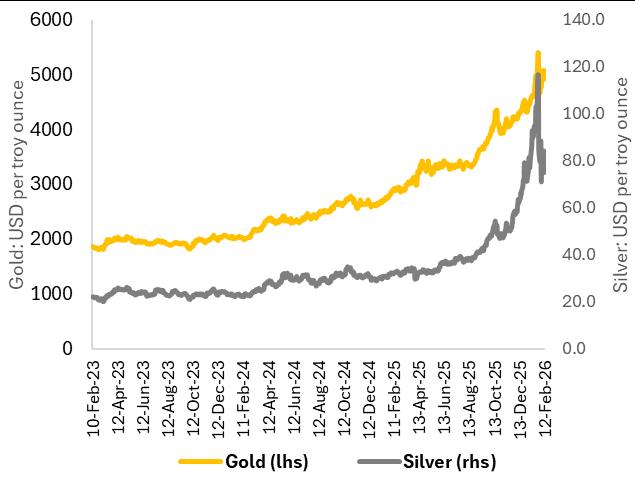
Source: LSEG. Latest observation: 12/2/2026
Notes: The chart depicts spot prices of gold and silver.
Energy prices were volatile, with oil and gas increasing on geopolitical tensions and colder weather respectively, although both eased later Industrial metals rose on tight supply before moderating, while agricultural commodities stayed broadly stable.
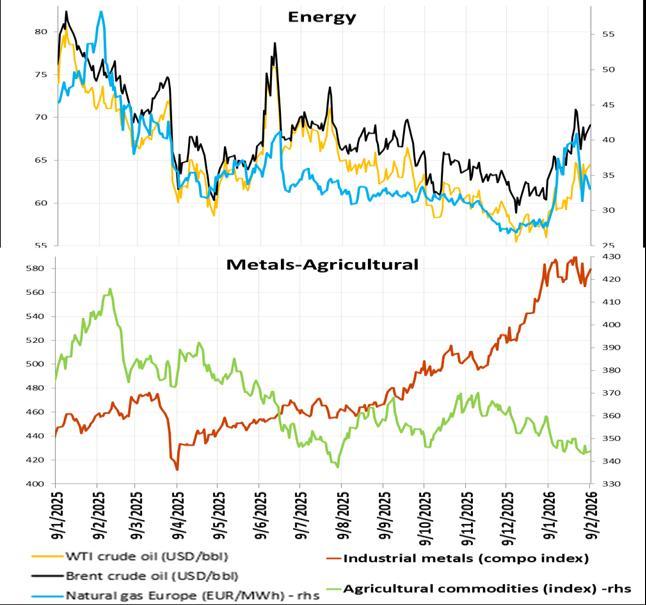
Source: LSEG. Latest observation: 9 2.2026
Note: S&P Goldman Sachs Commodity spot price indices for industrial metals and agricultural commodities.
Global sea transportation costs declined following a temporary increase.
Sources: Freightos and LSEG. Latest observation: 10.2.2026.
Notes: Freightos Baltic Indices reflect the ocean container transport spot freight rates (port to port) for a standard forty-foot container (FEU). Monthly average of daily data.
• According to the January PMI, input price inflation in manufacturing rose at the steepest rate since March 2025 due to higher transportation charges and greater prices for metals; at the same time, better demand conditions enabled firms to pass through higher costs to customers at the fastest rate since last August
• January firms’ survey points to higher inflation expectations across all business sectors, with selling price expectations rising particularly in the construction and in the services sectors.
PMI input and output prices in
Greek manufacturing
In January 2026, both input and output inflation picked up …
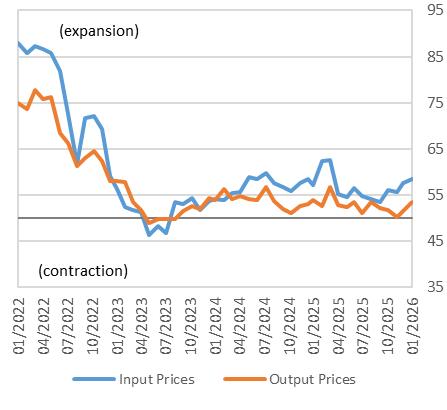
Source: S&P Global. Latest observation: January 2026.
Producer Price Index and import prices in Greece (annual % change) …while producer prices show signs of convergence.
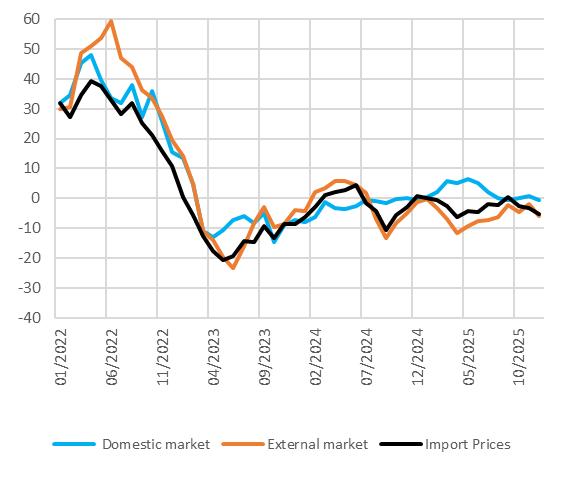
Source: ELSTAT. Latest observation: December 2025.
Selling price expectations in business sectors in Greece (for the next 3 months)
Selling price expectations increased across all business sectors, in January 2026.
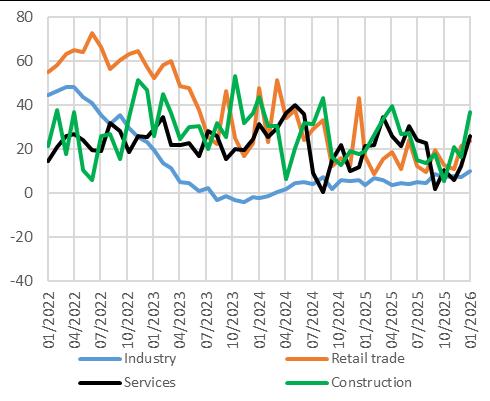
Source: European Commission. Latest observation: January 2026.
Note: Data is obtained from the closed-ended question about selling price expectations over the next 3 months. The chart shows the net balances i.e. the share of firms’ managers expecting higher selling prices minus the share of them expecting lower prices
• Professional forecasters’ inflation expectations: According to Consensus Forecasts released in February, inflation expectations for 2026 were unchanged for the EA at 1.8% and 2.6% for the US The projections for 2027 suggest a marginal increase to 1.9% for the EA, with inflation expected to continue converging to the target of 2% for major EA economies, and decrease to 2.4% for the US.
Inflation expectations
Inflation is expected to ease in large economies
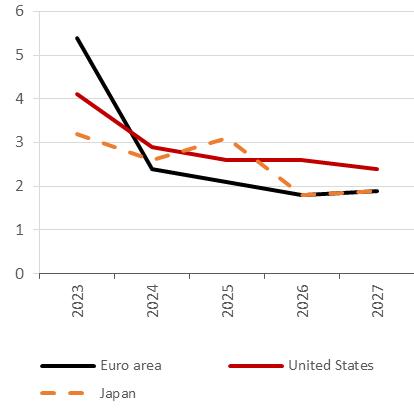
Source: Consensus Forecasts (February 2026).
Inflation expectations …and in several EA countries
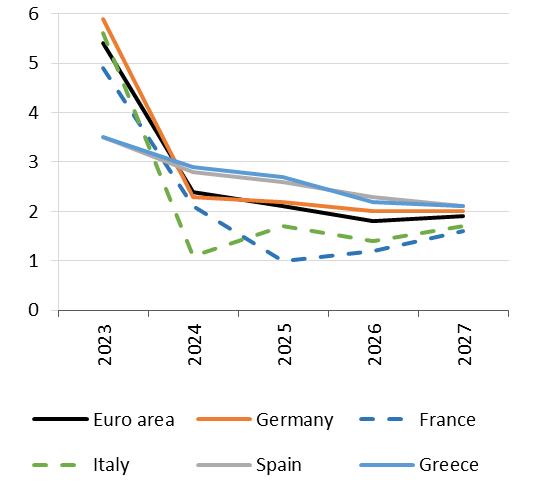
Source: Consensus Forecasts (February 2026).
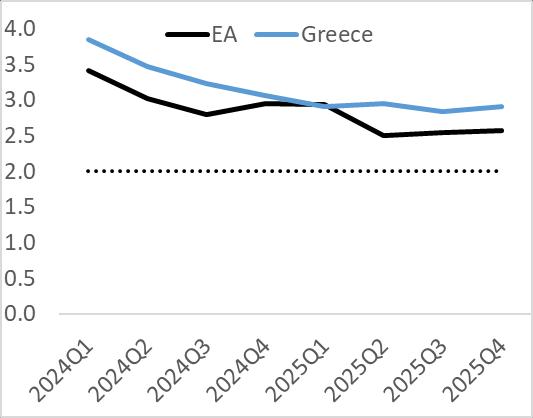
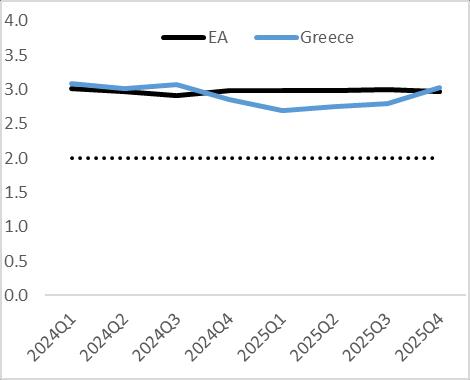
• Firms’ inflation expectations: Firms’ median one year ahead inflation expectations in Greece and in the euro area were broadly unchanged in 2025 Q4 at 2.9% and 2.6%, respectively. Three years ahead expectations increased in Greece to 3% in 2025 Q4 from 2.8% in Q3 whereas in the euro area were unchanged at 3%. Five years ahead expectations in 2025 Q4 were broadly unchanged at 3% in Greece and the euro area.
Inflation expectations 12 months ahead
Inflation expectations 3 years ahead
Source: ECB Survey on the Access to Finance of Enterprises (SAFE).
Inflation expectations 5 years ahead
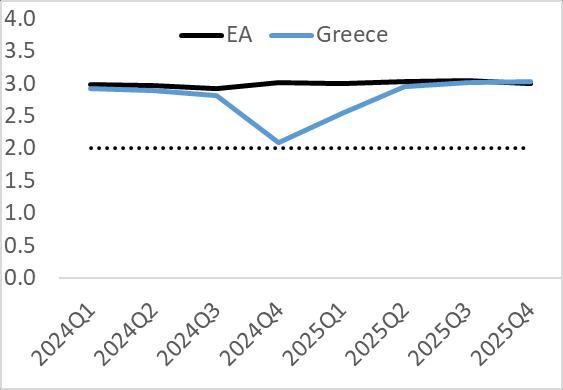
Note: Survey weighted median. Median is computed by linear interpolation of the mid-distribution function. The statistics are computed after trimming the data at the country-specific 1st and 99th percentiles. The data included in the chart refers to questions 31_a, 31_b and 31_c of the survey regarding firms’ inflation expectations one year ahead, three years ahead and five years ahead All enterprises in the sample are included. The chart refers to survey rounds 30 to 37 (2024Q1 to 2025Q4).
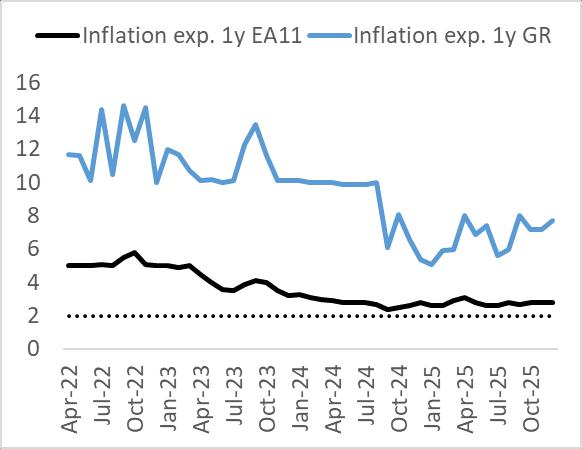
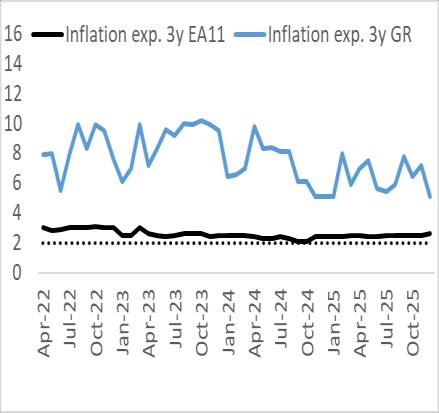
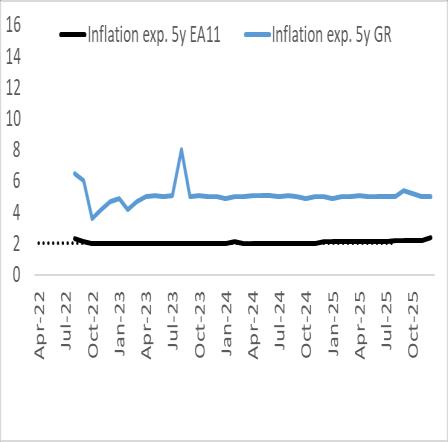
• Consumers’ inflation expectations: The ECB’s Consumer Expectations Survey (CES) shows that in December median inflation expectations over the next twelve months in Greece increased to 7.7% from 7.2% in November whereas in the euro area they were unchanged at 2.8%. Median three years ahead inflation expectations decreased in Greece in December to 5.1% from 7.2% in the previous month whereas in the euro area they were broadly unchanged at 2.6%. Median five years ahead inflation expectations were unchanged in Greece at 5%. On the contrary, in the euro area they increased to 2.4% in December from 2.2% in November.
Inflation expectations 12 months ahead
Source: ECB Consumer Expectations Survey (CES).
Inflation expectations 3 years ahead
Inflation expectations 5 years ahead
Note: Using weighted data. Median short-term, medium-term and long-term inflation expectations are obtained from the open-ended question about individuals’ expectations of changes in prices in general over the next 12 months, between 2 and 3 years between 4 and 5 years, respectively. The sample period is from April 2022 to December 2025. Long-term inflation expectations are available since August 2022.
Financial markets’ inflation expectations:
• Market-based expectations for euro-area inflation, over the short-term horizon (2-years), edged higher in the past month; in the US, they also rose somewhat (on 10.2.2026 vs. 13.1.2026, EA-2Y inflation linked-swap rate: 2.03% +3 bps, US-2Y inflation linkedswap rate: 2.37% +5 bps).
• Market-based inflation expectations over the medium- and long-term rose somewhat in the euro area and in the US. Currently, medium-term breakeven inflation is below 2% in the euro area and higher than that level in the US (on 10 2 2026 vs. 13 1 2026, 5-year breakeven inflation rates: EA: 1.78%, +5 bps; US: 2.51%, +14 bps; 10-year breakeven inflation rates: EA: 2.06%, +8 bps; US: 2.32%, unchanged).
• Real yields fell somewhat in the euro area across horizons, and relatively more in the US amid some lower-than-expected data (e.g. euro area: flash PMI and German Ifo business climate for January; United States: PMI and ADP national employment for January, job openings for December) (on 10 2 2026 vs 13 1 2026: EA-2y: 0.02%, -8 bps, EA-5y: 0.6%, -7 bps, EA-10y: 0.74%, -9 bps; US-2y: 1.08%, -13 bps, US-5y: 1.19%; -18 bps, US-10y: 1.83%: -3 bps).
Euro-area breakeven inflation rates
Market-based expectations for euro-area inflation, over a mediumto long-term horizon, rose somewhat over the last month, standing below or close to the medium-term target level of 2%.
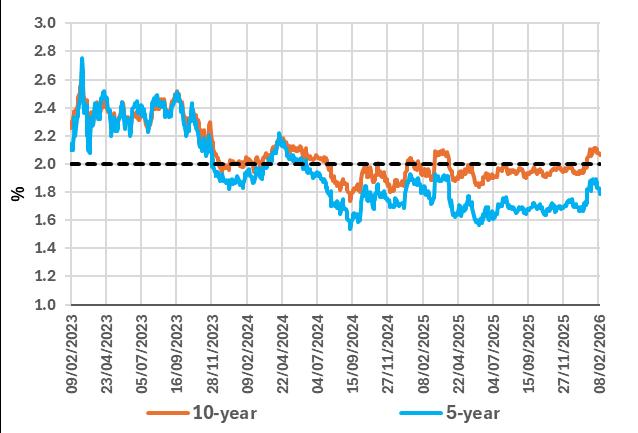
Sources: LSEG, Bank of Greece. Latest observation: 10.02.2026. Note: The chart illustrates daily developments in the yield differential between nominal and inflation-linked EA benchmark bonds with a maturity of 5 (blue line) and 10 (orange line) years.
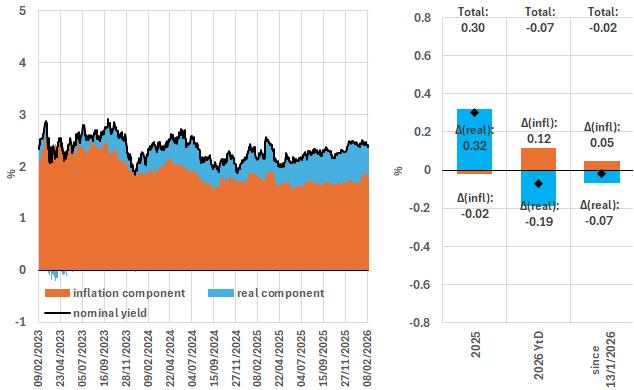
Euro area: Decomposition of nominal 5y yields into real yield and inflation component
In the EA, medium-term nominal yields were broadly unchanged in the past month, amid lower real yields (i.e. inflation-linked bond yields which compensate investors for inflation), and a somewhat higher inflation component.
Left graph: levels (%) Right graph: changes (pp)
Sources: LSEG, Bank of Greece. Latest observation: 10.02.2026.
Note: The chart shows the decomposition of the 5-year EA benchmark bond yield (black line) into its real (blue bars) and inflation-linked (orange bars) components. The inflation component is the breakeven inflation rate and the real component is the yield of the bond that compensates bondholders for inflation (i.e. the 5-year German inflation-linked federal bond).
Market-based expectations for US inflation rose somewhat over the last month, remaining substantially above the 2% inflation target.
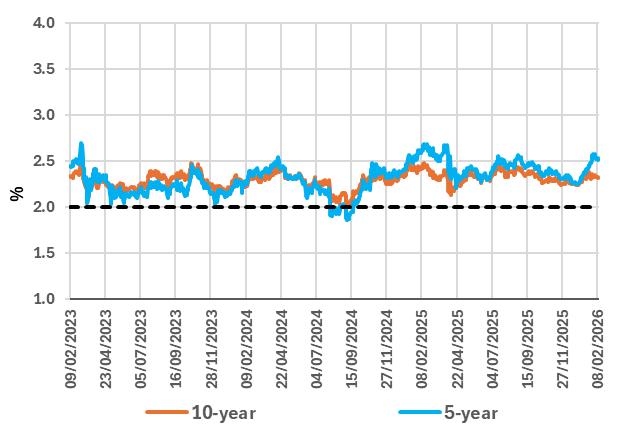
Sources: LSEG, Bank of Greece. Latest observation: 10.02.2026. Note: The chart illustrates daily developments in the yield differential between nominal and inflation-linked US Treasury bonds with a maturity of 5 (blue line) and 10 (orange line) years.
US: Decomposition of nominal 5y yields into real yield and inflation component
In the US, nominal yields on medium-term bonds were broadly unchanged during the past month, with inflation expectations somewhat higher and real yields somewhat lower
Left graph: levels (%) Right graph: changes(pp)
Sources: LSEG, Bank of Greece. Latest observation: 10 02.2026
Note: The chart shows the decomposition of the 5-year US Treasury bond yield (black line) into its real (blue bars) and inflation-linked (orange bars) components. The inflation component is the breakeven inflation rate and the real component is the yield of the bond that compensates bondholders for inflation (i.e. the 5-year US Treasury Inflation-Protected Security).
Section 6: Policy interest rates expectations
• The ECB has cut its policy rates four times by a total of 100 bps in 2025, following another four rate cuts in 2024 that also amounted to 100 bps. Markets expect that the ECB will not change its rates until end-2026 (no change has a probability of around 75% versus 80% one month ago)
• The Fed has cut the Fed fund rate (FFR) three times by a total of 75 bps in 2025, after three rate cuts in 2024 that amounted to 100 bps Markets expect the Fed to continue easing in 2026, with one rate cut of 25 bp expected until June (around 70% probability, broadly unchanged vs. one month ago), followed by another cut of 25 bp until the end of the year (about 75%, broadly unchanged vs. one month ago).
Short-term rates in the euro area Markets expect stable ECB rates until end-2026.
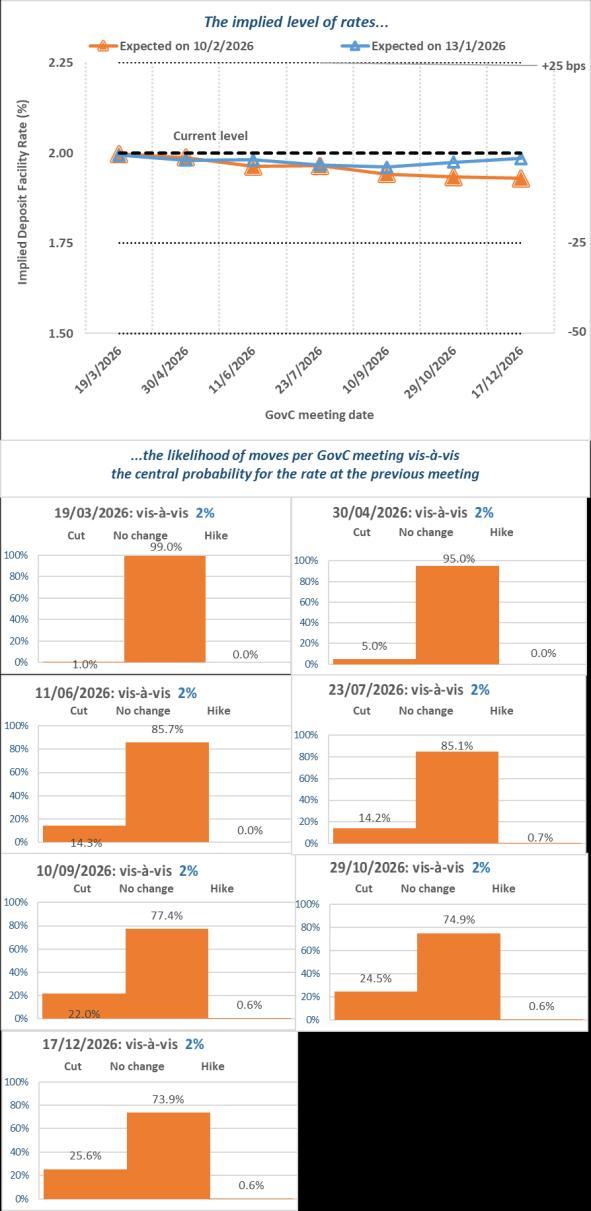
Sources: LSEG. Latest observation: 10 02 2026
Short-term rates in the US Markets anticipate further easing in 2026, with a rate cut until June seen as roughly 70% likely and another rate cut until December 2026 about 75% likely
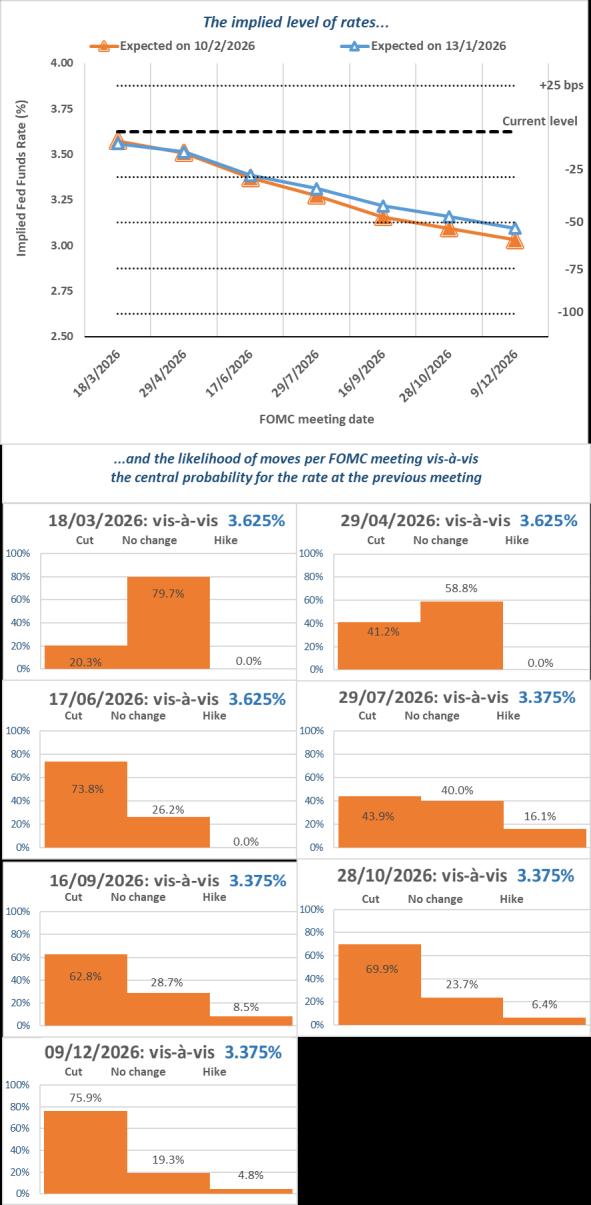
Notes: Upper charts: The orange line shows the most recent expectation about the level of the policy rate (ECB: Deposit Facility Rate, Fed: Fed funds rate), as implied by the OIS rates’ yield curve (ECB) or the pricing in futures contracts (Fed) for each meeting from today until December 2026. The blue line shows the expectation one month ago. The horizontal axis shows the date of each meeting. The dashed lines show the present level of the policy rate and its expected level given the market’s view about upcoming rate moves by the ECB (charts in the left) or the Fed (charts on the right) Lower charts: The bars show the level of likelihood (i.e. implied probabilities) for the event of a rate move (from left to right: cut, no change, hike). The graphs correspond to monetary policy meetings (GovC for the ECB and FOMC for the Fed) during 2026. The probabilities for each move are calculated as the sum of the probabilities for rates lower, equal or higher, respectively, vis-à-vis the central probability for the rate at the previous meeting as inferred by the latest OIS yield curve (ECB) or futures contracts for different delivery dates (Fed).
INFLATION MONITOR – 16 February 2026
Table of news and statements on inflation (period: 19/1/2026-16/2/2026)
Statements by central bankers and other officials
• 28.1.2026: Fed FOMC Statement: Available indicators suggest that economic activity has been expanding at a solid pace. Job gains have remained low, and the unemployment rate has shown some signs of stabilization. Inflation remains somewhat elevated […]. In support of its goals, the Committee decided to maintain the target range for the federal funds rate at 3-1/2 to 3-3/4 percent. In considering the extent and timing of additional adjustments to the target range for the federal funds rate, the Committee will carefully assess incoming data, the evolving outlook, and the balance of risks. […]
• 5.2.2026: ECB monetary policy decision: The Governing Council decided to keep the three key ECB interest rates unchanged. Its updated assessment reconfirms that inflation should stabilise at the 2% target in the medium term. The economy remains resilient in a challenging global environment. Low unemployment, solid private sector balance sheets, the gradual rollout of public spending on defence and infrastructure and the supportive effects of the past interest rate cuts are underpinning growth. At the same time, the outlook is still uncertain, owing particularly to ongoing global trade policy uncertainty and geopolitical tensions. […]
• 6.2.2026: San Francisco Fed President M Daly (Reuters interview): she indicated that one or two more interest rate cuts may be needed to counteract weakness in the labor market, however adding that to cut rates “you have to be pretty confident, like really confident, that the effects of the tariffs will roll off and that inflation is really on a downward trajectory.”
Source: LSEG. *Expected figures are based on opinion polls among financial sector experts.
INFLATION MONITOR – 16 February 2026
Economic Analysis and Research Department Annex
UN COICOP2018 classification is the updated international standard for classifying household consumption expenditures into 13 categories applied to HICP and CPI from January 2026 onwards.1 The updated classification reflects significant changes in the nature of goods and services, as well as evolutions in household consumption patterns since the introduction of COICOP 1999.
The transition from COICOP1999 to COICOP2018 was necessary because of extensive changes in consumer markets since the implementation of COICOP1999 in 2015. More specifically:
• certain categories became outdated,
• new products and services were difficult to classify,
• the boundaries between certain categories were not clearly defined.
The most significant differences of COICOP2018, compared to COICOP1999, are:
• It distinguishes between goods and services where possible, and new categories and subcategories have been created for services such as repair, maintenance, installation and rental of products. Changes to categories and subcategories resulted from reclassification and changes to their content.
• It introduces a new group namely Group 13: Personal care, Social protection and Other goods and services.
• Group 08: “Information and communication” and Group 09: “Recreation, sport and culture” have been extensively revised.
• Group 07: “Transport” which previously focused on passenger transport, now also includes the category “Delivery fees”, which had previously been included in the price of goods.
• The Hellenic CPI follows the same classification as the HICP, in order to ensure comparability between the indices.
The already published inflation data of HICP and CPI do not change. Therefore, the all-items index remains unchanged for any month and year, in all countries, with precision up to the second decimal place.
Finally, the new HICP reference year is 2025=100
1 In the European Union (EU), COICOP2018 or COICOP18 is referred to as the European Classification of Individual Consumption According to Purpose, version 2 (ECOICOP ver. 2). UN COICOP 2018 is the most updated version of the Classification of Individual Consumption According to Purpose, approved by the United Nations Statistical Commission (UNSC) in March 2018. It replaces the COICOP 1999 version, which was used until 2025.
This report is published by the Bank of Greece and aims to inform the general public about price developments. The data contained in this report are meant for information purposes only and do not constitute advice or a service for the conduct of any transaction, nor are they intended for this purpose. The Bank of Greece is under no obligation to update or revise this report or to make any announcements or notifications in the event that any information, opinion, forecast or estimate contained herein changes or is subsequently found to be inaccurate. The Bank of Greece cannot be held liable for any actual, consequential or other loss, including loss of profit, that may arise from, or in connection with, the contents or any use of this report. In any case of reproduction or republication hereof, the Bank of Greece must be cited as the source.
ISSN: 2945-2481