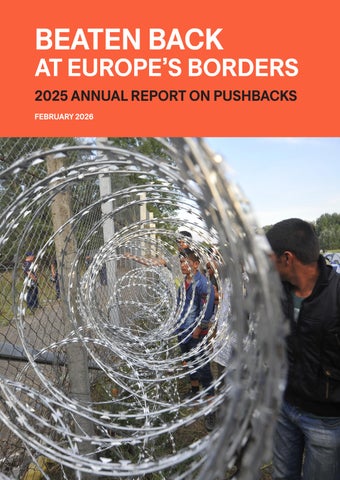
BEATEN BACK AT EUROPE’S BORDERS
2025 ANNUAL REPORT ON PUSHBACKS
FEBRUARY 2026
MANAGEMENT SUMMARY
This report documents pushbacks from EU Member States to third countries in 2025, highlighting ongoing violations of international and EU law.
It draws from NGO reports, research groups, human rights organizations, UN agencies, government services and interviews with organizations active in Hungary, Latvia, Lithuania, Greece, Poland, Croatia, Bulgaria and Romania.
In total, 80,865 pushbacks were recorded. Overall, the normalization of pushbacks persists, requiring stronger enforcement and greater accountability from both Member States and EU institutions. At the same time, 2025 has witnessed a trend towards externalization of border management. The EU finances third countries to prevent people seeking protection to reach EU borders, resulting in offshoring human rights violations. The result is an increase in pullbacks and a decrease in pushbacks on certain routes.
In 2025, the Libyan coast guard, financially and logistically supported by the EU, prevented 27,116 people from reaching EU borders. Poland pushed back 14,754 asylum seekers, followed by Bulgaria whose authorities have executed 13,568 pushbacks.
The report concludes with recommendations for the EU, its Member States, Frontex and UNHCR to address these ongoing human rights violations.
This report is a collaboration between: 11.11.11 (Belgium), Hungarian Helsinki Committee, We Are Monitoring Association (Poland), Centre for Peace Studies (Croatia), Lebanese Center for Human Rights (CLDH), Sienos Grupė (Lithuania), I Want to Help Refugees/Gribu palīdzēt bēgļiem (Latvia).
Research: Virginia Maciucchi
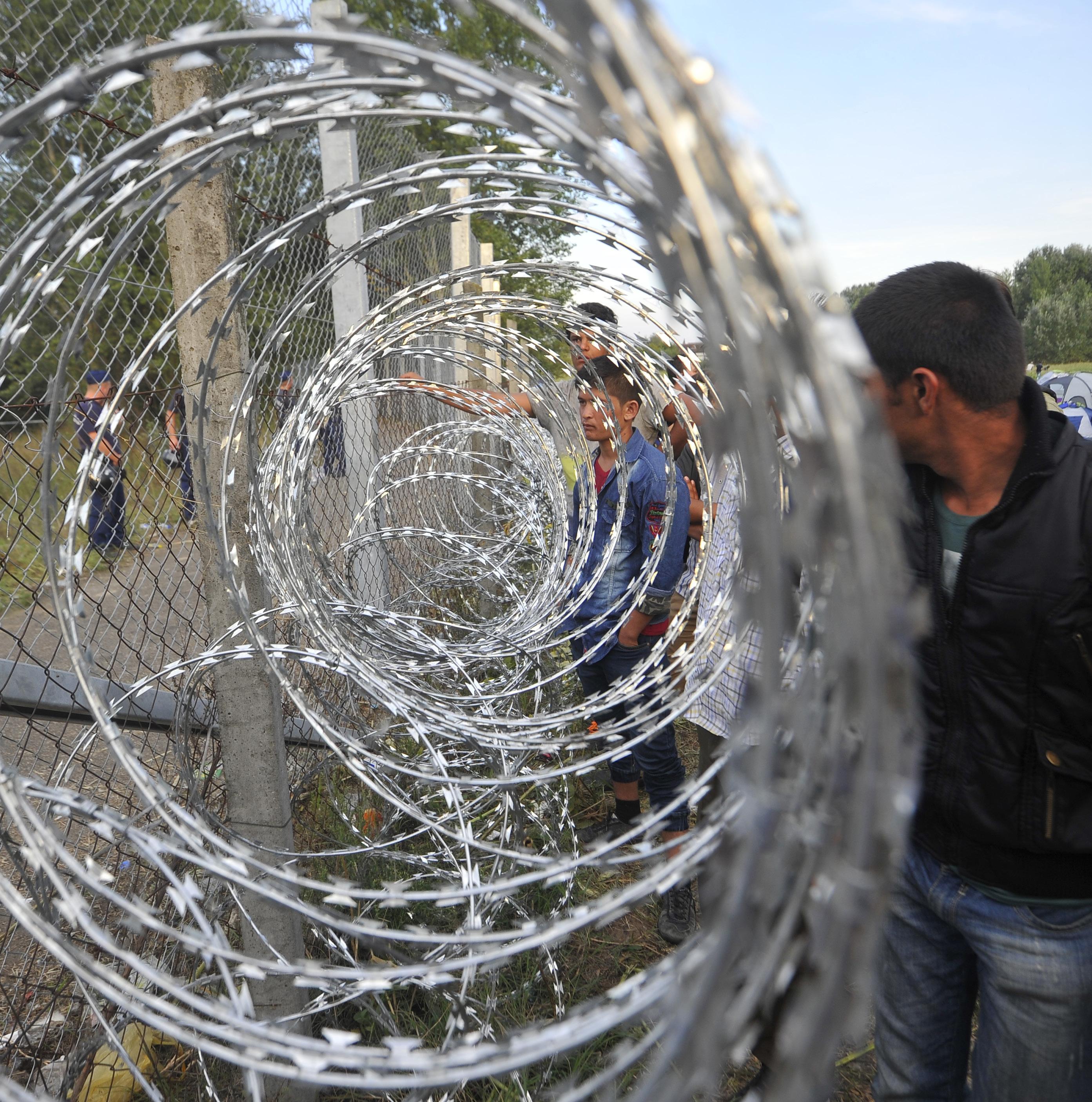
Coverpicture: Shutterstock



LIST OF ABBREVIATIONS
CCPR Covenant on Civil and Political Rights
ECHR European Convention on Human Rights
ECJ European Court of Justice
ECRE European Council for Refugees in Exile
ECtHR European Court of Human Rights
EU European Union
EUAA European Union Agency for Asylum
FRA European Union Agency for Fundamental Rights
FRO Frontex’s Fundamental Rights Officer
IOM International Organization for Migration
OHCHR Office of the United Nations High Commissioner for Human Rights
UN United Nations
UNHCR United Nations High Commissioner for Refugees
PREFACE
In recent years, pushbacks at Europe’s external borders have become a widespread practice across European Union (EU) Member States. The consistency of these practices indicates that they have become a systematic component of EU migration policy.
Pushbacks are practices that result in the removal of persons seeking protection, individually or in groups, without an individualized assessment in line with human rights obligations and due process guarantees.1 Pushbacks are often accompanied by violence and the destruction or confiscation of personal belongings.
The ongoing reports of pushbacks indicate a systematic failure on behalf of the EU to enforce respect for one of the most fundamental human rights. UNHCR, IOM, and UN Special Rapporteurs have repeatedly called on the EU and its Member States to take urgent action to end pushbacks, collective expulsions, and the use of violence against migrants and refugees.2
LEGAL FRAMEWORK: THE RIGHT TO SEEK ASYLUM
All EU Member States must respect the right to seek international protection in the EU. Prior to any expulsion an individual assessment must be made of the potential safety risks for the individual in question. Failing to do so, results in violations of both international, European and national law.
The European Convention on Human Rights (ECHR) explicitly prohibits collective expulsion (Article 4). The principle of non-refoulement, which prohibits expulsion from individuals to countries where their safety may be at risk, is anchored in the UN Refugee Convention (Article 33), the EU Charter of Fundamental Rights (Article 1, 18 and 19) and the ECHR (Article 2, 3 and 5). This ensures that prior to every return decision a specific examination takes place and that no general expulsion measures can be taken.
The EU Schengen Border Code, which regulates entries on the external borders of the Schengen Zone, also stipulates that EU Member States must act in accordance with European law and ‘the obligations concerning access to international protection and, more specifically, the principle of non-refoulement’ (Article 4). The UN Convention on the Law of the Sea (UNCLOS) and SOLAS/SAR Conventions, require immediate rescue of anyone in danger at sea and their disembarkment to a place of safety.
This report documents pushbacks recorded in 2025 from EU Member States to non-EU countries. It provides an overview of the situation on the ground in selected countries. The report examines relevant judicial and legislative developments at national level, outlining changes in policies and practices related to border management. It also assesses the role of EU institutions and Frontex in this context.
The report concludes with recommendations addressed to EU Member States, the European Commission and Frontex.
1 Report on means to address the human rights impact of pushbacks of migrants on land and at sea | OHCHR 2 UNHCR warns asylum under attack at Europe’s borders, urges end to pushbacks and violence against refugees | UNHCR; IOM Calls for End to Pushbacks and Violence Against Migrants at EU External Borders | International Organization for Migration; joint letter (OL OTH (119.2025; A/ HRC/50/31: Human rights violations at international borders: trends, prevention and accountability | OHCHR
METHODOLOGY
For the purpose of this report, 11.11.11 (Belgium), Hungarian Helsinki Committee, We Are Monitoring Association (Poland), Centre for Peace Studies (Croatia), Lebanese Center for Human Rights (CLDH), Sienos Grupė (Lithuania), I Want to Help Refugees/Gribu palīdzēt bēgļiem (Latvia) collected all available data on pushbacks from EU member states (including their maritime zones of Search and Rescue) to third countries for the year 2025. This concerns data from NGO reports, research groups, human rights organizations, UN organizations and government services. This information was supplemented with interviews with human rights organizations active both within the EU and outside its external borders, as well as requests for information to government authorities. The data can be verified through the source citation that accompanies every figure.
The figures presented in this report refer to individual instances of pushbacks. In practice, people are frequently returned in groups. In such cases, the number of individuals affected is used to calculate the total number of pushbacks. For example, when 40 people are returned in a single pushback operation, this is recorded in the report as 40 pushbacks.
Many individuals are subjected to pushbacks on multiple occasions, sometimes over an extended period of time. It is not possible to disaggregate the data to identify repeat cases. Consequently, where the same person is unlawfully returned on three separate occasions, these incidents are counted as three pushbacks.
In cases involving returns to Libya the physical interception and return are carried out by the Libyan coast guard rather than directly by EU Member States (also referred to as ‘pullbacks’see box). However, the support provided by Italy and the European Union to these operations is long-standing, direct and substantial, including aerial surveillance and coordination of interceptions, as well as financial, material and training support to the respective coast guards. On this basis, these operations are included in the report as pushbacks attributable to EU Member States.
PULLBACKS
In the past years migration management has increasingly been externalised to countries of origin and transit. In this context, the term pullbacks is used to describe a different, though closely connected, set of practices. Pullbacks are measures taken by countries of origin or transit to prevent people from physically leaving or to forcibly return (“pull back”) people to those territories before they can reach the jurisdiction of their destination countries. Pullbacks can take place on land or at sea, including the interception of departing boats, and the apprehension of people attempting to leave. Article 12 (2) of the International Covenant on Civil and Political Rights (CCPR) guarantees the right of everyone to leave any country, including their own. Pullbacks, by their very nature, prevent migrants and refugees from exercising their right to leave any country or territory. The UN Special Rapporteur on the human rights of migrants has expressed serious concern regarding the use of pullbacks and has urged states to end these practices.3
EU TRENDS: BORDER CONTROL AND FUNDAMENTAL RIGHTS
Throughout 2025, EU Member States and EU agencies, including Frontex, have faced scrutiny over alleged human rights violations against people on the move. The European Commission and Frontex have been criticised for ineffective oversight and, in some cases, for funding or indirectly facilitating pushback practices.
In January 2025, the European Union and Bosnia and Herzegovina signed an Agreement on operational activities carried out by Frontex in Bosnia and Herzegovina. The agreement provides the legal framework for Frontex to deploy officers and conduct joint operations.4 In June 2025, Frontex launched its first full operational deployment in the country involving more than 100 Frontex officers, marking a significant expansion of the agency’s operational presence in the Western Balkans.5
In February 2025, following a complaint by several NGOs on the ineffective monitoring by the European Commission of EU-funded border management activities in the context of persistent human rights violations, the European Ombudsman issued recommendations on how the Commission should ensure that border management funding complies with fundamental rights obligations.6
In March 2025, the Council of Europe’s Commissioner for Human Rights warned against a “securitisation” approach to migration, cautioning that framing migration primarily as a security issue undermines fundamental rights. In May, the Commissioner called for zero tolerance of pushbacks, specifically at the Greek borders, highlighting the urgent need for compliance with international protection obligations.7
In May 2025, the governments of Italy, Denmark, Austria, Belgium, Czechia, Estonia, Latvia, Lithuania, and Poland published an open letter calling for a reinterpretation of the ECHR in the field of migration, arguing that the European Court of Human Rights (ECtHR) had “in some cases limited ability to make political decisions”. In response, the Council of Europe issued a defence of the Court’s independence stating that no judiciary should face political pressure and warning that undermining the Court risked eroding the stability it is meant to ensure.8 The ECtHR plays a crucial role in addressing pushback cases, particularly because such practices often result in a lack of investigation or accountability by national courts.9
In July 2025, the European Union Agency for Fundamental Rights (FRA) published a position paper on how the EU can counter the instrumentalisation of migrants while fully respecting fundamental rights. The FRA stresses that repressive measures should not punish the individuals who are accused of migrant smuggling nor target humanitarian actors supporting migrants and asylum seekers at EU external borders, but target criminal networks.10
In early 2025, the EU advanced measures furthering the extra-territorialisation of border and migration management, initiating negotiations on a new Return Regulation, the introduction of a list of so-called ‘safe countries of origin’, and revisions to the concept of ‘safe third country’. Together, these measures mark a paradigm shift in refugee and migrant protection, increasingly transferring responsibility from EU Member States to non-EU countries. UNHCR warned that increasing transfers to safe third countries risks weakening the right to seek asylum in the EU – which would undermine the very foundation of the EU’s asylum system and be detrimental for the international refugee protection regime more broadly.11
4 Status agreement with Bosnia and Herzegovina - Migration and Home Affairs
5 Frontex rolls out fully-fledged operation in Bosnia and Herzegovina
6 Decision on how the European Commission monitors fundamental rights compliance in the context of EU funds granted to Greece for border management (case 1418/2023/VS) | Decision | European Ombudsman
7 Addressing pushbacks at the EU’s external borders
8 Alain Berset on the joint letter challenging the European Court of Human Rights - Portal
9 TPI-evidence.pdf ;
10 Countering the instrumentalisation of migrants and refugees and respecting fundamental rights | European Union Agency for Fundamental Rights
11 UNHCR calls for stronger safeguards in EU proposal on asylum transfers to third countries | UNHCR Europe
In two judgments delivered on 18 December 2025 – Hamoudi v Frontex and WS and Others v Frontex – the Court of Justice significantly clarified the scope of Frontex’s responsibility for fundamental rights violations. In doing so, the Court rejected a narrow reading of the Agency’s mandate and affirmed that operational involvement entails legal accountability.12
Throughout 2025, the criminalization of humanitarian assistance continued at both national and EU levels. At the EU level, the proposed EU Facilitation Directive risks criminalizing not only people on the move but also those providing support to them for familial or humanitarian reasons, as noted by the UN Special Rapporteurs on trafficking in persons, human rights defenders, and the human rights of migrants (December 2025). The Directive risks targeting individuals offering humanitarian and legal assistance to people who have been forcibly returned or pushed back, effectively criminalizing acts of solidarity.13
In 2025, the use of border technology intensified across the EU, with monitoring systems, satellites, and drones playing a central role. Member States began implementing parts of the AI Act, using AI at the borders in ways that specifically target people on the move. In October, the Entry/Exit System (EES) came online, allowing Member States to share data on border crossings. These technologies are increasingly used to facilitate pushbacks, with thermal cameras and advanced surveillance networks preventing asylum seekers from reaching safety and enabling collective expulsions.14
FOCUS COUNTRIES
1. Finland
2. Latvia
3. Lithuania
4. Poland
5. Hungary
6. Croatia
7. Romania
8. Bulgaria
9. Greece
10. Cyprus
11. Italy
12. Spain
13. France
PUSHBACKS REMAIN A SYSTEMATIC PRACTICE ACROSS THE EU, AMOUNTING TO 80.865 PUSHBACKS IN 2025
FINLAND
DATA
Since 2023, the main border crossing points on the Finnish eastern border with Russia have been closed and border traffic suspended. According to the available data, no pushbacks have taken place in Finland in 2025.15
TRENDS
Since Russia’s full-scale invasion of Ukraine, Finland has adopted an increasingly securitizing approach in border management and asylum, arguing that Russia is orchestrating the influx of asylum seekers and migrants towards the Finnish border, representing a threat to national security.16
In July 2024, the government of Finland adopted the Act on Temporary Measures to Combat Instrumentalized Migration, allowing the Finnish border guard to prevent the entry of foreign nationals “who could potentially be a threat to Finland’s sovereignty and national security”. In June 2025, the Act was extended until December 2026, resulting in the possibility of lodging asylum applications only at Finnish airports and seaports.17
According to Amnesty International, this law de facto legalizes pushbacks, as border guards are allowed to prevent entry to people seeking asylum without a proper individual assessment of the people’s vulnerabilities.18 Members of the European Parliament also raised concerns, particularly on the law’s alignment with international law and EU Regulations.19
In July, the law on the use of technology in maintaining border security entered into force, expanding the purpose and the area of the use of the technical surveillance at the Finnish borders.20
In October 2025, the Finnish government took the extraordinary measure of closing all road crossings along its 1,340-kilometre eastern border with Russia for an initial period of six weeks. The government justified the measure by citing so-called “hybrid operations” by Russian authorities aimed at destabilizing Finland.21
LATVIA
DATA
According to the Latvian State Border Guard (SBG), since January 2025, 12,046 people have been ‘prevented from illegally crossing’ Latvia’s state border. Non-governmental organizations monitoring the border consider these incidents to constitute pushbacks, raising concerns regarding compliance with international law. Only 31 people have been allowed in Latvia’s territory for humanitarian reasons.22
TRENDS
In 2025 pushbacks have more than doubled compared to last year, while the number of people allowed to enter Latvia has increased minimally. Based on the information available to “I Want to Help Refugees” (GPB), between June 2024 and December 2025 two individuals have died in the border region after crossing Latvia-Belarus border and were buried in Latvia, reaching the total number of 11 deaths since 2023 23
15 Finland extends ban on migrants seeking asylum on Russia border | Reuter
16 Russo-Finish border games – more serious than they look | Mixed Migration Centre
17 Government Programme measures to reform border security - Ministry of the Interior
18 Finland: Emergency law on migration is a “green light for violence and pushbacks at the border” - Amnesty International
19 Temporary Measures to Combat Instrumentalised Migration | Other events | Events | LIBE | Committees | European Parliament
20 Legislative amendments to expand the Border Guard’s right to use more technology in statutory duties - Ministry of the Interior
21 Finland Closes All Border Crossings With Russia Amid ‘Hybrid-Warfare’ Migrant Surge
22 31 December 2025 at the national border and within the country | State Border Guard
23 Up-to-date information on the death of unidentified people after crossing the Latvian-Belarusian border - I want to help refugees
According to SBG, on March 16, 2025, traffic at the “Pāternieki” border checkpoint was temporarily stopped due to ‘an influx of migrants’. This checkpoint was the only place to cross the Latvia-Belarus border on foot, effectively denying potential asylum seekers access to the only official crossing and de facto halting the asylum application process in several Latvian municipalities.” The persons affected include ten women from African countries that were heading to the border crossing point, but were prevented from crossing the border and the possibility to apply for asylum.24
The Latvian national media and other news portals, as well as the State Border Guard itself, actively communicated about the cases of pushbacks. In April 2025, Latvian border guards on two separate occasions used guns, special combat techniques and service dogs to deter migrants from crossing the border.25 The same month, Latvian border guards, in cooperation with the National Armed Forces Quick Reaction Force (QRF), pushbacked 9 migrants.26
In September 2025, with the help of officials from the State Police and the Aviation and Special Operations Administration of the State Border Guard 14 migrants were pushed back to Belarus, with no opportunity to apply for asylum.27
In June the government of Latvia extended the reinforced security present at the border with Belarus, following the rise of people trying to cross the border throughout the spring of 2025.28 The head of the State Border Guard stated that cameras had been installed, enabling the border guards to monitor the entire border. In December the reinforced border protection regime was extended for another six months, until June 30, 2026.29
CASE LAW
In February 2025, the ECtHR held a hearing in the case H.M.M. and Others v. Latvia, brought in 2021 by a group of Iraqi nationals of Kurdish origin. The applicants alleged that they had been repeatedly pushed back from Latvia to Belarus by Latvian authorities. All of them were eventually allowed to enter Latvia, but were subsequently returned to Iraq. The applicants claimed violations of the right to life, liberty and security, and to an effective remedy, as well as a violation of the prohibition of inhuman or degrading treatment and of collective expulsion. The ECtHR ruling is still pending.30
LITHUANIA
DATA
According to the statistics of the Lithuanian border guard, since January 1,652 migrants have been pushed back to Belarus. In 2024 the number was 1,002.31
TRENDS
In April, the Lithuanian NGO Sienos Grupė, which provides support to people on the move on the Lithuania-Belarus border, reported a pushback of a group of five people from Kenya and Sudan who arrived at the checkpoint and tried to apply for asylum. However, the state border guards returned them to Belarus by pushing the group back into the forest.32
In August, Frontex’s Fundamental Rights Office (FRO), published a report concerning that same incident. The FRO states that based on the evidence it is “likely” that violations of the rights to asylum” occurred. The FRO also found that the right to an effective remedy was breached, as border
24 Partial closure of the Pāternieki border crossing point will prevent the possibility to apply for asylum on the Latvian-Belarusian border - I want to help refugees
25 Border guard uses firearm to apprehend aggressive border offenders / Article ; A migrant carrier is detained in Kraslava county; In Augsdaugava district, border guards use special fighting techniques / Article
26 Another transporter of persons who have illegally crossed the state border has been detained | State Border Guard
27 Estonian citizen detained for transporting persons illegally crossing the state border who tried to flee from border guards | State Border Guard
28 Extended border protection regime in the east of the country until the end of the year / Article
29 Due to illegal migration, the reinforced security regime at the Belarusian border area is extended by half a year / Article
30 Grand Chamber hearing in the case H.M.M. and Others v. Latvia (1).pdf
31 Statistics of Illegal Migrants Denied Entry - State Border Guard Service under the Ministry of the Interior of the Republic of Lithuania
32 EU EASTERN BORDERS: Polish president signs asylum suspension law ― Finland plans to extend its asylum suspension law ― 18 reception centres to close in Finland ― Tighter controls at checkpoints on Latvia’s borders ― Pushback accusation in Lithuania | European Council on Refugees and Exiles (ECRE)
guards provided no documentation or registration of claims. The report underscores that the right to access asylum applies at all times, including during emergencies. 33
In October, the Lithuanian Government approved amendments suspending two border checkpoints on the Lithuanian–Belarusian border.34 Under current law, these checkpoints are the main entry points for lodging asylum claims; their closure effectively prevents asylum seekers from applying.35 In November, the border checkpoints were reopened.36
In December, the UNHCR representative for the Nordic and Baltic countries urged Lithuania to end its pushback policy occurring at the border with Belarus and to fully meet its commitments under the European Union’s migration solidarity mechanism.37
CASE LAW
In February, the hearing of the case C.O.C.G. and Others v. Lithuania took place in the Grand Chamber of the ECtHR. It addresses allegations of illegal pushbacks. Four Cuban nationals crossed the Belarusian-Lithuanian border on several occasions. Each time they have been apprehended by border guards on Lithuanian territory, who pushed them back, at gunpoint, into Belarusian territory, disregarding their oral requests for asylum.38 The judgement is still pending.
POLAND
DATA
According to the Polish border guards, between January and December 2025 Polish authorities executed 14,754 pushbacks39
The Polish NGO, We Are Monitoring, from January to December 2025, documented a total of 2,077 pushbacks concerning 868 people that have been pushed back at the - Polish Belarusian border. Amongst them there were 53 women and 57 children.
29 people had been hospitalized in medical facilities along the border before being pushed back. 400 persons reported experiencing violence by Polish authorities in addition to being pushed back.
Pushbacks in Poland are carried out based on one of the two legal bases.40 Regardless of the legal basis applied, the majority of documented cases follow a similar pattern. After being apprehended on the Polish side, persons are either transported to a Border Guard facility and only then taken back to the border, or forced to return directly to Belarus without prior transfer to a facility. In the border zone, they have no access to food, water, medical assistance, or shelter and often suffer from the effects of tear gas, without any possibility of removing it from their bodies or clothing. Numerous testimonies indicate that at every stage of apprehension, persons are frequently subjected to additional violence, including the use of tear gas, beatings, threats, forced undressing and mockery. Theft and destruction of property are widespread. Weaponisation of terrain is frequently reported, with people intentionally pushed back into areas posing severe danger to their health and life, such as marshes and rivers. The reporting is based on interviews with people on the move and field reports from activists and NGOs providing assistance to them.41
33 FINAL SIR REPORT, Log Number: 10611/ 2025
34 The Šalčininkai and Medininkai Border Checkpoints With Belarus Are Being Closed for One Month - Government of the Republic of Lithuania
35 How to apply for asylum in Lithuania - UNHCR Lithuania
36 Government Decides to Reopen Šalčininkai and Medininkai Border Checkpoints with Belarus - Ministry of the Interior of the Republic of Lithuania
37 UNHCR urges Lithuania to end migrant pushback policy, honour EU refugee commitments - LRT
38 Grand Chamber hearing in the case C.O.C.G. and Others v. Lithuania.pdf
39 Data obtained through request for accessing public information. It was provided by Podlaski Border Guard Unit and Nadbużański Border Guard Unit with respectively 12257 and 2497 pushbacks carried out by both units in 2025.
40 Article 303b of the Act on Foreigners of 12 December 2013 and the Regulation of the Ministry of the Interior and Administration of 13 March 2020
41 Methodology - Stowarzyszenie We Are Monitoring; Interactive dashboards - Stowarzyszenie We Are Monitoring
TRENDS
In March 2025, new legislation entered into force allowing the authorities to temporarily suspend the right to seek asylum for people who entered the country irregularly via the border with Belarus.42
The measure has been criticized as a violation of European and international law by the UNHCR43 and the Council of Europe’s Commissioner for Human Rights44. The Polish Human Rights Commissioner warned that the legislation is unconstitutional.45 The regulation suspending the right to seek asylum at the border with Belarus was signed by the Polish president soon after and entered into force on March 27th for an initial period of 60 days. It was later extended four times in 2025 and for the fifth time on January 9th 2026. Access to asylum remains effectively blocked for those who had arrived in Poland from Belarus. The few individuals who succeeded in applying for protection were often hospital patients and other individuals who had been granted interim measures from the ECtHR.
In 2025 alone ECtHR granted 114 interim measures related to crossing the border into Poland and suspension of the right to seek asylum.46 Despite the legislation stipulating that suspension of the right to seek asylum is limited to the border area it is noted that Border Guards are denying the possibility to file application in the whole country if the applicant is suspected of having crossed the Poland-Belarus border irregularly.47
According to the Border Deaths Monitoring Group in 2025 at least 15 people lost their lives due to the Poland-Belarus border regimes. As many as 11 have drowned in the border river Bug between April and July 2025.48
In July, the last section of the electronic border perimeter was completed on the river Bug. Its total length is approximately 172 km and includes 1,900 camera poles, around 5,000 day-night and thermal imaging cameras, as well as special sensors that enable detection of physical characteristics. The total cost was over 66 million euro and was partially covered from European Funds for Migration, Borders and Security.49
In September 2025, We Are Monitoring together with Grupa Granica and Save the Children published the report Children at the Polish-Belarusian border, based on interventions by humanitarian organizations at the border between January and September 2025.50 The report describes the systematic denial of access to Polish territory through strengthened border fortifications and the closure of crossing points, as well as the almost complete restriction of access to international protection that have created a situation in which men, women, and children are trapped in dense, primeval forests, exposed to violence from both Polish and Belarusian services and subjected to repeated pushbacks. The organizations report that such practices have contributed to a widespread fear of seeking medical assistance, as hospitalisation does not help to provide protection against pushbacks, even in cases involving children and serious medical needs. The report includes the case of three unaccompanied minors who spent nine days in the forest at the Polish-Belarusian border after being pushed back three times by Polish authorities. The minors had previously been beaten by Belarusian officers, resulting in a broken arm for one of the boys. After receiving emergency treatment in a Polish hospital, where his arm was placed in a cast, the boy was returned to the border and pushed back.51
42 EU EASTERN BORDERS: Polish president signs asylum suspension law ― Finland plans to extend its asylum suspension law ― 18 reception centres to close in Finland ― Tighter controls at checkpoints on Latvia’s borders ― Pushback accusation in Lithuania | European Council on Refugees and Exiles (ECRE)
43 Komentarz UNHCR wygłoszony na wysłuchaniu parlamentarnym w sprawie proponowanych zmian w ustawie o udzielaniu ochrony cudzoziemcom | UNHCR Polska
44 Poland: Proposed amendments to asylum law should be rejected to ensure human rights observance at the border with Belarus - Commissioner for Human Rights
45 RPO o projekcie nowelizacji ustawy o udzielaniu cudzoziemcom ochrony na terytorium RP. Opinia przekazana Prezydentowi RP
46 Interim measures accepted By respondent State and key theme in 2025, European Court of Human Rights.
47 Inquiry of the Ombudsman for Civic Rights Marcin Wiącek to the Minister of Interior and Administration.
48 Border Deaths Monitoring Group – BDMG, List of Border Deaths, The methodology is decribed below the list.
49 https://strazgraniczna.pl/pl/aktualnosci/14625,Bariera-elektroniczna-na-rzece-Bug-uruchomiona.html
50 Children at the Polish-Belarusian Border (January – September 2025) | Save the Children’s Resource Centre
51 Children at the Polish-Belarusian border|We Are Monitoring
In October 2025 the Polish Prime Minister hinted that Poland would withdraw from the ECHR 52
On October 7th After the conclusion of the public consultation process, the provision in the Act on Foreigners prohibiting the placement of unaccompanied children over the age of 15 in closed detention centers was removed. The amendment was presented as merely informational.
In November, based on the fact that the Polish border guard denied ten Pakistani nationals access to asylum, Frontex decided not to proceed with their return procedure, following complaints filed by the Rule of Law Institute.53
On December 21 a Polish journalist published video footage54 of a Polish soldier shooting at an Afghan man with rubber bullets and then beating him with a butt of his rifle. The soldier was praised by the Polish minister for Defense. The Afghan man was first taken to the hospital, then a detention centre and finally deported, throughout this time he was not provided legal representation.
CASE LAW
In February, the ECtHR, heard the case of 32 Afghan nationals who have been pushed back at the Polish-Belarus border, despite their willingness to seek asylum. The judgement is still pending.55
In May, the District Court of The Hague ordered the Dutch government to bring an asylum seeker at the time in Poland back to the Netherlands. The decision was based on the fact that the asylum seeker’s rights, including freedom from degrading treatment and procedural guarantees, risked to be violated in Poland.56
The same month, the Association for Legal Intervention reported on the case of a citizen of the Democratic Republic of the Congo and a citizen of Somalia who were pushed back by the Border Guard to Belarus, despite their willingness to claim asylum. The ECtHR ordered Poland to allow the refugees to remain on its territory until 12 May 2025. Despite this, the asylum seekers were returned to the border in April, without any possibility to appeal, ignoring the decision of the ECtHR.57
On 17 July 2025, in the first judgement of this type in Poland the Regional Court in Białystok58 awarded compensation of 5,000 PLN (1,200 EUR) each to two Afghan men for a pushback from Poland to Belarus. The applicants, represented by the Association for Legal Intervention, crossed the Polish–Belarusian border irregularly in August 2021. They tried to apply for international protection but their intention was ignored. They were held for several hours in a detention cell at the border police station without access to legal counsel or an interpreter or explanation of the reason for detention. Later, in the middle of the night, they were taken deep into the Białowieża Forest, to a strictly protected reserve area, forced across the Polish–Belarusian border, and abandoned there among marshes. Their detention was later declared unlawful, unjustified, and procedurally improper by the District Court in Bielsk Podlaski, VII Branch Criminal Division in Hajnówka.59
52 Tusk under fire over remarks on quitting ECHR | Euractiv
53 (4) Frontex v. Poland. Has the EU stopped funding unlawful deportations from Poland? | LinkedIn:
54 Everyone lied. The Afghan was the soldier’s victim. We have surveillance video|Czaban Robi Raban
55 R.A. and Others v. Poland (no. 42120/21) - ECHR - ECHR / CEDH
56 (2) Dublin transfer to Poland annulled post-factum by the Court in the Netherlands and prevented by the Court in Germany! | LinkedIn
57 Application to the ECtHR Regarding the Pushback of Refugees to Belarus at the Terespol Border Crossing - Association for Legal Intervention
58 Case no. III Ko 383/22
59 Compensation for illegal pushback - Association for Legal Intervention
HUNGARY
DATA
The official website of the Hungarian Police, records weekly updates of pushbacks. In 2025 4,389 pushbacks took place at the Hungarian border through the “IBH” gate60, which is the temporary security border crossing point.61
TRENDS
Since 2015, Hungary has proclaimed a quasi-permanent state of crisis, enabling the suspension of key rights of asylum seekers, resulting in a legal regime that authorizes pushbacks without the possibility to appeal. Accordingly, first in March,62 then in August 2025, the government issued decrees prolonging the state of crisis due to ‘mass immigration’ for additional six-months periods, citing national security and border protection.63
The effective blockage of access to asylum resulted in only 47 asylum applications being lodged in the first half of 2025, a figure described by the European Union Agency for Asylum (EUAA) as an “exceptionally low number.”64
In January, 33 people reported to the Serbian NGO Asylum Protection Center that they were violently pushed back from Hungary towards Serbia. Violence includes blows with batons to the stomach, back, arms, and in some cases the destruction or confiscation of their phones and wallets. A third of the people report that they have been subject to multiple pushbacks.65
In June 2025, the NGO Kilikaktiv published a report accusing Hungarian authorities of cooperating with Serbian police in carrying out pushbacks at the border. The organization documented a case in which a group of asylum seekers was handed over to Serbian police by Hungarian border guards and subsequently detained at a police station.66
In September 2025, the Hungarian Helsinki Committee submitted a report to the UN Special Rapporteur on Torture and Other Cruel, Inhuman or Degrading Treatment or Punishment, highlighting the continued practice of pushbacks at the Hungarian border. The submission noted that these operations are often accompanied by violence, placing people at risk of inhuman and degrading treatment, and in some cases, death.67
CASE LAW
In June 2025, the ECtHR ruled on three cases concerning the pushback of 3 individuals from Hungary to Serbia at various times throughout 2021 and 2022, which the Court found in violation of their fundamental rights. Additionally, the Court ruled that the Hungarian asylum procedure “was not clearly regulated and lacked adequate safeguards, leading to uncertainty, a lack of transparency and, most importantly, the risk of arbitrary application”. As a result the Hungarian government was ordered to pay just satisfaction to three asylum seekers and to take immediate measures to stop the collective expulsion of asylum seekers.68 The Committee of Ministers of the Council of Europe continued to examine the implementation of pushback judgments delivered in cases concerning Hungary, and in September 2025 “strongly exhorted, once again, the authorities to terminate, without further delay, the practice of removing asylum-seekers to Serbia pursuant to section 5 of the State Borders Act without their identification or an examination of their individual situation”.69
60 Evolution of illegal migration - by week | Official website of the Police
61 Communication from Hungary concerning the case of Shahzad v. Hungary (no. 2) (0900001680b1efab)
62 Government Decree No. 30/2025 (III. 5.), STATE OF EMERGENCY IS EXTENDED UNTIL SEPTEMBER 7, 2025, DUE TO IMPENDING MASS MIGRATION THREAT - KNP
63 Government Decree No. 268/2025 (VIII. 13.)
64 Applications | European Union Agency for Asylum
65 Povećan broj nasilnih pushbackova iz Mađarske u Srbiju - Centar za zaštitu i pomoć tražiocima azila / Asylum Protection Center
66 II-kvartalni-izveštaj-2025_EN.pdf , p. 28
67 Submission to the UN Special Rapporteur on Torture: Experiences of Victims and Survivors - Hungarian Helsinki Committee
68 H.Q. and Others v. Hungary
69 Shahzad v. Hungary (no. 1.) group of cases, 1537th Meeting of the Committee of Ministers of the Council of Europe, CM/Del/Dec(2025)1537/H46-16, 17 September 2025
One year earlier, the European Court of Justice (ECJ) ordered Hungary to pay a lump sum of 200 million euros and a penalty payment of 1 million euros per day of delay for failure to comply with a judgment of the Court of Justice finding the legalisation of pushbacks in breach of EU law.70 In a response, in December 2025, the Hungarian government filed a lawsuit against the ECJ. 71
CROATIA
DATA
The overall number of persons seeking international protection in 2025 decreased by 51% compared with the same period in the previous year.72 Also, the Ministry of the Interior reported that irregular entry decreased by 52%.73 At the same time reports of pushbacks at the Croatian border have persisted.
According to testimonies collected by Save the Children, pushbacks from Croatia continue to be widespread and systemic, with children significantly affected.74 In 2025, Save the Children’s outreach teams recorded 1,017 testimonies of pushbacks, including 238 cases involving children.75
TRENDS
In January 2025, the Border Violence Monitoring Network (BVMN) documented persistent and violent pushbacks from Croatia to Bosnia and Herzegovina, reporting beatings with batons and sticks, destruction of mobile phones, and increasingly dangerous border conditions that left people unable to contact family or navigate safely.76 Further testimonies throughout 202577 mirror and reinforce these findings, revealing a systematic pattern of illegal pushbacks marked by denial of access to asylum, arbitrary detention, theft and destruction of belongings, forced river crossings, and abandonment in remote areas, often accompanied by severe physical violence.
In June 2025, the NGO’s Centre for Peace Studies (CPS) and AsyLex submitted a Joint Request for Inquiry to the Committee Against Torture regarding Croatia’s treatment of asylum seekers and other Migrants. The organizations refer to a systemic practice of torture and other cruel and inhuman behaviours based on client testimony, as well as reports from other NGOs and Croatian human rights institutions.78
In November 2025, Save the Children published a report highlighting pushbacks in Croatia as a systemic feature of border control along the EU’s external border with Bosnia and Herzegovina, with children among those most severely affected, including unaccompanied and separated boys and girls. The organisation documented that pushbacks occur regardless of the presence of children and are often violent and repeatedly experienced, exposing children to cycles of attempted crossings and forced returns. Reported violence included blows from batons, attacks by dogs, intimidation, and other coercive practices, carried out without access to asylum procedures or individual assessments.
The data also highlight distinct operational patterns in how pushbacks were carried out. Save the Children documented two main scenarios: in some areas, people were pushed back immediately at or near the border, while in others they were intercepted deeper inside Croatian territory, detained
70 Asylum policy: Hungary is ordered to pay a lump sum of 200 million euros and a penalty payment of 1 million euros per day of delay for failure to comply with a judgment of the Court of Justice
71 Hungary files lawsuit against EU court over migration-related fine - InfoMigrants
72 Ministry of the Interior of the Republic of Croatia, Statistics: International Protection Seekers
73 Illegal Border Crossings Drop by 52% in Croatia, Confirms Minister Božinović - The Dubrovnik Times
74 Beaten by Batons, Bitten by Dogs – The Harsh Realities for Children Travelling the Balkans Route: Spotlight on Pushbacks at the External Border with Croatia (2025) | Save the Children’s Resource Centre
75 Data provided by Save the Children- Croatia
76 BVMN-Monthly-Report-Jan-2025.pdf
77 BVMN testimonies: https://borderviolence.eu/testimony/they-tried-to-hide-but-were-followed-by-the-drone, https://borderviolence.eu/ testimony/the-border-police-station-was-very-dirty-we-were-not-given-food-or-water, https://borderviolence.eu/testimony/the-police-did-noteven-know-where-they-were-beating, https://borderviolence.eu/testimony/pushback-near-mali-prolog-south-of-croatia, https://borderviolence. eu/testimony/i-saw-my-friend-get-hit-on-the-head-and-he-was-going-to-die-these-people-have-no-mercy, https://borderviolence.eu/testimony/ we-need-protection-from-croatia-please-protect-us, https://borderviolence.eu/testimony/before-the-bus-comes-police-came-quickly-in-the-car-theysaw-us-and-they-immediately-came-back
78 Joint Request for Inquiry Regarding Croatia’s Treatment of Asylum Seekers and Other Migrants, Submitted to the Committee Against Torture by the Centre for Peace Studies and AsyLex - Centar za mirovne studije
for hours or overnight, often in informal or unsuitable facilities, and then expelled in larger groups. This latter trend increasingly exposed children to prolonged fear, disorientation, and deprivation before return. After pushbacks, children, particularly those unaccompanied, were often left in remote border areas, compounding risks of harm and exploitation and placing additional strain on an already overstretched protection system in Bosnia and Herzegovina.79
CASE LAW
In July 2025, in the case Y.K. v. Croatia, the ECtHR confirmed that Croatian authorities violated Articles 3 and 13 of the European Convention on Human Rights by repeatedly refusing to allow a Turkish national of Kurdish ethnicity to apply for international protection.80
The Court found that the authorities deliberately obstructed his access to a lawyer, detained him, and unlawfully expelled him without any remedy capable of suspending his removal, thereby exposing him to a real risk of torture and persecution. The judgment highlights systemic failures in Croatia’s asylum practice and confirms that such expulsions cannot be justified where fundamental rights are at stake.
In April 2025, CPS submitted recommendations81 to the Committee of Ministers of the Council of Europe in the case of Daraibou v. Croatia, proposing concrete measures for the execution of the judgment. The ECtHR had found in January 2023 that Croatia violated the right to life of three young men in police custody at the Bajakovo Border Police Station, resulting in two deaths and serious injuries to the survivor, Abdeljalil Daraibou, and identified serious failures in the investigation of crimes against refugees and migrants.82 In October, CPS learned that the Croatian authorities had issued an indictment and an international arrest warrant against Mr. Daraibou, who was previously denied international protection, arbitrarily labelled a security threat, deported, and banned from the country, an action that appears to criminalise a survivor of grave abuse and serve as a warning to others who might seek accountability for serious human rights violations.83
ROMANIA
DATA
The Romanian border police reports daily updates on how many citizens were prevented entry in the country.84 Nonetheless, we were not able to verify if these include pushbacks, due to lack of independent monitoring.
According to a fact finding visit to Romania carried out by the European Council for Refugees in Exile (ECRE), no direct pushbacks have been directly observed by UNHCR.85
Nonetheless, conversations between 11.11.11 and local civil society organizations, both in Romania and Serbia, confirm that they collected testimonies of several persons that were victims of pushbacks that took place in 2025 at the Serbian-Romanian border.
TRENDS
On the 1st of January, Romania entered into the Schengen area, resulting in increasing aerial surveillance at its borders, supported by Frontex’s missions and cooperation with Serbia.86 In October 2025, Serbia and Romania signed an agreement further strengthening cooperation in tackling irregular migration.87 Key to this cooperation is also the agreement signed by the EU with Serbia in 2007, which gives legal grounds for EU member states to return third country nationals
79 Beaten by Batons, Bitten by Dogs – The Harsh Realities for Children Travelling the Balkans Route: Spotlight on Pushbacks at the External Border with Croatia (2025) | Save the Children’s Resource Centre
80 Case of Y.K. v. CROATIA (application no. 38776/21)
81 CPS: Recommendations of the Centre for Peace Studies for the Implementation of the Daraibou v. Croatia Judgment, April 2025
82 HUDOC - European Court of Human Rights
83 CPS: Croatia violated his right to life, expelled him, and then issued an arrest warrant against him?, October 2025
84 Open data - Border Police
85 Fact-finding-visit-Romania.pdf ECRE, p.10
86 EU signs agreement with Serbia to strengthen collaboration in migration and border management - Migration and Home Affairs
87 Cooperation with Romania in internal affairs at high level
and stateless persons back to Serbian territory.88 These practices have been described by CSO’s as ‘formalized pushbacks’, as people after return are denied access to asylum procedures in Serbia.89
Conversations between 11.11.11 and local civil society organizations in Romania and Serbia indicate a shrinking space for civil society, including restricted access to border areas and reduced access to funding.
GREECE DATA
According to the NGO Aegan Boat Report, from January to December 2025, 5,841 pushbacks at sea have happened.90
Systematic pushbacks were also documented at the country’s land border with Turkey, along the Evros river. Over the period January-December 2025, the NGO Greek Council for Refugees (GCR) requested provisional measures from the ECtHR for facts related to pushbacks of 100 individuals in the Evros region, including unaccompanied minors and families with children. Many of them were Turkish nationals that were arrested and imprisoned in Turkey after being pushed back. In all cases the Court imposed the requested measures and ordered the Greek government not to remove the refugees from the country’s territory. A large number (at least 32) of refugees went missing after the Court’s decision and GCR was not aware of their whereabouts. 91
TRENDS
In April 2025, the Frontex Executive Director stated that the agency was considering restricting funding to the Greek Coast Guard in response to persistent allegations of human rights and EU law violations by Greek authorities. He emphasized that the aim was to “make it even clearer that the rights of migrants must be respected.” 92 However, Greek authorities have not implemented any concrete measures in 2025.
In July, the right to asylum was suspended for three months for people arriving by sea from North Africa to the Greek islands. According to the Ministry of Migration, this was deemed a necessary measure given the number of arrivals in Greece since the beginning of 2025. However, according to Greek NGOs the numbers were consistent with previous years, and the accommodation centers still had around half of their places available.93
In August 2025, Greek media reported that the Minister of Migration intended to establish a working group to revise the registration conditions for NGOs working in the field of migration and asylum. The reports indicated that under the measures being prepared by the Minister, NGOs could be removed from the registry if they oppose the government’s migration policy or bring legal challenges against decisions of state bodies in the field of asylum.94
In September 2025 the UN Special Rapporteur on Human Rights defenders, expressed grave concern about the Minister of Migration’s statements concerning the restrictions of the work of NGOs in the field of migration but also concerning the de facto suspension of the right to asylum.95
In September, the FRO published a Serious Incident Report concerning a collective pushback of asylum seekers at the border with north Macedonia. The report refers to alleged violations of the right to asylum, right of the child, right to health care and the protection in the event of removal.96
88 Agreement between the European Community and the Republic of Serbia on the readmission of persons residing without authorization (2007/819/EC), Article 3
89 klikAktiv_Formalizing-Pushbacks-the-use-of-readmission-agreements-in-pushback-operations-at-the-Serbian-Romanian-border.pdf
90 Aegan Boat Report Data Studio › Total numbers
91
GCR
92 Frontex-Chef Hans Leijtens: »Ein Zaun allein ist noch keine Lösung« - DER SPIEGEL
93
- GCR
94 Greece: public statements against migrants’ rights NGOs and new restrictions on the right to seek asylum (joint communication) - UN SR Human Rights Defenders
95 ibid
96 Final SIR Report, Log Number: 14196/2024
In September, Greece passed legislation allowing rejected asylum seekers to receive prison terms of up to five years, fines and orders to wear ankle tags.97
In October, FRO published a Serious Incident Report on a fatal shooting in which the Hellenic Coast Guard violated the right to life of a migrant. The coast guard shot several times at a boat, killing a migrant. During the pursuit, according to the report, the coast guard did not respect the principles of necessity, proportionality and precaution. In addition, the FRO found that Greek authorities’ lack of transparency and cooperation had hindered the investigation.98
CASE LAW
In January 2025 the ECtHR ruled that Greece had engaged in unlawful pushbacks of a Turkish asylum seeker at the Evros River border. The A.R.E. v. Greece case represents a landmark ruling, recognizing the existence of a systematic pushback regime operated by Greek authorities. Violations include : Article 2 (right to life) and 3 (prohibition of inhuman or degrading treatment), Article 13 (right to an effective remedy), Article 5 §§ 1, 2 and 4 (right to liberty and security).99
In August, the ECtHR issued interim measures forbidding the Greek government from deporting eight refugees from Sudan who arrived in Crete in July 2025. All of them submitted asylum applications, but the Asylum Service refused to register them, citing the suspension of access to asylum. The Hellenic Police ordered their return to their country of origin or to the country they transited, Libya, under standardised decisions. 100
In October, the ECtHR delivered a judgment in F.M. and others v. Greece, finding that the Greek Coast Guard failed to implement appropriate search and rescue operations, resulting in the death of sixteen people. In addition, the Court found that the criminal investigation by the Piraeus Naval Court was ineffective.101
In November, a Greek prosecutor at the naval appeal court in Piraeus extended charges to four more senior Hellenic Coast Guard officers, following an appeal by the lawyers representing the victims of the Pylos shipwreck, which cost the lives of more than 600 people in 2023 . Earlier, in May 2025, the naval court had charged 17 other Coast Guard officers for the tragedy.102
BULGARIA
DATA
According to the Ministry of Interior, during the period from January to December, 15,421 persons attempted to cross irregularly. 1,774 individuals have been detained by Bulgarian authorities, 79 by neighboring border authorities and 13,568 have “returned independently to the interior of neighboring countries” according to the official data. In Bulgaria, there is no independent mechanism, which could confirm if the practice of third-country nationals voluntarily going back into neighboring countries complies with human rights standards. At the same time, local NGOs and grassroots organizations report that the vast majority of these practices actually involved pushbacks of people from Bulgarian territory.
TRENDS
In January Bulgaria joined the Schengen area.
In April, The Working Group on Enforced or Involuntary Disappearances of the Office of the United Nations High Commissioner for Human Rights (OHCHR) raised concerns on the Bulgarian authorities arbitrarily and secretly detaining 1,135 migrants. Secret detentions are allegedly taking place during pushbacks. The Working Group finds that during pushbacks, migrants report violence and
97 Greece passes draconian legislation with prison terms for rejected asylum seekers | Greece | The Guardian
98 Final SIR Report, Log Number: 13822/2024
99 A.R.E. v. GREECE
100 European Court of Human Rights blocks deportation of refugees detained by Greece under unlawful asylum suspension - R.S.A.
101 F.M. ET AUTRES c. GRÈCE
102 Greek court charges more coast guard officers over 2023 migrant shipwreck, sources say | Reuters
beatings and some are allegedly forced to undress. This has also been reported with regard to women and minors.103
In 2025, the FRO published two distinct Serious Incident Reports concerning violations of Bulgarian authorities.
One incident reports on masked officers, likely to be Bulgarian authorities, pushing back a group of migrants towards Greece, after having stolen their belongings. The accusations are prohibition of collective expulsion and right to property.104
The other incident concerns the death of three Egyptian minors who had crossed the Turkish-Bulgarian border in December 2024. According to the FRO, Bulgarian authorities failed to implement adequate measures in time, despite having the capacity to do so, resulting in loss of lives. Frontex also found it likely that Bulgarian authorities obstructed rescue efforts by an NGO whose attempts it considered genuine and whose account of the events it found credible and detailed. The FRO concluded that there was “gross negligence and a failure to fulfil fundamental child protection obligations” on the part of the Bulgarian authorities.105
In November 2025, the NGO No Name Kitchen (NNK) published a submission for the Universal Periodic Review of Bulgaria that highlights the systematic use of pushbacks in Bulgaria. According to NNK, the pushbacks are increasingly involved with violence including dog attacks, forced undressing and beatings with rubber batons .106
Also in November, the Bulgarian Council for the Development of Civil Society raised serious concerns about government actions that undermine access to foreign funding, defame organizations, including NGOs working on refugee rights, and create a chilling effect, violating freedom of association 107
In January 2026, the Bulgarian Helsinki Committee, a key organization providing assistance to people on the move in Bulgaria, had to close the legal aid reception programme for Legal Protection to Refugees and Migrants due to major financial cuts including within UNHCR. Over the past three decades, through the programme, legal assistance was provided to a total of 209,703 refugees, asylum seekers and forcibly displaced persons 108
CASE LAW
In November, the ECtHR found the Bulgarian government violated free-expression rules by withholding information sought by a watchdog group and civil society organizations concerning information on a pushback that occurred in 2015. 109
CYPRUS
DATA
According to different sources, including UNHCR, national news media articles and NGOs reports focusing on border violence, the number of pushbacks carried out by Cypriot authorities amounts to at least 155.
TRENDS
In March, UNHCR Cyprus issued concerns about Cyprus continuing to push back asylum seekers towards Lebanon and Syria.110
103 wgeid-136-bulgaria-general-allegation.pdf
104 FINAL SIR REPORT, Log Number 10223/202
105 FINAL SIR REPORT, Log Number 10222/2025
106 NNK-Bulgaria-UPR-Submission-2025.pdf, p. 10
107 The Council for the Development of Civil Society with a Call to Close the Temporary Commission Stigmatizing CSOs | OSIS.BG
108 The BHC Legal Aid Reception for Refugees and Migrants ceased its operation on 1 January 2026
109 STANEV ET COMITÉ HELSINKI BULGARE c. BULGARIE
110 UNHCR concerned about reports of pushbacks of Syrians | UNHCR Europe
In March several pushback operations were conducted by the Cypriot authorities. BVMN reports that on the 3rd of March, a boat carrying 18 migrants was pushed back to Syria.111
UNHCR has reported about a pushback incident on 14 March involving three boats with approximately 80 Syrian nationals, including women and children. The group was forcibly returned to Syria, in violation of the principle of non-refoulment.112
The 17th of March a boat carrying more than 20 migrants from Syria capsized off Cyprus: two were rescued by Cypriot authorities, 11 bodies are still missing and the other seven bodies have been recovered. Survivors subsequently explained that Cypriot authorities were shooting close to the boat and ordering them to go back to Syria.113
In May, a boat carrying 37 migrants was pushed back from Cyprus back to Tartous, Syria.114
In July, a group of asylum seekers brought their case to the ECtHR, accusing Cypriot authorities of pushbacks, obstructing access to asylum procedures, degrading treatment, violence, unlawful detention, and forcing them to live in miserable conditions. 29 is the number of cases pending before the administrative court of international protection concerning pushbacks.115
SPAIN DATA
In August, 200 people that attempted to reach the Spanish enclave of Ceuta by swimming were intercepted by Spanish Coast Guard and the Royal Moroccan Navy and pushed back to Morocco.116
TRENDS
The border regime between Spain and Morocco is characterized by a legalization of pushbacks through a law that was introduced in 2015. According to the Immigration Law, when a person is found at the Spanish-Moroccan border, on the Spanish side, the individual can be brought back to Morocco. The amendment has been criticized by UNHCR, the Council of Europe Commissioner and the United Nations Committee against Torture. In late 2024, the Spanish government announced that the law would be modified, but as of December 2025, the reform process remains stalled.117
In March, a boat carrying 183 people was traveling from Mauritania towards the Canary Islands. The NGO Caminando Fronteras alerted Spanish authorities, who confirmed the position of the boat two days earlier and who deployed a plane to find the boat. Four days later, a Spanish maritime rescue boat was preparing to intervene when the Moroccan Navy took over the operation bringing the migrants to Western Sahara; seven people had died.118
According to Caminando Fronteras, the increasing mortality on the routes towards Spain is partly caused by the poor coordination between Spain and Morocco whose operations are driven by deterrence rather than humanitarian principles, resulting in the failure to activate or delay search and rescue operations.119
In July, the Human Rights Committee, assessing Spain’s implementation of the International Covenant on Civil and Political Rights, expressed concern about pushbacks at the borders of Ceuta and Melilla.120
111 Continued_pushbacks_by_Cypriot_authorities_in_spite_of_M.A.___Z.R._v_Cyprus.pdf
112 UNHCR concerned about reports of pushbacks of Syrians | UNHCR Cyprus
113 Cyprus opposition demands inquiry into migrant pushback allegations | in-cyprus.com; Cyprus: Two survivors and at least seven dead after migrant boat capsizes - InfoMigrants
114 Continued_pushbacks_by_Cypriot_authorities_in_spite_of_M.A.___Z.R._v_Cyprus.pdf
115 Asylum seekers take Cyprus to ECtHR over alleged pushbacks and abuse | Cyprus Mail
116 200 Migrants Attempt Swimming Crossing to Spanish Enclave of Ceuta
117 Access to the territory and push backs - Asylum Information Database | European Council on Refugees and Exiles; Freedom vs. Order: Spain Debates « Euro Weekly News
118 Report DALV 5 months 2025
119 Ibid
120 Spain called out by the Committee for discrimination and treatmen
CASE LAW
In March 2025, the High Court of Justice of Andalusia ruled on a case regarding a man who was trying to reach the coast of Ceuta by swimming in March 2023. The Guardia Civil intercepted him, brought him to Ceuta, where he was assisted by the Red Cross, and subsequently he was handed over to Moroccan authorities at the border. The High Court of Justice declared this action illegal, as it consisted of a pushback.121
ITALY-LIBYA
DATA
According to IOM, 27,116 people were intercepted by Libyan authorities and returned to Libya in 2025.122 In 2024 the number was 21,762.
TRENDS
In April, the Libyan government shut down the work of 10 major humanitarian organizations, including Doctors Without Borders, Norwegian Refugee Council, and the UNHCR. Libyan authorities claim that these NGOs agencies are compromising national identity by introducing “Christian, atheist and homosexual values”.123
In June, the Libyan coastguard chased 30 people in distress, traveling on a fiber glass boat, for over an hour. The group was trying to escape, but this resulted in 15 people falling into the water. The civil monitoring airplane Seabird called the so-called Libyan coastguard vessel, but the calls were ignored. Eventually, the 15 survivors got pulled back to Libya.124
In August, the crew of SOS Mediterranee, traveling on the Ocean Viking with 87 survivors, was shot at by the Libyan Coast Guard. The vessel operated by the Libyan coast guard was provided by Italy. According to the crew, hundreds of bullets were fired during 20 minutes, resulting in the destruction of windows, puncturing the boat’s specialized lifeboats and huge damages to the boat. As a result, the Ocean Viking has not been able to conduct rescue missions for two months.125
In September, the UN Human Rights committee ruled on a case concerning the death of seven people and the rescue operation by a civilian rescue ship. For seven days, Italy and Malta had neither initiated nor coordinated any rescue operation and the committee found that Italy and Malta violated their duty to coordinate rescues of people in distress at sea and their disembarkation in a place of safety.126
The same month, the Italian newspaper La Repubblica documented instances of government-aligned Libyan militia throwing migrants into the sea. 127
In October, 38 European parliamentarians from four political groups wrote a letter to the European Commission urging an end to funding for all Libyan security forces 128
In November 2025, the Italy-Libya Memorandum of Understanding (MoU) was renewed for a period of three years, enabling Italy and the EU to further provide economic, logistical, and operational support to Libyan authorities to forcibly bring people on the move to Libya where they face arbitrary detention, torture, rape and forced labor.129
121 El Tribunal Superior de Justicia de Andalucía ratifica como ilegales las devoluciones en caliente de los migrantes rescatados en el mar
122 IOM Libya (@IOM_Libya) / X
123 Libya Shuts Down 10 NGOs, Claiming “Hostile Actions” - SOS MEDITERRANEE
124 Sea-Watch-Violence-at-sea-2016-September-2025.pdf
125 SOS MEDITERRANEE ship the Ocean Viking attacked at by Libyan Coast Guard - SOS MEDITERRANEE
126 UN Human Rights Committee rules against Malta’s and Italy’s non-assistance • Sea-Watch e.V.
127 Italian journalist captures migrant dumping at sea by Libyan officials - InfoMigrants
128 European lawmakers call for end to EU support for all Libyan security forces | Euronews
129 Italy: End Border Control Pact with Libya | Human Rights Watch) Cooperation between Italy and Libya is deadly. Here’s why: - SOS MEDITERRANEE
CASE LAW
In November, SOS Humanity won its first court case against the Italian government concerning illegal and arbitrary detentions of non-governmental search and rescue vessels. The court reaffirmed that the EU-financed so-called Libyan Coast Guard cannot be considered a legitimate search- and rescue actor in the Mediterranean.130
FRANCE
DATA
In July 2025, 27 people were travelling from Comorian Island of Anjouan towards Mayotte, a department and region of France, close to Madagascar, when the French police struck them: the boat tore apart and everyone fell into the sea. Some people survived, but many drowned into the sea as a result of the pushback operation.131
TRENDS
According to an investigation of Lighthouse Reports, for more than two decades French authorities have conducted a policy of pushbacks in the Indian Ocean. Through collisions, wave-making, and ramming, the French coast guard has routinely prevented people arriving in Mayotte, through aggressive interception maneuvers.132
130 We won: detention was unlawful - SOS HUMANITY
131 “They hit us and watched us drown” - Lighthouse Report
132 “They hit us and watched us drown” - Lighthouse Reports
CONCLUSION
Pushbacks remain a systematic practice across the European Union. In 2025 alone, at least 80,865 pushbacks were recorded—amounting to 221 each day. These figures, certainly an underestimate, underscore the persistent and widespread violation of international and EU law at Europe’s borders.
At the same time, the space for civil society has continued to shrink. The criminalization, intimidation and defunding of humanitarian actors and monitoring organizations have severely undermined independent oversight. Throughout 2025, the few civil society organizations still documenting abuses at EU borders faced escalating attacks, resulting in fewer witnesses and even weaker accountability mechanisms. In Greece, NGOs working on migration face removal from the official registry if they oppose government policy, while in Bulgaria key organizations are targeted through defamation campaigns and financial restrictions.
Violence during pushbacks is commonplace. Men, women and children—including individuals in critical medical condition—are routinely subjected to beatings, attacks by police dogs, forced stripping, forced river crossings and theft of personal belongings.
National accountability mechanisms continue to fail. Not a single pushback case has been tried before a Greek court, and no Bulgarian border police officer has been sanctioned, despite countless reports of violations, including Serious Incident Reports by Frontex. A particularly grave example is the Frontex Fundamental Rights Officer’s investigation (July 2025) into the deaths of three Egyptian minors at the Turkish-Bulgarian border in December 2024, which concluded that Bulgarian authorities demonstrated “gross negligence and a failure to fulfil fundamental child protection obligations,” including by obstructing rescue efforts by an NGO.
A judicial milestone was the January 2025 ruling of the European Court of Human Rights, which recognized the systematic nature of pushbacks and related human rights violations in Greece. This ruling should have served as a wake-up call for EU institutions. Instead, it has been followed by growing political pressure on the Court itself, exemplified by the letter from nine EU governments calling for a reinterpretation of the European Convention on Human Rights in the field of migration.
Meanwhile, the legalization of pushbacks continues. In 2025 Finland and Lithuania have adopted laws restricting access to asylum procedures at borders and granting authorities powers to prevent entry, including through the use of force. Similar legislation has been introduced in Poland and Greece, while Hungary has further extended its “state of crisis,” effectively enabling pushbacks without access to remedies.
Within Frontex, the work of the Fundamental Rights Officer has led to increasingly well-documented reporting on abuses. However, these findings have not translated into meaningful action. Despite statements by the Frontex Executive Director following the FRO reports and the ECHR ruling, that funding to the Greek Coast Guard would be restricted, Frontex did not take concrete measures. The Frontex Management Board continues to fall short of placing human rights at the centre of the agency’s mandate, reflecting a systemic failure that has contributed to preventable loss of life, including the deaths of children.
Human rights violations linked to EU border policies increasingly occur beyond the EU’s immediate borders. Through agreements with third countries people are intercepted and detained before reaching the EU. This is clearly illustrated by the sharp increase in pullbacks to Libya in 2025 compared to previous years. The EU and Italy bear responsibility for supporting pullbacks by the Libyan Coast Guard that violate the right to seek asylum, as well as for enabling a system in which migrants and refugees are exposed to torture and inhuman or degrading treatment. A similar pattern is observed in other countries along the EU’s migration control routes, including Serbia and Bosnia and Herzegovina.
As the EU implements the new Pact on Migration and Asylum, with its strong emphasis on externalization and migration management through third-country agreements, it is essential that respect for human rights is ensured in law and in practice.
In 2025, reported pushbacks decreased while reported pullbacks increased compared to 2024, illustrating a continued shift towards the externalization of border-related human rights violations by the EU and its member states to third countries.
What is at stake is not only the rights of people seeking international protection, but the very foundations of the European Union itself: the rule of law, human dignity, freedom and democracy. The overall trajectory points to a dangerous normalization of pushbacks and a sustained retreat from the EU’s human rights commitments. Reversing this trend requires robust enforcement of existing legal obligations and genuine accountability—both for individual member states and for EU institutions.
RECOMMENDATIONS
FOR EU MEMBER STATES
> Immediately halt all pushbacks and collective expulsions and allow people to claim international protection at the border or upon arrival in the country.
> Ensure accountability by investigating all allegations, and, where warranted, prosecuting any agents of police, border guard or other security agencies who have used or ordered excessive use of force or other ill-treatment against migrants, asylum seekers or refugees in their custody.
> Set up effective and independent monitoring that ensures respect for fundamental rights. This entails:
> an expansion of the geographical and procedural scope of the monitoring mechanism foreseen in the EU Migration Pact to make sure it covers areas of border management.
> guarantees that the mechanism can operate independently from the national authorities, with the involvement of independent organisations (such as national human rights organisations, ombuds organisations, local and international NGOs or civil society organisations);
> guaranteed and unlimited access for the mechanism to all relevant documentation and data, as well as the possibility to carry out unannounced site visits at relevant locations (police stations, transit/reception centres, pre-removal centres and border regions).
> In relation to Frontex and in their capacity as a member of the Frontex management board:
> advocate for the immediate scale back of Frontex activities and limit them to monitoring in Member States that systematically break the rules. This is in line with the Frontex regulation.
> advocate for further internal reforms of Frontex, with a stronger role for the Fundamental Rights Officer.
> Make sure human rights expertise is represented in the agency’s Management Board, in the formal representation as in preparatory meetings at national level.
> Make participation in Frontex operations dependent on independent assessments of the human rights situation and suspend the deployment of means and personnel in case of violations by Frontex or the host country of the operation.
> re-evaluate the collaboration between Frontex and non-EU Member States and examine whether it contributes to human rights violations. This is definitely the case for the collaboration between Frontex and the Libyan coast guard.
> Encourage the European Commission to fulfil its role as ‘Guardian of the Treaties’ and, in line with article 258 of the Treaty on the Functioning of the European Union (TFEU), institute infringement procedures against countries that do not respect European regulations.
> In their bilateral contacts with the involved Member States systematically pay attention to the human rights situation in terms of border management and to remind them of their obligations under international law.
> Advocate within the EU for making border management funding dependent on respect for human rights and to suspend funding when these rights are violated.
> Make funding to third countries conditional on the implementation of effective human rights safeguards. This includes ensuring that funding does not facilitate interceptions at sea (pullbacks), which violate international maritime law, the right to seek asylum, and the right to leave one’s country.
> Oppose the criminalisation of the work of human rights organisations and other NGOs that are active on the external borders or save lives in the Mediterranean.
FOR THE EUROPEAN COMMISSION
> Fulfill its role as ‘Guardian of the Treaties’ and, in line with article 258 of the Treaty on the Functioning of the European Union (TFEU), institute infringement procedures against countries that do not respect EU regulations.
> Suspend funding for border management in countries that do not respect European regulations.
> Suspend support for the Libyan coast guard and security agencies until guarantees are in place that support is not used for operations that contribute to summary expulsions, arbitrary arrest and detention, or ill-treatment. Increase the transparency and accountability of support for migration management in third countries.
> Develop ongoing independent, public human rights impact assessment to ensure that all current and future support does not contribute to human rights violations in the context of border management.
FOR FRONTEX
> Immediate scale back Frontex activities and limit them to monitoring in Member States where fundamental rights violations are systemic and likely to persist.
> Re-evaluate the collaborations between Frontex and non-EU Member States and examine whether they contribute to human rights violations. This is definitely the case for the collaboration between Frontex and the Libyan coast guard.
> Strengthen the human rights framework and further empower the Fundamental Rights Officer (FRO) with adequate resources, personnel and the ability to effectively monitor and address human rights concerns and the ability to issue binding recommendations in cases of human rights violations
> Make the serious incident reports or operational plans consistently publicly available, to ensure transparency and oversight by civil society organizations
FOR UNCHR
> Continue carrying monitoring activities at the borders and where these activities have stopped reestablish monitoring mechanisms
> Ensure more cooperation with local NGOs, particularly in monitoring activities to ensure a comprehensive and local-based monitoring approach
> More resources should be deployed for local NGOs as they are facing major financial challenges, increasing criminalization and limitations in accessing border zones despite their vital support to people on the move.
> In bilateral contacts with Member State and law enforcement authorities advocate for respect of fundamental rights at the borders, including the rights to asylum and the principle of non-refoulement.