Identifying Centripetal Acceleration
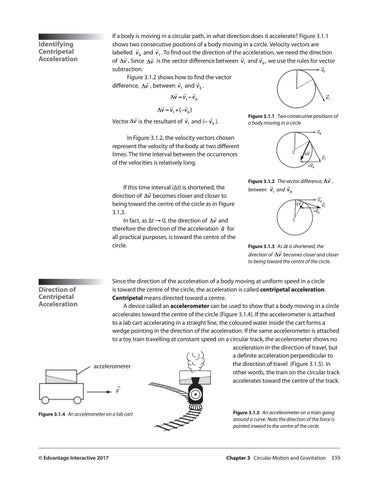
If a body is moving in a circular path, in what direction does it accelerate? Figure 3.1.1 shows two consecutive positions of a body moving in a circle. Velocity vectors are labelled v 0 and v1 . To find out the direction of the acceleration, we need the direction ! ! of Δv . Since Δv is the vector difference between v1 and v 0 , we use the rules for vector subtraction. v0 Figure 3.1.2 shows how to find the vector ! difference, Δv , between v1 and v 0 . ! ! ! Δv = v1 – v 0 v1 ! ! ! Δv = v1 +(−v 0 ) Figure 3.1.1 Two consecutive positions of ! Vector Δv is the resultant of v1 and (– v 0 ). a body moving in a circle v0
In Figure 3.1.2, the velocity vectors chosen represent the velocity of the body at two different times. The time interval between the occurrences of the velocities is relatively long.
C
Δv
v1
–v0
!
If this time interval (∆t) is shortened, the ! direction of Δv becomes closer and closer to being toward the centre of the circle as in Figure 3.1.3. ! In fact, as ∆t → 0, the direction of Δv and therefore the direction of the acceleration a for all practical purposes, is toward the centre of the circle.
Figure 3.1.2 The vector difference, Δv ,
between v1 and v 0 Δv
v0 –v0
v1
C
Figure 3.1.3 As ∆t is shortened, the
!
direction of Δv becomes closer and closer to being toward the centre of the circle.
Direction of Centripetal Acceleration
Since the direction of the acceleration of a body moving at uniform speed in a circle is toward the centre of the circle, the acceleration is called centripetal acceleration. Centripetal means directed toward a centre. A device called an accelerometer can be used to show that a body moving in a circle accelerates toward the centre of the circle (Figure 3.1.4). If the accelerometer is attached to a lab cart accelerating in a straight line, the coloured water inside the cart forms a wedge pointing in the direction of the acceleration. If the same accelerometer is attached to a toy train travelling at constant speed on a circular track, the accelerometer shows no acceleration in the direction of travel, but a definite acceleration perpendicular to the direction of travel (Figure 3.1.5). In accelerometer other words, the train on the circular track accelerates toward the centre of the track. F
Figure 3.1.4 An accelerometer on a lab cart
© Edvantage Interactive 2017
Figure 3.1.5 An accelerometer on a train going
around a curve. Note the direction of the force is pointed inward to the centre of the circle.
Chapter 3 Circular Motion and Gravitation 155