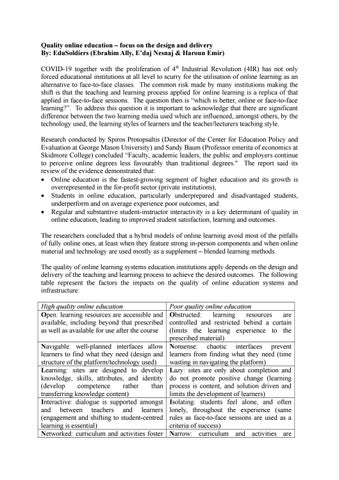
Quality online education – focus on the design and delivery By: EduSoldiers (Ebrahim Ally, E’daj Nesnaj & Haroun Emir) COVID-19 together with the proliferation of 4th Industrial Revolution (4IR) has not only forced educational institutions at all level to scurry for the utilisation of online learning as an alternative to face-to-face classes. The common risk made by many institutions making the shift is that the teaching and learning process applied for online learning is a replica of that applied in face-to-face sessions. The question then is “which is better, online or face-to-face learning?”. To address this question it is important to acknowledge that there are significant difference between the two learning media used which are influenced, amongst others, by the technology used, the learning styles of learners and the teacher/lecturers teaching style. Research conducted by Spiros Protopsaltis (Director of the Center for Education Policy and Evaluation at George Mason University) and Sandy Baum (Professor emerita of economics at Skidmore College) concluded “Faculty, academic leaders, the public and employers continue to perceive online degrees less favourably than traditional degrees." The report said its review of the evidence demonstrated that: Online education is the fastest-growing segment of higher education and its growth is overrepresented in the for-profit sector (private institutions), Students in online education, particularly underprepared and disadvantaged students, underperform and on average experience poor outcomes, and Regular and substantive student-instructor interactivity is a key determinant of quality in online education, leading to improved student satisfaction, learning and outcomes. The researchers concluded that a hybrid models of online learning avoid most of the pitfalls of fully online ones, at least when they feature strong in-person components and when online material and technology are used mostly as a supplement – blended learning methods. The quality of online learning systems education institutions apply depends on the design and delivery of the teaching and learning process to achieve the desired outcomes. The following table represent the factors the impacts on the quality of online education systems and infrastructure: High quality online education Open: learning resources are accessible and available, including beyond that prescribed as well as available for use after the course Navigable: well-planned interfaces allow learners to find what they need (design and structure of the platform/technology used) Learning: sites are designed to develop knowledge, skills, attributes, and identity (develop competence rather than transferring knowledge content) Interactive: dialogue is supported amongst and between teachers and learners (engagement and shifting to student-centred learning is essential) Networked: curriculum and activities foster
Poor quality online education Obstructed: learning resources are controlled and restricted behind a curtain (limits the learning experience to the prescribed material) Nonsense: chaotic interfaces prevent learners from finding what they need (time wasting in navigating the platform) Lazy: sites are only about completion and do not promote positive change (learning process is content, and solution driven and limits the development of learners) Isolating: students feel alone, and often lonely, throughout the experience (same rules as face-to-face sessions are used as a criteria of success) Narrow: curriculum and activities are