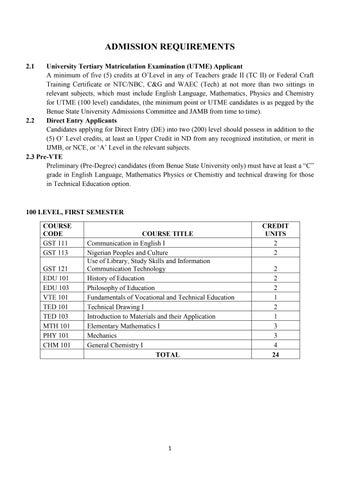
ADMISSION REQUIREMENTS
2.1 University Tertiary Matriculation Examination (UTME) Applicant
A minimum of five (5) credits at O‟Level in any of Teachers grade II (TC II) or Federal Craft Training Certificate or NTC/NBC, C&G and WAEC (Tech) at not more than two sittings in relevant subjects, which must include English Language, Mathematics, Physics and Chemistry for UTME (100 level) candidates, (the minimum point or UTME candidates is as pegged by the Benue State University Admissions Committee and JAMB from time to time).
2.2 Direct Entry Applicants
Candidates applying for Direct Entry (DE) into two (200) level should possess in addition to the (5) O‟ Level credits, at least an Upper Credit in ND from any recognized institution, or merit in IJMB, or NCE, or „A‟ Level in the relevant subjects.
2.3 Pre-VTE
Preliminary (Pre-Degree) candidates (from Benue State University only) must have at least a “C” grade in English Language, Mathematics Physics or Chemistry and technical drawing for those in Technical Education option.
100
200 LEVEL, SECOND SEMESTER
COURSE DESCRIPTIONS
EDU 101: HISTORY OF EDUCATION 2 CR
A study of educational development and institutions from ancient times to the present with particular reference to the evolution of modern education in Nigeria.
EDU 102: INTRODUCTION TO EDUCATIONAL PHILOSOPHY 2CR
This is a faculty based course designed to introduce all education students to the basic elements of psychology as it is applied to teaching and learning processes. It covers areas such as learning, theories of learning and motivation, individual differences and personality development among others.
EDU 103: PHILOSOPHY OF EDUCATION 2CR
An introduction to major philosophical ideas which have influenced educational thought and practices and the relevance of these to the development of education in Nigeria.
EDU 201: SOCIOLGY OF EDUCATION 2CR
An examination of the school as a micro society; a study of the school as a component of the larger society as well as inter dependence of the school and the larger society.
EDU 202: EDUCATIONAL PSYCHOLOGY 2 CR
This course covers the broad areas of general Psychology developmental psychology and human learning.
EDU 203: CURRICULUM AND INSTRUCTION 2CR
Introduction to the school curriculum with particular reference to primary and secondary schools, general principles and methods of instruction, communication in instruction, and introduction to the teaching profession.
EDU 204: INSTRUCTIONAL TECHNOLOGY 2CR
General principles for selection and use of audio-visual materials. Techniques for production/ improvisation of instructional materials e.g. pictures manipulation, dry mounting, rubber cement/gum mounting, and lettering (stencil and mechanical). Operation of equipment e.g. overhead, opaque slide and film projectors, duplicating scanner and photocopier machines and tape recorders.
EDU 301: EDUCATIONAL STATISTICS 2CR
An introduction to basic statistics, both descriptive and inferential. Organization and analysis of collected data in educational problems. Approximations; measures of central tendency (mean median mode), representation of data (bar chart, pie chart, histogram, relative frequency curve, Ogive), measure of variability (Range), and correlations. Introduction to hypothesis testing.
EDU 302: EDUCATIONAL RESEARCH METHODS 2 CR
An experience in problem identification, types, design, data gathering, processing, analyzing, interpreting and reporting in education
EDU 303: CURRICULUM STUDIES I 2CR
An in depth exposure of students to the concept of curriculum; its foundations and their policy implications, patterns/models of curriculum organization/design. Application to the Nigerian education system to be emphasized.
EDU 304: CURRICULUM STUDIES II 2CR
A detailed treatment of educational objectives and their form and types, their significance in curriculum and instruction. Curriculum evolution and revision. A review of Nigerian Primary and secondary School curriculum to highlight
EDU 309: INTRODUCTION TO GUIDANCE AND COUNSELLING2 CR
This is a faculty based course that at preparing all educational students to provide first aid guidance services in schools. The course includes areas such as: concepts of guidance and counseling, general professional counseling differences, guidance services in schools, principles of guidance counseling and team work in school guidance and counseling, among others innovation.
EDU 401: TEACHING PRACICE 6 CR
A minimum of six weeks supervised exposure to classroom teaching on field experience to demonstrate the degree of proficiency in applying the basic theories and techniques of instruction.
EDU 403: TEST AND MEASUREMENTS 2 CR
An experience in the test construction, administration, analyses and interpretation.
EDU 404: RESEARCH PROJECT 6 CR
An application of the educational research methods and statistics courses to a field experience under the guidance of a faculty member.
VTE 101: FUNDAMENTALS OF VOCATIONAL AND TECHNICAL EDUCATION (1CR)
History and philosophy of Vocational Industrial and Technical Education. An evaluation of Vocational, Industrial and Technical Education processes. A review of trends and issues in Vocational, Industrial and technical education implications for national, state development.
VTE 102: IMPROVISATION OF EQUIPMENT 2CR
General research and development experiences focusing on problems related to laboratory/workshop equipment, teaching and learning materials, etc. The students design, develop and apply various products and systems for the solution of problems related to the availability and functionality of laboratory/workshop equipment, as well as other instructional resources.
VTE 202: FACILITIES PLANNING FOR VOCATIONAL AND TECHNICAL EDUCATION 2CR
The course is concerned with planning, organization and managing educational and/or related facilities. The course will consider the problems and techniques in determining Vocational and Technical education facility needs, evaluating and assessing facilities, planning for new construction, utilizing available resources and related matters.
VTE 204: PRINCIPLES AND METHODS OF TEACHING IN VTE I 2CR
This course focuses on methods of teaching that are applicable across vocational and technical subject areas and in varying teaching situations. This include student-centered and teacher-centered instructional strategies as well as broader curriculum framework that makes these strategies meaningful. The concept of teaching including identification of the role of teachers in the teaching –syllabus; the scheme of work; instructional objectives; selection of teaching aids; understanding the various parts of a lesson
VTE 301: PRINCIPLES AND METHODS OF TEACHING IN VTE II 2CR
The art of classroom management and control Qualities of a good teacher, Some common bad habits to avoid; dealing with disciplinary problems in the classroom. Micro-teaching, preparation for teaching using the experiential approach
VTE 302: INDUSTRIAL TRAINING 6CR
To be undertaken by the student in a recognized industry.
VTE 304: PROBLEMS AND PROJECT IN AREA OF SPECIALIZATION 3CR
Students to be guided to identify a problem in area of specialization, research and present problem solution report based on current literature available, or design and present with a project report
VTE 402: PLANNING AND ADMINISTRATION OF VTE 2CR
An introduction to the scientific approach to educational planning and administration. Techniques and tools in educational planning. Planning in Nigeria and problems of educational planning in the 3rd world. Concept of planning versus free enterprises, planning and planning statistics in technical education. Indices of growth. Differences between development and growth. An introductory analysis of the progress, science and innovative dimension of educational administration. Organization and its structural framework for administration principles of systems approach to educational administration. School and community leadership, personnel Administration and supervision as an administrative task. Planning techniques and problems of educational planning in Nigeria.
TED 101: TECHNICAL DRAWING I (2CR)
To impart the fundamental principles of technical drawing: Use of Instruments and materials; Applied Geometry; lettering; the theory of projections; orthographic projection; auxiliary projections; ellipse and freehand sketching.
TED 102: TECHNICAL WRITING(2CR)
Technical Writing is a course that focuses on business and technical correspondence and reports. This course aims to help the student develop the skills they will need to write scientific and technical documents successfully. The course introduces students to the rhetorical principles and compositional practices necessary for writing effective and professional communications such as reports, instructions, technical briefs, and documentations within their domain of practice.
TED 103: INTRODUCTION TO MATERIALS AND THEIR APPLICATION (1CR)
Structure of materials, chemical composition, phase transformations, corrosion and mechanical properties of metals, polymers, ceramics, composites, electronic materials, etc. electrical, magnetic and optical properties of materials. Materials selection and related considerations in engineering and technology applications.
TED 104: SAFETY TECHNOLOGY (2CR)
Standards, codes, mechanical injuries, heat, pressure and electrical hazards; fires and explosions; toxic materials and radiation; vibration and noise. Accident prevention and safety administration.
TED 105: BASIC ELECTRICITY (2CR)
Basic concept of generation meaning of MW, KW, Milli Amp. Etc. Advantages of Electrical Energy. Basic Safety precautions.
OHM‟s Law definition, Calculation of simple Problems associated with ohm‟s law, applications in series, parallel circuits. A.C. & D.C. Circuits: differences, mean value/Average value, R.M.S. value, plotting of R.M.S. graph. Resistance:definition, Resistances in series, Resistance in Parallel Resistances in series & parallel Uses in electrical work Capacitance: Definition: simple calculations/applications.Conductors/Insulators:definitions/examples/applications. Inductance: definitions. Simple calculations/applications Magnetism: concepts: magnetic materials uses of magnets/electromagnets. Kirchhoff’s laws.State meaning, illustrate with circuits. Solve problems using Kirchhoff‟s 1st and 2nd laws.
CHM 101: GENERAL CHEMISTRY I 4CR
Atoms, molecules and chemical reactions; chemical equations and stoichiometry; redox reactions; atomic structure and periodicity; electric theory of atoms; chemical bonding; the kinetic theory and the gas laws, the solid state; nuclear chemistry; electrolytes; thermochemistry; introduction to chemical kinetics; elementary electrochemisty; chemical equilibrium; acids and bases; buffers; precipitation reactions; complexometric reactions.
CHM 110: INTRODUCTION TO INORGANIC CHEMISTRY 2CR
Introduction to inorganic chemistry with emphasis on group properties; chemistry of hydrides, oxides, hydroxides and halides of the second and third periods, protonic acids, chemistry of metals and non-metals. Introduction to the chemistry of transition metals
PHY 102: HEAT AND PROPERTIES OF MATTER 3CR
Molecular treatment of properties of matter, elasticity; Hook‟s Law,Young‟s Shear and bulk moduli. Hydrostatistics pressure; Buoyancy; Archimedes‟ principle; Hydrodynamics; Streamlines, Bernoulli and continuity equations, turbulence, Reynolds number. Viscosity; Laminar flow, Woiscull‟s equation. Surface tension; adhesion, cohesion. Capillarity, drops and bubbles. Temperature; the zeroth law of thermodynamics; heat; gas laws of thermodynamics; kinetic theory of gases. Applications.
PHY 103 ELECTRICITY AND MAGNETISM 3CR
Electrostatic in vacuum: Electric force; field and potential; Electric flux and Gausa‟s Theorem; Capacitors: current. Electricity: magnetic fields in vacuum. Fields due to magnets, earth and currents. Magnetic flux and flux density for solenoid, straight conductor and narrow circular coil. BUT-Savart Law, Hall effect, Ampheres Law. Applications, Electromagnetic induction: Flux linkage, Faraday and Lenz‟s Law. Eddy currents. Applications; self and mutual inductance; magnetic materials. AC circuits: Dielectrics.
MTH 101: ELEMENTARY MATHEMATICS I 3 CR
Elementary set theory, subsets, union interaction, complements, Venn diagrams. Real number; integers, rational and irrational numbers, mathematics induction, real sequences and series, theory of quadratic equations, binomial theorem. Complex numbers; algebra of complex numbers; the argand diagram. De Moivre‟s theorem, nth roots of unity. Circular measure, trigonometric function of angles of any magnitude, addition and factor formulae.
MTH 102: ELEMENTARY MATHEMATICS II 3CR
Geometric representation of vectors in 1-3 dimensions, components, direction cosines. Addition, scalar, multiplication of vectors, linear independence. Scalar and vector products of two vectors. Differentiation and integration of vectors with respect to a scalar variable. Two dimensional co-ordinate geometry. Straight lines, circles, parabola, ellipse, hyperbole, tangents, kinematics of a particle. Components of velocity and acceleration of a particle moving in a plane. Force, momentum, laws of motion, under gravity, projectiles, resisted vertical motion, elastics strings, simple pendulum, impulse, impact of two smooth spheres, and a sphere on a smooth sphere, vector equations of lines and planes. Pre-requisite MTH 101.
MTH 131: STATISTICS FOR PHYSICAL SCIENCES AND ENGINEERING 4CR
Measures of location and dispersion in simple and grouped data exponentials. Elements of probability distributions: normal, binomial, Poison, geometric, negative binomial distributions. Estimation and tests of hypotheses concerning the parameters f distribution. Regression, correlation and analysis of variance contingency table. Non-parametric inference.
TED 201: TECHNICAL DRAWING II 2CR
Points, lines and planes in space presentation drawing, development and intersections. Detail assembly drawing, screws, thread and fasteners. Perspective, pipes, fittings and values. Shop processes and structural drawings. Use of graphics in solving engineering problems.
TED 202: STRENGTH OF MATERIALS
2CR
Review of Stress and Strain relationships, elasticity and elastic limits, Centre of gravity and Moment of Inertia: determination of centre of gravity and moment of inertia. Bending moment and Sheer force: types of beams and loadings, determination of shearing forces and bending moments, shear force and bending moments, theory of bending. Stop and deflection of beams, Factors affecting deflection, span/depth ratios. Introduction to torsion and its effect on shafts.
TED 203: COMPUTER AIDED DRAFTING (CAD) I 2CR
Instruction and use of basic drafting equipment and the Auto CAD drafting Software Programme. Students will design and develop basic layouts; isometric and orthographic drawings, sketching, and dimensioning techniques. Once the basics are mastered, students will switch to the computer and spend the rest of the year creating drawing on the computer. Students will begin to explore mechanical drawing, architectural drawing assembly and detail.
TED 204: COMPUTER AIDED DRAFTING II (CAD) 2CR
Advanced work in computer-assisted drafting. Students will complete all drawings using the AutoCAD Software Programme on the computer. The focus of CAD II will be architectural, mechanical, electrical, and other engineering drawing concepts students will work in each area and concentrate on the materials related to the area. Students will research, design, and building projects related to each area. Students will begin to develop basic skills in the development of 3-D modeling and animation
TED 205: BASIC APPLIED MECHANICS 2CR
Force systems: Mass, force and weight, resultant and equilibrium of forces, scalar and vector quantities. Static equilibrium, Concurrent coplanar and Non-concurrent Coplanar forces. Velocity and acceleration, Inertia and change of motion in a circular path. Dynamics of rotation, Simple harmonic motion. Stress and strain relationships: direct stress and strain. Shear stress and strain. Shear force and bending moment, shear force and bending moment diagrams, combined bending and direct stress. Friction: the nature of friction, laws of friction.
TED 221: WOOD WORKING PRACTICES
Design and construction of furniture and fixtures. Materials, Methods and equipment used in the construction of timber structures, design, construction and framing of roofs. Use of bolts, connectors and nails. Support to deep trenches.
CTE 211: INTRODUCTION TO BUILDING SERVICES 2CR
Types and nature of utility services required in modern buildings; principles of cold and hot water supply, mains and distribution pipe work, disposal of waste and soil water, drainage and sewage disposal systems. Supply and distribution of gas, pipe work and safety relating to gas. Fire detection and control systems, building regulations and fire control
CTE 212: ARCHITECTURAL DRAWING II
Development of graphical simulation techniques and problem solving abilities. Study site planning, space requirements, housing codes, structure, light frame construction, solar and earth integrated designs, mechanical and electrical systems are required for the solution of a variety of housing problem.
CTE 213: CONSTRUCTION TECHNOLOGY LABORATORY I (3CR)
Site preparation and foundation, further consideration of the different foundation types, their suitability for various types of soils and construction methods. Pilling and sheet pilling. Retaining walls underpinning. Control of surface and ground water on site. Load bearing wall construction in bricks, blocks, stone and concrete, walling materials, panel filling, glass block, composite panels. Thermal and sound insulation systems. (Field trips will be compulsory to acquaint students with practical skills on actual projects).Introduction to site activities, Brick/block work and masonry practices. Construction of formwork, concreting practices, Mix design in concrete and mortar, Production of workable mixes. Basic roof construction of different types. Course covers the whole structure concept of technology of building assembly. Domes, shell roof, portal roof, framed buildings in steel, concrete and timber, integration of building structures with services and equipment.
CTE 214:
LAW OF CONTRACT AND ARBITRATION
Introduction to law and the legal processes. Sources of Nigeria Law. Foundations of contract; offer and acceptance, consideration, etc. Principles of the laws of contract, tort, etc. The nature of building contract; types of contract and contract documentation. Arbitration in the construction industry.
CTE
215:
ARCHITECTURAL DRAWING I (2CR)
Brief history and impact of architecture, its dynamics and social aspects. Free hand sketching. Orthographic, pictorial and geometric drawing with applications in architecture. Perspective and axonometric drawing. Working drawings including plans, elevation, sections and mechanical working drawings. Scale depth and space organizations.
CTE 216: MEASUREMENT AND QUANTITIES OF BUILDING WORKS (2CR)
Covers organization and management of firms involved in residential and light commercial construction. Includes methods of estimating and cost control. Also techniques planning, scheduling and control of construction projects.Duties of a quantity surveyor. Relationship between members of the building team, the client, architect, engineer, quantity surveyor, contractor, site agents, etc. introduction to the general principles of taking off and the current standard method of measurement of building works. Taking off quantities for the excavation works, foundations, concrete brick/block work. Floors, internal finish, windows, doors measurement of staircases and fittings, measurement of plumbing installations, drainage works, and external works. Measurement of concrete, works, site investigation, brickwork, block work. Preparation of bills of quantities.
CTE 217:
INTRODUCTION TO WOODWORKING (2CR)
This course provides introduction to the broad area of woodworking technology and covers names, classification and uses of hand tools, basic machines and woodworking joints. Materials used in woodworking to include man-made boards, wood adhesives, abrasives, nails, screws and wood finishes are also to be covered.
CTE 218:
RELATED BUILDING TRADES (2CR)
Covers areas related to residential and light commercial buildings construction utilities, electrical wiring, plumbing, painting and decoration, building sheet metal work and environmental control
CTE 219: JOINERY I (2CR)
The properties and uses of common materials used in joinery, their selection and application. Types, application and construction of common woodwork joints used in joinery. Methods and techniques of frame construction and its application in the production of standard doors and windows. Production of casement and louvered windows. Estimates and costs of joinery projects. wall panelling, doors/windows with shaped heads, gates and garage doors. Basic principles of stair design, their construction and finishing ready for installation.
CTE 221: MACHINE WOODWORKING (2CR)
Introduction to the names and basic functions of common stationary and portable woodworking machines, names and functions of parts, general and machine specific safety precautions. Emphasis on practical application of the machines to be high attention.Working principles, further scope of functions and methods of operation of cross-cutting saw, surfacer, table saws, thicknesser, combined surfacer and thicknesser, band saw and drilling machine with emphasis on functions, parts, safety rules and regulations. Machine shop layout, use of working drawings, preparation of setting out
rods and job cutting list. Job setting out ready for machining. The scientific method of woodworking project design and production. Working principles, scope of functions and methods of operation of portable power tools, vertical spindle moulder, wood turning lathe, tenoner, mortiser, over head belt sander, Disc sander, bobbin sander and drum sander with emphasis on safety. Experiences in organization and presentation of content in wood machining as it relates to the total introductory technology and vocational and technical education programmes.
CTE 222: WOOD TECHNOLOGY (2CR)
Forest management, structure of wood, Properties of wood, defects of wood, modification of wood, lamination of wood, wood testing procedures and trends in wood based industries.
CTE 224:
WOODWORK INTERIOR AND EXTERIOR FINISHING TO BUILDINGS (2CR)
Development of skills and knowledge related to built-in cabinets, installation of prefabricated cabinets, wall sheathing and siding, wall covering, finished flooring covering, fitting and hanging of doors, windows, wall paneling, trimming of eaves and soffit, in roofs construction and ceilings.
CTE 311: STRUCTURAL DESIGN (2CR)
Statically determine and indeterminate structures. Methods of force distribution using flexibility and displacement or rigidity. Indeterminacy arising from support, settlement and energy. Methods of structural analysis of beams, columns, frames, slope and deflection.
CTE 313: REINFORCED CONCRETE DESIGN (2CR)
Properties of concrete and steel. Stress- strain relationship for steel and reinforced concrete. Creep shrinkage and modulus of Elasticity of concrete sizes and types of reinforcement. Limit state design such as aim of structural design, philosophy, strengths loads and partial factors of safety should be considered. Reinforcement of concrete beams and ultimate limit state should be considered for singly, doubly and flanged beams and design detailing. Serviceability limit sate should include deflection and cracking. Elastic theory, deflection and crack widths.
CTE 315: SOIL MECHANICS AND LAB ORATORY
The course covers physical, chemical and mineralogical properties of soil. Types of soils with emphasis on clay and interaction with water. Site investigation-objectives methods of sampling field tests, soil profiles and laboratory identification tests. Shear strength and stresses in soil should be considered these should includes Mohrs stress circle, MohrsCoulomb theory of failure. Shear test-vane tests, shear box test, traixial, shear strength of saturated clay and compacted unsaturated clays
CTE 317: CONSTRUCTION TECHNOLOGY LABORATORY II (2CR)
Construction of retaining walls, basement water roofing and construction. Cofferdams under piping, ground water control and soil, should be considered, soil stabilization proprietary building systems fire protection and safety on building sites. Site visits required.
CTE 319: BUILDING MAINTENANCE (2CR)
Maintenance organization. Safety codes and standards, equipment handling. The need for maintenance; duties of a maintenance officer. Tools and testing instruments. Stratification of construction projects for maintenance. Maintenance scheduling. Failure and problems in foundations and effect on superstructure remedial actions. Cracks and failures on wall fabrics. Maintenance of roofs, floors, windows, doors. Maintenance of domestic drainage. Field trips and site visits to Acquaint students with real like problems are compulsory. Students are expected to select defective structures for case studies.
CTE 321: UPHOLSTERY TECHNOLOGY (3CR)
Upholstery tools and materials. Factors for consideration in upholstery frame design. The basic principles of upholstery. Upholstering fabrics and leatherette. Cutting and sewing of upholstery fabrics and leatherette cover. Forms of upholstery. Design and construction of upholstered simple furniture. Design and construction of complex upholstered furniture.
CTE 323: CARPENTRY I (2CR)
Basic carpentry activities involving the construction, erection and dismantling of site and other hoardings, centers for arches, timbering and shoring to trenches, formwork, scaffolds and ladders, timber floors, basic roofs and ceilings, partitions and screens, cladding concrete and steel members in buildings.
CTE
325:
JOINERY II (2CR)
Reading of blue prints in joinery construction in building/architectural drawings and production of working drawings. Rods for mass production of joinery items. The techniques and processes of mass production of joinery items of all types. The basic geometry of hand railing and the production and installation of Wreathed hand rails for quarter and half turn stairs. Designing and construction of specialized items of joinery furniture for public and domestic use. The construction of joinery involving geometry of single curvature.
The differences between temporary, semi-permanent and permanent buildings. Principles of design of timber buildings of the temporary, semi-permanent and permanent types. Foundations to timber buildings, wall systems, ceiling/floor systems, ceiling/roof systems, damp-proofing, preservation of timber structural members. Drawing/sketching of constructional details of a temporary timber building suitable for a site office, a guard‟s hut and a residential building. Erection of temporary and semipermanent timber building using prefabricated timber building components and finish for use as appropriate. Selection and fixing of interior and exterior finishing to timber buildings.
CTE 327: FURNITURE DESIGN AND CONSTRUCTION TECHNOLOGY (2CR)
Tools and materials design elements. Design principles. Anthropometrics principles of Appofitionings sizes to product. Factors affecting the shape of a sections. Principles of joint selection for various furniture structures. Design draw and choose production materials for simple furniture. The principles and preparation of surface of finishing. Design and construction of stools, chairs, tables, desks and cabinets. Furniture hardware
and methods of fixing. Styles of furniture in use and their periods. History of period furniture. Common sizes of furniture.
CTE412: SITE ORGANIZATION AND EQUIPMENT SELECTION (2CR)
Factors affecting the choice of plant and construction methods. Influence of site conditions on construction methods. Site layout and efficiency of plant movement. Construction of temporary structures for effective site control. Storage and security. Labour assessment and forecasting of requirements.
CTE 414: SPECIFICATION WRITING (2CR)
Functions of specifications, plans specifications, specification writing and language procedure. Addenda and change orders. General and supplementary conditions, the use of standard reference materials. Standard workmanship, quality of materials and tests, specification writing covering various trades and sections.
CTE 416: CONSTRUCTION PROJECT MANAGEMENT II (2CR)
Collecting data for work programming; Preparation of programming and process charts Critical paths methods of work programming; Project evaluation techniques, labour, equipment, materials, planning, control and forecasting should be studiedidentification and organization of construction equipments Architectural drawings, Engineering drawings, scheduling, specifications bill of quantities and contract documents; Communication information using statement methods and programming. Use and development of bar chart for programme and progressFinancial control in construction projects management. Use of CPM and PERT methodologies in construction contract administration. Pre And Post contract planning; project applications of operations research in construction management, linear programming, sequencing, queuing theory and work study.
CTE 418: ARCHITECTURAL DRAWINGS III 2CR
Preparation and interpretation of working drawings as they apply to different crafts in the construction of buildings including plans, elevations, section and details drawing which when read with specific detailed materials and workmanship give information for building.
CTE 422: STRUCTURAL DESIGN II (2CR) (pre-requisite TED 321 &329)
Further consideration of moment distribution using flexibility and stiffness methods plastic behaviour of concrete and steel sections using increment load technique. Plastic behaviour of slabs, beam and columns production and interpretation of working drawings required.
CTE 432: PRODUCTION MANAGEMENT IN WOODWORKING INDUSTRY (2CR)
Definition of manufacturing management. Responsibilities of manufacturing management. The roles of a woodworking industry owner and manager. General tasks of industrial management and the levels of authority in a woodworking industry. Activity areas in a manufacturing woodworking industry. The labour union. A typical introduction to students‟ manufacturing woodwork enterprise.
CTE 434: WOOD FINISHING
TECHNOLOGY
(2CR)
Scope of finishing; types, characteristics and processes of selected wood finishing materials, safe practices in wood finishing, drying process in wood finishing, finishing
characteristics of different types of wood, colour relationships and mixing, surface preparation for finishing, schedules for finishing wood surfaces, equipment and methods of application of selected wood finishing materials, restoration and maintenance of finishes.
CTE 436: MAINTENANCE OF WOODWORKING EQUIPMENT (2CR)
Reconditioning and power woodworking equipment. Identification and correction of malfunctions commonly encountered with wood processing equipment. Information on manufacturer‟s performance specifications, technical data on cutting tools, schedules, criteria for the selection of hand tools, power equipment, measuring instruments and safety devices.
CTE
438:
CARPENTRY II (2CR)
The requirements of construction and erection of roofs and ceiling for domestic, industrial and other special buildings on spans over 10meters. Basic requirements and the erection of timber platforms and supports between openings other than domestic floors. The principles of design, construction, erection and stripping of various types of insitu and pre-cast concrete forms. Installation of sliding and folding doors and partitions.
ETE221: UTILITY POWER SYSTEM (2CR)
Full treatment of various D.C. power supplies solar cells, piezo electricity etc state full utilization voltages of each type with the applications. Electromagnetism, principles and applications in relays, electric bells (3v D.C. to 230v A.C) Land Telephone System: Microphone and Speaker Systems: Construction and description of working principles. Operating principles of cell-phones. Illustrate with block diagrams. Draw Telephone system for two stations complete with microphones and speaking systems. Open and closed circuit alarm systems. Draw fire alarm systems for cars and residential houses. Draw fire alarm systems for bungalows and block of flats.
ETE 223: CIRCUIT THEORY (2Cr)
DC Network: Ohms law, Power, Energy and Efficiency .Series circuit, Kirchhoff‟s voltage law. Voltage and current divider rules, Parallel circuits, Kirchhoff‟s current law.
Current and voltage sources. Source conversion. Voltage sources in series and parallel. Mesh and Nodal Analysis Norton, Theremin and superposition Theorems. Star-Delta and Delta-Star conversion Bridge Network. AC Network. Basic Geometry and Trigonometry of the right-angle triangle. Sinusoidal ac. Voltage generation. Definition of waveform ,instantaneous values, peak value period and frequency sinusoidal voltage phase relationship, average value and effective value. Response of R, L and C elements in AC circuits. Average power and power factor. Phasor- Rectangular and polar forms. Conversion techniques. Mathematical operation of complex numbers. Impedance and phasor diagram – Admittance and susceptance. RL, RC and RLC parallel AC network source conversion mesh and Nodal analysis. Bridge Network star-Delta conversion. Superposition and Norton‟s theorems maximum power theorem-series Resonance circuit. Parallel resonance circuit.
Introduction, ideal operational amplifier: Basic inverting and non-inverting circuits. Operational amplifier practical considerations; gain, input impedance and output impedance for inverting and non-inverting amplifiers. Noise, slew rate and offset voltage and current. Linear circuits integration and differentiation circuits.
Instrumentation amplifiers. Non-linear circuits: comparators, clamping and limiting circuits. Oscillators. The SSS timer.
ETE 225 ELECTRONICS DEVICES (2CR)
Understanding of basic semi-conductors and thermionic theory, characteristics, parameters and simple circuits applications, such devices as diodes, triodes, tetrodes pentodes and special values; and semiconductor devices: transistors; uninjunction mosfet IGFET, SCR, DIAC, TRIAC, etc. theory and applications of integrated circuits
ETE 226: LINEAR NETWORK THEORY (2CR)
Linear discrete and integrated solid devices used in amplifiers, Oscillators, other practical circuits. Applications of selected laboratory equipment and devices.
ETE 227: ELECTRICAL MEASURING INSTRUMENTS (2CR)
Definition of measurement, instrument, Accuracy, Precision, sensitivity, Resolution and Error. Types of Error, system of units and magnetic units. Direct current indication instrument: Galvanometer construction. Torque and deflection. Permanent magnet moving coil instrument its construction and operation. DC Ammeter shunt and multi range resistors. DC voltage multiplier and multi -range resistors. series type Ohmmeter. Multi-meter operation principles and application of potentiometers. AC indicating instruments and moving iron instrument. Oscilloscope basic operations and application . CRO probes. Signal Generator and function Generator principles and uses. Electronic counters. Digital voltmeter.
ETE 228: DIGITAL ELECTRONICS II (2CR)
A comprehensive course in the selection of digital logic devices to solve specific problems (Logic problems) using standard integrated circuit devices with the aid of functional block diagram approach. Strong emphasis be made on the characteristics and uses of TTL, EGG, MOS and CMOs technologies and their application in the design of encoders, decoders, counters, registers, program logic array devices, memories and AD/DA converters.
ETE 232: TELECOMMUNICATIONS I (2CR)
Radio wave propagation: Electromagnetic waves, principles of wave radiation, methods of wave propagation. Aerials: half-wave dipole, mavcom quarter wave aerial, yagi Array and feeding and aerial. Radar transmission and reception, application of rader system. Digital communication techniques. Internet and GSM.
ETE 331: ENERGY & ELECTRICAL POWER MACHINES (2CR)
D.C. machines: D.C. Generators, types, operating principles and applications. D.C. Motors: Types, operating principles and applications. Describe with aid of sketches the differences between series, shunt, compound, short compound and long compound motors. Derive the e.m.f. (E.r) of rotation for a.d.c. machine and state that for a.d.c. generator, Er = Eg (e.m.f. generated) and for a.d.c. motor Er = Eb. (Back e.m.f.) Recognize lap and wave armature windings. Sketch and solve problems involving lap and wave armature connections Derive speed and Torque equations for d.c. machine in the form T = KQla and W = EV KQ Explain in the term critical field resistance. State the various forms of losses in d.c. machines. Methods of varying output voltage for Generators. Methods of varying speed of d.c. motors and their limitations.
Explain the need for motor starters, sketch the d.c. Face-plate starter with its protective devices and explain the function of each.
Explain armature reaction and commutation in d.c. machines. Explain the effects of armature reaction and how to overcome each effect. Explain the production of a rotating magnetic field when a suitable three phase supply is connected to the stator windings of three phase machine. Describe the principles of operation of induction, and synchronous motors and generators. Define and calculate values of synchronous speed, slip and slip speed. List the losses in stator, rotor and solve problems concerning losses and per unit efficiency for induct on motors. Methods of starting induction motors
a. Direct-on-line
b. Star/Delta
c. Autotransformers
Explain the principles of operation of single and three phase transformers sketch each type. State reasons for laminating transformers and methods of reducing magnetic leakage.
ETE 333: ELECTRICAL POWER AND DISTRIBUTION (2CR)
Theory of 3-phase Generation. Types of generating Stations: Hydro, Steam, Nuclear and Diesel. Operating principles of each type. Merits and Demerits of each type. State the advantages and disadvantages of a.c .for generation, transmission and distribution. TransmissionSystems: Voltages in transmission lines. Sub-stations equipment and their functions. Sketch a single-line diagram of a typical three-phase supply system from generation to consumer terminals. Explain why transformers are used in transmission and distribution systems. Sketch diagrams of star, delta or mesh connections of voltage sources and balanced 3 phase loads. Derived the relationships between line and phase voltages, and currents for a star and mesh connected systems.
ETE 335: ELECTRICAL DRAFTING (2CR)
Drafting concepts, Electrical symbols as contained in I.E.E Regulations. Drafting techniques: scale drawings: Actual translation. Reading of approved architectural drawings.
Blue prints: Merits/demerits. Methods of preserving blue prints illumination principles: Illumination terms: candela, luminous intensity, lumen, lux, illuminance. The inverse square law and cosine law. Illustrate the laws above, with some problems and solutions. Discharge lamps. Explain stroboscopic effect. High voltage discharge lamps. Plan illumination for residential, offices and workshops.
ETE 337: POWER ELECTRONICS (2CR)
Analysis and design of industrial electronics systems, power sources. Motor control, timming and sequencing circuits, industrial application of solid-state devices. Laboratory analysis of industrial equipments.
ETE 339: DIGITAL ELECTRONICS I (2CR)
Number systems, codes and operations, logic gates, Boolean algebra, combinational sequential, arithmetic, logic memories
ETE 341: CONTROL CIRCUIT SYSTEM I (2CR)
Objectives of control system design. Open loop and feedback control. Transfer function. Block diagram, signal flow, input signal, classification of systems based on their
responses to common input signals. Derivation of transfer functions of generators, motors gearing, op-amp hydraulic and pneumatic controllers. Frequency response analysis. Amplitude. Vs frequency and phase vs frequency diagrams. Stability of control systems: the S-plane. Root stability criterion. Nyquist stability criterion Root lolacus. Bode plot and compensation techniques. Speed, position, numerical and process.
ETE 343: TELEVISIONI (2CR)
Basic principles of monochrome television, transmission and reception principles, transmitters, receivers, cameras and cathode ray tubes. Principles of transmission and reception of colour television function of sections of transmitters and receivers. Analysis of circuits localization of faults remedy and solutions
ETE345: ELECTRONIC DESIGN AND DRAFTING (2CR)
Standard electronic drafting symbols and drafting skills. Electronic network diagrams (Block diagrams). Electronics Network (circuits) Design procedures and blue print reading. Printed circuit boards (single sided, double sided). Preparation technology and components layout. Macro and micro circuits soldering procedures and technologies/techniques.
ETE 347: TELECOMMUNICATIONS II (2CR)
Radio wave propagation: Electromagnetic waves, principles of wave radiation, methods of wave propagation. Aerials: half-wave dipole, mavcom quarter wave aerial, yagi Array and feeding and aerial. Radar transmission and reception, application of rader system. Digital communication techniques. Internet and GSM.
ETE 349: POWER ELECTRONICS (2CR)
Analysis and design of industrial electronics systems, power sources. Motor control, timming and sequencing circuits, industrial application of solid-state devices. Laboratory analysis of industrial equipments.
ETE 444:
OPERATION AND MAINTENANCE OF A.C. AND D.C. MACHINES (4CR)
Practically designed to equip students with the knowledge, services and repairs of household electrical gadgets as well as industrial machines. Examine service or repair the followings: Single-phase motors e.g. capacitor start, capacitor start and run motors. Shaded pole motors, series (single phase) motors, repulsion motor, repulsion induction motors, universal motor, reluctance and Hysteresis motor. Repair and services of 3 phase induction motors. Repair and services of motor starters-single or three phase types. Repair of common faults in switchgears, discharge lamps and single phase generators. Describe methods of protection, including thermal and magnetic overload devices, relays and current transformers.
Show the advantages of power factor improvement by calculation of economic saving and increase in plant capacity. Describe suitable Electric motor drives for pumps, compressors, machine tools, fans generating plants and conveyors. Select the most suitable motor and associated control gear to drive a load, taking into account factors such as supply voltage, load characteristics, prime and running costs, efficiency, power factor, load factors, type of enclosures, maintenance. Calculate power and torque required for hoists, lifts and overhead cranes. Sketch schematic diagrams of power and control circuits for the sequence control of electric motor.
ETE 446: ELECTRICAL INSTALLATION PRACTICE II (4CR)
Introduction to safety precautions in workshops and electrical production industries. Introduction to electrical wiring systems, and the applications of relevant I.E.E. Regulations for electrical equipment in buildings. Types of wiring systems. Planning a wiring for residential, workshop, construction sites, commercial and industrial situations. Detail treatment of modern electrical installation in buildings, e.g. residential bungalows offices and blocks of residential flats/offices. Advanced wiring systems in buildings, selection of suitable switchgears. A method of installing machines e.g. lathes in wood working machines etc. Electric motor starters for single and three phase motors. Installation of heavy duty plants e.g Generators and Transformers, Feeder pillars and switchgears. The change-over switch from public supply to Generators. Testing of completed electrical installations. Verification of polarity tests. Insulation resistance tests, earth loop tests earthing Systems. Double earthing: Merits and demerits. The voltage and current operated earth leakage circuit breakers. Single and three phase types. Installation of single and three phase energy meters. Discussion of common electric faults in A.C. motors/starters and their rectifications. Power factor (P.F) correction advantages and disadvantages, Solve problems on P.F. Types of cables and their applications Diversity factors as applied to: residential, hotels, offices and industrial buildings. Cable enclosures: conduit, trucking and ducting systems. Selection and calculation of cables in conduits, trucking and ducts using the space factor techniques. Discussion of common faults in electrical wiring systems and their rectifications.
ETE 448:
ELECTRONIC
COMMUNICATIONS (2CR)
Analysis of the functions of major parts of turned frequency radio receiver, analysis and functions of parts of TV receiver, Telephone, telex, RADAR and satellite communications.
ETE 454: ELECTRONIC SERVICING TECHNIQUES (2CR)
Designed to give students a working knowledge of the solid state devices, its circuits and safe trouble-shooting and testing procedure; identifying, replacement of ordering components in electronic devices.
MTE 229: TRAFFIC AND HIGHWAY SAFETY (2CR)
Driving signs and signals, highway code, operation of motor vehicle on highway based on contemporary analysis of driving tasks. Government policy and laws governing the use of highways. Categories of vehicles using the highway. Organizations constituted by law to enforce highway safety.
MTE 231: FUNDAMENTALS OF AUTOMOBILE TECHNOLOGY (2CR)
Basic fundamentals and theory of Aeromechanical principles and functions of power units, operational, maintenance and overall processes of two and four strokes cycle engines
MTE233: METALS AND METAL PROCESSES 2CR
Introduction and orientation to the field of metals. Basic technical information and laboratory work in metal processes and fabrication. This include work in the areas of welding, forging, foundry, sheet metal, and metal machining. A variety of projects will be made to demonstrate the different processes.
MTE 235: METAL BULK DEFORMATION PROCESSES 2CR
A basic understanding of plastic deformation (including work hardening). A study of the various deformation processes and the ways they are used to form metallic objects. Treatment to include rolling, extrusion, forging, drawing, etc. Appreciation of the advantages and disadvantages of each and understanding of the reasons for selecting a process for a particular end product
MTE 237: EQUIPMENT MAINTENANCE 2CR
Types of maintenance, planning and scheduling of maintenance, servicing and repair of mechanical equipment such as power fluid system and laboratory/workshop equipment. The course include actual disassembly and assembly of valves, pumps. Cylinders and other units and operation of systems including corrections of malfunctions in circuits.
MTE 238: THERMODYNAMICS OF INTERNAL COMBUSTION ENGINES (2CR)
The study of internal combustion engine, combustion process, factors affecting thermal and volumetric efficiencies of the engine, study of properties of fuels, fluids oxidants and propellants.
MTE 239: WELDING AND SHEET METAL FABRICATION 2CR
Mechanical properties of Sheet metals, Machine tools used in sheet metal fabrication. Marking out and cutting. Fasteners for sheet metals e.g. rivets, nuts & bolts. Sheet metal fabrication processes (operations) including punching, drilling, riveting, folding edges and seams making-turning, burring, hollowing, raising, forming, crimping, beading, grooving, plating and annealing. Soldering and Brazing. Solder sweating. Common riveting faults. Calculation of allowances for making joints in sheet metal. Development of templates and patterns. Removal or dents on sheet metals. Theory and practice of oxyacetylene welding gas tungsten arc welding (TIG), gas metal – arc welding (MIG). Resistance, Plasma welding, etc. welding hazards (electric shock, radiation, arc-eye, toxic fumes, corrosive substances, burns, etc) First aid treatment. Weld testing. Field trip is required.
MTE 241: INTRODUCTIONS TO REFRIGERATION AND AIR CONDITIONING
An overview of the development of the field of refrigeration and air conditioning from the primitive age to the present time. Concepts commonly used in the field, such as, compression, condensation. Also, the functional benefits of the course to grandaunts relative to job opportunities are highlighted upon.
MTE 242 AUTO ELECTRICAL WORKS (3CR)
Study of Auto electrical systems of the vehicle which includes; Ignition circuit, starter circuit, lighting circuit, batteries and electrical accessories cables and conductors other basic electrical units.
MTE 243: REFRIGERATION SYSTEMS AND SELECTION
Graphic presentation of the various types of systems and processes employed in refrigeration practices, classifications of systems, relative benefits and basis for selection for any application, e.g. absorption, vapour compression, Thermoelectric, primary and secondary systems employed in domestic commercial and industrial systems.
MTE 247: AIR CONDITIONING SYSTEMA AND SELECTION
Various categories of Air Conditioners with their inherent advantages, application, construction, installation and service are treated.
MTE 254: PRODUCT DESIGN I
This course provides students with opportunities to apply a design process to meet a variety of technological challenges. Students will research projects, create, designs, build models and/or prototypes, and assess products and/or processes using appropriate tools, techniques and strategies. Students projects may include designs for homes, vehicles, bridges, robotic aims, clothing, or other products. Students will develop an awareness of environmental and societal issues related to technological design.
MTE 256: REFRIGERANTS AND LUBRICATION OILS
Refrigeration on the Chemistry of refrigerants and lubricating oils, classification, application, desirable properties, pour point, flock point, viscosity, safety and handling technology.
MTE 258: REFRIGERATION AND AIR CONDITIONING CONTROLS
Used of manually-operated and automatic controls for the regulation or complete stoppage of refrigeration or air conditioning systems to achieve either capacity control, reduction in energy wasted or to safe-guard both plant and personnel.
MTE 262 THEORY OF AIR CONDITIONING AND APPLICATION
Fundamental principles of refrigeration applied to air conditioning, function, basis for conditioning air, air properties and effect of altitude on atmospheric pressure, gases, temperature, humidity, and relationship between gases. Air conditioning and productivity, application of air conditioning to modern industry.
MTE 264 PSYCHOMETRICS OF AIR CONDITIONING
Measurement of air properties, interactions, effect on human comfort, representations. Dry bulb and wet-bulb temperature, dew point, grains of moisture, relative humidity, evaporative cooling, thermometer, hygrometer, density, specific weight/volume, and psychometrics chart reading.
MTE 351: AUTOMOBILE TRACTION AND BREAKS 2CR
Automobile suspension system, Ride control and brake system. Laboratory work on wheels, brakes and steering system.
MTE 353: ENGINE REBUILDING (3CR)
Rebuilding of four and two stroke cycle engines using all necessary precision machines, special emphasis given to Cylinder blocks, value train and reciprocating parts.
MTE 355: PLASTICS PROCESSES 2CR
Study of plastic materials and processes including characteristics and properties and various manufacturing processes used for production of plastic products.
MTE 357:MECHANICAL POWER TRANSMISSION 2CR
Fundamentals of mechanical power transmission theory of operation, selection of components, suggestion for application and analysis of the system.
MTE 359: AUTOTRONICS 2CR
Operational principles of fuel injection system of automobiles, emission and emission control system, application of modules, sensors, actuators and solenoids on modern automobile engines.
MTE 361: FOUNDRY TECHNOLOGY 2CR
Review of materials in TE 394. Special casting processes to include die casting, centrifugal casting, investment casting, ingot casting, continuous casting, etc. destructive and non-destructive testing. Field trip is required.
MTE 363: MACHINING PROCESSES II (2CR)
Advanced practical of traditional machining. A study of non-traditional chipless machining processes such as photochemical Machining. Electric discharge Machining, Electrochemical Machining, Electrochemical Grinding, Abrasive Jet Machining, Laserbeam.
MTE 365: AUTOMOBILE TRANSMISSION SYSTEM CR
Clutches, fluid (flywheel) couplings, and torque converters. Gearboxes freewheel and overdrive propeller shafts, joints, drive arrangements. Transaxle and their construction.
MTE 367: PRODUCT DESIGN II 2CR
The course builds on the skills students have acquired in MTE 254 with a particular emphasis on technology for designers including materials and manufacturing, electronics, structural mechanics, prototyping and form, Designing with people and design process, Develop working prototypes by embedding technology in products, Participate in industry led projects and Explore digital manufacturing methods.
MTE 369: PRODUCTION MANAGEMENT 2CR
Introduction to the objectives and goals of management, how it is organized and function. And how management measures itself against these goals. Modern management techniques including an introduction to quantitative techniques are covered
MTE 371: TOOLS AND DIE DESIGN 2CR
Study of the design of jigs and fixtures, piecing, blanking, forming and drawing dies and tools that are used in manufacturing processes.
MTE 373: REFRIGERATION COMPONENTS (2CR)
Presentation of the major components of refrigeration system compressor, condenser, expansion valve, and evaporator, characteristics of each, working, principles, construction, rating and selection, installation, maintenance and capacity control.
MTE 375: MODERN REFRIGERATION PRACTICE (2CR)
Construction and selection of modern domestic and commercial refrigerators, freezers service procedure, trouble-shooting, repairs, charging refrigerants and oils, evaporators defrosting, efficiency test, installation and commissioning. Preparing work stations and implementation of safety practices in workshops.
MTE 377: MODERN AIR CONDITIONING PRACTICE (2CR)
Selection, construction of modern domestic and commercial space coolers e.g. Through –the wall units, split units, free to air units evaporative air coolers. Service procedure, trouble-shooting, repairs installation and commissioning. Preparation of work stations, equipment selection and implementation of safety habits.
MTE 379: MAINTENANCE OF REFRIGERATION AND AIR CONDITIONING EQUIPMENT (2CR)
Design and planning of maintenance schedule for all categories of refrigeration and air conditioning equipment, carry out efficiency tests. Emphasis should be placed on
preventive maintenance rather than curative. Equipment and material selection, procurement and storage.
MTE 381: BASIC THERMODYNAMICS APPLIED TO RAC
Analysis of 1st and 2nd laws of thermodynamics, forms of energy, elementary matter theory, concepts of systems, cycles processes, weight/mass, volume, density, temperature, heat, pressure, units work, power, enthalpy, mechanical efficiency, P-H Chart, mollier diagrams, vapour compression cycles, ideal gas laws, equilibrium.
MTE 458: AUTO-BODY REPAIRS AND FINISHING 2CR
Evolution of vehicle body designs, constructional process, materials, panel works and spray painting.
MTE 462: AUTOMOBILE WORKSHOP MANAGEMENT AND ADMINISTRATION 2CR
Layout of auto workshops, management of personnel and equipments. Workshop organization, handling and storage of hazardous and inflammable materials. Vehicle reception and billing.Management of auto-parts stores, record keeping stock control, ware housing, parts ordering and distribution.
MTE 464: DIESEL ENGINE (COMPRESSION IGNITION) 2CR
Detail study of compression ignition engines. Types, their use, fuel system, governors, super charger and Turbo charges
MTE 466: AUTOMOBILE AIR CONDITIONING
Modern method and practice of providing comfort in cars or buses while in transit by either cooling or heating. Course should emphasize equipment selection, installation, service and repairs.Advance theory of operation, service, maintenance trouble shooting, coding system for auto air-conditioning, related information will be covered.
MTE 474: FOUNDRY TECHNOLOGY II 2CR
Review of materials in MPT 311. Special casting processes to include die casting, centrifugal casting, investment casting, ingot casting, continuous casting, expendable mold casting processes, permanent mold casting processes, casting techniques for singlecrystal component, rapid solidification, Casting alloys. Inspection of castings, destructive and non-destructive testing. Practical experiences are required. The course should be taught as a hands-on experience course. Students will be required to complete a project.
MTE 478:SURFACE TECHNOLOGY 2CR
Theory and prevention of corrosion of metals including oxidation, sulphidation, other atmospheric attacks, aqueous corrosion and other topics. Application of organic, inorganic and metallic coatings. Practical experiences are required. The course should be taught as a hands-on experience course. Students will be required to complete a project.
MTE 482: AUTOMATED MANUFACTURING SYSTEMS 2CR
A study of computer integrated manufacturing systems utilized by industry, including robotics, computer aided manufacturing, computer aided process planning. A strong emphasis is placed on technological impact.
MTE 484: INDUSTRIAL FACILITIES PLANNING 2CR
The fundamental principles of plant location, plant layout as it applies to new and old buildings. The basic economic principles for the selection, application and arrangement of machines and equipment are covered as they apply to line production, process and fixed position. Material handling systems are also presented.
MTE 486: MACHINE DESIGN 2CR
Design principles of machine elements such as linkages, shafts, gears, cams and fasteners. Factors influencing the selection of materials and their significance in design. Economy loading conditions, stresses and deformation related to satisfactory machine design.
MTE 488: SPECIAL REFRIGERATION APPLICATIONS
Transport refrigeration, marine refrigeration, aircraft air conditioning, cryogenics, cascade systems, multi temperature, booster systems, ice rinks – description of their characteristics and uses.
MTE 492: COLD STORE INSTALLATIONS AND MAINTENANCE
Use of refrigeration equipment in food industry, knowing the basis for selection, design, installation and commissioning of plant, trouble-shooting and repairing faults.
MTE 494: HEAT LOAD ESTIMATION
Acquiring the basic skills for computing heat loads for various refrigeration and air conditioning applications in domestic, commercial and industrial settings. Using heat load figures to select appropriate equipment for optimal performance.
MTE 496: AIR CONDITIONING SELECTIONS, INSTALLATION AND COMMISSIONING
Provide students with the basic knowledge and skills of selecting, installing. Commissioning, repairing and maintaining all brands of air conditioning systems as in domestic, commercial and industrial air conditioning.
REVISED B.Sc. (Ed.)
= New Courses on the Programme
= Modified Course Title
= Changed Level of Offering the Course;
= Changed Semester of Offering the Course;
= New Course on the Programme; MCT = Modified Course Title
Specialization
Specialization
REVISED B.Sc. (Ed.)
KEY: NC = New Courses on the Programme MCT = Modified Course Title CCC = Changed Course Code; CL = Changed Level of Offering the Course; CS = Changed Semester of Offering the Course; NC = New Course on the Programme; MCT = Modified Course Title