EDUCATION
INTERNATIONAL
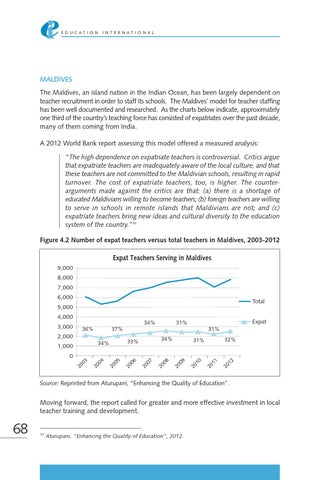
MALDIVES The Maldives, an island nation in the Indian Ocean, has been largely dependent on teacher recruitment in order to staff its schools. The Maldives’ model for teacher staffing has been well documented and researched. As the charts below indicate, approximately one third of the country’s teaching force has consisted of expatriates over the past decade, many of them coming from India. A 2012 World Bank report assessing this model offered a measured analysis: “The high dependence on expatriate teachers is controversial. Critics argue that expatriate teachers are inadequately aware of the local culture, and that these teachers are not committed to the Maldivian schools, resulting in rapid turnover. The cost of expatriate teachers, too, is higher. The counterarguments made against the critics are that: (a) there is a shortage of educated Maldivians willing to become teachers; (b) foreign teachers are willing to serve in schools in remote islands that Maldivians are not; and (c) expatriate teachers bring new ideas and cultural diversity to the education system of the country.”91 Figure 4.2 Number of expat teachers versus total teachers in Maldives, 2003-2012
Expat Teachers Serving in Maldives 9,000 8,000 7,000 6,000
—— Total
5,000 4,000 3,000
34% 36%
2,000 34%
1,000
—— s Expat
31%
37%
31% 34%
33%
32%
31%
20 12
20 11
20 10
20 09
20 08
20 07
20 06
20 05
20 04
20 03
0
Source: Reprinted from Aturupani, “Enhancing the Quality of Education”.
Moving forward, the report called for greater and more effective investment in local teacher training and development.
68
91
Aturupani, “Enhancing the Quality of Education”, 2012.