Teaching with Tech: the role of education unions in shaping the future
Digital Competencies, Training and Support (Qs 18-25) Having established that digital technologies are increasingly integrated into education activities, the survey turned to questions on the digital competencies of teachers and ESPs. This section includes 5 survey questions, Q18-22. Note that the response rate to these questions was between 75 and 93 out of the total 110 responses (i.e. between 70% and 85% of all responses).
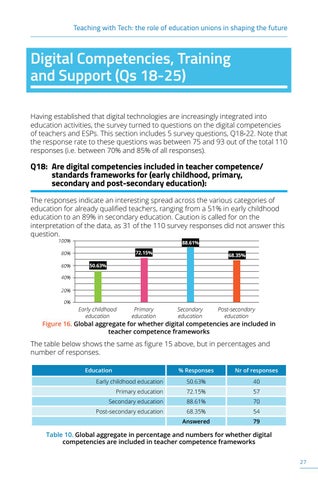
Q18: Are digital competencies included in teacher competence/ standards frameworks for (early childhood, primary, secondary and post-secondary education): The responses indicate an interesting spread across the various categories of education for already qualified teachers, ranging from a 51% in early childhood education to an 89% in secondary education. Caution is called for on the interpretation of the data, as 31 of the 110 survey responses did not answer this question. 100%
88.61% 72.15%
80% 60%
68.35%
50.63%
40% 20% 0%
Early childhood education
Primary education
Secondary education
Post-secondary education
Figure 16. Global aggregate for whether digital competencies are included in teacher competence frameworks
The table below shows the same as figure 15 above, but in percentages and number of responses. Education
% Responses
Nr of responses
Early childhood education
50.63%
40
Primary education
72.15%
57
Secondary education
88.61%
70
Post-secondary education
68.35%
54
Answered
79
Table 10. Global aggregate in percentage and numbers for whether digital competencies are included in teacher competence frameworks 27