John of Lignères: Iberian Astronomy settles in Paris
John of Lignères was a leading fgure in the astronomical milieu in Paris in the early fourteenth century and, together with other astronomers by the name of John (John Vimond, John of Murs, and John of Saxony), he recast the Castilian Alfonsine Tables compiled in Toledo under the patronage of King Alfonso of Castile and León (reigned: 1252–84) into what was to become the Parisian Alfonsine Tables.1
Regarding the biography of John of Lignères, not much can be added to the information given about ffy years ago, in 1973, by Poulle: ‘Originally from the diocese of Amiens, where any of several communes could account for his name, John of Lignères lived in Paris from about 1320 to 1335’.2
However, more can be said about his scholarly activity, since several of his astronomical and mathematical works, including two major sets of astronomical tables and various texts, have been studied in recent years. Te object of the present monograph is his frst set, the Tables of 1322, associated with two canons usually called Cuiuslibet and Priores owing to their respective opening words.3
John of Lignères was a successful and prolifc author, whose astronomical tables and texts are frequently found in miscellaneous astronomical manuscripts of the fourteenth and ffeenth centuries. His reputation quickly gained traction and as early as 1327 his name was mentioned by his disciple, John of Saxony, who wrote canons to the Parisian Alfonsine Tables beginning Tempus est mensura. Tis text and this set of tables would become the most widely difused astronomical material for more than two centuries.
Te Tables of 1322 consist of a series of tables addressing some of the most common problems faced by practitioners of astronomy in the early fourteenth century.4 As is shown below, this set by John of Lignères is heir to the Islamic astronomical tradition developed on the Iberian Peninsula and, in particular, to the Toledan Tables composed in Toledo by
1 José Chabás and Bernard R. Goldstein Bernard R., Te Alfonsine Tables of Toledo, Archimedes, New Studies in the History and Philosophy of Science and Technology, 8 (Dordrecht-Boston-London: Kluwer Academic Publishers, 2003).
2 Emmanuel Poulle, ‘John of Lignères’, in Dictionary of Scientifc Biography, ed. by Charles Gillispie, 16 vols (New York: Charles Scribner’s Sons, 1973–1980, republished 2001), 7, pp. 122–128; Marie-Madeleine Saby, ‘Les canons de Jean de Lignères sur les tables astronomiques de 1321’ (Unpublished thesis: École Nationale des Chartes, Paris, 1987). A summary appeared as ‘Les canons de Jean de Lignères sur les tables astronomiques de 1321’, École Nationale des Chartes: Positions des thèses, pp. 183–190.
3 Tese two texts were edited, but not published, by Marie-Madeleine Saby, 1987. A monograph on them is expected to appear in this book series.
4 José Chabás and Marie-Madeleine Saby, ‘Editing the Tables of 1322 by John of Lignères’, in Richard L. Kremer, Mathieu Husson, and José Chabás (eds), Alfonsine Astronomy: Te Writen Record (Turnhout: Brepols, 2022), 243–255.
a group of Muslim astronomers in the second half of the eleventh century. On the other hand, many of the tables examined here were integrated in what was later called the Parisian Alfonsine Tables. For this reason, we frst identify all tables composing this set by John of Lignères, edit them, and then write commentaries for each of them.
1. John of Lignères’ works
Canons associated with the Tables of 1322
John of Lignères composed two lengthy canons related to his astronomical tables of 1322 and dealing with most of the problems faced by astronomers at the time. Te frst features the incipit Cuiuslibet arcus propositi sinum rectum, and it is structured in forty-four chapters, with a total length of about 9,400 words. Te second, beginning Priores astrologi motus corporum celesti, is more than twice as long, for it has about 21,000 words, and it is presented in forty-six chapters. Te two canons address diferent topics, and they are ofen found separately in codices. Even when found together in the same codex, their chapters have distinctive numberings.5 Nevertheless, the two texts were considered by John of Lignères to form a unifed treatise, which is corroborated by the various cross-references appearing in them; for example, Chapter 1 of the Cuiuslibet refers to Chapter 9 of the Priores, and, vice versa, Chapter 35 of the Priores mentions Chapters 30 and 36 of the Cuiuslibet. Te canons beginning Cuiuslibet arcus propositi sinum deal primarily with the daily rotation of the celestial vault, the primun mobile, as it was usually called at the time, and addresses trigonometrical problems related to it. Te frst chapter defnes the sine of an arc and refers to a table of sines in which the argument is given at intervals of half a degree and the norm is set at 60, hence this is no doubt the table usually found heading up the Tables of 1322. Afer the frst six chapters with instructions on how to deal with what we now call trigonometric functions, Chapters 7, 8, and 9 cover astronomical instruments, such as a quadrant and a parallactical rule, following the patern established by Ptolemy in Almagest, V and in the zij of al-Batānī.6 Tese three long chapters were omited in various manuscripts. Te ensuing chapters refer to the solar declination and give the value used for the obliquity of the ecliptic (23;33,30º), the shadow cast by a gnomon of twelve units, right ascension, oblique ascension; and instructions on how to derive or use the solar altitude, geographical latitude, daily arc, length of daylight, rising times, houses, and stellar coordinates. While some of these topics are closely related to tables found in John of Lignères’ set of 1322, others are not addressed in this or any other table known to have been compiled by him.
5 In several manuscripts, only the Cuiuslibet is found, e.g. Paris, Bibliothèque nationale de France [BnF], lat. 7378A, 46r–52r (fourteenth century) and lat. 7290, 66r–75v (ffeenth century). In contrast, the Priores is found separately in Rome, Biblioteca Casanatense, 643, 105r–108v (fourteenth century), and BnF, lat. 7295A, 174r–180v (ffeenth century), among other manuscripts.
6 For Ptolemy, see Gerald J. Toomer, Ptolemy’s Almagest (New York: Springer Verlag, 1984), pp. 217–220, 244–247; for al-Batānī, see Carolo Alfonso Nallino, Al-Batānī sive Albatenii Opus Astronomicum, 3 vols (Milan: U. Hoepli, 1899–1907), pp. 138–144, Chapter LVII.
Te issues addressed in the primum mobile were revisited shortly afer by a former student of John of Lignères, John of Saxony, who in about 1335 wrote a text entitled Expositiones canonum primi mobilis per magistrum Johannem de Lineriis a magistro Johanne de Saxonia, beginning Quia plures astrologorum, providing full explanations and examples for the forty-four chapters of the Cuiuslibet. 7
Priores astrologi is the incipit of the second text, in forty-six chapters, mainly devoted to the motion of the planets and the luminaries. In some manuscripts, the numbering and the order of the chapters difer, and in others, mostly in ffeenth-century codices, some chapters have even been omited.8 Te frst chapters deal with the sexagesimal counting of the days, and references to several tables are given. Tese tables were not integrated into the Tables of 1322, but they found their way into the editio princeps of the Parisian Alfonsine Tables. Ten follow several chapters on the mean motions of the celestial bodies, and it is worth emphasizing that the tables mentioned display sub-tables for collected years, expanded years, months, and days. We are also told that the year begins in January and that signs of 30º are used. A critical piece of information stated explicitly is that the radices for the use of these tables are set for the city of Paris at noon previous to the frst day of January (Chapters 5 and 6). As was the case before, John of Lignères did not integrate the tables for mean motion mentioned here into the Tables of 1322. Rather, they appear in a later set of his, the Tabule magne (dated 1325). Chapter 10 opens with a crucial statement on Alfonsine theory of precession/trepidation: the motion of the apogees has two components, one due to the motion of access and recess, and another due to the continuous motion of the eighth sphere. Te table for the equation of the eighth sphere mentioned here was not integrated in the Tables of 1322 either. We then fnd chapters on the equations of the luminaries and the planets, direct and retrograde motions, solar declination, and lunar and planetary latitudes, requiring the use of tables usually found in previous sets of tables, such as the Toledan Tables, but not always integrated into the Tables of 1322. Chapter 24 on the latitudes of the planets is one of few to explicitly state numerical values, and the maximum values for northern and southern latitudes are given for the fve planets. However, although equal or similar in some cases, these numbers are not always in agreement with those in the corresponding table of his set, which was taken either from the Toledan Tables or from the zij of al-Batānī.
Mean and true syzygies, parallax, and eclipses are the subjects of Chapters 25–40. Te length of a mean ‘lunation’, which is the synodic month, is given in Chapter 27 as the diference between the thirty-one days in a month and 11;15,57h. Te result, 29d 12;44,3h, is indeed the Alfonsine value embedded in the tables for syzygies in the Tables of 1322 (see Table 16). It is noteworthy to fnd two worked examples to explain the computation of the solar diameter (Chapter 36) and the time of a lunar eclipse (Chapter 38) and two chapters to explain how to draw fgures for the solar and lunar eclipses, following a practice
7 For an edition of John of Saxony’s Quia plures astrologorum, see Saby 1987, based on two manuscripts: BnF, lat. 7281, 222r–232r and Erfurt, CA 2º 386, 26r–32r.
8 See, for instance, BnF, lat. 7329 and Basel, F II 7.
already established by the Toledan Tables.9 All the tables mentioned in this section are found among the Tables of 1322.
Te last chapters concern the visibility of the planets, the unequal motion of the planets, a star catalogue based on that of Ptolemy, and the revolution of the years. While the frst two subjects have their corresponding tables among the set for 1322, the other two do not.
In 1327, John of Saxony wrote new chapters on the same topics in a text beginning Tempus est mensura, which became the standard canons associated with the Parisian Alfonsine Tables.10
Two conclusions can already be drawn at this point. Te canons Cuiuslibet and Priores cover most of the problems faced by contemporary astronomers. Tese canons follow the schemes set in the zij of al-Batānī and those in the Toledan Tables, or even in the Castilian Alfonsine Tables, among others. However, in contrast to previous zijes, in the set compiled by John of Lignères not all of these problems were addressed by means of tables or have a corresponding table, and thus the correspondence between the two canons and the tables associated with them is not close.
John of Lignères was not prone to mentioning his ‘auctoritates’ or his sources. One fnds that in the canons Cuiuslibet and Priores, Ptolemy is not mentioned at all. Tis is a surprising feature because almost all medieval astronomical texts mention his name, and more so those embracing such a wide range of topics, as is the case here. Moreover, Alfonso is only mentioned once, in passing, when referring to a catalogue of stars that the astronomers in the service of King Alfonso adapted from Ptolemy’s catalogue. One would expect an early Alfonsine astronomer such as John of Lignères to refer repeatedly to Alfonso, as John of Murs did, for example. Tere are only three authorities mentioned. All the references appear in the Priores (none in the Cuiuslibet), and they are concentrated in two chapters: Azarquiel is mentioned once in Chapter 35, an otherwise unknown Abraham Benbthegar or Benbihegen is given two references in the same chapter,11 and al-Batānī is mentioned six times (once in Chapter 34 and fve times in Chapter 35).
9 For the Toledan Tables, see Fritz S. Pedersen, Te Toledan tables: a review of the manuscripts and the textual versions with an edition (Copenhagen: C.A. Reitzel, 2002), pp. 379, 464–467, 470–472.
10 For an edition of this text with a commentary and translation into French, see Emmanuel Poulle, Les tables alphonsines avec les canons de Jean de Saxe (Paris: Ed. du C.N.R.S.,1984). It is worth noting that the Tempus est mensura by John of Saxony integrates much previous textual material mostly taken from John of Lignères’ Priores, sometimes verbatim or very close to it. Tis is especially so in the chapters ofen found afer the Tempus est mensura, which have been called the membra adiuncta
11 Te name Abraham Benbthegar seemed to be totally unknown to the copyists of most of the manuscripts, who all spelt the name very diferently: Habraham Benbthegar (Erfurt, CA 2° 377), Abraham Benthegor alias Benhigen (Cracow, BJ 551), Abraham Benthegar (Catania, 85), Abraham Benhihegen (Erfurt, CA 4° 366), Abraham ben Bahegen (Paris, BnF lat.7281). No one with this name, or anything similar, has been identifed, but the name of Abraham ben Waqār, a translator at the service of King Alfonso, has been evoked (José Chabás and Bernard R. Goldstein 2003, p. 282). According to John of Lignères, this astronomer composed canons ‘that have not yet been translated from Hebrew, although it seems to me from what I have heard that they are the best of all, with the exception of those of al-Batānī’: Concordat similiter in isto secundo Habraham Benbthegar in canonibus suis qui de hebreo nondum sunt translati, licet ut michi videtur, per ea que audivi sint meliores omnibus aliis excepto Albategni (Marie-Madeleine Saby 1987, p. 237).
The Tabule magne and their canons
Tis second set was compiled shortly afer the Tables of 1322 and was dedicated to Robert the Lombard in 1325,12 together with two treatises on astronomical instruments, the saphea and the equatorium. Te canons associated with the Tabule magne begin Multiplicis philosophie variis radiis. Te text, not hitherto edited, mentions some outstanding astronomers, none of whom were contemporaries, or even Alfonso himself.13 As was the case in his Tables of 1322, John of Lignères uses signs of 30º and computes his geographically dependent tables for the meridian of Paris.
Te tables in this set can be grouped into six categories.14 (1) Te table for the positions of the apogees of the Sun and the planets displays entries from 1320 to 1520 at twenty-year intervals, as well as their motions per year. Tis table is frequently found in manuscripts separately from the rest of tables in this set. (2) Te tables for mean syzygies give entries for the frst syzygy of years from 1321 to 1609 at intervals of twenty-four years. Tey are computed for the meridian of Paris with the years beginning in January; this was a systematic practice followed by John of Lignères in his Tables of 1322 on which he depended for his new tables. (3) Te mean motions of the Sun, the Moon, and the planets are presented in separate tables, in collected and expanded years, and at twenty-year intervals, up to 2,000 years. (4) Te table for the solar equation, with a maximum value of 2;10º at arguments 92º–94º is the same as that used by John of Lignères in his previous set for 1322. (5) Te true longitude of the Moon is presented in a double argument table of 1800 entries. Te entries represent the increment in longitude of the Moon to be added to its mean longitude at the preceding mean conjunction. Similar tables for the same purpose had previously been compiled by John Vimond and John of Murs. (6) Te planetary equations are also displayed as double argument tables, where the arguments are the mean centre and mean anomaly, both at intervals of 6º. Tese compact double argument tables are probably the most outstanding feature of the Tabule magne, and of John of Lignères’ production as a table-maker. Tis format, however, was not new in Latin astronomy, but John of Lignères was the frst to use it systematically for the equations of the planets.
Te canons also explain the use of a division table for fnding the time from mean to true syzygy for each integer of the hourly velocity in elongation from 27 to 33 minutes per hour. For a list of twenty manuscripts containing the tables (whether totally or partially) and/or the canons, we invite the reader to consult J. Chabás, Computational Astronomy, pp. 205–206.
12 Roberto (di) Bardi (1290–1349), a member of a wealthy family in Florence, Tuscany, studied theology at the University of Paris. Although he is almost exclusively referred to as Dean of Glasgow (1318), according to the Dizionario Biografco degli Italiani (online) he was later Dean of Verdun (1323), Dean of Notre Dame de Paris (1335), and Chancellor at the University of Paris. In astrology, he is known as the author of a treatise in defence of astrological interrogations beginning Quesitum fuit utrum per interrogationes astronomicas, extant in two manuscripts: one in Brussels (Bibliothèque Royale, 926–40, 215r–221v) and the other in the Vatican (Vat. lat. 4275, 29r–34v).
13 Mathieu Husson, ‘Les domaines d’application des mathématiques dans la première moitié du quatorzième siècle’ (Unpublished doctoral thesis, Ecole Pratique des Hautes Etudes, 2007).
14 For a detailed description of the Tabule magne, see José Chabás, Computational Astronomy in the Middle Ages (Madrid: Consejo Superior de Investigaciones Científcas, 2019), pp. 199–206.
Although no edition of the Tabule magne exists for the moment, this overview allows us to have a clear idea of its contents. It focuses on two topics: the computation of planetary positions by means of tables for the apogees, mean motions, and equations, and the prediction of the time of eclipses using the tables for syzygies. Te tables associated with the frst topic nicely complement those of the Tables of 1322, where this subject is not addressed. As for syzygies and the computation of eclipses, the three tables for mean syzygies of the Tables of 1322 were reused in the Tabule magne.
Canons to the Tables of Alfonso
John of Lignères also wrote a text in sixteen chapters to accompany the Tables of Alfonso, as they are called in some manuscripts in which this text is found: Canones Tabularum Alfoncii, ordinati per magistrum Ioannem de Lineriis. Te text begins Quia ad inveniendum loca planetarum and it contains about 4,600 words.15 According to Poulle, these canons by John of Lignères were writen between 1322, the date he composed his set of tables under examination here, and 1327, when John of Saxony wrote his own canons to the Alfonsine Tables beginning Tempus est mensura. 16 We note that John of Saxony, a disciple of John of Lignères, wrote longer and more complete canons shortly afer his master.
Te Quia ad inveniendum was thus the frst text compiled in Paris to explain the use of the set associated with King Alfonso. Te frst three chapters are devoted to the conversion of dates in diferent calendars. In particular, there is an explicit reference to some ‘Tables of the Arabs’ and the beginning of their era. Various tables are mentioned providing the number of days in collected and expanded years and months (whether in a leap year or not), as well as a table for the diference in the number of days between diferent eras to convert a date from one to another. Already in the introduction preceding the three chapters on the conversion of dates it is made clear that the entries in the tables are given in sexagesimal notation. Tese two elements, the sexagesimal counting of days and the variety of tables for diferent eras, are indeed found in the Castilian Alfonsine Tables, as explained in detail in the frst chapters of these canons.17
Chapter 4 of the canons by John of Lignères is devoted to the determination of the day of the week in diferent calendars, and a table for the day of the week at the beginning of the diferent eras is explicitly mentioned (Tabula radicum notarum anni). A table with the same title is found in the editio princeps of the Parisian Alfonsine Tables (Ratdolt 1483, c7r). It displays entries for ten eras, from the Flood to the era of Alfonso, also including the eras of Nabonassar, Philippus, Alexander, the Incarnation, and the Hijra. Tis is a table that would seem to have been of litle use in Paris at the beginning of the fourteenth century. It no doubt originated in a much more multicultural environment, and indeed
15 See Alena Hadravová and Petr Hadrava, ‘John of Lignères, Quia ad inveniendum loca planetarum: edition and translation’, in Richard L. Kremer, Mathieu Husson, and José Chabás (eds), Alfonsine Astronomy: Te Writen Record (Turnhout: Brepols, 2022), 257–302.
16 Emmanuel Poulle, Dictionary of Scientifc Biography, p. 124.
17 For the edition of the Castilian Alfonsine Tables, see José Chabás and Bernard R. Goldstein, Te Alfonsine Tables of Toledo, pp. 20–35, 143–151.
the canons to the Castilian Alfonsine Tables have two chapters on the day of the week associated with all these calendars.18
Te following three chapters deal with the conversion of hours and minutes into fractions of a day and vice versa, clearly indicating the determination to extend the use of base 60 for counting days to submultiples of a day.
Chapter 8 is concerned with the mean motion of the planets. Tis long chapter ofers a description of a table for mean motion, with one column for the argument, from one to sixty, and ‘at least eight other columns’, together with a lengthy explanation on how to enter the table for each of the components of a time given in sexagesimal form. We are also told that the resulting signs ‘have the value of two [zodiacal] signs’, that is, 60º. Tis description corresponds to a compact and single table for each object, consisting of sixty successive multiples of a basic parameter for each case. It difers from the description given in the canons to the Castilian Alfonsine Tables, based on the use of sub-tables for collected and expanded years, months, days, and fractions of a day.19 Te text mentions tables for the mean motions of the Sun, the planets, the lunar node, the anomalies of the Moon, Venus, and Mercury, the argument of lunar latitude, the eighth sphere, the apogees, and the elongation, in that order. Te canons to the Castilian Alfonsine Tables do not specify the quantities appearing in the mean motion tables.20
Signifcantly, the tables for the radices of all these quantities are valid for the meridian of Toledo.
Mean syzygies are the subject of Chapter 9. Te tables for conjunctions and oppositions described have entries for four elements: the time of the event, the mean motion of the Sun and the Moon, the mean lunar anomaly, and the mean argument of lunar latitude. Te same four quantities are used in the corresponding table described in the canons to the Castilian Alfonsine Tables.21 Another critical piece of information is given here: the year begins in January.
Chapter 10 explains how to fnd the longitude of the planetary apogees, and it refers specifcally to two tables for the mean motion and equation of the eighth sphere. No sign of this model with two components for trepidation is found in the extant canons to the Castilian Alfonsine Tables, although in his Expositio (1321) John of Murs ascribed it to the Tables of Alfonso. Apparently, the source of this claim made by John of Murs, and here echoed by John of Lignères, difered in some respects from the Castilian canons.22
Te determination of the true positions of the two luminaries, the lunar node, and the fve planets is presented in Chapters 12–15. Tables for the equation of the Sun, the Moon, and the fve planets are invoked, and rules for their use are given. Te procedures for determining the true positions agree with those explained in the canons to the Alfonsine Tables except for the true position of the Moon. It is worth noting that in Chapter 15, afer explaining how to determine the true positions of Venus and Mercury, John of Lignères indicates that ‘in this way, anyone can compile an almanac’, with the following frequencies
18 See José Chabás and Bernard R. Goldstein, Te Alfonsine Tables of Toledo, Chapters 6 and 7, pp. 25–28, 146–147.
19 See José Chabás and Bernard R. Goldstein, Te Alfonsine Tables of Toledo, Chapter 15, pp. 36–37, 151–152.
20 See José Chabás and Bernard R. Goldstein, Te Alfonsine Tables of Toledo, Chapter 13, pp. 35–36.
21 See José Chabás and Bernard R. Goldstein, Te Alfonsine Tables of Toledo, Chapter 30, pp. 56–58, 188–189.
22 For a detailed explanation, see José Chabás and Bernard R. Goldstein, Te Alfonsine Tables of Toledo, pp. 256–266.
for the entries: daily for the Sun and the Moon, every fve days for the inferior planets, and every ten days for the superior planets. And indeed, these are the frequencies he used in his own almanac for the planets (see below).
Finally, Chapter 16 concerns the possibility of an eclipse. For both kinds of eclipses, the range is between –12º and +12º of the argument of lunar latitude. Tis very crude estimate for the limits of an eclipse is the only specifc numerical data given in the text. We note that there is no mention of any table for computing eclipses or determining their circumstances. Tese are not the only tables that are missing. Te text Quia ad inveniendum focuses on general topics regarding Alfonsine astronomy but does not deal with such topics as solar declination, the lunar and planetary latitudes, equation of time, retrogradation and stations of the planets, parallax, and velocities of the luminaries and the planets. In contrast, these topics are found in major sets such as the Toledan Tables or those mentioned in the Castilian Alfonsine Tables, as well in the set of Tables of 1322 by John of Lignères. It is thus at the very least odd that in his text on the Tables of Alfonso he did not even mention any of these other tables. We are led to believe that perhaps this text is an unfnished work or, if we also take into account the simplicity of the explanations and the overall absence of numerical data, maybe it was intended as an introductory course on astronomy, to teach students the basic rules for using astronomical tables.
Theory of the planets
Te Teorica planetarum by John of Lignères, dated 1335 in Paris, BnF, lat. 7281, begins Spera concentrica vel circulus dicitur. Tis treatise is found on f. 165r–172r in this splendid anthology of texts writen by early Alfonsine astronomers in Paris: John of Murs, John of Lignères, John of Saxony, and John of Genoa, among others. We note, however, that afer f. 165, numbering restarts at 164. In this case, the incipit is Prima pars continet descriptionem et numerum. Tis interesting treatise has not yet been the subject of an edition or a scholarly study.
Kalendarium
Madrid, Biblioteca Nacional, 9288, 10v–14v, contains the unique copy of a hitherto unknown work by John of Lignères. It consists of a short text headed Canon supra kalendarium magistri Johannes de Lineriis (10v) and a table (11r–14v) for all mean conjunctions in the period from 1321 to 1396. Te time of the conjunctions is given in months, days, hours, and minutes, beginning in January 1321, and the days begin at noon. All entries were computed for Paris. Te characteristics and the dates of this 76-year period point to the conclusion that the table was indeed computed by John of Lignères or derived from tables compiled by him, building on those by John of Murs by applying a correction of 0;48h to account for the time diference between Toledo and Paris.23
23 José Chabás, ‘New texts and tables atributed to John of Lignères: context and analysis’ in Richard L. Kremer, Mathieu Husson, and José Chabás (eds), Alfonsine Astronomy: Te Writen Record (Turnhout: Brepols, 2022), 303–316.
Almanac for the planets
As anticipated in Chapter 15 of his Quia ad inveniendum, John of Lignères compiled an almanac, that is, a collection of tables giving the true positions of the fve planets at intervals of a few days (ten for Saturn, Jupiter, and Mars, and fve for Venus and Mercury) for periods of return to their initial position (59y for Saturn, 83y for Jupiter, 79y for Mars, 8y for Venus, and 46y for Mercury).24 Te entries, rounded to the nearest degree, were computed for the meridian of Paris using Alfonsine parameters. Te patern in the almanac closely follows that in the Almanac of Azarquiel and the Almanac of Jacob ben Makhir, compiled around 1300 and based on the Toledan Tables.25 We have located John’s almanac in fve manuscripts:
Munich, Universitätsbibliothek, F 593, 12r–21r; Paris, Bibliothèque nationale de France, Mélanges Colbert 60, 26r–32r (tables); Philadelphia, Free Library, Lewis E.3, 3r–10r (tables, incomplete), 10r (canons), late fourteenth century;
Vatican, Biblioteca Apostolica Vaticana, Pal. lat. 446, 219v (canons), 220r–227v (tables), early ffeenth century;
Vatican, Biblioteca Apostolica Vaticana, Pal. lat. 1446, 36r–47v (tables), late fourteenth / ffeenth century.
Te tables go along with a short text that difers slightly in the manuscripts examined. However, they provide the same basic information: the epoch year is 1341, starting in January, and the entries are displayed in zodiacal signs of 30º. As far as we can determine, this was the frst time Alfonsine parameters were used to compile an almanac. Tis was innovative, but in terms of precision it was a regression with respect to previous almanacs. As was the case for the canons to the Tables of Alfonso, John of Lignères’ disciple, John of Saxony, went further and computed a larger and more precise version. Following his master, John of Saxony computed for Paris and used signs of 30º. In contrast, he substantially modifed the patern and also included true positions of the Sun and the Moon, paving the way to the compilation of ephemerides.
Astronomical instruments
John of Lignères wrote treatises on two instruments, the saphea and the equatorium, which he dedicated to Robert, Dean of Glasgow in 1325, together with the Tabule magne. 26
24 See José Chabás and Bernard R. Goldstein, ‘Te Master and the Disciple: Te Almanac of John of Lignères and the Ephemerides of John of Saxony’, Journal for the History of Astronomy, 50 (Cambridge: Science history pub., 2019a), pp. 82–96.
25 For the Almanac of Azarquiel, see José M. Millás, Estudios sobre Azarquiel (Madrid–Granada: Editorial Maestre, 1943–1950); for the Almanac of Jacob ben Makhir, see Chabás and Goldstein, ‘Te Almanac of Jacob ben Makhir’ in Mathieu Husson, Clemency Montelle and Benno van Dalen (eds), Editing and Analysing Numerical Tables: Towards a Digital Information System for the History of Astral Sciences (Turnhout: Brepols), pp. 53–68.
26 Emmanuel Poulle, Équatoires et horlogerie planétaire du XIIe au XVIe siècle (Geneva: Droz. Paris: H. Champion, 1980); see esp. p. 213.
Te saphea is an astronomical instrument based on an analogous universal instrument, al-ṣafīḥa, developed by Azarquiel.27 Te text of this late-eleventh-century Andalusian astronomer was translated from Arabic into Castilian and Latin by the astronomers at the court of King Alfonso in Toledo in the second half of the thirteenth century and into Hebrew by Jacob ben Makhir. Te text by John of Lignères’ saphea is preserved in four manuscripts:
Erfurt, Universitätsbibliothek, CA 4º 355, 73r–81v; Erfurt, Universitätsbibliothek, CA 4º 366, 40r–49r; Madrid, Biblioteca Nacional, 9288, 100r–105v; Paris, Bibliothèque nationale de France, lat. 7295, 2r–14r.
In the Madrid manuscript, John of Lignères’ text, spanning thirty-four chapters, begins Descriptiones que sunt in facie instrumenti notifcate. Limbus seu circulus exterior and ends Expliciunt canons magistri Iohannis de Lineriis supra quoddam instrumentum mirabile, cuius anima cum Christo in eternum possideat sempiterna. Amen.
John of Lignères authored two treatises on the equatorium. One is an adaptation of an instrument by Campanus de Novara for computing the positions of the planets. It is associated with a text sometimes bearing the title Abbreviatio Campani de Novaria equatorii, and it begins Quia nobilissima scientia astronomie and ends ad cetera sunt tabule. 28 It should be noted that the same incipit appears in a diferent treatise, which is associated with the instrument called the Oxford equatorium, ending cum instrumentis prius dictis. John of Lignères’ text is extant in at least the following manuscripts:
Brussels, Bibliothèque Royale, 10117–26, 142v–146v; Cracow, Biblioteka Jagiellońska, 555, 21r–24r; Cracow, Biblioteka Jagiellońska, 557, 11v–120v; Oxford, Bodleian Library, Digby 168, 65v–66r; Vatican, Biblioteca Apostolica Vaticana, Pal. lat. 1375 8v–10v.
In his second treatise, the main goal is to determine the planetary equations.29 It consists of two parts: one for the construction of the instrument and another for its usage. Te frst part begins Fiat primo regula and the second Primo linea recta. Te treatise is found in the following manuscripts:
Oxford, Bodleian Library, Digby 228, 53v–54v; Vatican, Biblioteca Apostolica Vaticana, Urb. lat. 1399, 16r–21r.
27 Roser Puig, Los tratados de uso y construcción de la azafea de Azarquiel (Madrid: Instituto Hispano-Árabe de Cultura, 1987).
28 For an edition, see Derek. J. Price, Te Equatorie of the Planetis (Cambridge: Te University Press, 1955), pp. 188–196.
29 Mathieu Husson, ‘Compositio equatorium planetarum: construire un instrument de calcul astronomique au 14e siècle, le second équatoire de Jean de Lignières’, in Danièle Jacquart, Catherine Verna, Joël Chandelier, and Nicolas Weill-Parot (eds), Téorie et pratique: une intersection pertinente, hommage à Guy Beaujouan (Presses Universitaires de Vincennes, 2014).
Arithmetic
Although not specifcally addressing astronomical issues, the text by John of Lignères called Algorismus de minutiis or Algorismus minutiarum deals with sexagesimal fractions, which are frequently used in astronomy. Tis work saw great success, and it is extant in at least 30 manuscripts. Te usual incipit is Modum representationis minutiarum vulgarium et phisicarum, but it varies slightly from one manuscript to another.30 Tis work went into print in Padua in 1483 by Mathaeus Cerdonis, where it was bound together with a text, also on arithmetic, by the Paduan astronomer Prosdocimo de’ Beldomandi, Algorithmus (1r–18v). Prosdocimo’s text precedes John of Lignères’ (19r–27v), beginning Representationis minutiarum vulgarium et phisicarum. 31
2. Works attributed to John of Lignères
As can be seen from the list of his works, John of Lignères was a prolifc author addressing a great variety of topics on mathematical astronomy, ranging from the compilation of tables to the composition of texts regarding theory and instruments, as well as canons to tables. We also note that his work is not concerned with astrological maters. If we are to judge from the number of copies of his Tables for 1322 and the Tabule magne preserved in manuscripts, he was an authoritative and prestigious voice in the feld of astronomy. Clearly, his sets of tables were especially appreciated. Terefore, it comes as no surprise that his name was used as auctoritas in order to prove the reliability and authority of a text or a table to add value to it.32 It is thus not uncommon to fnd texts in miscellaneous manuscripts, or in manuscript catalogues, that are atributed to him either by a copyist, a manuscript owner, or even a modern cataloguer. We have found several examples, which are described below, and we are convinced that more remain to be uncovered.
1. De significationibus planetarum in singulis domibus
Basel, Universitätsbibliothek, F II 10, is a thick ffeenth-century composite manuscript mostly devoted to astrology and medicine. In particular, it contains a short text atributed to John of Lignères on 163rb–164vb, with the title, Canon magistri Johannis de Lineriis de signifcationibus planetarum in singulis domibus. Te incipit reads Saturnus cum fuerit in ascendente signifcat mortem, and the explicit is Haec sunt signifcationes capitis et caude draconis in 12 domibus planetarum si fuerit in bono signifcat bonum. Si in malo malum etc. Tis short text deals with the atributes of the planets, and no reference to tables for the celestial houses or computation of the cusps is found.33 Apparently, it is a version of Chapter 5 of De signifcationibus septem planetarum,
30 See Lynn Torndike and Pearl Kibre, A Catalogue of Incipits of Mediaeval Scientifc Writings in Latin (London: Mediaeval Academy of America, 1963), 878. For a critical edition, see Hubertus L. L. Busard, Het rekenen met breuken in de middleleeuwen, in het bijzonder bii Johannes de Lineriis (Brussels: Vlaamse Academie, 1968).
31 ISTC ib00299000: for a digital copy, see htps://archive.org/details/3999345/page/n. 39/mode/2up.
32 José Chabás, ‘New texts and tables atributed to John of Lignères’.
33 A similar work beginning De signifcationibus planetarum, also atributed to John of Lignères, is preserved in Vatican, Biblioteca Apostolica Vaticana, Pal. lat. 1188.
an astrological work atributed to Messahala, and sometimes to Jirjis or Gergis and even to Alcabitius.34 In any case, this text does not seem to have been composed by John of Lignères.
2. Short canons and tables for syzygies
Vatican, Biblioteca Apostolica Vaticana, Pal. lat. 1390, 86r–92r and Pal. lat. 1445, 219r–221v contain two copies of the same canons and tables.35 In both cases the incipit is Volens invenire medios motus planetarum, and the explicits refer to John of Lignères: Explicit canon Iohannis de Lineriis in tabulas sequentes (Pal. lat. 1390) and Explicit canon Iohannis de Lineriis in tabulis precedentibus brevis et utile valde (Pal. lat. 1445). Te canons deal with mean motions, mean conjunctions, and apogees of the planets. Te entries in the corresponding tables are computed for Toledo, not Paris, and the years begin in March, not January. Tese two features are not characteristic of John of Lignères’ other works. If we add that the interval of twenty-eight years in the list of conjunctions difers from the one commonly used by John of Lignères and the span of the list (1385–1556), we are led to the conclusion that he had nothing to do with the composition of this particular work, despite the mention of his name in the explicit.
3. Tables for the motions of all planets
Erfurt, Universitätsbibliothek, CA 2º 388, 1r–35r is a ffeenth-century manuscript containing a set of tables with the general heading Incipiunt tabule Iohannis de Lineriis de loci motuum omnium planetarum 36 One would expect to fnd the Tables of 1322, but this is not the case. Alternatively, we fnd tables for the mean motions of the planets and the two luminaries as well as tables for their equations. For each celestial body, the table for the equations follows those for the mean motions. Te tables for the equations are indeed those in John of Lignères’ Tabulae magne, and the tables for the mean motions are presented as twelve tables; one for each month of the year, where the entries are the accumulated daily mean motions and mean anomalies. Te entries are easily obtained by successive additions of the corresponding parameter for one day. A list of radices is also supplied. As far as we know, there are no grounds to conclude that these tables of accumulated mean motions were compiled by John of Lignères: they could have been compiled by almost anyone. In any case, the mean motions tables compiled by John of Lignères in his other works display a very diferent patern.
4. De aspectibus
In his descriptive catalogue of the manuscripts preserved at the Amplonian Library at Erfurt, Schum atributed a treatise on the aspects extant in Universitätsbibliothek, CA 2º
34 Francis J. Carmody, Arabic Astronomical and Astrological Sciences in Latin Translation, a Critical Bibliography (Berkeley: University of California Press, 1956), pp. 29–30.
35 José Chabás, ‘New texts and tables atributed to John of Lignères’. We have also found a copy of this text in Frankfurt, Stadt- und Universitätsbibliothek, Barth. 134, 158v–162v.
36 Te general heading was writen by the Flemish scholar John of Wasia (d. 1395). For a description of the manuscript, see Wilhelm Schum, Beschreibendes Verzechnis der Amplonianischen Handschrifen-Sammlung zu Erfurt (Berlin: Weidman, 1887), p. 273.
395, 40r–43v, beginning Tempus quarti aspectus solis et lune invenire, to John of Lignères. We are also told that the end of it reads facies secundum doctrinam magistri Iohannis de Lineriis, a quo scienciam mean habeo. 37 Contrary to Schum’s suggestion, this corresponds to a work by John of Saxony. Te above incipit is the beginning of Chapter 24 of John of Saxony’s canons, Tempus est mensura (Ratdolt 1483, b2r; Poulle 1984, p. 90), and the ending reproduces the last words of the chapter on lunar eclipses in the so-called membra adiuncta (Ratdolt 1483, b7v). It is worth noting that these additional chapters on eclipses, ofen found just afer the 27 chapters traditionally included in the Tempus est mensura, are assigned to John of Saxony in Brussels, Bibliothèque Royale, 1022–47, 39v, and they were ordinati parisius per magistrum Iohannes de Saxonia anno domini 1330. Tis suggests that the membra adiuncta on eclipses were writen by John of Saxony shortly afer the date appearing in his Tempus est mensura (July 1327). To sum up, the text extant in Erfurt, Universitätsbibliothek, CA 2º 395, 40r–43v was not authored by John of Lignères.
5. Star list
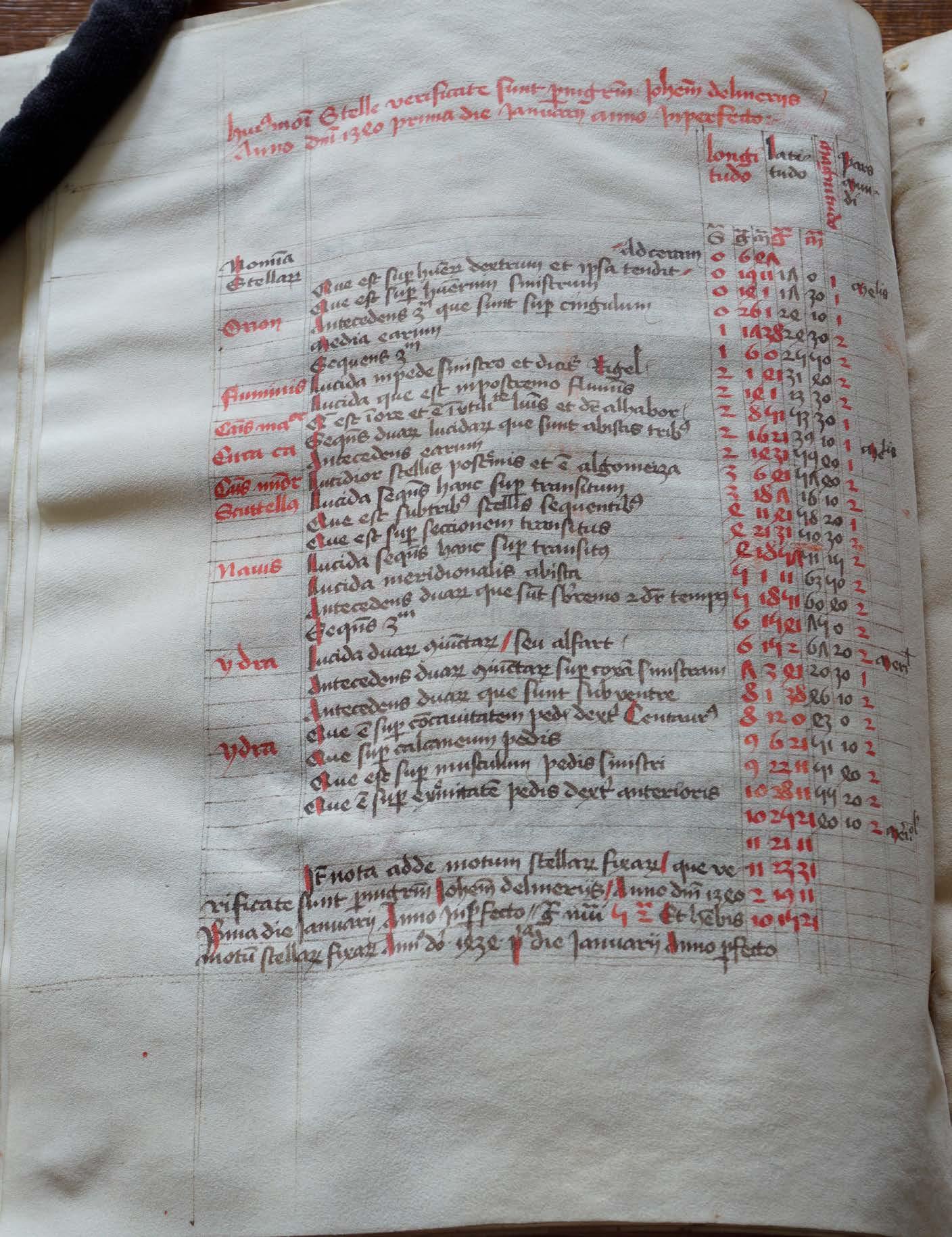
Bernkastel-Kues, Cusanusstifsbibliothek, 211, 22r–v, displays a list of sixty stars under the title Huiusmodi stelle verifcate sunt per magistrum Johannem de Lineriis anno domino 1240 (sic) prima die januarii anno imperfecto (see Figure 1). Te explicit repeats this information, but it refers (correctly) to 1340. For each star we are given its name, longitude, latitude, magnitude, and an indication of the hemisphere in which it is located. Te list only contains stars of frst and second magnitudes.
Te frst star listed belongs to the Ursa Minor constellation: Meridiana duarum que sunt in latere sequenti and the associated entries are 4s 6;11º (longitude), 72;50º (northern latitude), and 2 (magnitude). In Ptolemy’s catalogue, the longitude of this star is given as Cnc 17;10º. Terefore, the increase in longitude since Ptolemy’s catalogue is 19;1º. Te same value is obtained for the rest of the stars in this list. Now, such an increase due to precession does not correspond to the year 1340, but to the year 1434, and this is indeed a date mentioned at the end of the list. Terefore, the entries in this list do not correspond to John of Lignères’ time. Moreover, the same stars, in the same order, are found in a list where their longitudes are increased by 18;0º compared to Ptolemy’s, a value of precession corresponding to 1340, and the longitude of the star Meridiana duarum is 4s 5;10º. Te author of this star list is Swabian astronomer Heinrich Selder (f. 1370’s), and it is extant in a few manuscripts.38
We conclude that someone in the frst half of the ffeenth century adapted a star list for 1340 (that of Selder) to his own time by adding 1;1º to the longitudes of the stars, and, ignorant of the author’s name, added that of the well-known astronomer John of Lignères, to whom he atributed authorship. Tis is a new example of the widespread fame of the Parisian astronomer.
37 Tis text is also extant in Cracow, BJ 715, 67v–68r, and Rostock, UB, math.-phys. 1, 76r.
38 On Selder, see C. Philipp E. Nothaf, ‘Vanitas vanitatum et super omnia vanitas: Te Astronomer Heinrich Selder and A Newly Discovered Fourteenth-Century Critique of Astrology’, Erudition and the Republic of Leters, 1 (Leiden-Boston: Brill, 2016), pp. 261–304.
Figure 1. Star list in Bernkastel-Kues, 211, 22v.
6. Instruments
At least two instruments are atributed to John of Lignères. In his Recueil des plus celebres astrologues, Simon de Phares assigns an instrument called ‘directoire’ to John of Lignères, which is explained in a text beginning Accipe tabulam planam rotundam, and he added that this occurred ‘l’an mil IIIcXX’.39
Te second is an armillary instrument described in a text beginning Trianguli equilateri ex tribus quartis preserved in Vatican, Biblioteca Apostolica, Urb. lat. 1399, 2r–15r. On f. 1v, the frst item in the index of the codex reads, In hoc codice continentur instrumentum armillare Iohannis de Lineriis.
7. Canon primi mobilis
Vatican, Biblioteca Apostolica Vaticana, Pal. lat. 1412, 30r–35r, contains a text beginning Nunc autem de celestium diversitate. According to the catalogue of Palatine manuscripts at the Vatican Library (Schuba, p. 191), it is identifed as a ‘Canon primi mobilis super tabulas’ and atributed to John of Lignères. Furthermore, the explicit of the text, on f. 35r, reads as follows: Explicit canon primi mobilis super tabulas Parisius 17ª die julii (…) anno domini 1454, ordinati per magistrum Johannem de Lineriis. Te atribution of this text to John of Lignères is plausible, for it is followed by two other canons by him, the Cuiuslibet (35v–46v) and the Priores (f. 46v–71v), and it is preceded by the canons to the Parisian Alfonsine Tables by John of Saxony (f. 10r–24v) and canons on eclipses (f. 25r–29v), which are usually considered as additions to the Alfonsine set (see Ratdolt 1483, b4r–b7v), here explicitly ascribed to John of Saxony. Moreover, Torndike and Kibre (col. 961) list the text under the given incipit as a work by John of Lignères.
Te words Nunc autem de celestium diversitate actually correspond to the beginning of a sentence in the most popular version (Cb) of the Canons to the Toledan Tables. A comparison of the two texts reveals that the work atributed to John of Lignères in this manuscript corresponds to canons 51b–126 of the Toledan Tables (see Pedersen 2002, pp. 402–430). It is worth noting that these canons, mainly on trigonometry, had their own independent life, for they are preserved as such in at least one other manuscript: Zürich, Zentralbibliothek, II.88, 275r–298v.
Te difculty in identifying the text atributed to John of Lignères derives from the fact that the frst sentence, Nunc autem de celestium diversitate, is not the beginning of any paragraph or chapter, and that the text to which it belongs and that precedes it is not extant in the manuscript. In any case, the text here called ‘canon primi mobilis’ was not writen by John of Lignères, contrary to what was claimed by the ffeenth-century scribe and by modern scholars.
39 Jean-Patrice Boudet, Le recueil des plus célèbres astrologues de Simon de Phares (Paris: Editions pour la société de l’histoire de France, 1997), pp. 469–470.
3. The set of tables
A set of astronomical tables is ofen preserved in miscellaneous manuscripts under the general title Incipiunt tabule magistri Iohannis de Lineriis. Tis set, which we have called the Tables of 1322 by John of Lignères, is preserved in many manuscripts frequently following copies of the Parisian Alfonsine Tables, and it is restricted to tables for chronology, radices, mean motions, and equations of the Sun, the Moon, and the planets. We fnd this set, whether complete or not, in 46 manuscripts -listed below- and we are convinced that this list will continue to grow as more codices are examined.
*Basel, Universitätsbibliothek, F II 7, 62r–77v (ffeenth century);
Bernkastel-Kues, Cusanusstifsbibliothek, 210, 117v–123v; *Bernkastel-Kues, Cusanusstifsbibliothek, 212, 74r–93r (ffeenth century);
Bernkastel-Kues, Cusanusstifsbibliothek, 213, 45r–60v; Bonn, Universitäts- und Landesbibliothek, S 498, 40v–60v;
*Cologne, Historisches Archiv der Stadt, W* 178, 1r–18r (ffeenth century);
Cracow, Biblioteka Jagiellońska, 459, 29r–37r;
Cracow, Biblioteka Jagiellońska, 546, 23r–29v;
Cracow, Biblioteka Jagiellońska, 547, 48v–55r;
Cracow, Biblioteka Jagiellońska, 549, 23r–29v;
Cracow, Biblioteka Jagiellońska, 550, 24v–52r;
*Cracow, Biblioteka Jagiellońska, 551, 74v–90r, 94v–95r (fourteenth century);
Cracow, Biblioteka Jagiellońska, 553, 147r–165v;
Cracow, Biblioteka Jagiellońska, 602, 60r–75v;
Cracow, Biblioteka Jagiellońska, 610, 317r–338r;
Cracow, Biblioteka Jagiellońska, 613, 15r–22r, 59r–62v, 118r–137r;
Cracow, Biblioteka Jagiellońska, 618, 18v, 23v–24r, 47r–64r;
*Erfurt, Universitätsbibliothek, CA 2º 377, 41v–46v (fourteenth century);
Erfurt, Universitätsbibliothek, CA 2º 384, 26r–45v;
*Florence, Biblioteca Medicea Laurenziana, San Marco 185, 102r–117v (fourteenth century);
Leipzig, Universitätsbibliothek, 1484, 43r–58v;
*London, British Library, Egerton 889, 31r–52v (ffeenth century);
Lüneburg, Ratsbücherei, Miscell. D 2°11, 26r–45r; Lüneburg, Ratsbücherei, Miscell. D 2°13, 36r–57v;
*Madrid, Biblioteca Nacional, 10002, 23r–47r (ffeenth century); Moscow, Russian State Library, F 68 N 450, 36r–57r; Munich, Bayerische Staatsbibliothek, Clm 5640, 117r–132v;
*Oxford, Bodleian Library, Can. Misc. 27, 78v–104r (ffeenth century); Oxford, Bodleian Library, Can. Misc. 499, 124r–144r;
*Paris, Bibliothèque nationale de France, lat. 7282, 113r–128v (ffeenth century);
Paris, Bibliothèque nationale de France, lat. 7285, 62r–v, 76r–83v, 115v–116r;
*Paris, Bibliothèque nationale de France, lat. 7286C, 24v–28v, 48r–52r, 53v–55r, 56r (fourteenth century);
*Paris, Bibliothèque nationale de France, lat. 7295A, 155r–171r (ffeenth century);
Philadelphia, University of Pennsylvania, LJS 174, 27r–38r, 40v–42r; Prague, National Library, X A 23, 22v–40v;
Rome, Biblioteca Casanatense, MS 653, 34v–37r, 40r–64r; Rome, Osservatorio astronomico, III C 14, 15or–159v; Rostock, Universitätsbibliothek, math.-phys.1, 135r–144v; Vatican, Biblioteca Apostolica Vaticana, Otob. 1826, 130r–140r; Vatican, Biblioteca Apostolica Vaticana, Pal. lat. 1367, 27v–40v, 61r–62r, 70v–77r, 90r–v;
Vatican, Biblioteca Apostolica Vaticana, Pal. lat. 1373, 97v–108r, 123r; Vatican, Biblioteca Apostolica Vaticana, Pal. lat. 1374, 26r–46v; Vatican, Biblioteca Apostolica Vaticana, Pal. lat. 1376, 34v–49r, 51v–56r; *Vatican, Biblioteca Apostolica Vaticana, Pal. lat. 1412, 35v–46v, 95r–101v, 109r–114r, 117r–120r (ffeenth century);
Vatican, Biblioteca Apostolica Vaticana, Pal. lat. 1413, 46r–51r, 55r–58r;
Venice, Biblioteca Nazionale Marciana, lat. VI, 29 (2526), 51r–56r, 60r–65v, 75r–76v; Wolfenbütel, Herzog August Bibliothek, 36.21 Aug. 2º (2401), 304r–311r; Zürich, Stadtbibliothek, MS 361, 244r–273r.
To identify the components of the set, we used the thirteen manuscripts marked here with an asterisk, covering both the fourteenth and the ffeenth centuries and extant in a variety of European libraries. Te result is a set of thirty-two tables.40
Not all manuscripts contain all the tables in the set. In Figure 2 we list the tables extant in each of the manuscripts closely examined in the edition of the Tables of 1322 by John of Lignères. A major feature is that none of them contains all thirty-two tables. In three of them (MSS Cracow 551, Egerton 889, and Oxford 27), only one table is missing; in all cases, the missing tables are diferent. We also note that in eleven manuscripts a maximum of three tables are missing, indicating that this set was considered by their users as an entity from which very few tables could be detached.
If we now consider which tables are systematically found in the various manuscripts examined here, we fnd a total of twelve, and there are another thirteen tables that are missing only from one or two other manuscripts. Te table that appears least frequently in the manuscripts under consideration, in just eight of them to be precise, is Table 20, a table for the velocities of the luminaries. Tis is probably due to the fact that John of Lignères’ set contains two other tables for the same purpose.
Not all manuscripts have an incipit and an explicit for this set, but those that do are useful guides to identifying the tables belonging to it. Te tables are usually arranged in the same order and provide a stable and coherent sequence of tables addressing the basic problems in mathematical astronomy faced by medieval astronomers. Te set usually begins with a table representing the sine function at intervals of half a degree of the argument. Not all manuscripts have the same tables, and it is common to fnd additional tables not featured in most of the manuscripts, sometimes making the defnition of the set a complicated issue. Te thirty-two tables on which the edition of John of Lignères’ Tables of 1322 is based appear in nearly all manuscripts we have closely reviewed. Te tables can be grouped in various categories: (i) Trigonometry and spherical astronomy,
40 José Chabás, Computational Astronomy in the Middle Ages 2019, pp. 175–198; José Chabás and Marie-Madeleine Saby, ‘Editing the Tables of 1322 by John of Lignères’.
Numb. tables missing
Vat. Otob. lat. 1826
Vat Pal Lat 1412
Vat.Pal Lat 1374
Paris BNF Lat 7295A
Paris BNF Lat 7286C
Paris BNF Lat 7282
Oxford Bod. Can Misc 27
Madrid B. N. 10002
British Library Egerton 889
Bern- kastel- Kues 212
Flor. Bib. Med. Laur. SM 185
Erfurt CA 2° 377
Cracow BJ 551
Koln Hist. Arch W*178
Basel F II 7
Table