FOREWORD
By MAJOR-GENERAL SIR FREDERICK MAURICE K C.M.G., C.B., LL.D .
THIS book fills a definite gap in the history of the British Army. The period between the South African War and the Great War saw the creation of the General Staff, extended later to comprise the whole Empire, the organization of the Regular Army at home in the formations in which it would fight in the event of war, and a complete change in our attitude towards the auxiliary forces of the Crown. These developments involved many enquiries and much controversy. The greatest of them was the reorganization of the inchoate mass of Yeomanry, Militia and Volunteers, which had no higher . commands, no transport and none of those services, which enable an army to take the field, into the Territorial Army of to-day.
This book appears at an opportune moment, for the Territorial Army is now at long last represented on the Army Council and Colonel Dunlop has just been appointed to the Staff of the·Director-General to assist in carrying on the good work of development and progress. The Territorial Army is to-day charged with highly important functions in the defence of our coasts, and in anti-aircraft defence, while it is the recognized means of expansion of the regular forces in the event of a great national emergency. The story of how these changes came about is appropriately told by an officer who has devoted his life to the Territorial Army and has had practical experience in command of a famous battalion of that army. It is presented vii
viii THE DEVELOPMENT OF THE BRITISH ARMY
to us here with very complete documentation and is not only a valuable historical record but also an useful guide to those who have to deal with the problems of the Territorial Army of to-day.
F. MAURICE
Noveml,er 19.37
AUTHOR'S FOREWORD
A LIST of some of the authorities consulted will be found in a Bibliography at the end of this work.
Much of the most interesting information has, however, been derived from discussion and correspondence with tho~e who themselves played important parts in the period covered by the book. It is not possible to include all the names of those who have thus helped, but I should wish to pay special tribute to some whose advice and guidance have been of particular value. First to Major-General Sir Frederick Maurice, K.C.M.G., C.B., to whose encouragement the book owes its very origin; then to the Rt. Hon. the Earl of Midleton, K.P. ( who, as Mr. St. John Brodrick, was Secretary of State for War from 1902-1906), to Lieut.-General Sir Gerald Ellison, K.C.B., K.C.M.G., to Sir. Charles Harris, G.B.E., K.C.B., and to Mr. A. E. Widdows, C.B., especially for their information on the Haldane period; to Colonel A. S. Barham, C.M.G., V.D., J.P., Colonel A. D. Bayliffe, C.M.G., T.D., who, together with the late Colonel H.F. Coldicott, V.D., T.D., were .my authorities on the subject of 'the Volunteers of 1899'.
I should also wish to express my thanks to my wife and to Mrs. ·John Bruford and Miss H. V. Webb, for their great help in transcribing and checking references.
PART I
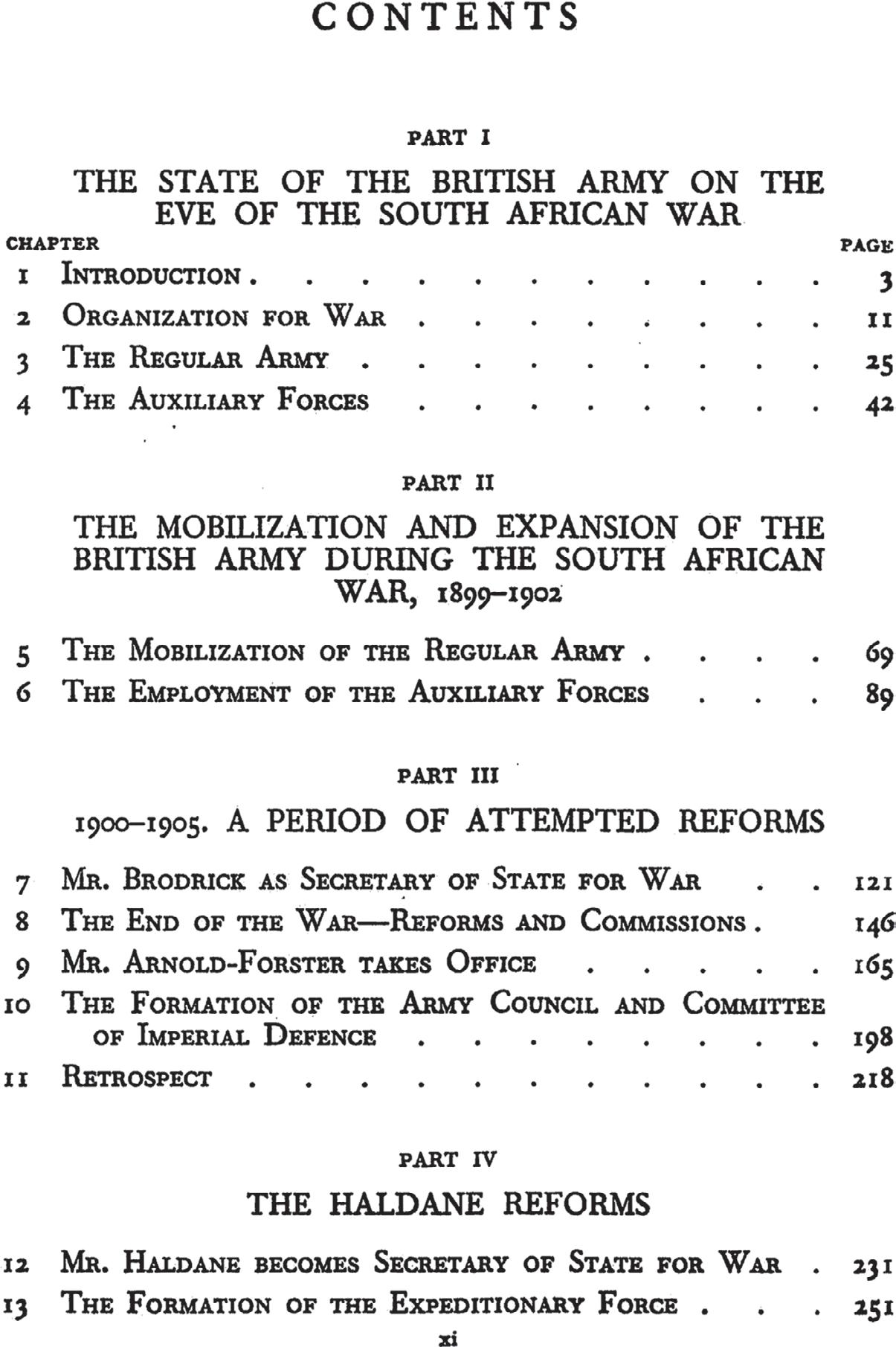
THE STATE OF THE BRITISH ARMY ON THE EVE OF THE SOUTH AFRICAN WAR
CHAPTER I
INTRODUCTION
IN the summer of 1899 the British Army consisted, according to the terms of the Army Estimates, of the Regular Army and the Auxiliary Forces. Included in the Regular Army was the Army Reserve; included in the Auxiliary Forces were the Militia, the Yeomanry, and the Volunteers.
Within the compass of forty years each of these component parts had experienced very important changes. The Volunteers in their present form had sprung into existence in the year 1859. The Militia, after the post-Waterloo quiescence, had revived but not in the old character. As for the Regular Army, the military reforms associated with the names of Mr. Cardwell and Mr. Childers, the reforms of the years 1870 to 1882, were regarded by Sir John Fortescue, in his classic 'History of the Army' as so complete in their purview, so revolutionary in their scope, that they marked the end of a military age. The Old Army, that had endured from Stuart times had passed away and a New Army was to take its place. Three sentences from his final volume will show how vital, in the opinion of this judge, were the alterations effected by this series of legislation. 'Two relics of the old system alone remained, long service for soldiers, and purchase for officers. The former was swept away in 1870, the latter in 1871; and therewith the knell of the Old British Army was rung•••• Some other hand must record the vicissitudes of the New Army which grew up after.•••' 1
This conception of a complete change was also present in
1 These sentences are taken from the end of one chapter and the commencement of the next-Fortescue, vol. xiii, pp. 500-1.
4
THE DEVELOPMENT OF THE BRITISH ARMY .
the minds of the authors of a work 'The Army Book of the British Empire' which was published in 1893. In a chapter entitled 'The Modem System in Britain' they made clear the prevalent feeling that the introduction of short service, the dependence upon an army largely composed of reservists, was a complete .revolution which rendered comparison ~th the past difficult, if not impossible.1
The great series of new legislation had commenced with 'The Army Enlistment Act' of 1870. This measure had authorized enlistment for short service, such service to be partly with the Colours and partly with the Reserve}& This was followed, in the following year, by the Royal Warrant of July 20, 1871, which abolished purchase of commissions, and the New Warrant of October 30th of the same year, which laid down the new conditions for first commissions and for subsequent promotion.8
In 1872, as a result of the Report of General MacDougall's Committee on Military Organization, a scheme for the Territorial localization of the Army was laid before the House of Commons. Therein the Duke of Cambridge, as Commanderin-Chief of the Aimy, sketched out the new plan for the organization ·of the land force s.
The plan had provided, in brief, for the linking in pairs of all single battalion regiments of Infantry, and for the 'localization' of regular infantry by associating each regiment with a definite part of the country and with the militia battalions, already, so to speak, attached to the soil .' The Brigade
1 'The condition of our military forces fifty years ago can probably hardly be realized by whose who' have only come to observe these things in more recent years.'-Major-General Sir E. F. Ducane, K.C.B., 'R.U.S.I. Journal', xlii, p. 159.
2 'Chronology', p. 19. ·
8 'Chronology', p. 21. It may be worth mentioning that the systelμ of purchase only applied to the cavalry and infantry. In the two 'Ordnance Corps' c;,f Artillery and Engineers. promotion was by seniority, and there was no purchase.-Fortescue, vol. xiii, .p. 550 ·
.·' The Foot Guards, ~e 60th Rifles, and the Rifle Brigade were not included in the 'localization' scheme.
INTRODUCTION
s depot was established as the territorial nerve centre of the regiment.
In 1881, Mr. Childers carried the scheme to its logical conclusion by amalgamating the linked battalions.1
The last of the major reforms initiated by Mr. Cardwell had been to bring together, under the one roof of the War Office, the department of the Secretary of State for War, and the department of the Commander-in-Chief. At the same time, all the reserve forces as they were then called, the Militia, the Yeomanry, and the Volunteers, were brought under the control of the War Office. 2
· In 1899 these important changes were within the memory of many officers still serving. There were many in the senior ranks who had entered the Army in the days of purchase and a long service soldiery. It was perhaps inevitable that there had been controversy over the introduction of such far-reaching reforms. Even in 1899 echoes of the arguments were heard. 'Lord Cardwell's Reforms vital as they were to the well-being of the Army disturbed prejudices and interests in many quarters, and left behind them a long trail of grievances of which the War Office has been made the legatee.'3
The very controversies however had forced the Army to take itself seriously. Discussions at the Royal United Service Institution, and in the Service journals showed that a great weight of serious military opinion was in favour of the short service system with the Army Reserve. In any event the change was hound to come. The lesson of the Crimean War was perfectly clear. To engage upon a wasteful campaign with
1 The Cameron Highlanders remained a single-battalion regiment till a second battalion was raised in 1897. The actual change was ordered by G.O. 41 of April 1881 .. Sir C.H. Ellice's Committee on the Formation of Territorial Regiments had contributed recommendations to this effect.A.R.C. No. 240 of 1881.
1 Clause 7, Military and Re.serve Forces Circular, 1872. 'Chronology', p. 23.
8 Mr. St. John Brodrick. Cf. also Major-General R. L. Dashwood at the R.U.S.I. February 9, 1898: 'ff these battalions are unlinked-which I sincerely hope they will be.'
THE DEVELOPMENT OF THE BRITISH ARMY
no system of reserves for the supply of regimental drafts was clear·folly.
· Lord Wolseley was a powerful advocate of the short service system, and he placed the evidence in its favour quite fairly when he said: 'This at least is certain, that an Army Reserve of 80,000 men places us in a military position that for either offence or defence we have never before attained to in this country. • • • When that .Army Reserve rejoins the colours, the home Army would then be immeasurably superior to any Army we have had in England for 100 years.'1
Some parts of the new system had already been tested on the battle-field. The short service soldiers had been engaged in a series of small wars. At a later period the Esher Committee spoke of the years between 1870 and 1899 as a 'period ofimmunity from real stress, when the provision of relatively small expeditionary forces to operate against unotganized and ill-armed peoples has been the principal occupation of the War Office apart from its multifarious duties of purelypeaceroutine'.2 Indeed during the last half of the nineteenth century the British Army hadbeenalmostcontinuouslyat W ar.3 In South Africa had come in rapid succession the Kaffir War of 1877, the Zulu W arof 1878-9, the Basuto W arof 1879-8oand the Boer War of 1880-1.
In North Africa, the period had commenced with Sir Garnet Wolseley's decisive Egyptian campaign of 1882. To that had succeeded a period of almost continuous warfare against Mahdism. There had been disasters as well as victories, but the end had recently come with the crushing defeat of the Khalifa's Army at Omdurman.4 In West Africa had been the expedition to Ashanti of 1873-4.
1 Quoted-in Military Notes, 'R.U.S.I. Journal', vol. xlii, p. 336.
2 Report of the War Office (Reconstitution) Committee (Command Paper 1932 of 1904), p. 8, para. 7.
3 'Our -Anny is almost always at War.'-Wolseley at R.U.S.I., November 1-7, 1897. ·
4 'IJie official ·Battle Honours covering these Egyptian and Sudan campaigns are: Tel-el-Kebir, Egypt 1882, Abu Klea, Kirbekan, Tofrek, Egypt 1884, ~ile 1884-5, Suakim 1885, Atbara, Khartoum.
INTRODUCTION
Further East had been the hard-fought Second Afghan War of 1878-80 made memorable ·by General Roberts' occupation of Kabul and march to Kandahar. Also on the frontiers of India had been the campaigns -of the Tirah and Chitral in 1897-8 and the Burmese War of 1885-,.
The only occasion on which reservists had been used overseas had been the Egyptian campaign of 1882, but the working of the new system had also been tested in 1885 at the time of the Pendjeh incident. The Army Reserve of one cavalry regiment and fifteen regiments of infantry had been called out. A total of 4,681 reservists rejoined the colours and served from April till August.1
Thus the British Army had, in the course of some thirty years, gained great experience of warfare of various kinds, and most of the high commands were fill~d with men who had seen active service, and had given proof of fighting ability and personal courage of a high order.
Internationally there was reason enough for considering the strength of the Army. Though it had been the success of Prussian militarism ·in the wars of 1864, 1866 and 1870 that had shocked Great Britain into Army Reform, so long as Bismarck retained power Germany was careful and friendly in her policy to this country. It was the France of Napoleon Ill which in 1859 had caused the formation in England of hundreds of Volunteer Rifle Corps, and the F ranee of the Third Republic was very jealous of English activities in Egypt. Russia, also, was beginning to threaten. When Disraeli called out the Reserve as a challenge to the Treaty of San Stefano, and brought troops from India to the Mediterranean, he was indulging in a policy which led directly to the Second Afghan War.
However these distant scares of wars with great powers
1 'Chronology', p. 43. Mobilization arrangements were not well developed at this stage. Neither clothing nor accoutrements were available for the Reservists when first they reached barracks, and ·there was a good deal of drunkenness. till the men settled down.-Ellison, chap. vii.
8 THE DEVELOPMENT OF THE BRITISH ARMY
had paled before the very real tension of the F ashoda question. In the summer of 1899, that crisis was t:ecent history. 'I)ie French press was still strongly Anglophobe, while, in this country it was F ranee that was the enemy in all war stories of the popular press.
One .result of this long period of small wars and continental scares had been a very definite improvement in the attitude of the public towards the Army. There were several reasons for this. The Diamond Jubilee of 1897 had been the occasion of a great and very genuine outburst of affectiort and .respect for a venerated sovereign. Her Majesty's regard for the Army, particularly for her beloved Highland Regiments, was well known, and set a fashion. The Romanticism .of the late Victorian age was well suited to admire deeds of heroism. Lady Butler's pictures and Caton Woodville's drawings were popular. ·
Though the disasters of Maiwand -and Isandlwana shook the popularity of Lord Beaconsfield's ministry in 1880, the populace reacted to the stories of heroism in those fights. The Berkshire Lion at Reading typified local feeling, while the self-sacrifice of Lieutenants Coghill and White at lsandlwana endeared the British Army to many in these islands who had previously thought little of such things. When the Queen placed a wreath of immortelles on the Queen's colour of the 1 /24th Foot it was a gesture attuned to the spirit of the day. · ·
At Dargai, on the North-West Frontier, a young Highland piper, wounded in both ankles, had sat down on a rock and played forward his comrades.
Sir Evelyn Wood tells that he had to exercise his personal influence with the management of the Alhambra to cut short the appearance on the stage of this Piper Findlater, V.C.1 Though decorum would reasonably have di~liked such advertisement, a student ofnational psychology would, perhaps, have had different views. At all events, one of ·the main 'Froin Midshipman to Field-Marshal', vol. ii, p. 240. May 28, 1898. 1
INTRODUCTION
tableaux of the year at Madame Tussaud's Exhibition had represented Piper Findlater playing forward a spirited group of Gordon Highlanders. In ·similar vein 'Major Wilson's Last Stand' had been the cen~ episode in a Wild West Show at Olympia. The Military Tournament, first founded by the Volunteers, had been taken over by London District, and provided a medium for public interest in the Army.
This improvement in public interest in the army did not necessarily indicate much greater comprehension of military matters,1 nor did it indicate any great improvement in recruiting. It was however becoming the fashion to regard 'Tommy Atkins' as a kind of domestic pet.
The army continued to draw its officers from a rather narrowcircle,anditsrank and file from a low stratum of society; 'from the froth and scum of the nation' as had been said. On the other hand the Volunteer Movement, in spite of many defects and deficiencies, had at least been means .whereby the middle classes gained a certain knowledge of military affairs. 'If the Volunteers had never done anything else, we owe them a debt of gratitude for one thing, that they have brought military knowledge to the people much more than it was before they existed.'2
Such popular appreciation was improved by the latest battle news. The Sudan Campaign of 1898 had been excellently organized. The two battles had been definite victories, Omdurman 3 itself being one of the most crushing defeats ever inflicted on a numerically much superior foe. British casualties had been very low. 'Even the ranks of Tusculum could scarce forbear to cheer.' In the debate in the House of Commons on a grant to Lord Kitchener the Radical opposition could
1 'In counties where the sporting rights are leased to non-residents manreuvres are, in the present state of Public feeling .in the United Kingdom, impossible without an Act of Parliament.'-'From Midshipman to FieldMarshal', vol. ii, p. 221.
a Captain W. H. James, R.U.S.I. Institution, March 10, 1898.
a September 2, 1898.
xo THE DEVELOPMENT OF THE BRITISH ARMY
find . nothing . to criticize in the conduct of the operations. Comments centred on the desecration of the Mahdi's tomb, or the great slaughter of Dervishes. It was suggested that the very ease and cheapness of the victory might prove a temptation .to further facile colonial conquests.
CHAPTER 2
ORGANIZATION FOR WAR
THE STANHOPE MEMORANDUM
THE Military Intelligence Department of the War Office had been established on April 1, 187j.1 Incidentally it was at 18, Queen Anne's Gate, half a mile away from the War Office at Pall Mall. In 1886, Major-General Henry Brackenbury as head of this Intelligence Division had been instructed by Lord Wolseley, the Adjutant-General, to 'prepare a scheme for the mobilization of two Army Corps and the necessary lines of communication troops for . war outside Great Britain and lreland'. 2 Brackenbury prepared his report and stated, 'there is no want of either infantry or cavalry officers and men, for the formation of two Army Corps, but that for the mobilization of one Army Corps there are not sufficient men available to fill up the cadres of the Medical Staff Corps, the Commissariat and Transport Corps, the Ordnance Store Department and the Veterinary Department, and nearly 8,000 horses would have to be purchased'. 8 .
It was as a direct result of this Memorandum from General Brackenbury that a Mobilization Department was formed, at first at Queen Anne's Gate. A year later, in 1889, it was transferred to Pall Mall and became the Mobilization Sub-Division of the Adjutant-General's Division (A.G.7) under Colonel Ardagh, C.B., R.E. 4
1 'Chronology', p. 23. It was first a branch of the Quartermaster-General's Department, but was brought under the A.G. in 1888.-Ellison, xv, p. 8. a Ellison; xi, p. u.
3 The R.A.M.C., R.A.S.C., R.A.O.C., and R.A.V.C. all took their present form after 1886.
' Hartington Commission (Further Reports) (Command Paper 5979 of 1904), p. 98. Ardagh had been appointed assistant to Brackenbury at the Intelligence Department in 1887.
THE DEVELOPMENT OF THE BRITISH ARMY
Already, however, the deliberations of another Committee had produced a report which, for the time being, rendered nugatory General Brackenbury's work upon an overseas force. In 1887 Mr. Stanhope's Committee on Fortifications and Armaments of Military and Mercantile Ports concluded its work.1 ·
The Government was experiencing a cold fit. Confidence in the ability of the Navy was weakened by extensive building programmes in F ranee and Russia, ·and a general overhaul of naval and military machinery was carried out. The naval side of this development took the form of the Naval Defence Act of 1889 and the building of the 'Resolution' class of battleships.2 The military side ·took the form of the Imperial Defence Loan of 1888 and the building of an elaborate system of fortifications for the defence of London.
'The whole plan was the apotheosis of the "Blue Funk School;, as opposed to the "Blue Water School" which laterwas to gain the day and give such outrageous follies their quietus.'8
Nevertheless, the effect of this period of concentration upon Home Defence was so important upon all portions of the Army that it must be referred to, however briefly. It was in ·1886 that General Brackenbury had produced plans for the mobilizcJ.tiOn of two Army Corps for service 'outside Great . Britain and Ireland'. Within two years he· was producing another Memorandum upon 'French Invasion'.
As a result of these forebodings, detailed plans were worked out for the defence of London against attacks from the South and South-East. In March 1889, Mr. Stanhope announced in the House of Commons the construction of a series of fortifications to cover . London. 'There are certain strategical positions round London commanding roads and railways which are essential to its defence.' The general line of defence
1 Confidential Paper A 96 of 1887. See 'Chronology', p. 4G. .
2 'In March (1889) the First Lord of the Admiralty announced a Naval Defence Act involving an e~penditure distributed over a term of years amounting to £21,500,000.'-Brassey, 1890, p. 98.
8 Ellison, xii, p. 7.
ORGANIZATION FOR WAR
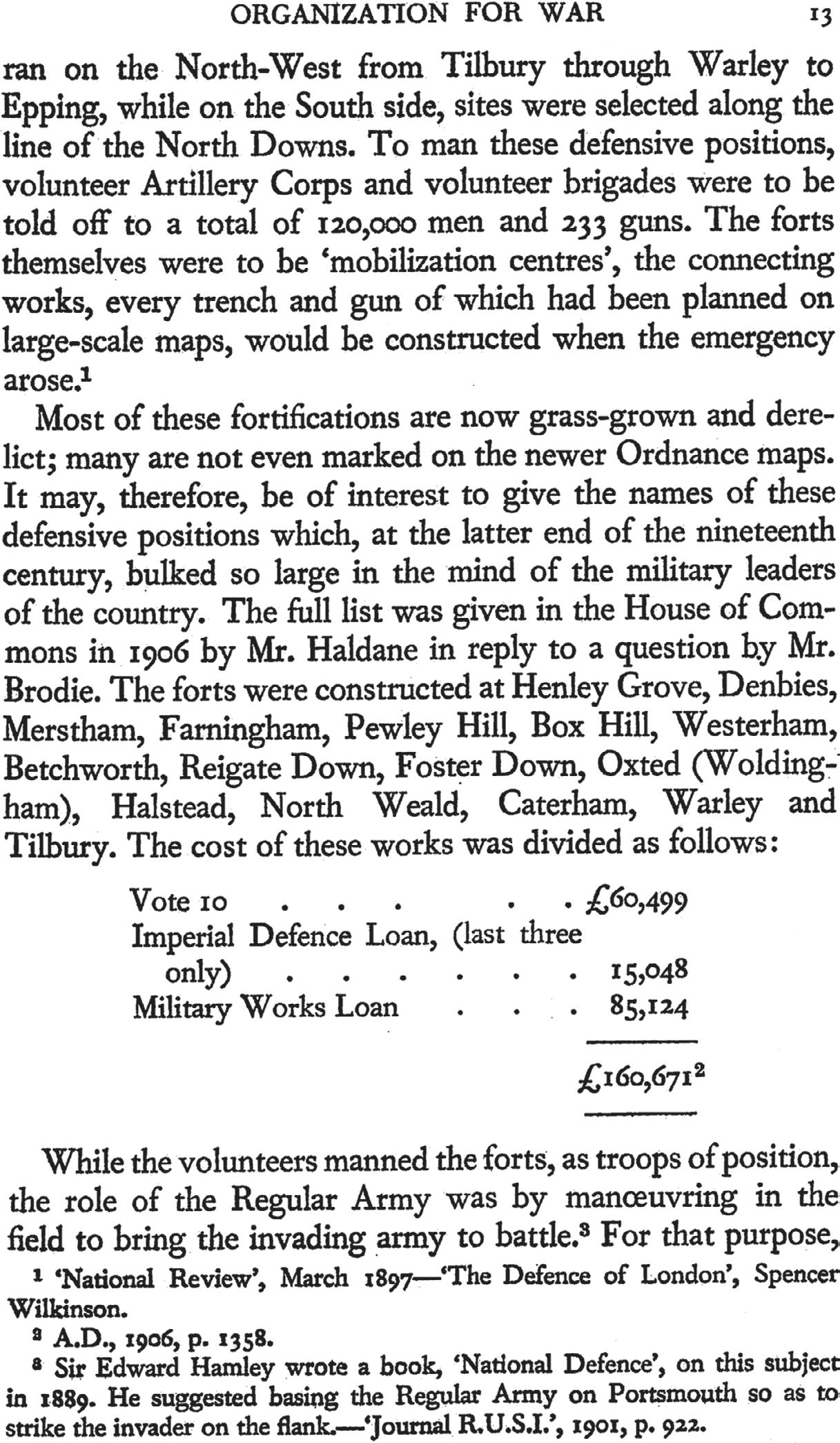
ran on the North-West from Tilbury through Warley to Epping, while on the South side, sites were selected along the line of the North Downs. To man these defensive positions, volunteer Artillery Corps and volunteer brigades were to be told off to a total of 120,000 men and 233 guns. The forts themselves were to be 'mobilization centres', the connecting works, every trench and gun of which had been planned on large-scale maps, would be constructed when the emergency arose.1
Most of these fortifications are now grass-grown and derelict; many are not even marked on the newer Ordnance maps. It may, therefore, be of interest to give the names of these defensive positions which, at the latter end of the nineteenth century, bulked so large in the mind of the military leaders of the country. The full list was given in the House of Commons in 1906 by Mr. Haldane in reply to a question b.y Mr. Brodie. The forts were constructed at Henley Grove, Denbies, Merstham, Farningham, Pewley Hill, Box Hill, Westerham, Betchworth, Reigate Down, F ost~r Down, Oxted (Woldingham), Halstead, North Weald, Caterham, Warley and Tilbury. The cost of these works was divided as follows:
Vote IO
• £00,499
Imperial Defence Loan, (last three only)
• 15,048
Military Works Loan
While the volunteers manned the forts, as troops of position, the role of the Regular Army was by manceuvring in the field to bring the invading .army to battle. 8 For that purpose,
1 'National Review', March 1897-'The Defence of London', Spencer Wilkinson.
8 A.D., 1906, p. 1358.
• S4' Edward Hamley :wrote a book, 'National Defence', on this subject in 1889. He suggested basing the Regular Army on Portsmouth so as to strike the invader on the flank.-'Joumal R.U.S.I.', 1901, p. 922.