Green Energy Harvesting
Materials for Hydrogen Generation and Carbon Dioxide Reduction
Edited by
Pooja Devi CSIR, Delhi India
This edition first published 2023
© 2023 John Wiley & Sons Ltd
All rights reserved. No part of this publication may be reproduced, stored in a retrieval system, or transmitted, in any form or by any means, electronic, mechanical, photocopying, recording or otherwise, except as permitted by law. Advice on how to obtain permission to reuse material from this title is available at http://www.wiley.com/go/permissions.
The right of Pooja Devi to be identified as the author of the editorial material in this work has been asserted in accordance with law.
Registered Offices
John Wiley & Sons, Inc., 111 River Street, Hoboken, NJ 07030, USA
John Wiley & Sons Ltd, The Atrium, Southern Gate, Chichester, West Sussex, PO19 8SQ, UK
Editorial Office
Boschstr. 12, 69469 Weinheim, Germany
For details of our global editorial offices, customer services, and more information about Wiley products visit us at www.wiley.com.
Wiley also publishes its books in a variety of electronic formats and by print-on-demand. Some content that appears in standard print versions of this book may not be available in other formats.
Trademarks: Wiley and the Wiley logo are trademarks or registered trademarks of John Wiley & Sons, Inc. and/or its affiliates in the United States and other countries and may not be used without written permission. All other trademarks are the property of their respective owners. John Wiley & Sons, Inc. is not associated with any product or vendor mentioned in this book.
Limit of Liability/Disclaimer of Warranty
While the publisher and authors have used their best efforts in preparing this work, they make no representations or warranties with respect to the accuracy or completeness of the contents of this work and specifically disclaim all warranties, including without limitation any implied warranties of merchantability or fitness for a particular purpose. No warranty may be created or extended by sales representatives, written sales materials or promotional statements for this work. The fact that an organization, website, or product is referred to in this work as a citation and/or potential source of further information does not mean that the publisher and authors endorse the information or services the organization, website, or product may provide or recommendations it may make. This work is sold with the understanding that the publisher is not engaged in rendering professional services. The advice and strategies contained herein may not be suitable for your situation. You should consult with a specialist where appropriate. Further, readers should be aware that websites listed in this work may have changed or disappeared between when this work was written and when it is read. Neither the publisher nor authors shall be liable for any loss of profit or any other commercial damages, including but not limited to special, incidental, consequential, or other damages.
A catalogue record for this book is available from the Library of Congress
Paperback ISBN: 9781119776055; ePub ISBN: 9781119776079; ePDF ISBN: 978111977606; oBook ISBN: 9781119776086
Cover image: © Elnur/Shutterstock
Cover design by Wiley
Set in 9.5/12.5pt STIXTwoText by Integra Software Services Pvt. Ltd, Pondicherry, India
Contents
List of Contributors vii
Preface x
Acknowledgements xi
Abbreviations xii
1 Renewable Energy: Introduction, Current Status, and Future Prospects 1
Srikanth Ponnada, Indu Kumari, Sampath Chinnam, Maryam Sadat Kiai, A. Lakshman Kumar , Rapaka S. Chandra Bose, Demudu Babu Gorle, Annapurna Nowduri, and Rakesh K. Sharma
2 Hydrogen and Hydrocarbons as Fuel 23
Chandraraj Alex and Neena S. John
3 Fundamental Understanding and Figure of Merits for Electrocatalytic and Photoelectrocatalytic H2 Production 46
Swapna Pahra, Sweta Sharma, and Pooja Devi
4 Single Atom Catalysts for Hydrogen Production from Chemical Hydrogen Storage Materials 75 Rajani Kumar Borah, Adarsh P. Fatrekar, Panchami R., and Amit A. Vernekar
5 Non-Noble Metal Ion-Based Metal-Organic Framework Electrocatalyst for Electrochemical Hydrogen Generation 101 Satya Prakash, Kamlesh, Deepika Tanwar, Pankaj Raizda, Pardeep Singh, Manish Mudgal, A.K. Srivastava, and Archana Singh
6 2D Materials for CO2 Reduction and H2 Generation 121 Rameez Ahmad Mir, Sanjay Upadhyay, and O.P. Pandey
7 Hybrid Materials for CO2 Reduction and H2 Generation 147 Anupma Thakur and Pooja Devi
8 Possible Ways for CO2 Reduction into Hydrocarbons 169
Shelly Singla, Pooja Devi, and Soumen Basu
9 MXenes for CO2 Reduction and H2 Generation 187
N. Usha Kiran, Laxmidhar Besra, and Sriparna Chatterjee
10 The Role of Transition Metal-Based Electrocatalyst Toward Efficient Electrochemical Hydrogen Fuel Generation 220
Tribani Boruah and Ramendra Sundar Dey
11 Devices Development and Deployment Status for Commercial Usage: H2 Production and CO2 Utilization 249 Tulsi Satyavir Dabodiya, Twinkle George, Kapil Dev Singh, and Arumugam Vadivel Murugan
Index 279
List of Contributors
Chandraraj Alex Centre for Nano and Soft Matter Sciences, Shivanapura, Bengaluru, Karnataka, India
Soumen Basu
School of Chemistry and Biochemistry, Thapar Institute of Engineering and Technology, Patiala, Punjab, India soumen.basu@thapar.edu
Laxmidhar Besra
Materials Chemistry Department, CSIRInstitute of Minerals and Materials Technology, Bhubaneswar, Odisha, India
Rajani Kumar Borah
Inorganic and Physical Chemistry Laboratory (IPCL), Council of Scientific and Industrial Research (CSIR)-Central Leather Research Institute (CLRI), Chennai, India
Tribani Boruah Institute of Nano Science and Technology (INST), Mohali, Punjab, India
Rapaka S. Chandra Bose Centre for Materials for Electronics Technology, Thrissur, Kerala, India
Sriparna Chatterjee
Materials Chemistry Department, CSIRInstitute of Minerals and Materials Technology, Bhubaneswar, Odisha, India sriparna251@gmail.com
Sampath Chinnam Department of Chemistry, M.S Ramaiah Institute of Technology (Affiliated to Visvesvaraya Technological University, Belgaum), Bengaluru, Karnakata, India sampathchinnam@gmail.com
Tulsi Satyavir Dabodiya Department of Chemical and Materials Engineering, University of Alberta, Alberta, Canada er.tulsikumar@gmail.com
Pooja Devi
Materials Science and Sensor Application, Central Scientific Instruments Organisation, Chandigarh, Punjab, India poojaiitr@csio.res.in
Ramendra Sundar Dey Institute of Nano Science and Technology (INST), Mohali, Punjab, India rsdey.kgp@gmail.com
List of Contributors
Adarsh P. Fatrekar
Inorganic and Physical Chemistry Laboratory (IPCL), Council of Scientific and Industrial Research (CSIR)-Central Leather Research Institute (CLRI), Chennai, India
Twinkle George Centre for Nanoscience and Technology, Madanjeet School of Green Energy Technologies, Pondicherry University Kalapet, Puducherry, India
Demudu Babu Gorle
Materials Research Centre, Indian Institute of Science, Bangalore, Karnataka, India
Neena S. John Centre for Nano and Soft Matter Sciences, Shivanapura, Bengaluru, Karnataka, India jsneena@cens.res.in
Kamlesh
Academy of Scientific & Innovative Research (AcSIR), Ghaziabad, Uttar Pradesh, India
Maryam Sadat Kiai
Nano-Science and Nano-Engineering Program, Graduate School of Science, Engineering and Technology, Istanbul Technical University, Istanbul, Turkey
N. Usha Kiran
Materials Chemistry Department, CSIRInstitute of Minerals and Materials Technology, Bhubaneswar, Odisha, India
Indu Kumari
Department of Biotechnology, Chandigarh College of Technology, Chandigarh Group of Colleges, Landran, Mohali, Punjab, India
A. Lakshman Kumar
CSIR-Central Electrochemical Research Institute, Karaikudi, Tamil Nādu, India
Rameez Ahmad Mir Department of Materials Science Engineering, University of Toronto, Canada
Manish Mudgal Academy of Scientific & Innovative Research (AcSIR), Ghaziabad, Uttar Pradesh, India
Annapurna Nowduri
Department of Engineering Chemistry, Andhra University College of Engineering (A), Andhra University, Visakhapatnam, India
dr.nannapurna@andhrauniversity.edu.in
Swapna Pahra
Materials Science and Sensor Application, Central Scientific Instruments Organisation, Chandigarh, Punjab, India
Panchami R.
Inorganic and Physical Chemistry Laboratory (IPCL), Council of Scientific and Industrial Research (CSIR)-Central Leather Research Institute (CLRI), Chennai, India
O.P. Pandey
Center of Excellence for Emerging Materials (CEEMS)-Virginia Tech (VT), TIET, Patiala, Punjab, India oppandey@thapar.edu
Srikanth Ponnada
Sustainable Materials and Catalysis Research Laboratory (SMCRL), Department of Chemistry, Indian Institute of Technology Jodhpur, Karwad, Jodhpur, India
List of Contributors
Satya Prakash
Academy of Scientific & Innovative Research (AcSIR), Ghaziabad, India
Pankaj Raizda
School of Chemistry, Shoolini University, Himachal Pradesh, India
Rakesh K. Sharma
Sustainable Materials and Catalysis Research Laboratory (SMCRL), Department of Chemistry, Indian Institute of Technology Jodhpur, Jodhpur, India rks@iitj.ac.in
Sweta Sharma
Academy of Scientific & Innovative Research (AcSIR), Ghaziabad, India
Archana Singh
CSIR – Advanced Material and Processes Research Institute, Bhopal, India archanasingh@ampri.res.in
Kapil Dev Singh
Department of Material Science and Engineering, National Institute of Technology, Hamirpur, Himachal Pradesh, India
Pardeep Singh
School of Chemistry, Shoolini University, Himachal Pradesh, India
Shelly Singla
School of Chemistry and Biochemistry, Thapar Institute of Engineering and Technology, Patiala, India
A.K. Srivastava
CSIR – Advanced Material and Processes Research Institute, Bhopal, India
Deepika Tanwar
Academy of Scientific & Innovative Research (AcSIR), Ghaziabad, India
Anupma Thakur
Discipline of Chemical Engineering, Indian Institute of Technology Gandhinagar, Gujarat, India anupmathakur92@gmail.com
Sanjay Upadhyay
School of Physics and Materials Science (SPMS), Thapar Institute of Engineering and Technology, Patiala, India
Amit A. Vernekar
Inorganic and Physical Chemistry Laboratory (IPCL), Council of Scientific and Industrial Research (CSIR)-Central Leather Research Institute (CLRI), Chennai, India amitvernekar@clri.res.in
Arumugam Vadivel Murugan
Centre for Nanoscience and Technology, Madanjeet School of Green Energy Technologies, Pondicherry University Kalapet, Puducherry, India
Preface
This book, Green Energy Harvesting: Materials for Hydrogen Generation and Carbon Dioxide Reduction, concisely summarises the possible ways to harvest hydrogen from water and also reduce CO2 into various hydrocarbons. A special emphasis is given to the figure-of-merits for the currently developed system/materials for hydrogen generation and CO2 reduction. We further have summarised the trends in materials innovation and the corresponding state of the art to achieve the desired efficiency and stability, while also considering the cost of production. Finally, the future prospects of this sustainable alternative fuel is summarized for the possible future strategy in adopting these sustainable solutions at the commercial level.
This book can be used to develop an understanding in this field in terms of fundamentals, materials advances, and devices deployment. The students and researchers from energy, environment, materials, chemistry, electrochemistry, and similar backgrounds will find it useful in their respective fields.
Acknowledgements
The kind permission of the Director of CSIO to execute this book project is highly acknowledged. All the reviewers who have reviewed the chapters in this book and suggested necessary improvements are also acknowledged.
Abbreviations
AB ammonia borane
ABPE applied bias photon to current efficiency
ac aberration-corrected
AC activated carbon
AEL alkaline electrolysis
AEM alkaline exchange membrane
AFC alkaline fuel cell
Ag silver
Al aluminum
ALD atomic layer deposition
APCE absorbed photon-to-current efficiency
Au gold
B boron
BASF Baden Aniline and Soda Factory
BC7N borocarbonitride
BDC benzenedicarboxylic acid
BHT benzene-1,2,3,4,5,6-hexathiol
C3N4 carbon nitride
C carbon
CA California
CB conduction band
CBE conduction band edge
Cdl double layer capacitance
CdS cadmium sulfide
CH4 methane
CNT carbon nanotube
Co cobalt
Co carbon monoxide
Co2 carbon dioxide
CoD Chemical Oxygen Demand
CooH carboxyl intermediate
CoPC Co phthalocyanine
CoPS Co-phosphosulphides
Abbreviations
CoP|S Co-phosphosulfate nanoparticles
Co2RR CO2 reduction reaction
CoVID-19 Coronavirus disease 2019
CS catalytic selectivity
Cs specific capacitance
CTF covalent triazine framework
Cuf copper foam
CUMS coordinatively unsaturated metal sites
CV cyclic voltammetry
CVD chemical vapor deposition
1D one-dimensional
2D two-dimensional
3D three-dimensional
DBD dielectric barrier discharge
DFT density functional theory
DMSo dimethyl sulfoxide
DoE Department of Energy
DoS density of states
DRIFTS CO-diffuse reflectance infrared Fourier transform spectroscopy
DTM double transition-metal
EC electrocatalyst
EC electrochemical
ECSA electrochemical active surface area
EELS electron energy-loss spectroscopy
EF energy efficiency
EG ethylene glycol
EHvac H-vacancy energy
EIA Energy Information Administration
EIS electrochemical impedance spectroscopy
ENE-FARM energy and farm
EV electrovolts
EXAFS extended X-ray absorption fine structure
EY Ernst & Young Global Ltd
FA formic acid
fcc face-centred cubic
FCH JU Fuel Cells and H2 Joint Undertaking
FE faradic efficiency
Fe iron
Feox iron oxide
FTO conductive surface
ΔG Gibbs’s free energy
GCE glassy carbon electrode
GDL gas diffusion layer
GGNR graphene/graphene nanoribbon
GO graphene oxide
Abbreviations xiv
Δh enthalpy
Δs entropy
2H hydrogen
H2 hydrogen
Hads hydrogen adsorption
HAADF high-angle annular dark-field
h-BN hexagonal boron nitride
HCN heptazine-based crystalline carbon nitride
HCooH formic acid
hcp hexagonal close packing
HDH hetero-dimensional hybrid architecture
HDS hydrodesulfurization
HEP H2 evolution photocatalyst
HER hydrogen evolution reaction
HES hydrogen energy storage
HF hydrofluoric acid
HRTEM high resolution transmission electron microscope
HSSA high specific surface area
IC ion chromatograph
ICP-AES inductively coupled plasma atomic emission spectroscopy
IL ionic liquid
i-MAx in-plane MAX
IPCC Intergovernmental Panel on Climate Change
IPCE Incident Photon-to-Current Efficiency
IPHE International Partnership for H2 and Fuel Cells in the Economy
i-PrA isopropylamine
IQE internal quantum efficiency
iR drop ohmic potential drop
Iro2 iridium oxide
jo exchange current density
KoH potassium hydroxide
LB Langmuir Blodgett
LBL layer by layer
LDH layered double hydroxide
LM Wind Lunderskov Møbelfabrik
LoHC liquid organic hydrogen carrier
LSV linear sweep voltammetry
M metal
MCFC molten carbonate fuel cell
MD molecular dynamic
MEA membrane electrode assembly
MILD minimally intensive layer delamination
Mo molybdenum
Mo2C molybdenum carbide
MoF metal-organic framework
MoP molybdenum phosphide
MoS2 molybdenum disulfide
MoSe2 molybdenum diselenide
MWCNT multi-walled carbon nanotubes
Mx metal complex
N nitrogen
N2o nitrous oxide
NASA National Aeronautics and Space Administration
Nb niobium
ND nanodisc
ND nano-dots
NExAFS near edge X-ray absorption fine structure
NF nanoflake
NG N-doped graphene
NGo N-doped graphene oxide
NH4HF2 ammonium bifluoride
NHE normal hydrogen electrode
Ni nickel
NiCo-UMoFN Ni-Co MOF nanosheet
Ni-G Ni-graphene
NP nanoparticle
o2 oxygen
oEP O2 evolution photocatalyst
oER oxygen evolution reaction
oH hydroxyl
o-MAx out-of-plane MAX
oPEC organic photoelectrochemical
oRR oxygen reduction reaction
os osmium
ov oxygen vacancy
QD quantum dots
P phosphorus
PAFC phosphoric acid fuel cell
PC photocatalytic
PCE photo-chemical-efficiency
PCG porous conductive graphene
Pd palladium
PDMS polypyrrole, polydimethyl siloxane
PEC photoelectrocatalyst
PEC photoelectrochemical
PEC-HER photoelectrochemical-hydrogen evolution reaction
PEM (polymer) electrolyte membrane
PEM proton exchange membrane
PEMEL Proton Exchange Membrane Electrolysis
PEMFC proton exchange fuel cell
Abbreviations xv
Abbreviations xvi
PH3 phosphine gas
PL photoluminescence
PLD pulsed laser deposition
PoM polyoxometalate
PoMoF polyoxometalate-based metal-organic framework
Pt platinum
PV photovoltaic
PVEC photovoltaic electrocatalyst
PxRD powder X-ray diffraction
QE quantum efficiency
Rct charge transfer
R&D Research and Development
RDS rate determining step
RECAI Renewable Energy Country Attractiveness Index
RES renewable energy resources
rGo reduced graphene oxide
RHE reversible hydrogen electrode
Ru ruthenium
S sulfur
SA surface area
SAA single-atom alloy
SAC single-atom catalyst
SCE saturated calomel electrode
SCWG supercritical water gasification
Se selenium
SEM scanning electron microscope
SFE Solar-to-Fuel efficiency
SMR steam methane reforming
SoEL high-temperature solid oxide water electroysis
SoFC solid oxide fuel cell
SPR van der Waals
SSA specific surface area
STEM scanning transmission electron microscopy
STH solar-to-hydrogen
Ta tantalum
TA terminal alkyne
TaS2 tantalum disulfide
TBA tetrabutylammonium
TEoA triethanolamine
TNAoH tetrabutylammonium hydroxide
TDoS total density of states
TEM transmission electron microscope
THT triphenylene-2,3,6,7,10,11-hexathiolate (THT)
TM transition metal
TMAoH tetramethylammonium hydroxide
TMC transition metal carbide
TMD transition metal dichalcogenide
TMN transition metal nitrides
TMo transition metal oxide
TMP transition metal phosphide
TMPS TM-phosphosulphides
ToF turnover frequency
ToN turnover number
ToP trioctylphosphine
TV television
TW terawatt
UCLA University of California, Los Angeles
UPS UV photoelectron spectroscopy
USEPA United States Environmental Protection Agency
UV ultraviolet
VB valance band
vdW van der Waals
Vo2 vanadium dioxide
VS2 vanadium sulfide
VSe2 vanadium selenide
VS2s vanadium sulfides
Wuse.out useful work output
Wrev.out reversible work output
WC tungsten carbide
WCHN WSe2/CNTs hybrid network
WG waved graphene
WGSR water-gas shift reaction
WHo World Health Organisation
φM work function
φM semiconductor work function
WS2 tungsten disulfide
WSe2 tungsten diselenide
xPS X-ray photoelectron spectroscopy
xRD X-ray diffraction
xANES X-ray absorption near-edge spectroscopy
YSZ yttria-stabilized zirconia
ZIF zeolite imidazolate framework
Abbreviations
1
Renewable Energy
Introduction, Current Status, and Future Prospects
Srikanth Ponnada1, Indu Kumari2, Sampath Chinnam3, Maryam Sadat Kiai 4 , A. Lakshman Kumar 5, Rapaka S. Chandra Bose6, Demudu Babu Gorle7, Annapurna Nowduri 8,*, and Rakesh K. Sharma1,*
1 Sustainable Materials and Catalysis Research Laboratory (SMCRL, Department of Chemistry, Indian Institute of Technology Jodhpur, Karwad, Jodhpur 342037, India
2 Department of Biotechnology, Chandigarh College of Technology, Chandigarh Group of Colleges, Landran, Mohali, Punjab 140307, India
3 Department of Chemistry, M.S Ramaiah Institute of Technology (Affiliated to Visvesvaraya Technological University, Belgaum), Bengaluru, Karnataka 560054, India
4 Nano-Science and Nano-Engineering Program, Graduate School of Science, Engineering and Technology, Istanbul Technical University, Istanbul 34469, Turkey
5 CSIR-Central Electrochemical Research Institute, Karaikudi 630003, Tamil Nādu, India
6 Centre for Materials for Electronics Technology, Thrissur 680581, Kerala, India
7 Materials Research Centre, Indian Institute of Science, Bangalore 560012, India
8 Department of Engineering Chemistry, Andhra University College of Engineering (A), Andhra University, Visakhapatnam 530003, India
* Corresponding Author
1.1 Introduction
Continuous large-scale exploitation of our valuable natural resources, i.e., water, energy, and land has resulted in a drastic change in average global temperature [1]. While considering the world’s future needs, mitigating climate change without misusing these resources becomes the prime challenge of human civilization today. However, based on our former scrutiny of energy resources, it is possible to sustain and broaden a prosperous civilization by improving air quality, energy access, and energy security [2]. Energy resources mainly consist of three groups, i.e., fossil fuels, renewable resources, and nuclear resources [3]. Since the recovery of non-renewable resources (i.e., fossil fuels and nuclear resources) is not possible after their depletion, the demand of renewable energy resources (RES) increases. Renewable energy is the form of sustainable energy that can be derived directly or indirectly from the environment and sources that are persistently replenished by nature. The main advantages of RES include no wastage, low maintenance cost, are economical, and no depletion. Renewable energy plays a major role in energy security and reducing greenhouse gas emissions. In general, roughly 8 billion metric tons of carbon are being consumed and dumped into the atmosphere each year; deforestation contributes to 1.5 billion, with 6.5 billion tons from fossil fuels [4]. The great consumption of fossil fuels has caused serious damage to the environment and disrupted the whole ecological cycle. According to the experts, nonrenewable resources
Green Energy Harvesting: Materials for Hydrogen Generation and Carbon Dioxide Reduction, First Edition. Edited by Pooja Devi.
© 2023 John Wiley & Sons Ltd. Published 2023 by John Wiley & Sons Ltd.
will become depleted within 53 to 110 years and therefore are not sufficient to fulfill the world’s energy needs [5]. In addition, the burning of fossil fuels has led to poor air quality and global warming. According to the World Health Organisation (WHO), around 7 million deaths were recorded globally in 2016 due to household and ambient air pollution. In this data, around 94% of deaths were from low- and middle-income countries [6].
Thus, many countries have turned to renewable resources to meet their rising energy demands and to reduce air pollution. However, at present, RES provides only 14% of the total energy world energy demands [7], though several efforts have been taken up by countries worldwide. For instance, the binding target of 27% (by year 2030) has been adjusted by the European Union, that was earlier decided in 2014 to reach 32% by June 2018. According to this new target, by 2023, countries are going to discuss an even higher target [8]. The Government of India has also set an ambitious renewable energy target of 175 GW to be completed by 2022, consisting of 60 GW of wind and 100 GW of solar energy, and 10 GW of bio-power and 5 GW from small hydro-power [9]. In 2019, India was ranked fifth in wind power and solar power and fourth in renewable power installed capacity. The Government of India is planning to achieve 227 GW of renewable energy capacity by 2022, that includes 114 GW of solar capacity and 67 GW of wind power capacity, i.e., more than its 175 GW target [10]. Since July 2021, India holds 25.2% of the overall installed capacity of hydro projects and provides great options for green data centers’ development. The Government of India’s target is to establish a renewable energy capacity of 523 GW by 2030, including 73 GW from hydropower and about 280 GW expected from solar power. Throughout 2023, around 5000 compressed biogas plants are planned to be set up across India [11].
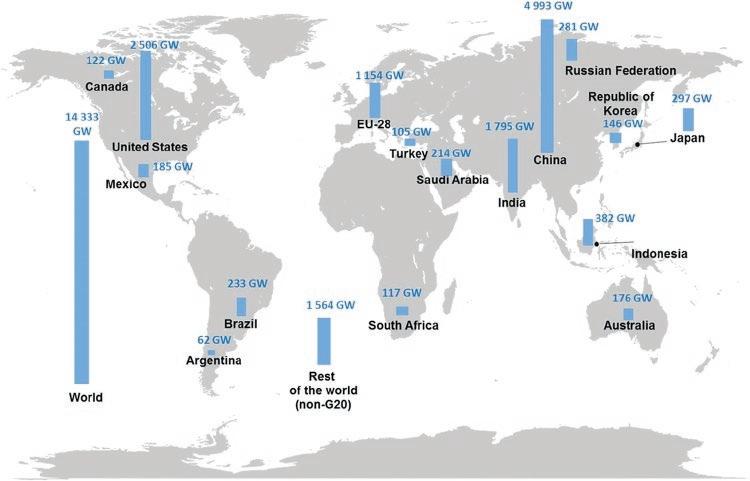
China, the largest energy producer and consumer, has a pivotal role in the global energy transition. China has also set targets to reduce carbon emissions per unit of gross domestic product by 60–65% from 2005 to 2030 [12]. In 2017, more than half of all global solar photovoltaic (PV) capacity additions of 94 GW were contributed by China. Also, solar PV deployment quotas were introduced by the Government of China in 2018 [13]. By the end of 2021, China and U.S. aimed to produce 600T Wh and 400 TWh, respectively, i.e., jointly representing more than half of the global wind power capacity. Figure 1.1 represents the geographical breakdown of the renewable power generation capacity additions, wherein China accounts for over one-third, followed by the United States, India, and the European Union [10].
In 2021, the U.S. Energy Information Administration’s (EIA), with the recent invention of electricity generators, enabled power plant owners to generate 39.7 GW of new electricity capacity to start commercial operation [14], wherein solar accounts for the largest share of new capacity at 39% and wind accounts for 31% [14]. The U.S. primary energy consumption, in terms of energy source, is represented in Figure 1.2. According to the EIA, the tendency of large-scale battery storage more than quadrupled by late 2021. In Florida, the world’s largest solar powered battery was construction and scheduled to be operational by the end of 2021 [14].
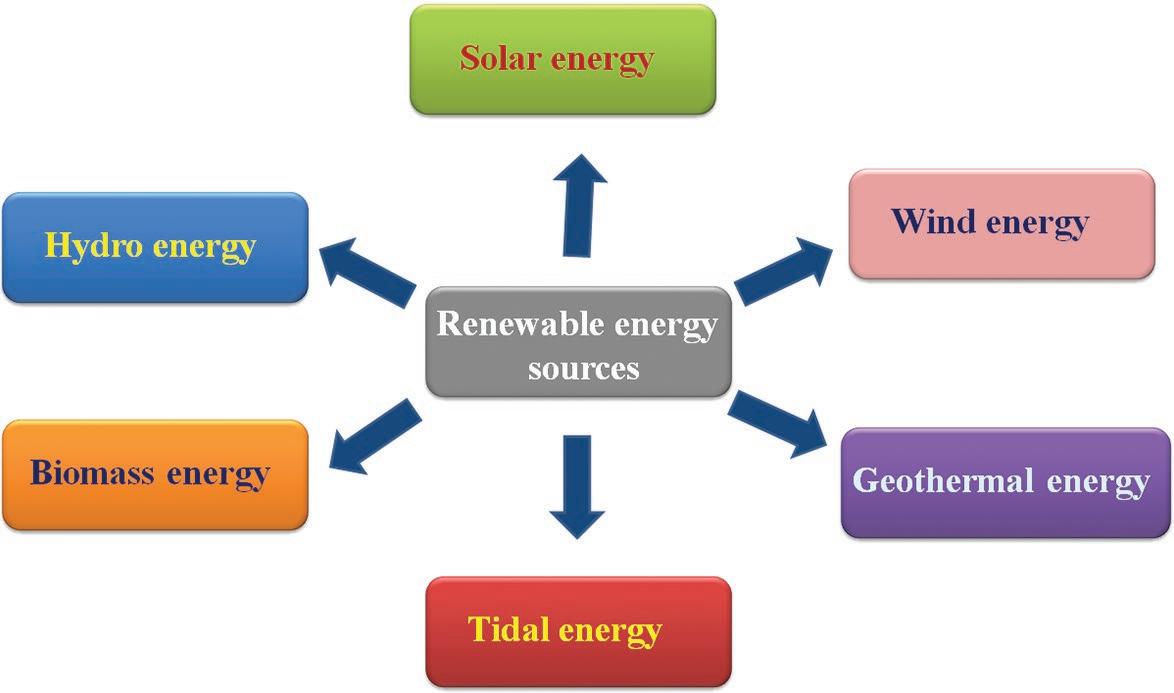
The main advantage of RES is its distribution over a wide range of geographical areas. The most common types of renewable resources include hydropower, biomass energy, geothermal power, wind energy, solar energy, and tidal energy (Scheme 1.1). These forms of energy are interconnected to each other in various ways. For instance, the Sun’s heat drives the winds, and wind turbines capture its energy. Then, the Sun’s heat and wind collectively lead to the evaporation of water that converts into rain or snow and finally flows downhill forming rivers
Figure 1.1 Geographical breakdown of renewable power generation capacity additions, 2018–2050. Reproduced from [10] / With permission of Elsevier.
Figure 1.2 U.S. primary energy consumption by energy source, 2020.
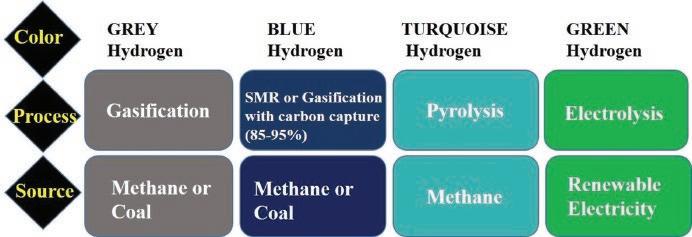
or streams. Their energy can be utilized by hydroelectric power. In addition to rain and snow, sunlight is also responsible for the growth of plants and vegetation. The organic matter made by plants is the biomass that can be used for various purposes, such as transportation, fuel, electricity, or chemicals that lead to the generation of bioenergy. Hydrogen can be burned as a fuel or transformed into electricity. Though it is always found in combination with other elements, it can be used only after its separation from another element.
There is some RES available that does not come directly from Sun. For instance, geothermal energy uses the heat present inside the Earth and can be used in various applications, including electric power production and heating of buildings. Geothermal energy was first used for commercial purposes in 1900s by the Italians [15]. Turkey is known for its rich geothermal energy resources and ranked fifth after China, Japan, USA, and Iceland [16]. Additionally, the energy produced from the oceans’ tides can also be used as an RES. There are many sources available that can generate ocean energy. For instance, ocean energy can be generated from the the gravitational pull of the moon and Sun upon the Earth. Also, it can be driven by both the tides and winds [17].
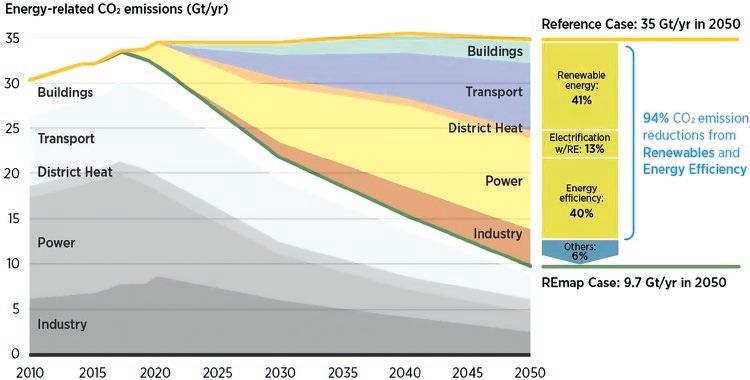
Climate change and local air pollution are among the major factors responsible for energy transition worldwide. Countries such as China and India are greatly impacted by local air pollution. In Europe the rise in harmful health effects have been observed due to air pollution, largely related to energy supply and use. Thus, energy transition needs to lessen emissions substantially, whilst ensuring that sufficient energy is still available for economic growth. The data in Figure 1.3 shows that the CO2 emissions intensity of global economic activity needs to be reduced by 85% between 2015 and 2050, and CO2 emissions need to be lowered by more than 70% compared to the Reference Case in 2050. It is clear that renewable energy and energy efficiency measures can successfully attain 94% of the necessary emissions reductions by 2050, as compared to the Reference Case. The remaining 6% would be achieved via other options in terms of reduction of activities leading to CO2 emissions, i.e., fossil fuel switching, continued use of nuclear energy, and carbon capture and storage [10] (Figure 1.3).
Renewable energy and sustainable development are very much related to each other. The development of renewable energy with reduced CO2 emissions has generated new interest in storage, thus it has become a chief component of sustainable development. Energy storage can improve the system flexibility, mitigate power variations, and enable the storage and transmission the electricity produced by different RES, including solar and wind energy. The various storage technologies are used in electric power systems such as
Scheme 1.1 Schematic illustration of different types of renewable energy.
Figure 1.3 CO2 emission reduction potential by technology in the Reference Case and REmap, 2010–2050. Note: the figure shows the breakdown of energy-related CO2 emissions by technology in the REmap Case compared to the Reference Case. The figure excludes emissions from nonenergy use (feedstocks). Reproduced from [10] / With permission of Elsevier.
chemical or electrochemical, mechanical, thermal, or electromagnetic storage [18]. For electrochemical storage, different batteries are available, including lithium-sulfur, nickelcadmium, nickel-zinc, lead-acid, ZnO, etc. [18, 19a–c]. These batteries have remarkable properties; for example, high charge/discharge efficiency, long life, and low self-discharge. For hydrogen energy storage (HES), the energy is stored in the form of hydrogen where it is retransformed to electricity by a fuel cell to energize the power plants. Hydrogen can store energy for a long time by using various HES models such as compressed, liquefied, metal hydride, etc. [18]. Mechanical energy includes flywheel energy storage, pumped HES, and compressed air energy storage [18]. In thermal energy storage, the energy is stored by varying the temperature of the material such as by heating or cooling [18]. In India, it is predicted that about 49% of the total electricity will be produced by renewable energy owing to the more efficient batteries for the storage of electricity, which will further cut the solar energy by 66% as compared to present costs [18, 19].
Based on the above discussion, the renewable concept has been accepted worldwide and is now a central energy policy unit. Though the RES has numerous advantages, the concept might even be hazardous toward the efforts taken to combat climate change or power sustainable development [20]. This is because of the dependency of these solutions on geographical sites and climatic conditions. The careful planning, measures, and location selection can help to eliminate these limitation of RES. Among the different types of RES, many organizations have discussed the exceptional role of biomass combustion in various renewable energy strategies and scenarios [21, 22]. However, it has few environmental issues, such as biomass energy being an insufficient source of energy when compared with fossil fuels, growing and harvesting biomass, transportation to the power plant, and combustion, all of which can add to global warming emissions.
In the case of hydropower, major disadvantages include high costs of facilities, changes in stream regimens (where it can affect plants, fish, and wildlife by changing stream levels, flow patterns, and temperature), dependence on precipitation, deluge of land and wildlife habitat, and dislocation of people living in the vicinity of the reservoir [23]. Among RES, solar power is considered the true renewable resource and the most abundant renewable resource on the Earth. However, solar sources provide basic power, out of which humans consume only 0.04% due to the high cost of PV panels, which are more expensive than burning fossil fuels. Apart from its advantages, such as no wastage and no emission of greenhouse gases, its main disadvantages are the costs involved, and dependency on sunshine [15]. Like other RES, wind energy also has some limitations; for example, high maintenance and transmission costs, the irregular and unpredictable nature of wind power, noise pollution, interruption of TV and radio signals, killing of migratory birds, and requirement of large geographical areas for the setups [15, 24]. Similarly, the drawbacks of geothermal energy resources include finding a suitable location for the setup; safety issues, such as volcanoes concentrated near geothermal energy sources and earthquakes at these points being more frequent; relatively lesser energy than other RES; and the steam can include toxic materials such as mercury, ammonia, arsenic, etc. [15, 25]. Thus, more attention has to be paid toward these issues, and energy policies are much needed that should focus on solving such disadvantages of RES.