C E N T R O P O R S C H E FA R O | M AGA Z I N E
n.9
OUTONO / INVERNO 2025-2026
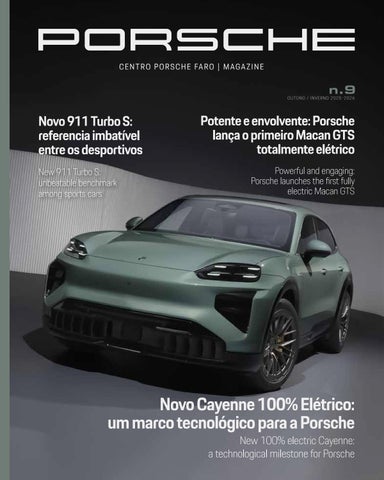
Novo 911 Turbo S: referencia imbatível entre os desportivos New 911 Turbo S: unbeatable benchmark among sports cars
Potente e envolvente: Porsche lança o primeiro Macan GTS totalmente elétrico Powerful and engaging: Porsche launches the first fully electric Macan GTS
Novo Cayenne 100% Elétrico: um marco tecnológico para a Porsche New 100% electric Cayenne: a technological milestone for Porsche CENTRO PORSCHE FARO MAGAZINE | 1
*
SUMÁRIO
} EDITORIAL
_
4
A PORSCHE AG. CASH-FLOW LÍQUIDO ROBUSTO
_
60
CAYENNE 100% ELÉTRICO
_
6
PRÍNCIPE CARL PHILIP, UM SONHO REALIZADO
_
64
NOVO PORSCHE 911 TURBO S
_
18
ENTREVISTA: DR. ROGGENDORF E DR. MAURER
_
68
25º ANIVERSÁRIO PORSCHE CARRERA GT
_
30
A. LANGE & SÖHNE
_
76
TIMO BERNHARD, REGRESSA AO MÉXICO
_
36
A HISTÓRIA DA CREED
_
82
MACAN GTS TOTALMENTE ELÉTRICO
_
40
BUCCELLATI, A ARTE DO BRILHO
_
86
CARREGAR A BATERIA DE UM BEV
_
44
PORSCHE EXPERIENCE CENTRE SINGAPURA
_
90
PORSCHE 911 S/T: O REGRESSO DA LENDA
_
48
PORSCHE X SMEG
_
94
PORSCHE 911 GT3 OCELOT
_
52
O ARCO DE PROTEÇÃO DO 911 TARGA
_
96
CAMERA-CAR PORSCHE BOXSTER
_
56
CENTRO PORSCHE FARO X, NOVO PROTOCOLO
_
100
DR. MICHAEL LEITERS
_
58
EVENTOS CPF
_
102
Centro Porsche Faro Estrada Nacional 125, km. 98,9 CP 643 – Arneiro 8005-412 FARO Telefone Geral: (+351) 289 888 911
porsche-faro.com
Siga-nos nas nossas redes sociais: fb. Centro Porsche Faro Ins. @centroporschefaro Lkin. Centro Porsche Faro
Producción editorial T.: 929 050 200 editorialmic.com
———— AVISO LEGAL - O Centro Porsche Faro e empresas associadas, em conjunto com a Editorial MIC, não se responsabilizam pelos conteúdos dos espaços publicitários, sendo estes da exclusiva responsabilidade dos anunciantes.
CENTRO PORSCHE FARO MAGAZINE | 3
EDITORIAL
FOREWORD
DA TECNOLOGIA À ESTRATÉGIA
FROM TECHNOLOGY TO STRATEGY
A Porsche acaba de lançar a nova geração do Cayenne, para já com motorizações exclusivamente elétricas. Os seus argumentos tecnológicos nesta área continuam a evoluir de forma segura e robusta, conquistando-se assim, gradualmente, novos argumentos para sustentar a viabilidade deste conceito, em função das exigências e dos constrangimentos dos clientes. Para além da potência e da aceleração que estão consentâneas com o ADN da Porsche (potência combinada até 1156 cv e uma aceleração dos 0 aos 100 km/h em 2,5 s), o novo Cayenne, graças à sua tecnologia de 800 V, apresenta uma potência de carregamento de até 400 kW e uma autonomia, medida de acordo com a norma WLTP, de até 642 km. No regime de carregamentos rápidos, a nova tecnologia proporcionada pelo Cayenne também progrediu exemplarmente: o SoC (State of Charge) pode ir dos 10% aos 80% em menos de 16 minutos. E no caso de eventuais suplementos de autonomia com menor distância, os tempos de carregamento são igualmente muito baixos: uma autonomia de 325 km, no caso do Cayenne ou de 315 km, na versão Cayenne Turbo, pode ser adicionada em 10 minutos. Outros dois argumentos são importantes no lançamento do Cayenne no que diz respeito ao progresso das motorizações elétricas na nossa marca: a primeira diz respeito à recuperação de energia, desenhada em função dos conhecimentos adquiridos na Fórmula E, a qual permite que cerca de 97% das travagens possam ser efetuadas exclusivamente pelos motores elétricos, pelo que os travões mecânicos de fricção raramente precisam de intervir; a segunda, tem a ver com a opção de carregamento por indução, utilizando uma placa elétrica indutora instalada no chão. São todas boas notícias e, ao mesmo tempo, argumentos que reforçarão o desempenho das versões exclusivamente elétricas da Porsche. Mas, ao mesmo tempo, a nossa marca anunciou uma nova estratégia de motorizações que vai de encontro às necessidades dos nossos clientes, de acordo com as declarações de Matthias Becker, Membro do Conselho de Administração responsável pelas Vendas e pelo Marketing: “Continuaremos a desenvolver o Cayenne com sistemas de propulsão híbridos e a combustão eficientes durante o próximo decénio e esta estratégia aplicar-se-á a toda a gama de modelos da Porsche, em todos os segmentos em que estamos representados. Os clientes terão assim, no futuro, a escolha entre motorizações totalmente elétricas e com motor a combustão.” A evolução tecnológica, balizada por esta nova estratégia, só pode ser prometedora.
Porsche has just launched the new generation of the Cayenne, initially with exclusively electric powertrains. Its technological arguments in this area continue to evolve safely and robustly, gradually gaining new arguments to support the viability of this concept, according to customer demands and constraints. In addition to the power and acceleration that are consistent with Porsche’s DNA (combined power up to 1156 hp and acceleration from 0 to 100 km/h in 2.5 seconds), the new Cayenne, thanks to its 800 V technology, offers a charging power of up to 400 kW and a range, measured according to the WLTP standard, of up to 642 km. In terms of fast charging, the new technology offered by the Cayenne has also progressed exemplarily: the SoC (State of Charge) can go from 10% to 80% in less than 16 minutes. And in the case of any range extensions with shorter distances, charging times are also very low: a range of 325 km, in the case of the Cayenne, or 315 km, in the Cayenne Turbo version, can be added in 10 minutes. Two other arguments are important in the launch of the Cayenne regarding the progress of electric powertrains in our brand: the first concerns the son call energy recovery, designed based on knowledge gained in Formula E, which allows approximately 97% of braking to be carried out exclusively by electric motors, so that mechanical friction brakes rarely need to intervene; the second concerns the option of inductive charging, using an inductive electric plate installed in the ground. These are all good news and, at the same time, arguments that will reinforce the performance of Porsche’s exclusively electric versions. But, at the same time, our brand announced a new powertrain strategy that meets the needs of our customers, according to recent statements by Matthias Becker, Member of the Board of Management responsible for Sales and Marketing: “We will continue to develop the Cayenne with efficient hybrid and combustion propulsion systems over the next decade, and this strategy will apply to the entire Porsche model range, in all segments in which we are represented. Customers will thus, in the future, have the choice between fully electric and combustion engine powertrains.” The technological evolution, guided by this new strategy, can only be promising.
Na Porsche, será a Estratégia a liderar a Tecnologia e não a Tecnologia a impor a Estratégia
At Porsche, Strategy will lead Technology, not the other way around
4 |
Um marco tecnológico para a Porsche: o novo Cayenne 100% elétrico A technological milestone for Porsche: the new 100% electric Cayenne O Cayenne Elétrico marca o início de uma nova era para a Porsche. Como SUV totalmente elétrico, combina o ADN da Porsche com tecnologia pioneira e um desempenho referencial : potência máxima até 1.156 cv, 0-100 km/h em 2,5 segundos e até 400 kW de potência de carregamento, com uma autonomia que poderá atingir os 642 quilómetros. É o Porsche de produção mais potente de sempre e, ao mesmo tempo, mais versátil do que nunca: dinâmico na estrada, confiante fora dela e confortável em longas viagens.
/
The Cayenne Electric marks the beginning of a new era for Porsche. As a fully electric SUV, it combines Porsche DNA with pioneering technology and benchmark performance: maximum power of up to 1,156 hp, 0-100 km/h in 2.5 seconds and up to 400 kW of charging power, with a range of up to 642 kilometres. It is the most powerful production Porsche ever and, at the same time, more versatile than ever: dynamic on the road, confident off-road and comfortable on long journeys.
O Cayenne foi o primeiro modelo em que a Porsche alargou o seu ADN de automóveis desportivos a um segmento de mercado completamente novo. O desportivo completo tornou-se um sucesso a nivel global desde a estreia em setembro de 2002. Agora, uma nova era começa com o Cayenne totalmente elétrico. Com cerca de 36% dos seus automóveis desportivos vendidos a nível global a serem eletrificados, a Porsche é um dos fabricantes de automóveis que mais rapidamente se transformou em 2025. O Cayenne Elétrico é o próximo marco nesta história de sucesso e complementa a
6 |
The Cayenne was the first model in which Porsche extended its sports car DNA to a completely new market segment. The all-round sports car has been a global success since its world premiere in September 2002. Now, a new era begins with the all-electric Cayenne. With around 36% of its sports cars sold globally being electrified, Porsche is one of the fastest-transforming car manufacturers heading into 2025. The Cayenne Electric is the next milestone in this success story and complements the existing range of Cayenne
*
CENTRO PORSCHE FARO MAGAZINE | 7
oferta existente de modelos Cayenne com motor de combustão e híbridos plug-in, no espírito de uma escolha totalmente flexível de motores Porsche. O desempenho de um superdesportivo A família Cayenne totalmente elétrica é composta inicialmente por dois versões: o Cayenne Electric e o Cayenne Turbo Electric, ambos com tração integral e equipados com o sistema eletrónico Porsche Traction Management (ePTM). O Cayenne Turbo acelera dos 0 aos 100 km/h em 2,5 segundos, dos 0 aos 200 km/h em 7,4 segundos e atinge uma velocidade máxima de 260 km/h. Este poderoso desempenho elétrico é possível graças a um sistema de acionamento recentemente desenvolvido que gera até 1.156 cv e até 1.500 Nm de binário quando o Launch Control está ativado. A variante Turbo apresenta refrigeração direta a óleo do motor elétrico no eixo traseiro para garantir uma elevada potência contínua e eficiência. A versão Cayenne de entrada tem 408 cv em funcionamento normal e 442 cv e 835 Nm de binário com o Launch Control. Acelera dos 0 aos 100 km/h em 4,8 segundos, atingindo uma velocidade máxima de 230km/h.
8 |
models with combustion engines and plug-in hybrids, in the spirit of a fully flexible choice of Porsche engines. The performance of a super sports car The all-electric Cayenne family initially consists of two models: the Cayenne Electric and the Cayenne Turbo Electric, both with all-wheel drive and equipped with the Porsche Traction Management (ePTM) electronic system. The Cayenne Turbo accelerates from 0 to 100 km/h in 2.5 seconds, from 0 to 200 km/h in 7.4 seconds and reaches a top speed of 260 km/h. This powerful electric performance is made possible by a newly developed drive system that generates up to 1,156 hp and up to 1,500 Nm of torque when Launch Control is activated. The Turbo variant features direct oil cooling of the electric motor on the rear axle to ensure high continuous power and efficiency. The entry-level Cayenne version has 408 hp in normal operation and 442 hp and 835 Nm of torque with Launch Control. It accelerates from 0 to 100 km/h in 4.8 seconds, reaching a top speed of 230 km/h.
CENTRO PORSCHE FARO MAGAZINE | 9
Níveis de recuperação de energia da Fórmula E O Cayenne Electric também oferece valores de recuperação de energia líderes na industria, atingindo prestações ao nível da Fórmula E com até 600 kW de potência recuperada. No dia-a-dia, cerca de 97% de todas as travagens podem ser realizadas exclusivamente pelos motores elétricos. Os travões mecânicos de fricção raramente têm de intervir. Para o Cayenne Turbo, o Porsche Ceramic Composite Brake (PCCB) está também disponível como opcional. O Cayenne Elétrico deve grande parte da versatilidade ao chassis. A suspensão pneumática adaptativa com Porsche Active Suspension Management (PASM) é de série em ambas as versões. O Turbo conta ainda com o diferencial traseiro Porsche Torque Vectoring Plus (PTV Plus). Ambas as versões podem ser equipadas com eixo traseiro direcional. Além disso, o Porsche Active Ride também está disponível para o modelo topo-de-gama pela primeira vez. O sistema de suspensão activa, já conhecido das berlinas desportivas da Porsche e utilizado pela primeira vez no Cayenne, compensa quase por completo os movimentos da carroçaria e garante uma estabilidade, dinâmica e conforto excecionais. Comodidade de carregamento inovadora: rápida, robusta e sem fios. No coração dos modelos Cayenne totalmente elétricos está a bateria de alta tensão de 113 kWh recentemente desenvolvida, que beneficia de um arrefecimento de dupla face para uma gestão térmica ideal. Isto resulta em uma autonomia WLTP combinada de até 642 km para o Cayenne Elétrico e até 623 km para o Turbo. Graças à sua tecnologia de 800 volts, o Cayenne carrega com uma capacidade de carregamento CC até 390 kW, e, em condições específicas, até 400 kW. O SoC (Estado de Carga) pode ser aumentado de
10 |
Formula E energy recovery levels The Cayenne Electric also offers industry-leading energy recovery values, achieving Formula E-level performance with up to 600 kW of recovered power. In everyday driving, around 97% of all braking can be performed exclusively by the electric motors. The mechanical friction brakes rarely have to intervene. For the Cayenne Turbo, the Porsche Ceramic Composite Brake (PCCB) is also available as an option. The Cayenne Electric owes much of its versatility to its chassis. Adaptive air suspension with Porsche Active Suspension Management (PASM) is standard on both versions. The Turbo also features Porsche Torque Vectoring Plus (PTV Plus) rear differential. Both versions can be equipped with rear-axle steering. In addition, Porsche Active Ride is also available for the top-of-the-range model for the first time. The active suspension system, already familiar from Porsche sports saloons and used for the first time in the Cayenne, almost completely compensates for body movements and ensures exceptional stability, dynamics and comfort. Innovative charging convenience: fast, robust and wireless. At the heart of the all-electric Cayenne models is the newly developed 113 kWh high-voltage battery, which benefits from double-sided cooling for optimum thermal management. This results in a combined WLTP range of up to 642 km for the Cayenne Electric and up to 623 km for the Turbo. Thanks to its 800-volt technology, the Cayenne charges with a DC charging capacity of up to 390 kW, and under specific conditions, up to 400 kW. The SoC (State of Charge) can be increased from 10 to 80% in less than 16 minutes, which allows a range of 325 km
Sofisticado e único mas alguns comandos analógicos foram mantidos
Sophisticated and unique, but some analogue controls have been retained
10 para 80% em menos de 16 minutos, o que permite uma autonomia de 325 km (Cayenne) ou 315 km (Cayenne Turbo) em apenas 10 minutos. O desempenho de carregamento robusto foi um dos focos principais durante o desenvolvimento do novo Cayenne. O Cayenne Elétrico é também o primeiro Porsche a oferecer um sistema opcional para carregamento por indução, um dispositivo que carrega a 11 kW. Tudo o que o Porsche Wireless Charging exige é que o utilizador estacione sobre uma placa de pavimento. O processo de carregamento inicia-se automaticamente. Novo design exterior: sofisticado e aerodinâmico O Cayenne Elétrico combina as proporções características da marca Porsche com uma linguagem de design claramente desenvolvida. “O novo Cayenne é inequivocamente Porsche e inequivocamente Cayenne. Partimos de características de design comprovadas e preservamos o que torna este SUV único. O resultado é um conceito de design moderno que leva o Cayenne para o futuro”, afirma Michael Mauer, Chefe do departamento de design da Porsche. Os destaques incluem o capô baixo com faróis estreitos Matrix LED. Estes enfatizam a largura do veículo e combinam todas as funções de iluminação num único módulo. Os guarda-lamas com contornos marcantes são também muito típicos de outros designs da Porsche, assim como a icónica e suavemente inclinada linha de tejadilho. A vista lateral é caracterizada por portas sem moldura e um vinco expressivo nas portas. As saias laterais têm um design distintamente tridimensional e estão pintadas em Cinza Vulcânico Metalizado e, no Cayenne Turbo, em preto brilhante. O concept bicolor sublinha as proporções desportivas do automóvel.
(Cayenne) or 315 km (Cayenne Turbo) in just 10 minutes. Robust charging performance was one of the main focuses during the development of the new Cayenne. The Cayenne Electric is also the first Porsche to offer an optional system for induction charging, a device that charges at 11 kW. All Porsche Wireless Charging requires is for the user to park over a paving slab. The charging process starts automatically. New exterior design: sophisticated and aerodynamic The Cayenne Electric combines the characteristic proportions of the Porsche brand with a clearly developed design language. ‘The new Cayenne is unmistakably Porsche and unmistakably Cayenne. We started with proven design features and preserved what makes this SUV unique. The result is a modern design concept that takes the Cayenne into the future,’ says Michael Mauer, Head of Design at Porsche. Highlights include the low bonnet with narrow Matrix LED headlights. These emphasise the width of the vehicle and combine all lighting functions in a single module. The strikingly contoured wheel arches are also very typical of other Porsche designs, as is the iconic, gently sloping roof line. The side view is characterised by frameless doors and an expressive crease in the doors. The side skirts have a distinctly three-dimensional design and are painted in Volcanic Grey Metallic and, on the Cayenne Turbo, in gloss black. The two-tone concept emphasises the car’s sporty proportions.
CENTRO PORSCHE FARO MAGAZINE | 11
Os acabamentos específicos dos arcos das rodas enfatizam o carácter todo-o-terreno. Detalhes marcantes na traseira, como a faixa de luz com o distinto visual 3D e gráficos dinâmicos, bem como a inscrição Porsche iluminada, sublinham a linguagem de design moderna. O Cayenne Turbo apresenta inúmeros elementos contrastantes na exclusiva cor Turbonite. Estes incluem os emblemas da Porsche, os centros das jantes de liga-leve e os acabamentos das janelas laterais. Delicados detalhes em Turbonite realçam a faixa de luz e a inscrição Porsche. Para clientes com requisitos especiais em termos de ângulo de ataque e robustez, existe o pacote Off-Road. A secção dianteira com geometria modificada ajuda a navegar em segurança em estradas de terra batida, subidas ou descidas particularmente íngremes e terrenos difíceis. Graças a um coeficiente de resistência de apenas 0,25, o novo Cayenne Electric é um dos SUV mais aerodinâmicos da classe, oferecendo benefícios em termos de autonomia e consumo energético. O sistema Porsche Active Aerodynamics (PAA) adapta com precisão as propriedades aerodinâmicas do automóvel à respectiva situação de condução e velocidade e, juntamente com uma estratégia de controlo eficiente, também contribui para a dinâmica de condução esperada com um incremento na downforce. Os elementos aerodinâmicos ativos incluem flaps de arrefecimento móveis na dianteira, um spoiler de tejadilho adaptativo e as inovadoras pás aerodinâmicas ativas na traseira do Turbo, que alargam as arestas laterais e melhoram as características do escoamento do ar, o que leva também a um aumento da autonomia, especialmente a velocidades mais elevadas. Outras medidas aerodinâmicas incluem cortinas de ar na dianteira, uma parte inferior da carroçaria quase completamente fechada, jantes aerodinâmicas especiais e um difusor na traseira. Um novo nível de utilidade, conforto e individualidade O novo Cayenne Electric é 55 milímetros mais comprido do que o modelo com motor de combustão. A maior diferença reside porém na distância entre-eixos que cresceu quase 13 cm, traduzindo-se no maior espaço disponível para as
For customers with special requirements in terms of approach angle and robustness, there is the Off-Road package. The front section with modified geometry helps you navigate safely on dirt roads, particularly steep ascents or descents, and difficult terrain. Thanks to a drag coefficient of just 0.25, the new Cayenne Electric is one of the most aerodynamic SUVs in its class, offering benefits in terms of range and energy consumption. The Porsche Active Aerodynamics (PAA) system precisely adapts the aerodynamic properties of the car to the respective driving situation and speed and, together with an efficient control strategy, also contributes to the expected driving dynamics with an increase in downforce. Active aerodynamic elements include movable cooling flaps at the front, an adaptive roof spoiler and innovative active aerodynamic blades at the rear of the Turbo, which extend the side edges and improve air flow characteristics, also leading to increased range, especially at higher speeds. Other aerodynamic measures include air curtains at the front, an almost completely closed underbody, special aerodynamic wheels and a diffuser at the rear. A new level of utility, comfort and individuality The new Cayenne Electric is 55 millimetres longer than the combustion engine model. The biggest difference, however, is in the wheelbase, which has grown by almost 13 cm, translating into more legroom and comfort for rear passengers than ever before. The rear seats are electrically adjustable as standard and offer flexible adjustment options, from a comfortable position to a loading position.
Novo sistema opcional para carregamento por indução
Aleta aerodinâmica extensível automaticamente Automatically extendable aerodynamic flap
12 |
New optional system for induction charging
pernas e conforto para os passageiros traseiros até agora oferecido. Os assentos traseiros são de série ajustáveis eletricamente e oferecem opções de ajuste flexíveis, desde uma posição confortável até uma posição de carga. A capacidade da bagageira varia entre os 781 e os 1.588 litros, além da bagageira dianteira de 90 litros. A versatilidade do novo Cayenne BEV é também sublinhada pela capacidade de reboque até 3,5 toneladas, dependendo do atrelado. Os recém-introduzidos Mood Modes transformam o interior num espaço de experiência que se adapta ao estado de espirito e à situação. Dependendo do programa selecionado, da posição do assento, do ambiente de iluminação, do ar condicionado, o perfil sonoro e a aparência do visor alteram-se. O tecto panorâmico deslizante, que pode opcionalmente ter controlo de luz variável através de uma película de cristal líquido comutável eletricamente, proporciona uma sensação de espaço arejado e luminoso ou protector dos excessos solares. Outro destaque é o novo aquecimento dos painéis laterais das portas e apoios de braços, para além dos já disponíveis assentos aquecidos e volante. Nunca antes um Cayenne foi tão abrangente e individualmente personalizável como o novo modelo totalmente elétrico. Os clientes podem escolher entre 13 cores padrão, nove designs de jantes de 20 a 22 polegadas, 12 combinações de interiores, bem como até cinco pacotes de interiores e até cinco pacotes de acabamento. Graças à Porsche Exclusive Manufaktur, à gama alargada de cores exteriores do programa Paint to Sample e ao programa Sonderwunsch, os clientes podem também personalizar o Cayenne de acordo com os desejos pessoais, desde uma série de opções até um modelo completamente único. O programa de relógios personalizados da Porsche Design foi alargado para incluir a gama de modelos SUV. Isto significa que os clientes do Cayenne podem agora também encomendar um relógio da manufactura Porsche, personalizado para o seu veículo.
The boot capacity ranges from 781 to 1,588 litres, in addition to the 90-litre front boot. The versatility of the new Cayenne BEV is also underlined by its towing capacity of up to 3.5 tonnes, depending on the trailer. The newly introduced Mood Modes transform the interior into an experience space that adapts to the mood and situation. Depending on the selected programme, the seat position, lighting ambience, air conditioning, sound profile and display appearance change. The panoramic sliding roof, which can optionally be fitted with variable light control via an electrically switchable liquid crystal film, provides a feeling of airy, bright space or protection from excessive sunlight. Another highlight is the new heating for the door side panels and armrests, in addition to the already available heated seats and steering wheel. Never before has a Cayenne been as comprehensive and individually customisable as the new all-electric model. Customers can choose from 13 standard colours, nine 20to 22-inch wheel designs, 12 interior combinations, as well as up to five interior packages and up to five trim packages. Thanks to Porsche Exclusive Manufaktur, the extended range of exterior colours in the Paint to Sample programme and the Sonderwunsch programme, customers can also customise their Cayenne according to their personal wishes, from a range of options to a completely unique model. The Porsche Design customised watch programme has been extended to include the SUV model range. This means that Cayenne customers can now also order a watch from the Porsche manufactory, customised for their vehicle.
CENTRO PORSCHE FARO MAGAZINE | 13
Porsche Driver Experience – a maior área de exposição num Porsche No campo da digitalização, o Cayenne Elétrico eleva a experiência de condução a um novo patamar. No coração do recém-desenvolvido Porsche Driver Experience está o Flow Display, um painel OLED elegantemente curvado que se integra perfeitamente na consola central e permite uma clara separação entre o ecrã e as áreas de controlo. É complementado por um painel de instrumentos totalmente digital com tecnologia OLED de 14,25 polegadas e um ecrã opcional de 14,9 polegadas para o passageiro. Juntos, o resultado é a maior área de exposição visual em ecrã jamais encontrada num Porsche. Pela primeira vez no Cayenne, um head-up display com tecnologia de realidade aumentada está também disponível como opção, que projecta visualmente uma área de exposição de 87 polegadas a 10 metros à frente do veículo. Todos os ecrãs estão perfeitamente integrados na arquitetura interior. Em contraste, os botões e os controlos para funções utilizadas com frequência, como o ar condicionado e o volume do áudio, são os tradicionais analógicos. Além disso, foi desenvolvido um apoio de mão que permite ao condutor operar os elementos digitais e analógicos de forma ergonómica, mesmo em situações de condução particularmente dinâmicas. A nova Porsche Digital Interaction é uma filosofia de operação digital e uma linguagem de design que expande a Porsche Driver Experience e está orientada para a personalização e o acesso rápido às funções. Os widgets permitem o acesso às funções preferidas, enquanto a aplicação Themes personaliza o esquema de cores de todos os displays. Inúmeros aplicativos de terceiros podem ser integrados diretamente no veículo através do Porsche App Center. Diversas funcionalidades de streaming e jogos elevam a experiência digital a um novo patamar. O novo Voice Pilot também contribui para isso. Graças à inteligência artificial, compreende consultas complexas e inter-relacionadas, reconhece o contexto e responde como um verdadeiro interlocutor. Permite que a navegação seja controlada intuitivamente e que se aceda a um extenso conhecimento online. Com a Porsche Digital Key, o smartphone e o smartwatch tornam-se chaves do veículo que podem ser partilhadas digitalmente com até sete outros utilizadores. Três opções de motorização para além de 2030 O novo Cayenne Elétrico complementa agora a seleção existente de tipos de motorização, que continuarão a ser oferecidas em paralelo em todo o mundo. “Inspirar os clientes é a nossa principal prioridade na Porsche. Com a eletrificação do Cayenne, alcançámos um novo nível de desempenho que define padrões para o futuro. Ao mesmo tempo, continuaremos a desenvolver o Cayenne com sistemas de propulsão híbridos e a combustão eficientes até à próxima década”, afirma Matthias Becker, membro do Conselho de Administração de Vendas e Marketing. “Esta estratégia também se aplica a todo o portefólio de modelos da Porsche: em todos os segmentos em que operamos, os clientes terão, no futuro, a opção entre motorizações totalmente elétricas e a combustão.” Os modelos Cayenne totalmente elétricos já estão disponíveis para encomenda. A versão Cayenne começa nos 110.086 euros e o Cayenne Turbo nos 171.919 euros.
. ——————
14 |
Porsche Driver Experience – the largest display area in a Porsche In the field of digitalisation, the Cayenne Electric takes the driving experience to a whole new level. At the heart of the newly developed Porsche Driver Experience is the Flow Display, an elegantly curved OLED panel that integrates seamlessly into the centre console and allows for a clear separation between the display and the control areas. It is complemented by a fully digital instrument cluster with 14.25-inch OLED technology and an optional 14.9-inch display for the passenger. Together, the result is the largest visual display area ever found in a Porsche. For the first time in the Cayenne, a head-up display with augmented reality technology is also available as an option, which visually projects an 87-inch display area 10 metres in front of the vehicle. All screens are seamlessly integrated into the interior architecture. In contrast, the buttons and controls for frequently used functions such as air conditioning and audio volume are traditional analogue controls. In addition, a hand rest has been developed that allows the driver to operate the digital and analogue elements ergonomically, even in particularly dynamic driving situations. The new Porsche Digital Interaction is a digital operating philosophy and design language that expands the Porsche Driver Experience and is geared towards personalisation and quick access to functions. Widgets provide access to favourite functions, while the Themes app customises the colour scheme of all displays. Numerous third-party apps can be integrated directly into the vehicle via the Porsche App Centre. Various streaming and gaming features take the digital experience to a new level. The new Voice Pilot also contributes to this. Thanks to artificial intelligence, it understands complex and interrelated queries, recognises context and responds like a real interlocutor. It allows navigation to be controlled intuitively and access to extensive online knowledge. With the Porsche Digital Key, the smartphone and smartwatch become vehicle keys that can be shared digitally with up to seven other users. Three engine options beyond 2030 The new Cayenne Electric now complements the existing selection of engine types, which will continue to be offered in parallel worldwide. “Inspiring customers is our top priority at Porsche. With the electrification of the Cayenne, we have achieved a new level of performance that sets standards for the future. At the same time, we will continue to develop the Cayenne with efficient hybrid and combustion drive systems into the next decade,‘ says Matthias Becker, Member of the Executive Board for Sales and Marketing. ’This strategy also applies to the entire Porsche model portfolio: in all segments in which we operate, customers will in future have the choice between fully electric and combustion engines.” The fully electric Cayenne models are already available to order. The Cayenne version starts at £110,086 and the Cayenne Turbo at £171,919.
CPF —————— .
CENTRO PORSCHE FARO MAGAZINE | 15
18 |
Imbatível e a referência entre os automóveis desportivos:
o novo Porsche 911 Turbo S Unbeatable and a benchmark among sports cars: the new Porsche 911 Turbo S Já disponível para encomenda, o novo 911 Turbo S da geração 992 II é não só a versão topo-de-gama do 911 como igualmente o 911 de produção mais potente até à data, graças ao inovador motor biturbo com a avançada tecnologia T-Hybrid.
/
Now available to order, the new 911 Turbo S from the 992 II generation is not only the topof-the-range version of the 911, but also the most powerful production 911 to date, thanks to its innovative twin-turbo engine with advanced T-Hybrid technology.
O novo Porsche 911 Turbo S segue os passos de um grande antecessor que já era considerado a referência no mundo dos automóveis desportivos quando se tratava de combinar prestações, eficácia dinâmica, conforto em longas distâncias, exclusividade e usabilidade diária. Agora, o novo 911 Turbo S elevou o padrão significativamente em todas os domínios. Disponível nas versões coupé e descapotável, estreia-se com um desempenho significativamente melhorado, um design mais imponente, uma aerodinâmica mais inteligente, um chassis otimizado e equipamentos ainda mais exclusivos.
The new Porsche 911 Turbo S follows in the footsteps of a great predecessor that was already considered the benchmark in the world of sports cars when it came to combining performance, dynamic efficiency, long-distance comfort, exclusivity, and everyday usability. Now, the new 911 Turbo S has raised the bar significantly in all areas. Available in coupé and convertible versions, it debuts with significantly improved performance, a more imposing design, smarter aerodynamics, an optimized chassis, and even more exclusive equipment.
CENTRO PORSCHE FARO MAGAZINE | 19
Motorização Twin-Turbo T-Hybrid inovadora A nova motorização de alto desempenho atinge uma potência combinada de 711 cv. Isto faz do novo 911 Turbo S o 911 de produção mais potente de sempre. O binário máximo é de 800 Nm e está disponível numa gama extremamente ampla, das 2.300 às 6.000 rpm. Equipado com a inovadora e particularmente leve tecnologia T-Hybrid com um sistema de 400 V, a potência aumentou 61 cv comparativamente ao antecessor. O conjunto motopropulsor T-Hybrid estreou-se em 2024 no 911 Carrera GTS. Desde então, a tecnologia foi significativamente melhorada para utilização no novo 911 Turbo S. Enquanto um único turbocompressor elétrico de gases de escape (eTurbo) está integrado no sistema T-Hybrid no GTS, são utilizados dois eTurbos no novo 911 Turbo S. A turbina e o compressor foram especificamente concebidos para satisfazer os requisitos do modelo topo-de-gama. Os dois eTurbo contribuem não só para o aumento considerável do desempenho, como também melhoram a capacidade de resposta do grupo motopropulsor. A bateria de alta voltagem, particularmente compacta e leve, com uma capacidade de 1,9 kWh, é a mesma utilizada no 911 Carrera GTS. Uma transmissão PDK de oito velocidades com motor elétrico integrado transmite a potência para o sistema de tração integral Porsche Traction Management (PTM). O tempo de aceleração dos 0 aos 100 km/h do Turbo S Coupé foi reduzido em 0,2 segundos, para 2,5 segundos. São necessários uns escassos 8,4 segundos para se atingir os 200 km/h, o que representa uma melhoria de 0,5 segundos. A velocidade máxima do novo 911 Turbo S é de 322 km/h.
A sonoridade do novo 911 Turbo S é única. Nada foi perdido, tudo foi melhorado
The sound of the new 911 Turbo S is unique. Nothing has been lost, everything has been improved
20 |
Innovative Twin-Turbo T-Hybrid engine The new high-performance engine achieves a combined output of 711 PS. This makes the new 911 Turbo S the most powerful production 911 ever. Maximum torque is 800 Nm and is available across an extremely wide range from 2,300 to 6,000 rpm. Equipped with innovative and particularly lightweight T-Hybrid technology with a 400 V system, power has increased by 61 PS compared to its predecessor. The T-Hybrid powertrain made its debut in 2024 in the 911 Carrera GTS. Since then, the technology has been significantly improved for use in the new 911 Turbo S. While a single electric exhaust gas turbocharger (eTurbo) is integrated into the T-Hybrid system in the GTS, two eTurbos are used in the new 911 Turbo S. The turbine and compressor have been specifically designed to meet the requirements of the top-of-the-range model. The two eTurbo not only contribute to a considerable increase in performance but also improve the responsiveness of the powertrain. The particularly compact and lightweight high-voltage battery with a capacity of 1.9 kWh is the same as that used in the 911 Carrera GTS. An eight-speed PDK transmission with integrated electric motor transmits power to the Porsche Traction Management (PTM) all-wheel drive system. The Turbo S Coupé’s acceleration time from 0 to 62 mph has been reduced by 0.2 seconds to 2.5 seconds. It takes just 8.4 seconds to reach 200 km/h, which is an improvement of 0.5 seconds. The top speed of the new 911 Turbo S is 322 km/h.
. ——————
CPF —————— .
CENTRO PORSCHE FARO MAGAZINE | 21
Cerca de 14 segundos mais rápido no Nürburgring Nordschleife Apesar dos componentes adicionais do sistema híbrido de alto desempenho, o novo 911 Turbo S pesa apenas mais 85 quilos. O aumento de peso foi mais do que compensado em todas as áreas relevantes para a dinâmica de condução. A melhor demonstração disso é o tempo por volta no Nürburgring Nordschleife. Como parte dos testes finais de desenvolvimento realizados no outono de 2024, um 911 Turbo S ligeiramente camuflado obteve um tempo de 7:03,92 minutos sob supervisão notarial; cerca de 14 segundos mais rápido que o seu antecessor! “Não se sente o aumento de peso. Pelo contrário, o carro é muito mais ágil, tem mais aderência e é significativamente mais rápido que o anterior em todos os troços relevantes da pista”, refere Jörg Bergmeister, embaixador da marca Porsche, que participou no desenvolvimento e nos testes do novo 911 Turbo S e estabeleceu o tempo oficial de volta.
Around 14 seconds faster on the Nürburgring Nordschleife Despite the additional components of the high-performance hybrid system, the new 911 Turbo S weighs only 85 kilograms more. The increase in weight has been more than compensated for in all areas relevant to driving dynamics. The best demonstration of this is the lap time on the Nürburgring Nordschleife. As part of the final development tests carried out in the fall of 2024, a slightly camouflaged 911 Turbo S achieved a time of 7:03.92 minutes under notarial supervision; around 14 seconds faster than its predecessor! “You don’t feel the increase in weight. On the contrary, the car is much more agile, has more grip, and is significantly faster than the previous model on all relevant sections of the track,” says Jörg Bergmeister, Porsche brand ambassador, who participated in the development and testing of the new 911 Turbo S and set the official lap time.
Os maiores discos jamais introduzidos
The biggest discs ever introduced Travões e pneus com desempenho otimizado Os engenheiros da Porsche implementaram melhorias em todas as áreas para alcançar o desempenho impressionante. A nova geração de pneus utilizada no 911 Turbo S oferece uma condução significativamente melhorada em piso seco, mantendo um bom desempenho em piso molhado. O eixo traseiro está agora equipado com pneus 10 milímetros mais largos, com as dimensões 325/30 ZR 21. O sistema de travagem Porsche Ceramic Composite Brake (PCCB) de série vem equipado com novas pastilhas de travão e pode suportar cargas elevadíssimas. Isto melhora o desempenho da travagem e a sensibilidade do pedal. Os engenheiros aumentaram o diâmetro do disco de travão no eixo traseiro de 390 mm para 410 mm. Os discos de travão com diâmetro de 420 mm são utilizados na dianteira. Isto significa que o novo 911 Turbo S está equipado com o maior sistema de travagem PCCB que a Porsche já instalou num automóvel de duas portas.
22 |
Optimized brakes and tyres Porsche engineers have implemented improvements in all areas to achieve impressive performance. The new generation of tyres used on the 911 Turbo S offers significantly improved handling on dry roads while maintaining good performance on wet roads. The rear axle is now equipped with 10 millimeters wider tyres, with dimensions of 325/30 ZR 21. The standard Porsche Ceramic Composite Brake (PCCB) system is equipped with new brake pads and can withstand extremely high loads. This improves braking performance and pedal sensitivity. Engineers have increased the diameter of the rear brake disc from 390 mm to 410 mm. Brake discs with a diameter of 420 mm are used at the front. This means that the new 911 Turbo S is equipped with the largest PCCB braking system that Porsche has ever installed in a two-door car.
CENTRO PORSCHE FARO MAGAZINE | 23
Aerodinâmica ativa inteligente A aerodinâmica melhorada otimiza o arrefecimento e a eficiência do novo 911 Turbo S. As abas de ar de arrefecimento ativas, dispostas verticalmente na dianteira do veículo e um difusor dianteiro ativo, juntamente com um spoiler dianteiro ajustável e a asa traseira extensível e inclinável herdada do modelo anterior, funcionam em conjunto como um sistema eficiente. O ar de refrigeração flui de forma otimizada para os travões e radiadores. Dependendo da situação de condução, a aerodinâmica ativa reduz de forma inteligente a sustentação ou, quando recolhida, o arrasto. O coeficiente de resistência do 911 Turbo S Coupé foi reduzido em 10 %, quando todos os elementos aerodinâmicos ativos estão na posição mais eficiente. Além disso, a aerodinâmica ativa melhora o desempenho de travagem em piso molhado: no modo molhado, os difusores dianteiros fecham-se para proteger os discos de travão dianteiros do excesso de salpicos de água.
24 |
Intelligent active aerodynamics Improved aerodynamics optimize the cooling and efficiency of the new 911 Turbo S. Active cooling air flaps, arranged vertically at the front of the vehicle, and an active front diffuser, together with an adjustable front spoiler and the extendable and tiltable rear wing inherited from the previous model, work together as an efficient system. Cooling air flows optimally to the brakes and radiators. Depending on the driving situation, active aerodynamics intelligently reduce lift or, when retracted, drag. The drag coefficient of the 911 Turbo S Coupé has been reduced by 10 % when all active aerodynamic elements are in their most efficient position. In addition, active aerodynamics improve braking performance on wet roads: in wet mode, the front diffusers close to protect the front brake discs from excessive water spray.
Chassis para maior agilidade e estabilidade O sistema de propulsão T-Hybrid, devido ao sistema elétrico de alta voltagem e baterias, permitiu aos engenheiros equipar o 911 Turbo S com o Porsche Dynamic Chassis Control (PDCC) controlado eletro-hidraulicamente como item de série. Reduz a tendência de rolagem nas mudanças de direção e aumenta a agilidade na entrada e saída de curvas. Os estabilizadores geram forças de suporte e mantêm o veículo em equilíbrio. Isto torna-o ainda mais previsível e fácil de conduzir, apesar da enorme potência, melhorando tanto o conforto como a dinâmica de condução. O PDCC está disponível com um sistema de elevação opcional para o eixo dianteiro, que atua muito mais rapidamente do que no antecessor graças à integração no sistema de 400 V. Um novo sistema de escape desportivo de série com silenciador traseiro e ponteiras de escape em titânio também reforça a sonoridade única do 911 Turbo S. Além disso, o novo sistema de escape permite poupar 6,8 kg de peso. As modificações internas no motor são outro fator que contribui para o som ainda mais emocionante. O motor boxer de 3,6 litros funciona especificamente com sincronização assimétrica que adiciona frequências extra ao motor, criando um som mais encorpado e distinto, típico de um motor boxer.
Chassis for greater agility and stability The T-Hybrid drive system, thanks to its high-voltage electrical system and batteries, has enabled engineers to equip the 911 Turbo S with electro-hydraulically controlled Porsche Dynamic Chassis Control (PDCC) as standard. It reduces the tendency to roll when changing direction and increases agility when entering and exiting corners. The stabilizers generate support forces and keep the vehicle in balance. This makes it even more predictable and easier to drive, despite its enormous power, improving both comfort and driving dynamics. PDCC is available with an optional lift system for the front axle, which acts much faster than in the predecessor thanks to integration into the 400 V system. A new standard sports exhaust system with rear silencer and titanium tailpipes also enhances the unique sound of the 911 Turbo S. In addition, the new exhaust system saves 6.8 kg in weight. Internal modifications to the engine are another factor contributing to the even more thrilling sound. The 3.6-liter boxer engine specifically features asymmetric timing that adds extra frequencies to the engine, creating a more full-bodied and distinctive sound typical of a boxer engine.
CENTRO PORSCHE FARO MAGAZINE | 25
Os detalhes em Turbonite também caracterizam o interior Turbonite details also characterize the interior
Visual exclusivo e equipamento de alta qualidade O novo Turbo S marca a introdução da estratégia de design Turbo da Porsche, que abrange toda a série 911. Diversos elementos contrastantes são finalizados na cor Turbonite, reservada exclusivamente para as variantes Turbo. Estes detalhes incluem o brasão da Porsche e a inscrição Turbo S na traseira. Além disso, inserções específicas do Turbo S nas alhetas da asa traseira e nas faixas dos vidros laterais diferenciam esta versão topo-de-gama. A oferta de jantes para o Turbo S inclui novos designs com fixação central em Turbonite. Como é típico do Turbo, a carroçaria e a bitola são visivelmente mais largas em comparação com as versões Carrera, bem como aberturas na secção lateral traseira. Na traseira redesenhada, as aberturas de ventilação marcantes enfatizam ainda mais a largura. As ponteiras do sistema em titânio, com um design reinterpretado típico do Turbo, reforçam o estatuto desta nova versão, assim como uma estrutura dinâmica nacarada acima da faixa das luzes traseiras. Ponteiras de escape ovais em titânio com uma estrutura especial estão disponíveis como opção. No geral, a aparência única diferencia claramente o Turbo S das outras versões 911. Os detalhes em Turbonite também caracterizam o interior. Podem ser encontrados nos painéis das portas, no volante, no painel de instrumentos e nos contornos da consola central, como costuras decorativas no painel de instrumentos e no cronógrafo do Sport Chrono. Os designers da Porsche também usaram a cor para os cintos de segurança e vários comandos na consola central. Pela primeira vez, faixas de acabamento com estrutura em carbono e detalhes em neodímio e um forro do tejadilho em microfibra perfurada com fundo preto fazem parte do interior exclusivo.
26 |
Unique look and high-quality equipment The new Turbo S marks the introduction of Porsche’s Turbo design strategy, which spans the entire 911 series. Several contrasting elements are finished in Turbonite, a color reserved exclusively for Turbo variants. These details include the Porsche crest and the Turbo S inscription on the rear. In addition, Turbo S-specific inserts on the rear wing flaps and side window strips differentiate this top-of-therange version. The range of wheels for the Turbo S includes new center-lock designs in Turbonite. As is typical of the Turbo, the bodywork and track width are noticeably wider than the Carrera versions, as are the openings in the rear side section. At the redesigned rear, striking ventilation openings further emphasize the width. The tailpipes of the titanium exhaust system, with a reinterpreted design typical of the Turbo, reinforce the status of this new version, as does a dynamic pearlescent structure above the rear light strip. Oval titanium tailpipes with a special structure are available as an option. Overall, the unique appearance clearly differentiates the Turbo S from the other 911 versions. Turbonite details also characterize the interior. They can be found on the door panels, steering wheel, instrument panel, and center console contours, as well as decorative stitching on the instrument panel and Sport Chrono chronograph. Porsche designers also used the color for the seat belts and various controls in the center console. For the first time, trim strips with a carbon structure and neodymium details and a perforated microfiber headliner with a black background are part of the exclusive interior.
Tal como nos outros coupé, o 911 Turbo S é entregue como um dois lugares de série. O sistema de bancos traseiros pode ser configurado sem custos adicionais, mediante pedido na encomenda. O descapotável é entregue na configuração 2+2. O novo 911 Turbo S conta com faróis HD Matrix LED de série. Apresentam funções de luz inovadoras que aumentam consideravelmente a segurança ao conduzir à noite. O pacote Sport Chrono, incluindo o indicador de temperatura dos pneus, a suspensão PASM com ajuste específico, o controlo de rolamento eletro-hidráulico PDCC e o sistema de escape desportivo em titânio, são também itens de série. No interior, são utilizados bancos desportivos adaptáveis Plus de 18 vias com função de memória e inscrição “turbo S” nos encostos de cabeça. O relevo específico do Turbo S nas superfícies dos bancos e nos painéis das portas é uma reinterpretação das características de design do primeiro 911 Turbo 930. Os assentos desportivos tipo baquet, já conhecidos do 911 GT3, estão disponíveis como opção para o coupé.
As with the other coupés, the 911 Turbo S comes as a two-seater as standard. The rear seat system can be configured at no extra cost upon request when ordering. The convertible is delivered in a 2+2 configuration. The new 911 Turbo S features HD Matrix LED headlights as standard. These offer innovative lighting functions that significantly increase safety when driving at night. The Sport Chrono package, including tyre temperature display, specially tuned PASM suspension, PDCC electrohydraulic roll control, and titanium sports exhaust system, are also standard features. Inside, 18-way adjustable sports seats Plus with memory function and “turbo S” lettering on the headrests are used. The Turbo S-specific embossing on the seat surfaces and door panels is a reinterpretation of the design features of the first 911 Turbo 930. The bucket-style sports seats, already familiar from the 911 GT3, are available as an option for the coupé.
O descapotável é entregue na configuração 2+2
2+2
The convertible is delivered in a 2+2 configuration
CENTRO PORSCHE FARO MAGAZINE | 27
Vasta gama de opções Outras opções de personalização estão disponíveis através da gama Porsche Exclusive Manufaktur. Além do programa Paint to Sample (PTS), com mais de 100 cores exteriores, estas opções incluem jantes Turbo Exclusive Design com lâminas em carbono pintadas em Neodyme, tejadilho leve em carbono, farolins traseiros Exclusive Design e entradas de ar na secção lateral traseira feitas em carbono. Pela primeira vez, são disponibilizados, como opção, braços de limpa pára-brisas feitos de carbono, 50% mais leves que o componente padrão. O interior pode ser ainda melhorado com detalhes como costura decorativa em cores contrastantes, relevo personalizado, consolas dos bancos e soleiras em pele com costura decorativa fina, bem como chaves do veículo pintadas e personalizadas.
Wide range of options Further customization options are available through the Porsche Exclusive Manufaktur range. In addition to the Paint to Sample (PTS) program, with over 100 exterior colors, these options include Turbo Exclusive Design wheels with carbon blades painted in Neodyme, a lightweight carbon roof, Exclusive Design taillights, and carbon air intakes on the rear side section. For the first time, carbon windshield wiper arms, which are 50% lighter than the standard component, are available as an option. The interior can be further enhanced with details such as contrasting color stitching, personalized embossing, leather seat consoles and door sills with fine decorative stitching, as well as painted and personalized vehicle keys.
O 911 Turbo S para o pulso O Configurador de Relógios Porsche Design oferece aos clientes a possibilidade de criarem o seu próprio desportivo individual para o pulso, combinando perfeitamente com o 911 Turbo S até ao último detalhe. O novo mostrador preto com elementos em Turbonite reflete esta estreita ligação. Além do Turbonite, todas as cores exteriores (incluindo PTS) estão disponíveis para o anel em redor do mostrador. A caixa de titânio apresenta um revestimento de carboneto de titânio preto. A bracelete é feita de couro e com os fios originais usados no interior dos Porsche. Um destaque é a gravação a quente com a inscrição Turbo S. O relógio é movido pelo calibre Porsche Design WERK 01.200 com certificação COSC e função flyback. O rotor de corda personalizável ecoa os vários designs das jantes do 911 Turbo S e apresenta o brasão da Porsche em Turbonite. O fundo da caixa pode ser personalizado com uma gravação. O cronógrafo 911 Turbo S é feito à mão por encomenda na fábrica de relógios da Porsche em Grenchen, na Suíça.
The 911 Turbo S for the wrist The Porsche Design Watch Configurator offers customers the possibility to create their own individual sports watch for their wrist, perfectly matching the 911 Turbo S down to the last detail. The new black dial with Turbonite elements reflects this close connection. In addition to Turbonite, all exterior colors (including PTS) are available for the ring around the dial. The titanium case features a black titanium carbide coating. The strap is made of leather and features the original threads used in Porsche interiors. A highlight is the hot stamping with the Turbo S inscription. The watch is powered by the Porsche Design WERK 01.200 caliber with COSC certification and flyback function. The customizable winding rotor echoes the various designs of the 911 Turbo S wheels and features the Porsche crest in Turbonite. The case back can be personalized with an engraving. The 911 Turbo S chronograph is handmade to order at the Porsche watch factory in Grenchen, Switzerland.
. ——————
28 |
CPF —————— .
CENTRO PORSCHE FARO MAGAZINE | 29
Porsche Carrera GT:
o super-desportivo lendário comemora o 25º aniversário
a legendary super sports car celebrates its 25th anniversary
Porsche Le Mans Prototyp LMP 2000
Mission: Future Heritage FROM PROTOTYPE TO PERFECTION. 30 |
Há um quarto de século, a Porsche apresentou em Paris um modelo muito especial que estabelecia padrões na tecnologia, design e dinâmica de condução. O Carrera GT revelava um motor V10, originalmente desenvolvido para Le Mans, e que derivava do LMP 2000, um protótipo que nunca chegou a competir, mas encontrou um novo fôlego no Carrera GT.
A quarter of a century ago, Porsche presented a very special model in Paris that set new standards in technology, design, and driving dynamics. The Carrera GT featured a V10 engine, originally developed for Le Mans, which was derived from the LMP 2000, a prototype that never competed but found new life in the Carrera GT.
Porsche Carrera GT
CENTRO PORSCHE FARO MAGAZINE | 31
Há um quarto de século, estreou um automóvel considerado um marco em muitos aspetos: o Porsche Carrera GT. Apresentado no Salão Automóvel de Paris, em setembro de 2000, como um estudo conceptual de um automóvel super-desportivo quase de série e que em apenas três anos viu a luz do dia e entrou em produção. Pouco antes, Walter Röhrl pilotou o desportivo descapotável perante a imprensa internacional sob chuva, desde o Arco do Triunfo ao Museu do Louvre. “O Carrera GT é um elemento essencial da nossa filosofia: levar o desporto automóvel a sério, compreender as origens, e traduzi-las em movimento”, disse Roland Kussmaul, antigo piloto de testes e engenheiro da Porsche AG. “Representa uma atitude, não apenas uma performance.” O legado do LMP 2000 O motor V10 que impulsionava o Carrera GT teve origem no nunca antes utilizado LMP 2000, um protótipo originalmente desenvolvido para o Campeonato do Mundo de Resistência. Com 5,5 litros de cilindrada, refrigeração líquida e construção compacta, pesava apenas 165 kg e era concebido para atingir rotações até às 8.900 rpm. No final da década de 1990, a Porsche iniciou o projeto internamente sob o nome de LMP 2000. O objetivo era construir um carro para obter a victória à geral Le Mans seguindo as anteriores obtidas pela Porsche. O V10 de última geração foi concebido como um motor central de alta rotação, estável e intransigente. No entanto, quando a Porsche decidiu, em 1999, concentrar as capacidades em novos modelos de série, o projeto foi descontinuado. Mas o V10 era demasiado bom para ser abandonado. Em vez de o colocar no museu, a Porsche repensou o conceito como a peça central de um superdesportivo homologado para as ruas. “Tínhamos um motor construído para o extremo, por isso, demos-lhe um novo desafio: o dia a dia”, explicou Kussmaul. “O LMP 2000 era a nossa visão para o futuro. O Carrera GT colocou as nossas ideias na estrada.” Kussmaul contou com a larga experiência e conhecimentos Röhrl para o ajuste do chassis do Carrera GT. “O piloto do Carrera GT quer ser desafiado, mas não dominado”, disse o bicampeão do mundo de ralis. Um dos maiores desafios em termos de afinação foi domar o superdesportivo de uma forma que permitisse que também fosse conduzido dinamicamente por condutores não profissionais. Röhrl, Kussmaul e a equipa conseguiram tornar o Carrera GT adequado para o uso diário.
Walter Rohr
32 |
Roland Kussmaul
A quarter of a century ago, a car considered a milestone in many respects made its debut: the Porsche Carrera GT. Presented at the Paris Motor Show in September 2000 as a concept study for a near-production super sports car, it saw the light of day and went into production in just three years. Shortly before, Walter Röhrl drove the convertible sports car in front of the international press in the rain, from the Arc de Triomphe to the Louvre Museum. “The Carrera GT is an essential element of our philosophy: taking motorsport seriously, understanding its origins, and translating them into motion,” said Roland Kussmaul, former test driver and engineer at Porsche AG. “It represents an attitude, not just performance.” The legacy of the LMP 2000 The V10 engine that powered the Carrera GT originated in the never-before-used LMP 2000, a prototype originally developed for the World Endurance Championship. With a displacement of 5.5 liters, liquid cooling, and compact construction, it weighed only 165 kg and was designed to reach speeds of up to 8,900 rpm. In the late 1990s, Porsche started the project internally under the name LMP 2000. The goal was to build a car to win Le Mans overall, following Porsche’s previous victories. The latest-generation V10 was designed as a high-revving, stable, and uncompromising mid-engine. However, when Porsche decided in 1999 to focus its capabilities on new production models, the project was discontinued. But the V10 was too good to be abandoned. Instead of putting it in a museum, Porsche rethought the concept as the centerpiece of a street-legal supercar. “We had an engine built for the extreme, so we gave it a new challenge: everyday driving,” explained Kussmaul. “The LMP 2000 was our vision for the future. The Carrera GT put our ideas on the road.” Kussmaul relied on Röhrl’s extensive experience and knowledge to tune the Carrera GT’s chassis. “The Carrera GT driver wants to be challenged, but not dominated,” said the two-time world rally champion. One of the biggest challenges in terms of tuning was to tame the super sports car in such a way that it could also be driven dynamically by non-professional drivers. Röhrl, Kussmaul, and the team succeeded in making the Carrera GT suitable for everyday use.
Tudo no Carrera GT era impressionante, único e avassalador. Um super-desportivo em estado puro
Everything about the Carrera GT was impressive, unique and overwhelming. A super sports car in its purest form
O Carrera GT como marco técnico Com uma cilindrada de 5,7 litros, 612 cv, uma velocidade máxima de 330 km/h e um peso de apenas 1.380 kg, a versão de série do Carrera GT incorporava tudo o que define a Porsche: construção leve, alta velocidade, princípio de motor central e a ideia de levar a tecnologia das pistas para as estradas e ruas.
The Carrera GT as a technical milestone With a displacement of 5.7 liters, 612 PS, a top speed of 330 km/h, and a weight of just 1,380 kg, the production version of the Carrera GT embodied everything that defines Porsche: lightweight construction, high speed, mid-engine principle, and the idea of bringing track technology to the roads and streets.
A carroçaria era feita de plástico reforçado com fibra de carbono, com componentes de magnésio e Kevlar também na mistura. O monocoque era feito inteiramente de carbono. O Carrera GT estava à frente do seu tempo, tecnologicamente, dimensionalmente e filosoficamente. A asa traseira ajustável, o difusor e o caixa manual de seis velocidades transversal foram retirados diretamente do automobilismo de competição.
The body was made of carbon fiber-reinforced plastic, with magnesium and Kevlar components also in the mix. The monocoque was made entirely of carbon. The Carrera GT was ahead of its time, technologically, dimensionally, and philosophically. The adjustable rear wing, diffuser, and transverse six-speed manual gearbox were taken directly from competitive motorsports.
Para assinalar o aniversário, a Porsche colaborou com o designer parisiense Arthur Kar para criar uma coleção cápsula que celebra o legado do veículo. “Desde o seu lançamento, o Carrera GT sempre foi o meu automóvel favorito. Não é apenas uma máquina, é um símbolo de inovação, design e pura emoção”, disse Kar.
To mark the anniversary, Porsche collaborated with Parisian designer Arthur Kar to create a capsule collection celebrating the vehicle’s legacy. “Since its launch, the Carrera GT has always been my favorite car. It’s not just a machine, it’s a symbol of innovation, design, and pure emotion,” said Kar.
Anthony-Robert “Tony” Hatter, o designer exterior responsável pelo Porsche Carrera GT, partilha desta visão: “Este carro é um presente para todos aqueles que querem saber de onde a Porsche veio, e para onde queremos ir. Pegámos no desporto motorizado na sua forma mais pura e transformámo-lo num carro de estrada.” Entre o Outono de 2003 e Maio de 2006, foram produzidos 1.270 automóveis artesanais em Zuffenhausen e Leipzig.
Anthony-Robert “Tony” Hatter, the exterior designer responsible for the Porsche Carrera GT, shares this vision: “This car is a gift to all those who want to know where Porsche came from and where we want to go. We took motorsport in its purest form and turned it into a road car.” Between fall 2003 and May 2006, 1,270 handcrafted cars were produced in Zuffenhausen and Leipzig.
CENTRO PORSCHE FARO MAGAZINE | 33
Porsche Carrera GT
Dados técnicos Motor: V10 a 68 graus naturalmente aspirado, Cilindrada/compressão: 5.733 cc/12,0:1 Potência: 612 cv às 8.000 rpm Binário máximo: 590 Nm às 5.750 rpm Transmissão: manual de 6 velocidades com embraiagem cerâmica Aceleração: dos 0 aos 100 km/h em 3,9 s; dos 0 aos 200 km/h em 9,9 s Velocidade máxima: 330 km/h Peso em ordem de marcha: 1.380 kg Comprimento/largura/altura/distância entre eixos: 4,613 m/1,921 m/1,166 m/2,730 m Período de fabrico/quantidade/fábrica: de 2003 a 2006/1.270 unidades/Leipzig Preço novo em 2003: 452.690 euros + impostos
Technical data Engine: 68-degree naturally aspirated V10 Displacement/compression: 5,733 cc/12.0:1 Power: 612 PS at 8,000 rpm Maximum torque: 590 Nm at 5,750 rpm Transmission: 6-speed manual with ceramic clutch Acceleration: 0 to 100 km/h in 3.9 s; 0 to 200 km/h in 9.9 s Top speed: 330 km/h Curb weight: 1,380 kg Length/width/height/wheelbase: 4.613 m/1.921 m/1.166 m/2.730 m Production period/quantity/factory: from 2003 to 2006/1,270 units/Leipzig New price in 2003: €452,690 + taxes
0-100 km/h 3,9 segundos / 3,9 seconds
34 |
. ——————
CPF —————— .
CENTRO PORSCHE FARO MAGAZINE | 35
Timo Bernhard revive o legado da Porsche na La Carrera Panamericana 2025 Timo Bernhard revives Porsche’s legacy at La Carrera Panamericana 2025
O embaixador da marca e lenda do automobilismo moderno, Timo Bernhard, regressa ao México para destacar a longa e rica ligação da Porsche à La Carrera Panamericana, a lendária corrida de estrada da década de 1950, que é agora um dos eventos de ralis históricos mais acarinhados do mundo. Brand ambassador and modern motorsport legend Timo Bernhard returns to Mexico to highlight Porsche’s long and rich connection to La Carrera Panamericana, the legendary road race from the 1950s that is now one of the world’s most cherished historic rally events. A La Carrera Panamericana 2025 proporcionou uma espetacular exposição de automóveis, história e paixão, com destaque para a participação de Timo Bernhard. O campeão alemão de resistência, que venceu em Le Mans e Nürburgring, juntou-se à equipa Porsche no rali como piloto convidado especial, conduzindo um 911 GT3 ao lado do copiloto mexicano Patrice Spitalier. A participação de Bernhard na edição do 75º aniversário da La Carrera Panamericana evoca o legado histórico de pioneiros como Hans Herrmann, que liderou a primeira equipa oficial da Porsche a entrar na perigosa corrida de fronteira a fronteira com o 550 Spyder, em 1954. Houve também Herbert Linge, cujo excepcional trabalho mecânico valeria-lhe a Ordem de Mérito do governo mexicano, e Huschke von Hanstein e Karl Kling, que ajudaram a estabelecer a reputação internacional da Porsche no mundo do automobilismo de elite quando participaram em 1953. “Sei, pela história da Porsche, que ‘La Carrera’ foi uma grande corrida com pilotos excepcionais da Porsche, incluindo as lendas alemãs Hans Herrmann e Herbert Linge, que foram heróis do seu tempo”, refere Bernhard. O vínculo históri-
36 |
La Carrera Panamericana 2025 provided a spectacular showcase of cars, history, and passion, with Timo Bernhard’s participation taking center stage. The German endurance champion, who has won at Le Mans and the Nürburgring, joined the Porsche team at the rally as a special guest driver, driving a 911 GT3 alongside Mexican co-driver Patrice Spitalier. Bernhard’s participation in the 75th anniversary edition of La Carrera Panamericana evokes the historic legacy of pioneers such as Hans Herrmann, who led the first official Porsche team to enter the dangerous border-to-border race with the 550 Spyder in 1954. There was also Herbert Linge, whose exceptional mechanical work earned him the Order of Merit from the Mexican government, and Huschke von Hanstein and Karl Kling, who helped establish Porsche’s international reputation in the world of elite motorsport when they participated in 1953. “I know from Porsche’s history that ‘La Carrera’ was a great race with exceptional Porsche drivers, including German legends Hans Herrmann and Herbert Linge, who were heroes of their time,” says Bernhard.
co entre a Porsche e a La Carrera Panamericana continua vivo não só em termos da concorrência, mas também em nomes de modelos icónicos como o 911 Carrera e o Panamera. Com a participação de Bernhard este ano, a Porsche procurou fortalecer esta ligação entre o seu presente desportivo e um capítulo marcante da sua história automóvel. “Pessoalmente, adoro ralis e conquistei várias vitórias à geral na Alemanha”, continua Bernhard. “Desta vez, porém, o meu foco não estava na competição ou nos resultados, mas sim em mostrar o legado e a fascinante história da Porsche aos espectadores.” ‘La Pana’, como é conhecida, foi uma das competições de estrada mais exigentes e emocionantes do mundo quando se realizou entre 1950 e 1954. De significado especial para a Porsche, viria a lançar as bases para a reputação duradoura da marca em termos de precisão e durabilidade. Embora a corrida tenha sido cancelada em 1955 devido a preocupações com os custos e a segurança, foi revivida em 1988 como um rali histórico, e a participação de Bernhard, 75 anos após a sua estreia, destaca tanto a contínua importância global do evento como a sua capacidade de continuar a atrair figuras proeminentes do desporto automóvel.
The historical link between Porsche and La Carrera Panamericana lives on not only in terms of competition, but also in the names of iconic models such as the 911 Carrera and Panamera. With Bernhard’s participation this year, Porsche sought to strengthen this connection between its sporting present and a remarkable chapter in its automotive history. “Personally, I love rallies and have achieved several overall victories in Germany,” continues Bernhard. “This time, however, my focus was not on competition or results, but on showing Porsche’s legacy and fascinating history to spectators.” ‘La Pana’, as it is known, was one of the most demanding and exciting road races in the world when it took place between 1950 and 1954. Of particular significance to Porsche, it would lay the foundations for the brand’s enduring reputation for precision and durability. Although the race was canceled in 1955 due to cost and safety concerns, it was revived in 1988 as a historic rally, and Bernhard’s participation, 75 years after his debut, highlights both the event’s continued global importance and its ability to continue to attract prominent figures from the world of motorsport.
Timo Bernhard: uma lenda indiscutível da Porsche Ao longo de mais de duas décadas como piloto oficial de fábrica da Porsche, Timo Bernhard construiu um nome como um dos pilotos mais completos, consistentes e carismáticos da sua geração. “O meu primeiro contacto com a Porsche Motorsport aconteceu em janeiro de 1999, quando fui convidado para a Seleção Júnior da Porsche (UPS Porsche Junior Selection). No final, fui um dos dois pilotos escolhidos. Era, de longe, o mais novo, ainda nem tinha 18 anos no meu primeiro teste na pista. A Porsche mostrou muita paciência e preparou-me gradualmente, permitindo-me cometer os meus próprios erros. Isto levou a uma grande história de sucesso com mais de 20 anos como piloto de fábrica. Penso que a gratidão que senti ajudou a forjar a minha forte ligação com a marca Porsche. No total, já lá vão 26 anos e continuamos firmes e fortes.” O nome de Bernhard está indissociavelmente ligado aos triunfos mais significativos, incluindo dois títulos do Campeonato Mundial de Resistência da FIA (2015 e 2017), uma vitória em Le Mans em 2017 com o Porsche 919 Hybrid e cinco vitórias em Nürburgring. Juntando a isto as vitórias em Daytona, Sebring e vários campeonatos da American Le Mans Series, Bernhard conquistou a prestigiada “tripla coroa” das corridas de resistência, estabelecendo-se como uma referência no mundo do automobilismo. Com uma técnica de condução precisa e uma grande visão estratégica, Bernhard tem sido fundamental para a evolução tecnológica da Porsche nos seus programas de corridas, desde carros GT a protótipos híbridos de topo.
Timo Bernhard: an undisputed Porsche legend Over more than two decades as a Porsche factory driver, Timo Bernhard has built a reputation as one of the most complete, consistent, and charismatic drivers of his generation. “My first contact with Porsche Motorsport came in January 1999, when I was invited to the Porsche Junior Selection (UPS Porsche Junior Selection). In the end, I was one of two drivers chosen. I was by far the youngest, not even 18 years old at my first test on the track. Porsche showed a lot of patience and prepared me gradually, allowing me to make my own mistakes. This led to a great success story with more than 20 years as a factory driver. I think the gratitude I felt helped forge my strong connection with the Porsche brand. In total, it’s been 26 years and we’re still going strong.” Bernhard’s name is inextricably linked to some of the most significant triumphs in motorsport, including two FIA World Endurance Championship titles (2015 and 2017), a victory at Le Mans in 2017 with the Porsche 919 Hybrid, and five victories at the Nürburgring. Adding to this his victories at Daytona, Sebring, and several American Le Mans Series championships, Bernhard has achieved the prestigious “triple crown” of endurance racing, establishing himself as a benchmark in the world of motorsport. With his precise driving technique and great strategic vision, Bernhard has been instrumental in Porsche’s technological evolution in its racing programs, from GT cars to top-of-the-line hybrid prototypes.
. ——————
CPF —————— .
CENTRO PORSCHE FARO MAGAZINE | 37
38 |
CENTRO PORSCHE FARO MAGAZINE | 39
Potente e envolvente:
Porsche lança o primeiro Macan GTS totalmente elétrico
Powerful and engaging: Porsche launches the first fully electric Macan GTS
40 |
Com até 571 cv de potência overboost, bloqueio do diferencial traseiro controlado eletronicamente e suspensão pneumática desportiva com uma altura de rolamento reduzida, o GTS estabelece novos padrões de agilidade e dinâmica de condução. Fiel à tradição GTS, a quinta versão do Macan BEV destaca-se tanto por dentro como por fora com um estilo distinto e inúmeros detalhes em tons escuros. GTS, três letras que gozam de uma reputação especial entre os entusiastas da Porsche desde o 904 Carrera GTS de 1963. Pela primeira vez, um Macan totalmente elétrico ostenta esta sigla icónica. Esta nova versão oferece uma dinâmica de condução excecional e números de aceleração extraordinários: o sprint dos 0 aos 100 km/h demora apenas 3,8 segundos, atingindo os 200 km/h em 13,3 segundos, com velocidade máxima limitada a 250 km/h. Tal como o Macan Turbo, o Macan GTS é equipado com o motor elétrico mais potente disponível no eixo traseiro. No GTS, a potência é de 516 cv e em combinação com o motor elétrico no eixo dianteiro atinge uma potência máxima combinada de 571 cv com o Launch Control, e um binário máximo de 955 Nm. O Macan GTS oferece uma autonomia WLTP de até 586 quilómetros. Numa estação de carregamento rápido adequada, a bateria de alta voltagem de 100 kWh pode ser carregada de 10 a 80% em apenas 21 minutos, com uma capacidade máxima de carregamento de 270 kW. O pacote Sport Chrono é de série e foi alargado para incluir o modo Track, já conhecido do Taycan, que configura o GTS para uma condução de alta performance. O modo aumenta o nível de arrefecimento da bateria, minimizando a perda de potência causada pela acumulação de calor (também conhecido como efeito de redução de potência), resultando num desempenho visivelmente melhorado sob carga sustentada. O novo Macan GTS entrega a potência num verdadeiro estilo desportivo, combinando a distribuição de peso com uma predominância na traseira, um centro de gravidade baixo e uma gestão inteligente da potência. Além do sistema de tração integral com o Porsche Traction Management eletrónico (ePTM) de resposta rápida, o Porsche Torque Vectoring Plus (PTV Plus) está incluído de série. O bloqueio do diferencial controlado eletronicamente melhora a tração e a agilidade.
With up to 571 PS of overboost power, electronically controlled rear differential lock and sports air suspension with reduced ride height, the GTS sets new standards in agility and driving dynamics. True to the GTS tradition, the fifth version of the Macan BEV stands out both inside and out with its distinctive styling and numerous dark-coloured details. GTS, three letters that have enjoyed a special reputation among Porsche enthusiasts since the 904 Carrera GTS of 1963. For the first time, a fully electric Macan bears this iconic acronym. This new version offers exceptional driving dynamics and extraordinary acceleration figures: the sprint from 0 to 100 km/h takes just 3.8 seconds, reaching 200 km/h in 13.3 seconds, with a top speed limited to 250 km/h. Like the Macan Turbo, the Macan GTS is equipped with the most powerful electric motor available on the rear axle. In the GTS, the power output is 516 PS and, in combination with the electric motor on the front axle, it achieves a maximum combined power output of 571 PS with Launch Control and a maximum torque of 955 Nm. The Macan GTS offers a WLTP range of up to 586 kilometres. At a suitable fast-charging station, the 100 kWh high-voltage battery can be charged from 10 to 80% in just 21 minutes, with a maximum charging capacity of 270 kW. The Sport Chrono package is standard and has been expanded to include Track mode, already familiar from the Taycan, which configures the GTS for high-performance driving. The mode increases the level of battery cooling, minimising the loss of power caused by heat build-up (also known as power reduction effect), resulting in noticeably improved performance under sustained load. The new Macan GTS delivers power in true sports car style, combining rear-biased weight distribution, a low centre of gravity and intelligent power management. In addition to the all-wheel drive system with fast-responding electronic Porsche Traction Management (ePTM), Porsche Torque Vectoring Plus (PTV Plus) is included as standard. The electronically controlled differential lock improves traction and agility.
CENTRO PORSCHE FARO MAGAZINE | 41
O Macan GTS apresenta também o centro de gravidade mais baixo da gama. Os engenheiros refinaram especialmente a suspensão pneumática desportiva, que conta com controlo de nível e Porsche Active Suspension Management (PASM). A altura ao solo 10 mm mais baixa e o ajuste específico do amortecedor e da barra estabilizadora proporcionam uma agilidade e precisão excecionais em curva, que podem ser ainda mais melhoradas com o opcional eixo traseiro direccional. O carácter emotivo do Macan GTS estende-se ao som emitido. O sistema Porsche Electric Sport Sound (PESS) oferece dois perfis de som exclusivos específicos do GTS, cada um com um carácter distinto nos modos ‘Sport’ e ‘Sport Plus’.
The Macan GTS also has the lowest centre of gravity in the range. Engineers have specially refined the sports air suspension, which features level control and Porsche Active Suspension Management (PASM). The 10 mm lower ride height and specific damper and stabiliser bar settings provide exceptional agility and precision when cornering, which can be further enhanced with the optional rear-axle steering. The emotive character of the Macan GTS extends to the sound it produces. The Porsche Electric Sport Sound (PESS) system offers two exclusive GTS-specific sound profiles, each with a distinct character in “Sport” and “Sport Plus” modes.
Exterior: detalhes em preto e saias laterais exclusivas O novo Macan GTS apresenta um estilo distintamente individual caracterizado por vários detalhes pintados de preto na frente, nas laterais e na traseira, elementos característicos de todos as versões Porsche GTS. Os faróis Matrix LED escurecidos e as extremidades exteriores fortemente contornadas acima das entradas de ar são particularmente marcantes. A partir do início de 2026, a Porsche irá disponibilizar um novo Pacote Sport Design para todos os modelos Macan incluindo novos para-choques dianteiro e traseiro. O GTS é o primeiro modelo a recebê-lo, não só como item de série, mas também com um estilo específico do GTS. Os elementos de contraste, como inserções, saias laterais, molduras das cavas das rodas e o lábio do spoiler traseiro adaptativo, têm acabamento em preto. A secção traseira inferior apresenta um design distinto com acabamento preto e um painel difusor pronunciado, enquanto as luzes traseiras são escurecidas para combinar com os faróis em Matrix LED. Com a introdução do novo Macan GTS, foram disponibilizadas três novas cores: o popular Crayon regressa, acompanhado pelo vermelho carmim típico do GTS e, pela primeira vez num Macan, o azul Lugano. Para além das 15 cores disponíveis através do Porsche Car Configurator, a Porsche Exclusive Manufaktur oferece quase 60 tonalidades adicionais, através do programa Paint to Sample.
Exterior: black details and exclusive side skirts The new Macan GTS has a distinctly individual style characterised by numerous black details at the front, sides and rear, which are characteristic features of all Porsche GTS models. The darkened Matrix LED headlights and the strongly contoured outer edges above the air intakes are particularly striking. From the beginning of 2026, Porsche will offer a new Sport Design Package for all Macan models, including new front and rear bumpers. The GTS is the first model to receive it, not only as standard equipment, but also with a GTS-specific style. Contrasting elements such as inserts, side skirts, wheel arch trims and the lip of the adaptive rear spoiler are finished in black. The lower rear section features a distinctive design with a black finish and a pronounced diffuser panel, while the rear lights are darkened to match the Matrix LED headlights. With the introduction of the new Macan GTS, three new colours have been made available: the popular Crayon returns, accompanied by the typical GTS carmine red and, for the first time in a Macan, Lugano blue. In addition to the 15 colours available through the Porsche Car Configurator, Porsche Exclusive Manufaktur offers almost 60 additional shades through the Paint to Sample programme.
42 |
Interior: costura decorativa opcional na cor da carroçaria Para manter o aspeto desportivo no interior, o Macan GTS apresenta estofos em Race-Tex com elementos em pele lisa preta. O Race-Tex está presente no volante desportivo multifunções GT aquecido, nos apoios de braços da consola central e nos painéis das portas, e no painel de instrumentos. Pela primeira vez no Macan Elétrico, o Pacote Interior GTS opcional permite a coordenação de cores entre o exterior e o interior. Para combinar com as cores de pintura exterior correspondentes, o pacote está disponível em Vermelho Carmim, Cinzento Ardósia Neo ou Azul Lugano. A costura decorativa contrastante nos bancos, volante, painéis das portas e parte superior do painel de instrumentos é da respectiva cor, bem como os cintos de segurança e a inscrição “GTS” nos bancos. O pacote inclui ainda o Pacote Interior em Carbono, que acrescenta um acabamento em fibra de carbono ao volante, ao painel de bordo e aos painéis das portas. O tema GTS continua na instrumentação digital. A cor exterior real do automóvel é refletida na visualização 3D do veículo no ecrã central, e o painel de instrumentos apresenta a inscrição “GTS”. Muitas das funções do Pacote Sport Chrono de série, como a cronometragem de voltas, a gravação de telemetria e a análise de setores, podem ser acedidas através da aplicação correspondente no ecrã central.
Interior: optional decorative stitching in the body colour To maintain the sporty look in the interior, the Macan GTS features Race-Tex upholstery with black smooth leather elements. Race-Tex is used on the heated GT multifunction sports steering wheel, the armrests on the centre console and door panels, and the instrument panel. For the first time in the Macan Electric, the optional GTS Interior Package allows for colour coordination between the exterior and interior. To match the corresponding exterior paint colours, the package is available in Carmine Red, Neo Slate Grey or Lugano Blue. The contrasting decorative stitching on the seats, steering wheel, door panels and upper part of the instrument panel is in the respective colour, as are the seat belts and the “GTS” lettering on the seats. The package also includes the Carbon Interior Package, which adds a carbon fibre finish to the steering wheel, dashboard and door panels. The GTS theme continues in the digital instrumentation. The actual exterior colour of the car is reflected in the 3D visualisation of the vehicle on the central display, and the instrument cluster features the inscription “GTS”. Many of the functions of the standard Sport Chrono Package, such as lap timing, telemetry recording and sector analysis, can be accessed via the corresponding app on the central display.
Novas funcionalidades de assistência, conforto e entretenimento O GTS beneficia também das mais recentes atualizações introduzidas em toda a gama Macan, que trouxeram melhorias adicionais em relação aos sistemas de assistência à condução e às funções digitais. Estas incluem a Chave Digital Porsche como complemento à chave física, novas funções de assistência ao estacionamento, o Voice Pilot com suporte de IA, uma oferta alargada para jogos no automóvel e uma capacidade máxima de reboque aumentada para 2.500 quilogramas.
New assistance, comfort and entertainment features The GTS also benefits from the latest updates introduced across the Macan range, which have brought further improvements to the driving assistance systems and digital functions. These include the Porsche Digital Key as a supplement to the physical key, new parking assistance functions, AI-supported Voice Pilot, an expanded offering for in-car gaming and an increased maximum towing capacity of 2,500 kilograms.
. ——————
CPF —————— .
CENTRO PORSCHE FARO MAGAZINE | 43
Carregar a bateria de um BEV: dicas de um especialista da Porsche Charging a BEV battery: tips from a Porsche expert O conhecimento e, acima de tudo, a experiência são essenciais quando se trata de dominar as melhores formas de carregar baterias de alta voltagem. Kevin Giek, Vice-Presidente responsável pela gama Taycan, partilha algumas dicas práticas.
44 |
Education and, above all, experience are essential when it comes to knowing the best ways to charge high-voltage batteries. Kevin Giek, Vice President responsible for the Taycan model line, shares some practical tips.
Kevin Giek
Mudar a forma como abastecemos os nossos automóveis não é um conceito novo introduzido pela mobilidade elétrica. No passado, os debates concentravam-se na gasolina com chumbo ou sem chumbo, ou no combustível comum ou premium. Hoje, as discussões centram-se nos tipos de combustível como E5 e E10, ou se se deve utilizar combustível de 102 ou 95 octanas. Também existem aplicações para ajudar os condutores a encontrar os postos de combustível mais baratos nas proximidades. Abastecer é uma competência que precisa de ser aprendida, mas depois de se apanhar o jeito, é bastante simples. O mesmo se aplica ao carregamento de carros elétricos, afirma Kevin Giek. Mas ao poder beneficiar do conhecimento por ele transmitido, significa a oportunidade de se tornar você mesmo um especialista. A regra dos 10% A primeira e mais importante dica: “Para carregar rapidamente, a bateria deve ter o mínimo de energia restante possível. Dez por cento é mais ou menos o ideal. Quem seguir esta regra, logo perceberá que o carregamento também funciona bem abaixo desse nível, mas cerca de 10% é o ideal.” Em estações de carregamento rápido de
Changing the same way we fuel our cars is not a new concept introduced by electric mobility. In the past, debates focused on leaded or unleaded petrol, or regular or premium fuel. Today, discussions centre on fuel types such as E5 and E10, or whether to use 102 or 95 octane fuel. There are also apps to help drivers find the cheapest petrol stations nearby. Refuelling is a skill that needs to be learned, but once you get the hang of it, it’s quite simple. The same applies to charging electric cars, says Kevin Giek. But being able to benefit from the knowledge he imparts means the opportunity to become an expert yourself. The 10% rule The first and most important tip: “To charge quickly, the battery should have as little energy left as possible. Ten per cent is more or less ideal. Anyone who follows this rule will soon realise that charging also works well below this level, but around 10% is ideal.” At suitable 800-volt DC fast-charging stations, the current Taycan charges up
CENTRO PORSCHE FARO MAGAZINE | 45
800 volts CC adequadas, o Taycan atual carrega até 320 quilowatts (kW), o que representa mais 50 kW do que o modelo anterior. Isto reduz o tempo de carregamento de 10 a 80% para 18 minutos, e não apenas em condições ideais. A janela de carregamento rápido da nova bateria Performance Battery Plus também foi significativamente alargada. Isto permite uma potência de carregamento acima de 300 kW durante até cinco minutos, e uma potência de carregamento muito elevada pode ser rapidamente atingida mesmo a baixas temperaturas. Dependendo do perfil de condução individual, isto reduz para metade o tempo necessário para carregar de 10 a 80% em comparação com o modelo anterior. Para o Taycan da primeira geração, o tempo de carregamento de 10 a 80% com a bateria a 15 graus Celsius é de 37 minutos. Nas mesmas condições, os modelos Taycan atuais requerem apenas 18 minutos, apesar da maior capacidade da bateria.
to 320 kilowatts (kW), which is 50 kW more than the previous model. This reduces the charging time from 10 to 80% to 18 minutes, and not only under ideal conditions. The fast-charging window of the new Performance Battery Plus has also been significantly extended. This allows a charging power of over 300 kW for up to five minutes, and a very high charging power can be quickly reached even at low temperatures. Depending on the individual driving profile, this halves the time required to charge from 10 to 80% compared to the previous model. For the first-generation Taycan, the charging time from 10 to 80% with the battery at 15 degrees Celsius is 37 minutes. Under the same conditions, the current Taycan models require only 18 minutes, despite the higher battery capacity.
A regra dos 80% Quando se trata de quão carregada deve estar a bateria, Giek tem ideias e conselhos claros: “Se tiver uma longa viagem pela frente, carrego totalmente a bateria em casa utilizando uma wallbox”, diz. “Na estrada, no entanto, por vezes só carrego até aos 60%. Depois disso, começa a parecer muito lento.” O patamar de carregamento da Porsche é muito elevado. Até cerca de 70%, o carregamento é feito a mais de 300 kW e mantém-se acima dos 200 kW até cerca de 75%. “Se o destino do dia puder ser alcançado confortavelmente com 60% de bateria, então já não carrego, porque o desempenho diminui depois disso. À noite, posso voltar a carregar totalmente, de preferência com corrente alterna para conservar a bateria.” Acima dos 80%, o desempenho do carregamento rápido cai significativamente nos carregadores”, diz Giek. A Porsche deu prioridade às viagens rápidas, assim como em todos os outros projetos da empresa. “Por meio do nosso planeador de carregamento, tentamos mostrar aos clientes o tempo total de viagem ideal. Isto significa que, se for mais eficiente carregar mais de 60% ou 70% antes da próxima paragem, isso será sugerido”, continua Giek. “Por vezes, é melhor carregar duas vezes rapidamen-
The 80% rule When it comes to how charged the battery should be, Giek has clear ideas and advice: “If I have a long journey ahead of me, I fully charge the battery at home using a wallbox,” he says. “On the road, however, I sometimes only charge it to 60%. After that, it starts to feel very slow.” The Porsche’s charging threshold is very high. Up to about 70%, charging is done at over 300 kW and remains above 200 kW up to about 75%. “If the day’s destination can be comfortably reached with 60% battery, then I don’t charge any more, because performance decreases after that. At night, I can fully recharge, preferably with alternating current to conserve the battery.” Above 80%, fast charging performance drops significantly in chargers,” says Giek. Porsche has prioritised fast journeys, as in all other company projects. “Through our charging planner, we try to show customers the ideal total journey time. This means that if it is more efficient to charge more than 60% or 70% before the next stop, this will be suggested,”
46 |
a regra dos
80% the rule
te do que uma vez durante um longo período.” Em qualquer caso, o planeador de carregamento garante sempre o pré-condicionamento perfeito da bateria para atingir os tempos de carregamento mais curtos possíveis, dependendo do plano de rota.
continues Giek. “Sometimes it is better to charge twice quickly than once over a long period.” In any case, the charging planner always ensures perfect preconditioning of the battery to achieve the shortest possible charging times, depending on the route plan.
O emparelhamento de postos de carregamento é crucial Em parques ou instalações com vários postos de carregamento, é comum ver novos utilizadores a conduzir até um ponto de carregamento onde um outro automóvel já está ligado de um dos lados do carregador. No entanto, estes utilizadores geralmente desconhecem que a potência do carregador é então reduzida para metade, a menos que seja uma estação Ionity ou um Porsche Charging Lounge. Isto é especialmente relevante para carregadores com uma potência de saída de 300 kW ou mais, que é depois dividida em duas, com metade para cada lado. Isto pode ser particularmente frustrante para os proprietários de automóveis, como os modelos Porsche, que podem consumir significativamente mais de 200 kW durante um período mais longo. E, claro, isso também aplica-se a carregadores com 150 kW. “Muitos veículos elétricos podem lidar facilmente com esta potência. Mas quando dois carros carregam num ponto, geralmente apenas 75 kW por lado estão disponíveis”, diz Giek. “Quando falo sobre isto com outros condutores de veículos elétricos enquanto carregam, dizem-me muitas vezes que não sabiam disso.” Fora das horas de ponta, quando geralmente existem pontos de carregamento suficientes para cada utilizador, é possível aceder à potência máxima na maioria das vezes. Potência máxima significa carregamento rápido e, portanto, tempos de viagem mais curtos. E isto, bem como o desempenho geral de condução, é de grande importância para a Porsche. Com a mobilidade elétrica, o desempenho tem uma dimensão que não pode ser alcançada com os sistemas de motorização convencionais a combustão, afirma Giek. Um centro de gravidade baixo, distribuição de carga por eixo, capacidade de resposta, estabilidade na condução, prazer de condução, tudo isto é ponto a ponto e que agora podem ser vivenciadas a um nível completamente novo.
Pairing charging stations is crucial In car parks or facilities with multiple charging stations, it is common to see new users driving up to a charging point where another car is already connected to one side of the charger. However, these users are often unaware that the charger’s power is then reduced by half, unless it is an Ionity station or a Porsche Charging Lounge. This is especially relevant for chargers with an output power of 300 kW or more, which is then divided in two, with half for each side. This can be particularly frustrating for owners of cars such as Porsche models, which can consume significantly more than 200 kW over a longer period. And, of course, this also applies to 150 kW chargers. “Many electric vehicles can easily handle this power. But when two cars are charging at one point, usually only 75 kW per side is available,” says Giek. “When I talk about this with other electric vehicle drivers while they are charging, they often tell me they didn’t know that.” Outside of peak hours, when there are usually enough charging points for every user, it is possible to access maximum power most of the time. Maximum power means fast charging and therefore shorter journey times. And this, as well as overall driving performance, is of great importance to Porsche. With electric mobility, performance has a dimension that cannot be achieved with conventional combustion engine systems, says Giek. A low centre of gravity, axle load distribution, responsiveness, driving stability, driving pleasure – all of these are point-to-point and can now be experienced on a whole new level.
. ——————
CPF —————— .
CENTRO PORSCHE FARO MAGAZINE | 47
O Porsche 911 S/T:
o regresso da lenda / the return of a legend Duas gerações do 911 S/T reunidas: o original de 1972 e a reinterpretação de 2024. Cada um deles carrega a própria história, mas partilham a característica marcante da pintura Amarelo Claro, código 117.
Two generations of the 911 S/T together: the original from 1972 and the reinterpretation from 2024. Each has its own history, but they share the striking feature of their Light Yellow paintwork, code 117.
Algumas histórias são insondáveis e misteriosas, e um bom exemplo é a deste 911 2.5 S/T que de vencedor da Classe GT nas 24 Horas de Le Mans em 1972 transformou-se numa carcaça praticamente destruída e abandonada num celeiro perto de São Francisco, EUA, e talvez nunca consigamos esclarecer o sucedido. O estado do outrora célebre carro de competição poderia ser descrito como devastador. O que restava era ferrugem, mossas e uma pintura malfeita. Após os célebres triunfos nas pistas, este extraordinário 911 teve uma vida muito difícil. O último registo de competição rastreável data de maio de 1975 em Riverdale, com o então proprietário Don Lindley ao volante. Depois de passar por mais dois proprietários, o rasto deste raro 911 arrefeceu. Mas em 2008 surgiram as primeiras pistas que apontavam para uma descoberta potencialmente sensacional num celeiro. Em 2013, um colecionador suíço voou para a Califórnia para resgatar o S/T da obscuridade e restaurá-lo devolvendo-lhe a antiga glória. Dado o estado em que estava, não seria uma tarefa fácil, e era claramente uma tarefa para os especialistas da Porsche Classic em Estugarda.
Some stories are unfathomable and mysterious, and a good example is that of this 911 2.5 S/T, which went from winning the GT Class at the 24 Hours of Le Mans in 1972 to becoming a virtually destroyed wreck abandoned in a barn near San Francisco, USA, and we may never be able to clarify what happened. The condition of the once-famous racing car could be described as devastating. All that remained was rust, dents and a botched paint job. After its famous triumphs on the track, this extraordinary 911 had a very difficult life. The last traceable competition record dates back to May 1975 in Riverdale, with then-owner Don Lindley at the wheel. After passing through two more owners, the trail of this rare 911 went cold. But in 2008, the first clues emerged that pointed to a potentially sensational discovery in a barn. In 2013, a Swiss collector flew to California to rescue the S/T from obscurity and restore it to its former glory. Given the state it was in, it was no easy task, and it was clearly a job for the experts at Porsche Classic in Stuttgart.
Ressurreição em Amarelo Claro Na Porsche Exclusive Manufaktur em Zuffenhausen, os restos do 2.5 S/T foram completamente desmontados e removida a pintura. Afinal, este lendário 911 poderia ser perfeitamente restaurado desde a
Resurrection in Light Yellow At Porsche Exclusive Manufaktur in Zuffenhausen, the remains of the 2.5 S/T were completely dismantled and the paintwork removed. After all, this legendary 911 could be perfectly re-
48 |
117
Amarelo Claro, código 117 Light Yellow paintwork, code 117
CENTRO PORSCHE FARO MAGAZINE | 49
base. Assim que a carroçaria nua foi realinhada no gabarito de alinhamento, o meticuloso processo iniciou-se e procedeu-se à substituição de inúmeras peças e repostas outras em falta. Utilizando gabaritos originais de chapa metálica e desenhos técnicos, os componentes em falta foram fabricados de raiz. Mais de 1.000 horas de trabalho manual foram dedicadas apenas à carroçaria. Para preservar este trabalho a longo prazo, os especialistas selaram a carroçaria exposta com um revestimento por imersão catódica, uma proteção anticorrosiva de última geração, tal como se utiliza nos veículos de produção em série atuais. Após dois anos e meio de restauro, o precioso 911 foi finalmente entregue ao seu proprietário em 2016, na sua cor original, Amarelo Claro, código 117, exatamente como era 44 anos antes. Estava em perfeitas condições, como novo de fábrica, com cada detalhe exatamente como era quando o S/T saiu da linha de produção em 1972. Os decalques dos patrocinadores, fiéis à época, foram adicionados após a entrega e, tal como aconteceu na vitória na Classe GT em LeMans em 1972, recebeu o número de partida 41. Uma lenda reimaginada O mesmo se aplica ao moderno 911 S/T, que agora partilha a garagem com o ilustre antecessor. A pedido do proprietário, a Porsche Sonderwunsch criou uma nova edição do vencedor da classe GT de Le Mans de 1972. A característica mais marcante é, sem dúvida, a pintura idêntica em Amarelo Claro, uma cor que não aparecia na paleta da Porsche há décadas. A pintura foi aplicada à mão num processo meticuloso e representou um desafio particular, uma vez que o tom claro oferece uma baixa cobertura, especialmente nos numerosos componentes de carbono do novo 911 S/T. Mas é precisamente este tipo de desafio que os especialistas da Sonderwunsch estão treinados para dominar. A Porsche completou o visual com jantes ultra-leves em magnésio forjado pintadas em Darksilver e pinças de travão pretas. A base técnica do actual S/T não foi alterada. No 911 S/T actual está um motor boxer de seis cilindros e quatro litros naturalmente aspirado, que atinge 9.000 rpm e debita 525 cv- 911 S/T, pesando apenas 1.380 kg. E, claro, tem uma caixa de seis velocidades manual. Isto permitiu ao Porsche Centre Zurique entregar uma continuação perfeita do renascido S/T original e demonstrar uma vez mais que o departamento Porsche Sonderwunsch praticamente não tem limites. A dupla 911 S/T demonstra de forma impressionante como as lendas podem ser preservadas e reinventadas como parte do programa Porsche Sonderwunsch. Por outro lado, temos o restauro fiel de um clássico. Graças à extensa documentação do veículo original no arquivo da Porsche e ao trabalho artesanal magistralmente executado, parece que uma viagem no tempo se tornou possível. A expertise dos especialistas da Porsche permite-lhes também integrar tecnologia moderna onde faz sentido, como a proteção anticorrosão avançada que torna o clássico revivido ainda mais intemporal. Por outro lado, a equipa Porsche Sonderwunsch cria veículos únicos baseados em modelos de produção em série modernos. Seja seguindo os passos de ícones históricos ou trilhando caminhos totalmente novos, a sua criatividade praticamente não conhece limites. Há, no entanto, uma área onde o compromisso nunca é uma opção: cada criação Sonderwunsch deve cumprir os mesmos padrões de qualidade que as restantes versões em produção, sem exceções e com garantia total de fábrica também. . ——————
50 |
stored from the ground up. Once the bare body had been realigned on the alignment jig, the meticulous process began and numerous parts being substituted and missing ones replaced. Using original sheet metal jigs and technical drawings, the missing components were manufactured from scratch. More than 1,000 hours of manual labour were devoted to the bodywork alone. To preserve this work in the long term, the specialists sealed the exposed bodywork with a cathodic dip coating, a state-of-theart anti-corrosion protection, as used in current mass-produced vehicles. After two and a half years of restoration, the precious 911 was finally delivered to its owner in 2016, in its original colour, Light Yellow, code 117, exactly as it was 44 years earlier. It was in perfect condition, like new from the factory, with every detail exactly as it was when the S/T rolled off the production line in 1972. The sponsor decals, faithful to the era, were added after delivery and, as was the case in the GT Class victory at Le Mans in 1972, it was given the starting number 41. A legend reimagined The same applies to the modern 911 S/T, which now shares the garage with its illustrious predecessor. At the owner's request, Porsche Sonderwunsch created a new edition of the 1972 Le Mans GT class winner. The most striking feature is undoubtedly the identical Light Yellow paintwork, a colour that had not appeared in Porsche's palette for decades. The paint was applied by hand in a meticulous process and presented a particular challenge, as the light shade offers low coverage, especially on the numerous carbon components of the new 911 S/T. But it is precisely this type of challenge that the Sonderwunsch specialists are trained to master. Porsche completed the look with ultra-light forged magnesium wheels painted in Dark Silver and black brake callipers. The technical basis of the current S/T remains unchanged. The current 911 S/T features a naturally aspirated four-litre six-cylinder boxer engine that revs to 9,000 rpm and delivers 525 PS – 911 S/T, weighing just 1,380 kg. And, of course, it has a six-speed manual gearbox. This allowed the Porsche Centre Zurich to deliver a perfect continuation of the reborn original S/T and demonstrate once again that the Porsche Sonderwunsch department has virtually no limits. The 911 S/T duo impressively demonstrates how legends can be preserved and reinvented as part of the Porsche Sonderwunsch programme. On the other hand, we have the faithful restoration of a classic. Thanks to the extensive documentation of the original vehicle in the Porsche archive and the masterfully executed craftsmanship, it seems that time travel has become possible. The expertise of Porsche's specialists also allows them to integrate modern technology where it makes sense, such as advanced corrosion protection that makes the revived classic even more timeless. On the other hand, the Porsche Sonderwunsch team creates unique vehicles based on modern series production models. Whether following in the footsteps of historical icons or breaking new ground, their creativity knows virtually no bounds. There is, however, one area where compromise is never an option: every Sonderwunsch creation must meet the same quality standards as the other production versions, without exception and with a full factory warranty as well CPF —————— .
CENTRO PORSCHE FARO MAGAZINE | 51
Ícones da América Latina:
Porsche 911 GT3 Ocelot Latin American Icons: Porsche 911 GT3 Ocelot Um 911 GT3 Touring 2020 único marca a estreia do novo projeto Sonderwunsch Ícones da América Latina. O design é inspirado na biodiversidade da floresta amazónica colombiana e num dos habitantes mais enigmáticos: a jaguatirica. A unique 2020 911 GT3 Touring marks the debut of the new Sonderwunsch Latin American Icons project. The design is inspired by the biodiversity of the Colombian Amazon rainforest and one of its most enigmatic inhabitants: the ocelot
A Porsche América Latina, com sede em Miami, celebrou um marco notável em 2025: 25 anos de ligação e apoio à rede independente de importadores Porsche e à apaixonada comunidade Porsche em toda a América Latina. Para assinalar este aniversário significativo, a empresa está lançou uma iniciativa que homenageia o rico legado e a excelência automóvel da região: Ícones da América Latina.
Miami-based Porsche Latin America celebrated a remarkable milestone in 2025: 25 years of connecting and supporting the independent Porsche import network and the passionate Porsche community throughout Latin America. To mark this significant anniversary, the company has launched an initiative that honours the region's rich heritage and automotive excellence: Icons of Latin America.
“Ícones da América Latina”: Uma homenagem ao património regional Estas ocasiões marcantes serão celebradas através de projetos Sonderwunsch personalizados, configurados localmente como sinceras homenagens à beleza, identidade e espírito desta região tão diversa. Cada veículo será meticulosamente personalizado pelos especialistas da Sonderwunsch, inspirando-se na cultura, flora, fauna e tradições distintas dos vários países onde a Porsche América Latina está presente. Estas obras-primas celebrarão o património latino-americano por gerações. Inspirado na floresta amazónica da Colômbia e carinhosamente apelidado de “O Ocelote”, este 911 GT3 Touring 2020 único é pintado na exclusiva cor Verde Floresta Metalizado. Como projeto Sonderwunsch inaugural desta série, liga a singularidade do país com a paixão pela Porsche de uma forma verdadeiramente exclusiva e emocionante. Este projeto comemora também o facto de, em 2025, a Autoelite, importador oficial da Porsche na Colômbia, celabrar 30 anos a representar a marca.
"Icons of Latin America": A tribute to regional heritage These remarkable occasions will be celebrated through customised Sonderwunsch projects, configured locally as heartfelt tributes to the beauty, identity and spirit of this diverse region. Each vehicle will be meticulously customised by Sonderwunsch experts, drawing inspiration from the distinct culture, flora, fauna and traditions of the various countries where Porsche Latin America is present. These masterpieces will celebrate Latin American heritage for generations to come. Inspired by Colombia's Amazon rainforest and affectionately nicknamed ‘The Ocelot,’ this unique 2020 911 GT3 Touring is painted in the exclusive Forest Green Metallic colour. As the inaugural Sonderwunsch project in this series, it combines the country's uniqueness with a passion for Porsche in a truly exclusive and exciting way. This project also celebrates the fact that, in 2025, Autoelite, Porsche's official importer in Colombia, will celebrate 30 years of representing the brand.
52 |
O exterior: Verde Floresta Metalizado e Prata Centenário A Amazónia colombiana é uma das regiões com maior biodiversidade do planeta. O vasto dossel verde dá vida ao continente, proporcionando abrigo a inúmeras espécies de plantas, aves e mamíferos. É tanto um tesouro nacional como um símbolo global de maravilha natural. O 911 GT3 Touring reflete esta abundância através da pintura personalizada (2B4) Verde Floresta Metalizado. O tom profundo, que brilha em vários tons de verde sob a luz do sol, evoca as infinitas camadas de folhagem, sombra e luz da floresta tropical, entrelaçadas num ritmo de vida. É uma cor que parece viva, oscilando entre o mistério e o brilho, dependendo da forma como chama a atenção. The exterior: Forest Green Metallic and Centennial Silver The Colombian Amazon is one of the most biodiverse regions on the planet. The vast green canopy brings the continent to life, providing shelter for countless species of plants, birds and mammals. It is both a national treasure and a global symbol of natural wonder. The 911 GT3 Touring reflects this abundance through its custom paintwork (2B4) in Forest Green Metallic. The deep shade, which shimmers in various shades of green in the sunlight, evokes the endless layers of foliage, shade and light in the rainforest, intertwined in a rhythm of life. It is a colour that seems alive, oscillating between mystery and brilliance, depending on how it catches the eye.
CENTRO PORSCHE FARO MAGAZINE | 53
Diversos detalhes em Prata Centenário no exterior do veículo oferecem um contraste marcante. Estes são mais do que meros detalhes estilísticos: ecoam os frisos cromados dos primeiros modelos Porsche 911 da década de 1960, ligando este moderno GT ainda mais à herança da marca. Desde a moldura, em forma de pagode, da luz traseira e da aba Gurney pintada no spoiler traseiro, aos puxadores das portas, às capas dos espelhos retrovisores exteriores, ao contorno da grelha de entrada de ar traseira e ao logótipo “Porsche” na traseira, cada detalhe em Prata Centenário evoca a pureza da linguagem de design original da Porsche. Até as jantes de alumínio forjado de 20/21 polegadas são pintadas em Verde Floresta Metalizado com finas linhas em Prata Centenário na face, equilibrando força e elegância.
O interior: pele castanha Cohiba e tecido Pepita Ao entrar, a inspiração muda da floresta tropical como um todo para um dos seus habitantes mais cativantes: a jaguatirica. Este pequeno felino selvagem, encontrado em toda a Colômbia, é venerado pela beleza. O pelo castanho-dourado, com rosetas pretas, apresenta um design intrincado que proporciona uma camuflagem elegante. Durante séculos, a jaguatirica fascinou as pessoas, surgindo no folclore e na arte. Hoje, continua a ser um símbolo da diversidade natural e da resiliência da Colômbia. O interior deste GT3 Touring exclusivo traduz a essência da jaguatirica através da manufactura Sonderwunsch. A maior parte do habitáculo é revestida em couro Cohiba Brown, um tom rico que ecoa a pelagem do animal, combinado com costuras cruzadas em Crema e Truffle Brown por toda a parte. Os bancos desportivos combinam o Cohiba Brown com o tecido Pepita no centro, numa paleta de Truffle Brown, Preto e Branco Crema, uma reminiscência do padrão de manchas da jaguatirica e uma homenagem à herança clássica da Porsche. The interior: Cohiba brown leather and Pepita fabric Upon entering, the inspiration shifts from the rainforest as a whole to one of its most captivating inhabitants: the ocelot. This small wild cat, found throughout Colombia, is revered for its beauty. Its golden-brown coat, with black rosettes, features an intricate design that provides elegant camouflage. For centuries, the ocelot has fascinated people, appearing in folklore and art. Today, it remains a symbol of Colombia's natural diversity and resilience. The interior of this exclusive GT3 Touring captures the essence of the ocelot in Sonderwunsch craftsmanship. Most of the cabin is upholstered in Cohiba Brown leather, a rich shade that echoes the animal's coat, combined with cross-stitching in Crema and Truffle Brown throughout. The sports seats combine Cohiba Brown with Pepita fabric in the centre, in a palette of Truffle Brown, Black and Crema White, reminiscent of the jaguar's spotted pattern and a tribute to Porsche's classic heritage.
54 |
Various Centenary Silver details on the exterior of the vehicle provide a striking contrast. These are more than just stylistic details: they echo the chrome trim of the first Porsche 911 models from the 1960s, linking this modern GT even more closely to the brand's heritage. From the pagoda-shaped rear light surround and the painted Gurney flap on the rear spoiler to the door handles, exterior mirror caps, rear air intake surround and the "Porsche" logo on the rear, every detail in Centenary Silver evokes the purity of Porsche's original design language. Even the 20/21-inch forged aluminium wheels are painted in Forest Green Metallic with fine lines in Centenary Silver on the face, balancing strength and elegance.
A homenagem é expressa de forma mais clara nos encostos de cabeça, que estão gravados com a silhueta astuta e inconfundível da jaguatirica. Este design foi diretamente inspirado nos sinais de trânsito colombianos que alertam os condutores para a travessia de animais selvagens. Nas estradas rurais, onde a floresta tropical encontra o asfalto, estas placas recordam aos viajantes o delicado equilíbrio entre a humanidade e a natureza. Neste GT3 Touring, essa mesma silhueta torna-se um símbolo de coexistência, respeito e admiração.
The homage is most clearly expressed on the headrests, which are engraved with the cunning and unmistakable silhouette of the ocelot. This design was directly inspired by Colombian road signs that warn drivers of wild animals crossing the road. On rural roads, where the rainforest meets the tarmac, these signs remind travellers of the delicate balance between humanity and nature. In this GT3 Touring, that same silhouette becomes a symbol of coexistence, respect and admiration.
Sonderwunsch encontra a identidade latino-americana A individualização continua em cada detalhe. Um emblema exclusivo em ambos os pilares B, com acabamento em Centenaire Silver, combina o logótipo da Porsche Latin America com a inscrição “Iconos de Latinoamérica” , um detalhe discreto mas impactante. assinatura da identidade do projeto. As soleiras das portas iluminadas exibem não só o logótipo GT3, mas também inscrições que assinalam os dois aniversários: “30 Anos de Autoelite” no lado do condutor e “25 Anos de Porsche Latin America” no lado do passageiro. A maioria dos componentes internos, como o painel de instrumentos Sport Chrono, os painéis superior e inferior, as molduras e as alhetas das saídas de ar, são revestidos em couro Cohiba Brown de alta qualidade, com costura em Truffle Brown. O volante exclusivo, revestido em couro Cohiba Brown, apresenta um marcador de 12 horas em Truffle Brown, refletindo precisão e atenção ao detalhe. O forro do tejadilho em Race-Tex na cor Truffle Brown envolve o habitáculo, enquanto os tapetes, os cintos de segurança e os painéis interiores foram cuidadosamente fabricados em tons a condizer. Até o compartimento de bagagem dianteiro é revestido em couro Cohiba Brown e Truffle Brown, com inserções em tecido Pepita que ecoam o design dos bancos. Para onde quer que o olhar se vire, há uma demostração da elevada qualidade da manufactura Sonderwunsch e paixão Porsche.
Sonderwunsch finds its Latin American identity The individualisation continues in every detail. An exclusive emblem on both B-pillars, finished in Centenaire Silver, combines the Porsche Latin America logo with the inscription "Iconos de Latinoamérica" (Icons of Latin America), a discreet but striking detail that signifies the project's identity. The illuminated door sills feature not only the GT3 logo, but also inscriptions marking the two anniversaries: "30 Years of Autoelite" on the driver's side and "25 Years of Porsche Latin America" on the passenger side. Most of the interior components, such as the Sport Chrono instrument panel, the upper and lower panels, the mouldings and the air vent flaps, are covered in high-quality Cohiba Brown leather with Truffle Brown stitching. The exclusive steering wheel, covered in Cohiba Brown leather, features a 12 o'clock marker in Truffle Brown, reflecting precision and attention to detail. The Race-Tex headliner in Truffle Brown envelops the cabin, while the carpets, seat belts and interior panels have been carefully crafted in matching tones. Even the front luggage compartment is upholstered in Cohiba Brown and Truffle Brown leather, with Pepita fabric inserts that echo the design of the seats. Wherever you look, there is a demonstration of the high quality of Sonderwunsch craftsmanship and Porsche passion.
. ——————
CPF —————— .
CENTRO PORSCHE FARO MAGAZINE | 55
Camera-car criado por a prendizes: um Porsche Boxster para perspetivas únicas
Camera car created Boxster by apprentices: a Porsche for unique perspectives
No âmbito de um projeto de formação, nove aprend Porsche Leipzig transfo izes da rmaram um Porsche 718 Boxster S num carro-câmara altamente funcional. A conversão, que ocorreu em 2017, permaneceu nos bastidores até agora. As modificações foram adaptadas às necess idades práticas de filmage ns na pista do Porsche Experience Center Leipzig. A precisão é essencial na captação de fotos e vídeos ta, incluindo em termos na pisdo desempenho do próprio carro-câmara. Quando o antigo "buggy ", um Porsche Boxster ma is antigo, já não conseguia acompanhar os modelos atuais, surgiu uma nova ideia: um 718 Boxster S seria o sucessor. A tarefa de con verter o veículo foi atribuído a uma equipa de nove aprendizes, orie ntados pelo supervisor de formação Car sten Pohle.
56 |
As part of a training project, nine apprentices at Porsche Leipzig converted a Porsche 718 Boxster S into a highly functional camera car. The conversion, which took place in 2017, has remained behind the scenes until now. The modifications were tailored to the practical requirements of filming on the track at the Porsche Experience Centre Leipzig. Precision is essential when capturing photos and videos on the track, including in terms of the performance of the camera car itself. When the old "buggy", an older Porsche Boxster, could no longer keep up with current models, a new idea emerged: a 718 Boxster S would be its successor. The task of converting the vehicle was assigned to a team of nine apprentices, led by training supervisor Carsten Pohle.
izes desenvoldo segundo ano, os aprend Como parte da formação A capota foi rio. diá uso do dida das exigências veículo, ino veram um conceito à me e ão a robusta barra de proteç em preto o ent removida, foi instalada um bam aca um adicionais, recebeu cionados adi cluindo todas as peças am For exos durante as filmagens. para um rais mate para minimizar os refl late nas e eira na frente, na tras serve bém tam suportes tubulares de aço teção da câmara. A barra de pro posicionamento versátil o. vad ele para câmaras mais como ponto de montagem eto fundamental da do fotógrafo foi um asp nça ura seg a ir Garant foram acolchoados m age partimentos de bag conversão. Ambos os com nça. Uma plataforma as de cintos de segura e equipados com sistem traseira oferece mais ira dianteiros e a bagage adicional entre os bancos to de segurança EPI para filmagens, com o cin configurações possíveis necessário.
bém O veículo recebeu tam e a lia cablagem interna permit as; nic téc es açõ aliz atu e ser fixado pod algumas que il, tát por r ara e o computado rgia para ene gação direta entre a câm ece forn passageiros. Um inversor os. nic em segurança na área dos téc s nto me ipa ento de todos os equ a operação e recarregam tem sido utilizado resão, o Boxster convertido clu con sua a de Des produções externas As . pzig ns na pista de Lei gularmente para filmage em várias filmagens o bem o veículo, incluindo também têm aproveitad omobilismo Walter aut do da ugarda. Até a len para a Motor Presse Est aras. Mais recenteBoxster adaptado para câm Röhrl foi filmada com o de montanha Tutto ida sub a filmagem para mente, serviu de carro de versatilidade e aplicaggiore, outro exemplo da Bene, perto do Lago Ma . em único de aprendizag ção prática deste projeto . ——————
As part of their second-year training, the apprentices developed a concept tailored to the demands of everyday use. The soft top was removed, a sturdy roll bar was installed, and the vehicle, including all additional parts, was finished in matt black to minimise reflections during filming. Tubular steel supports were added at the front, rear and sides for versatile camera positioning. The roll bar also serves as a higher mounting point for cameras. Ensuring the photographer's safety was a key aspect of the conversion. Both luggage compartments were padded and equipped with seat belt systems. An additional platform between the front seats and the rear luggage compartment offers more possible configurations for filming, with the necessary PPE seat belt.
The vehicle also received some technical upgrades; internal cabling allows a direct connection between the camera and the laptop, which can be securely attached in the passenger area. An inverter provides power for the operation and recharging of all technical equipment. Since its completion, the converted Boxster has been used regularly for filming on the Leipzig racetrack. External productions have also made good use of the vehicle, including in several shoots for Motor Presse Stuttgart. Even motorsport legend Walter Röhrl was filmed with the camera-adapted Boxster. More recently, it served as a camera car for the Tutto Bene hill climb near Lake Maggiore, another example of the versatility and practical application of this unique learning project.
CPF —————— . CENTRO PORSCHE FARO MAGAZINE | 57
DR. MICHAEL LEITERS É O NOVO CEO DA PORSCHE AG DR. MICHAEL LEITERS IS THE NEW CEO OF PORSCHE AG O Conselho de Supervisão da Porsche AG nomeou o Dr. Michael Leiters como CEO da Porsche AG. O Dr. Oliver Blume, que liderou a Porsche AG como CEO durante dez anos, continuará a desempenhar as funções de CEO do Grupo Volkswagen. Dr. Wolfgang Porsche, Presidente do Conselho de Supervisão da Porsche AG: “Enquanto CEO da Porsche AG, o Dr. Oliver Blume assumiu grande responsabilidade em tempos desafiantes e geriu a empresa com sucesso. O Conselho de Supervisão da Porsche AG gostaria de agradecer ao Dr. Blume pelo seu forte compromisso. Aguardamos com expectativa a continuidade de uma estreita colaboração e confiança com ele enquanto CEO do Grupo VW.” Como CEO da Porsche AG, Oliver Blume tem pavimentado o caminho para anos financeiros recorde, o IPO da Porsche AG, e a expansão para outros mercados internacionais, bem como sucessos históricos no desporto automóvel, e preparou a transição geracional no Conselho Executivo da Porsche de forma estratégica e a longo prazo. The Supervisory Board of Porsche AG has appointed Dr. Michael Leiters as CEO of Porsche AG. Dr. Oliver Blume, who led Porsche AG as CEO for ten years, will continue to serve as CEO of the Volkswagen Group. Dr. Wolfgang Porsche, Chairman of the Supervisory Board of Porsche AG: “As CEO of Porsche AG, Dr. Oliver Blume has taken on great responsibility in challenging times and has successfully managed the company. The Supervisory Board of Porsche AG would like to thank Dr. Blume for his strong commitment. We look forward to continuing our close cooperation and trust with him as CEO of the VW Group.” As CEO of Porsche AG, Oliver Blume has paved the way for record financial years, the IPO of Porsche AG, and expansion into other international markets, as well as historic successes in motorsport, and has prepared the generational transition on the Porsche Executive Board strategically and for the long term.
58 |
Dr. Michael Leiters
Dr. Oliver Blume, Presidente do Conselho de Administração do Grupo Volkswagen e da Porsche AG: "Após dez anos à frente da Porsche AG, decidi passar o cargo ao meu sucessor no final de 2025, em prol do Grupo. Tive o privilégio de desenvolver uma grande empresa com uma equipa fantástica. Estou muito satisfeito por Michael Leiters, um profissional experiente no mercado de automóveis desportivos, esteja a assumir este cargo. Ele e a nova equipa de gestão têm a minha total confiança. Desejo-lhes muito sucesso." No que diz respeito à situação atual da empresa, Oliver Blume afirma: "Mudanças drásticas naqueles que são, de longe, os maiores mercados individuais da Porsche, os EUA e a China, impuseram novas exigências ao nosso modelo de negócio. Foi por isso que reestruturamos a empresa este ano e expandimos de forma abrangente a nossa estratégia de produtos. Com total flexibilidade em termos de transmissão e uma estrutura de custos melhorada, a Porsche está agora numa posição sólida para o futuro. Na minha função no Grupo Volkswagen, irei acompanhar de perto e apoiar o desenvolvimento futuro da Porsche."
Dr. Oliver Blume, Chairman of the Board of Management of the Volkswagen Group and Porsche AG: "After ten years at the helm of Porsche AG, I have decided to hand over the reins to my successor at the end of 2025, in the best interests of the Group. I have had the privilege of developing a great company with a fantastic team. I am very pleased that Michael Leiters, an experienced professional in the sports car market, is taking over this position. He and the new management team have my full confidence. I wish them every success." Regarding the current situation of the company, Oliver Blume states: "Drastic changes in what are by far Porsche's largest individual markets, the US and China, have placed new demands on our business model. That is why we restructured the company this year and comprehensively expanded our product strategy. With complete flexibility in terms of transmission and an improved cost structure, Porsche is now in a solid position for the future. In my role at the Volkswagen Group, I will closely monitor and support Porsche's future development."
Dr. Oliver Blume
O Dr. Michael Leiters foi CEO da McLaren Automotive de julho de 2022 a abril de 2025, tendo anteriormente desempenhado as funções de CTO da Ferrari durante mais de oito anos. Mas, mais importante, Leiters não é um estranho à Porsche AG: ocupou cargos na Porsche durante mais de 13 anos, com responsabilidade pelos modelos Cayenne e Macan. “O Dr. Michael Leiters tem décadas de experiência na indústria automóvel. O estilo de liderança e profundo conhecimento são pré-requisitos ideais para presidir com sucesso o Conselho Executivo da Porsche AG. Ele e toda a equipa do Conselho Executivo da Porsche AG gozam da confiança do Conselho Fiscal para superar os desafios atuais”, afirma o Dr. Wolfgang Porsche. . ——————
Dr. Michael Leiters was CEO of McLaren Automotive from July 2022 to April 2025, having previously served as CTO of Ferrari for more than eight years. But more importantly, Leiters is no stranger to Porsche AG: he held positions at Porsche for more than 13 years, with responsibility for the Cayenne and Macan models. “Dr. Michael Leiters has decades of experience in the automotive industry. His leadership style and indepth knowledge are ideal prerequisites for successfully chairing the Executive Board of Porsche AG. He and the entire Porsche AG Executive Board team enjoy the confidence of the Supervisory Board to overcome the current challenges,” says Dr. Wolfgang Porsche. CPF —————— .
CENTRO PORSCHE FARO MAGAZINE | 59
A PORSCHE AG REPORTA UM CASH-FLOW LÍQUIDO ROBUSTO NUM AMBIENTE DE MERCADO DESAFIADOR PORSCHE AG REPORTS ROBUST NET CASH FLOW IN A CHALLENGING MARKET ENVIRONMENT A Porsche AG prosseguiu resolutamente na decisão de realinhar a estratégia de produtos no final do terceiro trimestre de 2025 por forma a garantir uma forte rendibilidade a longo prazo e, como esperado, está a ter um impacto significativo em vários indicadores financeiros importantes no curto prazo. Porsche AG resolutely pursued its decision to realign its product strategy at the end of the third quarter of 2025 in order to ensure strong long-term profitability, and as expected, this is having a significant impact on several key financial indicators in the short term. O cash flow líquido subiu para 1,34 mil milhões de euros, sublinhando o sólido desempenho da Porsche mesmo em condições desafiantes. - Entregas recorde nos EUA e nos Mercados Emergentes e no Estrangeiro. Região da América do Norte com um crescimento de 5%. Elevada proporção de veículos eletrificados, aumentou para 35% a nível global, 56% na Europa. - Como esperado, o realinhamento estratégico e os desafios macroeconómicos tiveram um impacto significativo nos resultados dos primeiros nove meses do ano. - Despesas extraordinárias de cerca de 2,7 mil milhões de euros, incluindo a flexibilização do portefólio de produtos e investimento nas baterias. - A receita de vendas do grupo nos primeiros nove meses do ano ascendeu a 26,86 mil milhões de euros, enquanto o resultado operacional do grupo foi de 40 milhões de euros. - A empresa está a aceitar conscientemente indicadores-chave temporariamente mais fracos para reforçar a rentabilidade e a resiliência a longo prazo.
Net cash flow rose to €1.34 billion, underlining Porsche's solid performance even in challenging conditions. - Record deliveries in the US and Emerging Markets & Overseas. North America region with a 5% growth. High proportion of electric vehicles, increased to 35% globally, 56% in Europe. - As expected, the strategic realignment and macroeconomic challenges had a significant impact on the results for the first nine months of the year. - Extraordinary expenses of around €2.7 billion, including the flexibilization of the product portfolio and investment in batteries. - Group sales revenue for the first nine months of the year amounted to €26.86 billion, while group operating profit was €40 million. - The company is consciously accepting temporarily weaker key indicators in order to strengthen long-term profitability and resilience.
O Diretor Financeiro, Dr. Jochen Breckner: “Melhorámos ainda mais o nosso alinhamento estratégico. Estamos agora a implementar decisões claras com firmeza. Esperamos que 2025 seja o ponto mais baixo que precede uma melhoria significativa para a Porsche a partir de 2026.” Apesar de um ambiente global desafiante, a receita e as entregas do grupo permaneceram amplamente estáveis nos primeiros nove meses do ano: a receita totalizou 26,86 mil milhões de euros e 212.509 veículos foram entregues a clientes em todo o mundo. Isto equivale a um declínio moderado de 6,0% em cada caso. O resultado operacional do grupo caiu para 40 milhões de euros nos primeiros nove meses de 2025 (ano anterior: 4.035 milhões de euros). O retorno operacional das vendas do grupo desceu para 0,2% (ano anterior: 14,1%).
Chief Financial Officer Dr Jochen Breckner: “We have further improved our strategic alignment. We are now implementing clear decisions with determination. We expect 2025 to be the low point preceding a significant improvement for Porsche from 2026 onwards.” Despite a challenging global environment, the group’s revenue and deliveries remained largely stable in the first nine months of the year: revenue totalled €26.86 billion and 212,509 vehicles were delivered to customers worldwide. This equates to a moderate decline of 6.0% in each case. The group's operating profit fell to €40 million in the first nine months of 2025 (previous year: €4,035 million). The group's operating return on sales declined to 0.2% (previous year: 14.1%).
60 |
As razões para tal são as despesas extraordinárias associadas ao realinhamento da estratégia de produto, que implicou custos de desenvolvimento e adaptações nas unidades de produção actuais e futuras; as condições desafiantes do mercado na China, especialmente no segmento de luxo; os efeitos pontuais relacionados com as atividades com baterias; e mudanças organizacionais. Além disso, o aumento das despesas com as tarifas de importação dos EUA também teve impacto. Em contraste, o cash flow líquido automóvel aumentou para 1,34 mil milhões de euros no final do terceiro trimestre de 2025 (ano anterior: 1,24 mil milhões de euros). A margem de cash-flow líquido automóvel subiu para 5,6% (ano anterior: 4,8%). Isto demonstra a resiliência das operações comerciais e mostra que a Porsche está a apresentar um desempenho robusto mesmo em condições desafiantes. “Num ambiente de mercado desafiante, geramos um cash flow robusto. Ao mesmo tempo, melhorámos ainda mais o nosso alinhamento estratégico. Agora, estamos a implementar decisões claras com firmeza”, sublinha o Dr. Jochen Breckner, membro do Conselho Executivo de Finanças e TI da Porsche AG. “Os resultados deste ano refletem o impacto do nosso realinhamento estratégico. No entanto, estas medidas são essenciais. Estamos a aceitar conscientemente números financeiros temporariamente mais fracos para reforçar a resiliência e a rentabilidade da Porsche a longo prazo.” Como parte do realinhamento da estratégia de produtos, a Porsche planeia complementar a gama com modelos adicionais com motores a combustão e híbridos plug-in. Em contrapartida, devido ao atraso na implementação da mobilidade elétrica, o lançamento no mercado de alguns modelos de veículos totalmente elétricos está previsto para uma data posterior. Em particular, o desenvolvimento da nova plataforma planeada para veículos eléctricos na década de 2030 será reprogramado. A plataforma será tecnologicamente redesenhada em coordenação com outras marcas do Grupo VW. No entanto, a gama de modelos totalmente elétricos existente está a ser continuamente atualizada. “Estamos a direcionar a Porsche para uma rentabilidade forte e de longo prazo”, explica Breckner. “Esperamos que 2025 seja o ponto mais baixo que precede uma melhoria notável para a Porsche a partir de 2026. O nosso objetivo é melhorar a nossa marca e tornar os nossos produtos ainda mais individuais, exclusivos e desejáveis. Ao fazê-lo, estamos a construir sobre uma base sólida: uma base de clientes fiéis, um portefólio de produtos renovado e atraente e uma das marcas mais icónicas do mundo.”
The reasons for this are extraordinary expenses associated with the realignment of the product strategy, which entailed development costs and adaptations to current and future production facilities; challenging market conditions in China, especially in the luxury segment; one-off effects related to battery activities; and organisational changes. In addition, increased expenses for US import tariffs also had an impact. In contrast, net automotive cash flow increased to €1.34 billion at the end of the third quarter of 2025 (previous year: €1.24 billion). The net cash flow margin rose to 5.6% (previous year: 4.8%). This demonstrates the resilience of commercial operations and shows that Porsche is performing robustly even under challenging conditions. “In a challenging market environment, we generated a robust cash flow. At the same time, we further improved our strategic alignment. We are now resolutely implementing clear decisions,” emphasises Dr Jochen Breckner, Member of the Executive Board for Finance and IT at Porsche AG. “This year’s results reflect the impact of our strategic realignment. However, these measures are essential. We are consciously accepting temporarily weaker financial figures in order to strengthen Porsche's long-term resilience and profitability." As part of the realignment of its product strategy, Porsche plans to supplement its range with additional combustion engine and plug-in hybrid models. In contrast, due to the delay in the implementation of electric mobility, the market launch of some fully electric vehicle models is planned for a later date. In particular, the development of the new platform planned for electric vehicles in the 2030s will be rescheduled. The platform will be technologically redesigned in coordination with other VW Group brands. However, the existing range of fully electric models is being continuously updated. “We are steering Porsche towards strong, long-term profitability,” explains Breckner. “We expect 2025 to be the low point before a marked improvement for Porsche from 2026 onwards. Our goal is to enhance our brand and make our products even more individual, exclusive and desirable. In doing so, we are building on a solid foundation: a loyal customer base, a refreshed and attractive product portfolio, and one of the world's most iconic brands."
CENTRO PORSCHE FARO MAGAZINE | 61
Nos primeiros nove meses do ano, a Porsche entregou 212.509 veículos a clientes de todo o mundo. A proporção de veículos eletrificados aumentou significativamente para 35,2% em comparação com o mesmo período do ano passado. De todos os veículos entregues, 23,1% eram totalmente elétricos e 12,1% eram híbridos plug-in. Na Europa, a proporção de veículos eletrificados atingiu os 56%. O maior crescimento entre as seis linhas de modelos foi registado pelo Macan, com 64.783 unidades entregues (um aumento de 18%). Novos recordes históricos foram alcançados nos EUA e no estrangeiro. Mercados Emergentes. Um aumento de cinco por cento foi registado na região da América do Norte. Nos primeiros nove meses de 2025, as despesas extraordinárias para o realinhamento da empresa totalizaram cerca de 2,7 mil milhões de euros. Além disso, o impacto das tarifas de importação dos EUA resultou num aumento dos custos na faixa das centenas de milhões de euros. No total, a Porsche AG espera custos de cerca de 3,1 mil milhões de euros para o ano fiscal de 2025 em resultado do realinhamento estratégico. A empresa continua a esperar receitas de vendas do grupo na faixa dos 37 a 38 mil milhões de euros. No limite inferior da gama, a Porsche espera um retorno sobre as vendas ligeiramente positivo e uma margem de cash-flow líquido automóvel de 3%. Na extremidade superior da gama, espera-se um retorno das vendas do grupo de 2% e uma margem de cash-flow líquido automóvel de 5%. Para a previsão da margem de cash-flow líquido, a Porsche espera desembolsos de cerca de 1,2 mil milhões de euros para o ano inteiro, relacionados com o realinhamento estratégico e as tarifas dos EUA. . ——————
62 |
In the first nine months of the year, Porsche delivered 212,509 vehicles to customers worldwide. The proportion of electrified vehicles increased significantly to 35.2% compared to the same period last year. Of all vehicles delivered, 23.1% were fully electric and 12.1% were plug-in hybrids. In Europe, the proportion of electric vehicles reached 56%. The strongest growth among the six model lines was recorded by the Macan, with 64,783 units delivered (an increase of 18%). New historical records were achieved in the US and overseas. Emerging Markets. A five per cent increase was recorded in the North American region. In the first nine months of 2025, extraordinary expenses for the realignment of the company totalled around €2.7 billion. In addition, the impact of US import tariffs resulted in increased costs in the range of hundreds of millions of euros. In total, Porsche AG expects costs of around €3.1 billion for the 2025 financial year as a result of the strategic realignment. The company continues to expect group sales revenue in the range of €37 to €38 billion. At the lower end of the range, Porsche expects a slightly positive return on sales and a net automotive cash flow margin of 3%. At the upper end of the range, a group return on sales of 2% and a net automotive cash flow margin of 5% are expected. For the net cash flow margin forecast, Porsche expects disbursements of around €1.2 billion for the full year related to the strategic realignment and US tariffs.
CPF —————— .
CENTRO PORSCHE FARO MAGAZINE | 63
O PRÍNCIPE CARL PHILIP, DA SUÉCIA, PILOTOU O LENDÁRIO PORSCHE 962 C: UM SONHO DE CRIANÇA REALIZADO PRINCE CARL PHILIP OF SWEDEN DROVE THE LEGENDARY PORSCHE 962 C: A CHILDHOOD DREAM COME TRUE
Sua Alteza Real o Príncipe Carl Philip era ainda um jovem estudante quando Hans-Joachim Stuck competia no campeonato ADAC Würth Supercup. Membro da realeza sueca, agora com 46 anos e piloto experiente, realizou um sonho de infância ao pilotar o icónico campeão 962 C de Stuck. Dois turbocompressores, 700cv e apenas 850 kg de peso. Números que soam impressionantes ainda hoje, imagine-se há quase 40 anos, quando Hans-Joachim Stuck pilotou pela primeira vez o famoso Porsche 962 C rumo à vitória no campeonato nas temporadas de 1986 e 1987 da ADAC Würth Supercup. O 962C foi também o protótipo original para o inovador sistema Porsche-Doppelkupplungsgetriebe (PDK) e, durante a ilustre carreira, competiu com transmissões automáticas e manuais. Em 2021, o carro foi submetido a um restauro completo e minucioso no Centro de Desenvolvimento de Weissach, onde foi originalmente construído, devolvendo-o às especificações de 1987, com a marcante pintura encarnada e amarela com o patrocínio da Shell e da Dunlop.
64 |
His Royal Highness Prince Carl Philip was still a young student when Hans-Joachim Stuck competed in the ADAC Würth Supercup championship. Now 46 years old and an experienced driver, the Swedish royal fulfilled a childhood dream by driving Stuck's iconic 962 C championship-winning car. Two turbochargers, 700 PS and weighing just 850 kg. These figures are impressive even today, so imagine how they must have seemed almost 40 years ago, when Hans-Joachim Stuck first drove the famous Porsche 962 C to victory in the 1986 and 1987 ADAC Würth Supercup seasons. The 962C was also the original prototype for the innovative Porsche-Doppelkupplungsgetriebe (PDK) system and, during its illustrious career, competed with both automatic and manual transmissions. In 2021, the car underwent a complete and thorough restoration at the Weissach Development Centre, where it was originally built, returning it to its 1987 specifications, with its striking red and yellow livery sponsored by Shell and Dunlop.
O 962 C marcou presença na derradeira etapa da temporada 2025 da Porsche Carrera Cup Escandinávia em Mantorp Park para algumas voltas de exibição pilotado pelo experiente piloto de corridas o Príncipe Carl Philip. Antes do grande dia, SAR foi à pista para algumas sessões de treino para se familiarizar com o potente 962. “É um sonho de infância tornado realidade”, admitiu enquanto o 962 C era descarregado do camião da Porsche Motorsport. “Estou incrivelmente grato por esta oportunidade.” O membro da realeza está certamente bem qualificado para a tarefa, tendo competido na Porsche Carrera Cup desde 2008 e celebrado a sua 100ª partida na série no início deste ano, para além de ter acumulado muita experiência noutras categorias, como o Campeonato Sueco de Carros de Turismo e a série sueca de GT. Talvez não seja surpresa que tenha tanto interesse por automóveis, vindo de uma linhagem de ávidos entusiastas de automóveis e fãs da Porsche. O seu pai, Sua Majestade o Rei Carlos Gustavo, foi fotografado a conduzir um 911 Targa em 1973 com a agora esposa, a Rainha Sílvia, no início do namoro. A paixão do Rei pelos automóveis levou-o a formar uma impressionante coleção de automóveis de diversas marcas, uma coleção na qual ainda se encontra o Porsche 911 Targa de 1973. Sua Majestade também se orgulha muito de compa-
The 962 C made an appearance at the final round of the 2025 Porsche Carrera Cup Scandinavia season at Mantorp Park for a few exhibition laps, driven by experienced racing driver Prince Carl Philip. Before the big day, HRH took to the track for a few practice sessions to familiarise himself with the powerful 962. "It's a childhood dream come true," he admitted as the 962 C was unloaded from the Porsche Motorsport truck. "I am incredibly grateful for this opportunity." The royal is certainly well qualified for the task, having competed in the Porsche Carrera Cup since 2008 and celebrated his 100th start in the series earlier this year, as well as having gained a wealth of experience in other categories such as the Swedish Touring Car Championship and the Swedish GT series. Perhaps it is no surprise that he has such an interest in cars, coming from a lineage of avid car enthusiasts and Porsche fans. His father, His Majesty King Carl Gustaf, was photographed driving a 911 Targa in 1973 with his now wife, Queen Silvia, at the beginning of their courtship. The King's passion for cars led him to build an impressive collection of cars from various brands, a collection that still includes the 1973 Por-
CENTRO PORSCHE FARO MAGAZINE | 65
recer regularmente à final da temporada da Carrera Cup Scandinavia para ver o filho correr. O tio-avô do Príncipe Carl Philip, o falecido Príncipe Bertil, era carinhosamente conhecido como "o príncipe do motor" e também foi proprietário de vários exemplares de automóveis desportivos Porsche durante a sua vida.
sche 911 Targa. His Majesty also takes great pride in regularly attending the Carrera Cup Scandinavia season finale to watch his son race. Prince Carl Philip's great-uncle, the late Prince Bertil, was affectionately known as "the motor prince" and also owned several Porsche sports cars during his lifetime.
Na pista: potência, precisão e paixão Ao sair do seu habitual 911 GT3 Cup, que pesa 1.260 kg e com uma potência de 510 cv e entrar no 962 C, o Príncipe Carl Philip notou imediatamente as enormes diferenças. Talvez a mais evidente fosse a reduzida habitabilidade do carro mais antigo. Apesar da elevada estatura do piloto, o habitáculo só podia ser descrito como "aconchegante". Apesar disso, Sua Alteza Real adaptou-se rapidamente ao 962 C, com os tempos por volta a tornarem-se progressivamente mais rápidos à medida que se sentia mais confortável e os enormes pneus slick atingiam a temperatura ideal. “Não é fácil de conduzir, mas o carro anda incrivelmente bem quando os pneus estão à temperatura ideal”, disse após a primeira sessão na pista. “E a potência quando os turbocompressores entram em ação… bem, isso é algo para o qual é preciso estar preparado!” Alexander Klein, Chefe de Operações e Comunicação do Património, ficou impressionado com a pilotagem do Príncipe. “Não é fácil entrar num carro tão depressa e conduzi-lo tão depressa depois de apenas algumas voltas”, diz Klein. Nota-se que o príncipe é um piloto experiente e confiante.”
On the track: power, precision and passion When stepping out of his usual 911 GT3 Cup, which weighs 1,260 kg and has 510 PS, and into the 962 C, Prince Carl Philip immediately noticed the huge differences. Perhaps the most obvious was the reduced roominess of the older car. Despite the driver's tall stature, the interior could only be described as "cosy". Nevertheless, His Royal Highness quickly adapted to the 962 C, with lap times becoming progressively faster as he felt more comfortable and the huge slick tyres reached the ideal temperature. "It's not easy to drive, but the car handles incredibly well when the tyres are at the ideal temperature," he said after his first session on the track. "And the power when the turbochargers kick in... well, that's something you have to be prepared for!" Alexander Klein, Head of Heritage Operations and Communications, was impressed with the prince's driving. "It's not easy to get into a car so quickly and drive it so fast after just a few laps," says Klein. "You can tell that the prince is an experienced and confident driver."
O Porsche 962 C: um marco tecnológico renascido Após a carreira nas pistas, o chassis número 009 do 962 C tornou-se um carro de testes aerodinâmicos em Weissach, antes de finalmente fazer parte da coleção do Museu Porsche. “Durante anos, passámos por este carro no armazém”, explica Armin Burger, Coordenador de Automobilismo Histórico da Porsche. “Então, em 2020, decidimos tirá-lo de lá, levá-lo para Weissach e começar a trabalhar nele.” Os membros da equipa que originalmente trabalharam com o carro foram chamados para auxiliar no restauro, incluindo o lendário engenheiro Norbert Singer e o designer Robert Powell, originalmente responsável pelo design da pintura encarnada, amarela e preta.
. ——————
66 |
The Porsche 962 C: a technological milestone reborn After its racing career, chassis number 009 of the 962 C became an aerodynamic test car in Weissach, before finally becoming part of the Porsche Museum collection. "For years, we walked past this car in the warehouse," explains Armin Burger, Porsche's Historic Motorsport Coordinator. "Then, in 2020, we decided to take it out of storage, bring it to Weissach and start working on it." The team members who originally worked on the car were called in to assist with the restoration, including legendary engineer Norbert Singer and designer Robert Powell, who was originally responsible for the red, yellow and black paint scheme.
CPF —————— .
CENTRO PORSCHE FARO MAGAZINE | 67
E
N
T
R
E
V
I
S
T
A
NA MESMA ÓRBITA:
como a indústria aeroespacial e a indústria automóvel aprendem uma com a outra I N T E R V I E
W
IN THE SAME ORBIT: how the aerospace industry and the automotive industry learn from each other
Como podem os engenheiros de desenvolvimento automóvel e os da indústria aeroespacial e respectivas empresas beneficiar mutuamente? Nesta entrevista, o astronauta da ESA, Dr. Matthias Maurer, e o Dr. Christoph Roggendorf, da Porsche Engineering, falam sobre investigação de materiais, sistemas autónomos e métodos de teste virtuais.
68 |
How can automotive development engineers and those in the aerospace industry and their respective companies benefit from each other? In this interview, ESA astronaut, Dr Matthias Maurer, and Dr Christoph Roggendorf, from Porsche Engineering, talk about materials research, autonomous systems and virtual testing methods.
Dr. Maurer, o senhor é um cientista apaixonado e passou seis meses a dirigir a investigação na Estação Espacial Internacional (ISS) em 2021/2022 com a missão Cosmic Kiss, incluindo atividades extraveiculares. Agora, está encarregue de montar a Instalação Analógica LUNA em Colónia, a instalação de simulação da ESA e do DLR para futuras missões lunares. Está satisfeito com o ritmo desta abordagem lunar?
Dr Maurer, you are a passionate scientist and spent six months conducting research on the International Space Station (ISS) in 2021/2022 with the Cosmic Kiss mission, including extravehicular activities. Now you are in charge of setting up the LUNA Analogue Facility in Cologne, the ESA and DLR simulation facility for future lunar missions. Are you satisfied with the pace of this lunar approach?
Dr. Matthias Maurer (ESA): Estou muito satisfeito com a nossa instalação de treino lunar LUNA, diria mesmo que é a instalação mais avançada do mundo. A NASA visitou-nos recentemente em Colónia para realizar medições. Os seus funcionários testaram aqui uma nova câmara, que será utilizada na lua, nas condições extremas aqui simuladas. Estamos muito orgulhosos disso. Em breve, também testaremos aqui uma nova estação lunar. Imagine um contentor de alta tecnologia no qual passaremos semanas a viver em condições realistas. Um túnel ligará esse contentor ao centro de treino LUNA. Isto também significa que não sairemos destas áreas conectadas durante a operação simulada e, por isso, também não veremos a luz do sol. À superfície da lua, há muita poeira vulcânica abrasiva que teremos que lidar. As rochas na lua quase não se movem, uma vez que não há água nem vento, devido à falta de atmosfera. É por isso que o formato dos grãos de areia tem arestas afiadas e a areia também é muito pegajosa, como a farinha. Além disso, existem crateras cuja profundidade é difícil de estimar e temperaturas negativas até 150 graus. Nas zonas sombreadas da Lua, nas crateras profundas, onde a luz solar nunca penetra, as temperaturas podem descer até aos 250 graus negativos. Outro desafio é o Sol baixo, que projeta sombras traiçoeiras. É isso que nos espera na região polar da Lua e é para lá que pretendemos ir.
Dr Matthias Maurer (ESA): I am very pleased with our LUNA lunar training facility; I would even say it is the most advanced facility in the world. NASA recently visited us in Cologne to take measurements. Their employees tested a new camera here, which will be used on the moon, under the extreme conditions simulated here. We are very proud of that. Soon, we will also be testing a new lunar station here. Imagine a high-tech container in which we will spend weeks living in realistic conditions. A tunnel will connect this container to the LUNA training centre. This also means that we will not leave these connected areas during the simulated operation and therefore will not see sunlight. On the surface of the moon, there is a lot of abrasive volcanic dust that we will have to deal with. The rocks on the moon hardly move, as there is no water or wind due to the lack of atmosphere. This is why the shape of the grains of sand has sharp edges and the sand is also very sticky, like flour. In addition, there are craters whose depth is difficult to estimate and temperatures as low as minus 150 degrees. In the shaded areas of the Moon, in deep craters where sunlight never penetrates, temperatures can drop to minus 250 degrees. Another challenge is the low Sun, which casts treacherous shadows. This is what awaits us in the polar region of the Moon, and that is where we intend to go.
Tudo isto soa muito concreto; quais são os desafios que restam?
This all sounds very concrete; what challenges remain?
Dr. Matthias Maurer: O que não temos neste momento é o nosso próprio foguetão e cápsula. O desafio é que tanto o foguetão como a cápsula precisam de ser certificados para transportar pessoas. A consideração especial aqui é que a cápsula precisa de regressar em algum momento e não pode desintegrar-se ao reentrar na atmosfera terrestre. Isto deve-se à alta velocidade e ao calor gerado pelo atrito na reentrada. No passado, dependíamos muito da engenharia e das parcerias internacionais nesse sentido. No entanto, é tempo de a Europa aumentar a sua resiliência neste aspecto, isto aplica-se certamente a vários sectores, mas o aeroespacial é fundamental.
Dr Matthias Maurer: What we don't have at the moment is our own rocket and capsule. The challenge is that both the rocket and the capsule need to be certified to carry people. The special consideration here is that the capsule needs to return at some point and cannot disintegrate upon re-entering the Earth's atmosphere. This is due to the high speed and heat generated by friction during re-entry. In the past, we relied heavily on engineering and international partnerships in this regard. However, it is time for Europe to increase its resilience in this area. This certainly applies to various sectors, but aerospace is key.
Dr. Roggendorf, o senhor vem do mundo dos sistemas de mobilidade, mas há muito que trabalha em todos os domínios: das estradas ao espaço. Como é possível, enquanto fornecedor de serviços de desenvolvimento, ter sucesso em lidar com um espectro tão alargado, principalmente em projetos visionários com muitas incógnitas?
Dr Roggendorf, you come from the world of mobility systems, but you have long been working in all areas: from roads to space. How is it possible, as a development service provider, to successfully deal with such a broad spectrum, especially in visionary projects with many unknowns?
Doutor Christoph Roggendorf (Porsche): Este amplo espectro é exatamente o que nos impulsiona e inspira enquanto engenheiros. Nas nossas equipas interdisciplinares, por exemplo, uma grande parte dos responsáveis pelo desenvolvimento tem formação em tecnologia aeronáutica e aeroespacial. Estas competências ajudam-nos a lidar com uma vasta gama de desafios técnicos de diversas indústrias. Actualmente, estamos a desenvolver um sistema de energia completo para aplicação em satélites.
Dr Christoph Roggendorf (Porsche): This broad spectrum is exactly what drives and inspires us as engineers. In our interdisciplinary teams, for example, a large proportion of those responsible for development have a background in aeronautical and aerospace technology. These skills help us to tackle a wide range of technical challenges from various industries. We are currently developing a complete energy system for use in satellites.
CENTRO PORSCHE FARO MAGAZINE | 69
Os requisitos em órbita baixa terrestre são muito semelhantes aos do setor automóvel, por exemplo, em relação aos perfis de temperatura ou vibrações durante o lançamento de um foguetão.
The requirements in low Earth orbit are very similar to those in the automotive sector, for example in terms of temperature profiles or vibrations during rocket launch.
Dr. Maurer, a ESA é uma agência aeroespacial e tem uma estrutura muito diferente da das empresas comerciais. Quais as formas de pensar e de trabalhar são cruciais para permitir que as pessoas possam realmente viver e trabalhar na lua no futuro?
Dr Maurer, ESA is an aerospace agency and has a very different structure from commercial companies. What ways of thinking and working are crucial to enable people to actually live and work on the moon in the future?
Dr. Matthias Maurer: A ESA opera com dinheiro dos contribuintes, o que significa que utilizamos esse dinheiro de forma muito responsável. Significa também, no entanto, que enfrentamos bastante burocracia e temos de lidar com atrasos que as empresas privadas do sector não enfrentam na mesma medida. Costumamos dizer: vamos fazer um estudo, e depois um segundo e um terceiro. O objetivo é cumprir os requisitos legais e proceder de forma muito correta. A principal tarefa da ESA é especificar a direção, definir os programas e externalizá-los para a indústria. Se a própria indústria pudesse definir metas e abordá-las por sua conta e risco e com o seu próprio capital, apoiada pela ESA como um cliente âncora fiável, isto introduziria certamente mais rapidez e agilidade. E, neste momento, também precisamos de mais participantes.
Dr Matthias Maurer: ESA operates with taxpayers' money, which means we use that money very responsibly. It also means, however, that we face a lot of bureaucracy and have to deal with delays that private companies in the sector do not face to the same extent. We often say: let's do a study, and then a second and a third. The aim is to comply with legal requirements and proceed in a very correct manner. ESA's main task is to specify the direction, define the programmes and outsource them to industry. If industry itself could set goals and tackle them at its own risk and with its own capital, supported by ESA as a reliable anchor customer, this would certainly introduce more speed and agility. And right now, we also need more participants.
Dr. Roggendorf, como vê o futuro nesse sentido?
Dr Roggendorf, how do you see the future in this regard?
Dr. Christoph Roggendorf: Sempre tivemos o desejo de ir além da indústria automóvel e entrar noutros setores. É empolgante. O objetivo é combinar o conhecimento de diferentes setores e contribuir para os nossos serviços de engenharia. Processos eficientes, desde a prova de conceito e testes de limites físicos numa fase inicial, até à abordagem mais rápida possível para uma solução pronta para produção em série.
Dr. Christoph Roggendorf: We have always had the desire to go beyond the automotive industry and enter other sectors. It's exciting. The goal is to combine knowledge from different sectors and contribute to our engineering services. Efficient processes, from proof of concept and physical limit testing at an early stage to the fastest possible approach to a solution ready for series production.
É claro que a investigação e o progresso não podem ser alcançados sem contratempos. Como fornecedor de serviços de desenvolvimento, como lidam com o fracasso? Como conseguem desenvolver novas tecnologias de forma ousada e, ao mesmo tempo, validar processos para os clientes?
Of course, research and progress cannot be achieved without setbacks. As a development service provider, how do you deal with failure? How do you manage to develop new technologies boldly while also validating processes for customers?
Dr. Christoph Roggendorf: Isto depende inteiramente da fase de desenvolvimento e das expectativas do cliente. Há uma citação de Ferry Porsche que se encaixa perfeitamente aqui: “Não temos medo de contratempos. Pelo contrário, esperamos por eles. Se não falhar de vez em quando, então não se desafiou realmente”. Este é o lema que aplicamos ao nosso trabalho todos os dias. Como engenheiro, preciso e quero testar os limites do que é tecnicamente viável, especialmente nas fases de pré-desenvolvimento. Se tudo corre sempre sem problemas, significa que aprendi muito pouco. Precisamos de promover uma cultura de erros que permita que os erros sejam cometidos nestas fases. Claro que isto é diferente na fase de produção em série. Nesse ponto, precisamos ter um produto funcionalmente fiável de forma inequivoca, livre de erros e de elevada qualidade.
Dr Christoph Roggendorf: This depends entirely on the development phase and the customer's expectations. There is a quote from Ferry Porsche that fits perfectly here: "We are not afraid of setbacks. On the contrary, we look forward to them. If you don't fail from time to time, then you haven't really challenged yourself." This is the motto we apply to our work every day. As an engineer, I need and want to test the limits of what is technically feasible, especially in the pre-development phases. If everything always runs smoothly, it means I have learned very little. We need to promote a culture of error that allows mistakes to be made in these phases. Of course, this is different in the series production phase. At that point, we need to have a product that is unambiguously functionally reliable, error-free and of high quality.
Dr. Maurer, nos voos espaciais tripulados em particular, a fiabilidade de uma missão é uma questão de vida ou morte. Como encontrar um equilíbrio entre “mais vale prevenir do que remediar” e a coragem para correr riscos?
Dr Maurer, in manned spaceflight in particular, the reliability of a mission is a matter of life and death. How do you strike a balance between “better safe than sorry” and the courage to take risks?
70 |
Dr. Christoph Roggendorf ( à esquerda) e Dr. Mathias Maurer ( à direita)
“Não temos medo de contratempos. Pelo contrário, esperamos por eles. Se não falhar de vez em quando, então não se desafiou realmente”
Dr Matthias Maurer: Until now, aerospace agencies have always carried out an extremely high number of tests to eliminate as many errors as possible before launching a rocket, which, of course, is very time-consuming. And you can learn a lot from this, especially when something goes wrong. However, a new error culture has taken root in the aerospace industry due to the influence of the sector: “Fail early, fail often.” This happens to a certain extent in large-scale rocket projects; a rocket explodes and the employees celebrate because they did not expect complete success. It is difficult for me to imagine this happening at ESA, but it is a direction we need to take. Of course,
Dr. Matthias Maurer: Até agora, as agências aeroespaciais sempre realizaram um número extremamente elevado de testes para eliminar o máximo de erros possível antes de lançar um foguetão, isto, claro, consome muito tempo. E pode-se aprender muito com isso, principalmente quando algo corre mal. Entretanto, uma nova cultura de erros enraizou-se na indústria aeroespacial devido à influência do setor: “Falha cedo, falhe com frequência.” Isto acontece até certo ponto em projetos de foguetões de grande escala; um foguetão explode e os colaboradores festejam porque não esperavam um sucesso total. É difícil para mim imaginar isso a acontecer na ESA, mas é uma direção que precisamos de seguir. Claro que, apenas enquanto não houver pessoas dentro destes foguetes e ninguém ficar ferido no solo. Assim que começarmos a falar sobre voos espaciais tripulados, precisamos de ter uma política de zero erros, e um sistema de contingência fiável. Se um foguetão tiver um problema, os astronautas na cápsula são ejetados e regressam à Terra com o páraquedas. E este sistema de contingência já foi necessário e resultou na aterragem segura dos astronautas.
"We are not afraid of setbacks. On the contrary, we look forward to them. If you don't fail from time to time, then you haven't really challenged yourself"
Até que ponto o sector aeroespacial pode beneficiar das conquistas industriais e comerciais em termos de fabrico com custo-benefício e prazos de desenvolvimento rentáveis? E o que a investigação espacial pode fazer especificamente pelas empresas?
To what extent can the aerospace sector benefit from industrial and commercial achievements in terms of cost-effective manufacturing and profitable development timescales? And what can space research do specifically for businesses?
only as long as there are no people inside these rockets and no one is injured on the ground. As soon as we start talking about manned space flights, we need to have a zero-error policy and a reliable contingency system. If a rocket has a problem, the astronauts in the capsule are ejected and return to Earth by parachute. This contingency system has already been necessary and has resulted in the safe landing of astronauts.
CENTRO PORSCHE FARO MAGAZINE | 71
Dr. Matthias Maurer: Estou muito entusiasmado com a ideia de “spin-in”. Ou seja, garantir que incorporamos capacidades e inovações industriais em projetos aeroespaciais. A indústria automóvel é tão inovadora e tão rápida no desenvolvimento que uma quantidade incrível de tecnologia já está em uso, quase pronta para produção em série ou, pelo menos, arquivada. Sonho em abrir esta gaveta e despejar o conteúdo no setor aeroespacial. O pré-requisito para tal é estabelecer um diálogo entre os dois mundos. Afinal, algo mudou em termos de impulsionadores da inovação. No passado, todo um sistema informático teve que ser desenvolvido para a missão Apollo. Isto foi um impulsionador da inovação, se observar as patentes que daí surgiram. No entanto, na indústria aeroespacial atual, temos processos altamente estabelecidos e fazemos utilização de muita tecnologia já existente. Utilizar novas tecnologias significa ultrapassar novos obstáculos, e as tecnologias devem ser certificadas. Como resultado, utilizamos sistemas muito antigos e computadores ainda mais antigos na EEI. Espero que introduzamos cada vez mais novas tecnologias, e o diálogo, como o que estamos a ter aqui hoje, é essencial para tal.
Dr Matthias Maurer: I am very enthusiastic about the idea of "spin-in". In other words, ensuring that we incorporate industrial capabilities and innovations into aerospace projects. The automotive industry is so innovative and so fast in its development that an incredible amount of technology is already in use, almost ready for series production or at least archived. I dream of opening this drawer and pouring the contents into the aerospace sector. The prerequisite for this is to establish a dialogue between the two worlds. After all, something has changed in terms of drivers of innovation. In the past, an entire computer system had to be developed for the Apollo mission. This was a driver of innovation, if you look at the patents that came out of it. However, in today's aerospace industry, we have highly established processes and make use of a lot of existing technology. Using new technologies means overcoming new obstacles, and technologies must be certified. As a result, we use very old systems and even older computers on the ISS. I hope that we will introduce more and more new technologies, and dialogue, such as the one we are having here today, is essential for this.
Dr. Roggendorf, em que medida a indústria e vós, enquanto prestadores de serviços de desenvolvimento, podem beneficiar de programas aeroespaciais?
Dr Roggendorf, to what extent can industry and you, as development service providers, benefit from aerospace programmes?
Dr. Christoph Roggendorf: O tema da investigação de materiais é sempre muito entusiasmante para nós, e também uma das paixões do Dr. Maurer. Historicamente, muitos materiais de ponta dos quais a indústria beneficiou vieram de aplicações aeroespaciais. E é aí que estes dois mundos se estão a unir. Novas áreas de negócio estão a surgir; agora também estamos envolvidos no setor dos satélites, por exemplo. Tradicionalmente, praticamente todos os satélites eram únicos. O objetivo agora é ver como é que estes sistemas podem ser normalizados e construídos de forma modular. Isto significa que a nossa experiência permite-nos fornecer ajuda e acompanhamento na industrialização de produtos e, assim, permitir que os nossos clientes se expandam nas novas áreas de negócio. Dr. Matthias Maurer: Os sistemas autónomos são também uma questão importante que apresenta sobreposição. Na Terra, o foco está na condução autónoma com inteligência artificial. No espaço, estamos também a atingir um nível de densidade de tráfego em que, em breve, já não conseguirá controlar todos os satélites. Existem mais de 12.000 satélites em órbita, alguns dos quais já não estão ativos e, portanto, já não são controláveis. Portanto, há muitos condutores em contramão lá fora no espaço, que temos de contornar ou capturar. Estes satélites eram controlados por pessoas na Terra, mas isso já não será possível devido ao grande número de satélites. Este controlo deve ser substituído por inteligência artificial; os satélites devem utilizá-la para operar autonomamente. Os desafios e as questões terrestres e cósmicas apontam no mesmo sentido. Além do facto de não precisarmos de marcha-atrás no espaço. (risos)
"Os desafios e as questões terrestres e cósmicas apontam no mesmo sentido"
72 |
Dr Christoph Roggendorf: The topic of materials research is always very exciting for us, and also one of Dr Maurer's passions. Historically, many cutting-edge materials that have benefited industry have come from aerospace applications. And that's where these two worlds come together. New business areas are emerging; we are now also involved in the satellite sector, for example. Traditionally, virtually all satellites were unique. The goal now is to see how these systems can be standardised and built in a modular way. This means that our expertise enables us to provide support and guidance in the industrialisation of products, thereby enabling our customers to expand into new areas of business. Dr Matthias Maurer: Autonomous systems are also an important issue that overlaps. On Earth, the focus is on autonomous driving with artificial intelligence. In space, we are also reaching a level of traffic density where it will soon be impossible to control all satellites. There are more than 12,000 satellites in orbit, some of which are no longer active and therefore no longer controllable. So there are many drivers going the wrong way out there in space, which we have to either steer around or capture. These satellites used to be controlled by people on Earth, but that will no longer be possible due to the large number of satellites. This control must be replaced by artificial intelligence; satellites must use it to operate autonomously. The challenges and issues on Earth and in space point in the same direction. Apart from the fact that we don't need reverse gear in space. (laughs)
"The challenges and issues on Earth and in space point in the same direction"
Dr. Christoph Roggendorf: Quando pensamos em satélites controlados autonomamente, surge também a questão da precisão. E temos muita experiência com isso. Na indústria automóvel, estamos a falar de centímetros, para os satélites, estamos a falar de muitos quilómetros. No entanto, os mecanismos de intervenção são comparáveis. E podemos também dar um contributo valioso à gestão de frotas, dado o número crescente de veículos, com os nossos métodos e ferramentas nas áreas de controlo e automação, e até mesmo a inteligência artificial. Continuando neste assunto: Dr. Roggendorf, como é que este conhecimento, por exemplo, em relação a processos de desenvolvimento, métodos de teste virtuais ou de elevada integração, pode ser aplicado a projetos aeroespaciais? Dr. Christoph Roggendorf: Penso que estes são exatamente os métodos que precisam de ser utilizados no sector aeroespacial. Os métodos de teste virtuais são um óptimo exemplo. Estamos a trabalhar em gémeos digitais de sistemas inteiros. Tomemos como exemplo uma bateria de um veículo. Através de um gémeo digital e da transmissão de dados em tempo real, conseguimos conhecer e compreender o sistema em detalhe durante o desenvolvimento. Posso extrair o máximo dele e prolongar a vida útil da bateria. Métodos e processos virtuais como estes são, obviamente, ainda mais importantes no espaço. Afinal, não posso reparar coisas ou reabastecer com a mesma facilidade. Cada grama de combustível e tudo o que preciso de levar para lá custa uma quantia imensa de dinheiro.
Dr. Christoph Roggendorf: When we think of autonomously controlled satellites, the question of precision also arises. And we have a lot of experience with that. In the automotive industry, we are talking about centimetres, for satellites, we are talking about many kilometres. However, the intervention mechanisms are comparable. And we can also make a valuable contribution to fleet management, given the growing number of vehicles, with our methods and tools in the areas of control and automation, and even artificial intelligence. Continuing on this topic: Dr Roggendorf, how can this knowledge, for example in relation to development processes, virtual testing methods or high integration, be applied to aerospace projects? Dr Christoph Roggendorf: I think these are exactly the methods that need to be used in the aerospace sector. Virtual testing methods are a great example. We are working on digital twins of entire systems. Take a vehicle battery, for example. Through a digital twin and real-time data transmission, we can get to know and understand the system in detail during development. I can get the most out of it and extend the battery's service life. Virtual methods and processes like these are, of course, even more important in space. After all, I can't repair things or refuel as easily. Every gram of fuel and everything else I need to take up there costs an immense amount of money.
Dr. Matthias Maurer: Na verdade, também utilizamos tecnologia de Realidade Virtual com modelos gémeos aqui no centro de treino LUNA, porque não podemos reproduzir todos os dispositivos com um modelo físico. Em vez disso, usamos óculos de RV no nosso fato espacial e exibimos diferentes dispositivos, instrumentos de medição ou outra estação espacial para interagir com eles.
Dr Matthias Maurer: In fact, we also use virtual reality technology with twin models here at the LUNA training centre, because we cannot reproduce all the devices with a physical model. Instead, we use VR glasses in our space suit and display different devices, measuring instruments or another space station to interact with them.
Dr. Christoph Roggendorf: Se levarmos esta ideia em relação aos métodos um passo mais à frente, investimos muito em soluções end-to-end ou seja, desde a definição do produto até à automatização de requisitos e a geração de casos de teste com o suporte da IA, até à avaliação eficiente dos dados de análise em tempo real. No caso de produtos altamente individualizados, em particular, em que estas fases de desenvolvimento demoram um tempo extremamente longo, podemos ser significativamente mais rápidos com uma cadeia de ferramentas completa.
Dr Christoph Roggendorf: If we take this idea one step further in relation to methods, we invest heavily in end-to-end solutions, i.e. from product definition to AI-supported requirements automation and test case generation, to efficient evaluation of real-time analysis data. In the case of highly individualised products in particular, where these development phases take an extremely long time, we can be significantly faster with a complete tool chain.
Outra característica comum às suas duas áreas de atuação é a orientação global. Qual a importância da rede internacional?
Another feature common to both of your areas of activity is global orientation. How important is the international network?
Dr. Matthias Maurer: Os voos espaciais são um empreendimento tão vasto que nenhum país na Europa consegue realizá-lo sozinho. Como já foi referido, nós, na Europa como um todo, ainda não estamos em condições de ter os nossos próprios astronautas. Poderíamos fazê-lo em termos de conteúdo, mas o financiamento ainda não foi resolvido. Temos pontos fortes incríveis graças à enorme riqueza de experiência das diferentes culturas europeias e das diferentes áreas de especialização em engenharia. Podemos gerar potencial a partir disto, e podemos expandir significativamente este potencial abrindo as portas e trabalhando em conjunto com especialistas fora da indústria aeroespacial. Isto permitir-nos-á colocar a Europa na liderança.
Dr Matthias Maurer: Spaceflight is such a vast undertaking that no country in Europe can do it alone. As already mentioned, we in Europe as a whole are not yet in a position to have our own astronauts. We could do it in terms of content, but the financing has not yet been resolved. We have incredible strengths thanks to the enormous wealth of experience from different European cultures and different areas of engineering expertise. We can generate potential from this, and we can significantly expand this potential by opening doors and working together with experts outside the aerospace industry. This will enable us to put Europe in the lead.
CENTRO PORSCHE FARO MAGAZINE | 73
Dr. Christoph Roggendorf: Para nós, na Porsche Engineering, a internacionalização é muito importante e um fator chave para o nosso sucesso. Na Europa, operamos em vários locais diferentes: para além da Alemanha, principalmente na República Checa e na Roménia. Temos também uma grande instalação de testes e um centro de engenharia em Itália. O nosso activo são os engenheiros, os cérebros da operação. Para atrair os melhores talentos, os engenheiros mais motivados e altamente qualificados, a cooperação com universidades de várias regiões do mundo é extremamente importante. Também temos locais de desenvolvimento nos EUA e na China. Acima de tudo, porque eles têm requisitos muito diferentes para os veículos do que a Europa. Graças à nossa presença local, compreendemos muito melhor o que o mercado específico necessita. Só em termos de conectividade, estamos a lidar com ecossistemas completamente diferentes, mundos inteiros de aplicações em smartphones, particularmente na China. Os veículos são simplesmente utilizados de forma diferente lá. As ideias certas não lhe ocorrerão enquanto estiver sentado num escritório na Alemanha. Para além do lado puramente técnico, a cooperação intercultural é extremamente instrutiva e profícua em relação a outras formas de trabalho.
"Para além do lado puramente técnico, a cooperação intercultural é extremamente instrutiva e profícua em relação a outras formas de trabalho"
Por fim, uma questão pessoal para ambos: O que os motiva? Dr. Christoph Roggendorf: Para mim, ficou claro desde cedo: eu tornar-me-ia engenheiro por causa da minha paixão pela tecnologia. Adoro experimentar coisas, desenvolver coisas, melhorar inovações. E isso inspira-me todos os dias. Temos uma equipa altamente motivada para enfrentar e implementar ideias verdadeiramente inovadoras em conjunto. Eu venho originalmente do setor energético. Sempre foi uma questão de primeiro integrar as energias renováveis às redes e, por fim, viabilizar a mobilidade elétrica de hoje. O meu foco é desenvolver novas tecnologias para o nosso planeta. Também penso nos meus filhos, para quem quero que as coisas corram bem no futuro. É por isso que me levanto todos os dias e gosto de ir para o escritório. Dr. Matthias Maurer: Como astronauta, claro, é alguém guiado pelos seus sonhos. Tudo o que preciso é contemplar o céu noturno todas as noites e maravilhar-me com o quanto ainda há para descobrir lá fora. Há tantos sítios para onde quero ir e onde quero aprender alguma coisa. A questão fundamental aqui é: como é que tudo isto surgiu? Como é que a vida chegou à Terra e como surgiu o nosso sistema solar? Estamos sozinhos no universo ou existem outros seres inteligentes lá fora? E como poderiam viver? Estas questões têm muito a ver com sonhos, mas também com um sentido de aventura e a vontade de descobrir coisas novas. Para além do meu entusiasmo pela tecnologia como engenheiro, do ponto de vista científico, fascina-me o facto de poder realizar novas experiências todos os dias no espaço e observar o trabalho dos melhores investigadores do mundo. Isso realmente energiza-me. E há também o sonho de ir à Lua. Estamos aqui a olhar através do vidro para uma situação semelhante à da Apollo; eu gostaria de ir para lá. E outra motivação é partilhar conhecimento e inspirar a próxima geração.
74 |
. ——————
Dr Christoph Roggendorf: For us at Porsche Engineering, internationalisation is very important and a key factor in our success. In Europe, we operate at several different locations: in addition to Germany, mainly in the Czech Republic and Romania. We also have a large testing facility and an engineering centre in Italy. Our asset is our engineers, the brains behind the operation. In order to attract the best talent, the most motivated and highly qualified engineers, cooperation with universities in various regions of the world is extremely important. We also have development sites in the USA and China. Above all, because they have very different requirements for vehicles than Europe. Thanks to our local presence, we understand much better what the specific market needs. In terms of connectivity alone, we are dealing with completely different ecosystems, whole worlds of smartphone applications, particularly in China. Vehicles are simply used differently there. The right ideas will not occur to you while sitting in an office in Germany. Beyond the purely technical side, intercultural cooperation is extremely instructive and fruitful in relation to other ways of working.
"Beyond the purely technical side, intercultural cooperation is extremely instructive and fruitful in relation to other ways of working"
Finally, a personal question for both of you: What motivates you? Dr Christoph Roggendorf: For me, it was clear from an early age that I would become an engineer because of my passion for technology. I love experimenting with things, developing things, improving innovations. And that inspires me every day. We have a highly motivated team to tackle and implement truly innovative ideas together. I originally come from the energy sector. It was always a question of first integrating renewable energies into the grids and ultimately enabling today's electric mobility. My focus is on developing new technologies for our planet. I also think about my children, for whom I want things to go well in the future. That's why I get up every day and enjoy going to the office. Dr Matthias Maurer: As an astronaut, of course, you are someone guided by your dreams. All I need to do is gaze at the night sky every evening and marvel at how much there is still to discover out there. There are so many places I want to go and so much I want to learn. The fundamental question here is: how did it all come about? How did life arrive on Earth and how did our solar system come into being? Are we alone in the universe, or are there other intelligent beings out there? And how could they live? These questions have a lot to do with dreams, but also with a sense of adventure and the desire to discover new things. Beyond my enthusiasm for technology as an engineer, from a scientific point of view, I am fascinated by the fact that I can conduct new experiments every day in space and observe the work of the world's best researchers. That really energises me. And then there's the dream of going to the Moon. We're here looking through the glass at a situation similar to Apollo; I'd like to go there. Another motivation is to share knowledge and inspire the next generation.
CPF —————— .
Dr. Maurer, da ESA, e Dr. Roggendorf, da Porsche.
CENTRO PORSCHE FARO MAGAZINE | 75
A. Lange & Söhne O Tempo Reinventado
A. Lange & Söhne Time Reinvented 76 |
Lange & Söhne
A. Lange & Söhne chega a Lisboa, à Avenida da Liberdade, com a abertura da sua primeira boutique em Portugal. Um marco que aproxima a excelência relojoeira alemã dos apaixonados por precisão e engenharia mecânica. A história da A. Lange & Söhne é, antes de tudo, a história de um homem e da sua visão. Em 1845, Ferdinand Adolph Lange fundou em Glashütte, na Saxónia, uma pequena manufatura que viria a transformar o nome da região num sinónimo de precisão. Nascido entre artesãos, Lange estudou com mestres da relojoaria europeia e regressou à Alemanha determinado a criar os melhores relógios do mundo. Introduziu o uso do milímetro na relojoaria, inventou a emblemática placa de três quartos, ainda hoje assinatura da marca, e formou gerações de relojoeiros que fizeram de Glashütte o coração da relojoaria alemã. Em pouco tempo, os relógios A. Lange & Söhne tornaram-se referência de exactidão e elegância, admirados por reis, cientistas e exploradores. O rigor técnico e o acabamento meticuloso dos seus movimentos revelavam uma filosofia simples: o tempo deve ser medido com alma, não apenas com mecânica. A. Lange & Söhne arrives in Lisbon, on Avenida da Liberdade, with the opening of its first boutique in Portugal. A milestone that brings German watchmaking excellence closer to those who are passionate about precision and mechanical engineering. The history of A. Lange & Söhne is, above all, the story of one man and his vision. In 1845, Ferdinand Adolph Lange founded a small manufactory in Glashütte, Saxony, which would transform the name of the region into a synonym for precision. Born among craftsmen, Lange studied with masters of European watchmaking and returned to Germany determined to create the best watches in the world. He introduced the use of the millimetre in watchmaking, invented the iconic three-quarter plate, still the brand's signature today, and trained generations of watchmakers who made Glashütte the heart of German watchmaking. In a short time, A. Lange & Söhne watches became a benchmark for accuracy and elegance, admired by kings, scientists and explorers. The technical rigour and meticulous finishing of their movements revealed a simple philosophy: time must be measured with soul, not just mechanics.
CENTRO PORSCHE FARO MAGAZINE | 77
Do silêncio ao renascimento As guerras do século XX interromperam o curso da marca. A fábrica foi destruída na última noite da Segunda Guerra Mundial e, durante décadas, a divisão da Alemanha apagou o nome Lange do mapa relojoeiro. Mas em 1990, com a queda do Muro de Berlim, Walter Lange, bisneto do fundador, devolveu à Saxónia o seu legado. Ao lado de Günter Blümlein, reergueu a manufatura, começou do zero e apresentou, quatro anos depois, a primeira coleção da nova era: quatro modelos que redefiniram o prestígio da relojoaria alemã. Entre eles estava o Lange 1, com o seu mostrador descentrado e a data de grandes dimensões, hoje um ícone incontornável. Seguiram-se criações como o Datograph, o Zeitwerk ou o Tourbillon “Pour le Mérite”, exemplos perfeitos de engenharia e estética em equilíbrio absoluto. From silence to rebirth The wars of the 20th century interrupted the brand's progress. The factory was destroyed on the last night of the Second World War, and for decades, the division of Germany wiped the Lange name from the watchmaking map. But in 1990, with the fall of the Berlin Wall, Walter Lange, the founder's great-grandson, restored Saxony's legacy. Together with Günter Blümlein, he rebuilt the manufactory, started from scratch and, four years later, presented the first collection of the new era: four models that redefined the prestige of German watchmaking. Among them was the Lange 1, with its off-centre dial and large date display, now an unmistakable icon. This was followed by creations such as the Datograph, the Zeitwerk and the Tourbillon ‘Pour le Mérite’, perfect examples of engineering and aesthetics in perfect balance.
A fábrica foi destruída na última noite da Segunda Guerra Mundial e, durante décadas, a divisão da Alemanha apagou o nome Lange do mapa relojoeiro. Mas em 1990, com a queda do Muro de Berlim, Walter Lange, bisneto do fundador, devolveu à Saxónia o seu legado. The factory was destroyed on the last night of the Second World War, and for decades, the division of Germany wiped the Lange name from the watchmaking map. But in 1990, with the fall of the Berlin Wall, Walter Lange, the founder's great-grandson, restored Saxony's legacy.
78 |
Lange & Söhne The savoir-faire of perfection At A. Lange & Söhne, each watch is assembled twice. The first time is to test the mechanics. The second, after it has been disassembled, cleaned and decorated by hand, to ensure that nothing less than perfection leaves the manufactory. The bridges and plates in German silver, the circular graining, the blued screws and the hand-engraved balance cock make each movement a unique work of art. This technical rigour, combined with restrained elegance and a distinctly German aesthetic, means that the brand now occupies a unique place among the great names in fine watchmaking. At A. Lange & Söhne, luxury can be heard in the precise ticking of a calibre that defies time. Lisbon, a new destination for precision More than 175 years after Ferdinand Adolph Lange's dream, history gains a new chapter with the opening of the first A. Lange & Söhne boutique in Lisbon, on Avenida da Liberdade. The space, created in partnership with the Tempus group, will be a tribute to the art of watchmaking and the tradition of Portuguese hospitality, offering an environment where time is contemplated with calm and attention to detail. With iconic pieces and limited editions, the boutique promises to be more than just a point of sale: it will be an open door to the brand's universe, where heritage, innovation and savoir-faire come together.
O savoir-faire da perfeição Na A. Lange & Söhne, cada relógio é montado duas vezes. A primeira, para testar a mecânica. A segunda, depois de desmontado, limpo e decorado à mão, para garantir que nada menos do que a perfeição sai da manufatura. As pontes e platinas em prata alemã, o granulado circular, os parafusos azulados e a gravação manual do galo do balanço fazem de cada movimento uma obra de arte irrepetível. Este rigor técnico, aliado a uma elegância contida e a uma estética distintamente germânica, faz com que a marca ocupe hoje um lugar singular entre os grandes nomes da alta relojoaria. Na A. Lange & Söhne, o luxo ouve-se no tique-taque preciso de um calibre que desafia o tempo. Lisboa, novo destino de precisão Mais de 175 anos depois do sonho de Ferdinand Adolph Lange, a história ganha um novo capítulo com a abertura da primeira boutique A. Lange & Söhne em Lisboa, na Avenida da Liberdade. O espaço, criado em parceria com o grupo Tempus, será um tributo à arte relojoeira e à tradição de hospitalidade portuguesa, oferecendo um ambiente onde o tempo se contempla com calma e atenção ao detalhe. Entre peças icónicas e edições limitadas, a boutique promete ser mais do que um ponto de venda: será uma porta aberta para o universo da marca, onde a herança, a inovação e o savoir-faire se encontram.
. ——————
CPF —————— .
CENTRO PORSCHE FARO MAGAZINE | 79
80 |
CENTRO PORSCHE FARO MAGAZINE | 81
} A ELEGÂNCIA OLFACTIVA DE UMA CASA SECULAR a história da Creed THE OLFACTORY ELEGANCE OF A CENTURY-OLD HOUSE
the history of Creed
Há marcas que dominam o tempo. Outras, como a Creed, transformam-no em fragrância. Desde 1760, esta casa franco-britânica tem vindo a aperfeiçoar a arte de traduzir emoções em aroma: uma alquimia rara onde tradição, técnica e sensibilidade se encontram. Tal como um automóvel de exceção, cada criação é o resultado de séculos de precisão e de um instinto apurado de perfeição. Some brands transcend time. Others, like Creed, transform it into fragrance. Since 1760, this Franco-British house has been perfecting the art of translating emotions into scent: a rare alchemy where tradition, technique and sensitivity meet. Like an exceptional car, each creation is the result of centuries of precision and a keen instinct for perfection.
82 |
A história começa em Londres, com James Henry Creed, um jovem alfaiate de Leicester que, movido pelo talento e pela ambição, abriu o seu atelier em Mayfair em 1760. O requinte dos cortes e a atenção ao detalhe conquistaram rapidamente a aristocracia britânica. O seu filho, Henry Creed, levaria o nome da família para Paris, instalando-se no número 25 da Rue de la Paix, tornando-se o primeiro alfaiate londrino a abrir casa na capital francesa. Desta fusão de culturas nasceu o ADN da marca: uma alma franco-britânica onde se encontram a precisão inglesa e a elegância francesa.
The story begins in London with James Henry Creed, a young tailor from Leicester who, driven by talent and ambition, opened his workshop in Mayfair in 1760. The refinement of his cuts and attention to detail quickly won over the British aristocracy. His son, Henry Creed, took the family name to Paris, setting up shop at 25 Rue de la Paix and becoming the first London tailor to open a store in the French capital. This fusion of cultures gave rise to the brand's DNA: a Franco-British soul combining English precision and French elegance.
Quando o perfume vestia a pele Muito antes de ser uma casa de fragrâncias, a Creed distinguia-se pela arte da alfaiataria perfumada. No século XIX, produzia luvas e peças em pele tratadas manualmente, mergulhadas em soluções aromáticas e deixadas repousar sobre camadas de flores: a famosa mise en fleurs. O resultado era um aroma subtil e luxuoso, símbolo de distinção entre a aristocracia europeia. Dessa paciência artesanal nasceu uma filosofia que ainda hoje define a casa: a beleza está no detalhe invisível, aquele que só o tempo revela.
When perfume dressed the skin Long before it became a fragrance house, Creed distinguished itself through the art of perfumed tailoring. In the 19th century, it produced gloves and leather goods that were treated by hand, dipped in aromatic solutions and left to rest on layers of flowers: the famous mise en fleurs. The result was a subtle and luxurious scent, a symbol of distinction among the European aristocracy. From this artisanal patience was born a philosophy that still defines the house today: beauty lies in the invisible detail, the one that only time reveals.
Um legado digno de reis A ligação da Creed à realeza foi cimentada em meados do século XIX, quando a Rainha Vitória distinguiu Henry Creed com o prestigiado Royal Warrant, selo reservado aos fornecedores da corte. Entre as criações do seu atelier parisiense, um fato de equitação feito para a monarca tornou-se símbolo de requinte e poder, hoje preservado no Museu de Quioto. Mais de um século depois, esse mesmo espírito de elegância e força feminina inspiraria Aventus for Her, a fragrância que celebra as mulheres que traçam o seu próprio caminho.
A legacy fit for kings Creed's connection to royalty was cemented in the mid-19th century when Queen Victoria awarded Henry Creed the prestigious Royal Warrant, a seal reserved for suppliers to the court. Among the creations from his Parisian atelier, a riding suit made for the monarch became a symbol of refinement and power, now preserved in the Kyoto Museum. More than a century later, that same spirit of elegance and feminine strength would inspire Aventus for Her, the fragrance that celebrates women who forge their own path.
CENTRO PORSCHE FARO MAGAZINE | 83
O nascimento de um império perfumado Com o passar das gerações, a família Creed manteve o talento e a visão intactos. Durante os anos 1930, James Henry Creed viajou pelo Oriente em busca de tecidos, essências e inspiração, enquanto o seu irmão Charles se destacava na moda britânica como membro fundador do British Fashion Institute. Dessa curiosidade cosmopolita nasceu a paixão do jovem Olivier Creed, que viria a transformar a casa familiar num império olfactivo. Com o incentivo do pai e o apoio da avó, Olivier dedicou-se à criação de perfumes artesanais, recuperando o molde original dos frascos e perpetuando a identidade visual e olfactiva da marca. Hoje, em Fontainebleau, trabalha lado a lado com o filho, Erwin Creed, a sétima geração a carregar este legado.
The birth of a fragrant empire Over the generations, the Creed family kept their talent and vision intact. During the 1930s, James Henry Creed travelled through the East in search of fabrics, essences and inspiration, while his brother Charles made a name for himself in British fashion as a founding member of the British Fashion Institute. This cosmopolitan curiosity sparked the passion of young Olivier Creed, who would go on to transform the family home into an olfactory empire. With his father's encouragement and his grandmother's support, Olivier devoted himself to creating handmade perfumes, reviving the original bottle design and perpetuating the brand's visual and olfactory identity. Today, in Fontainebleau, he works side by side with his son, Erwin Creed, the seventh generation to carry on this legacy.
A arte do Millésime Na Creed, cada perfume é concebido como uma colheita excecional: um Millésime. Inspirado no vocabulário do vinho, o termo designa uma produção que reflete uma safra perfeita, uma harmonia entre natureza e savoir-faire. Olivier e Erwin percorrem o mundo à procura dos melhores ingredientes: bergamota da Calábria, vetiver do Haiti, sândalo do Sri Lanka, rosa de Mai de Grasse, lavanda da Provença ou íris florentina. O coração de muitas composições é o orris, raiz da íris que leva seis anos a preparar — três de crescimento e três de secagem — conferindo aos perfumes profundidade, textura e alma. Cada criação respira com quem a usa, evolui no tempo e carrega o toque da natureza.
The art of Millésime At Creed, each fragrance is conceived as an exceptional harvest: a Millésime. Inspired by the vocabulary of wine, the term refers to a production that reflects a perfect vintage, a harmony between nature and savoir-faire. Olivier and Erwin travel the world in search of the finest ingredients: bergamot from Calabria, vetiver from Haiti, sandalwood from Sri Lanka, rose from Mai de Grasse, lavender from Provence, and Florentine iris. The heart of many compositions is orris, the root of the iris that takes six years to prepare — three years to grow and three years to dry — giving the perfumes depth, texture and soul. Each creation breathes with the wearer, evolves over time and carries the touch of nature.
84 |
Aventus: o ícone moderno Em 2010, para celebrar os 250 anos da casa, Olivier e Erwin lançaram Aventus, uma fragrância inspirada na figura de Napoleão Bonaparte e nos ideais de força, ambição e conquista. O nome deriva do latim ad ventus — “rumo ao vento” — evocando movimento, liberdade e energia. Com notas de ananás, bétula fumada, almíscar e âmbar-gris, Aventus tornou-se um fenómeno global e um novo símbolo do luxo contemporâneo: confiante, carismático e intemporal. O futuro da tradição Mais de dois séculos depois, a Creed mantém-se uma das raras casas independentes com fabrico próprio. Em 2023, passou a integrar o universo da Kering Beauté, iniciando um novo capítulo de expansão sem abdicar do seu espírito artesanal. O seu legado vive não apenas no aroma, mas na filosofia: criar beleza com precisão, emoção e autenticidade. Em Portugal, as criações Creed estão disponíveis em exclusivo na Boutique dos Relógios Plus, o território natural do luxo intemporal. Aventus: the modern icon In 2010, to celebrate the house's 250th anniversary, Olivier and Erwin launched Aventus, a fragrance inspired by the figure of Napoleon Bonaparte and the ideals of strength, ambition and conquest. The name derives from the Latin ad ventus — ‘towards the wind’ — evoking movement, freedom and energy. With notes of pineapple, smoked birch, musk and ambergris, Aventus has become a global phenomenon and a new symbol of contemporary luxury: confident, charismatic and timeless. The future of tradition More than two centuries later, Creed remains one of the few independent houses with its own manufacturing facilities. In 2023, it joined the Kering Beauté universe, beginning a new chapter of expansion without compromising its artisanal spirit. Its legacy lives on not only in its fragrances, but also in its philosophy: creating beauty with precision, emotion and authenticity. In Portugal, Creed creations are available exclusively at Boutique dos Relógios Plus, the natural home of timeless luxury.
. ——————
CPF —————— .
CENTRO PORSCHE FARO MAGAZINE | 85
BUCCELLATI A arte do brilho BUCCELLATI the art of brilliance
A Buccellati apresenta as novas declinações da coleção Étoilée, Color e Mini, duas interpretações que reforçam a delicadeza, a sensualidade táctil e o virtuosismo artesanal que distinguem a joalharia italiana da Maison. Peças onde a tradição renascentista encontra uma energia contemporânea, numa combinação que seduz quem valoriza design, técnica e intemporalidade.
86 |
Buccellati presents the new additions to the Étoilée collection, Color and Mini, two interpretations that reinforce the delicacy, tactile sensuality and artisanal virtuosity that distinguish the Maison's Italian jewellery. Pieces where Renaissance tradition meets contemporary energy, in a combination that seduces those who value design, technique and timelessness.
A coleção Étoilée nasceu nos anos 90 pela mão de Andrea Buccellati, que se inspirou nos mosaicos da Roma Antiga para criar padrões geométricos com profundidade e movimento. A partir dessa referência clássica surgiu uma linguagem nova dentro da Maison: o uso de correntes de ouro trabalhadas à mão, unidas por um encadeamento manual minucioso que confere às peças uma suavidade quase têxtil. A técnica, herdada de Mario e Gianmaria Buccellati, é um dos maiores exemplos da forma como a casa italiana transforma metal precioso em superfícies com textura, flexibilidade e conforto. Um savoir-faire que permanece praticamente inalterado desde as antigas “botteghe” renascentistas.
The Étoilée collection was created in the 1990s by Andrea Buccellati, who drew inspiration from the mosaics of Ancient Rome to create geometric patterns with depth and movement. From this classical reference emerged a new language within the Maison: the use of handcrafted gold chains, joined by meticulous manual linking that gives the pieces an almost textile softness. The technique, inherited from Mario and Gianmaria Buccellati, is one of the greatest examples of how the Italian house transforms precious metal into surfaces with texture, flexibility and comfort. A savoir faire that has remained virtually unchanged since the ancient Renaissance "botteghe".
CENTRO PORSCHE FARO MAGAZINE | 87
Étoilée Color. A explosão cromática A grande novidade da temporada é a chegada das peças Étoilée Color, onde Andrea Buccellati reinterpreta a assinatura da coleção através de uma paleta vibrante. Mantém-se o desenho clássico, mas as combinações de pedras preciosas conferem-lhe uma vivacidade inédita. As peças, colar, anel Eternelle, pulseira e brincos, surgem em duas versões cromáticas: uma mistura quente de rúbis, espessartites e safiras rosa, e outra mais fresca, com tsavoritas e safiras azuis. A cor une-se ao ouro num diálogo que sublinha a riqueza do trabalho manual e a fluidez das correntes, criando joias que celebram a elegância histórica da Buccellati com uma energia mais lúdica e moderna. É a coleção ideal para quem procura intensidade, personalidade e o toque inconfundível da Maison. Étoilée Mini. A pureza do essencial A nova Étoilée Mini traduz o mesmo domínio técnico da linha original, agora numa escala mais subtil. Anel Eternelle, brincos e colar surgem com proporções delicadas, pensadas para quem prefere uma abordagem discreta, mas nunca simplificada. Versáteis, elegantes e extremamente confortáveis, estas peças adaptam-se ao quotidiano com a mesma naturalidade com que brilham em momentos especiais. Mantêm a identidade Buccellati, mas oferecem uma leitura mais contemporânea, perfeita para quem aprecia a intemporalidade sem abrir mão da leveza.
Étoilée Colour. A burst of colour The big news this season is the arrival of the Étoilée Colour pieces, in which Andrea Buccellati reinterprets the collection's signature style through a vibrant palette. The classic design remains, but the combinations of precious stones give it an unprecedented liveliness. The pieces, necklace, Eternelle ring, bracelet and earrings, come in two colour versions: a warm mix of rubies, espessartites and pink sapphires, and a fresher one with tsavorites and blue sapphires. Colour joins gold in a dialogue that highlights the richness of the craftsmanship and the fluidity of the chains, creating jewellery that celebrates Buccellati's historic elegance with a more playful and modern energy. It is the ideal collection for those seeking intensity, personality and the unmistakable touch of the Maison. Étoilée Mini. The purity of the essential The new Étoilée Mini reflects the same technical mastery as the original line, now on a more subtle scale. The Eternelle ring, earrings and necklace feature delicate proportions, designed for those who prefer a discreet but never simplistic approach. Versatile, elegant and extremely comfortable, these pieces adapt to everyday life with the same naturalness with which they shine on special occasions. They maintain the Buccellati identity, but offer a more contemporary interpretation, perfect for those who appreciate timelessness without sacrificing lightness.
88 |
. ——————
CPF —————— .
CENTRO PORSCHE FARO MAGAZINE | 89
Porsche revela conceito final do PEC Singapura e revive o legado do Renndienst
PORSCHE UNVEILS FINAL CONCEPT FOR PEC SINGAPORE and revives the legacy of renndienst A Porsche revelou o design e o conceito final do futuro Porsche Experience Centre (PEC) Singapura durante a semana da do Grande Prémio de F1, através de uma ativação "Raceborn" em toda a ilha, destacando a herança e o ADN da marca no desporto automóvel.
90 |
Porsche unveiled the final design and concept for the future Porsche Experience Center (PEC) Singapore during F1 Grand Prix week through an island-wide “Raceborn” activation, highlighting the brand's heritage and DNA in motorsport.
As raízes da Porsche nas corridas remontam a 1951, quando um 356 SL "Super Leicht" conquistou a primeira vitória da marca, na classe, nas 24 Horas de Le Mans. Tendo acumulado mais de 30.000 vitórias, a Porsche esteve ativa em várias séries de corridas e de campeonatos, incluindo o troféu monomarca Porsche Carrera Cup Asia, que mais uma vez serviu como corrida de apoio para o Grande Prémio de Singapura. Fora da pista de F1, os fãs de automobilismo puderam levar para casa um pedaço da rica história da marca no desporto automóvel, uma vez que uma carrinha Volkswagen T1 ‘Kombi’ circulava pelas ruas com a clássica pintura Porsche Renndienst ou ‘Racing Service’. A carrinha Renndienst ocupa um lugar especial na história do automobilismo da Porsche, uma vez que acompanhava os carros de competição em diferentes circuitos, bem como em corridas de estrada icónicas como a Targa Florio e a Mille Miglia. As carrinhas transportavam ferramentas essenciais, peças de substituição e equipamento, e eram uma visão familiar nos paddocks por toda a Europa.
Porsche's roots in racing date back to 1951, when a 356 SL “Super Leicht” clinched the brand's first class victory at the 24 Hours of Le Mans. Having racked up more than 30,000 victories, Porsche has been active in various racing series and championships, including the Porsche Carrera Cup Asia onemake trophy, which once again served as a support race for the Singapore Grand Prix. Off the F1 track, motorsport fans were able to take home a piece of the brand's rich history in motorsport, as a Volkswagen T1 ‘Kombi’ van drove through the streets sporting the classic Porsche Renndienst or ‘Racing Service’ livery. The Renndienst van occupies a special place in Porsche's motorsport history, as it accompanied the racing cars on different circuits, as well as in iconic road races such as the Targa Florio and the Mille Miglia. The vans carried essential tools, spare parts, and equipment, and were a familiar sight in paddocks across Europe.
Roadshow Raceborn em Singapura Este ano, esta tradição foi reinventada para as ruas de Singapura, com a carrinha ‘Renndienst’ a percorrer locais selecionados da ilha, distribuindo uma publicação Porsche ‘Raceborn’ de edição limitada, disponível gratuitamente ao público. As páginas revelam as raízes históricas da Porsche no desporto automóvel, desde as famosas pinturas utilizadas em Le Mans até às muitas inovações que a Porsche transfere das pistas para os modelos de série que circulam pelas estradas e cidades de todo o Mundo. As personalidades regionais do desporto automóvel em toda a Ásia-Pacífico também são destacadas, juntamente com as histórias de origem no desporto automóvel de muitos dos modelos atuais da gama Porsche.
Raceborn Roadshow in Singapore This year, this tradition has been reinvented for the streets of Singapore, with the ‘Renndienst’ van traveling to selected locations across the island, distributing a limited-edition Porsche ‘Raceborn’ publication, available free of charge to the public. The pages reveal Porsche's historical roots in motorsport, from the famous liveries used at Le Mans to the many innovations that Porsche transfers from the racetrack to the production models that drive on roads and in cities around the world. Regional motorsport personalities across Asia-Pacific are also highlighted, along with the motorsport origins stories of many of the current models in the Porsche range.
CENTRO PORSCHE FARO MAGAZINE | 91
92 |
Com tantas informações e histórias exclusivas, a publicação ‘Raceborn’ entusiasmou os entusiastas do desporto automóvel em todo o lado durante esta temporada de F1. Foi distribuído exclusivamente no Porsche Studio Singapore e no Porsche at Jewel durante a semana da F1, enquanto o Renndienst percorreu a cidade com paragens no CBD no Guoco Midtown, no centro da cidade na Orchard Road em frente ao Ion Orchard e, finalmente, num evento especial ‘Cars & Kopi’ em Dempsey Hill.
With so much exclusive information and stories, the ‘Raceborn’ publication has thrilled motorsport enthusiasts everywhere during this F1 season. It was distributed exclusively at Porsche Studio Singapore and Porsche at Jewel during F1 week, while the Renndienst toured the city with stops at the CBD at Guoco Midtown, downtown on Orchard Road in front of Ion Orchard, and finally at a special Cars & Kopi event at Dempsey Hill.
Imagens conceptuais finais do PEC Singapore reveladas O artigo principal desta publicação da ‘Raceborn’ é uma antevisão das imagens conceptuais finais do aguardado PEC Singapore, com inauguração prevista para 2027. Novos e arrojados elementos de design são visíveis, desde uma praça de eventos construído para eventos comunitários, como encontros temáticos de Carros e Café, até uma experiência inédita da Porsche com a “pista drive-through”, onde os condutores atravessam o edifício do PEC Singapura a alta velocidade antes de entrar numa curva de aceleração e seguir para a reta principal. As imagens revelam ainda outros atrativos: uma dupla curva em “S” na pista que exige máxima disciplina para se manter na linha ideal de trajectória, uma área de treino dinâmico para aprender o controlo de veículos de emergência, uma pista de baixa aderência, além de um círculo de drift para aprender os conceitos básicos do controlo de subviragem e sobreviragem, e uma curva inclinada onde os condutores podem atingir até 1,4 G laterais.
Final concept images of PEC Singapore revealed The main article in this issue of Raceborn is a preview of the final concept images of the highly anticipated PEC Singapore, scheduled to open in 2027. Bold new design elements are visible, from an event plaza built for community events such as themed Car and Coffee gatherings, to an unprecedented Porsche experience with a “drive-through track,” where drivers speed through the PEC Singapore building before entering an acceleration curve and heading onto the main straight. The images also reveal other attractions: a double S-curve on the track that requires maximum discipline to stay on the ideal trajectory line, a dynamic training area to learn emergency vehicle control, a low-grip track, and a drift circle to learn the basics of understeer and oversteer control, and an inclined curve where drivers can reach up to 1.4 lateral Gs.
Um marco para a Porsche na região “Estamos imensamente orgulhosos que o PEC Singapore seja um marco para a Porsche na região e estabeleça novos padrões com muitas características únicas e inéditas para todos os visitantes. Este empreendimento reflete o espírito de inovação e paixão que define a Porsche, e estamos entusiasmados por ver esta visão ganhar vida”, afirma Marc Beil, Senior Manager da Porsche Experience na Porsche Ásia-Pacífico, ficando marcada a grande inauguração para 2027.”
A milestone for Porsche in the region “We are immensely proud that PEC Singapore is a milestone for Porsche in the region and sets new standards with many unique and unprecedented features for all visitors. This venture reflects the spirit of innovation and passion that defines Porsche, and we are excited to see this vision come to life,” says Marc Beil, Senior Manager of Porsche Experience at Porsche Asia Pacific, with the grand opening scheduled for 2027.
CENTRO PORSCHE FARO MAGAZINE | 93
Porsche x Smeg :
IMPULSIONADA PELA PAIXÃO, REFINADA PELO DESIGN PORSCHE X SMEG: DRIVEN BY PASSION, REFINED BY DESIGN Numa ousada celebração da tradição, inovação e excelência de design, a Porsche e a Smeg revelam uma colaboração inovadora que redefine a interseção entre o prestígio automóvel e o estilo de vida doméstico. Esta parceria reúne duas marcas icónicas, cada uma um símbolo de estilo intemporal, para criar uma coleção de eletrodomésticos de edição limitada que falam à alma dos amantes do design e entusiastas de automóveis. A coleção consiste no frigorífico FAB28 em diferentes edições de design, uma máquina de café expresso automática, bem como liquidificadores, chaleiras e torradeiras. Dois legados, uma visão Unidas pela paixão pelo design intemporal, a Porsche e a Smeg criaram uma coleção cápsula exclusiva que transcende o comum, combinando a emoção das pistas de corridas com a sofisticação da vida moderna. “No cerne desta colaboração reside uma filosofia partilhada: criar objetos que não sejam apenas funcionais, mas também emocionalmente impactantes. A Porsche, com o seu legado de excelência na engenharia e triunfos no desporto automóvel, e a Smeg, de renome pelos icónicos eletrodomésticos e design italiano, uniram-se para criar uma coleção tão ousada quanto bela”, afirma Stefan Büscher, CEO do Porsche Lifestyle Group. “Na Smeg, acreditamos na criação de produtos que trazem alegria através do design e do desempenho”, afirma Vittorio Bertazzoni, Presidente da Smeg. “A colaboração com a Porsche permitiu-nos expandir os limites do que um eletrodoméstico pode representar.
94 |
In a bold celebration of tradition, innovation, and design excellence, Porsche and Smeg unveil an innovative collaboration that redefines the intersection between automotive prestige and domestic lifestyle. This partnership brings together two iconic brands, each a symbol of timeless style, to create a limited-edition collection of appliances that speak to the soul of design lovers and car enthusiasts. The collection consists of the FAB28 refrigerator in different design editions, an automatic espresso machine, as well as blenders, kettles, and toasters. Two legacies, one vision United by a passion for timeless design, Porsche and Smeg have created an exclusive capsule collection that transcends the ordinary, combining the excitement of the racetrack with the sophistication of modern living. "At the heart of this collaboration lies a shared philosophy: to create objects that are not only functional, but also emotionally impactful. Porsche, with its legacy of engineering excellence and motorsport triumphs, and Smeg, renowned for its iconic appliances and Italian design, have come together to create a collection that is as bold as it is beautiful," says Stefan Büscher, CEO of the Porsche Lifestyle Group. “At Smeg, we believe in creating products that bring joy through design and performance,” says Vittorio Bertazzoni, President of Smeg. “The collaboration with Porsche has allowed us to expand the boundaries of what an appliance can represent.
Homenageando a primeira vitória geral da Porsche nas 24 Horas de Le Mans A coleção Porsche x Smeg é encabeçada por uma série de edição limitada inspirada no lendário Porsche 917 KH na icónica pintura Salzburgo, o automóvel que garantiu a primeira vitória geral da Porsche nas 24 Horas de Le Mans em 1970. A coleção inclui um frigorífico encarnado e uma máquina de café expresso automática a condizer, cada uma limitada a 1.970 unidades numeradas. A colaboração estende-se a duas linhas exclusivas adicionais, com acabamento em Branco Carrara Metálico e Verde Metalizado, tonalidades distintas da Porsche interpretadas através da lente do design italiano. Apresentando uma seleção exclusiva dos eletrodomésticos mais adorados da Smeg, incluindo o frigorífico FAB28, torradeira, chaleira e liquidificador, cada peça é refinada com detalhes de design exclusivos da Porsche: detalhes em preto mate, riscas subtis e silhuetas limpas e esculturais. Do rugido da pista de corrida ao zumbido tranquilo de um ritual matinal, a Porsche e a Smeg apresentam um novo capítulo no luxo funcional.
Honoring Porsche's first overall victory at the 24 Hours of Le Mans The Porsche x Smeg collection is spearheaded by a limited-edition series inspired by the legendary Porsche 917 KH in the iconic Salzburg paint scheme, the car that secured Porsche's first overall victory at the 24 Hours of Le Mans in 1970. The collection includes a red refrigerator and matching automatic espresso machine, each limited to 1,970 numbered units. The collaboration extends to two additional exclusive lines, finished in Carrara White Metallic and Metallic Green, distinctive Porsche shades interpreted through the lens of Italian design. Featuring an exclusive selection of Smeg's most beloved appliances, including the FAB28 refrigerator, toaster, kettle, and blender, each piece is refined with Porsche-exclusive design details: matte black accents, subtle stripes, and clean, sculptural silhouettes. From the roar of the racetrack to the quiet hum of a morning ritual, Porsche and Smeg present a new chapter in functional luxury.
A coleção Porsche x Smeg é composta pelos seguintes artigos:
The Porsche x Smeg collection consists of the following items:
• Frigorífico 917 Salzburgo • Máquina de Café em Grão 917 Salzburgo • Frigorífico • Torradeira • Chaleira • Liquidificador
• 917 Salzburg Refrigerator • 917 Salzburg Bean-to-Cup Coffee Machine • Refrigerator •Toaster • Kettle • Blender
–––––– Todos estes artigos estão já disponíveis na nossa Boutique do Centro Porsche Faro ou poderá encomendá-los, sendo que alguns são de série limitada e poderão esgotar-se rapidamente. ––––––
–––––– All these items are now available at our Porsche Center Faro Boutique or can be ordered, but please note that some are limited edition and may sell out quickly. ––––––
. ——————
CPF —————— . CENTRO PORSCHE FARO MAGAZINE | 95
CONDUÇÃO COM CAPOTA ABERTA: O ARCO DE PROTEÇÃO DO 911 TARGA DRIVING WITH THE TOP DOWN: THE ROLL BAR OF THE 911 TARGA
96 |
The first 911 Targa appeared 60 years ago. Since then, the characteristic Targa roll bar has become an iconic component in Porsche history. The history of the Targa roll bar is based on technological vision, stylistic innovation and a bold solution to the then new challenges in opentop car manufacturing. Even during the development of the Porsche 901, later renamed the 911, it was already clear that there should be a convertible version to complement the Coupé. Representatives from Porsche, Karosseriewerk Reutter and Karmann met in 1962 to discuss the different approaches. There were three variants under discussion: a classic canvas top, a roadster version with a reduced structure and a convertible with a fixed protective bar. Ultimately, it was the third variant that proved to be the most technologically convincing. Even though the project was initially shelved due to limited capacity, the basic idea had been born. When stricter regulations for convertible vehicles came into force in the US in the mid-1960s, Porsche was able to respond with a solution it had kept in reserve: a safer convertible with a fixed roll bar. The 911 Targa made its debut at the Frankfurt Motor Show (IAA) in 1965, and the 912 Targa became available from the 1967 model year. Hidden beneath the brushed stainless steel body panel, the steel bar offered structural safety without limiting the pleasure of open-top driving. A removable section of the roof above the front seats and a plastic rear window that could be opened with a zip and folded down offered a new level of flexibility. Porsche announced O primeiro 911 Targa surgiu há 60 anos. Desde então, o característico four variants, with the roof removed or in place and the rear arco de proteção do Targa tornou-se um componente icónico na hiswindow open or closed. The advertising slogan at the time was: tória da Porsche. "There is now a vehicle that combines the freedom of a conA história do arco do Targa baseia-se na visão tecnológica, na inovavertible with the safety of a coupé." ção estilística e numa solução corajosa para os então novos desafios no fabrico de automóveis abertos. Mesmo durante o desenvolvimento do Porsche 901, mais tarde rebaptizado 911, já era claro que deveria existir uma versão descapotável para complementar o Coupé. Representantes da Porsche, da Karosseriewerk Reutter e da Karmann reuniram-se em 1962 para discutir as diferentes abordagens. Havia três variantes em debate: uma capota de lona clássica, uma versão roadster com uma estrutura reduzida e um descapotável com uma barra de proteção fixa. Foi, em última análise, a terceira variante que se revelou a mais convincente tecnologicamente. Mesmo que o projeto tenha sido inicialmente arquivado devido à capacidade limitada mas a ideia base nascera. Quando surgiram regulamentos mais rigorosos para veícuPorsche 914 los descapotáveis nos EUA em meados da década de 1960, a Porsche conseguiu responder com uma solução que tinha guardado: um descapotável mais seguro, com um arco barra de proteção fixo. O 911 Targa fez a sua estreia no Salão de Frankfurt (IAA) em 1965 e o 912 Targa ficou disponível a partir do ano do modelo de 1967. Escondida sob o painel da carroçaria em aço inoxidável escovado, a barra de aço oferecia segurança estrutural sem limitar o prazer de condução com a capota aberta. Uma secção amovível do tejadilho acima dos bancos dianteiros e um óculo traseiro em plástico que podia ser aberto com fecho, e rebatido, ofereciam um novo nível de flexibilidade. A Porsche anunciava quatro variantes, com o tejadilho removido ou colocado e o óculo traseiro aberto ou fechado. O slogan publicitário da época dizia: “Existe agora um veículo que combina a liberdade do descapotável com Primeiro 911 Targa a segurança de um coupé.”
CENTRO PORSCHE FARO MAGAZINE | 97
O nome foi inspirado na Targa Florio, a lendária corrida nas estrada e ruas da Sicília, associada a espetaculares sucessos desportivos da Porsche ao longo dos anos. O ex-diretor de vendas Harald Wagner foi quem sugeriu o nome “Targa”, e assim lançou as bases para uma linha de versões que dura até aos dias de hoje. Sob a orientação do designer Ferdinand Alexander Porsche, a barra Targa surgiu como uma expressão visível da fusão típica da Porsche entre forma e função, e uma verdadeira marca registada da marca. O princípio foi depois aplicado a futuros modelos como o 914 e o Carrera GT. Também se provou ser uma fonte de inspiração para outras marcas: uma nova abordagem à condução com a capota aberta, segura e adequada para o uso diário em qualquer clima. A Targa acompanhou todas as gerações do 911 desde a estreia. Embora o óculo traseiro flexível em plático tenha sido substituído por um painel panorâmico fixo em vidro em 1969, o princípio básico manteve-se o mesmo nas três primeiras gerações do 911: barra de proteção fixa com tejadilho amovível e dobrável. Uma modificação tecnológica e estilística ocorreu na geração 993 em 1995. Com um tejadilho de vidro com suportes longitudinais em vez de uma barra transversal, o 911 Targa ficou mais próximo do Coupé, mas ainda assim inequivocamente um Targa. O arco barra regressou em 2014 na sétima geração do 911 (991). O amplo vidro traseiro envolvente sem o pilar C e a barra de proteção evocavam o conceito original de 1965. A silhueta clássica foi combinada com a tecnologia moderna sob a forma de um sistema de tejadilho totalmente elétrico. A coreografia é de cortar a respiração, com o amplo painel de vidro e a barra a abrir e a fechar com o toque de um botão, e a capota de lona a desaparecer atrás dos bancos traseiros. Abertura com substância, desportividade com estilo: o Targa incorpora tanto a arte da engenharia como a história do design. Uma centelha de emoção sobre rodas.
The name was inspired by the Targa Florio, the legendary race on the roads and streets of Sicily, associated with spectacular sporting successes for Porsche over the years. Former sales director Harald Wagner suggested the name ‘Targa’, thus laying the foundations for a line of versions that continues to this day. Under the guidance of designer Ferdinand Alexander Porsche, the Targa bar emerged as a visible expression of Porsche's typical fusion of form and function, and a true trademark of the brand. The principle was then applied to future models such as the 914 and Carrera GT. It also proved to be a source of inspiration for other brands: a new approach to open-top driving that was safe and suitable for everyday use in all weather conditions. The Targa has accompanied every generation of the 911 since its debut. Although the flexible plastic rear window was replaced by a fixed panoramic glass panel in 1969, the basic principle remained the same in the first three generations of the 911: a fixed roll bar with a removable, folding roof. A technological and stylistic change occurred in the 993 generation in 1995. With a glass roof with longitudinal supports instead of a crossbar, the 911 Targa became closer to the Coupé, but still unmistakably a Targa. The bar arch returned in 2014 in the seventh generation of the 911 (991). The large wraparound rear window without the C-pillar and the protective bar evoked the original 1965 concept. The classic silhouette was combined with modern technology in the form of a fully electric roof system. The choreography is breathtaking, with the large glass panel and bar opening and closing at the touch of a button, and the canvas top disappearing behind the rear seats. Openness with substance, sportiness with style: the Targa embodies both the art of engineering and the history of design. A spark of emotion on wheels.
O vidro traseiro panorâmico só surgiu em 1969
. ——————
98 |
CPF —————— .
CENTRO PORSCHE FARO MAGAZINE | 99
Centro Porsche Faro x Ordem dos Engenheiros Sul: novo protocolo Porsche Centre Faro x Southern Engineers Association: new protocol O Centro Porsche Faro estabeleceu um novo protocolo com a Ordem dos Engenheiros Região Sul aproveitando o anúncio da criação do novo clube On Wheels, lançado pela mesma Ordem, para renovar os termos desta parceria que dá aos engenheiros inscritos na Ordem condições especiais, nomeadamente no após-venda, bastando apresentar o cartão de membro quer na recepção da oficina quer a um dos nossos elementos da equipa comercial. Proximamente, iremos desenvolver em parceria eventos exclusivos com o clube On Wheels no seguimento de outros eventos em que apoiámos e participámos anteriormente.
100 |
The Porsche Centre Faro has established a new protocol with the Southern Region Engineers' Association, taking advantage of the announcement of the creation of the new On Wheels club, launched by the same Association, to renew the terms of this partnership, which gives engineers registered with the Association special conditions, particularly in after-sales, simply by presenting their membership card either at the workshop reception or to one of our sales team members. We will soon be developing exclusive events in partnership with the On Wheels club, following on from other events that we have previously supported and participated in.
. ——————
CPF —————— .
CENTRO PORSCHE FARO MAGAZINE | 101
EVENTOS CPF
Reunião transxale: boas rotinas para manter
CPF EVENTS Transaxle meeting: good habits to maintain
Como tem sido tradição, a nossa reunião anual dos clientes com os clássicos modelos Transaxle da Porsche é sempre um momento de agradável convívio e uma rara oportunidade em que se juntam em exclusivo todos estes modelos num evento. O sistema Transaxle é constituído por um motor na dianteira e caixa de velocidades na traseira, o que favorece a distribuição de pesos. Este sistema foi adoptado nos Porsche 924, 944, 928 e, sendo o último a adoptá-lo, no 968. Também nestes modelos há versões muito especiais e séries limitadas hoje em dia muito raras e com valorizações surpreendentes nos últimos anos. E todos os que nos visitaram estão em perfeito estado, o que demonstra que a paixão dos proprietários pela marca e por estes modelos em particular permite-nos ter parte da historia da marca a andar pelas nossas estradas. Aliás, muitos destes preciosos exemplares continuam a ser mantidos, e alguns restaurados, no Centro Porsche Faro com todo e carinho e competência técnica pelos nossos mecânicos especializados.
102 |
As has become tradition, our annual meeting of customers with classic Porsche Transaxle models is always a pleasant gathering and a rare opportunity to bring all these models together in one event. The Transaxle system consists of a front engine and rear gearbox, which favours weight distribution. This system was adopted in the Porsche 924, 944, 928 and, lastly, in the 968. These models also include very special versions and limited series that are now very rare and have increased in value significantly in recent years. All those that visited us are in perfect condition, which shows that the owners' passion for the brand and for these models in particular allows us to have part of the brand's history driving on our roads. In fact, many of these precious examples continue to be maintained, and some restored, at the Porsche Centre in Faro with all the care and technical expertise of our specialised mechanics.
O evento contou com diversos momentos que enalteceram a beleza, a sofisticação e o estilo de vida Porsche. Entre os destaques estiveram os workshops de beleza, conduzidos por especialistas em cabelos, maquilhagem e estética, que partilharam dicas práticas e valiosas para realçar a beleza natural de cada convidada. Quarteto de cordas: concerto ao final da tarde Fazendo parte do nosso programa de eventos musicais, trouxemos ao Centro Porsche Faro, uma vez mais fruto da nossa parceria com a Orquestra do Algarve, um quarteto de cordas que tocou com mestria obras dos compositores Almeida Mota, Mozart, Scarlatti e Haydn. O Quarteto era composto pelos músicos Bojana Pantovic e Alma Ramirez nos violinos, Ivetta Natzkaya na viola e Tiago Mirra no violoncelo.
The event included moments that celebrated beauty, sophistication, and the Porsche lifestyle. Among the highlights were beauty workshops led by specialists in hair, makeup, and skincare, who shared practical and valuable tips to enhance each guest’s natural beauty. String quartet: late afternoon concert As part of our programme of musical events, we brought to the Porsche Centre in Faro, once again as a result of our partnership with the Algarve Orchestra, a string quartet that masterfully performed works by composers Almeida Mota, Mozart, Scarlatti and Haydn. The quartet was composed of musicians Bojana Pantovic and Alma Ramirez on violins, Ivetta Natzkaya on viola and Tiago Mirra on cello.
CENTRO PORSCHE FARO MAGAZINE | 103
Arte a Sul: escultores e pintores da região No amplo espaço de exposição do Centro Porsche Faro trocámos uma vez mais os automóveis por outras peças de arte concebidas e realizadas por pintores e escultores algarvios ou que desde há muito residem na região. São sempre eventos muito coloridos, inspiradores e descontraídos. E a relação directa e pessoal entre os nossos clientes e artistas cria momentos de convívio únicos.
104 |
Art in the South: sculptors and painters from the region In the spacious exhibition area of the Porsche Centre Faro, we once again swapped cars for other works of art designed and created by painters and sculptors from the Algarve or who have long resided in the region. These events are always very colourful, inspiring and relaxed. And the direct and personal relationship between our customers and artists creates unique moments of conviviality.
Caravana Sul: colocar os SUV a toda a prova Seguindo o nosso plano de proporcionar a novos e potenciais clientes e aos existentes uma experiencia com os SUV da Porsche, tivemos uma frota de várias versões para executar um percurso misto para comprovarem a versatilidade dos Macan e Cayenne. Eficazes, confortáveis e desportivos no asfalto e nas ruas das cidades também o são nas estradas de terra ou nos exigentes percursos de todo-o-terreno. Foi esta eficiente ambivalência que ficou amplamente demonstrada no percurso escolhido.
Caravana Sul: putting SUVs to the test In line with our plan to provide new and potential customers, as well as existing ones, with an experience with Porsche SUVs, we had a fleet of several versions to run a mixed route to prove the versatility of the Macan and Cayenne. Effective, comfortable and sporty on asphalt and city streets, they are also effective on dirt roads or demanding off-road routes. It was this efficient ambivalence that was amply demonstrated on the chosen route.
CENTRO PORSCHE FARO MAGAZINE | 105
Concerto Black Edition: uma série especial e um prazer auditivo ilimitado Por pura sorte, o salão de exposição do Centro Porsche Faro tem uma qualidade acústica surpreendente e já ficou demostrado por diversas vezes e mais ainda quando reunimos a Orquestra do Algarve para um concerto aquando o lançamento da nova série Black Edition do Cayenne, e que já está disponível. Uma vez mais, pretendemos homenagear compositores portugueses e no repertório do concerto. que incluiu também outros compositores, foram interpretadas obras de João de Sousa Carvalho, António Leal Moreira, João de Deus de Castro Lobo e de José Maurício Nunes Garcia. . ——————
106 |
Black Edition Concert: a special series and unlimited listening pleasure By pure luck, the Porsche Centre Faro showroom has surprising acoustic quality, which has been demonstrated several times, and even more so when we brought together the Algarve Orchestra for a concert at the launch of the new Cayenne Black Edition series, which is now available. Once again, we wanted to pay tribute to Portuguese composers in the concert repertoire. In addition to other composers, works by João de Sousa Carvalho, António Leal Moreira, João de Deus de Castro Lobo and José Maurício Nunes Garcia were performed.
CPF —————— .
CENTRO PORSCHE FARO MAGAZINE | 107
108 |