Nanna Liebmann
Syv sange
Seven Songs for sang og klaver / voice and piano (1885)
Partitur / Score
Danish Classical Music
Danish Classical Music
Edition·S music¬sound¬art
Syv sange
Seven Songs for sang og klaver / voice and piano (1885)
Partitur / Score
Danish Classical Music
Danish Classical Music
Edition·S music¬sound¬art
Syv sange Seven Songs for sang og klaver / voice and piano (1885)
Partitur / Score
Redigeret af / Edited by Maria Claustad
Copenhagen 2025
Nanna Liebmann: Syv sange
Kritisk udgave ved / Critical edition by Maria Claustad
DCM Editor-in-chief: Thomas Husted Kirkegaard © 2025 Edition·S
Cover design: Tobias Røder
Music engraving: Maria Claustad
Layout: Hans Mathiasen
Proofreading, score: Marianne Terp
Udarbejdet og udgivet med støtte fra Augustinus Fonden
Prepared and published with support from The Augustinus Foundation
Edition·S | music¬sound¬art Worsaaesvej 19, 5th floor DK–1972 Frederiksberg Denmark https://edition–s.dk/
Edition·S’s virksomhed støttes af Statens Kunstfond / Edition·S is supported by The Danish Arts Foundation.
DCM 080
ISBN 978-87-85346-16-2
ISMN 979-0-706839-39-4
Danish Classical Music iv
Biografi / Biography vi
Forord / Preface vii
Faksimiler / Facsimiles viii
Syv sange
Seven Songs
1. Frühling 11
2. Die Sennin 14
3. Die Spröde 16
4. Die Bekehrte 18
5. Der Goldschmiedsgesell 22
6. Lenz 24
7. Der Rattenfänger 26
Critical Commentary 28
Udgivelsesserien Danish Classical Music (DCM) har til formål at tilgængeliggøre dansk musikalsk kulturarv i pålidelige og gennemarbejdede praktisk-videnskabelige nodeeditioner for musikere og forskere i ind- og udland. Således er ambitionen at overtage stafetten fra Dansk Center for Musikudgivelse, som opererede som et forskningscenter under Det Kgl. Bibliotek, 2009-2019. Centeret udgav praktisk-videnskabelige editioner af høj filologisk kvalitet, og siden lukningen af centeret er denne opgave ikke blevet varetaget – men behovet er ikke blevet mindre.
Mens Dansk Center for Musikudgivelse fungerede som et center med ansatte medarbejdere er forholdene for det nye DCM anderledes: Her er tale om selvstændige og individuelt finansierede projekter under DCMparaplyen. Derfor er der ikke blevet udarbejdet et nyt sæt redaktionelle retningslinjer – i stedet videreføres de retningslinjer, som blev formuleret af Dansk Center for Musikudgivelse. De eneste ændringer fra retningslinjerne er layoutmæssige, og så er der i DCM-udgivelserne tilføjet en kort biografisk introduktion til komponisten.
De redaktionelle retningslinjer sikrer udgivelsernes høje og konsistente editionsfilologiske niveau og grundindstillingen til udgivelsesarbejdet kan sammenfattes i nogle få, centrale punkter.
Om “praktisk-videnskabelige editioner”
Med begrebet “praktisk-videnskabelige editioner” sigtes der til, at udgivelserne skal være praktisk anvendelige for musikere, uden at musikerne nødvendigvis skal forholde sig til redaktørens arbejde og filologiske overvejelser. Derfor er selve nodesiden “ren” og uden fodnoter eller lignende. Samtidig er udgivelserne videnskabelige, idet interesserede læsere kan finde den nødvendige information om det editionsfilologiske arbejde i tekstdele placeret før og efter nodedelen: Før nodedelen bringes en introduktion til værket, dets tilblivelses- og receptionshistorie samt generelle kommentarer til det filologiske arbejde (eksempelvis nogle særlige udfordringer eller valg); efter nodedelen følger en grundig kildebeskrivelse og en oversigt over redaktionelle ændringer, deres begrundelse i kilderne samt information om varianter.
Om redaktørens rolle
Som James Grier skriver i bogen The Critical Editing of Music fra 1996, så er al editionsfilologisk arbejde også et fortolkningsarbejde, ideelt set baseret på grundige, kritiske og historisk forankrede studier af kildematerialet. Idéen om at den videnskabelige edition videregiver den “eneste rigtige” version af værket er en fiktion: Ofte vil redaktører komme frem til varierende udlægninger af et værk, og ofte kan der argumenteres lige godt for den ene læsning som den anden. Det er derfor vigtigt at bevæggrunden for de enkelte valg er tydeliggjort i oversigten over redaktionelle rettelser.
The publication series Danish Classical Music (DCM) aims to make Danish musical heritage accessible for musicians and researchers in Denmark and abroad by providing reliable and meticulous practical-scholarly music editions. The ambition is thus to take over the baton from the Danish Centre for Music Publication which operated as a research centre under the Royal Library from 2009 to 2019. The centre published practical-scholarly editions of high philological quality, and since the closure of the centre, this task has not been undertaken – but the need has not diminished.
While the Danish Centre for Music Publication functioned as a centre with dedicated employees, the conditions for the new DCM are different: it comprises of independent projects funded individually under the DCM framework. Therefore, a new set of editorial guidelines has not been developed – instead, the guidelines formulated by the Danish Centre for Music Publication are being sustained. The only changes to the guidelines relate to layout, and in DCM publications a brief biographical introduction of the composer is added.
The editorial guidelines ensure a high and consistent level of philological quality in the publications, and the fundamental editorial approach can be summarized in a few key points.
The term “practical-scholarly editions” refers to the aim of making the publications practically useful for musicians without requiring them to engage directly with the editor’s work and philological considerations. The sheet music is therefore “clean”, without footnotes or similar additions. At the same time, the publications are scholarly in nature, as interested readers can find the necessary information about the philological work in sections placed before and after the sheet music: Prior to the sheet music, there is an introduction to the work, its genesis and reception history, as well as general comments on the philological work (such as specific challenges or choices). After the sheet music, a thorough description of sources and an overview of editorial changes, their justification based on the sources, and information about variants are presented.
As James Grier writes in his book The Critical Editing of Music from 1996, all philological work is also an act of interpretation, ideally based on thorough, critical, and historically grounded studies of the source material. The notion that the scholarly edition presents the “only correct” version of a work is a fiction: Editors often arrive at varying interpretations of a piece, and equally compelling arguments can often be made for different readings. Therefore, it is important to clarify the rationale behind each choice in the overview of editorial revisions.
I serien undgås såkaldte “eklektiske” editioner, en sammenblanding af forskellige kilder, der kan resultere i en version af værket, der aldrig har eksisteret fra komponistens hånd. Der bestemmes derfor altid en hovedkilde, som editionen er baseret på, mens varianter kan bruges som hjemmel ved rettelser af klare fejl.
Om denne udgivelse
Nærværende udgivelse er en del af et indledende projekt på DCM, som fokuserer særligt på danske kvindelige komponister – en gruppe af komponister, hvor behovet for kritisk-videnskabelige og praktisk anvendelige editioner er særlig mærkbart al den stund at meget af deres musik ikke blev udgivet i deres egen levetid og kun sjældent er blevet opført. Det er håbet, at udgivelsen kan være med til at udbrede et overset men vigtigt repertoire i dansk musikkulturarv – både blandt musikere, forskere og andre interesserede.
Udgivelsen er venligt støttet af Augustinus Fonden, hvortil der rettes en stor tak.
The series avoids so-called “eclectic” editions, which involve a mixture of different sources and may result in a version of the work that never existed in the composer’s hand. Therefore, a primary source is always determined as the basis for the edition, while variants can be used as evidence for correcting clear errors.
The present publication is part of an introductory project within DCM that specifically focuses on Danish women composers – a group of composers for whom the need for scholarly-critical and practically useful editions is particularly pronounced, given that much of their music was not published during their lifetime and has rarely been performed. The hope is that this publication can help disseminate an overlooked yet important repertoire in Danish musical heritage among musicians, researchers, and other interested parties.
The publication is generously supported by the Augustinus Foundation, to whom heartfelt thanks are directed.
Thomas Husted Kirkegaard, Ph.D
Nanna Liebmann (født Lehmann) (1849-1935) blev født i København som del af en velstillet og kulturel borgerlig familie. Hendes far var øjenlæge og amatørviolinist og hendes onkel var den kendte liberale politiker Orla Lehmann. Både i Liebmanns barndom og ungdom arrangerede faren adskillige kvartetaftener i hjemmet, hvor han også selv deltog. I en artikel i Dannebrog blev familiens hjem på Rosenvænget endda kaldt “toneangivende i Kjøbenhavns musikalske Kredse”. 1
Liebmann begyndte som 18-årig på Niels. W. Gades nye musikkonservatorie og fik stor ros under sin studietid. I 1872 forlovede hun sig med sin studiekammerat Axel Liebmann, der var en lovende komponist. De to skrev små kærlighedssange til hinanden og to af de sange, Nanna komponerede til Axel, Der Rottenfänger og Der Goldschmiedgesell, blev udgivet som del af hendes allerførste udgivelse Syv Sange til tydske Texter fra 1885. Parret giftede sig i 1874 og fik en søn året efter, men Axel Liebmann døde i 1876 af en underlivssygdom, kun halvandet år efter deres bryllup. Herfra måtte Nanna Liebmann forsørge sig selv og sin søn. Hun fik arbejde som sanglærer på Nathalie Zahles Skole og overtog Axels tidligere post som musikkritiker i avisen Fædrelandet. Hun lagde mere eller mindre kompositionerne på hylden i de næste 25 år, og det var først efter år 1900, at hun begyndte at komponere og udgive musik igen. Hun udgav i perioden 1903-1904 sanghæfterne Minnelieder og Fem sange, der generelt modtog fine anmeldelser, og i 1911 udgav hun klaverværket Thème passioné et variations på Wilhelm Hansens Forlag.
Nanna Liebmann var i 1895 med til at arrangere Kvindernes Udstilling og fungerede som formand for musikudvalget. Hun var yderst kompetent til det, da hun gennem sin families kulturelle bekendtskaber samt sin egen opbyggede omgangskreds kendte mange i musikmiljøet og kunne rekruttere derfra. Men selvom Kvindernes Udstilling havde til formål at vise de nordiske kvinders kunnen, var Nanna Liebmann ikke kvindesagsforkæmper – tværtimod forholdt hun sig kritisk til hele kvindefrigørelsen.
Efter en sygdomsperiode i 1914 stoppede Liebmann så vidt vides med at komponere og levede de sidste år frem til hendes død af at undervise og at have logerende.
Maria Claustad
Nanna Liebmann (née Lehmann) (1849–1935) was born in Copenhagen into a wealthy and highly cultured bourgeois family. Her father was an ophthalmologist and amateur violinist, and her uncle was the well-known liberal politician Orla Lehmann. During Liebmann’s childhood and youth, her father hosted numerous string quartet evenings at their home, often participating himself. In a newspaper article in Dannebrog, the family’s home on Rosenvænget was even described as “a leading influence in Copenhagen’s musical circles” 1
At the age of 18 Liebmann was enrolled in the Niels W. Gade’s new music conservatory, and she received high praise during her time there. In 1872, she became engaged to her fellow student Axel Liebmann, a promising composer. The two wrote small love songs for each other, and two of the songs Nanna composed for Axel, Der Rattenfänger and Der Goldschmiedgesell, were included in her very first publication, Syv Sange til tydske Texter from 1885.
The couple married in 1874 and had a son the following year, but Axel Liebmann passed away in 1876 from an abdominal illness, only a year and a half after their wedding. From that point on, Nanna Liebmann had to provide for herself and her son. She found work as a singing teacher at Nathalie Zahle’s School and took over Axel’s former role as a music critic at the newspaper Fædrelandet. She more or less set aside composing for the next 25 years, and it was only after 1900 that she resumed composing and publishing music.
Between 1903 and 1904, she published the song collections Minnelieder and Fem sange, both of which generally received positive reviews. In 1911, she released the piano work Thème passionné et variations through the publisher Wilhelm Hansen.
In 1895, Nanna Liebmann played a key role in organizing the Women’s Exhibition in Copenhagen, where she served as chair of the music committee. She was highly competent in this regard, as her family’s cultural connections, along with her own cultivated network, gave her strong ties within the musical community, enabling her to recruit talent from these circles. However, although the Women’s Exhibition sought to highlight the talents of Nordic women, Nanna Liebmann was not an advocate for women’s rights; on the contrary, she was deeply critical of the entire women’s liberation movement.
Following a period of illness in 1914, Liebmann is believed to have stopped composing and spent her remaining years supporting herself by teaching and taking in lodgers.
Maria Claustad (translated by Emil Vijgen)
Syv sange blev udgivet i 1885 på Wilhelm Hansens forlag og var Nanna Liebmanns første publikation. I avisen Morgenbladet blev det d. 20. december 1885 annonceret, at “Fru Nanna Liebmann, afd. Komponist Axel Liebmanns hustru, vil til Julen udgive sit Opus 1, indeholdende 7 Sange til tyske Texter”. 1
Ved en koncert, som Liebmann afholdt i 1892, hvor hun øjensynligt ikke sang nogle af sine egne kompositioner, skrev anmelderen, der i øvrigt omtalte Liebmann i yderst rosende vendinger, at nodeudgivelsen Syv sange “røbede den gjennemdannede, gjennemmusikalske Dame”. 2
I 1885 var Liebmann 35 år gammel og boede sammen med sin søn Poul Liebmann på ni år samt en tjenestepige på Frederiksborggade 23 i København. 3 Hun var i 1876 blevet enke efter sin mand, Axel Liebmann, og havde efter hans død, fra 1876-1880, overtaget hans tidligere arbejde som musikkritiker i avisen Fædrelandet I folketællingen fra 1885 var hendes beskæftigelse angivet som musiklærerinde – hvor og hvem hun underviste, er uvist, men muligvis underviste hun privat. I årene 1876-1880 underviste hun i sang på Nathali Zahles Skole. 4
Teksten til “Frühling” er skrevet af den tyske digter Heinrich Heine (1797-1856). “Die Sennin” og “Lenz” har tekst af den østrigske digter Nikolaus Lenau (18021850), mens “Die Spröde”, “Die Bekehrte”, “Der Goldschmiedsgesell” og “Der Rattenfänger” alle har tekst af Johann Wolfgang von Goethe (1749-1832). I nærværende udgave følges Liebmanns fremlæggelse af teksterne (med hensyn til f.eks. stavemåde) medmindre andet fremgår af noterne.
Hovedkilden (A) til alle sangene er et trykt nodeeksemplar af 1. udgaven, et håndeksemplar, som Liebmann har givet til sin svigermor med hilsenen “Til min kjære Svigermoder fra Nanna. Jul 85” (se faksimile 1). Kilde A er udvalgt blandt flere trykte udgaver, da hilsenen beviser, at Liebmann har haft partituret i hånden. To af udgivelsens sange, “Der Goldschmiedsgesell” og “Der Rattenfänger”, er begge komponeret i 1872 og tilegnet Axel Liebmann, der dengang var hendes forlovede. I kilde B har hun efter sidste takt i “Der Goldschmiedsgesell” skrevet “En lystig Vise til Opmuntring for Axel paa den 27nde September 1872. Fra Nanna” (se faksimile 2). Kilde C til “Die Sennin” er dateret “Den 5 te Januar 1881”, mens der ikke er bevaret dateringer på de øvrige sange.
Maria Claustad
1 “Nyheder”, Morgenbladet 20.12.1885.
2 “R.Z.”, Dagens Nyheder 9.12.1892.
3 “Danmarks Statistik Folketælling 1885, København”, arkivalieronline.rigsarkivet.dk (accessed 25 September 2025). https://arkivalieronline.rigsarkivet.dk/da/billedviser?bsid=253982#253982,47661357
4 Rigmor Gran, “Lærerkræfterne” i Nathali Zahle til minde (København: C. A. Reitzels Forlag, 1927), 241-76, s. 251. https:// slaegtsbibliotek.dk/910154.pdf (accessed 25 September 2025).
Seven Songs was published in 1885 by the publisher Wilhelm Hansen and served as Nanna Liebmanns first publication. On 20 December 1885, the newspaper Morgenbladet announced that “this Christmas, Mrs. Liebmann, wife of deceased composer Axel Liebmann, will publish her Opus 1, comprising 7 songs set to German texts”. 1
At one of Liebmann’s concerts in 1892, where she apparently did not sing any of her own compositions, the critic, whose coverage of Liebmann praised her highly, wrote that the publication Seven Songs “revealed the thoroughly cultivated, thoroughly musical lady”. 2
In 1885, Liebmann was 35 years old and lived with her son Poul Liebmann, aged 9, and her maid at Frederiksborggade 23 in Copenhagen. 3 Axel Liebmann’s death made her a widow in 1876, and until 1880 she continued his work as a music critic for the paper Fædrelandet. In the 1885 census, her occupation was stated as music teacher – where and whom she taught is uncertain, but it is possible that she taught privately. In the years 18761880, she taught singing at Nathali Zahle’s School. 4
The lyrics to “Frühling” are written by the German poet Heinrich Heine (1797-1856). “Die Sennin” and “Lenz” use lyrics by the Austrian poet Nikolaus Lenau (1802-1850), while “Die Spröde”, “Die Bekehrte”, “Der Goldschmiedsgesell” and “Der Rattenfänger” all use lyrics by Johann Wolfgang von Goethe (1749-1832). In the present edition, Liebmann’s presentation of the texts is followed (e.g. with regards to spelling), unless otherwise stated in the notes.
The main source (A) for all the songs is a printed copy of the first edition, a copy which Liebmann gave to her mother-in-law with the greeting “For my dear mother-in-law from Nanna. Christmas 85” (see facsimile 1). Source A has been chosen among several printed editions, as the greeting proves that Liebmann has held the score in her hands.
Two of the edition’s songs, “Der Goldschmiedsgesell” and “Der Rattenfänger”, were both composed in 1872 and dedicated to Axel Liebmann, whom she was engaged to at the time. In Source B, after the last measure of “Der Goldschmiedsgesell” she has written “a jolly song for the encouragement of Axel on 27 September 1872. From Nanna” (see facsimile 2). Source C for “Die Sennin” is dated “5 January 1881”, while none of the remaining songs are dated.
Maria Claustad (translated by J.B. Houby)
1 “Nyheder”, Morgenbladet 20.12.1885.
2 “R.Z.”, Dagens Nyheder 9.12.1892.
3 “Danmarks Statistik Folketælling 1885, København”, arkivalieronline.rigsarkivet.dk (accessed 25 September 2025). https://arkivalieronline.rigsarkivet.dk/da/billedviser?bsid=253982#253982,47661357
4 Rigmor Gran, “Lærerkræfterne” i Nathali Zahle til minde (København: C. A. Reitzels Forlag, 1927), 241-76, s. 251. https:// slaegtsbibliotek.dk/910154.pdf. (accessed 25 September 2025).
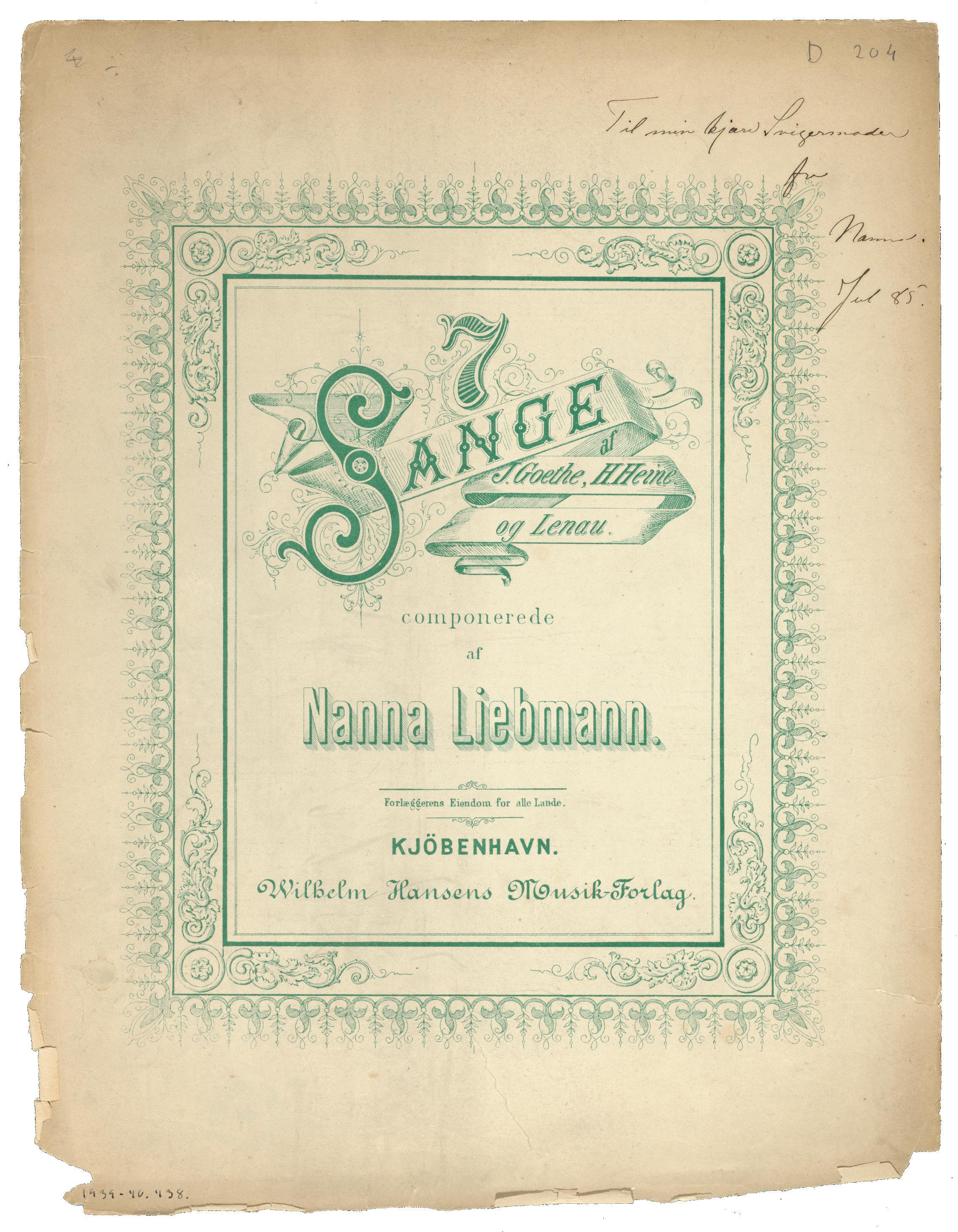
Forside til Syv sange (kilde A). I øverste højre hjørne ses Nanna Liebmanns hilsen til sin svigermor.
The front page of Seven Songs (Source A). A greeting from Nanna Liebmann to her mother-in-law is written in the top right corner.
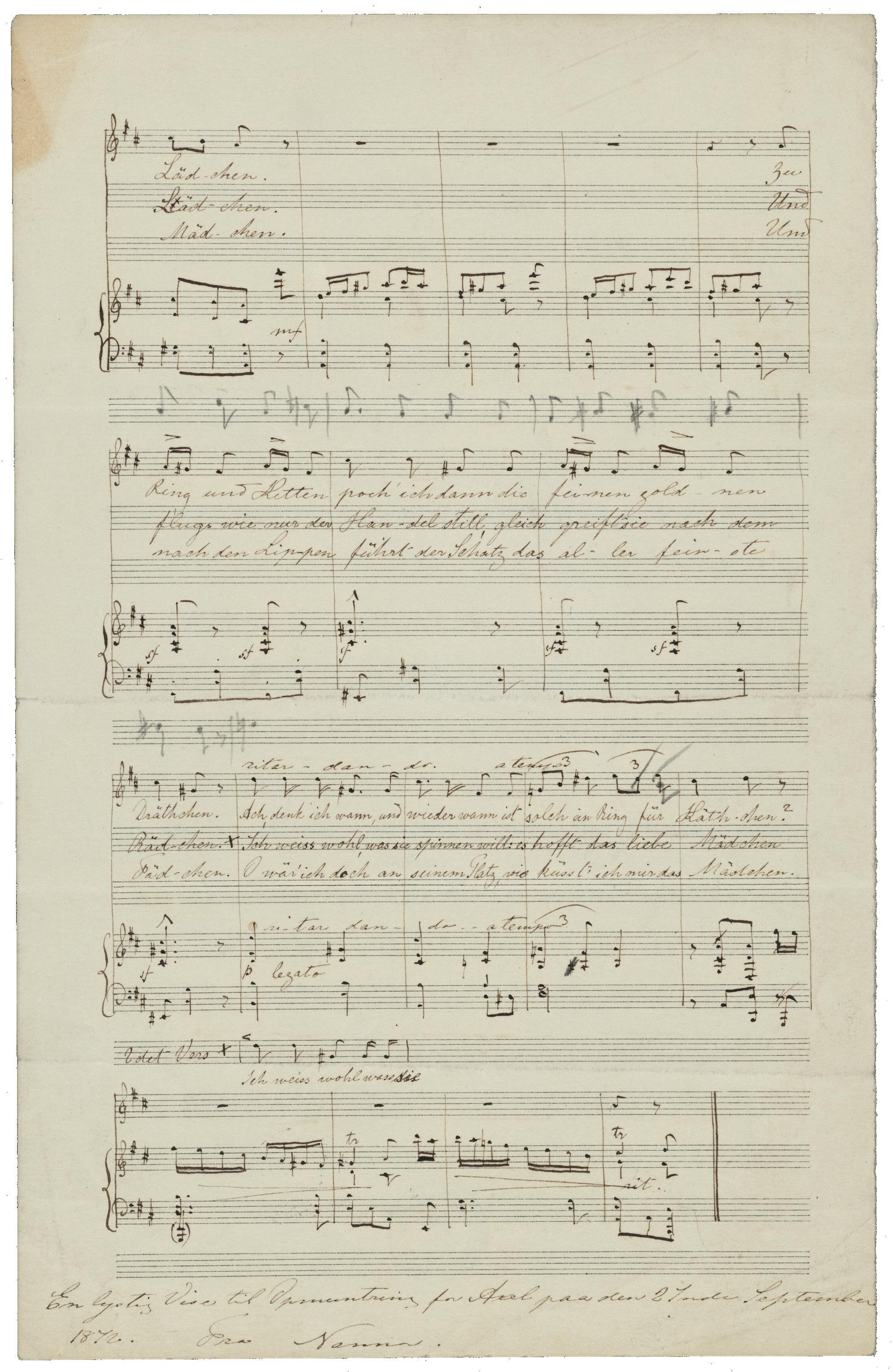
Anden nodeside af “Der Goldschmiedsgesell” (kilde B). En dedication til Axel Liebmann ses nederst på siden.
Second page of “Der Goldschmiedsgesell” (source B). A dedication to Axel Liebmann is written at the bottom of the page.
Tek st : Heinrich Heine
liebt sich so lieb lich im Len ze! Am Flus se sitzt
Nanna Liebmann
liebt sich so lieb lich im Len ze! Die Schä fe rin seufzt aus tie fer Brust:
Nanna Liebmann: Sy v sange - 1
Hu tes Sie weint und wirft in den glei ten den Fluss die schö nen Blu men
A ndante espressivo
Tek st : Nikolaus Lenau
Schö Horch, A ne o ber Sen Mäd einst, nin, chen wie noch wie Al ein dein les 1 2 3
mal Sang flieht, sin in schei ge die dest dei Brust du nen den mit Ruf Ber dei in’s gen nem Thal, drang, Lied, dass wie wenn die dein dich
fro
Wort
Lie he die be Fel Fel fort sen sen be spra see wo che len gen, dei freu o nem dig der hel fort dich len und der Ruf fort Tod er er ent wa zäh zo
Nanna Liebmann: Sy v sange - 4
Nanna Liebmann: Sy v sange - 5
Tek st : Johann Wolfgang von Goethe
An dem rein bot sten ihr Früh für lings ein mor Mäul gen chen ging zwey, die drey
Schä
Schäf fe chen rin gleich und am sang, Ort, jung schalk und haft schön blick und te
Bän der und der drit te bot sein Herz; doch sie trieb mit
Tek st : Johann Wolfgang von Goethe
Nanna Liebmann: Sy v sange - 8
süss. Und ich sag te: bla se wie der! und der gu te Jun ge blies,
Vivace non troppo
5. Der G oldschmiedsgesell
Tek st : Johann Wolfgang von Goethe
Es Und Das ist thut klei doch sie ne mei erst Füss ne die chen Nach Schal tritt ba tern und rin auf, tritt; ein da da
al kommt denk’ ler das ich lieb gan mir stes ze das Mäd Städt Wäd chen! chen, chen, Wie und das früh feilscht Strumpf ich und band in wirbt denk’ der mit ich Werk hel auch statt lem wohl bin, Hauf mit, blick’ um’s ich
ich Al schenkt’s nach ler dem ih lei lie rem im ben Läd Läd Mäd chen chen. chen. 9
Nanna Liebmann: Sy v sange - 11
Zu Und Und Ring’ flugs, nach und wie den Ket nur Lip te der pen poch’ Han führt ich del der dann still, Schatz die gleich das fei greift al nen sie ler gold nach fein nen dem ste Dräht Räd Fäd chen chen chen
Ach, Ich O denk’ weiss wär ’ ich ich wann, wohl, doch was und sie an wie spin sei der, nen nem wann, will: Platz, ist es wie solch hofft küsst’ ein das ich Ring lie mir für be das Käth Mäd Mäd chen? chen chen!
6. L enz
Tek st : Nikolaus Lenau
Die Bäu me blühn, die Vög lein sing en, die Wie sen bring en ihr
Tek st : Johann Wolfgang von Goethe
Ich
Dann Dann bin ist ist der der der wohl gut viel be ge ge kann laun wand te te te Sän Sän Sän ger, ger ger der mit ge viel un le ge ter gent rei auch lich ste ein ein Rat Kin Mäd ten der chen fän fän fän ger, ger, ger;
den der in die selbst kei se die nem alt wil Städt be de chen rühm sten langt te be er Stadt zwingt, an, ge wenn wo wiss er er ’s be die nicht son gold man ders nen cher nö Mär an thig chen ge hat; singt than und Und Und
wä wä wä ren’s ren ren Rat Kna Mäd ten ben chen noch noch noch so so so vie trut blö le, zig, de, und und und wä wä wä ren’s ren ren Wie Mäd Wei sel chen ber mit noch noch im so so Spie stut sprö le, zig, de, von in doch
Nanna Liebmann: Sy v sange - 15
al mei al len ne len säubr ’ Sai wird ich ten so die greif ’ lie sen ich be Ort, ein, bang sie sie bei müs müs Zau sen sen ber mit al sai ein le ten an hin und der ter Ge fort drein sang
Description of Sources
A Printed score, first edition with dedication
B Manuscript score, autograph.
A Printed score, first edition with dedication
DKKk, Royal Danish Library (Musiksamlingen). D204 1939-40.438
7 Sange af J. Goethe, H. Heine og Lenau.
København: Wilhelm Hansens Musik-Forlag (1885).
Title page: “7 Sange / J.Goethe, H.Heine / og Lenau. / componerede / af / Nanna Liebmann. / Forlæggerens Eiendom for alle Lande. / Kjöbenhavn. /Wilhelm Hansens Musik-Forlag.”
Ed og Pl.nr: 9288.
35x27.9 cm. 4 bifolios with 13 paginated pages, pp. 2–4.
fol.1r: “Til min kjære Svigermoder / fra / Nanna. / Jul 85.” top left corner, written in ink.
fol.1r: “1939-40.438” lower right corner, written in ink.
B Manuscript score, autograph.
DKKk, Royal Danish Library (Musiksamlingen), C II, 10 Axel Liebmanns samling 13.
[Efterladte Kompositioner og Udkast III], [Diverse skitser] / Nanna Liebmann.
White folder titled: “Nanna Liebmann / Kompositioner og Udkast”. Written in ink with additions in pencil.
34.6x25.8 cm. 1 unpaginated bifolio with 2 pages.
Commentary on the Edition
The lyrics to “Frühling” are by Heinrich Heine from the poem collection Neue Gedichte 1 This edition follows Liebmann’s spelling.
Editorial Emendations and Alternative Readings
Bar Part Comment
4 voice “da-hin es” emended to “da-hin – es” as in B
19 voice “!” emended to “?” as in B
29 voice notes 1–2: cresc dec added as in B and by analogy with b. 10
Description of Sources
A Printed score, first edition with dedication
B Draft in pencil
C Manuscript score, autograph
A Printed score, first edition with dedication DKKk, Royal Danish Library (Musiksamlingen). D204 1939-40.438
7 Sange af J. Goethe, H. Heine og Lenau. København: Wilhelm Hansens Musik-Forlag (1885).
1 Heinrich Heine, “191. Frühling” i Neue Gedichte (Hamborg: bei Hoffmann und Campe, 1844), 198. https://archive.org/details/bub_gb_VJQ6AAAAcAAJ/page/n5/mode/2up?q=die+wellen (accessed 24 September 2025).
Title page: “7 Sange / J.Goethe, H.Heine / og Lenau. / componerede / af / Nanna Liebmann. / Forlæggerens Eiendom for alle Lande. / Kjöbenhavn. /Wilhelm Hansens Musik-Forlag.”
Ed og Pl.nr: 9288.
35x27.9 cm. 4 bifolios with 13 paginated pages, p. 5.
fol.1r: “Til min kjære Svigermoder / fra / Nanna. / Jul 85.” top left corner, written in ink.
fol.1r: “1939-40.438” lower right corner, written in ink.
B Draft in pencil
DKKk, Royal Danish Library (Musiksamlingen), C II, 10 Axel Liebmanns samling 13.
[Efterladte Kompositioner og Udkast III], [Diverse skitser] / Nanna Liebmann.
White folder titled: “Nanna Liebmann / Kompositioner og Udkast”. Written in pencil.
34.6x25.8 cm. 1 sheet paper with 1 page.
C Manuscript score, autograph
DKKk, Royal Danish Library (Musiksamlingen), C II, 10 Axel Liebmanns samling 13.
[Efterladte Kompositioner og Udkast III], [Diverse skitser] / Nanna Liebmann.
White folder titled: “Nanna Liebmann / Kompositioner og Udkast”. Written in ink with additions in pencil.
30.9x18.5 cm. 1 unpaginated bifolio with 2 pages.
fol.1v: “Den 5 te Januar 1881” top right corner, written in ink. fol.2r: 3th and 4th verses written after last bar in ink.
Commentary on the Edition
The lyrics to “Die Sennin” are by Nikolaus Lenau. This edition follows Liebmann’s spelling.
An edition of “Die Sennin” (identical to A) appears in SangAlbum af nordiske Kvinder, a collection of works for voice and piano by Nordic female composers, published on the occasion of Kvindernes Udstilling (the Women’s Exhibition) in Copenhagen in 1895. Liebmann served as chair of the music committee and was also deeply involved in the creation of the songbook.
C has an extra bar in the prelude. The pencil draft (B) is closer to A than the manuscript written in ink (C).
C (especially pf.2) includes many erasures and corrections and an extra bar in the prelude. These corrections were incorporated into B. Thus, C is a precursor to B.
Editorial Emendations and Alternative Readings
Bar Part Comment
14 pf.2 upper part, notes 1–8: slur added by analogy with pf.1
Description of Source
A Printed score, first edition with dedication
DKKk, Royal Danish Library (Musiksamlingen). D204 1939-40.438
7 Sange af J. Goethe, H. Heine og Lenau. København: Wilhelm Hansens Musik-Forlag (1885).
Title page: “7 Sange / J.Goethe, H.Heine / og Lenau. / componerede / af / Nanna Liebmann. / Forlæggerens Eiendom for alle Lande. / Kjöbenhavn. /Wilhelm Hansens Musik-Forlag.”
Ed og Pl.nr: 9288.
35x27.9 cm. 4 bifolios with 13 paginated pages, pp. 6–7.
fol.1r: “Til min kjære Svigermoder / fra / Nanna. / Jul 85.” top left corner, written in ink.
fol.1r: “1939-40.438” lower right corner, written in ink.
Commentary on the Edition
The lyrics to “Die Spröde” are by Johann Wolfgang von Goethe. 2 This edition follows Liebmann’s spelling.
Editorial Emendations and Alternative Readings
Bar Part
2–3
pf.
Comment
cresc (beginning on b. 2, note 2 and ending on b. 2, note 4) emended to end on b. 3, note 1 by analogy with voice
10 voice comma added after “klang” (verse 1) and “fort” (verse 2) by analogy with b. 23 14 pf.1 up-stemmed part, note 1: @^ added by analogy with bb. 13 and 26 15–16 voice
cresc (beginning on b. 15, note 2 and ending on b. 15, note 4) emended to end on b. 16, note 1 by analogy with b. 3 15–16 pf.
22 voice
Description of Sources
cresc (beginning on b. 15, note 1 and ending on b. 15, note 4) emended to span from b. 15, note 2 to b. 16, note 1 by analogy with voice
cresc (beginning on first semiquaver and ending on forth semiquaver) emended to end on first crochet by analogy with pf. and b. 9
A Printed score, first edition with dedication
B Draft in pencil
A Printed score, first edition with dedication
DKKk, Royal Danish Library (Musiksamlingen). D204 1939-40.438
7 Sange af J. Goethe, H. Heine og Lenau.
København: Wilhelm Hansens Musik-Forlag (1885).
Title page: “7 Sange / J.Goethe, H.Heine / og Lenau. / componerede / af / Nanna Liebmann. / Forlæggerens Eiendom for alle Lande. / Kjöbenhavn. /Wilhelm Hansens Musik-Forlag.”
Ed og Pl.nr: 9288.
35x27.9 cm. 4 bifolios with 13 paginated pages, pp. 8–9.
fol.1r: “Til min kjære Svigermoder / fra / Nanna. / Jul 85.” top left corner, written in ink.
fol.1r: “1939-40.438” lower right corner, written in ink.
B Draft in pencil
DKKk, Royal Danish Library (Musiksamlingen), C II, 10 Axel Liebmanns samling 13.
[Efterladte Kompositioner og Udkast III], [Diverse skitser] / Nanna Liebmann.
White folder titled: “Nanna Liebmann / Kompositioner og Udkast”. Written in pencil.
34.6x25.8 cm. 1 unpaginated bifolio with 2 pages.
2 Johann Wolfgang von Goethe, “Die Spröde” i Goethe’s Werke (Stuttgart: J.G. Cotta’sche Buchhandlung,1816): 21. https://viewer.onb. ac.at/10799F82/ (accessed 24 September 2025).
Commentary on the edition
The lyrics to “Die Bekehrte” are by Johann Wolfgang von Goethe. 3 This edition follows Liebmann’s spelling.
B has no prelude and is consequently one bar shorter than A
Editorial Emendations and Alternative Readings
Bar Part
4 voice
9 pf.1
Comment
B: p
A: upper part, note 1: n added in ink
11 pf.2 note 1–8: slurs added by analogy with b. 2
13 voice
18 pf.1
B: p
A: upper part, note 1: n added in ink
18–19 voice dec (beginning on b. 18, note 4 and ending on b. 19, note 1) added by analogy with bb. 9–10
27 pf.1
A: upper part, note 1: n added in ink
Description of Sources
A Printed score, first edition with dedication
B Manuscript score, autograph.
A Printed score, first edition with dedication
DKKk, Royal Danish Library (Musiksamlingen). D204 1939-40.438
7 Sange af J. Goethe, H. Heine og Lenau.
København: Wilhelm Hansens Musik-Forlag (1885).
Title page: “7 Sange / J.Goethe, H.Heine / og Lenau. / componerede / af / Nanna Liebmann. / Forlæggerens Eiendom for alle Lande. / Kjöbenhavn. /Wilhelm Hansens Musik-Forlag.”
Ed og Pl.nr: 9288.
35x27.9 cm. 4 bifolios with 13 paginated pages, p. 10.
fol.1r: “Til min kjære Svigermoder / fra / Nanna. / Jul 85.” top left corner, written in ink.
fol.1r: “1939-40.438” lower right corner, written in ink.
B Manuscript score, autograph.
DKKk, Royal Danish Library (Musiksamlingen), C II, 10 Axel Liebmanns samling 13.
[Efterladte Kompositioner og Udkast III], [Diverse skitser] / Nanna Liebmann.
In black folder with music theory exercises by Nanna and Axel Liebmann. Written in ink with additions in pencil.
20.5x13.4 cm. 1 sheet paper with two pages.
fol.1v: “En lystig Vise til Opmuntring for Axel paa den 27nde September / 1872. Fra Nanna.” after last bar, written in ink.
The lyrics to “Der Goldschmiedsgesell” are by Johann Wolfgang von Goethe. 4 This edition follows Liebmann’s spelling except for one instance, described in the editorial emendations below.
Source B is dedicated to her husband (fiancé at the time), Axel Liebmann, and is dated 1872.
3 Johann Wolfgang von Goethe, “Die Bekehrte” i Goethe’s Werke. (Stuttgart: J.G. Cotta’sche Buchhandlung,1816): 22. https://viewer.onb. ac.at/10799F82/ (accessed 24 September 2025).
4 Johann Wolfgang von Goethe, “Der Goldschmiedsgesell” i Goethe’s Werke. (Stuttgart: J.G. Cotta’sche Buchhandlung,1816): 27. https://viewer. onb.ac.at/10799F82/ (accessed 24 September 2025).
There are 13 years between sources A and B, and they differ in many respects. B is 26 bars long and contains no volta brackets. In B, bb. 11–19, the piano accompaniment is completely different compared to A and the melody is altered in bb. 14–18. There have most likely been other versions between A and B that have not been preserved.
Editorial Emendations and Alternative Readings
Bar Part
6 pf.1
Comment
upper part, notes 1–3: slur (beginning on note 1 and ending on note 2) emended to end on note 3 by analogy with voice
6 pf.2 upper part, notes 1–3: slur (beginning on note 1 and ending on note 2) emended to end on note 3 by analogy with voice
9 voice notes 1–2: slur added by analogy with b. 5 and pf.1, upper part
10 pf.1 lower part, note 4: �� erased as in B
12 pf.1 �� erased by analogy with b. 10
18 voice “Dräthchen” emended to “Drähtchen” by analogy with original poem 5
21 pf.2 upper part, note 2: d added by analogy with b. 20 and to regularise bar
6. Lenz
Description of Sources
A Printed score, first edition with dedication
B Draft in pencil
A Printed score, first edition with dedication
DKKk, Royal Danish Library (Musiksamlingen). D204 1939-40.438
7 Sange af J. Goethe, H. Heine og Lenau.
København: Wilhelm Hansens Musik-Forlag (1885).
Title page: “7 Sange / J.Goethe, H.Heine / og Lenau. / componerede / af / Nanna Liebmann. / Forlæggerens Eiendom for alle Lande. / Kjöbenhavn. /Wilhelm Hansens Musik-Forlag.”
Ed og Pl.nr: 9288.
35x27.9 cm. 4 bifolios with 13 paginated pages, p. 11.
fol.1r: “Til min kjære Svigermoder / fra / Nanna. / Jul 85.” top left corner, written in ink.
fol.1r: “1939-40.438” lower right corner, written in ink.
B Draft in pencil
DKKk, Royal Danish Library (Musiksamlingen), C II, 10 Axel Liebmanns samling 13.
[Efterladte Kompositioner og Udkast III], [Diverse skitser] / Nanna Liebmann.
White folder titled: “Nanna Liebmann / Kompositioner og Udkast”. Written in pencil.
34.6x25.8 cm. 1 unpaginated bifolio with 2 pages.
Commentary on the edition
The lyrics to “Lenz” are by Nikolaus Lenau. This edition follows Liebmann’s spelling.
Editorial emendations and alternative readings
Bar Part Comment
4 pf.1 �� (after first chord (a, c′, f ′ )) erased to regularise bar
5 Johann Wolfgang von Goethe, “Der Goldschmiedsgesell” i Goethe’s Werke. (Stuttgart: J.G. Cotta’sche Buchhandlung,1816): 27. https://viewer. onb.ac.at/10799F82/ (accessed 24 September 2025).
Description of Sources
A Printed score, first edition with dedication
B Manuscript score, autograph in pencil
C Manuscript score, autograph
A Printed score, first edition with dedication
DKKk, Royal Danish Library (Musiksamlingen). D204 1939-40.438
7 Sange af J. Goethe, H. Heine og Lenau.
København: Wilhelm Hansens Musik-Forlag (1885).
Title page: “7 Sange / J.Goethe, H.Heine / og Lenau. / componerede / af / Nanna Liebmann. / Forlæggerens Eiendom for alle Lande. / Kjöbenhavn. /Wilhelm Hansens Musik-Forlag.”
Ed og Pl.nr: 9288.
35x27.9 cm. 4 bifolios with 13 paginated pages, pp. 12–13.
fol.1r: “Til min kjære Svigermoder / fra / Nanna. / Jul 85.” top left corner, written in ink.
fol.1r: “1939-40.438” lower right corner, written in ink.
B Manuscript score, autograph in pencil
DKKk, Royal Danish Library (Musiksamlingen), C II, 10 Axel Liebmanns samling 13.
[Efterladte Kompositioner og Udkast III], [Diverse skitser] / Nanna Liebmann.
White folder titled: “Nanna Liebmann / Kompositioner og Udkast”. Written in pencil.
34.6x25.8 cm. 1 sheet paper with 1 page.
C Manuscript score, autograph
DKKk, Royal Danish Library (Musiksamlingen), C II, 10 Axel Liebmanns samling 13.
[Efterladte Kompositioner og Udkast III], [Diverse skitser] / Nanna Liebmann.
In black folder with music theory exercises by Nanna and Axel Liebmann. Written in ink with additions in pencil.
20.5x13.4 cm. 1 sheet paper with two pages. fol. 1v: “Hellerup. Den 23nde September 1872 / Til Axel.” after last bar, written in ink.
Commentary on the edition
The lyrics to “Der Rattenfänger” are by Johann Wolfgang von Goethe. 6 This edition follows Liebmann’s spelling.
Source C is dedicated to her husband (fiancé at the time), Axel Liebmann, and is dated 1872.
The pencil draft (B) is closer to A than the manuscript written in ink (C). C includes some corrections in the piano part, and these corrections were incorporated into B. Thus, C is a precursor to B.
There are 13 years between A and C (B is not dated).
Editorial emendations and alternative readings
Bar Part Comment
12 pf.1 arpeggio added to dotted crotchet-chord by analogy with b. 11
6 Johann Wolfgang von Goethe, “Der Rattenfänger” i Goethe’s Werke (Stuttgart: J.G. Cotta’sche Buchhandlung,1816): 202–203. https://viewer.onb. ac.at/10799F82/ (accessed 24 September 2025).