
Year Three Maths

Page 1


PRACTICAL ACTIVITIES TO SUPPORT YOUR CHILD AT HOME

Year Three Mathematics

Can you tell the time?

Whenever possible, ask your child to tell you the time to the nearest minute. Use a clock with hands as well as a digital watch or clock. Also ask:

What time will it be one hour from now? What time was it one hour ago? Time your child doing various tasks, e.g. getting ready for school; tidying a bedroom; saying the 5 times, 10 times or 2 times table

Ask your child to guess in advance how long they think an activity will take. Can they beat their time when they repeat it?

Cupboard Maths

Ask your child to help you sort a food cupboard out, putting heavier items on the lower shelf and lighter items on an upper shelf.

Can they put them in order of weight whilst sorting?

Look at the units of measurement used and discuss them. Let them feel the weight of a Kg, 250g etc.

Board Games

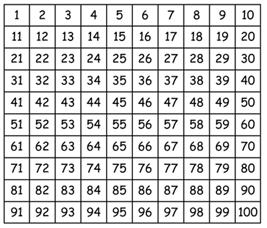
For these games you need to sketch a board like this.

Notice how the numbers are arranged.

Start on 1. Toss a coin. If it lands heads, move 1 place along. If it lands tails, add 10, saying the total correctly before moving. First person to reach the bottom row wins.

Start anywhere on the board. Roll a dice. Even numbers move you forwards and odd numbers move you backwards. If you land on a multiple of five, you can move either 10 forwards or 10 backwards. The first person to reach either the top or bottom of the board wins.

Order, Order!

Each player should draw 6 circles in a row. Take turns to roll two dice and make a two-digit number. Write the number in one of your circles. Once the number is written in a circle you cannot change it or move it!

The first to fill all six of their circles with numbers in increasing order from left to right wins.

Secret Sums

Ask your child to say a number, e.g. 43.

Secretly do something to it (e.g. add 30). Say the answer, e.g. 73. The child then says another number to you, e.g. 61.

Do the same to that number and say the answer. E.g. 91

The child has to guess what you are doing to the number each time!

Then they can have a turn at secretly adding or subtracting something to each number that you say to them.

Lunch Number Crunch!

Gather together the ingredients needed to make a favourite sandwich or snack lunch. Look at how much of each is needed t make the lunch for one person. How much would be needed for 2 people, a family of 4?

This can be made more tricky by looking at specific recipes with more compacted ingredient measurements and units of measurement.

Money Matters

When you go shopping see if your child can work out how much change they would receive when buying an item costing less than a pound. Can they then add up the cost of 2 items and work out the change from either £1, £2 or £5?

Turn static files into dynamic content formats.

Create a flipbook