"Io e l'Asma", a clinical asthma management programme developed over a period of ten years, implementing international guidelines into daily practice Sebastiano Guarnaccia, Mariateresa Chiarini, Alessandro Gaffurini, Andrea Lombardi, Emanuele D'Agata, Giusy Boldini, Adriana Boldi, Raffaele Spiazzi S. Guarnaccia (sebastiano.guarnaccia@spedalicivili.brescia.it) Centro “Io e l‟Asma”, Laboratorio Clinico Pedagogico e Ricerca Biomedica, Spedali Civili, Brescia, Italy www.ioeasma.it
AIMS To analyse the evolution and the adherence of the “Io e l'Asma” programme implementing International Asthma Guidelines based on the clinical pathway for children over a period if ten years. STUDY PROGRAM 1999−2002 The pulmonologist is the sole responsible for all aspects of the management: diagnosis , therapy, education and follow−up. The primary care physician and the nurse are merely supportive. An educational book and a CD−ROM are made available for patients and families.
1999-2002
2003−2005 A holistic approach is developed with a team of specialists (pulmonologist, resident, nurse, clinical pedagogue, web−engineer) working on its own without co−ordination or a shared plan. A diagnostic therapeutic protocol based on the International Guidelines is developed with primary care physicians.
2003-2005
2006−2008 All team members now create a framework following a sheduled diagnostic−therapeutic− clinical pathway (basis: 3 specialist visits at 0, 6−8, 12−16 weeks, followed by 6−monthly visits).
2006-2008
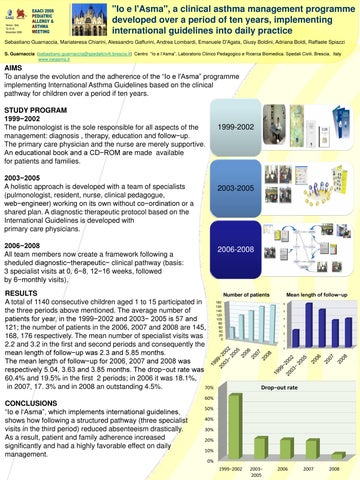
RESULTS A total of 1140 consecutive children aged 1 to 15 participated in the three periods above mentioned. The average number of patients for year, in the 1999−2002 and 2003− 2005 is 57 and 121; the number of patients in the 2006, 2007 and 2008 are 145, 168, 176 respectively. The mean number of specialist visits was 2.2 and 3.2 in the first and second periods and consequently the mean length of follow−up was 2.3 and 5.85 months. The mean length of follow−up for 2006, 2007 and 2008 was respectively 5.04, 3.63 and 3.85 months. The drop−out rate was 60.4% and 19.5% in the first 2 periods; in 2006 it was 18.1%, in 2007, 17. 3% and in 2008 an outstanding 4.5%. 70% CONCLUSIONS “Io e l„Asma”, which implements international guidelines, shows how following a structured pathway (three specialist visits in the third period) reduced absenteeism drastically. As a result, patient and family adherence increased significantly and had a highly favorable effect on daily management.
Mean length of follow−up
Number of patients 180 160 140 120 100 80 60 40 20 0
6 5 4 3 2 1 0
Drop−out rate
60% 50% 40% 30% 20% 10% 0% 1999−2002
2003− 2005
2006
2007
2008