Creating a win-win situation for homeowners and boards PAGE 16
SERVING HOA BOARD MEMBERS & HOMEOWNERS
THE RISING COST OF INACTION
How industry trends are elevating capital planning PAGE 22
ECHO LEGISLATION TRACKER
Outline of HOA-related bills in this legislative session PAGE 31
MARCH 2026
When
“Open
to the Public” Changes Everything
TAILORED MANAGEMENT SOLUTIONS
The Next Generation of Community Management
We deliver financial intergrity, proactive planning, transparent reporting and responsive communication.
Community association management is evolving. The industry is experiencing a shift, and a new generation of management entrepreneurs is emerging—focused on relationships, innovation, and purposeful growth. We are not reinventing the wheel. We are building upon it.
Across the East Bay and greater Bay Area, boards are seeking more than just management—they are seeking partnership, accessibility, and leadership that understands the unique fabric of their communities.
Tailored Management Solutions was founded on over two decades of senior-level experience with a mission to restore the personal touch in HOA management. As a private, boutique firm headquartered in Concord, we are deeply rooted in the communities we serve. We believe management should feel like a partnership among neighbors—not an impersonal transaction with revolving doors.
A Smaller Firm with a Modern Foundation
Strength comes from intentional growth, guided by strategy rather than size.
Our lean structure allows us to remain agile, responsive, and fully engaged. Through controlled growth and a carefully selected portfolio, we ensure each community receives direct oversight and personalized attention. Our team is growing thoughtfully— cross-trained, collaborative, and committed to quality over quantity.
At the same time, we embrace innovation. With Vantaca as our technology platform, homeowners and board members enjoy secure 24/7 access to accounts, documents, and management tools. We pair high-touch service with modern systems—bringing together tradition and technology to meet today’s expectations.
Experience That Drives Confidence
Founder Maria Hernandez, MCAM, CCAM-PM, brings 20 years of experience managing large-scale and diverse communities. As a certified member of CACM and ECHO, and one of the few managers in California to earn the Master of Community Association Management designation, her leadership reflects both expertise and forward-thinking vision.
Today’s boards face increasing financial, operational, and regulatory complexities. Our role is to deliver financial integrity, proactive planning, transparent reporting, and responsive communication—helping boards lead with clarity and confidence.
Tailored Management Solutions is committed to remaining private, boutique, and community-centered— driving our careers forward just as our predecessors once did, while shaping the future of HOA management in the Bay Area.
To learn how Tailored Management Solutions can support your community, call us at 925-459-5535 or visit tailoredmanagementsolutions.com to schedule a consultation.
Maria Hernandez, MCAM, CCAM-PM, COO 2322 Bates Avenue, Ste. G Concord, CA 94520
Fostering a better quality of life in community associations through education, advocacy and networking.
Echo 5669 Snell Ave., #249 San Jose, CA 95123 408.297.3246 | info@echo-ca.org www.echo-ca.org
BOARD OF DIRECTORS & OFFICERS
PRESIDENT
Mark T. Guithues, Esq.
VICE
PRESIDENT
Sarah Dunia
TREASURER
Karl Lofthouse
SECRETARY
Jessica Roberts
DIRECTORS
Brian Campisi
Rolf Crocker
John Gill, Esq.
Adam Haney
David Levy
Nathan McGuire, Esq.
Ali Nekumanesh
Louis J. Sarmiento, Esq.
Bridgette Tabor
EMERITUS BOARD MEMBER
David Hughes
BENEFACTOR MEMBERS
Donald W. Haney, CPA CID Consortium, LLC
Paul Collins Collins Management
CHIEF EXECUTIVE OFFICER
David Zepponi | dzepponi@echo-ca.org
OPERATIONS MANAGER
Connor Zepponi | connor@echo-ca.org
MEMBERSHIP & SALES MANAGER
Jacqueline Price | jprice@echo-ca.org
MEMBERSHIP DEVELOPMENT MANAGER
Leila Saeed | lsaeed
PUBLICATIONS EXPEDITOR
Pam Grove | pgrove@echo-ca.org
MEMBER ENGAGEMENT COORDINATOR
Jared Giguere | jared@echo-ca.org
The Echo Journal is published quarterly by the Executive Council of Homeowners (Echo). The views of authors expressed in the articles herein do not necessarily reflect the views of Echo. We assume no responsibility for the statements and opinions advanced by the contributors to the magazine. It is released with the understanding that the publisher is not engaged in rendering legal, accounting or other professional service. If legal advice or other expert assistance is required, the services of a competent professional should be sought.
Acceptance of advertising does not constitute any endorsement or recommendation, expressed or implied, of the advertiser or any goods or services offered. We reserve the right to reject any advertising copy or image.
Echo member information is never released to any outside individual or organization, unless agreed to by the member.
HOA Education On Demand!
Get more from your Echo membership
Echo members have exclusive access to our entire library of HOA-focused educational programming including Community Conversations, Educational Seminars, Workshops, Ask the Attorneys, and Ask the Experts.
The presentations referenced below are a sampling of what is available to our valuable members. Click a title to watch!
Amending and Restating Governing Documents
Is Your HOA Ready for EV Charging?
Navigating Insurance Challenges in California
Non-Functional Turf & Water Conservation
Ask the Experts: Construction and Maintenance
Discrimination: Cultural Sensitivity & Reasonable Accommodations
All Things Paving
Privacy, Cameras, & Recordings ... What Can We Do?
ZEPPONI
Board Elections Establish Strategic Direction
Well, it’s that time of year again – we’re talking about electing new leadership in our communities. Directors should be elected for the various skills and attributes they bring to the board. Chief among them is the ability to think strategically. To do this, directors must have a keen understanding of the mission and vision of the HOA. If none exists, a director must have their own mission and vision for the community. And directors should stay focused on these even though boards are often weighed down by operational details and trivial matters. A strong board executive should provide clear direction for management, have the confidence to delegate projects and tasks while letting managers manage, and provide oversight of work to ensure that projects and tasks progress according to plan and are completed to the satisfaction of the board and community.
Raison d’Etre – The Reason for Boards
legislature, in its inimical way, has tried to make the election process fair, clear, and efficient but has only mucked it up and made elections a messy and uncertain process for HOAs. So much so, in fact, that lawmakers have created an entirely new profession dedicated to untangling the election process.
Inspectors of elections (IOEs) are professionals who focus on election process compliance and help HOAs navigate the challenges of selecting new board directors.
What a beautiful phrase, raison d’etre (reason for being). It is a every board member should consider and collectively agree. The phrase engenders humanity. The words roll from one’s tongue. stark business senses and adds the element of humanity to the a board: Strategic planning, execution and evaluation; mission management. The business realities should be reflective of community common values of individuals in the community.
The board’s job is to look after the big picture while ensuring progress at the operational level. They should be vigilant about the long-range vision for the community. This means that the board provides strategic direction for the safe enjoyment of the community by its residents and homeowners, establishes and defends neighborhood norms, and maintains individual and community property values. Accordingly, the role of the board director is to execute plans and actions for the longrange benefit of the association and its members while orchestrating the short-term operational management of projects and tasks.
Communities are imperfect – because they are made of humans. relating. Humans using. Human living. Basically, humans being being human, communities sometimes forget that management establish norms for a successful community. In a sense, the board the community. Its purpose is to establish order and elevate or progress and pace by establishing norms and constraints to balance to benefit all.
It is my strong suggestion that HOA boards avail themselves of the services offered by IOEs. Minor mistakes in the election of directors can result in multiple delays and disharmony in any community. A volunteer board should rely on an IOE for their HOA election expertise. An IOE will help an HOA prepare for an election and stay on schedule according to the legal requirements. If the board is ever challenged, then the IOE is responsible and should be able to answer any questions. If something goes wrong, the IOE is responsible for corrections.
It seems apparent that board leadership must understand and owners in order to orchestrate a sense of community and generate and protect community values. The purpose of a board, therefore, build community based on common values for the good of all.
It takes time to orchestrate a community. It takes time to know your time to listen to the voices and build a vision reflective of community and you will be more effective as a board member and satisfied your reason for being on the board.
Hopefully the election process is going well and is not too stressful. It seems that many (but not most) HOAs struggle with the election process and outcomes. This is because the HOA election process is anything but straightforward. And the
As experts, the IOE’s job is to make sure the process goes well and is in compliance with the laws and the HOA’s governing documents. In their role, IOEs have legions of practical experience working on many association elections and fielding their questions and concerns. Additionally, they must stay abreast of complex laws affecting HOA elections. The IOE can and should answer homeowner and candidate questions with authority and independence. Finally, if the board relies on the IOE, it minimizes the risk to the community and the
Continued on page 14
ECHO CHIEF EXECUTIVE OFFICER
David Zepponi Executive Director
ECHO is committed to helping homeowner boards and residents ing and advocacy – this is our “raison d’etre”.
2026 IN-PERSON & ONLINE EVENT CALENDAR
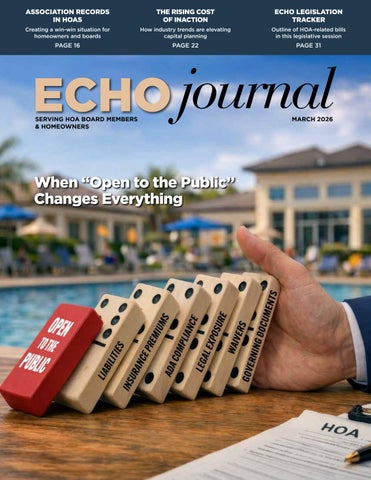
When “Open to the Public” Changes Everything: How Community Access Impacts Liability and Premiums
BY BRIDGETTE TABOR
When “Open to the Public” Is Not Open-and-Shut
Community associations are increasingly exploring the practice of using common areas for programs and activities that can benefit both residents and the public – for example, fitness classes, tennis instruction, wellness programs, pop-up events, etc. When thoughtfully implemented, these programs can enhance community engagement and quality of life. However, allowing residents to use common areas is quite different from allowing use by the public. Public use will expose an association to significant increased potential liability and risk.
From both an insurance and a governance standpoint, how a program is structured matters just as much as what the program is. Board members who understand this distinction are far better positioned to protect their associations – and fulfill their fiduciary duties.
Why Boards Are Tempted to Open Amenities to the Public
The appeal of allowing public access is understandable. Associations with competitive amenities – particularly those with large pools, tennis facilities, or premium fitness centers – sometimes consider opening select programs to nonresidents for several compelling reasons:
• Revenue generation. Fees from public participants can help offset maintenance costs or fund facility upgrades, especially in communities where amenity expenses strain operating budgets.
• Competitive positioning. In markets where prospective buyers compare communities, the ability to host swim meets, tennis tournaments, or community-wide events can differentiate an association from other communities and enhance perceived value.
• Community goodwill. Public events can foster positive relationships with neighboring communities and local organizations, creating a sense of civic engagement.
• Amenity utilization. In communities where certain facilities sit underused during specific hours or seasons, opening them to the public can seem like an efficient use of existing resources.
These motivations, while legitimate, must be carefully weighed against the potential liability and risk involved in allowing public access.
Why “Open to the Public” Raises Immediate Concerns
Most HOA insurance policies are underwritten and priced based on a fundamental assumption: The association’s facilities and activities serve a defined membership base. When activities are advertised or structured as “open to the public,” that assumption no longer applies. While communities that are not open to the public do not have to comply with the American Disabilities Act (ADA), once they are open to the public, compliance will likely be required.
From an insurance perspective:
• HOA common areas are not rated as public venues.
• “Free” or donation-based events do not reduce risk.
• Claims are more likely to involve third parties unfamiliar with the property.
Continued on page 10
Rachel Adams, CIC VP / Commercial Producer
As a result, insurance carriers may do the following:
• Require underwriting approval before coverage applies.
• Increase premiums or impose additional conditions.
• Require higher limits or additional insured endorsements.
• Exclude coverage for the activity altogether.
In practice, public access is one of the most common triggers for coverage disputes in community associations.
Instructor Insurance:
A Critical (But Often Misunderstood) Safeguard
Requiring instructors to carry insurance is standard practice, but coverage must be appropriate to the activity. Minimum best practices generally include these:
• Commercial general liability (CGL) insurance
• $1 million per occurrence / $2 million aggregate
• Association named as an additional insured
• Coverage that is primary and noncontributory
• Waiver of subrogation when available
A common mistake boards make is assuming that a certificate of insurance automatically means protection. Many instructor policies have limitations:
• Exclude group instruction
• Exclude public or nonmember participation
• Are written only for personal training
• Do not include the association as an additional insured
Certificates should be reviewed carefully, and requirements should align with the association’s own insurance carrier standards.
Waivers Help, But They Do Not Eliminate Liability
Participant waivers are useful tools, but they are often misunderstood.
Waivers can:
• Support assumption-of-risk defenses
• Deter marginal or nuisance claims
• Strengthen the association’s legal position
Waivers do not:
• Prevent lawsuits from being filed
• Bind spouses, heirs, estates, or insurers
• Eliminate defense costs or settlements
From the standpoint of claims, waivers reduce exposure; they do not eliminate it. Insurance carriers regularly defend and pay claims even when waivers are in place. Premises liability claims against HOAs – including slipand-fall incidents, pool accidents, and injuries in recreational areas – are among the most frequently litigated issues faced by community associations, often resulting in significant settlements or jury awards.
The Most Defensible Model: Board-Sponsored, MembersOnly Programs
The cleanest and most insurable approach is a boardsponsored program. Under this structure:
• The association sponsors the activity
• The association contracts directly with the instructor
• The board controls scheduling, enrollment, and communications
• Participation is limited to residents (and, if desired, accompanied guests)
• Activities are not marketed to the public
This model:
• Aligns with how HOA insurance is underwritten
• Minimizes liability exposure
• Reduces the likelihood of premium increases
• Provides strong protection under the business judgment rule
Why Public Classes Are Strongly Discouraged
Some associations do permit public participation, but they typically do so with the following conditions:
• Strict limits on marketing and resident involvement
Historically, this is where associations have experienced the most frequent claims and the most challenging coverage disputes.
Classes and programs can absolutely benefit a community, but these informal or well-intentioned arrangements often create unintended exposure
Remember:
• Board-controlled, members-only programs are the safest approach.
• Insurance carriers view public access as a materially higher risk.
• Instructor insurance must be properly structured and reviewed.
• Waivers help, but they do not prevent lawsuits.
• Resident-hosted or public programs significantly increase liability.
Thoughtful structure, clear policies, and coordination with legal and insurance professionals allow boards to support community engagement while protecting the association and helping them to fulfill their fiduciary responsibilities.
Why Mutual Benefit Corporations Should Not Open Facilities to Nonmembers
While the considerations outlined above apply to all homeowners associations, mutual benefit corporations face additional and more stringent restrictions when it comes to opening facilities to nonmembers.
A mutual benefit corporation is a nonprofit entity organized under state law specifically to provide benefits to its members. Unlike public benefit corporations or charitable organizations, mutual benefit corporations exist solely to serve their membership. This fundamental organizational structure creates legal and operational constraints
that make opening facilities to the public particularly problematic.
Corporate Purpose and Member-Only Benefit
The articles of incorporation and bylaws of a mutual benefit corporation typically define its purpose as serving the exclusive interests of its members. When a mutual benefit corporation opens its facilities to nonmembers, it may be acting outside the scope of its stated corporate purpose. This creates potential exposure to challenges from members who question whether the board is fulfilling its fiduciary duty to operate solely for member benefit.
Continued on page 12
Board Checklist: Questions to Ask Before Approving Classes or Programs
Before approving any instructional or fitness program, boards should be able to answer “yes” to the following:
Is this a board-approved, association-sponsored program?
Is participation limited to residents (or residents with guests)?
Is the activity clearly not open to the public?
Does the association contract directly with the instructor?
Has a written services agreement been reviewed and approved?
Does the instructor carry appropriate CGL coverage?
Is the association named as an additional insured?
Are participant waivers standardized and board-approved?
Has the association’s broker confirmed coverage in writing?
Has the board adopted a written policy governing these programs?
A consistent “yes” across this checklist significantly reduces risk.
Continued from page 11
Members of a mutual benefit corporation typically pay assessments or dues with the expectation that these funds will be used exclusively to maintain and operate facilities for member use. Allowing nonmembers to access these facilities –even for a fee – can be viewed as a breach of this understanding and may constitute a misapplication of member funds.
Tax-Exempt Status Concerns
Many mutual benefit corporations maintain taxexempt status under Section 501(c)(4) or 501(c) (7) of the Internal Revenue Code. These exemptions are predicated on the organization serving its members rather than conducting commercial activities or serving the public. Opening facilities to nonmembers, particularly on a regular or revenuegenerating basis, may jeopardize this tax-exempt status in the following ways:
• Creating unrelated business income that exceeds permissible thresholds
• Demonstrating a substantial nonmember benefit that conflicts with the organization’s exempt purpose
• Operating more like a commercial enterprise than a member benefit organization
Loss of tax-exempt status can result in significant tax liability, both retroactively and going forward, as well as potential penalties and the loss of other benefits associated with exempt status.
Member Equity and Fairness Issues
Members have a reasonable expectation that common facilities are maintained for their exclusive use and enjoyment. When nonmembers are permitted access:
• Members may experience increased crowding and reduced availability of amenities for which they have paid to use.
• Accelerated wear and tear may necessitate more frequent maintenance or earlier replacement, increasing costs borne by members.
• Security and privacy concerns may arise when unfamiliar individuals regularly access the property.
• The exclusivity that members paid for is diminished, potentially affecting property values.
These impacts can lead to member dissatisfaction, increased complaints, difficulty in
board elections, and, in extreme cases, member challenges to board decisions or even litigation.
Governing Document Restrictions
Most mutual benefit corporations have governing documents – including CC&Rs, articles of incorporation, and bylaws – that explicitly restrict facility use to members and their authorized guests. Opening facilities to the public may directly violate these provisions, creating legal exposure for the board and potentially voiding insurance coverage. Any board considering such a change would likely need to amend the governing documents, which typically requires a supermajority membership election. This is a difficult threshold to meet and a clear indication of the fundamental nature of this restriction.
The Bottom Line for Mutual Benefit Corporations
For mutual benefit corporations, the question is not merely whether opening facilities to nonmembers is advisable from a risk management perspective; it is whether doing so is consistent with the organization’s fundamental legal structure and obligations to its members. The combination of corporate purpose restrictions, tax implications, governing document limitations, and member equity concerns creates a strong legal and practical case for maintaining a strict members-only policy.
Boards of mutual benefit corporations should consult with legal counsel before implementing any program that would allow nonmember access to common facilities. In most cases, the prudent course is to maintain the members-only framework that forms the foundation of the organization’s legal and operational structure.
A commercial agent with LaBarre-Oksnee in Aliso Viejo, California, Bridgette Tabor has been a licensed insurance agent for 20 years. Prior to her career in insurance, Bridgette spent 20 years as a legal assistant for several large law firms. She obtained her insurance license in 2003 and moved from health insurance to property and casualty insurance in 2010, specifically focused on common interest developments. She now works to help individuals, businesses, and organizations protect their assets, manage risks, and navigate the complex world of insurance. In addition, she has served on the board of Scripps Ranch and on a national HOA industry association board.
Steven Roseman, Esq., of Roseman Law, APC, contributed to this article.
HOA Nuts, Bolts, and The Future
Planning for the future of an HOA is challenging, especially with the twists and turns of the economy and the legislature. Boards must manage the practical nuts and bolts of running an association and plan for the future. This interactive educational seminar will focus on project costing, options to finance, impacts of AI and technology on management, the rising tide of legislation and expectations for the future. In addition, there will be many professionals in attendance to answer your specific questions. This event has limited seating, so register early.
Northern California Educational Seminar June 13, 2026 | 9:00 am – 2:30 pm The Villages 5000 Cribari Lane, San Jose, CA 95135
Southern California Educational Seminar September 26, 2026 | 9:00 am – 2:30 pm
Laguna Hills Community Center 25555 Alicia Pkwy., Laguna Hills, CA 92653 www.echo-ca.org
board. It is smart business in a nonprofit HOA to put an expert between the board and the homeowner issues. Doing so protects the election process and the association from liability, and it adds confidence and trust in the election process.
As associations go into the election season, boards should find an IOE, start the election process early, be transparent in focusing on what is needed in community leadership, and engage your homeowners. Frequent and objective communication is the best medicine for a healthy election season.
Echo Call for Board of Director Applications
Echo has opened its annual election window and is calling for applications for candidates to serve on its board of directors. Echo does not have the same requirements as HOA elections under the DavisStirling Act, but it still must follow the California Corporations Code. Loosely, this means that Echo governing documents (such as election policy, bylaws, and articles of incorporation) define the fair process for the election of board directors.
Members interested in running for the Echo board are invited to apply via the online fillable form on the Echo website. One can review the application and requirements for board member service there, fill out the form, and submit it directly to Echo by July 31, 2026. The application form can be found at www.echo-ca.org/about-echo/; click on the dropdown menu under “About,” and click on “Echo Board Application.” Fill out the application and return it to me directly. If you have any trouble or have questions, please contact me for assistance.
The application process began February 1 and runs through July 31, 2026. All applications are initially reviewed by staff for eligibility. All applicants must be active members of Echo and support its mission and purpose. Individual Echo members from all categories of membership may apply for a position on the Echo board. However, only HOA community membership may vote in the election for board directors: one vote for each active Echo community membership.
Echo is a nonprofit, and serving on the board is a volunteer position. We do not reimburse expenses or time. Note that submission of an application does not guarantee acceptance as a candidate. Prospective applicants can find more information about the process on the application form (see above for details). For questions or clarifications, I can be reached at 408-816-1542 or by sending an email to dzepponi@echo-ca.org
Outlined below is the basic process for conducting an Echo board of directors election:
1. Echo receives the application.
2. Staff reviews the application to ensure eligibility (primarily membership).
3. The board meets to establish its leadership needs. These criteria are used to vet applicants. (June board meeting)
4. Using the board criteria, the Nominating Committee reviews and interviews the applicants and prepares a report for the board. (July and August)
5. The full board receives all applications and the candidate recommendation report from the Nominating Committee. At its August meeting, the board determines which applicants will be received as candidates for the election –or if the election is uncontested, the board will make the determination of an election by acclamation.
6. Candidate announcements are made public in September.
7. The multi-week election period begins in October and ends in November, pursuant to Echo bylaws. Only HOA Community Membership boards or board designees (usually the HOA board president) are permitted to vote for Echo board directors. The election is electronic, and one ballot per HOA Community Membership is permitted. Other categories of membership are not permitted to vote pursuant to Echo bylaws.
8. Counting of ballots and announcement of newly elected directors is done at the Annual Membership Meeting on November 19, 2026, via Zoom.
9. The first meeting of the new board immediately follows the Annual Membership Meeting on November 19, 2026.
It is highly recommended that those considering applying for the Echo board of directors talk with me before sending in an application. Currently we have 13 board directors who serve three-year staggered terms.
The above is subject to change.
Enjoy the election season and remember that executive leaders – board directors – must lead, support, and encourage others to follow in relentless pursuit of the vision and mission of the organization.
Echo Board of Director Candidacy and Election Announcement
Echo will conduct the annual election of its board of directors in early fall. The results of the election will be announced at the Echo annual membership meeting, which will be held on Thursday. November 19, 2026, from 9:00 to 9:15 a.m. The meeting will be online only. Candidate nomination application forms can be requested via the following email: elections@echo-ca.org. For the application to be considered by the Echo nominating committee, it must be completed and received by Echo no later than 5:00 p.m. on July 31, 2026.
For more information, contact Dave Zepponi at dzepponi@echo-ca.org.
Association Records in HOAs
BY ALPA AGARWAL AND LOUIS J. SARMIENTO, ESQ.
ASSOCIATION RECORDS
Governing Documents: For example, articles of incorporation; CC&Rs; bylaws; operating rules; architectural guidelines; collection policy; condominium plan, if applicable; tract or parcel map, if applicable; election rules; IDR policy; and fine policy.
CALIFORNIA STATUTE
Section 5200(a)(11)
The following types of association records must be maintained by the HOA and made available to members: Boards of directors of common interest developments (hereafter “HOAs”) are responsible for an ever-growing list of duties, such as the maintenance, repair, and replacement of the HOA’s common area components.
California HOA boards also have to make a significant amount of information about the HOA available to homeowners. The information that HOAs are required to make available to homeowners is termed “association records” and is covered under California Civil Code 5200. Access to these records is important – so important that a community that denies access to them can be sued in an enforcement action and assessed civil penalties in court, including in small claims court.
Homeowners must also do their part: They may not sell association records or use them for a commercial purpose or for any other purpose not reasonably related to their interest as a member of the HOA.
Electronic storage and accessibility of association records have become much easier in this digital age. There are vendors (including some Echo members) that offer services to assist boards, such as online tools for uploading and downloading documents.
Continued on page 18
Election Materials: Returned ballots, signed voter envelopes, voter list of names, parcel numbers, voters to whom ballots were sent, proxy ballots, candidate registration list, and tally sheet of votes cast by electronic secret ballot. (Signed voter envelopes may be inspected but not copied.)
Insurance: Executed insurance policies and summaries of the HOA’s property; general liability, earthquake, flood, and fidelity insurance policies.
Membership List: Member’s name, property address, mailing address, and email address for those members who have not opted out.
Agendas and Minutes of Meetings of the Members, Board, and Committees (Executive session minutes are excluded; however, their summary must be provided in the minutes of board meetings.)
State and Federal Tax Returns
Contracts: Executed contracts (unless privileged under law) and written board approval of vendor and contractor proposals and invoices.
Enhanced Association Records: Invoices, receipts, and canceled checks/check registers for payments made by the HOA; purchase orders approved by the HOA; bank statements for bank accounts in which assessments are deposited or withdrawn; credit card statements for credit cards issued in the name of the HOA; statements for services rendered; and reimbursement requests submitted to the HOA.
Financial Statements: For example, general ledger, income and expense statement, balance sheet, and budget comparison.
Section 5200(c)
Sections 5200(a) (1) and 5300(b)(9)
Section 5200(a)(9)
Section 5200(a)(8)
Section 5200(a)(6)
Section 5200(a)(5)
Section 5200(b)
Section 5200(a)
Chart continued on page 18
Association Records Requests
Homeowners must make their requests to inspect records in writing per California Civil Code Section 5205. Associations that retain professional community managers may delegate the task of responding to records inspection requests to the management company. Per Civil Code 5210, HOAs have 10 business days to make association records prepared during the current fiscal year available to the requesting member. If the membership list is requested, the HOA is required to make the document available within five business days. Associations have up to 30 calendar days to make association records prepared during the previous two fiscal years available. Agendas and minutes of board, special, and member meetings must be made available from the date of the HOA’s inception and within 30 calendar days of the meeting. Committee meeting minutes must be made available from January 1, 2007, and within 30 calendar days of the meeting.
If the HOA does not comply, a homeowner may bring an action to enforce that member’s right to inspect and copy the association records. Per Civil Code 5235, the member may take the matter to small claims court unless their claim is frivolous, unreasonable, or without foundation. If the court finds that the HOA unreasonably withheld association records, the court can order the HOA to produce the association records requested by the homeowner, assess a penalty of $500 to the
Reserves Summary: Reserve account balances and records of payments made from reserve accounts. The full reserve study is also an association record and must be made available to homeowners of the HOA.
Any Financial Document Comprising the Annual Budget Report:
• Pro forma operating budget showing the estimated revenue and expenses on an accrual basis.
• A summary of the HOA’s reserves.
• A summary of any reserve funding plan adopted by the board.
• Statement as to whether the board has determined to defer or not undertake repairs or replacement of any major component with a remaining life of 30 years or less, including a justification for the deferral or decision not to undertake the repairs or replacement.
• Statement as to whether the board has determined or it anticipates special assessments. If so, the statement shall also set out the estimated amount, commencement date, and duration of the assessment.
• Statement as to whether the HOA has any outstanding loans with an original term of more than one year, including the payee, interest rate, amount outstanding, annual payment, and when the loan is scheduled to be retired.
• Summary of the HOA’s property, general liability, earthquake, flood, and fidelity insurance policies.
• Whether the HOA is certified by the Federal Housing Administration.
• Whether the HOA is certified by the Federal Department of Veterans Affairs.
• “Charges for Documents Provided” for homeowners looking to sell their units.
Any Disclosure Document to Be Provided by Home Sellers to Their Prospective Buyers: Prospective buyers of homes in an HOA are entitled to many of the above-mentioned association records. All of the documents available to them are also association records and are available to homeowners.
Section 5200(a)(7)
Sections 5300, 4525, and 4528
Sections 4525 and 5200
HOA for each separate written request for records, and order reimbursement of costs incurred by the homeowner, including attorneys’ fees if the homeowner sought the counsel of an attorney. While attorneys are not permitted to represent either party in small claims court, they may advise either party before or after a small claims action commences. Attorneys can also testify to facts and represent a party in an appeal to superior court and in connection with the enforcement of a judgment.
HOAs can charge homeowners the direct and actual cost of copying and mailing the requested documents, per Civil Code 5205. In the case of a request for hard copies of the requested documents, an HOA must inform the member of the amount of copying/mailing costs, and the member must agree to those costs before copying and mailing expenses are incurred by the HOA. Requesting homeowners also have the option of receiving specifically identified records electronically, in which case the HOA may charge the direct cost of producing the copy of a record in the specified electronic format. If the redaction of enhanced association records is required, the HOA may charge the requesting homeowner an amount not more than $10 per hour, and the total amount per written request may not exceed $200.
In addition to association records, board directors have the right to all HOA books, records, and documents per Corporations Code 8334.
Continued on page 20
Association Records in HOAs
Continued from page 19
Conclusion
Having access to association records helps educate homeowners, increases participation, and helps boards meet their legal obligations, which is a winwin for all. Of course, not all documents pertaining to an HOA are association records, and not all association records need to be kept for the entirety of an HOA’s existence (but some do). Boards should work with their legal counsel and management company to adopt a records retention policy to identify which documents will be retained and the duration for which those documents will be kept.
Important Note: This article does not create an attorney-client relationship between the writers and readers and does not substitute for the legal advice of an attorney.
Alpa Agarwal has an undergraduate degree in economics and an MBA from the University of Missouri-Columbia. Having worked in the tech industry for Microsoft, eBay, Intuit, and American Express, Alpa currently works at the U.S. Department of Veterans Affairs, helping develop technologies to make our veterans’ lives better. She also serves on the board of directors of her HOA.
Louis J. Sarmiento Jr. is senior counsel at Scherer Smith & Kenny LLP, where he advises homeowners, associations, mutual benefit corporations, businesses, and individuals on real estate, corporate, and general business matters. Louis also gives advice to common interest development boards and officers on matters including governance, development, and enforcement. In addition, he counsels clients on general real estate transactional matters, including leasing, purchases, sale, and title issues.
RELIABLE PAVEMENT SERVICES
Our Goal is Your Goal... Plan for Success, Control the Budget & Finish on Time
Since 2012, Reliable Pavement Services (RPS) is proud to have served Northern California planned communities with an estimated $10 million in project involvement annually.
With over 45 years of paving experience, our staff works hard to continue to build the business on the core values of Accountability, Competency, and Integrity. Our WHY is the belief that life is about the Win-Win-Win – and we strive to make that happen daily.
RPS handles projects of all sizes and scopes. From large to small projects, single or multi-year plans, the finished
product provides increased value to your community.
RPS design specifications allow seal coat applications to last up to eight years, while the results of other contractors last three to five years, with minimal increases over multi-year plans.
management and successful project completion – RPS does it all.
Nothing serves a community better than an accurate, long-term plan for your paving projects. Budget planning and reserve funding adjustments are part of the overall project scope and one of the extras Reliable Pavement Services proudly provides to clients.
Contact RPS today and let’s find a way to work together.
• Consulting Agreement fee-based services
• Prime Contract % of the project*
• Flat Rate 10% of the project *
• Project Management Service Fee
*Not available for all projects
We pride ourselves in going above and beyond for our clients. RPS maintains a strong focus on details which allows homeowners, community/ property managers and installation contractors to use one set of documents to track the project from beginning to end. From budget planning to bidding, contract assignment to project
Rick Scheibley, Owner 877 Serene Court Morgan Hill, CA 95037 (408)858-2117
rick@RPSpaveman.com RPSpaveman.com
The Rising Cost of Inaction: How Industry Trends are Elevating Capital Planning
BY CHRISTIAN COLUNGA
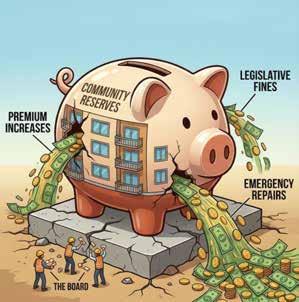
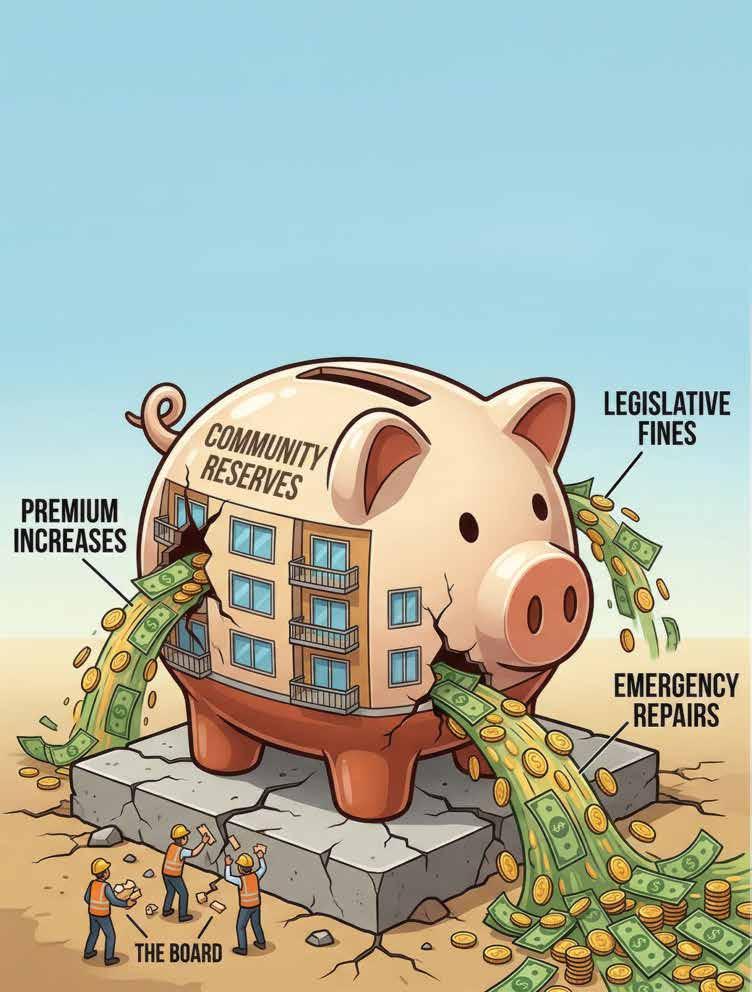
Much like business leaders, HOA boards manage financial resources and make strategic decisions that both preserve and enhance a community’s value. With personal budgets wearing thin, every decision is under greater scrutiny, from increases in dues to the timing of capital projects. While temporarily limiting assessment increases or delaying projects may seem like a low-risk way to support residents in the short term, the potential consequences can be far more significant. Underfunded reserves or deferred maintenance often signals increased risk to insurance providers and mortgage lenders.
Industry Trends Are Elevating Reserve Planning
Following the tragic partial collapse of the 12-story condominium tower in Surfside, Florida, in 2021, the reserve study landscape has rapidly evolved. From legislation to insurance and lending, the impact has been far-reaching. For example, the following states have passed legislation aimed at ensuring structural and resident safety.
1. Florida – Now requires reserve studies for buildings with three or more residential stories. These communities are also required to fund reserves at the level outlined in the reserve study, and older buildings must conduct periodic structural inspections.
2. Maryland – Signed into law in 2022, all condominiums, cooperatives, and certain homeowners associations are required to conduct periodic reserve studies. These associations are also required to fund reserves at the level outlined in the reserve study.
3. New Jersey – Signed into law in 2024, condominiums, cooperatives, and certain homeowners associations are required to conduct periodic
reserve studies. They are also required to fund reserves at the level outlined in the reserve study.
4. Tennessee – Signed into law in 2023, unit owners associations with $10,000 or more in common assets are required to conduct periodic reserve studies. The law’s intent is to inform the board how much should be set aside in reserves to avoid future assessments. There are currently no statutory funding requirements.
Insurance Trends
Underwriting standards have evolved over the past several years as insurance providers mitigate risks associated with aging infrastructure. What was once a simple verification process is now a thorough review of structural conditions, maintenance history, and financial preparedness. Communities that are unable to demonstrate proactive planning risk greater premium increases, reduced coverage, or difficulty securing a renewal.
Key insurance trends that communities experience include the following:
1. More Detailed Inspection Requirements – Rather than simply accepting that a reserve study exists, insurers regularly review recommended project timelines and whether structural projects have been completed. Any indication that a structural project (such as a roof replacement) is overdue inherently increases the carrier’s risk and the likelihood of a future claim.
2. Condition-Based Premiums
Historically, premiums were primarily reflective of the age of a property, building materials used, number of stories, and location. Today,
maintenance history, known deferred projects, and the adequacy of reserve funds (which increase the carrier’s risk) are often reflected in premiums.
3. Stricter Underwriting Terms
Increased risk is often associated with the terms of renewal. Associations that deviate from reserve funding or have a recent history of deferred maintenance are at greater risk of lower coverage limits, higher deductibles, risk-based exclusions, and, in the worst cases, denial of coverage.
Mortgage Trends
Shortly after the Surfside collapse, Fannie Mae and Freddie Mac released new guidelines for securing loans backed by government-sponsored enterprises. Meant to safeguard against safety and structural concerns, the new guidelines place greater emphasis on proper reserve funding, proactive maintenance, and periodic building inspections.
With roughly 70% of conventional loans backed by Fannie Mae or Freddie Mac, the market is highly dependent on traditional lending. When a loan is denied for a condo real estate transaction, the association is at risk of landing on a “do not lend” list: a list of buyers that do not qualify for a government-backed conventional loan until the buyer sufficiently addresses any issues at hand.
Key mortgage trends that communities experience include the following:
1. Stricter Reserve Requirements
Lenders often require a recent reserve study and evidence or confirmation of proper reserve funding, which is outlined in the reserve study.
Continued on page 24
Addressing Insurance and Loan Eligibility Issues
It is becoming increasingly common for boards to address insurance and mortgage lender concerns. For good reason, the reality is that oftentimes management and the board can lean on their reserve study provider to clarify concerns about reserve funding and deferred maintenance.
significantly or if major projects are deferred or completed).
2. Increased Documentation
Requests – It is not uncommon to provide detailed maintenance and capital project records and inspection reports as part of the loan approval process. Lenders often review reserve studies to assess the extent of structural deterioration and potential water infiltration. If project timelines deviate from the study, supporting documents that validate the board’s decision may be warranted to continue the loan review process.
3. Impact on Buyer Eligibility
– As lenders are hesitant to approve mortgages for condominiums that are deemed high risk, the pool of potential buyers shrinks, impacting residents’ ability to close on the sale of their homes and potentially impacting property values.
In a recent case involving a Midwest-based condo association, the board was unable to complete a brick masonry repair project in 2025, the year in which their reserve study recommended it. Due to weather constraints, the project was scheduled for 2026 instead. A homeowner’s mortgage application was denied due to the deferred maintenance. Upon validating the board’s decision and confirming that there were no safety or structural concerns, the lender resumed the mortgage approval process.
Best Practices to Mitigate Risk
As industry expectations continue to rise, boards can position their communities for greater financial stability and resilience against external risks.
1. Prioritize Structural and Safety-Related Projects –Addressing high-risk projects, such as roofs, waterproofing systems, or structural concrete, demonstrates responsible stewardship and mitigates the risk of insurance and loan eligibility concerns.
2. Maintain Adequate Reserve Funding and Keep the Reserve Study Current –Proper funding reduces the risk of future deferred maintenance and signals financial preparedness. Associations should update their reserve studies at least every three years (or sooner if funding levels change
3. Leverage a Reserve Study Partner for Clarity and Documentation – When questions arise, oftentimes a reserve study provider can discuss insurance and mortgage-related concerns and provide documentation to assist with renewal and loan processing, thereby keeping the community’s insurance renewals and real estate transactions on track.
Insurance and lending trends will continue to evolve, driving the industry toward a more resilient future. An increased focus on structural integrity and reserves supports a more proactive approach to addressing building deterioration when issues are minor, rather than waiting until they become complex and more costly to address. Communities that take a disciplined approach to capital planning will be best positioned to maintain coverage at the most affordable rates, mitigate risks of loan eligibility, and support home values.
Christian Colunga, RS, is the West Coast division manager for Reserve Advisors/Browning Reserve Group. He has completed well over 3,500 reserve studies and capital plans both domestically and internationally, helping guide some of the world’s largest hotel and resort brands in addition to community associations, golf facilities, worship centers, and commercial facilities. In that time, he has helped shape many of the policies and practices that are used throughout RA/BRG and the reserve study industry at large. He is passionate about serving common interest communities at home in California and around the world.
The Rising Cost of Inaction Continued from page 23
Thank You to Our 2025 Sponsors
PLATINUM SPONSOR
GOLD SPONSORS
Ace Property Management, Inc.
Alterra Assessment Recovery
Angius & Terry LLP
ArborMD Tree Care, Inc.
Ascendant Association & Property Management
Assembly HOA Management
Associa Northern California
Avenues HOA Financial Management
Bimini Corp.
Blu Sky Restoration Contractors
Briscoe Ivester & Bazel LLP
BTC Bob Tedrick Construction, Inc.
C&A Painting & Construction
Collins Management
Common Development Management
Common Interest Management Services
Community Financials
Community First Property Management
Community Legal Advisors, Inc.
Del Conte’s Landscaping, Inc.
Dunn-Edwards Paint Corporation
EB Community Managers
an Associa Company
Ergeon, Inc.
Fidelity Roof Company, Inc.
SILVER SPONSORS
Fontaine Roofing
Gachina Landscape Management
Gallopify
Garcia | Marsalli, LLP
The G.B. Group, Inc.
George Petersen Insurance Agency
Good Life Construction
GoPowerEV
Grayson Community Management
The Hignell Companies
Homeowner Association Management Services, Inc.
Hughes Gill Cochrane Tinetti, P.C.
IQV Construction & Roofing
K&D Landscaping, Inc.
The Kevin Boland Insurance Agency
LaBarre/Oksnee Insurance
Landesign Construction & Maintenance, Inc.
Liberty HOA Election Services, LLC
The Manor Association, Inc.
McGuire Schubert Sohal, LLP
MindMe Technology, Inc.
Modern Community Management
Morris and Sons Towing
Nextier Insurance Services, Inc.
Nixon Peabody, LLP
OMNI Community Management, LLC
Pacific InterWest Building Consultants
Park West Landscape Management
Pratt & Associates, APC
Precision Concrete Cutting
Prendiville Insurance Agency
Pro Elections, LLC
Recon360, LLC
Saarman Construction, LTD
Sail Internet, Inc.
Scherer, Smith & Kenny, LLP
Silvercreek Association Management
Socher Insurance Agency, Inc.
SwedelsonGottlieb
Tailored Management Solutions
Tinnelly Law Group
Unlimited Property Services, Inc.
Urban Painting
Varsity Painting
Velocity Construction Services, Inc.
Vista Paint Company
Westlake Royal Roofing Solutions
Unified Steel
Whit’s Painting, Inc.
Don’t miss an opportunity to get the education you need – and the networking and connection you want. Register today!
Educational Seminars
Learn from an acclaimed faculty delivering essential knowledge for HOA boards and homeowners.
• Ask your questions of on-site attorneys
• Visit with industry experts at exhibit tables
• Meet and connect with board members from neighboring communities
Visit echo-ca.org/events for more information on upcoming events.
Click a button or use the link to sign up to receive information on Resource Panel meetings near you!
Come and reconnect with your peers and attend an upcoming Resource Panel in your region. These events are held in a casual atmosphere to enable homeowners, board members, managers, and other professionals to hear about important topics presented by experts in the HOA industry. Click a Resource Panel meeting location below to sign up to receive information.
4/7 Sacramento Resource Panel 11:30 am – 1:30 pm
4/8 TECAR – The Echo Club at Rossmoor 9:30 am – 11:30 am
4/9 East Bay Resource Panel 11:30 am – 1:30 pm
4/14 Los Angeles Resource Panel 11:30 am – 1:30 pm 4/15 Orange County Resource Panel 11:30 am – 1:30 pm
4/21 Wine Country Resource Panel 11:30 am – 1:30 pm 4/22 North Bay Resource Panel 11:30 am – 1:30 pm 4/22 San Francisco Resource Panel 5:30 pm – 7:30 pm 4/28 San Pablo Bay Resource Panel 11:30 am – 1:30 pm
4/29 South Bay Resource Panel 11:30 am – 1:30 pm
4/30 Central Coast Resource Panel 11:30 am – 1:30 pm
WELCOME TO ECHO’S
New Professional Service Providers
In every community, only one thing is certain: change.
From goals, market conditions, legislation and more, communities must continue to evolve to meet— and exceed—resident and occupant expectations.
At Seabreeze, we are always looking ahead. Whether that’s staying abreast of legislation to build out a longterm plan for your community, we’re here to guide you along the path to continued success.
With Seabreeze, your community will:
• Have access to the right people, personalities and experience to meet your specific needs
• Benefit from a tailored, comprehensive association management plan that is combined with convenient, accessible client support
• Enjoy a hands-on approach by our educated, experienced and certified team
• Be backed by a company culture that embraces and anticipates change, helping you thrive no matter what
• Always receive our full attention as we continue to learn your needs and grow together
Offices:
Corona | Playa Vista | Roseville | San Clemente | San Diego | Woodland Hills
Seabreeze Community Management (800) 232-7517 seabreezemgmt.com
Get HOA projects done, without the drama
Gigaly is an AI-powered platform helping HOAs save money by connecting them with the right vendors for maintenance and construction projects. Our tools streamline vendor selection, procurement, and project management, ensuring costeffective decisions while improving transparency and efficiency for homeowners and boards.
Gigaly (647) 509-2235 gigaly.com
McMills Duffy Consulting Group provides outcome-based solutions for HOA boards: elimination of fiscal waste; mediation, dispute resolution and litigation avoidance; insurance analysis and strategy; contract negotiation and vendor vetting; forensic audits and reserve management advisory. Our Subject Matter Experts possess deep domain expertise in financial services, insurance, and technology.
McMills Duffy Consulting Group (800) 919-4351 mcmillsduffy.com
We Bring Life to Living Environments
Whether your home or business, we understand the value of spending time in a beautiful setting.
We proudly serve and have been a part of the North Bay Area community for over two generations.
We create and maintain spaces with a goal to surpass our clients’ expectations.
We strive to build trust and relationships that last.
• Landscape Maintenance
• Enhancements
• Irrigation
• Landscape Construction
• Artificial Turf Green Vine Landscaping (707) 217-7507 greenvinelandscaping.com
Customized Energy Solutions No. 1 EV installer in the U.S.*
Green Water and Power (GWP) is a leading national turnkey provider of energy service infrastructure, boasting over a decade of expertise in renewable energy. The company specializes in the installation of electric vehicle chargers, battery storage, and solar energy systems, managing the entire project lifecycle from design and permitting to construction and commissioning.
Additionally, GWP offers comprehensive operations and maintenance services to maximize the performance of energy projects. Recognized as America’s #1 EV Installer, GWP has successfully installed over 10,000 chargers and has a portfolio that includes more than 4 MW of solar capacity.
*As stated by Ohm Analytics, the leader in market intelligence for the distributed energy transition.
Green Water & Power LLC (888) 928-6016 greenwaterandpower.com
Your future Is Our Business
RSI is a full-service propertyconsulting company and premier Reserve Study provider.
We offer Reserve Studies, litigation support, property inspection, cost estimation, and budget analysis for residential and commercial developments, as well as educational facilities and religious institutions. Established in 1991, RSI’s founders recognized the three essential skills necessary to develop a reliable Reserve Study: field inspection, cost estimating, and financial analysis.
When performed by RSI’s professionally trained staff, these skills produce a comprehensive report portraying both the current physical and financial conditions, along with the future needs of a property. RSI has built a strong reputation for delivering a quality product and consistently exceeding client expectations.
Today, we are one of the largest providers of Reserve Studies in the Western United States, offering clients the expertise and insight to protect and plan for the long-term performance and value of their properties.
Reserve Studies, Inc. (800) 485-8056 reservestudiesinc.com
Prendiville Insurance Agency Specializes in Homeowners Association (HOA) Insurance Coverage
We offer the most comprehensive HOA insurance coverage options available.
For over 30 years, Prendiville Insurance Agency has grown to be an industry leader in Homeowners Association (HOA) insurance. While representing over 100,000 units, we have become one of the Nation’s largest HOA Specialized Agents. Besides offering the right coverage at a competitive price, our specialty is educating homeowners and board members, supplying critical information to banks without hassle, and providing unmatched advocacy in times of a claim.
Why Choose Us As Your HOA Insurance Provider?
• The right coverage at a competitive price
• Ongoing education of homeowners and board members
• Supplying critical information to banks without hassle
• Work directly with a specialist from Prendiville Insurance Agency, not a corporate 800 number
• Unrivaled advocacy in times of a claim. Our in-house Claims Coordinator guides the unit owner/board/manager through the claims process and in doing so, creates an easier process. This also creates the added benefit of eliminating claims that should not be filed, such as obviously uncovered or misplaced claims.
We are a full-service management company providing complete management services to meet our clients’ needs. Our team has over 30 years of combined real estate experience managing commercial and residential properties throughout Monterey County.
Our systems are fully automated and can be customized to provide exactly those services desired by our clients. Whether a single-family home, a common interest development, apartments or commercial property, our goal is to maintain first-class living and working environments for our clients as well as our tenants.
Our long-term, intimate knowledge of Monterey County real estate allows us to provide personalized service and tailored solutions. We prioritize building strong relationships with our clients, ensuring that we understand their unique needs and preferences.
Our dedicated team is committed to maintaining high standards of property care. Furthermore, our focus on effective communication and responsiveness means that your concerns are addressed promptly, fostering a sense of trust and reliability.
By partnering with us, you benefit from expert local insights, superior personalized service, and a commitment to enhancing your real estate investments and community living experience.
Elemental Association Management (833) 711-1130 elementalre.com
■ Get the most value out ofyour association's policy! Work with Experts!
■ Insurance coverages designed & tailored for common interest developments.
■ Providing Enhanced D&O coverage and Guaranteed Replacement Cost coverage.
Christi Spina
Your Local Agent CA License# 0E13855 3900 Mayette Ave Santa Rosa, CA 95405
Our office locations are in Novato and Santa Rosa, to better serve Marin and Sonoma Counties. We've worked with hundreds of associations all over the Bay Area.
Let me help you get smart about your coverage options.
Get ready for the most up-to-date resource in community association law – Echo’s 2026 Statute Book is now available for order! Whether you prefer the convenience of a searchable digital version or the feel of a professionally bound printed copy, this essential reference includes the latest California laws affecting homeowners associations. Perfect for board members, managers, and legal professionals, the 2026 edition helps you stay informed and compliant all year long. Don’t miss out – order your electronic or printed copy today!
LEGISLATION TRACKER:
Bill Introduction Deadline Has Passed March 2026
BY NATHAN McGUIRE, ESQ.
The legislature was back in session on January 5, 2026, for the second half of the 2025-2026 legislative session. This means that the bills that did not make it to the governor’s desk last year are back in play. Many of those bills will stay dormant (and some of them for good reason), but some may be resurrected and are moving forward.
New bills were required to be introduced by February 20, 2026. So, this is the time of year where we review all of the bills and identify which bills may impact HOAs. This article will outline the bills we are watching so far, followed by bills that do not seem to be going anywhere. Please alert us of any bills that you think we should be looking at.
ASSEMBLY BILLS
AB-739 (JACKSON) – ASSOCIATION FEES
This bill, originally introduced last year, would have required a managing agent of a common interest development to hold a real estate broker license issued by the DRE (Department of Real Estate). The bill was amended on January 5, 2026 and January 15, 2026, changing gears completely to require the board of directors of the association to review, on an annual basis, fees charged by the managing agent, as specified. The bill would also require the association to deliver through electronic means a statement of these fees upon written request by a member.
STATUS: The bill passed out of the Assembly 75-0 and is being referred to committees in the Senate.
AB-1184 (PATTERSON/DEMAIO) – GOVERNANCE
This bill, originally introduced last year, has been amended and now appears to be the follow-up to AB-21, a “kitchen sink” bill which failed to move last year. This bill would:
• Require the general notice for an emergency rule change to include the text of the rule change, a description of its purpose and effect, and the date when the rule change will expire.
• Prohibit a majority of the directors of the board, outside an authorized meeting, from using a series of communications of any kind, directly or through intermediaries, to discuss, deliberate, or take action on any item of business within the board’s subject matter jurisdiction, except in an emergency. The bill would also exempt from this prohibition certain informational and ministerial communications.
• Require the board, if the association becomes involved in litigation, to provide notice of the occurrence as part of the annual budget report distributed to members, as prescribed.
• Require, if open session meetings of the board are electronically recorded using audio, or audio and video, that the recordings be considered a record of the association and be made available to members on the same basis as written meeting minutes. The bill would require notice to be given at the beginning of
every open session of the board that the meeting is being recorded.
• Prohibit the imposition of a charge for minutes that are distributed electronically. The bill would allow minutes posted on the association website to meet minute distribution requirements. The bill would require the minutes, or proposed minutes, to include specified information, including the date and time of the meeting.
STATUS: The bill passed out of the Assembly 69-0 and is being referred to committees in the Senate.
AB-1684 (WARD) – COOLING SYSTEMS
This bill would make any provision of the governing documents, architectural guidelines, or policies void and unenforceable if the provision prohibits or restricts the installation, upgrade, replacement, or use of a cooling system. The bill would also make any covenant, restriction, or condition contained in any, among other specified agreements, deed that effectively prohibits or restricts the installation, upgrade, replacement, or use of a cooling system, void and unenforceable. The bill would make it unlawful for an association to prohibit or restrict a member from installing, upgrading, replacing, or using a cooling system in the member’s separate interest, or to take other specified actions in connection with the installation, upgrade, replacement, or use of a cooling system, subject to specified exceptions. Finally, the bill would make an association that willfully violates these provisions liable to the member for actual damages occasioned thereby, and for a civil penalty paid to the member in an amount not to exceed $2,000.
STATUS: The bill was referred to the Housing & Community Development and Judiciary Committees.
AB-1892 (DAVIES) – MAINTENANCE AND ELECTIONS
This is a cleanup bill to 2024’s SB-900. Under SB-900, an association is responsible for repairs and replacements necessary to restore interrupted gas, heat, water, or electrical services that begin in the common area even if the matter extends into another area, as specified, unless the utility service that failed is required to be maintained, repaired, or replaced by a public, private, or other utility
Continued on page 32
service provider, or otherwise provided in the declaration. This bill would attempt to clarify that requirement by replacing “that begin in the common area” with “when the interruption begins in.” Unrelated to SB-900, the bill would change the 90-day notice for an association intending to use election by acclamation to 30 days. And finally, the bill would clarify that the delivery of electronic ballots is only to be delivered to members who are voting electronically.
STATUS: The bill has not yet moved or been referred to any committee.
AB-2035 (DIXON) – AMENDMENTS
This bill would lower the threshold for petitioning the superior court to reduce the percentage of votes necessary for an amendment to more than 37 percent of the votes if the court finds that the common interest development is a senior citizen housing development, as defined, the separate interests in the common interest development meet specified criteria, and the declaration has not been amended in at least 35 years.
STATUS: The bill has not yet moved or been referred to any committee.
AB-2050
(CALOZA) – RESERVE ACCOUNTS
This bill would, beginning January 1, 2032, revise the requirement to perform a study of the reserve account requirements to, among other things, include the minimum reserve contribution level to prevent the projected association reserve account balance from falling below zero over the following 30 years. The bill would require an association to fund the reserve account on an annual basis in at least the minimum reserve contribution level. If the association is unable to fund the reserve account in at least the minimum reserve contribution level without exceeding the above-described specified limitations on increases on assessments, then, notwithstanding those specified limitations, the bill would require the association to levy a reserve special assessment in an amount necessary to allow the association to fund to minimum contribution level without a reserve special assessment within three (3) fiscal years, as provided.
STATUS: The bill has not yet moved or been referred to any committees.
SENATE BILLS
SB-222
(WIENER/ALLEN/BECKER/STERN) –APPLIANCES AND UTILITIES
This bill would make any provision of the governing documents, architectural guidelines, or policies void and unenforceable if the provision prevents the replacement of a fuel-gas-burning appliance with an electric appliance. The bill would also make any covenant, restriction, or condition contained in any, among other specified agreements, deed, and any provision of a governing document, that effectively prohibits or restricts the installation or use of a residential heat pump water heater or heat pump HVAC system, void and unenforceable.
STATUS: The bill passed out of the Assembly 29-8.
SB-876 (PADILLA) – FIRE AND RESIDENTIAL
INSURANCE
This bill would substantially expand insurers’ payment obligations, coverage requirements, and regulatory oversight for residential property insurance, particularly in the context of declared states of emergency. It would accelerate and increase mandatory claim payments following a total loss by requiring prompt payment of actual cash value and undisputed replacement cost amounts, with interest penalties for delays. It would broaden and mandate enhanced replacement cost, guaranteed replacement cost, and building code upgrade coverage, limiting insurers’ ability to issue or renew policies unless higher levels of coverage are affirmatively offered and, in some cases, automatically increased after disaster losses. It would tighten insurer compliance by eliminating exemptions from rebuilding cost estimates, extending those obligations to FAIR Plan policies, and exposing insurers to liability up to full replacement cost for noncompliance. Additional provisions expand additional living expense benefits, increase contents payouts after total losses, restrict adjuster reassignments, and impose stricter reporting and disaster planning requirements on insurers. While the bill is directed at insurers, its practical effect may be increased premiums, reduced underwriting flexibility, and tighter scrutiny of property condition and valuation—impacts that could be felt acutely by homeowners associations insuring large, multi-structure residential communities in high-risk areas.
STATUS: The bill has been referred to the Insurance and Judiciary Committees. The concern is that imposing substantial burdens on insurers would cause more of them to leave the marketplace.
SB-1007 (MENJIVAR) – DISCLOSURES AND ASSESSMENTS
This bill would require the annual budget report to include a high-level summary breakdown of what the regular assessments fund and a statement regarding compensation of a management company, as provided. The bill would require a summary of an annual budget or policy statement to also include a high-level breakdown that describes what the regular assessments fund, as specified. This bill would prohibit an association from increasing a regular assessment, unless the board includes the above-referenced information pertaining to regular assessments. The bill would, instead, prohibit a board from imposing a regular assessment for the association’s preceding year, adjusted for inflation, without the approval of the majority of a quorum members. This bill would require the association to make any physical evidence used to determine a violation of the governing documents has occurred available to the member at least five (5) business days before the hearing or deadline for the member’s response if the association seeks to impose a monetary penalty against a member for violation of the governing documents, as provided.
STATUS: The bill has been referred to the Housing and Judiciary Committees.
SB-1238 (WAHAB) – MANAGEMENT AND MAINTENANCE
This bill would make broad revisions to the Davis-Stirling Act aimed at increasing transparency, accountability, and consumer protection in common interest developments. However, some of the requirements would be unworkable in practice. This bill would significantly expand the
regulatory and administrative obligations placed on homeowners associations, with a particular focus on management practices, reserve funds, and structural safety disclosures. It would broaden the definition of association “agents” to capture managers and third parties involved in key disclosure and financial functions, expressly subjecting them to fiduciary duties owed to the board and members. It would substantially increase disclosure requirements for homeowners, associations, and managers in connection with sales and refinances, especially where balconies or other exterior elevated elements are involved, and ties those disclosures to evolving federal lending standards and “critical repair” concepts. The bill would tightly restrict boards’ ability to use or transfer reserve funds for litigation or legal services involving owners or their relatives, even at the threat stage. In addition, it would integrate exterior elevated element inspections into the reserve study framework, emphasizing occupant safety and requiring that identified repairs be prominently summarized and incorporated into reserve planning and disclosures. Taken together, the measure would increase compliance complexity, documentation burdens, and risk exposure for volunteer boards, while narrowing board discretion over reserves and heightening scrutiny of how associations plan for, disclose, and fund major repair obligations.
STATUS: This bill, sponsored by CAR (California Association of Realtors), has been referred to the Housing, Judiciary, and Appropriations Committees.
SB-1267 (ALLEN) – ELECTRIC VEHICLE CHARGING STATIONS
This follow-up bill to last year’s SB-770 (precluding HOAs from requiring insurance naming the association as an additional insured) aims to provide liability protection for associations which permit installation of EV charging stations. The bill would make each owner and successive owner responsible for any damages occurring as a result of damages from an EV charging station and would further require installers to indemnify or reimburse the association or its members for loss or damage caused by the installation, maintenance, or use of the EV charging station.
STATUS: The bill has been referred to the Housing and Judiciary Committees.
WATCH BILLS
These bills don’t appear to be moving, but could still be picked back up again at this point in the session:
• AB-6 (WARD)—This bill was introduced last year and ended up in the suspense file. It would require the Department of Housing and Community Development (HCD) to convene a working group to research and consider recommending building standards.
• AB-21 (DEMAIO)—This kitchen-sink bill would make numerous changes negatively impacting operations and management of HOAs. It failed to advance out of committee. The author is working with Assemblymember Patterson on a related bill, AB 1184.
• AB-69 (CALDERON)—This bill would require a broker of record to determine if a FAIR Plan policy can be moved to a voluntary market insurance company before the policy is renewed. Introduced last year, it passed out of the Assembly 78-0. The hearing in the Insurance Committee was cancelled at the author’s request, and the bill failed to move from there.
• AB-1240 (LEE/PEREZ)—This bill would prohibit a business entity that has an interest in more than 1,000 single-family residential properties from purchasing additional single-family residential properties for rental purposes. It passed out of the Assembly 42-18 but was held up in the Senate Judiciary Committee and did not make it to the Senate floor.
• AB-2439 (BLANCA RUBIO)—This bill would make nonsubstantive changes to Section 5650 of the DavisStirling Act relating to interest imposed on delinquent assessments. This is likely a “spot” bill which could be amended later to include substantive changes.
• SB-282 (WIENER)—This bill would void any restrictions in governing documents that prevent the replacement of a fuel-gas-burning appliance with an electric appliance or prevent the installation or use of a residential heat pump water heater or heat pump HVAC system. It was returned to the Senate due to its failure to advance.
• SB-448 (UMBERG)—This bill would implement procedures for removal of squatters. It was returned to the Senate due to its failure to advance.
• SB-546 (GRAYSON)—This bill would modify existing board financial review requirements to be satisfied when individual members or a subcommittee of the board review the documents and make statements independent of a board meeting. The bill was amended on January 5, 2026 and no longer has anything to do with HOAs. It will be removed from next month’s report.
• SB-570 (ALVARADO-GIL)—This HOA spot bill was never amended to include substantive changes to the law.
• SB-681 (WAHAB)—This bill contained the language that was incorporated into AB-130 but could be amended to make related changes.
• SB-750 (CORTESE)—This bill would establish the California Residential Mortgage Insurance Fund in the State Treasury and would continuously appropriate moneys to the California Housing Finance Agency (CalHFA) for the purpose of insuring construction loans and permanent loans for affordable housing.
Be sure to check Echo’s website frequently for the most current information on pending legislation: www.echo-ca. org/echo-legislation-tracker/.
Nathan McGuire, Esq., is a founding partner of McGuire Schubert Sohal LLP, a law firm specializing in representing community associations of all types. He has been engaged in legislative advocacy for HOAs for most of his 20-plus-year career and serves on the board of directors for Echo. He was named Super Lawyers magazine’s “California Rising Star” for six years running; Super Lawyer in 20212026; and is the recipient of an AV Preeminent Peer Review designation from Martindale-Hubbell, which signifies the highest level of excellence in the attorney profession.
Join like-minded colleagues and learn what is needed to prepare an individual for board service or to better serve your HOA clients.
The program covers the essentials, including the HOA legal environment, fiduciary responsibilities and duties, financial management and reserves, meetings (planning and management), election procedures, board ethics, and soft skills needed to deal with people. The curriculum is brought together with a capstone course on the role of HOA vision, mission, strategy, and core values in common interest developments.
The courses will be available in various formats including workshop, lecture, and lecture/lab. Faculty has been recruited from the most successful and knowledgeable companies in the industry. Currently, eight of the ten courses will be recorded and available on demand. All courses will be offered live via webinars. Two workshops require live, online participation: HOA Board Ethics and the capstone strategy course.
Participants will be given three years from the date of enrollment to satisfactorily complete the ten courses and successfully pass the exam for each course with a score of 70% or better. The examinations will be designed to cover the basic knowledge and skills discussed in the course and to encourage the internalization of the curriculum. After successfully completing the examinations, participants will be awarded a certificate of successful completion of the Echo Board Member Preparedness Program. This is a lifetime certificate and will be noted in the permanent Echo records.
Board Member Preparedness Certificate Program Curriculum
Good Governance Series (100 series)
100 Leadership & Governance
101 Elections, Voting, and Candidacy
102 Meetings and Best Practices
103 Board Evaluation of HOA Management
HOA Legal Environment Series (150 series)
150 Ask the Attorney: Davis-Stirling Act Overview
151 Ask the Attorney: Laws Other than the Davis-Stirling Act
152 Ask the Attorney: Judicial InterpretationHOA Case Law
Board Ethics (120 Series)
120A Foundations of HOA Ethics Workshop
120B Ethics in Practice Workshop
HOA Financial Management & Reserves (170 Series)
170 HOA Financial Management & Reserves
HOA Board Member Preparedness
Capstone Course (199)
199 A Strategic Approach to HOA Management
To enroll or learn more about the program, contact Connor Zepponi, connor@echo-ca.org, or visit www.echo-ca.org and click on the Echo HOA University program tab.
8 REASONS TO CHOOSE LEVY, ERLANGER & COMPANY LLP
1
Almost of our clients are homeowners associations, planned unit developments, condominiums, condominium conversions, COOPs, tenancies in common and timeshare projects ...
3
5
Which enables our professional sta of
12 including 6 CPAs and 6 CPA candidates (growing to almost 20 professionals during “tax season” from January to April) to ...
7
6
150
Working with approximately management companies in Northern California out of a total of 300 serving community associations ...
2
Since 1977 more than experience
4
2,500 Serving more than community associations (3 to 6,700 units) in Northern California out of a total of approximately 17,000
Provide a wide range of services to community associations including …
• Financial statements and income tax returns — audits, reviews and compilations
• Comparative 2-year financial statements— more meaningful to readers
• Reserve funding plans, or updates
• 2020 Condominium Greenbook™, the 290-page financial reference book for Association treasurers
• 2020 Community Association Financial Survey of over 1,500 associations