
Typography in Web Design: Top Fonts to Boost Your Online Visibility
Creating a professional website means paying attention to every detail. Typography In Website Design covers all from choosing the right colors to getting high-quality images, every information is important. But don't forget about fonts – they're more than just decoration. Your website wouldn't be complete without fonts. With an abundance of options, it can be challenging to determine which ones are suitable for use in website typography.
To make it less difficult, we have created a blog that guides you in choosing exceptional fonts for your website.
Importance Of Typography In Website Design
Typography plays an important role in website design, going beyond mere aesthetics. This includes the selection, composition, and presentation of fonts to efficiently communicate data, evoke emotion, and enhance the consumer experience of your website.
Impact of Fonts on User Experience
The fonts used on a website can significantly impact the consumer experience. Choosing the proper font can make content more readable, available, and visually appealing.
Here are some key things to keep in mind when choosing font for your website:
Readability: The primary reason for text content on a website is to provide data. Make sure the font you choose is easy to study, has smooth letters and has adequate spacing between letters.
Accessibility: Consider the needs of users who are visually impaired or have trouble interpreting. Choose fonts that are highly useful and follow accessibility pointers, including adequate contrast between text and background.
Brand Consistency: Fonts play an important part in establishing and preserving logo identity. Choose fonts that reflect your brand's personality and beliefs. Consistent font usage across your website enables you to build a consistent and recognizable brand image.
Emotional impact: Fonts can evoke good emotions and add freshness to your content. Choose fonts that reflect the nature and message you want to convey. Serif fonts, for example, tend to have a historic and complicated vibe, whereas sans-serif fonts are more current and straightforward
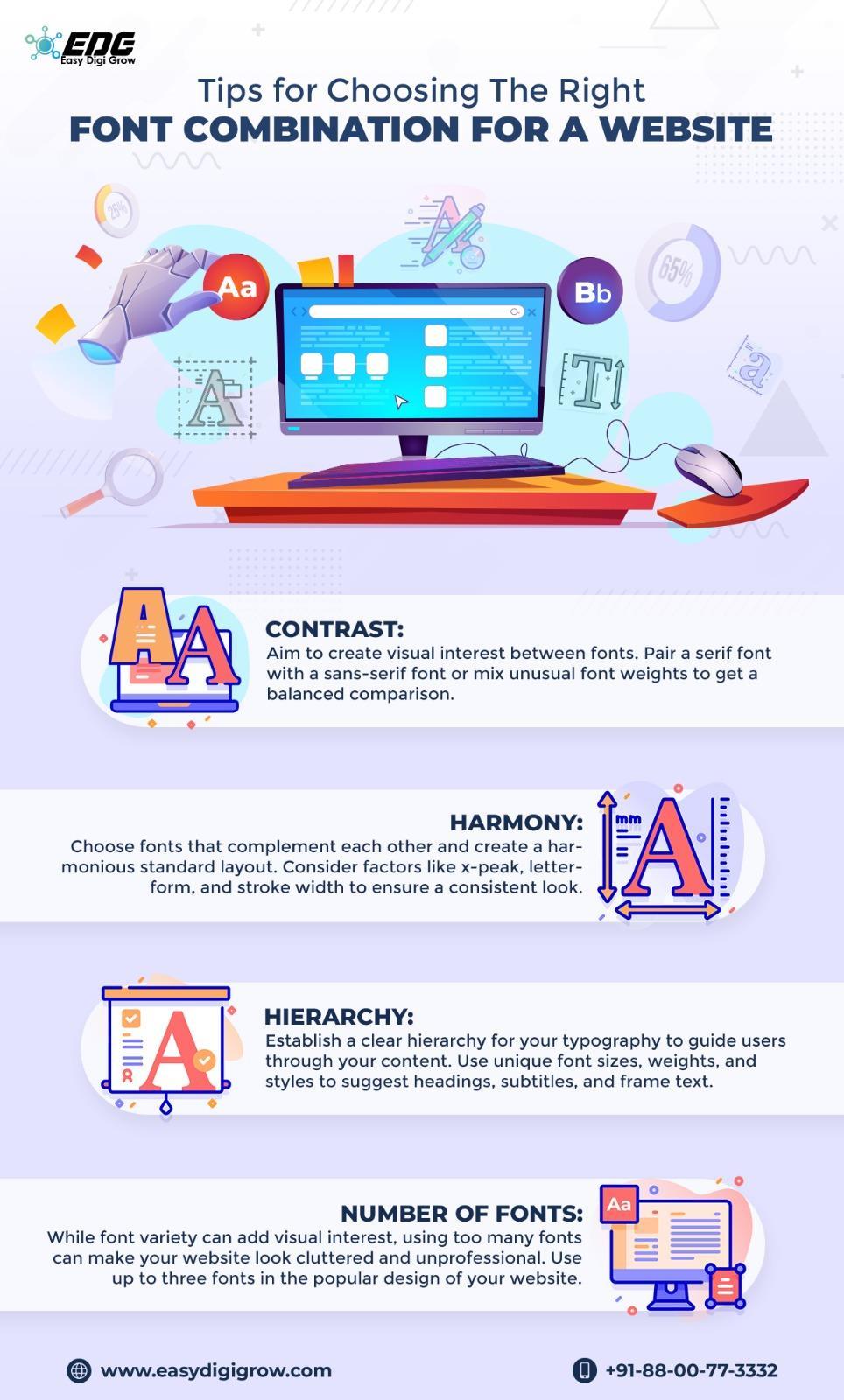
Contrast: Aim to create visual interest between fonts. Pair a serif font with a sans-serif font or mix unusual font weights to get a balanced comparison.
Harmony: Choose fonts that complement each other and create a harmonious standard layout. Consider factors like x-peak, letterform, and stroke width to ensure a consistent look.
Hierarchy: Establish a clear hierarchy for your typography to guide users through your content. Use different font sizes, weights, and styles to indicate headings, subtitles, and frame text.
Number of fonts: While font variation can provide visual interest, having too many fonts might make your website appear cluttered and amateurish. Use up to three fonts in the popular design of your website.
Best Practices for Incorporating Fonts into Your Website
Now that we understand the importance of typography and how to choose the right font, let's discover good practices for applying them in web layouts:
Use Web-Safe Fonts or Web Fonts
Two types of typefaces can be used on the web: web-safe fonts and web fonts. Web-safe fonts are fonts that are widely available in particular working structures and browsers. They ensure regular rendering and are a reliable option for maintaining design integrity.
Several web-safe styles contain Arial, Helvetica, and Times New Roman. Web fonts, on the other hand, grant you more creative tractability because they permit you to use bespoke fonts that may not be helped by all devices. These fonts are yanked from other resources, such as Google Fonts or Adobe Fonts. When using web fonts, make sure they can be optimized for overall performance and remember their impact on page load time.
Customize font loading
Font loading can drastically affect the overall performance of the website. Slow-loading fonts can cause delays in rendering, which will adversely affect the overall enjoyment of the consumer. To ensure the most useful font loading and minimize potential performance issues, consider implementing the preconnect feature to set the font company's region reference in advance. This reduces latency when fetching fonts, resulting in faster loading times.
Additionally, it is important to enable the appropriate "Font-Show" properties. These homes allow you to control how fonts are displayed while loading. Compressing font documents is another effective way to optimize font loading. Font compression tools and offerings, with Font Squirrel or an online font compression offering, can be employed to reduce the dimensions of font documents without compromising their quality.
Understanding Sans and Serif Fonts
Sans and serif are the primary classifications of fonts, each with its own wonderful characteristics and visible patterns. Let's find out what sets them apart:
•Sans serif fonts: Sans serif fonts, as the call indicates, lack serif ornamentation at the ends of the strokes. They feature a sleek, clean appearance and offer a modern, minimalist look. Sans serif fonts are often associated with simplicity, readability, and contemporary aesthetics. These are typically used for digital interfaces, titles, and displays where ease of reading and upright appearance are important.
Examples: The Montserrat, Arial, and Helvetica fonts
•Serif fonts: Serif typefaces are easily recognizable by the little decorative strokes or serifs that terminate each letter. Adding visual flair and exuding an air of refined history, these serifs are a great choice. Serif fonts are generally used for body text in engraving materials counting books, newspapers, and publications, as serifs assist model the eye along the lines of writing, increasing readability.
Examples: Times New Roman, Georgia, and Garamond. However, there are no strict guidelines, and the choice ultimately depends on the desired visual style and the message you want to convey.