Why Does Accessibility Website Design Matter?
Accessible website design is important for your website as it guarantees that individuals with disabilities can access, navigate, and interact with web content like everyone else.
Here are some of the key reasons why accessible website designs are beneficial:
Equal Right Of Access for All: Accessible websites provide equal right of access to information and services for people with disabilities. It gets rid of limitations and allows anyone to participate fully in the digital sphere, regardless of their abilities.
Legal Requirements: In most countries, accessibility is mandated through law. Both public and private corporations are required to follow accessibility standards to ensure inclusivity and protect you from discrimination based on disability
Expanded Customer Base: By designing an accessible website, you expand your potential visitor base. The number of men and women with disabilities worldwide is estimated to be more than a billion which is a huge market level.
Better User Experience: Accessibility not only benefits customers with disabilities but also magnifies the experience for all customers. Use clear and concise language, prepare content logically, streamline orders, and avoid cluttered layouts that may irritate customers.
Search Engine Optimization: Many accessibility practices align with search engine marketing’s practices. For example, presenting descriptive text content for pics not only benefits visually impaired customers but also improves search engine indexing and ratings
Considerations for Users With Disabilities When Designing An Accessible Website
Visual Disabilities: Provide textual content options for pictures, use descriptive captions, and ensure adequate color evaluation for readability
Hearing Disabilities: Provide captions or transcripts for multimedia content, provide visual cues for audio indicators, and avoid relying solely on audio commands.
Motor Disabilities: Ensure that interactive factors can be easily operated using a keyboard, provide an adequate clickable area for hyperlinks and buttons, and minimize the need for precise mouse movements.
Cognitive Disabilities: Use clear and concise language, prepare content logically, streamline orders, and avoid cluttered layouts that may irritate customers
By incorporating those issues into your web website layout, you create an inclusive and user-friendly experience for people with disabilities, promoting equality and diversity online internationally.
Understanding The User
To ensure accessibility in website design, it is essential to understand your audience and their various needs. Users have different qualifications, options, and technical literacy levels. By adopting a consumer-centric approach, you can create a website that can accommodate a large number of customers.
Consider The Following Questions When Designing The Accessibility Capabilities Of Your Website:
• How can you make your content understandable for visitors with cognitive disabilities?
• Are your navigation menus intuitive and trouble-free for individuals with motor disabilities?
• Are your images accurately described for users with visual impairments who rely on a display reader?
• Can visitors control the font size or shade contrast to suit their preferences?
• Does your website integrate well with assistive technologies like display readers and speech recognition software programs?
Understanding the unique desires of your audience can help you tailor your website design accordingly and provide an excellent user experience for everyone
Accessibility Features for Website Design
10 Accessibility Features for Website Design
To ensure an inclusive user experience, it is important to incorporate accessibility capabilities into your website design. Consider the following website design strategies:
Semantic HTML: Use the correct HTML tags and elements to structure your content. This allows display screen readers and search engines to correctly recognize your website.
Alternate Text: Provide descriptive text for images to explain their meaning to customers who cannot see them. This display allows readers to describe images to visually impaired users.
Captions and Transcripts: Include captions or transcripts for movies and audio content.This benefits hearing-impaired users who rely on writing to recognize multimedia factors.
Keyboard Accessibility: Make sure each website functionality can be accessed using a keyboard alone. Some users cannot use a mouse due to motor disabilities and rely on keyboard navigation
Color Contrast: Use shade combinations that provide appropriate contrast between the text and background. This enables users with visual impairment or color blindness to check the content without any difficulty
Form Input Validation: Clear error messages and validation prompts in forms. This helps customers with cognitive disabilities complete the paperwork as it should.
Descriptive Link Text: Use descriptive hyperlink text that gives meaningful records about the destination page. Avoid generic phrases like “click here” and instead use descriptive phrases that explain the reason for the hyperlink
Descriptive Link Text: Use descriptive hyperlink text that provides important information about the destination page. Avoid generic phrases like “click here” and alternatively use descriptive words that explain the reason for the hyperlink
Accessible Forms: Incorporate clear error messages and validation cues in forms. This helps users with cognitive disabilities complete forms correctly.
Consistent Page Layout: Maintain a consistent web page format at any level on your website to provide familiarity and ease of use. Users with cognitive disabilities or learning problems benefit from predictable and consistent web page structures
Changing Text Size: Enable customers to modify the text size for your website without any difficulty. This includes users with visual impairments who choose larger text for better readability
Consistent Navigation: Design clear and regular navigation menus to facilitate clean navigation for all users. Providing logical structure and labeling navigation elements benefits people with cognitive disabilities and people who use display readers.
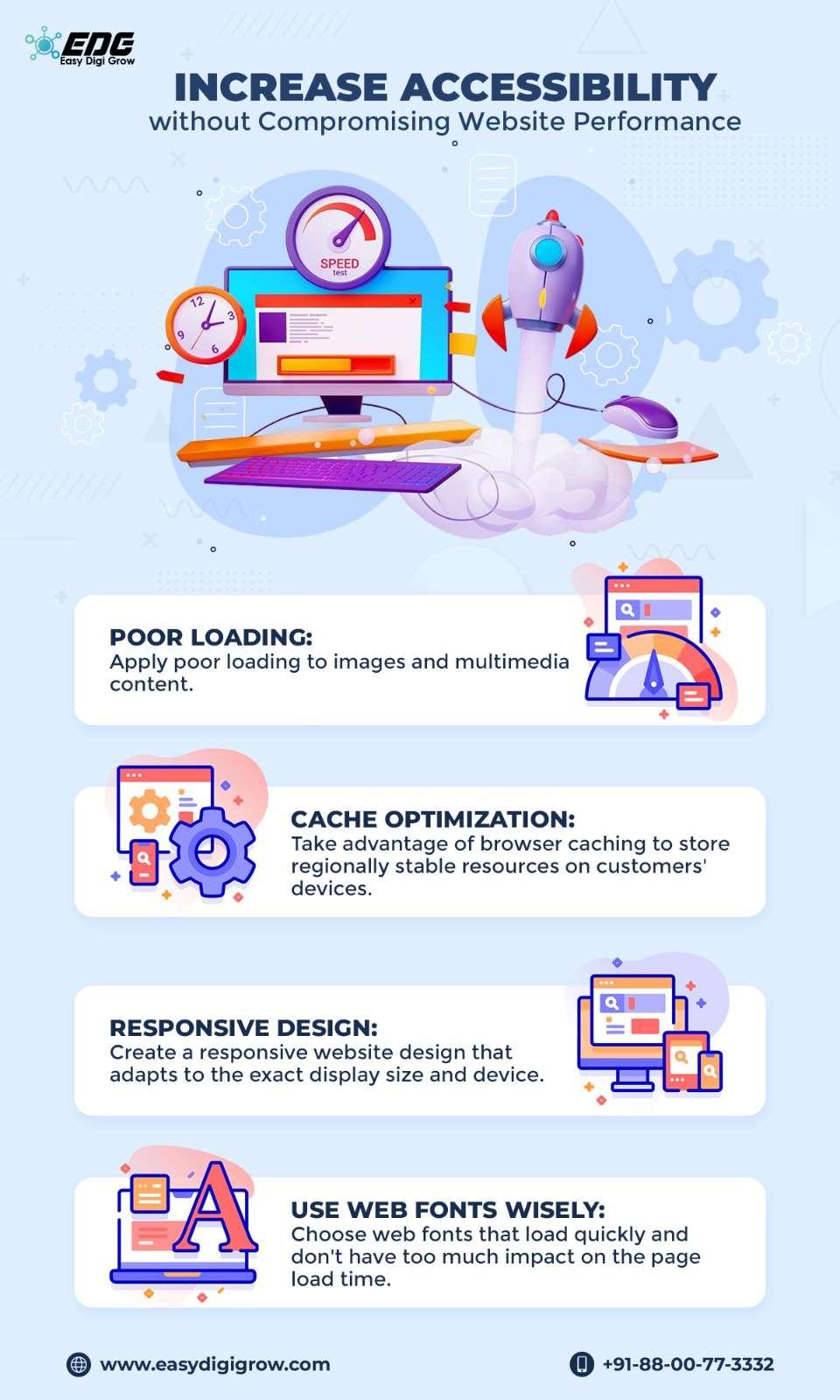
Increase Accessibility Without Compromising Website Performance
1. Deferred Loading: Apply deferred loading to images and multimedia content. This method delays loading non-viewed factors, improves page load instances, and even provides accessibility features after they come into view
2. Cache Optimization: Take advantage of browser caching to store regionally stable resources on customers’ gadgets. This reduces server requests and improves website speed for repeat visits, benefiting all customers, including those who rely on assistive technology
3. Responsive Design: Create a responsive website design that adapts to the exact display size and gadget. This guarantees that customers with disabilities who use a range of assistive technology can seamlessly access your content.
4. Use Web Fonts Wisely: Choose web fonts that load quickly and don’t have too much impact on the net page load time. Prioritize legibility and readability to benefit users with visual impairments or dyslexia.
Minify CSS and JavaScript: Minify and compress CSS and JavaScript files to reduce size and improve overall website performance. This allows users, including those with slow internet connections, to navigate your website online more efficiently. Don’t forget to take a look at our manual on effective web page redecorating techniques that will let you maximize your organic visitors!
To Ensure Compliance With Accessibility Requirements, Here Are Some Tips:
•WCAG 2.0 and WCAG 2.1: Familiarize yourself with the Web Content Accessibility Guidelines (WCAG) 2.0 and 2.1. These internationally recognized requirements provide overall guidelines for developing accessible content.
•Keyboard accessibility: Make sure that all the functionality of your website can be accessed using a keyboard. Users with motor disabilities may also rely on keyboard navigation and the keyboard navigation they need to successfully connect to your website.
•Alt Text for Images: Provide alternative descriptive text (alt text) for all photos. Alt text allows visually impaired users to recognize photo content through a display screen reader.
•Color Contrast: Make sure there is adequate matching beyond text and background elements.This enables users with visual impairment or shade blindness to easily study and differentiate content
•Heading Structure: Use the correct heading tags (H1, H2, etc.) to shape your content. It helps users navigate your website using assistive technology such as screen readers
•Accessible form: Design forms with accessibility in mind. include clean labels, provide commands, and use error messages that can be viewed by all users.
Audio and Video Accessibility: Provide captions, transcripts, or audio descriptions for multimedia content including movies and audio files. It helps users with hearing disabilities.
•Focus Indicators: Make sure there are visible indicators when a detail is in focus. Users who navigate using the keyboard rely on those indicators to recognize their presence on the page
•Skip Links: Include skip links at the beginning of the page so that users can skip repeated factors and directly access the primary content.
User Feedback and Accessibility Details: Encourage users to provide feedback on accessibility barriers they encounter. Display an accessibility declaration on your website that outlines your commitment to accessibility and provides tactile information for accessibility-related inquiries.
By following these tips, you can create an SEO-friendly Website that provides an inclusive user experience for all visitors
Final Thoughts
By prioritizing accessible website design, you can ensure that no one is left behind and that individuals with disabilities can fully engage with online content and services. EasyDigiGrow is a leading Website Design and Development Company focusing on designing accessible websites. With our understanding and commitment to accessibility, we can help you create a website that meets the highest standards of inclusivity. Start your accessibility journey with easydigigrow.com today and make a beneficial impact on the lives of people with disabilities.