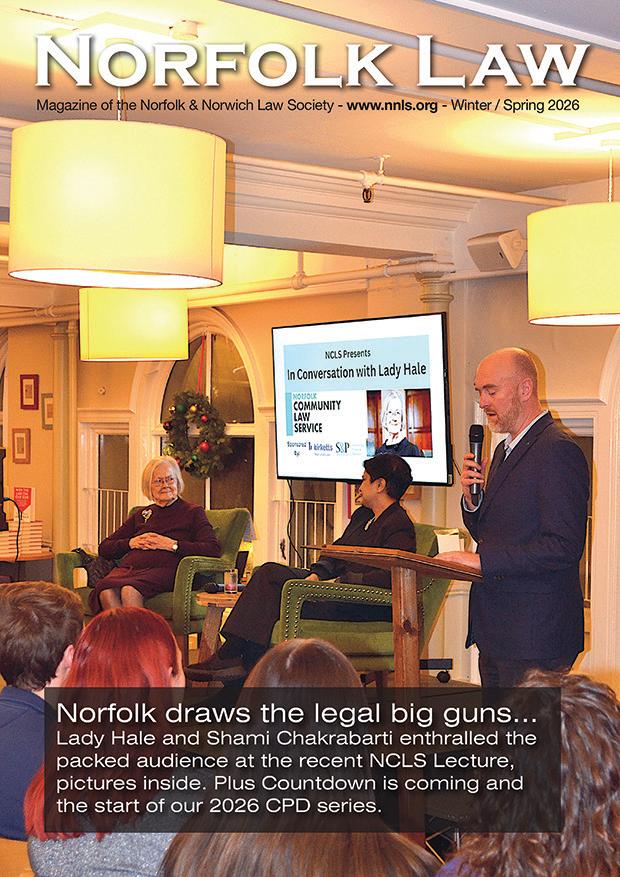
Magazine of the Norfolk & Norwich Law Society - www.nnls.org - Winter / Spring 2026
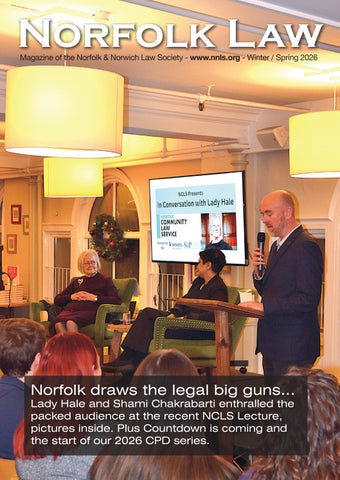
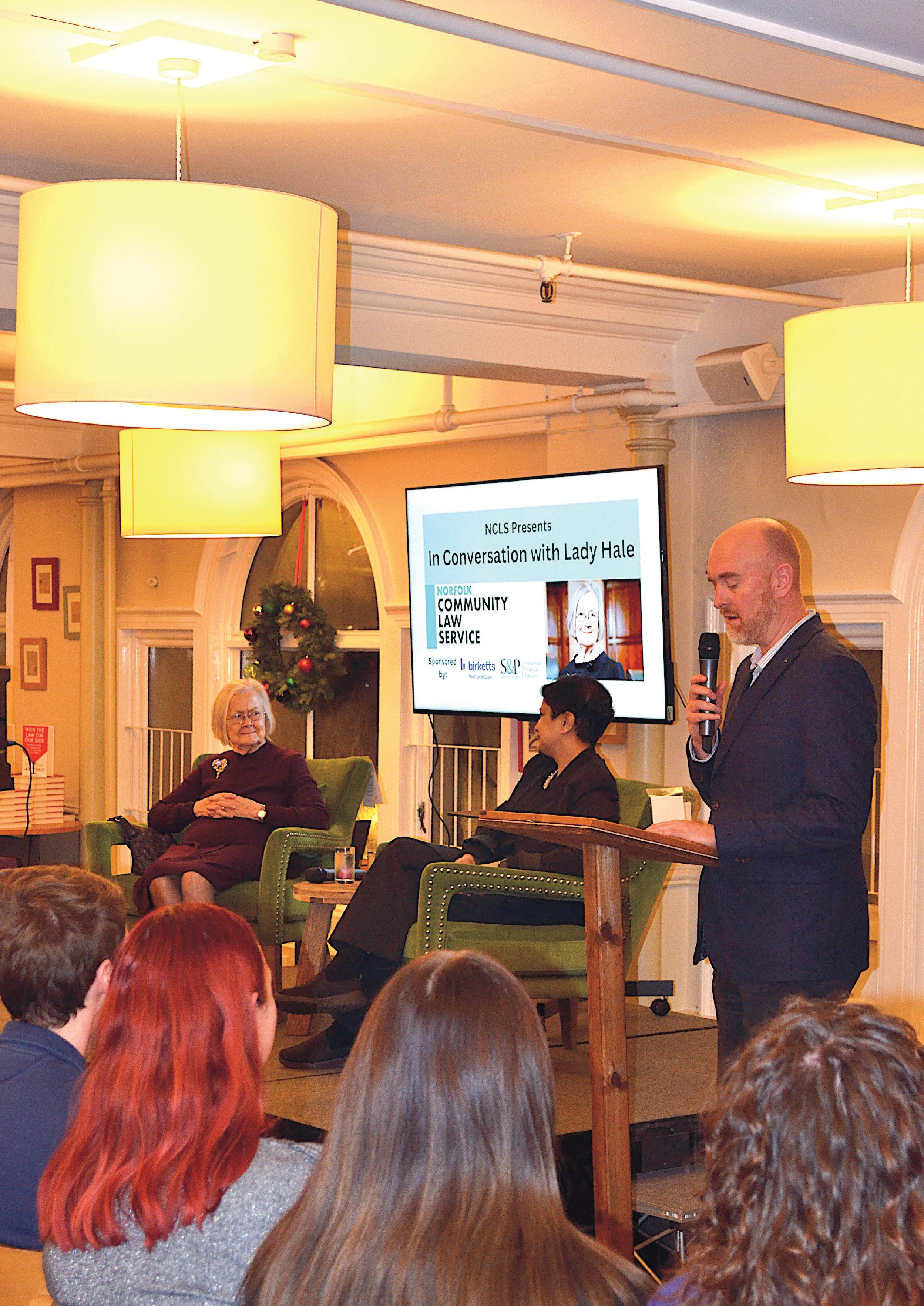
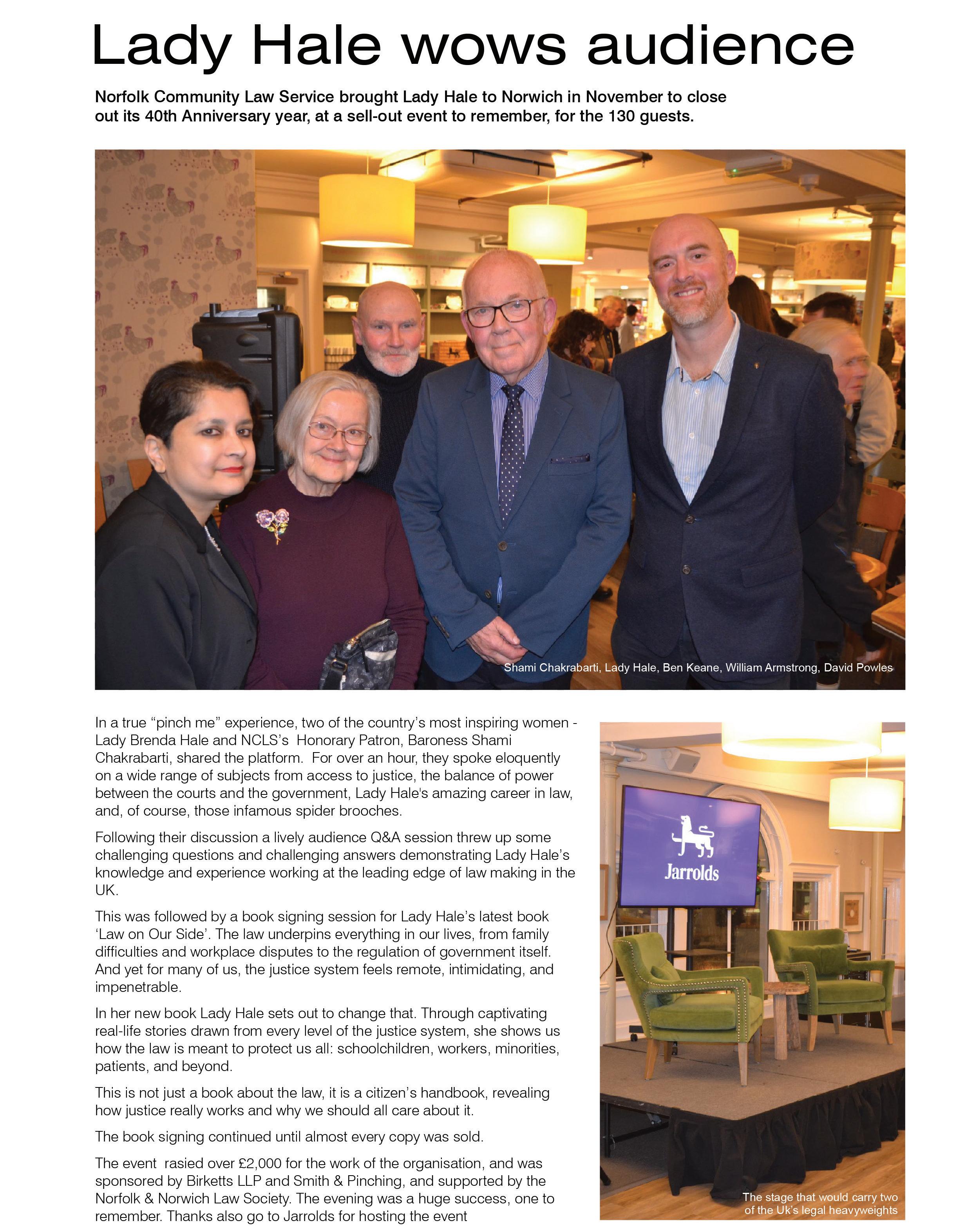
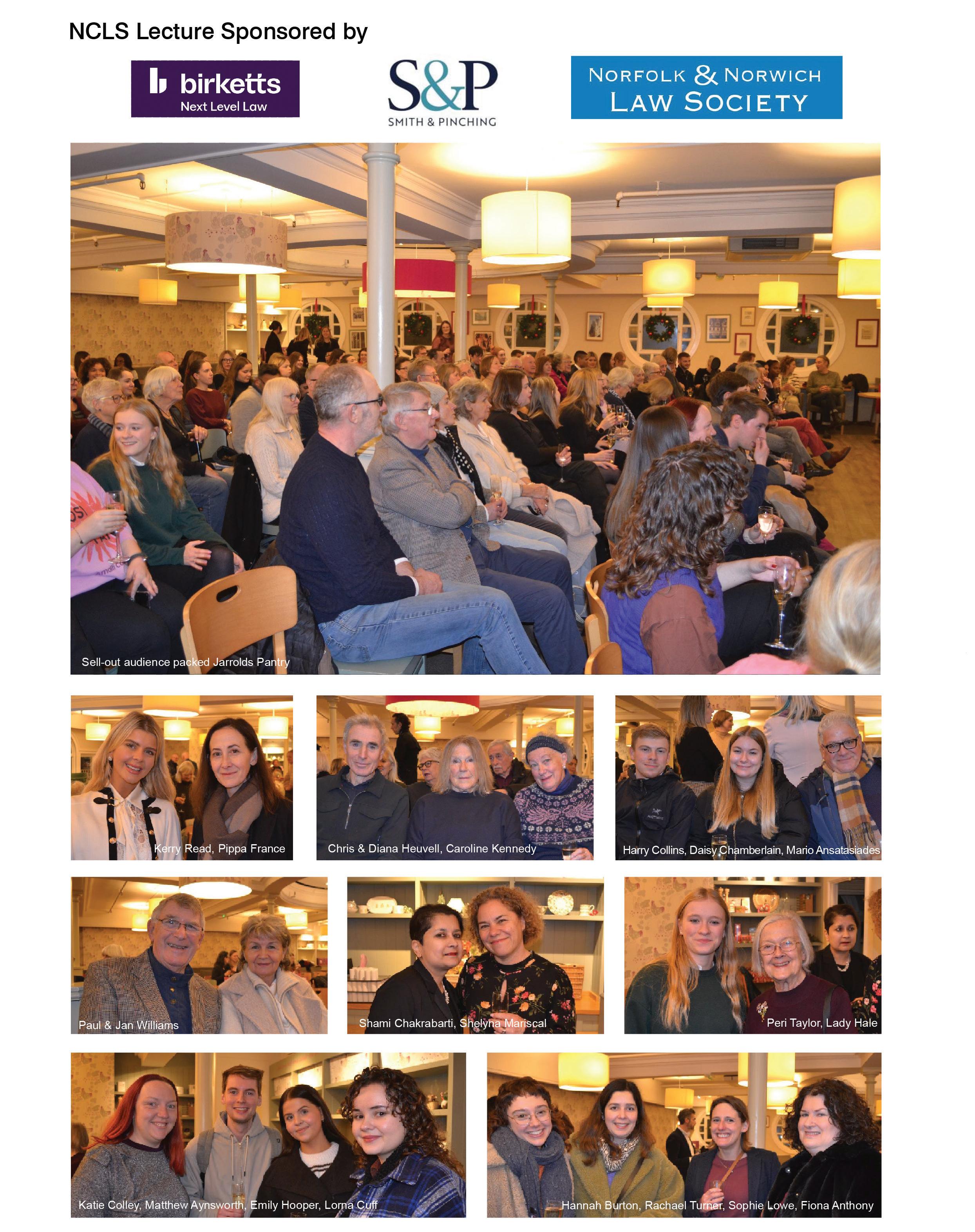
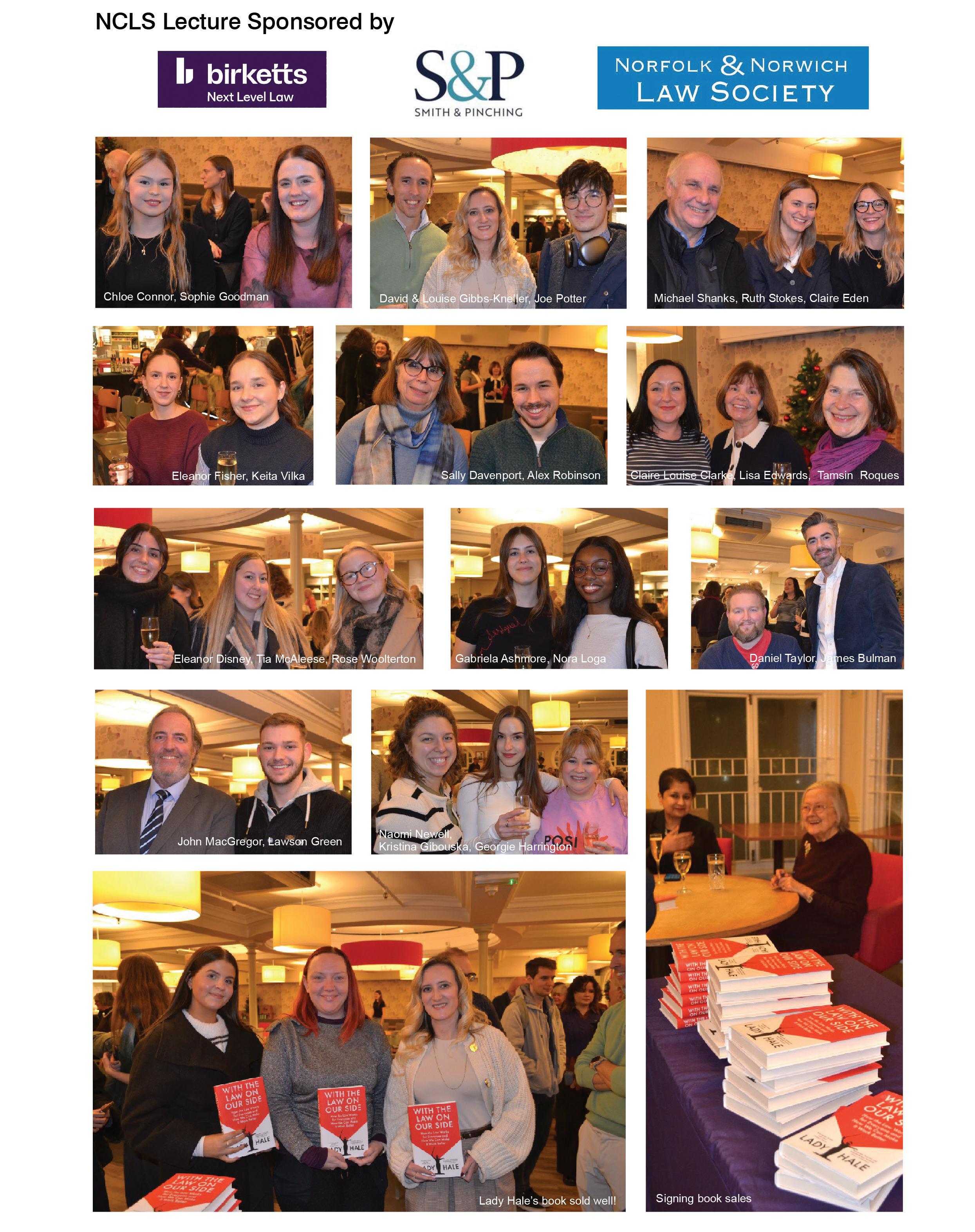
Norfolk draws the legal big guns... Lady Hale and Shami Chakrabarti enthralled the packed audience at the recent NCLS Lecture, pictures inside. Plus Countdown is coming and the start of our 2026 CPD series.
to the first Norfolk Law of 2026. Countdown is coming, the NCLS Pub Quiz and our CPD programme kicks off too. Plus pics from the Lady Hale Lecture organised by NCLS and more musings from our resident author (and broadcaster) Richard Barr.
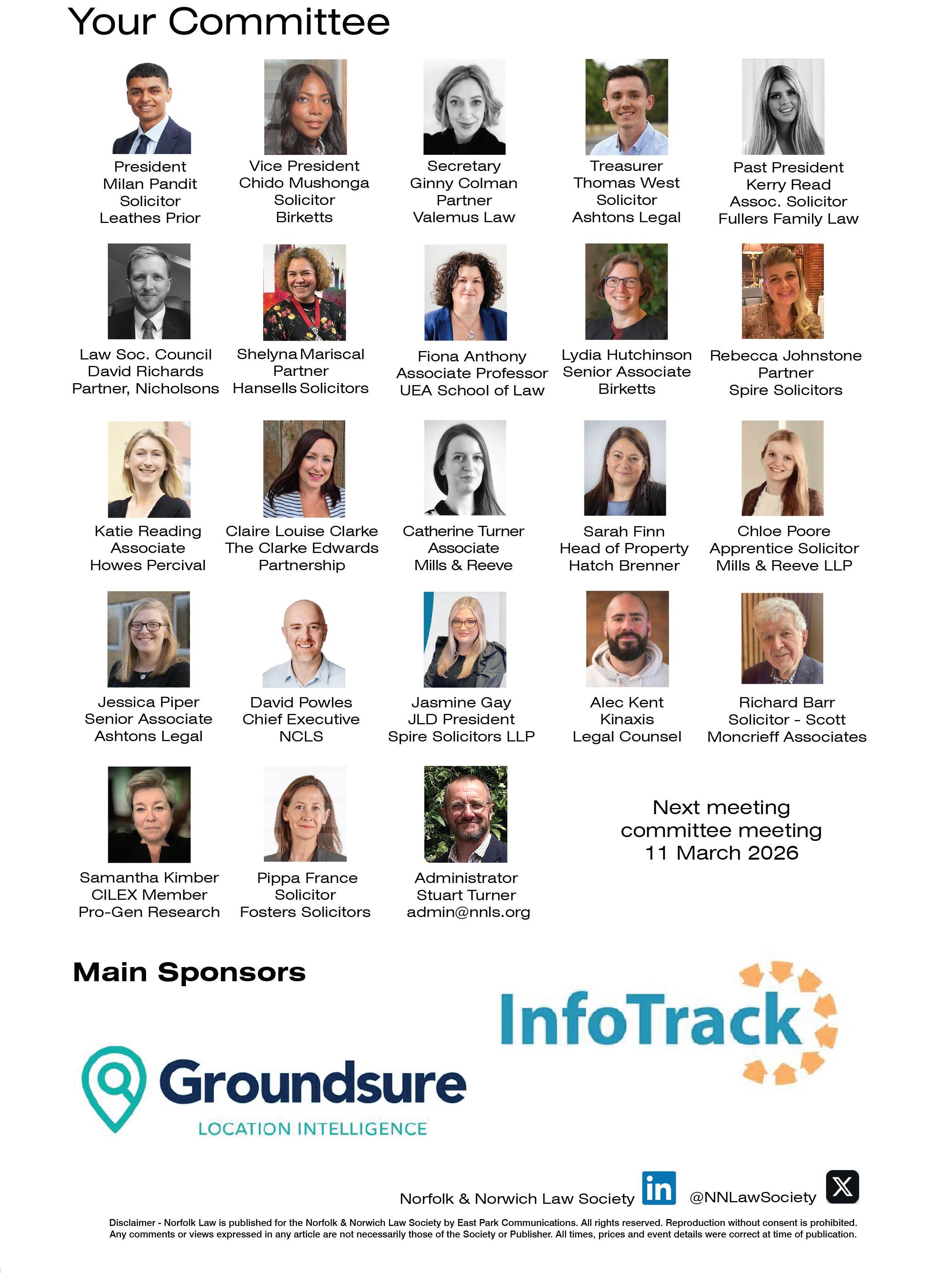
President’s Report
The past two years have been transformative for the Norfolk & Norwich Law Society (NNLS). As a committee, we have modernised our constitution to reflect the needs of today’s profession, continued to support the Norfolk Community Law Service in expanding its regional impact, and delivered two outstanding Annual Excellence Awards celebrating the strength and talent that Norfolk & Norwich contribute to the legal sector.
It is a genuine privilege to serve as President of the NNLS for 2025–2026 and to build on the strong momentum established in recent years. To share this role with my Vice President, Chido Mushonga of Birketts, gives me every confidence that the year ahead will match – and hopefully exceed – the success of those that came before.
Our commitment to the legal community across Norfolk & Norwich is one of energy and action. While some members of the executive committee may be early in their careers, any perceived lack of
experience is more than offset by enthusiasm, dedication and a clear determination to serve our members well. We are focused on ensuring that our constituents have meaningful access to education, support and professional opportunities, enabling the local profession to continue to thrive.
The committee itself continues to evolve, welcoming new and diverse voices to ensure comprehensive representation across the profession. We are particularly pleased to maintain involvement from in-house lawyers and strong links with the University of East Anglia. Supporting the lawyers of tomorrow is essential if Norfolk is to sustain its reputation for delivering outstanding legal services.
I look forward to contributing to the next chapter in the NNLS’s history and to giving back, in some small measure, to Norwich’s legal community – a community that has already afforded me considerable opportunity in my career to date.
Milan Pandit President, Norfolk & Norwich Law Society 2025-26
When lawyers are silenced
Attacks on lawyers’ freedom of expression silence the voices essential to upholding justice and accountability, according to a new report from the Law Society of England and Wales.
When Lawyers are Silenced: How restrictions on lawyers’ expression undermine rights, justice and democracy* highlights a troubling global problem.
Through real-life examples, it illustrates how lawyers across the world face harassment, disbarment and imprisonment for speaking out in support of equal access to justice and human rights.
The report details many violations of lawyers’ freedom of expression, including ongoing criminal proceedings against the leadership of the Istanbul Bar Association.**
The charges come from a statement the Association issued calling for an independent investigation into the deaths of two journalists in Syria.
Prosecutors subsequently accused them of “terrorist propaganda” and “disseminating misleading information”.
Law Society president Mark Evans said:
“The intimidation and harassment of lawyers worldwide is extremely concerning, and urgent action is needed to protect freedom of expression in the legal profession.
“The rule of law underpins the rights, freedom and protections that touch the everyday lives of all people in all societies.
“If lawyers are not protected, the justice system collapses and every single one of us will become vulnerable to injustice. One by one, all of our communities will be adversely affected.
“We call on governments to respect and protect lawyers’ rights in line with international law and to condemn all acts of violence, threats or reprisals against lawyers doing their job.
“Lawyers’ freedom of expression is central to a functioning justice system and a healthy democracy.
“We stand with our colleagues who work tirelessly to uphold the rule of law, human rights, access to justice and the very principles that safeguard our daily lives and families.”
One in three people with a Will include a charitable gift
Poppy’s
When Poppy’s Dog Guardian conta
With the largest intergenerational wealth transfer now underway, new data from our latest tracking study reveals that almost one in three people aged 40+ with a Will have included a gift to charity (32% ) .
The study, based on over 2,000 people who donate to charity more than once a year, indicates that people often write their Will at a younger age than others might think. Almost half of those who have made a Will, did so before they reached their 50s (49%). However, it also shows that almost 2 in 5 people aged 40+ (37%) have not yet written a Will at all.
This New Year, we’re encouraging people, when writing or updating their Will, to consider all the things they care about; loved ones and good causes alike.
Importance of Will-writing
As New Year’s resolutions take shape, January remains the most natural time of year for a financial reset. Writing or updating a Will is essential for anyone who wants to influence how their assets will be distributed beyond their lifetime, while being a key opportunity to protect family, loved ones and any good causes they wish to support.
Good estate planning can also help families reduce their Inheritance Tax (IHT) bill. Charitable gifts in Wills are free of tax, with donations of 10% or more of the net value of the estate reducing the IHT rate from 40% to 36%. However, even amongst wealthier UK households, a significant knowledge gap remains about these tax incentives, with 30% of millionaires in this study saying they were unaware of the tax breaks on charitable gifts in Wills.
Evolving fiscal landscape
This news comes at a time when IHT receipts continue to rise. The Chancellor’s Autumn Budget
statement revealed that IHT thresholds will be frozen for another year (until 2030/31). With the Government’s plans to draw inherited pension pots into the scope of IHT from April 2027, experts are predicting that around twice as many estates will be liable for IHT by 2031, 1 prompting more households to think carefully about how they preserve and pass on wealth.
Solicitors, Will-writers and financial advisers are already reporting a growing appetite for inheritance planning. In recent research, 60% said they have seen a rise in demand for estate or tax planning advice, and 65% say they expect charitable tax incentives to become even more important 2 to their clients in the years ahead.
With the UK entering the largest intergenerational wealth transfer in history and many more estates facing an Inheritance Tax liability, having an up-to-date Will in place has never mattered more.
Impact of charitable gifts in Wills
This January, Remember A Charity is urging people to reflect not only on their financial affairs, but the good causes they wish to support alongside their loved ones. Charitable gifts in Wills can make a considerable impact on good causes and communities across the UK – funding vital research, care in the community, emergency helplines, animal welfare, environmental causes and so much more.
Lucinda Frostick ,
Director of Remember A Charity, says: “The new year is a great opportunity for us all to get our affairs in order and it’s deeply inspiring to see that – for so many people – that includes
good causes as well as our loved ones. We’re seeing a growing sense of social responsibility and a real desire to leave the world a little better. No matter the size of the gift, remembering a charity in your Will can be one of the most empowering things to do – helping to sustain urgently-needed charitable services for future generations.”
James Antoniou , Head of Estate Planning & Senior Solicitor at Co-op Legal Services, says: “Typically, the start of the year is the most popular time for putting a Will in place. It’s an essential part of planning for the future and a properly prepared Will is often much easier to do than people realise. Gaining peace of mind that your wishes will be legally recognised and your assets protected for your loved ones after you’re gone are often key incentives however we are increasingly seeing clients choose to include charitable causes in their Wills, leaving a lasting legacy that can make a real difference to the causes that matter to them.”
To explore how charitable gifts in Wills are changing the world, visit the Great Map of Willanthropy. 3
Legacy Festival 2026: Sponsors and Programme Announced
We’re thrilled to announce the programme and sponsors for the Legacy Festival 2026. Our exclusive one-day member event is designed to bring charities together to connect, learn, and be inspired.
Taking place in London on Monday 16 March, the Legacy Festival is proudly supported by an impressive line-up of sector partners, led by headline sponsor National Free Wills Network.1
Exhibiting at the event, fellow sponsors and supporting partners include Co-op Legal Services2, Yoyo3, Fastmap4, formyENCORE.com5, Institute of Legacy Management6, Smee & Ford | Legacy Futures7 and The Saltways.8
Katie Roberts, Business Development Manager at the National Free Wills Network, says: “We’re immensely proud to be sponsoring Remember A Charity’s Legacy Festival, supporting the nation’s movement for legacy growth. It’s a fantastic opportunity to celebrate the power of charitable legacies and to bring the legacy fundraising community together . We’re hugely looking forward to being part of such an inspiring event.”
Legacy Festival 2026 Programme Launched
The programme9, launched today, features new market data, inspiring speakers and case studies, fundraising clinic sessions and a multitude of networking opportunities. Attendees will learn about how strategies from behavioural science can enhance their fundraising and supporter journeys, and explore creative ideas for legacy marketing.
An interactive day, the Festival encourages members to exchange ideas and learn from their peers, while hearing updates on key campaign developments for 2026.
Director of Remember A Charity, Lucinda Frostick, adds:
“This year’s Legacy Festival celebrates the growing power of gifts in Wills across our sector, and the key role of collaboration in accelerating legacy giving. This is a great opportunity to come together to learn, share and feel inspired about the impact we can create for future generations.”
Remember A Charity members can view the programme and book their space here10 . Please note that places are available on a first-come, first-served basis, and attendance is limited to two delegates per organisation.
AN UPDATED COMPREHENSIVE GUIDE TO CURRENT ADOPTION LAW FOR 2020s
For law students and practitioners alike, there has been concern in recent years that some fundamental reform of the law of adoption is urgently needed. We welcome the new, second edition of “Adoption Law: A Practical Guide” by Nasreen Pearce from Wildy, Simmonds and Hill Publishing for 2025.
The title arrives at an interesting time for the modern development of adoption as the strains on the system continue to show. Wildy have provided us again with another excellent book in their practical guide series of titles. We thank Nasreen Pearce for her wise counsel in offering a comprehensive guide to the law, practice, and procedure for lawyers, adoption agencies, support services and other professional bodies who are concerned with adoption for a wide readership. It can make all the difference to the advice we give clients.
For practitioners new to the work, the author covers each stage of the adoption process, including what are difficult issues of contact between the child and their birth parents. It includes the alternative options available by reference to the relevant case law and regulations in relation to domestic adoptions as well as adoptions involving overseas jurisdictions.
The title considers registration of adoption and the sensitive issue of disclosure of information which are explaining in straightforward terms to both knowledgeable readers and those new to this subject. Pearce explains the rights of those parties to challenge decisions made by the professional bodies involved in the process so do use the detailed index at the back for any specific areas you are interested in exploring further.
Nasreen Pearce in updating the second edition has included important developments in this principal area of family law for those wishing to adopt.
The book looks at the impact of the Convention for the Protection of Human Rights and Fundamental Freedoms on all aspects of the law relating to adoption.
As we expect with all Wildy guides, recent case law has been included in areas such as the notification to fathers and the child’s birth families of any plans to place a child for adoption. We are grateful for the inclusion of the procedure relating to preparation before proceedings begin, and the procedure for applications in the Family Court and, where relevant, the High Court.
The book also includes case law citations in relation to placement orders. It covers leave to revoke a placement order and to oppose adoption and postplacement arrangements for contact. The text sets out new coverage of postplacement contact, and post-adoption contact details to update advisers. The commentary covers recent reports and research plus the important decision in R & C (Adoption or Fostering) [2024].
We also found the inclusion of two recent lectures by the President of the Family Division on the modern approach to adoption and open adoption to be of great additional assistance.
The second edition of this hardback book from Wildy was published in 2025
Discrimination In Housing Law
By David Renton
ISBN 978 1 91364 856 5 LEGAL ACTION GROUP
The access to justice charity www.lag.org.uk
ESSENTIAL READING FOR HOUSING PRACTITIONERS ACTING FOR CLIENTS FACED WITH REPOSSESSION
There is very little that strikes more terror in the souls of its victims than the threat of impending homelessness via the judicial processes involved, which culminate in the process of eviction.
There ought to be an erudite and readable le book about it — and there is, thanks to this very useful publication from the Legal Action Group (LAG), the access to justice charity, who are justly famed for producing legal texts accessible not only to lawyers, but to the average concerned reader. David
Reviews Editor,
Renton, the author, is a barrister who represents tenants and mortgage holders embroiled in possession hearings.
Published in handy paperback format, the book offers a broad and concise coverage of ‘the use of the principles of equality in housing law’ — and equally of prime importance — the duty of landlords to fulfil their duties under the general categories of fitness and repossession.
As the publishers point out, the book covers the often complex and controversial matters, for example, of council houses let by housing associations, as well as houses held in thrall either to mortgages, or long leases. It should be added that homeowners in mortgage arrears suffer the same anxieties as those who rent — hence the general and urgent need for all practitioners to be duly bound in support of clients who struggle with these and other difficulties in the housing sector.
Practitioners and clients alike coming to grips with these problems will find this book especially helpful. As a concise work of reference, it truly excels. The precise introduction points directly to the subject of the book, namely the Equality Act of 2010 and its related principles — which apply both to business premises and residential properties.
Straightforward to navigate, the book has a detailed table of contents, enabling the reader — lawyer of not — to find the necessary advice they may be looking for, and for those doing further research, the book contains extensive footnotes, plus a detailed and useful index at the back.
Note too, the particular advantage of a 30-page section of precedents — including for example, the precedent entitled ‘Case Summary Application to Set Aside Possession Order.’ Also included in this concise text are Tables of Statutes, Statutory Instruments and also a Table of European and International Legislation.
For practitioners and clients alike, this book emerges as a practical and indispensable purchase.
The date of publication of this paperback book is cited as 2024.
Appreciations by Elizabeth Robson Taylor of Richmond Green Chambers and Phillip Taylor MBE, Head of Chambers and
“The Barrister”
Building on the Green Belt: The Hidden Planning Risks Facing East
Anglia’s Conveyancers
Across England, the debate over developing on green belt land is growing, and East Anglia is no exception. As local authorities contend with housing demand and land shortages, developers are increasingly targeting protected areas as possible sites for expansion. For conveyancers, this shift introduces new layers of planning and environmental risks that require careful consideration.
According to the latest government data, England’s green belt covers around 1.63 million hectares, representing 12.5% of the country’s total land area. In the East of England, this equates to roughly 233,670 hectares, or 12.2% of the region’s land, with significant coverage across South Cambridgeshire, parts of Essex, and Bedfordshire. Although these figures have remained relatively stable in recent years, the pressure to release land for housing is rising sharply.
“Flood risk, traffic congestion and the lack of supporting infrastructure, such as schools, roads and healthcare, remain major concerns,” says Iain Grimes, Managing Partner at Fraser Dawbarns. “These are not just planning challenges; they directly impact the long-term sustainability of new developments.”
Infrastructure gaps and planning pressures
While housing targets continue to rise, infrastructure investment has struggled to keep up. A recent report from the Home Builders Federation found that the East of England delivered 28,640 homes in 2023-24, significantly short of the regional target of 45,429.
“Planning policy is not addressing the chronic underfunding of infrastructure,” explains Iain. “Hospitals, roads, schools and the services expected by residents are not being planned in a coordinated way to make development sustainable.”
This mismatch between planning approvals and infrastructure delivery creates uncertainty for conveyancers and their clients. In some cases, land may technically be approved for development but remain impractical to occupy or resell because the necessary facilities aren’t yet in place.
The conveyancer’s challenge Conveyancers advising on potential or former green belt land face unique due diligence challenges. Having accurate, current information on planning restrictions, environmental risks, and infrastructure capacity is vital for managing client expectations.
“Having the correct information to inform
clients
of environmental risks is critical,” notes Iain. “Pre-occupation conditions are one of the biggest issues we see, along with occupancy restrictions tied to local employment. These factors can delay completion or complicate future resale.”
Between 2019 and 2022, approximately 7,200 hectares of green belt land in England changed to developed use,
with around 1,100 hectares converted for residential development. For conveyancers, these shifts highlight how planning boundaries and land designations can evolve, often faster than anticipated, bringing new considerations around flood risk, access, and sustainability.
Looking ahead
Most experts agree that pressure on green belt development in East Anglia will continue to rise over the next decade. Yet without coordinated investment in transport, drainage, schools and healthcare, the region risks overdevelopment without infrastructure, a trend that could erode community resilience and increase transaction risk.
“Overdevelopment without infrastructure investment is the biggest concern for the region,” adds Iain
At Geodesys, we help conveyancers manage these planning risks by providing trusted, combined risk and standalone planning reports to support informed decision-making. Our comprehensive searches enable solicitors to spot potential issues early, from flood and environmental factors to pre- occupation conditions, ensuring developments are both viable and sustainable.
East Anglia’s green belt presents both opportunity and risk. For conveyancers, understanding the balance between development potential and environmental impact is essential, and it all starts with reliable, data-led insight.
Law Society News
Updated guidance eases processes for probate professionals and bereaved families
UK Finance has updated the Estate Administration Banking Protocol that gives probate practitioners clear guidance on how to engage with regulated financial services when representing bereaved families*.
The Law Society of England and Wales supports the updated protocol, which aims to help probate professionals support bereaved families during a stressful and confusing time following the death of a loved one. The guidance:
• provides a transparent framework for how banks and probate practitioners should exchange information during
estate administration
• defines exactly what documentation a bank requires to verify the authority of a probate practitioner
• reduces delays by setting a 15-working-day aim for banks to respond to initial information requests
Law Society president, Mark Evans, said:
“UK Finance has greatly improved the Estates Administration Protocol. The relationship between probate practitioners and financial service providers is a delicate one as both parties must try to accurately and efficiently convey the wishes of the deceased and the best
interests of the family.
“This protocol is a good opportunity to improve the communication and consistency about how estates are administered.
“This updated protocol will help practitioners and financial service providers to work together, simplify the process and reduce avoidable delays.”
*Read the full Estate Administration Banking Protocol. * Ian Bond, member of the Law Society’s Private Client & Estates Committee, provided significant input in the protocol.
Alcohol misuse in safeguarding or workplace cases: How Certis BioLabs helps courts and employers see the full picture
For legal professionals practising across Hertfordshire, alcohol misuse can be a key concern in family law and child protection.
According to the Department for Education, 73,250 social care cases in the year ending 31 March 2025 involved concerns about a parent’s alcohol misuse. While drugs often attract the headlines, alcohol is the substance more frequently linked to child neglect, domestic abuse, and fluctuating parental capacity.
With around 1 in every 30 children classified as being “in need” of social care services, understanding patterns of alcohol consumption among parents or guardians is critical to safeguarding cases.
Meanwhile in the workplace, alcohol misuse is likely to be minimised, misunderstood, or missed. This is despite studies suggesting that a whopping 40 per cent of workplace industrial accidents are due to substance misuse.
Using alcohol testing to support decision making
At Certis BioLabs, we provide clear and scientifically grounded evidence about alcohol and drug patterns of use to support sound decision making.
Our UKAS-accredited labs and experienced forensic teams will help you identify patterns of use over time, so that fair decisions can be taken in family courts or the workplace.
We understand that every test result goes deeper than data: it can impact a child’s or adult’s future. That’s why we uphold the highest standards of accuracy, confidentiality, and scientific clarity in all our services.
How do we do this? We develop a full picture of alcohol consumption by looking at alcohol biomarkers in hair, blood, urine, and nail samples. These biomarkers are usually produced in the body following alcohol consumption and can provide insight into a person’s alcohol consumption patterns over time.
With our reports, you will have clear, court-compliant evidence of alcohol
use over both short and extended time periods.
What test is best for your case? There are a lot of tests out there and it can be confusing to know which to choose from.
We offer:
Hair strand testing: By looking at biomarkers left by alcohol in the hair (EtG, EtPa), this test can indicate excessive or chronic historical consumption over a 1-6 month window.
Blood testing (PEth): Provides insight into a person’s alcohol consumption in a roughly four-week period prior to testing.
Nail alcohol testing (EtG): This is useful for understanding historical consumption and is a good alternative to blood or hair samples.
Hair and nails are generally best at revealing long-term use, while blood (PEth) and urine (EtG) are better placed to highlight recent consumption. For the Public Law Outline (PLO) process, assessments over 3 or 6-month periods are usually required, whereas shorter detection windows may be preferred for employment-related tests.
If you are unsure about which methods are best for your case, our dedicated customer service team will be happy to advise.
Translating results into reliable evidence
Reports where cut-off levels or certificates of analysis have been used can easily lead to disputed results.
Certis BioLabs ensures reports that stand up to scrutiny, providing:
• Clear and easy to digest courtadmissible reports
• Contextual explanation of what results mean, as well as what they can and cannot show
• None of our findings are filtered out – we report all substances found, no matter how small
• Dedicated support from our experts for follow up questions
We don’t just provide data but clarity
about what the data means and why it matters.
Our interpretation is complemented with information collected from the client about their self-declared use, as well as other relevant information, such as hair colour, pregnancy, medication use and other factors that can impact results.
Certis BioLabs works with solicitors and local authority teams at the instruction stage to ensure the chosen method answers the precise questions the court need answered.
Having supported thousands of cases with drug and alcohol testing, we know how high the stakes are for individuals being tested.
The Importance of High-Quality Sample Collection
Sample collection remains a frequent source of delay in family cases when not performed to forensic standards.
Certis BioLabs offers nationwide professional sample collection, ensuring:
• Full forensic chain of custody
• Convenient appointments, including home visits or appointments at one of our nationwide walk-in centres
• Bespoke handling of each case, ensuring clients are treated with dignity and respect
• Consistent, legally defensible processes to ensure evidence is reliable and court admissible.
• 3-day turnaround once the sample is received
Reliable evidence supports better outcomes
When it comes to alcohol testing, Certis BioLabs helps eliminate the guess work. Our focus is on clarity, safeguarding, and trust, providing results that meet the highest standards of accuracy and care.
Need an alcohol test?
Contact us now on 01235 633040 or email testing@certis-biolabs co.uk to discuss how we can support your testing needs.
Website: Certis BioLabs LimitedDrug, Alcohol & DNA Testing: https:// www.certis-biolabs.co.uk/
Thinking About Live-in Care Support?
• Are you considering Live-in Care for a person you know, or do you already have a care package in place?
• If the thought of Live-in Care is new to you, please call 01603 764567 for further details.
If you are already receiving Live-in Care but would like to compare costs, please call 01603 764567 and we will be happy to discuss.
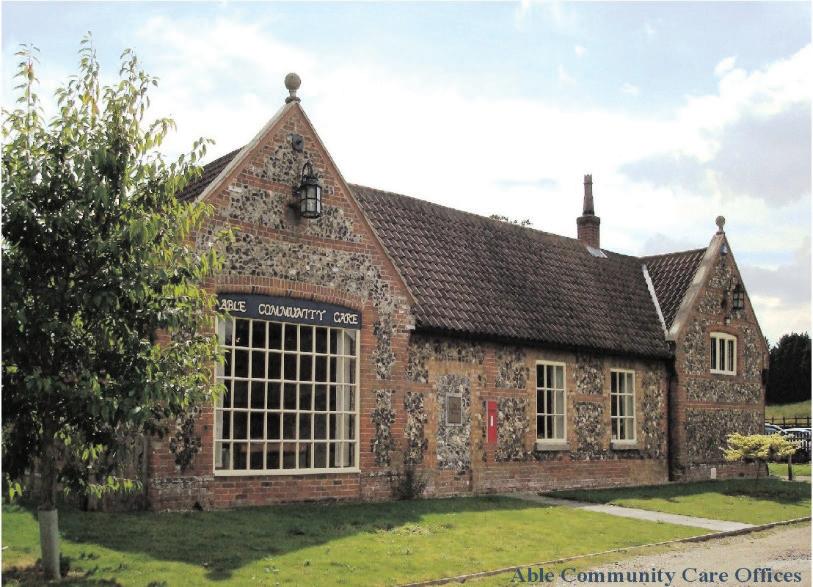
Able Community Care is a Specialist Live-in Care Provider - Established in 1980, we provide expert Live-in Care support. We are based in Norfolk, but our care support is available throughout the UK and the offshore islands.
Get in touch today: Call 01603 764567 or Email to: info@ablecommunitycare.com to request your information brochure or visit our website at: www.ablecommunitycare.com
Home of Able Community Care in Trowse, Norwich NR14 8TZ since 2003.
Top Tips from the experts at FHM Forensic Accountants
In this article our experts at FHM Forensic Accountants share their top tips for lawyers. Fiona Hotston Moore and Tom Arnold undertake 50 to 60 forensic accounting assignments each year. We are instructed on a range of matters including business valuations, financial investigations, professional negligence, shareholder and partnership disputes. We act as Single Joint Expert, Party Expert and Shadow Adviser.
1) Beware of placing too much reliance on published company accounts
Less than 5% of companies are subject to an external audit. An external audit gives assurance that an external qualified auditor has scrutinised the accounts both in terms of the numbers and the disclosures. An audit gives an assurance that the auditor has not identified a “material” error in the accounts. However, Accounting and Auditing Standards are principlesbased and you may need expert advice to interpret the accounts. If you do have audited accounts, we recommend first checking the Audit Report to see if the auditor was happy with the accounts. If the auditor was unable to give a “clean” audit report, you may see either a “Disclaimer of Opinion” or an “Adverse Opinion”. Read the qualification carefully and ideally obtain an interpretation from a qualified accountant. Additionally, the auditor may express a view as to whether the company is a “going concern” (i.e. is able to continue to trade and meet its liabilities as they fall due).
In respect of most limited companies other than the largest entities, the
published accounts on Companies House, are of limited value. The accounts on public record will be extracted from the full accounts that are prepared for shareholders. Often the published accounts comprise only a balance sheet and a few notes. The profit and loss statement is not published and so there is no information on turnover or profitability. The accounts will normally include a note of the number of employees which gives an indication on the likely size of the company.
The balance sheet in the published accounts will give you the “net assets”a very rough estimate of the baseline net worth of a company. However, but this may be very different from the market value of the company which takes into account the value of the trade and intangibles. Also remember that assets shown in the balance sheet may be at historical cost. The current market value of, say, a property may be substantially higher than its original cost.
Finally, as experts we all too often come across errors in accounts as well as accounts that show a misleading view of the financial position. Errors can include inclusion of provisions and liabilities that are not justifiable or failure to correctly account for a share premium. Occasionally we even see accounts that do not add up!
2) Think tax
Tax impacts much of our work as forensic accountants. We may be giving a view on the after-tax valuation of a shareholding or the tax costs of extracting cash or assets from a company. The tax costs of a transaction can be substantially reduced if capital gains tax rates apply rather than income tax rates. Furthermore, there are
various reliefs and exemptions that may be available.
There are also taxes that are easily overlooked in a transfer or transaction but that can be significant. For example, disposing of shares that were eligible for Business Asset Disposal Relief, may result in a substantial increase in the potential Inheritance Tax liability on an estate. Similarly, don’t overlook potential VAT on a business or asset transfer or Stamp Duty Land Tax on the transfer of a property.
The list of potential tax pitfalls is very long and early input from the company accountant or an independent expert is advisable.
We also come across tax liabilities arising from tax schemes or failed tax planning. This may include disputed Research & Development claims or Employee Ownership Trusts. In such situations an objective assessment of the likely liability is required.
3) Don’t overlook the option of engaging a shadow adviser
We are instructed as shadow adviser in a range of cases. Typically, in a financial dispute where a Single Joint Expert is engaged, we may be instructed to help the clients and legal counsel to draft the instructions, to assess the expert report, formulate questions and decide on the litigation strategy.
In family cases we can review the initial disclosure and give a view on any valuation provided by a party or company accountant. We can give a view on whether the appointment of a Single Joint Expert should be sought.
The shadow adviser can help give your client reassurance on the reasonableness of the Single Joint Expert report and help contain costs.
fiona@fhmforensic.co.uk
+44 (0)7770 642491
Tom@fhmforensic.co.uk
www.fhmforensic.co.uk
The FHM Senior Team: Kirsty Shuckford, Fiona Hotston Moore, Graham Hines and Tom Arnold
Outgoing Chair of The Solicitors’ Charity, Shams Rahman, on “Listening, Learning and Leading with Care” – a personal reflection
Shams Rahman, pictured above, has served on Board of The Solicitors’ Charity for the past decade. He is a Partner at London firm Edwin Coe where he is a member of the firm’s Management Board and Head of Contentious Trusts and Estates.
As his term of office as Chair ends, he shares his insights:
“As I step down as Chair, it feels like a wonderful journey, where brilliant progress has been made and will continue. After serving as a Trustee for ten years and as Chair for the past two, no one moment stands out from the rest – our work stretches well beyond any single initiative or headline. I have witnessed transformation both within the Charity and across the legal community.
“More people now know who we are and what we do and feel able to come forward. We’ve done immense work in building our c.170-year-old brand and reputation to become known as the leading support for solicitors, whatever their needs may be.”
As the legal profession confronts rising pressures – from cost-of-living challenges to emotional strain and professional
uncertainty – so too has the demand for support from The Solicitors’ Charity grown. The latest Big Report highlighted a 33% increase in the number of solicitors helped in a single year, alongside £1.2 million directed towards wellbeing support. This surge reflects not just need, but also confidence: more solicitors now know the Charity exists and feel empowered to reach out for help.
Shams says: “The legal profession is often defined by competence and resilience. Yet one of the clearest truths I have learned is that lawyers are not immune to life’s disruptions. Illness, job loss, financial strain, and personal crisis do not distinguish between junior and senior, or between those who advise others for a living and those being advised.”
“Bad
things happen to good people, including highly capable solicitors who never expected to need help themselves and have devoted their professional life to helping others. Providing support with dignity, discretion,
and care has been at the heart of everything we do.”
“A defining shift during my tenure has been a move beyond traditional financial assistance to a holistic approach that embraces emotional, professional, and practical wellbeing.
“Collaborating with specialist partners, from counselling services to career transition advisors, has extended our capacity and enriched the support we can
provide. These partnerships recognise the reality that hardship rarely fits into neat categories and that truly effective support must be interconnected.
“Some of the most powerful moments during my time as Chair have been the least visible. Helping someone regain independence by funding essential equipment such as a specialist wheelchair; supporting a solicitor who has lost their job and needs time, space, training, and guidance to find a way forward again.”
“Being named Charity Collaboration of the Year at the Association of Charitable Organisation’s annual awards, for our partnership with LawCare, was a meaningful moment. It recognised years of quiet, practical collaboration around mental health and wellbeing, and reinforced the idea that charities supporting the legal profession are strongest when they work together.”
He adds: “By strengthening ties with local law societies, we have made sure solicitors throughout England and Wales understand that support is accessible, personal and rooted in their own communities. The example set by organisations such as the Bournemouth & District Law Society reminds us that local commitment drives national impact.”
Shams concludes: “As I hand over the leadership to I. Stephanie Boyce, former President of The Law Society, I am confident the Charity’s direction is strong and its mission more vital than ever.
The Charity is reaching more people, responding to more complex needs, and doing so through collaboration rather than isolation. “