Lee Thomas Miller, ’91
“I should have been scared,” he says today. “There was so little money.” At first, it seemed easy; by July Miller and his fiddle were on the road with a Nashville touring band. Six days later he was fired. Chastened, Miller registered at a temp agency and took “manual labor, office work, wherever.” Nights he played club bands, variously featured on piano, fiddle, guitar or voice. He peddled his songs at record labels, a process he calls terrifying. “Nashville can be a brutal town,” he admits, but his friendly, generous manner that Betsy Grise remembers from his Eastern days began forging lasting bonds in what is also, says Miller, “a relationship town.” Miller’s formal music training brought self-confidence and broader cultural awareness even if it wasn’t an immediate business asset since many country musicians can’t read music, relying on melodic memory and Nashville’s simple chord numbering system. But maturity and drive helped edge Miller over the fresh talent arriving daily. He avoided the obvious temptations and “just outgrew negative peer pressures.” Today, when his successes lure young musicians to Miller for advice, wondering if they shouldn’t go professional straight from high school and be the next Taylor Swift, Miller counsels them to grow up first, go to college and graduate. Even assuming tremendous luck and tremendous skill, new stars can burn out by their mid-twenties. With or without a blazing career, he advises young people, “You’re going to have to learn to be an adult and function in society. College helps you do that.” By the mid-nineties, Miller had married his wife Jana, a registered nurse, and had a regular night job singing at the Opryland Hotel. By day he promoted himself as a singer, musician and songwriter. A 1996 audition at Hamstein Music finally changed that. “You’re not reinventing the wheel as a musician or singer, but you might be able to write songs,” said Thomas Cain of BMI. Miller was offered a songwriting contract and an office on Music Row to “make up stuff for a living.” Asked to describe the appeal of country music (reaching 77.3 million adults every week, according to Arbitron, Inc.), Miller credits its lyrics and appeal to the common man. “The songs are about life: football, the baby, the relationship, the land, the family, the truck.” At their best, he says, writers create rhyming poetry from common language, “things that last.” Many songs emerge from the lives around him. The carpe diem theme of Grammy nominee “You’re Gonna Miss This” came from fellow songwriter Ashley Gorley’s description of a trying day with the kids. The story struck a chord with Miller. “Ours were 7, 4, 3 and 1 at the time, and the running joke was ‘I’m not gonna miss that!’You’d hear that phrase after some catastrophe: broken lamps, ink on walls, crusty food in the couch. The list is endless. And the crazy thing is, we probably will miss it.” The songwriting session began with a bridge concept and worked backwards. “Ashley claims the title was mine, but I’ve long since forgotten that detail,” says Miller with customary modesty.
22 Eastern
These days Miller lives a startlingly regular life, in the office by 10 a.m., working steadily and going home at night for dinner. He has “stuck his toe in producing” for singer Steve Holy (producing Holy’s 2006 hit single, “Brand New Girlfriend”), but his focus stays with songwriting. “I tell people I can only do one impossible job at a time,” he quips. Miller does travel often to Washington, D.C., with Nashville Songwriters Association International (NSAI) to lobby for his profession. In the past decade, according to NSAI, two-thirds of its professional songwriters have left the field, driven out by illegal downloading, piracy, radio deregulation and corporate mergers. Hard work by Miller and his colleagues recently brought some tax code relief for songwriters. “We take our guitars to Congress, talk, and then play a song,” laughs Miller, “which is something they don’t get with corporate lobbyists.” He is fascinated by the law-making process, which reminds him of his impatience with those who say that “politics” kept them from stardom. Every field is political, he observes. But as Lee Thomas Miller’s own story demonstrates, even politics, even a sometimes “brutal town” like Nashville may yield to steady determination, versatile talent, long relationships and focus on “things that last.”
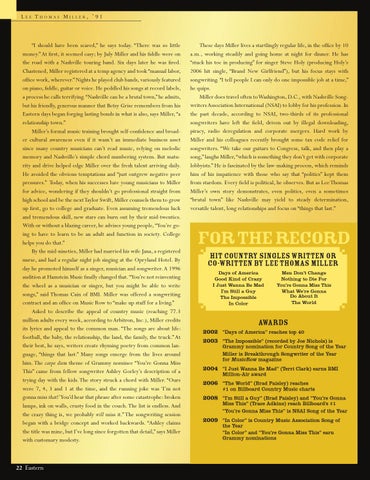
FORTHE RECORD Hit country singles written or co-written by Lee Thomas Miller Days of America Good Kind of Crazy I Just Wanna Be Mad I’m Still a Guy The Impossible In Color
Men Don’t Change Nothing to Die For You’re Gonna Miss This What We’re Gonna Do About It The World
AWARDS 2002 “Days of America” reaches top 40 2003 “The Impossible” (recorded by Joe Nichols) is
Grammy nomination for Country Song of the Year Miller is Breakthrough Songwriter of the Year for MusicRow magazine
2004 “I Just Wanna Be Mad” (Terri Clark) earns BMI Million-Air award
2006 “The World” (Brad Paisley) reaches
#1 on Billboard Country Music charts
2008 “I’m Still a Guy” (Brad Paisley) and “You’re Gonna
Miss This” (Trace Adkins) reach Billboard’s #1 “You’re Gonna Miss This” is NSAI Song of the Year
2009 “In Color” is Country Music Association Song of
the Year “In Color” and “You’re Gonna Miss This” earn Grammy nominations