Looking Back & Moving Forward A Brief History of Eastern Connecticut
State University
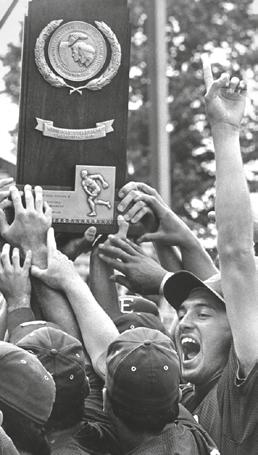
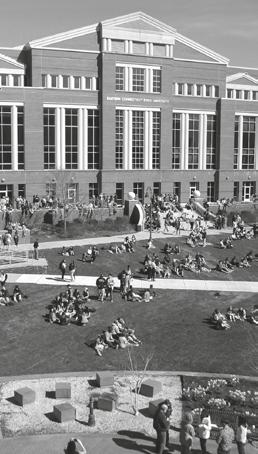
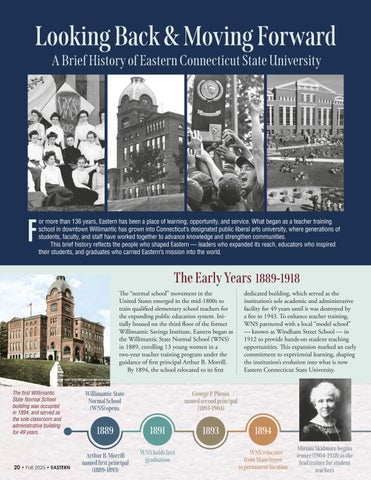
For more than 136 years, Eastern has been a place of learning, opportunity, and service. What began as a teacher training school in downtown Willimantic has grown into Connecticut’s designated public liberal arts university, where generations of students, faculty, and staff have worked together to advance knowledge and strengthen communities.
This brief history reflects the people who shaped Eastern — leaders who expanded its reach, educators who inspired their students, and graduates who carried Eastern’s mission into the world.
The Early Years 1889-1918
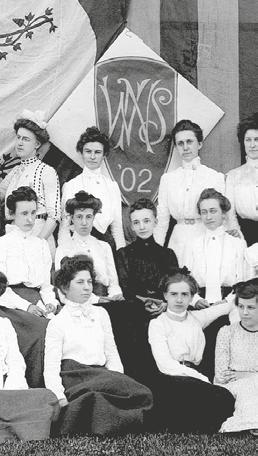
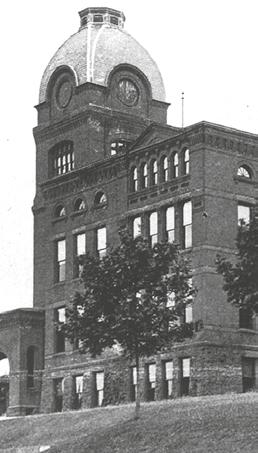
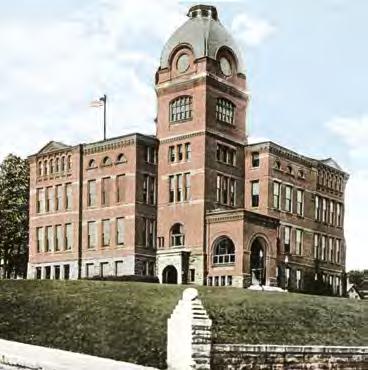
e “normal school” movement in the United States emerged in the mid-1800s to train quali ed elementary school teachers for the expanding public education system. Initially housed on the third oor of the former Willimantic Savings Institute, Eastern began as the Willimantic State Normal School (WNS) in 1889, enrolling 13 young women in a two-year teacher training program under the guidance of rst principal Arthur B. Morrill. By 1894, the school relocated to its rst
Willimantic State Normal School (WNS) opens

Arthur B. Morrill named rst principal (1889-1893)
WNS holds rst graduation
George P. Phenix named second principal (1893-1904)
dedicated building, which served as the institution’s sole academic and administrative facility for 49 years until it was destroyed by a re in 1943. To enhance teacher training, WNS partnered with a local “model school” — known as Windham Street School — in 1912 to provide hands-on student teaching opportunities. is expansion marked an early commitment to experiential learning, shaping the institution’s evolution into what is now Eastern Connecticut State University.
WNS relocates from Main Street to permanent location

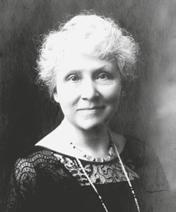
Miriam Skidmore begins tenure (1904-1928) as the lead trainer for student teachers
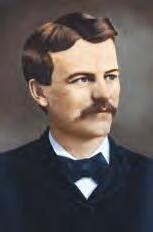


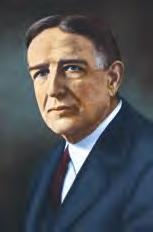
Arthur B. Morrill 1889-1893
Arthur B. Morrill, a Yale graduate, left New Britain Normal School to open WNS in 1889.
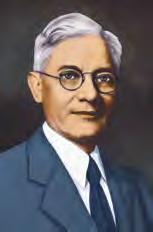
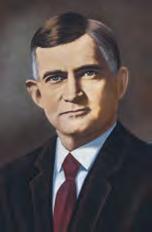
George P. Phenix 1893-1904
e second principal of WNS, George P. Phenix led the school’s move to a new building.
Henry T. Burr 1904-1918
Henry T. Burr served as WNS principal during the World War I era and oversaw construction of a model school where student teachers could practice their craft.
George H. Shafer 1918-1947
George H. Shafer’s tenure as the school’s fourth principal — and later as president — spanned the Roaring Twenties, the Great Depression, and World War II. During this period, he oversaw the opening of the school’s rst dormitory, which housed 80 women and was named after Henry T. Burr, WNS’s third principal.
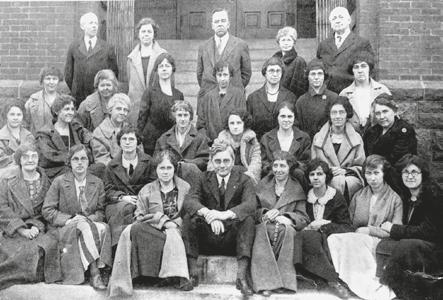
Shafer directed the school’s transition to a four-year curriculum in 1937, leading to its renaming as Willimantic State Teachers College (WSTC). On Sept. 27 of that year, Shafer was formally installed as the college’s rst president. By 1939, WSTC had enough male students to form its rst men’s basketball team. In 1941, the college expanded its academic o erings with its rst bachelor’s degree in science.
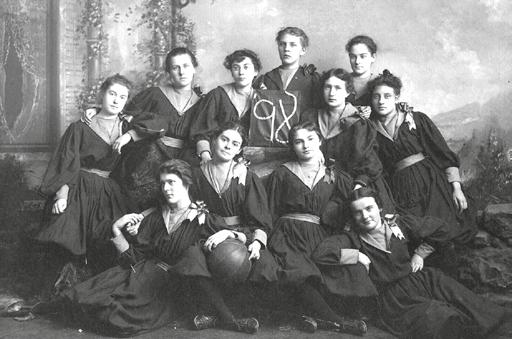

Henry T. Burr named third principal (1904-1918)
1904
1912
Windham Street Model School opens
George H. Shafer named fourth principal/ rst president (1918-1947)
1918
During Shafer’s tenure, Connecticut faced severe economic and environmental crises. Unemployment hit 26% by 1932 amid the Great Depression. e devastating 1936 ood and 1938 hurricane further tested the state. World War II brought both challenges and economic growth, with more than $8 billion in aviation and munitions contracts boosting Connecticut’s economy. However, rationing of essentials like gasoline and canned goods became routine.
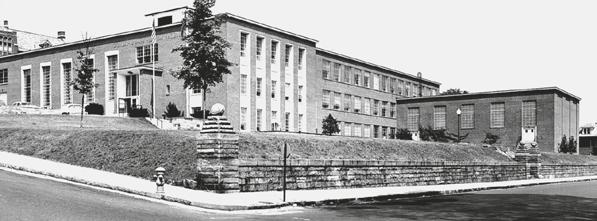
The original Willimantic State Normal School building was destroyed by fire in 1943 and reopened in 1948.
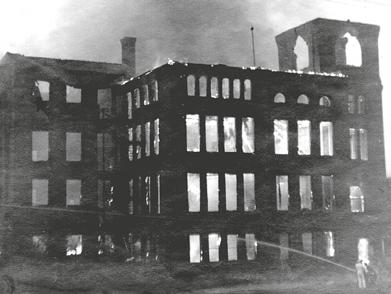
Windham Street School burns down (reopens in 1928)
19211924
Burr Hall opens ( rst dormitory)

1937
WNS renamed Willimantic State Teachers College (WSTC)
First bachelor’s degree offered (science)
1941

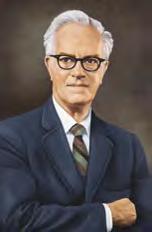
J. Eugene Smith 1947-1966
James Eugene Smith became president of WSTC in 1947, following his tenure at Windham High School and as a WSTC faculty member. His leadership marked a transformative era as the campus grew beyond its original Valley and Prospect Street
locations, acquiring new land “up the hill” and adding a student union, academic buildings, and the rst men’s dormitory.
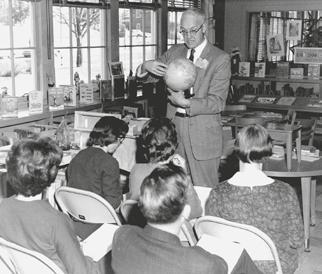
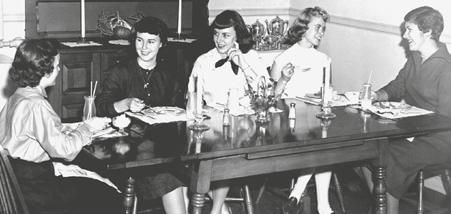
e 1950s brought stability compared to prior decades of economic turmoil, with student life ourishing through clubs, athletics, and cultural activities, including study tours to Canada, Cuba, and Mexico. Yet, the decade also re ected broader cultural changes, with youth rebellion rising alongside rock ‘n’ roll and gures like James Dean.
Postwar Connecticut struggled with job losses as defense contracts ended, but the GI Bill expanded access to higher education, boosting male enrollment. Academically, WSTC launched its
rst graduate program in education in 1957 and was renamed Willimantic State College in 1959, re ecting its growth. In 1971, after Smith’s retirement, the campus library was dedicated in his honor. ough relocated, the original library now serves as the Alvin B. Wood Support Services Center.
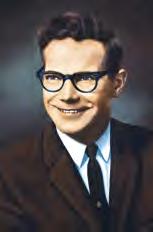
Searle Charles 1966-1970
During his brief tenure as the college’s third president, Searle Charles led the school through another name change: Eastern Connecticut State College. He also saw the completion of Goddard and Hurley Halls and the opening of Keelor Hall, the school’s rst early childhood education facility.

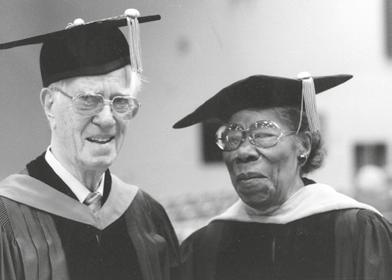
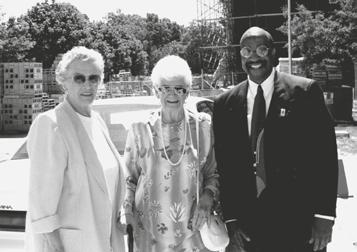
President J. Eugene Smith and Juliette Burstermann, who was the rst African American professor in New England when she joined the faculty of Willimantic State Teachers College in 1948, are reunited in this 1990s photograph.
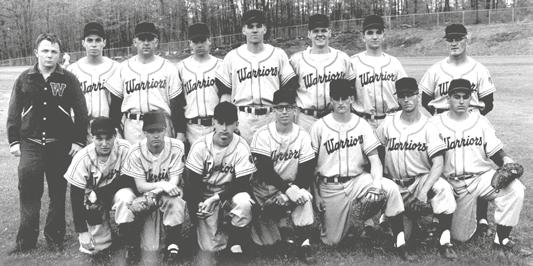
J. Eugene Smith named second president (1947-1966)
First graduate program offered (education)
Name change: Willimantic State College

Winthrop Hall opens (former student union)
Searle Charles named third president (1966-1970)
1970
1967 Name change: Eastern Connecticut State College
Charles R. Webb named fourth president (1970-1988)
Softball wins rst of ve national championships
1981

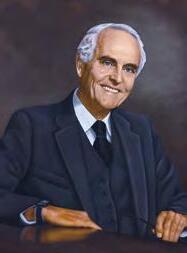
Charles R.Webb 1970-1988
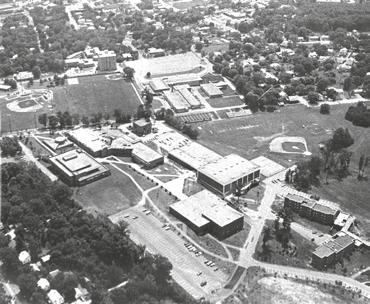
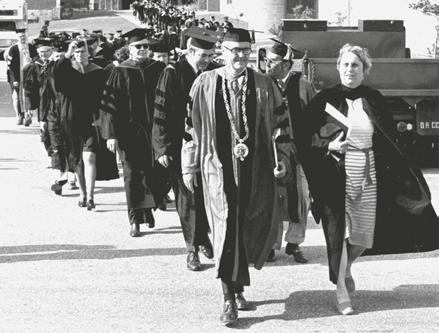
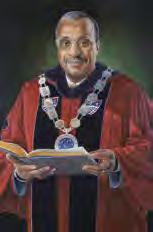
Charles Richard Webb served as Eastern’s fourth president from 1970 to 1988, overseeing remarkable growth and transformation. Enrollment increased from fewer than 1,000 to more than 4,000 students, while nine new buildings were added to the North Campus.
Webb introduced academic programs in environmental earth science, communication, and
computer science, and reorganized the institution into three schools: Arts and Sciences, Education and Professional Studies, and Continuing Education. In 1983, Eastern o cially became Eastern Connecticut State University, re ecting its broadened mission.
Webb also championed Division III athletics, growing varsity sports from four to 11 teams, including six teams for women. His push for the Sports Center in 1971 supported Eastern’s athletic success, including the softball team’s 1981 national
Webb Campus Developments
• Burnap Hall (1970)
• Crandall Hall (1970)
• Original library (1970) — now Alvin B. Wood Support Services Center
• High Rise and Low Rise Apartments (1971)
• Sports Center (1973)
• Robert K. Wickware Planetarium (1974)
• Student Center (1975)
• Occum Hall (1984)
championship — Eastern’s rst of 10 national titles in baseball and softball.
Webb’s presidency paralleled a period of major societal change. Inspired by the Civil Rights and Women’s Rights Movements, students engaged in environmental activism, gender equality, and a rmative action. Study abroad programs expanded, fostering a more global outlook. Culturally, the 1970s–80s shaped student life with fashion trends like bell-bottoms and miniskirts, dorm room novelties like lava lamps, and popular lms such as Star Wars and Saturday Night Fever.
David G. Carter 1988-2006
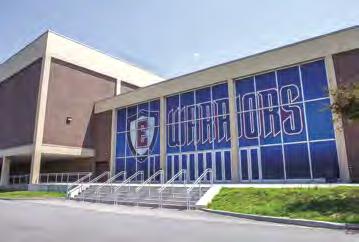
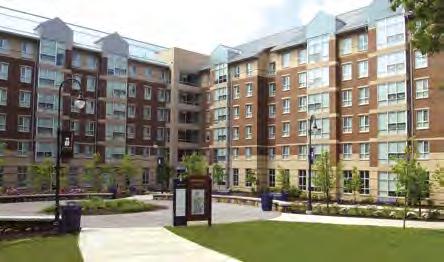
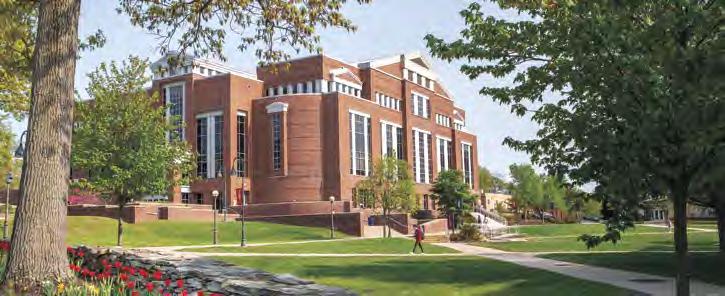
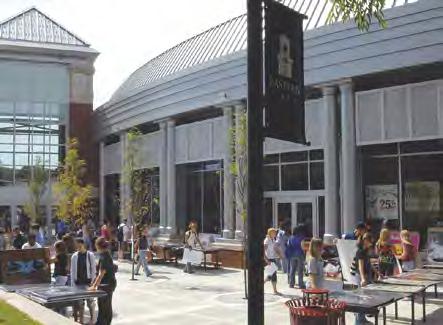
From 1988 to 2006, President David G. Carter led Eastern through its most ambitious period of growth, doubling the campus footprint with the addition or renovation of 15 buildings, including new residence halls, athletic facilities, academic buildings, and the iconic Foster Clock Tower. is expansion addressed a more than 40% enrollment increase during his tenure.
Academically, Carter strengthened Eastern’s liberal arts mission, earning formal approval from the Connecticut State University System Board in 1998 and joining the Council of Public Liberal



Arts Colleges (COPLAC) in 2004.
e updated Liberal Arts Core (LAC) curriculum accompanied an expansion to 33 undergraduate majors, 49 minors, and three graduate programs.
Eastern broadened its global presence through exchange agreements with institutions in Sri Lanka, France, Japan, Uganda, Brazil, and more, boosting study abroad participation and international enrollment.
e era also re ected millennial culture, with the rise of the internet, cell phones, instant messaging, and popular grunge and hip-hop music. Students embraced environmental sustainability, social justice, and community service, underscoring Eastern’s renewed commitment to civic engagement and global awareness.
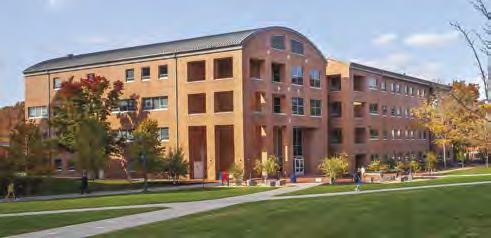

Carter Campus Developments
• Charles R. Webb Hall (1992)
• Frederick R. Noble Hall renovation (1992)
• Dr. Arthur L. Johnson Unity Center (1997)
• Baseball stadium (1998) and sports complex (1999)
• Niejadlik Hall (1998)
• Admissions Building (1999)
• Foster Clock Tower (1999)
• J. Eugene Smith Library (1999)
• Mead Hall (1999)
• Frederick A. Gelsi and Leslie T. Young Hall (2002)
• First parking garage (2003)
• Constitution, Laurel, and Nutmeg residence halls (2005)
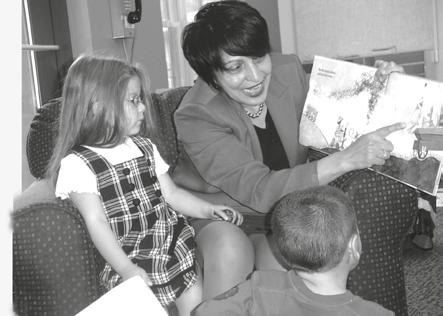
• Margaret S. Wilson Child and Family Development Resource Center (2006)


Elsa M. Núñez 2006-2024
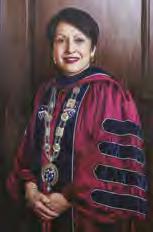
Elsa Núñez, a native of Puerto Rico, became Eastern’s president in 2006, making history as the rst Latina to lead a New England public university. Her tenure strengthened Eastern’s academic pro le, expanded access to higher education, and improved student success. By 2021, Eastern was ranked #1 among New England public universities by U.S. News & World Report for three consecutive years.
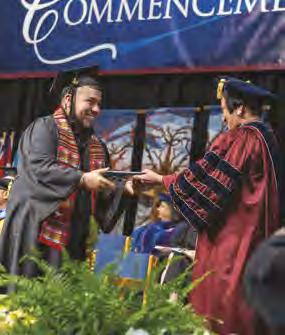
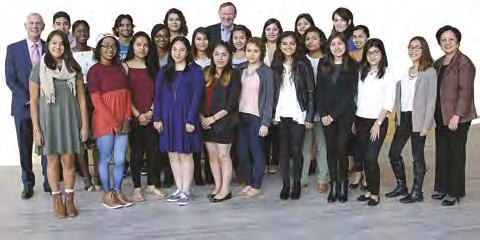
A champion of educational equity, Núñez positioned Eastern as a national leader in supporting undocumented students. In 2016, eDream. US selected Eastern as a pilot site for its scholarship program, which has since enrolled more than 350 Opportunity Scholars with a 97% retention and 89% graduation rate. She
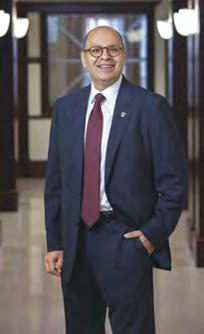
Karim Ismaili 2024-Present
Karim Ismaili became Eastern’s seventh president on July 31, 2024, having previously served as executive vice president and provost at Bridgewater State University. A rst-generation college student, Ismaili grew up in London, England, and Vancouver, Canada, earning a master’s degree in criminology

also consolidated academic resources into the Academic Success Center, boosting support services and helping Eastern achieve the highest four-year graduation rate among Connecticut’s state universities.
Campus life thrived as student clubs grew from 60 to 100, the Student Center was remodeled, and diversity e orts expanded through the Arthur L. Johnson Unity Wing. Sustainability and civic involvement ourished with the Center for Community Engagement, on-campus food pantry and thrift shop, and the student-led Day of Giving.
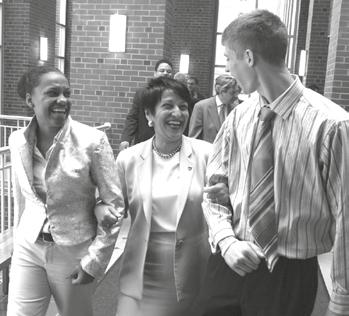
Núñez’s presidency navigated global and technological changes — smartphones, social media, the 2008 recession, and the COVID-19 pandemic — fostering resilience while advancing Eastern’s mission of access, inclusion, and excellence.
from Cambridge University and a Ph.D. in political science from the University of Western Ontario. After beginning his career as a criminology professor in 1997, he transitioned to higher education leadership in 2006. In his rst semester at Eastern, the University launched the Eastern Liberal Arts Core (ELAC), a streamlined curriculum emphasizing critical thinking, ethical reasoning, communication, creativity, and
quantitative literacy. Ismaili also conducted a “Listening and Learning Tour” to engage with the campus community and approved the lming of an episode of Amazon’s e College Tour to showcase Eastern to a national audience. Ismaili’s leadership marks a new chapter of growth, innovation, and opportunity for the University.