




Eastern Magazine is produced by the O ce of University Communications & Marketing for the bene t of alumni, students, faculty, sta , and friends of Eastern Connecticut State University.
Publisher Ryan Quigley
Executive Editor Michael Rouleau
Assistant Editor Ashley Orcutt
Designers Leigh Balducci | Kevin Paquin
Photographers Aaron Flaum | Tom Hurlbut
Nick Lacy | Bode Paquin | Derek Ward
Contributors Kyle Berson | Elisabeth Craig
Christopher Dorsey | Abigail Dreyer
Brian Lashley | Bob Molta | Darlene Orozco
Ed Osborn | Sheila RuJoub | Noel Teter
We welcome the feedback and input of our readers. Pitch us a story. Send us an Alumni Note. Tell us what you like and want to see more of in Eastern Magazine. Contact us at editor@easternct.edu.
See previous Eastern Magazine issues at www.easternct.edu/magazine.
Make an online donation to an ECSU Foundation scholarship and support students on their Eastern journey. Donations may be made in honor of a beloved professor/coach or in support of a speci c program or cause. Scan the QR code to donate.

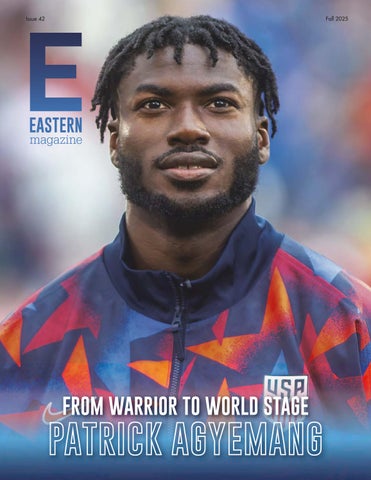
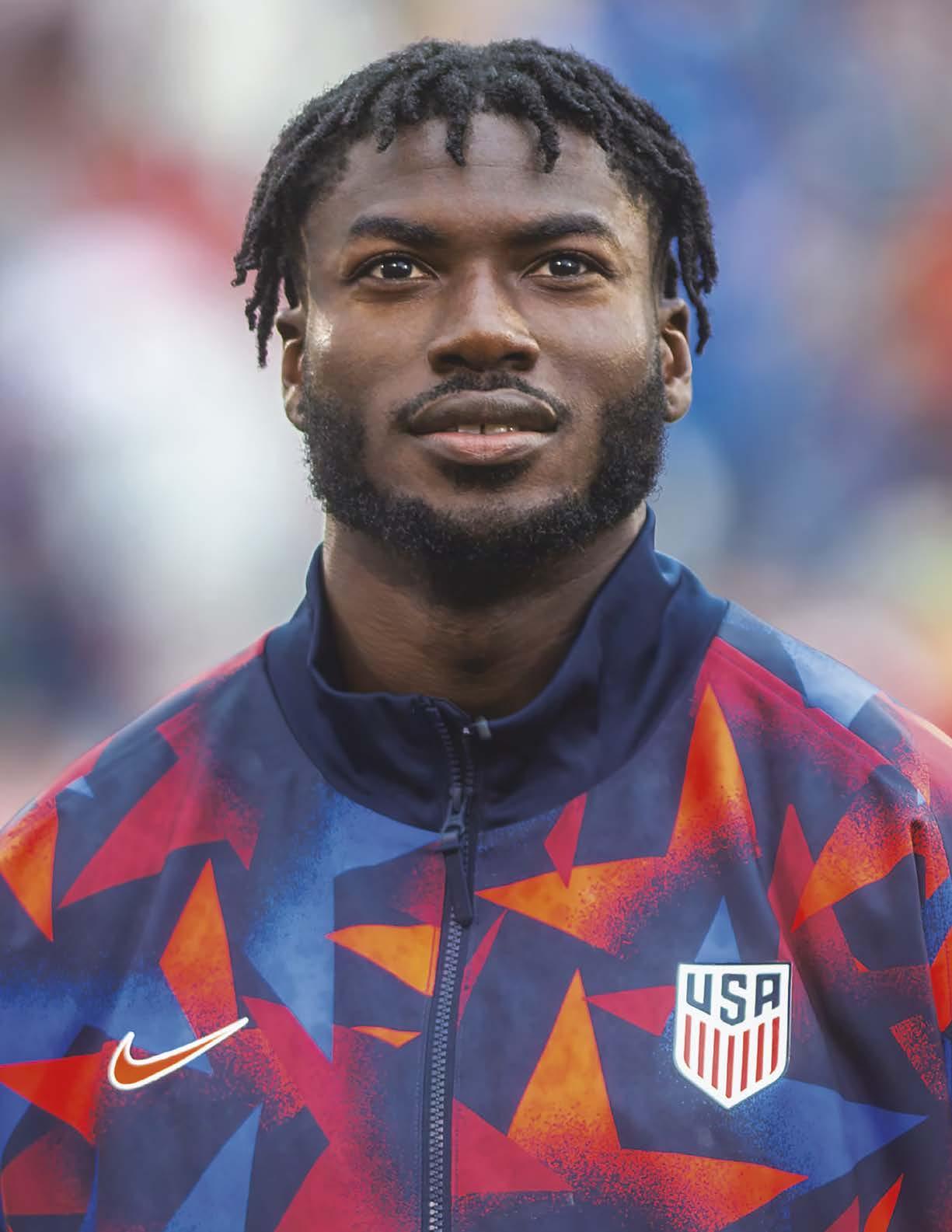
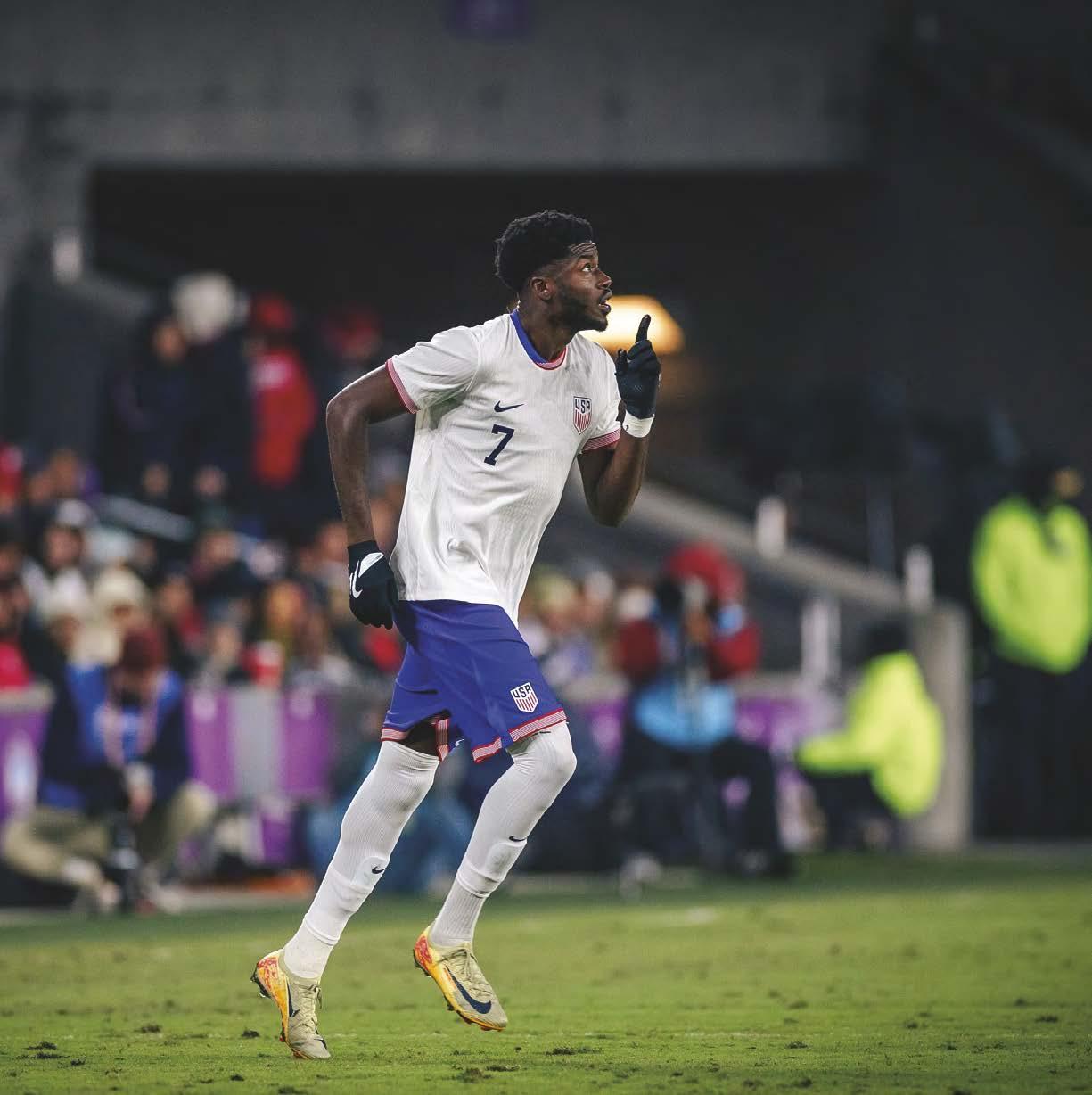
Cover: Former Eastern soccer star Patrick Agyemang returns to Connecticut as a starting forward on the U.S. Men’s National Team. Special thanks to Hartford Courant photographer Aaron Flaum and Executive Editor Helen Bennett.


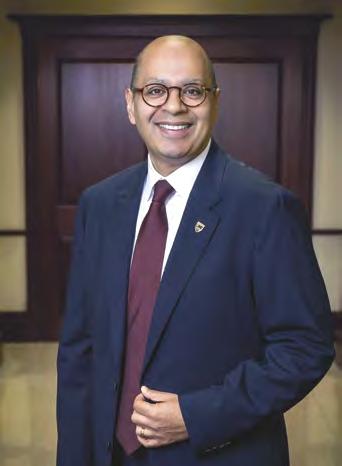
It is an honor to lead this remarkable institution and to be part of a community that exempli es the very best of public higher education.
From Eastern’s modest roots as a normal school to becoming Connecticut’s public liberal arts university, our core mission has remained unchanged for 136 years: to educate, to serve, and to transform lives.
is past year, I launched a Listening and Learning Tour to understand this mission better.
roughout 28 thoughtful and energizing sessions, I spoke with students, faculty, sta , alumni, community leaders, and friends of the University. What I heard rea rmed what I sensed from the very beginning of my presidency — Eastern is more than a university. It is a caring, committed, and purpose-driven community.
e insights and aspirations shared during the tour are captured in a recently released summary report, which o ers a roadmap for the work ahead.
Eastern’s strength lies in its people. During my tour, I encountered an abiding a ection for this institution — an a ection grounded in relationships, a love of learning, and a shared responsibility. ere is a common thread that runs through everything we do: a desire to welcome, to include, and to help one another succeed. Whether it’s the support students nd in small classes, the mentorship of faculty scholars, or the partnerships we forge in the community, Eastern thrives on human connection.
Our distinct mission within Connecticut’s public higher education system is a source of pride. We are the only public liberal arts university in the state — a designation that speaks to our commitment to critical thinking, communication, creativity, ethical reasoning, and quantitative literacy. ese are not abstract ideals; they are the skills our graduates use to lead ful lling lives and make meaningful contributions to their communities.
But we are also proudly regional. We understand our vital role in eastern Connecticut — not only as an engine of upward mobility, but as a cultural, educational, and economic partner. We want to be an open door for our neighbors: a campus where local students thrive, where lifelong learners return, where K–12 students visit for concerts and events, and where the broader community feels at home.
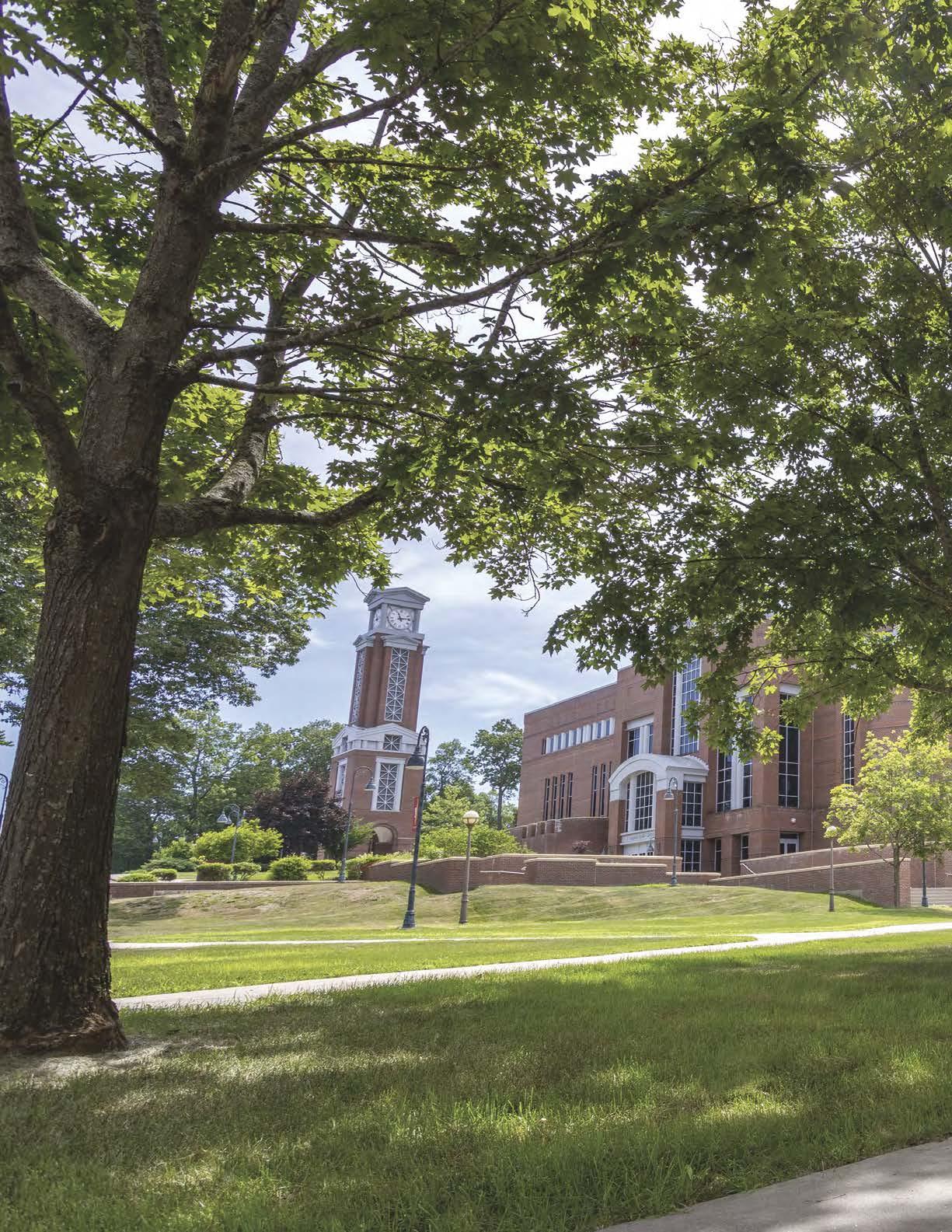
We are fortunate to learn, work, and gather on a beautiful New England campus that re ects our values — welcoming, well cared for, and open to all. Above all, Eastern thrives because of its people. at’s the lesson I’ve learned time and again throughout my rst year at this remarkable university. e best of what we are is not found in buildings or statistics, but in the a ection we hold for this place and each other.
Eastern’s story is still unfolding. As we look to the future, we do so not with uncertainty, but with hope and a deep commitment to charting our own course. I believe our past inspires our future and will continue to grow stronger by building on the best of what we are.
To our proud alumni, thank you for welcoming me to Eastern. I look forward to partnering with you as we write the next chapter — together.
Warm regards,
Karim Ismaili, Ph.D. President
Learn more about the President’s Listening and Learning Tour.

By Kyle Berson ’26
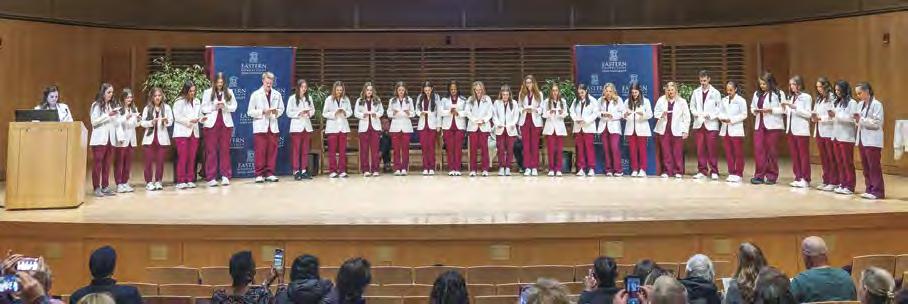
astern’s rst cohort of nursing students took an oath to provide compassionate patient care during the nursing program’s inaugural “white coat ceremony” in spring 2025.
A rite of passage for nursing students worldwide, the ceremony marks the start of clinical education and a commitment to empathetic care. Twenty-eight students donned their white coats and received a “Keeping Healthcare Human” pin from the Arnold P. Gold Foundation, which established the tradition in 1993.
“You’re about to embark on a profession that is as challenging as it is rewarding and complex as it is beautiful,” said keynote speaker Christina Cote, a registered nurse and nurse manager at Generations Family Health Center. “Compassion is the cornerstone of our profession. … Healing not just the body, but also the mind and spirit.”
Eastern President Karim Ismaili praised the students for “beginning a tradition that emphasizes the heart of healthcare: compassion, dedication, and human connection.”
Christina Nadeau, nursing
Among its spring schedule of theatrical productions, Eastern presented Zoomers, an observational commentary about Generation Z. Written by Matthew Gasda and premiering in New York in 2024, the play follows a group of roommates in their 20s as they navigate friendships and romantic relationships while searching for meaning in a world full of technology and distractions.
Eastern’s rendition was directed by theatre Professor David Pellegrini, who was captivated by the play’s rich, character-driven storyline. For the student actors, portraying characters close to their own age provided both comfort and challenge.
“Usually, we have to age up or
down for shows, which is great for versatility, but playing someone your own age took the stress o ,” said theatre major Xsyanni Jackson ’25. Zavier Garcia ’26 added, “ ere was a factor of relatability to the story and what the characters were experiencing.”
program director, added: “Crossing the threshold into nursing clinical practicum is a major accomplishment in the nursing education journey.” e ceremony is a celebration “of a new class of nursing students heading out into the world of healthcare to share their healing touch and compassion with others.” Launched in fall 2024 with support from the Connecticut Health Horizons project, Eastern’s Bachelor of Science in Nursing program addresses the state’s nursing shortage and expands opportunities for students.
By Darlene Orozco ’28
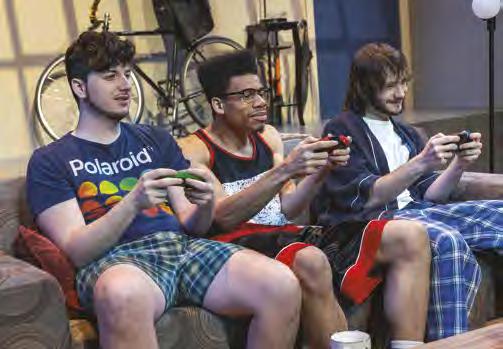
e play explores the desire for genuine human connection. According to Dominic Robucci ’25, “Zoomers does a good job of capturing the plight of Gen Z, mostly by displaying our struggles to connect in a digital world, as the characters are distracted by their hedonistic pleasures.”
By Michael Rouleau ’11
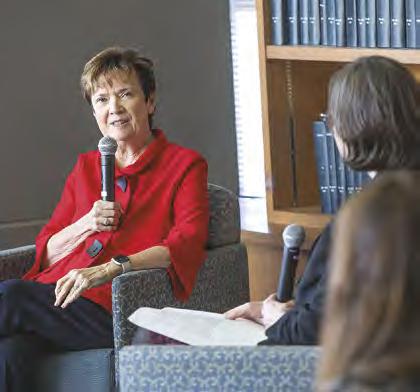
One of the nation’s leading advocates for higher education, Dr. Lynn Pasquerella, visited Eastern in spring 2025 for a special discussion about the vital role of higher education at a time when it faces unprecedented scrutiny in an increasingly polarized society.
“Colleges and universities are facing an existential threat,” warned Pasquerella, president of the American Association of Colleges and Universities (AAC&U).
“For the rst time, higher education is no longer viewed as the cornerstone of the American dream but, [in some circles] as the enemy.”
is growing skepticism, she said, is forcing institutions to ask fundamental questions:
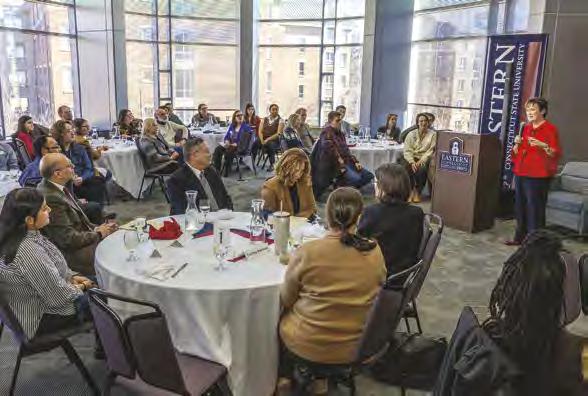
colleges and universities as “anchor institutions” in their communities, countering the notion of academia as an “ivory tower” disconnected from real-world concerns. “ ere is widespread mistrust in higher education,” she acknowledged, “but there isn’t mistrust in local institutions — in places like Eastern that are visible and provide service to the community.”
When asked about the greatest threats facing higher education, Pasquerella pointed to attacks on academic freedom, institutional autonomy, and democracy
“We must approach each other with good faith and a willingness to change our minds.”
“What is our purpose in higher education? What is our fundamental mission?”
Pasquerella’s answer was clear: “It goes back to educating for democracy — preparing students to be engaged citizens at a time when our democracy is so fragile.”
During a Q&A session, Pasquerella discussed the value of a public liberal arts education. Beyond career preparation, she emphasized that the liberal arts allow students to “imagine that some of their most fundamentally held beliefs may actually be mistaken.”
Pasquerella also stressed the role of
itself. “One of the most powerful things we can do is recommit ourselves to a liberal arts education,” she said, arguing that the liberal arts cultivate the intellectual and ethical capacities needed to sustain a just society.
Despite the uncertainty surrounding higher education, Pasquerella sees opportunity. “ is is a moment to revolutionize and reimagine higher education,” she said. “ e reason I’m lled with hope and optimism is because I look at students like you and see a chance to move forward in ways we haven’t in the past.
“Given the burgeoning polarization and partisanship that characterize our republic, reaffirming and catalyzing the democratic purposes of higher education is more important than ever. Since our nation's inception, colleges and universities have played a distinctive role in fostering democratic learning, civic education, community engagement, and efforts to bridge divides in the classroom and beyond.”
–Lynn Pasquerella
You demonstrate a level of courage that’s been lacking.”
However, she cautioned against the dangers of polarization. “We must approach each other with good faith and a willingness to change our minds. Otherwise, we will fail.”
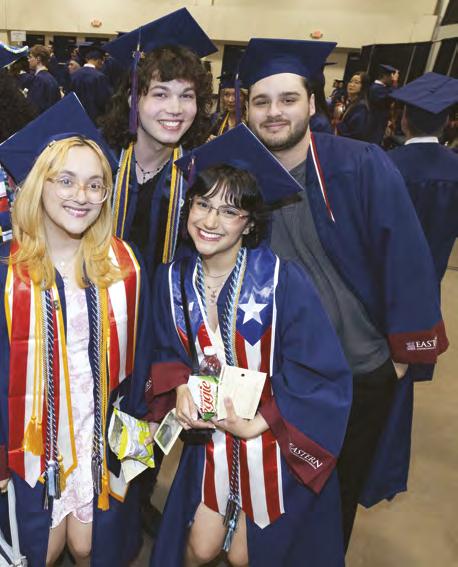

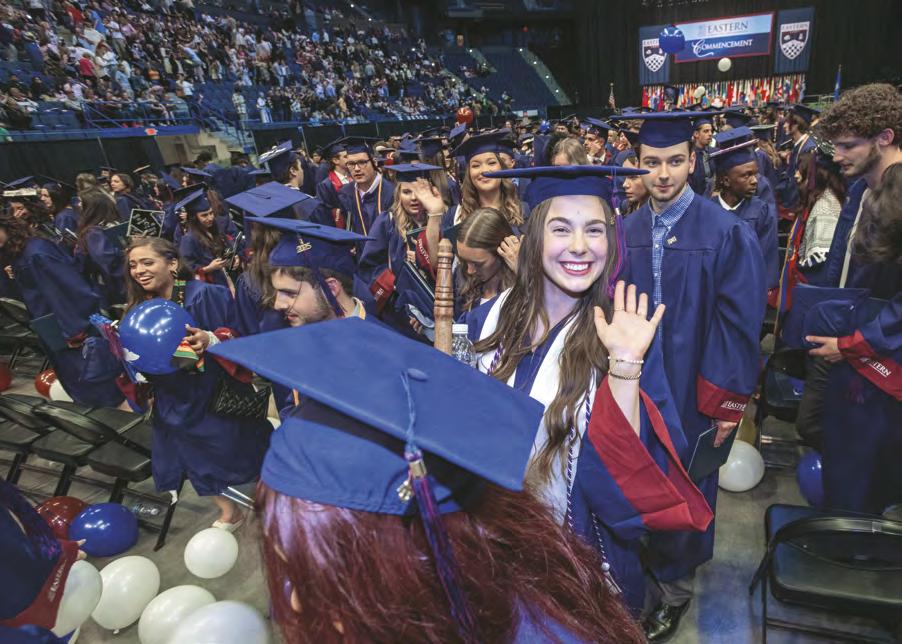
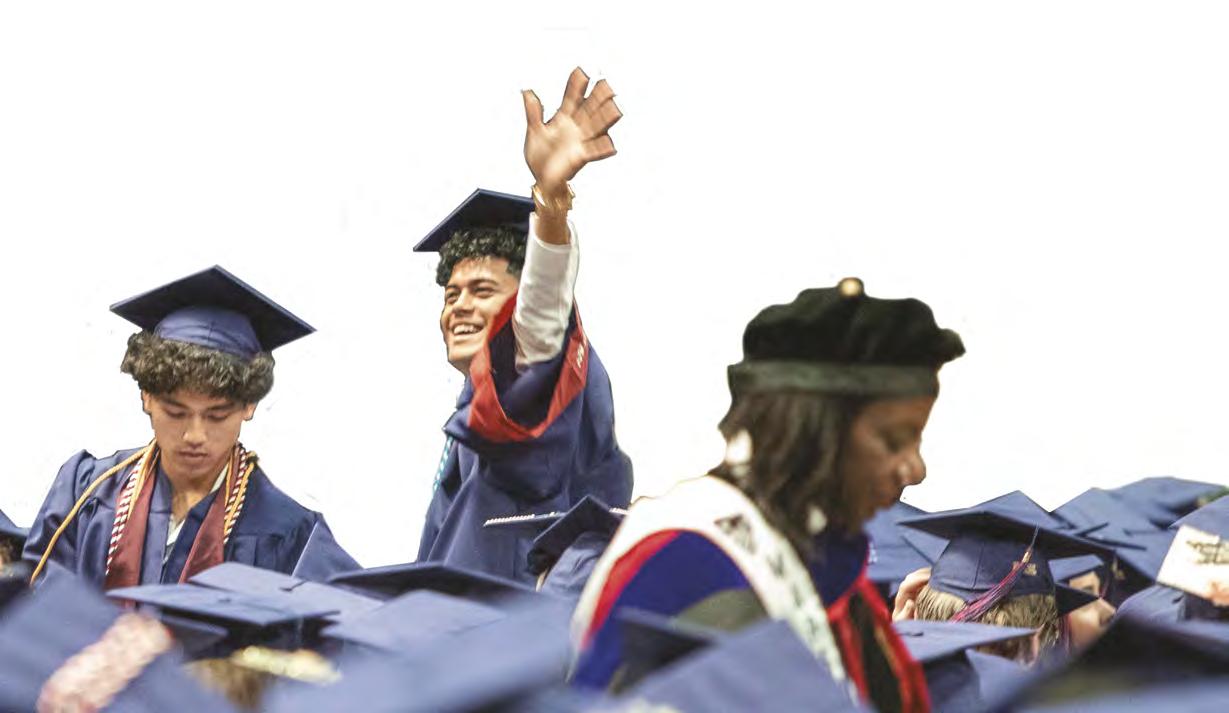
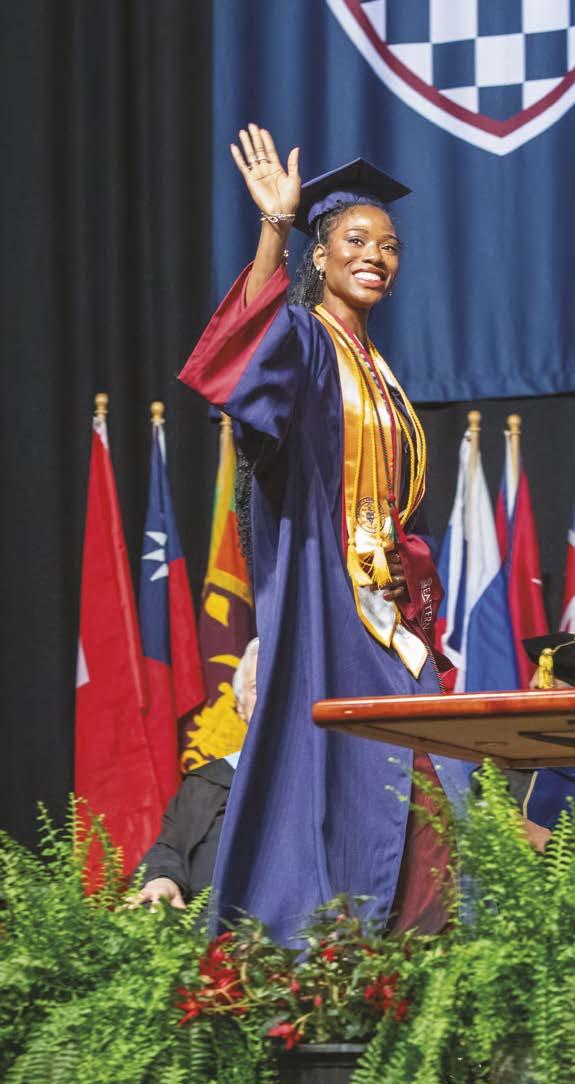
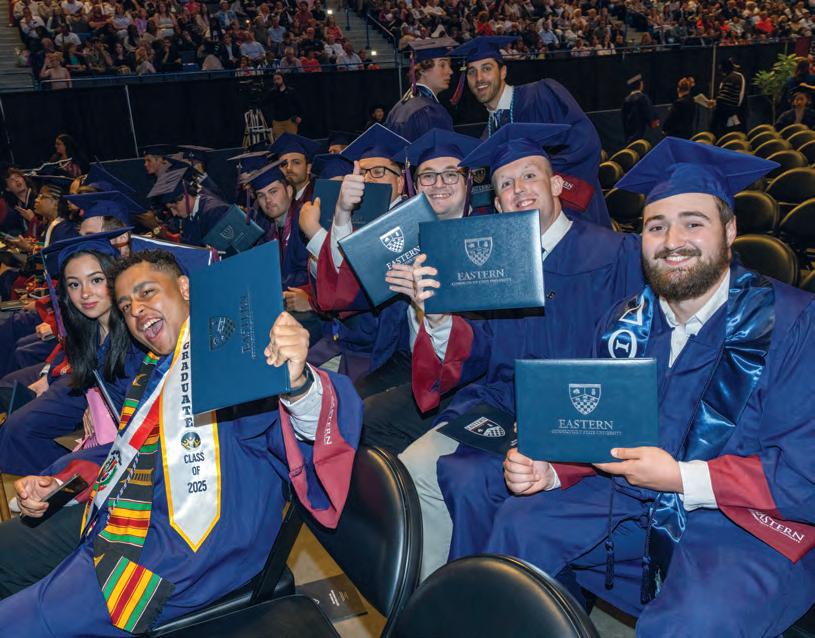
the Massachusetts College of Art and Design, applauded the graduates for their resilience, pointing out that they were the rst class to attend college following the initial shutdown of the COVID-19 pandemic.
“In a world that sometimes chooses fear over hope, choose hope,” Grant said. Drawing on her own liberal arts background, she emphasized the enduring value of skills like critical thinking, creativity, and ethical reasoning. “ ese aren’t soft skills,” she said. “ ey’re essential skills — skills that all employers want.”
Eastern President Karim Ismaili echoed Grant’s sentiments, commending graduates for transforming through their college years into

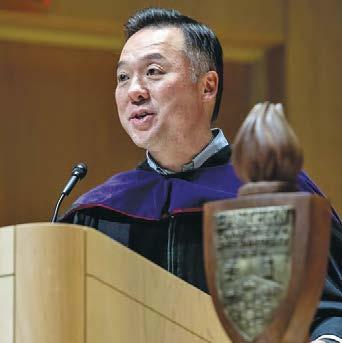
Wethers eld, Tong said, “ ere are a lot of people who feel invis ible. I want to help them because I know what they’re going through.”
Tong encouraged graduates to recognize shared humanity and stand up for marginalized communities. “See the people who don’t look exactly like you; they’re your people, too,” he said.
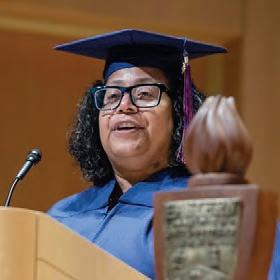
During her graduate commencement remarks, student speaker Shellena Pitterson ’25 highlighted the personal sacri ces and late-night study sessions that de ned the graduate journey: “We’ve navigated assignments, exams, late nights, and — let’s be honest — the occasional existential crisis.”
At the undergraduate ceremony, Senior Class President Felishka Ramirez ’25 thanked the “Eastern village” of faculty and sta who invested in students’ growth. “ ey didn’t just teach us; they believed in us. ey taught us how to think critically, how to persevere, and how to believe in the power of our own voices,” she said.
Speaking on behalf of alumni, Ellen Lang ’81 spoke at both ceremonies to welcome new graduates into Eastern’s alumni family, now more than 40,000 strong. “You are now connected to a powerful and supportive network of leaders, changemakers, and lifelong learners,” she said. “Once a Warrior, always a Warrior.” E




By Ed Osborn


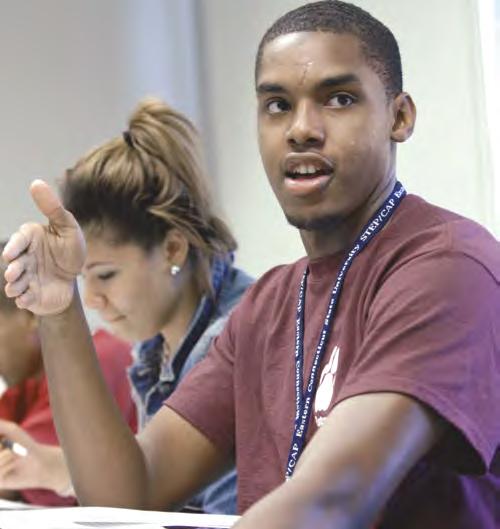
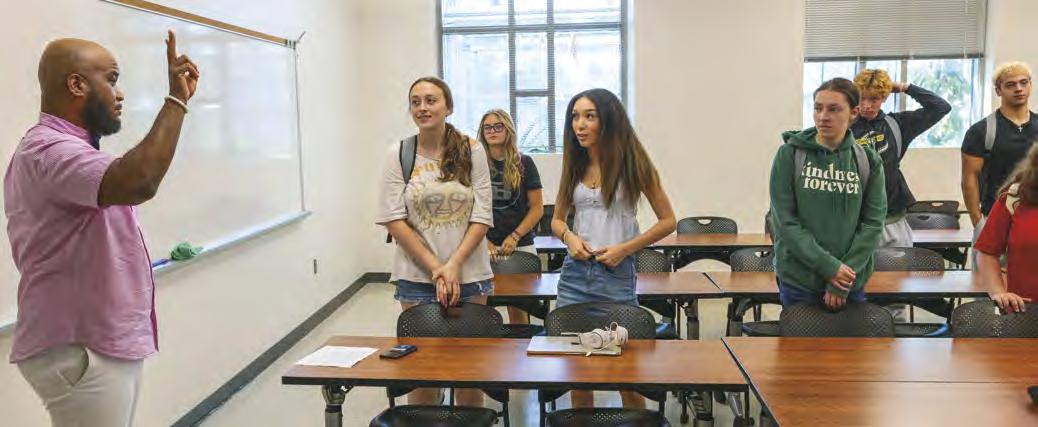
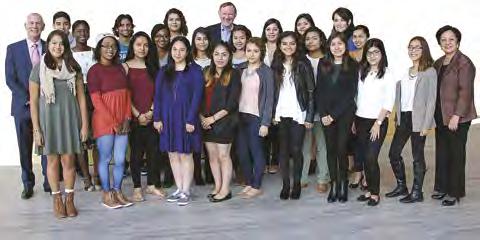
Since the early 1980s, Eastern Connecticut State University’s Summer Transition to Eastern Program/Contract Admissions Program (STEP/ CAP) has been helping students make a smooth and con dent start to their college careers. Over the decades, more than 2,000 students have participated, with more than 900 earning bachelor’s degrees from Eastern.
STEP/CAP provides a residential summer “bridge” experience for incoming rst-year students from underrepresented backgrounds. rough mentorship, academic support, and access to campus resources, the program fosters con dence and equips students with the tools needed to thrive in college. Upon successfully completing the program, participants matriculate as full-time Eastern students, ready to begin their academic journey with a strong foundation.
“‘You are going to be successful’ was our mantra,” explained Floyd Bagwell, the program’s original director and chief architect. He and Associate Director Margaret Hebert sought high school students with potential and perseverance who might develop into better students with the support that Eastern could provide.
rough collaborating with high school guidance counselors, Bagwell and Hebert interviewed students and shared notes with STEP/CAP faculty and admissions sta . In the beginning, the cohorts were small, but as retention grew and the program’s success became evident, they negotiated for more participants — upwards of 60 each summer.
Describing Hebert as the “good cop” and himself as the “bad cop,” Bagwell recounted that the program was challenging and expectations were high. “ e [students] were highly motivated and understood we were a serious program. If someone acted out, I had no problem putting them in my car and taking them home.”
Looking back on the program’s four decades of success, Bagwell said, “I am extremely elated that more than 900 STEP/CAP students have graduated from Eastern. ey are a real credit to their families and to the University.”
If Bagwell was the architect, Hebert was the foreman, closely supervising the program for nearly 30 years. Central to STEP/CAP’s summer operations, Hebert oversaw each year’s cohort as they joined Eastern’s student body in the fall. In addition to frequent check-ins with Hebert or another sta member, STEP/CAP students watched out for each other, keeping tabs on their friends and sharing notes with the sta .
the Academic Success Center, which o ers support in career preparation, math, writing, and more.
As a result of this commitment to student persistence, rstyear to sophomore retention for STEP/CAP has frequently been equal to or higher than the University’s overall average, which often hovers around 85%.
Peer advisors — upper-level students at Eastern — also help STEP/CAP students as they learn to transition to college.
Kevin Ruiz ’22, a computer science major from New London, was a peer advisor in 2022. “During the summer, STEP/ CAP puts students in a rhythm, from waking up and going to classes, to eating, working out, and doing other activities throughout the day. is makes it easier for them to adjust to the regular semester. When more homework is given to them, they have the ability to adjust to more.”
“ In high school, I did not receive much encouragement for my college aspirations. STEP/CAP provided the confidence I desperately needed to achieve my educational and personal goals.”
Thomas Gibson ’96
“It was my heart; I loved my work,” said Hebert, who retired in 2012 after serving Eastern stu dents for 31 years. “I loved my work. I loved the kids. It was a blessing. e students worked hard each summer to prepare for the college experience at Eastern. Motivation is such a key to retention. I saw students from the same backgrounds — some made it, some didn’t. But with encouragement from us and commitment from them, they were able to succeed.”
e program has always been rigorous, with students taking a full day of courses, ve days a week, including credit-bear ing courses in mathematics and English. e students also participate in workshops on study skills, time management, test taking, nancial management, and public speaking. A GPA of 2.5 in the credit-bearing classes is necessary for students to qualify to enroll at Eastern in the fall — more than 90% have historically met that threshold each summer.
Student support during the academic year has also been critical for student retention and graduation. In addition to cohort-speci c services — including academic advising, tutoring, and nancial assistance — STEP/CAP students have access to the University’s general support services, such as
Examining the accomplishments of STEP/ CAP graduates over the years is perhaps the best way to judge the quality and success of the program. One inspirational STEP/CAP story is that of omas Gibson ’96, who successfully transitioned from STEP/CAP to graduating in 1996.
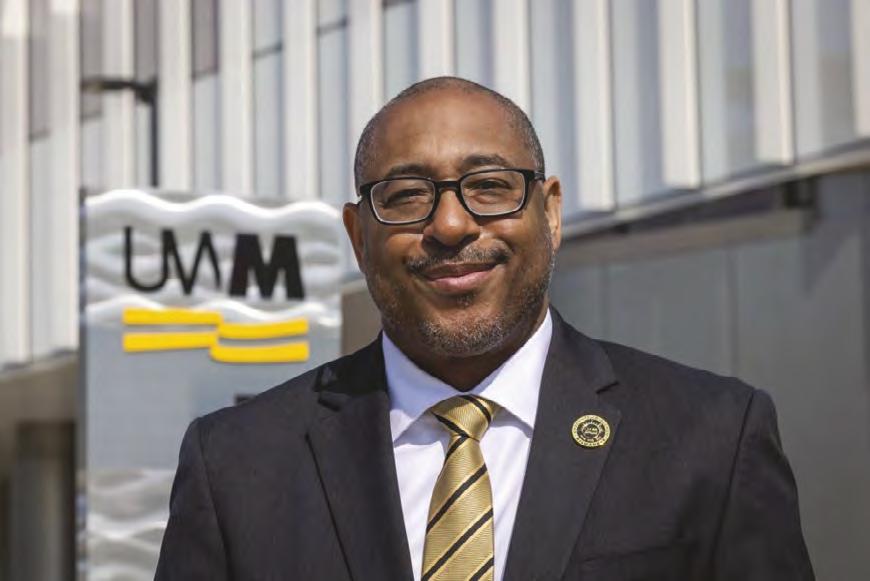
Today, Gibson is the chancellor of the University of Wisconsin-Milwaukee, after previously leading the UW system’s campus at Stevens Point since 2021. A native of New Haven, Gibson received his doctorate from Johnson & Wales University before embarking on a higher education career that has taken him to City University of New York, Ball State University, and Bowling Green University, before his chancellorships at the University of Wisconsin.
Gibson recalled his time in STEP/CAP fondly. “ e STEP/CAP program was invaluable to me, especially as I struggled with imposter syndrome during my rst
year of college,” he said. “In high school, I did not receive much encouragement for my college aspirations. STEP/CAP provided the con dence I desperately needed to achieve my educational and personal goals.”
Like so many STEP/CAP students, Gibson credits the support provided by Margaret Hebert. “Dr. Hebert was my advisor and supported me through both challenging times and successes. She never judged me, but carefully guided me toward my goal of earning a college degree. Several years later, Dr. Hebert would serve on my doctoral dissertation committee.”
“ I am who I am to a large degree due to my experiences in STEP/CAP.”
Walner Homere ’95
“ It was in those weeks that I realized college wasn’t just about showing up — it’s about showing up prepared.”
Ashon Avent ’08
Some experiences bring a smile to Gibson’s face. “I recall a job interview during my senior year when I didn’t own a blazer or sports coat. Will Hare, an instructor in the program, brought in three of his sports coats for me to try on. e STEP/CAP o ce in Winthrop Hall suddenly turned into a fashion show, with sta giving thumbs up or down as I modeled the jackets. is moment reminded me of the care provided by the program sta . ese experiences inspired me to pursue a career in higher education. I want to help more students succeed, just as the program helped me.”
Another STEP/CAP student who has made achievements on the national stage is Walner Homere ’95. A native of Haiti, Homere did not have the SAT scores needed to be admitted to college. It was Eastern’s “academic military boot camp,” as he describes STEP/CAP, that helped launch his success in college, and resulted in earning his degree in sociology in 1995. “I am who I am to a large degree due to my experiences in STEP/CAP.”
In November 2024, Homere was honored for his work at a recognition event at the White House. After receiving his graduate degree in engineering at Ohio State University, Homere held jobs at Ernst & Young LLP, Deloitte and Touche LLP, and Dell Technologies. He is now an IT forensics specialist for the U.S. Securities and Exchange Commission’s Enforcement Division.
He also works to help young people achieve their dreams. “For the past eight years, I’ve been running a mentoring program for underprivileged communities where I teach nancial empowerment and career selection,” said Homere. “I motivate them because with a story like mine, I can relate.”
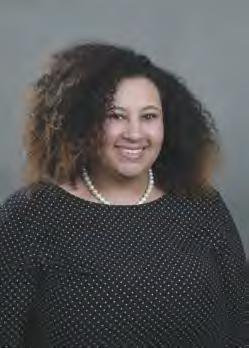
Ashon Avent ’08 teaches as an adjunct in Eastern’s business administration program, in addition to running his own clothing apparel business and studying for his doctorate in business administration at Southern Connecticut State University. “I was a teenage father, carrying responsibilities that most of my peers didn’t have to think about. e thought of leaving Hartford, even temporarily, felt like stepping into the unknown.
“ en came STEP/CAP. e program wasn’t just an introduction to college — it was a lifeline. It forced me to sharpen my study skills, manage my time like never before, and learn the importance of discipline. More than that, it taught me how to interact with peers who came from di erent backgrounds, to take notes that actually made sense when I read them later, and to navigate campus life before the pressure of the semester kicked in. It was in those weeks that I realized college wasn’t just about showing up — it’s about showing up prepared.”
In addition to these exceptional leaders, STEP/CAP graduates can be found at such employers as Electric Boat, the University of South Florida, Lawrence + Memorial Hospital, Comcast, and Aetna, and in positions ranging from graphic designer and town clerk to tax auditor, cardiology technician, parole o cer, CIO, associate professor of sociology, second-grade teacher, chief nancial o cer, and biomedical scientist.
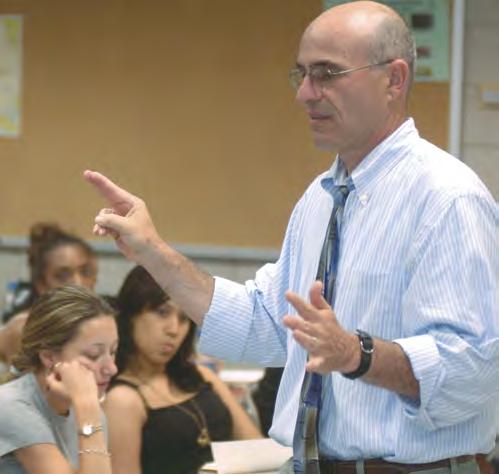
Another person frequently mentioned by STEP/CAP graduates is Rick Hornung, who advised STEP/CAP students from 1998 to 2018, and now continues his work as a student development specialist in the Academic Success Center.
Hornung credits others for the program’s success. “Floyd Bagwell and Margaret Hebert built this program with the support of Stanley Battle (academic a airs) and President David
Carter. As a result, hundreds of people have graduated from college who may not have had the opportunity to achieve their dream of a college education.”
Hornung described STEP/CAP’s simple but e ective formula: “If you give students a place where they can practice math, it will come. Give them opportunities to practice writing and their writing will improve. We gave them a safe place to do it and o ered them the understanding that they belonged and were welcomed here. We gave them the guides, the mentors, the navigators who could help assist them to meet their potential.”
Rachel (Sawyer) Walker ’16 warmly recalls Hornung’s support from her summer experience in 2012 when he directed the STEP/CAP program. “Dr. Hornung led from a place of care and support for us students regardless of our identities. He created a safe space for us to learn. A lot of us did not have that level of support in our high school experiences, and I will forever be grateful for him!
“Additionally, the program built a sense of community for the students in STEP/CAP. We all went through a bonded ex-
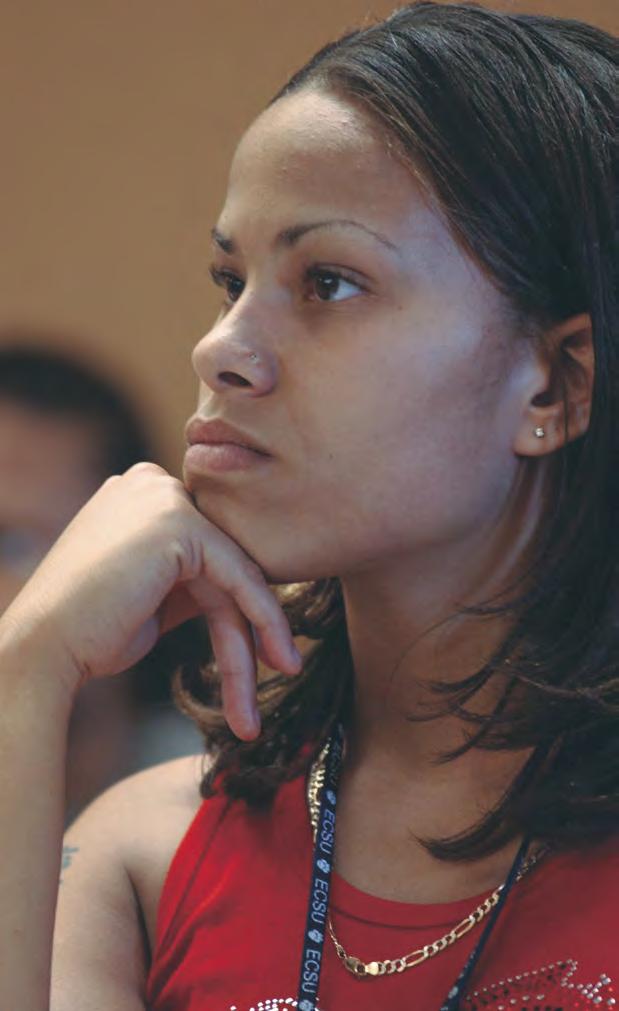
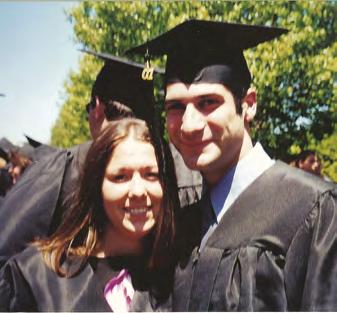
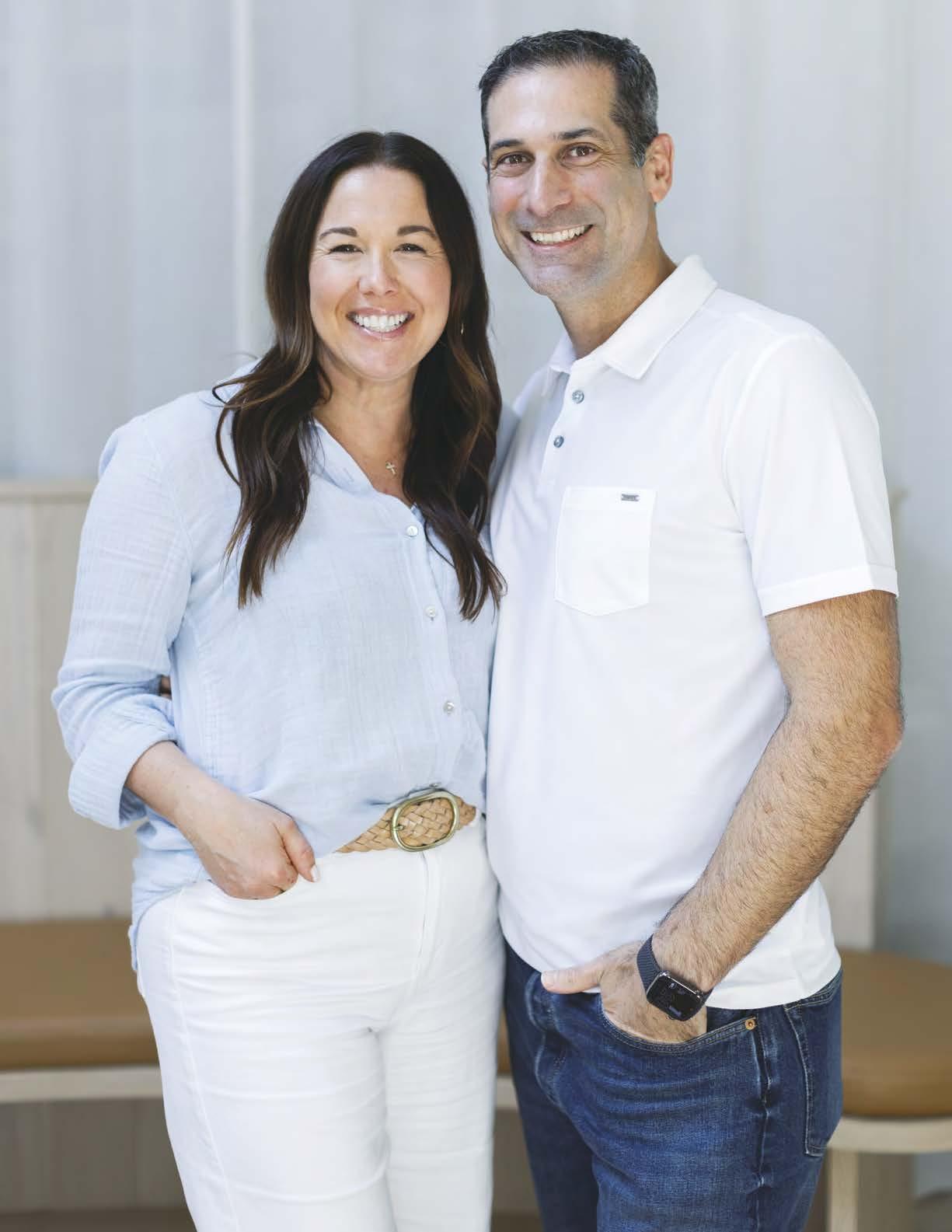
he business empire of Je ’01 and Jessica Reinhart ’00 began with a call from an unlikely thought leader: their 14-year-old niece, Bella, who lived in Arizona. Bella had started a small business selling customized jewelry to help save money to buy a car for her 16th birthday.
“She was selling these lockets that people seemed to like,” said Je . “She asked if we wanted to come out and start a business with her.”
Given that the Reinharts were then living in Connecticut with their two young children, ying to the Southwest to start a business with their teenage niece didn’t seem like the safest bet. “We were pretty rooted in Connecticut,” said Jessica. And yet, they decided to take the leap of faith. “Each of us separately felt the same thing, and then we came together with this crazy idea to move, and it ended up being the best possible thing,” said Jessica. is “best possible thing” was Origami Owl, an expansion of Bella’s customized jewelry business. What was once a teenager’s lucrative hobby became
By Noel Teter ’24
a rapidly growing direct sales company, with Je and Jessica serving as co-founders.
“At the end of one year, we had 250 employees,” said Je , who also served as Origami Owl’s chief operating o cer. “At the end of two years, we had 700 employees.”
“We came together with this crazy idea to move, and it ended up being the best possible thing.”
JESSICA REINHART
e Reinharts left Origami Owl after the birth of their third child, but the company is still active to this day. is was just the beginning for the Reinharts: “We’re serial entrepreneurs,” said Jessica.
Today, their main enterprise is Jessica’s brainchild, Lumitory, which creates and sells conversation cards intended to strengthen interpersonal relationships. Jessica has served as Lumitory’s founder and CEO since its inception in 2016.

Lumitory cards are sold by hundreds of retailers across the country, according to Jessica, including at Nordstrom stores nationwide starting in fall 2025. ey were even featured on e Today Show last December, and this summer,

By Ryan Quigley and Noel Teter ’24

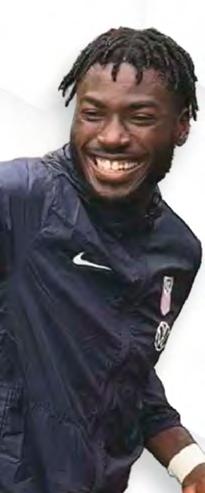
Afew years ago, Patrick Agyemang was just another determined college athlete — a con dent striker from East Hartford playing Division III soccer at Eastern Connecticut State University, boldly proclaiming he would one day play professionally.

People laughed.
Today, Agyemang is a rising star on the international stage, wearing the jersey of the U.S. Men’s National Team and a recent transfer from Major League Soccer (MLS) to Derby County Football Club in the United Kingdom. In June 2025, he returned home to Connecticut, starting for the national team at Pratt & Whitney Stadium at Rentschler Field in front of 34,000 fans, including the very people who helped shape his journey.
From the pitch to the press box, it was clear: Patrick Agyemang’s life has changed — not just in circumstance, but in in uence, visibility, and purpose.






When Agyemang took the East Hartford eld to face Türkiye in a warmup for the World Cup — taking place in summer 2026 — the energy was electric. Local youth soccer teams, Eastern alumni, and national team supporters packed the stands. But for those who knew Agyemang personally, it was more than a game.
In the crowd were his parents, watching their son represent the United States on the eld for the rst time in his home state. Nearby were Eastern President Karim Ismaili, men’s soccer Coach Greg DeVito, and many more from the Eastern community.
ough the U.S. lost 2–1, Agyemang held his own against seasoned European defenders, once again proving that he belongs at the elite level.
e cheers he received weren’t just for his performance. ey were for his journey — one that began on the elds of East Hartford and Eastern.







Agyemang’s journey to the pros didn’t follow the traditional script. In part due to his young age — Agyemang was 17 during his freshman season at Eastern — he wasn’t heavily recruited out of high school. But Eastern was invited by Agyemang’s high school coach to attend his senior night match. “Two days later, I was on the phone with Coach DeVito,” said Agyemang. “I verbally committed soon after.”


He moved into Constitution Hall, room 401, where he shared a suite with teammates. “We’d hang out outside the building, throw a football around, do homework, just talk. When the weather was nice, we’d lay out blankets and enjoy it,” he recalled.




















He played pickup games on Webb Lawn, joined fashion shows with the African Club, and grabbed meals at Hurley Hall with friends. “I just remember having fun,” he said. “ at was the main thing


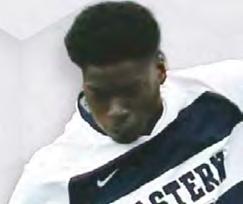





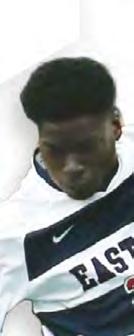










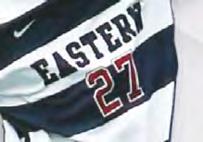


























Playing for the Warriors, Agyemang quickly emerged as a formidable o ensive player. Coach DeVito recalled his breakout sophomore season, in which Agyemang scored 21 goals and earned Division III All-America honors.































“He was a very creative player, tough to defend,” said DeVito. “He had the technique and speed a lot of DIII [athletes] don’t have, but the biggest thing he had was the motivation to do it on his own. He didn’t just rely on practice to get better. He put in the extra work, trained on his own. He’s an internally, intrinsically motivated kind of guy. His story is a testament to hard work. I couldn’t be prouder.”









“He’s an internally, intrinsically motivated kind of guy. His story is a testament to hard work.”





coach gregory devito
In 2019, Agyemang was joined on the eld by his older brother, Emmanuel ’21, who played defense on the men’s soccer team. “It was amazing. I had one of my best friends with me, built in as my brother,” said Agyemang. “We’d trained together our whole lives. Playing at Eastern together just felt right.” ough the two rarely played on the same formal teams growing up due to their age gap, they bonded over backyard training sessions and brotherly competition. “We knew each other’s games inside and out,” he said. “ at season together was one of our favorite years.”




soc com
Agyemang majored in health sciences at Eastern, initially planning for a career in physical therapy or nursing. “I knew I wanted to work with athletes. Health sciences gave me options — physical therapy, occupational therapy, nursing — so I followed that path before I realized soccer could be an actual option,” he said. His upbringing in a Ghanaian household reinforced the importance of education. “I had to prioritize being a student because it allowed me to play,” he said. “And I wanted to make sure I had my degree.”






Balancing school and athletics wasn’t always easy. “During the season, it was tough. You had to work harder, ask more questions, be disciplined,” he said. “But I’m grateful for it. at experience built my time management skills, and I still rely on that today.”












In 2020, Agyemang transferred to the University of Rhode Island to compete at the Division I level. “ e competitive nature got 10 times harder,” he said. “ ere were international players, scholarship guys. I was there to take someone’s spot.”
Despite the pressure, Agyemang never doubted himself. “I’ve always backed myself,” he said. “As long as I’m there and I play, I’ll shine at some point.”














at con dence — and a lifelong underdog mentality — fueled his rise. “I love proving people wrong,” he added. “I’ve been doing it my whole life. You can think whatever you want, but eventually, you won’t be able to ignore me.”




















In 2023, Agyemang was drafted 12th overall by Charlotte Football Club in the MLS SuperDraft. In his rst season, he led the team in goals. By 2025, he had earned a call-up to the U.S. Men’s National Team, scoring ve goals in his rst nine appearances, including a game-winner against Haiti. is summer, he nalized a deal to transfer to Derby County Football Club, which competes in the second tier of professional English football.


“If you’re committed and you have faith, anything can happen.”


has












Agyemang describes his journey of becoming a professional soccer player as surreal. “To be able to do it now is great, but it makes me realize the work has just begun.” Recalling the rst post-collegiate match his parents attended, he said, “ ey were on the eld, in the suites. … I think that was the moment they realized, ‘Wow, our son is a professional soccer player.’ Giving them that experience meant everything.” e leap to pro soccer wasn’t seamless. “Two years ago, when I rst got to Charlotte, I was probably at my lowest,” Agyemang admitted. “It was hard mentally and physically.” But his love for the game never faded. “I’m obsessed with soccer,” he said. “If you start playing like it’s just a job, the passion goes. I play in a way that lets people watching feel the joy through me.”
























He keeps himself grounded through journaling, community work, and time with friends and family. “When you’re trying to accomplish something great, there’s always noise,” he said. “But con dence is internal. I remind myself who I am.”




Agyemang’s story isn’t just about personal triumph — it’s about representation. “I never played academy. I came up through public school, middle school, club, DIII. I just want every kid from a background like mine to know: if you’re committed and you have faith, anything can happen.”









Back at Rentschler Field during that match against Türkiye, he looked up at a stadium full of fans chanting his name — to the section where his parents stood and to the supporters in Eastern sweatshirts.
He saw them. He sees all of us. And with the 2026 World Cup on the horizon, his journey is just getting started. E











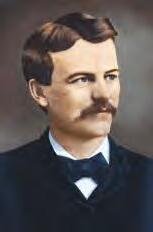


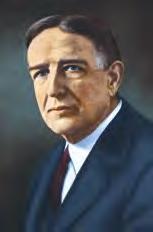
Arthur B. Morrill, a Yale graduate, left New Britain Normal School to open WNS in 1889.
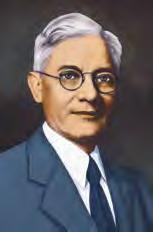
e second principal of WNS, George P. Phenix led the school’s move to a new building.
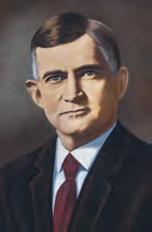
Henry T. Burr served as WNS principal during the World War I era and oversaw construction of a model school where student teachers could practice their craft.
George H. Shafer’s tenure as the school’s fourth principal — and later as president — spanned the Roaring Twenties, the Great Depression, and World War II. During this period, he oversaw the opening of the school’s rst dormitory, which housed 80 women and was named after Henry T. Burr, WNS’s third principal.
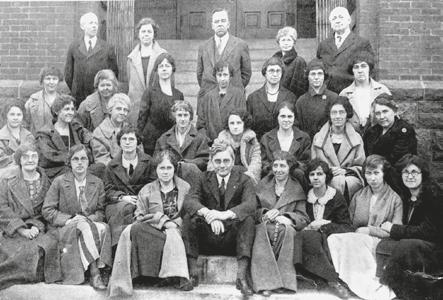
Shafer directed the school’s transition to a four-year curriculum in 1937, leading to its renaming as Willimantic State Teachers College (WSTC). On Sept. 27 of that year, Shafer was formally installed as the college’s rst president. By 1939, WSTC had enough male students to form its rst men’s basketball team. In 1941, the college expanded its academic o erings with its rst bachelor’s degree in science.
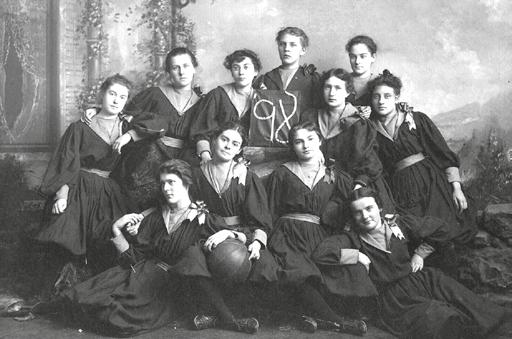

Henry T. Burr named third principal (1904-1918)
1904
1912
Windham Street Model School opens
George H. Shafer named fourth principal/ rst president (1918-1947)
1918
During Shafer’s tenure, Connecticut faced severe economic and environmental crises. Unemployment hit 26% by 1932 amid the Great Depression. e devastating 1936 ood and 1938 hurricane further tested the state. World War II brought both challenges and economic growth, with more than $8 billion in aviation and munitions contracts boosting Connecticut’s economy. However, rationing of essentials like gasoline and canned goods became routine.
The original Willimantic State Normal School building was destroyed by fire in 1943 and reopened in 1948.
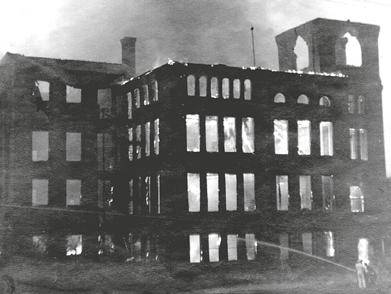
Windham Street School burns down (reopens in 1928)
19211924
Burr Hall opens ( rst dormitory)

1937
WNS renamed Willimantic State Teachers College (WSTC)
First bachelor’s degree offered (science)
1941

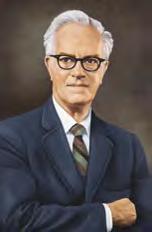
James Eugene Smith became president of WSTC in 1947, following his tenure at Windham High School and as a WSTC faculty member. His leadership marked a transformative era as the campus grew beyond its original Valley and Prospect Street
locations, acquiring new land “up the hill” and adding a student union, academic buildings, and the rst men’s dormitory.
e 1950s brought stability compared to prior decades of economic turmoil, with student life ourishing through clubs, athletics, and cultural activities, including study tours to Canada, Cuba, and Mexico. Yet, the decade also re ected broader cultural changes, with youth rebellion rising alongside rock ‘n’ roll and gures like James Dean.
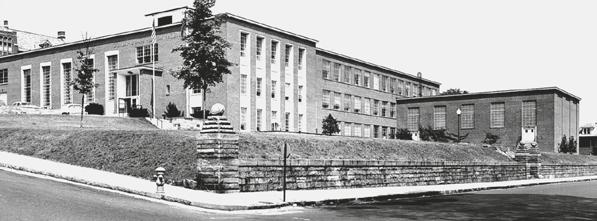
Postwar Connecticut struggled with job losses as defense contracts ended, but the GI Bill expanded access to higher education, boosting male enrollment. Academically, WSTC launched its
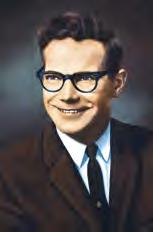
rst graduate program in education in 1957 and was renamed Willimantic State College in 1959, re ecting its growth. In 1971, after Smith’s retirement, the campus library was dedicated in his honor. ough relocated, the original library now serves as the Alvin B. Wood Support Services Center.
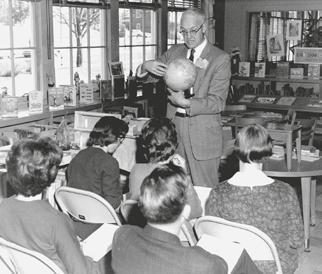
During his brief tenure as the college’s third president, Searle Charles led the school through another name change: Eastern Connecticut State College. He also saw the completion of Goddard and Hurley Halls and the opening of Keelor Hall, the school’s rst early childhood education facility.

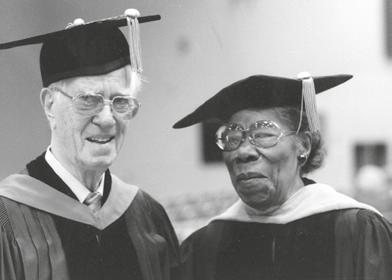
President J. Eugene Smith and Juliette Burstermann, who was the rst African American professor in New England when she joined the faculty of Willimantic State Teachers College in 1948, are reunited in this 1990s photograph.
J. Eugene Smith named second president (1947-1966)
First graduate program offered (education)
Name change: Willimantic State College

Winthrop Hall opens (former student union)
Searle Charles named third president (1966-1970)
1970
1967 Name change: Eastern Connecticut State College
Charles R. Webb named fourth president (1970-1988)
Softball wins rst of ve national championships
1981

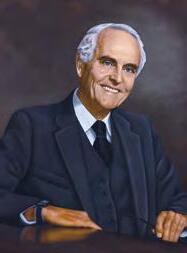
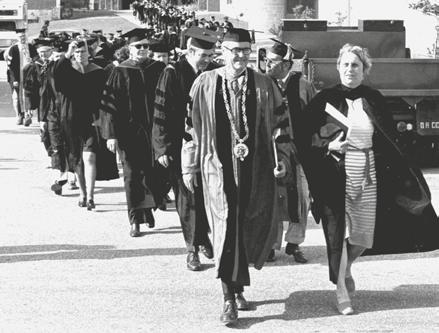
Charles Richard Webb served as Eastern’s fourth president from 1970 to 1988, overseeing remarkable growth and transformation. Enrollment increased from fewer than 1,000 to more than 4,000 students, while nine new buildings were added to the North Campus.
Webb introduced academic programs in environmental earth science, communication, and
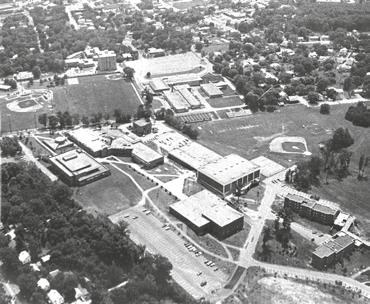
computer science, and reorganized the institution into three schools: Arts and Sciences, Education and Professional Studies, and Continuing Education. In 1983, Eastern o cially became Eastern Connecticut State University, re ecting its broadened mission.
Webb also championed Division III athletics, growing varsity sports from four to 11 teams, including six teams for women. His push for the Sports Center in 1971 supported Eastern’s athletic success, including the softball team’s 1981 national
• Burnap Hall (1970)
• Crandall Hall (1970)
• Original library (1970) — now Alvin B. Wood Support Services Center
• High Rise and Low Rise Apartments (1971)
• Sports Center (1973)
• Robert K. Wickware Planetarium (1974)
• Student Center (1975)
• Occum Hall (1984)
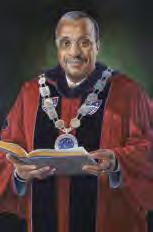
championship — Eastern’s rst of 10 national titles in baseball and softball.
Webb’s presidency paralleled a period of major societal change. Inspired by the Civil Rights and Women’s Rights Movements, students engaged in environmental activism, gender equality, and a rmative action. Study abroad programs expanded, fostering a more global outlook. Culturally, the 1970s–80s shaped student life with fashion trends like bell-bottoms and miniskirts, dorm room novelties like lava lamps, and popular lms such as Star Wars and Saturday Night Fever.
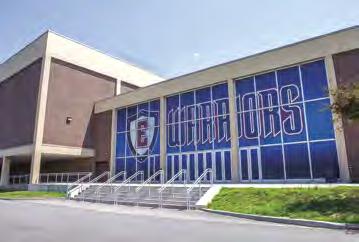
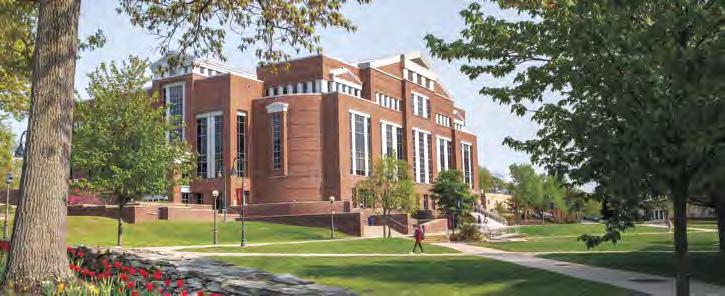
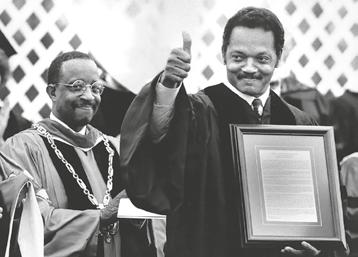
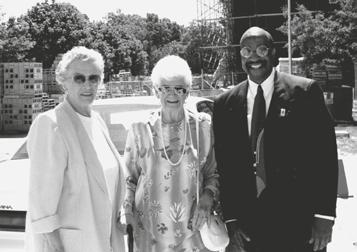
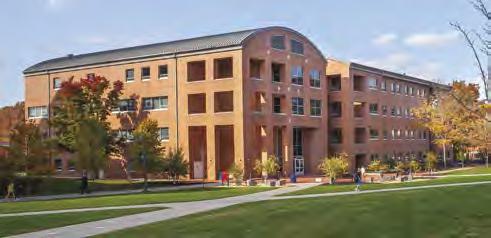
From 1988 to 2006, President David G. Carter led Eastern through its most ambitious period of growth, doubling the campus footprint with the addition or renovation of 15 buildings, including new residence halls, athletic facilities, academic buildings, and the iconic Foster Clock Tower. is expansion addressed a more than 40% enrollment increase during his tenure.
Academically, Carter strengthened Eastern’s liberal arts mission, earning formal approval from the Connecticut State University System Board in 1998 and joining the Council of Public Liberal


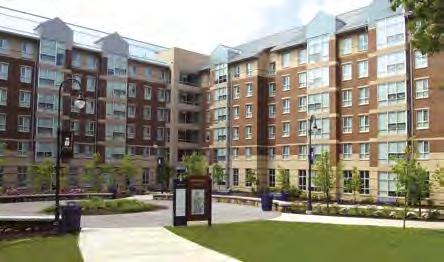

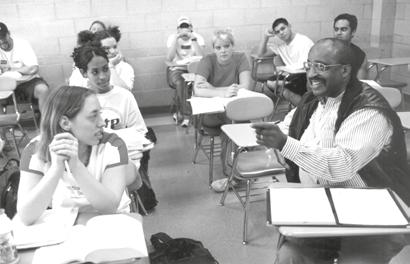
Arts Colleges (COPLAC) in 2004.
e updated Liberal Arts Core (LAC) curriculum accompanied an expansion to 33 undergraduate majors, 49 minors, and three graduate programs.
Eastern broadened its global presence through exchange agreements with institutions in Sri Lanka, France, Japan, Uganda, Brazil, and more, boosting study abroad participation and international enrollment.
e era also re ected millennial culture, with the rise of the internet, cell phones, instant messaging, and popular grunge and hip-hop music. Students embraced environmental sustainability, social justice, and community service, underscoring Eastern’s renewed commitment to civic engagement and global awareness.

• Charles R. Webb Hall (1992)
• Frederick R. Noble Hall renovation (1992)
• Dr. Arthur L. Johnson Unity Center (1997)
• Baseball stadium (1998) and sports complex (1999)
• Niejadlik Hall (1998)
• Admissions Building (1999)
• Foster Clock Tower (1999)
• J. Eugene Smith Library (1999)
• Mead Hall (1999)
• Frederick A. Gelsi and Leslie T. Young Hall (2002)
• First parking garage (2003)
• Constitution, Laurel, and Nutmeg residence halls (2005)
• Margaret S. Wilson Child and Family Development Resource Center (2006)
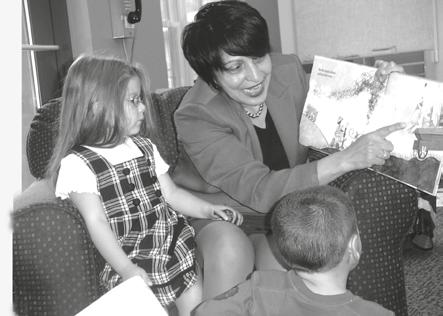
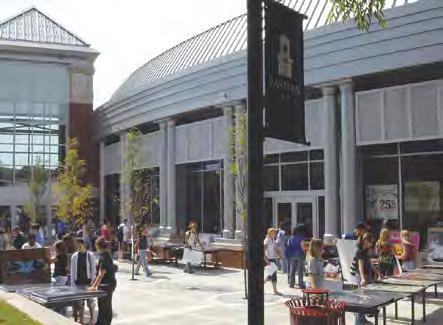


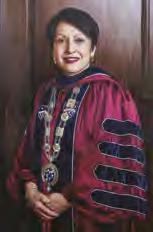
Elsa Núñez, a native of Puerto Rico, became Eastern’s president in 2006, making history as the rst Latina to lead a New England public university. Her tenure strengthened Eastern’s academic pro le, expanded access to higher education, and improved student success. By 2021, Eastern was ranked #1 among New England public universities by U.S. News & World Report for three consecutive years.
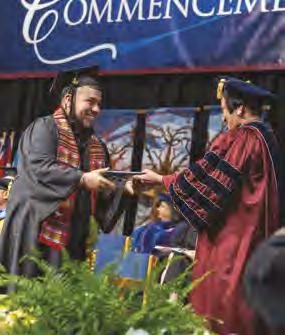
A champion of educational equity, Núñez positioned Eastern as a national leader in supporting undocumented students. In 2016, eDream. US selected Eastern as a pilot site for its scholarship program, which has since enrolled more than 350 Opportunity Scholars with a 97% retention and 89% graduation rate. She
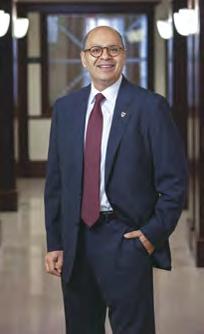
Karim Ismaili became Eastern’s seventh president on July 31, 2024, having previously served as executive vice president and provost at Bridgewater State University. A rst-generation college student, Ismaili grew up in London, England, and Vancouver, Canada, earning a master’s degree in criminology

also consolidated academic resources into the Academic Success Center, boosting support services and helping Eastern achieve the highest four-year graduation rate among Connecticut’s state universities.
Campus life thrived as student clubs grew from 60 to 100, the Student Center was remodeled, and diversity e orts expanded through the Arthur L. Johnson Unity Wing. Sustainability and civic involvement ourished with the Center for Community Engagement, on-campus food pantry and thrift shop, and the student-led Day of Giving.
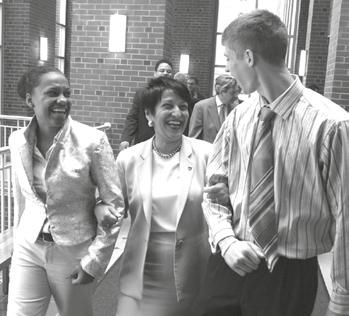
Núñez’s presidency navigated global and technological changes — smartphones, social media, the 2008 recession, and the COVID-19 pandemic — fostering resilience while advancing Eastern’s mission of access, inclusion, and excellence.
from Cambridge University and a Ph.D. in political science from the University of Western Ontario. After beginning his career as a criminology professor in 1997, he transitioned to higher education leadership in 2006. In his rst semester at Eastern, the University launched the Eastern Liberal Arts Core (ELAC), a streamlined curriculum emphasizing critical thinking, ethical reasoning, communication, creativity, and
quantitative literacy. Ismaili also conducted a “Listening and Learning Tour” to engage with the campus community and approved the lming of an episode of Amazon’s e College Tour to showcase Eastern to a national audience. Ismaili’s leadership marks a new chapter of growth, innovation, and opportunity for the University.


































































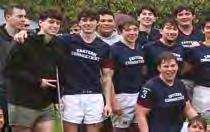





















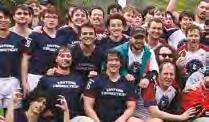



















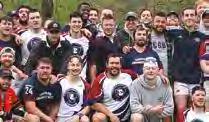




























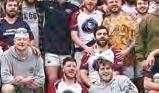
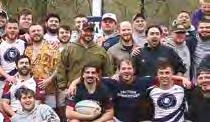
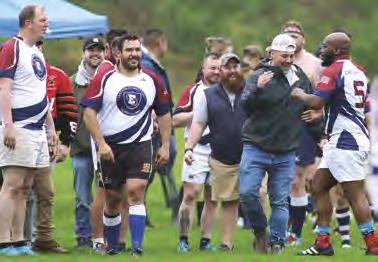
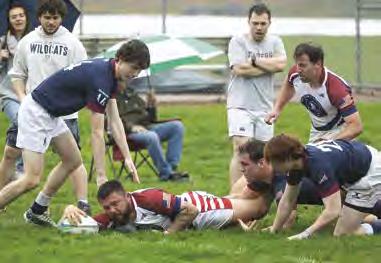
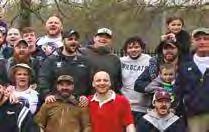
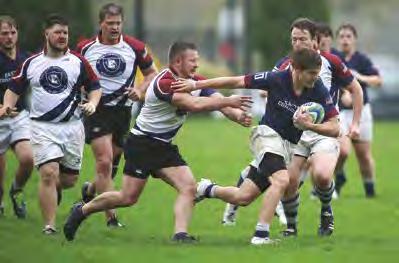
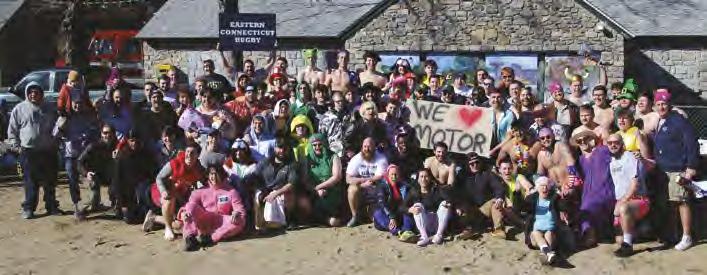
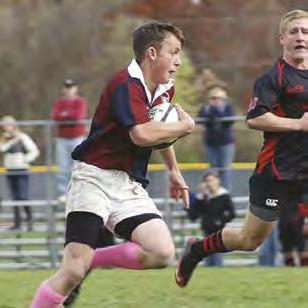
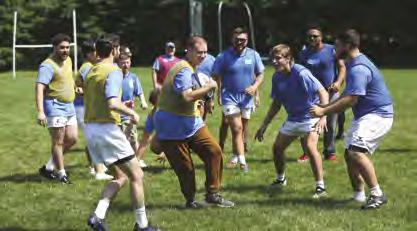
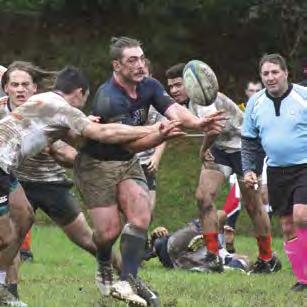
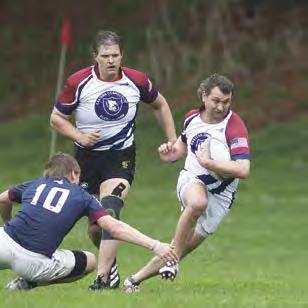
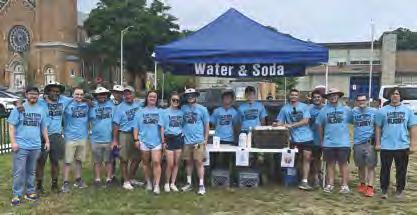
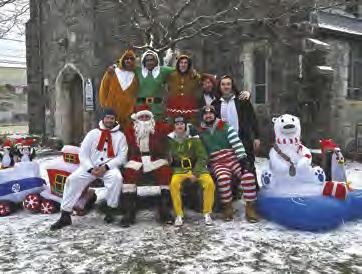
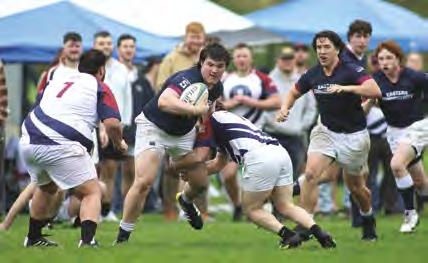
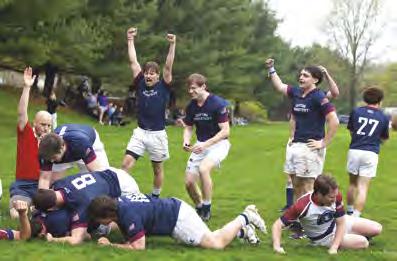
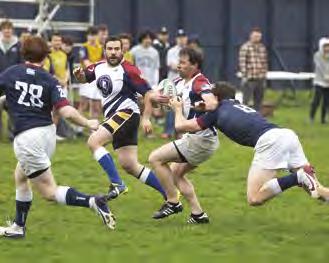
Eastern’s men’s rugby team has an ulterior motive. On the surface, it is a competitive and popular club sports team, known for its grit and sportsmanship. However, as committed as it is to the game, the team may be even more visible out in the community. Players and alumni can be seen around Willimantic collecting donations at Stop & Shop on a freezing winter day, serving meals at the Covenant Soup Kitchen, or cleaning community gardens during the fall. is is no coincidence — a culture of community service has been engrained in the team for generations. Many alumni continue to support the team long after their time on the eld, assisting the local community in a variety of events year after year.







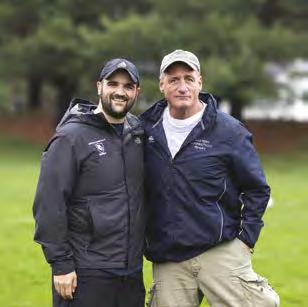
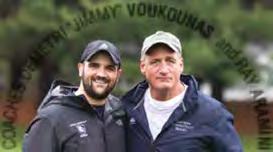
“Willimantic is an exceptional community, a community that has an awful lot of heart,” said Ray Aramini, a prominent gure in town and Eastern rugby coach for 21 years. Growing up in West Virginia and witnessing poverty








By Noel Teter ’24 and Michael Rouleau ’11





















rsthand, Aramini’s coaching and community service are rooted in a commitment to helping others. As such, service has become central to the rugby team’s identity.


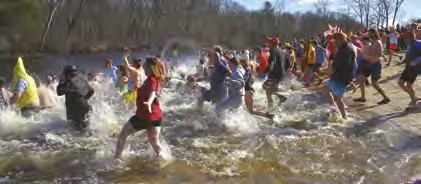
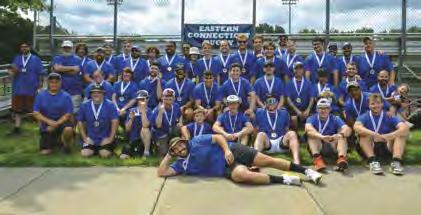
Among Aramini’s proudest accomplishments with Eastern rugby is the annual Olga Ezis Plunge for Hunger, which has raised hundreds of thousands of dollars for the Covenant Soup Kitchen over 14 years. Other initiatives include leading rugby clinics with the local Special Olympics, providing manpower at local cleanup events, and more.




















“It’s about reacting to the need, as opposed to creating an event and then seeing if it ts,” he said of the team’s community involvement.



Aramini aims to help his players develop into balanced adults who can be de ned beyond the sport they play. “Rugby is what draws these students in. ey may not become professional rugby players, but they’re all going to be professionals,” he said. “It’s about developing













































the totality of the student.”


















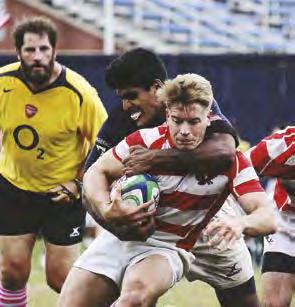
One of those balanced adults is Demetri Voukounas ’14, a former player of Aramini’s who has served as the team’s head coach for nine years. Like many of the students who nd their way to the club, Voukounas wasn’t aware of the sport before Eastern. “No pads, full contact tackling ... rugby is a crazy game,” said Voukounas. “Looking back, joining the team is one of the best decisions I ever made ... the fun, the work ethic it taught me, the giving back.” He says the club is very inclusive, welcoming everyone of any skill level, without the barriers of a varsity college sport. “It’s an outlet for so many students looking for a community ... for guys with an athletic drive and an itch to be on a team.”
















As for the club’s community engagement, Voukounas said, “Why wouldn’t we? As students, we live in town, go to school in town, utilize the town’s resources. e least we can do is give back.”













































































On top of that, he says working in the community is fun: “You’re hanging out with the guys you’re going to battle with. ... It builds camaraderie and brings you closer as a team.”










Patrick Scully ’12 was the student leader who helped launch what would become the Plunge for Hunger. Scully and friend Nick Fitzner ’13 organized a fundraising bike ride from Willimantic to Washington, D.C. With the support of Aramini, raising donations/ taking pledges and jumping into the icy Natchaug River, the Plunge was born.










Now a fourth-grade teacher in Glastonbury, Scully recalls joining the rugby team out of interest in his Irish heritage. “We were never going professional in rugby,” he said of his teammates’ motivations to have fun and build camaraderie.








As a student, he noticed the University’s e orts to connect with the local community, but volunteering through rugby made it personal. “Now, I’m face to face with the community,” he said, re ecting on his experiences at Covenant peeling eggs and tending the property.




















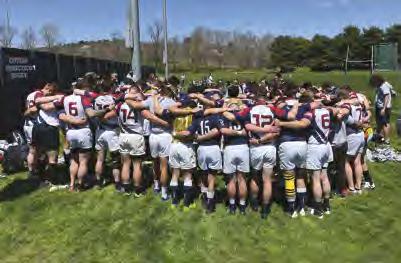






Scully continues to return to Willimantic and to the team: “It’s about being part of a community.”

Brad Marston ’19 was unsure of his path through higher education before landing at Eastern, the third college he attended. “Rugby is what kept me at Eastern,” he said. “It changed my life.”










Marston began to see himself not just as a student, but as a member of the local community. “It was always family, school, work, rugby,” he said. “Community was in our free time.”






“They may not become professional rugby players, but they’re all going to be professionals. It’s about developing the totality of the student.”

- Coach Aramini















As an alumnus, Marston continues to return to Willimantic to help out with the team, especially for the Plunge. “It’s miserably cold, so seeing the way everyone comes out and supports the soup kitchen is really cool,” he said. is past holiday season, Marston also helped the team give Christmas presents to children at the soup kitchen. “ at was the most fun and rewarding [event] for me,” he said.


















































































“Rugby is what kept me at Eastern. It changed my life.” - Brad Marston '19



A former baseball and hockey player, Anthony Amato ’12 joined the rugby team the spring semester of his rst year. He heard about the team from two residents in his hall who seemed to always talk about how much fun the games were.


Naturally, Amato began hearing Aramini talk about the community service opportunities available to the team. “Ray never forced us to do anything,” he said. “It didn’t feel like work to us.”

One of Amato’s earliest volunteer events was the annual Day of Caring, a townwide cleanup organized by Eastern’s Center for Community Engagement in partnership with United Way. “We had buckets and grabbers and were picking stu up o the street,” he recalled.









A former rugby player at Vermont State University-Johnson Campus, Kam Chaudhry ’19 transferred to Eastern after hearing friends talk about the strength of its rugby team: “If you want to play rugby, that’s where you go.”











Amato still makes time to volunteer at the Shaboo Stage concerts and participate in the Plunge for Hunger. “I like being able to go back to Willimantic and give something back to the community,” he said.
Describing himself as someone who was “self-centered,” Chaudhry began to change through team interactions — especially during a bus ride when teammate Sam arp sat next to him and “just wouldn’t stop talking.” Despite trying to tune him out, their friendship grew, as did Chaudhry’s bonds with the rest of the team.







Amato also keeps the rugby team in his life outside of the community events. “Eight of my best friends are from the rugby team,” he said. “Our children now play together.”

















In June 2018, arp died in a motorcycle accident — a loss that deeply impacted Chaudhry. “I went into Eastern super hard-headed and self-centered, and then when that event happened with Sam, I was completely broken down.” e team’s response left a lasting impression. “If we needed a friend, Coach would get another teammate to talk to us. at was a level of support I wasn’t used to,” Chaudhry said. “ ere were days we’d cry and days we’d forget the world existed.”




































Chaudhry ramped up his community e orts with the team following arp’s










passing. “We’re serving more than just ourselves,” he said. “Ray taught us that ALL =1. You see someone who needs something, and you give back.” E









































By Abigail Dreyer ’28
Going to college is one of the biggest transitions people experience in their lives. You’re away from home for the rst time, solely responsible for your academic and social life, with the pressure to become the person you want to be for the rest of your life.
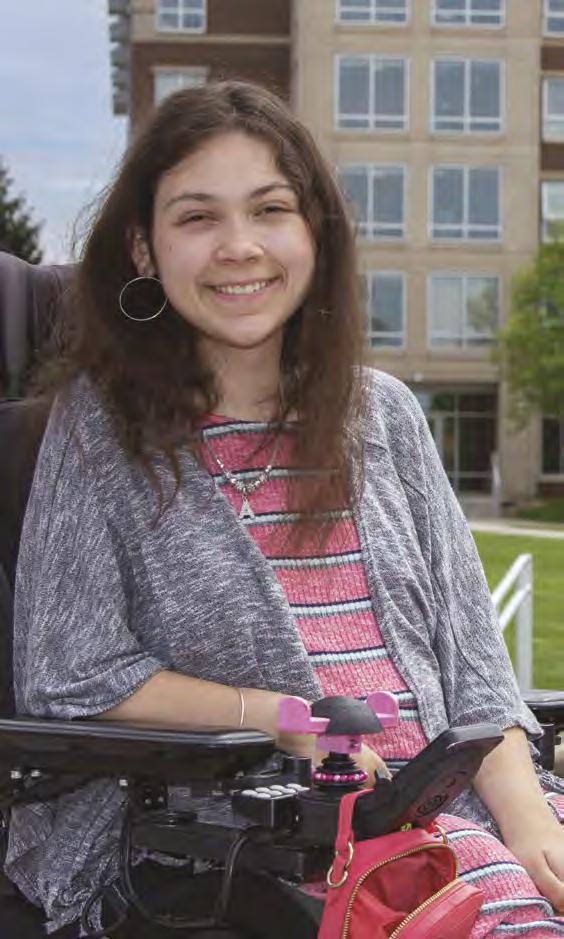
As daunting as that may be, now imagine also having a rare genetic condition and living — for the rst time — without a caregiver. is was my reality when I came to Eastern as a rst-year student last fall.
I was born with spinal muscular atrophy, a genetic condition that causes one’s muscles to deteriorate over time. Because of this disability, I use a power wheelchair and require daily assistance with basic tasks such as getting dressed in the morning. In preparing for college — even an accessible one like Eastern — I needed to gure out how to minimize the near-24/7 care I had grown up with and maximize my independence.
My very rst days at Eastern were a whirlwind, to say the least. Learning how to navigate my new environment — nding the door openers and elevators within buildings and guring out how to use the bathroom on my own, all while balancing my schoolwork and clubs — was physically and mentally draining. For a time, it seemed that things might not work out, and I often found myself frustrated. ere were days I felt trapped in my mind, just trying to juggle the logistics.
rough it all, however, I found there was always something to pull me back to the present, whether it be a kind word from an RA or a new friend excited to see me. And that’s when I discovered something even more rare than accessibility: community.
Growing up in Rhode Island and graduating in a high school class of approximately 120 kids, there weren’t many opportunities to meet new faces. Everyone in my grade had been together since elementary school, if not longer. As a result, the stereotypical tropes of who each person was
“supposed” to be were rmly established. To my peers, I was known simply as “the girl in the wheelchair” (and maybe a bit of a nerd).
At Eastern, it was a shock to meet people who were genuinely interested in getting to know me for all that I am. It was this welcoming community that truly made me feel not only like a Warrior, but a capable one, too.
Transitioning to college was certainly an eye-opening experience. I nd it almost poetic that at this point in my life, where I’m more self-su cient than ever, I’m also more supported than ever. For a long time, I never thought I’d be as independent as I am now, and I once believed that to be truly successful, one had to be completely independent. But now I see that independence and receiving support are not mutually exclusive. If I’ve learned anything this year, it’s that success is not linear and doesn’t exist in isolation. ere’s always something you can improve upon, and it doesn’t all have to do with getting good grades. Success can be measured from all angles. Often, improving in one area, such as being more social, can send waves through your life and help you thrive in other areas as well.
Considering the challenges I’ve faced and conquered this year, I know there will be many more to come. As unpleasant as challenges may be, they are also opportunities to grow in multidimensional ways — ways you might never have thought possible. While it’s di cult, I encourage you to embrace life’s challenges. After all, we are Warriors.” E

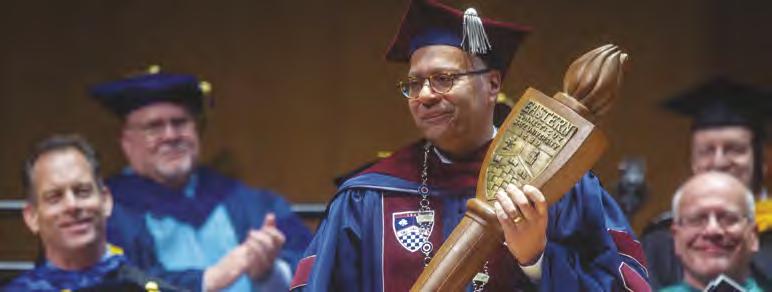
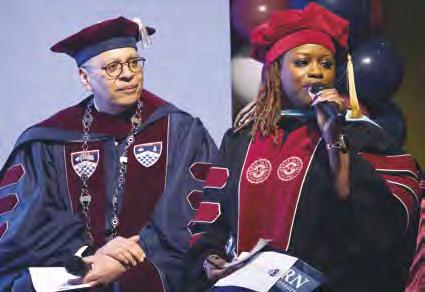
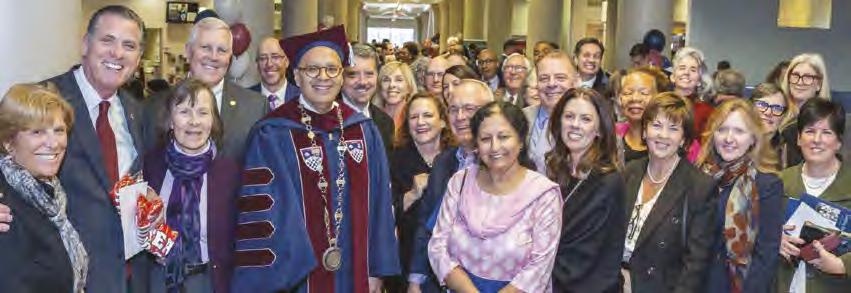
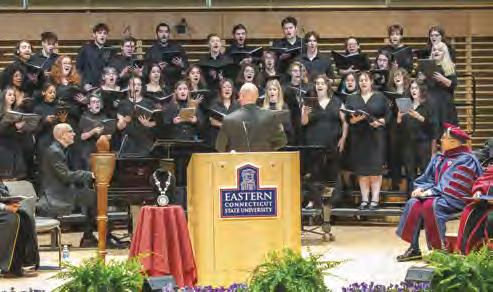
n April 11, 2025, Eastern Connecticut State University formally inaugurated Dr. Karim Ismaili as its seventh president. e milestone event took place in the Concert Hall of the Fine Arts Instructional Center, where hundreds of Eastern community members, state o cials, and delegates from peer institutions gathered to celebrate the latest chapter in Eastern’s 136-year history.
During his inaugural address, Ismaili re ected on the University’s origins as the Willimantic State Normal School and its ongoing public-serving mission to expand educational opportunities. “Eastern has an unwavering commitment to extending the promise of higher education to everyone who wishes to pursue their dreams … to those who may not see themselves as deserving, capable, or nancially able.”
Underscoring that mission, Ismaili turned to his own lived experience. He recalled growing up in 1970s London with his brother, Rahim, and mother, Rabia, an immigrant from Kenya. During a time of social unrest and following a tumultuous family situation due to domestic violence, the threesome ed to Canada when Ismaili was 13. Education, he said, was both “a luxury and a lifeline.”
Rabia, who passed away in December 2024, instilled in her sons the values of compassion, discipline, and education. “She was our inspiration, our North Star,” Ismaili said. “We miss her so much.”
By Michael Rouleau
Ismaili recounted the agship initiative of his rst year as president: the Listening and Learning Tour, which engaged faculty, sta , students, alumni, and other members of the Eastern community in dozens of discussions about their aspirations for Eastern. “My goal was to learn from those who know Eastern best,” he said.
e takeaway: “A genuine, abiding a ection for Eastern.” He praised the community’s caring spirit, academic excellence, and inclusive mission, urging a renewed commitment to the value of higher education amid national skepticism.
“Eastern’s true value comes from contributing to the intellectual growth, social development, and well-being of our students,” he said. Ismaili stressed that Eastern is an economic engine for the state, with 92% of students coming from Connecticut and 86% of graduates remaining to build their careers.
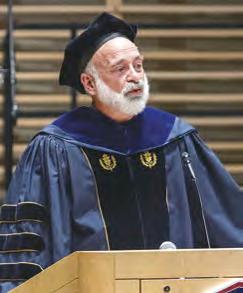
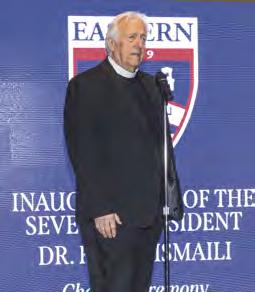
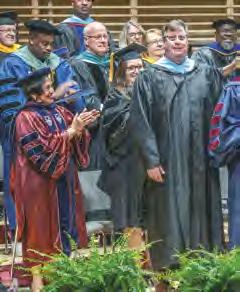
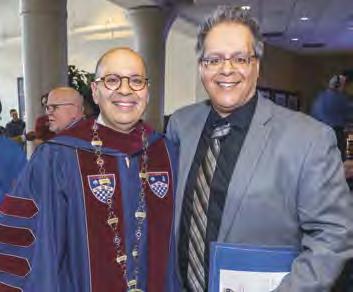
Dana Mohler-Faria, Ismaili’s mentor and president emeritus of Bridgewater State University, praised his integrity and leadership. Recalling his own mentor, former Eastern President David G. Carter, Mohler-Faria said, “To be a great leader, you must bring the essence of who you are to the presidency every day. … Dr. Ismaili’s path to this position is not accidental or incidental. He is the right person, at the right time, in the right place.”
Lisa Drzewucki, Ismaili’s sister-in-law, o ered a more personal perspective. “ ere’s no dirt to dish,” she joked. “Karim is a true rarity — a person who walks the walk and talks the talk. Sincerity and integrity, that’s what Karim brings to the table.”
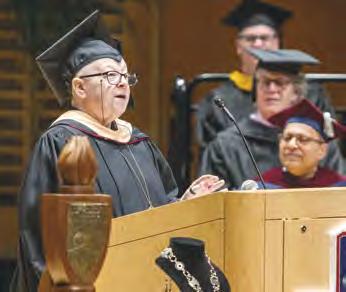
Psychology Professor Peter Bachiochi, speaking on behalf of the faculty, noted Ismaili’s inclusive leadership. Drawing on his 25 years at Eastern and his expertise in the eld of industrial organizational psychology, he cited the value of inclusion in building successful organizations.
“Inclusion is the secret sauce that makes an organization run smoothly and a classroom re on all cylinders,” Bachiochi said, noting that it fosters belonging and improves performance. “I am happy to say that I see in him a leader who will take what we have built here at Eastern and bring us to new heights.”
Representing students, senior history major Emma McCormack ’25 re ected on Eastern’s transformative power. “Eastern is a place that recognizes potential in students before we see it in ourselves,” she said. “Under [Ismaili’s] leadership, I have no doubt that Eastern will continue to inspire, challenge, and empower the next generation of students.”
Terrence Cheng, former chancellor of the Connecticut State Colleges and Universities system, praised Ismaili’s “kind and compassionate spirit” and his rsthand understanding of the transformative power of public higher education.
Board of Regents Chair Marty Guay emphasized Ismaili’s connection to Eastern’s mission. “Like many of our students, Dr. Ismaili is a rst-generation college graduate. He believes deeply in education’s power to transform lives and communities.”
Support President Ismaili's vision with a gift to the Presidential Strategic Initiatives Fund.



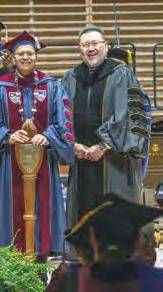
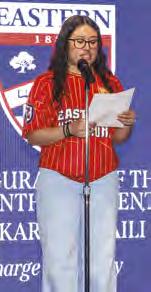
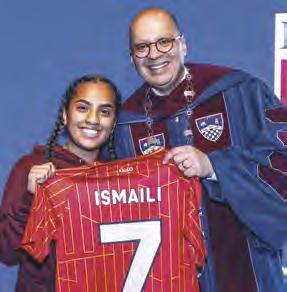
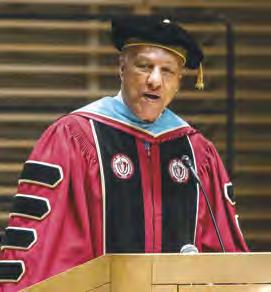
Following the formal investiture, the community gathered for a symbolic “Charge Ceremony” at the Student Center. Led by Dean of Students Kemesha Wilmot ’05, more than 10 speakers — including students, alumni, faculty leaders, union representatives, and local o cials — challenged Ismaili to uphold Eastern’s values as a student-centered, academically rigorous, community-engaged, employee-supportive, and culturally inclusive institution.
Junior Gabriela Varela Santana, an economics major from Atlanta, re ected on her own journey at Eastern. “ e lessons I’ve learned here — about kindness, resilience, and community — will stay with me forever. Just like President Ismaili, we must be the kind of leaders who shape the future with courage and compassion.” E



By Ed Osborn
It all started with Mark Bradley ’90. Since Bradley graduated from Eastern more than 30 years ago, generations of the Bradley family have followed in his footsteps, becoming Warriors and launching their careers after graduating from Connecticut’s only public liberal arts university. His example was followed by his sister, Shanda Hinton ’96; cousin, Kolin Ebron ’12; and nephew, Maurice Johnson ’17.
“I am really proud to introduce others in my community and my family to educational opportunities and connections at Eastern,” said Bradley.
“From the beginning, I enjoyed the close-knit community,” he said of his decision to transfer from UConn. “At Eastern, it’s such a healthy environment — I was able to build relationships with faculty and other students. President David G. Carter was also in uential and Dean of Students Arthur Johnson embraced me.”
Bradley has remained connected to his alma mater, serving as president of Eastern’s alumni association and later as a member of the board of directors of the ECSU Foundation, Inc.
He celebrates 30 years with e Hartford in September 2025, where he is the director of middle/large business operations, leading three of the company’s divisions for its general industries, technology, and life sciences business segments. He is also vice president of the Greater Hartford chapter of the National African American Insurance Association, the second largest chapter in the United States.
“They laid the foundation; I just walked the trail.”
Kolin Ebron ’12
Bradley’s sister, Shanda Hinton ’96, is another family member who has fond memories of Eastern. A rst-generation student from Bridgeport, Hinton liked Eastern’s size and wanted to stay in Connecticut to attend college. She recalls the impactful experiences she had working on Eastern’s student-run television news program and serving as an RA.
“I had an incredible experience at Eastern — it was foundational. I was exposed to a variety of experiences and ideas. I learned about collaboration, teamwork, time management, and developed interpersonal skills, gaining the con dence to manage change and make critical decisions. I also learned about innovation and creativity, and how to engage students.”
After earning a master’s degree in educational administration from the University of Massachusetts, Hinton began her career in the O ce of Admissions at Trinity College before transitioning to Cigna (later Prudential) in the area of management training, and then to Comcast where she specialized in talent management. Today, she is vice president of culture and organizational health at RTX, the largest aerospace and defense company in the world, comprised of Collins Aerospace, Pratt & Whitney, and Raytheon.
Kolin Ebron ’12 is Mark and Shanda’s rst cousin and bene ted from knowing of their success and experiences at Eastern. “ ey laid the foundation; I just walked the trail,” he chuckles. A transfer student — “I wanted to be closer to home” — Ebron majored in sport and leisure management with a concentration in health.

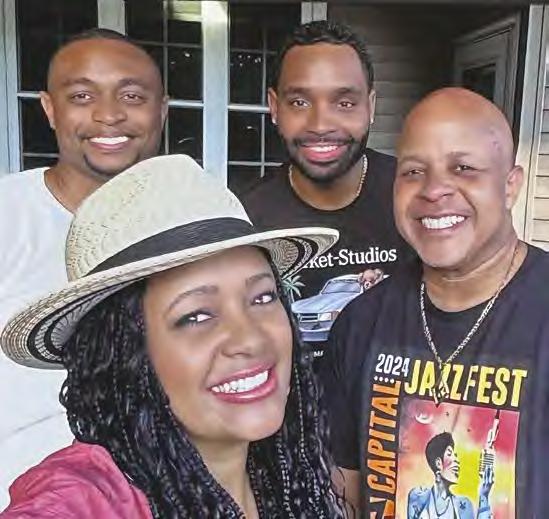
Ebron was an RA on campus, “a leadership role that gave [me] opportunities to learn skills transferable to other circumstances.” Ebron also enjoyed volunteering with the Center for Community Engagement.
In 2021, Ebron received a Ph.D. in learning leadership and educational policy from UConn, with a research focus on sport-based youth development programming and critical service learning.
Maurice Johnson ’17 is Mark and Shanda’s nephew, and the fourth member of the Bradley family to attend Eastern.
“I wanted a computer science degree and Eastern has a good program. Plus, the campus was the right distance from my hometown of Stratford,” Johnson said.

“Eastern was the foundation of my career. The knowledge and skills I learned there are critical to the work I do each day.”
Maurice
Johnson ’17

“I enjoyed Eastern thoroughly, I met people from across Connecticut and beyond, and had the opportunity to experience di erent cultures.”
In the computer science program, Johnson learned about data structures, algorithms, JAVA, and other software skills.
“I use all these in my daily programming job,” said Johnson, who is a software engineer at e Hartford in its enterprise risk management area. He provides application development and web services for internal company customers, working with databases and APIs, as well as front-end and back-end web spaces. “Eastern was the foundation of my career. e knowledge and skills I learned there are critical to the work I do each day,” said Johnson.
e Bradley family is a great example of the transformative power of an Eastern education, and a reminder that the relationships of family, friends, colleagues, and mentors are the foundation of the University community. E
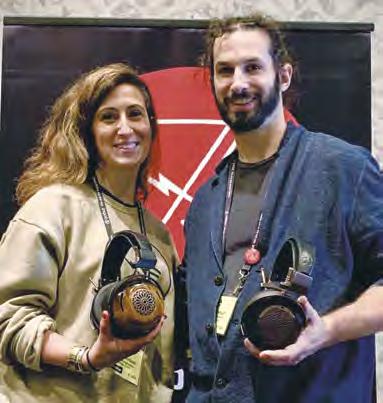
hen they met two decades ago at Eastern in a scriptwriting class with Professor Edmond Chibeau, Zach ’06 and Bevin (Titcomb) Mehrbach ’07 had no idea about the romantic partnership they’d form — or the acclaimed upscale headphones business they’d eventually establish.
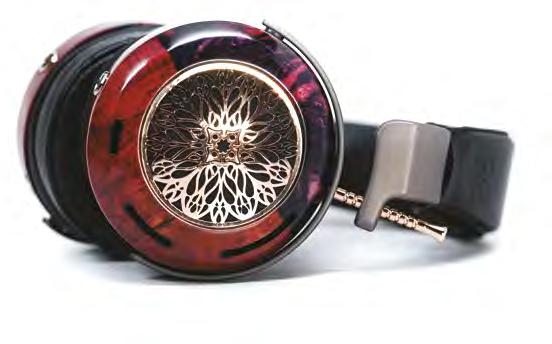
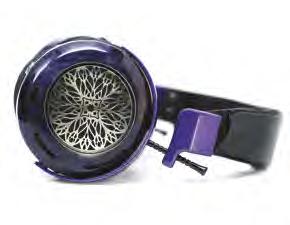
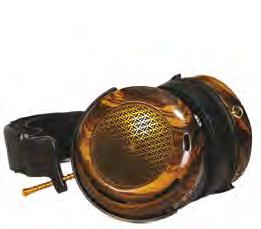
Now married and living in Chicago, the two communication alumni are co-founders of ZMF Headphones, a company that hand-constructs headphones from premium hardwoods for an immersive listening experience.
ZMF’s products have received numerous accolades, including e Absolute Sound’s 2020 Product of the Year, and rave reviews from several media outlets, such as CNET, Audiophile Magazine, and more. eir artfully crafted products often carry four- gure price tags, and are distributed to dealers around the world.
Zach began constructing headphones in 2010 as a graduate lm student at Columbia College Chicago. In 2015, ZMF Headphones became his full-time job. “Listening to a lot of headphones in co ee shops while getting my degree, I started researching di erent acoustic instruments and realized that it would be cool to have a pair of headphones that looked like the guitars I liked,” he said.
“I was introduced to hi- audio by Zach,” said Bevin. “I had always just listened [to music] through whatever earbuds came with my iPhone. You don’t understand the di erence in delity until you hear your music through a really high-end audio system.”
Bevin continued: “You can hear the musicians’ nails hitting the ridges on a guitar string or you can hear when they purse their lips to begin singing. So, I just hope that people have that transformative experience.”
e couple can point to Eastern as the impetus for ZMF Headphones in many ways. Zach recalls former music Professor

By Noel Teter ’24
Richard Jones-Bamman’s courses on music theory, which instilled in him a keen interest in the structure of acoustic instruments, speci cally banjos.
“A lot of the ornate features on our headphones are inspiration that I found in those 19th-century banjo makers that Richard Jones-Bamman showed me,” he said.
Zach also played on Eastern’s baseball team. Playing for Bill Holowaty, one of the most successful coaches in NCAA Division III history, he learned about e ective organizational communication.
“All that experience in sports really helped me gure out how to interact with people, motivate them, and be transparent about what they might need,” he said. “[Holowaty] tutored us about how to navigate those relationships and that the end goal is being successful at whatever you’re doing.”
Meanwhile, Bevin, who handles the culture and human resources side of the business, credits the late Professor Edmond Chibeau for helping her nd her way at Eastern and beyond.
“I’m a scatterbrained artistic type,” she said. “I thought of myself as not good at school. … Dr. Chibeau took such an interest in my writing. He put me on the radio, asked to publish my scripts, asked me to come to readings, and encouraged me.”
But the most foundational part of ZMF Headphones is Zach and Bevin’s relationship. As Bevin recalls, the couple didn’t have a “traditional” rst date. In its place were frequent trips to Hurley Hall, Dunkin’ Donuts, Campus Activity Board events, and Willi Bowl, a former local bowling alley.
eir fondest memories occurred in Occum Hall, with its friendly residential community. “It was homey, and everyone knew each other,” said Bevin. “We spent so much time just hanging out talking about music, movies, and all the common interests that led to ZMF.” E



hen Gussie (Paster) Sitkin ’43 arrived at Willimantic State Teachers College (WSTC) — now Eastern Connecticut State University — in 1939, life as she knew it was about to change.
Born in 1921 on a farm in rural eastern Connecticut, Sitkin grew up with a strong work ethic and a sense of resiliency that would carry her through every chapter of her life.

delight — as I used to go to folk dances with my brother when I was a teen,” she said. “I even took a music class, even though my previous background in music was nil.”

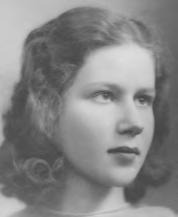




She attended WSTC for four years on a full scholarship. “I stayed at the dorm for six months of the year — the cold months,” Sitkin recalled. If ever she had to commute from her home 20 miles away, “I hitchhiked.”











But these were not ordinary college years. e U.S. had just entered World War II, and its shadow loomed over every decision. “Students were very anxious about what to do — whether to leave and join up or to complete their courses,” Sitkin recalled. “Some students left before the end of the school year with special permission.”















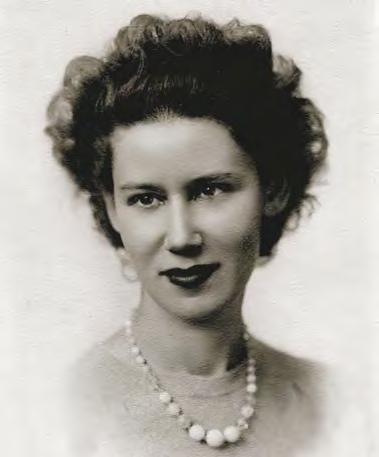









Gussie Sitkin ’43 on education, resilience, and 104 years of life
By Elisabeth Craig ’26 and Michael Rouleau ’11


With her senior year cut short and a male teacher shortage due to the war, Sitkin quickly transitioned into teaching, taking on a combined class of kindergarteners and rst graders. “It was di cult for me as a new teacher, but I got used to it,” she said. In hindsight, “I really loved it.”
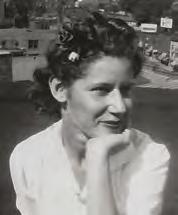


In 1945, Sitkin’s life took another turn when she married Joe Sitkin, a radar repairman at the military base in New London. Soon after, she left teaching and moved with Joe to Southern California, where they raised three children and built a new life together. “We had a wonderful life for 75 years,” she said.





In Willimantic, Sitkin met a diverse community of students. “ ere were students from di erent nancial backgrounds, di erent places, and with di erent personalities,” she said. “What I enjoyed most about being a student were the classes — you had required classes, but you also had a choice of others.”
Sitkin found joy in unexpected places. “I loved the folk dance course — the teacher was a

Sitkin’s passion for education and helping others inevitably called her back to the classroom. In 1979, she returned to teaching before moving into school counseling. “I was fortunate to land a job as an elementary school counselor in the Los Angeles Uni ed School District — it was the rst time the district had counselors at the elementary level,” she said. Her drive for professional growth didn’t stop there. While still counseling in schools, Sitkin pursued a license as a marriage and family counselor and earned her doctorate in education in 1985. She retired from school counseling in 1999 and then began her nal professional chapter as a marriage and family therapist, a career she continued into her 100s.
“I’ve had a great life and a rewarding career. As you can see, counseling and therapy — helping kids and adults through emotional issues and traumas — has been my passion.”


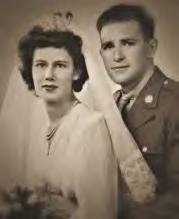
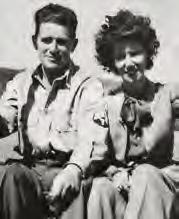
Sitkin turns 104 on Oct. 17. From a hitchhiking farm girl in Connecticut to a trailblazing counselor in Los Angeles, she looks back with gratitude on a century of service, love, and growth. E
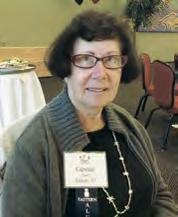
Read more about Gussie’s remarkable life on her autobiographical website, Love and



By Michael Rouleau ’11
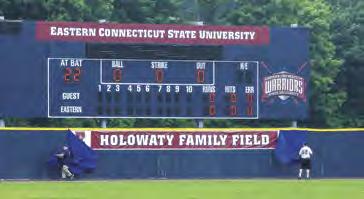
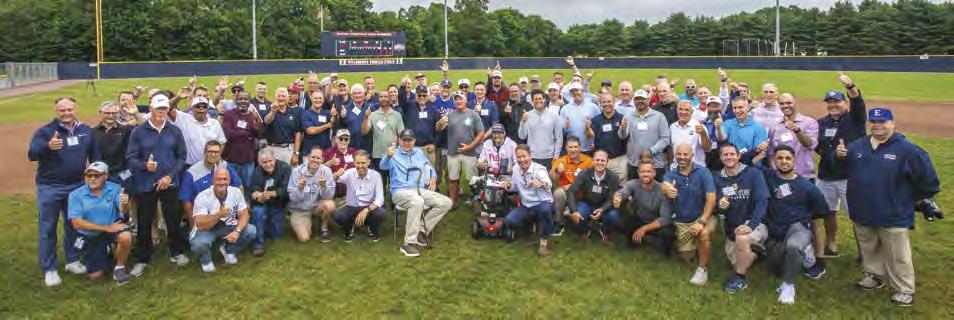
Eastern Connecticut State University honored one of the most storied coaches in NCAA Division III history on June 28 with the formal naming of its baseball eld as Holowaty Family Field. e ceremony paid tribute to Coach Bill Holowaty, whose remarkable 45-year tenure at Eastern not only brought national acclaim to the program, but also created a familylike environment among generations of Eastern baseball players.
Coach Holowaty led Eastern’s baseball program from 1969 to 2013, amassing one of the most decorated coaching records in NCAA Division III history. Under his leadership, the team captured four national championships (1982, 1990, 1998, 2002), appeared in 12 College World Series, and maintained a career winning percentage of 72% with a record of 1,404-525-7.
“Naming the eld in honor of the Holowaty family is a tribute to a coach whose impact on this program is de ned not only by remarkable records, but by the generations of student-athletes who came through it,” said Eastern President Karim Ismaili. “His teams brought national recognition to our university and created some of the most memorable moments in Eastern athletics.”
Current head baseball Coach Mike Odenwaelder acknowledged the foundation his predecessor laid. “Coach Holowaty built from the ground up so much of the rich history, tradition, and winning culture that is Eastern baseball. … As I look forward to my own tenure at the helm here, the tall task of lling Coach’s shoes is made immensely easier because of that rich history and culture, baked into the walls of this stadium.”
e eld naming re ects the collective e ort of nearly 100 alumni and supporters who, since fall 2024, have committed more than $150,000 to the Holowaty Family Field Fund. e fund supports ongoing maintenance, renovations, and upgrades to the eld and overall venue.
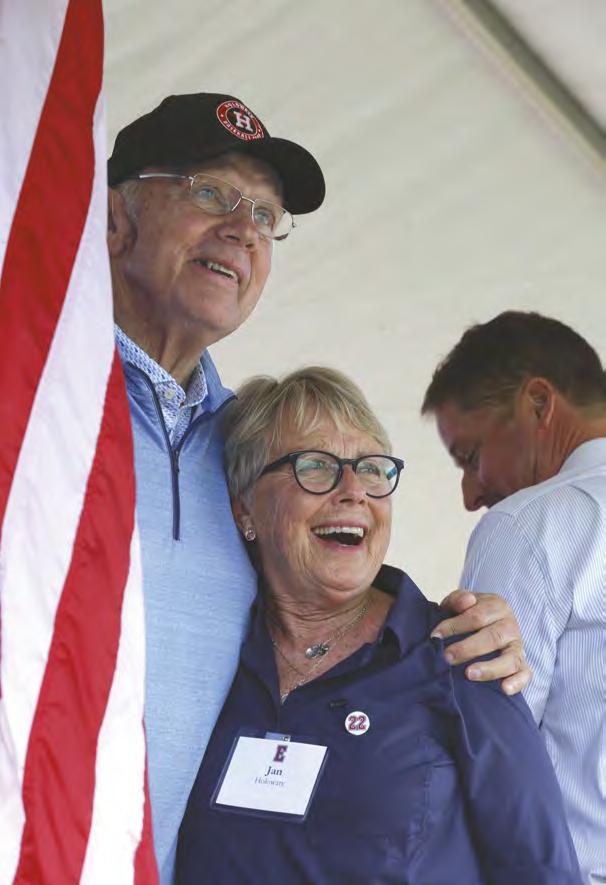
Bill and Jan Holowaty look on as the Holowaty Family Field sign is revealed.
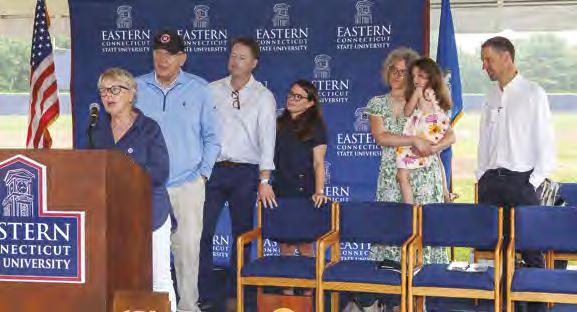
Speaking on behalf of donors and alumni, former player Greg Sullivan ’06 emphasized the importance of staying connected to the team after their time on the eld. To Coach, he added: “You taught us character, toughness, and class. You taught us 'we' over 'me' and you taught us loyalty. ... Yes, you will always be our coach, but more importantly, you will always be family.”
our family here and developed a huge baseball family. e name Holowaty Family Field — the ‘Family’ part — is for all of you, because you’ve made our lives so much better.”
Daughter Jennifer Holowaty ’97 echoed her mother’s sentiment. “ e naming of the eld is an incredible moment for our family,” she said. “However, it is not simply about the Holowaty family, but the
“His re to compete shaped us into better players — and even better men.” - Tom Roath ’81
Former player Tom Roath ’81 emphasized Coach’s unwavering dedication to developing players both on and o the eld. “Yes, winning games was important, but it was about pushing us — every single day — to be better than we were the day before,” said Roath. “His re to compete shaped us into better players — and even better men.”
Roath also paid tribute to Jan Holowaty, Coach Holowaty’s wife, calling her the “real MVP” for her steadfast support behind the scenes. “Whether it was managing the bus driver, keeping Coach out of trouble, or making sure we were all fed, Jan was the glue that held everything together,” he said.
Re ecting on her decades of building a life around Eastern baseball, Jan Holowaty said: “Nothing can compare to the 45 years that we spent here at Eastern — we raised
Eastern baseball family — all of the players, families, and friends who have been impacted by my father and by Eastern baseball. It’s a recognition of everyone who helped build the program.”
Son Jared Holowaty ’02 recalled growing up with Eastern baseball as a constant presence in his life, from his adolescence as the team’s bat boy to his college days playing for the Warriors. “To all the players, sta , and supporters — it takes a family,” he added. “ e naming of this eld is about all of us.” E
Lee A. Cattanach ’16 2011-2016
Cross Country/Track & Field
Dwayne J. Coles ’03 1999-2002
Men’s Lacrosse
Michael J. Garrow ’14 2009-2014
Men’s Basketball
Amy M. (Arisco) Geriak ’12 2007-2011
Women’s Swimming
Priscilla M. (Alicea) Pierro ’12 2009-2012
Softball
2025 Little East Conference Inductee Marianna (Capomolla)
Linnehan ’07 2004-2006
Women’s Volleyball
Induction Ceremony and Social Saturday, Oct. 18, 2025, at 5 p.m. Fine Arts Instructional Center, Concert Hall
Contribute to baseball field renovations with a gift to the Holowaty Family Field Fund.

Purchase tickets:

By Bob Molta ’78
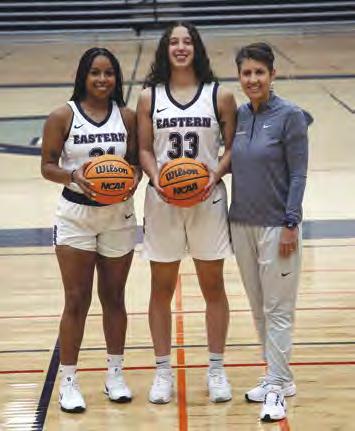
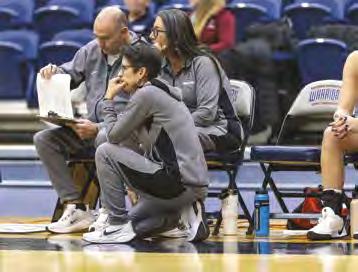
e most successful women’s basketball coach in Eastern’s history, Denise Bierly, retired this past spring after a celebrated 31-year career.
Bierly led the Warriors to 15 postseason tournaments and 13 seasons of 20 or more wins over three decades.
e program’s all-time leading coach in terms of years and games coached and won, Bierly compiled an overall record of 553-279 (66.5%). She coached 488 of the program’s 588 Little East Conference (LEC) regular-season and tournament games, winning or sharing eight regularseason titles and capturing six LEC tournament championships, including four in a six-year span between 2015 and 2020.
“What started out as a way to continue my love of the game of basketball turned into so much more than I could have ever imagined,” said Bierly. “Becoming a mentor, teacher, and supporter to our student-athletes has been the joy of my life. I want to thank Eastern for giving [me] a chance. I gave everything I had for 31 years. It has been quite a ride.”
A native of Lafayette, OH, Bierly joined Eastern in 1994. Following a four-year playing career at Division III De ance College, Bierly spent three seasons as an assistant coach at Capital University — where the team won a Division III national title.
“I want to thank all of the administrators, coaches, assistant coaches, and sta that I have had the pleasure of working with,” said Bierly. “ ey are truly what make Eastern a special place. Most importantly, I want to thank all of the wonderful studentathletes who chose to become Warriors and play for me. It has been my honor to have coached them. e success of the program does not happen without their loyalty, dedication, and hard work.”
Bierly continued, “I will miss terribly the daily interactions with our players, but I know that Eastern will hire a great coach to lead them into the next chapter, and I will be their biggest cheerleader.”
“Becoming a mentor, teacher, and supporter to our student-athletes
has been the joy of my life.”
- Coach Bierly
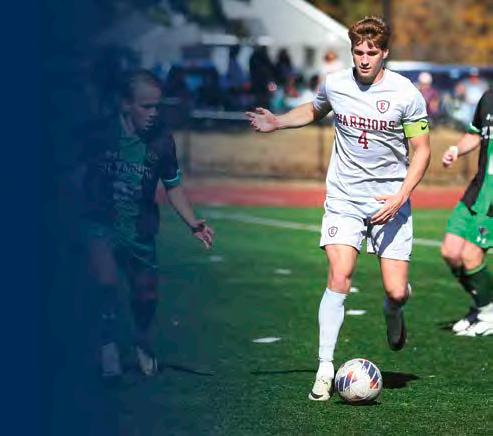
Soccer player Walter Scudder ’25 was named LEC Student Athlete of the Year, following his success on the eld as a four-year starting mid elder and in the classroom as a biology major. Scudder is one of three studentathletes across the conference to receive the annual award.
“My experiences as a scholarathlete at Eastern have, most importantly, prepared me to serve,” said Scudder. “My time studying biology, tutoring underclassmen, researching cell migration, shadowing physicians, volunteering in a nursing home, speaking at schools and churches in
India, and captaining the men’s soccer team have shaped me into a leader ready for a career in medicine.”
In January 2024, Scudder traveled to India to shadow physicians. “ e experience changed my life,” he said. “I saw the desperation of people in underserved areas. I learned the value of empathy. … e experience gave me an appreciation for diversity that I didn’t previously have. One of my biggest takeaways is that we student-athletes are so lucky to have the experiences we do.”
By Bob Molta ’78
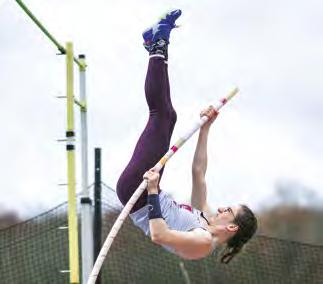
Junior pole vaulter Natasha Frisch ’25 became the rst Eastern women’s track athlete to gain All-America honors in 38 years, and senior center elder Ray Leonzi ’26 became the baseball program’s 62nd selection to the American Baseball Coaches Association (ABCA) All-America team in spring 2025. e two give the Eastern athletic program a total of 163 All-Americans.
Frisch, also a Little East Conference swimming champion, placed 16th in a eld of 22 with a mark of 12-3 ½ at the NCAA Division III Outdoor Track & Field Championships this past May at the SPIRE Institute in Geneva, OH. Her performance earned her secondteam All-America honors with the U.S. Track & Field and Cross Country Coaches Association.
She became just the third Eastern female to earn All-America track and eld honors, following three-time AllAmerican Judy Pemberton and twotime All-American Bonnie Edmondson
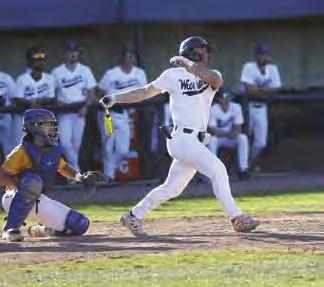
’87. Frisch set the program’s current indoor (11-7 ¾) and outdoor (13-0 ¼) pole vault records within a span of three months this year.
A two-time All-Region II and three-time All-Little East selection in his three-year career after transferring from the Division I level, Leonzi was the only player from the Little East to earn ABCA All-America honors when he was named to his fourth team in late May.
e lefty-hitting leado batter and tri-captain did not miss a start this year and led the team in at-bats, runs, home runs, total bases, slugging, walks, on-base percentage, and steals; he did not commit an error on 97 out eld chances. Leonzi is the rst Eastern player in eight years to lead the team in home runs and stolen bases in the same season — the last being All-American Alex Zachary ’17 in 2017.
Eastern will launch a varsity program in women’s golf in the fall 2025 semester, its 20th intercollegiate program overall and 11th for women.
Current men’s golf Coach Kyle Gallo has been elevated to full-time status for both the men’s and women’s programs. A respected veteran coach and Connecticut Golf Hall of Fame inductee, Gallo brings more than 25 years of experience as a competitive amateur and professional golfer.
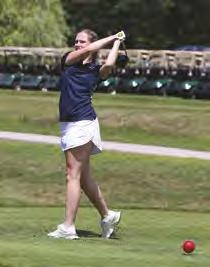
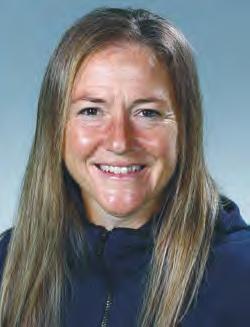
Veteran college basketball Coach Mandy King was named head coach of the women’s basketball team this summer. Following Coach Denise Bierly’s 31-year tenure, King is the program’s fth head coach in its 54-year history.
“I am deeply honored to be appointed as the head women’s basketball coach at Eastern Connecticut State University,” said King at the time of her appointment. “Eastern has a distinguished tradition in both athletics and academics, and I am committed to continuing the legacy established by Coach Bierly and the exceptional young women who have worn the jersey over the past 31 years.”
After playing collegiately at the Division III level as a point guard at the University of Southern Maine — a fellow member of the Little East Conference — King went on to coach at the Division III level in all but two seasons of her 26-year career. For 22 of those seasons, she served as head coach at Kean University in New Jersey and Washington & Lee University in Virginia.
“ e community at Eastern is truly special,” said King. “ e administrators, coaches, and support sta genuinely care about each other and work collaboratively and tirelessly to create an environment where everyone can do their best work and win championships. I can’t wait to contribute to this welcoming family.”
Philip Dei Dolori ’81 is president at the Middleby Corporation.
John Mennone ’89 is the director of U.S. health economics and market access at Johnson & Johnson MedTech.
Michael Burns ’90 is the senior vice president of sales at Active Interest Media.
Mary Micoletti ’91 is the senior director of enterprise resiliency at UnitedHealth Group.
Lisa Blake ’92 is a licensed acupuncturist and president of Bridging Access to Wellness, Inc.
By Noel Teter ’24
Rebecca Kalagher ’92 is the director of community standards at Springfield College.
Bill Savinelli ’93 is the senior director of operations at Stonington Institute.
Robert Stevenson ’93 is the director of quality control at MassBiologics.
Ron Samul ’94 is the director of Thames at Mitchell College at Mitchell College.
Adam Stahl ’95 is the senior vice president at Verituity.
Alycia Santilli ’96 is the senior director of community initiatives at the College of Health and Human Services at Southern Connecticut State University.
Wayne Zorger ’97 is the executive director at UBS.
Omar Rodriguez ’98 is the associate director of the Office of Intercultural Affairs at Stonehill College.
From a World War II love story to a medley of novels about dogs, Eastern alumna Susan Wilson ’72 has found her niche as a writer. A New York Times best-selling author of 11 novels, Wilson’s literary career blossomed when she turned to writing “dog stories.”
Titles such as One Good Dog, The Dog Who Danced, and The Dog Who Saved Me marked her shift from romance to emotionally rich tales inspired by animals — a return to her childhood passion.
“The primary reason I had always wanted to be a writer was because of my childhood devotion to writers of animal stories, in particular Albert Payson Terhune,” said Wilson, a graduate of Eastern’s English program. “All of the ‘dog’ books are really about the relationships people have with each other as well as the dogs.”
After several romance novels, Wilson hit a creative wall. “I threw in the towel,” she said. “I’d had a good run … but maybe I was done.” Then, her agent suggested dog stories — just as the acclaimed novel The Art of Racing in the Rain by Garth Stein was gaining popularity. That was the turning point.
“There are no hard and fast rules about when, where, and how to make a work of art,” said Wilson. “Some stories arrive mostly whole cloth, and many play hide and seek with me.”
After two years at a community college, Wilson transferred to Eastern, where her love for literature deepened. “The faculty were consummate professionals … outstanding in their knowledge, accessibility, and desire to inspire,” she recalled.
Though she once thought writers were “ordained,” she eventually realized that “regular folks like me” could make it. Pursuing her dream meant juggling day jobs.
“It took almost 20 years of writing to entertain myself before I mustered up the courage to attend a writers’ conference, join a group, and seek out an agent.”
To aspiring writers, Wilson offers: “Write the story you want to read. And don’t assume it’s perfect. But with practice and patience, it can become pretty darn good.”
Elizabeth Bumgardner ’99 is the director of the Windham Early Childhood Center at the Windham Public School District.
Jeff Ganley ’99 is a director and product owner at Prudential Financial.
Scott Magnano ’99 is the chief financial officer at AffirmedRx, a public benefit corporation.
Rick Galipeau ’01 retired as CEO at World Energy Services.
Denice Handwerk ’01 is the director of operations at CiDRA Concrete Systems, Inc.
Jay Romano ’01 is the director of player development at Mohegan Sun.
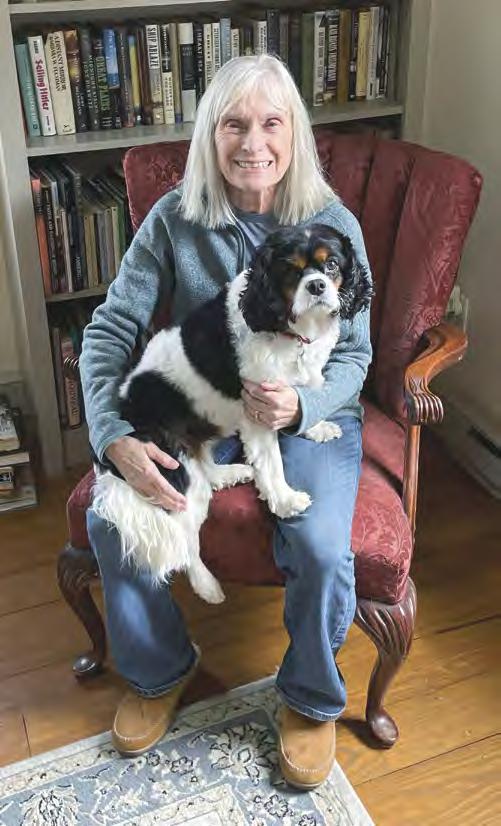
Ed Osborn
In his role as the commissioner of the Connecticut Office of Higher Education (OHE), Tim Larson ’81 is a strong advocate of the power of learning. “I like to say to students, ‘Learn something every day you are on Earth. … College may not be for everyone, but learning is something everyone can do.’”
Larson and his 30-member team at OHE support students through five key initiatives: managing the Roberta B. Willis Scholarship; regulating private career schools; administering veteran education benefits; overseeing student loan reimbursements; and coordinating programs like the Minority Advancement Program, AmeriCorps, and alternative certification pathways for aspiring educators.
Before his 2019 appointment as commissioner by Governor Ned Lamont, Larson was a member of the East Hartford Town Council (1990-92), mayor of East Hartford (1999-2005), state representative (2008-14), and District 3 state senator (2014-19). He was reelected in 2018, but transitioned to lead the OHE.
Larson has fond memories of his time at Eastern. He was a sociology major and recalls taking classes with Professor Arthur L. Johnson and baseball Coach Bill Holowaty.
“I had a wonderful experience at Eastern,” he said. “I met my wife, Nancy, there and made lifetime friendships with people I still see today. It was a fun time to be in college. Academics, intramurals, and student life made for a healthy atmosphere. The campus was small enough that you knew everybody — it was a close-knit community with a hometown feel.”
That strong foundation at Eastern helped pave the way for his ongoing commitment to higher education. At the OHE, he said, “I have a diverse staff of highly talented people who provide a great service to students looking for higher education opportunities. It’s a very dynamic time to be in the higher education field and I get to use my skillset every day in public service.”
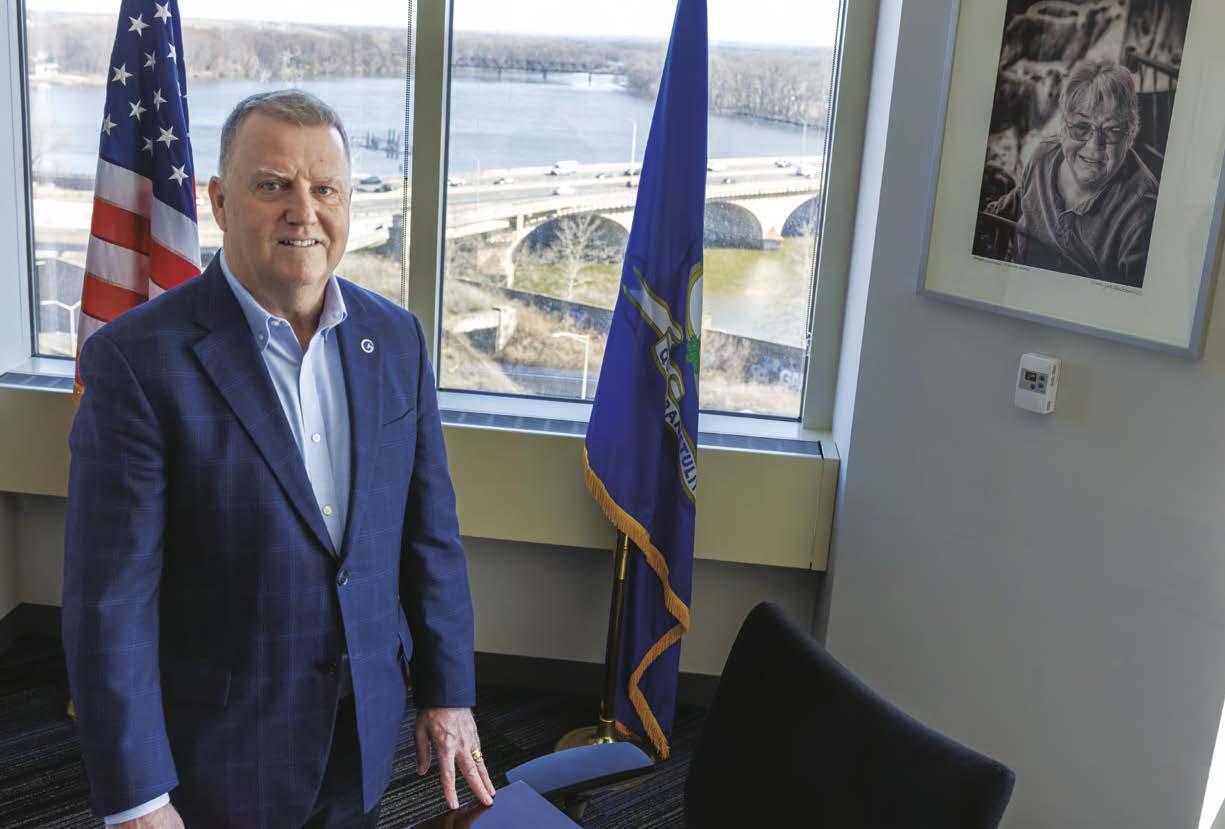
Chris Abayasinghe ’02 is the associate vice president of finance and business operations at Northeastern University.
Ian Smith ’02 is the vice president and operations safety executive at Turner Construction Company.
Noel Wilson ’02 is the director of field services at the University of Maine at Farmington.
Andrea Dawley ’03 is the support services director at Rose City Learning Center.
Joaquin Falcon ’03 is the director of federation relations at the American Medical Association.
Jeff Spencer ’03 is the vice president and general manager at Micro Precision Industries.
Daniel Belanger ’04 is the director of nursing at Natchaug Hospital.
Mike Cunningham ’04 is the chief operating officer at Vale Sports Club.

Yovan Reyes ’04 is the dean of early college and student engagement at Polk State College.
Joleen Catania ’05 is the director of cyber risk and regulatory engagement at Capital One.
Mayantha Perera ’05 is the director of client services at Boldyn Networks.
Brian Saunders ’05 is the vice president of technical program management at Snyk.
Christopher Gauthier ’06 is the first vice president of commercial lending at Dime Bank.
Jeff Grohs ’06 is the associate director of brand support at 5&5, which specializes in digital solutions within the food service industry.
Andrew Simmons ’06 is the vice president of securities and derivatives, as well as senior manager of futures clearing operations at Citi.
Rachael Baker ’07 is the associate director of grants and contracts at Celldex Therapeutics.
Garrett Dukette ’07 is a client partner at FranklinCovey.
Thomas Gardella ’07 is the director of engineering at Venmo.
Chelsea Halpine-Berger ’07 is a partner at Bradford & Barthel, LLP.
Sam Iverson ’07 is the vice president of sales operations at Rectangle Health.
Eric Grundfast ’08 is president of the Des Moines Buccaneers.
Peace Omo-Edo ’08 is the financial operations controller at Oreeza Financials.
Alyssa Schatz ’08 is vice president of policy and advocacy at National Comprehensive Cancer Network.
Craig Vallee ’08 is vice president of engineering at Inspect Point.
By Noel Teter ’24
Jessica Chapman ’11, a history and social studies teacher at Norwich Free Academy (NFA), was recently honored with one of the nation’s top awards for educators — the Milken Educator Award (MEA). Surprised during a schoolwide assembly in fall 2024, Chapman was one of 45 educators across the country to be awarded the $25,000 cash prize.
Since receiving the award, Chapman has adopted the MEA’s motto of “being 10 percent bolder” as a personal mission. “I now have a network of incredible educators who have my back and want to make positive change,” she said. Her renewed focus includes advocating for systemic improvements in the education of multilingual learners.
At NFA, more than 30 languages are spoken within the school community. Chapman’s advocacy centers on ensuring equitable access to education for these students. “They are just figuring out how to navigate both social and academic English,” she said. “I work to ensure laws are followed and programs are effective.”
Her passion for multilingual education was further shaped by a year teaching in El Salvador. “I want to better connect with students and families,” she said of her decision to immerse herself in a foreign language. “I knew I couldn’t learn 30 languages, but I could learn Spanish.”
Chapman realized that the collectivist culture of her students in El Salvador could inform her teaching approach at NFA. Accordingly, she nurtures an environment where “kids can work together, pull each other up, and support each other.”
Chapman studied history and social science at Eastern after initially pursuing education. “I was confused about what I wanted, and Eastern supported my transition,” she said. Now, she draws inspiration from her history professors. “I hope my students feel about my class the way I felt at Eastern — where history came alive.”
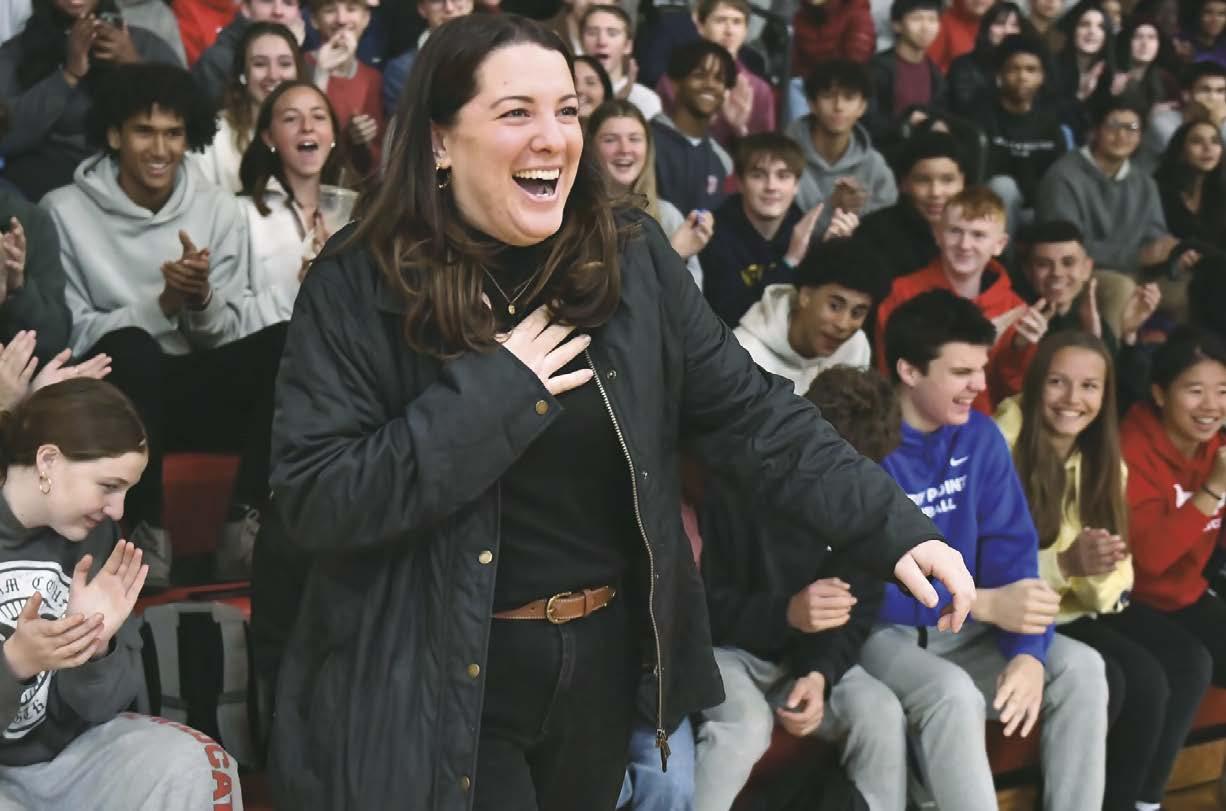
Jason Andersen ’09 is the director of business development at Legacy Building Systems, LLC.
Nick Hulten ’09 is the director of business process management at Travelers.
Steve Lane ’09 is president at FC Development Corp.
Pooja A. Virdee ’09 is a human resources business partner at Yale University.
Kenton Webley ’10 is the sales director at Benestar Brands.
Kelly Bryant ’11 is the director of the life and MoneyGuard inbound sales teams at Lincoln Financial.
Whitney Cadett ’11 is vice president of marketing and strategic growth at Sikorsky Credit Union.
Nick Gallo ’11 is the director of Lowe’s Pro selling solutions.
Kayla Kudla ’11 is the director of operations at Mill Rock Packaging.
Alexander Freilich ’12 is the creative director at Digital Sports Partners.
Jillian Librandi ’12 is vice president of account management at Dynata.
Josh Poudrette ’12 is vice president of finance at Flexcon.
Broderick Sawyer ’12 is the director of clinical training at Loyola University Chicago.
Ryan Sullivan ’13 is the director of operations at Hitchiner Manufacturing.
Jose Colon ’10 is the chief operating officer at Hartford Public Schools.
Kristen Forster ’10 is the senior director of operations at Physical Therapy & Sports Medicine Centers.
Bobbi-Jo Wathen ’10 is the director of pre-college summer programs at the University of Connecticut.
Colin Salko ’11 is the senior director of portfolio analytics and strategy at Amgen.
Megan Savage ’11 is vice president of communications and public involvement at WSP, a professional services consulting firm.
Dan Schmiemann ’11 is vice president and management director at AREA 23, an IPG Health Company.
Jeremiah Blankenbaker ’14 is the executive director at Dudley Housing Authority.
Haley Heslin ’14 is the director of human resources at LAZ Parking.
Shannon Lane ’14 is vice president of program strategy and delivery at Essex, a Veridix AI Company.
Jaime Zamudio ’14 is the director of operations HSMC-S at Pratt & Whitney.
By Elisabeth Craig ’26
Two alumni of Eastern’s music program recently turned their shared passion into a lifelong duet. Adam Benway ’24 proposed to Sarah Burkart ’24 this past January in the Fine Arts Instructional Center (FAIC) Concert Hall — the same space where Benway first heard Burkart sing. “I remembered exactly where I was sitting when I first heard Sarah in voice studio class,” said Benway.
Wanting a sentimental proposal setting, Benway invited Burkart to campus, suggested she dress up for the occasion, and surprised her with a proposal on the stage of the Concert Hall after pretending to retrieve something backstage.
Their relationship began with a duet in fall 2023, when they performed “All I Ask of You” from The Phantom of the Opera. “That was the moment where it clicked for us,” said Burkart.
Before romance blossomed, the two built a solid friendship. “We’d talk between classes and play pool before choir,” said Benway. “The first time I felt a spark was rehearsing that duet in a practice room.”
Burkart added, “We opened up about a lot during those rehearsals. That deepened our friendship. From then on, we’d spend time in the FAIC foyer. Adam listened, supported me, and was always honest.”
Since graduating, the couple has continued performing together, including at two fundraising events. “Adam comes to every one of my band’s rehearsals and runs sound,” said Burkart. “When we get married, we might sing ‘All I Ask of You’ as a tribute to the start of our relationship,” she added.
Their romance came as no surprise to members of the music program. “When I told [Lecturer David] Ballena we were dating, he said, ‘Yep, could’ve called that,’” recalled Benway.
“[Lecturer Rebecca] Calissi once told me, ‘You’re going to marry a music man,’” added Burkart. “After the proposal, I texted her, ‘Guess what? You were right.’”
Benway summed up their love story simply: “They say when you know, you know. And when I knew, I knew I wanted to marry her.”
Joshua Cranmer ’15 is the director of design at HealthPlanOne.
Rachael Dyer ’15 is the director of program development and evaluation at the University of Bridgeport.
Joseph Garzone ’15 is an office management specialist at the U.S. Department of State.
Andrew Panganiban ’15 is the director of media at Maganda Group, LLC, a full-service creative company.
Nicolai Soendergaard ’15 is the senior director of Omni Enablement at Newell Brands.
Hennessy Aspilaire II ’16 is the director of partnerships, music, and live experiences at MediaCo Holding Inc.
Julie Chapman ’16 is the director of finance for the Town of Montville.
Rachel Sawyer-Walker ’16 is the director of inclusive excellence at the New Jersey Institute of Technology.
Alexandra Sordi ’16 is the founder and designer at Brand Sanctuary Studio.
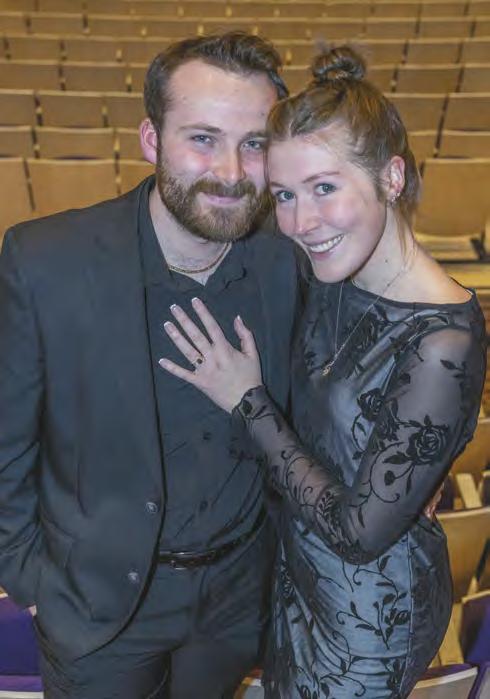
Bryan Frankovitch ’17 is an inpatient neurology/stroke nurse practitioner at Hartford Hospital’s Ayer Neuroscience Institute.
Enidza Torres ’17 is the director of development at Backside Learning Center.
Elier Alvarado ’18 is the director of utilities at the Jewett City Department of Public Utilities.
Lovel Cassells ’18 is the chief financial officer at ConnCORP.
Jennifer Beams ’20 is a vice president of workplace investing at Fidelity Investments.
Abby DeMarkey ’20 is a student employment manager at Manhattanville University.
Brighton Leonard ’20 is a firefighter/ EMT for the Warwick Fire Department in Rhode Island.
Laura Pineros ’20 is the senior director of operations at the Southeast Affordable Housing Administration.
Marie Sene ’20 is the director of operations at Hertz Senegal.
Lauryn Smith ’20 is a payroll associate for the Colchester Board of Education.
Zoe (Buntz) Koppy ’21 is a senior asset owner in data science at The Hartford.
Enda Sweeney ’21 is the director of information technology staffing at WhiteCap Search.
Jimmy Miller ’22 is a human resources generalist at Hartford Healthcare, East Region.
Robert Warren ’22 is an assurance supervisor at Whittlesey PC.
Kit Anderson ’23 is a clinical therapist at Revelation Counseling.
Emma Dashnaw ’23 is a multi-language learner paraeducator for the Somers Public School System.
Abigail Fletcher ’23 is a sales coordinator at FANUC America Corporation, a supplier of automation for manufacturing processes.
Aimee McCarthy ’23 is a medical technologist at the Center for Advanced Reproductive Services.
























































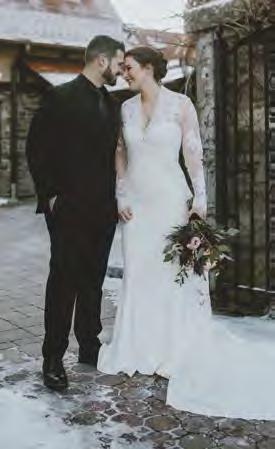










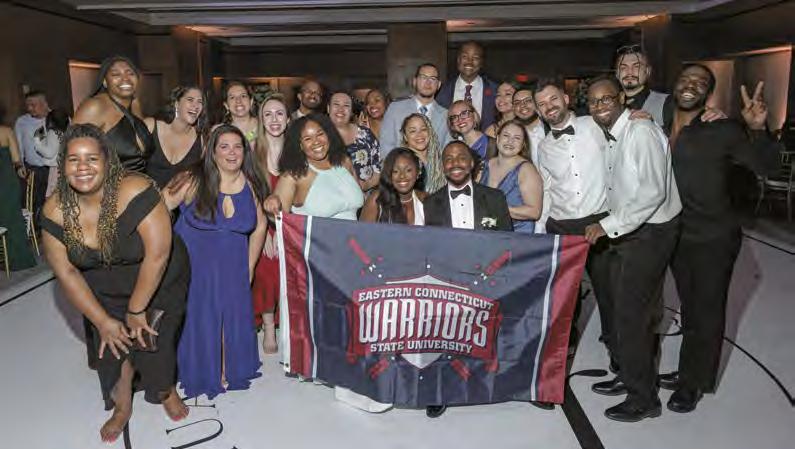


















































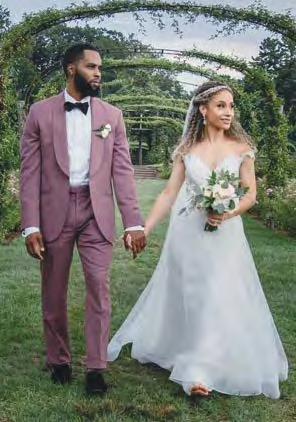


















































We want to celebrate our alumni











Email life updates to alumni@easternct.edu
























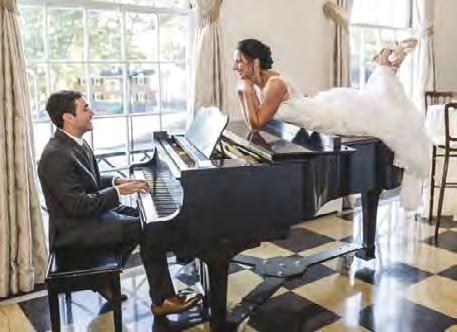







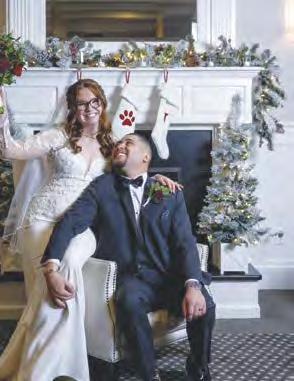


e Department of Communication, Film, and eatre is thrilled to announce its 2025-26 mainstage schedule.
Tickets & Bundles On Sale
• Save up to 15% with a season bundle.
Eastern Magazine Recipients
• Save an extra 5% on bundles (code EasternMag5).
• Save 15% on single tickets (code EasternMag15).
To purchase tickets and bundles, scan the QR code or visit: https://t.ly/c 2526season
March 3-8, 2026
By Anton Chekhov with translation by Sarah Ruhl, directed by Rachel Jett
April 22-26, 2026
Written & directed by Melanie Guerin


October 12-15, 2025
By David Lindsay-Abaire, directed by j.j. Cobb
December 4-7, 2025
New translation by Seamus Heaney, directed by Kristen Morgan