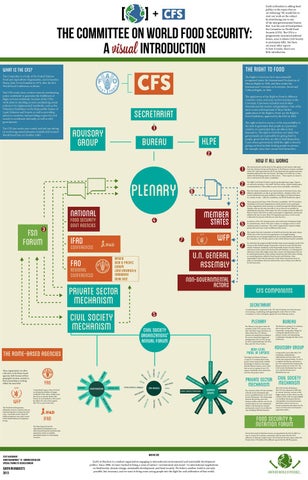
The COmmittee on WOrld Food Security: A visual introduction
Earth in Brackets is adding food politics to the topics that we are following! We would like to start our work on the subject by introducing you to one of the intergovernmental fourms that is at the core of food politics: the Commitee on World Food Security (CFS). The CFS is a progressively structured political forum, since it allows Civil Society to participate fully, but there are many other aspects to how it works. Here’s our little introduction.
The Right to Food
What is the CFS? The Committee is a body of the United Nations Food and Agriculture Organization, and is based in Rome, Italy. It was founded in 1974, after the first World Food Conference, in Rome.
The Right to Food was first internationally recognized under the International Declaration of Human Rights in 1948, and then under the International Covenant on Economic, Social and Cultural Rights, in 1966.
The CFS’s work, then, revolves around coordinating policy worldwide to guarantee the fulfillment of Right to Food worldwide. Sections of the CFS’s work relate to deciding on and coordinating actual policies to be implemented worldwide, such as the Voluntary Guidelines on the Responsible Tenure of Land, Fisheries and Forests; as well as providing advice to countries, and providing a space for civil society to coordinate internally, as well as with governments. The CFS also works year-round, and not just during its week-long annual plenaries (usually held around World Food Day, on October 16th).
The application of the Right to Food in different countries varies, and since its first mention in the Covenant, it has been included several other international law treaties and guidelines. One of the most recent and important of these further applications of the Right to Food, are the Right to Food Guidelines, approved by the FAO in 2004.
secretariat advisory group
The right to food in essence, is the responsibility of the state to guarantee that people in a particular country, at a particular time, are able to feed themselves. The right to food does not imply that governments are responsible for giving food to people, given that they are able to feed themselves. Cases where governments fulfil the right to food by giving out food include feeding people in prisons, for example, since they cannot feed themselves.
HLPE
bureau
How it all works The Secretariat sets out the items for the agenda of each Session with input from the Advisory Group and the Bureau. At the Plennary Sessions, members of the CFS, with input from the HLTF, also determine key agenda issues that should be addressed at the next Session. The High-Level Task Force is then tasked with developing reports on these issues. . These reports are meant to serve as the basis for the policy roundtables.
Plenary national food security FSN forum
6
IFAD Conferences
7 africa asia & pacific europe latin america & caribbean near east
fao regional
conferences
This Zero Draft is submitted to the Food Security & Nutrition Forum. Here different stakeholders are able to provide feedback. Members of the Civil Society Mechanism also gives feedback to the High-Level Panel of Experts in a variety of ways. . After the consultation, the HLPE finalizes the report.
member states wfp u.n. general assembly
4
govt agencies
The High-Level Panel of Experts reports go through many stages. Experts are selected to develop a “zero draft”. The first version, which includes policy recommendations, is then subject to peer review and public consultation.
non-governmental actors
private sector Mechanism Civil Society Mechanism
An administrative component of the CFS, the Secretariat serves the function of overseeing, coordinating and supporting the work of the rest of the Committee, as well as setting the agenda for every Plennary session.
5
plenary Civil Society organizations' annual forum
ng map pi
ng &
Urba
central asia west as ia sout heas t as ia
mon
itori
one ern c
ition
price volatility
south
mer
nutr
la
biofuels
CFS E
ging
The Bureau is a group of 12 countries plus an elected chair. They are responsible, among other things, for creating the agenda before every plenary session, and maintaining coordination amongst all other actors at all levels.
advisory group Composed by actors like other UN institutions, philanthropic organizations, private sector, civil society and research bodies. Its role is to support the Bureau, and ensure a two way communication between the Bureau and the rest of the CFS. The Civil Society Mechanism has 4 seats on it, and the Private Sector Mechanim has one.
society private sector civil mechanism mechanism
ange
e ch t a clim
working groups
re
enu t d n
a
africa
ric l af
tra cen
west
reg
The High Level Panel of Experts. A team of 15 scientists that creates project-teams and provide scientific knowledge in relation to the topics that the Plenary session covers. They have access to a group of over 120 experts worldwide, from which they can form the project teams.
protracted crisis & conflict soci al pr otec tion
inves tmen t
frica
ion
s
rker l wo
a ltur
and
ural
global strategic framework
east a south africa
less
north
sub-regions
ica amer ean
cu agri
land
central america & caribbean
rica north af pacific
cult
er
en
ia
agri
gend
wom
sout
e
indigenous people
constituencies
ists l a r o past
urope
n Po
or
east e
consumers
rop
ocean
NGOs
ers
ia h as
Issu
es
The structure of the CFS also includes a Private Sector Mechanism that serves a parallel function to the Civil Society Mechanism. The relationship between the private sector and business entities with the rest of civil society tends to be very contentious, which is why having two separate mechanisms seems to be an effective way of dealing with that dynamic.
The Civil Society Mechanism, The CFS was reformed in 2009 into its current structure, and one of the biggest aspects of that reform was the creation of the CSM. Its responsibility is to facilitate discussions between civil members of social movements and NGOs, and to it serves as a formal mechanism that allows for the voices of civil society to be heard in negotiation tables.
Food Security & nutrition Forum
The International Fund for Agricultural Development, is an international financial institution that administers funds to establish agricultural projects in developing countries.
earth in brackets 2013
bureau
The Plenary is the space where all members of the CFS convene every year, and where major decisions are taken within the CFS. Plenary sessions are numbered according to the year in which they happened, starting from CFS1 in 1974, except for 2012, which held both CFS 38 in May, and CFS 39 in October.
IFad
text & design by khristian Mendez ‘15 - kmendez@coa.edu special thanks to Jessica Duncan
So, what does the output actually look like? Some recent examples are the First Version of the Global Strategic Framework on Food Security and Nutrition, and the Voluntary Guidelines on the Responsible Tenure of Land, Fisheries and Forests in the context of Food Security and Nutrition. As confusing and elaborate as these titles might sound, they contain vital information that can be used by governments, policy makers, businesses and CSOs when creating or contexting policies related to Food Security and Nutrition. Most importantly, in line with the objectives of the reform document, these are policy recomendations that have informed by voices of those most affected by food insecurity.
secretariat
t eu wes
farm
fisherfolk
The World Food Programme administers food to countries that are experiencing short or long term food crises. It provides food to about 90 million people per year, and it is part of the United Nations Development Group.
h
A Specialized Agency that is focused on solving the problem of hunger worldwide. It has other, smaller areas that focus on specific themes like Forests. It was founded in 1945, and it has offices for each of five regions. The CFS is a part of the FAO.
The outputs from the Committee on World Food Security take many shapes. While most of the text from the negotiations is not legally binding, governments are encouraged implement the recommendations agreed upon by Committee. The CFS also reports to the United Nations General Assembly.
high-Level Panel of Experts
yout
wfp
fao
5 6 7
In advance of the CFS Annual Sessions, the Civil Society Mechanism holds an Annual Forum, where CSOs have a chance to strategize and try to find common points of consensus. This work is supported by various working groups that work year-round on different policy issues.
CFS components
the rome-based agencies These organizations are often referred to as the Rome-based agencies, both because of their geographic location, and due to their partnership in working within the same field.
4
These reports for the basis of the CFS policy roundtables. All CFS members (including Civil Society Organizations and the private sector) participate in these negotiations until consensus is reached amongst the Member States. Member states are the only ones able to vote as they are accountable for upholding the decisions. What makes the CFS so unique is that the 2009 CFS Reform ensures that CSOs are able to participate in negotiations and directly influence the text. In most other UN negotiation processes, if civil society is allowed to be present at all, they are only observers.
The Food Security & Nutrition Forum was launched by the FAO in 2007 as a way to connect the academic community with the issues that the FAO addresses. In the past couple of years, the Forum has become a place where the Version Zero (V0) drafts of the different reports that the HLPE prepares.
Who we are Earth in Brackets is a student organization engaging in international environmental and sustainable development politics. Since 2006, we have worked to bring a sense of justice—environment and social—to international negotiations on biodiversity, climate change, sustainable development, and food security. We believe another world is not only possible, but necessary, and we want to bring more young people into the fight for and celebration of that world.
ANOTHER WORLD IS POSSIBLE...