Vocabulary



Unit Overview





Vocabulary
Unit Overview





cold, hot, rainy, snowy, sunny, windy, I’m excited, black, white, I love my friends
Grammar
It’s (sunny)
GSE Learning Objectives
Speaking
• Can use a few basic words to say how they feel, if supported by pictures.
• Can use a few basic words to describe objects, if supported by pictures.
Listening
• Can recognize a few basic words related to familiar topics, spoken slowly and clearly and supported by pictures.
• Can recognize a few familiar everyday nouns and adjectives (e.g., colors, numbers, classroom objects), if spoken slowly and clearly.
• Can understand a few basic words and fixed expressions in a story that is read aloud to them, if supported by pictures.
Phonics and letters
• Rr; rainy
Elsa is quieter and calmer than her sister, Anna. She’s scared of a secret she has. With the love of her sister, she learns to accept herself, and then she’s happy and not scared anymore.





Anna is free-spirited, happy, and optimistic. She loves having fun with all her friends, especially her sister, Elsa.


Olaf is a snowman that Elsa and Anna made. Olaf is optimistic and outgoing, and he’s a very loyal and caring friend. He’s happy and he can get very excited about things.


Lesson aims
• to introduce the unit characters
• to introduce the topic and vocabulary of the weather
Target language
• cold, hot, rainy, snowy, sunny, windy
Main GSE Learning Objective
• Can recognize a few basic words related to familiar topics, if spoken slowly and clearly and supported by pictures.
Future Skills
• Persistence and growth
• Self-awareness
Materials
• Unit 2 Picture Cards (cold, hot, rainy, snowy, sunny, windy)
• Sticker (Arctic fox)
• Mickey Mouse puppet
Extra resources
• plastic bottles
• rice or dried lentils
• crayons, markers, foam stickers, sequins (if available)




2.1
Snowy, snowy, snowy
Cold, cold, cold
Hot, hot, hot
Sunny, sunny, sunny
Windy, windy, windy
Rainy, rainy, rainy
2.2 The weather
Sunny, sunny day!
Hot, hot day!
Windy, windy day!
Rainy, rainy day!
Snowy, snowy day!
Cold, cold day!


0.3 You can play the Sit down song at the start of Circle time in each lesson.
•Have the Mickey Mouse puppet appear from behind a desk.
Hello, Mickey!
•Make Mickey say Hello to each student.
•Have students say Hello to Mickey.
•Have Mickey look outside the classroom window and say today’s weather, e.g., sunny.
•Use Mickey as you show the Picture Cards to say the weather words for students to repeat.
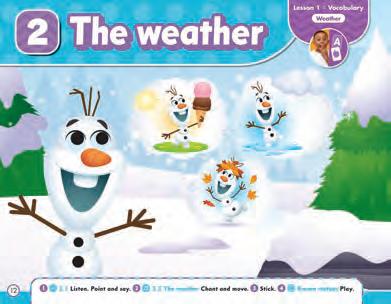
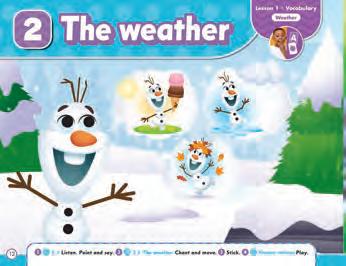
•Help students find page 12 in their Student’s Books.
•Have students say which character they can see in the picture (Olaf).
•Use the Mickey Mouse puppet to point to the pictures showing Olaf in different scenes.
This is Olaf. He’s happy.
•Play the audio. Point in the picture to elements showing the different types of weather.
•Play the audio again and have students point to the different weather elements in the picture. Pause after each word for students to repeat.
•Hold up the weather Picture Cards and have students say the words.
Chants with actions help students remember new words. Model the actions clearly beforehand.
•Demonstrate actions for each type of weather, e.g., wiggle fingers for rain.
•Play the audio and have students listen to the chant.
•Play the audio again and have students join in and do the actions
3 Stick.
•Have students find the sticker of the Arctic fox.
•Students can stick this anywhere on the page.
4 Frozen statues Play.
•Remind students of the weather actions.
•Say a weather word. You can start by also showing the corresponding Picture Card. Sunny.
•Have students move around the classroom doing the corresponding weather action. Frozen!
•Students have to freeze like a statue, in the shape of the action they were doing.
•Continue with other weather words. If you want to make the game competitive, eliminate any students you see moving when they should be frozen.
Make rain-maker shakers: fill plastic bottles with dried lentils or rice. Have students decorate the outside of their shaker with raindrop patterns, using crayons, foam stickers, sequins, etc.). Play the chant again and have students shake their shakers during the “rainy” line.
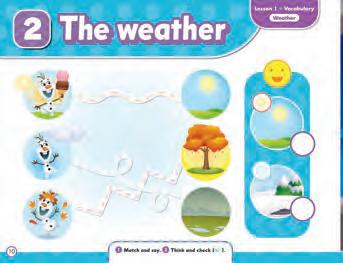
1 Match and say.
•Have students look at the pictures and the trace lines.
•Help students point to the matching pairs and follow the trace lines with a finger.
•Show students how to trace the guidelines with a pencil.
•Have them point and say sunny, rainy, and windy.
2 Think and check 4.
•Have students look at the pictures and think whether they like hot or cold weather the best.
•They check the one they like the best.
0.2 Sing the Goodbye song. Have students wave goodbye.
Lesson 2 Grammar
It’s sunny

Lesson aim
• to introduce the grammar structure It’s with weather
Target language
• It’s (sunny)
Main GSE Learning Objective
• Can recite a short, simple rhyme or chant.
Future Skills
• Persistence and growth
• Self-awareness
Materials
• Mickey Mouse puppet
• Unit 2 Picture Cards (cold, hot, rainy, snowy, sunny, windy)
• Weather poster
Student’s Book

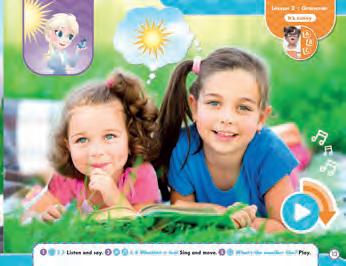
2.3
It’s sunny. It’s hot!
2.4 Weather is fun!
Sunny, windy, rainy, Snowy, hot, cold, too.
It’s a sunny day, it’s a sunny day –hooray!
It’s a windy day, it’s a windy day –hooray!
It’s a rainy day, it’s a rainy day –hooray!
It’s a snowy day, it’s a snowy day –hooray!
It’s a hot day, it’s a hot day –hooray!
It’s a cold day, it’s a cold day –hooray!
0.1 Greet students and sing the Hello song.
The question What’s the weather like today? is passive language, so don’t expect students to produce it.
•Have the Mickey Mouse puppet look out of the window.
What’s the weather like today?
•Have Mickey say the type of weather that it definitely isn’t, e.g., if it’s hot and sunny outside, have Mickey say It’s cold.
•Look confused and have students join you saying No!
•Continue doing the same with other types of weather that it isn’t, until Mickey says the weather correctly, e.g., It’s hot. It’s sunny.
1 2.3 Listen and say.
•Point to the picture of the children.
•Play the audio. Have students point to the weather symbol in the thought bubble.
•Play the audio again and have students repeat what they hear.
2 2.4 Weather is fun! Sing and move.
•Play the song and/or watch the video.
•Play and/or watch again.
•Have students join in with the words and the actions.
Ask students to say which lines of the song are true for the weather today.
3 What’s the weather like? Play.
•Stick the weather Picture Cards around the classroom.
•Play music and say Dance! Have students dance or move around the class.
•Stop the music and have students race to stand next to the Picture Card that is closest to them.
What’s the weather like?
•Have students answer It’s and the name of the type of weather as on the Picture Card they’re standing next to.
Not all students will want to dance. It’s fine for them just to walk or jog around the classroom.
• Display the Weather poster. Point to each picture in the poster and have students say the name of the type of weather. Then invite two volunteers to the front of the class. Have them stand in front of the poster. Say a weather word and have them race to be the first to touch the correct picture on the poster. Do the same with other volunteers.
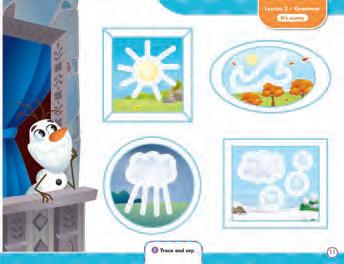
1 Trace and say.
•Have students look at the pictures with different weather symbols.
•Have them trace the weather symbols with a pencil. Monitor and assist students as necessary.
•Have students say the type of weather in each picture, using a single word or It’s (sunny/hot, windy, rainy, snowy/cold). Praise all attempts.
•Ask students to look out of the window. Ask What’s the weather like today? Have students answer either with a single word or using the phrase It’s (sunny).
It doesn’t matter if students can’t trace the shapes neatly. Praise all attempts.
Persistence and growth: Having students work on specific tasks for short periods of time improves focus and concentration. This, in turn, builds confidence and independence.
What’s this? Play this game with the Picture Cards (see page 16).
0.2 Sing the Goodbye song.
•You can now do the Unit 2 Phonics lesson (see Student’s Book page 76 and Teacher’s Book page 184).
Lesson 3 Feelings
I’m excited

Lesson aim
• to introduce the word excited and recognize, understand, and express the feeling of excitement
Target language
• I’m excited
Recycled language
• worried
Main GSE Learning Objective
• Can use a few basic words to say how they feel, if supported by pictures.
Future Skills
• Self-awareness
• Persistence and growth
Materials
• Sticker (Olaf)
• Mickey Mouse puppet
• Feelings poster
Student’s Book Workbook



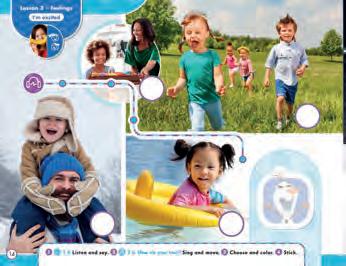
2.5
A: I’m excited. It’s snowy.
B: I’m excited.
C: I’m excited. I love my friends.
D: It’s sunny and it’s hot. I’m excited.
2.6 How do you feel?
How do you feel? How do you feel?
How do you feel today?
I’m excited, I’m excited, I’m excited today.
I’m excited, I’m excited, I’m excited today.
Hooray! Hooray! Hooray!
0.1 Greet students and sing the Hello song.
Self-awareness: Excited is like being very happy. Children may smile a lot and have butterflies in their stomach when they feel excited.
Show excitement by smiling and jumping up and down.
•Have the Mickey Mouse puppet greet the students by name.
•Have students greet Mickey.
Hello, Mickey! I’m excited.
•Jump up and down and say again I’m excited.
•Make Mickey act excited, too, and have him say I’m excited. It’s English class!
Book time
•Look at the pictures together. Point to each person or item as you mention them.
Look at the boy. He’s excited. It’s a snowy day!
Look at the girl. She’s excited.
Look at the children. They’re excited.
It’s a sunny day!
Look at the girl. She’s excited.
• Play the audio of children saying I’m excited.
•Have students point to the pictures as they listen. (The listening path is indicated by the striped line.)
•Play the audio again and have students join in, saying I’m excited.
2.6 How do you feel?
Sing and move.
•Play the song.
•Sing the How do you feel? line yourself and have students join in with the answer.
•Play the song again and have students personalize the verse with how they’re feeling today. They could say excited or happy or any other feeling they can remember.
3 Choose and color.
•Explain that different situations make different children feel excited.
•Point to each of the pictures. How do you feel?
•If students feel excited in the situation shown in a picture, they color the circle.
Self-awareness: Explain to students that feeling excited before a big event is normal and that many children feel like this. Sometimes, the feeling can seem overwhelming, but it’s OK to feel like this.
4 Stick.
•Have students find the excited sticker.
Is Olaf excited?
•Have students say Yes!
•Help students find the correct place on the page to stick their sticker.
Persistence and growth
Feelings poster
• Discuss the different feelings students may already know. Have students find excited on the poster. Play the Good job song [0.6].
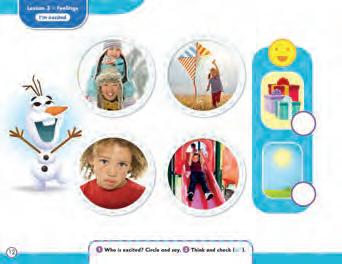
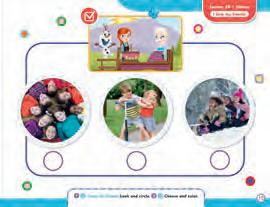
1 Who is excited? Circle and say.
•Review excited. Mime the excited action and have students copy.
•Point to Olaf looking excited.
•Students look and circle the pictures showing excited children
2 Think and check 4.
•Students look at the two pictures (presents and a sunny day) and check the one that makes them feel excited.
Self-awareness
0.2 Sing the Goodbye song.
Lesson 4 Colors
Black |

Lesson aim
• to recognize and name the colors black and white
Target language
• black, white
Recycled language
• blue, green, red, yellow
Main GSE Learning Objective
• Can recognize a few familiar everyday nouns and adjectives (e.g., colors, numbers, classroom objects), if spoken slowly and clearly.
Future Skills
• Persistence and growth
Materials
• Color Cards
• Mickey Mouse puppet
• Weather poster
• Colors poster
Extra resources
• black and white paper
• white tissue paper or cotton wool (if available)
Student’s Book Workbook
2.7
Look!
Black.
Black, black!
Look!
White.
White, white!
2.8 Colors
Colors, colors, lots of colors!
Let’s all play the colors game!
Black, black, black.
Jump to black!
Jump to black!
White, white, white.
Hop to white!
Hop to white!
0.1 Greet students and sing the Hello song.
Circle time
Start to introduce asking about the weather as part of your circle time routine. Display the Weather poster and ask What’s the weather like today?
•Display the Colors poster and bring out the Mickey Mouse puppet.
• Have Mickey point to the color blue on the poster and say Hmm? What color?, and see if students can say blue. If not, then have Mickey say Blue! Yes, blue!
•Do the same with the colors green, yellow, and red.
If you’re confident that students already know the colors blue, green, yellow, and red, have Mickey say the wrong word for these colors and have students correct him.
Book time
Student’s Book p15
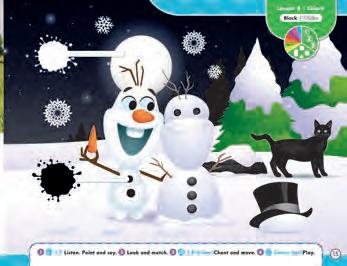
1 2.7 Listen. Point and say.
•Point to the black and white in the left of the picture.
Look!
• Play the audio and have students listen and point to each of the colors as they are mentioned.
•Play the audio again and have students repeat the color words.
•Have students point to all the black items in the picture. Then have them point to all the white things in the picture.
Persistence and growth Colors poster
•Use the Colors poster to reinforce students’ understanding. Have students find the colors black and white on the poster.
2 Look and match.
•Have students point once more to the white and black splotches in the left of the picture and say the names of the colors.
•Then have them trace along the lines to match to the white and black items in the picture. Have them first trace the lines with their finger and then with a pencil.
3 2.8 Colors Chant and move.
• Play the audio and have students listen to the chant.
•Play the audio again and have students join in with the chant.
•Then play the audio a third time, and have students do the TPR actions as they listen: jumping and hopping.
4 Colors fun! Play.
•Put a large sheet of black paper on one side of the classroom and a large sheet of white paper on the other side. You could either put them on the floor or stick them to the wall.
•Play the chant [2.8], and demonstrate that students should jump to black and hop to white as they chant.
•Play the game without the chant in the style of Simon says (or Olaf says), with hop and jump
to the colors, and also review other actions (skip, dance, walk, clap).
•Students do the action if you say the instruction with Olaf says …, but they don’t do the action if you say the instruction without Olaf says …
0.3 Play the Sit down song after playing the game.
Have students make a snowy night collage. Provide them with black paper and have them stick white star and moon shapes in the sky. They can use white tissue paper or cotton wool for snow and a snowman.
If you set Workbook activities for homework, make sure students understand what they need to do in each activity.
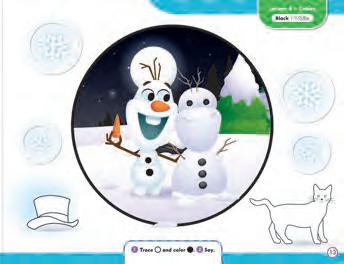
1 Trace and color .
•Point to the scene and ask What’s the weather like? (It’s snowy).
•Have students use a pencil to trace around the white snowflakes.
•Have them color the hat and the cat black.
2 Say.
•Have students point to different black and white items in the picture and say the name of the color, e.g., hat – black.
0.2 Sing the Goodbye song.

Olaf’s sunny day
Lesson aim
• to understand the target language in the context of a story
Recycled language
• cold, hot, rainy, snowy, sunny, windy, white, It’s (sunny), I’m excited
• Can understand a few basic words and fixed expressions in a story that is read aloud to them, if supported by pictures.
Future Skills
• Social awareness
Materials
• Story Cards
• Mickey Mouse puppet Lesson


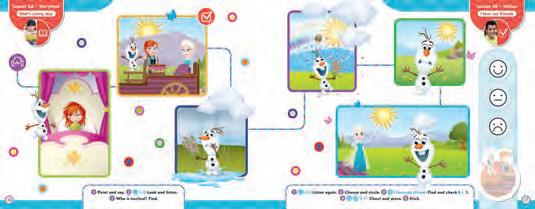
2.9 Olaf’s sunny day
1: “Huh?” says Anna. “Oh! Good morning, Olaf! What’s the weather like today?”
“Hello, Anna! It’s sunny!” says Olaf. “Come on! I’m excited.”
2: “Let’s go on a picnic!” says Elsa. “Hooray! I love my friends!” says Olaf. “I’m excited.”
3: “Oh, no! It’s rainy,” says Olaf.
4: “Hey, look! It’s windy!” says Olaf. “Hooray! Wheeee! Hello, sun!”
5: “It’s sunny again!”
“Oh, no!” says Olaf. “It’s hot. It’s very hot! I’m worried.”
6: “Don’t worry, Olaf,” says Elsa. “I can help.”
“It’s white! It’s snowy! Hooray!” says Olaf.
“Thank you, Elsa!”
4

2.10
“Oh, no! It’s rainy,” says Olaf.
0.1 Greet students and sing the Hello song.
Circle time
Story synopsis
It’s a sunny day and Olaf wants to go on a picnic. He’s excited about spending time with his friends. He experiences different weather along the way. The hot weather makes Olaf start to melt and he feels worried, but Elsa helps.
•Make the Mickey Mouse puppet appear and make him move around.
Mickey, sit down. It’s storytime.
•As students get used to this routine, have them chorus after you.
•Make Mickey sit down and praise him. Have students praise him, too.
Good job, Mickey!
•Hold up the Story Cards, and read the story showing each of the cards in turn. Point to the characters and the type of weather as they’re mentioned in the story.
2.9
•Play the audio without pausing. Show each Story Card as students listen.
•Play the audio again, pausing after each frame. Ask some of the key questions on the back of the Story Cards to help students understand.
1 Point and say.
•Help students find pages 16 and 17 in their Student’s Books.
Look. Can you find a windy day?
•Have students explore the pictures and find the windy day in frame 4.
•Point to pictures showing other types of weather. Ask What’s the weather like? Have students point and say the words.
•Point to items with colors students know. Ask What color is it?
Look and listen.
•Play the story audio.
•Have students listen, follow in their Student’s Books, and point to each frame as they listen.
•Play the audio again. Pause after each frame to ask questions or have students point to characters or items.
1 Who’s this? (Olaf) Is he excited? (Yes)
2 Who’s this? (Anna, Elsa, and Olaf) What’s the weather like? (It’s sunny.) 3 What’s the weather like? (It’s rainy.) 4 What’s the weather like? (It’s windy.) 5 What’s the weather like? (It’s sunny.) Is Olaf happy? (No) 6 What’s the weather like? (It’s sunny and it’s snowy.) Is Olaf excited? (Yes)
3 Who is excited? Find.
•Have students look at the story frames in their Student’s Books. Who is excited?
•Have students point to Olaf (he’s excited in frames 1, 2, 4, 6).
Social awareness: Ask students why Olaf is excited (he’s spending time with his friends outside). Have them empathize with Olaf and imagine how he feels. Ask if they feel excited when they spend time with their friends outside.
Show the Story Cards one by one, and have studentsget into groups to act out each story frame, and play the corresponding audio. Have students try to get in the same poses as the characters in the frame. When they’re in position, play the audio from the corresponding frame.
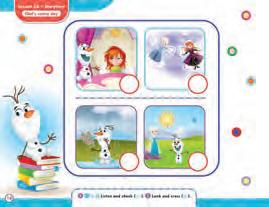
1 2.10 Listen and check 4.
•Play the audio and have students look at the pictures.
•Play the audio again and have students check the picture that corresponds with the audio.
2 Look and cross ✘.
•Have students look at the pictures again and cross the picture that isn’t in the story.
•Ask why this picture is the odd one out (Anna and Elsa don’t make snow angels).
0.2 Sing the Goodbye song.
I love my friends
Lesson aims
• to review and remember the story from Lesson 5A
• to evaluate the story
• to recognize and understand the value I love my friends
Target language
• I love my friends
Recycled language
• cold, hot, rainy, snowy, sunny, windy, white, It’s (sunny), I’m excited
• Can use a few basic words and phrases to talk about a familiar topic.
Future Skills
• Social awareness
• Persistence and growth
Materials
• Story Cards
• Sticker (Olaf and Anna)
• Mickey Mouse puppet
• Values poster

2.9 Olaf’s sunny day
1: “Huh?” says Anna. “Oh! Good morning, Olaf! What’s the weather like today?”
“Hello, Anna! It’s sunny!” says Olaf. “Come on! I’m excited.”
2: “Let’s go on a picnic!” says Elsa. “Hooray! I love my friends!” says Olaf. “I’m excited.”
3: “Oh, no! It’s rainy,” says Olaf.
4: “Hey, look! It’s windy!” says Olaf. “Hooray! Wheeee! Hello, sun!”
5: “It’s sunny again!”
“Oh, no!” says Olaf. “It’s hot. It’s very hot! I’m worried.”
6: “Don’t worry, Olaf,” says Elsa. “I can help.”
“It’s white! It’s snowy! Hooray!” says Olaf. “Thank you, Elsa!”


2.11
I love my friends, I love my friends, I love my friends every day!
I love my friends, I love my friends, I love my friends – hooray!
I love my friends, I love my friends, I love my friends every day!
I love my friends, I love my friends, I love my friends – hooray!
I love my friends, I love my friends, I love my friends every day!
I love my friends, I love my friends, I love my friends – hooray!
0.1 Greet students and sing the Hello song.
Use the Mickey Mouse puppet to introduce the value.
•Make the Mickey Mouse puppet appear and greet him.
Hello, Mickey.
•Make Mickey look excited.
How do you feel today, Mickey?
•Have Mickey answer I’m excited! Look at all my friends. Make him point to all the students.
•Have Mickey say I love my friends.
•Revisit the story. Hold up the Story Cards one by one, and have students look at the pictures on the cards and say what they remember about each one.
Who loves their friends in the story?
(Olaf, Anna, and Elsa)
2.9
•Read the story or play the audio again. Pause the audio after each frame and ask the questions on the back of each Story Card, to check understanding.
•Read the story or play the audio again. Have students do some of the actions and say any of the words they remember.
Student’s Book pp16–17
1 2.9 Listen again.
•Play the story audio again. Help students follow the story by pointing to the correct picture.
2 Choose and circle.
Students may copy their friends when they choose. Encourage individuality and help students understand they can have a different opinion.
•Point to each of the happy, neutral, and sad face icons on the blue panel.
I like this story (look happy). It’s OK (look neutral). I don’t like this story (look unhappy).
•Mime thinking and then choosing and circling one of the icons.
•Have students decide which of the three icons reflects their opinion and circle that icon.
3 I love my friends
Find and check 4.
•Say Olaf loves his friends and point to frame 2.
•Have students find the correct frame in their Student’s Book. Have them trace the check icon.
4 2.11 Chant and move.
•Have students stand up. Demonstrate an action to show loving our friends, e.g., hugging.
• Play the audio for students to listen to the chant.
•Play the audio again. Have students join in with the chant and do the actions.
5 Stick.
•Have students stick the I love my friends sticker in the correct place on the Student’s Book page.
Persistence and growth
Values poster
• Help students identify the picture for I love my friends on the Values poster. Congratulate them for completing this observation activity.
Have students draw a picture of a friend they love.
1 I love my friends
Look and circle.
Look. Who loves their friends?
•Have students look and point to the picture of Olaf, Elsa, and Anna together.
•Then have students look at the pictures below. Have them point to the correct pictures and trace the circles.
2 Choose and color.
•Have students color the circles below the pictures showing children who love their friends.
0.2 Sing the Goodbye song.

Lesson aim
• to consolidate all language including the new, receptive language, emotion, and value in a real-world context
Recycled language
• cold, hot, rainy, snowy, sunny, windy, It’s (sunny), I’m excited, I love my friends
• Can use a few basic words to describe objects, if supported by pictures.
Future Skills
• Social awareness
• Persistence and growth
Materials
• Mickey Mouse puppet
• Weather poster
• Unit 2 Picture Cards (cold, hot, rainy, snowy, sunny, windy)
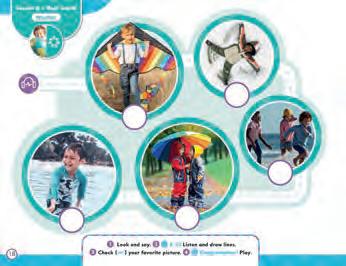
2.12
A: It’s windy! Hooray!
B: It’s snowy! I’m excited!
C: It’s sunny! I love my friends.
D: It’s rainy! I love my friends.
E: It’s hot! (Whew.)
0.1 Greet students and sing the Hello song.
Circle time
Lesson summary
These pictures show children enjoying different types of weather and being with their friends. It’s important for students’ physical and emotional development to have fun with friends and spend time outside in all types of weather. Different countries have different types of weather at different times of the year. Children can feel excited about different types of weather, e.g., snowy weather in picture 2.
Social awareness
•Say Hello to the Mickey Mouse puppet and have him say Hello, too.
•Display the Weather poster and point to each type of weather.
What’s the weather like?
•Make Mickey look uncertain and have volunteers help Mickey answer correctly.
•Have Mickey say Thank you! You’re kind!
• Do the same with the other types of weather.
•Have them point and say It’s (weather), but accept single words and praise all attempts.
•Ask students if they think the children are excited and love being with their friends.
2 2.12 Listen and draw lines.
•Play the audio and have students use their fingers to trace along the lines connecting the pictures.
•Play the audio again and have students trace along the lines with a pencil.
•Ask students to find children who are excited. Ask them to find children who love their friends.
What’s the weather like? (1 windy, 2 snowy, 3 sunny/hot, 4 rainy, 5 sunny/hot) Who is excited? (all of the children!) Who loves being with their friends? (pictures 3 and 4)
Personalize the language and concepts.
Ask students which type of weather makes them feel excited. Ask them what they enjoy doing with their friends in different types of weather.
3 Check 4 your favorite picture.
•Mime as if you’re thinking and then point to one of the pictures and smile.
I like this picture! I like sunny days. Which picture do you like?
•Help students think, decide, and mark the picture they have chosen. They may just copy your answer, but they will grow to understand the concept of I like as the course progresses.
Book time
Student’s Book p18
1 Look and say.
•Have students look at the pictures.
Persistence and growth
4 Crazy weather! Play.
•Have students sit in a circle. Give the weather Picture Cards to students in the circle.
• Have students pass the cards around the circle.
•Have Mickey ask What’s the weather like? and answer It’s (weather), e.g., It’s cold.
•The student holding the cold card stands up.
•From time to time, answer Mickey’s question with It’s crazy! (make funny gestures with your hands to help convey the meaning). When you say this, all students with cards have to jump up and swap places.
•If you have confident students in the class, they can lead the game with you: have Mickey ask them What’s the weather like? and they answer with It’s (weather).
0.6 Play the Good job song and praise students for all their hard work.
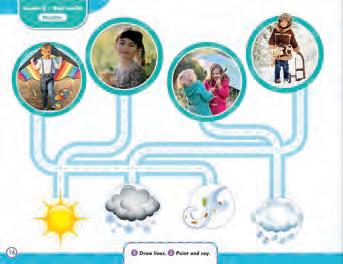
Workbook p16
Drawing lines with a pencil is a pre-writing skill.
1 Draw lines.
•Have students draw along the maze lines to match the pictures to the weather symbols.
2 Point and say.
•Have students point and say what they can see in the pictures.
What’s the weather like? (It’s windy/sunny/ hot/rainy/snowy/cold.)
0.2 Sing the Goodbye song.
Make and Remember

Lesson aims
• to review the unit language through project-based learning
• to physically make a project linked to the theme of the unit
Recycled language
• cold, hot, rainy, snowy, sunny, windy, It’s (sunny), I’m excited, I love my friends
Main GSE Learning Objective
• Can use a few basic words to describe objects, if supported by pictures.
Future Skills
• Social awareness
• Persistence and growth
Materials
• Sticker (Elsa)
• Press-outs
• Mickey Mouse puppet
Extra resources
• glue or sticky tape, string
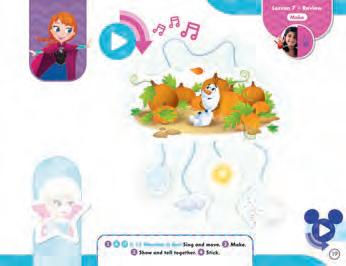
2.13 Weather is fun!
Sunny, windy, rainy
Snowy, hot, cold, too. It’s a sunny day, it’s a sunny day –hooray!
It’s a windy day, it’s a windy day –hooray!
It’s a rainy day, it’s a rainy day –hooray!
It’s a snowy day, it’s a snowy day –hooray!
It’s a hot day, it’s a hot day –hooray!
It’s a cold day, it’s a cold day –hooray!
2.14
It’s hot.
It’s snowy.
It’s windy.
It’s rainy.
It’s sunny.
0.1 Greet students and sing the Hello song.
•Make the Mickey Mouse puppet appear and make him greet the class.
•Show students your Student’s Book and look through the whole of Unit 2 together.
•Make Mickey point to pictures and say words and phrases. Pause before Mickey answers, so that students can speak first.
•Show surprised admiration at how clever Mickey and students are and how much they can remember.
Student’s Book p19
1 2.13 Weather is fun!
Sing and move.
•Play the video and have students join in with the song and the actions.
About the project
This project requires students to use their fine and gross motor skills to press out and put together their weather mobile. They can then use their mobiles to role-play the story. Students can take turns to role-play Olaf and the different types of weather. When we integrate language with movement, creativity, and simple dramatic play, we begin to learn to speak in real and imagined contexts.
2 Make.
•Help students press out the weather mobile template and the weather pictures.
•Have students plan which order they would like to stick their weather pictures.
•Help them use yarn or string to attach the weather symbols to the central picture, using sticky tape or glue.
0.5 Sing the Let’s clean up song as students help you clean up.
3 Show and tell together.
•Ask What’s the weather like? and have students point to the symbols on their mobiles and answer.
You can also have students show you their favorite type of weather. They can use one word answers or say I like ....
Display the mobiles in the classroom. If possible, take a picture of the mobiles for students to add to their portfolios.
Put students in groups of three to act out the story. They can take turns role-playing Olaf. Show students the Story Cards and remember the story together.
Persistence and growth
4 Stick.
•Help students find and stick the Elsa sticker.
•The sticker is shaped like a star to reward students for their good work.
0.6 Sing the Good job song.
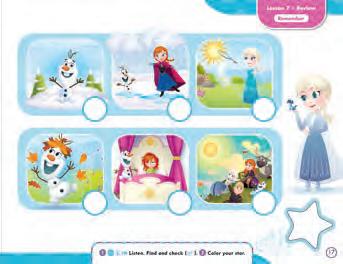
1 2.14 Listen. Find and check 4.
•Play the audio. Pause after the first item and demonstrate checking the picture showing hot weather (picture 6).
•Play the audio for the next item and monitor as students check picture 2.
•Continue in the same way for the rest of the types of weather.
•Elicit which picture students didn’t check (picture 5).
What’s missing? Play this game with the Picture Cards (see page 16).
2 Color your star.
•Tell students they have done a good job and they can color their star any color they wish.
Persistence and growth
0.2 Sing the Goodbye song.
You can now do the Unit 2 Video lesson (see Teacher’s Book page 56).
It’s Bambi and his friends.
Hello, Thumper.
It’s a sunny day.
Hello, Flower.
What’s the weather like? It’s rainy!
Where’s Bambi? Oh, there he is!
It’s snowy today. It’s cold.
Look! It’s Thumper. He’s excited. He likes snowy days.
Wheeeee! That’s fun!
Come on, Bambi!
Oh dear! Look at Bambi!
Look at Bambi’s legs! It’s cold.
Thumper helps Bambi. Bambi loves his friend!
•Hello, fun Language
Materials
•cold, rainy, snowy, sunny; It’s (snowy), I’m excited, I love my friends
0.1 Greet students and sing the Hello song.
•Have the Mickey Mouse puppet appear and greet you and the students.
•Make Mickey hold up the Unit 2 Picture Cards and show students.
What’s the weather like?
•Have Mickey say the wrong type of weather for each Picture Card, in a questioning voice. Encourage students to correct him.
•Show Mickey and students the movie still of the video clip.
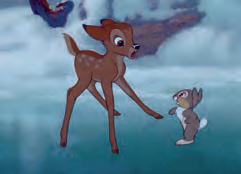
Look! It’s Bambi! Let’s watch!
This is a movie about a young deer who grows up in the forest with his friends, Thumper the rabbit and Flower the skunk. In this clip, it’s winter. It’s cold and snowy. Thumper takes Bambi to play on the ice. Thumper is very excited and loves ice skating. Bambi finds it trickier and falls over on the ice. Bambi loves being on the ice and having fun with his friend.
•Mickey Mouse puppet
•Unit 2 Picture Cards (cold, hot, rainy, snowy, sunny, windy)
•drawing paper and crayons
Pause the clip after the first play at any point to review any numbers, colors, and shapes students know.
•Play the clip once through and have students watch and listen carefully.
Good?
•Have students answer Yes! (or No).
•Play the clip again and pause at 00.45: Bambi, Thumper, and Flower in the flowers.
Who’s this? (Yes, it’s Bambi. It’s Thumper. It’s Flower.)
What’s the weather like? (It’s sunny! Yes, It’s sunny.)
•Pause at 00.55: Bambi in the rain.
What’s the weather like? (It’s rainy! Yes, it’s rainy.)
•Pause at 01:15: Bambi in the snow.
What’s the weather like? (It’s cold. It’s snowy! Yes, it’s cold. It’s snowy.)
•Pause at 01:26: Thumper jumping on the ice. Is Thumper excited? (Yes. Thumper is excited!)
•Let students enjoy the rest of the clip.
•Play the clip one more time without stopping.
•Have students draw a picture of Bambi/Thumper.
•Let students draw anything they wish from the clip.
Have students act out being Bambi and Thumper on ice.
Goodbye
0.2 Sing the Goodbye song.