Community Connect: Vol. 7 Issue 2

Page 1


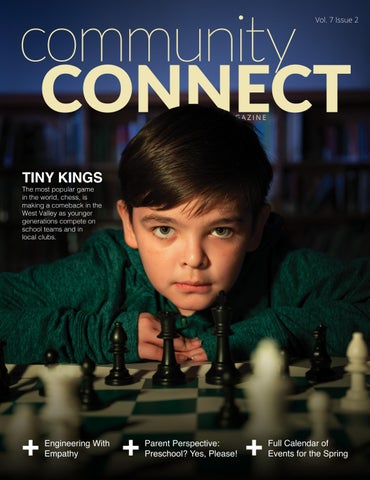
TINY KINGS

The most popular game in the world, chess, is making a comeback in the West Valley as younger generations compete on school teams and in local clubs.

Engineering With Empathy +

Parent Perspective: Preschool? Yes, Please! +

Full Calendar of Events for the Spring +

Exceptional care for kids. Close to home.

When your child needs medical care, every minute matters. At Banner Children’s at Thunderbird, our pediatric experts have provided compassionate, kid-focused care for West Valley families for 20 years –right in your neighborhood.

From sudden fevers and breathing problems to more serious concerns, your child will receive high-quality care in a family-friendly setting designed to help kids feel safe and parents feel at ease. Learn more

IN THIS ISSUE

Feature Story: Creative Movements 4 6 8 10 16 18 24 28 34 36

Calendar of Events for the Local Community

Spotlight: Luke Elementary STEM Field Trip

Student Voice: Exploring My Future

Cover Story: Tiny Kings and the Rise of Chess

Teacher Tips: Measuring Up

Feature Story: Engineering with Empathy

CONNECT CTcommunity

APRIL 2026 • Vol. 7 Issue 2

15802 N Parkview Place Surprise, AZ 85374

Editorial Staff

Renee Ryon

Ryan McGinley

Sarah Catalano

Marcus Lopez

Colleen Seto

Contributing Writers

Becky Reina

Lindsey Serene

Emily Schuler

Contributing Artists and Photographers

City of Surprise

Michaela Brooks

Becky Reina

Advertising

Interested in advertising with us?

ON THE COVER

Feature Story: Dia-Buddies

The Community Connect Magazine offers full page, half page, and quarter page options for each issue. Contact us at publicrelations@dysart.org for more information on pricing and deadlines or visit dysart.org/ CommunityConnect.

Story Ideas?

The Community Connect is always looking for story ideas and contributing content. If you know of an idea or person that should be featured, please feel free to reach out to us at publicrelations@dysart.org.

Community Capture Artwork

Parent Perspective: Preschool? Yes, Please! On the Calendar: High School Graduations!

About Us

The Community Connect Magazine is a publication aimed at telling the stories of students, staff, and community members who make extraordinary contributions to our community. The magazine has one of the largest circulations in the Northwest Valley. The mission is to provide a publication for the community, about the community, through the support of community business advertisements.

Axl Unger Mendez, a fifth grader at Luke Elementary School poses in front of a chess board at the school. Axl took first place in the inaugural Dysart District Tournament.

APR

City of Surprise Eggstravaganza

The City of Surprise hosts its annual Eggstravaganza featuring egg hunts for children of all ages with candy- and toy-filled eggs. Attendees can also enjoy face painting, balloon artists, inflatables, and photos.

APR 3 @ 5:00 p.m. to 9:00 p.m.

Mark Coronado Park

City of Surprise Vet Fest

Surprise’s Vet Fest is a fun-filled evening offering those who have served, are currently serving, or are looking to serve in the military a chance to connect and learn about the support and resources available to veterans.

APR 11 from 5:00 p.m. to 8:00 p.m. Surprise Stadium

Shadow Ridge Presents

Between the Lines Musical

Between the Lines is a musical based on the play by Jodi Picoult and Samantha van Leer. It follows Delilah, an outsider at a new school who falls in love with a fairytale prince, causing the lines between her reality and his fictional world to blur.

APR 8-10 @ 7:00 p.m.

Shadow Ridge Auditorium

Tickets: dysart.org/theater

Events Notice:

All calendar events are subject to date, time, and location changes and/or cancellation. Please check with the hosting venue and/or organization for the most up-to-date information on the event.

Dysart High Presents Willy Wonka Jr.

The delicious adventures of Willy Wonka’s chocolate factory light up the stage in this captivating adaptation of Roald Dahl’s fantastical tale. Featuring the enchanting songs from the 1971 film, in addition to a host of fun new songs, Willy Wonka Jr. is a musical guaranteed to delight everyone’s sweet tooth.

APR 8-10 @ 7:00 p.m.

Dysart High Auditorium

Tickets: dysart.org/theater

Willow Canyon Theatre presents Lucky Stiff

Based on the novel, The Man Who Broke the Bank at Monte Carlo by Michael Butterworth, Lucky Stiff is an offbeat, hilarious murder mystery farce, complete with mistaken identities, six million bucks in diamonds and a corpse in a wheelchair. The story revolves around an unassuming English shoe salesman who is forced to take the embalmed body of his recently deceased uncle on a vacation.

APR 8-11 @ 7:00 p.m.

Willow Canyon Auditorium Tickets: dysart.org/theater

Teacher Appreciation Week

Teacher Appreciation Week 2026 runs from Monday, May 4, 2026, to Friday, May 8, 2026, with National Teacher Day celebrated on Tuesday, May 5, 2026. This week is dedicated to recognizing educators for their vital role in shaping students’ lives and providing them with essential tools for success. Every school year, this week often involves various activities, gestures of appreciation, and recognition events organized by schools, parent-teacher associations, and educational institutions. Thank a teacher during this week and the impact they have made on you or your family.

MAY

Math Challenge

Students from across the West Valley compete in a math challenge designed for 3-8th graders to test their skills and what they have learned. MAY 2 @ 8:00 a.m. Dysart High School

Graduations

Dysart Schools is hosting high school graduations on Wednesday, May 13, 2026 at Desert Diamond Arena, located at 9400 West Maryland Avenue, in Glendale, Arizona.

School ceremonies will begin at the following times on May 13 at Desert Diamond Arena:

• 10:00 a.m. – Willow Canyon High School

• 12:30 p.m. – Dysart High School

• 3:00 p.m. – Shadow Ridge High School

• 5:30 p.m. – Valley Vista High School

Spring Band, Choir, and Choral Concerts

Schools across the West Valley are hosting various band, orchestra, choir, and choral concerts so students can showcase what they have learned over the year. We encourage you to visit the website below and attend one of these amazing events to support the arts in our schools and the talent of our students. Shows run throughout the month and are hosted at the school gymnasiums or at the Vista Center for the Arts.

dysart.org/artscalendar for dates and times.

Luke Elementary 8th Graders get STEM-fueled Field Trip

Eighthgraders from Luke Elementary School recently got a once-in-a-lifetime opportunity as they traveled to the Phoenix International Raceway to participate in “Beyond the Finish Line,” an immersive STEM experience centered around motorsports.

Phoenix Raceway Charities partnered with the Larry Fitzgerald Foundation, Cox Communications, and NASCAR to put on the event giving students a handson introduction to the exciting intersection of STEM and racing.

“I could see it in their faces and in hearing their reactions,” said Stephanie McKinnis, seventh and eight grade language arts teacher at Luke Elementary School. “So many of them were getting to experience things that they never had before.”

When students first arrived at the Phoenix Raceway they were treated to a lap around the track in their school bus. Following the pace car and accompanied by former Arizona Cardinals Hall of Fame wide receiver, Larry Fitzgerald, the students got to experience the scale and scope of the raceway from a driver’s perspective.

From there, students rotated through four stations set up by the raceway. At the first station students learned about a car, which included an under-the-roof tour and getting strapped into the vehicle.

“My favorite station was probably going in the NASCAR cars,” said Ally Pernudi, eighth grader at Luke Elementary. “I thought that was really cool just because we got to see how it worked.”

The next three stations had a STEM aspect to them. At one station students learned about friction and conducted experiments with remote control cars on different surfaces. At another they made cars out of cardboard and balloons and conducted experiments on how to make them go faster and farther. At the final station students took apart an entire computer tower and put it back together.

“My brother has been struggling in school, and this was an opportunity for him to go and expand what his interests are,” said Alexia Lopez, a volunteer at the school. “He’s very hands-on and into mechanics. He’s really interested in how things work. He would always have a follow up question to have a deeper understanding of everything.”

Eighth graders from Luke Elementary School pose for a photograph with Arizona Cardinals Hall of Fame wide receiver, Larry Fitzgerald during their STEM field trip at Phoenix Raceway. Phoenix Raceway Charities partnered with the Larry Fitzgerald Foundation, Cox Communications, and NASCAR to put on the event for the students.

“I could see that the activities we were doing were something they would totally want to do in their future,” said McKinnis. “One student was talking about how he took apart a computer and put it back together himself, and he was so proud. It helped broaden their experiences and their minds.”

After the stations and lunch, the students were given the ultimate parting gifts. They first received two tickets to the NASCAR championship race. Cox Communications also announced that each student was being given a laptop of their very own to take home.

“When I realized that Cox Communications was giving us all computers, I was sitting next to my friends, and everybody started screaming,” exclaimed Pernudi. “I was sitting there in shock. My jaw was wide open. I was so happy and so surprised they would do this.”

All of the eighth graders walked away not only with gifts, but a stronger sense of how the world of racing works and how education and STEM play a part in it, something they will soon not forget.

“I just liked how there were very kind people there to help us,” said Pernudi. “They were very happy to have us there, and they were all about making sure we had a good experience. I was really honored they picked our school.”

Dysart_Future_7.5x5_ad.pdf 1 8/27/24 2:39 PM

Students from Luke Elementary School pose for a photo in a race car while attending a field trip at Phoenix Raceway.

EXPL RING

CTE was the very first elective that caught my attention when picking my electives at Sonoran Heights Middle School. But what exactly is CTE? CTE stands for Career and Technical Education. This elective provides hands-on stations and activities that go into real life jobs in categories such as manufacturing, architecture and construction, transportation, distribution, and logistics. It equips students with technical skills for jobs in high school and prepares students for entry into the workforce. CTE strives to help students find their interests in their future careers.

Growing up in a military family, I’ve had my fair share of enrolling in different schools in many different places. These schools had a common link of arts, physical education, creative writing, multicultural studies, and music such as band and choir for electives. Before coming to Sonoran Heights I never knew anything like CTE even existed. Getting a hands-on approach of future careers was nothing that I’ve ever had the opportunity to do before, so I thought it was super cool! Being in CTE and getting to work at the stations not

only helped me know what I’d want to pursue in high school, but it also helped with my communication and teamwork skills when working with people I didn’t know. I believe that is one of the reasons why other students should take CTE. It pushes you out of your comfort zone and teaches you skills that are needed in life everyday. Another skill that these exploration courses provide is time management and accountability. Students have a certain amount of time to get each station and their activities done. This creates good habits for planning when and how long tasks will take, as well as taking responsibility for your part of working as a team.

Participating in this elective helps with more than just skill building though. It supplies students with the opportunity to be shown a full introduction into future career options. It allows students to gain knowledge on what they think they have an interest in as well as info on careers that they might have never considered. Getting to work first-hand on the career options provides students with the experience of feeling what that profession would be like. This helps students explore a wide variety of

careers and allows them to get a grip on what careers they want to get into and which ones they feel don’t fit for them.

Personally, CTE helped me figure out the possibilities of what I want to do for a future career. One of the stations that I worked at was sports medicine. Being able to work at the hands-on station with the activities made me change my mind on it completely. I loved doing the activities because the steps were easy to follow, I was able to learn how to do real wrappings of injuries, and I gained information on what all goes into sports medicine. Sports medicine is something I am definitely going to do in high school and look into doing it in the future for a possible career.

All of this is why I would recommend CTE, especially if you’re in eighth grade because it explores elective options that you can take in high school. Along with that, if you don’t know what you want to do, or want to explore career options, CTE is the perfect elective to be able to do so.

In all, CTE is a very fun elective that is full of opportunity and exploration for your future career options, and it will bring good skills to have and knowledge of all the future careers that CTE’s stations have to offer.

Students work on a bridge building exercise in the Career and Technical Education Exploration program at Sonoran Heights.
View the Sonoran Collection
A student at Sonoran Heights Middle School works on a mechanical project as part of the CTE program at the school.

Emiliano Nava, a student at Marley Park Elementary School, holds a king chess piece at the school. Emiliano finished second in the inaugural district chess tournament.

It was the fifth game of the Dysart District chess tournament for Axl Unger Mendez, a fifth grader at Luke Elementary School. He was playing in the championship, and he had his opponent on the ropes. A clever trap allowed him to capture the opposing queen, leaving him five moves away from checkmate. More than 100 students from 16 schools competed in this inaugural chess event, demonstrating that one of the most popular games in the world is alive and well in the West Valley, and it deserves more opportunities to engage youth.

Hamman, Director of Community Education and Middle School Athletics. “Research has proven that when kids are involved on their school sites, their grades, behavior, and attendance also improve.”

Chess has been a huge part of my life and being able to share with the new generation of kids is really awesome. We’re quite proud of what we’re doing in Dysart, and it’s awesome to see.

It was more than a year ago when conversations about chess first started in the Dysart District. Other than maybe some after school clubs, it was nonexistent. The district was interested in adding another extracurricular activity for students to participate in, from an athletic standpoint. Although chess might not be perceived as athletics, it falls under the Arizona Interscholastic Association (AIA) platform of extracurricular sports for children to compete in.

- Freddy Neumann

“Chess also focuses on a different target group of kids to be involved with activities on their campuses,” said Dustin

In essence, a student who may not be athletically or artistically inclined, could in fact be perfect for this type of activity. The district was unsure of how much interest there would be in the chess program, but after speaking with the top five finishers at the district tournament, it’s clear that chess is still taught and nourished in the home. It is still popular, and these students just needed an avenue to cultivate their interest further.

“Part of my family knew chess and they taught me how to play,” said Axl. “I liked it so much that first time so I continued to play. It was hard at the start. But I saw that it was a good game. So I kept playing, and I began to really like it. Now I love chess.”

“My dad taught me,” shared Christian Hernandez Detrick, a sixth grader at Luke who placed fourth in the district tournament. “My dad and his friend used to play chess a lot. We went on a trip one time, and they taught me. I got really interested in it, but I didn’t practice. But then this past summer I started practicing on an online website for fun. My dad has taught me a lot of things too, and continued to guide me through it. I’m probably still doing chess because of my dad.”

For Jack Neill, a sixth grade student at Sunset Hills Elementary who placed third in the tournament, his dad taught him as well. Jack’s grandmother also got him a book about chess and online chess helped quite a bit as well. Jack is autistic, and found the strategy of the game to be incredibly interesting for him and how his mind works.

“It’s actually pretty easy to learn,” Jack shared of chess. “It’s a strategy game, and it just makes sense to me. My parents always encouraged me because they could see I like playing chess. It’s actually helped me a bit.”

When the district chose chess as its next middle school “sport,” they decided to elicit some help in running and

A student moves a piece in the first round of the district chess tournament. More than 100 students participated in the inaugural event from 16 schools across the Dysart District.

A student moves a chess piece during the inaugural district chess tournament held at Dysart High School in November 2025.

organizing it.

“When two people who don’t know anything about how to operate chess start a league, you reach out to people who do,” said Hamman. “I met with Chess Emporium to let them know what we were envisioning, and asked them how to make that work. They do chess tournaments all the time, so we were able to modify and adjust based on their feedback.”

Chess Emporium has been around in the Phoenix Metro area since 1993. Freddy Neumann was the point of contact and ended up being the driving force behind a promising first year in the district.

“I don’t think we would have been as successful as we were without their involvement,” said Hamman. “Chess Emporium brought the people that ran the tournaments and the officials, or referees, if you will. They also supplied pieces and boards. They provided our coaches with information on how to teach kids chess. Their willingness to partner with us was outstanding.”

Perhaps the main reason behind this success was Freddy’s history with the game and continued focus on bringing it to a young audience. Like Axl, Christian, and Jack, Freddy also learned chess from his father. He has a twin brother, and they learned from watching their dad play his brother when they were three years old.

“When we were kids, we were super shy and not really social,” he shared. “We were always playing chess after learning it, so our mom brought us to a chess studio. They had a tournament and our mom was like, ‘Well, you

A student contemplates a move during the district chess tournament. Rules require students to move a piece after they touch it.

guys should play.’ Our dad was like, ‘They’re not ready to play. They have to get better before they can get in a tournament.’ But my mom kept us in there to see how we did. We played our first tournament and both my brother and I lost all nine of our games. But we had such a good time that we’ve been going to tournaments ever since.”

They were initially just interested in having fun and playing the game, much like the students today. But Neumann said, at the time, he and his brother didn’t realize how chess was helping them out in all aspects of life.

“I really was able to make a lot of friends. My relationship with my dad really strengthened. He started taking us to all of our tournaments every Saturday and doing game analysis. We ended up really excelling in school because chess teaches you a lot of logic and it teaches you a lot of skills that are actually really valuable.”

When Freddy realized how vital chess had been to his growth, he decided to pass that on.

“It’s been a huge part of my life and being able to share with the new generation of kids is really awesome,” he said. “We’re quite proud of what we’re doing in Dysart, and it’s awesome to see.”

Chess Emporium teaches to more than 300 schools and 4,000 students in the Phoenix Metro area. To Neumann’s knowledge, Dysart is the only district that rolls middle school chess into athletics. Other schools might have a specials curriculum or after school program, but not

Axl Unger Mendez, a fifth grader at Luke Elementary School moves a piece during his second match.

organized tournaments.

“We weren’t sure what to expect,” said Neumann. “We weren’t sure how many kids were going to be participating in the preliminary events. We had three different campuses for four preliminary events. And basically at each, we had up to five schools and they could have up to 10 kids per school. And at almost every location, we had 40 to 50 kids.”

Many of the students, including those in the top five of the district tournament, had a basic understanding of how to play chess. This chess program extends that. Students are taught introductory tactics, strategies, basic chess openings, how to write down moves, and a variety of other skills.

“When you’re playing the tournament, there’s a lot of rules you have to follow,” said Neumann. “You have to play what they call touch move. If you touch a piece, you’re required to move that piece if you’re allowed to. And if you let your hand off a piece after you’ve made a move, that move has to stand. And while you’re doing that, you also have to write down the move. We have little notation sheets and little pencils for everybody. And you have to use the chess clock. You have the clock ticking, you have to write down your move, you have to make sure not to touch a piece, and you’ve got to think and come up with good moves while doing all that. It’s a lot to handle, especially if you’re brand new to it. But these were some of the best kids that we’ve ever taught. They were super

well behaved. They were super studious.”

They saw kids going back to the practice tables with their opponent, studying the game, going through the moves, thinking what they could have done differently, where they made mistakes, and really analyzing and learning from the games, which is exactly what they had hoped would happen. They just didn’t think it would happen so quickly.

“The first move I ever learned was the Scholar’s Mate,” said Christian enthusiastically. “It’s like the most basic move, but it’s so easy to do, and I’ve checkmated people with it so many times.”

Scholar’s Mate is a quick, four-move checkmate in chess, common among beginners, and achieved by White developing the Queen and Bishop to attack a pawn.

“Chess really helps your brain,” Neumann shared. “You’re thinking, you’re planning, you’re learning logic, you’re learning strategy, you’re learning tactics. You’ve got to combine all that in a way that gets you good outcomes. There’s a lot of creativity and there’s a lot of free-flowing decisions that have to be made. It just translates really well into life and some of the things that will come at you as a kid and even as you’re growing into adulthood.”

Even though the “season” is over in the district, the teams are still coming together each week to practice and hone their skills, with some unofficial tournaments scheduled periodically. Axl plays quite often online against other kids and recently just beat his teacher at school.

“Last Friday one of our teachers came to chess and he is very good,” said Christian who was beaming with pride for Axl. “He plays all the time, and Axl played him very tough and beat him. The cool part is they move their pieces very fast but still in good positions.”

Next season Axl will be ready to defend his title, and the district is even looking to try and bring chess to the high school level to compete in the AIA. Providing students with an opportunity to engage in a variety of activities that keep them motivated and engaged is the goal of any successful school. While academics are important, it is often those ancillary activities that make a good student into a great one.

“Engaging in any extracurricular activity with a school, I hope students gain improved skills, comprehension, and ability to execute the activity that they’re engaged in,” said Hamman. “I hope they gain social opportunities and friendships. I hope that it draws student interest, and I hope it enhances their positive experience at our Dysart district schools.”

Asa teacher, one of the most common questions I hear from parents is, “Why do benchmark assessments matter?” When families hear the word test, it can bring up worry, stress, or concern about pressure on students. However, school district benchmark assessments are not about labeling students or increasing anxiety. Instead, they are powerful tools designed to support student learning, guide instruction, and ensure every child is getting what they need to be successful. Benchmark assessments are given to all students in grades 3-11 twice a year, typically in October and January. These assessments measure students’ progress toward grade-level standards and provide a snapshot of what students have already mastered, what skills are developing, and which areas may still need support. Benchmarks are meant to inform teachers. They help teachers, students, and parents better understand learning progress throughout the school year.

intentional.

Benchmarks also give students a chance to show what they know. When students take a benchmark assessment in October and then again in January, they are often excited to see how much they have grown. Growth matters! Seeing improvement builds confidence and pride, especially for students who struggle academically. While benchmarks are assessments, they are also opportunities to celebrate progress, set goals, and motivate students to continue working toward success.

One of the most important values of benchmark assessments is how they guide instruction. As teachers, we carefully analyze benchmark data to make informed decisions about our teaching. The results help us identify which students may benefit from targeted small-group instruction and which students are ready for enrichment or advanced learning opportunities. Instead of guessing what students need, benchmarks allow us to respond by being

As a grade-level team, we meet to collaborate and review benchmark results together. We look at patterns across the entire grade level to identify shared strengths and common areas of need. This collaboration allows us to adjust our instruction as a team, align our teaching strategies, and ensure consistency across classrooms. When teachers work together using data, students benefit from stronger, more purposeful instruction.

The purpose of benchmarks is to help us as teachers determine what still needs to be taught. For example, if benchmark results show that most of the class is struggling with identifying the main idea of a text, I know I need to continue teaching and reinforcing that skill. On the other hand, if only a few students need additional support in a specific area, I can work with them in a small group

Lindsey Serene

Lindsey Serene works with a student in her third grade classroom. Benchmark exams let her know what students may need some extra support toward their mastery of grade-level standards. They also allow students to show growth and improvement.

while continuing grade-level instruction for the rest of the class.

Benchmark data is equally valuable for high-achieving students. They help us identify students who are ready for more challenging work. For example, if third-grade students demonstrate mastery of singledigit multiplication, benchmark results may show they are ready to explore multi-digit multiplication, which is typically taught in fourth grade. This allows us to extend learning and keep students engaged and challenged rather than holding them back.

The purpose of benchmarks is to help us as teachers determine what still needs to be taught. “ “

serve as important checkpoints along that journey, helping us adjust instruction before gaps become larger challenges. Benchmarks give teachers helpful information about how students are growing and how we can best support their learning. Because of this, students need to be at school on benchmark testing days whenever possible. When a student misses a benchmark, we lose valuable insight into their progress. Your support in making sure students attend and try their best helps teachers, families, and most importantly, your child succeed.

- Lindsey Serene

Ultimately, benchmarks help ensure that students are on track to meet grade-level expectations by the end of the school year. We have a responsibility to ensure our students meet those gradelevel expectations by the end of the year. Benchmarks

In summary, benchmark assessments matter because they help us support student growth, guide teaching decisions, celebrate progress, and ensure academic success. Have confidence in knowing these assessments are being used to help students learn, grow, and thrive in school.

Thereare things in life that might cost an arm and a leg. A great education however, will teach students to build one. At least that’s the case for the Shadow Ridge High School Engineering Program, where third-year engineering students start the course with a very unique project inspired by their teacher, Eric Bennett.

Mr. Bennett tragically lost his right arm in a car accident when he was 15. However, that didn’t stop him from doing the things he loved like fishing, archery, and of course, engineering. Where some would see obstacles, Mr. Bennett saw opportunities. More specifically, he saw teaching opportunities. Over the years, Mr. Bennett has designed and built custom prosthetic attachments to help himself with specific tasks. It dawned on him that this process would make a great lesson for his engineering students. Thus, the Prosthetic Arm Project was born.

At the start of the project, each group of students meet with a fictional “client” played by Mr. Bennett. During the initial meeting the build team is given a set of requests and requirements for the final product. This ensures that the end result won’t be a run-of-the-mill prosthetic arm.

In fact, it’s rarely even an arm in the traditional sense, but rather specialized tools or attachments designed to accomplish a unique task. The requested function of each prosthesis ranges from fishing, to picking up small objects, to playing a sport.

The students must also account for the client’s anatomy and location of the missing limb. Amputations could be above or below the elbow, or at the wrist requiring only a hand. Some may be at the shoulder and need a device that includes joints. This information not only changes the overall design, but how it attaches.

After receiving all the information about their client, the students work together to conceptualize, design, and ultimately build a personalized product that meets the specified needs.

Bianca Morgan displays her prototype for a prosthetic arm.
Bianca Morgan is right at home in the engineering workshop at Shadow Ridge High School. It’s where her greatest ideas take shape.

Over the years, the project has become somewhat legendary among engineering students. For junior student Bianca Morgan, it was a project she’s been looking forward to for quite some time.

In middle school, Bianca discovered she had a knack for engineering. She was a part of the Career and Technical Education (CTE) program at Sonoran Heights Middle School where she got to experience hands-on projects that introduced her to the fundamentals of engineering.

“When I was in eighth grade, I got to build an engine,” she recalled. “That’s when I realized that I loved building.”

Her affinity for the subject only grew when she went to Future Freshman Night at Shadow Ridge High School and attended the engineering presentation.

While it may have been the robots that initially caught her attention, it was something a little more human that drew her in. “Mr. Bennett mentioned the [Prosthetic Arm] Project way back in my freshman year,” she recalled. “Back then I was already thinking, ‘That’s so cool! What would I do for that?’”

Being able to learn these skills and take them out into the real world to help others is just as important as learning how to take these skills to help yourself. “ “
- Bianca Morgan

“I was instantly convinced to take the class,” she said. “I saw the robots, I saw the cool projects that they did, and I was really inspired. I knew I wanted to do that!”

Unsurprisingly, when the time came to take on the project, Bianca was more than ready. It was not just because she had spent two years learning how to use the tools, software, and equipment. It was because she used the first rule of engineering: identify a need. She had observed something about her teacher that had been overlooked.

“I noticed that Mr. Bennett struggled to write sometimes,” Bianca explained. “Because he only has one hand, he couldn’t hold his paper down. He’d have to use this big heavy block. He’d write something, then move the block, then write something else. It was even worse when he tried to draw a straight line.”

Bianca brought this up to her group during the planning phase of the project. Her teammates readily agreed that they wanted to focus on making something to facilitate writing with traditional pencil and paper. So, while other teams were given parameters based on their assigned client, Bianca’s team took a more proactive approach by tackling a real-world problem that needed a practical solution.

Bianca emphasised that the entire process, from brainstorming to building, was a collaborative effort, saying, “I’d like to credit my teammates. They were so helpful in getting the design down. I don’t think I would have completed the project the same successful way without them.”

Improving upon using a heavy block wasn’t much of a challenge, so the team made sure to set the bar a little higher. Their hard work and thoughtful planning were evident in the final product, which was nothing short of impressive.

“We decided we wanted to make a multi-functional paper holder,” she said. “It would have a smaller attachment for things like sticky notes and smaller papers and a larger attachment for holding an entire piece of

This template of a hand was carefully measured and designed by an engineering student to meet exact specifications.

paper.”

While this would have easily satisfied the requirements for a successful design, the team took it a step further. They added a ruler attachment for Mr. Bennett so he could finally draw a straight line without needing to use the lessthan-reliable block.

With functionality covered, the team then turned their attention to the aesthetic aspect of their design.

“One of the requirements was that it had to be sleek and match the shape of the arm,” Bianca explained. “Something I didn’t think about at first was that you have to make sure it’s the exact right length. So I had to get Mr. Bennett’s measurements. If we gave him something that was too long or too short he’d have to lean back or hunch over to use it, and we wanted it to be as comfortable as possible for him.”

The team addressed this issue by incorporating an adjustable tube at the end so the user could fine-tune the length. They also made certain that their design would work well with a prosthetic sleeve to ensure it would fit securely and comfortably.

Attention to detail quickly became a central theme in their design. Personalizing a prosthesis for a real person, even the pretend clients played by Mr. Bennett, brought an aspect of reality to the project. This motivated students to think critically about how even the little things could have a negative or positive affect on the user.

In the end, taking all the details into consideration paid off for Bianca and her team. When it came time for Mr. Bennett to test drive their design, it was met with rave reviews.

“He loved it!” Bianca happily recalled. “He said it was

A mannequin was available for Shadow Ridge High School engineering teams to use for measurements, fittings, and general troubleshooting of their prototypes during the prosthetic arm project.

so useful that he would buy an actual prosthetic of it if he could.”

Completing the long-awaited Prosthetic Arm Project was certainly exciting for the team, but seeing it bring a genuine smile to their teacher’s face was the icing on the cake.

“Honestly, we had so much fun designing it,” said Bianca “I think my favorite part was seeing how happy it made Mr. Bennett. It was personalized to him and he could see and feel that.”

It’s been original projects like this that have added a human element to engineering for Bianca.

“When you’re younger and you think of an engineer, you might think of a scientist that builds a robot,” she said. “But they are also the people who design the bridge, they design the layout of your school, and the tools at the doctor’s office. Engineering is how we have heart monitors, defibrillators, and devices that help people monitor diabetes. It’s how we design crutches and wheelchairs.”

It may seem strange that a field governed by the principles of Science, Technology, Engineering, and Math

(STEM) could be so human. But for Bianca, there’s an obvious connection.

“Humans are social creatures,” she explained. “We learn (engineering) skills not only to help ourselves but to help others as well. Helping others is a great feeling and a great thing to do. Being able to learn these skills and take them out into the real world to help others is just as important as learning how to take these skills to help yourself.”

Now that she’s successfully completed the highly anticipated Prosthetic Arm Project, Bianca is looking forward to her fourth and final year in the Shadow Ridge Engineering Program. She’s also interested in adding physics and welding to her skill set. After high school, she is considering Northern Arizona University or EmbryRiddle Aeronautical University.

Whatever the future holds for Bianca, she will always be grateful for her early introduction to engineering.

“Offering these classes early on gives students a chance to see that if you go into engineering, your future isn’t limited to one option,” she said. “You can do so much with these skills. It can help with practically everything.”

Shadow Ridge High School Engineering teacher Mr. Bennett refuses to let the loss of a limb stop him from doing the things he loves. Instead, he brings what he’s learned about building prosthetics into the classroom.
Students were tasked with deciding what among the provided materials would work best to bring their design to life. This challenged them to think outside the box as well as to be resourceful.

Learn more about the class that’s giving students with autism the opportunity to learn through movement.

Back in November of 2025, Rachel Guest, the director of In Motion Dance, was teaching an adult tap class. One of her students came up to her after class to inquire about something unusual. The adult student works with children who are on the autism spectrum or who have other learning delays. She told Guest that people in the community are hungry for programs that can help support their kids. She asked if Guest would ever consider adding a dance class for this unique group of students.

“I said ‘absolutely,’” Guest exclaimed.

As it happens, one of the dance instructors at In Motion Dance has a child on the spectrum. They approached Brieanna Moran about teaching the class. She loved the idea, and within two weeks, Creative Movements was born. As the name suggests, this isn’t a traditional dance class. In fact, dance isn’t even a primary aspect of it.

“I felt like because the children’s exposure to a dance class is either limited or they just haven’t been in one, I didn’t want to try and define it and put it into something like what we already do,” Guest explained. “I knew it was important for them to kind of have some flexibility with understanding the structure of an environment like this. That way we could tailor it to what our student’s needs are.”

And that is exactly what happened at the beginning of the first class. Brieanna Moran quickly learned that she had to develop trust with the students and meet them at a place where they felt most comfortable with her.

“They opened up a lot since the beginning,” said Moran. “They were very unsure of me at first. I changed the way I was teaching so it would be more beneficial for them, and that just helped them open up, and now they’re having fun the whole time.”

When you watch a Creative Movements class, you’re bound to see a variety of activities aligned to the group that is being taught. There is some song and dance that allows the students to move their bodies in a free and creative way, some acrobatics, some learning, and some good old-fashioned running around and playing.

“We caught wind of the new class through our BCBA (Board Certified Behavior Analyst),” said Holly Long, whose son Jack is in the class. “The way she described it was just this inclusive, non-pressure activity for them to have fun and have something kind of to look forward to throughout the week. And my kids, they love it.”

Creative Movements is currently for children ages 3-8 who are on the spectrum or have learning delays, and its purpose is defined by teachers and parents alike as a place free from structure. Whether it be school, daily activities, or other community classes, each has a defined structure that requires children to do certain things within a box, which can be difficult for these kids.

“We have a really hard time going places,” said Amber Nikel, whose son Quillan is in the class. “He’s in preschool right now. It’s always a fight to go there. Sometimes it’s a fight to go to therapy. But here, it’s no fight at all. He wants to come. We tried soccer and he didn’t like it because there were so many drills, and he wanted to do his own thing. In here, he’s able to run around and have fun, and he enjoys that. It’s not very strict or structured.”

“When you look at programs that we have offered throughout the city, they’re a lot of programs geared toward neurotypical kids,” Holly Long added. “I feel like we often feel pressure as moms to get our kids to conform to these types of things. Conform to the way other kids are acting or doing, or behaving. For me, personally, it causes a lot of anxiety and stress. We don’t have to do that here. Jack can be himself. If he has a hard moment nobody’s going to think anything of it.”

Within all the activities of the class, instructor Moran weaves in a variety of basic learning and soft skills that allows the children to gain some additional foundational skills along the way. There are activities and incentives around counting, letters, shapes, colors and more. Additionally, the students learn skills centered around being in this type of environment.

“These kinds of skills are good for my son to practice,” said Long. “Following directions, answering questions, those skills are important for my son to practice in a safe, non-pressured environment. Because sometimes

Students in the Creative Movements Dance Program work on tumbling exercises during a class.

if he feels like he’s being drilled too much, then he’ll shut down.”

“The children still get to be social and have fun with the other kids,” said Moran. “They learn things in school but it helps to be in a different environment and still learn those same things.”

Now that Creative Movements has been launched, Guest and Moran are already looking at how to improve and expand upon their offerings. And they are taking a community-focused approach to it. If there is interest for other age groups or specific styles or types of students, they are ready to accommodate. But for the moment, this once a week 45-minute class is providing families a missing piece to the growth and development of their children.

“Quillan has been wanting to come every single day,” Nikel said while laughing. “He’s like, ‘let’s go to dance class.’ I have to say, ‘not today buddy, it’s not Wednesday.’”

“Honestly, just having a space for these children that offers flexibility for them to be themselves and have their moments just gives them grace,” said Long.

For more information on Creative Movements and In Motion Dance, visit www.dysart.org/inmotiondance

A student uses movement to learn his letters during a Creative Movements Dance class.

Dia-Buddies

Students at a Diabetes Night event display their pumps, which are small, wearable, computerized devices that deliver rapidacting insulin throughout the day, replacing daily injections to improve glycemic control.

Madeline “Maddie” Haslam, a fifth grader at Sonoran Heights Middle School, was diagnosed with Type 1 Diabetes when she was three years old. Her family had some history of the autoimmune disease, but no direct experience with it. Mom and dad were suddenly thrust into this situation where the care for their daughter was life or death, and they knew very little.

“The amount of unknowns you really can’t explain,” said Jeff Haslam, Maddie’s dad. “There’s so many things you don’t think about throughout the day that all of a sudden you have to be hyper aware of.”

Diabetes is a life-long disease of high blood sugar. When people eat, most of the food is broken down into glucose, the form of sugar in the blood. Normally, the pancreas produces insulin, which moves the glucose from the bloodstream to the body’s cells to be used as fuel. With Type 1 Diabetes, the pancreas produces little or no insulin. Without adequate insulin, sugar builds up in the blood instead of going to the cells. The body isn’t able to convert nutrients into necessary energy. Over time, high blood sugar levels have the potential to damage various organs. More than one million Americans have Type 1 Diabetes. Approximately 30,000 Americans are diagnosed each year, 13,000 of those being children.

“It does feel at diagnosis that you are in a fight or flight mode,” shared Michelle Haslam, Maddie’s mom. “That can be very scary. And now I have to drop my child off at school, and who’s going to make sure she stays alive. Reaching out to communities really helps ease some of that scariness. There are resources that are there that

can really help support you.”

That community resource was something the Dysart Unified School District Lead Nurse, Director of Exceptional Student Services, and Director of Food & Nutrition had all been discussing. They knew the importance of support systems and were wanting to develop a way to best support families with diabetes. They wanted to have a place where parents and students would ask and get their questions answered, but also allow families to interact with and provide support to each other. In July of 2025 they gathered for the first time with a districtwide Diabetes Night to coincide with the impending first day of school.

“When you think about a child with a disability being in school, particularly one like diabetes, one of the biggest things is fear from parents,” said Dr. Corey Montaño, Director of Exceptional Student Services. “So we want to make sure that parents have an opportunity to talk with other parents and to understand that they can trust us with their kids who have diabetes. They’re kids first, and then they happen to have diabetes. So this is just another layer to make sure that we’re keeping the child with diabetes safe.”

That first Diabetes Night started with paperwork, questions, and answers on everything from accommodations to nurse treatment and school meals.

“We have Section 504 accommodation plans for the students, and it’s developed in partnership with their health plan that usually comes from their treating endocrinologist,” said Montaño. “We want to make sure that we are keeping kids safe by doing unique and individual plans for each kiddo. So everything from figuring out what the plan is going to be if a student has a low blood sugar during the day, to what it looks like for them to bolus for their meals, to what level of control the student is able to have. As students get older and they have more knowledge of their diabetes, we want them to own it, but we want to partner with the parents and what that looks like.”

A meal bolus is a rapid-acting insulin dose taken to manage blood sugar spikes from food, typically administered five to 15 minutes before eating.

“In schools our food and nutrition staff support with

Madeline Haslam pedals the Blender Bike to make salsa during a Diabetes Night Event.

carbohydrate counting,” said Allyson Geary, Director of Nutrition Services. “We work really closely with the school Health Services Assistants to get the carb counts that they need. Health Services Assistants can then go and be there with the students to make sure they’re getting the correct insulin that they need.”

Carb counting is crucial for diabetes management because carbohydrates turn into glucose, directly raising blood sugar levels more than any other nutrient. By tracking carb intake, individuals can maintain stable glucose levels, prevent spikes, and match insulin doses to meals, which is essential for preventing both high and low blood sugar.

“We also make sure that all of the staff understand that this student might not be able to test as well or complete school work as well if their blood sugars are out of range,”

said Jacqueline Hoeffler, Lead Nurse. “There’s some staff training, and then there’s some actual working with the parents to manage their diabetes while they’re at school.”

After the paperwork and the questions to district staff, the Diabetes Night really became a discussion and sharing of ideas by parents. There was a mix of parents who had students who were newly diagnosed, as well as veteran parents.

“When you mix newly diagnosed with experienced parents it is good because everybody experiences it differently,” said Jeff Haslam. “Diabetes is very similar, but everyone is unique in how they manage it and their experiences. The child’s daily activities are different, and that all impacts it. So, you might find a family who manages their child who has Type 1 Diabetes, and they are also in sports. While somebody else might not do

A student examines a card and counts carbohydrates at a Diabetes Night event. Carb counting is crucial for diabetes management because carbohydrates turn into glucose, directly raising blood sugar levels more than any other nutrient.

sports. The way they approach problems is going to be completely different. And some combination of those might actually help someone who is newly diagnosed.”

The new parents had a variety of questions for the veteran parents on this particular night, and the discussion quickly turned to pumps. Type 1 Diabetes pumps are small, wearable, computerized devices that deliver rapid-acting insulin throughout the day, replacing daily injections to improve glycemic control. They provide continuous “basal” rates and mealtime “bolus” doses via a small catheter, often integrating with Continuous Glucose Monitors (CGMs) for automated, precise blood sugar management.

“It’s really been remarkable for parents, because some of them that swore they would never do a pump, ended up with a pump two months later,” said Hoeffler. “They talked to the other parents, and really, it was the older diabetic students, the ones that were in fifth, sixth, and seventh grade, that were going around to the different tables, and they’re showing off their pumps. There was even one little girl that didn’t want anybody to know. She was kind of embarrassed by it, but then she was like, oh, well, I’m not the only one.”

can relate to their experiences.

“I’m hoping what will happen is that we’ll develop a community for them, so that these students will become friends,” said Hoeffler. “I don’t want them to not feel like they can’t experience some of the other things that their peers experience, like staying overnight at your friend’s house, or something like that. A regular friends’ parents might not know how to manage their diabetes. So, it might be kind of nice if they could spend the night at each other’s house and then parents know that they’re with a family that manages diabetes.”

“ “
The experience of being a Type 1 Diabetic has been fun and scary. When I go super low it gets scary. It’s fun because there are events like this though. It’s nice to meet other kids with diabetes so you know you’re not alone.
- Madeline Haslam

That student’s reaction was another hopeful benefit of the Diabetes Night. It’s great for parents to be able to ask questions to district staff. It’s great when parents talk to each other about their experiences. But it’s even better when students realize they aren’t alone, and that others are going through some of the same things they are.

“The experience of being a Type 1 Diabetic has been fun and scary, I guess,” said Maddie. “When I go super low it gets scary. It’s fun because there are events like this though. It’s nice to meet other kids with diabetes so you know you’re not alone.”

Maddie knows of only one other student in her school with Type 1 Diabetes. With only around 50 families districtwide, it can be hard for children to find those who

“I really hope that kids see that they’re not alone, that they’re just a kid who happens to have diabetes, and that they feel connected and not embarrassed or are worried about having it,” said Montaño. “And I hope that families also feel the same, but I also hope they are able to see that they have a connection and community that’s out there that lives the same things that they’re living. This is an opportunity to build a network where you have a phone-afriend, a ‘dia-buddy.’”

After the success of that first night, the group decided to have another Diabetes Night in the second semester. This event was geared more toward that parent-to-parent and student-to-student interaction, with a little fun mixed in.

“Tonight, we wanted to do some kind of fun activity for the kids that was very hands-on, so we brought the blender bike out, and we’re going to blend salsa,” said Geary. “They have a recipe. It has all the carb counts and nutrition facts for salsa, and then they’re gonna get some quesadillas to go with that, as well. So they’ll get to just hang out with other kids that are in the same situation as them.”

Maddie was one of the first in line to make the salsa, partnering up with a friend she had met at the event. They took turns pedaling the bike with more than a few laughs along the way. During the meeting Montaño also

shared with the group that it was her 34th dia-versary. She was diagnosed on her 12th birthday with Type 1 Diabetes and can relate very well with these students and families.

“There were no diabetics in my school at all back then, none in the entire town,” she said. “That was a different feeling. So it is near and dear to my heart for multiple reasons. First, ensuring that all students with disabilities have what they need to be safe in schools, but then this particular disability, you know, having diabetes, it makes me feel good because I can speak the language, and I love being able to kind of be that liaison between the school language and education, but then families, and living with diabetes, and what that looks like. So it is one of my most favorite things. I get to, like, just make that connection.”

Maddie has been in Dysart schools since Kindergarten, and she’s in fifth grade now, so the Haslam’s have been through a lot. If there is one piece of advice Jeff Haslam would give other parents, it’s learning to trust yourself in how you’re managing, but also trust the technology you’re using.

“Maddie has classes where she gets no reception,” he

said. “So I just have to trust that what I expect is going to happen, what I know is going to happen, is going to happen for that hour in class where she has no reception. That only comes with time. You were good 20 minutes ago, you’ve been good for the last three hours, you’re going to be fine for this hour. You’re still going to feel crazy and be glued to your phone checking it, but it helps you move past that. The only way you get confidence and trust is the community and interaction with others.”

The district plans to have quarterly meetings moving forward, with a focus on building a community. Each event could be informative, or it could just be a chance for people affected by the same disease to interact and have fun together.

“It’s amazing that the school and district are doing something like this, because these kids feel like they’re alone a lot of times, and no one understands them,” said Michelle Haslam. “They have to think about so many things throughout the day that other kids don’t have to think about. Just managing it and staying alive is a lot. Having this opportunity for these kids to mix and mingle and be like, me too, those are really great moments for them.”

Topreschool or not to preschool? That is a question all of us parents ask ourselves.

As a long-time private nanny with a background in education, I have seen firsthand the benefits of Early Education/Preschool programs. The social, emotional, and educational impact preschool has on a child is unparalleled. But what are the advantages? Is it worth sending your baby into the big world early on? For our family and both my daughters, unequivocally, yes. Bear with me while I get technical and wear my “educator hat” for a minute. The social advantages are learning how to interact with many other kids as well as other adults and authority figures who aren’t Mom and Dad. Emotionally, they are learning to leave Mom or Dad without too much drama or sometimes with lots of it (but it does get better). Both help ease the transition for what’s to come in grade school without the shock and awe of a totally new experience. The cherry on top is the early foundational knowledge kids gain and the established routine of waking up, getting ready, and leaving on time. Or mostly on time. That added structure is good practice for Mom too!!

just lend themselves to exploring and experiencing the world at large.

My oldest, Madeline, started at daycare back in California when she was 8 months old and attended some form of either daycare or preschool until she transitioned to Kindergarten. At the time, both my husband and I were working full time and commuting to offices. Daycare was a necessity just as much as it was a preference.

The landscape of our lives changed drastically by the time Genevieve joined our family in 2021. We were living in Arizona and, thanks to COVID, both of us were working remotely from home.

We were fortunate that she was able to stay home with us until age two. We found that, while she could have stayed home with us longer, she was prone to boredom and needed more engagement than we could manage while working simultaneously. We enrolled her in preschool as soon as she met the age requirement.

As I mentioned earlier, for our family, preschool was not an “if” but rather “when.” Both my husband and I are products of preschool, and after seeing our daughters in action, we knew they would benefit from experiencing preschool. Our daughters are highly intelligent, extremely social and very independent by nature. Their personalities

That being said, we were not thrilled with our oldest daughter’s experience at a “big brand” daycare here in Arizona and knew we wanted somewhere different when it was Genevieve’s time. Thankfully, we heard about Growing Minds Preschool through our research and friends. After touring the campus, meeting the director, and asking way too many questions, we knew we had found the perfect fit.

Genevieve was very verbose and a social child naturally, so we focused more on the aspects that impacted myself and my husband, like extended hours for pick up and drop

Becky Reina poses with her daughter, Genevieve, as she drops her off for preschool.

off, as well as the cost. As much as no one likes to talk about money, it was an important factor in our decision. Growing Minds was by far the most balanced option in terms of cost and expertise. Another important factor for us was staff retention; we didn’t want another facility where there was a constant revolving door of teachers like we saw with Madeline’s experience.

As Genevieve’s preschool chapter comes to a close and we prepare for Kindergarten, I cannot help but reflect on her experience, and my own.

Genevieve has made some wonderful friends that we will carry with us for years to come and her confidence in herself has grown. As a self-proclaimed Momma’s girl, she now walks into her class sure of herself and has zero hesitation to kiss Mom goodbye to start her day. Her fine motor skills have improved exponentially. She colors with purpose within the lines and her penmanship is already better than her 8-year-old sister. This year alone she has mastered Kinder skills like cutting, letter and number recognition, and even telling time.

If I could give my past self any advice based on the past three years, I would say this. Start the new sleep/

wake routine at least a week before the first day. Get up, get dressed, pack up the car and make the drive, because I guarantee you it will take longer than you think. If you have a kiddo like Genevieve who is NOT a morning person, prep for school over the weekend or the night before. Pick out clothes on Sunday (we have a basket labeled for each day), pack lunches and fill water bottles the night before. Organization is key to maintaining your sanity. We have a designated spot for backpacks, lunch boxes and water bottles, and even a specific area of our pantry for school lunch snacks. This makes it easy for my girls to help set out their own options.

Finally, take ALL the pictures. Make the first day signs. Create fun first day breakfast traditions. Volunteer as room Mom. ENJOY EVERY SECOND because it goes by WAY too fast.

As we get ready to say goodbye to preschool, I am so grateful and appreciative of all the wonderful teachers that have nurtured, loved, and supported my girl over the last 3 years. I know she has been given the best possible foundation to be successful in her Kindergarten journey and beyond.

Becky Reina’s daughter, Genevieve, poses on her first day of preschool (left) and her last, first day of preschool.
Artwork by Michaela Brooks,11th grader at Valley Vista High School

Turn static files into dynamic content formats.

Create a flipbook
Community Connect: Vol. 7 Issue 2 by DysartUSD - Issuu