The Chronicle
See Inside Erin Mathias thriving as senior leader Page 9
T H E I N D E P E N D E N T D A I LY AT D U K E U N I V E R S I T Y
WEDNESDAY, JANUARY 24, 2018 DUKECHRONICLE.COM
ONE HUNDRED AND THIRTEENTH YEAR, ISSUE 48
DEMONS EXORCISED
UNIVERSITY
Blue Devil defense limits Wake Forest again en route to fifth consecutive ACC victory and another road win By Michael Model Assistant Blue Zone Editor
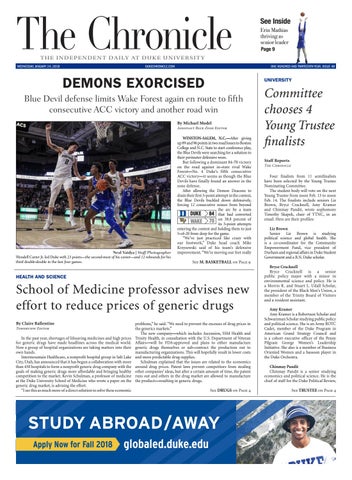
Neal Vaidya | Staff Photographer Wendell Carter Jr. led Duke with 23 points—the second-most of his career—and 12 rebounds for his third double-double in the last four games.
WINSTON-SALEM, N.C.—After giving up 89 and 96 points in two road losses to Boston College and N.C. State to start conference play, the Blue Devils were searching for a solution to their perimeter defensive woes. But following a dominant 84-70 victory on the road against in-state rival Wake Forest—No. 4 Duke’s fifth consecutive ACC victory—it seems as though the Blue Devils have finally found an answer in the zone defense. After allowing the Demon Deacons to drain their first 3-point attempt in the contest, the Blue Devils buckled down defensively, forcing 12 consecutive misses from beyond the arc by a team DUKE 84 that had converted 38.8 percent of WAKE 70 on its 3-point attempts entering the contest and holding them to just 5-of-20 from deep for the game. “We’ve just practiced like crazy with our footwork,” Duke head coach Mike Krzyzewski said of his team’s defensive improvement. “We’re moving our feet really See M. BASKETBALL on Page 9
HEALTH AND SCIENCE
School of Medicine professor advises new effort to reduce prices of generic drugs By Claire Ballentine Towerview Editor
In the past year, shortages of lifesaving medicines and high prices for generic drugs have made headlines across the medical world. Now a group of hospital organizations are taking matters into their own hands. Intermountain Healthcare, a nonprofit hospital group in Salt Lake City, Utah, has announced that it has begun a collaboration with more than 450 hospitals to form a nonprofit generic drug company with the goals of making generic drugs more affordable and bringing healthy competition to the market. Kevin Schulman, a professor of medicine at the Duke University School of Medicine who wrote a paper on the generic drug market, is advising the effort. “I see this as much more of a direct solution to solve these economic
problems,” he said. “We need to prevent the excesses of drug prices in the generics markets.” The new company—which includes Ascension, SSM Health and Trinity Health, in consultation with the U.S. Department of Veteran Affairs—will be FDA-approved and plans to either manufacture generic drugs themselves or sub-contract the production out to manufacturing organizations. This will hopefully result in lower costs and more predictable drug supplies. Schulman explained that the issues are related to the economics around drug prices. Patent laws prevent competitors from stealing other companies’ ideas, but after a certain amount of time, the patent runs out and others in the drug market are allowed to manufacture the product—resulting in generic drugs. See DRUGS on Page 4
STUDY ABROAD/AWAY Apply Now for Fall 2018
globaled.duke.edu
Committee chooses 4 Young Trustee finalists Staff Reports The Chronicle
Four finalists from 11 semifinalists have been selected by the Young Trustee Nominating Committee. The student body will vote on the next Young Trustee from noon Feb. 13 to noon Feb. 14. The finalists include seniors Liz Brown, Bryce Cracknell, Amy Kramer and Chinmay Pandit, wrote sophomore Timothy Skapek, chair of YTNC, in an email. Here are their profiles: Liz Brown Senior Liz Brown is studying political science and global health. She is a co-coordinator for the Community Empowerment Fund, vice president of Durham and regional affairs in Duke Student Government and a B.N. Duke scholar. Bryce Cracknell Bryce Cracknell is a senior public policy major with a minor in environmental science and policy. He is a Morris K. and Stuart L. Udall Scholar, the president of the Black Men’s Union, a member of the Trinity Board of Visitors and a resident assistant. Amy Kramer Amy Kramer is a Robertson Scholar and Schwarzman Scholar studying public policy and political science. She is an Army ROTC Cadet, member of the Duke Program in American Grand Strategy Council and is a cohort executive officer of the Penny Pilgram George Women’s Leadership Initiative. She also is a member of Business Oriented Women and a bassoon player in the Duke Orchestra. Chinmay Pandit Chinmay Pandit is a senior studying economics and political science. He is the chief of staff for the Duke Political Review, See TRUSTEE on Page 4
2 | WEDNESDAY, JANUARY 24, 2018
The Chronicle
dukechronicle.com
Bloomberg editor discusses new book, future of American fraternities at talk Researchers develop bacteria to help in material fabrication HEALTH AND SCIENCE
By Jack Dolgin
Contributing Reporter
Within 48 hours of bids being handed out to Duke Interfraternity Council and Panhellenic Association students, senior editor at Bloomberg News John Hechinger spoke the Rubenstein Library Tuesday afternoon about some of the problems facing fraternities in America. His new book, “True Gentlemen: The Broken Pledge of America’s Fraternities,” addresses questions about how some of the worst incidents involving fraternities—like deaths that were disproportionately common in chapters of Sigma Alpha Epsilon—have arisen in recent years and the efforts that are being taken to improve fraternities. “When a school does take action, it costs time and money,” Hechinger said. “[Eliminating them] would be very unpopular among not just alumni but among students, and in public universities it would be hard legally.” Hechinger said that in comparison to many schools around the country, Duke has handled some of the problems with Greek life particularly well. He praised that Duke students cannot rush Greek life until at least their second semester, which he said makes students less vulnerable during Greek-related events. Still, Hechinger said he wished Duke would be more transparent about some of the problems facing fraternities. “The Duke website basically provides an endorsement of Greek life but doesn’t present research on drinking,” he said. “There’s a part where it says, ‘Is alcohol an issue in Greek life?’ for Frequently Asked Questions for parents. And the answer is, ‘Alcohol is an issue in all of society.’ That’s it. And the reality is, every student that I’ve looked at shows that fraternity men binge drink twice as much as other students.”
The website actually reads, “as our society grapples with alcohol and substance use issues ... Greek affiliated students also deal with these issues. Most students probably dealt with these questions prior to coming to Duke, and have most likely faced these same subjects since arriving on campus.” Hechinger added that in the past 20 years fraternities have managed to be insured by essentially “kicking members to the curb.” He meant that national fraternities and universities leave responsibility for certain Greek incidents to the students, so that universities and national fraternities are not legally responsible. The Duke Community Standard reveals that to be recognized by the Office of Fraternity and Sorority Life, organizations must be insured for at minimum $1 million “per occurrence” and $3 million aggregate. One attendee noted that the talk informed his impression of Greek
Special to the Chronicle “True Gentlemen: The Broken Pledge of America’s Fraternities,” a book by John Hechinger, explores some of fraternities’ worst moments.
life nationally. “I’m under the impression that fraternities here won’t exist in 10 years, and the impression that fraternities won’t exist nationally in 50 years. So I expected to come here and have that confirmed,” sophomore Griffin Reilly said. “I actually had more of the opposite shown. Because I sometimes forget at state school environments just how powerful the fraternity strength is.”
By Deepti Agnihotri Contributing Reporter
Another member of the audience of more than 30 people, however, said she wished he had more personal experience as a minority to talk critically about race in Greek life. “For example, this older white man went in and talked to all these fraternity leaders and claims they are really open to change,” senior Anita Desai said. “But he’s not one of the people that actually are marginalized by these groups. And I think it’s very difficult for someone who feels like they’re on equal footing and has nothing to lose to say from these organizations to say they are committed.” When asked after the talk about a relationship between homogeneity and damaging events, Hechinger said more
Did you know that self-organizing bacteria can help pressure sensors? Led by Lingchong You, the Paul Ruffin Scarborough associate professor of engineering and Stefan Zauscher, the Sternberg Family professor of mechanical engineering and materials science, Duke researchers have developed bacteria using a synthetic gene circuit that can self-organize to aid in material fabrication. The bacteria could ultimately help create materials that heal themselves and respond to environmental changes. You described the primary goal of the project so far as proof of concept, showing that bacteria could be manipulated to create devices. “What we have demonstrated for the first time is that you can actually do this,” You said. “It is not impossible. You can use engineered bacteria to form well defined 3D structures and then use that as a foundation to assemble something that can actually work.” The researchers altered E. coli bacteria with synthetic gene circuits to grow colonies in particular formations such as a ring or dome and release a protein that would attract nanoparticles and arrange them in the same formation. The bacteria served as a mold for the particles and allowed the team to create pressure sensors. You said the bacteria-developed sensors were no match for the conventional sensors already in the market. However, he emphasized the significance of developing a working method for bacteria in material fabrication and said there is potential for further research. “The bigger question we are trying to address is what even is possible. This is a relatively simple demonstration that you can engineer bacteria to make simple devices. One of the fantasies I have along this research direction is eliciting the bacteria at different locations. As the bacteria grow, they will assemble different types of structural materials. Eventually, after some time, you will end up getting a functional circuit board, entirely grown by bacteria. But whether that is even possible, we don’t know yet.”
See FRATERNITIES on Page 4
See BACTERIA on Page 4
I think if fraternities grapple with this diversity issue, then I think they do have a future, and I would expect that if they don’t, they’re going to be much smaller. JOHN HECHINGER
SENIOR EDITOR AT BLOOMBERG NEWS
Get TheDirt The Chronicle brings you a weekly summary of events, ideas and news items that are trending at Duke and in the Triangle. Read all you need to know with The Dirt!
thebluedirt.com
The Chronicle
dukechronicle.com
WEDNESDAY, JANUARY 24, 2018 | 3
Taste testing Thrive, the new restaurant on Central Campus By Jake Satisky Staff Reporter
Meet Duke’s newest restaurant, Thrive. At the start of this semester, Central Campus welcomed Thrive as the newest restaurant at Devil’s Bistro. It offers a “fast casual fresh, healthy concept,” according to its Duke Dining webpage. The Chronicle sent me to test out some of the resteraunt’s signature dishes and see if it lives up to its description. Thrive has a selection of breakfast items, sandwiches, salads, soups and bowls. The menu features popular superfoods like salmon, quinoa and avocado. Alongside my friend, first-year Sarah Watkins, I ordered the wild salmon bowl with a can of Tribucha kombucha. And as the Chronicle’s resident avocado expert, I couldn’t turn down the
opportunity to order the chicken avocado BLT sandwich and avocado toast as well. First, we tried the wild salmon bowl, which came with jasmine white rice, edamame, carrot shreds, cucumber, red peppers and ginger sauce. At $12, it is the most expensive of the pre-constructed bowls. Although the menu stated that avocado was included, I did not see any in the bowl; nevertheless, the bowl was colorful and enticing. The salmon was a tad overcooked and the rice was bland, but the ginger sauce saved the dish, and the vegetables tasted fresh. “The vegetables were still raw so they give the bowl a crunch [that] I like,” Watkins said. Final verdict: healthy and filling, but not the most flavorful dish. I did appreciate getting a good serving of fish for the money.
It’s delicate, without heavy flavors. It looks and tastes healthy. SARAH WATKINS
FIRST-YEAR AND FRIEND OF REPORTER ON THRIVE’S AVOCADO TOAST
Jake Satisky | Contributing Photographer One of Thrive’s signature dishes was the wild salmon bowl, which contained jasmine white rice and edamame.
Next, we sampled the $9 chicken avocado BLT, which came with grilled chicken, avocado, bacon, lettuce and tomato on a whole wheat bun. Thrive also added melted baby swiss cheese to this classic sandwich. After taking one large bite, Sarah and I didn’t know what to make of the sandwich, other than that we wanted another bite. It was a little sweeter than I expected a BLT to be, maybe because of the cheese. We both liked the avocado on the sandwich. The dish came with a side of house chips, which were well-salted and had a great crunch. Final verdict: the stars of the sandwich were the toppings—cheese, avocado, the BLT—while the chicken and bun served as a fine supporting cast members.
ENROLLING 2018 • NEW INFORMATICS PROGRAM •
Jake Satisky | Contributing Photographer Thrive’s $6 avocado toast features olive oil, capers, chia seeds and pepitas on multi-grain bread.
Finally, we tasted the $6 avocado toast, featuring olive oil, capers, chia seeds and pepitas on multi-grain bread. I was pleased that we got a thick piece of bread, but I was initially not excited to see all the oil and seeds on the toast. As it turns out, I was pleasantly surprised by the oil and the seeds, which added crunch without detracting from the avocado flavor. The toast itself was neither too crunchy nor too soggy. Sarah ate her half of the toast in no time. “It’s delicate, without heavy flavors,” she said. “It looks and tastes healthy.” Final verdict: simple yet rich, the dish allowed the avocado flavor shine while the extra toppings supplemented it nicely. I would have preferred not quite as many seeds, but overall it was my favorite dish. Final verdict for Thrive: it is definitely not cheap, but you get your money’s worth with the friendly service, generous portions, healthy ingredients, and the mix of flavors.
Attention All Undergraduate Majors! Study Away at University of Glasgow in Fall 2018 Duke in Glasgow, Scotland Program Students from all majors are welcome to apply. Application Deadline: March 1, 2018
MASTER IN INTERDISCIPLINARY DATA SCIENCE (MIDS)
Concentration in Biomedical Informatics (BMI)
The Biomedical Informatics Concentration of the Duke University Master in Interdisciplinary Data Science (MIDS) is a new full-time two-year educational program where students will be exposed to the interdisciplinary application of data science while developing skills applied to biomedical informatics.
CORE MIDS COURSES
BMI COURSES
• Data to Decision • Modeling and Representation of Data • Introduction to Text Analysis • Principles of Machine Learning • Data Management Systems • Data Logic, Visualization, and Storytelling • Data Science Ethics
• Introduction to Informatics • Data Representation and Standards • Health Care Information Infrastructure • EHRs and Mobile Health • Health Care Systems • Health Analytics and Decision Support • Information Research Seminar
Information Session: Tuesday, January 30, 2018 5-6pm, Rubenstein Hall, Room 200 (NOT Rubenstein Library) Offered each fall, the program begins with a visit to London, featuring meetings with members of Parliament and visits to key cultural and political institutions. Additionally, students typically travel to other sites of political and historical interest in Scotland. While at Glasgow, students on the program take a specificallydesigned course on British policy and politics (PUBPOL 450AS) and three additional elective courses from the University of Glasgow’s regular offerings. Please join us for this information session with the Program Director, Coordinators, and Duke in Glasgow alums as we share the details about the curriculum, logistics, and more!
FOR INFORMATION
dchi.duke.edu • datascience.duke.edu healthinformatics@duke.edu 919-668-4647
The Duke in Glasgow program page and application can be found at the Duke Global Education website: https://globaled.duke.edu/programs/glasgow. Contact meghann.lail@duke.edu for additional information.
The Chronicle
dukechronicle.com
4 | WEDNESDAY, JANUARY 24, 2018
DRUGS FROM PAGE 1 “The whole idea was that generic drugs would reduce the price of brand-name drugs over time,” he said. However, what often happens is that the sudden competition causes manufacturers to reduce their prices and many then have little incentive to stay in the market because the price is so low. The companies decide to concentrate on other areas and stop making the generic drug, resulting in a drug shortage. Another problem occurs when one manufacturer has a monopoly over production of a drug and raises the price arbitrarily, Schulman said. The most famous example of this is Martin Shkreli, the founder and CEO of a drug company that increased the price of the drug Daraprim from $13.50 to $750. Some of the hikes have led to government investigations. The increase of the antibiotic doxycycline hyclate from 5.6 cents a pill in 2012 to $3.65 in 2013 resulted in state and federal inquiries. In 2015, Valeant Pharmaceuticals
International bought up old medicines such as heart drugs Nitropress and Isuprel and raised the prices, which led to Congressional hearings. According to a press release from Intermountain Healthcare, some generic drug prices have increased by more than 1,000
It’s an ambitious plan. But healthcare systems are in the best position to fix the problems in the generic drug market. MARC HARRISON
PRESIDENT AND CEO OF INTERMOUNTAIN HEALTHCARE
percent in only a few months. But research suggests that prices for generic drugs can be reduced to a fraction of their costs. “It’s an ambitious plan,” said Marc Harrison, president and CEO of Intermountain Healthcare. “But healthcare systems
HOT ITEM of the WEEK
are in the best position to fix the problems in the generic drug market. We witness, on a daily basis, how shortages of essential generic medications or egregious cost increases for those same drugs affect our patients. We are confident we can improve the situation for our patients by bringing much needed competition to the generic drug market.” Schulman explained that he got involved in the project when the Intermountain doctors reached out to him about a year ago. They had read a paper he wrote on ways to promote competitive generic drug markets in the U.S. and wanted to see if Schulman thought their approach had a chance of making a difference. Since then, Schulman has worked on their national advisory committee and attended a series of conferences about the topic. Other advisors include Clayton Christensen, professor at Harvard Business School, and Don Berwick, president emeritus of the Institute for Healthcare Improvement, along with Bob Kerrey, a former Nebraska governor, U.S. senator and pharmacist. So far, hundreds of hospitals have agreed to buy products from the new company, Schulman noted. Many will have three-year agreements to purchase a certain quantity of the drugs. Funding is coming from Intermountain Healthcare along with some of the other health systems involved, he said. Although he’s never seen a collaboration like this before, he said he doesn’t think there will be any legal issues with it since it will only be a portion of the generics market. “All the consolidation has made these economic issues worse, which is why you have to do something like this new organization,” he said. Although the partnership’s future is uncertain, Schulman said it could be a long-term player in the market. “I think of it as an insurance policy to protect the market from adverse behavior and price manipulation,” he said.
FRATERNITIES FROM PAGE 2
Duke 3-Pack Basketball Tees
Colors: Royal, White, Charcoal Heather Available Sizes: S - 3X Fabric Content: 100% cotton; Charcoal Heather: 50% cotton, 50% polyester Advertised price does not include tax. Offer cannot be combined with any other discount or promotion. Sold as a pack of 3. Packages cannot be broken.
Offer valid Wednesday, January 24 through Monday, January 29, 2018, or while supplies last.
25
$
28 for 3X • Compared to $4785 up to $5985
$
Available in the following locations:
The University Store
Medical Center Store
Upper Level, Bryan Center
Lower Level, Duke Clinics
eSTORE
www.shopdukestores.duke.edu Departments of Duke University Stores®
diversity leads to less group think. He said that at certain fraternities in the country, like at Alabama, nearly all members have been white since their foundings. The Chronicle published a story Friday detailing the extent of homogeneity in Greek life at Duke. Given these challenges, Hechinger said fraternities will need to be more inclusive if they want to exist in the next 30 years. However, he noted that fraternities have become increasingly popular in recent years, due in part due the increased job prospects that are associated with being in a fraternity. “I think if fraternities grapple with this diversity issue, then I think they do have a future, and I would expect that if they don’t, they’re going to be much smaller,” he said.
TRUSTEE FROM PAGE 1 a portfolio manager for the Duke Investment Club, a Robertson Scholar and a student representative on the business and finance committee of the Duke Board of Trustees. This year, Duke Student Government Senate passed an amendment to the by-laws for the Young Trustee Nominating Committee. The amendment changed the minimum number of committee members from 10 to eight and enabled a quorum to be assembled at seven members. “Lowering the minimum number of committee members does not require us to fill [as many] spots, so we can pick the best people,” said DSG President Riyanka Ganguly, a senior, at the time.
BACTERIA FROM PAGE 2 The researchers are interested in creating synthetic gene circuits that encode more complex patterns but are wary since such patterns require more computation and cannot be as easily encoded. “Every human being is like a sophisticated 3D pattern. We didn’t grow into a mold. We become this pattern through growth and self-organization. But as bioengineers, our ability to control the cell, to generate mega-genetic programs, to instruct the cells to form well defined patterns is incredibly limited.” The method’s success also lies in the fact that bacteria were used as the medium. In theory, this genetic modification could be extended to any other programmable organism, but it would be much harder to predict how well it would work. Few organisms have been studied as extensively as E. coli.
The Chronicle
recess dukechronicle.com
WEDNESDAY, JANUARY 24, 2018 | 5
VOLUME 19, ISSUE 48 | JANUARY 24, 2018
community through conservation New exhibit at The Scrap Exchange uses found objects, page 7
reexamining the dmz M.F.A. students’ multimedia installation opens at Smith, page 8
R 6 | WEDNESDAY, JANUARY 24, 2018
recess editors I would like to thank the Academy and...
Will Atkinson .....................sean baker Nina Wilder ............................. myself Georgina Del Vecho.......... walt disney Christy Kuesel .............. NOT la la land Jessica Williams ............photo essays Likhitha Butchireddygari........ frances
on the cover: “The Dancers of Red Lake” by Calvin Brett. On display at The Scrap Exchange.
The Chronicle
dukechronicle.com recess
In the last year, the Duke community has lost a few of its own. The news of a death reaches every student, even those who didn’t know the deceased personally. Their absence is felt by their loved ones and their presence lives on in people’s memories. As young college students in good health, with ambitions and a bright futures, we rarely think about death — unless we have to. When confronted with the inevitability of our mortality, few of us know what to feel, think or do. What is right in a situation where death is involved? Paul Kalanithi, a neurosurgeon who died of lung cancer at 37, asked this question in his book, “When Breath Becomes Air”: “If the weight of mortality does not grow lighter, does it at least get more familiar?” The weight of mortality was foreign to me until my mom told me my grandfather had cancer. At the time, I wasn’t fully aware of how seriously ill he was. I had a naive sense of optimism that he would be okay and somehow get through it. When I visited him in the hospital, he seemed to be doing well. He was planning ways the doctors could cut out more of the cancer in his stomach. I believed in his steadfast hope until I came home from school one day to the news of his death. My first reaction was utter disbelief. My mom must be playing a practical joke, trying to test me somehow. Now I realize how ridiculous my denial was. I was blindsided by the strangeness and newness of death. Today death feels a little bit less unfamiliar. After having to confront its reality multiple times in the last year, I am almost curious about it. I have an urge to get to know it more intimately in the perhaps futile hope that the more I find out about mortality, the less terrifying it will be. Yesterday, I finished reading Kalanithi’s memoir, which chronicles his last months working as a neurosurgeon. Kalanithi was in his last year of residency when he found out he was dying. He had his
entire career ahead of him. His diagnosis changed his trajectory. He decided that he wanted to write a book that chronicled his relationship with cancer, death, his patients and his wife — and eventually with his newborn daughter Cady. Kalanithi had no clear idea of exactly how
staff note much time he had. The phrase “live one day at a time” didn’t clarify what he was supposed to do in the days he had left. Living with cancer, Kalanithi realized that he had gone through the five stages of grief in reverse: from acceptance to depression to bargaining to anger and finally to denial — total denial
that he had cancer. “Maybe, in the absence of any certainty, we should just assume that we’re going to live a long time,” he writes. “Maybe that’s the only way forward.” My friend asked me if I would rather know when I would die or not know at all. I think I would prefer to live not knowing. Maybe because that way I can hold death at arm’s length. That way I can live under the safe assumption that I will live to see my grandchildren go to school. I can dream of sitting on my front porch in a rocking chair and watch the events of a lazy Sunday afternoon unfold. The uncertainty of not knowing justifies my tendency to procrastinate and my aversion to planning for the future. The truth is I don’t know death very well. A part of me doesn’t ever want to be in the company of death. But more and more, I’m beginning to realize that I don’t really have a say in the matter. Whether I’m ready for it or not, one day death will get to know me. —Keyin Lu
recess
Yiran Ao | Special to The Chronicle Two visitors chat at “Looking North,” now on display at Smith Warehouse. See page 8 for the story.
Admission is always free for Duke students.
Courtside Dreams are easily realised at COSMIC CANTINA MENU SAMPLING Old School Veggie Burrito Regular Chicken Burrito Cheese Quesadilla Chicken Quesadilla Chips & Salsa
$2.86 $5.65 $1.41 $3.59 $2.06
1920 1/2 Perry St. @ Ninth Street Just a block from East Campus
Photographs by Bill Bamberger On view January 26 – May 13, 2018
Friday, January 26, 5:30 PM: Cash Bar 6 PM: Gallery talk Get ready for basketball season with an exhibition of vibrant color photographs that capture the many different settings in which basketball is played around the world. Join artist Bill Bamberger and Duke undergraduate students for a talk about Courtside, which the students co-curated through a Curatorial Practicum class taught at the Nasher Museum.
nasher.duke.edu/courtside Bill Bamberger, Charter School Playground, Harlem, New York (detail), 2007. Inkjet print on archival paper. Courtesy of Bill Bamberger. © Bill Bamberger.
The Chronicle
dukechronicle.com recess
WEDNESDAY, JANUARY 24, 2018 | 7
local arts
The Scrap Exchange’s exhibit promotes community and conservation By Selena Qian Staff Writer
Discarded objects fascinate Calvin Brett. He started exploring art seriously as a painter, but soon realized painting wasn’t his preferred form of expression. Artists like Thornton Dial and Patrick Dougherty, who created the stick sculptures in Duke Gardens, inspired Brett to move into assemblage and to use found objects in his art. Brett’s most recent installation is made of cardboard, plastered over the walls of The Cameron Gallery at the Scrap Exchange in Durham’s Lakewood District. “In a society where so much is based on purchasing the new, the cardboard represents all that we ship, all that we buy, all that is transferred around, and is just this husk,” Brett said. Open boxes jut out into the space, which is currently filled with ladders and various pieces waiting to be mounted. The installation, called “Packaging Space,” will open Friday and be on display through Feb. 10 with a reception from 6 to 9 p.m. on opening night. Visitors to the exhibit will be invited to take objects from the floor and arrange them in the boxes. “As simple as that sounds, hopefully through enough visitors grabbing items and putting them in different boxes, they’ll look at the relationships between these items,” Brett said. “Hopefully, it will be something that people will be able to play with and keep on adding more and more and inspire others to create with things that they would traditionally just throw out.” Brett worked on this exhibit with four other artists: Jaclyn Bowie, Carin Walsh,
Jenny Blazing and Meg Stein. The idea of sustainability and awareness of waste creates a common thread throughout the components of the exhibit. Stein’s work focuses on using common items in new ways; Walsh and Blazing will add an animation based on city decay and environmental concerns. Bowie will add another layer of interactivity to the piece by projecting images from overhead projectors that visitors can write and draw on. The artists working on this installation are also part of “The Bull Meets the Bayou” artist collective, which aims to create connections between artists in Durham and in New Orleans and increase Durham’s national reputation. Brett and Bowie said Stein was the first to organize this group. Her goal is to bring Durham artists to New Orleans to show work and vice versa. The opening of “Packaging Space” will be one of several events intended to increase exposure for the collective and fundraise for their travels. Visual artist Gemynii, who is also a part of the group, said she has never been to New Orleans and felt that it would be a good opportunity for her as well as her colleagues to show their work to new audiences and to find inspiration. “I feel that those cities both have a deep history of artists and artists of color and spirit and community,” Gemynii said. “It’s like a sister type of city, like our cousins that we’re getting ready to go meet for the first time.” The theme of reuse in “Packaging Space” ties in with the goals of The Scrap Exchange, whose mission, according to its website, is to “promote creativity, environmental awareness and community
recess
Selena Qian | Staff Photographer Calvin Brett’s exhibit, “Packaging Space,” is on display at The Scrap Exchange in Durham through Feb. 10.
through reuse.” The organization reclaims materials from businesses and local residents to then sell them in their retail store and to provide an open studio through a “Make N Take” space. Brett decided to apply to exhibit in The Scrap Exchange because he had made a piece using materials from the store about a year ago. He also is looking to apply for the Artist in Residence Program at Recology in San Francisco, and he felt that exhibiting at The Scrap Exchange would be a good stepping stone to that residency. The interactive aspect of the installation is another one that Bowie and Brett said they want to emphasize. Bowie had previously
worked in sculptural installation before moving to a more digital medium when her studio space began to shrink. She wants to make art accessible and available, and does that through the use of the overhead, which she said is easy for people to engage with due to its low-tech nature. Brett’s use of cardboard also creates accessibility due to its abundance. “People might look at this and be like, ‘Okay, anybody can do this,’” Brett said. “For me, that’s the point. If I can come up with something that others can do, that now all of a sudden opens up a brand new spectrum or avenue for expression, and that’s what I want.”
Jostens Ring Days Distinctive. Classic. Lasting.
Wednesday, January 24 & Thursday, January 25 10am - 4pm The University Store, Bryan Center, West Campus
find housing
Sponsored by Duke University Stores®
OPERATION: University Store PUBLICATION: Chronicle
at The Chronicle’s online guide to living near Duke.
The Chronicle
dukechronicle.com recess
8 | WEDNESDAY, JANUARY 24, 2018
campus arts
‘Looking North’ challenges popular notions about the Korean DMZ By Milena Ozernova Contributing Writer
Many people in the Western world have a rather vague and uncertain idea of what the demilitarized zone between North and South Korea looks like. Some know it simply as the world’s most dangerous border; others treat it as a reminder of the war that has persisted between the two neighboring countries for over 60 years. In the coming weeks, Duke students will be given an opportunity to explore the demilitarized zone from an insider’s perspective and develop their own view on the conflict that managed to divide one nation into two. Beginning with an opening reception last Friday, the collaborative multimedia exhibition “Looking North” will be on display in the Smith Warehouse until Feb. 4. Assembled by Danny Kim, a student in the M.F.A. program in Experimental and Documentary Arts, and Peter Lisignoli, who graduated from the program in 2013, “Looking North” aims to create a realistic image of the Korean Demilitarized Zone by blending together vivid photographs, a multi-channel installation and a video game. The project was born out of a coincidence. While finishing his thesis work in Korea, Danny Kim was introduced to Peter Lisignoli, an American filmmaker, who was deeply interested in the way the demilitarized zone functioned under the influence of war and propaganda. As a native Korean citizen, Kim had the opportunity to show Lisignoli a version of the world’s most dangerous border that was never meant to be seen by a Western tourist — the version that wasn’t prescribed or picturesque. When Kim introduced Lisignoli to the
demilitarized zone as he knew it, both artists were struck by inspiration and set out to document the reality that surrounded them. For this reason, “Looking North” is composed of the rich scenery of the farmland alongside scenes of gaping tourists coming in and out of gift shops and quiet announcements warning people about a heat wave. “Each time I visited the area, I was struck by the idea that it was turned into an attraction site,” Kim said. It quickly turned out he was not the only one who felt this way. After visiting the area, Lisignoli was also left with a feeling of displacement brought about by the contradictions between the past, present and future of the demilitarized zone. “The most interesting thing about that place is different historical time periods that are expressed in the demilitarized zone. You learn about the past, you learn about the Korean war in the ‘50s and you are surrounded by these exhibits promising this kind of reunification in the future,” Lisignoli said. “Meanwhile, in the present we are still pretty much in the war zone.” To present the demilitarized zone from an insider’s perspective, Kim and Lisignoli used various multimedia components. One of them is a video game that Kim programmed from scratch to enable his audience with a weapon that turns North Korean soldiers into K-pop lovers. (I personally “disarmed” five such soldiers while listening to some of the best Korean songs released in recent years.) Another multimedia feature of the exhibition is a dual-channel video created by Lisignoli. This part of the project carefully portrays the conflicts that exist within the demilitarized zone as the video
Yiran Ao | Special to The Chronicle Last Friday’s opening reception for “Looking North,” now on display in Smith Warehouse Bay 11.
imagines the area’s future and reflects on Northern neighbors are not foes but rather its present condition. By using an engaging long-lost relatives. In Kim’s photographs, combination of sound, noise and visual when South Koreans look at the northern elements, Lisignoli made the demilitarized territory through telescopes, they try to zone come to life right in the middle of imagine what the life down there might look the showroom, 7,000 miles away from its like. They are longing for a chance to eliminate actual territory. the secrecy that surrounds the North Korean However, the purpose of the exhibition land so their countries can be reunited after does not solely revolve around documenting six decades of separation. the current reality of the demilitarized zone, For now, as Kim and Lisignoli’s project Kim said. Among other things, “Looking points out, “looking north” is one of North” focuses on the idea that unlike the only ways for South Koreans to feel Westerners, South Koreans are not afraid of connected to their northern counterparts their cousins in the North. while they are separated by different “I always find it really fascinating how the ideologies and borders. Western world is fearful of North Korea, but The exhibition is now open and will we live right below its border and move on be on display through Feb. 4 in the Smith The lives,” New York Corporation with our daily Kim Times said. Syndication Sales Warehouse, Bay 11. The artist talk will take Avenue, Newtheir York, N.Y. He explained620 thatEighth for South Koreans, place10018 Feb. 1 at 4:30 p.m. For Information Call: 1-800-972-3550 ForRelease ReleaseWednesday, Tuesday, January For January23, 24,2018 2018
CLASSIFIEDS WANTED TO BUY
TRAVEL/VACATION
NEED UVA AND NOTRE DAME BASKETBALL TICKETS.
BAHAMAS SPRING BREAK $189 for 5-Days� All prices include: Round-trip luxury party cruise� Accommodations on the island at your choice of ten resorts� Appalachia Travel� www�BahamaSun�com 800-867-5018
California alum bringing family back to experience Duke� Need four tickets each to the UVA and Notre Dame games� These Blue Devil kids have never seen Duke or been to Cameron� Duke Hall of Fame RB Elmore Hackney is my great uncle� Please help if you can� Thanks! Email danieldrennon@ gmail�com NEED TICKETS-1/27 DUKE-UVA GAME Duke ‘05 from NYC looking for at least 2 tickets to the Duke-UVA game on Saturday, 1/27� I’m willing to pay a reasonable price (just not Stubhub level)� Please reach out at cyoung@sailthru� com if you have any leads� Thank you! Email cyoung@sailthru�com
The Chronicle classified advertising www.dukechronicle.com/classifieds deadline 12:00 noon 2 business days prior to publication
The Chronicle Best film we saw at Sundance 2018 Riz Ahmed ������������������������������������������������������������������������������������������ likhithabanana An Inconvenient Truth 2������������������������������������������������������������������������ hankthetank How Bread Grows (?) ������������������������������������������������������������������������� jackofalltrades Pacific Rim ����������������������������������������������������������������������������������������������� turksncaicos Boss Baby ������������������������������������������������������������������������������������������������������ the ‘cess Student Advertising Manager: ������������������������������������������������������������Megan Bowen Student Marketing Manager: ���������������������������������������������������������������������Lizzy Pott Account Representatives: ������������������������������Brittany Amano, Griffin Carter, TJ Cole, Paul Dickinson, Jack Forlines, Matt Gendell, Francis L’Esperance, Jack Lubin, Gabriela Martinez-Moure, Jake Melnick, Spencer Perkins, Brendan Quinlan, Levi Rhoades, Rebecca Ross, Jake Schulman, Matt Zychowski Creative Services: �������������������������������������������������� Rachael Murtagh, Myla Swallow Student Business Manager ���������������������������������������������������������������������� Dylan Riley
Edited by Will Shortz
Crossword ACROSS ACROSS 11 Russian Soak (up)ruler 45 Themes With 14-Across, weakness for 11 Gathering of sugar people with a 9 shared Fix, as ainterest race 12 Pennsylvania, It’s on the 13 waterfront for example 14 Nixes, See 4-Across 14 as a 15 proposal Juno’s Greek counterpart 16 Bibliophile 16 Possess, Designer Gucci 17 in the 17 Bible With 25-Down, 2012 British 18 Sunrise’s Open winner direction, in 18 Sonora Those, in Spain 19 “We Whatshall a rolling 20 never stone is know allunlikely the to gather good that a ___ can 21 simple Kurt of Nirvana do”: Mother 23 Teresa Retro 24 &Baby 21 22 Certain to make 26 way Pile up 60-Across 27 A little thick 24 Game-ending 30 cry Same at old, a card same old table 31 Police dept. alert 25 Designer 32 Jacobs Sharper
35 V.I.P. Cries of 27 at disgust boot
36 camp Christmas tree decorationof… or 28 Dunham a hint to what “Girls” the circled letters 29 Some form businesses: 38 Abbr. Gets underway 41 Assessing, I’m not buying it! 31 with 45 “up” “___ take arms a sea of 33 &against 34 Another troubles”: Hamlet way to make 46 60-Across Something 35 Colorful squirreledbird away? a big sheep bill 50 with Like black 37 Dole (out) 51 Tree with smooth 38 Carrier of bark electricity 53 Long-handled 39 Electricity, e.g. tool 41 flippant with 54 Be Language group that gave us 45 Office data: “banjo” and Abbr. “gumbo” 46 & 47 A third 55 way ___-chic (hippieto make inspired fashion) 60-Across 56 Absurd “But of course!” 48 57 Opera Popularset footwear 50 partly from Down Under on the banks of Nile 58 the “That would stink” or air 52 Food
ANSWER TO PREVIOUS PUZZLE E S S P C A A P B E A D A
A O LI L M L A L M E P
S P O E A D PI CI N A G B
R S A O C B E F H A P N S
TI T R OI L B D O Y R A O
M A A T D R D O A P S O H S
E M R U O C L K SI A M C R T O E C E H E T
S O D A H I N S S A T I M H R O NI C E H Y
A W R O M R O N R D H V E D L E C N H A N O N T R C U T A N Y
S T E X E P N O A D N E S M A O
L E E O O N N I I A V M Y I O K O N H E E D
G E TI NI C D O M JI O C S R E A R L L M Y S
A T G H E O E C R EI N A R D N Y A D O U I
E N T O B M O B U R E N G E O B N U E R M S O T
H E K A O D SI
Y E A N W R N A G M E E S G
A R N E O S I N D T U S E
LI O R V O E N LT A P W
B G R A A S S H E L Y S
TI N A A N W G O L R E D
N A O R T O S N A C L E
LS N E O U W SI SI N M
60 19th-century “Gilmore Girls” 53 protagonist Midwest 63 territory Shield
64 Annie Part of and a shore 55 the
dinnerMermaid, Little 65 notably Dot-dot-dot,
dash-dash-dash,
57 Like paradise dot-dot-dot
66 Network “Yahoo!” 58
(with)
67 Voiced Put an end to 59
something? 60 puzzle’sfor 68 This Blue Stater, theme short DOWN DOWN
1 Baden-Baden, for 1 More concise one number 22 Month “Moby-Dick” light 60-Across: source 3 Abbr. Human-powered taxi a date, say 3 Had 4 Vermeer and 4 Like cutting in Rembrandt line contemporary 5 Deface Tattered 66 Sunset’s Forever and a day direction, in 7 Sorrento Suffix with diet 87 60-Across, 2000s teen in drama set in baseball Newport Beach native 98 Person What’s left to an area 10 Absolutist’s rule of station 119 Kind Number for a surgeon? 10 First name in 13 women’s Tends to, as a tennis cradle 11 2016 Disney 15 Flip call film set in 20 Polynesia Show disdain for, in a way 12 Pretend to be 22 Recurring action role for Yorke Matt of 14 Singer Damon Radiohead 23 Sound heard 15 Ado from a herd 19 25 Nestful See 17-Across 27 Mate Netflixfor item 23 a bull
1 12
2
13
2
3
13
11
5
14
16 14
17
4 4
20
15
26
31
29 33 39 35
32 30
33
13 16
18
46 39
47
52 46
37 48 40
34
58 53
59 54
63 57
60
25
35 37
41 50 41 54
55
11 10
28
32
49
56 50
10 9
24 30
53
49
9 8
22 20
34 36
51 45
7 15
29
31
40
55
28
36
45 38
48
27
27
6
24 23
22
26 25
8 5
21 19
18
23 21
38
7
12
17 19
6
1219 No. 1220
51
57
61
56
42
43
44
42
43
44
47 52 62
64 58
65 59
66
67
68
60
ANDREW RANDALL KINGSLEY PUZZLE BY TALITHA
28 ___ “The60-Across Holly 26 and theof___” (state (Christmas euphoria) song)
27
Difficult
29 situation Hearing aid?
28 cat is said to 33 A Archaeological
have handle60-Across of them 34 Make, as dough 30 ___ Jacquet, of 36 director Stitch with “March of athe hook Penguins” 37 Problem Fills with fury 32 before a big date, 38 informally Loud lament
39 Left New bereft York 33
City bridge,
35 What informally, with
transported “the” Dorothy to Oz 40 Fate who cuts the 36 Burst threadin of space life 37 who 42 Gregor 2010 Disney pioneered film that setina genetics record for the most expensive 38 Upbraids animated movie 40 Small dam ever made 42 soldier!” 43 “Relax, Gallery sign 44 Greta Romanian 43 Garbo or currency Ingrid Bergman 47 Gains Given to talk 44 yardage?
48 Arrive, “Would as youalook 46 at that!” storm
49 Worlds
49
Prefix meaning
51
Possible score
52 60-Across Potful for Winnie-the-Pooh 54 after Succumb to 40-all pressure?
52 58 German Some office
homophone of printers, for short 60-Across
59 South American tuber now!” 54 “___ 61 (infomercial Arles assent
phrase)
62 Suffix with real or social 56 Japanese “yes”
Online subscriptions: Today’s puzzle and more than 7,000 past puzzles, nytimes.com/crosswords ($39.95 a year). Read about and comment on each puzzle: nytimes.com/wordplay.
The Chronicle
Sports
dukechronicle.com
The Chronicle
WEDNESDAY, JANUARY 24, 2018 | 9
THE BLUE ZONE
SHOULD DUKE PLAY MORE ZONE DEFENSE? sports.chronicleblogs.com
dukechronicle.com
WEDNESDAY, JANUARY 24, 2018
WOMEN’S BASKETBALL
‘FUTURE COMING TOGETHER’
Veteran Erin Mathias thriving as a player and fashion designer in final year as a Blue Devil that confidence and sort of realizing this has to be my year to kind of step up.”
By Spencer Levy Staff Reporter
For some players, the rise to prominence in college basketball can only be seen on game day. But for Duke’s lone four-year senior, the path taken was atypical. Before Erin Mathias even stepped foot in high school, she had received high praise, even being compared to the top recruit to enter college in 2008 and eventual WNBA MVP Elena Delle Donne. According to Mathias’ recruiting profile, the forward from Pittsburgh was thought to have a similar skill set, which Blue Devil head coach Joanne P. McCallie took notice of quite early in the recruiting process. “Knowing that she wanted to come to Duke, she verbally committed essentially her freshman year, so she’s someone who is taking care of the academics,” McCallie said. “She has come to Duke and has gotten better every single year and taken advantage even when she was coming off the bench. Not whining, being a team player and learning how to get better to be in the spot that she is in now.” Mathias’ athleticism was never questioned and neither was her ability to put the ball in the basket. But something was missing from her game that has allowed the senior to put herself in the starting position she currently holds. “She is just so much more confident out there on the floor. She doesn’t let little things get to her like they used to. If she makes a mistake,
Bre Bradham | Staff Photographer
Erin Mathias was one of the most highly-sought recruits in the Class of 2014 and is finally showing off her potential as a senior. she bounces back so much faster,” Blue Devil graduate student Lexie Brown said. “From A to Z, everything about Erin has been so much better. But just her confidence, that’s what leading the way.” Couple the newfound confidence with a greater opportunity, and McCallie is left with a multifaceted player who can spread the floor on
M. BASKETBALL FROM PAGE 1 well right now, it helps us in man and zone. We work on it every day. The guys have been enthusiastic about it and it’s paying off. And we still have to do it.” The Blue Devils (18-2, 6-2 in the ACC) have now held their opponents to an average of 64.4 points per contest during their five-game winning streak, after allowing an average of 92.7 points in their first three conference games. Wake Forest (8-12, 1-7) kept it close in the early going with a hot 6-of-8 start from the field, trailing just 19-17 with 10:44 left in the half despite committing nine turnovers in the first nine minutes. Unfortunately for the Demon Deacons, regression to the mean and an inability to maintain possession of the basketball plagued them. They proceeded to convert on just four of their next 20 shots and coughed up the ball another six times, allowing Duke to enter the locker room with a 41-30 lead. Senior Grayson Allen continued to break out of his recent slump. After draining four 3-pointers Saturday against Pittsburgh, the Jacksonville, Fla., native continued to show more confidence Tuesday. Allen knocked down each of his first three shot attempts and led the Blue Devils with 13 points at halftime. The captain’s leadership was especially crucial Tuesday with freshman Trevon Duval having an off night, missing all eight of his shot attempts in the first scoreless outing of his young career. Allen took over at point guard for much of the second half and led the team with six assists. “There’s a greater chance for inconsistent performance with young players,” Krzyzewski said. “But Grayson, he’s our
every possession. With the graduations of 6-foot4 forwards Oderah Chidom and Kendall Cooper last spring, frontcourt minutes opened up as the spring rolled into summer. “I’m one of the only senior post players, so I knew I had to be a big presence vocally as well as far as numbers go, so the Italy trip definitely helped with that aspect,” Mathias said. “Building
backup there. Grayson did a great job of running the team, and we got the ball to our big guys and they came through for us again.” Duke stormed out of the locker room, draining its first three shot attempts and extending the lead to what seemed like a comfortable 20 points with just under 17 minutes left to play in the second half. But the Demon Deacons kept it interesting, embarking on a 19-7 run in the next seven minutes to cut the Duke lead to just eight at 58-50. Guard Brandon Childress and 7-foot-1 center Doral Moore led the way for Wake Forest. Childress’ 18-point performance and Moore’s perfect 9-of-9 night with 18 points and 12 rebounds kept the Demon Deacons in it, but it wasn’t enough. “The only way we could defend him was to get him in foul trouble,” Krzyzewski said of Moore’s dominance—he scored 14 points in the first half. “They’ve done such a good job with him and obviously he’s done a great job of working at it. He’s really come on.” The Blue Devils took advantage of Moore’s foul trouble, using a 17-8 run to seal the victory in his absence, and he eventually fouled out after 30 minutes on the floor. Freshmen Wendell Carter Jr. and Marvin Bagley III continued to lead the Blue Devils’ effort on the interior. After scoring just 11 points in the first half, the duo turned it on in the second half. Carter finished with a game-high 23 points and 12 rebounds and Bagley added 16 and 11, the eighth time the two recorded double-doubles in the same contest this season. “He’s a great teammate. From the start, we’re able to talk to him. He’s extremely mature. One of the plays that shows his maturity, he gets the ball with seven seconds left on the
Balancing two dreams The confidence that once plagued the Pittsburgh native was augmented by way of a passion that came full circle before the season even began. In front of the Duke Chapel on Sept. 28, 2017, Mathias combined her passion for fashion with her belonging on the team in a fashion show that included many onlookers, including a surprise appearance from her parents. The show’s models included some of her teammates, practice players as well as other student-athletes. “I think she’s seeing her future coming together. She had her internship in New York. She made that fashion line. We were all so supportive of that,” Brown said. “She’s just blossoming into an amazing young woman on the court and off the court.” What makes Mathias’ rise even more striking is the fact that she did not compromise her love of clothing design to fulfill her dream to play at the highest level of college basketball. Mathias took the beginning of her summer after her sophomore season and spent time working with designer Charles Harbison, where she worked on an outfit for Beyoncé. “It was a great experience.… I came back for second summer session, worked on basketball and school,” Mathias said. “I have to make some See MATHIAS on Page 12
shot clock, he didn’t rush at all,” Allen said. “Just took his time, got fouled, got to the free throw line and knocked them down. That’s a big play. He plays beyond his years.” After being named co-ACC Player of the Week Monday, freshman Gary Trent Jr. also continued his recent tear and efficient shooting, adding 19 points on an efficient 6-of12 shooting from the field. Trent, Allen, Carter and Bagley combined for all 75 of Duke’s 84 points. The Blue Devils will return home to Cameron Indoor Stadium for one of their biggest games of the season Saturday afternoon at home against No. 2 Virginia.
Neal Vaidya | Staff Photographer
Trevon Duval struggled through the first scoreless game of his career, missing eight shots from the field and two free throws.
T H E I N D E P E N D E N T D A I LY AT D U K E U N I V E R S I T Y
The Chronicle
“
Addressing Aziz
W
ith the recent publication of a detailed narrative, Aziz Ansari has become the latest publically implicated celebrity in a national movement against sexual assault that has been making headlines since October of last year. Writing anonymously, the victim described what she called “the worse night of my life,” only to see swaths of other women decry her experience as merely a night of consensual, albeit bad, sex. Amidst this latest controversy, it has become clear that the MeToo and Times Up movements have catalyzed incredibly difficult conversations around intimacy. But as more stories are shared, we are faced with the project of outlining nuances to these issues. With cases like Harvey Weinstein, it was easy to summarily categorize him as a misogynist and predator. However, when it comes to Ansari, whose career was built on confronting racism, misogyny and homophobia and whose exposed interaction felt complex and upsettingly common, our clearcut categories fail us. Women have defended the comedian, saying that what happened wasn’t sexual assault and calling it so is dangerous. Yet, even if Ansari never crossed the line into what could be classified as criminal, something about his pursuit of the victim was invasive. Rather than simply chalking this up to Ansari’s social intelligence alone, it is important
to recognize that, within our culture, it’s nearly impossible for men to avoid an unhealthy relationship with sex. With violent and exploitative pornography currently acting as a common sex education provider, it’s unsurprising that men—even well-intended ones— internalize a sense of entitlement to women’s bodies and often commit forms of assault without knowing. While this is in no way an excuse for transgressions committed, it does stand as a reminder of where some of these harmful norms stem from. There is a difference between sex that is simply
Editorial Board unfulfilling and sex that is violating and unwanted. Yet this distinction seems to have gotten lost, as evidenced by the number of women defending Ansari by claiming their lives have been full of experiences like the one described in the anonymous tell-all. Just because these types of encounters are common doesn’t mean they are healthy or free from critique. What is needed at these crossroads are nuanced and frank conversations about intimacy and the social failings around it. To be clear, sexual assault is a crime that needs to be addressed, but the cycle of trauma and public accusations isn’t solving larger issues that
“The Nugget is Duke at its best. No patronizing. No crap. Just good stuff!” —Robert Dix on Jan. 15 article, “We put a talking collar on Nugget the dog and it turns out she f**king hates you”
The Chronicle welcomes submissions in the form of letters to the editor or guest columns. Submissions must include the author’s name, signature, department or class, and for purposes of identification, phone number and local address. Letters should not exceed 325 words; contact the editorial department for information regarding guest columns. The Chronicle will not publish anonymous or form letters or letters that are promotional in nature. The Chronicle reserves the right to edit letters and guest columns for length, clarity and style and the right to withhold letters based on the discretion of the editorial page editor.
Est. 1905
”
Direct submissions to: E-mail: chronicleletters@duke.edu Editorial Page Department The Chronicle Box 90858, Durham, NC 27708 Phone: (919) 684-2663 Fax: (919) 684-4696
The Chronicle
Inc. 1993
LIKHITHA BUTCHIREDDYGARI, Editor HANK TUCKER, Sports Editor KENRICK CAI, News Editor SAM TURKEN, Managing Editor VIR PATEL, Senior Editor ADAM BEYER, Digital Strategy Team Director IAN JAFFE, Photography Editor JACKSON PRINCE, Editorial Page Editor ALAN KO, Editorial Board Chair SYDNEY ROBERTS, Editorial Board Chair CHRISSY BECK, General Manager ISABELLE DOAN, University News Department Head BRE BRADHAM, Local & National News Head NATHAN LUZUM, Health & Science News Head SHAGUN VASHISTH, Health & Science News Head JIM LIU, News Photography Editor WILL ATKINSON, Recess Editor NINA WILDER, Recess Managing Editor SUJAL MANOHAR, Recess Photography Editor SANJEEV DASGUPTA, Sports Photography Editor MITCHELL GLADSTONE, Sports Managing Editor LEAH ABRAMS, Editorial Page Managing Editor CARLY STERN, Editorial Page Managing Editor NEAL VAIDYA, Audio Editor JAMIE COHEN, Social Media Editor JEREMY CHEN, Graphic Design Editor CLAIRE BALLENTINE, Towerview Editor JUAN BERMUDEZ, Online Photography Editor NEELESH MOORTHY, Towerview Editor NEELESH MOORTHY, Investigations Editor ABIGAIL XIE, Investigations Editor CAROLYN CHANG, Towerview Photography Editor CAROLINE BROCKETT, Recruitment Chair CLAIRE BALLENTINE, Recruitment Chair SHAGUN VASHISTH, Recruitment Chair SARAH KERMAN, Senior News Reporter KATHERINE BERKO, Senior News Reporter LEXI KADIS, Senior News Reporter BRENDA LARSON, Advertising Director JULIE MOORE, Creative Director The Chronicle is published by the Duke Student Publishing Company, Inc., a non-profit corporation independent of Duke University. The opinions expressed in this newspaper are not necessarily those of Duke University, its students, faculty, staff, administration or trustees. Unsigned editorials represent the majority view of the editorial board. Columns, letters and cartoons represent the views of the authors. To reach the Editorial Office at 301 Flowers Building, call 684-2663 or fax 684-4696. To reach the Business Office at 1517 Hull Avenue call 684-3811. To reach the Advertising Office at 2022 Campus Drive call 684-3811. One copy per person; additional copies may be purchased for .25 at The Chronicle Business office at the address above. @ 2018 Duke Student Publishing Company
propagate sexual violence. In order to undo poisonous socializations that often lead to pervasive unwanted sexual experiences, we must stress the importance of restorative justice and critical unlearning processes. These solvencies should take the form of men recognizing harmful ideals they have internalized around intimacy and working constantly to undo them as well as setting up a better system by which to educate younger generations about consent. For Duke students living on a campus with twice the national average of sexual assault, communication and accountability are the bedrock of building a safer and healthier sex life. Sex doesn’t have to be something to tiptoe around and agonize over; with the right tools and language, it can be discussed in a healthy way and consensually enjoyed. There are resources on campus, like The Duke Men’s Project, that provide resources for improving and fixing the relationship with sex and power that so many men have. Beginning these open conversations about accountability and sexual violence is an important step towards eliminating the issues that the MeToo movement has brought to the surface. Ultimately, the biggest components to battling our status quo are a willingness to engage in honest and thoughtful dialogue around what violence we have accepted as normal, and a desire to make a change for the better.
How to help the addiction pandemic
onlinecomment
LETTERS POLICY
The Chronicle
dukechronicle.com commentary
10 | WEDNESDAY, JANUARY 24, 2018
“
My name is Mo, and I am an alcoholic and a drug addict” are words that I never thought I would need, or want, to string together. I am also a physician, a son, a brother, a friend, a dog-owner and an active participant in several communities. I have an amazing family, wonderful friends, a passport with extra pages full of stamps and degrees from top universities. Despite this, I found myself homeless, destitute and with very little will to live.
Mo Sarhan GUEST COLUMN In the long-form definition of addiction published by the American Society of Addiction Medicine, we learn that “about half of the likelihood that an individual will develop addiction” is genetically predetermined. Genetics, alone, are not enough to produce an addict or an alcoholic. The other half of the formula has to do with environmental factors and how these factors dance with an individual’s genetic predisposition. Much to our misfortune, genetics are far less modifiable than environmental factors. Any cardiologist would tell a child of a parent with a history of premature death due to coronary disease to quit smoking, eat healthy and exercise. The genetics are unquestionably there. Optimization of environmental risk factors as related to coronary artery disease, in addition to treatment of co-morbid conditions and preventative medication as indicated, is paramount in this patient population to best protect individuals from their unique genetic predisposition. As non-researchers in the field of addiction and members of society at-large, these environmental factors are where our attention should be. “Environmental factors” is not a euphemism for “access to drugs or alcohol.” While drugs and alcohol are at the core of the destruction and incomprehensible demoralization that addicts and alcoholics so profoundly experience, they are not the problem. In fact, drugs and alcohol were the solution to my problem. They numbed the pain and flattened the fears I experienced from my perceived inability to live authentically. My main goal in my lifelong journey of recovery is to live authentically. Wray Herbert, an award-winning journalist and writer on the psychological sciences, writes, “authenticity [is] acting in accordance with one’s thoughts, desires, and needs. This commitment
is essential for self-regulation, and violating this commitment leads to feelings of inauthenticity, which taint one’s moral self-concept and lead to emotional disregulation. In short, being an imposter to oneself leads to moral and psychological distress.” On September 30, 2017, The New York Times’ Editorial Board published an opinion piece titled “America’s 8-Step Program for Opioid Addiction” suggesting steps to be taken on a large-scale to address the current and growing pandemic. On a far smaller, and perhaps more impactful and meaningful scale, let’s work to reduce the prevalence of addiction and alcoholism together by fostering safe environments for all members of our society to live authentically without fear or shame, such that an individual’s genetic predisposition matters less. This would also help anyone without the genetic predisposition to addiction and alcoholism who may struggle with the ability to be authentic, and therefore happy. Mo Sarhan graduated in the class of 2006.
Want to weigh in?
Submit a letter to the editor on www.dukechronicle.com or a guest column to jackson.prince@duke.edu.
Listen to
Chroncast, a new audio platform for Duke stories.
The Chronicle
dukechronicle.com commentary
WEDNESDAY, JANUARY 24, 2018 | 11
Placing greater value on the humanities
A
s an already exhausted pre-med freshman, I encounter many people who feel my pain. We quip together about the insanity of Duke math and the struggle of Orgo. I feel that I’m in good company, but often am less invested or interested in my pre-med classes than some of my peers. I like science. I enjoy exploring the mysteries of cellular biology and the conformations of molecules. But I also like writing poems, reading classics, making art and studying philosophy. These are but a few of my humanities interests. And while I do like science, I think I like (or at least am more gifted at) the humanities better. In high school, I envied my friends who were calculus or chemistry whizzes. Perfect essay grades seemed poor compensation for my difficulty with integrals. I knew even before college decisions came out that these friends would have it easier in the job market because not many employers are clamoring for philosophers. So I am resigned to premed. And being a physician will be immensely rewarding, but I wonder if being an artist would be more so. At Duke, advisors love to remind us that, “There are jobs for humanities majors too!” We can get that English degree and avoid a life of squalor. Often the salaries of writers or teachers pales in comparison to engineers and doctors. We (or our parents) may not be satisfied with the compensation that a humanities job warrants, especially given the price of Duke. I know many people like me who love English or some other subject within the humanities, but are majoring in computer science, biology or
another STEM field to be more employable. A lot of people explain the humanities vs. STEM predicament by acknowledging that humanities aren’t as useful to society, so there are less jobs involving them. Biomedical engineering can save someone’s life, but what good is a poem or painting in a life or death situation? Most people who subscribe to this
us about relationships, art gives us multiple perspectives, philosophy teaches us to think and history offers case studies for millions of situations. These are less tangible benefits than science, but all are incredibly important in shaping the human understanding of life. Both STEM and the humanities—and all academic pursuits in general—are intended to help us
Much as we would be stumbling around in the dark without science or math, we are often lost when it comes to properly structuring our societies, lives and relationships. Camille Wilder columnist
argument are also science-based people—ones who understand the world in terms of science. But what about the rest of us—some who like a mixture of STEM and humanities, or others who hate STEM outright? The fact that we cannot imagine a future for humanities graduates beyond preparing lattes or entering academia shows our societal preference for STEM. America, champion of capitalism and entrepreneurship, mainly measures worth with money. STEM majors earn an average of $65,000 a year, as opposed to $43,100 for humanities majors. Your parents were right! That computer science degree will earn more money than a degree in English. Science is obviously beneficial to society. Science and math have brought us technology, which has subsequently led to efficiency and comfort. Most people are less certain about what humanities offer. Literature teaches
good life?”, or “What will happen after death?” in the way that the humanities are so daringly able to. The fact that these questions do not plague us every minute of every day the way iPhone notifications (a product of science) do is not an indication that they aren’t important. It’s an indication that society has not deemed them important. Much as we would be stumbling around in the dark without science or math, we are often lost when it comes to properly structuring our societies, lives and relationships. The humanities extend other ways for digesting the beauty and horror that comprises every human’s short stint on earth. STEM is a very necessary part of our society, but the humanities deserve equal weight. When America is so entrenched in furthering technology at the sake of entire worldviews, it is evident that such areas of study and work are not currently as valued as science and math are. Recognizing the problems with graduating students who are proficient in STEM but have no idea how to think independently, interpret their feelings, or structure their relationships is the beginning of the solution. Monetary compensation is not the end-all-be-all for happiness, but it does play a significant role. When our society sees the value in creating humanities jobs in addition to STEM opportunities, the money will follow. Check yourself before you degrade your friends majoring in humanities and consider whether you’re blindly following a system to get rich.
better comprehend ourselves and the world around us. When society places more emphasis on STEM than humanities, entire contexts for life are discounted. The School of Life, a company and popular YouTube channel started by author Alain de Botton, has a video entitled “Why Arts Graduates Are Under-Employed.” The video explores what use the humanities could offer societies predisposed toward science. The humanities could be used to fix governments, explore healthy relationships, teach us how to regulate and interpret emotions, or simply lead happier lives. Science can accomplish some of these things, but science often fails to reach people on a personal level. A scientific report does not elicit the same response that a moving book, play or painting does. Nor can science answer the deepest questions of existence, such Camille Wilder is a Trinity first-year. Her as “What does it mean to love?”, “What is a column runs on alternate Wednesdays.
Political fairy dust
A
side from the schoolwide snowball fight in the Duke Gardens, last week’s most anticipated event—by far— was Friday night’s discussion between Senator Bernie Sanders and Reverend William Barber II. While the event was postponed because of the Senator’s schedule, its eager anticipation on a progressive campus was not surprising, especially because it would feature two of the leading voices in the fight for a fairer economy. According to some polls, Senator Sanders is the most popular politician in the country, with an approval rating of roughly 55 percent. That figure is even higher among millennials. Throughout his decades of public service, he has spoken out against increasing income inequality and declining economic opportunity. Emphasizing these themes, his 2016 campaign reflected the anger many Americans felt at both the government and the financial industry after the Great Recession. In our polarized political climate, it was not surprising that proposals to break up banks and enact single payer health care gained significant traction among voters. Yet in areas central to his agenda, Sanders’ policies offer simplistic solutions to complex and challenging problems. While many politicians stretch the truth or spin facts, Sanders’ inability or unwillingness to appreciate nuance, and his penchant for personally attacking those who challenge his policies is troubling, particularly for a politician so admired by our generation. Take the Senator’s economic proposals made during the 2016 campaign. In an interview with the editorial board of The New York Daily News, Sanders appeared to have difficulty answering basic questions about his proposals. For instance, while he repeatedly criticized the fact that no CEO’s were prosecuted after the financial crisis of 2008-2009, he seemed unable to articulate what laws were actually broken. His ideas seemed to come more from “The Big Short” rather than from any serious
policy knowledge. Sanders also predicted unrealistically that his economic proposals would increase annual growth by over 5 percent over the next decade. As the Nobel Prize winning liberal economist Paul Krugman pointed out, such rosy predictions ignore economic history (raising long-run growth dramatically and over a sustained period is difficult), as well as changing demography. Mr. Krugman was not alone. In an open letter to the Sanders campaign, four previous Chairs of the Council of Economic Advisers—three to President Obama and one to President Clinton—expressed concern over “extreme claims” that “cannot be supported by the economic evidence” made by Sanders. Rather than responding to these concerns, Sanders embarked on an effort to impugn
accomplishments. Promising unachievable outcomes and being unwilling to pursue incremental change contradict what I’ve learned at Duke as a public policy student, where classes focus on understanding tradeoffs and seeking sensible solutions to pressing issues. As the Editorial Board recently wrote, politics is about more than simply catchy slogans and internet memes. Our political process requires citizens to be informed and engaged, and to choose candidates who will champion necessary causes, rather than seek to divide. And our democracy demands that politicians work within the political process— even with actors who may hold odious views— to achieve practical goals that improve the lives of their constituents. I have written about President Trump’s pathological lying. While there is not an Yet in areas central to his agenda, Sanders’ policies offer simplistic equivalence between Trump’s untruths and Sanders’ oversimplifications, both signify solutions to complex and challenging problems. the troubling popularity of demagogues who offer facile and unrealistic solutions to Max Labaton complex problems and disregard inconvenient columnist truths. In a democracy, a dose of populism is healthy, as it projects vision and helps the character of those economists, as well as Yet, he neglects to mention that the U.S. has a to ensure accountability. Yet populism that of Hillary Clinton, referring to them as trade surplus in manufactured goods with 20 becomes problematic when it morphs into “establishment” and insinuating that they countries in which it has trade agreements, and scapegoating—whether it be immigrants, cared more about Wall Street than working that after NAFTA was signed, the U.S. added Muslims or CEOs. families. A lack of knowledge about basic 17 million jobs and unemployment dropped I hope the talk can be rescheduled, as policy issues is bad enough for someone from 7 percent to 4 percent. Furthermore, his having Sanders and Reverend Barber would running for president. But ad hominem attacks emphasis on renegotiating trade agreements— provide a fantastic opportunity. Yet if Sanders indicate a willingness to scapegoat, rather than highly unlikely—obscures policies that should is able to come, those attending the event, as to critically assess policies that have enormous be pursued, such as strengthening the domestic well as his many campus supporters, should implications. safety net and adequately funding job training consider essential leadership qualities. Political Education is another area where Sanders programs for workers laid off. leadership requires understanding the possible, continues to peddle unrealistic ambitions. While Sanders has admirably advocated forging solutions among competing actors, While reducing tuition and student debt is a for higher wages, affordable and accessible and being honest with voters, not peddling worthy goal and one that should be pursued, health care, and commonsense policies to fairy dust and promising the unachievable. leading academics have concluded that his combat climate change, his brand of politics proposal to make all public colleges and seems to champion “pie in the sky” objectives Max Labaton is a Trinity sophomore. His universities tuition free is both politically over pragmatic solutions. And while long, infeasible and economically unsound. Many his political career boasts few legislative column runs on alternate Wednesdays. states would oppose this plan since it would create winners and losers among them. States would need to contribute one-third of the revenue needed to make tuition disappear (the federal government would supply the rest), which would require either tax increases or diverting existing resources away from other state priorities such as health care, infrastructure, and K-12 education. While tuition-free college is a great sound bite, the obstacles are insurmountable—a fact revealed by careful analysis. And on trade, Sanders channels raw populist anger instead of offering substantive policy solutions. In criticizing trade deals such as NAFTA and the Trans Pacific Partnership, he has raised reasoned concerns about the effects of structural economic change on some workers.
dukechronicle.com
12 | WEDNESDAY, WEDNESDAY,JANUARY JANUARY24, 24,2018 2018
The Chronicle
COLUMN
‘We all we got. We all we need:’ Reflections of an Eagles fan
Broad Street in Philadelphia was packed with Eagles fans after Sunday’s NFC championship.
No city is more of a football town than Philadelphia, plain and simple. When I got off the subway Sunday night, there were just as many fans getting on the train as there were getting off. For the nearly 70,000 that packed into Lincoln Financial Field, there were probably another 30,000 or more in the parking lots just to tailgate before heading home or back into Center City to watch the game. All of this took place before a minute of the NFC Championship Game was even played. And less than five minutes in, a Viking touchdown sucked most of the energy out of myself and the rest of the juiced-up, towel-waving, green-andwhite clad crowd. How else was I supposed to feel? It’s not like we hadn’t been here before. Prior to Sunday, the Eagles had played in five conference title games since the turn of the century. The result? One Super Bowl appearance, which ended in a loss to the New England Patriots. Then, it turned. Patrick Robinson’s pick-six wound up in the end zone, just about one hundred feet from where I stood. LeGarrette Blount pounded one in from 11 yards out, and just when the excitement was starting to flow, Alshon Jeffrey broke off his route, setting up a pass that I wouldn’t have thought in my wildest dreams Foles was going to complete. Yet, he did—and we scored. And if that weren’t enough, Foles did it twice more. It wasn’t just Foles, though. It was a defense that made Case Keenum look less than ordinary. It was an offensive line that held up against one of the NFL’s most fearsome fronts. It was Torrey Smith, who dropped balls all season long before hauling in a 41-yard score on a flea flicker. It was general manager Howie Roseman pulling all the right strings in the offseason, making the moves to put the pieces around a star quarterback.
It was Wentz, who was the first person to greet Foles when he left the game at the two-minute warning and has been a major influence on the team’s playcalling all year long. It was the fans that ran into subway poles before the game and climbed Crisco-coated light poles afterwards. Perhaps most importantly, it was Doug Pederson, who one analyst called “less qualified to coach a team than anyone” he’d ever seen last September, drawing up incredible gameplans time and time again this season, especially last night. I went home for last night’s game because more than anything, I wanted to share it with my grandfather—someone who is the reason why I love this team as much as I do. But I also wanted to be there to share it with my city. “We all we got. We all we need.” These were the words uttered by safety Malcolm Jenkins and echoed by Eagles fans all over. No one believed in us. Each of the last two weeks, just a handful of people outside Philadelphia picked us to win, and both games, Vegas had us as the underdogs. But even underdogs have to eat, and eat we did. We feasted on the NFC East, we chowed down on the Falcons and Sunday, we polished off the Vikings. For me, it’s going to be a long two weeks until Super Bowl LII kicks off in Minneapolis. I can barely remember when we lost to the Patriots 13 years ago—yet, this one I don’t think I’m going to forget. When I finally left South Philadelphia, a smile on my face and confetti in my pocket, I rode the subway back up Broad Street. Coming up to street level, there were close to 5,000 standing in the middle of the busiest road in town. Just remember, folks, there’s one more game to be played.
offseason. N.C. State’s forward Akela Maize has increased her scoring to 10.3 points, a 7.2-point jump, for the top spot. “Erin just keeps working hard. She’s got a great work ethic, great spirit and attitude about things and we just felt very strongly that she was just going to keep improving. That’s exactly what she’s done,” McCallie said. “Her productivity is a factor of her just playing the game. Staying technical, remembering certain things she’s supposed to do out there, taking full advantage.” Hard work, as it often does, pays off in the end, and Mathias is no exception. With more minutes to be had given a lack of experienced frontcourt players, the senior has shown more of her game than previous years. More than halfway through the season, McCallie has utilized seven different starting lineups, all of which included Mathias. But the variation has allowed Mathias to expand her game from merely a low post player. The lineup changes began when McCallie replaced freshman Mikayla Boykin with graduate student Bego Faz Davalos. The change allowed Mathias to play the power forward position, where she could step away from the basket. With an injury-riddled season beginning thereafter, Mathias has started six games alongside either Davalos or freshman Jade Williams. This lineup switch has displayed something that was lacking in recent years. “I’ve been pretty accurate with my jump shot. I don’t think it just started out of nowhere. It’s not like, ‘Surprise, Erin can sort of shoot,’” Mathias said. “Just continuously working on it
in practice and getting shots up after practice and before practice.” From her high school days, Mathias has been able to knock down jumpers on a consistent basis. When describing Mathias, McCallie highlighted her athleticism and versatility. “Just her diversity of her game and her aggressiveness around the paint helps tremendously because paint points are so important,” McCallie said. “She doesn’t always have to make a shot, just being a threat and being aggressive. She’s been making shots and being a threat all the time.” Often times, when a player steps away from the interior, her shots become more difficult, leading to a dwindling shooting percentage. But for Mathias, this commonality has not been on display. The senior has scored at a 52.9 percent rate, which lands second on the team behind sophomore forward Leaonna Odom. “It’s important as far as shot selection goes and not overdoing it and taking more shots than I really need to be taking in order for the team to succeed, so I still need to find my teammates and get my passing involved,” Mathias said. “If that starts to really flow, my shots will come and they’ll continue to come.” As other frontcourt options emerge over the course of the season, Mathias is confident that she will “make it work” wherever she gets the ball. That attitude is one that allowed McCallie to play a bigger lineup with the senior playing the four spot. “We’re just a bigger team, but we’re still a quick team, the dynamic that I’ve never
been a part of,” Brown said. “Having such big players, but still being able to have an upbeat pace to the game.” Another part of the forward’s game is her ability to lead by example. Mathias is not an official captain, but Brown said she is someone that McCallie looks to for leadership, especially among the many underclassmen forwards. “The other posts have been watching her,” McCallie said. “She’s very technically sound on defense and offense and when they’re not sure about something, all they have to do is watch Erin.”
Sunday night, there were 67,000 fans clapping their hands over their heads. No, Minnesota Vikings fans hadn’t taken over the Linc, nor were any of them chanting, “Skol, Skol, Skol.” The words were clear: “Foles, Foles, Foles.” Ever since moving to the City of Brotherly Love in 2003, I’ve seen more than my fair share of Eagles games. But Sunday night was something new—and special. It feels like only a few weeks ago that I sat in this very same place and let out an audible shriek that might have been heard all throughout Durham when it was announced that quarterback Carson Wentz would be done for the rest of the season. Fourteen weeks into a
Mitchell Gladstone
season that had given me as much excitement as any other year, arguably the most miraculous win to that point felt about as empty as any game I’ve ever watched due to the ACL tear. The last few weeks did little to inspire confidence. I watched the defense surrender 29 points against a miserable Giants offense before Nick Foles and the Eagles put up just 19 in the final two weeks of the regular season combined. There was no reason to think the NFC’s top seed could definitely win one playoff game, let alone a pair. Yet, when Lane Johnson broke out those German Shepherd masks after beating the Falcons in the divisional round, I felt hope. This team had found an identity—not that it hadn’t before, but this time, it was one that Philadelphia could be a part of. The Eagles are not a ‘they.’ The Eagles are a ‘we.’
Mitchell Gladstone | Contributing Photographer
MATHIAS FROM PAGE 9 sacrifices as far as not being able to go home and spend time with family, but being able to do all these other cool things.” Mathias, a visual and media arts studies major, has mastered her time management with fashion design as she takes classes in the Innovation and Entrepreneurship Certificate program while also becoming a force on the hardwood. “They go hand in hand. A lot of people think basketball and everything else is so separate,” Brown said. “It’s intertwined, and things that you do off the court definitely impact how you perform on the court.” Confidence carrying over The other cool things, as the senior described, have given her more confidence on the court, which has translated to a high level of play in her final year of eligibility. “It was funny. I was talking to someone… about how just my confidence when it comes to fashion design has absolutely carried over onto the court,” Mathias said. “It’s been really cool to see the two areas play together.” On the court, Mathias has seen her allaround game translate to one of the largest scoring increases among seniors in the ACC. This season, the senior has contributed 9.0 points per game, which is a 5.1-point increase over last year’s average of 3.9 points. With respect to the other seniors in the ACC, Mathias ranks second in terms of improvement in the
Bre Bradham | Staff Photographer
Mathias is averaging 9.0 points per game, more than a five-point improvement.