Opening the floodgates
Women’s Center gets new home
Duke set a program record in its 49-6 win against N.C. Central | Sportswrap
Students and leaders praise bigger space, note higher attendance| Page 3
The Chronicle T H E I N D E P E N D E N T D A I LY AT D U K E U N I V E R S I T Y
MONDAY, SEPTEMBER 5, 2016
WWW.DUKECHRONICLE.COM
ONE HUNDRED AND TWELFTH YEAR, ISSUE 7
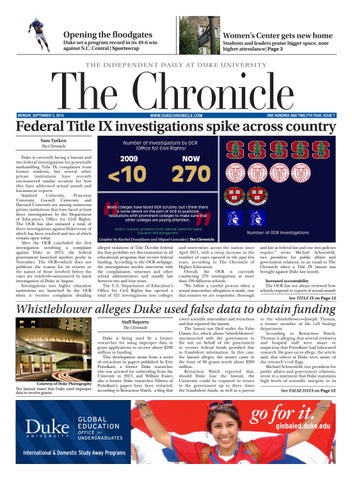
Federal Title IX investigations spike across country Sam Turken The Chronicle Duke is currently facing a lawsuit and two federal investigations for potentially mishandling Title IX complaints from former students, but several other private institutions have recently encountered similar scrutiny for how they have addressed sexual assault and harassment reports. Stanford University, Princeton University, Cornell University and Harvard University are among numerous private institutions that have faced at least three investigations by the Department of Education’s Office for Civil Rights. The OCR has also initiated a total of three investigations against Duke—one of which has been resolved and two of which remain open today. After the OCR concluded the first investigation involving a complaint against Duke in 2013, the federal government launched another probe in November. The OCR—which does not publicize the reason for its reviews or the names of those involved before the cases are resolved—announced its latest investigation of Duke in August. Investigations into higher education institutions are launched by the OCR when it receives complaints detailing
Graphic by Rachel Donaldson and Miguel Gonzalez | The Chronicle
alleged violations of Title IX—the federal law that prohibits sex discrimination in all educational programs that receive federal funding. According to the OCR webpage, the investigations involve interviews with the complainants, witnesses and other school administrators and usually last between two and four years. The U.S. Department of Education’s Office for Civil Rights has opened a total of 321 investigations into colleges
and universities across the nation since April 2011, with a steep increase in the number of cases opened in the past few years, according to The Chronicle of Higher Education. Overall, the OCR is currently conducting 270 investigations at more than 190 different schools. “We follow a careful process when a sexual misconduct allegation is made, one that ensures we are responsive, thorough
and fair as federal law and our own policies require,” wrote Michael Schoenfeld, vice president for public affairs and government relations, in an email to The Chronicle when a Title IX lawsuit was brought against Duke last month. Increased accountability The OCR has not always reviewed how schools respond to reports of sexual assault See TITLE IX on Page 12
Whistleblower alleges Duke used false data to obtain funding Staff Reports The Chronicle
Courtesy of Duke Photography The lawsuit states that Duke used improper data to receive grants.
Duke is being sued by a former researcher for using improper data in grant applications to receive about $200 million in funding. This development stems from a series of retractions in papers published by Erin Potts-Kant, a former Duke researcher who was arrested for embezzling from the University in 2013, and William Foster, also a former Duke researcher. Fifteen of Potts-Kant’s papers have been retracted, according to Retraction Watch, a blog that
covers scientific misconduct and retractions and first reported the lawsuit. The lawsuit was filed under the False Claims Act, which allows “whistleblowers” unconnected with the government to file suit on behalf of the government to recover federal funds provided due to fraudulent information. In this case, the lawsuit alleges, the money came in the form of 60 grants worth about $200 million. Retraction Watch reported that, should Duke lose the lawsuit, the University could be required to return to the government up to three times the fraudulent funds, as well as a payout
to the whistleblower—Joseph Thomas, a former member of the cell biology department. According to Retraction Watch, Thomas is alleging that several reviewers and hospital staff were aware or suspicious that Potts-Kant had fabricated research. He goes on to allege, the article said, that others at Duke were aware of the research’s red flags. Michael Schoenfeld, vice president for public affairs and government relations, wrote in a statement that Duke maintains high levels of scientific integrity in its See FALSE DATA on Page 12
go for it.
globaled.duke.edu
International & Domestic Study Away Programs
The Chronicle
www.dukechronicle.com
2 | MONDAY, SEPTEMBER 5, 2016
Heatwave concert organizers make most of sudden relocation hour, and when we got inside the room was still half empty,” she said. “I don’t The Chronicle know why they were keeping people out, because it was still not full.” Despite the inclement weather, Some decided an indoor venue was organizers said that Friday’s Heatwave not appropriate for an artist like Cash concert went well. Cash. This year’s concert—featuring “I don’t think Page is really a place to electronic dance music group Cash go for an EDM concert,” said junior Adam Cash—had to be moved inside Page Russell. “I’ve been to it before when Auditorium due to forecasts of rain, BØRNS came, and I had to sit up there instead of its planned location on Abele and I wasn’t a fan of that. I just think the Quadrangle. The concert still packed venue isn’t good for the music.” Page Auditorium despite the sudden Soled said DUU was well-prepared relocation, said senior David Soled, for the possibility of inclement weather president of Duke University Union and had Page as a back-up option. He Campus Concerts. added that Cash Cash was obligated by “We hit capacity in Page,” Soled contract to perform on campus, rain said. “We had around 1200 or 1300 or shine. Using Page as a concert venue is not new at Duke. In April, organizers of the K-ville p-checks concert also moved their event indoors due to anticipated rain. The performers were one reason Dryfoos decided to attend, despite being disappointed about the move indoors. Although Soled acknowledged that an indoor EDM concert was not ideal, he said “it went as well it could go” because the organizers “can’t change the weather.” “There’s a lot more congregation going on [outside] whereas in Page, people have to follow the logistics of fire safety and making sure the theater stays in one piece,” he noted. “People can’t congregate in front of the stage. They can’t really jump around as much. People can’t have food or drinks. It’s a different environment completely, but Henry Yu | The Chronicle given everything that went down, it was The annual Heatwave concert, which featured electronic dance music group Cash Cash, was still a super success.” Kanter and Dryfoos agreed, saying held inside Page Auditorium this year.
Neelesh Moorthy
people there. That was terrific. People showed up even despite heavy rain. It was one of the most well-attended Page performances.” Sophomores Nathaniel Brooke and and Ilona Stanback said they decided not to join the concert because there was a long line outside the auditorium. Sophomore Delaney Dryfoos, who attended the concert, said it was relatively empty at first but filled up as people came in late. On the other hand, junior Katie Kanter, who attended the concert, disagreed. She said the room was only half-filled for the entire duration and that there was little reason to keep people outside. “They kept us outside for half an
Henry Yu | The Chronicle Some students noted that Page Auditorium is not a good location to host campus concerts.
DUU did the best it could given the circumstances. “I really enjoyed it,” Dryfoos said. “I really think they made the best of the situation. They hooked up all the lights and they hooked up the smoke machines for Cash Cash and it was really fun.” In previous years, the concert has been held in the Blue Zone. Last year, for example, alternative rock band X Ambassadors performed. In 2014, the concert was held at the Keohane Amphitheater, and before that, it has been held on the Main Quadrangle. Likhitha Butchireddygari contributed reporting.
sign up. Be the first to know about new arrivals, special collections, the latest in technology, sales events, textbook buyback and more. For more information, visit our website at www.dukestores.duke.edu and click on the BTFTK icon on the left.
SA ND ER S DR . CRYS TA L R. 05 20 OF S AS CL
Our Privacy Policy: We respect your right to personal privacy. We promise to use this subscription service for the express purpose of keeping you informed of only those services that you have requested. Your personal information will not be disclosed to any third parties. We hope you will find our e-mails of benefit. We promise to keep them informative and to-the-point. You will have the option of unsubscribing from this service with each e-mail campaign.
OPERATION: Stores Administration PUBLICATION: Chronicle
History Professor Write your own story. Be a Baldwin Scholar.
APPLY ON-LINE BY FRIDAY, OCTOBER 7: BALDWINSCHOLARS.DUKE.EDU
The Chronicle
www.dukechronicle.com
MONDAY, SEPTEMBER 5, 2016 | 3
Women’s Center adjusts to new East Campus space Claire Ballentine The Chronicle Despite criticism of an administrative decision to move the Women’s Center to East Campus, students and faculty said they are making the best of the new space. The center—which was previously located next to the West Campus bus stop—relocated to the Crowell Building on East Campus this year. The center’s former location is now the new home of the Center for Leadership, Development and Social Action. “The new Women’s Center location is absolutely beautiful,” wrote Stephanie Helms Pickett, director of the Women’s Center, in an email. “It is a warm and welcoming environment with vibrant colors and dynamic space for us to extend programming and services in the stellar
Chronicle File Photo Some have argued that the center’s location on West was easier to access than its new space on East.
capacity that we’ve always strived to.” When plans for the move were announced, many students were frustrated with the decision, often arguing that the center’s new location would be more difficult to access. Some also questioned how the relocation would affect sexual assault victims. The Crowell Building contains the Office of Student Conduct, where hearings regarding sexual assault take place. However, Pickett noted attendance has actually improved compared to the start of last year. At the open house last week, she wrote, the center welcomed over 100 people—a new record. The center has attracted attention by spreading word of the new location through its website, social media, flyers and newsletters, she explained. Tricia Ingram, a graduate student working in the Women’s Center, said a major advantage of the move is the larger space in Crowell—filled with comfortable chairs making for a nice gathering space. She added that there is also a classroom space to hold “Prevent. Act. Challenge. Teach” training, which aims to prevent gender violence on campus. “It’s a fun place to come home to everyday,” Ingram said. Although the new location can initially be hard to find at first, Ingram said the center is now much more accessible for freshmen. This is especially important because freshmen typically experience the highest rate of sexual assault out of college students within the first few weeks of school starting, she said. The Women’s Center will also have several new resources such as a meeting space on the second floor of the Bryan Center and a new staff member in
TOLSTOY AND DOSTOEVSKY:
Russian 89S
Carol Apollonio (flath@duke.edu) Class Meetings: MW 1:25-2:40 Two of the world’s greatest writers lived at the same time and in the same place, wrote in the same language, admired and grappled with each other’s works, even on one occasion were in the same room together, but they never met. In our semester this fall, Leo Tolstoy and Fyodor Dostoevsky meet at last. We read selected works by the writers, taking up the “big questions” that they grappled with, and testing the relevance of their struggle in the twenty-first century. Students will engage with the readings in a multitude of ways, through scholarly analysis, imitation, or creative work. If English is not your native language, we can discuss ways of reading in different translations.
The Chronicle File Photo The Women’s Center is now located in Crowell Building on East Campus but will also have a meeting room in the Bryan Center.
the Gender Violence Prevention and Intervention office. Malena Price, a graduate student in the global health department, said the new space is comfortable and that she hopes freshmen can start and continue a relationship with the center throughout their Duke career. Sophomore Grace Cai, however, raised concerns about the center’s proximity to the Office of Student Conduct. She said she did not agree with the reasons given for the center’s move. “In general, I don’t agree with why it was moved. The proximity to the Student Conduct office can be problematic,” she said. “It’s definitely more annoying, but it doesn’t take away the fact that it’s still an important place to visit, so I still am planning on going.” Although the Women’s Center is technically in the Crowell Building, Ingram explained that it has its own
entrance distinct from that of the Office of Student Conduct. “For people who are concerned that it might be a trigger, I don’t see that,” she said. Pickett wrote that the Women’s Center is not included in the new Student Health and Wellness Center—which is expected to be built by January 2017 on the intersection of Union Drive and Towerview Road—because it is a unit within Campus Life. Only offices that are under the umbrella of the Dean of Students will be located in the new Student Health and Wellness Center. Ingram said that everyone who has visited the new Women’s Center has had positive things to say about the new space. “It’s still the same smiling faces that you know and still the same resources,” she said. Likhitha Butchireddygari contributed reporting.
4 | MONDAY, SEPTEMBER 5, 2016
www.dukechronicle.com
The Chronicle
Law professor dissects white-collar crime in new book Likhitha Butchireddygari The Chronicle Sam Buell, Bernard M. Fishman professor of law, recently published a book entitled “Capital Offenses: Business, Crime and Punishment in America’s Corporate Age,” in which he explores the nuances of prosecuting corporate crime. The Chronicle’s Likhitha Butchireddygari spoke with Buell about the ideas he presents in his work. The Chronicle: What is the main argument of your book? Sam Buell: The main point of the book is that white-collar crime is not necessarily a black and white affair. It is complex and subtle and sometimes difficult to tell the difference between right and wrong. The reason that is because we as a society are fundamentally ambivalent about capitalism. We celebrate risk. We encourage it. We like aggressive economic behavior because it generates wealth. But, then we regret it and resent it when it produces harm.
Q & A
TC: Where is the injustice in the prosecution of white collar crime? SB: It’s important to understand that our criminal justice system— as we all well know these days—is flawed. There isn’t any reason to think that those flaws are somehow absent in the
prosecution of corporate crime. The flaws can run in both directions. It’s the system that can be overly punitive and insufficiently effective, and that’s true with respect to all kinds of crime. The system is run by people. People are imperfect, and they make mistakes. We need to have better systems for regulating people and getting them to do their jobs better, whether that’s the police or prosecutors when dealing with street crime or corporate crime. I don’t believe that there is any reason to think that systematically, the errors in the area of white collar-crime are skewed heavily in one direction or another, relative to the errors that get made in the system regarding street crime.
of business at the same time. Some of this SB: Well, it’s interesting because has to do with this problem of corporate some of the same people who are scale that I’m talking about. very upset about corporate crime and feel that corporations are not treated TC: Why aren’t more people jailed for harshly enough by the legal system also white collar crimes? don’t like the fact that the Supreme SB: Well, we actually have more Court has decided that corporations people being prosecuted for corporate can be treated as individuals for the crime than most people think. There’s purpose of certain constitutional rights. actually quite a few prosecutions going My point would be that you can’t really on, and there are long sentences being have it both ways. Are they physically given out. It’s certainly a misconception actually persons? No, of course not. To that there is a softness on white-collar me, that is silly discussion. The question is whether they can be crime. If anything, our criminal justice system has gotten harsher in the area of treated legally as persons for the purpose white-collar crimes. It’s gotten harsher in of, for example, criminal prosecution. a lot of areas over the last 20 or 30 years. More things are criminal. The sentences See WHITE-COLLAR on Page 12 are longer. That said, I think that there’s a perception that that’s not the case because people tend to focus on the few, most high-profile cases of wrongdoing that involve the largest corporations, so the banks in the financial crisis for example. But, the larger the corporation and the more the problem seems to be a problem of management responsibility for the wrongdoing or for failing to present the wrongdoing, the harder it is to prosecute that because in our criminal justice system, we require individual guilt for prosecution, and it can be very difficult to establish that management of a very large corporation had the necessary involvement and awareness of the wrongdoing at lower levels for them to be able to be prosecuted. That’s certainly the case with the banks in the financial crisis. Special to The Chronicle
TC: Corporate crime, unlike street crime, has the ability to impact hundreds of thousands, even millions of people and can be responsible for mass harm. Should that be accounted for in the way that corporate crime is prosecuted? SB: Well, yes and I think that it is because we have corporations as the subject of criminal prosecution. We don’t have an equivalent institutional level that we can direct the legal system at when it comes to street crime. There are obviously huge institutional questions associated with street crime that need to be addressed at the level of reform. But there’s nobody to prosecute to get at street crime. There’s not a bigger institution to prosecute. We can do that with corporate crime. The problem we have is that there’s a limit to how severe we can be on these corporations because we are dependent Sam Buell discusses the difficulties of on them. So, most of the time we don’t TC: Are corporations people? Should prosecuting white-collar crime in his new want to prosecute them and put them out they be treated as such? book.
Newly-renovated West Union holds “first big welcome”
Ashley Han, Kevin Zhang, Cameron Beach, Chloe McGlynn, Jackie Park, Harsh Sanghi, Annie Yang | The Chronicle
The Chronicle
the chronicle
www.dukechronicle.com
XXXDAY, MONTH XX, 2016 | 5
september 5, 2016
IAN JAFFE/THE CHRONICLE
sportswrap
DAMN, DANIEL FIELD HOCKEY: STAYS PERFECT WITH 2 TOP-20 WINS • MEN’S SOCCER: UPSETS NO. 9 UCLA
6 | MONDAY, XXXDAY, MONTH SEPTEMBER XX, 2016 5, 2016
FOOTBALL
The Chronicle
www.dukechronicle.com
OPENING THE FLOODGATES
Duke sets program record for most points in a half in season opener Ben Feder The Chronicle On the Blue Devils’ second play from scrimmage, running back Jela Duncan ran to his left, cut upfield then eluded two N.C. Central defenders on his way to a 50-yard touchdown run. That was seemingly the only resistance the Duke offense faced in the first half. The Blue Devils broke a 67-yearold record for most points in a half by pouring on 49 en route to a seasonopening 49-6 win against the Eagles Saturday evening at Wallace Wade Stadium. After Duke racked up more than 400 yards of offense in the first two quarters, its reserves played most of the second half with the outcome already decided. “Offensively, we were amazingly efficient early on. [Starting quarterback] Daniel Jones showed poise and put in some good plays,” Blue Devil head coach David Cutcliffe said. “Jela Duncan did what we thought he was going to do.” Jones looked decisive in his first start, finishing 10-of-15 for 189 yards and two touchdowns through the air in about two quarters of work. Backup Parker Boehme came in late in the second quarter and tacked on a touchdown pass before Jones returned for Duke’s first possession of the second half. Jones made his first mark on the game early when faced with 3rd-and-15 from N.C. Central’s 28-yard line. The redshirt freshman found tight end Daniel Helm up the seam for 25 yards, putting the Blue Devils (1-0) in position to add to their 7-0 lead. The Charlotte native impressed on third downs throughout the contest, converting 4-of-6 attempts. Three of the conversions went for at least nine yards, and Jones had a hand in nine plays that went for 10 yards or more in his first start. “[Jones] was comfortable. He knew what he was doing,” Cutcliffe said. “There’s a lot of things that he can do well.”
Khloe Kim | The Chronicle Redshirt freshman quarterback Daniel Jones accounted for more than 200 yards and three touchdowns in the first half Saturday.
Both Boehme and Jones also had two of the Blue Devils’ four rushing touchdowns, with Duncan punching in the other two for Duke’s first two scores of the season. The redshirt senior captain finished with 115 yards on 15 carries. The two quarterbacks spread the ball out to 11 different receivers, with slot receiver Johnathan Lloyd scampering for a 55-yard touchdown reception to put the Blue Devils up 21-0 late in the opening period—the first career touchdown for both players. Helm and fellow tight ends Erich Schneider and Davis Koppenhaver combined for six catches for 84 yards and two touchdowns, stepping right into the openings left on the roster by Braxton Deaver and David Reeves. But as impressive as the Blue Devil offense was, its defense might have been even better. Duke limited N.C. Central (0-1) to
Khloe Kim | The Chronicle Linebacker Joe Giles-Harris had six tackles in barely one half of play after making his first start Saturday evening.
112 total yards, with redshirt freshman linebacker Joe Giles-Harris leading the way with six tackles in his first start. Veteran defensive tackle A.J. Wolf— the Blue Devils’ only returning starter on the defensive line—had three sacks Saturday, the second-most in team history and more than any Duke player during the entire 2015 season. “The defense was lights out that whole first half, and that was exciting to see,” Jones said. “[The offense] got great field position pretty much all night, and that makes our job a whole lot easier working with a short field.” Cornerbacks Bryon Fields and Breon Borders forced first-half turnovers to set up the efficient Blue Devil offense with good field position, and Duke’s veteran secondary limited Eagle quarterback Malcolm Bell to 74 passing yards. Although the Blue Devils dominated the first half, the team’s sloppiness in
the second half did not sit well with Cutcliffe and his staff. Duke did not score after halftime— though it did get in the red zone late in the fourth quarter before failing to convert on fourth down—and lost five fumbles. Two of the Blue Devil miscues set up N.C. Central’s two second-half field goals, the Eagles’ first points against Duke in three games after getting shut out in 2013 and 2015. The Blue Devils also committed 10 penalties Saturday despite controlling the line of scrimmage on both sides of the ball, a number Duke likely cannot afford next week in its ACC opener against Wake Forest. “We won’t win if we do those things. Too many penalties in an opening game for my pleasure. Too many on the offensive front,” Cutcliffe said. “These are things that we can correct, and we will.”
Ian Jaffe | The Chronicle Redshirt senior A.J. Wolf had three sacks against the Eagles, more than any Blue Devil had in the entire 2015 season.
The Chronicle
www.dukechronicle.com
MONDAY, XXXDAY, SEPTEMBER MONTH XX, 5, 2016 | 7
WOMEN’S SOCCER
Blue Devils shut out Minnesota to close Nike Classic Jack Dolgin The Chronicle On Friday, the Blue Devils dominated No. 8 North Carolina but could not score on any of their 30 shot attempts. Duke took 21 fewer shots Sunday against No. 9 Minnesota—but nine turned out to be enough. Freshman Ella Stevens scored in the 32nd minute to send the No. 7 Blue Devils to a 1-0 victory against the Golden Gophers in the finale of the 0 Duke Nike Classic UNC DUKE 0 Sunday afternoon at Koskinen Stadium, MINN. 0 the team’s first win DUKE 1 against a ranked opponent this season. Minnesota outshot Duke 12-9 and held a 5-2 edge in corner kicks, but the Blue Devil defense preserved the early lead to extend its shutout streak to three games. “You just kind of have to gut games out,” Duke head coach Robbie Church said. “[We’re] a little disappointed obviously with the tie on Friday, so to come back and get this win was huge.” Stevens’ goal came after sophomore Chelsea Burns threw the ball in to senior Christina Gibbons near the left sideline, where the co-captain recorded her two assists against Coastal Carolina Aug. 28. Gibbons then sent a cross to the near post, which Stevens deflected into the bottom left corner of the net. “Going down the wing has been so dangerous,” Stevens said. “It’s hard, it spreads them out, and we’re able to get in and finish any balls that they give us.... We
just kept saying it was going to come. The goals will come, and they did.” The first half was a back-and-forth affair, with Duke (4-1-1) outshooting the Golden Gophers 8-5 but with Minnesota (5-1-0) taking four corners to the Blue Devils’ two. Minnesota’s best chance came in the 11th minute, when Molly Fiedler got an open look at the top of the box and fired a low shot at Duke goalkeeper E.J. Proctor. But the Blue Devil junior fully extended, diving to her left to make the save. Proctor has not allowed a goal in her last 331 minutes of game action. “I knew E.J. had to make one great save,” Church said. “When’s she’s in a rhythm and everyone starts to feel better behind us, we start to say, ‘Okay, if we make a mistake, then she’s going to be back there to clean things up.’” After playing 110 minutes against the Tar Heels, Church tapped into his bench with 17 substitutions throughout the match. Stevens—who scored the third goal of her career—was not even a starter in the game and entered in the 24th minute with Duke coming out in a 4-2-3-1 formation. Despite the frequent substitutions, the Blue Devils struggled to generate more scoring opportunities after Stevens’ tally. Duke was caught offsides five times, and its lone forward at the top of the formation, Kayla McCoy, struggled to generate offensive chances with several defenders marking her. At times, even when McCoy got the ball, the sophomore did not have midfield support. “We mismatch lineups, we put people in some places they haven’t been all year,
Peishu Li | The Chronicle Senior co-captain Christina Gibbons found freshman Ella Stevens with a cross sent from the left sideline to put Duke ahead in the 32nd minute.
actually hadn’t trained all year,” Church said. “We put Mia [Gyau] as a wide player on midfield…. [we put] Ella in the middle of the field because she’s so tricky around the goal.” Minnesota sent more players forward in the last 10 minutes of the game, threatening the Blue Devils the same way they controlled stretches against recent opponents. The Golden Gophers outshot Duke 7-1 in the second half but were often forced to fire from long range. The Blue Devils will attempt to keep
their home shutout streak going Friday evening against No. 4 West Virginia before taking on High Point Sunday. Six games into the season, Duke has most of its key players healthy, though junior defender Schuyler DeBree missed the second half against Minnesota with a quad injury. Luckily for the Blue Devils, they can go 19 deep if necessary, as they did Sunday. “Our team has so many players that can come in off the bench and give us the fresh legs we need—the level doesn’t drop,” Stevens said.
FIELD HOCKEY
Chillano game-winner, clutch saves keep Duke perfect Amrith Ramkumar The Chronicle In the Blue Devils’ first two games of the season, Duke’s offense stood out, powering the Blue Devils to two routs by a combined eight-goal margin. Duke only scored four goals total in its two games this weekend, but sophomore goalkeeper Sammi Steele and the Blue Devil defense stepped up to keep the team perfect. No. 4 Duke knocked off No. 16 Northwestern 3-2 in overtime Sunday afternoon at the Spooky Nook Sports Complex 0 in Lancaster, Pa., UMD DUKE 1 after besting No. 6 Maryland 1-0 Friday. 2 Junior defender Alyssa NW DUKE 3 Chillano and Steele were the stars for the Blue Devils, with Chillano notching the gamewinner against the Wildcats for her second goal Sunday and Steele combining for 16 saves across the two games. The two Big Ten teams threatened much more often than William and Mary and Liberty did in Duke’s first two games—Steele only had four saves in her first two starts—but the Blue Devils were up for the challenge.
Ian Jaffe | The Chronicle Junior Alyssa Chillano scored two goals Sunday, including the overtime game-winner, to give the defender four tallies this season—tied for most on the team.
“The Big Ten is obviously a great conference with strong teams, and we faced two of them this week,” Duke head coach Pam Bustin told GoDuke.com. “They weren’t easy—they were battles—and hopefully all teams get better from it.” Northwestern (2-2) capitalized on a string of early penalty corners in the
game’s third minute to take a 1-0 lead but struggled to find the net again until the end of regulation. During that time, the Blue Devils (4-0) took control, with the versatile Chillano moving forward to notch her third tally of the season in the 11th minute and senior forward Heather Morris giving Duke the lead 21 minutes later after
tracking down a loose ball. The Blue Devils continued peppering Wildcat goalkeeper Lindsay von der Luft— who had a career-high 13 saves Sunday— with shots in the second half, but could not extend their lead despite a 22-14 advantage in shots for the game. Duke’s inability to add a third goal proved costly with 80 seconds left in regulation. Northwestern moved forward after von der Luft denied Blue Devil freshman Margaux Paolino and graduate student Aisling Naughton. After the Wildcats went a player up when they pulled von der Luft, Saar de Breij found an opening in the defense and took advantage, beating Steele to send the contest to overtime. “Northwestern did a great job with the extra man strategy. We had addressed it earlier in the week and just had a little miscommunication,” Bustin said. “Sometimes that’s all it takes. I appreciate the experience that will get us to go back and try to shore up our defense for that. We know what to do— we’ve just got to make sure we make it happen on the field.” Although the Wildcats entered See FIELD HOCKEY on Page 9
8 | MONDAY, XXXDAY, MONTH SEPTEMBER XX, 2016 5, 2016
www.dukechronicle.com
The Chronicle
MEN’S SOCCER
Late Brian White strike carries Duke to road upset Mitchell Gladstone The Chronicle As the Blue Devils and Bruins neared the penultimate minute of Friday evening’s contest, it appeared the game was headed for overtime. But a game that included a missed penalty kick, clutch saves from both goalkeepers and stout defending by both sides took an unexpected turn. A back-heel pass from freshman Suniel Veerakone found the right foot of Brian White nearly 30 yards out. The junior midfielder then fired a shot to stun one of the sport’s dominant college programs. With just more than two minutes remaining, a strike from White clanked off the left post and in, sending Duke past No. 9 UCLA 1-0 at DUKE 1 Drake Stadium in UCLA 0 Los Angeles. The long-range shot was one of 14 combined shots on goal between the teams, but arguably the least likely to find the back of the net. Fortunately for the Blue Devils, it did just that. “Brian [White] got a second wind because he was struggling late in the second half,” Duke head coach John Kerr told GoDuke.com. “He grew in stature tonight by playing defense when we needed it, being strong, and he popped into that hole, found some space and just whacked it.”
Khloe Kim | The Chronicle Junior Brian White fired a shot off the left post to send the Blue Devils to their first win against a ranked team this season.
Despite a quick pace, neither team could get much going in the first half. The Bruins utilized their speed with midfielder Jackson Yueill and forward Seyi Adekoya threatening in the final third. But the Blue Devil defense kept UCLA (1-1-1) at bay with steady defense anchored by junior Markus Fjortoft and freshman CC Uche. Once again, Duke (2-0-1) received a huge boost on the back line from graduate student goalkeeper Robert Moewes, who tallied his first clean sheet of the season. The Dortmund, Germany, native made eight saves and
has surrendered just two goals in his first three contests as a Blue Devil. “[Robert] made so many big saves that kept us in the game at times,” Kerr said. “It built our confidence because it felt like he wasn’t going to let any goals past him.” After a few mistakes by the Bruins in the first half gave Duke opportunities to jump out to an early lead, the Blue Devils put Moewes to the fire less than five minutes into the second half when an Uche foul just inside the 18-yard box sent UCLA’s Brian Iloski to the penalty spot. But Iloski could not make the most of his
team’s best chance Friday as the shot on the ground missed wide right of goal. Even if it had been on frame, it appeared as if Moewes was in position to make the save. From that point on, it was a 40-minute sprint to the finish. And as the Bruins continued to bring the pressure, Duke met the challenge. Even with plenty of weapons on the offensive side of the ball, UCLA struggled to score through its first two games. And though they attacked with frequency, it was much of the same in their third matchup of the regular season. Yueill had three shots and forwards Jason Romero and Blayne Martinez, as well as midfielders Matthew Powell and Jose Hernandez, each registered a pair of shots—but the numerous attempts between them failed to get past Moewes every time. Ultimately, the visitors made the most of the counterattack when they notched the game’s only tally. Although Kerr used a shorter bench than in the Blue Devils’ first two games, all four reserves played vital minutes. Freshman forward Colby Agu entered after an injury sent Bryson Asher to the sidelines just nine minutes into the game. Senior forward Jared Golestani also made his mark on the contest when he nearly capitalized on his lone shot in just 11 minutes of play. “The bench was a really big plus for See M. SOCCER on Page 9
VOLLEYBALL
Blue Devils blow match point, 2-set lead Hank Tucker The Chronicle The Blue Devils were inches away from a sweep of TCU when they had a match point in the third set Friday night, with a kill attempt from Horned Frogs hitter Sarita Mikals sneaking just inside the baseline. Duke had victory in its sights again numerous times in a marathon fourth set, and yet again when it took an 11-9 lead in the deciding fifth set. But after two hours and 44 minutes of play at Cameron Indoor Stadium, it was TCU celebrating on 3 the court with a 21TCU DUKE 2 25, 23-25, 26-24, 2927, 15-13 comeback victory, handing the Blue Devils their second loss in two days. “It’s important that our team realizes that we should have—could have—had that,” Duke head coach Jolene Nagel said. “They should feel really sick about it tonight because it was there for them to take. We hurt ourselves with some unforced errors tonight.” With a commanding two-set lead, the Blue Devils (3-2) appeared to seize control of the third set and the match when a 10-3 run put them ahead of the Horned Frogs 16-11. But TCU quickly erased the deficit with five straight points, as sophomore Anna Walsh converted four straight kills and senior Jillian Bergeson added a kill to even the set at 16. The two teams traded points until Duke
earned a match point at 24-23, but Mikals delivered the most important of her teamleading 16 kills to keep the Horned Frogs (4-0) alive. Another two kills for TCU sent the match to a fourth set. “We’ve got to finish when we have an opportunity,” Nagel said. “We could have made our lives a lot easier by just buckling down in that third set. This team has to learn from that.” The Blue Devils trailed for most of the fourth chapter of the marathon, but a kill by sophomore Leah Meyer punctuated a quick 3-0 run to give Duke its first lead at 21-20. Meyer had 15 kills and hit .353 to lead the team in the losing effort and junior Anna Kropf, senior captain Jordan Tucker and freshman Jamie Stivers all finished with at least 14 kills. But none of the Blue Devil playmakers could deliver in crunch time to finish the match. After hitting better than .300 as a team in the first two sets, Duke hit worse than .200 in each of the last three sets. “They’re a very physical team, and it was really tough to pick and find spots to hit,” Meyer said. “We just need to challenge ourselves to keep staying aggressive, keep swinging at the ball.” After TCU regained control of the fourth set with three straight points of its own, Duke saved two set points with a kill by Kropf and an emphatic block by Tucker and freshman Natalie Schilling to level the score at 24. The Horned Frogs and Blue Devils continued to trade kills to knot the set at 25, 26 and 27, including several tense rallies that
Peishu Li | The Chronicle Freshman Jamie Stivers was one of four Blue Devils with at least 14 kills Friday, but Duke could not finish the job against the Horned Frogs.
gave both squads a chance to taste victory. Each team finished the match with more than 100 digs, a mark Duke had not reached since Oct. 23, 2015. But when TCU had its sixth set point at 28-27, junior Kaylee Smith’s serve landed untouched in the middle of the court as the six Blue Devils on the floor all looked at each other, looking for somebody else to make a play on the ball. Nobody did, and the Horned Frogs finished the fifth set on a 6-2 run, with five of their final six points coming on attack errors or service errors by the Blue Devils. The end
of the match mishaps were a microcosm of a night in which Duke committed 25 attack errors, 15 service errors and two ballhanding errors. Much like it did against North Carolina Thursday night, Duke came out strong and controlled the first set against TCU, leading by at least three points during the second half of the frame. “One of the things that we really focus on is coming off and starting off strong, and we did that really well today coming See VOLLEYBALL on Page 9
The Chronicle
www.dukechronicle.com
MONDAY, XXXDAY, SEPTEMBER MONTH XX, 5, 2016 | 9
M. SOCCER from page 8 us,” Kerr said. “The subs that came on did a really good job of playing their roles tonight. I thought that was crucial in the win.” With big-time matchups at No. 11 Boston College and home against No. 21 Wake Forest looming during the next two weeks, Friday’s victory against a top10 team should be a major boost for an improving Duke squad. “It certainly gives us a lot of confidence,” Kerr said. “We have to be aware of not thinking that this is the season-maker and we don’t go on overconfident against Boston College. But certainly, it sets a standard that we can reach and I feel that we’ve only scratched the surface.”
Carolyn Chang | The Chronicle After two assists Sunday afternoon, freshman Margaux Paolino now has six through four games this season.
FIELD HOCKEY from page 7 overtime with momentum, Bustin’s team stayed aggressive, firing four shots before earning a penalty corner in the sixth minute of the extra session. On the ensuing play, Paolino found Chillano for her second goal of the contest to give Duke the win. One of the Blue Devils’ standout newcomers this season, Paolino already has six assists early in her freshman campaign. Friday’s contest against the Terrapins (1-2) was a defensive struggle, with Maryland containing Duke’s offense after struggling to stop No. 2 Syracuse last week. The Blue Devils were outshot 9-5 in the first half and did not score until the game’s 42nd minute, when Alexa Mackintire found junior forward Ashley
VOLLEYBALL from page 8
Kristen, who beat Sarah Holliday for her first score of 2016. Although Duke did not have many other chances to score it did not matter. Steele and the defense were steady for the full 70 minutes, shutting down all 12 Maryland shots and four penalty corners. The shutout was Steele’s second against a top-15 team of her young career. “Sammi was outstanding tonight, just outstanding,” Bustin told GoDuke.com after Friday’s game. “She made some great saves in there. That really gave us the energy we needed to keep the ball going forward.” With three wins against ranked teams already this year, the Blue Devils will face their fourth straight top-20 team in their ACC opener against No. 5 Virginia Friday at 6 p.m. at Jack Katz Stadium.
out that first set firing,” Meyer said. “That’s something we need to continue to do throughout all five sets.” In a much closer second set, neither team ever led by more than three. With the Blue Devils clinging to a 24-23 advantage, Stivers received a perfect set from classmate Cindy Marina and spiked the ball off the Horned Frogs’ block and out of bounds to stake Duke to a two-set lead. It turned out to be the type of execution under pressure that Nagel’s squad sorely missed during the last three sets. The Blue Devils will hope to bounce back from the disappointing two-game stretch Khloe | The ChronicleSales The New YorkKim Times Syndication Corporation thousands of miles away with three matches Senior Jared Golestani one ofNew several 620 Eighthwas Avenue, York, N.Y. 10018 next weekend at the LBSU/CSUF Baden substitutes who helped preserve Duke’s 1-0 For Information Call: 1-800-972-3550 Invitational lead Friday evening. For For Release Release Saturday, Monday, September September 5, 3, 2016 2016 in Long Beach, Calif.
CLASSIFIEDS TUTORING
HELP WANTED
GRE PREP SEPTEMBER 11TH OR OCTOBER 3RD
WANT TO HELP LAUNCH A NEW COMPANY?
PrepSuccess has helped thousands of students prepare for the GRE� We partner with programs from UNC, Duke, Campbell, and FSU� The Early Bird rate for our 42 hour course is $504 ($12/hour)� Attend on weekends, weeknights, or via Live Online� To learn more visit www�PrepSuccess� com or call 919�791�0810�
Want business experience? Want to know the behind the scenes of launching a new company? Want free donuts and unlimited energy drinks? Marketing / Business Development / Customer Service rock star needed to help launch new Durham based startup� Part time position (minimum of 20 hrs� per week)� Start September 15th� $15 per hour� Submit resume and cover letter to careers@bullcitylearning�com� Email nathan@bullcitylearning�com
To place a classified ad, go to www.Dukechronicle.com/classifieds
The Chronicle Our least favorite stories: theneeldeal specials: ������������������������������������������������������������������������������������� clairity Concert wraps:���������������������������������������������������������������������������������������theneeldeal DSG:����������������������������������������������������������������������������������������������������������������� bigxie Poorly worded columns: ��������������������������������������������������������������������������merryman Too many quotes: ����������������������������������������������������������������#amrithisnotimpressed TBD: ������������������������������������������������������������������������������������������������������������ jaffetaffy Food truck features: ����������������������������������������������������������������������������beyerbeware Student Advertising Manager: ������������������������������������������������������������� John Abram Student Marketing Manager: ����������������������������������������������������� Beatriz Gorostiaga Account Representatives: ������������������������������ Megan Bowen, Griffin Carter, TJ Cole, Paul Dickinson, Davis English, Philip Foo, Jack Forlines, Shiv Gidumal, Francis L’Esperance, Leeshy Lichtman, Rachel Louie, Gabriela Martinez-Moure, Jack McGovern, Jake Melnick, David Myer, Lauren Pederson, Levi Rhoades Maimuna Yussuf, Matt Zychowski Creative Services: �������������������������������������������������������������������������������Myla Swallow Marketing ������������������������������������������������������� Hunter Bracale, Nicoleete Sorensen
Crossword ACROSS 1 Guacamole, 1 Ridiculous e.g. 4 imitation Trudge 8 on 8 Playful Basis ofanimal a patent a stream bank 15 Traffic report 13 Dangers for drug source, addicts, often for short 14 ___ a.k.a. 16 Gordie Something John Mr. Hockey Adams and John Quincy Adams 15 Very rich … or each drunkhad 17 17 Barbies, Change, e.g. as allegiances 19 Game piece with pips 18 “Mean Girls” 20 screenwriter Most hip 22 Wyoming’s Grand 19 Close to, ___ mountain colloquially 23 Dull hurt 20 Sell as a plane 25 Land, 27 Means Prefix with 21 of classical communication since 1817, in 28 IV units brief 30 Kanye West’s genre receptions 22 Some 31 Genetic carrier 24 Wonder 32 “It’s not just 27 Surgeon’s me?” tool
34 The 29 Charles “A” in who James A. Garfield created murals 36 for Big Harlem band Hospital and trombonist the American 39 Conical home for Museum of a Plains Indian 40 Natural Canada’sHistory capital 32 of many a 43 Start ___-cone romantic comedy 46 Business card info: Abbr. 34 1922 Kafka short 47 story Chowed down 48 of a black35 Driver Hematologist’s and-white measure car 49 The highest price 36 Pioneer in New 52 Word after pork Journalism in the or karate 1960s-’70s 53 Rose oil 37 Author who 54 Removed without shares his name much effort with a German 57 state Newsman Holt 59 Planner’s aid 38 Fire … oraway what 17-, 36- and 39 25-, Pet name 49-Across are? meaning 62 What’s new, with “faithful” “the” 40 Moore 63 Michael “Immediately!” offering, for short 64 “I mean … this 43 Sea instant!” ___
ANSWER TO PREVIOUS PUZZLE F M AI T R SI A B A S K P ST A I B A BI S A
O N M E P N E S R C E A N L T A S N SI GI H M
G C R A Y W M L A T C T H E A R L K K U O P LT A O
S K AI C L KI O S C H S U ET E B R LI O P C E
E D HI TI T LI T A N E N S O L C O R O A K B
S R PI A G D H ET A H N A G N L G E D O H G E R A
C Y O B N S E C M O C G E EI T A F TI SI N T G S
Peishu Li | The Chronicle Sophomore Leah Meyer led the Blue Devils with 15 kills and a .353 hitting percentage in Friday’s loss.
A O L P C A H P U E R C T H YI N C E O
T N H O ET B E E S E G M E A E C S E D Q A E TI D A
E N MI A D R S A H E E R S O S P O U L L C L A S N
A W M E O N U D N TL E T T U O S R AI C L B A
TI O T M A B L H S A T HI N D E E C M LI AL W L
A D X E EF LE A A T NI G S LT O P D H O O P N E E Y
LE RI N E E W OI N T E R S O E U C S T S
L A E M TY S E R N A G V E S C S R K E SI T
65 Part 47 Linzerof___ a hit 1940s-’50s film (pastry) trio 66 Artist 50 Has dreams and Lichtenstein others 52 Completely surpass paint 67 Day-___ 53 It doesn’t have much to say DOWN 54 Armful for 1 “i” completer Moses 2 Words 55 Slide exchanged at a presentations? wedding 56 Hedge fund 3 Intimidate, employee as before a game 4 “Away, fly!” DOWN 5 Laze 1 Santa ___ 6 Baby nocturnal 2 birds They might be ill 3 Featurebase of CNN 7 Artist’s or Fox News 8 Aged 4 Hindu goddess 9 often Aim orportrayed Crest her husband 10 with Domesticated Shiva 11 Masthead title 5 Work on a lead, 12 maybe Fame 16 Woman’s name 6 Part of a square that means 7 That therein “woman” Italian 8F and G, but not 18 H Mother of a fawn 9 Wife in Jonathan 21 Certain jet Franzen’s engine “The Corrections” 23 Whatever 10 Meander 24 No. 1 in a 11 It adds stress: company Abbr. 26 Stick : 12 “Glass half punishment :: empty” sort ___ : enticement 13 Emily Dickinson’s 28 Stop moving “Ended, ___ it 29 begun” Make mandatory 33 Writer 14 Little one Sedaris
Edited by Will Shortz 1
2
3
4
13 15
20
24
22 27
32
32 34
36
44
45
28
8
8 9
16
15
18
19
21
25 23
29
30
33
49 38
34
43
10 11
45
51
62 53 65
46
58
14
29
24 30
31
25
26
41
42
41
42
60
61
31
35
33
38
37 39
12 13
22
40 46
44
11 12
16
37
50
53
9 10
26
39
35
55
7
18
27
57 50
6 7
20
19
43 36
5 6
14
17
23 21
4 5
0730 No. 0801
47
48
51
52
54
55 47
56 48
40
49
59
52
63
54
64
66
56
67
PUZZLE BY LILY KURTSILVERSTEIN MENGEL AND JAN-MICHELE GIANETTE
34 Like 20 Ending motel withwalls, it often or seems orange lemon 23 Host 35 Big Apple 25 Refuses to opera lover’s 26 Grade sch. class destination, with 27 “the” Ladder’s counterpart 37 28 Shouts Track things 29 America’s Sprayer Cup 38 30 “___ sportpray” 31 Author of the 41 Try to win, as for “Mostly Ghostly” romance book series
42 Attribute 32 Pokémonas Go, the cause e.g. of 33 43 Sprayed, Conk out,inasa an way engine 34 Start of a Hamlet 44 Skip dinner, say monologue 45 Decides one will 35 Child support, for short? 47 Melodic 39 50 Sparring One doing partners? carbon 14 40 Dull-witted testing 41 Where Boots 2-Downs 51 are exchanged 42 Peak
52 Ready 44 ___-de-sac 45 Zodiac symbol 55 Attack time in W.W.sitting II 46 One on a celestial throne 56 “My bad!” 48 Goya’s “Duchess of ___” 58 Numbered rd. 49 Grind down 60 Note between fa 50 Legal and laorg. 51 Kind of card 61 Requirement for 52 Itinerary a tang abbr.
Online subscriptions: Today’s puzzle and more than 7,000 past puzzles, nytimes.com/crosswords ($39.95 a year). Read about and comment on each puzzle: nytimes.com/wordplay. Crosswords for young solvers: nytimes.com/studentcrosswords.
www.dukechronicle.com commentary
“
T H E I N D E P E N D E N T D A I LY AT D U K E U N I V E R S I T Y
The Chronicle
10 | MONDAY, XXXDAY, MONTH SEPTEMBER XX, 2016 5, 2016
Progressing with unions
O
n August 23, just as graduate students around the country were preparing to return to campus, the NLRB (National Labor Relations Board) issued a ruling with the potential to greatly improve workplace quality for a great many of them. In a 3-1 decision, the NLRB determined that graduate students at private universities, like Duke, are workers who have the right to form unions and collectively bargain. Their decision comes after a decades long struggle for the proper recognition of graduate student research and teaching work at private universities. As the campaign for graduate student unionization at Duke moves forward, undergraduate students may be asking themselves ‘what does this mean for me?’ In today’s editorial, we explore the answer to that question and ponder the effects of unionization on graduate students, themselves. Graduate student workers typically spend 6-8 years as employees of the University. During this time, they will take some coursework—typically only in their first two years—but the majority of their time will be spent serving as teaching assistants for undergraduate and graduate courses or as research assistants in laboratory and non-laboratory positions. Graduate students gain valuable experience in performing their employment duties, but they also provide a vital service to the university, without which the teaching and research mission of the university could likely not be fulfilled. Unionization will allow them to ensure that their
onlinecomment “Questionable ethics involved when encouraging non-residents-people who don’t consider the state their home residence, who don’t serve as jurors, who don’t have state issued driver’s licenses, etc.--to vote in state and local elections that will significantly impact full time, taxpaying North Carolina citizens.” — “Fed Up,” responding to “Vote where it matters” by Leah Abrams, published September 2, 2016
LETTERS POLICY
The Chronicle welcomes submissions in the form of letters to the editor or guest columns. Submissions must include the author’s name, signature, department or class, and for purposes of identification, phone number and local address. Letters should not exceed 325 words; contact the editorial department for information regarding guest columns. The Chronicle will not publish anonymous or form letters or letters that are promotional in nature. The Chronicle reserves the right to edit letters and guest columns for length, clarity and style and the right to withhold letters based on the discretion of the editorial page editor.
Est. 1905
work conditions are fair and appropriate. Opponents of graduate student unionization efforts generally make two arguments against unionization. First, they the claim that the development of an employeeemployer relationship between graduate students and their faculty supervisors would damage the mentorship relationship graduate students enjoy; second, they claim that graduate student activity is not work, but is rather part of the learning experience provided by the university. The former argument ignores academic evidence that graduate students represented by unions actually enjoy equivalent
Editorial
or improved student outcomes compared to their nonunionized counterparts and report higher levels of personal and professional support from faculty mentors. The latter glosses over the undeniably large economic value of graduate student work to the university. Graduate student unionization at other universities has led to transparent job expectations and improved benefits. At Duke, we hope that unionization brings clear employment contracts, improved health insurance options recognizing medical concerns (such as pregnancy) not well covered in student plans and clear grievance processes to address real
The Chronicle
Inc. 1993
CLAIRE BALLENTINE, Editor
concerns of workplace sexual harassment/assault and other forms of discrimination/retaliation. Many grad students also hope to see the abolition of ‘continuation fees,’ along with the contractual inclusion of dental insurance, paternity leave and retirement benefits. With better working conditions, graduate student teachers and mentors are likely to have more time to dedicate to undergraduate teaching; as such, the undergraduate experience is likely to also improve. Alternatively, if the university is unable to so cheaply employ graduate students to do jobs better carried out by faculty members, we may witness fewer courses taught by graduate students and possibly improved course quality. Providing appropriate conditions for our graduate student teachers and mentors should take precedent over some of the more ‘luxury’ benefits our tuition dollars pay for, and Duke’s excellent fundraising skills could be employed to cover any additional costs incurred without undergraduate tuition increases. Ultimately allowing graduate student workers to unionize will improve our academic community. We support the right of Duke graduate students to unionize and look forward to benefiting from their gains.
Editor’s Note: This editorial was written by members of staff rather than The Chronicle’s independent editorial board.
What you and Durham have in common T
he pejorative language that has characterized student conversation about Durham for most of Duke’s history has changed--and it has changed in a big way. In recent years, it has become abundantly clear that Duke students’ age-old justifications for making fun of our home town simply do not align with Durham’s reality. Disrespecting Durham no longer makes for a good joke. It never should have, of course, but that isn’t the point. It doesn’t take much googling to discover why the student perception of Durham has changed so dramatically. In recent Direct submissions to: years, a financial windfall and cultural boon have made Durham’s explosive growth and revitalization difficult to overstate. This year, US News & World Report named Durham the 4th-Overall E-mail: chronicleletters@duke.edu Best Place to Live in the United States. Durham is Duke’s most undersold asset, and the reason is that the transformation has Editorial Page Department literally been quicker and more significant than Duke’s public relations savvy knows how to harness. The Chronicle But for students to pick up on Durham’s hype is also to miss Box 90858, the point. For most students, Durham feels distant--like an Durham, NC 27708 adopted town that, even with its new restaurants and downtown buzz, still isn’t quite home. Phone: (919) 684-2663 In spite of our better angels, we students tend to treat Durham Fax: (919) 684-4696 as a stepping stone. But even first-rate stepping stones get second-
”
The Chronicle
talk with strangers during your first week of class. Reading history, much like asking a friend where they’re from, makes our personal narratives sound cohesive--almost deterministic. But Durham’s story certainly wasn’t linear. Redlining in the 1930s decimated Durham’s black neighborhoods--threatening communities that, for generations, were the lifeblood of its bustling streets and the backbone of its cultural heritage. Later, civil rights protests originating in Durham and Greensboro would spark the sit-in movement that swept the American south. Earlier, in 1890, Durham wasn’t even sure that Trinity College, now Duke University, would choose the Bull City as its new home. When you enrolled as an undergraduate, you chose Duke in much the same way that Duke chose Durham; and Duke will alter your life in much the same way it altered the life of its host city. It is difficult to overstate how deeply Duke has affected Durham’s development: it employs 35,000 of its residents and transformed a tobacco town into the City of Medicine. Duke has afforded Durham wealth and stature, and it may do the same to you. But with those resources come immense challenges. Largely driven by the University, Durham is undergoing a massive period of gentrification, driven largely by the University, that has
Tanner Lockhead NOT STRAIGHT TALK
AMRITH RAMKUMAR, Sports Editor ABBY XIE, News Editor SAMANTHA NEAL, Assistant News Editor NEELESH MOORTHY, Managing Editor ADAM BEYER, Digital Content Director HAN KANG, Photography Editor JACKSON PRINCE, Editorial Page Editor SURABHI BERIWAL, Editorial Board Chair ASA ROYAL, Editorial Board Chair
CHRISSY BECK, General Manager FRANCES BEROSET, University News Department Head
JAIME GORDON, University News Department Head
LIKHITHA BUTCHIREDDYGARI, Local & National News Head VIR PATEL, Health & Science News Head IAN JAFFE, Sports Photography Editor CHRISTY KUESEL, Recess Managing Editor SAMEER PAMHARE, Sports Managing Editor ADDISON MERRYMAN, Editorial Page Managing Editor GAUTAM HATHI, Towerview Editor MELANIE PARK, Towerview Photography Editor AMRITH RAMKUMAR, Recruitment Chair HEATHER ZHOU, Senior News Reporter MEGAN HAVEN, Advertising Director MARY WEAVER, Business Manager
KENRICK CAI, Local & National News Head JIM LIU, News Photography Editor DILLON FERNANDO, Recess Editor AUSTIN PEER, Recess Photography Editor SAM TURKEN Sports Managing Editor CAROLYN SUN, Graphic Design Editor RACHEL CHASON, Towerview Editor RACHEL CHASON, Recruitment Chair SARA KERMAN, Senior News Reporter
JULIE MOORE, Creative Director
The Chronicle is published by the Duke Student Publishing Company, Inc., a non-profit corporation independent of Duke University. The opinions expressed in this newspaper are not necessarily those of Duke University, its students, faculty, staff, administration or trustees. Unsigned editorials represent the majority view of the editorial board. Columns, letters and cartoons represent the views of the authors. To reach the Editorial Office at 301 Flowers Building, call 684-2663 or fax 684-4696. To reach the Business Office at 1517 Hull Avenue call 684-3811. To reach the Advertising Office at 2022 Campus Drive call 684-3811.
rate treatment. When we treat our town --however trendy--like a transient part of our lives, we miss out on lessons, experience and perspective that make us better citizens and fuller people by the time we leave Duke. Advertising Durham’s meteoric ascent of the USNWR cities ranking and solidifying its place as Duke’s newest accessory isn’t the type of transformative change that turns newfound student interest into the tug of hometown pride. When we spend time in a place intentionally, we develop a sense that our story overlaps with the story of that place--that our identity is somehow tied up in a location. That’s what makes home feel like home. If you take a look, the story of Durham is probably a lot like your own. We should treat Durham like home not because it literally is, but because you probably have more in common with it than you think. Think about your own history--about the big moments in your life that your orientation-week friends never learned. Durham, too, has a storied history, and it’s one that many students never discover. In 1865, the largest surrender of confederate soldiers --ending the Civil War--occurred a few miles from East Campus. In the late 1880s, Durham was the home of the world’s biggest tobacco empire, and by the 1900s the Bull City was known nationwide as the home of “Black Wall Street.” If cities had feelings, I imagine that Duke students would evoke in Durham a longing--for its history to be known and its heritage to be studied. Walk over to Hayti or Trinity Park on a fall afternoon, and I bet you would find that long-time Durhamites share the same impulse to offer their stories that you felt while making small-
uprooted low-income communities and threatened the cultural makeup that has characterized the city since its infancy. If for no other reason than it is best situated to do so, Duke must take the lead on creating affordable housing, protecting longstanding communities, and preserving the city’s cultural heritage. It must exhibit a reverence for the city’s roots that will secure the preservation of the town whose residents welcomed it long ago. Managing the risks that periods of growth pose to our identities is something that all Duke students can relate to. Duke and its students are gentrifying Durham, but Duke also gentrifies its students. Think critically about how your institution has impacted your person. Ask yourself whether you have been affected by the same allure of wealth and gentility that has characterized Duke’s slowworking effect on its host city. You may have that in common with Durham as well. My relationship with Durham is likely different from yours-Durham has always been my home. I was born in Duke hospital and attended public school a couple miles south of East Campus. But if home really is just a place we identify with through shared experience, then Durham is your home for reasons that extend beyond mere coincidence. Let’s treat Durham with the respect and familiarity of a friend--not merely the intrigue of trendy stranger. Durham has something in common with each of us, and when we realize that, it doesn’t take long for it to begin to feel like home. Tanner Lockhead is a Trinity senior. His column, “not straight talk,” runs on alternate Mondays.
The Chronicle
www.dukechronicle.com commentary
MONDAY, XXXDAY, SEPTEMBER MONTH XX, 5, 2016 | 11
The idolatry of politics So you wanna be an activist
I
n August of last year, nearly no credible pundit would have predicted that Donald Trump would claim the Republican nomination. Yet here we are, in the beginning of September 2016, with the boundaries of a seeming impossibility shattered and in the rear view mirror. We gape in disbelief at a Republican nominee whose lumbering campaign, to quote a conservative radio host in Wisconsin, is a “dumpster fire inside a nuclear meltdown.” The insistence that Trump’s impropriety during the primary was “4th dimensional chess” and that he would mature and pivot to the general election has so far proven to be a gross miscalculation.
“make America great again.” And then there are the reluctant Trump supporters. These people don’t think Trump is a good candidate or a good person, but are compelled by the idea that this election involves a binary choice between the lesser of two evils. “A vote not for Trump,” they insist, “is a vote for Hillary Clinton.” And since a Hillary Clinton presidency would be antithetical to many conservative principles and policies, they reason that they must hold their noses and vote for Trump. They simply can’t stomach the possibility of a Clinton presidency, and feel compelled to do almost everything in their power—
O
n Friday, convicted rapist Brock Turner was released from jail after serving only three months of his six-month sentence. His release was accompanied by scores of articles slamming his white privilege for such a light sentence, a particularly amusing article celebrating the look of disgust on an officer’s face as Turner walked past her, and the sheriff expressing her wish for Turner to remain behind bars. Turner’s case, while receiving enormous media attention, isn’t unique in any particular way from the average college sexual assault other than the fact that he was actually arrested and convicted. The vast majority of cases aren’t even reported; of the ones reported a fraction actually make it to trial, a fraction of those actually result in a criminal conviction, and a fraction of those actually go to prison. Out of 1,000
on the Women’s Center’s website. The Center also has an incredible staff—Director Stephanie Helms Pickett, Sheila Broderick, Krystal George, Bibi Gnagno and Tuania Wright—who are all fundamental to aiding survivors and preventing sexual assault here at Duke. The Women’s Center staff has been instrumental in ensuring that incoming first-year students are trained on Title IX, consent and sexual assault through sessions during orientation. The Duke Administration runs a task force on sexual assault prevention that generally meets monthly to talk about current issues on campus such as the creation of a campus climate survey, how to increase participation in training programs, and potential changes to Duke’s sexual misconduct policy. Dr. Larry Moneta, Vice President for Student Affairs, has devoted significant time and energy
Addison Merryman
Dana Raphael
DEEP MAGIC
PROBLEMATIC PEOPLE DOING PROBLEMATIC THINGS
For those who hold to the JudeoChristian worldview, which includes principles such as the sanctity of human life and the created order while emphasizing the importance of character and integrity, this is truly grieving. The current Republican nominee is neither principled, honest nor morally upright. Nonetheless, the 2016 Election season is fully upon us, and Donald J. Trump is the Republican nominee for President of the United States. How can we make sense of this and the path forward? The truth is that Trump’s supporters do not comprise a homogeneous voting bloc; rather, it appears that they form a conglomerate of three fuzzy factions. On the one hand, there is the “alt-right,” which champions white tribalism and ethno-nationalism. Although proponents within this faction have been active for many years, the “alt-right” movement has escalated in prominence to national attention only in the past several months. For instance, the Wikipedia page composed to document its existence was created in March 2016, while Hillary Clinton has formally addressed the movement only as of the past two weeks. The reason for the alt-right’s support of Trump can be attributed to his racist comments concerning Judge Curiel, his refusal to denounce David Duke and the KKK, his hiring of Steve Bannon of Breitbart.com and an alliance of nativist policy interests. On the other hand, there are the “Trumpkins”—those who have sworn virtually complete allegiance to Donald Trump, his words and his actions. For these, Trump can do almost no wrong, and he must be defended to the ends of the earth. In an article by Ben Shapiro of DailyWire. com, titled “7 Steps To Defending Donald Trump: A Guide”, Shapiro lists the levels to which Trump’s supporters are willing to stoop in order to defend him. If Trump were to hypothetically shoot somebody on 5th Avenue, he probably wouldn’t lose any of these voters. “After all,” the Trumpkins would rationalize, “Trump was probably right to shoot that girl. It was her fault for yelling at him. She was a bad girl anyway. The evil media set Trump up to do this and misconstrued his actions. Or, wait—this was actually somehow a genius move by Trump! The shooting distracted the media from Hillary Clinton’s rally! But if you do criticize Trump, then you’re actually helping Hillary. And hey, at least he’s better than Hillary.” The reality distortion bubble continues on and on. The Trumpkins earnestly believe that a President Trump would act as an executive strongman who will use big government policies to alleviate their victimhood and
even voting for a person whom they acknowledge is an unprecedentedly terrible candidate—to stop her. There is something that binds these three factions together, besides the fact that they will all vote for Donald Trump in November. They have all become, in at least a small sense, leftist. America’s fate, in their eyes, rests in fixing all the problems or at least preventing America’s demise through the means of political power. The alt-right sees the identity politics and tribalism of groups on the left such as The Movement for Black Lives and counters with its own brand of racialized identity politics, which they seek government power to implement. The Trumpkins have embraced Donald J. Trump as their “Orange Godking” or “Cheetoh Messiah,” since in their minds he is the only one who can bring balance to America. And the reluctant Trump supporters are bound by the need for a “lesser evil” in the position of President of the United States. They all, to some degree, depend on political power to be their civil messiah. In his Gettysburg Address, Abraham Lincoln urged his audience to continue fighting so that “this nation, under God, shall have a new birth of freedom—and that government of the people, by the people, for the people, shall not perish from the Earth.” One of the central truths on which Lincoln touches in his speech is that in a free and democratic society such as America, the government that exists will be of, by and for the people. In other words, the U.S. government will be and do what we as a people permit and support. Our government’s virtue or lack thereof reflects the state of our nation’s soul. Continuing to offer up principle and righteousness on the altar of political power is no solution. Neither is excusing and covering for Trump’s vile actions/ words or Clinton’s heinous corruption. These strategies instead continue to debase the American populace by compelling people that such behavior ought to be accepted for the “good of the country.” Politics do matter. But if we truly wish to “make America great again,” we must remember Whom we are under. We must remember from whom our inalienable rights come and seek His Truth, rebuilding our civil society according to those principles. If you are new to the scene, Duke is a great place to dialogue about these matters of significance; we welcome you to join the conversation! Addison Merryman is a Trinity senior. His column, “deep magic,” runs on alternate Wednesdays.
rapes, 994 perpetrators will walk free. When crimes of sexual violence receive intense media coverage it can spur a lot of positive change. People realize that rape is indeed a crime that exists in their backyard. Students realize rapists are tangible beings who exist on college campuses. Universities may be more inclined to adopt better policies and procedures to handle complaints of sexual violence. Victims of sexual violence may feel more compelled to come forward to share their stories. Students whose lives haven’t already been scorched by the slow burn of sexual violence can often feel intense horror, sadness and distress when hearing about the kinds of crimes that occur on their campuses and largely go unreported. The idea that your wonderful university may be much darker than you ever believed is a form of trauma in and of itself. Being Duke students, when we see a problem in the world, we like to try to fix it. If that means raising money or meeting with the administration or starting a new student organization, if a Duke student thinks it’s broken, hell or high water一they will try to fix it. When this mentality is applied to sexual assault prevention, however, it can sometimes do more harm than good. I can’t tell you the number of students I have talked to who, in their very justified rage about the problem of sexual assault on college campuses, insist indignantly that we need to “start the conversation” at Duke. As if the conversation hadn’t already started. It did, a long time ago, before any of us were even here. The conversation on Duke’s campus about sexual assault prevention isn’t broken. The conversation forever and always can use more voices and perspectives about how our campus can do better and be better for victims and potential victims of sexual assault, but it’s difficult for many to add their voices to the conversation when they may not even recognize that the conversation exists. I thought I would use this space to describe some of the many initiatives that voices within the conversation of sexual assault prevention at Duke are working on and have accomplished. For students who are interested in sexual assault prevention, I hope this serves as a guide of how to get involved. For the students who are thinking of starting their own initiatives but who haven’t spent any time working with the groups currently in existence, I hope this serves as encouragement to lend your voice to the voices already in the conversation instead of diverting efforts away from that conversation, however noble your intentions. The Duke Women’s Center provides counseling services for victims of sexual violence and can assist students who choose to pursue investigations with the university. They can assist students in obtaining academic and housing accommodations, whether or not the student decides to pursue a formal investigation. The Women’s Center runs many incredible prevention initiatives, including PACT (Prevent Act Challenge Teach), which is a bystander intervention training program where students learn about gender violence, consent, and how to safely intervene in problematic situations. If you are interested in working on issues of preventing sexual violence, PACT training is the minimum you should be doing to prepare yourself. In addition to PACT training, the Women’s Center also runs trainings called “Let’s Talk Consent,” “50 Shades of…An Unhealthy Relationship” and organizes numerous talks and events centered on sexual violence prevention. You can sign up for the different trainings
to ensure that student voices are heard on this task force. Victoria Krebs, Assistant Dean in the Office of Student Conduct, and Howard Kallem, Duke’s Title IX director, work on reported cases of sexual violence and on ensuring Duke complies with federal law on Title IX, respectively. There are numerous student organizations on campus working to combat sexual assault. I founded one of these organizations, Duke Support, as a first-year. Duke Support is a support and advocacy organization for survivors of sexual violence. Survivors come together to process and talk about what they have experienced and we practice healing through mutual support. We have worked closely with Dr. Moneta on the administration’s task force. We Are Here Duke is an advocacy organization to prevent sexual assault at Duke. Both survivors and allies are welcome to participate in designing activist projects to raise consciousness about sexual assault on campus. Last year the organization created a vision wall that posed the question: What would our world look like without sexual violence? There were hundreds of responses. Develle Dish is an online feminist blog at Duke that also runs the Duke Breaking Out campaign. Duke Breaking Out is a photography campaign where survivors of sexual violence are photographed holding posters that illustrate their stories of survivorship. The posters usually contain quotes from perpetrators, family/friends, or describe the victims’ feelings about the situation. After the photographs were exhibited in the Bryan Center last spring, they were posted online and received more than 4 million views and over 130,000 shares. As a result of that success, some students began coordinating Breaking Out as a national campaign where people from all over the world can share and submit their stories. Develle Dish and Duke Support plan on coordinating Duke Breaking Out again this fall. Duke Student Government has also worked extensively on preventing sexual violence, including holding events like hosting the founders of the organization Know Your IX and hosting a screening of the Hunting Ground. The Duke Men’s Project works to educate about how toxic masculinity feeds violence. Duke also has chapters of It’s On Us, the White House initiative on sexual assault prevention, and He for She, the UN’s initiative. That’s not to mention organizations like Duke Hollaback and more. The conversation at Duke is alive and well. It doesn’t need to be started, but it very much needs more people to join it. We have an incredible amount of work to do that will only be accomplished if more people choose to step forward. The doors for every one of these organizations are wide open to new members and new ideas. Start by becoming a part of one or many of these groups instead of trying to cut out your own door, neglecting all of the ones that are sitting wide open and waiting. Spend the time learning, really learning, what Duke is already doing before you try to start your own initiative. Once you’re involved and if you still see an area lacking, go ahead with a new initiative. At that point you will already be equipped with the tools, knowledge and institutional background needed to be successful. That’s what makes lasting change. Dana Raphael is a Trinity senior. Her column, “problematic people doing problematic things,” runs on alternate Mondays.
www.dukechronicle.com
12 | MONDAY, SEPTEMBER 5, 2016
WHITE-COLLAR from page 4
FALSE DATA from page 1
I think they should be allowed to be treated that way. In fact, they are in a legal system and have been for over a century. Well, if you can treat something as a proper object of prosecution, then you also have to figure out what legal rights it has. I’m not of the view that corporations should have all the same legal rights as individuals, but they need to have at least some legal rights, like the right to counsel, the right to a jury trial, that kind of thing. It’s not as simple as they are or are not persons. Of course they’re not persons.
research. “Duke is committed to maintaining the highest standards of integrity in research. After Duke learned that a former employee, Erin Potts-Kant, had been embezzling funds from the University (for which she later was prosecuted and convicted), we also discovered discrepancies in some data that she had been generating in research projects,” Schoenfeld wrote. “Even though the full scope of Ms. Potts-Kant’s actions were not known at the time, Duke notified several government agencies in June 2013 about the matter and immediately launched a formal scientific misconduct investigation, as required by federal law. Since then, Duke has provided extensive information to the government regarding the grants in question, and we will continue to cooperate with their investigation. As with all pending litigation, we will decline further comment on the case.” The lawsuit follows other incidents of research misconduct at the University, including a scandal involving nowdiscredited cancer researcher Anil Potti who falsified research that made it seem like he could use models to customize a patient’s cancer treatment. In May 2015, the University settled a lawsuit involving the families of eight patients who were treated in clinical trials based on Potti’s work.
TC: What are some solutions to make the criminal justice system for corporate crime more fair? SB: What I talk about at the end of the book is the conversation we need to be having, more than specific concrete proposals. My argument is that we can continue to make proposals to tweak the criminal justice system one way or another. But, it’s not going to change the fundamental fact that we have dependent relationships on very large corporate institutions that engage in risky behaviors that we don’t have sufficient control over. So, what we really need to be doing is having a conversation about the corporation itself and whether a very large public corporation is an institution that’s just become dysfunctional. Perhaps, we need to think about different ways to define the obligations outside the criminal justice system—the legal obligations of those who form and manage corporations. That’s the conversation we ought to be having, not a conversation about who is or who isn’t in jail.
letter clarifying universities’ responsibilities for dealing with cases of sexual violence. The Department of Education also lowered the standard of evidence needed to decide if an accused student is guilty of misconduct. Erin Buzuvis, law professor at Western New England University, noted that the clarification letter “raised important awareness about the availability of government enforcement to hold colleges and universities accountable.” President Barack Obama’s launch of the “It’s On Us” initiative—which intends to increase attention to sexual violence prevention—in 2014 further underscored the federal government’s increased commitment to ending sexual assault on campuses.
Private vs. public Ivy league and prestigious, private universities have especially faced numerous investigations by the OCR in the last five years. Stanford and Princeton are among the three institutions that lead the country with five Title IX investigations that have been or currently remain under review, according to the Chronicle for Higher Education. Cornell is currently under review for four cases, while Columbia and the University of Chicago both have three ongoing investigations. Harvard, like Duke, has faced three investigations since 2013— two of which are ongoing. Just eight public schools, by contrast, have been the subject of at least three Title IX investigations in the last three years. Brett Sokolow—president and CEO of the from page 1 National Center for Higher Education Risk as often as it does now. In 2009, the office Management, a consulting and law firm— received just nine complaints that were explained that the OCR may investigate elite filed under Title IX. schools more often in order to generate Investigations by the OCR spiked in 2011 more awareness among other schools. after the Department of Education issued a “Many colleges have faced OCR scrutiny,
TITLE IX
2016 FALL
ARTS PREVIEW music | visual | screen | dance drama | performance | etc.
WEDNESDAY, september 7
IN
The Chronicle but I think there is some desire on the part of OCR to publicize resolutions with prominent colleges to make sure that other colleges are paying attention,” Sokolow wrote in an email. Wendy Murphy, adjunct professor of sexual violence law at the New England School of Law in Boston, noted, however, that private schools may try to cover up sexual assault cases to preserve their reputations. Murphy has previously brought complaints to the OCR against Harvard and Princeton. “I’ve filed dozens more complaints over the years—against all types of schools— and the odd thing is, the lower tiered schools tend to be safer for women, in part because of the lack of entitlement in the potential offender population,” Murphy wrote in an email. Resolving investigations John Burness—visiting professor of the practice in the Sanford School of Public Policy and former senior vice president for public affairs and government relations — told The Chronicle in January that OCR investigations typically find that institutions have failed to appropriately respond to accusations of sexual violence. At the conclusion of its investigations, the OCR and the institutions usually agree on resolutions which prescribe remedial actions and policies on how cases will be handled in the future. The University of Virginia and Princeton, for example, have both changed their sexual misconduct policies after coming to agreements with the Department of Education. Sokolow added that the OCR “typically implements deadlines by which the changes must be made and a three-year monitoring period to assure that those changes take effect.”