The Chronicle
See Inside Women’s soccer advances to College Cup Page 6
T H E I N D E P E N D E N T D A I LY AT D U K E U N I V E R S I T Y
MONDAY, NOVEMBER 27, 2017 DUKECHRONICLE.COM
ONE HUNDRED AND THIRTEENTH YEAR, ISSUE 37
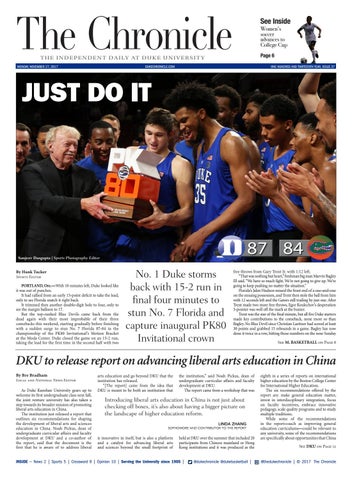
JUST DO IT
Sanjeev Dasgupta | Sports Photography Editor
By Hank Tucker Sports Editor
PORTLAND, Ore.—With 10 minutes left, Duke looked like it was out of punches. It had rallied from an early 15-point deficit to take the lead, only to see Florida snatch it right back. It trimmed then another double-digit hole to four, only to see the margin balloon to 17. But the top-ranked Blue Devils came back from the dead again with their most improbable of their three comebacks this weekend, starting gradually before finishing with a sudden surge to stun No. 7 Florida 87-84 in the championship of the PK80 Invitational’s Motion Bracket at the Moda Center. Duke closed the game on an 15-2 run, taking the lead for the first time in the second half with two
No. 1 Duke storms back with 15-2 run in final four minutes to stun No. 7 Florida and capture inaugural PK80 Invitational crown
free throws from Gary Trent Jr. with 1:12 left. “That was nothing but heart,” freshman big man Marvin Bagley III said. “We have so much fight. We’re not going to give up. We’re going to keep pushing no matter the situation.” Florida’s Jalen Hudson missed the front end of a one-and-one on the ensuing possession, and Trent then stole the ball from him with 12 seconds left and the Gators still trailing by just one. After Trent made two more free throws, Egor Koulechov’s desperation 3-pointer was well off the mark at the buzzer. Trent was the star of the final minute, but all five Duke starters made key contributions to the comeback, none more so than Bagley. No Blue Devil since Christian Laettner had scored at least 30 points and grabbed 15 rebounds in a game. Bagley has now done it twice in a row, hitting those numbers on the nose Sunday See M. BASKETBALL on Page 8
DKU to release report on advancing liberal arts education in China By Bre Bradham Local and National News Editor
As Duke Kunshan University gears up to welcome its first undergraduate class next fall, the joint venture university has also taken a step towards its broader mission of promoting liberal arts education in China. The institution just released a report that outlines six recommendations for shaping the development of liberal arts and sciences education in China. Noah Pickus, dean of undergraduate curricular affairs and faculty development at DKU and a co-author of the report, said that the document is the first that he is aware of to address liberal
arts education and go beyond DKU that the institution has released. “[The report] came from the idea that DKU is meant to be both an institution that
the institution,” said Noah Pickus, dean of undergraduate curricular affairs and faculty development at DKU. The report came from a workshop that was
Introducing liberal arts education in China is not just about checking off boxes, it’s also about having a bigger picture on the landscape of higher education reform. LINDA ZHANG
SOPHOMORE AND CONTRIBUTOR TO THE REPORT
is innovative in itself, but is also a platform and a catalyst for advancing liberal arts and sciences beyond the small footprint of
held at DKU over the summer that included 20 participants from Chinese mainland or Hong Kong institutions and it was produced as the
INSIDE — News 2 | Sports 5 | Crossword 9 | Opinion 10 | Serving the University since 1905 |
@dukechronicle @dukebasketball |
eighth in a series of reports on international higher education by the Boston College Center for International Higher Education. The six recommendations offered by the report are: make general education matter, invest in interdisciplinary integration, focus on faculty incentives, embrace innovative pedagogy, scale quality programs and to study multiple traditions. While some of the recommendations in the report—such as improving general education curriculums—could be relevant to any university, some of the recommendations are specifically about opportunities that China See DKU on Page 12 @thedukechronicle | © 2017 The Chronicle
Gardens visitor robbed at gunpoint Sunday afternoon
Professor explores role of selective colleges on income inequality in new book By Maya Iskandarani Staff Reporter
The richest one-fifth of American households makes more than half of the country’s income. The poorest one-fifth makes less than four percent. Have American colleges played a role in the country’s widening income inequality? The Chronicle’s Maya Iskandarani sat down with Charles Clotfelter, Z. Smith Reynolds professor of public policy studies and author of a new book, “Unequal Colleges in the Age of Disparity,” to find out. This interview has been edited and condensed for clarity.
Courtesy of Wikimedia Commons The suspect fled the scene and no injuries were reported.
Staff Reports The Chronicle
A visitor of the Doris Duke Center at Duke Gardens was robbed at gunpoint Sunday afternoon, according to a recent DukeALERT. The incident took place at approximately 5 p.m., with no injuries reported. The suspect allegedly approached the visitor with a silver handgun and asked for money before leaving the scene. According to the DukeALERT, the suspect is a thin, black male with dreadlocks and a height between 5 feet 9 inches and 6 feet. During the encounter, the suspect wore a ski mask along with a pink striped long-sleeve shirt and dark pants. Check back for updates on this developing story.
The Chronicle
dukechronicle.com
2 | MONDAY, NOVEMBER 27, 2017
CC: There are numerous studies and government statistics that tell us. Every year there’s a new report. The richest onefifth of American households in 1970 made 43 percent of all income. In 2016, they made 52 percent. The bottom one-fifth made 4.1 percent. Now, they make 3.1 percent. So, in the backdrop, we’ve got these colleges. Colleges, at an individual level, help the girl from Queens who never had experience with affluent people go to Princeton and one day become a justice of the Supreme Court. If you look at [Associate Justice of the Supreme Court] Sonia Sotomayor’s autobiography, See INEQUALITY on Page 4
The Chronicle: Why did you write this book? What are its main points? Charles Clotfelter: I wanted to find out what the market for college looked like over a long period. Why? Because our economy has been experiencing a tremendous increase in income inequality. I wanted to know—what was the role of colleges in this? Had they made for more equality, more opportunity, as a lot of people would think college ought to? Or had the colleges, in fact, made things worse? TC: What do you mean by ‘market’? CC: The market is a service that firms like Duke University offer. Customers like you come in and they consume this service. One of the unusual aspects of this particular industry is that the customers—you—are also one of the most important inputs to production. So, imagine you were going to go to a gym to get in good shape. If you don’t exert yourself, you’re not going to get anything out of it. In the same way, the customers of colleges are also doing a lot of the heavy lifting. Footnote—since about 1980, the income distribution in this country has gotten more unequal. The share of total income consumed by the top one-fifth of households has been going up and up and up. The share that’s been consumed by everybody else has been going down. TC: How do you know?
Courtesy of Duke Photography Charles Clotfelter, a public policy professor, wrote that selective colleges have benefited from income inequality.
ASK US YOUR QUESTIONS. GIVE US YOUR OPINIONS.
Connect with Duke University Stores! Give us your feedback on any of our operations via our online question/comment page, DevilSpeak. Just visit www.dukestores.duke.edu and click on the DevilSpeak link.
Duke University Stores. We are the Stores that Work for You! OPERATION: Stores Administration PUBLICATION: Chronicle
COSMIC CANTINA Burritos: the weapon of choice after a wild night MENU SAMPLING Old School Veggie Burrito Regular Chicken Burrito Cheese Quesadilla Chicken Quesadilla Chips & Salsa
$2.86 $5.65 $1.41 $3.59 $2.06
1920 1/2 Perry St. @ Ninth Street Just a block from East Campus
The Chronicle
dukechronicle.com
HEALTH AND SCIENCE
MONDAY, NOVEMBER 27, 2017 | 3
UNIVERSITY
Duke research uses smartphone Roach in salad? How Duke microchips for 3-D ultrasounds handles food quality assurance By Lexi Kadis Senior News Reporter
The $10 microchip that allows your smartphone to take a panoramic shot can replace 3-D medical imaging technology worth thousands of dollars, researchers at Duke have discovered. Existing ultrasound machines with 3-D imaging capabilities can cost up to $250,000. However, Duke researchers have found a new way to upgrade 2-D ultrasound machines at a relatively low cost. The brainchild of
emergency physician Joshua Broder, the inexpensive 3-D imaging device is made possible through the use of orientation technology found in cell phones. Broder, director of the emergency medicine residency program at the School of Medicine, explained that the microchip is attached to the ultrasound probe using a 3-D printed holster. “We are using, in a novel way, existing chip technology. In every smartphone, there See ULTRASOUNDS on Page 4
Courtesy of Wikimedia Commons Emergency physician Joshua Broder created an inexpensive 3-D imaging device that uses technology from cell phones for ultrasound probes.
By Stefanie Pousoulides Staff Reporter
On Nov. 17, sophomore Annie Yang ordered a side salad at Pitchforks and noticed an unexpected ingredient—a cockroach. “At first, I didn’t even realize what it was,” she said. “I thought it was a black bean.” So how did such a menacing bug slip into her meal, and what can students and Duke Dining do to prevent an incident in the future? Marcus Carson, sustainability and quality assurance manager for Duke Dining, wrote in an email about their standards for food management. “Duke Dining’s Quality Assurance Program applies specific standards related to food safety and customer service to each dining location on campus,” he wrote. “Dining staff is required to undergo training related to these standards and locations are formally evaluated via Durham County health inspections, internal operations reviews and the Mystery Shopper Program. In addition to these formal evaluations, every dining location is monitored on a daily basis to ensure they are meeting Duke Dining’s very high-quality assurance standards.” Although the incident has made Yang “wearier” of what she orders, she did not point the bug out to the Pitchforks staff. But, as Carson explained, Duke Dining prefers students to do the opposite. “To ensure the safety of our students and the quality of our offerings, we highly
Special to The Chronicle Sophomore Annie Yang was shocked to see a cockroach in her Pitchforks side salad and posted about it on Fix My Campus.
encourage any issue is reported to a manager on site immediately. Without knowing more details it can be very difficult to remedy such concerns,” he wrote. Because Yang still wanted to file a report after the incident, she contemplated using a comment card—as she knew that it would be a direct means of providing feedback on dining and services directly to the administration. However, she explained that she found the comment categories on the card to be “vague”
Get TheDirt The Chronicle brings you a weekly summary of events, ideas and news items that are trending at Duke and in the Triangle. Read all you need to know with The Dirt!
thebluedirt.com
See ROACH on Page 4
ROACH FROM PAGE 3 and was uncertain as to whether or not Duke Dining would ever review her card and those of others. Carson wrote that both physical and electronic comment cards are received each year and added that Duke Dining appreciates “any and all feedback.” Yang instead opted to post in Fix My Campus—a closed Facebook group for Duke students to voice suggestions about dining, facilities and other areas related to campus affairs. She hoped that her post would prompt Duke Dining to contact Pitchforks staff about the cockroach and spark discussion on issues like “better produce examination.” Given that some students may prefer not to contact the administration directly—like Yang, Carson wrote on how complaints on the group might eventually reach administrators. He explained that a Fix My Campus student representative assigned to address food complaints generally steps in and can
INEQUALITY FROM PAGE 2 you’ll be able to see what an important role Princeton was in her success. So, college can have that effect. What I wanted to find out was, did it? TC: Did it? CC: The evidence would suggest otherwise. The difference in the income of the students that go to the most selective colleges went up at a rate far beyond that of the income of students at less selective public institutions, for example. The percentage who went to private schools went up. The percentage whose parents have graduate degrees went up. TC: So your conclusion, explicitly, was? CC: [It] was that there was a divergence of incomes between the most selective and the least selective colleges. That was one conclusion. There was a report done in 1980 by the chancellor at Duke University. He was really worried that Duke was going to fall behind the public institutions, so he recommended several cuts. As it turned out, the next 30 years were nothing but boom times for the Dukes of the world. Inequality turned out to be good for Duke, ironically. Even though its professors were decrying the increase in inequality, the University was doing better. TC: Why? CC: There are a couple reasons. The rich were getting richer. The most affluent one-fifth? Their incomes were going up really fast. Number one, that gave them enough money to buy not only good real estate and nice cars but also to pay the rising tuition of the most selective colleges. Second—they were giving contributions. People at the very top were giving donations to universities. Places like Duke and Harvard [University], [the University of] Chicago and [the University of] Miami, got a wealth of new donations that allowed them to build new buildings and pay their professors more. And the endowments for these private universities did very well. TC: Did you conclude, then, that colleges exacerbated inequality or benefited from it? CC: The second. But I think that nobody at these universities wanted this to happen; it just happened. There may be ways
ULTRASOUNDS FROM PAGE 3 are chips that provide orientation information at a very high rate of speed. What we’ve done is piggybacked one of those chips onto an ultrasound probe,” Broder said. “The magic is that a little tiny bit of data that’s seemingly not that sophisticated all of a sudden opens up this dramatic possibility of three-dimensional imaging of the human body.” Traditional 2-D ultrasound images do not have information about the direction or angle that the probe is facing when the images are taken, Broder said. With this device, every image generated by the machine is tagged with the orientation of the probe, so that the 2-D images can be assembled into a 3-D picture. Matt Morgan, a graduate student at Duke who worked on the device as an undergraduate, wrote in an email that the 2-D ultrasound image is a “slice”
The Chronicle
dukechronicle.com
4 | MONDAY, NOVEMBER 27, 2017
contact Duke Dining or the Duke University Student Dining Advisory Committee for further action. Julia Medine, senior and co-chair of DUSDAC, spoke on the importance of DUSDAC’s role of connecting students like Yang with Duke Dining when faced with food management concerns. “When [DUSDAC does] get involved in those issues, we take them very seriously because we feel responsible for being the liaison between students and administration in fixing issues that are only noticeable when students do complain,” she said. She added that DUSDAC has not had an opportunity to deliberate on the Pitchforks salad because it has not held a meeting since Yang’s post. Fix My Campus is “an incredible resource,” Medine noted, because it “alerts other students of problems on campus” and enables students to “mobilize behind important issues.” Yang’s post has had upwards of 30 comments and 175 likes and reactions since it came out. One of the comments suggested that sanitation issues “have been going on for a while” at Pitchforks. This “really surprised”
Yang because of the health certifications displayed outside of Duke eateries, especially for Pitchforks—which has a sanitation rating of 99 out of 100. Carson wrote that Duke Dining takes pride in Duke eateries—which collectively have an average health inspection score of 99. In addition to annual formal inspections through the Durham County Health Department the eateries also go through a biannual check through Duke Dining’s internal Quality Assurance Program. “In addition to these formal evaluations, Duke Dining locations are being constantly monitored by administrative staff to ensure they meet our very high standards every single day,” he wrote. Except for the cockroach discovery, Yang said that she has had no prior issues with the restaurant, and Medine concurred that she has not heard of anything similar to the Pitchforks salad and classified it as an incident of “serious concern.” “In my experience, [DUSDAC has] not had any issues related to serious sanitation concerns. It’s not something we see often,” Medine said.
in which college made things more unequal. If the graduates of the most selective colleges married people they went to college with, both of whom are doing very well, you have power couples. That might have—and probably did—contribute to the inequality. There is a drive to recruit low-income students, and it’s sincere. Places like Duke have bent over backwards to try to diversify their student bodies. Despite all those efforts, the average income of their students continues to rise faster than at most schools.
State governments are cutting back on aid that they give to state colleges. Well, that’s going to create some inequality. Something else that’s encouraged this is competition among colleges, aided by U.S. News and World Report. Now it’s easy for you, as a consumer of colleges, to get online or buy a book and find out how Amherst and Harvey Mudd and Northwestern compare, whereas before, you had to go to the library and look for some books. The urge to be ranked high has caused universities, especially ones below the very top, to give out more merit scholarships. That is, “we want you, because you’ve got a good academic profile and we would like to have you in our class. It would make us look better in U.S. News, so we’re going to cut our price to you.” But they do that irrespective of your financial need. What that’s done is exacerbate the income inequality that’s already there.
TC: Why is that average going up, and should Duke and other colleges do something to change that? CC: We have a big system in which the brightest students get matched to the colleges with the most resources. For these brightest students, it’s like a marriage made in heaven, because they really benefit from all of the professors, the labs, the resources. The question is, does that make sense for society at large? You could argue that the inequality doesn’t need to be quite as severe as it is. Maybe the economy, maybe society as a whole might do better with a little more equality. So you ask, what can
One of the best, most successful exports that we have in this country is higher education. CHARLES CLOTFELTER
Z. SMITH REYNOLDS PROFESSOR OF PUBLIC POLICY STUDIES
TC: But didn’t you just explain that this person is being recruited regardless of their income? CC: If you’ve got good grades, it’s probably the case that you wouldn’t need aid. A college that may be down in the 70th percentile is taking its finite amount of aid and, rather than giving it on the basis of financial need, trying to get those best students without necessarily looking at need. So, have colleges exacerbated the income inequality in the country? I can’t answer that. It’s too hard a question. There are too many variables out there. What I can say in this book is this—if they had been increasing equality, would we observe the things that we observed? And the answer is no.
the colleges do? They’re already opening their doors to racial minorities and looking for first-generation students. They can do more of that. There are rural areas and smaller cities that usually aren’t touched by admissions fairs. That could be something. Places like Duke could give less preference to sons and daughters of alumni, but that’s a policy that Duke has followed. It has good reasons for doing that.
TC: What are future directions? Do you foresee this inequality continuing to increase? CC: A lot of this has to do with national policy. Since about 1980, about the time when income inequality started, the tax policy in the federal government has been to reduce the top marginal tax rates on the very wealthy. We’re seeing the same thing in the most recent proposals. So, do I see in those kinds of policies any promise to change underlying causes of the inequality in colleges? No.
TC: How do we fix this problem, and is it fixable? CC: It’s kind of hard to fix, because it’s not one little thing that’s made it happen. What’s made it happen is a change in the whole economy that’s really shifted the distribution of income. That’s one major force. The second [is] public policies.
TC: Anything more to add? CC: One of the best, most successful exports that we have in this country is higher education. At the very top, you can’t beat American colleges and universities. The concern is that there’s a soft underbelly that might not be so good.
of the 3-D anatomical volume. He compared 2-D ultrasound imaging to trying to map out a living room in the dark using just a flashlight. “You know there are couches, a coffee table, and a dining room table around somewhere, but you can only look at a small fraction of the room at any one time, so it could get confusing to figure out what the layout of the room is without any prior knowledge,” Morgan wrote. “What we’re trying to do is let you flip the lights on, so you can see the whole room simultaneously.” Broder noted that the 3-D capability gives much needed “context” to existing 2-D images, which he explained is especially helpful in fields like emergency medicine. He added that the device will also improve patient-care by decreasing exam time. “From a patient stand-point, if the physician can just sweep the ultrasound probe across the area that we’re interested in, in a matter of seconds, we can increase the patients’ comfort,” Broder said.
Alongside Broder and Morgan, Carl Herickhoff and Jeremy Dahl, who are former biomedical engineering instructors and professors at Duke, also helped design the device. Since then, they have both moved to
Since many clinics already have access to 2-D ultrasound machines, the developers predicted that the inexpensive and versatile device will be extremely popular once its reaches the market.
The magic is that a little tiny bit of data that’s seemingly not that sophisticated all of a sudden opens up this dramatic possibility of three-dimensional imaging of the human body. JOSHUA BRODER
EMERGENCY PHYSICIAN
positions at Stanford University where they have begun clinical trials for the device. Herickhoff said he hopes to have physicians using the device in clinics at Stanford very soon. In addition to its low cost, another benefit of the device is its versatility, Herickhoff noted. “We developed it to the point where it was versatile enough to plug in to any existing ultrasound system,” he said.
“By giving health care providers the ability to see the whole field of view by acquiring 3-D images instead of the conventional 2-D images, we hope to make point-of-care ultrasound more complete and intuitive at a very low cost,” Morgan wrote. Broder, Morgan, Dahl and Herickhoff have an international patent pending on the design.
The Chronicle
dukechronicle.com
the chronicle
MONDAY, NOVEMBER 27, 2017 | 5
november 27, 2017
CAROLYN CHANG/THE CHRONICLE
sportswrap
BOUND 4 ORLANDO FOOTBALL: WINS TO BECOME BOWL ELIGIBLE • WOMEN’S BASKETBALL: TOPS NO. 18 OREGON STATE
6 | MONDAY, MONDAY,NOVEMBER NOVEMBER27, 27,2017 2017
FOOTBALL
dukechronicle.com
The Chronicle
BOWLY COW
Blue Devils rally for second straight victory to reach bowl eligibility for fifth time in six seasons By Mitchell Gladstone Sports Managing Editor
WINSTON-SALEM, N.C.—For nearly two months, things in Durham were spiraling. During the course of six consecutive defeats, Duke failed to even score a touchdown twice. After beginning the year a perfect 4-0, the Blue Devil offense was scuffling, and Saturday at Wake DUKE 31 Forest—even after WAKE 23 snapping its losing skid last weekend— it looked for nearly a half-hour as if Duke would revert to its old form. But Daniel Jones and the Blue Devils would not go quietly on the regular season’s final afternoon. With its 2017 campaign on the line, Duke emerged victorious at BB&T Field, knocking off the Demon Deacons 31-23 to earn the Blue Devils’ sixth win of the year and become bowl eligible for the fifth time in the last six seasons. After trailing by a touchdown at halftime, Duke came out firing after the break, racking up 230 yards and 21 points to pull away from Wake Forest. “We all looked in the mirror and we took account of where we were,” Blue Devil head coach David Cutcliffe said. “We use the phrase around here, ‘You can either run to it or you can run from it.’ What that means specifically is take ownership, and we didn’t run from anything. We ran right to it.” For Duke, the turnaround all began under center. Jones finished the afternoon with 346 yards on 25-of-44 passing, tallying two touchdowns through the air and another on the ground to lead the Blue Devil offense to a second consecutive win. “When you go through a six-game skid, you learn how to overcome adversity, you learn how to become tough and become a gritty team,” senior captain and center Austin Davis said. “That’s one thing Coach Cut always teaches us. You’ve got to overcome the
Neal Vaidya | Staff Photographer
Sophomore cornerback Mark Gilbert picked off Wake Forest quarterback John Wolford twice and iced the win with a takeaway in the final two minutes. pressure and any mistakes that come your way and go forward. “We made mistakes in the first half, but we knew that the second half was going to be ours and we had to know that we were going to come back and get the win.” With Duke trailing 17-10 at the break, the teams traded empty possessions to open the third quarter. The Demon Deacons then marched into Blue Devil territory—only to be held to a field goal that kept the visitors within striking distance, down just 10. From there, Jones went to work. Duke (6-6, 3-5 in the ACC) scored touchdowns on three straight series, going at least 74 yards on each possession to stake the visitors to a 31-23 lead midway through the fourth quarter. First, a six-yard pass to freshman Noah Gray—just the second touchdown reception of his young career—made the score 20-17 in favor of the hosts.
Then, just when it seemed like Wake Forest (7-5, 4-4) might get a crucial stop, Jones completed a clutch 36-yard pass to Chris Taylor on fourth down, putting the Blue Devils inside the Demon Deacon one-yard line and setting up an easy quarterback sneak score for Jones. And if that wasn’t enough for the Duke offense, the Blue Devils finally came back for more, using 12 plays and nearly four minutes to march down the field, capping the series with a four-yard rushing touchdown by redshirt freshman Brittain Brown. “Everyone understood the opportunity that we had, and at times in the first half, we were able to move the ball and do what we wanted to do,” Jones said. “A few missed opportunities held us up, so we knew that if we could get some of those things right, we had a good opportunity to come out on top.” Down by eight with a little more than eight
minutes to go, Wake Forest made a quarterback change, bringing Kendall Hinton in for John Wolford—who posted one of his weaker showings of the season, finishing with 191 yards and just 16 completions on 33 attempts. But the Duke defense did not relent and forced the Demon Deacons to go back to Wolford late in the game for a potential gametying drive. With a little more than two minutes remaining in the game, the Blue Devils sealed the win when sophomore Koby Quansah brought big-time pressure on fourth-and-3 and cornerback Mark Gilbert intercepted Wolford for the second time of the afternoon. “We felt like we had their number early, but we just had to get adjusted to their offense,” senior safety Alonzo Saxton II said. “When Daniel is clicking, we have to step up our game because we don’t want to disappoint the offense, just like the offense doesn’t want to disappoint us. It’s a hand-in-hand thing, and we’ve got to hold up our end of the deal.” Even with some early and late first-half fireworks, neither side could gain a significant advantage in the opening 30 minutes. After a Jones interception on the Blue Devils’ first series set up a Demon Deacon touchdown and Wake Forest extended its lead to 10-0 with a field goal in the first few minutes of the game, Duke responded with a 10-play drive that resulted in an Austin Parker field goal to pull the Blue Devils within seven. Although the teams then went scoreless for more than nine minutes, a pair of quick-strike touchdowns before halftime brought the score to 17-10 at intermission. But for a second straight week, the Blue Devils were able flip the script in the latter stage of a game. Duke will now await Selection Sunday next weekend to find out where it will be headed for a bowl game. “We just stuck to the plan, we trusted our coaches and trusted our game and how good we were each and every day,” Davis said. “We showed that Duke football can bounce back from adversity, and we did it as a team.”
WOMEN’S SOCCER
Duke shuts out Baylor to advance to College Cup By Bre Bradham Staff Reporter
Carolyn Chang | Staff Photographer
Senior captain Imani Dorsey had a goal and an assist to help Duke to its second College Cup appearance of her career.
It didn’t take long on Friday night for the Blue Devils to find the back of the net and score the game-winning goal that would break the program’s single-season wins record and send the team to its second College Cup in three years. Five minutes and 46 seconds, to be exact. Top-seeded Duke took control of the physical matchup against Baylor from the beginning Friday at Koskinen Stadium, and never looked back after junior forward Kayla McCoy found the 0 back of the net to BAY 4 open the first half. The DUKE Blue Devils went on to score three more goals in the second half in the 4-0 win, continuing their run of shutouts in this year’s NCAA tournament. Now, they are headed to the Final Four for the fourth time in school history. The 4-0 Duke victory has a hint of historic
irony as well, as the only time the teams had previously met was in Durham in 1998—when Baylor downed the Blue Devils 4-0. Duke’s dominant win marked its 23rd for the year, breaking the record of 22 it set in 2011, but it’s a milestone that head coach Robbie Church doesn’t want to focus on just yet. “It’s great, but the most important thing is that we are still playing,” Church said. “This team has broken a lot of records. As soon as the year is over, we’ll sit back and feel good about that.” The first of Duke’s four goals came from McCoy off an assist from junior midfielder Taylor Racioppi. Baylor’s freshman goalkeeper Jennifer Wandt used a goal kick to launch the ball to midfield after McCoy sent a left-footed shot from the top of the 18-yard box just wide of the goal. From midfield, Duke sophomore Ella Stevens sent a pass to Racioppi, who chased it down to the Baylor end line and sent a rolling cross into the See W. SOCCER on Page 9
The Chronicle
dukechronicle.com
MONDAY, NOVEMBER 27, 2017 | 7
FOOTBALL
Duke’s seniors extend careers for one more game By Mitchell Gladstone Sports Managing Editor
WINSTON-SALEM, N.C.—Standing in the northwest corner of BB&T Field postgame, you could feel the energy. No words were needed to express the joy this Duke team was experiencing—you could see it in their smiles, dances and hugs. It was a far cry from a season ago, when the Blue Devils finished 2016 with a pair of listless blowout defeats. Just as it played a week ago in Durham, Duke was relentless in its regular-season finale Saturday afternoon at
Wake Forest, riding a dominant second-half offensive performance to victory. Now, the Blue Devils’ senior class will have one more opportunity to leave a lasting impact on the program as they go bowling for a final time. “I’ve always wanted to play and start in a bowl game,” senior captain Austin Davis said. “I’ve started two years, and last year didn’t go the way we wanted. This year was starting to turn bad, but we’ve overcome the adversity and it’s just an emotional, emotional victory. I love these guys, I’m thankful that I don’t have to say bye to them yet and we’ve got one more game to win in my college career—it’s
Neal Vaidya | Staff Photographer
Although Shaun Wilson was bottled up Saturday, he finished the regular season with nearly double the amount of all-purpose yards anybody else on the team accumulated.
a heck of a feeling.” Of the 31 points Duke scored, not a single one came from a player who had ever touched the field in a bowl game. Tight end Daniel Helm, quarterback Daniel Jones and kicker Austin Parker all redshirted the 2015 season, one as a transfer and the other two as freshmen. As for Noah Gray and Brittain Brown? They were still in high school. But you don’t have to look far to see the importance of seniors among this group of Blue Devils. Three of Duke’s four captains—Jones being the lone exception—are in their final year of eligibility. Running back Shaun Wilson finished with nearly twice as many all-purpose yards per game as any other player on the roster. And Bryon Fields Jr.’s game-sealing pick-six at North Carolina will go down as this season’s signature play. Just don’t tell that to David Cutcliffe. For the Blue Devils’ head coach, this season is far from over. “We thanked all of the seniors in the locker room for extending the opportunity to just be with them,” Cutcliffe said. “Forget just playing football—I told a professor not too long ago that those guys are in our classes every day for five years. We go into their homes. There’s more than what you would call an attachment. “I’ve told all the parents I’ve seen this week that I couldn’t say goodbye in Winston-Salem. We’ve got to say goodbye at some destination.” A month from now, Duke will likely be in Detroit, Birmingham, Ala. or Shreveport, La.—not exactly the places that most think
of for the prototypical winter getaway. But as Ralph Waldo Emerson wrote, “Life is a journey, not a destination.” When Cutcliffe emerged from the locker room before the start of the third quarter, he bluntly told Fox Sports South sideline analyst Rebecca Kaple, “We’re getting ready to go have some fun. We’re getting ready to be a different football team. You’re going to see a celebration at the end of this thing.” The 2017 Blue Devils’ journey was more than just two straight weeks of second-half turnarounds to earn a bowl bid, though. It was a 4-0 response to a 4-8 2016 season, winning as many games as they did all of last year in the span of a month, only to be followed up by one of the worst stretches in the entire Cutcliffe era. For Davis, Wilson, Fields, Mike Ramsay, Alonzo Saxton, Gabe Brandner and the rest of Duke’s senior class, each of their personal journeys in Durham—a roller-coaster ride with the highs of a Pinstripe Bowl win in 2015 and the lows of last season—will soon come to an end. So after making sure that their collegiate careers did not end on a sour note Saturday, this group of Blue Devils has one more month to write the final chapter. “We knew what we were capable of, and at Duke, we pride ourselves on hard work,” Davis said. “If things aren’t going our way, we’re going to go back to work, so even Sundays after a hard, devastating loss, we came in, lifted weights, watched film, practiced and learned from it. And we got better and better each week, even though we were losing.... Now, we’ve kind of come full circle.”
WOMEN’S BASKETBALL
Blue Devils hold off No. 18 Oregon State at home By Ben Leonard Blue Zone Editor
The Oregon Ducks are Oregon State’s archrivals, but the Beavers might have a new nemesis—”Ducky.” Leaonna Odom—nicknamed affectionately by teammate Faith Suggs after the goofy duck in the movie Land Before Time—burst open the dam for Duke Saturday as a force in the paint. After seeing the floor for just 16 minutes due to foul trouble Thursday against Old Dominion, Odom helped the No. 16 Blue Devils down No. 18 Oregon State 72-65 Saturday at Cameron Indoor Stadium by bleeding the Beavers to death in the paint in the first half. The 6-foot2 forward scored 16 65 points and grabbed ORST 72 eight rebounds to DUKE give the Blue Devils their seventh consecutive home win against a ranked team, helping make up for a relatively off shooting day from star guard Lexie Brown, who went 5-of-14 from the field. “I came out there with a different mindset and my teammates put me in position to where I was able to score,” Odom said. “Coach P told me in the last game that I needed to learn how to play in foul trouble. Then I took that to mind and had a no fear mentality and went from there.” But with Odom quiet down the stretch due to defensive adjustments, Brown took over late in the fourth quarter and wound up leading the team with 19 points thanks to a few trips to the
foul line to ice the win, and graduate student Rebecca Greenwell added 17 points. Duke locked down an offensive-minded Oregon State team, holding it to shoot just 9-of25 from beyond the arc and frustrating 6-foot-5 star center Marie Gulich—who turned the ball over five times and was whistled for four fouls. The Beavers played a four-out, one-in style similar to the one that helped Villanova toppled the Blue Devils two weeks ago, but head coach Joanne P. McCallie said the task of guarding the towering Gulich made it even harder. The Blue Devils (4-1) didn’t completely shut Gulich down by any stretch—she scored 16 points and grabbed nine rebounds—and the Beavers never went away, cutting the lead to one point midway through the fourth quarter after an and-one from star guard Mikayla Pivec and a 3-pointer from Kat Tudor. “Our offense had gotten stymied there because we were dribbling too much—we were just not moving,” McCallie said. “It was difficult, and I’m glad we worked through that stretch. The team got focused and came out stronger.” Greenwell shook off a first-half shooting slump to lift Duke late, scoring 14 points after the break, and Brown sparked a quick 9-2 run to pull away from Oregon State. Brown decisively swung the momentum in the Blue Devils’ favor with two straight steals and coast-to-coast layups to give them an eight point lead with 2:47 left. The guard had sagged off on defense, allowing passes around the arc for most of the game—but changed that approach late. “I wasn’t really active stealing the ball the
Bre Bradham | Staff Photographer
Sophomore Leaonna Odom controlled the paint in the first half against the Beavers, scoring 12 of her 16 points before the break. entire game, so I think they got a little bit lax offensively,” Brown said. “I saw an opportunity to take a chance defensively in a tight game. Their nerves were on edge and our nerves are on edge, so I just capitalized on that.” Odom led Duke to a 35-26 halftime lead, owning the post with 12 points and six rebounds in the first half. The sophomore forward used her quickness in the post to help the Blue Devils outscore the Beavers 16-10 in the paint in the first half, forcing them to adapt defensively— with good results, as Odom scored just four in the second half. “We impacted their on-ball a little bit better,”
Oregon State head coach Scott Rueck said. “She was a recipient of Lexie’s playmaking off the onball screen. Lexie commands a lot of attention, so she pulled our help up and then made great passes as Odom rolled to the rim. Then our positioning got better.” Although Duke had the bulk of its scoring in the post, its light-out 3-point shooting also helped it pull ahead of the Beavers (3-2) early. Brown’s steal midway through the first half and ensuing 3-pointer helped spark a 12-0 run, giving the Blue Devils an early 19-11 lead. See W. BASKETBALL on Page 9
8 | MONDAY, MONDAY,NOVEMBER NOVEMBER27, 27,2017 2017
dukechronicle.com
The Chronicle
MEN’S SOCCER
Blue Devils’ season ends in shootout heartbreak By Bre Bradham Staff Reporter
Duke’s season came to an end Saturday night after falling 8-7 in penalty kicks to Fordham in the NCAA tournament’s Sweet 16. The sixth-seeded Blue Devils forced the Rams to play catch-up the whole game at Koskinen Stadium, striking early and never falling behind. But a late goal for 2 Fordham tied the game FORD 2 at 2-2, and after two DUKE scoreless overtimes, the match headed to penalty kicks. A save by Rams goalkeeper Rashid Nuhu in the 10th round of the shootout sent the team to the Elite Eight. “It hurts. Penalties is just a sour way to end a game,” Duke head coach John Kerr said. “It’s difficult to take. We had the game in control for 90 minutes and in overtime, but they hung around and they fought.” The Blue Devils (13-4-3) started off strong in the shootout when freshman goalkeeper Will Pulisic made a diving stop off junior
Janos Loebe’s shot toward the bottom right corner of the goal. Duke’s Daniele Proch and Brian White buried the team’s first two penalties, both finding the bottom left corner of the goal past the outstretched arms of Nuhu. The third Blue Devil to step up wasn’t so lucky, with Nuhu kicking away Kristófer Gardarsson’s shot toward the bottom right of the goal. Senior defender Markus Fjørtoft was up next, sending one past Nuhu to the bottom left of the net and evening the tally at 3-3. Fordham (14-5-3) made its second, third and fourth penalty kicks—Nuhu even took a successful turn at the penalty spot—before senior Jannik Loebe’s shot bounced off the crossbar, giving the Blue Devils a chance to win the shootout and the match in the fifth round. But senior Carter Manley’s shot was rejected by Nuhu, extending the Rams’ season and sending the shootout to sudden death rounds. Both teams were perfect through four more nerve-wracking repetitions until the 10th round of penalty kicks.
Bre Bradham | Staff Photographer
Max Moser’s shot was saved by Rashid Nuhu in the 10th round of penalty kicks to send the Rams to the quarterfinals.
M. BASKETBALL FROM PAGE 1 and scoring his last four points on back-to-back possessions to pull Duke (8-0) within one. “It seems like every game he goes out there and it’s a simple but beautiful 30-and-15,” senior captain Grayson Allen said. “It’s not something you see very often. 30-and-15 should be something very loud and in your face, but he just goes out there and makes it look easy.” Allen made a key triple to chop a six-point deficit in half, and Wendell Carter Jr.—who went scoreless and battled foul trouble for the first 30 minutes of the night—scored six straight Blue Devil points early in the final rally. And the comeback all started with point guard Trevon Duval, a freshman who is not known for his shooting ability but had the confidence to step into a corner 3-pointer with 9:47 left off a pass from Allen and knock it down anyway. “Trevon, who had not had a good tournament or first half, all of a sudden—when a player can change during the game, he’s special,” head coach Mike Krzyzewski said. “He’s got a chance to be very, very good. Trevon did that.” Florida (5-1) raced out to a 21-6 lead in the first six minutes of the game, knocking down
four of its first six 3-point attempts. It was hard to imagine the Gators would only make four more triples the rest of the night, and Duke would wind up besting one of the most lightsout shooting teams in the nation. The Blue Devils quickly got back into the game with a flurry of triples on the other end. Trent—who shot 0-of-6 from deep in Friday’s overtime win against Texas—made three 3-pointers in a span of less than 90 seconds, and Allen added back-to-back 3-pointers to spark a 20-4 run that put Duke in front 44-37. The Blue Devils finished the night 10-of23 from 3-point range and held Florida to a modest 8-of-20 mark. “We had to stay at home on the shooters and we had to just guard. We couldn’t go zone like we tried to for a little bit in the first half because they move so well and their shooters are always loaded up,” Allen said. “We had to just man up and D up, really stay at home and let our bigs contest around the rim.” The Gators had the last counterpunch of the half, scoring 16 points in the last 3:10 to head into the locker room up 53-49. Florida’s four starting guards—Hudson, Chris Chiozza, KeVaughn Allen and Koulechov—each scored at least 13 points and combined to make all eight of the team’s triples,
Jordan Black, Fordham’s senior backup goalie, stepped up to take the first penalty kick of his collegiate career. Black, who has not played a minute in goal this season for the Rams, shot one past Pulisic to give Fordham the advantage. “When it came to penalty kicks, we were confident,” Black said. “My coach asked me, ‘Do you want one?’ and I was like, ‘Yeah, I’ll take one.’ Stepped up, had my moment. I may not have played in many games in my career, but I’ll remember that for the rest of my life.” The Blue Devils had to find the back of the net to stay alive, but sophomore Max Moser’s strike toward the right side was stopped by Nuhu. “Their keeper made a great save at the end on Max,” Kerr said. “I feel bad for Max, I’m really sorry for him.” Duke struck first in the match when White found the back of the net in the eighth minute. The Flemington, N.J., native headed a pass from Moser past Nuhu into the right side of the goal to give the Blue Devils the early 1-0 lead. Duke controlled possession for most of the first 45 minutes, but did not find the back of the net for the rest of the first half while tallying a total of nine shots and two corner kicks. Fordham came out aggressively following the break and saw some opportunities early, logging its first shot of the game and taking two corner kicks in the first three minutes, though it was not able to put them in the back of the net. The early pressure paid off for the Rams in the 51st minute, when Jannik Loebe notched his eighth goal of the season. After controlling a pass from sophomore midfielder Bart Dziedzic in the 18-yard box, Loebe turned toward the goal and ripped a shot past a diving Pulisic to find the bottom right corner. It didn’t take long for Duke to regain the lead. In the 63rd minute, a corner kick from Moser put the ball into a crowded six-yard box, where freshman defender Matthias Frick got a foot on it to tap the ball into the goal. Nuhu tried to pull in the ball as it rolled across the line, but it was determined to be a goal after a review, giving Frick his second score of the season and putting the Blue Devils in front.
Kerr wanted to see his team establish a more secure lead. “I wanted the third goal, candidly,” Kerr said. “I was trying to push for the third goal, and I thought we had a couple of good opportunities to create the third goal, but the last pass just didn’t make it or the last shot.” Duke held on to the one-goal advantage until the last three minutes of regulation. Dziedzic got on the end of a long lofted blast from sophomore defender Joergen Oland and found room to run up the left side. Cutting toward the goal, Dziedzic drew Pulisic off the goal line. With two Blue Devil defenders and Pulisic moving toward the ball, a fortunate bounce and deflection sent it over the diving goalkeeper. A left-footed tap from Dziedzic was all it took to send the ball into the back of the net and tie the game. “I think it was just miscommunication, a bit unlucky—the ball bounces in their way and not ours. That’s soccer. You love it and it gives you so much, but it also robs you of everything sometimes and it feels so unfair,” Fjørtoft said. “That’s the beauty and the curse of the game.” After two 10-minute periods of overtime, the two teams headed to the decisive marathon penalty shootout. The game marked the end of Duke’s first trip to the NCAA tournament since 2011 and its first time in the Round of 16 since 2009. When the Blue Devils met Fordham earlier this season, they beat the Rams 3-0. Fordham will advance to face No. 3 seed North Carolina in the Elite Eight. For Fjørtoft, whose first and last NCAA tournament game was Saturday night, the tough loss also showed how far the program has come. “I’m really optimistic, because there’s just a whole different culture change. From turning around a disappointing season last year to this, it’s incredible,” Fjørtoft said. “I know we’ll bounce back, and I’ll live vicariously through them and help in any way I can. But right now it’s disappointing, of course. Very, very disappointing.”
forcing big men like Bagley into unfamiliar situations defending the perimeter. “He’s guarding 1 through 5 because he can do that. He gives us a lot of flexibility,” Krzyzewski said. “This kid’s special. He’s a great teammate. He’s the most unique kid I’ve coached at Duke. I’ve got to learn about him too because he’s 6-11 and can guard five positions and put up 30 two games in a row as a freshman.” Thirteen unanswered points a few minutes into the second half widened the Gators’ lead to 17, and Florida was even beating Duke on the boards for second chances—Hudson collected 10 rebounds to along with his 24 points for his first career double-double. But the Blue Devils played an almost flawless quarter of the game the rest of the way. Florida, which had scored 219 points and made 32 3-pointers in its first two games in Portland, scored just 10 points and did not make a shot from deep in the last 10 minutes of the game. Duke surged past the Gators with 30 points during that span. “I don’t know [why we keep having slow starts]. We’ve got to figure that out. But the one thing I do know is that we have a lot of fighters on this team,” Grayson Allen said. “It shows a lot of heart and I think it shows how special this group can be.”
The Blue Devils will face a Power-5 opponent away from home for the third straight game when they travel to Bloomington, Ind., to face Indiana in the ACC/Big Ten Challenge Wednesday night.
Sanjeev Dasgupta | Sports Photography Editor
Gary Trent Jr. nailed four free throws in the final 72 seconds to seal the victory.
The Chronicle
dukechronicle.com
W. SOCCER FROM PAGE 6 box for McCoy. The Lincolnwood, Ill., native pounced on the ball, punching it into the net from just a few yards out to pick up her 14th goal of the season. “It was definitely huge to get the early goal. It’s a great game-setter, when you can score early like that,” McCoy said. “Taylor did a great job getting [to the] end line and getting around her defender and looking for us, and I was just thankful to be able to get on the end of it.” The Bears—the third Big 12 team Duke has faced through the first four rounds of the NCAA tournament—came to Koskinen riding a six-game winning streak and was playing in the Elite Eight in program history. The Big 12 champions failed to put a shot on goal in the first half, notching 12 fouls and losing junior forward Lauren Piercy after her second yellow
Carolyn Chang | Staff Photographer
EJ Proctor has not yet given up a goal in the NCAA tournament.
MONDAY, NOVEMBER 27, 2017 | 9
W. BASKETBALL
card in the 40th minute. Piercy, who led the Bears in shots on goal, was sent off for a tackle on Blue Devil defender Taylor Mitchell. The Bears (15-6-3) played physically the whole game, earning 12 fouls in the first half to Duke’s four before settling down and notching only five to Duke’s four in the second half. Baylor picked up an additional yellow card in the 69th minute on sophomore forward Raegan Padgett. Senior captain Imani Dorsey said Duke (23-2-0) came into the game expecting Baylor to be physical. “We were ready to get hit—and we were also ready to work with the referee to show him, ‘Hey, this is happening and it’s unacceptable,’” she said. With Baylor entering the second half down a player and a goal, it didn’t take the Blue Devils long to stretch their lead. Just more than one minute into the half, Dorsey fell to the ground in the box while dribbling around defenders before returning to her feet and slipping a pass by a defender to Stevens, who back-heeled the ball past the goalkeeper to record her fifth goal of the season. Moments later, Dorsey found the back of the net herself with an unassisted goal. She beat two defenders up the left sideline before launching a shot past Wandt into the bottom right corner of the Baylor goal to bring the tally to 3-0. “I go into every game and I tell myself that I want to be dynamic and aggressive, so if it’s not working in the first half, I’ll just keep trying it and see what happens in the second half,” the senior captain said. “I was getting better chances for myself in the second half, and it came from continuing to work. It’s not like I wasn’t doing it in the first, it just kind of worked out the second time.” The game was scoreless from then until the 87th minute, when freshman forward Tess Boade scored her first career goal. The
Highlands Ranch, Colo., native got an assist from redshirt senior midfielder Rebecca FROM PAGE 7 Quinn to put the Blue Devils up 4-0. Boade, Duke was 5-of-9 from deep in the first half, at the top of the 18-yard box, used her first led by Brown’s 2-of-3 ledger, and finished touch to back-heel the ball between the legs 9-of-19 overall. of the Baylor defender and get a one-on-one Duke built on its lead with stout defense look at Wandt. She booted the ball past the in the second quarter, allowing just 10 points goalkeeper into the bottom right corner of and leaning on an early 11-5 run despite not the goal with her left foot. making a shot from the field for the final 5:20 The Bears had a few chances in the second of the period. half, forcing Duke goalkeeper EJ Proctor to One lingering concern is the Blue Devil make two saves. bench’s continued struggles—it scored just The senior from Wilson, N.C., led Duke eight points Saturday. For the second straight to its 16th shutout of the year, with saves on game, Haley Gorecki was the only reserve who a free-kick strike from Baylor’s leading scorer, made significant contributions, with seven of senior Aline De Lima, and a left-footed shot the eight points. from Julie James from just outside of the 18McCallie said she wants to only run a yard box. Proctor easily scooped up James’ seven-player rotation in November and lauded shot, but held onto the ball too long before Gorecki’s improvements after not playing for kicking it away—resulting in an indirect free nearly two full seasons. kick inside the penalty box for the Bears, who “I have a lot of confidence in Haley. It’s could no turn it into a goal. fun to see her game coming—she’s starting to The Blue Devils will now head to Orlando click,” McCallie said. “Her teammates love it. for the College Cup, where they will face No. She makes everyone smile for some reason— 2 seed UCLA next Friday. For 16 members of she just does that. For a lot of reasons actually, the current Blue Devil squad, it will be their her comeback for one.” second trip to the final four—after a 2015 loss Duke went on to beat Presbyterian Sunday in the championship to Penn State. 79-45 in its second game of the weekend, coming “We’re going to go down there and we on strong in the latter stages to pull away. want to win the thing,” Church said. “We’re “Our whole team sent a message with the not going down there to visit Mickey in tenacity and the defense we played,” McCallie Orlando. We’re going down there to win said. “We did a lot of different things, and the thing. We’ll be prepared and we’ll look to have 17 assists and nine turnovers—you forward to Friday night.” look at that turnover margin, and that’s For Dorsey, in particular, playing in the pretty much the game. In games like this, Final Four means her last season in a Blue you cannot turn the ball over and give Devil uniform lasts a bit longer. people second and third chances.” “It’s another game that I get to play,” Dorsey Note: This story was updated from the online said. “And that’s how I look at it right now—if The New York Times Syndication Sales Corporation version published Saturday to include the score of we turn out being national champions at the 620 Eighth Avenue, New York, N.Y. 10018 the Presbyterian game. A full recap of Sunday’s end, that is a dream come true. But if I also get For Information Call: 1-800-972-3550 matchup can be found online. another game in For the that’s all I want. ” Forprocess, Release Release Tuesday, Monday, November November 27, 21, 2017 2017
CLASSIFIEDS Crossword
TRAVEL/VACATION BAHAMAS SPRING BREAK $189 for 5-Days� All prices include: Round-trip luxury party cruise� Accommodations on the island at your choice of ten resorts� Appalachia Travel� www�BahamaSun�com 800-867-5018
The Chronicle classified advertising
www.dukechronicle.com/classifieds rates All advertising - $6�00 for first 15 words 10¢ (per day) additional per word 3 or 4 consecutive insertions - 10 % off 5 or more consecutive insertions - 20 % off
The Chronicle Why Phil Knight started Duke’s game at 11 p.m.: It’s normal: ����������������������������������������������������������������������������������������� likhithabanana It was past Grayson Allen’s bedtime: ������������������������������������������������������likeaVIRgin He doesn’t want me to sleep: ������������������������������������������������������������������� happyrock He wants it to last until he actually turns 80:�������������������������������������� hankthetank Student Advertising Manager: ������������������������������������������������������������Megan Bowen Student Marketing Manager: ���������������������������������������������������������������������Lizzy Pott Account Representatives: ������������������������������Brittany Amano, Griffin Carter, TJ Cole, Paul Dickinson, Jack Forlines, Matt Gendell, Francis L’Esperance, Jack Lubin, Gabriela Martinez-Moure, Jake Melnick, Lauren Pederson, Brendan Quinlan, Levi Rhoades, Rebecca Ross, Jake Schulman, Matt Zychowski Creative Services: �������������������������������������������������� Rachael Murtagh, Myla Swallow Student Business Manager ���������������������������������������������������������������������� Dylan Riley
ACROSS ACROSS 11 Flaky Onlinemineral source of film trivialike 5 She “walked woman and 5a When doubled, a Hawaiian talked like a fish man,” in a Kinks 9 A lot song 14 Sour expression 9 Say with 15 conviction “Yeah, right!” 16 Give permission 13 Lots 17 Film Period 14 format dominated by that’s sometimes the likes of Dan in 3-D and Rather Peter Jennings? 15 Mushroom’s cell 19 reproductive Stop competing as an amateur 16 Refined chap 20 Base Like dry, 17 for clumpy mud long-distance 21 carriers? Cool, in ’90s slangis looking 19 “This badby 23 extremely Blacken, as fireme!” for 24 Person Joan who sang 21 setting at Woodstock the stage? 26 Archaeologist Period when 22 every car played by was a junker? Ford, Harrison 28 informally Hairless 23 30 Lyricist Boise’sGershwin state: Abbr. Martin’s 25 Ricky 32 “Livin’ Dawn La goddess Vida 33 ___” Painful boo-boo
26EnglishSouth Asian 34
shade tree speaking 28neighbor Prohibit of Venezuela 29 Fuel that 36 Maple syrupto contributes source global warming 30Period A mereknown pittance 39 its “X” 007might 33for What movies? represent on a treasure 41 Period of map fuzzy 34sweaters? An official language of 43 So last year Canada: Abbr. 44 Swallowed 35 Ink-squirting quickly creature 46 Classic Dianahit 40 Unexpected Ross hairdo 43 Size in a lingerie 47 Strategy-free shop card game 47 Rebel on many T-shirts vow 48 Wedding 48Gradually Wears away 49 49remove, “… ish” as from a mother’s 50milk “The StarSpangled 50 Period when Banner” tribute bands contraction 51thrived? Hardly an upscale bar 54 Flees 52Go Cellwild thatinfires 56 theon impulse streets
ANSWER TO PREVIOUS PUZZLE D A S G H R A R P P M O C V E S L C A HI E R R S
A S TL O A N W E D B A R L OI G UI E G O L N O E O
M C A O S D S E I W F O R M D A S G N Q E U T E EI C N
A O N B TI E DI N B L A E C A O G N U E P G A
S T H E E A L N S G OI G H S R OI T E K M E S N
C O S T M U DI C O RJ O S K E R S M PI A N T E
U P S O P C S H O C O H I L A C P O P L T S
S H E A T R M P E O N U A Y T N E R A S X EL S E T S
U L W C E D R O R EI O D N A B I R E E R I
T S H E AI N R C Z H I M R B O A S BI W E E R A N
H OI N P D S A I N D A E O S W N O M W S E K T
E L K M E S C D A E R G D R E TE B O H N M E O
M F AI LI N E G T A T R E A C EJ O T B R J A A C R K
GI R D E E A N L L BI TL A TI M L A LI K E E
S B Y O S O T N O E L E Y S E T G E YT S E E R N
54 Reason Emissiontofrom 57 pull
radioactive an all-nighter decay 59 Backs of necks 57 Cleopatra’s lover 62 “I was with my 60 mistress Shower at the affection (on) time,” maybe 61 Period Annual when athletic 64 awards psychiatrists 62 ruled? Canadian Plains 66 Cross-dressing tribe Disney heroine 63 of Wee bit 1998 64 Eliot who 67 Chimney chased Capone buildup 65 Supply-andFile size units, 68 informallysubj. demand 66 Fire IDs collected 69 starter by H.R. 70 Chooses 71 The first “R” of R&RDOWN 1 Storied traveling trio DOWN 2 Unit in an online 1 Apple cart introduction of 3 1998 “I’m listening …” 24 “___ Stop Lisa” and go, e.g. 3 Hunter’s hiding inwithout a marsh 5 spot “Sing” singing 4 Guillotined Leave out 56 Tarnish or 7 deface Fall behind 68 “Right away!” Body spray brand 7 Turnpike, e.g. High-level 89 Lead-in to bad H.S. class with news integrals 9 Droop 10 It has its charms 10 Things seen 11 in Beethoven’s most public buildings, but Third almost never in 12 casinos Undo, as a law 15 A, ___-Cat (winter 11 as in Aristotle vehicle) 12 Kerchief worn 18 as Chimp’s relative headgear 20 Used Growsfoul fur for 13 the winter, say language 23 Keats Pro at poem building 18 financial worth, 22 Elvis in slangily the 1950s or Justin 24 Bieber Kitchenin the 2010s appliance
Edited by Will Shortz 1
2
3
4
5
13 14
7
8
9
14 15
16 17
18
19 20
33 30 39 33
40
43
44 40
43
44
45
50 49
51
52
18
47 46
53
62 57
63
26 23
12 11
13 12
36
37
38
37
38
39
60 55
61 56
23 27
24
30
31
34
31
35
32
34
41
35
32
28
25 29
42 36
41
45
42
46
47
48
48
49
50
56 52
11 10
19
21 22
21 25
29 27
10 9
15 16
17
20 24 22
28 26
6
1017 No. 1023
53
54 51
57
58 54 64 58
59
55 59
65
60
66 61
67 62
68 63
69 64
70 65
71 66
PUZZLE BY JEFF TIMOTHY CHEN POLIN
26 Secretive tower email 25 Stepped option of ancient
Sumer 27 “That’s the 27 Anthracite, e.g. spot!” 28 Classic clown 31 Actress Anne of with a repetitive “Donnie name Brasco” 29 Missing, as a 32 ___ de corps G.I. 36 1951 film 31 Climax of featuring Nero “Hamilton” 37 Brand of kids’ 35 Mimicked wear with 36 Campus Superman and sanctuary, Batman options in modern parlance 38 Filler for a cooler 37 Taj Mahal locale
39 Some A.L. 38 Lowly worker sluggers
Food-thickening agent women’s 41 N.C.A.A. basketball 42 Legislator powerhouse 45 Specialty 42 Overnight bakery flights 43 People who 47 Home mixology target stationthe starts of 17-, 30-, 40and 57-Across 50 Pulls an allnighter, say 44 Paper fold 51 Prepare for a 45 Takes by force bodybuilding contest 46 Raunchy 1981 comedy withittwo 52 “And there sequels is!” 40
53 Intl. groupsurface 53 Painting headquartered in D.C. Arbor, Mich. 55 ___ 58 54 Gait Rare between blood type,
a walk for shortand a canter
60 Causes of 55 Memo heading bigheadedness abbr. 61
Mailed
63
What quills are
56 Pro votes
dipped inshowing 58 Channel old films “___ Always Sunny in Philadelphia” 59 Valuable rock 65
Online subscriptions: Today’s puzzle and more than 7,000 past puzzles, nytimes.com/crosswords ($39.95 a year). Read about and comment on each puzzle: nytimes.com/wordplay.
T H E I N D E P E N D E N T D A I LY AT D U K E U N I V E R S I T Y
The Chronicle
“
Addressing Charlie Rose Waking up to new, unsettling headlines implicating powerful men in instances of coercion and sexual violence have now become the new norm for many. This past week was no exception when allegations of sexual harassment were leveled against Charlie Rose, an American television journalist, talk show host and Duke alumnus. His alleged behavior comes as a shock for some admirers, even with the outpour of accusations placed against prominent figures like Kevin Spacey, Louis C.K. and Harvey Weinstein. While Charlie Rose wasn’t the first person to be accused since the “me too” hashtag went viral—and, unfortunately, will likely not be the last—his connection to Duke necessitates a conversation about how our university fails to prevent predators and the ripples of harm that neglect can cause. Earning an undergraduate history degree in 1964 and later a Juris Doctor in 1968, Rose spent nearly a decade of his life studying at Duke. During his time here, he was also a member of the Kappa Alpha Order fraternity and on staff for The Chronicle. Post-graduation, Rose has made appearances back on campus at the Duke Law School’s Class of 2016 commencement, been awarded an honorary degree and was granted the DeWitt Wallace Center for Media and Democracy’s Futrell Award. By all accounts, he
was the quintessential, inspiring Blue Devil. Which, perhaps, is partially why the administration has yet on these incredibly troubling accusations. Rose is a powerful alumnus who exemplified the perfect combination of wealth, power and visibility. Yet, none of those factors change the deeply disturbing circumstances that are coming to light. The journalism schools at both the University of Kansas and Arizona State University promptly rescinded Rose’s awards
Editorial Board and honorary degrees after the news story broke, with school officials commenting that the alleged behavior was worthy of revoking these honors. This kind of swift and decisive action was appropriate and stands as a timely example for Duke and other institutions to follow. However, Rose’s awards and achievements shouldn’t be the focal point of national discussion. Far too often the sheer star power of the perpetrators can overshadow victims and their trauma within conversations around sexual violence. Headlines center the men and their contributions to film or media while the lives they’ve impacted remain
onlinecomment “I’m quite sure that if [DACA status students] had entered the U.S. legally as is the case for millions of others they would be given the chance to peacefully live here.”
”
— Joe Prairie on the Nov. 23 article, “Undocumented, DACA status students to go to Washington to fight for protection from deportation”
LETTERS POLICY The Chronicle welcomes submissions in the form of letters to the editor or guest columns. Submissions must include the author’s name, signature, department or class, and for purposes of identification, phone number and local address. Letters should not exceed 325 words; contact the editorial department for information regarding guest columns. The Chronicle will not publish anonymous or form letters or letters that are promotional in nature. The Chronicle reserves the right to edit letters and guest columns for length, clarity and style and the right to withhold letters based on the discretion of the editorial page editor.
Est. 1905
The Chronicle
dukechronicle.com commentary
10 | MONDAY, NOVEMBER 20, 27, 2017
Direct submissions to: E-mail: chronicleletters@duke.edu Editorial Page Department The Chronicle Box 90858, Durham, NC 27708 Phone: (919) 684-2663 Fax: (919) 684-4696
The Chronicle
Inc. 1993
LIKHITHA BUTCHIREDDYGARI, Editor HANK TUCKER, Sports Editor KENRICK CAI, News Editor SAM TURKEN, Managing Editor VIR PATEL, Senior Editor ADAM BEYER, Digital Strategy Team Director IAN JAFFE, Photography Editor JACKSON PRINCE, Editorial Page Editor ALAN KO, Editorial Board Chair SYDNEY ROBERTS, Editorial Board Chair CHRISSY BECK, General Manager ISABELLE DOAN, University News Department Head JOYCE ER, University News Department Head BRE BRADHAM, Local & National News Head NATHAN LUZUM, Health & Science News Head SHAGUN VASHISTH, Health & Science News Head JIM LIU, News Photography Editor WILL ATKINSON, Recess Editor NINA WILDER, Recess Managing Editor SUJAL MANOHAR, Recess Photography Editor SANJEEV DASGUPTA, Sports Photography Editor MITCHELL GLADSTONE, Sports Managing Editor LEAH ABRAMS, Editorial Page Managing Editor CARLY STERN, Editorial Page Managing Editor NEAL VAIDYA, Audio Editor JAMIE COHEN, Social Media Editor JEREMY CHEN, Graphic Design Editor CLAIRE BALLENTINE, Towerview Editor JUAN BERMUDEZ, Online Photography Editor NEELESH MOORTHY, Towerview Editor NEELESH MOORTHY, Investigations Editor ABIGAIL XIE, Investigations Editor CAROLYN CHANG, Towerview Photography Editor CAROLINE BROCKETT, Recruitment Chair CLAIRE BALLENTINE, Recruitment Chair SHAGUN VASHISTH, Recruitment Chair SARAH KERMAN, Senior News Reporter KAT BERKO, Senior News Reporter SAMANTHA NEAL, Senior News Reporter LEXI KADIS, Senior News Reporter MEGAN HAVEN, Advertising Director JULIE MOORE, Creative Director The Chronicle is published by the Duke Student Publishing Company, Inc., a non-profit corporation independent of Duke University. The opinions expressed in this newspaper are not necessarily those of Duke University, its students, faculty, staff, administration or trustees. Unsigned editorials represent the majority view of the editorial board. Columns, letters and cartoons represent the views of the authors. To reach the Editorial Office at 301 Flowers Building, call 684-2663 or fax 684-4696. To reach the Business Office at 1517 Hull Avenue call 684-3811. To reach the Advertising Office at 2022 Campus Drive call 684-3811. One copy per person; additional copies may be purchased for .25 at The Chronicle Business office at the address above. @ 2017 Duke Student Publishing Company
W
secondary characters. Women continue face obstacles when navigating spaces that are historically dominated by men and there’s no way to account for how many talented actresses, comedians or journalists have been pushed out of the industries they loved because of abusive, invasive men. Mourning is in order for the art not made, the articles not published and the ambitions not fulfilled because of gendered power dynamics that we have failed to dismantle. Charlie Rose serves as yet another reminder of the painful, degrading realities that women face in any career they choose to pursue. Furthermore, his actions and sense of entitlement to women’s bodies are further evidence that we must do better in preventing misconduct early on. This pattern of exploitation did not occur in a vacuum and likely started well before he was the star of the “Charlie Rose” show. Rose was able to leave Duke with two degrees and an unchallenged internalization that he could objectify women without consequences. This is an institutional failing that can still be seen decades later in the current rates of sexual assault and gender violence on campus. How Duke chooses to respond to the allegations against Rose will be indicative of how committed the administration truly is to creating a safe and inclusive campus, even if it means speaking out against alumni.
Taking a step back
hen I was thirteen years old, like many young people, I dreamed of becoming president. I felt ready to share my extensive life experience with the world. I was proud of my leadership skills and I thought my progressive ideals would change the world for better. Many kids hold this dream, and it extends beyond the oval office. Many of us aspire to be leaders. We want to be captains of our sports teams, officers of our clubs and leaders in student government. We want to
Ethan Ready COLUMNIST
be CEOs, senators and news anchors. We want to write opinion columns. We want the world to hear our voices and our ideas, and we want the power to fit the world according to our image. I still think my progressive ideals would make the world the better place, but I’ve realized that we don’t need another wealthy white guy leading the country, regardless of qualifications. Forty-three of our 44 presidents have been white men. Privileged identities dominate leadership positions in many sectors of society. Our country needs be led by the voices we haven’t heard and the multitudes of identities that have never been president. Even though I know that I benefit from extensive privilege due to my identity, giving up a dream like this is still difficult. It requires me to set aside my own ambitions and instead focus on liberation, something I should have done all along. At first, the idea of foregoing potential leadership opportunities is not an easy one to swallow, but in the end it should be empowering because my efforts can work to serve a larger cause. Allowing marginalized folks to occupy positions of power constitutes the beginning of a solution, but this will not singularly solve privilege and oppression. Many other things need to happen, including deep cultural change, comprehensive institutional change and progressive policy change. My perspective, and therefore my actions, will inherently be limited by my life experience. As a leader, I will fail to understand
certain problems simply because I haven’t lived them. In a deeper sense, true liberation can only be achieved when marginalized communities create their own liberation, which can’t happen when only white men are in charge. Representation can also affect how marginalized people view themselves and their potential. Diverse leadership provides a more comprehensive perspective and empowers marginalized people to enact their liberation. Despite the benefits of diverse leadership, privileged folks shouldn’t be disqualified from holding positions of power. If a privileged person would create the most positive change among the available candidates, then by all means, they should run. What privileged people must consider, however, is whether their leadership would achieve more than the leadership of candidates representing marginalized communities. Privileged people must think about long-term impacts of representation, and prioritize this above their personal ambition. When working for any social justice cause, privileged people must target their actions directly toward the goal and not prioritize individual desires over positive impact. Privileged people shouldn’t center themselves in the liberation movements of other communities. This means that sometimes our opinions aren’t relevant, and sometimes our leadership isn’t needed. Privileged people often serve causes most effectively by leading from the back rather than from the front. This means working to put marginalized folks into leadership positions and working to enact societal change that combats oppression. A person doesn’t need a glorified position to do this; there’s a neverending need for people to carry out grassroots activism and break down systems of oppression. Giving up leadership means giving up power. Doing so is difficult, but it is necessary to substantially work toward deconstructing privilege and pursuing social equity. I might not run for president, but that doesn’t mean I can’t work behind the scenes to create a more just society, and gain fulfillment in knowing that my efforts can advance this goal. Ethan Ready is a Trinity sophomore. His column usually runs on alternate Tuesdays.
Download “Chroncast,” a place for Duke stories on iTunes and Google Play!
chron.it/Chroncast
The Chronicle
dukechronicle.com commentary
When does evil prevail?
T
he old English epic poem Beowulf tells of how the beast Grendel terrorizes the people of a Danish lord. By day, the Danes rule and revel. By night, their reality shrinks to the scope of a single terrible threat. “All were endangered; young and old were hunted down by that dark death-shadow who lurked and swooped in the long nights on the misty moors; nobody knows where these reavers
Tim Kowalczyk COLUMNIST
from hell roam on their errands.” No matter how bright the day seems, we must face the beasts that will come at night. And this is the their greatest terror: we do not know their purpose. We face such a threat today. It was announced on November 21 that Federal Communications Commission (FCC) chairman Ajit Pai proposed the repeal of net neutrality rules. These rules guaranteed that telecom companies could not pick and choose what traffic is sped up and what is slowed down. We were able to be freethinking and active members of a democratic society because no private interest could cut off this or that source of news. But thanks to Mr. Pai’s actions, internet providers will now be able to manipulate traffic—just as long as they tell us how they’re doing it. As someone who was not born yesterday, and who has had to deal with telecom’s rare talent for writing fine print, I beg the pardon of the powersthat-be for finding no comfort in this pledge of corporate good citizenship. This is exactly how the Orwellian disaster begins, not to mention an archetype of everything laughably and terribly wrong with the Trump administration. Powers in government make little half-steps in their own interest, closing a windows to the world one by one, until we have nothing but darkness and their word to trust. This is a move directly out of Vladimir Putin’s playbook. (I leave the choice of Premier or President to the reader.) Make the media one with the state. Let the money talk. Let who will cooperate, cooperate; push anyone else into the margins. The First Amendment forbids the government from restricting free speech and press. There is little difference between strangling free speech, and sitting back while someone else does it for you. Recall the collective national panic over revelations that the National Security Agency’s program of mass surveillance had created a “dark state” which threatened our fundamental freedoms. Repealing net neutrality enables telecom giants to privatize the dark state. This proposal is one small step toward despotism for the FCC, but one giant leap
for Trump’s project of releasing as many monsters back into the “swamp” as possible. Who is Ajit Pai? Mr. Pai began public life as a Department of Justice trial attorney, spent time as a lawyer with none other than Verizon Communications Inc. as Associate General Counsel, and has since “climbed the ladder” of the executive branch. Even the circumstances of Mr. Pai’s confirmation reek of Trumpism: while the nation was mourning the Las Vegas shooting and receiving more and more distressing news from Puerto Rico, an alumnus of a telecom giant was quietly sneaked into a regulatory position, fifty-two votes in favor and fortyone against. This administration has no qualms about welcoming the children of corporations aboard the ship of state—indeed, our Secretary of the Treasury made his name in the forge of moral rectitude also known as Wall Street. Mr. Pai was born a lamb, worked for the wolves, and has since returned to the sheepfold. His proud parents at Verizon said this: “We’re very encouraged by Chairman Pai’s announcement today that the FCC will move forward next month to restore the successful light-touch regulatory framework for Internet services.” But let’s not worry about why a telecom giant just sent a public thank-you note to one of its progeny, especially when said progeny is paid by taxpayers to curb the excesses and punish the abuses of said telecom giant. And that question, the “why” of it, is perhaps most frightening. We really do not know where these people run on their errands. All are endangered who place a modicum of trust on what they see on screens. This action poses a threat of existential magnitude to our democracy, to our freedom of thought, and to our very identity as a free people. Every free society is and must be a marketplace of ideas, where our best ideas are proven by debate and made into reality. Either we are a discursive society, or a society that is not and cannot be free. Call or write to your senator and representatives, send a letter to your town paper, star conversations about this issue. Make it something that people talk about, that people care about. I close, as the nature of these times demands, with George Orwell, who said, “In times of deceit telling the truth is a revolutionary act.” We are tired of “fake news.” We are tired of executive branch doublespeak. We do not want this to be the new order in America. There is no other reason to fight this fight than protecting the very essence of a free society. Think whether tomorrow’s Americans deserve the freedom to think, and act accordingly. Someone asked me what my greatest fear is. I assumed they wanted a real answer. Spiders, probably. Tim Kowalczyk is a Trinity sophomore. His column usually runs on alternate Tuesdays.
MONDAY, NOVEMBER 27, 20, 2017 | 11
The one and the many
A
nd so I boarded the C1 once more, armed with a new question for the commuting masses: who is your favorite historical figure? I received the ostensibly broad range of answers you would expect from a bus full of bleary-eyed college students trying to align their geography with their schedule. There were a smattering of confusedly ironic Che Guevaras, a fair few defiant Bernie Sanderses and about a dozen George Washingtons. (These last were uttered with a tone that conveyed a
First espoused by Thomas Carlyle, great man theory was the idea that, in Carlyle’s words, “The history of the world is but the biography of great men.” In other words, historical change is primarily affected by the action of historical figures. Musk ignites an electric transportation revolution. Parks refuses to move. Napoleon creates a European empire. This view of history is tempting in that it is comprehensible. History is the story of the world, and great man theory lets us divide it into chapters that can be read in
History is the story of the world, and great man theory lets us divide it into chapters that can be read in a single sitting. Mihir Bellamkonda SMALL QUESTIONS
desperate desire to give a safe answer in order to be left alone with one’s thoughts on the bus for a few moments of blissful peace before Econ 101.) There were Musks for the modernists, Platos for the classicists and Rands for the onanists. Teslas and Edisons chased each other in historical narrative circles. Obviously, Tesla was a visionary beleaguered by the madness of genius and unscrupulous businessmen whose greed for his beautiful mind is the reason we don’t have free electricity today. Equally obviously, Edison was a much maligned patron of innovation whose genius for business led him to success while other, less practically-minded individuals died in painful and stagnant obscurity. There were Currys and Curies for athletes and physicists; Russels and Rousseaus for philosophers and political scientists. Faced with such a varied spread, I came to an new line of questioning: what unites these people? What makes a historical figure? I’ll skip the well-worded navel gazing (for now) and get right to what I think is the answer. A historical figure is defined by their causation of change, whether political, philosophical, or technological: historical figures are people of consequences. Or are they? Let’s talk about “War and Peace”— the book, not the aspects of the human condition. Most well-known for, at nearly six hundred thousand words, its potential for use as a weapon, Leo Tolstoy’s magnum opus has also garnered some moderate amount of acclaim for its historical approach to the Napoleonic invasion of Russia. While it is framed as a narrative, long sections of it are simply historical philosophy or explanations of Freemasonry. Tolstoy described it as “not a novel.” Instead, it can be thought of as a rebuttal to the great man theory of history.
a single sitting: we’re used to narratives that feature a protagonist and their actions changing the world. But as detractors of the theory have repeatedly pointed out, this sacrifices fidelity for ease of understanding. History isn’t the story of individuals so much as a vast battleground of economic, social and technological forces occasionally figurehead-ed by an individual. Without the scaling up over time of lithium battery technology, the electric transportation revolution doesn’t happen. Without complex shifts in Democratic power in the South during the Civil Rights era, Parks’ boldness comes to naught. This is the argument Tolstoy applies to Napoleon: neither his rise nor his eventual defeat on the Russian front can be attributed to him personally. Instead, the short lived empire was the product of supply lines and seasons, coincidence and collective action. Tolstoy argued over 1,225 pages or so that Napoleon’s victories and defeats were the product of people, certainly, but not individuals, and certainly not a single individual. Tolstoy wrote that “kings are the slaves of history,” that history was “the unconscious, swarmlike life of mankind.” And yet, as much sense as this rebuttal makes given our contextual knowledge of the behind-the-scenes forces that shape history, the ones that don’t fit into neat chapters, it feels empty somehow. There’s a part of us that desperately wants to believe in our heroes, in individuals, in Musk’s incisivity, in Parks’ defiance. And perhaps that desire is not entirely displaced. Tolstoy rightly calls history a swarm. But to borrow from the final lines of Cloud Atlas, what is a swarm but a multitude of individuals? Mihir Bellamkonda is a Trinity firstyear. His column, “small questions” runs on alternate Tuesdays.
Have something to say? Submit a letter to the editor on dukechronicle.com or a guest column to Jackson Prince at jrp56@duke.edu.
dukechronicle.com
12 | MONDAY, NOVEMBER 27, 2017
The Chronicle
DKU FROM PAGE 1 has to “leap-frog” ahead in liberal arts education because they have so much energy, emphasis on the subject and scale to work with, Pickus explained. “We want it to speak to them, and we want it to speak to Duke and to a Western audience,” he said. “Some of the recommendations in here you could make for almost any university.” Duke sophomore Linda Zhang, who spent the summer at DKU and contributed to the report from a student’s perspective, thinks that the report’s suggestions are not limited to practical suggestions for how to move liberal arts education along, but also target the “broader framework” necessary to understand the liberal arts in China. “Introducing liberal arts education in China is not just about checking off boxes, it’s also about having a bigger picture on the landscape of higher education reform,” she wrote in an email. The ultimate goal of the report is to help China advance its liberal arts education, and Pickus noted that joint ventures are not the only party involved in that—Chinese institutions are also a primary target of the report. “Joint ventures have a lot to learn from Chinese universities and vice-versa, so we wanted this report to be more of a platform for ongoing discussion rather than a kind of manual for what to do,” he said.
There are not actually any direct Chinese words that you can translate ‘liberal arts education’ as. NOAH PICKUS
DEAN OF UNDERGRADUATE CURRICULAR AFFAIRS AT DKU
Pickus said that when he was in Shanghai in July, there were representatives from 1,300 Chinese universities present to discuss how they can change their educational model. He noted that things are not done like that in the US, where curricular decisions are independently made at individual institutions.
Courtesy of Duke Photography Duke Kunshan University will be welcoming its first class of undergraduates next fall and has already accepted more than two dozen faculty members, almost all of whom accepted the position.
In Shanghai, the represented institutions decided that they needed a broader type of education for their students, so every school is experimenting with it, Pickus explained. “They are really at this absolutely pivotal moment, because [the Chinese] know that they want to move beyond the utilitarian focus and they have started to nurture some experiments, yet there is a lot of misunderstanding and doubt about what exactly is a liberal arts education,” Pickus said. “There are not actually any direct Chinese words that you can translate ‘liberal arts education’ as.” At DKU, he said that nearly all the recommendations are being built-in to the institution as it builds its undergraduate program. For instance, DKU’s general education requirements say that there are three courses that all students have to take instead of distribution requirements, and students will take one each year for their first three years. The goal is to integrate the general education requirement more fully into students’ undergraduate careers, rather than it being a something that is crammed into the first year or two.
“This is not a how-to manual. China is doing really important things here,” he said. “We think it can be a leader in many ways, but there are also obstacles we should all attend to now, as opposed to a kind of finger-pointing.” Those obstacles, outlined in the report, include “general confusion over the meaning of the liberal arts; doubts about its value and relevance…bureaucratic resistance; difficulties in scaling programs; the need for new ways of teaching about Chinese, Western, and other cultures, traditions, and values; and the fact that Mainland Chinese institutions are still overseen by important political forces that are ambivalent about the virtues of liberal arts and sciences education for Chinese university students.” Moving forward, however, Pickus thinks that the Chinese have a chance to do something special with liberal arts and sciences education by blending distinct views of education into an entirely new educational structure. “Instead of taking a Western idea and putting it into China, they can blend Asian and Western thinking and they can create something that is totally new,” he said.
find housing at The Chronicle’s online guide to living near Duke.