Duke student musicians forge their own community
Page 4


Duke student musicians forge their own community
Page 4
Story by Leyuan Zhang Staff Writer
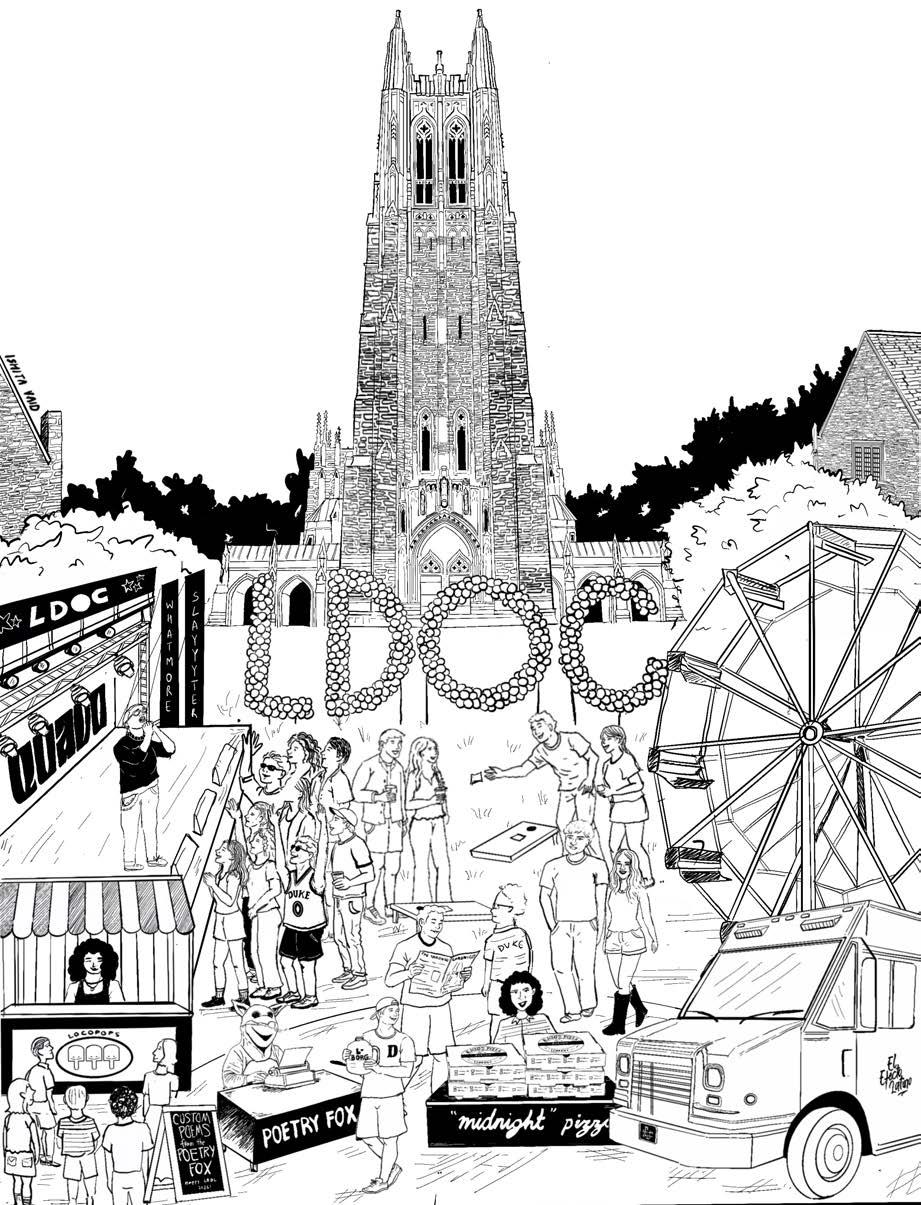
With higher annual student turnout than the Duke-UNC basketball game and the P-Checks concert, LDOC is Duke’s most popular social event of the year. Drawing 7,725 attendees last year, LDOC committee co-chair Allison Lee and incoming LDOC committee chair Nilay Ghodasara expect this year to surpass that figure.
The day is coming to fruition after months of work by the Duke University Union LDOC committee. The committee — which meets weekly throughout the entire school year — is composed of students from each grade, from first-years to graduate students.
“We all meet together, but we all have our specialties,” Ghodasara said. “A certain portion focuses on the daytime programming, and we have a certain portion focusing on the marketing, the branding, the videos.”
With over 50 daytime events and a concert in the evening, Lee encourages students to “wake up early” and “get involved.”
This year, the theme is “Duke in the Desert,” inspired by popular musical festivals Coachella and Burning Man. There will be plenty of intheme programming offered, from sunglasses decorating to sand art. As in previous years, students will be able to take part in popular traditions like the Chapel climb, stuff-
a-critter, screen-printed tote bags and a visit from the Durham Poet Laureate Poetry Fox. Free food, including four quad brunches, will be scattered across West Campus dormitories starting early on into the day.
The programming, beginning at 10 a.m., is all designed to let students celebrate their accomplishments over the year — all on campus.
“We let frats and other student-led organizations on campus host events during the day, right before the concert on the quads, to encourage people to stay on campus and on Abele Quad right up until the first artist performs,” Ghodasara said.
New wellness-centered activities will also take place this year, featuring cycle sessions at the Student Wellness Center, pilates with Duke Recreation and a “sound bath” in Penn Pavillion.
LDOC will then conclude in the evening with a concert featuring artists Quavo, Slayyyter and WHATMORE. But to get Quavo, the LDOC committee first had to sift through 1000 responses collected on a student survey sent out at the beginning of the year. Then, the committee works with a team to contact the artist through a special college concert production process.
New this year, students will be able to visit “Alumni Messages.” Throughout the semester, the LDOC committee has been collecting alumni responses to questions such as “What’s your favorite LDOC memory?” and “What’s a lesson you learned at Duke?” which will be transcribed onto letters. On LDOC, students will be able to take home one of these letters, bringing a piece of advice from an alum home with them.
In addition to putting on a fun event, the committee also strives to give back through a philanthropic partnership each year. As students picked up their LDOC wristbands on Monday and Tuesday, they were able to purchase LDOC merchandise. Profits will go to this year’s philanthropy partner KidzNotes, a Durhambased non-profit that empowers youth through music education.










By Liv Prusky Recess Staff Writer
The last day of classes — in its modern, concert-centered form — took shape in the late 1990s, and since then, has become one of the largest annual events on Duke’s campus. On that long-awaited Wednesday, students climb the Chapel, participate in craftmaking workshops and indulge in an abundance of free food. The day culminates with the iconic LDOC concert, with students speculating over who the artists will be all year.
From nostalgic pop stars to the most famous rappers of our generation, Duke’s history of heavy-hitter LDOC concerts deserves credit for the pop culture institution it has become. Ahead of Quavo’s 2026 performance, here’s a look back at Duke’s iconic Abele Quad performers.
In its early stages, throughout the late 1990s and early 2000s, LDOC performances spotlighted big names. One famous headliner was Run-DMC, a hip-hop group renowned for songs like “It’s Tricky” and “Walk This Way,” a cover of the Aerosmith song featuring the original band. Another popular artist, but lesser-known LDOC headliner, was The Indigo Girls. The folk-rock duo is known for “Galileo” and “Closer to Fine,” a cover of which was featured in the deluxe edition of the soundtrack to Greta Gerwig’s 2023 film “Barbie.”

Although a controversial figure more recently, Kanye West — now known as Ye — performed at Duke in 2004 and is one of the biggest LDOC success stories. His reputation has since soured due to antisemitic rhetoric, but the LDOC booking, years before his 24 Grammy Awards, was a remarkable feat. Looking retrospectively, when the committee selected him, he had only a handful of singles to his name. In February 2004 — two months before the performance — he released his debut album “The College Dropout.” His price tag for the LDOC feature was a mere $31,500.
The following years brought numerous iconic performances: Gym






Class Heroes in 2009, Ludacris in 2011 and Lil Wayne and B.o.B in 2012. The following year, 2013, was particularly star-studded. Kendrick Lamar, rap’s most decorated Grammy winner and 2025 Super Bowl halftime show performer, headlined the concert. The artist behind “Not Like Us” and “HUMBLE.” was accompanied by Steve Aoki, a prominent DJ known for throwing cake at fans. What a duo.
Dillon Francis, a DJ known for popular tracks like “Get Low” and “Goodies,” headlined LDOC in 2014. While somewhat unpopular at the time, now Francis boasts 2.9 million monthly listeners on Spotify. In 2015, T-Pain, creator of the ultimate hype song “Hey
Baby” and cult classic “Buy U a Drank,” performed after R&B artist Jeremih, whose most popular track at the time was “Birthday Sex” (perhaps making for an interesting performance).
Somewhat forgotten in the LDOC historical record are the years of 2017 and 2018. In 2017, Duke hosted Tory Lanez, Daya and Cheat Codes, providing a dynamic mix of R&B, pop and electronic dance music. In 2018, the performers were Marc E. Bassy, singer of “You and Me,” Smallpools, the indie band behind the coming-of-age hit track “Dreaming” and Quinn XCII, popular for “Stacy” and “Love Me Less.” While LDOC tends to pull through with at least one quality A or B-lister, these years boasted quantity too.
More recent performers might sound more familiar. Duke has hosted NLE Choppa, 070 Shake, Swae Lee and of course, Natasha Bedingfield.
From this survey of past performers, a common trend emerges: LDOC often featured artists on the cusp of a meteoric rise, although recent performers like Bedingfield had often hit the peak of their career years earlier. Interestingly, one of this year’s supporting acts, Slayyyter, recently gained attention on social media after a packed Coachella set. Some speculate that her breakout performance echoes Chappell Roan’s career trajectory. Maybe Slayyyter’s LDOC performance will be the next big step in putting her on the map.






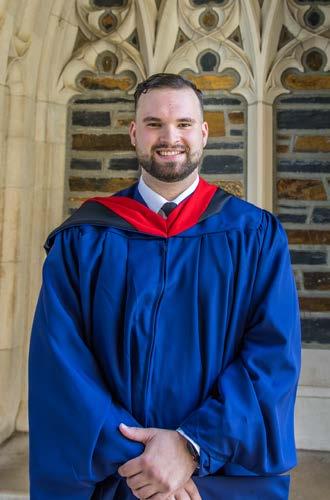

showing them. Until one of his friends called his bluff, asking him to play it on a guitar.
Somewhere on the lower level of Bryan Center lies a recording studio many students don’t know exists. Inside are professional-grade microphones, soundproofed walls and, on any given weekday, at least one
exists. Inside are professional-grade undergraduate trying to find their artistic voice.
The studio is home to Small Town Records — Duke’s fully student-run record label — and serves as a hub for a relatively underground music scene.

“I couldn’t do it,” he said. “Funny enough, that’s how I started wanting to learn.” Fast forward eight years, he showed up to move-in day with a guitar and amp, having already discovered STR on Instagram.
None of them came to Duke specifically for music, yet each of them found it anyway.
For many, Duke’s creative arts
For many, Duke’s creative arts offerings may not be the first thing that comes to mind, with students leaning towards pre-professional pathways such as finance, consulting and law. Yet within Duke’s smaller community of student musicians, another culture is taking shape.
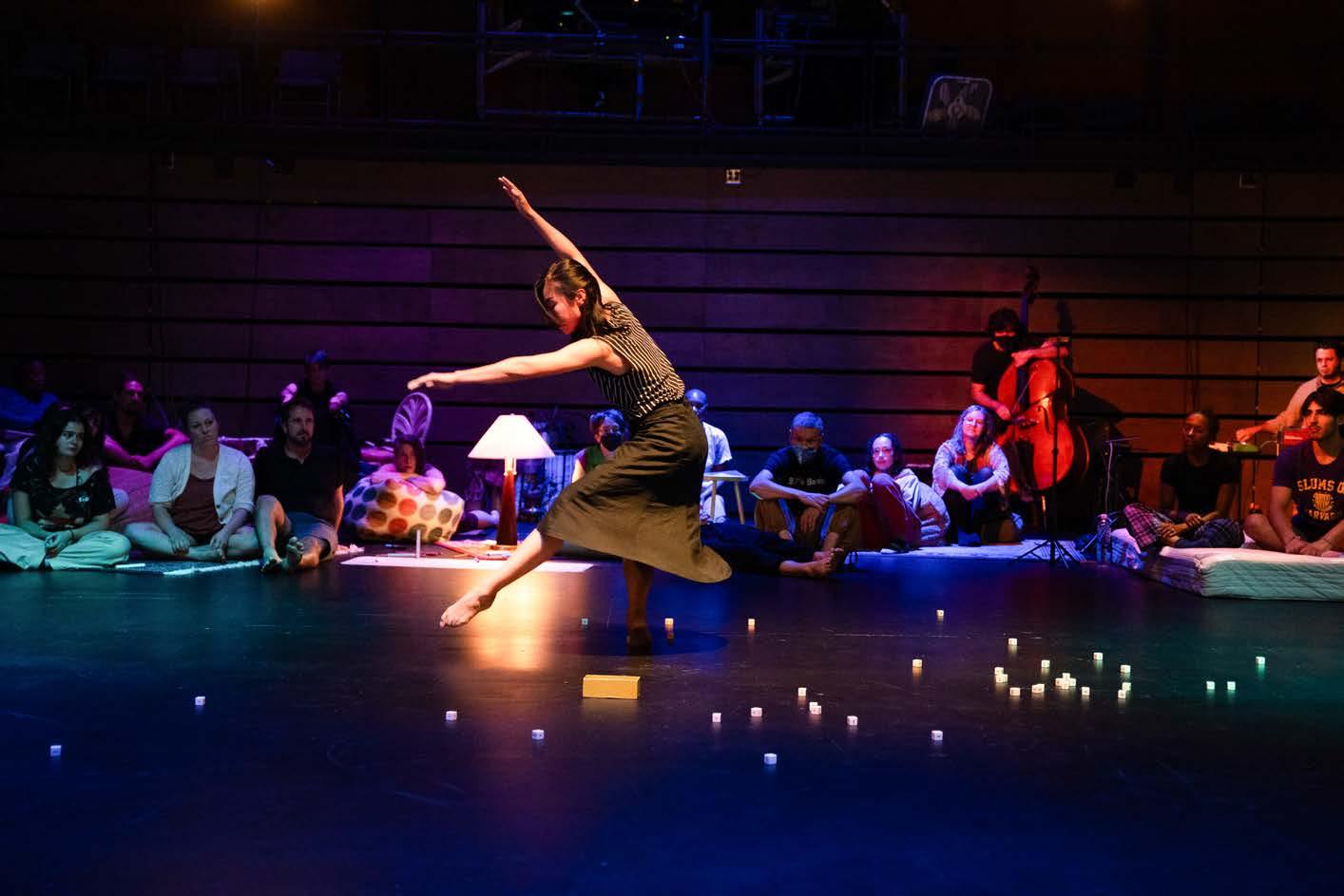
A rapper from the Bronx cuts tracks at 3 a.m. A physics student lets a song sit for two weeks before she decides if she likes it. A firstyear from Greenville, S.C., is figuring out how to play his guitar in his dorm without waking up his neighbors. And a senior is preparing to close out college the same way she started it: on a stage.

“I didn't

Ask any of them when they started making music, and the
general answer is the same: early in life.
Hannon Stern, a sophomore singersongwriter who described music as “a language that just is very intuitive to me,” started writing songs in sixth grade on the piano — bad ones, she’ll tell you, and she was okay with them being bad.
“I liked the feeling it gave me in the privacy of my room,” she said. And her music was private for years, shared through voice memos to friends and only once at a songwriting camp during high school.
Grace Davis, a senior neuroscience major just days away from graduation, also traces her musical roots to a young age. At four years old, she was a Taylor Swift devotee. By five, she was begging her parents for a guitar.
“They said, ‘if you play piano for a year and you still want to play guitar, we'll buy you one,’” she laughed. She got the guitar a year later, and has been playing ever since.
Jaden Small, stagename JDon!, a junior Reginaldo Howard Scholar studying political science and history, was gifted his first microphone from his father, who also made music.
“It's the same one I use to this day,” he said.
And Jack Stapleton, the first-year from Greenville, S.C., got his start slightly differently. At 11, he began messing around with Garageband on his phone, lying to his friends that he could play the guitar presets he was
even really know what people my age were doing. I didn't know what performances people were going for and how people were recording their music,” Stern said of the time before she came to Duke. “I was learning that world, and then I got to college, and still had no intention of releasing music. [Then I] auditioned for Small Town Records, and then it just became such a central part of my life.”
“It seems like a no-brainer. The
“It seems like a no-brainer. The commitment that I have for myself and my music is of equal importance to any class that I take at Duke,” Small explained.
to any class that I take at Duke,” Small Stapleton, pre-law and studying public policy and neuroscience, wants to go into survivor’s rights law to defend victims of sexual assault priority, he treats playing the guitar like a relaxing brain break to which he
Stapleton, pre-law and studying public policy and neuroscience, wants to go into survivor’s rights law to defend victims of sexual assault and abuse. Although academics take priority, he treats playing the guitar like a relaxing brain break to which he devotes much of his spare time.
Davis explained that for the artists, who are “the minority” at STR, “there’s a much larger group of people backing them up and making everything happen.” Since becoming a signed artist her sophomore year, Davis has released two songs through STR, with access to a marketing team for promotion and a visuals team for cover art.
But for both Stern and Davis, the community extends beyond production and promotion at the studio.
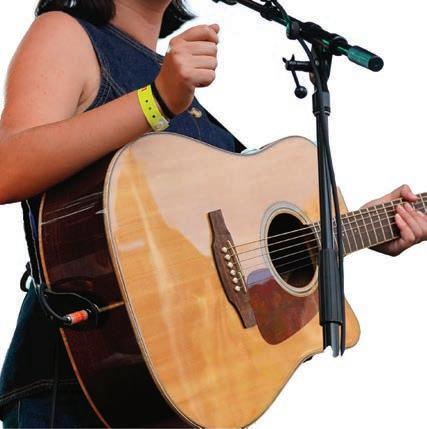
“Music's been a really good outlet for me, and always has,” Stapleton said. “When I was in high school, I called it my therapy.”
“Music's been a really good outlet said. “When I was in high school, I called it my therapy.”
Stapleton and his band, which formed during orientation week, treat their rehearsals like a club.
formed during orientation week,
They show up at least once a week and work towards gigs whenever they have “free time to be able to get together and just play some
and work towards gigs whenever have able to get together and just play some music.”
“It's seeing people around campus. It's performing around campus. It's like meeting up with a band in a random location to practice,” Stern said, a dynamic Davis described as part of Duke’s “small but mighty” student musician community.
Davis, who is school, finds that having performances on her calendar negotiable. an but I also have a performance this week," she said, “and so both become

Davis, who is heading towards law school, finds that having performances on her calendar makes her music commitment nonnegotiable.
“I might have an exam this week, but I also have a performance this week," she said, “and so both become priorities for me.” Without the accountability of STR, which lines up shows and creates expectations,
accountability of STR, which lines up shows and creates expectations, it might be easy to let music fall to the wayside.

Small occupies a unique position within it. He describes himself as the only hip-hop rapper on campus, operating in a landscape largely dominated by indie singer-songwriters and country artists. Rather than treating that as isolation, he takes his place in STR as a creative advantage.
“[By] being able to get criticism or get input from people that are doing other types of music, we can make sure that the sound is actually reaching a diverse audience,” he said. He tends to work lean, producing his beats and music in his dorm room with an audio interface, mic stand and laptop — no entourage required.

The commitment that I have for myself and my music is of equal importance to any class that I take at Duke.
Jaden Small
But Duke’s academic culture, relentlessly pre-professional and chronically busy, does not make space for art by default, they said. These students have to carve it out.
Small described the Duke environment as “very corporate,” and has spent the past few summers — including the upcoming one — interning at J.P. Morgan. And rap and finance are not an obvious duo.
“Trying to find time for both has been particularly challenging, but ultimately, it's something that you're gonna have to deal with,” he said. His solution is the same one he’d offer for most things: he treats his music like it matters just as much as anything else.
And that’s why nearly every student musician emphasized STR’s importance. If you asked Small, Davis, Stapleton or Stern to describe STR, they would tell you it’s so record label — it’s the underpinning Duke’s music
Davis, Stapleton or Stern to describe STR, they would tell you it’s so much more than a record label — it’s the underpinning ecosystem of Duke’s music scene.
STR has fewer than 10 signed artists at any given time. Everyone else is an audio engineer, producer, social media manager, member of the house band, visual media creator or logistics and marketing.
STR has fewer than 10 signed artists at any given time. Everyone else is an audio engineer, producer, social media manager, member of the house band, visual media creator or
“It's such a great community of people, and just a world of resource,” Stern said. “It's amazing — I feel like I've and I haven't even taken advantage of a fraction of it entourage required.
“It's such a great community of people, and just a world of resource,” Stern said. “It's amazing — I feel like I've taken advantage of so much, and I haven't even taken advantage of a fraction of it yet.”

Davis wants to see the scene grow outward, beyond the self-selecting group that already knows STR exists. She points to the Duke Music Coalition as a promising development: a newer organization that creates performance opportunities for any
student, regardless of how deep their musical background runs.
"Duke isn't really known for being an artsy school," she said, "but I think there are a lot of students who just don't know how to connect with people who are doing the same things they are."
Stapleton noted that connection is also shaped — and sometimes

limited — by campus infrastructure. He pointed to the logistical hurdles of putting on outdoor performance, from reserving BC Plaza in advance to navigating noise ordinances and wrangling approvals. "Welcome to Small Town" — one of STR's signature annual events held on the quad — takes serious coordination just to happen.
Despite their love for it, none of the four sees music as their primary career. All of them are mostly certain it probably won’t go anywhere, though Small is the most openly ambitious.
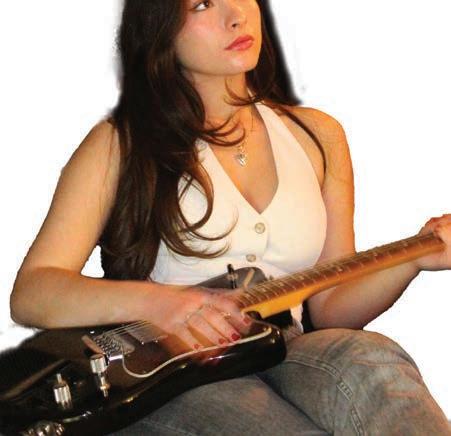
Small talks about scalability and a digital economy that would make music a viable future for him.
"I'm always making music. I'm only trying to get better," he says. If music doesn't scale the way he wants, he'll be in finance in New York — and he'll still be making music.




For him, the two paths are not mutually exclusive.
Small’s inspirations are A Boogie wit da Hoodie, a fellow Bronx native and his moststreamed artist since sixth grade, as well as Drake and Gunna — artists he said are defined by range and a refusal to be boxed in. His biggest full-circle moment was opening for A Boogie during the P-Checks concert last
year.
Stapleton performs Australian indie-influenced, guitar-driven rock with his band and cites Royal Otis and Mac DeMarco as influences. But he’s honest about his ceiling.


“I'm pre-law. This isn't a thing where I'm gonna drop out and move to LA," he said. But Stapleton talks about music the way he talks about everything else he cares about: with total commitment. "I don't ever commit to something unless I can give my 110%,” he said.
Joni Mitchell guitar tunings and pulls a drummer, bassist and guitarist into the studio for collaborative recordings just because she can. The physics major is at a crossroads with what comes next. For now, though, she’s grateful for the uncertainty.
commit to something unless I can give
Davis is preparing to open for this year's LDOC — another full-circle moment for someone who spent four years quietly building toward stages she didn't know she'd reach.
“Part of me will always be open to music, and I think it's just kind of based on whatever opportunity presents itself,” Stern said. “The short answer is I don't see it as a career. And then the long answer is, I don't see anything yet as a career.”
year's LDOC — another full-circle four years quietly building toward she'd probably freak she says.
"My high school self would out,"
After
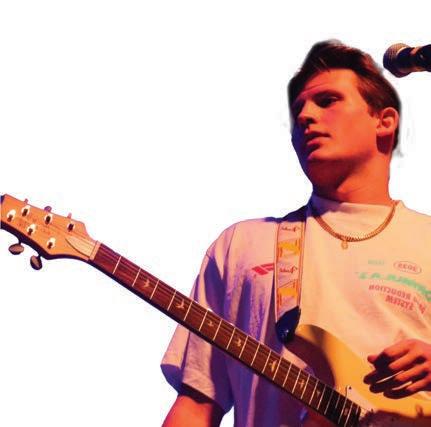
graduation, music alongside her career, And perfectionist who marinate for weeks turns uninspired
graduation, she plans to pursue civil rights and family law. For Davis, music will run alongside her career, not underneath it.
And Stern, the perfectionist who lets her songs marinate for weeks before she decides if she loves them, turns uninspired afternoons into

Remotescreeninginterview
3setsofquestionnaires
In-personsingle-session interventionfordepression s mptoms




bit.ly/hyperscan-wl






These mini puzzles commemorate Duke University's 2026 Last Day of Classes. Check out all puzzles on the Crossword page on The Chronicle's website!
By Jeffrey Broms | Crossword Editor


ACROSS
1. Have debts
4. Endure
6. Goodbye, in Guadalajara
8. Cpls.' superiors
9. Negative, in Nice
DOWN
1. Salutation, in Sao Paolo
2. Bunches of bills
3. Endorse digitally
5. "Africa" band
7. ID for a 1040



ACROSS
1. One of seven in a week
4. 12/24 and 12/31, e.g.
6. "___ Steps" (Coltrane tune)
8. Diva
9. Bond, for one
DOWN
1. Duke grad's BA or BS
2. Alamo rival
3. "Sailing to Byzantium" poet
5. Piece of cake
7. Investigate in court

ACROSS
1. Too
5. Place to plug in
8. PHYSICS 161 and MUSIC 161, for two
10. On edge
11. Praline ingredients
DOWN
1. One of The Squad, in brief
2. ___lemon of athleisure
3. Megafan
4. Mary-Kate or Ashley
6. Genesis twin
7. What might be worth 40% of your grade!
9. Part of iOS: Abbr.

By Ella Bilu and Spencer Oshins Sports Staff Writers
The Blue Devils may have an ACC Championship under their belt, but they still have a chip on their shoulder.
On a sunny day at Wallace Wade Stadium, Duke’s defensive squad brought the true heat to the team’s annual Blue & White Game, snatching a win from its offensive counterpart, 26-17. Two quarterbacks played at the helm for Duke — returner Dan Mahan and transfer Ari Patu — while transfer Walker Eget, who is still recovering from injury, showed off his prowess during in-between practice plays. Ultimately, though, the largely young offense could not overcome a sharp defense anchored by sixthyear linebacker Nick Morris Jr.
“In a setting like this, with people in the stands, you want to see guys perform with a little bit [of] that extra pressure,” said head
coach Manny Diaz, who is entering his third year with the program and just agreed to a contract extension through 2031. “From my vantage point, watching both sides of the ball, I think we got what we wanted to accomplish.”
After a series of warm-up plays to kick off the morning, Duke’s defensive and offensive units split to opposite sides of the ball and field for the first of two 15-minute quarters.
While the offensive Blue Team earned points as it would in a regular performance, it had the added opportunity to cash in on an additional four points for a 20-yard touchdown or a field goal over 50 yards. The defensive White Team earned one point for a sack, two points for a three-and-out sequence, two points for a safety, three points for a fourth-down stop, three points for a defensive touchdown and five points for a prized turnover.
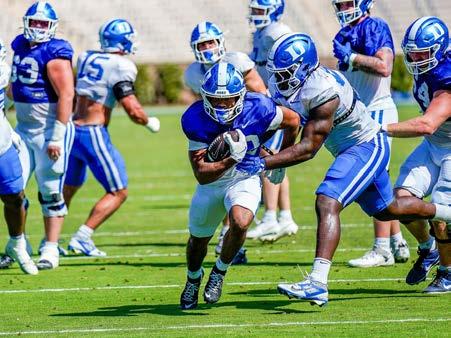
In the first drive of the game, Mahan powered the offense from the quarterback slot. It took only two plays for him to air the ball for a 15-yard completion. Returning from a stellar freshman season, Nate Sheppard shouldered lead back responsibilities, carrying three straight run plays.
“The young backs wowed everybody … and I think will give the fans the reason to think why we're optimistic about those guys, not just this year, but down the line for this program,” Diaz said.
At just 19 years old, Sheppard is the only player in
the running back room with at least one year of meaningful experience in a Blue Devil uniform. New additions CJ Campbell Jr., CJ Givers and Jayvian Tanelus earned reps throughout the scrimmage.
“There's always someone behind you that can come and take your spot. So they push me further than I can just put myself on myself,” Sheppard said.
After a scoreless first drive, Patu replaced Mahan under center. The North Alabama transfer was stifled by a pressing defensive line, capitalized by a sack from defensive tackle Dakota Quiñonez. Unlike last year’s affair, the defensive side struck first on a three-and-out, making the score 2-0.
But an offensive unit that led last year’s ACC with 285.4 passing yards per game responded aptly. Mahan, returning as playcaller, scrambled on the first drive of the play for a first down. He then darted a 20-yard spot to Jaivon Solomon. The redshirt freshman stamped the drive with a gravity-defying catch in the corner of the endzone to take a 7-2 lead, with Cosme Salas kicking the extra point.
“I think a major storyline was the plays that our young wide receivers made, which is consistent with what we had seen throughout the spring with Solomon,” Diaz said.
In the game’s 30 minutes of play, the defense forced three interceptions and recovered a fumble, amounting to 20 difference-making points. First, a one-legged Mahan throw was bobbled by the receiver and recovered by cornerback Dylan Flowers. The second forced turnover was a Kaleb Laneir interception off Patu. Following a five-point defensive fumble
recovery from UConn transfer Jon Morris — brother of Nick Morris Jr. — the score read 2110, advantage Blue. Two drives later, safety KD Cotton prevented a touchdown with a pick at the front corner of the end zone.
“I think we're gonna be a lot better this upcoming year,” veteran linebacker Nick Morris Jr. said. “I think we have an edge about us, maybe a little bit of a chip on our shoulder because we maybe didn't quite live up to the expectations last year."
Despite the graduation of three-year starting kicker Todd Pelino, the performance of Duke’s special teams proved sturdy. Redshirt freshman Ashton Zamani started the drives with kick-offs, while Salas converted both of his two field goal opportunities.
Trailing 26-10 with little time to go, the Blue Team knew a scrimmage win was out of sight, but in-game improvement was not. After settling for a field goal in the closing 30 seconds of the first half, the pressed offense finally converted, with freshman wide receiver Brody Keefe grabbing the six-point catch. Zamani nailed the ball through the uprights to close the offense’s scoring for the day.
Between some of the scrimmage plays, a helmet-less squad also took the field for practice snaps. Eget, still recovering from a leg injury, was the signal-caller during most of these reps.
“To get them in the stadium and have them operate the call, even though they're not going full speed in playing and hitting, I think there's still a lot of value in that,” Diaz said.
The Blue Devils will open fall competition at Wallace Wade Stadium against Tulane September 5.
By Ella Moore
Associate News Editor
Quavo will headline the annual Last Day of Classes concert on April 22, according to a video streamed by the DUU LDOC Committee during its Wednesday evening artist reveal. Additional acts include Slayyyter and the musical band WHATMORE.
Quavious Keyate Marshall, who goes by the stage name Quavo, is a four-time Grammy-nominated American rapper and record producer from Lawrenceville, Ga. He is known for his versatile flow, adlibbing ability and melodic lyrical delivery across both features and original songs.
Quavo is widely recognized for appearances on high-charting tracks spanning genres from rap to pop, including DJ Khaled’s “I’m The One,” Justin Bieber’s “Intentions” and Post Malone’s “Congratulations.” He first rose to prominence as part of the American rap trio Migos alongside his nephew Kirsnick Khari Ball, known as TakeOff and fellow Lawrenceville native Kiari Kendrell Cephus, known as Offset.
The group first gained traction with the release of the single “Versace” in 2013 before going viral with the 2016 single “Bad and Boujee,” featuring Lil Uzi Vert. The song topped the Billboard Hot 100 for three non-consecutive weeks in January 2017.
Migos became the first rap group to spend more than one week at No. 1 on the Billboard Artist 100 chart following the release of its third studio album, “Culture II,” in 2018. The sequel to the group’s
breakout album “Culture,” “Culture II,” featured popular tracks such as “Walk It Talk It,”“Stir Fry” and “Motorsport,” all of which charted in the top 10 on the Billboard Hot 100. The group eventually split in 2022.
Following the death of Takeoff due to gunshot wounds in November 2022, Quavo became a staunch advocate against gun violence. He founded the Rocket Foundation, which supports communitybased programs addressing gun violence. In 2024, the Biden administration’s Office of Gun Violence Prevention presented him with the ‘Humanitarian of the Year’ award for these efforts at the Variety Hitmakers Brunch.
Catherine Grace Garner, known by the stage name Slayyyter, is an American singer, songwriter and rapper from Kirkwood, Mo. She began her studio career with the release of the studio album Troubled Paradise in the summer of 2021. Her most recent album "Wor$t Girl in America," released in March, brought her to the top the Billboard Dance Albums Chart. Three songs from the album, “Yes Goddd,” “Crank” and “Dance” debuted in the Top 15 on Billboard’s Hot Dance/Pop Song chart.
WHATMORE, consisting of members Cisco Swank, Elijah Judah, Jackson August, Sebastiano and Yoshi T, is a New York City-based band that blends hip hop, jazz and alternative indie. The group has recently gone viral on TikTok for its album, aptly titled “whatmore,” and some have compared the group to the popular hip hop boy band Brockhampton.
BY ANA DESPA |
04/21/2026
Steve Cannaday has been woken up by police twice at stoplights, passed out midroute, engine still running, newspapers piled in the back. He only stops driving when he cannot physically hold out any longer.
WHY DUKE IS EXPANDING ITS HEALTH SYSTEM WHILE THE UNIVERSITY CUTS COSTS
BY ZOE KOLENOVSKY
| 04/20/2026
Behind the scenes of the University’s austerity, the health system has been growing its reach through a series of substantial acquisitions and investments that will double the number of hospitals in the system in the coming years.
FACULTY COMMITTEE CALLS FOR OVERHAUL OF DUKE’S PPD POLICY AFTER FINDING ‘FUNDAMENTAL DEFICIENCIES’
BY DYLAN HALPER
| 04/17/2026
The report recommended creating a separate committee tasked with drafting a new “expressive activity” policy to be voted on by the council at the end of the next academic year.

looks like effortless beauty at the Gardens — from the blooms to the carefully arranged landscapes — is the product of daily labor and year-round planning
By Rebecca Fan Editor-At-Large
Every day, visitors arrive at Duke Gardens, and the plants have already been checked, paths cleared and beds quietly tended.
What looks like effortless beauty at the Gardens — from the blooms to the carefully arranged landscapes — is the product of daily labor and yearyear-round?
The work falls to a coordinated team of staff horticulturists, interns and volunteers, supported by a facilities specialist and a plant collections manager who maintains a detailed database of the Gardens’ plant collections.
round planning. Behind the quiet paths and the lively South lawn, who are those responsible for the beautiful blossoms spaces
Together, the team, led by Director of Horticulture Robert Mottern, keeps one of Duke’s most visited spaces open every day of the year, welcoming more than 650,000 visitors annually. In his role, Mottern oversees both the day-to-day maintenance of the Gardens’ plant life and long-term planning for landscape infrastructure, including patios, pathways, irrigation systems, drainage, garden

structures and seasonal plantings.
The Duke Gardens are divided into four distinct sections — the Historic Gardens, H.L. Blomquist Garden of Native Plants, W.L. Culberson Asiatic Arboretum and the Gateway Gardens — each managed by a team of horticulturalists who are experts in their respective areas and largely manage their sections independently.
“I really let each individual team make most of the decisions in their areas because I want everyone to have a part of ownership in their area … and their thoughts and ideas represented,” Mottern said.




In addition to full-time staff, the daily upkeep of the Duke Gardens relies on a broad network of students, interns and volunteers to help with daily operations. During the academic year, about 15 to 16 work-study students assist with tasks ranging from mulching to assisting weekend visitors. Each summer, the Gardens also hire interns from horticulture programs across the country to support routine maintenance, including watering the Gardens’ many container plantings.
It takes a lot of people, a lot of hands and a lot of coordination to maintain the Gardens like we do.
Behind the visible displays, Mottern noted the “constant manipulation of plants,” with spaces intentionally shaped and maintained through specific plant selection, design and routine trimming for both aesthetic and safety reasons. He added that maintenance also includes removing dead trees, cleaning up and repairing damage caused by storms, repainting the iconic Meyer bridge, as well as routinely managing disease and pests.
Volunteers are also a significant part of the Gardens’ backbone. Mottern said between 30 and 50 horticulture volunteers regularly contribute hours each week, while others support departments across the Gardens, including education, special events and visitor services.
“It takes a lot of people, a lot of hands and a lot of coordination to maintain the Gardens like we do,” he said.
Much of the care that comes with maintenance is labor intensive. This
By Lila De Almeida Staff Writer
Poke a hole in the soil, about six inches deep. Gently place the pink beet seedling inside. Flick some more soil into the hole. Keep the seedling’s leaves above the surface. Rinse and repeat — there’s still a whole tray of yellow beets that need to be planted.
How else would a handful of French students, a Pratt alumnus and a Swiss tourist spend their Friday afternoon?
Situated six miles off West Campus, the Duke Campus Farm (DCF) sits on a one-acre plot of land. On Wednesday mornings and Friday afternoons, anyone in the area — including Duke students, community members or passersby — can get their hands dirty and harvest fresh produce.
Spring is an especially eventful time at the farm. Volunteers look forward to their shifts because the fields grow noticeably greener and livelier each week.
“The [plants] are growing so big!” said sophomore crewmember Tsveti Milkova.
All plants at the DCF are grown from seeds and start out in the prop house, a temperaturecontrolled structure covered in opaque plastic that stands behind the property. Now that the weather is warmer, the “babies,” as they are affectionately called, are brought outside to be planted in the ground by workers and volunteers.
The DCF reminds Milkova of home in Bulgaria, where her family grows food for the household. Although the scale is much larger and the climate warmer, she has taken on twice-weekly shifts at the Orange County farm.
Harini Ilamurugu, a second-year Master of Business Administration student, only discovered her interest in farming at the DCF.
“I was born and raised in India, and [my parents] have a farm over there [...] I didn’t really respect it as much as I should have, but now I do,” she said.
As she spoke, Ilamurugu ruffled the spinach plants with her fingers, pulling out disheveled or discolored leaves alongside a dozen other volunteers kneeling in the soil. This farm, she said, differs from her family’s in part because it practices regenerative agriculture — a sustainable farming method that emphasizes maintaining and improving the health of the land.
A volunteer inspected the plants provided by the Duke Campus Farm for EarthFest visitors, which included students, faculty and the families of prospective students visiting campus for Blue Devil Days.
Saskia Cornes, DCF director and assistant professor of environmental humanities, had a tall problem to tackle when she first started the job in June 2014. Years of plantation agriculture had eroded the area’s soil, Cornes wrote in an article. For her, the environmental loss mirrors the deaths of Indigenous and enslaved people who worked on that very land.
Therefore, today’s work on the farm is regenerative of both ecological damage — by using sustainable farming techniques like integrated pest management and minimal tillage — and historical injustice — by growing culturally significant crops like sunflowers, tobacco and okras.
Working at the farm elbow grease, but that’s exactly what draws people in. Farm work is gritty and tangible, a welcome change of pace for college students.
“It’s always a great feeling to be able to do something with your hands and to see something that you put effort into be actually ac-
complished,” said Eloise Wescott, a North Carolina State University student on spring break who accompanied her father to volunteer at the farm. Academic work is different from farm work, she said, because turning in a paper does not yield quite the same satisfaction.
Sophomore Joseph Yan began his tenure at the DCF in fall 2025 through the Office of Climate and Sustainability’s Green Devil Intern Program. His first task in August was to plant carrot seeds. By December, he pulled those same carrots out of the ground and enjoyed the fruits of his labor in a soup he prepared at home.
But what becomes of the rest of the crops that volunteers do not take home?
In years past, the DCF has donated 100% of its produce to local community organizations. But to establish a direct connection between the farm and the community it feeds, the farm will return to its previous business model: community-supported agriculture. Starting in April, CSA subscribers will pay $35 per week ($32 for students) to receive boxes of fresh produce that vary by week. Customers can get their reusable box of herbs, leafy greens, fruits and roots at their pick-up spot of choice.
Produce isn’t the only thing that brings people to the farm, though. Days spent sorting garlic cloves, grooming spinach or tying bunches of basil mean a lot of quality time among the workers. The farm is far from quiet: there’s a steady hum of conversation from between the rows of plants as people work.
Take, for example, seniors Asher Wallen and Sofa Radkova. Wallen first visited the farm during his first-year orientation group Project Earth. Friday was Radkova’s first time at the farm, fulfilling an item on her senior year bucket list. It was a lucky coincidence that their
French class, FRENCH 308S: Manger: Foodways and Food Systems, required the two to visit the farm as a “community engagement activity.” For the first hour of their visit, Cornes gave them a tour of the farm’s grounds completely in French.
Apart from class requirements and orientation excursions, people also engage with the DCF casually. As student employees of the farm, Yan and Milkova teach workday volunteers various tasks. In the process, they get wellacquainted with the farm’s cast of characters.
“That’s always the most rewarding part of this job ... just seeing all the new, different people come in, and also seeing all the returners come back and ... have fun in the soil,” Yan said.
Staff of the Duke Campus Farm gave away free plants and spoke with students about their initiatives, which include providing sustainably-grown produce and food systems education to the Duke and Durham communities.
One such returner is Eloise’s father Bob Wescott, Pratt ‘90, who has attended three workdays in the past month or so. He said he found himself returning for the people, the outdoors and of course, the vegetables.
“The limits of Duke kind of fascinate me, because I can never find the end of it. There’s always something interesting going on,” he said.
Community workdays are open to all, regardless of farming experience. Volunteers can coordinate carpooling online, like Anna Lebret, a visitor from Switzerland who stumbled upon the event on Duke Groups and arranged to ride with Wescott and his daughter.
DCF veterans encourage interested parties to come on Wednesday or Friday to see the farm for themselves.
“It’s just good to be in a space where everything is so alive,” Yan said.

includes hand-pulling weeds, mulching, pruning and rotating the seasonal plants in and out. The process begins in the greenhouse, where plants are moved into containers before being transferred to different areas of the Gardens and eventually replanted each season. According to Mottern, replanting typically takes place in the spring and fall, the busiest periods for the Gardens team.
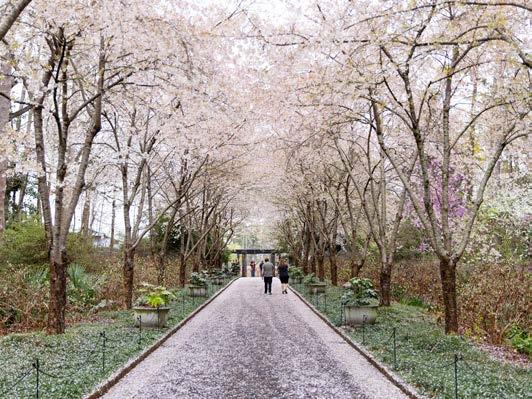
Each year, Duke Gardens also prepares months in advance for the influx of visitors during cherry blossom season, an effort so extensive it has come to be known as “Operation Cherry Blossom.”
Photo by Amy Zhang | Photo Editor
We’re always busy with something. It’s just that some seasons are a little bit busier than others.”
For Lilyann Gardner, a first-year Master of Fine Arts student, working behind the scenes has become valuable experience. Gardner works as a student intern in the Historic Gardens, where her responsibilities shift with the seasons.
Brand new luxury apartments in Downtown Durham—steps away from Duke, the DPAC, Brightleaf Square, and RTP
Brand new luxury apartments in Downtown Durham—steps away from Duke, the DPAC, Brightleaf Square, and RTP
“It’s constant work,” he said. “…
Depending on the time of year, Gardner helps with watering, weeding, pruning and planting — much of the hands-on labor at the core of Duke Gardens’ upkeep. Currently, much of her work has focused on preparing the terraces by removing old plant -
ings, tilling soil and installing bulbs for future blooms — work Gardner described as “really gratifying.”
Behind the work is also a strong emphasis on sustainability, something Gardner said many visitors may not notice. She explained that when seasonal flowers such as tulips and daffodils are removed after a season, all plant material is composted and reused to create new soil and mulch for future plantings.
Mottern said that behind all the planning and labor, the Duke Gardens are ultimately meant to be a place where visitors can explore, learn and take inspiration home. By showcasing “unique and unusual plants” and designing them in what he called “the most exciting way to use certain plant material,” Mottern hopes that people will “take home ideas and maybe represent what they see here at Duke Gardens … in their own yards.”
He added that Duke Gardens’ year-round, free admission makes it a rare resource among university gardens.
“We just want people to come in here, enjoy the Gardens and re -
spect the Gardens but just really enjoy this space,” Mottern said. “… There’s lots of universities that have arboretums and gardens, but not really [of Duke Gardens’] caliber.”
Gardner described her time working at the gardens as centered on “community” and “teamwork.” Although each individual action may be small, together, the efforts of staff and volunteers certainly don’t go unnoticed.
“There’s a lot of people that are doing work behind the scenes, and they’re really making it beautiful, day in and day out,” Gardner said. “It’s just wonderful to then be able to see the Duke community, Durham community come out and enjoy the fruits of that labor.”







































By Annie Eilers City News Editor
For the ninth consecutive year, The Chronicle asked members of the first-year class about their social experiences on campus so far, ranging from Greek life affiliation and residential life to opinions on orientation and involvement with affinity groups.
A semester into their Duke careers, a large majority of the Class of 2029 — over fourfifths of our respondents — reported having found community. The most common places first-years reported having found community on campus were orientation week, dorms and clubs or extracurriculars.
Residential life
The Class of 2029 is the fourth firstyear class to matriculate under the QuadEx system, which launched in 2021. All firstyears are randomly assigned to East Campus dorms that connect to a specific quad on West Campus. The University created QuadEx with the intention of fostering a “culture of belonging,” although the system has received pushback over the years.
Members of the Class of 2029 have more positive opinions of QuadEx than previous first-year classes, with 56.40% of respondents reporting somewhat or strongly favorable opinions of the residential system, up from 52.23% last year. Over a fourth of respondents were neutral on the program, up from one in five last year.
First-years’ perceptions of QuadEx vary by their assigned quad connection. Firstyears connected to Edens Quad were by far the most likely to have unfavorable opinions of the residential system, while those connected to Wannamaker, Craven and Keohane Quads reported the most favorable attitudes.
At least half of respondents in all income groups reported favorable opinions of QuadEx. First-years’ opinions of QuadEx varied less across income groups than two years ago.
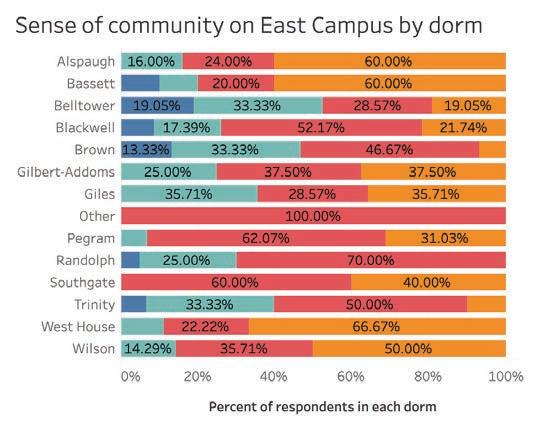
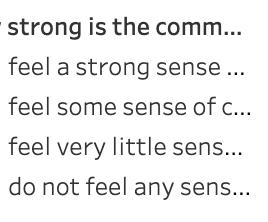
About three-quarters of our first-years reported feeling at least some sense of community in their East Campus dorm.
Residents of Pegram and Alspaugh filled out the survey at the highest relative rates, with 29 out of approximately 125 Pegram residents and 25 of approximately 120 Alspaugh residents responding. Over half of respondents in Alspaugh reported a strong sense of community in their dorm, with 84.00% reporting at least some sense of community. In Pegram, 93.10% of
respondents reported feeling at least some sense of community in their dorm, with a third characterizing it as strong.
In Brown, Trinity and Bell Tower, at least two in five respondents reported feeling very little to no sense of community in their dorms. Trinity and Bell Tower both connect to Edens Quad, in which the highest proportion of first-years reported having unfavorable opinions of QuadEx.
connect in which the highest proportion of
Greek life, SLGs and pre-professional societies
Five years after Duke’s fraternities and sororities disaffiliated from the University, over two-thirds of our respondents said they did not attempt to join Greek life this spring. Of those who did rush a sorority or fraternity, three-fourths received a bid. Women were more likely to rush than men, and of those who did rush, men were more likely to not receive a bid.
whatsoever.
Most respondents, 63.20%, said they had not rushed a pre-professional society at Duke, such as Delta Sigma Pi Business Fraternity or Phi Delta Epsilon Pre-Medicine Fraternity. Of those who rushed, only 36.96% received a bid — down about 12 percentage points from last year’s survey.
Respondents who had rushed preprofessional societies at Duke were much more likely to be interested in also rushing a sorority or fraternity. While a minority of respondents had rushed Greek life, over half of those who had rushed a pre-professional society did. Notably, being accepted into a pre-professional society was also associated
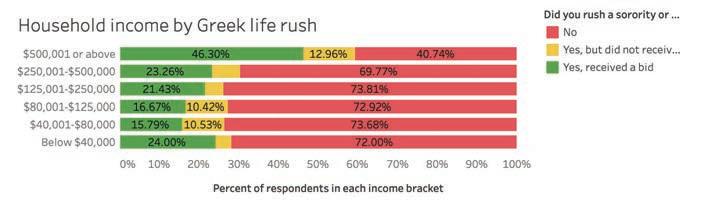
In line with trends from previous years, first-years with higher estimated family incomes were more likely to rush a Greek sorority or fraternity — especially those with household incomes over $500,000. Only about one in five students who rushed came from families with household incomes roughly at or below the federal median, though our full sample was similarly skewed — roughly one-fourth of our respondents reported incomes at or below the federal minimum.
Interest in SLGs and LLCs was more consistent across income levels than interest in Greek life.
Interest in LLCs was somewhat correlated with income — those with estimated family incomes above $500,000 were the least interested in LLCs, while those with estimated family incomes below $40,000 were most interested in LLCs. Interest in
with receiving a bid from a sorority or fraternity.
Interest in selective living groups appears to be lower than in Greek life among the Class of 2029. A minority of respondents, 22.40%, were at least moderately interested in rushing an SLG, but over half reported no interest at all.
SLGs displayed less of a consistent trend in variation across income levels.
Nearly half of first-years, 44.80%, reported being very or extremely interested in tenting to secure a spot inside Cameron Indoor Stadium for a home men’s basketball game against rival North Carolina during their time at Duke. An additional 26.00% of respondents expressed moderate interest; 15.20% expressed slight interest; and only 14.00% were not interested at all.
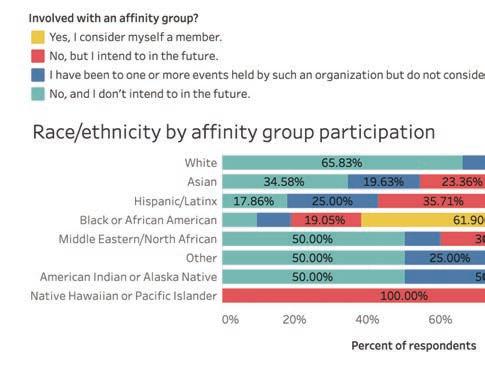
Nearly half of our respondents reported no involvement with a student-run affinity group on campus. One in five of our firstyears said they were not involved at the time of completing the survey but that they intended to be in the future, and slightly fewer said they were already a member. The remainder had attended one or more events held by an affinity group but were not a member.
Black or African American students were by far the most likely to be members of an affinity group, with about three-fifths of our respondents in this group indicating so. About a fifth of Asian and Hispanic/Latinx students each reported the same. Students in these two groups were the most likely to say they intended to join an affinity group in the future. White respondents were the least likely to be involved in an affinity group or want to in the future.
(A very small number of respondents self-identified as Middle Eastern/North African, American Indian or Alaska Native, Native Hawaiian or Pacific Islander, or a race or ethnicity not listed, so the results we reported for these groups may not be reflective of the full first-year population with these identities.)
Members of the Class of 2029 had somewhat more interest in living-learning communities than in SLGs. A slightly higher proportion of respondents, 26.40%, had at least a moderate interest in joining an LLC, and 42.00% of students reported having no interest

having no interest
Interestingly, those with estimated family incomes below $40,000 and above $500,000 were the only groups in which the majority of respondents who rushed a pre-professional society were accepted. First-years with estimated family incomes exceeding $500,000 were by far the most interested in pre-professional societies, with exactly half of our respondents in that income bracket having rushed.
Other social affiliations
The Class of 2029 is the fourth to begin their Duke experience with mandatory Experiential Orientation (ExO) programming. During their first week on campus, first-years spend time in one of several project groups meant to build community and a sense of belonging before classes start.
Members of the Class of 2029 have overall very positive perceptions of ExO. Four in five respondents expressed favorable opinions of the program, with over half reporting strongly favorable opinions. Only about a tenth of respondents reported unfavorable feelings.
Just over half of our respondents, 53.20%, said they had visited or attended an event for an identity and cultural center. The Center for Multicultural Affairs was selected the most by our respondents, followed closely by Jewish Life at Duke. None of our respondents reported involvement with the Women’s Center.
Respondents who were involved with the Mary Lou Williams Center for Black Culture or the Center for Multicultural Affairs were most likely to also be a member of a studentrun affinity group. Those involved with the Center for Muslim Life or Jewish Life at Duke were least likely to report affinity group involvement.
Editor's note: This story is part of a series about the Class of 2029 based on a survey conducted by The Chronicle in January and February 2026. You can read more about our methodology and limitations here or read all our survey coverage at dukechronicle.com.