























































By Dom Fenoglio Senior Editor
Tens of thousands of fans held their breath as Gordon Hayward released a half-court heave in the 2010 National Championship, and millions more watched the ball rim off as time expired. Then-captain and point guard Jon Scheyer ran to celebrate Duke’s fourth National Championship.
But Hayward’s shot was hardly the only pivotal moment that took place that weekend in Indianapolis.
During the media onslaught that came with a small school from Indianapolis playing in its backyard against giants of the sport, Stevens gave credit to a little-known analytics website named Kenpom.com, which he said he checked after every game. The website, run by statistics aficionado Ken Pomeroy in his spare time, skyrocketed into the mainstream thanks to Stevens’ kudos, and is now almost as synonymous as the AP poll in terms of a team’s ranking.
Ten minutes away from Butler, Evan Miyakawa watched live as Gordon Hayward nearly brought a championship to the young fan’s favorite team, cementing his lifelong love for the sport. Miyakawa carried that passion through his Ph.D. in statistics and now runs an analytics site of his own — EvanMiya.com — used by fans and coaches across the country.
Back when Pomeroy began his work tracking college basketball metrics, the data was sparse and difficult to accumulate. These days, the numbers come in droves — and both Pomeroy and Miyakawa take advantage of them.
The overwhelming amount of data collected from each basketball game presents teams with a challenge — and an opportunity. Pomeroy and Miyakawa are two of the leaders spearheading a drive to translate the math into terms understandable by coaches, players and fans alike. Used correctly, they believe analytics can enable a team to gain an edge on its competition. Butler is a great example.
Finding the right rhythm
Since the dawn of time, or at least the dawn of public ranking systems, sports fans have argued ceaselessly over which team is better than another. It would be practically impossible for all teams to play each other head-to-head, so any attempt at ranking is built on some idea of a universal comparison system.
Beginning at the most basic level, the best teams should be the ones with the most wins and least losses. If teams have the same record, the better team should outscore the same opponents by more. Another common idea is that wins against other strong teams should be more valuable than wins against lesser competition.
100 possessions on defense would have a net rating of 30, likely putting them in the national top 10. Michigan currently leads the KenPom leaderboard with a rating of 36.1; Duke comes in third at 35.35.
This simple change allows for a far more reasonable comparison across teams that play different styles. Pomeroy even keeps a tempo rating on his website for viewers to keep track of his math.
“I try to lean on that idea [of] just really making it understandable for more people,” Pomeroy said. “I do think that is an advantage of basketball … Most of the stats on my site, you could calculate yourself with the right information in front of you. For the most part you can double check my work.”
Pomeroy is underselling the complexity of his calculations on a number of levels. Even collecting box-score data was not trivial when he first started, but Pomeroy eventually wrote a computer script to scrape box-score data from every college basketball game played. Additionally, a crucial part of his rankings rely on scaling a team’s performance based on its strength of schedule.
Again, Pomeroy’s solution is rather intuitive. Instead of trying to equate one team’s schedule to another, he adjusts everyone’s ranking to be relative to the average. In other words, the example team with a net rating of 30 could be better described as 30 points better than the average college basketball team.
Every margin of every game is scaled based on the strength of the teams playing, yielding an objective grading of performance that has historically proved remarkably accurate. The last five national champions all ranked inside the top six in Pomeroy’s rankings entering the tournament, and four were inside the top four.
Digging in deeper
Tempo and opponent adjustments are just the tip of the iceberg when it comes to advanced methods to team grading, especially with the advent of more complex play-by-play data. For example, how do statisticians like Pomeroy and Miwakawa produce preseason rankings, before they have access to any performance data?
The answer to that question is integrated heavily into everything Miyakawa calculates on his website, which includes deep dives on teams, players and even specific lineup combinations. He relies on Bayesian statistics, methods that allow him to combine prior beliefs about a team or player’s strength with their on-court performance.
I just kind of dove in an did my own work without thinking about where it would go, or what it would lead to.
Combining these three ingredients is like baking cookies with salt instead of sugar; it looks right but doesn’t hold up upon closer inspection. Enter Pomeroy, who applied his knowledge of statistics to a love of college basketball.
KEN POMEROY Basketball statistician
Unlike some traditional statistical techniques, Bayesian methods allow models to be extremely flexible as more data comes in. If a team underperforms relative to its preseason projections, Miyakawa’s rankings would react faster than typical methods; he might also recognize a breakout player before teams wisen up.
align that with the types of things they’re thinking about, all of a sudden they really care about it.”
Miyakawa doesn’t need to convince coaches to care about his work, as the growth of advanced analytics in the sport has led programs across the country to lean into the numbers to help build their teams. In addition to consulting coaches on how to use his site, Miyakawa has a subscription plan that allows schools — or avid fans — to see his transfer portal player ratings and even project how they would mesh with a team’s current lineup.
When you can actually take data and align that with the types of things they’re thinking about, all of a sudden they really care about it.
Still, Miyakawa does not advertise his work as infallible. Both Pomeroy and Miyakawa stressed that advanced metrics should be used as a piece of the puzzle, not the entire solution, and as the statistical complexity of the models increases, the uncertainty they contain becomes harder to explain. Nonetheless, the results speak for themselves.
who received similar recruiting marks entering their rookie year. Miyakawa also added that his Bayesian approach takes this into account, allowing freshmen to more quickly escape their preseason rankings to reflect their actual output. Another area of the game Pomeroy pointed to as a source of uncertainty is 3-point shooting. The common adage “live by the three, die by the three” rings true in the data, as small differences in 3-point percentage not only have major implications on the outcome, but are largely uncorrelated to controllable factors.
EVAN MIYAKAWA Basketball statistician
“The one thing that I feel like is underestimated by coaches, [is] just the influence of variance in 3-point shooting,” Pomeroy said. “The wild swings 3-point shooting has on a game-to-game basis, I’m not gonna say the defense has no control over it, but [it’s] a lot less control than coaches want to think.”
“It was about that time that the advanced analytics movement in baseball had really taken off and become mainstream, and there really wasn’t anything for basketball yet,” Pomeroy told The Chronicle. “So I just kind of dove in and did my own work without thinking about where it would go, or what it would lead to.”
Pomeroy introduced tempo-based statistics to his model, an enormous leap in the field of basketball analytics when he began his site over 20 years ago. A team that tends to run up the score by shooting 3-pointers and playing as fast as possible should not be overvalued because of its high scoring output. Similarly, a team that grinds a game to a slow, methodical pace is less likely to pull away and win by gaudy margins, but that does not mean it should be punished.
Pomeroy scales his offensive and defensive ratings to a 100-possession rate, then combines these metrics to create an overall net rating, or a team’s predicted victory margin. For example, a team that averages 120 points per 100 possessions on offense and gives up an average of 90 points per
“The Bayesian approach has real computational appeal,” Duke statistics professor Jerry Reiter, who teaches a sports analytics class, told The Chronicle. “You can set a model up and try to estimate it, whereas with a lot of the classical statistics methods, you have to prove that this model has some [assumptions].”
Leveraging Bayesian statistics allows Miyakawa to make conclusions that, by design, will adapt and improve as more games are played. Miyakawa also provides information about how teams perform in his model over time, inserting emojis next to teams on his website that represent consistency, injuries or hot streaks.
With over 50,000 followers on X, Miyakawa consistently interacts with fans and other college basketball personalities to spread his work and bring analytics to more people. He builds each addition to his website to help users contextualize for themselves what they see when they watch basketball.
“It all gets back to something that people care about, whether they want to know the numbers or not,” Miyakawa told The Chronicle. “They have their own biases, eye test [or] couch expert knowledge. When you can actually take data and
“There are 365 teams, and my projections are going to be wrong about a lot of things,” Miyakawa said. “There’s over 5,000 players. Surely there’s going to be some [projections] that are off. But more often than not — if I’m picking a ballpark, I’d say like, 75% of the time — this is going to be pretty close to what ends up happening.”
Forecasting the future
If there is one prediction Duke and North Carolina fans hope Miyakawa and Pomeroy nail, it’s the outcome of the game between the archrivals. However, aside from any sort of added pressure that may or may not add to the unpredictability of the Blue Bloods’ contest, the two teams are led by some of the hardest players to quantify: outstanding freshmen.
Both Cameron Boozer and Caleb Wilson were projected to be instant impacts for their respective squads, but it was hardly a guarantee that they would be playing at an All-American caliber strength to this point in the season.
Pomeroy and Miyakawa each spoke about the difficulty in projecting the performance of star freshmen before a season begins, since the only data to rely on comes from players
Despite the unpredictability that comes along with basketball, the effect of advanced analytics on the game is evident now more than ever. Furthermore, the information available to coaches will only continue to become more complex — Miyakawa pointed to on-court tracking of player movements as a lane in which analytics is currently expanding. These new tools allow teams to learn more not only about their players’ performances, but also about their physical attributes.
“I think there’s a bit more of a recognition now that even tiny, little marginal gains in the long run can help you,” Reiter said. “Even off the field and off the court, things like injury prevention … there’s a recognition that bringing analytical tools and data might help.”
But even with the best information, statistics can never guarantee an outcome. When Hayward released that fateful halfcourt heave back in 2010, Pomeroy’s high ranking for Butler had absolutely no effect on whether or not the ball went in.
That’s why it was so exciting to watch.
Note: All rankings as of Sunday, Feb. 1
1. Michigan (+36.62)
2. Arizona (+36.37) 3. Duke (+35.91) 4. Iowa State (+31.96) 5. Houston (+31.46) 6. Illinois (+31.09) 7. Florida (+30.38)
8. Michigan St. (+30.28) 9. Connecticut (+29.96) 10. Purdue (+29.50)
21. Texas Tech (+24.64) 22. Iowa (+23.87)
23. N.C. State (+23.39)
24. Arkansas (+23.05) 25. Saint Louis (+23.00) 26. Auburn (+21.80)
Texas A&M (+21.62)
Villanova (+21.60)
North Carolina (+21.46)
Kentucky (+21.33)
Clemson (+20.96)
Utah St. (+20.93)
Michigan (32.3)
Arizona (31.4)
Duke (31.3)
N.C.
Texas (19.7)
Kentucky (19.7)
Auburn (19.2)
Ohio State (19.0)





By Caleb Dudley Sports Multimedia Editor
For the first time in quite a while, both Duke and North Carolina are headlined by a star freshman. Cameron Boozer has been exactly as advertised for the Blue Devils, currently averaging 23.5 points per game as one of the nation’s top scorers and the current favorite for the Wooden Award. Tar Heel forward Caleb Wilson has been just as effective though, averaging near 20-point double-doubles and sporting one of the nation’s best highlight tapes thanks to his high-flying feats. As the two diaper dandies await their first matchup of the season, let’s take a look at some other standout freshman performances in this century’s history of the rivalry:
Few freshman debuts in the rivalry, if any, were as anticipated as Williamson’s. With Barack Obama and Spike Lee among others in the crowd for the first edition of the rivalry at Cameron, all eyes were on the tantalizing freshman who had taken the country by storm with his athletic feats. Instead, the star forward burst through his shoe on a drive, robbing him of two appearances in the rivalry and Duke of two wins as he recovered from an injury. When the Blue Devils drew their rival in the ACC Tournament semifinal, Williamson put on a show that was worth the wait.
The power forward went for 31 points and 11 rebounds, with his return serving as the difference in the one-point victory for No. 5 Duke. North Carolina led with just 47 seconds to go, but Williamson powered his way to a putback over Nassir Little to regain the lead in the final seconds. Refusing to be swept in the rivalry, the eventual Wooden Award winner “put on his Superman jersey,” according to North Carolina coach Roy Williams, as he finished with the finest freshman rivalry performance so far in the 2000s.
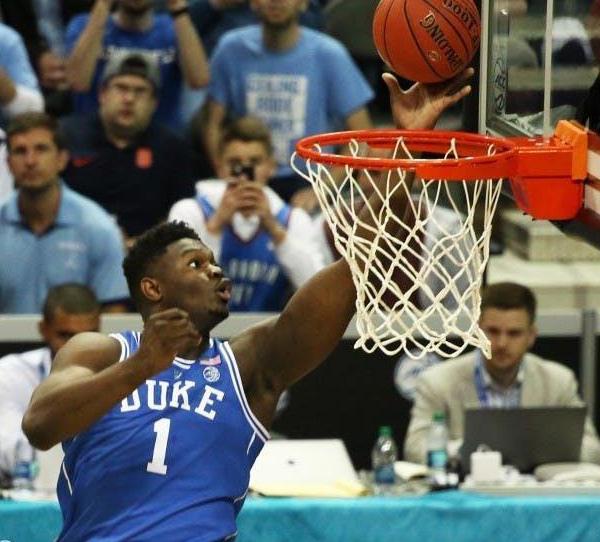
in the 2018-19 season.
Caleb Love, 2021
Duke fans likely have no place in their heart for Caleb Love. Between his antagonist role in the rivalry and his repeated appearance — perhaps by fate — on the Blue Devils’ schedule during his time at Arizona, the St. Louis native hit more than enough shots to frustrate the royal-blue-clad faithful. A notorious microwave scorer, Love exploded for 25 points and seven assists in likely the best performance of his rookie campaign as North Carolina won a 91-87 shootout over Duke.
It was a rare unranked-on-unranked matchup — and one of few without fans due to COVID-19 — in the history of the rivalry, but Love didn’t seem to care about any outside noise. His four threes helped the Tar Heels to a 66.7% 3-point percentage on the evening — an offensive output the Blue Devils simply couldn’t match. The freshman guard outdueled fellow freshman Jeremy Roach as the visitors snapped a three-game losing streak in the series.
“It was a big (statement), just having this be one of the best rivalries in college basketball,” Love said. “It felt like there were fans, just how hard we were playing and how into the game we were. We were just locked in coming into the game.”
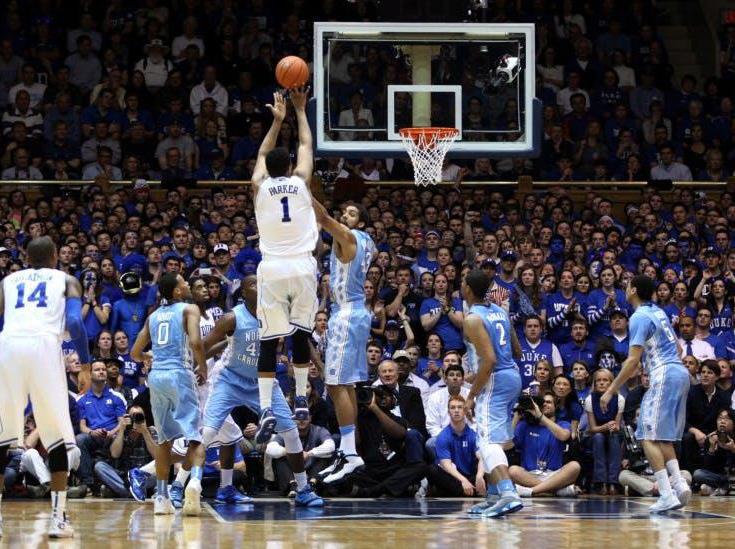
The 2013-14 season was a major “What-if?” What if Duke had gotten past Mercer in the first round of the NCAA Tournament? Would the dynamic duo of Rodney Hood and Jabari Parker have made a deep run in March? The latter’s performance against North Carolina certainly would incline you to think that way — the eventual lottery pick hung a season-high 30 points on the fourteenth-ranked Tar Heels and had 11 rebounds to boot.
While not an elite 3-point shooter, the freshman did knock down two of his four attempts from beyond the arc in the contest, including one that gave Duke its largest advantage of the evening at 74-55. Hood added 24 points as the fourth-ranked Blue Devils finished the regular season with a 24-7 overall record.
“It’s hard to say what ‘it’ is, but whatever the hell ‘it’ is, Jabari found it,” Williams said.
While McCants led the Tar Heels in the scoring column, it was his freshman running mate in Felton who commanded the offense in the shocking upset. The young point guard remained in complete control of the offense throughout the contest, going for 18 points, 10 dimes and eight boards.
With Duke narrowly trailing, it elected to play the free-throw game in a desperate attempt to get back into the game. Felton could have easily felt the pressure of the six-game skid to the Blue Devils weighing on him in one of the biggest moments of his young career. Instead, he drilled a pair at the charity stripe, allowing the Tar Heels to hang on by a thread at home.
Krzyzewski’s last year did not go to plan. The Final Four exit at the hands of Duke’s in-state rival and a demoralizing loss with every Blue Devil dignitary in the building on senior night tarnished the legacy of what was an excellent season for the Blue Devils. However, there was an often-forgotten win over the Tar Heels that season. That February contest in Chapel Hill was not highlighted by eventual No. 1 pick Paolo Banchero, but by a 27-point outburst from fellow freshman AJ Griffin.
Griffin was simply unstoppable that evening at the Dean Dome. The noted sharpshooter knocked down three triples and went 11-for-17 in his career night. Duke jumped out to a 31-8 start in the eventual 20-point triumph, but it was the freshman forward who helped stave off the Tar Heels’ comeback attempt. The Ossining, N.Y.., native started the second half on a personal 10-0 run, “plunging dagger after dagger into the hearts of a pumped Tar Heel crowd.” When it was all said and done, Griffin had quite the crowd chanting his name as he got off the bus outside Cameron Indoor Stadium.
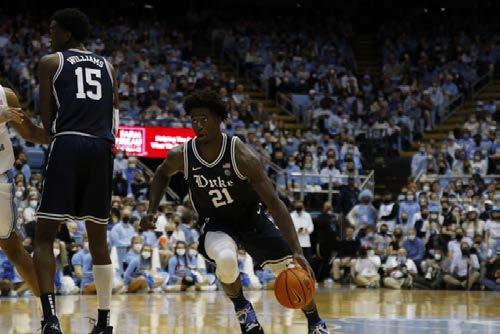
March 5, 2006, was supposed to be a celebration of one of Duke’s all-time greats. No. 1 Duke honored six seniors prior to tip-off, with JJ Redick and Shelden Williams chief among them. Instead, the night was ruined by a freshman big man in Hansbrough. The center went for 27 points and pulled down 10 rebounds despite drawing one of the toughest defensive assignments in the conference in Williams.
The win for No. 13 North Carolina marked the end of a 19-game win streak at Cameron Indoor for the Blue Devils, and was only the second conference loss of the year for Redick and company. Hansbrough went on to terrorize Duke for the remainder of his four-year career — the Tar Heel legend never lost a game at Cameron Indoor. 22
This one needs little explanation. While the big-time shot over Zeller is the memory burned into the mind of every fan who tuned into the game, Rivers had an overall masterful performance in the nail-biting victory over No. 5 North Carolina. The son of NBA head coach Doc Rivers registered 29 of Duke’s 85 points, including six made threes.
Down 10 in the final 2:30, the Blue Devils made a fervent comeback led by Rivers. After Zeller scored what could only be likened to a soccer own goal to put Duke behind by just one point with 14 seconds left, his missed free throw set the stage for one of the greatest moments in the rivalry’s history. As the freshman guard brought the ball up the left side of the court, he saw an opportunity to create a mismatch that favored the offense. Crossing over right, he successfully forced a much less nimble defender in Zeller to guard him on the perimeter. The rest is history. Rivers fired from long range — nothing but net. 14 years later, it remains as likely the greatest single play a freshman has made in the recent history of the rivalry, if not the entire breadth.
2003 was likely the low point for North Carolina in this century’s version of the rivalry. Head coach Matt Doherty had not proven the answer following the retirement of the legendary Dean Smith — the Tar Heels had won just eight games the year prior. Entering a March matchup with the 10th-ranked Blue Devils late in the season, Rashad McCants decided to provide a late bright spot to a disappointing campaign that was Doherty’s final in Chapel Hill.
The game itself was a thriller; 21 lead changes certainly will keep the fans engaged. But it was McCants who finished the job as North Carolina bucked a six-game losing streak in the Tobacco Road series, as the frosh forward dropped 26 points on 12-of-16 shooting and knocked down a crucial three with 2:23 remaining to break a 7272 stalemate. While the victory wasn’t groundbreaking in terms of postseason implications, it did ensure North Carolina doubled its win total from the season prior.
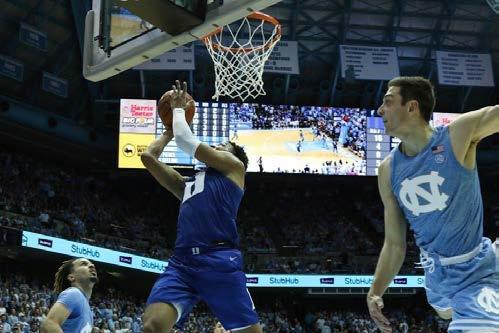
No matter your overall statline, there is no greater feeling than hitting a game winner to defeat your bitter rival. Williams did just that in the season finale of the 2004-2005 campaign. With 19 seconds remaining in the contest, North Carolina point guard Raymond Felton had a chance to tie the ballgame at the charity stripe. Instead, the free throw careened off the rim and found itself caught up in a tussle for possession. Almost miraculously, the ball rolled out of the chaos and found Williams on the block. The freshman forward rose up and converted a tough finish, with a whistle to boot. Williams finished off the and-one successfully, and North Carolina had the lead with 17 seconds to play.
Williams finished the contest with nine points and seven rebounds, but it was that play down the stretch that cements his place on the list. The 75-73 win over the sixth-ranked Blue Devils gave North Carolina head coach Roy Williams his first career win over Duke, and helped propel the Tar Heels to an eventual national title run that concluded roughly a month later.
10 10
Like Williams, Wendell Moore delivered a special freshman moment in one of the all-time classic iterations of this series. After some late-game heroics from sophomore point guard Tre Jones — an intentionally missed free throw that resulted in a game-tying jumper ended regulation — No. 7 Duke found itself in overtime despite trailing by 13 with less than five minutes to go. Jones looked primed to deliver another Herculean effort, but his game-winning jumper attempt came up short. However, it never hit the ground. Moore swooped in from the left side, grabbing the miss and putting it right back up for the dagger. Just the possession before, the Charlotte product delivered the break the Blue Devils desperately needed. The freshman guard finished a layup with 13 seconds left to bring the deficit to one, and then deflected a ball off North Carolina guard Andrew Platek to give Duke the ball, leading to the the eventual miss-turnedpass that has now been immortalized. Not a bad way to make your mark in the 100th year of the rivalry.



All gifts of $100 or more per day will be entered into our drawing to win two tickets to the Duke v. UNC game in Cameron on March 7, 2026

By Sophie Levenson Senior Editor
On the far end of Duke’s bench in Cameron Indoor Stadium, right next to the scorer’s table, Davis Beischer is sitting next to associate head coach Chris Carrawell, who’s sitting next to head coach Jon Scheyer. All three of them have their eyes trained on Coach K Court, where Duke men’s basketball is playing a strange, halting first half against Louisville.
The first time Patrick Ngongba II dunks on the Cardinals, the bench erupts, but Beischer stays put, his composure intact.
Beischer, 23, who has curly, dirty-blonde hair, sports an all-black outfit, like every other staff member on the bench. Alec Kopatich, the team’s equipment manager, texts the coaches and staff what to wear for every game. It’s one of the many small tasks the staff performs, which together make Duke basketball what it is: a highly polished and seriously complicated operation dependent on all sorts of seemingly silly tasks — many of which fall under Beischer’s purview as director of basketball operations.
Beischer was once one of the freshman student managers who frantically wipes players’ sweat off the court; in his day, he sopped up a lot of Paolo Banchero’s famously voluminous sweat, and some of Trevor Keels’ and A.J. Griffin’s. He decided to apply to be a student manager during orientation week of his first year at Duke, when he heard a then-senior manager shout outside the K Center, “Did they unload the Gatorade order?”
It wasn’t so much that Beischer had a particular penchant for hydration, but more that he grew up in Durham as an avid fan of both Duke and basketball. He played high-school ball at Durham Academy, an “undersized center,” (he’s 6-foot-2), good but not good enough to play in college. As a manager, Beischer figured, he could stay close to the game, and maybe find a job in sports after graduation. He figured correctly.
‘A beast’
When Beischer was a freshman, to get to Cameron Indoor on time, the managers would often use the rentable electric scooters that used to populate campus. Beischer, at least once, opted to run instead.
Preston Sharkey, one of the student managers who worked with Beischer — and one of his best friends — called Beischer “a beast.”
“There’s nothing that will stop Davis from doing his job,” Sharkey said. “No matter what it takes, he’s willing to sacrifice his personal time or other outside factors to make sure it happens.”
Jaylen Blakes, who was in the same class as Beischer during his three years with the Blue Devils, noticed him working hard behind the scenes as early as his freshman year. If Blakes needed someone to come to the gym to rebound for him, he texted Beischer. He could see that his classmate was a perfectionist.
“If you ask Davis to do something, he’ll always do it. He’ll always be there, and then always think one step ahead of everything,” Blakes said.
After Beischer’s freshman year, Mike Krzyzewski handed the Duke program over to Scheyer. The young head coach spent the summer in the gym with his team, learning how to steer the ship, working out the kinks inherent in this kind of transition. Beischer stuck around for the summer months and helped out with preseason workouts. He watched and assisted as Scheyer figured out his new role. When the rest of the managers came back to campus, Beischer communicated to them the operational changes Scheyer had made; they weren’t huge, but every coach runs things a little differently, and the manager position is all about the little things.
There’s nothing that will stop Davis from doing his job.
SHARKEY Former student manager
On the bench next to Carrawell, Beischer’s face is set, expressionless. He’s chewing gum. When Cameron Boozer fouls a Cardinal, Beischer makes a note on the folded piece of paper he holds on his knee, where he tracks fouls, timeouts and possession. During timeouts, he tells Scheyer where the ball is spotted so the head coach knows which play to write up.
Along with wiping up sweat, freshman managers are responsible for rebounding with the team at 6 a.m., an hour before the C1 bus starts running between East and West Campus.
Sophomore managers graduate from sweat-wiping and water-fetching to bottle-labeling and whistlearranging. They set up the film room with the coaches’ notebooks lined up in a certain order. As juniors, they start traveling with the team to every game, which means learning to pack the 30plus bags of equipment which the team takes on its charter plane. Every year, one senior carries the clipboard, which signifies the head manager position. Last year, as head manager, Beischer took charge of the packing checklist, making sure the managers never forgot equipment. He booked the ballrooms in hotels, in which the managers would tape court lines so the team could walk through plays. He sat on the bench with Scheyer’s clipboard and handed it to the coach for every time out. While the other managers sprinted to the locker room as soon as the buzzer rang for halftime and the end of the game, Beischer stayed behind, keeping close to Scheyer.
That Beischer always stands so close to
the head coach indicates Scheyer’s trust in his director of basketball operations — something general manager Rachel Baker also attested to. That trust earned Beischer his current job.
Two years ago, Duke’s director of basketball operations left the program for an opportunity in the NBA. Scheyer didn’t immediately fill the position; he wanted to be sure to identify the right person. He “kept his eye” on Beischer during his senior year, according to Baker, pretty sure he wanted him to take the job. In the meantime, as head manager, Beischer picked up some of the slack from the empty position.
He was thrilled when Scheyer officially offered him the job last spring. He’s thrilled now, eight months into the job. He’s having a ball. But he can’t quite articulate exactly what it means to be the director of basketball operations.
“I always struggle with this question,” he said when asked what he does.
Sharkey described the manager position almost exactly the same way: “You want to take care of all the little things, so that the players and coaches can focus on just playing and coaching and nothing else.”
Beischer spends a lot of time with Baker, who has taught him about the business of basketball and the work that goes into running a team’s front office. His office, which he has yet to decorate, is right across from hers, on the fifth floor of the K Center. Jayce McCain, who was promoted from graduate assistant to player development specialist at the same time Beischer became director of operations, also has an office nearby. Sometimes, up on the fifth floor, the two young men look at each other in shared wonder that they ended up there, part of the small team that runs this powerhouse of college basketball.
He’s the voice of the players in a lot of ways.
What he’s sure of, though, is that he has plenty to do. Beischer sets up Zoom calls for the coaches and controls the program’s daily schedule. He organizes parking passes for the team. Several months ago, he took Dame Sarr to the DMV to get an American driver’s license. Last week, Beischer drove to his parents’ house to pick up a bunch of Steelers merch that one of the players needed for an NIL-related photoshoot (Besicher’s mom is from Pittsburgh). Then he returned the rental cars the team had leased during the winter storm.
RACHEL BAKER General manager
He also manages the managers and oversees their hiring process. As a former manager who understands the importance of culture in the group, Beischer invites the current student managers to sit in on interviews, and takes their input.
“He’s really a catch-all for the department on any administrative and operational support that we need,” Baker said.
In many ways, Beischer’s job is about making others’ easier, something he’s well suited for. He has a unique ability to anticipate Scheyer’s needs, according to Baker.
“They’re very close,” she said.
“I love working under Coach Scheyer,” Beischer said.
But it’s not just Scheyer he helps out; he lightens everyone’s loads, constantly working behind the scenes to make the program operate as well as it can.
“It’s basically just trying to make everything run as smooth as possible, and hopefully allowing the coaches to have their main attention on basketball and take care of the off the court things,” Beischer said.
‘Someone that cares’ If there are two entities Beischer serves in his role as DOBO (which is what they call it on the fifth floor), they are Scheyer and the players. Beischer is younger than most DOBOs in men’s college basketball; at North Carolina, for example, the man who holds the job is in his late thirties. Rather than being a shortcoming, Beischer’s youth helps him serve the players more acutely — less than a year ago, he was a Duke student, too. He loves this part of the job; he once wanted to be a teacher, and helping students figure things out (like Sarr’s driver’s license, class schedules or any other problem they might have) gives him a similar sense of purpose.
“Anything that these guys might not understand, or know what to do — because they’re 18, and I wouldn’t know either when I was 18 years old — and they’re not with their parents, [I just try] to help them out in any way,” Beischer said. “This role has allowed me to be a resource for the guys … they have a lot, with the pressure of being a Duke basketball player.”
Four years of 40-hour weeks with Duke basketball players taught Beischer about the pressures piled on the young men in Duke blue. They are surrounded by support from their coaches and other staff members — like Baker — but Beischer is able to connect with them differently. He’s not a coach; it’s not his job to make them better players, it’s to make the road less bumpy along the way.
“He’s the voice of the players in a lot of ways,” Baker said, “if we’re trying to gut check a scheduling thing, or where the team’s head is at, or just get a feel for the locker room.”
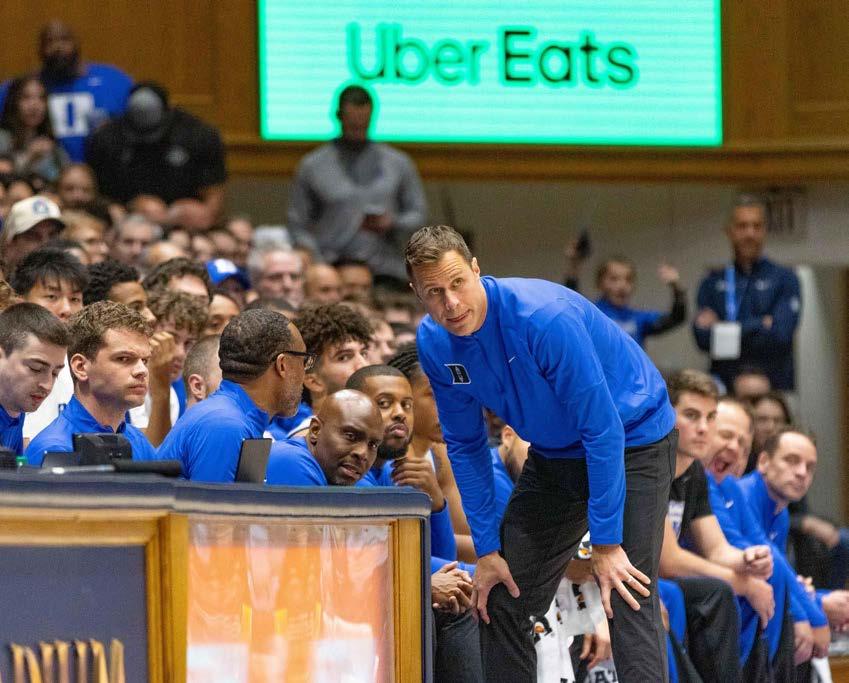


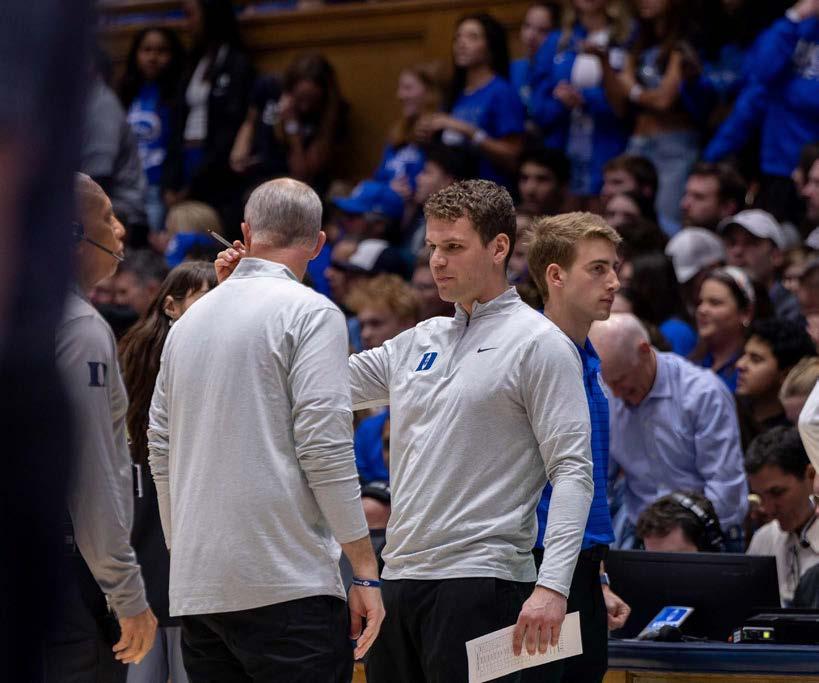



















‘Stick to my path’: Duke’s supporting cast is emerging via the team’s renewed defensive focus
By Ranjan Jindal Senior Editor
Cameron Boozer. AJ Dybantsa. Darryn Peterson. Kingston Flemings. Caleb Wilson. The list goes on.
Freshman excellence has defined this college basketball season. And while each of those players, including Duke’s own Boozer, have foreshadowed excellent NBA futures, what can get lost in the narrative around college basketball is the beauty of growth and the unique paths that each player takes in their career.
Not every 18-year-old (or younger) is going to have a seamless adjustment from being the go-to guy on their high school or prep team to the arduous intensity of college basketball. Nor are they supposed to; that’s what coaches are for. Not to mention the added mental pressure from the outcry of one bad game.
Unlike some of the teams bolstered by young talent, nobody at Duke was a routine starter on a college team last year. Head coach Jon Scheyer’s group does not have a transfer that plays significant minutes (one hope was Cedric Coward, whose burgeoning talent is instead producing flowers for the Memphis Grizzlies). What that means is the path for this team is different than most; it’s not immediately dominant, but requires fan patience.
The team has shown some glaring weaknesses, but with all that said, because of Scheyer’s elite coaching and player adjustments, the Blue Devils have amassed a 20-1 record featuring one of the toughest nonconference schedules in the country. Freshmen Nikolas Khamenia and Dame Sarr, as well as sophomores Isaiah Evans and Patrick Ngongba II, are following a parallel individual growth path, carving out roles and expanding their repertoires to maximize their impact.
in the second half, but he also played an important role in guarding Louisville’s elite backcourt in the nearly eight-minute first-half scoring drought from the Cardinals.
His first three came on a play epitomical of Duke’s paint domination. Maliq Brown grabbed an offensive rebound after a Foster miss. Cayden Boozer couldn’t make a layup but Foster came flying in to swipe a rebound from Louisville’s 6-foot-11 forward Sananda Fru. Cayden Boozer got a paint touch and swung a cross-court pass to Khamenia. He buried the left-corner three. Double fist-pumps from Scheyer.
“I show up with the same mentality to help my team, whatever it may be, whether it’s screening, rebounding, guarding. Scoring will come,” Khamenia said.
The Los Angeles native had a breakout performance against Michigan State, then saw his minutes slow near the beginning of ACC play as he went through a drop in production.
“Nik is on the journey not even like most freshmen. He’s still in rare air in terms of making an impact on one of the best teams in the country,” Scheyer said. “But you’re going to go through your moments of ups and downs. And I think he’s figuring out how to be really successful in college and how to adjust to certain areas, but also how to have that belief in yourself still.”
That belief is paramount, because it can be easy to get dejected as a freshman at a place like Duke with the likes of Boozer and Cooper Flagg and Kon Knueppel and the other unicorns of college basketball. Freshmen are supposed to progress, and their seasons aren’t always pointed upward.
I feel like everybody’s path is kind of different. So me, I just stick to my path, stick to my progress.
Duke’s other wing, Dame Sarr, has carved out his niche as a defensive stopper.
to my progress,” Sarr said. “I don’t look out too much … and I just worry about what I can do to be a better player.”
The development doesn’t just stop with year one, it goes into another season for most college basketball players. For Evans, even though his 3-point numbers are significantly down from his freshman year (albeit with much more volume), his growth on the defensive end and clutch shotmaking from all areas of the floor are evident. Against the Cardinals, he had the tough assignment of All-ACC guard Isaac McKneely, who notoriously runs off screens and creates a conditioning challenge for any defender. He only made one three when Evans guarded him and took only six shots the whole game.
in the schedule.
This team has struggled to shoot the ball all year; that hasn’t improved in this recent hot stretch. Duke shot 31.2% between the Cal and Louisville games from deep, below its 34.4% season average. There’s little the coaching staff can do on that front. But what can help an inconsistent offense? More chances and good defense.
We take pride in the different journeys that we want to be a part of.
Scheyer’s defensive adjustments — the Blue Devils have started switching less on screens — and emphasis on getting back in transition and fighting on the offensive glass has more than made up for the lack of shooting. Holding Louisville to 52 points and both California teams to under 60 gives Duke a much wider margin of error on offense.
In Duke’s 83-52 statement win against Louisville Jan. 26, the Blue Devils played arguably their most complete game of the season, with only 19 points from Boozer. Khamenia’s career-high 14 points came largely
In that same Michigan State game, his length at the top of the 3-2 zone helped hold stellar guard Jeremy Fears Jr. without a field goal, and he’s also taken on the assignment of Ryan Conwell and Ebuka Okorie in ACC play. His point scoring has slowed but not at the expense of his defensive intensity.
“I feel like everybody’s path is kind of different. So me, I just stick to my path, stick
And Foster, who didn’t have the sophomore year he or the Blue Devil faithful had hoped, is now playing the best basketball of his career as a reliable 3-point threat, floor general and defensive stopper.
“We take pride in the different journeys that we want to be a part of, and that journey can be a one-year, two-year, threeyear or even a four-year journey. We’ve doubled down and spent a lot of time and energy thinking about player development and how to approach that on the college level, which is different,” Scheyer said after the Louisville game.
As a result of Scheyer’s coaching, a young Duke team overachieved in the nonconference, emerging unscathed from the Arkansas-Florida-Michigan State stretch of three top-25 opponents. The Blue Devils’ lone loss to Texas Tech was an embarrassing collapse against a depleted roster in the waning minutes of the game. But that’s college basketball; games like that happen. It’s a coach’s job to learn from it.
Duke’s effort on the defensive end was certainly in question as December turned to January. With turnovers galore against Lipscomb and too-close-for-comfort wins against Georgia Tech and Florida State, the Blue Devils had to quickly negate that lull
“I love switching one through five to stand teams up. I don’t think we necessarily did that as well as we normally have … I think our guys have actually developed a better toughness, fighting through some screens,” Scheyer said. “I think the exciting part as a coach, you’re finding each team, what works for them … I don’t think there’s one way you have to play defense. I think there’s adjustments you have to make as a coach, you have to make sure your guys feel good.”
This team is much different from last year’s in both offensive output and defensive efficiency. Scheyer directly asked the team what they feel most comfortable with on defense and has schematically adjusted. But he hasn’t taken any accommodations for effort. Duke often ends up with loose balls and gains extra possessions through deflections (enter Maliq Brown) or rebounds.
A year-to-year team difference, rough patches, late bloomers. Those are all natural forces in the college basketball cosmic order, especially early in the season. Duke won in its non-conference slate largely due to prime late-game execution and deadly defensive stretches. A lot of the “what if” questions are being answered for Duke, and this squad with only one rotation senior is starting to play to its strengths and has its rotation players flourishing.


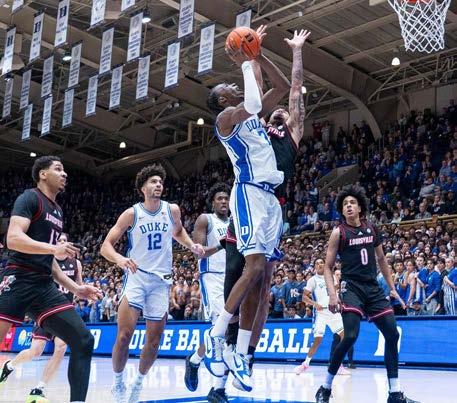
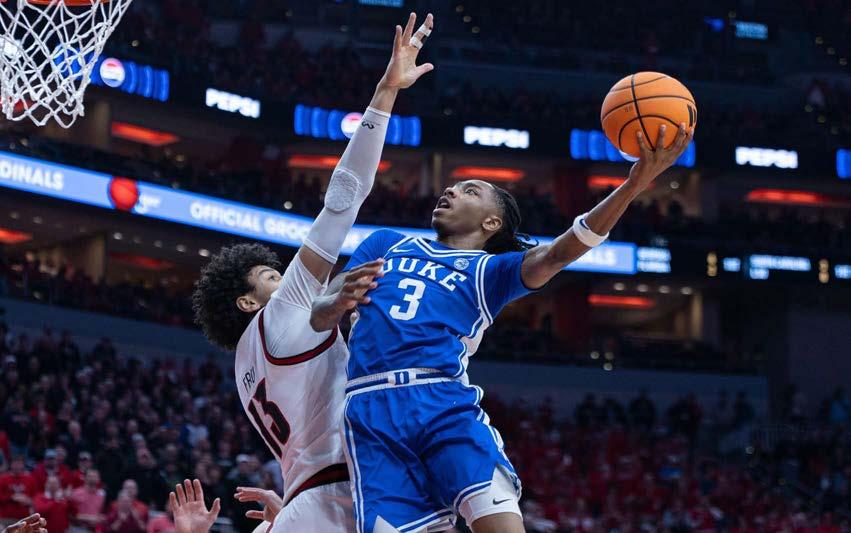


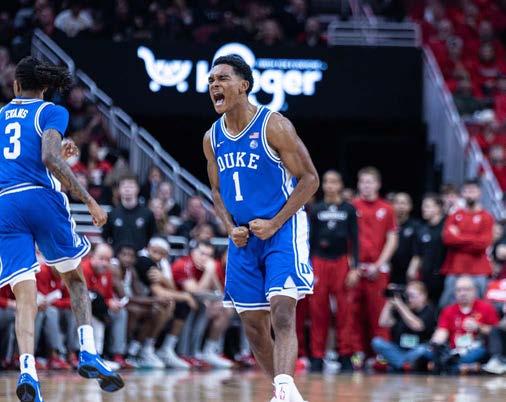

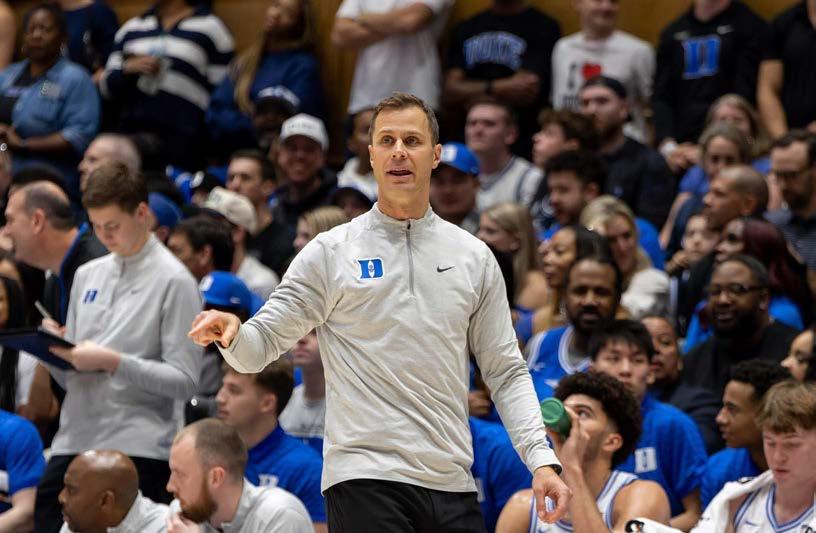
‘We’re going to show up’: Decades of stories from
By Elle Chavis Sports Managing Editor
Before there was Mike Krzyzewski or line monitors or a tenting test, before anyone really cared about Duke men’s basketball, there was Carol Egan and her group of volunteer ushers.
At a table in the corner of Hope Valley Diner off of Shannon Road, Carol reminisces on the decades she spent volunteering as an usher with some of her former colleagues: Gerri Pettit, Pete Hall and Vicki Westbrook. The memories flow out of them with ease: the good, the bad, the only argument Carol swore she ever got into with a coworker over 43 years of working games. They and the rest of the True Blue volunteer ushers who work with them have watched Duke basketball transform from an upstart program to the bluest of blue bloods in college sports.
Carol first started volunteering her time in 1975, when Cameron Indoor Stadium had only been called that for a few years. She and her husband, Jerry, volunteered together, primarily working for Duke football. Jerry worked the North Gate for football while Carol covered the press tent — before the media had anything
as luxurious as a box in the Blue Devil Tower at Wallace Wade Stadium to call home. Back in those days, Tom D’Armi, in addition to being the baseball coach, also worked as the director of athletic facilities and game management. D’Armi made a point to walk around and introduce himself to all the volunteers working.
“So at the end of that game, he came up to me and said, ‘I’m Tom D’Armi.’ I said, ‘Yeah, I’m so glad to meet you,’” Carol said. “He said, ‘I like the way you work. You’re gonna be running the games for me.’ And that’s how it started.”
Before long, Carol and Jerry started organizing volunteers to work as hospitality ushers for Duke football and basketball games, pulling in their friends and friends of friends, including Gerri, Pete and Vicki, to join them. They did everything from driving around VIPs in golf carts to helping lost children during the annual Youth Day games. As the group continued on, D’Armi suggested they become a nonprofit, dubbing them the AllAmerican Athletic Association. Though they were volunteers, Duke still paid them for their hospitality efforts, and the group donated every cent they earned to charity.
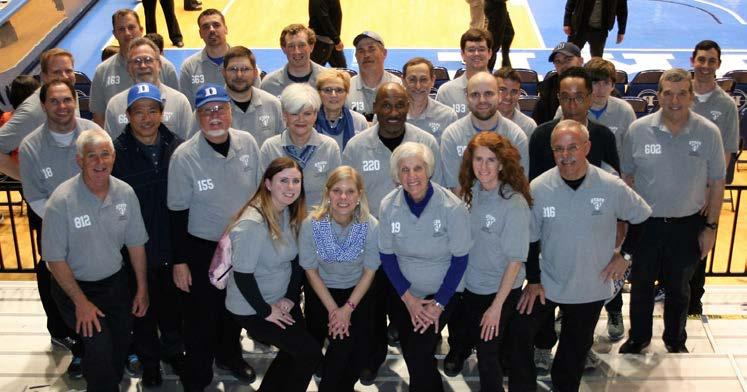

Carol remembers the day the airball chant originated in Cameron, the day Shaquille O’Neal came to Cameron and the day former President Barack Obama attended a game. Most of all, Carol remembers how often the Crazies used to throw things onto the court: twinkies, pizza boxes, tennis shoes. When the students threw tennis balls between Sections 17 and 19 — back when the students filled both sides — D’Armi charged her with getting on a microphone and yelling at the students to stop. Before the North Carolina game, he would ask one of the maintenance men to sleep in the crow’s nest to ensure no students snuck into the Stadium. Carol remembers when D’Armi told her that the maintenance man had discovered a couple sneaking into Cameron in the hopes of a moment alone on the court.
was called Trinity College, Pete proudly ushers Section 9. He knows the regulars in his section, just as they know him. When Pete came down with the flu, he jokingly said the man who covered his section should have worn a sign around his neck that read, “Pete’s not dead.”
I think I’m the longest-tenured worker in the building of basketball.
“Everybody was asking where I was…I realized I had not missed a regularseason game in 22 years,” Pete said. “I say now that I’m glad that [Coach] K retired, I think I’m the longest tenured worker in the building of basketball.”
All of the volunteers display a commitment, driving from as far as Elon, N.C., for nearly every home game. They know who regularly sits in their sections just as the fans know them. They have all experienced nearly every significant moment in Duke basketball history from Coach K’s arrival to Jon Scheyer taking over.
The group has a lengthy list of me mories of students attempting to sneak into Cameron. Pete — who has worked with the group since 1988 — remembers once trying to open the storage closest off of his section where he stored his winter coat. To his surprise the door was locked, something that could only be done from someone inside. He called Tony “Ship” Shipman, who worked as a lieutenant in the Duke Police Department for several years.
“Ship, very calmly said, ‘Okay you need to come and open the door or we’re going to break it down,’” Pete said. “‘If we have to break it down, not only do we charge you with trespassing, you have to pay for the door too.’” After a few beats of silence, the student came out of the closest, claiming that they had simply fallen asleep.
A lifelong Durham native whose family has had roots in the era since Duke
“If we sign up to work the game, I think Duke Athletics feels like we’re going to show up,” Vicki said. Once, she came straight from the airport after being in California for a work conference to work a N.C. State game. Rain, snow or shine, the True Blue volunteers will be at Cameron Indoor Stadium.
After 17 years of service, Duke Athletics gave Carol a plaque dubbing her an honorary coach. In 2000, they named her Woman of the Year.
“At the time, the football coach, every time he saw my husband, he’d say, ‘Hi, husband of the Woman of the Year,’ because he didn’t know his name,” Carol said.
As a part of the group’s nonprofit status, they gathered once or twice a year to decide which charities and organizations would get their donated wages. Every volunteer got a voice and a vote to ensure they all felt proud of where their funds were






















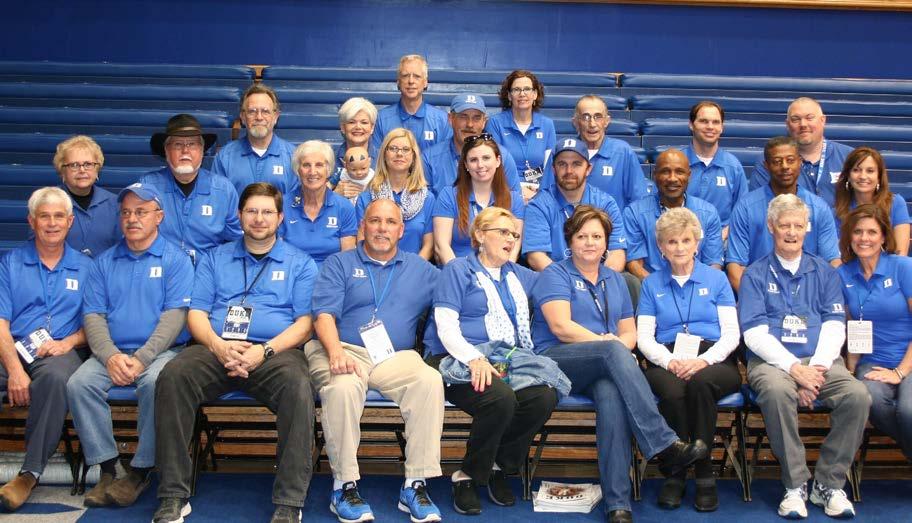
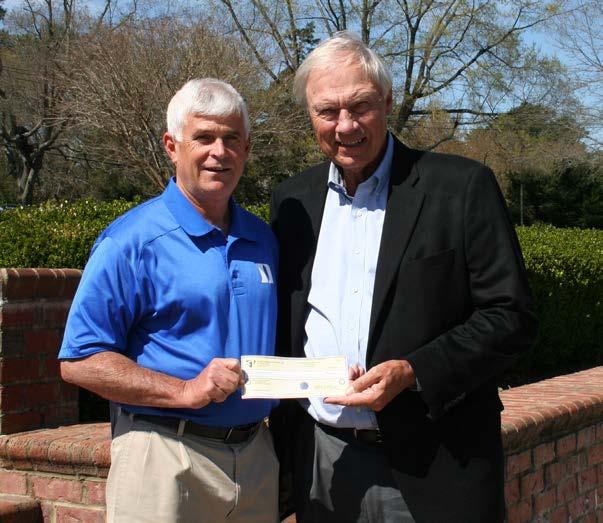
going. The group has donated to charities ranging from the Ronald McDonald House to the Duke Children’s Hospital.
When Jerry and Carol retired in 2018, Athletics gifted them basketball jerseys with their last name and the number 43 — to commemorate 43 years of work — as well as a special ACC patch to differentiate them from Mike Gminski’s retired jersey that hangs in the rafters of the stadium that had become their second home.
The electric environment of Cameron I ndoor Stadium has become an integral part of the volunteers lives. Their children have grown up in it and volunteered with Duke Athletics as well. That dedication has spanned generations and become a family affair.
If we sign up to work the game, I think Duke Athletics feels like we’re going to show up.
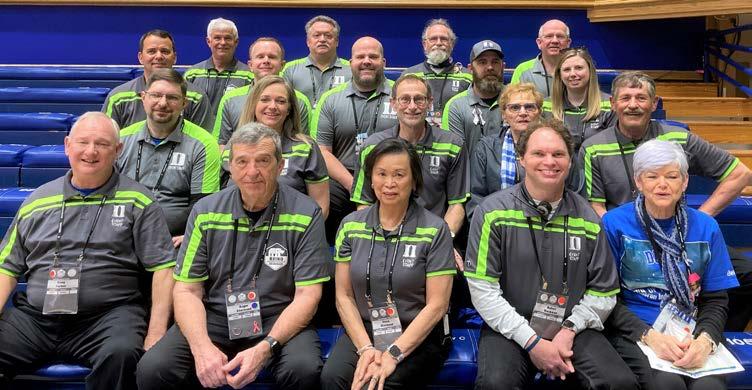
After they retired, the ushering group shifted under the control of Rhino Sports & Entertainment Services which provides security and ushers to athletic games across the Triangle region. They still donate their wages to charity, separately from the staff that Rhino provides.
While the Rhino staff may consider working at Duke basketball games as their job, the True Blue ushers continue to show up because they genuinely care.
“We’re there because we’re Duke fans and support Duke and want to be a part of that environment,” Vicki said.
Gerri, Vicki and Pete all still usher for as many football and basketball games as they can. Gerri and Vicki both started volunteering with their husbands, balancing careers and raising children, before fully dedicating their time once their children grew older, and they both retired from working full-time.
Of course, over the years, things at Cameron Indoor Stadium have changed. The group was there when the first banner was lofted into the rafters. Now, the students — relegated to exclusively Section 17 instead of laying claim to both 17 and 19 — cry out that they have their sights set on six.
Many of those they have worked with have since passed away. D’Armi in 2010,



Jerry in 2022 and Shipman in April of last year. But, in the parking lot of Hope Valley Diner, Gerri, Pete, Vicki and Carol all linger together. The conversation turns to grandchildren and vacations and the perks of being retired. Pete plans to travel to Alaska this summer for the Alaska Midnight Sun baseball game. Vicki will pick up a foster puppy on her way home from lunch.
More importantly, Duke will face off against Wake Forest the next day. Carol may have retired, but Gerri, Vicki and Pete will be there. They’re all happy the game was moved up so they can get home before the snow starts. They wouldn’t miss it for the world.

By Colton Schwabe Blue Zone Editor
Several hues of blue and about 10 miles separate Duke University with the University of North Carolina, but on the hardwood, the men’s basketball programs are about as close as it gets. The Blue Devils lead the Tar Heels 54-46 over the past 100 meetings, and North Carolina’s six national championships slightly outweigh Duke’s five. With each team boasting nearly 100 produced NBA players and a top-five all-time winning percentage, the Tobacco Road rivals are respected as historically two of the best men’s basketball programs in NCAA history, and the history of contests between the two teams is legendary in and of itself.
The inception: 1920 North Carolina’s victory over Trinity College 35-25 on Jan. 24, 1920, is regularly cited as the first competition between Duke and North Carolina’s basketball programs in the teams’ long, illustrious histories. In the subsequent coverage of the competition, The Trinity Chronicle made sure to set the record straight for the inaugural rivalry matchup, making clear that “Defeat by Carolina Result of ‘Jinx’ and Not Due to Superior Team.” The second installment of the 1920 rivalry resulted in Trinity earning a win of its own, 19-18, in what The Chronicle called “one of the most sensational comebacks in [Trinity’s] history.”
Later that year, the 1920 volume of The Chanticleer, Trinity’s yearbook, claimed that its team’s loss to Carolina, the only loss of the season, “was a surprise even to the Carolina supporters, and was a result of overconfidence on the part of the Trinity quintet.” With the opening pair of meetings, the seeds for what would blossom into one of the most famous rivalries in American sports had been planted.
Though the article mentions a meeting between the two programs in 1898 before a two-decade break in athletic relations between the schools, there isn’t much to be found about this 19th century matchup, and 1920 serves as the birth of Duke-Carolina basketball.
The February 1961 contest was the moment the bad blood elevated to new heights. Long Island, N.Y., native Art Heyman starred for the Blue Devils a couple years after he flipped his commitment from the Tar Heels in a controversial decision where Heyman’s stepfather got into a verbal altercation with North Carolina head coach Frank McGuire. With nine seconds left in the game, Heyman unnecessarily clobbered North Carolina’s Larry Brown — a fellow Long Island native who went on to build a legendary coaching career in the NBA and NCAA — and a brawl broke out between both teams.
It took several Durham police to break up the fight, and Heyman was ejected from the game and suspended for the remainder of the ACC schedule. According to The Chronicle print days later, “On Frank McGuire’s TV show Sunday afternoon, he refused to even mention the name of Art Heyman. There is a message in that fact, and it shouldn’t take anyone long to figure out what it is.”
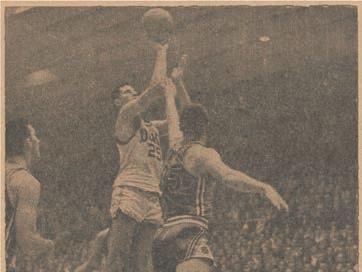
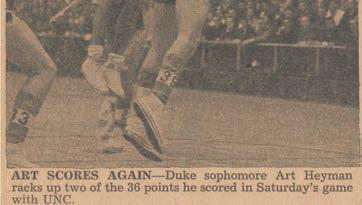
A irball: 1979
North Carolina had an interesting tactic in its 1979 bout in Cameron Indoor Stadium. In the pre-shot-clock era of college basketball, the “four corners” offense was a viable option. Place four players in the corners of a halfcourt and have a fifth ball handler hold the ball on the inside to stall time. The Chronicle reported “the Tar Heels maintained possession of the ball for over 12 consecutive minutes after initially going to the stall.”
With just over four minutes left in the first half, North Carolina’s first shot of the half “missed everything.” The team’s second shot of the half came at the buzzer, also missing completely, and sending the Blue Devils into the half time break with a 7-0 lead. Scoring picked up in the second frame — the contest ended 47-40 in favor of Duke — but the scoreless half is believed to be the start of the “airball” chant, with Blue Devil faithful’s innovative response to the Tar Heel’s cold shooting.
Living on a prayer: 1995
Despite Jeff Capel’s 30-foot prayer to beat the buzzer and send Duke and North Carolina into a 95-95 lock and double overtime, the Tar Heels overcame the Blue Devils 102-100 in what The Chronicle called “one of the best games ever played in Cameron Indoor Stadium.” After the contest, The Chronicle’s masthead turned Carolina Blue with the phrase “Dean Smith is God,” adjacent to the title; the editor’s note inside made sure to clear up “why The Chronicle is printing untruths and icky colors on its front page,” stating “We made the annual bet with The Daily Tar Heel, and had things turned out differently, they would have had to make similar ‘design changes’ to their newspaper. The Chronicle regrets the outcome.”
Blue blood: 2007
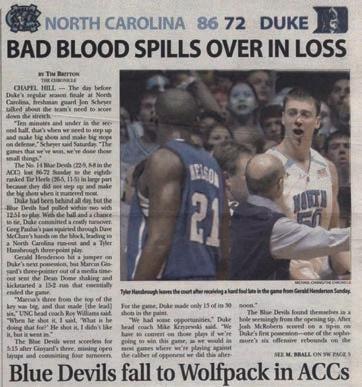
Jon Scheyer’s freshman season coincided with one of the more iconic images in the rivalry’s recent history. During a particular Chapel Hill contest within the reign of North Carolina forward Tyler Hansbrough’s 6-2 record versus the Blue Devils, the Poplar Bluff, Mo., native went up for a secondchange opportunity as Duke freshman Gerald Henderson’s arm came down on his face,
spilling blood across the very fabric of the rivalry and Hansbrough himself. Henderson was ejected to the delight of the packed Dean Dome before the Tar Heels ran away with the 86-72 victory.
Clear eyes, full hearts: 2016
In the season after Duke’s fifth national championship, there was no lack of excitement. The Blue Devils neglecting substitutions for the final 10: 51 paid off when all was said and done; freshman guard Derryck Thornton got a finger on North Carolina’s Joel Berry II’s attempted game-winner, holding Duke’s 74-73 lead to the buzzer. Grayson Allen took hold of the ball and chucked it into the air, celebrating with his arms outstretched for The Chronicle to freeze the moment in time.
A fond farewell: 2022
In an unfortunate end to quite the dominant half century of Duke basketball, head coach Mike Krzyzewski’s legendary 42-season career with the Blue Devils went out with a Final Four loss to North Carolina. Caleb Love’s massive 3-pointer with 24.8 seconds left on the clock turned out the lights on Coach K’s time at the helm in Durham, setting the stage for Duke’s new era with Scheyer captaining the Blue Devil sideline.

By Lucy Glynn
Assistant Blue Zone Editor
Editor’s note: All statistics as of Jan. 30
“On a roller coaster ride.”
That’s how head coach Jon Scheyer described his team’s ACC journey after a home win against SMU. It’s a ride that has left Duke diehards bracing for the ups and downs of slow starts that have become all too familiar.
In five of its first eight ACC games, the Blue Devils have trailed at the 10-minute mark.
In Cameron Indoor Stadium, the lead teetered to favor Georgia Tech by halftime of the conference opener. Two road matchups followed. Duke was deadlocked with Florida State at the break and later forced to climb out of a nine-point deficit in the KFC Yum! Center against Louisville.
In the next five games, Duke corrected to lead before the second half, though often only by a single-digit difference. And yet, 10 minutes in, it still trailed both Cal and Wake Forest. Even then, Duke remained 8-0 in the ACC.
The Blue Devils know how to recover. They just haven’t yet shown they know how to start.

What do the numbers say about Duke’s recurring slow starts?
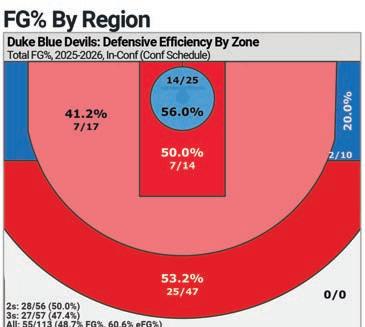
Red dominates the floor in CBB Analytics’ zone breakdown — a visual warning of Duke’s early defensive inefficiency.
In the first 10 minutes of play, opponents find comfort in above-the-break (noncorner) threes. These high-value shots swing early margins quickly, and Duke has struggled to limit them in both volume and effectiveness: Figure 1, created by CBB Analytics, shows conference opponents are converting on 53.2% of those attempts against the Blue Devils — nearly 20% higher than what Division I teams typically allow — while conceding them more frequently than most teams.
Shift closer to the rim, and the struggles persist. Outside of shots at the basket (i.e., within 4.5 feet of the rim), ACC opponents are making 45.2% on their twos in the first 10 minutes.
Duke’s starting defense has allowed these teams to score at multiple levels, turning even effective defensive possessions into points. That makes the Blue Devils’ underlying defensive strengths harder to see on the scoreboard.
For reference, the Blue Devils excel on the opponent’s glass, grabbing on average 76.8% of defensive rebounds in the opening half of conference games — a figure in the 97th percentile nationally. Duke also leads the country in first-half steal rate, holding steady in the 100th percentile.
However, the efficient shotmaking of opponents from the 3-point range has blunted the impact of that turnover defense, forcing the Durham squad into recovery mode early.
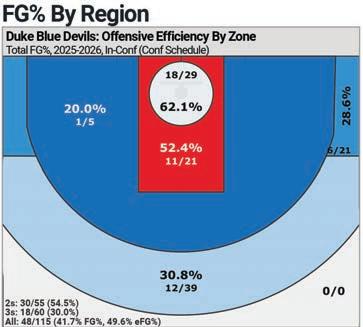
Duke’s slow starts aren’t just about what it allows — but also what it produces. Whereas red indicated inefficiency on defense, the blue overwhelming the offensive zones in Figure 2 should leave any Blue Devil enthusiast feeling blue.
Early offense has struggled with efficient scoring. From beyond the arc,
corner threes excluded, Duke converts just 30.8% of its attempts, below the Division I average of 33.2%.
While a silver lining can be found inside the paint — Duke’s efficiency posting 10.3% above the average — it is undercut by the volume of those shots. In the first 10 minutes, Duke is attempting shots in the paint right at the Division I average and attacking the rim less frequently than other teams. As a result, one of the Blue Devils’ clearest advantages becomes underutilized early.
Combine this low-output performance with defensive inefficiencies, and it’s no surprise that these slow starts have limited Duke. When the Blue Devils lean on 3-point shooting and those shots fail to fall, leads are more difficult to build. Still, their 8-0 ACC record proves that slow starts have yet to be fatal. Instead, as games start tight, Duke survives on living up to its “second-half team” label.
Have the Blue Devils found their best starting lineup?
To search for a cure to the plague of slow starts, it’s logical to begin with the players who start. Over Duke’s eight conference games — from Georgia Tech to Louisville — head coach Jon Scheyer has flexed three different rotations at tip-off.
Constant in the lineup is National Player of the Year favorite Cameron Boozer, joined by sophomore Isaiah Evans and junior Caleb Foster. The fluctuations have come in the final two spots, which have shifted in the first half of ACC play.
Duke opened conference play with Patrick Ngongba II and Cayden Boozer in the lineup. Alongside the core three, the five started the opening trio of conference games where the Blue Devils trailed at both the 10-minute mark and halftime.
Over the course of conference play, CBB Analytics ranked this lineup in the 40th percentile nationally for overall net rating — a measure of the differential between points scored and points allowed per 100 possessions.

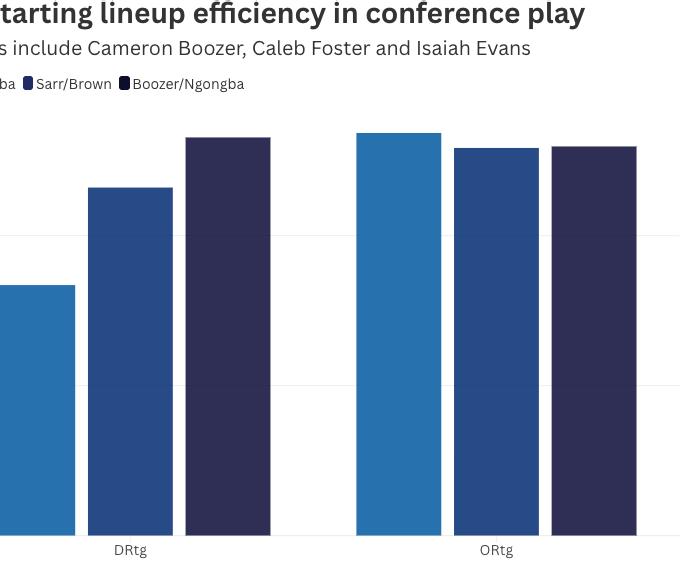
Defense is this combination’s weakness. The group’s defensive rating, or points allowed per 100 possessions, hit 132.7, dropping it into the 12th percentile nationally. The Blue Devils allowed opponents to shoot 69.1% in effective field goal percentage, a statistic that adjusts for the increased value of 3-point shots — the worst mark among Duke’s frequently used lineups. That vulnerability, evidenced by their glaringly high bar in Figure 3, shows this lineup risks stretching the gap Duke is often battling from behind.
Scheyer tweaked against SMU, inserting senior Maliq Brown and freshman Dame Sarr. Duke led at both the 10-minute mark and halftime against its highest-ranking conference opponent, according to ACC basketball standings. This lineup’s overall net rating jumped to the 62nd percentile, outscoring opponents on average by 13.2 points per 100 possessions.
While the lineup readjustment was largely positive, this combination lacked the defensive edge needed to lock down op ponents’ early momentum. In conference play, opponents have been able to hit an effective
See EFFICIENCY on Page 15





















In their three years together as player and manager, Blakes and Beischer developed a close friendship that they still carry on today. They kept in touch when Blakes graduated early from Duke and transferred to Stanford and then when he played abroad in Israel. To Blakes, Beischer is “one of the best guys you’ll ever meet.”
While Blakes, Sharkey and Baker all attested to Beischer’s ability to lock in at work and maintain a strict professionalism, they also all testified to his contagious sense of humor. Baker said he does great impressions of the staff. Blakes called him “a jokester.” His colleagues and friends are eager to be in his company; when Baker walked into the Bill Brill Media Room last week and saw Beischer, she grinned and shouted, “Our favorite DOBO!”
The levity that might define Beischer outside of work does not make appearances on the sidelines of high-stakes college basketball games, however. Beischer is remarkably composed and visibly intense when it comes to his job. He takes everything seriously.
As head manager, Beischer said he would “triple check” his packing list so that he never forgot anything for the team. But if anything ever did go wrong, he took responsibility and ensured it didn’t happen again, Sharkey said.

As Baker sees it, Scheyer has given Beischer so much responsibility because he knows he will handle it with care. “He knew that he would take it so seriously that nothing would fall through the cracks,” she said.
“Not that he’s not composed, but there’s a nervous energy that makes him really, really good, because he has an anxiety around making sure everything’s perfect,” Baker said. “In FROM PAGE 7
moments where the margins are so important for winning games, you want someone that cares about it as much as our head coach to be responsible for those things.”
As it happened, Duke’s beat down of Louisville was not a game where the margins were so important, given that the margin was 31 points in the home team’s favor. So the second time Ngongba dunked, just a few moments after the first, Beischer joined the rest of the bench, jumping to his feet and dropping his jaw in a scream of excitement.
Because beneath his intensity, his nervousness, his incredible attention to detail and his willingness to do anything this job requires of him, there beats the real reason Davis Beischer is so good at his job: He was once a kid who loved Duke basketball, and now he gets to live it.

FROM PAGE 13
field goal efficiency of 60.3% against the respective lineup of Cameron Boozer, Foster, Evans, Sarr and Brown, proving that defensive issues still have yet to disappear. This showed against SMU when Duke trailed 11-0 almost three minutes in. And while able to recover to reach an 18-17 scoreline midway through the first half — and a tight 41-35 halftime lead against the Mustangs — the Blue Devils had yet to show they could build separation.
Over the past four games, Scheyer appears to have settled on Duke’s best option yet, returning Ngongba to the starting lineup beside Sarr. The early results remain mixed: Duke has still trailed at the 10-minute mark in two of the games, but by halftime, this group has been the first in conference play to consistently put Duke ahead.

possessions. Defensively, it’s been suffocating, holding opponents to an effective field goal clip of 36.8%. Offensively, its reliability continues, outputting a 60.0% effective field goal efficiency — among the Blue Devils’ top on-court lineups.
Duke’s conference games beginning with these five have been characterized by halftime leads, with Scheyer’s team riding a doubledigit gap by the half in the past three. The lineup — Cameron Boozer, Foster, Evans, Sarr and Ngongba — has boasted both an offensive and defensive rating in the 98th and 92nd percentile, respectively, across the most recent trio of games. Simply put, this rotation is signaling it’s the best in Division I basketball.
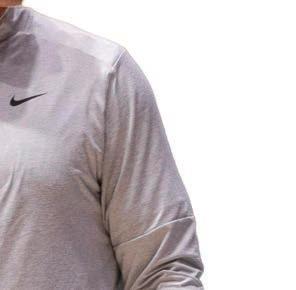


Indeed, his seriousness emanates from the bench, where Beischer sits firmly in his cushioned black chair, eyes trained fiercely on the ball while Cameron Indoor Stadium echoes with screams and cheers from Section 17.
Figure 3 further illustrates their relative dominance, as they edge out alternative lineups for the highest offensive rating. Defensively, their low column mark signals a dramatically stronger defense.
Across ACC games, the numbers reinforce the shift. This lineup owns Duke’s best net rating, ranking in the 94th percentile nationally, according to CBB Analytics, outscoring opponents on average by 50.8 points per 100



The cushion these five are getting in the habit of building suggests that the Blue Devils are turning their slow starts into good ones. The delays haven’t fully vanished; Duke was behind 10 minutes in against Cal and Wake Forest. Nevertheless, this lineup has done the most to absorb early pressure and position the Blue Devils to turn it into separation.
Duke men’s basketball’s starting lineup is tempering the roller coaster ride, and maybe Blue Devil fans can leave behind first-half frustrations. Maybe the all-too-familiar early deficits will soon fade away.
But then again, it’s Duke basketball — slow starts may just be a part of the journey.



By Alex Min Assistant Blue Zone Editor
It’s a familiar scene for a Friday night in Cameron Indoor Stadium. Students cram into Section 17, jostling for precious inches of space. Faces covered in blue and white populate a crowd that thrums with anticipation — the fans have waited all week for this.
The team is already out on court as the fans trickle in. Grouped by position, the Blue Devils cycle through layup lines, 3-point shooting drills and a gauntlet of stretches. Hip-hop’s latest hits trickle through the sound system, but within a matter of minutes, the initial elation of entering the gym after a day spent in line has died down for many. Well over half an hour remains until tipoff: they’ll have to stand in place for a while longer. The fabled Cameron Indoor becomes static, as if the nation’s No. 4 team isn’t about to play a game there.
descriptors. This is a space imbued with history — and also the headquarters for the DUMB, an unfortunate acronym coined by former director Paul Bryan (for which Au “has forgiven him”).
It’s year 21 for Au as director, the eighth person to fill the role since the program’s inception in 1906. The marching band, however, has been central to his life for far longer than that. As a student, he attended Ohio University and Notre Dame with the hope of becoming a professional trumpet player, but physical ailments dashed those dreams. He pivoted quickly, though, and became Assistant Director of Bands at Elizabeth City State University, then the Director of Bands at Towson University.
There’s a lot of institutional memory that’s with the band for cheering and having spirit and being energetic.
When he saw a job opening for Duke on a website he frequented, he didn’t think twice to apply.
letter from a band veteran changed his mind. Through Project Band, the program’s own Experiential Orientation, Opel immediately found a community ready to support him.
“But not only were the senior section leaders really invested in me, the drum majors were really invested in me, too,” Opel recalls. “That’s something that I kind of felt a duty to give back to. I was a drum major in high school as well, and it was just such a cool experience. To be able to have the opportunity to do that at my dream school was something that I couldn’t pass up.”
here — and how we’ve institutionalized that — is really unique.”
“It is very much a second home with people that I can turn to for everything,” Opel says. “I met my core group of six friends during PBand camp, and we haven’t stopped talking since.”
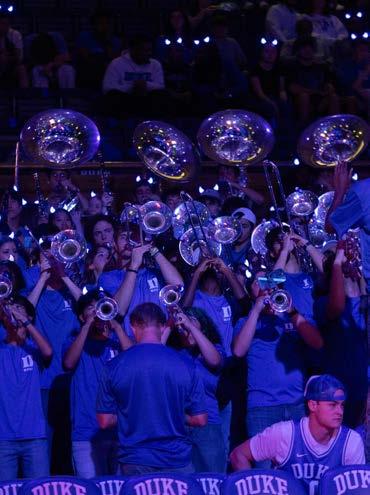
Eventually, the players return to the locker room, but 15 minutes later, they race back out onto the hardwood to an environment made new. Blue light washes the arena as Duke takes the floor. The playlist of rap songs has been traded for a pep band that blasts “Runaway Baby” by Bruno Mars as loud as it can. It’s hard to hear anything over the symphony of brass and drums, but the Cameron Crazies still thunder with raucous cheers, their excitement supercharged.
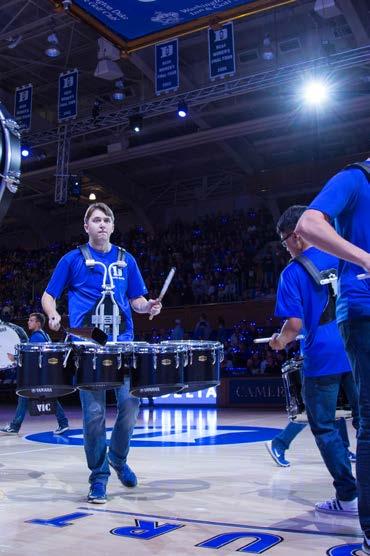
The pregame ritual commences. A student performs the national anthem, her voice crystalline upon every note. Player introductions ensue, where the Blue Devils are met with thunderous applause, while the student sections adorn the visiting Niagara with chants of “Hi, [player name]. YOU SUCK!” At last, the 10 starters congregate at center court. A seismic rhythm emanates from the courtside stands — although not from the mob who jump in place: it’s the band’s beating of the drums that channels the students’ frenetic energy. The tempo accelerates, and by the referee’s first whistle, signalling the start of play, the Crazies have been whipped into a frenzy. They have earned their title.
“The band can provide a lot of energy. It’s a big section of the crowd, and it’s right there in the action,” says Jeff Au, Director of the Duke University Marching Band and Pep Band. “We’ve been doing these things for decades, so there’s a lot of institutional memory that’s with the band for cheering and having spirit and being energetic.”
Au leans back in his chair, a wall of Duke memorabilia behind him, his dog Manny near his feet. His office is tucked away into a corner of Card Gym’s upper level — so nondescript from the outside that it could be mistaken for a storage closet at first. Instead, furniture and seemingly disparate items fill the room, although “messy” or “cluttered” aren’t apt
“The life path is always crooked. I love doing this. To say I get to do this for a living, every day, and they give me money for it: It’s pretty uncommon. I’m pretty lucky, and I love where I ended up.”
And although his love for music guided him to the marching band, Au was also a fan of basketball and baseball (football not so much). At Duke, there became very little separation between his two passions.
“The marching band can be under a music department, it can be under athletics, it can be under student affairs. Here, it’s under athletics,” the director explains. “So, I’m an employee of the athletics department. My last couple jobs, I was in the music department, so I would teach classes, lessons and all that kind of stuff.”
It’s a fraught balance to strike. Au isn’t surrounded by colleagues, much less other musicians — leaving him on “an island of one.”
He stresses that the athletics department is very generous and helps where it can — after all, it was former Duke football head coach David Cutcliffe who made him a full-time employee. Still, he chooses his words carefully, measured pauses between each sentence.
“We make it work,” he settles on with a taut smile.
Fortunately, Au receives plenty of help within and from the band itself. Despite being the only “adult” in the program, he doesn’t run a one-man show. At basketball games, his involvement is more guidance than direction.
“Mostly the drum majors decide [what the band plays],” Au says. “I don’t have assistant directors or anything like that. So the drum majors, the section leaders, the officers, they all have elevated roles compared to other places where everything is kind of done for them.”
For sophomore Ian Opel, applying to be a drum major was a no-brainer. Before his freshman year, his mom strongly encouraged him to join the band; at a place like Duke, she said, finding community could be difficult amongst all the competition between students. He was unsure at first, but a handwritten
It was never going to be close between Duke and Niagara, a basketball David and Goliath battle sans the divine intervention. Even still, this contest has gotten out of hand. After Caleb Foster and Isaiah Evans cash in from deep on back-to-back possessions, the Blue Devils carry a gargantuan 38-point advantage.
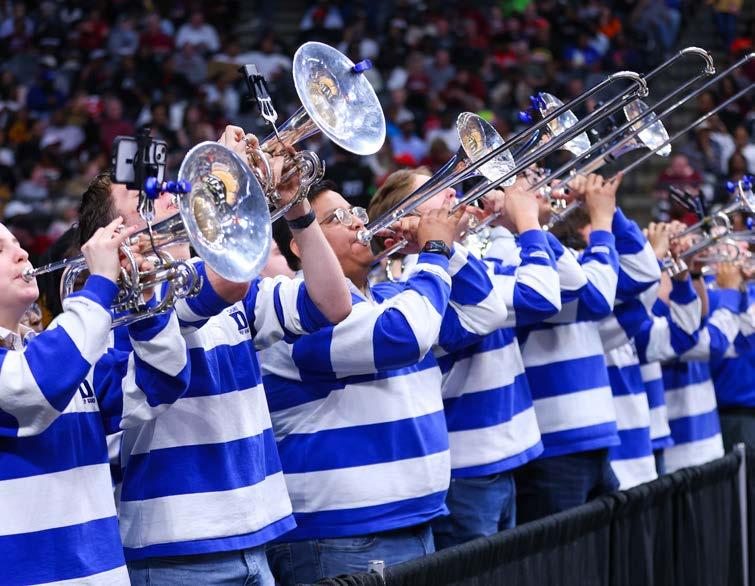
When the Purple Eagles call timeout following Evans’ triple, the crowd explodes as a line of rugby shirt-wearing students sprints onto the floor. Lunging forward, the entire first row sticks out their hands to high-five the band members, and for a brief moment, these musicians are elevated to celebrity status. Upon reaching the end of the court, they double-back to the midcourt logo — throwing themselves onto the ground in precise order so that they resemble a raft of logs. The last of the group tosses a wooden surfboard on top of his bandmates, and once secure, the Blue Devil mascot precariously mounts the curved plank.
That internal support and enthusiasm spills outward, shaping what fans feel the moment they step into Cameron Indoor or Wallace Wade. The sea of blue-and-white rugby shirts are synonymous with Duke Athletics; they share their traditions with every Blue Devil fan — sewing themselves into the very fabric of the live game-watching experience. And whether it’s their first or 10th time throwing themselves onto the court to spell out “D-U-K-E,” the band members never tire from amping up their fellow students.
“I’ve gone out and done everything now. I’ve done Zing-It diving, where we spell Duke on the court. I’ve done pumpkin, which is the little dance we do. And then I’ve also done surfing,” junior sousaphone player Ricardo Urena says. “It’s always like, ‘Oh, wow, that was really cool,’ every time I do it, even though I’ve done it several times before.”
And of course, a passion for the Blue Devils makes it all go. Even though they likely won’t be found cheering in the student section or tenting in K-Ville before big games, DUMB carries the Cameron Crazies’ spirit perhaps more than anyone else.
You’re not going to find a group of people more willing to take off their shirts and paint themselves blue and white for the UNC game than the people in the band.
IAN OPEL
Sophomore drum major
Then, the magic begins. At once, the bodies below roll in unison, their rotation allowing the Blue Devil to “surf” across the hardwood.
“That looks so painful,” a fan whispers to her friend courtside. Difficult, too, apparently: The Blue Devil twice loses balance and tumbles to the floor. Some groan while others laugh, yet when it’s time to resume play, they applaud the performance all the same.
Maybe it’s the lopsided score or the matchup’s lack of stakes, but for a brief moment, the Crazies seem quieter when the band members run off and the game clock begins to tick once again
DUMB is far more than a time commitment or a hobby; for many, the group of 100-ish students becomes a family. In Project Band, freshmen are introduced to Duke with a built-in social network already provided for them. Orientation leaders take incomers under their wing, while social chairs organize everything from watch parties to state fair trips to Thanksgiving dinners. Beyond getting acclimated to college life, first-years are given a community that welcomes them with open arms.
“Every band says, ‘Oh, we’re a band family,’ but we take that to the next level,” Au says. “The level of support that students give each other
“The band is kind of a reflection of the Duke school spirit,” Opel says. “You’re not going to find a group of people more willing to take off their shirts and paint themselves blue and white for the UNC game than the people in the band. We would do that every game if we got the opportunity.”
This is a family that will give anything to its school — a group of people who have made Duke basketball their life.
When the final buzzer sounds, the jumbotron reads, “Duke 100 - 42 Niagara.” It’s the largest margin of victory in head coach Jon Scheyer’s young coaching career. And although the contest was perhaps decided in its opening minutes, most of the fans have stuck around. The players eventually return to the locker room — still, the student section stays put.
At last, the pep band begins its closing performance. As the trumpets sound, the Crazies sway with their arms draped over each other’s backs. The song’s few lyrics flash on the screen, a relief to some, yet no assistance is needed for the ending words. And for the first time all night, the over a thousand voices in Section 17 unite with the band. Together, they belt, “Our alma mater dear,” one last tradition, a final good night to Cameron Indoor.
By Abby DiSalvo Sports Editor
In the four decades since students first camped out in front of Cameron Indoor Stadium, Krzyzewskiville has evolved into a modern city. The Crazies started with a few sleeping bags, a cardboard sign and a haphazard line down the sidewalk. Today, they have study tables, power cords, entry tests, Slack channels, spreadsheets and carefully-divided territories on a grassy lawn.
Tenters still pitch camping gear and brave winter weather to earn a coveted seat in Duke’s annual home game against North Carolina. A group of student Line Monitors still uses a redand-white bullhorn to call random attendance checks throughout the night. What began as a mild test of dedication now has taxing requirements: On the first night of the 2025-26 tenting season, students woke up to the roll-call siren at 1:15, 2:30, 3:43 and 5:00 a.m.
The story of Krzyzewskiville spans 40 years of collaboration and competition, debauchery and dedication, tradition and innovation. Only two things have ever been certain: tents and checks.
‘A friendly nuisance’
The birth of K-Ville is well-documented: In 1986, a few students in the Mirecourt selective living group set up camp ahead of the North Carolina game. With no clear structure, though, governance of the line for the game devolved into chaos. José Isasi II (Trinity ‘88) brought the matter to his committee on Duke’s student government, which was then called the Associated Students at Duke University (ASDU).
“I thought we needed to get involved in making sure that the line didn’t result in something bad happening to a student,” Isasi said. “The whole tenting system emerged from the mob rule. Prior to that, the only way that people maintained order was yelling, swearing, that kind of thing.”
from Cameron to chat, plan pizza deliveries or organize special welcomes for recruits. When Alaa Abdelnaby — who would eventually go on to a seven-year NBA career — visited Durham, Isasi spread the news among tenters to guarantee he received a warm reception.
Only a few weeks passed before former baseball coach and facilities manager Tom D’Armi took notice of Isasi’s organizational efforts. The “Line Monitors” had been filing into Section 17 for games along with the rest of the students, so D’Armi offered them early entrance to the stadium as a token of thanks. Fearing reprisal from the tenters if they took the front-center seats, Isasi’s group elected to sit across from the visitors’ bench, a few rows up. That location remained a perk of the job for over 20 years, until the Line Monitors shifted to the front-row, home-bench section they claim today.
‘Analog’
Tenting popularity exploded during the 1990-91 and 1991-92 seasons, when Duke won its first two national championships. But when Krzyzewski suffered a back injury in 1994, fan enthusiasm faltered. Students still attended the games in droves, but they weren’t willing to sleep outside for a team that finished 13-18 overall and 2-14 in the conference.
Matt Ferraguto (Trinity ‘98) first camped out in K-Ville his senior year, when the team had returned to form and excitement once again simmered for a competitive rivalry game. That season, his group of 15 pitched a tent 56 days before the contest against North Carolina.
Being student government geeks, we were viewed as a friendly nuisance by a lot of people.
Ferraguto remembered Krzyzewskiville as the campus social hub. Relations with the Line Monitors — still primarily provided by Duke Student Government (DSG) — remained largely positive, and tenting demand never grew large enough to require that students cram sideways into Section 17.
the moment, seeing the energy and emotion of the players … It’s one of the single best ways that Duke builds community and connection between students, and it’s one of my fondest memories of being there.”
‘A free-for-all’
The turn of the century — and the 2001 national championship — brought new fervor to Krzyzewskiville. Though the North Carolina game drew eager fans, many students also tented for the annual game against then-ACC foe Maryland.
Line Monitors began wristbanding students in the 2001-02 season, but campouts began earlier and earlier each year as students competed for spots.
If we want all the students to be here, let’s give them reasons to be here.
At that time, the group was still closely intertwined with DSG, often using the student government office to make wristbands or plan Krzyzewskiville events. The Line Monitors earmarked roughly $4,000 of DSG funding to set up a party on the night of Personal Checks. Wine invited the student basketball radio show and participated in a dunk contest with the mascot in hopes of entertaining students. P-Checks — as tenters refer to it — went off without a hitch, and the addition of programming birthed a tradition that now includes a concert, food trucks and copious amounts of drinking.
His committee decided to moderate the madness. When tents popped up in the spring of 1987, Isasi volunteered himself and a few friends to wander through Krzyzewskiville and make lists of the residents. Their goal was to boot so-called “phantom tents” — empty placeholders in line — and prevent students from sneaking into the queue. With a clipboard and a pad of paper, they planned three “checks” leading up to the game.
Students were free to miss one roll-call before the monitors moved their tent to the back of the line. For the most part, they conceded to the new system without fuss.
“Being student government geeks, we were viewed as a friendly nuisance by a lot of the people,” Isasi said. “The people at the front of the line appreciated it … [but] we got some creative names thrown at us, involving references to informants from the mob or butt-kissers.”
Early on, Isasi’s group fostered a dynamic relationship with the basketball staff. Former head coach Mike Krzyzewski sometimes emerged
The Crazies danced to “Rock Lobster” instead of “Everytime We Touch,” which would not be released for nearly a decade. No one thought to raise the tents with pallets, but the tradition still required immense preparation.
“It was a lot more analog,” Ferraguto said. “I think we had a handwritten sheet for our entire tent … We intentionally split apart friend groups between [tents], so that people would have great friends to be out with at the same time.”
Only one member of each tent had to be in K-Ville around the clock, but every individual had to make three of five “personal checks” in the 48 hours before the doors opened. Ferraguto’s group was fourth to enter the stadium, and he was rewarded with a come-from-behind win against North Carolina in Steve Wojciechowski’s final home game at Duke.
“There’s just this feeling of exhaustion and elation when you actually step foot in Cameron,” Ferraguto said. “Your emotions are running high, and you just can’t help but get swept up in
On the day after Christmas in 2003, thenhead Line Monitor Donald Wine II (Trinity ‘04) answered a phone call from Durham. The first group had arrived outside Cameron Indoor, and its members wanted to let him know.
“I live in Michigan,” Wine told them. “I’ll see you guys on January 4th.”
Unbeknownst to him, the line kept growing.
A few hours later, the rising senior received an agitated call from the fire marshal, who wanted the five tents in front of Cameron taken down until school began. Wine refused to make the Crazies relocate.
“If you remove one tent from K-Ville before I get back on January 4th, I’m not going to be upset. My mom is going to be upset, because I’m going to have to leave Michigan and drive 12 hours to deal with this,” Wine told the fire marshal. “Just wait until January 4th — at 10 a.m., I will be there.”
Sure enough, when Wine pulled up to Krzyzweskiville a few days later, he saw the fire marshal waiting for him. They exchanged lists of rules and names, and the 2003-04 tenting season officially began.
At that point, students could choose between two levels of tenting: blue and white. The former was capped at 50 groups, and though registration occurred in K-Ville on a predetermined date, tenters could arrive as early as they wished. Fans who opted to white tent registered with the head Line Monitor closer to the date of the game. Wine remembered creeping around campus and getting friends to drive him to class, worried someone would uncover his whereabouts too early.
“We would just pick the spot on campus, and we would tell people at a certain time what that location was,” Wine said. “It was a free-for-all. It was kind of like a scout movement. Find me, you get to sign up.”
Wine and his 26 fellow Line Monitors planned 10 checks over the course of the 2003-04 season. Then they focused on making Krzyzewskiville more than just a tent city.
“The two years that I was there were the first couple years that we really beefed up programming around K-Ville, because we wanted it to be the center of student life,” Wine said. “If we want all the students to be here, let’s give them reasons to be here.”
Wine’s perpetual challenge was fitting as many students as possible inside Section 17, which is designed to hold 1,200 fans. He claims the Line Monitors occasionally fit close to 2,000 — the Wake Forest game of his senior year was a highlight — but it wasn’t easy.
“We had people upstairs, we had people sideways, we had people every nook and cranny in that place,” Wine laughed. “The fire marshal and I, we were dance partners. It wasn’t a dance that either of us really liked, but it was a great way to figure out how to get as many people as possible [inside].”
Wine did his best to mobilize that energy in support of all Duke sports teams by attending other athletic events as frequently as possible. When the head Line Monitor was busy watching a women’s basketball game or fencing meet — thus ruling out the possibility of a surprise attendance check — other tenters grew inclined to join him. Suddenly, Krzyzewskiville residents began to file into Cameron Indoor for more than just men’s basketball games.
“It wasn’t an official thing. It was more of a ‘Hey, Donald’s going to this game … He’s not going to stop at halftime to come out and give us a personal check,” Wine said. “So at a certain point, I just started saying, ‘Guys, just go to the [women’s basketball] game. Go the volleyball game.’”
The fan enthusiasm eventually found a foothold, especially for high-profile women’s matchups. When top-ranked UConn visited Durham in 2004, students pitched tents and formed their own walk-up line.
Elizabeth Allin (Trinity ‘05), a Line Monitor the year below Wine, remembered the difficulty of calling attendance checks in the flip-phone era. The group never planned them in advance, for fear the schedule might leak to tenters. Instead, upon receiving a call from the head Line Monitor, members met near the Sanford Building off Towerview Road and traipsed through the woods to K-Ville. Then they sounded the bullhorn and crosschecked student IDs with paper lists of each tent’s residents — a process that could take up to an hour.
At that point, the blue tenting rules required groups to have two members present during the day and eight at night.
“You always feel like kind of a jerk when you’re waking people up at 2 a.m., but the fact is, you have to have humility about it,” Allin said. “I think of being a Line Monitor as being an obligation
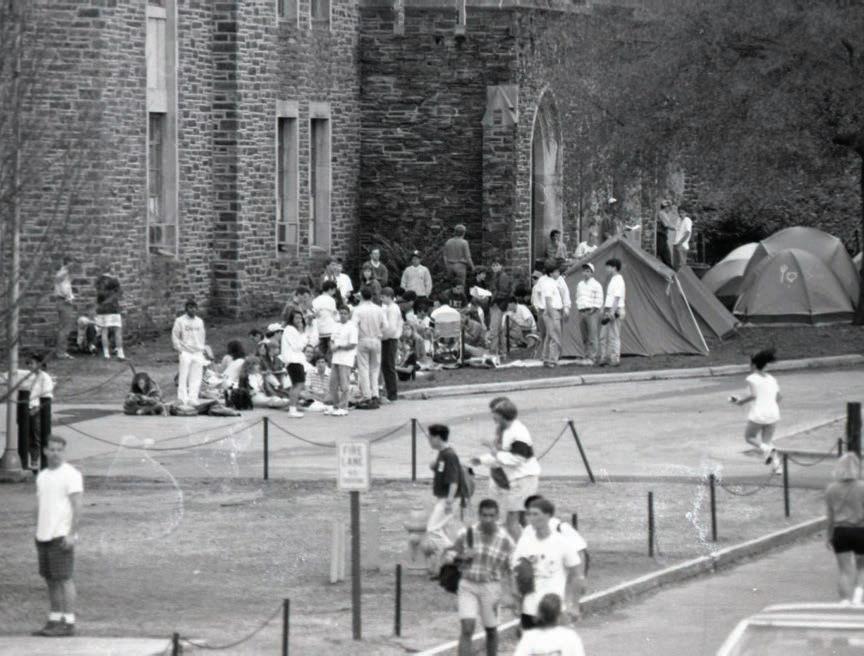


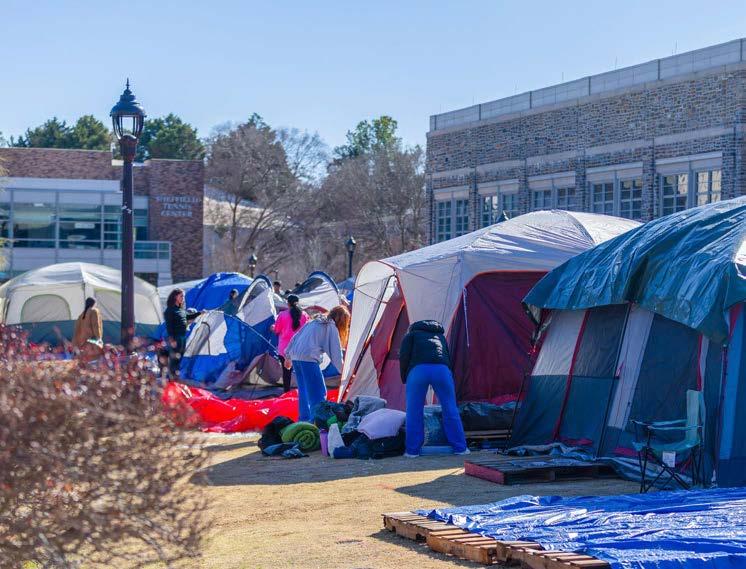
and a responsibility even more so than a privilege. You’re making a commitment to take care of your fellow students and to be there together and make sure you all have the best possible experience.”
In Allin’s senior year, the Line Monitors coordinated with Duke Athletics to help Krzyzewski give a late-night speech and deliver hundreds of pizzas. That was also the debut year of College Basketball Gameday, which stopped in Durham for the Duke-North Carolina matchup. Allin and the Line Monitors, who were friendly with the stadium security, helped get students into the stadium for the broadcast.
They built close relationships not only with each other, but with the program. Allin was the one to organize a candlelight vigil in K-Ville over the summer of 2004, when Krzyzewski flirted with the idea of leaving Duke to coach the Lakers. As students sent over 1,300 emails begging their head coach to stay — some of which Mickie Krzyzewski later said moved the family to tears — Allin gathered friends and fellow Line Monitors for a show of solidarity on the lawn. They dressed in their Cameron Crazy attire and held candles outside the Schwartz-Butters building, hopeful their beloved coach might catch a glimpse.
“It sounds so silly, but it was stuff like that was so organic and memorable,” Allin said. “The team represented so much more than just sports: integrity, leadership, teamwork, family. It just felt like at Duke, you were part of the basketball family as a student.”
‘Unbelievable’
For all the growth Krzyzewskiville experienced, it also encountered inevitable growing pains. Ahead of the 2006-07 season, the Line Monitors and student government announced that tenting would only occur for the North Carolina game (and not also for the Maryland game, as in previous years). Students were prohibited from setting up tents before Jan. 7, though two members of each group could wait in K-Ville ahead of that date if they wished to hold a spot.
After the season, however, tenters expressed frustration that Line Monitors had accepted student-made lists of residents and failed to check IDs carefully. Some fans who had earned wristbands for the game were turned away, while others who joined the line close to tipoff made it inside Cameron.
“I would have liked to have seen more effort at the end,” then-freshman Chris Jones told The Chronicle at the time. “It seemed like a lot of [the Line Monitors] were more concerned about getting into the game than keeping order in the line.”
Ahead of the 2009 season, with tensions in K-Ville continuing to grow, security and weather concerns caused University administrators to crack down on winterbreak tenting. The start date moved to Jan. 30, and line-ordering shifted from arrival date to a performance-based system that included an intense Duke basketball trivia test.
“It just continues to evolve,” Baum told The Chronicle. “I had no baby carrier … I thought that thing was gonna last two games and have a leg fall off, because I didn’t think it was actually going to be of high quality.”
Meanwhile, Krzyzewskiville residents set up hot tubs and planned parties and pushed the limits of Durham city codes. Some students attempted to pour a cement foundation into the lawn, while others tried to construct two-story structures that doubled as physics projects. One year, students dragged officiating chairs from the nearby tennis courts into K-Ville to officiate beer pong tournaments. Communication with Duke Athletics administrators — including assistant director of athletics Debbie Savarino — thus grew more standardized.
“That was too much,” Savarino laughed. “Anything you actually have to pull some sort of city-wide approval process for, you probably shouldn’t do.”
For the most part, though, Duke Athletics began to embrace the tent city for the successful social experiment it had become. Whether providing hot chocolate and s’mores on chilly nights or water during the games, almost every Line Monitor request became a reality.
“The existence of Krzyzewskiville is an unbelievable, maybe even unimaginable tradition,” Savarino said. “You can’t buy that type of school spirit, that type of tradition, that type of enthusiasm, that rite of passage that our students feel so excited about … I love watching it all come to fruition.”
‘A great blend’
A student named Ben Succop joined the Line Monitors in the 2017-18 season with high hopes for Krzyzewskiville. He had white tented his freshman year and saw opportunities to improve the system, especially when it came to tensions between the Line Monitors and tenters. The tradition had reached a practical cap — students who wished to tent in 2017 had to earn their spot by scoring among the top 70 groups on an entry test — and the heightened competition spurred resentment against the Line Monitors.
“There had been some culture issues at various times through K-Ville history,” Succop said. “Essentially, there wasn’t a whole lot of accountability in terms of guidelines for the Line Monitors themselves, in how much they were contributing to tent checks and actually doing the work before the games. I think there was some very well-justified criticism from some of our black tenters, who were there for six weeks.”
The existence of Krzyzewskiville is an unbelievable, maybe even unimagineable tradition.
DEBBIE SAVARINO Assistant Director of Athletics/Special Events
In order to maintain excitement and support for other Blue Devil teams, certain non-basketball athletic contests were designated as “attendance events” that could boost a tent’s spot in line.
Changes were met with mixed reactions from students, who feared their dedication could be replaced by incessant studying. The Line Monitors thus added a “hell week” that required group members to sleep outside for seven days without a tent. It was an early version of black tenting, which would eventually involve two tenters’ attendance during the day and 10 at night.
Krzyzewskiville’s traditions also went through adaptations. The Line Monitors modernized the art of the dirt sheet, scouring social media and LinkedIn accounts to provide fodder for Cameron Crazies to taunt opposing teams. They began passing costumes and props — a blue suit jacket, blue boxing gloves, a life vest — down through classes of monitors.
Dan Baum (Trinity ‘07), who first brought the now-infamous Duke baby doll to a game, never expected it to assume a life of its own.
“Cammy” (short for Cameron) now has her own costume, carrier, significant ESPN air time and a choreographed dance to the AWOLNATION song “Sail.”
When Succop and Maddie Manning became co-head Line Monitors in 2019, they worked to resolve those issues. The group created an internal accountability system to ensure equal participation and coordinated with Duke Athletics to bring tenters’ wishes to life. First on the list was a study tent — complete with power sources, Wi-Fi, tables and wind protection — that would allow students to work in Krzyzewskiville.
“[Succop] thought it would be a great blend of the school spirit and the incredible academic drive that all Duke students have,” Savarino said. “Really, the existence of the study tent is kind of a visual representation of the partnership that has happened and grown with Student Affairs, with the university side of Duke and Athletics.”
It wasn’t all fun and games, though. As a liaison between student affairs and the student body, Succop and the Line Monitors also made sure that the tradition remained as spontaneous as possible. The season prior, intoxicated walk-up lines had prompted discussions among administrators about ways to better regulate tenters, which the Line Monitors gently pushed back on.
“Sometimes that emphasis on safety can be painted with too broad a brush, and you end up losing some of what makes K-Ville, K-Ville,” Succop said. “The really unique part of the [Line Monitor] role is that it’s that nexus, and you get to really be an advocate for the tenters, and then navigate between athletics and administration and help sort of guide policy in that direction.”
Succop wanted to bring the team and tenters closer as the tenting season neared its close. He coordinated with Savarino to plan a giant party in Cameron: food, music, inflatable tricycles and a knockout game with the team. With numbers
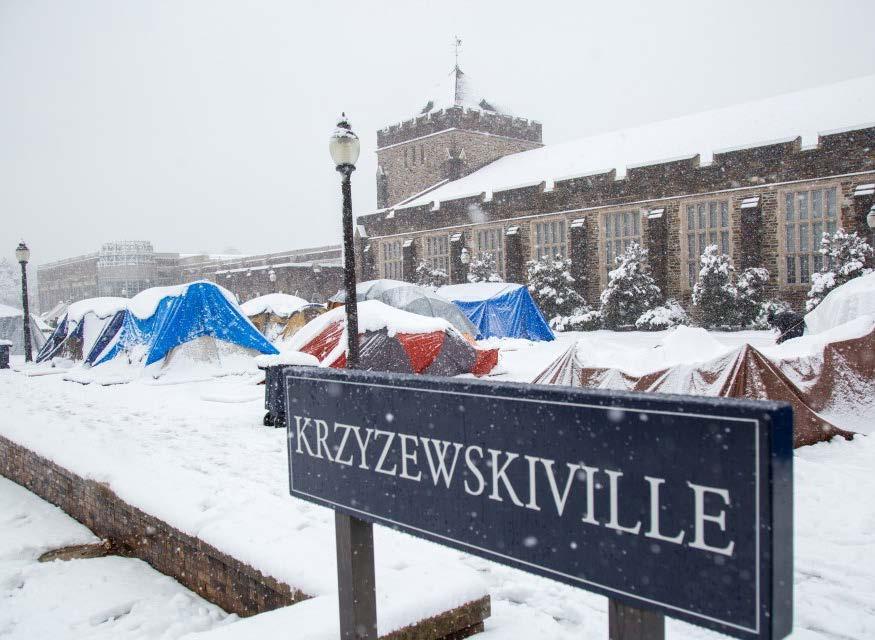

on their side, the K-Ville residents even managed to beat the players — all part of the magic of the tenting tradition.
“Ideally, the Line Monitors are stewards of K-Ville. The students are the real stars,” Succop said. “The true Cameron Crazies are the ones who are doing the camping, and as Line Monitors, we’re sort of the cheerleaders that facilitate the students doing that.”
That season brought Krzyzewskiville much closer to its modern form, but the 2020 DukeNorth Carolina game was the last one played before the pandemic shut down the college basketball season. When Cameron Jarnot (Pratt ‘22) took over as head Line Monitor in her senior year, the tradition looked very different. Tenters had to split their 12-person groups between three smaller tents, and every resident took regular Covid tests. Certain grace rules were instituted for groups whose members caught the virus.
one wants to be woken up in the middle of the night by a siren.”
The students on the other side of the bullhorn often have a different perspective.
“I think that some Line Monitors want it to feel like a camaraderie,” said Eliana Durkee (Pratt ‘25), a four-year tenter. “And then there’s definitely Line Monitors that treat it as like a power trip. You can tell in the way that they address you, and you can tell in the way that they will ignore you intentionally if they don’t like someone in your group.”
Ideally, the Line Monitors are the students of K-Ville.
The students are the real stars.
“We really had to be advocates with the administration in terms of finding a way for tenting to happen safely for everyone,” Jarnot said. “We felt like it was really important to get tenting back on campus. It is one of the only fully inclusive spaces in that anyone who wants to be a part of it can choose to be a part of it.”
Other changes also occurred that year. The 2021-22 season was the first in which Duke Athletics offered pallets to tenters, who had previously scouted them from nearby grocery store dumpsters. The wooden platforms, topped with cardboard and used to elevate tents, helped keep structures drier and warmer. It takes nearly 1,000 to line the lawn in Krzyzewskiville — in 2026, Duke Athletics supplied 934.
The Line Monitors began their tradition of playing The Judds’ “Girls Night Out” before every walk-up line, and Crazies combined DJ Khaled’s “All I Do Is Win” with “DDMF” in their pre-game routine. Costumes and props still made frequent appearances — in her senior year, Krzyzewski’s last with the Blue Devils, Jarnot took the baby doll to the Final Four.
‘A spectacle’
Krzyzewskiville policies received their most recent overhaul in 2024, when grace temperatures raised to 32 degrees Fahrenheit and “Wellness Week” offered students seven days off in the middle of the tenting season. The negative health effects of other K-Ville norms — frequent alcohol consumption and regular sleep deprivation — had contributed to growing tensions between students in the line and students governing it.
The Line Monitors now use a Slack channel to communicate with tenters, who are free to express their dissatisfaction over attendance checks with a variety of choice emojis. The improved technology has made it easier to coordinate the roll-call, which means students are roused far more often than ever before in Krzyzewskiville history.
“We know that students aren’t gonna be happy,” current co-head Line Monitor Claire Raney (Trinity ‘26) said. “I completely understand why people feel that way, because no
Every year, though, new Line Monitors don the group’s characteristic blue windbreakers and assume the role’s inherent resentment. Some do it out of pure love for Duke basketball. Others hope to uphold a family tradition. Succop’s younger sister, Sara Byrd, knew as soon as she matriculated that she wanted to follow in her older brother’s footsteps. Her class of Line Monitors has introduced yet more change to Krzyzewskiville: a whiteout and a blackout inside Cameron for big non-conference games, along with a talent show that earned participation from star players like Sion James.
Those who witnessed K-Ville’s humbler origins have a hard time believing how advanced their tent city has become. Isasi laughed at the Line Monitor title now, having never considered his role a formal one. But when Cameron Indoor installed a plaque on the podium inside the student entrance with a list of all former head Line Monitors, his name was the first on the list.
“I’m just blown away by how formal, how structured, and how desired this position is,” Isasi said. “I had a hard time getting people to want to help me with this, because it just seemed like a real hassle without any big upside.”
Tenters now engage in intense decorating contests and compete for the most clever themes, which often pun on players’ and coaches’ names. Last year, “The Church of Siontology,” “Khaman my Knueppels” and “Neil or no Neil” won top honors in the Krzyzewskiville-wide vote. This year, “Heated Scheyvelry,” “O-Slim-Pic,” “Maliqually Blond” and “The Boozegeousie” earned the most votes from fellow tenters. Inflatable decorations and larger-than-life signs litter the lawn outside Cameron Indoor, and players occasionally visit their namesake tents.
In recent years, GoFundMe and Venmo requests have circulated for the purchase of a massive K-Ville keg. Bunk bends and hammocks have found their way in front of the stadium. Tenting forces nearly a quarter of Duke’s undergraduate student body — often from different corners of campus life — to spend upwards of 50 days in cold, cramped proximity. And for four decades, those students have returned year after year for another iteration of the unique social experiment.
“The ability of people to organically come together and live together and make policies and be part of this community is really special,” Allin said. “There are not many times that you see early adults get together and be able to put on something so massive, and it really is a spectacle.”
“It’s not the Line Monitors. It’s not the tenters,” Succop said. “It’s all of us. One Duke team.”



20.0 points per game
9.9 rebounds
1.6 steals

It’s almost that time.
The first round of UNC-Duke men’s basketball is right around the corner.

Whether you’re a casual fan who occasionally tunes in alongside friends or a die-hard who is willing to watch alone, the anticipation of this longtime ACC rivalry continues to live yearly. And for the 2025-26 contests, with the first coming to the Dean E. Smith Center on Feb. 7, two future NBA players will take center stage: UNC’s Caleb Wilson and Duke’s Cameron Boozer. Coming into college, Wilson and Boozer were bothlisted in the top five of SportsCenter’s Top 100, with Wilson standing fifth and Boozer third. And around three months intothe season, the two first-years are leading their teams in what will more than likely be their only season of college basketball.
Wilson, an Atlantanative, attended Holy Innocents Episcopal High School. In his first season with the Tar Heels, he is averaging 20 points and 9.9 rebounds, leading NorthCarolina in both categories.Wilson is up to 11 double-doubles, and with plenty of basketball left, he is on track to top Antawn Jamison’s first-year record of 13 during the 1995-96 season. On the other end, Boozer is currently averaging 23.5 points and 9.8 rebounds a game, helping lead Duke to a 20-1 record. The son of former Blue Devil and NBA big man Carlos Boozer, the first-year forward is amongst the best players in college basketball and one of the leading contenders for the National Player of the Year Award. While Wilson and Boozer are on opposite sides this year, the two shared the court not too long ago. Before stepping onto their college campuses,










23.5 points per game








X: @mdmaynard74
But maybe only Williams says it best. “I do not want to go off campus.”
But if the University actually cares about preserving the legacy of North Carolina basketball, the community and the students that make UNC the place that it is, they won’t move the Smith Center. Listen to the legends. Listen to the students. Listen to the community. Because there’s a shared sentiment echoed by many.
what to get out of this building, the Smith Center, that Coach Smith wanted this place on campus. That was his wish.” Hansbrough joined Williams in making a video in support of renovating the Smith Center. Senior guard Seth Trimble said the arena couldn’t move off campus in an interview with the Field of 68. Before UNC’s home matchup with Notre Dame on Jan. 21, students held up newspapers that displayed an advertisement with “Renovate Don’t Relocate” below a picture of Williams and Smith at midcourt. Even former Duke head coach Mike Krzyzewski said UNC should listen to Williams. All of this isn’t to say that the new plan doesn’t make at least a little bit of sense, though. With the changing landscape of college sports, money talks. If North Carolina administrators think it will help put the program at a competitive advantage in the future, it does make sense to consider. And perhaps with a relocation, more students would get to sit closer to the court.
“I was Coach Smith’s assistant for 10 years. We had many discussions about basketball, about life, about the golf course, everything,” Williams said in the video. “But I do know, during the conversation about
coach Roy Williams released a video statement in support of renovating the current arena instead of relocating.
About two weeks ago, former head
No more running from the Smith Center to Franklin Street after beating Duke. No more historic moments in the house that Dean Smith built.
A move off campus would strip all of that away for future generations of Tar Heels. No more walks to basketball games.
In its current location, UNC men’s basketball is easily accessible for students —walkable for those living on campus and nearby. Memories are made on those walks. Laughs are shared, and tears are shed.On South Campus, the Smith Center is in a perfect location for students to walk safely to games and rush Franklin after a win over the Blue Devils. A bus ride to a new arena and back to campus or Franklin Street would ruin those traditions.
Sure, relocating the Smith Center may create an improved venue for new legends and iconic moments to be made. But the proposition of moving it to a site 1.6 miles from campus could strip the identity and community feeling that an on-campus arena cultivates.
UNC basketball memories that are embedded not only in the stadium but also in the campus on which it sits.
During those years, students and fans were treated to iconic
X: @briandaguanno4
If they don’t, and if some of the concerning trends that have shown up this season continue, UNC won’t win and the impressive offensive stat lines won’t matter.
Another issue with Veesaar’s defense has been his physicality in the low-post. He has struggled to effectively play tough on-ball defense against post-dominant big men. With the Blue Devils having 6-foot-11, 250-pound Ngongba to feed the ball to down low, that is a problem. There’s no way around it. Wilson and Veesaar have to prove that they are competent defenders against the Blue Devils.
The solution in recent games has beento play drop coverage in most ball screens with Veesaar while having the guard go over.But versus a sharpshooter like Duke’s Isaiah Evans, who needs minimal space to get his shot off, that elaborate drop coverage will most certainly pose a problem. Veesaar might be forced into switching on screens, which is where he has to step up and improve at defending them.
For Veesaar, he has struggled this season at times with overcommitting on hedges and traps. This has led to wide open cuts and 3-pointers. Once again, the way that opposing teams have chosen to exploit this has been to put the junior center in constant high ball screens.
In addition to the issues with the screens, Wilson has tended to ballwatch while playing help defense. At certain points, the effort has also looked to be questionable. This has put him out of position on countless occasions. Against Boozer — who is shooting 38.1 percent from 3-point range — being slow on switches, ball-watching and any diminished effort will potentially be devastating. It’s why Wilson’s defensive performance against the Blue Devils will be just as important as his offensive display.
No. 16 North Carolina is preparing for its first matchup of the season against No. 4 Duke Saturday at 6:30 p.m. in the Smith Center, but much of the talk over the past few weeks has centered around the potential relocation of the arena. On Jan. 21, the University announced its plans to move forward with the development of Carolina North, one of the potential — and most likely — spots for a new basketball arena. But the movement of the Dean Dome to an off-campus location would be a disservice to the legacy of North Carolina basketball and the UNC community. The Smith Centeropened in 1986, and UNC’s very first game in the new arena was a 95-92 win over none other than the Blue Devils. Since then, the building has seen 501 North Carolina wins. Legends like Jerry Stackhouse, Antawn Jamison, Vince Carter, Tyler Hansbrough, Kendall Marshall, Joel Berry, Armando Bacot
And while the days of my short trips to the Smith Center as a student are winding down, they look numbered for everyone else, too.
In my four years at UNC, I’ve made countless trips to the Dean E. Smith Center. I walked there from Ehringhaus Residence Hall my first year. I’ve walked, driven or taken the bus there for the past three years. Some games I’ve covered for The Daily Tar Heel. Others I’ve attended with friends. Each time, there’s something special about going through campus alongside floods of fans to get there.
The same thing carried over into the Cal game. Using similar tactics to what Stanford did, the Golden Bears got out to an almost insurmountable first half lead by exploiting the poor ball screen defense and poor frontcourt defense in general.
screen fast enough, leading to the dagger. Those two plays were just a microcosm for how Stanford chose to attack the Tar Heels using high ball screens in the second half en route to its comeback.
But from a basketball X’s and O’s perspective, those weren’t the main reasons the Tar Heels left California winless. It also wasn’t how the backcourt defended, despite the electric performances out of opposing guards. It was Wilson and Veesar’s struggle to guard high ball screens.
Kyan Evans hasn’t been the player he was recruited to be. Luka Bogavachasn’t found his shot as expected. Seth Trimble’s game isn’t well-rounded enough to be a true offensive engine. All that is true.
Yet as good as both Wilson and Veesaar have been on offense, North Carolina’s problems this season have largely stemmed from the duo’s inability to defend at a high enough level. Heading into a pivotal matchup on Feb. 7 against one of the best teams in the country, Duke — which also happens to have a top frontcourt — it will be the defensive performance of North Carolina’s big man duo that will most likely decide the outcome. Facing fellow firstyear, NPOYcontender Cameron Boozer, along with sophomore standout Patrick Ngongba II, Wilson and Veesaar must match their offensive effort on defense to have a chance. Looking back at the disastrous West Coast road trip — which included two bad losses to Stanford and Cal that put head coach Hubert Davis’ name on the hottest seatit’s been on during his tenure so far — it was easy to blame the guard play.
There is national discourse about whether first-year forward Caleb Wilson and junior center Henri Veesaar are the best frontcourt in college basketball. Their combined points and rebounds regularly circulatethe college basketball world following most UNC games. From afar, the eye-popping statlines would suggest that claim to be true. Both are in the running to be All-Americans, and rightfully so, with Wilson even having an outside shot at the National Player of the Year award.
By
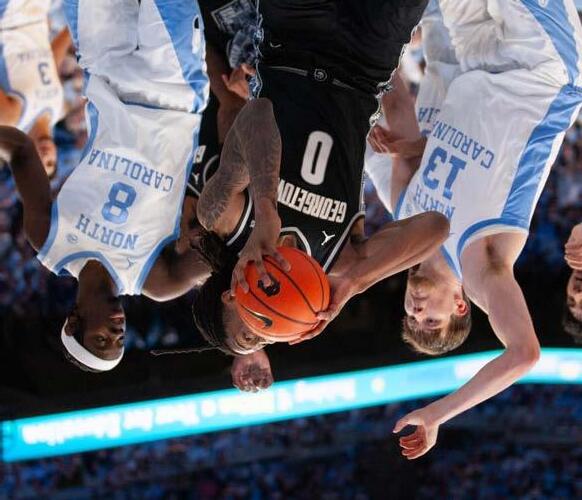
Don’t destroy the Dean Dome Caleb Wilson, Henri Veesaar must improve defensively for Tar Heels to beat Duke
A perfect example was the game against Stanford. With the Tar Heels up 87-85, Wilson failed to step up quick enough to contest the go-ahead Cardinal 3-pointer off a ball screen. On the very next defensive possession, with Stanford up 1 point, Wilson once again didn’t switch on a ball and RJ Davishave made their names known in the Smith Center.
By Matthew Maynard Sports Editor



X: beckettbrant@
it just means more,” Victor said.
“It’s always been in his head and his heart that ‘I want to be a Tar Heel,’ and now that he is a Tar Heel,
Sometimes, when Jaydon is sitting on the couch, that moment — seeing his face flash on the big screen and hearing the crowd cheer for him — flashes across his mind. It’s a culmination of not only his entire basketball career, but his entire life.
But a year after losing to North Carolina,Jaydon walked through two rows of his Tar Heel teammates and joined starters on the home bench in the Dean E. Smith Center.
“Okay now I’m starting. Now, how can I sustain those minutes?” Jaydon said. “How can I stay out there?”
Jaydon just wanted to do all that he could to contribute to the team, and that effort translated into a top five role. He isn’t even close to done.
“To see all of the sweat, tears and prayers and believing, and just having faith come to fruition, for Jay was just super emotional, super exciting and happy,” Victor said. Starting was never a goal.
There were no profound emotions at that point. His dad always told him that proper preparation prevents poor performance. He’d been ready. Not even Jaydon’s family and friends knew before the game. He called his dad to tell him, but Victor told him to make it a surprise. The lineup posted on UNC’s social media ruined the fun, but not the emotional weight of the moment.





“That’s what [Victor]





















“I told my parents, if anything ever happens and I have to transfer, I’m going to be a Tar Heel,” Jaydon said.



For a long time, he wasn’t the best player on the court and nothing came easy. Jaydon Young had to prove that he was a good teammate, so he took advantage of every opportunity to show that he was a winner. In college, starting over as one of the youngest on the team, it became clear how important playing up had been.









But those experiences taught him how to trust himself. They taught him how to adjust quickly, but also to trust the process. To put his head down and fight through anything that came











“Everybody was like, ‘Huh?’ including me,” Young said.

So Jaydon pivoted his focus to Virginia Tech. The school stuck with him through his injury, and he wanted to stay relatively close to home, so he committed. Jaydon worked his way into the starting lineup last season, his sophomore year, and he averagedmore than16 points in the last six games of the season. He entered the transfer portal at the end of the season.

That was enough to catch UNC’s eye. Assistant coach Steve Robinson recruited Jaydon, but when Robinson left for Arizona and Jaydon got injuredin his sophomore year, he stopped hearing from the school as much.


“I never understood it for the life of me when I was younger, he believes whatever he says,” Jaydon said. So it always felt like a possibility that he would end up in Carolina Blue. Jaydon won a state championship his senior year at Greensboro Day School. He was one of the best players in a competitive conference and on a talented team.
So it always felt like a possibility that he would end up in Carolina Blue.
His dad, Victor Young, taught him
Tar Heel born Every day growing up, Jaydon imagined playing for UNC. His dad, Victor Young, taught him never to doubt.
competitive conference and on a in his sophomore with him through his injury, and he wanted to stay relatively close to 16 points in the happens and I have to transfer, I’m going to be a Tar Heel,” Jaydon said. points in the game. But just by scoring, Jaydon proved to himself that he could play with much older guys. He was always the youngest kid and the smallest kid, so his opponents didn’t always

The team was watching film when Davis listed Jaydon off as a starter.
The team was watching film when Davis listed Jaydon off as a starter.


After a rough two-loss trip to California, it was anyone’s guess who would start against Notre Dame last week.
After a rough two-loss trip to California, it was anyone’s guess Dame last week.

Earning the start
Earning the start


Knowing that Davis trusted him late in the close Wake game meant a lot. But that performance only made him want to work harder.
Knowing that Davis trusted him late in the close Wake game meant a lot. But that performance only made him want to work harder.


“I’ve coached 49 years, and I’ve never had a player quite like Jaydon when it came down to clutch time,” Johnson said.
“I’ve coached 49 years, and I’ve when it came down to clutch time,” Johnson said.


Young is the kid that won eight games in his senior season in the final minute.


But if you ask the local journalists in Greensboro, they might tell you that Jaydon



“Everybody was like, ‘Huh?’ including me,” Young said. was five classes ahead of





















“Those juniors and back in the game. He provided a hit to put the Tar Heels up 3 points. His defensive grit stands out to his dad and to Johnson. But if you ask the local journalists in Greensboro, that Young is the kid that won eight games in his senior season in the final minute.
With just over three minutes remaining and UNC only up 1 point after a Wake rally, Davis put Jaydon back in the game. He provided a defensive spark and hit a free throw to put the Tar Heels up 3 points. His defensive grit stands out to his dad and to Johnson.

“Everybody does.”
“I really want to be out there,” Jaydon said after the game.






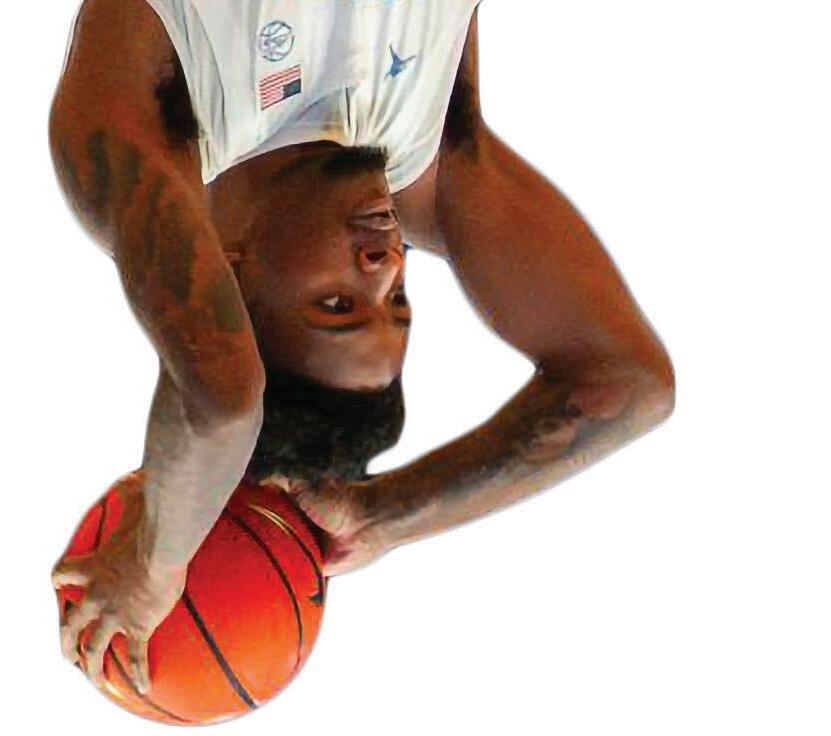
With a couple of seasons under his belt, Jaydon Young is taking on that mentor role at UNC. He’s used his experience to guide first-year forward Caleb Wilson and some seniors at Virginia Tech, they definitely took care of me,” Jaydon said. “So that’s what I try to do for [Wilson] and the other freshmen.” With six rotation guards — and five guys who can play at the three —head coach Hubert Davis has played around a lot with the backcourt lineup. Against Wake Forest, Jaydon played 19 minutes — the most he’s played all season.
was doing, trying to prepare me for that because he played college basketball,” Jaydon said. “So, he knew the endgame, but I really didn’t understand at the time.” Now, he’s no longer the youngest or the smallest, but he’s still proving himself. It was a dream to coach Jaydon, Freddy Johnson, his hall of fame high school coach, said, because he was like a coach on the court.


“I’m pretty sure he would say it was tough. As a sixth grader, you’re wanting to play middle school ball with your middle school, fifth and sixth grade buddies, and your dad is telling you you’re getting ready to play against ninth, 10th and some 11th graders,” Victor said. “So he didn’t understand it.” Jaydon Young played against former





UNC star Coby White, who working out his
“It was just a little quick exchange, but that definitely made me feel like there was a possibility they would reach out,” Jaydon said in an interview with The Daily Tar Heel. Now, not only has he played half a season at his dream school, but Jaydon also has three starts under his belt. On a team with lots of talent in the backcourt, the junior guard has had to fight for every minute he’s played. But that’s nothing new. Every stage of Jaydon’s career — from elementary school to now — has taught him how to play his part when he’s surrounded by talent.


Then, he was in the car on the him. White dropped 40
“The rest is history,” Victor said. Playing up Jaydon is used to being doubted. When he was playing basketball with the Boys and Girls Club, his dad made him play with the older kids.
Point University so he could be just a few minutes away from home. A week later, the head coach left. And North Carolina finally called.
But UNC was still playing in the NCAA Tournament when Jaydon entered, so he committed to High
After his 12-point performance that night for Virginia Tech, UNC assistant coach Pat Sullivan askedJaydon how they had let the local kid slip out of North Carolina. Jaydon wondered the same thing.
night for Virginia Tech, UNC assistant Jaydon exchange, but that definitely made half a season at his dream school, for every minute he’s played. But his dad — who is a high school basketball coach — told him that he wouldn’t be able to play middle school basketball. Jaydon cried in the back seat for 30 minutes, trying to plead with him.
He knew that playing basketball at North Carolina was his dream.

He knew some of his opponents, from AAU and NBA camps mostly, but more than anything, he knew UNC. Jaydon knew sitting in front of the TV with his family to watch the UNC-Duke game. He knew Late Night with Roy before the basketball season and East Coast NCAA Tournament games when his family could make them.
He had been thinking about this game for a week.
Rising from the bench as the PA announcer read out his name as a starter, then-Virginia Tech guard Jaydon Young walked onto the court and prepared to take on North Carolina last season.
By Beckett Brantley Assistant Sports Editor
He never stopped fighting to get to his dream school
From now on, Derek will lead North Carolina’s backcourt for the rest of the season. And he’ll do it with the same calm, poised attitude that he answered his first call from Davis with two years ago. “Really just trying to improve with the guys,” Derek said. “Finish out ACC play strong and make some runs in the tournaments.”
After spending this summer at UNC to adjust, Derek’s transition to college went smoothly. But at the beginning of the season, he didn’t get much playing time — normal for a firstyear player. Derek played only eight minutes and was scoreless in North Carolina’s loss to Michigan State on Thanksgiving. It looked like his play time was diminishing, and his role was still unclear seven games into the season. That’s when the breakout came. Against Kentucky, on Dec. 2 at Rupp Arena, Derek put his name on the college basketball world’s radar. Coming into the primetime, headto-head matchup between two of the sport’s blue bloods, Derek hadn’t played more than 18 minutes in a game. The meaningful minutes weren’t there. That all changed in one of the biggest moments of UNC’s season. When starting point guard Kyan Evans got into foul trouble, it was Derek’s time. His mom and dad were both watching from the stands. Derekhad the ball with the Tar Heels down one with less than a minute remaining. As the shot clock expired and the play out of the huddle broke down, Derek had to improvise. He drove to his right, stepped back, and let a 3-pointer fly to give UNC a 2-point lead. On the next possession, after Kentucky tied the game, Davis called Derek’s number. Derek went around a screen and blew by the defense, finishing with a left-handed layup to give UNC the lead with less than 17 seconds remaining. The same left hand he worked incredibly hard to develop. Despite being on the ESPN interview after the game and the enormity of the shot that put his name on the map, you wouldn’t have been able to tell by the way Derek reacted. With his hometown friends freaking out in a group chat while it was all going down, Derek sent a simple text after the game. “Big looks fellas,” he texted. That was it. No fanfare or elaborate celebration. Just the same old Derek that said basketball was just a game in fourth grade. This time, just on a bigger stage. “I’d just say that’s how he is,” Bullis said. After his breakout performance against Kentucky, Derek followed it up with a 14-point game in UNC’s win over Georgetown. While it took some time to gain consistency after those two games, Derek has made his way into the starting lineup the past four games versus California, Notre Dame, Virginia and Georgia Tech.
“We’re all in with UNC now,” Kari said.
I’ve been there,’ that’s really cool to have a coach with that type of connection with,” Derek said. The night before his commitment to UNC, Derek was just hanging out, playing video games with his childhood friends. He made little mention of his looming decision the next day. Following Derek’s decision to commit to North Carolina over Pitt, Derek’s mom quickly got rid of all the Duke gear in the house.
“Just him knowing the area and talking to him, telling him I’m going to this place and then be like ‘Oh,
And Derek was driving with his friends to Tysons Corner Center when Davis called one day.
As he began to get to know Davis better, Derek found out the head coach grew up just 10 to 15 minutes from where he did.
“Looking at the roster, we felt like Derek would have the opportunity to compete to play right away,” John said.
To Derek and his family, Davis and North Carolina fit his playstyle and was the perfect opportunity.
But Derek never really thought of the Blue Devils as an option during his recruitment process. Instead, Pitt,Vanderbilt and UNCtook over as his top options.
national championship Duke team that featured Tyus Jones was his favorite.
In fact, growing up, the Dixon household was a Duke family, including Derek. They watched every game on TV, cheering for the Blue Devils. Derek even had Blue Devil shirts and sweatshirts. The 2015
always the plan for Derek. He never really even had a dream school.
While getting recruited in high school, North Carolina wasn’t
Matthew Bullis, Derek’s childhood friend, said.
“It was really cool to watch,”
It was there that Derek put in countless hours, usually after 9 p.m., to perfect his game. He even brought his friends to help him rebound. Sometimes he would be there until 1 a.m.
After his first year at Gonzaga, Derek got the code to a gym owned by an alumni, meaning he could practice whenever he wanted.
And it paid off when Derek was recruited to play for Gonzaga College High School in Washington, D.C., which played in the WCAC. During his first year at Gonzaga College, he didn’t earn much playing time. But in the open gym runs, Derek held his own against other Division I commits. He knew he was talented enough to play at the next level.
All the work was beginning to show.
During this time, he also hit a growth spurt. In his first practice back after the pandemic, with his taller frame and longer hair, and his mask on, Derek’s old coach didn’t even recognize him.
“He just loved it, that’s all he wanted to do,” Kari Dixon, Derek’s mom, said. “You’d go in his room, and he’s just laying on the floor, throwing a basketball up. When he could be outside, he was outside shooting.”
That self-driven mindset, from hours of workouts every day during the lockdown to changing which hand he brushed his teeth with, drastically improved Derek’s game.
Kayla Dixon
John
Voters in the Efland precinct will now vote at the Efland – Cheeks Community Center at 117 Richmond Rd, Mebane.
Voters in the Efland precinct, please be advised of the following Election Day polling place change:
Questions? Call the Orange County Board of Elections Office at 919-245-2350 or send an email to vote@orangecountync.gov.
The voter registration deadline for this election is 5 p.m. Friday, February 6, 2026. Eligible individuals who are not registered by that deadline may register and vote at any early voting site during the early voting period. Individuals registering to vote at an early voting site will be required to provide current documentation of their residence (for example, a government ID, other government document, or a paycheck, bank statement, or utility bill). Voters who wish to change party affiliation must do so by the February 6 deadline.
Voters aged 18 and older and registered in the Orange County Schools district are eligible to vote in the Orange County Schools Board of Education Election. In the primary election, voters will select nominees for a political party to move on to the general election on November 3rd. In the primary, voters affiliated with a political party will be given a ballot of candidates for their party, if their party has a primary. Unaffiliated voters may choose to vote in any party’s primary, but they may select only one party’s ballot.
Absentee ballots will be mailed to voters who have requested them beginning January 12, 2026. Absentee ballots must be received by the county board of elections no later than 7:30 p.m. on March 3, 2026. A voter can fill out an absentee ballot request at votebymail.ncsbe.gov, or by filling out a request form provided by the county board of elections office. The request must be received through the website or by the Orange Board of Elections by 5 p.m. February 17, 2026.
Early voting hours are Mon–Fri, 8 a.m.–7:30 p.m.; Saturdays (Feb. 14 and Feb. 28), 8 a.m.–3 p.m.; and Sunday (Feb. 22), 12 p.m.–4 p.m.
Community Center: 117 Richmond Rd, Mebane.
Library: 100 Library Dr, Chapel Hill; Chapel of the Cross: 304 E Franklin St, Chapel Hill; Seymour Senior Center: 2551 Homestead Rd, Chapel Hill; Efland – Cheeks
Early voting will be held at the following locations from Thursday, Feb. 12, through Saturday, Feb. 28, 2026: Orange Works at Hillsborough Commons (in lieu of BOE office): 113 Mayo St, Hillsborough; Drakeford Library: 203 N Greensboro St, Carrboro; Chapel Hill
Voters will be asked to show photo ID when they vote. All voters will be allowed to vote with or without ID. Voters who lack ID can get one for free from their county board of elections. Find out more at ncsbe.gov/voter-id.
The statewide primary and the Orange County Schools Board of Education Election will be held on Tuesday, March 3, 2026. Polls will be open from 6:30 a.m. to 7:30 p.m. on Election Day.
“That was when I really knew this was something that I wanted to do and really started working at it,”
more than just a game for Derek, though. The COVID-19 pandemic was really when Derek became serious about improving.
A couple of years later, in middle school, was when it became slightly
“It’s just a game,” Derek would reply.
It got to a point where his father, John Dixon, became annoyed with him because he never showed emotion on the court.
And no one could change that.
Despite this early passion for the game, though, Derek was always laid back. Nothing bothered him. After games, it was hard to tell if Derek’s team won or lost based on his reaction.
“He could have won the lottery and you will never see it in his demeanor or facial expressions.”
In eighth grade, Derek even beganbrushing his teeth with his left hand despite being right-handed. He did it to improve his ball handling with his left hand, and he still does it to this day.
Derek said in an interview with The Daily Tar Heel. At the end of seventh grade, when the pandemic hit, Derek set a clear goal — play in the Washington Catholic Athletic Conference in high school. He did everything to make that goal a reality. Since school was virtual, it gave Derek more time to train. Every morning, he would lift weights after his first batch of online classes. Following his next couple of classes, he’d go shoot on the family’s outdoor hoop in the backyard. Then, after school was over for the day, he’d return to the court and shoot for three to four more hours.
The mall has a section with more expensive stores, while the other side is known for cheaper places.Davis, who knew what mall Derek was going to, joked with him about going to the more expensive side.
In kindergarten, Derek played against second graders in a house league, holding his own against the older kids.
1 on a mini hoop in the house, and the two would often have to be separated for fighting each other.
“He could have won the lottery and you will never see it in his demeanor or his facial expressions,” Kayla said. Growing up, Derek was surrounded by basketball. He would play against Kayla 1-on-
Nothing phases the first-year guard. He rarely shows emotion. And that reserved, calm nature has translated to the court, where in his first season with the Tar Heels, Derek has cemented himself as the team’s lead point guard. In UNC’s 85-80 statement win against a ranked Virginia team on the road on Jan. 24, in his third start of the season, Derek tallied 11 points and seven assists — playing an instrumental role in a 16-point comeback.
Around two years ago, Derek Dixon was on the back porch of his home in Virginia following a workout, sitting with his sister,Kayla Dixon, when his phone rang. He told Kayla it was a call he had to take. Following the call, and after returning to the porch, Derek was calm and reserved — the same way he was before his phone rang. “That was Hubert Davis,” Derek told Kayla. It was the first time the UNC head coach had reached out to recruit him. Davis offered Derek on the spot. Still, despite one of the biggest programs in the history of the sport offering him, Derek’s demeanor didn’t change. Not because he wasn’t excited or happy, it’s simply who Derek is. sister, Kayla his and Kayla. Derek programs in the because he is.



By Brian D’Aguanno Assistant Sports Editor
Carolina’s backcourt


The Virginia native’s poise steadies North



X: dthsports@
“He knows that Tiffany will always pull the style off,” Sabrina said. “[But] he enjoys the suspense of seeing the request being fulfilled.”
Poles has an idea of what it will be. She just can’t reveal it yet.
Ahead of the rivalry matchup with Duke, Poles will travel back to Chapel Hill to craft her next design. And Wilson is already thinking about what style he wants to go with. “I don’t know what I’m going to do,” Wilson said. “I’m trying to figure it out.”
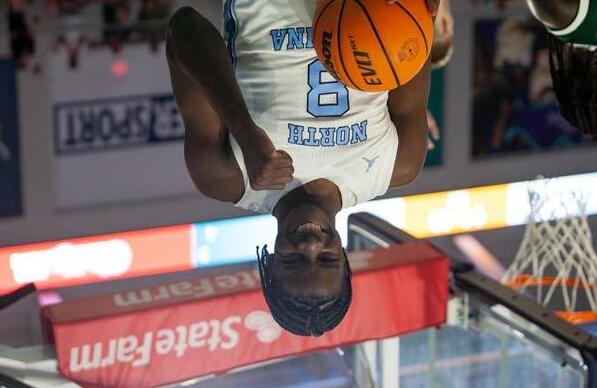
“But also her ability to tell the story that he requests of her. He has worked to build his skill level piece by piece by working day by day, and that particular hairstyle shows it.”
“It not only shows the brilliance and intricacy in which she takes her time to pour into the design request of her client,” Sabrina explained.
But his most recent design is Sabrina’s favorite. The back of his head currently shows braids that form a brick wall. Nine individual rows, designed as bricks, stacked from the bottom of his hair to the top. She calls it “Brick by Brick.”
UNC number — on top. He’s also featured a “Maze” style and a “Wavy” style in past months.
Ahead of NorthCarolina’s trip to Fort Myers, Fla., Wilson got his nickname, “DUB,” braided into the back of his head with an “8” — his
“He’s so passionate,” Poles said.
And Wilson hasn’t questioned her since. Following those two appointments, the pair has teamed up four other times. Sometimes, Wilson brings an idea for her to construct. Other times, he lets Poles tap into her creative freedom. But the duo assures that his identity and her creativity are woven through the braids themselves.
Sabrina said in an email to The Daily Tar Heel. “I am always thoroughly impressed with the quickness in which she braids the intricate styles. She is a true artist.”
“She has been able to capture all of Caleb’s ideas and put her own signature twist on each design,”
off. They wove into a diamond pattern on the top of his head, perfectly mimicking the argyle.
Two nights later, Wilson emerged from the tunnel, showing the braids
“His jaw hit the floor,” Poles said.
Until Poles handed him her phone.
When she finishes a design, she takes a video to show him the results. In the case of the argyle, he knew what he had requested, but he was hesitant about how it would take shape.
“He picks good movies, we’re always watching something good,” Poles said.
During appointments, they chat about basketball and life. Wilson always puts on a movie while Poles works.
So for three hours, he sat and Poles went to work.
Ahead of his next appointment — Nov. 5, before the marquee matchup versus Kansas — Wilson asked if she could braid the argyle that rests famously on the side of North Carolina’s jerseys into his hair. She was confident she could. Wilson, though, needed to see it to believe it.
“Once I did it once, his parents and [Wilson] were like, ‘Yeah, this is your braider for the rest of the season,’” Poles said. Then, Wilson’s creative mind went to work.
Poles called it “basic.” But her definition of basic is not consistent with everyone else’s. She prides herself on her ability to do creative work that seems improbable. Wilson and his parents, Sabrina and Jerry Wilson, were still impressed by her initial work, even if it just scratched the surface of what Poles was capable of.
“It was a gift from God,” Poles said. “I was really good from a young age.” Now, NBA Hall of Famer Allen Iverson, along with many past and present Charlotte Hornets and Carolina Panthers players, is on her list of regulars. And as of midOctober, Wilson joined them. The first design for Wilson — which he got on Oct. 12 before media day — was a “Zig Zag” style.
Poles is based in Charlotte, with 25 years of professional braiding experience. In the last decade, her clientele has shifted mostly toward professional athletes. She grew up braiding her own hair, then her siblings’ and friends’ hair.
The person who referred Poles told Wilson and his family that they wouldn’t “have anything to worry about.” That reassurance turned out to be a total understatement. Ever since that impromptu introduction, Wilson and his family have leaned on Poles during his time in Chapel Hill. The UNC men’s basketball superstar has unveiled a rotation of braid designs through the 2025-26 season, highlighted by the iconic North Carolina argyle. The uniqueness and detail in Poles’ work have turned heads among spectators and teammates, but more than anything, they represent Wilson’s confidence, expression and creativity both on and off the court.
Thankfully, someone in Wilson’s circle knew Tiffany Poles — a professional braider with a long history of NFL and NBA clients. And when she got the call, she was happy to add Wilson to her schedule.
It was a surprise to Wilson, though, when his appointment with his original stylist was canceled.
That wasn’t a surprise. The firstyear forward has sported multiple braid styles dating back to his time at Holy Innocents Episcopal High School in Atlanta.
Before media day in October, Caleb Wilson wanted his hair braided.
By Jack Morris Senior Writer
An argyle pattern was his first UNC-inspired style
X: dthsports@
“Carolina basketball and Duke basketball is so much bigger than one player or one coach or one team.”
“The individual players are not bigger than the schools and the fan bases,” Wojciksaid.
With only one rotation player on the UNC roster who has faced the Blue Devils each of his three years, a larger part of the team than ever is having to learn for the first time what it means to face Duke.
But as NIL opportunities become a focal point in recruiting players, the promise of playing a big game like the Duke game and the appeal of the “Carolina Culture” that has defined the blue blood program will no longer promise the same intensity.
“When I was a kid, you know, it inspires the next generation to want to play in rivalry games like that,” former guard and 2024 graduate Paxson Wojciksaid. “It puts passion and excitement into the fan bases from students to the professors, to faculty and staff, to feel like they’re a part of something bigger than themselves.”
Despite the lack of one-anddone players, the Tar Heels’ roster includes only one returning rotation player, senior guard Seth Trimble, while Duke’s lineup includes five. Several players who appeared in last season’s matchup against Duke departed North Carolina via the transfer portal or graduation.
means to be a Tar Heel and they
“I think recruiting guys who are in it because they value what it
During the 2024-25 season, Duke had three players who left for the NBA — Flagg, Kon Knueppel and Khaman Maluach — while North Carolina had one in Drake Powell.
Since 1999, Duke has produced 33one-and-done players, among the highest totals in the NCAA.
current era of college basketball.
The one-and-done departures, such as Flagg, are not unique to the
enjoy being at North Carolina, and are fully bought in to the culture and tradition of the school, that’s what keeps that culture alive in terms of in the locker room and having guys who are not just here to play another game,” Ryan said.
With contracts and NIL money to contend with, general managers give schools an edge in recruiting top high school and portal talents.
In 2025, first-year Cooper Flagg led Duke to the Final Four, reportedly earning $28 million in NIL. The same year, North Carolina hiredJim Tanner as GM of its basketball operations. The hiring of both Tanner and Baker aligns with similar hires across high-major programs amid the changing college environment.
In 2022, Duke hired Rachel Baker as a general manager to oversee name, image and likeness operations.
That season, Duke swept the season series against North Carolina and won the ACC Tournament.
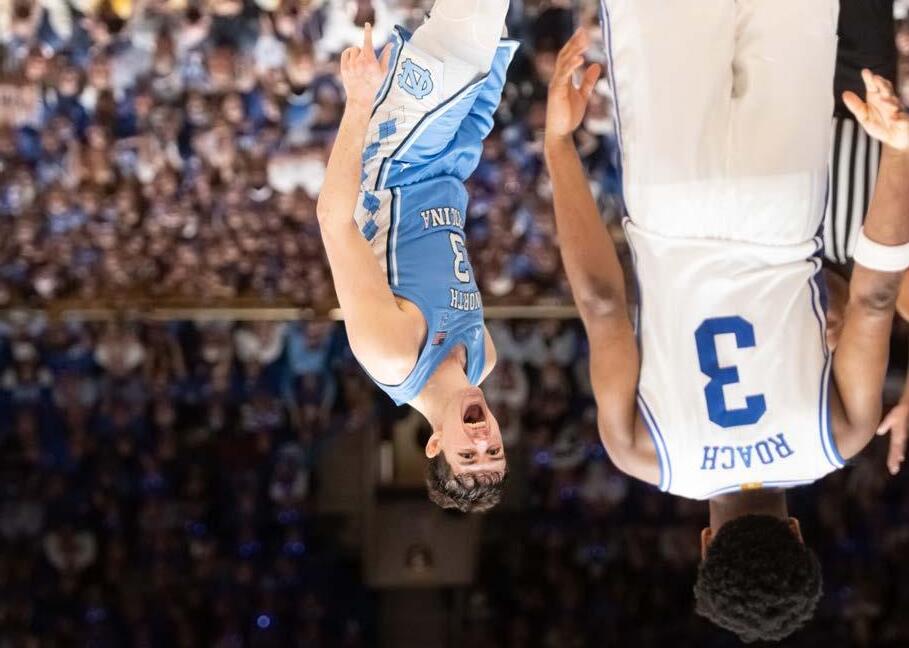
Some of them have played Duke before on other teams, but the intensity of those games is different.
The UNC-Duke rivalry is built on its history. Today, very few of the players are from North Carolina.
Nevertheless, some observers and players argue the rivalry has become more reflective of yearto-year roster construction than longstanding tradition.
“The driving factor in a lot of ways now is money, and I don’t think that’s necessarily a bad thing. These players have the opportunity to make generational wealth,” Ryan said. “But the recruiting of coming to a school just because you get to play in big-time games or just because you get to be a part of a big-time tradition or a big-time program, that’s still there, but it’s no longer the driving factor.”
As concerns around commercialization have emerged, high-end talent continues to rotate through both universities, and the product remains great basketball.
“The way the landscape of college basketball is heading, you’re starting to see a lot of tradition and culture go by the wayside in exchange for essentially money and just commercializing the enterprise of college sports,” former forward and 2024 graduate Cormac Ryan said.
Throughout college basketball, while players are still leaving after a single year for the NBA, the constant bidding wars for the best players in the transfer portal and high school is disrupting the storyline for the iconic matchup.
UNC’s hatred for Duke and Duke’s for UNC. But as roster turnover from the transfer portal impacts both programs, the current form of the Tobacco Road rivalry is changing.
In a college sports era of uncertainty, one thing is still certain:
By Josh Markotich Senior Writer
the
Donors receive $7,500 for each completed donation. Visit

Are you are a healthy, non-smoking woman age 21-30? You could have the opportunity to become an egg donor.
X: dthsports@
The 83 percent free throw shooter easily sank the game-winning shot and the crowd stormed the court moments later at the buzzer, the Tar Heels holding off the Blue Devils within the final seconds and capping off one of the greatest nights in UNC basketball history.
On March 6, 2005, with three minutes left to go on their senior night against No. 6 Duke, the Tar Heels trailed 73-64. However, the future 2005 NCAA Tournament champions came storming back, scoring 11 unanswered points. The historic comeback was completed as Raymond Felton missedhis second free throw with 19 seconds left, the ball bouncing around before finding its way into the hands of Marvin Williams, who banked it off the glass and into the net as a whistle blew for an and-1.
1. The and-1
Montross suffered and played through two cuts on his face — both of which required stitches — highlighting the intense rivalry between the Tar Heels and the Blue Devils and cementing the “Bloody Montross” game in the Smith Center’s and Montross’ legacy.
Heels held off a talented Duke team spearheaded by Christian Laettner.
Devil win streak and becoming one of only two teams that would defeat the eventual national champions. Led by Eric Montross andcurrent UNC head coach Hubert Davis, theTar
1 Duke, ending a 23-game Blue
Commonly referred to as the “Bloody Montross” game, on Feb. 5, 1992, UNC beat undefeated No.
2. Bloody Montross
Heels defeated the Seminoles in what would go into the annals of UNC history as “The Comeback.”
Lynch with 1:41 left to go, the Tar
comeback capped off by a midcourt steal and slam dunk by guard George
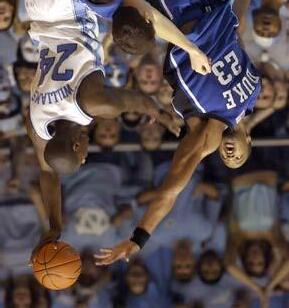
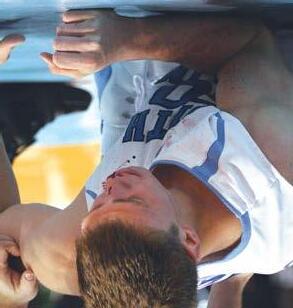
20 with 9:30 to go. After a furious
State came into Chapel Hill hot after winning its past five games, including the previous game against the twotime defending national champions Duke.While 16-1 UNC had the better record, Florida State took advantage of UNC’s starters Derrick Phelps, Brian Reese and Donald Williams being held out at the start of the game, quickly putting the Tar Heels into a hole. FSU led by as much as 21, and North Carolina wasdown by
On Jan. 27, 1993, No. 19 Florida
3. The comeback
ACC and National Player of the Year took an elbow to the face from Duke’s Gerald Henderson while going up for the put-back after rebounding his own free throw. With blood streaming down his face, Hansbrough threw some words toward the Duke bench before being led off the court and into the locker room while Henderson was ejected from the game and handed a one-game suspension. Although UNC won the game shortly thereafter, Hansbrough’s bloody nose remains both the most memorable moment of the night and one of the most memorable in UNC history.
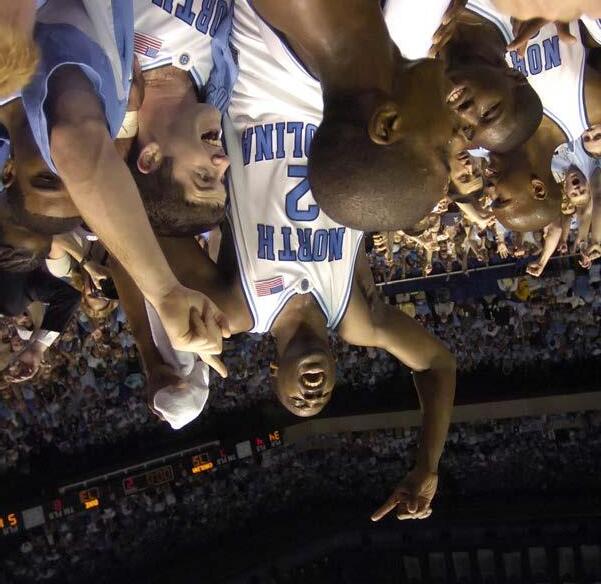
A list of the biggest moments in the Smith Center can’t be complete without mention of Tyler Hansbrough’s broken nose. On March 4, 2007, the future
4. The bloody nose
It didn’t take very long for the Smith Center to deliver a historic moment; the first game in the new arena was a heated rivalry matchup between the No. 1 Tar Heels and No. 3 Duke. Led by future NBA All-Star center Brad Daugherty and powered by a career-high 28 points from guard Steve Hale, UNC beat Duke 95-92, maintaining itsundefeated status.
5. The first game
UNC basketball history have occurred there. Here is a ranking of the top five games in the Smith Center.
For 40years, the Dean E. Smith Center has been home to the North Carolina men’s basketball team since playing its inaugural game in the historic arena on Jan. 18, 1986. The Tar Heels haveproduced 21Final Four appearances, 39 first round NBA selections and four national championships. The fourth-largest arena in college basketball, with 21,750 seats, the Smith Center is an undeniable cornerstone of NCAA hoops. Amid numerous conversations about the future of the building, what remains true is the rich history of the arena. Some of the biggest moments in
Staff Writer
By Caleb Schalliol
From iconic bloody rivalry matches to historic comebacks
X:
“There’s no other feeling of walking in the Smith Center whether there’s 22,000 people in there, or zero people,” Maye said.
But Maye will keep his memories tucked in the back of his mind, knowing the Smith Center provides a tenured history and culture that can’t simply be transferred to another building.
Keeping the Smith Center on campus was Dean Smith’s wish.
Atma Hotel Group president Manish Atma projected that a new arena would cost more than $1 billion. He cited schools like Duke University and the University of Tennessee, Knoxville, who have completed successful renovations, and he asked why UNC could not do the same. He added that N.C. State University’s off-campus arena has not worked out well for them, since traveling on top of every student’s current workload leaves them unmotivated to make the trip off campus. Carter clarified that the renovations the Committee for a South Campus Arena has advocated for would ideally be done in phases, similar to the recent Spectrum Center renovations in Charlotte. That way, the team could still play in the Smith Center during this multiyear process. Carter added this would require a credible professional study to be done, which was not where this process started when he found out in early December. An abbreviated process should not be used to make a billion-dollar decision, he said. For UNC, it’s either renovate or relocate. And Smith Center South’s motto stems from that looming decision: “Renovate, Don’t Relocate.”
Upcoming decisions
It’s not just a place to watch basketball, but also a source of extra income. And Hansbrough gave an interesting player perspective on the hardwood itself at the Smith Center. Since the Smith Center court is only used for basketball, it is spring-loaded and has a little bit of give to it, making it a recruiting advantage and much better for an athlete’s body, in contrast with other multipurpose courts.
Name, image and likeness giving schools and athletes the opportunity to gain revenue from other places has transformed the role of an arena.
Maye and Marquise Williams both echoed similar sentiments about the reason for this change.
“It hurts my heart to see my guys that I went to school with who won a national championship, who won numerous games in that arena, thinking about [how] they have to now go to a new arena,” Marquise said. “I mean, it’s just hurtful.” By moving the arena, he felt like they would take away everything UNC meant to the alumni.
Not only did he play across the road at Kenan MemorialStadium, but he lived just a four-minute walk from the Smith Center his first year at UNC, in Ram Village Apartments. Every chance he got that year, he walked over to basketball games to take part in the electric atmosphere. As an alumnus, he returned with his 5-year-old daughter and 2-yearold son. He lamented the idea that all those memories could be taken away, not just for him, but for the basketball players who he was close with in Chapel Hill, such as Marcus Paige, Brice Johnson and Kennedy Meeks.
But it extends across other sports. Take former UNC quarterback Marquise Williams, for example.
As a result, the administration is taking the time to absorb as much
The protests aren’t just outside noise to Roberts, but a reflection of the passion fans bring for UNC basketball culture.
spend $80 [million] to $100 million to replace the roof at the Smith Center, upgrade the bathrooms — which everyone knows are an embarrassment — do something with the concessions and do the required ADA compliance,” Roberts said.
“At a minimum, we need to
But, Roberts ruled out leaving the arena as it is.
He emphasized how there wouldn’t be a perfect location, but Carolina North, a 230-acre University-owned site along Martin Luther King Jr. Boulevard, would be the ideal placement. The Carolina North area will be developed no matter the fate of the arena.
On Jan. 19, Roberts said no decisions have been made about the Smith Center yet.
And suddenly the discussions slowed even further. The urgency to move the Smith Center began to dwindle as more powerful local figures voiced their opposition.
Hansbrough said. “And if there’s more people that feel the same way about us, we’d like to see them voice their opinion as well. Because the Smith Center’s meant a lot to a lot of people.”
advice and input as it can from the outside, Roberts said, knowing this choice will affect the next few decades. With the decision up in the air, it’s clear where many of the basketball alumni like Maye and Hansbrough stand.
soon after to get the word out. These accounts, under the name Smith Center South, advertised a petition that has gained 21,750 signatures enough to people fill the Smith Center — in about 10 days. The committee reached out to Roy Williams and Hansbrough about the idea of shooting a video, and they both agreed. “It’s just to make sure that the public knows where we stand,”
The Committee for a South Campus Arena took to platforms X, Instagram, Facebook and Tik Tok
Influential perspectives
“We have stayed together as a unit to try to continue to put information out to present both sides of this story and to let the voices of the former players, the voices of coaches, the voices of students, the voices of alums be heard,” Carter said.
And from the handful of people who rallied to get the signatures, the Committee for a South Campus Arena was created. With figureheads for the movement like Roy Williams, it helped the protest come to life.
One person agreed up front, but said if the organization used it publicly they would want it taken off. Carter said the organization complied with this person’s wishes.
Carter added that the organization complied with any wishes for name removal from the document.
There could have been even more names, Carter said, but the organization reached out to people in just a 24-hour time window. Even with the clock ticking, Hansbrough and Carter emphasized that the group got consent from everyone’s name on the list.
Ninety signatures decorate nearly half the page. Among them, names like Roy Williams, Tyler Hansbrough and the Maye family gave the letter unprecedented weight.
board, I think a lot of other former players really felt comfortable putting their name on that letter,” Hansbrough said.
“Coach Williams, when he was on
Some of this noise got back to Roberts, so the administration put three focus groups on the calendar to discuss the matter. These meetings yielded mixed opinions, but most pushed back against the idea of relocating. Then, Hansbrough received a call from a UNC alumnus to inform him of the letter. By the time he read it, Roy Williams’ name was already on the document. He signed without hesitation.
Administrative response
entitled “Tar Heels Concerned for the Future of the Dean E. Smith Center and Carolina Basketball” was born and sent on Dec. 12 to Roberts. The message was clear: do not move the Smith Center.
Exactly 10 days later, a letter
So, the group took action to put a stop to this. Carter said they heard the announcement would arrive in just 10 days, or as early as Dec. 10.
“‘What’s going on here? Where is this coming from? Is it coming from outside the University? Is it inside the University?’” Carter recalled. But the central question they asked was about the process. Or, lack thereof, for that matter. Because even Roy Williams didn’t know.
And it included moving the basketball arena. He was told the administration’s decision had been made. There was nothing anyone could do. In shock and awe, the group all started talking among themselves.
1971 alumnus Rusty Carter was at the UNC-Kentucky game in Lexington, Ky. Carter and a few other alumni and supporters of the UNC basketball program were approached by members of the athletic department to inform them that there was a pending announcement about Carolina North.
On Dec. 2, UNC donor and
Alumni reactions Maye remarked how the administration seemed taken aback by how unified everyone on the call was against moving the arena in favor of renovations. Hansbrough said he didn’t hear a single former player or person associated with the program say they wanted a new arena. But Hansbrough also said he thought the meeting should have taken place months ago, long before plans had been cemented. Action to protest this movement had already taken place weeks before the Zoom.
“It’s just going to be pretty difficult for me [to] accept anything else,” Maye said.
It was eye-opening to hear the administration’s take on the issue for Maye. As a former UNC basketball standout and lifelong Tar Heel fan, it would be a hard pill to swallow to see the Smith Center move locations.
The administration planned the call with former UNC basketball players and coaches to give them a heads up about the potential plans to move the basketball arena off campus. About 90 of them gathered within a week for this discussion. And turns out, they all had pretty similar opinions and stories.
In early December, Maye and Hansbrough received an email from UNC Chancellor Lee Roberts’ office that announced a Zoom call with Director of Athletics Bubba Cunningham and Executive Associate Athletic Director Steve Newmark.
This ran through both their minds when they got word of a call to discuss the future plans for the Smith Center.
And 10 years before Maye, national champion Tyler Hansbrough experienced the same. A unique feeling and environment he couldn’t put into words.
“It’s hard to describe if you haven’t been in there when it’s empty,” Maye said.
Not just his first scrimmage. Or beating No. 9 Duke his junior year. Or even senior night. Instead, it was the late nights going in and shooting with family, playing one-on-one. All four Maye brothers, the lone souls among the endless rows of seats, scanning the sea of the Carolina Blue. The banners and jerseys hanging in the rafters. Looking down at his feet and seeing the Roy Williams Court signature.
What stood out to Luke Maye most about the Dean E. Smith Center wasn’t just the sold-out games.
By Alexandra Jones Senior Writer
The discourse started in December, and it hasn’t died down yet







































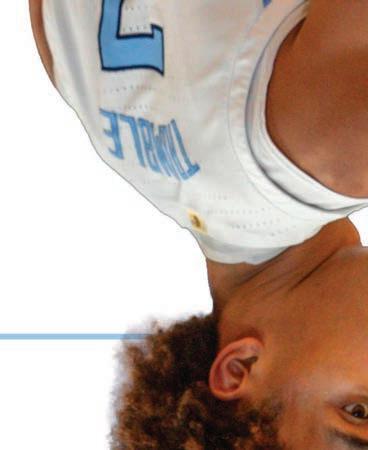


















































Trimble will likely defend Evans,
Derek Dixon continues to trend upwards as the starting point guard.
Duke big men and if first-year guard



Jonathan Powell may not score much, but he’s a great rebounder. Against Michigan State and Virginia, two of the best teams UNC has faced all season, he had seven rebounds. Junior guard Luka Bogavachas been streaky offensively but had a big game in the win over Virginia.Bogavac and Powell are two guys who have the potential to come up big against the Blue Devils. Ultimately, improved perimeter defense and a big performance from at least one of the guards coming off the bench might be enough to counter a relatively lacking Duke backcourt.
Bogavac and Powell are two guys who have the potential to come up at least one of the guards coming off the bench might be enough Duke backcourt.









Trimble is averaging14.5 points and 4.1 rebounds a game. To a certain extent, his efficiency will rely on how much of a shooting threat the frontcourt can be against talented
tip by applying pressure, attacking passing lanes and forcing Duke’s guards into uncomfortable positions.






while at UNC, will need to set the tone defensively from the opening
Senior guard Seth Trimble, the only Tar Heel guard to face Duke
Here is a preview of the backcourt matchup when the Tar Heels face off against Duke:
North Carolina has had in a while, so UNC should have an edge.
This is the tallest backcourt that



of Junior guard Kyan Evans will almost certainly be coming off the bench for UNC. When Evans five of 20 3-pointers, and it’s made him reluctant can produce off the bench, the backcourt Jonathan Powell may not score much, but faced all season, he had seven rebounds. Junior Bogavac has win over Virginia.
Junior guard Kyan Evans will almost certainly be coming off the bench for UNC. When Evans is overly 3-point reliant, he struggles. Over the past five games, he has made just five of 20 3-pointers, and it’s made him reluctant to shoot. UNC averages 20.35 bench points per game, compared to Duke’s 22.5, so if Evans can produce off the bench, the backcourt depth could be a huge advantage for UNC. Sophomore guard





performs out of the gate if he starts.



When the Tar Heels face off against Duke, their main backcourt opponents will be junior guard Caleb Foster andsophomore guard Isaiah Evans, who make up nearly a quarter of Duke’s offense that ranks fourth in efficiency.
Juke Harris,28 points. Boopie Miller,27 points.
Ebuka Okorie,36 points.
UNC’s defensive problem in big games is clear. Against elite point guards, UNC has struggled.
Staff Writer
By Kate Clark
UNC the edge in guard matchup against Duke
Duke’s second-highest scorer at 14.3 points per game and its best perimeter shooter. Evans is capable of heating up quickly, and he’s an agile off-ball threat, so keeping him cold from downtown is key. In Duke’s one loss to Texas Tech, Evans was held to 0-for-2 from 3-point range and only scored 4 points. Trimble — known for his defense — will need to force Evans into long, contested jumpers. Foster is averaging 8.8 points a game and 3.7 rebounds, similar to Trimble. He had a career-high 20 points against Louisville, but he hasn’t been an outside threat in big games, shooting 9-for-27 in ranked matchups. Since moving into the starting lineup, Dixon has shown promising growth. He had an impressive performance against Virginia, dishing a career-high seven assists on top of 11 points. His ability to push the pace in transition — on the ball and as a passer — will be critical against Duke’s athletic defense. Dixon is one of UNC’s best perimeter shooters at nearly 41 percent, and he has come up big in ranked matchups, like against Kentucky. The whole team, however, ranks 11th in the ACC in 3-point shootingat 34.1 percent. Duke will try to expose that weakness by forcing UNC to shoot beyond the paint and locking down Dixon. Junior guard Jaydon Young needs to elevate his performance. After earning his first start against Notre Dame, Young has shown flashes of defensive toughness, but his minutes remain inconsistent and he hasn’t been particularly productive offensively. Against the Blue Devils, he must focus on defensive pressure and discipline, particularly avoiding early fouls. His impact against Duke will likely be determined by how he
Starters could give



No wonder PreLaw Magazine consistently ranks us among the nation’s top schools for practical training.
Court hears cases, and where our moot court and mock trial teams compete.
UNC and Duke graduates have excelled in our 2 ½ -year, highly experiential program of legal education. Learn more about Elon University School of Law, including our Robert E. Long Courtroom where the North Carolina Business
James Brown play smaller roles as depth pieces, but their presence gives UNC additional options if foul trouble becomes a factor — something the Tar Heels have not always had.
High and sophomore center
Sophomore forward Zayden




If Wilson can establish a position inside and Veesaar can pull Ngongba away from the basket, UNC can force Duke into longer half-court possessions.
Junior forward Jarin Stevenson provides size and defense with his 6-foot-10 frame. His length allows him to switch easily on defense, and based on recent strong performances — including his 17-point showing against Virginia — Stevenson has shown he can provide a spark off the bench.
North Carolina’s supporting cast off the bench adds some depth to the frontcourt.


On the other side, the Blue Devils rely on a clear frontcourt duo in first-year forward Cameron Boozer and sophomore center Patrick Ngongba II. Boozer serves as Duke’s primary interior scorer, averaging 23.5 points and 9.8 rebounds per game while shooting 58.6 percent from the field. He is most effective when he has space to operate, where he can either score or find open teammates. Boozer also averages 4.1 assists per game, which keeps Duke’s offense flowing. Ngongba fills a more traditional role in the paint for the Blue Devils. He averages 11.1 points, six rebounds and 1.3 blocks per game, giving Duke a reliable presence around the rim. At 6-foot-11, Ngongba’s size helps anchor Duke’s interior defense, and his ability to finish plays near the basket makes him an efficient scoring option.
Veesaar is averaging 16.8 points and nine rebounds per game, but his value extends beyond traditional post play. Shooting 45.8 percent from 3-point range, the 7-footer pulls away defenders from the basket, opening driving lanes for UNC’s guards. Defensively, Veesaar protects the rim, with the junior center averaging 1.3 blocks per game.
Wilson’s presence is matched by junior center Henri Veesaar, who gives North Carolina the true center it lacked last season.




Caleb Wilson, who has quickly become the focal point of UNC’s frontcourt.









Center. This physicality that change forward the focal point of

7 in the Dean E. Smith Center.This year, the Tar Heels arrive with a frontcourt capable of setting the tone inside and establishing against Duke. At the center of that change is first-year


But ifDuke can keep UNC’s bigs defending on the perimeter and avoid foul trouble, Boozer’s efficiency can limit North Carolina’s size advantage. In a rivalry often decided by small margins, the frontcourt battle may decide who controls the physicality andwhether UNC’s rebuilt interior is enough to beat a dangerous Duke team. X: dthsports@ present is the Blue Devils on Feb.




However, these concerns are no longer present as UNC is set to take on the Blue Devils on Feb.





By Katie Reeves Staff Writer


Last year against Duke, UNC’s frontcourt was outmatched in two humiliating regular season losses. Small lineups and limited size forced the Tar Heels to rely on pace and perimeter play, leaving little room for error against Cooper Flagg and Khaman Maluach.

Wilson is averaging 20 points and 9.9 rebounds per game while shooting 58.9 percent from the field. Wilson’s strength in the post forces defenses to help, and his rebounding limits second chance points — an issue that hurt the Tar Heels last year. As physicality increases in conference play, Wilson’s ability to finish through contact will be more valuable.






North Carolina, Duke both boast strong tandems











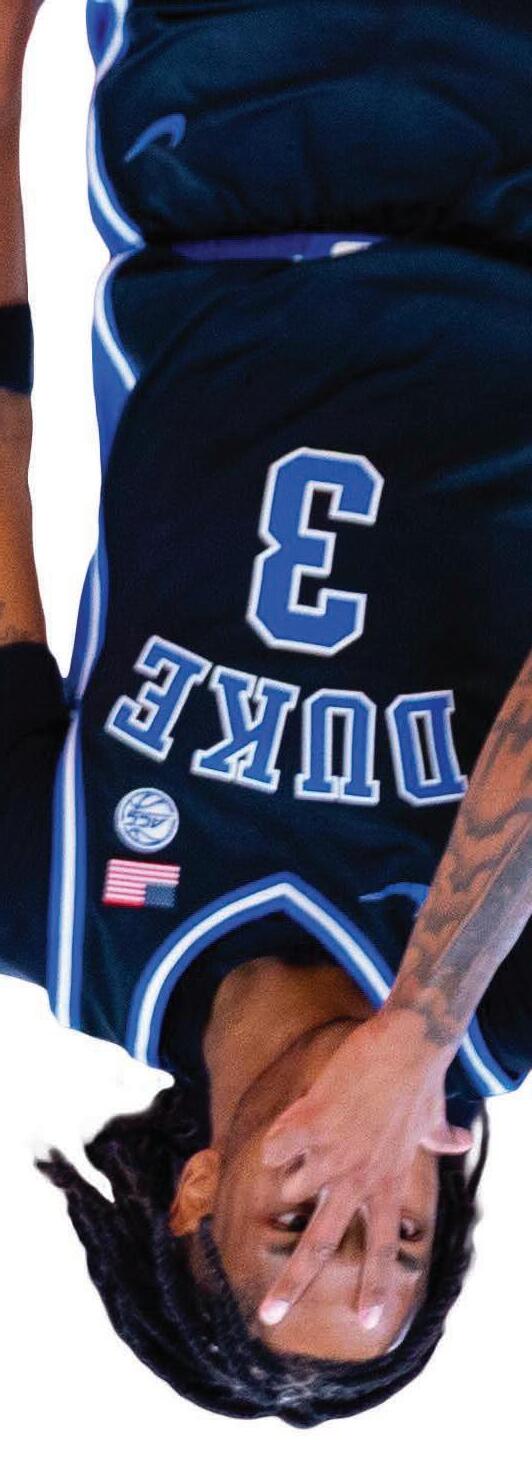


















Boozer is second in assists with 2.9 assists per game and serves as another primary Boozer is second in assists playmaker when Foster isn’t on the floor. The Blue Devils also have a former All-ACC in Maliq Brown to reinforce their defense when needed. Brown is averaging 1.7 steals and 0.5 blocks so far



Often, first off the bench



Starters: A Elite defense, consistent shooting and one of the best players in college basketball to tie it all together. It’s hard to poke holes in Duke’s rock-solid starting five this season. With wins over multiple ranked teams, including Michigan State and Kansas, Duke’s starting five has demonstrated that it has all the elements to contend for a national championship.
Duke’s backcourt is full of effective outside scorers, making its inside game all the more potent.
Duke’s starting point guard, junior Caleb Foster, orchestrates Duke’s offense. Foster is a steady lead guard, controlling the tempo and doing small things to keep the team running smoothly. Foster is averaging 8.8 points per game and shooting 38.2 percent from beyond the arc. At the two guard is Evans, a volume scorer with a lightningquick trigger. Evans is currently shooting 33.6 percent from deep on nearly double the attempts of Duke’s second-most-willing shooter.
Backcourt: B+
When Boozer gets doubled, Ngongba dives towards the paint for an open lob or to initiate a secondary action. Boozer and Ngongba provide a stable foundation for this year’s Duke squad.
provides an additional cutting threat and handoff opportunities.
His partner in crime, Ngongba,
steals, cementing his position as a top five pick in the upcoming NBA draft. Boozer is arguably the most dangerous post player in college basketball with his combination of touch, footwork and playmaking. Boozer has also flashed some impressive outside shooting, hitting on38.1 percent of his threes this season.
The Boozer and Ngongba frontcourt has come out swinging throughout the first half of the season. Boozer leads the Blue Devils in points, rebounds, assists and
Frontcourt: A+
With their variety of switchable defenders, opposing offenses grind to a halt and quickly allow the Blue Devils to run away with games. They held Kansas and Florida to 66 points, Michigan State to 60 points and Stanford to just 50 points this season.
CenterNgongbaanchors the defense, though. Duke’s defenders run opposing shooters off the 3-point line and funnel them towards the 6-foot-11, 250-pound center who is averaging 1.3 blocks per game this year.
Duke’s best perimeter defenders, and both are capable of guarding positions one through four.
Dame Sarr and Maliq Brownare
Duke boasts one of the nation’s strongest defensive units again this season. The Blue Devils are allowing opponents to score just 64.6 points per game and have a defensive rating of 91.2 per KenPom, both of which rank top 20 nationally. Forwards
Defense: A+
35 percent from beyond the arc, allowing them to stretch the floor and punish any help defense the opponents send. First-year big man Cameron Boozer leads Duke in scoring, averaging 23.5 points per game. He is the go-to scoring option for the Blue Devils this season, shooting 58.6 percent from the field. Boozer is complemented by sharpshooting sophomore guardIsaiah Evansand sophomore center Patrick Ngongba II, with the three combining for over half of Duke’s points this season.
Duke ranks 15th in the nation in effective field goal percentage to go along with an average margin of victory of 20 points. Shootingwise, the Blue Devils currently have three players shooting over
The Blue Devils pride themselves on efficient inside-out basketball.
Offense: A-
As the first of two UNC games versus Duke rapidly approaches, here are the letter grades for the Blue Devils’ season thus far:
The Blue Devils are currently 20-1, with their only defeat being a 1-point loss to Texas Tech in late December.
The No. 4 Duke men’s basketball team looks poised to make another run at a national title following last year’s Final Four loss to Houston.
Staff Writer
By Kendall Allen
Blue Devils earn high grades all around at midseason mark

Junior guard Luka
Sophomore forwards Zayden High and James Brown have been unreliable backup big men, as well asfoul-prone. Stevenson has played at a few positions, but he has been consistent when backing up Veesaar and Wilson, showing his defensive ability.
The Tar Heels have more depth on the bench this season, but it’s concentrated at guard. Specifically, sophomore guard Jonathan Powell has shown potential, as well as Young and Dixon when they were coming off the bench. Powell is averaging just over 16.1 minutes a game, and his ability to shoot from three and push the ball up the court has been important in big moments for North Carolina.
Bench: B+
Stevenson, at 6-foot-10, adds more height for the Tar Heels but averages only seven points, although he came up big against ranked Virginia. Young is only averaging 7.4 minutes for North Carolina anddidn’t do much with the starting role against Notre Dame, Virginia and Georgia Tech, but is shooting 33.3 percent from three.
Bogavac, who arrived from Europe as a promising 3-point shooter, has struggled, shooting just over 32 percent from beyond the arc.
The three spot of North Carolina’s starting lineup has been the most tumultuous.
Derek Dixon has taken over the starting position. Dixon has both a higher field goal percentage and 3-point percentage, though Evans averages more assists.
Evans earned the starting role early in the season, but first-year guard
At one point, junior guard Kyan
Only two players, Wilson and Veessar, have started each game for the Tar Heels. Trimble faced an early injury but has started every game he has been available for.
Heels still do not have a solidified starting lineup.
Through Week 11, the Tar
Starters: B
This UNC team is only the second Tar Heel team this century to allow two ACC opponents to score 95 points in regulation. The only other time this happened was in 2002, a team that went 4-12 in the conference.
come from guarding beyond the arc. UNC is 187th in 3-point defense, allowing opponents to shoot 33.6 percent. In their games against Wake Forest, Stanford and Cal, the Tar Heels gave up 44 total 3-pointers.
Much of North Carolina’s issues
UNC team very quickly turned into its kryptonite. Through ACC play, the Tar Heels sit 12th in scoring defense, giving up an average of 70.3 points per game.
What started as a highlight of this
The offense has struggled to shoot at times, especially to close out games, but overall, the Tar Heels have shot 34.1 percent from three and 48.1 percent from the floor.
rated him the third best first-year in the country. Wilson has 11 doublegames, but overall, the Tar Heels
Wilson, who came to UNC as a 5-star recruit and the No. 8 player in his class, has been as advertised for this Tar Heels offense. ESPN has rated him the third best first-year in the country. Wilson has 11 doubledoubles and leads the Tar Heels in points, rebounds, steals and blocks.
North Carolina is led by the frontcourt duo of first-year forward Caleb Wilson and junior center Henri Veesaar. Wilson is fourth in scoring in the ACC, averaging 20 points per game, followed by Veesaar at 10th, averaging 16.8 points per game.
frontcourt duo of first-year forward
The Tar Heels sit at 66th in the country, averaging 82.6 points per game. Through ACC play, the Tar Heels rank seventh in the conference at 83.0 points per game.
Offense: B
here’s how things are going for the Tar Heels rank seventh in the
North Carolina enters its game against No. 4 Duke with a chance to prove itself against its toughest opponent yet. Based on how Carolina performed this season, here’s how things are going for the team so far:
Michigan State. Things were looking up for a team that barely made the tournament the year prior. But road conference play has been a struggle for the Tar Heels. With a tough trip to Texas followed by an even worse trip to California, the Tar Heels continue ACC play back at the beginning, with many questions.
Defense: C-
Bogavac, junior forward Jarin Stevenson and junior guard Jaydon Young have all started.
only loss coming to thenNo. 11

Tar Heels stood at 12-1 with their
Entering ACC play, the
The Tar Heels tipped off the 2025-26 season at No. 25, but individual expectations were unclear. With only one starter returning from the previous season — senior guard Seth Trimble — North Carolina began the season surrounded by questions about who would step up. Those questions quickly faded after a victory over then No. 19 Kansas already matching its total from last season.


By Tess Alongi Staff Writer


North Carolina’s defense may limit its ceiling
Overall: B X: dthsports@ one surrounded in the Dean E. Smith Center. The win marked UNC’s first Quad 1 victory of four, just two games into the season, already from last season. then





X: dthsports@
North Carolina may not have the luxury of starting slow and attempting to mount a comeback as they did against UVA. It will be a challenge to get a lead and therefore keep it against the No. 4 Blue Devils. If North Carolina can show consistency throughout the game and avoid scoring droughts, it could add yet another top-ranked win to its resume.
UNC picked up wins versus Wake Forest and Ohio State, but in dangerous territory. After gaining 15-point and 11-point advantages, respectively, both games would end up coming down to the final buzzer.
Heels were looking at a 19-point deficit as they headed into the locker room at the half. Although they made a late push, it was too little too late.
In the defeat against Cal, the Tar
The Tar Heels have neither been openers nor closers this season. Losses and near losses have come from either digging themselves into deep holes early on or taking their foot off the gas and allowing teams to slowly creep back in.
Don’t start slow and don’t blow leads
Off the bench, junior forward Jarin Stevenson can provide a spark for North Carolina. As Davis continues to mix and match with different lineups, it’s clear he has an array of height and talent at his disposal to throw at Duke.
First-year Derek Dixon has stepped strongly into the starting role. His third start in the victory at Virginia likely solidified his status as the starting point guard moving forward.
Ngongba II at 6-foot-11, the Blue Devils’ rotation is limited in the size department. Depth wise, Duke may have the best player on the floor. But UNC has more proven players.
As for Duke, besides Cameron Boozer at 6-foot-9 and center Patrick
Unlike last season, North Carolina’s strength lies in the frontcourt. Spearheaded by 6-foot-10 first-year forward Caleb Wilson and 7-foot center Henri Veesaar,the duo has been outstanding this season.
Utilize size and depth
Opponents aren’t just getting lucky — the Tar Heels have experienced major defensive lapses during ACC play.
come up with a different plan to defend.
Head coach Hubert Davis must
Against Cal, North Carolina gave up 54 first-half points, including 10 threes. Duke guard Isaiah Evans,who shoots over seventhrees per game, will pose as a major threat to UNC.
Heel defense allowed the Mustangs, Cardinals and Golden Bears to all shoot above 50 percent from beyond the arc.
In UNC’s three conference losses, the common denominator has been poor perimeter defense. The Tar
Shore up perimeter defense
Here are three keys in order for NorthCarolina to come out on top in Chapel Hill:
UNC to stay on track and continue to improve its resume before the NCAA Tournament.
A win over Duke is crucial for
On Feb. 7,No. 4 Duke will make the 9.8-miletrip down Tobacco Road from Durham to Chapel Hill for the 265th all-time matchup with No. 16 North Carolina.
Tar Heels look for a win in 265th
X: dthsports@
Things are different for the Tar Heels on home court, opening the season 12-0 at the Dean E. Smith Center. They slippedup on their trip out West, but they aren’t going to let that happen here. The East Coast is Tar Heel territory, which they proved in their 85-80 win against then-No. 14 Virginia. North Carolina will need to improve defensively, especially to face Duke’s strong frontcourt, but the rivalry will bring out the needed energy from the team. Wilson andVeesaar will step up to the challenge. The game will be close, but Franklin Street should start preparing. The Tar Heels are back.
Even with a rough second-half against Wake Forest at home, UNC scraped by with an 87-84 win.
This year, we’re putting the belt on everybody. I’m talking about real belt. Sparkle, bedazzled.” And he means that.
“I don’t like Duke, I don’t like N.C. State, I don’t like Wake Forest.
Caleb Wilson and his bedazzled belt are more than ready for the game against Duke. The first-year forward’s words have echoed across social media.
UNC 81, DUKE 79
Ava Sharon, deputy photo editor
Somehow, someway, Davis and the Tar Heels must find a way to win one against Duke.But they won’t do that at home; they will have to wait for March.
By Colby Cotrone Staff Writer By

The offense needs to step up for UNC. First-year guard Derek Dixon and senior guard Seth Trimble will have to exploit Duke’s backcourt to have a chance. Before the season started, I predicted North Carolina to split the series with the Blue Devils. And around three months later, that’s still true.
Headcoach Hubert Davis has a chance to silence the doubters.
Brian D’Aguanno, assistant sports editor DUKE 85, UNC 83
have a big game — 20 or 30 points — in typical UNC-Duke game fashion, then the Tar Heels have a good chance against a shallow Duke backcourt. If UNC wins, the game will likely be high scoring, but the defense will need to hold Duke below its 85-point average.
After UNC’s horrible two losses to Stanford and Cal, it looked like Davis would be on his way out. But an inspired win on the road against Virginia has the Tar Heels right back on track. On the other side, the Blue Devils might be the best team in the country. They certainly have the best player in the country in Cameron Boozer. It will be no easy task for North Carolina to shut him down, especially with the frontcourt defensive issues from first-year forward Caleb Wilson and junior center Henri Veesaar.
But UNC has Caleb Wilson and his bedazzled belt. Assuming that North Carolina can rely on Wilson and Henri Veesaar for their usual double digit output in the frontcourt, UNC’s chance to win will hinge on two things. First, whether Wilson and Veesaar decide to be aggressive on defense, which has been the main shortcoming of their games this season. Second, whether one or more guys in the backcourt step up. If Luka Bogavac, Jonathan Powell or Jaydon Young can
If there ever was a year that UNC and Duke were primed for a split, this is it. Duke is undeniably the better team. No. 4 ranked, with a top three draft pick in Cameron Boozer and only one loss to No. 11 Texas Tech.
UNC 79, DUKE 75
Beckett Brantley, assistant sports editor
have to lead UNC to a victory.
fall into place, and Wilson will likely
For North Carolina to come out on top against one of the best teams in the country, all the pieces will have to
In the backcourt, if the Tar Heels can show improved 3-point defense — which has plagued them in ACC play so far — North Carolina has a chance to come out on top. With senior guard Seth Trimble being the only player on this year’s squad to play meaningful minutes against Duke, it is vital that the rest adjust quickly to the intensity of a UNCDuke rivalry matchup.
Junior center Henri Veesaar and first-year forward Caleb Wilson headline a Tar Heel frontcourt that has been dominant on the offensive end of the floor all season. And Duke’s frontcourt duo of Cameron Boozer and Patrick Ngongba II will be one of the best Wilson and Veesaar have faced all year, and the pair will have to show up on the defensive end.
Unlike last season, UNC enters its first matchup with Duke in a much better position. Head coach Hubert Davis added much-needed size to the roster over the offseason, one of the defining factors in both of North Carolina’s regular season losses to the Blue Devils last year.
DUKE 87, UNC 82
Matthew Maynard, sports editor
The first matchup with the Blue Devils is Feb. 7 at 6:30 p.m.

Adhikari, senior sta
X: dthsports@
Editor’s note: Nearly every source interviewed for this piece works at The Daily Tar Heel.
“This was for student journalism across the country.”
“It was about beating a worse student paper and a worse basketball team today,” he said.
DTH assistant sports editor and power forward Beckett Brantley said. “You just have some guy you really don’t expect who drops 30 points. So I think that’s what we saw from Hayden. Is that his name? Dylan.” At the end of the game, D’Aguanno looked around with pride. This was their team. This was their glory.
“You know, that’s usually what happens in UNC games,”
His consistency drove The DTH to a 25-18 win in the second game and then to a 25-15 win in the third.
“Dylan, incredible performance,” co-head coach and small forward Matthew Maynard said. “Just brought the intensity throughout the whole game.”
He played for almost the entirety of the 90-minute game, despite notable targeted fouls and a twoman defense. Layup after layup after layup.
That was putting it modestly.
“I didn’t really know what to expect,” he said. “I didn’t play last year, so I didn’t really know. Yeah, it was fun. I just came out and played some basketball.”
D’Aguanno and Matthew Maynard pulled the team into a huddle to revise their strategy. More communication. Zone defense. And getting the ball to Dylan Skinner. A four-semester writer for the University Desk at The DTH, Skinner didn’t wake up that morning planning to score over half of the team’s 65 points total.
So down one game, head coaches
In the first game, The DTH’s defense couldn’t keep up with her.
Caleb Dudley, sports multimedia editor at The Chron, said.
But when Ella Moore, associate news editor for The Chron and walk-on for the 2024-25 Duke women’s basketball roster, stepped on the court, her wellpracticed shooting caught The DTH off guard. “[Moore] played every single minute, just about. She’s a trooper,”
The DTH was confident walking into the series. They had drilled all the basics in warmups: the layups, the 3-pointers, the man-on-man defense.
The win didn’t come easy.
The DTH stepped back on to the court with a renewed joie de vivre, marching ahead to win the next two games and soaring to a tasteful and well-deserved victory Friday evening at Brodie Recreation Center on Duke University’s campus.
And they did.
But co-head coach and point guard Brian D’Aguanno didn’t blink. “Look at the footage after game one. My eyes didn’t waver. My heart stayed steady,” he said. “I told the team, ‘2016 Cavs came down 3-1.’ I told this team they had it in them.”
The Daily Tar Heel had just suffered a loss, 25-15, in Game 1 of three against The Duke Chronicle. Fans and reserve players stood anxiously on the sidelines. The DTH had already been beaten by The Chron in flag football just a few months before. Their reputations, their livelihoods, their honor was on the line.
The stakes couldn’t have been higher.
Print Managing Editor
By Madelyn Rowley
Each year, the rival newsrooms face off in a basketball game
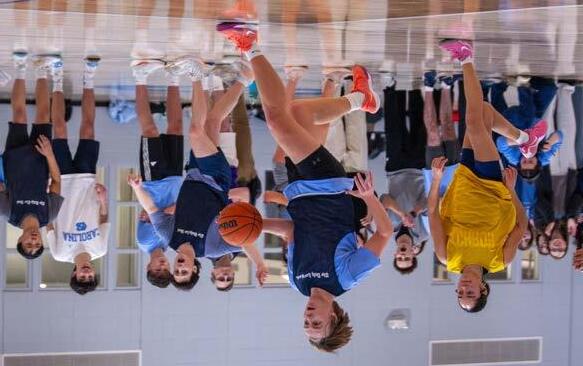



There is a point in every contest where sitting on the sidelines is not an option.