T H E I N D E P E N D E N T D A I LY AT D U K E U N I V E R S I T Y
The Chronicle
WEDNESDAY, SEPTEMBER 12, 2012
ONE HUNDRED AND EIGHTH YEAR, ISSUE 15
WWW.DUKECHRONICLE.COM
Sales up 25 Duke jumps to eighth in rankings percent at Food Fac. by Margot Tuchler THE CHRONICLE
by Robert Johnson THE CHRONICLE
The Food Factory on Central Campus has been through tough times. When it opened last year—after moving to Duke from its lucrative Cary location—business was slow and sparse, and the spotless tables and chairs sat with few customers to fill them. The lack of business threatened the survival of the restaurant, and the future was bleak. “We felt like we were out here in the middle of no-man’s-land,” manager Lisa Schmid said. Now, business at the Food Factory is 25 percent higher than it was at the same time last year, Schmid said. He added that the restaurant is a lively spot for groups of fraternity and sorority members, as well as the unaffiliated. The rise in sales follows the implementation of the house model, which created an influx of affiliated groups on Central this year—the campus now hosts six fraternity houses, nine sorority houses and six selective living groups. The turnaround since the beginning of the school year has not gone unnoticed by students who frequent the establishment. SEE FOOD FACTORY ON PAGE 6
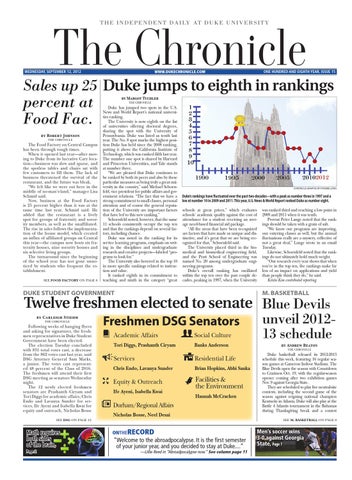
Duke has jumped two spots in the U.S. News and World Report’s national universities ranking. The University is now eighth on the list of universities offering doctoral degrees, sharing the spot with the University of Pennsylvania. Duke was listed as tenth last year. The No. 8 spot marks the highest position Duke has held since the 2008 ranking, putting it above the California Institute of Technology, which was ranked fifth last year. The number one spot is shared by Harvard and Princeton Universities, and Yale stands at number three. “We are pleased that Duke continues to be ranked by both its peers and also by these particular measures as being truly a great university in the country,” said Michael Schoenfeld, vice president for public affairs and government relations. “The fact that we have a strong commitment to small classes, personal attention and of course the general reputation of the University are important factors that have led to this new ranking.” Schoenfeld noted, however, that the same 11 schools consistently occupy the top ten and that the rankings depend on several factors, including chance. Duke was noted in the ranking for its service learning programs, emphasis on writing in the disciplines and undergraduate research and creative projects—labeled “programs to look for.” The University also hovered in the top 10 in more specific rankings related to instruction and value. It ranked eighth in its commitment to teaching and ninth in the category “great
CHRONICLE GRAPHIC BY PHOEBE LONG
Duke’s rankings have fluctuated over the past two decades—with a peak as number three in 1997 and a low at number 10 in 2009 and 2011. This year, U.S. News & World Report ranked Duke as number eight. schools at great prices,” which evaluates schools’ academic quality against the cost of attendance for a student receiving an average need-based financial aid package. “All the areas that have been recognized are factors that have made us unique and distinctive, and it’s great that we are being recognized for that,” Schoenfeld said. The University placed third in the biomedical and biomedical engineering field, and the Pratt School of Engineering was named No. 20 among undergraduate engineering programs. Duke’s overall ranking has oscillated within the top ten over the past couple decades, peaking in 1997, when the University
DUKE STUDENT GOVERNMENT
was ranked third and reaching a low point in 2009 and 2011 when it was tenth. Provost Peter Lange noted that the rankings should be taken with a grain of salt. “We know our programs are improving, our entering classes as well, but the annual fluctuations really are a mystery, reflective of not a great deal,” Lange wrote in an email Tuesday. Likewise, Schoenfeld noted that the rankings do not ultimately hold much weight. “Our research every year shows that when you’re in the top ten, the rankings make far less of an impact on applications and yield than people think they do,” he said. Kristie Kim contributed reporting.
M. BASKETBALL
Twelve freshmen elected to senate Blue Devils unveil 2012Freshmen DSG Senators B Academic Affairs g Social Culture 13 schedule by Carleigh Stiehm THE CHRONICLE
Following weeks of hanging flyers and asking for signatures, the freshmen representatives in Duke Student Government have been elected. The election Tuesday concluded with 831 total votes cast, a decrease from the 862 votes cast last year, said DSG Attorney General Sam Marks, a junior. The votes cast represented 48 percent of the Class of 2016. The freshmen will attend their first DSG meeting as senators Wednesday night. The 12 newly elected freshmen senators are Prashanth Ciryam and Tori Diggs for academic affairs, Chris Endo and Lavanya Sunder for services, Ife Ayeni and Isabella Kwai for equity and outreach, Nicholas Bosse
Tori Diggs, Prashanth Ciryam
Banks Anderson
THE CHRONICLE
YServices
pResidential Life
Chris Endo, Lavanya Sunder
v Equity & Outreach Ife Ayeni, Isabella Kwai
a Durham/Regional Affairs
Brian Hopkins, Abhi Sanka
& t Facilities the Environment Hannah McCracken
Nicholas Bosse, Neel Desai
SEE DSG ON PAGE 12
Math requires both sides of the brain, Page 2
by Andrew Beaton Duke basketball released its 2012-2013 schedule this week, featuring 16 regular season games at Cameron Indoor Stadium. The Blue Devils open the season with Countdown to Craziness Oct. 19, with the regular-season opener coming after two exhibition games Nov. 9 against Georgia State. They are scheduled to play five neutral-site contests, including the second game of the season against reigning national champion Kentucky in Atlanta. Duke will also play at the Battle 4 Atlantis tournament in the Bahamas during Thanksgiving break and a contest SEE M. BASKETBALL ON PAGE 8
ONTHERECORD
“Welcome to the abroadpocalypse. It is the first semester of your junior year, and you decided to stay at Duke....” —Lillie Reed in “Abroadpocalypse now.” See column page 11
Men’s soccer wins 3-0 against Georgia State, Page 7
2 | WEDNESDAY, SEPTEMBER 12, 2012
THE CHRONICLE
Left, right brains Graduate student gifts ‘zines’ to Duke libraries collaborate for by Emma Baccellieri THE CHRONICLE
A graduate student’s donation will expand Duke’s zine collection. Dwayne Dixon, a former employee at the Center for Documentary Studies, has given his entire zine collection to the Sallie Bingham Center for Women’s History and Culture. Dixon first donated 110 zines as an employee at Duke but has added 68 zines to that collection as a current graduate student. Zines are self-published underground magazines that make up one of the center’s most popular collections, said Laura Micham, a curator for the center.
“The variety of zines is incredible, both in the way they look and the issues they engage,” said Micham. “They’re not glossy or professional like the magazines we’re used to—these have been assembled and Xeroxed and distributed by hand, but they’re still a very powerful communication device.” Dixon’s donation includes a variety of zines on punk music, feminism and general activism from the 1980s and the 1990s. Dixon, a doctoral student in cultural anthropology, became interested in zines as a SEE ZINES ON PAGE 6
math ability by Parth Chodavadia THE CHRONICLE
Mathematical ability may be strengthened by interaction between the left and right sides of the brain, a study found. Researchers at Duke University, the University of Michigan and the University of Texas at Dallas showed that arithmetic performance is correlated to heightened levels of communication between the left and right hemispheres of the brain. The findings may lead to treatment methods for cognitive problems with mathematics and for age-induced mental decline. Previous research showed that the right region of the brain’s parietal cortex handles basic quantity processing and the left parietal region contributes to numerical operations. The connectivity between these two halves contributes to numerical competence and arithmetic processing, according to the study, published online this summer in the journal Cerebal Cortex. “Crosstalk between [both] brain re-
gions was most effectively [occurring] when subjects were solving an arithmetic problem that involved adding or subtracting numbers,” Joonkoo Park, postdoctoral fellow and lead author of the study, wrote in an email Sept. 6. “We thus speculate that mental manipulation of numbers require such crosstalk.” To examine neural activity and interconnectivity, the researchers used functional magnetic resonance imaging while subjects performed simple numerical and arithmetic tasks like addition and subtraction, said Dr. Thad Polk, professor of psychology at the University of Michigan. The fMRI estimated neural activity throughout the brain while people perform different tasks. “Using these readings, we then contrasted neural activity and connectivity in one condition versus another and drew connections between these differences based on task specificity,” Polk said. Basic quantity processing tasks such as number matching activated the right parietal cortex, while SEE BRAIN ON PAGE 5
PHOTO ILLUSTRATION BY BRIANNA SIRACUSE/THE CHRONICLE
Graduate student Dwayne Dixon has donated his collection of zines—self-published underground magazines—to the Sallie Bingham Center for Women’s History and Culture.
THE CHRONICLE
WEDNESDAY, SEPTEMBER 12, 2012 | 3
Americans mistakenly wiretapped, officials say
Not forgotten
by Chris Strohm BLOOMBERG NEWS
EMILY YANG/THE CHRONICLE
Students painted the Campus Drive bridge to commemorate the 11th anniversary of the attacks on the World Trade Center.
WASHINGTON — U.S. intelligence agencies have mistakenly monitored the phone calls and emails of U.S. citizens without warrants and will not reveal how many times it has happened, an intelligence official said Tuesday. The incidents were not intentional and occurred as the agencies conducted electronic surveillance of suspected foreign terrorists, Robert Litt, general counsel for the U.S. national intelligence director, told reporters on a conference call. The Obama administration is seeking to renew a law providing broad authority to conduct electronic surveillance and is facing resistance from some lawmakers over concern that the communications of Americans have been monitored. The 2008 law updated the Foreign Intelligence Surveillance Act to provide a legal framework for warrantless wiretapping the government began after the terrorist attacks of Sept. 11, 2001. “There have been some compliance incidents” involving the “incidental collection” of U.S. citizens’ communications, Litt said. “The incidents that have occurred have been unintentional, accidental and not reflective of any intent to evade the statute.” The law expires in December, and the House is scheduled to vote Wednesday on a bill that would reauthorize it until the end of 2017. U.S. intelligence agencies are required to follow procedures to minimize the collection, retention and dissemination of communications involving U.S. citizens. A court-
approved warrant is required if a U.S. citizen becomes the target of surveillance. Litt would not say how many times the communications of U.S. citizens have been monitored. “This is not something that’s reasonably possible to estimate with any degree of accuracy,” he said. “In order to do that we’d have to talk about the details of the collection in a way that would compromise national security.” Asked if he knew how many incidents there have been, Litt said, “There are times when somebody in my position likes to stick very closely to the talking points.” In one case, a secret court that oversees the Foreign Intelligence Surveillance Act found an unreasonable collection that violated the Fourth Amendment of the Constitution. Litt wouldn’t provide details about the case and said “a solution was found” and the court “subsequently found that the problem had been cured.” Thirteen senators, including Democrat Ron Wyden of Oregon and Republican Rand Paul of Kentucky, sent a letter July 26 to Director of National Intelligence James Clapper asking for an estimate of the number of people located in the United States whose communications have been reviewed. “We understand that it might not be possible for the intelligence community to calculate this number with precision, but it is difficult for us to accept the assertion that it is not possible to come up with even a rough estimate of this number,” the senators wrote. SEE WIRETAPPED ON PAGE 6
4(% 342%33 /& 05235).'
s s e c c u S
How does your body and mind respond to the stressors you face? How do your thinking tendencies influence how much stress you face? How does your approach to your emotions relate to stress? And What Can You Do About It All? This 3 session workshop offers skills and insights into how to effectively manage your stress.
Mondays Sept 17, Sept 24, and Oct 1 4:00 - 5:15pm To register, visit the CAPS website at http://www.studentaffairs.duke.edu/caps Click on Workshops on Discussions for more information and to register.
Counseling and Psychological Services
4 | WEDNESDAY, SEPTEMBER 12, 2012
THE CHRONICLE
Israel: U.S. has no ‘moral right’ to stop attack on Iran by Joel Greenberg THE WASHINGTON POST
SIMPLY THE BEST!
JERUSALEM — Signaling a deepening dispute with Washington over issuing ultimatums for Iran’s nuclear program, Israeli Prime Minister Benjamin Netanyahu said Tuesday that those who will not make such demands on Tehran “don’t have a moral right to place a red light before Israel.” In a blistering response to Secretary of State Hillary Rodham Clinton’s statement that the United States is “not setting deadlines” for Iran and that negotiations coupled with sanctions are the best approach, Netanyahu said that if no “red line” is established for Iran, it will continue pursuing an atomic bomb. “The sanctions have hurt the Iranian economy, but they haven’t stopped the Iranian nuclear program. That’s a fact,” Netanyahu said at a news conference with the visiting Bulgarian Prime Minister Boyko Borisov. “And the fact is that every day that passes, Iran gets closer and closer to nuclear bombs,” Netanyahu added. “The world tells Israel: ‘Wait. There’s still time.’ And I say: ‘Wait for what? Wait until when?’ Those in the international community who refuse to put red lines before Iran don’t have a moral right to place a red light before Israel.” The Obama administration has pressed Israel to hold off threatened military action against Iran, arguing that there is still time to achieve results through diplomacy backed by tightening economic sanctions. Netanyahu told an interviewer Sunday that Israel is discussing red lines with the
United States. He did not say whether those discussions include any new offers from the Obama administration, but White House press secretary Jay Carney waved off that suggestion Monday. “The president’s position, unequivocally, is that he is committed to preventing Iran from acquiring a nuclear weapon,” Carney said. “We share that view with Israel and Israel’s leadership in a way that has been made clear again and again.” The Obama administration is arguing for more time for diplomacy and sanctions. “We believe that there remains time and space for that effort to bear fruit,” Carney said Monday. “We’ve also made clear that the window of opportunity for reaching a solution by that means will not remain open indefinitely. Iran has denied that it is seeking nuclear weapons, and U.S. intelligence has not detected any evidence that the leadership in Tehran has decided to build a nuclear bomb, senior Obama administration officials have said. Netanyahu, who is traveling to the United States later this month, has been pressing the Obama administration to spell out the point at which Iran’s nuclear program could face an American military strike. Netanyahu argues that only an ultimatum to Iran has a chance of swaying Tehran and averting a military confrontation. He has not specified what that tipping point should be, but his demand reflects the sense of urgency projected by the Israeli
X-ray art
DAVID MAISEL/THE WASHINGTON POST
X-rays take on an ethereal quality in a new exhibit called History’s Shadow at the National Academy of Sciences.
SEE ISRAEL ON PAGE 12
cosmic cantina
&RPH IRU OXQFK
2Q :HVW LQ &KLFN )LO $ RU RQ 1LQWK 6WUHHW
The Writing Partners Are In! New Drop-In Sessions at the Writing Studio in Perkins Library* Where: Perkins 112 When: Sunday, Monday, Wednesday, and Thursday from 8:00 - 10:00 pm Who: Drop-in sessions are FOR UNDERGRADUATES ONLY. What: Policy memos, lab reports, literature reviews, research papers, grant proposals, resumes, personal statements, job letters, creative writing, etc. Students can visit at any stage of the writing process - from brainstorming, to drafting, to revising, to polishing the final draft. Start Date: Sunday, September 16 For more information, visit: http://sites.duke.edu/writingpartners/ *Continue to schedule regular Face-to-Face or E-Tutor appointments at the Writing Studio online.
Come the first week and enjoy a cookie, too!
Menu Sampling Old School Veggie Burrito $2.86 Regular Chicken Burrito $5.65 Cheese Quesadilla $1.41 Chicken Quesadilla $3.59 VeggieNachos $4.12 Chips & Salsa $2.06
Open until 4 am 1920 1/2 Perry St. at Ninth Street Just a block from East Campus Also serving from Chick-Fil-A on Campus
Now Open The Bicycle Chain at 5400 Durham Chapel Hill Blvd.
THE CHRONICLE
WEDNESDAY, SEPTEMBER 12, 2012 | 5
Boehner “not confident” on spending cuts by James Rowley BLOOMBERG NEWS
WASHINGTON — House Speaker John Boehner said Tuesday he was “not confident at all” that Congress would reach a deal on avoiding $1.2 trillion in spending cuts set to take effect in January. Boehner said the Democratic-led Senate and a lack of leadership by President Barack Obama were to blame for inaction on finding an alternative to the spending cuts to meet the deficit target and avoid the Dec. 31 expiration of George W. Bush-era tax cuts. “Well, I’m not confident at all,” the Ohio Republican said when asked at a Capitol Hill news conference about Moody’s Investors Service’s statement Tuesday that it may downgrade the U.S. credit rating unless Congress finds a way to reduce the percentage of debt-to-gross domestic product. Moody’s said it would extend the U.S.’s Aaa rating with negative outlook beyond 2013 if the so-called “‘fiscal cliff’ actually materialized.” The fiscal cliff refers to $1.2 trillion in automatic spending cuts and the expiration of tax cuts that would take effect in January. Senate Majority Leader Harry Reid (D-Nev.), said he was “disappointed” with Boehner’s comments, adding that it was “much too early” to give up on a deal. “I think we have to look at the glass being halffull, not half-empty all the time,” Reid told reporters. Boehner said “the House has done its job” by passing legislation to find alternative spending cuts and extend the Bush-era tax rates. “The Senate at some point has to act,” Boehner said. “Where’s the president? Where’s the leadership? Absent without leave.” No talks to avoid the fiscal cliff are under way in Congress, and lawmakers in both parties have said they don’t expect negotiations to begin in earnest until after the Nov. 6 election. House Whip Steny Hoyertold (D-M.D.) told reporters Tuesday he was “optimistic that once this election is over” that the “patriotism of members — Republican and Democratic” will allow them to reach a deal. “I don’t think anything is going to be done before November,” he said. Asked about Republican presidential nominee Mitt Romney’s statement that it was a “mistake” for House Republicans to agree to the spending cuts in defense and other domestic programs, Boehner said, “It was certainly a difficult time.” Also Tuesday, House Majority Leader Eric Cantor (R-V.A.) said the House is scheduled to vote Sept. SEE BOEHNER ON PAGE 12
How stressful is it to be a teenage girl? A new UNC study wants to know. • Project ARCH is for girls aged 12 to 16 who have had difficulty with sadness, anxiety or related symptoms. • Families can earn up to $440 by participating in this research study.
For more information visit www.projectARCH.org or call us toll free at 1-855-ARCH-UNC
BRAIN from page 2 acquired arithmetic processing tasks such as addition and subtraction activated the left parietal cortex, Park noted. What was unexpected, however, was the significant increase in communication between the left and right hemispheres during arithmetic tasks than in control conditions, he said. “What we found was phenomenal because mathematical operations do not just depend on how much neural activity is occurring in the brain but also on how interconnected the activity is,” said Denise Park, co-director of the Center for Vital Longevity at UT Dallas. “With this discovery, I think people who are studying the neuroscience of mathematical processing will shift their focus from studying individual neural sites to studying a network comprised of individual processes.” Although there is a long way to go before these findings can be applied to interventions, they might help in treating developmental learning disorders such as dyscalculia, the numerical equivalent of dyslexia, said Joonkoo Park. “In the future, we may expect to develop better screening
methods for examining dyscalculia based on functional connectivity and more efficient training paradigms focused on improving numerical competence,” he said. Denise Park added that such training paradigms could also help elderly adults rebuild neural connections required for mathematical processing after onset of age-related cognitive decline. “Examining how experience and aging play a role in changing neural connectivity is something that I am particularly interested in,” she said. “I especially want to study how calculator usage has impacted neural connectivity in the brain by comparing younger and older populations’ mental calculation processing abilities.” Joonkoo Park hopes to extrapolate these findings to other learning disabilities by utilizing more complex mathematical problems. He also hopes to examine effects of behavioral training on the degree of interconnectivity. “Functional connectivity has been one important approach to studying dyslexia, but results like our current study will further emphasize the role of neural interconnectivity in developmental learning disorders,” Joonkoo Park said.
Shop at the University Store today and receive up to 30% off your total purchase of clothing and gift items. When you are ready to check out, pick up a fortune cookie at the register to determine your discount. Your discount could be 5, 10, 15, 20, 25 or 30 percent off your total purchase. 30% maximum discount allowed. Discount cannot be combined with any other discount or promotion. Valid on in-stock merchandise only. No rain checks. Discount does not include: school supplies, caps & gowns, greeting cards, Custom Orders, electronics, Cameron & Championship Floor Pieces, class rings, blazers & sportcoats and Alumni Chairs.
Upper Level, Bryan Center, West Campus Phone: 919.684.2344 Monday - Wednesday: 8:30am - 7pm Thursday & Friday: 8:30am - 8pm Saturday: 9am - 6pm
Department of Duke University Stores®
6 | WEDNESDAY, SEPTEMBER 12, 2012
THE CHRONICLE
JACK FINES/THE CHRONICLE
Students dine at the Food Factory on Central Campus, which has seen increased business this Fall—particularly in alcohol sales—a welcome change following the restaurant’s slow first year at Duke.
FOOD FACTORY from page 1 “It seems like it’s more of a partying atmosphere, people come in in groups that didn’t before,” said freshman Timesh Patel, who enjoys the restaurant’s vibe. The restaurant has a sports bar layout—students can choose to sit either on a row of barstools or in the main dining area, and both are humming at most times every evening. The sale of alcohol has also contributed to the success—Schmid described it as a “big draw” for customers. Offering alcohol on campus also helps promote safety, she added, because students of age can purchase alcohol without having to drive off campus. The Food Factory also delivers, allowing students spending time studying to get a meal without having to travel to Central. “We try to listen to the advice students give and respond to it,” Schmid said. “You may think you know everything there is to know, but unless you listen to
feedback then you don’t.” This attitude of responsiveness may have driven a fair amount of the growth at the Food Factory over the past year. “The food is good, but the best thing about the place is the atmosphere,” said Douglas Carter, a freshman enjoying a cheeseburger. The management has tried to foster a party feel. The restaurant has begun hosting events geared towards students, such as having a DJ last weekend. There will be a special event every Saturday night, Schmid said. Events may serve as a draw for more students and customers. “It seems like a place where you can have a dinner with friends on a Saturday and feel like you’re in the middle of things,” said Ali Kaussari, a student from Davidson College who came to Durham to visit a friend. The Food Factory has turned a corner from a year ago. It remains to be seen if the Factory will continue to manufacture success.
Tweet @DukeChronicle
ZINES from page 2
WIRETAPPED from page 3
New Jersey teenager involved in the punk scene. In the pre-Internet days, zines were one of the only ways to access information on alternative interests, he said. “In the late ‘80s, early ‘90s, if you were interested in music, activism, weird art… there was no other way to find things out at a level below mainstream corporate production,” he said. He said that discovering zines ended up being a life-changing experience because they exposed him to new ideas and perspectives. “It made me feel not so isolated, knowing there were all these people like me— and all these people who weren’t like me, but had all these ideas I could really get down with,” Dixon said. “It was incredible as a straight, white boy to discover all these people my age from very different backgrounds, experiencing my America in very different ways.” As he grew older and moved around the country, Dixon made sure to keep his zine collection intact because he felt personally responsible for their wellbeing. He never thought anyone else would find his collection to be of much value, but a couple years ago, when Dixon worked at the center, he noticed a blurb in a newsletter regarding a zine donation to Duke from comic book artist Sarah Dyer. The blurb surprised Dixon, who did not think an academic institution like Duke would have interest in zines. When he realized his collection might have worth to someone else, he donated enough to bring Duke’s zine collection to more than 5,000 volumes, Micham said. The collection is sought out by scholars and students alike, she added, and is even assigned by faculty as coursework. Rachel Seidman, a visiting assistan professor of public policy, has used zines in her class, Women as Leaders, in order to look at zines in the context of feminist communication. Even with all of the academic interest in his zines, Dixon still views them in a more sentimental light. “It’s a bit weird,” he said. “This is just my stuff, showing nothing but my personal journey, but it’s had a life way beyond what I or the zine authors could have imagined.”
Wyden has placed a hold on the Senate’s bill to reauthorize the law and believes it “needs to be modified to ensure that the privacy of law-abiding American citizens is protected,” his spokesman, Tom Caiazza, said in an email Tuesday. Privacy groups including the American Civil Liberties Union have filed lawsuits claiming the law is unconstitutional and gives the government unchecked powers. “It’s somewhat shocking that four years later Congress is voting on this without real substantial information about how many Americas are being spied on with this program and how that information is being used,” Michelle Richardson, legislative counsel for the ACLU’s Washington office, said in a telephone interview. The law isn’t “a tool for spying on Americans” and intelligence agencies are required to comply with “an extensive set” of rules, Litt said. That includes having the secret Foreign Intelligence Surveillance Court review and approve procedures to ensure they comply with the Fourth Amendment, he said. The national intelligence director, Justice Department and agencies conducting surveillance “regularly and extensively monitor” how the law is being implemented and provide classified reports to Congress, Litt said. The reports include how many times information about U.S. citizens has been disseminated as part of intelligence reporting, he said. Reauthorizing the law is the top legislative priority for U.S. intelligence agencies, Litt said. The White House “strongly supports” the House bill, according to a statement of administration policy released yesterday. “I will lose an incredibly valuable source of foreign intelligence information that, I think it’s fair to say, has been critical to protecting our country over the last few years,” he said. “I know of specific instances, both involving terrorist attacks and involving other kinds of threats, where we have been able to thwart them or gain significant insight into them as a result of this collection activity.”
DUKE MARINE LAB T I M L Th
is i s
M AR
f eau INE LAB B
,N ort
C
Biology 201LA Gateway to Biology: Molecular Biology. NS, NS STS Fall/Spring/Summer Term I
Molecular Biology is offered YEAR ROUND at the Duke Marine Lab! Complete this BIOLOGY GATEWAY COURSE in Beaufort with Professor Tom Schultz · · · ·
Small class size One-on-one attention Accessible professor Supportive learning environment
PLUS many more experiential courses and research opportunities for all students!
VIEW A COMPLETE LIST OF SPRING COURSES AT dukemarinelab.net QUESTIONS? CONTACT LAUREN STULGIS AT LAUREN.STULGIS@DUKE.EDU OR 252.504.7531
Sports
>> THE BLUE ZONE
The Chronicle
WEDNESDAY September 12, 2012
Visit The Blue Zone at sports.chronicleblogs.com for quotes from football head coach David Cutcliffe looking forward to Saturday’s game vs. N.C. Central.
www.dukechroniclesports.com
MEN’S SOCCER
Duke Offense comes alive for 3-0 win must show resilience by Paul Pisani THE CHRONICLE
This year Duke football’s mission was simple—do not let last season repeat itself. After the Blue Devils split their first two games and looked more dichotomous than Jekyll and Hyde, it may be time to amend that mission. Many of Duke’s most notorious misgivings from last year have improved greatly through the Blue Devils’ first two games. After falling to FCS opponent Richmond in its home-opener last season, Daniel Duke stomped all over a talented Florida International team to kick off 2012. Struggling to contain opposing running backs in 2011, the Blue Devils’ opponents have managed just 3.6 yards per carry through the team’s first two games, a significant improvement from the 4.9 yards per carry that Duke allowed last season. Even field goals are finding their way through the uprights. After Will Snyderwine’s disastrous 2011 season, freshman Ross Martin is 3-for-4 on field goal attempts this year and has restored faith in the Blue Devils’ kicking game. Following a 3-9 season and still in search of its first bowl berth since 1994, what in the world should Duke attempt to replicate from last season? The 2011 team’s resilience and ability to rebound after being dismantled by a ranked opponent. You can’t sugarcoat the 50-13 beatdown that the Blue Devils received at the hands of Stanford last weekend. Thousands of miles away from home, Duke was outmatched and thoroughly dominated by the Cardinal from the game’s opening whistle. The Blue Devils were unable to move the ball in the first half, and once halftime was over, they were simply playing for experience. “We didn’t prepare poorly for Stanford, it’s about an edge. It’s a fine edge and we relaxed that edge maybe a little and you don’t even see it, you don’t even know it yourself,” head coach David Cutcliffe said. “But the way Duke football goes about its business, regardless of a win or a loss—on Sunday it’s back to work.” Last season when Duke faced Stanford at home in its second game of the season, the team ended with a similar result in a very different way. The Blue Devils weren’t behind the 8-ball from the opening whistle, in fact it appeared that they had the Cardinal on the ropes in the first half. Duke could have gone into halftime with a lead if not for some key mistakes by its special teams unit, but when the second half rolled around, Andrew Luck remembered he was Andrew Luck, taking over the game and quashing Duke’s upset dreams in a 44-14 loss.
Sometimes it takes just 30 minutes of solid play to win a soccer game. That was certainly the case Tuesday night at Koskinen Stadium, as the Blue Devils (2-3) turned a lackluster first half into a resound0 ing 3-0 victory against GSU Georgia State (2-2). DUKE 3 The win was much needed for a team that had managed just three goals in its first four games of the season. Sophomore Nick Palodichuk broke the ice for Duke and junior Sebastien Ibeagha followed that up with two scores. Duke’s offensive woes were painfully apparent for much of the first half. Despite brief moments of brilliance in the midfield, the team mustered just one shot on goal in the first 45 minutes. Finding open spaces and finishing on counterattacks proved difficult for the young Blue Devils, with crosses failing to find teammates. “Our guys just weren’t able to find open space,” Duke head coach John Kerr said. “We’ve been struggling to get players the ball on offense all season, and you could definitely see that in the first half tonight.” Fortunately for Duke, their opponents were not much better. With neither team able to find any sort of rhythm in the first half, the ball spent most of its time in the midfield. The game got chippy at times, with defenders on both sides cutting off passes and making aggressive tackles. Georgia State sophomore Michael Nwiloh proved
Carp
On Football
SEE FOOTBALL ON PAGE 8
KEVIN SHAMIEH AND NICOLE SAVAGE/THE CHRONICLE
After Duke was outshot in a scoreless first half, Nick Palodichuk and Sebastien Ibeagha combined for three goals.
SEE M. SOCCER ON PAGE 8
WOMEN’S GOLF
Duke hunts down second place by Jackie klauberg THE CHRONICLE
The Blue Devils displayed some predator instincts at the Cougar Classic. The Duke women’s golf team traveled to the Yeamans Hall Club in Hanahan, S.C. to take on a talented pool of competition, featuring 10 of the top 15 teams from the 2012 NCAA Championship, including each of the top-five finishers. But thanks to a strong showing on the final day, the Blue Devils finished in second place. No. 3 Duke was led by their familiar standout, senior Lindy Duncan, who claimed second place individually in the Classic with her three-round score of 207. The Fort Lauderdale, Fla. native finished just four shots behind Camilla Hedberg of Florida, who ended the tournament with a 13-under par 203. Duncan, who was named the No. 1 player to watch for the upcoming 2012-13 season by Golf World, lived up to the high expectations of her pre-season accolades. The 2012 NGCA Player of the Year last season seems to have ice in her veins when the pressure is on. “I think the great thing about Lindy is that she does have those [high] expectations, she feels it, but she is able to collect herself and perform very well,” Blue Devil head coach Dan Brooks said. “It’s not that
she’s not feeling it. She keeps finding a way to get it done even though she does feel the pressure.” Duke brought its strongest performance to the links on day three of the tournament. At the end of day one, the Blue Devils stood tied for second place, yet after a rough showing on day two, they found themselves tied for sixth place. This slip in standing only seemed to motivate Duke, who after day two, sat 12 shots behind the leading Gators. “The best thing about [finishing where we did] was the attitude of the players,” Brooks said. “We just stayed strong until the very end. Even though Florida had quite a lead on us going into the last day, we still gave winning a strong possibility.” The Blue Devils recorded a team-total 286 on day one of the tournament, a 291 on day two and a 281 on day three. The strong finish and persevering attitude of the Duke players propelled the team up the leader board to the second-place spot. Brooks praised the play of the two Blue Devil freshmen who stepped right into their first collegiate tournament, saying they competed with confidence and winning attitudes. In their collegiate debuts, SEE W. GOLF ON PAGE 8
CAROLINE RODRIGUEZ/CHRONICLE FILE PHOTO
Lindy Duncan led the Blue Devils, finishing second place individually, as the team finished second overall.
8 | WEDNESDAY, SEPTEMBER 12, 2012
THE CHRONICLE
FOOTBALL from page 7
Duke won’t play at MSG
But last year’s Blue Devils bounced back, and won three straight games following that loss. The team relaxed and clicked into a rhythm, defeating two of its easier opponents—Boston College and Tulane— before knocking off a T.Y. Hilton-led Florida International squad on the road. In fact, Cutcliffe’s Duke teams have consistently shown the ability to bounce back from a big loss on the road to a ranked opponent. In 2009, the Blue Devils lost to Kansas 44-16 and responded with a sound 49-14 drubbing of this week’s opponent, N.C. Central. Duke would win four of its next five games after the team’s loss to the Jayhawks. After a 44-7 loss to Virginia Tech in Blacksburg in 2010, the Blue Devils posted back-toback wins against Navy and Virginia. Duke’s response following a 30-point loss to the Cardinal last season showed an immense maturity and focus, a focus the Blue Devils, who were flying high off a convincing season-opening victory, may not have brought with them to Palo Alto last weekend. It is a focus the Blue Devils will need in order to recover from one of the most lopsided losses of the Cutcliffe era. A defeat as devastating as last week’s loss to Stanford can derail a team’s season. With Duke’s two easiest games approaching, home contests against N.C. Central and Memphis, the Blue Devils need to make a statement this weekend against the Eagles to prove that just like the team’s loss to Richmond last year was a fluke, this year’s blowout victory against Florida International was not. The only way Duke will achieve this is through extreme focus, without losing the sense of urgency that these two contests are must-wins, with important matchups against Wake Forest and Virginia to follow. “We’re not going to forget that game. We’re not putting it behind us. I want that game remembered, but there’s a perspective to that,� Cutcliffe said. “That should create some hunger and I want to remember what needs to be corrected and I’m not talking about next Saturday, I’m talking about this morning. We’re not going to talk ourselves into being a good football team. Work is what it comes down to.�
CHRIS DALL/CHRONICLE FILE PHOTO
The Blue Devils have played in Madison Square Garden every year since 2001-02, but will not this season.
M. BASKETBALL from page 8 against Temple at the Izod Center in East Rutherford, N.J. The Blue Devils will not play a game at Madison Square Garden in New York City for the first time since the 2001-2002 season. While they typically play a neutral-site game in either New Jersey or New York each season, the team has played St. John’s in an away game at the World’s Most Famous Arena in the years when they have played in New Jersey. Because league expansion will force the Blue Devils to play 18 ACC games for the first time, Duke and St. John’s have put their series on hold and thus will not play for the first time since the 1998-1999 season, said Mike Cragg, senior associate director of athletics who oversees administration of the Duke basketball program. “We had to make some decisions on what we usually do during January through March,� Cragg said. One of those decisions was giving the team a bye weekend in January, with no games between the Thursday Jan. 17 home contest against Georgia Tech and the Miami road game Jan. 23. Although the Blue Devils have the same number of games scheduled as last season—31—that has typically included a non-conference game on a weekend in the middle of ACC play. Eliminating that break in play created the
opportunity for the small January respite, a decision suggested by head coach Mike Krzyzewski, Cragg said. “Because of the 18 [ACC] games, we decided let’s break up the conference schedule a little bit this year and try a little different approach instead of what can be a long, tough grind,� Cragg said. “We’ll see how that goes. We may be right. We may be wrong. Hopefully we’re right—usually most thing Coach K does are right.� For the Cameron Crazies, Duke hosts the first of its two matches against University of North Carolina at Chapel Hill Wednesday Feb. 13. The Blue Devils also host a marquee earlyseason matchup Nov. 28 against Ohio State in the ACC/Big Ten Challenge. Duke played the Buckeyes last year in the same event, falling on the road 85-63. In the Battle 4 Atlantis, Duke will play Minnesota in the first round, with a secondround matchup against Memphis or Virginia Commonwealth. In the final round, Duke will have the chance to play one of Louisville, Stanford, Missouri or Northern Iowa. All 31 of the team’s games will be televised, 22 of which will be on one of the ESPN channels. “We are fortunate to be in the spotlight of college basketball and at the highest level,� Cragg said. “Kids do want to play in those events and on television. It’s great for our school to have that exposure. Year after year we have more national television games than any other program.�
Webmail ebmail Bus Bus Tracking Tracking We Food F ood d Delivery De eliv very
Library L ibrarry eRecruiting e Recru uiting g
The T he eC Chronicle hroniclle
Two-day overview- an introduction to the 6 main areas of HR on 10/9-10. Register now at learnmore.duke.edu/certificates/hr 919-684-6259.
DukeCard Du ukeCard
ESPN E SPN Short S hor t T Term erm IIllness llne ess
your landing page for all things
Duke’s Yi Ashley Xiao finished tied for 10th place and Celine Boutier finished tied for 25th. “[It was exciting] for two freshmen to come in and to understand that winning was still a strong possibility even with that deficit that we had,â€? Brooks said. “For them to come in and play as strong as they did‌ that says a lot about their perspective on winning and how they give it a good possibility all the way to the end.â€?
ESSENTIALS OF HR COURSE
YouTube YouT Yo uTub ub be
qDuke.com
W. GOLF from page 7
ANNOUNCEMENTS
Facebook Facebo ook
ACES
Blackboard B lackb board Sakai
particularly challenging for Duke, making a number of big stops against Duke sophomore Riley Wolf. The game’s back-and-forth play changed about 15 minutes into the second half. The Blue Devils began to look more confident on offense, beating their opponents to contested balls and sending a number of dangerous balls into the Panthers’ defensive third. “We really picked up our level of play in the second half,� Palodichuk said. “We came out a lot quicker on the offensive end, with guys like Riley making great runs, and I think it really showed.� Duke finally broke through in the 65th minute of play. A deep throw-in from Duke ricocheted around the box. Palodichuk collected the rebound and had little trouble putting it away to give the Blue Devils a 1-0 lead. Ten minutes later, Duke scored again. Freshman Zach Mathers served in a corner kick to the far post, where Ibeagha gave the keeper little hope, heading the ball down and out of reach for a 2-0 Blue Devil lead. Mathers and Ibeagha were not done, however. After a poor Georgia State corner kick with just four minutes left in the second half, Duke quickly went on the counterattack. The Panthers recovered slowly and were overwhelmed by the Blue Devils’ quick passing. Mathers found an open Ibeagha directly in front of the goal for his second tally of the game and a 3-0 Duke win. “We really picked up the tempo there in the second half. We were connecting on passes, really controlling the game,� Kerr said. “It’s also our first shutout of the season, so really impressive from the back line.�
CLASSIFIEDS
Dining D ining H Hours ourrs
Gmail
M. SOCCER from page 7
HELP WANTED
CARE FOR FREEDOM Feel the pulse of freedom as you take care of America’s heroes. Join the Army National Guard as a medical professional.
BARTENDERS ARE IN DEMAND! Earn $20-$35/hr. in a recessionproof job. 1 or 2 week classes & weekend classes. 100% job placement assistance. Raleigh’s Bartending School. HAVE FUN! MAKE MONEY! MEET PEOPLE! Back to school tuition rates as low as $299. CALL NOW!! 919-676-0774, www.cocktailmixer.com/duke.html
SERVICES OFFERED
Duke .!4)/.!,'5!2$ COM s 1-800-GO-GUARD
GOING ON SABBATICAL? Need a reliable house sitter to care for your pets? Excellent references. Many years experience. Katie 919 619 7517 Email Kseeek@gmail.com
The Chronicle classified advertising www.dukechronicle.com/ classifieds rates All advertising $6.00 for first 15 words, 10¢ (per day) additional per word 3 or 4 consecutive insertions - 10 % off 5 or more consecutive insertions - 20 % off deadline 12:00 noon 1 business day prior to publication
THE CHRONICLE
WEDNESDAY, SEPTEMBER 12, 2012 | 9
Diversions Shoe Chris Cassatt and Gary Brookins
Dilbert Scott Adams
Doonesbury Garry Trudeau
The Chronicle Our Chronicle rankings: 1, sets the standards (yarite): ............................................. locopop 2, prep school, duh: .............................................................shwanth 3, interdisciplinary background: ............................................ jewels 4, international background: ................................................pheebs 5, has real work experience: ................................................spinster 6, recruit recruit recruit: ....................................................og abeats 7, 8, 9, 10 arts supplements: ........................crod, bri, davk, savage lost his top-10 status, boohoo: .............................................briggsy Barb Starbuck doesn’t care about rankings: ............................ Barb
Ink Pen Phil Dunlap
Student Advertising Manager: .................................. Allison Rhyne Account Representatives: ..................... Jen Bahadur, Sarah Burgart Courtney Clower, Peter Hapin, Claire Gilhuly, Sterling Lambert Liz Lash, Dori Levy, Gini Li, Ina Li, Vivian Lorencatto, Lalita Maraj Parker Masselink, Cliff Simmons, James Sinclair, Olivia Wax Creative Services: .......... Allison Eisen, Marcela Heywood, Mao Hu Rachel Kiner, Anh Pham, Izzy Xu
Sudoku
Fill in the grid so that every row, every column and every 3x3 box contains the digits 1 through 9. (No number is repeated in any column, row or box.) pisl utem eugiatet loborti smolort ionsent numsandiat utem dolutat. Agna feum dolorem vel ut lortie eros adipisc iliscip et ipis non henibh ea ad exerati onsectem alit nim do dolor sequatum niscipsummy nis nis am, ver sit aore tem amet, sed delenim dui tie tet at wis alit verat irit eraesse quamet, consectem qui tatuerostis er augait exeraessit nis amet lorperos augiamc onulput prat dolortisi endip er alissequi euisit iuscip estisim zzriusto el uluptatum in ulputat alit erci enibh enibh ex enim ilissis num el ullaore core tionsent iurem et wis diamcommy nit pratuer iurero euipit, quamcon ullaore te feuguer sumsand ipsustie faccum ea con ullan utat luptatuerit nisi te et nibh ea faccums andrem del er sed etuerit luptatet elenisit, conse tat Ipisl utem eugiatet loborti smolort ionsent numsandiat utem dolutat. Agna feum dolorem vel ut lortie eros adipisc iliscip et ipis non henibh ea ad exerati onsectem alit nim do dolor sequatum niscipsummy nis nis am, ver sit laore tem amet, sed delenim dui tie tet at wis alit verat irit eraesse quamet, consectem qui tatuerostis er augait exeraessit nis amet lorperos augiamc onulput prat dolortisi endip er alissequi euisit iuscip estisim zzriusto el ulluptatum in ulputat alit erci enibh enibh ex enim ilissis num el ullaore core tionsent iurem et wis diamcommy nit pratuer iurero euipit, quamcon ullaore te feuguer sumsand ipsustie faccum ea con ullan utat luptatuerit nisi te et nibh ea faccums andrem del er sed etuerit luptatet elenisit, conse tat. stis er augait exeraessit nis amet lorperos augiamc onulput prat dolortisi
Receive an email containing the latest news from each Chronicle issue
sign up at dukechronicle.com
Answer to puzzle
www.sudoku.com
The Independent Daily at Duke University
The Chronicle
10 | WEDNESDAY, SEPTEMBER 12, 2012
Through the career-view mirror Dirges about the profesWe believe that these obsionalization of the liberal servations are spot on, but arts education can be as ro- are likely to provoke a conmantic as they are unoriginal, fused and negative response. not to mention as frequent. After all, we all need to spend The spirited defense of the time thinking about our creliberal arts curdentials. The riculum—often world is full editorial a code word for of sober and the humanities—as an object bleary-eyed human resource to be pursued independently officers, so the story goes, of and, occasionally, at the who spend their hours pagexpense of professional in- ing through piles of resumes terests, has become a bustling in search of just those candigenre of its own. Duke’s own dates with precisely the right contribution to this genre, the work experience, extracurfreshly minted Intellectual riculars and major/minor Climate Committee Report, combinations. If we want to adds a new twist to the old participate in this world— form: professional pursuits and to pay off our student don’t just distract from intel- loans—we have to play the lectual ones, they can even game to a certain extent, erode the intellectual experi- which isn’t so bad anyway ence in the classroom and on because we’re working tothe quad. ward a professional life we’ve
“
There are ALWAYS going to be those who don’t deserve what they get. However, there is a strong percentage of those wealthy who have earned what they have and should not be taxed insanely... —“turtleD” commenting on the story “Skin in the game.”
LETTERS POLICY The Chronicle welcomes submissions in the form of letters to the editor or guest columns. Submissions must include the author’s name, signature, department or class, and for purposes of identification, phone number and local address. Letters should not exceed 325 words; contact the editorial department for information regarding guest columns. The Chronicle will not publish anonymous or form letters or letters that are promotional in nature. The Chronicle reserves the right to edit letters and guest columns for length, clarity and style and the right to withhold letters based on the discretion of the editorial page editor.
”
Direct submissions to:
E-mail: chronicleletters@duke.edu Editorial Page Department The Chronicle Box 90858, Durham, NC 27708 Phone: (919) 684-2663 Fax: (919) 684-4696
The Chronicle
Inc. 1993
YESHWANTH KANDIMALLA, Editor LAUREN CARROLL, Managing Editor JULIAN SPECTOR, News Editor ANDREW BEATON, Sports Editor CHRIS DALL, Photography Editor MAGGIE LAFALCE, Editorial Page Editor KATHERINE ZHANG, Editorial Board Chair PARKER KUIVILA, Managing Editor for Online JIM POSEN, Director of Online Operations CHRISSY BECK, General Manager KRISTIE KIM, University Editor TIFFANY LIEU, Local & National Editor ANDREW LUO, Health & Science Editor CAROLINE RODRIGUEZ, News Photography Editor PHOEBE LONG, Design Editor MICHAELA DWYER, Recess Editor SOPHIA DURAND, Recess Photography Editor SCOTT BRIGGS, Editorial Page Managing Editor MATTHEW CHASE, Towerview Editor ADDISON CORRIHER, Towerview Photography Editor NICOLE KYLE, Social Media Editor SAMANTHA BROOKS, Senior Editor REBECCA DICKENSON, Advertising Director MARY WEAVER, Operations Manager DAVID RICE, Director of External Relations
presumably chosen for its rewarding qualities. So why, we might wonder, does the report pathologize the necessary and—when done in moderation—even healthy practice of credentialism and insist it detracts from the intellectual life? The answer lies in an overly narrow definition of credentialism. According to the ICC, 51% of students want more of an intellectual experience than they are getting. We will put a dent in that number by understanding that credentialism comes in many shapes and flavors, and that its more flexible forms—which we indeed encourage—are not just compatible with a rich intellectual life, but can enhance it. The ICC defines creden-
tialism to be anti-intellectual by its very nature. Take its report’s principle example: that obsession with credentials leads students to avoid challenging classes in favor of higher, more easily attained grades and, thus, better career options. Credentialism, as the ICC has defined it, always exists at the expense of the true intellectual culture. However, true credentialism, as we’ve pointed out, can actually provide another outlet for intellectual activity. We can be concerned with preening our professional feathers, but we can also imbue our interest in the professions with intellectual activity. In tomorrow’s editorial, we will explore how Duke can bring credentialism and intellectualism closer together.
However, opportunities to merge professional and intellectual interests exist even now. The Duke Colloquium sponsors a series of speakers that address the role of the humanities in the professions. Even quotidian pursuits hold intellectual potential: we can take courses that interest us, avoid unnecessary majors and minors, and find the interesting gems of knowledge in the blow-off classes we take to fluff up our GPAs. In the long run, richer minds will hopefully make us richer professionals. Ultimately, we need to step outside of these concerns and pursue intellectual life for its own sake. On this point, we can only throw our two cents in with the dirges: read a book before you go bed.
Facebook friends, not friends
onlinecomment
Est. 1905
THE CHRONICLE
commentaries
MARGOT TUCHLER, University Editor JACK MERCOLA, Local & National Editor DANIELLE MUOIO, Health & Science Editor ELYSIA SU, Sports Photography Editor ELIZA STRONG, Design Editor HOLLY HILLIARD, Recess Managing Editor CHELSEA PIERONI, Online Photo Editor ASHLEY MOONEY, Sports Managing Editor SONIA HAVELE, Towerview Editor MELISSA YEO, Towerview Creative Director NICOLE KYLE, Special Projects Editor MAGGIE SPINI, Senior Editor MICHAEL SHAMMAS, Recruitment Chair BARBARA STARBUCK, Creative Director MEGAN MCGINITY, Digital Sales Manager
The Chronicle is published by the Duke Student Publishing Company, Inc., a non-profit corporation independent of Duke University. The opinions expressed in this newspaper are not necessarily those of Duke University, its students, faculty, staff, administration or trustees. Unsigned editorials represent the majority view of the editorial board. Columns, letters and cartoons represent the views of the authors. To reach the Editorial Office at 301 Flowers Building, call 684-2663 or fax 684-4696. To reach the Business Office at 103 West Union Building, call 684-3811. To reach the Advertising Office at 101 West Union Building call 684-3811 or fax 684-8295. Visit The Chronicle Online at http://www.dukechronicle.com. © 2010 The Chronicle, Box 90858, Durham, N.C. 27708. All rights reserved. No part of this publication may be reproduced in any form without the prior, written permission of the Business Office. Each individual is entitled to one free copy.
T
he time was late, my eyes were bleary, ond, this dynamic had flipped; the majority of and after a long day of studying I was my 1,260 “friends” were Facebook friends first sitting at my desk staring at Facebook. and friends second. Most of our interactions It was the middle of finals week, so other than took place on Facebook, and seeing each other a few brief forays from my room in real life could, quite honestly, to eat, social interaction over become pretty awkward. While on the past few days had been baFacebook we could maintain the sically nonexistent. As I scrolled comfortable illusion that we knew through various statuses (most of each other, in real life we underwhich were humble-bragging or stood the truth: We may have been expressing some form of cliché messaging and so on—certainly political outrage), something we liked each other, judging by snapped. What snapped? I don’t mike shammas all the “likes” we threw about— know. What I do know is that my but did we know each other? Not fairly unbalanced mouse clicked the “deactivate” even a little bit. button, and for a brief moment “Of course you did!” some I thought I’d finally mustered up the courage people (let’s call them Facebook apologists) to delete my pixelated existence forever. might argue. “What’s more, you had the purest For a second I felt awed. I felt vindicated. I form of communication one can have—mind felt… well… free. to mind.” What happened next is depressing because This is not true. We did not know each other it reveals my cowardice. After clicking “deacti- for who we truly were, with all our quirks and vate,” Facebook asked whether I truly wanted passions and flaws and manners of speech. No, to delete my account. “Your 1,260 friends will we knew our idealized selves—our Facebook no longer be able to keep in touch with you,” it selves. That was what made interacting in real said. This is Zuckerbergish for, “You’ll become life so incredibly awkward. Although we were a huge loser if you quit.” supposed to know each other, we really didn’t My first thought was that this was absolute know the least bit about each other. What we nonsense. I don’t have 1,260 friends in real did know of one another was filtered, watered life; I interact with a core group of 10 to 15 down and presented in a neat little package— (absolutely awesome) people. And besides, in not unlike that of a political candidate at a nareality I can see all those people whenever I tional convention. want. This isn’t to say that Facebook has no benBut then I realized this isn’t completely true. efits, but a part of me does yearn for a (dimly I can’t talk to the vast majority of my Facebook remembered) time when we were more than friends in real life, often because of physical or the sum of our Facebook profiles’ parts, when even national boundaries (as is the case with there was more of an element of mystery to my family in Lebanon), so deleting Facebook other people. A part of me still believes that would mean losing touch with some people. Facebook friends should be friends first, FaceWhat’s more, deleting myself from Facebook book friends second—that if they are Facebook would mean I would be deleting myself from friends first then they really aren’t friends at the social consciousness of hundreds of friends all. (more accurately, “friends”). The final nail in It sounds hypocritical, but despite what I’ve the coffin of my brief foray from Zuckerbergia written above I will not be deleting Facebook. was the anxiety-provoking thought: “If I delete The prospect is still daunting. There are mesmyself, won’t a lot of friends assume I blocked sages to write and statuses to read, and perhaps them?” That did it. I decided to remain on Fa- I need Facebook so I don’t feel lonely during cebook. that next finals week when I’m studying like a Since then I’ve been trying to decide what madman in my room. However, I will try (and snapped that day. Honestly, I don’t entirely probably fail) to limit my Facebook time to five know. I suspect I was growing tired of the end- minutes a day. less stream of humble-bragging and shallow Edit: One day out from the first draft of this political statuses (I’m especially guilty of the column, I’ve failed. Perhaps you will succeed— latter). just don’t share this column on Facebook. Yet, the larger reason is more complicated. I think I’d realized that rather than my “friends” Mike Shammas is a Trinity senior. His column being friends first and Facebook friends sec- runs every other Wednesday.
THE CHRONICLE
WEDNESDAY, SEPTEMBER 12, 2012 | 11
commentaries
Honduras sells out
L
ast week, the government of Hon- depictions in both popular entertainment duras announced its intentions to and normative historical narratives of the essentially sell three of its cities to American West as a den of murder and lawa swath of international investors. This lessness, it was actually the case that crime maneuver—described as an effort by an in the area only became a significant probimpotent government to try to both quell lem once the state itself arrived. As another criminal activity and stimulate economic historian has put it with regards to the cattle growth—is expected to result in some- town of Abilene, “Nobody was killed in 1869 thing akin to the arrangeor 1870. In fact, nobody was ment in cities such as Dubai killed until the advent of ofand Hong Kong, which are ficers of the law, employed usually referred to as “states to prevent killings.” Furtherwithin a state.” more, the records show that Unsurprisingly, many some districts in the Amerihave been quick to decry can West went so far as to this move, and some of them ban the practice of federal on legitimate grounds: The law altogether. As a resident chris bassil fear that the lands of inof stateless California wrote human action digenous peoples—lands back then, “We needed no to which the government law until the lawyers came,” should have no rights, and therefore and in the words of another Californian, should not lawfully be able to sell—could “There were few crimes until the courts be sold without their consent, for example, with their delays and technicalities took the is warranted. On the other hand, however, place of miners’ law.” there are elements of this new Honduran Lastly, there is the case of stateless Soidea that are extremely interesting from malia, which is actually usually invoked as the point of view of political theory. Is it an argument against the reliability of sponpossible, for example, that these foreign taneous order within society. It is said that investors will be able to successfully piece the violent conflict and political instability together their private cities? And, if so, in of this failed state, for example, amount what ways will they differ (or not) from to some form of proof that human beings the traditional, centralized state authority? cannot coexist peacefully in the absence They will, after all, be responsible for the of a central authority. Now, although it is planning of three entire cities—including true that the condition of stateless Somalia roads, utilities, neighborhoods and the was, by and large, an undesirable one, it in rest—lending this venture the potential no way follows from this observation that to create something of a bizarre hybrid spontaneous order itself is an unreliable between forms of anarchism, capitalism, mechanism for the organization of society. corporatism and socialism. In fact, it should be noted that, in many In this regard, though, those in control places, both local elders and businessmen should consider refraining from excessive recognized it as in their best interest to planning. In fact, they might do best to provide private security for the surroundallow as many of these institutions as pos- ing community, and were even able to sible to emerge spontaneously, as the re- significantly undermine local warlords sult of private initiatives among members simply by paying their gunmen a higher of their fledgling populations. Although premium for their own defensive purpossuch a relatively hands-off approach would es. The same community leaders were also more or less fly in the face of conventional involved in facilitating local systems of “shwisdom on the subject of nation-building, aria” (Islamic law) courts to take the place a host of neglected or misinterpreted his- of the fallen state judiciary. It also merits torical examples provide evidence for the mentioning that, even prior to the collapse efficiency of spontaneous order in society. of the Somali state, most citizens elected to Take, for example, the community of settle their interpersonal disputes in such Neutral Moresnet. A product of the Na- courts, outside of state channels. poleonic Wars, this mountain community Of course, I have to admit that these situated near the Aachen forest existed examples are incomplete, excessively comfrom 1816 to 1920 under the joint gover- plicated and not entirely analogous. They nance of Prussia, Belgium and the Nether- do not provide irrefutable evidence that lands. As a result of its small size and this an absolute policy of spontaneous order— system of shared oversight, however, the if such a notion itself is not already inherisolated Neutral Moresnet was more or less ently contradictory—is decidedly the most left to its own devices for the better part of appropriate path for the cities of Hondua century and, with little significant local ras, or that such a policy would exhibit authority, came to be organized according the most successful short term outcomes. to a spontaneous emergent order. In fact, In fact, it is still unclear if such a policy though the community had just a single would even be possible under what will policeman, it saw over time the develop- still be a form of centralized—even if apment of a number of private and effective parently privatized—authority. But, then channels for the adjudication of interper- again, these examples are not included sonal disputes. This, combined with almost here as the basis for policy prescriptions. no taxation or import tariffs, encouraged a Instead, they are intended to serve as acrespect for free trade and property rights counts of the “black swan” variant, where that translated into a century of relatively the supposedly irreconcilable phenomena rapid growth in terms of both the econo- of order and statelessness have actually my and the population. emerged hand in hand. There is also the more familiar case In the end, though, it is highly unlikely of the American West. The “Wild, Wild that the investors responsible for these citWest”—which two scholars have actually ies will allow them to be organized accordretroactively dubbed the “not so Wild, Wild ing to a system of spontaneous order. In all West”—is another example of a spontane- likelihood, the boards in charge of erectously organized society which created all ing these societies will begin to function as of its necessary institutions solely from the proxy states, and the experiment will be lost initiatives of its private citizens. In fact, even without much gain or philosophical insight. armed security—long thought to be a prov- And this, of course, would be a shame. ince of the state and state alone—became readily available in the old American West, Chris Bassil, Trinity ’12, is currently workand arose out of arrangements such as ing for Dana Farber Cancer Institute in Boston, land clubs, cattlemen’s associations, min- Mass. His column runs every Wednesday. You ing camps and wagon trains. Despite the can follow Chris on Twitter @HamsterdamEcon
The Socialites
Abroadpocalypse now
I
magine, if you will, stepping onto pletely unaware of how desperate for love Duke’s campus. It’s been a long sum- and affection you are, so act natural. Remer, and you’re happy to see this member: No friendship that started with beautiful place once again—or if you live a creepy older person trying to hang out on Central, you’re at least with younger kids has ever happy to see that your car gone wrong! didn’t get broken into last Another method is night and that your buildto engross yourself in exing hasn’t been swallowed tracurriculars. I use this by a giant sea monster yet term lightly, as I know today. But more so, you’re typical Duke involvement excited to see your friends. in extracurriculars entails Now imagine that wherever making hollow promises lillie reed you search, you can’t find during meetings and then wumbology them. They’ve disappeared posting occasional, sociallyoff the face of campus. It’s aware Facebook statuses almost like they’re in another country or and tweets. This is the coping method that something. I personally support. Also, I support pets. Welcome to the abroadpocalypse. It is Remember that today is National Pet Methe first semester of your junior year, and morial Day! I hope you’re all commemoyou have decided to stay at Duke. Maybe rating the holiday by giving your pets a it was due to having too many classes left well-earned day off. @dukepaws #beingain your major, or overprotective parenting, catishardsometimesokay or, in my case, an inexplicable and intense But what’s the most annoying way of phobia of men who dress better than I do. dealing with the abroadpocalypse’s ineviWhatever reason you’re avoiding the Eu- table plagues of social media and deaths rotrip, most of your classmates aren’t. of our first-born basketball recruits? The The first sign of the abroadpocalypse is b****ers. These people think that the best the sudden realization that you know NO way to miss their friends is to have no fun ONE. Who ARE these people in Perkins without them. They’ll harp about how they these days? How is Shooters packed and I wish they’d gone abroad, complain that know 10 people? As a narcissist, I refuse to there is nothing to do with all the juniors blame this on my own unpopularity, and gone and basically make you want to ram instead will blame it on the international a Prozac-filled hand grenade down their end of days. You will gradually begin to no- throat every time you talk to them. tice that seeing someone you know on the Which brings me to my real point. What Plaza is about as unlikely as Duke students is so s***ty about staying in Durham? It is ever getting into football. This is when the peculiar to me that at Blue Devil Days, one second sign of the abroadpocalypse hits: of the biggest attractions is the abroad fair. People begin to talk endlessly about how It is as if Duke welcomes you to Durham by nobody is here. “I guess it’s not our cam- telling you how to leave. And it’s true: Gopus anymore!” “I know right? I’m lonely ing abroad is an amazing, crucial, enrichand I have no friends!” And so forth. This ing immersion for some. For others, howtype of sudden, socially acceptable self-pity ever, it is nothing more than a prolonged will have you feeling like Duke in Durham vacation from true academic pursuit under might not actually be all that bad. Until… the guise of a cultural experience. THE PICTURES. Oh, God the pictures. As a Duke student, I am confident that The final sign that the end is here. All of a my education will land me in a place where sudden everyone abroad has discovered I will be able to go abroad at other points that there’s no point to their adventures in my life if I want to, and I know, given my if they aren’t heavily documented on the interests, that I will pursue these opportuInternet for everyone else to be jealous of. nities. And honestly, I doubt that I would And as you peruse their artsy Instagrams receive the caliber of education that I will of chapels, photos with monuments that get this semester if I were not attending they know nothing about and sloppy self- Duke in Durham. So why should I spend ies at discotheques, it’ll finally hit you: The one of the precious eight semesters that I abroadpocalypse is now. have at this amazing University away from This is a tough realization. You’ll quickly its campus? move through the stages of grief—denial, I could care less about the quickly apanger, drunkenness, Pikachu, Raichu and, proaching horsemen of the abroadpocaif it hits you really hard, Clint Eastwood. lypse. I love Duke, I love Durham, and You’ll begin to feel something like a dino- Shooters has an outdoor patio now. I have saur, because all your friends are dead. I no complaints. mean abroad. Whatever. But never fear! There are a variety of Lillie Reed is a Trinity junior. Her installacoping mechanisms you can employ. For tion of the weekly Socialites column runs on alone, you can aggressively befriend sopho- ternate Wednesdays. Follow Lillie on Twitter @ mores. For the most part, they’re com- LillieReed
lettertotheeditor Online only today! “Get ready for new Tailgating” by DSG President Alex Swain and Neil Kondamuri, vice president for social culture Read at dukechronicle.com/opinion
12 | WEDNESDAY, SEPTEMBER 12, 2012
ISRAEL from page 4 leadership, which has called a nuclear-armed Iran an existential threat to Israel. “If Iran knows that there is no red line, if Iran knows that there’s no deadline, what will it do?” Netanyahu said Tuesday. “Exactly what it’s doing. It’s continuing, without any interference, towards obtaining nuclear weapons capability. And, from there, nuclear bombs.” Israeli Defense Minister Ehud Barak has warned that time is running out as Iran’s nuclear facilities approach a “zone of immunity,” protected in underground bunkers invulnerable to Israeli attack. In an interview Sunday on Bloomberg News radio, Clinton rejected an ultimatum to the Iranians. “We’re not setting deadlines,” she said when asked whether Washington would draw “red lines” for Iran or spell out the consequences of failing to reach agreement with world powers by a certain date. Interviewed Sunday on Canadian television, Netanyahu said
THE CHRONICLE
that Israel was currently in discussions with the United States on “a clear delineation of a line which Iran cannot cross in its pursuit of the development of nuclear weapons capability.” The issue sparked a heated exchange last month between Netanyahu and Dan Shapiro, the U.S. ambassador to Israel, according to Rep. Mike D. Rogers (R-Mich.), who was at the meeting and gave his account last week to a Detroit radio station. Rogers, the chairman of the House Intelligence Committee, said Netanyahu was frustrated with what he sees as a lack of U.S. resolve to draw lines for military action if necessary. Shapiro has denied the reports of a sharp exchange. Barak said after a meeting last week with Adm. James A. Winnefeld, the vice chairman of the Joint Chiefs of Staff, that there were “differences” between Washington and Israel and that “the clock is ticking at a different pace for each of us.” “There are differences in approach here,” he said of the views in Jerusalem and Washington, “and they are deep.” Washington Post staff writer Anne Gearan in Washington contributed to this report.
DUKE UNIVERSITY DUKE UNIVERSITY HEALTH SYSTEM office of the vice-president for institutional equity
Dear Duke Students: I want to welcome each of you to Duke University. You are embarking on an amazing journey that is your "Duke experience,” during which you will be exposed to the rich and diverse tapestry of all that Duke and Durham have to offer. I hope you will explore the vast opportunities for learning that await you, in and out of the classroom. One of the ways our community values are demonstrated is through the manner in which we engage with one another. Each member of our community should be treated with respect and dignity. Harassment of any kind is unacceptable and conflicts with our sense of community. As Vice-President for Institutional Equity, I also serve as the Duke University Title IX Coordinator. Title IX is a federal law that prohibits sex discrimination at educational institutions receiving federal funds. As the Title IX Coordinator, I am responsible for implementation and administration of Duke’s nondiscrimination and harassment policies, which support Duke’s commitment to learning and work environments that are respectful and inclusive. It is my hope and expectation that you will never encounter conduct that is inappropriate or harassing. Nonetheless, should you ever feel you have been subjected to such conduct, do not hesitate to seek help. Undergraduate students can contact Stephen Bryan, Associate Dean of Students and Director of the Office of Student Conduct, at (919) 684-6938 or conduct@duke.edu. If you are a graduate or professional student, you can contact your respective school dean or department chair. You can always contact me directly. My office telephone number is (919) 684-8222 and we are located at Smith Warehouse, 114 S. Buchanan Blvd., Bay 8, Durham, North Carolina 27708. Please visit our departmental website for more detailed information at www.duke.edu/web/equity. Many wishes for a successful year and again, welcome to Duke! Sincerely,
Benjamin D. Reese, Jr., Psy.D. Vice-President for Institutional Equity
114 s. buchanan blvd., bay 8 t smith warehouse t durham, nc 27708 t tel (919) 684-8222 t fax (919) 684-8580
DSG from page 1 and Neel Desai for Durham and regional affairs, Banks Anderson for social culture, Brian Hopkins and Abhi Sanka for residential life and Hannah McCracken for facilities and the environment. “I was so surprised when they called,” Kwai said. “I just feel really grateful. [The other students] were so supportive and really believed in me.” Flyers were a prevalent form of campaigning during this election period, although each candidate took a slightly different path towards seeking votes. “I noticed that everyone started campaigning like last Tuesday and hitting the campaign trail hard,” Diggs said. “I waited until later, so I would be the last one they would see—so they would remember.” Anderson approached the campaigning process with a different mindset. “I didn’t have a specific campaign strategy,” he added. “I just tried to get to know as many people as possible since O-Week.” Although the posters for their opponents still linger on Facebook and the bulletin boards of East Campus, the new senators have already begun to look to their futures on DSG. Diggs hopes to implement an alternative to Duke’s traditional drop/add period. Her goal is to create a “shopping” period at the beginning of each semester in which students are able to test drive different classes before committing to them. Other senators, like Anderson, are less clear as to what they are aiming to accomplish this year. Anderson said he is waiting until he becomes more acquainted with other DSG members before setting goals. DSG Executive Vice President Patrick Oathout noted his excitement about the upcoming year. “I think it is going to be the best Senate ever,” Oathout said. He added that senate hopefuls that were not elected still have many opportunities to be involved with DSG. “Defeated candidates can apply for at-large positions on the Senate,” Oathout said. “A lot of our at-large members end up getting positions of leadership.” DSG President Alex Swain said she was impressed with the enthusiasm of the campaigns and their focus on the big issues on campus. She advised new senators to keep their eyes open. “Be observant. If there’s anything that strikes you as odd about the University in general and about DSG, don’t be afraid to ask,” Swain said. “Be inquisitive, observant, not afraid to push for things [you] think should be fixed.”
BOEHNER from page 5 13 on a continuing resolution to keep the federal government operating past the Oct. 1 start of the fiscal year. Obama and congressional leaders have tentatively agreed to a six-month stopgap measure. As to whether the House plans to adjourn Sept. 21 until after the election, Cantor said “the important thing is to make sure that the necessary resources are there for the government to continue operating.” Hoyer said House Democrats plan to support the measure because it continues the spending levels in the 2011 legislation that extended the government’s borrowing authority. Florida Rep. Allen West, a freshman Republican elected on a deficit-reduction platform with support of the tea party movement, said he would vote for the stopgap spending measure even though it doesn’t contain deeper spending cuts. Republicans won’t use the threat of a government shutdown to push for deeper cuts, as they did in past showdowns, because “I don’t think the American people want that,” West said. Eight weeks before the presidential and congressional election, “the most important thing to do is to get a different administration and win the Senate so we can operate this place the way it should be,” West said. With assistance from Kathleen Hunter in Washington.