Advances in dental local anesthesia techniques and devices the desired penetration zone. One recent study found IntraFlow to provide reliable anesthesia of posterior mandibular teeth in 13 of 15 subjects, compared to 9 of 15 with an inferior alveolar nerve block.Disadvantages of the IntraFlow are start-up and maintenance costs, and that the device can occasionally leak anesthetic, especially if not assembled properly.
Local Anesthesia Techniques: Anterior middle superior alveolar and palatal approach-anterior superior alveolar nerve block
CCLAD has made both techniques quite
popular, as the level of patient discomfort is minimal. The AMSA nerve block provides pulpal anesthesia to the maxillary incisors, canines and premolars on the side of injection. Soft tissue anesthesia is achieved for the entire hard palate on both that side and the intraoral mucosa of the five anesthetized teeth. Significantly, no extraoral anesthesia develops with the AMSA, a benefit to both the patient (functionally and esthetically) and the doctor during cosmetic procedures (no drooping of the upper lip). The palatal approach-anterior superior alveolar nerve block provides pulpal anesthesia to the six anterior teeth - canine to canine bilaterally, as well as the palatal and labial gingiva and mucoperiosteum and bone overlying these teeth. As noted with the AMSA, there is no collateral anesthesia extraorally. • P e r i o d o n t a l ligament injection: Another injection technique, the periodontal ligament injection, also known as the intraligamentary injection (ILI) has been extremely useful Injection with the STA needle into the intraligamentary space when anesthesia of a single tooth in the mandible is required. The PDL injection provides pulpal anesthesia
13
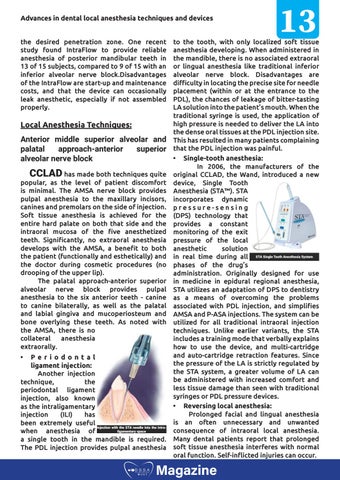
to the tooth, with only localized soft tissue anesthesia developing. When administered in the mandible, there is no associated extraoral or lingual anesthesia like traditional inferior alveolar nerve block. Disadvantages are difficulty in locating the precise site for needle placement (within or at the entrance to the PDL), the chances of leakage of bitter-tasting LA solution into the patient’s mouth. When the traditional syringe is used, the application of high pressure is needed to deliver the LA into the dense oral tissues at the PDL injection site. This has resulted in many patients complaining that the PDL injection was painful. • Single-tooth anesthesia: In 2006, the manufacturers of the original CCLAD, the Wand, introduced a new device, Single Tooth Anesthesia (STA™). STA incorporates dynamic pressure-sensing (DPS) technology that provides a constant monitoring of the exit pressure of the local anesthetic solution in real time during all STA Single Tooth Anesthesia System phases of the drug’s administration. Originally designed for use in medicine in epidural regional anesthesia, STA utilizes an adaptation of DPS to dentistry as a means of overcoming the problems associated with PDL injection, and simplifies AMSA and P-ASA injections. The system can be utilized for all traditional intraoral injection techniques. Unlike earlier variants, the STA includes a training mode that verbally explains how to use the device, and multi-cartridge and auto-cartridge retraction features. Since the pressure of the LA is strictly regulated by the STA system, a greater volume of LA can be administered with increased comfort and less tissue damage than seen with traditional syringes or PDL pressure devices. • Reversing local anesthesia: Prolonged facial and lingual anesthesia is an often unnecessary and unwanted consequence of intraoral local anesthesia. Many dental patients report that prolonged soft tissue anesthesia interferes with normal oral function. Self-inflicted injuries can occur.
Magazine