The Bar Journal is the independent journal of the Delaware State Bar Association. It is a forum for the free expression of ideas on the law, the legal profession, and the administration of justice. It may publish articles representing unpopular and controversial points of view. Publishing and editorial decisions are based on the quality of writing, the timeliness of the article, and the potential interest to readers, and all articles are subject to limitations of good taste. In every instance, the views expressed are those of the authors, and no endorsement of those views should be inferred, unless specifically identified as the policy of the Delaware State Bar Association.
The Bar Journal is published monthly with a combined July/August issue.
All correspondence regarding circulation, subscriptions, or editorial matters should be mailed to:
Editor, DSBA Bar Journal
Delaware State Bar Association
704 North King Street, Suite 110 Wilmington, DE 19801 or emailed to: dbouchatfriedman@dsba.org
Letters to the Editor should pertain to recent articles, columns, or other letters. Unsigned letters are not published. All letters are subject to editing. Send letters to the address above, Attention: Editor, Bar Journal. The Bar Journal Editorial Policy is available upon request.
COLUMNS
PRESIDENT’S CORNER
| BY DAVID A. WHITE, ESQUIRE
LAW DAY 2 0 2 6
The Delaware State Bar Association (“DSBA”) hosts its 2026 Law Day Luncheon on Friday, May 1, 2026 at the Riverfront Events Center, as part of its annual Law Day celebration. This year’s Law Day theme is “The Rule of Law and the American Dream,” focusing on how the legal system protects liberties and helps enable the pursuit of goals.
Each year Law Day offers an opportunity to pause, reflect, and recommit—to honor the rule of law and to celebrate the fundamental principles that sustain our profession and our democracy. As President of the DSBA, I am honored to mark Law Day 2026 by underscoring how the rule of law and the core values of our profession uphold the Constitution, advance professional excellence, and preserve public trust and confidence in our institutions.
The rule of law is more than an abstract ideal. It is a practical framework that organizes civic life, defines the limits of governmental power, and ensures that rights, responsibilities, and remedies are accessible to all. In Delaware—the home of a sophisticated Bar, a respected judiciary, and a diverse community of neighbors—the rule of law is the bedrock on which commerce, civil liberties, and orderly governance rest. When laws are clear, public institutions operate predictably, legal processes are applied fairly and impartially, and individuals and businesses can plan, transact, and resolve disputes with confidence.
Yet the rule of law is not self-sustaining. It requires regular, active stewardship by lawyers, judges, public officials, and everyday citizens. At its core, the rule of
law depends on a set of shared professional values: integrity, competence, civility, independence, and a commitment to equal justice under the law. These values are the engine that drives professional excellence and the primary means by which lawyers translate legal knowledge into public service.
Integrity
Integrity is foundational. The legal profession is entrusted with responsibilities—advising clients, protecting rights, advocating positions, and helping to administer justice—that demand honesty and fidelity to ethical obligations. When lawyers act with integrity, they reinforce the predictability and fairness of legal outcomes. When they fail, the consequences extend beyond individual cases and corrode the authority of our legal institutions. Upholding high ethical standards preserves the credibility of our Bar and ensures that the law remains an instrument of justice rather than of expediency.
Competence
Competence and commitment to lifelong learning are equally vital. The law is dynamic: statutes evolve, precedents shift, and societal challenges create novel legal questions. Professional excellence requires lawyers to maintain the skill and knowledge necessary to serve clients effectively and to participate meaningfully in civic life. Through mentoring, continuing legal education, and collaboration across practice areas, Delaware lawyers and judges can help ensure that our Bar remains equipped to meet contemporary demands while adhering to fundamental principles.
Civility
Civility and respectful advocacy matter tremendously in maintaining public trust. How disputes are litigated and resolved, how opinions are exchanged, and how adversaries treat one another in and out of a courtroom influence public perceptions of fairness. Civility does not mean relinquishing zeal; it means exercising it within bounds that preserve the dignity of the process and the humanity of those involved. When lawyers demonstrate respect for the rule of law and for each other, they model constructive citizenship for the broader community.
Independence
Independence of the legal profession is another keystone. Attorneys must be able to represent clients and voice principled positions free from undue influence. This independence supports vigorous advocacy and safeguards against the misuse of power. It also enables lawyers to advise public officials and private actors in ways that advance lawful decision-making. The balance between advocacy and accountability—between zealous representation and fidelity to the law—defines our profession’s contribution to a stable constitutional order.
The Constitution itself is both the source and the guardian of many of the liberties and obligations that make our system unique. The rule of law and constitutional principles operate together: the rule of law provides the mechanism for applying constitutional norms, while the Constitution supplies the overarching commitments—separation of powers,
federalism, individual rights—that guide legal interpretation. Lawyers are custodians of constitutional reasoning in courts, legislatures, and administrative areas. Through careful analysis, principled argument, and respect for precedent, we protect constitutional structures while also responding to the changing needs of society.
Public trust and confidence in the legal system are not automatic. They are earned through consistent performance and visible adherence to core values. When citizens perceive fairness, accessibility, and accountability in our institutions, they are more likely to comply with laws and court orders and rely on the legal process for dispute resolution. Conversely, insidious perceptions of bias, unpredictability, or corruption can erode the willingness of the public to engage with the justice system, with negative effects on social cohesion and democratic legitimacy.
At the DSBA, our important role is both professional and civic. We advance access to justice, support pro bono efforts, foster diversity and inclusion, and promote
On Law Day 2026, let us renew our pledge to uphold the rule of law and to embody the values that sustain it.
continued legal education programs that illuminate the role of the law in everyday life. Law Day provides us an opportunity to reflect on these commitments and to invite all members of the DSBA to engage. Whether through public forums, school programs, or our friends and colleagues at The Delaware Law Related Education Center (“DELREC”), Law Day initiatives help demystify the law and bring its benefits within reach.
On Law Day 2026, let us renew our pledge to uphold the rule of law and to embody the values that sustain it. Let us rededicate ourselves to professional excellence—remaining ethical, competent, civil, independent, and committed to equal justice. Let us teach and model these values for the next generation of Delaware lawyers and judges and for the public we are proudly committed to serve. In doing so, we not only uphold the Constitution,
we help fortify public trust and ensure that the law continues to function as a source of order, liberty, and fairness for all Delawareans.
In times of change and challenge, the rule of law endures when we, as Delaware lawyers and judges, choose to defend it through our conduct and advocacy. On Law Day 2026, and every day, let that choice guide our work. I look forward to seeing you at the Law Day Luncheon at the Riverfront Events Center on Friday, May 1, 2026.
David A. White is the 78th President of the DSBA. He is a former Superior Court Commissioner and former Managing Partner of McCarter & English, LLP. From March 2021 to November 2024, he served as Chief Disciplinary Counsel, an Arm of the Delaware Supreme Court. He is currently working as a Professional Neutral at Delaware ADR (www.delawareadr.com).
EDITOR’S PERSPECTIVE | BY JASON C. POWELL, ESQUIRE
Paying It Forward
Even though it was nearly 30 years ago, it all came back to me immediately. I got the email this past week out of the blue. A young law clerk at another firm emailed me, explaining that he had passed the Delaware bar exam and had one item left on his clerkship requirements. “Can you help me,” he asked. I know you know what he was asking. I’m guessing everyone reading this knows, and undoubtedly remembers that time when you were in his shoes.
Nearly three decades ago, I made the decision that I would not actively pursue the requirements until, and unless, I actually passed the bar exam. That was a bit of a gamble, because if I did pass (which I did, thankfully), I would be pressed to complete a rather expansive list of tasks in short order to make sure I could be sworn in at the upcoming ceremony.
I clearly remember the day I got my results. Back then, you had to walk to the law library in the New Castle County Courthouse and find a spreadsheet taped to a wall. On that spreadsheet was a list of identification numbers (one for each applicant) and directly next to it was “Pass,” or, gulp, “Fail.” I went in, lined up my number, and saw the great news. I didn’t even make it a block from the courthouse when I started to have doubts. Did I look at the right number? Did I line up the result correctly to my corresponding ID number? Back I went to double check, and thank goodness I came up with the same results. Now it was time to celebrate. But with whom? You didn’t know whether your friends passed or failed, and you didn’t really want to call and ask, in case they failed. You just turned up at the bar, and if you saw your buddies, you could reasonably
assume they also received good news. But you didn’t know for sure. They could have been drowning their sorrows. I remember I approached carefully, looking for any telltale sign. Finally, the exchange of good news happened, and we were able to safely converse and celebrate. But once my celebration faded, I had to get to work.
The clerkship requirements. I probably should have started on this sooner, I thought to myself. Oh well. I started canvassing what was then my limited network of senior attorneys. And I began working with my fellow applicants to see if they had any leads on opportunities to complete the requirements. Completing the requirements were memorable and I marvel that I recall them with such clarity and appreciation. Michael Kelly, Esquire, came to the rescue for many of us. He was arbitrating a workers compensation
matter, and he told us we all could come. We threw on our best (actually worst) suits and then crowded into a conference room for the ADR procedure. I will never forget that arbitration. It was like nothing I had ever seen.
I remember the Recorder of Deeds Office being so kind, welcoming, and helpful to us. They had a whole process, and sample files and deeds, we could review. The staff took us around on what felt like a VIP tour of the office and how it worked. I remember a civil trial in the Court of Common Pleas was the one to get. Word got out that a civil trial was moving forward and wasn’t going to settle! We all rushed over there, just to find out it settled right before the proceeding started. Heads hung low, we then set out to find our contested deposition.
I remember the older attorneys the best. They went out of their way to help. If they did not have a deposition on their calendar, they contacted their colleagues to see if one was available to monitor. This example set the tone for me, as I went on to practice. Just like the
clerkship requirements, if I had a question on a particular area of law, I would find the senior attorney practicing in this area of the law and call them. It was a bit intimidating calling a stranger and asking for guidance. But year after year, attorneys answered my calls. To this day, I can’t wait to repay the favor.
And so I was eager to help this young law clerk. We set him up to attend a virtual mediation—his last clerkship requirement. And what a way to go out, seeing Delaware attorneys, with the aid of another Delaware attorney, working to resolve a contentious matter through a mediation. Good luck to him and all of the admittees—Welcome!
Bar Journal Editor Jason C. Powell is the managing member of the Powell Firm, LLC. He can be reached at jpowell@delawarefirm.com All opinions expressed are solely his own.
Step up to the mic!
Organizing a program or a CLE Seminar is a great way to get exposure and engage with the DSBA! Email your ideas to Alison McLaughlin at amclaughlin@dsba.org.
EXECUTIVE COMMITTEE
David A. White President
Ian Connor Bifferato President-Elect
Francis J. Murphy, Jr. Vice President-at-Large
Jennifer Ying Vice President, New Castle County
Liam N. Gallagher Vice President, Kent County
Christophe C. Emmert
Vice President, Sussex County
Leroy Tice Vice President, Solo & Small Firms, New Castle County
Jeffery Young Vice President, Solo & Small Firms, Kent County
Stephen A. Spence Vice President, Solo & Small Firms, Sussex County
Mae Oberste Secretary
Michael J. Hoffman Assistant Secretary
Frederick H. Mitsdarfer III Treasurer
Crystal Carey Assistant Treasurer
Mary Dugan Past President
The Honorable Eric M. Davis Judicial Member
Christopher L. Damon Assistant to President
Thomas P. McGonigle Legislative Liaison
Tayler D. Bolton
Commissioner Emily A. Ferrell
Robert Kleiner
Brenda R. Mayrack
Zachary S. Stirparo
Anthony V. Panicola
Take advantage of the target audience of the DSBA Bar Journal and initiate new business through referrals and building your brand. Placing an ad is easy!
For more information, email Danielle BouchatFriedman at dbouchatfriedman @dsba.org.
Members-at-Large, elected
Claire M. DeMatteis
Arthur Dent
Richard A. Forsten
Roger D. Landon
Wali W. Rushdan, II
Members-at-Large, appointed
Karl G. Randall Executive Director
CALENDAR OF EVENTS / CLEs
April 2026
Thursday, April 16, 2026 • Noon - 1 p.m.
Key Changes in DE Criminal Appeals CLE DSBA
Friday, April 17, 2026 • 9 a.m. - 12:15 p.m. Best Practices in Family Court CLE
Wilmington University
Friday, April 17, 2026 • 1 p.m. - 4:15 p.m.
Future Developments of Law Involving AI Wilmington University
Wednesday, April 22, 2026 • 5 p.m. - 6:30 p.m.
Legal Ethics Mystery Thriller CLE Wilmington University
Thursday, April 23, 2026 • 9 a.m. - 11 a.m.
From Brief to Bench: Translating Written Advocacy into Trial Practice DSBA
Wednesday, April 29, 2026 • 9 a.m. - 10 a.m.
Navigating the CyberWorld CLE DSBA
May 2026
Friday, May 1, 2026 • Noon - 2 p.m. Law Day Luncheon Riverfront Events
Saturday, May 2, 2026 • Noon - 3 p.m. Spring Festival Ramsey’s Farm
Wednesday, May 6, 2026 • 4 p.m. - 6:30 p.m. CLE on the Court, followed by Pickleball (member event) Dill Dinkers, Newport
Tuesday, May 12, 2026 • Noon - 1:30 p.m. Education and Civics in Delaware (DELREC) DSBA
Wednesday, May 13, 2026 • Noon - 1 p.m.
Service & Social: assemble bags for ILYA DSBA
Thursday, May 14, 2026 • 9 a.m. - 4:30 p.m. Fundamentals of Law Practice Management DSBA
Thursday, May 14, 2026 • 4:30 p.m. - 6:30 p.m. Member Happy Hour Torbert Street Social, Wilmington
Dates, times, and locations of events and CLEs may occasionally change. Please consult the DSBA website for the most up-to-date information at dsba.org .
OF NOTE
Condolences to the family of Ina Inara Suuberg, Esquire , who passed away on February 5, 2026.
Condolences to the family of Robert K. Pearce, Esquire, who passed away on February 23, 2026.
Condolences to the family of the Honorable Rae M. Mims, whose father, James Rudolph Mims, passed away on February 24, 2026.
Condolences to the family of John Heggie Small, Esquire , who passed away on February 25, 2026.
If you have an item you would like to submit for the Of Note section, please contact Danielle BouchatFriedman at dbouchatfriedman@dsba.org.
COMMISSION ON LAW & TECHNOLOGY: LEADING PRACTICES
WHAT YOU SAY (TO AI) CAN AND WILL BE USED AGAINST YOU
BY MOLLY DIBIANCA, ESQUIRE AND ANNIE CORDO, ESQUIRE
In a case of first impression, a federal court ruled that inputs of a non-lawyer made to a public generative artificial intelligence (GenAI) tool without the direction of his counsel are not subject to the attorney-client privilege or work-product doctrine.
United States v. Heppner
Case Background
The defendant, Heppner, a former CEO of a financial-services company, was charged with various white-collar crimes, including securities fraud and wire fraud. After learning he was the target of a federal investigation, but before he was arrested, the defendant used Anthropic’s consumer GenAI tool, Claude, to help him analyze his legal exposure and craft a defense strategy. His queries included information from his lawyer. He sent his lawyer the documents created by the tool.
The government sought to compel Heppner to produce the inputs (the queries) and outputs (both the documents and responses generated by the AI tool). Heppner sought to withhold the documents based on the attorney-client and work-product privileges.
Analysis
The court rejected the defendant’s arguments. First, the court found that the attorney-client privilege does not apply to inputs of a non-lawyer defendant to an AI tool. The court explained that AI tool’s are not a lawyer and therefore cannot form an attorney-client relationship with a user.
Second, the court found that the defendant’s inputs were not confidential. In so finding, the court noted that Claude’s privacy policy, to which users must consent, specifically provides that Anthropic collects data on users’ inputs and Claude’s outputs, that Anthropic uses such data to “train” the tool, and that Anthropic reserves the right to disclose such data to third parties, including “governmental regulatory authorities.”
Third, the court found that, because the defendant was not acting at his lawyer’s direction, the communications with the AI tool were not made for the purpose of obtaining legal advice. The court also noted that the inputs were not “somehow alchemically changed into privileged [communications]” merely because they were later provided by the defendant to his lawyer.
The court then looked at the workproduct doctrine, finding that, because the inputs were not “prepared by or at the behest of counsel” and did not reflect the defense counsel’s strategy, the doctrine did not apply. The court relied on counsel’s admissions that: (1) the inputs were generated by the defendant without the input of his lawyer; and (2) they did not “reflect” the lawyer’s strategy at the time they were generated.
Although the issue of waiver was not before the court, it noted in a footnote that, “even if certain information Heppner input into Claude was privileged, he waived the privilege by sharing that information with Claude and Anthropic, just as if he had shared it with any third party.”
Had the defendant been pro se when he entered the information in Claude, a different analysis may have prevailed. In Warner v. Gilbarco, Inc., No. 2:24-cv-12333 (E.D. Mich. Feb. 10, 2026) (Dkt. 94), the court found that GenAI inputs and outputs are protected by the work-product doctrine when the user is serving as her own lawyer. Thus, the court in Warner, held that, even if the pro se party waived privilege when she used ChatGPT, she had not waived the work-product protection because she had not disclosed the information to an adversary.
Impact
The court’s ruling should come as no surprise—there is no special “AI privilege,” just as there is no privilege that protects
Google searches or notes taken in a Word document. However, the ruling should come as a warning to litigators—now is the time to consider the implications of lawyers use of GenAI and to manage the risks and benefits.
One approach is to warn clients against “oversharing via AI” in engagement letters. Just as many firms warn clients not to share information on social media, lawyers may want to consider providing a similar warning specifically addressing AI use.
On the flip side, lawyers should consider including AI-specific discovery requests and deposition questions to explore whether responsive information and documents were sent to or received from GenAI tools. Similarly, e-discovery retention protocols may need to be updated to ensure AI inputs and outputs are preserved.
Conclusion
The ways GenAI will affect the way we litigate are myriad and rapidly evolving. But the rules regarding confidentiality, privilege, and work-product are not tool-specific. If the user is a non-lawyer and has not been directed by counsel to
perform the query, the inputs and the outputs are not privileged and are subject to discovery.
United States v. Heppner, 2026 WL 4336479 (S.D.N.Y. Feb. 17, 2026).
Molly DiBianca is the Managing Partner of DiBianca Law, LLC.
Molly serves as the cochair of the Emergent Technologies Committee of the Delaware Supreme Court Commission on Law and Technology, and a member of the State Commission on Artificial Intelligence.
Annie Cordo is an attorney at DiBianca Law, where she litigates commercial and employment disputes.
invites you to attend its
36 ANNUAL DINNER TH
honoring
KATHLEEN DUFFY SMITH
Recipient of the 2026 Monsignor Paul J. Taggart St. Thomas More Award
SUNDAY, MAY 3, 2026
Cocktails at 5 p.m. | Dinner at 6 p.m.
Wilmington Country Club 4825 Kennett Pike, Wilmington, DE
For information about registration and sponsorship opportunities, please contact Denise Nordheimer at dnordheimer@foxrothschild.com
Sage Advice from Hon. Jan R. Jurden, (Ret.)
CURATED BY RICHARD HERRMANN, ESQUIRE
During the academic part of my career, the most valuable aspects of my classes were the visits from members of the Bench and Bar, who would look back on their careers and share the more important advancements and moments with our students.
I aim to continue facilitating these discussions through a column called “Sage Advice.” In this issue, I sought advice from Hon. Jan R. Jurden (Ret.), Dean of Wilmington University School of Law.
QIf you wanted to offer one nugget of Sage Advice to those developing their legal careers in Delaware, what would it be?
ABe kind. The Delaware Bar is small and collegial. We are most fortunate to have the high bar we maintain for civility
and professionalism. You can be the smartest lawyer, but if you are not kind to others (and this means clients, adversaries, law staff, court staff, and your fellow citizens), you will never be a great lawyer.
Q
When you attended law school, did you have a thought as to what you would like to do with your career? And if you did, what was it?
A
I went to law school during the hostile takeover bonanza in the late 80’s. I was a summer associate at YCS&T in 1987. It was that experience that made me want to be a corporate lawyer. After three years in the corporate section, I then decided I wanted to try jury cases. No offense to our esteemed Court of Chancery, I just really enjoyed jury trial work.
Q What was your first position after you were admitted to the Delaware bar?
A Associate at YCS&T.
QWhen you started your career, was it your plan to stay in that field until you retired or was this a stepping-stone to something else?
AMy plan was to stay in that field my entire career.
Q
If you were to choose one person who had the most impact in the advancement of your career as a member of the bar in Delaware, who would that be and why?
AThis one is a very difficult question. I have been fortunate to have had so many mentors over the last three decades. I can’t pick just one. I am going to do something I don’t do, and that is break the rules, by naming more than one:
■ My mother
■ Ben Castle
■ Melanie Sharp
■ Dave McBride
■ Jim Conaway
■ Fred Iobst
■ Judge Thynge
■ Judge Farnan
■ Judge Del Pesco
■ Judge Haile Alford
■ Justice Holland
I am sure I missed some and to those I missed, I apologize.
Q
What was the most interesting matter in which you were involved in your career?
AExxon Mobil Corp. v. Saudi Basic Industries Corp., 866 A.2d 1, 11 (Del. 2005). I had to interpret and apply Sharia Law to a contractual dispute. Because the parties’ Saudi Law experts disagreed on Saudi law, the Court hired its own Saudi Law expert. The case went to trial in March 2023 and the jury returned a verdict of over $400 million in favor of Exxon Mobil. It was
the largest reported jury verdict in the U.S. in 2023 and the most interesting and challenging case I ever handled.
QWhat was your most challenging problem that you faced in your career as a member of the Delaware bar?
AGenerating business as a woman lawyer in the late 80s and early 90s.
QIf you had to start your career again, would it be as a lawyer in Delaware?
AAbsolutely.
QWhat does work-life balance mean to you and did you have it?
A
I did not have work-life balance the first 10 years of my legal career and that was nobody’s fault but mine. I finally achieved it at age 38. Not proud of that. Work-life balance means ensuring that you make time to exercise, see family and friends, relax and read something other than cases and briefs, prioritize self-care in all respects, cherish relationships (you have to nurture them or you lose them), realize that (as trite at it might sound) life is, indeed, short. The work will always be there, those we love will not.
Q
You started with a nugget that you wanted to leave those developing
their practice or careers in Delaware. Is there another nugget you would like to offer?
A It takes a long time to build a stellar reputation. It takes one unprofessional email or one uncivil exchange to ruin it.
Q What’s the best thing about being a lawyer?
A
Using that degree to help others.
Richard K. Herrmann consults with Wilmington University on Emerging and Innovative Technologies. He can be reached at richard.k.herrmann@ wilmu.edu.
CLE at HOME
DSBA CLE ONLINE
JIM DEEL, EXECUTIVE DIRECTOR
The Quiet Impact of Therapy Dogs in Delaware’s Legal System
April offers a unique opportunity to pause and recognize the quiet, but meaningful, impact of therapy animals. With Dog Therapy Appreciation Day on April 11 and National Therapy Animal Day on April 30, attention is drawn to the work of animals and handlers who provide comfort, stability, and support in environments where it is often needed most.
While often associated with hospitals and schools, therapy animals are increasingly being recognized within the legal system, where individuals navigate stress, uncertainty, and deeply personal experiences. Creating conditions where people feel at ease is not separate from the work of the law—it supports it.
Within this evolving landscape, therapy and facility dogs have emerged as a
practical and impactful tool.
Here in Delaware, that impact is being realized through the work of Capitol Police K-9 Vinn (pictured at left), as well as through Crisis Response Canines (CRC)—a national nonprofit organization comprised of certified K-9 teams across the United States. I have the privilege of serving as one of those teams alongside my therapy dog, Zoey.
Delaware’s program represents a more formalized, statewide approach compared to many jurisdictions, where such services are often limited to individual courts or agencies.
Trauma, Exposure, and the Role of Support
For many who encounter the legal system, the experience is not simply procedural—it is deeply personal. Victims of crime are often asked to revisit difficult moments in order to participate in the process, which can make an already stressful environment feel even more overwhelming.
Within this context, therapy dogs offer practical support. Their presence is steady, calm, and non-judgmental. In emotionally charged moments, they help reduce anxiety,
provide grounding, and create conditions where individuals are better able to engage.
Research shows that interaction with dogs can reduce stress-related hormones such as cortisol while increasing moodregulating hormones like oxytocin and serotonin.1
There is also another form of exposure that is less visible but equally important— vicarious trauma. Judges, attorneys, investigators, victim advocates, and court staff are routinely engaged with individuals who have experienced trauma. Over time, this exposure can contribute to emotional fatigue, detachment, or burnout.2
In these settings, therapy dogs introduce something simple but meaningful—a moment of calm that helps regulate stress and support focus within environments often defined by urgency and intensity.3
Court Perspective: Supporting Children in the Courtroom
As Delaware Judicial Officer Jennifer Ranji shared:
“Delaware law requires that we consider a child’s wishes in such cases, and speaking directly with the child often provides critically important information for us to consider in our analysis. While these interviews are generally done without either party present, it can be stressful for a child to come into a courtroom and speak with a judge or commissioner. Helping a child to feel sufficiently comfortable to share their wishes and other relevant information is key to the effectiveness of those interviews, and Vinn’s presence is extremely helpful in that regard, particularly as guided by Officer DiClemente.”
“The interviews generally start with Vinn greeting the child in the hallway outside the courtroom … by the time they enter the courtroom together, the child is already more at ease than when they must enter the courtroom alone.”
“In my experience, children are much more at ease entering the courtroom and engaging in the child interview when Vinn is present. He provides a welcome and comforting focal point, and an easy starting point for conversation between the judicial officer and child.”
“A youth who is greeted by a judicial officer with discussions of Vinn’s soft ears, brown eyes, and wagging tail is much more likely to relax and engage than one who walks in the courtroom alone.”
“Vinn’s non-judgmental presence can be a comfort to a child who is sharing sensitive information in the middle of an otherwise sterile courtroom setting.”
“Parents are generally happy for their children to have the opportunity and extremely grateful that the Court is taking such steps to make their children comfortable.”
“Vinn’s presence often changes the dynamic in otherwise stressful situations, allowing children to feel more comfortable sharing important information and parents to recognize that the Court is focused on supporting their children through the interview process.”
Delaware Capitol Police Facility Dog Program
To better understand how this work is structured and delivered across the state, the Delaware Capitol Police provided the following overview:
The Delaware Capitol Police Facility Dog Program provides support to victims, witnesses, and others involved in court proceedings. Vinn, Delaware Capitol Police’s first facility dog, arrived in October 2022 through Canine Companions, an accredited nonprofit organization. He was trained similarly to a service dog and knows over 40 commands designed to reduce stress and support engagement. Vinn works alongside a trained handler to assist courts across the state and has
passed the Assistance Dogs International (ADI) test.
Vinn is trained to work in high-stress environments, helping reduce anxiety and promote participation in the court process. His presence can improve the quality of testimony while allowing attorneys and social workers to remain focused on their responsibilities.
In addition to supporting court proceedings, Vinn and his handler, Master Corporal Donna DiClemente also provide support to courthouse staff and have partnered with Family Court on wellness initiatives.
The goal of the program is to provide comfort and support to individuals in the courthouse who may not otherwise have it.
Facility dog services can be requested through the Delaware courts.
This structured approach reflects what is already being observed in practice—when individuals feel more at ease, they are better able to participate, communicate effectively, and engage with the court in a meaningful way.
A View from the Field
As Executive Director of the Delaware Lawyers Assistance Program, I am often accompanied by my therapy dog, Zoey (below), as part of my work. What she does is simple in appearance, yet profound in impact. In that role, Zoey provides statewide support to attorneys, judges, and Department of Justice staff,
offering a steady, non-judgmental presence in environments often defined by stress, trauma, and uncertainty.
Our work has extended into law enforcement settings, where Zoey has supported officers and, at times, comforted victims of crime navigating unfamiliar and stressful circumstances. She has also been present in the aftermath of a line-ofduty death, offering a calm presence where words often fall short.
Beyond my professional responsibilities, Zoey and I also engage in volunteer work throughout the community. This includes ongoing support at Zoë Ministries—a long-term residential program for minors who have been, or are suspected of being, victims of human trafficking—as well as visits to schools and other community settings.
In both professional and volunteer settings, Zoey provides a steady, non-judgmental presence in environments often defined by stress, trauma, and uncertainty. In moments that carry weight, she offers something simple but powerful—a pause, a sense of calm, and an opportunity, even briefly, to exhale.
Closing
As we recognize therapy animals this April, it is worth acknowledging the role they are quietly playing within our legal system. Whether supporting a child in a courtroom, a victim navigating difficult moments, or professionals engaged in demanding work, their presence reflects a simple but important principle: how people experience the process matters. In that space, even small moments of calm make a meaningful difference.
For those interested in learning more about these services or requesting a visit, I can be reached at jdeel@de-lap.org or 302-610-8234.
Notes:
1. Beetz, A., Uvnäs-Moberg, K., Julius, H., & Kotrschal, K. (2012). Psychosocial and psychophysiological effects of human-animal interactions. Frontiers in Psychology.
2. National Center for State Courts (2021); Figley, C.R. (1995). Compassion Fatigue
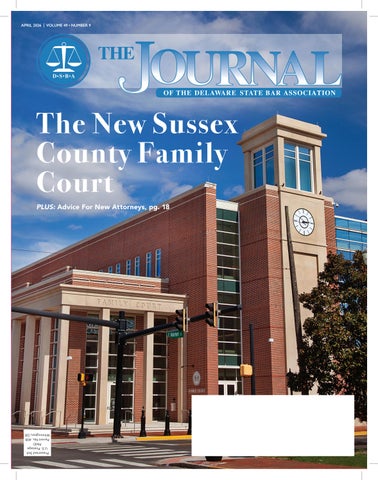
The new Family Court building in Georgetown at 100 E. Market Street officially opened its doors on Thursday Nov. 13, 2025 with a ceremonial ribbon cutting.
The new three-story building is roughly three times the size of the previous courthouse on The Circle. The 107,800-square-foot building not only has more courtrooms—eight, or two more than its predecessor—but courtrooms that are significantly larger at 1,400 to 1,800 square feet each, allowing for more comfort and safety during court proceedings. The building also has a large, bright, two-story lobby, wide hallways with alcoves and small meeting areas off to the sides to allow parties more distance and privacy as they wait. There is also a waiting area for children and specially designed rooms that will allow children to appear at proceedings through video instead of having to take the witness stand. Behind the scenes, there are more holding cells and more room to allow for the appropriate separation of individuals in custody from judicial officers and court staff. There is also more space for court staff along with space for justice system partners in the building including the Department of Justice, Office of Defense Services and Office of the Child Advocate. Finally, the building also has a 400-car parking garage becoming the first parking structure in Georgetown.
Delaware Supreme Court Chief Justice Collins J. Seitz, Jr. says that the projected opening date for the new Kent County Family Court Courthouse is late August 2026. “After opening the new Family Court building in Georgetown, we have been thrilled with the design, natural light coming into the building, more space for our employees and stakeholder agencies, and the appropriately sized courtrooms to add dignity and calm for our litigants to address the serious and personal issues that are facing them. Safety has been enhanced in the new courthouses, as well. I am confident that the new Family Court courthouse in Kent County will do the same for the people of Kent County.”
High-Tech Courtooms
The high-tech courtrooms contain equipment that is generally requested in the legal community for evidence presentation. All the Sussex Family Courtrooms are identical in configuration and include all the features below.
▪ Podium with laptop computer input connection.
▪ Podium Document viewer which includes the following features: viewing of document one page at a time, viewing of slides and overhead transparencies, viewing of 3-D objects, power zoom lens, auto or manual focus, and negative/ positive option for viewing negative films. Camera head can be rotated for viewing of an object not on the document viewer.
▪ Podium DVD player.
▪ Podium Annotation system with touch screen monitor. Annotation is a system where you are able to draw on the monitor over documents or
pictures, such as highlighting and circling, etc.
▪ Counsel tables all have an HDMI computer input connection and a separate monitor to view the evidence presented.
▪ Witness monitor with a touch screen monitor for annotation and evidence viewing.
▪ Large wall mounted TV for the gallery and staff to view evidence.
In addition to these high-tech features, the Sussex Family Court courtrooms all have four wall-mounted cameras that offer adjustable views and feed directly to a computer at the Clerk desk for Zoom calls.
The new camera and Zoom capabilities at Sussex Family Court make hybrid court sessions easier and much higher quality than just using webcams from a computer.
The Sussex Family Court also has implemented a new world class audio and microphone system at all tables
that capture the court record with much higher quality than ever before. With these high-quality microphones, we also use the recording software “For The Record” (FTR), the courtroom audio is then sent to the FTR cloud based storage systems and we are able to generate high quality transcripts of the proceedings. The future Kent Family Court Courtrooms will also be equipped with this technology.
The court webpage provides up-todate information for the Bar of what technology is in statewide courtrooms. That link is: https://courts.delaware. gov/aoc/courtroomtechnology.aspx. There are tabs at the top to switch to the other counties.
The projected opening date for the new Kent County Family Court Courthouse is late August 2026.
Advice For New Attorneys (Part Two)
SUBMITTED BY MEMBERS OF THE DELAWARE STATE BAR ASSOCIATION
Last May, The Bar Journal ran a feature all about advice for new attorneys. It was such a hit that we decided to bring it back. This time, we asked members of the Delaware State Bar Association to share their best advice for new attorneys, including successes, challenges, and words of wisdom, as well as the best advice they received from a mentor.
Gary W. Aber, Esquire
Gary W. Aber Attorney at Law
My one most important piece of advice, especially for litigators, is to be solicitous of court personnel, from Judges’ immediate assistants down to a clerk in the Prothonotary, Register in Chancery, Supreme Court, or even JP courts. They can be of enormous help with advice, sharing information, and “greasing the skids,” especially if you are on their good side.
Nothing reveals more about your character than the way you behave toward (or treat) others over whom you believe you have authority.
Ian Connor Bifferato, Esquire University Legal Counsel at Wilmington University
Unfortunately, I never had a mentor. It was not without trying. I wanted help but ended up having to figure it all out myself. Why? Let’s face it. Not all experienced lawyers are interested in helping “young” lawyers. Some think it is a waste of their time because it is generally not billable time, some don’t really know anything to share, and some are insecure and feel that sharing knowledge threatens them. So, if your partners or the judge you clerk for ignore you or are unable to answer your questions, start reading. Read the rules, again and again. Read the statutes, again and again. Read Supreme Court cases, again and again.
But, you may ask, what about the more practical aspects of practicing law in Delaware? This is tricky. If you are being ignored, you need to find someone outside of your immediate circle. I suggest changing jobs. Alternatively, you can observe. You can attend hearings. When you see a lawyer who does know things and practices well, call them! Ask them! I made the mistake of thinking that observing other lawyers would be sufficient, and I found out late that I was missing out on a lot of information.
Loren R. Barron, Esquire Managing Partner— Delaware at Kaufman Dolowich
Some young lawyers do have good experiences with mentoring, but, unfortunately, many women lawyers do not. Women are still often ignored by senior partners in many firms and left out of “soft mentoring” like meeting clients and social events. If you believe you are in that situation, get out quickly. It is not worth it to stay in a position where you are not considered worthy of teaching. I have seen my women colleagues stick it out in such circumstances only to find that they have wasted years going nowhere in a firm that wanted them only for brief writing, reviewing other lawyers’ work as Delaware counsel, or “of counsel” positions. I know of women lawyers who wasted years as the only Delaware barred lawyer in a firm in charge of reviewing and filing documents from out of state counsel and not much else. Don’t let that be you. Feel free to reach out.
Too often I read briefs that begin, “Now comes Plaintiff to this Right Honorable Court and humbly requests…” Please, I am begging you, do not write like this. Write in American English and try your best to sound like a human person from the twenty-first century.
Jason H. Beehler, Esquire
American Civil Liberties Union of Delaware
Eric
M. Doroshow, Esquire
Law
Offices of Doroshow, Pasquale, Krawitz & Bhaya
1. Be impeccable with your word. Your reputation for truth and honesty is primary in your career. Being truthful applies to everyone you meet: your family, your staff, and the Court. If you do not tell the truth, you will often have to tell a lie to cover up the first lie. Eventually, you will be caught. As a result, your credibility will then be challenged for anything you may say in the future. Once compromised, it is very difficult to get back your good reputation.
2. In your work and in your personal life, surround yourself with competent, positive people. Listen to them. Don’t be afraid if these people are smarter or more accomplished than you. Their help will help you grow as an attorney. Avoid people who constantly complain.
Melissa Green, Esquire Maven Law, LLC
1. (Advice) Your career is going to take you through any number of twists and turns, highs and lows. Don’t let that discourage you from moving forward and strive to be open-minded and curious. You will be amazed at what kind of professional and personal opportunities present themselves around those bends in the road!
2. (What My Mentor Taught Me) My mentor, Gary Linarducci, Esq., taught me so much, but what stands out the most is the way he provided the highest level of service to all his clients equally, regardless of their background, education, political affiliation, financial status, or position in society. A doctor and a bricklayer received the same level of commitment and service from him, because he sincerely believed that by meeting clients where they are, the rest will fall into place. I will always carry that lesson with me.
Be yourself in your legal practice. Do not be afraid to be you and start that early. I spent a lot of years being very formal and putting up a lot of professional walls. That did not help me (although my early colleagues were amazing mentors and taught me a lot). Now, I work for a midsize firm in the Midwest, and my colleagues jokingly refer to my office as “the yoga studio” because it’s bright, colorful and holds a riot of plants. My practice is largely focused on family law these days. I hate the ugliness of divorce, but it’s a huge part of what I do—because I found this to be my primary area in which I can help people who are facing one of their worst moments.
My early years of practice were often trial-by-fire. I worked for a big firm, and one of my bosses had a background in insurance defense. He learned on the fly, and that’s how he taught me. I was taking depositions and handling motion arguments as a first-year attorney. I was utterly terrified, but I learned fast. Do it scared. The reality is that we are all scared of new things. Some of your biggest growth comes in your trials. You will screw up, but you will also become a better lawyer. And years later, when your former boss reaches out and tells you he used your deposition to win a multi-million-dollar verdict, you might realize you knew a bit more than you thought.
Large, Esquire
Member
of Mika Meyers PLC (Grand Rapids, MI), and former Associate of Saul Ewing, LLP (DE)
Thank those who helped you, even if it was a hard lesson and you did not want to hear it at the time. Be humble to those teaching you. Be OK with being underestimated. I was often mistaken for a court reporter as a young female showing up for depositions. I called a judge more than once to have him or her enforce the court rules in depositions, when the other side was crossing the line into unprofessional bullying or misconduct. Stand up for yourself when you need to but realize that sometimes being underestimated is your best tool. You can gain a witness’s or party’s confidence, and he or she may tell you a lot more than intended.
Don’t wait to give back. Mentor others. Take at least one pro bono case a year. We all have a chance to flip the script and make “helper” the first thing people think about lawyers.
Don’t try to model your practice style after anyone. You have to stay true to who you are and practice the way that makes you most comfortable, otherwise you will feel and project inauthenticity. In a Delaware full of attorneys, be you!
Esquire Associate at Saul Ewing
Kim
Allison Neff,
Penelope B. O'Connell, Esquire
Assistant Public Defender, Superior Court
1. When you go to a supervisor/partner with a legal issue/question/problem, always show up with proposed solutions.
2. When you write a brief or any other work product for your supervising attorney, treat the drafting process as though you are writing for your client; do not turn in a draft to your partner that you would not give to your client.
3. Always assume that any email you write to opposing counsel will be an exhibit to a motion at some point; treat your opponent with the respect and collegiality you would want a judge to see in an email exhibit.
When I was a mid-level associate in Corporate Law at a large firm, the partners for whom I worked took me out to lunch to share what it takes to be a successful partner. I asked how to get clients. Their response: have something people need you for. Put in the extra work to gain indispensable knowledge others lack.
Fast forward to a career change in my 40s to Special Needs Planning and Elder Law, now partner in my own firm. Again, from my new mentor: gain the expertise that actually makes a difference for someone. Study, earn the credentials that are hard to get. There is no substitute for relevant, specialized expertise. Nor is there substitute for the learning and camaraderie you gain from the networks those credentials make possible.
Catherine B. Read, Esquire Estate & Elder Law Services of Delaware LLC
The Delaware State Bar Association is planning a CLE Lunch and Learn in September on this exact topic! For more information and to be a part of it, contact Alison McLaughlin, CLE Coordinator, at AMcLaughlin@dsba.org.
David J. Haley, Esquire
1943 - 2026
BY JANINE N. HOWARD-O’RANGERS, ESQUIRE
The world lost an extraordinary man on January 12, 2026, when David J. Haley, former Master in Family Court and long time Family Court practitioner, passed away at the age of eighty two. David—known to many simply as Dave—left an indelible mark on the Delaware legal community through his skill, integrity, humor, and unwavering commitment to justice.
I met Dave about a month into my career as a staff attorney for Delaware Volunteer Legal Services (DVLS). We were on opposite sides of a complicated property division matter—my first trial outside of Protection from Abuse cases—and I was understandably nervous to be litigating against someone of his experience. When the decision came down in my client’s favor, Dave, with his trademark blend of candor and humor, announced to a waiting room full of attorneys and litigants: “That young lady over there just kicked my ass in Court.” He likely never knew how much that moment meant to me, or how profoundly it boosted my confidence as a new attorney.
Over the years, I had the privilege of working with Dave both as opposing counsel and as a colleague. He was a straight shooter—honest, fair, and guided always by principle rather than ego. In a practice area filled with conflict, we often found ways to negotiate solutions that benefited both parties. Dave was also a mentor I trusted. He offered sound advice, sprinkled with
His wife, Mena, would even reach out proactively during scheduling to ask which volunteer dates he could fill. His commitment was recognized formally when he received the DVLS Pro Bono Award in 1997, and again when he became the very first recipient of the DSBA Commitment Award in 2007 for his lifetime dedication to pro bono service.
humor, help younger
Those who knew Dave will remember his orneriness, wit, and deep compassion. Practicing in an emotionally demanding area of law can be draining, but Dave made it joyful. His empathy was unmistakable, never more evident than in cases involving vulnerable clients. I once served as guardian ad litem for one of his clients who was struggling, and working closely with Dave on that matter only amplified my respect for him. He approached the case with patience, humanity, and remarkable clarity, and his courtroom presence was something to behold.
Dave was one of DVLS’s most dedicated volunteers—without question one of the finest we have ever had. He took on the most challenging cases without hesitation, treating every client, including survivors of domestic violence, with dignity and respect. He was often our first call in emergency situations because he rarely said no.
To me, and to many others, Dave was larger than life. His example continues to shape how I train new attorneys and how I navigate my own practice. He represented the absolute best of our profession, brilliant yet humble, formidable yet kind. Dave volunteered hundreds of hours helping clients who were scared, traumatized, or navigating some of the most difficult moments of their lives. He brought comfort, humor, and a sense of safety to every interaction.
Even after retiring and moving away from Delaware, his influence remained deeply felt. Dave is the only attorney I know to have received Volunteer of the Year twice—honors earned not because he sought recognition, but because his goodness and dedication were impossible to overlook.
Despite his best efforts, Dave’s innate goodness always shone through. It guided him, it comforted others, and it left a beacon for those of us fortunate enough to have known him. His legacy is one of compassion, integrity, service, and genuine humanity—qualities that will continue to inspire the countless
Janine N. Howard-O’Rangers is the Executive Director of Delaware Volunteer Legal Services, Inc. (“DVLS”) and a Legal Consultant to the Widener University Delaware Law School Delaware Civil Clinic. Before becoming Executive Director, Ms. Howard-O’Rangers was a staff attorney for DVLS where she represented victims of domestic violence with family law issues and recruited pro bono attorneys. She was admitted to the Delaware Bar in 1995 and the Pennsylvania Bar in 1997. She is a member of the Family Law Sections of the American Bar Association and the Delaware State Bar Association (“DSBA”).
Ms. Howard-O’Rangers is a former Chair of the DSBA Family Law Section. In addition, Ms. Howard-O’Rangers serves on several committees that address access to justice and domestic violence issues.
BECOME A DSBA SECTION MEMBER
REPORT: 2026 MID-YEAR MEETING OF THE ABA HOUSE OF DELEGATES
BY WILLIAM C. CARPENTER, JR.
The Rule of Law does not defend itself…Lawyers do!
While this was the message and call to action at the 2025 Annual Meeting of the ABA House of Delegates, this theme continued at this years mid-year meeting held in San Antonio, Texas on February 5 through the 9th. The concerns previously expressed regarding the attack on the Rule of Law, judicial independence, voting rights, immigration, and safeguarding our basic constitutional rights again highlighted the mid-year meeting and are reflected in the resolutions consider by the House of Delegates. President Michelle Behnke of Wisconsin in her remarks to the HOD, highlighted the continuing effort by the ABA to protect these rights and to speak out when they are under attack. President-elect Laura Farber of California also noted this commenting on how the ABA stands in a unique position to speak on these issues as the largest organization of lawyers and judges in the nation.
While certainly important messages by the ABA leadership, for the Delaware delegation, the highlight of the meeting was the address before the House by Chief Justice Seitz in his role as chair of the Conference of Chief Justices. Justice Seitz emphasized the long tradition of cooperation with the ABA and the important role it has played in support of the issues facing the judiciary. In his message, the Chief Justice highlighted three areas of particular concern. First was the safety and security of judicial officers and court staff. He highlighted the
recent bombing attempt of the Arizona Supreme Court and the shooting of a trial judge and his wife in Indiana. He asked that we work to rebuild a culture that champions civility over violence and asked the ABA to support the federal legislation, Countering Threats and Attacks on our Judges Act , presently before the U.S. House of Representatives. Next, he addressed the concerns around the use of AI. He emphasized that the “bar and state courts must collaborate on standards, training, and ethical frameworks so that AI enhances efficiency and access to justice without harming fairness, transparency or public trust.” Finally, he noted the need to realign legal education and the bar admission processes to better meet the needs of the public. He asked the ABA to join with law schools and state courts to graduate individuals who are practice-ready and equipped to serve the public effectively and affordably. It was a proud day for the Delaware delegation.
With these important messages the HOD got down to business adopting more than 26 policy resolutions, including ones related to the federalization of the National Guard, model rules, attacks on the judiciary, AI and the independence of the US Department of Justice. While all the resolutions before the HOD addressed critical issues facing the legal community and our country, I will highlight those that I believe will be of greatest interest. The following resolutions were adopted at the meeting.
• Adopted an updated iteration of
Model Rule of Professional Conduct 1.4 related to representation of clients with diminished capacity.
• Encouraged bar associations, law schools and civic organizations to promote public understanding of the role of the judiciary and to mrespond to attacks that threaten judicial independence and safety.
• Affirmed the ABA’s support for the action taken by the Council of the Section of Legal Education and Admissions to the Bar in defining and clarifying the meaning of distant education courses for which law schools provide credit towards a JD degree.
• Require law schools to demonstrate reasonable steps to minimize student loan defaults including debt counseling at the inception of the loan and before graduation.
• Encourages state bar associations to conduct periodic economics of law surveys covering income, billing practices, receivables and benefits, with demographic breakdowns when practicable.
• Urges the National Conference of Bar Examiners to include Trust and Estate Law as a Foundational Concept and Principle on the NextGen bar exam.
• Urges the continuation of the current fee system in which U.S. Patent and Trademark Office fees are based on recovering costs of the operation of the USPTO and opposes calculating patent fees based on a percentage of, or in proportion to the economic value of a patent whether at issuance, maintenance or otherwise.
• Urge the Executive Branch and loan servicers to resume accepting and processing student loan forgiveness applications, periodic employment and income recertifications, and repayment plan change requests for all borrowers engaged in eligible government and public sector employment.
• Urges the federal government to address domestic issues through local and civilian law enforcement agencies rather than military options and urges that the use of the federalized National Guard or similar forces to be restricted to exceptional circumstances and policing duties to be carried out only by personnel properly trained in relevant law enforcement responsibilities.
• Opposes legislation, regulations, policies and practices that reduces Medicaid funding, denies or terminates enrollment of eligible individuals or restricts coverage in a manner inconsistent with the Medicaid statute’s purpose and requirements.
• Urges federal, state, local, tribal, and territorial officials to prevent and mitigate the dangers of emerging Generative Artificial Intelligence and deepfake technology in tech-facilitated abuse involving students.
• Urges state and local prosecutors and law enforcement officers to exercise their prosecutorial discretion to investigate and, where probable cause exists, prosecute federal officials who violate state laws while acting outside the legitimate and reasonable scope of their federal authority.
• Urges the President and all Executive Branch officials to safeguard the independence of the U.S. Department of Justice by ensuring that investigative and prosecution decisions are free from political influence.
• Supports the authority of state, local, tribal and territorial governments to enact laws limiting their participation in federal immigration law enforcement efforts, without fear of federal retaliation.
• Urge Congress to repeal the Protect of Lawful Commerce in Arms Act which conveys special legal immunity to the firearms industry.
• Finally, I would like to highlight a resolution that was sponsored by our own Bill Johnson that embodies principals that we should all strive to meet in our professional and daily life and was adopted by the ABA at this meeting. The resolution embodied the principal that there should be free, open, and civil discussion and debate on legal and policy issues among lawyers and other interested individuals
and a wide range of different viewpoints should be heard, respected, and fully considered in the ABA and urged all individuals to support, implement and help advance these principles. Well said Bill!
For a detailed description of all resolutions and the report prepared in support, please see www.americanbar.org or contact me or other members of the Delaware delegation for additional information.
The Delaware Delegation
The House of Delegates is the primary policy-making body of the ABA and creates policy that guides the positions taken by the Association’s leadership. The Delaware delegation at this year’s mid-year meeting included the Honorable Calvin L. Scott, Jr., as the ABA Judicial Division Representative, Nicole M. Mozee, DSBA Delegate, Lauren P. DeLuca, DSBA Young Lawyer Delegate, John “Jack” Hardin Young, Senior Lawyer Division Delegate and yours truly as State Delegate.
Your ABA
On behalf of the Delaware delegation, if you are not a member of the ABA, we again encourage you to consider joining. It is important that lawyers have a strong voice in protecting the Rule of Law and our constitutional rights, and while it is difficult for a lone voice to make adifference, joining with thousands of lawyers around the country can. Please consider joining, and if you are a member already, consider becoming more active in the sections, divisions and forums of the Association. The House of Delegates will meet again in February 2026 at its annual meeting in Chicago. If you have any questions or comments in the meantime, please feel free to reach out to me (carpenteradr@ gmail.com) or the other members of your Delaware Delegation.
Judge Carpenter retired in 2023 from the Superior Court of Delaware after serving nearly 30 years on the bench. Prior to his judicial service, he served 19 years in the United States Attorney office. In retirement, he has handled mediations, arbitrations and served as a discovery magistrate in Chancery/CCLD matters.
BOOK REVIEW | REVIEW BY RICHARD A. FORSTEN, ESQUIRE
The Never-Ending Battle
The Pursuit of Liberty How Hamilton vs. Jefferson Ignited the Lasting Battle Over Power in America
By Jeffrey Rosen (Simon & Schuster, 2025)
There are many ways to think about political and constitutional differences both today and over the course of American history; but, according to professor Jeffrey Rosen, CEO Emeritus of the National Constitution Center, in his new book, The Pursuit of Liberty, How Hamilton vs. Jefferson Ignited the Lasting Battle Over Power in America , it is the differing constitutional visions of Alexander Hamilton and Thomas Jefferson that explain much of nation’s political and legal battles and debate.
Hamilton believed in a strong federal government that would unite the country, increase economic prosperity, and preserve the nation. His call for the assumption of state debts, a national bank, and the promotion of US-based manufacturing were all a reflection of his desire for the United States to be viewed as a strong, independent country able to defend itself and take its place in the world.
Jefferson, in contrast, believed in states’ rights, yeomen farmers, and a limited federal government. He (secretly) authored the Kentucky Resolutions in response to the Alien and Sedition Acts, arguing that the Constitution was a compact among the independent states and that each state had the right to determine whether federal legislation was constitutional or not, and whether the legislation would be enforced in that state or not. James Madison, Jefferson’s close friend and fellow Virginian, authored a similar resolution for the state of Virginia, but no other state supported the resolutions. Indeed, ten states indicated their disapproval of the resolutions.
Rosen begins with two chapters on the contrasting visions of Jefferson and Hamilton before tracing those competing visions in the subsequent chapters to the current day. Along the way, their respective influences and favor waxed and waned, depending on the issues of the day and policies to be pursued, but much of political debate can be explained by reference to the original theorists, even if political parties and individuals may have flip-flopped between the two visions. Indeed, even Hamilton and Jefferson were not entirely faithful to their own views.
During his presidency, Jefferson made one of the most important decisions in American history with the Louisiana Purchase. Yet he did so even though he thought the Constitution did not authorize the act. Finding no enumerated power in the Constitution to enable the federal government to expand the territory of the country, he drafted a constitutional amendment; but, before moving forward with the proposal, word came back from France that Napoleon might change his mind if there was a suggestion of illegality about the proposed transaction, or a substantial impediment that might slow the transaction down. Jefferson swallowed his concerns and the purchase went forward—ironically, the greatest act of his presidency was one he thought unconstitutional.
Following Jefferson and Hamilton, much of our history and the various political debates of the particular ages in our history echoes the competing visions of those two men. Jackson’s veto of the U.S. Bank bill, the compromises and debates over slavery, reconstruction, Lochner, the “switch in time that saved nine,” the steel seizure case, the Warren Court agenda, and more—all harken back in one way or another to the fundamental debates between Hamilton and Jefferson. The debates continue to this day, in large part because there is no one right answer, no clear balancing point, that can apply universally in every situation.
Rosen concludes his work with a thank you to Hamilton and Jefferson that we all should share:
It’s true that in the central battle of American history—the battle between the principles of Hamilton and Jefferson—presidents, justices, and political parties have repeatedly switched sides to achieve their favored results. But although Hamilton and Jefferson sometimes betrayed their own principles, they gave America the gift of principles to debate. The success of the American experiment doesn’t require agreement between Hamiltonians and Jeffersonians about how to balance liberty and powers; it requires a good faith commitment to participate in the inevitable tug-of war between them. That’s why Jefferson placed a bust of Hamilton facing his own bust in the front hall of Monticello. He viewed his greatest foe not as a hated enemy to be destroyed but as a respected opponent to be defeated, and he accepted his own defeats as an opportunity to fight another day. The founding of America on the principles of liberty, equality, and government by consent is one of the most inspiring
events in world history. For their productive battles over the meaning of these principles, we have Hamilton and Jefferson to thank.
In an age of so much rage and vitriol and hate on social media and in so much so-called political commentary, it is easy to overlook the fact that our constitutional system and our commitment to free speech were specifically designed to accommodate, as best possible, the fact there will always be competing views. The two greatest competing constitutional views trace back to Hamilton and Jefferson, and have always been part of the political debate, and no doubt will always continue to be part of that debate. But this does not mean our political system is broken. Rather, it means that we all remain free under the Constitution to continue the debate, that we remain free from tyranny, and that we remain free to continue the pursuit of liberty. Hamilton and Jefferson had opposite views on many issues, stemming, primarily, from their differing views on the federal government, yet Jefferson did have Hamilton’s bust on prominent display in Monticello, and Hamilton did put aside his disagreements with Jefferson and support him in the 1800 presidential contest over Aaron Burr, predicting (correctly) that although Jefferson was often doctrinaire in his writings and pronouncements, he would govern pragmatically and not do injury to the country. If Jefferson and Hamilton, despite their competing views, could nevertheless retain respect for each other, then our failure to do so is all the more inexcusable.
Richard “Shark” Forsten is a Partner with Saul Ewing LLP, where he practices in the areas of commercial real estate, land use, business transactions, and related litigation. He can be reached at Richard.Forsten@saul.com.
CONFERENCE ROOMS AND SPECIAL EVENT SPACE
THE DSBA HAS MEETING & EVENT SPACE IN THE HEART OF DOWNTOWN WILMINGTON
➤ Perfect for depositions, arbitrations, and committee meetings
➤ Close to the Leonard L. Williams Justice Center
➤ Multiple meeting room options to suit your needs
➤ Free Wi-Fi
➤ Access to a kitchen
➤ Complimentary printing and shredding
➤ Competitive rental fees
For more information call (302) 658-5279
THE JUDICIAL PALATE |
BY SUSAN E. POPPITI, ESQUIRE
Savoring Our Semiquincentennial, Part Four
This month we visit two original Southern Colonies, Maryland and Virginia. It seems fitting to head south toward the National Cherry Blossom Festival in D.C. to continue our 250th celebrations. During my research of vintage recipes, I found a number of Maryland and Virginia classics in The Famous American Recipes Cookbook, a 1957 collection by John and Marie Roberson.1 In the 50s and 60s, the Robersons authored cookbooks on distinctive themes, such as chafing dishes, casseroles, and barbecues.
The Introduction to The Famous American Recipes Cookbook provides: American cookery is the most diversified and colorful in the world, and with good reason. From every corner of the earth came the people who populated the land. They fed their enormous vitality and immensely varied cooking knowledge into the young nation…Our aim in writing Famous American Recipes has been to help give lasting character to this colorful and mouthwatering potpourri.2
Maryland is synonymous with crabcakes, and the Robersons specifically highlight Baltimore. They write: “Crab cakes are typically Baltimorian. You may find them in other cities but somehow they never taste quite as delectable as those served in Baltimore and the surrounding Maryland countryside where the cakes are as available and popular as hot dogs at Coney Island.”3
BALTIMORE CRAB CAKES
• 1 pound crab meat
• 1½ teaspoon salt
• 1 teaspoon white pepper
• 1 teaspoon dry English mustard
• 2 teaspoons Worcestershire sauce
• 1 egg yolk
• 1 tablespoon mayonnaise
• 1 teaspoon chopped parsley
• flour
• 2 eggs, slightly beaten with 2 tablespoons water
• bread crumbs
Mix crab meat with salt, pepper, mustard, Worcestershire sauce, egg yolk, mayonnaise, and parsley. Form into 4 cakes. Coat with flour. Dip into the egg-water mixture, then into bread crumbs. Fry quickly in hot greased skillet, turning to brown both sides. Serve hot with coleslaw and lemon wedges. Makes 4 servings. 4
The Famous American Recipes Cookbook also features a Maryland fried chicken recipe, ideal for a Spring picnic. The Robersons start with some history of raising chickens: “The scattered chicken production of one hundred years ago when everyone ‘had chickens,’ as compared to 1957 when the birds are scientifically raised by the tens of thousands, marks a milestone of farming efficiency. Chicken raising is considered one of the most important industries of Maryland, Maine, Delaware, New Jersey, Virginia, Oregon and Arkansas.”5
MARYLAND FRIED CHICKEN
• 2 3-pound frying chickens
• milk
• 1½ teaspoon salt
• ½ teaspoon white pepper
• ½ cup flour
• 2/3 cup butter
• 1 cup lard or vegetable shortening
Cut chickens into serving-sized pieces. Place in a bowl and pour over milk to just
cover. Cover bowl; place in refrigerator for several hours. Drain but do not wipe dry. Mix salt, pepper, and flour in a paper bag. Drop in pieces of chicken; shake until all are well covered with flour. Melt butter and lard in a heavy skillet. Heat the fat to 360° F. Fry chicken in fat until browned on all sides. To cook the chicken with a crisp crust, cover and cook 20 minutes; then remove cover last 20 minutes of cooking. For a tender crust cook uncovered for 20 minutes, then cover and continue cooking 20 minutes more or until the chicken is done. Makes 4 servings. 6
Another Spring main dish is Virginia’s iconic Smithfield Ham.7 The Robersons devote a significant discussion to Southern Hams:
In 1652 the English cavaliers brought the first hogs to Virginia. At first the swine were tendered as farm animals to provide much needed meat, but later as the herds rapidly multiplied they were turned out to roam the countryside. In their wild state they ate the peanuts which the planters grew. The peanut diet accounts for their characteristically delicious flavor. The meat was given a brine dip, then sacked and hung from the low ceiling in the smoke house on hooks. A fire pit in the center burned green logs, preferably hickory for fragrance and flavor. Corncobs were added to the fire, and the hinds were left to cure for about a year.
Early in our history Smithfield became the Virginia shipping center for hams. Today this is still true. A Smithfield ham is known in our country and the world over as one of the culinary wonders of the world. Over one hundred years ago Queen Victoria ordered for Buckingham Palace a shipment of six hams a week from Smithfield. The order has never been canceled.
Because of its age and slow smoke curing, the Smithfield ham is likely to appear moldy and forbidding from the outside, but this should not discourage an epicure.8
According to a 1926 Virgina statute, hams labeled Genuine Smithfield Hams must be processed, treated, smoked, aged, and cured for a minimum of six months in the town of Smithfield.9 Think of France’s Appellation d’Origine Contrôlée designations for wines…a Champagne must be from Champagne, a Bordeaux from Bordeaux. CONTINUED >
For dessert, a strawberry shortcake would be a perfect prelude to warmer weather months. The Robersons stated: “Governor McKeldin of Maryland is very fond of strawberry shortcake and has submitted his choice recipe for this favorite American dessert.”12
MARYLAND STRAWBERRY SHORTCAKE
• 2 cups all-purpose flour, sifted
• 4 teaspoons baking powder
• ½ teaspoon salt
• 1 tablespoon sugar
• few grains nutmeg
• 4 tablespoons butter
• ¾ cup milk (approximate)
• 2 tablespoons softened butter
• 2 cups strawberries, gently crushed and sugared
• 1 cup heavy cream
Sift flour with baking powder, salt, sugar, and nutmeg. Cut in 4 tablespoons of butter with 2 knives, or work in with fingers until the mixture resembles coarse meal. Gradually add milk, mixing until a soft dough is formed. Divide dough in half; roll each half on a lightly floured board to fit a 9-inch round pan. Place one layer on buttered pan. Spread with half of softened butter. Top with other layer. Bake in hot oven (425° F) for 12 to 15 minutes or until the top is golden brown. Remove from pan, carefully split layers and spread center with remaining butter. Place half of the berries between the layers and top with remaining berries. Serve warm with cream. Makes 6 servings.13
Nearly a century later in January 2024, Smithfield Foods stopped producing Genuine hams and donated the last one to the Isle of Wight County Museum in Smithfield for display alongside the World’s Oldest Ham and the World’s Largest Ham.10 This last of its kind was even 3D scanned by Virginia Commonwealth University anthropology students to study decay over time.11 Not to worry—other Smithfield ham products are still available.
While enjoying the crab cake, chicken, ham, or one of the desserts, I recommend a sparkling wine. Cava from Spain would be a good choice. Made in the Traditional Method, like Champagne, Cava would be a refreshing complement to this month’s fried and salty dishes.
Where to in May?
Notes:
I cannot turn down a good pound cake, regardless of the season, especially one with such a rich history. The Robersons describe a famous Virginia pound cake recipe: “We have found receipts for pound cake very similar to this one in records of Wicomico Church, Virginia, 1754, Mount Vernon, and Williamsburg. These were probably adapted from old English and French receipts of earlier date. Martha Jefferson Randolph, daughter of Thomas Jefferson, was hostess for her father at Monticello, and under her supervision it became known for its high standard of cooking. She was especially proud of her excellent pound cake.”14
VIRGINIA POUND CAKE
• 1 pound butter or margarine
• 1 pound sugar
• 10 eggs, separated
• 2 tablespoons brandy
• 1 pound (4 cups) cake flour
• ¼ teaspoon mace
1. Roberson, J. (1957). The famous American recipes cookbook. Englewood Cliffs, N. J.: Prentice-Hall.
J. (1957). The Famous American Recipes Cookbook. Englewood Cliffs, N. J.: PrenticeHall.
Cream butter until soft and pliable. Gradually beat in sugar until mixture is light and fluffy. Beat egg yolks until thick and lemon-colored, about 7 to 8 minutes; beat into creamed mixture. Stir in brandy. Beat egg whites until stiff but not dry. Sift flour with mace and add alternately with egg whites to butter-sugar mixture. Mix until well blended. Pour into 2 buttered, wax paper-lined 9 X 5 X 2 ½-inch loaf pans. Bake in slow oven (300° F) for 1½ hours or until done. Cool in pans for 10 minutes. Loosen sides of cake from pans, turn out onto cake rack and cool thoroughly. Makes 2 loaf cakes.15
Susan E. Poppiti is the owner of Susan Poppiti Math Tutoring LLC. Susan holds a WSET (Wine and Spirit Education Trust) Level 3 Award in Wines with Merit. You can contact Susan at spoppiti@hotmail. com and find a searchable collection of her “Judicial Palate” articles at cucinadipoppiti.com.
Levfind
For more information on submitting articles for publication in the Bar Journal, please contact D Danielle Bouchat-Friedman at dbouchatfriedman@dsba.org.
cake.”
SERVICE
CDC - INDEPENDENT MEDICAL EVALUATIONS
Serving attorneys from our Newark and Dover locations.
Board-Certified. Fast Reports. Reliable Testimony. www.cdcime.com | 800-494-0321 | referrals@cdcime.com
POSITIONS AVAILABLE
MACELREE HARVEY, LTD., a well-respected mid-sized law firm with a growing family law practice, is seeking an entry level Family Law Associate Attorney for their Centerville, DE office. A successful candidate will be licensed in Delaware and should demonstrate strong analytical, writing, research and communication skills along with an eagerness to learn new areas of law. Prior family law experience, including clerkship, is welcome but not required. Must be licensed to practice law in the State of Delaware.
MacElree Harvey offers a competitive salary and excellent benefits package including medical, dental, vision, long term disability and 401k plan. Candidates should send resumes to Nicole Castafero at ncastafero@macelree.com.
WILMINGTON
OFFICE OF
WHITE AND WILLIAMS LLP, a large multi-practice law firm, is seeking an attorney with 1-3 years of experience to work in the areas of product liability, insurance coverage, and commercial litigation. DE Bar admission required. We offer a competitive salary, an excellent benefits package, and the opportunity for professional growth. Please send your resume to Recruiting@whiteandwilliams.com for consideration.
MELUNEY ALLEMAN & SPENCE is seeking to add an attorney to its corporate and commercial litigation practice. The candidate should be a member of the Delaware bar with 1-3 years of experience. The candidate must be an excellent writer and researcher and be detail oriented. Salary will be commensurate with experience, and the attorney will work in the firm’s Lewes, Delaware office. Please send resume to Heather.Alleman@maslawde.com.
DIBIANCA LAW IS GROWING! Delaware bar license and a sense of humor required; litigation experience and interest in employment law preferred. Fully remote and hybrid positions available; flexible hours. Email Molly DiBianca at mdibianca@dibilaw.com.
THE DISTRICT COURT OF DELAWARE is hiring a Pro Se Staff Attorney. Duties include: legal advice and assistance to the District and Magistrate Judges in connection with non-habeas corpus civil cases involving pro se litigants, the majority of which allege civil rights violations; monitors the filings in such cases and drafts appropriate opinions and orders. To apply for the position, please go to: www.ded.uscourts. gov/employment.
ATTORNEY OPENING: CAMPBELL & LEVINE, LLC seeks an attorney with 0 – 7 years of experience. Previous experience in the areas of insolvency law, transactional law, mass tort settlement trusts, or corporate governance preferred. This position will include research, writing, and some litigation. The candidate must have strong research and writing skills and be admitted to the Delaware Bar or awaiting admittance to the Delaware Bar. Please submit resumes to Marla Eskin at meskin@camlev.com.
BROCKSTEDT MANDALAS FED
ERICO LLC, a distinguished Delaware law firm and three-time Top Workplace award recipient, is seeking a skilled attorney to join our Dover office. We are looking for a candidate with at least 3-5 years of experience in litigation and transactional work, interested in the fields of land use, zoning, and administrative law, with excellent writing ability, interpersonal skills, and courtroom presence. The key responsibilities would be to represent clients in land use, zoning, and administrative applications and hearings, as well as any litigation arising therefrom, with a primary practice focus in Kent and Sussex counties. The successful candidate will have a Juris Doctor (JD) from an accredited law school, be active membership in the Delaware State Bar, and have proven experience in litigation work. BMF offers a competitive compensation and benefits package, including health, dental, and vision insurance, 401(k) retirement plan, opportunities for professional development and career advancement, a collaborative, supportive, and growth-oriented work environment. If you’re ready to make an impact with a respected firm that values excellence and innovation, we encourage you to apply. To apply, please email your resume and salary requirements to cmosher@lawbmf.com.
PHILLIPS & GAY, located in Georgetown is looking for a Domestic Relations attorney with partnership potential. Contact Ron Phillips at Ron@ phillipsandgaylaw.com.
THE GENERAL ASSEMBLY’S DIVISION OF LEGISLATIVE SERVICES is seeking a paralegal for a casual-seasonal position working in the Registrar of Regulations Office. For more information, e-mail us at legislative.council@delaware.gov or visit our website at https://legis.delaware.gov/ Offices/DivisionOfResearch/DivisionCareerOpportunities.
BULLETIN BOARD
CITY OF WILMINGTON LAW DEPARTMENT seeks an attorney for the position of Assistant City Solicitor. Minimum of two years legal experience is preferred. The Law Department offers a variety of practice areas, including litigation, transactional (contracts, real estate, and FOIA), employment/labor, legislation, code enforcement, and environmental. Delaware Bar Admission required. Negotiable compensation with a targeted starting salary range for well-qualified individuals of $100,000 to $115,000. Robust benefits package inclusive of medical/ dental/vision coverage, pension plan, CLE allowance, professional membership dues, yearly DE bar registration fee, 13 paid holidays, 2 floating holidays, 18 vacation days and 1 day per month accrued sick time. Tenure is provided following three years of satisfactory performance. Send resume, cover letter, and writing sample to: City of Wilmington Law Dept., Attn: Rosamaria Tassone-DiNardo, 800 French St., 9th Fl., Wilmington, DE 19801-3537, or email them to Javette Lane at jlane@wilmingtonde. gov. Full job descriptions available at www.wilmingtonde.gov.
OFFICE SPACE
BEAUTIFULLY APPOINTED office space for lease on month-tomonthly or yearly basis in professional collegial environment. Furnished or unfurnished. Shared services and facilities include conference room, impressive reception room, copying, and phone hookup. Ideal for a solo or small practice. Contact Bayard Marin at 302-658-4200. Email: bmarin@bayardmarinlaw.com.
The Delaware Court of Chancery and the Court of Chancery Historical Society Present
The 4th Annual Legal Art Contest Open to Delaware Students in Grades 7 through 12
First Place Prize: $500
Second Place Prize: $300
Third Place Prize: $200
Equity: What Does it Mean to You?
Equity is defined as the quality of being fair and impartial, especially in a way that takes account of and seeks to address existing inequalities.
The Court of Chancery = The Court of Equity
invite you to use
imagination to create an original piece of artwork, essay, poem, or musical composition contemplating equity in modern society. A reception and awards ceremony will be held to honor the winners on Thursday, June 11, 2026, at 2:30 p.m. at the Chase Center on the Riverfront
Scan the QR code for more information and instructions on how to submit your piece.
THE LAST WORD
Legal Humor
by Richard K. Herrmann, Esquire
Copyright @ 2026 Richard K. Herrmann. All rights reserved. Yes, even the jokes.
Best Practices in Delaware Family Court
What to Expect:
Best Practices: Practical insights on effective advocacy and courtroom excellence
Ethics in the Delaware Courts: Essential guidance on professional responsibility and ethical practice
Sage advice: Candid stories, real-world anecdotes, and guidance from the bench, court administration, and experienced practitioners about what works, what does not, and how to distinguish yourself as a member of the Delaware Bar