Dental Organiser Ltd
Garrynagry Roscahill Galway Ireland. H91V8C5 www.dentalorganiser.com sales@dentalorganiser.com
What did Digital Dentistry Ever Do For Me.....?
In this newsletter I want to explore the options we now have for Digital imaging. Digital design. Digital Milling in house. Digital Printing
I often hear the comment. “I don’t do enough crowns to warrant the investment.”.
I would like to look at the bigger picture here. Since 2000 digital dentistry has grown in popularity and scope not incrementally but exponentially. Lets explore some of the applications and implications of what you might be missing.
So What Can You Do With This ( not new) Technology?
Indeed you can use it for digital imaging to capture crown preps, upper lower anatomy, and bite registrations with uncanny accuracy. This is currently marketed and the dentist is urged to send this to the laboratory. But this is only half the story.
A digital imaging, design, milling printing combination can absolutely revolutionise you practice procedures, your practice finance, and your practice reputation.
Diagnosis and Treatment Planning
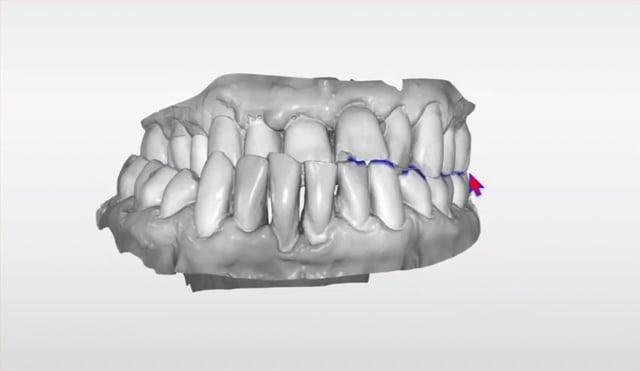
This is so often overlooked, but is one of the most beneficial benefits of this technology. You can image your new patients at your initial appointment. This takes probably 2 minutes an arch, but then you have a record of the patient and can sit then up and show then what you are seeing.
Sometimes I will use this simply to have a record and even show them in black and white. Its easier on the eye.
This will allow you to discuss
a.Periodontal issues (and have a visual record of recession and calculus accumulation).
b. Occlusal observations (from inside and out), bruxism, writing teeth , missing teeth.
c. Failing fillings. Combined with radiographs, and visual observations of marginal defects , cracks in enamel.
d. Potential treatment options in a way that a narrow would never allow.
This also allows you to do a “screen grab” and document your observations for notes, future reference and correspondence.”. This is such a powerful tool I cannot emphasis enough.
I often ask to patient to take photos or video of the screen while I talk and summarise their problems and possible solutions to take home and discuss with their partner. These images can also be used in further treatment.
The simple cases are so simple they become part of your normal protocols with ease. As you get more experienced you can be more ambitious.
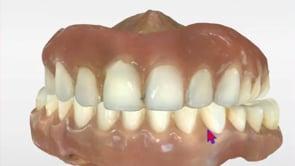
I enclose a presentation of the restoration of an upper arch, worn by years of bruxism. This is more challenging!
Full Dentures
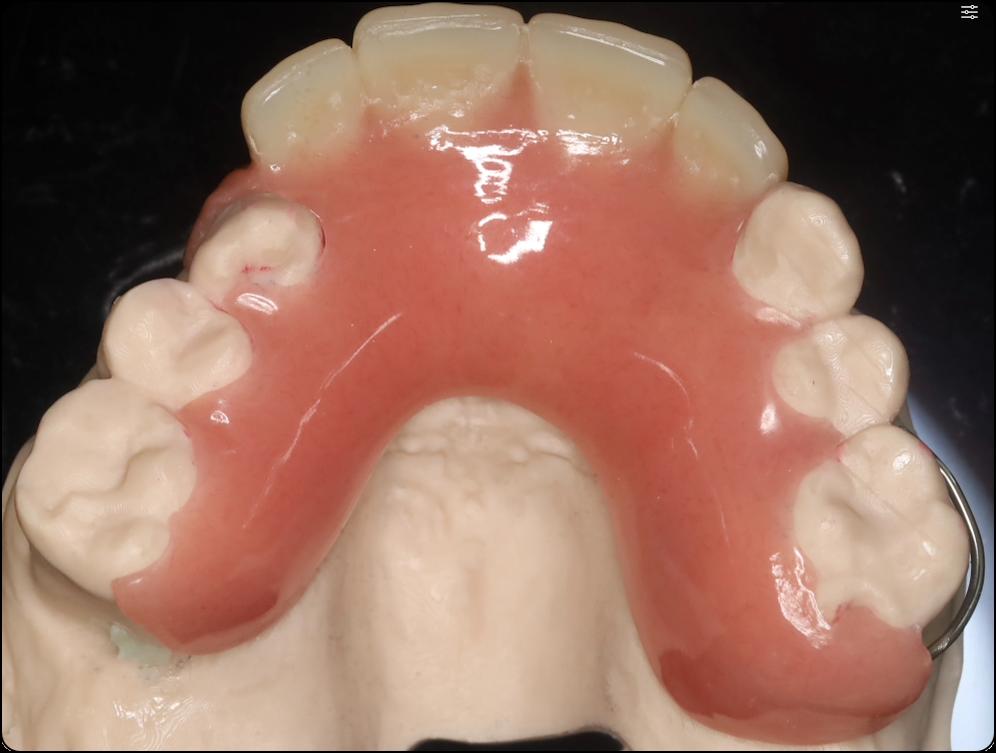
Dentures can now designed and printed completely from digital imaging. The materials and techniques have been improving dramatically for many years and are now really good.
On a simpler level I will often scan the existing denture ( takes 4 - 5 min ) and saved as an STL file for printing From this a “copy” of the old denture can be used as a special tray for green stick border holding and Kellys paste wash, with the dual function of a bite block for the second visit . This eliminates one stage, on visit of the denture fabrication. Nice
Inlays.
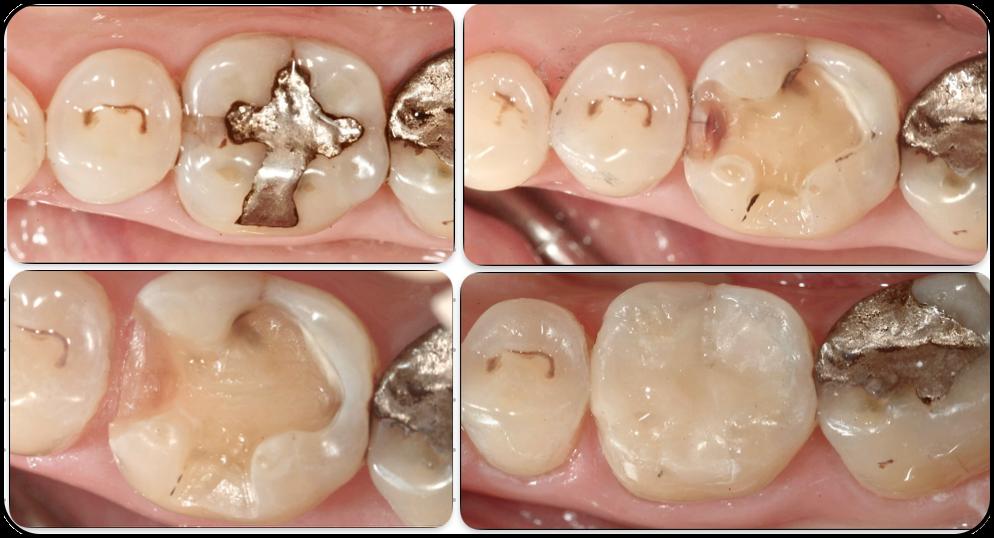
Replacement of failing fillings, amalgam or composite on posterior teeth. It is the bread and butter of many, representing a large part of general practice.
You can view you preparation in magnification. Each time you do this you learn and refine your technique from observing your own work in detail. A screenshot will record the depth of the cavity and remaining tooth structure. You can choose to copy or create the occlusion from your initial images ( Biocopy) and in-house mill eg an Enamic (Vita) is a hybrid ceramic, essentially a dual-network material where a fine-structure feldspathic ceramic is infused with a polymer (composite) network. You can choose your ideal contact points and achieve excellent aesthetics. I often describe this as “an internal crown” bonding the remaining walls and even providing cusp coverage.\
Advantages Over Composite Resin: While composite (filling material) is great for small cavities, Enamic inlays offer several "levelup" benefits for larger restorations:
• Superior Durability and Wear: Composite tends to wear down over time, especially if you have a heavy bite or grind your teeth. Enamic mimics the abrasion resistance of natural enamel. It won't "cup out" or flatten like a large composite filling often does.
• Reduced Polymerisation Shrinkage. When a dentist cures a composite filling with a light, the material shrinks slightly. This can create microscopic gaps at the edges (microleakage) leading to sensitivity or new decay. Enamic is milled from a solid, pre-cured block, meaning there is zero shrinkage once it's placed in your tooth.
• Better "Modulus of Elasticity”: This is a fancy way of saying it flexes like a real tooth.
• Pure Ceramic: Can be too stiff, potentially causing the remaining tooth structure to crack. Composite: Can be too soft.
• Enamic: Hits the sweet spot. It distributes the "load" of chewing more evenly, which protects the remaining natural walls of your tooth.
• Precision and Fit: Enamic inlays are created via CAD/CAM (digital scanning and milling), the fit is often much more precise than a hand-layered composite. The "contacts" (how the tooth touches its neighbour) are usually much tighter and more anatomical, meaning less food getting stuck between your teeth.
• Aesthetic Stability: Composite is porous and can stain over time from coffee, tea, or wine. Enamic is much more resistant to surface staining and maintains its polish and "shimmer" significantly longer
Restoration Type
Direct Composite
5-Year Success Rate
~85% to 90%
VITA Enamic Inlay 95% to 98%
10-Year Success Rate
~65% to 75%
~85% to 90% (estimated)
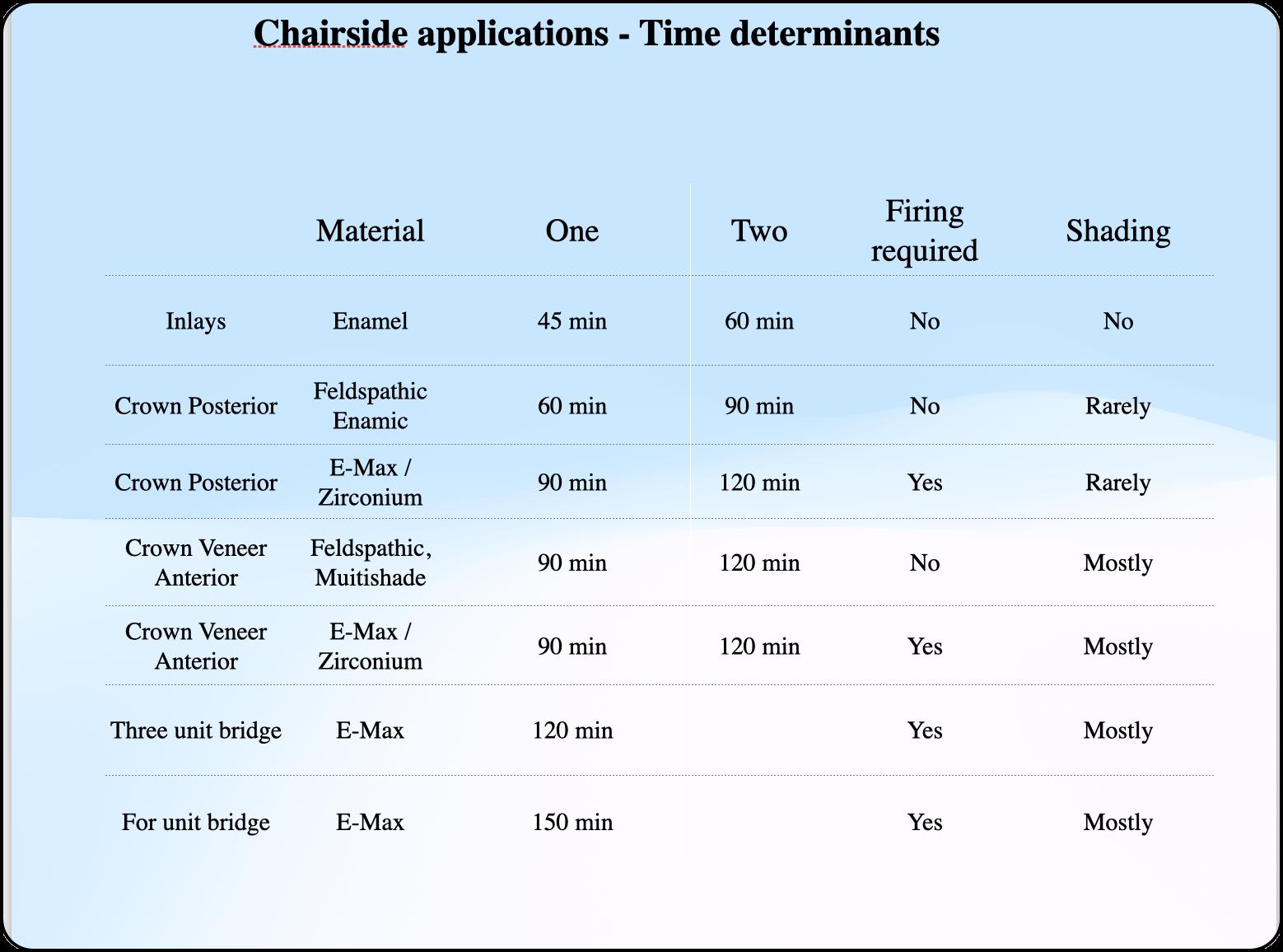
Typical costs in general practice would be 50 % of a crown. This single appointment might take you 60 minutes from start to finish, one aesthetic and no temporaries of second visit. Two inlays will typically take 90 minutes ( more efficient.)
If you are doing multiple restorations in one visit the software will automatically generate “mutual” contact points and paths of insertion.
Personally I recommend a cement like VisionLink. This is a new technique to learn, but the radiopacity of the cement is crystal clear and allows excellent monitoring over time.
Crowns and Veneers
Certainly you can taken the impression and send them to your technician. This will require two visits, local anaesthetics, appointment scheduling at reception, temporaries and postal costs. I put it to you that you can prep, design and mill and crown/ veneer and the joint appointment time ( eg 60 and 30 min for two visits ) will be the same as you will take to prep, design, mill, finish and fit in one visit.
You have design options for Biometric design, Biocopy (copying the occlusion and form of the tooth you started with), and even copying and reflecting the form of a contra-lateral tooth.
You can choose to work from wax up or “digital wax ups”
You can set the design and milling “parameters” to define tightness of contact points, marginal fit, cement spacing, porcelain thickness......
You also have multiple options of Enamic, Feldspathic, Lithium Dislocate, Zirconium, materials in high, in low, in medium or multiple translucencies and a full range of shades. You are in control.
With minimal training you can even easily learn to characterise (stain and glaze). Its really rewarding and the patient will be impressed.
The success rate of CEREC crowns is remarkably high, consistently matching or even exceeding those made in a traditional dental lab. Because "CEREC" is a technology (the machine) rather than a single material, the success rate depends on the type of block your dentist chooses (e.g., Zirconia, Lithium Disilicate, or Hybrid Ceramic like Enamic).
On average, CEREC restorations have a 95–98% survival rate at 5 years and approximately 90–95% at 10 years
Success Rate by Material Type
Not all CEREC blocks are created equal. Here is how the most common ones perform:
Back molars (extremely strong) Lithium Disilicate (e.max)
(Hybrid)
Feldspathic Ceramic
Front/side teeth (best aesthetics)
Implants/Sensitive teeth (flexibility)
Inlays and small onlays
For one crown you will may require 60 to 90 minutes depending on the material choice. For 2 crowns same visit you might choose from 90 to 120 minutes.
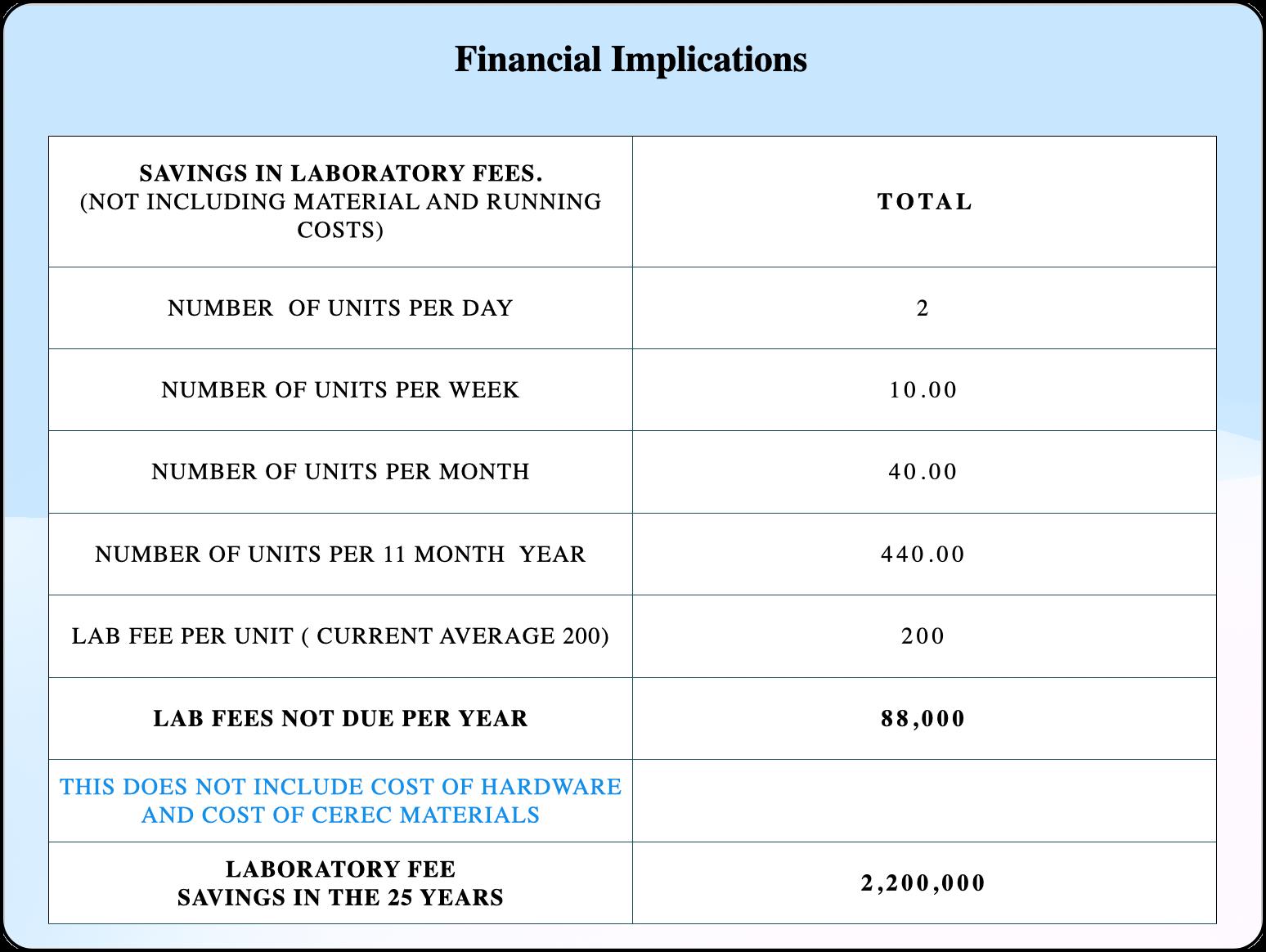
Material costs circa 30 - 40 euro per unit. Saving your lab fee - 30-40 per unit . No models, no impressions, no temporaries, no post, no second appoints with reduced inconvenience to the patient for travel, time off work, parking.
What’s not to like......
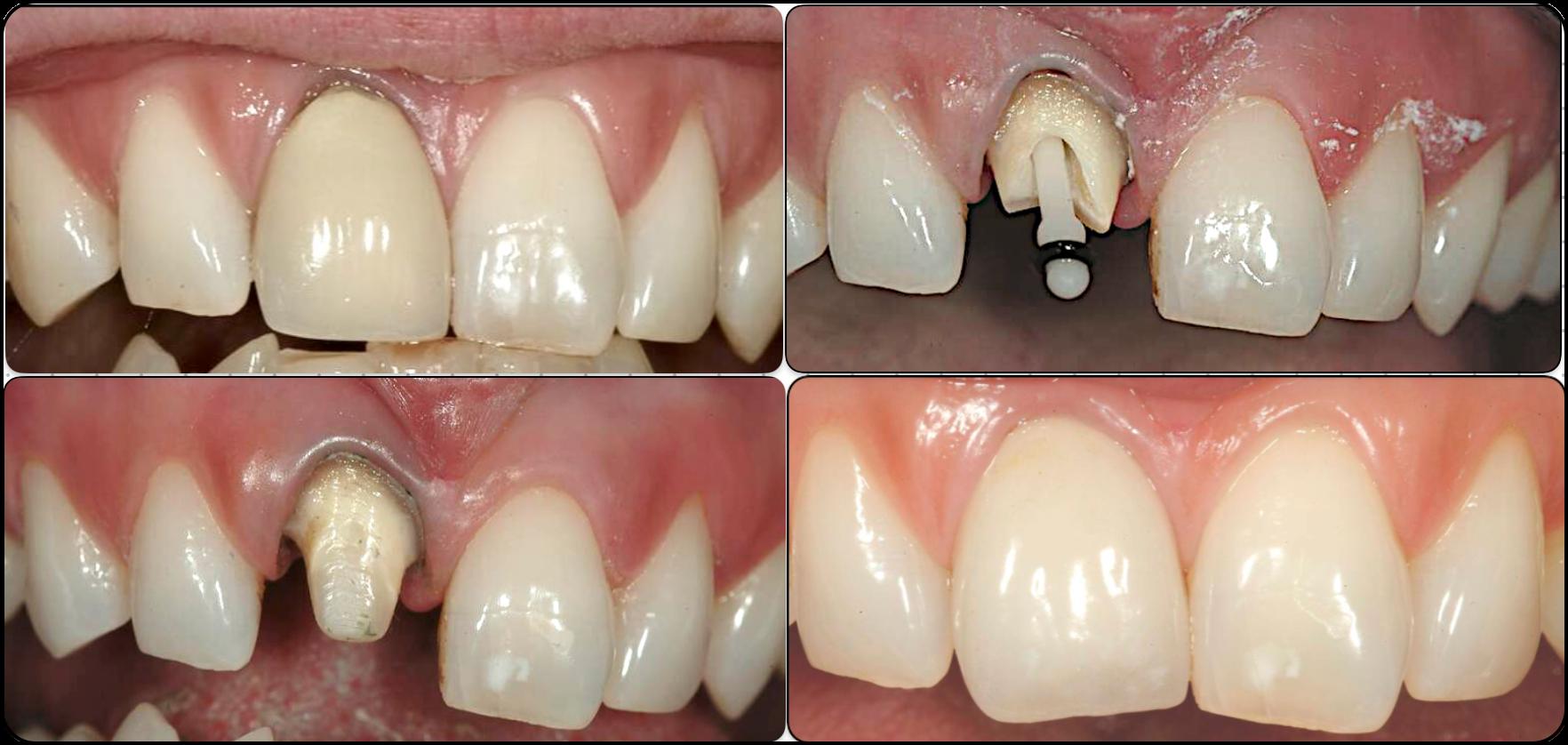
My first anterior Cerec Crown in 2002. Post and Core and Review 20 years later.
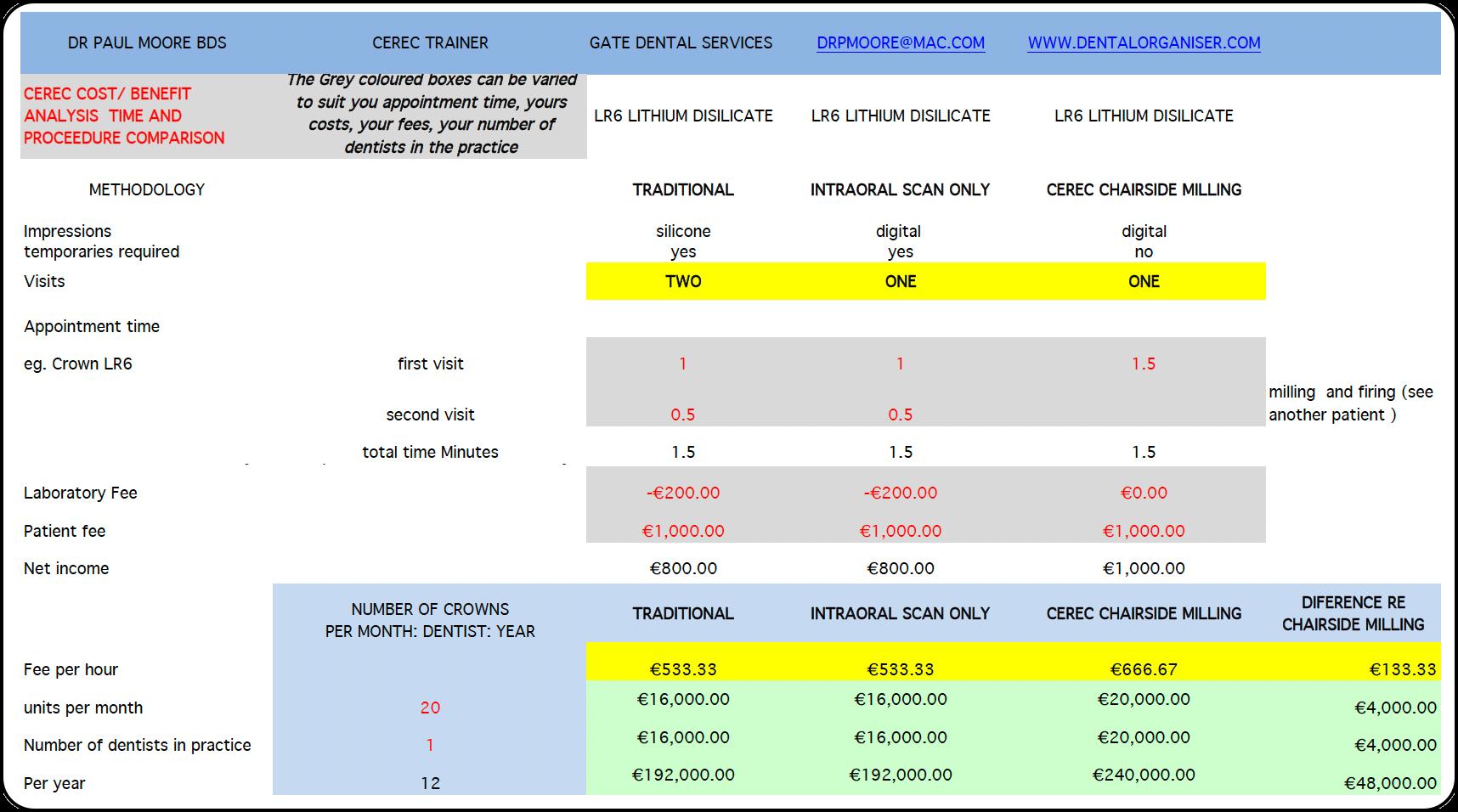
If you would like an inter-acticve spreadsheet to enter your own figures - Procedures- appointment times- patient fees- Laboratory costs- number of dentists in the practice....... And any other variables you wish- please do send me a message to drpmooore@mac.com and I will send you my spreadsheet. Here is an example to compare a single unit crown and evaluate the impact this alone would have in your practice. On the spreadsheet you can vary the figures in red.
Bridges
Two unit, three unit, four unit bridges, provisional printed or porcelain final. All are possible with cerec.
You can of course choose to delegate to your technician or design and mill these yourself. Maryland Bridges can be milled the same day as provisional or final.
Implant Restorations.
Single implants, Multiple implants, Full arch fixed implants or Bar retained removable implants.
The options here are myriad.
Planning you implants might involve requesting a prosthetic or surgical guide, combining CBCT technology and dedicated services such as your favourite technician, or external services such as Biomet Realguide or Atlantis to improve implant delivery and placement.
Restorations: You can choose to delegate these to your technician from imaging “scanposts”. For single implants you can use “Tibase” in metal or porcelain for in-house solutions. Implant solutions include printed placement joigs, Soft tissue implant models ( articluated ) Porcelain abutment, MTX abutments, Cementable abutment and crown. Printed provisionals and even printed customised healing caps Or you might “halfway- house” and send images to technical services to make customised abutments Titanium or Porcelain, ( eg Atlantis ) and design and mill the crowns in-house.
For multiple implant solutions do engage with your technicians
Printing Technology
Having a Digital Scanner also opens a new world of Digital Design and Printing Technology.
Digital printing in dentistry (also known as additive manufacturing) is the process of building dental appliances layer-by-layer from a liquid resin or powder, guided by a 3D digital file.
While milling (like CEREC) is subtractive—carving a tooth out of a solid block—3D printing is additive. This makes it significantly less wasteful and allows for much more complex, hollow, or "nested" geometries that a drill bit simply couldn't reach.
What Can Be Made?
In 2026, the range of 3D-printed dental applications has expanded from simple "prototypes" to high-strength, permanent restorations.
Orthodontics (The High-Volume Leader)
• Clear Aligner Models: This is the most common use. Dentists print "stages" of a patient's teeth to vacuum-form clear aligners (like Invisalign) over them.
• Direct-Printed Aligners: Emerging technology now allows for the aligner itself to be printed from a specialised "shapememory" resin, skipping the physical model step entirely.
• Retainers & Night Guards: Printed in durable, biocompatible clear resins that are often more comfortable and precise than traditional "boil and bite" or lab-poured versions.
Implantology (The "GPS" of Surgery)
• Surgical Guides: These are perhaps the most critical digital tools. They are custom-printed templates that fit over a patient's teeth during surgery, with holes that guide the dentist's drill at the exact angle and depth planned on the computer.
• Gingiva Masks: Soft, flexible 3D prints that mimic gum tissue on an implant model, helping the lab or dentist see how the final tooth will emerge from the gums.
Prosthodontics (Restorative Work)
• Digital Dentures: Dentists can now print both the pink "base" and the "teeth" of a denture. These are often stronger than traditional dentures because they are printed as a monolithic (single-piece) unit, meaning teeth can't "pop out."
• Temporary Crowns & Bridges: While milling is preferred for permanent ceramic crowns, 3D printing is much faster for "temporaries" (provisional restorations) that a patient wears while a permanent one is being made.
• Try-ins: For complex cosmetic cases, a dentist can print a "trial smile" in cheap resin. The patient wears it for a day to test the look and feel before committing to expensive porcelain.
• Implant surgical guides.
Advanced & Specialty Applications
• Bone Grafts & Scaffolds: In oral surgery, 3D printers can create bio-resorbable "scaffolds" tailored to a patient's jaw defect, which then encourage the body to regrow its own bone.
• Custom Impression Trays: If a patient has a highly unusual jaw shape, a custom tray can be printed in minutes to ensure a perfect physical mold if digital scanning isn't an option.
Mandibular Advancing Devices ( MAD), Sleep Apnoea and Snoring Solutions.
This has been a hugely satisfying and successful service to offer. That has improved exponentially over the years. Digital imaging can capture excellent details and protruded occlusions required for these. The new materials and technologies allow for the manufacture of devices that the patient can tolerate and work so well. The results can be so rewarding Professional Dental Labs (Dentist-Prescribed)
These are some of companies manufacturing custom-fit devices based on a digital scan They offer the highest success rates due to their precision fit.
• Panthera Dental (Canada): Specialised in 3D-printed medical-grade nylon. Their devices (Panthera Classic and X3) are among the smallest and strongest on the market because nylon can be printed in very thin, flexible layers that are almost impossible to break.
• Glidewell (USA): A leader in 3D-printed sleep tech. Their Silent Nite 3D is printed from a biocompatible light-cured resin, making it thinner and more comfortable than traditional versions. They also manufacture the flexTAP, which is often 3Dprinted in durable nylon.
• ProSomnus Sleep Technologies: Unlike others that print, ProSomnus uses robotics and AI-driven milling to carve their devices (like the ProSomnus EVO) from a solid block of medical-grade plastic. This makes them extremely hygienic and less likely to stain or harbour bacteria.
• SomnoMed: Known for the SomnoDent line. They have recently integrated "Rest Assure" technology, which includes builtin sensors to track how well the device is working while you sleep.
• ResMed: While famous for CPAP, their Narval CC is a widely prescribed 3D-printed CAD/CAM appliance known for its lightweight, "discreet" design.
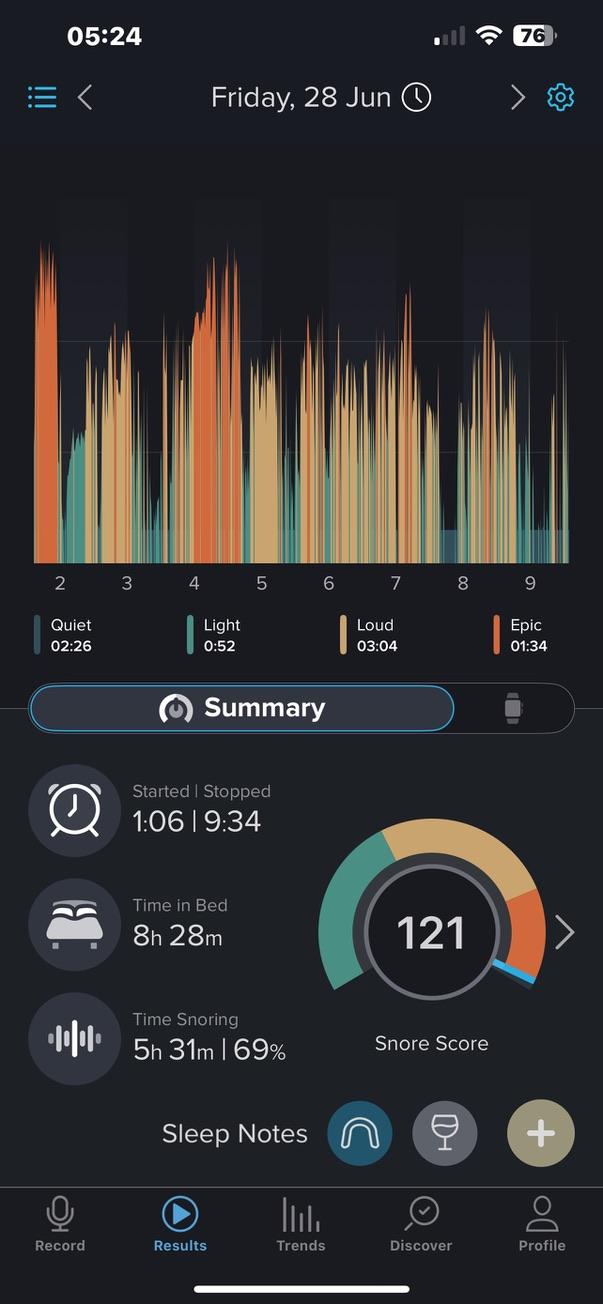
• These are the results before and after using the Panthera X3. Its comfortable and lightweight and can impressively improve the sleep and snoring patterns and reduce the reliance on “Sleep Apnoea” therapy for patients.
Cerec imaging technology, with add ons of Milling, Printing and CBCT opens up a wealth of options, understanding and communication.
One word of advice. Make it easy for yourself - after a single days training you should be able to start this journey with confidence to be able to Improve your communications a with patients, imaging designing and milling posterior crowns and inlays. How much you learn and how fast you learn it will depend on you. It is a lot to learn, but one step at a time.
So the question is not “ I don’t do enough crowns to warrant the investment.” It should be “Can I afford not to seize the opportunity.”