
J E SUS o F N A Z ARE T H.
JESU S OF NAZARETH .
Film script b Y
Film script * J
Car 1 T h D r eye r.
Car l I h Dreyer .
commentary: (1)
There was a man sent from GOD, whose name was John. He was not the Light, but was sent to bear witness of the Light, the true Light. It was in the World, but the World knew is not.
Commentary; There was a man sent from GOD, whose name was John. He was not the Light, but was sent to bear witness of the Light, the true Light. It was in the World, but the World knew is not.
It happened at the river Jordan. The one called the Baptist was bringing a man up out of the waters. The simple ceremony symbolized the washing away of his sins. The Baptist recited a short prayer as a disciple helped the man with his outer garment. A crowd, gathered on the shore, listened intently as John the Baptist addressed them. They were the common people, simple to1k, who had come to him with their needs. But among them were Pharisees and Sadducees, oome out from Jerusalem to hear this strange man and his powerful preaohing which had reached to the fartherest parts of the land. The movement whioh had sprung up and the numerous disciples, increasing daily, might become a matter of conoern to them.
It happened at the river Jordan. The one called the Baptist was bringing a man up out of the waters. The simple ceremony symbolized the washing away of his sins. The Baptist recited a short prayer as a disciple helped the man with his outer garment. A crowd, gathered on the shore, listened intently as John the Baptist addressed them. They were the common people, simple folk, who had come to him with their needs. But among them were Pharisees and Sadducees, come out from Jerusalem to hear this strange man and his powerful preaching which had reached to the fartherest parts of the land. The movement which had sprung up and the numerous disciples, increasing daily, might become a matter of concern to them.
Unknown among the people was Jesus. He was unknown, but he oould not long remain unnotioed. His bearing, his calm, peaceful spirit, hie face with its sensitive eyes would soon draw attention.
Unknown among the people was Jesus. He was unknown, but he could not long remain unnoticed. His bearing, his calm, peaceful spirit, his face with its sensitive eyes would soon draw attention.
John the Baptist, in the meantime, has climbed upon a large stone and begun to speak -
John the Baptist, in the meantime, has climbed upon a large stone and begun to speak -
John the Baptist: GOD has sent me that I should show you the way in which you will free yourselves so that no mortal will rule over you, only the Most High, who will deliver you and subject all things hostile to you but yourselves will be subject to none.
John the Baptist: GOD has sent me that I should show you the way in which you will free yourselves so that no mortal will rule over you, only the Most High, who will deliver you and subject all things hostile to you but yourselves will be subject to none.
A murmur of satisfaction ran through the crowd.
A murmur of satisfaction ran through the orowd.
John the Baptist: The Kingdom of GOD is near and the day of judgment is at hand. Therefore, repent you because the axe is laid unto the root of the trees. Every tree, therefore, which brings not forth good fruits is hewn down and cast into the fire.
John the Baptists The Kingdom of GOD is near and the day of judgment is at hand. Therefore, repent you because the axe is laid unto the root of the trees. Every tree, therefore, which brings not forth good fruits is hewn down and cast into the fire.
The People asked him saying -
The People asked him saying -
Voices:
What shall we do then?
Voices: What shall we do then?
John the Baptist: He that has two coats, let him impart to him that has none.
John the Baptist: He that has two coats, let him impart to him that has none.
Then came some publicans and said -
Then came some publicans and said -
Publicans: Master, what shall we do?
Publicans : Master, what shall we do?
John the Baptist: Exact no more than that which is appointed you.
John the Baptist; Exact no more than that which is appointed you.
And some soldiers likewise demanded of him, saying -
And some soldiers likewise demanded of him, saying -
Soldiers:
And what shall we do?
Soldiers: And what shall we do? -
John the Baptist: Do violence to no man, neither accuse any falsely, and be content with your wages.
John the Baptist: Do violence to no man, neither accuse any falsely, and be content with your wages.
The Pharisees and the Sadducees exchanged glances. It was time to ask the questions they had planned. One spoke up -
The Pharisees and the Sadducees exchanged glances. It was time to ask the questions they had planned. One spoke up -
1. Pharisee: Who are you?
1. Pharisee: Who are you?
John the Baptist: I am not the Messiah.
John the Baptist: I am not the Messiah.
2. Pharisee: What then? Are you Eliah?
2. Pharisee: What then? Are you Elian?
John the Baptist: I am not.
John the Baptist: I am not.
3. Pharisee: Are you that Prophet?
3. Pharisee: Are you that Prophet?
John the Baptist: No.
John the Baptist: No.
1. Sadduoee: Who are you?
1. Sadducee: Who are you?
That we may give an answer to them that sent us.
That we may give an answer to them that sent us.
What say you of yourself?
What say you of yourself?
2. Sadducee: Why baptize you, if you be not that Meesiah, nor Eliah, neither that
2. Sadducee: Why baptize you, if you be not that Messiah, nor E^iah, neither that Prophet?
John the Baptist: I baptize with water; but there stands one among you who ia coming after me. He shall baptize you with the Holy Ghost and wi th fire. Whose fan is in his hand, and he will thoroughly purge his floor, and will gather the wheat into his garner, but
John the Baptist: I baptize with water; but there stands one among you who is coming after me. He shall baptize you with the Holy Ghost and with fire. Whose fan is in his hand, and he will thoroughly purge his floor, and will gather the wheat into his garner; but
(3)
(3)
the chaff he will burn with fire unquenchable. This is he of whom I said: after me comes a man which is preferred before me: for he was before me.
the chaff he will burn with fire unquenchable. This is .he of whom I said: after me comes a man which is preferred before me: was before me.
With that John the Baptist turned and looked towards Jesus. His action caused the people to turn in the same direction. Then it was Jesus rose and left. Andrew and John, disciples of the Baptist, followed him, drawn by a power they felt but could not understand. The voice of the Prophet grew faint in their as he continued speaking to the people -
With that John the Baptist turned and looked towards Jesus. His action caused the people to turn in the same direction. Then it was Jesus rose and left. Andrew and John, disciples of the Baptist, followed him, drawn by a power they felt but could not understand. The voice of the Prophet grew faint in their ears as he continued speaking to the people -
John the Baptisti But he that comes after me is mightier than I, whose latchet of shoes I am not worthy to stoop down and unloose. He must increase, but 1^ must decrease. He Wa t comes from above is above all. He that is of earth is earthly. He that comes from Heaven is above all.
John the Baptists But he that after me 1s mightier than I, whose latchet of shoes I am not worthy to stoop down and unloose. He must increase, but I must decrease. He inat comes from above 1s above all. He that is of earth is earthly. He that comes from Heaven is above all.
During the closing words the Pharisees and the Sadducees left the crowd and went to their white mules standing contentedly under a tree. They discussed in a low voice all they had seen and heard.
During the closing words the Pharisees and the Sadducees left the crowd and went to their white mules standing contentedly under a tree. They discussed in a low voice all they had seen and heard. •
Jesus was walking along the shore of the sea of Genesareth. It was a lovely spot with the lake in the background and small boys romping in its waters, playing a game of seeing who could hold his head under water the longest. Andrew and John were behind Jesus. As he realized that someone was following him he turned and said -
Jesus was walking along the shore of the sea of Genesareth. It was a lovely spot with the lake in the background and small boys romping in its waters, playing a game of seeing who could hold his head under water the longest. Andrew and John were behind Jesus. As he realized that someone was following him he turned and said -
Jesus: What seek you?
Jesus s What seek you?
For a moment the two were at a loss for words. Finally Andrew said
For a moment the two were at a loss for words. Finally Andrew said -
Andrewt Rabbi, where dwell you?
Andrews Rabbi, where dwell you?
With a quiet smile Jesus gave them an invitation.
With a quiet smile Jesus gave them an invitation.
Jesus s Come and see.
And they went together.
Jesus: Come and see. And they went together.
The Pharisees and Sadducees astride their white mules and in animated conversation made their way homeward to Jerusalem,
The Pharisees and Sadducees astride their white mules and in animated conversation made their way homeward to Jerusalem.
Along the shore of the lake Jesus, Andrew and John came upon a boat beached in the sand. Nearby a fisherman was repairing his nets. His name was Philip. He looked up questioningly as the others approached. He had never seen Jesus before.
Along the shore of the lake Jesus, Andrew and John came upon a boat beached in the sand. Nearby a fisherman was repairing his nets* His name was Philip. He looked up questioningly as the others approached. He had never seen Jesus before.
John:
John:
We have found the Messiah.
We have found the Messiah.
Apparently Philip was not convinced. Jesus looked at him and Philip, as though drawn by some unseen power, rose to his feet. For a moment the two stood face to face, and Philip realized he had found his Master. It was then that Andrew spoke -
Apparently Philip was not convinced. Jesus looked at him and Philip, as though drawn by some unseen power, rose to his feet. For a moment the two stood face to face, and Philip realized he had found his Master. It was then that Andrew spoke -
Andrew: Go, and tell the good news to Nathanael.
Philip smiled in a strange manner, as he rushed away. Jesus looked after him with an approving glance.
Andrew: Go, and tell the good news to Nathanael. Philip smiled in a strange manner, as he rushed away. Jesus looked after him with an approving glanoe.
As Jesus and the other two continue on their way '. they see fishermen in their boats some distanoe from the shore. One, standing on the rim of the boat, oarries his fishing-net (a ciroular net, pointed at the top, the lower edge weighted with plumbs). Again and again the net is and each time it oomes to the surface without any fish. Noticing the three on the shore the fisherman shrugs his shoulders indicating his ill fortune. Jesus called out, saying -
As Jesus and the other two continue on their way they see fishermen in their boats some distance from the shore. One, standing on the rim of the boat, carries his fishing-net (a circular net, pointed at the top, the lower edge weighted with plumbs). Again and again the net is cast and each time it comes to the surface without any fish. Noticing the three men on the shore the fisherman shrugs his shoulders indicating his ill fortune. Jesus called out, saying -
Jesus:
Jesus:
Fisherman:
Children, have you caught nothing?
Fishermans No.
Children, have you caught nothing? No.
Jesus:
Jesus:
Cast the net on the right side of the ship and you shall find.
Cast the net on the right side of the ship and you shall find.
The one who has been standing in his boat did as directed and this time his net was so full of fishes he had to ask others to help him in drawing it up_ Andrew and John looked at Jesus in astonishment, but he merrily indicated that they were to move along. As they continue
The one who has been standing in his boat did as directed and this time his net was so full of fishes he had to ask others to help him in drawing it up. Andrew and John looked at Jesus in astonishment, but he merrily indicated that they were to move along. As they continue
(5)
their walk a peasant woman makes her way to the sea in order to wash her pots and dishes.
their walk a peasant woman makes her way to the sea in order to wash her pots and dishes. • • •
Philip found Nathanael sitting in the shade of a fig-tree. He could not be oertain whether he was reading the book of the Law or simply dreaming.
Philip found Nathanael sitting in the shade of a fig-tree. He could not be certain whether he was reading the book of the Law or simply dreaming.
Philips
Philips
Nathanael:
Nathanaelj
Philip:
Philips
Nathanaels
We have found him, of whom the Prophets did write.
We have found him, of whom the Prophets did write.
Who is he?
Who ishe?
Jesus ... (and after a pause) of Nazareth.
Nathanaels Of Nazareth? Can there any good thing come out of Nazareth?
Jesus ••• (and after a pause) of Nazareth. Of Nazareth? Can there any good thing come out of Nazareth?
Philip:
Philips
Come and see.
Gome andsee.
Nathanael got up with doubt written on his face and followed Philip.
Nathanael got up with doubt written on his face and followed Philip.
In the meantime Jesus and Andrew and John had come to a place on the shore where fishing-boats moored. Here they saw Andrew's brother Simon, called Peter, and John's brother Jacob cleaning their nets. Some small lads had built a fire the shore and frying fish.
In the meantime Jesus and Andrew and John had come to a place on the shore where fishing-boats were moored. Here they saw Andrew's brother Simon, called Peter, and John's brother Jacob cleaning their nets. Some small lads had built a fire on the shore and were frying fish.
Andrew called to his brother -
Andrew called to his brother -
Andrew:
Andrew:
We have found the Messiah.
We have found the Messiah, And he brought Peter to Jesus, who looked upon him.
And he brought Peter to Jesus, who looked upon him.
Jesus: You are Simon, the son of Jonah.
Jesus: You are Simon, the son of Jonah.
Peter looked up, surprised. How did this man know his name? He was ready to question his brother, but Andrew only shook his head in helpless fashion. At that moment Jesus turned to Peter and a bond was forged between them that was never to be broken.
Peter looked up, surprised. How did this man know his name? He was ready to question his brother, but Andrew only shook his head in helpless fashion. At that moment Jesus turned to Peter and a bond was forged between them that was never to be broken.
Then it was that Philip returned with Nathanael. When Jesus saw the latter, he said -
Then it was that Philip returned with Nathanael. When Jesus saw the latter, he said -
Jesus: Behold a Jew indeed, in whom is no guile.
Nathanael:
Jesus: Behold a Jew indeed, in whom is no guile, Nathanael: Whence know you me?
Jesusj
Whence know you me?
Jesus: Before Phi lip called you, I saw you under the fig-tree.
Before Philip called you, I saw you under the fig-tree.
Nathanaels doubt were rapidly "being dissolved. He realized that never before had he been in the presence of such a one. The words came slowly -
Nathanaels doubt were rapidly being dissolved. He realized that never before had he been in the presence of such a one. The words came slowly -
Nathanael:
NathanaelJ
Jesus:
Now I believe you are the Son of GOD.
Now I believe you are the Son of GOD.
You believe me because I said I saw you under a fig tree. You shall see greater things than those.
Jesus s You believe me because I said I saw you under a fig tree. You shall see greater things than those.
These first disciples listened wonderingly. It was clear to them all that Jesus was the Messiah. They were drawn to him, and in his hands they willingly placed their destiny.
These first disciples listened wonderingly. It was clear to them all that Jesus was the Messiah. They were drawn to him, and in his hands they willingly placed their destiny.
Jesus, who knew what was in their hearts, spoke to them -
Jesus, who knew what was in their hearts, spoke to them -
Jesus: Follow me, from henceforth you shall catch men.
Jesus: Follow me, from henceforth you shall catch men.
Eagerly they gathered about him, listening to his words. One of them asked him about John the Baptist -
Eagerly they gathered about him, listening to his words. One of them asked him about John the Baptist -
Jacob:
Jacob: Jesus: What manner of is that John the Baptist?
What manner of man is that John the Baptist?
He has borne witness of me and I know that witness is true. He is the burning and shining light. For I say unto you: among those that are born of women there is no greater Prophet than John the Baptist •••
Jesus: He has borne witness of me and I know that witness is true. He is the burning and shining light. For I say unto you: among those that are born of women there is no greater Prophet than John the Baptist ...
He pauses before continuing -
He pauses before continuing -
Jesus: ••• but he that is least in the Kingdom of God is greater than he.
Jesus: ... but he that is least in the Kingdom of God is greater than he.
Peter took salt from a bag and invited everyone to taste. Each of them took a pinch and put it into his mouth. A "salt-covenant" was sacred and everlasting.
Peter took salt from a bag and invited everyone to taste. Each of them took a pinch and put it into his mouth. A "salt-covenant" was sacred and everlasting.
Nathanael looked at the sky, pointing out a flock of cranes winging their way towards the North. The other men looked in the di-
Nathanael looked at the sky, pointing out a flock of cranes winging their way towards the North. The other men looked in the di-
rection he pointed and saw
rection he pointed and saw
•
the cranes (or storks) high in the sunshine, their white feathers like flakes of snow against the blue sky.
the cranes (or storks) high in the sunshine, their white feathers like flakes of snow against the blue sky. •
The sight of the cranes (or storks) dissolves softly into a down-angle shot of the lake with a great number of boats with their fluffy, snow-white sails. They are sailing Northward.
The sight of the cranes (or storks) dissolves softly into a down-angle shot of the lake with a great number of boats ith their fluffy, snow-white sails. They are sailing Northward. This scene again dissolves into
This scene again dissolves into
another flight of cranes (or storks) circling overhead as though seeking a place to settle. This scene softly dissolves into the next scene
another flight of cranes (or storks) circling overhead as though seeking a place to settle. This scene softly dissolves into the next scene
•
showing the boats which have crossed the sea and have gathered on the western side of the pier which is made of large boulders.
showing the boats which have crossed the sea and have gathered on the Western side of the pier which is made of large boulders.
During the scene-shifting is heard the following -
During the scene-shifting is heard the following -
commentary: Now, as Jesus walked by the sea of Galilee his fame went through all the region round about, and many came in boats from the towns all around the lake hear him preaching.
Commentary: Now, as Jesus walked by the sea of Galilee his fame went through all the region round about, and many came in boats from the towns all around the lake to hear him preaching.
Jesus was standing on the end of the pier with the disciples he had been recently gathering sitting about in comfortable positions. Ashore a group of Pharisees. And also some women and children. Before him many ships had gathered, their masts jutting up like a young forest. The ships were crowded with people, mostly men and boys, who listened with eager attention as Jesus spoke to them with a simplioity they could easily understand. They nodded approvingly from time to time as he drove home some point in hie teaching by describing a familiar scene taken from their daily life.
Jesus was standing on the end of the pier with the disciples he had been recently gathering sitting about in comfortable positions. Ashore a group of Pharisees. And also some women and children. Before him many ships had gathered, their masts jutting up like a young forest. The ships were crowded with people, mostly men and boys, who listened with eager attention as Jesus spoke to them with a simplicity they could easily understand. They nodded approvingly from time to time as he drove home some point in his teaching by describing a familiar scene taken from their daily life.
(8)
( 8)
Jesus: A voice:
Take heed what you hear. When you see a cloud rise out of the West, straightway you say, there comes a shower; and so it is. And when you see the south wind blow, you say, there will be heat, and it comes to pass. And when it is evening, you say, it will be fair weather, for the sky is red and lowering. You can discern the face of the sky and of the earth; but how is it that you do not discern this time? Yes, and why even of yourselves judge you not what is right. The time is fulfilled and the Kingdom of God is at hand.
Jesus: Take heed what you hear. When you see a cloud rise out of the West, straightway you say, there comes a shower; and so it is. And when you see the south wind blow, you say, there will be heat, and it comes to pass, And when it is evening, you say, it will be fair weather, for the sky is red and lowering. You can discern the face of the sky and of the earth; but how is it that you do not discern this time? Yes, and why even of yourselves judge you not what is right. The time is fulfilled and the Kingdom of God is at hand.
A voices
Jesus:
Jesus:
What is the Kingdom of God?
What is the Kingdom of God?
Whereunto shall I liken the Kingdom of God?
Whereunto shall I liken the Kingdom of God?
Jesus looks his shoulder, and in a following shot we see the boats on the west side of the pier and the shore the east side. There a group of fishermen are drawing a net to land. The noise of this scene, which until has been subdued, rises somewhat but remains soft enough for the voice of Jesus to be heard distinctly.
Jesus looks over his shoulder, and in a following shot we see the boats on the west side of the pier and the shore on the east side. There a group of fishermen are drawing a net to land. The noise of this scene, which until now has been subdued, rises somewhat but remains soft enough for the voice of Jesus to be heard distinctly.
Jesus:
Jesuss
The Kingdom of Heaven is like unto this net that was cast into the sea, and gathered of every kind: which, when it was full, they drew to the shore, and sat down, and gathered the good in vessels, but cast the bad away. So shall it be at the end of the world. The Angels shall come forth, and sever the wicked from among the just. Therefore, repent you, believe the Gospel.
The Kingdom of Heaven is like unto this net that was cast into the s ea, and gathered of every kinds which, when it was full, they drew to the shore, and sat down, and gathered the good in vessels, but the bad away. So shall it be at the end of the world. The Angels shall come forth, and the wicked from among the just. Therefore, repent you, believe the Gospel.
While Jesus is speaking his words are being illustrated by the fisherman and their catch.
While Jesus is speaking his words are being illustrated the fisherman and their catch.
The net used by the fishermen is a dragnet which is capable of catching all kinds of fish. It is quite long and is placed in position not far from the shore, being held upright by heavy stones. The boats are placed at each end so that the upper edge of the net forms a semi-circle. The fish are driven into the net by beating the water with long rods. At the right some of the fishermen,
The net used by the fishermen is a dragnet which is capable of catching all kinds of fish. It is quite long and is placed in position not far from the shore, being held upright by heavy stones. The boats are placed at each end so that the upper edge of the net forms a semi-circle. The fish are driven into the net by beating the water with long rods. At the right moment some of the fishermen,
practically naked, leap into the water, pull the net and carry it to the shore.
practically naked, leap into the water, pull the net and carry it to the shore.
The bottom of the lake being covered with sharp stones there is much confusion and shouting as the net is dragged to land.
The bottom of the lake being covered with sharp stones there is much confusion and shouting as the net is dragged to land.
Once ashore the fish are immediately sorted out. Those considered unfit are thrown back into the sea while the others are collected in vessels and baskets. The Jewish law only permitted the eating of fishes which had fins. Skin fished such as eels were not considered fit for human consumption.
Once ashore the fisb are immediately sorted out. Those considered unfit are thrown back into the sea while the others are collected in vessels and baskets. The Jewish law only permitted the eating of fishes which had fins. Skin fished such as eels were not considered fit for human consumption.
While the fish are being sorted some of the older fishermen, likely the owners of the net, overhaul it to make certain it has not been damaged.
While the fish are being sorted some of the older fishermen, likely the owners of the net, overhaul it to make certain it has not been damaged.
Some boys gathered about the fishermen at their task and are given those fish too small to be sold at the market. The boys tie their fish into bunches. It was from a boy such as these that the disciples bought the "two small fishes and the five loaves*.
Some boys gathered about the fishermen at their task and are given those fish too small to be sold at the market. The boys tie their fish into bunches. It was from a boy such as these that the disciples bought the "two small fishes and the five loaves·.
The last scene of this sequence is a close-up of the fish, showing the men's hands as they are sorting the good and "casting the bad away".
The last scene of this sequence is a close-up of the fish, showing the men's hands as they are sorting the good and ·casting the bad away·.'
The close-up of the fish dissolves softly into the next Bcene.
The close-up of the fish dissolves softly into the next scene.
The next scene shows the overseer of the Synagogue, blowing his horn to announce that the Sabbath has come. This scene again dissolves softly into the next which is a close-up of the catch of fish, showing the good and bad together. This scene again dissolves softly into
The next scene shows the overseer of the Synagogue, blowing his horn to announce that the Sabbath has come. This scene again dissolves softly into the next scene which is a close-up of the catch of fish, showing the good and bad together. This scene again dissolves softly into
(10)
a new scene showing the exterior of the Synagogue, Two shepherds dressed in cloaks of sheep-skin arrive - a little late - in the Synagogue.
a new scene showing the exterior of the Synagogue. Two shepherds dressed in cloaks of sheep-skin arrive -a little late - in the Synagogue.
During the scene-shifting is heard the following -
During the scene-shifting is heard the followingcommentary: And Jesus went about all Galilee and he taught on Sabbaths in their Synagogues - being glorified of all.
Commentary: And Jesus went about all Galilee and he taught on Sabbaths in their Synagogues - being glorified of all.
The two shepherds tether their flock of sheep and goats at a tree. The sheep are white and the goats are black. (Even to-day one can see the sheep and goats mixed. It was because of this custom that Jesus spoke of "the shepherd dividing his sheep from the goats.") The shepherds hastened into the entrance hall of the There in the center was the basin for washing the hands before entering the service. When the shepherds entered the door of the Synagogue proper the voice of Jesus could be heard reading selected verses from one of the prophets (and its targum after each three verses). The men had difficulty finding seats, ae the service was crowded, but at last they succeeded.
The two shepherds tether their flock of sheep and goats at a tree. The sheep are white and the goats are black. (Even to-day one can see the sheep and goats mixed. It was because of this custom that Jesus spoke of "the shepherd dividing his sheep from the goats.") The shepherds hastened into the entrance hall of the Synagogue. There in the center was the basin for washing the hands before entering the service. When the shepherds entered the door of the Synagogue proper the voice of Jesus could be heard reading selected verses from one of the prophets (and its targum after each three verses). The men had difficulty finding seats, as the service was crowded, but at last they succeeded.
All the time the voice of Jesus can be heard and ae he speaks the camera moves through the listening crowd in the three-aisled room, toward the south wall where the table with the scrolls is to be found.
Before the table with the scrolls is a platform with and armchair. When Jesus comes into view he is still standing at the desk but has just finished his reading. He hands the scroll to the who rolls it up and carries it to the table with the scrolls. Jesus hae seated himself in the armchair and - while still seated, which was the common practice - he begins preaching, basing his the verses he has read.
All the time the voice of Jesus can be heard and as he speaks the camera moves through the listening crowd in the three-aisled room, toward the south wall where the table with the scrolls is to be found. Before the table with the scrolls is a platform with reading-rstand and armchair. When Jesus comes into view he is still standing at the desk but has just finished his reading. He hands the scroll to the overseer who rolls it up and carries it to the table with the scrolls. Jesus has seated himself in the armchair and - while still seated, which was the common practice - he begins preaching, basing his sermon on the verses he has read.
Jesus:
Jesus; You have heard that it was said by them of old time: you shall not kill« And whomsoever shall kill shall be in danger of the judgment. Therefore, if you bring your gift to the altar, and there remember that your brother has ought against you* leave there your gift before the altar, and go your way? first be reconciled to your brother and then come and offer your gift. You have also heard it was said by them of old time, you shall not commit adultery. But I say unto you, that whosoever looks on a woman to lust after has committed adultery with her already in his heart. Again, you have heard that it has been said by them of old time, you shall not foreswear yourself, but shall perform unto the Lord your oaths. But I say unto you, swear not at all. Let your communication be, Yea, Yea* Nay, Hay* for whatsoever is more than these comes of evil.
You have heard that it was said by them of old time: you shall not kill. And whomsoever shall kill shall be in danger of the judgment. Therefore, if you bring your gift to the altar, and there remember that your brother has ought against you; leave there your gift before the altar, and go your way, first be reconciled to your brother and then come and offer your gift. You have also heard it was said by them of old time, you shall not commit adultery. But I say unto you, that whosoever looks on a woman to lust after has committed adultery with her already in his heart. Again, you have heard that it has been said by them of old time, you shall not foreswear yourself, but shall perform unto the Lord your oaths. But I say unto you, swear not at all. Let your communication be, Yea, Yea; Nay, ay; for whatsoever is more than these comes of evil.
As Jesus preaches the faces of the congregation are studied. The aged with flowing white beards are seen and beside them small boys. There are the rich and the poor and also the women. And three revolutionaries. All are astonished at the doctrine of Jesus, for he taught them as one that had authority, and not as the scribes. And they questioned among themselves, saying: "What thing is this? A ne doctrine?"
As Jesus preaches the faces of the congregation are studied. The aged with flowing white beards are seen and beside them small boys. There are the rich and the poor and also the women. And three revolutionaries. All are astonished at the doctrine of Jesus, for he taught them as one that had authority, and not as the scribes. And they questioned among themselves, sayings "What thing is this? A new doctrine?"
Between the table with the scrolls and the platform from which Jesus is preaching are the Pharisees, sitting facing the congregation. They are listening with sympathy and they seem to take interest in the interpretation of the preacher, even though their faces disclose from time to time that they are not entirely one with him.
Between the table with the scrolls and the platform which Jesus is preaching are the Pharisees, sitting facing the congregation. They are listening with sympathy and they seem to take interest in the interpretation of the preacher, even though their faces disclose from time to time that they are not entirely one with him.
In the obscurity of its side-aisle, is a man known to all the town. He was thought to be possessed of an evil spirit and his frequent fits of rage lent credence to the view. In fact, however, he was suffering from a mental disease which caused him at times to become hysterical. The following scene depicts the duality of mind which characterizes those afflicted in such fashion. On the one hand
In the obscurity of its side-aisle, is a man known to all the town. He was thought to be possessed of an evil spirit and his frequent fits of rage lent credence to the view. In fact, however, he was suffering from a mental disease which caused him at times to become hysterical. The following scene depicts the duality of mind which characterizes those afflicted in such fashion. On the one hand
he is attracted by Jesus and wishes to be healed. On the other he is repelled and wants nothing to do with Jesus. The religious excitement is only the incidental cause of his raging outbreak.
he is attracted by Jeaus and wishes to be healed. On the other he is repelled and wants nothing to do with Jesus. The religious excitement is only the incidental cause of his raging outbreak.
Even though held by the preaching of Jesus he is disturbed by a feeling of unrest. Several times he looks toward the door, as though he would like to leave. Perhaps he feared that a spell would seize him. But the large audience makes it difficult for him to get out without great confusion. His anxiety increases until he can control himself no longer and he leaps to his feet, his eyes flaming with excitement as he shouts -
Even though held by the preaching of Jesus he is disturbed by a feeling of unrest. Several times he looks toward the door, as though he would like to leave. Perhaps he feared that a spell would seize him. But the large audience makes it difficult for him to get out without great confusion. His anxiety increases until he can control himself no longer and he leaps to his feet, his eyes flaming with excitement as he shouts -
The hysterical: Let us alone; what have we to do with youyou Jesus of Nazareth? Are you come to destroy us? I know who you are •••
The hysterical: Let us alone; what have we to do with youyou Jesus of Nazareth? Are you come to destroy us? I know who you are ...
He beats the air violently. Those sitting nearby draw away from him as he repeats himself again and again:
He beats the air violently. Those sitting nearby draw away from him as he repeats himself again and again:
The hysterical: I know who you are ...
The hysterical: I know who are • • •
His talk becomes incoherent and then he starts screaming. He is seized with a cramp and falls heavily to the floor. His lips covered with foam and his face distorted, he screams out time and again. He keeps his arms on his back. His hands look stunted and his fingers crooked like claws. This too is typical of those afflicted in this fashion.
His talk becomes incoherent and then he starts screaming. He is seized with a cramp and falls heavily to the floor. His lips covered with foam and his face distorted, he screams out time and again. He keeps his arms on his back. His hands look stunted and hie fingers crooked like claws. This too is typical of those afflicted in this fashion.
Jesus stops and steps down from the platform. Quietly he adtoward the wretched creature as the crowd makes way for him. When he reaches the afflicted one he bends over him only to have the man creep fearfully toward the wall where he hides his face behind his arms and shouts:
Jesus stops and steps down from the platform. Quietly he advances toward the wretched creature as the crowd makes way for him. When he reaches the afflicted one he bends over him only to have the man creep fearfully toward the wall where he hides his face behind his arms and shouts:
The hysterical: What have we to do with you, Jesusyou SON of GOD.
The hysterical: What have we to do with you, Jesusyou SON of GOD.
Jesus steps forward, seizing him with a firm grasp and speaking in a commanding voice -
Jesus steps forward, seizing him with a firm grasp and speaking in a commanding voice -
Jesus:
Hold your peace, and come out of him.
Jesus: Hold your peace, and come out of him.
But the sick man "breaks free and with his face still distorted continues to shout -
But the sick man breaks free and with his face still distorted continues to shout -
The hysterical: You SON ot GOD ••• SON of GOD.
The hysterical: You SON of GOD ... SON of GOD.
He tries to spit but the saliva can get no farther than the corners of his mouth. All at once his eyes meet those of Jesus and he becomes quiet. With the back of his hand he wipes his and then groans with a feeling of release. He looks with surprise at the people gathered about him. His head is clear now and the spell is past. More, he realizes that Jesus has healed him of his infirmity. At that moment the priest can be heard pronouncing the Aaronamic benediction. Everyone faces the South-wall and listens devoutly.
After each verse the people respond with: Amen. Jesus and the man he has cured are standing side by side.
He tries to spit hut the saliva can get no farther than the corners of his mouth. All at once his eyes meet those of Jesus and he becomes quiet. With the back of his hand he wipes his chin and then groans with a feeling of release. He looks with surprise at the people gathered about him. His head is clear now and the spell is past. More, he realizes that Jesus has healed him of his infirmity. At that moment the priest can be heard pronouncing the Aaronamic benediction. Every one faces the South-wall and listens devoutly. After each verse the people respond with: Amen. Jesus and the man he has cured are standing side by side.
After the benediction is pronounced Peter indicates to Jesus that he will go ahead to his house and wait for him there. He hurries away.
After the benediction is pronounced Peter indicates to Jesus that he will go ahead to hie house and wait for him there. He hurries away.
Meanwhile the ranks of the Synagogue, with some of the Pharisees, come up to Jesus. They look with curiosity upon the man once so afflicted and now healed. He is surrounded by people who are amazed and who say among themselves: "What word is this? For with what power he commands the unclean spirits, and they do obey him?"
Meanwhile the ranks of the Synagogue, with some of the Pharisees, come up to Jesus. They look with ouriosity upon the man once so afflicted and now healed. He is surrounded by people who are amazed and who say among themselves: "What word is this? For with what power he commands the unclean spirits, and they do obey him?"
Jeaus takes advantage of the confusion and, together with hie disciples, slips away by a back door.
Jesus takes advantage of the confusion and, together with his disciples, slips away by a back door.
Peter has hurried away from the Synagogue because his wife's mother is lying sick at home.
Peter has hurried away from the Synagogue because his wife's mother is lying sick at home.
He reaches his place where he lives with his wife, her mother, and his brother, Andrew. The house must have been a large one. On the doorpost is fastened the "Mezuzah". As a devout Jew Peter touches the "Bdezuzah" and then kisses the fingertips which have touched the sacred object.
He reaches his place where he lives with hie wife, her mother, and his brother, Andrew. The have a large On the doorpost is fastened the wMezuzah w• As a devout Jew Peter touches the "Mezuzah" and then kisses the fingertips which have touched the sacred object.
Peter walks on tip-toes when he enters the room where his mother-in-law is lying ill . His wife is watching at her bed-side. One look at his wife is enough to tell him that there is no change for the better.
Peter walks on tip-toes when he enters the room where his mother-in-law is lying ill. His wife is watching at her bed-side. One look at his wife is enough to tell him that there is no change for the better.
(The mother-in-law is ill with -the great fever w• The Greek Physicians distinguished between the wgreat fever" and the wsmall fever". The first was accompanied by transitory delirious fanoies like those which can be with in cases of hysterics. Physicians of to-day speak of Wpsychic fever.")
(The mother-in-law is il l with "the great fever". The Greek Physicians distinguished between the "great fever" and the "small fever". The first was accompanied by transitory delirious fancies like those which can be met with in cases of hysterics. Physicians of to-day speak of "psychic fever.")
Anxiously Peter looks at his mother-in-law. The glow of the fever is in her cheeks and her lips are dry. She tosses restlessly in her bed talking in her delirium about a fish that is going to eat a sheep.
Anxiously Peter looks at his mother-in-law. The glow of the fever is in her oheeks and her lips are dry. She tosses restlessly in her bed talking in her delirium about a fish that is going to eat a sheep.
Mother-in-law:
Mother-in-law: Look, look ••• the fish ••• the fish and the sheep ••• the fish is eating the sheep •• no, no ••• that mustn't be ••• save it ••• save it •••
Look, look ... the fish ... the fish and the sheep ... the fish is eating the sheep .. no, no ... that mustn't be ... save it ... save it .,.
Peter arouses her from her delirium. She looks about in bewildered
Peter arouses her from her delirium. She looks about in bewildered
fashion. She fixes a feverish glance upon Peter's face and then overcome with the augue she falls back upon the bed, groaning and despairing of her condition. Tears crowd the eyes of Peter's wife. He tries to console her.
fashion. She fixes a feverish glance upon Peter's face and then overwith the augue she falls back upon the bed, groaning and despairing of her condition. Tears crowd the eyes of Peter's wife. He tries to console her.
Peter: Jesus will be here soon; he will make her whole •••
Peters Jesus will be here soon: he will make her whole ...
But her weeping continues. Trying to encourage her Peter tells of the miraculous cure Jesus has just made in the Synagogue.
But her weeping continues. Trying to encourage her Peter tells of the miraculous cure Jesus has just made in the Synagogue.
Peter:
Peter: He has just cured a man of an evil spirit. You know Zadok, the demoniac? Well, he commanded the unclean spirit to come out of him •••
He has just cured a man of an evil spirit. You know Zadok, the demoniac? Well, he commanded the unclean spirit to come out of him ...
His wife is listening now. She looks at her husband through her tears and asks -
His wife is listening now. She looks at her husband through her tears and asks -
The wife:
The wife: And did he not hurt him?
Peters No.
Peters And did he not hurt No.
His wife takes courage.
His wife takes courage.
Peters I'll go and meet him.
Peters I'll go and meet him.
He leaves the room, his mother-in-law alternately groaning and babbling incoherently in her delirium.
He leaves the room, his mother-in-law alternately groaning and babbling incoherently in her delirium.
Outside. Jesus and his disciples arrive as Peter is coming out of the house. The latter approaches Jesus and explains the situation.
Outside. Jesus and his disciples arrive as Peter is coming out of the house. The latter approaches Jesus and explains the situation.
Peters
Peters
My wife's mother is sick, Master. I know that if you will you oan make her whole •••
My wife's mother is sick, Master. I know that if you will you can make her whole ...
Jesus puts his arm around him to comfort him.
Jesus puts his arm around him to comfort him.
Jesus: Where is she?
Jesuss Where is she?
(16)
Peter and Jesus enter the house, but not before Jesus has touched the "Mezuzah" because he too is a devout Jew.
Peter and Jeaus enter the house, but not before Jesus has touched the "Mezuzah" because he t .oo is a devout Jew.
The room with the sick patient. Jesus and Peter enter. Peter1 s wife is about to leave, but Jesus motions to her to stay.
The room with the sick patient. Jesus and Peter enter. Peter's wife is about to leave, but Jesus motions to her to stay.
The ill woman is still moaning in her delirium.
The ill woman is still moaning in her delirium.
Jesus looks at her quietly and then goes to the head of the bed. Peter lends a hand and they lift the patient to an upright position.
Jesus looks at her quietly and then goes to the head of the bed. Peter lends a hand and they lift the patient to an upright position.
Jesus sits beside her while Peter and his wife see that she does not fall back upon the bed. It is obvious that the ill woman is suffering considerably. Her eyes have a glazed look and her throat is parched with thirst. The daughter gives her a drink of water.
Jesus sits beside her while Peter and his wife see that she does not fall back upon the bed. It is obvious that the ill woman is suffering considerably. Her eyes have a glazed look and her throat is parched with thirst. The daughter gives her a drink of water.
Jesus takes her hand and succeeds in attracting and holding her attention. Peter bends over her and begins speaking to her in a low earnest voice.
Jesus takes her hand and succeeds in attracting and holding her attention. Peter bends over her and begins speaking to her in a low earnest voice.
Peter:
Peter: Fear not...believe only...and you*11 be made whole...fear not...only believe...you111 be whole...have faith...believe...fear not... you will be whole...
Fear not ••• believe only ••• and you'll be made whole ••• fear not ••• only believe ••• you'll be whole ••• have faith ••• believe ••• fear not ••• you will be whole •••
Soon a change is noticed in the woman's condition. She breaks out with a heavy perspiration and beads of sweat begin to run down her forehead and cheeks. Confidently she fixes her eyes upon Jesus.
Some strange healing power has passed from Jesus to the patient.
Peter's wife wipes her mother's face several times with a napkin.
Soon a change is noticed in the woman*s condition. She breaks out with a heavy perspiration and beads of sweat begin to run down her forehead and cheeks. Confidently she fixes her eyes upon Jesus. Some strange healing power has passed from Jesus to the patient. Peter*s wife wipes her mother*s face several times with a napkin.
Finally the gasping stopped and the ill person was breathing normally. She closed her eyes and Jesus signalled to Peter and his wife to lay her down in the bed that she might be able to rest. Almost instantly she fell into a deep sleep.
Finally the gasping stopped and the ill person was breathing normally. She closed her eyes and Jesus signalled to Peter and his wife to lay her down in the bed that she might be able to rest. Almost instantly she fell into a deep sleep.
(17)
Peter's wife looks at Jesus gratefully and then leaves the room to make preparations for the evening meal. Jesus and Peter soon follow her. After they leave the room the mother-in-law suddenly awakes as from a long refreshing sleep. Feeling rested she gets out of bed, dresses quickly and goes to her daughter, who scarcely knows what to make of this rapid recovery of her mother. A neighbor, who has dropped in to inquire about the patient, is startled and hurries away to spread abroad the news.
Peter's wife looks at Jesus gratefully and then leaves the room to make preparations for the evening meal. Jesus and Peter soon follow her. After they leave the room the mother-in-law suddenly awakes as from a long refreshing sleep. Feeling rested she gets out of bed, dresses quickly and goes to her daughter, who scarcely knows what to make of this rapid recovery of her mother. A neighbor, who has dropped in to inquire about the patient, is startled and hurries away to spread abroad the news.
Peter's mother-in-law returned to her household duties and almost before the others realized it she was once again in full command of her home. Taking a tray of bread from her daughter's hands she carried it herself into the room where Jesus and his disciples were awaiting their supper. A wine cup was on the table because it was customary to serve wine on Saturday evening. The men rejoice at the sight of the mother-in-law but she gives all credit and praise to Jesus for his miraculous cure.
Peter's mother-in-law returned to her household duties and almost before the others realized it she was once again in full command of her home. Taking a tray of bread from her daughter's hands she carried it herself into the room where Jesus and his disciples were awaiting their supper. A wine cup was on the table because it was customary to serve wine on Saturday evening. The rejoice at the sight of the mother-in-law but she gives all credit and praise to Jesus for his miraculous cure.
Suddenly the Bound of the horn from the Synagogue is heard, marking the end of the Sabbath day. Everyone arises, wine is poured into the cup, and Peter, head of the home, pronounces the benediction.
Suddenly the sound of the horn from the Synagogue is heard, marking the end of the Sabbath day. Every one arises, wine is poured into the cup, and Peter, head of the home, pronounces the benediction.
After this supper is served and since it was customary to eat with the fingers they first had to be washed. Therefore Peter's wife brought a basin and water-jug and begins to pour water on the hands of the guests.
After this supper is served and since it was customary to eat with the fingers they first had to be washed. Therefore Peter's wife brought a basin and water-jug and begins to pour water on the hands of the guests.
Related scenes show the neighbors spreading the news of the miraculous cure. Other neighbors come to the door to look at the motherin-law and to see Jesus. "Is he staying overnight?" they ask. And they wonder if he is going to deliver another sermon that evening.
Related scenes show the neighbors spreading the news of the miraculous cure. Other neighbors come to the door to look at the motherin-law and to see Jesus. "Is he staying overnight?" they ask. And they wonder if he is going to deliver another sermon that evening.
Finally Peter persuades them to leave and he shuts and bars the door in order to make certain that Jesus and the disciples will not be disturbed again that night.
Finally Peter persuades them to leave and he shuts and bars the door in order to make certain that Jesus and the disciples will not be disturbed again that night.
The news about Peter»s mother-in-law spreads rapidly through the town. When the Sabbath is past people crowd to the house of Peter, some wanting to hear another sermon, others carrying with them sick relatives they hope Jesus will heal. They come from all directions and each one has some particular need. A blind man is led by his daughter; a lame man is leaning upon the shoulders of two brothers; one man walks with the aid of sticks and another with crutches. A young mother brings her sick baby and a young girl her grandmother who has to stop at almost every step because of fits of coughing. A father and mother forcibly bring their imbecile daughter hoping that Jesus will drive the evil spirit out of their daughter as he did with the man in the Synagogue. A mother with a limping child.
The news about Peterts mother-in-law spreads rapidly through the town. When the Sabbath is past people crowd to the house of Peter, some wanting to hear another sermon, others carrying with them sick relatives they hope Jesus will heal. They come from all directions and each one has some particular need. A blind man is led by his daughter; a lame man is leaning upon the shoulders of two brothers; one man walks with the aid of sticks and another with crutches. A young mother brings her sick baby and a young girl her grandmother who has to stop at almost every step because of fits of coughing. A father and mother foroibly bring their imbecile daughter hoping that Jesus will drive the evil spirit out of their daughter as he did with the man in the Synagogue. A mother with a limping child.
It is not long before half of the town has gathered in front of the home of Peter and others continue to come in an endless strain. The huge throng wait patiently for Jesus.
It is not long before half of the town has gathered in front of the home of Peter and others continue to come in an endless strain. The huge throng wait patiently for Jesus.
Inside the house Peter and his guests have finished their meal. Andrew looks out through the window.
Inside the houae Peter and his guests have finished their meal. Andrew looks out through the window.
Andrew: All the city is gathered together at the door.
Andrews All the city is gathered together at the door.
Peter and the others look at Jesus, wondering what he will do. Their faces show their satisfaction as he rises and moves toward the door.
Peter and the others look at Jesus, wondering what he will do. Their faces show their satisfaction as he rises and moves toward the door.
Peter opens the door and comes out first. A wave of excitement runs through the multitude as Jesus appears and indicates that he is
Peter opens the door and comes out first. A wave of excitement runs through the multitude as Jesus appears and indicates that he is
(19) going to speak to them.
Jesus;
Jesus:
Come unto me, all you that labour and are heavy laden, and I will give you rest. Take my yoke upon you, and learn of me; for I am meek and lowly in heart; and you shall find rest unto your souls, For my yoke is easy and my burden light. Blessed be you poor; for your 1 s the kingdom of God. Blessed are you that hunger now; for you shall be filled. Blessed are you that weep now; for you shall laugh.
Come unto me, all you that labour and are heavy laden, and I will give you rest. Take my yoke upon you, and learn of me; for I am meek and lowly in heart: and you shall find rest unto your souls. For my yoke is easy and my burden light. Blessed be you poor: for yourts the kingdom of God. Blessed are you that hunger now: for you shall be filled. Blessed are you that weep now: for you shall laugh.
As Jesus speaks the camera swings over the multitude. It shows "on the front seats" some Scribes and Pharisees, even as in the Synagogue. It should be noticed that their attitude toward Jesus is not hostile. To those people religious and theological problems were of the greatest importance. The Judaism of that period covered so many different sects of varying shades of theological thought that one more or less did not make a great difference. Jesus, the preacher, was to them only "something new" which had to be studied carefully. They therefore listened attentively, desiring to be instructed in his doctrine.
As Jesus speaks the camera swings over the multitude. It shows "on the front seats" some Scribes and Pharisees, even as in the Synagogue. It should be noticed that their attitude toward Jesus is not hostile. To those people religious and theological problems were of the greatest importance. The Judaism of that period covered so many different sects of varying shades of theological thought that one more or less did not make a great difference. Jesus, the preacher, was to them only "something new" which had to be studied carefully. They therefore listened attentively, desiring to be instructed in his doctrine.
We see also a group of three with earnest, resolute faces. They were seen before in the Synagogue. They too - but for other reasons - are listening intently to Jesus. A patrol of Roman soldiers looks in to make sure the meeting is not a political one. The three men cast hateful looks after the soldiers who move on with mocking grins upon their Nothing is going on except the preaohing of one of those "crazy Rabbis. w
We see also a group of three men with earnest, resolute faces. They were seen before in the Synagogue. They too - but for other reasons - are listening intently to Jesus. A patrol of Roman soldiers looks in to make sure the meeting is not a political one. The three young men cast hateful looks after the soldiers who move on with mocking grins upon their faces. Nothing is going on except the preaching of one of those "crazy Rabbis."
Finally we see a man standing in the middle of the crowd, and yet alone, because everyone avoids him. He is Levi the tax collector and because he collects taxes for the Romans from his own people he is considered a traitor and renegade and is treated with utmost
Finally we see a man standing in the middle of the crowd, and yet alone, because every one avoids him. He is Levi the tax collector and because he collects taxes for the Romans from his own people he is considered a traitor and renegade and is treated with utmost going to speak to them.
contempt.
Jesus;
Jesus: (20)
Blessed are you when men shall hate you, and when they shall separate you from their company - for the Son of man's sake. Rejoice you in that day, and leap for joys for behold, your reward is great in Heavens for in like manner did their fathers unto the prophets.
Blessed are you when men shall hate you, and when they shall separate you from their company - for the Son of man's sake. Rejoice you in that day, and leap for joy: for behold, your reward is great in Heaven: for in like manner did their fathers unto the prophets.
At the beginning of the scene four men arrive carrying a lame man on a pallet. One is an old man with a white beard. The other three are young men. The old man is apparently the father of the sick man and the other three sons of the latter. They try to bring the lame man to Jesus but cannot reach him because of the multitude. Therefore they take their burden up the outside stairs to the roof and there break a hole - an easy matter since the roof is made of mud rolled down on the rafters. Finding a rope they let down through the hole in the roof the pallet with the paralytic lying upon it. Jesus stops speaking when he sees what they are doing. Some of the disciples help the man to be placed safely at the feet of Jesus. Two of the sons jump down from the roof and the older one tells of his father's illness.
The sons
At the beginning of the scene four men arrive carrying a lame man on a pallet. One is an old man with a white beard. The other three are young men. The old man is apparently the father of the sick man and the other three sons of the latter. They try to bring the lame man to Jesus but cannot reach him because of the multitude. Therefore they take their burden up the outside stairs to the roof and there break a hole - an easy .matter since the roof is made of mud rolled down on the rafters. Finding a rope they let down through the hole in the roof the pallet with the paralytic lying upon it. Jesus stops speaking when he sees what they are doing. Some of the disciples help the man to be placed safely at the feet of Jesus. Two of the sone jump down from the roof and the older one tells of hie father's illness.
The son: This is my father ••• he is taken with palsy ••• look, both his legs are lame.
This is my father...he is taken with palsy... look, both his legs are lame.
The sons And look.
The other son uncovers the legs of the father and demonstrates that the muscles are loose and flabby.
The lames None at all. contempt.
The other son uncovers the legs of the father and demonstrates that the muscles are loose and flabby. leg. The son: look.
He takes a long needle and drives it into the calf of his father's
He takes a long needle and drives it into the calf of his father's leg.
Philip:
The lame: (addressing the lame man) You feel no pain? None at all.
Philips (addressing the lame man) You feel no pain?
All are looking at Jesus in excitement5 the disciples, the two sons, the old white-bearded father, and the third son peering through the hole in the roof. Prom the multitude not a word is spoken. There is a hush of expectation.
. All are looking at Jesus in excitement: the disciples, the two sons, the old white-bearded father, and the third son peering through the hole in the roof. From the multitude not a ord is spoken. There is a hush of expectation.
Jesus is looking with compassion at the sick man whose eyes never leave the face of the Master. Presently Jesus speaks with a gracious manner.
Jesus is looking with compassion at the sick man whose eyes never leave the face of the Master, Presently Jesus speaks with a gracious manner,
Jesus; Man, your sins are forgiven.
Jesus: Man, your sins are forgiven.
At these words the Pharisees and the Scribes look at one another and each knows the thought passing through the other*s mind. Is not this blasphemy? Who can forgive sins but God alone?
At these words the Pharisees and the Scribes look at one another and each knows the thought passing through the other's mind. Is not this blasphemy? Who can forgive sins but God alone?
But Jesus too knows their thoughts, and he turns to them, asking -
But Jesus too knows their thoughts, and he turns to them, asking -
Jesus; Why reason you these things in your hearts?
Jesus: Why reason you these things in your hearts?
There is a long silence. The Pharisees and Scribes do not answer as there is no particular reason why they should. According to their law God alone can forgive sins. No one can doubt or deny that fact. They feel that Jesus has gone too far and they are curious to see what he will do next.
There is a long silence. The Pharisees and Scribes do not as there is no particular why they should. According to their law God alone forgive sins. No one can doubt or deny that fact. They feel that Jesus has gone too far and they are curious to see what he will do next.
Jesus continues, but there is no harshness in his tone.
Jesus continues, but there is no harshness in his tone.
Jesus; What reason you? Whether it is easier to say to the sick of the palsy; "Your sins be forgiven you" - or to say; "Arise and take up your bed and walk1*?
Jesus: What reason you? Whether it is easier to say to the sick of the palsy: "Your sins be forgiven you· - or to say: "Arise and take up your bed and walk"?
There is another period of silence. The multitude looks first at Jesus and then at the Pharisees but without animosity toward either. The Pharisees are the respected leaders of the people and the latter realize that this is not a quarrel between men but a
There ia another period of silence. The multitude looks first at Jesus and then at the Pharisees but without animosity toward either. The Pharisees are the respected leaders of the people and the latter realize that this is not a quarrel between men but a
(22)
theological discussion on a high plane.
theological discussion on a high plane.
As the Pharisees do not answer, Jesus turns again to the sick man and says with a tone of authority -
As the Pharisees do not answer, Jesus turns again to the sick man and says with a tone of authority -
Jesus; I say unto you - ARISE.
Jesuss I say unto you - ARISE.
A tremor, followed by a series of spasms, runs through the body of the paralytic whose eyes are still fixed upon Jesus. The latter signals to the two sons who lift their father out of bed. With their aid he gets to his feet. They would still assist him but he sends them away and begins to walk alone, his confidence increasing with every step.
A tremor, followed by a series of spasms, runs through the body of the paralytic whose eyes are still fixed upon Jesus. The latter signals to the two sons who lift their father out of bed. With their aid he gets to his feet. They would still assist him but he sends them away and begins to walk alone, his confidence increasing with every step.
Everyone, including the Scribes and the Pharisees, were amazed. There were tears of joy in many eyes. Jesus spoke again to the man who had been healed.
Everyone, including the Scribes and the Pharisees, were amazed. There were tears of joy in many eyes. Jesus spoke again to the man who had been healed.
JesusJ
Jesus:
Take up your bed and go your way into your house.
Take up your bed and go your way into your house.
With a look of surprise the man takes up his bed, places it upon his shoulders, and walks away, followed by his sons and his old father.-
With a look of surprise the man takes up his bed, places it upon his shoulders, and walks away, followed by his sons and his old father.
Expressions of joy are heard from all sides, and a voice from the crowd is heard shouting -
Expressions of joy are heard from all sides, and a voice from the crowd is heard shouting -
A voices In truth we have seen strange things to-day.
A voice s In truth we have seen strange things to-day.
"And the people glorified God."
"And the people glorified God.-
{The sick man's palsy is ' thought to be a result of hysterics in an advanced state. The root the man's trouble was a consciousness of guilt. When Jesus pronounced forgiveness
(The sick man's palsy is thought to be a result of hysterics in an advanced state. The root of the man's trouble was a consciousness of guilt. When Jesus pronounced forgiveness (22)
he took from the man his feeling of guilt and thus destroyed those inner conflicts that were causing the sickness. The result was an immediate healing.)
he took from the man his feeling of guilt and thus destroyed those inner conflicts that were causing the sickness. The result was an immediate healing.)
After healing the lame man Jesus turns to the large crowd of sick people, gathered in front of Peter's home, and who are thronging about him.
After healing the lame man Jesus turns to the large crowd of sick people, gathered in front of Peter's home, and who are thronging about him.
The three young Revolutionaries, impressed by the miracle they have witnessed, leave the place. They are going to a secret meeting with some other Revolutionaries who have come from the towns around the lake. The place of meeting is on the seashore not far from the house of Peter. Here, where the Revolutionaries meet, is an open shed with baskets, barrels, fishing nets, masts, and other fishing equipment. A salting-house for fish. Salt-pans. Salt shovels powderinglubs, vine-pump. - Salt-barrels - heaps of salt. There is little danger of being taken by surprise but as an added safeguard a man is left on watch to warn against any Roman patrol that might come that way.
The three young Revolutionaries, impressed by the miracle they have witnessed, leave the place. They are going to a secret meeting with 'some other Revolutionaries who have come from the towns around the lake. The place of meeting is on the seashore not far from the house of Peter. Here, where the Revolutionaries meet, is an open shed with baskets, barrels, fishing nets, masts, and other fishing equipment. A salting-house for fish. Salt-pans. Salt shovels powderinglubs, vine-pump. - Salt-barrels - heaps of salt. There is little danger of being taken by surprise but as an added safeguard a man is left on watoh to warn against any Roman patrol that might come that way.
We follow the three young men and as we do the following is heard -
' We follow the three young men and as we do the following is heard -
commentary: The Pharisees tolerated the Romans 8a they waited for a deliverance by God. But there were others who resolutely determined to throw off the Roman yoke as as possible. They were the Revolutionaries and made up the underground movement of that day. They watched Jesus attentively, hoping to find in him the leader they needed. Zealots run of action in need of a leader.
Commentary: The Pharisees tolerated the Romans as they waited for a deliverance by God. But there were others who resolutely determined to throw off the Roman yoke as soon as possible. They were the Revolutionaries and made up the underground movement of that day. They watched Jesus attentively, hoping to find in him the leader they needed. Zealots run of action in need of a leader.
Those from out of town had already arrived. The three young Revolutionaries we have already met appeared. In the dialogue
Those from out of town had already arrived. The three young Revolutionaries we have already met soon appeared. In the dialogue
(24)
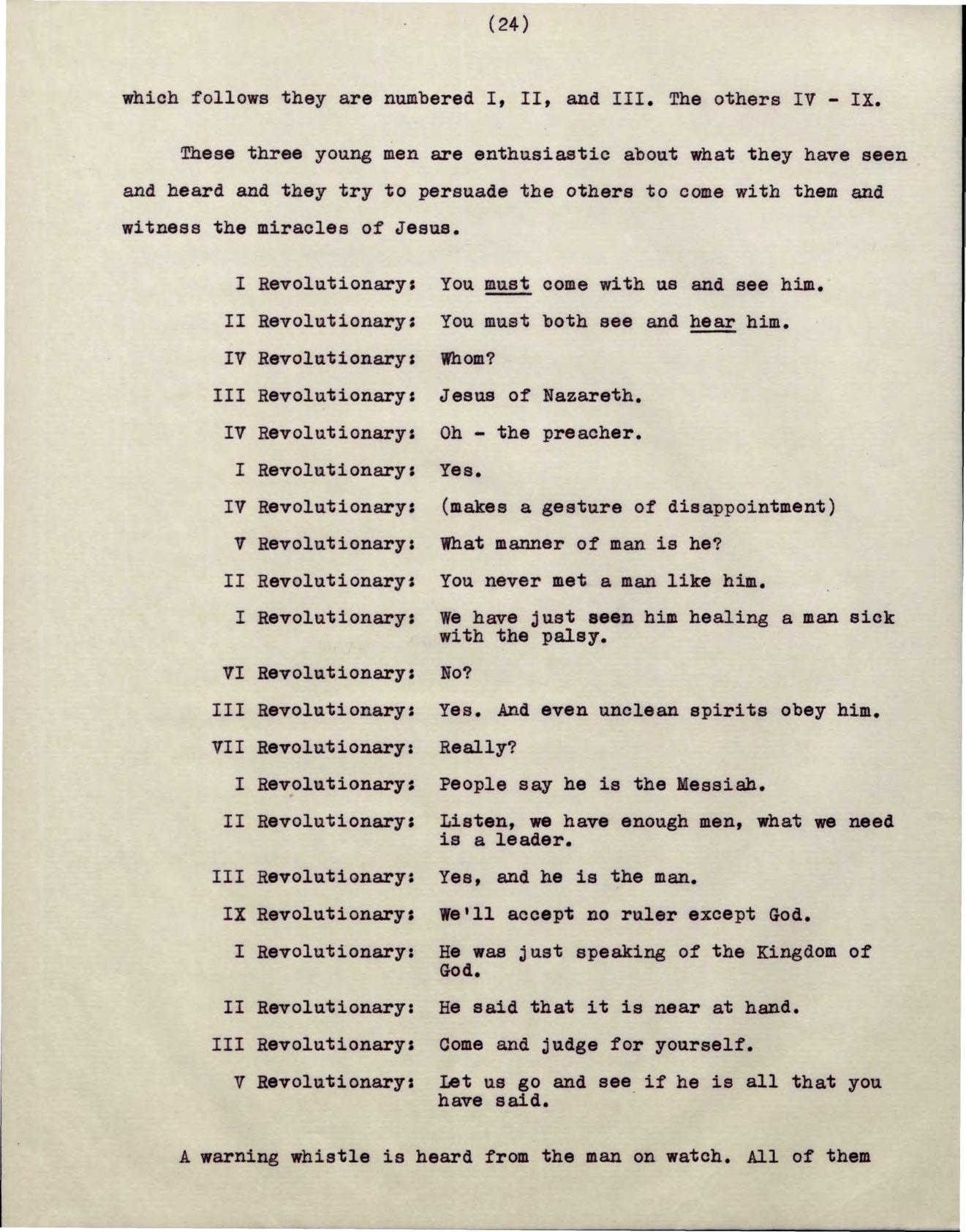
which follows they are numbered I, II, and III. The others IV - IX.
which follows they are numbered I, 11, and Ill. The others IV - IX.
These three young men are enthusiastic about what they have seen and heard and they try to persuade the others to come with them and witness the miracles of Jesus.
These three young men are enthusiastic about what they have seen and heard and they try to persuade the others to come with them and witness the miracles of Jesus.
I Revolutionary: You must come with us and see him.
I Revolutionary; You must come with us and see him.
11 Revolutionary: You must both see and hear him.
II Revolutionary; You must both see and hear him.
IV Revolutionary: Whom?
IV Revolutionary; Whom?
III Revolutionary: Jesus of Nazareth.
Ill Revolutionary; Jesus of Nazareth.
IV Revolutionary: Oh - the preacher.
IV Revolutionary; Oh - the preacher.
I Revolutionary: Yes.
I Revolutionary; Yes.
IV Revolutionary: (makes a gesture of disapPointment)
IV Revolutionary; (makes a gesture of disappointment)
V Revolutionary: What manner of man is he?
V Revolutionary; What manner of man is he?
11 RevolutionarYJ You never met a man like him.
II Revolutionary; You never met a man like him.
I Revolutionary: We have just Been him healing a man sick wi th the pals:r.
I Revolutionary; We have just seen him healing a man sick with the palsy.
VI Revolutionary: No?
VI Revolutionary; No?
III Revolutionary: yes. And even unclean spirits obey him.
Ill Revolutionary; Yes. And even unclean spirits obey him.
VII Revolutionary: Really?
VII Revolutionary: Really?
I Revolutionary: People say he is the Messiah.
I Revolutionary; People say he is the Messiah.
11 Revolutionary: Listen, we have enough men, what we need is a leader.
II Revolutionary; Listen, we have enough men, what we need is a leader.
III Revolutionary: Yes, and he is the man.
Ill Revolutionary: Yes, and he is the man.
IX Revolutionary: We'll accept no ruler except God.
IX Revolutionary; We'll accept no ruler except God.
I Revolutionary: He was just speaking of the Kingdom of God.
I Revolutionary: He was just speaking of the Kingdom of God.
II Revolutionary: He said that it is near at hand.
Ill Revolutionary; Gome and judge for yourself.
11 Revolutionary: He said that it is near at hand. Revolutionary: Come and judge for yourself.
A warning whistle is heard from the man on watch. All of them (24)
V Revolutionary: Let us go and see if he is all that you have said.
V Revolutionary; Let us go and see if he is all that you have said.
A warning whistle is heard from the man on watch. All of them
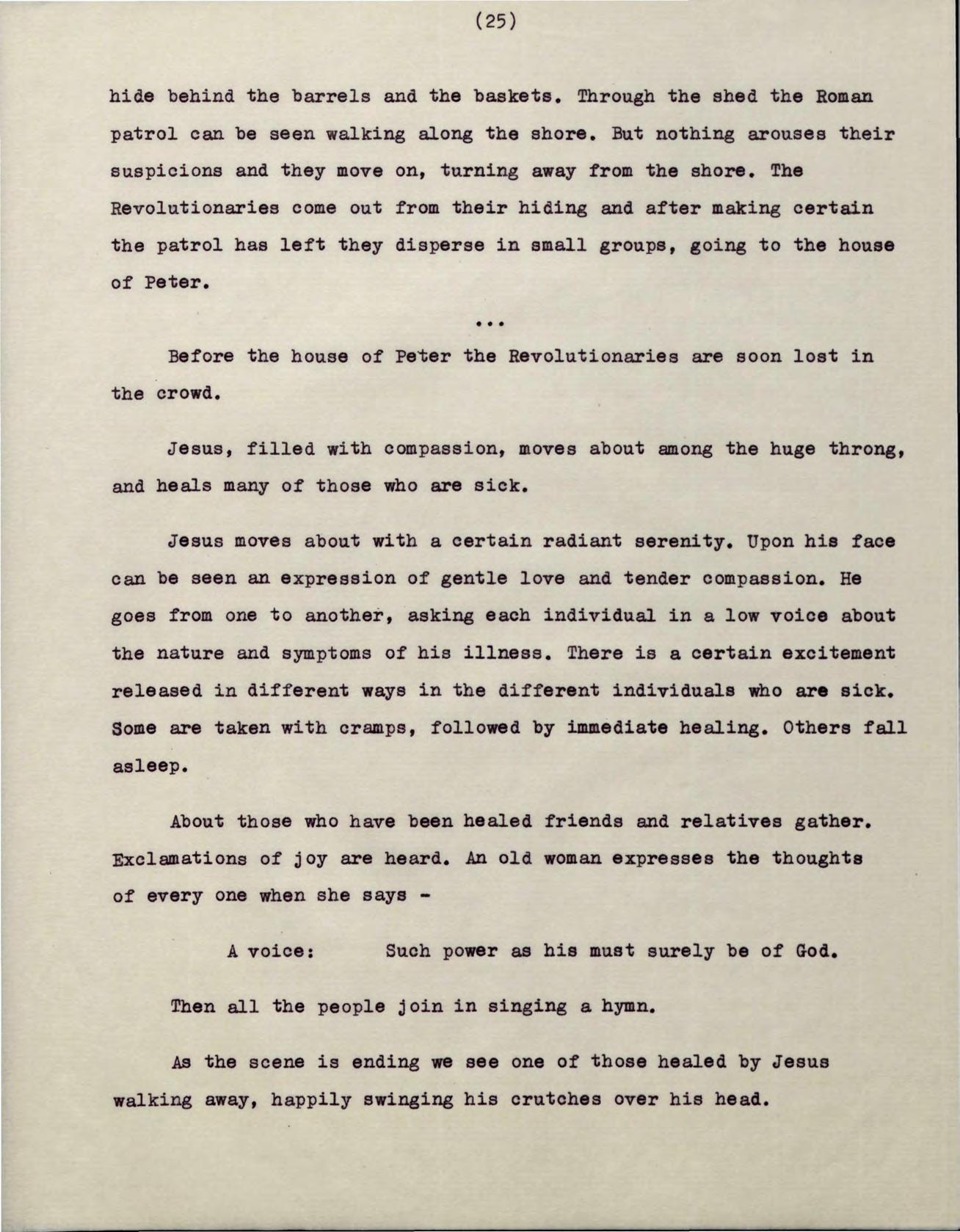
hide behind the "barrels and the baskets. Through the shed the Roman patrol can be seen walking along the shore. But nothing arouses their suspicions and they move on, turning away from the shore. The Revolutionaries come out from their hiding and after making certain the patrol has left they disperse in small groups, going to the house of Peter.
hide behind the barrels and the baskets. Through the shed the Roman patrol can be seen walking along the shore. But nothing arouses their suspicions and they move on, turning away from the shore. The Revolutionaries come out from their hiding and after making certain the patrol hae left they disperse in small groups, going to the house of Peter.
Before the house of Peter the Revolutionaries are soon lost in the crowd.
Before the house of Peter the Revolutionaries are soon lost in the crowd.
Jesus, filled with compassion, moves about among the huge throng, and heals of those who are sick.
Jesus, filled with compassion, moves about among the huge throng, and heals many of those who are sick.
Jesus moves about with a certain radiant serenity. Upon his face can be seen an expression of gentle love and tender compassion. He goes from one to another, asking each individual in a low voice about the nature and symptoms of his illness. There is a certain excitement released in different ways in the different individuals who are sick. Some are taken with cramps, followed by immediate healing. Others fall asleep.
Jesus moves about with a certain radiant serenity. Upon his face be seen an expression of gentle love and tender compassion. He goes from one to another, asking each individual in a low voice about the nature and symptoms of his illness. There is a certain excitement released in different ways in the different individuals who are sick. Some are taken with cramps, followed by immediate healing. Others fall asleep.
About those who have been healed friends and relatives gather.
About those who have been healed friends and relatives gather.
Exclamations of joy are heard. An old expresses the thoughts of everyone when she says -
Exclamations of joy are heard. An old woman expresses the thoughts of every one when she says -
As the scene is ending we see one of those healed by Jesus walking away, happily swinging his crutches over his head. (25)
A voice: Such power as his must surely be of God.
A voice: Such power as his surely be of God.
Then all the people join in singing a hymn.
Then all the people join in singing a hymn.
As the scene is ending we see one of those healed by Jesus walking away, happily swinging his crutches over his head.
(26)
Commentary: (26) And in the morning Jesus out and departed for a solitary plaoe.
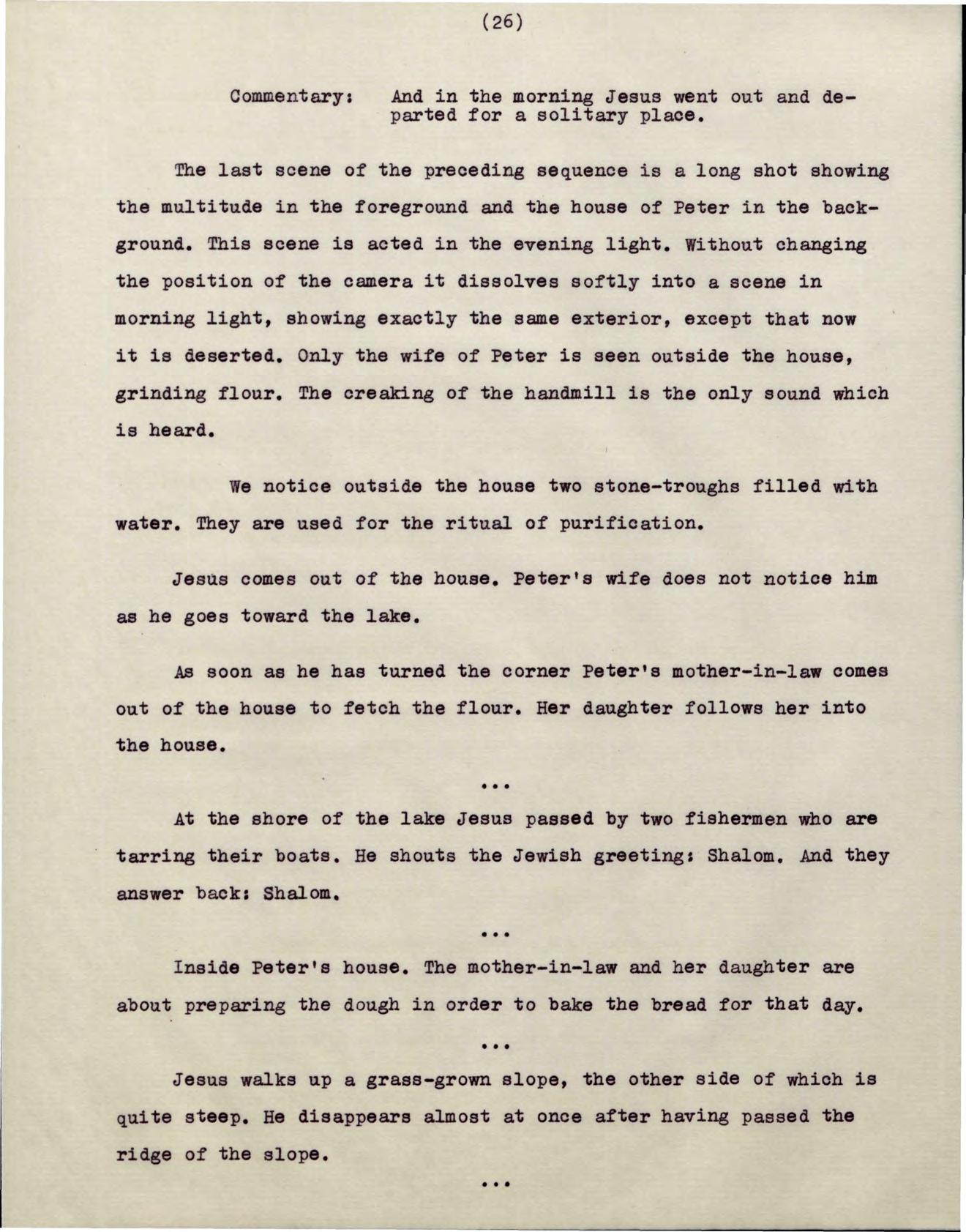
Commentary: And in the morning Jesus went out and departed for a solitary place.
The last scene of the preceding sequence is a long shot showing the multitude in the foreground and the house of Peter in the background. This scene is acted in the evening light. Without changing the position of the camera it dissolves softly into a scene in morning light, showing exactly the same exterior, except that now it is deserted. Only the wife of Peter is seen outside the house, grinding flour. The creaking of the handmill is the only sound which is heard.
The last scene of the preoeding sequence is a long shot showing the multitude in the foreground and the house of Peter in the background. This scene is acted in the evening light. Without changing the position of the it dissolves softly into a scene in morning light, showing exactly the exterior, except that it is deserted. Only the wife of Peter is seen outside the houae, grinding flour. The creaking of the handmill is the only sound which is heard.
We notice outside the house two stone-troughs filled with water. They are used for the ritual of purification.
We notice outside the house two stone-troughs filled with water. are used for the ritual of purifioation.
Jesus comes out of the house. Peter's wife does not notice him as he goes toward the lake.
Jesus comes of the Peter's wife does not notice him he goes toward the lake.
As soon as he has turned the corner Peter's mother-in-law comes out of the house to fetch the flour. Her daughter follows her into the house.
As soon as turned the corner Peterts mother-in-law comes out of the house to fetch the flour. Her daughter follows her into the house.
At the shore of the lake Jesus passed by two fishermen who are tarring their boats. He shouts the Jewish greeting: And they answer back: Shalom.
At the shore of the lake Jesus passed by two fishermen who are tarring their boats. He shouts the Jewish greetings Shalom. And they answer back: Shalom,
Inside Peter's The mother-in-law and her daughter are preparing the dough in order to the bread for that day.
Inside Peter's house. The mother-in-law and her daughter are about preparing the dough in order to bake the bread for that day.
Jesus walks up a grass-grown slope, the other side of which is quite steep. He disappears almost at once after having passed the ridge of the slope.
Jesus walks up a grass-grown slope, the other side of whioh is quite steep. He disappears almost at once after having passed the ridge of the slope.
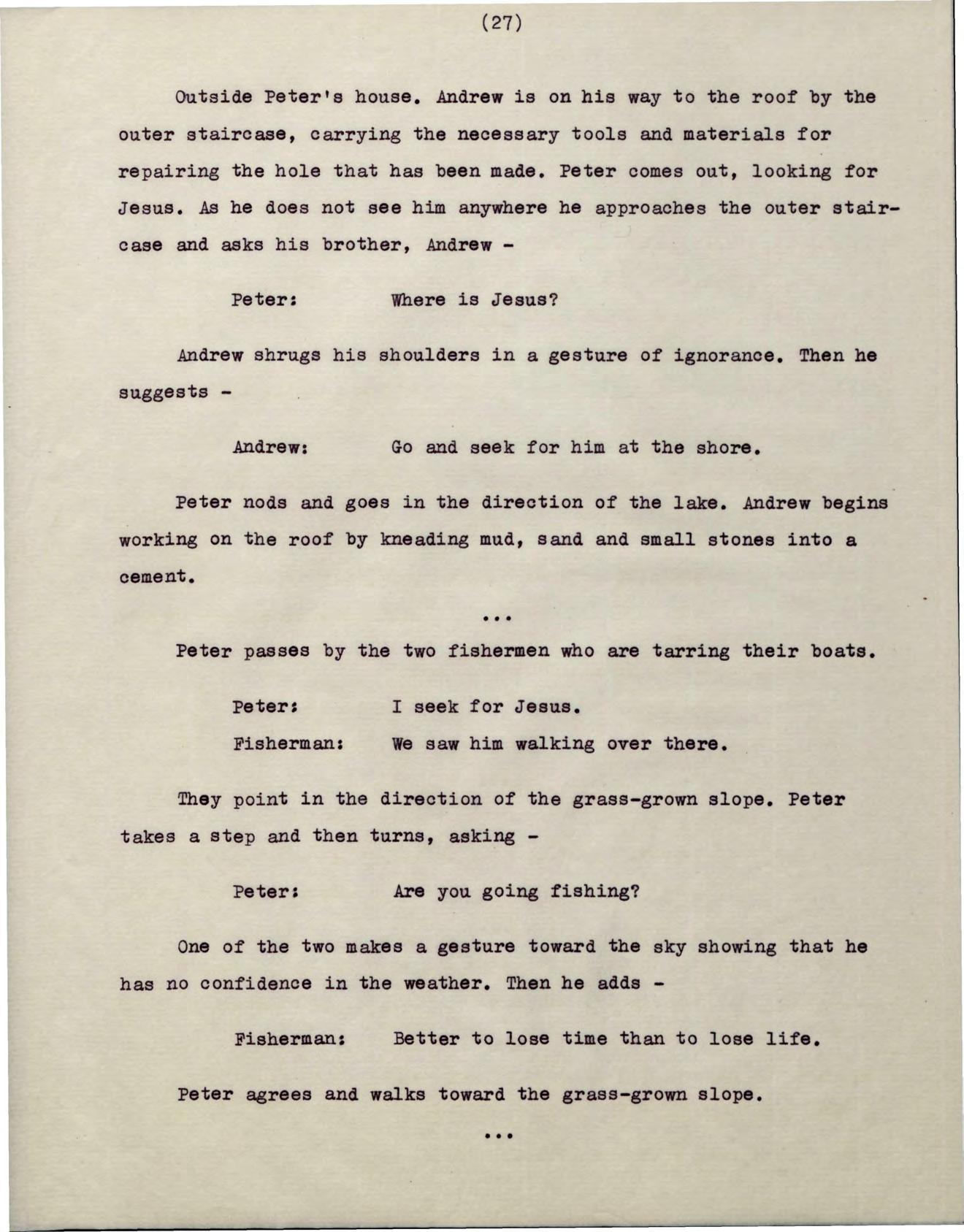
Outside Peter1 s house. Andrew is on his way to the roof by the outer staircase, carrying the necessary tools and materials for repairing the hole that has been made, Peter comes out, looking for Jesus, As he does not see him anywhere he approaches the outer staircase and asks his brother, Andrew -
Outside Peter's house. Andrew is on his way to the roof by the outer staircase, carrying the necessary tools and materials for repairing the hole that has been made. Peter comes out, looking for Jesus. As he does not see him anywhere he approaches the outer staircase and asks his brother, Andrew -
Peter: Where is Jesus?
Peter: Where is Jesus?
Andrew shrugs his shoulders in a gesture of ignorance. Then he suggests -
Andrew shrugs his shoulders in a gesture of ignorance. Then he suggests -
Andrew: Go and seek for him at the shore.
Andrew: Go and seek for him at the shore.
Peter nods and goes in the direction of the lake. Andrew begins working on the roof by kneading mud, sand and small stones into a cement.
Peter nods and goes in the direction of the lake. Andrew begins working on the roof by kneading mud, sand and small stones into a cement.
• •,
Peter passes by the two fishermen who are tarring their boats.
Peter passes by the two fishermen who are tarring their boats.
Peter« I seek for Jesus.
Peters Fisherman: I seek for Jesus.
We saw him walking over there.
Fisherman: We saw him walking over there.
They point in the direction of the grass-grown slope. Peter takes a step and then turns, asking -
They point in the direction of the grass-grown slope. Peter takes a step and then turns, asking -
Peter: Are you going fishing?
Peter: Are you going fishing?
One of the two makes a gesture toward the sky showing that he has no confidence in the weather. Then he adds -
One of the two makes a toward the sky showing that he has no confidence in the weather. Then he adds -
Fisherman: Better to lose time than to lose life.
Fisherman: Better to lose time than to lose life.
Peter agrees and walks toward the grass-grown slope.
Peter agrees and walks toward the grass-grown slope.
(28)
Outside of Peter's house Andrew is spreading the mud-cement and filling up the hole in the roof.
Outside of Peter's house Andrew is spreading the mud-cement and filling up the hole in the roof. •
•
Peter climbs the slope of ground and sees Jesus in the depression behind, kneeling and absorbed in prayer. Peter is greatly moved at the sight of Jesus and a seems to transform the rough fisherman. A light appears to shine from within the man reflecting the new purity he has found. He moves away a short distanoe and lies down on the grass waiting for Jesus.
Peter climbs the slope of ground and sees Jesus in the depression behind, kneeling and absorbed in prayer. Peter is greatly moved at the sight of Jesus and a power seems to transform the rough fisherman. A light appears to shine from within the man reflecting the new purity he has found. He moves away a short distance and lies down on the grass waiting for Jesus. •
Outside Peter's house. Andrew has finished spreading themudcement and starts rolling it with a Bstone-roller."
•
Outside Peter's house. Andrew has finished spreading the mudand starts rolling it with a "stone-roller."
Jesus comes back over the grassy slope and sees Peter who explains his presence by saying -
Jesus comes back over the grassy slope and sees Peter who explains his presence by saying -
Peters You were not in the house so I came out to look foryou.
Peter: You were not in the house so I came out to look for you.
Jesus nods in appreciation and, still in the mood of devotion, the two men walk silently back to town.
Jesus nods in appreciation and, still in the mood of devotion, the two men walk silently back to town.
Outside Peter's house. Andrew has finished working on the roof and is on his way down the staircase. He puts his tools in their place and washes his hands. At the same time Peter's wife and motherin-law are setting the table outside the house, preparing the first meal of the day. Andrew approaches Peter's wife, showing her that he has torn to pieces the sleeve of his shirt.
Outside Peter's house. Andrew has finished working the roof and is on his way down the staircase. He puts his tools in their place and washes his hands. At the same time Peter's wife and motherin-law are setting the table outside the house, preparing the first meal of the Andrew approaches Peter's wife, showing her that he has torn to pieces the sleeve of his shirt • .
Andrews Look.
Andrews Look.
She goes into the house and comes back with a needle that has (28)
She goes into the house and back with a needle that has
been carefully preserved in a hollowed bone. As she begins sewing Jesus and Peter arrive. They sit down and the mother-in-law pours out goats milk for them, at the same time inviting them to help themselves to bread, grapes, and dates. As the mending of Andrew's sleeve is completed several of the Pharisees who were there the night before come to the house. They are made welcome and invited to share in the meal. They accept but before sitting down they approach the stone trough for the ritual of hand washing before meals. By means of a scoop water is poured on the hands and allowed to run off outside the trough. This ceremony is a normal custom for the Pharisees, Once it is completed they sit down and begin eating.
been carefully preserved in a hollowed bone. As she begins sewing Jesus and Peter arrive. They sit down and the mother-in-law pours out goats milk for them, at the same time inviting them to help themselves to bread, grapes, and dates. As the mending of Andrew's sleeve is completed several of the Pharisees who were there the night before come to the house. They are made weloome and invited to share in the meal. They accept but before sitting down they approach the trough for the ritual of hand washing before meals. By means of a scoop water is poured on the hands and allowed run off outside the trough. This ceremony is a normal custom for the Pharisees. Once it is completed they sit down and begin eating.
(The succession of the situations of this scene progress so rapidly there will be no need of special and superfluous dialogue - such as the little courtesies of life.)
(The succession of the situations of this scene progress so rapidly there will be no need of special and superflu- . ous dialogue - such as the little courtesies of life.)
John and Jacob arrive. They too are invited to share in the meal, They accept and begin eating at once without going through the ceremony of the handwashing. One of the Pharisees, and old man, speaks to John and Jacob and in his voice is a tinge of reprimand.
John and Jacob arrive. They too are invited to share in the meal. They accept and begin eating at once without going through the cereof the handwashing. One of the Pharisees, and old man, speaks to John and Jacob and in his voice is a tinge of reprimand.
1. Pharisee: You eat bread with unwashed hands?
I. Pharisee: You eat bread with unwashed hands?
John: We are not shammaites.
Johnj We are not shammaites.
2. Pharisee: We are not shammai tes either.
2. Pharisee: We are not shammaites either. The third Pharisee now speaks to the two young Pharisees,
The third Pharisee now speaks to the two young Pharisees.
3. Pharisee: The Bread is a gift of God, and you profane it in his eyes if you do not receive it with clean hands.
3. Pharisee: The Bread is a gift of God, and you profane it in his eyes if you do not receive it with clean hands.
Jacobs That is not written in the Law.
Jacobs That is not written in the Law.
I. Pharisee: But it is in the traditions.
I. Pharisee: But it is in the traditions.
John (interrupting): The traditions are not the Law.
John (interrupting): The traditions are not the Law.
2. Pharisee: The traditions are given by God the same as the Law.
2. Pharisee: The traditions are given by God the same as the Law,
Jacobs The traditions are not of God but of man.
Jacobs The traditions are not of God but of man.
3. Pharisee: He who lightly esteems hand-washing will perish from the earth.
3. Pharisee: He who lightly esteems hand-washing will perish from the earth.
(It should be emphasized that there is no tension between those taking part in the conversation. It is only a friendly discussion setting forth the old and new points of view.)
(It should be emphasized that there is no tension between those taking part in the conversation. It is only a friendly discussion setting forth the old and new points of view.)
The elder Pharisee turns to Jesus.
The elder Pharisee now turns to Jesus.
1. Pharisee: What say you? Why do your disciples eat bread with unwashed hands?
1. Pharisees What say you? Why do your disciples eat bread with unwashed hands?
Jesus does not answer at once. Instead he looks at his hands as if he would there find the answer. Then he speaks.
Jesus does not answer at once. Instead he looks at his hands as if he would there find the answer. Then he speaks.
Jesus: There is nothing from without a man that canenter into him and defile him...
Jesus: There is nothing from without a man that canenter into him and defile him •••
He pauses. The Pharisees and the disciples listen attentively although they have difficulty in following his line of thought •
He pauses. The Pharisees and the disciples listen attentively although they have difficulty in following his line of thought.
Jesus: ...but that which comes from within, it is that which defiles a man. Not that which goes into the mouth, and from there into the belly, but that which comes out of the heart, this defiles a man.
Jesus: ••• but that which comes from within, it is that which defiles a man. Not that which goes into the mouth, and from there into the belly, but that which comee out of the heart, this defiles a man.
Jesus looks again at his hands and then he gets up and enters the house. There is deep silence. The Pharisees are perplexed as they do not understand the profound meaning of the words of Jesus. In their eyes he is a maker of paradoxes and should not be taken too seriously.
Jesus looks again at his hands and then he gets up and enters the house. There is deep silence. The Pharisees are perplexed as they do not understand the profound meaning of the words of Jesus. In their eyes he is a maker of paradoxes and should not be taken too seriously.
The elder Pharisee has been so absorbed in listening to Jesus that he has not noticed his departure. He is just about to speak when he realizes that Jesus has gone. His face shows that he is some-
The elder Pharisee has been so absorbed in listening to Jesus that he has not noticed his departure. He is just about to speak when he realizes that Jesus has gone. His face shows that he is some-
(31)
what disturbed. But, collecting his thoughts, he turns to the other Pharisees and says -
what disturbed. But, collecting his thoughts, he turns to the other Pharisees and says -
1, Pharisee: I think we too will have to go.
1. Pharisee: I think we too will have to go.
He rises. One of the other Pharisees, seeing that the disciples are embarassed at the situation, explains their hurried departure by saying -
He rises. One of the other Pharisees, seeing that the disciples are embarassed at the situation, explains their hurried departure by saying -
2. Pharisee: They are waiting for us at the Synagogue.
2. Pharisee: They are waiting for us at the Synagogue.
Then they leave.
Then they leave.
The four disciples, being left alone, look at each other. Every time Jesus uproots some deep seated custom or tradition they are disturbed if not shocked. They cannot understand his apparently rude behaviour toward the Pharisees who had come as friends to see him.
The four disciples, being left alone, look at each other. Every time Jesus uproots some deep seated custom or tradition they are disturbed if not shocked. They cannot understand his apparently rude behaviour toward the Pharisees who had come as friends to see him.
Peter breaks the silence -
Peter breaks the silence -
Peter: Come.
Peters Come.
All four enter the house.
All four enter the house.
(According to "the traditions of the Elders· the handwashing before meals was a religious duty and the Pharisees had more regard for the tradition than for the Law. Some Pharisees were so scrupulous they washed twice, before and after each meal. But beyond doubt there were many, who did not obey the regulation so strictly. Each party to the discussion unquestionably considered the question from his own point of view. The Pharisees looked upon it as a social, political, and religious while Jesus thought
(According to "the traditions of the Elders" the handwashing before meals was a religious duty and the Pharisees had more regard for the tradition than for the Law. Some Pharisees were so scrupulous they washed twice, before and after each meal. But beyond doubt there were many, who did not obey the regulation so strictly. Each party to the discussion unquestionably considered the question from his own point of view. The Pharisees looked upon it as a social, political, and religious matter while Jesus thought (31)
(32)
of it in terms of the ethical and the spiritual. Both were right. Among the Pharisees two tendencies were dominant: the rigorous school of Shammai and the more liberal school of Hillel.)
of it in terms of the ethical and the spiritual. Both were right. Among the Pharisees two tendencies were dominants the rigorous school of Shammai and the more liberal school of Hillel.)
Inside Peter's house his wife is mending some old clothes, Jesus is sitting beside her, studying the way she is sewing a piece of old cloth on an old garment,
Inside Peter's house his wife is mending some old clothes. Jeaus is sitting beside her, studying the way she is sewing a piece of old cloth on an old garment.
Peter and the three others enter the room. Peter speaks to Jesus.
Peter and the three others enter the room, Peter speaks to Jesus.
Peters The Pharisees were offended.
Peter: The Pharisees were offended.
Jesus does not look or speak indicating there is nothing he can do about the matter.
Jesus does not look or speak indicating there is nothing he can do about the matter.
John: They did not understand.
John: They did not understand.
John's tone indicates that neither he nor the others have understood the meaning of the words of Jesus any better than have the Pharisees. Jesus therefore looks up at them asking -
John's tone indicates that neither he nor the others have understood the meaning of the words of Jesus better than have the Pharisees. Jesus therefore looks up at them asking -
Jesus;
Are you also without understanding?
Jesus: Are you also without understanding?
Their faces express their feelings. Jesus sighs. He will have to teach them step by step.
Their faces express their feelings. Jeaus sighs. He will have to teach them step by step.
Jesus:
Jesus: Do you not yet understand, that whatsoever enters in at the mouth goes into the belly, and is cast out into the draught? But those things which proceed out of the mouth come forth from the heart, and they defile the man. For out of the heart proceed evil thoughts, murders, adulteries, fornications, thefts, false witness, blasphemies: these ,are the things which defile a mans but to with unwashen hands defiles not a man.
Do you not yet understand, that whatsoever enters in at the mouth goes into the belly, and is cast out into the draught? But those things which proceed out of the mouth come forth from the heart, and they defile the man. For out of the heart proceed evil thoughts, murders, adulteries, fornications, thefts, false witness, blasphemies: these are the things which defile a man: but to eat with unwashen hands defiles not a man.
Now the disciples understand and their faces express their joy. They are at the same time ashamed and proud: ashamed because of their
Now the disciples understand and their faces express their joy. They are at the same time ashamed and proud: ashamed because of their
lack of confidence and proud because they are his disciples. They do no"k frilly understand but their intuition tells them that no mere man has ever spoken in such fashion before.
lack of confidence and proud because they are his disciples. They do not fully understand but their intuition tells them that no mere man has ever spoken in such fashion before.
The three Pharisees arrive at the Synagogue. On the steps leading up to the Synagogue are some men from the town sitting about and talking.
The three Pharisees arrive at the Synagogue. On the steps leading up to the Synagogue are some men from the town sitting about and talking.
The three Pharisees stop before entering the Synagogue and we hear them speaking about Jesus.
The three Pharisees stop before entering the Synagogue and we hear them speaking about Jesus.
1. Pharisee: It is always the same way with that man. I talk of the East and he talks of the west.
1. Pharisees It is always the same way with that man. I talk of the East and he talks of the West.
2. Pharisees Yes, and if I put a straightforward question to him •••
2. Pharisees Yes, and if I put a straightforward question to him...
3. Pharisee: ••• you get a vague reply •••
3. Pharisees ...you get a vague reply...
1. Pharisee: ••• or an evasive one. Never mind, come.
1. Pharisees ...or an evasive one. Never mind, come.
He makes a sign to his brothers to follow him into the Synagogue.
He makes a sign to his brothers to follow him into the Synagogue.
Inside the Synagogue. From outside we have been able to hear a choir of shrill voices belonging to small boys to whom the first lessons in the Holy Scriptures are given by the overseer.
Inside the Synagogue. Prom outside we have been able to hear a choir of shrill voices belonging to small boys to whom the first lessons in the Holy Scriptures are given by the overseer.
Entering the house of God we see the boys sitting on the stone floor, around the teacher, who is reciting one verse after another. They move their small bodies rhythmically according to the rhythm of the reading and to the time beaten by the teacher's stock, being taught the Law and the Prophets by repeating every verse over and over again.
Entering the house of God we Bee the boys sitting on the stone floor, around the teacher, who is reciting one verse after another. They move their small bodies rhythmically according to the rhythm of the reading and to the time beaten by the teacher's stock, being taught the Law and the Prophets by repeating every verse over and over again.
The three Pharisees stop for a moment to listen to the children, reading the 26th verse of the 36th chapter of the book of Ezekiels
The three Pharisees stop for a moment to listen to the children, reading the 26th verse of the 36th chapter of the book of Ezekiels
(34)
A new heart also will I give you, and a new spirit will I put within you2 and I will take away the stony heart out of your flesh, and I will give you a heart of flesh.
A new heart also will I give you, and a new spirit will I put within you: and I will take away the stony heart out of your flesh, and I will give you a heart of flesh.
The teacher calls a halt. The Pharisees smile appreciatively at the boys.
The teacher calls a halt. The Pharisees smile appreciatively at the boys.
2. Pharisee: Do not forget, boys, that no man is poor except the man who is poor in knowledge.
2. Pharisee: Do not forget, boys, that no man is poor except the man who is poor in knowledge.
The Pharisees leave the boys. The elder Pharisee turns to his two brothers and says -
The Pharisees leave the boys. The elder Pharisee turns to his two brothers says -
1. Pharisee: In truth, the World is saved only by the breath of the school-children.
1. Pharisee: In truth, the World is saved only by the breath of the school-children.
Now the ruler of the Synagogue advances to meet the three Pharisees, while the teacher speaks to the boys singing -
Now the ruler of the Synagogue advances to meet the three Pharisees, while the teacher speaks to the boys singing -
Teacher: The boys:
Teacher:
Have I not told you that a man has 248 jOints? And that what you learn here by heart oannot enter into your 248 joints if do not speak loud? Have I not told you that?
Teacher: Have I not told you that a man has 248 joints? And that what you learn here by heart cannot enter into your 248 joints if you do not speak loud? Have I not told you that?
Yes.
The boys: Yes.
Well, then let us start again with 25and this time let us speak much louder.
Teacher: Well, then let us start again with verse 25and this time let us speak much louder.
The teacher has the script roll on his knees, and while we are listening to the boys reciting the verses very loudly, we see in a "close-up" the finger of the teacher gliding over the page, along the first line of verse 25, chapter 36 of the book of Ezekiels
The teacher has the script roll on his knees, and while we are listening to the boys reciting the verses very loudly, we in a "close-up" the finger of the teacher gliding over the page, along the first line of verse 25, chapter 36 of the book of Ezekiel:
Then I will sprinkle clean water upon you, and you shall be clean. From all your filthyness will I cleanse you.
Then I will sprinkle clean upon you, and you shall be clean. From all your filthyness will I cleanse you.
The close-up of the page of the book of Ezekiel dissolves softly into a scene of the custom-house and the custom-gate of the town.
The close-up of the page of the book of Ezekiel dissolves softly into a scene of the custom-house and the custom-gate of the town.
During the beginning of the scene the follOwing is heard:
During the beginning of the scene the following is heard: (34)
(35)
commentary: (35)
Commentary: The Roman oppressors were sucking the life blood out of the Jews by imposing intolerable taxes. And they were being levied through the medium of Jewish tax collectors who were despised by their own people.
The Roman oppressors were sucking the life blood out of the Jews by imposing intolerable taxes. And they were being levied through the medium of Jewish tax collectors who were despised by their own people.
The tax-collector Levi whom we noticed in the crowd before Peter's house yesterday is sitting at his office, absent-minded, absorbed in his own thoughts. With him are two or three other Jewish custom officers. A group of Roman soldiers are on watch at the gate in order to lend authority if it is needed. Passers-by.
The tax-collector Levi whom we noticed in the crowd before Peter's house yesterday is sitting at his office, absent-minded, absorbed in his own thoughts. With him are two or three other Jewish custom officers. A group of Roman soldiers are on watoh at the gate in order to lend authority if it is needed. Passers-by.
A peasant leading a donkey laden with cauliflowers comes up to the gate. One of the custom officers steps out and after inspecting the load fixes the duty at so much. The peasant makes strong objection to the demand of the tax-collector.
A peasant leading a donkey laden with oauliflowers comes up to the gate. One of the custom officers steps out and after inspecting the load fixes the duty at so much. The peasant makes strong objection to the demand of the tax-collector.
Peasant: Yesterday I only paid half of that.
Peasant: Yesterday I only paid half of that.
Custom Officer: Yesterday is not to-day.
Custom Officer: Yesterday is not to-day.
Peasant: But why the double? Why, why?
Peasant: But why the double? Why, why?
Custom Pay - and don't waste my time.
Custom Officers Pay - and don't waste my time.
Peasant s No, I won't pay the double.
Peasant: No, I won't pay the double.
Custom Officer: You won't?
Custom Officer; You won't?
Peasant: No.
Peasant: No.
The oustom officer turns toward the soldiers, but the sergeant is already on his way. He needs only to let his presence become known in order to make the peasant pay. The sergeant returns to his soldiers. The peasant, when leaving the gate, oannot resisthe temptation to spit after the custom officer.
The custom officer turns toward the soldiers, but the sergeant is already on his way. He needs only to let his presence become known in order to make the peasant pay. The sergeant returns to his soldiers. The peasant, when leaving the gate, cannot resisthe temptation to spit after the custom officer.
At this moment Levi looks up and sees Jesus and his six disciples approaching the gate. Their appearance is to him like an answer to his thoughts. He rises and goes to Jesus, falling down on his knees and saying -
At this moment Levi looks up and sees Jesus and his six disciples approaching the gate. Their appearance is to him like an answer to his thoughts. He rises and goes to Jesus, falling down on his knees and saying -
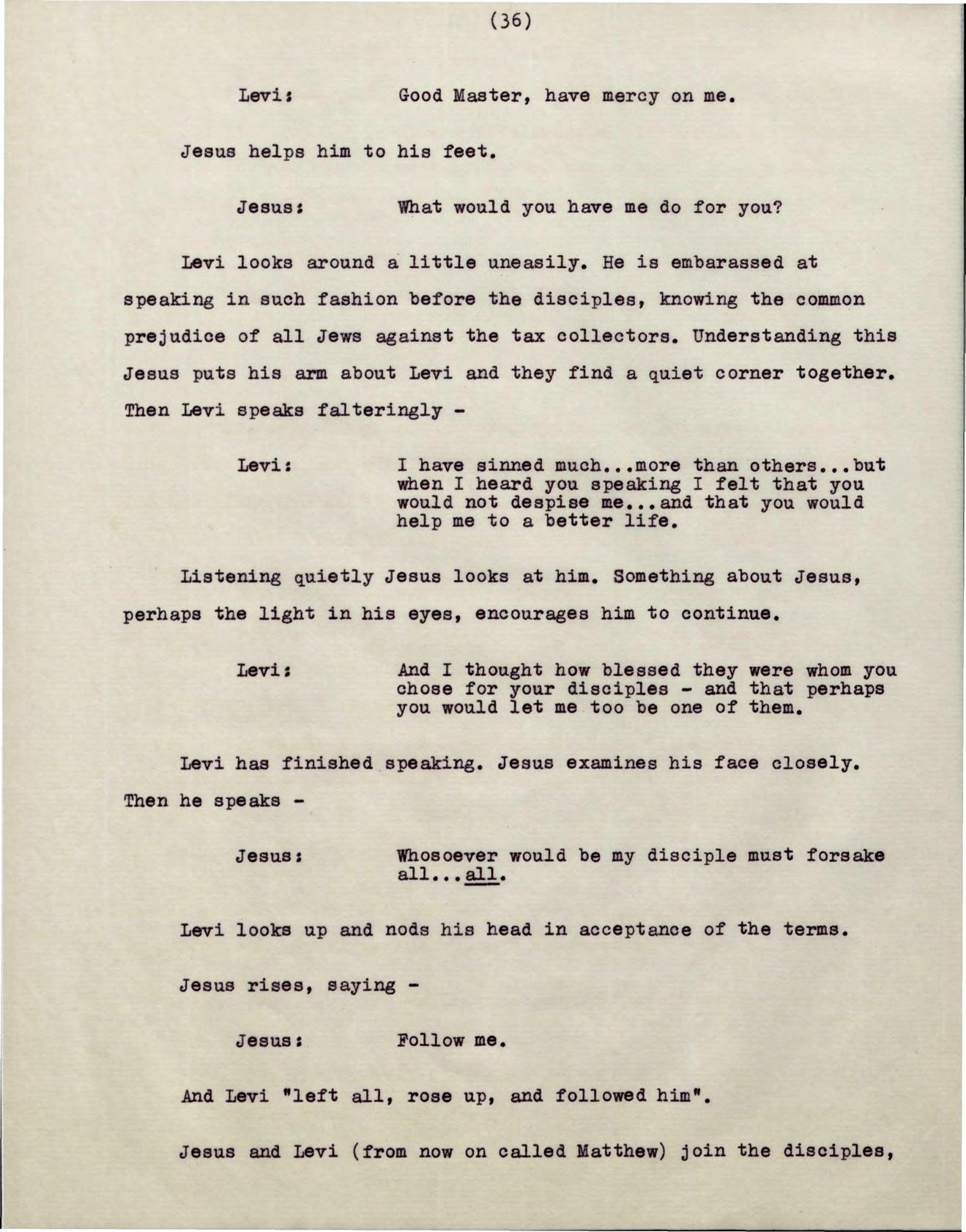
Levis Good Master, have mercy on me.
Levis Good Master, have mercy on me.
Jesus helps him to his feet.
Jesus helps him to his feet.
Jesus: What would you have me do for you?
Jesus: What would you have me do for you?
Levi looks around a little uneasily. He is embarassed at speaking in such fashion before the disciples, knowing the common prejudice of all Jews against the tax collectors. Understanding this Jesus puts his arm about Levi and they find a quiet corner together. Then Levi speaks falteringly -
Lavi looks around a little uneasily. He is embarassed at speaking in such fashion before the disciples, knowing the common prejudice of all Jews against the tax collectors. Understanding this Jesus puts his arm about Levi and they find a quiet corner together. Then Lavi speaks fal teringly -
Levi: I have sinned much...more than others...but when I heard you speaking I felt that you would not despise me...and that you would help me to a better life.
Levi: I have sinned much ••• more than others ••• but when I heard you speaking I felt that you would not despise me ••• and that you would help me to a better life.
Listening quietly Jesus looks at him. Something about Jesus, perhaps the light in his eyes, encourages him to continue.
Listening quietly Jesus looks at him. Something about Jesus, perhaps the light in his eyes, encourages him to continue.
Levi: And I thought how blessed they were whom you chose for your disciples - and that perhaps you would let me too be one of them.
Levis And I thought how blessed they were whom you chose for your disciples - and that perhaps you would let me too be one of them.
Lavi has finished , speaking. Jesus examines his face closely.
Then he speaks -
Levi has finished speaking. Jesus examines his face closely. Then he speaks -
Jesus: Whosoever would be my disciple must forsake all... all.
Jesus: Whosoever would be my disciple must forsake all ••• all.
Levi looks up and nods his head in acceptance of the terms.
Levi looks up and nods his head in acceptance of the terms.
Jesus rises, saying -
Jesus rises, saying -
Jesus: Follow me.
Jesus: Follow me.
And Levi "left all, rose up, and followed him".
And Levi "left all, rose up, and followed him".
Jesus and Levi (from now on called Matthew) join the disciples,
Jesus and Lavi (from now on called Matthew) join the diSCiples,
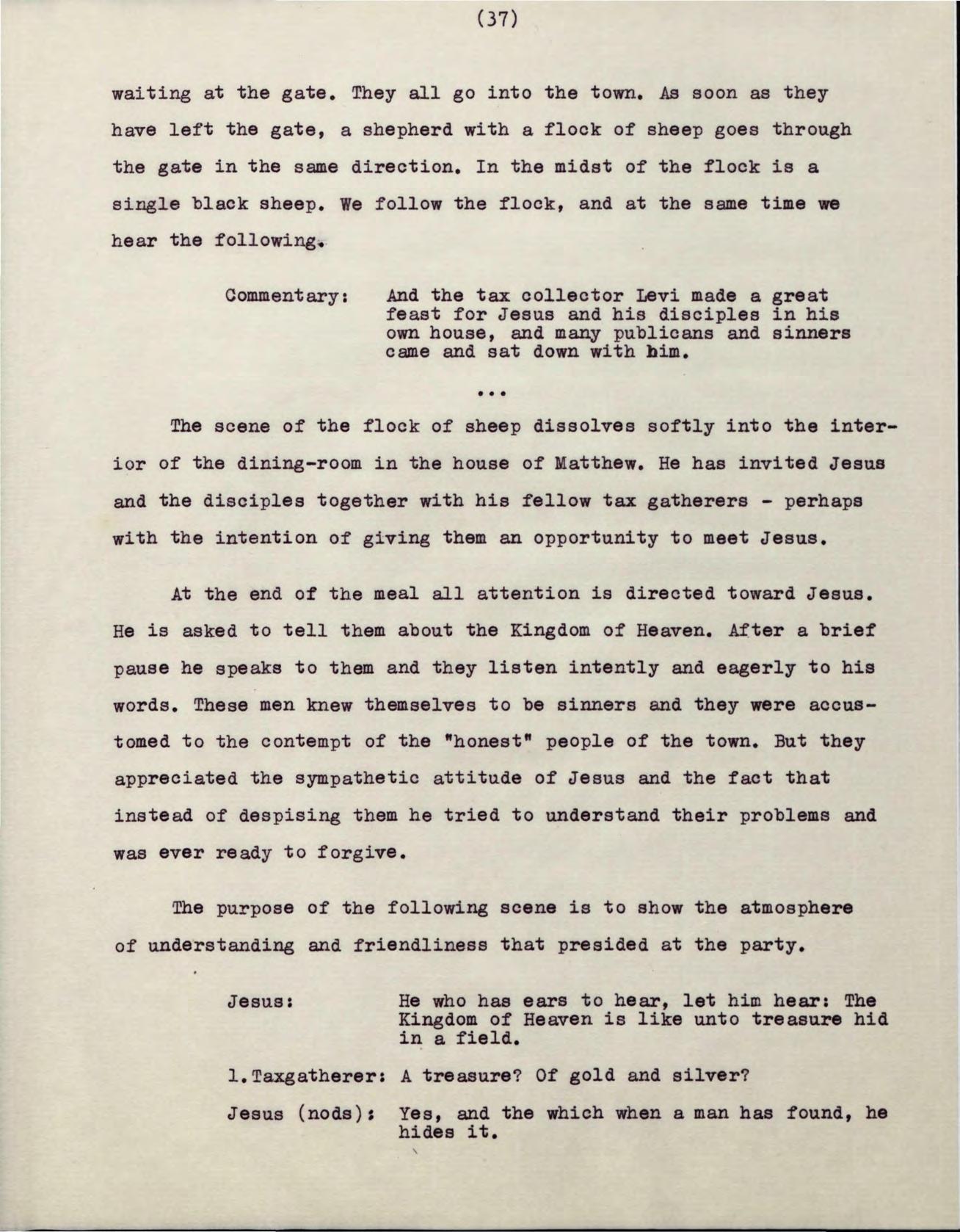
waiting at the gate. They all go into the town. As soon as they have left the gate, a shepherd with a flock of sheep goes through the gate in the same direction. In the midst of the flock is a single black sheep. We follow the flock, and at the same time we hear the following*
waiting at the gate. They all go into the town. As soon as they have left the gate, a shepherd with a flock of sheep goes through the gate in the same direction. In the midst of the flock is a single black sheep. We follow the flock, and at the same time we hear the following.
Commentary: And the tax collector Levi made a great feast for Jesus and his disciples in his own house, and many publicans and sinners came and sat down with him.
Comment ary : And the collector Lavi made a great feast for Jesus and his disciples in his own house, and many publicans and sinners came and sat down with him •
The scene of the flock of sheep dissolves softly into the interior of the dining-room in the house of Matthew. He has invited Jesus and the disciples together with his fellow tax gatherers - perhaps with the intention of giving them an opportunity to meet Jesus.
The scene of the flock of sheep dissolves softly into the interior of the dining-room in the house of Matthew. He has invited Jesus and the disciples together with his fellow tax gatherers - perhaps with the intention of giving them an opportunity to meet Jesus.
At the end of the meal all attention is directed toward Jesus. He is asked to tell them about the Kingdom of Heaven. After a brief pause he speaks to them and they listen intently and eagerly to his words. These men knew themselves to be sinners and they were accustomed to the contempt of the "honest" people of the town. But they appreciated the sympathetic attitude of Jesus and the fact that instead of despising them he tried to understand their problems and was ever ready to forgive.
At the end of the meal all attention is directed toward Jesus. He is asked to tell them about the Kingdom of Heaven. After a brief pause he speaks to them and they listen intently and eagerly to his words. These men knew themselves to be sinners and they were accustomed to the contempt of the "honest" people of the town. But they appreciated the sympathetic attitude of Jesus and the fact that instead of despising them he tried to understand their problems and was ever ready to forgive.
The purpose of the following scene is to show the atmosphere of understanding and friendliness that presided at the party.
The purpose of the following scene is to show the atmosphere of understanding and friendliness that presided at the party.
Jesus:
Jesus: He who has ears to hear, let him hear: The Kingdom of Heaven is like unto treasure hid in a field.
He who has ears to hear, let him hear: The Kingdom of Heaven is like unto treasure hid in a field.
l.Taxgatherer: A treasure? Of gold and silver?
I. Taxgatherer: A treasure? Of gold and silver?
Jesus (nods): Yes, and the which when a man has found, he hides it.
Jesus (nods); Yes, and the which when a man has found, he hides it.
(38)
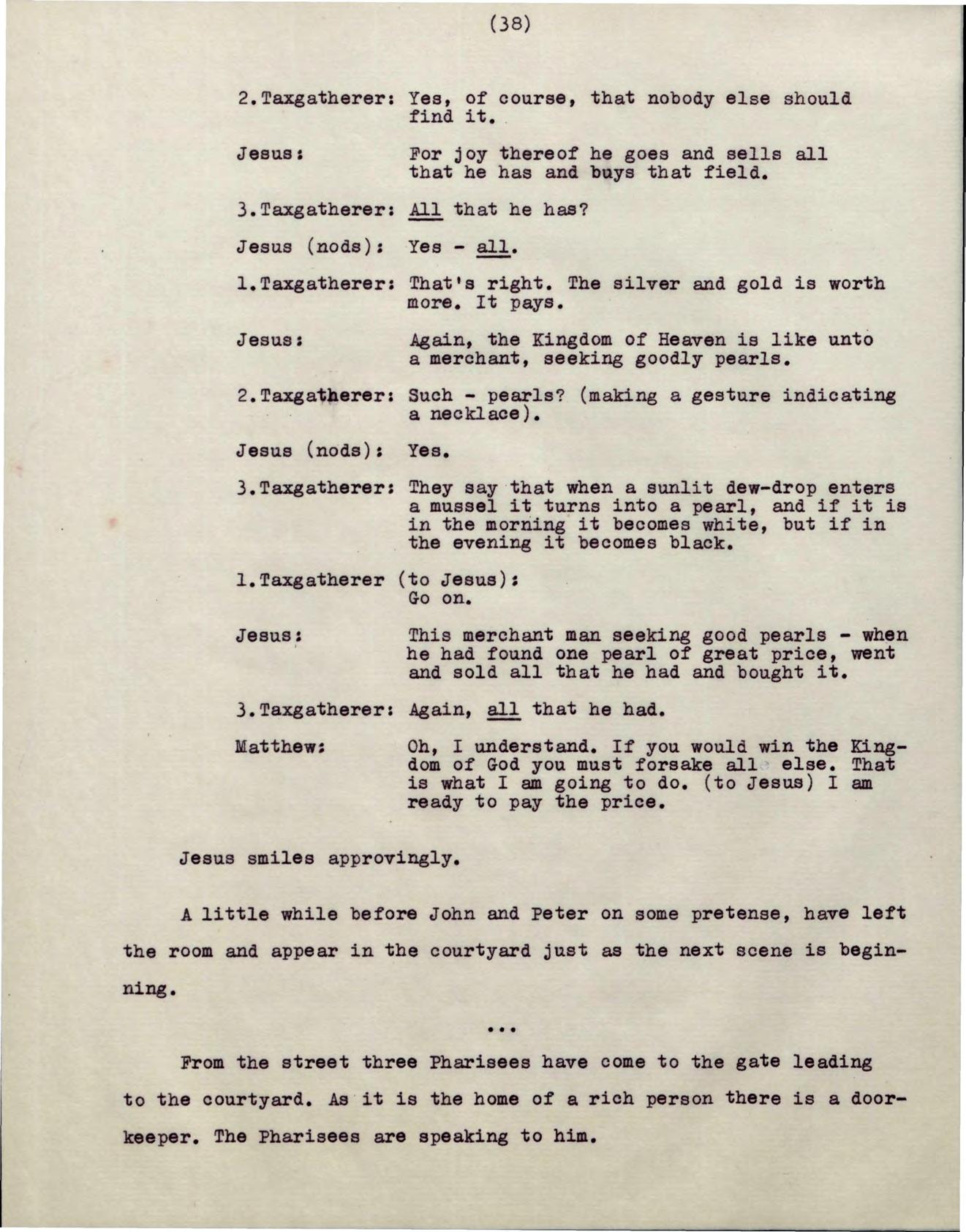
2. Taxgatherer: Yes, of course, that nobody else should find it • .
2.Taxgatherer: Yes, of course, that nobody else should find it.
Jesus: For joy thereof he goes and sells all that he has and boys that field.
Jesus: For joy thereof he goes and sells all that he has and buys that field
3.Taxgatherer: All that he has?
3. Taxgatherer: All that he has?
Jesus - all.
Jesus (nods): Yes - all.
I. Taxgatherer: That's right. silver and gold is worth more. It pays.
l.Taxgatherer: That's right. The silver and gold is worth more. It pays.
Jesus: Again, the Kingdom of Heaven is like unto a merchant, seeking goodly pearls.
Jesus: Again, the Kingdom of Heaven is like unto a merchant, seeking goodly pearls
Such - pearls? (making a gesture indioating a neoklace).
2.Taxgatherer: Such - pearls? (making a gesture indicating a necklace).
Jesus (nods): Yes
Jesus (nods): Yes.
3. Taxgatherer: They say ·that when a sunlit dew-drop enters a mussel it turns into a pearl, and if it is in the morning it becomes white, but if in the evening it becomes black.
3.Taxgatherer: They say that when a sunlit dew-drop enters a mussel it turns into a pearl, and if it is in the morning it becomes white, but if in the evening it becomes black.
I.Taxgatherer (to Jesus):
l.Taxgatherer (to Jesus): G-o on
Jesus: I Go on.
This merchant man seeking good pearls - when he had found one pearl of great price, went and sold all that he had and bought it.
Jesus: This merchant man seeking good pearls - when he had found one pearl of great price, went and sold all that he had and bought it.
3. Taxgatherer: Again, all that he had.
3.Taxgatherer: Again, all that hehad.
Matthew:
Matthew: Oh, I understand. If you would win the Kingdom of God you forsake all else. That is what I am going to do. (to Jesus) I am ready to pay the price.
Oh, I understand. If you would win the Kingdom of God you must forsake all else. That is what I am going to do. (to Jesus) I am ready to pay the price.
Jesus smiles approvingly.
Jesus smiles approvingly.
A little while before John and Peter on some pretense, have left the room and appear in the courtyard just as the next scene is beginning.
little while before John and Peter on some pretense, have left the room and appear in the courtyard just as the next scene is beginning.
From the street three Pharisees have come to the gate leading to the courtyard. As it is the home of a rich person there is a doorkeeper. The Pharisees are speaking tohim.
From the street three Pharisees have come to the gate leading to the courtyard. As ' it is the home of a rich there is a doorkeeper. The Pharisees are speaking to him.
(39)
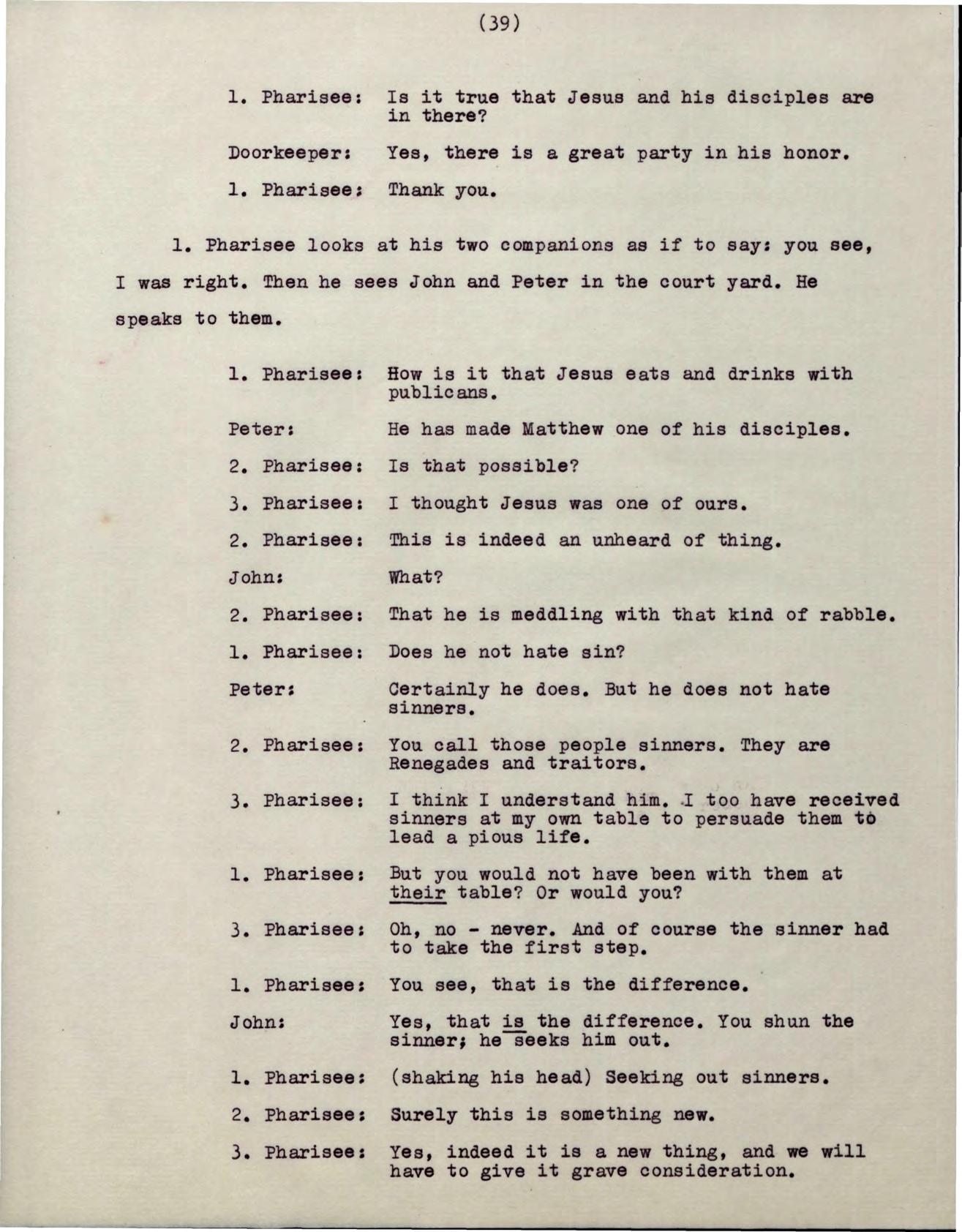
1. Pharisee: Is it true that Jesus and his disciples are in there?
1. Pharisee: Is it true that Jesus and his disciples are in there?
Doorkeeper: Yes, there is a great party in his honor.
Doorkeeper: Yes, there is a great party in his honor.
1. Pharisee: Thank you.
1. Pharisee; Thank you,
1. Pharisee looks at his two companions as if to say: you see, I was right. Then he sees John and Peter in the court yard. He speaks to them.
1. Pharisees
1. Pharisee looks at his two companions as if to says you see, I was right. Then he sees John and Peter in the court yard. He speaks to them.
How is it that Jesus eats and drinks with publicans.
1. Pharisee: How is it that Jesus eats and drinks with publicans.
Peters
Peter: He has made Matthew one of his disciples.
2. Pharisees
2. Pharisee: Is that possible?
He has made Matthew one of his disciples. Is that possible?
3. Pharisee: I thought Jesus was one of ours.
3. Pharisees
I thought Jesus was one of ours.
2. Pharisees
2. Pharisee: This is indeed an unheard of thing.
Johns
John: What?
This is indeed an unheard of thing. m/hat?
2. Pharisee:
1. Pharisee:
1. Pharisee: Does he not hate sin?
Peters
2. Pharisees
That he is meddling with that kind of rabble. Does he not hate sin?
2. Pharisee: That he is meddling with that kind of rabble.
Peter: Certainly he does. But he does not hate sinners.
Certainly he does. But he does not hate sinners.
2. Pharisee: You call those people sinners. They are Renegades and traitors.
3. Pharisee:
You call those people sinners. They are Renegades and traitors.
3. Pharisee: I think I understand him • .r too have received sinners at my own table to persuade them to lead a pious life.
1. Pharisees
1. Pharisee:
3. Pharisee:
3. Pharisees
1. Pharisees
Johns
1. Pharisee: John:
1. Pharisee:
1. Pharisees
2. Pharisee:
2. Pharisees
3. Pharisee:
3. Pharisees
I think I understand him. -I too have received sinners at my own table to persuade them to lead a pious life.
But you would not have been with them at their table? Or would you?
But you would not have been with them at their table? Or would you?
Oh, no - never. And of course the sinner had to take the first step.
Oh, no - never. And of course the sinner had to take the first step.
You see, that is the difference.
You see, that is the difference.
Yes, that is the difference. You shun the sinner; he:eeeks him out.
Yes, that is the difference. You shun the sinners he seeks him out.
(shaking his head) Seeking out sinners.
(shaking his head) Seeking out sinners.
Surely this is something new.
Surely this is something new.
Yes, indeed it is a new thing, and we will have to give it grave consideration.
Yes, indeed it is a new thing, and we will have to give it grave consideration. (39)
(40)
Jesus, from the dining-room having seen his two disciples talking with the Pharisees, now approaches the group. The first Pharisee sees him.
Jesus, from the dining-room having seen his two disciples talking with the Pharisees, now approaches the group. The first Pharisee sees him.
1. Pharisee: There you are. We were just talking about you.
1. Pharisee: There you are. We were just talking about you.
3. Pharisee: We cannot understand •••
3. Pharisee; We cannot understand...
Jesus looks questioningly.
Jesus looks questioningly.
2. Pharisee: We did not expect this of you ••• a religious teacher.
2. Pharisee: We did not expect this of you...a religious teacher.
Jesus now looks inquiringly at the first Pharisee.
Jesus now looks inquiringly at the first Pharisee.
1. You break bread with publicans and sinners.
1. Pharisee; You break bread with publicans and sinners.
Jesus looks at them and nods pensively. Then he takes a seat on the bench in the midst of them. He begins to speak:
Jesus looks at them and nods pensively. Then he takes a seat on the bench in the midst of them. He begins to speak;
Jesus:
Jesus:
They that be whole need not a physician, but they that are sick, for I am not come to call the righteous, but sinners to repentance.
They that be whole need not a physician, but they that are sick, for I am not come to call the righteous, but sinners to repentance.
(Let it be understood that there is no tension or excited rudeness. The Pharisees are surprised and shocked. (Perhaps they have reason to be.) But they are not hostile and neither is Jesus.)
(Let it be understood that there is no tension or excited rudeness. The Pharisees are surprised and shocked. (Perhaps they have reason to be.) But they are not hostile and neither is Jesus.)
After his last remark he points to a who is passing by in the street. The swings toward the woman and remains focused upon her. In the meantime the following is heard -
After his last remark he points to a woman who is passing by in the street. The camera swings toward the woman and remains focused upon her. In the meantime the following is heard -
commentary: And while they still murmured he spake this parable unto them, saying: What woman having ten pieces of silver, if she lose one piece ••• (dies away).
Commentary; And while they still murmured he spake this parable unto them, saying; What woman having ten pieces of silver, if she lose one piece... (dies away). (40)
The woman in the street is counting some money she has in her hand. There are only nine coins and there should be ten. Where is the missing coin? She searches for it in the plaits of her coat but it is not there. She counts the coins again but still there are only nine. She looks on the ground around her but the missing coin is nowhere to be found. The woman is poor - perhaps a widow - so that the coin, even if only a small one, means a great deal to her. She wonders where it could possibly be. Her home is nearby and so she returns thinking it may have been lost in the house. All the time she keeps her eyes on the ground, to see if the coin could have been dropped in the street, but discovers nothing at all. On the way she passes two neighbors who ask what she is looking for and she tells them she has lost a drakme and cannot find it anywhere. They express sympathy and they hope she will find the lost coin.
The woman in the street is counting some money she has in her hand. There are only nine coins and there should be ten. Where is the missing coin? She searches for it in the plaits of her coat but it is not there. She counts the coins again but still there are only nine. She looks on the ground around her but the missing coin is nowhere to be found. The woman is poor - perhaps a widow - so that the coin, even if only a small one, means a great deal to her. She wonders where it could possibly be. Her home is nearby and so she returns thinking it may have been lost in the house. All the time she keeps her eyes on the ground, to see if the coin could have been dropped in the street, but discovers nothing at all. On the way she passes two neighbors who ask what she is looking for and she tells them she has lost a drakme and cannot find it anywhere. They express sympathy and they hope she will find the lost coin.
She enters her home and looks around but the coin is nowhere to be seen. She then takes a broom, made of straw knitted together into a bundle. As the room is dark she has to light an oil lamp to light up the corners where the coin may be hidden away.
She enters her home and looks around but the coin is nowhere to be seen. She then takes a broom, made of knitted together into a bundle. As the room is dark she has to light an oil lamp to light up the corners where the coin may be hidden away.
The broom sweeps over the floor of stamped earth. The dust is swept out of all the fissures and the holes in the floor. Each of the dark corners is thoroughly searched. The few pieces of furniture are moved about as the search is made with the care typical of a good housewife. At last her pains are rewarded. A jingling is heard and there is the missing coin as it rolls from its hiding-place. The woman beams. So great is her joy she must share it with the neighbors. She goes to the door and shouts -
The broom sweeps over the floor of stamped earth. The dust is swept out of all the fissures and the holes in the floor. Each of the dark corners is thoroughly searched. The few pieces of furniture are moved about as the search is made with the care typical of a good housewife. At last her pains are rewarded. A jingling is heard and there is the missing coin as it rolls from its hiding-place. The woman beams. So great is her joy she must share it with the neighbors. She goes to the door and shouts -
The woman; Look, I have found it...
The woman: Look, I have found it •••
The neighbors rush into the room and the widow tells the wonderful story of how she found the lost coin.
The neighbors rush into the room and the widow tells the wonderful story of how she found the lost coin.
(The purpose of this parable is to inform us how a small coin became the center of attention because it was lost and then found again. Just as the woman was overjoyed on finding the coin again so Jesus rejoices exceedingly over every sinner who returns to him. And as the woman found her coin in the dirt and dark so Jesus searches for sinners in the dirt and darkness of this world.)
(The purpose of this parable is to inform us how a small coin became the center of attention because it was lost and then found again. Just as the woman was overjoyed on finding the coin again so Jesus rejoices exceedingly over every sinner who returns to him. And as the woman found her coin in the dirt and dark so Jesus searches for sinners in the dirt and darkness of this world.)
The widow puts her nine coins in a heap in a small table. While telling her story to the neighbors she adds the tenth coin to the others. And while hearing her story we finish the scene with a closeup of the ten coins. Luke 15, 10.
The widow puts her nine coins in a heap in a small table. While telling her story to the neighbors she adds the tenth coin to the others. And while hearing her story we finish the scene with a 0108eup of the ten coins. Luke 15, 10.
This close-up dissolves softly into another close-up of a large heap of gold and silver coins. The camera moves backward now till the entire room is in focus.
This close-up dissolves softly into another close-up of a large heap of gold and silver coins. The camera moves backward now till the entire room is in focus.
During the shifting of scenes the following is heard -
During the shifting of scenes the following is heard -
Commentarys And Jesus spake another parable unto them, sayings A certain man had two sons...
commentarys And Jesus spake another parable unto them, saying: A certain man had two sons •••
In the room we see the father, a rich farmer, and his two sons. The older son, who is to inherit the farm at the death of the father, is a stern-looking young man, a toiler, a slave to duty, stubborn and hard as nails. The younger son is light-hearted and generous and full of the joy o f life, but also giddy and weak. He is not bad but only unstable.
In the room we see the father, a rich farmer, and his two sons. The older son, who is to inherit the farm at the death of the father, is a stern-looking young man, a toiler, a slave to duty, stubborn and hard as nails. The younger Bon is light-hearted and generous and full of the joy of life, but also giddy and weak. He is not bad but only unstable.
(43)
The younger son has asked his father to give him now the portion of goods that will be his after the death of his father. The father has promised to think it over. Now the father and his two sons have gathered together in order to discuss the matter.
The younger son has his father to give him now the portion of goods that will be his after the death of his father. The father has promised to think it over. Now the father and his two sons have gathered together in order to discuss the matter.
Father: You have not changed your mind?
Father: You have not changed your mind?
Younger son: No, father, I am being bored to death by this manner of life.
Younger son; No, father, I am being bored to death by this manner of life.
Elder son: Start working, and stop dreaming - that's my advice to you.
Elder son: start working, and stop dreaming - that's !l advice to you.
Younger son: I tell you that farming holds no attraction for me.
Younger son: I tell you that farming holds no attraction for ' me.
Elder son: Why? It does for me.
Elder son: Why? It does for me.
Younger son: With you it is different. Some day the farm will be yours. Then I will have to move out. Better t9 leave and start my life.
Younger son: With you it is different. Some day the farm will be yours. Then I will have to move out. Better to leave now and start my own life.
The father lays his hands on the shoulders of the younger son.
The father lays his hands the shoulders of the younger son.
Father:
Father: You are certain that you wish to leave?
Younger son:
Younger son: I am certain.
You are certain that you wish to leave? I am certain.
Father:
Father: You shall have your own way.
Elder son: Fool.
Elder son:
Father:
You shall have your own way. Fool.
Father: No, your brother is no child. He is old enough to decide for himself.
(To the younger son, pointing to the heap of on the table): Here is your third.
No, your brother is no child. He is old enough to decide for himself. (To the younger son, pointing to the heap of money on the table): Here is your third.
Younger son: Thank you, father.
Younger son: Thank you, father.
He collects the money hurriedly, putting it into a small chest. The father looks at him with an expression of sadness in his eyes.
He collects the money hurriedly, putting it into a small chest. The father looks at him with an expression of sadness in his eyes.
Wipe to the next scene.
Wipe to the next scene.
At the gate to the farm the young man is about to take his leave from the father and the elder brother. The latter is cool and there is a smirk upon his face. The father embraces his son warmly and before
At the gate to the farm the young man is about to take his leave from the father and the elder brother. The latter is cool and there is a smirk upon his face. The father embraces his son warmly and before (43)
letting hira go takes a ring of gold from one of his fingers and places it on the hand of the young man. The latter goes away. The father looks after him -until he disappears aroung a bend in the road. His eyes are filled with tears. The elder son shakes his head in disgust as the two go back to the farm.
letting him go takes a ring of gold from one of his fingers and places it on the hand of the young man. The latter goes away. The father looks after him until he disappears aroung a bend in the road. His eyes are filled with tears. The elder son shakes his head in disgust as the two go back to the farm.
Wipe to the next scene.
Wipe to the next scene.
The road. The son, seen from behind, travelling on his journey. The road divides the picture in two parts - one to the right and another to the left of the road.
The road. The son, seen from behind, travelling on his journey_ The road divides the picture in two parts - one to the right and another to the left of the road.
This scene dissolves softly into a scene representing a street in an Oriental city, f.inst. Damascus. The street divides the picture into two parts - just like the road. In the street the awnings throw a shade-pattern onto the pavement. In the crowd we notice the younger son who has just arrived. We follow him around a corner. He enters a barber shop and explains to the barber how he wishes his hair cut.
This scene dissolves softly into a scene representing a street in an Oriental city, f.inst. Damascus. The street divides the picture into two parts - just like the road. In the street the awnings throw a shade-pattern onto the pavement. In the crowd we notice the younger son who has just arrived. We follow him around a corner. He enters a barber shop and explains to the barber how he wishes his hair cut.
The son: Take away the beard and cut my hair in the Greek fashion.
The son: Take away the beard and cut my hair in the Greek fashion.
The barber starts to work, using scissors, knife, comb, and curling-iron.
The barber starts to work, using scissors, knife, comb, and curling-iron.
The barber shop faces a small square where a girl can be seen sitting under a tree. She starts playing on a flute. Her eyes are encircles with black, and she has rouge on her cheeks and her lips. At the time of Christ prostitues were noted for playing flutes. There is an exchange of smiles between the young man and the girl who continues playing on her flute. When he leaves the barber-shop they go together.
The barber shop faces a small square where a girl can be seen sitting under a tree. She starts playing on a flute. Her eyes are encircles with black, and she has rouge on her cheeks and her lips. At the time of Christ prostitues were noted for playing flutes. There is an exchange of smiles between the young man and the girl who continues playing on her flute. When he leaves the barber-shop they go together.
Wipe to the next scene.
Wipe to the next scene.
A tavern of the rather sordid type is entered by the prostitute and the young man. By winking at the innkeeper she makes him understand that she has a sucker in tow. The innkeeper therefore outdoes himself in politeness and the young man is flattered. The girl orders wine and snails for food. They are served at once. Y/hile they sit at the table the young man apologizes for being ignorant of the Greek language. The girl promises to teach him and they begin their first lesson at once, using fingers and sign language and laughing cheerfully. The innkeeper, seeing this, joins in the laughter and recommends the girl to the young man by saying -
A tavern of the rather sordid type is entered by the prostitute and the young man. By winking at the innkeeper she makes him understand that she has a sucker in tow. The innkeeper therefore outdoes himself in politeness and the young man is flattered. The girl orders wine and snails for food. They are served at onoe. While they sit at the table the young man apologizes for being ignorant of the Greek language. The girl promises to teach him and they begin their first lesson at once, using fingers and sign language and laughing cheerfully. The innkeeper, seeing this, joins in the laughter and recommends the girl to the young man by saying -
Inn-keeper: She is a good girl - and her heart is in the right place.
Inn-keeper: She is a good girl - and her heart is in the right plaoe.
A street seller enters the tavern and approaches the young couple. He has jewelry set in gold for sale. The girl is eager for an armlet and the boy buys her two of them, one for each arm. She is deliriously happy as she teaches him to eat snails - with a spoon. In the other end of the spools handle is a pin. The lesson in snail eating causes them both to laugh uproariously.
A street seller enters the tavern and approaches the young couple. Re has jewelry set in gold for sale. The girl is eager for an armlet and the boy buys her two of them, one for each arm. She is deliriously happy as she teaches him to eat snails - with a spoon. In the other end of the spoon's handle is a pin. The lesson in snail eating causes them both to laugh uproariously.
Wipe to the next scene.
Wipe to the next scene.
A lane. Moonshine. The girl moves ahead of the young man. Coming to a house she opens the door and slips silently inside, dragging him along with her.
A lane. Moonshine. The girl moves ahead of the man. Coming to a house she opens the door and slips silently inside, dragging him along with her.
Wipe to the next scene.
Wipe to the next scene.
The tavern. The prostitute and the son enter. The innkeeper receives him as if he were royalty. It is evident that he is a customer held in high favor. He has been granted admittance to a special backroom, reserved for regular customers. Here the young Jewish rakes with their Roman and Greek friends debauch themselves
The tavern. The prostitute and the son enter. The innkeeper receives him as if he were royalty. It is evident that he is a customer held in high favor. He has been granted admittance to 8 special backroom, reserved for regular customers. Here the young Jewish rakes with their Roman and Greek friends debauoh themselves
and engage in games of chance. The son is now dressed in a short Greek oloak and has a broad-rimmed hat. He also carries a stick.
and engage in games of chance. The son is now dressed in a short Greek cloak and has a broad-rimmed hat. He also carries a stick.
He and the prostitute enter the baok-room and are greeted with a noisy welcome. One of the company rises and reads a poem of homage to the son who, being moved, orders a large quantity of wine. He is cheered, not only by the men but also a choir of flute playing girls, many of whom are only twelve to fourteen years old. As the wine is poured into the cups a street seller enters offering headkerchiefs of all oolors. He approaches the son with flattering words and the prostitute is invited to choose what she likes. She picks out a headkerchief wrought with gold, the most expensive one. The son does ' not object because he feels so gay and happy with his new friends. He buys the entire lot of headkerchiefs and invites the girls to help themselves. One of the girls suggests they sing a certain Greek song, which just now is a la mode. It is sung by alternating between male and female voices and the whole group joins in.
He and the prostitute enter the back-room and are greeted with a noisy welcome. One of the company rises and reads a poem of homage to the son who, being moved, orders a large quantity of wine. He is cheered, not only by the young men but also a choir of flute playing girls, many of whom are only twelve to fourteen years old. As the wine is poured into the cups a street seller enters offering headkerchiefs of all colors. He approaches the son with flattering words and the prostitute is invited to choose what she likes. She picks out a headkerchief wrought with gold, the most expensive one. The son does not object because he feels so gay and happy with his new friends. He buys the entire lot of headkerchiefs and invites the girls to help themselves. One of the girls suggests they sing a certain Greek song, which just now is a la mode. It is sung by alternating between male and female voices and the whole group joins in.
Wipe to the next scene.
Wipe to the next scene.
A very short scene at the house of the girl. In a ray of moonlight we see only the back of the son, and the naked arms of the girls twining round his neck. Distant music.
A very short scene at the house of the girl. In a ray of moonlight we see only the back of the son, and the naked arms of the girls twining round his neck. Distant music.
V/ipe to the next scene.
Wipe to the next soene.
The tavern. The prostitute and the son enter. The reception of the inn-keeper is less cordial than before. Apparently his financial standing is not as good as before. They enter the back-room. The innkeeper does not accompany them and this time there is no song of welcome. They are received with complete indifference.
The tavern. The prostitute and the son enter. The reoeption of the inn-keeper is less cordial than before. Apparently his finanoial standing is not as good as before. They enter the back-room. The innkeeper does not accompany them and this time there is no song of welcome. They are received with complete indifference.
A stairoase is leading down to a gambling room. The prostitute attempts to lift his spirits by saying.
A stairoase is leading down to a gambling room. The prostitute attempts to lift his spirits by saying.
The girl: Why not try your luck downstairs?
The girl: Why not try your luck downstairs?
He takes her advice. She prefers staying with her friends in the back-room. He goes downstairs and is immediately snared by professional gamblers who soon take all the money he has left. He returns to the back-room. Nobody invites him to sit down but the prostitute takes pity on him and goes with him. When they are passing the tavern the inn-keeper does not even look in his direction.
He takes her advice. She prefers staying with her friends in the back-room. He goes downstairs and is immediately snared by professional gamblers who soon take all the he has left. He returns to the back-room. Nobody invites him to sit down but the prostitute takes pity on him and goes with him. When they are passing the tavern the inn-keeper does not even look in his direction.
Wipe to the next scene.
Wipe to the next scene.
A very short scene at the house of the girl. In a ray of moonlight we just see her naked arm lifting up his arm into the light. She takes off his finger the golden ring which his father has given him when he was leaving home. Distant music.
A short scene at the house of the girl. In a of moonlight we just see her naked arm lifting up his arm into the light. She takes off his finger the golden ring which his father has given him when he was leaving home. Distant music.
Wipe to the next scene.
Wipe to the next scene.
The tavern. The son enters and approaches the inn-keeper timidly -
The tavern. The son enters and approaches the inn-keeper timidly -
The son:
Could I get some food on credit?
The son: Could I get some food on credit?
Inn-keeper:
Inn-keeper: No, I never give credit.
The son:
The son: Could you lend me five drakme?
Inn-keeper:
Inn-keeper: No.
No, I never give credit. Could you lend me five drakme? No.
The son:
Two drakme?
The son: Two drakme?
Inn-keeper: (brutally) No begging is allowed here. Get going. Beat it. Quick.
Inn-keeper: (brutally) No begging is allowed here. Get going. Beat it. Quick.
The inn-keeper has driven the son out of the tavern.
The inn-keeper has driven the son out of the tavern.
Wipe to the next scene.
Outside the house of the girl. The time is at night. There is moonshine. The son knocks at the door. He is now dressed in his old clothes. The Greek oloak has been sold for bread. He knocks again. She answers. They speak through the door.
Outside the house of the girl. The time is at night. There is moonshine. The son knocks at the door. He is now dressed in his old clothes. The Greek cloak has been sold for bread. He knocks again. She answers. They speak through the door.
The girl: Who is it?
The girl: Who is it?
The son: Open the door.
The son: Open the door.
The girl: No. What do want?
The girl: No. What do you want?
The son: I have no money and nowhere to sleep.
The son: I have no money and nowhere to sleep.
The girl: What is that to me?
The girl: What is that to me?
The son: I know you have money.
The son: I know you have money.
The girl: Go away now. I am done with you. Get going.
The girl: Go away now. I am done with you. Get going.
The son leaves.
The son leaves.
Wipe to the next scene.
Wipe to the next scene.
A square in the city with a huge stone from which slaves are sold. An auctionens. Here also day laborers gather when looking for work. Among these is the son. A peasant who has come to town in order to find a helper stops in front of the son, inspecting him closely as if he were a cow or a horse. Some of the slaves singing a monotonicae song.
A square in the city with a huge stone from which slaves are sold. An auotionens. Here also day laborers gather when looking for work. Among these is the son. A peasant who has come to town in order to find a helper stops in front of the son, inspecting him closely as if he were a cow or a horse. Some of the slaves singing a monotonicae song.
The peasant, realizing that the young man has had a quarrel with ( 48) Wipe to the next scene.
Peasant: The son:
Peasant: Do you know anything of farming?
The son: My father is a farmer.
Peasant: Where?
Peasant: Do you know anything of farming?
My father is a farmer. Where?
The son (evasive): Far from here.
The son (evasive): Far from here.
The peasant, realizing that the young man has had a quarrel with
his father, does not press him for a further explanation but invites him to come with him to his farm.
Wipe to next soene.
Wipe to next scene.
The peasant makes the son tend his swine. He, a Jew, has become a keeper of swine for a heathen peasant. During the day the herd of swine search for food in the field. At night they are kept in the hog pen where the swine keeper must sleep too. As there is a famine in the land the food for the swine is sometimes better than the food for their keeper. To appease his hunger the son often has to eat the carob-beans which are given the swine for food.
The peasant makes the son tend his swine. He, a Jew, has beoome a keeper of swine for a heathen peasant. During the day the herd of swine search for food in the field. At night they are kept in the hog pen where the swine keeper must sleep too. As there is a famine in the land the food for the swine is sometimes better than the food for their keeper. To appease his hunger the son often has to eat the carob-beans which are given the swine for food.
One evening, while sitting in the hog-sty among the swine he remembers the happy evenings in his father's home, with all the servants gathered with the family for supper. Then he recalls his parting from his father as he was leaving him. He weeps silently and then breaks down as great sobs shake his body. He bites into his coat in order that no one shall hear him weeping. Suddenly he comes to himself and makes up his mind. He rises, opens the door and goes out.
One evening, while sitting in the hog-sty among the swine he remembers the happy evenings in his father's home, with all the servants gathered with the family for supper. Then he reoalls his parting from his father as he was leaving him. He weeps silently and then breaks down as great sobs shake his body. He bites into his coat in order that no one shall hear him weeping. Suddenly he comes to himself and makes up his mind. He rises, opens the door and goes out.
Wipe to the next acene.
Wipe to the next acene.
The son on the road - on his way home. In his rags, like a tramp, he more than once is at the point of giving up.
The son on the road - on his way home. In his rags, like a tramp, he more than once is at the point of giving up.
Wipe to the next scene.
Wipe to the next scene.
The father is out in the field, watching the plough-drivers make one furrow after another. Now and then he glanoes toward the road. Day after day he has kept watch but it has always been in vain. But it is as though his eyesight has been especially sharpened for
The father is out in the field, watching the piough-drivers make one furrow after another. Now and then he glances toward the road. Day after day he has kept watch but it has always been in vain. But it is as though his eyesight has been especially sharpened for his father, does not press him for a further explanation but invites him to come with him to his farm.
to-day because he is able to recognize his son at a great distance even though he is dressed in rags« The father runs to meet him, and when they come together the father embraces the son and kisses him again and again. And the son says -
to-day beoause he is able to recognize his son at a great distance even though he is dressed in rags. The father runs to meet him, and when they come together the father embraces the son and kisses him again and again. And the son says -
The younger son: Father, I have sinned and I am no longer worthy to be called your son.
The younger son: Father, I have sinned and I am no longer worthy to be called your son.
But the father does not listen. He cannot cease kissing him and embraoing him. There is not an angry word or any suggestion of reproaoh. We see only the great heart of a loving father.
But the father does not listen. He cannot cease kissing him and embracing him. There is not an angry word or any suggestion of reproach. We see only the great heart of a loving father.
And when they were approaching the house the father called his servants, saying -
And when they were approaching the house the father called his servants, saying -
The father: Bring hither the fatted calf, and kill it; and let us eat, and be merry.
The father: Bring hither the fatted calf, and kill it; and let us eat, and be merry.
Wipe to the next scene.
Wipe to the next scene.
The feast taking place outside the house is in full course. The younger son is seated next to his father in the place of honor. He has on new clothes and new sandals on his feet. And now the father puts a golden ring on his finger. Every one is filled with joy and laughter echoes through the air, accompanied by song and music. At some distance from the men's party the girls and young women from the farm are enjoying their folk dances.
The feast taking place outside the house is in full course. The younger san is seated next to his father in the place of honor. He has on new clothes and new sandals on his feet. And now the father puts a golden ring on his finger. Everyone is filled with joy and laughter echoes through the air, accompanied by song and music. At some distance from the men's party the girls and young women from the farm are enjoying their folk dances.
At this moment the elder son arrives. He has been out in the fields and is late. Surprised at hearing the song and music he calls one of the servants, asking -
At this moment the elder son arrives. He has been out in the fields and is late. Surprised at hearing the song and music he calls one of the servants, asking -
Elder son: What do these things mean?
Elder son: Servant:
Servant: Your brother has come back.
Elder son: How did he look?
Elder son: What do these things mean? Your brother has come back. How did he look?
Servant:
)
Miserable. Very poor indeed. Dressed in rags.
Servant: Miserable» Yery poor indeed. Dressed in rags.
Elder son:
Then what is all this?
Elder son: Then what is all this?
Servant:
Your father has killed the fatted oalf.
Servant: Your father has killed the fatted calf.
Elder son:
Servant:
Why?
Elder son: Why?
Because he has received him home again safe and sound.
Servant: Because he has received him home again safe and sound.
The elder son's face is filled with anger.
The elder son's face is filled with anger.
Servant: Are you not coming to meet your brother?
Servant: Are you not coming to meet your brother?
Elder son: No.
Elder son: No.
The servant goes to the father and tells of his conversation with the elder brother.
The servant goes to the father and tells of his conversation with the elder brother.
Servant: Father:
Servant: Your son has come in from the fields.
Father: Is he not coming here to bid his brother welcome?
Servant: Your son has come in from the fields. Is he not coming here to bid his brother welcome?
I asked him to come but he said he would not.
Servant: I asked him to come but he said he would not.
The father is disturbed and goes to the elder son.
The father is disturbed and goes to the elder son.
Father:
Elder son:
Why do you not come and meet your brother?
Father: Why do you not come and meet your brother?
Father, 10, all these many years I have served you, neither transgressed I at any time your oommandments: and yet you never gavest me a kid, that I might make merry with my friends.
Elder son: Father, lo, all these many years I have served you, neither transgressed I at any time your commandments: and yet you never gavest me a kid, that I might make merry with my friends.
Father:
Elder son:
You never asked me.
Father: You never asked me.
(pretending not to hear): But as soon as this YOUi son was come who has devoured your !!VIng w tn-narlots you have killed for him the fatted oalf.
Elder son: (pretending not to hear): But as soon as this your son was come who has devoured your living with harlots you have killed for him the fatted calf.
The father looks at the son for a long moment and the answers mildly -
The father looks at the son for a long moment and the answers mildly -
Father:
Pather: Son, you are ever with me, and all that I have is yours. It was meet that we should . make merry, and be glad: for this your brother was dead, and is alive again, and was lost and is found.
Son, you are ever with me, and all that I have is yours. It was meet that we should . make merry, and be glad: for this your brother was dead, and is alive again, and was lost and is found.
The father waits. For a moment father and son stand faoe to face. Then, on a sudden impulse, the son turns around and goes his way out into the fields. The father looks after him with a sad expression. Then he returns to the feast. And the older son crosses the field, passing the plough-drivers.
The father waits. For a moment father and son stand face to face. Then, on a sudden impulse, the son turns around and goes his way out into the fields. The father looks after him with a sad expression. Then he returns to the feast. And the older son crosses the field, passing the piough-drivers.
While the son is crossing the fields many thoughts crowd his mind, chief of which is that he has been wronged. He is vexed and offended that his father is giving such a party for his good-fornothing brother who has disgraced the family. He feels that he has been deceived because his father apparently prefers this fool to himself. One might well conclude that his father had only one son, the one for whom the family homestead was not good enough. But even though his father had lost his head, he the elder son would retain his senses and keep things moving in proper fashion.
While the son is crossing the fields many thoughts orowd his mind, chief of which is that he has been wronged. He is vexed and offended that his father is giving such a party for his good-fornothing brother who has disgraced the family. He feels that he has been deceived his father apparently prefers this fool to himself. One might well conclude that his father had only one son, the one for whom the family homestead was not good enough. But even though his father had lost his head, he the elder son would retain his senses and keep things moving in proper fashion.
During this the following is heard -
During this the following is heard -
Commentary:
Commentary: Jesus ooncluded: More joy shall be in Heaven over one sinner who repents than over 99 just persons who need no repentance.
Jesus concluded: More joy shall be in Heaven over one sinner who repents than over 99 just persons who need no repentance.
The elder son sits down on a stone-fence. Behind him, some distance away, is a shepherd with his boy and a dog at the head of the flock of a hundred sheep. The shepherd is hailing him: Shalom. But the elder son does not hear him.
The elder son sits down on a stone-fence. Behind him, some distance away, is a shepherd with his boy and a dog at the head of the flock of a hundred sheep. The shepherd is hailing him: Shalom. Eut the elder son does not hear him.
In the distance is heard the song and music from the farm, but this sound dies away little by little and is replaoed by the sound
In the distance is heard the song and music from the farm, but this sound dies away little by little and is replaced by the sound
of the reed pipe which the shepherd is playing to divert himself.
In following the shepherd and his sheep by means of a semicular panorama we leave the elder son, and behind the shepherd and his 100 sheep we see Jesus and his disciples« We stay with them and the shepherd and his sheep leave the picture.
In following the shepherd and his sheep by of a semicular panorama we leave the elder son, and behind the shepherd and his 100 sheep see Jesus and his disciples. We stay with them and the shepherd and his sheep leave the picture.
Jesus is sitting surrounded by six of his disoiples: Andrew, John and his brother Jacob, Philip, Bartholomew (Nathanael) and Matthew. They are waiting for Peter, who presently arrives, accompanied by five other new disoiples chosen by Jesus to follow him. These are: Thomas, Jaoob (the of Alphai), Tadda1, SimoD the Canaenaean and Judas ish Querijoth (from the town Querijoth).
Jesus is sitting surrounded by six of his disciples: Andrew, John and his brother Jacob, Philip, Bartholomew (Nathanael) and Matthew. They are waiting for Peter, who presently arrives, accompanied by five other new disciples chosen by Jesus to follow him. These are: Thomas, Jacob (the son of Alphai), Taddai, Simon the Canaenaean and Judas ish Querijoth (from the town Querijoth).
All of them apparently have been drawn from the middle-classes. At the time of Christ the middle-classes were particularly interested in spiritual and religious matters.
All of them apparently have been drawn from the middle-olasses. At the time of Christ the middle-olasses were partioularly interested in spiritual and religious matters.
They were very different in character and temper. The most remarkable of them was certainly Peter, great hearted, staunch in his loyalty to Jesus, strong and weak at the same time, but profoundly sincere. His brother Andrew was as sincere as Peter and was more calm and gentle. John and Jacob were hasty and violent and therefore were surnamed "Sons of thunder". Thomas was sceptical and cautious, but also straight and courageous. Nathanael had once been a sceptic but was now a faithful believer in Jesus. Of Judas we will speak later.
They were very different in oharacter and temper. The most remarkable of them was certainly Peter, great hearted, staunch in his loyalty to Jesus, strong and weak at the same time, but profoundly sincere. His brother Andrew was as sinoere as Peter and was more calm and gentle. John and Jacob were hasty and violent and therefore were surnamed "Sons of thunder". Thomas was soeptical and cautious, but also straight and courageous. Nathanael had once been a sceptio but was now a faithful believer in Jesus. Of Judas we w111 speak later.
As Peter approaches Jesus, who is sitting on a stump of a tree, he introduces the new disciples one by one, and each in his turn, kiss him as a sign of love and respect.
As Peter approaches Jesus, who is sitting on a stump of a tree, he introduces the new disciples one by one, and each in his turn, kiss him as a sign of love and respect. of the reed pipe which the shepherd is playing to divert himself.
Thomas: I will follow you wherever you go.
Thomas: I will follow you wherever you go,
Judas: I too will follow you wherever you go.
Judas: I too will follow you wherever you go.
Jesus then speaks to Jaoob, the son of Alphai.
Jesus then speaks to Jacob, the son of Alphai.
Jesus:
Jesus: Follow me.
Jacob:
Jacob: Follow rp.e.
Let me go first and bid them farewell, whioh dwell at my home.
Let me go first and bid them farewell, which dwell at my home.
But Jesus said unto him -
But Jesus said unto him -
Jesus:
Jesus: No man having put his hand to the plough, and looking baok, is fit for the Kingdom of God.
No man having put his hand to the plough, and looking back, is fit for the Kingdom of God.
Jacob, the son of Alphai, smiles, signifying his loyalty and kisses Jesus.
Jacob, the son of Alphai, smiles, signifying his loyalty and kisses Jesus.
Then Jesus speaks to Simon the Canaenaen -
Then Jesus speaks to Simon the Canaenaen -
Jesus:
Jesus: Follow me.
Simon:
Simon:
Jesus:
Jesus: Follow me.
Let me first go and bury my father.
Let me first go and bury my father.
Let the dead bury their dead: but go you and preaoh the Kingdom of God.
Let the dead bury their dead: but go you and preach the Kingdom of God.
Simon the Canaenaen nodded assent and kissed Jesus. Then Taddai approached Jesus.
Simon the Canaenaen nodded and kissed Jesus. Then Taddai approached Jesus.
Taddai: I will follow you wherever you go.
Taddai: I will follow you wherever you go.
He kisses Jesus.
He kisses Jesus.
After this soene Jesus rises. The disoiples gather about him and he speaks to them.
After this scene Jesus rises. The disciples gather about him and he speaks to them.
Jesus: Foxes have holes, and the birds of the air have nests; but the Son of man has not where to lay his head.
Jesus: Foxes have holes, and the birds of the air have nests; but the Son of man has not where to lay his head. This he says in order not to raise false hopes in his followers.
This he says in order not to raise false hopes in his followers.
(55 )
But as if being sorry for having discouraged them he promptly adds -
But as if being sorry for having discouraged them he promptly adds -
Jesus:
Jesus: But take no thought for your life, what you shall eat and what you shall drink. Is not the life more than meat, and the body more than the raiment?
But take no thought for your life, what you shall eat and what you shall drink. Is not the life more than meat, and the body more than the raiment?
The disciples nod thoughtfully and together with Jesus they continue on their way, talking as they walk along•
The disciples nod thoughtfully and together with Jesus they continue on their way, talking as they walk along.
From far away the tinkling of the sheep-bells is heard.
From far away the tinkling of the sheep-bells is heard.
A short scene of the shepherd at the head of his flock, leading it over the hills to new pastures and speaking familiarly to the sheep in a strange rhytmic language that is somewhat akin to the sounds made by the animals themselves.
A short of the shepherd at the head of his flock, leading it over the hills to new pastures and speaking familiarly to the sheep in a strange rhytmic language that is somewhat akin to the sounds made by the animals themselves.
•
Jesus and his disciples talking as they walk along.
Jesus and his disoiples talking as they walk along.
Jesus points to the sky, and all the disciples look in that direction.
Jesus pOints to the sky, and all the disciples look in that direction.
Two beautiful "kingfishers" are ciro1ing above their heads.
Two beautiful "kingfishers" are circling above their heads.
Jesus:
Jesus: Behold the fowls of the air: for they sow not, neither do they reap, nor gather into barns; yet your heavenly Father feeds them.
Behold the fowls of the air: for they sow not, neither do they reap, nor gather into barns; yet your heavenly Father feeds them.
The disciples nod thoughtfully.
The disciples nod thoughtfully.
Jesus: And are you not much better than they?
Jesus: And are you not much better than they?
The disciples nod again, smiling.
The disciples nod again, smiling.
Another short scene of the shepherd at the head of his flock
Another short scene of the shepherd at the head of his flock
of sheep. Boy. Dog.
(56) of sheep. Boy. Dog.
• • •
• • •
Jesus and his disciples talking as they walk along.
Jesus and his disciples talking as they walk along.
Jesus points at the meadow carpeted with flowers of wondrous colors.
Jesus points at the meadow carpeted with flowers of wondrous oolors.
Jesus: Consider the lilies of the field, how they grow. They toil not, neither do they spin.
Jesus: Consider the lilies of the field, how they grow. They toil not, neither do they spin.
The disciples look at the flowers.
The disciples look at the flowers.
Jesus:
Jesus: Therefore, take no thought of how you shall be clothed, for your heavenly Father knows that you have need of all these things. But seek you first the Kingdom of God, and all these things shall be added unto you.
Therefore, take no thought of how you shall be clothed, for your heavenly Father knows that have need of all these things. But seek you first the Kingdom of God, and all these things shall be added unto you.
Jesus and the disciples continue their walk.
Jesus and the disciples continue their walk.
• • •
The shepherd with his flock. Dog.
The shepherd with his flock. Dog.
Suddenly he misses one of the younger sheep. He realizes that a single sheep is helpless out in the hills. Therefore he leaves the entire flock with the boy, knowing there is no risk for them as long as they keep together. Then he goes to find the lost sheep. He runs from one hill to another, calling and listening, but without success. He calls again and at last a bleating is heard. He runs in the direction of the sound and in a ravine he finds the sheep. It has a foot pinched into a fissure of the rock. The shepherd helps it out, hugging and caressing the little animal. Then he puts it on his shoulders and carries it back to the flock and soon after all are headed for the sheep-fold.
Suddenly he misses one of the younger sheep. He realizes that a single sheep is helpless out in the hills. Therefore he leaves the entire flock with the boy, knowing there is no risk for them as long as they keep together. Then he goes to find the lost sheep. He runs from one hill to another, calling and listening, but without success. He calls again and at last a bleating is heard. He runs in the direction of the sound and in a ravine he finds the sheep. It has a foot pinched into a fissure of the rock. The shepherd helps it out, hugging and oaressing the little animal. Then he puts it on his shoulders and carries it back to the flock and soon after all are headed for the sheep-fold.
• • •
Jesus and his disciples walking toward the sheep-fold. They
Jesus and his disciples walking toward the sheep-fold. They
(57)
stop and by means of a panorama we see the sheep-fold, surrounded by a stone wall on the top of which thorns are placed to prevent wild beasts from attacking the sheep. Our shepherd from the preceding scene arrives with his flock. He still has the wounded sheep on his shoulders as he enters the sheep-fold followed by the flock.
stop and by means of a panorama we see the sheep-fold, surrounded by a stone wall on the top of which thorns are placed to prevent wild beasts from attaoking the sheep. Our shepherd from the preceding scene arrives with his flock. He still has the wounded sheep on his shoulders as he enters the sheep-fold followed by the flock.
We turn back to Jesus and his disciples and hear him saying -
We turn back to Jesus and his disciples and hear him saying _
Jesus:
Jesus: "Verily I say unto you: he rejoices more of that sheep, than of the ninety and nine which went not astray. Even so is it not the will of your Father which is in heaven, that not one of these little ones should perish.
Verily I say unto you: he rejoices more of that sheep, than of the ninety and nine whioh went not astray. Even so is it not the will of your Father whioh is in heaven, that not one of these little ones should perish.
Once more we turn back to the sheep-fold and see the shepherd, after having left his sheep in charge of the keeper of the fold, leaving and shouting to the keeper that he will be back in the morning to fetch the sheep. The keeper of the fold stands in the door. This is narrow because the sheep are counted by passing under a stick as they are let in.
Onoe more we turn back to the sheep-fold and see the shepherd, after left his sheep in charge of the keeper of the fold, leaving and shouting to the keeper that he will be back in the morning to fetch the sheep. The keeper of the fold stands in the door. This is narrow because the sheep are counted by passing under a stick as they are let in.
We turn back to Jesus and his disciples and hear him saying -
We turn back to Jesus and his disciples and hear him saying _
Jesus:
Jesus:
Verily, I say unto you, I am the door of the sheep. I am the door: by me if any man enter in he shall be saved, and shall go in and out and find pasture.
Verily, I say unto you, I am the door of the sheep. I am the door: by me if any man enter in he shall be saved, and shall go in and out and find pasture.
And he indicates they are to go and find shelter for the night.
And he indicates they are to go and find shelter for the night.
At some distance from the sheep-fold four or five shepherds are camping around a fire. Our shepherd approaches, eager to share his experiences with the others. He is looking forward with pleasure to speaking at great length about the event of the day. Dogs.
At some distance from the sheep-fold four or five shepherds are camping around a fire. Our shepherd approaches, eager to share his experiences with the others. He is looking forward with pleasure to speaking at great length about the event of the day. Dogs.
Our shepherd: I lost a sheep to-day.
Our shepherd: I lost a sheep to-day.
1. Herd: But you found it again?
1. Herd: But you found it again?
(58)
Our shepherd: Yes, fortunately.
Our shepherd: Yes, fortunately.
2. Herd: Sit down, and tell •••
2. Herd: Sit down, and tell...
Our shepherd sits down and begins his story.
Our shepherd sits down and begins his story.
Jesus and his disciples are walking through a village. Their leads them beside a stone-wall. They can see a farm house inside the wall. Not far from the house is a hay-barn. From within the house is heard a womants sweet voice, singing softly and lulling a baby to sleep.
Jesus and his disciples are walking through a village. Their way leads them beside a stone-wall. They can see a farm house inside the wall. Not far from the house is a hay-barn. From within the house is heard a woman*s sweet voice, singing softly and lulling a baby to sleep.
Jesus and his disciples stop to listen. Then Jesus speaks to Peter -
Jesus and his disciples stop to listen. Then Jesus speaks to Peter -
Jesus: Go and tell them that we will spend the night at their house.
Jesus: Go and tell them that we will spend the night at their house.
While Peter enters the house Jesus and the others go to the barn, where the disciples lie down on the hay. One of .the disciples, Nathanael, speaks -
While Peter enters the house Jesus and the others go to the barn, where the disciples lie down on the hay. One of the disciples, Nathanael, speaks -
Nathanael: Have ever heard the parable of Moses and the sheep?
Nathanael: Have you ever heard the parable of Moses and the sheep?
The other disciples have not heard it and Nathanael continues -
Nathanael:
The other disciples have not heard it and Nathanael continues -
Nathanaels Once while Moses was tending the sheep of his father-in-law, a young kid ran away. Moses went to look for it and found it in a ravine, drinking from a well, when Moses reached the sheep he said: I did not know that you were thirsty. I think you must be tired now. And he took the kid up and carried back...
Taddai:
Nathanael:
Once while Moses was tending the sheep of his father-in-law, a kid away. Moses went to look for it and found it in a ravine, drinking from a well. When Moses reached the sheep he said: I did not know that you were thirsty. I think you must be tired now. And he took the kid up and carried back •••
Taddai: And after that?
And after that?
After that God said to Moses: because you have shown pity I make you the herdsman of my flock, the people of Israel.
Nathanael: After that God said to Moses: because you have shown pity I make you the herdsman of my flock, the people of Israel. (58)
In the meantime Peter has met the young farmer who, with Oriental hospitality, bids Jesus and his disciples welcome» He and his wife (whose voice we have heard lulling her baby asleep) make preparations for a meal.
In the meantime Peter has met the young farmer who, with Oriental hospitality, bids Jesus and his disciples welcome. He and his wife (whose voice we have heard lulling her baby asleep) make preparations for a meal.
In the barn the eleven disciples have made themselves at home. Without drawing attention Jesus leaves and it 1s only after the return of Peter that they notice his absence. Peter reasons that he has gone out to pray. And one of the disciples looking through the cross-bars at the back of the barn can see Jesus praying in a lonely place. All the disciples are filled with awe because of the loveliness of his countenance. They long to be able to pray in the same manner.
In the barn the eleven disciples have made themselves at home. Without drawing attention Jesus leaves and it is only after the return of Peter that they notice his absence. Peter reasons that he has gone out to pray. And one of the disciples looking through the cross-bars at the back of the barn can see Jesus praying in a lonely place. All the disciples are filled with awe because of the loveliness of his countenance. They long to be able to pray in the same manner.
The farmer announces a simple meal: milk, bread, figs and dates. The disciples have just finished eating when Jesus comes back. He tastes a cup of milk andthen the farmer bids them good night. As soon as he has retired Peter approaches Jesus saying -
The farmer announces a simple meal: milk, bread, figs and dates. The disciples have just finished eating when Jesus oomes back. He tastes a cup of milk am then the farmer bids them good night. As soon as he has retired Peter approaches Jesus saying -
Peter:
Teach us to pray.
Peter: Teach us to pray.
Jesus nods, and the disciples gather around him. And he speaks unto them.
Jesus nods, and the disciples gather around him. And he speaks unto them.
Jesus:
Jesus:
When you pray, enter into your closet, and when you have shut your door, pray to your father, who is in seoret, and your father who sees in secret, shall reward you openly.
After this manner therefore pray you:
When you pray, enter into your closet, and when you have shut your door, pray to your father, who is in secret, and your father who sees in secret, shall reward you openly. After this manner therefore pray you:
Our Father which art in Heaven, hallowed be thy name.
Our lather which art in Heaven, hallowed be thy name.
Thy Kingdom come.
Thy Kingdom come. Thy will be done in earth, as it is in Heaven. Give us this day our daily bread. And forgive us our debts, as we forgive our debtors.
Thy will be done in earth, as it is in Heaven. Give us this day our daily bread. And forgive us our debts, as we forgive our debtors. And lead us not into temptation, but deliver us from eTil.
For thine is the Kingdom, and the power, and the glory, tor eTer. Amen.
And lead us not into temptation, but deliver us from evil. For thine is the Kingdom, and the power, and the glory, for ever. Amen. (59)
As Jesus gives them each article of the prayer the disciples repeat the words after him.
As Jesus gives them each article of the prayer the disciples repeat the words after him.
After "Amen1' there is a devout silence. Then Jesus rises, wishes them good-night and they all go to their rest.
After "Amen" there is a devout silence. Then Jesus rises, wishes them good-night and they all go to their rest.
Without moving the the preceding in evening light dissolves softly into a scene of the hay-barn in morning light.
Without moving the camera the preceding scene in evening light dissolves softly into a new scene of the hay-barn in morning light.
Jesus and the disciples awake and rise.
Jesus and the disciples awake and rise. •
The sheep-fold seen from within. At dawn the herdsmen come to fetche their flocks. Our shepherd is among them. The keeper of the fold has opened the door. Outside one of the shepherds is singing out his special call, and his sheep (and only his) are hurrying toward the door, slipping out one by one. They have to go under his stick, which enables him to count them. The other sheep do not move but wait patiently for the call of their own herdsman.
The sheep-fold seen from within. At dawn the herdsmen come to fetche their flocks. Our shepherd is among them. The keeper of the fold has opened the door. Outside one of the shepherds is singing out his special call, and his sheep (and only his) are hurrying toward the door, slipping out one by one. They have to go under his stick, which enables him to count them. The other sheep do not move but wait patiently for the call of their own herdsman.
•
The farm. In the courtyard. The disciples are up and washing their hands and faces. While some are washing, others carry water in buckets from the farm well.
The farm. In the courtyard. The disciples are up and washing their hands and faces. While some are washing, others carry water in buckets from the farm well.
A road. A shepherd with his flock of sheep. Log. Three carriages laden with lime-stone from a nearby pit are passing. The carriages are drawn by donkeys. The stones are intended for a new building in process of being erected on the outskirt of the nearby town.
A road. A shepherd with his flock of sheep. Dog. Three carriages laden with lime-stone from a nearby pit are passing. The carriages are drawn by donkeys. The stones are intended for a new building in process of being erected on the outskirt of the nearby town. •
The farm. Having finished washing, Jesus and his diSCiples sit down at a table which the farmer and his wife have set for them in the courtyard. Placed before them is butter, milk, cheese and large
The farm. Having finished washing, Jesus and his disciples sit down at a table which the farmer and his wife have set for them in the courtyard. Placed before them is butter, milk, cheese and large
baskets of bread. Before eating one of the disciples say grace.
baskets of bread. Before eating one of the disciples say grace.
The three carriages laden with stones for the new building. The drivers cursing and shouting.
The three carriages laden with stones for the new building. The drivers cursing and shouting,
The farm. Jesus and his disciples leaving the farm as the farmer and his wife bid them farewell.
The farm. Jesus and his disciples leaving the farm as the farmer and his wife bid them farewell.
•
The three carriages arrive at the new building. A dozen people are working on it. The walls have already reached a considerable height. The builder himself is standing on the top of the building, singing in order to keep up the spirits of the masons and their helpers. For a moment the builder stops singing as he shouts to the drivers with their carriages to unload the stones. Then he resumes his singing. The masons are busily occupied with their work. Solid planks are placed from the ground to the upper part of the building and the workmen use these in carrying up the necessary material: stones, water, mortar, etc. There is also the noise of the chisels of the stonecutters. Beside the building is a lime pit.
The three carriages arrive at the new building. A dozen people are working on it. The walls have already reached a considerable height. The builder himself is standing on the top of the building, singing in order to keep up the spirits of the masons and their helpers. For a moment the builder stops singing as he shouts to the drivers with their carriages to unload the stones. Then he resumes his singing. The masons are busily occupied with their work. Solid planks are placed from the ground to the upper part of the building and the workmen use these in carrying up the necessary material: stones, water, mortar, etc. There is also the noise of the chisels of the stonecutters. Beside the building is a lime pit.
The new building is situated at the junction of t 0 roads, one running south and the other west.
The new building is situated at the junction of two roads, one running south and the other west.
One of the workmen suddenly notices a procession coming from the South. At its head are some of "the elders" from the nearby town and with them the commander of the garrison, leading his horse by the bridle. He is not a Roman, this part of the country being outside the Roman military territory, but is a Gentile and a commander of the mercenaries in the service of King Herodes Antipas.
One of the workmen suddenly notices a procession coming from the South. At its head are some of -the elders" from the nearby town and with them the commander of the garrison, leading his horse by the bridle. He is not a Roman, this part of the country being outside the Roman military territory, but is a Gentile and a commander of the mercenaries in the service of King Herodes Antipas.
At a respectful distance the procession is followed by a crowd of people.
At a respectful distance the procession is followed by a crowd of people,
A boy, sent ahead for reconnoitering by one of "the elders'*, comes back hurriedly, announcing that Jesus and his disciples are coming on the road from the West. "The elders" confer with one another and with the commander and they decide that "the elders" shall meet Jesus first. They therefore go on and meet Jesus at the junction. All the laborers on the new building have ceased working and stopped singing and are gazing at what is happening in the street.
A boy, sent ahead for reconnoitering by one of "the elders", comes back hurriedly, announcing that Jesus and his disciples are coming on the road from the west. "The elders· confer with one another and with the commander and they decide that "the elders" shall Jesus first. They therefore go on and meet Jesus at the junction. All the laborers on the new building have ceased working and stopped singing and are gazing at what is happening in the street.
One of "the elders" speaks to Jesus.
One of "the elders" speaks to Jesus.
The I.elder: Do you see that man there?
The 1.elder: Do you see that man there?
Jesus looks in the direction of the commander.
Jesus looks in the direction of the commander.
The 2.elder: He is the commander of our town.
The 2.elder: He is the commander of our town.
Jesus nods.
Jesus nods.
The l.elder: He has a who is very dear to him and who is sick and about to die.
The 1.elder: He has a servant who is very dear to him and who is sick and about to die.
Jesus looks inquiringly at "the elder".
Jesus looks inquiringly at "the elder".
The 2.elder: He wishes you to help him in the hour of his need.
The 2.elder: He wishes you to help him in the hour of his need.
The 3.elder: He is worthy of being helped for he loves our nation and he has built our Synagogue.
The 3.elder: He is worthy of being helped for he loves our nation and he has built our Synagogue.
The l.elder: Can he come and see you?
The 1.elder: Can he come and see you?
Jesus: Yes.
Jesus: Yes.
The elders beckon the commander to come.
The elders beckon the commander to come.
(63)
Commander: (63) My servant lies at home sick of palsy and grievously tormented.
Commander: My servant lies at home sick of palsy and grievously tormented.
Jesus looks at him instantly and then he speaks.
Jesus looks at him instantly and then he speaks,
Jesus: I will come and heal him.
Jesus: I will come and heal him.
The commander looks greatly relieved but says -
The commander looks greatly relieved but says -
Commander: I am not worthy that should come under my roof: but speak the word only and my servant shall be healed. For I am a man under authority, having soldiers under me: and I say to this man: Go, and he goes: and to another: come, and he comes: and to any servant: do this, and he does it.
Commander: I am not worthy that you should come under my roof: but speak the word only and my servant shall be healed. For I am a man under authority, having soldiers under me: and I say to this man: Go, and he goes: and to anothers come, and he comes: and to any servant: do this, and he does it.
When Jesus heard this, he marvelled, and looking around at "the elders" and the disciples he said -
When Jesus heard this, he marvelled, and looking around at "the elders" and the disciples he said -
Jesus: Verily, I say unto you, I have not found so great faith, no, not in Israel.
Jesus: Verily, I say unto you, I have not found so great faith, no, not in Israel.
Then Jesus turns to the Commander, saying -
Then Jesus turns to the Commander, saying -
Jesus: Go your way, according to your faith, so will it be done unto you.
Jesus: Go your way, according to your faith, so will it be done unto you.
The commander is hesitant for a as he looks at Jesus. Then Jesus repeats:
The commander is hesitant for a moment as he looks at Jesus. Then Jesus repeats:
Jesus: Go your way. Your servant lives.
Jesus: Go your way. Your servant lives.
Then the commander believes, and mounting his horse he rides away.
Then the commander believes, and mounting his horse he rides away. •.
A crowd of people have gathered round Jesus, and from all sides they beseech him to speak to them calling him: Lord, Lord.
A crowd of people have gathered round Jesus, and from all sides they beseech him to speak to them calling him: Lord, Lord.
Laborer: Come up here and teach us.
Laborer: Come up here and teach us.
And Jesus begins walking on one of the planks that leads from the ground to the upper part of the building. With the new building as background he faces the crowd and begins to speaks
And Jesus begins walking on one of the planks that leads from the ground to the upper part of the building. With the new building as background he faces the crowd and begins to speak:
Jesus:
Jesus:
Why call you me: Lord, Lord, and do not the things which I say. Therefore, whosoever hears these sayings of mine, and does them, I will liken him unto a wise man, which built his house upon a rock; And the rain descended, and the floods came, and the winds blew, and beat upon that house; and it fell not: for it was founded upon a rock. And every one that hears these sayings of mine, and does them not, shall be likened unto a foolish man, which built his house upon the sand: And the rain descended, and the floods came, and the winds blew, and beat upon that house; and it fell: and great was the fall of it. Therefore, not every man, that says unto me: Lord, Lord, shall enter into the Kingdom of Heaven; but he that does the will of my Father which is in Heaven.
Why call you me: Lord, Lord, and do not the things which I say. Therefore, whosoever hears these sayings of mine, and does them, I will liken him unto a wise man, which built his house a rock; And the rain descended, and the floods came, and the winds blew, and beat upon that house; and it fell not: for it was founded upon a rock. And everyone that hears these sayings of mine, and does them not, shall be likened unto a foolish man, which built his house upon the sand: And the rain descended, and the floods came, and the winds blew, and beat upon that house; and it fell: and great was the fall of it. Therefore, not every man, that says unto mel Lord, Lord, shall enter into the Kingdom of Heaven; but he that does the will of my Father which is in Heaven.
When Jesus had ended these sayings, the people were astonished. As he came down from the building many sought to touch him, for virtue went out of him. But the disciples held them back.
When Jesus had ended these sayings, the people were astonished. As he came down from the building many sought to touch him, for virtue went out of him. But the disciples held them back.
Just as Jesus and his disciples were leaving the place the ruler of the Synagogue of the town, by name Jairus, came to meet him, and when he saw him he besought him greatly, saying -
Just as Jesus and his disciples were leaving the place the ruler of the Synagogue of the town, by name Jairus, came to meet him, and when he saw him he besought him greatly, saying -
The ruler:
The ruler: My little daughter lies at the point of death: I pray you, come and lay your hands on her, that she may be healed, and she shall live.
My little daughter lies at the point of death: I pray you, come and lay your hands on her, that she may be healed, and she shall live.
And Jesus went with him, and much people followed him and thronged him.
And Jesus went with him, and much people followed him and thronged him.
In some intercalated scenes we have seen the commander on horseback making his way home. At his arrival the servants meet him almost
In some intercalated scenes we have the commander on horseback making his way home. At his arrival the servants meet him almost
beside themselves with joy.
beside themselves with joy.
Commander: How is he?
Servants: He lives.
Commander; How is he? Servants; He lives.
The commander hurries into the sick room of his servant. He is sitting up in bed and eating with a " good appetite. The commander inquires of the other servants.
The commander hurries into the sick room of his servant. He is sitting up in bed and eating with a good appetite. The commander inquires of the other servants.
Commander: When did he begin getting well?
Commander: When did he begin getting well?
The servants explain that he took a turn for the better only a short while ago.
The servants explain that he took a turn for the better only a short while ago.
(This "miracle" is convincing proof of the unique suggestive power possessed by Jesus and is a classic case of mental healing by "absent treatment". The patient is away from the healer and knows nothing of what is happening to him. For this the healer has and undisturbed opportunity affect the subconscious mind which in is ready to cooperate in restoring health to the body. Obviously it is a great advantage to be in a position where the ofttimes doubting and skeptical consciousness cannot interfere, as it is not aware of what is taking place).
(This "miracle" is convincing proof of the unique suggestive power possessed by Jesus and is a classic case of mental healing by "absent treatment". The patient is away from the healer and knows nothing of what is happening to him. For this reason the healer has and undisturbed opportunity to affect the subconscious mind which in return is ready to cooperate in restoring health to the body. Obviously it is a great advantage to be in a position where the ofttimes doubting and skeptical consciousness cannot interfere, as it is not aware of what is taking place).
Jesus, accompanied by the ruler of the Synagogue and the disciples, is on his way to the town. They are surrounded by a crowd, thronging him, everybody trying to get near him at the same time.
Jesus, accompanied by the ruler of the Synagogue and the disciples, is on his way to the town. They are surrounded by a crowd, thronging him, everybody trying to get near him at the same time.
. The roof of a poor house. Hens and chickens are running about. A woman is sitting on the floor, protected against the sun by a tentcloth. Grains of rye are spread on trays for drying. A hand-loom is set up in a corner. A younger woman, the daughter, is on her way up the outer staircase with a cup of milk for the mother. After delivering the milk she sits down at the hand-loom and starts weaving. The
' The roof of a poor house. Hens and chickens are running about. A woman is sitting on the floor, protected against the sun by a tentcloth. Grains of rye are spread on trays for drying. A hand-loom is set up in a corner. A younger woman, the daughter, is on her way up the outer staircase with a cup of milk for the mother. After delivering the milk she sits down at the hand-loom and starts weaving. The
picture is centered on the mother. While she is sipping her milk the following is heard.
picture is centered on the mother. While she is sipping her milk the following is heard.
Commentary: A certain woman which was 12 years diseased with an issue of blood and had spent all her living upon physicians neither could be healed of any, was nothing bettered, but rather grew worse. When she heard of Jesus she said within herself; If I may but touch his garment, I shall be whole.
commentary: A certain which was 12 years diseased with an issue of blood and had spent all her living upon physicians neither could be healed of any, was nothing bettered, but rather grew worse. When she heard of Jesus she said within herself: If I may but touoh his garment, I shall be whole.
Suddenly the noise of the crowd is heard. The daughter rises and runs to the parapet of the roof, looking in the direction of the noise and then shouting at the mother -
Suddenly the noise of the crowd is heard. The daughter rises and runs to the parapet of the roof, looking in the direction of the noise and then shouting at the mother -
Daughter: That must be Jesus...yes, Mother, it is Jesus.
Daughter: That be Jesus ••• yes, Mother, it is Jesus.
The mother is listening with excitement. Then she calls the daughter -
The mother is listening with excitement. Then she calls the daughter -
The woman: Gome and help me.
The woman: Come and help me.
The daughter helps her to her feet and then assists her down the staircase. Once in the street the woman runs on unaided, making her way into the crowd surrounding Jesus. She comes in the press behind Jesus and succeeds in touching the hem of his garment - and she feels in her body that she is healed.
The daughter helps her to her feet and then assists her down the staircase. Onoe in the street the woman runs on unaided, making her way into the crowd surrounding Jesus. She comes in the press behind Jesus and succeeds in touching the hem of his garment - and she feels in her body that she is healed.
But Jesus, immediately knowing in himself that virtue had gone out of him, turned about saying...
But Jesus, immediately knowing in himself that virtue had gone out of him, turned about saying •••
Jesus: Who touched me?
Jesus: Who touched me?
He looks questioningly at those behind him but no one answers. Peter and they that are with him shake their heads. They do not understand the meaning of it all and Peter speaks to him, saying -
He looks questioningly at those behind him but no one answers. Peter and they that are with him shake their heads. They do not understand the meaning of it all and Peter speaks to him, saying -
(67)
Peter:
Peter: You see the multitude throng about and press you and you says who touched me?
Jesus: (67) You see the multitude throng about and press you and you say: who touched me?
Jesus s Somebody has touched me, for I perceive that virtue is gone out of me.
Somebody has touched me, for I perceive that virtue is gone out of me.
And Jesus looked around about to see who had done this thing. The woman, when she saw that hiding was useless, came forward fearfully and told him all the truth.
And Jesus looked around about to see who had done this thing. The woman, when she saw that hiding was useless, came forward fearfully and told him all the truth.
The woman: I touched you - and I have been healed.
The woman: I touched you - and I have been healed.
Jesus looked at her with compassion.
Jesus looked at her with compassion.
Jesus s
Jesus: Be of good comfort. Your faith has made you whole.
Be of good comfort. Your faith has made you whole.
The woman took her leave and ran most of the way home.
The woman took her leave and ran most of the way home.
While Jesus yet spoke to the woman there came from the house of the ruler of the Synagogue a servant who had been sent with the following message.
While Jesus yet spoke to the woman there came from the house of the ruler of the Synagogue a servant who had been sent with the following message.
Servant: Your daughter is dead. Why trouble you the Master any further?
Servant: Your daughter is dead. Why trouble you the Master any further?
But when Jesus heard this, he spoke to the ruler of the Synagogue, saying -
But when Jesus heard this, he spoke to the ruler of the Synagogue, saying -
Jesus: Be not afraid, only believe, and she shall be whole.
Jesus: Be not afraid, only believe, and she shall be whole.
The intention of Jesus in saying this is to encourage the father and to inspire him with faith and hope, removing all fear and doubt. He succeeds and the father believes implicity in Jesus and in his power as a healer.
The intention of Jesus in saying this is to encourage the father and to inspire him with faith and hope, removing all fear and doubt. He succeeds and the father believes implicity in Jesus and in his power as a healer.
The poor house with the roof. The daughter is waiting for her mother who now appears, breathless with joy and excitement.
The poor house with the roof. The daughter is waiting for her mother who now appears, breathless with joy and excitement.
The woman: I am healed - Jesus made me whole.
The woman: I am healed - Jesus made me whole.
She runs upstairs quickly and the daughter embraces her.
She runs upstairs quickly and the daughter embraces her.
(Among psychiaters it is a well-known fact that women suffering from certain psychic diseases are often afflicted with abnormally prolonged and violent menstruations. Doubtless the blood-flux of the woman in the Gospels was caused by a mental derangement, originating with a tendency to hysterics. )
(Among psychiaters it is a well-known fact that women suffering from certain psychic diseases are often afflicted with abnormally prolonged and violent menstruations. Doubtless the blood-flux of the woman in the Gospels was caused by a mental derangement, originating with a tendency to hysterics.)
Jesus came to the ruler's house and in the courtyard, just inside the gate, he met the flute-playing minstrels and the mourning who had been summoned for the funeral. He spoke to them with authority saying
Jesus came to the ruler's house and in the courtyard, just inside the gate, he met the flute-playing minstrels and the mourning women who had been summoned for the funeral. He spoke to them with authority saying -
Jesus: Give place.
Jesus: Give place.
He and his disciples entered the courtyard and he spoke again to the minstrels and the wailing women -
He and his disciples entered the courtyard and he spoke again to the minstrels and the wailing women -
Jesus: Why make you this ado? The maid is not dead.
Jesus: Why make you this ado? The maid is not dead.
Surprised, they stop playing and wailing and look inquiringly at the ruler who gives them to understand that they are needed and that he will send for them if necessary. In the meantime
Jesus has given his disciples instructions to close the gate after the minstrels and not to let anybody in.
Surprised, they stop playing and wailing and look inquiringly at the ruler who now gives them to understand that they are not needed and that he will send for them if necessary. In the meantime Jesus has given his disciples instructions to close the gate after the minstrels and not to let anybody in.
Then he chooses Peter, John, and Jacob to follow him into the house, leaving the others at the gate to , prevent unbelievers from entering the house. Judas is vexed because he has not been chosen to
Then he chooses Peter, John, and Jacob to follow him into the house, leaving the others at the gate to prevent unbelievers from entering the house. Judas is vexed because he has not been chosen to
go with Jesus and attempts to follow him, but Andrew makes him understand that Jesus1 orders must be obeyed,
go with Jesus and attempts to follow him, but Andrew makes him understand that Jesus' orders must be obeyed.
Jesus enters the sick room. The 12 year old daughter is lying in her bed, apparently dead. At the side of the bed is the mother, weeping silently. She looks up when Jesus and her husband enter. The room is filled with relatives and friends, mostly women, who according to common custom have been summoned in order to be present at the moment of death.
Jesus enters the sick room. The 12 year old daughter is lying in her bed, apparently dead. At the side of the bed is the mother, weeping silently. She looks up when Jesus and her husband enter. The room is filled with relatives and friends, mostly women, who according to common custom have been summoned in order be present at the moment of death.
Some of them have taken off their head-coverings. Others have covered the lower part of the face to the upper-lip. As a sign of mourning they are all sitting or lying on the floor, having taken off their sandals. Some of them lay a hand on their head. They are unrestrained in their mourning and their eyes are washed with tears. Wails of woe are heard: Woe, woe my sister, woe is me.
Some of them have taken off their head-coverings. Others have covered the lower part of the face to the upper-lip. As a sign of mourning they are all sitting or lying on the floor, having taken off their sandals. Some of them lay a hand their head. They are unrestrained in their mourning and their eyes are washed with tears. Wails of woe are heard: Woe, woe my sister, woe is me.
When Jesus comes in he sees how they weep and wail for the maid and he says -
When Jesus comes in he sees how they weep and wail for the maid and he says -
Jesus:
Jesusj
Weep not, she is not dead but sleeps.
Weep not, she is not dead but sleeps.
Knowing that she is dead they shake their heads and some of them smile in unbelief.
Knowing that she is dead they shake their heads and some of them smile in unbelief.
Jesus puts them all out of the room and they go into the courtyard and stay with the disciples.
Jesus puts them all out of the room and they go into the courtyard and stay with the disciples.
The father and mother do not understand why their relatives and friends who have come to pay their respects to their daughter are put out of the room but they do not interfere. They commit themselves to God - and to Jesus. The father goes to the bed, putting his hand under the cover and touching the feet of his daughter. They
The father and mother do not understand why their relatives and friends who have come to pay their respects to their daughter are put out of the room but they do not interfere. They commit themselves to God - and to Jesus. The father goes to the bed, putting his hand under the cover and touching the feet of his daughter. They
(70)
are cold like ice. He and his wife look at one another, but putting their faith in Jesus, join in a silent prayer.
are cold like ice. He and his wife look at one another, but putting their faith in Jesus, join in a silent prayer.
The purpose of Jesus in putting the relatives and friends out of the room was to create an atmosphere of faith by eliminating every tendency toward doubt and unbelief. For this same reason only his three most faithful disciples were admitted to the sick-room, together with the father and mother.
The purpose of Jesus in putting the relatives and friends out of the room was to create an atmosphere of faith by eliminating every tendency toward doubt and unbelief. For this same reason only his three most faithful disciples were admitted to the sick-room, together with the father and mother.
But Jesus had yet another reason for putting the weeping and wailing relatives out of the room. His task was, by affecting the subconscious mind, to revive the spirit of the lifeless girl. His first thought therefore must necessarily be to get rid of the negative influence of the atmosphere of death and mourning and replace it by a positive and favorable influence such as would be found in an atmosphere of hope, faith, and confidence. By doing so he made the subconscious mind, still accessible, susceptible to telepathic c ommunic at i on.
But Jesus had yet another reason for putting the weeping and wailing relatives out of the room. His task was, by affecting the subconscious mind, to revive the spirit of the lifeless girl. His first thought therefore must necessarily be to get rid of the negative influence of the atmosphere of death and mourning and replace it by a positive and favorable influence such as ' would be found in an atmosphere of hope, faith, and confidence. By doing so he made the subconscious mind, still accessible, susceptible to telepathic communication.
For a while there is complete silence in the room. All eyes are turned toward Jesus and the maid.
For a while there is complete silence in the room. All eyes are turned toward Jesus and the maid.
As soon as Jesus feels that he has the subconscious mind of the maid under his control, he puts his exceptional and mysterious power of suggestion into force. He approaches the bed, takes the hand of the maid - it is still cold - and speaks to her -
As soon as Jesus feels that he has the subconscious mind of the maid under his control, he puts his exceptional and mysterious power of suggestion into force. He approaches the bed, takes the hand of the maid - it is still cold - and speaks to her -
Jesus: Talitha qumi.
Jesus: Talitha qumi.
That means: I say unto you, arise.
That means: I say unto you, arise.
Those in the room are watching intently, excitedly. Now all of them look at the maid and her spirit actually returns to her.
Those in the are watching intently, excitedly. Now all of them look at the maid and her spirit actually returns to her.
She moves, opens her eyes, then she rises and walks. "And they were astonished with a great astonishment."
She moves, opens her eyes, then she rises and walks. "And they were astonished with a great astonishment."
The mother embraces the maid, but Jesus speaks to the mother -
The mother embraces the maid, but Jesus speaks to the mother -
Jesus: Give her something to eat.
Jesus: Give her something to eat.
The mother hurries out to find some food for the girl. The father is kissing and caressing his daughter. The mother comes back with some fruit which the girl eats while sitting on the bed.
The mother hurries out to find some food for the girl. The father is kissing and caressing his daughter. The mother comes back with some fruit which the girl eats while sitting on the bed.
Jesus takes the father aside, cautioning him not to speak to anybody of what has just taken place.
Jesus takes the father aside, cautioning him not to speak to anybody of what has just taken place.
Jesus s See that no man shall know of this.
Jesus: See that no man shall know of this.
Jesus always impressed upon the people he helped the importance of not speaking to anybody of their miraculous healing. Why did he do this? Because a man who has been healed by the power of suggestion very often meets with doubt and unbe1ief which threatens tu undermine the faith of the man and thus bring the return of the psychic causes of the disease.
Jesus always impressed upon the people he helped the importance of not speaking to anybody of their miraculous healing. Why did he do this? Because a man who has been healed by the power of suggestion very often meets with doubt and unbelief which threatens to undermine the faith of the man and thus bring the return of the psychic causes of the disease.
Jesus and his disciples take leave of the maid and her mother, while the father accompanies them to the gate. The relatives gather around them asking many questions.
Jesus and his disciples take leave of the maid and her mother, while the father accompanies them to the gate. The relatives gather around them asking many questions.
Voices: Has she come to life again? Is she alive?
The father: Yes, she is alive.
Voices: The father:
Jesus: Has she come to life again? Is she alive? Yes, she is alive.
I told you that she was not dead but slept.
Jesus: I told you that she was not dead but slept.
Then Jesus and the three disciples, joining the others at the gate, go on their way.
Then Jesus and the three disciples, joining the others at the gate, go on their way.
The sick room. The daughter, while eating the fruit, is exhaustively questioned by her mother -
The sick room. The daughter, while eating the fruit, is exhaustively questioned by her mother -
(The apparently dead girl is doubtless a case of suspended animation. Such cases occur even in the western countries much more frequently than generally believed,)
(The apparently dead girl is doubtless a case of suspended animation. Such cases occur even in the western countries much more frequently than generally believed.)
From the courtyard of the house of the ruler of the Synagogue a side door leads out to the street. The relatives leave the house through this door. The camera is placed in the street and facing this exit. The ruler of the Synagogue is standing in the door seeing the relatives off. They go to the right while the camera, placed on a truck, is moving to the left, passing people walking and shopping. Among the people we notice a couple of young girls standing in front of a shop. Two Roman soldiers try to flirt with the girls who only scold them and make them feel sheepish. The camera continues, turning a corner.
From the courtyard of the house of the ruler of the Synagogue a side door leads out to the street. The relatives leave the house through this door. The camera is placed in the street and facing this exit. The ruler of the Synagogue is standing in the door seeing the relatives off. They go to the right while the camera, placed on a truck, is moving to the left, passing people walking and shopping. Among the people we notice a couple of young girls standing in front of a shop. Two Roman soldiers try to flirt with the girls who only scold them and make them feel sheepish. The camera continues, turning a corner.
Moving along the street the camera picks up two Pharisees and we notice how people rise and bow to them, except the artisans who are allowed to remain sitting. The camera stops in front of a wine shop and we enter the shop together with the two girls. There are four or five girls, prostitutes, sitting around and drinking with some companions. The make-up of the girls is according to the customs of that day. Their eye-lids are daubed with black and there is henna on the nails of their jewel-laden hands. Their hair is anointed. One of the girls even has golden ornaments fixed in her nostrils. The girls and their friends are gay and jubilant; some are exceedingly drunk. One of the girls however does not take part in the merry-making. Her name is Ruth and she sits staring moodily into space. One of the young men tries to tickle her, only to be
Moving along the street the camera picks up two Pharisees and we notice how people rise and bow to them, except the artisans who are allowed to remain sitting. The stops in front of a wine shop and we the shop together with the two girls. There are four or five girls, prostitute"sitting around and drinking with some companions. The make-up of the girls is according to the customs of that day. Their eye-lids are daubed with black and there is henna on the nails of their jewel-laden hands. Their hair is anointed. One of the girls has golden ornaments fixed in her nostrils. The girls and their friends are gay and jubilant; some are exceedingly drunk. One of the girls however does not take part in the merry-making. Her name is Ruth and she sits staring moodily into space. One the young tries to tickle her, only to be
(73)
pushed away, and another receives the same treatment. One of the girls indicates to the young men that they are to leave Ruth alone.
pushed away, and another receives the same treatment. One ofthe girls indicates to the young men that they are to leave Ruth alone.
As two Pharisees are just passing on the street the girl calls to mind a story she has heard recently and she begins telling it.
As two Pharisees are just passing on the street the girl calls to mind a story she has heard recently and she begins telling it.
1. girl:
2. girl:
1. girl:
The others:
1. girl:
1. girl: 2. girl: 1. girl: The others: 1. girl: The others:
The others:
1. girl:
1. girl: 3. girl:
3. girl:
1. girl:
1. girl:
The others:
The others:
1. girl:
1. girlJ 2. girls
2. girl:
1. girl:
1. girl:
A girl, you know ••• a girl like one of us, was in love with a young student, soon to become a Scribe. But he did not care for her •••
A girl, you know... a girl like one ofus, was in love with a young student, soon to become a Scribe. But he did not care for her...
Why not?
Why not?
He said she was "unclean". She was hurt and she would avenge herself on him. Can you imagine what she did?
He said she was "unclean" She was hurt and she would avenge herself on him Can you imagine what she did?
No, no. What did she do? Tell us.
No, did she Tell us.
She stole his prayer-straps and, going to the Synagogue, showed them to the elders and said: "Look, for lack of money he gave me these."
She stole his prayer-straps and, going to the Synagogue, showed them to the elders and said: "Look, for lack of money he gave me these."
Well - and what happened?
Well - and what happened?
You see: He denied, but the elders would not believe him.
You see: He denied, but the elders would not believe him
And then?
And then?
Then he went up to the roof and jumped off.
Then he went up to the roof and jumped off.
And died?
And died?
And died.
And died.
Poor fellow.
Poor fellow.
Poor? I do not know; the scribes - and the Pharisees too - are always so hard upon us, are they not?
Poor? I do not knows the scribes - and the Pharisees too - are always so hard upon us, are they not?
General approbation.
(Jeneral approbation.
Ruth has not listened to all this. he is absorbed in her own thoughts. The girl is weary of a life spent in drink and sin. She would like to begin a new and better life but does not know how to go about it. She is lonesome and unhappy and longs for some dependable support to which she can cling. Tears come into her eyes.
Ruth has not listened to all this. She is absorbed in her own thoughts. The girl is weary of a life spent in drink and sin.She would like to begin a new and better life but does not know how to go about it. She is lonesome and unhappy and longs for some dependable support to which she can cling. Tears come into her eyes.
(74)
Suddenly she rises and leaves the wine-shop. The other girls look after her, shaking their heads. They know from their own experience how she feels. In order to break the silence one of the other girls starts telling another story.
Suddenly she rises and leaves the wine-shop. The other girls look after her, shaking their heads. They know from their own experience bow she feels. In order to break the silence one of the other girls starts telling another story.
•
At a square nearby Jesus is speaking to the multitude. The Pharisees we have seen in the street are present. They do not miss any opportunity of studying Jesus and of listening to his teaching. There are also some young revolutionaries. One of them is more contemplative than the others.
At a square nearby Jesus is speaking to the multitude. The Pharisees we have seen in the street are present. They do not miss any opportunity of studying Jesus and of listening to his teaching. There are also some young revolutionaries. One of them is more contemplative than the others.
By means of a Panorama we approach Jesus and hear his voice.
By means of a Panorama we approach Jesus and hear his voice.
Jesus:
Jesus:
If you forgive not men their trespasses, neither will your Father forgive your trespasses. But if you forgive men their trespasses, your heavenly Father will also forgive you.
If you forgive not men their trespasses, neither will your Father forgive your trespasses. But if you forgive men their trespasses, your heavenly Father will also forgive you.
Then Peter asked -
Peter;
Then Peter askedPeters Jesua,
Jesuss
How oft shall my brother sin against me, and I will forgive him? Till seven times?
How oft shall brother sin against me, and I will forgive him? Till times?
Not seven times, but seventy times seven. Therefore judge not, and you shall not be judged. Condemn not, and you shall not be condemned. Forgive, and you shall be forgiven.
Not seven times, but s.venty times seven. Therefore judge not, and you shall not be judged. Condemn not, and you shall not be condemned. Porgive, and you shall be forgiven.
•
We leave the meeting and see the girl named Ruth standing broken-hearted in the street.
We leave the meeting and see the girl named Ruth standing broken-hearted in the street.
•
We go back to the meeting. The Pharisees are as interested as the revolutionaries in the preaching of Jesus.
We go back to the meeting. The Pharisees are as interested as the revolutionaries in the preaching of Jesus.
Jeaus:
Jesuss Give and it shall be given unto you, for with the same measure that you mete withal it shall be measured to you again. Ask, and
Give and it shall be given unto you, for with the same measure that you mete withal it shall be meaaured to you again. Ask, and
(75)
(75)
it shall be given you. Seek, and you shall find. Knock, and it shall be opened unto you. For every one that asks receives. And he that seeks finds. And to him that knocks it shall be opened.
it shall be given you. Seek, and you shall find. Knock, and it shall be opened unto you. For everyone that asks receives. And he that seeks finds. And to him that knocks it shall be opened.
While Jesus is speaking the girl named Ruth has walked over to the square. She listens to the words of Jesus and her spirits revive. A couple of old men try to restrain her as one of them says-
While Jesus is speaking the girl named Ruth has walked over to the square. She listens to the words of Jesus and her spirits revive. A couple of old men try to restrain her as one of them says-
Old mans This is not for girls like you.
This is not for girls like you.
Ruth does not care. She presses forward until she finds a place where she can clearly see and hear the preacher.
Ruth does not care. She presses forward until she finds a place where she can clearly see and hear the preacher.
Jesus has finished his sermon.
Jesus has finished his sermon.
The Pharisees look at each other and shake their heads. Again Jesus has shocked them. One of them, named Simon, speaks and says -
The Pharisees look at each other and shake their heads. Again Jesus has shocked them. One of them, named Simon, speaks and says -
Simons
Simon: It is dinner time. I will go and bid Jesus come and eat bread with us.
It is dinner time. I will go and bid Jesus come and eat bread with us.
The suggestion meets with general approval because it offers them an opportunity of exchanging news with the popular teacher.
This is once again proof of the good feeling existing between Jesus and the Pharisees.
The suggestion meets with general approval because it offers them an opportunity of exchanging news with the popular teacher. This is once again proof of the good feeling existing between Jesus and the Pharisees.
While the other Pharisees go on ahead Simon makes his way through the crowd and approaching Jesus, says -
While the other Pharisees go on ahead Simon makes his way through the crowd and approaching Jesus, says -
Simons
Simons Master, I have prepared a dinner for some friends and we desire that you would sit at meat with us.
Master, I have prepared a dinner for some friends and we desire that you would sit at meat with us.
Jesus accepts the invitation, takes leave of his disciples, and goes to the house of Simon, the Pharisee.
Jesus accepts the iny1tation, takes leave of his disciples, and goes to the house of Simon, the Pharisee.
(76)
Ruth has been standing nearby. A great change has come over her. There is still a feeling of heavy pressure upon her but the words of Jesus have inspired her with new hope and confidence. If only she could receive his forgiveness. But how should she approach him? Hoping that some opportunity will arrive she follows Jesus and Simon the Pharisee at a respectful distance.
Ruth has been standing nearby. A great change has come over her. There is still a feeling of heavy pressure upon her but the words of Jesus have inspired her with new hope and confidence. If only she could receive his forgiveness. But how should she approach him? Hoping that some opportunity will arrive she follows Jesus and Simon the Pharisee at a respectful distance.
For a few moments we follow the group of revolutionaries leaving the meeting. Because of the danger of spies they choose their words carefully. But it is easy to tell they have been greatly impressed by the words of Jesus.
For a few moments we follow the group of revolutionaries leaving the meeting. Because of the danger of spies they choose their words carefully. But it is easy to tell they have been greatly impressed by the words of Jesus.
1. revolutionary: He gets more and more followers.
1. revolutionary: He gets more and more followers.
2. revolutionary: And he makes people listen •••
2. revolutionary: And he makes people listen...
3. revolutionary: ••• and inspires them •
3. revolutionary: ...and inspires them.
4. revolutionary: Yes, words, words. But what we need is action.
4. revolutionary: Yes, words, words. But what we need is action.
2. revolutionary: Hush.
2. revolutionary: Hush.
The revolutionaries of the town have been summoned for a secret meeting this same afternoon.
The revolutionaries of the town have been summoned for a secret meeting this same afternoon.
The luxurious house of Simon the Pharisee. The Pharisees are just arriving from the meeting. Slaves and servants attend them. They take off their sandals, wash their feet and anoint them, so that the anointment of the feet of Jesus is less surprising. The servants also anoint their heads. While this is going on they are excitedly discussing the preaching of Jesus.
The luxurious house of Simon the Pharisee. The Pharisees are just arriving from the meeting. Slaves and servants attend them. They take off their sandals, wash their feet and anoint them, so that the anointment of the feet of Jesus is less surprising. The servants also anoint their heads. While this is going on they are excitedly discussing the preaching of Jesus.
1. Pharisee: Have you ever heard anything like that? Seventy times
1. Pharisee: Have you ever heard anything like that? Seventy times seven?
2. Pharisee: Mere phrases.
2. Pharisee: Mere phrases. (76)
(77)
3. Pharisee: Then Peter was more reasonable with his seven times.
3. Pharisee: Then Peter was more reasonable with his seven times.
4. Pharisee:
3. Pharisee:
The Law says three times.
4. Pharisee: The Law says three times.
3. Pharisee: At any rate you must draw the line somewhere.
5. Pharisee:
At any rate you must draw the line somewhere.
I have tried to understand him hut I cannot. I give it up.
5. Pharisee: I have tried to understand him but I cannot. I give it up.
6. Pharisee:
1. Pharisee:
So do I.
6. Pharisee: So do I.
1. Pharisee: And I do not understand why people cling to him.
5. Pharisee:
And I do not understand why people cling to him.
Nor do I because there is no plan in his teaching.
5. Pharisee: Nor do I because there is no plan in hie teaching.
4. Pharisee:
4. Pharisee: Just so. All terms are blotted out.
3. Pharisee:
3. Pharisee: Right is wrong. And good is bad.
Just so. All terms are blotted out. Right is wrong. And good is bad.
2. Pharisee:
He is a babbler.
2. Pharisee: He is a babbler.
6. Pharisee:
Yes, and a hair-splitter.
6. Pharisee: Yes, and a hair-splitter.
When they finish their preparations they enter the dining-room.
When they finish their preparations they enter the dining-room •
Jesus and Simon the Pharisee arrive at Simone house. A little later Ruth arrives. She remains out, undecided as to just what to do.
Jesus and Simon the Pharisee arrive at S1mon's house. A little later Ruth arrives. She remains out, undecided as to just what to do.
Jesus and Simon. Slaves meet them with water for washing their feet and oil for anointing their heads, but Simon, possibly because he knows that Jesus does not stress outward ceremony, indicates with a nod that they will not be needed. He and Jesus are just entering the dining room as a newcomer arrives. Simon hurries off to him, kisses him and beckons the slaves to come with the water and the oil. Simon and Jesus now enter the dining-room where the others are already lying at table waiting for the host. Jesus is invited to lie down. Now the latest arrival also enters the dining-room and Simon
Jesus and Simon. Slaves meet them with water for washing their feet and oil for anointing their heads, but Simon, possibly because he knows that Jesus does not stress outward ceremony, indicates with a nod that they will not be needed. He and Jesus are just entering the dining room as a newcomer arrives. Simon hurries off to him, kisses him and beckons the slaves to come with the water and the oil. Simon and Jesus now enter the dining-room where the others are already lying at table waiting for the host. Jesus is invited to lie down. Now the latest arrival also enters the dining-room and Simon
points out to him a place at the table. The first course is served,
points out to him a place at the table. The first course is served. •
Outside the house Ruth is still debating her course of action. The idea is taking root in her mind that she will not get rid of her burden of sin until she has made a confession to Jesus and received his pardon. Finally she makes up her mind and enters the house.
Outside the house Ruth is still debating her course of action. The idea is taking root in her mind that she will not get rid of her burden of sin until she has made a confession to Jesus and received his pardon. Finally she makes up her mind and enters the house.
The dining-room. Ruth has slipped unnoticed through the maze of servants and entered the dining-room, moving toward Jesus. The Pharisees are disturbed at seeing this woman of bad repute entering the room. It was unseemly that a woman approach the men's table. With stern looks they watch the following scene between the girl and Jesus. It should be pointed out that the entering of the house of a Pharisee by the girl was dangerous. But she willingly ran the risk of arrest in order to . see Jesus.
The dining-room. Ruth has slipped unnoticed through the maze of servants and entered the dining-room, moving toward Jesus. The Pharisees are disturbed at seeing this woman of bad repute entering the room. It was unseemly that a woman approach the men's table. With stern looks they watch the following scene between the girl and Jesus. It should be pointed out that the entering of the house of a Pharisee by the girl was dangerous. But she willingly ran the risk of arrest in order to see Jesus.
She is standing at the side of Jesus. At first she is discouraged by the disapproving glances of the Pharisees. Then her eyes meet those of Jesus and she is comforted. For a moment she is at a loss for words. Then suddenly she begins to cry and the hot tears trickle down her cheeks. She feels depressed and unclean in the presence of Jesus. Finally two words pass her lips.
She is standing at the side of Jesus. At first she is discouraged by the disapproving glances of the Pharisees. Then her eyes meet those of Jesus and she is comforted. For a moment she is at a loss for words. Then suddenly she begins to cry and the hot tears trickle down her cheeks. She feels depressed and unclean in the presence of Jesus. Finally two words pass her lips.
Ruth: Forgive me.
Ruth; Forgive me.
Her emotion gets the best of her. She falls down at the feet of Jesus, wetting them with her tears and kissing them passionately. She looks for a cloth with which she can wipe his feet but as she does not find anything suitable she gathers her dishevelled hair into her hand and wipes away the tears. She has ceased her crying
Her emotion gets the best of her. She falls down at the feet of Jesus, wetting them with her tears and kissing them passionately. She looks for a cloth with which she can wipe his feet but as she does not find anything suitable she gathers her dishevelled hair into her hand and wipes away the tears. She has ceased her crying
(79) and now she takes out of a fold in her garment an alabaster box of ointment with which she anoints the feet of Jesus, No words are spoken during this scene. The Pharisees are amazed though silent witnesses.
and now she takes out of a fold in her garment an alabaster box of ointment with which she anoints the feet of Jesus. No words are spoken during this scene. The Pharisees are amazed though silent witnesses.
Simon does not say anything but in his own mind he is certain that Jesus could not be a Prophet because if he were a Prophet he would have known who and what manner of woman this was. Jesus, reading his thoughts, speaks kindly to him.
Simon does not say anything but in his own mind he is certain that Jesus could not be a Prophet because if he were a Prophet he would have known who and what manner of woman this was. Jesus, reading his thoughts, speaks kindly to him.
Jesus:
Jesus: Simon, I have something to say to you.
Simon:
Jesus: Simon, °1 have something to say to you.
Master, say on.
Simons Master, say on.
There was a certain creditor who had two debtors: the one owed five hundred pence, and the other fifty. And when they had nothing to pay, he frankly forgave them both. Tell me therefore, which of them will love him most?
Jesus; There was a certain creditor who had two debtors: the one owed five hundred pence, and the other fifty. And when they had nothing to pay, he frankly forgave them both. Tell me therefore, which of them will love him most?
Simon understands the purpose of the question but he has no choice: he must give the answer Jesus expects.
Simon understands the purpose of the question but he has no choice: he must give the answer Jesus expects.
Simon: I suppose that he to whom he forgave most.
Jesus: You have judged rightly.
Simon: Jesus: I suppose that he to whom he forgave most. You have judged rightly.
Jesus turns to the girl, motioning her to rise, and saying to Simon -
Jesus turns the girl, motioning her to rise, and saying to Simon -
Jesus: This woman saw that I entered your house. You gave me no water for my feet, but she has washed my feet with tears and wiped them with the hairs of her head. You gave me no kiss, but this woman has not ceased to kiss my feet. My head with oil you did not anoint, but this woman has anointed my feet with ointment. Wherefore I say unto you: her sins, which are many, are forgiven, for she loved much, but to whom little is forgiven, the same loves little.
Jesus: This woman saw that I entered your house. You gave me no water for my feet, but she has washed my feet with tears and wiped them with the hairs of her head. You gave me no kiss, but this woman has not ceased to kiss my feet. My head with oil you did not anoint, but this woman has anointed my feet with ointment. Wherefore I say unto you: her sins, which are many, are forgiven, for she loved much, but to whom little is forgiven, the same loves little.
And once more Jesus turned to the girl and said -
And once more Jesus turned to the girl and said -
80)
Jesus: Your sins are forgiven.
Jesus: Your sins are forgiven.
The trembling lips of the girl reveal her feelings. She tries to utter some words of thankfulness while tears of joy fall from her eyes. Jesus continues -
The trembling lips of the girl reveal her feelings. She tries to utter some words of thankfulness while tears of joy fall from her eyes. Jesus continues -
Jesus: Your faith has saved you. Go in peace.
Jesus: Your faith has saved you. Go in peace.
With an angelic smile to Jesus the girl leaves the room.
With an angelic smile to Jesus the girl leaves the room.
The Pharisees shake their heads. Once again Jesus has forgiven sins. Who does he feel that he is?
The Pharisees shake their heads. Once again Jesus has forgiven sins. Who does he feel that he is?
It is evident that a breech between Jesus and the Pharisees is developing.
It is evident that a breech between Jesus and the Pharisees is developing.
We see just a glimpse of the girl in the street. Her poise and self confidence is evidence that she has won back her self respect.
We see just a glimpse of the girl in the street. Her poise and self confidence is evidence that she has won back her self respect.
The secret meeting of the revolutionaries takes place in an abandoned corn-mill. The walls are coated with the white corn dust that also covers the floor. The Phantom-like querns have not been in use for a long time.
The secret meeting of the revolutionaries takes place in an abandoned corn-mill. The walls are coated with the white dust that also covers the floor. The Phantom-like querns have not been in use for a long time.
We listen to the following conversation -
We listen to the following conversation -
1. revolutionary: I believe in him. I believe he is the Messiah we are ' waiting for.
1. revolutionary: I believe in him. I believe he is the Messiah we are waiting for.
2. revolutionary: So do I.
2. revolutionary: So do I.
3. revolutionary: If he would only proclaim herself our leader.
3. revolutionary: If he would only proclaim herself our leader.
4. revolutionary: Is he a leader?
4. revolutionary: Is he a leader?
5. revolutionary: I am afraid he is not. His plan is not like our plan.
5. revolutionary: I am afraid he is not. His plan is not like our plan.
81)
(81)
6. revolutionary: Has he a plan?
6. revolutionarys Has he a plan?
7. revolutionary: He has !!2. plan.
7. revolutionary s He has no _ plan.
2. revolutionary: But he says the time is at hand.
2. revolutionary; But he says the time is at hand.
6. revolutionary: When and how?
6. revolutionary? When and how?
5. revolutionary: No, he is not the man the Prophets spoke of.
5. revolutionary: No, he is not the man the Prophets spoke of.
1. revolutionary: Then, what about his miracles? They cannot be explained away.
1. revolutionary: Then, what about his miracles? They cannot be explained away.
3. revolutionary: To-day he has raised one from the dead.
3# revolutionary: To-day he has raised one from the dead.
2. revolutionary: I believe he is the son of God.
2. revolutionary: I believe he is the son of God.
4. revolutionary: It remains to be seen.
4. revolutionary: It remains to be seen.
6. revolutionary: In due time.
6. revolutionary: In due time.
• • •
Ruth has decided to return to her father and mother, living on the family farm, some distance from the town. She returns to the I farm late in the afternoon. Her mother is alone in the house. She is all astonished at catching sight of the daughter whom she had considered lost forever. Their eyes meet, but no one speaks. Then the girl goes to a corner of the room. ithout saying a word she discards all of her jewelry: necklaces, armlets, anklets, and the finger-rings. The mother, who cannot take her eyes off her daughter, finally breaks the silence.
Ruth has decided to return to her father and mother, living on the family farm, some distance from the town. She returns to the farm late in the afternoon. Her mother is alone in the house. She is all astonished at catching sight of the daughter whom she had considered lost forever. Their eyes meet, but no one speaks. Then the girl goes to a corner of the room. Without saying a word she discards all of her jewelry: necklaces, armlets, anklets, and the finger-rings The mother, who cannot take her eyes off her daughter, finally breaks the silence.
The mother: Have you come back?
Ruth: Yes, mother.
The mother: To stay here with us?
Ruth: Yes, mother.
The mother: Ruth: The mother: RutlJ: Have you come back? Yes, mother. To stay here with us? Yes, mother.
At this moment Ruth's sister approaches the house. The mother joyously calls her.
At this moment Ruth's sister approaches the house. The mother joyously calls her.
The mother: Your sister is here.
The mother: Your sister is here.
The sister: Ruth?
The sister:
The mother: (82) Ruth? Who else.
(82)
The mother: Who else.
The sister approaches Ruth who avoids her kisses and asks her -
The sister approaches Ruth who avoids her kisses and asks her -
Ruth:
Ruth: Will you help me to a bath?
The sister: Of course I will.
The sister: Will you help me to a bath? Of course I will.
The mother, exceedingly happy, nods approvingly and says -
The mother, exceedingly happy, nods approvingly and says -
The mother: Ruth:
The mother: You know it is the Sabbath?
Ruth: Yes, mother.
Yes, mother.
The mother: You know it is the Sabbath?
I will go and tell father.
The mother: I will go and tell father.
She leaves the house. The two sisters enter a room in an out-house. Here is a pit which, when filled with water, is used by the women for the ritual bath which is taken after menstruation or when for some other reason they have become "unclean". The two sisters start filling the pit with water.
She leaves the house. The two sisters enter a room in an out-house. Here is a pit which, when filled with water, is ueed by the women for the ritual bath which is taken after menstruation or when for aome other they have become "unclean". The two sisters start filling the pit with water.
The mother finde the father in the field and tells him the good news. He becomes as happy as his wife who hurries back to the house in order to prepare the Sabbath-meal.
The mother finds . the father in the field and tells him the good news. He becomes as happy as his wife who hurries back to the house in order to prepare the Sabbath-meal.
We see now scenes from the bathing and scenes of the mother preparing the Sabbath-meal. It is to be a feast. The father in the meantime has returned from the field. He greets his daughter and welcoms her back home. It is all very simple and without sentimentality, according to Oriental manners. Then they gather around the table and wait for sunset. Horn-blowing from the Synagogue is heard. Thanking God the mother lights the candle. The father pronounces the Proverb of Solomon, the homage to the good
We see scenes from the bathing and scenes of the mother preparing the Sabbath-meal. It is to be a feast. The father in the meantime has returned from the field. He greets his daughter and welcoms her back home. It is all simple and without sentimentality, according to Oriental manners. Then they gather around the table and wait for sunset. Horn-blowing from the Synagogue is heard. Thanking God the mother lights the candle. The father pronounces the Proverb of Solomon, the homage to the good
(83)
wife (perhaps to be replaced by Proverbs 31.10 ff.)
wife (perhaps to be replaced by Proverbs 31.10 ff.)
Rejoice with the wife of thy youth. Let her be as the loving hind and pleasant roe, let her breasts satisfy thee at all times, and be thou ravished always with her love.
Rejoice with the wife of thy youth. Let her be as the loving hind and pleasant roe, let her breasts satisfy thee at all times, and be thou ravished always with her love.
Ruth is asked to say Grace. Then they sit down and begin eating after the father has broken the bread.
Ruth is asked to say Grace. Then they sit down and begin eating after the father has broken the bread.
The preceding scene of the Sabbath eve in the home of Ruth dissolves softly into a scene taken in a cornfield. There is a close up of the corn with the wind and the sun producing beautiful rhythmical waves. This close up dissolves softly into a scene showing Jesus and his disciples passing through a cornfield. In Palestine at that time the seed was sown so carelessly that much of it fell on paths that crossed the fields. Some of the disciples are humming a hymn.
The preceding scene of the Sabbath eve in the home of Ruth dissolves softly into a scene taken in a cornfield. There is a close up of the corn with the wind and the sun producing beautiful rhythmical waves. This close up dissolves softly into a scene showing Jesus and his disciples passing through a cornfield. In Palestine at that time the seed was sown so carelessly that much of it fell on paths that crossed the fields. Some of the disciples are humming a hymn.
As the disciples were hungry they began to pluck the ears of corn and to eat, rubbing the corn in their hands.
As the disciples were hungry they began to pluck the ears of corn and to eat, rubbing the corn in their hands.
Some Pharisees saw this and one of them spoke to Jesus.
Some Pharisees saw this and one of them spoke to Jesus.
Jesus has approached the group of Pharisees. He now takes a seat on a stone. (83)
1. Pharisee: Behold, why do your disciples on the Sabbath day that which is not lawful?
1. Pharisee: Behold, why do your disciples on the Sabbath day that which is not lawful?
Peter answers before Jesus can speak -
Peter answers before Jesus can speak -
Peters Because we are hungry.
Peter: Because we are hungry.
2. Pharisee: Have you not read in the Law?
2. Pharisee: Have you not read in the Law?
Jesus has approached the group of Pharisees. He now takes a seat on a stone.
Jesus: Have you not read what David did when he was hungry - how he went into the house of God and did take and eat the Shewbread?
Jesus: Have you not read what David did when he was hungry - how he went into the house of God and did take and eat the Shewbread?
1. Pharisee: His life was in danger, but the lives of your disciples are not in danger.
1. Pharisee: His life was in danger, but the lives of your disciples are not in danger.
Jesus: On the Sabbath days the Priests in the Temple profane the Sabbath and are blameless.
Jesus: On the Sabbath days the Priests in the Temple profane the Sabbath and are blameless.
3. Pharisee: Your disciples are not Priests in the Temple.
3. Pharisee: Your disciples are not Priests in the Temple.
4. Pharisee: You use the Law to destroy the Law.
4. Pharisee: You use the Law to destroy the Law.
Jesus: The Sabbath is made for man and not man for the Sabbath.
Jesus: The Sabbath is made for man and not man for the Sabbath.
2. Pharisee: We agree, but in this case there was no reason to violate the Sabbath.
2. Pharisee: We agree, but in this case there was no reason to violate the Sabbath.
Jesus: The Son of Man is Lord also of the Sabbath.
Jesus: The Son of Man is Lord also of the Sabbath.
3. Pharisee: If you were the Son of Man you would have blamed your disciples.
3. Pharisee: If you were the Son of Man you would have blamed your disciples.
Jesus rises and, having answered the Pharisees, indicates to the disciples that they are to follow him. But before leaving he says -
Jesus rises and, having answered the Pharisees, indicates to the disciples that they are to follow him. But before leaving he says -
Jesus: If you had known what this means: "I desired mercy and not sacrifice" - you would not have condemned the guiltless.
Jesus: If you had known what this means: "I desired mercy and not sacrifice" - you would not have condemned the guiltless.
4. Pharisee: Now you use the Prophets to destroy the Law.
4. Pharisee: Now you use the Prophets to destroy the Law.
Jesus makes no reply and he and his disciples leave the place.
Jesus makes no reply and he and his disciples leave the place.
(The tone of the remarks quoted above is less friendly than before, but only a shade sharper and not at all hostile. This way of discussing is the ordinary way of Rabbinical debating of theological problems. And as the strict observance of the Sabbath was a matter of the greatest importance to the Pharisees they strongly defended their interpretation of the Law and the Scriptures, and from their point of view they were right.)
(The tone of the remarks quoted above is less friendly than before, but only a shade sharper and not at all hostile. This way of discussing is the ordinary way of Rabbinical debating of theological problems. And as the strict observance of the Sabbath was a matter of the greate 'st importance to the Pharisees they strongly defended their interpretation of the Law and the Scriptures, and from their point of view they were right.)
The preceding scene dissolves softly into a close up of corn waving in the wind, and this close up again dissolves softly into
The preceding scene dissolves softly into a close up of corn waving in the wind, and this close up again dissolves softly into
(85)
a new scene representing harvesters cutting the corn with sickles. The harvester catches a bundle of ears with his left hand, cutting it off with the sickle in his right hand. He puts it away and catches a new bundle. The bundles cut off are sheafed together, generally by girls and young women. The sheaves are loaded on the back of a donkey to be carried to the threshing floor. This scene dissolves softly into
a new scene representing harvesters cutting the corn with sickles. The harvester catches a bundle of ears with his left hand, cutting it off with the sickle in his right hand. He puts it away and catches a new bundle. The Qundles cut off are sheafed together, generally by girls and young women. The sheaves are loaded on the back of a donkey to be oarried to the threshing floor. This scene dissolves softly into
a close up of the donkey with the sheaves, framed by the gold of the sun. This close up again dissolves softly into
a close up of the donkey with the sheaves, framed by the gold of the sun. This close up again dissolves softly into
a new scene of the threshing floor. This is as a rule situated on a large piece of elevated ground, surrounded a low wall. Here the sheaves are untied and spread out on the floor. Donkeys or oxeD are hitched to a sledge, studded on the underside, and with the thresher standing on the sledge. The animals are first blindfolded and then driven round and round. A girl or boy in fun is standing on the sledge beside the thresher. Other girls or boys armed with rakes turn the sheaves on the floor so that the grain can be trampled out. This scene dissolves softly into
a new scene of the threshing floor. This is as a rule situated on a large piece of elevated ground, surrounded by a low wall. Here the sheaves are untied and spread out on the floor. Donkeys or oxen are hitched to a sledge, studded on the underside, and with the thresher standing on the sledge. The animals are first blindfolded and then driven round and round. A girl or boy in fun is standing on the sledge beside the thresher. Other girls or boys armed with rakes turn the sheaves on the floor so that the grain can be trampled out. This scene dissolves softly into
a close up of the corn, which after the threshing 1s swept together in a heap on the threshing floor , ready for the winnowing. This close up dissolves softly into
a close up of the corn, which after the threshing is swept together in a heap on the threshing floor, ready for the winnowing. This close up dissolves softly into
a scene representing the winnowing, which also takes plaoe on the threshtng floor. For the winnowing the thresher has to wait for a wind from the West, and for this reason the threshing is always done east of the village to avoid the chaff being oarried away in the direction of the houses. The winnowing-shovels oast the grain
a scene representing the winnowing, which also takes place on the threshing floor. For the winnowing the thresher has to wait for a wind from the West, and for this reason the threshing is always done east of the village to avoid the chaff being carried away in the direction of the houses. The winnowing-shovels cast the grain (85)
up into the air and, while the wind is carrying the light chaff away toward the Eastern corner of the threshing floor, the grain is gathered on the ground at the feet of the thresher. This scene dissolves softly into
up into the air and, while the wind is carrying the light chaff away toward the Eastern corner of the threshing floor, the grain is gathered on the ground at the feet of the thresher. This scene dissolves softly into
a scene representing in the foreground a heap of sunlit grain and in the background the chaff being burned in a fire, which can be seen from afar.
a scene representing in the foreground a heap of sunlit grain and in the background the chaff being burned in a fire, which can be seen from afar.
During the harvest - and threshing scenes, the rhythmical song of the harvesters and threshers is heard. This song dies away little by little, and during the last scenes the voice of John the Baptist speaks the following -
During the harvest - and threshing scenes, the rhythmical song of the harvesters and threshers is heard. This song dies away little by little, and during the last scenes the voice of John the Baptist speaks the following -
commentary: But there stands one among you whom you know not, and he will thoroughly purge his floor and will gather the wheat but the chaff he will bQrn with fire unquenchable.
Commentary: But there stands one among you whom you know not, and he will thoroughly purge his floor and will gather the wheat but the chaff he will burn with fire unquenchable.
The preceding scene dissolves softly into a scene of the interior of the Synagogue, starting with a panorama of an ornamental frieze decorating the walls and showing stylized sheaves of corn •
. During this panorama we hear voices. The camera is approaching Jesus, sitting in the chair of the preacher. To his right are his disciples; to his left the Pharisees and some scribes. The Synagogue is filled with people. In the crowd we notice the revolutionaries.
The preceding scene dissolves softly into a scene of the interior of the Synagogue, starting with a panorama of an ornamental frieze decorating the walls and showing stylized sheaves of corn. During this panorama we hear voices. The camera is approaching Jesus, sitting in the chair of the preacher. To his right are his disciples; to his left the Pharisees and some scribes. The Synagogue is filled with people. In the crowd we notice the revolutionaries.
Jesus has just begun a discussion with the Pharisees. One of them is asking the following question -
Jesus has just begun a discussion with the Pharisees. One of them is asking the following question -
1. Pharisee: What must we do, that we might work the works of God?
1. Pharisee: What must we do, that we might work the works of God?
(87)
Jesus answered -
Jesus answered -
Jesus: (87) This is the work of God, that you believe in him whom he sent.
Jesus; This is the work of God, that you believe in him whom he sent.
So many false Messiahs have made their claims in recent years that the Pharisees, with good cause, could question his divine mission. Therefore one of them asked
So many false Messiahs have made their claims in recent years that the Pharisees, with good cause, could question his divine mission. Therefore one of them asked -
2. Pharisee: What sign can you show us that wo may see and believe you.?
2. Pharisees What sign can you show us that we may see and believe you?
4. Pharisee: Our fathers did eat Mannah in the desert, as it is written.
4. Pharisee; ^ur fathers did eat Mannah in the desert; as it is written.
2. Pharisee: Moses gave them bread from Heaven to eat.
2. Pharisee: Moses gave them bread from Heaven to eat.
3. Pharisee: What can you do?
3. Pharisee; What can you do?
Jesus has been smiling as he listened to the words of the Pharisees. He shakes his head indulgently as he answers -
Jesus has been smiling as he listened to the words of the Pharisees. He shakes his head indulgently as he answers -
Jesus; Moses gave you not that bread from Heaven. But my Father gives you the true bread from Heaven.
Jesus: Moses gave you not that bread from Heaven. But my Father gives you the true bread from Heaven.
The Pharisees look at each other. To their uncomprehending minds the words of Jesus are just another paradox.
The Pharisees look at each other. To their uncomprehending minds the words of Jesus are just another paradox.
Jesus, realizing that the Pharisees have not understood his words, continues -
Jesus, realizing that the Pharisees have not understood his words, continues -
Jesus:
Jesuss
The true bread of God is he, which comes down from Heaven and gives life unto the world.
The true bread of God is he, which comes down from Heaven and gives life unto the world.
One of the Pharisees, entering into the spirit of what Jesus is saying, requests -
One of the Pharisees, entering into the spirit of what Jesus is saying, requests -
5. Pharisee: Then give us this true bread.
5. Pharisees Then give us this true bread.
Jesus answers but this time he does not address the Pharisees but the congregation -
Jesus answers but this time he does not address the Pharisees but the congregation -
Jesus:
Jesuss I am the bread of life. He that comes to me shall never hunger; and he that believes in me shall never thirst. For I came down from Heaven, not to do mine own will, but the will of him that sent me. And this is the will of my Father, that sent me, that everyone who sees the Son, and believes in him, may have everlasting life, and I will raise him up at the last day.
I am the bread of life. He that comes to me never hunger; and he that believes in me shall never thirst. For I came down from Heaven, not to do mine own will, but the will of him that sent me. And this is the will of my Father, that sent me, that everyone who sees the Son, and believes in him, may have everlasting life, and I will raise him up at the last day.
The people have been listening attentively but the Pharisees whisper among themselves. Approaching the Pharisees we hear one of them, who is speaking a little louder than the others, saying -
The people have been listening attentively but the Pharisees whisper among themselves. Approaching the Pharisees we hear one of them, who is speaking a little louder than the others, saying -
3. Pharisee: How is it that he can say he came down from Heaven?
3. Pharisee: How is it that he oan say he came down from Heaven?
Jesus turns toward the Pharisees saying -
Jesus turns toward the Pharisees saying -
Jesus5 Murmur not among yourselves.
Jesus: Murmur not among yourselves.
Again Jesus addresses the congregation -
Again Jesus addresses the congregation -
Jesus: I say unto you. He that believes in me has everlasting life. I am that bread of life.
Jesus: I say unto you. He that believes in me has everlasting life. I am that bread of life.
The people are ready to believe in Jesus but the faces of the Pharisees show that they are not convinced. One of them who till now has kept quiet, breaks the silence. He is a very old man leaning upon two crutches. He has a long white beard and white hair and a sharp face. His deep set eyes look fanatically at Jesus as he shouts -
The people are ready to believe in Jesus but the faces of the Pharisees show that they are not convinced. One of them who till now has kept quiet, breaks the silence. He is a very old man leaning upon two crutches. He has a long white beard and white hair and a sharp face. His deep set eyes look fanatically at Jesus as he shouts -
6. Pharisee: How know you letters, having never learned?
6. Pharisee: How know letters, having never learned?
The other Pharisees tell him to be silent. They do not wish
The other Pharisees tell him to be silent. They do not wish
(89) the discussion to fall to the level of merely attacking personalities.
the discussion to fall to the level of merely attacking personalities.
Jesus answers quietly and with restraint, respecting the extreme old age of the man.
Jesus answers quietly and with restraint, respecting the extreme old age of the man.
Jesusj My doctrine is not mine, but his who sent me.
Jesus: My doctrine is not mine, but his who sent me.
The old fanatic would have answered again hut the other Pharisees persuade him to keep quiet.
The old fanatic would have answered again but the other Pharisees persuade him to keep quiet.
At this moment a man enters the Synagogue. He has a withered hand or most probably a withered arm. It is the right arm which hangs limply. Someone makes room for him and he sits down.
At this moment a man enters the Synagogue. He has a withered hand or most probably a withered It is the right arm which hangs limply. Someone makes room for him and he sits down.
(Apparently it is a case of lameness with an incipient atrophy, the psychic cause of which doubtless can be traced back to a case of hysterics. The fact that the lameness is limited to a single limb proves that the lameness has an hysterical origin.)
(Apparently it is a case of lameness with an incipient atrophy, the psychic of which doubtless can be traced back to a case of hysterics. The fact that the lameness is limited to a single limb proves that the lameness has an hysterical origin.)
As the man enters the Synagogue all eyes are fixed on him not only with compassion but also with curiosity. People wonder if Jesus, in spite of his conflicts with the Pharisees, is going to heal the man with the withered hand. The Pharisees just wait to see what is going to happen. Their faces have expressions of forced indifference. Jesus, sensing their thoughts and also the hush of expectation in the congregation, rises and speaks to the man with the withered hand -
As the man enters the Synagogue all eyes are fixed on him not only with compassion but also with curiosity. People wonder if Jesus, in spite of his conflicts with the Pharisees, is going to heal the man with the withered hand. The Pharisees just wait to see what is going to happen. Their faces have expressions of forced indifference. Jesus, sensing their thoughts and also the hush of expectation in the congregation, rises and speaks to the man with the withered hand -
Jesus: Rise up and stand forth in the midst.
Jesus: Rise up and stand forth in the midst.
Everyone in the congregation, and especially the women, crane their necks in order to see better.
Everyone in the congregation, and especially the women, crane their necks in order to see better.
The man with the withered hand has stepped forward and is now
The man with the withered hand has stepped forward and is now
standing in front of the platform. Jesus turns to the Pharisees and says -
standing in front of the platform. Jesus turns to the Pharisees and says -
Jesuss I will ask you one things is it lawful on the Sabbath day to do good or to do evilto save life or to destroy it?
Jesus: I will ask you one thing: is it lawful on the Sabbath day to do good or to do evilto save life or to destroy it?
Once again Jesus has put so subtle a question to the Pharisees that they are unable to give an immediate answer, for if they answer according to the letter of the law the people will accuse them of hard-heartedness. Therefore they keep silent and say nothing.
Once again Jesus has put so subtle a question to the Pharisees that they are unable to give an immediate answer, for if they answer according to the letter of the law the people will accuse them of hard-heartedness. Therefore they keep silent and say nothing.
Jesus then turns to the man with the withered hand, saying -
Jesus then turns to the man with the withered hand, saying -
Jesus: Stretch forth your hand.
Jesus: Stretch forth your hand.
The man first makes some vain attempts to raise his arm, while Jesus looks steadily at him. Then he suddenly is aware of a change in his arm. It feels as if the nerves and muscles of the arm are slowly beginning to obey his will. He makes another attempt and is able to raise the arm and move the hand and fingers. Finally the hand is restored whole as the other.
The man first makes some vain attempts to raise his arm, while Jesus looks steadily at him. Then he suddenly is aware of a change in his arm. It feels as if the nerves and muscles of the are slowly beginning to obey his will. He makes another attempt and is able to raise the arm and move the hand and fingers. Finally the hand is restored whole as the other.
All are amazed. Smiles of joy and happiness be seen on all sides and of the begin to weep. People gather round the who has been healed to congratulate him. But they are told to be silent for Jesus is speaking again.
All are amazed. Smiles of joy and happiness can be seen on all sides and many of the women begin to weep. People gather round the man who has been healed to congratulate him. But they are told to be silent for Jesus is speaking again.
Jesus addresses the Pharisees, saying -
Jesus addresses the Pharisees, saying -
Jesus:
Jesuss What man shall there be among you, that shall have one sheep and if it fall into a pit on the Sabbath day, will he not lay hold on it and lift it out? How much then is a man better than a sheep? Therefore it is lawful to do well on the Sabbath days.
What shall there be among you, that shall have one sheep and if it fall into a pit on the Sabbath day, will he not lay hold on it and lift it out? How much then is a better than a sheep? Therefore it is lawful to do well on the Sabbath days.
Jesus has stepped down from the platform. But the Pharisees, who fear that the influence of Jesus will become too great, decide to give him an answer. One of them, the most reasonable and most moderate, rises and addresses the congregation. Everyone listens respectfully.
Jesus has stepped down from the platform. But the Pharisees, who fear that the influence of Jesus will become too great, decide to give him an answer. One of them, the most reasonable and most moderate, rises and addresses the congregation. Everyone listens respectfully.
5# Pharisee: We are as happy as you are that this man has been healed. But we ask: would it have been "to do evil or to kill", if the healing had been postponed till to-morrow
5. Pharisee: We are as happy as you are that this man has been healed. But we ask: would it have been "to do evil or to kill", if the healing had been postponed till to-morrow
?
3. Pharisee: Or only till to-night when the Sabbath is over?
3. Pharisee: Or only till to-night when the Sabbath is over?
5. Pharisee: There was no danger of life and therefore there would have been no harm done by waiting ••• (with emphasis) And we would ' not have offended God by profaning the Sabbath.
5. Pharisee: There was no danger of life and therefore there would have been no harm done by waiting. . . (with emphasis) And we would not have offended God by profaning the Sabbath.
The Pharisee steps back and Jesus does not have any chance to reply because a priest has already gone to the platform and begins immediately pronouncing the Aaronic benediction, with the congregation answering: Amen.
The Pharisee steps back and Jesus does not have any chance to reply because a priest has already gone to the platform and begins immediately pronouncing the Aaronic benediction, with the congregation answering: Amen.
After the benediction the congregation leaves the Synagogue.
After the benediction the congregation leaves the Synagogue.
Among the people there was much murmuring concerning Jesus. Some said, he is a good man, while others said, the Pharisees were right.
Among the people there was much murmuring concerning Jesus. Some said, he is a good man, while others said, the Pharisees were right.
While the crowd is leaving the Synagogue the Pharisees gather in a corner to discuss the measures which will have to be taken concerning Jesus.
While the crowd is leaving the Synagogue the Pharisees gather in a corner to discuss the measures which will have to be taken concerning Jesus.
5. Pharisee: Gome and let us talk matters over. It cannot go on in that way.
5. Pharisee: Come and let us talk matters over. It oannot go on in that way.
The others: No, no. Certainly not.
The others: No, no. Certainly not.
5. Pharisee: We have patiently tolerated his wild sayings but he is now going too far.
5. Pharisee: We have patiently tolerated his wild sayings but he is now going too far.
6. Pharisees (the old fanatic) Let him speak.
6. Pharisee: (the old fanatic) Let him speak.
5. Pharisee: No, we will not let him speak. Now we will speak. -
5. Pharisee: No, we will not let him speak. Now we will speak.
2. Pharisee: You are right. His teaching is. an insult to our Law and to our Traditions.
2. Pharisee: You are right. His teaching is an insult to our Law and to our Traditions.
1. Pharisee: And a to our faith.
1. Pharisee: And a danger to our faith.
5. Pharisee: If his doctrine gains ground among the population all that we have built up will fall down.
5. Pharisee: If his doctrine gains ground among the population all that we have built up will fall down.
4. Pharisee: Yes, we must keep an eye upon him.
4. Pharisee: Yes, we must keep an eye upon him.
5. Pharisee: More than that we must keep aloof from him and warn people against him. Let us go out and see what he is about. Come.
5. Pharisee: More than that we must keep aloof from him and warn people against him. Let us go out and see what he is about. Come.
They leave the Synagogue.
'They leave the Synagogue.
Outside, on the steps of the Synagogue and on the square in front of it, people have gathered. Some have come with those who are sick. Jesus moves among them, comforting them. When the Pharisees come out from the Synagogue Jesus is talking with a man who for years has been deaf and dumb. The Pharisees draw nearer in order to watch what is going on.
Outside, on the steps of the Synagogue and on the square in front of it, people have gathered. Some have come with those who are sick. Jesus moves among them, comforting them. When the Pharisees come out from the Synagogue Jesus is talking with a man who for years has been deaf and dumb. The Pharisees draw nearer in order to watch what is going on.
The wife of the sick man explains to Jesus the reason her husband has come.
The wife of the sick man explains to Jesus the her husband has come.
The wife: He is deaf, and he has an impediment in his speech. If you put your hand upon him, he will be healed.
The wife: He is deaf, and he has an impediment in his speech. If you put your hand upon him, he will be healed.
The sick man stammers out some unintelligible sounds but his eyes plead with an eloquence his lips are not able to put into words.
The sick man stammers out some unintelligible sounds but his eyes plead with an eloquence his lips are not able to put into words.
(The sick man has probably at some time had a serious psychic experience, resulting in
(The sick man has probably at some time had a serious psychic experience, resulting in
a wish to escape the realities of life. To aid this desire of escaping from life (of which he himself is unconscious) his subconscious mind has caused his sense of hearing and his faculty of speech to cease functioning, thus aiding him in avoiding other people. Such cases of derangement of certain sensibilities, originating with a fit of hysterics, is believed by modern psychiaters to be curable by mental healing).
a wish to escape the realities of life. To aid this desire of escaping from life (of which he himself is unconsoious) his subconscious mind has caused his sense of hearing and his faculty of speech to cease functioning, thus aiding him in avoiding other people. Such cases of derangement of certain sensibilities, originating with a fit of hysterics, 1s believed by modern psychiaters to be curable by mental healing).
The wife of the sick man demonstrates how deaf he is by beating together two pieces of wood, making a sound like a shot. The man does not move.
The wife of the sick man demonstrates how deaf he is by beating together two pieces of wood, making a sound like a shot. The man does not move.
The first thing Jesus does (that a modern mental healer also would do) is to separate the sick man from the crowd, especially from the hostile influence of the Pharisees. Only the wife is allowed to follow when Jesus guides him to a place where they can be undisturbed. Here Jesus makes him sit down. The eyes of Jesus rest upon the eyes of the sick man. "Then he puts his fingers into his ears, and spits, and touches his tongue. And looking up to Heaven, he sighed and said unto him: "Ephaphatha", that is th e Aramaic word for "Be opened." The eyes of the sick man have alle this time been staring fixedly at the face of Jesus. Now a ohange takes place . His face becomes deadly pale. He falls into a swoon so that his wife has to aid him. After a few seconds he is taken with a violent fit of convulsions, so that the wife must make use of all , her strength to keep him from falling down. He tells them he is suffering from terrible pains in the head, particularly in his ears. He turns his head from left to right and from right to left, and he does this so quickly that it is not possible to distinguish the distorted features of his face. The wife would drag him away but he makes signs to her to stay. Suddenly the convulsions cease . For a while he sits with a downcast look. Then he raises his head and looks about as if listening to some distant music. His wife is looking at him with astonishment,
The first thing Jesus does (that a modern mental healer also would do) is to separate the sick man from the crowd, especially from the hostile influence of the Pharisees. Only the wife is allowed to follow when Jesus guides him to a place where they can be undisturbed. Here Jesus makes him sit down. The eyes of Jesus rest upon the eyes of the sick man. "Then he puts his fingers into his ears, and spits, and touches his tongue. And looking up to Heaven, he sighed and said unto him: "Ephaphatha", that is the Aramaic word for "Be opened." The eyes of the sick man have alle this time been staring fixedly at the face of Jesus. Now a change takes place. His face becomes deadly pale. He falls into a swoon so that his wife has to aid him. After a few seconds he is taken with a violent fit of convulsions, so that the wife must make use of all her strength to keep him from falling down. He tells them he is suffering from terrible pains in the head, particularly in his ears. He turns his head from left to right and from right to left, and he does this so quickly that it is not possible to distinguish the distorted features of his face. The wife would drag him away but he makes signs to her to stay. Suddenly the convulsions cease. For a while he sits with a downcast look. Then he raises his head and looks about as if listening to some distant music. His wife is looking at him with astonishment,
saying -
The wife: Can you hear now?
The wife: Can you hear now?
The man only nods as if he does not wish to be disturbed.
The man only nods as if he does not wish to be disturbed.
The wife: Can you speak too?
The wife: Can you speak too?
The man does not answer at once« He looks at Jesus, smiling gratefully, and then he catches the hem of Jesus' cloak, kissing it. Only then does he turn to his wife and answer her question -
The man does not answer at once. He looks at Jesus, smiling gratefully, and then he catches the hem of Jesus' cloak, kissing it. Only then does he turn to his wife and answer her question -
The man: I am healed.
The man: I am healed.
He rises and goes back to the square in front of the Synagogue where he is besieged by the multitude who ask him all manner of questions.
He rises and goes back to the square in front of the Synagogue where he is besieged by the multitude who ask him all manner of questions.
When Jesus returns the crowd gathers around him, being astonished beyond measure. Men in the crowd say -
1. man:
When Jesus returns the crowd gathers around him, being astonished beyond measure. Men in the crowd say -
You have made all things well. You make both the deaf to hear, and the dumb to speak.
1. man: You have made all things well. You make both the deaf to hear, and the dumb to speak.
2. man:
2. man: It was never so seen in Israel.
3. man:
3. man: Is not this the son of David?
It was never so seen in Israel. Is not this the son of Dav1d?
The Pharisees, who are standing on the steps leading up to the Synagogue, seize the opportunity to interfere. The most moderate of them steps forward and begins speaking -
The Pharisees, who are standing on the steps leading up to the Synagogue, seize the opportunity to interfere. The most moderate of them steps forward and begins speaking -
Jesus realizes immediately the weight of the accusation and that he is in danger of losing his popularity, but he faces the danger. saying -
5. Pharisee: Hearken: he casts out devils, but only with the help of Satan.
5. Pharisee: Hearken: he casts out devils, but only with the help of Satan.
Jesus realizes immediately the weight of the accusation and that he is in danger of losing his popularity, but he faces the danger.
(95)
Jesus: (95) You say that I cast out devils through Satan. But if Satan cast out Satan, he is divided against himself, how shall then his Kingdom stand?
Jesus: You say that I cast out devils through Satan. But if Satan cast out Satan, he is divided against himself, how shall then his Kingdom stand?
He pauses. The crowd looks in the direction of the Pharisees but they do not respond. Therefore Jesus continues -
He pauses. The crowd looks in the direction of the Pharisees but they do not respond. Therefore Jesus continues -
Jesus:
Jesus:
But if I cast out devils by the Spirit of God, then the Kingdom of God has come unto you.
But if I cast out devils by the Spirit of God, then the Kingdom of God has come you.
Jesus turns toward the Pharisees.
Jesus turns toward the Pharisees.
Jesus:
Jesus:
But I say unto you, that every idle word you speak, you shall give account thereof in the day of judgment, because he that is not with me, is against me, and he that gathers not with me scatters.
But I say unto you, that every idle word you speak, you shall give account thereof in the of judgment, because he that is not with me, is against me, and he that gathers not with me scatters.
Jesus has spoken with a force and energy similar to that of the Prophets of old. Doubtless he has carried the day. The crowd is with him. The position of the Pharisees is only weakened when the fanatic one raises his voice.
Jesus has spoken with a force and energy similar to that of the Prophets of old. Doubtless he has carried the day. The crowd is with him. The position of the Pharisees is only weakened when the fanatic one raises his voice.
6. Pharisee: You dare to teach us who read the divine books every day. You should cease your abominable doings and not deceive the people with your reckless speech.
6. Pharisee: You dare to teach us who read the divine books every day. You should cease your abominable doings and not deceive the people with your reckless speech.
The other Pharisees do their best to stop the old man but he resists them until he has finished, when he leaves the squarethe sound of his crutches against the stones of the pavement can be heard for some distance.
The other Pharisees do their best to stop the old man but he resists them until he has finished, when he leaves the squarethe sound of his crutches against the stones of the pavement can be heard for some distance.
The Pharisees even though they have suffered a setback are not disposed to give up. One of them steps forward, saying to Jesus -
The Pharisees even though they have suffered a setback are not disposed to give up. One of them steps forward, saying to Jesus -
2. Pharisee: Once more we ask you to show us a sign that we may see and believe you.
2. Pharisee: Once more we ask you to show us a sign that we may see and believe you.
And Jesus answering -
And Jesus answering -
Jesus:
Jesus: And I say unto you: there shall no sign be given unto this generation.
And I say unto you: there shall no sign be given unto this generation.
He is about to leave but when he would make his way through the people they cling to him and will not let him pass. Yet he would have a final word for the Pharisees. Raising his hand and speaking in a loud voice he says -
He is about to leave but when he would make his way through the people they cling to him and will not let him pass. Yet he would have a final word for the Pharisees. Raising his hand and speaking in a loud voice he says -
Jesus:
Jesus:
Heed the words of the Prophet Isaiah: behold my servant whom I have chosen. He shall not strive, nor cry, neither shall any man hear his voice in the streets, till he send forth judgment unto victory.
Heed the words of the Prophet Isaiah: behold my servant whom I have chosen. He shall not strive, nor cry, neither shall any man hear his voice in the streets, till he send forth judgment unto victory.
Then he went away with his disciples. But the crowd, impressed by the strength and the force of Jesus, does not leave the place but continues discussing and debating the sayings of Jesus and the miraculous healing of the deaf and dumb man and of the man with the withered hand. They also discuss the dispute with the Pharisees. Some side with Jesus while others side with the Pharisees. Among those who side with Jesus we notice a group of revolutionaries.
They have always accused the Pharisees of being luke-warm and to-day they have been inspired by the actions of Jesus.
Then he went away with his disciples. But the crowd, impressed by the strength and the force of Jesus, does not leave the place but continues discussing and debating the sayings of Jesus and the miraculous healing of the deaf and dumb man and of the man with the withered hand. They also discuss the dispute with the Pharisees. Some side with Jesus while others side with the Pharisees. Among those who side with Jesus we notice a group of revolutionaries. They have always accused the Pharisees of being luke-warm and to-day they have been inspired by the actions of Jesus.
They whisper among themselves -
They whisper among themselves -
2. revolutionary: You see: he has great power over the people.
2. revolutionary: You see: he has great power over the people.
4. revolutionary: Yes, he was like another man to-day.
4. revolutionary: Yes, he was like another man to-day.
1. revolutionary: That is what I said; he is a born leader.
1. revolutionary: That is what I said; he is a born leader.
3. revolutionary: A man of action.
3. revolutionary: A man of action.
5. revolutionary: If we could only get him on our side.
5. revolutionary: If we could only get him on our side.
2. revolutionary: If? We shall.
2. revolutionary: If? We shall.
4. revolutionary: And if he refuses?
4. revolutionary: And if he refuses?
1. revolutionary: We will urge him. Come.
1« revolutionary: We will urge him. Come.
5. revolutionary: Now - at once?
5. revolutionary: Now - at once?
2. revolutionary: Why not?
2. revolutionary: Why not?
In order not to attract attention ·they move slowly and one by one in the same direction that Jesus has gone .
In order not to attract attention they move slowly and one by one in the same direction that Jesus has gone.
Jesus and his 12 disciples go to the house of Peter, who carefully locks the door. In addition to the twelve there are a few other followers who until now have considered themselves as disciples of Jesus though not belonging to the inner circle. They are disturbed because of the preaching of Jesus and are murmuring among themselves.
Jesus and his 12 disciples go to the house of Peter, who carefully locks the door. In addition to the twelve there are a few other followers who until now have considered themselves as disciples of Jesus though not belonging to the inner circle. They are disturbed because of the preaching of Jesus and are murmuring among themselves.
1. believer: That was a hard saying.
1. believer: That was a hard saying.
2. believer: Vilio could hear it without being offended?
2. believer: Who could hear it without being offended?
When Jesus heard them murmuring in this fashion he turned to them and asked -
When Jesus heard them murmuring in this fashion he turned to them and asked -
Jesus: Did it offend you?
Jesus: Did it offend you?
3. believer: It offended the Pharisees.
3. believer: It offended the Pharisees.
Jesus: But did it offend you?
Jesus: But did it offend you?
They do not answer. Jesus continues -
They do not answer. Jesus oontinues -
Jesus: What if you shall see the Son of man ascend up where he was before?
Jesus: What if you shall see the Son of man ascend up where he was before?
They do not answer but the words of Jesus appear blasphemous to them. Jesus continues -
They do not answer but the words of Jesus appear blasphemous to them. Jesus continues -
Jesus: The words that I speak unto you, they are spirit, and they are life. But there are
Jesus: The words that I speak unto you, they are spirit, and they are life. But there are
some of you that believe not. How is it that you have no faith?
some of you that believe not. How is it that you have no faith?
Jesus has spoken and then turns his face away. Now those to whom he has spoken feel offended because of his rebuke and with scowling faces they decide to leave the room, some of them shaking their heads and muttering to themselves. "And they drew away and left the house".
Jesus has spoken and then turns his face away. Now those to whom he has spoken feel offended because of his rebuke and with scowling faces they decide to leave the room, some of them shaking their heads and muttering to themselves. "And they drew away and left the house".
Jesus realizes that he is facing a crisis. He wishes to know how those in the inner circle feel. Therefore he decides to put "the twelve" to a test and let them make their choice. Have they faith or are they too beginning to waver?
Jesus realizes that he is facing a crisis. He wishes to know how those in the inner circle feel. Therefore he decides to put "the twelve" to a test and let them make their choice. Have they faith or are they too beginning to waver?
He says unto them -
He says unto them -
Jesus: Will you also go away?
Jesus: Will you also go away?
Peter looks about, studying the faces of the other disciples.
Then he answers -
Peter looks about, studying the faces of the other disciples. Then he answers -
Peter:
Peter:
Master, to whom shall we go? We believe you have the words of eternal life...
Master, to whom shall we go? e believe you have the words of eternal life •••
Again Peter looks about to see if the others are with him.
All of them nod assent. Only Judas is hesitant in giving his approval.
Again Peter looks about to see if the others are with him. All of them nod assent. Only Judas is hesitant in giving his approval.
Outside the house a crowd of the common people who trust in Jesus have gathered. In their center is the group of revolutionaries. They begin to cry out, insisting that Jesus show himself. Jesus indicates to Peter that he is to go out to them.
Outside the house a crowd of the common people who trust in Jesus have gathered. In their center is the group of revolutionaries. They begin to cry out, insisting that Jesus show himself. Jesus indicates to Peter that he is to go out to them.
While Peter is outside the other disciples, curious to know
While Peter is outside the other disciples, curious to know (98)
(99)
what is going on, approach the half opened door. They are deeply interested in the conversation taking place outside. Now Peter returns and, after looking the door carefully, turns to Jesus and says -
what is going on, approach the half opened door. They are deeply interested in the conversation taking plaoe outside. Now Peter returns and, after looking the door carefully, turns to Jesus and says -
Peter: They wish to make you their leader.
Peter: . They wish to make you their leader.
The other disciples are watching the face of Jesus closely.
The other disciples are watching the face of Jesus closely. All of them have, to some extent, been dreaming of an earthly kingdom in which they would hold prominent positions.
All of them have, to some extent, been dreaming of an earthly kingdom in which they would hold prominent positions.
Jesus does not answer and Peter continues -
Jesus does not answer and Peter continues -
Peter: They believe God has sent you to free Israel from the Romans.
Peter: They believe God has sent you to free Israel from the Romans.
The face of Jesus bears a troubled look. He realizes that up to the present his mission is a failure. No one, not even his disciples, understand his teaohing: that the kingdom of God is a spiritual kingdom. He also realizes the danger he is facing if his activity as a religious teaoher and preaoher unites him with a political party known to be hostile to the Romans.
The face of Jesus bears a troubled look. He realizes that up to the present moment his mission is a failure. No one, not even his disciples, understand his teaching: that the kingdom of God is a spiritual kingdom. He also realizes the danger he is facing if his activity as a religious teacher and preacher unites him with a political party known to be hostile to the Romans.
With an expression of sad resignation Jesus studies the faces about him. Then Peter speaks again, this time with a smile -
With an expression of sad resignation Jesus studies the faces about him. Then Peter speaks again, this time with a smile -
Peter: They said that if you would not heed their demand they would come and take you by force to make you a king...
Peter: They said that if you would not heed their demand they would oome and take you by force to make you a king •••
The word "king" causes Jesus to put aside the many thoughts that have been racing through his mind and forces him to give attention to the needs of the moment. He arises, saying with authority -
The word "king" causes Jesus to put aside the many thoughts that have been racing through his mind and forces him to give attention to the needs of the moment. He arises, saying with authority -
Peter:
(100)
Jesus: Let us go away to a solitary place where we can have peace.
Jesus:
Jesus: Peter: Jesus: (100)
Let us go away to a solitary place where we can have peace.
Where?
Where?
To the other side of the lakeo
To the other side of the lake«
The disciples look at him in puzzled fashion. They do not understand his reasons for refusing the offer and they follow him reluctantly. Through another door they leave the house unseen.
The disciples look at him in puzzled fashion. They do not understand his reasons for refusing the offer and they follow him reluctantly. Through another door they leave the house unseen.
And they go down to the shore and, boarding a boat, set out for the other side of the lake. A couple of fishermen. Peter's wife and his mother in law arrive with provision.
And they go down to the shore and, boarding a boat, set out for the other side of the lake. A couple of fishermen. Peter's wife and his mother in law arrive with provision.
Outside the house of Peter. A Roman patrol, making its rounds, has suspicions the crowd is holding a politioal . meeting and the sergeant of the patrol forms a guard around the place. At the sight of the Roman soldiers the revolutionaries slip away and after the other people disperse.
Outside the house of Peter. A Roman patrol, making its rounds, has suspicions the crowd is holding a political meeting and the sergeant of the patrol forms a guard around the place. At the sight of the Roman soldiers the revolutionaries slip away and soon after the other people disperse.
The boat on the sea. Jesus and 12 disciples.
The boat on the sea. Jesus and 12 disciples.
Some revolutionaries and a part of the crowd, looking for Jesus and his disciples, go to the shore and see the boat some distance away. Many run along the shore, following the boat, though unseen by the men in it because it was sailing round a point. The revolutionaries, however, follow the path crossing the point.
Some revolutionaries and a part of the crowd, looking for Jesus and his disciples, go to the shore and see the boat some distance away. Many run along the shore, following the boat, though unseen by the men in it beoause it was sailing round a point. The revolutionaries, however, follow the path crossing the point.
When the boat has rounded the point Jesus directs them to enter the bay and go ashore. They are some distance from the shore when they discover the crowd of people coming out from the town. As the ship approaches the shore the crowd sets up a great shout _
When the boat has rounded the point Jesus directs them to enter the bay and go ashore. They are some distance from the shore when they discover the crowd of people coming out from the town. As the ship approaches the shore the crowd sets up a great shout -
)
Voices:
Voices: Do not go away yet. Do not leave us. We have come all the way out heue for your sake,
Do not go away yet. Do not leave us. We have come all the way out hem for your sake.
Jesus is moved with compassion for the people and he says to the disciples -
Jesus is moved with compassion for the people and he says to the disciples -
Jesus: They are as sheep having no shepherd.
Jesus : They are as sheep having no shepherd.
Addressing the crowd ashore he cries -
Addressing the crowd ashore he cries -
Jesus: What will you that I shall do unto you?
Jesus: What will you that I shall do unto you?
From the shore a voice out of the crowd is heard saying -
From the shore a voice out of the crowd is heard saying -
A voice: We have come out to question you on a certain matter.
A voice: We have come out to question you on a certain matter.
Jesus tells Peter to have the boat brought to shore. Two of the disciples each take an oar and shove the boat along until it is within a few feet of the shore. Then one of the diSCiples casts anchor. The boat is now lying with its broadside toward the shore and Jesus is standing in the stern where he oan be both Been and heard.
Jesus tells Peter to have the boat brought to shore. Two of the disciples each take an oar and shove the boat along until it is within a few feet of the shore. Then one of the disciples casts anchor. The boat is now lying with its broadside toward the shore and Jesus is standing in the stern where he can be both seen and heard.
Ashore the many people have seated themselves on the grass or on the stone blocks. A young man, a revolutionary, has stood up on one of the blocks and is speaking to Jesus -
Ashore the many people have seated themselves on the grass or on the stone blocks. A young man, a revolutionary, has stood up on one of the blocks and is speaking to Jesus -
1. revolutionary: Jesus, we believe in you. Your words are divine and you are working mighty miracles. You are working by word and authority and through some invisible power. We believe that you are sent by God to accomplish many things. We want you to be our leader and to use your power to free us from the Roman hands and then to become our king, the king of Israel.
1. revolutionary: Jesus, we believe in you. Your words are divine and you are working mighty miracles. You are working by word and authority and through some invisible power. We believe that you are sent by God to accomplish many things. We want you to be our leader and to use your power to free us from the Roman hands and then to become our king, the king of Israel.
Many voices: Yes, we will make you a king, our king.
Many voices: Yes, we will make you a king, our king.
Jesus does not answer. All of the disciples are looking at him expectantly.
2. revolutionary:
Jesus does not answer. All of the disciples are looking at him expectantly.
2. revolutionary: Are you the Messiah? If you are tell us in plain words.
Jesus does not answer.
Jesus does not answer.
Are you the Messiah? If you are tell US-in plain words.
3. revolutionary: Are you the king we are waiting for?
3. revolutionary: Are you the king we are waiting for?
Finally Jesus decides to answer -
Finally Jesus decides to answer -
Jesus:
Jesus:
1. voice:
1. voice:
3. voice:
3. voice:
2. voice:
2. voice:
1. voice:
1. voice:
Again Jesus answered -
Again Jesus answered -
Jesus:
Jesus:
4. voice:
4. voice:
5. voice:
5. voice:
6. voice:
6. voice:
7. voice:
7. voice:
I have come to establish the Kingdom of God on earth.
I have come to establish the Kingdom of God on earth.
You have said that the Kingdom of God is near. Why do you then hide here in Galilee?
You have said that the Kingdom of God is near. Why do you then hide here in Galilee?
Why do you not go to Jerusalem?
Why do you not go to Jerusalem?
Why do you keep it secret?
Why do you keep it secret?
Yes, why? Show yourself to the world.
Yes, why? Show yourself to the world.
My time is not yet come.
My time is not yet come.
Why do you hesitate?
Why do you hesitate?
This should not be put off.
This should not be put off.
How long will you keep us in suspense?
How long will you keep us in suspense?
Yes, how long shall we be left in doubt?
Yes, how long shall we be left in doubt?
These short remarks follow rapidly one after the other.
These short remarks follow rapidly one after the other.
There is silence for a moment.
There is silence for a moment.
Then Jesus answers(102)
4. revolutionary: When will the Kingdom of God come?
4. revolutionary: When will the Kingdom of God come?
Then Jesus answers -
(103)
Jesus:
Jesus:
The Kingdom of God comes not with observation. Neither shall they say: Lo here, or: Lo there - for behold, the Kingdom of God is within you.
The Kingdom of God comes not with observation. Neither shall they says Lo here, or; Lo there - for behold, the Kingdom of God is within you.
5. revolutionary: Will you make us free?
5. revolutionary; Will you make us free?
Jesus:
Jesuss
If you continue in my word, you shall know the truth, and the truth shall make you free.
If you continue in my word, you shall know the truth, and the truth shall make you free.
6. revolutionary: We do not understand what you mean.
6. revolutionary; We do not understand what you mean.
The people look at each other in puzzled fashion and the more Jesus speaks the more confused they become.
The people look at each other in puzzled fashion and the more Jesus speaks the more confused they become.
Jesus:
Jesus;
You have heard that "it has been said, you shall love your neighbor and hate your enemy. But I say unto you: love your enemies, bless them that curse you, do good to them that hate you, and pray for them who despitefully use you and persecute you.
You have heard that it has been said, you shall love your neighbor and hate your enemy. But I say unto you; love your enemies, bless them that curse you, do good to them that hate you, and pray for them who despitefully use you and persecute you.
Some people of the crowd are laughing disdainfully.
Some people of the crowd are laughing disdainfully.
8. voice:
8. voice: (ironically) Shall we love also the Romans?
(ironically) Shall we love also the Romans?
Jesus refusing to notice the irony, continues -
Jesus refusing to notice the irony, continues -
Jesus:
Jesus:
You have heard that it has been said: an eye for an eye, and a tooth for a tooth. But I say unto you: that you resist not evil. And if anyone forces you to go one mile, go with him two miles.
You have heard that it has been said: an eye for an eye, and a tooth for a tooth. But I say unto you: that you resist not evil. And if anyone forces you to go one mile, go with him two miles.
9. voice:
9. voice:
Also if he is a Roman?
Also if he is a Roman?
Jesus continues in a calm manner.
Jesus continues in a calm manner.
Jesus:
Jesus: And whosoever shall smite you on your right cheek turn to him the other also.
And whosoever shall smite you on your right cheek turn to him the other also.
Already many have turned away because his words have dashed their hopes for a leader to free Israel. To those who remain Jesus
Already many have turned away because his words have dashed their hopes for a leader to free Israel. To those who remain Jesus
says -
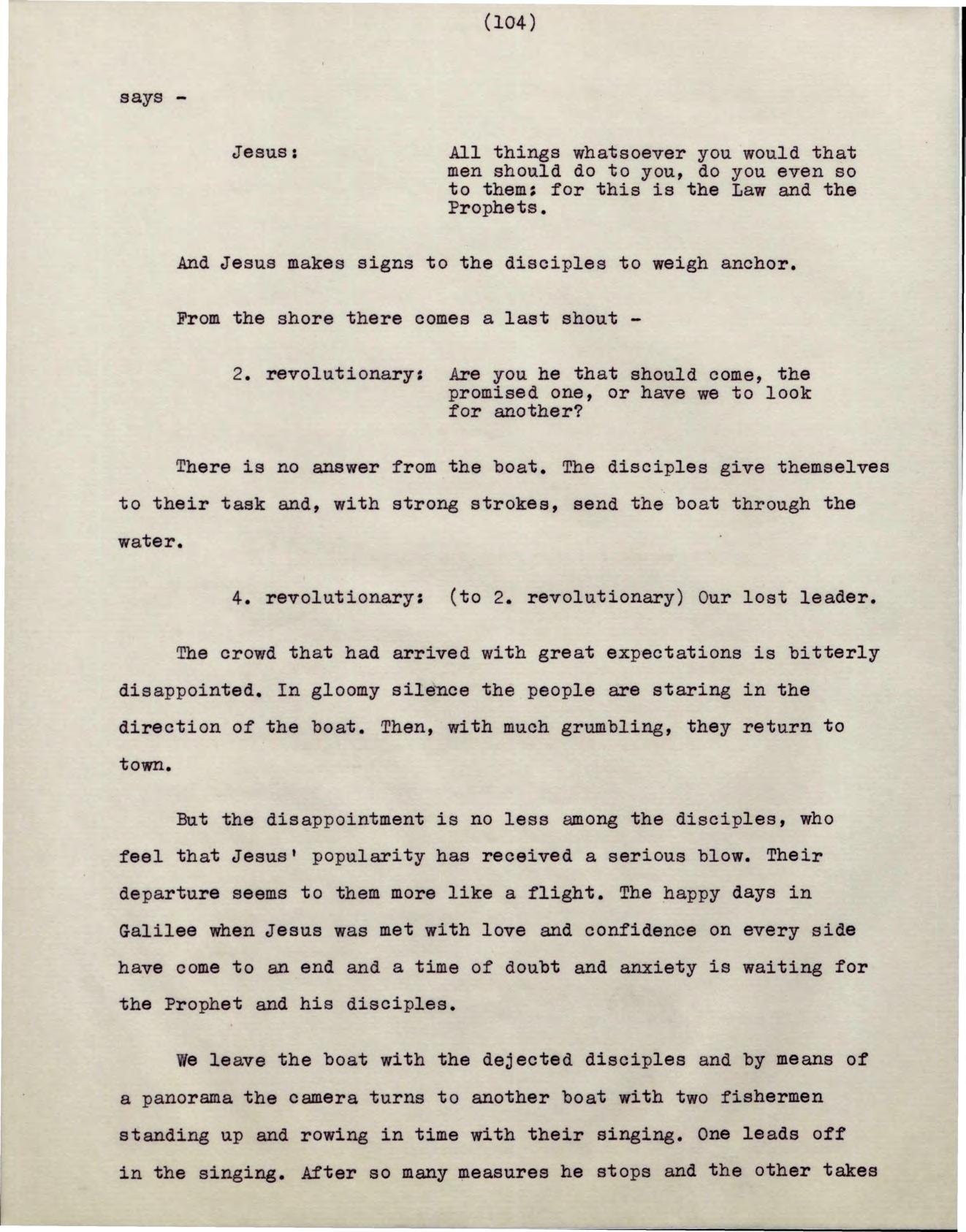
Jesus:
Jesus: (104)
All things whatsoever you would that men should do to you, do you even so to them; for this is the Law and the Prophets.
All things whatsoever you would that men should do to you, do you even so to them: for this is the Law and the Prophets.
And Jesus makes signs to the disciples to weigh anchor.
And Jesus makes signs to the disciples to weigh anchor.
From the shore there comes a last shout -
Prom the shore there comes a last shout -
2. revolutionary: Are you he that should come, the promised one, or have we to look for another?
2. revolutionary: Are you he that should come, the promised one, or have we to look for another?
There is no answer from the boat. The disciples give themselves to their task and, with strong strokes, send the boat through the water.
There is no answer from the boat. The disciples give themselves to their task and, with strong strokes, send the boat through the water.
4. revolutionary: (to 2. revolutionary) Our lost leader.
4. revolutionary: (to 2. revolutionary) Our lost leader.
The crowd that had arrived with great expectations is bitterly disappointed. In gloomy silence the people are staring in the direction of the boat. Then, with much grumbling, they return to town.
The crowd that had arrived with great expectations is bitterly disappointed. In gloomy silence the people are staring in the direction of the boat. Then, with much grumbling, they return to town.
But the disappointment is no less among the disciples, who feel that Jesus' popularity has received a serious blow. Their departure seems to them more like a flight. The happy days in Galilee when Jesus was met with love and confidence on every side have come to an end and a time of doubt and anxiety is waiting for the Prophet and his disciples.
But the disappointment is no less among the disciples, who feel that Jesus1 popularity has received a serious blow. Their departure seems to them more like a flight. The happy days in Galilee when Jesus was met with love and confidence on every side have come to an end and a time of doubt and anxiety is waiting for the Prophet and his disciples.
We leave the boat with the dejected disciples and by means of a panorama the camera turns to another boat with two fishermen standing up and rowing in time with their singing. One leads off in the singing. After so many measures he stops and the other takes
We leave the boat with the dejected disciples and by means of a panorama the camera turns to another boat with two fishermen standing up and rowing in time with their singing. One leads off in the singing. After so many measures he stops and the other takes says -
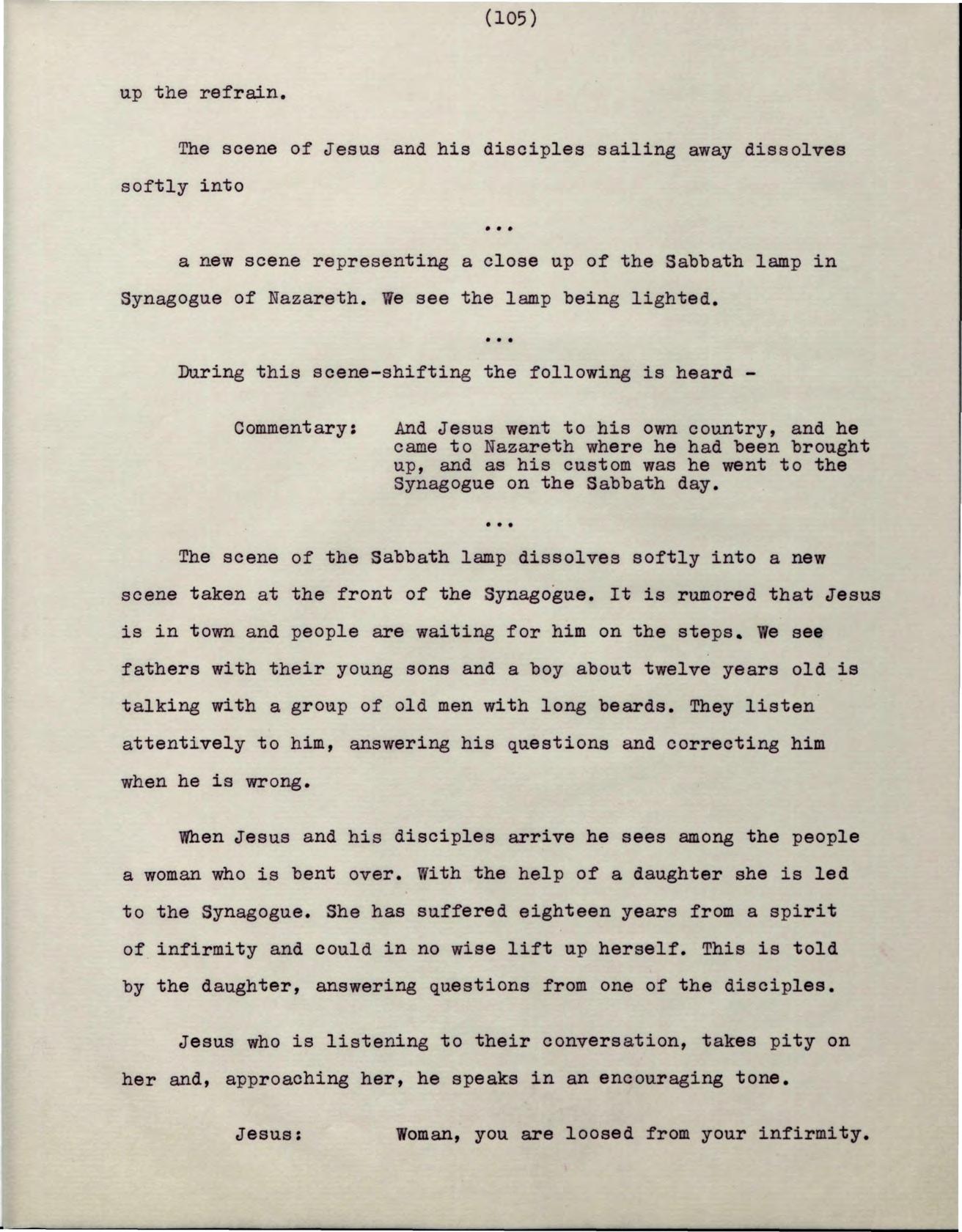
up the refrain.
up the refrain.
The scene of Jesus and his disciples sailing away dissolves softly into
The scene of Jesus and his disciples sailing away dissolves softly into •
a new scene representing a close up of the Sabbath lamp in Synagogue of Nazareth. We see the lamp being lighted.
a new scene representing a close up of the Sabbath lamp in Synagogue of Nazareth. We see the lamp being lighted.
During this scene-shifting the following is heard -
During this scene-shifting the following is heard -
Commentary: And Jesus went to his own country, and he came to Nazareth where he had been brought up, and as his custom was he went to the Synagogue on the Sabbath day.
commentary: And Jesus went to his own country, and he came to Nazareth where he had been brought up, and as his custom was he went to the Synagogue on the Sabbath day.
The scene of the Sabbath lamp dissolves softly into a new scene taken at the front of the Synagogue. It is rumored that Jesus is in town and people are waiting for him on the steps. We see fathers with their young sons and a boy about twelve years old is talking with a group of old men with long beards. They listen attentively to him, answering his questions and correcting him when he is wrong.
The scene of the Sabbath lamp dissolves softly into a new scene taken at the front of the Synagogue. It is rumored that Jesus is in town and people are waiting for him on the steps * We see fathers with their young sons and a boy about twelve years old is talking with a group of old men with long beards. They listen attentively to him, answering his questions and correcting him when he is wrong.
When Jesus and his disciples arrive he sees among the people a woman who is bent over. With the help of a daughter she is led to the Synagogue. She has suffered eighteen years from a spirit of infirmity and could in no wise lift up herself. This is told by the daughter, answering questions from one of the disciples.
When Jesus and his disciples arrive he sees among the people a woman who is bent over. With the help of a daughter she is led to the Synagogue. She has suffered eighteen years from a spirit of infirmity and could in no wise lift up herself. This is told by the daughter, answering questions from one of the disciples.
Jesus who is listening to their conversation, takes pity on her and, approaching her, he speaks in an encouraging tone.
Jesus who is listening to their conversation, takes pity on her and, approaching her, he speaks in an encouraging tone.
Jesus: Woman, you are loosed from your infirmity.
Jesus: Woman, you are loosed from your infirmity.
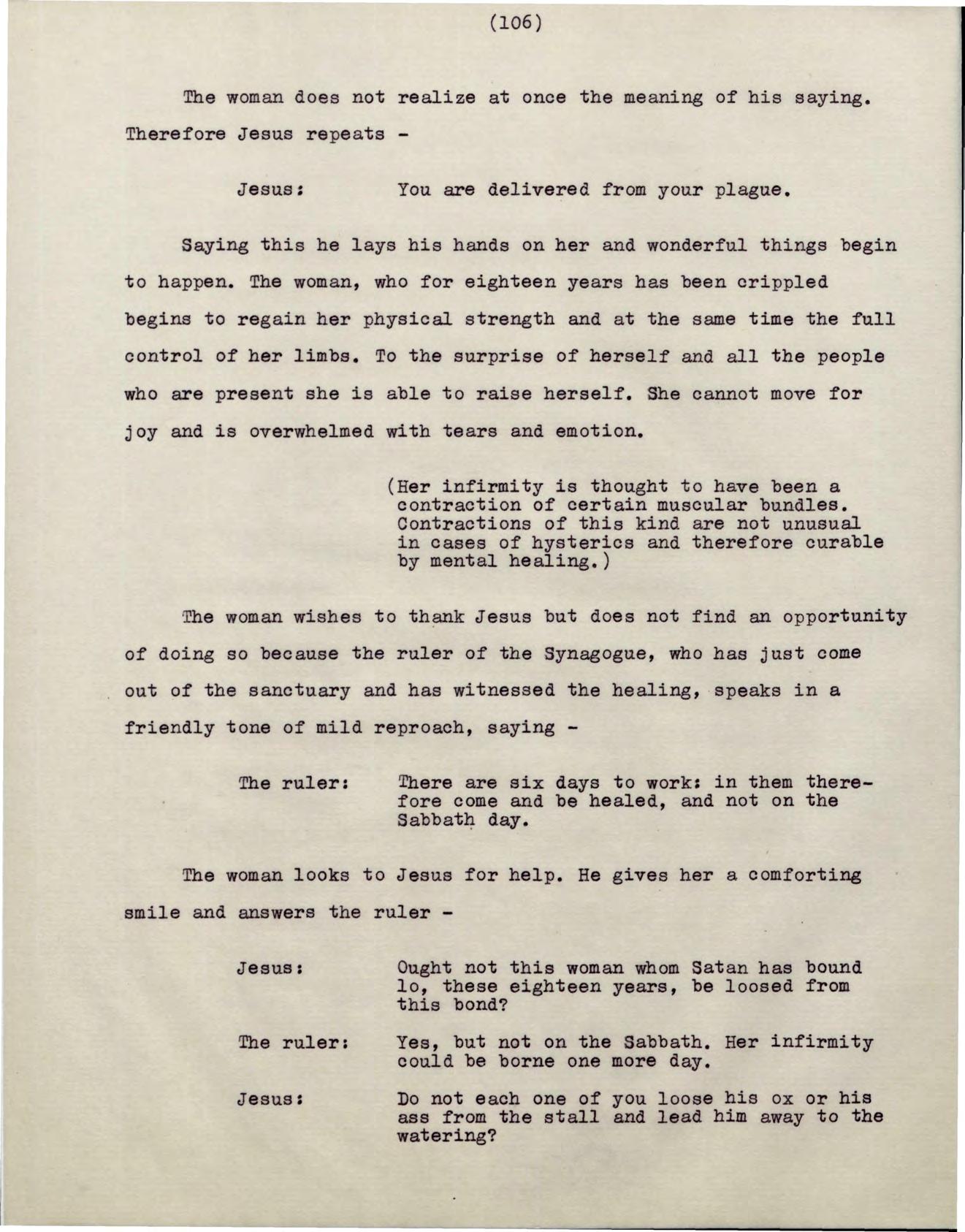
The woman does not realize at once the meaning of his saying. Therefore Jesus repeats -
The woman does not realize at once the meaning of his saying. Therefore Jesus repeats -
Jesus: You are delivered from your plague.
Jesus: You are delivered from your plague.
Saying this he lays his hands on her and wonderful things "begin to happen. The woman, who for eighteen years has been crippled "begins to regain her physical strength and at the same time the full control of her limbs. To the surprise of herself and all the people who are present she is able to raise herself. She cannot move for joy and is overwhelmed with tears and emotion.
Saying this he lays his hands on her and wonderful things begin to happen. The woman, who for eighteen years has been crippled begins to regain her physical strength and at the same time the full control of her limbs. To the surprise of herself and all the people who are present she is able to raise herself. She cannot move for joy and is overwhelmed with tears and emotion.
(Her infirmity is thought to have been a contraction of certain muscular bundles. Contractions of this kind are not unusual in cases of hysterics and therefore curable by mental healing.)
(Her infirmity is thought to have been a contraction of certain muscular bundles. Contractions of this kind are not unusual in cases of hysterics and therefore curable by mental healing.)
The woman wishes to thank Jesus but does not find an opportunity of doing so because the ruler of the Synagogue, who has just come out of the sanctuary and has witnessed the healing, speaks in a friendly tone of mild reproach, saying -
The woman wishes to thank Jesus but does not find an opportunity of doing so because the ruler of the Synagogue, who has just come out of the sanctuary and has witnessed the healing, . speaks in a friendly tone of mild reproach, saying -
The ruler: There are six days to work: in them therefore come and be healed, and not on the Sabbath day.
The ruler: There are six days to work: in them therefore come and be healed, and not on the day.
The woman looks to Jesus for help. He gives her a comforting smile and answers the ruler -
The woman looks to Jesus for help. He gives her a comforting smile and answers the ruler -
Jesus: The ruler:
Ought not this woman whom Satan has bound 10, these eighteen years, be loosed from this bond?
Jesus: Ought not this woman whom Satan has bound lo, these eighteen years, be loosed from this bond?
Yes, but not on the Sabbath. Her infirmity could be borne one more day.
The ruler: Yes, but not on the Sabbath. Her infirmity could be borne one more day.
Jesus:
Jesus:
Do not each one of you loose his ox or his ass from the stall and lead him away to the watering? (106)
Do not each one of you loose his ox or his ass from the stall and lead him away to the watering?
(107)
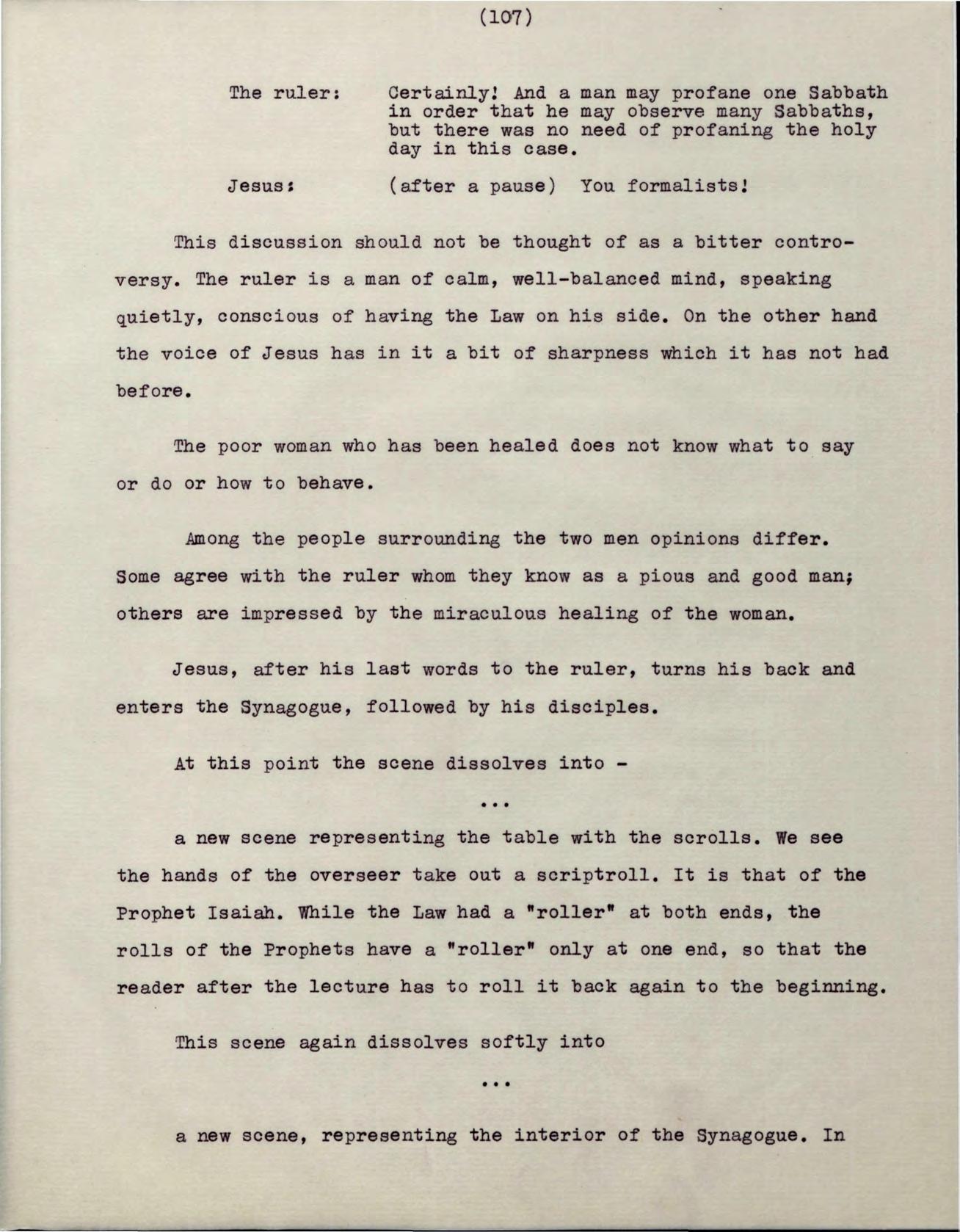
The ruler: Certainly i And a man may profane one Sabbath in order that he may observe many Sabbaths, but there was no need of profaning the holy day in this case.
Jesus J
The ruler: Jesus:
Certainly! And a man may profane one Sabbath in order that he may observe many Sabbaths, but there was no need of profaning the holy day in this case.
(after a pause) You formalists!
(after a pause) You formalists i
This discussion should not be thought of as a bitter controversy. The ruler is a man of calm, well-balanced mind, speaking quietly, conscious of having the Law on his side. On the other hand the voice of Jesus has in it a bit of sharpness which it has not had before.
This discussion should not be thought of as a bitter controversy. The ruler is a man of calm, well-balanced mind, speaking quietly, conscious of having the Law on his side. On the other hand the voice of Jesus has in it a bit of sharpness which it has not had before.
The poor woman who has been healed does not know what to say or do or how to behave.
The poor woman who has been healed does not know what to say or do or how to behave.
Among the people surrounding the two men opinions differ. Some agree with the ruler whom they know as a pious and good man; others are impressed by the miraculous healing of the woman.
Among the people surrounding the two men opinions differ. Some agree with the ruler whom they know as a pious and good man; others are impressed by the miraculous healing of the woman.
Jesus, after his last words to the ruler, turns his back and enters the Synagogue, followed by his disciples.
Jesus, after his last words to the ruler, turns his back and enters the Synagogue, followed by his disciples.
At this point the scene dissolves into -
At this point the scene dissolves into -
a new scene representing the table with the scrolls. We see the hands of the overseer take out a scriptroll. It is that of the Prophet Isaiah. While the Law had a "roller w at both ends, the rolls of the Prophets have a "roller" only at one end, so that the reader after the lecture has to roll it back again to the beginning.
a new scene representing the table with the scrolls. We see the hands of the overseer take out a scriptroll. It is that of the Prophet Isaiah. While the Law had a "roller" at both ends, the rolls of the Prophets have a "roller" only at one end, so that the reader after the lecture has to roll it back again to the beginning.
This scene again dissolves softly into
This scene again dissolves softly into
a new scene, representing the interior of the Synagogue. In
a new scene, representing the interior of the Synagogue. In
the beginning only the platform with the pulpit and the chair for the preacher is shown. Jesus receives from the overseer the scriptroll of Isaiah. He opens it, rolls it out to Chapter 61, and reads verses 1 and 2.
the beginning only the platform with the pulpit and the chair for the preacher is shown. Jesus receives from the overseer the scriptroll of Isaiah. He opens it, rolls it out to Chapter 61, and reads verses 1 and 2.
Jesus: "The Spirit of the Lord is upon me, because he hath anointed me to preach the Gospel to the poor; he hath sent me to heal the brokenhearted, to preach deliverance to the captives, and recovering of sight to the blind, to set at liberty them that are bruised."
Jesus; "The Spirit of the Lord is upon me, because he hath anointed me to preach the Gospel to the poor* he hath sent me to heal the brokenhearted, to preach deliverance to the captives, and recovering of sight to the blind, to set at liberty them that are bruised."
He puts down the roll and then seats himself. The eyes of all those in the Synagogue are fastened on him. A hush of expectancy runs through the room.
He puts down the roll and then seats himself. The eyes of all those in the Synagogue are fastened on him. A hush of expectancy runs through the room.
Then Jesus speaks in a careful and exact manner.
Then Jesus speaks in a careful and exact manner.
Jesus:
Jesus:
This day is this scripture fulfilled in your ears.
This day is this scripture fulfilled in your ears.
While the people wonder at his words the Pharisees turn to each other and shake their heads.
While the people wonder at his words the Pharisees turn to each other and shake their heads.
Jesus looks at them and then he opens the roll of Isaiah again and reads -
Jesus looks at them and then he opens the roll of Isaiah again and reads -
Jesus hands the roll to the overseer. Then he rises. There is a tenseness in the atmosphere as the feeling is general that Jesus is likely to create a controversy. Again Jesus speaks (108)
Jesus: "He hath blinded their eyes, and hardened their hearts, that they should not see with their eyes, nor understand with their hearts and be converted, and I should heal them."
Jesus: "He hath blinded their eyes, and hardened their hearts, that they should not see with their eyes, nor understand with their hearts and be converted, and I should heal them."
Jesus hands the roll to the overseer. Then he rises. There is a tenseness in the atmosphere as the feeling is general that Jesus is likely to create a controversy.
Again Jesus speaks -
Jesus: (109)
Jesus; He that believes in me, believes not in me but in him that sent me. And he that sees me, sees him that sent me.
He that believes in me, believes not in me but in him that sent me. And he that sees me, sees him that sent me.
The hearers are looking at each other: what he mean? But Jesus continues unaffected.
The hearers are looking at each other: what he mean? But Jesus continues unaffected.
Jesus:
Jesus: For I have not spoken of myself; but the Father which sent me, he gave me a commandment, what I should say, and what I should speak.
For I have not spoken of myself; but the Father which sent me, he gave me a commandment, what I should say, and what I should speak.
If Jesus was met with indifference before he entered the Synagogue, he is now becoming the object of contempt. What is the meaning of this boasting?
If Jesus was met with indifference before he entered the Synagogue, he is now becoming the object of contempt. What is the meaning of this boasting?
Among the men we have noticed a group of two or three devout Jews, ascetics, who are shocked at the sayings of Jesus. They are his brothers. The most fanatical of them is Jacob a very short man.
Together with them is their mother who cannot restrain her tears. Her two daughters try to comfort her.
Among the men we have noticed a group of two or three devout Jews, ascetics, who are shocked at the sayings of Jesus. They are his brothers. The most fanatical of them is Jacob a very short man. Together with them is their mother who cannot restrain her tears. Her two daughters try to comfort her.
There is a short silence after the last words of Jesus. Then a man in the congregation rises, and after him another, and then yet another. The storm is about to burst.
There is a short silence after the last words of Jesus. Then a man in the congregation rises, and after him another, and then yet another. The storm is about to burst.
1. man: You have said you came down from Heaven. We will ask your mother how that happened.
2. man: She is sitting over there.
You have said you came down from Heaven. We will ask your mother how that happened. She is sitting over there.
Look, she is weeping. She is ashamed on your behalf.
3. man: Look, she is weeping. She is ashamed on your behalf.
You should have stayed at home like your brothers.
4. man; You should have stayed at home like your brothers.
5. man: Yes, and have stuck to your last.
6. man: And left the preaching to the preachers.
2. man: And the healing to the doctors.
1. man: 2. man: 3. man: 4. man: 5. man: 6. man: 2. man:
Yes, and have stuck to your last. And left the preaching to the preachers. And the healing to the doctors.
1. man:
1. man: If you are a doctor then heal yourself.
4. man:
4. man: You need a doctor yourself.
If you are a doctor - then heal yourself. You need a doctor yourself.
7. man:
But a good one.
7. man: But a good one.
Jesus has "been standing silently while the insults are showered upon him.
Jesus has been standing silently while the insults are showered upon him.
The last remarks are drowned in a wave of scornful laughter and after that there is a pause. Jesus continues speaking -
The last remarks are drowned in a wave of scornful laughter and after that there is a pause. Jesus continues speaking -
Jesus: I tell you a truth. Many widows were in Israel in the days of Elijah, (when the heaven was shut up three years and six months,) when great famine was throughout all the land. But to none of them was Elijah sent, save unto the Heathen town Sarepta, unto a woman that was a widow.
Jesus: I tell you a truth. Many widows were in Israel in the days of Elijah, (when the heaven was shut up three years and six months,) when great famine was throughout all the land. But to none of them was Elijah sent, save unto the Heathen town Sarepta, unto a woman that was a widow.
The people are angry and some curse him, but Jesus continues undisturbed.
The people are angry and some curse him, but Jesus continues undisturbed.
Jesus: And many lepers were in Israel in the time of Eliseus, the Prophet and none of them was cleansed, saving the Heathen Naaman the Syrian.
Jesus: And many lepers were in Israel in the time of Sliseus, the Prophet and none of them was cleansed, saving the Heathen Naaman the Syrian.
Now all in the Synagogue when they heard these things are filled with wrath. Once again Jesus uses the sacred scriptures to defend his own unholy and blasphemous demeanor and it is intolerable to the devout Jews of Nazareth. What entitles him to act as a religious teacher and Prophet? He is mad; there can be no doubt of it. The whole congregation cries out indignantly. They curse him as they howl and stamp the floor. For a while a riot is developing but the noise quiets down for a moment as the voice of Jesus is heard crying -
Now all in the Synagogue when they heard these things are filled with wrath. Once again Jesns uses the sacred scriptures to defend his own unholy and blasphemous demeanor and it is intolerable to the devout Jews of Nazareth. What entitles him to act as a religious teacher and Prophet? He is mad; there can be no doubt of it. The whole congregation cries out indignantly. They curse him as they howl and stamp the floor. For a while a riot is developing but the noise quiets down for a moment as the voice of Jesus is heard crying -
Jesus:
Jesus: I say unto you: no Prophet is accepted in his own country.
I say unto you: no Prophet is accepted in his own country.
(Ill)
(Ill)
Again there is a furious outbreak of which Jesus appears to take little notice. He leaves the platform quietly. It is clear to him that here in his native town not only the Pharisees but also the common people are against him. They are all outraged because of his work and claims and they follow him out, heaping upon him scorn and abuse.
Again there is a furious outbreak of which Jesus appears to take little notice. He leaves the platform quietly. It is clear to him that here in his native town not only the Pharisees but also the common people are against him. They are all outraged because of his work and claims and they follow him out, heaping upon him scorn and abuse.
Outside the Synagogue a great crowd gathers about him and threatens him.
Outside the Synagogue a great crowd gathers about him and threatens him.
8. man: You say you have not come to destroy the Law, but that is just what you do.
8. man: You say you have not come to destroy the Law, but that is just what you do.
9. man: You blasphemer.
9. man: You blasphemer.
6. man: A false Prophet, that 's what you are.
6. man: A false Prophet, that's what you are.
But to one side stood a small group: the mother of Jesus and his brothers and sisters. The mother and sisters are weeping. The ruler of the Synagogue approaches them in order to give comfort, saying -
But to one side stood a small group: the mother of Jesus and his brothers and sisters. The mother and sisters are weeping. The ruler of the Synagogue approaches them in order to give comfort, saying -
The ruler: He is beside himself.
The ruler: He is beside himself.
Jacob: (hard-hearted) He is mad.
Jacob: (hard-hearted) He is mad.
The mother: If we only could lay hold on him.
The mother: If we only could lay hold on him.
The second brother, who has tried to force his way through the crowd, comes back and says -
The second brother, who has tried to force his way through the crowd, comes back and says -
2. brother: I cannot get near him for the press of the crowd.
The ruler: Wait, I'll try.
2. brother: The ruler: I cannot get near him for the press of the crowd. Wait, I'll try.
The ruler approaches the crowd surrounding Jesus and it gives way before him. When he gets close to Jesus he says -
The ruler approaches the crowd surrounding Jesus and it gives way before him. When he gets close to Jesus he says -
The ruler: And he answers -
The ruler: Behold, your mother and your brethren seek for you.
And he answers -
Jesus: (112) Behold, your mother and your brethren seek for you.
Who is my mother, or my brethren?
Jesus: Who is my mother, or my brethren?
And he looked round about on his disciples who were with him saying -
And he looked round about on his disciples who were with him saying -
Jesus:
Jesus: Behold my mother and my brethren. For whosoever shall do the will of God, the same is my brother, and my sister, and mother.
Behold my mother and my brethren. For whosoever shall do the will of God, the same is my brother, and my sister, and mother.
The ruler looks at Jesus in bewilderment and then returns to the mother who cannot control her tears. Her two daughters care for her. But James, the elder brother, cannot control his anger. Pointing at Jesus he shouts -
Jacob:
Jacob:
That's the way with you: defiant, wilful, and as always it is I, I, I. Now I say unto you be gone as soon as possible, you are no longer one of ours.
That's the way with you: defiant, wilful, and as always it is I, I, I. Now I say unto you be gone as soon as possiole, you are no longer one of ours.
Voices from the crowd are heard: "Yes, get off. Away
The ruler looks at Jesus in bewilderment and then returns to the mother who cannot control her tears. Her two daughters care for her. But James, the elder brother, cannot control his anger. Pointing at Jesus he shoutswith you.-
Voices from the crowd are heard: "Yes, get off. Away with you."
The people had taken the words of Jesus literally. They could not do otherwise and consequently they were shocked at his apparent heartlessness. Therefore they shook their fists at him.
The people had taken the words of Jesus literally. They could not do otherwise and consequently they were shoc ked at his apparent heartlessness. Therefore they shook their fists at him.
A man of the crowd mounts a stone and shouts -
A man of the crowd mounts a stone and shouts -
A voice: There will be no peace in this town so long as this man is among us.
A voice: There will be no peace in this town so long as this man is among us.
But Jesus is already on his way out of town, followed by the
But Jesus is already on his way out of town, followed by the
disciples. The crowd hastens after him.
disciples. The crowd hastens after him.
The road out of his native town skirts a ravine. The disciples are busy talking to people trying to make them listen to reason and explaining how the words of Jesus were to be understood. For this reason Jesus was a little apart from his followers. Suddenly he sees himself surrounded by fanatic men who obviously have designs upon him. He is standing alone with his back to the ravine. It appears that the plan of the attackers is to encircle him and cast him down headlong. Someone is shouting -
The road out of his native town skirts a ravine. The disciples are busy talking to people trying to make them listen to reason and explaining how the words of Jesus were to be understood. For this reason Jesus was a little apart from his followers. Suddenly he sees himself surrounded by fanatic men who obviously have designs upon him. He is standing alone with his back to the ravine. It appears that the plan of the attackers is to encircle him and cast him down headlong. Someone is shouting -
A voice: Go to your death - you blasphemer.
Another voice: Yes, stone him.
A voice: Another voice: Go to your death - you blasphemer. Yes, stone him.
Beside the road there is a large heap of stones. Many of the attackers take up stones and are about to throw them. But Jesus does not move. He is standing with arms outstretched and looking at those who are about to throw their stones. His calmness causes the crowd to become silent and one by one the men drop their stones.
Beside the road there is a large heap of stones. Many of the attackers take up stones and are about to throw them. But Jesus does not move. He is standing with arms outstretched and looking at those who are about to throw their stones. His calmness causes the crowd to become silent and one by one the men drop their stones.
IWhile Jesus fearlessly moves toward his attackers they retire and there is a death-like silence. Then Jesus leaves the town unharmed, unhurt, and his disciples with himnbut he passing through the midst of them went his way".
While Jesus fearlessly moves toward his attackers they retire and there is a death-like silence. Then Jesus leaves the town unharmed, unhurt, and his disciples with him - "but he passing through the midst of them went his way".
Now, without interrupting the scene the camera turns and moves toward the stones - ending in a down-angle close up of the heap of stones.
Now, without interrupting the scene the camera turns and moves toward the stones - ending in a down-angle close up of the heap ot stones .
After a while this close up dissolves softly into an immense puddle of water, the circumference of which exactly covers the cir-
After a while this close up dissolves softly into an immense puddle of water, the circumference of which exactly covers the cir-
cumference of the heap of stones. The surface of the water reflects one of those days of boisterous weather which are typical for Palestine. Heavy drops of rain splinter the mirror of the water which from time to time is inflamed by flashes of lightning. Thunder is heard.
cumference of the heap of stones. The surface of the water reflects one of those days of boisterous weather which are typical for Palestine. Heavy drops of rain splinter the mirror of the water which from time to time is inflamed by flashes of lightning. Thunder is heard.
This first scene is followed by a short sequence of rapidly changing scenes. There is a Palistinean torrential downpour. The strong whirl-winds beat violently against the trees and houses.
The roads stand in puddles. Floods of water are rushing away heaps of earth, causing earth-slides, overflowing the valleys and inundating the fields. And all this is accompanied by claps of thunder and lightning flashes.
During this sequence the following is heard -
During this sequence the following is heard -
This first scene is followed by a short sequence of rapidly changing scenes. There is a Palistinean torrential downpour. The strong whirl-winds beat violently against the trees and houses. The roads stand in puddles. Floods of water are rushing away heaps of earth, causing earth-slides, overflowing the valleys and inundating the fields. And all this is accompanied by claps of thunder and lightning flashes. into
Commentary: Jesus had stirred up a storm. Despised by his family, and in open fight against the Pharisees, he withdrew from the Jews and turned to the Gentiles. And so we meet him some time later in the heathen town of Caesarea Philippi. The earliest name of the town was Paneas, so called because a sanctuary for the Greek god Pan was erected on the rocks near the town.
commentary: Jesus had stirred up a storm. Despised by his family, and in open fight against the Pharisees, he withdrew from the Jews and turned to the Gentiles. And so we meet him some time later in the heathen town of Caesarea Philippi. The earliest name of the town was Paneas, so called because a sanctuary for the Greek god Pan was erected on the rocks near the town.
The last scene of the thunderstorm-sequence dissolves softly
The last scene of the thunderstorm-sequence dissolves softly into
a new scene, representing the statue of Pan in a niche hewn into the rock.
a new scene, representing the statue of Pan in a niche hewn into the rock.
By means of a panorama combined with a trucking shot we move from Pan to Jesus his diSCiples standing near the rock.
By means of a panorama combined with a trucking shot we move from Pan to Jesus and his disciples standing near the rock.
Because of adversity the character of Jesus has changed,
Because of adversity the character of Jesus has changed,
especially with regard to his belief in his own divine authority. There is new accent in his voice. His disciples have remained faithful to him and their love and loyalty strengthen hie own belief in himself.
especially with regard to his belief in his own divine authority. There is a new accent in his voice. His disciples have remained faithful to him and their love and loyalty strengthen his own belief in himself.
The thoughts of Jesus more and more center round a certain idea. He remembers the words reaching him in the boat: "Are you he that should come - the promised one?" Thinking the question over again and again, he asks himself: might he not be the One? and the disciples do their best to nurture the thought. Little by little Jesus sees himself in a new light: might he not be the chosen One, the Messiah? He has a foreboding of the mission to which he is called.
The thoughts of Jesus more and more center round a certain idea. He remembers the words reaching him in the boat: "Are you he that should come - the promised one?" Thinking the question over again and again, he asks himself: might he not be the One? and the disciples do their best to nurture the thought. Little by little Jesus sees himself in a new light: might he not be the chosen One, the Messiah? He has a foreboding of the mission to which he is called.
Jesus is sitting alone, pondering. At some distance the disciples, speaking in a low voice, discuss the problem as to who Jesus is and what is his mission on earth.
Jesus is sitting alone, pondering. At some distance the disciples, speaking in a low voice, discuss the problem as to who Jesus is and what is his mission on earth.
We hear the following dialogue -
We hear the following dialogue -
John:
John: Nathanael:
Nathanael:
Thomas:
Thomas:
Peter:
Peter:
Matthew:
Matthew:
Peter:
Peter:
Andrew: Taddai:
Andrew: Taddai:
Judas:
Judas:
The question is: what is Jesus to himself?
The question is: what is Jesus to himself?
What is he to us?
What is he to us?
To me a Prophet.
To me a Prophet.
More than a Prophet.
God t s son.
More than a Prophet. God's son.
The Messiah.
The Messiah.
John the Baptist said it.
John the Baptist said it.
And then all his miracles.
And then all his miracles. But why does he keep it secret?
But why does he keep it secret?
Jesus has risen and is approaching. Peter tells them to be quiet.
Jesus has risen and is approaching. Peter tells them to be quiet.
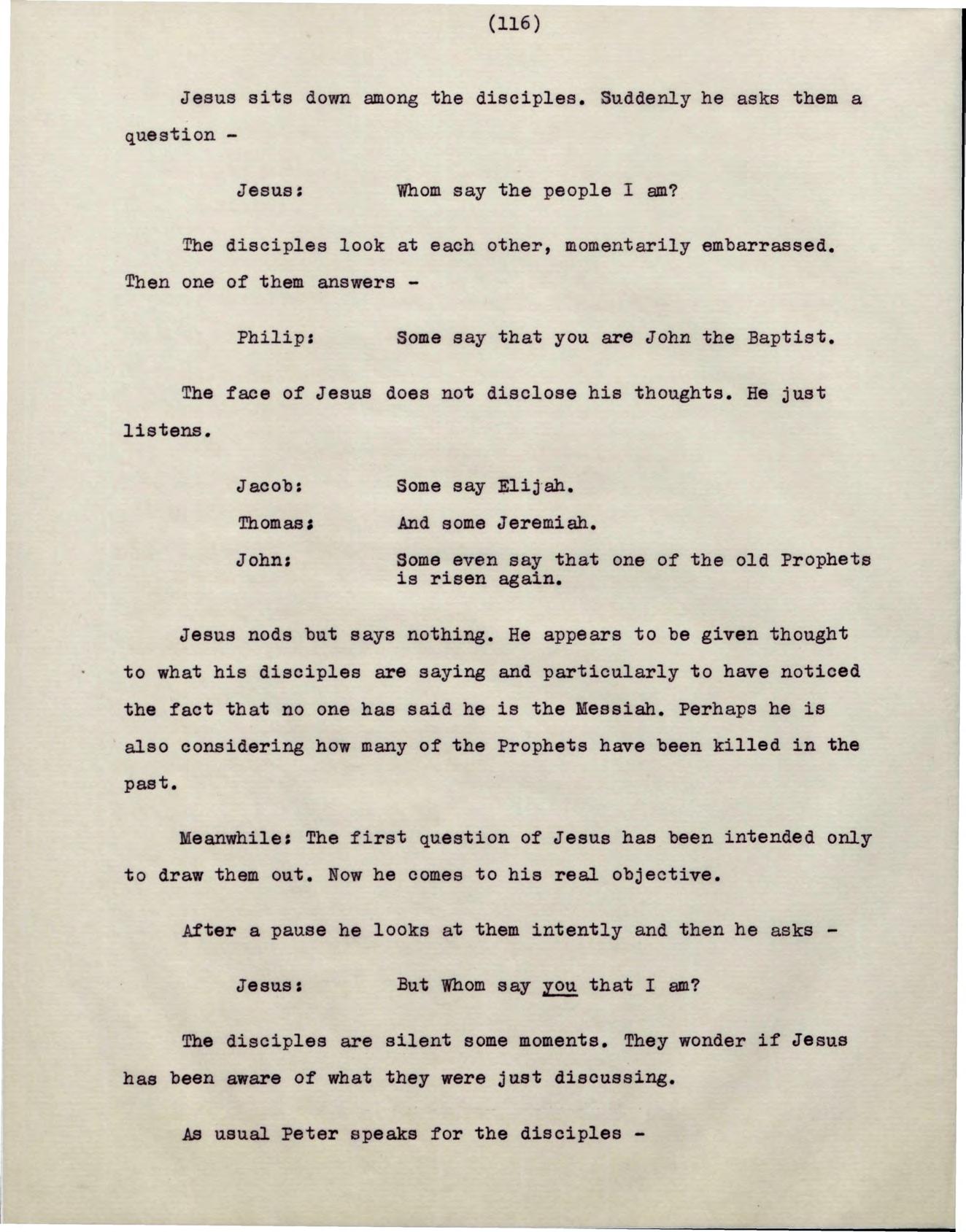
Jesus sits down among the disciples. Suddenly he asks them a question -
Jesus sits down among the disciples. Suddenly he asks them a question -
Jesuss Whom say the people I am?
Jesus: Whom say the people I am?
The disciples look at each other, momentarily embarrassed. Then one of them answers -
The disciples look at each other, momentarily embarrassed. Then one of them answers -
Philip: Some say that you are John the Baptist.
Philips Some say that you are John the Baptist.
The face of Jesus does not disclose his thoughts. He just listens.
The face of Jesus does not disclose his thoughts. He just listens.
Jacob:
Jacob: Thomas,
Some say Elij -ah. And some Jeremiah.
Some say Elijah, Thomas; And some Jeremiah.
John:
John:
Some even say that one of the old Prophets is risen again.
Some even say that one of the old Prophets is risen again.
Jesus nods but says nothing. He appears to be given thought to what his disciples are saying and particularly to have noticed the fact that no one has said he is the Messiah. Perhaps he is also considering how many of the Prophets have been killed in the past.
Jesus nods but says nothing. He appears to be given thought to what his disciples are saying and particularly to have noticed the fact that no one has said he is the Messiah. Perhaps he is also considering how many of the Prophets have been killed in the past.
Meanwhile$ The first question of Jesus has been intended only to draw them out. Now he comes to his real objective.
Meanwhile: The first question of Jesus has been intended only to draw them out. Now he comes to his real objective.
After a pause he looks at them intently and then he asks -
After a pause he looks at them intently and then he asks -
Jesus: But Whom say you that I am?
Jesus: But Whom say you that I am?
The disciples are silent some moments. They wonder if Jesus has been aware of what they were just discussing.
The disciples are silent some moments. They wonder if Jesus has been aware of what they were just discussing.
As usual Peter speaks for the disciples -
As usual Peter speaks for the disciples -
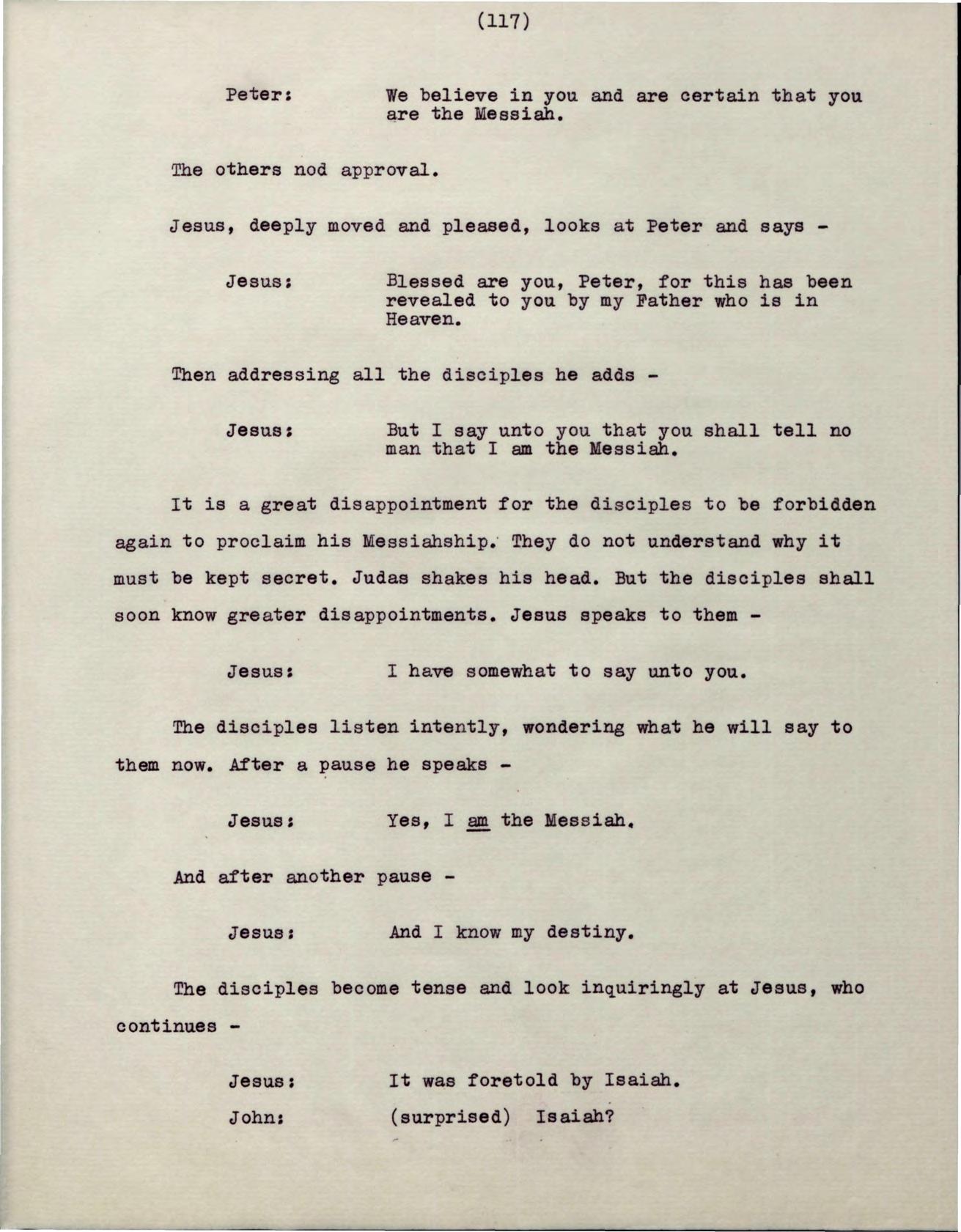
Peter:
Peter; We believe in you and are certain that you are the Messiah.
We believe in you and are certain that you are the Messiah.
The others nod approval.
The others nod approval.
Jesus, deeply moved and pleased, looks at Peter and says -
Jesus, deeply moved and pleased, looks at Peter and says -
Jesus:
Jesus:
Blessed are you, Peter, for this has been revealed to you by my Father who is in Heaven.
Blessed are you, Peter, for this has been revealed to you by my Father who is in Heaven.
Then addressing all the disciples he adds -
Then addressing all the disciples he adds -
Jesus:
Jesusj
But I say unto you that you shall tell no man that I am the Messiah.
But I say unto you that you shall tell no man that 1 am the Messiah.
It is a great disappointment for the disciples to be forbidden again to proclaim his Messiahship. ' They do not understand why it be kept secret. Judas shakes his head. But the disciples shall soon know greater disappointments. Jesus speaks to them -
It is a great disappointment for the disciples to be forbidden again to proclaim his Messiahship. They do not understand why it must be kept secret. Judas shakes his head. But the disciples shall soon know greater disappointments. Jesus speaks to them -
Jesus: I have somewhat to unto you.
Jesus: I have somewhat to say unto you.
The disciples listen intently, wondering what he will say to them now. After a pause he speaks -
The disciples listen intently, wondering what he will say to them now. After a pause he speaks -
Jesus: Yes, I the Messiah.
Jesus: Yes, I am the Messiah,
And after another pause -
And after another pause -
Jesus: And I know my destiny.
Jesus: And I know my destiny.
The disciples become tense and look inquiringly at Jesus, who continues -
The disciples become tense and look inquiringly at Jesus, who continues -
Jesus: John: It was foretold by Isaiah. (surprised) Isaiah?
Jesus: It was foretold by Isaiah. John: (surprised) Isaiah?
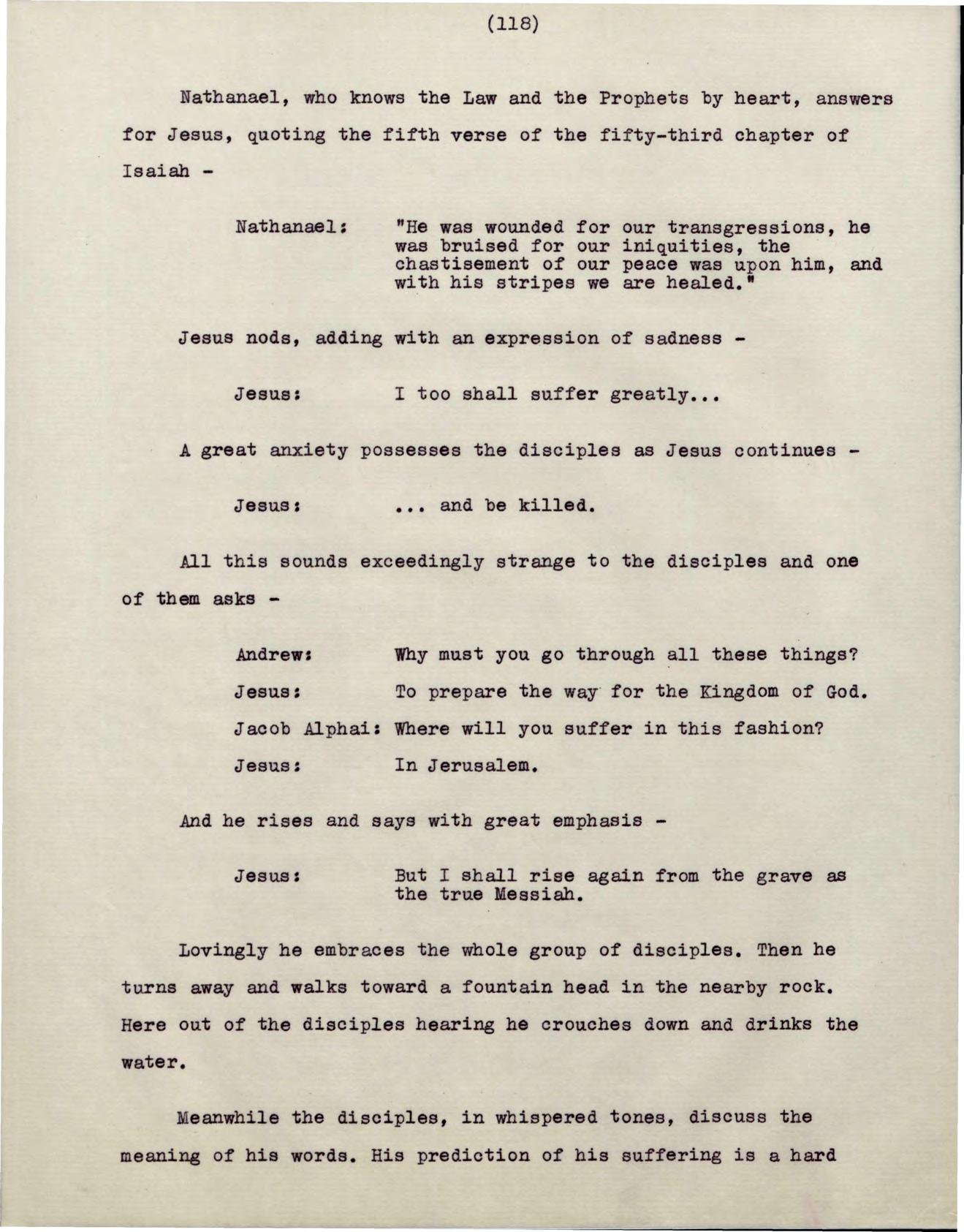
Nathanael, who knows the Law and the Prophets "by heart, answers for Jesus, quoting the fifth verse of the fifty-third chapter of Isaiah -
Nathanael, who knows the Law and the Prophets by heart, answers for Jesus, quoting the fifth verse of the fifty-third chapter of Isaiah -
Nathanael: "He was wounded for our transgressions, he was bruised for our iniquities, the chastisement of our peace was upon him, and with his stripes we are healed.·
Nathanael; "He was wounded for our transgressions, he was bruised for our iniquities, the chastisement of our peace was upon him, and with his stripes we are healed."
Jesus nods, adding with an expression of sadness -
Jesus nods, adding with an expression of sadness -
Jesus: I too shall suffer greatly •••
Jesus: I too shall suffer greatly...
A great anxiety possesses the disciples as Jesus continues -
A great anxiety possesses the disciples as Jesus continues -
Jesuss ••• and be killed.
Jesus : ... and be killed.
All this sounds exceedingly strange to the disciples and one of them asks -
All this sounds exceedingly strange to the disciples and one of them asks -
Andrews
Andrews
Jesus:
Why must you go through all these things?
Why must you go through all these things?
To prepare the way ' for the Kingdom of God.
Jesus $ To prepare the way for the Kingdom of God.
Jacob Alphai: Where will you suffer in this fashion?
Jacob Alphai: Where will you suffer in this fashion?
Jesus: In Jerusalem.
Jesus; In Jerusalem.
And he rises and says with great emphasiS -
And he rises and says with great emphasis -
Jesus: But I shall rise again from the grave as the true Messiah.
Jesus: But I shall rise again from the grave as the true Messiah.
Lovingly he embraces the whole group of disciples. Then he turns away and walks toward a fountain head in the nearby rock. Here out of the disciples hearing he crouches down and drinks the water.
Lovingly he embraces the whole group of disciples. Then he turns away and walks toward a fountain head in the nearby rock. Here out of the disciples hearing he crouches down and drinks the water.
Meanwhile the disciples, in whispered tones, discuss the meaning of his words. His prediction of his suffering is a hard
Meanwhile the disciples, in whispered tones, discuss the meaning of his words. His prediction of his suffering is a hard
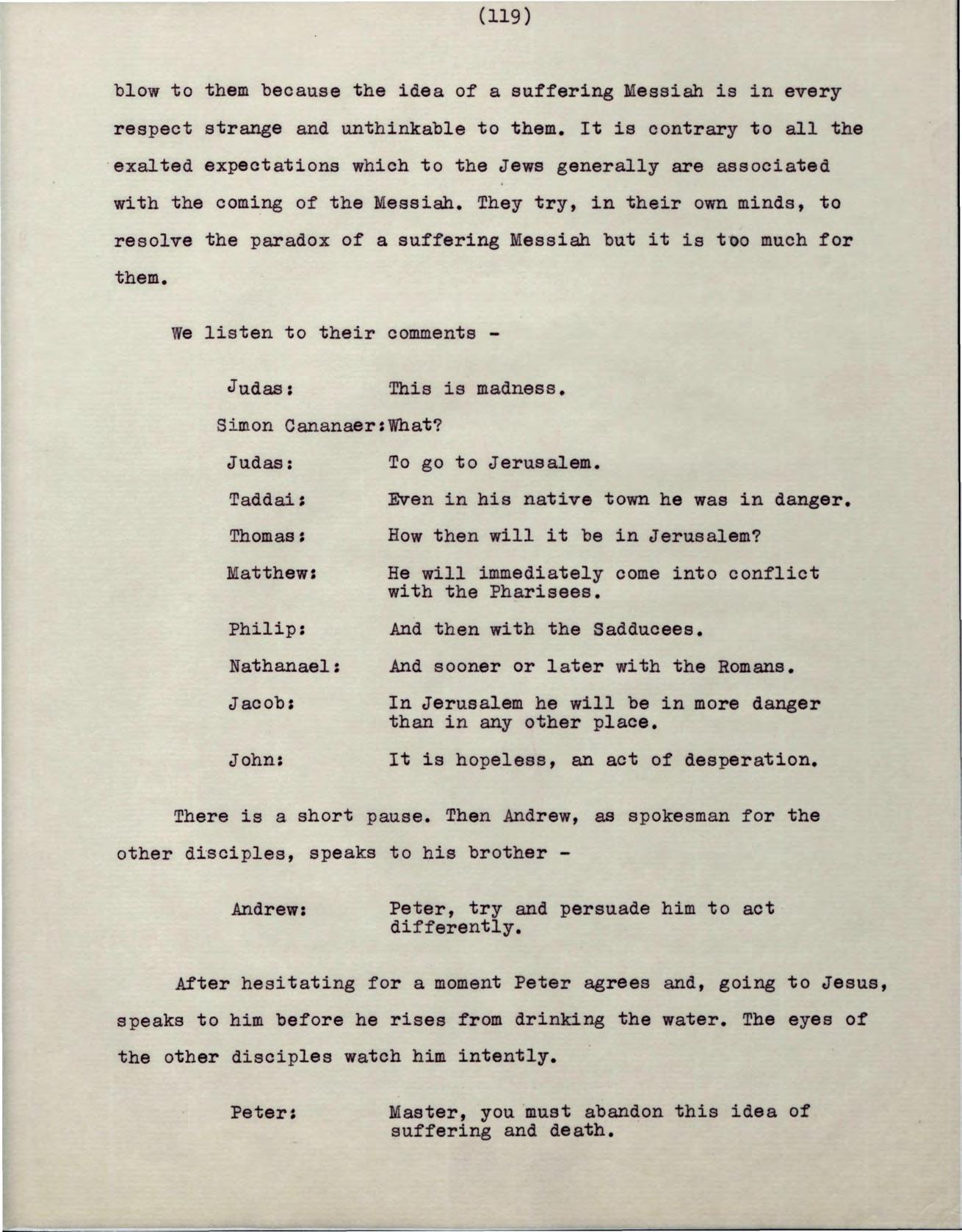
blow to them because the idea of a suffering Messiah is in every respect strange and unthinkable to them. It is contrary to all the exalted expectations which to the Jews generally are associated with the coming of the Messiah. They try, in their own minds, to resolve the paradox of a suffering Messiah but it is too much for them.
blow to them because the idea of a suffering Messiah is in every respect strange and unthinkable to them. It is contrary to all the exalted expectations which to the Jews generally are associated with the coming of the Messiah. They try, in their minds, to resolve the paradox of a suffering Messiah but it is too much for them.
We listen to their comments -
We listen to their comments -
Judas: This is madness.
Judas: This is madness.
Simon GananaersWhat?
Simon Cananaer:What?
Judas:
Judas: To go to Jerusalem.
Taddai:
Taddai; Even in his native town he was in danger.
Thomas: How then will it be in Jerusalem?
Matthew: He will immediately come into conflict with the Pharisees.
Even in his native town he was in danger. How then will it be in Jerusalem? He will immediately come into conflict with the Pharisees.
Philip: And then with the Sadducees.
Thomas: Matthew: Philip: Nathanael:
Jacob:
Nathanael: And sooner or later with the Romans.
Jacob: In Jerusalem he will be in more danger than in any other place.
John: To go to Jerusalem.
And then with the Sadducees. And sooner or later with the Romans. In Jerusalem he will be in more danger than in any other place.
It is hopeless, an act of desperation.
John: It is hopeless, an act of desperation.
There is a short pause. Then Andrew, as spokesman for the other disciples, speaks to his brother -
There is a short pause. Then Andrew, as spokesman for the other disciples, speaks to his brother -
Andrew: Peter, try and persuade him to act differently.
Andrew: Peter, try and persuade him to act differently.
After hesitating for a moment Peter agrees and, going to Jesus, speaks to him before he rises from drinking the water. The eyes of the other disciples watch him intently.
After hesitating for a moment Peter agrees and, going to Jesus, speaks to him before he rises from drinking the water. The eyes of the other disciples watch him intently.
Peter: Master, you must abandon this idea of suffering and death.
Peter: Master, you must abandon this idea of suffering and death.
Jesus raises his head to listen -
Jesus raises his head to listen -
Peter:
Peter:
Be it far from you, this shall not he unto you.
Be it far from you, this shall not be unto you.
After a pause he continues -
After a pause he continues -
Peters You are not to undergo any suffering, you are the Messiah the people are waiting for.
Peter: You are not to undergo any suffering, you are the Messiah the people are waiting for.
Now Jesus rises and turns around looking at him. In a tone of authority, such as might have been used by one of the old Prophets, he says -
Now Jesus rises and turns around looking at him. In a tone of authority, such as might have been used by one of the old Prophets, he says -
Jesus s
Jesus:
Get you behind me, Satan: you are an offence to me, for you savour not the things that be of God, but those that be of men.
Get you behind me, Satan: you are an offence to me, for you savour not the things that be of God, but those that be of men.
Peter realizes that he has been unwise in seeming to prefer an all conquering Messiah to a suffering Messiah and in humiliation he bows his head.
Peter realizes that he has been unwise in seeming to prefer an all conquering Messiah to a suffering Messiah and in humiliation he bows his head.
But Jesus, with his last remark, has made it clear that he has chosen the way of grief and suffering. He knows that death probably awaits him if he goes to Jerusalem. But no fear can shake his determination.
But Jesus, with his last remark, has made it clear that he has chosen the way of grief and suffering. He knows that death probably awaits him if he goes to Jerusalem. But no fear can shake his determination.
Now he, followed by Peter, returns to the other disciples. He wants them to understand perfectly and to be rid of all foolish dreams, all false expectations and all misinterpretations of the Kingdom of God. They have to learn that if he is the suffering Messiah they must suffer with him, if they wish to be his disciples. Therefore he speaks to them in a solemn tone as he says -
Now he, followed by Peter, returns to the other disciples. He wants them to understand perfectly and to be rid of all foolish dreams, all false expectations and all misinterpretations of the Kingdom of God. They have to learn that if he is the suffering Messiah they must suffer with him, if they wish to be his disciples. Therefore he speaks to them in a solemn tone as he says -
Jesus:
Jesus: If any man would come after me, let him deny himself and follow me. For whosoever
If any man would come after me, let him deny himself and follow me. For whosoever
will save his life shall lose it, and whosoever will lose his life for my sake, the same shall save it. For what is a man profited, if he shall gain the whole world, and lose his own soul?
will save his life shall lose it, and whosoever will lose his life for my sake, the same shall save it. For what is a man profited, if he shall gain the whole world, and lose his own soul?
The disciples, their faces revealing their serious frame of mind, listen to Jesus. It is a hard truth they are being taught. But all of them are fully committed to Jesus and they are ready to follow him wherever he leads.
The disciples, their faces revealing their serious frame of mind, listen to Jesus. It is a hard truth they are being taught. But all of them are fully committed to Jesus and they are ready to follow him wherever he leads.
In a milder tone Jesus continues -
In a milder tone Jesus continues -
Jesus:
Jesus; I tell you a truth: there he some standing here, who shall not taste of death, till they see the Kingdom of God.
I tell you a truth: there be some standing here, who shall not taste of death, till they see the Kingdom of God.
The disciples could understand the words of Jesus to a certain point but they did not yet understand the profound meaning behind the words.
The disciples could understand the words of Jesus to a certain point but they did not yet understand the profound meaning behind the words.
Jesus indicates that they are to rise and go on.
Jesus indicates that they are to rise and go on.
The road Jesus and his disciples travel on leaving Caesarea Philippi forks at a certain point.
The road Jesus and his disciples travel on leaving Caesarea Philippi forks at a certain point.
One branch runs northeast toward Mount Hermon.
One branch runs northeast toward Mount Bermon.
The other runs to a neighboring village northwest of Caesarea Philippi.
The other runs to a neighboring village northwest of Caesarea Philippi.
Another scene of Jesus and his disciples walking in the direction of Mount Hermon. (121)
Jesus and his disciples follow the road toward Mount Hermon.
Jesus and his disciples follow the road toward Mount Bermon.
Another scene of Jesus and his disciples walking in the direction of Mount Bermon.
Jesus and his disciples arrive in the vicinity of Mount Hermon. According to a plan they have decided upon Jesus takes Peter, John and Jacob and goes up into the mountain to pray, leaving the others to await them at the foot of the mountain. A well. Water-carriers. Shepherds with dogs watering sheep. Disciples take out their buckets.
Jesus and his disciples arrive in the vicinity of Mount Bermon. According to a plan they have decided upon Jesus takes Peter, John and Jacob and goes up into the mountain to pray, leaving the others to await them at the foot of the mountain. A well. Water-carriers. Shepherds with dogs watering sheep. Disciples take out their buckets.
Jesus and the three disciples on their way up the mountain.
Jesus and the three disciples on their way up the mountain.
Jesus and the three disciples climb to the top of the mountain.
While Jesus as was his custom, goes apart to pray, the disciples lie down under a tree to rest. After the long climb they are tired and heavy with sleep.
Jesus and the three disciples climb to the top of the mountain. While Jesus as was his custom, goes apart to pray, the disciples lie down under a tree to rest. After the long climb they are tired and heavy with sleep.
The mountain. At some distance from the sleeping disciples
The mountain. At some distance from the sleeping disciples
Jesus is standing with his face turned toward Jerusalem and praying. His eyes are fixed as on a vision in the distance - maybe he sees his Father in Heaven.
Jesus is standing with his face turned toward Jerusalem and praying. His eyes are fixed as on a vision in the distance - maybe he sees his Father in Heaven.
The disciples are sleeping. Suddenly a brilliant light shines upon their faces. They awake and see Jesus in his transfiguration. His garments are incredibly white. His face too is changed and shining from a great inner light. The disciples are filled with wonder and amazement. They do not know whether they dream or if they are really looking upon Jesus.
The disciples are sleeping. Suddenly a brilliant light shines upon their faces. They awake and see Jesus in his transfiguration. His garments are incredibly white. His face too is changed and shining from a great inner light. The disciples are filled with wonder and amazement. They do not know whether they dream or if they are really looking upon Jesus.
They get exceedingly excited as a white cloud passes between them and Jesus. When it has moved away they see two men standing with Jesus which they have no difficulty in recognizing as being Moses and the Prophet Elijah. A divinely beautiful music.
They get exceedingly excited as a white cloud passes between them and Jesus. When it has moved away they see two men standing with Jesus which they have no difficulty in recognizing as being Moses and the Prophet Elijah. A divinely beautiful music.
At the sight of these the disciples become afraid and cling
At the sight of these the disciples become afraid and cling
to each other. They see Moses and Elijah talking with Jesus and they hear them speaking - (Michelangelo).
to each other. They see Moses and Elijah talking with Jesus and they hear them speaking - (Michelangelo).
Moses:
Moses: Verily you are the only Son of God and chosen to establish His Kingdom on Earth.
Verily you are the only Son of God and chosen to establish His Kingdom on Earth.
And Elijah goes on -
And Elijah goes on -
Elijah: And strength will be given unto you for all that is to come.
Elijah: And strength will be given unto you for all that is to come.
To the disciples it appears that Moses and Elijah are about to leave. It occurs to the rather bewildered Peter that maybe they can be persuaded to stay. Partly rising he speaks to Jesus -
To the disciples it appears that Moses and Elijah are about to leave. It occurs to the rather bewildered Peter that maybe they can be persuaded to stay. Partly rising he speaks to Jesus -
Peter:
Peter:
Master, it is good for us to be here: and let us make three tabernacles? one for you, and one for Moses, and one for Elijah.
Master, it is good for us to be here: and let us make three tabernacles; one for you, and one for Moses, and one for Elijah.
There was no answer and as Peter was speaking a bright cloud came over causing Jesus, as well as Moses and Elijah, to be hidden from the disciples. They did not know what to say or do and they were sore afraid.
There was no answer and as Peter was speaking a bright cloud came over causing Jesus, as well as Moses and Elijah, to be hidden from the disciples. They did not know what to say or do and they were sore afraid.
Out of the cloud came a voice, saying -
Out of the cloud came a voice, saying -
GOD the FATHER: This is my beloved Son in whom I am well pleased: Hear ye him.
GOD the FATHER: This is my beloved Son in whom I am well pleased: Hear ye him.
When the disciples heard the voice of the Almighty speaking directly to them they became frightened and fell on their faces.
When the disciples heard the voice of the Almighty speaking directly to them they became frightened and fell on their faces.
After the voice there was silence. The disciples did not know for how long because they feared to lift up their faces. But finally they heard the voice of Jesus saying -
After the voice there was silence. The disciples did not know for how long because they feared to lift up their faces. But finally they heard the voice of Jesus saying -
Jesus: Pear not.
Jesus: Fear not.
Then the disciples raised their heads. The cloud had drifted off and when they lifted up their eyes they saw no man save Jesus only. His appearance was as usual. Then he approached them saying •
Then the disciples raised their heads. The cloud had drifted off and when they lifted up their eyes they saw no man save Jesus only. His appearance was as usual. Then he approached them saying -
Jesus: Arise.
Jesus: Arise.
When he reaches the disciples he addresses them once more, saying -
When he reaches the disciples he addresses them once more, saying -
Jesus: You shall tell no man of the things you have seen...
Jesus: You shall . tell no man of the things you have seen •••
Jesus continues speaking as they descend the mountain but his words are not audible.
Jesus continues speaking as they descend the mountain but his words are not audible.
A new cloud appears, and all four of them are hidden from the audience.
A new cloud appears, and all four of them are hidden from the audience.
(It is said to be characteristic of Mount Hermon and the surrounding country for clouds to appear suddenly, generally in a few minutes, and they disappear as quickly as they come.)
(It is said to be characteristic of Mount Hermon and the surrounding country for clouds to appear suddenly, generally in a few minutes, and they . disappear as quickly as they come.)
Dissolve to the next scene.
Dissolve to the next scene.
A close up of a short dagger, hidden in a chest. We see the hand of a young man take it out from its hiding-place.
A close up of a short dagger, hidden in a chest. We see the hand of a young man take it out from its hiding-place.
During the scene-shifting the following is heard.
During the scene-shifting the following is heard.
Commentary: Apparently the Jewish people groaned in silence under the yoke of their cruel Roman oppressors but deep beneath the surface smouldered the hatred that resulted in numerous guerrilla attacks and in continuing revolts.
commentary: Apparently the Jewish people groaned in silence under the yoke of their cruel Roman oppressors but deep beneath the surface smouldered the hatred that resulted in numerous guerrilla attacks and in continuing revolts.
The camera follows the hand with the dagger as it is lifted
The camera follows the hand with the dagger as it is lifted
and glides backward at the same time. Finally We see the whole room. The young man with the dagger in his hand has risen from the bed and is trying to leave the room without making any noise. His father is sleeping in the same room. He awakes from his sleep and is surprised to see his son about to leave the house so late in the night.
and glides backward at the same time. Finally We see the whole room. The young man with the dagger in his hand has risen from the bed and is trying to leave the room without making any noise. His father is sleeping in the same room. He awakes from his sleep and is surprised to see his son about to leave the house so late in the night.
The son is a young, fanatical patriot, belonging to the most aggressive faction of the revolutionaries: the "sicarii", so called after the name of the short dagger "sica".
The son is a young, fanatical patriot, belonging to the most aggressive faction of the revolutionaries: the "sicarii", so called after the name of the short dagger "sica".
The father whispers -
The father whispers -
The father:
The fathers Is it to-night?
The son:
The son; Yes.
The father:
The fathers And you must go?
The sons Yes, father. I must.
The son: Is it to-night? Yes. And you must go? Yes, father. I must.
The father has risen too. He blesses his son, saying -
The father has risen too. He blesses his son, saying -
The fathers Be careful.
The father: Be careful.
The son nods, smiling confidently, and then slips away. Keeping the door ajar the father looks after the son for a long time.
The son nods, smiling confidently, and then slips away. Keeping the door ajar the father looks after the son for a long time.
Wipe to the next scene.
Wipe to the next scene.
Somewhere in a lonely ravine the revolutionaries meet this night in order to carry out a special task. Our young man from the preceding scene is just arriving.
Somewhere in a lonely ravine the revolutionaries meet this night in order to carry out a special task. Our young man from the preceding scene is just arriving.
Their leader is delivering the address to the 30 or 40 young
Their leader is delivering the address to the 30 or 40 young
men who have gathered about him.
men who have gathered about him.
The leader: Long ago, men, we determined not to serve the Romans nor to submit to any slavery; therefore let us willingly accept the punishment that awaits us if we are to fall into Roman hands alive. For my own part I had rather be dead if I cannot be free.
The leader: Long ago, men, we determined not to serve the Romans nor to submit to any slavery; therefore let us willingly accept the punishment that awaits us if we are to fall into Roman hands alive. For my own part I had rather be dead if I cannot be free.
A loud applause breaks out. The leader makes a sign for them to be silent and once more he addresses the men, saying -
A loud applause breaks out. The leader makes a sign for them to be silent and once more he addresses the men, saying -
The leader; Everybody knows what he has to do?
The leader: Everybody knows what he has to do?
Voices: Yes, yes.
Voices: Yes, yes.
The leader: Nobody is in doubt?
The leader: Nobody is in doubt?
Voices: No, no.
Voices: No, no.
The leader: Well, then let us get to work.
The leader: Well, then let us get to work.
The meeting breaks up and the conspirators leave the place.
The meeting breaks up and the conspirators leave the place.
A war song.
A war song.
Wipe to the next scene.
Wipe to the next scene.
A mountain pass. The same night.
A mountain pass. The same night.
A wooden bridge crosses a cleft in the mountains. The Jewish patriots have decided to destroy this bridge which is of strategic importance to the Roman army. For this reason the Romans keep watch over the bridge day and night. At each end of the bridge, where men are stationed, there is a fire and on one side of the bridge is a tent for the officer of the watch. Suddenly the bridge is overrun by the Jewish guerrillas. For a few moments fierce fighting takes place which results in the killing of all the Romans except the officer in charge, and also some of the Jews. Some fall on the
A wooden bridge crosses a cleft in the mountains. The Jewish patriots have decided to destroy this bridge which is of strategic importance to the Roman army. For this reason the Romans keep watch over the bridge day and night. At each end of the bridge, where men are stationed, there is a fire and on one side of the bridge is a tent for the officer of the watch. Suddenly the bridge is overrun by the Jewish guerrillas. For a few moments fierce fighting takes place which results in the killing of all the Romans except the officer in charge, and also some of the Jews. Some fall on the
bridge, some on the rocks at the ends of the bridge, some of them are flung into the deep. When the fighting is over and the Jews have picked up their dead the bridge is set on fire. Then they leave the place. A bugle-signal. An answering bugle.
bridge, some on the rocks at the ends of the bridge, some of them are flung into the deep. When the fighting is over and the Jews have picked up their dead the bridge is set on fire. Then they leave the place. A bugle-signal. An answering bugle.
Without moving the camera the scene dissolves softly into a scene showing the bridge at the very moment when, consumed by fire, it falls down. It is time for the watch to be relieved and the fresh troops arrive, having come up hurriedly. Roman soldiers, on duty far away, having noticed the fire and smelled the smoke, have sent out the alarm. On the rocks near the bridge they find one of the Jewish insurrectionists, forgotten by his companions. The Roman soldiers kick at him and notice that he is not dead. Then they pick him up. He might be useful during the investigation.
Without moving the camera the scene dissolves softly into a scene showing the bridge at the very moment when, consumed by fire, it falls down. It is time for the watch to be relieved and the fresh troops arrive, having come up hurriedly. Roman soldiers, on duty far away, having noticed the fire and smelled the smoke, have sent out the alarm. On the rocks near the bridge they find one of the Jewish insurrectionists, forgotten by his companions. The Roman soldiers kick at him and notice that he is not dead. Then they pick him up. He might be useful during the investigation.
Wipe to the next scene.
Wipe to the next scene.
A torture-chamber of the Romans. The young Jew whom the Roman soldiers have picked up at the bridge is subjected to a "third degree" examination He is sitting, the upper part of his body naked, on a low seat without back support Two-three Roman soldiers at the doors. Two executioners, one on each side of him, are holding his outstretched hands firmly while the examiner, sitting in front, is cross-questioning him.
A torture-chamber of the Romans. The young Jew whom the soldiers have picked up at the bridge is subjected to a "third degree" examination. He is sitting, the upper part of his naked, on a low seat without back support. Two-three Roman soldiers at the Two executioners, each side of him, are holding his outstretched hands firmly while the examiner, sitting in front, is cross-questioning him.
The examiner: Who the others?
Tell me some of their names?
The examiner: Who were the others? Tell me some of their names?
One of them?
Who is your leader?
One of them? Who is your leader?
A clerk is ready to put down what the prisoner might possibly say but up to now he has not betrayed any secret. The examiner, irritated by his stubbornness, signals to a third executioner who
A clerk is ready to put down what the prisoner might possibly say but up to now he has not betrayed any secret. The examiner, irritated by his stubbornness, signals to a third executioner who
is standing behind the prisoner, a flaming torch in his hand. He applies the torch to the back of the young Jew who sets up a piercing cry -
is standing behind the prisoner, a flaming torch in his hand. He applies the torch to the back of the young Jew who sets up a piercing cry -
Wipe to the next scene.
Wipe to the next scene.
The same interior as the first scene of this sequence. The same young and his father are sleeping. From far away the noise of spiked sandals marching up the pavement is heard. The father awakens first. He sits up and listens. He knows only too well what this sound at night-time means. Now he hears the distant sound of a sword's hilt hammering brutally upon a door. It is opened and a rough voice is heard shouting words of command. The sound of weeping and crying comes to his listening ears. There is a short pause during which the sound of the marching feet is heard again, then hammering upon a door and the commanding voice, but this time much nearer. Now the young man also awakens. It is clear to him at once what is happening. He rises. His father also rises and embraces his son. The sound of the sandals is approaching. The father holds the son closely. Without doubt the soldiers are coming to their house; they are knocking now. With a look of determination the son embraces his father, smiles courageously, and opens the door. The soldiers seize him and fetter him. For a moment the father stands in the door looking after his son through eyes blinded with tears. Then he shuts the door. A plaintive weeping is heard through the door.
The same interior as the first scene of this sequence. The same young man and his father are sleeping. Prom far away the noise of spiked sandals marching up the pavement is heard. The father awakens first. He sits up and listens. He knows only too well what this sound at night-time means. Now he hears the distant sound of a sword*s hilt hammering brutally upon a door. It is opened and a rough voice is heard shouting words of command. The sound of weeping and crying comes to his listening ears. There is a short pause during which the sound of the marching feet is heard again, then hammering upon a door and the commanding voice, but this time much nearer. Now the young man also awakens. It is clear to him at once what is happening. He rises. His father also rises and embraces his son. The sound of the soldiers' sandals is approaching. The father holds the son closely. Without doubt the soldiers are coming to their house; they are knocking now. With a look of determination the son embraces his father, smiles courageously, and opens the door. The soldiers seize him and fetter him. For a moment the father stands in the door looking after his son through eyes blinded with tears. Then he shuts the door. A plaintive weeping is heard through the door.
Wipe to the next scene.
Wipe to the next scene.
An underground vault in a Roman fortress. Seven or eight of
An underground vault in a Roman fortress. Seven or eight of
the insurrectionists, among them their leader, are bound fast in stocks, waiting for judgment and death.
the insurrectionists, among them their leader, are bound fast in stocks, waiting for judgment and death .
The leader speaks to his companions -
The leader speaks to his companions -
The leader: We have acted as men, and we will die as men. We are not afraid to die. Life without liberty is not worth having. Do any of you think it is?
The others: No, no.
The leader: The others: We have acted as men, and we will die as men. We are not afraid to die. Life without liberty is not worth having. Do any of you think it is? No, no.
The leader turns to one of his companions, saying -
The leader turns to one of his companions, saying -
The leader: You, Rabbi, pray for us.
The leader: You, Rabbi, pray for us.
The Rabbi offers a prayer. The others answer: Amen.
The Rabbi offers a prayer. The others answer: Amen.
Then the leader starts singing a lively, joyous Jewish hymn and the others j oin in. Some non-Jewish prisoners listen with surprise.
Then the leader starts singing a lively, joyous Jewish hymn and the others join in. Some non-Jewish prisoners listen with surprise.
The song continues during the following three scenes but little by little it fades away.
The song continues during the following three scenes but little by little it fades away.
Wipe to the next scene.
Wipe to the next scene.
On a hill outside the town is the place of execution. Seven or eight crosses are raised and the insurrectionists are nailed to the crosses. The crosses are evenly spaced and form a curbed line. The vultures (or the crows) are circling above the crosses.
On a hill outside the town is the place of execution. Seven or eight crosses are raised and the insurrectionists are nailed to the crosses. The crosses are evenly spaced and form a curbed line. The vultures (or the crows) are circling above the crosses.
Two or three slaves are seen cleaning the place of the remains of the last gang of crucified revolutionaries.
Two or three slaves are seen cleaning the place of the remains of the last gang of crucified revolutionaries.
Wipe to the next scene.
Wipe to the next scene.
A single cross in close up. A panorama from the foot of the cross to the top with the vultures (or the crows) circling about.
A single cross in close up. A panorama from the foot of the cross to the top with the vultures (or the crows) circling about.
A large heap of human bones and skulls - reminding one of the Russian painter Vereschagin's famous painting.
A large heap of human bones and skulls - reminding one of the Russian painter Vereschagin's famous painting.
The slaves who are outside the scene throw the remains they have picked up on the heap.
The slaves who are outside the scene throw the remains they have picked up on the heap.
This scene which is the last scene of the insurrectionistsequence dissolves softly into
This scene which is the last scene of the insurrectionistsequence dissolves softly into
a new scene, representing little boys and girls playing "wedding" on the market place of a village. The boys are playing flutes and the girls are dancing graciously. At the beginning we see only the girls dancing - maybe only two of them - then the camera is gliding backwards and we see the boys and the other girls. By means of a panorama the camera turns toward the opposite corner of the marketplace. Here Jesus is sitting surrounded by his disciples. Though Jesus has just arrived people already are gathering to hear his teaching. The majority of them are women. Some of them approach Jesus, bringing young children with them, that they may be touched by Jesus. His disciples try to drive them away, saying -
a new scene, representing little boys and girls playing "wedding" on the market place of a village. The boys are playing flutes and the girls are dancing graciously. At the beginning we see only the girls dancing - maybe only two of them - then the camera is gliding backwards and we see the boys and the other girls. By means of a panorama the camera turns toward the opposite corner of the marketplace. Here Jesus is sitting surrounded by his disciples. Though Jesus has just arrived people already are gathering to hear his teaching. The majority of them are women. Some of them approach Jesus, bringing young children with them, that they may be touched by Jesus. His disciples try to drive them away, saying -
The disciples: Do not bother the Master. Leave your children at home. They have no understanding.
The disciples: Do not bother the Master. Leave your children at home. They have no understanding.
When Jesus sees this, he is displeased and says to the disciples -
When Jesus sees this, he is displeased and says to the disciples -
Jesus:
Jesus: Suffer the little children to come unto me, forbid them not: for of such is the Kingdom of God.
Suffer the little children to come unto me, forbid them not: for of such is the Kingdom of God.
He puts his hands upon the children, pushed forward by the mothers to receive his blessing. He takes the other little children up in his arms and puts his hands upon them also, blessing them.
He puts his hands upon the children, pushed forward by the mothers to receive his blessing. He takes the other little children up in his arms and puts his hands upon them also, blessing them.
While this is happening the sound of the flute-playing little boys and the girls with whom they are playing "wedding", is heard in the background, though subdued.
While this is happening the sound of the flute-playing little boys and the girls with whom they are playing "wedding", is heard in the background, though subdued.
As time passes the people gathered around Jesus increase in number. Also some Pharisees have come in order to debate with him.
As time passes the people gathered around Jesus increase in number. Also some Pharisees have come in order to debate with him.
One of them asks him -
One of them asks him -
1. Pharisee: Is it lawful for a man to put away his wife?
1. Pharisee: Is it lawful for a man to put away his wife?
Jesus turns to the questioner inquiringly, as if he does not quite understand what the Pharisee has in mind. For this reason the other Pharisees join in, saying -
Jesus turns to the questioner inquiringly, as if he does not quite understand what the Pharisee has in mind. For this reason the other Pharisees join in, saying -
2. Pharisee: Can he send her out of the house •••
2. Pharisee: Can he send her out of the house...
3. Pharisee: ...if he finds some unseemly thing in her?
3. Pharisee: ••• if he finds some unseemly thing in her?
Jesus answers them with a question
Jesus answers them with a question
Jesus: What did Moses command you?
Jesus: What did Moses command you?
2. Pharisee: Moses suffered to write a bill of divorcement and Bend her away.
2. Pharisee: Moses suffered to write a bill of divorcement and send her away.
Jesus nods and looks significantly at the Pharisees as if to ask: Yes, and do you know why Moses did that?
Jesus nods and looks Significantly at the Pharisees as if to ask: Yes, and do you know why Moses did that?
Speaking aloud he says -
Speaking aloud he says -
Jesus:
Jesus: For the hardness of your heart he suffered you to put away your wives. But from the beginning it was not so.
For the hardness of your heart he Buffered you to put awayJOUr wives. But from the beginning it was not so.
Now it is the Pharisees who do not quite understand what Jesus has in mind and they look at him perplexed. Jesus continues -
Now it is the Pharisees who do not quite understand what Jesus has in mind and they look at him perplexed. Jesus continues -
Jesus:
Jesus:
Have you not read that from the beginning when God created the world, he created man and woman as male and female?
Have you not read that from the beginning when God created the world, he created man and woman as male and female?
Nathanael who always is proud of knowing the Scriptures by heart is happy once more to display his knowledge and quotes the 24th verse of the 2nd chapter of the Book of Genesis -
Nathanael: "Therefore shall a man leave his father and his mother and shall cleave unto his wife, and they shall be one flesh."
Nathanael: "Therefore shall a man leave his father and his mother and shall cleave unto his wife, and they shall be one flesh."
Jesus nods in the affirmative, adding -
Jesus nods in the affirmative, adding -
Jesus:
Jesus:
So they are no longer two but 0 n e flesh.
So they are no longer tw o but on e flesh.
Nathanael who always is proud of knowing the Scriptures by heart is happy once more to display his knowledge and quotes the 24th verse of the 2nd chapter of the Book of Genesisment.
But the Pharisees will not yet admit the validity of his argu-
But the Pharisees will not yet admit the validity of his argument.
1. Pharisee: That is t "rue enough with .. one flesh", but if the man no longer cares for his wife, what then?
1. Pharisee: That is true enough with "one flesh", but if the man no longer cares for his wife, what then?
2. Pharisee: Or if he has found a woman he likes better?
2. Pharisee: Or if he has found a woman he likes better?
4. Pharisee: In that case man and wife are no longer "one flesh".
4. Pharisees In that case man and wife are no longer "one flesh".
3. Pharisee: Is it not better then that they separate?
3. Pharisee: Is it not better then that they separate?
4. Pharisee: And that the man be permitted to divoroe his wife?
4. Pharisee: And that the man be permitted to divorce his wife?
These words of the Pharisees follow each other rapidly. Jesus listens and when they have finished their argument he answers them -
These words of the Pharisees follow each other rapidly. Jesus listens and when they have finished their argument he answers them •
Jesus: What God has joined together, no man shall put asunder,
Jesus: What God has joined together, no man shall put asunder.
2. Pharisee: According to the Law the man is allowed to send off his wife at will.
2. Pharisee: According to the Law the man is allowed to send off his wife at will,
Jesus rises and speaks with an authority which discourages the Pharisees from answering anything more.
Jesus rises and speaks with an authority which discourages the Pharisees from answering anything more.
Jesus: And I say unto you: whosoever shall put away~~his wife, except it be for fornication, and shall marry another, commits adultery: and whosoever marries her which is put away does commit adultery too.
Jesus: And I say unto you: whosoever shall put away-nis wife, except it be for fornication, and shall marry another, commits adultery: and whosoever marries her which is put away does commit adultery too.
Among those present are many women and they are pleased by this interpretation of the Law, One of the women says to him -
Among those present are many women and they are pleased by this interpretation of the Law. One of the women says to him -
A woman: Blessed is the womb that bare you, and the breasts that you have sucked.
A woman: Blessed is the womb that bare you, and the breasts that you have
With a side-glance at the Pharisees Jesus answers -
With a side-glance at the Pharisees Jesus answers -
Jesus:
Jesus: Rather blesses are they that hear the word of God, and keep it.
Rather blesses are they that hear the word of God, and keep it.
The camera turns again to the little boys and girls who are playing "Wedding" and the scene ends with the showing of a boy and several girls dancing. The sound of flutes which has been subdued becomes louder.
The camera turns again to the little boys and girls who are playing "wedding" and the scene ends with the showing of a boy and several girls dancing. The sound of flutes which has been subdued becomes louder.
The final scene of the children playing "wedding" dissolves softly into.
The final scene of the children playing "wedding" dissolves softly into.
a new scene, very short, representing a close up of the top of a pomegranate tree (or another fruit tree) in blossom. This scene again dissolves into -
a new scene, very short, representing a close up of the top of a pomegranate tree (or another fruit tree) in blossom. This scene again dissolves into -
(134)
a new scene showing a path through a field outside the village. The sound of the flutes of the children who are playing "wedding" furnishes a background for this scene, "but almost imperceptibly the flutes are replaced by a distant choir of little children singing the same tune and in the same rhythm.
a new scene showing a path through a field outside the village. The sound of the flutes of the children who are playing "wedding" furnishes a background for this scene, but almost imperceptibly the flutes are replaced by a distant choir of little children singing the same tune and in the same rhythm.
At both sides of the path through the field pomegranate trees (or other fruit trees) are growing wild.
At both sides of the path through the field pomegranate trees (or other fruit trees) are growing wild.
Along the path a young farmer is walking, leading his camel.
Along the path a young farmer is walking, leading his camel. From the other direction comes a girl, at pitcher filled with water on her shoulder. They greet each other as they pass. We will name them Mirjam and Joseph.
Prom the other direction comes a girl, at pitcher filled with water on her shoulder. They greet each other as they pass. We will name them Mirjam and Joseph.
When they have passed each other the young man turns around and calls the girl who also turns around. She is a virgin and very fair to look upon. She keeps her veil in place with her teeth so that her nose and eyes can hardly be seen through the split which has been left open.
When they have passed each other the young man turns around and calls the girl who also turns around. She is a virgin and very fair to look upon. She keeps her veil in place with her teeth so that her nose and eyes can hardly be seen through the split which has been left open.
For a moment they stand face to face* then she speaks.
For a moment they stand face to face; then she speaks.
Joseph: Let me, I pray you, drink a little water from your pitcher.
Joseph: Let me, I pray you, drink a little water from your pitcher.
Mirjam lets her pitcher down upon her hand and gives him a drink. There is another moment of embarrassment and the he speaks again.
Mirjam lets her pitcher down upon her hand and gives him a drink. There is another moment of embarrassment and the he speaks again.
Josephs Whose daughter are you, tell me.
Whose daughter are you, tell me.
I am the daughter of Jotham, the son of Amalek.
Mirjam: I am the daughter of Jotham, the son of Amalek.
Joseph: What is your name?
Joseph: Mirjam; Joseph: Mirjam:
What is your name?
Mirj am.
Mirjam: Mirjam.
He repeats her name in a musical tone of voice. It is easy to see that he likes it.
He repeats her name in a musical tone of voice. It is easy to see that he likes it.
She returns the pitcher to her shoulder and is about to leave when he asks.-
She returns the pitcher to her shoulder and is about to leave when he asks.-
Joseph:
Joseph: When shall we meet again?
Mirjam:
Mirjam: Ask my father.
Joseph: I will.
Joseph: When shall we meet again? Ask my father. I will.
She continues on her way home without glancing backward.
She continues on her way home without glancing backward.
He joins his camel but continues to look after her.
He joins his camel but continues to look after her.
The camel is laden with sheep skins. Suddenly, surrendering to an impulse, he takes out a skin, a beautiful white one, and running after the girl he calls her by name. She turns around and waits for him. When he reaches her he shows her the skin, saying -
The camel is laden with sheep skins. Suddenly, surrendering to an impulse, he takes out a skin, a beautiful white one, and running after the girl he calls her by name. She turns around and waits for him. When he reaches her he shows her the skin, saying -
Joseph: This is for you...
Joseph: This is for you •••
He pauses. Then he rolls up the skin and puts it under her arm, saying -
He pauses. Then he rolls up the skin and puts it under her arm, saying -
Joseph: You are all fair.
Joseph: You are all fair.
She turns around again and starts out once more for her home.
She turns around again and starts out once more for her home.
He has returned again to his camel and taking it by the bridle begins leading it in the opposite direction.
He has returned again to his camel and taking it by the bridle begins leading it in the opposite direction.
The scene dissolves softly into a new, very short scene, picturing some beautiful branches from the top of a pomegranate-tree in full bloom. This scene again
The scene dissolves softly into a new, very short scene, picturing some beautiful branches from the top of a pomegranate-tree in full bloom. This scene again
dissolves softly into
dissolves softly into
a new scene in Mirjam 's father's house.
a new scene in Mirjam's father's house.
Joseph has come to demand Mirjam in marriage. He is talking to her father and mother.
Joseph has come to demand Mirjam in marriage. He is talking to her father and mother.
Joseph: And now if you will deal kindly and truly with me, tell me; and if not, tell mewhether God has led me in the right way, that I may take your daughter to my wife.
Joseph: And now if you will deal kindly and truly with me, tell mej and if not, tell mewhether God has led me in the right way, that I may take your daughter to my wife.
The father looks at him and then at his wife and says -
The father looks at him and then at his wife and says -
The father: All things proceed from God.
The father: All things proceed from God.
The mother nods approvingly, adding -
The mother nods approvingly, adding -
The mother: We cannot speak to you good or bad.
The mother: The father: We uannot speak to you good or bad. We will call her and let her speak for herself.
The father: We will call her and let her speak for herself.
The mother again nods approvingly and calls the daughter, who enters. She and Joseph each other. Then the father asks his daughte.r.
The mother again nods approvingly and calls the daughter, who enters. She and Joseph greet each other. Then the father asks his daughter.
The father: Will you marry this man?
The father: Will you marry this man?
With a calm voice and without changing the expression on her face Mirjam answers -
With a calm voice and without changing the expression on her face Mir j am answers -
Mirjam: I will.
Mirjam: I will.
Joseph takes a step forward and puts two gold bracelets on Mirjam's hands and "an earring on her face. w
Joseph takes a step forward and puts two gold bracelets on Mirjam's hands and "an earring on her face.w
Her father and mother bless her.
Her father and mother bless her.
The scene dissolves softly into
The scene dissolves softly into
a new scene representing another close-up of the blooming branches of fruit trees. And these blooming branches dissolve softly into
a new scene representing another close-up of the blooming branches of fruit trees. And these blooming branches dissolve softly into
a new scene of a blooming young bride waiting for her bridegroom. The bride is Mirjam. Her mother and her two sisters are busy arranging her bridal garments.
a new scene of a blooming young bride waiting for her bridegroom. The bride is Mirjam. Her mother and her two sisters are busy arranging her bridal garments.
The door has been shut to prevent too curious friends and neighbors from entering the room. Now and then someone knocks at the door but the two sisters turn them away by saying: "She is not ready yet."
The door has been shut to prevent too curious friends and neighbors from entering the room. Now and then someone knocks at the door but the two sisters turn them away by saying: "She is not ready yet .• "
In a room in her father's house Mirjam has been seated on a platform where she sits like a princess on a throne. She does not appear to be very comfortable however, in her bridal garments and in her elevated position. The bridal garments cover her up from head to toe. On her arms are armlets. Prom the bridegroom she has received, according to custom, a sum of money in gold and silver, and a part of these coins are fastened on her headkerchief. Other coins are knitted together forming a heavy necklace.
In a room in her father's house Mirjam has been seated on a platform where she sits like a princess on a throne. She does not appear to be very comfortable however, in her bridal garments and in her elevated position. The bridal garments cover her up from head to toe. On her arms are armlets. From the bridegroom she has received, according to custom, a sum of money in gold and silver, and a part of these coins are fastened on her headkerchief. Other coins are knitted together forming a heavy necklace.
Again someone knocks at the door. One of the sisters asks who . it is and then turns to the mother, saying -
Again someone knocks at the door. One of the sisters asks who . it is and then turns to the mother, saying -
The sister: It is Sarah and the other girls. They would like to see Mirjam before they go to meet the bridegroom.
The sister: It is Sarah and the other girls. They would like to see Mirjam before they go to meet the bridegroom.
The mother gives her consent to let the girls in. With the door ajar ten girls slip into the room. All of them have lamps in
The mother gives her consent to let the girls in. With the door ajar ten girls slip into the room. All of them have lamps in
their hands. Chattering and with cries of joy and admiration they are fussing about the bride and fingering her garments and jewelry. Mirjam patiently sits through it all. At length, their curiosity satisfied, they light their lamps and leave the room, laughing and talking.
their hands. Chattering and with cries of joy and admiration they are fussing about the bride and fingering her garments and jewelry. Mirjam patiently sits through it all. At length, their curiosity satisfied, they light their lamps and leave the room, laughing and talking.
The mother and sisters fasten the bride's veil and put the room in order for the reception which is to follow the wedding.
The mother and sisters fasten the bride's veil and put the room in order for the reception which is to follow the wedding.
The 10 bridesmaids are on their way to meet the bridegroom, according to the custom of that day. All the virgins carry their lamps.
The 10 bridesmaids are on their way to meet the bridegroom, according to the custom of that day. All the virgins carry their lamps.
These lamps consist of a small oval container for the oil with a lip for the wick at one end of the oval and a handle at the other end. At the under side of the container was a hole so that the lamp could be fixed on a long wooden pole and borne aloft.
These lamps consist of a small oval container for the oil with a lip for the wick at one end of the oval and a handle at the other end. At the under side of the container was a hole SO -.I that the lamp could be fixed on a long wooden pole and borne aloft.
The bride's chamber. Mirjam is still sitting in her elevated position. The mother has a few stitches to make in the wedding gown. In a plaintive childish tone the bride says -
The bride's chamber. Mirjam is still sitting in her elevated position. The mother has a few stitches to make in the wedding gown. In a plaintive childish tone the bride says -
Mirjams I am hungry.
Mirj am: I am hungry.
One of the sisters gives her a piece of bread or some fruit while the other lifts up her veil.
One of the sisters gives her a piece of bread or some fruit while the other lifts up her veil.
The bridesmaids stop at a cross road. The leader of the group, Sarah, says -
The bridesmaids stop at a cross road. The leader of the group, Sarah, says -
1. virgins We had better wait here.
1. virgin: We had better wait here.
(139)
(139)
Near the intersection is a watch-tower, located in a vineyard. The tower has a roof covered with leaves. The lower par of the tower is open and provides shelter for the bridesmaids.
Near the intersection is a watch-tower, located in a vineyard. The tower has a roof covered with leaves. The lower par of the tower is open and provides shelter for the bridesmaids.
During the beginning of this scene the following is heard -
During the beginning of this scene the following is heard -
commentary: And Jesus likened the Kingdom of Heaven unto the ten virgins who took their lamps and went forth to meet the bridegroom. Fine of them were wise, and five were foolish. They that were foolish took their lamps, and took no oil with them. But the wise took oil in their vessels with their lamps.
Commentary: And Jesus likened the Kingdom of Heaven unto the ten virgins who took their lamps and went forth to meet the bridegroom. Fine of them were wise, and five were foolish. They that were foolish took their lamps, and took no oil with them. But the wise took oil in their vessels with their lamps.
The ten virgins make themselves comfortable at the base of the watch-tower. But the five wise virgins decide to put out their lamps in order before they sit down. We hear them talking among themselves -
The ten virgins make themselves comfortable at the base of the watch-tower. But the five wise virgins decide to put out their lamps in order before they sit down. We hear them talking among themselves -
1. virgin: I think I will fill my lamp now.
1. virgin: I think I will fill my lamp now.
6. virgin: (surprised) Have you some extra oil with you?
6. virgin: (surprised) Have you some extra oil with you?
1. virgins Of course I have.
1. virgin: Of course I have.
2. virgin: So have I.
2. virgin: So have I.
3. virgin: It was the prudent thing to do.
3. virgin: It was the prudent thing to do,
7. virgin: £ have no extra oil.
7. virgin: I have no extra oil.
8. virgin: Nor have I.
8. virgin: Nor have I_.
9. virgin: Oh, it will not be long.
9. virgin: Oh, it will not be long.
10. virgin: I hope not.
10. virgin: I hope not.
After a while the five wise virgins have filled their lamps and all the virgins sit down. The lamps have been removed from their poles and placed on a convenient board above the heads of the virgins.
After a while the five wise virgins have filled their lamps and all the virgins sit down. The lamps have been removed from their poles and placed on a convenient board above the heads of the virgins.
Some of the girls yawn. It is late and the virgins become sleepy.
Some of the girls yawn. It is late and the virgins become sleepy.
4, virgin: I am sleepy.
4. virgin:
1. virgin:
1. virgin: Then sleep.
2. virgin: We will awaken you.
2. virgin: I am sleepy. Then sleep. We will awaken you.
The girls relax and soon they are dozing and nodding.
The girls relax and soon they are dozing and nodding.
The bride-chamber. At last the bride is ready to receive the visitors. The door is opened wide and the crowd of impatient friends rush in. Exclamations of joy, congratulations, and cries of amazement are heard. During all this Mirjam sits unmoved, silent, and staring ahead with unseeing eyes. From time to time she smiles stiffly. Someone begins singing the merry rhythmical, hymenial song. A single voice leads off and other voices repeat the refrain. Mirjam is soon bathed in tears as becomes a Palestinean bride.
The bride-chamber. At last the bride is ready to receive the visitors. The door is opened wide and the crowd of impatient friends rush in. Exclamations of joy, congratulations, and cries of amazement are heard. During all this Mirjam sits unmoved, silent, and staring ahead with unseeing eyes. From time to time she smiles stiffly. Someone begins singing the merry rhythmical, hymenial song. A single voice leads off and other voices repeat the refrain. Mirjam is soon bathed in tears as becomes a Palestinean bride.
Little by little the girls are captured by the rhythm of the song.
Little by little the girls are captured by the rhythm of the song. Involuntarily they move body, head, feet and arms in time to the song. One by one they leave the room and, outside in the open air, they form two chains, dancing to and fro with one another, clapping their hands and singing. Certain parts of the song are emphasized by loud handelapping.
Involuntarily they move body, head, feet and arms in time to the song. One by one they leave the room and, outside in the open air, they form two chains, dancing to and fro with one another, clapping their hands and singing. Certain parts of the song are emphasized by loud handclapping.
We have followed the singing and dancing girls outside; but the song from the house is still heard, mingling with the song and the handclapping of the girls.
We have followed the singing and dancing girls outside; but the song from the house is still heard, mingling with the song and the handclapping of the girls.
The camera is moving backwards, and the sound of the song is slowly fading away.
The camera is moving backwards, and the sound of the song is slowly fading away.
The scene dissolves softly into
The scene dissolves softly into
a new scene showing a close-up of the watch-tower and the virgins' lamps placed side by side. Three of the lamps, belonging to the foolish virgins, have already burned out and now the fourth and the fifth lamps also burn out.
a new scene showing a close-up of the watch-tower and the virgins' lamps placed side by side. Three of the lamps, belonging to the foolish virgins, have already burned out and now the fourth and the fifth lamps also burn out.
During this scene the faint sound of song from the bridal house mingles with the distant music and song accompanying the approaching bridegroom and his followers. During the following scene the sound of the approaching bridegroom increases in force.
During this scene the faint sound of song from the bridal house mingles with the distant music and song accompanying the approaching bridegroom and his followers. During the following scene the sound of the approaching bridegroom increases in force.
As soon as the fifth lamp is gone out this short scene dissolves into
As soon as the fifth lamp is gone out this short scene dissolves into
a long shot, covering the road, the watch-tower and the 10 sleeping virgins. According to custom a friend of the bridegroom is riding or running before the procession to make known that the bridegroom is approaching. In this case the forerunner is riding on a donkey, crying -
a long shot, covering the road, the watch-tower and the 10 sleeping virgins. According to custom a friend of the bridegroom is riding or running before the procession to make known that the bridegroom is approaching. In this case the forerunner is riding on a donkey, crying -
Forerunner: The bridegroom comes. Go you out to meet him.
Forerunner: The bridegroom comes. Go out to meet him.
The 10 virgins awake from their sleep. Sleepily they reach for their lamps. The five wise virgins trim the wicks and quickly fasten the lamps to the wooden poles.
The 10 virgins awake from their sleep. Sleepily they reach for their lamps. The five wise virgins trim the wicks and quickly fasten the lamps to the wooden poles.
But the five foolish virgins are startled at seeing their lamps burned out. One of them appeals to the wise virgins for help -
But the five foolish virgins are startled at seeing their lamps burned out. One of them appeals to the wise virgins for help6. virgins Give us of your oil.
6. virgin: Give us of your oil.
The wise virgins refuse.
The wise virgins refuse.
1. virgin:
1. virgin; Not so* lest there be not enough for us and you: go you rather to them that sell, and buy for yourselves.
2. virgin:
Not sOl lest there be not enough for us and you: go you rather to them that sell, and buy for yourselves.
2. virgins But make haste.
3. virgin: (142)
But make haste • . Maybe you can be back in time.
3. virgin: Maybe you can be back in time.
The five wise virgins go swiftly in the direction from which the bridegroom is expected.
The five wise virgins go swiftly in the direction from which the bridegroom is expected.
The five foolish virgins run back to the village hoping to find the shopkeeper awake.
The five foolish virgins run back to the village hoping to find the shopkeeper awake.
The procession of the bridegroom on the road coming toward the camera. Joseph, the bridegroom, is riding on a richly bedecked camel. He is surrounded by friends some of whom are riding on donkeys. All of them carry lamps or torohes. Passers-by have joined the train and the whole procession is shouting, singing and playing musical instruments. The women are waving their hands. A Rabbi and his disciples oome out from a house.
The procession of the bridegroom on the road coming toward the camera. Joseph, the bridegroom, is riding on a richly bedecked camel. He is surrounded by friends some of whom are riding on donkeys. All of them carry lamps or torches. Passers-by have joined the train and the whole procession is shouting, singing and playing musical instruments. The women are waving their hands. A Rabbi and his disciples come out from a house.
The five wise virgins with their lamps burning come to meet the bridegroom. They welcome him by waving their hands and moving their lamps up and down.
The five wise virgins with their lamps burning come to meet the bridegroom. They welcome him by waving their hands and moving their lamps up and down.
Close-up of Joseph on his lofty returning their greetings.
Close-up of Joseph on his lofty seat returning their greetings.
The procession seen from behind, when entering the narrow village street. Men, women, and children oome out from the houses or stand on top of the walls, watching the bridegroom and greeting him. The five virgins have been placed at the head of the procession.
The procession seen from behind, when entering the narrow village street. Men, women, and children come out from the houses or stand on top of the walls, watching the bridegroom and greeting him. The five virgins have been placed at the head of the procession.
This scene dissolves very softly into
This scene dissolves very softly into
a scene showing the interior of a merchant's shop. The five foolish virgins have succeeded in waking up the shopkeeper and his wife, who are refilling their lamps and lighting them one by one. We only see the heads of the five girls, the tops of the wooden poles with the lamps, and behind them the sleepy and sulky shopkeeper's face. When all the lamps have been lighted the virgins leave the shop, and we follow them, moving the camera upwards so that we see only the five lamps. They are hopping up and down in a lively fashion.
a new scene showing the interior of a merchant's shop. The five foolish virgins have succeeded in waking up the shopkeeper and his wife, who are refilling their lamps and lighting them one by one. We only see the heads of the five girls, the tops of the wooden poles with the lamps, and behind them the sleepy and sulky shopkeeper's face. When all the lamps have been lighted the virgins leave the shop, and we follow them, moving the camera upwards so that we see only the five lamps. They are hopping up and down in a lively fashion.
During this scene the song and music of the procession becomes fainter and fainter and at the end of the scene it has died away.
During this scene the song and music of the procession becomes fainter and fainter and at the end of the scene it has died away.
This scene of the five foolish virgins and their lamps dissolves softly into
This scene of the five foolish virgins and their lamps dissolves softly into
a new scene of the bridal-chamber. Mirjam is still sitting in her elevated position covered with her veil which is so heavy it practically conceals her. She is all alone. Then Joseph enters the room followed by her father and mother. While the father and the mother remain in the background Joseph approaches Mirjam and greets her. The camera moves in for a close-up of the two of them. He tries to peer through the veil as he speaks to her -
a new scene of the bridal-chamber. Mirjam is still sitting in her elevated position covered with her veil which is so heavy it practically conceals her. She is all alone. Then Joseph enters the room followed by her father and mother. While the father and the mother remain in the background Joseph approaches Mirjam and greets her. The camera moves in for a close-up of the two of them. He tries to peer through the veil as he speaks to her -
Joseph: You have eyes like a dove.
Mirjam: You have hair like a raven.
Joseph: Mirjam;
Joseph: Your teeth are like a flock of sheep.
Mirjam: Your beard is like a flock of goats.
Joseph: Mirjam; You have eyes like a dove. You have hair like a raven. Your teeth are like a flock of sheep. Your beard is like a flock of goats.
Joseph: (144)
Joseph: Beautiful is your faoe and sweet is your voice. You have milk and honey under your t ongue.
Beautiful is your face and sweet is your voice. You have milk and honey under your tongue.
These remarks are said quite simply and without any sentimentality. Indeed, there is a strain of humour and self-irony. Both of them know they are quoting the Song of Songs.
These remarks are said quite simply and without any sentimentality. Indeed, there is a strain of humour and self-irony. Both of them know they are quoting the Song of Songs.
When Joseph pronounces the word "tongue" a knocking is heard at the door. It was customary for the door to be closed as soon as the invited guests and those who had taken part in the "bridal procession had entered. Mirjam's mother nevertheless is going to open the door when Joseph motions to her to wait and he himself goes to the door.
When Joseph pronounces the word "tongue" a knocking is heard at the door. It was customary for the door to be closed as soon as the invited guests and those who had taken part in the bridal procession had entered. Mirjam's mother nevertheless is going to open the door when Joseph motions to her to wait and he himself goes to the door.
Joseph:
(at the door) Who is it?
Joseph: (at the door) Who is it?
7. virgin:
7. virgin: We are the five other girls.
8. virgin: 9. virgin:
8. virgin: Our lamps went out.
We are the five other girls. Our lamps went out.
Open for us, please.
But Joseph is firm.
9. virgin: Open for us, please. But Joseph is firm.
Joseph:
Joseph:
The girls:
The girls:
Joseph:
Only they that were ready went in with to the marriage.
Only they that were ready went in with to the marriage.
Forgive UB.
Forgive us.
No, I do not know you, because you did not know the hour.
Joseph: No, I do not know you, because you did not know the hour.
Outside. The door has been shut upon the five foolumvirgins. Disappointed and weeping they leave the house. We follow them, moving the camera upwards so that we see only the five lamps. This time they look tired and as if they were hanging their heads.
Outside. The door has been shut upon the five foolish virgins. Disappointed and weeping they leave the house. We follow them, moving the camera upwards so that we see only the five lamps. This time they look tired and as if they were hanging their heads.
This scene dissolves very softly into
This scene dissolves very softly into
a new scene of the grounds and garden of the home of the bride.
a new scene of the grounds and garden of the home of the bride.
By means of a followshot combined with a trucking-shot we are able to get some idea of what the feast is like. Most of the guests stay outside. Only the old people prefer to remain indoors. For them mats and cushions are spread on the floors of the rooms.
By means of a followshot combined with a trucking-shot we are able to get some .idea of what the feast is like. Most of the guests stay outside. Only the old people prefer remain indoors. For them mats and cushions are spread on the floors of the rooms.
Outside, according to custom, the men and women have been divided into two groups.
Outside, according to custom, the men and women have been divided into two groups.
The bride is led by her mother to a little out of the way place where the other young women and girls have gathered. Among the girls we recognize the five wise virgins. They will not be content until they can satisfy their passion for dancing. Their bare feet are already tripping.
The bride 'is led by her mother to a little out of the way place where the other young women and girls have gathered. Among the girls we recognize the five wise virgins. They will not be until they satisfy their passion for dancing. Their bare feet are already tripping.
The men are sitting on mats or standing in groups scattered here and there under the trees. Servants are carrying wine and dishes with refreshments around among the guests. We notice that some Pharisees and scribes are present.
The men are sitting on mats or standing in groups scattered here and there under the trees. Servants are carrying wine and dishes with refreshments around among the guests. We notice that some Pharisees and scribes are present.
In one place some young lads are trying their strength by lifting heavy stones.
In one place some young lads are trying their strength by lifting heavy stones.
The moving camera stops in front of the most interesting group, the one gathered about Jesus. He had been honored by being invited to the wedding. He was sitting on a bench under a tree surrounded by his disciples and other guests. (It was rather usual for scholars and their disciples to be invited to weddings and other festivals).
The moving stops in front of the most interesting group, the one gathered about Jesus. He had been honored by being invited to the wedding. He was sitting on a bench under a tree surrounded by his disciples and other guests. (It was rather usual for scholars and their disciples to be invited to weddings and other festivals).
«Joseph has been telling the people what he said to the five foolish virgins. He is just finishing his remarks -
Joseph has been telling the people what he said to the five foolish virgins. He is just finishing his remarks -
Joseph:
Josephs No, I would not let them in.
Jacob:
Jacobs You taught them a lesson.
No, I would not let them in. You taught them a lesson.
Andrew:
For their thoughtlessness.
Andrews For their thoughtlessness.
Jesus has listened to these remarks of Joseph. Now, as he begins to speak everyone listens attentively -
Jesus has listened to these remarks of Joseph. Now, as he begins to speak everyone listens attentively -
Jesuss
Jesus:
Verily, I say unto yous the Kingdom of (Jod can be likened unto those ten virgins, Watch therefore, for you know neither the day nor the hour wherein the Son of man comes. He comes at an hour when you think not. Be you therefore ready.
Verily, I say unto you: the Kingdom of God can be likened unto those ten virgins, Watch therefore, for you know neither the day nor the hour wherein the Son of man comes. He comes at an hour when you think not. Be you therefore ready.
These words of Jesus must be placed as soon as possible after we have witnessed the five foolish virgins being refused admittance.
These words of Jesus be placed as soon as possible after we have witnessed the five foolish virgins being refused admittance.
The disciples smile approvingly. They appreciate the way Jesus teaches from the incidents of every day life.
The disciples smile approvingly. They appreciate the way Jesus teaches from the incidents of day life.
The young women have somewhat satisfied their passion for dancing. Most of them sit down on mats or low stools so placed as to form a circle. Each of them takes a turn at entering the circle and doing an improvised dance. The bride also takes her turn. Her body moves lively, rhythmically; she is a perfect harmony of beauty and grace. The girls around the circle are either singing or playing their oriental type of tambourine: a vase of clay with a sheep-skin stretched over its opening. The girls drum on the skin with their fingers and the palms of their hands.
The young women have somewhat satisfied their passion for dancing. Most of them now sit down on mats or low stools so placed as to form a circle. Each of them takes a turn at entering the circle and doing an improvised dance. The bride also takes her turn. Her body moves lively, rhythmically; she is a perfect harmony of beauty and grace. The girls around the circle are either singing or playing their oriental type of tambourines a vase of clay with a sheep-skin stretched over its opening. The girls drum on the skin with their fingers and the palms of their hands.
The door from the courtyard opens and four slaves appear carrying a sedan. ·chair. Two other slaves open the door of the sedanchair and a young Jew alights. He is dressed in rich clothes, embroidered linen shirt, and a cloak in beautiful colors.
The door from the courtyard opens and four slaves appear carrying a sedan-chair. Two other slaves open the door of the sedanchair and a young Jew alights. He is dressed in rich clothes, embroidered linen shirt, and a cloak in beautiful pattern colors.
On his arms are golden armlets.
On his arms are golden armlets.
Mirjam*s father has run to meet this rich youth and bid him (Jod speed. He is a wealthy man and also is exceedingly religious. Possibly he is the ruler of the Synagogue. There is no pride or self righteousness in him. He has heard of Jesus, his teaching and his "mighty works", and he has longed to meet him. Having learned that Jesus is in town he does not want to miss the opportunity of meeting him and paying honor to him.
Mirjam's father has run to meet this rich youth and bid him God speed. He is a wealthy man and also is exceedingly religious. Possibly he is the ruler of the Synagogue . There is no pride or self righteousness in him. He has heard of Jesus, his teaching and his "mighty works", and he has longed to meet him. Having learned that Jesus is in town he does not want to miss the opportunity of meeting him and paying honor to him.
Mirjam»s father receives him most respectfully.
Mirjam's father receives him most respectfully.
The father:
I thought you were in Jerusalem.
The father: I thought you were in Jerusalem.
The rich youth:
The rich youth:
I have just returned an hour ago.
The father: You are welcome.
The rich youth:
The father: The rich youth:
I have just returned an hour ago. You are welcome.
I was told Jesus was here.
The father:
I was told Jesus was here. Yes, he has honored my house.
The father: Yes, he has honored my house.
While the father is taking the rich youth to Jesus the music and song from the dancing girls is heard. During the conversation between Jesus and the rich youth the music and song is subdued.
While the father is taking the rich youth to Jesus the music and song from the dancing girls is heard. During the conversation between Jesus and the rich youth the music and song is subdued.
After having exchanged the usual courtesies the rich youth explains the real nature of his visit by asking -
After having exchanged the usual courtesies the rich youth explains the real nature of his visit by asking -
The rich youth: Good Master •••
The rich youth: Good Master...
Jesus interrupts him.
Jesus interrupts him.
Jesus: Why call you me good?
Jesus: Why call you me good?
If the address "Good Master" is not to be interpreted as flattery it must at least have appeared strange to Jesus because
If the address "Good Master" is not to be interpreted as flattery it must at least have appeared strange to Jesus because (147)
the word "good" was only used in prayers offered to God. For this Jesus continued -
the word "good" was only used in prayers offered to God. For this reason Jesus continued -
Jesus: There is none good but one, that is, GOD.
Jesus: There is none good but one, that is, GOD.
The rich youth does not answer. He takes note of the mild reprimand from Jesus who, with a nod, encourages him to go on.
The rich youth does not answer. He takes note of the mild reprimand from Jesus who, with a nod, encourages him to go on.
The rich youth must be considered as one, who, in utmost sincerity, is striving to perfect himself. By nature he is the reflective type, a seeker after truth, and one who is constantly searching his own heart. The question he asks Jesus has been selected after much thought.
The rich youth must be considered as one, who, in utmost sincerity, is striving to perfect himself. By nature he is the reflective type, a seeker after truth, and one who is constantly searching his own heart. The question he asks Jesus has been selected after much thought.
The rich youth: What shall I do that I may inherit eternal life?
The rich youths What shall I do that I may inherit eternal life?
AccOrding to tradition "nothing else was good but the Law", so it was quite natural for Jesus to answer -
According to tradition "nothing else was good but the Law", so it was quite natural for Jesus to answer -
Jesus:
Jesus:
If you will enter into eternal life, keep the commandments.
If you will enter into eternal life, keep the commandments.
The rich youth: Which?
The rich youth: Which?
Jesus:
Jesus:
You shall do no murder. You shall not commit adultery. You shall not steal. You shall not bear false witness. Honor your father and mother - and you shall love your neighbor as yourself.
You shall do no murder. You shall not commit adultery. You shall not steal. You shall not bear false witness. Honor your father and mother - and you shall love your neighbor as yourself.
The young man answers with simplicity and honesty.
The young man answers with simplicity and honesty.
The rich youth: All these things I have kept from my youth up. What lack I yet?
The rich youth; All these things I have kept from my youth up. What lack I yet?
Jesus is pleased with this confident yet sincere reply and he looks upon the young man with affection. But he is able to see into his heart and he realizes what is lacking. The young man must face a severe test.
Jesus is pleased with this confident yet sincere reply and he looks upon the young man with affection. But he is able to see into his heart and he realizes what is lacking. The young man must face a severe test.
)
Jesus:
Jesus: If you will be perfect, go and sell what you have and give to the poor, and you shall have treasure in Heaven.
If you will be perfect, go and sell what you have and give to the poor, and you shall have treasure in Heaven.
Jesus pauses "before continuing -
Jesus pauses before continuing -
Jesusj
Jesus: And then come and follow me.
And then come and follow me.
The meaning of this is clear. Jesus invites the rich youth to become one of his disciples, but only on condition that he first forsake all his riches. In return Jesus promises him treasure in Heaven. But there can be no discipleship unless he is willing to sacrifice his riches.
The meaning of this is clear. Jesus invites the rich youth to become one of his disciples, but only on condition that he first forsake all his riches. In return Jesus promises him treasure in Heaven. But there can be no discipleship unless he is willing to sacrifice his riches.
The young man is troubled. He did come expecting to be found worthy of joining the followers of Jesus, but he did not expect to be told anything like this.
The young man is troubled. He did come expecting to be found worthy of joining the followers of Jesus, but he did not expect to be told anything like this.
He studies the face of Jesus to find out if he really means all he has said but Jesus does not move; rather he waits patiently.
He studies the face of Jesus to find out if he really means all he has said but Jesus does not move; rather he waits patiently.
It is a hard thing the rich youth has been asked to do. He rises, deeply grieved. On leaving Jesus he says -
It is a hard thing the rich youth has been asked to do. He rises, deeply grieved. On leaving Jesus he says -
The rich youth: Truly I believe in you. but I must give thought to the matter.
The rich youth: Truly I believe in you. but I must give thought to the matter.
Then the rich youth goes to his sedan-chair, accompanied by Mirjam's father. The slaves carry him to hie home.
Then the rich youth goes to his sedan-chair, accompanied by Mirjam1 s father. The slaves carry him to his home.
Jesus had no doubt about this manj he was not fit for the Kingdom of GOD. And when the rich youth has gone Jesus looks about, saying to his disciples -
Jesus had no doubt about this man; he was not fit for the Kingdom of GOD. And when the rich youth has gone Jesus looks about, saying to his disciples -
Jesus: How hardly shall they that have riches enter into the Kingdom of God.
Jesus: How hardly shall they that have riches enter into the Kingdom of God.
The disciples and the Pharisees are astonished at his words and one of the disciples points out -
The disciples and the Pharisees are astonished at his words and one of the disciples points out -
Taddai: If he gives away all his property, he will "be a burden to his family.
Taddai: If he gives away all his property, he will be a burden to his family.
The Pharisees also spoke up -
The Pharisees also spoke up -
1. Pharisee: It is not even lawful to give away all one's possessions.
1. Pharisee: It is not even lawful to give away all one»s possessions.
2. Pharisee: No, that is true; only a fifth at most might be used for almsgiving.
2. Pharisee: No, that is true} only a fifth at most might be used for almsgiving.
Jesus does not hear this as he is absorbed in his own thoughts -
Jesus does not hear this as he is absorbed in his own thoughts -
Jesus: It is easier for a camel to go through the eye of a needle, than for a rich man to enter into the Kingdom of GOD.
Jesus: It is easier for a camel to go through the eye of a needle, than for a rich man to enter into the Kingdom of GOD.
The disciples and those who are listening are astonished beyond measure at this saying. They look exceedingly perplexed and one of the disciples asks Jesus -
The disciples and those who are listening are astonished beyond measure at this saying. They look exceedingly perplexed and one of the disciples asks Jesus -
Jacob: Who then can be saved?
Jacob: Who then can be saved?
This question was quite natural for a Jew of that day. According to the traditions poverty (and illness) was considered as a punishment from God because of sin, and riches were consequently looked upon as a reward for good behaviour. Jesus does not answer directly -
This question was quite natural for a Jew of that day. According to the traditions poverty (and illness) was considered as a punishment from God because of sin, and riches were consequently looked upon as a reward for good behaviour. Jesus does not answer directly -
Jesus: No servant can serve two masters, for either he will hate the one and love the other; or else he will hold to one, and despise the other, (with emphasis) You cannot serve GOD and MAMMON.
Jesus: No servant can serve two masters, for either he will hate the one and love the other; or else he will hold to one, and despise the other. (with emphasis) You cannot serve GOD and MAMMON.
The Pharisees continue the discussion. They know that they have the Law on their side and it is their duty to defend the Law
The Pharisees continue the discussion. They know that they have the Law on their side and it is their duty to defend the Law
(151) by attacking Jesus.
by attacking Jesus.
3. Pharisee: Why do you teach against the Law?
3. Pharisee: Why do you teach against the Law?
1. Pharisee: Law and life is a whole.
1. Pharisee: Law and life is a whole.
2. Pharisee: In destroying the Law you destroy the Nation.
2. Pharisee: In destroying the Law you destroy the Nation.
Jesus does not heed the Pharisees and continues his own thought which is on a much higher level than theirs. He turns to his disciples saying -
Jesus does not heed the Pharisees and continues his own thought which is on a much higher level than theirs. He turns to his disciples saying -
Jesus: Therefore lay not up for yourselves treasures on earth but Heaven. For where your treasure is, will your heart be also.
Jesus: therefore lay not up for yourselves treasures on earth but in Heaven. For where your treasure is, there will your heart be also.
We return for a moment to the scene of the dancing girls, finishing with a close up of a tambourine, played by a girls hands.
We return for a moment to the scene of the dancing girls, finishing with a close up of a tambourine, played by a girls hands.
The scene dissolves softly into
The scene dissolves softly into .. . a close-up of a wooden-rattle. The close-up dissolves into a new scene of an open landscape not far from a village. We are facing a hill-side. From the other side of the hill we hear a noise and voices although no one appears as yet.
a close-up of a wooden-rattle. The close-up dissolves into a new scene of an open landscape not far from a village. We are facing a hill-side. From the other 'side of the hill we hear a noise and voices although no one appears as yet.
The noise is that of the wooden-rattle and the voices are those of husky men shouting -
The noise is that of the wooden-rattle and the voices are those of husky men shouting -
Voices: Unclean, unclean.
Voices: Unclean, unclean.
The noise of the rattle as well as the voices come nearer and then three or four miserably dressed creatures appear, carrying earthen jars, pots and mugs, which they place on the crest of the hill-side. All the time they are making no inconsiderable noise
The noise of the rattle as well as the voices come nearer and then three or four miserably dressed creatures appear, carrying earthen jars, pots and mugs, which they place on the crest of the hill-side. All the time they are making no inconsiderable noise
with a rattle and shouting: unclean, unclean. After having deposited their possessions the men retreat behind the hill-side and are again hidden from view.
with a rattle and shouting: unclean, unclean. After having deposited their possessions the men retreat behind the hill-side and are again hidden from view.
From our side of the hill two or three women now appear. Some are young and some are old and they carry vessels with food and pitchers of water. They ascend the hill-side and plaoe the food into the jars, pots and mugs, after whioh they hurry baok to the plaoe from which they have come.
Prom our side of the hill two or three women now appear. Some are young and some are old and they carry vessels with food and pitchers of water. They ascend the hill-side and place the food into the jars, pots and mugs, after which they hurry back to the place from which they have come.
Immediately after this the noise of the rattle and the husky voices is heard and again the men appear from behind the hillthey are ten lepers. They sit down to eat the food their relatives have brought and we have the opportunity of studying them close at hand.
Immediately after this the noise of the rattle and the husky voioes is heard and again the men appear from behind the hillthey are ten lepers. They sit down to eat the food their relatives have brought and we have the opportunity of studying them close at hand.
All of them have dry and glistening skin, more or less studded with white speoks. Some of their faces are disfigured by bails, as large as peas or hazel-nuts, sometimes in clusters like grapes. With some of them the mucous membranes of the throat, the gums, the nose, and the eyes have been attacked by the disease. On one of them the tip of the nose to the nasal bone has been oorroded.
All of them have dry and glistening skin, more or less studded with white specks. Some of their faces are disfigured by bails, as large as peas or hazel-nuts, sometimes in clusters like grapes. With some of them the mucous membranes of the throat, the gums, the nose, and the eyes have been attacked by the disease. On one of them the tip of the nose to the nasal bone has been corroded.
Another has lips that have swelled out. Another is bleary-eyed and a fourth is almost toothless. In others fingers and toes are stiff and crooked.
Another has lips that have swelled out. Another is bleary-eyed and a fourth is almost toothless. In others fingers and toes are stiff and crooked.
Spread through the black hair of some of them are speoks of white hair, or white specks without hair.
Spread through the black hair of some of them are specks of white hair, or white specks without hair. Their bodies tremble and shake violently.
Their bodies tremble and shake violently.
These poor wretches were banished and forced to live outside
These poor wretches were banished and forced to live outside
(153)
the towns and villages. They were forbidden to approach other persons at a distance less than six feet, and if the wind blew in the direction of those they approached: a hundred feet. The leper was looked upon as a living dead. According to the book of Leveticus he had to put on mourning - for himself.
the towns and villages. They were forbidden to approach other persons at a distance less than six feet, and if the wind blew in the direction of those they approached: a hundred feet. The leper was looked upon as a living dead. According to the book of Leveticus he had to put on mourning - for himself.
While the ten lepers are eating, one of them - apparently their "leader" - suddenly rises and shades his eyes as he stares fixedly at a group of men approaching from some distance. We listen as he speaks to the others -
While the ten lepers eating, one of them - apparently their "leader" - suddenly rises and shades his eyes he stares fixedly at a group of approaching from some distance. We listen as he speaks the others -
2. leper: What is it?
2. leper: What is it?
1. leper: Is not that Jesus?
1. leper: Is not that Jesus?
3. leper: The Prophet?
3. leper: The Prophet?
1. leper: Yes.
1. leper: Yes.
4. leper: Surely, it is.
4. leper: Surely, it is.
They are all looking intently in the direction of and his disciples.
They are all looking intently in the direction of Jesus and his disciples.
1. leper: He could make us clean.
1. leper: He _ could make us clean.
5» leper: If he would, yes.
5. leper: If he would, yes.
1. leper: If we believe, he will.
1. leper: If we believe, he will.
6. leper: I believe.
6. leper: I believe.
7. leper: I too have faith in him.
7. leper: I too have faith in him.
9. leper: So have I.
9. leper: So have I.
8. leper: Let us go and ask him.
8. leper: Let us go and ask him.
10. leper: Yes, oome.
10. leper: Yes, come.
They cross the crest of the hill-side and approach Jesus and his disciples. But they do not forget to use the rattle and to shout: unclean, unclean.
They cross the crest of the hill-side and approaoh Jesus and his disoiples. But they do not forget to use the rattle and to shout: unclean, unolean.
When they get near they fall on their faces, and their "leader" lifts up his voice and says -
When they get near they fall on their faces, and their "leaderft lifts up his voice and says -
1. leper: Jesus, Master, have mercy on us.
1. leper: Jesus, Master, have mercy on us.
The disciples have involuntarily drawn away from the lepers as they came near but when they see Jesus step forward they realize that a miracle is going to be performed.
The disciples have involuntarily drawn from the lepers as they came near but when they see Jesus step forward they realize that a miracle is going to be performed.
The lepers are on their knees and their faces are lighted with hope and expectation as they wait for a word from Jesus. He speaks to them even as they carefully keep the distance ordained by the Law.
The lepers are on their knees and their faces are lighted with hope and expectation as they wait for a word from Jesus. He speaks to them even as they carefully keep the distance ordained by the Law.
Jesus: Go your way, and show yourself to the priests, and offer for your cleansing those things which Moses commanded.
Jesus: Go your way, and show yourself to the priests, and offer for your cleansing those things which Moses commanded.
The lepers rise, at first a little uncertain, but after a few minutes they do as he bid them and leave the place to go in the direction of the village. So great is their faith in Jesus that they go away before they are certain of their healing.
The lepers rise, at first a little uncertain, but after a few minutes they do as he bid them and leave the place to go in the direction of the village. So great is their faith in Jesus that they go away before they are certain of their healing.
Jesus and his disciples look after them with compassion.
Jesus and his disciples look after them with compassion.
While Jesus and his disciples are leaving the place one of the disciples asks the question -
While Jesus and his disciples are leaving the place one of the disciples asks the question -
Jacob: How or by what sin has this come to them?
Nathanael: It is an old saying that leprosy is a chastisement for a foul tongue.
Jacob: Nathanael: How or by what sin has this come to them? It is an old saying that leprosy is a chastisement for a foul tongue.
Jesus shakes his head, saying -
Jesus shakes his head, saying -
Jesus:
Jesus:
Think you that these men are sinners above all men because they suffer such things? (154)
Think YOb that these men are sinners above all men ecause they suffer suoh things? '
The learned Nathanael answers him saying -
The learned Nathanael answers him sayingNathanael: Jesus: There is another old saying that "not the kill but the sin".
Nathanael: There is another old saying that "not the serpents kill but the sin".
And I tell you: nay. They are not sinners above all men.
Jesus: And I tell you: nay. They are not sinners above all men.
And Jesus and his disoiples continue on their way.
And Jesus and his disciples continue on their way.
Now we follow the lepers going on their way to the priests. They feel as if a new life has been given to them. On their way they pass a pool of stagnant water. Acting upon a sudden impulse, that seems common to them all, they walk over to the pool, fall on their knees and bend forward to look at their faces. We see the faces in the water and not a trace of the horrible disease is left. They look at each other and then look at their hands. The white specks have completely disappeared.
Now we follow the lepers going on their to the priests. They feel as if a life has been given to them. On their way they pass a pool of stagnant water. Acting upon a sudden impulse, that seems common to them all, they walk over to the pool, fall on their knees and bend forward to look at their faces. T e see the faces in the water and not a trace of the horrible disease is left. They look at each other and then look at their hands. The white specks have completely disappeared.
The ten lepers are beside themselves with excitement• They laugh and weep at the same time, stretching their hands toward Heaven.
The ten lepers are beside themselves with excitement. They laugh and weep at the same time, stretching their hands toward Heaven.
One of them, a Samaritan, rises up quickly and runs away i the direction from which he has just come.
One of them, a Samaritan, rises up quickly and runs away in the direction from which he has just come.
The other nine look after him in surprise. Then one of them, filling his hands with water, says -
The other nine look after him in surprise. Then one of them, filling his hands with water, says -
9. leper: I will wash my face.
9. leper: I will wash my face.
2. leper: Not yet.
') -. leper: Not yet.
9. leper: Why not?
9. leper: Why not?
8. leper: It is forbidden.
8. leper: It is forbidden.
2. leper: Until the priests have pronounoed you olean.
2. leper: Until the priests have pronounced you clean.
Now all nine of them rise and go toward the village.
Now all nine of them rise and go toward the village.
Some men have come out of the village and they throw stones . at them, shouting: "Get you gone, you Godless sinners".
Some men have come out of the village and they throw stones at them, shouting: "Get you gone, you Godless sinners".
the lepers speak to the villagers - and their are no more husky -
But the lepers speak to the villagers - and their voices are no more husky -
2. leper: Leave us in peace.
2. leper: Leave us in peace.
3. leper: We are clean.
3. leper: We are clean.
4. leper: Look at our faces.
4. leper: Look at our faces.
5. leper: Listen to our voices.
5. leper: Listen to our voices.
10. leper: Jesus has healed us.
10. leper: Jesus has healed us.
1. leper: Go and call the priests.
1. leper: Go and call the priests.
The villagers are convinced that the lepers are speaking the truth and they stop throwing stones at them. Some of them go to the village and call the priests.
The villagers are convinced that the lepers are speaking the truth and they stop throwing stones at them. Some of them go to the village and call the priests.
The Samaritan has left the others because he feels the compulsion to express his gratitude to Jesus for having healed him. He runs baok to the hill-side and finding Jesus and his disCiples, he falls "on his face" at the feet of Jesus, saying -
The Samaritan has left the others because he feels the compulsion to express his gratitude to Jesus for having healed him. He runs back to the hill-side and finding Jesus and his disciples, he falls "on his face" at the feet of Jesus, saying -
Samaritan: I have come to give you thanks ••• for health and healing ••• for help in hopeless need.
Samaritan: I have come to give you thanks... for health and healing... for help in hopeless need.
Jesus is moved at the sight of this man who has delayed his meeting with the priests and his family for the sake of Jesus. In reply to these words of gratitude from the Samaritan Jesus says -
Jesus is moved at the sight of this man who has delayed his meeting with the priests and his family for the sake of Jesus. In reply to these words of gratitude from the Samaritan Jesus says -
Jesus: Arise, and go your way. Your faith has made you whole.
Jesus: Arise, and go your way. Your faith has made you whole.
(157)
The Samaritan rises, leaves the place and hurries back to join the others and to show himself to the priests.
The Samaritan rises, leaves the plaoe and hurries back to join the others and to show himself to the priests.
But Jesus looks inquiringly at his disciples, asking -
But Jesus looks i n quiringly at his disciples, asking -
Jesus: Were there not ten cleansed? Butwhere are the nine?
Jesus: Were there not ten cleansed? Butwhere are the nine?
The disciples shrug their shoulders, unable to give any answer.
The disciples shrug their shoulders, unable to give any answer.
In intercalated scenes we have seen a dozen priests and as many levites come out of the village to meet the nine lepers and prepare the ceremony by which the lepers regain their position in the community.
In intercalated scenes we have seen a dozen priests and as many levites come out of the village to meet the nine lepers and prepare the ceremony by which the lepers regain their position in the community.
Now the Samaritan appears and at the same time a pigeon-dealer with ten small cages, two pigeons in each cage. The Samaritan is treated in the same way as the others.
Now the Samaritan appears and at the same time a pigeon-dealer with ten small cages, two pigeons in each cage. The Samaritan is treated in the same way as the others.
The nine lepers sitting in a row, the upper parts of their bodies naked, have their head shaved. Their beards also are shaved off and the priests pass from one to another giving each a careful examination to verify the fact that they really are healed« It is just like a modern physical examination.
The nine lepers sitting in a row, the upper parts of their bodies naked, have their head shaved. Their beards also are shaved of f and the priests pass from one to another giving each a careful examination to verify the fact that they really are healed. It is just like a modern physical examination.
A young priest draws the attention of an older priest to a white speck on the crown of the head of one of the lepers.
A youn g priest draws the attention of an older priest to a white speck on the crown of the head of one of the lepers.
Young priest: What is that?
Young priest: What is that?
The old priest studies the white speok and then he says -
The old priest studies the white speck and then he saysl.old priest: That is nothing. It is an old leprosy.
l.old priest: That is nothing. It is an old leprosy.
Another old priest takes this opportunity to teach the young priest and pointing at the speck he enlarges upon the explanation of the older old priest, saying -
Another old priest takes this opportunity to teach the young priest and pointing at the speck he enlarges upon the explanation of the older old priest, saying -
2.old priest: Look, there has been raw flesh but "if the raw flesh turn again and be changed unto white then he is clean".
2.old priest: Look, there has been raw flesh but "if the raw flesh turn again and be changed unto white then he is clean".
As soon as all the lepers have passed the inspection satisfactorily the ceremony of cleansing begins.
As soon as all the lepers have passed the inspection satisfactorily the ceremony of cleansing begins.
Earthen vessels containing "running" water have been placed on the ground. Some pieces of cedar wood, scarlet and hyssop are put into the water. Now one of the older priests approaches the first of the lepers. A Levite, with one of the cages in his hands, takes out a pigeon and hands it to the priest who kills it. We do not see this. We only see drops of blood dripping into the water and coloring it. Then the priest sprinkles the water seven times upon the leper. Now the Levite hands the other pigeon out of the cage to the priest who, after having dipped it in the water, lets it go free.
Earthen vessels containing "running" water have been placed on the ground. Some pieces of cedar wood, scarlet and hyssop are put into the water. Now one of the older priests approaches the first of the lepers. A Levite, with one of the cages in his hands, takes out a pigeon and hands it to the priest who kills it. We do not see this. We only see drops of blood dripping into the water and coloring it. Then the priest sprinkles the water seven times upon the leper. Now the Levite hands the other pigeon out of the cage to the priest who, after having dipped it in the water, lets it go free.
The last scene of this sequence is a close-up of the upstretched hands of the priest at the moment when he frees the pigeon. By means of a sideways panorama the camera glides to the hands of the next priest at the moment when he looses his pigeon - and so on to the end of the row. Then a soft dissolve.
The last scene of this sequence is a close-up of the upstretched hands of the priest at the moment when he frees the pigeon. By means of a sideways panorama the camera glides to the hands of the next priest at the moment when he 100ses his pigeon - and so on to the end of the row. Then a soft dissolve.
(It is thought by some that the leprosy mentioned in the Bible is not always to he identified with genuine leprosy which must be considered almost incurable. Through the centuries leprosy has been a common-denominator for many other skin diseases which are much like it but have other causes and which - if they are not
(It is thought by some that the leprosy mentioned in the Bible is not always to be identified with genuine leprosy which must be considered almost incurable. Through the centuries leprosy has been a common-denominator for many other skin diseases which are much like it but have other causes and which - if they are not
(159)

oared for in the right way - show symptoms very similar to those of leprosy« Many of these other skin diseases are even said to have been cured suddenly by mental healing. Quite likely a whole village at times has been afflicted with a disease of this kind).
cared for in the right way - show symptoms very similar to those of leprosy. Many of these other skin diseases are even said to have been cured suddenly by mental healing. Quite likely a whole village at times has been afflicted with a disease of this kind).
Udgår fra side 160 - 196 incl.
fra side 160 - 196 incl.
n en . 10 -u ot 10
The sideways panorama (from le-it to the right) or the birds being let loose dissolves softly into a new scene, a close-up of a young man running with a flaming torch in his hands. We follow him and the olose-up turns slowly into a long shot which shows him throwing the burning torch into a fire on top of a hill. By means of a panorama we see other hills and on top of each one a great fire is burning.
p 0
"During the scene shirting the following is heard- y&zAU
Commentary:
On one of those days as fires were lighted on all hills and all mountains to call the pilgrims of the Passover-to Jerusalem*it came to pass that a certain man named Lazarus» whom Jesus loved» became deathly sicic. He was a native of Bethany» outside Jerusalem» where he lived together with his father and his two sisters» Martha and Mary.
The scene of the hills dissolves softly into a new scene of a room in the house of Lazarus•
The father of Lazarus was a Levite. Lazarus himself was a scribe who had established a fine reputation as a writer. Many Synagogues ordered copies of the Law and the prophets from him.
His two elder sisters were needle workers and made garments for the priests.
Though the family were friends of Jesus they were also on good terms with the local religious authorities and the people of Bethany in general.
) d at h . H 1 o r 1 h d 'I f v r that 1 11 .P to h ve le t hi • only hi 1 rs move inc 1 to tI e he ut r som unlnt 111 Ibl oun • H1 ld ,
death. He is so ravished by fever that almost all lire appears to have lel't him. Only his fingers move incessantly, irom time to time he utters some unintelligible sounds. His old, white-bearded father moves about restlessly in the room while the two sisters take turns in oaring for the patient.
Some neighbors have entered quietly. In whispers they inquire of Mary about Lazarus' health but the silent shake of her head tells them thtft her brother is considered beyond recovery. That is •
Mary has a sudden impulse. She approaches her sister and speaks in a low voice. Martha seems to approve the suggestion and leaves the room. Vary goes back to the sick-bed and wipes the face of Lazarus.
In the courtyard. Martha has called a manaservant and she speaks to hin, saving-
Martha: Go and find Jesus and tell him: "He whom you love is sick".
The servant repeats the words: "He whom you love is sick" and sets out at once after filling his bag with some food. Martha returns to the sick-room.
The sick-room. Martha enters and after her a physician. The two sisters watch him anxiously as he prepares a drug for the siok man. According to custom the physician, in handing the remedy to the patient, pronounces the wordsPhysician: Arise from your fever.
or
Bat there Is no change. The patient Is unable to make any move or to apeak a word.
Everyone has a feeling that the unseen Angel of Death is already standing at the head of the sick-bed.
Wipe to the next scene«
The next morning.
i p to t n c ne . n t rnl •
Al o th ro d 1 dl to d J rll • th Boll e1t, . r db! i,t ar tr T 11ns . Th t unbur II d 1n t 1 on 1 · 1 1 1 b hin.d 1th
Along the road leading toward Jerusalem« the Holy City, a farmer and his wife are traveling. The man» unburdened in any way« is riding on a donkey« His wife is walking behind with a large basket on her head«
We follow them as they meet the servant t'rom the house of Lazarus« The servant stops them and asks-
Servant: Have you seen or heard anything of Jesus of Hazareth?
The farmer points in the direction from which he has come, saying-
Farmer: He is somewhere behind us«
Servant; How far?
r t : ou n 0 h thi J us of th? h t r po Int 1n t cUr tloJl hloh h co t1 .. 1 o h r hind • BO ? arm r u1clt: ou o toh 1th hi
Farmer: If you are quick you may catch up with him to-night.
The servant thanks the farmer and moves on rapidly.
Wipe to the next scene.
Th "" t s th r d OV on r p ldly . 1 to th 11 xt 0 n •
The sick-room of Lazarus who has just drawn his last breath* The physician» feeling his pulse, declares that he has been delivered from his sufferings and has entered into the Joy of the Lord. Leaving the bed he makes room for the old father whose duty it becomes to render the last offices to the dead son. With tears in his eyes he bends over the son and kisses him for the last tine. Then he closes the eyes and mouth of the dead. At the same time we see Martha light* in*,an oil-lamp which» according to Jewish custom» must be kept burnlng for -thirty days and nights» symbolizing the Immortality of the human soul. Mary has fallen down on her knees and» throwing out her hands, she cries hysterioally-
Mary: Woe is me» woe is my brother.
The physician leaves the room. Relatives, friends» and neighbors have gathered at the door to express their sympathy. They look at the physician inquiringly and he answers their questioning eyes by using the traditional formula-
Physician: Weep with them» all you who are bitter of heart.
One by one the relatives and friends enter the death-room. Mary is beside herself with grief and Martha is trying to console her.
Looked in each other's arms the two sisters weep together.
The newcomers first speak to the father and then to the two sisters, oomforting them-
1. relative: May the Lord of Consolations comfort you.
2. relative: Kemember that in Death the two Worlds meet and kiss.
g. relative: praise you the Lord, that he shall enter into peace.
How a blast .from the horn of the Synagogue i 3 toard aimounolng that-the Angel of Death has carried away another human seal. This and moan makes Mary wail/Tn a broken hearted Tashion.
Wipe to the next soene.
The servant from the house of Lazarus on his way across the desert that lies between Jerusalem and Jericho,
t d h1on . to t .n h rv t t ho L Z hi or s h d" rt t 1 J ru rioh • 0 0 el b 1 drl n 0 h ro • r t of J 0 hr ? On h 1-4r1 r point oro th 1d C 1- 1 .' v r th 11 . .' Srv : ' Th r t on 1
Some camels are being driven along the road. The servant asJes-
Servant: Have you seen or heard anything of Jesus of Hazareth? Do you Jcaow where he is?
One of the ctael-drivers points across the wilderness-
Camel-driver; Over there, beyond that hill.
Servant: The first one?
Camel-driver: No, the next one.
Servant: ThanJc you.
He hurries away.
Wipe to the next scene.
Outside the house of Lazarus.
The body of the dead has been washed, anointed, wrapped in the finest linen and laid in a bier of wiclcerworx. The face is turned up and the hands are folded on the breast. The bier is bordered with myrtle. Those present include the old father, the two tearrul
• ho r nt lnolud th old t r , h t 0
sisters, and a groat number or relatives» friends» and neigh« /^^o ^ borsTl •*& local 4>iwbVi8'Ljust^d.éllverij3e the usal funeral oration opening his address thus:
0 - 0 ng hi s a ddr thu : A h n of h or t n l' 1 en d 11 ..'t u p th to • t th e s
Babbl: / / You» trees» sway your heads and deplore a worthy and righteous man, a noble spirit that is no more and that spent day8 and nights in meditation» PUT hl»n, you trees» shed your tears, .hen he was but eighteen years if age, never having experienced the effecta or an unchaste dream»he revised his studies before me and J made him my attendant, and therefore I know of his pious deeds. In truth he waB a joint. Bat in the sight or God the death of his 3aints is precious. He welcomes the soula of the pure and right - awaiting their coming as new brides» with delight. And with delight the ministering angels rejoice over their coming to abide among them. Therefore, weep or the mourners» not ror him, who is lost« He has found his rest« »ieep for his near or xin« /or his father who taught him wisdom and who now is mourning Ms only son« /or his two sisters who stood near the dying one at the time he was breathing his last« j?or his friends and neighbors - yea, for the whole town which has lost its choicest ornament, it is our comfort that he was .vorthy that the Sjßhechinah should abide with him. And now: let us bring to the cave and lay him to rest«
At the end of the oration some of the male relatives and friends lift up the bier upon their shoulders and oarry it to the tomb« At the seme time the mourners begin singing the Jilegy« .lpe into the next scene«
The funeral procession on its way to the tomb -'the house of silence"« We notice that the men carrying the oasket are all without shoes«
t he t ro o s 0.0. t e or At 11 . er 1 . 0 t e .fath • d t e f 11y rh n 00 e .1 11 0 e b t h 0 t t t gr a. o 0 or aniz 't; t t d .
; the head of the procession is the\linboi/t»ao deliyerei the oration» After him come the father, Uary. Martha, and the immediate family. Then comes the casket which is followed by the hired mourners who are both men and women« Following at the rear is a great crowd so organized that the men and women are separated.
The funeral song from the preceding 3oene is also heard in this scane, accompanied by flutes and cymbals.
Some men quarrying stones by the roadside stop wording and stand reverently until the procession ka3 passed.
Wipe tc the next scene.
(20Z )
The procession has arrived at the "house ox silence.n
The song and music rrom the two preceding scenes is also heard in this as well as the three following scenes.
Lazarus is laid in a private tomb acquired a long time ago by his family. It is a rock-hewn tomb consisting of a vault with niches for the bodies along the sides. Beside the vault there is a small ante-room from which a corridor leads to the outside. The opening to the tomb was covered by a heavy circular stone that could be rolled aside. ,
The mourners walk by the casket saying over the deceased a "Depart in peace".
Then some youn£r men of the immediate family li^t up the body and carry it into the tomb followed by the father.
The proc ion ha.s arrlv d t th "hou 0 11 no • be 'Ok1 d mus1c ro th t 0 pro CU so n 1 10 h d in thi ell h thr e c n f L zaru ls laid 1n rlvat o b c lr 10 1 0 by hi t 111 _ I t 1 roe - h n to CO 0 8. vult Ith nloh to , t he bod! lon th ' id • th v u.lt t r 1 m 11 te-roo hioh oorridor 1 o th out • h op u 1 to the tomb 00 r b3 olroul tone th could b roll d ide a I m b th o s s 1 ov r th a ftD e ,J.. in Of • .., hen om yo n 0 th 1 1 t 1 11J..t u tu bo and c rry it into th to -b 0110 d the _ th r 1 into th n xt oen •
Wipe into the next scene.
The interior of the vault. The young men have laid the body in the niche and have withdrawn, leaving the father alone with his beloved son. As he tries to keep back his tears the old man covers the lace of the dead with a napkin, the last favor from a father's hand.
Wipe into the next scene.
'rh interior 0 th vault . h yow n l I d th bodl ! th nioh d av n. le vi t Oll i th h1 b 10 ed on . h trl s to bac his 01 t e 0 th d d -1 th a .n p n. th 1 t Tor 'rom a t her t h 'I pe into th n xt c.n • • o t 1 th to b. rh t er ooming om the oorrl or ar in or d r not to turn 1 to th e d .
Outside the tomb. The father coming from the corridor and walking backward in order not to turn his back to the dead.
As soon as he has come outside the two daughters care for him.
e t 0 h r or him .
o e 0 n roll the olroul
1nto 0 o t t it oov rs th tr ce to h tob . At t am t1
Some young men roll the olroular stone into place so that it covers the entrance to the tomb. At the same time the camera approaches and the scene ends in a close-up or the stone.
The song, the music and the wailing is lading away, and the scene dissolves softly into -
a new soene of a rooky and deserted landscape where Jesus is sitting surrounded by his disciples and a few Pharisees, A short distance away is another small group of Pharisees and Lawyers« Apparently both groups have halted here on their way to Jerusalem, Although Jesus has not yet made any final decision as to whether he will spend the Passover in Jerusalem or stay out in the desert where he is safer.
A Lawyer from the latter group approaches Jesus and asks him-
Lawyer: Master, what shall I do to innerit eternal life?
There was no ulterior motive in his aiking this question. It was common practice among Jewish Rabbis and Lawyers/to question each other on doubtful theological problems. This Lawyer wished to learn the opinion of Jesus on certain fundamental points of religion. Jesus received the question in good faith and being experienced in the art of dialectics, he answered with a questionjesaa: »that is written in the Law?
The Lawyer, already on the defensive, quotes from the firth book of Moses.
Lawyer: »Thou
all thy strength, and with all thy mind."
Jeans nods encouragingly as if to say: and what more? The Lawyer thinks for a moment and then continues, this time quoting the thirdfrook of Hoooo- £crz>A: <*S
Lawyer: "Thou shalt love thy neighbor as thyself."
Jesus nods approvingly and answers by quoting another text from the same book.
Jesus: "This do and you shall live eternally."
The Lawyer, recognizing the power of Jesus in this sort of discussion, wished to make it clear that he, for his part, would not accept a superficial solution of a problem of such great importance. A precise definition of neighbor was needed. The-third book of Meses said: "Thou shalt not take vengeance, no* bear any grudge against the children of thy people, but thou shalt love thy neighbor as thyself". According to this a "neighbor" could only be an Israelite. Therefore he asks Jesus the very simple question-
Lawyer: Who is my neighbor?
Jesus thought for a moment and then decided that the best way to make the matter clear was by use of a parable.
The transition from reality to the parable is done as follows-
0 :I b I r lit • Th r 0 J he r 1 qu · 10L ho 1 1 bor? • . us tho ght f or om nt 01 h t b to m t t by 0 The tr n. Itlon 0 11 0 1 .t ollo
Jesus and his disciples have halted at a place Just South of the road that runs across the desert rrorn Jericho to Jerusalem.
How the camera turns 120 degrees> from the group or Jesus and his disciples to the road. (The shirting is marked by photographic means in a special way» How it is to be done cannot be explained here).
ow th 0 r turns 120 d g rees , f ro, the OU 0 J u s end B disci ple to h ro d . (Th hl £tl i s m ked. by h to' gr p hi c me an ill p cial ay . HO it i to be done c annot be l a 1n d h r ) .
During the panorama the following is heard-
Commentary: And Jesus spoke a parable or a certain man who went down irom Jerusalem to Jericho, and fell among thieves«.•
(The country between Jericho and Jerusalem is a rooky desert with a gloomy and sinister look» The road between the * two places is tortuous, at times running along the edge of steep precipices and at other times at the foot of rooky walls. It thus lent itself to sudden attacks by robbers /ho had their hiding-places in the innumerable caves in the trackless mountains. Though the road was dangerous for travellors it was used a great deal because it was the only road between Jericho and Jerusalem. At the time of Christ it was named the "reå*1 or the "bloody" wa|t Halfway between Jerusalem and Jericho there was an inn capable of giving a night*s shelter to people and animals. This inn was an open space, a courtyard surrounded by a high wall. Inside the wall were roof-covered coilonades. Here men, women and children slept together while the animals spent the night in the middle of the open court-yard, around rook-hewn water cisterns, in addition to the colonnades there were a few rooms for travellors of some means. There was only one gate in the wall.
Assuming that Jerusalem is behind the camera, we see the "certain man", probably a Jewish merchant, leading his heavily loaded donkey along the road. Suddenly the road is swarming with armed robbers coming down from the rocky slopes. The merchant is taken by such surprise that in a few seconds he is overpowered, robbed, and literally stripped naked. Some of the robbers take
the donkey, pulling it arter them up into the mountains. Other« Tell upon the merchant, stabbing him with their daggers. Then they hurry away leaving him wounded and bleeding and heir dead.
t .onk y. it t r th u into t ount in. Oth r f 11 upon er chant , tabbl him wl th their d l e s . Th.n th Y hurry 1 1
Wipe,
Commentary!, By chance there came down a certain priest.
h pr! at, oomln to hi n tlv
do n 0 rt 1n pr1 i robab11 r tur.oJ. ur 0 ut in th p s b on an. for
The priest, coming from the Holy City, ie probably returning to his native town after having completed his turn of duty in the Temple. Seeing a man apparently dead he hurriedly passes by on the other side. Maybe he rears a trap by robbers» Qr porhapo he— does not like to touch a dead body and let it maice him unclean for seven daysH»«-was the bolioi' at the timo and» thelLaw. This must be taken into consideration ^though It la no valid oxouoo.—As a priest rew4-ah~ commandment r fthou ohalt love thy neighbor as -«-r-r-aadas-a-~pr1e«t he~~8h^u44~have- bourne in mind the words— •v-&£ w m have aeray-a»dr->~ sacrifice"» But hi a heart was— «et^-open~£or~^uo&~thoughta and he passed by.
Wipe.
Commentary: Likewise a Levite, when he was at the place.••
We see a Levite coming from the direction of Jerusalem, what -is Bald about-the-priest may also be oald about tho Levite» fie then leaves the placet not oaring about the //€ - £cr-C> jb o.A.^6
Commentary: But a certain Samaritan, as he journeyed, came, and when he saw nlm, he had compassion on
, Th S too c e r le • e 1 rl on - y. one. he 00 s h t o i t ey d hurr to the h 1 p1
The Samaritan too comes Trom Jerusalem, He is riding on a donkey. As soon as he becomes aware of what has happened he gets o the donkey and hurries to the helpless man. He has pity on him and begins immediately to help him. In order to disinfect the wounds he cleans them with wine. In order to heal them and to relieve the pain he rubs them with oil. Axter that he bandages the wounds and then lifts the poor man onto his donkey and starts out for the inn which is not far away.
Wipe.
Commentary: And he brought the man to an inn and took care of him.••
We see the Samaritan arriving at the inn where he is well received. Obviously he is a frequent visitor. The situation is an old story to the inn-keeper and few words of explanation are needed. The inn-keeper helps the Samaritanfcocarry the wounded merchant to a room where he is placed upon a couch.
Wipe.
Commentary: And on the morrow when the Samaritan departed he took out two denaries and gave them to the host...
We see the Samaritan the next morning about to make his departure and speaking to the inn-keeper in the room where the wounded man is lying in a deep sleep.
Handing the inn-keeper two coins and glanoing at the patient he says-
Samaritan: Take care of Mm; and whatsoever you spend more, when I come again, I will repay you.
Then we see the Samaritan leaving the inn and tiding awajr along the same road on which the merchant had been attached the day before.
This i s the end of the parable and by means of a panorama we return to real Hie : Jesus surrounded by his disciples and talking with the Lawyer. Jesus has just asked this question-
Jesus: Which now of these three, think you, was neighbor unto him that fell among thieves?
The Lawyer's first impulse* is to answer: "The Samaritan", But he hesitates because, being a Jew and a Lawyer he has always felt harshly toward the SamaritänsT^-J^yis so great that the word "Samaritan" oannot pass his lips. Finally he answers-
Lawyer: He that showed mercy on him.
To this Jesus replies-
Jesus: Go, and do you likewise, (Jesus taught that any man of any faith and of any race may be your neighborIt Is the heart that imports. These thoughts were not only new for that age; they were revolutionary and contrary to Jewish faith, and it was not surprising that pious Jews opposed them)•
After the last remark of Jesus the Lawyer and the Pharisees withdraw and Join their own group and leave the place.
In the meantime the servant sent by Martha of Bethany with the message for Jeus has just arrived and respectfully approaching
t h e r o p 0 J d hi - d1 01»1 s 1 - 0 n 0 h d1 ol'ple th t he h a s g or J sus. d1 cl 1
the group of Jesus end his disciples he makes a sign to one of the disoiples that he has a message for Jesus. The disciples draws the attention of Jesus to the servant and Jesus goes over to him. The disciples filled with curiosity rise and follow Jesus»
The servant, after the usual greetings, says-
Servant: Martha has sent me with a message...
Jesus looks at him inquiringly.
Servant: ...this is what she told me to say unto you:
The servant pauses like a schoolboy about to recite a lesson learned by heart. Then he speaks«
Servant: "He whom you love is sickn .
Jesus nods earnestly. It is as if he has had a premonition, confirmed by the message. He turns to the disoiples, saying-
r th t n t 0 o . J us to th e rv s·n J u 0 ov t o h1m. Th d1 alpl s lled lth ourlos1t rl d 0110 J u • h rv t. ter th tl • r t : rth h a nt i t ess ... . J loo t hi I nqu1rl y . S .rv t: • • • h i 1 t t l d 0 y un 0 you. h ll · e 11 oho ol oy b out to 01 1 on 1 .n d b n he p .. r t: ho you 0 1 le • J 0 tly. It 1 1 h re 0 ion , COll lr d h • rn to t 1 01 le • 1
Jesus: Let us go to Bethany.
J u : t et •
The disciples are startled. To go to Bethany, close to Jerusalem, would be the same thing as delivering himself into the hands of his enemies: the religious authorities. The disciples show their anxiety.
Th 1 01 1 tartle .. 0 to Jeru1 m. ou ld. th eth! dell rl hi Ato t h 0 1 nm th r 11 Iou uthorltl • i o .p1 ho h r anx1 tl 1 To th ?
John: To Bethany?
Jesus nods assent. (210) !
Jacob: To Jerusalem?
Jaoob· o J ?
J no a s nt .
peter: Are you really determined to go to Jerusalem?
Jesus shakes his head In the affirmative.
Kathanael: How at Passover time?
Jesus says quietly: Yes, now.
peter: Are you aware of the danger?
Matthew: Of late they sought to stone you*
Jesus, looking very serious, says after a short pausejesus: I must go. Our friend Lazarus sleeps ana t may awake him out of his sleep.
As a matter of faot Jesus is speaking of his death out the disciples "thought that he had spoken of taking rest in sleep".
Therefore they say-
peter:
But if he sleeps he shall do well.
And becavise they still have scruples about the wisdom of going to the Holy City they add-
philips And there is no neeå for us to go up to Jerusalem just now.
Then Jesus decides to speak to them plainly and says-
Jesus: Lazarus is dead«
The disciples are silent for a while, standing as though struck dumb, because all of them loved Lazarus. But they also love Jesus and are deeply concerned about the danger he will run into if he insists on going to Jerusalem, «or this reason John once more decides to try and make Jesus abandon his plans, saying-
John: IT Lazarus is already dead and cannot be saved - why then go to Bethany and Jerusalem?
Absent-mindedly Jesus listens to what John is saying. Other thoughts and ideas are running through his mind. Ee says-
Jesus: Yea, Lazarus is dead. And I am glad Tor your sakes that I was not there, in order that you may believe.
Ai'ter a short pause he repeats-
Ol ot a h r p t -
Jesus: Lazarus is dead. Nevertheless let us go unto him.
h h r on th 1r h II 1on .
The disoiples do not understand the meaning or these words. They are beyond their comprehension, peter spealcs urgently to Jesuspeter»
Then you are still determined on going to Jerusalem?
Jesus nods assent.
John: In spite of the danger?
With a slight tremor in his voice Jesus answers by saying-
Jesus: -It io not ilt i'or S Prophet to die outside or Jerusalem.
The disoiples look at each other, disturbed because ox'the danger threatening their beloved teacher. It is Thomas who acts as spokesman Tor all oil them, expressing their thoughts as he says-
Thomas: Since it is to be so, let us also go that we may die with him.
All of them agree to this and le ving the place they flock round
listening attentively to what he is about to say.
0110 them an t en to his or , -
We follow them and jefsten to his wordss /
J sua:
Jesus:
Are there not twelve hours In the day? Ii'any man walks in the day, he stumbles not, because he sees the light of this world. But If a man walks in the night, he stumbles, beoause there is no light in him.
This scene ends with a cl03e~mp of Jesus and several disciples clinging to him and listening. The ancle is out in a way that ithe right upper corner free, Then the scene dissolve» softly into
Th s cen nd 1 h olos - p 0 ... .u.e> to h i nd 1 t nl • Th th r1 ht upp o tly into corn f e . n e . c n ho 1 010 .. 19hte dl hi oh n1 g h
a new scene showing a close-up ox"the oil-lamp which was lighted when Lazarus died and which according to custom has to be le t burning thirty davs and nights. The lamp appears in the right upper corner. To the left we see the face ox* Martha wet with tears; then her hend3 as she refills the lamp» As soon as she has left the scene it dissolves softly into
rl h 1.1 r orn o t f lt h t th n r h h 1 th c 1 1 1 n cen 01' th zru vult o f t om • hi tl e h can 1 u rl po 0
rl ht p r co n r) h th 1 t 10 1 olv o l tl Int
a new scene of the dead Lßsarus lying in his niche in the vault of the tomb. This time the dissolve is not complete. The scene is a superimposing of the close-up of the lamp (in the right upper corner) and the niche (with the head of Lazarus in the left lover earner). After a short while the superlapostion dissolves softly into a nev; scene of Only the oil lamp. As soon as the dissolve is completed the camera glides backward until it encompasses the whole room in which Lazarus died.
The mourning lasts thirty days but only the first three days were a time of deep mourning« According to custom chairs and couches ha»e been reversed and laid low. A dead silence prevails interrupted only b^ the sighs and the weeping or the few immediate relatives who are sitting on the floor. JDuring these first three days the relatives are shunning conversation with other people and aaiar as possible refraining Trom eating ) and drinking.
Among the relatives who are mourning we notice Mary, her father, and a few others.
Th ournl 1 ts thirty days but , Y th lr st t e d t o mourn1 • coordl t o ou to n couo e h b r ver d and lai d 10 • e 1 0 prev 11 lnt rr pta onll b3 the s i gh t e 1 t f e r 1 ha 1tt!n 0 t f loor. Dur1ns th e r t hr th r 1 tlv hunnl oonv r ion lth oth r p opl d s po lbl o 1 a nd dr • r 1 tlv s h oti r i.' t er, an ot r Th pr o t t 1 t h h hou e · or • 1 Jut .no r l roo lth Q d h 0 r to ho r to h • d 1 in 1 • 't; h • droppin... do 11 • t 1 c;;.J to co lor h r 1 ter hos in 1 in d z • 1
The practical Martha has again taken up her housework. She is Just now entering the room with a few dried figs which she offers to Mary who refuses to take them. She weeps and is inconsolable. Martha, dropping down on her knees, tries to comfort her sister whose mind is in a daze. Weeping heart-renderingly she says-
Mary: Oh, if - if - if...
Martha embracing her-
Marthai If what?
Mary: If Jesus had been appealed to in time...
Lifting up her tear filled face Mary continues-
Mary: ...our brother would still be alive.
- r er! 1y he sy: h. 1 - 1 1' ••• rth b c1 h rt h : It' t? h d b n o 111 tl • • • f ti r t 11 0 oontl,nu••• our brot r d s t!l b allv • th : HO it onl e t th 0 no , i t 111 do no 00 to
Martha: How could we know it would be the death of his? Be quiet now, it will do no good to weep any more.
Some neighbors now enter the room to console the sisters, especially Mary» lapping her shoulder affectionately they speak-
1, neighbor: praise you the Lord, blessed is the righteous» who is taken away from the evil to come.
2. neighbor: She memory or the just is blessed*
Ba neighbor: Surely he shall not be moved Tor ever«
During the speaking or these words Martha has left the room*
Wipe to the next scene.
We see Martha entering the kitchen and looking about to set what work needs to be done« Walking to the door her attention is attracted by a group of men entering the village« She wipes the tears from her eyes in order to see better and Is able to make out who the men are: Jesus uid his disciples and at the head of the group her servant« Without any hesitation she runs to meet «Tesus«
y.ipe to the next scene«
As soon as Jesus has caught sight of Martha he goes ahead of his disciples to meet her« When Martha has oome up to Jesus, she cannot restrain her tears any longer« Jesus does hi3 best to comfort her and makes her sit down, saying-
Laz ru 1
Martha: Lazarus is dead.,.
Jesus only nods. He knows it. Martha goes on-
Martha; If you had been here my "brother had not died.
In a quiet reassuring voice Jesus answers-
Jesus» Your "brother shall rise again.
Martha does not interpret his words literally and says-
Martha: I know that he shall rise again in the resurrection at the last day.
Jesus: (after a pause) Martha...
There is in the voice of Jesus a strange note whioh makes her lift her head and look at him in surprise. Jesus continues*
Jesus: I am the resurrection and the lixe; he that believes in me, though he were dead, yet shall he live. And whosoever lives and believes in me shall never die.
Martha stares at him, moved by the tremendous thing he is saying«
How Jesus asks her,
Jesus: Believe you this?
Martha, almost overcome by the words and manner ot Jesus, answers weakly*
Martha: Yes, I believe.,,
And after a pause she adds-
Martha: I Relieve that you are the Messiah which should come into the world.
She rises, still looking at Jesus, Then she says-
Martha: I'll go and tell Mary.,.
She leaves the place and Jesus sits down, waiting Tor Mary.
I bel!ev th yo h sho d 00 1nto th orl . h r1ses , still loo ng t J • h n h arth I'll go t 11 • • s 1 a e t p ac Jesus it o n , 1t!
#ipe to the next scene.
1p to th n te n . Tl mourn1 -roo • 1 tt th b f ore . Othe n 1 9 r e h v th 00 • rth are . S q
The mourning-room. Mary is sitting at the same place as before. Other neighbors have entered the room.
Martha appears. She quietly approaches her sister and tells her in a whisper that Jesus has arrived and is out3ide. Mary rises quickly and %lth Martha leaves the room. The other mourners look after them in surprise and ask each other-
1. mourner: Why did Mary rise so hastily?
2, mourner: Where did she go?
2. mourner: Certainly to the grave to weep.
The lather: Let us also go to the grave.
The 1. th L t u 0 0 h • h mOUl" r • he d th r 0 L Z • 1
The mourners, headed by the father of Lazarus, leave the room.
Wipe to the next scene, Jesus is still in the place where Martha met him, waiting for Mary. When she arrives she falls down at his feet weeping and saying
Mary: If you had been here, my brother had not died«
She said this through tears of despair that blinded her eyes.
Seeing her weeping,and the mourners and Martha and the lather also weeping, Jesus is filled with oompaoslon and he asks them-
Jesus: Where have you laid him?
The "ether, answering him, says*
Father: Come and see»
And Jesus follows him, and with them all his disciples and the mourners.
Wipe to the next scene.
At the tomb. It has been rumored that Jesus and his disciples have arrived and a crowd of people has gathered near the tomb, kept at a distance by the disciples. We notice a group of Pharisees and Scribes. One of them says*
1. scribe. Could not this man, which opened the eyes or the blind, have caused that even this man should not have died?
Jesus J s standing before the entrance to the tomb. Between him and the tomb are the father, the two sisters, and other relatives of the immediate family. (The angles of this scene are out in a way that maJc^-s them as much as possible like the angles of the funeral scene.) This time there is no music, no song, not even any wailing;
)
just a heavy, oppressive silence, everybody is looking in the direction or Jesus ho stands as calm and immovable as a statue«
Ju s t a h es y, op pr essive sllenoe . rybody 1 loo 1n h direotion of Jesus t ho tand a s cal and i 0 1 t tu •
To his disciples it is clear that he is concentrating all his psychic power, thus preparing Tor the great task he has undertaken*
To his dleolpl s it 1 cle ar that h 1 cone psyohio po er, thu pr p ring f or th gra t t sk taken h un r-
The d d silenoe 1 brok n a r hil by J u-
The dead silence is broken arter a while by Jesus-
Jesus: Take away the stone*
JSU: a; :I th at on.
Some young men among the relatives approach the stone but the impulsive Martha makes a sign Tor them to wait and then she turns to Jesus, saying-
So e young men th rel tlve p ro oh th on. ·u the lmpulslv turns to J arth make a 19n fo r th to 1 t • say! arth st r , h h n d d then h tour d •
Martha: Master, he has been dead Tour days«
It a s n ot qu1te 01 to her ht 1n.t II d dol eh udd nly s ae1z d lt h n 1 s ar . t r t • AO that h r broth r . as dead h 1 h d hi to r t in» o. t Jean r buk h r In.gd
It was not quite clear to her that Jesus intended doing and she suddenly was seized with a nameless Tear, At any rate, now that her brother was dead she wished him to rest in peace. But Jesus rebukes her saying-
Jesus:
Jesu : 1d I n ot unto you . b 11 v • you hould 'IOU ould Glory ot . od?
Said I not unto you, that if you would believe, you should see the Glory of God?
She hangs her head in humility and Jesus makes a sign to the two young men to remove the stone.
For a while Jesus is seen again concentrating his psychic forces.
Suddenly people see him closing his eyes while tears are pouring out and running down his cheeks.
Sh han h r he d. in 11It d J e 1 to th t 0 young en to r 0 th tOll or hil J s 1 n ain oono ntr tl hi p yohi o oree • udd nly out opl him 010 ing hi y do n hi oh e 8. hil t ar pour! d ru.o.nl
Some in the crowd say in a whispered tone-
ome 1n th ora d 010 • • in hi p r tonB hold. ho h lOT d him •
Voices: Behold, how he loved him.
IThe stone has "been rolled aside. A wave of expectation is running through the crowd, but no sound is heard.
Th ton h b en rolled aside . A av of ex eota 10n i through th orowd , but no ound 1 h a.rd
But Jesus does not move, does not speak, until he lifts up his eyes, saying in a low voice-
J do not ove, do not pe k , until h 11 t UR hi y • 831,ng 1ll 10 volo . -
Jesus: iather, I thank you that you have heard me. And I knew that you hear me always; just because or the people which stand by I said it, that they may believe me that you have sent me.
leeu • th r. I h you t you h ve • And I k.n tha t you h m si JU t b c use 0 the eo le hloh tand bl I 1d 1t , th t th Y b l1 v m th t you hay ent • or hil ther 1 another d d s11 nee. Th .n J us 1 heard ory! Ith loud vo1e ..
For a while there is another dead silence. Then Jesus is heard crying with a loud voice-
Jesus: Lazarus, come forth.
Je Lazaru , co f orth . 1 ho pr nt th lr br e ath ln ar 1 xclt nt .
All who are present hold their breath in fearful excitement.
After a few seconds a white shape is seen moving slowly in the corridor leading out from the ante-room. It is Lazarus wrapped in his grave-clothes and the napkin in his hand.
Jesus turns toward Martha and Mary, saying-
Jesus: Loose him, and let him go.
Jesu : L oos him. and 1 hi go . hl1 th hurrle o hi .-ry 1 - true and 01 1 hi clothe to her there d e -
hile Martha hurries to his aid, looses his clothes and embraces him, Mary is awe-struck and clings to her father.
tt r f oonds hit hap 1 se n mo In 810 11 in th oorridor le d1 out fro th te - roo • It 1 L zaru r p in hi b r oe v - cloth d th np hand . le u turn . to d r ha and • 8 1l1B -
h har1 11 t n and he and crib s ar mutter! amo them lve . on.e 0 them 1
The Pharisees and scribes are muttering among themselves. We listen and we hear one of them saying-
1. Pha.rl e urel" thee ork ar not ot God
1. Pharisee: Surely, these works are not of God.
2. Pharisee: Certainly not.
The disciples have gathered around Jesus. They marvel and
2 . Ph 1 : Certainly not . Th 41 alpl h v gath r d around J u They arvel d d
are filled with awe.
ar 111ed 1 h •
he yo en roll th olro a r on b 0 into it 1 0 s o tha t it in oov r th ntrano to th to b . tl th c a pro ohe d th oen en 1 010 ot t e olroul ton • hn it o ' tly 1nto n t so Jl • Duri th cen. - hi t1 th 0110 1 1 •
The young men roll the circular stone back into its place so that it again covers the entrance to the tomb» At the same time the camera approaches and the scene ends in a close-up of the circular stone. Then it dissolves softly into the next scene,
During the scene-shifting the following is heard.
Commentary: But the Pharisees, who had witnessed the resurrection of Lazarus, went their ways to Jerusalem and told the High-priest what things Jesus had done* And the High« priest gathered his privy council.
This scene represents a room in the palace or the High-p riest Caiaphas. It is a rectangular building, consisting of Tour wings grouped around an open courtyard. All the rooms were facing this courtyard.
hi c n r pr nts roo in the ce 0 t Hi h-p ri t o 1 h • It 1 r cte.ngul bulld1 , oon 1st! of our I ng grou ed ound op n oourtya • 11 t e room re a 01 t hi 00 rty rd.
The room in which the meeting takes place was probably the "tablinarium", the library.
Th roo 1 loh th , t ,ng t plaoe rob b11 the "t blln rI n he 1Ibr rYe •
t 1 rich t tI.ng Ith 1 hous hold 0 om n 1 • Th nltur h oor tIon of t 118 Gre d Ro •
It is a rich setting with a large household of men and women slaves. The furniture and the decorations of the walls show Greek and Roman influence.
At th t J k t to •
At the gate a Janitress kept watch.
Th oouncil hloh had been ummone to t in the 1 oe ot th High- l>r!est a th pr1 1 oouncil ot the Hi h-prl st, oor sp onding to th counoil ot an b olut onaroh .
The council which had been summoned to meet in the palace of the High-priest was the privy council of the High-priest, corresponding to the privy council of an absolute monarch.
Th 1 h-prl t, ha t th tlm h hee. of th
J 1 h stat • d to 0 t io by the Ro an overnor Pil t an 00.0. qu ntll only lnt r ted in bei on ood t rm 1th th or 1 rulr d ill oarry1 out hi i h • ha h by all ood tr1 0t he loo d upon. hir 11 d oorrupt tool
0 h 0 o 'pr or ther 1 no vid no 0 thi b 1 th 0 • :polltlo1 h a re list d h OOll Id r d it to b or the b n it 0 the J 1 h nation to up e ran-a s ith th om • ap 1 th m. glvI ay in o11tia 1 question 0 lnor Importano • but on the oth r hand ate ov r and stubborn11 d ndlng the remnants ot lIb rty 1 t to th J we: th ir 0 n d1vIne orShip. th ir 0 n JustIe • theIr 0 n oourts d their 0 n polloe In 0 or Insurr ot1ons th J 1 h uthorltie
h d th duty 0 rre tl th 11tl and d 11 rl t m ov r to the Rom governor. these re ons th HI h-priest d to oon-
The High-priest, who at the same time was the head of the Jewish State, was appointed to office by the Roman governor Pilate and consequently was only interested in being on good terms with the foreign ruler and in carrying out his wishes. Though by all good patriots he was looked upon as a hireling and a corrupt tool of the Roman oppresser there is no evidence of this being the case. As a politician he was a realist and he considered it to be for the benefit of the Jewish nation to keep up appearances with the Romans, appeasing them, giving way in political questions of minor importance, but on the other hand watching over and stubbornly defending the remnants of liberty left to the Jews: their own divine worship, their own justice, their own courts and their own police force. In case of insurrections the Jewish authorities had the duty of arresting the guilty and delivering them over to the Roman governor, itor these reasons the High-priest had to con-
sider all rebellious movements as a danger to the Hation. The Nobility, the priesthood, and the substantial people or the country shared his point of view.
id r 1 r b elllou . movent r to th to. The obility. the riesthood . and th su t t1 010 the oountry sha red hi poInt 0 1 •
The privy council of the High-priest consisted mainly of Sadducees and Pharisees who were religiously irreconcilable antagonists but who agreed on the necessity of living in peace with the Romans, Regarding Jesus the Sadducees and Pharisees were inclined to consider him in two different ways. i*lrst they considered him from a political point of view and then from a religious one.
Th pr1 1 oouncI l of th H1 h-prl t oon 1 t d m inll ot 011 or th Ph rl e d b n p nt t
One of the Pharisees who had been present at the resurrection of Lazarus is about to give his report. He says-
r urr ot1on o Lazarus 1 about to 1 hi r port . .. har1s
Pharisee: ...people came from far to see Lazarus, whom jesus had raised from the dead, and they were many who believed on Jesus and took him for a prophet...
C 1 ph 11 lr nio 11 o u. o th hol qu st ion h b n mor 0 r 11 10us olltlc on. h n h ay -
Calaphas smiles Ironically because up to now the whole question has been more of a religious than a political one. Then he says-
Caiaphas: A prophet? Where is it written that a prophet shall come from Galilee?
C 1 phas: pr op het? h r 1 it r1tt n that prophet 1 co 0 111?
To this a Chief-priest adds-
To t h l Chi -1' 1 t d Chi th on th oounsellor re thre n . 1 b 1 JU t
Chiex-priest: And from ffazareth?
Among the counsellors are three men, all Jcnown as being Just and good and exceedingly sincere in their religious feelings: the old Rabtøl and teacher Gamaliel, and his disciples Kioodemus and Joseph of Arimathea. Secretly they approved the teaching of Jesus.
10 eph 0 Ar1 th • S oretly th a 'pr o t
)
Joseph of Arimathea therefore feels compelled to say a word in his defence.
J oeph 0 1 t he th r f ore e1 00 lid to s y ord i O n h1 d no •
Joseph; Truly he mu3t be a man moved by God.
Hioodemus speaxs in a similar vein and sa^s-
Jo P rull h u t b an 0 by Go • lco u p i n 11 1n. a slcod her ould h obt n th po r i f not 0 o '1
Nicodemus: I agree. Where would he obtain the power he has shown if not from God?
Ch! - prle t: nt t
Chief-priest: There have been others before him who claimed that they were sent by God, and who stirred up the people.
1. Lawyer: Making the Bomans exceedingly angry.
Chief-priest: And he is Just another one of the same type.
2. Lawyer: And therefore a danger to the state.
At this moment Gamaliel rises with dignity and says-
Gamaliel: If Jesus is a danger to the State his preaching will soon come to nought-andr 'he will be-idrll^d-liic» the otherms But if he be of God we do well to leave him alone.
His words strongly influence the members of the Council.
There is a short pause. Then Caiaphas closes the discussion. have to
Hi ord strongly In. f lue.no h m r · 0 t Counoil. h r 1 hort pau e . hn. Calaj;)h o cl e ' th 1 cuss 1on. to C 1 p ha. • lm danger ous . :I on h1 •
Caiaphas: Times are dangerous. We will/leep an eye on him.
Thi o n d.1 01 e oft 1l into • th nxt on. 01 -UJ? 0 a 1> pyru h t. h lld 1 en 1t! b ut1 letters 1n Bebr • h it1 1 'ro right to 1 • h hand b lOl18 to Lazaru he 1 00P11 one of th book
This scene dissolves softly into the next scene, a close-up of a papyrus sheet. A hand is seen writing beautiful letters in Hebrew. The writing is from right to left. The hand belongs to Lazarus who is copying one of the books of the Prophets. (
Sitting on the floor and leaning against the wall we see the aged father of Lazarus, He appears deep in thought.
Slttl n th 1 i n t t 1 the fe.th r :t Laz ru • B ap e p in tho ht Th 0 r lid t roo • 510
The camera glides backward and we see Lazarus sitting in a room. Slowly the image of Lazarus fades from the screen.and Jesus and Mary come into focus. They are sitting outside the house. Hot far from them is the door to the kitchen.
1 een 0 d :fro b t 'I n t ,. tah n d th carry! pl t • k ts Ith br 1
By means of a trucking-shot the camera is moved so that Jesus and Mary are in the foreground. In the background Martha is seen going to and fro between the kitchen and the dining room, carrying plates, baskets with bread, fruit, etc. Martha is obviously the housekeeper. The name Martha indicates that this is the case, because'»Martha" is the Aramaic word for "mistress", passing back and forth in her work Martha tries to catch some of the words of Jesus but without success.
o • v10u 11 t e hou eeper. Th n 1ndioate t t th ca. b e use' rth " 1 h 1 or f r 1 tr ac d orth in h r or trl to c oh th ords of J bu Ithout uco •
Mary is sitting at the feet of the Master listening with a rapt expression on her face and forgetting everything else.
We listen to what Jesus is telling her-
Jesus:
Fear not them whioh kill the body, but are not able to kill the soul: but rather fear him which is able to destroy both soul and body in hell. And are not two sparrows sold for a farthing? And not one of them shall fall to the ground without your i?ather. Therefore, fear not, you are of more value than many sparrows.
Duri thl th 0 ov d d focu e on t b co 1 p i nt t 1 hr' 0 i t r Ittl I t 1 o bu y too oul 11 0 it ·t th th t r d 11 t n. to hi or • I h 1 t r oul h lp th 0 oon b 1n! •
During this the camera is moved and focused on Martha who becomes Impatient at seeing her younger sister sitting idle while she herself is so busy. She too would like to sit at the feet of the Master and listen to his words. If her sister would only help the work would soon be finished. xi'or this reason she approaches Jesus. The camera follows.
We hear her saying-
h er 1- rth • Do 1 u. not 0 th tit er ha. 1 t to r lon El h r th re or th he help ID •
Martha: Do you not care that my sister has left me to serve alone? Bid her therefore that she help me«
Mary has jumped to her feet but Jesus makes a 3ign indicating she is to remain« There is silence for a moment. Martha no doubt is already sorry for having given way to her temper«
Jesus gives her a look of mild reproach and says-
Jesus: Martha, Martha«•«
Jesus shakes his head hut smiles as he continues-
Jesus| You are careful about many things, hut one thing is needful« Add Mary has chosen that good part, which shall not be taken away from her«
Martha bows her head in shame. With a lovely smile Mary approaches her sister, embracing and kissing her.
J h d b t 11e a he oontlnuesJ n t ne th bo 8 her h d lA ha.me . 1th 10 ly 11 a.r:s pp ro oh hr 1 ter , braol and kl 1 h r .
Then 1 in it o n t th t 0 J u and it her hand lnvl t B h Ider 1 t r 0 1t b 1 h r .
Then Mary again sits down at the feet of Jesus and with her hand invites her elder sister to sit beside her.
le u ,lo o at the t ' 0 ls e in lovl ..4. h1on.. oontinue hi t chin.
Jesus,looking at the two sisters in loving fashion, continues his teaching.
The scene dissolves soitly into
h 0 n 1 oly o tly into •
The next scene, representing the Temple in Jerusalem,
The next 0 • repre ent! the empl in 1 ru 1 • bre rl t in a hite 010 h so n d the p1nn cl o t T d look to ard th ou th. soon b k h 0 1 n to th pr t d 1 1t OA utI or th
At daybreak a priest in a white cloak has ascended the pinnacle of the Temple and looks toward the South« As soon as dawn breaks he calls down to the priests and levites on duty for the
morn.i a eri
(227) morning sacrifices.
1. priest: It dawns.
The chief of the priests answers in a shouting voice-
Chief-priest: Is it daylight to Hebron?
After a while the priest on watch shouts again-
1. priest: It is daylight to Hebron.
After this the Captain of the Temple-guard gives an oraer to open the heavy doors of the Temple, The levites blow their silver trumpets announcing the morning service.
This scene dissolves softly into the next scene, and during the scene-shifting the following is heard-
Commentary: On the following day which was the sabbath Jesus and two of his disciples went up to Jerusalem and came to a pool called Bethesda.
Hew scene.
The pool was a "twin-pool", consisting of two pools lying side by side but with a different water level and separated by a colonnade. The pools were enclosed by porches from which stairoases led down to the water. The water was supplied from a subterranean, intermittent hot spring, which at certain irregular intervals made the water boll up andseetn like water in a kettle. (227)
The pool of Bethesda was situated just outside the wall, near the sheep-market north of Jerusalem and the old "sheep-gate" that opened upon the road leading to Bethany.
The scene starts with a trucking shot of the pool and the porches, in which a great multitude of "blind, halt, lame and withered folk are lying.
fe see Jesus and his two disoiples (John and peter) entering the porches.
Th en at rt lth truck! hot 0 the pool an . porohe • in hieh at multitude 0 blind. t t lame and Ither 01 lylng . Jesu 1 t o dl olpl ( OM t r) t r1ng the porch • thl 1 hot t 0110 i he rd-
During this long shot the following is heard-
Commentary: It was believed that an angel at certain intervals went down into the pool and troubled the water and whosoever then first stepped in was made whole of whatsoever disease he had.
The camera is passing through the multitude of sick people lying on their pallets or mats or rugs. As it is the Sabbath relatives have come to visit many of them but all the sick have their eyes fixed upon the surrace of the water, every one hoping anxiously to be the first to enter when the angel again stirs the water. Therefore nobody takes much notice of Jesus and the two disciples.
h 0 er 1 a 1 t h the ultltu 0 10k pe opl 1y1 on their pall ts or at or r B it .1s the abb th r 1 tlv h co 0 1 it :I h 11 t lok a t lr h t ' . v 0 ho 1 nxiously to th 1rat to tlr th t r . Th r or nobo t uc llotlc 0 J u an th t 0 dl 01p1 •
The camera and Jesus arrive simultaneously beside a man who is lame. He is apparently 50 to 55 years old but is already whitehaired. Both his legs are lame, and he is only able to move by means of a cushioned seat (when sitting) or by walking with two crutches.
Jesus and his two disciples are filled with compassion because or the suffering of this man and they question him about his ini'irmity.
h ra an.d J su arrive slmul tan ou 1y b Ide a man ho 1 1 e . Be 1 p ntly 0 to 55 ;i old ut 1s re d3 hiter d Both ar 1 e . d h onll ble to o e bl ans 0 hlon t ( hen ittl ) or by alk1ng 1th 0 orutohe • d 1 t 0 1 01ple 111 it co ion bc us ring 0 thi an 1 qu tlon him out hi 1nL r •
John:
Have you been in this condition a long time?
The lames Thirty and eight years. Both of my legs are lame.
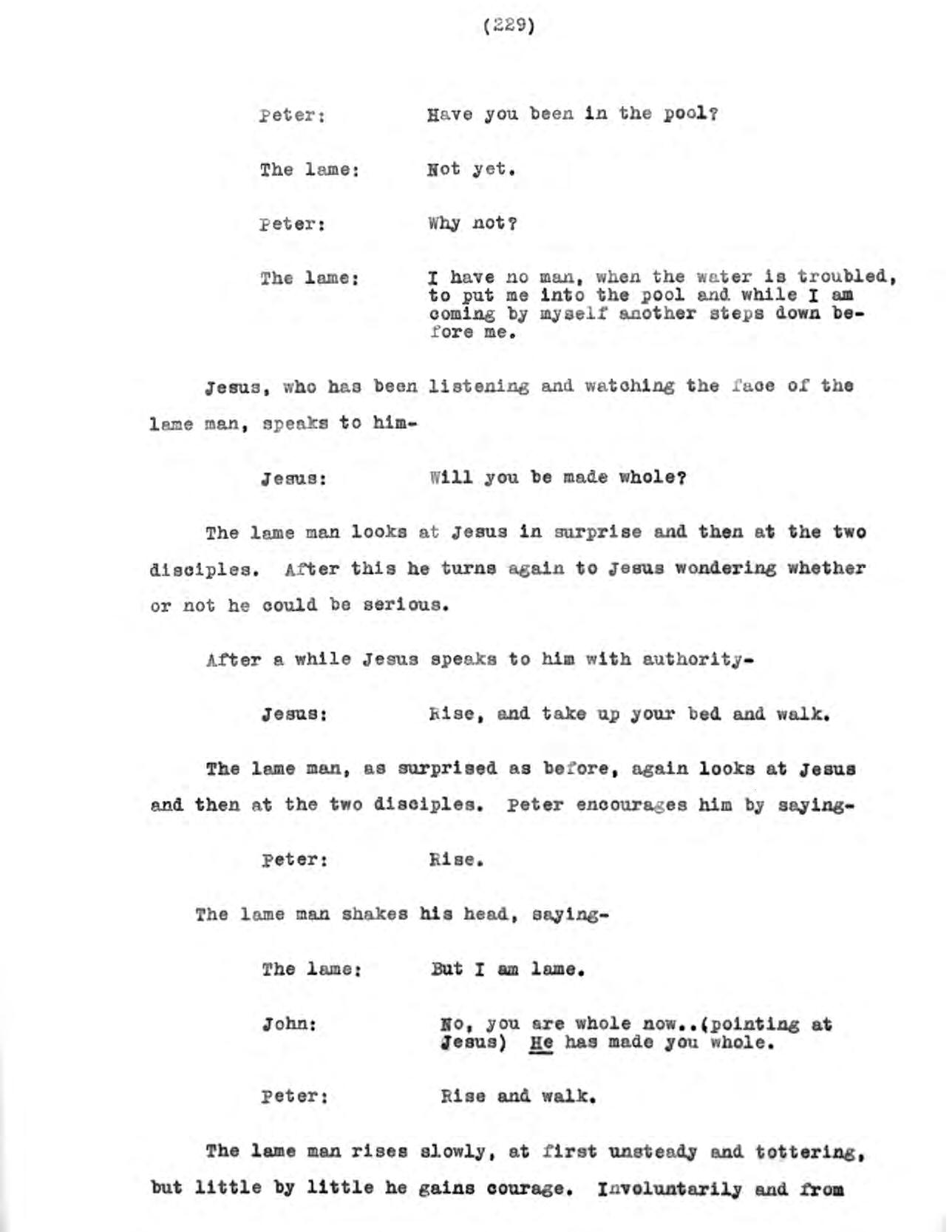
(229 ) et r : Have you b en in th 00
peter: Have you been in the pool?
The lame: Hot yet, peter: Why not?
The lame: I have no man, when the water is troubled, to put me into the pool and while I am coming by myself another steps down before me,
Jesus, who has been listening and watohing the i'aoe of the lame man, speaks to himjesus: Will you be made whole?
Th 1 ot Y t . t r: not? Th 1 : 1 d , 1 , 0 as n 11 t and oh th 0 ot h 1 m , to hi1 BU : 111 you d hol ?
The lame man looks at Jesus in surprise and then at the two disciples. After this he turns again to Jesus wondering whether or not he could be serious.
The 1 man look t J s in rprl d th n 't 0 lso1pl s . r t 1 h turn 1n to au on 1 h th r or not h coul b rlou • e hil J pak to h1 Ith uthorl .•
After a while Jesus speaks to him with authority-
Jesus: Rise, and take up your bed and walk.
The lame man, as surprised as before, again looks at Jesus and then at the two disciples, peter encourages him by sayingpeter: Eise.
The lame man shakes his head, saying-
J u is d t u our k. 1 , surprl in loo d th n t th t o dl oipl • p t ne our a him 'b 1ter: 1 • h am an h 1h 1 t I 1 •
The lame: But I am lame«
John: Ho, you are whole now..(pointing at Jesus) He has made you whole. peter: Rise and walk.
The lame man rises slowly, at first unsteady and tottering, but little by little he gains courage. Involuntarily and from
lohn: o •• ( poin 1 m d ou hol • r : 1 1 m ris 10 ly, t ir t t d.Y tot r1 • but
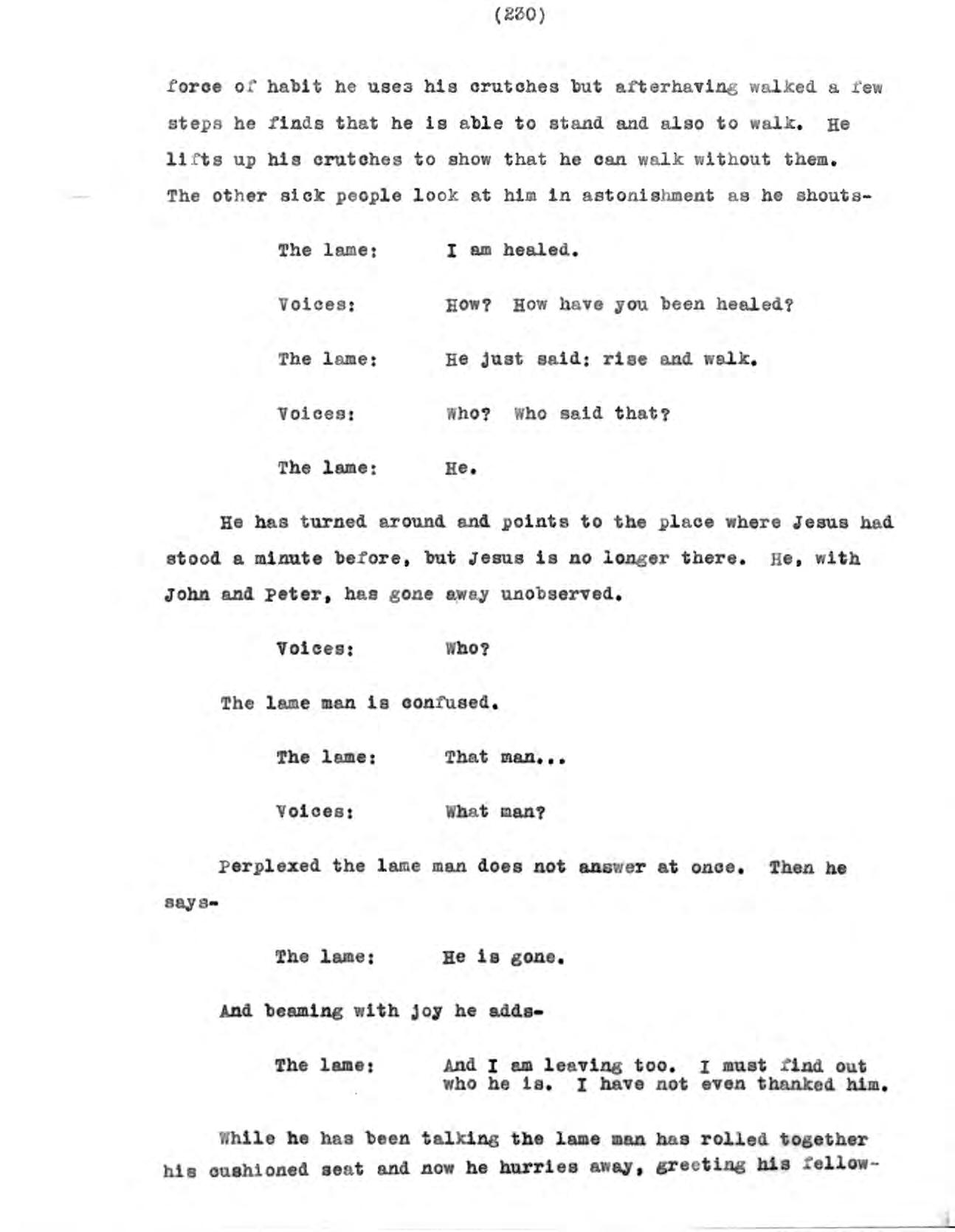
force or habit he uses his crutches "but afterhaving walked a few steps he finds that he is able to stand and also to walk. He lifts up his crutches to show that he can walk without them.
The other sick people look at him in astonishment as he shouts-
The lame: I am healed.
Voices: How? How have you been healed?
The lame: He Just said: rise and walk.
Voices: Who? Who said that?
The lame: He.
He has turned around and points to the place where Jesus had stood a minute before» but Jesus is no longer there. He, with John and peter, has gone away unobserved.
Voices: Who?
The lame man is confused.
The lame: That man...
Voices: What man?
perplexed the lame man does not answer at once. Then he says-
The lame: He is gone« And beaming with joy he adds»
The lame: And I am leaving too. I must find out who he is. I have not even thanked him. While he
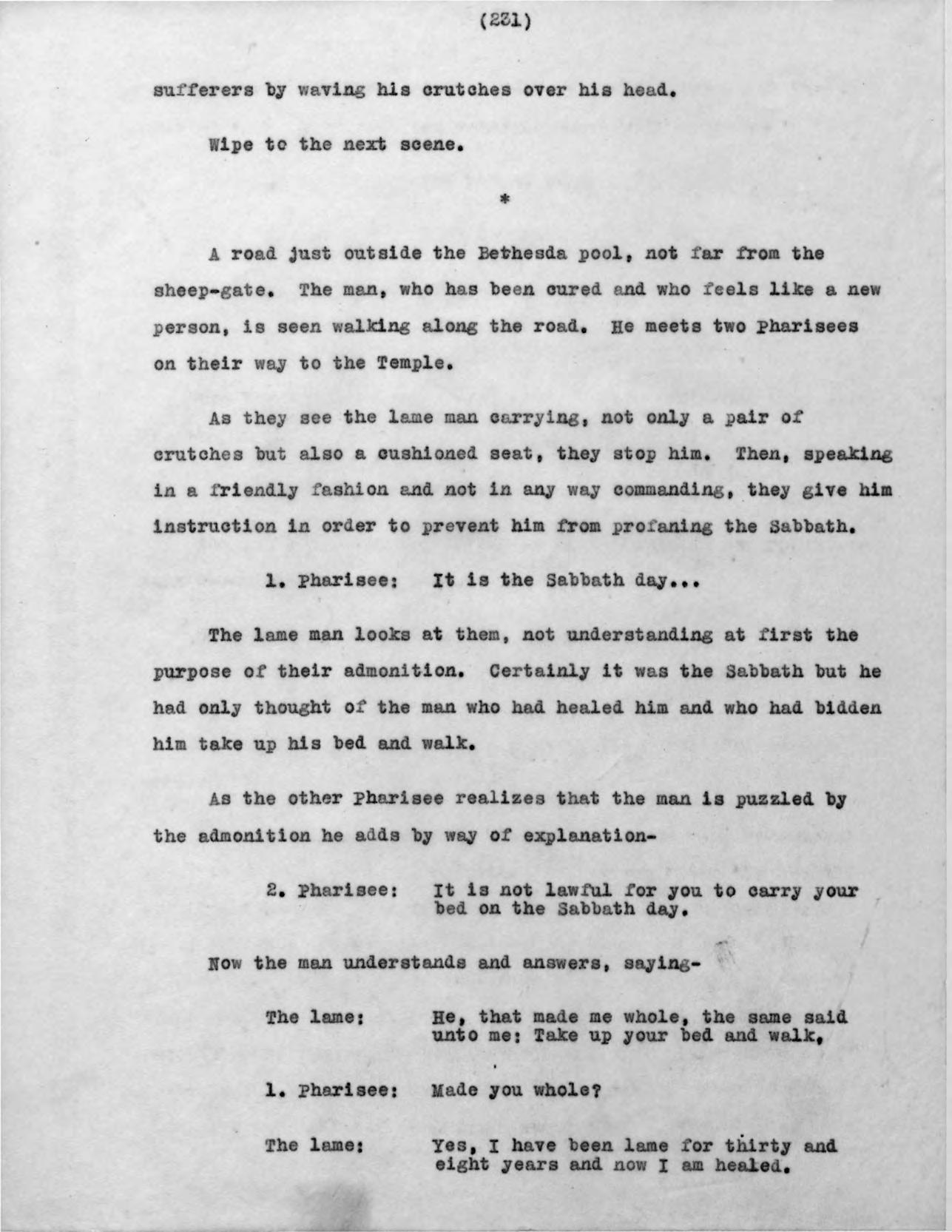
surrerers by waving his crutches over his head.
Wipe to the next scene.
:r.f r r by rav1 rtt hl orutcb OV r his had . lpe to th n xt so ne . road J at outsIde the the d pool, not 0 the eh p-:,J
r on, 1 e.n th ro d . H meet t 0 har1 e on th lr ay to th Tem,Pl .
A road just outside the Bethesda pool, not tar from the sheep-gate. The man, who has been cured and who feels like a new person, is seen walking along the road. He meets two Pharisees on their way to the Temple.
As they see the lame man carrying, not only a pair of crutches but also a cushioned seat, they stop him. Then, speaking in a friendly fashion and not in any way commanding, they give him instruction in order to prevent him from profaning the Sabbath.
As th 3 ee the 1 e an c rr 1 • not onl3 a p lr 0 crutoh but also OUShiOll d et. they to ' him . Then. . p ak1 in rIendly .. d not in y command! ' hey 1 v Instr ot1on in or er to pr vent him om ro th bb h . It Is th S bb th d •••
1. Pharisee: It is the Sabbath day...
The lame man looks at them, not understanding at first the purpose of their admonition. Certainly it was the Sabbath but he had only thought of the man who had healed him and who had bidden him take up his bed and walk.
Th lame man look at th ,not under tandlng at lr t the purpo o their ad onltlon . C talnll 1t w the abb th but h h d only thou ht 0 th man ho h d h aledh1m and who ha bl e4 hi t e up his and w k .
As the other Pharisee realizes that the man la puzzled by the admonition he adds by way of explanation-
2. Pharisee: It is not lawful for you to carry your bed on the Sabbath day.
Now the man understands and answers, saying-
The lame: He, that made me whole, the same said unto me; Take up your bed and walkf
1. Pharisee: Made you whole?
8 the other ph 1 e r l1ze th t the an 18 Ruzzled bl the onlt1on he de by W 0 expl atlon2 . h r1s e: It 1 not 1 bed on th o th man und r tand and ana er • The 1 1 . Ph 1 rh 1 e Be , t t ma me hol unto m s ake up lOur de IOU hol, Y • I h y b 4 1 19ht lear and no I • or 1ihirtl hv said k . 4
The lame: Yes, I have been lame for thirty and eight years and now I am healed.
(2
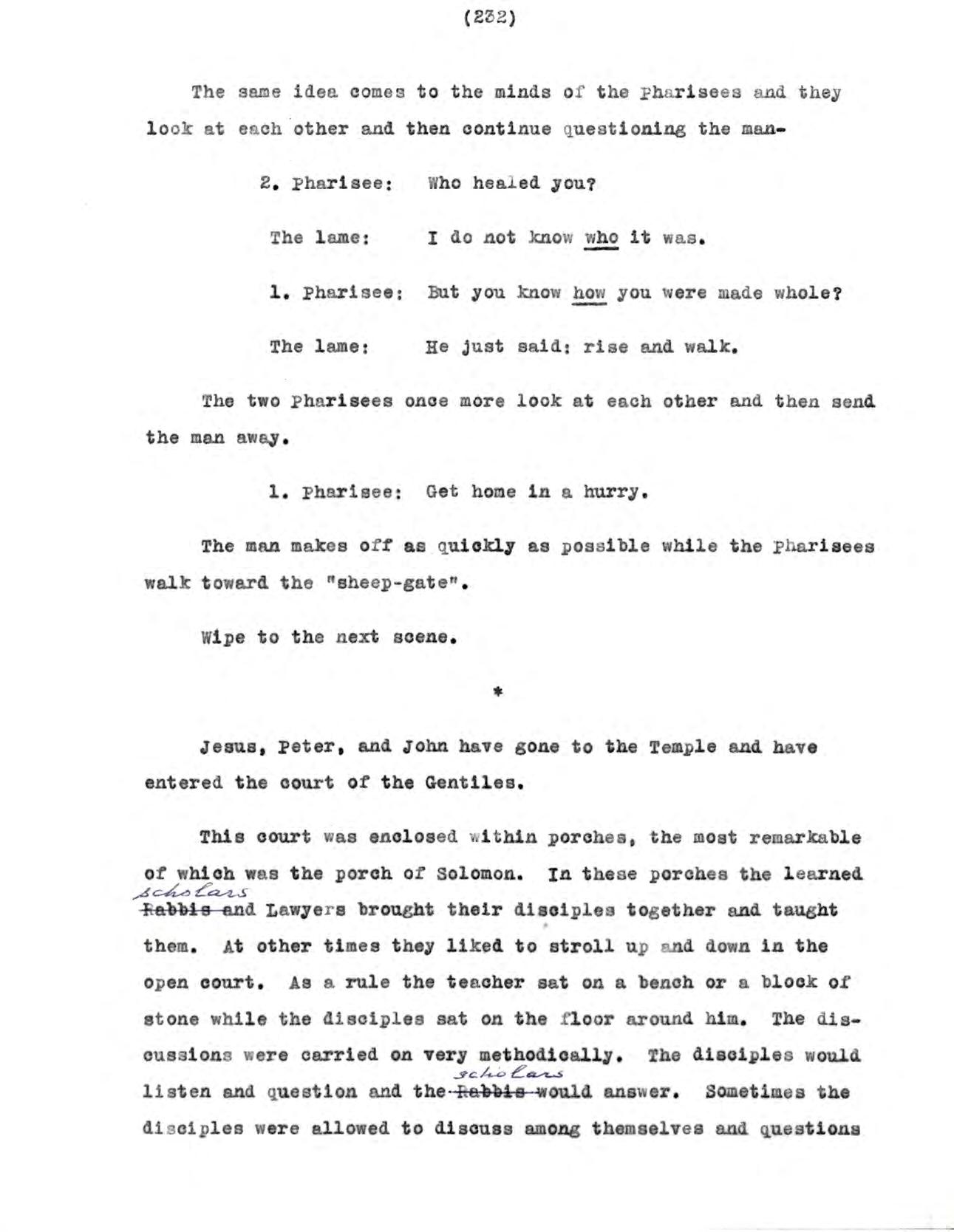
)
T e d com to the in s o ' t h ri a d they lo o c oth r d th n oontlnu quest 1 ni ng the -
The 3ame idea comes to the minds of the Pharisees and they look at each other and then continue questioning the man-
2 . Ph rl o he ed on?
2« Pharisee: Who healed you?
The lame: I do not know who it was»
1. Pharisee: But you know how you were made whole?
The lame: He just said; rise and walk«
h 1 • o .no mo 'lh it a • •1 . p 1 t you 0 r d Th 1 He J ust 1 • rl and 1 •
The two Pharisees once more look at each other and then send the man away«
1. Pharisee: Get home in a hurry.
The man makes off as auiokly as possible while the Pharisees walk toward the "sheep-gate"«
Wipe to the next scene«
h o Ph rl 011 or look t ch oth r d then sen th • 1. h e , G t ho 1.0. hurr3. . Th es 0 f . qu okll .P 1bl le th P . rl to r rt ep"" t tt • t h xt o n • .. J • P tr .• John v on 0 h 1 h v nt r h 00 r ot t h G nt! •
Jesus, Peter« and John have gone to the Temple and have entered the court of the Gentiles«
Th! . oourt a. 010 d ' it n pora • h mo t re bl o f hi oh th orch 0 Solomo • In t pore t 1 rn r ou h ·lr 1 o p to t ht t • t oth r 1 11k d to trol u
0 n court . rul th t oh r t on b no h or bloo k 0 ton 11 e 1 0- 1 sat Oll loor aro Im . Thou c rl d on ry m thodl0 :i dl 01 1 s 11 n 10 an the 0 h 1 ·01 1 r 110 d to 1 ou 0 t e qu tlon
This court was enclosed v.ithin porches, the most remarkable of which was the porch of Solomon. In these porches the learned Rabbis and Lawyers brought their disciples together and taught them« At other times they liked to stroll up <nd down in the open court« As a rule the teacher sat on a bench or a block of stone while the disciples sat on the floor around him« The discussions were carried on very methodically« The disciples would listen and question and the-Rabbis -would answer« Sometimes the disciples were allowed to discuss among themselves and questions
and answers then flew through the air like play-^lalls. The purpose of the discussion was» always in order to get to the very heart of the tiirological problem being debated, NOWand then afrabblcould be seen closeted with a single, intimate, disciple, in a whispering voice teaching him the most secret truths concerning the nature of God.
Jesus, John, and Peter are sitting in one of the porches surrounded by a crowd of listeners.
The man who has been healed is seen passing through the crowd which has gathered in groups of various sizes. He is searching for Jesus. He does not discover him but Jesus sees him and calls him. He goes to Jesus, happy to have the opportunity of thanking his beneiaotor, but Jesus outs him short, saying in a xriendly fashion-
Jesus: Behold, you are made whole: sin no more, lest a worse thing come to you.
The man stammers out a promise and words of thanks and withdraws. We follow him. just a few steps away he meets the two Pharisees who reproached him for carrying his bed. He treats them with respect and, pointing to Jesus, he says-
The lame: That is he who made me whole.
He accompanies them to Jesus who realizes the purpose of their visit and is ready for the controversy.
1. Pharisee: Why have you done these things on the Sabbath day?
2 P ri ou not 1 r1tt . i n h L ,
2. Pharisee: Know you not what is written in the Law?
Jesus answers them by saying-
J r hm 1
Jesus: Yes, I know that you eircumsize a man on the Sabbath, and now you are angry at me, because I have made a man every whit whole on the Sabbath.
2. Pharisee: Bat it is not lawful,
Jesus does not appear concerned about thi3 and says-
Jesus: My father works ever, and so must I.
I. Pharisee: Tou maice yourself equal with God?
The two Pharisees look at each other, shake their heads, and prepare to leave. But Jesus has another word for them.
t 1 1s not 1 • conoerne bou t i and s ork ve r, d o must I . ou ID yours I f q lth 0 loo t oh 0 r. s th ir u h oth r ord or th •
Jesus: 3earch the Scriptures - they testify of me«
o h r1 1 t 1 ce.
After this the two Pharisees leave the place.
19n to hi dl clp l 8 th t hel Br 10 th orch (0110 d b h camer)
Jesus rises and makes a sign to his disciples that they are to follow him. V/alking along the porch (followed by the camera) he speaks to them, saying-
h i e t 0 . h prep J t r th1 th rl d to Lo110 h h • J u 1 to h .n I the Ori nt ne round th J su ot r m e t!
Wipe to the next scene.
Gome Chief-priests, Lawyers, and Pharisees are present, and 2 . ar
Jesus: £ven Koses in whom they trust, accuses them, for had they believed Moses, they would also have believed me, for he wrote of me. But if they believe not in his writings, how shall they then believe in my words?
In the Orient news speeds rapidly and the word was soon around that Jesus was in town and had healed a lame man. Therefore another meeting was held in the palace of the High-priest.
eds r p1dly ust . ac ouse .s v d 0 8 , th '¥ e t Or h rot -ve not 1n his hen b 11eve lD. t e or as 00.0 in to n d h d h led 1 man. fh rea hel in th ' 1 - 'pr ! t.
;h them
Gamaliel. Nioodemus, and Joseph of Arimathea. A Scribe is reporting what has happened at the Betheada pool.
Scribe: He just said: Bise and walk. And the man rose and walked« Jesus has', made him whole» ^£
1. Lawyer: profaning the Sabbath.
1.Chief priest:And thus acting against the will of God.
With a knowing smile jjicodenras asks-
Nlcodemus: What is the will of God?
2. Lawyer: To keep the Law«
Joseph of A«: Is not the will or God to be good • to do good?
2.Chief priest:Not if the Law is broken.
Joseph of A«: To-day Jesus did good: he made a man whole Jj3^- - )
Nioodemus: A man who has been lame for ^thirty and ei&ht years.
Gamaliel: Isn't that a proof that God wished that man to be healed?
Nicodemus: Even on the Sabbath?
1. Lawyer: No» on the contrary, by breaking the Law Jesus proved that his power to heal is
Caiaphas has listened to this dispute with indifference. This theological spphistry i s nothing to him and he therefore welcomes the arrival of the two Pharisees who have been talking to Jesus Knocking on the table he silences the discussion and turns to the
askingwith them Gam 11 1 , .1: 0 oribe 1 report! h a t . orib : 1 . L • • 1 . Ch t p i . • 1 h m 1 0 · ,. 2 . L Y la 0 . • • 2 . C rl at:
Caiaphas: Any newa?
C pha AJJ.yll ? •
1, Pharisee: Yes,Jesus of Nazareth..•
Caiaphas: (interrupting) we know» Ee has healed a lame «an«.•
2. Pharisee; He has done worse than that.
Caiaphas: What?
1. Pharisee: He said that he is the Son orGod.
Gamaliel: We are all God's children.
1 . Y • J u o· z et •• • C 1 · ( tl ) • ha • 1 • hr h do or t t • C 1 h h t? 1. 1 a1 t t 1 th on 0 • G 1 1:
2. Pharisee: He made himself equal with God.
1. Lawyer:
2. Lawyer:
Nicodeaius: That is: he made himself a God. A God? He looks like anyone or us,
The stars are not axraid of being mis« taken for fire-riies
Caiaphas is bored, /eaxing another monstrous theological debate he says-
u t 1 n 1C 1 h 1 bor • r on r 'o t 10 1 e sc h 1 h r ut t 0
Caiaphas: He is of course a blasphemer but what oan we do?
1.Chief priest:Let him speak and his-woÄ-words will eventually nullify his teaching.
After thinking over the matter Caiaphas agrees with the Chief priest.
1 . Ch! pr! t:L 1 1 t r t c 1 h th C 1 pr! t c u rl t .
Caiaphass You are right.
Gamaliel» Nicodemus, and Joseph of Arlmathea shake hands. They are well pleased with the outcome of the meeting.
G 11 1 , d 10 e h 0 1 k 1 1 Ith th 0 too th 1 •
Wipe to the next scene«
to
At one of the Southern gates, leading Trom the Temple-area to the Ophel and the priest quarter.
Near the gates, or in the gates themselves, the beggars "requently sat.
Here Jesus, John, and peter are passing a blind beggar, a young man. written in Hebrew on a board over his head are the words;» nl was born blind."
At on of h outh rn g t 1 f ro to the Oph 1 and the rl t h t t or In th t t.&.ilo.ulJLl ogl requ n t t . r J t t r y o • 1 t n in br on a 0 or : I born bllhd .
After passing him the disoiples ask Jesus a question, jt was a co non belief in that day that sins committed by parents caused suffering in the lives of their children, frequently bringing on mental or bodily affliction, peter asks the questionpeter: Who did sin, this man, or his parents, that he is born blind?
Jesus stops walking and answers-
Jesus: neither has this man sinned, nor his parents: but that the works of God should be made manifest in him.
Then he turns to John, saying-
Jesus: Go and call him.
John approaches the blind man and we follow him. John speaks to him saying-
John:
and rise. The Master calls
John: Jesus of Hazareth.
Beggar: The prophet?
0 Jeu .. az et • • r o t? .
John: Yea,
As soon as the beggar reaches Jesus he cries out-
Beggar: Have mercy on me.
The beggar answers without hesitation»
Beggar: That I might receive my sight.
The blind beggar, filled with hope, puts on his garment, rises quickly and comes to Jesus» The actions of Jesus cause the disciple? to believe that he is going to perform a miracle»
Jesus: What will you that I should do unto you?
Beggar: Yes.
At this Jesus turns away» Then crouching down he spits on the ground and makes some clay out of the spittle and dust»
And aiter finsishing anointing the man's eyes Jesus adds(
Jesus: Believe you, that I am able to do this?
(This scene of Jesus making the clay is taken from such an angle that we do not see him directly "spitting".)
After finishing his preparation Jesus rises and anoints the ©yes of the blind man with the clay, sayingJesus: According to your faith be it unto you.
ohn - Y • h 11 b g .r . I f! 1 lth o p . • 'put s g ment , ri qu!o d co e Th o 10 o£ e us eau e th solp to b 1i e that 1 '01 to 1r cle . oon a th be gg r r c e u he ori s utt r 1n1 hi hi 'p r r o1n th o f t blind 1 h 01 ,J • coordln t t t 1t unto 30u . • d t r 1n 1 hi , o1nt1 th eye s u dd ..
) J • • no rv d ah t of th p opl ho So b3 the h 1 hi t the 001 0 i Je to th n '* en .
Jesus: Go now and wash In the pool of oiloam.
Some of the people who have been watching take the blind man by the hand and lead him to the pool of Siloam.
Wipe to the next scene.
(It was generally believed that not only the spit but also the mud were remedies possessing a healing power)»
Th 001 0 10 0 0 h 1. Hr h 1 • 0 o n , sur OWl 1 n d ou 10u by . lth 1 o b .from hi y • t and t t P 0 1 ound • , 010e • Do yc . u 1: I a in h d i · u in hi ole oh t u ·l: 0 I So 0 th o 1 h r bron
The pool of Siloam was situated at the South West of the hill of Ophel.
Here we see the blind man, whose name was Samuel, kneeling down, surrounded by friends and curious ones who have been passing by. Making a cup with his two hands he dips up the water and washes the mud from his eyes. Then he XIfta his head, looking at the sky and at the people around him. They ask him-
Voices: Do you see anything? What do you see?
Samuel: I see men as trees, walking.
Again he dips up water in his hand* and washes his eyes.
Voices! What do you see now?
Samuel; Now I see everything clearly.
Some of the people who are thronging around him say«
V 10 : I not 010 i he .
Voices: Is not this he that sat and begged?
Voices: This is he.
Voices: NO.
o. 10 • t th on dl u 11 · ts hi 8 t ? r • h o ? r th n h 1 0 1
t 0 1 u 1 , 0 t t r • loo h1.h t o y u ? • hi • 11 . .. t
Voices; Yes,
Voices: It is not hef but he io like him,
Samuel puts an end to the discussion, saying-
Samuel; I am he.
Voices: And you are not blind any more?
Samuel: No,
An incredulous one who has been watching has an idea. He holds up his hands before the face of Samuel, asking-
passer-by; How many fingers do you see?
Samuel: Seven,
passer-by: Ana now?
Samuel: Three, passer-by: And now?
Samuel: One,
The man looks around triumphantly.
During all this two Pharisees approach, their curiosity aroused. They question some ot the orowd-
1, Pharisee: What is the matter?
2. Pharisee: Is not he the beggar born blind?
A voice; Ten, and now he ha3 received his sight again,
2, Phariseej How?
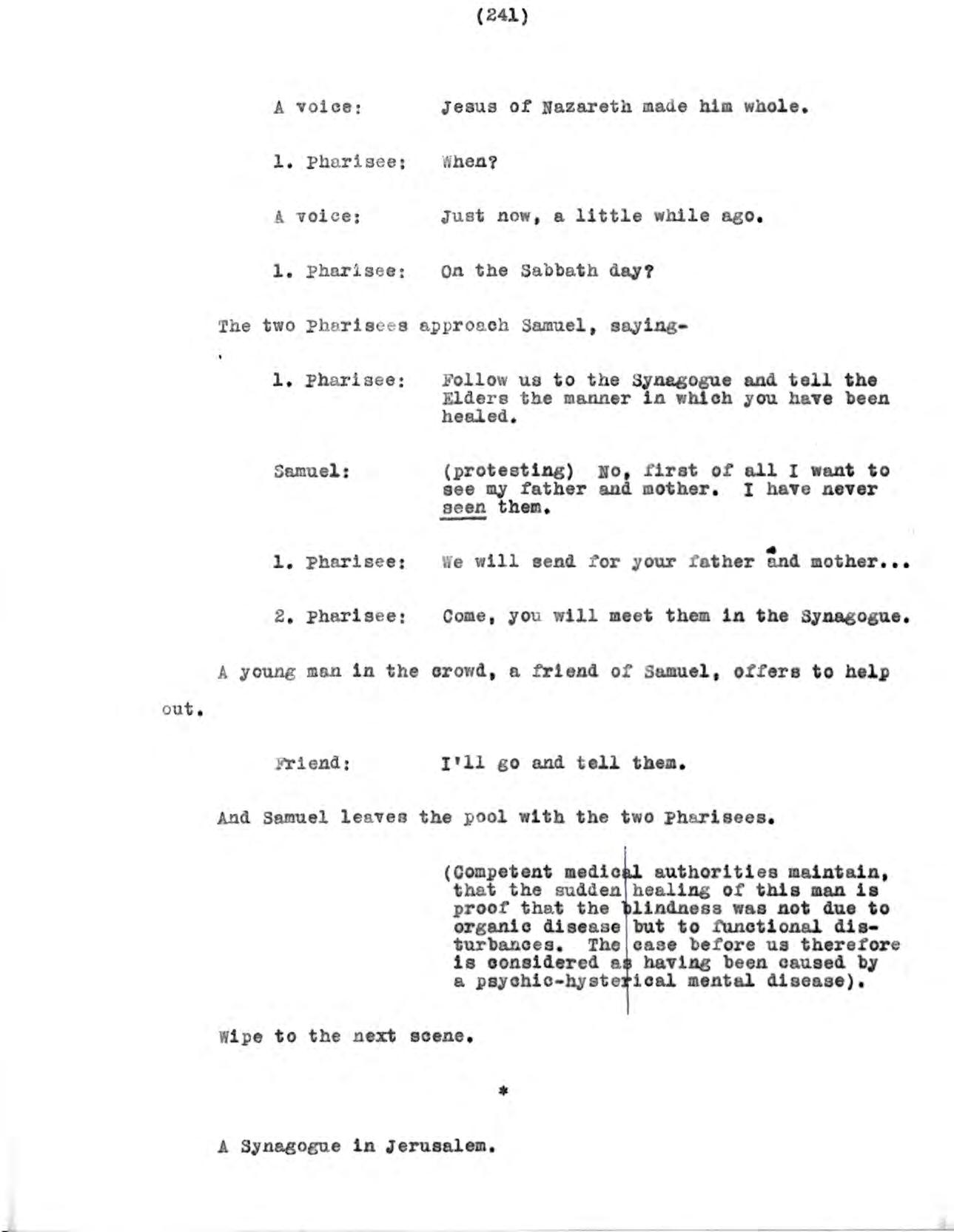
A voice: Jesus of Nazareth made him whole.
1. Pharisee; «hea?
1. Ph ris e : .Q? voi e . u no t 1 tt 1 · o.
A voice: just now, a little while ago«
1 h ." s e on th a h h t o P hari r o ch u t
1. Pharisee: On the Sabbath day?
The two Pharisees approach Samuel» saying-
1» Pharisee: follow us to the Synagogue and tell the Elders the manner in which you have been healed*
Samuel: (protesting) no, .first of all I want to see my father and mother. I have never seen them.
1. Pharisee: We will send for your rather and mother...
2. Pharisee: Come, you will meet them in the Synagogue.
A young man in the crowd, a friend of Samuel, offers to help out.
friend: 1*11 go and tell them.
And Samuel leaves the pool with the two Pharisees.
(Competentraedioilauthorities maintain, that the sudden healing of this man is proof that the blindness was not due to organic disease but to functional disturbances. The case before us therefore is considered an having been caused by a psychic-hysterical mental disease). Wipe to the next scene.
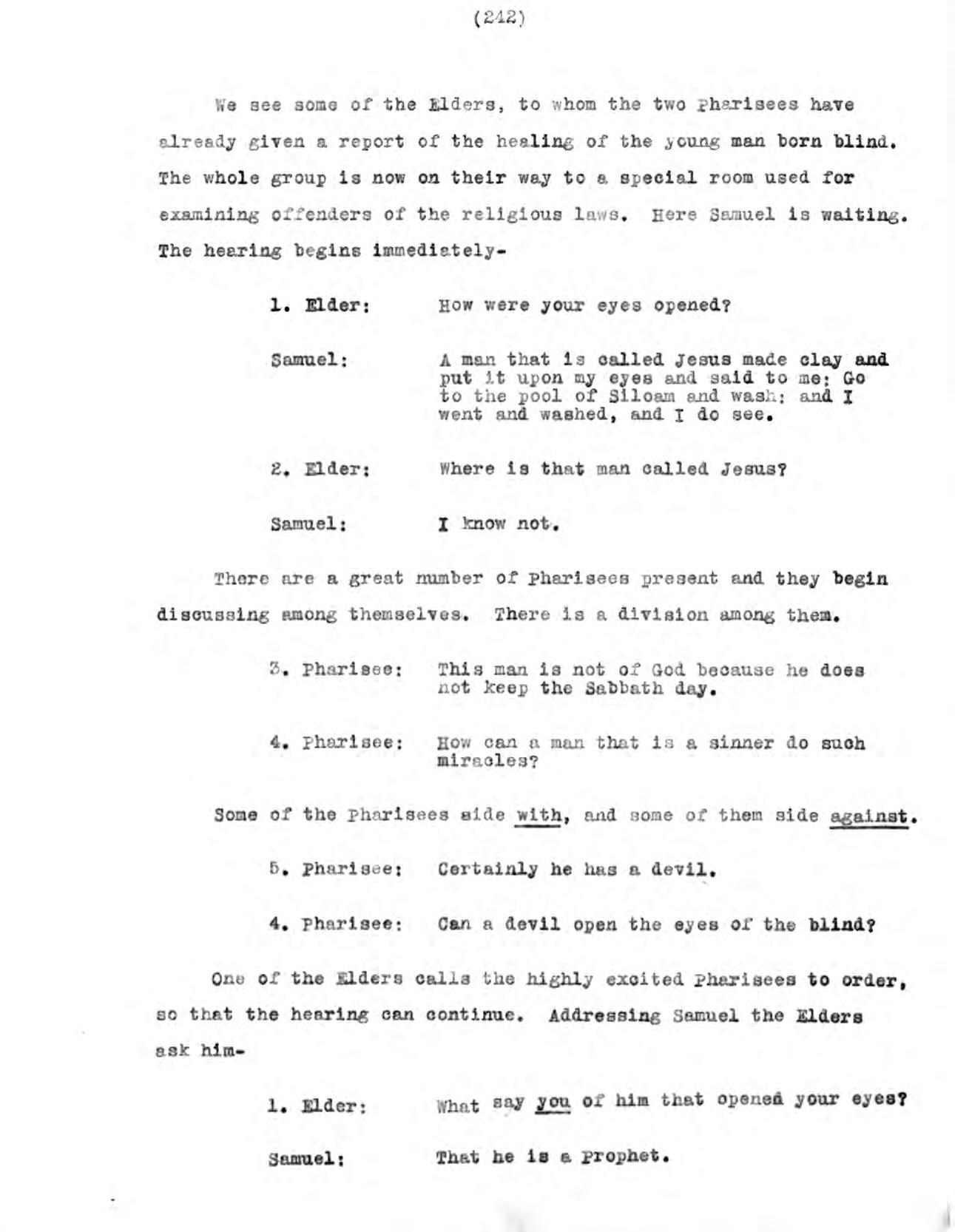
We see some of the Llders, to whom the two Pharisees have already given a report of the healing of the .young man born blind. The whole group is now on their way to a special room used for examining offenders of the religious laws. Here Samuel is waiting. The hearing begins immedi&tely-
1. Elder: How were your eyes opened?
Samuel; A man that is called Jesus made clay and put it upon my eyes and said to me: Go to the pool of Siloam and wasli: and I went and washed, and I do see«
2« Elder: Where is that man called Jesus?
2 1': h r 1 th 0 1 eau ?
Samuel: I know not.
S u 1 . no ' . r e a c T v t num er 0 P ar l e pre n t d th Y b -in di cus s ln 0 h e l v • Th re 1s d l v1,i on 0 t e '•
There are a great number of Pharisees present and they begin discussing among themselves. There is a division among them,
3 . ri e u e e 0 0 b
3. Pharisee: This man is not of Sod because he does not keep the Sabbath day.
ex !
4. Pharisee: HOW can a man that is a sinner do such miracles?
Some of the Pharisees side with, and ^ome of them side against
0 he Ph s ee id 1 h , ome OJ. th s de ains t. o. r is 1 1 vil e
5. Pharisee: Certainly he has a devil.
4. Pharisee: Can a devil open the eyes of the blind?
• r e . C v11 op Xl t e 0 h b1 111 ?
One of the £Lders calls the highly excited Pharisees to order, so that the hearing can continue. Addressing Samuel the £Lders ask him-
0 or t c 1 th e to or r, o t h t h 1 c contlnu • ddr 8 1n e th r o;,J k ..
1. Kldcr: t sa ^ 12H: o i hi m tiaat °P 0ne d * ou r e * es ?
1 . d r· 'h t 0 0 t t p n your , u 1: 1 0 •
Samuel: That he is a prophet.
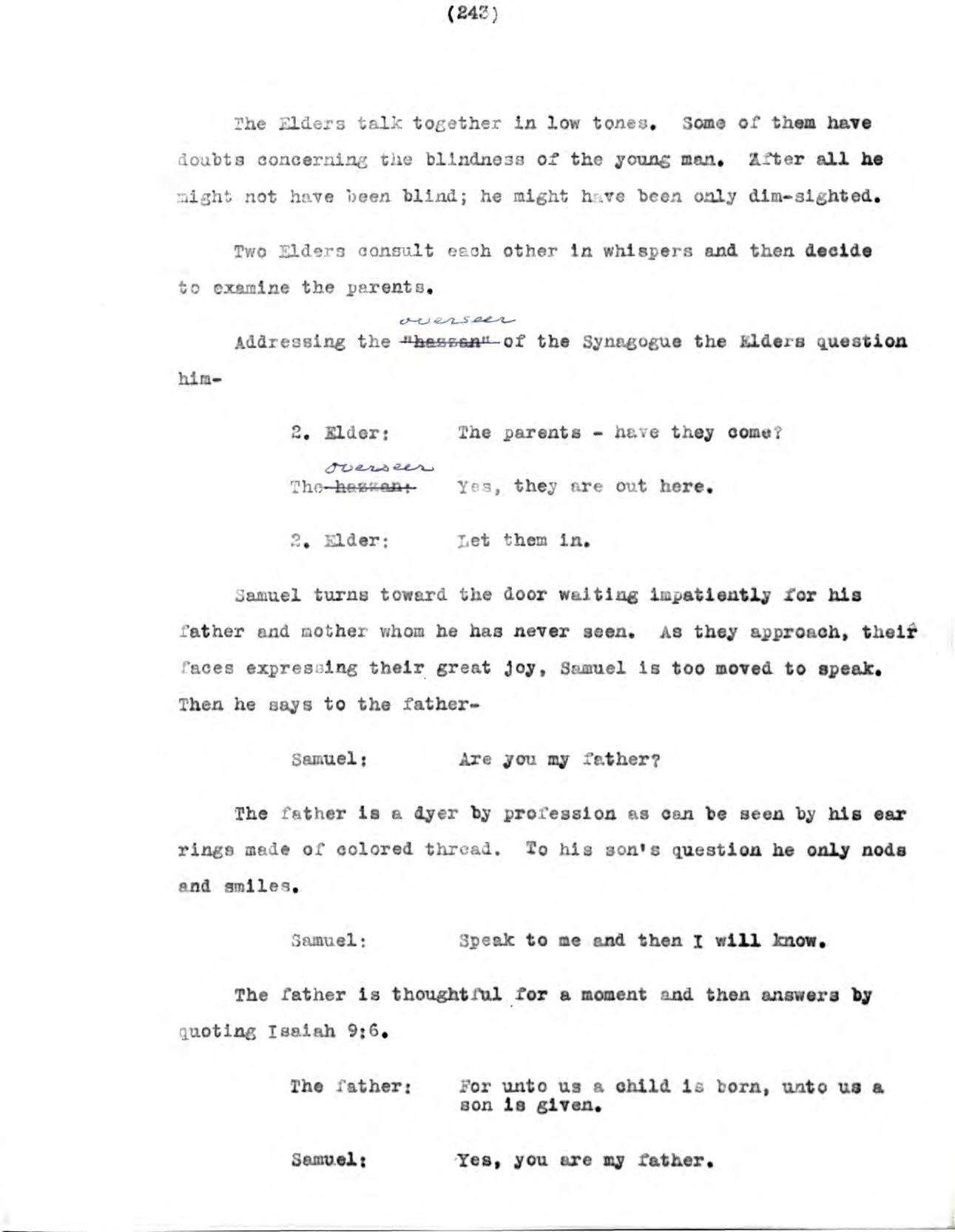
The Siders talk together in low tones* Some of them have doubta concerning the blindness of the young man» after all he might not have been blind; he might h .ve been only dim-sighted.
Two Elder3 consult e?oh other in whispers and then decide to examine the parents.
r 0 t r n. 0 on • h oubt co 0 i f. not 1) 1 • .., wo t h th n 1 n 6 .
Addressing the "hesscon" of the Synagogue the aiders question him-
2. Jgldor: The parents - have they come; 'Jhe- h&BKaPi i, they are out here, . Ider; Let them in.
Jamuel turns toward the door waiting impatiently for his father and mother whom he has never seen, AS they approach» their faces expressing their great Joy, Samuel is too moved to speak. Then he says to the father-
Samuel; Are you my father?
The father is a dyer by profession as can be seen by his ear rings made of colored %h To his 3on*s question he only nods and smiles,
Samuel: Speak to me and then I will know.
The father is thoughtful for a moment and then answers by Quoting Isaiah 9:6,
The father: for unto us a ohild 1~ born, unto us & son is given.
Samuel: Yes, you are my father.
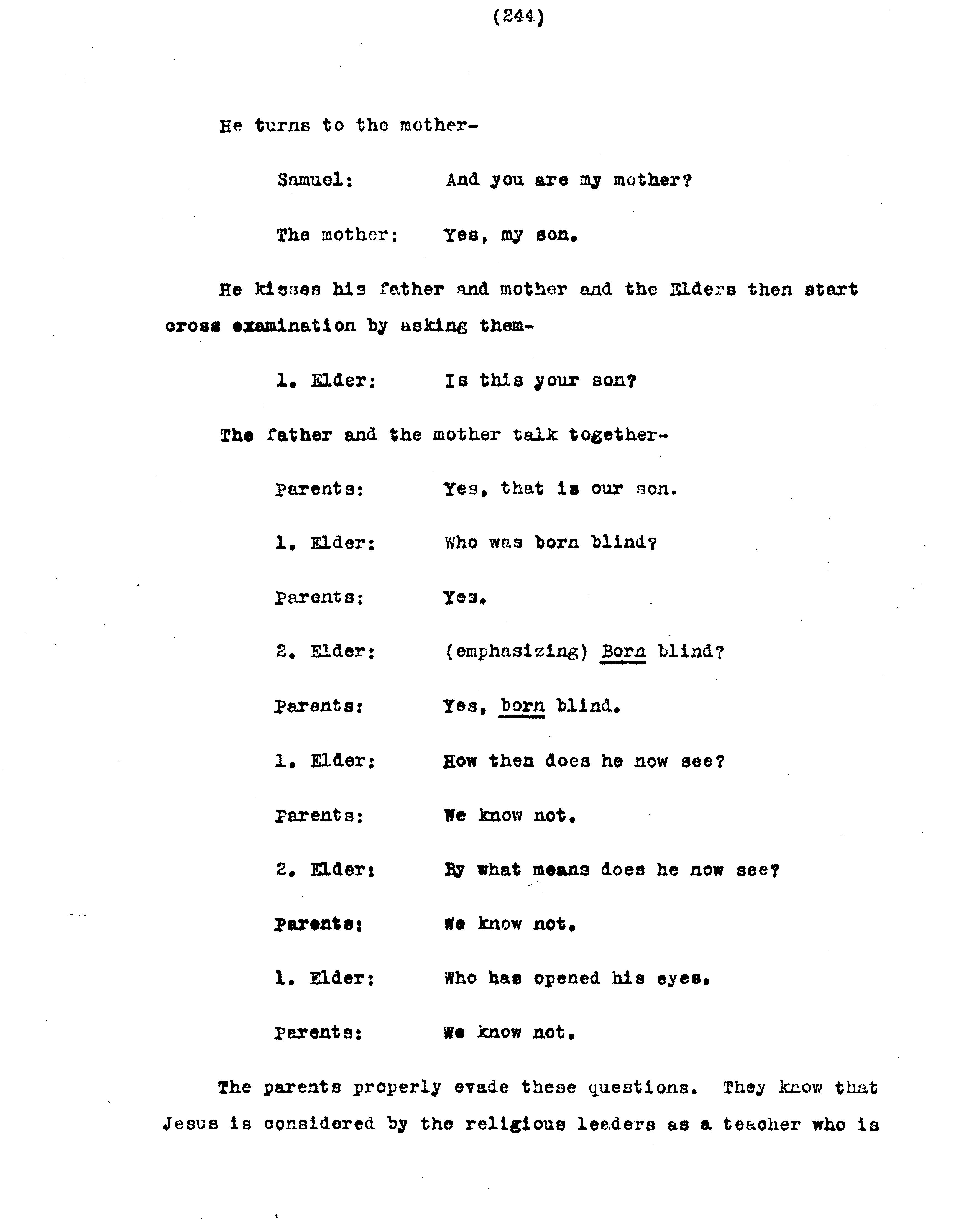
Ke turne to the mother-
He turns to the mother-
Samuel: And 30U are my mother?
Samuel: And you are my mother?
The mother: Yea, my son.
The mother: yea. fD.'3 8011.
He kisses his father and mother and the Iftders then start cross examination by asking them-
He his rather A.l1d mother and the lUdel's then start eros. exam1nat1on bl Qsking them-
1. Elder: Is this lOur son?
1. Elder: Is this your son?
rh. .father and the mother talk together-
The rather and the mother talk together-
parent s: Yes. that 1. our
parents:
1. Elder: Who was born blind?
Parents: YS3.
The parents properly evade these questions. They know that Jesus is considered by the religious leaders as a teacher who is (
1. Elder: parents: ilder:
Yes, that is our non. was born blind? Y33 . («nphasizing) Born blind?
2. Elder: (emphas1z1ng) Born. blind? -
parents:
Yea, born blind.
parents: Yes, born blind. -
1. Elder: HOw then does he now see?
1. Elder: parent s:
How then does he now see?
parents: We know not.
We know not.
2. Elderj parents:
By what means does he now see? we know not.
2. Elders l\V what means does he now see? " parentel •• know not.
1. Elder: parents:
Who has opened his eyes. We know not.
1. Elder: Who ha. opened his eyes, parents: •• mow not.
The parents properly evade these The3 kcow that Jesus ls oonsidered by the relig10us lee.ders as a. tefa.oher who la
preaching against the Law and the tradition and that he and nis followers are not locked upon with favor by the authorities, /earing to be excommunicated they try not to say anything they can avoided
The Ilders» noticing that the parents choose their words with care» try to trip them by ruae treatment. They continue-
1. Elder: You know not...you know not...you know nothing at all. Are you fooling ae?
But the effect is the contrary to that desired. The parents are only put more on their guard.
The father; Ho, we know nothing. Ask our son himself; he is of age..
,e mother: Yes» he shall speak ror himself»
As the parents cannot be forced to give any information they are dismissed and the Elders decide to examine the son once more.
1. Elder: iat did he to you? HOW opened he your eyes?
Samuel: I have told you already, and you did not hear: wherefore would you hear it again? Will iou also be his disciples?
Now the Elders are angry and they revile the young man» saying- Z
2, Elder: You are his disciple, but we are Moses' oTsciplts. Me know (hat Croo* spoke to ' Uoses. As for this fellow we know not from whence he is.
Samuel| who becomes quite excited and at the same time gains in courage, answers with a bit of arrogance-
u. 1:
Samuel: Why, herein is a marvellous thing, that you know not Trom whence he is, and yet he has opened my eyes« Since the world toe^an was it not heard that any man opened the eyes of one that was born blind« If this man were not or God, he could do nothing.
Th r JU' ' d to b po .D. to 1 thi hi on . h rl in t lr r d hout In lou vol -
The Siders are enraged to be spoken to in this fashion. They rise in their anger and shout in a loud voice-
2. Elder: you who are born in sin - do you teach us?
2 . r: yo 0 r born in in.o you t h u ?
1 . r: L v th t ono • you t out 0 th t1on. .
1. Elder: Leave the Synagogue at once» You are oast out of the congregation.
1 1 v t .11 ogu but hi Do 1 ok th our to 0110 hi
Samuel leaves the Synagogue but his parents lack the courage to follow him.
1p to h n c •
Wipe to the next scene.
The court of the Gentiles, in one of the porches Jesus. John, and peter are sitting on a heap of stone-blocks.
h oour 0 G ntl1 • III on 0 h orohe J u •
John-. p ltt l .as "n h - p 0 tOll - blook • ..."
Samuel. ;vho has been looking for Jesus, catches sight of him and hurries to his side. Out of breath he speaks to Jesus. saying-
Samuel: Master...
Peter: what is the matter?
Samuel: I have been cast out of the congregation.
It was a dreadful thing to be excommunicated and Samuel had reason for being alarmed.
jesus motions to John and peter to leave them alone and then
he Invites Samuel to sit down.
After a while Jesus looks earnestly at the young man and asks him-
jesus: Do you believe on the Son of Ood?
Samuel looks at Jesus In surprise asking-
Samuel: Who is he that I might believe in him?
Jesus bends forward, saying-
Jesus: You have both seen him and it is he, that talks with you»
Samuel is quiet for a moment and then says-
Samuel: I believe.
With his face reflecting joy and confidence he listens to Jesus.
Jesus; j?or Judgment I am come into this world, that they which see not might see, and that they which see might be made blind.
In the meantime peter and John have returned. Some Pharisees also have approached Jesus and have heard the last words spoken by him. one of them asks him-
1. Pharisee: Are we blind also?
Jesus looks up and answers-
Jesus: If You were blind you should have no sin, but now you say, we see; therefore your sin remains.
.p r1 hrug their hould r l a th
The Pharisees shrug their shoulder and leave the place,
Jesus turns to his disciples» saying-
Jesus: My soul is sorrowful Tor the sons of men, because they are blind and see not*
He rises and leaves with peter and John*
This scene dissolves softly into the next scene. miring the scene-shifting the following is heard-
Commentary: One of the Counsellors of the High-priest, a Pharisee, named Nicodemus, who in secret believed on Jesus, went at night to Bethany to question him concerning the Kingdom of God.
This scene is a trucking shot, a close close-up of a lantern, carried by a servant in the night*
The road leading from Jerusalem to Bethany. We see Nicodemus on his way to Jesus. A servant is carrying a lantern and leading the way. It is a windy night. The stormy weather bends the trees, sweeps the road and catches the cloak of Nicodemus, blowing it about, but he defies the storm because his errand is important.
Nicodemus was one of the richest citizens of Jerusalem at that ti e. He was not only a member of the political privy council of the High-priest, but he was also a distinguished member of the powerful Sanhedrin. He was a righteous, God-xearing man and highly cultured. He belonged to the pharasaio party. It was his passion to lQl0 W th e trut h tha t ^ove him out in the night. He
wanted a rirst hand knowledge of the new doctrine.
Wipe to the next scene.
The house of Lazarus in Bethany. The entrance seen from the inside. A knock at the door is heard. After a while Lazarus appears, an oil lamp in his hand, and asking-
Lazarus: Who is there?
The voice of Nioodemus is heard Trom outside, sa^lng-
Nicodemus: A friend. Nioodemus.
Lazarus opens the door and they greet one another.
Nioodemus: I have come to see Jesus.
Lazarus: He is in here.
Lazarus leads Nioodemus to Jesus, walking ahead and lighting the way.
Wipe to the next scene.
A room in the house of Lazarus. Jesus is seated and talking with John. He rises as Nioodemus and Lazarus enter the room. Jesus sits down again inviting Nioodemus to sit beside him. Lazarus and John stay with them.
Nioodemus wastes little time before putting to Jesus the question in his mind-
Nioodemus: We know that you are a teacher» come from God.
Jesus: We?
Nioodemus: Yes, we are many who realize that no man can do these works that you do except God be with him.
Nicodemus pauses and then continues-
Nicodemus: And we would like to icnow-the conditions^e^jC^^we- entering the Kingdom of God that you speak of.
For a moment Jesus looks searohingly at Nicodemus. Then he answers-
jesus: Except a man be born again, he cannot see the Kingdom of God«
Though Nicodemus is tamiliar with the figurative language of that day the spiritual meaning of the words of Jesus escape him. Therefore he asks very seriously-
Nioodemus: How can a man be born again when he is old? Can he enter the second time into his mother's womb, and be born again?
Nioodemus, with all of his education, is a man who only sees those things that are plainly visible. Jesus appreciates his eager spirit and tries to lift him to a higher and more spiritual level of understanding.
.· ood u 1 th t th lrl u h or Th r or h v r r10u 1100 u : icod • 1th 1 hi ne t1on, ho 1 t t 11nll 1 1bl • J d rl to 11 hi to hi 1 1 0 d1 • t oh r . 0 e od u • orn n, h 0 G d. 1 1 0 J u 1 h r or 0
Jesus: Marvel not that I said unto you, that you must be born again« But that which is born of the flesh is rlesh, and that which is born or the Spirit is 3pirit. Therefore I said unto you: exoept a man be born again he cannot enter into the Kingdom of God. J 1 d • • lood mu : 1
1) 1 this un tr to lco u • It 1 0 tlr 1 dlf r nt r o t 1 1 n 0 t G d . lth hi d nt h1rst o 1 h
lr 0 un rstand h1 t ohi -
All this sounds strange to Nicodemus« It Is so entirely different from the Jewish oonoeption of the Kingdom of God« But with his ardent thirst for knowledge he sincerely desires to understand Jesus and his teaching-
leod :u s orn ?
Hi c od emus: Born again?
Jesus: Yes, Born from above.
ITioodemuB: Born from above?
Jesus: Yes, of the Sptrit.
It becomes increasingly difficult for Nicodenus to follow the words and thoughts of Jesus»
After a while he repeats pensively-
Hioodemus: The Spirit?
John and Lazarus have listened with interest to the conversation and now try to help Hicodemus by quoting the first lines of Genesis-
John: In the beginning God created the Heaven and the ikrth.
J • • orll 0 • ' . 1 0 orn 0 ? J e t 0 h t it . t 1 or 1 iu! or 100 u 110 th or • A t r 1 11 r p % h plrlt? Jhn 11 t t 0 h oon rtlon d no t r 3 to h lp b quo 1 lr t 11n ot G n 1John: Go or L z o o Ull r t
Lazarus: -Aad-darJcneas waa--upon-the--face-. oi the-deep. And the SPIRI T of GO D moved upon the faoe of the waters« And God said: Let there be light» and there was light,
Regardless of how eager Kioodemus was to understand the meaning of the words of Jesus they were still unintelligible to him» Jesus therefore tries to help with a simple analogy. The wind howling outside inspires the analogy«
Jesus: • • <* HarJc - the wind blows when it Ustøtte-and
you hear the sound thereoi but cannot tell whence it comes, and whither it goes, so is it with every one that is born of the Spirit.
John: We cannot perceive the Spirit with our senses» but he is there* within us, preparing our second birth - our spiritual birth.
To some degree Nicodemus now begins to realize the meaning of the words: born again, born from above. Bit now another question forces itself upon his mind« how to attain to that spiritual birth. Therefore he asks-
Hioodemus: How can these things be? Eow can I become worthy to enter the Kingdom or God?
John was eager to lend a helping hand-
John: irst we must be transformed from within.
Lazarus also has a word-
Lazarus: .irst cleanse the inside of the oupthat the outside is bound to be clean.
Then Jesus says-
Jesus : Are you a Master of Israel, and Icnowwfc^ not these things? If i tell you earthly things, you believe not. How shall you believe if I tell you heavenly things?
Once again the words of Jesus are difficult for Hioodemus to understand and he asJcs-
Nioodemus: How can I believe in things which are unseen and in Heaven? No man can ascend up to Heaven.
Jesus: Ho. No man can ascend up to Heaven but he that came down Ir om Heaven, even THe Son of man«
Th r 1 11 no for
There is silence for a moment» Then Hioodemus says-
lood mu : J
Nicodemus: I know now what ia required IX one is to be round worthy to enter the Kingdom of God "but there is one thing yet that I do not know: where is the gate?
Jesus answers very earnestly-
jesus:
CrOd so loved the world that he sent his only begotten Son into the world» that through him it might be saved. And whosoever believes on the Son shall not perish» but have everlasting lire«
It is all becoming more understandable to Hioodemus» These last words have set the matter in a better light« Everything is now clearer to Nicodomus and he says-
Kloodemus: To believe in the Son and to love the /ather in his Son «»is that the gate to the Kingdom o£ God?
Jesus: Yes»
Hioodemus rises» saving-
Nioodemus: from now on I will seek with all my strength to rind that gate»
Jesus also rises and says-
Jesus: Seek» and you shall rind» and when you ilnd, you shall marvel, and when you marvel, you shall enter the Kingdom and when you have entered the Kingdom. I will give you rest.
Nicodomus takes leave of «Jesus and John,and Lazarus sees him to the door» On his way to the door he turns toward Jesus, saying«
Nieodemus: I warn you not to go to Jerusalem»
With an air of resignation Jesus answersJesuss Behold, I must walk to-day and to-morrow .and the day following, and the third day I shall "be perfected.
Then Nicodemus, deeply moved, leaves the room, the scene ending when the olosed door dissolves into the next scene»
(Jesus never publicly proclaimed himself the liessiah but undoubtedly he had slowly reached the conclusion that he was the expected Messiah, called by God to establish his Kingdom on earth» But Jesus felt t .at his mission In the world was an infinitely higher one than just to fulfill the traditionally National and political hopes which were tied to the Messianic dream of the people» Jesus wanted a revolution but one of a spiritual nature. And he gave the uesslahship a new significance by identifying it with "the righteous servant" of whom Isaiah had spoken and who through his sufferings would redeem Israel»
When therefore he decided the next day to enter the Holy City he wished by a symbolic act to emphasize that he came as a Messiah in a spiritual sense, but the multitude thought of the Messiah only in political and military terms»
As soon as the door has closed on Nicodemus the preceding scene dissolves softly into a close-up of a white foal of an ass sucking its mother.
During the scene-shifting the following is heard-
Commentary: The next day Jesus went up to Jerusalem, riding upon an ass - thus fulfilling the words of the prophet: Thy King oometh unto thee, lowly, and riding upon an ass.
When Jesus chose to make his entry into Jerusalem riding upon an ass he did this deliberately» irom olden times the ass had been used by distinguished people: Kings, judges, and prophets.
When a King oame riding upon an ass it was a sign that he oame with peace» It was therefore to be expected that the Anointed of aod would enter the Holy City riding upon an ass.
She-asses were preferred because of their light-Tooted and quiet pace.
) n rid! u .p0n it as t h wi th p ne • It a thr tor to b ot God r H on • oh - pr f rr d 0 1 1 u l t c •
The close-up dissolves into a long shot» in which we see the white she-ass with the sucJcing foal. The animal is tied near a place where two ways meet» Some people are standing about.
Two of the disciples of Jesus» Jacob and Thaddai, approach the ass and her foal and loose them» The owner of the asse3, seeing what the disciples are doing, hurries over to them asking-
The owner: Why do you thisf loosing them?
Jacob: Jesus of Nazareth has need of them.
The owner: ?or what?
• loo 1 th , Je.co : 0 th 0 h • h 0 r : h t
Thaddai: He is entering Jerusalem to-day. jaoob; Solemnly»
The owner: Taxe them.
Jacob: You will get them back to-night.
And he lets them go with the she-ass and her foal, and they leave the place drawing the asses after them.
Wipe to the next scene.
In front of the house of Lazarus in Bethany there is a large
crowd of people from the town, and pilgrims on their way to Jerusalem, have gathered« It has already been rumored that Jesus is to enter Jerusalem riding on an ass. Jesus is waiting before the house«
How Jacob and Thaddai arrive with the asses« With a sudden burst of enthusiasm one of the other disciples takes off his striped "simla" and covers the she-ass with it like a saddle-cloth« In ancient times the Kings of Israel were given homage in this way.
cro d t p o 1 om th to .n , 1 r to Jer u s m, h t er d. It ha e llr or t au 1 J e.l rl 011 a a . J a 1 tl or t h hou e . 0 oob d T ddai r th th s . lth a a d en bur t 0 on 0 th oth r 0 t rl d 0 r t 1 - 10 h . In 1 nt t r 1 J t t ts out 0 r th t 1 -t ok
Jesus mounts the animal and, followed by the crowd, he starts out over the rou£h mountain-track which crosses the crest of the Mount of Olives« It is the shortest way from Bethany to Jerusalem« The white cloak of Jesus appears to merge into the white skin of the animal« »hat in the beginning had looked like a disorderly mob changes little by little into a triumphal procession, headed by the disolpies and some Pharisees and Lawyers who have joined the procession. Men and women have cut branches from the trees at the roadside and wave them at Jesus«
hit 0 J
lI. of the ani al. .t1 th 1 d1 or r l¥ 0 oh 11 ttl . 11ttl roo 8 1 n. a d by h Ipl 1 La r lJ. ' h roo ion. ha OU r ch 0 th tr he • T 1 c n 01 s n II 011 do 11 1 0 t h ro b or th ro 0 ion . t lr t o on 1 om o,P l h ul tu ' • th 1r n r loo , c h 0 r Ith p rltt .nu • olll p d t o. J 0 r r ro • y t t t r 0 i n 1 t o •
This scene dissolves softly into a new scene, a down angle shot of the road before the procession« At first no one is seen. Then some of the disciples and people from the multitude are seen running forward, taking off their "simles", and spreading them on the road. The Pharisees look at each other with disapproval written upon their faces. This kind of homage is only paid to Kln&a« We see Jesus riding over the garments spread on the road. The crowd continually increases, waving its tree branches in enthusiastic fashion«
en.
Wipe to the next scene.
Jerusalem could not give shelter to the thousands or pilgrims who went to the Holy City for the passover and many or them had to pitch their "black tents of goats1 hair outside the oity. The black squares are spread all over the 3lopes of the Mount of Olives and the vplley of iridron, like a weaver's pattern.
The procession headed by Jesus passes by. All the pilgrims come out of their tents, some of them running to meet it and join the procession. All of them hail Jesus by waving their hands.
In the door of one of the tents sits an old, blind man, weaving tent cloth out of black goat's hair. A woman relative is trying to tell him whr.t is happening. We listen to some of their conversation.
The blind man: Who?
The woman: Jesus of Nazareth.
The blind man: Who is he?
The woman; He is a prophet.
The blind man: A prophet?
The woman: Yes, a few days ago here in Bethany he raised a man from the dead.
The blind man: Did he? Maybe then he is the Messiah?
The woman: Maybe he is.
58)
In Palestiae, at the time of Jesus, there were a great many more sheep than are to found In that country to-day» The sacrifices of the Temple denia^ed an immense number and large flocks, especially at the time of Passover» could be seen moving along all the roads leading to Jerusalem,
As the procession led by Jesus moves along the main-road a shepherd with his flock enters from a seoondary road, The two "flocks" meet at the junction of the two roads. The shepherd, hailing Jesus, involuntarily catches hold of the halter of the assf perhaps in order to prevent it from becoming irightened. in no time at all the sheep have surrounded the asses* The people make way for the sheep, enjoying the sight of Jesus, clothed in white, astride a white animal, surrounded by the white sheep. Beaming with Joy they shout and laugh and wave their hands and the branches like little children.
Wipe to the next scene.
Some Galilean pilgrims, camping out near the road-side, are sitting around a watch-fire, over which a kettle is suspended. When they catch sight of Jesus, their countryman, they are pleased and give vent to their joy by shouting with a loud voicepilgrims: Blessed be he, that comes in the name of the Lord. Blessed the Kingdom, that comes» Eosanna, Hosanna in the highest.
Wipe to the next scene.
T prooes 10n he Th Jo 0 1" t o-al 1 1 th r 0 pre e..dl d . or pe t J t th 1 th ro P
The procession headed "by Jesus and surrounded by the sheep. The Joy of the Galileans has 3tirred the hearts or the pilgrims in the procession as well as the disciples and the enthusiasm is spreading quickly. Words of praise are on every tongue, words spealdLng of Jesus as the Messiah the people are waiting Tor» To the disciples the procession has become a triumphal march« surpassing their mostJangulne expectations. Giving vent to their and impatiently enthusiasm, long/Held in restraint, they join in shoutingVoices: Hosanna to the son of David.
Blessed the Kingdom of our rather David.
Hosanna in the Highest» Blessed he he, that comes in the name of the Lord.
Blessed the Kingdom, that comes. peace in Eeaven, and Glory in the Highest.
It must be understood, that "He that comes in the name of the Lord" is the Messiah. All Jews were familiar with that term.
Wipe to the next scene.
Three old men are standing by the road-side. They could h-ve been the "three wise men from the Ea«t%
As Jesus approaches then they get down on their knees bowing their heads.
The shouting from the preceding scene carries over and is heard in this scene and the following one.
Wipe to the next scene«
The procession comes to a place where the road branch*. While the procession continues along the main highway the shepherd takes the side -road, walking ahead or the sheep. As he takes leave of Jesus he shouts»
Shepherd: Hosanua to the Son of David,
The disciples repeat his parting salutation«
Now that the shepherd has gone it is possible for the Pharisees to approach Jesu3. The proclaiming In public of Jesus as the Messiah seems to them to be a very dangerous thing to do, considering the possible political consequences for the Nation and also the likely personal consequences for Jesus himself. In their opinion Jesus is acting in an inexcusable lashion in not forbidding his followers to address him in this way. i?or this reason they feel justified in making an appeal to him themselves» saying-
la Pharisee: Master, rebuke them!
Jesus up to now has been silent *w.(L very serious. It is as If the whole procession were a dream to him and he has only allowed himseli* to be praised. But is not that his own business? Therefore he turns to the Pharisees, anawering-
Jesusj I tell you, if these should hold their peace, the atones would immediately cry out*
Realizing that Jesus does not object to the homage they pay him the disciples and the pilgrims again shout their praise with a loud voice and continue waving their branches»
The scene dissolves softly into * ( 6
a new scene: a close-up of the hand of a young girl waving some branches.
. tone - qu
This close-up again dissolves softly into a new scene, representing the interior of the subterranean, white stone-quarries of King Solomon, no longer in use at the time of Jesus«
Daring the seene-shifting the following is heard-
Commentary: At the same hour revolutionaries from all over palestine met secretly in the auarries of King Solomon. Tidings had spread that Jesus was about to make his entry into Jerusalem as the Messiah. The revolutionaries, who were constantly seeking a way to get rid of the Bomans, were not disposed to let this opportunity slip out of their hands.
A hundred or more young men of the fanatic revolutionary type have gathered to learn the news that had just come from Bethany, The men are standing or sitting upon the square stone-blocks to be found all over the floor of the stone-quarries.
At one place some stone-blocks are piled up in such a fashion that they form a pulpit.
At the opening of the scene a man is just leaving the pulpit, and another man, the leader, is about to go up into it. He starts speaking at once-
1.revolutionary:What is your plan? ) en: 010 - u 0 t h d 0 1rl 1 br ch •
The leader: You ask for a plan, vre have a plan. And if we succeed Jerusalemwill be in our hands before sunset.
1 1 Y
The leader: We will use Jesus,••
Z9revolutionary:And he? Will he allow himself to be used?
The leader: We will not ask him - till all is over,
2. revolutionary: And then?
The leader: Then - we will have a will o£ our own.
Two young Galilean pilgrims, who have been sent to rind out the size of Je3U3f procession and how it is received by the population, hurriedly enter the stone-quarries, both o£ them out of breath.
The leader lndioates they are to make their report. Anxious to tell their news and to encourage the other membex^s of the "underground-movement" they both start speaking at once.
1, Galilean: He is entering the city as the Messiah.
The leader: Definitely?
1, Galilean: Definitely,
Zi Galilean: And the crowd is enthusiastic,
1. Galilean]. Let us all go to meet him.
£, Galilean: And now. We have no time to lose.
The leader: While the iron is hot let us strike,
1, Galilean: All the pilgrims will be on our side,
4,revolutionary:(sceptically) nothing will come or it. He is not our man.
.revolutionary;Hot better wait Tor another.
1. Galilean: It would be foolish not to seize an opportunity like this«
2. Galilean: (impatient) But we must make up our minds.
The greater part or the men have risen and gathered around the leader.
The leaderi Steel your hearts. Let us die» if need be, but do not let us behave as cowards,
1, Galilean: Come, Let us go and stir up the town.
The leader: Yes» come - oat to meet him* On the way I'll tell you more about our plan.
Slowly the ones who had some doubts in their minds have joined the group behind the leader» and now even the two soeptios surrender.
While the men are leaving in small groups the scene dissolves softly into a new scene or a girl»3 hand waving branches. The shouting or of voices, rejoicing and prai3lng/£od has increased.
This scene again dissolves softly into a new scene. The procession headed by Jesus is just crossing the bridge over the brook or Kidron, which has already dried up.
The enthusiasm among his followers is, it*possible, greater than ever. All oi them "believe that «Jesus is the promised Son of David, A hope has "been kindled that the day of deliverance is at hand. Surely Jesus was the Messiah that should come and institute the Kingdom of God, prophesied by the prophets.
Wipe to the next scene.
1 o th n. 011 he , t r-g of J r out of 1 - , o p nl U Oll 0 1 to th • It om the out1 ore 0 1 1 o t 0 id
The "water-gnte" of Jerusalem, South of the Temple-area and opening upon a road leading to Bethany, It is seen from the outside, A crowd ox'people is flocking out to meet Jesus and bid him welcome. Most of them are pilgrims. We notice that the revolutionaries, according to their plan, have mingled with the crowd.
It was common custom xor people from Jerusalem to go out and welcome caravans from far away places and personalities or some importance. The welcome given to Jesus was larger and more enthus4 iastic than those ordinarily given to pilgrims. This was due in part to the efforts of the revolutionaries.
wipe to the next scene.
th n 08
A olose-up of the head of the young donkey trotting patiently after its mother.
Wipe to the next scene.
The top of a palmtree, one of the revolutionaries (whose race we recognize) has climbed up the tree and is busily cutting down h nt u
"branches and handing them to the leader who distributee them to the others In his band. At the same time he instructs them, saying-
The leader: ...and remember: when I make a sign we start chanting the "Hallel".
The waving of palm branches was used particularly in bidding welcome to kings and persons oJ.' distinction.
Wipe to the next scene.
b ranche d h ding t hem t o t h 1 r 0 t r t h the 0 h r i n hi b d . yl h 1 ad r: T 1 . :t loo m to ip to t n on pa.t 1 roh 1 proo . ion u p on
In front of a house facing the road an old white-bearded Patriarch is mounting a kneeling camel, it rises Just as the procession from Bethany passes by, with Jesus "meek and sitting upon an ass". The patriarch Joins the procession.
ipe to the next scene.
A down angle shot of the road ahead of the procession, we see the revolutionaries and the pilgrims who have come out from the city, spreading the palm-branches on the road like a green mat. finally the two bodies of people meet and those from the olty greet Jesus with shouts of nosanna. But now things have a taken a new turn. Jesus is no longer praised as the Son of David but openly as the King of Israel, 2i£«. <A*-J< Voices: Blessed is the King of Israel»Z^ U*+*JJ. Blessed be the King that oomes in the nam« of the lord.
This was the work of the revolutionaries«
Wipe to the next soene.
( 2 6 T 1 as t o o f t C 01 10 1 • 1 to tl n ton . ho th acr s th to h e s th 1 r of 1ut lon 0 t t r h n 11 fI II 01 u o th 0 s 11 r h
A shot from the side across the ass to where we see the leader of the revolutionäritunmaking a sign to his followers to start chanting the "Hallel". fhiapsftlm WIMS^ chanted on certain solemn religious festivals but •!*•wao'also chanted as a welcome to the caravans of pilgrims arriving at Jerusalem. The chanting of the "Hallel" together with the shouting of the Hosannas and the waving of palm-branches was of utmost significance, xhe /psalm la an antiphony chanted alternately by different voices.
The two bodies of people from Jerusalem and o*om Bethany and now united, filled the air with their song.
ipe to the next scene.
0 1.' h 1 " t er out! oserul d t • r c • " h tlpho vo • h t 0 o f m , J. l 11 e ir 1 h lr 0 • o t t o .n • c 0 J , U • v • e pi t 0 J ru 1 • h
A close-up of Jesus. Tears have come into his eyes, is he weeping at the ight of Jerusalem, the doomed City? Or is he moved to tears by the song and the shouts of joy that greet him?
Or does he realize thet the danger he is üLcinü in entering Jerus« alem is just at hand and that the shouts of the pilgrims, acclaim« ing him as the King of Iarael/ are increasing the danger?
Wipe to the next scene.
0 d t t 0 hou ? 0 0 us u .p 1 • 01 1t l n ? , 1 to en . h roo 10n h b3 J u 1 n th "at r- t ,
The procession headed by Jesus is seen from the "water-gate"
which frames it as it enters.
Wipe to the next scene.
In 1 the b at , ops to l "n g t:'l t he unu u the p p e tr i n t 1s id to b th n at -g t " 10 s 9 p
Inside the <;ate men, women, and children stand on the housetops to witness the unusual sight. The news spreads rapidly and the people strain their necks to catch a glimpse or the man who is said to be the King of Israel»-&U. >^*-~-*-
The "water-gate" seen Trom inside the City. As the procession passes through the gate Jesus is greeted cordially and sympathetically by the crowd of people brought into the streets by the shouting. The whole city is moved. Great events are in the making. The disciples are full of joy and expectation. Jesus himself is sitting silently in the midst or the shouting and chanting crowd. The excited multitude is thinking: This is the beginning of a great event. But Jesus knows that it is the beginning ox his passion. je to the next scene.
The procession is moving along the main-street which leads to the T,triple-gate", the chief entrance to the Temple-area from the South. The artisans: the glass-blowers, matmakers, barbers, and sandal-makers, working la their open shops, rise homage to the prophet, the Messiah, the King. What do they know?
The chanting and the shouting slowly dies down. hioh f r e it a t . • •
At the "Triple-gate" is a place where visit013 and pilgrims can leave their animals. Jesus gets off the ass he has been riding and, with his disciples, and surrounded by the revolutionaries who have mingled with the crowd, he enters the court of the Gentiles,
Wipe to the next 3cene.
just inside the "Triple-gate", in the porches at the southern corner of the court of the Gentiles, the merchants selling animals for the sacrifices and the money-changers have their stalls and their shops. Eere the o»»o? sheep, and lambs are icept. Here the pigeon dealers have their doves in c , irere the money-changers (with a denarius dangling in a thread fixed at the tip of the left •ar) h>ve their tables, with their cash-boxes and their money scales suspended above the tables. And the whole scene 13 filled with the1chattering and quarreling men.
But this market for the sale of birds and beasts needed for the sacrifices was indispensable to the Temple-service. The money chancers also were necessary. The animals sold within the Templearea had been subjected to a sanitary Inspection; they were "clean". The money-changers were necessary because the Temple for religious reasons refused to accept Greek and Koman coins in view of the fact that they bore the impress of the emperor. Jewish pilgrims from all parts of the world brought with them coins of every kind. Such money could not be used for payments to the Temple and therefore had to be exchanged.
At the sight of this oat^le-marxet within the Temple the heart of Jesus is filled with righteous indignation. (268 ) th "Tr . 1e- ten is :>1 cc 1 er vls1to san .P J' ri o an 1 e..v t h r a.nlm l s. u 0 the a. s bo ri 118 all • 1 th hi s dl s ol les, a ll b t e vol tio ri ' ho h 1 le 1 h th ore d, he t r h oourt 0 the nt l1 e • i p to th n en . J at n id t , r1 le - t t in th h h ru corn r 0 t e co .r t or t Gentil e the er aban 111 or h a er 10 an t he n -oh r hay all and. h ir ohop • th , lamb 'pt . re the pi on d r th ir o eA 1 • I t e on r ( i t 1 1 1n a t e tl 0 .4: th, 1 t ) t th t ir h -b t l r m c d bo th ta l e • nd th o n 1 '11l e t thl o:f 1 the ori..l..l lnd l pen b1 to h m Oll c 0 n 0 he 0 1 1 hin th 1 h be n o e d t o in p ot on; th "cl e nn . on e n 0 o ·u th mp le or 118I ou re no n r to cc d coin in v1 · 0 t h et t h t or t 0 th ror . J o 1 1om 1 t of t 0 t t 1 h them 0 l nd . c ot b 0 p ent to t 1 0 • 0 it h 1 t h r 0 th r t ou 1 n ton ,
All eyes are fixed upon hinw Before he begins the multitude and especially tfc* revolutionaries wait eagerly for what he is to say.
His eyes are flaming with righteous wrath and he reminds one of the prophets. He quotes from their writings-
Jesus: Is it not written: my house shall be called the House of prayer? Therefore the Prophets 3aid: To obey the voioe of the Lord is better than sacrifice, and to hearken better than tbi . To do Justice is better than sacrifice. So spoke the prophets: your burn offerings ore not sweet unto me. I am full of the burnt offerings of rams, and the fat of the £eå. beasts. And I delight not in the blood of bullocks, or of lambs, or of goats. And v/hen you spread forth your hands, I will hide mine eyes from you: for your hands are full of blood. Verily, verily, with the words of the jtrophets X say unto you: knowledge of God is more than burnt offering.
And Jesus points at those that sold animals for sacrifice, saying firmly-
jesus: Therefore, take these things hence, and make not my father's house a house of merchandise.
During the preaching of Jesus the leader of the revolutionaries is seen moving furtively from one to another of his comrades and whispering to them. Now he is seen running forth and mounting a bench from which he addresses the multitude, saying-
The leader: Jesus has spoken and his words prove that he is the and the Messiah we are waiting for. Long enough the people have sufx^ered and tolerated the iniquity of our treacherous rulers. It is time that the true patriots of this country take the Lew into their hauda and turn these thieves
and robbers out ox'&oors«#« come,..
The leader who has pointed to the oattio market now «jumps Into the midst of the merchants and money-changers, followed by the others of his band and a great number of the pilgrims, to whom the Temple-market was always unpopular. Some of the revolutionaries make scourges of rope-ends, with which they drive out the sheep-and the sows» Others overthrow the tables of the money changers«
The multitude apparently is sympathetic toward what is taking place and acclaims the actions of the rioters»
The revolutionaries are heard shoutingVoice»: Away -"rom her£S Get iff* Be gone. Away with you. Get you gone.
The merchants protest but it is of no use. The revolutionaries/quickly enter the stalls^/ They snatfoh the wnipe out of the hands of »the cowherds and the shepherds who are taken by surprise. Beating the cattle with the scourges and whips and striking at the herds and the merchants, who make lutile resistance, they finally put them to flight. The aeronauts of oattie are busily catching hold of the animals and pulling them out of the 3tallj, The pigeon-dealers, filling the cages with the doves, carry them away on their shoulders. Some of the doves escape from their cases. The money ohangers also hurry away with their money boxes and their scales.
During the cleansing of the porohes, in which the Templemarket was installed, Jesus is standing by silently. He suddenly becomes aware of the fact that he and his ..plea have been
affiliated people whose ways are not his ways, whose idoula were contrary to his» He has always kept aloof from them« fhe disciples, realizing this, gather cround hiu«
The leader of the revolutionaries with a look of pride and triumph "because of the success of the enterprise, approaches Jesus hurriedly and out of breath-
The leader: We have won the battle« Kow we must follow up the victory.
Jesus looks at him reproachfully and shakes his head slightly, but without angering«
The leader: Come with us up to the Temple. We will proclaim the Kingdom of God and make you the King,
Jesus doesn't answer. The disciples answer in his place,
Andrew: And the Eomans?
The leader: We'll run our dag&ers through them»
John: The Kingdom of God cannot come by killing...
Jacob: Only in men's hearts.
The learned itathanael puts an end to the conversation, saying-
Nathanael: Rot by force but by the Jpirit of God.
Jesus makes a sign to his disciples, and together they leave the place.
The dramatic scene has been played to the end in the course of a few minutes«
Ko resistance has "been offered by the people "because of the unpopularity of the Temple-market.
ot
h J 1 h T p l e gu rd h l t n e ed t tumult but doe to lnt r f er . T C t n n or the mple gu a rd ra o t b t T Y o s.no 1 r d t , t h d p O'p ul 0 1th r on Je us 0 on s on th id 0
J au 1 011 0 r . I s only n th eo le 0 h t ai t
o t t 0 o r that t tr 01' eao n t o t oro d. 1n 1 d l tal a . 1 ' d.! .. ortb rn Gorner of t h 1 th r evolu tl onari s . t ook 11 1 h t
I n f om n h oourt 0 _ th n tl1 1 ol ear e t h
p 0 1 C P
t h h
The Jewish Temple guard has witnessed the tumults but does not venture to interfere. The Captain of the Temple guard has been called out but he does not lay hands either on Jesus or on rioters. They feared that the populace was on the side of Jesus and his followers. It was only when the people oaught sight of the Eoman troops descending the 3taircase3 leading down from the F.oman casern Antonia to t rthern corner of the Templearea that the crowd, including the revolutionaries, took flight. In a few moments the court of the Gentiles is cleared ox the people. The Captain of the Temple guard who goes to meet the Captain of the Roman military police, speaking in Latin, reassures the Boman commander by telling him that some religious x'anatlos have exchanged some blows in their excitement and it is already over.
o r . h v 1 th f'·t · th 1 1 1 i t c ca r roph t 1 i n. 1
i t t h 1 c 0 1' h r th 0 on t
0 i d . t d r b t 1 om bl 1 1 th 0 cour o f t h
em o g o to t th (;-uuuf , r s polic e. e in r sour
hi m t 0 r 11 h 1r xclte c nt an t i Ir a t 0 r l v J d hi di e1 t ou rl le r h v • th e t II th J 1 th u e t 1 t r t to r 00 h v r " e he• r 1 In.g 0 1 - to in r r oh t . h boy o to u er oun
11 t l b oy 0 no oh H 1 ff
ot r b y in. r a th 0
By the time the Roman troops arrive Jesus and his disciples have left the court of the Gentiles through the Triple gate. Here many pilgrims with their children have gathered, .-rom the enthusiastic faces of their fathers the boys realize that Jesus is the prophet the rå so much about. At the side of the street the other boys on their way to or from school have ranged themselves in single file, rising on tip-toes in order to catch a glimpse of the prophet. The boys go to Jesus and gather around him. 3uddenly a little boy commences chanting the "Hallel" and immediately the other boys Join in, praising Jesus as the Son of David.
X group of priest3 and Lawyers witnessing this are alarmed
r t s t 1
when they think of the possible political consequences und one of them, goingfcoJesus, addresses hiia sayins-
Lawyer: Hear .you what these say?
Jesus answers with a smile*
Jesus: Yes, have you never read: "out of the mouth of babes and sucklings you have perxeoued praise"?
And surrounded by the chanting bo;<s and caressing them he continues his walk*
The children's voices are also heard during the next scene, fading out slowly»
The porches with the stalls for the cattle and the tables for the money-changers, »e see the merchants of catt&e; also the herds return to the stalls, driving the oowa, the calves, and the sheeg before them. And the money-changers raise their tables, put the money-boxes on them and put up their scales. The end of the scene is a close-up of a scale, with the two balances swinging up and down.
This close-up dissolves softly into the next scene.
During the scene-shifting the following ll heard.
Dur! he s e n - hi tin th 0110'1 •
Commentary: In the mind of the Righ-priest/jesus has changed, from a religloiis toaohor to political insurgent, he has become a peril to the Jewish s^ate. Too much was at staJce to leave unnotioed the con lict between Jesus and the oattlo-merohants. The privy council was therefore summoned/for the same
The house of the High-priest Caiaph- t-racitcally the same counsellors are present that were et the two preceding meetings.
We notice Joseph of Arimathea, Nicodemus, and Gamaliel,
Caiaphasj Again one of these useless revol •
1»Chief-priest: If we let him go on in this way the Eomans will make our whole Nation suffer because of him.
Joseph of A.: Why? No harm has been done so far.
1. Lawyer: Isn't it now clear that he is stirring up the people?
Gamaliel: iropheta are always impulsive.
Caiaphas: To me he i s not a prophet but a rebel.
2.Chief-priest:A menace to the public order.
l.Chief~prlest:We $ust get rid of him.
2. Lawyer: The sooner the better.
Ca'.aphas: But how?
. La»yer: There are grounds enough to arrest him.
4. Lawyer: It would be for his own good IX we could take him into custody. Then he would be ni^-den .rom the Eomans.
Uicoclemus: Does oar Law jud&e any man I it hears him and knows what he is doing?
4. Lawyer; (sneeringly) Are you alao ox' Galilee?
l co emus : Does 0 1hi d t h e 1 • L a. er : ( n er 1 ) e 0 1 3 0 1
i cod mus acts as thoug as et h a r e •
Nicodemus acts as though he has not heard the sneer.
Caiaphas, after thinking over the matter, says-
C l a he.a, a. ter think1 o er he ID .. C i aphe. • 0 , it 1 not os Ll t 1 .
Caiaphas: No, it is not possible, ffot during the feast *
1.Chief-priest: fthy not?
1 Chi - rie t: ot?
JO 'ph of . Th re 1 ht e upro
Joseph of A.: There might "be an uproar among the people,
100 .u h t tru • 11 o 1 or
1,Chief-priest:On the other hand it i s too dangerous to leave him at liberty,
Nicodemus: That's true. All people hang upon hia v.ords,
1 . Ch l f - pri t : On the 0 to 1 a.ve h • 'runa l J_ : rul t su o f er b 0 0 " hi .P 1 y.
Gamaliel: Truly, he suffers because of his popularity,
2, Lawyer: Yes, his popularity in itself i s dangerous.
2 . L er : • hi op 1 it 1 •
2. Lawyer: -Why? r/ø-*** ?
3 . Law er: ? r; w er• •
2. Lawyer: Because it ;.ii^ht be U3ed by others. Indeed that may already have happened.
2 . Chi t: •
2. Chief-priest:At any rate some measures must be taken. But how?
Caiaphas: perhaps we might be able to change the mind of the people.
1.Chief-priest: You mean, deprive him of hi3 popularity.
1. Lawyer: Cr even make him unpopular?
Caiaphas: In any ca^e, turn the people away from him. , Lawyer: How can that be done? )
Ca.laphaa: ) I think we aan leave it to our Lawyers and l'.he..risees to out 0 J!: ill -that matter .
Caiaphas: I think we can leave it to our Lawyers and )S to find out to . pr00«e4 in that matter.
He rises . meeting i 0106 •
He rises. The meeting is closed.
And the scen dissolves so.:.:tly into -the next sce..o..e.
And the scene dissolves softly into the next scene. *
At t e beginning of t 3 scene e see only a small loom (the ere all at t lat time). U. in a cloa u e se l.Ih .. hb.Llds yo 10man o e.rraillg Ghe :u t e ba. 1{ward i.'orward . theIJ.
At the beginning or this scene we see only a small loom (the looms were small at that time)» and in a close up we see tiM nand3 of a young woman carrying the shuttle backward and forward. then
Th camera. gll ea backwa an side .a'y S and /C e t: whole
a. e in BethfW.3 . ary ls waving. Her sister artha ls sitting be ide her, preparing the yarn. esu is \/1 th them) los 'li deep in. 0 own thoughts . His ey are cl s d . The t 0 sister s lo ok a him now and then but they do
The camera glides backward and si s and we/see the whole room. We are in Bethany. Mary is weaving. Her sister Martha is sitting beside her, preparing the yarn, gesus is with them, loss deep in his own thoughts. His eyes are closed. fhe two sisters look at him now and then but they do not speak.
t noise like men's voices in the distance is heard .
A Taint noise like men's voices in the distance is heard. Suddenly Jesus opens his eyes and rises. He is seen leaving the room, going out on the terraee and mounting the outer staircase leading up to the roof where the disciples are gathering together. They do not hear iiis steps in the staircase so they are more or less taken by surprise.
Su.ddenly Jesu opens his eyes and rises. He ls e.n le a.vi the room, going out on 'the terra.ce an mounting the o'uter stair a. e le ading Ull to e roof t ' e 1s01p1 a.r g tl er to ther. They , do not hear ius step in the staircase so the3 are more or leas t n by urpri
Jesus a3ks them-
Jesus: t was it that you disputed among yourselves?
J sus as J sus: • thcm' hat la 1 that you "eput d among yourelve ?
The disciples do not answer. Ashamed or themselves, they look at each other. Jesus answers for them-
Th dl oiples do not answer. Aan ed 0.1." theme 1 eSt they look t a.oh oth ,r. J au ans era :for them -
Jesus: You d1 eputed llou b e o yourselves as re test ill the o 11 dom 0:£ Ggd .
Jesus: Tou disputed among yourselves as to who should be the greatest in the Kingdom or God. looms a room.
The disciples hang their heads as Jesus continues.
he dl sclp e hatl their head as Je us continues .
Jesus: So shall it he among you, that whosoever will be great among you shall be „our minister: and whosoever will be the chie'est shall be the servant or all. itor even the Son or Man came not to be ministered unto, but to minister.
Jus : So sha.ll 1 t be amo'" ou, that 1hoso ev I ' 111 b gr at amon 'OU Sla 1 be our mini ter: and hOt oe r f 1 J e c i a ll b the ser an t 1 . "or even the on 0 cam not to ministere unto , but to ter.
J. e't;er takes co ra ,e d
ieter takes courage and a3ks-
Peter:
Peter: Behold we have forsaken all, and .followed youwhat shall/have therefore?
Behold e h e 40r -en a ll, wha.t sha.ll/have there:'ore? IkJed you-
To this J BUS ana ers-
To this Jesus answers-
' sus: h 1 no man, th t h la hous . or pa.rent , or bret n, or ' 'i e, or chil n . for th ingd ffi of God' k t ho hall not iv m i401d more in this 1 t in t e orl 0 co overl 11 'e .
Jesus: There is no man, that has lert house, or parents, or bretloren, or wife, or children, for the ringdom of God's sake, who shall not receive maniTold more in this present time, and in the world to come everlasting lire.
ith this answer the disciples were tatif..led. it did not occur to them that the words "manifold more" were meant in a spiritual sense.
11th this ans r the disciples r of tl s led . It 1 not ooour to them thp.t th \ ord manl!'old more e nt in sp!r tual sens ,.
Jesus leaves the root* and returns to the room below where he joins UTJ and ; -rtha.
eaus le .ves the roof nd re urn to the roo elo r h joi s d l1ar tha . (
(To t|ie jev,'s of that a^e it was an accepted tact that those who would be admitted as the chosen ones of the Kingdom or God would be raised immediately to honor and power and greatness. It was therefore not surprising that the disciples should openly discuss the matter of who should be accounted the greatest in the new Kingdom).
Jesus has sat down by the two sisters. Again he losey himself in thought as before, Shutting his eyes he leans against the wall. sideways a while we stay with him, then the Camera moves slowly
Je h t by th t 0 1 terse in h 10 1 sel in thought as b f or . 'hut tin hi e or hi1 t Y lth hi , th n . h le s r h all. si de aye 10 I Y .
(278)
and forward and at the end of the scene we only see a olose up of the loom and the hands ofMary carrying the shuttle backward and forward«
and f or ar d and a t the end or the soene e on! S8 a cl ose up of t he loo and th hand of ary carry1 t shuttle ba.okward and for ard.
During this the follow1 1 h ard-
During this the following is heard-
Commentary:
Co ntary
While time as e 1 th a t 0 Jesus he f elt mor lon ly than ev r. He almost de pair d because of the very m n ho had b n living Ith h1 day a ter d , ho h he rd him prea.ch! and t aching an ho h d 1tn d his mi ghty orks. hough th y love hi and r a1th to him th y s1 1y ooulCl not co preh nd hi 1ssion on th e
While time was weaving the fate of Jesus he felt more lonely than ever. He almost despaired because of the very men whohad been living with him day after day, whohad heard him preaching and teaching and whohad witnessed his mighty works. Though they loved him and were faithful to him they simply could not comprehend his mission on Earth«
The 010 e up 0 the loo and th hands 0 into th next so ne.
8 01 a so tl
The olose up of the loom and the hands ofMary dissolves softly into the next scene,
During the scene shirting the following is heard-
Du.ri th c n hi tlng th £0110 i i heard-
Comm nt Th L wy rs ho re try! popul ity ot J su r
to d tro th lr a dy at ork •
Commentary: The Lawyers who were trying to destroy the popularity of Jesus were already at work.
The Sanctuary of the Temple, near the entrance and close to the Northern wall. To one of the flag-stones of the floor an iron ring is fixed to make it possible to lift up the stone. Under this stone is a hollow filled with dust from the Sanctuary.
Th Sanotu ry o f th T pl. n ar th ntr8.lloe and 010 to th North rn all. o one 0 th -lag - tones of th loor an iron ring i f ix e d to m k 1t pos Ible to 11 t up th ton. Und r this st one 1 hollo f ill Ith ust f ro th S ctuary .
We see some women accused of adultery, Aocoriing to custom their heads are shaved, A priest on duty is bending over the hollow, taking up some dust and putting it into a cup of water, He is accompanied by some Levites, A drink of water mingled with dust from the Temple was given to these women as a symbolic act,
e e som o n acoused or dult ry. Aooorl1 to oustom th lr h ad are ah d. priest on duty l a b d1 over th hollo • t .ne; up om dust 4 putt1 J,t coomp d bl ome Levltes. A drink 0 th T mpl e a glv n to th ee o en as oup ot t r, H 1 at r mingl ed Ith dust symboli o aot .
om 1 led through th hal l hil thi 1 talcl o 'plo.
A young woman is led through the hall while this is taking place.
f ol l owl.ng -
She has her head shaved and is weeping pitiously. She is followed by a priest and some Levites and several executioners who take her to the Court to^bo oontenoed, [~We follow her, and we hear the following-
Commentary:
Commentary: (
This oman who had b en t n i n th rl et of a ul t ry, ooor dl t o th L ot o , should b t o d .
This woman who had been taken in the very act of adultery, according to the Law of Moses, should be stoned«
On their way to the Court this procession meets some Lawyers and Pharisees whom we have seen talcing part in the discussion of the privy council of the High priest. They have already passed by when they stop, acting upon a sudden impulse. After consulting together in whispers they command the priest, the Levites, and the executioners to follow them and to bring the young woman along.
On their way to t e Cour t hl a ion t La y r ion 0 t and Pharis ee whom h e 11 t k1 p ar t i n th dl pr! y oounoil of th HI h prle t . Th ey h a v r ady 1> hn they stop , acting upon sudd n 1 pul • r o on ultl t o th r ln hlap r th y o ommand th at , th L er to f ollo them and to bring t h yo l p e to th n xt so n • , and t h x outlon10 •
Wipe to the next scene«
Th Court of the G n tl1 e . J su i t d l · on ton .. bloc and t ea. "h l • A gr e t m tIt ud h a. g th r d round hi •
The Court of the Gentiles« Jesus is standing on a stone-block and teaching. A great multitude has gathered round him«
All his disciples are with him« Judas is, as usual, standing a little aside« Sometime during the scene Judas suddenly turns and discovers by his side a young Pharisee« They greet each other and from their friendly smiles it is seen that they are old friends« They remain standing together during the whole scene and now and then we see them smiling and speaking in a 16w tone of voice« We understand that the young Pharisee is impressed by the personality and words of Jesus«
Al l h i dl c l pl a r it him . J d 1 • • t a 11t t l as l d • So t l durl th o n J ud a udd nly turn d d l cover by hi aid a y oung P h r 1 • Th Y gr t e oh oth r fro t h e i r i ndly 1 1 i t 1 n. t t th Y e old r1 nd • Th Y rema i n s t andi ng tog ether during t h ole o n d no an then e them mill d p ale! 1n a 1 to 0 voioe . und rs tand t h a.t th yo Ph 1 1 1 r d b th .p r on d ord ot J sus .
( 'r h p r e a oh! 0 Je u 1 quot i n xt nao, but it d p nd on th o n - hi tl t o h o muoh 0 it ah 11 b u ed .)
(The preaching of Jesus is quoted in extenso, but it depends on the soene-shifting as to how much of it shall be used.)
Jsu:
Jesus:
I am the time vine, and my rather is the husbandman. Every branch in me that bears not fruit he takes away: and every branch that bears fuit, he purges it, that it may bring forth more fruit, I am the vine, you are the branches. As the branch cannot bear fruit of itself, except it abide in the vine; no more can you except you abide in me. If a man abide not in me, he is cast forth as a branch, and is withered; and men gather them, and ca3t them into the fire, and they are burned.
I am th tru vin , .fath r 1 th husbandman . ry br 1.0 m th t b are not f ruit h akes a : d v ry r ch th t b ara tuit . he pur'es it, th a t it may bring forth mor r u it , I h vine , you are th branohes . As th ranoh oannot bear ruIt 0 itsel f , exo t It a bide in the vin ; no mor can you ex e t you bId in me . I t a man abld not in me , he 1 forth 8. branch. d 1 it red; n g th r th • and ca th m into th and th '3 r burn d .
The L Y r arr iv and th p ri #?..d, and b h1 the th
ora d g lv s ay to the ooun el10r o f th H1gh rie t ho pu h the
ho e h v een t th gate ot x outlon r 1 h th o • Th
0 to a.r d eau • pl118 loud! h hr &0 nhr s.
The Lawyers and the Pharisees whom we have seen at the gate of Bioanoar arrive and behi*n-them the executioners with the woman. The crowd give3 way to the counsellors of the High-priest who push the woman toward Jesus, Weeping loudly she hides her face in her arms.
le us ha topp d hi t ohi • h reason he La yer d
Ph ri hay oom 1 01 r to him and, not 0 J et1 to a diee u slon , h lnvlt s th e to tate th ir bu in • H hi 1 it
do n to lis t n to th •
Jesus has stopped his teaching. The reason the Lawyers and Pharisees have come is clear to him and, not objecting to a discussion, he invites them to state their business. He himself sits down to listen to them.
1. L '3 r: good and t h t y ou t oh in g oodn o f h t. com to as you a 1 l e
1. Lawyer: We know that you are good and that you teach the way for one to find goodness of heart. Therefore we have come to ask you a single question.
The Lawyer points at the woman, saying-
h Y r oi n t t th 0 , ..
1. Lawyer: This woman is taken in adultery, in the very act. How Moses in the Law commanded us, that such should be stoned: but what say you?
1. L Y r: Th1 1 taken in dult er1, r1 act . 0 i n th L co u • th t hou l d b ton d: but B-1 yOU?
h q t 10n 1 r btl • I J su o J 0 to th outiOll
h O u L 0 d h h 1 u b11c1 th h
00 to d ro t h L • but to 1 111 i t . On th 0 r h d, i h
00 nt 0 xeeu tlon h 111 10 e 0 0 hi popularity , e p 0-
The question is very subtle. If Jesus objects to the execution he acts against the Law of Moses and he has said publicly that he has not oome to destroy the Law, but to fulfill it. On the other hand, if he consents to the execution he will lose some of his popularity, especially among the women, who are grateful for the way he has always defended them and placed them on an equality with men.
1 13 on the om n. ho t 1 or th ay he has al nd d th d p lod th m on an q 11ty Ith n . not
hn th L a y r b gin Boau 1,ng th o an, J sus, r d his hand, b nds f o e.rd and b 1n d 1 n 1n th an - •
When the Lawyer begins aoousing the woman, Jesus, a reed in his hand, "bends forward and begins making designs in the sand, crosses, one next to the other. He continues doing so even arter the Lawyer has ceased speaking, "as though he heard them not"»
cr oase t one next to th oth r. continu e 01 0 n t r t he La yer has c s e d p k1 It hou h h h a t h n.ot".
The accusers wait for an answer, but after a while, when it does not appear that he intends giving an answer, they begin to ask him a number of questions. j n e purpose is to try to entangle him in a discussion.
Th ceu er B1t :tor an r. u 1 • h n 1 d o es not app a r th t h int nd g1 i r. th b in to ask h numb r o f qu tio s . h e pu 0 1 0 r to hi in dl cu ion.
2. Lawyer: What is your opinion?
2. L Y r: hat 1 your o inion?
1. Lawyer: Shall she be stoned or not?
Ho answer from Jesus.
1 . L 1 r h 1 h b to d or not 0 r •
Then they ask again-
Th n th y a.gal.n-
1. Pharisee: She has led the man into sin*
1. p h · 1 e ah s 1 d th 1nto 1n.
2. Pharisee: And the sins of the flesh are abominable to God.
Ho answer from Jesus.
2 . ph rI e d t s1ns 0 th 1 h bomln bl to God . o r o s.
And th Y d 14-
And they asked again-
1. L r: Yo h 11 Ju hr
1. Lawyer: You shall Judge her.
2. L 1 r: o v r ou JU • it h 1 'ValId
2. Lawyer: And whatsoever you Judge, it shall be valid in Law.
There is still no answer from Jesus.
Th r 1 till no om :le • h L '1 r th Ph r1 look t e oh other h thlr he a.d •
The Lawyers and the Pharisees look at each other and shake their heads.
(
) h rai h er ha . H r Y der1 the L y r e to th h 1 e t t e ra. an th n to J • her n JU ho app n 13 i gnori r contl.nu d i in th •
The young woman has raised her head. Her eyes are wandering from the Lawyers to the Pharisees» to the executioners, and then to Jesus, her new judge, who apparently ignoring her continues making designs in the sand*
Impatiently the Lawyers try to press Jesus Tor an answer.
I mp 1 n y La r tr pr j u or • 1. L Y , ha.ll t 0 b s one or no t?
1. Lawyer: Say, shall this woman be stoned or not?
2. Lawyer: Her fate is in your hands.
At last Jesus replies. He rloeo to his .feet and says«
Jesus: He that is without sin among you, let him first oast a stone at her.
2 . La. y r: H r 1 in your t l a t J rep1 1 • J u : H th t 1 it ut you , 1 t him ir t oa t on
A r th,s or d J u g in too p do II and beg in ma 118 de 1 9ns in th
After these words Jesus again stoops down and begins making designs in the sand.
h L Y r t h y d ed not ay d d the Pharl do not thi tall . Th Y h t to say . In et by ex rl no that Jesu h d c rt n po r t t nab led him to l ook into th a t and th t ure 0 other p opl • 1 of them had h ard th e sto ry ot th of art • b o t h • or 1 o f t hem kn • t 3 er not I nnoo nt 0 " h in o f th 1 sh" .
The Lawyers and the Pharisees do not know what to say. In fact they dared not say anything at all. They knew by experience that Jesus had a certain power that enabled him to look into the past and the future of other people. All of them had heard the story of the woman of Samaria. Maybe some of them, or all of them knew, they were not innocent of "the sins of the flesh".
One by one they went out, beginning at the eldest, even unto the younger.
And Jesus was left alone. He had not ot ended the Law of Moses and he had not lost his popularity.
One by on th nt out. b g1nnl at th ld st , ev n unto th young r . d J l .ft lon . h a d not 0 r en d the L o e h ad ot 10 t ls op a rltl
When all have gone Jesus looks up and, seeing no one but the woman, he pretends surprise and says to her...
n 11 h gon J su lo ok up . d . ing no on t th • h r t n urprl and to h r •••
Jesus: Where are your accusers?
\' J' sus - hr your aQua r ?
The woman, still weeping, answers-
Th oman , still ping , an r -
The woman: I know not.
The oman: I 0 not .
Jesu H s no m oond you
Jesus: Has no man condemned you?
The woman: No.
The \10 an: Bo.
Invo lunt a rily th wom 11 do n on h r kn doe • tter a hil J 8U P ylng-
Involuntarily the woman falls down on her knees, awaiting her doom. After a while Jesus speaks, saying-
At f irst th an 0 not tru t h r 0 n cannot elia th t he ha cru 1 d ath • it! .n • d i r • hr Sh But ro th e press ion on th so P d ac o f J h at la t re lz e tha t it is true and h bursts out pi , not oonvul iv 1y but loudly f lIng 0 r 11 • H r (3 1 b th Ith t o Jo:/ •
Jesus: Neither do I condemn you.
J : e1th r 0 loon you .
At first the young woman does not trust her own senses. She cannot believe that she has escaped a cruel death and is Tree. But from the expression on the face of Jesus she at last realizes that it is true and she hursts out weeping, not convulsively but loudly and with a feeling of relief. Her face is bathed with tears of Joy.
Somewhere during this scene a close up of Judas and the young Pharisee is intercalated and we listen to a few words spoken in a low voice-
So her duri thl o n olos 0 Juda an th young Ph lee l s Interoal te and e 11 ten to 10 010Yo Ph 1
Young Pharisee:(in sincere admiration) He is great in debate, your Jesus.
Judas: (a little drawling) Yes, but how can he forgive her without the consent of her husband?
Jud s: :(1n s1n o r b t , your J ( g i or a p o n in tlo n) H 1 r at in d ) Ye • but ho 0 h orth con nt 0 h r hu b d?
The young Pharisee looks at Judas, surprised at his criticism of Jesus. Noticing this Judas adds-
1 lo o t Juda . ur pr1 a t oritio! o s us . otioi
Ju e. hi s Jud
judas: Anyhow, it is he who has been offended • Is it not so?
Anyho • it 1 h I 1t not 01 ohs. non d
Young Pharisee:(nodding pensively) You axe right.
yo h rise : (nodding pens! 13) y ou right .
He invi tes J ud to come ith hi m f or le av the pl 0 arm in m.
During thi i,nt r lud th eep ing 0 the n o e e her g in " stil l ee l! b f or J
rlvate talk and the y oman ls hear d . sus. he 1 beoomi
He invites Judas to come with him for a private talk and they leave the place arm in arm.
oa l mer no d a though l z d by udd n 1 and 1 0 r to J au sh b nd s o n and gar ent. y 1
pul se ah rise qu iet ly ses th h m 0 hi
During this interlude the weeping of the woman is heard. And now we see her again, still kneeling before Jesus. 3he is becoming calmer now and as though seized by a sudden impulse she rises quietly and walking over to Jesus she bends down and kisses the hem or his garment, saying-
h m l' k you.
The woman: Thank you.
Jesus, looking at her with oompassion answers-
J SUB l ooking t h r i th omp ssi on ana r -
Jesus: Go, and sin no more.
J Go , d in n o mor •
h o nod h r h rohl.r 0 ha er a c is 1 oat cov r d. he runs a •
The woman nods and, adjusting her headkerchief so that her race is almost covered, she runs away.
Jesus turns and completes the design he has been making in the sand.
J su turn and 00 pl t the d 1 9 n h h be n ak1 in the •
alo up 0 t h a n Ith th ore s s an the re d s inl
A close up of the sand with the crosses and the reed designing another cross is the end of the scene. It dissolves softly into the next scene.
anoth r cros Is th e nd 0 th n xt cen . oene. It dl solves so tly into the (
(We will take the opportunity her to characterize Judas in a few lines. In the beginning he had for Jesus sincere devotion and faith. But he was by nature a sceptic and after a while he began looking at Jesus with critical eyes. Hot of a spiritual bent of mind he interpreted the words of Jesus literally and he noticed with disapproval how often Jesus appeared to contradict himself, in the discussions between Jesus and the Pharisees
)
h 0 ten a Inolin d to agr rath r than 1 h J
he often was inclined to agree with them rather than with Jesus, whose thought was beyond his comprehension. Slowly doubt crept into his mind, »then he nevertheless allowed himself to suffer humiliations, privations, and persecutions it was partly because he was strongly attracted by the personality of Jesus and partly because, being a Jew, he never ceased hoping for the Kingdom of God.
The royal entry into Jerusalem had inspired him with new hope but now it was rapidly dwindling away. Judas was a sceptic and a doubter, but he was no traitor. As the action of the film progresses the wavering of Judas, the wavering between faith and doubt is shown particularly by gestures and mimioally, but also by exclamations of approval and disapproval, improvised on the spot).
The close up of the sand and the designs made by Jesus dissolves softly into a new söene in the house of Lazarus at Bethany.
During the scene shifting the following is heard-
It 1 du f h (2
Commentaryj Jesus, who knew the fate of the prophets, since Caesarea phllippi had spoken more and more of Death«
It is dusk of the same evening.
int o hi hi eel and per e. tro o Je us he never God . am .n1 • _ n a roo of th 0 1 Itt1 ith L zaru
In a room of the house Jesus is sitting with Lazarus and Mary. The room is pervaded by an atmosphere of melancholy and sadness caused by the words of Jesus.
Th roo 1 p rv d by t 0 p h r ot 1 oho1y o 'U e by th broth to J h • o Je u •
The e yes of Mary are beginning to fill with tears. She and her brother are silent but their hearts are full of love as they listen to Jesus.
Jesus: Verily, verily, I say unto you: the hour is come. Except a MBX Ä grain of wheat fall into the ground and die, it abides alone; but if it die, it brings forth much fruit.
After a short while he oontinues-
Jesus:
hi o nt ar h you nt r o y unto you , but o oh h ha l1ght d and hloh eh no put 04 tl • i s
I have yet many things to say unto you, but you cannot Hear them now.
At this moment Martha enters the room with a candle which she has lighted and which she now puts on a candlestick. She is as grave as her "brother and sister.
At the sight of the candle the thoughts of Jesus turn in a different direction and he says-
Jesus; Yet a little while is the light with you.
And after a pause he goes on-
Jesus:
While you have light, believe in the light, that you may be the children of light.
While Jesus is saying the last words the camera approaches the candle. The scene ends with a close up of the light which softly dissolves into the next scene.
During the scene shifting the following is heard-
Commentary: But the Lawyers and certain of the Pharisees and the Sadducees took counsel how they might entangle Jesus in his talk and turn the people against him. And on the following day, when Jesus went to the Temple, they were ready to put their plans into action.
Comm nt r : d oertain 0 the took couns 1 how th y in h1s t k and turll he n t hi • And Oil th 10110 1 d8.3. hen J 8U nt to th m 1 t th Y er to put th lr pl s into aotion .
We see Jesus teaching in the court of the Gentiles. A great multitude has gathered around hin and in the multitude there are groups of Pharisees, Sadducoes, and Lawyers. They have come Tor the purpose of destroying Jesus» influence with the people.
00 01.
Judas is seen with the young Pharisee he met yesterday,
Jesus» who senses the ill feeling if his enemiest begins his preaching by denouncing the Lawyers and the rharIseesJesus: The Lawyers and the Pharisees sit in noses* seat; all therefore whatsoever they bid you observe, that observe and do. But do not you after their works: for they say and do not. They do all their works to be seen of men: they make bread their phylacteries, and enlarge the borders of their garments. They pay tithe of mint and anise and otuamln but omit the weightier matters of Law, Judgaent, mercy, and faith. Jhoy ago llko unto whitcdaepulohreo, which indeed appear boautiful outwardly-but within are full of doad møn»o
s e Je us t aohl o t mult 1 tude hag t hered oun Im an 1n th gr oups 0 Phar1s ees adduo and L er pur pose o f de st r03i J su , 1n lueno e lth th Juda s ls e n 1 h the oung h_r e e he m t Jesu , who s n es h 111 f 11 0 .1. pr ohi by d Jl o.og th L W3 r J U 010 1 th er o out 1 oth r vol0 "Th ood men
A voice in the crowd is heard shouting: "That is unjust".
Another voice: "The Pharisees are good men 1 ».
During these words we observe the different reactions upon the faces of the hearers. The Pharisees and the Lawyers are offended. Judas disapproves tholg open provocation and he does not make any secret of hi3 disapproval to his friend the young Pharisee.
People in the crowd watch the faces of the Pharisees and the Lawyers closely in order to learn the effect of the words of Jesus.
As soon as Jesus has finished speaking one of the Pharisees steps forward, asking him-
1 t 1 Ju t • Dur1n t s 0 r h d1 r at r ion u 0 Q O t of ud a 1 p r o e oca.tl0 no or t or hi d1 n. th y 1 • b 1 in th ora d t ao 0 t :t wy re 010 l1 in 0 t oon J su on h i t .fo d.,
Pharisee: Tell us, by what authority do you say these things?
Another Pharisee Joins him-
2. phaxiseej Who is he that gave you this authority?
Jesus answers "by asking a counter-questlon-
jesus: I will also ask you one thing: and answer me«
The two Pharisees not assent-
Jesus: The baptism of John, was it from Heaven, or of men?
The two Pharisees are at a loss for an answer and they turn to the group of Pharisees and Lawyers standing nearby. They confer together and though they speak in low tones the camera is brought up close and we hear what they are saying*
1. Pharisee: Shall we say: from Heaven?
8« Pharisee: No, because then he will say: why then did you not believe him?
2. Pharisee: But if we say: of men, all the people will stone us«
4. Pharisee: Yes, because they are persuaded that John was a prophet.
5, Pharisee: Better if we give no answer at all.
1. and 2, Pharisee turn again toward Jesus, saying-
1. Pharisee: Y.e cannot tell whether it was from Heaven. 2» Pharisee: ...or of men.
replies quietly-
(2 8 )
Jesus· either can I tell 10U bl ha nthor1tl loth s thi s .
Jesus: neither can I tell you by what authority I do these things.
Th grou of ?hariaec a wlthdr s a 11tt as to the best course of action to ursue n
In the me t1me the ad u,o t tll in tl
The group or Pharisees withdraws a litte way and confers again as to the best course of action to pursue nof.
a. trIoky qu t10n hioh they hop 111 r1d1oule .
In the meantime the Sadducees take the initiative and ask Jesus a trioky question which they hope will confuse him and expose him to ridicule«
(While the Pharisees believed in the resurrection, the Sadducees did not because there was no indication of a resurrection in the written Law. (The Thorah)
One of the Saducees therefore says to Jesus-
1« Sadducee: Master» Moses said: if a man die» having no children, his brother shall marry his wife. How there were with us seven brethren: and the first when he had married a wife» deceased and left his wife unto his brother. Likewise the second also» and the third» unto the seventh. And last of all the woman died also. Therefore in the resurrection whose wife shall she be of the seven, for they all had her?
If the Sadducees hoped that Jesus would compromise himself by giving some clever answer to the puzzling question they were disappointed. He answereed them in a gentle manner, revealing their abysmal ignorance.
On 0 the S ne th r ore 1 . Sadd:c : hoped t t J h a t o pro 1 oon r x,po gl v l th Sad n 80 e 01 r t o th pu 11 qu tloA thy J e -' appointed. I er ed th m in v 1 th lr aby m 1 9nor o . 1 Je u h n 0 rt in
Jesus: You do err, not knowing the scriptures, nor the power of God. SOT in the resurrection they neifcher marry, nor are given in marriage, but are as the angels of God.
Then certain Lawyers and Pharisees (among them the young phari8ee who has been see'with Judas) make known their approval. They are pleased because of the defeat of the Sadducees and appreciate
the answer from Jesus:
The Pharisees after yet another conference approach Jesus once more and this time they ask him a political question of national importance.
But before asking the question one of them says flatteringlt
5. Pharisee: Master, we know that you are true, and teach the way of God in truth, neither care you for any man, for you regard not the person of men. Tell us therefore: what think you, is it lawful to give tribute unto Caesar, or not?
Jesus, however, perceives their subtlety and answers-
Jesus : Why tempt you me?
6. Pharisee: We do not tempt you. We are in doubt ourselves.
Jesus f appreciating the spirit of the pharlooooT asks them«-
Jesus s Show me a denarius.
(A denarius was a silver coin. Such coins were stamped with the portrait of the roman empsror and a superscription giving his name. Sometimes there was also another superscription saying that this coin was the emperor's property.)
One of the Pharisees hands him a denarius* Showing them the ooin Jesus asks them.
Jesus: .«hose Image is this?
4. Pharisee: Caesar's.
Jesus looks at the coin for a moment and then hands it back to the K S owner saying-
Jesus;
A>Å~o 4**£sz*t, 0^yi9 o^ &.<sC
Kender unto Caesar the tilings which are Caesar1 a; and unto &od the things that are God's.
(It was a very clever question the Pharisees put to Jesus. If he answered in the negative it would be an oxTence to the Koman authorities« I-he answers (as he actually did) in the affirmative he would lotse popularity among all patriots« to whom it was humiliatiae to pay taxes to the Koman Torces« itff this reason they Telt deceived« XX they had nourished any hopes that the coming or Jesus would give them a National i^ejjiah these hopes were now definitely crushed« On the other hand Jesus was as good a patriot as any one and there could be no doubt of his nationalistic reelings and sympathy« But he was opposed to any insurrection against the Komansi? no was •apposed because he came as theffriaeeQ£ •ffeaoe and was In no way a Messiah wife— •a sword.
In a shot that gives a bird's e.ve-view we see hair of the they multitude gathered round Jesus as/Ea ieave# the place« And in a close up we see the Pharisees feeling triumphant and satisfied over what they have accomplished« In another close up there appears Judas and the young Pharisee« Judas has upon his x'ace a look or despair« Jesus notices Judas and the Pharisee walicing away together«
The orowd around Jesus has grown thin«
Regardless'of the orowd Jesus continues to denounce the Lawyers and the Pharisees, saying to them-
Jesus:
Woe, unto you, you blind guides, which say: whosoever shall swear ay the Temple is nothing; but whosoever shall swear by the gold of the Temple, he is a debtor« You fools and blind: for whether is greater, the gold or the Temple that sanctifies the gold? And whosoever shall swear by the altar, it is nothing, but whosoever swears by the girt that is upon it, he is guilty« You iools and blind, Tor whether is greater, the girt, or the altar that sanctifies the gixt.
We do not hear very muoh of this "because we rollow Judas and the young Pharisee. The expression on Judas1 face reflects the general feeling of the people»
The two young men walk toward a bench in one of the porches and sit down.
o ll.
The voice of Jesus has faded 8way. Judas ia <iuite disheartened. We listen to their conversation.
Judas: What a disaster«
Young phariseetli he continues like that it will soon"be all over with him.
Judas: With all of us who are his disciple,.
After a short while he adds-
Judasj I wish it were over.
Young Pharisee:Are you deceived?
Judas does not answer. He just stares into space»
Young Pharisee:I pity you»
At this moment two elder Pharisees come up» ihe young Pharisee rises in order to make room for the two older men "but at the same time makes a sign to Judas to remain sitting.
The young Pharisee introduces Judas to the others, saying-
Young ph risee: This is Judas, on© or Jesus» disciple...
They look at Judas closely Tor some minutes and, in truth, he does not make a very Imposing appearance» Then one of them asks him in a sympathetic voice-
hi in y th tic vo1
1. Pharisee: Are you still his disciple?
Judas looks at him in surprise. The other goes on, saying-
1. Pharisee: Have you still faith in him?
Judas: (hesitating) Yes...
1* Pharisee! ...and no? You doubt?
Judas answers faintheartedly-
judas: X hoped that he was the one who would redeem Israel.
1. Pharisee: So, he is not the one we are waiting forf
2, Pharisee: why don't you break with him?
Judas does not answer. lie is puzzled over how to act and what to say.
The Pharisee, who is really sympathetic, continues in a tone of persuasion.
2. Pharisee! lu do you listen to a man who has led you astray?
Judas does not answer. He is wavering and irresolute. Suddenly he rises, saying-
Judas: I must go«
He leaves hurriedly«
The two elder Pharisees look after him and then at each ether«
One of them says-
1« Pharisee: The end is approaching»
The soene dissolves softly into the next soene«
Commentary: That same evening the friends of Jewis in Bethany made a supper for him«
A close up of a long-necked alabaster flagon standing in a niche in the wall of one of the rooms in the house of Lazarus at Bethany«
We see the hands of a young woman lift it out of the niche« It is one of those flagons whicht at that age. were used for precious perfums containing ointment of spikenard« A seal was put over the mouth of the flagon«
The hands belong to Mary, and by means of a trucking shot we are able to follow her to the door of another room where the supper is held« She remains standing at the door because Jesu3 is speaking« We approach him and hear him saying-
Jesus: I say unto you: Wheresoever two are together, God is with them« And wheresoever someone is all alone I shall be with him«
Martha is serving«
Lazarus, his father, and the disciples are at the table with Jesus« All are lying at the table, aceogaiaa to Oriental ouu»oui.
It was strictly against custom for a woman to enter a room where men were lying at table• Therefore Mary hesitates before entering but finally she overcomes her doubts. Jesus, these last days, has constantly spoken of his approaching death, with her greater sensItiYity and with a woman 1 s intuition Mary was more capable perhaps than the men of knowing how near he was to his end. perhaps she would not be at his side when Death came and for this reason she had deolded to use this spikenard symbolically as an ointment.
As soon as Jesus (as finished speaking Mary approaches him with the flagon in her hand. All eyes follow her. 6he halts at the side of Jesus, breaks the neck of the flagon, and pours the precious contents of the bottle over the head of Jesus, not drop by drop but all at once. While she is doing this those who are present held their breath in apprehension, in great simplicity Mary accomplishes the ceremony and in equal simplicity Jesus allows himself to be anointed. All who are presant feel they have witnessed a sacred act. That is all but one and this one is Judas. He is too profane to be Impressed by this solemn ceremony. Jesus, to his way of thinking, is contradicting himself and once more giving proof of his inconsistency. One day the teaching is; give all that you have to the poor. The next day Jesus himself allows an extravagance like this* The spikenard was worth 300 denaries and was equivalent to a laborer«s wages for a whole year. Judas cannot restrain his indignation and says in a loud voice-
Judast
Why was not this ointment sold for 300 denaries and given to the poor?
Judas has taken the flagon out of the hand of Mary and points to it. Then he flings the flagon into a corner of the room where it is smashed.
) Jud 0 ro h J t b h :/ . Sh c v 1 t ou 0 10 n 1 bl d h: 11
Judas has not reproached Jesus "but Uary and she blushes deeply• She has acted Impulsively tut out or love and now she is blamed and being humiliated,
Jesus defends her by saying-
Jesus: Let her alone« why trouble you heVi
to
Mary turns toward Jesus« A faint smile of gratitude lights her face as he continues.
Jesus: You have the poor always with you; but me you have not alwa; •
And after a pause he continues solemnly-
Jesus: or in that she has poured this ointment on my body, she did it Tor my burial.
Mary begins to cry*
In spite of his anger Judas is moved by ilary's proof of love and by the gravity of Jesus» words, HOWhe IS sorry that his temper got the better of him. Ashamed of himself he approaches Jesus who with a lovely gesture of forgiveness invites him to sit down at his side«
The scene ends with a close up of the broken Tiamon« And it dissolves into
dl 01 1nt
.n o ho
.u.c:> 1 n Ol o h o h Co t 0 th G t 1 • in o thl 0 l1t o ot . pro oh r o h 1 • h o
The next scene which shows Judas walking in one of the porches of the Court of the Gentiles« In the beginning we see him in a close up but this changes slowly into a medium shot and then into a long shot« He approaches a group of Pharisees, among them his young (
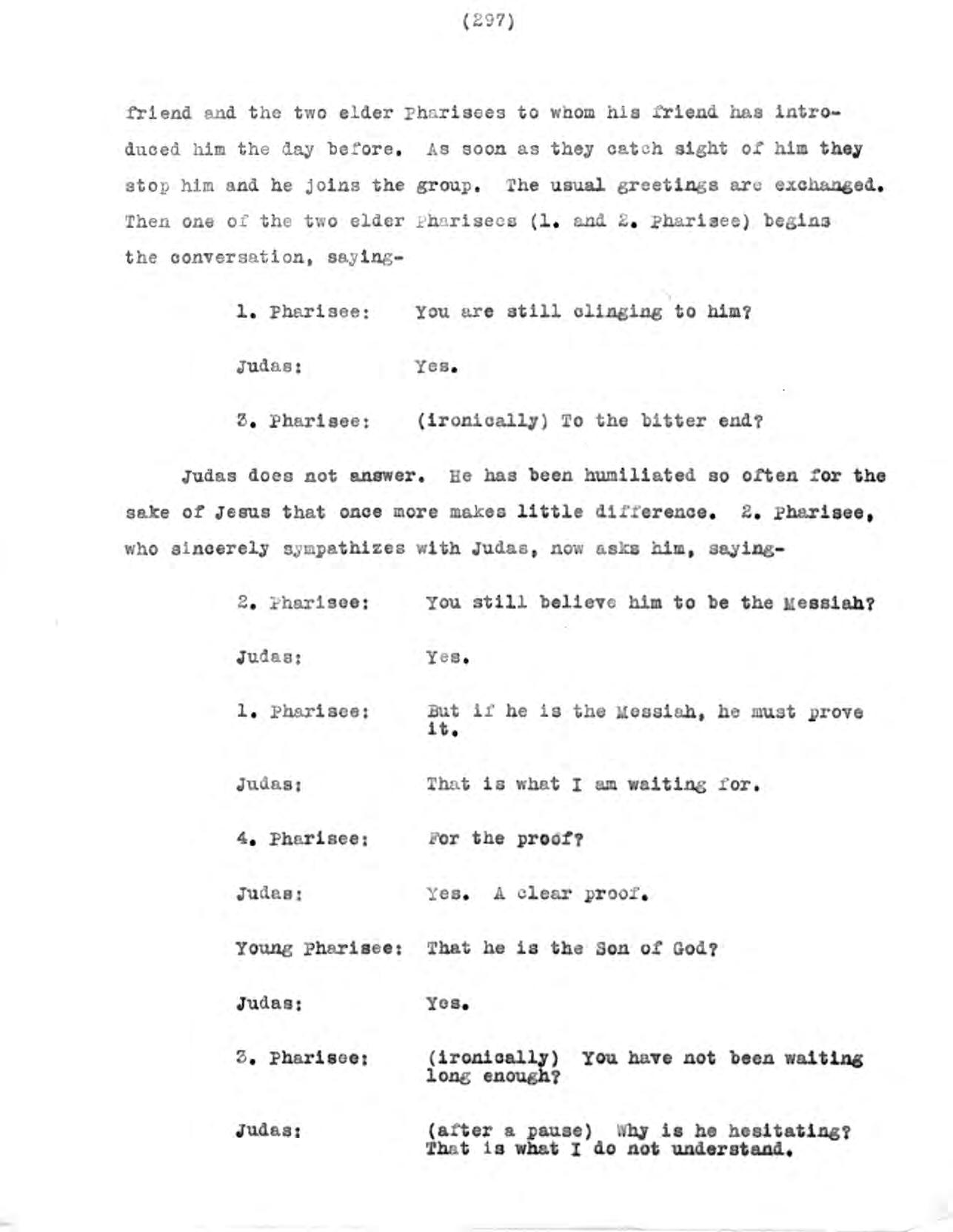
friend and the two elder Pharisees to whom his friend has introduced him the day "before. As soon as they catch sight of him they stop him and he joins the group, The usual greetings arc exchanged*
7) frin d the t ld r h a 1 s t iuoed hi t e b or • oon Cl to p him n h joins th • Then on o f th
Then one of the two elder ^h: rlsees (1* and £» Pharisee) begins the conversation, saying-
h con r a t1on. 1 .
le Pharisee: you are still clinging to him?
Ju : •
Judas: Yes«
Z. Pharisee: (ironically) To the bitter end?
Judas does not answer. He has been humiliated so often for the sake of Jesus that once more makes little difference, %% Pharisee, who sincerely sympathizes with Judas, now asks him, saying-
2, Pharisee: you 3till believe him to be the Messiah?
Judast Yes*
1. Pharisee: But if he is the Messiah, he must prove it,
Judast That is what I am waiting for, 4# Pharisee: ^or the proof?
Judas: 3, A clear prow. c
Young Pharisee: That he is the Son of God?
Judas: Yes«
It Pharisee: (Ironically) You have not been waiting lone enough?
Judas: (after a pause) Why is he hesitating? That is what I do not understand.
1. Pharisee: We ask the same question.
2« Pharisee: Vie too desire him to show us a sign from Heaven«
4. phariseet But he always re-fuses»
B. Pharisee: (ironcially) I wonder if it is because he lacks the power?
Judasi Oh - no. Think of all hio mighty works.
1. Pharisee: (fatherly) You believe, and you believe not.
2, Pharisee: ffor will we believe, except we see signs«
S. Pharisee: (sarcastically) But we will 3ee no signs«
4, Pharisee: 'or he is no prophet and no üesaiah«
Judas, who all the time has been watching Tor Jesus, suddenly criesJudas: There he is, look hov/ the crowd is rushing on«
1« Pharisee: Let us go al30«
They rise« Judas hurries away in advance or the others« ipe to the next scene«
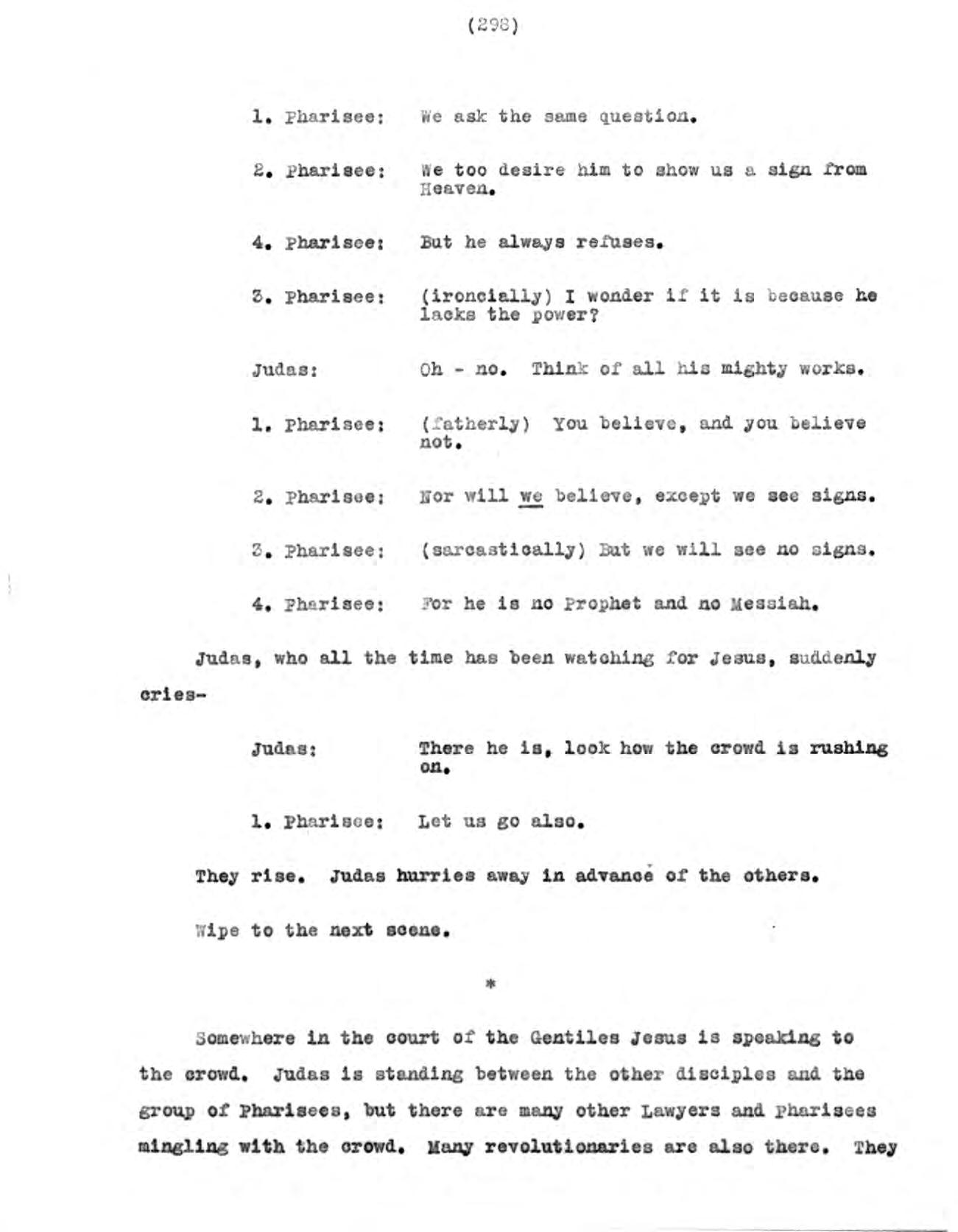
jomewhere in the court of the Gentiles Jesu3 is »peaking to the crowd« Judas is standing between the other disciples and the group of Pharisees, but there are many other Lawyers and Pharisees mingling with the crowd« Many revolutionaries are also there, ihey 1 . p 1
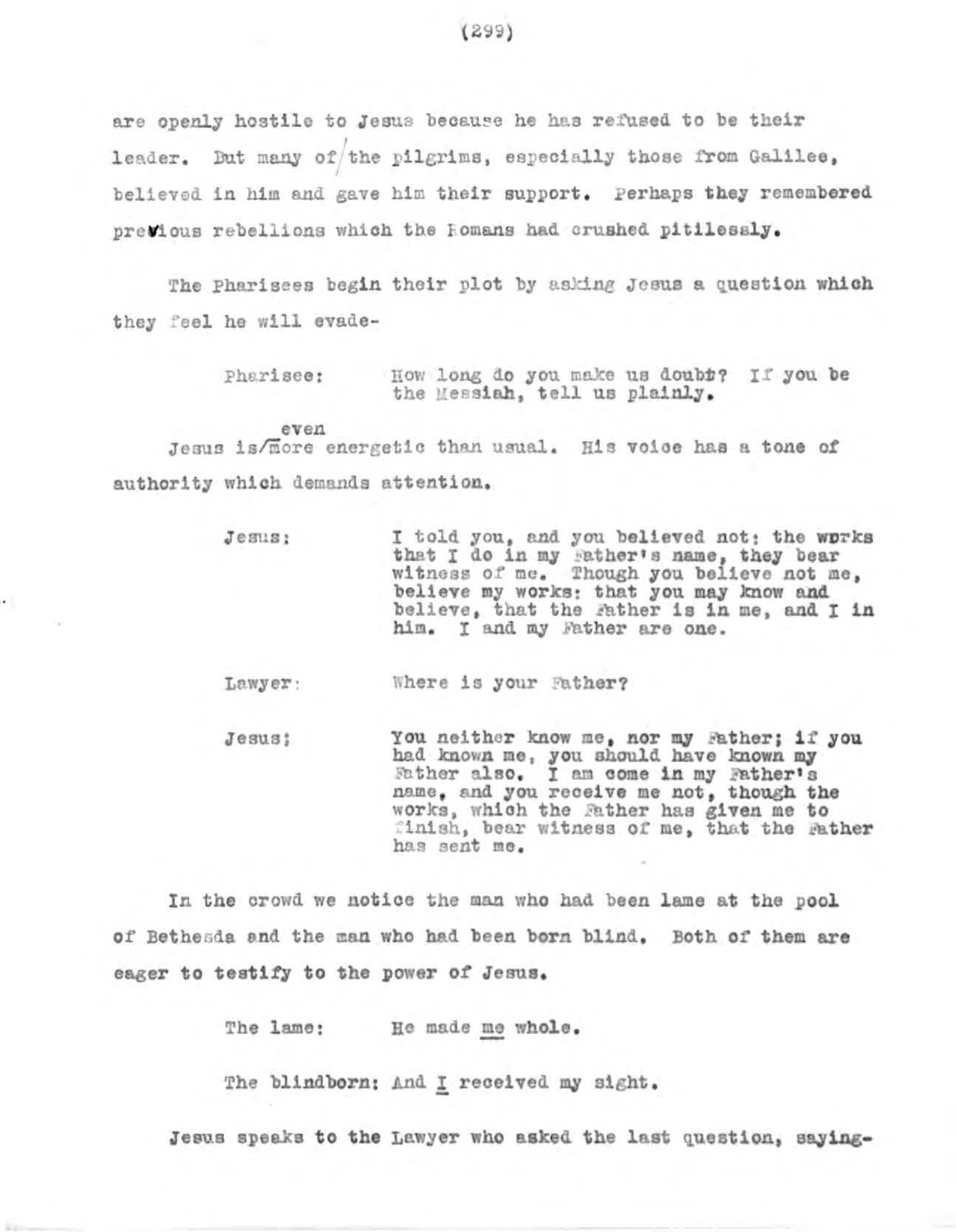
are openly hostile to Jesus because he has refused to be their f leader« But many of/the pilgrims, especially those Iron Galilee, believed in him and gave him their support. perhaps they remembered previous rebellions which the I omans had crushed pitilessly»
The Pharisees begin their plot by asking Jesus a question which they feel he will evade-
Pharisee: How long do you make us doubt? if you be the uessiah, tell us plainly» even Je3us is/more energetic than usual« His voice has a tone of authority which demands attention»
Jesu«j I told you, and you believed not: the wprks that I do in my ?atherf s name, they bear witness of me» Though you believe not me, believerayworics: that you may know and believe, that the anther is in me, and I in him, I and my >nther are one.
Lawyer: Where is your rather?
Jesus; You neither know me, nor my *ather; if you had known me, you should have known my i;her also. I an come in my rather»3 name, and you receive me not, though the works, which the father has given me to inish, bear witness of me, that the rather has sent me.
In the crowd we notice the man who had been lame at the pool of Bethejida end the man who had been born blind. Both of them are •ager to testify to the power of Jesus»
The lame: He made niewhole.
The blindborn: And 1^received my sight.
Jesus speaks to the Lawyer who asked the last question, saying«-
Jesus: You believe me not, because you are from beneath; I am from above; you are of this world; I am not of this world.
Pharisee:
Jesus:
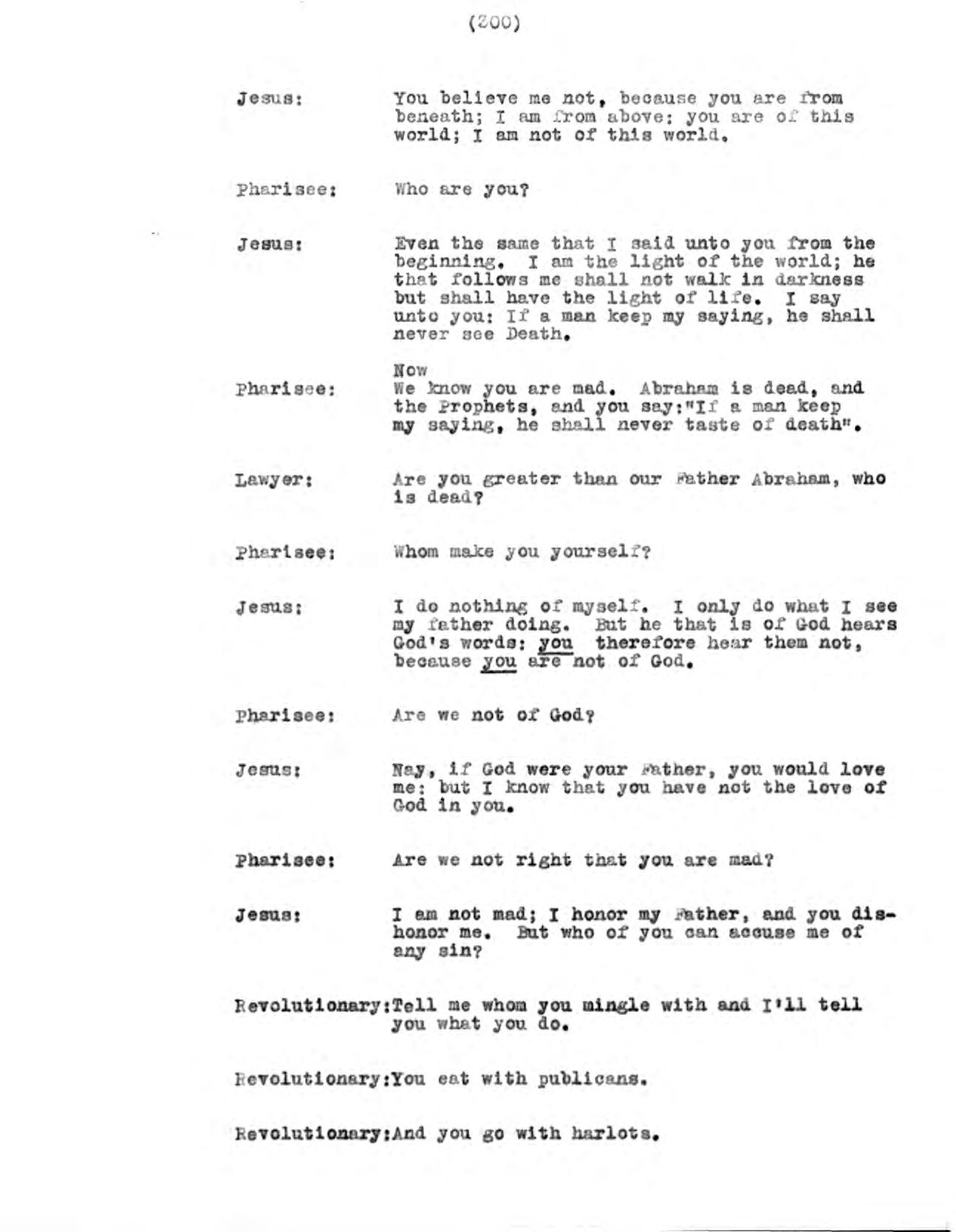
Pharisee:
Lawyer: Who are you?
Even the same that I 3aid unto you from the beginning, I am the light of the world; he that follows me shall not waJUc in darkness but shall have the light of life, I say unto you: If a man keep my saying, he shall never 3ee Death,
Hfow
We know you are mad, Abraham is dead, and the Prophets, snd you say:«If a man keep my 3aying, he 3hall never taste of death".
Are you greater than our father Abraham, who is dead?
Pharisee: „horn make you yourse.
Jesus: I do nothing of mysell, i only do what I see my father doing. But he that is of God hears God's words: you therefore hear them not, because you are not of God,
Pharisee: Are we not of God?
Jesus;
Nay, if God were your er, you would love me: but I know that you have not the love of God in you.
Pharisee: Are we not right that you are mad?
Jesus: I am not mad; I honor my rather, and you dis« honor me. But who of you can accuse me of any sin?
Eevolutionary:Tell me whom you mingle with and 1*11 tell you whet you do.
revolutionary:You eat with publicans.
Revolutionary:And you go with harlots.
Some of the Pharisees make signs to the revolutionaries to keep silent. And one of the Pharisees makes himself the spokesman or them all» asking-
Pharisee: What sign showest***•**-unto us?
Jesus: Destroy this Temple, and in three days I will raise it up.
The Pharisees hurst out laughing, and one of them answersPharisee: orty and six years was this Temple in the building, and will you build it up in three days?
They shake their heads in unbelie .
But many of the people believed in him, manifesting their belief in shouting-
pilgrim: :ienMessiah comes, will he do more miracles than these which this man has donev
pilgrim: He raised Lazarus from the dead.
There is a division among the people concerning him and they all begin speaking at once.
Voices: Of a truth this is a prophet.
Voices: Ho, he is the Messiah.
Voices: lay» shall the Messiah come out of Galilee?
Voices: We know this man whence he is: but when the Messiah comes, no man knows whence he is.
When the phari *-.es pjnd the Lawyers notice the excitement or the crowd, some of them are earful of trouble and appeal to the Captain of the Temple guard to interfere. We follow theau Pharisees and listen to their argument with the Captain.
Pharisee: Why don't you seize this man?
Lawyer? Don't you see how he is stirring up the people?
Captain: That would mean righting and killing»
pointing to himself and the remple police who erowa.around hia he continuer:~
Captain: JLfiA we are they who would be killed»
Pharisee: We'll hold you responsible Tor that»
Captain: And I'll answer to it.
We follow these Pharisees and Lawyers baok to the crowd surrounding Jesus« The discussion goes on more vehemently than ever» Jesus is just about to tell a parable-
Jesus; I am the good shepherd: the good shepherd /es his life -.'orthe sheep» Therefore does my cather love me» because I lay down my life for the sheep»
Voice: (scornful) Kow lon^ shall we yet suffer you?
Jesus does not listen to the shouting but continues his remarks-
jesus: Yet a little while I am with you, and then I go unto him that sent me» You shall seek me and shall not rind me: and where I: thither you cannot come. n th h r l st e d th L s no 1 e t c1 e to'
The Pharisees put their heads together and tallc among themselves-
The Ph, 1 c e put t air h ,ads to t er s 1 esa ri ea . ill eo. tl
pharisee; Whither will he go, that we shall not rind him?
Phsrisee: Will he kill himself?
As before, Jesus does not listen« He la absorbed in what he is saying-
Jesua: Yes, therefore does my ather love me, because I lay down my lire. Mo man takes it from me, but I lay it down of myself•
Jesus has spoken with great solemnity« Now he changes his tone Ars and his thought as he address/the Pharisees, saying-
Jesus: I speak that v.hieh my rather said unto me, and you should do the same»
Lawyen Our lather is Abraham»
Jesus: If you were Abraham1 s children, you would do the wcrks of Abraham* But I say unto you that Abraham, whom you call your rather, re« t1oiced to see my day; and he saw it and was glad.
Pharisee: You are not fifty yara old, and you have seen Abraham?
Jesus: I say unto .you, before Abraham was born, I am»
Again there is a division among the people on aooount of these sayings»
Revolutionary: .hy, hear you him?
Revolutionary: He is mad«
But
But some of the pilgrims defended him, saying-
Pilgrim: These are not the words or a madman.
P11gr : Th e a.r not th or o
In h om r volutlonarl h v pro h P o ton 1nt n.dd or r o the p1 bui ld! •
In the meantime some revolutionaries have approached a heap of stones intended for repairs of the Temple building.
Other revolutionaries are shouting-
}evolutionary: Yes, stone him.
Revolutionary: He is profaning the Temple.
Revolutionary: He Is blaspheming CrOd.
Jesus is perfectly calm. Unafraid, he turns to those who would stone him»
Jesus: You seek to kill me, because my word has no place in you. Ånd because I have told you the truth.
The revolutionaries who have gone for the stones now return with them lifted in their hands up over their heads.
But there is no fear in the face of Jesus when he is speaking to them-
Jesus: Many good works have I shown you from my rather, for which of those works do you stone me?
There is a fight between the revolutionaries and the pilgrims who would prevent them from throwing the stones* During the fight some of the revolutionaries shout-
Revolutionary: jtor a good work we stone you not, but for blasphemy.
oth r r olution 1 hout !y • ton hi•• olu 10 ry: H 1 pro f a.n1 h p1 • e olution r : 1 bl d . J 1 p r tly 0 lm. 1 • h tur to tho s ho oul to hi to ho 0 J : h r Tol t10n 1 11 in t hr 1 0 th mJ : Th r 1 ht oul pr v nt th ot th r 01utl0 vo utl0 to 11 • b ea.u 1.11 OU. beau I told truth ho v on or th tone no t n d up ov r • 1n th 0 0 J u hnh 1 or or Moh 0 ou ? n th volutl0 1 d th p11 rl thro 1 th ton. • 1 th ' 1 h rl hout: r g ood ork b l 8 h r41. ton you not. but or , volutl0 1: b 0 U t t IOu . b 1 t lOur 1 Go .
Revolutionary: And because that you, being a man, make yourself God.
J rie hi m 1 oh! 1 h 19 ht d it po uthorit 1n hi volo h 1J : 0
Jesus raises himself to his full height and with power and authority In his voice he says-
jesus: Verily, I say unto you: all these things shall come unto this generation, 0, Jerusalem, Jerusalem, you that kills the prophets, and stones them which are sent unto you« Behold your house left unto you desolate, and verily I say unto you: you shall not see me henceforth, till you shall say: Blessed is he that comes in the name of the Lord.
Once more some of the Pharisees and Lawyers approach the officers of the Temple-guard, saying-
Pharisee: Why do you not put an end to this?
Lawyer: Do you not hear how he is threatening us?
One of the Officers cannot hide his true feelings and he says-
1.Officer: Never spoke man like this man*
Pharisee: (with a stern look) Are you also mislead?
Lawyer: You*11 be called to account for that«
Pharisee: Do we believe on him?
2. Officer: No, not you but the people.
Lawyer: The people, ah* The people who know not the Law are acursed«
By means of intercalated scenes we have already notioed that roman soldlers and officers quartered in the nearby Eoman fortress Antonia watchfully observe what is going on in the Court of the Gentiles. The Captain is filled with indignation* And as it does not appear that the Temple-guard will do anything to end the disorders, the Eoman Captain sends some soldiers to disperse the mob*
In a down angle shot the place where Jesus is speaJcing to the multitude is seen. We hear Jesus finishing his tallc-
h
Jesus: You believe not, beoause you are not or my sheep« My sheep hear my voice, and I know them, and they follow me. And I give unto them eternal life.
After this Jesus and his disciples leave the place*
But the crowd remains, discussing, debating, and disputing what has been said«
r thl le u and 1 alpl 1 e. t th ore has b n id. Sud 1t 1 r m in. 1 an 1 »d or th h 0 t1 1 hi t old1 r to I »1 0 • d 1 put1 hat o d1 th t ira 8 1 dl do n ton1 to th Court 0 th G ntl1 d in 11 tl or no tl th 1 p r .. n h om rrl th y ind
3 r
Suddenly it is rumored that the Roman soldiers are descending the staircases leading down from Antonia to the Court of the GentileJ and in little or no time the crowd has dispersed* When the Romans arrive they find the place completely deserted, and they return to their quarters.
to th lr qu t r • Th do n- 1 rt d 1 a lth 1t P v nt 0 qu r ton i olv tOll •
The down-angle shot of the deserted place with its pavement of softly square stones dissolves/Into the next scene«
During the seene-shifting the following is heard-
Dur1 th n - hi tl th 1 h dC 1 Th plo 0 C 1 ph • h "t blln rium" . h r1v:J oouno1l • 11 t n 0 th -
Commentary: The riotous incidents in the Court of the Gentiles were soon known about in the palace of the High-priest, who fearing reprisals on the part of the Roman Governor pilate, summoned his privy council to meet at once.
The palace of Caiaphas. The "tablinarium". The privy council. We listen to the following1* Chief-priest: If we let him alone pilate will taJce away the few privileges we have left.
2 . Chi f prie t: I ond r h ther h 1 ar 0 h t ben h pp n1 .. •
2« Chiefpriest: I wonder whether he is aware of what has been happening«
Clap You 0 be o rtal,D. 1 •
Caiaphas: You can be certain he Is*
2 Ch! fpri t: L t t .Qot
2. Chiefpriest: Let us go and tell pilate what we Jcaow and we shall at least be clear ourselves and not have his wrath upon us*
Nioodemus: Shall we maJce ourselves his spies?
100d u : Sh 1 1 1 ? h rl • h 1 h • 1 o n
Pharisee: Even though we do not always agree with Jesus, he is after all one or our own people«
10 h ot . : good J •
Joseph of A«: And a good Jew«
Gamaliel: Of course we will stand up for him«
Caiaphas: As far as possible.
A servant enters» handing a wax-tablet to Caiaphas« sayfing-
G 11 1: ot oour 111 t u or hi • o i ha.: r 011 • rv t nt r t h dl bl toe 1 p •rva.nt t h Go rnor.
Servant: A message from the Governor.
Caiaphas unties the tablet and reads it« Then he says-
C untl th tabl t d r d 1 • hnh : t d ono • 1 ht b n et •
Caiaphas: I am wanted at once, as might have been expected«
R point t 1. Ch1 r1 t, 100 , 10 ph of 1 th • 1 -
He points at 1« Chiefpriest. Nioodemus, and Joseph of Arimathea, sayIng-
Calaphas: You» you, and you go with me«
And turning to the others he continues-
C 1 pha. : you, Ut d 30U 0 1th • d t nln to th h oo.ntlnuC • you t un 11 0 b 0 • in a to t 1 port t otlon.
Caiaphas: You had better •sta y until we oome baoic in case we have to take any Important action«
Then he leaves the room followed by 1« Chiefpriest, Nioodemus, and Joseph of Arimathea«
hllh 1 t roo 0110 1. Chi t rl • 100 • d 30 h of rl h
Wipe to the next scene«
1p to th xt en .
pil t h1 r no in t p 0 B 0 •
Pilate has his re sidenoe in the palace or Herodes.
Calaphas enters what is used as a reception room» pilate is talking with his chancellor and some secretaries who have just laid some rolls of Papyrus on a table.
The furniture is of Koman origin» Oil lamps made out of silver and bronze are lighted and oharooal is burning in the warming pans.
The conversation which takes place between pilate, Calaphas. and his three counsellors is held in the Greek language.
To Pilate the case of Jesus is only a matter of routine, one among hundreds of other similar oases and it is soon a forgotten episode.
pilate. who has a slip of papyrus he has just received from one of the secretaries, invites the High-priest and the three counsellors to sit down. He remains standing himself, facing them while speaking«
Pilate: It is because of this...
He studies the slip of Papyrus in his hand and oontinues-
Pilate: ••.Jesus of Nazareth I have summoned you*You think probably that I know nothing of what is going on in this City but believe me I do. The men in my service are neither blind nor deaf. This...
He must again consult the slip of paper, before continuing-
P11 te: It 1 b 0 u e of thi ••• tu i th 11p ot pyru ill hi oo.ntl.nuPil t I ••• .u onsult h 11 0 or oont! Pl1 t I
Pilate: ..,Jesus of Nazareth has for months been carefully watched. Nothing is hid from me and I am fully informed.••(emphasizing) This man must be put away before the feast;
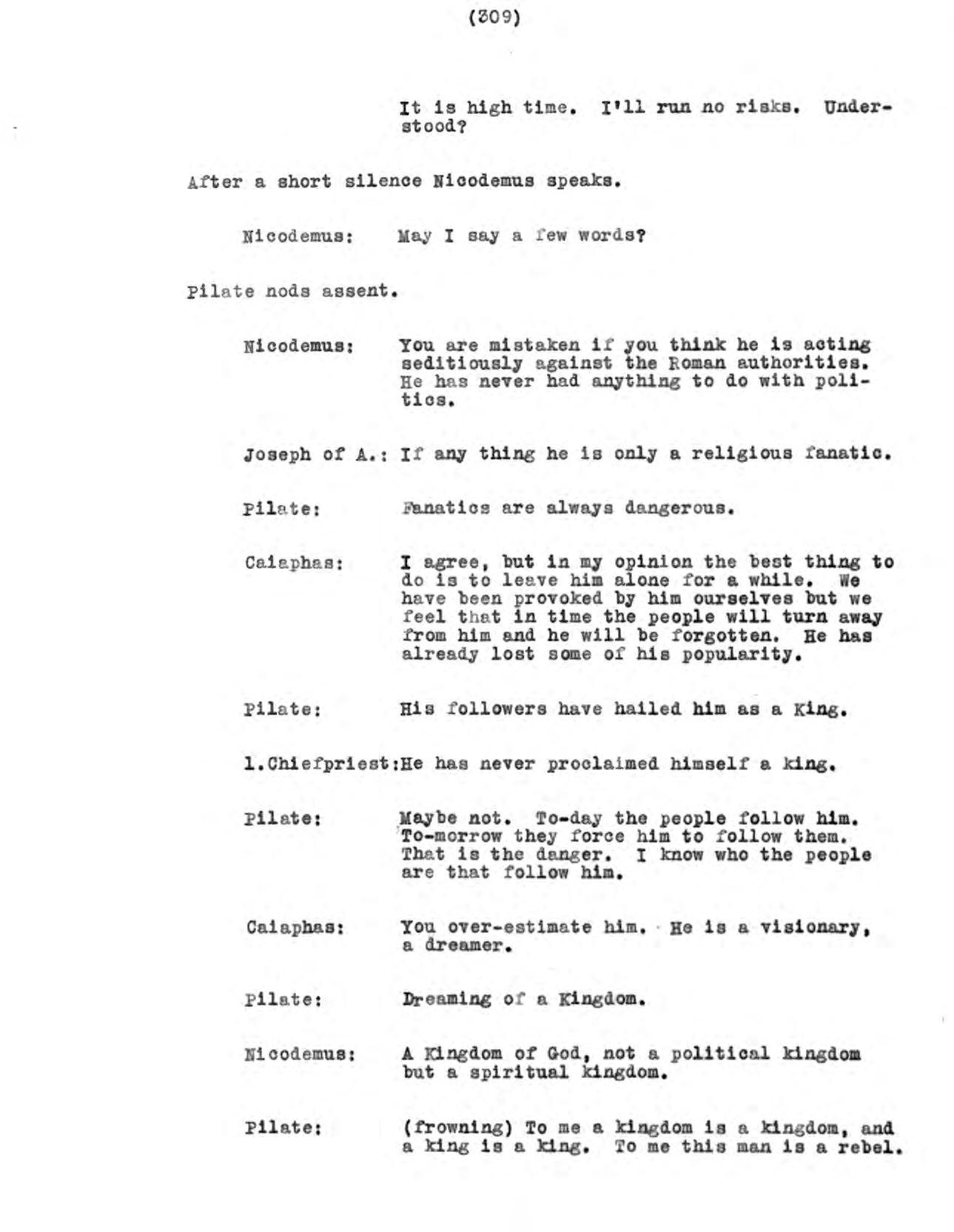
(309) It is high time. I'll run no risks. Understood?
I t 1 high t1 e . I'll run no rl k . Un rtood
After a hort s11enc loodemu p
After a short silenoe Nioodemus speaks,
Nlcodemu y sa.y e
Nicodemus: May I say a few words?
Pilate nods assent.
pil te nod as ent .
loode u :
Nioodemus: You are mistaken if you think he is acting seditiously against the Roman authorities. He has never had anything to do with politics.
10 ph ot .: I t th1 h
Joseph of A.: If any thing he is only a religious fanatic.
pil t . tic r 1
Pilate: fanatics are always dangerous.
Ca! ph I do 1 h v f e1 fro a.lr
Caiaphas: I agree, but in my opinion the best thing to do is to leave him alone for a while. We have "been provoked by him ourselves but we feel that in time the people will turn away from him and he will be forgotten. He has already lost some of his popularity.
Pilate: His followers have hailed him as a King.
Pi l t Hi 0110 r • 1
1.Chi efprl tzB ha n r proolai hi 1 •
1.Chiefpriest:He has never proclaimed himself a king.
pil :
Pilate: Maybe not. To-day the people follow him. To-morrow they force him to follow them. That is the danger. I know who the people are that follow him.
Ca! p 11 t :
Caiaphas: You over-estimate him. He is a visionary» a dreamer.
Pilate: Dreaming of a Kingdom.
loodemu :
Nicodemus: A Kingdom of God, not a political kingdom but a spiritual kingdom.
Pil t : b not o- d ' To- orro th y T t 1 - th d _ ar th t t 110 tl t r . o do ot Go plrltu 1
Pilate: (frowning) To me a kingdom is a kingdom, and a king is a king. To me this man is a rebel.
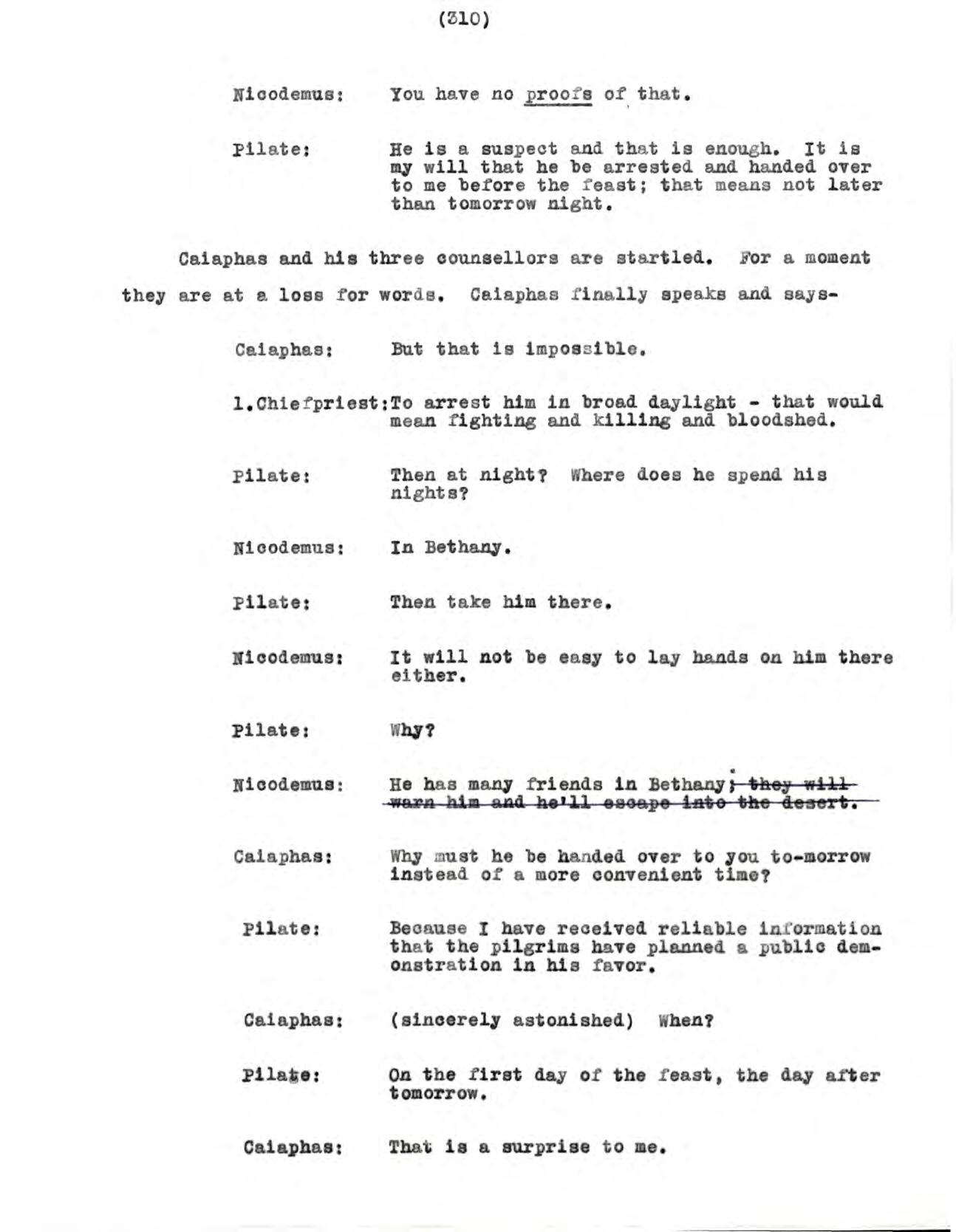
Nicodemus: You have no proofs of that«
Pilate: He is a suspect and that is enough* It is my will that he he arrested and handed over to me before the feast; that means not later than tomorrow night.
Caiaphas and his three counsellors are startled, j?or a moment they are at a loss for words. Caiaphas finally speaks and says-
Caiaphas: But that is impossible.
1,Chiefpriest:To arrest him in broad daylight - that would mean fighting and killing and bloodshed.
Pilate: Then at night? Where does he spend his nights?
Nicodemus: In Bethany.
Pilate: Then take him there.
Nicodemus: It will not be easy to lay hands on him there either.
Pilate: Why?
Nicodemus: He has many friends in Bethany; thoy will warn him and he'll escape into the deaert.
Caiaphas: Why iaust he be handed over to you to-morrow instead of a more convenient time?
Pilate: Because I have received reliable information that the pilgrims have planned a public demonstration in his favor. Caiaphas: (sincerely astonished) when?
Pilate: On the first day of the feast, the day after tomorrow.
Caiaphas: That is a surprise to me.
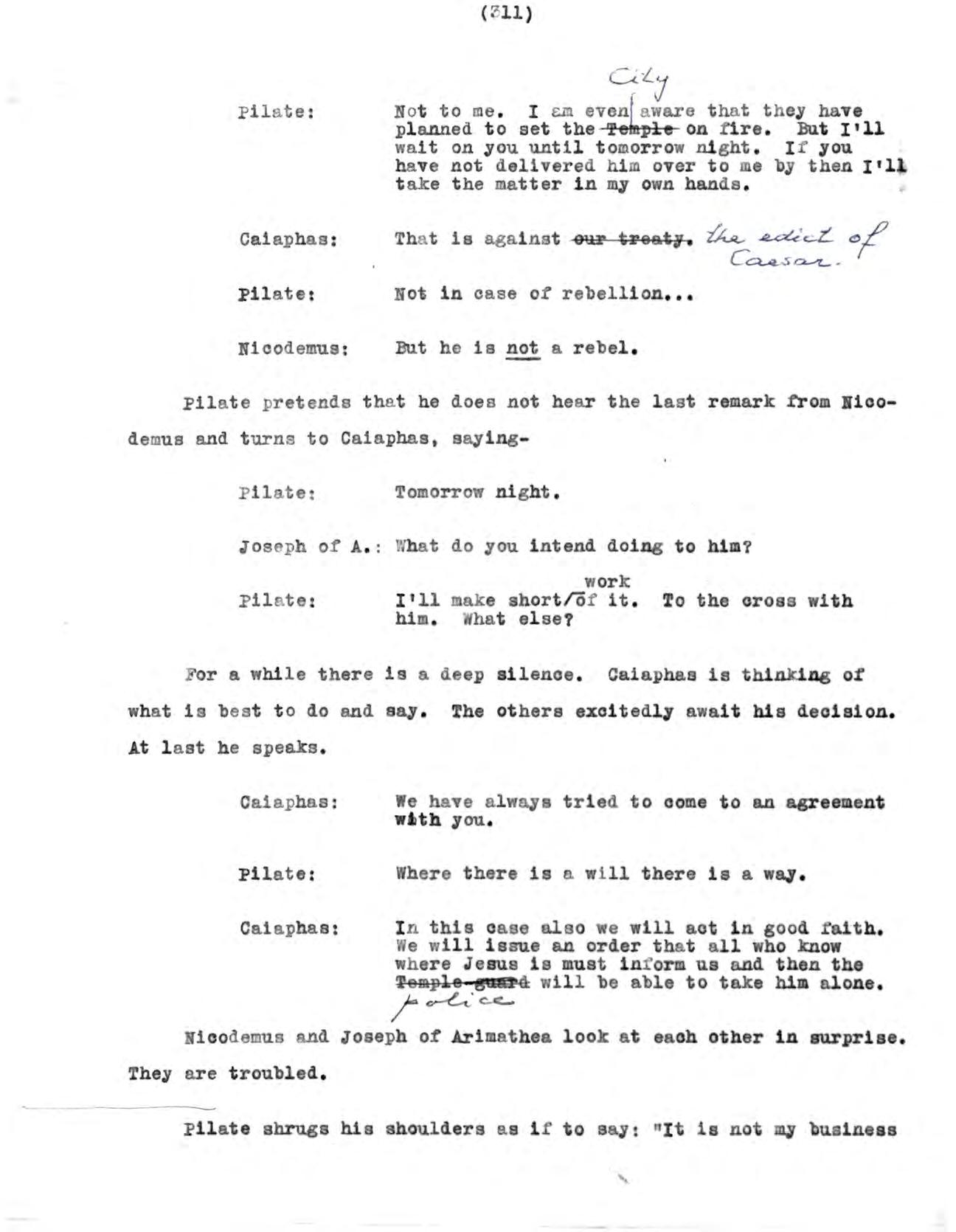
Pilate:
pl1 a te: e . I
Not to me. I am even aware that they have planned to set the Temple on Tire« But I'll wait on you until tomorrow night. \ t you have not delivered him over to me by then I'll take the matter in my own hands.
C 1 p h s: Th t 1 ag i n t
Cai ap ha s:
That i s against our treaty, &JL. AX^X^L <*>JZ
Pilate:
Not in case of rebellion...
P11 at o in ca e t r b 111on •••
Nicodemus: But he is not a rebel«
Pil t de mus d r h t 1 b t l a t h
Pilate: Tomorrow night.
Joseph of A«: What do you intend doing to him? work
!flood u.: t h 1 not r b 1 .pr t nd tha t h do not h r th 1 turn to C 1 11 0 1> of . .. Pil t hi th r t t o 0 pe •
Pilate pretends that he does not hear the last remark from Nicodemus and turns to Caiaphas, saying-
Pilate: 1*11 make short/of it. To the cross with him. What else?
For a while there is a deep silence. Caiaphas is thinking of what is best to do and say. The others excitedly await his decision. At last he speaks.
Caiaphas: We have always tried to come to an agreement with you«
Ca.l p h pha • 11 1 o orr n1 ht. t do you I nt It ll or hi l a 11 • h ot h r 1 th you . nd doi to or /O f t . o t ? • C 1 xo l t trl t 00 r pil t h r r 1 1 th r 1
Pilate: Where there is a will there is a way.
Caiaphas: In this case also we will act in good faith. We will issue an order that all who know where Jesus is must ini'orm us and then the Temple gwffd will be able to take him alone. /
C 1 P 8. : u o P of 1 o ar 1 ? or it
Nicodemus and Joseph of Arimathea look at eaoh other in surprise. They are troubled.
Pilate shrugs his shoulders as if to say: 'It is not my business
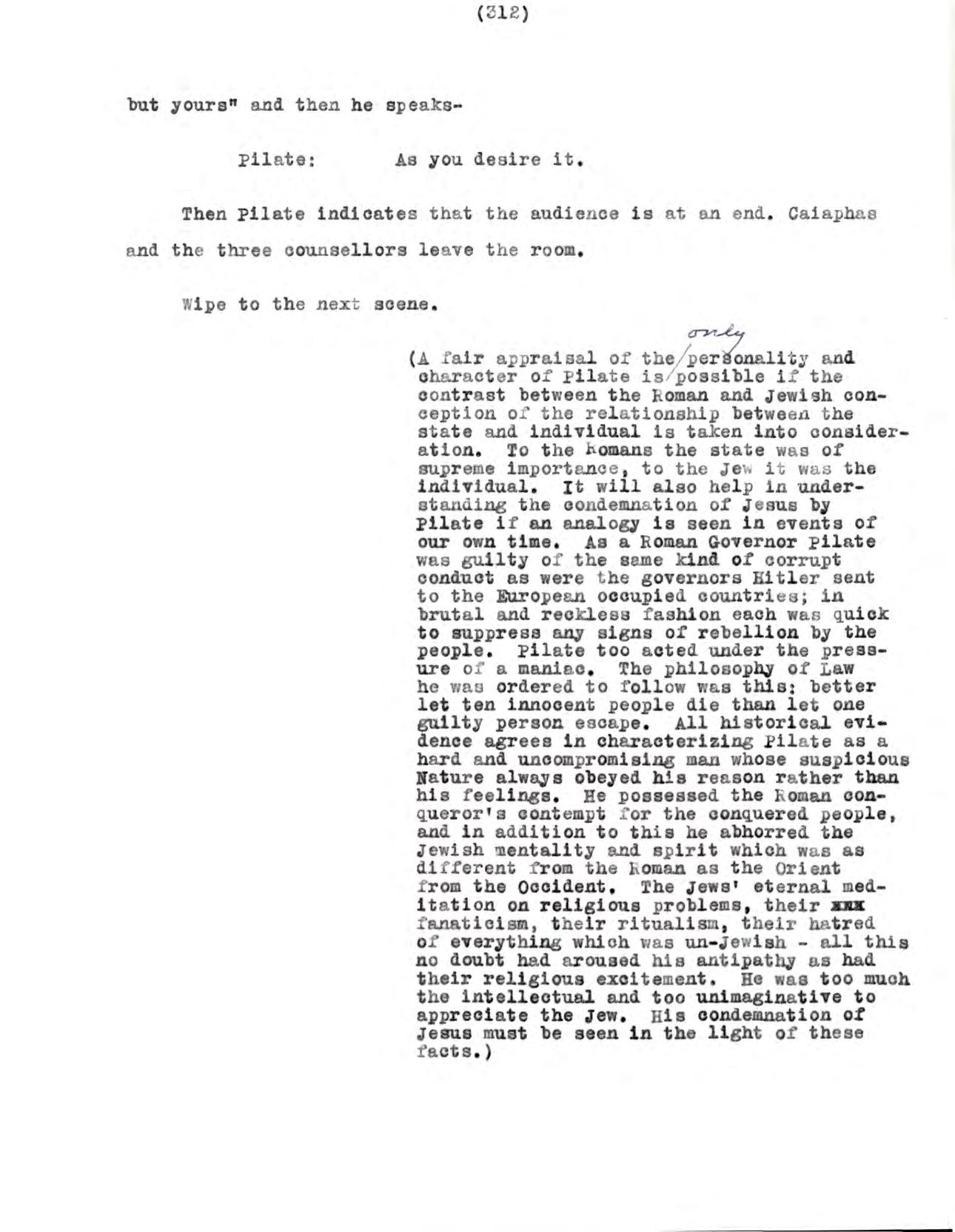
but yours" and then he speaks-
but your n and th n h s pea ... p 1 t you de 1r it
Pilate: As you desire it.
Th n pi1 t Indicat that th au 1 ne 1 at an end . Ca1ap s and th e llor 1 v the roo •
Then Pilate indicates that the audience is at an end. Caiaphas and the three counsellors leave the room.
1pe to the ne t en •
Wipe to the next scene.
(A -fair appraisal of the/personality and character or pilate is'possible if the contrast between the Koman and Jewish conception or the relationship between the state and individual is taken into consideration. To the Romans the state was or supreme importance, to the Jew it was the individual. It will also help in understanding the condemnation of Jesus by Pilate if an analogy is seen in events of our own time. As a Koman Governor pilate was guilty of the same kind of corrupt conduct as were the governors Hitler sent to the European occupied countries; in brutal and reckless fashion each was quick to suppress any signs of rebellion by the people, pilate too acted under the pressure of a maniac. The philosophy of Law he was ordered to follow was this: better let ten innocent people die than let one guilty person escape. All historical evidence agrees in characterizing pilate as a hard and uncompromising man whose suspicious Nature always obeyed his reason rather than his feelings. He possessed the Koman conqueror's contempt for the conquered people, and in addition to this he abhorred the Jewish mentality and spirit which was as different from the Koman as the Orient ^rom the Occident, The Jews1 eternal meditation on religious problems, their JPUI fanaticism, their ritualism, their hatred everything which was un-Jewish - all this no doubt had aroused his antipathy as had their religious excitement. He was too much the intellectual and too unimaginative to appreciate the Jew. His condemnation of Jesus must be seen in the light of these facts.)
Th e hou e ot C • He and hi thr r turn ro th m e
P
at 1
n 1 l.or t
The house of Ca laphas. He and his three companions return Trom the meeting with Pilate* All those who have been waiting for them oan scarcely restrainA ouriosity and excitement.
lty a can re tr ln l\our 0
er they roo ir t et or th High-pri s t to c 1 lv e n order 1 pha • th t 1 it r1t 1 mad! t l Ye n t
After they have entered the room the first act is for the High-priest to call a oorlborgnT give him an order.
Caiaphas: Write a commandment that all who know where Jesus is shall reveal it so that the police may take him.
The «oribe-starts writing immediately. In the meantime the Counsellors discuss the situation.
Coua e llors discus th it tlon p ( rr lf'l ) But thi Ca1 p s : r - 1 s tr o bl v
Pharisee: (terrified) But this means the cross.
Caiaphas; (sneering) You understand nothing. Can't you see, that the commandment is a warning to Jesus. The wisest thing he can do is to take the hint and flee, oross the border. The n he will be safe and we and the Romans will be rid of him.
Lawyer: The less trouble we have with him the better.
Gamaliel: And if Jesus doesn't take to flight.
Caiaphas: It will be his own fault. We have a clear conscience.
Th ;$ "a- "t.O ;;;] , ha f l 1
The ooribe- has finished writing the commandment and places it before Caiaphas. With his signet ring, or a special signet, Caiaphas puts the seal underneath - at the same time setting the seal upon the fate of Jesus.
The scene ends with a close up of the seal and it dissolves softly into the next scene.
t b or C 1 • Ith 1 t r1 , or phae put th 1 undern t h tl upon th :tat ot 1 s . Th o n nd Ith 01 0 t 1 o tly into th e ne t o n • Duri 0 i tl t f ol lo 1 i 1 ho 0 0 h t t t o 0
During the scene shifting the following is heard-
( 31 ) 8. t h as i U J and in i ends I n B t h
Commentary: That very day the High~priestT3 commandment was issued, and in order not to expose his friends in Bethany to any danger Jesus spent the night in an olive grove onthe Mount of Olives, His disciples were with him and the name of the place was Gethsemane.
On t h e lo pe
th e n1 ht I n an 01 Oli ves . 1 dl 01 name or t h pl a e ount of 1 v is t
here Jesu n d hi dl cl p1 on o ooa ion a ld
I t as oall e rd n o f I
I n whioh t h r gat •
On the slope of the Mount of Olives is the grove of olives where Jesus and his disciples on occasion would spend the night« It was called the Garden of Gethsemane« It was surrounded by a wall in which there was a gate«
Ju t t h gat wa s q: ar hit hu d P opl or d in t rav
J and hl 1 alpl t tool d t 11 th av 1 ft: t t h dr 1 ' or th t r - p l , m 11 ss l a , and b k t e . J sua 1 ol pl e t th
Jesus and his disciples enter the garden and we follow them. Their spirits are somewhat depressed because of the turn of events« Jesus seems lost in his own thoughts and to have about him an air of sadness« He realizes that his hour is approaching«
Th i r i r t m t r s th su 10 t in hl o II thoughts 0 dn • r l 1 z t h t ho 1 The y 1 1 i n 11 c , 1J O 11 o n. t o 1 t , J p tb h Y 110 1 1 r1 h t 0 th gr e t 11 . r h 0 et .
Id 0 the a l l y , l n i t r t o th P t 1 e n on t 1 d 0 t h e 1 • t op • Y h r 1 t 1
1 v 0 th ol1v tr e 0
They all walk in silence, looking for a place where they can lie down« Ne:.t to Jesus walJof peter, Jacob, Andrew, and John« The path they are following is right over against the Temple which crowns the great walls of the Holy City« The mountain fortress on the other side of the valley in its power and strength, is a strange contrast to the pastoral scene on this side of the valley« Suddenly John stops walking. They have arrived at a glade among the trees« The leaves of the olive trees place a frame of lace around alovely view of the Holy City. At the sight of all the^e walls and building of Co nt r y :
Just inside the gate was a square white house occupied by the gvt trrnor 4 During the day people worked in the grove and as we follow Jesu« and his disciples walking through the garden we notice the tools and utensils the workers have left: the oil-mill, the oil-press, the wheel for drawing water for the water-pipes, mortars, large and small vessels, and baskets«
0 t h 01 C1t • th th 1 ent e his er Jesus sp ut nth ount of' th hi and the • o of 01 1 e d by a 11 o eu l ed by t d e. 01 1 0 n o c the 1 , t 011- r 8 • r r 011 0 tur :f nt • out hi an a lr 0 • th :I C John h io h 0 II r tr oontr t 0 t e tr Th ound y 1 1 1 0
massive stone and bearing in mind those stern words or Jesus concerning the priesthood and the Temple: "Behold, your house is left unto you desolate", John turns to Jesus,saying-
massive ston." an bear DB in mind tho e s ter n oern! th r i thoo d and the e »1 . eh 1 • unto you de olate" ohn turns o Jesu , s
John:
J ohn
Master, see what manner of stones and what buildings are here.
Jesus looks at the Holy City and answers solemnly-
Jesus: Behold, the days will come, in the whioh there shall not be left one stone upon another$ that shall not be thrown down,
Peter:
eau l oo le : p t r :
Jesusj
Master, when shall these things be?
When you shall see Jerusalem compassed with armies, then know that the desolation thereof is nigh«
Pe t er :
Peter: And what sign will there be when these things shall come to pass?
Jcsu ..
Jesus; The sun shall be darkened, and the moon shall not give her light, and the stars shall Tall Trom Heaven. When you 3ee these things come to pass» know you that the Kingdom of God is nigh at hand. Then you shall see the Son of man coming in the clouds of Heaven.
Jacob: But before,..
Jesus interrupts hia-
Jesus:
But before all these things happen they shall lay hands on you and persecute you, and you shall be hated of all men for my name's sake.
With an expression oZ sadness he looks about the faces surrounding him, and then he continues-
Jesus:
But if the world hates you, you know that it hated me before it hated you, and if they have persecuted me, the,/ will also persecute you. They shall deliver you up to be afflicted and shall kill you, and they who kill you
) c that t h y d o God t d re o th n t 11 In p tl ne p o ou your •
will thinJt that they do God service. But he that endures to the end, the same shall be saved. In jour patienee poseess you your soul
Some of the disciples sit down with heavy hearts but Jesus remains standing»
The scene dissolves softly into the next scene«
During the soene shifting the following is heard-
Commentary: And the next morning the High-priest's command ient was read aloud in all Synagogues. By order of Pilate Jesus «as made an outcast among hi3 own people.
We see the written commandment, written in Hebrew and with the seal of the High-priest. Two hands hold it and by means of a at the same time super-imposition we see/The document and the Synagogue-ruler who is reading it aloud.
The scene dissolves softly into the next scene.
During the soene shirting the following is heard-
Commentary: On this day which was the day of the unleavened bread Jesus sent two of his disoiples to Jerusalem to prepare the Passover for the Law bid that the paschallamb should be eaten within the walls of the Holy City, and Jesus would not flee from his destiny.
h r n 0 e an 0 ot o t dl clp1 st a. 1 • ont1 ..\Ao t 1 0'1' nt 00 to J ho u t 11 t r d John and
The garden of Gethsentane. By means of a truoicing shot we see ten of the disciples lying fa3t asleep. Continuing the gliding movement we come to Jesus who has Just called peter and John and
no in 10 volc 1 l vl t h i nstruot!
now in a low voice is giving them instructions.
. • t r: J SUB J u pr t nd s not t
Jesus: Go and prepare the Passover that we may eat.
Peter: Would you have us prepare it?
Jesus: Behold, when you are entered into the City» there shall a man meet you, hearing a pitcher of water; follow him into the house, where he enters in.
John: Whose is that house?
Jesus pretends not to hear the question and goes on, saying-
J u:
Jesus:
And you shall say unto the good man of the house: 'The Master said: my time is at hand. I will keep the Passover at your house. Where is the guest cha mber where I shall eat the Passover with my disciples?"
JohnjWho cannot conceal his astonishment, asks-
John: And he will let us keep the passover at his nous
Jesus: He shall show you a large, furnished upper room; there make ready.
The two disciples silently leave the grove« Jesus returns to the other disciples who are still sleepin, •
John , ha 0 ot on J ohn : J su · h e t 0 1 c lp l t he ot er d c lp l h 0 n 1 01 n won.
The scene dissolves softly intoa new scene, showing the foot of a Papyrus-document. In a very intimate close up we see the signet of pilate, his hand carrying the signet, and the wax-seal.
During the scene shifting the following is heard-
Commentary: On the same day pllate put his seal to an order of the day forbidding the jews from holding any meetings and assemblages except divine services in the Temple and the Synagogues, Ho crowding in the streets or the market places would be tolerated, The Roman rounds were doubled and no more than three persons were allowed to walk or talk together
The soene of the seal dissolves softly into the next scene«
John and peter enter the Holy City by the water gate which opens to a path leading down to the well of Gihon. The watercarriers from the Southern part of the City ordinarily used this gate.
John t r n r h 011 Cl Y Y th t r at 0 n 0 th 1 dlng do n t th 1 f 1hon. a eo rr 1 r t h Sout h rn t 0 t C r in. i y d 1 . t • It n ' p o 1 r or k to rr r 1t not cu
It was women's particular work to carry water and it was not customarily done by men. A woman carried the pitcher on her head while a man carried it u_>on his shoulder. It was therefore rather unusual to see a many carrying water and when it happened it was most likely to be p. servant or a slave of a rich man's household.
The two disciples soon caught sight of a man carrying a jar on his shoulder. V/ithout accosting him they followed him.
wipe to the next scene.
hi r i t 110 him. t ip t n t on . str e t, on 1 d e 0 h ie 1 oooup l by t l ber - y rd . h dl al'pl 011 r car r ! r 1 t • I p 0 th n xt 0 n •
A street, one side of which is occupied by a timber-yard. The disciples follow the water carrier from a distance.
Wipe to the next scene. % 1 th
Another street 1 s quent d. fh d1 cip 1 still f ollow1 the t r-c ri r fro a 1
Another street less .frequented. The disciples axe again seen still following the water-carrier from a distance.
On aide o f the stre e t 1 a oourty rd round d by 11,
In id o f th gat to th rlght and to th 1 ft 1
us d f or storing in I n th courty rd e e 1n. I n the mlddle of th oourtyard Is larg bul1d1n ...... 0 r bl 0 tr ee •
One side of the street is a courtyard surrounded by walls, Inside of the gate to the right and to the left are small buildingr used for storing wine« In the courtyard we see casks of wine» In the middle of the courtyard is a large building shaded over by old trees.
The servant, notloi th t he 1 John 0110 d b ton. turn the m questioningly andli k 1-
The servant, noticing that he is followed by two men, turns to John them questioningly and/asks him-
John: h r Is th goo o th hou?
john: Where is the good man of the house?
Servant: Come with me.
S rvant. Co Ith •
H nt r the hou • fo110 a d b3 th i cl 1 0110 the m. I n Id • th b r of th :f 111 d th r t r 111 pr parl th Pas so'\' r h ioh t la.o t t v nl • On 0 th rv ts i prepari th Ch ro th, bl t r ond , nu ts , fig • da.t e s, 01 ont d oth r • other
shing the bitter herb • Oth r r or b th unle a ene d br e d, c azzot n • o 11 d in th L • A. rv 1 t th :!l a t 10 v B out of th 0 n . All thl 1 n 0.nl.J 1.0. pe. s 1 •
He enters the house, followed by the disciples, and we follow them. Inside, the members of the family and the servants are busily preparing the Passover which takes place that same evening. One of the servants is preparing the Charoseth, a compound of bitter almonds, nuts, figs, dates, cinnamon, and other things. Another servant is washing the bitter herbs. Others are working at the oven, baking the unleavened bread, calledTTMazzot", as called for in the Law. A servant is taking the flat loaves out of the oven. All this is seen only in passing.
The servant leads the two disciples to the goodman of the house, who is tapping wine for the evening. He is surprised at seeing the two disciples, peter speaks to him, saying-
Peter:
Th s rvant 1 d th t 0 1 olpl to th goo ho Is t 'pp! t 0 d1 alpl • P t r' in or th even1 • P t r p to h1 • H 1 1 sur rl o th hou t 1 -Ih r th
"The Master said; my time is at hand - I will keep the Passover at your house. Where is the guest chamber where I shall eat the Passover with my disciples?"
The face of the goodman brightens and he answers-
Th fa o ot th goodman brighten d he ana r-
Goodman: Tell the Master that he is welcome*
Goo r 11 th ast r th t h i lcome.
pp ntly th goo an 1 on f th m oret dl cl p le of J • H h probably b en rned by so eon tha t J U
d1sclpl a oul sp nd th night in ru al an ho h it 1 S d r u to do 0 h a r a· to reo iv e hi • h itu t on r -
mind us o f th und rground ov nt in th oooupied aoUA rf of Europ duri th 1 at ar Tho e ho b 10 d to th und rground n r a k d in vain or ah 1 r.
Apparently the goodman is one of the many secret disciples of Jesus. He has probably been warned by someone that Jesus and his disciples would spend the night In Jerusalem and though it was dangerous to do so he was ready to receive him. The situation reminds us of the underground movement in the occupied countries of Europe during the last war. Those who belonged to the underground never asked in vain for shelter.
The goo b ekoD the to 00 Ith him. 1 -
The goodman beckons them to come with him, saying-
Goodman: I'll show you; I have a large upper-room.
Goodm I'll ho you; I v lar upp r-roo •
The two disciples follow the goodman outside and climb an outer staircase to the "upper-room" on the roof. By using this outside staircase Jesus would come and go unseen by those of the household.
The t 0 dl olpl 0110 th goodman out id Md olimb out r
ta1ro a to th upp r-roo n on th roo • By u 1 thi out Ide t 1re e Je us ould 00 and go un n b thoe 0 th hou hold. h Y nt r th 00. It 1 " • t ble 1 p rtl t ith 1 • cup • d d1 h • 1 P fill d Ith 011. In 00 n of t roo 1 b sin or hi1 th 00 Is x1>l 1nl thi o th h so n 1 01 so 1 y into * to th ne t en. r pr ntl.ng th "d 0 or r". /Whioh 1n
They enter the room. It is "furnished" as Jesus has said. The table is partly set with vessels, cups, and dishes. The lamps are filled with oil. In a corner of the room is a basin for hand-washing* While the goodman is explaining things to them the scene dissolves softly into * to
the next scene, reprecenting the "day of order",/which we in a preceding seen have seen the hands of pilate put his seal. Now we see the document in fall size« It is written in Latin, Greek, and Hebrew,
pr c d1 cen h ve en the hand 0 11 t put. hi • 0 e the docum nt in fUll ize . I t 1 wrltt n in L tin, Gre • d H r • rl th oen hi 1 th 0110 i 1
During the scene shifting the following is heard-
Co m nt ry:
Commentary: In the early hours of the morning the order of the day was issued by pilate and, according to common practice, read aloud at all the gates of Jerusalem»
By mean of sup r - Impo Itlon
se a l and th h rald re ad! It loud . th t th is a coompanied by a drummer , ho mark v ry 1 1 roll.
By means of a super-imposition we see the oodument, with the seal and the herald reading it aloud. At the same time the herald is accompanied by a drummer, who marks every single section with a roll.
Th so n 1 01 0 1y lnto
The scene dissolves softly into the next scene, showing a street-crossing with a market-place in the background, like the market-place in"lhe 100 gates" of the present Jerusalem« We see Judas carrying a basket«
During the scene-shifting the following is heard-
Commentary: Judas also went to Jerusalem that day to buy food and provisions.
the nxt o n. sho 1 tr Ith b 0 round, 11 e th m l n t J rusal e • e l ud o rryl b t rl th so nhl f tl th :tollo 1 1 h Co ent 1: 0 nt to ru 1 pro 1 ion • Jud n r.o. • r l ht 1 le d1 ou 1 -pr1 nt . It 0 t r t r et h 0 o ho
We see Judas turn a corner. To the right is a group of several Jews disoussing the High-priest's commandment. A Roman patrol arrives. It scatters the group directing the Jews to go home separately.
Wipe to the next scene.
ip to th nxt on.
Another street. Judas stops at a store and buys different articles of food.
The camera now is placed inside the store facing the street, so thrt we see the interior of the store in the foreground and the street in the background.
o her tr t . I d op t to'r b r 101 o t ood. nt, 1 h th tl th h r d otl on 1 -1 0 1n th n 0 he p r nt dth t d to bU1 grou v r tro l lv tely . dl · --nt h 0 r no 1 pl 0 1.0. 1d th or 01 th tr t . 0 th t tr t th int erior 0 h tor in h or roun ound. th •
In the street we see the two Pharisees.to whom Judas has been lntroduced;walking together. They stop waliving, surprised at the sight of one of the disciples of Jesus«
They cross the street and, after the usual greetings, try to see what they can learn from Judas,
/ , 2. Pharisee: Why all these secrets? ( ) 11 th tr e th t 0 rl Introd ced , lki tog ther e Th ¥ top si g ht 0 on of th d1 alpl' ot J su • , to ho Judas s b e n k i ng . ur r l e t the h Y ora th tr e t r th u tl • try to 1 t th 0 1 rn ro Ju a •
1, Pharisee: What are you doing here?
1. h r1 t r do r
Jud : Bul1 ood or o- nl h •
Judas: Buying food for to-night»
2« Pharisee: (surprised) Are you going to eat the passover in Jerusalem?
2 . P 1 you 01 to t th pa ov r ?
Judas: Yes*
Jud y •
2 . P rl .All of IOU
2. Pharisee: All of you?
Judas: Tes«
Jud : y •
1« Pharisee: Jesus too?
Judas: Yes« Why?
1. Ph r J t o o . y •
1. Pharisee: I thought he had fled«
1. Ph rl I thou g ht h h ad d . 1 ? t ro ,..'
Judast Why should he flee?fiehas not done any wrong«
lu d /e . p rl to - n l ht? It 1 n 11 t er t er t . t ov r ( polo l z l ) I do not •
2« Pharisee: Where did you spend last night?
2 . r l h r dl you .P nd 1 t ght ?
Ju : (8 111 ) It 1
Judas: (smiling) It is a secret«
1. p 1 e' h r y ou 01
1« Pharisee: Where are you going to eat the Passover to-night?
Judas: It is a secret too««« (apologizing) I do not even loiow myself«
1. Pharisee: If Jesus is the Messiah whom has he to fear?
Judas: He jjs the Messiah»
1. p 1 ee : f u 1 th e r ud e 1 th e •
1, Pharisee: To-day he is the Messiah. Yesterday you were in doubt.
1. Ph . i e To- " 1 t s • t 30 r in
The two Pharisees look at each other. They sympathize with the young man and wish to help him. It the same time they oonslder it their duty to inform the High-priest, Therefore they urge Judas to follow them. He does*
Wipe to the next soene.
The outside of the Palaoe of the High-priest. The Pharisees again urge Judas to follow them into the palaoe,
1, Pharisee: I have a few words to say to the High-priest, Come and keep him company for that long,,• (pointing to the 2. Pharisee)
Again hesitating. Judas finally gives in to their coaxing.
Wipe to the next soene.
The t o Ph rl s loo e. ch r. hy z i h the yo i to h 1 1 • th oon 1d r it th ir duty to inf o th Rig -pr! • hr or th '3 r J d to f ollo th • d • Ip to t nn Q II • Th out id f h plo 0 t High- pr! t. h Ph 1 g in ur g Juda to 011 0 h m into t • 1. ph 1 to h 19 - rl t . or t t 10 • • • , ) I I in h it t • Jud f in 111 11' i.n o th r 0 Ip t n on . pri t roo in th Plo ot t H1 ' h- r l t . h t 0 Ph rl ho e to t t P 1 r r 011 d h t h r1 india to th o h r t th Y ar to r n h r t r •
A private room in the Palace of the High-priest, The two Pharisees, who seem to he at home in the palace, enter and are followed by Judas. The first Pharisee indicates to the others that they are to remain where they are.
1. Pharisee: Stay here, it will not be long.
1. P i • St hr • , 1 111 at b 10 • B 1 'V t roo . 2 . Ph Ju t o .n oontlnui th oon r lOll th Y b n 1 hi l •
He leaves the room. 2, Pharisee ana Judas sit down continuing the conversation they have been having while walking.
(The following conversation must not be understood as though the Pharisee is trying to lure or to outwit the young man« The Pharisee is seriously troubled about Judas whom he considers as one who has been led astray and to whom it would be a service to lead him back to the r ^^^ right way. And the Pharisee isTlnterest« ed as Judas is in rinding some proof that Jesus really is the Messiah.)
2« Pharisee: Look, you have been mistaken in him« All or you have been mistaken in him. Believe me: his downfall will come soon« The clouds are gathering« Stay out of danger for your own sake« Take courage and protect your own destiny«
Judas: (disheartened) How will it come to pass?
2« Pharisee: He will be given over to the Komans«
Judas: That means Death«
2 . Ph rl ud : (1 h rt n d) ill it 00 to ? 2 . rl : H 111 b 1 en ov r 0 h 0 • Jud h t D a th .
2« Pharisee: Yes«
2 . 1 e Y •
Judas: On the cross«
Jud I On th ro •
2 . rl • God' 111 Oll •
2. Pharisee: Yes, And God's will be done«
Judas: (with conviction) But God will not let him die«
Ju ( it on lo -ion) t Go 1 not t •
2« Pharisee: Not if he is the Son of God«
2 . hr • ot i f h 1 th 0 0 Go • •
h Ph rl 0 ho t r hil h on ill
The Pharisee is suddenly struck by a new thought and after a while he continues-
2 h 1 rha,P th t 1 th 1 1t! or . h P rl loo to ho h nly or II
2« Pharisee: Perhaps that is the sign from Heaven we are waiting for«
The Pharisee looks like a man to whom a heavenly secret has Just been revealed« Judas stares at him, asking-
JU t n r v 1 d . lUd -tar t him, -
)
Judas: What?
Juda : t?
2 . Ph r1 e :I£ h he wa ly e
2« Pharisee:If he dies on the cross it will be proven that he was a false prophet. But if God miraculously saves his life, it will prove that he is the Messiah, that he and God are one«
Judas repeats with conviotion-
Jud rep ts 1th C II lot1 n-
Jud • God 111 not let hi •
Judas: God will not let him die«
The P 1 , c rl by hi
The Pharisee, carried away by his luitli in thoughts; oontinues-
2 . p r1 ill 0 t Then. 1 co I sr el. 1 d b t n 'h n h p 1 t 11 to 2 . rl e: hi 0 nt t • rl
E«Phcrisee: Then he will have stood the test« If he descends from the cross even we will believe in him« Then, in truth, the Messiah will have come to Israel«
Apparently Judas is swayed by these new ideas and he is like one when the Pharisee turns to him,saying-
2« Pharisee: It is in your power to maJce possible that sign from Heaven« What a deed you will have done« Perhaps God has chosen you/for that deed. just
At this moment the 1« Pharisee enters and says to Judas-
1, Pharisee: The High-priest wants to see you«
Judas: Ho?
1 . h 1 h r1 t udas: 0
He 1 11 le lu t r d, n rl 0110 the t 0 to -p 1 1» o t e .n
Wipe to the next scene«
Th pr v t of 10
He is a little flustered and, wondering what it is all about, he follows the two Pharisees to the High-priest«
The private office of the High-priest« The three men enter« Caiaphas receives Judas with acordiality which cannot fail to impresi him«
C P r 0 1 Ju 1 • o .n • th 1th dl • t h • oont1nu1 h 1 11 on 1 • y t Jut ou . h t 1 1 11 out. h • • h n o 0 ot 1 r
He then goes directly to the business at hand-
Caiaphas: I teye just been told that Jesus is going to eatJvPas3over here in Jerusalem. &~-
Judas: (a little uneasy because of his talkativeness) Yes.
Caiephas: In spite of my warning?
Judas: (low-voiced) Yes.
Caiaphas: He must do so at his own risk.
Judas does not answer. He is standing with down-cast eyes. The High-priest changes the tone of his voice and speaks to Judas in a more confidential tone*
19h-pr! or COll 1
Caiaphas: IT we do not give him over to the fcomans to-night they will fall upon us and the whole nation will have to suffer.
Judas raises his head suddenly as in self-defense, saying-
Judas: I111 not betray him.
Caiaphas: But you betray the people.
Judas does not answer. After some moments of silence the Highpriest takes Judas by the hand, saying-
Caiaphas: ,If Jesus is the Messiah: and you believe he Ts, don't ycu?
Judas: Yes.
Caiaphas: Then God will take care of him. But if he is a deceiver you know what the Law says: "You shall exterminate the evil from your midst.'1
Again there is a period of silence. The resistance or Judas i s weakening so thr^t the High-priest is able to press home his point.
Gaiaphas: Arter supper to-ni&ht you will know where Jesus is going to spend the night?
Judasi (Taint -hearted) Yet«
Gaiaphas: Then you must come here and inform me?
Judas: (though reluctantly) Yes«
Judas is unhappy because he is victim of conflicting feelings. His mind,which is that of a simple villager;has suddenly been forced to face problems which are too much for it. After a while he turns to the High-priest, speaking fervently and persuasively. But his words are direoted to his own conscience as much as to the other man as he seeks to reassure himself-
H1 hioh 1 the. 1 r , o t c pro h i it . 1 ur to t Hi 0 r dl to oh t t ot r h 0 ur 1Ju n : h to h o 1 to u
Judas: Whatever I do I know it will be for his glory for I believe In him: I believe he is the Son of God; that God is in him and that God has given him power to give eternal life to all those who believe in him...
He is almost carried away by the Idea that he has been chosen by God to be an instrument of his divine purpose. The High-priest has indulgently listened to the youth. Now the High-priest interrupts him and says with a smile-
Caiaphas: You almost persuade me to become one of his disciples.
Judas; I wish to God that you were.
Gaiaphas: (still smiling) I don't think that I am fit for that.
The High-priest makes a sign to the two Pharisees and to Judas, saying-
Caiaphas: Come«
They follow him»
Wipe to the next scene*
The "tabllnarlum". where the counsellors are gathered together, waiting for the High-priest's return. He enters, followed bythe two Pharisees and Judas. The High-priest goes immediately tohis seat and speaks to the counsellors -
Caiaphas: Jesus has not fled. He has not taJcen our hint. He will have himself to blame Tor what toenails him* In sheer defiance he is going to eatthe Passover in Jerusalem. This has ^ust been told me by this young man who is one of his disciples (pointing at Juda3). He does not know where Jesus will eat the Passover as it has been kept a secret even from his disciples. But arter supper tonight he (again pointing to Judas) will Jcnow where Jesus will spend the night so that we can send the*g?omple-guard to takehim. I suppose you agree with me that this is how we should act. / ^CJfcGamaliel rises, saying-
Gamaliel: Before we come to any decision I would say a few words but I beg you to command this young man to go aside from the council while I speak.
The High-priest addresses Judas, sayingm Caiaphas: Will you wait outside for a few minutes?
And he makes a sign to the 2. Pharisee to accompany the young man. As soon as they have left the room Gamaliel begins speaking-
Gamaliel: My advice is: Kefrain from this man and let him alone, fon* he be of God you»ll find
yourselves in a fight against God« Therefore let us straightway refuse to give him over to Pilate« But our "no" kaücmust be a "determined no".
Caiaphas: Ho matter what the oonsequenoes will be*
Gamaliel: ma of Yes. We are in the right according to the A treaty» rie must insist that a signature is a signature*
Caiaphas: We must not allow ourselves to be guided by our personal feelings* The state is at stake.
Gamaliel: But this is not just a matter concerning Jesus; it is a matter concerning public security as a whole.
Caiaphas: (impatiently) The matter is urgent. We have pledged ourselves to deliver him up to-night, and a man 1 s word is a man's honor.
The High-priest pauses and then continues apparently deeply moved-
Caiaphaa: As Tor Jesus, you may believe me or not, but it is with a heavy heart that I give the Jew Jesus over to the Iomans. On the other hand, all things considered, is it not preferable to sacrifice one man to save the lives of many,..
A Lawyer: •••including our own lives.
on, 1
The High-priest pretends not to hear the interruption and goes on, saying-
Caiaphas: IanTt it expedient for us that one man should die for the people, and that our nation perish not.
After a pause he oontinues-
Caiaphaai I would like to know who agree with me and who do not.
0
A hush covers the assemblage. Gamaliel, Hicodemus, and Joseph of Arlmathea shake hands and then they rise without saying a word and leave the "tablinarium" in silence, thus dramatizing their position.
As soon as the door has closed upon them the High-priest turns to the others, asking them-
Caiaphae: And you?
The majority lift up their hands. Two or three are seen sitting silent^with their eyes oast down. They do not vote. then
The High-priest/Indicates that they are to let Judas in. Judas ll humble njndjimpressed by the presence of all these distinguished people.
The High-priest addresses Judas, saying-
Caiaphas: Now, the matter is settled and I expect you to-night.
Judas; Yes.
Caiaphas: After supper.
Judas: I'll come.
The High-priest adds "by way of admonition-
Calaphas: And see that you tell no man these things.
Judas: Ho«
While Judas is leaving the room we see the High-priest hitting a gong that is suspended near his seat, either as a sign that the meeting is closed or to call the servants. The camera rapidly
(3' 1)
the go and the scene n s \'ith a. cio e U o£ it a it tl rings . Jesus the our has eom •
approaches the gong and the scene ends with a close up or it as it st!X£ rings. or Jesus the hour has come. . y . •^d
(Caiaphas was doubtless/a patriotic Jew with good intentions; a man with experience and a knowledge of human nature, a man who v.ould not hesitate to compromise and who was well versed in the art or diplomacy. He was also a ooldfcalculating politician. And with good reason. The near East at that time was subject to perpetual shifting andohanges. In the controversies between the great powers of that day lay the possibilities
JCA^ÄÖ L ror a free Israel* The Jews themselves were not strong enough to shake off the yoke of their oppressors. History only too soon proved that Caiaphas was right in his efforts not to Irritate the Eomans but to live on good terms with them and to hope y that in due time God would give I ara»l /Ax. J**<*± ^a^ tAau^t. back it s-freedom. When Caiaphas deoiåed to sacrifice Jesus was it not possible that he, in spite of his hard character, did so with a heavy heart simply because Jesus was a jew. There is no reason«to believe that Caiaphas did what he did in order to save the people from the cruel reprisals of pllate. To Caiaphas it was common-sense to believe that it was preferable to sacrifice one man to save the lives of many especially when this one man was a permanent danger to the public order, HO W many political and religious idealists both before and after gesus have been killed because of political or religious necessity, and always in the name of the people?J
Th close p of th go 1 solv o
The close up of the gong dissolves softly into the next seen» which shows the Priest court crowded with prieots—edad Leviteo all — in white.
£m'inü the ioene»ah1 rtlng thn fallowing In henrd-
Commontaryt At sunset, when the first three stars app o or coin the aky a three-fold blast of the ffeaplc trumpeta announced the paaaover.
We hear the grieats and, the Levltea ohantlng; tholr prayero antiphoaally with the blowing oX the »liver trumpeta,
By means offa truoklafl-panorama the lon& ohot endo with a olose up of three Levitea blowing their trumpeta—
•This oleoo up dissolves again ool'tly into the next scene representing "the upper chamber" which has been le t to Jesus and his disciples for the celebration or the Passover*
The disciple3 have arrived in small groups» Among those already present is Judas. We see him talking to Jon«, Andrew, and Jacob, Speaking to John he asks-
Judas: Where do we Bleep to-night? In Gethsemane?
John* Yes, V/hy?
Judas; I must go and see someone after supper« I'll come a little later»
He turns away trom John and Joins another group.
The last group arrives and Jesus is with them. The owner of the house welcomes him cordially showing him that everything is ready Tor the fe tival. The room is lit by lamps which two servants have Just brought in. All that is needed for the supper has been prepared: the wine, the unleavened bread, the bitter herbs, and the roasted lamb, wfcioh is to be served later. The table is already l^ld and, after having invited the guests to take their seats, the owner of the house withdraws to celebrate the passover with his own family»
The table is long and low, about a Toot high« Two thirds of the table is covered with a cloth and around this part ox*the table the guests are lying on/jlllows, rive at each side and three at one end« The table is arranged in the .form of a horseshoe, leaving one ^nå tree which is uncovered and used by the servants in handling the dishes
The cushions are pushed close to the table and lend support Tor the left arm and elbow, thereby leaving the right hand free« The feet are stretched backward away from the table«
Jesus must aot the part of the "housefather" and occupy the "housefatherfs" seat at the table« But his place was not« as generally believed« at the end of the table bat at one of the long-sid.es, the second seat from the free end« The place on his right hand was occupied by John. The place on his left, the seat of honor, was occupied by Judas«
(It should be emphasized that Jesus, as a Jew, was celebrating the traditional Jewish pasohal supper according to inherited custom. To speak the benediction over the bread and wine and the offering of both to the guests was an old Jewish custom)«
Jesus and the disciples have taken their seats round the table« The disciples know that Jesus, who is sitting among them, Is being sought after. They also know of his thoughts concerning his Death so it is not surprising that an air of depression hangs over everything« Jesus himself knows that the hour is come that he should depart out of the world. His eyes look with affection upon his friends and disciples.
They begin the supper« The servants have mixed wine and water l' bl s 1 1 • a o t 0 hi • t 1 o 0 oun t p t 0 guests 1110 • 1"1 t ch t • Th t le 1 ed i n the 0 of hor o • rea h i h 1 0 r d du by h 1 dl Th cushion e.r p h t b 1 .p 0 r th d 1bo eb 1 th r h • r 0 a; bl • t et th p h "h u th r 00 t n ou t b • t 1 n t . 11 • th t • th a t t T 1>1 oooupl b JO T p1 c 1 e • • ocoupl d by u • (
in a large cup and one or them hands this to Jesus who, before saying the thanksgiving, speaks to the disoiples, saying-
Jesusj With desire I have desired to eat this passover with you before I surrer« For I say unto you, I will not anymore eat thereof, until it be .fulfilled in the Kingdom of God.
Then he speaks the thanksgiving over the v/lne, saying-
Jesust Blessed are you, Jehovah, our God, who has created the fruit of the wine.
He tastes the wine and presents the cup to the disciples who, one by one, take a sip«
b .n dIotlon.
or -hot rono 1
1.0 th
A servant approaches Jesus with a basin and water-pot and pours water on the hands of Jesus, afterward handing him a towel« The other servant has, in the meantime, placed one dish with the "bitter herbs" and another with salt-water before Jesus, who, pronouncing a benediction, dips the bitter herbs in the salt water, eating of them himself and offering them to each of the disciples»
At this moment the scene Inside the room softly dissolves into the outer wall of the room and the house» At the same time the camera starts moving vertically downward» When it approaches the ground floor the scene of the outer wall dissolves into a scene of the festival room in which the owner of the house and his family are celebrating xs± their Passover. Here too all the festive lamps are lighted, and we witness the next step of the passover-oeremony: the breaking of unleavened bread.
Before the housefather (the goodman) three unleavened breadcakes are placed. According to the Jewish ritual he takes the one in 1 r s 1 th hn t on b on , rv at 0 other h rb "
in the middle and breaks it into two parts. j?he one hair, called the "arter dioh': is put aside, covered with a cloth, and is to be eaten after supper. £he other hair is placed in a dish.—This is 11 ted up and the housefather blesses it in the following words-
Houoofathoj!
$hle is the bread of nioery» whioh our fathers ate la the land o.C ägypt. All that are hungrfr>coae and eati all that are needy, come, Jceep— the pnnnhfi.
The housefather breaks/the bi'ead, takes a piece himself, and then offers it to each one of the company, NO one partakes however until they see the housefather begin eating.
The scene inside the room dissolves softly into the outer wall. We are again in the street and the camera moves toward a neighboring house. During the trucking we Ü3ten to the :aint sounds of Joyful voices, psalm-singing, and prayers. It in Just like some Christmas night.
As soon as the camera is focused upon the outer wall of the neighboring house the scene dissolves into one showing the Inside of the room, where the family (according to the Law never less than ten persons) is gathered around a gayly deoorated table whioh is Just being removed. We witness the next step or the Passover ceremony.
While the second cup of wine is being filled and handed to the housefather the youngest in the company, in this case a boy seven or eight years old, rises and, addressing the houseiather, Inquires the meaning of the festival of this night.
He makes the inquiry in the following words-
Tl \.') boy.
Tho boyi '.Tay on v ^ othor night ;s wo do not dip ovon once but on this lllght we dip twice?
«Tay on all othor nijhts do we oat noat roastod, boiled or bttt on thi* night only roasted!
·:1h1 on nll othor ni1;ht:3 wo do not dip ovon but 011 thlo n1Cht us cl p t't/icef "Vh} on nll othor ni.:.:hto do ue noat l"oautod, bolled or ntotlod) hut on this only roantod1
lOido 0 - of tho houso and the camera novo aouso.
Ino 0 0" t .• u 1"'001'1 diasol ves illZO t'lt,) outor nul of tho houao and tlH;) carlora
n-o outor wall of into tho inside of the house and we bo cone acquainted with another family, consisting mostly of olderly people. Hero tho housofather it an old whito-bearded man and the youncest of tho company is a younc man twenty years old« Here too tho table is temporarily romoved. I I is just asking the last of the four questions commanded by tho Law -
0 ou or nul 0 tl io di::molvos into thv inside of tl.-, oUSt) and e bocome acqunlntlld ; nothor :fnn °11, conaiotlne looatly or aloorly pconl • Horo the houoo!n.thor io an old hi to-- boardod 11llUl and the younceot 0 t tho compnny a a young man twonty :rearo old . tn.blo ia tenr>ornrily ropx)vod . Tho young io juot asking the In13t 0 r th e · quos tio1l9 commanded by tho I.n 1 -
Younc on al' other ni tS j ts do TO cnt loaven c. or unIon.vone d \i °10 on 11:3 nie.1t \/0 oat 0l'11 unlQnvonod .. n.d .
j .11 other nlghto do wo wat loavon>;d or unleavened broad X wo oat only uniouvonod broad,
01(. 7llito-boardoa 1-' 1 rioos (Uld Givos ru1 account ot the cnptivity in ?;L) ypt and t 10 dellvoranco -
isos and ^ivo;j an account of lilt captivity in Egypt and . . ./oranco -
old nan 1 Li done bocauso of . iJLch tao Lord did unto us it us out of tao land of Egypt« At that time 03 called for all tho oi :,ors of Israel and said unto thorn draw out and tako you a lamb and kill the Passovor and color tho lintel and the/side posts with the blood.. two
h old 11lCll1, 111i 3 • a dono so 0 tl (t \ hieh tJ10 .ord die! unto us ,hen 0 brou -1 t ua ou tor tho land of iEypt At thn t tirno 1:0000 called for nll tho ol dors of Israel and said unto th n- draw out and tnko you n III b und k_ll. the PnsRovor Md color th') lintel and tho/sido posts with the blood •• \10
Tho inside of tho room dissolves into tho outor wall and tho camera moves to the outer wall of tho house next to tho one in which Jesus is celebrating the Passover.
'Tho inside 0 r tho rOOM d_3so1 V06 into outor wnll Md tho crunorn movos to the ou·tor wall or the hOUGO ne:tt to th e one in Jonus is colebrntillG the Paosover
v/all dissolves into ti ide of a rooi:, 1 .ittle smaller than the othor room I soon* For tail reason th . pooplo do not roclino on thoir pillows but are siytinf, on them with thoir
di::::oolorlOO ] u"'o "1 13 inside ,ot a roon , Co stl{ lIar than the r rOOlS w Itv soon tlia roC.son tl " pooplo do not roelino on thoir pillows buv art) a i . i1 r. 011 thom \71 tl hoir
legs crossed, as Orientals do even to-day.
Here the house rather ends the account or the captivity, saying-*
Housefather: «hen the Lord saw the blood upon the lintel - yr^ and on the two side posts he passed over the s< /-js*u&^£ &/ ÅG^CLA. home and would not suffer theft destroy or to ij ' come in anu smite those in the home.
Alter this the housefather lifts up the second cup in his right hand, drinks» and then hands the cup over to the company and each one takes a sip from it. At the same time all who are present begin singing the first part of theTTHallel"*
raise you the Lord, praise, 0» you servants of the Lord, praise the name of the Lord* Blessed be the name of the Lord from this time forth and for evermore. Jrou the rising of the sun unto the going down of the same the Lord's name is to bo praised.
The inside of the room dissolves into the outer wall and the camera^ moves vertically upward to the upper-room of the same house.
Here again the outer wall dissolves into the Inside of the room where a pilgrim-family is gathered. We heer them singing the last strophes of the first past of the "Hallel". -
Tremble, you i&rth, at the presence of the Lord, at the presence of the God of Jacob, which turned the rooJc into a standing water, the flint into a fountain of waters.
And now the paschal meal begins. The table is replaced in the midst of the family. The Paschal lamb, distended by means of two branches of a pomegranate-tree, is put on the table. An old maidservant t alee s care of the hand-washing. She has a basin, a waterpot, and a towel in her hands and goes about from one guest to another.
According to rule the "houserather" now should hand each one of those present a *teaT?røpL-(-a "sop'tf consisting of a piece of the roasted lamb and some of the hitter herbs wrapped in a piece or the unleavened bread that has been dipped into the "Charoseth"• We see the housefather start preparing the first u30p".
Then the inside of the room dissolves into the outer wall and the camera moves slantingly along t e outer staircase to the outer wall of the "upper chamber" where Jesus is seen with his disciples.
The outer wall dissolves into the inside of the "upper chamber".
Jesus has formed a spoon out of a piece of bread and filled the "spoon" with a piece of the roasted lamb and some bitter herbs which wmÆe dips into the "Charoseth".
In the Orient it is the custom to hand a "sop" to someone while at the table as a sign of friendship.
Jesus has already handed "sops" to all the disciples except Judas. At the moment the camera brings the scene into focus, Jesus is handing the "sop" he has just made to Judas, loo3dLog at him with an expression of sadness and love and spesJdng to him in a low voice so that his words can only be heard by Judas, sayingJesus: That you do, do aulcJcly.
Judas looks at Jesus, struck with astonishment. He realize« vaguely that Jesus has seen into his heart and Joiows what he is going to do. At the same time there is no hint of disapproval in^rirs-eyes
no to ot
and no tone of reproach in his voice, Judas puts the "sop" rrom him on the table, rises and leaves the room. The other disoiples do not pay much attention to his departure as their thoughts are occupied by the meal»
The outer staircase* Hesitatingly Judas is descending the steps. He stops, stands still, meditates, turns around, as if he would return, out finally decides to act according to the promise he has given the High-priest.
Th out r 1re • t tl t t ps . R top • t d tIll. t t oun • 1 ould r turn., but in 111 d 01 to ot o or to ro 1 h s g lv n th H1 - pr! •
The upper chamber.
h upp r 0 thlr cup 1 .no 111 d to J u ho , r1 n h
The third cup is now filled and handed to Jesus who, after having ppoken the benediction over it, passes it to the disoiples.
Knowing of his approaching death Jesus speaks the simple yet proround and majestic words of his farewell discourse to his disciples«
Jesus: A new commandment I give unto you. That you love one another. By this shall all men know that you are my disoiples, that you love one another even as I have loved you. (After a pause he continues) And greater love has no man than this, that a man lay down his life for his friends. But if I go and prepare a place for you, I will come again, and reoelve you unto myself; that where I am, there you may be also.
Peter: Whither go you?
Jesus: Whither I go, you cannot follow me now, but you shall follow me afterwards. But whither I go you know, and the way you know.
h J s
:
hlth r you o . ho c
Thomas: We know not whither you go, and how oan we know the way?
Jesus: I am the way, the truth, and the life; no man eomes unto the .ather but by me*
ruth, d th l1 t : no th r but bl •
Phi llp
ho u th
Philip: Show us the /ather, and it suffices us*
Jesus:
t r
Peter: Jesus:
J J • .
Have I been so long time with you, and yet have you not known met i^hilip? He that has seen me has seen the rather; and how say you then: shew us the rUther? (After a pause) I came forth from the rather9 and I came into the world: again. I leave the world» and go to my jftither.
Lo , no IOU
Lof now you speak plainly. How we believe.
th r. d 1t f le u . p1 1.nl • o w b 11 • :
Do you now believe? Behold the hour comes, yea, is now oome, that you shall be scattered, every man to his own, and shall leave me alone: and yet I am not alone, because I go to the iather. «A little while» nnd you nhnll aafe•see mer and agin, a llttle-whllo» and you— shall see me.
j£ke-d4»olp.Les look at each- other with astonishment^ among themselves: What is this that he says unto us? A little while?—We cannot tell what he pays»
Jesus oeeo that the disciplea do not underotand hl o woyds and he says unto them»
Jesus: Vorlly, verily, I say unto you, that you shall weep anrHnmant, but the world shall rejoice: snd you shall be sorrowful, but your sorrow shall be turned Into Joy.—I— tell you the truth: it is expedient for you «*hat- I go away: for lf-1 &o not away, the— <Ceafortar-wllJUnot~eome unto-you; but it I «dsparfc, -I—will «end 4ilm 4*nto-you-«—ahon he, the- Spirit of truth, I s come, he will gulds you into all truth,—And whatsoever you ohall aak the nather in you. my name he will give
While Jesus has spoken these words the disciples have listened with deep interest and loving hearts.
We see Judas on his way to the palace or the High-priest. He chooses the most deserted streets and lanes. But here and there stand tents» raised by the pilgrims. Outside the tents small Tires, over which the lambs have been roasted, are still burning. The air is filled with psalm-singingi prayers, and joyrul talk, jrom the roofs of the houses people are watching the solitary wanderer.
The upper chamber.
Th upp r 0 b r . The f ourth ( d 1 t) oup 1 o J •
The fourth (and last) cup is filled and handedto Jesus. He puts the cup on the table and takes the half of the'bread 9 called the gftfter-aiBh'^ put aside to be eaten after supper. And after having given thanks he breaks the bread and distributes the piece« among the disciples, saying-
Jesus: Take, eat; this is my body, which is broken for you.
The disciples, deeply Impressed not only by the strange words but also by the peculiarity of the ceremony and the solemnity of his voice, take the pieces of bread and eat them.
Then Jesus takes the cup of wine, gives thanks and hands the cup to the disciples, saying-
This cup is the new covenant in my blood, which is shed for you. This do, as often as you drink it, in remembrance of me.
peter: Will you not drink of it yourself?
Jesus shakes his head.
Jesusj I will not drink of the fruit of the vine until that day when I drink it new with you in my gather's Kingdom.
And the disciples all drink of it«
o 1 your l? o th ru1 0 th V111 dr1 it n lth you • on. hi to t 0 b • " pt or thes tr t . The IT S re not or
Another street scene of Judas walking on his way to the palace of the High-priest. A Roman patrol passes toy. Except for these few Koman soldiers no people are seen in the street. The Jews were not allowed outdoors on this evening except for going to the place where they will stay over-night.
The upper chamtoer.
The eleven disciples have gathered around Jesu3. He who has been the last to sip of the wine puts the cup from him on the table.
t J u 'ho no d b 1n 1, or hi d1 a1pl
All of them are looking at Jesus who now lifts up his eyes to Heaven and begins praying for his disciples, saying-
Jesus:
father, the hour is now come. I have manifested your name unto the men which you gave me. I have given unto them the words which you gave me; and they received them, and have known surely that I came out from you, and they have believed that you did send me. I pray for them: Holy ^ther, keep through your own name those whom you have given me, that they may be one, as we are. As you have sent me into the world, even so have I also sent them into the world. And for their sakes X sanctify myself, that they also might be sanoftifled through the truth. But I pray not for these alone, but for them also which
shall believe on me through their word that they all may be one; as you rather, are in me, and I in you, that they also may be one in us: that the world may be-* lieve that you have sent me*
The palaoe of the Eigh-prie3t. Wt see Judas entering.
h 1 0 0 t h-p 1 t. n r l •
The upper chamber.
Earnestly the disciples have listened to the prayer and tears have come into the eyes of many of them,
Jesus has ended the prayer and turning to the disciples he says-
Jesus: Hereafter I will not talk much with you. Arise, let us go hence.
Some of the disciples put out the lamps.
The door to the outer stair-case is opened and the owner of the house, the goodman, enters, Jesus embraces him cordially, kissing both of his cheeks.
Through the open door the second part or the "Hallel" is heard being sung in a neighboring house, involuntarily Jesus and the disciples Join in, singing-
The Lord is on my side; I will not Tear: whf.it can man do unto me?
The Lord takes my part with them that help me: therefore shall I see my desire upon them that hate me. It is better to trust in the Lord than to put confidence in man.
Singing the hymn they leave the room which remains dimly lighted«
While the sound of the hymn slowly dies away the room remains empty for a while»
In that day the guests at meals on festival occasion cleaned their hands with large pieces of bread which they then threw on the floor.
We see a dog entering the room and greedily eating the pieces of bread.
In the anteroom adjoining the private office of Caiaphas,Judas is sitting and waiting to be let in. He is visibly excited.
How the sound of the gong is heard and a moment later a servant appears. He makes a sign for Judas to follow him.
Judas enters the private office of Caiaphas who receives him kindly but seriously. A human Hie meant much more to the Jews than to the !•omans.
Caiaphas: Where will he spend the night?
Judas: In Gethsemane.
Out of curiosity,but also with some compass!on;he inquires after Jesus.
Caiaphas: How is he? In low spirits?
Judas: Ho. To-night he said that he would not eat the Passover anymore until it be fulfilled in the Kingdom of God. That means.•• Caiaphas: What? In th 0 1
: Jud : uda
Judas: That the Kingdom of God is near athand, and•i •
Caiaphas: And?
Judas: (almost triumphantly) That Jesus JLstiie Messiah«
Judas has spoken the last words hesitantly because a Kingdom of God with Jesus asKing would mean the elimination orthe priesthood and the whole priestly system.
God Ith J u
and th hol pr! at y y t •
Caiaphas hha-ces his head disoouraglngly. Tohim, the realist, all that isabsurd talk, ^&<yid!.c*^y in
As a aoritoo enters the office with a wax tablet/Eis hand Caiaphas breaks off the conversation, saying-
Calaphas: This man will take you to the Captain of the police. You will gije him the information he needs. He hus been informed about the matter.
Nodding kindly Caiaphas indicates that the audience is at an end. The scribe and Judas leave the office together.
Jesus and his disciples have left Jerusalem through the "watergate". Following the road under the Eaet-wall they cross the brook Kldron, using the same bridge which Jesus had used a few days ago with the applause of the crowd ringing in his ears.
The moon is full and the moonlit fields are sprinkled with hundreds of small objects, the black goat-skin tents set up by the pilgrims, irom the tents voices are heard singing the "Hallel".
The disciples are tired and dispirited. They gather about Jesus. Sometimes they walk and at other times they just stand still.
On the "bridge they halt. They have been deeply moved by the words Jesus spoke to them after the supper. They oannot get out of their minds his propheoy that in his fatal hour they would leave him alone. What has given him any suoh thought? They ask him questions, at times all speaking together.
Andrew: How say you: my hour is come?
John: Your rather in Heaven will not suffer you being done any harm.
peter: (simple-heartsd) Hor will we •
Jacob: It'll stand up for you. won't we?
Philip: Of course» we'll not leave you along.
With a sad smile Jesus hears their protests. Then he answers them-
Jesusj It is written, I will smite the shepherd, and the sheep shall be scattered« Peter is filled with ardour-
On. th 0 th 1 1n lon • lon t dr John t J oob: phil! • it th( 3 ) e tlr d 41 6 lrlt • h th r Y h t ro h 0 1 p 11 al o h r tlm th u t It. v b n p r . h in hi hour uoh to th r. H you: y hour 1 ther 11 Vll. d on ny rm . ( im pl - t .., ) or '11 t U.p J.or ou. 0 cour • ' 1 ot h th lr prot t It 1 rltt n. 111 d th eh p hall b ply ov annot the oul 1 ? 111 not ill on t ou • Th n it th o tt r bout t 111. d '3 th t out 0 1 hi qu tr IOU ? • r • t r 1 11 d lth ourdd 1: tth John r o o am I d I. I 111 not to 0 lth OUt oth lnto r1 on, th e lth r 111 I .
Kathanael: Neither will I. 1 01 1 • 1
Peter: I am ready to go with you, both into prison, and to Death.
Taddai: So am I.
Matthew: And I.
John: I will not abandon you.
1 hi in hi hou of n
. t p 1 1 tur th ord 0 f It c p 1 0 1 h i ur c b 1 -
And likewise aaid they all. They had giv<sn so many proofs of their love that it was incomprehensible that he sQuid imagine they would leave him in his hour of need, peter especially was greatly disturbed "by the words of Jesus and felt compelled to give force to his assurances by saying-
Peter; I will lay down my life for your sake«
Jesus looked at him earnestly and with love a nd affection, asking-
Jesus: Will you lay down your life for my sake?
peter feels injured because of the doubt expressed by Jesus and speaking vehemently he once more affirms his intention of standing with Jesus in case of danger, saying-
Peter; Even if I should die with you, I will not leave you alone and not deny you in any wise*
Jesus looks at him with love but also with sadness,
Jesus: I tell you, peter, the cook shall not crow this day, before that you shall thrice deny that you know me.
Jesus has said these words in a calm voice and the disciples know from experience that his predictions spoken in this voice and in this manner never fail. They therefore dare not^portoot» Confused and perplexed they look at each other silently and at peterf who for
onoe is at a loss for words. He is glad when Jesus indicated they are to continue their walk.
Judas and the oorlbo arrive at the building where the Jewish
police force is quartered. They enter the guard-room and the oorlbo addresses a police sergeant, saying-
Soy&b<r / Bring this young man to the Chief-captain for he has something to tell him from the Kigh-priest.
The ooribe hands the wax tablet to Judas, saying-
Scribei / Take this and give it to the Chief-captain and he will understand.
The scribe leaves the guard-room while the police sergeant leads Judas into the adjoining room.. The police-sergeant speaks to the Chief-captain, sayin-
Sergeant: A scribe from the Kigh-priest requested that I bring this youn<<;man here; he has something to say to you.
The police-sergeant withdraws. The chief-captain takes Judas by the hand and goes aside with him privately, asking him-
Chief-captain; what is it that you have to tell me?
Judas: I was told to give you this.
He hands the wax-tablet to the Chief-captain who unties it and reads what it says. Then he turns again to Judas, asking-
Chief-captain: How many disciples has Jesus with him?
Judass Kleven.
Chief-captain: Are they armed?
Judas: No.
Chie '-captain: Come, let us go at once.
Judas and the ChI -0 »taln. 0 Int t a 0 n1 u - 0 to g ether . "hile Jud 1 it th Chi f -c polloem n
Judas and the Chief-captain go into the adjoining guard-room together, while Judas is waiting the Chief-captain chooses a score or policemen armed with staves« He also selects two sergeants who are armed with swords in the same manner as is the Chief-captain.
Jesus and his eleven disciples reach Gethsemane where they are feoing to spend the night.
The night is very guiet. Only the distant sound of the "Eallel" can "be heard, sung by the pilgrims in their tents.
c be h rd, le s Ith t or d_st
Jesus with peter» John, and Jacob, walk ahead or the group.
A short distance after them come the other eight disciples. Inside the gate9 near the oil-mill, Jesus turns toward the eight disciples and signals them to stay where they exe and keep watch, saying-
In id. th t , n dl o pl nd 1 n 1 s 3 1 -
Jesus: Sit you here and watch, while I go and pray.
The eight disciples sit down. The night is cool and they are very weary so that after they lie down, muffled up in their cloaks and sheltered by the oil mill, they soon fall asleep.
In the meantime Jesus and the three disciples walk to a part of the garden where the trees and plants grow wild,
Jesus, who appears distraught, stops at a group of trees and indloates a place to^three disciples where thg* may stay by saying-
In th th r n J in.dia t • tlm r t ho p 1 c J u: Th it 0 n r th :/ 11
Jesus: Tarry you here, and watch.
They sit down and look with compassion at Jesus who for a moment
b J.:or th 1th
stands before them with an expression of sadners. Heaving a deep sigh he savs:
1 h he J
Jeanis: My soul is exceeding sorrowTul unto death.
n h lth r 8
n Y 1> t 0 p r th 1
bu t th 00 0 r 0 1 o1t nt O.L.
t r too r pp hi
Y o thl in order to
Then he withdraws from them, They looJc arter him with wonder and sympathy, John and Jacob bow their heads and wrap the upper parts of their, oloaks around them. They do this in order to pray but they are soon overpowered by weariness caused by their exhausting excitement of these last days. Suffering makes one weary, Peter too has wrapped his cloak around his head but he has not fallen asleep. He is listening to the soft steps of Jesus,
1 p . 1 11 t n1
Jesus has withdrawn from the three disciples about "a stone»s throw". We see him kneeling down. He is deathly pale as a man in great distress.
Juha Ihrn o ft hi t d1 tr •
We see again the three disciples, peter is still listening and with him we hear the prayer of Jesus.
Jesus:
Abba, father, all things are possible unto you, jaXe away this cup from me: nevertheless not what I will, but what you will.
Though distant the words are distinctly heard.
After this prayer we hear heavy sighs, peter now bows his head forward until it touches his knees and he too falls asleep,
(It has always puzzled scholars as to how the writers of the Gospels could Jcnow the wording of the prayers of Jesus in the garden of Gethsemane since the three
disciples with him all Tell asleep. The few words whioh Jeu3, according to Mark and Matthew, used for his prayers can only "be a very brief outline or his prayers. The only explanation appears to be that the three disoiples (or perhaps one or two ot them) at intervals wakened and then fell asleep again. In these short intervals they may have heard the brier fragments quoted in Mark and Matthew. We must remember that Jesus had only withdrawn "a stone's throw" and he did not say his prayers silently or in a low voice. Lather he poured out his heart "loudly lamenting and with a flood of tears". The problem in this script has been worked out in such a way that we never see Jesus himself praying*but are only aw&r-e— of them-indirectly-»
fwe see the three disoiples and with them we hearThe prayers of Je3us. And when all three 01 them arc asleep we Just hear the distant and indistinct sounds of his lamenting, sighing, and groaning, mingled with a ew inartlculated words, which also might have penetrated their drowsiness and reached their consciousness.)
return to th dl 01p1 • d t t an indl t1n t oun 0 h udd nl 10 d 0 Y 0 h r 11 th t th ory ha 0 John 1 burr 0 1 1 bu
th y g in ir o 0 oun h th 1 t d in t not th c s • d rt r t n ru. • o f th 011 1 th cor 0 011
r lr 1 h
We return to the disciples. During their sleep w£ heal? the distant and indistinct sounds of the sighing and groaning of Jesus. Suddenly a loud cry of despair is heard. The disciples awake. They realize that the cry must have come from Jesus and they are startled.
John would rise and hurry to his aid but peter holds him back, /or a moment they listen and tears come to their eyes. Murmuring prayers they again wrap their oloaks around their heads and sleep. And again ve hear the distant and indistinot prayers of Jesus. After a while they cease. * A deserted street in Jerusalem. Judas and the chief-oaptain of the police with the score of policemen are on their way to Geth3emane. *
Gethsemane.
The group of three disciples. They are still sleeping«
Jesus appears, sad and sorrowrul, like a man who is in need of human sympathy. And he finds his three "best friends, sleeping. Sleeping while he is righting desperately the struggle of the soul.
Beproaching them mildly Jesus says-
Jesus: Sleep you?
The disciples awake, drunk with sleep, and look at Jesus whose face "bears witness of his suffering.
Jesus continues reproaching them mildly and addressing .tfeter in particular-
Jesus: Could you not watch one hour?
The disciples, feeling the reproach, how their heads. They are ashamed«
Jesus oontinues-
Jesus: Watch you and pcay, lest you enter into temptation. The spirit truly is willing, hut the flesh is weak.
When Jesus warns them jt is time to watch and pray they understand that it is: "not for my sake but Tor your sake". They too are in danger. They nod assent but their eyes are heavy with weariness. Jacob and peter at once cover their heads, bow them forward, and fall asleep. John has the will power to keep awake. He remains sitting upright; when Jesus leaves the place is more lonesome than ever. This time the thoughts of Jesus are aooupied with his disciples. The cup
waiting for him is also waiting Tor them unless he saves them by drinking it himself.
1th John
but distinot
With John we can hear Jesus praying. The sounds are distant but distinct.
Jesus: 0, my rather, If this oup may not pass away» except I drink it, your will be done.
Jesus, in his humanity, hopes there may be a way out, an escape from the cross; but above all, his desire is that the i-ather's will be done. While praying he waits Tor the gather's answer.
t ero but abov 11 ,
John has fought bravely against Tailing asleep but at last he succombs to it. He bows his head without covering it. Again the distant and indistinct prayers of Jesus are heard, more passionate ^r^ o thaX before and accpanied by heavy sighs and groans. We hear something like sobbing and convulsive crying, and then silence.
A few minutes later we see Jesus approaching the three disciples. This time he comes like a rather who, though in danger himself, must look after his children who also are in danger. He finds them asleep again. He calls them by their names but they sleep soundly. He calls them again and they awake but "they know not what to answer him". They are startled at sight of him. He looks weak and tired with exhaustion. He is bathed in cold sweat and drops of sweat fall from his forehead. He looks like one sick with a fever. After a short while he turns around and leaves the three disoiplea alone. And as their eyes are exceedingly heavy they are soon
pped in sleep again.
The bridge crossing the "brook Kidron. Judas, the Chief-captain, and his score or men cross the bridge on their way to Gethaemane.
1ndl
Gethsemane.
We see the three sleeping disciples and we hear distantly and indistinctly Jesus lamenting and pouring out hi3 stricken soul» We hear a loud plaintive cry which awakens Peter, once again the thoughts of Jesus are occupied with himseir and his own Tate«
Jesus: 0$ my father, if you be willing, then let this hour pass from me - this evil hour that is coming and drawing nearer« Nevertheless not my will hut yours he done.
It appears that he has passed the climax ox his struggle and the battle has "been won.
Peter wraps his cloak around his head and again falls asleep.
Slowly the sighing and groaning or Jesus decreases and comes to an end. We hear nothing more, /or a while we see only the three sleeping disciples. Then Jesus returns and now he is calm. He has fought his way to a final victory over himself. He sit3 down on the stump of a tree, His face calm and serene.
Suddenly he listens intently. He has heard a noise. He rises and calls the three disciples who are drowsy with sleep.
Instinctively Jesus feels that danger is approaching.
The three disciples rise to their feet and they all listen.
Then Jesus catches sight of Judas, standing in a glade in the
light and looking at him Intently»
To Jesus the appearance of Judas Is something he has been waiting for» an answer f&om God. And he gives up all thought of fleeing,
Judas» having seen Jesus» approaches him quietly, kissing him cordially and in great sincerity» He has now steeled himseir with the thought that he is an instrument in God*s hand» Jesus has somewhat the same thought» nothing will come to pass unless it is God's will»
(throughout the whole film we will have been seeing men kissing each other when they meet so that the kiss of Judas was only following a common practice, ffho olrcumotanooe of the greeting however made It the id aa of a traitor»)
Jesus becomes aware of the danger and he and the three disciples move toward the oil-mill to Join the other disciples who are all asleep» In whispering voices they awake them» The moon shines on their troubled faces»
The noise Jesus has heard increases and they know it is the noise of marching feet and shortly the Chief-captain and his score of men stand in the open gate» They enter the garden and walk toward the group around Jesus.
Now Jesus, having calmjty accepted his fate, steps forth, saying* Jesus: Whom seek you?
Chief-captain; Jesus of iiazareth.
(In Arnmaio the wordo "I am he" oro ox-— -pressed with the words "I am"-,—but "I am*~ 1B the holy and störet nemo or God, whioh— no Jaw wac o11nig»ri f.<> p^orrnin^ff) »
-*&e-
-Struole aghast at hearing Jesus pronounce/holy aame-.fthe policemen involuntarily draw back and some or them stumble and fall to the ground. Maybe they also are surprised at the infinite calmness of Jesus. They were prepared to meet resistance» i"ear and flight, but not this calmness. And, being Jews, some of them m03t likely disapprove the work they are ordered to do; while others perhaps fear the supernatural power Jesus has orten manifested.
Then Jesus asks again:
Jesus: Whom seek you?
And the Chief-captain repeats-
Chief-oaptain: Jesus of Nazareth.
Jesus: I have told you, that I am he.
How son© of the disciples, among them Peter, John, Jacob, and Andrew, hasten to the rescue of Jesus and begin a quarrel with the policemen.
Jacob: What manner.
John: Why all those weapons?
peter: Have you set out to capture a robber?
Andrew: Are you Jews?
The Chief-captain responds to their reproaches by saying-
Chief«captain: I do my duty. ( )
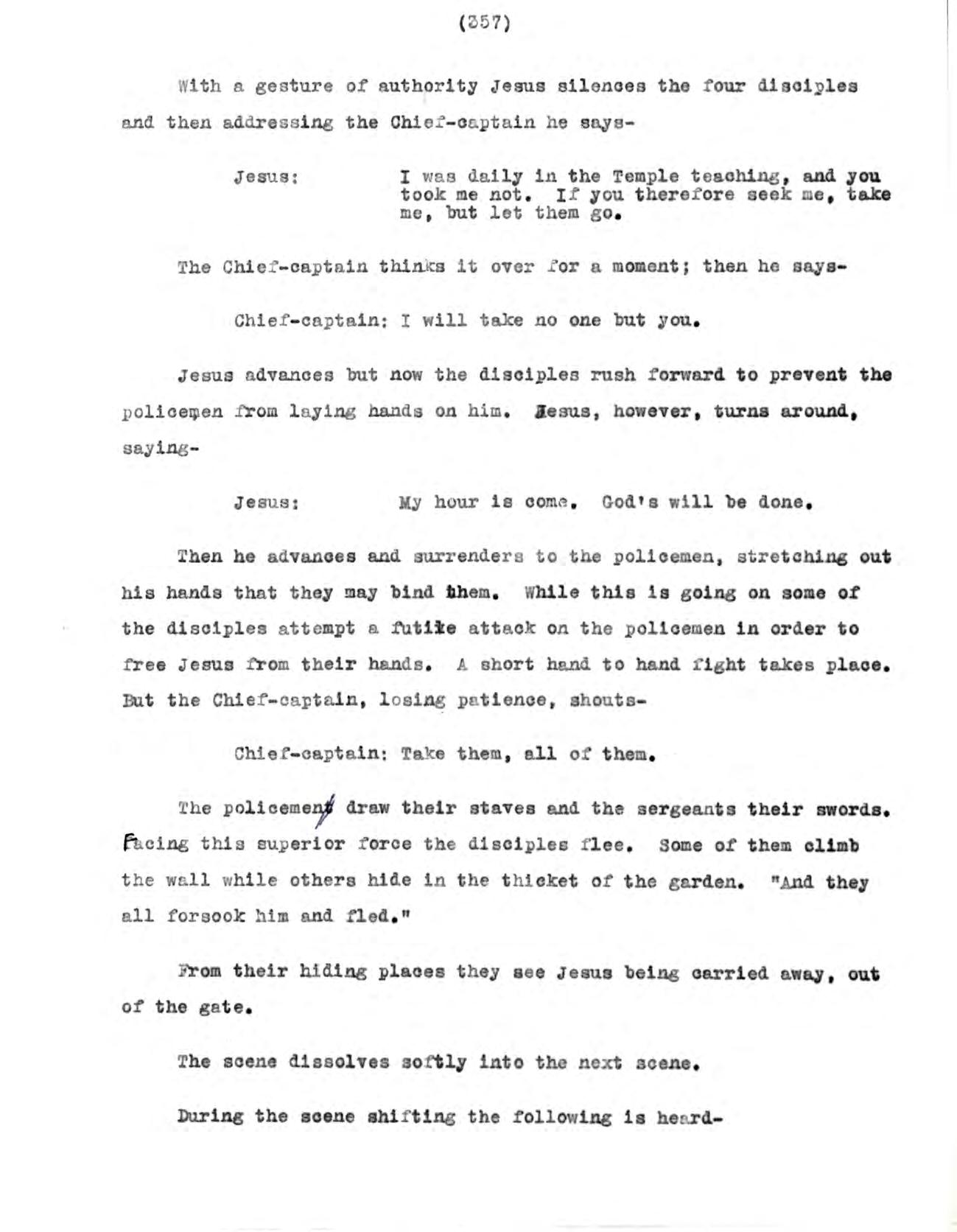
With a gesture of authority Jesus silences the four disciples and then addressing the Chief-captain he says-
Jesus: I was daily in the Temple teaching, and you took me not. If you therefore seek me 9 take me, but let them go.
The Chief-captain things it over for a moment; then he says-
Chi :f- c tin: 111 no on JOU .
Th Ch! -c pta1 thi ov r or t· nh -
Chief-captain: I will take no one but you, Jesus advances but now the disciples rush forward to prevent the policemen from laying hands on him« gesus, however, turns around, say in: -
Jesus: My hour is oonu% God's will be done.
Then he advances and surrenders to the policemen, stretching out his hands that they may bind them. While this is going on some of the disciples attempt a futiie attack on the policemen in order to free Jesus from their hands. A short hand to hand fight takes place. But the Chief-captain, losing patience, shouts-
Chief-captain: Take them, all of them.
The policemen^ draw their staves and the sergeants their swords, pacing this superior force the disciples flee. Some of them climb the wall while others hide in the thicket of the garden. "And they all forsook him and fled."
Srom their hiding places they see Jesus being carried away, out of the gate.
The scene dissolves softly into the next 3cene.
During the scene shifting the following is herrd( 7)
Commentary; AAA they led Jesus and brought him to the High-priest who had cabled a meeting of his privy council üe_ore handing Jesus over to the Eomana.
iThe palace of the High priest has a gate in which there is a wioket with a port-lid. This can be worked from within and is closed with a gfote, O'c&'i*- •
The preceding scene dissolves softly into a close up of the port-lid. The face of a woman, the janitress, appears, ühe has an expression of listening and spying« ;Che noise of trampling feet is heard.
A close up is taken by means of a trucking shot which is slowly transformed into a long shot of the deserred street and the front of the palace. We see the Jewish policemen)^ approaching with Jesus in their midst. The janitress open3 the gate for them and they enter. Only a few people have noticed the procession. The last of the policemen cause them to move on.
Commentary:
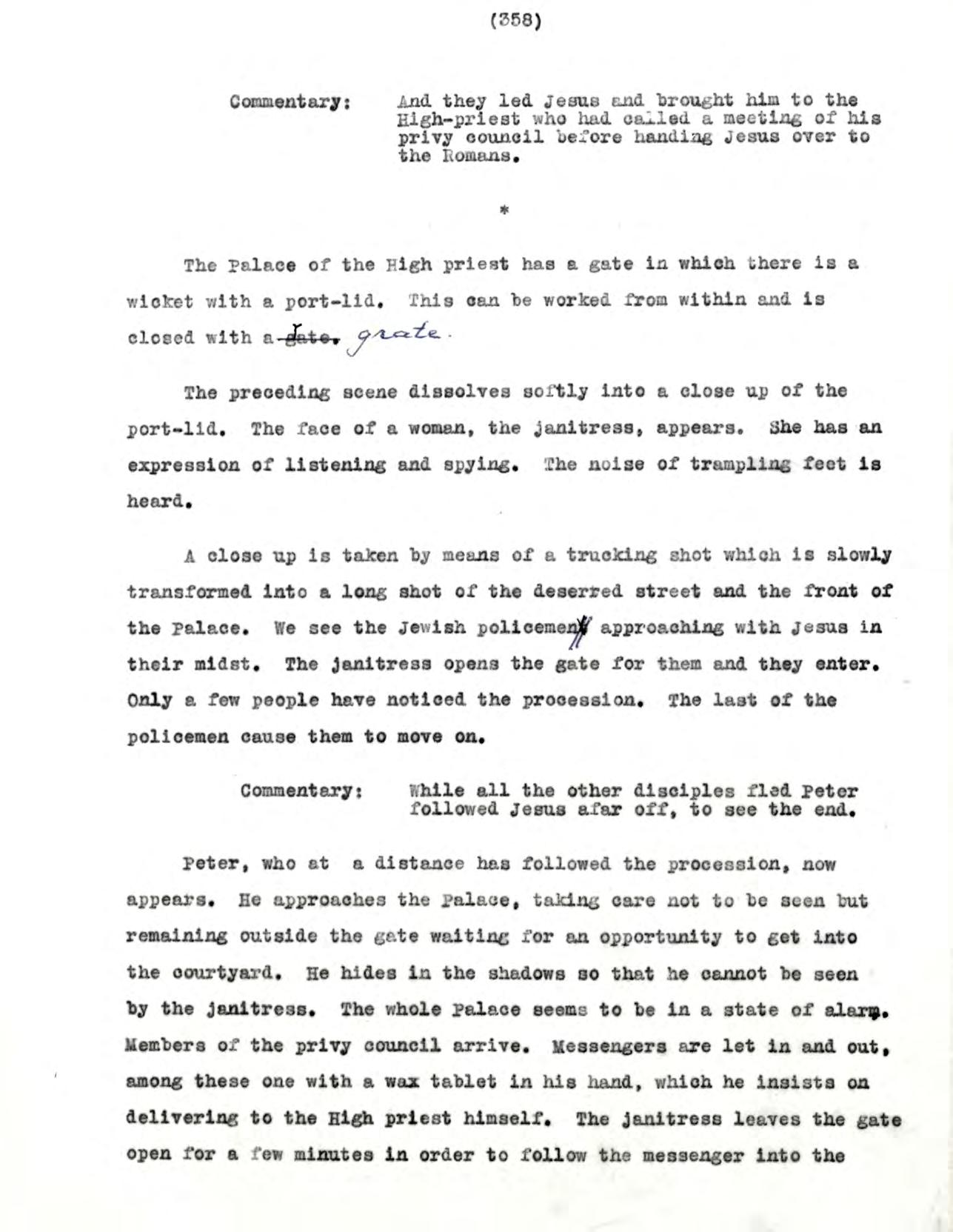
While all the other disciples fled Peter followed Jesus afar off, to see the end.
Peter, who at a distance has followed the procession, now appears. He approaches the palace, taking care not to be seen but remaining outside the gate waiting for an opportunity to get into the courtyard. He hides in the shadows so that he cannot be seen by the janitress. The whole palace seems to be in a state of alari^. Members of the privy council arrive. Messengers are let in and out, among these one with a wax tablet in his hand, which he insists on delivering to the High priest himself. The Janitress leaves the gate open for a few minutes in order to follow the messenger into the
courtyard. Peter takes advantage or the opportunity to slip into the courtyard. Here a Tire has been kindled in a large warming pan around which maid-servants and men-servants and some or the policemen have gathered to warm themselves. Peter sits down among them.
courtynrd . P t r t k ad vant ., 0 t or to to t I th cour yard • Her a f 1 e in / ch an m n g th re to them 1 r • In th ppo 1 corn r 0 th 0 r J ..
In the opposite corner of the courtyard peter sees Jesus surrounded by policemen^. The Chief-captain also is at his side, üho oeribe» whom we have seen act as a aeQretary-»o-Caiaphaa, approaches the Chief-captain, speaking to him in a lov/ voice and giving him certain directions. The Chief captain nods and makes a sign to Jesus and to two of the policemen/Tollow him. They enter the colonnade surrounding the courtyard and disappear into the building it-al*£»
During this the following is heard-
Commentary- xle the High priest was waiting for his privy counsellors Jesus was led away to Annas who was iather-in-law to the High priest.
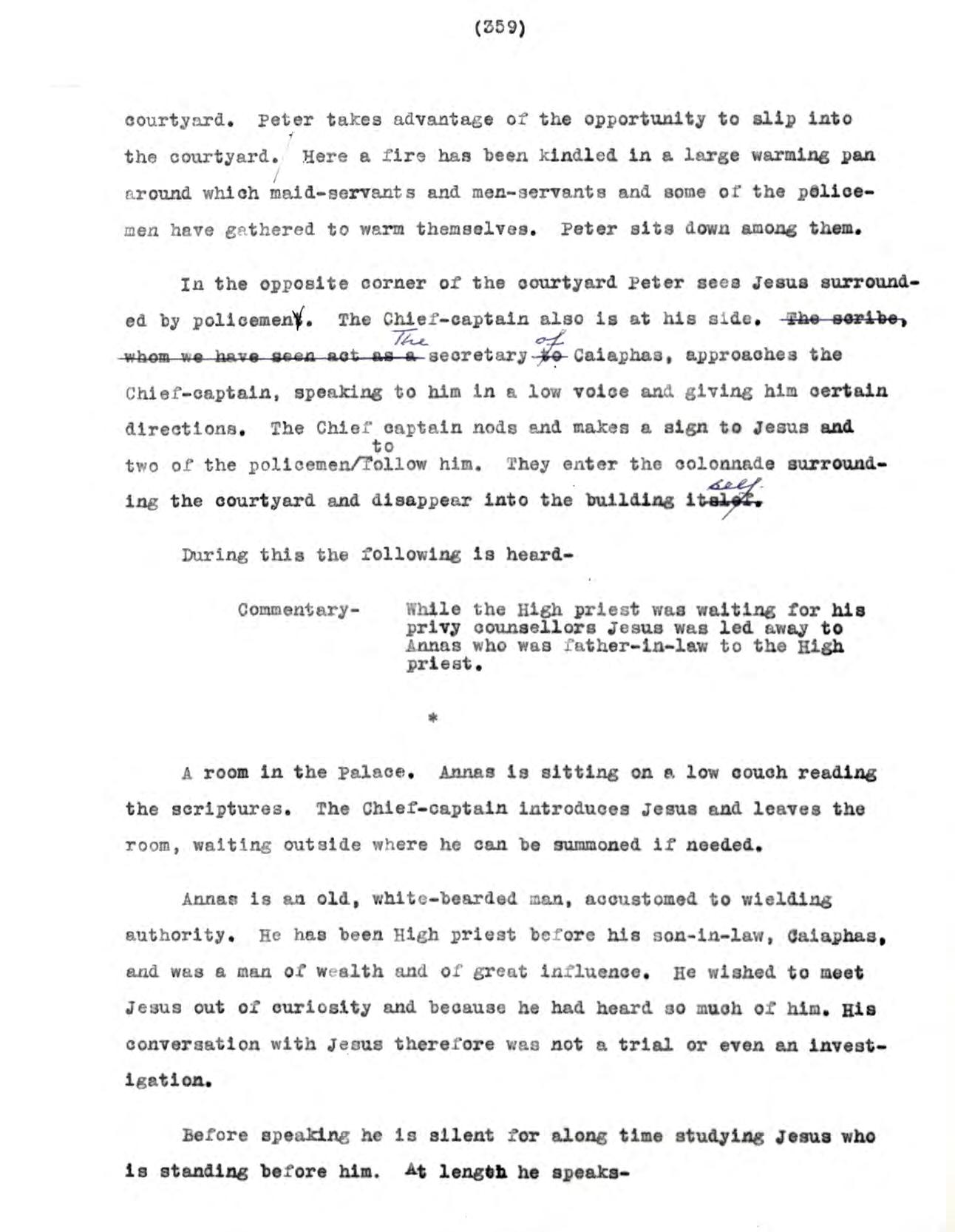
A room in the palace. Annas is sitting on a low couch reading the scriptures. The Chief-captain introduces Jesus and leaves the room, waiting outside where he can be summoned if needed.
Annas is an old, white-bearded man, accustomed to wielding authority. He has been High priest be'ore his son-in-law, Gaiaphas, and was a man of wealth and oi great influence. He wished to meet Jesus out of curiosity and because he had heard 30 much of him. His conversation with Jesus therefore wa3 not a trial or even an investigation.
Before speaking he is silent for along time studying Jesus who is standing before him. *t length he speaks-
Annasi So you are Jesus o± Nazareth?
Jesus does not answer,
Annas: e warned you strictly not to come to Jerusalem and behold you have Tilled the City with your teaching.
There is still no answer from Jesus,
Annas: What is the meaning of your doctrine?
Now Jesus answers-
Jesus: I spoke openly to the v/crfcd; I ever taught in the Synagogue and in the Temple, and in secret I have said nothing,
Annas: I know, but answer my (question.
Jesus; Why ask you me? Ask them which heard me what I have said unto them: bahold, bhey know what;' I said.
Annas looks at Jesus Tor a long time and then bids the Chiefcaptain to come and lead him away. He then resumes his reading»
Jesus is led into the adjoining room which is the anteroom of the tablinarium where the privy council is held,
Jesus 1B asked to sit down by the Chie^-captain who also seats himself.
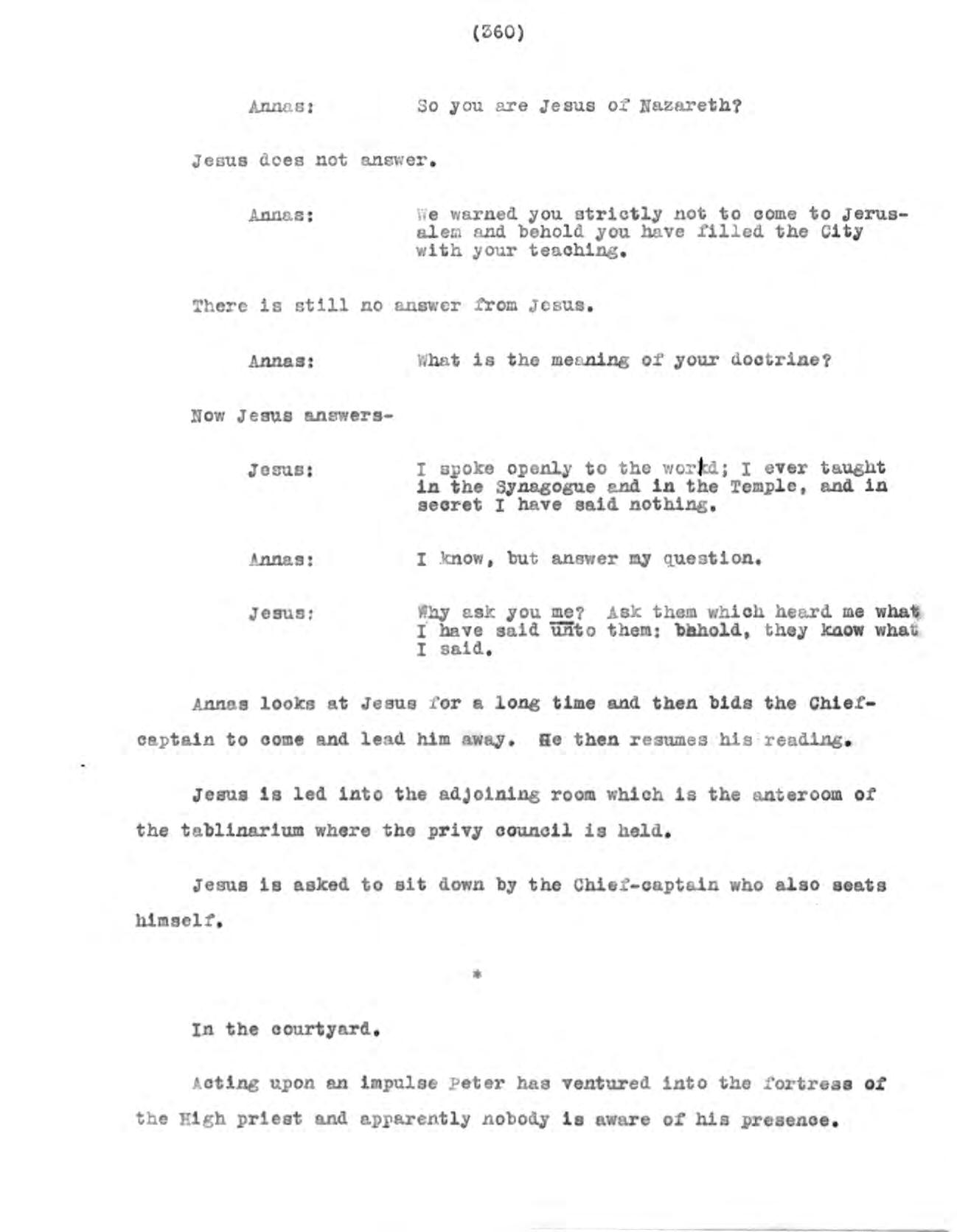
In the courtyard,
'cting upon an impulse peter has ventured into the Tortreas of the I h priest and apparently nobody is aware of his presence.
All are quietly talking and warming their hanas over the Tire, the flames lighting up their races. Only a maid-servant who passes the fire on her way to the water cistern "becomes suspicious. Maybe she has seen peter with Jesus in the Court of the Gentiles. Looking at him carefully she speaks and says-
Maid: Are you not one of his disciples?
peter is taken "by surprise and is completely at a loss Tor words. In his contusion he tolls u. lie» Baying- ^tx^s
Peter: I know not, neither understuad, what you say.
She looks at him disbelievingly and continues her trip toward the water-cistern but she keeps her eyes on him while filling her 3&r with water, peter*s e-uxiety is reflected in his X'ace.
We have followed the maid to the watern cistern and we follow her back to the rire. Here she stops, looking at him sharply and this time does not speak to Peter but to the crowd gathered around the ire. Pointing at peter she says-
Maid: This man was with him; he is one of them.
peter by now is better prepared. Kudely and sneeringly he repudiates the accusation-
Peter: I am not. I know not what you say.
But a spark of suspicion has been ignited.
Peter is surrounded by suspicious people who whisper and look at him beligerantly. The crowd, having become hostile, one or them shouts-
-e r v t: r..)urel , yo & 0 0 :' h
are Gill
Han-servant: Surely, you ere one if themf ror you are a Galilean.
With indignation Peter begins to ourse and swear, sayingpeter; I know not this man of whom you speak.
And immediately while he yet spoke, the cook crew.
(In Palestine the cook crow» just at midnight and a&ain in the morning at six o'clook.)
And Peter called to mind the words Jesus had said,"and when he thought thereover he wept". He turns away in order to hide his tears. But all those who stood by look at him in surprise and wonder. Have they wronged him? At any rate they leave him alone. A little later he risea, leaving the courtyard and the Palace. The"tablinr<rium".
Jesus is led to the High-priest who Bits with his privy counoll. We notice that neither Gamaliel, Nieo/demus, or Joseph of Arimathea are present.
This meeting was only a matter or form, necessary in order to hand Jesus over to the Komana.
Jesus is standing so that he faces the council. They test him in order to find out how deep rooted is his belief that he is the Messiah.
A Pharisee: Did you not say: "I am able to destroy the Temple of God and to rebuild it in throe days?"
Jesus holds his peace.
Caiaphas: tfhat is it which these say against you?
Øesus continues to hold his peace and answer» nothing.
Caiaphaa: Answer you nothing?
There is silence for a while$ then the High-prieat bends forv/ard and giving Jesus no chance to evade the crucial question he asjcs—
Caiaphasj Are you the Messiah? Tell us,
3 voice vibrates from excitement; he is both hoping and ex» pecting that J,sus will deny it. Bat Jesus does not deny it; rather he affirms it. Addressing the High priest he says-
Jesus: If I tell you, you will not believe. And if I a^ic you, you will not answer me,
Baising his voice and addressing the whole Council he adds-
Jesus: But hereafter 3hall the 3on of man sit on the tight hand of God.
Then the High-priest repeats his aue3tion-
Caiaphas: Then you are the Messiah?
The question is asJced with the purpose of drawing a denial and as a solemn warning; but Jesus refuses to avoid the danger. With guileless sincerity he answers-
Jesus: You say that I am, or a while there is deep silence. The counsellors look at each other and mrny shake their heads with regret. There could be no saving of a man who would not be saved.
Then the High priest again addresses Jesus, not in excitement but this time in a tone of sympathy, saying-
Caiaphas: Your arrest ia ordered "by pilate.
6 ) Th Hi h r e ;!"ain dre .. e a ot 1 eX Q t t hi to p by, 1 o r t 1 or r by t • h r 1 no
There is no answer from «Tesus«
Caiaphas: You should not have allowed yourself to be addressed as a king«
Still no answer from Jesus.
Caiaphas: Thefcomansthought you were planning a revolt.
lo answer from Jesus.
In a sad low voice Caiaphas speaks his final words to jesus-
C It 1
Caiaphasj It is with heavy hearts that we hand you over to the Komans.
No answer from Jesus.
o th r rom J • C to t Chi - 0 t in B t th 00 • f - o pt n 1 hi ou 0 th roo • e • c n 1 01 o tl 1Ilt t h t on . r1 t c hi" ti th 0110 1 Co II y. n c n 1 o t o i
Then Ca iaphas make» a sign to the Ghief-oaptain who is standing near the door. Handling Jesu» gently the Chief-captain leads him out of the room. The atmosphere ia full of aadness.
The scene dissolves softly into the next scene.
Daring the acene shirting the following is heard-
Commentary; And in the night they -^eé- jesus/away and delivered-ki«-to Pilate who sat down in his Judgment-seat in a place called Gabatha.
The next y^ene is a close up o f the Judgment-seat or rilate, a carved ivory chair, placed in the Koman pretorium. This chair was
) c lled 'B! n or "Curul •
called "Bima" or "Curul",
The scene dissolves soxtly in»o a new scene showing the "Gabbatha".
Duxinc his visits in Jerusalem Pilate occupied the palace- Öo - ¥a citadel built by icing Herod only-8Q-SQ years ago. Inside the walls
- 1./0
d 1 bl.. 1 by K1 rod on y
Ghis palace was a large paved or flagged square called in Aramaic "Gabbatha". A part of this square was elevated like a tribune. In the center of this tribune stood the ivory chair.
0 thi l' 1 ce 8 ve 0 Q 11 1 fTG th " of his 1 11k rib I • • th a nt r O.J.. th" tr un t t- t ro _:or 0 01' t rl
Beside the judgment-seat there was room ror assessors of the court, secretaries and clerics, one or the clerks is preparing s new sheet of papyrus; another one is nibb^in^ his reed ^on*
In front of the tribune the prosecutor, the counsel of defense, and the Accused take their places.
The whole scene was set in the midst of a regiment of soldiers commanded byftcenturion.
The trial took piece on ^riday morning at tv>a ifl4rth h™'rt honen tim»! th'-t Is at- 6 o'clock.
n the scene opens Jesus is just being brought in. He is accompanied by two Jewish Lawyers, members or the privy council of the Eigh-priest. They were to act as his counsellors or defence. Jesus is delivered to the centuri/ln.
T tr 1 too pl c on '" d t - 6 0' • n t .;;10 n 1 ,. acom 1ed t '0 0 t 118 - rt t. r 0 et 0 1 0 • J su 1 d l1v r d to • e 1
Roman legal procedure always took place in the open-air or in public halls, and there is no doubt that the trial 01 Jesus proceeded according to the rules of the Roman court. On the other hand time
has taught us how obedient to the rulera are the representatives of justice in the totalitärstetates.
Most likely only a few people were present as onlookers. Jesus had been taken prisoner in the night and in great seci mA been led to the house of the Hi&h-prieat. in equal secrecy he vai talcen that same night to the 1 the trial was set foi a very early hour in order to avoid arousing suspicion among the many pilgrims.
Jesus is the first ease that day so the ivory chair ts still empty. But now pilate arrives. Aye. military person of high rank and belonging to the "Herrenvois of that epooh he had a military type of walk and his tramping on the pavement is heard all over the ^bbatha". Re takes only a hasty view of Jesus. Then he asoends the tribune and takes his seat. Eoman military governors had the reputation of deciding oases in a very short time so» without any introduction, Pilate turns to the prosecutor and asks aim as was oustomary-
Pilate: iYhat accusation bring you against this man?
ffell man, Jesus of tfazareth, who tea *>een ided over to us by the Jewish govern- ment* i is said to be a successor in aireet descent rrom Kin& David, of the iirst ) h t ugnt 11 0 0 1 . t th r h r pr /an... 0 j -io 1 tot 11 ; tt , • o t i l.y 0 'I t 0,1)1 r s en t n rl OIler
(According to the proceeding in the homan ap** ° the T)ro3ecuto£ ^irst rcede M <*»e«ro«fttion, «r»r»r>p«+in ±hen the «Juat-< .nterrogatio. examined the prisoner, And at the last the counsel or defense spoke, excusatio^(. Alter thir the jud.^e pro* nounced zhe sentence).
1 o th OU OJ. t I e night to th 0 he t rl our n or t 'ou u p C 0 J t c t ay 0 t lvo y cl lr t t no Pil t 11 '3 per .n 0 hi b long1ng to h u r n 0 f 0 of r 1 n t p 1 b th If t o Lly ty le\; 0 th tribun d t ea hi reputa,,101 1 v in roductio , 11 t urns to th pro out or au om 11'11 t : h t a cue tion b 1 n 1 e it 1 e the rltt tin)1 1 o. in c m n in o to: 1 h y ov i 0 an as 1m au El 1", t ou r s e a v a eel]. s v r )11 ri a . till hr . :iH th aDO a . s m ? 'p ok • (in.
: r pon the invitation of pilate the prosecutor rises, and noluing the written bill of indictment in his hands, begins reading (in Latin)3eoutor» -
, Jewish dynasty. I cannot prove the truth hereof. But I can prove that we have had the good lortunTTTo lav hands on one more rebel .rom oalllee, the ^reai breeding ground of revolts against the Roman governJP ment, or ellong time . • "been disturbing
* M>e^e>/^"^ the Jewish* nation, provoklng^geop 1 e to rise
* x ^ÅG^*^ against their Jewish rulers and thus causing disturbances of peace and order. Doing so he was threatening poman interests and undermining Roman authority• But we soon discovered that he was more than a dangerous political agitator, stirring up the people throughout all judea and beginning irom Galilee even unto this place, we learned that he openly proclaimed himself to be the Messiah, the leader sent by the God or the jews to deliver them Trom Caesar and from pome. At his entry into Jerusalem last • hailed as a king. And whosoever makes himsell a king is an enemy of Caesar, it is our duty not only to trace but also, with the utmost rigour, to suppress any attempt of insurrection, indulgence would be interpreted a3 weakness, in the x jb*e^o/f£±„ name of Caesar and the poman*ütato i charge / / the prisoner or high-treason, according to lex julianna, and i claim punishment of ueaun.
Mate , who has büen _ully informed in advance about all the charges against Jesus, has listened with indifference, flow he turns to jesus and aoko him (in Greek) -g>- ^ pilate; t answer you to this? > Jesus is silent. pilate; Answer you nothing? Jesus remains silent and plL.te marvels, probably Jesus* contempt of death is what makes pilate "marvel". The accusation it Le proven. But pilate desires an admittance of guilt -.rom Jesus himself and therefore he asks himpilate» Are you the king of the jews?
1 te, 0 1 l11.,C' or i n 0 bo t ag i n t J a d vi h • 0 h 6'y , d..Q /,;\ 7 >f tan ou t t h ? 1 • 1: ut ou ? J u n 11 t 11 1: t 1 • ro b con 1 h t a. 0 1 l h c t 0 u t 11 t d lr t 0 '" 11 J 1 h r 1 0 h h 11 ou tl 0 J ?
Jesus answers pilate this time-
jesusi you say.
pilate is not satisfied with this, iherefore lie 3ays again-
pilate: Are you a king tuen?
After this .pilate could not do anything but ratify the sentence ox death but, according to custom, he addresses the two Jewish ( ) r l a t eo • 1 • r or you : t o ? : 1 1 B , ? (
jesus; kingdom is not io world: ix my kingdom were of this world, then ay followers would have fought for me, but now is my kingdom not from hence.
pilate: M then you are a king?
Jesus; you say that I am a king. To thia end was Y^orn, and ror this cause came I into the world, that i should bear witness unto the truth. Everyone thct i3 tf the truth hears my voice.
pilate shrugs his shoulders, sayingl&tfj tat is tmth? (after a short pause) «hence are you?
No answer from jesua.
pilate» (irritated) speak you not unto me?
Ho answer from jesus.
pilate» Know you not that I have power to crucify you and have power to reloase you?
How Jesus answers with great dignityjesu YOU could have no power t all over nie, except it were given you from above.
Lawyers, saying*
pilate« what can you state in his defence?
One of the Lawyers takes a step forward, sayingLawyer» we can only repeat that Jesus is a religious fanatic hut not deliberately a political revolutionary, we therefore asJt the prosecutor not to press the charge and we ask humbly for the Governor to show the greatest possibly leniency.
pilate has listened with indifference and even before the Lawyer has come to the olose of his plea pilate makes a sign to the prosecutor to bring the indictment for his signature* Before signing the document he rises in the seat and addresses Jesus, sayingpilate* Ibis ad crucem - (go to your cross).
And addressing the centurian-
pilate* I, miles, expedi crucem - (see to it that he is crucified).
Then he puts his seal on the death warrant. The centurian salutes pilate by stretching up his hand.
The scene dissolves into a new scene showing the document and the hands and signet of pilate«
This scene again dissolves softly into a new scene»
During the soene shifting the following is heardCommentaryi The doom of Jesus was sealed. H«^ into Jerusalem proclaimed as a king was
C o->t-«-<-fc- /o J/le^Z^r-M^XS*.
sentenced to death by pilate as a rioter and a rebel» He'-weuAd die for nis faith and/for hi« people.
n oell in 01 1er • I
The next soene shows a hall of the oitadel whioh is used by the soldlers» Jesus has been placed on an elevated marble bench» His hands are still bound»
• 111 •
The Koman soldiers have led him into this hall in order to make fun of him and they have called together the whole band»
When this scene opens a soldier is just putting a purple» woolen military cloak around him and fastening it with a clasp at the shoulder»
1» soldiers
»Of you are Just like a king»
Jesus submits silently and patiently to the jesting of the soldiers.
Another soldier has platted a crown of thorns in mockery, twigs from one of the two species of bramble-bushes so well known in palestine, ononis spinosa or lyoeum spinosum. This species does not prick» The purpose of putting a crown on the head of Jesus was not to wound him but to mock him by likening him to Roman emperors who on ceremonious occasions wore plaited crowns of leaves»
The soldier who has just finished platting the orown now puts it on the headof Jesus saying«
2» soldier: you will soon be in your kingdom; in the meantime: here is your orown»
A third soldier who puts a reed Into his hands says«
3. soldiers And here is your sceptre.
in turn the soldiers sneeringly how their lenees before him, salute him, and mook him, shouting*
Voices: Hail, King of the jews,
Jesus is able to endure all the Insults because he rests in God. Ho is heard whispering the old prayer: shema-
Jesust Hear, o* Israel: The Lord, our God is one /C^C« L ,s cx^scy -God* and you shall love the Lord with all your heart and with all your soul and with all your might.
At this moment the two Jewish Lawyers who have aoted as his counsellors pass by. when they see how jesus is being treated by the soldiers, they stop and rebuke them sharply, saying-
1* Lawyer: For shame.
£. Lawyer: stop that.
1. Lawyer: otherwise we will lodge a complaint against you.
A soldier now enters carrying an a long pole the "titulus" for the cross of Jesus: a square tablet with a coating of gypsum and with the inscription in Greek, Latin, and Hebrew: The Ring of the ews.
Their attention is diverted from jesus booause this Inscription is an open offense to the Jewish people. Addressing the soldier they ask him-
1. Lawyer; Bar whose order was that inscription written?
4* soldier: By order of the governor.
2. Lawyer; Himself?
4« soldier: Yes«
1. Lawyer: That must be a mlstales«
2. Lawyer« Let us go and speak to him at once.
1» Lawyer addresses the soldier«
1* Lawyer; Come with us.
The two Lawyers and the soldier with the "tltulus" leave the hall.
As soon as they have left the soldiers continue their mockery. When a soldier attempts to adjust the reed, the orown slips down on one side. The soldier tries to straighten it out it Tails off the head of Jesus and rolls along the floor bringing a roar of laughter from the m Idlers, one of them shouts to jesus-
6. soldier^ you almost lost your orown.
One of the soldiers picks up the orown and puts it back upon the head of jesus.
We follow the two Lawyers hastening back to the "Gabbatha«, pilate is already busily engaged with the next case. During a pause the Lawyers approach the governor and make their complaint.
of them says-
1. Lawyer: We have come to ask you not to allow that to be used»
pilate is annoyed at the interruption and answers ourtly-
pllatc*
1. Lawyers pilate;
1* lawyer:
£• Lawyer;
ai Lawyer;
pilate*
Whyf
(pointing at the tablet) it says that he is erucified as the king oT~the jews«
And?
That is not correct.
He is cruoiried beoause he said that he was the Icing or the yews«
(persuasively) The people might feel offend»
(cutting them short) what I have written» I have written«
He turns his back to the Lawyers and continues his conversation with the Roman officials.
Shrugging their shoulders» the Lawyers leave the place«
The scene dissolves softly into a new scene«
During the soene*shifting the following is heard-
Commentary; on this day,as on all other days« the divine service within the Temple began with the ottering of the lnoense»
The new scene shows a olo3c up of a golden vessel« we see the two hands of a priest, clad in white and pouring incense into the vessel«
The oamera glides backward and we see the priest, the vessel la his hands, start walUng toward the Sanctuary. He is joined by another priest, olad In white and carrying a golden fire pan filled with live coals that have been taken from the altar of burnt offering*
We follow the two priests into the Sanctuary, passing by the golden candlestick, and the table of show bread which has a covering of pure gold,
Xn the center of the Sanctuary is the incense altar*
The priest with the fire-pan places the live coals on the altar after which the other priest sprinkles them with incense*
The priest with the fire-pans leaves the Sanctuary while the other priest falls down upon the floor, worshipping God*
The oamera approaches the altar and the scene ends with a close up of the altar with the burning incense which is a symbol of the prayers of believers*
The soene dissolves softly into the next scene*
During the soene-shifting the following is heard«
Commentaryj And the Romans took Jesus and led him away to be crucified*
Jesus was led from the palace of Herod through the main-street w hioh parallels the northern wall, to the gate opening on the road leading northward*
We see the empty street* All is asleep after the feast* The shops are closed* only a few people are about* The roar of the wild h., 1.0. hi. heAd , at aao .h
beasts In the oirous nearby is heard and, arter a little while the sound ox studded sandals» HOW the doors are opened silently and frightened faces look out as those in the street are asked if any» thing is wrong« They are told that the Romans are out and the people hurriedly retreat into their houses, closing doors and windows« The sound of people bolting their doors and placing the cross-oars in place is heard in addition to the sound of the Roman soldiers* sandals« The sound becomes louder with each passing moment•
By moving the camera we are able to see the procession surround* lng jesus enter the street«
The procession is headed by a herald who announces in a loud voice the crime of the prisoner« He is accompanied by a drummed. who, at certain intervals between the announcement, makes a rolling noise on his drums«
A soldier walks behind the herald and the drummer carrying the "tltulus** which later will be plaoed on the cross«
He is followed by the centurion and a few soldiers to clear the street«
Then follow four exeoutloners with jesus in their midst« The executioners carry different carpenter tools and Implements, for instance a ladder, boards, ropes, and so on*
jesus is going to be crucified on a «crux comissa«, that is a cross in the form of a T# according to]oustcm the man who has been sentenced to death must himself carry the cross-beam to the plaoe of execution« The oross-beam was laid on the shoulders of Jesus who bends his neck under the heavy burden«
Soldiors follow along at the end of the procession*
Out of the soldiers carries the crown of thorns on a lancehead« Beoause of the cross-beam it has been necessary to remove it from jesus head*
Jesus is pale and weak, HO has been under a constant strain Tor some days and Tor many hours has had nothing to eat or to drink«
When the procession approaches the camera we see how his feet fail him« slowly his strength givesway and. stumbling over a stone in the pavement, he sinks down on his knees« The procession halts« o&e of the executioners helps him to regain his feet and replaces the cross-beam on his shoulders«
During this scene a few people have become bold enough to draw near, particularly some women and children« one of the women, feeling compassion for «Jesus, addresses one of the soldiers«
Woman:
x,ook how sweaty he is. May I help him to wipe his face?
As the vornan is pleasant and sympathetic looking, the soldiei nods assent»
The women in palestine at that time frequently wore a napkin, allowing it to hang loosely over the shoulders or around the neck«
Among the jews it was considered a sign of compassion to wipe the face of another human being who was in distress«
How this woman,moved with pity, hands Jesus her napkin« He takes it and presses it against his face and then gives it back to her. The centurion now shouts an order that they are to continue. And the procession moves on, Jesus bearing his cross«
The scene dissolves softly into
The next scene: from the Sanctuary or the Temple beginning with a close up of the altar with the burning incense.
The camera moves baoJcward and the priest who has been worshiping God rises and leaves the Sanctuary, we follow him through the entrance hall to the steps leading up to the Holy place. At the foot of the steps the believers have gathered, standing at the top of the steps and lifting his hands over the people of Israel the priest pronounces the eld Jewish Aaronlo benediction» ths same benediction which is used to-day in Christian churches.
priest:
The Lord bless you and keep you» the Lord make his face shine upon you and be gracious unto you; The Lord lift up his countenance upon you and give you peace.
The scene dissolves softly into the next scene. During the scene shifting the last sentence of the benediction is heard.
This soene shows the procession with Jesus which has passed the gate ot oenath and now is outside the first northern wall. Golgotha is not far away. It is an open rooky landscape without buildings but from olden times has been oovered with gardens.
Somewhere along the road, yesus stumbles onoe more and the procession stops.
The executioners again help him to arise and they also attempt to place the cross-beam on his shoulders but the centurior interferes, saying-
Centurion« NO , it*S no use; we must rind someone to carry the arose for him.
He looks about.
A Greek jew, Simon of Cyrene, on his way home at this moment, meets the procession* The centurion calls him and commands him to carry the cross,saying-
Centurion: Carry that oross for him. He is all in«
Simon refuses, saying-
Simon; why do you ask me? YO U have men enough*
Centurions X didn't ask you. It was an order,
Simon, grumbling and with the help of one of the executioners, lifts the cross to his right shoulder*
The procession moves on, Simon going behind Jesus who is leaning on one of the executioners.
The scene dissolves softly into
the next scene« from the Temple. At the end of the morningservloe the Levltes on duty gather on the steps leading to the Sanctuary, TW O priests with trombones of silver (called trumpets) are with them. Each day a psalm was sung by the Levltes while the two priests at certain intervals in the song would sound their trombones.
At each blast of the trombones the people throw themselves upon
the ground, pra jing and worshipping Qod.
zBy means of a trucking shot the ssene ends with a cose up of the trombones ana dissolves softly into the next scene. During the soene shixting the song and the music is heard, the song being subdued and the trombones emphasised*
This soene shows Golgotha and begins with a long shot*
The piaoe was situated about a hundred metres from the oenath gate and a little aside rrom the road which followed the Horthern wall in the direction of the palaoe of King Herod»
Roman soldiers have been posted all around the plaoe to prevent persons not concerned xrom approaching the place of execution» The crowd la small in number«
If it was not xor the crosses the place would resemble a timberyard» in a corner was a heap of rough-hewn beams and boards» jn another corner two men are occupied with sawjtng a beam» This beam is placed on two vertloal beams oae carpenter is standing beneath» another one above the horizontal beam, each one sawing from his end; the man above is drawing up, the man beneath drawing down. The saw cuts only when it is going downward, A bundle of fagots is also seen» sometimes the executioners hastened the victim's death by xindling a fire at the foot of the cross, A heap of sand la also seen»
The ncarpenters"whom we see working are the executioners. They do not look very bloodthirsty but like artisans exercising their profession. o&e of them is carrying water xYom a nearby water-
olstern and p ourlng it into a barrel• mother «carpenter» is seen bsnt over a tub washing his bloody hands, A fellow "carpenter" pours water from a jar over his hands.
The air is filled with the sounds of hammer-strodes and axeblows, Also with sighs, groans, and wailing and doleful cries.
When Jesus arrives at the place the situation is as follows-
jesus Is going to be crucified with two[ thloves» /"§£• of them is already hangln*, on the cross and two executioners are just nailing his feet on the vertical beaut of the cross.
The other one is about to be hoisted up upon his cross»
The manner of proceeding was as follows: The cross-beam was laid on the ground. The man who was sentenced to death was stretched out upon the cross-beam, his arms extended and his hands nailed to the beam. Then the cross-beam with the man was hoisted up ana placed upon the vertical beam which has already been raised.
By means of ropes, ladders» and men with long poles with hooJcs the cross-beam is hoisted up to the top of the vertical post and fastened by nails and ropes»
Spur-shores are placed between the cross-beam and the vertical beam.
On this vertical beam, midway up, a wooden "saddle* is fixed, the so called "sddlle"» The prisoner is placed in a riding position on this "saddle« which supports the body. Then the feet are nailed to the
are preparing the cross for jesus. A hole is hewn In the rook and a man is cleaning it out.
The Tertlcal beam is lying on the ground near the hole» ready to be planted in the ground, HOW three or four exeoutioners raise the beam, ^pushing the foot of it toward the hole until finally it sinks down into position« They put wedges into the hole aroung the foot of the beam until it is vertical.
The vertical beam is not raised too high. The feet of the sufferer must be leas than a man's height over the ground.
One of the executioners hums a gay tune while working and another one Joins in singing the refrain.
All are busy, Just as men might be when engaged in any common toil.
When jesus arrives the cross-beam is lifted from the shoulders of Simon of cyrene and placed on the ground.
According to Roman law those who were sentenced to death on the cross must be placed naked on "the tree" but in Palestine they were allowed to keep a loin-cloth in place.
jesus is ordered to take off his clothes. Simon of Cyreno offers to help him but the executioners send him away«
Glimpses of other situations are intercalated while Jesus is undressing.
When we return to Jesus he is undressed and is stretched out on the ground, his arms extended on the cross-beam. They are not yet nailed, A string is put around his wrists and they are straightened
out toward the ende of the oress and fixed as tightly as possible» dose-up this is seen in a trucking/Shot along the cross-beam from one enA to the other and we see also the executioners marking on the beam the plaoe where the nails shall be driven. Than the string is loosened and holes are made with an auger to receive the long nails, Again the arms are straightened out and the string fastened to the ends of the beam in order to prevent the sufferer from drawing back his hands and making it difficult to drive in the nails»
While this is happening we hear jesus saying*
jesus: Father, forgive them for they know not what they do.
prom a new angle we see one of the exeoutloners drive the nails through the hands, first the right hand and then the left, ffeis scene is shot in such a way that it stimulates the imagination of the spectators without showing the cruelties of the deed, we see the baok of the executioner and the hammer being lifted up after each stroke and we hear the hollow sound S3 it descends, and the moaning of jesus.
After this scene we see the top of the vertical beam of the cross of jesus and a Roman soldier handing the "titulus" to an executioner standing on a ladder. The executioner fastens the "titulus" on the backside of the beam so that it will appear just above the head of Jesus when he is placed on the cross. And now the camera slowly approaches the "titulus" until it covers the whole screen. Daring this different sounds are heard: the braying of sheepv the bugles from the Roman Governor«s palace calling the bugles at the Roman fortress Antonia and their reply, we also hear the barking of dogs mingled with the cries and the wailing of the crucified. • o i 1 1 , 1 1 .'
After a while the "titulus* dissolves softly into a new soens, or the camera moves bacJcward to a long shot. Jesus is now hanging on the cross» TWO exeoutioners are about to nail his feet to the upright beam* we hear the hammer-strokes and we see the points of the lon&> ••mf nfrff nails, piercing through the beam and appearing on the backside.
Then a scene of the front of the cross, A ladder *s still leaning against the cross and an executioner is standing on it«
A Roman soldier hands the crown of thorns to the executioner who puts it on the head of «Jesus» The executioner descends the ladder and removes it from the oross. The paleness of death is already coloring the face of Jesus» With the greatest difficulty he lilts up his eyes and in a loud voice cries«
Jesus: MyiflP^i myfled,why have you foraaiten met
His eyelids close and he turns his head heavily and slowly rrom one side to the other» Tears come into his eyes and roll down his cheeks.
Again the camera approaches the "titulus" until it entirely covers the screen.
After a few moments it dissolves into a short scene of the cross oi'one of the gobaegü» seun -Crom the front» The rebbor / shouts disdainfully at Jesus-
frehtørr If you be the Messiah, save yourself and me»
The scene dissolves bacx to the "tltulus" and different sounds are heard» After a short while the scene again dissolves» this time into a new scene showing three executioners standing on the ground and looking at jesus. one of them says-
Executioner: H« vxculd destroy the Temple and build it in three days.
The scene dissolves "back to the "titulus" and the camera moves backward and we see Jesus, xn a faint voice he is heard gasping.
jfc3Uoj 1 thirst.
A Roman soldier ie seen drawing near with a sponge that has been moistened with vinegar. The sponge is fastened to the head or*a lance. The soldier lifts the sponge to the mouth of Jesus who turns his head away, while lifting the sponge to the face of Jesus the soldier shouts-
Soldier: You saved others, yourself you cannot save.
The camera approaches again the "titulus" until it entirely covers the screen. After a short while the "titulus" softly dissolves into a scene of several revolutionaries in the crowd» We recognise their xaces and we hear them 3aying<»
1.revolutionary: HO said he was the son of God,
2.revolutionary: l,et God deliver him how, if he wil»l have him. him.
The scene dissolves softly bade to the ''titulus" which, after a short while, again dissolves into a scene showing the four executioners. They are sitting on the ground casting lots to determine what each of them should take. The garments of Jesus consisted of his cloak ("simxah"), his head-gear, his girdle, and hiajsandals. Also his »kiton% woven in one<-#•**«•» The casting of lots is done as follows; a square is drawn on the ground and divided into 9 smaller squares numbered
atones into the squares. The object is to get the moot points« The one who gets the "simian» »ays-
Executioner: x never dreamt of being clad in a royal mantle*
The scene dissolves softly into the "titulus" and the camera glides backwards until we see jesus again» his strength almost spent and crying in a loud voice-
jesus: gather into your hands I commend my spirit*
"And having sala thus he gave up the ghost• «
(The dissolves axe not complete dissolves but superlmpositions f«inst« 1-4. so that the titulus remains subdued behind the different intercalated scene
After this scene another scene follows of the cross of Jesus , from the cross« . angle* mle centurion and a soldier approach taken rrom a different . Xh **
r 1 o 1f1
It was the duty of the centurion to make sure that those crucified were really dead and he motions to the soldier to pieroe the side of Jesu3 with his spear* The soldier does so and "forthwith out same there/Blood and water».
This scene is followed \>^ a long shot« The centurion sits down with a few soldiers who have been ordered to remain until all the crucified are dead* The exeoutioners have left* The soldiers have opened their "knapsacks" and started eating*
By means of a dissolve the soldiers and the crosses of the two thieves-''slowly disappear. The cross with Jesus is left all alone« We see the shadow of the cross lengthening more and more until it breaks the frame of the image«
During thi3 ih ; follow; hoard -
Counoniaryj Jo3U.. but in Doath ha aecon At ho had bøgun Inldfa Ril bo.": 1% and nobla ihou ;ato '.ivod ills laaort i brought to hunanlty all ov >rld tha wood ,f iovo ond elv r i ty Torobo phftta of Ol . Co ntnrys
JoaU1J d.-od but in Donth ll() nccon;>l_uh()d what h.o hnd bOL'1ln n _ o. :3 bo Y \laB 11.od. hut h10 nn r t ....... .. ·.,od. Ilia ltAort 1 ne,) brol ..;ht to hlU'':}'111 ty 01 ova t.ho lor!d thu :;ood t_dlnco 0 t ., OVO and oh(,}'" J. or oouuu b · tl (J JO\,I all rophot 0.:. ola