Head Office
TimeLine Auctions Limited
The Court House
363 Main Road
Harwich, Essex
CO12 4DN, UK
Tel: +44 (0)1277 815121
Website www.timelineauctions.com
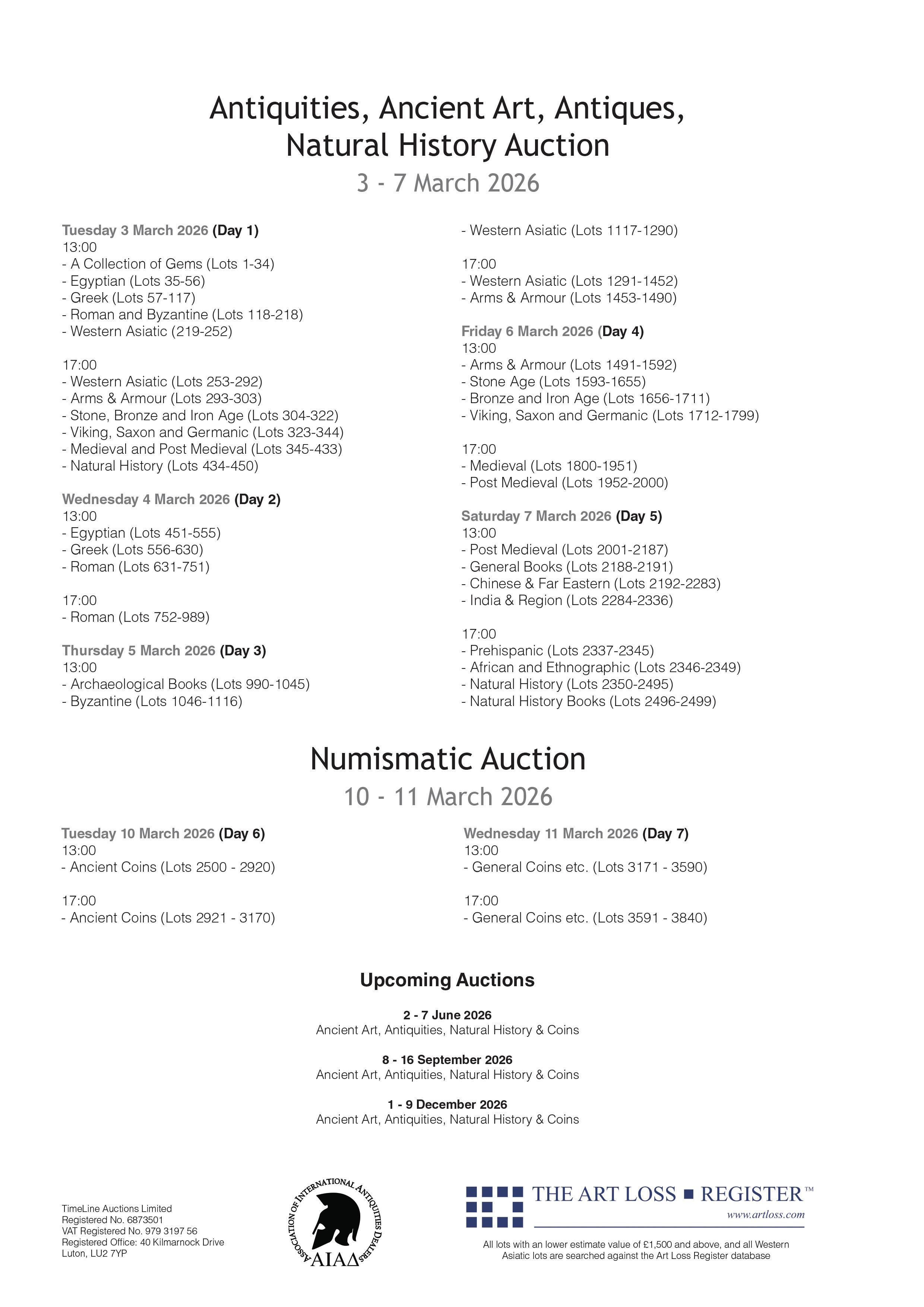
Antiquities Auction
Tuesday 3 March 13:00 (Lots 1 - 450)
Wednesday 4 March 13:00 (Lots 451 - 989)
Thursday 5 March 13:00 (Lots 990 - 1490)
Friday 6 March 13:00 (Lots 1491 - 2000)
Saturday 7 March 13:00 (Lots 2001 - 2499)
Numismatic Auction
10 - 11 March 13:00 (Lots 2500- 3840)
Viewing
By Appointment Only
Bids
+44 (0)1277 815121
+44 (0)1277 814122 fax bids@timelineauctions.com
Telephone bidding by prior arrangement. Please see back of the catalogue for Terms & Conditions
Consignments
+44 (0)1277 815121 consignments@timelineauctions.com
Illustrations
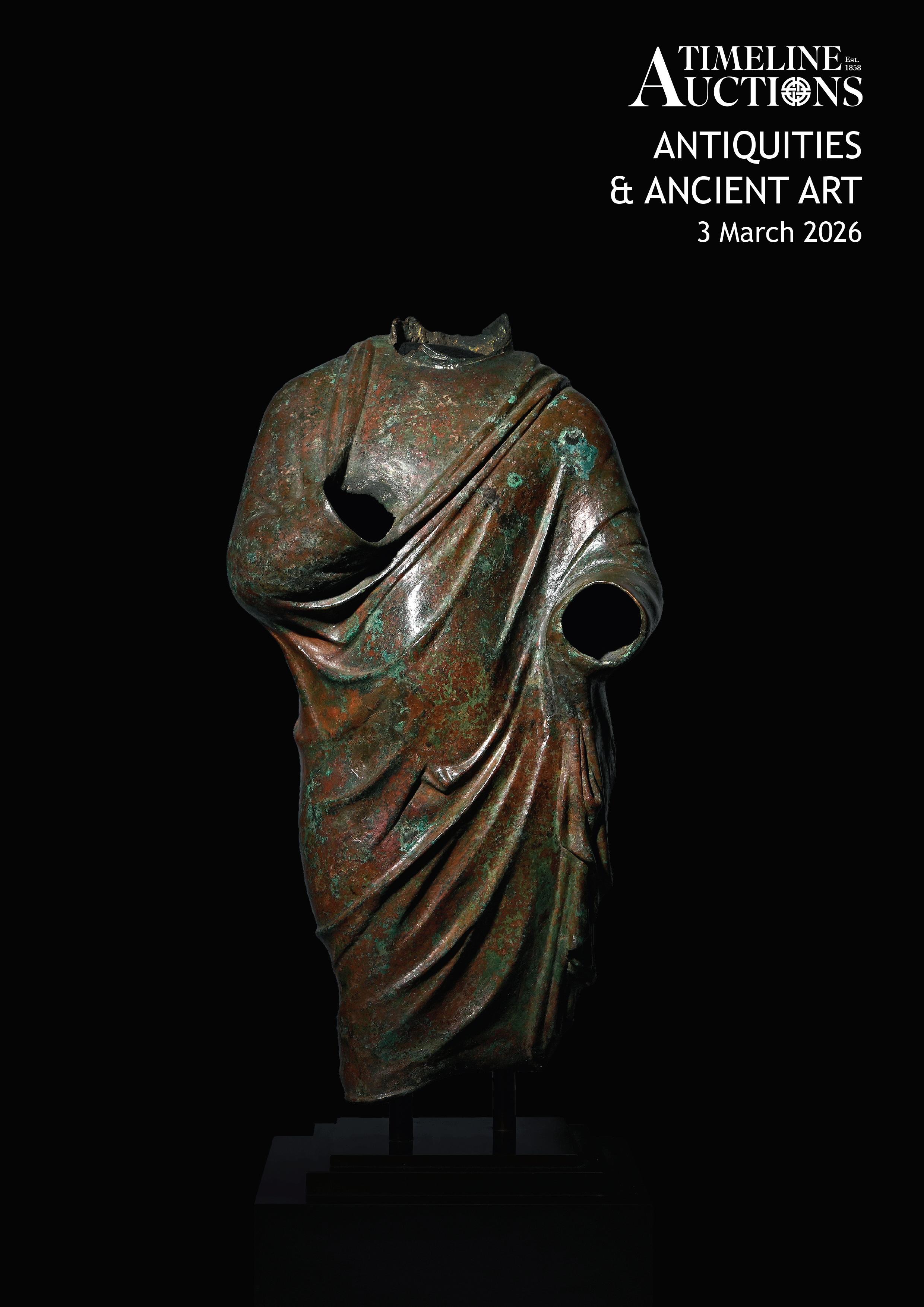
Cover: Lots 150 & 134
Sale Number: 305
Catalogue Production & Layout
Damir Radic DRs d.o.o.
Davor Radic DRs d.o.o.
Photography & Video Production
Michael Healy
Kyle Elmer
Jason Williams
Antiquities Department
Dr Raffaele D'Amato (Head of Department)
Stephen Pollington (Cataloguer)
Michaela Simonova, MA (Cataloguer)
Tanja Maijala (Cataloguer)
Numismatic Department
Periklis Mastrangelis, MA (Head of Department)
Dane Kurth (Cataloguer)
Michaela Simonova, MA (Cataloguer)
Brett Hammond, FRSA (Cataloguer)
Consultants
Professor Neritan Ceka (Classical & General Antiquities)
Professor Dr phil. Peter Rothenhoefer (Classical Archaeology, Chinese Antiquities, & Coins)
Professor Livio Zerbini (Classical Archaeology & Roman Epigraphy)
Dr Ronald Bonewitz (Antiquities & Geological)
Dr Manuel Ceccarelli (Western Asiatic Antiquities)
Dr Robert Chandler (Paleontology)
Dr Paul A. Fox, MA, FSA (Heraldry)
Dr Brian Gilmour (Arms & Armour & General Antiquities)
Dr Ittai Gradel (Classical & General Antiquities)
Dr Malcolm Jones (Medieval & Later Antiquities)
Dr Alberto Pollastrini (Egyptian & Associated Antiquities)
Dr Laura Proffitt (Classical & General Antiquities)
Dr Laura Vigna (Ancient Jewellery, Ceramics & Marble)
Laetitia Delaloye, MA (Egyptian & General Antiquities)
Michaela Simonova, MA (Mesoamerica, Viking & Religious)
Thomas Sturm, MA (Cylinder Seals)
Paul Whelan, MA (Egyptian Antiquities)
Peter Bufton (Far Eastern, Islamic & Ethnographic)
Peter Clayton, FCILIP, Dip, Arch, FSA, FRNS (Egyptian)
Richard Falkiner, FSA (Jewellery & General Antiquities)
Michael Howgate, B.Sc. M.Sc. PGCE FLS (Natural History)
Igor Gorokhovsky (Metallurgist & General Antiquities)
Joseph Hubbard (Natural History)
Dane Kurth (Greek & Roman Coins & Antiquities)
Stephen Pollington (Anglo-Saxon & Viking Antiquities)
Amin Rezai (Western Asiatic & General Antiquities)
Richard Roy (Ancient Americas)
Simon Schmidt (Jewellery & General Antiquities)
Mehdy Shaddel (Western Asiatic & Islamic Antiquities)
Stefany Tomalin (Beads & Associated Jewellery)
For further information and biographies see: www.timelineauctions.com
Team
Chief Executive Officer: Brett Hammond, FRSA
Chief Operating Officer: Aaron Hammond
Head of Administration: Tanja Maijala
Client Account Manager: Lisa Fricker
Admin Assistants: Law Yuen Ying, Heather O’Neil The

1
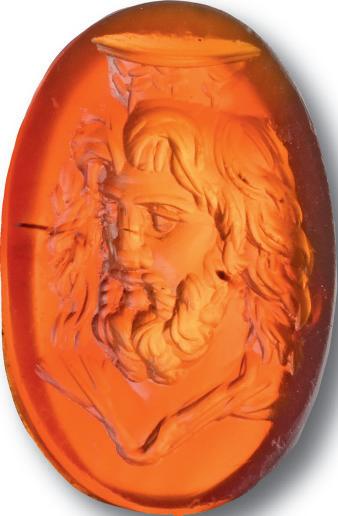

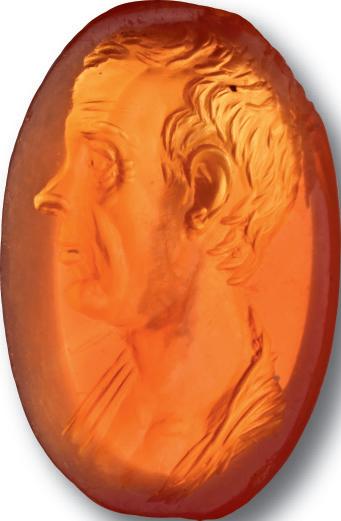


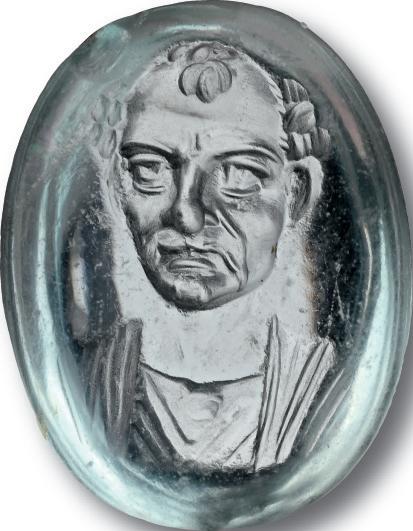

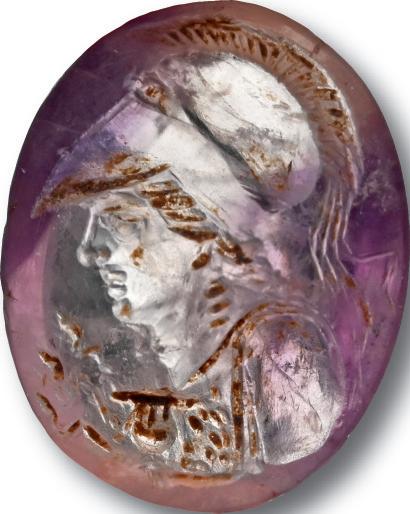
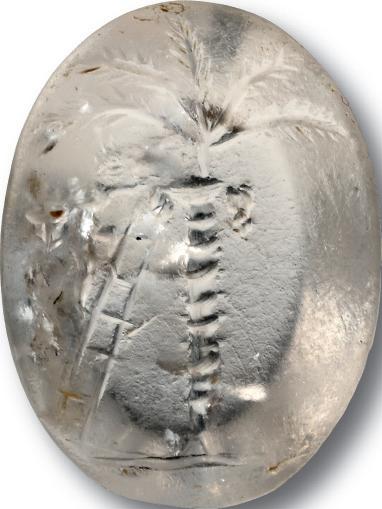

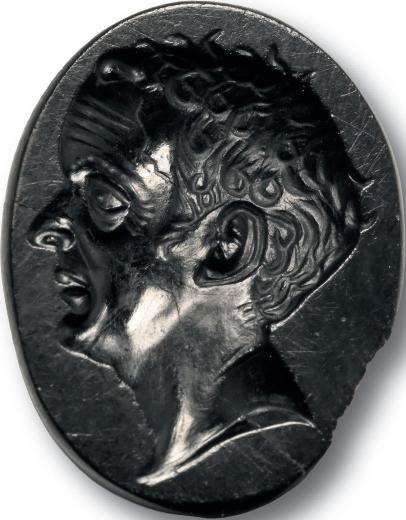

A PRIVATE COLLECTION OF GEMSTONES (LOTS 1 - 33)
Private English collection, formed between the late 1970s and early 1990s. Private collection, London, UK.
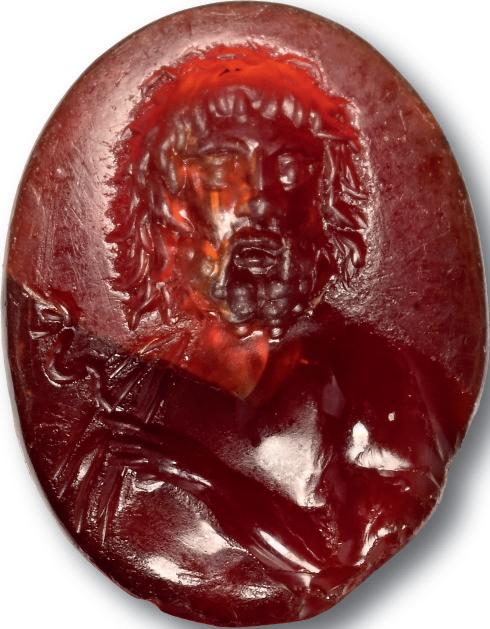
ROMAN CARNELIAN GEMSTONE OF THE GOD SERAPIS
1ST-2ND CENTURY A.D.
½ in. (0.47 grams, 14 mm)
Orangey-red intaglio with a concave front and flat back, depicting the three-quarter bust of Serapis; displaying a tightly curled beard, shoulder-length wavy hair with a central parting brushed up from the forehead, wearing the characteristic calathus (woven basket or cornmeasure) headgear, symbolising fertility.
£1,000 - 1,400
2
ROMAN AQUAMARINE GEMSTONE OF A PHILOSOPHER
LATE 1ST CENTURY B.C.
½ in. (0.90 grams, 14 mm)
Plano-convex in section, incuse facing bust of an elderly man wearing a tunic and toga.
£2,000 - 3,000
3
ROMAN AMETHYST GEMSTONE OF THE GODDESS MINERVA
1ST-2ND CENTURY A.D. in. (0.48 grams, 11 mm)
Plano-convex in section with incuse bust of Minerva wearing a Corinthian-style crested helmet.
£1,200 - 1,700
4
ROMAN CARNELIAN GEMSTONE OF AN ELDERLY MAN
1ST CENTURY A.D. OR LATER ¾ in. (1.15 grams, 18 mm)
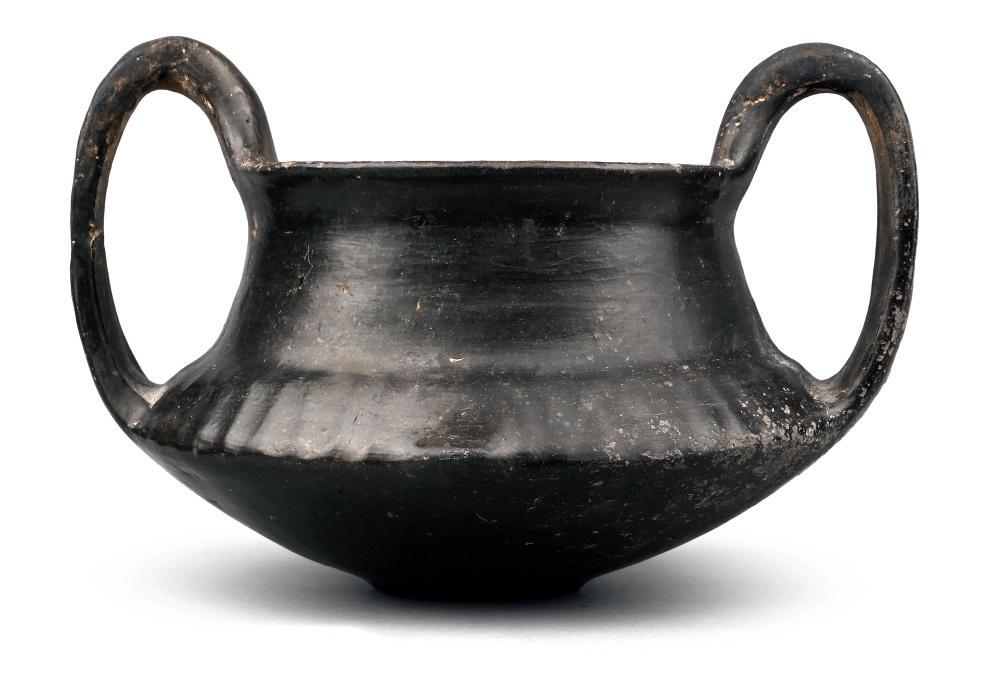
Showing a mature man in profile facing left, modelled after the Roman Republican portrait models.
£500 - 700
5
ROMAN ROCK CRYSTAL GEMSTONE OF A DATE PICKER
1ST-2ND CENTURY A.D. ½ in. (0.71 grams, 12 mm)
Incuse image of a palm tree with splayed fronds, ladder placed against the trunk, and a man with a basket ascending to pick the fruit.
£500 - 700
6
ROMAN BLACK JASPER GEMSTONE OF A REPUBLICAN PORTRAIT
1ST CENTURY B.C. in. (0.91 grams, 17 mm)
Ellipsoid inlay with incuse profile bust of an elderly man with thinning curly hair, wrinkled brow and hollow cheeks.
£1,500 - 2,000
FOOTNOTES:
The piece has been restored after having been split into two parts; retaining a chip to the edge.
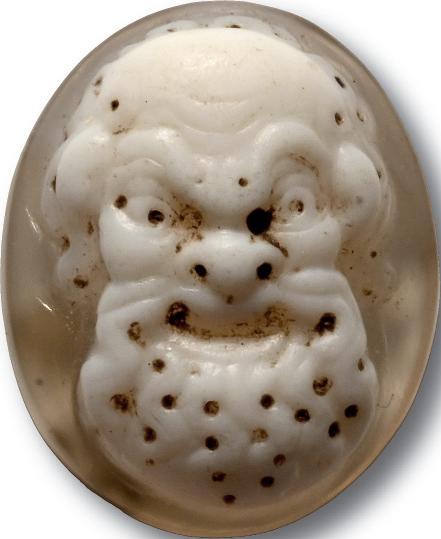

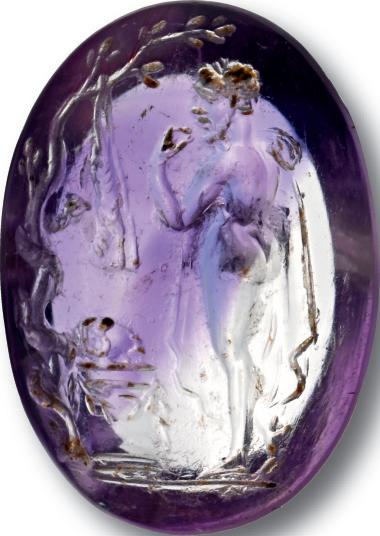





7
ROMAN AGATE CAMEO OF A THEATRICAL MASK OF PORNOBOSKOS
1ST CENTURY B.C.
½ in. (0.69 grams, 12 mm)
Plano-convex in section with reserved facing theatrical mask of Pornoboskos, or brothel-keeper, with bald head and bushy beard.
£1,000 - 1,400
8
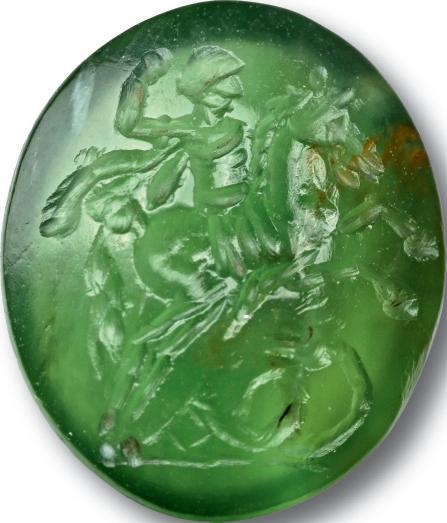
ROMAN GREEN CHALCEDONY GEMSTONE OF HORSE AND RIDER WITH A SNAKE
3RD CENTURY A.D. OR LATER in. (0.43 grams, 10 mm)
Plano-convex type with incuse image of a horseman on rearing steed, plunging a spear into a coiled serpent.
£1,000 - 1,400
9
ROMAN CARNELIAN GEMSTONE OF THE YOUNG GOD HERCULES FIGHTING SNAKES
2ND-3RD CENTURY A.D.
½ in. (0.70 grams, 13 mm)
Intaglio image of Hercules kneeling on a baseline holding a snake aloft in one hand and gripping another in the other hand.
£300 - 400
10
ROMAN AMETHYST GEMSTONE OF JASON AND THE GOLDEN FLEECE
1ST-2ND CENTURY A.D.
½ in. (0.79 grams, 13 mm)
Plano-convex type with incuse image of naked Jason advancing beneath an overhanging tree with Golden Fleece suspended in its branches.
£800 - 1,000
11
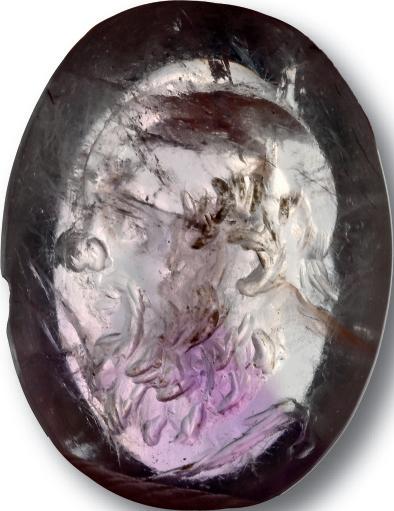
ROMAN PALE AMETHYST GEMSTONE WITH BUST OF THE GOD SILENUS
1ST CENTURY A.D. in. (0.39 grams, 11 mm)
Incuse profile bust of Silenus with full beard and bald head; below, gnarled walking stick made from a vine.
£1,000 - 1,400
12
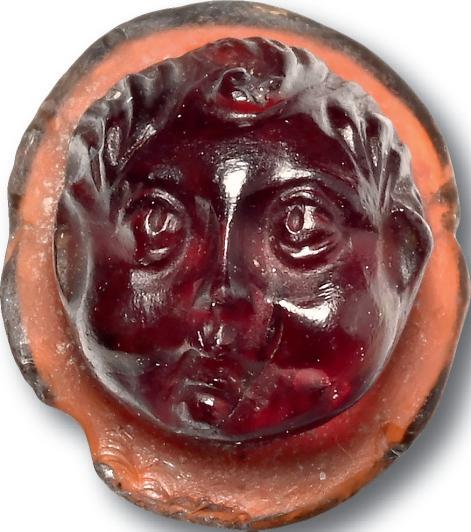
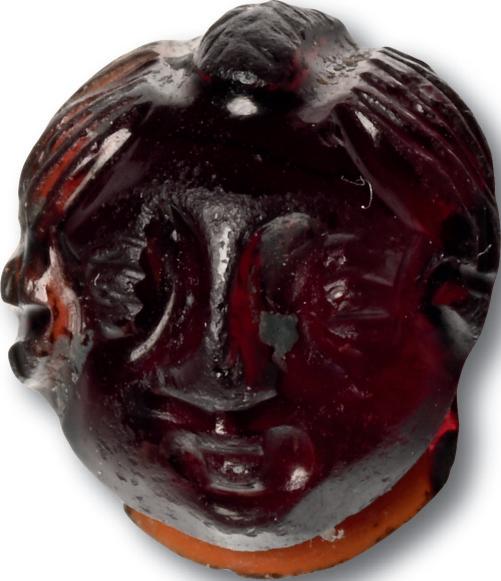
ROMAN GARNET CAMEO OF EROS THE GREEK GOD OF LOVE
1ST-2ND CENTURY A.D. in. (0.42 grams, 8 mm)
Discoid in plan with high-relief mask of Cupid (Greek Eros).
£700 - 900






13
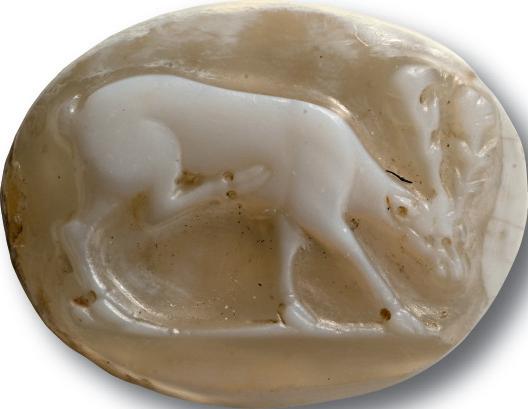
ROMAN AGATE CAMEO OF A STAG
1ST CENTURY B.C.-2ND CENTURY A.D. in. (1.09 grams, 16 mm)
Ellipsoid plaque with reserved stag grazing, one hindleg raised to the flank.
£1,000 - 1,400
FOOTNOTES:
The surface is burnt, hence the colour change.
14
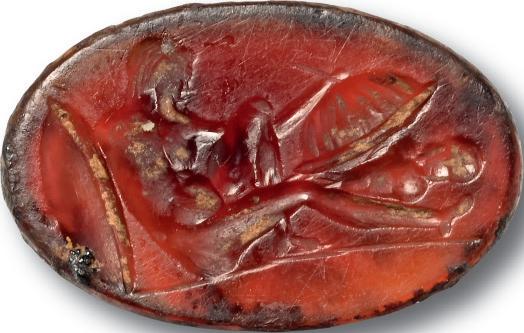
ROMAN SARD GEMSTONE OF OTHRYADES THE FALLEN
WARRIOR WRITING ON A SHIELD
1ST-2ND CENTURY A.D.
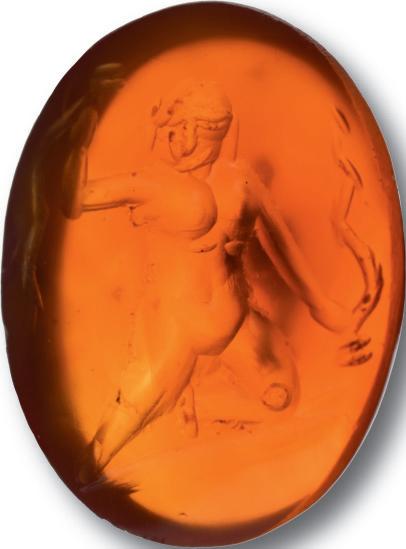
½ in. (0.50 grams, 14 mm)
With incuse scene on a baseline depicting a nude warrior resting on a baseline with his shield propped behind his back, one leg bent and one arm extended towards the convex shield of another warrior (visible as head and trunk), with a stylus in his hand in the act of inscribing the shield.
£300 - 400
15
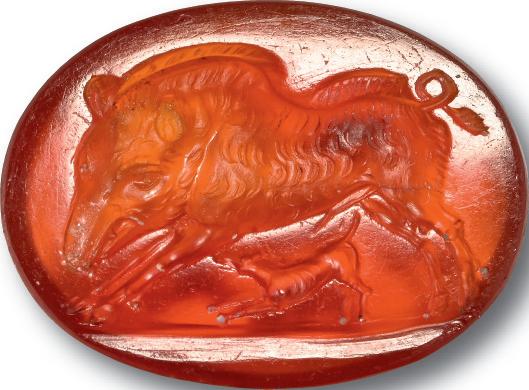
ROMAN CARNELIAN GEMSTONE OF A WILD BOAR AND DOG
1ST CENTURY B.C.-1ST CENTURY A.D. in. (0.79 grams, 16 mm)
Ellipsoid in plan with incuse hunting scene depicting a large boar running on a baseline with a hunting dog attacking from beneath.
£2,000 - 3,000
16
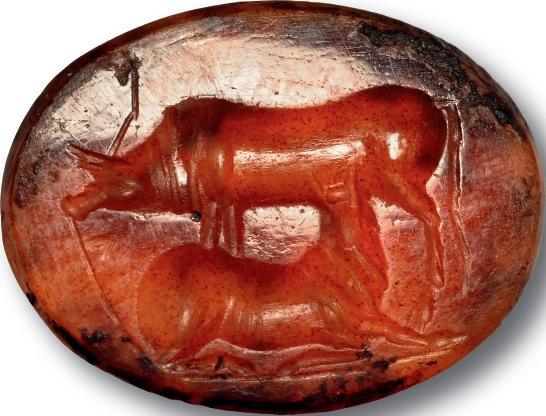
ROMAN CARNELIAN GEMSTONE WITH TWO COWS
1ST-2ND CENTURY A.D.
½ in. (0.35 grams, 13 mm)
Ellipsoid type with intaglio of a reclining cow with its head turned to the right, facing, another one standing behind in profile; supplied with a museum-quality impression.
£800 - 1,000
17
KUSHAN OR INDO-GREEK ROCK CRYSTAL GEMSTONE WITH A MATURE MAN AND ANIMALS
1ST-3RD CENTURY A.D. ¾ in. (2.44 grams, 18 mm)
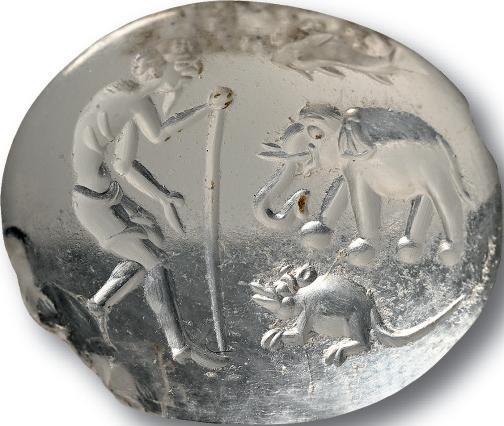
Plano-convex in section with incuse image of an advancing elderly man with a staff facing three beasts: dolphin, elephant and rat; possibly Kushan workmanship.
£400 - 600
18
ROMAN SARDONYX CAMEO OF FISH AND SHRIMP
2ND-4TH CENTURY A.D. in. (0.90 grams, 17 mm)
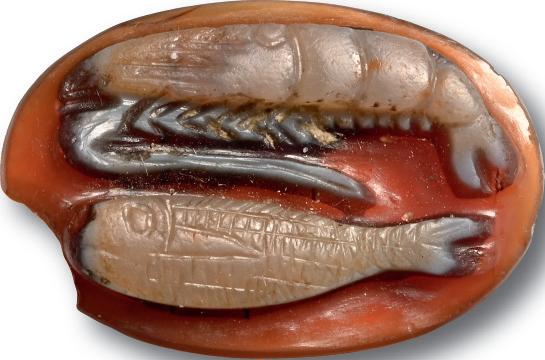
Ellipsoid plaque with reserved fish with scale detailing to the flank, shrimp with segmented body.
£1,000 - 1,400





19
SASANIAN GARNET GEMSTONE OF A LION 5TH-7TH CENTURY A.D. in. (0.55 grams, 10 mm)
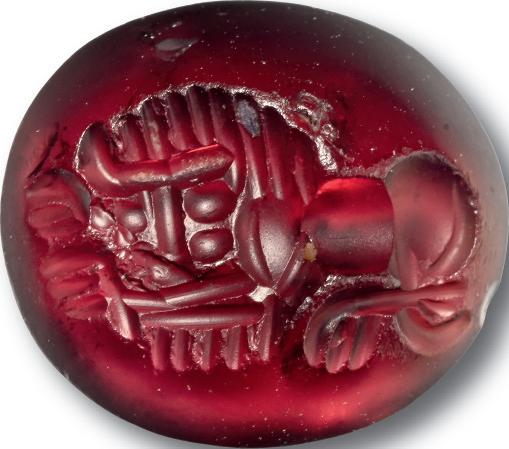
Plano-convex in section with incuse sleeping lion.
£500 - 700
20
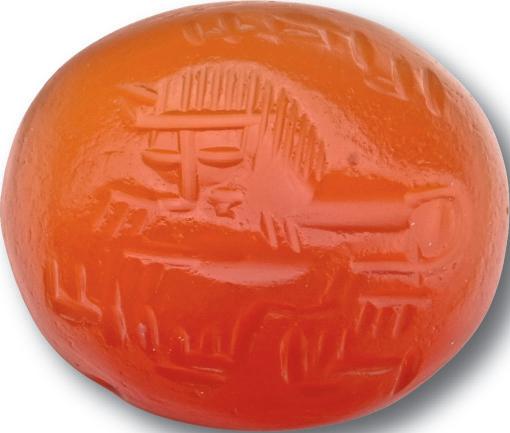
SASANIAN CARNELIAN GEMSTONE OF A LION WITH PAHLAVI INSCRIPTION
5TH-7TH CENTURY A.D. ½ in. (1 grams, 12 mm)
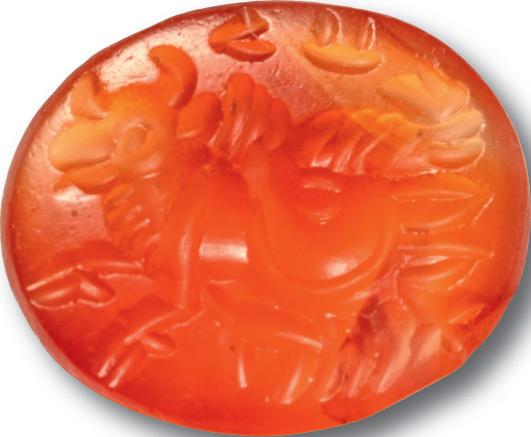
Plano-convex in section with incuse crouching lion motif, bands of Pahlavi script above and below.
£500 - 700
21
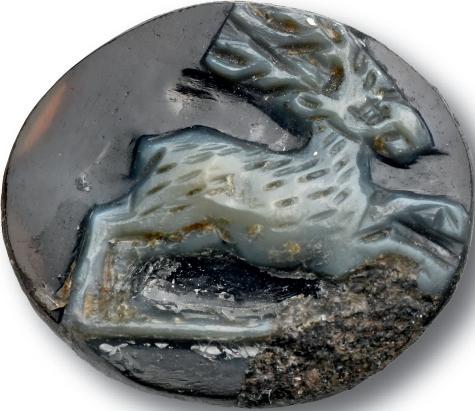
ROMAN SARDONYX CAMEO OF A LEAPING STAG
2ND-3RD CENTURY A.D. in. (0.43 grams, 11 mm)
With a cameo image of a male antelope jumping right; supplied with a museum-quality impression.
£400 - 600

22
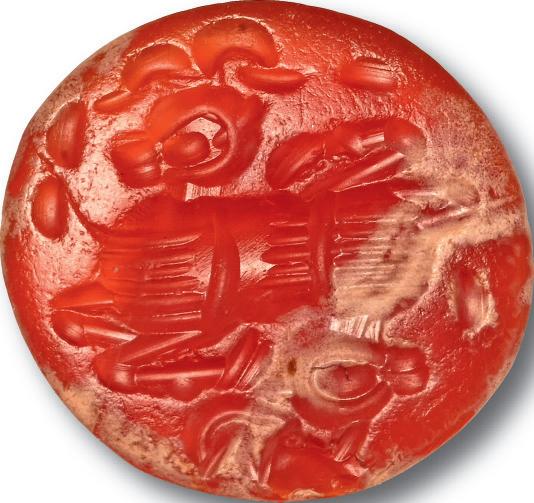
SASANIAN CARNELIAN GEMSTONE OF A FANTASTIC CREATURE WITH PAHLAVI LEGEND
4TH-5TH CENTURY A.D. in. (0.32 grams, 10 mm)
Plano-convex in section with advancing winged and horned beast, Pahlavi legend to the border.
£500 - 700
23
SASANIAN CARNELIAN GEMSTONE OF AN IBEX WITH INSCRIPTION
5TH-7TH CENTURY A.D. in. (0.42 grams, 11 mm)
Discoid in plan with incuse ibex with the legs folded beneath the body; text in the field.
£700 - 900
24
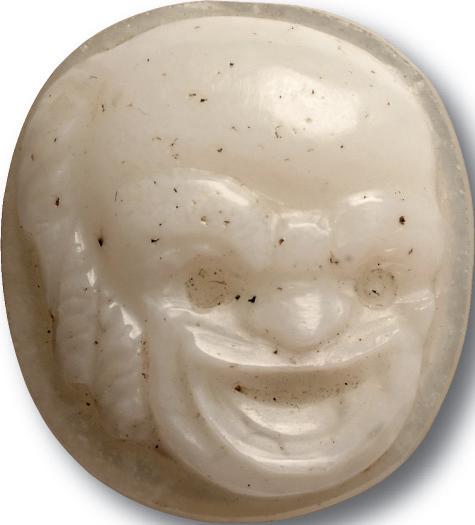
ROMAN AGATE CAMEO OF A THEATRICAL MASK
1ST CENTURY A.D.
½ in. (1.07 grams, 13 mm)
Showing a New Comedy ‘Cook’ type theatre mask, with an open mouth; supplied with a museum-quality impression.
£1,000 - 1,400




25
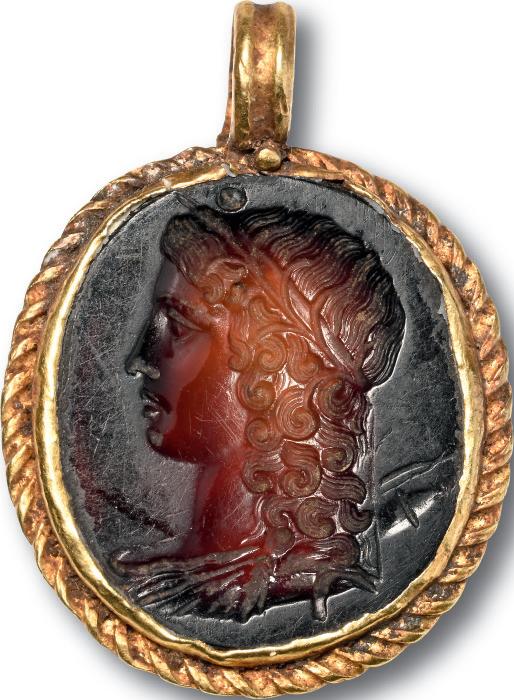
GRAECO-ROMAN SARD GEMSTONE OF THE GOD APOLLO IN GOLD MOUNT
2ND-1ST CENTURY B.C.
1 in. (1.66 grams, 24 mm)
With intaglio profile bust of youthful male with curly hair, wearing a headdress; set in a later Roman period gold mount with roped border and attachment loop to the top.
£1,200 - 1,700
26
ROMAN CARNELIAN GEMSTONE OF ASCLEPIUS, THE GOD OF MEDICINE WITH SNAKE
1ST CENTURY A.D.
½ in. (0.64 grams, 14 mm)
Intaglio facing bust of the god Asclepius with serpent in one hand.
£1,000 - 1,400
27
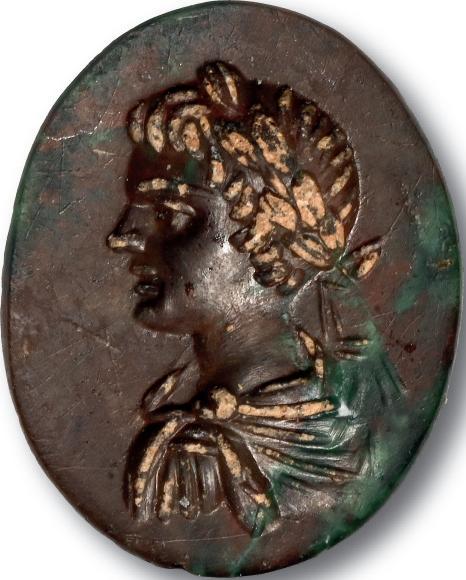
ROMAN GREEN JASPER GEMSTONE OF YOUNG EMPEROR CARACALLA
CIRCA 198-217 A.D.
½ in. (0.63 grams, 14 mm)
Incuse profile bust of a youth wearing a mantle secured at his chest, with a wreath in his tousled hair; probably Caracalla or Geta.
£600 - 800
28
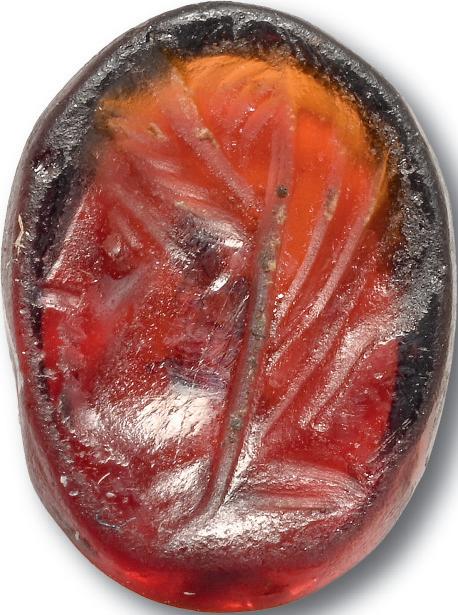
GRAECO-ROMAN GARNET GEMSTONE WITH VEILED HEAD OF A QUEEN

3RD-2ND CENTURY B.C. in. (0.36 grams, 9 mm)
Finely-cut profile bust of a woman with palla folded over her head and neck; possibly Ptolemaic.
£500 - 700
29
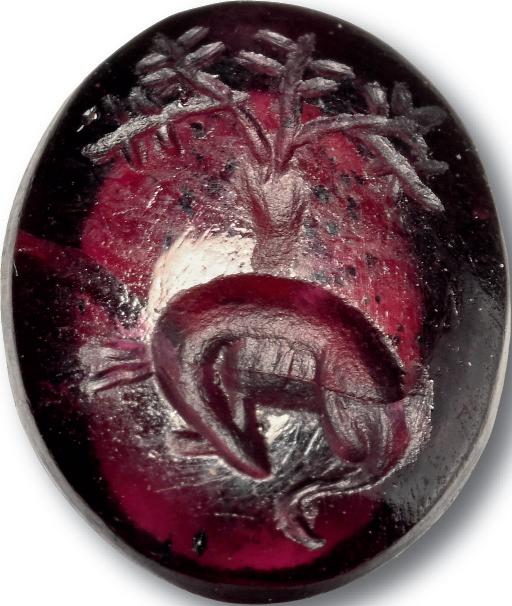
ROMAN GARNET GEMSTONE OF A SLEEPING DOG UNDER A TREE
2ND-3RD CENTURY A.D. in. (0.54 grams, 9 mm)
Convex obverse with incuse image of a tree with spreading branches and foliage, sleeping dog curled up at the base of the trunk.
£400 - 600

30
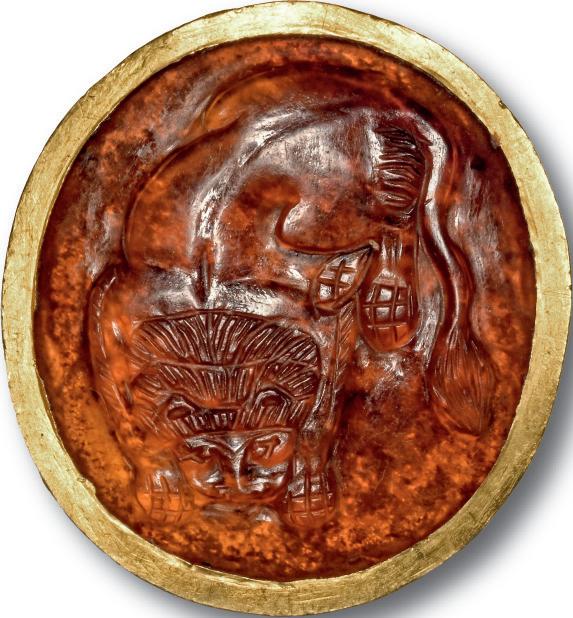
ROMAN CARNELIAN CAMEO OF A CROUCHING LION IN GOLD MOUNT
EASTERN ROMAN, 3RD-4TH CENTURY A.D.
1 in. (2.72 grams, 25 mm)
Discoid cell with flange rim, inset convex gemstone with reserved image of a lion resting with his head on his forepaws.
£3,000 - 4,000
31
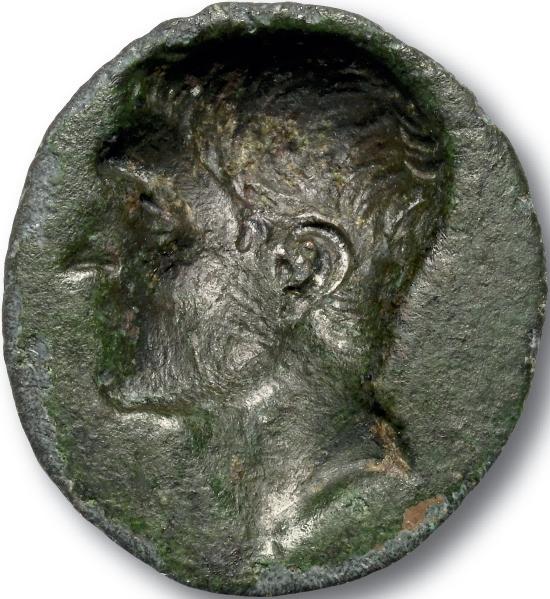
ENGRAVED BRONZE SEAL OF A REPUBLICAN PERIOD MALE PORTRAIT
2ND-1ST CENTURY B.C.
in. (3.11 grams, 17 mm)
Discoid in plan with deeply engraved clean-shaven male bust.
£400 - 600
32
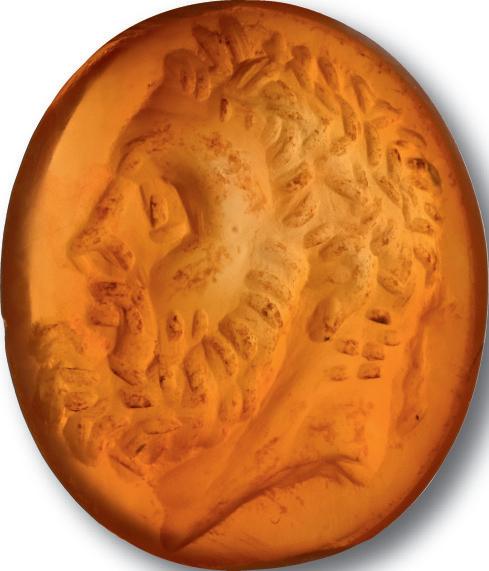
ROMAN CARNELIAN GEMSTONE WITH PORTRAIT OF HERCULES
1ST CENTURY B.C.-1ST CENTURY A.D.
½ in. (0.83 grams, 14 mm)
Discoid in plan with intaglio profile bust of Hercules sporting a browband and thick beard.
£1,200 - 1,700
33
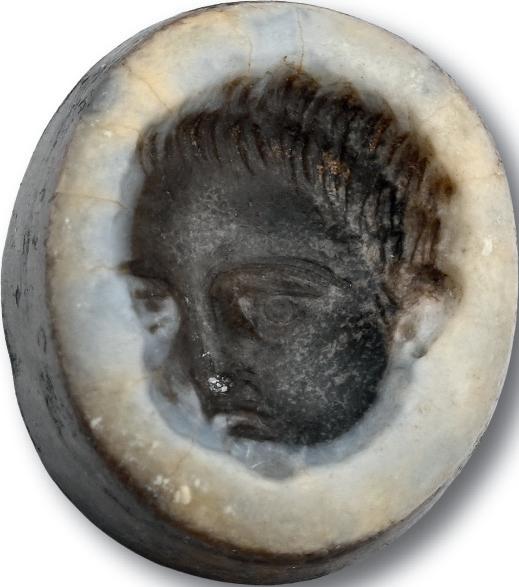
ROMAN NICOLO GEMSTONE OF BOY 1ST CENTURY A.D.
¼ in. (0.18 grams, 7 mm)
Discoid in plan with incuse juvenile head in three-quarter view.
£1,000 - 1,400
34
ROMAN GARNET CAMEO OF EROS THE GREEK GOD OF LOVE
1ST CENTURY B.C.-1ST CENTURY A.D. in. (0.76 grams, 9 mm)
With the head of Eros (Roman Cupid), the god of love, facing; supplied with a museum-quality impression.
£600 - 800
PROVENANCE:
Private English collection, formed between the late 1970s and early 1990s. Private collection, London, UK.





36
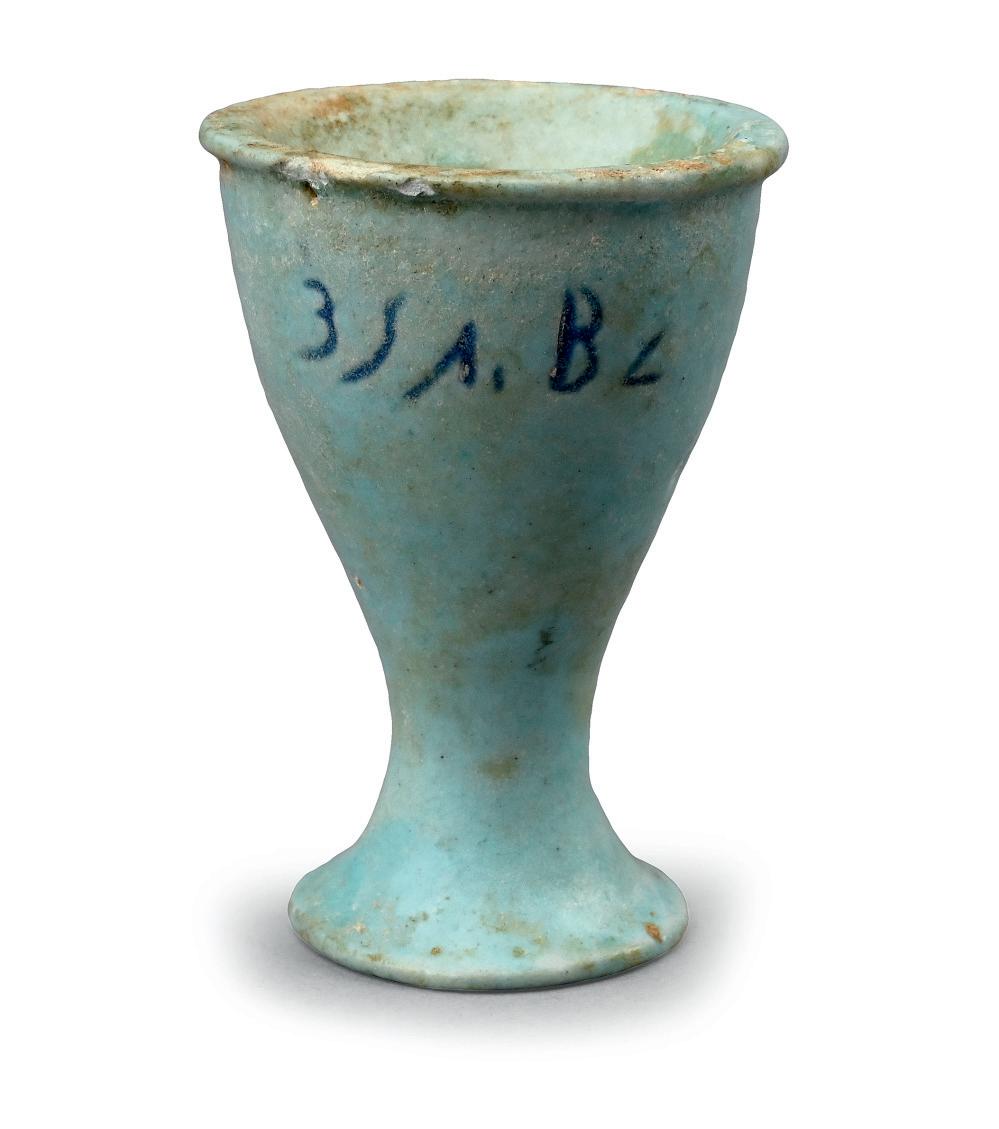
EGYPTIAN BLUE FAIENCE OFFERING CUP WITH INSCRIPTION
LATE PERIOD-PTOLEMAIC PERIOD, 664-30 B.C.
2½ in. (57 grams, 62 mm)
Conical in profile with a wide base and a shallow interior hollow; inscription in a darker blue glaze, consisting of a single line of demotic-script text.
£1,000 - 1,400
PROVENANCE: Mariaud de Serres, Drouot, Paris, 1999. with Christie’s, New York, 5-6 December 2001, no.354.
Accompanied by copies of the relevant Christie’s catalogue pages.
FOOTNOTES:
Demotic script was an ancient Egyptian writing system that was used from approximately the 7th century B.C. to the 4th century A.D. It represented a more simplified and cursive form of writing compared to hieroglyphs and hieratic script. Demotic text was employed for a wide range of purposes in ancient Egypt, including administrative, legal, religious, and literary documents. Deciphering Demotic has played a pivotal role in enhancing our understanding of ancient Egyptian culture, history, and everyday life.
35
PHOENICIAN LIMESTONE FUNERARY MASK
CIRCA 4TH-3RD CENTURY B.C.
7¾ in. (1.3 kg total, 19.7 cm including stand)
Carved in the half-round with tall nose and chin with false beard dua wer, full lips and wide cheeks, stylised eyes and asymmetrical eyebrows; mounted on a custom-made stand.
£1,000 - 1,400
PROVENANCE: Private collection, Europe. Acquired on the French art market.
37

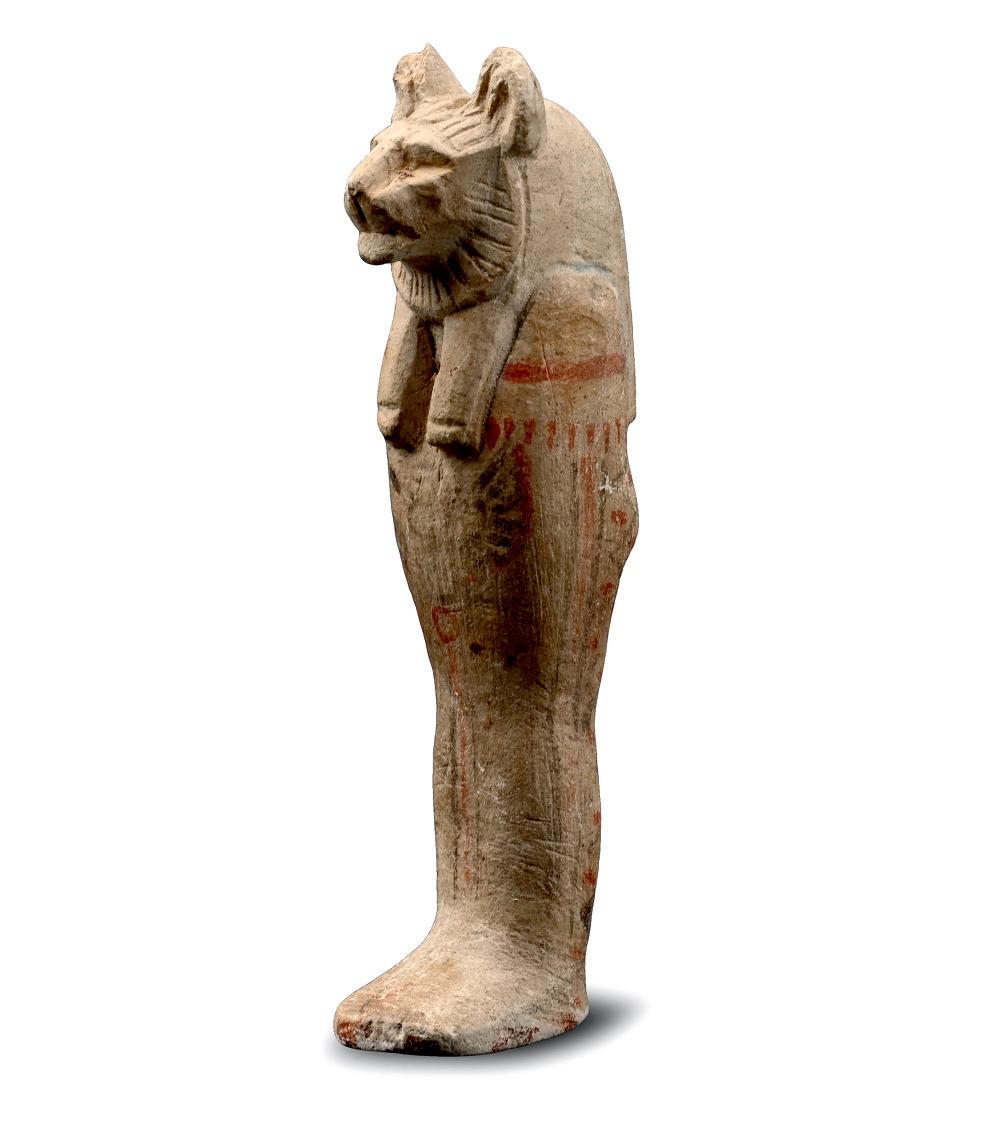
EGYPTIAN PAINTED LIMESTONE MUMMIFORM SEKHMET STATUETTE
CIRCA 7TH-6TH CENTURY B.C.
3 in. (29 grams total, 77 mm including stand)
Carved in the round depiction of Bastet or Sekhmet in a lion-headed form with a tripartite headdress, with front lappets overlain by the leonine mane; between the ears, a hole possibly for the insertion of a separate sun disc element; red pigment lines and fringe to the shoulders; a black diamond pattern with central red dots decorating the back, and a winged scarab in black on the abdomen; marked on the underside with the collector’s reference ‘BAOP SAKKARA’; mounted on a custom-made display stand.
£4,000 - 6,000
PROVENANCE:
Private collection of George Anastase Michaelides (1900-1973) and legally exported from Egypt in the 1940s.
Black ink inscription on base BAOP SAKKARA. Christie’s, London, 29 October 2003, no.167.
Accompanied by a copy of the relevant Christie’s catalogue pages.
FOOTNOTES:
Considering the specified Saqqara provenance, it is probable that the statuette originated from the Bubastaeion, dedicated to Bastet. The goddess was more commonly depicted as a cat or a human with a cat’s head, although she also sometimes displayed a leonine aspect. It is also possible that the statuette represents her son, Mahes, who was depicted as a man with a lion’s head.
38

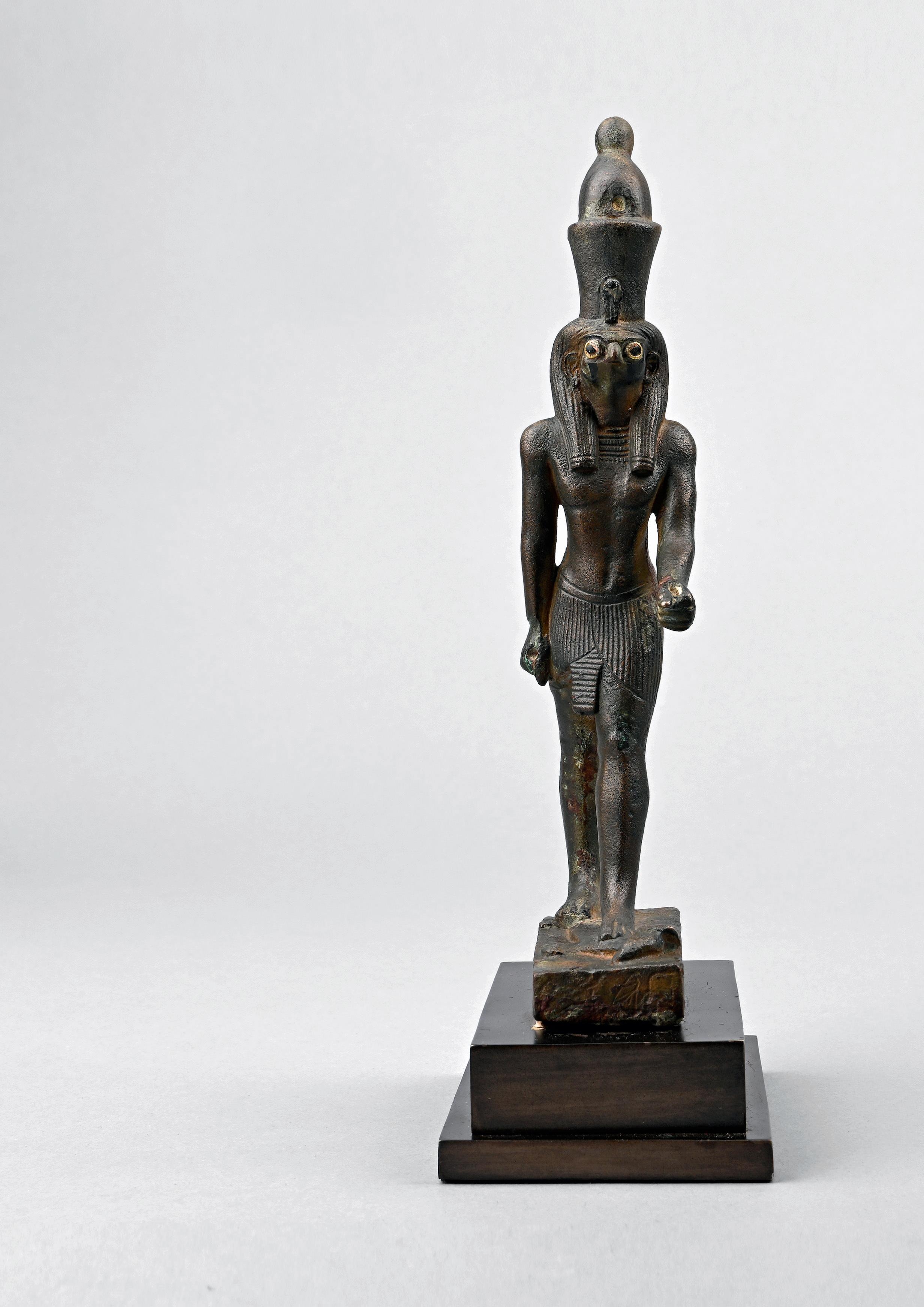
EGYPTIAN BRONZE FIGURE OF HORUS STANDING ON AN ORYX
LATE PERIOD-PTOLEMAIC PERIOD, 664-30 B.C. 9 in. (1.1 kg total, 23 cm high including stand)
Standing falcon-headed deity with eyes inlaid in gold, wearing the traditional shendyt kilt, a tripartite wig topped by the double crown (pa-sekhemty) fronted by a uraeus, as worn by Egyptian pharaohs, and a wesekh collar; the figure depicted striding forward, with the position of the left arm and drilled hand indicating that it originally held the shaft of a sceptre or a weapon; the right hand also drilled to hold an attribute; the rectangular base featuring a low-relief depiction of an oryx beneath the god’s feet, the four sides of the base bear a line of hieroglyphic invocation giving the name of the deity represented by the statuette and those of the dedicator and his family; two tenons on underside for attachment; mounted on a custom-made display stand.
£20,000 - 30,000
PROVENANCE:
with Sakae Art Gallery, Nagoya, Japan, 1981.
Accompanied by an academic report by Dr Alberto Pollastrini.
PUBLISHED:
Small is Beautiful: The Art of Sculpture; Christie’s, South Kensington, 6-20 October 2015, no.24.
FOOTNOTES:
The hieroglyphic inscription surrounding the base is worn and difficult to interpret. Based on the formulas preserved on similar statuettes, a tentative interpretation of its meaning can be proposed. The text begins with the customary formula d mdw, meaning words to be spoken, followed by the hieroglyph of a falcon, indicating that the deity addressed is Horus. The following signs are unclear, making it hard to identify which specific form of Horus is meant, possibly Horus of Hebenu or Horus the Elder. The formula continues with a plea for the god to grant the dedicator life, prosperity, health, longevity, and a good old age. The inscription ends with the name of the offerer: Pa-iu, son of Pa-di-Aset; his mother Ta-heret; and his wife Aset, justified.

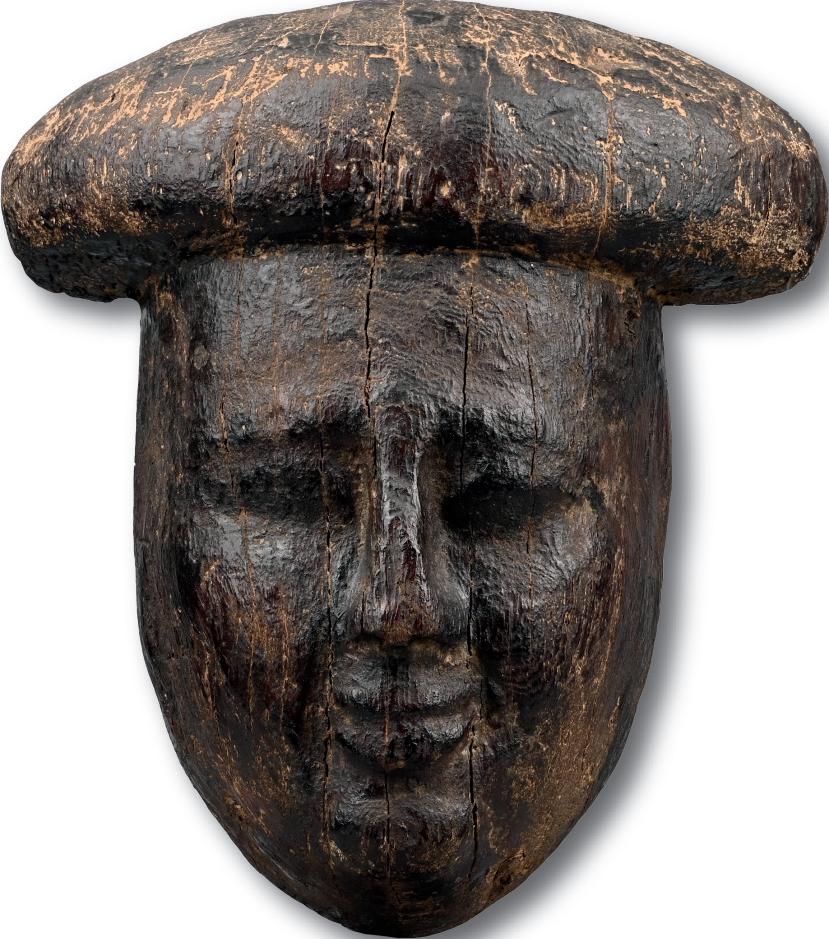

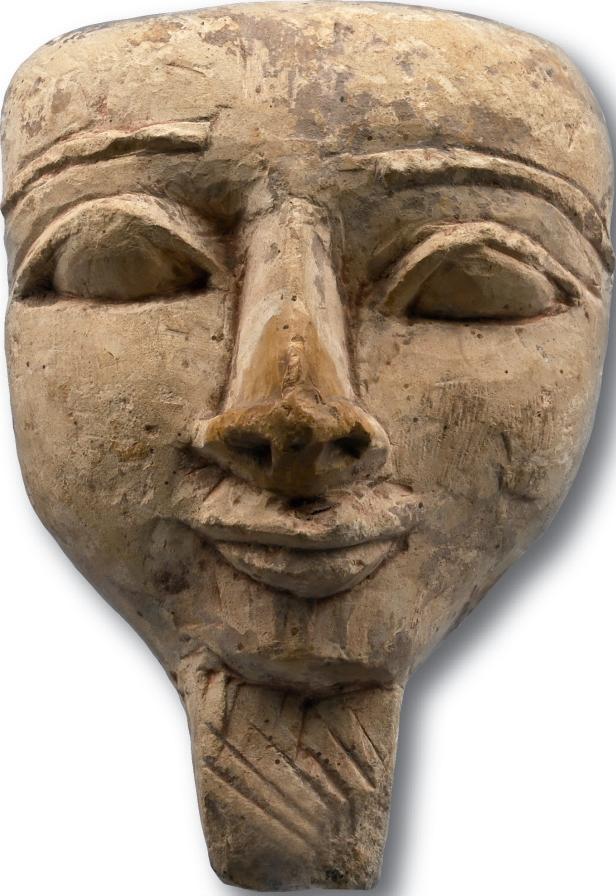
EGYPTIAN WOODEN MUMMY MASK LATE PERIOD, 664-332 B.C.
15¼ in. (4.85 kg total, 38.8 cm high including stand)
Columnar in form with carved facial detailing, thick block of hair, full lips; pierced to reverse for attachment.
£1,500 - 2,000
PROVENANCE:
English private collection, formed in the early 20th century. Acquired on the English art market.
40
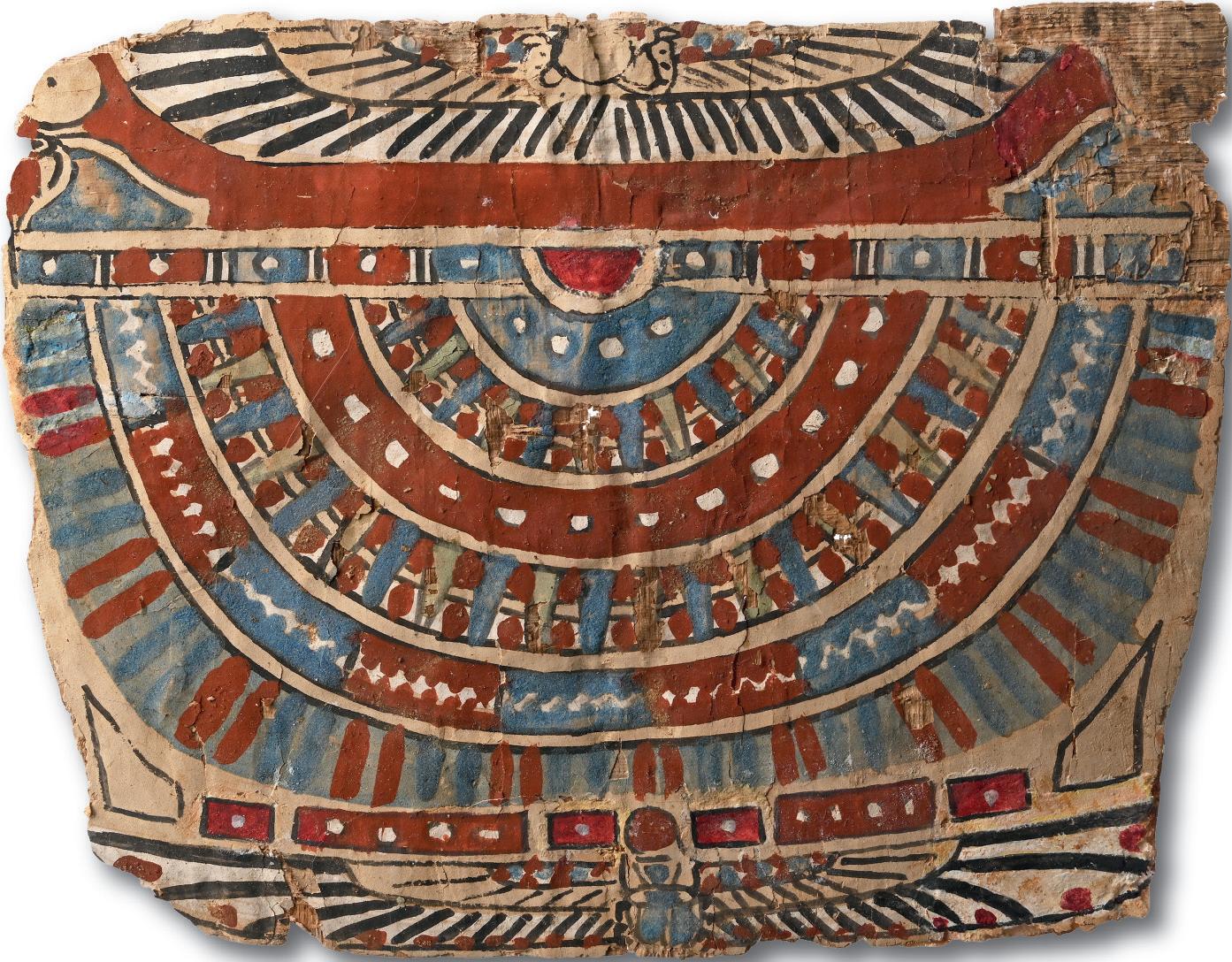
EGYPTIAN CARTONNAGE PANEL WITH PECTORAL LATE PERIOD-PTOLEMAIC PERIOD, CIRCA 664-30 B.C.
12 in. (2.06 kg total, 31.4 cm wide including stand)
A rectangular cartonnage panel with bands of triangles, teardrops and other motifs in white, red, blue and pale green; winged scarab to the bottom, lower portion of a winged sun disc flanked by uraei to the top; mounted on a custom-made stand.
£1,800 - 2,400

PROVENANCE: Ex early 20th century collection, London, UK.
41
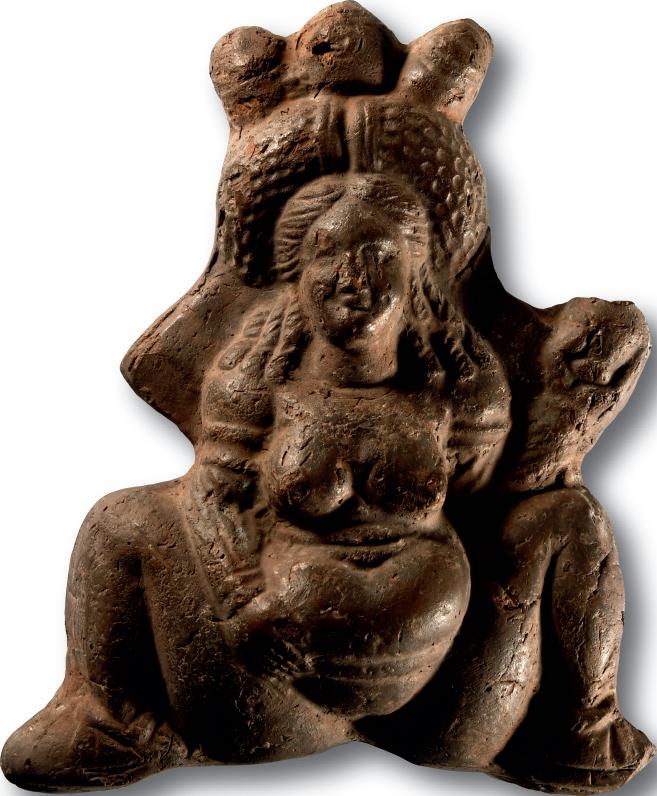
LARGE ROMANO-EGYPTIAN TERRACOTTA FIGURE OF BAUBO PTOLEMAIC PERIOD, 332-30 B.C.
6 in. (373 grams, 15.5 cm)
Modelled as a seated plump female figure; the right hand touching the pubic area beneath the rounded abdomen, wearing a tall headdress of thick braids falling on her shoulders, smooth back with a vent hole; chipped at left foot and arm.
£800 - 1,000
PROVENANCE: with Superior Galleries, Los Angeles, USA. Ex Dr W. Benson Harer, Los Angeles, USA, March 1985.
EXHIBITED: Robert & Frances Fullerton Museum or Art (RAFFMA), California State University, 1998-2023, with reference no.EL01.098.1998.
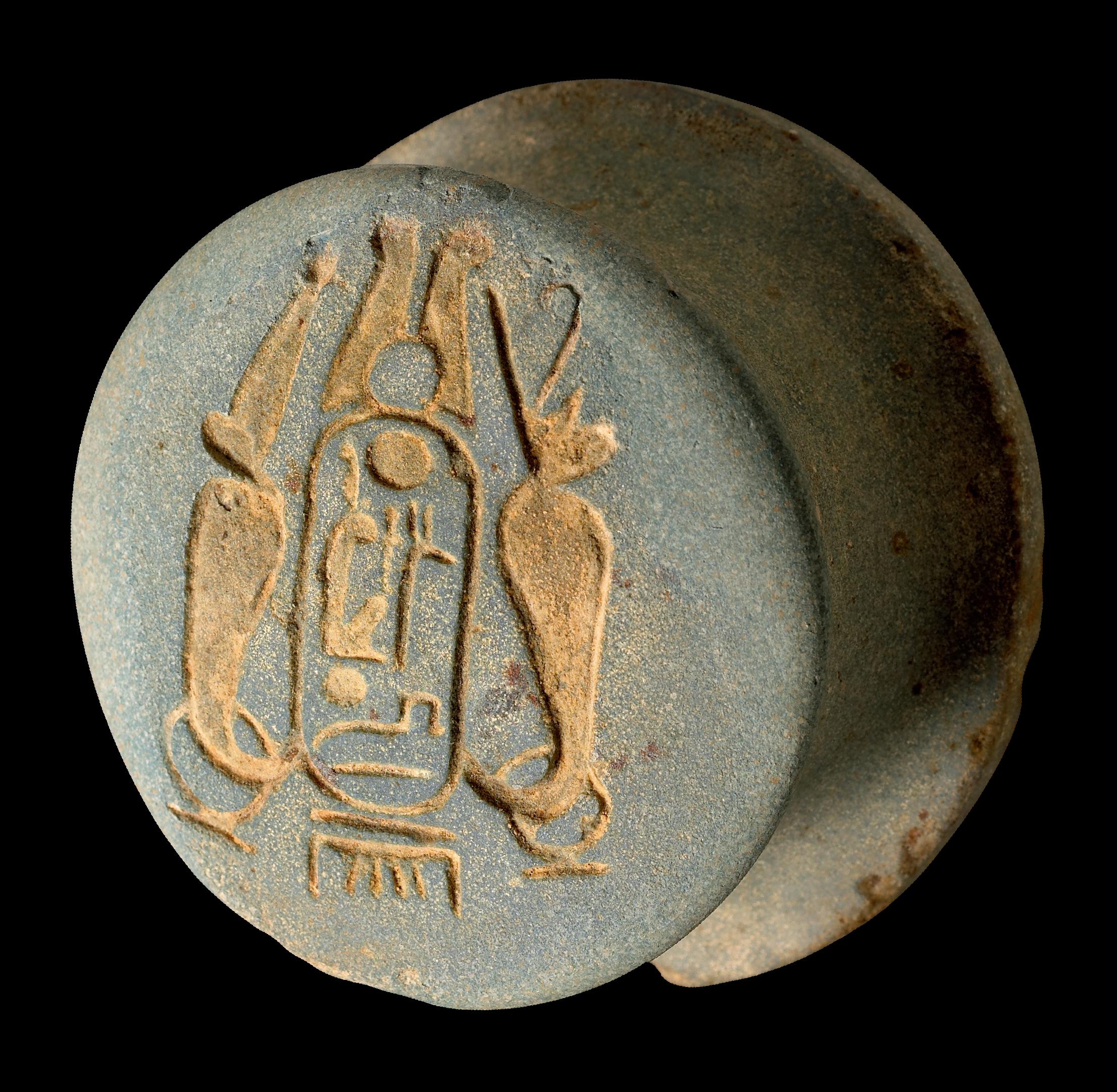

LARGE EGYPTIAN BLUE FAIENCE ROUNDEL FOR RAMESSES II NEW KINGDOM, 19TH DYNASTY, 1295-1186 B.C. 5½ in. (475 grams total, 14 cm including stand)
A fitting or pommel made for King Ramesses II, his throne name (User-Maat-Re Setep-en-Re) inscribed within a cartouche topped by two ostrich feathers framing a solar disc; the cartouche positioned above the hieroglyphic sign nbw, which signifying ‘gold’ and alluded to the luminous radiance of the royal name; two uraei flanking the cartouche wearing the White Crown of Upper Egypt and the Red Crown of Lower Egypt, respectively; the throne name roughly translating as ‘The justice of Re is powerful, chosen of Re’; a squareshaped socket located at the back for attachment; mounted on a custom-made display stand.
£10,000 - 14,000
PROVENANCE: Formerly with G. Janes, Manchester, UK and collection Galerie Nefer. Previously with Cybele Galerie Librairie Egyptologie, Paris, France. From an important English collection.
PUBLISHED: ‘Nefertari regina d’Egitto’ An exhibition of 130 objects from the British Museum, the Louvre, the Egyptian Museum of Turin, the Turin Archaeological Museum, and the Royal Library of Turin. In collaboration with the Getty Conservation Institute, 6 October 1994 - 5 June 1995.
FOOTNOTES: The epithet part of the throne name Setep en Re appears in Ramesses II’s royal titulary from Year 2 of his reign. The two rearing cobras, which symbolise the goddesses Nekhbet and Wadjet, also represent the unity of the Two Lands under Ramesses II’s rule. A similar green faience fitting bearing Ramesses II’s throne name is kept in the Archaeological Collection of Zürich (inv. no. 3702). Similar objects linked to the 18th Dynasty kings Akhenaten and Ay show that such fittings were not limited to the 19th Dynasty. They may even have influenced later designs, as the fitting of King Ay, possibly from a piece of heirloom furniture, was found among the tomb goods of Nefertari, Ramesses II’s Chief Queen.


43


45
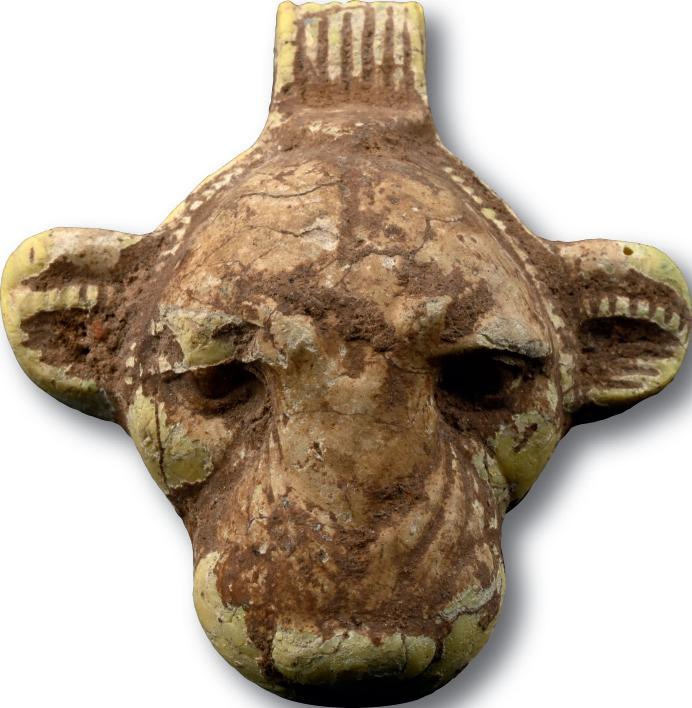
LARGE PHOENICIO-EGYPTIAN FAIENCE AMULET OF A FELINE
HEAD
LATE 1ST MILLENNIUM B.C. 1¾ in. (31.9 grams, 46 mm)
Modelled in the half-round with fine detailing and a ribbed suspension loop.
£800 - 1,000
PROVENANCE:
Ex collection of a Surrey lady, circa 1940s.
FOOTNOTES:
It is unclear which deity the head represents, though either Sekhmet or Bastet is likely.
44
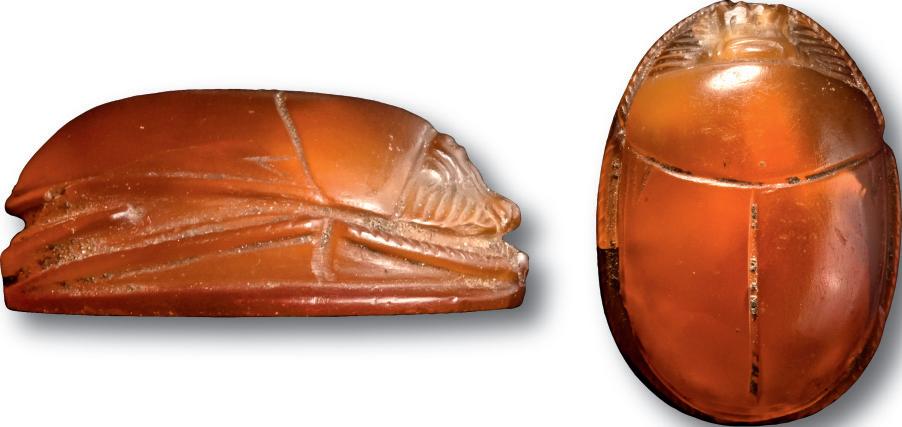
LARGE EGYPTIAN CARNELIAN SCARAB
PTOLEMAIC-ROMAN PERIOD, CIRCA 332 B.C.-300 A.D. in. (4.75 grams, 22 mm)
Carved in the round with segmented carapace, pierced longitudinally for suspension.
£1,000 - 1,400
PROVENANCE:
UK private collection before 2000. Acquired on the UK art market. Private collection, London, UK.
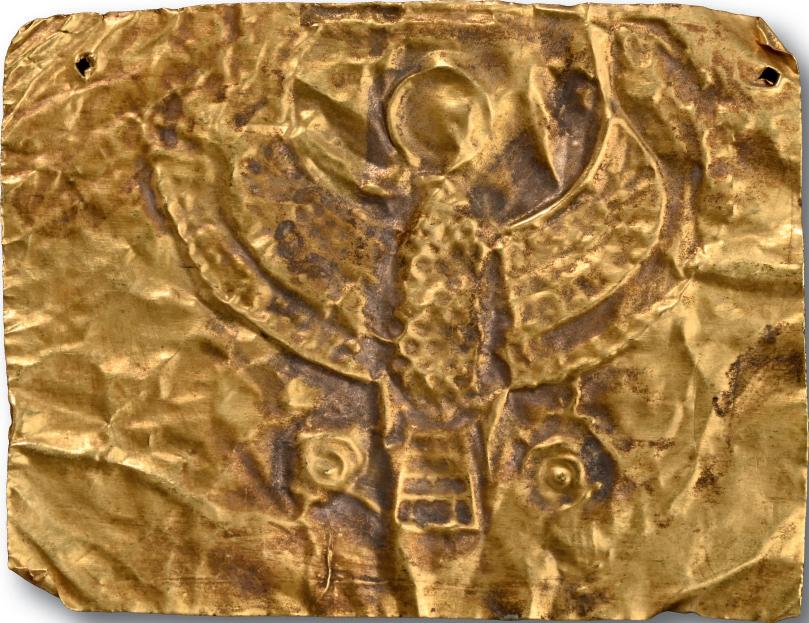
EGYPTIAN GOLD PLAQUE WITH THE FALCON GOD HORUS
LATE PERIOD, 664-332 B.C. 1 x 1¼ in. (1.03 grams, 40 x 31 mm)
Rectangular foil panel featuring a repoussé motif of a bird with wings spread in an arc, with a sun-disc on its head, and claws clutching each a shen ring; honeycomb detailing on the wings and body.
£500 - 700
PROVENANCE:
UK private collection before 2000. Acquired on the UK art market. Private collection, London, UK.
46
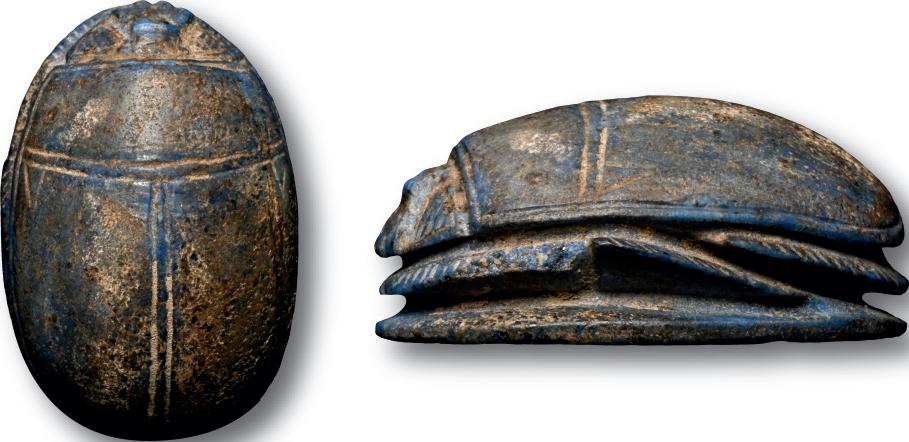
LARGE EGYPTIAN LAPIS LAZULI HEART SCARAB
NEW KINGDOM, 1550-1070 B.C. ½ in. (31 grams, 39 mm)
Naturalistically modelled head, thorax, and abdomen, with elytra outlined by incised lines; front, middle, and hind legs visible at the sides and merging into an oval base plinth.
£2,500 - 3,500
PROVENANCE: Ex early 20th century collection, London, UK.

47
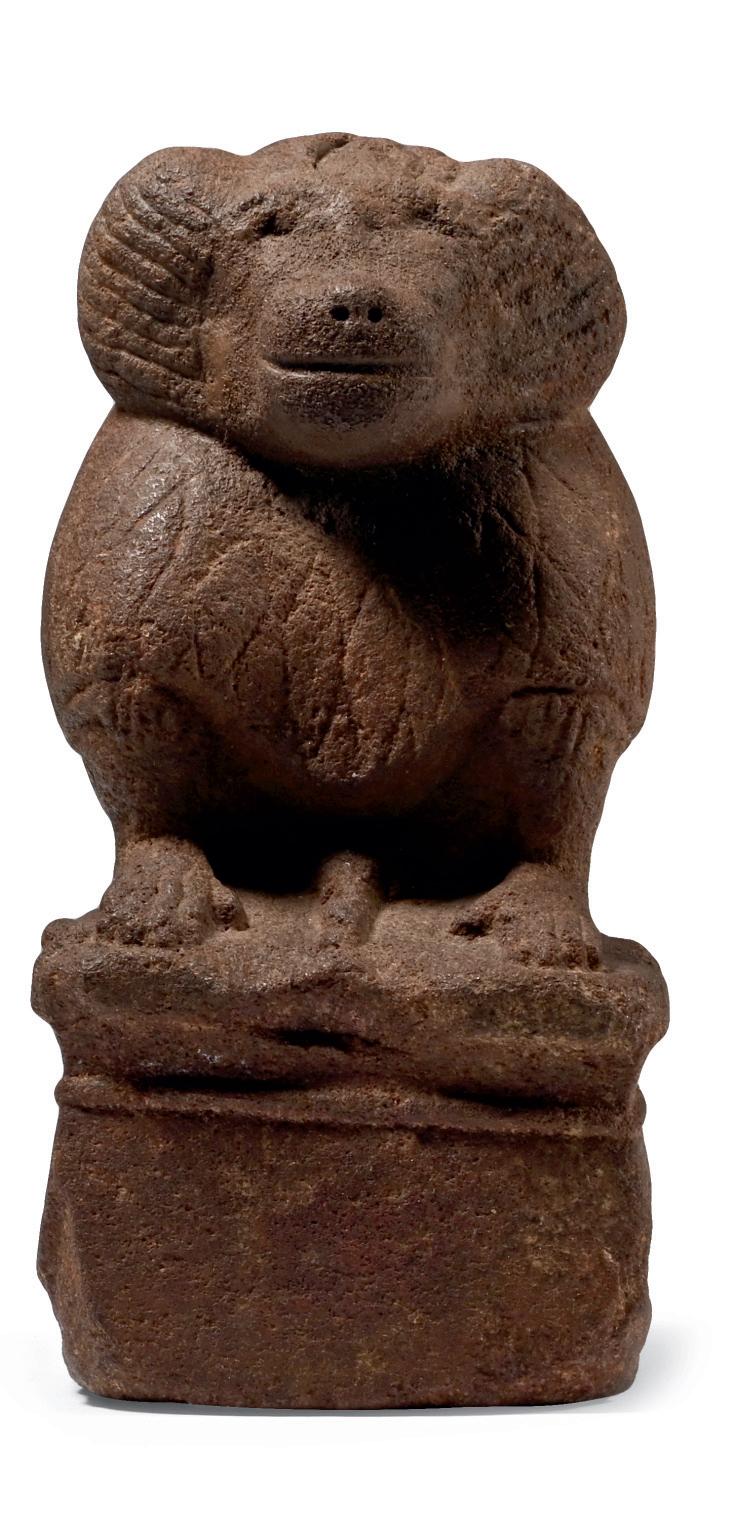
EGYPTIAN BROWN QUARTZITE FIGURE OF THE BABOON GOD THOTH ‡ NEW KINGDOM, CIRCA 1550-1070 B.C.
5 in. (1.15 kg, 15 cm)
Carved in a typical pose, sitting on its haunches with its tail curving around the right side, its front paws resting on its knees and protruding beneath its thick furry pelt, with incised detailing, its feet either side of the phallus, the head with bulbous, striated hair on either side, chipped, snout restored; seated on a high shrine-shaped plinth with squared front and rounded back, featuring a cavetto cornice and roll detailing on the upper part.
£5,000 - 7,000
PROVENANCE:
From a deceased American estate, 1970-1989. with Bonhams, London, 28 October 2009, no.35.
48
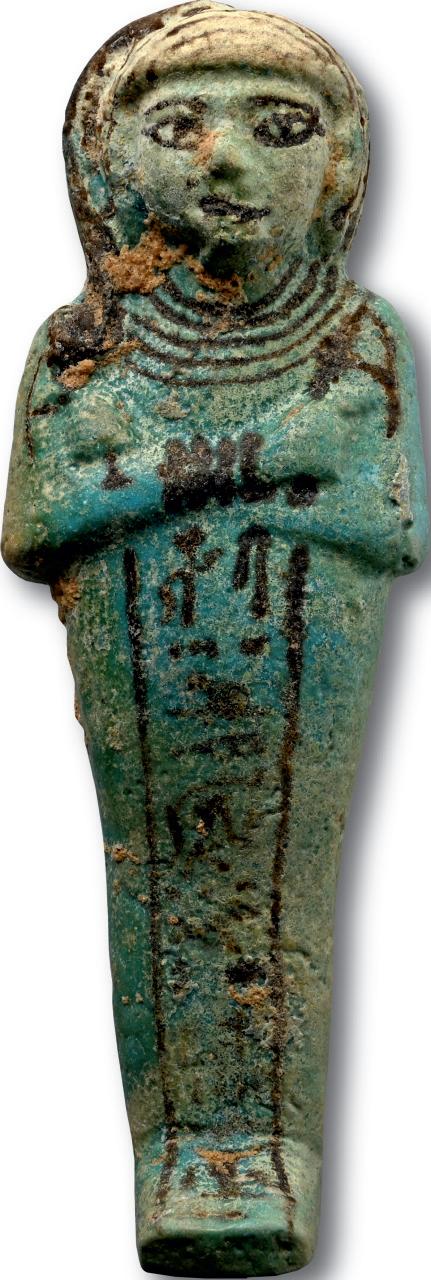
EGYPTIAN FAIENCE USHABTI ‡ 2ND MILLENNIUM B.C.
5 in. (134 grams, 15 cm)
Mummiform figure with black-pigment facial detailing, sidelock, tripartite wig, dorsal seed-net, tiered collar, and vertical panel of hieroglyphic text.
£1,800 - 2,400
PROVENANCE: Acquired in the mid 1980s.
Private collection, Switzerland, thence by descent. Private collection, since the late 1990s.

49
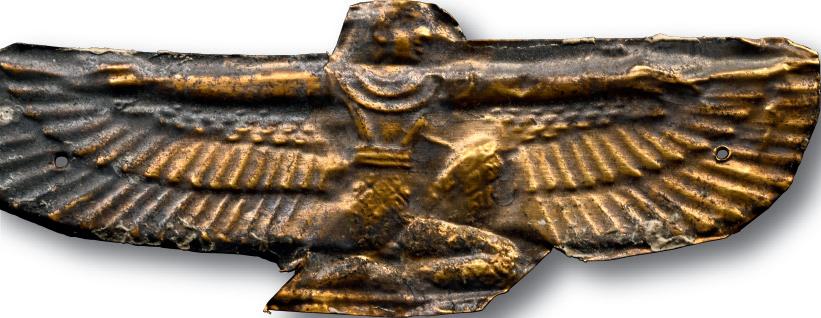
EGYPTIAN GOLD PLAQUE WITH WINGED GODDESS 1ST MILLENNIUM B.C. 2½ in. (1.57 grams, 62 mm)
Foil figure of a kneeling goddess with outstretched wings; wearing a tripartite wig with a headband, a multi-strand collar, and a tight robe with diamond detailing; mounted in a display frame.
£1,200 - 1,700
PROVENANCE:
UK private collection before 2000. Acquired on the UK art market. Private collection, London, UK.
FOOTNOTES:
Several winged goddesses appear in Egyptian iconography. Without a headdress, the deity’s identity here remains uncertain, but Isis, Nephthys, or Nut are likely candidates. All three are often shown in avian form as protectresses of the dead.
50
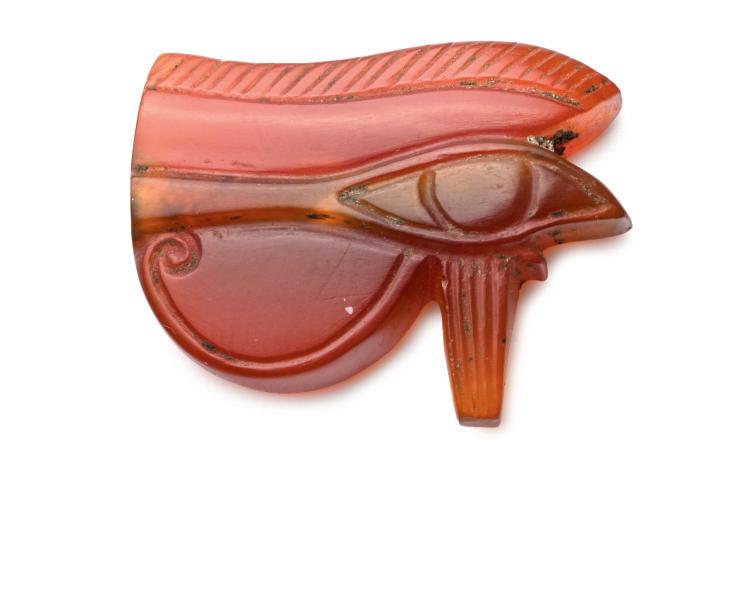
EGYPTIAN CARNELIAN EYE OF HORUS NEW KINGDOM, 1550-1295 B.C. in. (3.08 grams, 22 mm)
Plano-convex in section with incised bilinear borders.
£1,800 - 2,400
PROVENANCE:
Ex early 20th century collection of a lady.
51
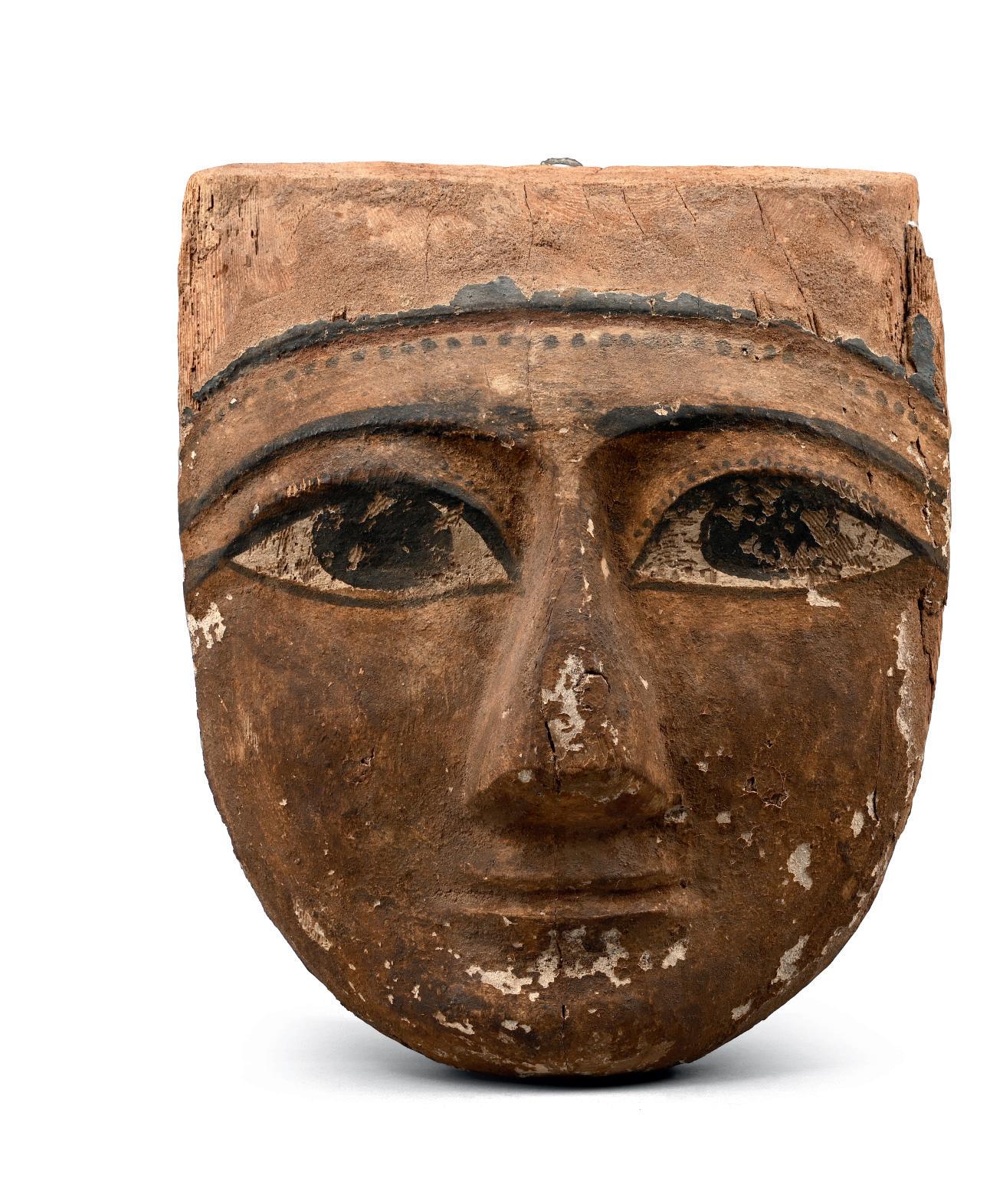
EGYPTIAN PAINTED WOODEN MUMMY MASK ‡
PTOLEMAIC PERIOD, CIRCA 3RD CENTURY B.C.
11¾ in. (1.04 kg, 30 cm)
D-shaped in plan with carved facial detailing, thick nose and full lips; painted bands to the brow, pierced in three places for attachment.
£2,000 - 3,000
PROVENANCE:
Swiss private collection, Zurich, assembled in the 1950s. Private collection.
Acquired on the Zurich art market in 2013.
52
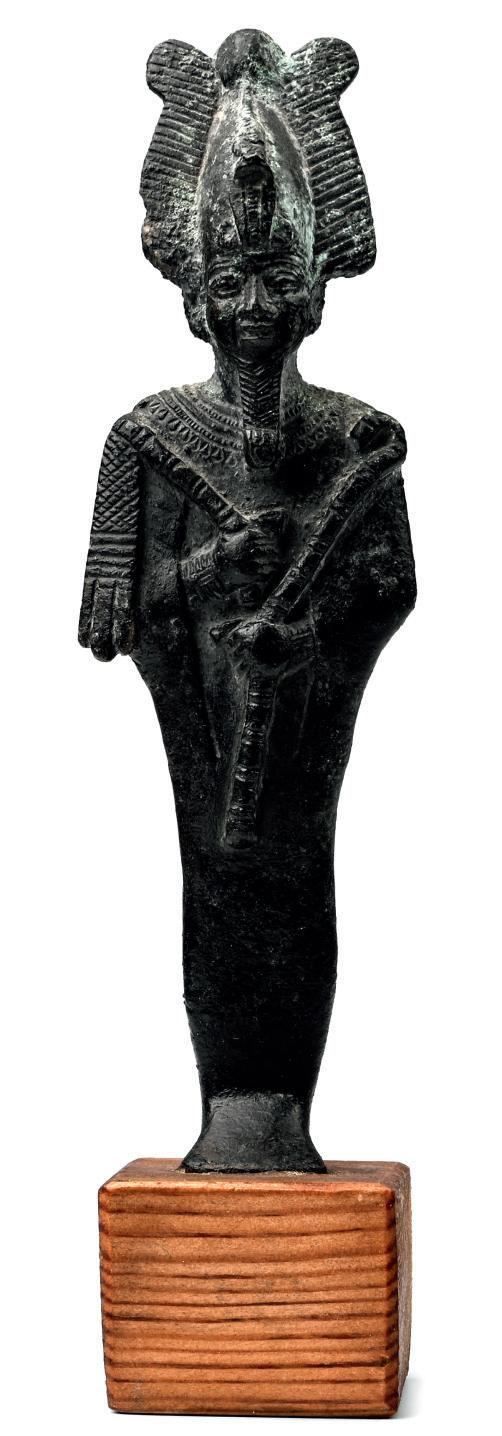
EGYPTIAN BRONZE OSIRIS STATUETTE
LATE PERIOD, 664-332 B.C.
6 in. (185 grams total, 15.4 cm including stand)
Standing figure in mummiform stance, wearing the conical Atef crown with flanking ostrich plumes and frontal uraeus, holding the crook (heka) and flail (nekhakha) regalia; mounted on a display stand.
£600 - 800
PROVENANCE:
Property of a deceased gentleman’s collection, 1980s. Ex John Nicholson Auction, Haslemere, Surrey, UK.
53
EGYPTIAN FAIENCE MAYHES AMULET
LATE PERIOD, 664-332 B.C.
3¼ in. (50.8 grams total, 84 mm including stand)
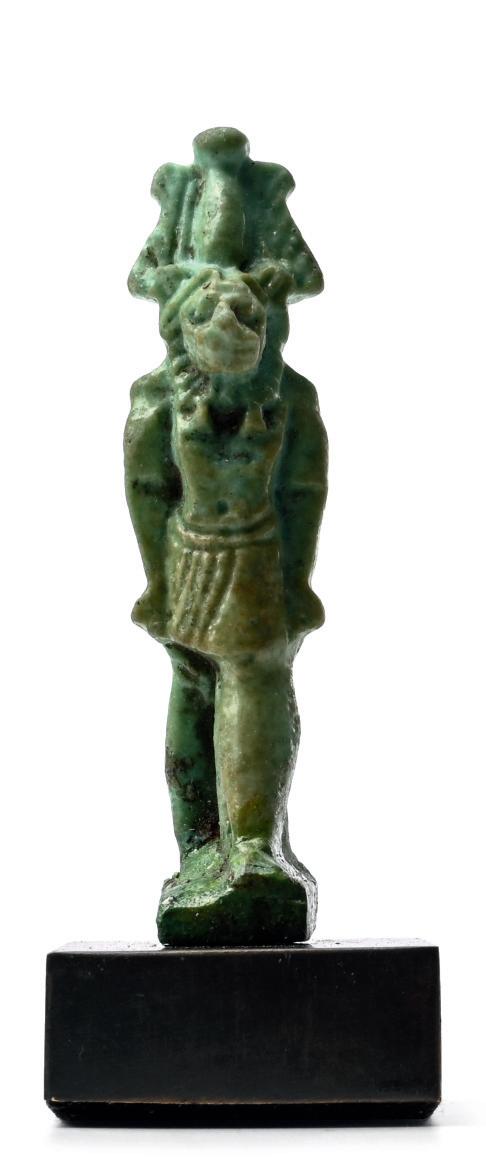
Standing erect with dorsal pillar and rectangular base, arms straight and one leg advancing; lion-head wearing atef crown and a uraeus; mounted on a custom-made stand.
£500 - 700
PROVENANCE: Ex early 20th century London, UK, collection.
54
LARGE EGYPTIAN CARNELIAN SCARAB
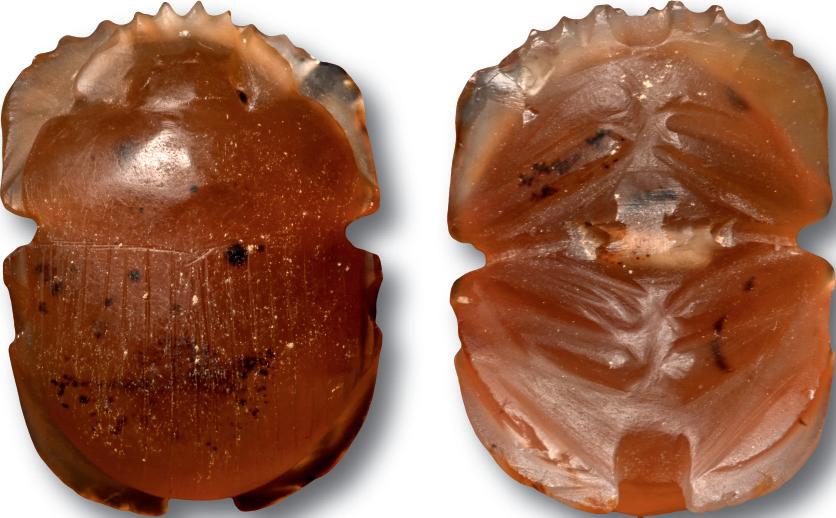
LATE PERIOD, 664-332 B.C. in. (3.98 grams, 22 mm)
Naturalistically modelled, featuring detailed head and elytra, with suspension loop on the underside.
£2,500 - 3,500
PROVENANCE: Collection of a lady, circa 1940. Ex Mayfair gallery, London, UK. Ex an important Wiltshire, UK, collection.

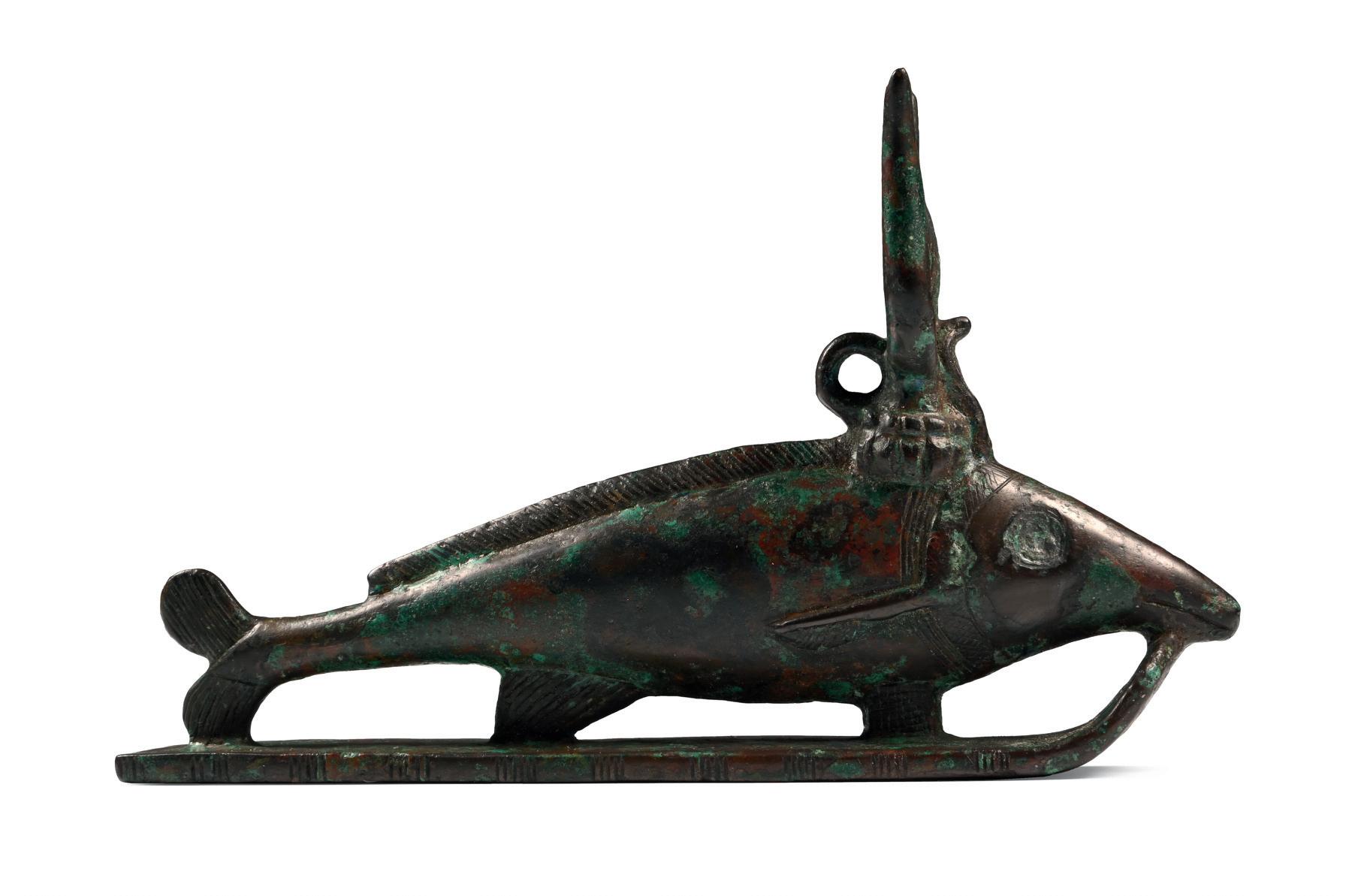
VERY LARGE EGYPTIAN BRONZE OXYRHYNCHUS FISH OF PERMEDJED WITH HIEROGLYPHIC INSCRIPTION ‡ LATE-PTOLEMAIC PERIOD, 664-30 B.C.
6¾ in. (585 grams, 17 cm)
Modelled in the round on a sledge attached by ventral and pectoral fins, a forked tail, a dorsal ridge, and a tapering nose, featuring recessed circular eyes filled with enamel, a horned sun disc headdress fronted by a uraeus, and a suspension loop behind; a few
hieroglyphs of a dedication remain visible on the underside of the sledge, which may be interpreted as ‘….the great give life (to)…’ (…t wr rdi n t….); presumably, ‘the great’ followed the name of a deity, now lost.
£4,500 - 6,500
PROVENANCE: Acquired from Gallery Reiner, Paris, France, 1981. Private collection, Europe.
Accompanied by a copy of French passport no.150583 dated 29 November 2013.
56
EGYPTIAN GRANITE SEATED FIGURE ‡ LATE PERIOD, 664-332 B.C.
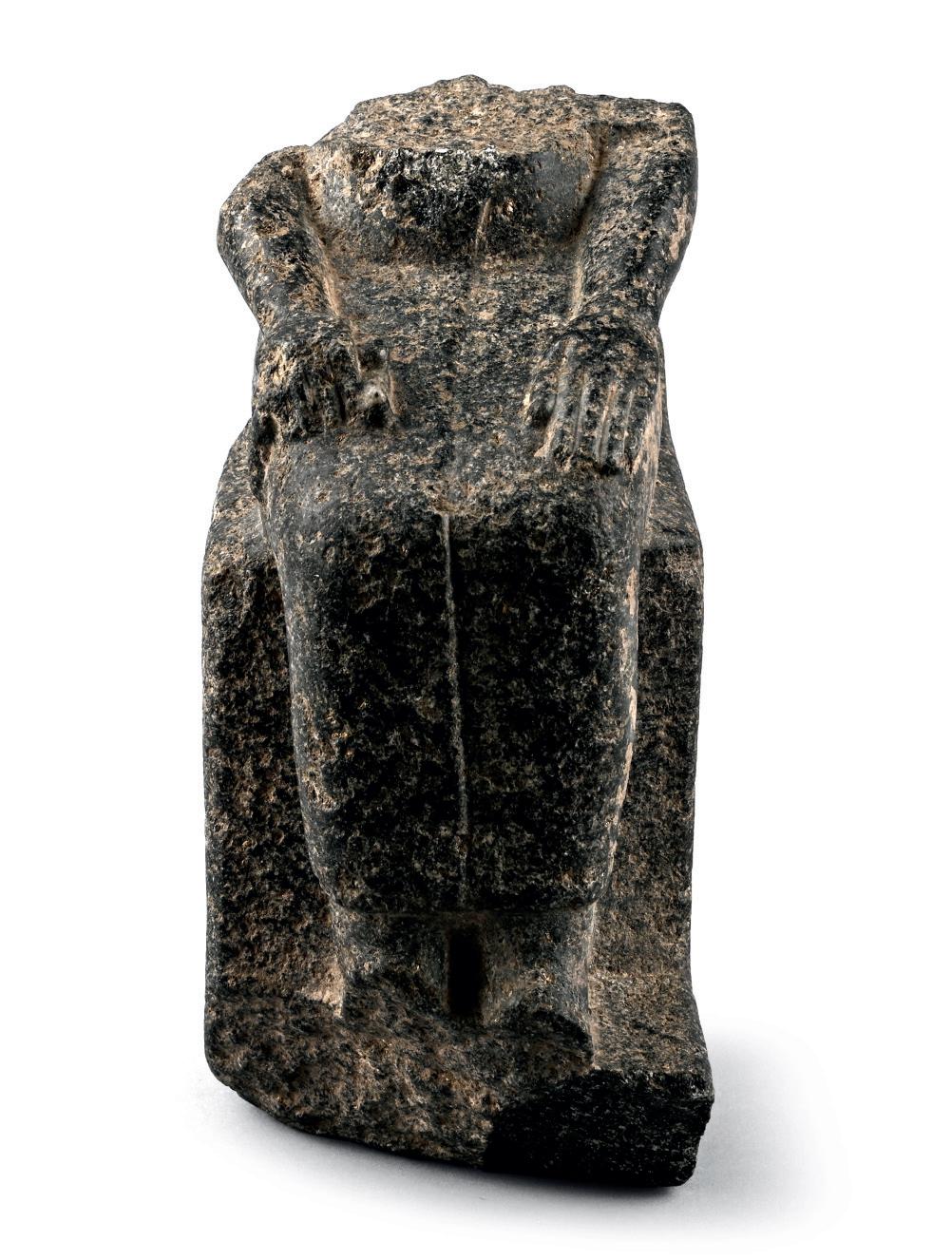
7 in. (4.1 kg, 18.7 cm)
Fragment of a statue of an official, comprising the torso and legs clad in an ankle-length robe and seated on a rectangular-section seat with stepped base and short, curved backrest and rear dorsal pillar; the left hand carved with the palm resting along the thigh; the right hand similarly placed but with the hand gripping a folded piece of cloth of which the ends are draped over the lower thigh above the knee; traces of an old label to reverse.
£3,000 - 4,000
PROVENANCE: Private collection, Europe. with Bonhams & Brooks, 8th November 2001, no.265. Private collection, Europe.
Accompanied by copies of the relevant Bonhams & Brooks catalogue pages.
FOOTNOTES: The official would have been shown wearing a longer cloak-like garment rather than a waist-height kilt, as the line of the folded edge is visible above where a waistband would typically be.
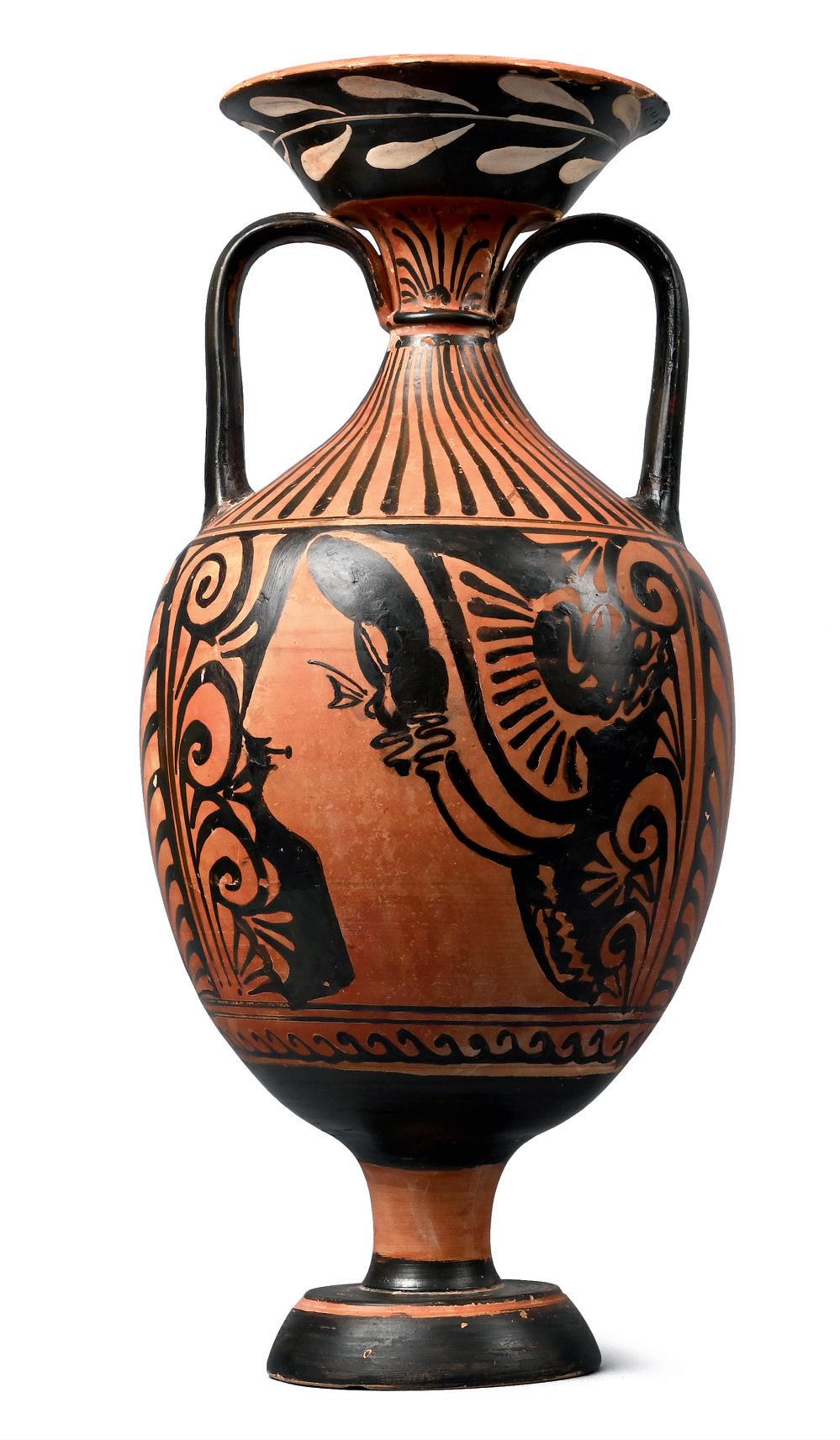
58
LARGE GREEK RED-FIGURE AMPHORA WITH LADY OF FASHION
APULIAN, 3RD-2ND CENTURY B.C. 18¼ in. (2.48 kg, 46.5 cm high)
The conical mouth with laurel-leaf motif, palmettes below; lateral strap handles to the shoulder and palmette below each; Side A: profile bust of a lady of fashion with her hair in a chignon covered by a sakkos; Side B: similar design.
£2,000 - 3,000
PROVENANCE:
Acquired on the art market between the late 1990s and mid2000s.
Estate of the late Barry Paul Buxton (1944-2024), Oakham, Rutland.
Acquired on the UK art market, 2025.
Accompanied by a thermoluminescence analysis report no.N126a17 from Oxford Authentication.
FOOTNOTES:
The pattern-work and the female head seem to connect the vase more closely with the Monopoli Group. The corkscrew curls on the hair over the ear and the sakkos with a bow at the top are, in fact, typical of the heads of this group.
57
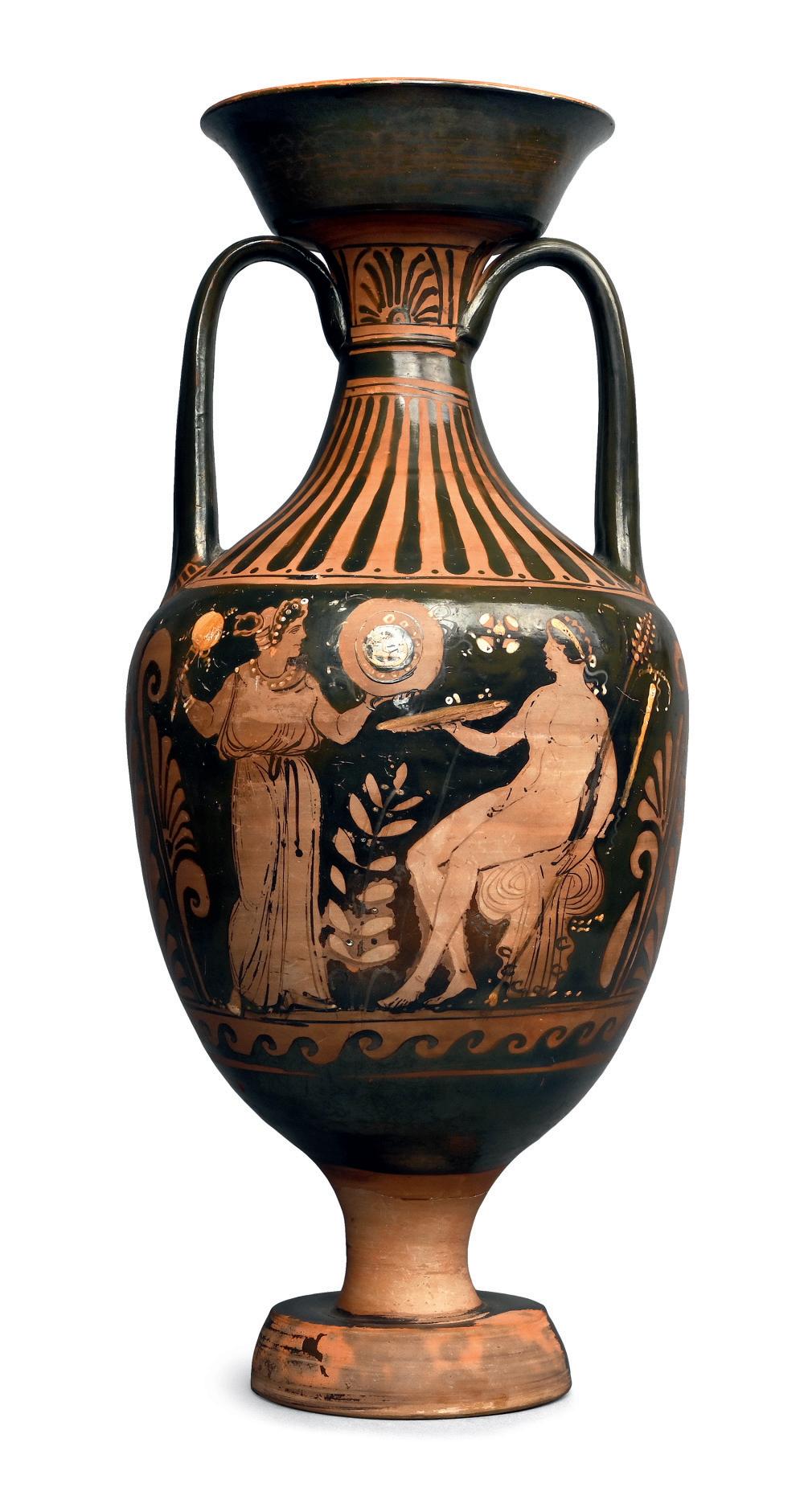
LARGE GREEK RED-FIGURE AMPHORA WITH DIONYSIAN SCENERY
APULIAN, 3RD-2ND CENTURY B.C.
17 in. (1.88 kg, 43 cm)
The piriform body with broad, stepped rim and two lentoid-section handles; painted palmette beneath each handle and on the neck below the mouth; Side A: redfigure frieze depicting a standing woman wearing a himation and stephane, her hands raised supporting objects, a laurel frond before her and a seated nude male with thyrsus and other items; Side B: two opposed figures standing supported by staves, each wearing a loosely draped floor-length garment; objects in the field.
£3,000 - 4,000
PROVENANCE:
Acquired on the art market between the late 1990s and mid2000s.
Estate of the late Barry Paul Buxton (1944-2024), Oakham, Rutland.
Acquired on the UK art market, 2025.
Accompanied by a thermoluminescence analysis report no.N126a18 from Oxford Authentication.
FOOTNOTES:
The subject is standard, often representing the draped youths completely enveloped in their himatia
59
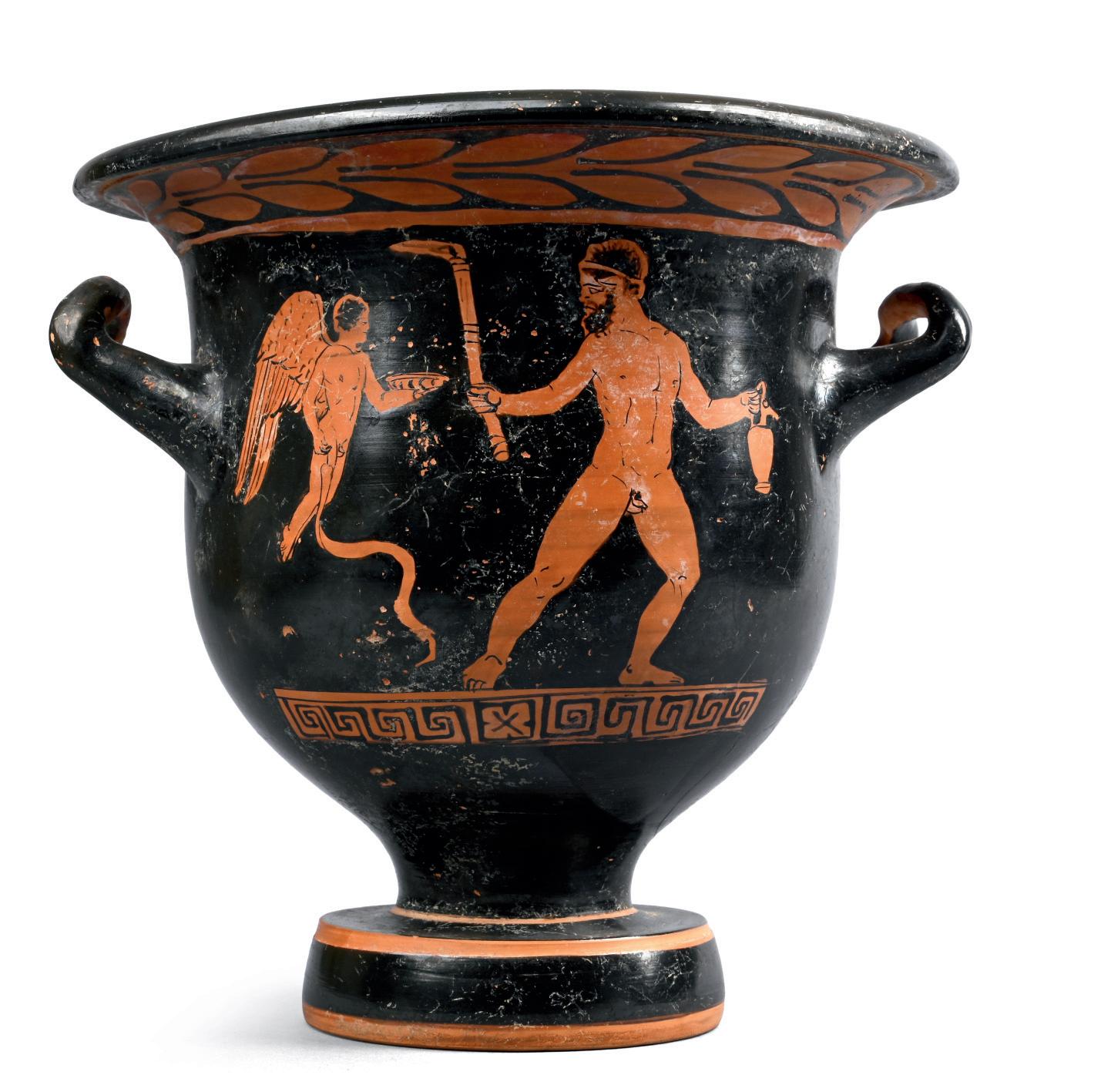
GREEK RED-FIGURE BELL KRATER WITH SATYR AND EROS
APULIAN, CIRCA 450-400 B.C. 8 in. (814 grams, 20 cm)
With laurel-leaf wreath beneath the flared rim, band of meander ornament as a baseline; Side A: striding satyr with torch and oinochoe followed by Eros holding a scroll behind; Side B: woman wearing a himation in active pose with sphere advancing towards a tendril.
£3,000 - 4,000
PROVENANCE:
Acquired on the art market between the late 1990s and mid2000s.
Estate of the late Barry Paul Buxton (1944-2024), Oakham, Rutland.
Acquired on the UK art market, 2025.
Accompanied by an academic report by Dr Raffaele D’Amato.
FOOTNOTES:
Often, the iconography of an ‘elevated’ mythological subject was applied to members of Dionysos’ retinue. Here we have three typical examples of them: a satyr, an Eros, and a woman, all three behaving according to Bacchic ecstasies.
60
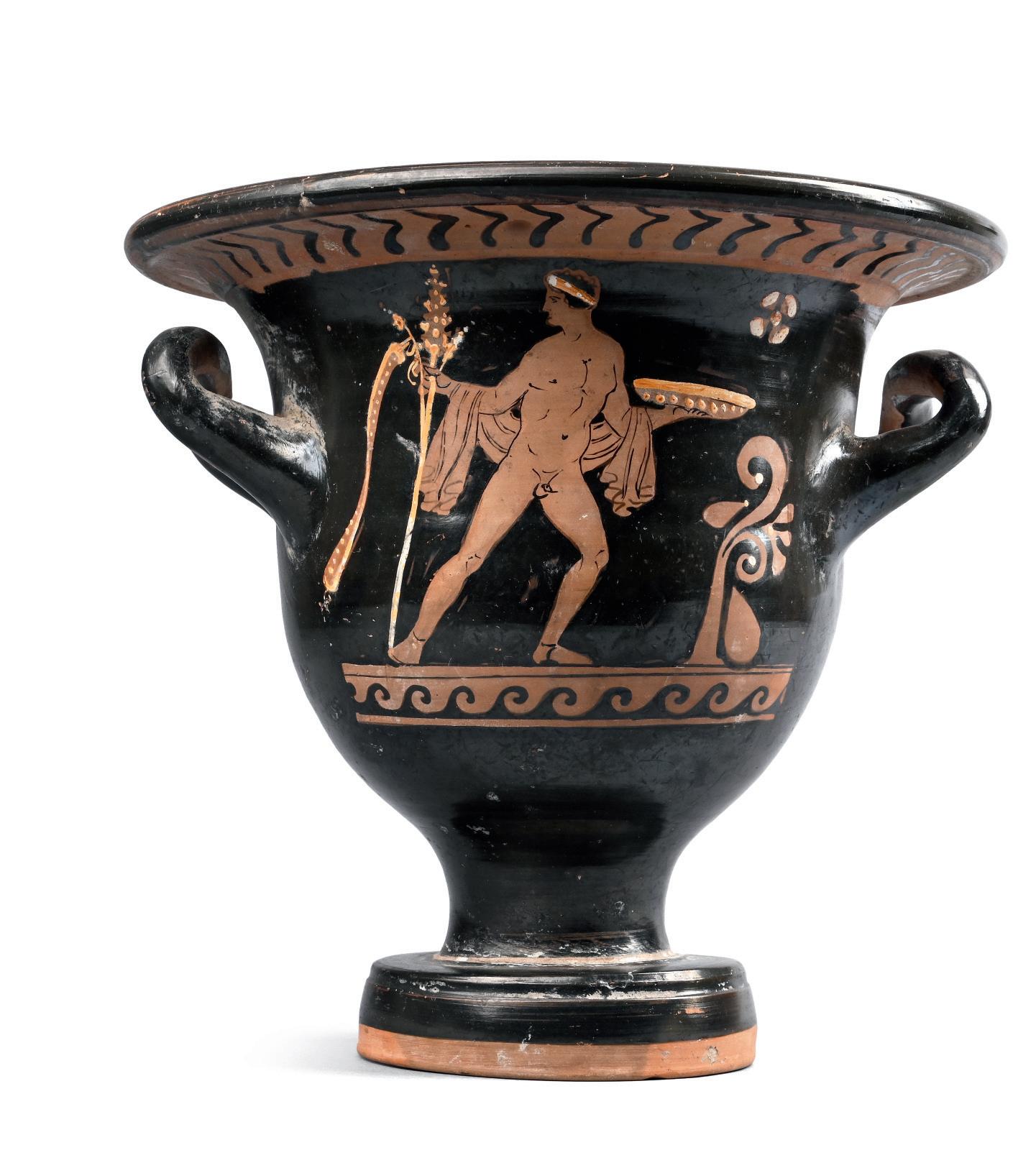
GREEK RED-FIGURE BELL KRATER BELONGING TO THE CHEVRON GROUP
APULIAN, 4TH CENTURY B.C. 9 in. (1.11 kg, 23.2 cm wide)
With reserved herringbone band beneath the rim, wave pattern to be the baseline; Side A: young man with thyrsus and pendant streamer holding a phiale, a loose mantle draped from the elbows; Side B: head of a lady of fashion with white accents to her stephane and hair drawn up in a chignon, a volute and window before her.
£2,500 - 3,500
PROVENANCE:
Acquired on the art market between the late 1990s and mid2000s.
Estate of the late Barry Paul Buxton (1944-2024), Oakham, Rutland.
Acquired on the UK art market, 2025.
Accompanied by an academic report of Dr Raffaele D’Amato.
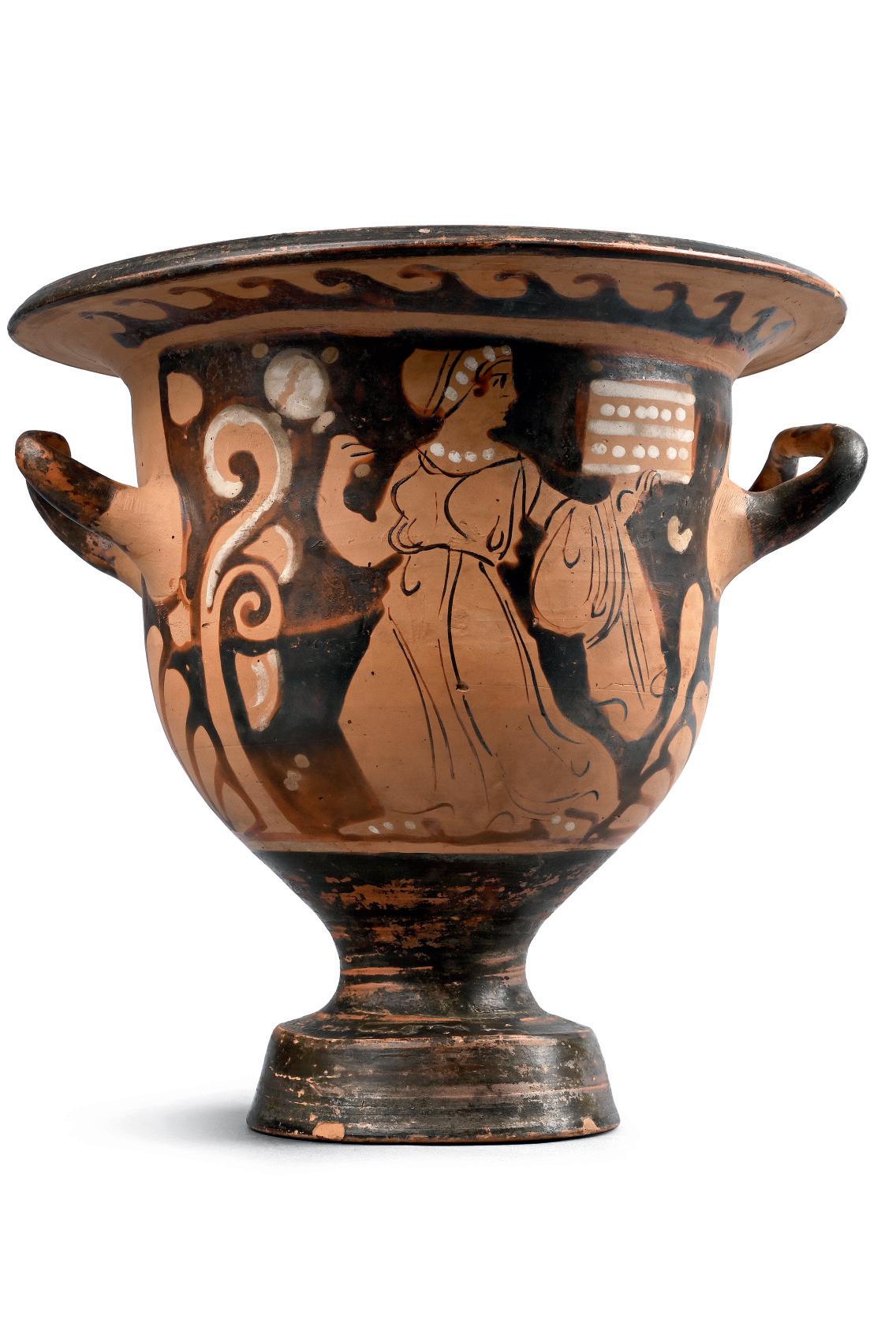
62
GREEK RED-FIGURE BELL KRATER CAMPANIAN, 340-325 B.C.
7 in. (585 grams, 18 cm high)
With notable added white details; Side A: woman moving to her right while holding a cista, dressed in a chiton clinched at the waist, with a himation draped over her left arm, her hair adorned with a sakkos; Side B: profile head of a woman wearing a patterned sakkos and radiated stephane, intricate earrings and necklace of beads, objects in the field; beneath the handles, palmettes with floral elements.
£3,000 - 4,000
PROVENANCE:
Ex Rev. & Mrs T.S. Hichens, Cornwall with Charles Ede, 1981 (Stock No.8370).
Ex Mrs B. Shankes, November 1986.
PUBLISHED: Charles Ede Ltd, 120 Antiquities, 1981, no.5.
61
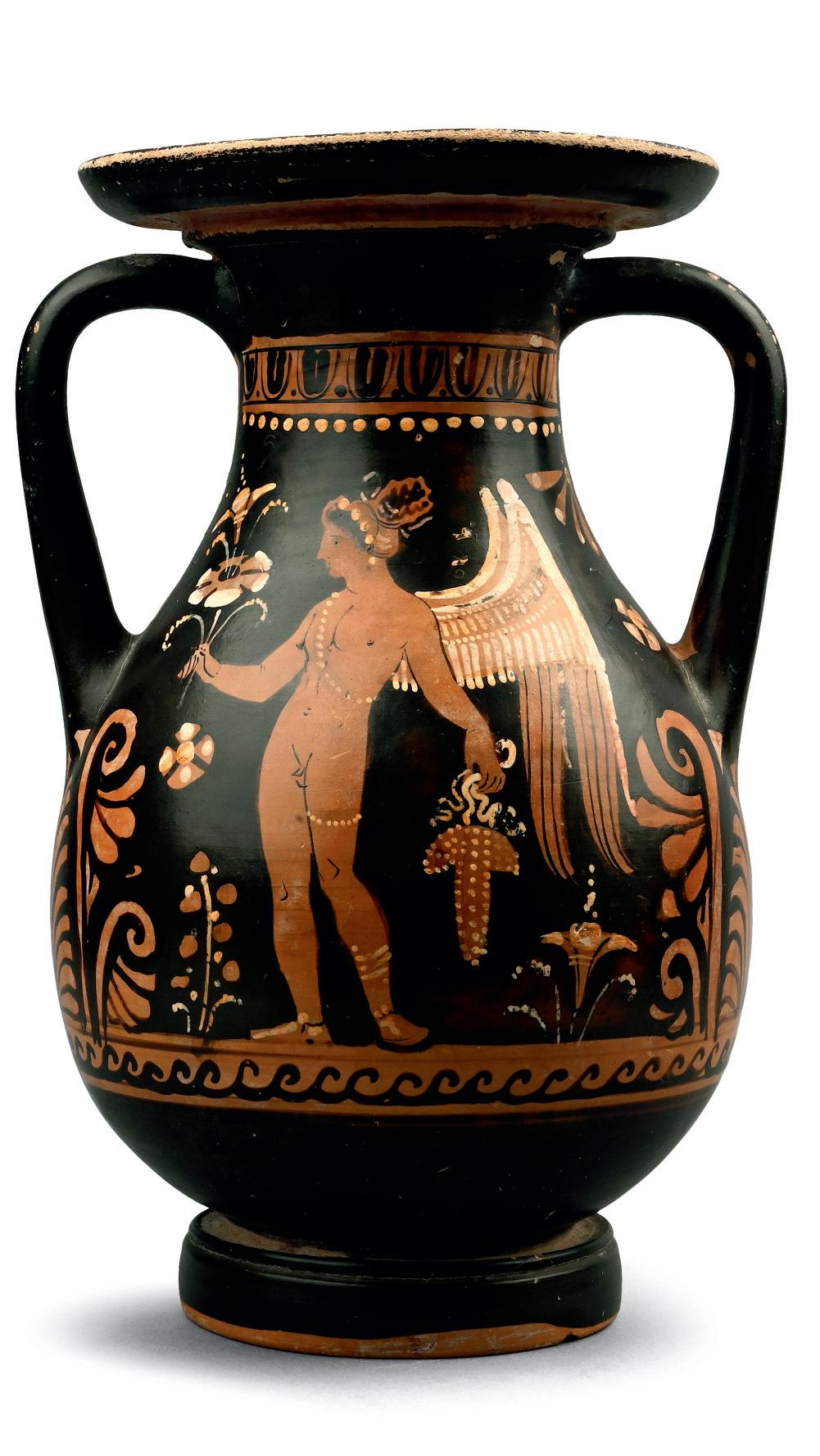
LARGE GREEK RED-FIGURE PELIKE WITH NIKE APULIAN, 3RD-2ND CENTURY B.C.
10¼ in. (1.19 kg, 26 cm high)
Comprising a pedestal base, mastoid body, lateral strap handles and funicular neck, broad mouth with stepped rim; the neck decorated with a band of egg-and-dart; palmette below each handle, flanked by tendrils and flowers; Side A: naked Eros (Cupid), hair in a bun and tied with a cloth, right arm outstretched and holding a flower by the stem, left hand holding leaves and tendrils; Side B: Nike standing in himation and stephane, holding up a drum-shaped object and supporting leaves and tendril, flower patterns to the background.
£1,800 - 2,400
PROVENANCE:
Acquired on the art market between the late 1990s and mid2000s.
Estate of the late Barry Paul Buxton (1944–2024), Oakham, Rutland.
Acquired on the UK art market, 2025.
Accompanied by a thermoluminescence analysis report no.N126a15 from Oxford Authentication.
Accompanied by an academic report by Dr Raffaele D’Amato.
63
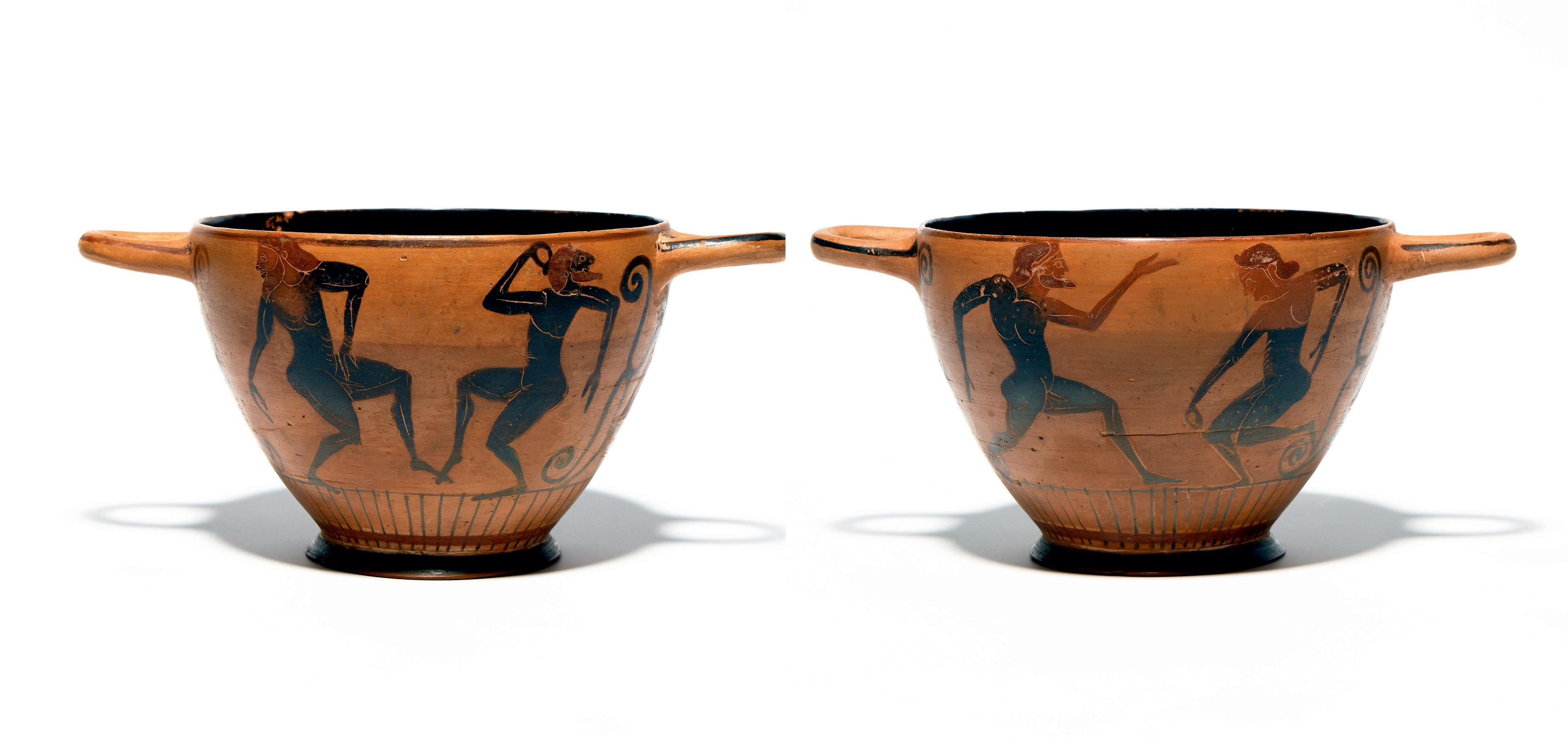
GREEK BLACK-FIGURE SKYPHOS WITH DANCING SATYRS BY THE KOMAST PAINTER GROUP
ATTIC, 585-560 B.C.
7 in. (219 grams, 20 cm wide)
Featuring black-figure depictions of the Komos in a lively procession of revellers celebrating Dionysos, with the god portrayed as an ithyphallic satyr; two loop handles on the rim and a palmette beneath each handle, adorned with tendrils; professionally repaired.
£5,000 - 7,000
PROVENANCE: with Sotheby’s, New York, 20 June 1990, no.11.
Private collection, New York, USA. Private collection, Georgia, USA. Private collection, UK.
64
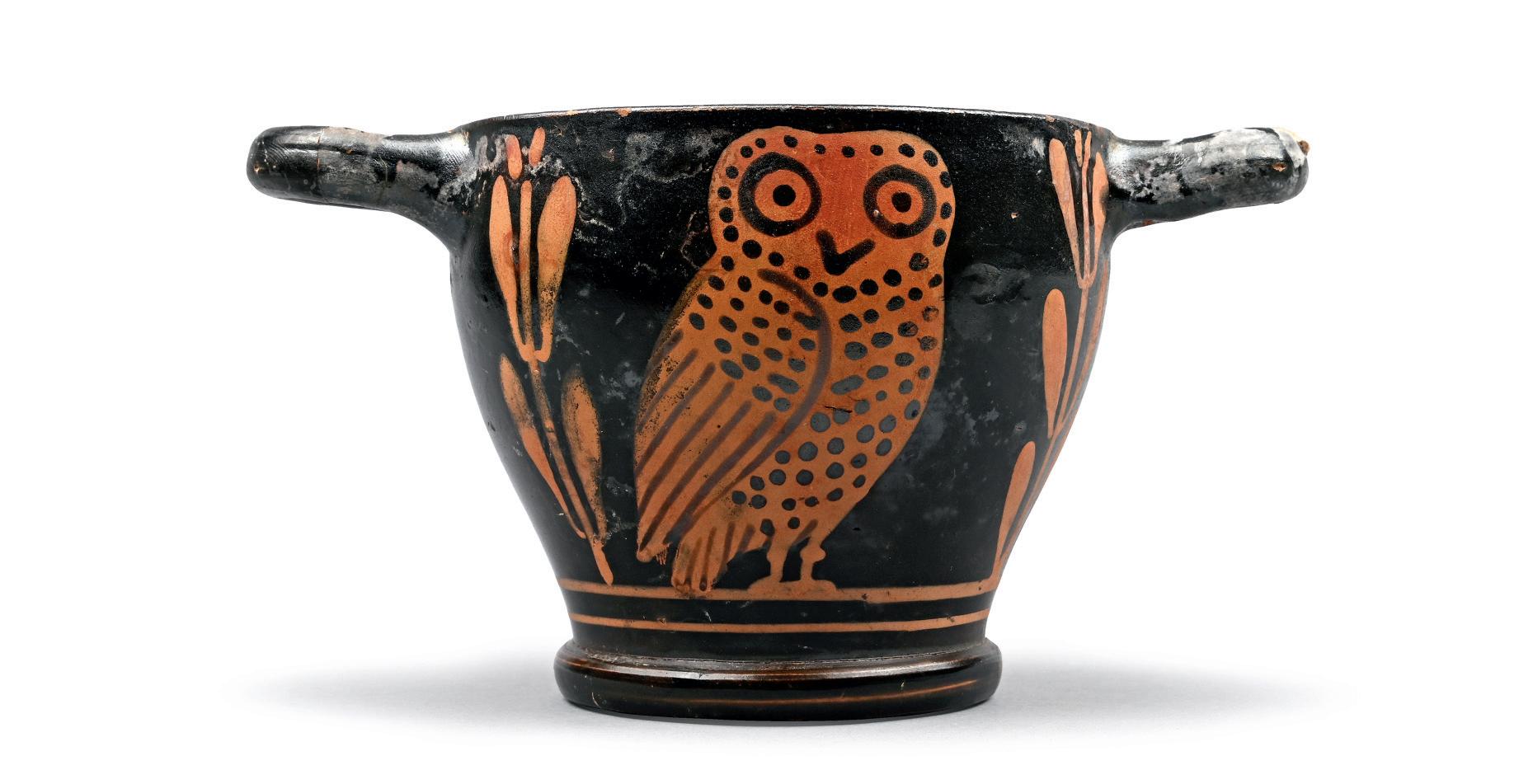
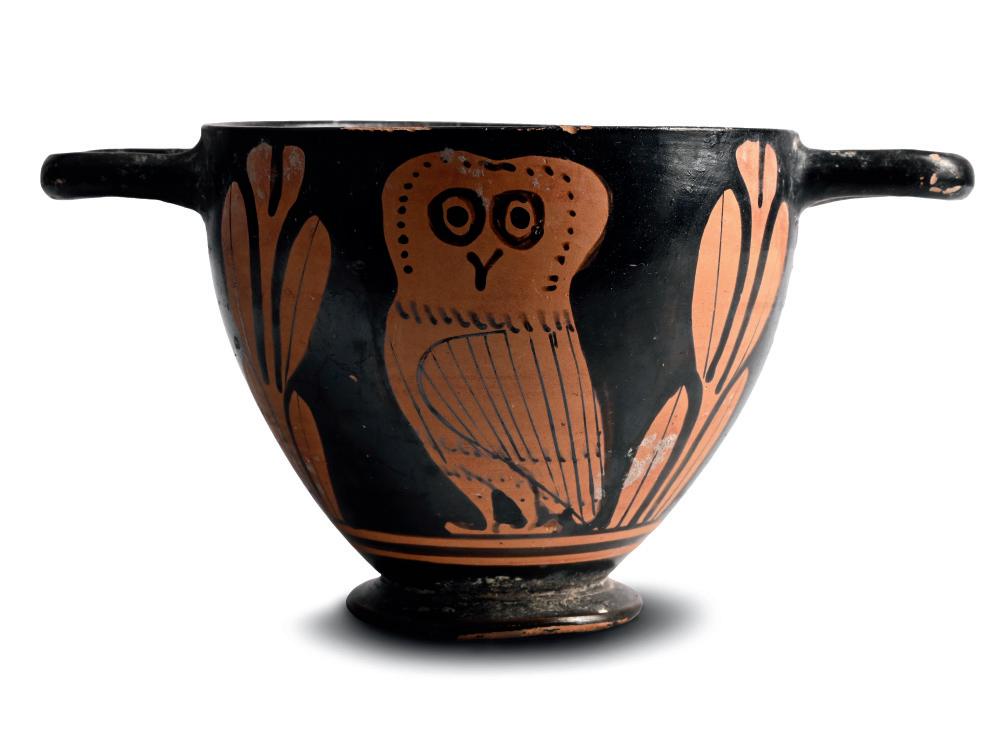
LARGE GREEK RED-FIGURE SKYPHOS WITH OWL ‡ SOUTH ITALIAN, 5TH-4TH CENTURY B.C.
6 in. (239 grams, 17.5 cm)
With mammiform body, pedestal base and two loop handles; each side with a facing image of an owl between laurel fronds.
£2,500 - 3,500
PROVENANCE: Swiss private collection, assembled in the 1960s-1970s. Private collection, acquired in 2013.
Accompanied by a thermoluminescence analysis report no.N126a14 from Oxford Authentication.
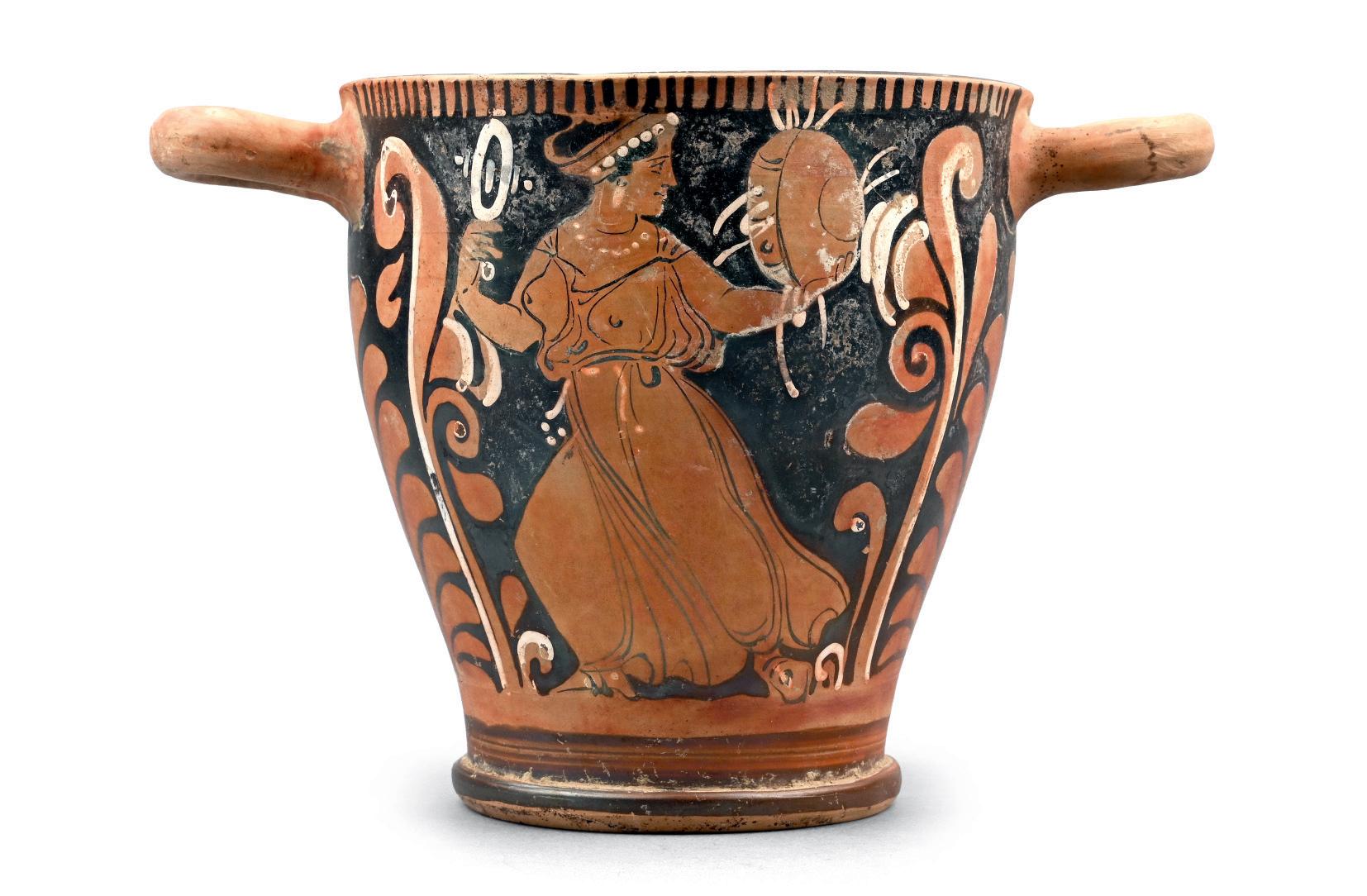
65
LARGE GREEK RED-FIGURE SKYPHOS WITH LADY OF FASHION APULIAN, 3RD-2ND CENTURY B.C. 9 in. (640 grams, 23 cm wide)
With mammiform body, pedestal base and two loop handles; ovolo patterns in ochre beneath the rim and palmette beneath each handle; Side A: lady of fashion in advancing pose holding up a dish and a mirror, white detailing to the stephane and necklace; Side B: standing figure in a himation with a stephane
£1,200 - 1,700
PROVENANCE:
Acquired on the art market between the late 1990s and mid-2000s. Estate of the late Barry Paul Buxton (1944-2024), Oakham, Rutland. Acquired on the UK art market, 2025.
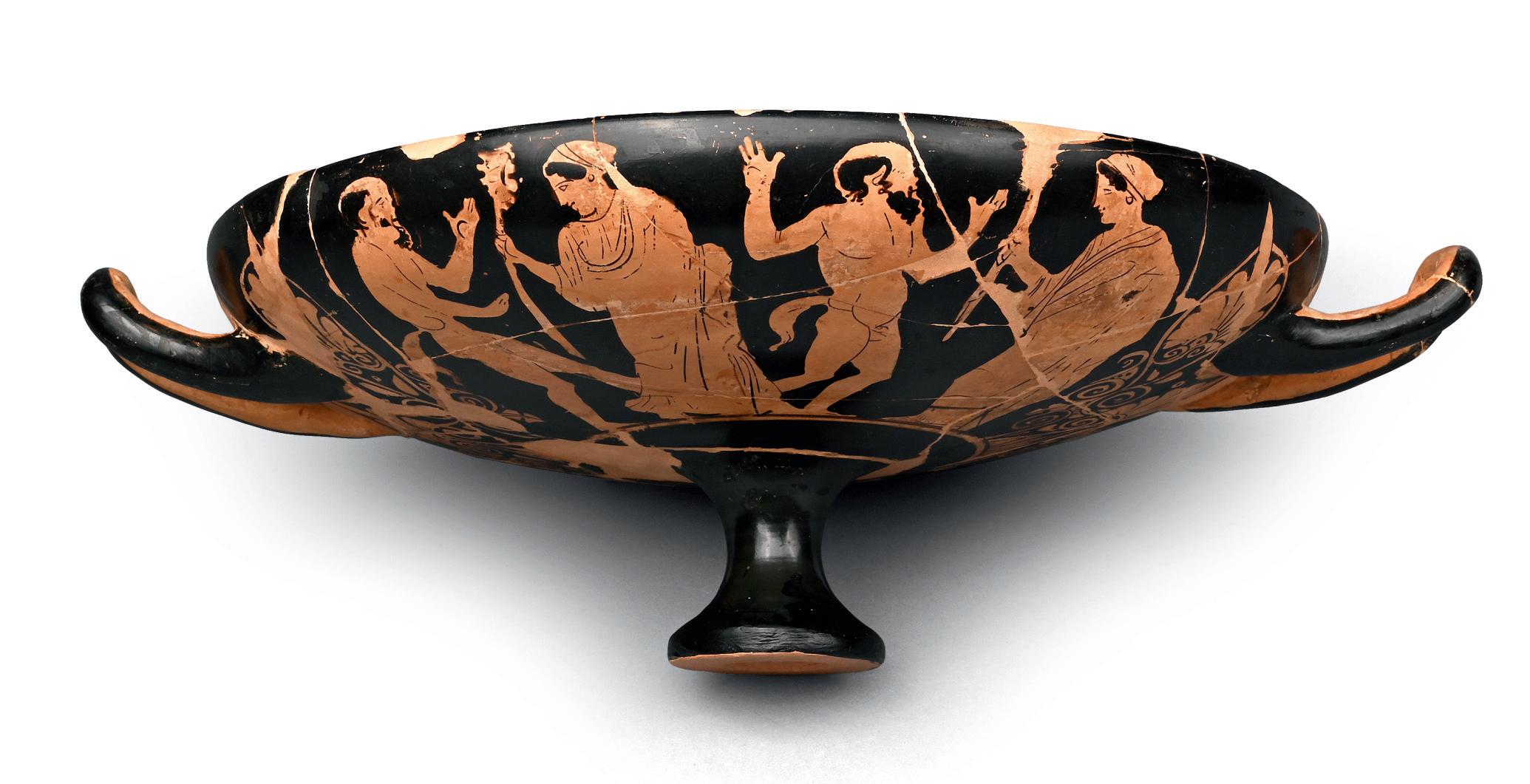
66
GREEK RED-FIGURE KYLIX WITH DANCING NYMPHS AND SATYRS ‡ ATTIC, 5TH CENTURY B.C. 14 in. (875 grams, 37 cm wide)
With short stem and broad bowl with carination at the shoulder; two strap handles with an ivy-leaf with tendrils and volutes underneath; the underside of the bowl with a frieze of four satyrs and four maenads performing a dance, the maenads dressed in fancy Ionian dress, long peplos and himation, and a kekrykephalos (hair net) on their heads, and holding a thyrsus in their right hands; the centre of the cup showing dancing Silenus and a nymph, dressed in a similar manner and holding a thyrsus, border of meanders and chequered squares surrounding; restored.
£3,000 - 4,000
PROVENANCE: Ex Dr Gonik and the late Mr Wirth, 1960-1970s. Private collection, Switzerland.
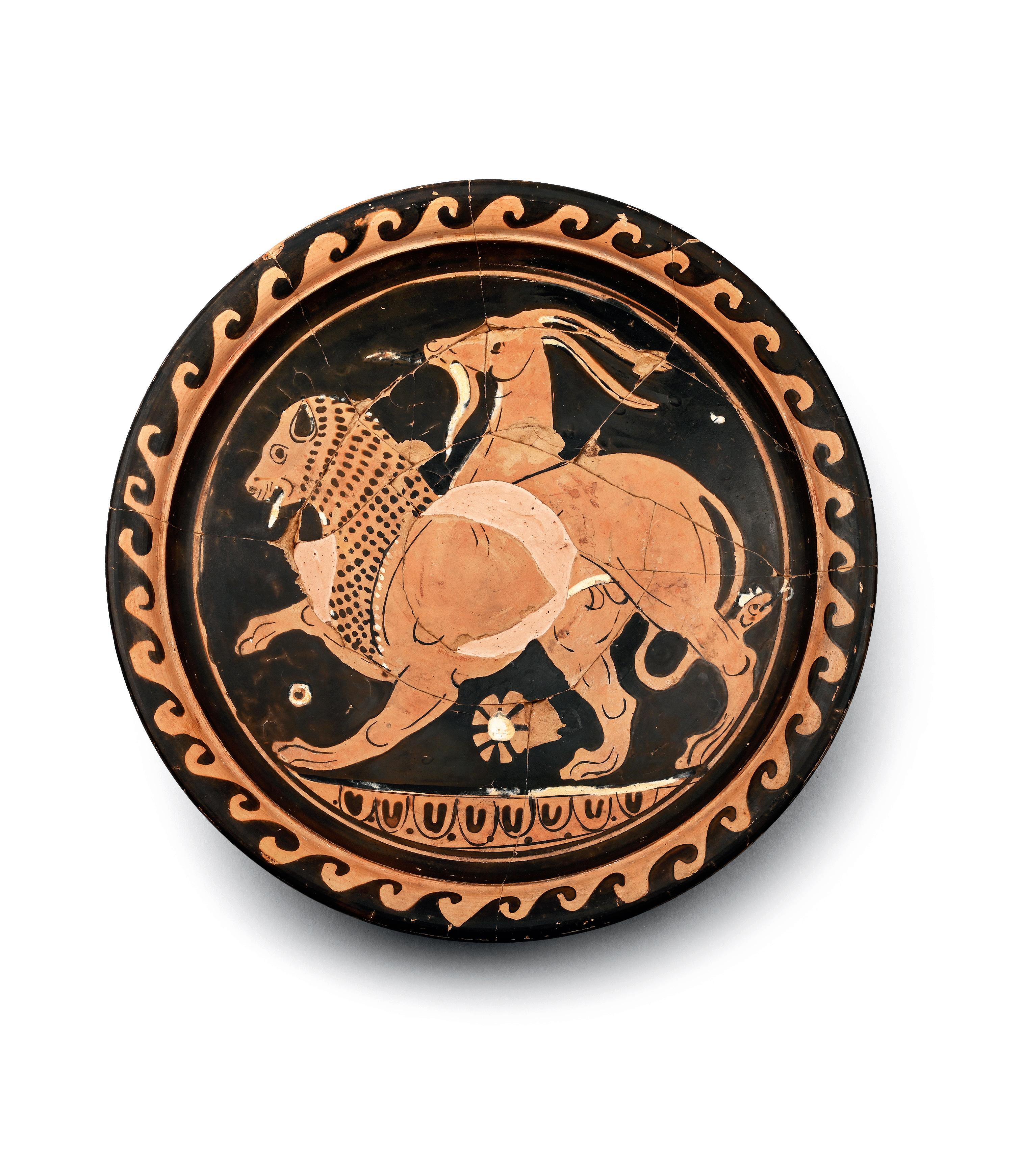
GREEK RED-FIGURE PATERA WITH CHIMERA ‡
APULIAN, 4TH CENTURY B.C.
8 in. (342 grams, 20.5 cm wide)
With curved rim, carinated profile and low foot; rim with reserved wave pattern, tondo with reserved ring enclosing a chimera in profile advancing on an egg-and-dart baseline; repaired and partly restored.
£5,000 - 7,000
PROVENANCE:
Ex private North American collection. Acquired in the United States, 2010.
Accompanied by an academic report by Dr Raffaele D’Amato. Accompanied by a thermoluminescence analysis report no.N126a12 from Oxford Authentication.
FOOTNOTES:
The legend of Bellerophon and the chimera was a subject highly appreciated by the Greek ceramists. Red-figure Apulian plates depicting the chimera were realised in South Italian workshops dating back to around 350-340 BC. The most famous example and possible prototype is the one held at the Musée du Louvre in Paris, created using the red-figure technique.
69
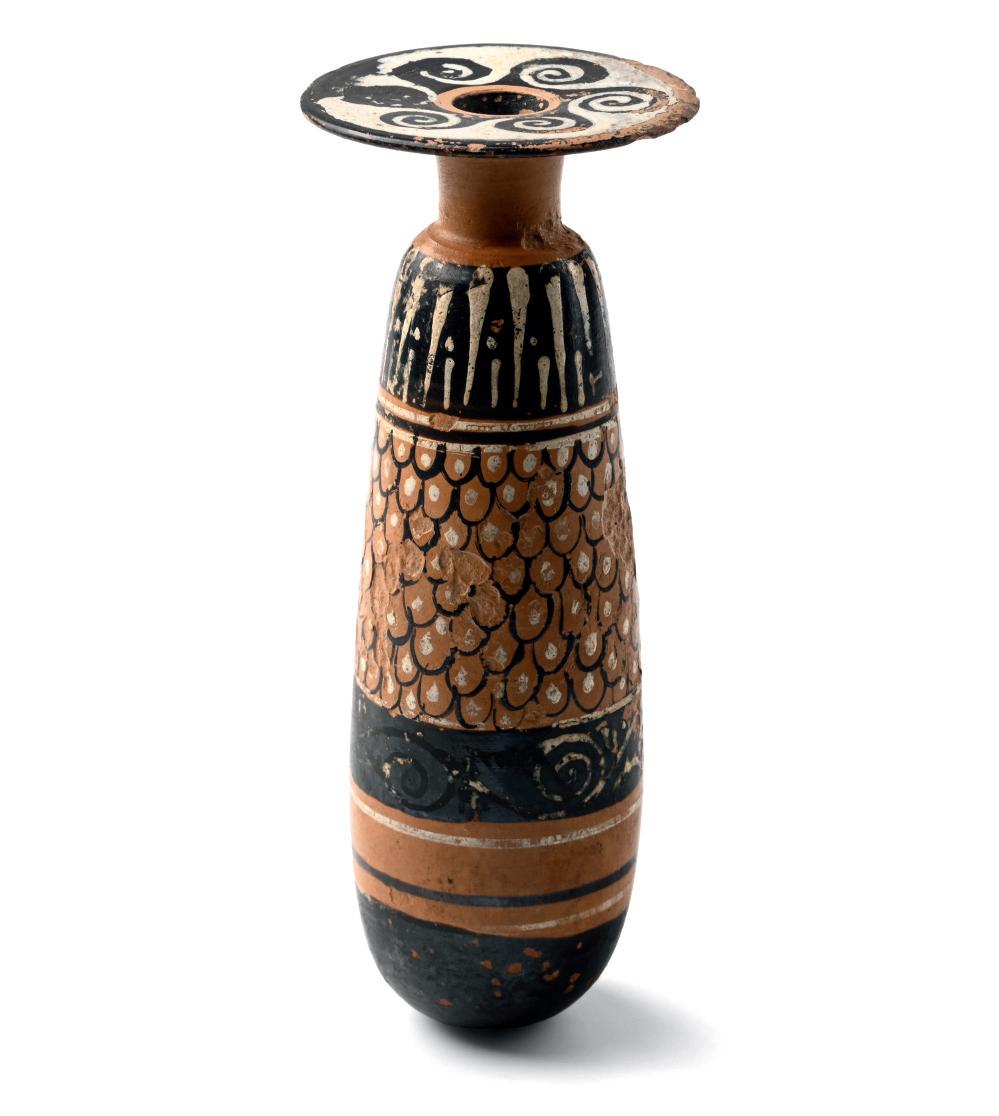
GREEK ‘PLASTIC’ OINOCHOE WITH A BUST OF A BEARDED MAN ‡ 5TH CENTURY B.C.
4 in. (77 grams, 11.8 cm)
The body formed as a male head with his elongated neck forming the foot of the vessel; wearing an ivy-leaf crown, stylised, painted facial features and a full beard, two rows of stylised curls above the forehead; the neck of the vessel emerging from the top of his head, trefoil mouth and a handle to the rear; some repainting.
£3,000 - 4,000
PROVENANCE:
Swiss private collection formed in 1960s-1970s.
Accompanied by an academic report by Dr Raffaele D’Amato.
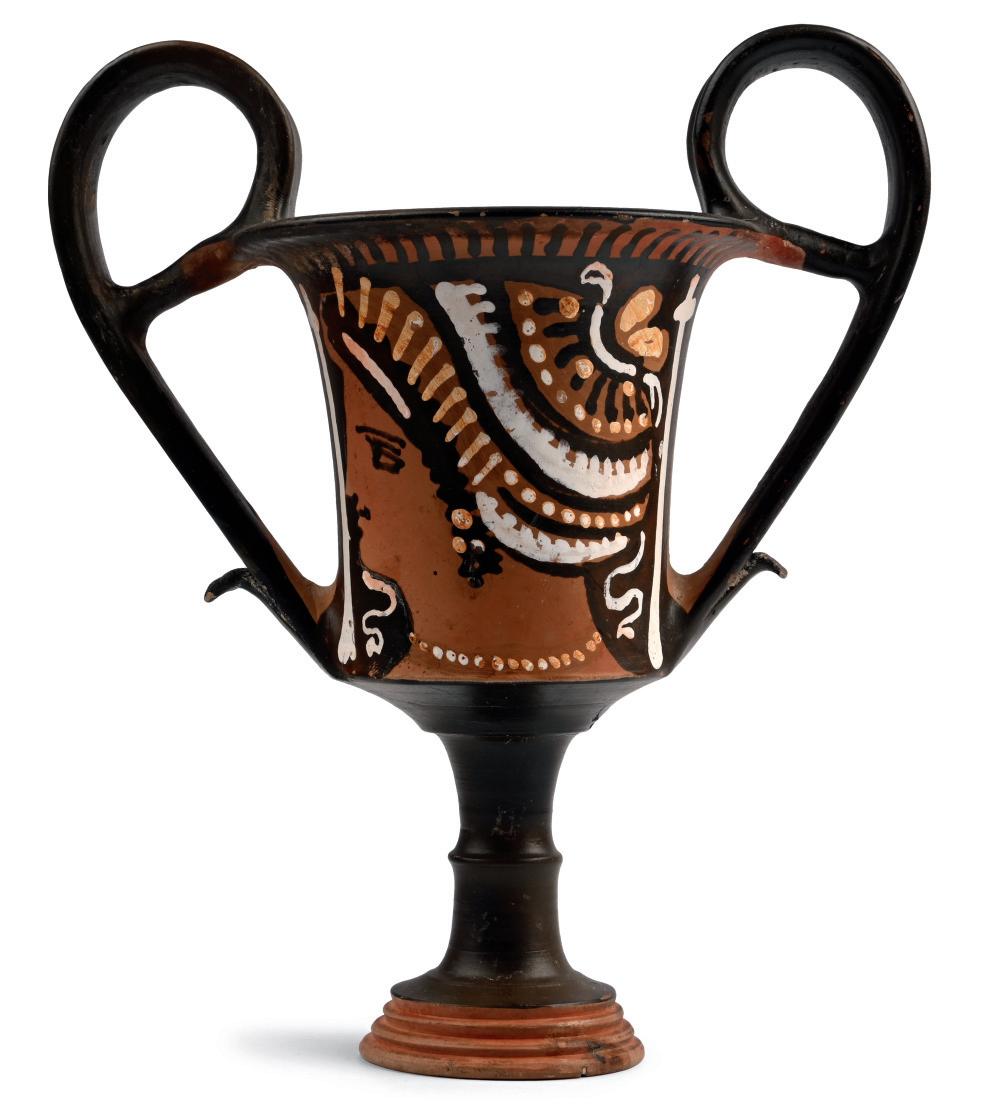
68
GREEK RED-FIGURE KANTHAROS WITH LADY OF FASHION APULIAN, 3RD-2ND CENTURY B.C.
7¼ in. (415 grams, 18.6 cm)
High-handled cup with flared body and a tall offset foot with a collar, coiled lateral handles; profile ‘ladies of fashion’ busts with white and cream detailing to the hair, diadem and earrings.
£500 - 700
PROVENANCE:
Acquired on the art market between the late 1990s and mid-2000s. Estate of the late Barry Paul Buxton (1944–2024), Oakham, Rutland. Acquired on the UK art market, 2025.
70
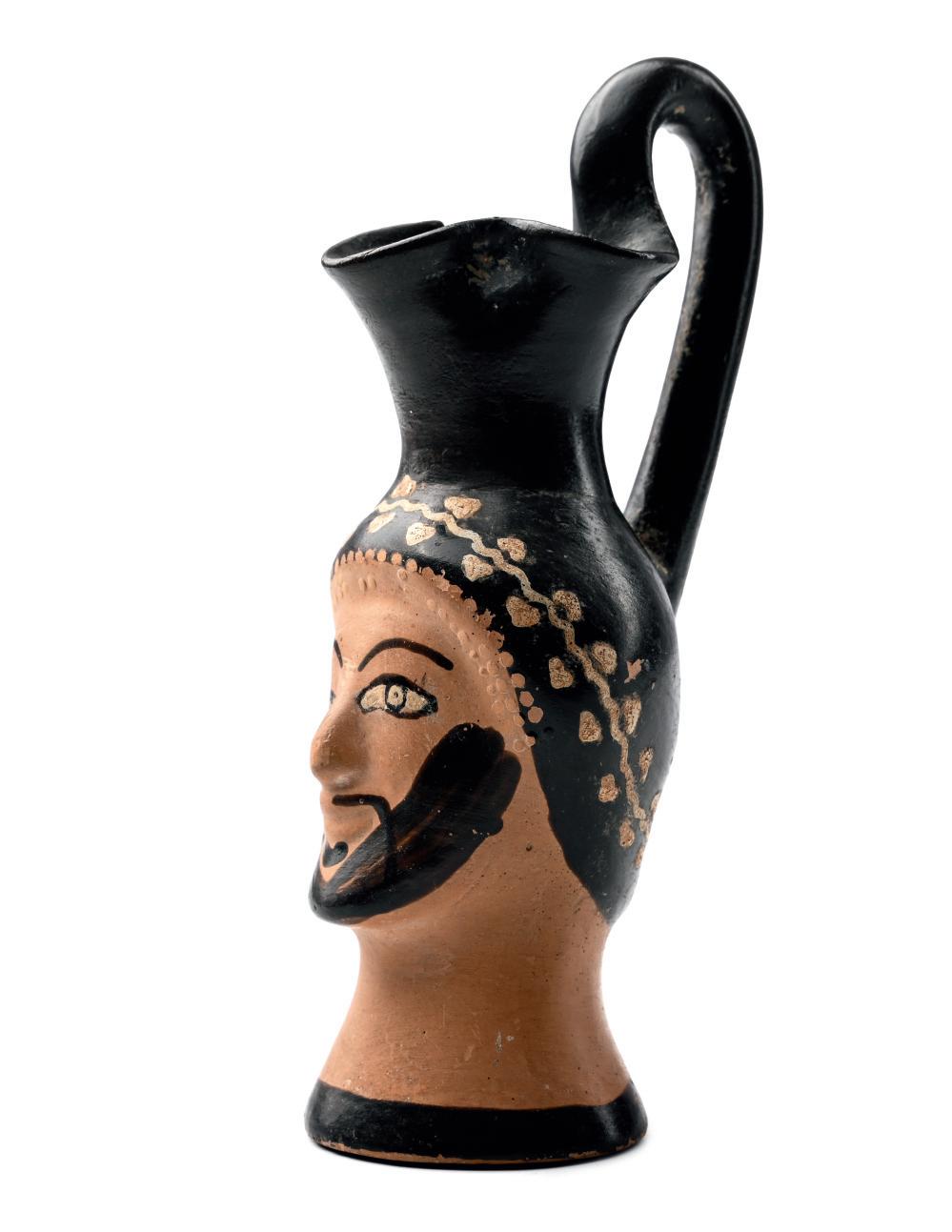
GREEK BLACK-FIGURE ALABASTRON WITH FISH SCALE PATTERN, POSSIBLY ATTRIBUTED TO THE BULAS GROUP ‡ ATTIC, EARLY 4TH CENTURY B.C.
5 in. (87 grams, 13 cm)
Ovoid shape with short neck and expanded flat rim; painted with horizontal bands with vertical strokes on the shoulder, fish-scale pattern below and running scrolled tendrils; horizontal stripes below.
£2,000 - 3,000
PROVENANCE:
Collection of M. Bouvier, Switzerland (1901-1980), Switzerland. Bouvier was a law professor in Alexandria prior to 1930. with Christie’s, London, 7 October 2010, no.117.
Private collection, 2010.
Accompanied by an original thermoluminescence analysis report no.N125q42 by Oxford Authentication.
FOOTNOTES:
The alabastra of the Bulas Group display scale-like patterns. They were painted with slip, a liquid clay which vitrifies when fired. This group is usually dated to the late 5th – early 4th century B.C. It was named after Kazimierz Bulas, who was the first to study them in depth in the 1930s. He characterised various shapes according to their decorative techniques (nets and floral patterns) and their functions.
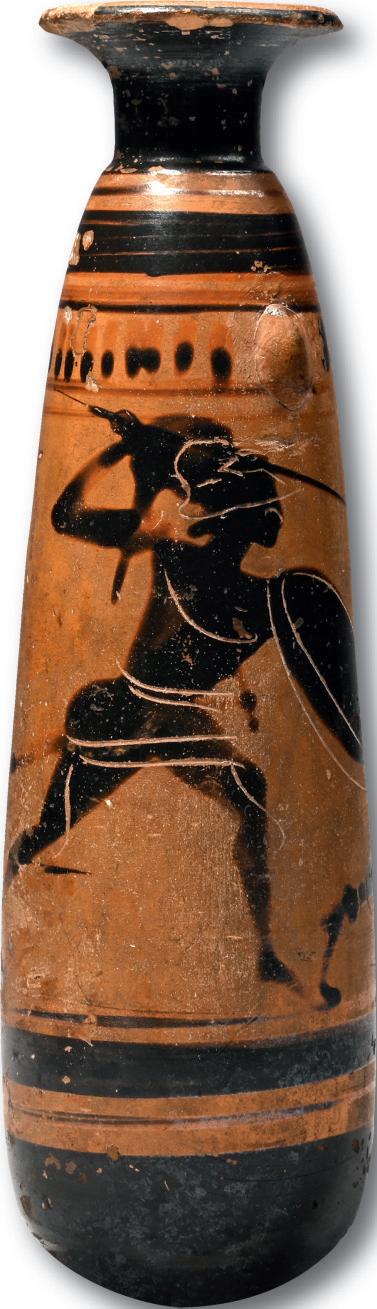

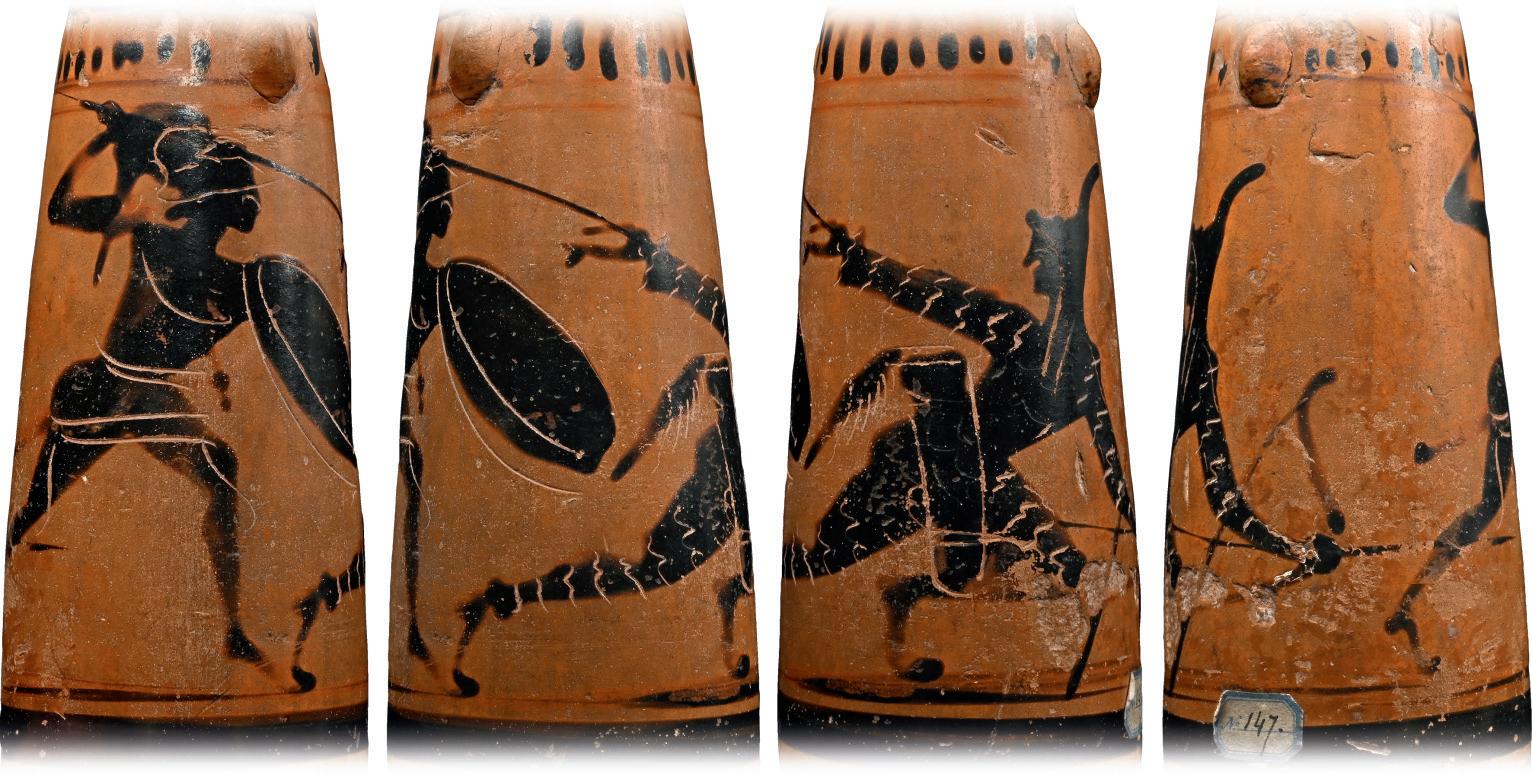
GREEK BLACK-FIGURE ALABASTRON WITH FIGHTING WARRIORS ‡
ATTIC, 500-480 B.C.
6¼ in. (262 grams total, 16 cm high including stand)
Of ovoid shape, short neck and expanded flat rim; painted in horizontal bands with black vertical strokes the shoulder, ovules in the upper part, the central scene representing a Greek Ekdromos fighting a Scythian archer; the Greek warrior, wearing a light sleeveless chiton, and a crested Corinthian helmet, carrying a wide hoplon shield, and a long spear with which he is slashing his opponent; the Scythian archer is wearing a typical tall cap flowing backwards and his long coat-suit, carrying a gorytos, (quiver) and composite bow with arrow; horizontal black stripes below; accompanied by a custom-made display stand.
£30,000 - 40,000
PROVENANCE: Louis-Gabriel Bellon (1819-1899) collection, France. European private collection, 2009.
Accompanied by an academic report by Dr Raffaele D’Amato.
FOOTNOTES:
The importance of this alabastron is linked to its iconography, which represents episodes of the Persian Wars, fought 490-480 B.C. Such alabastra are part of a series realised during the period of the conflict and after, and they are an important source of information on the Persian and Greek armies. Here, the two opponents evoke the Greek victories, with a light-armed Greek ekdromos (hoplite fighting in light equipment) killing a Scythian archer, who formed part of the Persian army. The representation of Scythian costume in vase-painting reached its height of popularity between c. 530 and 490 B.C., and went out of fashion after the Graeco-Persian wars, when these clothes began to be associated with the Persian ethnic identity rather than the original Scythian.
72
GREEK GOLD AND JET DIADEM WITH MASKS HELLENISTIC, 3RD-2ND CENTURY B.C.
8½ in. (22.5 grams, 21.6 cm)
A gold necklace or diadem composed of twenty-two articulated units each in the form of a complex shields terminating in finials decorated with palmettes executed in filigree; body consists of shield-shaped jet(?) elements with a central rhomboid panel, joined above and below by triangular sections decorated with granulated triangles; the perimeter of each shield framed by a soldered beaded wire; at the centre of each rhomboid panel, an embossed appliqué mask in low relief; to the reverse of each element, two vertically aligned loops formed from narrow gold strips and intended for articulation; offered in a lined wooden display case.
£8,000 - 10,000
PROVENANCE:
Ex M. Velensky collection, London, UK, 1990s.
Accompanied by a copy of a four page examination report number 90/2015 by Dr habil Mikhail Treister.
FOOTNOTES:
The terminals are comparatively rare survivals, decorated with palmettes in filigree, a feature only occasionally attested among comparable assemblages from Bosporan contexts. The overall typology, decorative programme, and construction techniques closely parallel examples recovered from welldocumented burials at Phanagoria, Pantikapaion, Tanais, and Tsukur-Liman.
Comparable necklaces combining shield elements with embossed human heads are particularly characteristic of the 3rd-2nd centuries BC. According to the examination conducted by Dr habil. Mikhail Treister, there is nothing to challenge the authenticity of the object. The specific form, restricted geographic distribution, and close parallels suggest manufacture within a workshop of the Bosporan Kingdom, most plausibly in Phanagoria, one of its principal production centres during the Hellenistic period.

73
GREEK GOLD ‘GOLDEN FLEECE’ RAM-HORN PAIR 5TH-3RD CENTURY B.C.
4 in. (60.61 grams total, 10.5 cm each)
A matched pair of sheet-gold model ram’s horns, each curved with narrow end flattened, ribbed body, flared rim to the mouth with applied granule detailing; probably from a representation of the or ‘golden fleece’ from the legend of Jason and his adventures with the crew of the ship Argo.
£5,000 - 7,000
PROVENANCE:
From a private collection of seals and amulets, the property of a Canadian gentleman living in London; from his father’s collection formed in the late 1960s to 1980s.
FOOTNOTES: The legend of the Golden Fleece is referenced by several ancient writers, including Pindar, whose reformulation forms the basis of most modern retellings, but an earlier version was evidently familiar to Homer in the 8th century B.C. It appears as a pictorial theme on early Greek vases. The story refers to a celestial winged ram with golden wool, which was believed to live and be worshipped by the inhabitants of lands north of the Black Sea; this ram, in some versions of the tale, is transformed into the constellation Aries.

SCYTHIAN ELECTRUM TORC
7TH-5TH CENTURY B.C.
6½ in. (169 grams, 16.5 cm diameter)
Formed as a simple penannular hoop from a single piece of electrum, tapering towards the terminals.
£12,000 - 17,000
PROVENANCE: Ex Jack Ogden, 1990s.
Accompanied by an expertise from Striptwist Ltd, a London-based company run by historical precious metal specialist Dr Jack Ogden, reference number [191101].
FOOTNOTES: Portable X-ray fluorescence (XRF) analysis confirms the alloy to be electrum, with an average composition of approximately 62% gold, 34% silver, and 3% copper. The purity and metal ratios are consistent with ancient manufacture. The restrained form, lacking figural ornament, is characteristic of early Scythian metalwork and suggests a date prior to the 5th century BC.
76
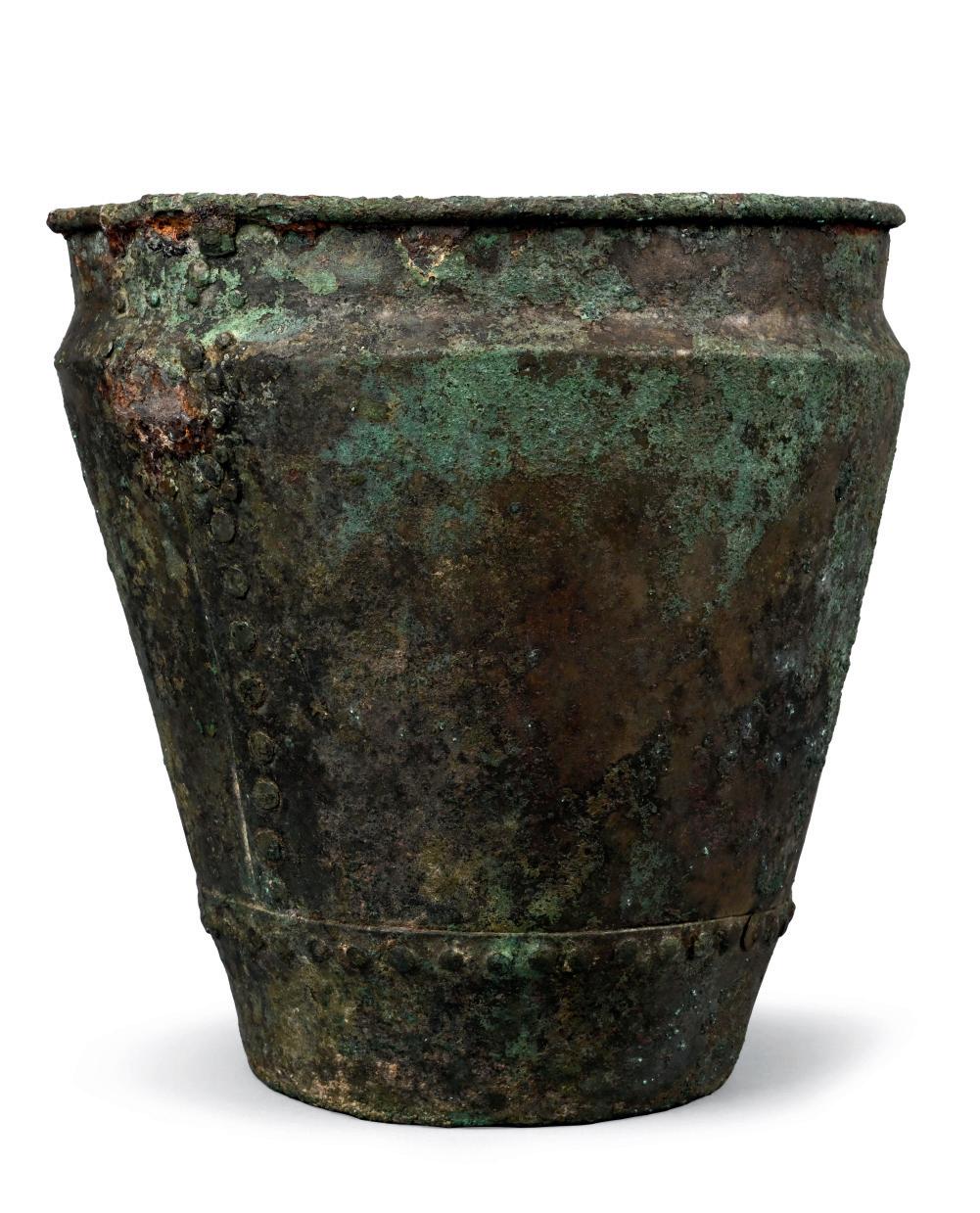
‘THE GUTTMANN’ LARGE GREEK BRONZE FUNERARY SITULA
7TH CENTURY B.C.
10¼ in. (1.56 kg, 26.2 cm)
Formed with a single-piece bottom and two-piece body riveted together; the underside recessed, sidewall flared with a carination at the shoulder and rolled rim; attachment point for handles at the seams below the shoulder and to the inner face of the rim; small repair panel to the inner face.
£2,000 - 3,000
PROVENANCE:
Ex Axel Guttmann Collection of Ancient Arms and Armour, Germany [19442001], AG 490.
Private collection, UK.
PUBLISHED:
Born, H. and Hansen, S., Fruhgriechische Bronzehelme: Sammlung Axel Guttmann, IX, Mainz, 2001, (AG 490), p.32.

75
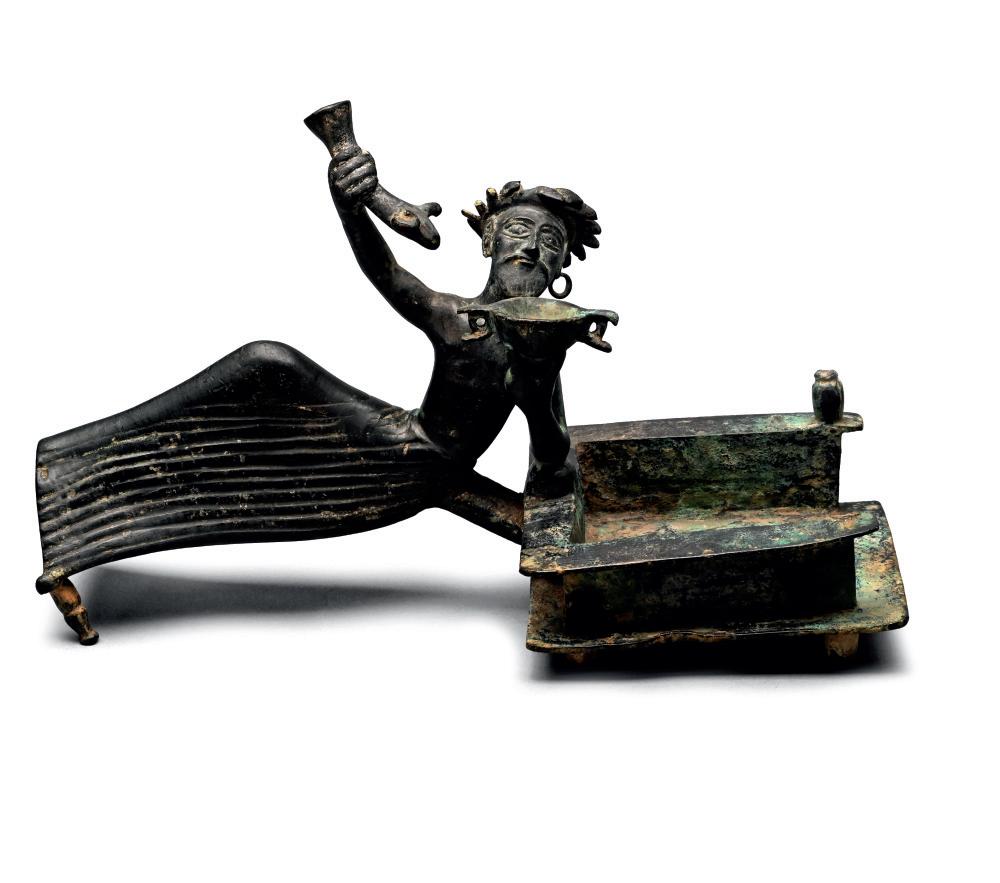
BRONZE BATILLUM DEPICTING A RECLINING BANQUETEER WITH SKYPHOS AND RHYTON PARTHIAN, 3RD-1ST CENTURY B.C.
10 in. (1.58 kg, 25 cm)
Comprising a square base with a raised border and supported by four stub feet, each originally surmounted by poppy-head finials (some absent); a hollow-formed figure of a banqueteer reclining elegantly with his weight resting on his left elbow, his right leg drawn up beneath the folds of a finely pleated robe; in his right hand, a ram’s head rhyton and his left hand cradling a skyphos; his bearded head with a laurel wreath.
£4,000 - 6,000
PROVENANCE:
Private New York collection, formed in the 1960s. Acquired on the North American art market, 1990s. with Cahn Auktionen AG, Basel, Switzerland, 13 November 2015, no.84 (CHF 18,000).
Accompanied by an academic report by Dr Raffaele D’Amato. 75
Accompanied by an academic report by Dr Raffaele D’Amato.
76
77
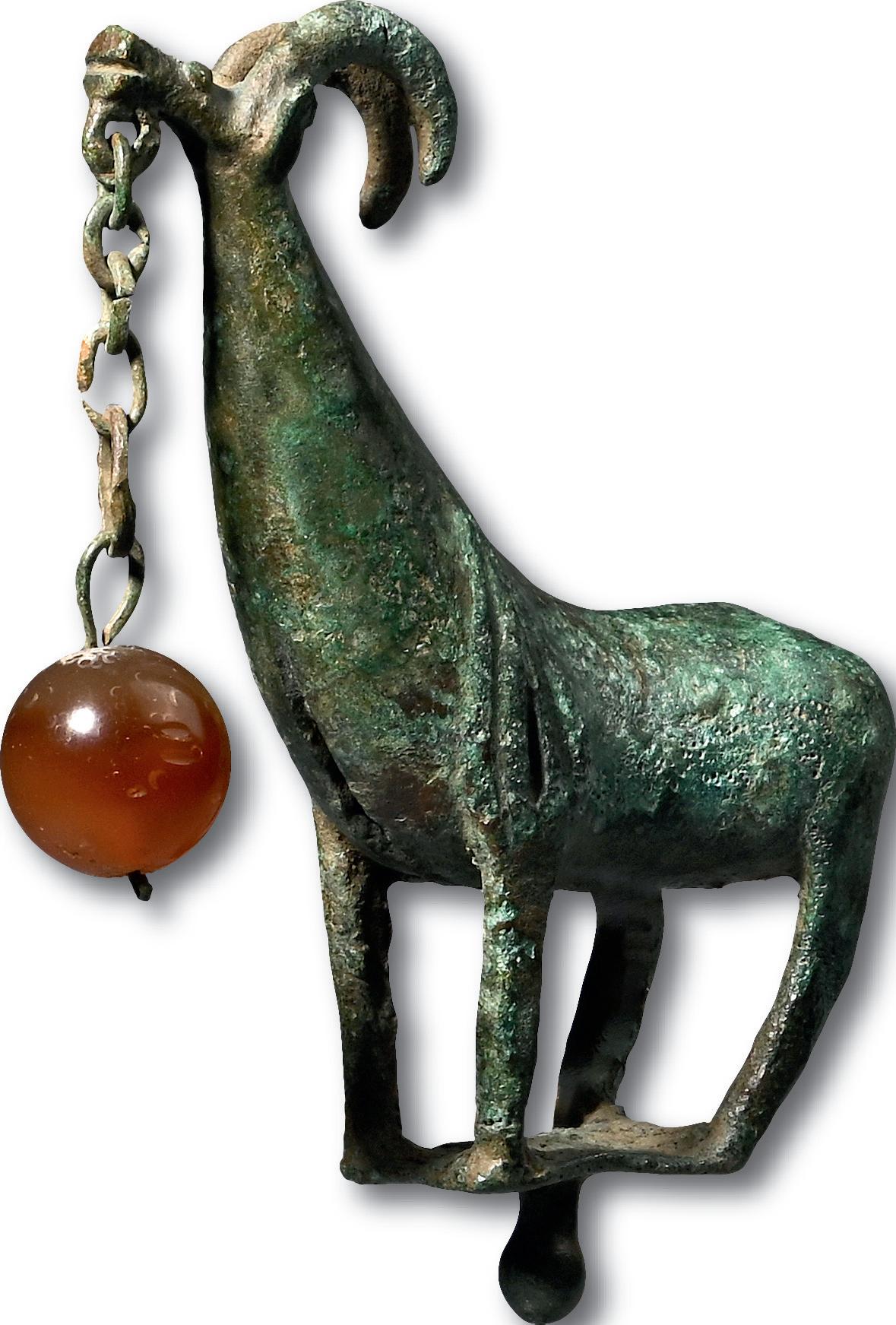
SCYTHIAN BRONZE MILITARY STANDARD FINIAL OF AN IBEX TRANSCAUCASIA, 4TH CENTURY B.C.
5 in. (643 grams total, ibex: 15 cm high)
With a rounded body and prominent raised neck, a tubular muzzle with stylised eyes and ears and a small, slightly open mouth; a ring with a chain and a large carnelian sphere beneath the chin; a wide incised groove above the front legs, perhaps intended to represent muscles; a long slit beneath the abdomen; standing on a rectangular platform with a pin for insertion to a wooden shaft; accompanied by a custom-made display stand.
£8,000 - 10,000
PROVENANCE: Acquired in Vienna, Austria, in the 1990s.
Collection of N.M., former Israeli Ambassador to Austria (1998–2000). Private collection, London.
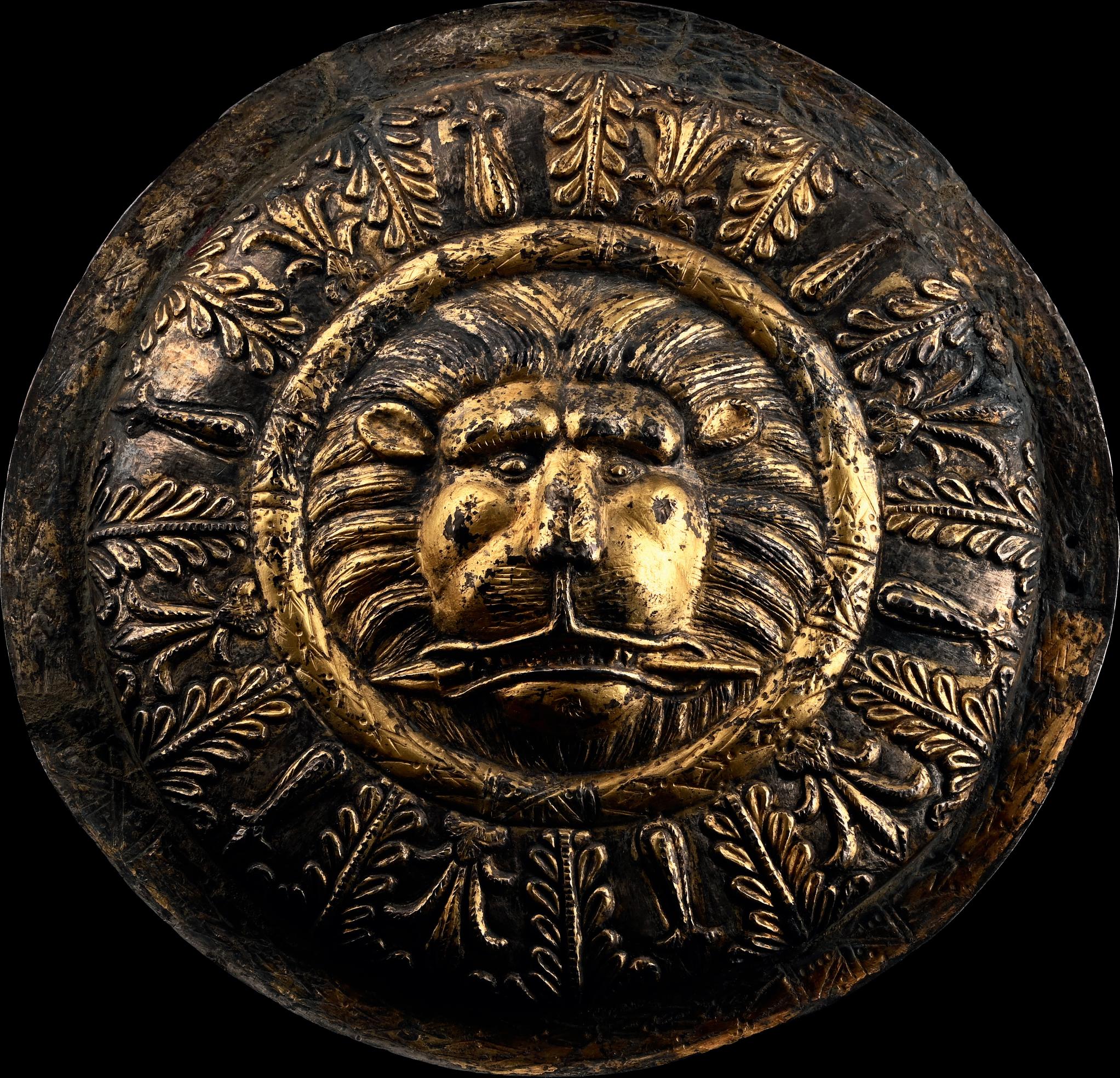
GREEK SILVER-GILT LION-HEAD MILITARY PHALERA HELLENISTIC, 2ND CENTURY B.C. 10 in. (451 grams, 27 cm).
Originally forming part of an elite horse-harness assemblage, made as a circular disc with a slightly flared rim and originally fitted with rear attachment loops (now lost); strongly modelled frontal lion’s head in high relief at the centre, gripping a spear or arrow in its jaws; the lion’s mane rendered in thick, slightly undulating locks, with additional chasing to suggest twisted strands, the facial features treated with pronounced linear and punched details: herringbone-patterned notches articulating the nose and whiskers, small star- or whirl-rosette motifs chiselled on the cheeks and chin; the central medallion framed by a raised ridge and a belted garland composed of pointed laurel leaves, dots imitating fruits, and four tied segments, a broad concentric frieze of alternating vegetal motifs surrounding, including narrow palmettes, lotus flowers, and oval blossoms with serrated petals, arranged rhythmically with alternating orientations; the floral elements originally selectively gilded against an ungilded silver ground, the outer flange decorated with a further leaf garland, and pierced with pairs of holes for attachment to leather straps.
£40,000 - 60,000
PROVENANCE: From the Walter Bizzarri family collection, 19th century.
Accompanied by a copy of an examination report number 101/2018 by Dr Habil Mikhail Treister, 22 September 2018.
Accompanied by an expertise from Striptwist Ltd, a London-based company run by historical precious metal specialist Dr Jack Ogden, reference number 180701.
Accompanied by copies of the relevant Apollo magazine pages.
PUBLISHED: Apollo magazine, February 2019.
FOOTNOTES: Such monumental phalerae are widely understood as prestige objects, likely produced as diplomatic gifts or ceremonial donations for members of the nomadic elite in contact with the Bosporan state. The scale, technical ambition, and iconographic complexity of the present example firmly support its interpretation as a high-status object within this tradition.
79
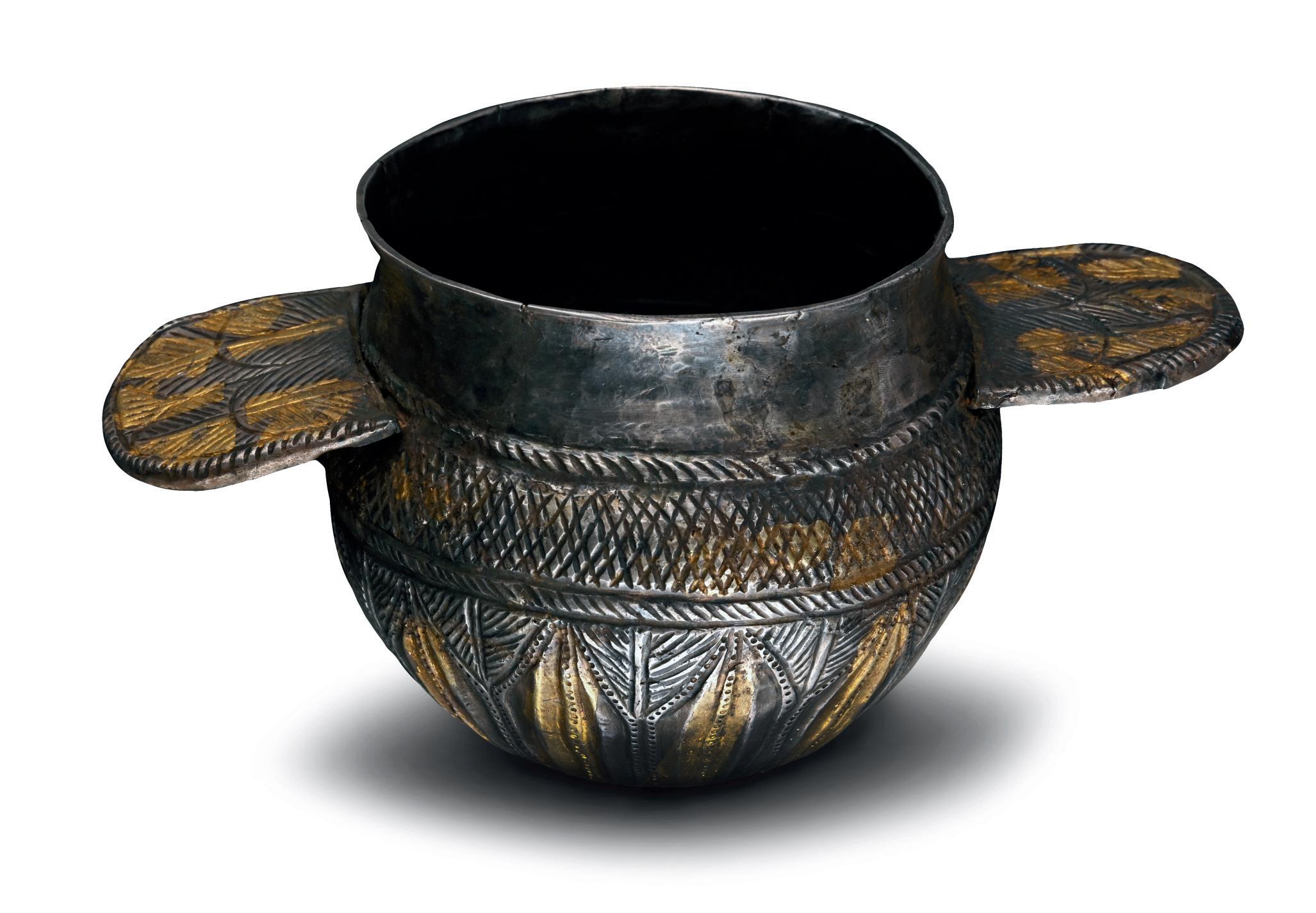
GREEK SILVER-GILT WINE CUP WITH HANDLES HELLENISTIC, 2ND-1ST CENTURY B.C.
6 in. (179 grams, 15.5 cm wide)
Comprising a globular body with a rounded underside, a repoussé rosette with ropework border, segmented band with leaf detailing, hatched shoulder framed by ropework bands, scooped neck with chamfered rim; two D-shaped ledge handles with recessed rim, ropework border, hatched panels; accompanied by a custom-made display case.
£3,000 - 4,000
PROVENANCE:
Acquired on the US art market, early 1990s.
Private collection, North America.
Ex private collection, USA.
TimeLine Auctions, 23 February 2023, no.48.
Private collection, London.
Accompanied by an academic report by Dr Raffaele D’Amato.
80
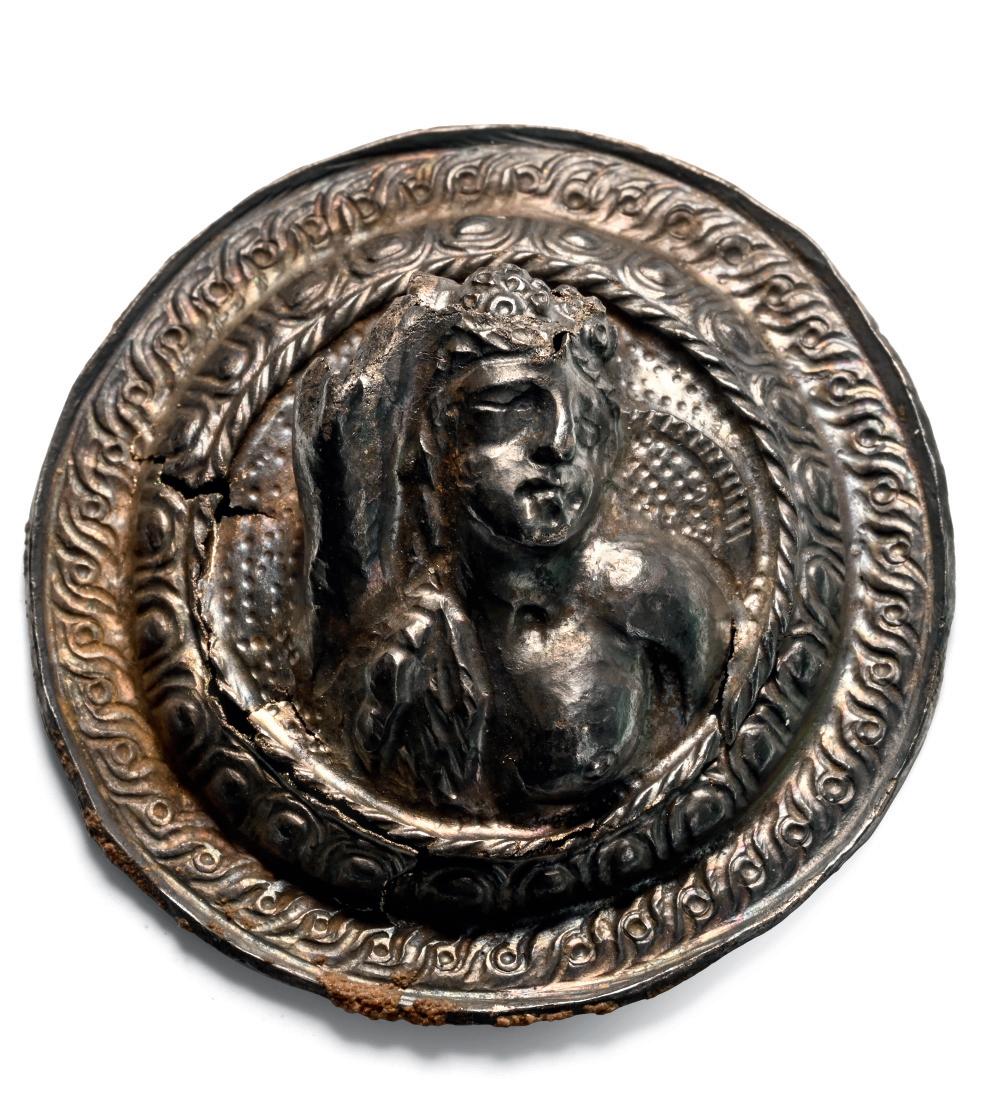
GREEK SILVER PHALERA WITH DIONYSUS ‡ 3RD-2ND CENTURY B.C.
1½ in. (5.28 grams, 41 mm)
Discoid in plan with returned rim, guilloche to the outer field and eggand-dart to the dome; central bust of Dionysus modelled in high-relief with garland in his hair.
£1,000 - 1,400
PROVENANCE:
Private collection, assembled in the 1950s-1970s, thence by descent.
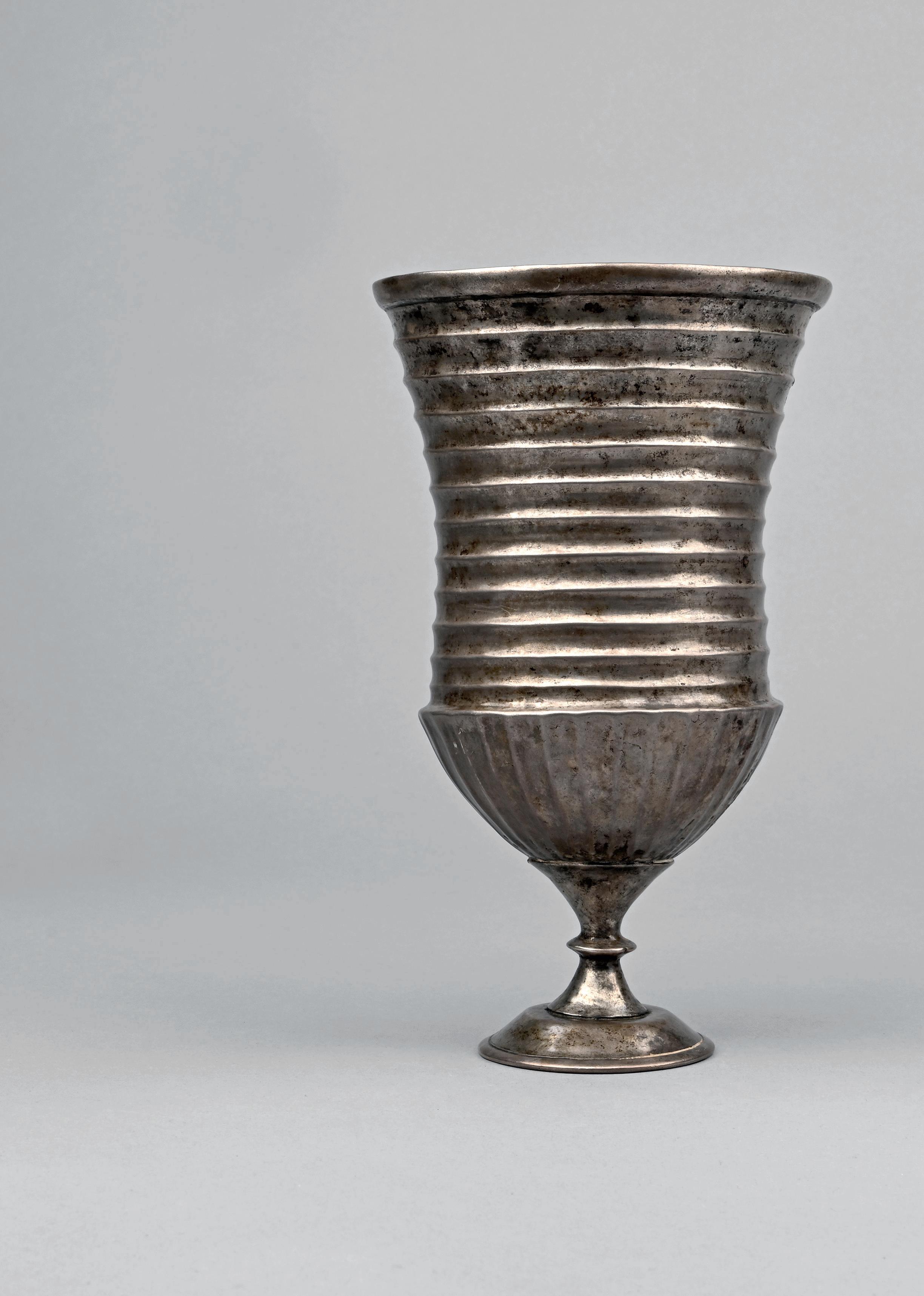

LARGE GRAECO-PARTHIAN RIBBED SILVER GOBLET
GRAECO-PARTHIAN OR GANDHARAN, 1ST CENTURY B.C.-1ST CENTURY A.D.
7 in. (695 grams, 20 cm high)
With carinated ribbed walls, the upper portion cylindrical, the lower ovoid, with a separately made footed base, with the foot characterised by a central horizontal groove.
£20,000 - 30,000
PROVENANCE: Robert Haber, New York, 1992.
Accompanied by an academic report by Dr Raffaele D’Amato.
83
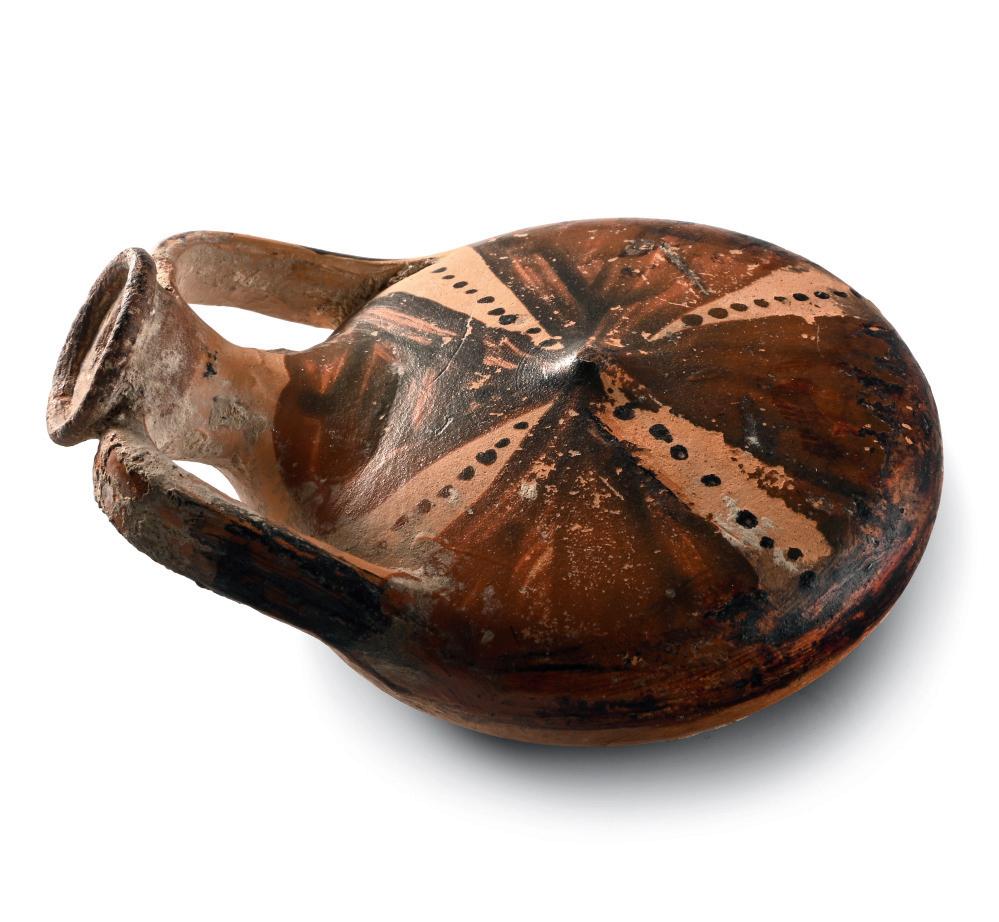
MYCENAEAN PAINTED POTTERY FLASK ‡
14TH-13TH CENTURY B.C.
4 in. (132 grams, 11.1 cm)
Comprising a circular body with a rounded base and two strap handles, a short neck with an everted rim; the body with a painted expanding cross motif with the arms separated by a band of pellets.
£1,500 - 2,000
PROVENANCE:
Private collection, Switzerland, acquired in the 1994. Private family collection since the late 1990s.
Accompanied by an academic report by Dr Raffaele D’Amato.
85
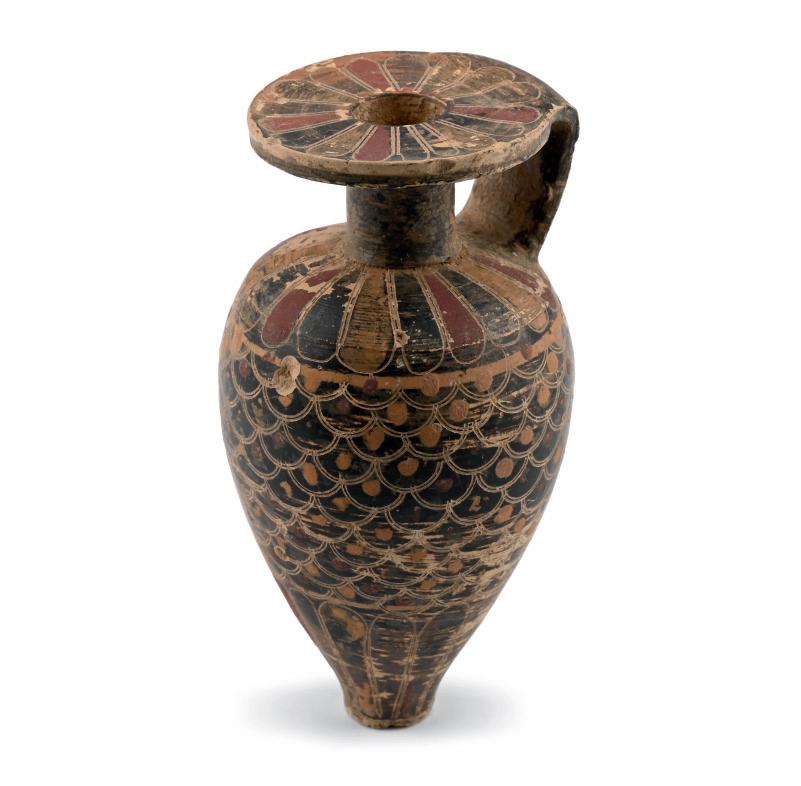
PROTO-CORINTHIAN PAINTED TERRACOTTA ARYBALLOS ‡
7TH CENTURY B.C.
4 in. (79 grams, 10.5 cm)
Comprising a piriform body and a tubular neck with a wide rim, a strap handle to the rear, the rim with painted polychrome petals, the pattern repeating beneath the neck and on the base of the vessel; the body decorated with fishscale decoration.
£2,000 - 3,000
PROVENANCE:
Swiss private collection, assembled in the 1960s and 1970s. Acquired by the present owner in 2004.
Accompanied by an academic report by Dr Raffaele D’Amato.
82
GREEK RED-FIGURE OWL SKYPHOS
ATTIC, 4TH CENTURY B.C.
6 in. (115 grams, 15.2 cm wide)
Mammiform body with flared pedestal base and two loop handles to the rim; each side with a facing image of an owl between laurel fronds; concentric circles to the base, Attic workmanship.
£800 - 1,000
PROVENANCE:
Acquired on the art market between the late 1990s and mid-2000s. Estate of the late Barry Paul Buxton (1944–2024), Oakham, Rutland. Acquired on the UK art market, 2025.
84
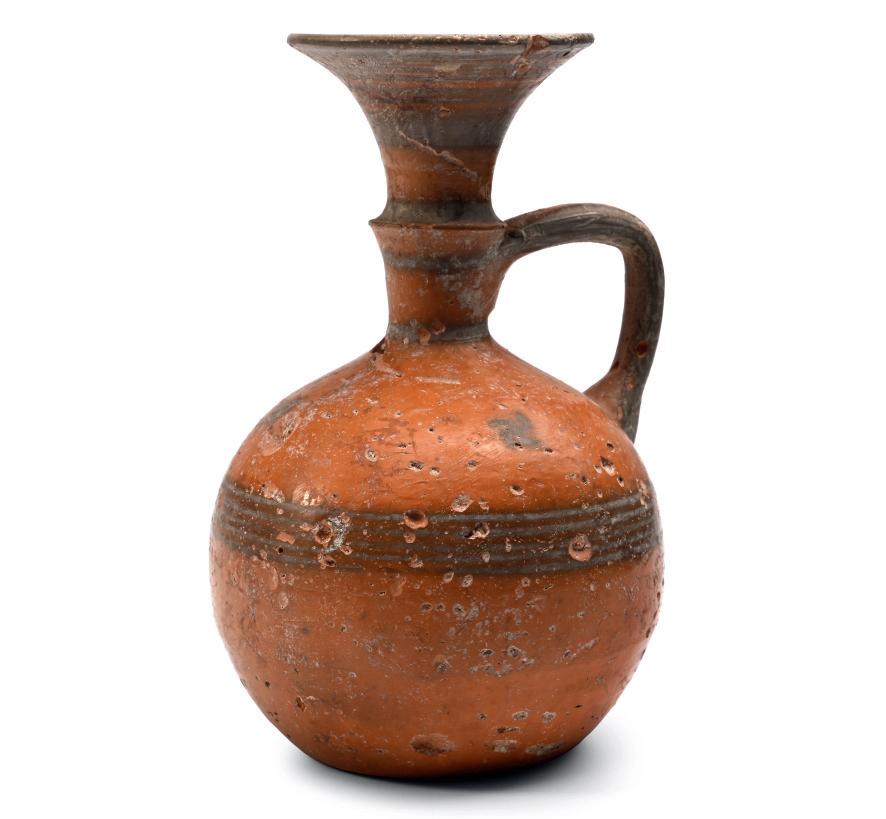
EASTERN MEDITERRANEAN TERRACOTTA JUG ‡
7TH-6TH CENTURY B.C.
3½ in. (67 grams, 91 mm)
Comprising a spherical body and flat base, trumpet-shaped mouth with biconvex collar and strap handle; painted circumferential bands.
£300 - 400
PROVENANCE:
Acquired by a Swiss family in the mid-1980s to late 1990s, thence by descent. Private collection, Switzerland, since the late 1990s.
86

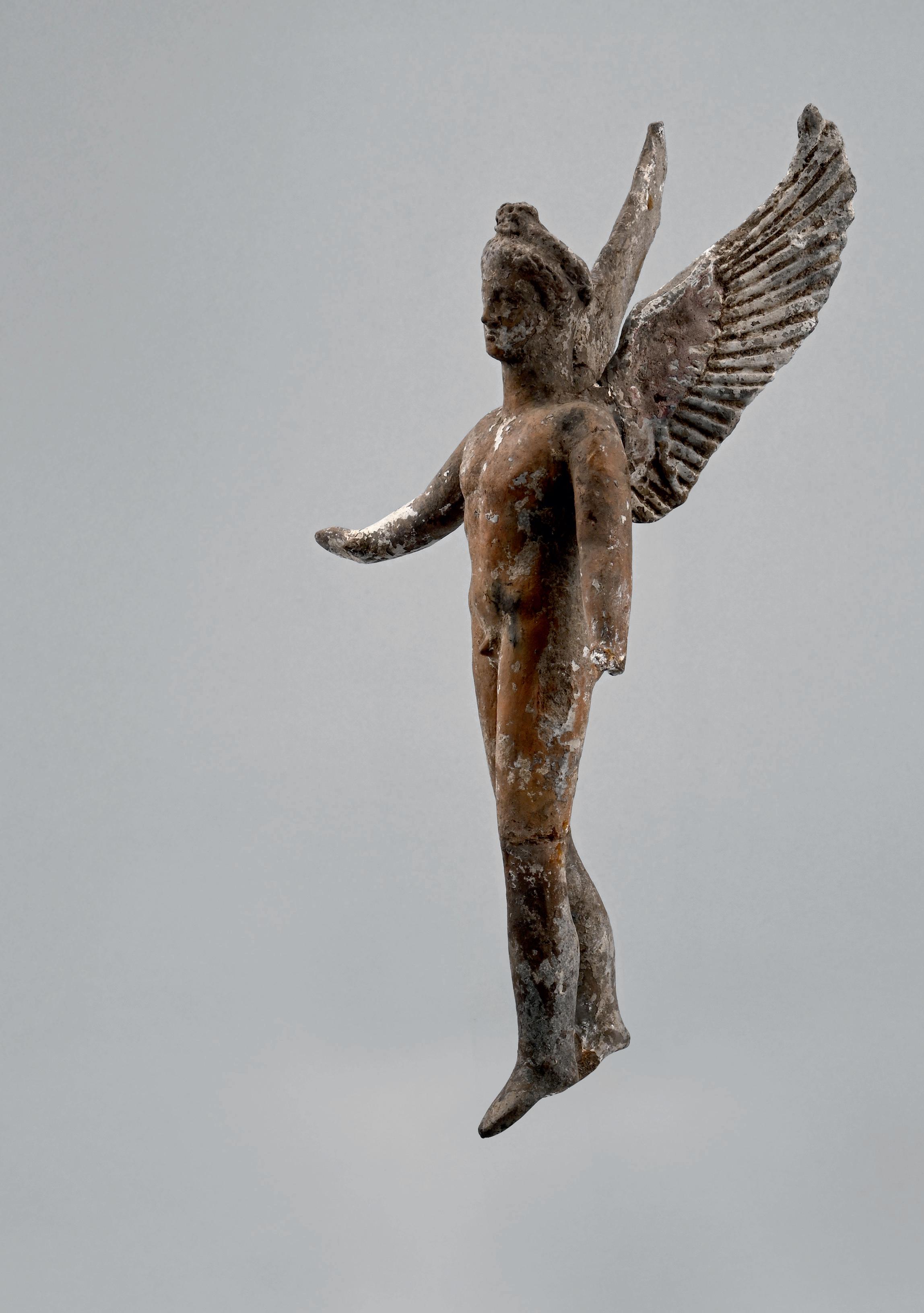
GREEK TERRACOTTA FIGURE OF EROS, THE GOD OF LOVE ‡ HELLENISTIC, 3RD-1ST CENTURY B.C.
12¼ in. (808 grams total, 31 cm including stand)
Modelled nude in a dynamic pose with his wings spread open, the left leg slightly advanced, and the right arm extended with open palm, a diadem or a fillet on his head; circular socket between the wings; accompanied by a display stand.
£10,000 - 14,000
PROVENANCE: Louis-Gabriel Bellon (1819-1899) collection, France. European private collection, 2009.
Accompanied by an academic report by Dr Raffaele D’Amato.
FOOTNOTES:
In classical times, Eros was usually depicted as a handsome adolescent, with only his wings distinguishing him from other kaloi and young athletes. Sometimes he was depicted younger and with less masculine features: Lysippos, in the famous statue of Eros of Thespiae, depicted him as a youth.

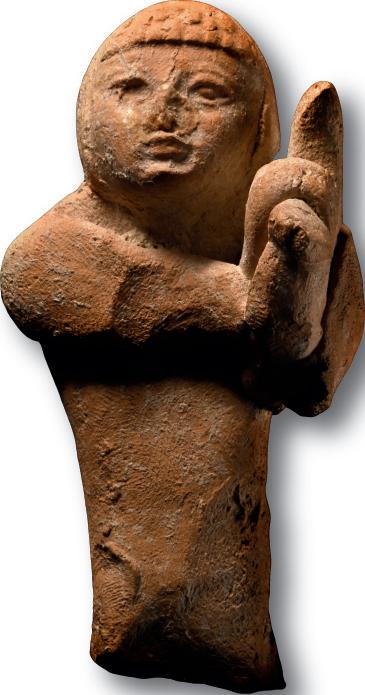
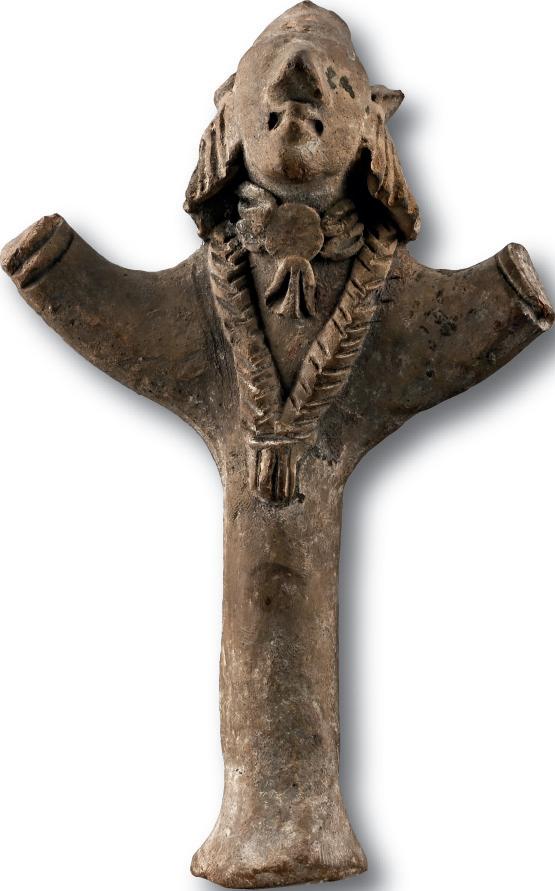
GREEK TERRACOTTA STANDING FIGURE
ARCHAIC, 7TH-5TH CENTURY B.C.
6¾ in. (277 grams total, 17 cm high including stand)
Modelled in the round figure standing with arms raised, head tilted upward with shoulder-length hair and horned cap, collar to the throat with large disc closure, pectoral pendant on a stylised braided thong; mounted on a custom-made stand; possibly Cypriot workmanship.
[No Reserve]
£500 - 700
PROVENANCE:
Ex Ernest Ohly collection.
Acquired from Woolley & Wallis, Wiltshire, UK, 20 May 2010, no.1010 (part).
From an important Cambridgeshire estate; thence by descent.
From the private collection of John Meredith, acquired since the 1990s; thence by descent.

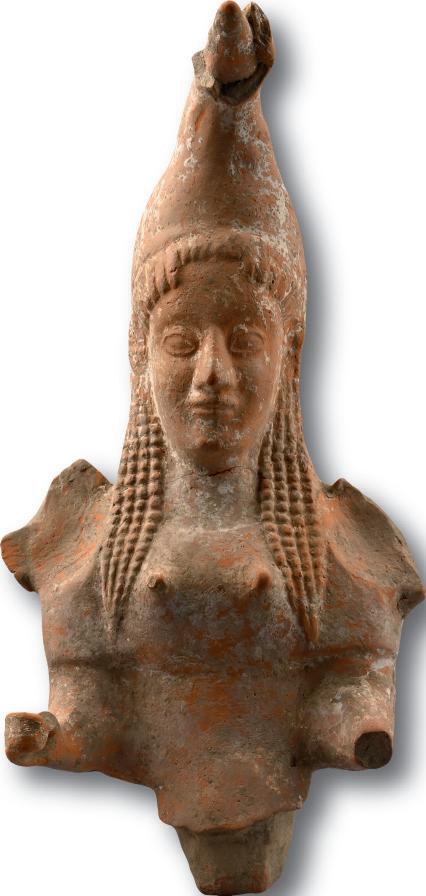
GREEK TERRACOTTA FEMALE ANTEFIX ‡ ARCHAIC, 6TH-5TH CENTURY B.C.
10½ in. (411 grams, 26 cm)
Mould-made figure of a female upper body with tall curved and conical headdress, hair dressed in braids falling to her shoulders and flanking her breasts, arms spread and right hand curled to grip a handle or sword-hilt; beneath, a tapering mounting peg for attachment to a roof.
£1,800 - 2,400
PROVENANCE:
Acquired in the mid 1980s-1990s.
Private collection, Switzerland, thence by descent. Private collection, since the late 1990s.
Accompanied by an academic report by Dr Raffaele D’Amato.
87
GREEK TERRACOTTA CITHARODE ‡ 6TH-4TH CENTURY B.C.
3 in. (62 grams, 86 mm)
D-shaped in section with close-cut hairstyle, standing, holding a cithara supported on the left arm, strumming with the right hand.
£1,500 - 2,000
PROVENANCE:
Ex Shlomo Moussaieff (1925-2015), Israel. European private collection.

89
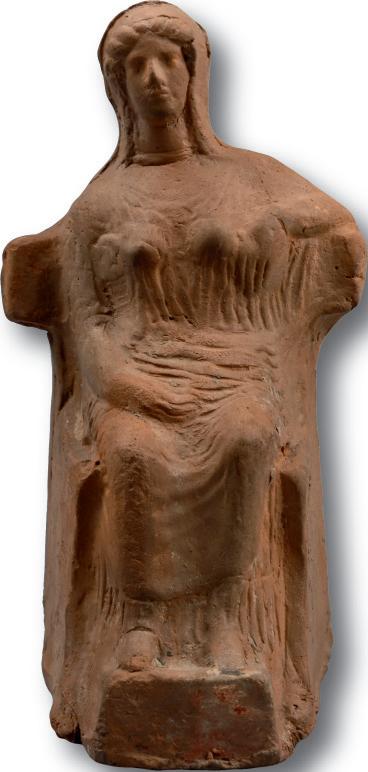
GREEK TERRACOTTA FIGURE OF A SEATED GODDESS ‡ 3RD-2ND CENTURY B.C.
5½ in. (255 grams, 13.8 cm)
Hollow-formed figurine of a female wearing a himation seated on a high-backed chair with right hand in her lap and left arm bent over the back of the chair; triangular vent to reverse, hollow underside; Tanagra type.
£500 - 700
PROVENANCE: Collection of Mr C., Geneva, Switzerland (1936-2016), assembled between 1985 and 2010.

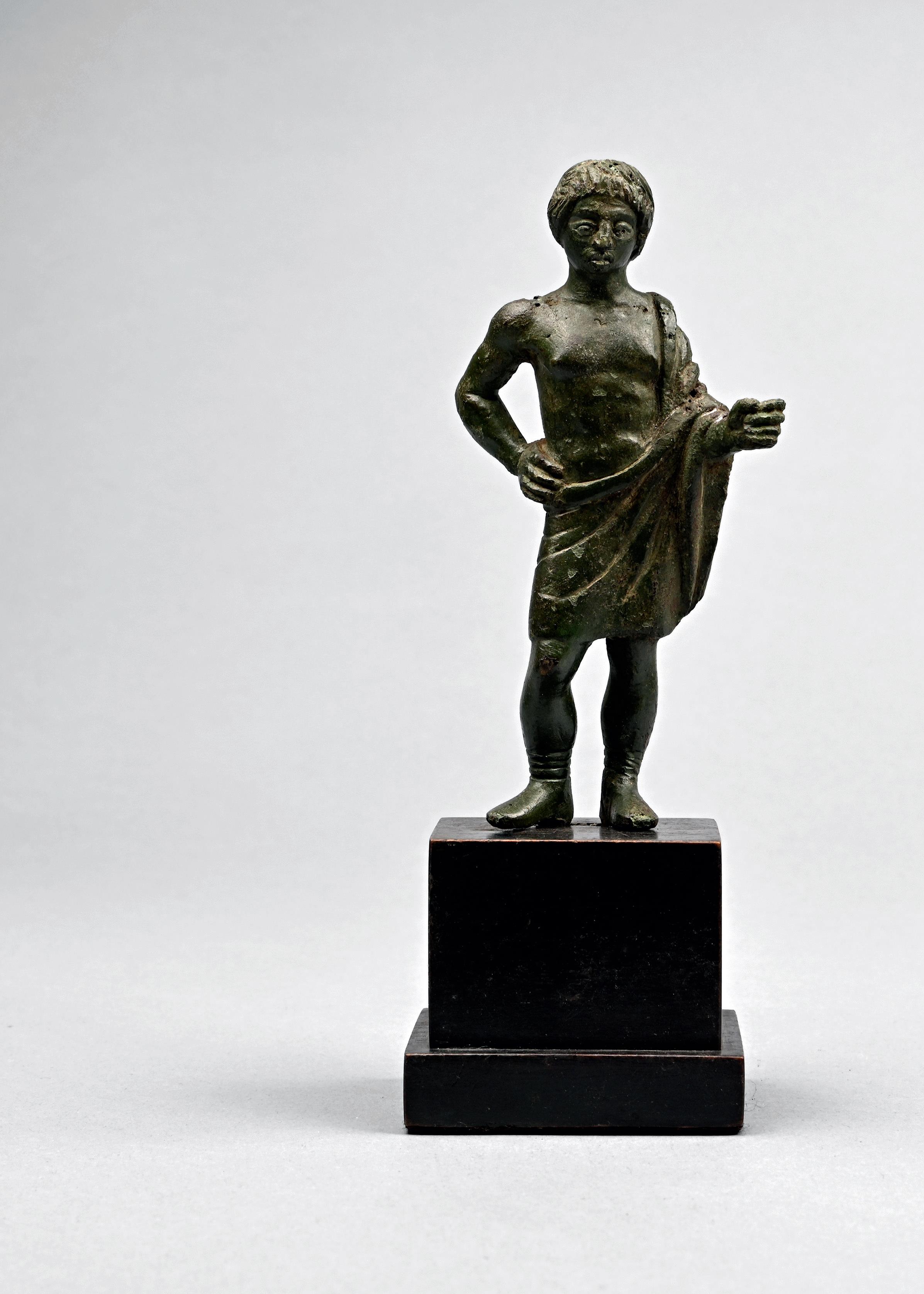

ETRUSCAN BRONZE STATUETTE OF A DRAPED HERO ‡
4TH-3RD CENTURY B.C.
7 in. (506 grams total, 18.7 cm including stand)
Modelled in the round, standing erect with right hand on his hip and left arm extending from the elbow resting on the left hip and with fingers curled to hold a staff or handle, wearing a loosely draped cloth over the left shoulder and drawn around the body to hang over the arms; ribbed cuffs to the boots; youthful face with tousled hair and slightly exaggerated lentoid eyes; C-shaped staple beneath the feet for attachment; supplied with a custommade display stand.
£18,000 - 24,000
PROVENANCE: with Sotheby’s, Antiquities, London, 6 July 1995, no.130. Acquired by the present owner at the above sale.
FOOTNOTES:
The statue was probably a cult offering and presents an archaic Etruscan hairstyle; it is likely to have been produced as a votive offering or for private lararia. His warrior status can be confirmed by his boots, typical of archaic-era Etruscan and Latin warriors.
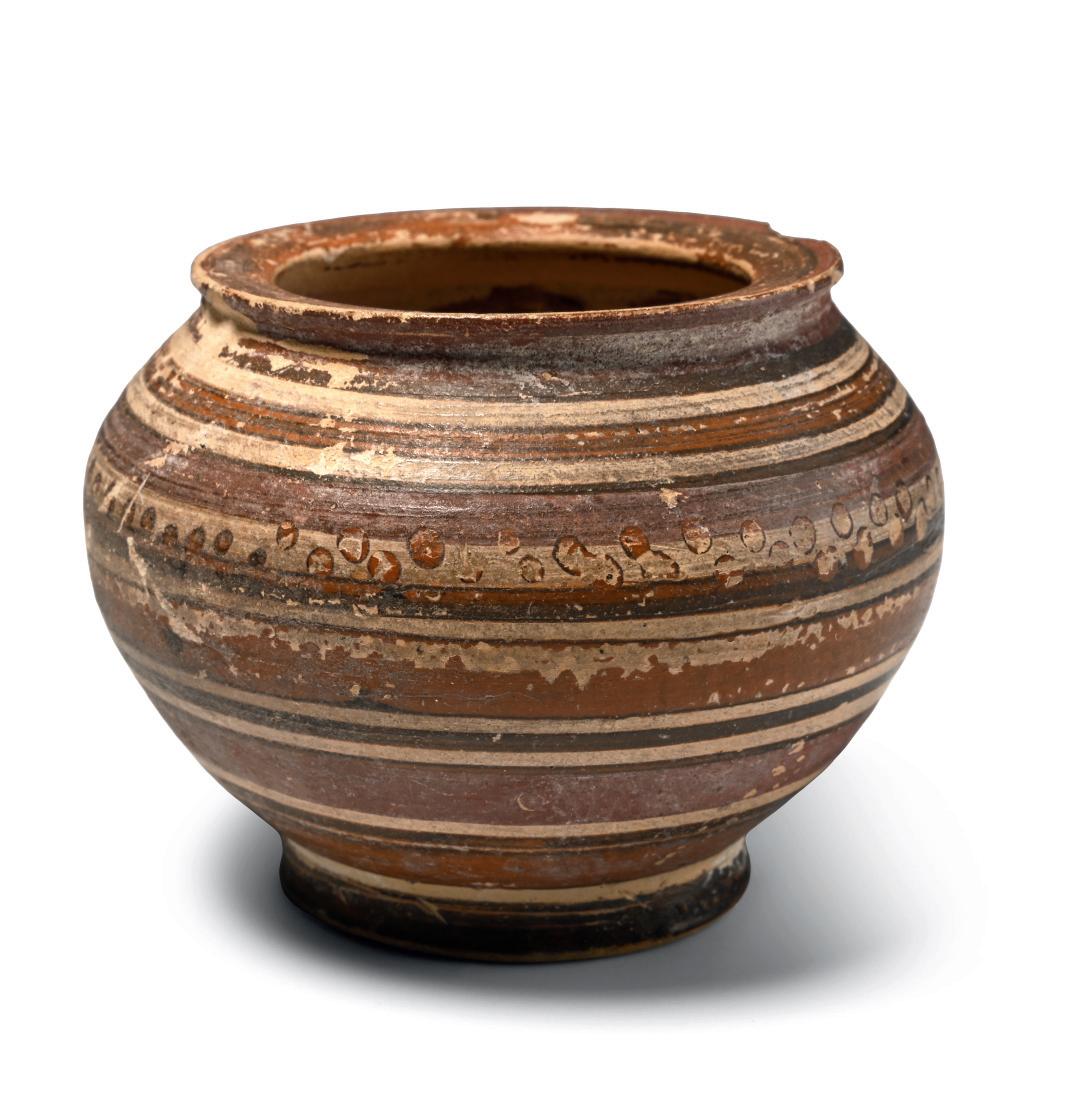
93
GREEK BOWL WITH CRIMSON AND BLACK DECORATIONS ‡
4TH CENTURY B.C.
2 in. (49.2 grams, 63 mm)
With a narrow basal ring, a flared rim, and painted circumferential bands.
£1,000 - 1,400
PROVENANCE:
Private collection, Los Angeles, USA. Acquired on the American art market. European private collection.
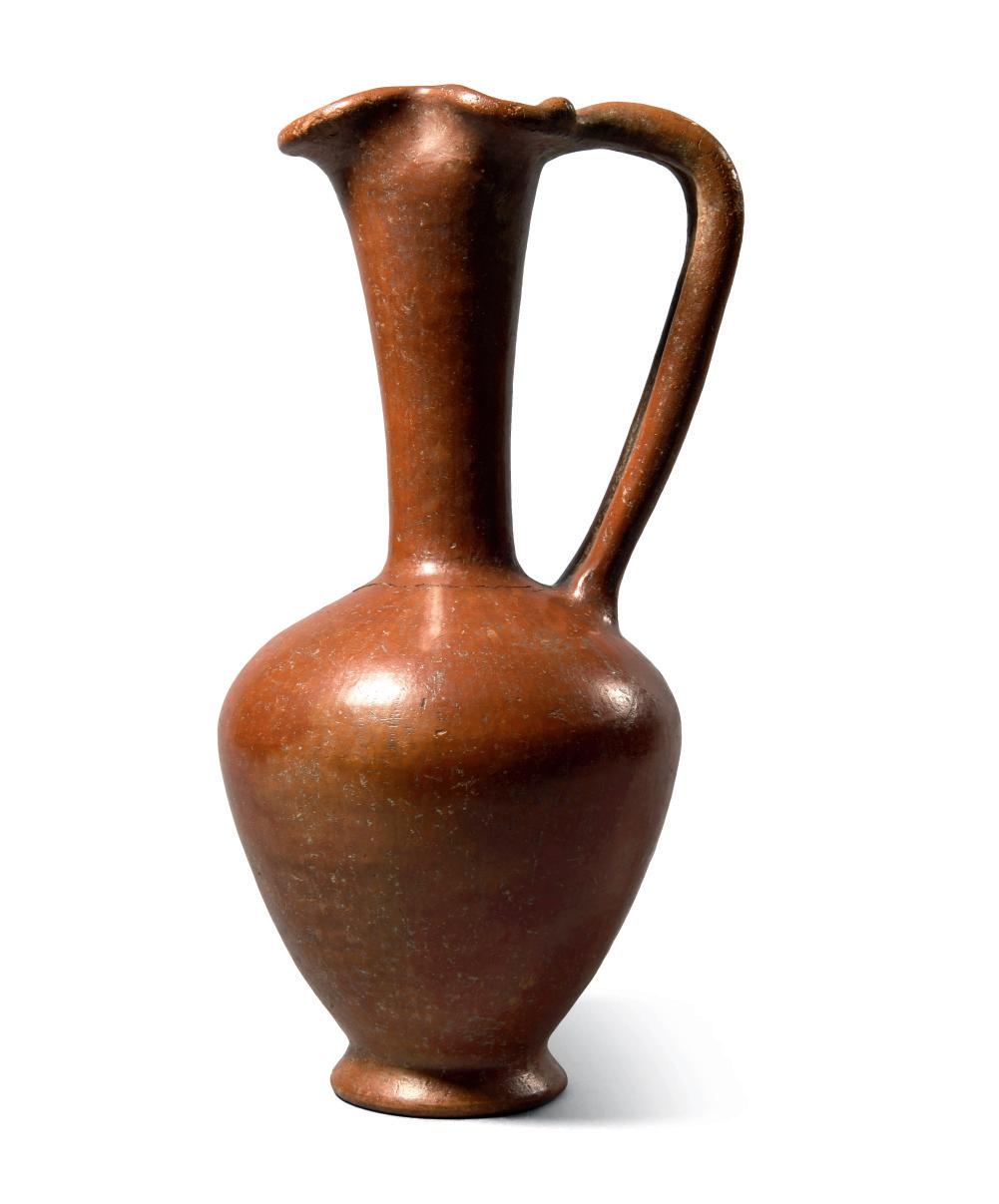
LARGE PHOENICIAN CERAMIC PIRIFORM JUG
LEVANTINE, 8TH CENTURY B.C.
11 in. (1.72 kg, 28 cm)
With trefoil mouth and integral ribbed handle, covered in a red slip with burnished surface; held in an antique wooden box crate.
£3,000 - 4,000
PROVENANCE:
Collected by Miss Patience Townend, in the late 1950s. Thence by descent to the owner’s godmother. By gift to Mrs Lucy Manningham-Buller, circa 2002. Private collection, UK.
Accompanied by a copy of a letter from Rupert Chapman, Curator of Levantine Antiquities, in the Middle Eastern Department at the British Museum, dated 4th March 2013, discussing the piece: ‘…there is no doubt in our minds that the piece is genuine, and that it dates to the eighth century B.C....the piece you have is a very fine one… any museum would be very happy to have such a fine example in its collection’.
FOOTNOTES:
This object exemplifies the high-quality tableware produced during its historical period, intended for use in the wealthiest homes.
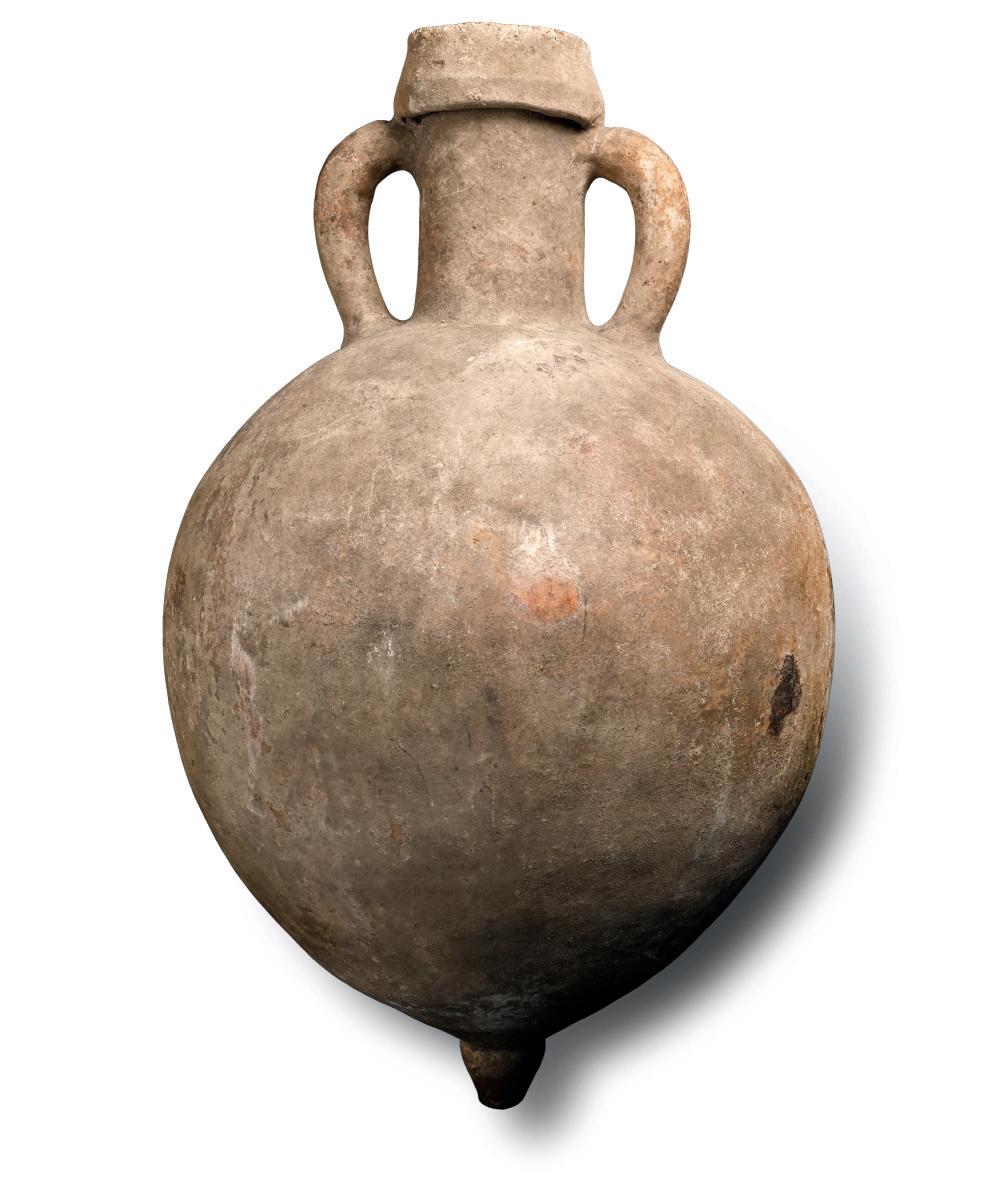
94
VERY LARGE GREEK BRINDISI TYPE TERRACOTTA AMPHORA
3RD-1ST CENTURY B.C.
29¾ in. (12.5 kg, 75.5 cm high)
Comprising an ovoid bulbous body with knop finial, narrow tubular neck with lateral strap handles and a folded rim to the mouth.
£1,000 - 1,400
PROVENANCE:
Ex. H.P. Payot, Clarens (VD, Switzerland) collection, by inheritance.
Private collection, UK.
LITERATURE: See The Levantine Ceramics Project, Brindisi amphoras.
95
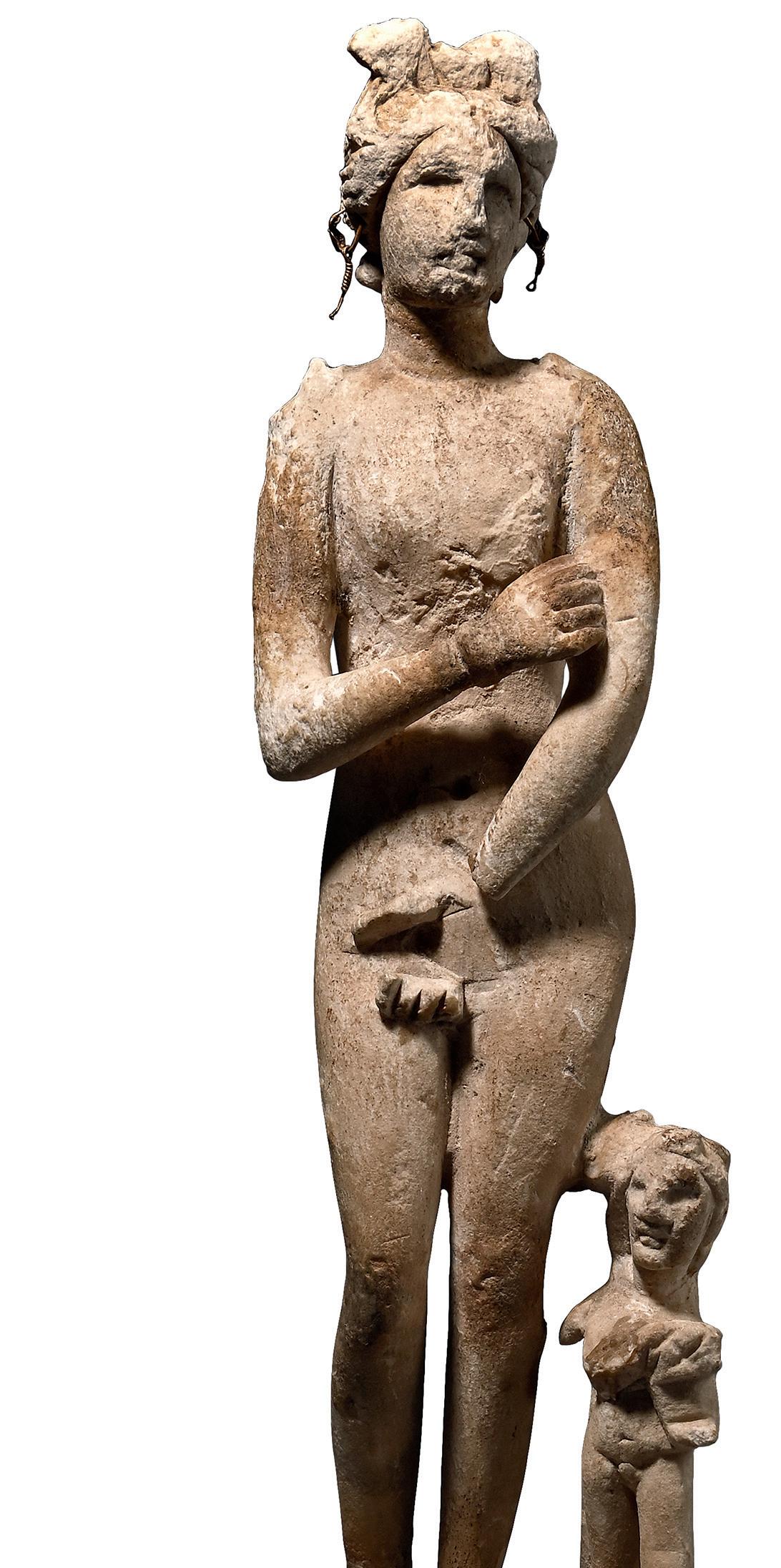
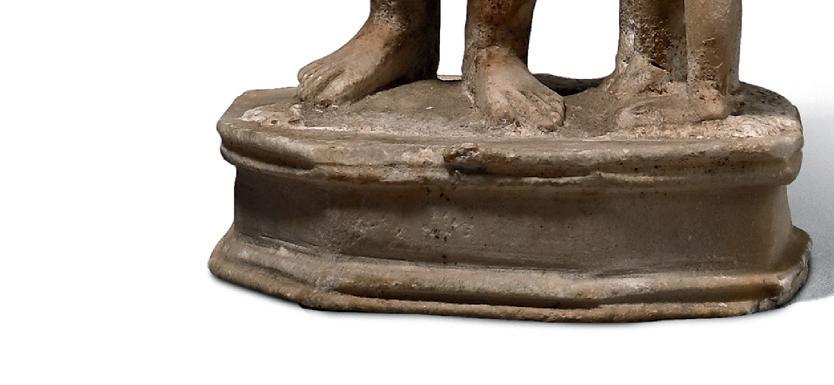
EASTERN GREEK MARBLE FIGURE OF APHRODITE ‡
1ST CENTURY B.C.-1ST CENTURY A.D.
12¾ in. (1.2 kg, 32.7 cm)
Carved in the round figure of the goddess standing nude with one hand raised and the other on her pudendum, her hair gathered into a chignon with lateral bunches on the crown and with voids to allow for the suspension of small gold earrings; putto at her left knee; left hand partly absent; remounted on a socle base.
£5,000 - 7,000
PROVENANCE:
Acquired in the 1992.
Private collection, Switzerland, thence by descent. Private collection, since the late 1990s.
96
‘THE SMITHSONIAN’ GREEK TERRACOTTA HORSE ITALY, 3RD-1ST CENTURY B.C.
7 in. (1.15 kg, 19.4 cm)
Modelled in the round, horse in advancing pose with one foreleg raised, flange base; old collector’s number ‘170439’ to base; old label ‘170[...]’ and ‘102’ to lower body; neck repaired.
£2,000 - 3,000
PROVENANCE:
Private collection of Baron d’Ussés.
Acquired by F.B. Spiridon, New York, believed before 1894.
Acquired by Eleanor Magruder (1852-1906), and thence by descent to her heirs in 1906.
Accompanied by photographs of the object on display at the Smithsonian Institution and of the corresponding accession catalogue entry.
PUBLISHED:
On loan to the Smithsonian Institution, Washington, D.C., from 1894 to 1898, where it was published in the accession catalogue (accession no. 28776; catalogue no.170439) with Parke-Bernet Galleries, New York, 4 December 1969.
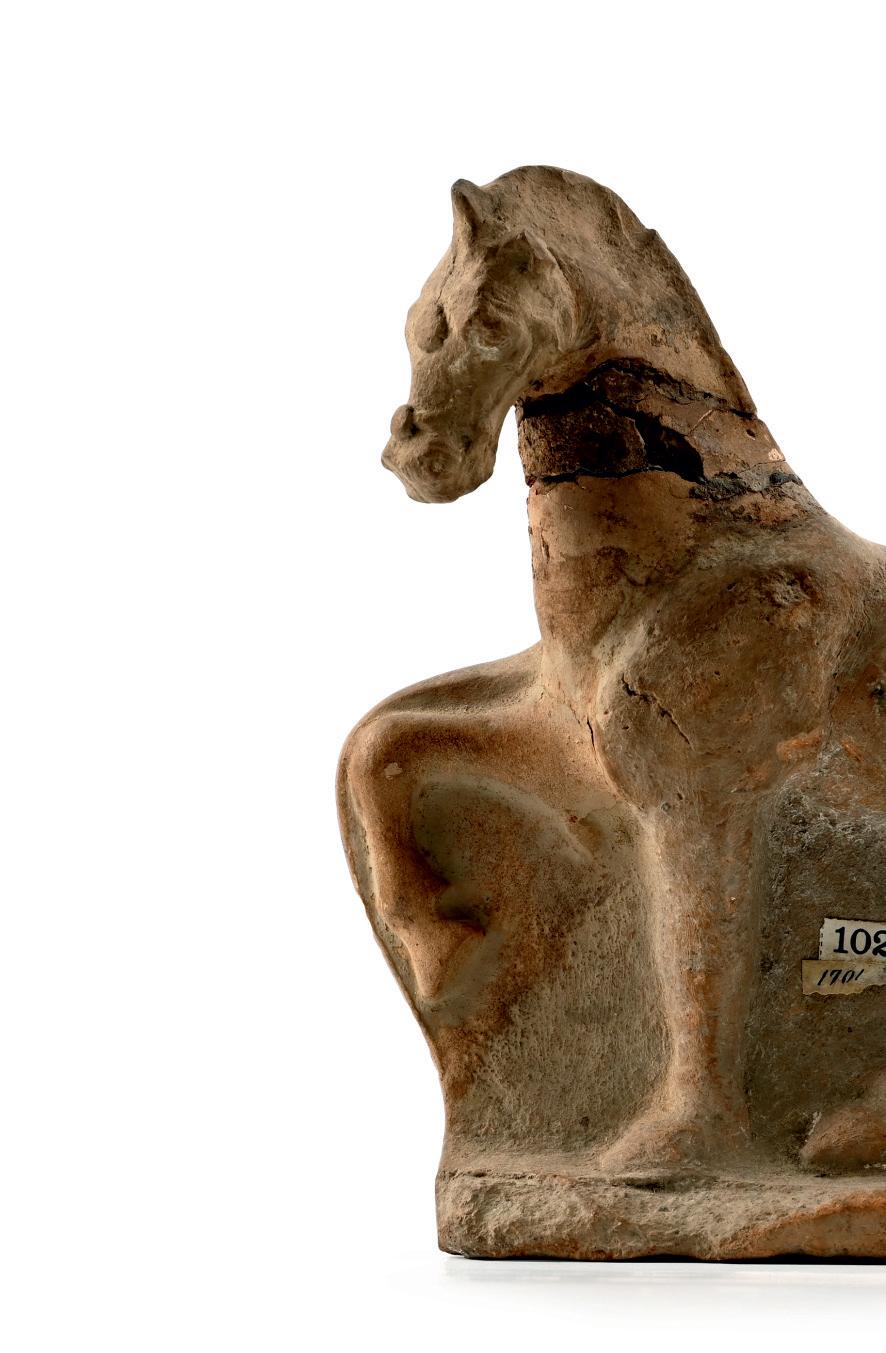
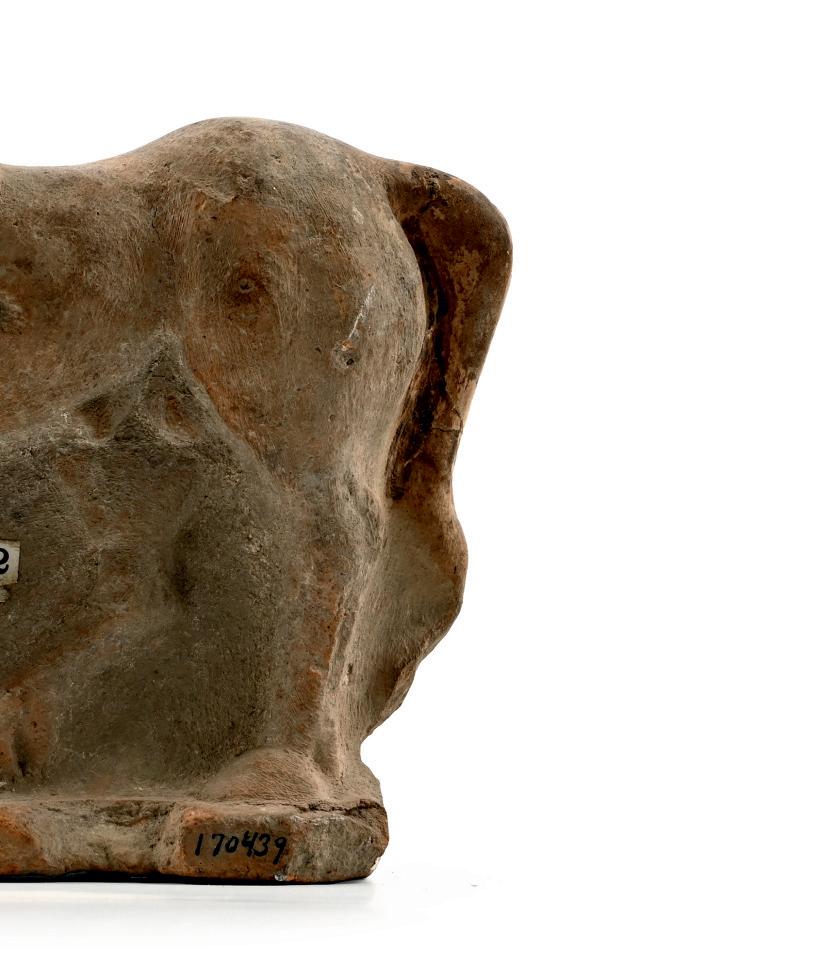

97
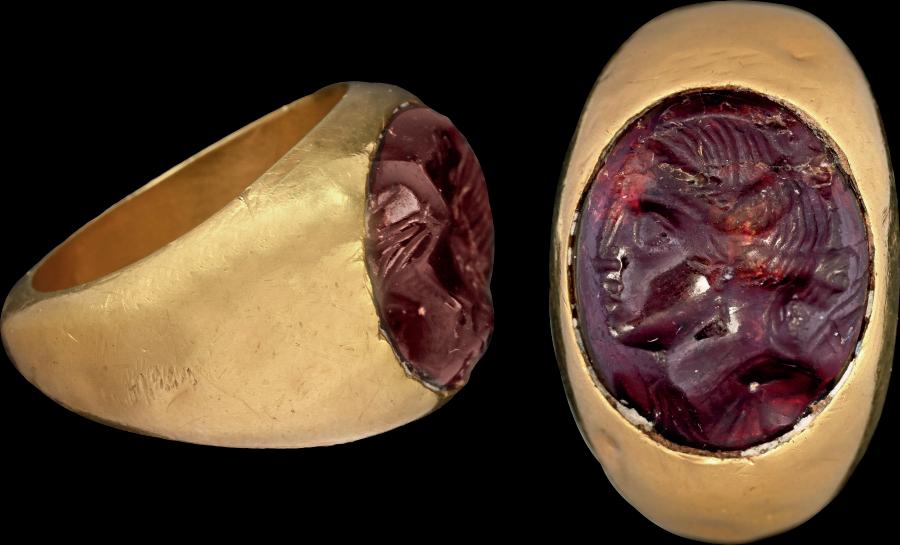
GREEK GOLD RING WITH ARTEMIS GEMSTONE ‡ HELLENISTIC, 2ND CENTURY B.C.
1 in. (11.27 grams, 26.91 mm overall, 17.95 x 20.72 mm internal diameter (approximate size British R, USA 8½, Europe 18¾, Japan 18))
Hollow-formed shank with broad plaque and inset garnet cabochon intaglio profile bust of Artemis in high-relief.
£3,000 - 4,000
PROVENANCE: European art market.
98
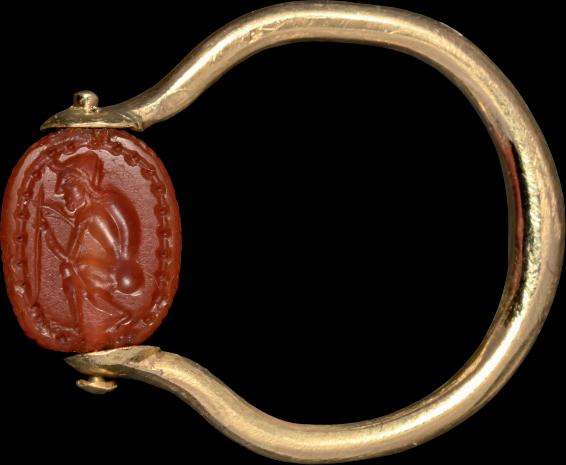
ETRUSCAN CARNELIAN SCARAB OF A FLETCHER IN GOLD RING
4TH-3RD CENTURY B.C.
1 in. (4.24 grams, 27.12 mm overall, 18.38 x 18.49 mm internal diameter (approximate size British P½, USA 7¾, Europe 16.86, Japan 16))
With carapace detailing and intaglio of a crouching male carving an arrow; set into a later gold swivel ring.
£1,200 - 1,700
PROVENANCE:
Private collection, Europe. Acquired on the English art market.
99
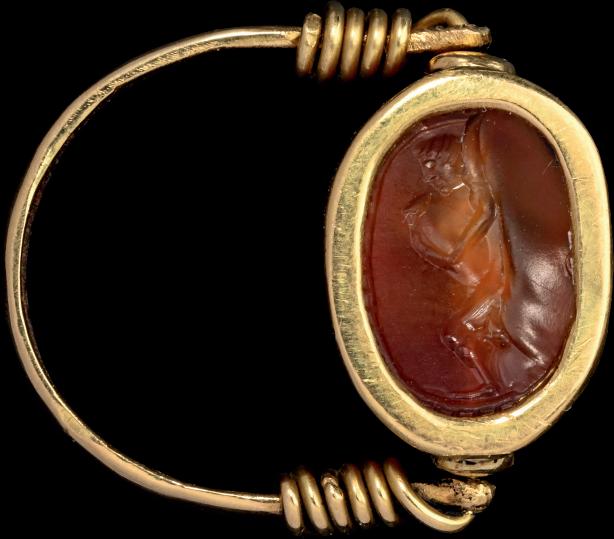
ITALIC CARNELIAN SCARAB WITH SATYR MOUNTED IN A GOLD SWIVEL RING
4TH-3RD CENTURY B.C.
1 in. (5.30 grams, 23.85 mm overall, 14.56 x 17.70 mm internal diameter (approximate size British J½, USA 5, Europe 9.32, Japan 9))
Carved scarab with detailed carapace, legs and mouth; underside with intaglio standing figure holding an amphora; set into a later gold swivel ring.
£1,200 - 1,700
PROVENANCE:
Private collection, Europe. Acquired on the English art market.
FOOTNOTES: It is clear that the sculptor devoted more care and attention to carving the scarab itself rather than its intaglio.
100
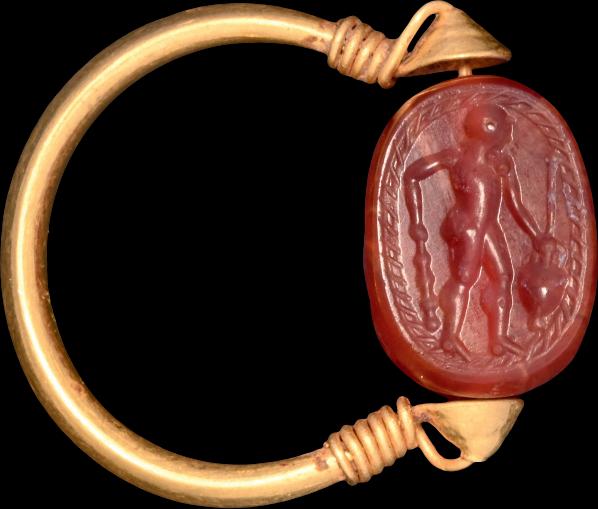
ETRUSCAN CARNELIAN SCARAB WITH HERCULES AT A FOUNTAIN IN GOLD RING
3RD CENTURY B.C. in. (5.73 grams, 22.52 mm overall, 18.68 x 16.58 mm internal diameter (approximate size British P, USA 7½, Europe 16.23, Japan 15))
Hoop made from D-section wire with coils to the shoulders, carnelian scarab bezel with carapace detailing and intaglio of a standing nude figure of Hercules holding a club and amphora at a stream, enclosed by a roped border.
£1,500 - 2,000
PROVENANCE: Acquired on the UK art market. Private collection, England.

‘THE CYRUS COLLECTION’ GREEK CORE-FORMED GLASS
5TH CENTURY B.C.
5½ in. (197 grams total, 13.5 cm high including stand)
Ovoid blue body with narrow flared foot, pinched mouth and applied strap handle; marvered trail decoration in yellow to the shoulder, applied trails to the neck, marvered and dragged trails to the equator; cleaned and repolished; supplied with a custom-made stand.
£15,000 - 20,000
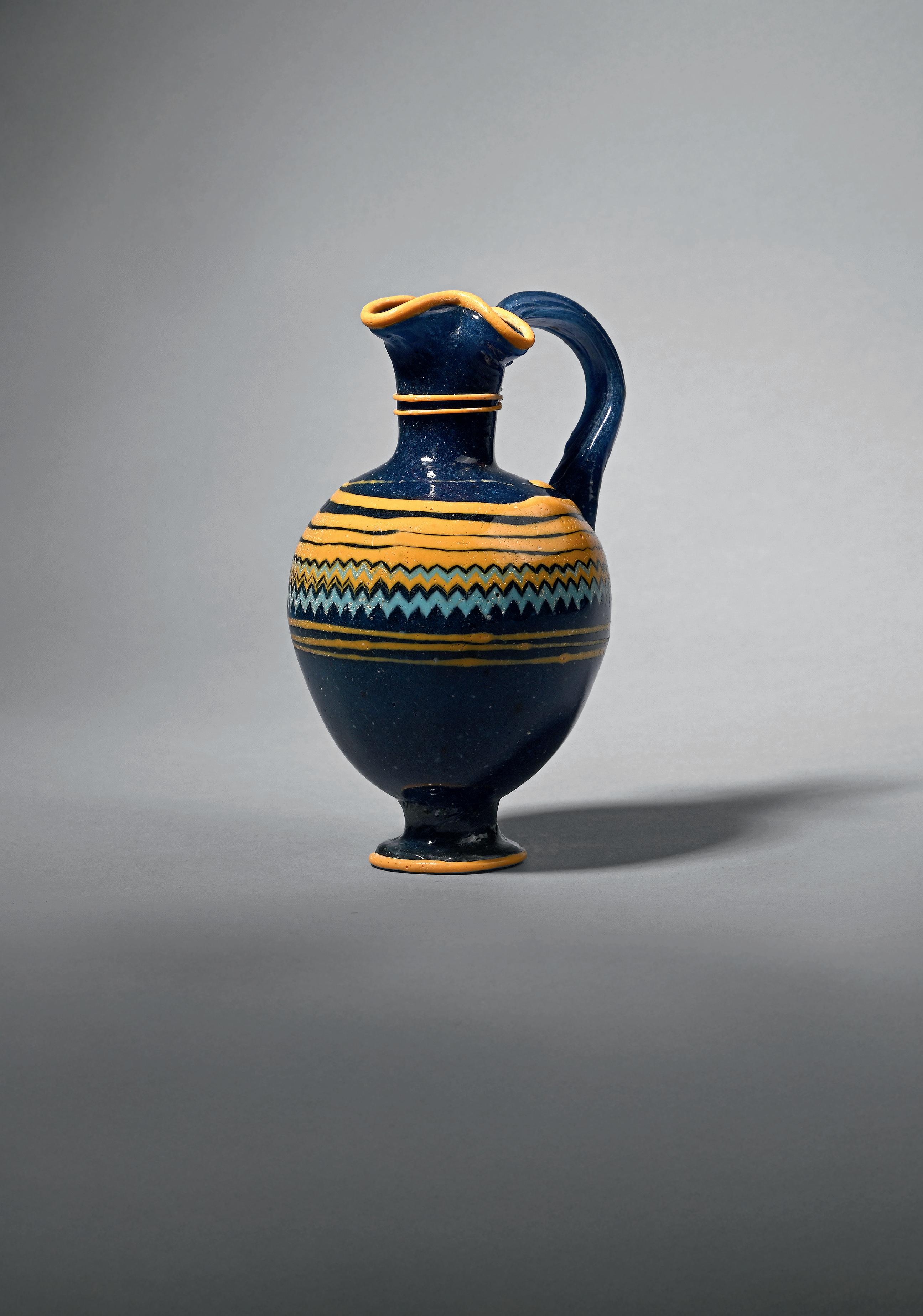
PROVENANCE: Ex Antike Kunst Palladion, Basel. The Cyrus collection, 1970s. with Sotheby’s, New York, 9 December 2003, no.88.
Accompanied by a copy of the relevant Sotheby’s catalogue pages.
FOOTNOTES:
During the 5th century B.C., the colours of Mediterranean Group I vessels expanded from blue or opaque white to include dark green, golden brown, and opaque brick red.

102
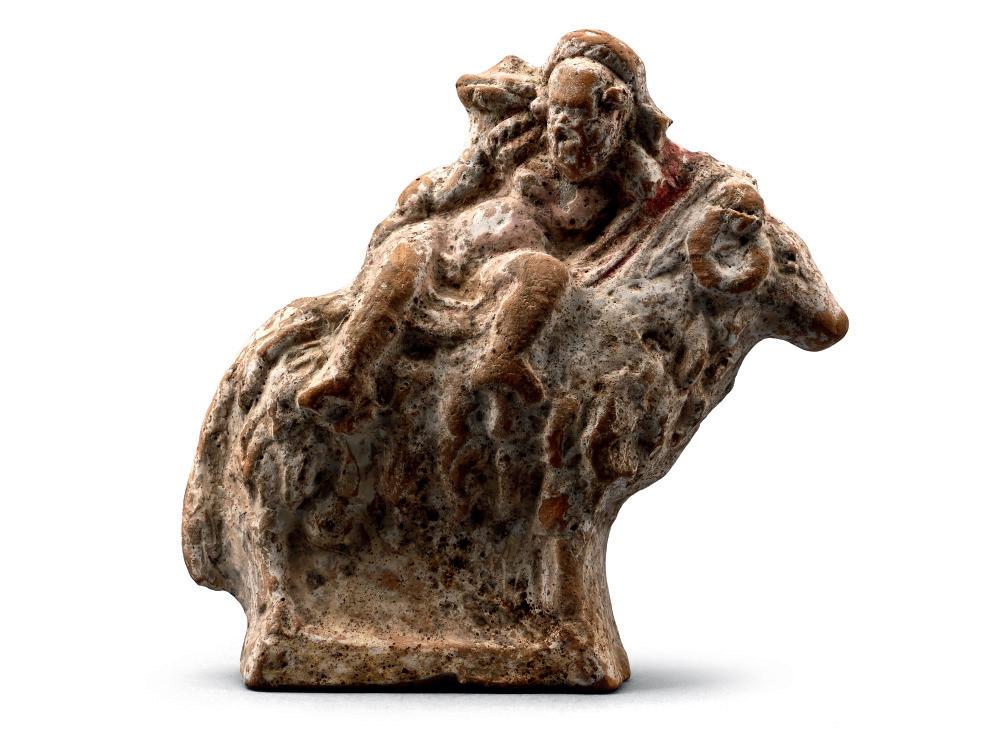
GREEK TERRACOTTA OF DRUNKEN SILENUS SEATED ON A RAM SOUTH ITALIAN, 3RD CENTURY B.C.
4¾ in. (257 grams, 12.2 cm)
Hollow-formed and modelled in the round figure of a shaggy ram standing on a rectangular base with the slouching figure of Silenus on his back, clutching a large drinking horn in his right hand; white and red pigment; hollow underside.
£800 - 1,000
PROVENANCE: with Fortuna, Galerie fur alte Kunst, Zurich, 1998. Private collection, Zurich, acquired from the above in 2002. with Bonhams, New Bond Street, London, 1 December 2020, no.67.
Private collection, UK.
103
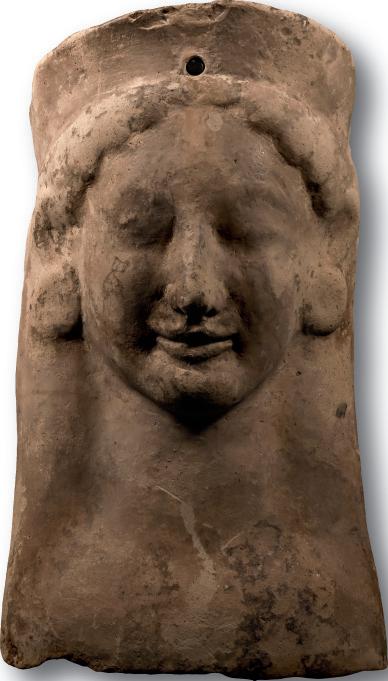
GREEK TERRACOTTA FEMALE PROTOME ‡ EARLY 5TH CENTURY B.C.
7¾ in. (606 grams, 19.5 cm)
Mould-made female protome with oval face, graceful nose and typical archaic smile; forehead framed by snail-shell curls descending to shoulder-height; with a low polos with a central perforation and large disc earrings.
£1,500 - 2,000
PROVENANCE:
Ex Herbert A. Cahn, Kunst der Antike, Basel, 1997. with Paul and Vreny Vosseler-Studer, Riehen.
PUBLISHED:
Cat.9, Griechische und Etruskische Kunstwerke archaischer Zeit, Basel, 1998, no.19.
104
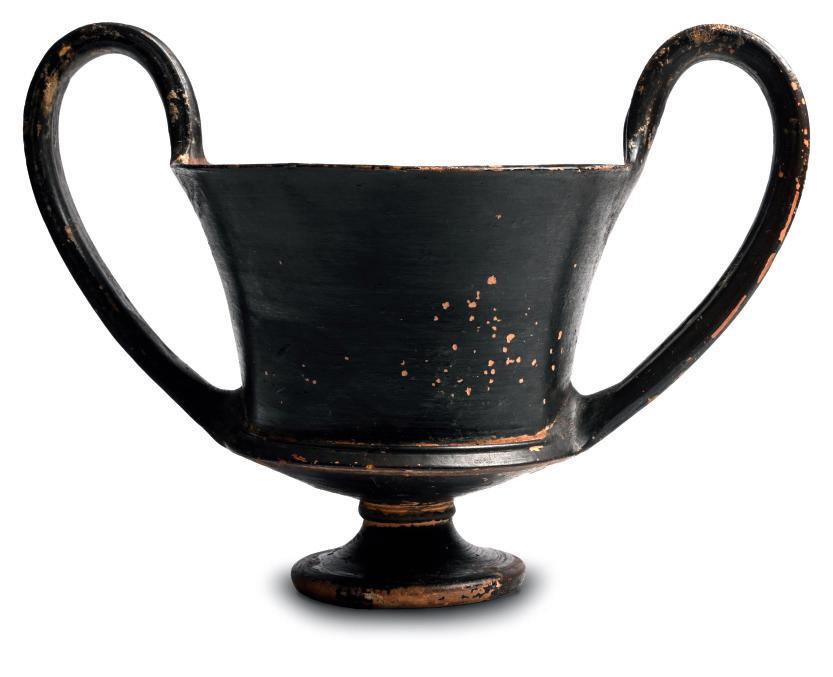
GREEK BLACKWARE SHORT-STEMMED KANTHAROS
CIRCA 5TH-4TH CENTURY B.C.
9 in. (354 grams, 23 cm wide)
With a flared foot, tapering body and two lateral high strap handles with ribs to the outer edges, the sidewall set off from the foot by a carination.
£500 - 700
PROVENANCE: Ex Norri collection, Milton Keynes, Bedfordshire, UK, 1980s-1990s.
105
TWO-HANDLED VILLANOVA BOWL
VILLANOVAN, 8TH-7TH CENTURY B.C.
5¼ in. (221 grams, 13.4 cm wide)
A squat vessel with a small base, raised neck and slightly projecting rim, carinated shoulder with two projecting bosses and a pair of high strap handles.
£500 - 700
PROVENANCE:
Old Basel private collection. Elsa Bloch-Diener, Antike Kunst, Bern, 27 July 1990. Private collection, Bern, Switzerland. Private collection, UK.
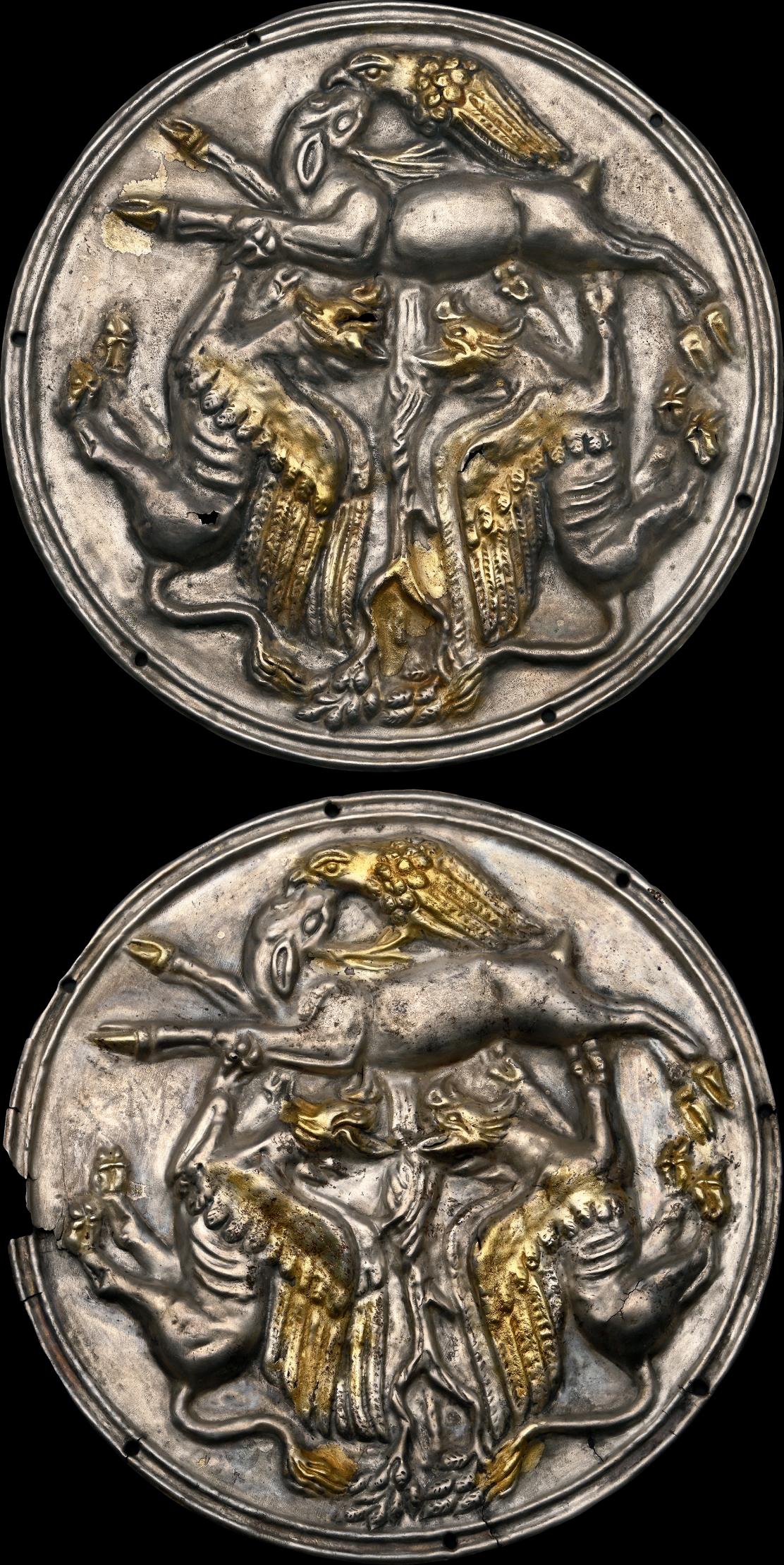
GREEK SILVER-GILT PHALERAE DEPICTING A FIGHT BETWEEN GRYPHONS, AN EAGLE AND A DEER HELLENISTIC, 1ST CENTURY B.C.-1ST CENTURY A.D.
5¼ in. (62 grams total, 13.2 cm)
A pair of circular horse trappings hammered from sheet-silver, each with a decoration of two gryphons and an eagle slaughtering a deer, the gryphons attacking the deer from below, and the eagle attacking its muzzle, a tree in the background; accompanied by a custom-made display case. [2]
£12,000 - 17,000
PROVENANCE: Private German collection, 1980s.
Accompanied by an expertise from Striptwist Ltd, a London-based company run by historical precious metal specialist Dr Jack Ogden. Accompanied by an academic report by Dr Raffaele D’Amato.
EXHIBITED: The Houston Museum of Natural Science, Gold! Natural Treasure, Cultural Obsession, 18 February - 18 September 2005.
FOOTNOTES:
This phalera comes from the Hellenised East, and was likely used as decoration of the higher part of a horse harness, like the phalerae visible on the armoured and unarmoured horses of the famous graffiti of Dura Europos representing Parthian, Palmyrene or Roman clibanarii (D’Amato-Negin, 2018, pp.11,16-17,26).
108
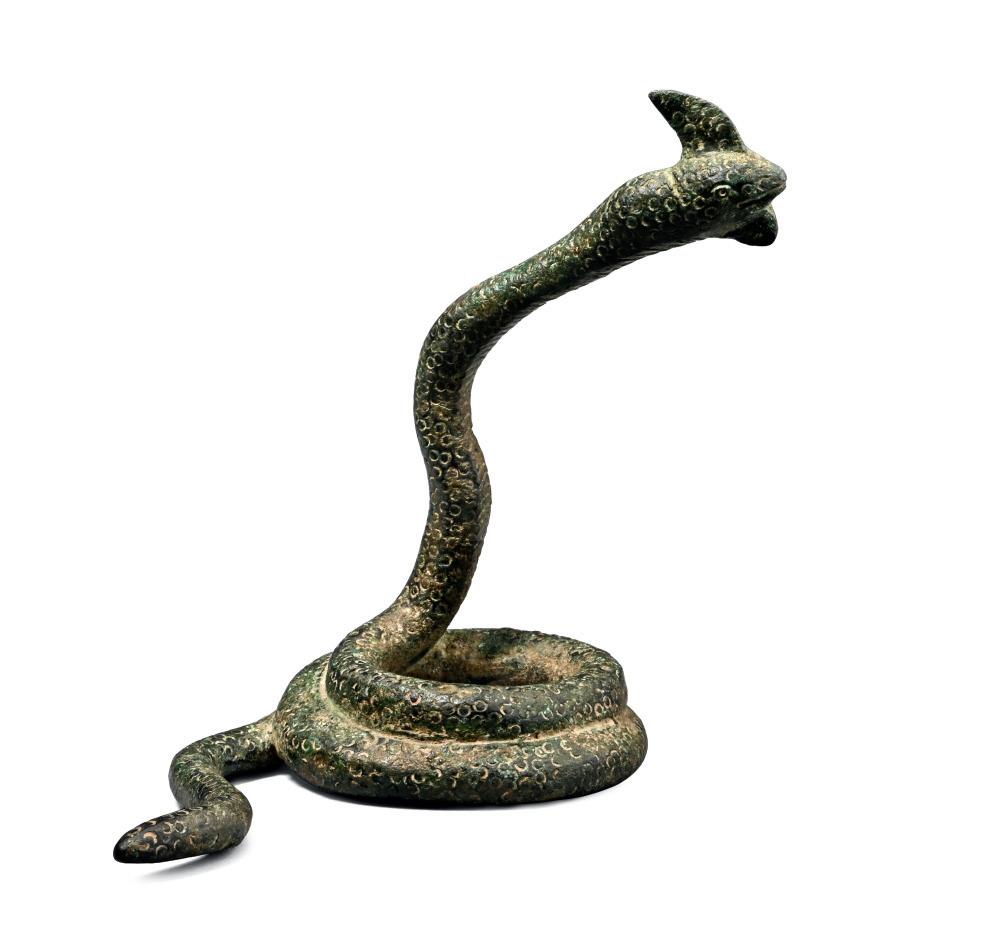
GREEK BRONZE STATUETTE OF A COILED REARING SNAKE ‡ ARCHAIC, 6TH-5TH CENTURY B.C.
4¼ in. (312 grams, 11 cm)
Modelled in the round with coiled body and rearing head, barbed fin to the forehead, punched annulet texturing on the body.
£6,000 - 8,000
PROVENANCE:
Private collection, Neuchâtel, Switzerland, assembled in the 1980s.
Acquired in 1995 by a European private collector. Private collection, since the late 1990s.
107
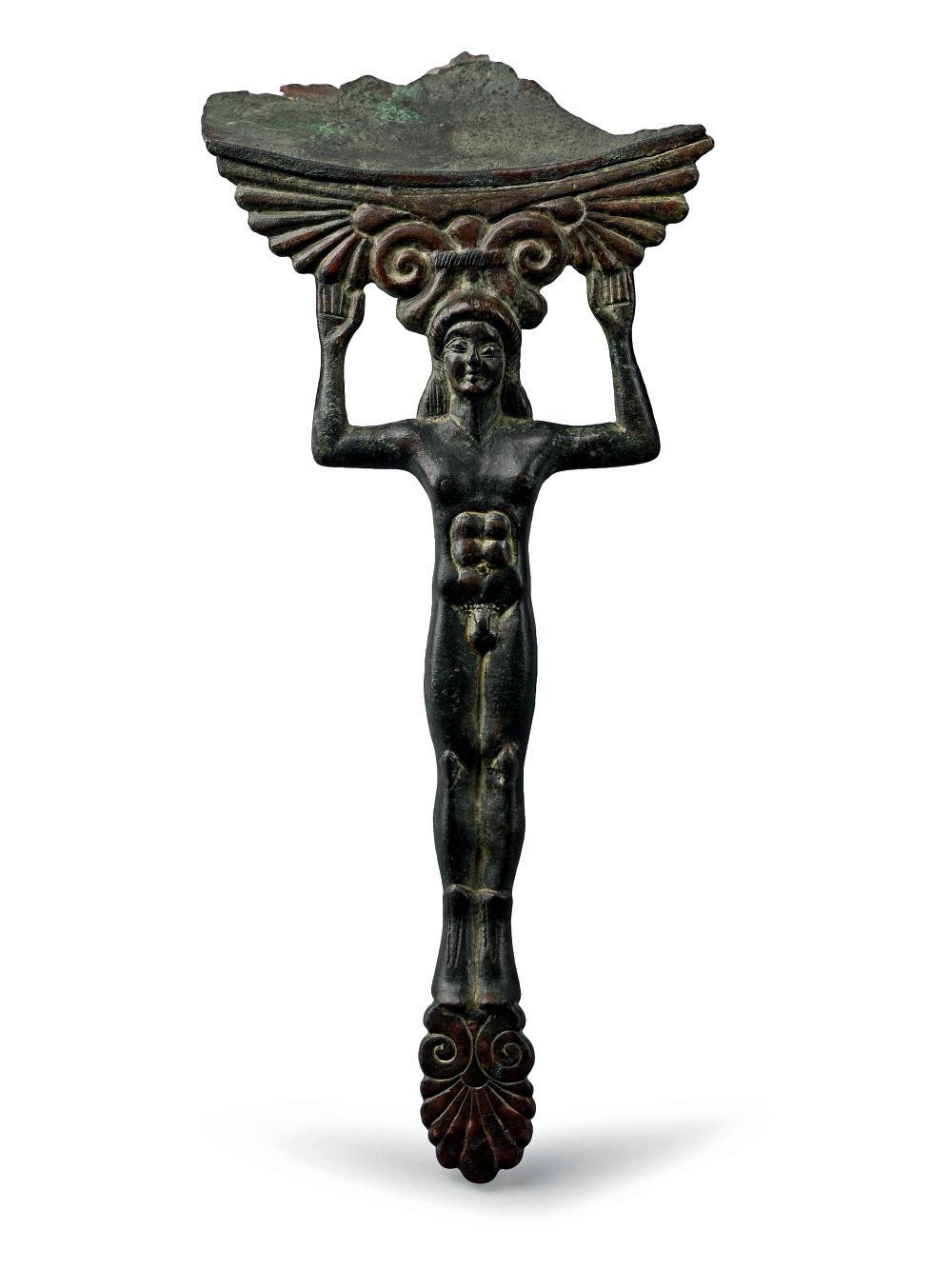
GREEK BRONZE KOUROS PATERA HANDLE WITH BOWL ‡ ARCHAIC, CIRCA 480 B.C.
17 in. (1.35 kg total, 45.5 cm high including stand)
The handle formed as a nude youth supporting a panel of double volutes and half-palmettes, long braided hair falling at the back of the neck and on his forehead; the legs joined and ankles extended, the feet enclosed in pointed shoes, palmette below; accompanied by the bowl with inverted rim, a pair of parallel lines to the outer rim; the handle and part of the rim detached and mounted separately on the custom-made display stand.
£6,000 - 8,000
PROVENANCE: with Herbert A. Cahn, Basel, 1990s.
Accompanied by an academic report by Dr Raffaele D’Amato.
FOOTNOTES:
Anthropomorphic handles with images of young naked boys connected with animals were widespread and used for mirrors. The object, in particular, is part of the group of mirrors and paterae with standing youths (male and female, probably symbolising athletes) and nude female mirror caryatids (MittenDoeringer, 1968, figs.87-88) serving as vertical handles.
109
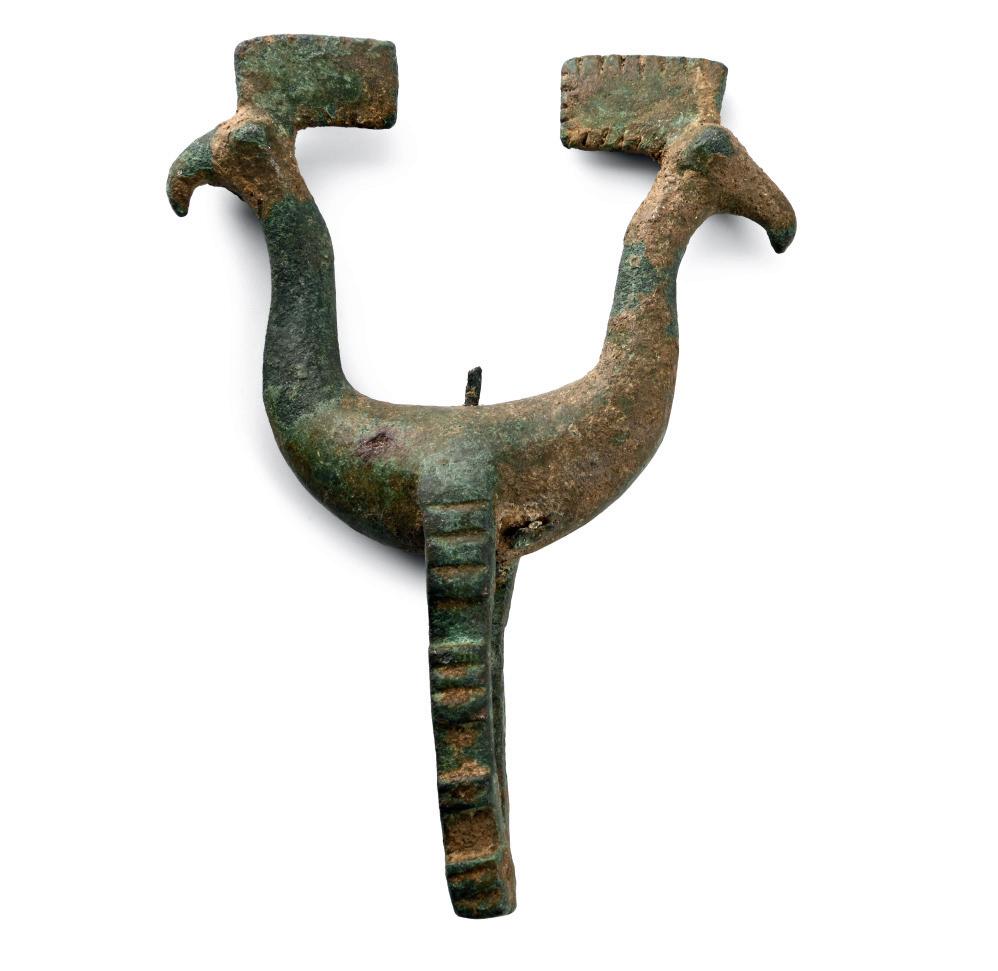
LARGE GREEK BRONZE DOUBLE-HEADED ANIMAL TERMINAL ‡ GEOMETRIC, 8TH-6TH CENTURY B.C.
3 in. (55.6 grams, 86 mm)
Comprising a crescent body with a slender neck at each end, topped by a bird-head with a rectangular crest, vertical legs with raised block detailing conjoined at the lower end into a mounting peg.
£1,500 - 2,000
PROVENANCE:
Ex collection Mr. K.H., Germany. Private collection, acquired in 2012.
FOOTNOTES:
Bird figures, standing on plates or discs, are found as votives mainly in Northern Greek sanctuaries of the Geometric Age. They should be regarded as symbolic and sometimes modest gifts to the gods. Some birds were also designed as pendants. The present fitting evokes the rooster, but a possible representation of a peacock and its connection with Hera is not to be excluded.
110
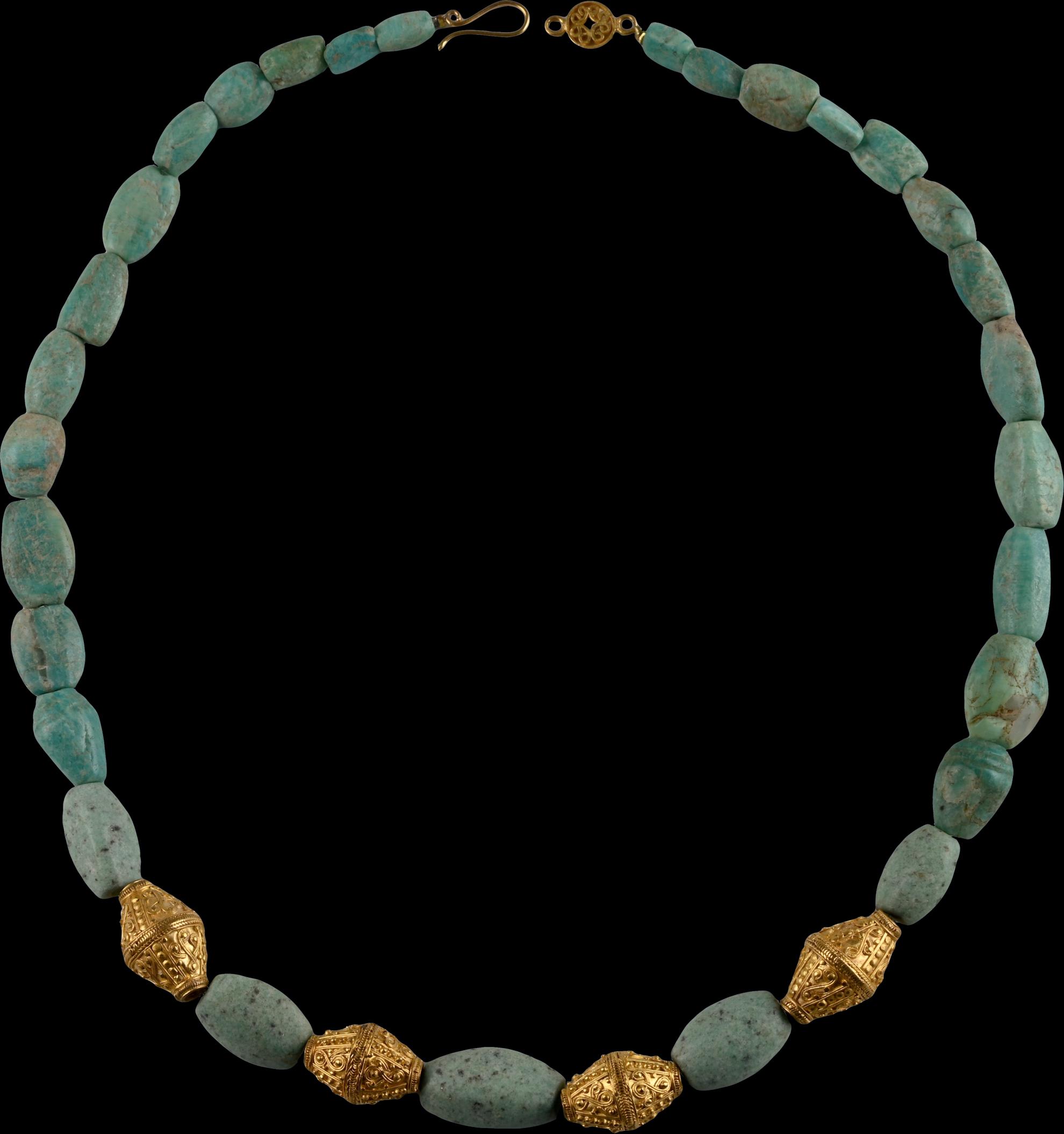
GREEK TURQUOISE BEAD NECKLACE WITH GOLD BEADS HELLENISTIC, CIRCA 2ND-1ST CENTURY B.C.
21 in. (72 grams, 55.5 cm)
Composed of twenty-nine oval turquoise beads and four bicone sheet-gold beads with granulation, decorated with spirals and vertical lines, with beaded wire collars and equator, with later openwork clasp.
£2,500 - 3,500
PROVENANCE: Acquired on European art market, 1990s. Private collection of Mr K.A., France. with Kallos Gallery, London, UK.
FOOTNOTES: The use of turquoise and carnelian cloisonné inlay would be more expected in the Ptolemaic or earlier periods than from the Roman period. However, the love of coloured stones increased during the Roman period. In about A.D. 200, Clement said that ‘the stones which silly women wear fastened to chains and set in necklaces’ included emerald, amethyst, peridot, jasper and ceraunites. Clement’s list of stones is closely paralleled by a tariff list of c. A.D. 200, and a list of jewellery from Spain. Both of these sources also include sapphire (hyacinthus) and callaina, which was probably turquoise.
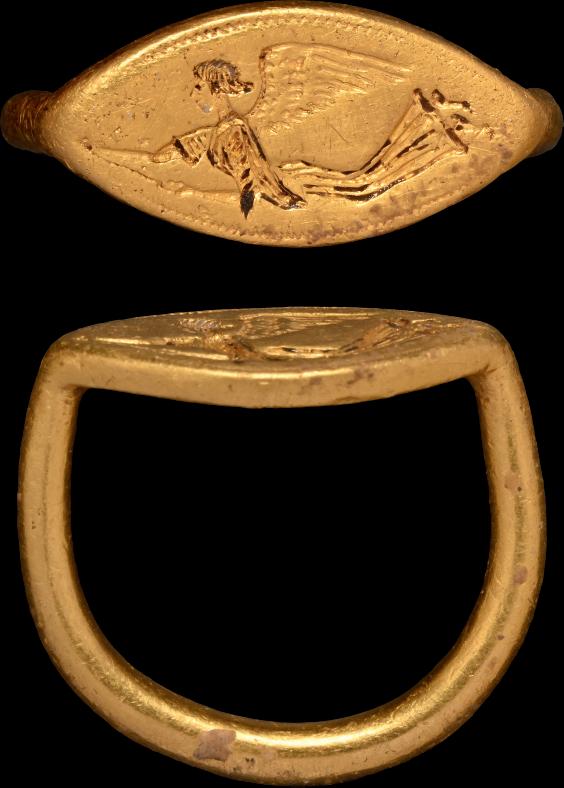
111 GREEK GOLD RING ENGRAVED WITH GODDESS NIKE ‡ 5TH-4TH CENTURY B.C.
1 in. (9.61 grams, 23.23 mm overall, 18.22 mm internal diameter (approximate size British L½, USA 6, Europe 11.87, Japan 11))
Comprising a round-section U-shaped hoop and a lentoid-shaped bezel bearing the image of flying Nike with her wings spread and wearing a long dress, leaving her feet exposed.
£8,000 - 10,000
PROVENANCE: Focquaert collection, Belgium, 1980s. European private collection, 2012.
FOOTNOTES: The ring belongs to the typology I of Boardman’s classification (Boardman, 2001, p.213). One of the subjects usually represented on this ring type is the flying Nike. A similar flying Nike is visible on a gold ring found in grave 17 of the Nymphaeum, and it is today preserved at the Hermitage.
112
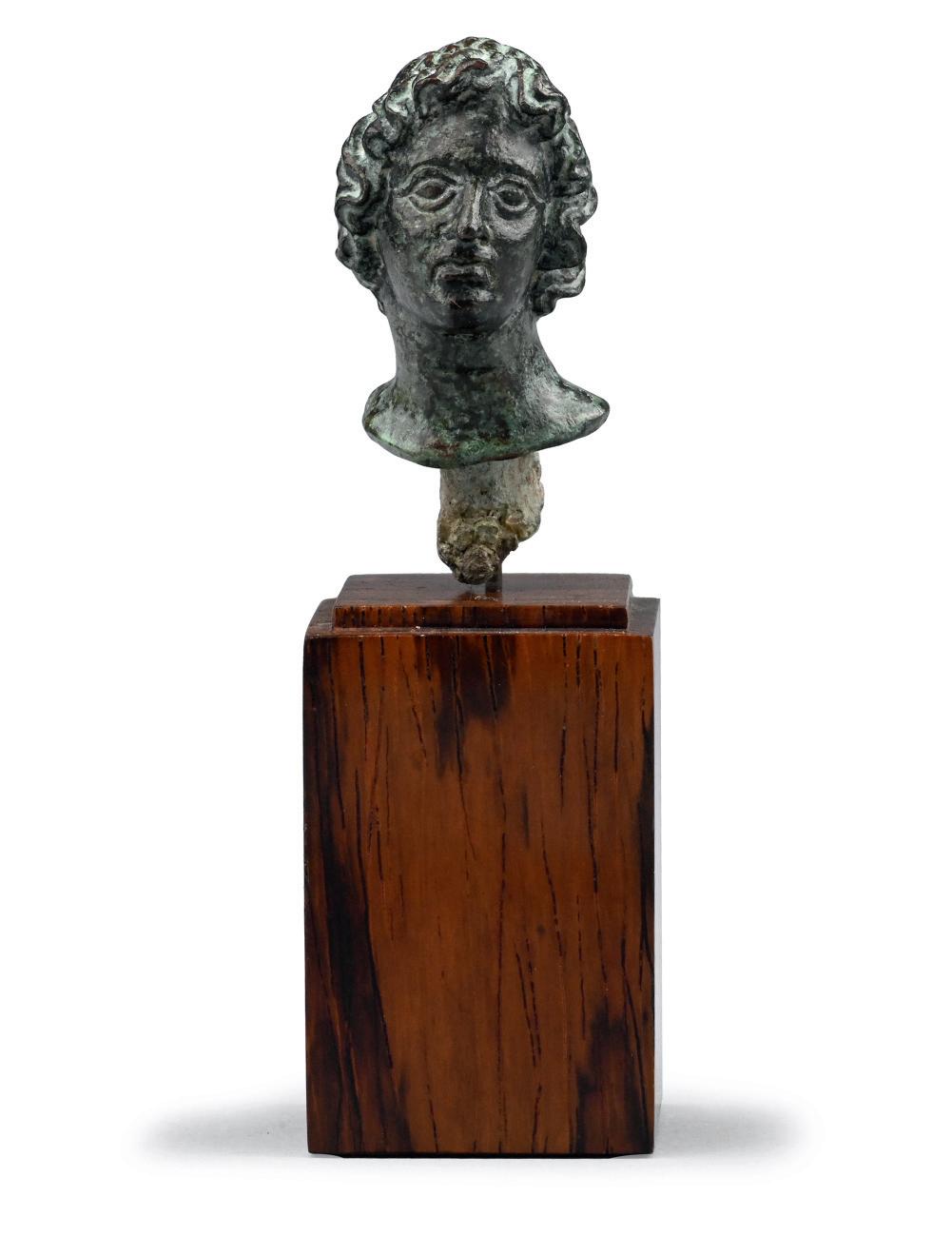
GREEK HEAD OF ALEXANDER THE GREAT ‡ 3RD-2ND CENTURY B.C.
4 in. (142 grams total, 10.2 cm including stand)
Modelled in the round with wavy hair brushed forwards, large lentoid eyes in low-relief, angular nose and small mouth; attachment lug to underside, rich lead/copper alloy; mounted on a custom-made stand.
£5,000 - 7,000
PROVENANCE:
Collection of Mr C., Geneva, Switzerland (1936-2016), assembled between 1985 and 2010.
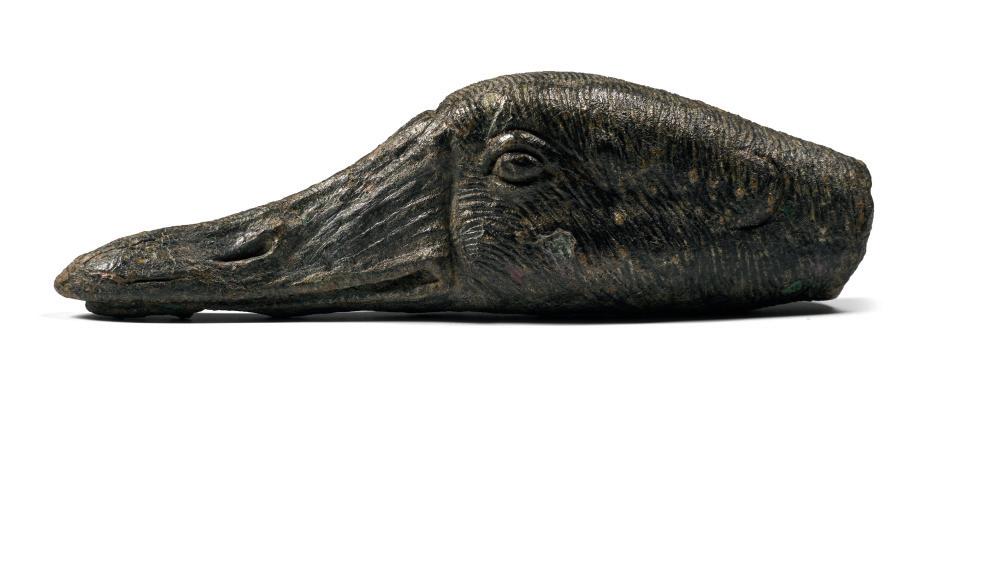
113
GREEK BRONZE DUCK’S HEAD ‡ 3RD-2ND CENTURY B.C.
4 in. (236 grams, 10.1 cm)
Modelled in the round with realistic features, textured plumage, rounded beak.
£1,500 - 2,000
PROVENANCE:
Acquired in the mid 1980s-1990s.
Private collection, Switzerland, thence by descent. Private collection, since the late 1990s.
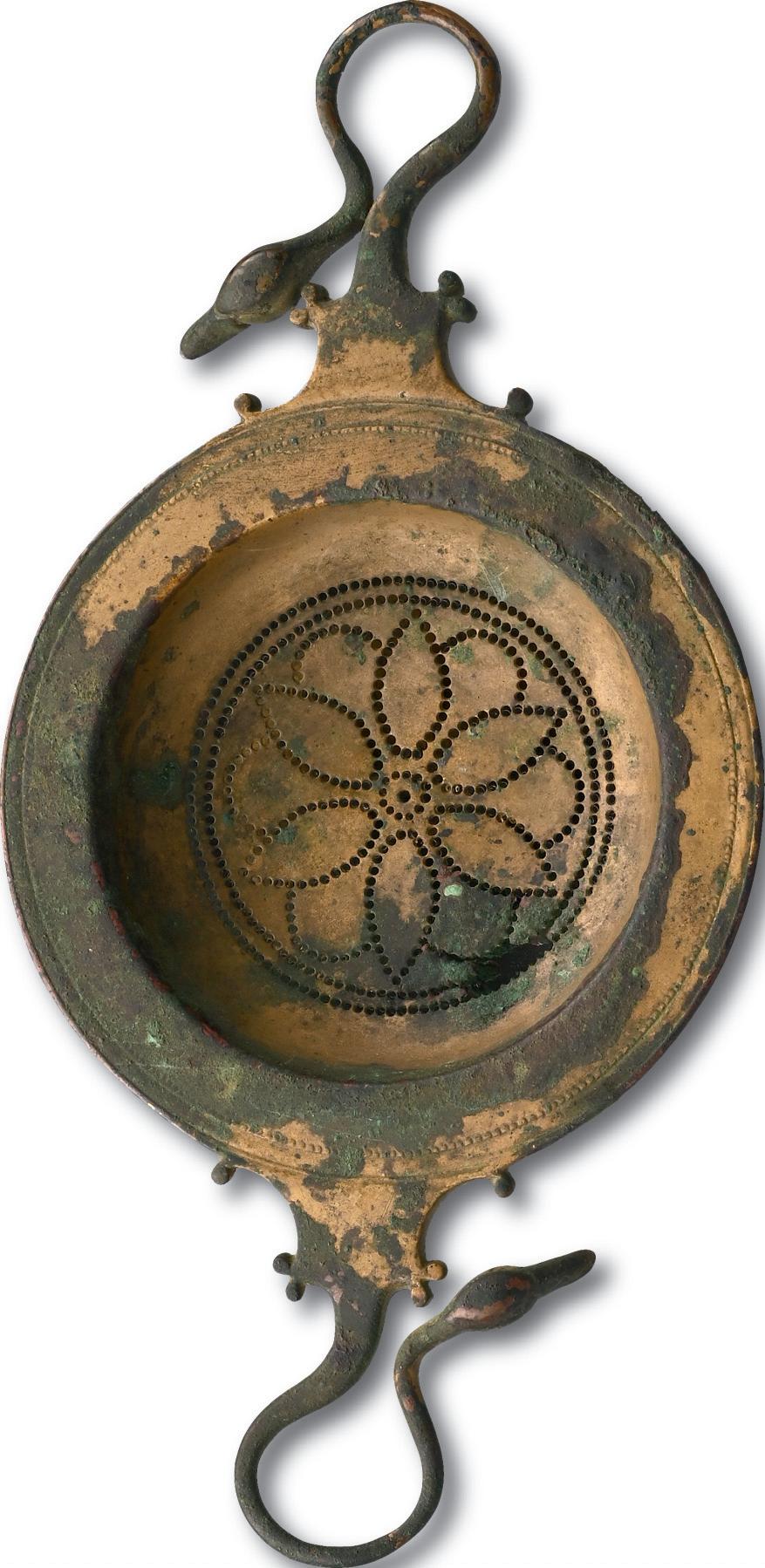

GREEK BRONZE WINE STRAINER WITH SWAN-HEAD HANDLES ‡ 4TH-3RD CENTURY B.C.
7¾ in. (402 grams total, 19.7 cm including stand)
Comprising a shallow bowl and broad flange rim, two integral scalloped handles with lateral scrolled flourishes, each tapering to a S-curved handle with swan-head terminals with incised eye and beak detailing; perforated whirl within roundel to interior base; accompanied by a custom-made display stand with mirror.
£10,000 - 14,000
PROVENANCE: with Hôtel des ventes de Belfort Sarl, October 2011, no.16. Acquired by the present owner at the above sale.
Accompanied by an academic report by Dr Raffaele D’Amato.
FOOTNOTES:
Elaborate gilded strainers, such as this present example, were used at symposia and festive occasions for the purpose of preventing the dregs of wine from entering the wine cup. This and other related silver utensils became popular in the late 4th and 3rd century B.C. These highly decorated wine strainers were fitted with dual handles forming loops in the shape of twisting animals, here a swan. Usually, they took the form of a shallow dish complete with four rings of perforations in the centre in order to drain the wine. Strainers of this type were used to separate out sediments found in the thick Greek wine. Examples similar to this one have been found in royal tombs in northern Greece, as well as the tomb of a monarch in Sudan.
115
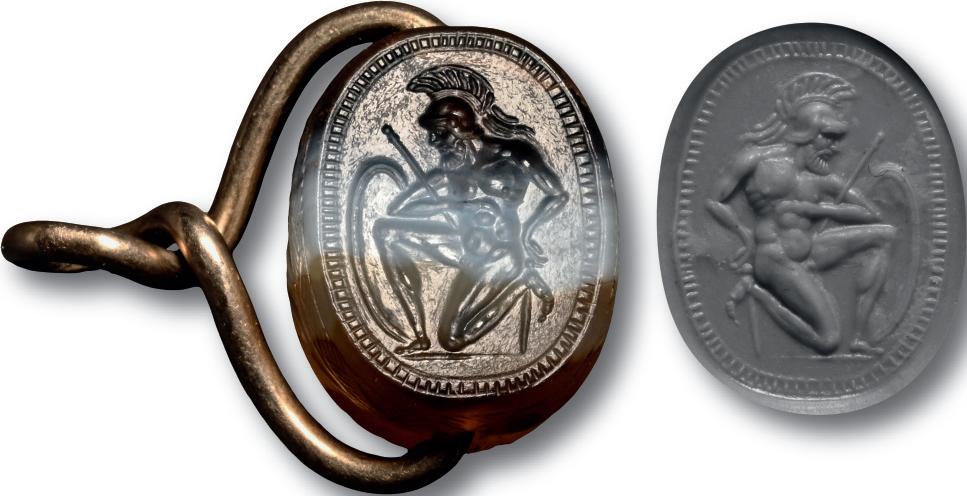
ITALIC BANDED AGATE SCARAB WITH KNEELING WARRIOR IN GOLD MOUNT
3RD CENTURY B.C.
1 in. (5.24 grams, 25 mm)
Scarab bezel with carapace detailing and intaglio of a kneeling male nude wearing a helmet, holding a shield, sword and a spear; set into a later gold swivel ring.
£10,000 - 14,000
PROVENANCE:
English private collection. Acquired on the English art market.
FOOTNOTES:
The intaglio can depict Capaneus, a legendary, strong, skilled, but arrogant warrior. He was one of the Seven Against Thebes, who boasted that not even Zeus could stop him from scaling the city walls. However, as he climbed them, Zeus struck him down with a bolt of lightning, illustrating divine punishment for his hubris. Evadne, his wife, then threw herself onto the funerary pyre in her grief. The story of strength but excessive pride was reflected in Dante's Inferno, where Capaneus is in the seventh circle as a condemned blasphemer.

117

116
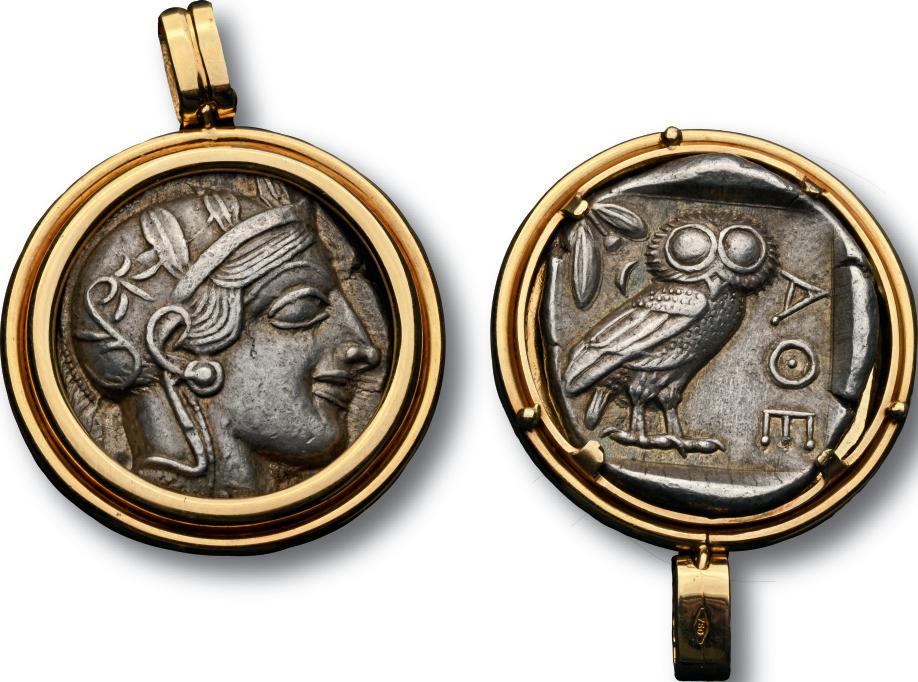
GREEK
SILVER TETRADRACHM OF ATHENS IN GOLD PENDANT CIRCA 454-404 B.C.
1 in. (24.36 grams, 37 mm)
Obv: head of Athena with profile eye to right, wearing disc earring, pearl necklace and a crested Attic helmet adorned with three olive leaves and a pi-style palmette. Rev: , owl standing to right, head facing the viewer, olive sprig with berry and crescent moon in upper left field, all within incuse square. Kroll 8; Dewing 1591-8; SNG Copenhagen 31; HGC 4, 1597; the coin enclosed inside a modern gold medallion pendant stamped ‘750’ with double border.
£2,000 - 3,000
PROVENANCE:
Roma Numismatics, E-LIVE Auction 4, 29 November 2018, no.155. Private collection of Mr K.A., France. with Kallos Gallery, London.
FOOTNOTES:
The Athenian components of several of the hoards in which these tetradrachms were found, together with other published and unpublished tetradrachms, make it clear that this coinage of c.400/390 to 353 was not only substantial, but was one of the most prolific Greek coinages of the period.
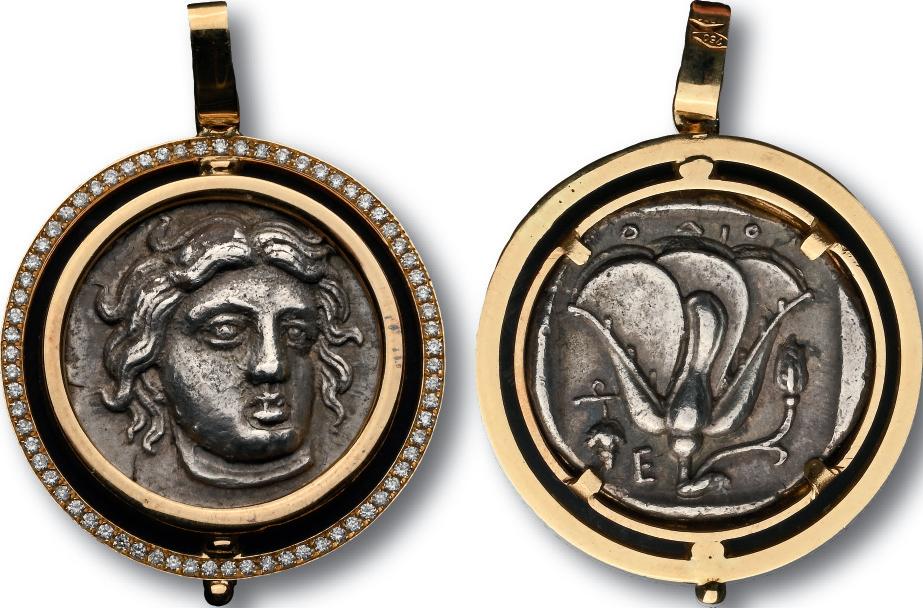
GREEK SILVER DIDRACHM OF RHODES IN GOLD PENDANT CIRCA 454-404 B.C.
1 in. (11.86 grams, 35 mm)
Obv: head of Helios facing slightly right. Rev: RODION legend above rose with bud on the right; bunch of grapes over E in left field; the coin enclosed in a modern double circular gold frame stamped ‘750’ set with colourless stones.
£2,000 - 3,000
PROVENANCE:
Roma Numismatics, E-LIVE Auction 4, 29 November 2018, no.155.
Private collection of Mr K.A., France. with Kallos Gallery, London.
FOOTNOTES:
The coinage of Rhodes city began around 408/7 B.C. with the introduction of a silver coinage bearing a deeply cut image of Helios, seen full-face with luxuriant hair, blown back by the wind. Helios’ imposing image was paired with that of a rose (a pun on the name of the city) and also the city’s ethnic, PO ION, meaning ‘of Rhodes’.

118
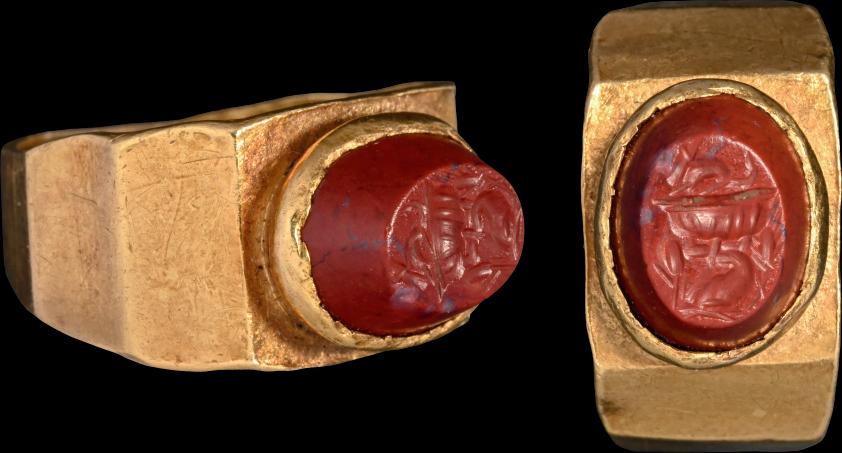
ROMAN GOLD RING WITH JASPER GEMSTONE OF FOUNTAIN AND DOLPHIN
2ND-3RD CENTURY A.D. in. (5.39 grams, 21.00 mm overall, 15.51 x 13.97 mm internal diameter (approximate size British J, USA 4¾, Europe 8.69, Japan 8))
The hoop octagonal in section with cell to the bezel and inset conical jasper stone, intaglio vessel and dolphin with attributes; some restoration and polishing.
£800 - 1,000
PROVENANCE:
Private collection, Europe.
Acquired on the English art market.
119
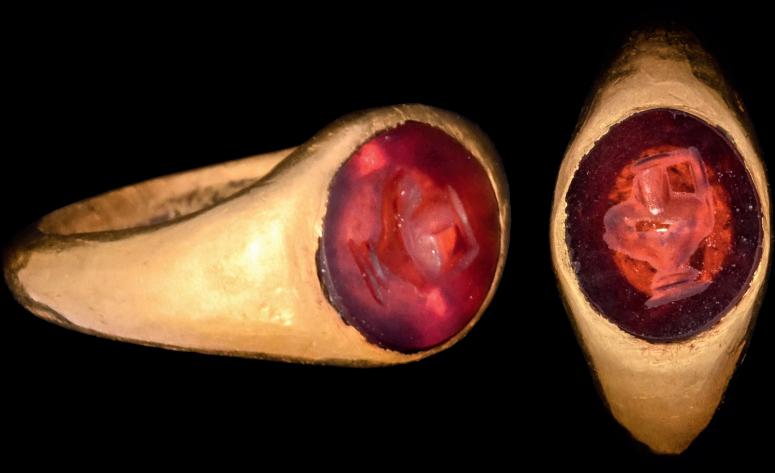
ROMAN GOLD CHILD’S RING WITH GARNET EWER GEMSTONE
1ST-2ND CENTURY A.D. in. (0.87 grams, 9.77 mm overall, 7.20 mm internal diameter)
Solid ring inset with an intaglio of an ewer with socle foot and handle.
£600 - 800
PROVENANCE:
Private English collection, formed between the late 1970s and early 1990s.
Private collection, UK.
120
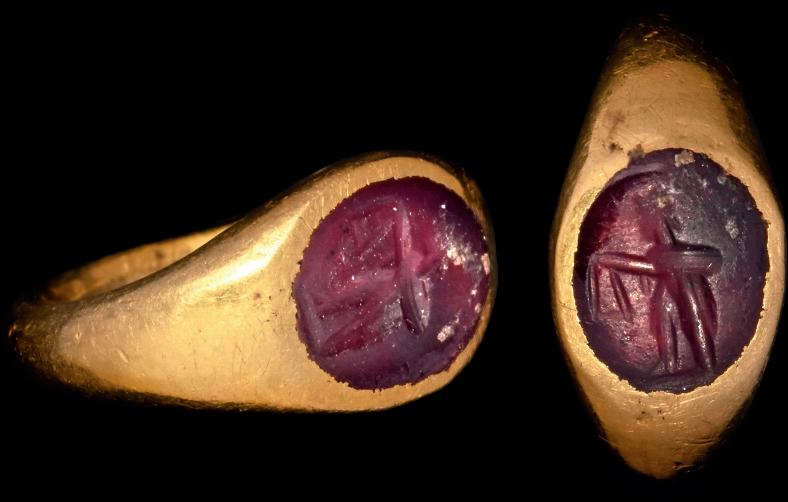
ROMAN CHILD’S GOLD RING WITH FIGURAL GEMSTONE
1ST-2ND CENTURY A.D.
½ in. (1.73 grams, 12.81 mm overall, 9.85 mm internal diameter)
Inset amethyst intaglio of a stylised human standing on a baseline with his arm extended in front.
£600 - 800
PROVENANCE:
Private English collection, formed between the late 1970s and early 1990s. Private collection, UK.
121
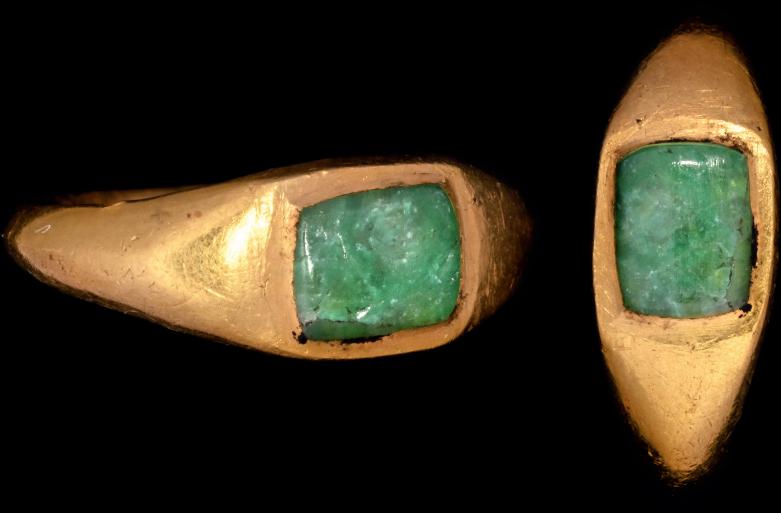
ROMAN CHILD’S RING WITH EMERALD
1ST-2ND CENTURY A.D.
½ in. (1.22 grams, 13.23 mm overall, 10.74 mm internal diameter)
Integral flat bezel with inset green cloison.
£600 - 800
PROVENANCE:
Private English collection, formed between the late 1970s and early 1990s. Private collection, UK.
122
ROMAN GILT BRONZE RING WITH BUST OF MINERVA 1ST-2ND CENTURY A.D.
1 in. (4.23 grams, 24.14 mm overall, 17.40 mm internal diameter (approximate size British G, USA 3¼, Europe 4.92, Japan 4))
Integral scaphoid bezel with female bust modelled in the round.
£350 - 450
PROVENANCE:
Private collection, UK.
Acquired on the English art market.
123
ROMAN GOLD MARRIAGE RING WITH 'DEXTRARUM IUNCTIO' CAMEO
3RD CENTURY A.D.
1 in. (6.81 grams, 27.53 mm overall, 22.01 mm internal diameter
(approximate size British U, USA 10, Europe 22.52, Japan 21))
With hoop formed as three rods, the outer one beaded, paired granules to the shoulders, an elliptical bezel with beaded wire border, set with an onyx cameo with clasped hands above the Greek term 'HOMONOIA' (concord).
£3,000 - 4,000
PROVENANCE:
Ex Swiss collection. with St Paul’s Auction, Sale 1, no.145. Private collection, England.
124
ROMAN GOLD RING WITH RECLINING DOG CAMEO
1ST CENTURY A.D.
1 in. (6.20 grams, 24.32 mm overall, 19.23 x 15.12 mm internal diameter (approximate size British L½, USA 6, Europe 11.87, Japan 11))
With recessed bezel, inset cameo of a sleeping dog or fox with bushy tail curled round beside the body.
£3,000 - 4,000
PROVENANCE:
Ex Swiss collection, 1990s. Private collection, England.
125
ROMAN GOLD RING WITH CARNELIAN GEMSTONE WITH BUCOLIC SCENE
2ND-3RD CENTURY A.D.
1 in. (4.20 grams, 23.66 mm overall, 19.69 mm internal diameter (approximate size British O, USA 7, Europe 14.98, Japan 14))
Cloison with incuse scene depicting a satyr sitting on a rock beneath a curved tree on a baseline, milking a goat.
£3,000 - 4,000
PROVENANCE: Acquired on the UK art market. Private collection, England.
126
EASTERN ROMAN GOLD RING WITH DUCK GEMSTONE 4TH-5TH CENTURY A.D.
1 in. (3.85 grams, 23.13 mm overall, 18.91 mm internal diameter (approximate size British Q½, USA 8¼, Europe 18.12, Japan 17))
Comprising a flat-section hoop and a raised rectangular bezel, the tapering bezel set with a garnet intaglio engraved with a standing duck.
£2,500 - 3,500
PROVENANCE: Private English collection. Private collection, London, UK.
127 ROMAN GOLD RING WITH GLASS BOAR INTAGLIO ‡ 1ST CENTURY B.C. in. (1.93 grams, 22.40 mm overall, 15.77 mm internal diameter (approximate size British J, USA 4¾, Europe 8.69, Japan 8))
Hollow-formed and widening at the shoulders to a high elliptical bezel set with a black and white banded glass intaglio depicting a running boar in profile on a baseline.
£800 - 1,000
PROVENANCE:
Ex private collection, Contessa L.G., since the 1980s. Private collection, acquired in 1997.
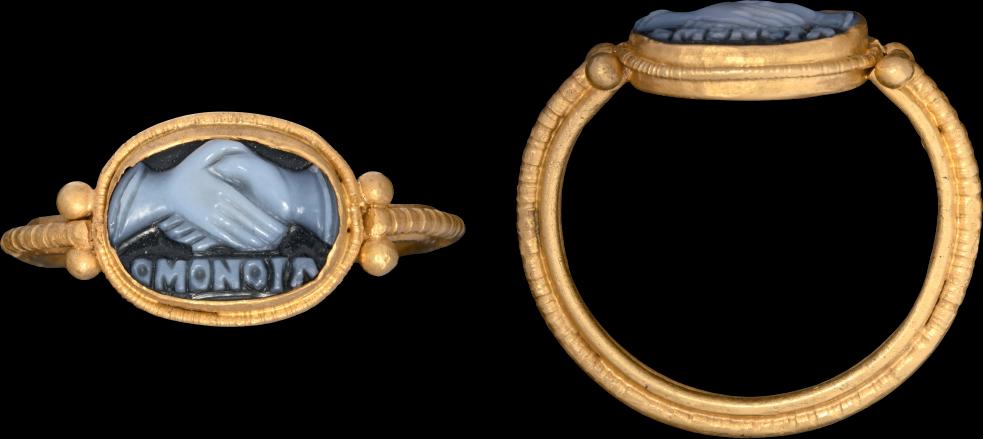
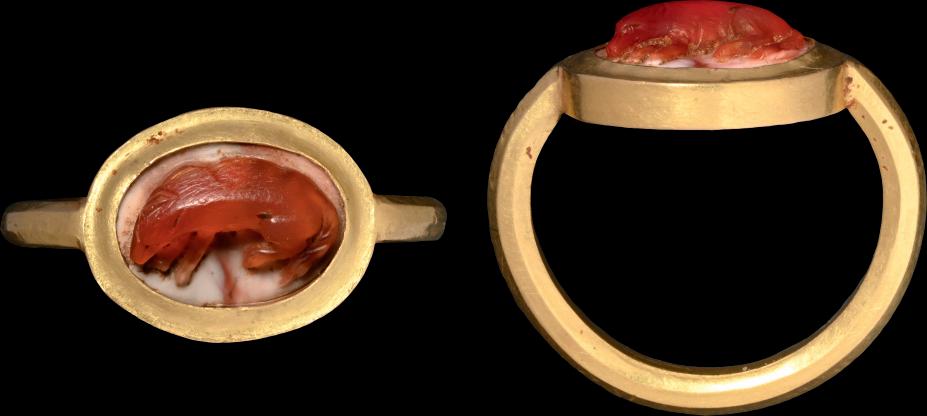
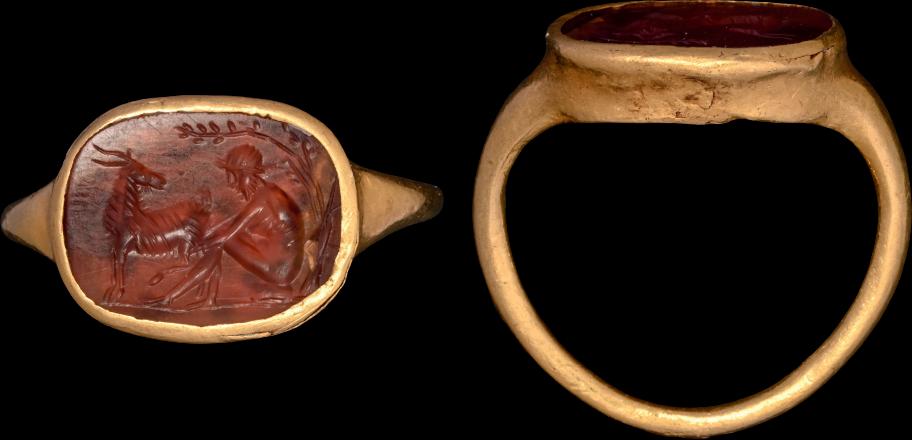
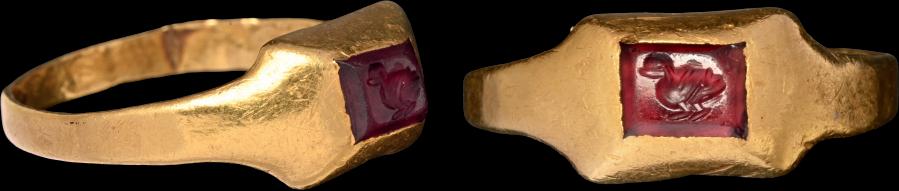
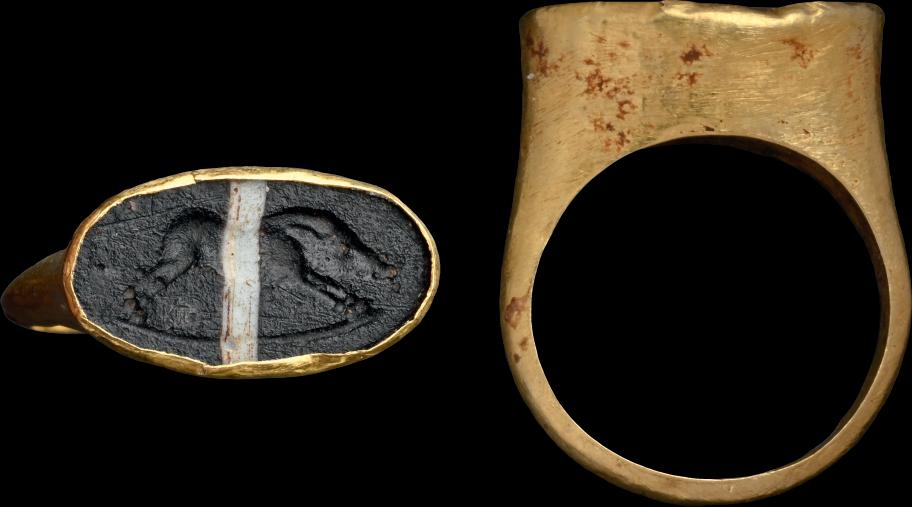
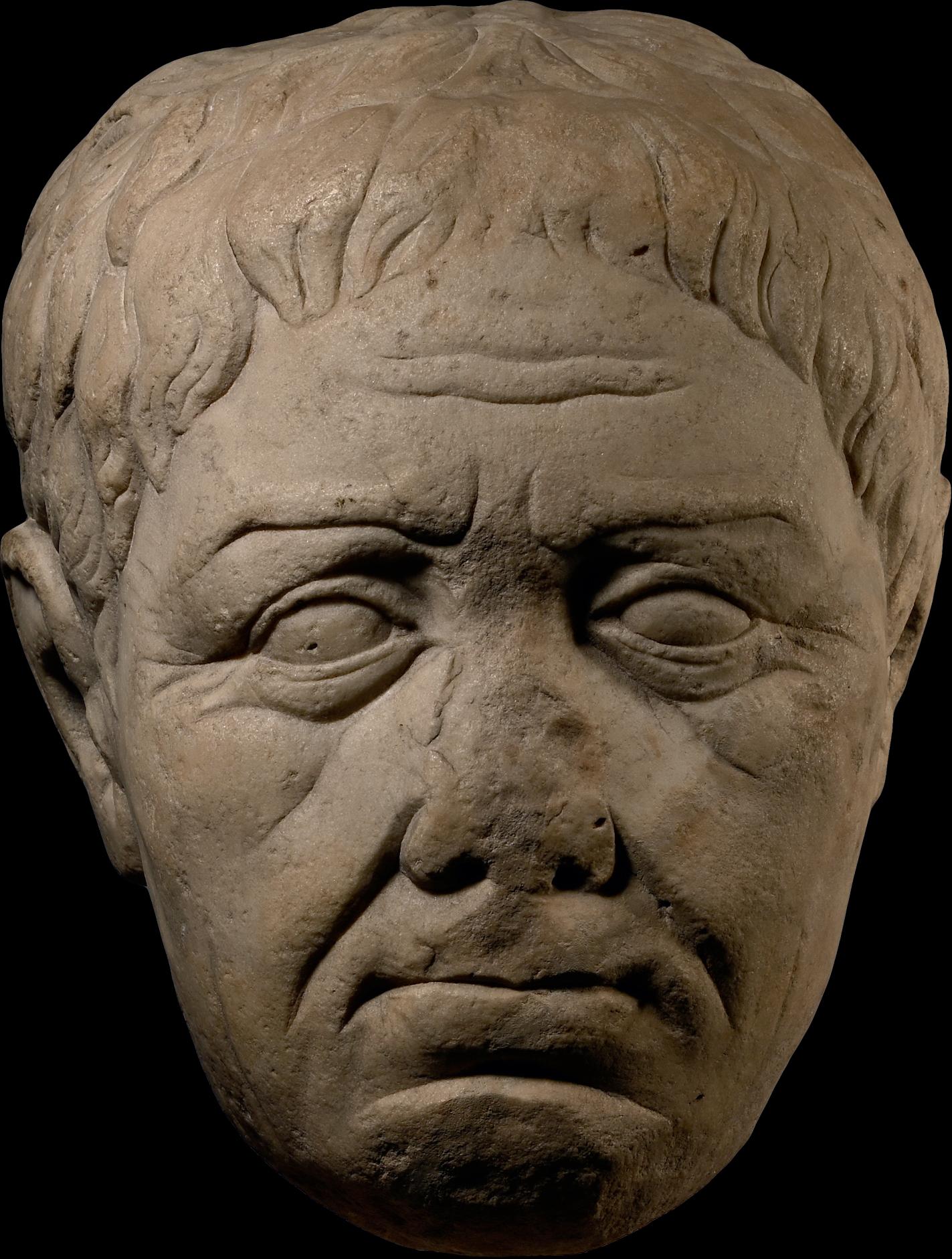
LIFE-SIZE ROMAN REPUBLICAN MARBLE PORTRAIT HEAD OF A MAN
2ND-1ST CENTURY B.C.
19¾ in. (25.75 kg total, 50 cm including stand)
Private portrait head of a beardless but aged man sculpted in provincial style to be full of character with pinched mouth and furrowed brow; the short hairstyle characteristic of Late Republican Rome; nose abraded; socket to underside for mounting on the display stand.
£5,000 - 7,000
PROVENANCE:
Private collection, Auvergne, France, 1970s.
FOOTNOTES:
In view of the fact that visual conventions (i.e. the Julian hairstyle) developed in the capital reached the “Romanised” provinces with a certain time lag, this portrait head was probably created in the Late Republican or Early Imperial Period.
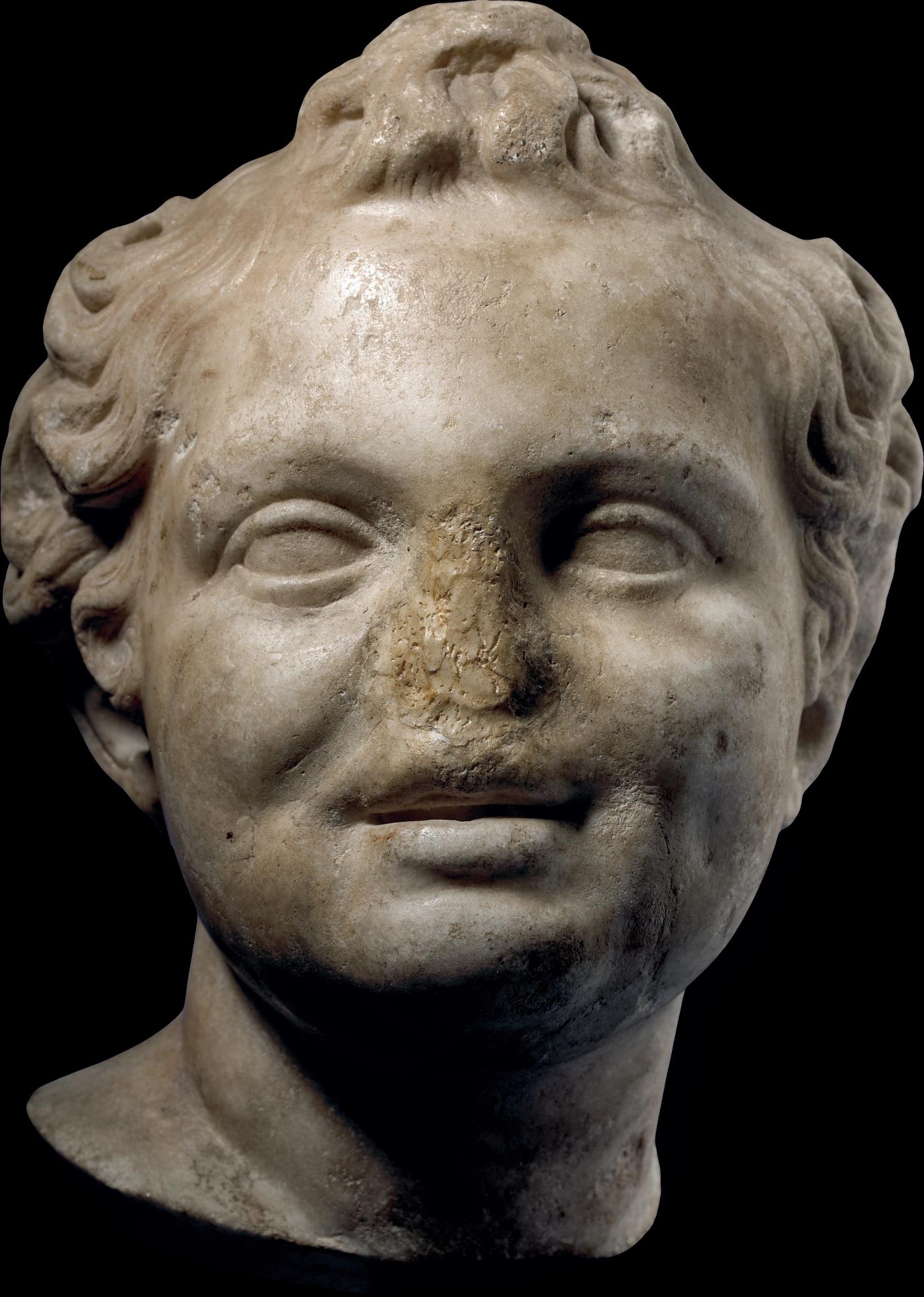
ROMAN MARBLE HEAD OF YOUTHFUL EROS, THE GREEK GOD OF LOVE
2ND-3RD CENTURY A.D.
13½ in. (9.95 kg total, 34 cm including stand)
Carved in the round as a bust of a child with youthful face, wide cheeks, slightly opened mouth with full lips, almond-shaped eyes, chipped nose; curly hair combed on the top of the head; mounted on a custom-made display stand.
£12,000 - 17,000
PROVENANCE: Collection of Mr and Mrs A., in their private mansion near the Champs-Élysées; thence by descent.
Acquired on the French art market, 2024. Private collection, England.
FOOTNOTES:
The finely sculpted head represents a young child, probably intended as Eros (Cupid). Such depictions were produced in numerous variations to illustrate the stages of childhood and the capacity of children to undertake meaningful or symbolic actions. The softly modelled features and gentle expression recall the celebrated work of Boethos’, The Boy Strangling the Goose, as well as the widespread images of Eros and the Erotes found throughout Graeco-Roman sculpture and painting. In Graeco-Roman art, representations of children occupied an important and evolving role. Initially, youthful figures were portrayed as miniature adults, but from the 4th century BC onwards - particularly during the Hellenistic and Roman periods - artists began to study children’s anatomy more closely, reproducing their characteristic proportions and expressions with naturalistic sensitivity.
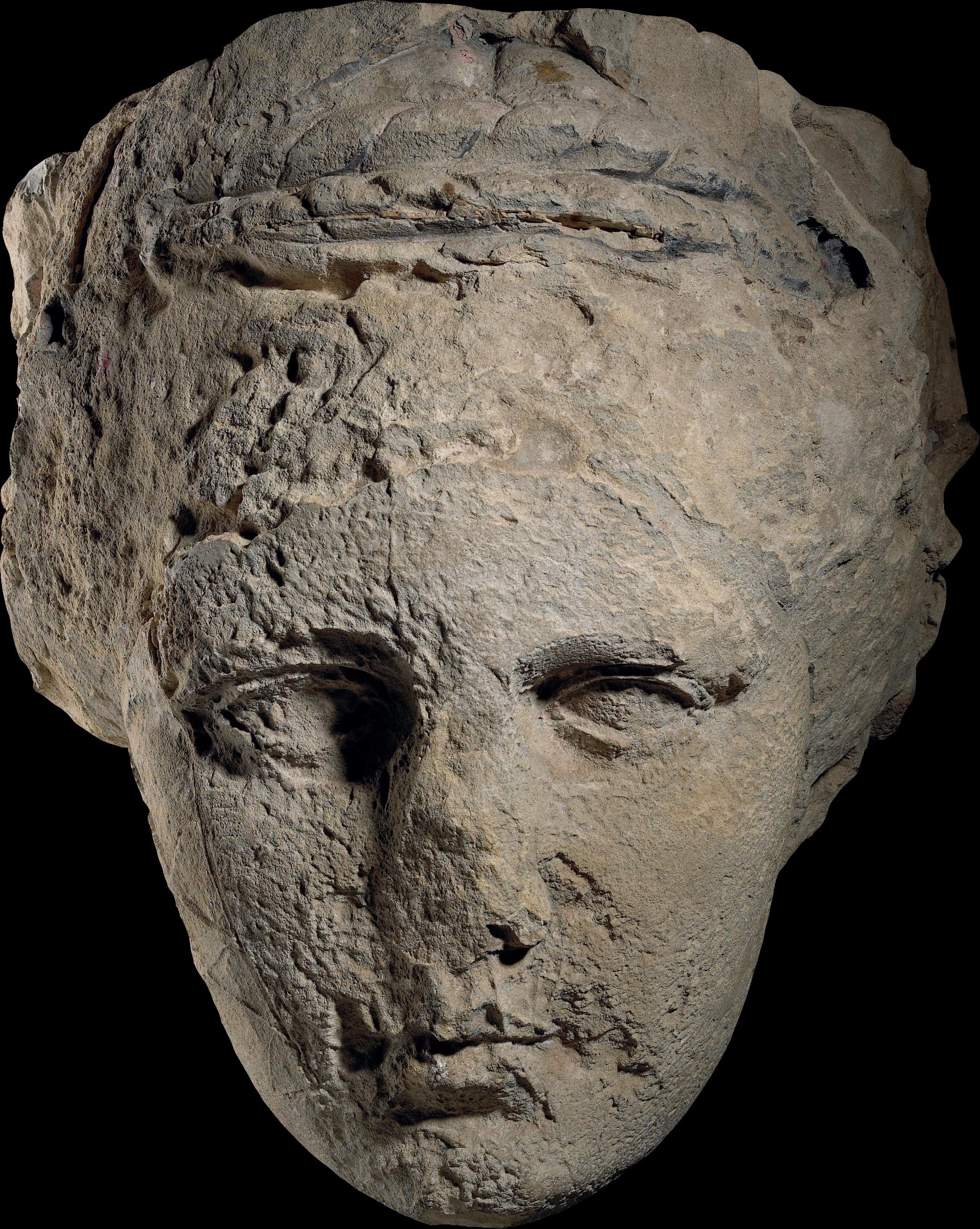
130 THREE TIMES LIFE-SIZE ROMAN HEAD OF THE GODDESS DIANA
1ST-2ND CENTURY A.D.
28 in (99.5 kg total, 72 cm high including stand)
The goddess (Greek Artemis) with elegant features, sensual lips and deep eyes; detailed treatment of the hairstyle in transverse braids across the brow, laurel wreath with two rows of leaves resting above the forehead, an architectural element that was placed for the support of the sima of a building of great size; mounted on a custom-made display stand.
£12,000 - 17,000
PROVENANCE: Ex private Belgian collection. with Madame Andree Mace collection. English private collection.
Accompanied by an academic report by Prof. Neritan Ceka.
FOOTNOTES: The upper part of the head, cut horizontally, creates a semi-circular surface, on which the rest of the hair, or an architectonic capital, may have been mounted into a T-shaped socket. The back of the head, cut perpendicularly, proves that the head was intended for architectural use, and not to be viewed in the round. This piece may have been intended as the head of a caryatid (a sculpture serving as a pilaster) or an architectural stone corbel (an architectural element placed to support the sima of a significant building).
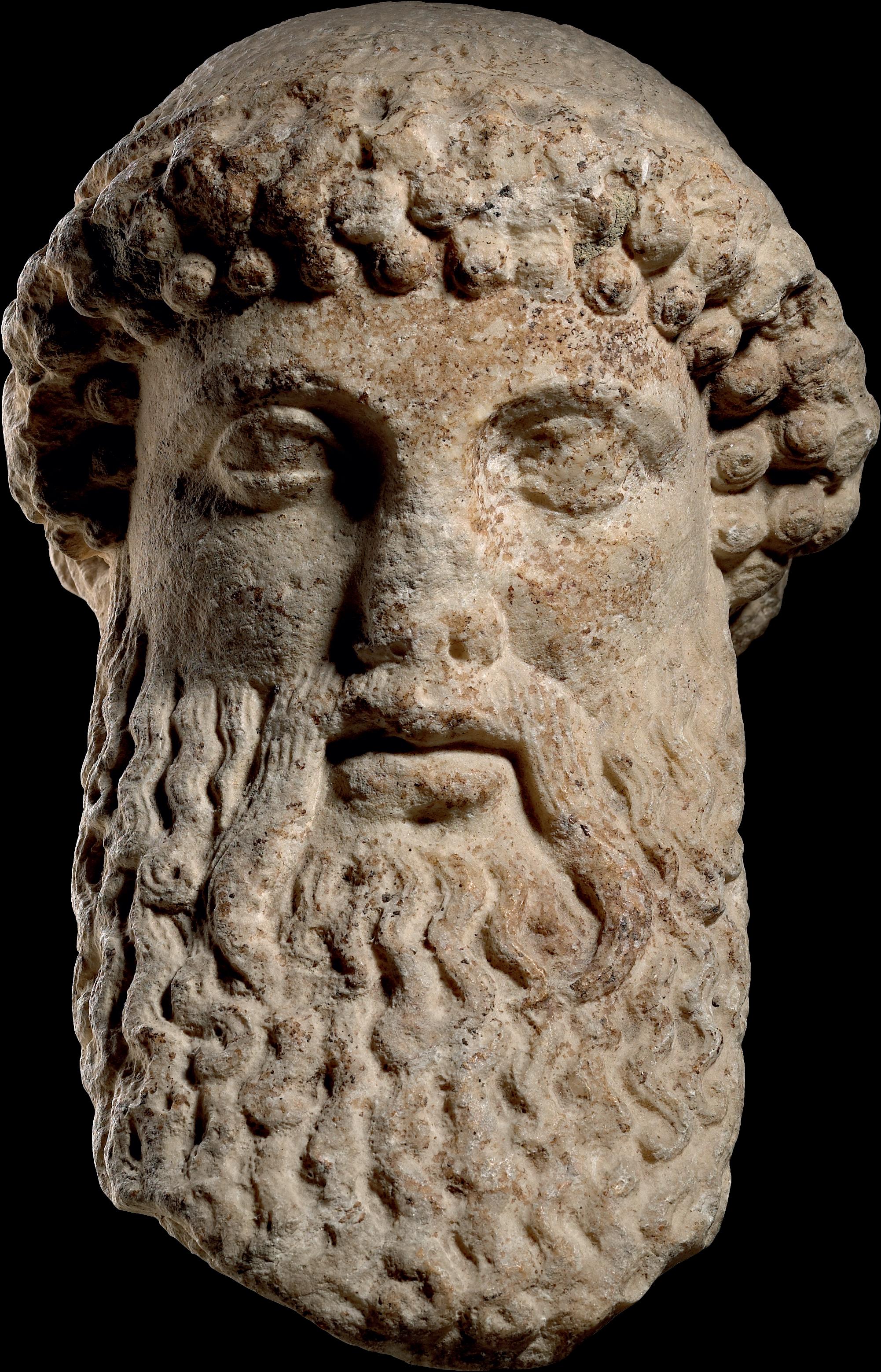
LIFE-SIZE ROMAN BEARDED HEAD OF THE GREEK GOD HERMES
1ST-2ND CENTURY A.D.
20½ in. (32.2 kg total, 52 cm high including stand)
With densely curled hair, stern facial expression beneath a broad brow, luxuriant curled beard falling in waves and cut square at the lower edge, a Roman copy after a 5th century B.C. Greek original; mounted on a custom-made display stand.
£30,000 - 40,000
PROVENANCE: with Chaucer Fine Arts Ltd, 1980s. English private collection.
Accompanied by an academic report by Dr Marina Mattei and Dr Laura Maria Vigna.
FOOTNOTES:
This belongs to a type of archaic sculpture which can be traced back to the original ‘Hermes Propylaios’ by the Attic sculptor Alkamenes, a pupil of Phidias, active in the second half of the 5th century B.C. According to some theories, such depictions of Hermes (Hermae) were created for the Propylaea of the Acropolis of Athens, Hermes being the patron deity of doors and entrances. According to others, this type of bearded Hermes was located within the Acropolis as a devotional figure.
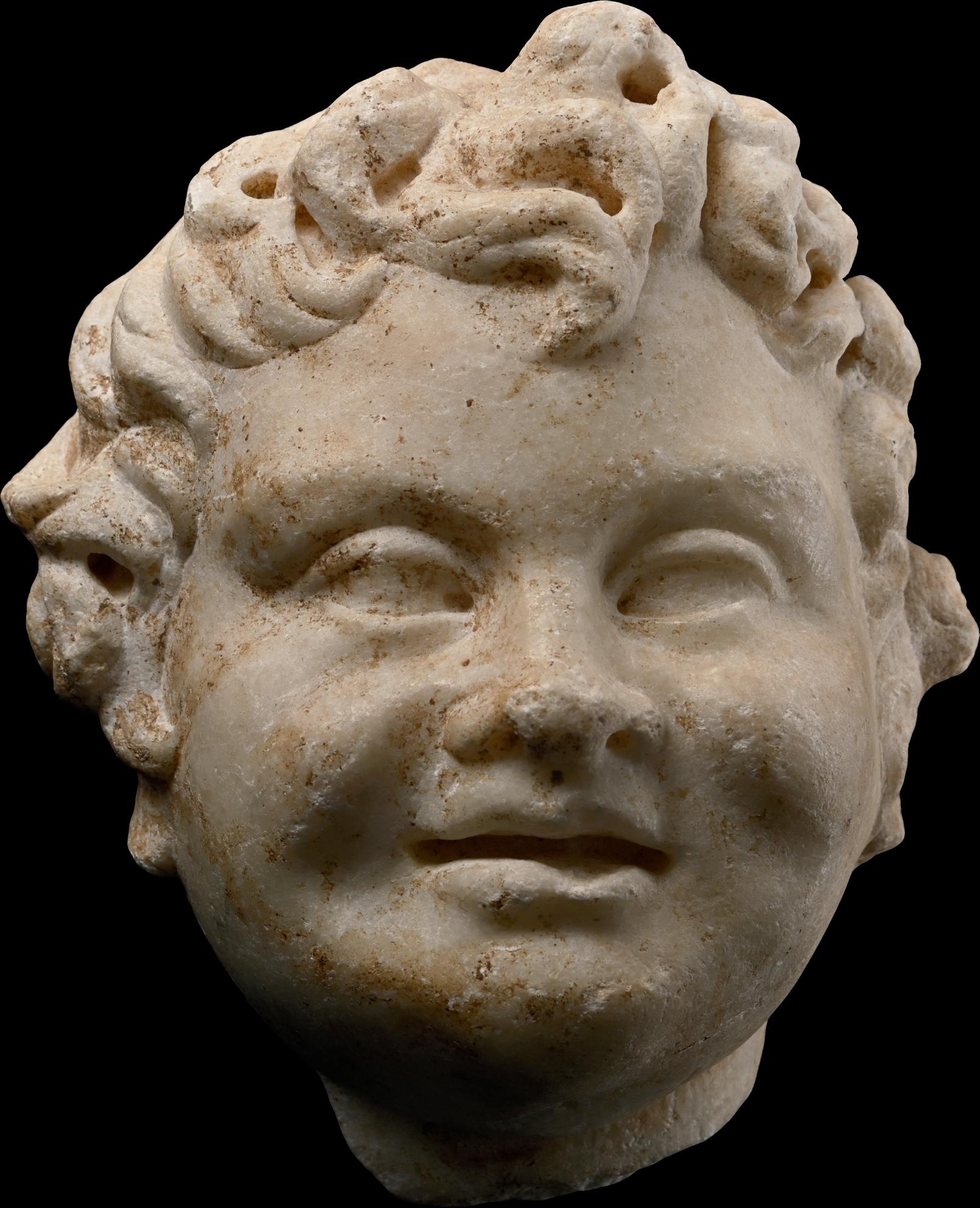
ROMAN MARBLE HEAD OF EROS, THE GREEK GOD OF LOVE
2ND-3RD CENTURY A.D.
6 in. (2.02 kg, 17.5 cm)
Carved in the half-round with undercuts to the curly hair, fleshy facial features; attachment ring to reverse.
£4,000 - 6,000
PROVENANCE: Acquired on the French art market, 13 November 2022. Private collection, England.
FOOTNOTES: The finely sculpted head represents a young child, probably intended as Eros (Cupid). Such depictions were produced in numerous variations to illustrate the stages of childhood and the capacity of children to undertake meaningful or symbolic actions. The softly modelled features and gentle expression recall the celebrated work of Boethos’, The Boy Strangling the Goose, as well as the widespread images of Eros and the Erotes found throughout Graeco-Roman sculpture and painting. In Graeco-Roman art, representations of children occupied an important and evolving role. Initially, youthful figures were portrayed as miniature adults, but from the 4th century BC onwards - particularly during the Hellenistic and Roman periods - artists began to study children’s anatomy more closely, reproducing their characteristic proportions and expressions with naturalistic sensitivity.
& 28 of
133
ROMAN MARBLE HELMETTED AND CUIRASSED BUST OF MARS, THE GOD OF WAR
LATE 4TH CENTURY A.D.
27 in. (45.2 kg, 68.5 cm)
His head turned slightly to the right, calm and idealised facial expression with heavy-lidded eyes defined by incised irises and drilled, crescent-shaped pupils, and a neatly trimmed beard; his wavy hair crowned by a Corinthian helmet, pushed back high on the forehead; wearing a cuirass decorated at the centre with a small gorgoneion, and a chlamys secured by a brooch on the left shoulder; mounted on a later variegated stone socle.
£30,000 - 40,000
PROVENANCE:
European private collection, 18th century (based on the restoration techniques). Private collection, France, acquired on the Marseilles art market in the late 1960s.
Sotheby’s, London, 13th June 2016, no.18. UK collection, acquired from the above auction.
Sotheby’s, Ancient Marbles: Classical Sculpture and Works of Art, 3-9 July 2020, no.30.
FOOTNOTES:
The sculpture has undergone both ancient and modern intervention. The back has been hollowed out in modern times, indicating that it was originally part of a tondo. Restoration is visible to the tip of the nose, the lower edges of the helmet’s cheek-pieces, and a small area of drapery. There is minor reworking to parts of the drapery folds and the brooch, as well as light retouching to the proper right corner of the lower lip and possibly the right side of the moustache.
A small area of fill is also present on the restored nose of the helmet. In style, the bust belongs to the Late Antique tradition of ideal sculpture. The simplified facial features and distinctive eye treatment closely recall a comparable head in the Vatican, dated to the late 4th century AD. The military dress and iconography strongly suggest that the figure represents the Roman god Mars, comparable to known images of Mars Ultor. The Corinthian helmet, restored with a sculpted nose-guard, reflects an 18th-century restoration practice well attested in Roman collections, including examples from the Villa Albani.
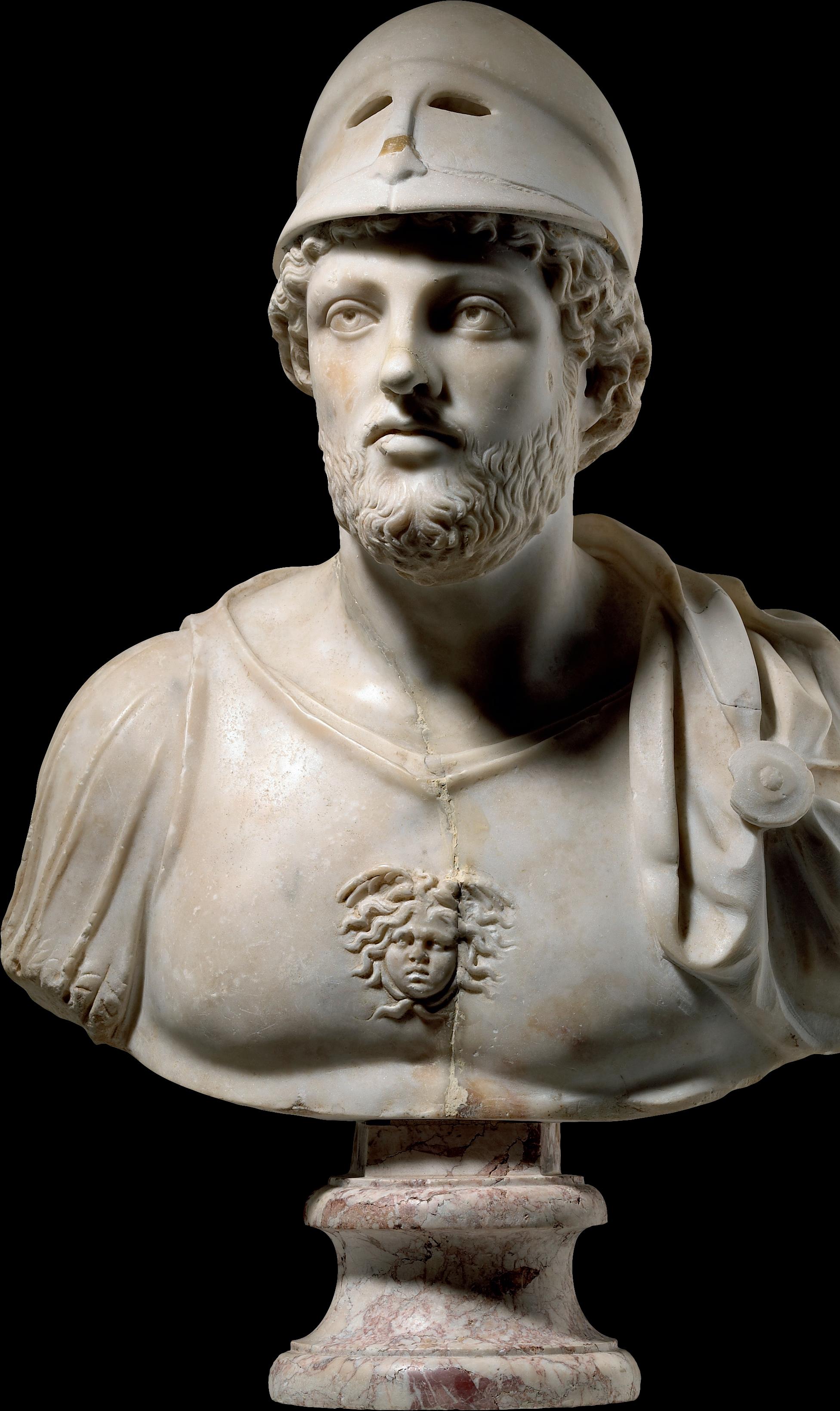
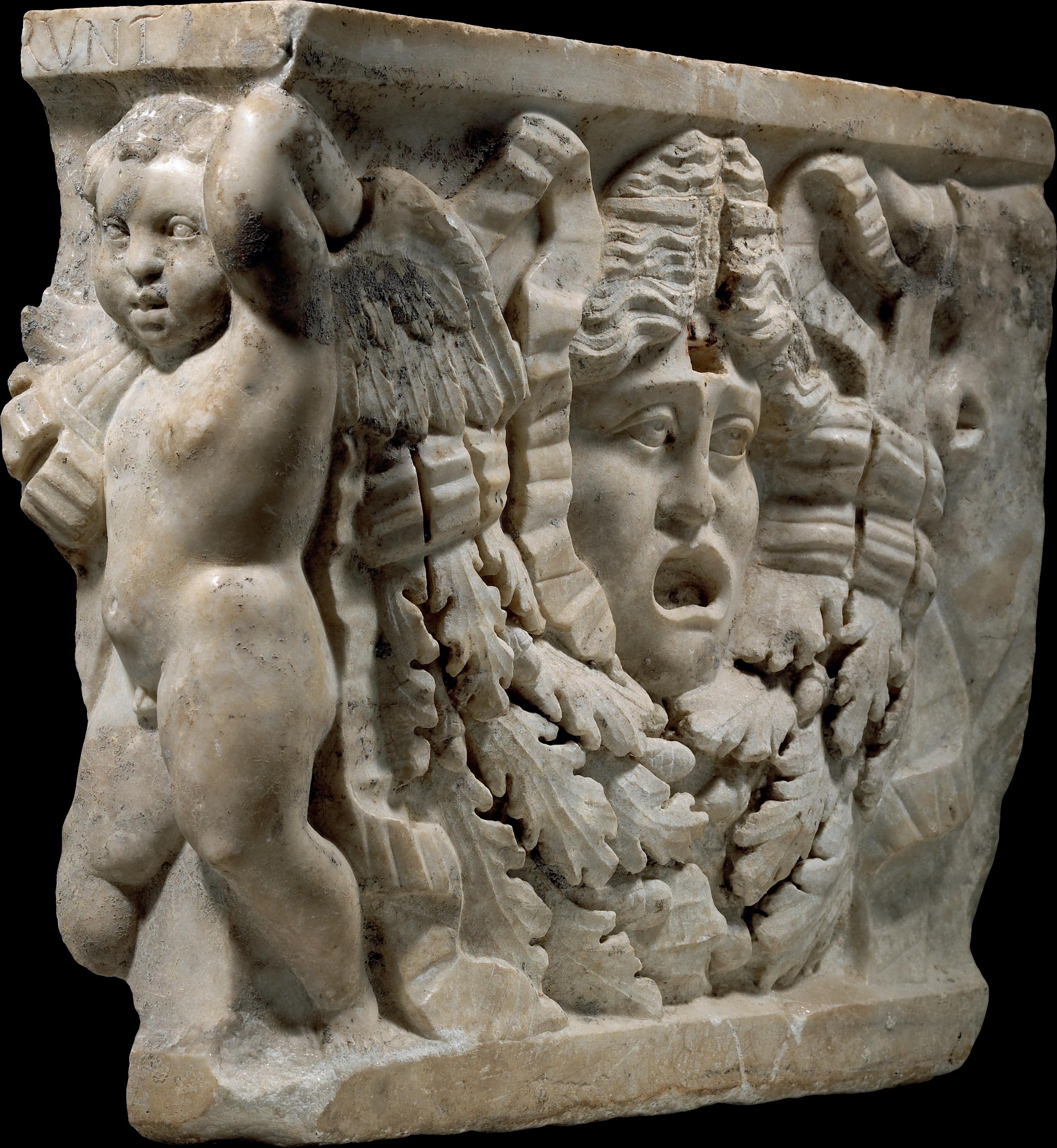
ROMAN MARBLE GARLAND SARCOPHAGUS PANEL WITH THEATRICAL MASK AND EROS, THE GREEK GOD OF LOVE CIRCA 135 A.D.
19 x 22 in. (72.95 kg, 48 x 57 cm)
From the right end of an ornate sarcophagus, carved dramatic theatrical mask in the centre with open mouth and drilled eyes, the forehead morticed for an attachment, a garland of leaves below; the right end tied to a boukranion, the left supported by a winged Eros; reverse with apsidal recess.
£18,000 - 24,000
PROVENANCE: Private collection, New York. with Christie’s, New York, 7th December 1995, no.118. Christie’s, New York, April 29th, 2019, no.189. Acquired at the above sale. with Sotheby’s, 17 December 2020, no.80.
The opposite short side of the same sarcophagus was sold at Sotheby’s, New York, November 28th, 1990, no.104, and is now in a New York private collection.
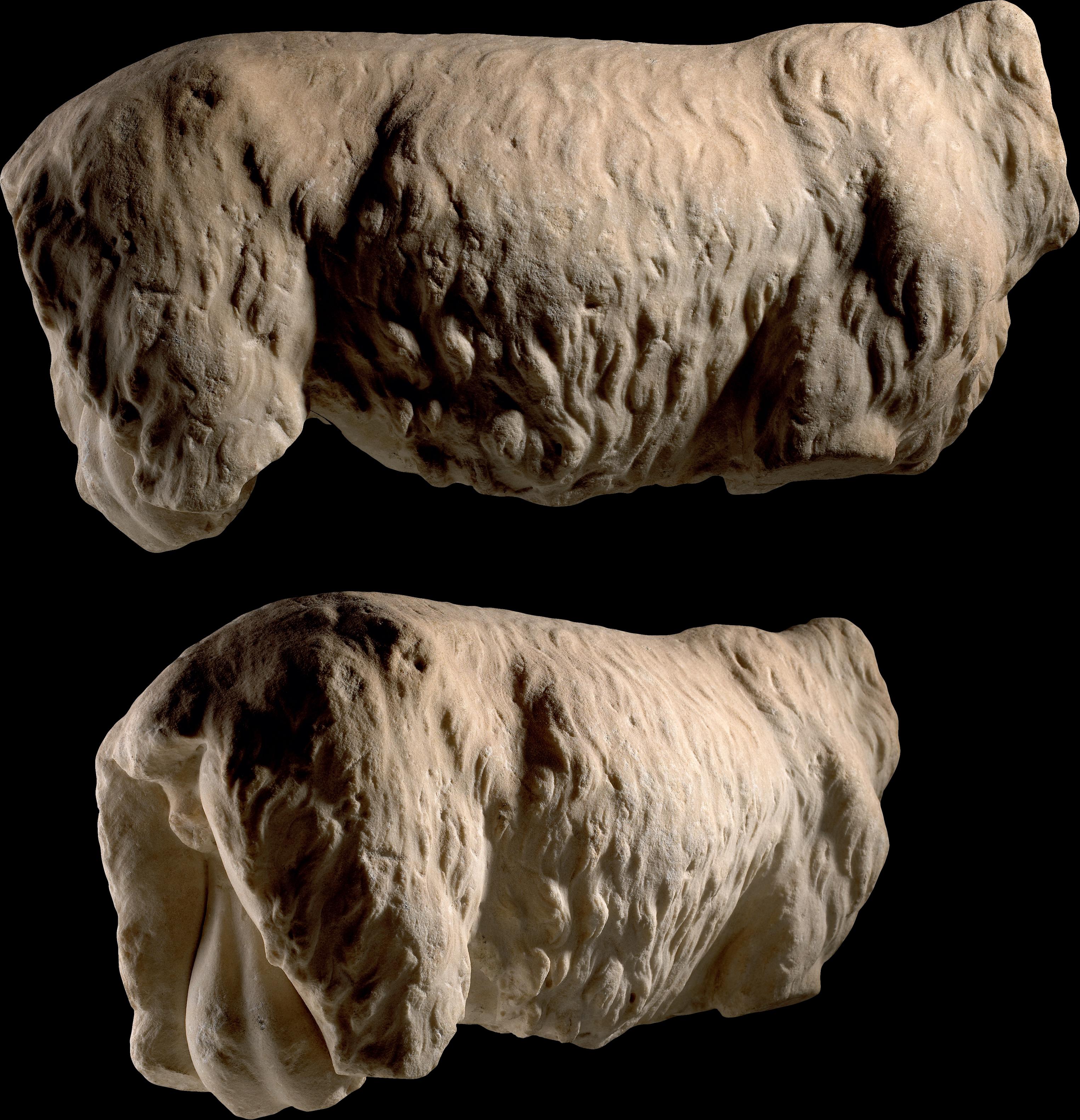
LIFE-SIZE ROMAN MARBLE TORSO OF A RAM
1ST CENTURY B.C.-1ST CENTURY A.D.
35 in. (long), 16 in. (high) (155 kg, 89 cm (long), 41 cm (high) excluding stand)
The naturalistic rendering of the animal is particularly evident in the modelling of the muscles and shaggy fur, which originally belonged to a multi-figure group intended for prominent display in an official space, such as a public bath, or in the private gardens of a luxurious villa; accompanied by a custom-made display stand.
£30,000 - 40,000
PROVENANCE: Acquired in Brussels, circa 1980. with Christie’s, South Kensington, 6 October 2011, no.121. Jean-David Cahn AG, Basel, Switzerland. Private collection, England.
FOOTNOTES:
The sculpture may represent the goat Amalthea, nurse of Zeus, one of the most famous animals in Graeco-Roman mythology. At the same time, it could simply be a representation of a ram, an animal typically sculpted in sacrificial reliefs of the Roman world.
136
ROMAN MARBLE CORINTHIAN CAPITAL
3RD-4TH CENTURY A.D.
10 in. (23 kg, 25.7 cm high)
Round in plan, showing detailed acanthus leaves and spiral volutes with deep undercuts, applied flower to the upper edge.
£4,000 - 6,000
PROVENANCE:
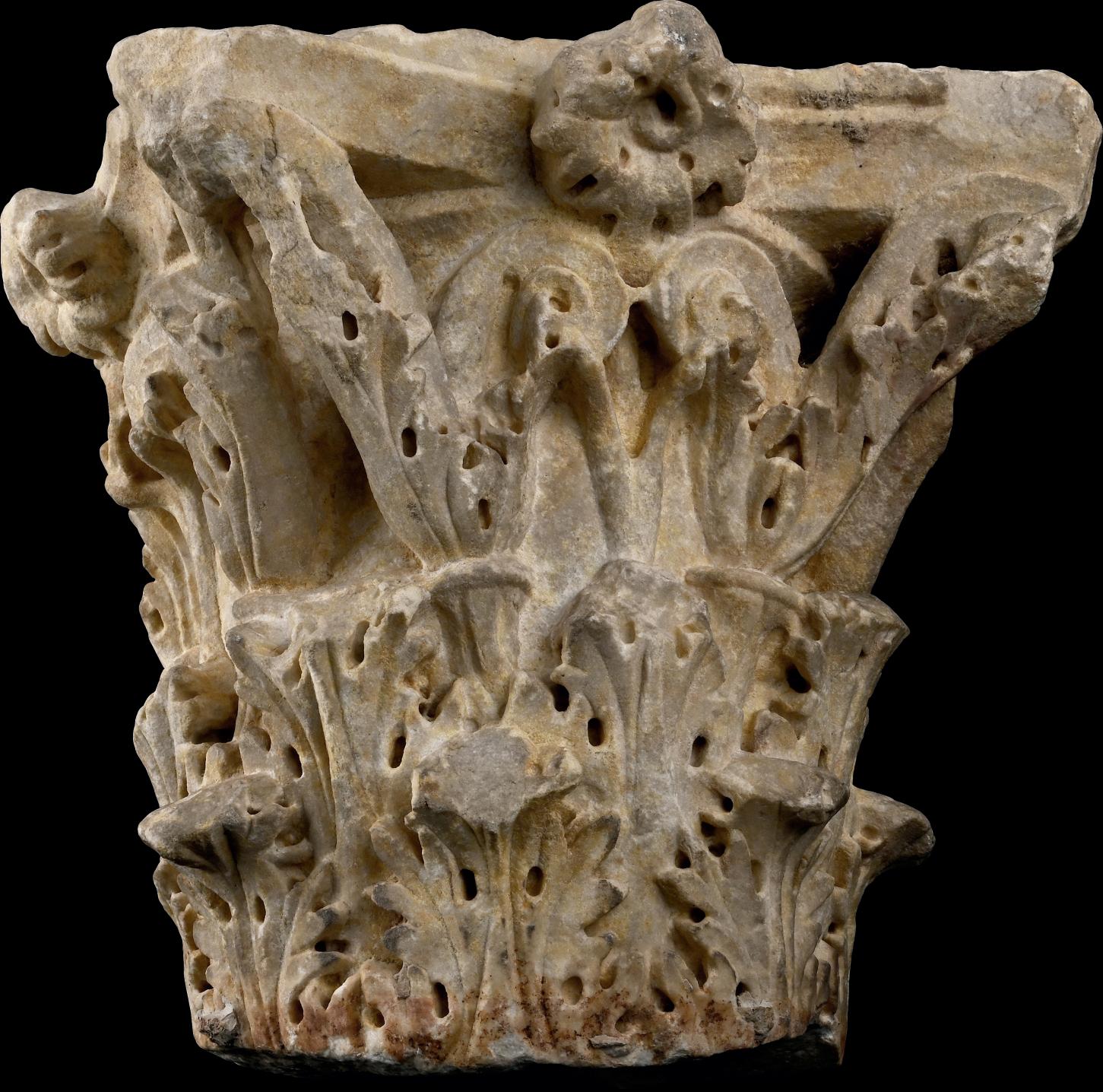
Acquired on the French art market, 13 November 2022. Private collection, England.
137
ROMAN MARBLE LEFT FOOT FROM A SCULPTURE
2ND CENTURY A.D.
5 in. (771 grams total, 15 cm high including stand)
Comprising an elegantly carved lower part of the calf and foot, a detailed rendering of the toes; the proportions suggesting that the subject was a child or a young woman; mounted on a custom-made display stand.
£3,000 - 4,000
PROVENANCE:
Nicolas Koutoulakis (1910-1996), thence by descent.
Ex Galerie Dominique Thirion, Brussels, 1990s.
Private collection of Mr K.A., France. with Kallos Gallery, London.
Accompanied by an academic report by Dr Raffaele D’Amato.
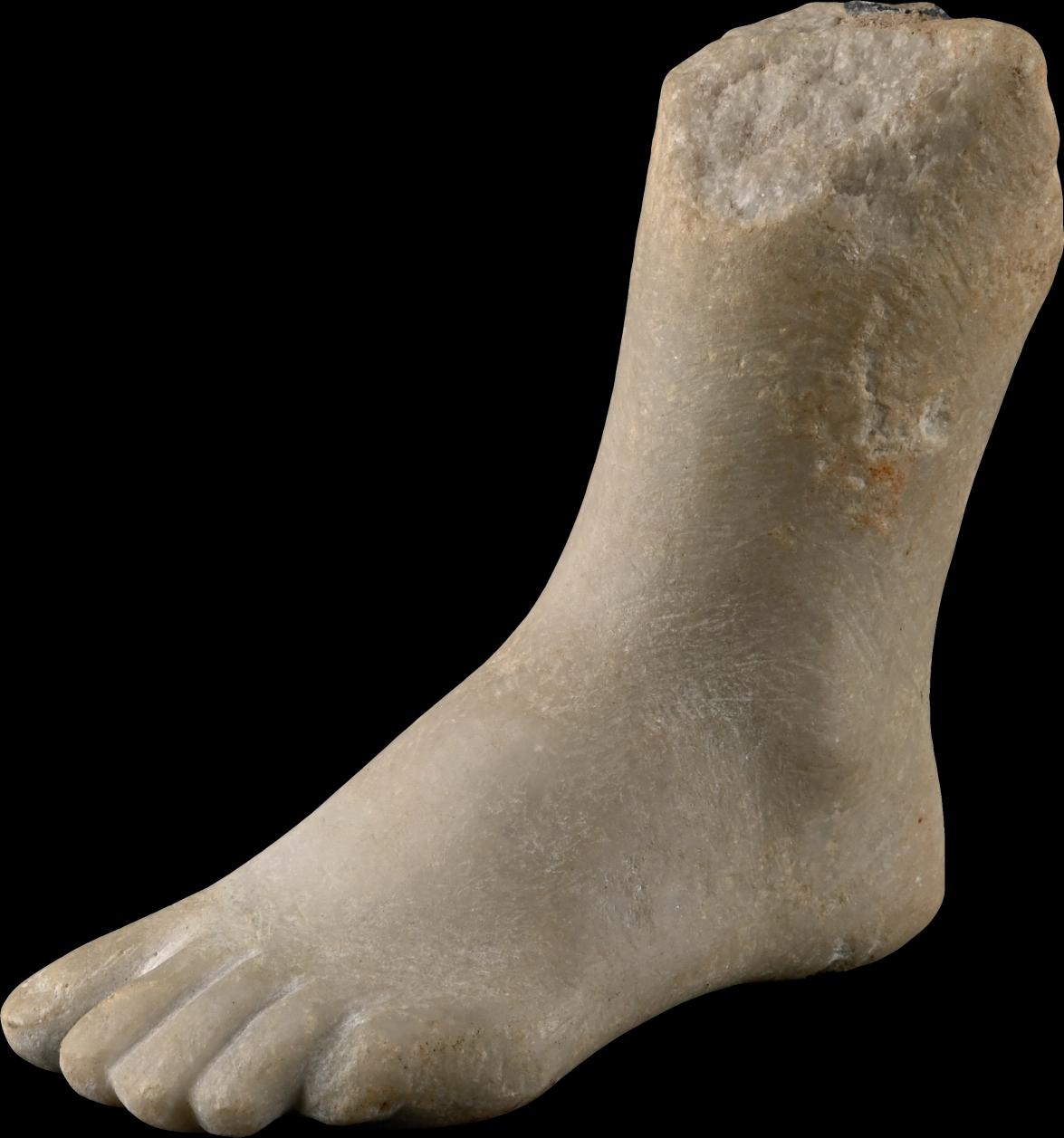
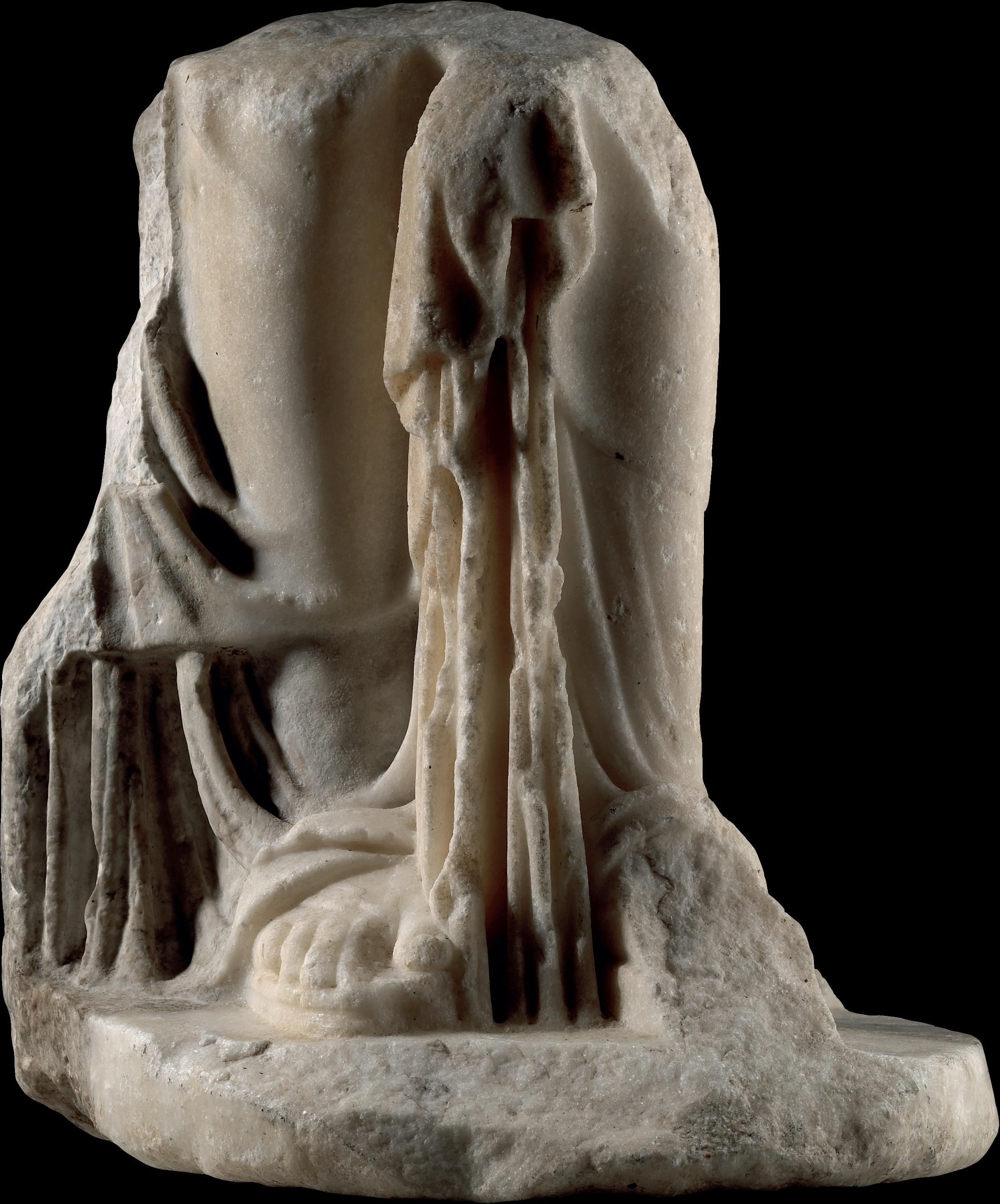
LARGE LOWER SECTION OF A ROMAN MARBLE FIGURE OF THE GODDESS ISIS
2ND CENTURY A.D.
19 in. (66.65 kg, 50 cm)
Statue fragment of a woman or goddess, including floor-length robe and right foot with sandal; modelled standing with the foot slightly advanced, wearing sandals, chiton and himation
£7,000 - 9,000
PROVENANCE: American private collection, acquired in the 1980s-1990s. Acquired on the American art market in 2016. with Sotheby’s, London, 11 December 2020, no.88.
FOOTNOTES: Both the stance and folds of the himation suggest an Archaistic statue, perhaps the goddess Isis.
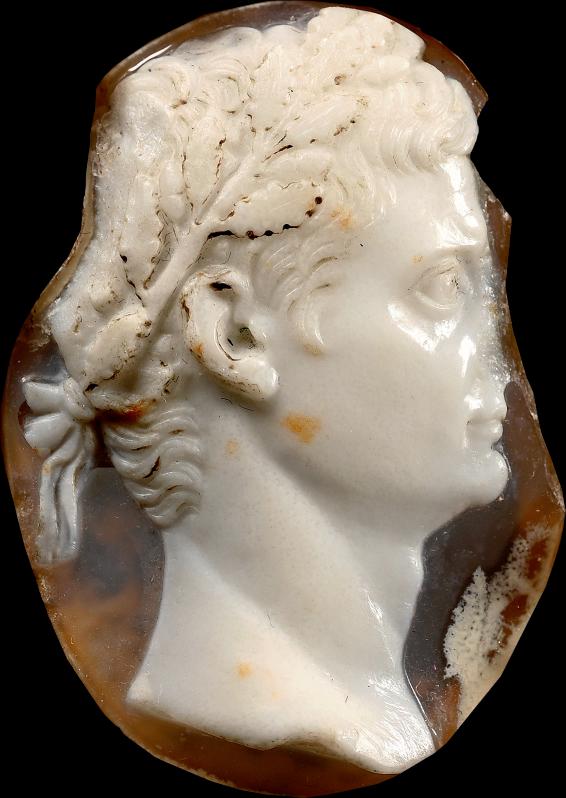
140 ROMAN CARNELIAN GEMSTONE WITH EROS, THE GREEK GOD OF LOVE HOLDING A THEATRICAL MASK
1ST CENTURY A.D.
in. (1.8 grams, 17 mm)
Plano-convex in section with intaglio scene: a small winged character stands beneath a large theatrical mask, supporting it on his shoulders.
£4,000 - 5,000
PROVENANCE: Acquired on the UK art market. Private collection, England.
FOOTNOTES:
The young Eros appears with his face inside the wide-open mouth of the mask, looking out as a spectator. The mask is held in his small hands and is characterised by a thick beard, large orbital cavities, and short hair with ribbons. He is depicted in three-quarters seen from behind, engraved and polished with great skill. The stone has a convex surface with traces of ancient burning at the bottom and slight wear marks.
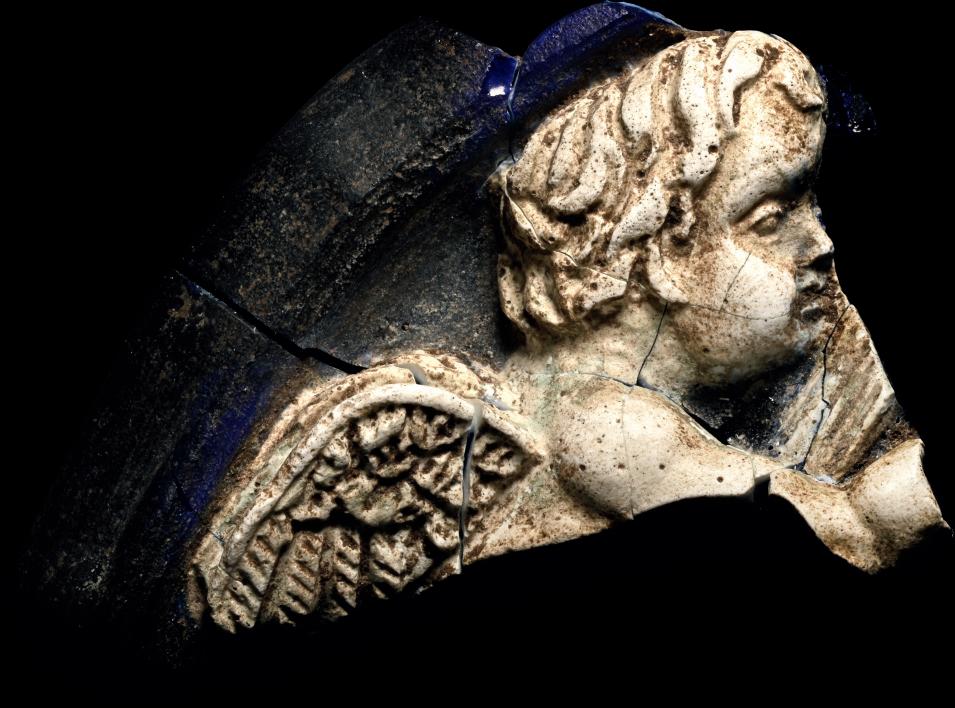
139
ROMAN AGATE CAMEO OF THE EMPEROR AUGUSTUS ‡ 1ST CENTURY A.D.
2 in. (99 grams total, pendant: 50 mm)
Ellipsoid cameo with profile portrait bust in antique gold pendant frame with surrounding cabochons: emerald, sapphire, ruby - and clusters of pearls; marked to reverse ‘750’, in a rectangle ‘Bd G’ (believed to be an upstate New York jeweller’s stamp) and an indeterminate third mark; supplied with a custom-made display stand.
£20,000 - 30,000
PROVENANCE:
American collection, early 20th century, New York. with Robert Haber Gallery, New York, 1990. Ex Jean Clostre, Geneva, Switzerland.
Accompanied by a scholarly report by Dr Ittai Gradel.
FOOTNOTES:
Dr Ittai Gradel says: ‘The cameo, of exquisite technical quality, has a close parallel in the Cabinet des médailles, Paris .. The TimeLine auction cameo is not, however, an exact copy .. though details are so close to the larger Paris cameo that the same gem carver, or at least workshop, probably produced both.’
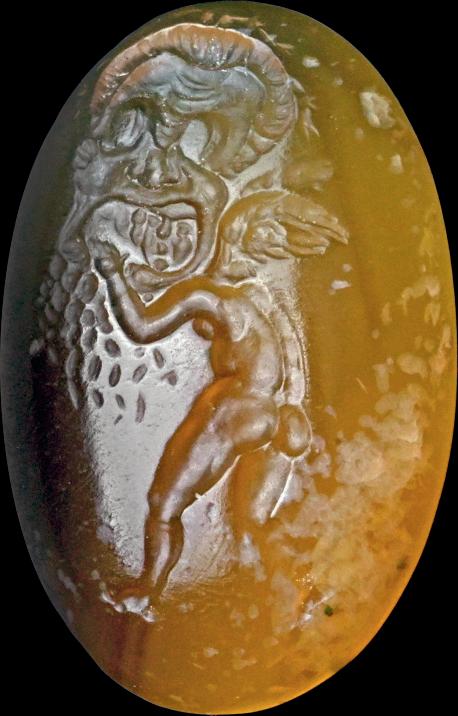
141
ROMAN BLUE GLASS CAMEO WITH EROS, THE GREEK GOD OF LOVE
3RD CENTURY A.D. 2½ in. (53.3 grams, 63 mm)
Fragment from a large tondo; reserved Eros with fleshy face, small dorsal wings; repaired.
£3,000 - 4,000
PROVENANCE: Ex Shlomo Moussaieff (1948-2000). with Gorny and Mosch, Munich, 12 December 2019, no.304. Private collection, England.
142
MASSIVE ROMAN GOLD RING WITH NICOLO INTAGLIO OF AN IMPERIAL EAGLE
3RD CENTURY A.D.
1 in. (28.30 grams, 35.39 mm overall, 21.58 x 15.31 mm internal diameter (approximate size British M, USA 6, Europe 12.46, Japan 12))
Architectural in form with carved scrolls and gadrooning, set with a nicolo intaglio of an eagle, stood upon a ground line with a laurel wreath clutched in its beak.
£8,000 - 10,000
PROVENANCE:
English private collection, formed in the early 20th century.
Private collection, London, UK.
143
LARGE ROMAN GOLD RING WITH CARNELIAN GEMSTONE WITH BUST OF THE GODDESS ATHENA AND INSCRIPTION
1ST CENTURY B.C.
1¼ in. (20.80 grams, 33.33 mm overall, 22.23 mm internal diameter (approximate size British Z, USA 12½, Europe 28.77, Japan 27))
Hollow-formed with flange rim and stepped bezel, inset intaglio profile bust of Athena in crested helmet; sinistrograde legend to bottom edge ‘ *’.
£5,000 - 7,000
PROVENANCE: with Bertolami Fine Arts, London, Auction 66, no.481. Private collection, England.
144
ROMAN GOLD RING WITH BUST OF THE GOD SERAPIS ‡ 1ST-2ND CENTURY A.D.
1 in. (5.65 grams, 27.68 mm overall, 18.70 x 15.32 mm internal diameter (approximate size British L½, USA 6, Europe 11.87, Japan 11))
Hollow-formed hoop with broad ellipsoid cell, inset red jasper intaglio profile bust of Serapis with modius
£3,000 - 4,000
PROVENANCE: Private European collection. Acquired in 2002.
145 ROMAN GOLD RING WITH GREEN CHALCEDONY GEMSTONE WITH PANTHEISTIC DEITY
1ST CENTURY A.D.
1 in. (9.91 grams, 23.93 mm overall, 19.33 mm internal diameter (approximate size British L½, USA 6, Europe 11.87, Japan 11))
Cabochon with intaglio standing male deity, possibly Asclepius, surrounded by attributes including a wreath, caduceus, ant, sistrum and others.
£1,500 - 2,000
PROVENANCE: Private collection, England.
146
ROMAN GOLD RING WITH CABOCHON GARNET GEMSTONE WITH THE GODDESSES ATHENA AND NIKE
1ST-3RD CENTURY A.D.
1 in. (5.75 grams, 26.40 mm overall, 19.16 mm internal diameter (approximate size British P, USA 7½, Europe 16.23, Japan 15))
Hollow-formed hoop with broad plaque, inset cabochon with incuse standing opposed figures of Athena and Nike.
£1,500 - 2,000
PROVENANCE: Private collection, England.
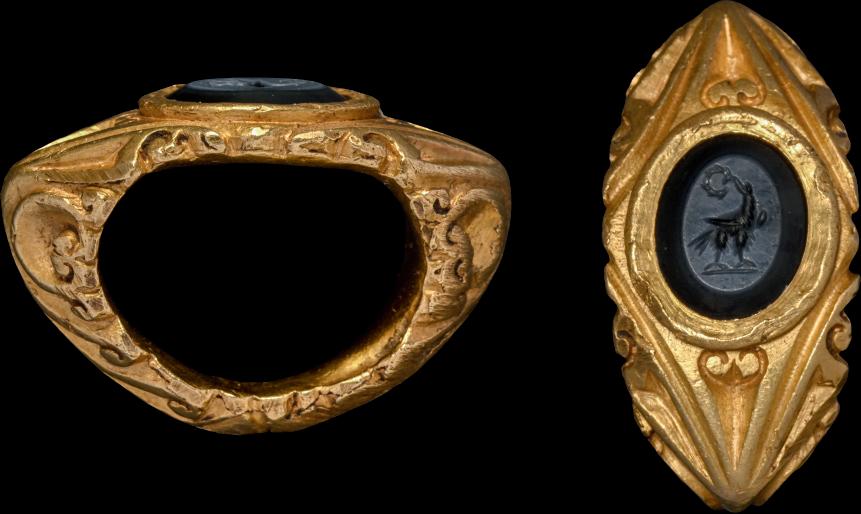
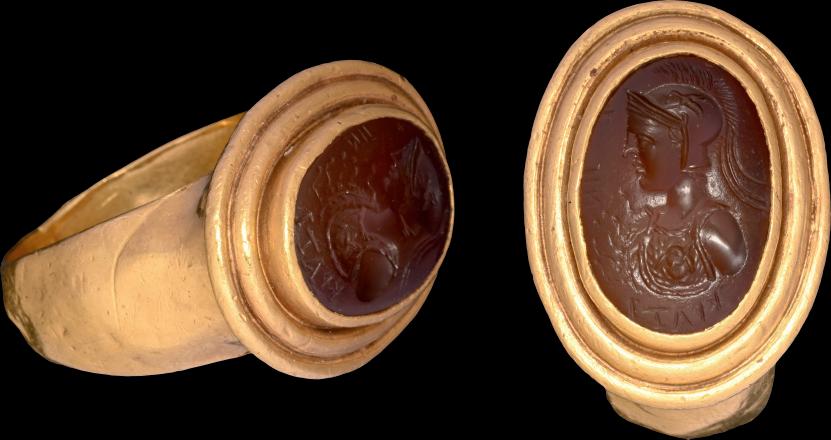
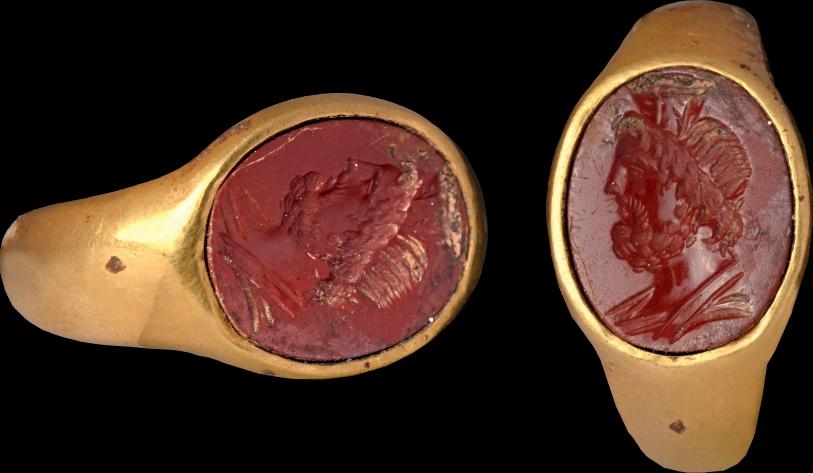
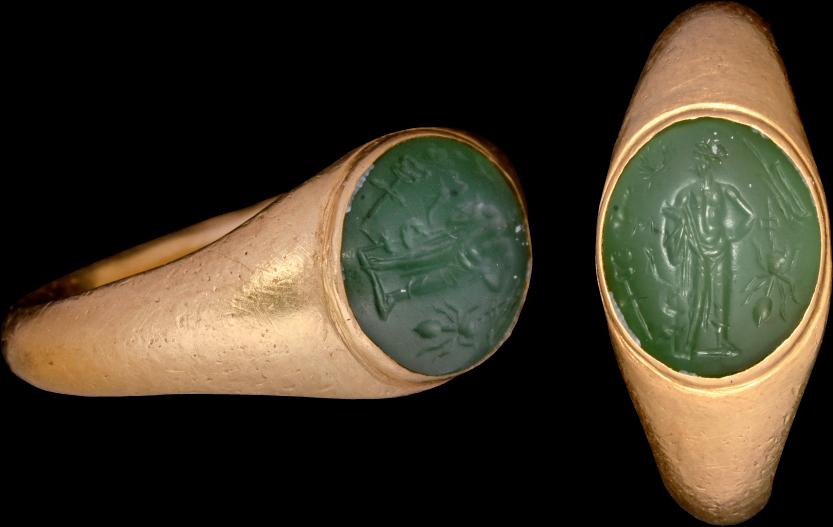
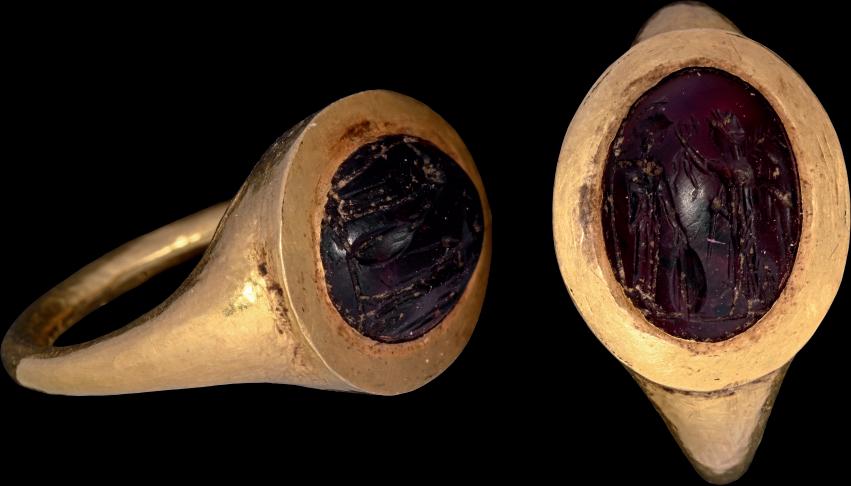
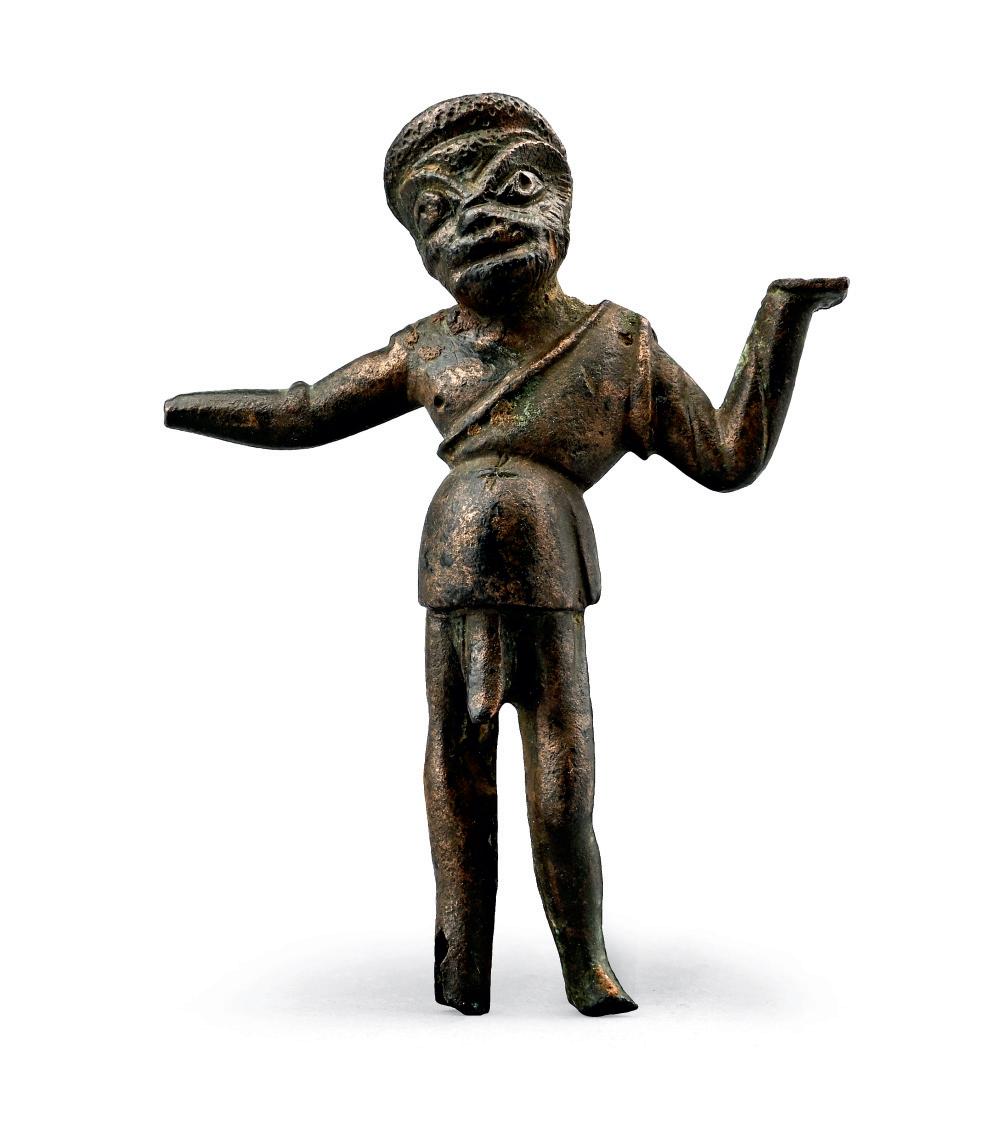
148
ROMAN BRONZE FIGURE OF A BATHING YOUNG GIRL ‡
3RD-4TH CENTURY A.D.
6 in. (448 grams total, 17.4 cm including stand)
Depicted as a standing nude female figure with hair dressed in a chignon, left hand clasped to the chest and right arm bent; mounted on a tiered display stand.
£2,000 - 3,000
PROVENANCE:
Acquired in the late 1980s.
Private collection, since the late 1990s.
FOOTNOTES:
The girl is depicted in the act of girding her chest with a fascia, similar to the one illustrated in the famous mosaics of Piazza Armerina, where the band is worn together with a subligaculum that covers her lower parts. It is modelled after a real two-piece bath costume of the ancient Romans.
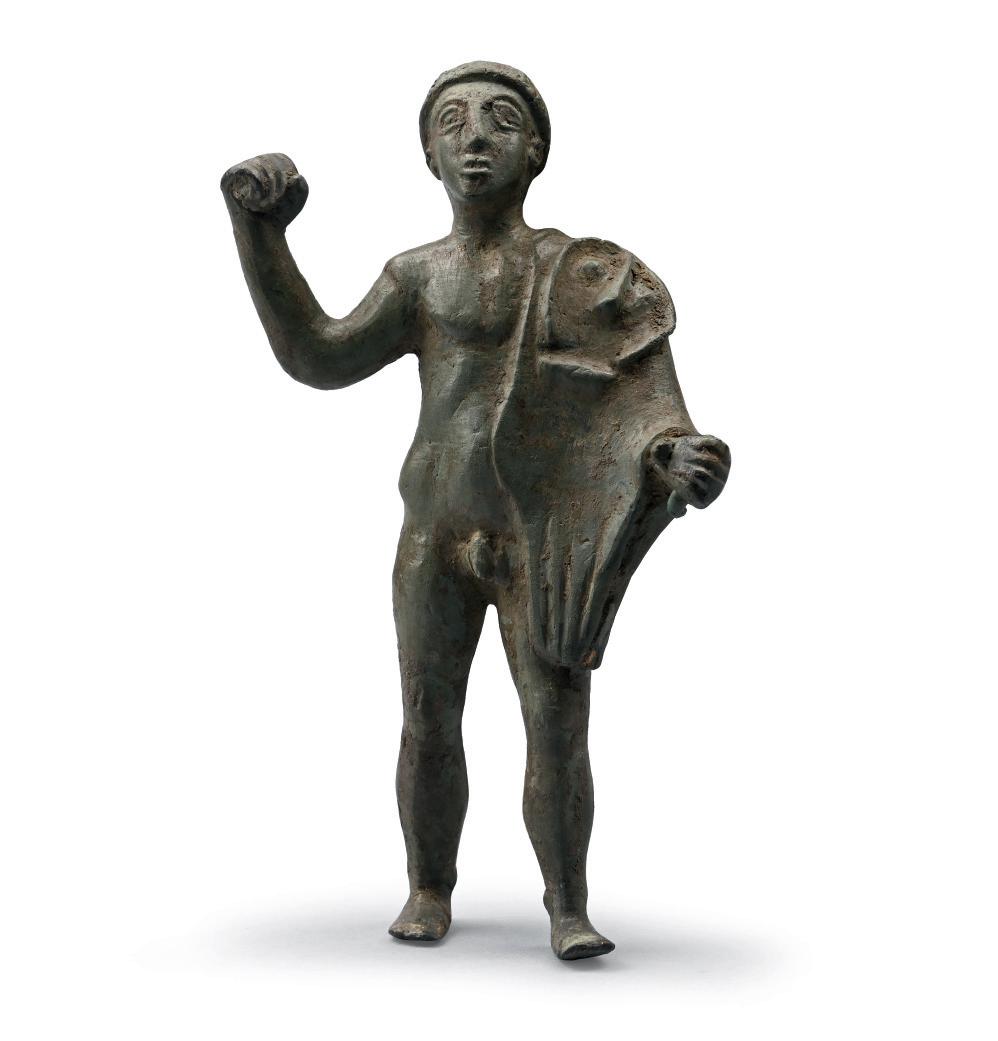
147
ROMAN BRONZE EROTIC GROTESQUE STATUETTE ALEXANDRIA, 1ST CENTURY A.D.
3 in. (106 grams, 85 mm)
Modelled in the round as a standing figure in phylax mask, wearing a short tunic revealing his exaggerated genitals.
£1,200 - 1,700
PROVENANCE:
Ex German art market, 2000s.
Acquired from an EU collector living in London. From the collection of a Surrey, UK, gentleman.
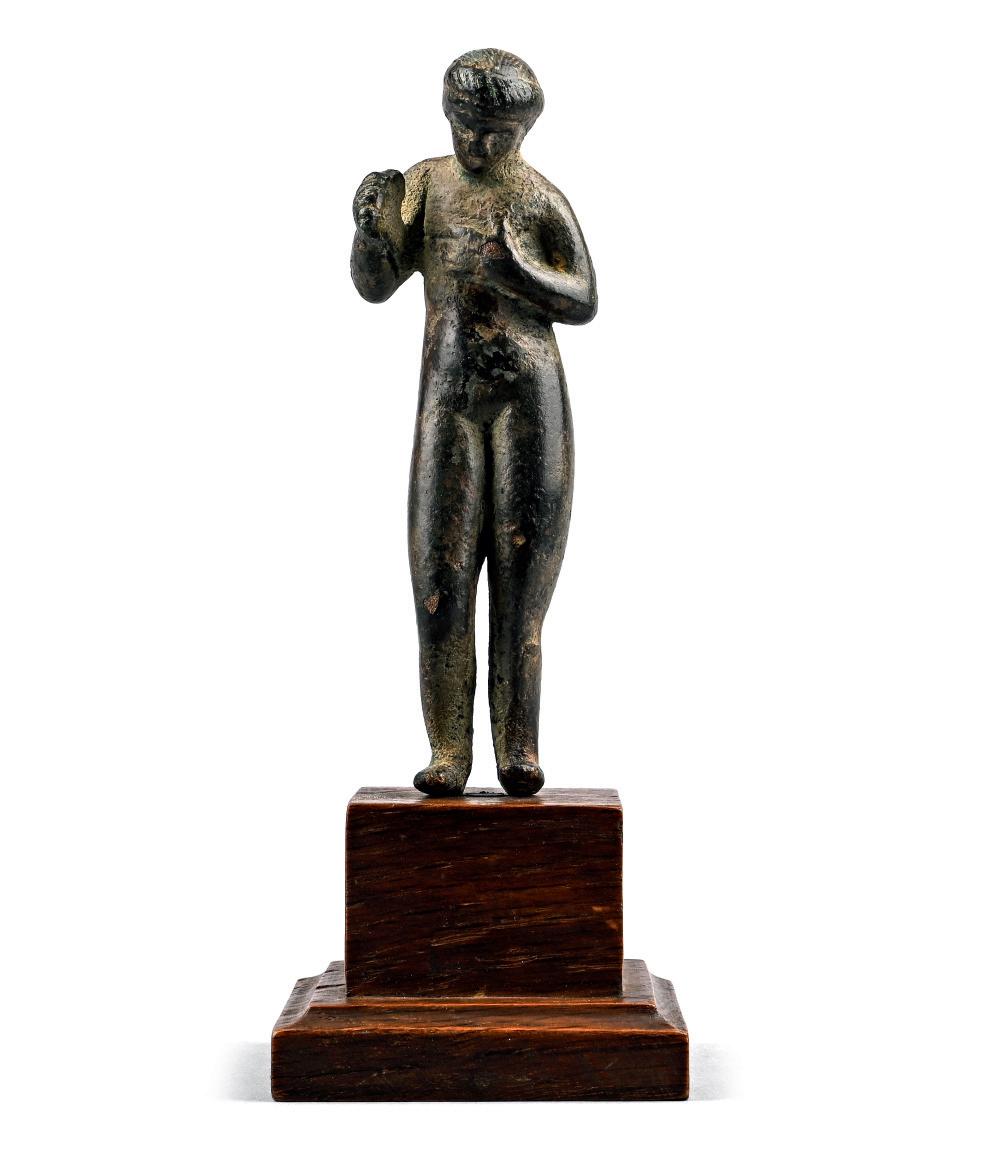
148
149
ETRUSCO-ITALIC BRONZE FIGURE OF YOUNG HERCULES ‡ ARCHAIC STYLE, CIRCA 4TH-3RD CENTURY B.C.
4 in. (307 grams, 12 cm)
Modelled in the round figure standing in advancing pose with the right hand raised and fist clenched; left shoulder and arm covered with the skin of the Nemean lion and left hand modelled hollow; hair cut short and textured.
£3,000 - 4,000
PROVENANCE:
Acquired in the mid 1980s-1990s.
Private collection, Switzerland, thence by descent.
Private collection, since the late 1990s.
Accompanied by an academic report by Dr Raffaele D’Amato.
FOOTNOTES:
There were several cult sites of Hercules in Etruria and old Latium, particularly in the Sabellian region, and the bronze statuettes discovered here exhibit a wide range of styles. Etruscan bronzes of the half-god usually represent him with the lion skin draped over his arm (Metropolitan accession number 96.9.419).
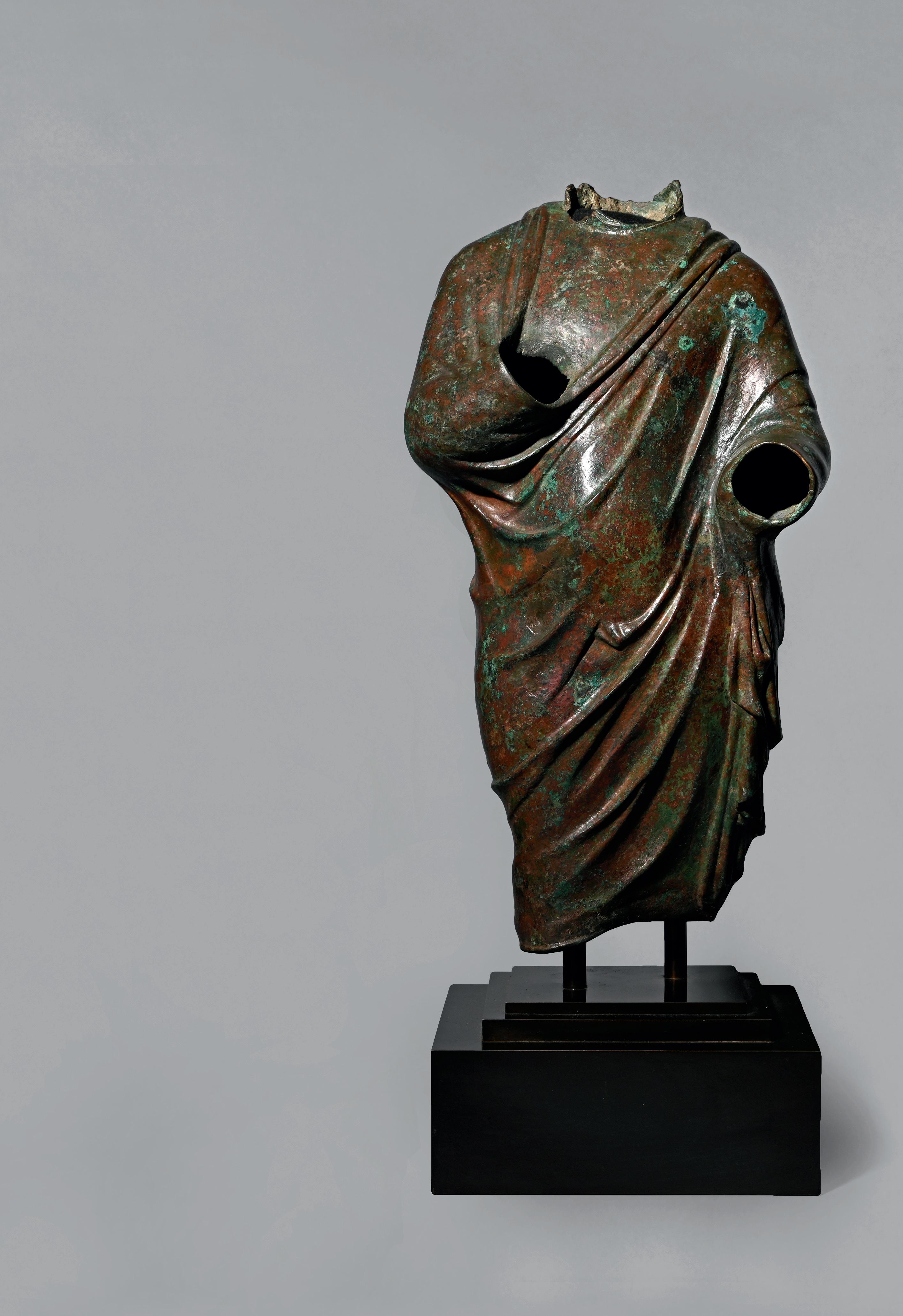
150

LARGE ROMAN BRONZE ROBED TORSO
1ST CENTURY B.C.-1ST CENTURY A.D.
21 in. (7.55 kg total, 53.5 cm high including stand)
Likely representing Harpocrates, depicted frontally and wearing a draped full-length himation, the right arm raised and left arm bent at the elbow; mounted on a custommade display stand.
£30,000 - 40,000
PROVENANCE:
Private collection, Hong Kong, acquired in the 1970s. Spanish art market.
Acquired by the present owner from the above.
Accompanied by an academic report by Dr Raffaele D’Amato.
FOOTNOTES:
The body of this statue was hollow-cast by the lost wax method; traces of solder within the arm sockets and around the neck indicate that the arms and head were cast separately. The position of the body and comparative images suggest the statue represents Harpocrates. Harpocrates, the son of Isis and Horus, was one of the most represented children, especially after the diffusion of his cult into the Roman Empire. He is usually depicted naked, but draped figures of the god were produced in the Hellenised east and spread throughout the Empire. Statues of Harpocrates were at the entrance of almost all temples, to indicate that in those places the gods should have been honoured with silence, or, according to Plutarch, men who had an imperfect knowledge of the divinity should only speak of it with respect.

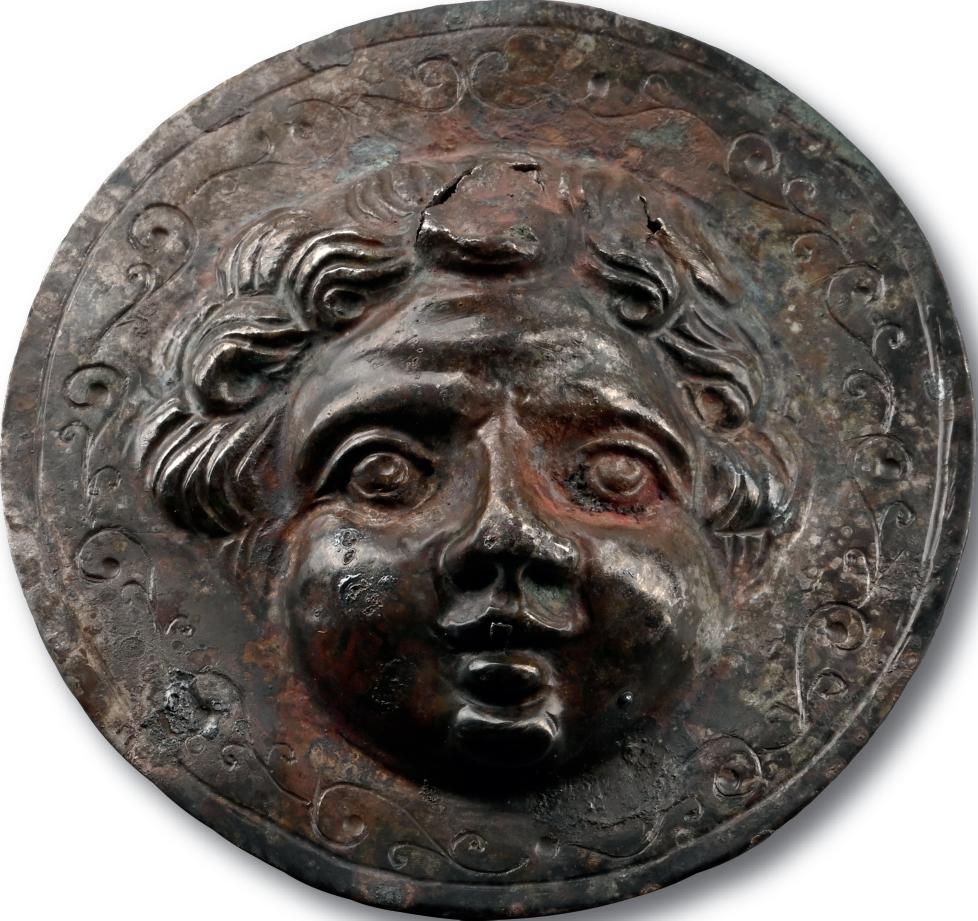
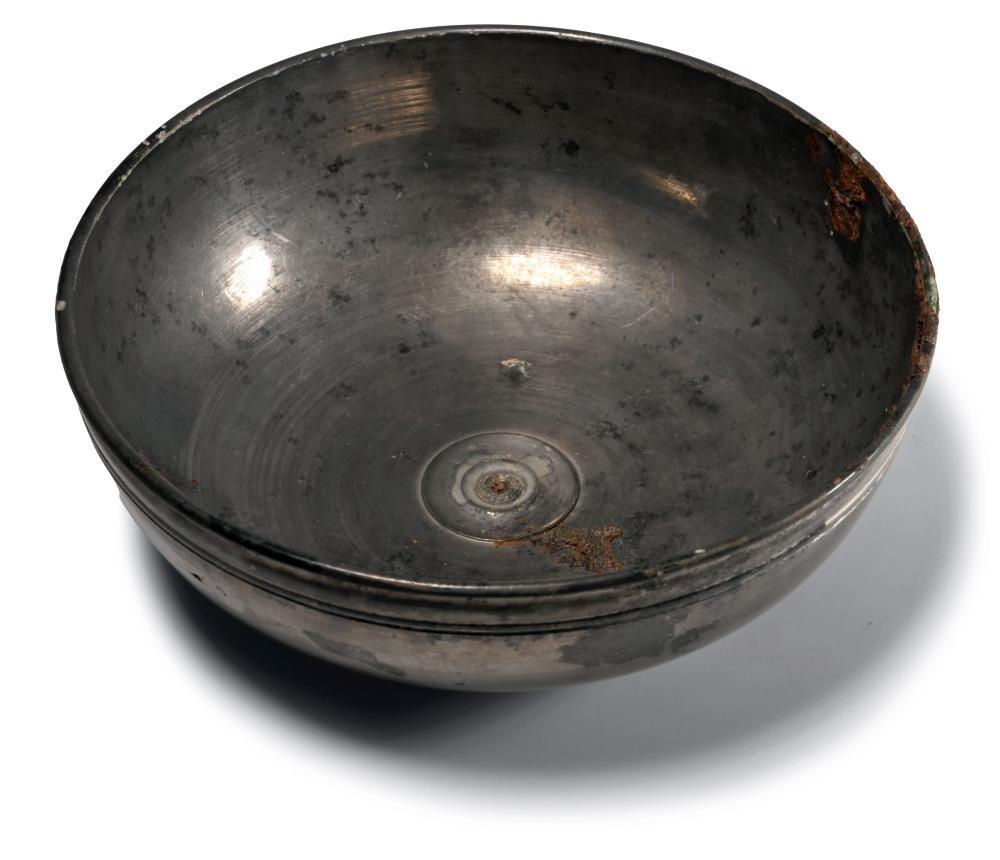
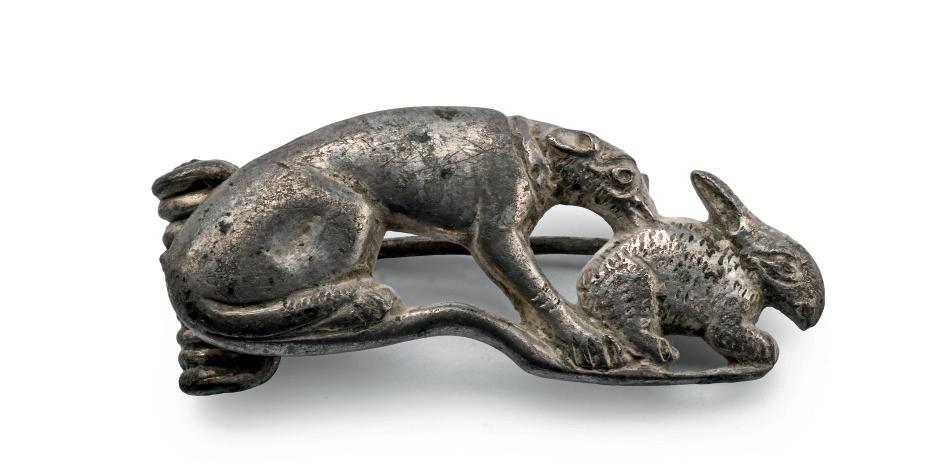
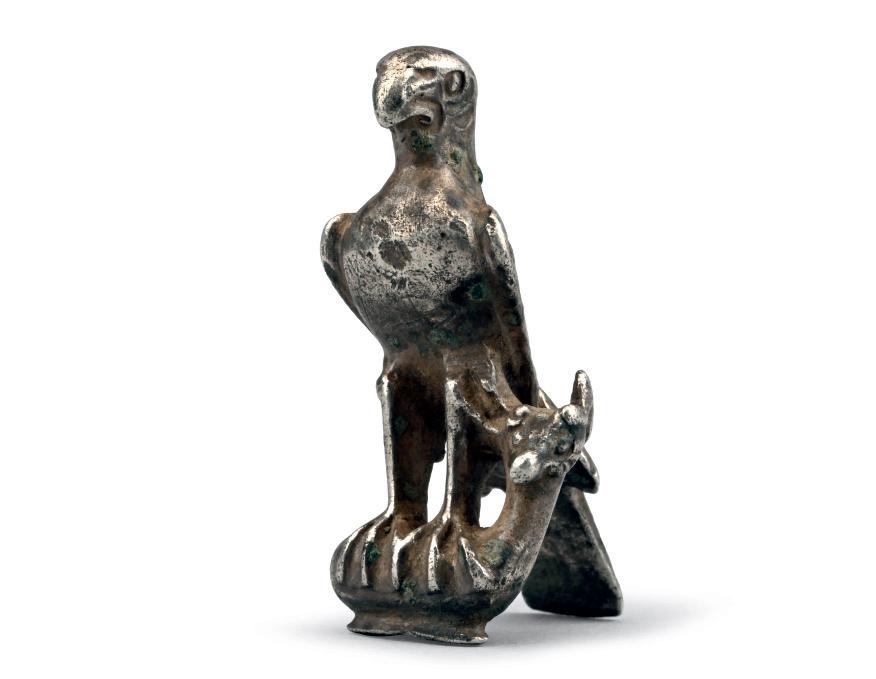
ROMAN SILVER PHALERA WITH FACE OF EROS, THE GREEK GOD OF LOVE
1ST-2ND CENTURY A.D.
2 in. (27.1 grams, 74 mm)
Discoid in plan with running scrolled tendrils to the outer edge, central mask with curly hair and fleshy features.
£800 - 1,000
PROVENANCE:
Ex German art market, 2000s.
Acquired from an EU collector living in London.
From the collection of a Surrey, UK, gentleman.
152
ROMAN TINNED BRONZE BOWL ‡
1ST-3RD CENTURY A.D.
4¼ in. (177 grams, 10.3 cm)
Hemispherical in profile with low foot, incised circumferential lines to rim; high-tin surface with silvery appearance.
£1,200 - 1,700
PROVENANCE:
Acquired in the mid 1980s-1990s.
Private collection, Switzerland, thence by descent.
Private collection, since the late 1990s.
153
ROMAN SILVER HARE AND HOUND BROOCH
CIRCA 2ND CENTURY A.D.
1 in. (10.2 grams, 42 mm)
Modelled in the half-round, image of a hare attacked by a hound on a baseline; pin-lugs, pin and catch to reverse.
£1,200 - 1,700
PROVENANCE:
Ex ‘S’ collection, London, UK, 1970s-1990s.
154
ROMAN SILVER EAGLE HOLDING A DEER ‡
2ND-3RD CENTURY A.D.
1½ in. (21.5 grams, 38 mm high)
The eagle standing with its wings folded, erect head with natural facial detailing, claws gripping the body of a reclining doe with raised head and pricked ears.
£1,000 - 1,400
PROVENANCE: Acquired in the 1980s.
Private collection, Switzerland, thence by descent.
Private collection, since the late 1990s.
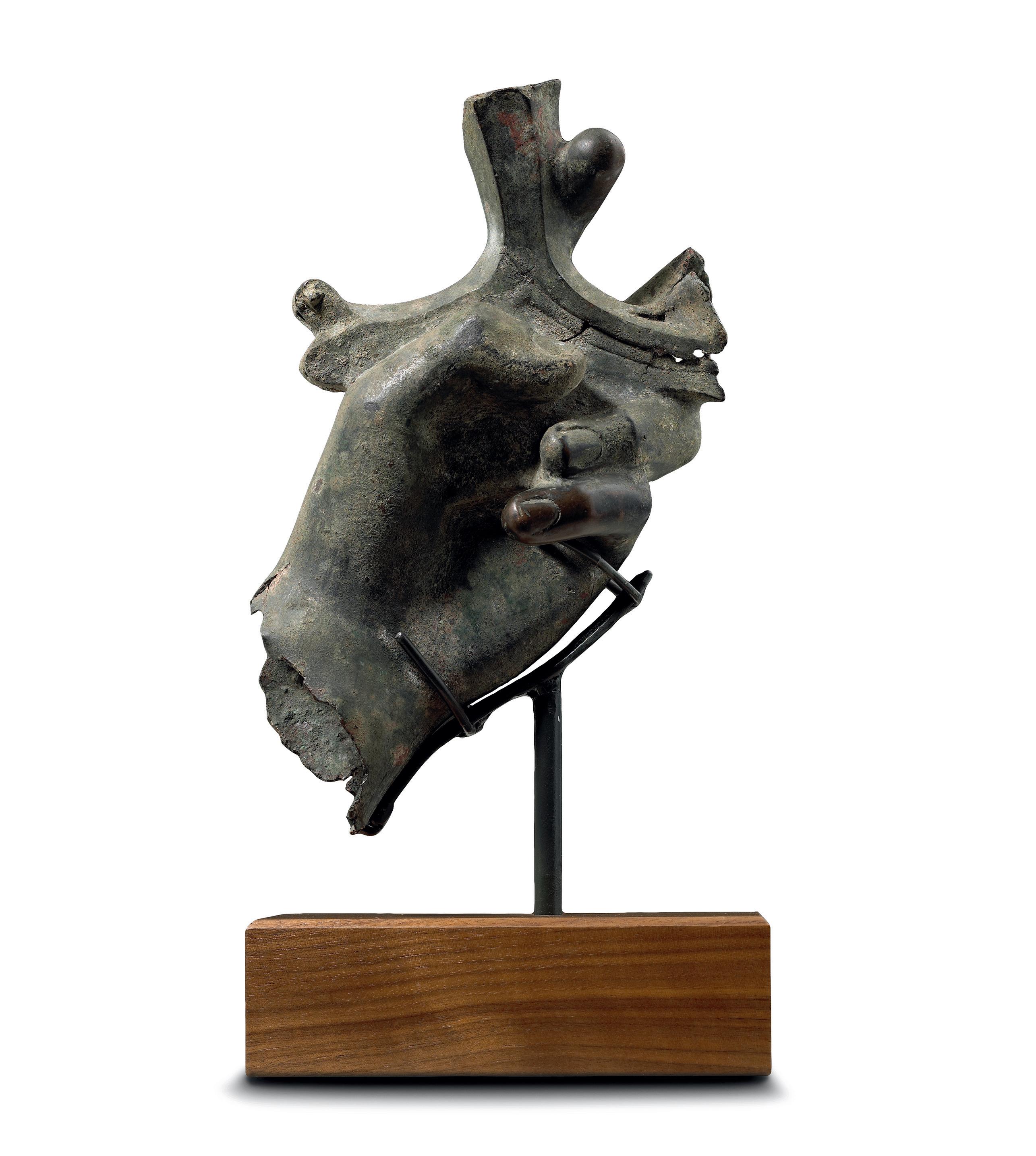
2ND-3RD CENTURY A.D.
12 in. (1.97 kg total, 32.6 cm high including stand)
Fragment from a hollow-formed monument comprising a left hand holding the base of a cross fleury hexagonal cross-section; mounted on a custom-made display stand.
£10,000 - 14,000
PROVENANCE:
Ex Arthur Richter (1925-2018), California, USA. Private collection, England.
Accompanied by an academic report by Dr Raffaele D’Amato.
FOOTNOTES:
Here, the hand of what was once a colossal statue of a general or emperor brandishes an object that may be a cross, or the hilt of a commander’s sword (parazonium). These monumental bronzes belong to the late period of the Empire, when the image of the victorious emperor or general was intended as propaganda demonstrating military strength, despite the Empire being surrounded by external enemies and devastated by internal strife.
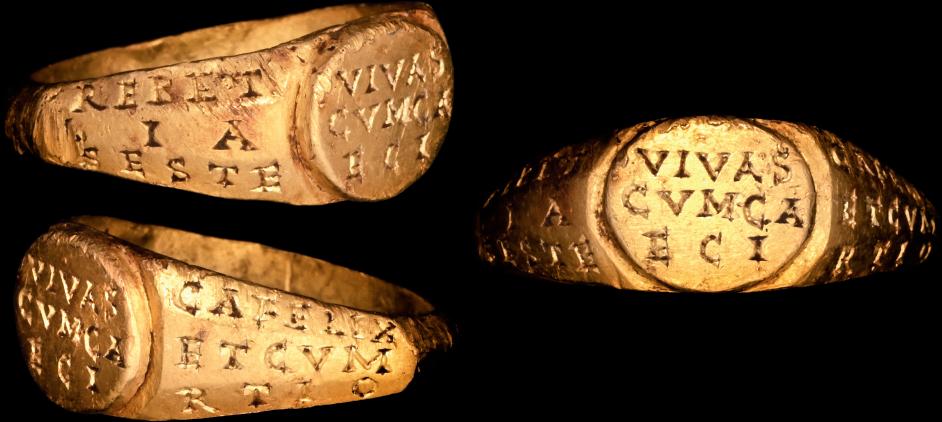
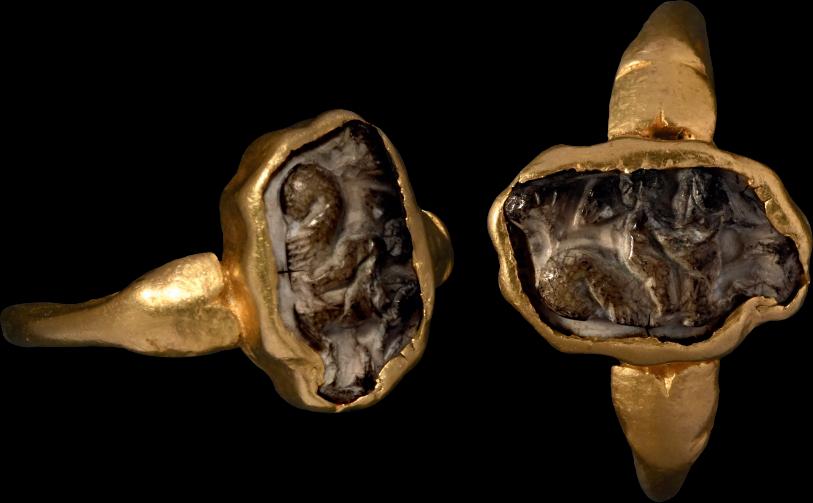
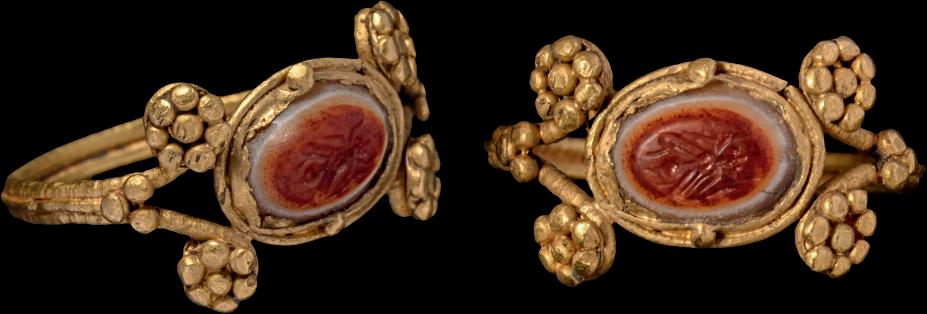
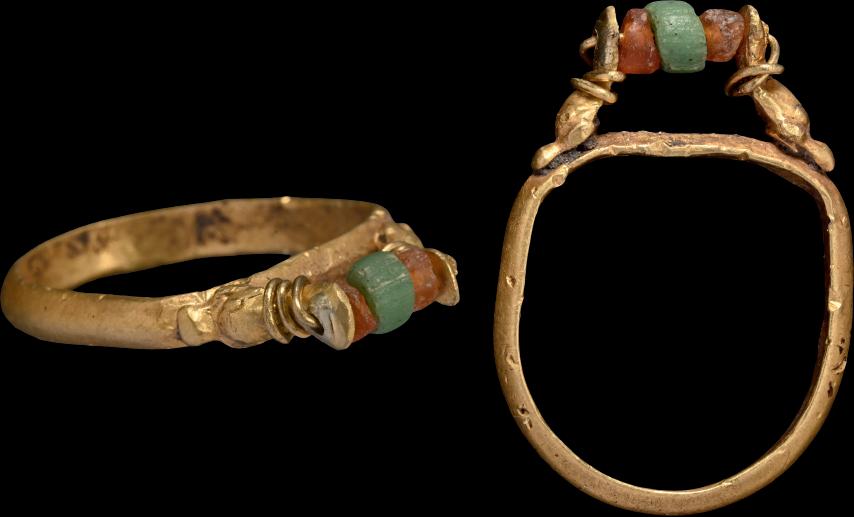
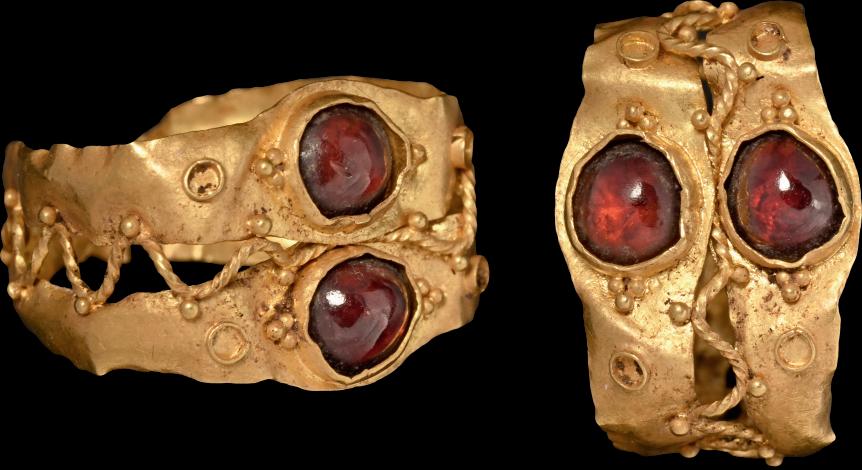
156
ROMAN GOLD ‘TALISMANIC’ RING WITH INSCRIPTIONS
3RD-4TH CENTURY A.D.
¾ in. (3.80 grams, 18.19 mm overall, 14.94 mm internal diameter (approximate size British F, USA 2¾, Europe 3.67, Japan 3))
Comprising chamfered sloped shoulders and ellipsoid bezel; engraved with blundered Latin legends in capitals: left shoulder‘REBET ?IA SESTE’ (It is rebated), bezel - ‘VIVAS CVM CAECI’ (Live with Caecus), right shoulder - ‘CAFELIX ET CVM RTIO’ (Safe and comfortable).
£4,500 - 6,500
PROVENANCE: Private collection, Europe.
Acquired on the English art market.
157
ROMAN GOLD RING WITH BURNT AGATE CAMEO OF EROS, THE GREEK GOD OF LOVE RIDING A HIPPOCAMPUS
2ND-3RD CENTURY A.D.
¾ in. (3.59 grams, 20.92 mm overall, 16.98 mm internal diameter (approximate size British M, USA 6, Europe 12.46, Japan 12))
D-section hoop with ellipsoid cell, inset cameo with Eros on a hippocamp.
£1,500 - 2,000
PROVENANCE:
Private collection, Europe.
Acquired on the English art market.
158
ROMAN GOLD RING WITH ‘EYE’ GEMSTONE WITH ENGRAVED BEE
3RD CENTURY A.D.
in. (4.52 grams, 22.29 mm overall, 19.07 mm internal diameter (approximate size British Q½, USA 8¼, Europe 18.12, Japan 17))
Sardonyx cabochon with incuse bee to centre; set in a cell with flanking gold rosettes; hoop formed with three beaded wire bands and granule detailing.
£1,500 - 2,000
PROVENANCE:
Private collection, Europe. Acquired on the English art market.
159
ROMAN GOLD RING WITH DOLPHINS SUPPORTING BEADS
1ST CENTURY A.D.
1 in. (4.24 grams, 26.14 mm overall, 15.47 x 16.96 mm internal diameter (approximate size British J, USA 4¾, Europe 8.69, Japan 8))
D-section hoop with shoulders formed as addorsed dolphins, the tails pierced to accept a wire with three glass seed beads.
£1,000 - 1,400
PROVENANCE: Ex Cambridgeshire, UK, gentleman’s collection, 1980-1990s.
160
ROMAN GOLD RING WITH GARNETS ‡ 2ND-3RD CENTURY A.D. in. (1.38 grams, 17.03 mm overall, 14.85 mm internal diameter (approximate size British G½, USA 3½, Europe 5.55, Japan 5))
Comprising two parallel hoops connected with angled filigree struts with a granule to each node, annulets to the shoulders, irregular circular cells each set with a cabochon garnet; hoop cracked at underside.
£800 - 1,000
PROVENANCE: Acquired in the 1992.
Private collection, Switzerland, thence by descent.
Private collection, since the late 1990s.
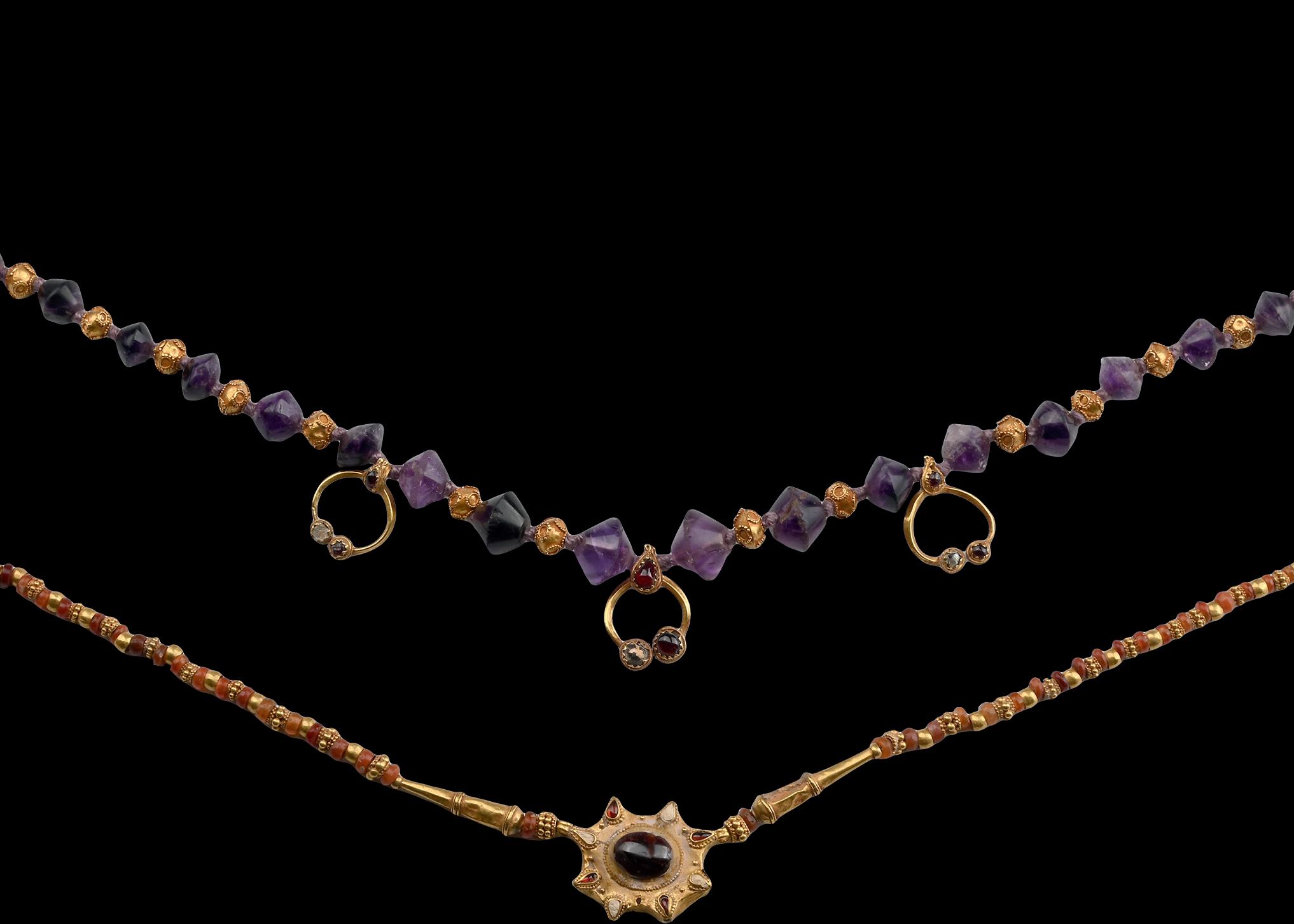
161
ROMAN AMETHYST NECKLACE WITH GOLD AND GARNET PENDANTS
1ST-3RD CENTURY A.D.
20½ in. (51 grams, 52 cm)
Restrung group of graduated biconical amethyst beads with gold interstitial beads with granulation detailing, three crescent pendants, each with a cabochon gemstone to each of the finials.
£4,000 - 6,000
PROVENANCE: Ambassador Carlo Perrone-Capano, former Italian Ambassador to Damascus, assembled largely during his tenure in Damascus in the 1960s; later resident near Grantham, where he spent his later life.
162
GREEK GOLD AND CARNELIAN NECKLACE WITH GARNET-SET PENDANT
5TH-4TH CENTURY B.C.
20 in. (39.16 grams, 53 cm)
A restrung necklace comprising carinated carnelian beads interspersed with sheet-gold beads of plain and granulated types, two tapering round-section beads with collars and domed finials, a central gold polygonal pendant with eight concave sides, polished oval garnet cabochon at the centre, granulated collar around base, raised tearshaped cell to each corner also with granulated border, alternately set with enamel and garnet cabochons, a single applied bead between each; modern hook-and-eye clasp.
£3,000 - 4,000
PROVENANCE: Acquired in the mid-1980s to early 1990s. Private collection, London, UK.
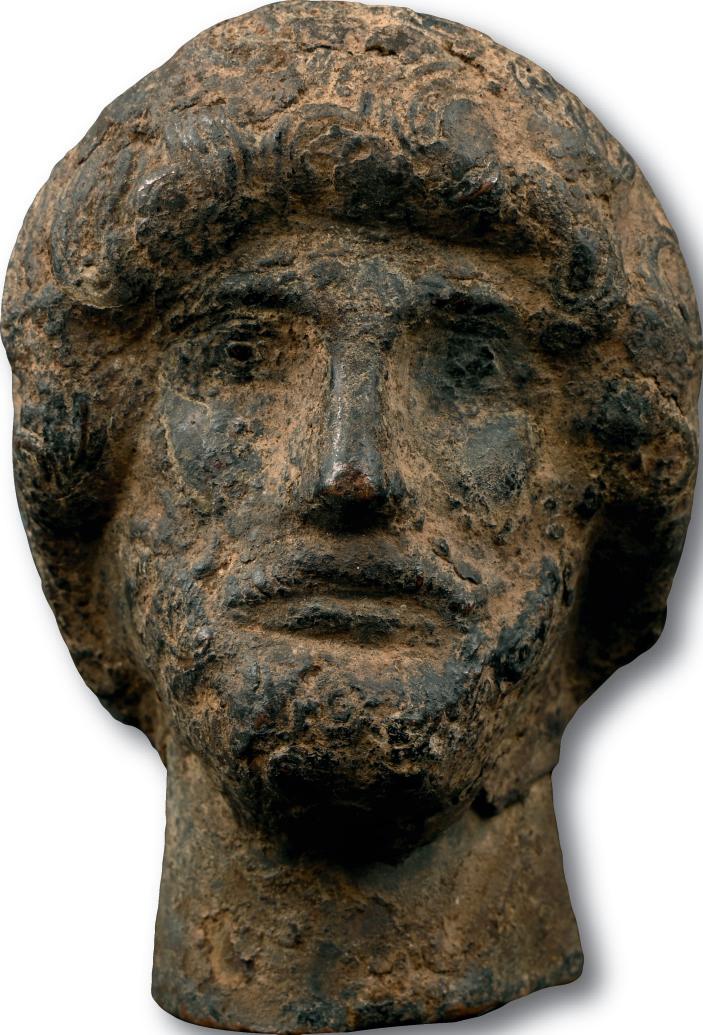

164
ROMAN BRONZE ‘MONEY’ BOX WITH CROSS ‡ 4TH CENTURY A.D.
2 in. (89 grams, 54 mm)
Hollow-formed model male head with aperture to underside; with short beard and incised cross fourchée to the brow.
£2,500 - 3,500
PROVENANCE:
German private collection, 1980s. with Artemis Gallery, 1990s. Private collection, acquired in 1999.

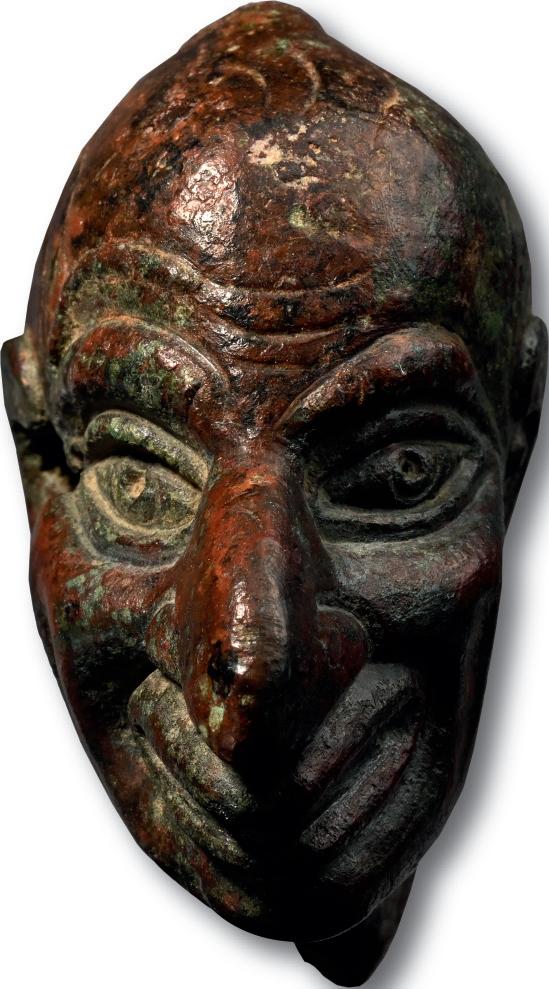
163
ROMAN BRONZE HEAD ‡ 2ND-4TH CENTURY A.D.
4 in. (440 grams, 10 cm)
Hollow-formed with long neck, abundant thick hair and beard, broad mouth; probably intended to represent an emperor.
£1,000 - 1,400
PROVENANCE:
Acquired by a Swiss family in the mid-1980s to late 1990s, thence by descent. Private collection, Switzerland, since the late 1990s.
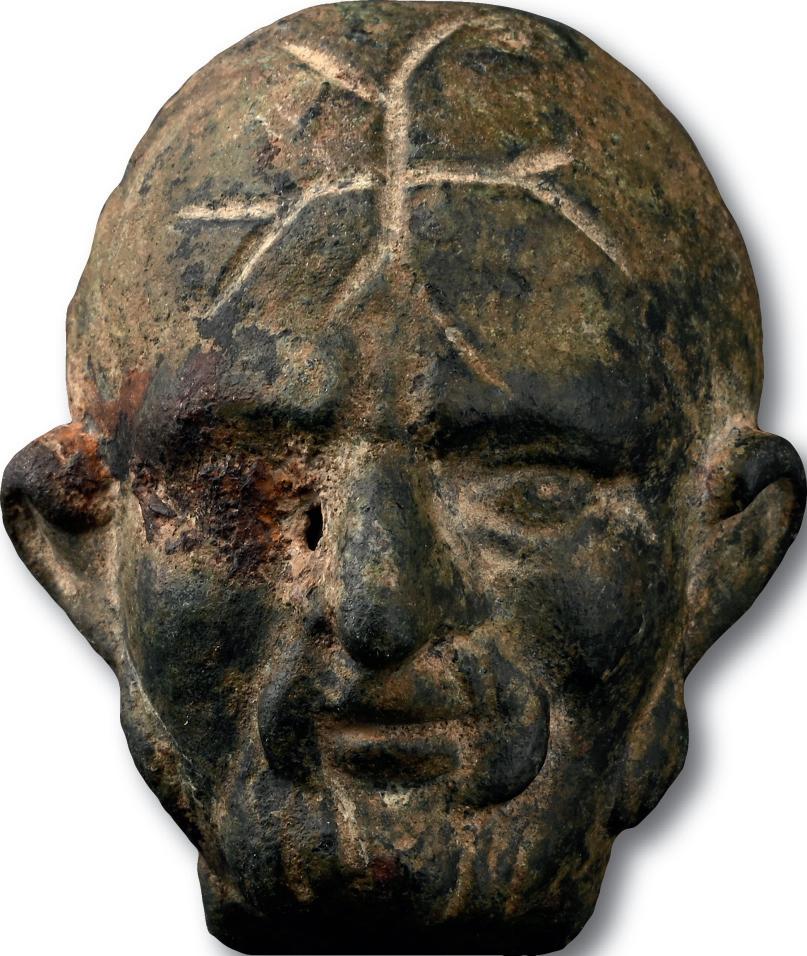

165
ROMAN BRONZE HEAD OF A GROTESQUE DWARF ‡ ALEXANDRIA, 1ST CENTURY A.D.
1 in. (67 grams, 48 mm)
Hollow-formed ‘moneybox’ with exaggerated nose and lips, small crescent-and-pellet ears, low-relief eyes with impressed pupils, small lock of hair to the scalp, vesica-shaped socket to the underside; pierced at the scalp and at the right ear.
£1,800 - 2,400
PROVENANCE: with Artemis Gallery, Munich, before 1998. Acquired by the present owner from the above in 2003.
FOOTNOTES:
Such small bronzes with physical abnormalities and exaggerated features served as entertainment, but also had the function of warding off evil.
166
ROMAN BRONZE HAND-STANDING ACROBAT
1ST-2ND CENTURY A.D.
4¾ in. (162 grams, 12 cm high)
A statuette of an acrobat on a round, drum-shaped base, standing on his hands, body arching slightly and legs together; wearing a loin cloth and cap decorated with floral pattern; eyes inlaid with silver.
£7,000 - 9,000
PROVENANCE:
Ex property of a Surrey collector; acquired in the early 1970s.

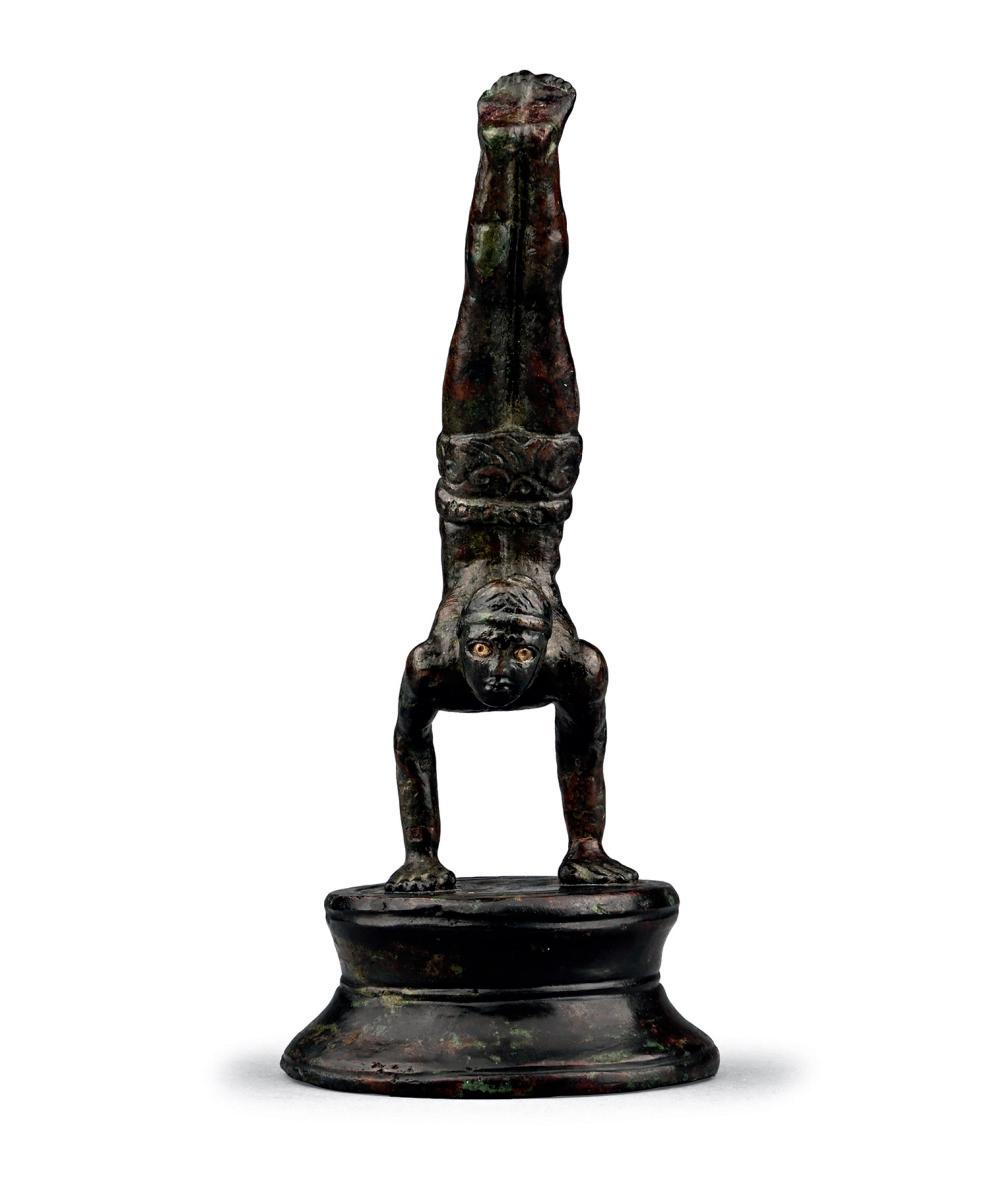
167
ROMAN BRONZE EROS CRADLING GOOSE APPLIQUÉ
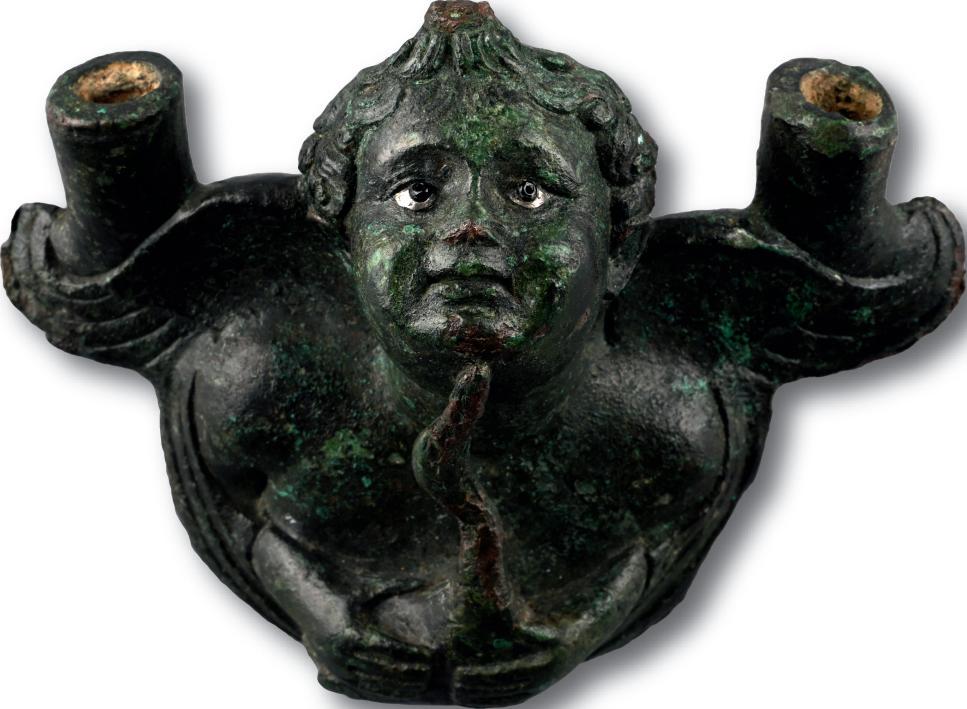
168
ROMAN BRONZE STATUE HAND
2ND CENTURY A.D.
6 in. (457 grams total, 16.9 cm including stand)
The slender right hand from a large statue with index finger extended and the others curled as if gripping a thin wand, flower-stem or similar item; cracked at the wrist; mounted on a custom-made display stand.
£2,000 - 3,000
PROVENANCE: Private collection, Europe. Acquired on the English art market.
LATE 1ST-EARLY 2ND CENTURY A.D.
4¾ in. (5½ in.) (515 grams total, 11.9 cm wide (740 grams total, 14 cm high including stand))
Formed as the bust of Eros looking upwards, with stub wings to his shoulders, holding a goose to his chest; conical socket above each wing; eyes with silver inserts; old collector’s label ‘1994 51.75’ to the reverse; mounted on a custom-made stand; likely a socket base.
£2,000 - 3,000
PROVENANCE: with Sotheby’s, London, 23 May 1988, no.234.
Ex Joel L. Malter & Co., Encino, California, USA, Auction XLV, 28 May 1991, no.902.
Ex Bruce A. Kamerling collection.
Acquired from Royal Athena Galleries, New York, 26 June 1994. The Haggin Museum, Stockton, California.
Property deaccessioned from the Haggin Museum, Stockton, California, USA. Bonhams, Antiquities, 23 May 2012, no.121.

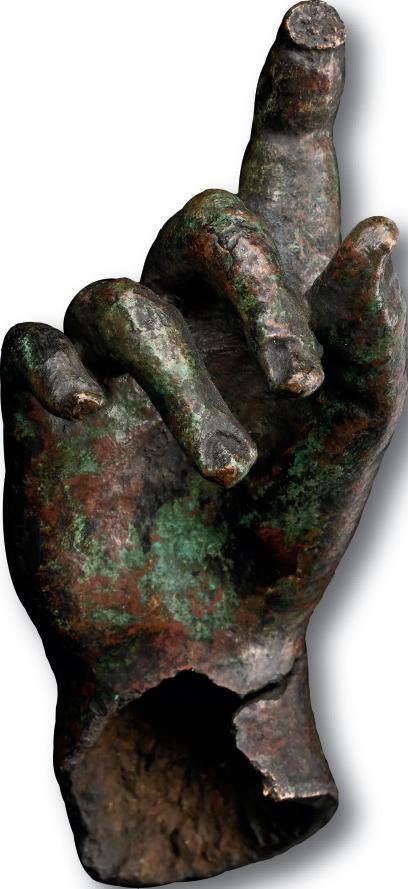
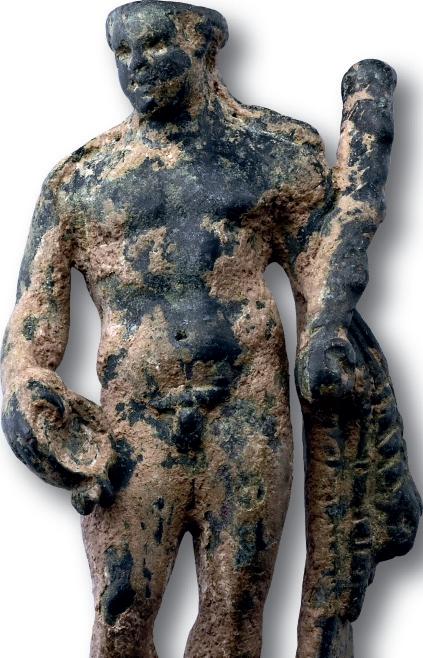
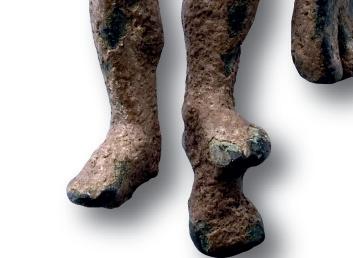

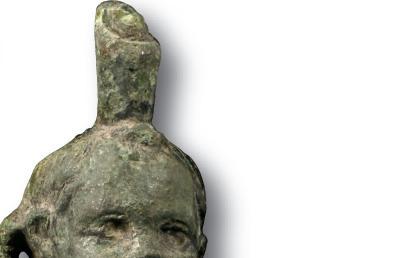
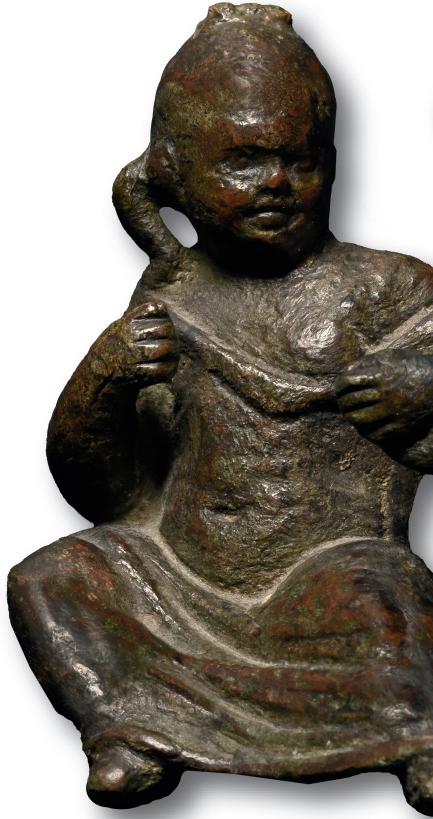
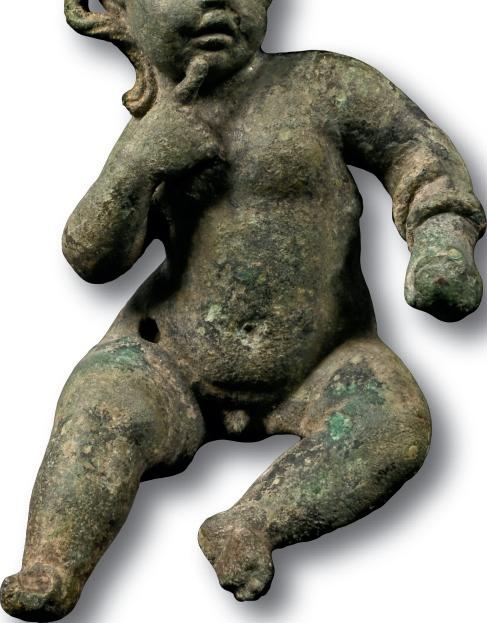




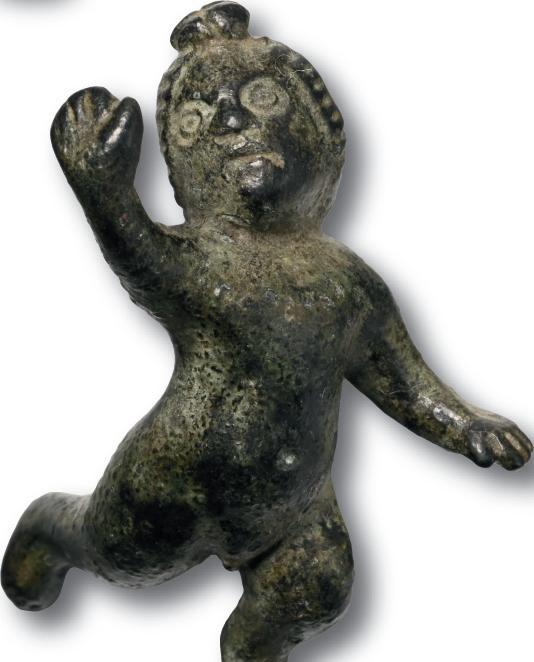



169
ROMAN BRONZE FIGURE OF HERCULES ‡
2ND-3RD CENTURY A.D. in. (115 grams, 86 mm)
Depicted nude in a contrapposto stance with the weight on his left leg, holding a club in the crook of his left hand with a lion-skin draped over the arm, and a cup in his right hand.
£1,500 - 2,000
PROVENANCE:
Acquired in the 1980s.
Private collection, Switzerland, thence by descent. Private collection, since the late 1990s.
FOOTNOTES:
The statuette, perhaps of Gallo-Roman origin, was likely part of a private lararium. It is a provincial work, but is well-proportioned. Unlike other statuettes of this type, Hercules is beardless. The upper part of the head was probably covered by a laurel crown.
170
ROMAN BRONZE FIGURE OF THE GOD HARPOCRATES ‡
1ST CENTURY A.D.
2¾ in. (145 grams, 72 mm)
Modelled in the round, sitting with miniature double-crown, serpent arm-ring on left wrist, sidelock; fixing socket to right thigh.
£2,500 - 3,500
PROVENANCE:
Private collection, Me. A., Florida, USA, early 1990s.
European private collection, acquired in Germany, September 2000.
171
ROMAN BRONZE STATUETTE OF THE GOD HARPOCRATES ‡
1ST-3RD CENTURY A.D. in. (4 in.) (213 grams, 73 mm (276 grams total, 10.2 cm including stand))
Presented as a very young child sitting on the ground, wearing a long tunic which covers his lower body down to his feet; right arm bent and hand raised to the shoulder, left hand curved around an object (absent); sporting the conventional sidelock behind the right ear; mounted in a custom-made tiered wooden stand.
£2,000 - 3,000
PROVENANCE:
Ex Hanna Saba collection, Ambassador to Egypt-USA-France (1909-1992). Private European collection.
FOOTNOTES:
The god’s name was Hellenized in the Ptolemaic era and later adopted by the Romans, but it originated in the figure of ‘Horus the child’, son of Isis and Osiris, who was worshipped especially in Alexandria.
172
‘THE THETFORD’ ROMAN BRONZE PUTTO STATUETTE
1ST-2ND CENTURY A.D.
1¾ in. (26.2 grams, 43 mm)
Modelled in the round with back arched, legs extended, right arm reaching upwards; old collector’s label marked ‘Thetford’.
£300 - 400
PROVENANCE: Found Thetford, Norfolk, UK.
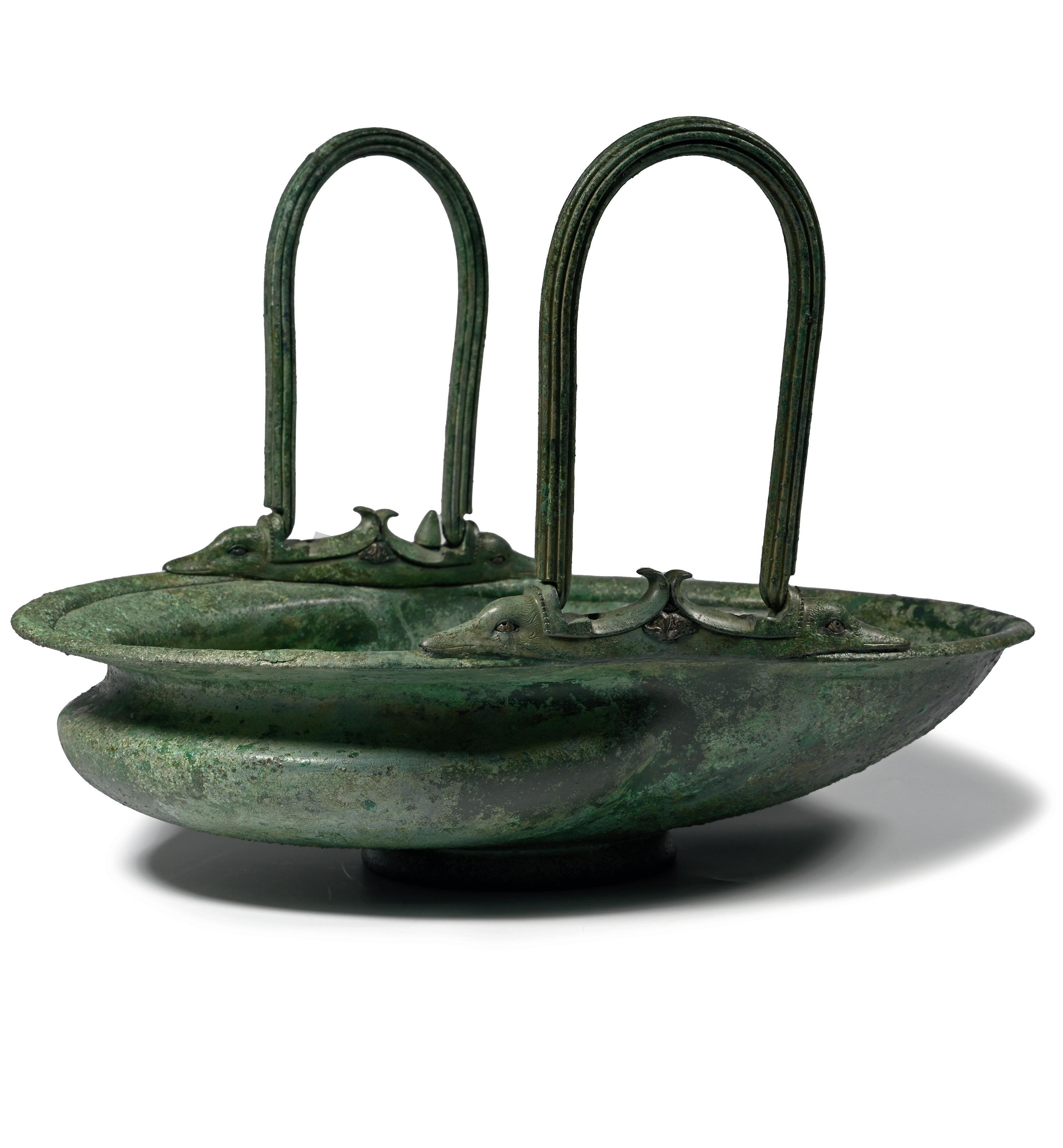
ROMAN BRONZE BASKET-VASE ‡
1ST-2ND CENTURY A.D.
11 in. (1.68 kg, 28 cm)
Ellipsoid in plan with low basal ring and thick convex rim, carination to the forward end; hinges to each lateral rim, the knuckles formed as addorsed duck-heads each with scrolled panel to the rear retaining the pivot of the ribbed D-shaped handles.
£15,000 - 20,000
PROVENANCE: Acquired in Switzerland, 1996. Private collection, Europe.
Accompanied by an academic report by Dr Raffaele D’Amato.
FOOTNOTES:
This vessel (lanx) was part of Roman and provincial bronze instrumentum domesticum, i.e. culinary or domestic utility ware. The form of the bowl resembles a type of helmet with carination to the front, the handles placed as hinged cheek-protectors.
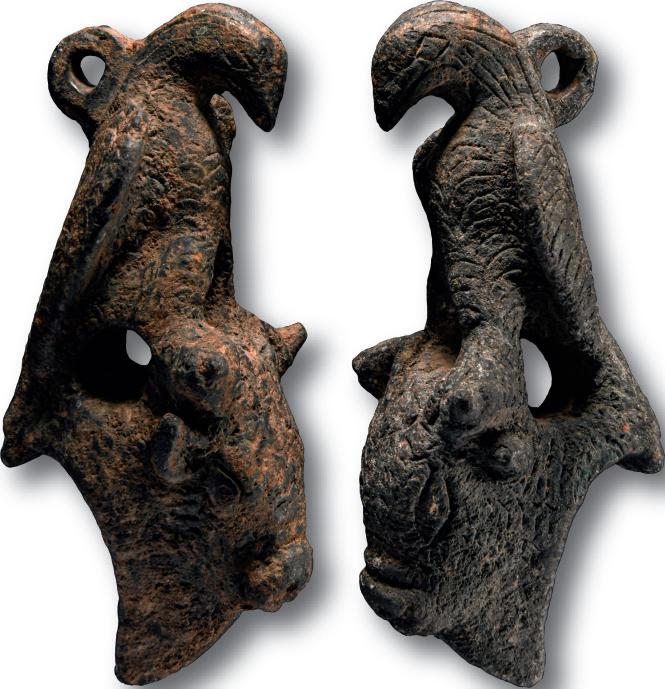

174
ROMAN BRONZE JUPITER DOLICHENUS EAGLE PAIR
2ND-3RD CENTURY A.D.
3 - 3 in. (482 grams total, 86-92 mm)
Formed as imperial birds modelled in the round, each standing on the head of a horned bull, wings partially spread; semi-naturalistic detailing to the head and feathers; suspension loop behind the neck.
[2]
£1,000 - 1,400
PROVENANCE:
Acquired in Europe before 1992. Private collection, UK.

176
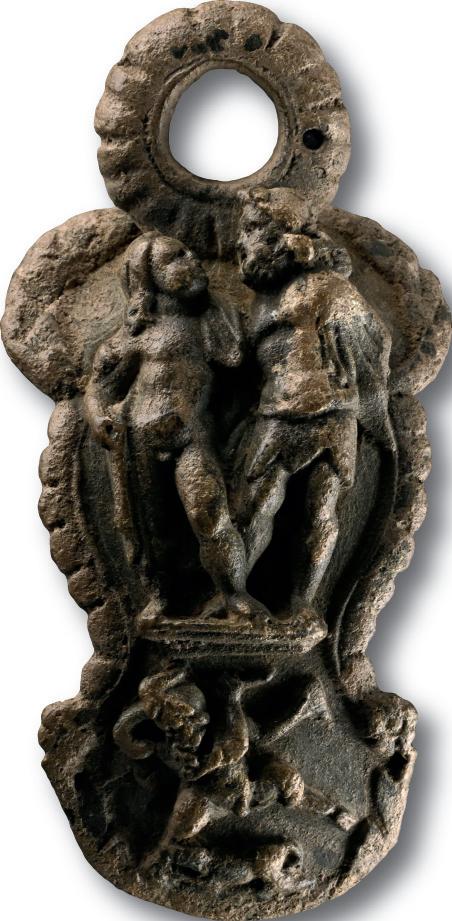
ROMAN BRONZE THREE-DIMENSIONAL VESSEL MOUNT ‡
2ND-3RD CENTURY A.D.
5 in. (286 grams, 13.8 cm)
Comprising a plaque of three conjoined lobes with segmented border; at the top, a loop with segmented rim; vignette with a nude male with shoulder-length hair embracing a taller bearded figure with kilt and mantle to left shoulder (Hercules?); below, a satyr with horns and goat’s legs beset by hunting dogs.
£3,000 - 4,000
PROVENANCE: Acquired in 1992.
Private collection, thence by descent.
Private collection, since the late 1990s.
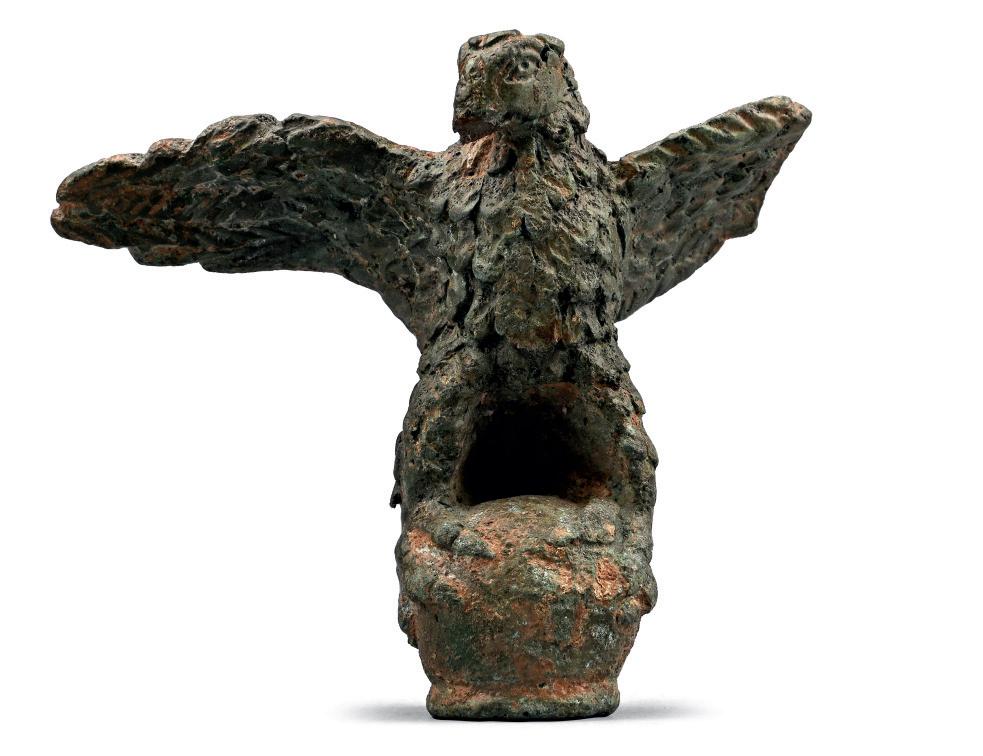
175
ROMAN BRONZE LEGIONARY EAGLE STAFF FINIAL ‡
2ND-3RD CENTURY A.D.
3 in. (236 grams, 81 mm)
Comprising a hollow-formed knop with collar to the socket, eagle modelled in the round perching on the knop with wings spread and head turned; socket behind the shoulders.
£1,000 - 1,400
PROVENANCE:
Acquired in the mid 1980s-1990s.
Private collection, Switzerland, thence by descent. Private collection, since the late 1990s.
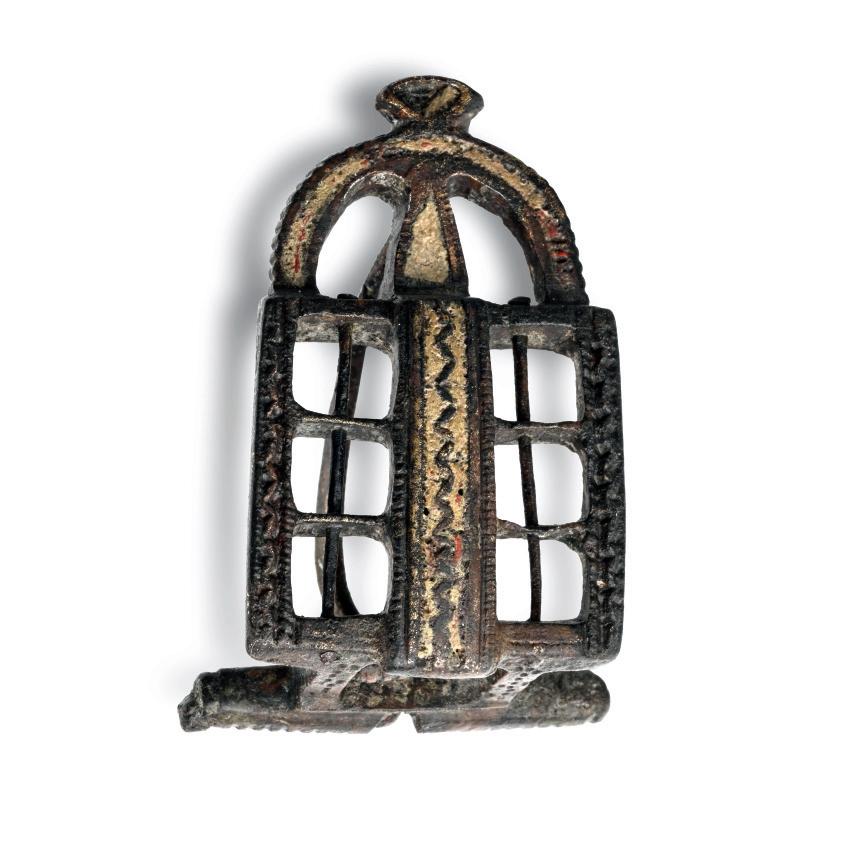
177
ROMAN ENAMELLED BRONZE OPENWORK ‘CAMP GATE’ PLATE BROOCH
1ST-2ND CENTURY A.D.
1¾ in. (21.2 grams, 44 mm)
Tongue-shaped openwork plate with knob finial and yellow enamel; pin, pin-lugs and catchplate to the reverse. [No Reserve]
£300 - 400
PROVENANCE: Ex property of an Essex, UK, gentleman collector. From the private collection of a Colchester, UK, gentleman.
178
ROMAN BRONZE EAGLE WITH DEDICATION TO ZEUS
2ND-3RD CENTURY A.D.
3¾ in. (233 grams, 95 mm)
Depicted in a standing position with an erect head, the detailed claws resting on a pedestal base, folded wings and a long tail; detailed engraving of feathers, superb rendering of the beak and round eyes; Greek inscription on the front and left side of the raised square pedestal, having a square socket allowing the insertion in a staff or shaft; the inscription could be translated as: ‘[ ] [ ] [ ] = To Zeus / [ ] [ ] [ I] (?) = those of the association of ? ..RRAS / = in fulfilment of a vow’.
£3,000 - 4,000
PROVENANCE:
UK private collection before 2000. Acquired on the UK art market. Private collection, London, UK.
Accompanied by an academic report by Dr Raffaele D’Amato.

180
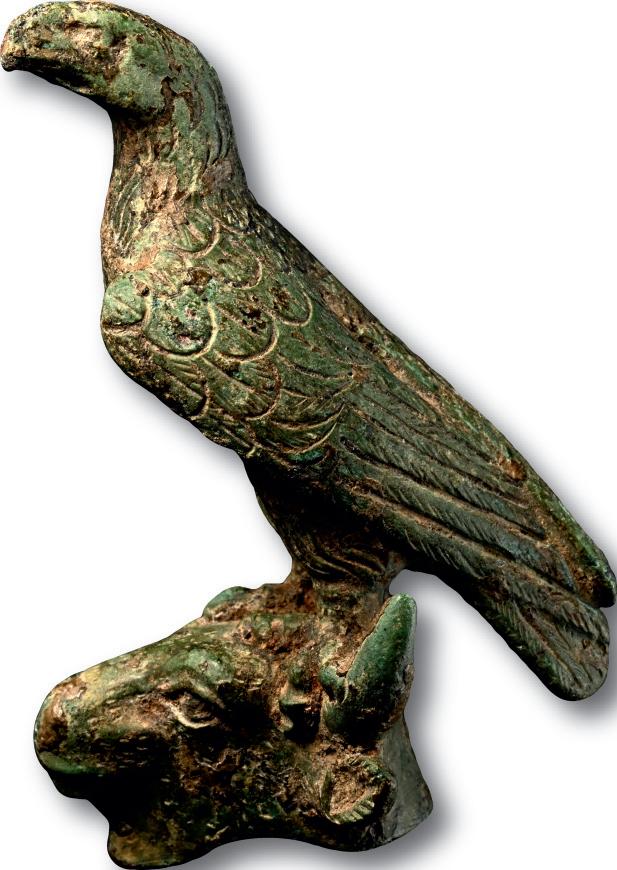
ROMAN BRONZE PRANCING LION STATUETTE
1ST-3RD CENTURY A.D.
5 in. (226 grams total, 13 cm including stand)
Modelled in the round with the tail laid along the spine, collar to the neck and crest between the pricked ears; tongue protruding to form a loop against the chest, possibly from a handle; mounted on a display stand.
£600 - 800
PROVENANCE: Acquired from Bath Antiques Centre, 1990s; and inspected and verified by Robert Knox of the British Museum. From the private collection of a Somerset gentleman.
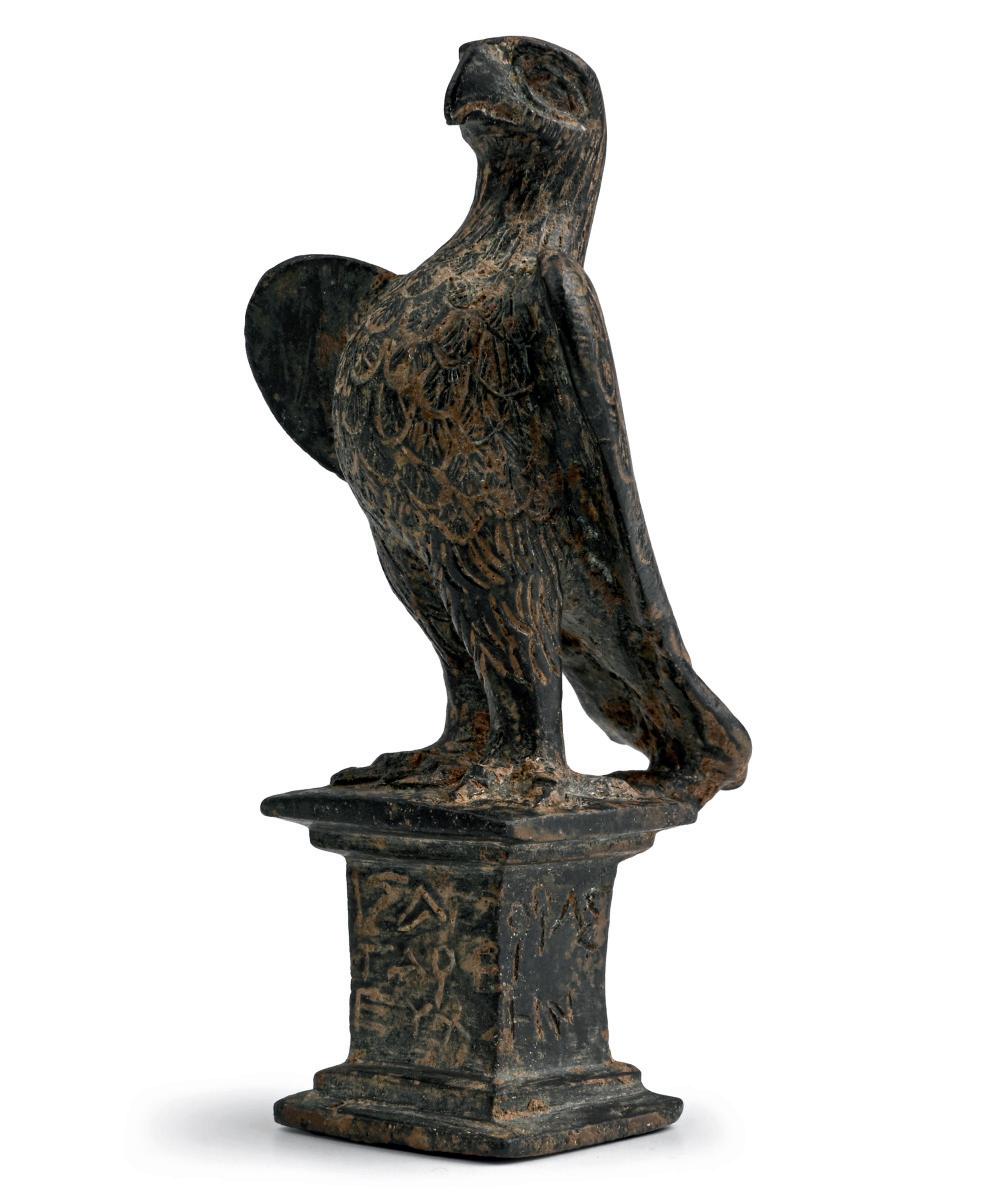
179
ROMAN BRONZE EAGLE ON BULL’S HEAD ‡
2ND-3RD CENTURY A.D.
2¾ in. (129 grams, 70 mm)
Modelled in the round figure of a bull’s head (bucranium) with an eagle with folded wings perched on the horns; hollow to the underside.
£1,000 - 1,400
PROVENANCE: Acquired by a Swiss family in the mid-1980s to late 1990s, thence by descent. Private collection, Switzerland, since the late 1990s.
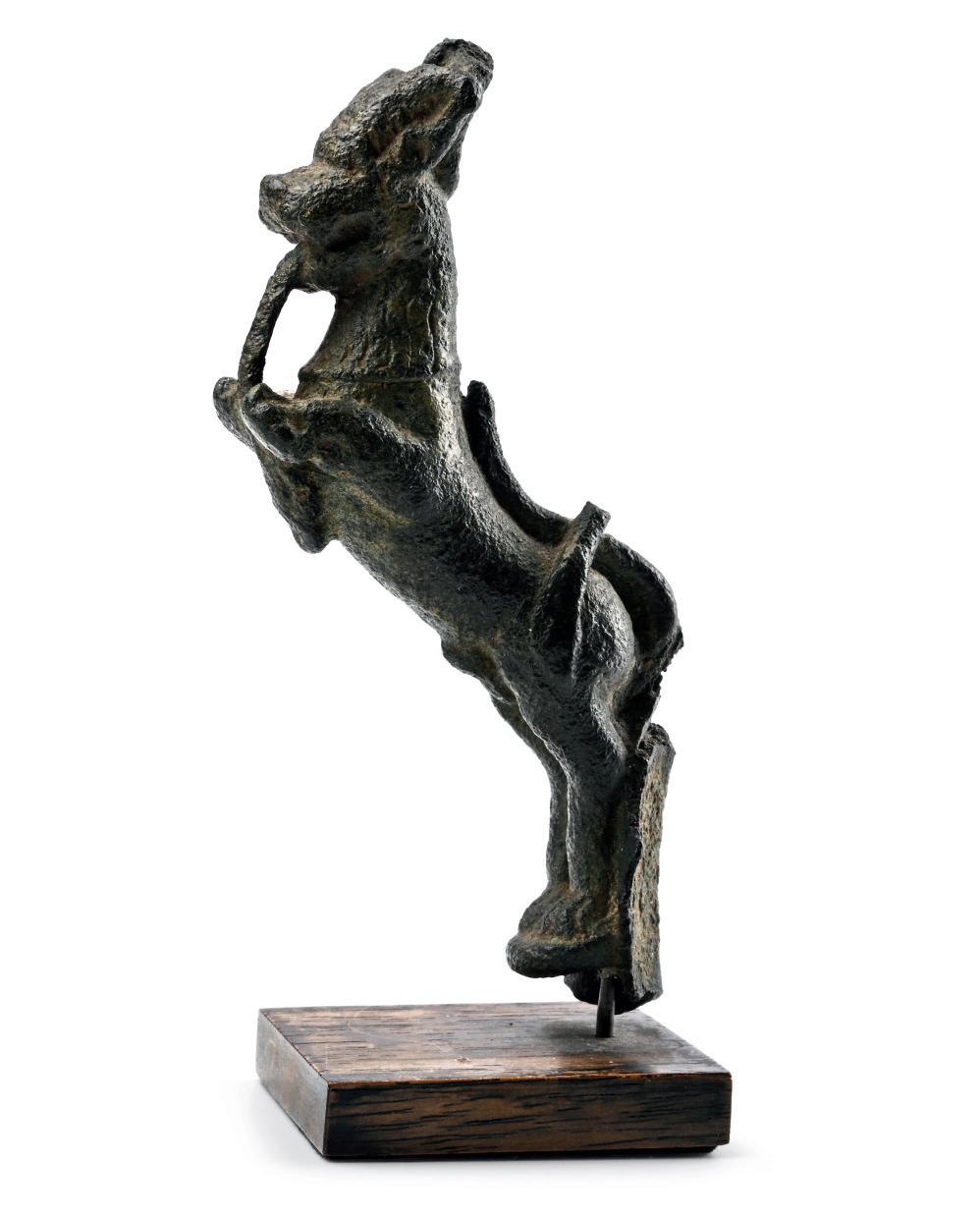
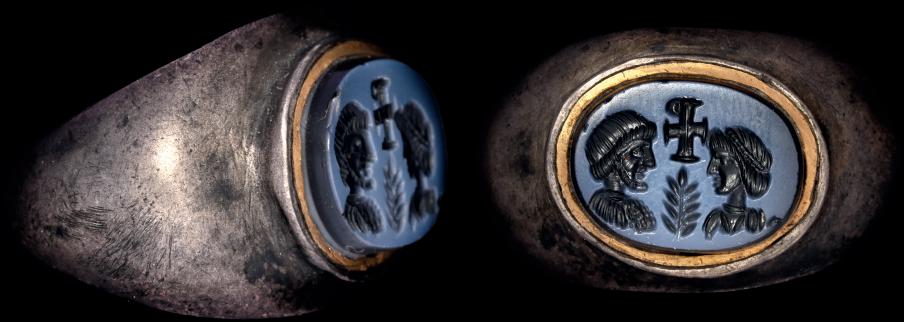
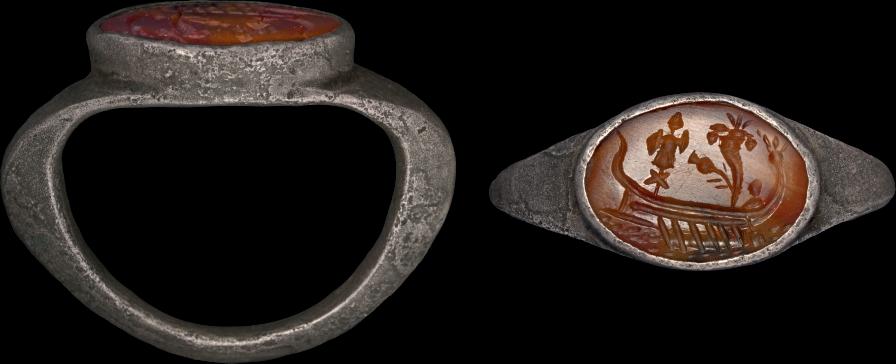
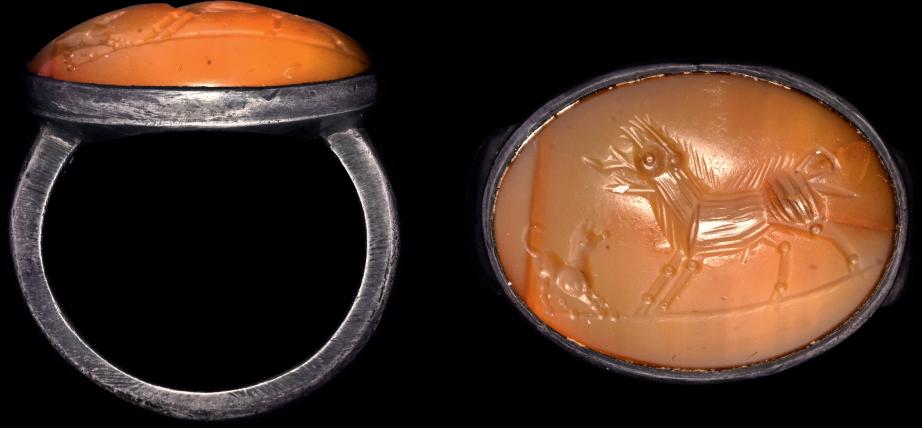
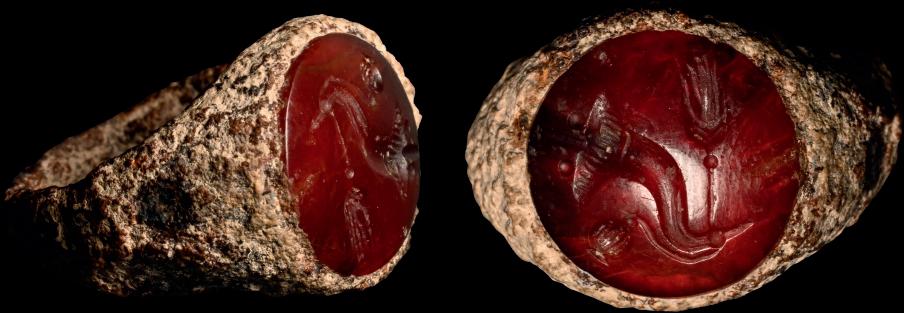
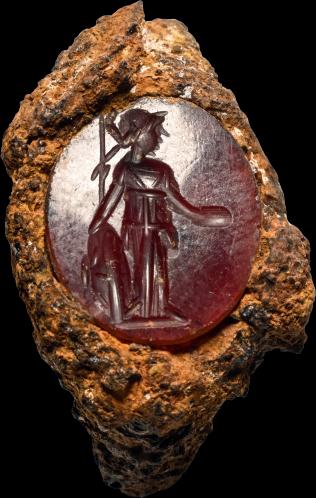
181
LATE ROMAN SILVER RING WITH NICOLO GEMSTONE WITH FACING BUSTS AND CHI RHO
4TH-6TH CENTURY A.D. OR LATER
1 in. (12.79 grams, 25.74 mm overall, 17.61 x 14.24 mm internal diameter (approximate size British I½, USA 4½, Europe 8.07, Japan 7))
Broad hoop and shoulder with stepped bezel, inset nicolo with incuse image of two profile busts flanking a frond surmounted by a Christogram.
£1,000 - 1,400
PROVENANCE: Private collection, England.
PUBLISHED: Hammond, A., Discovering Jewellery, p.86.
182
ROMAN SILVER RING WITH AGATE GEMSTONE WITH ROMAN WAR SHIP WITH TROPHY
2ND-3RD CENTURY A.D.
1 in. (8.48 grams, 29.64 mm overall, 21.60 × 16.35 mm internal diameter (approximate size British O, USA 7, Europe 14.98, Japan 14))
Comprising a triangular-section hoop with keeled shoulders, an ellipsoid bezel with inset carnelian intaglio with oared ship, trophy of arms at prow, and floral decoration at stern.
£1,000 - 1,400
PROVENANCE:
Private collection, before 1975. Private collection, England.
183
‘THE CERES COLLECTION’ ITALIC AGATE GEMSTONE OF A BOAR IN SILVER RING
2ND-1ST CENTURY B.C.
1 in. (12.35 grams, 25.62 mm overall, 18.51 mm internal diameter (approximate size British N½, USA 6¾, Europe 14.35, Japan 13))
Oval in plan and plano-convex in section, depicting a boar at bay from a hound; set in a later heavy silver mount with French maker’s mark and French assay mark.
£500 - 700
PROVENANCE: American family collection, New York, formed 1930s-1990s. with Bonhams, London, 17 September 2014, no.96.
Private collection, England.
184
ROMAN CORNUCOPIA AND POPPY GEMSTONE IN IRON RING
2ND-1ST CENTURY B.C.
1 in. (9.07 grams, 24.90 mm overall, 16.14 x 17.64 mm internal diameter (approximate size British L½, USA 6, Europe 11.87, Japan 11))
With broad plaque and inset cabochon intaglio, cornucopia flanked by budding flowers; set into a possibly later iron ring.
£1,000 - 1,400
PROVENANCE: UK private collection before 2000. Acquired on the UK art market. Private collection, London, UK.
185
ROMAN CARNELIAN GEMSTONE WITH MINERVA IN IRON BEZEL
CIRCA 2ND CENTURY A.D.
1 in. (3.5 grams, 23 mm)
Ferrous bezel with inset intaglio of Minerva standing with spear and shield, one hand extended with patera
£500 - 700
PROVENANCE: Ex gentleman’s specialist collection, 1990-2015.
186
EASTERN ROMAN GOLD RING WITH ROCK CRYSTAL GEMSTONE OF AN EMPEROR
2ND CENTURY A.D.
1 in. (9.14 grams, 26.16 mm overall, 18.96 x 17.33 mm internal diameter (approximate size British P, USA 7½, Europe 16.23, Japan 15))
D-section hoop with expanding shoulders enclosing a rectangular bezel, intaglio depicting a profile bearded bust wearing a laurel wreath.
£3,000 - 4,000
PROVENANCE:
Ex London gentleman’s collection, 1990s.
187
ITALLIC CARNELIAN GEMSTONE DEPICTING THE GODDESS ATHENA BEFORE A TREE IN GOLD RING CIRCA 2ND CENTURY B.C.-1ST CENTURY A.D.
1 in. (8.18 grams, 23.95 mm overall, 17.27 mm internal diameter (approximate size British N½, USA 6¾, Europe 14.35, Japan 13))
With a standing figure wearing chiton facing a tree, possibly Athena facing an olive tree; set into a later gold ring.
£1,800 - 2,400
PROVENANCE:
Private collection, Europe. Acquired on the English art market.
188
ROMAN SARD GEMSTONE DEPICTING THE GOD APOLLO IN GOLD RING
1ST CENTURY B.C.-1ST CENTURY A.D. in. (6.33 grams, 22.23 mm overall, 17.52 mm internal diameter (approximate size British O, USA 7, Europe 14.98, Japan 14))
Ellipsoid in plan with intaglio profile bust of Apollo as a kouros; set into a later gold ring.
£2,000 - 3,000
PROVENANCE:
Private collection, Europe. Acquired on the English art market.
189
ROMAN HELIOTROPE GEMSTONE WITH IBEX AND TWO EROTES IN GOLD RING
2ND CENTURY A.D.
in. (9.93 grams, 22.82 mm overall, 19.07 mm internal diameter (approximate size British R, USA 8½, Europe 18¾, Japan 18))
Ellipsoid cloison with profile grazing ibex beneath a tree with two erotes; set into a later gold ring.
£1,500 - 2,000
PROVENANCE: Private collection, England.
190
ROMAN CHROME CHALCEDONY INTAGLIOS IN DOUBLE BEZEL GOLD RING
1ST-2ND CENTURY A.D.
1 in. (7.59 grams, 23.27 mm overall, 19.02 mm internal diameter (approximate size British Q, USA 8, Europe 17.49, Japan 16))
One intaglio carved with the image of an elderly man seated before a column, the other with the figure of the sun god Sol; set into a later gold ring.
£2,000 - 3,000
PROVENANCE: Private collection, Europe. Acquired on the English art market.
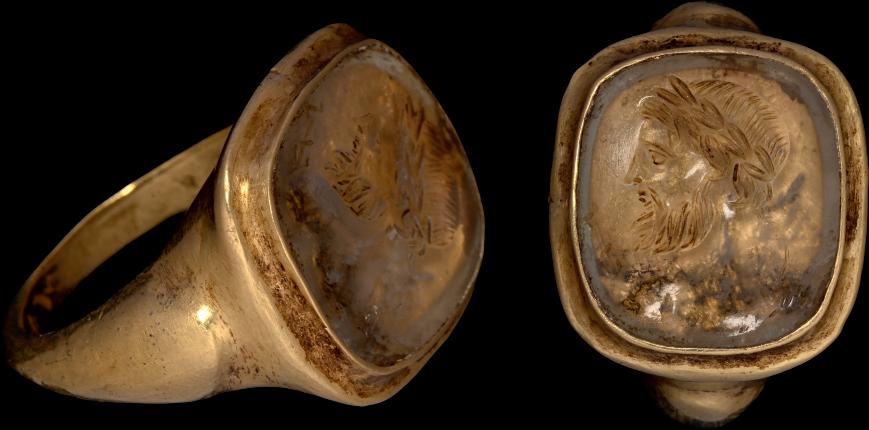
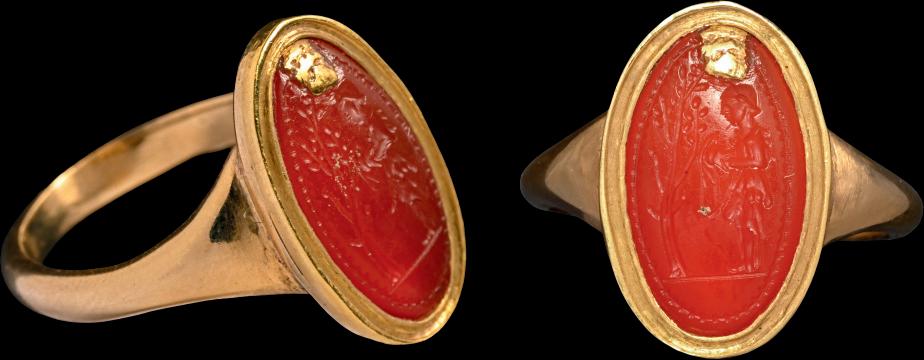
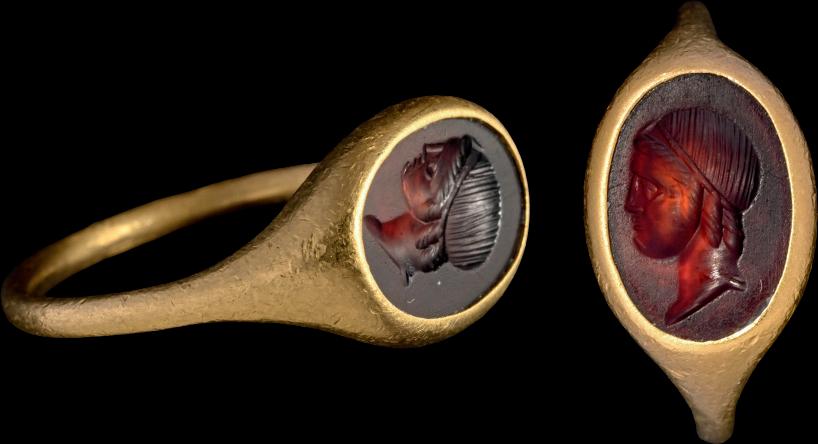
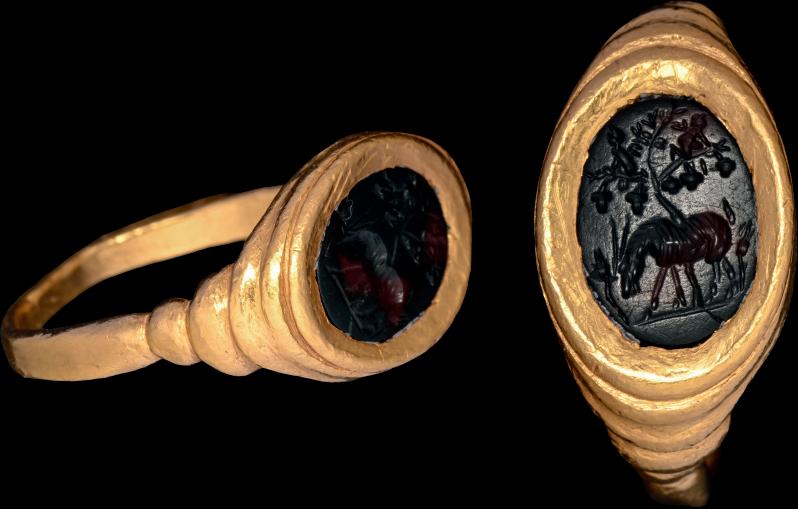
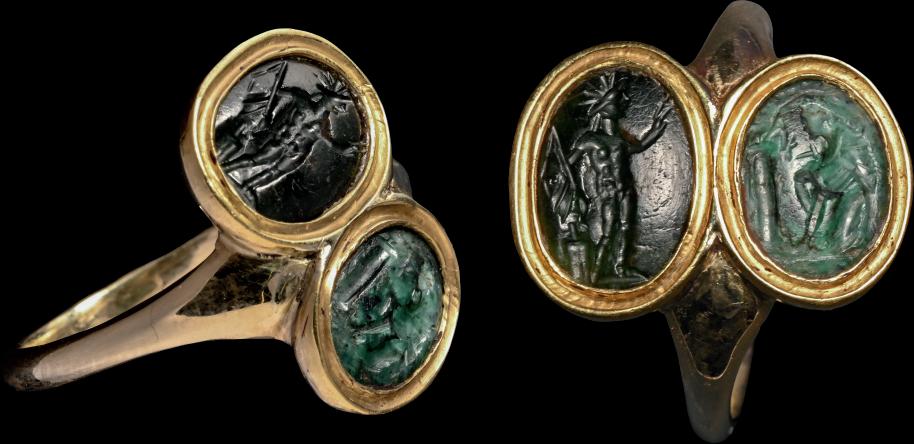
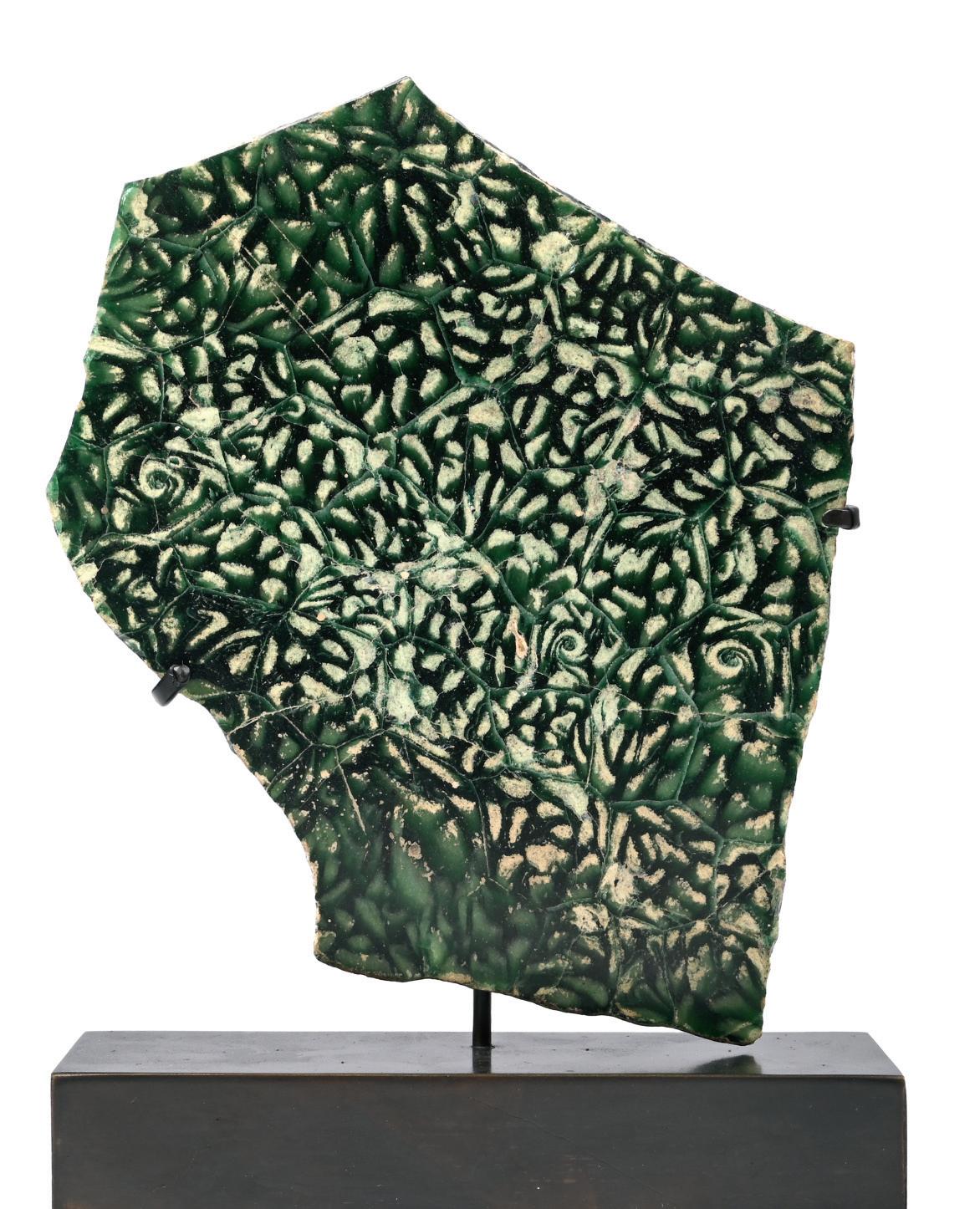


191
LARGE ROMAN GREEN MOSAIC GLASS FRAGMENT
LATE 1ST CENTURY B.C.-EARLY 1ST CENTURY A.D.
6 in. (473 grams total, glass: 16.3 cm)
Irregular panel fragment made from mosaic-type glass in shades of green and cream; one polished face; mounted on a custom-made stand.
£3,000 - 4,000
PROVENANCE: Dr Jutaro Kawabe, Nagoya, Japan, assembled during the 1960s1980s. with Hoshigaoka Gallery until the late 1990s.
FOOTNOTES:
The decoration is well documented in the Eastern Roman Empire, especially the Syro-Palestinian coast. The most frequently occurring colours in these glass mosaics are opaque red, but green and blue tints are not uncommon.
192
LARGE ROMAN GREEN MOSAIC GLASS FRAGMENT
LATE 1ST CENTURY B.C.-EARLY 1ST CENTURY A.D.
4 in. (460 grams total, glass: 11.9 cm)
Sub-rectangular panel fragment made from mosaic-type glass in shades of green and cream; one polished face, edge chipped; mounted on a custom-made stand.
£3,000 - 4,000
PROVENANCE: with old 19th-century label ‘240’ to the reverse. Dr Jutaro Kawabe, Nagoya, Japan, assembled during the 1960s1980s. with Hoshigaoka Gallery until the late 1990s.
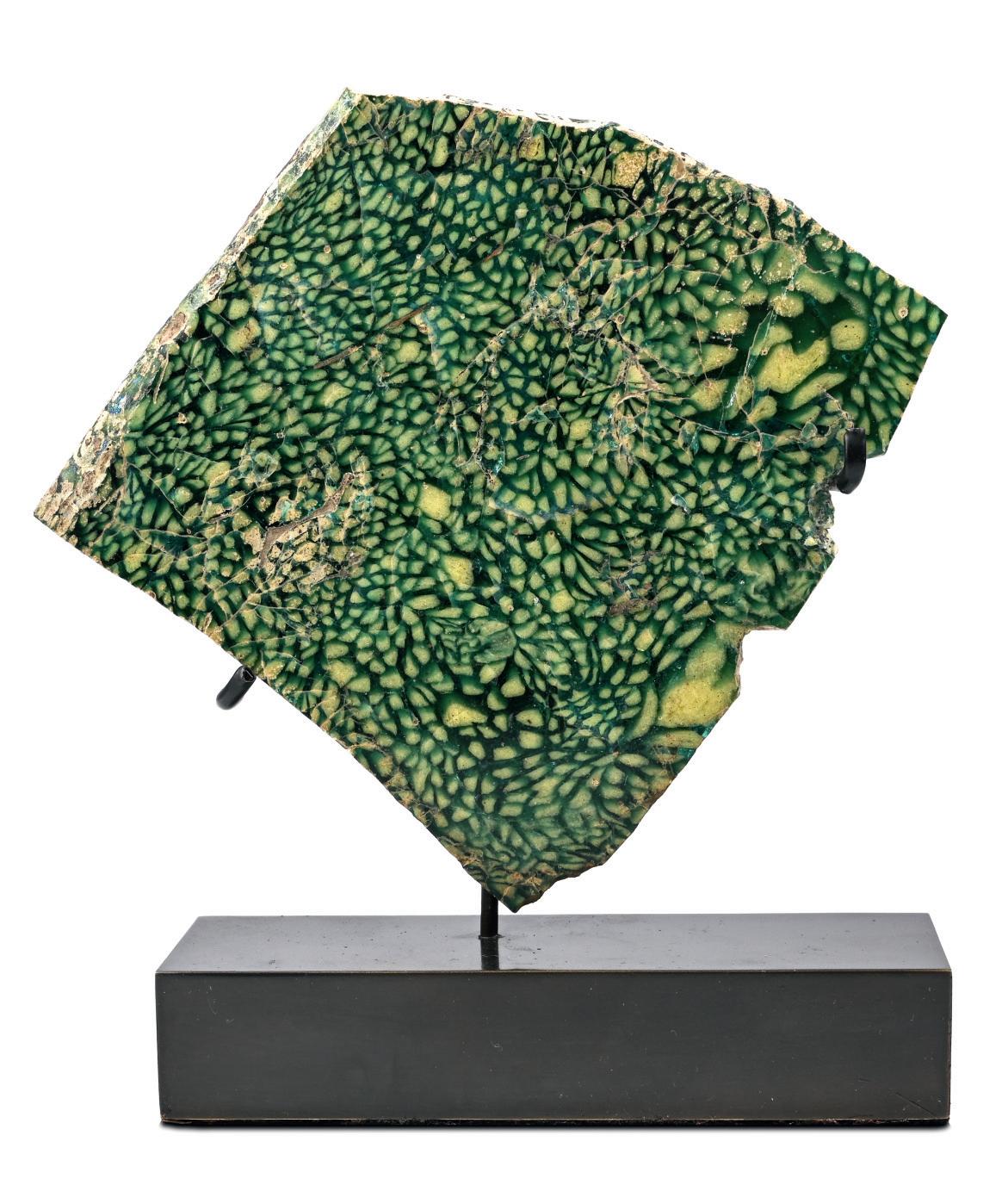

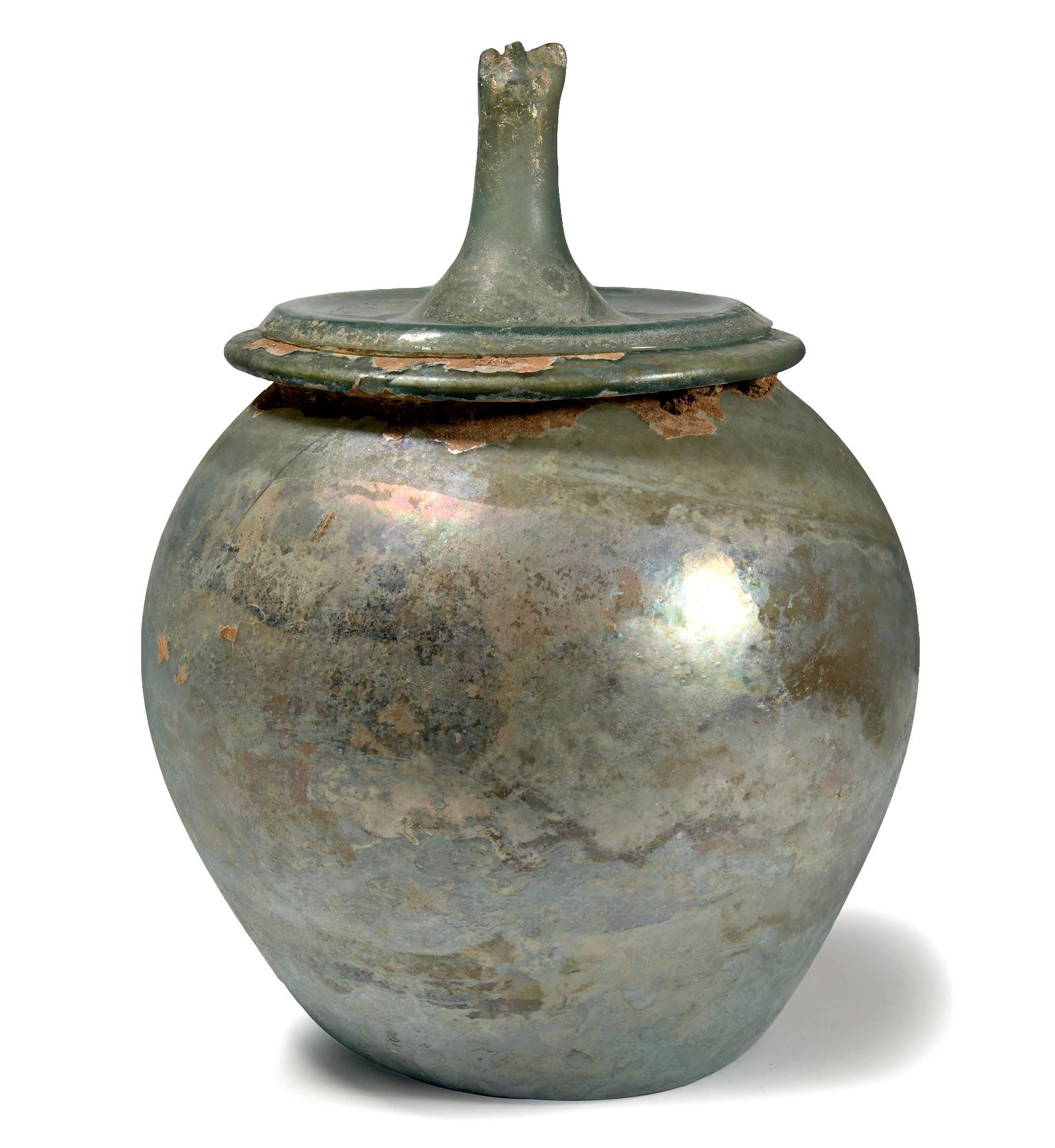
LARGE ROMAN ‘THE SANGIORGI’ PALE GREEN GLASS CINERARY URN
3RD-1ST CENTURY B.C.
1 in. (823 grams total, 29.5 cm high)
Of piriform shape with everted rim, gently chamfered upper lip and concave underside; lid with bevelled rim, gently dished upper face rising to a central dome and cylindrical handle with piecrust pleats; iridescent surfaces.
£6,000 - 8,000
PROVENANCE:
Ex Sangiorgi collection, acquired in the 19th century. with Christie’s, 3 June 1999, no.121.
The remains of a 19th-early 20th-century label can be seen on the glass on one side. with Christie’s, New York, 9 December 1999, no.476.
American private collection, Westchester, New York, acquired in 1999. with Bonhams, London, 30 September 2015, no.91.
Private collection, UK.
FOOTNOTES:
A similar jar in the British Museum was found in Warwick Square, London, inside a lead canister, and was originally filled with bone ashes. The Romans often reused glass jars, originally made for storing liquids and foodstuffs, as cremation vessels, but this kind of jar seems too fragile and was therefore probably purpose-made. The lead canister, which was found with the jar from London, protected the glass and bones. Georgio Sangiorgi is one of the most famous names associated with the field of ancient glass collecting. Working from the Galleria Sangiorgi in the Palazzo Borghese, Sangiorgi acquired the most magnificent collection of ancient glass, seeking only the finest examples.
194
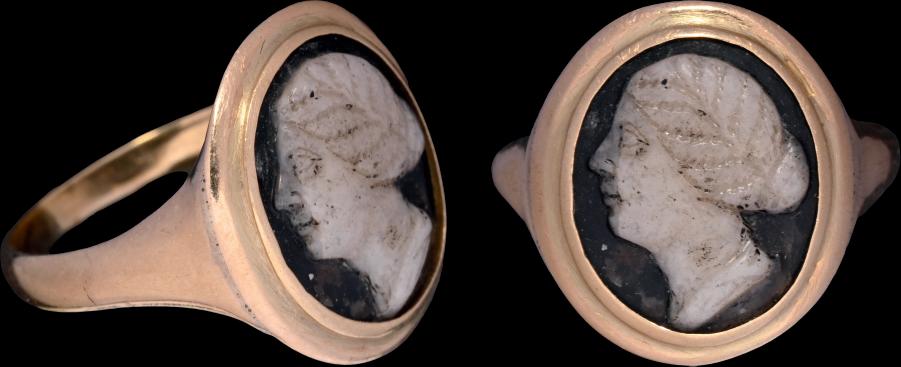
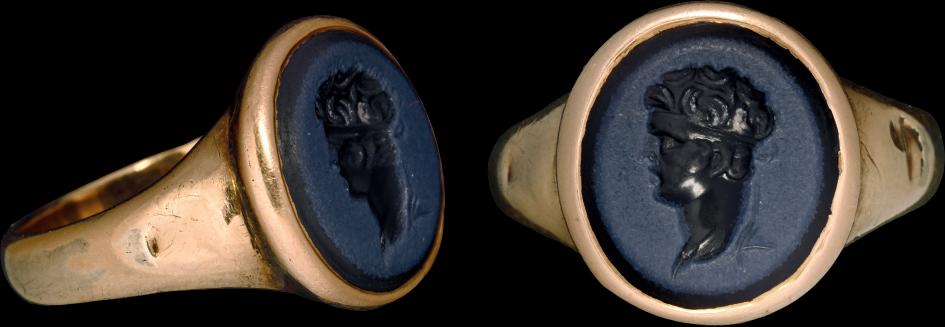
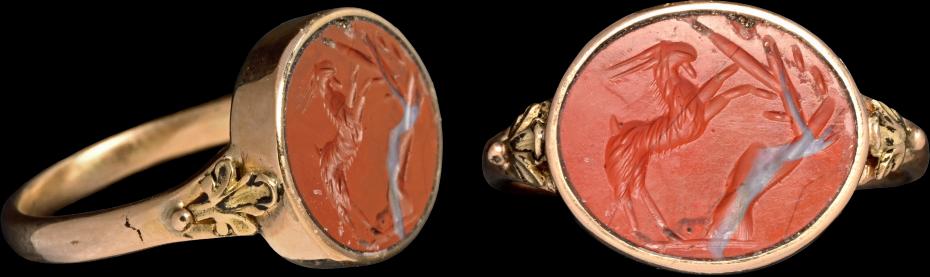
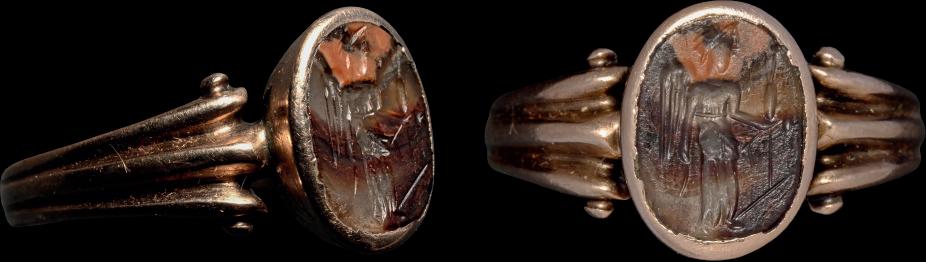
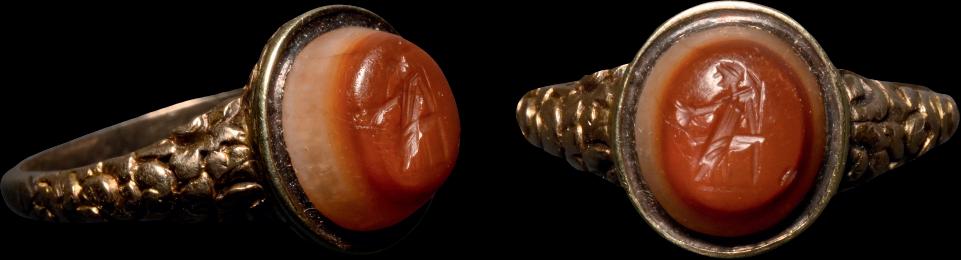
ROMAN CAMEO OF A FEMALE HEAD IN GOLD RING
1ST-2ND CENTURY A.D.
¾ in. (2.73 grams, 18.12 mm overall, 15.02 mm internal diameter (approximate size British H, USA 3¾, Europe 6.18, Japan 6))
Inset cameo with finely detailed chignon hairstyle; set in an 18th century gold finger ring.
£1,500 - 2,000
PROVENANCE:
Acquired on the UK art market. Private collection, England.
195
ROMAN NICOLO GEMSTONE OF THE BUST OF AN EPHEBOS IN GRAND TOUR GOLD RING
2ND CENTURY A.D.
¾ in. (3.84 grams, 21.26 mm overall, 17.32 mm internal diameter (approximate size British L½, USA 6, Europe 11.87, Japan 11))
With profile bust of an adolescent (Greek ephebos) with tousled hair; set in a later gold ring.
£1,500 - 2,000
PROVENANCE:
Private collection, England.
196
ROMAN JASPER GEMSTONE OF A GRAZING GOAT IN GOLD RING
2ND-3RD CENTURY A.D.
¾ in. (4.10 grams, 20.70 mm overall, 17.90 x 14.56 mm internal diameter (approximate size British L, USA 5¾, Europe 11.24, Japan 10))
Intaglio of a bearded goat standing on its hind legs against a tree on which it browses; large fruits hanging from two of the boughs; from a third bough to the right of the tree hangs what may be a dead hare, or possibly another fruit; set into a later gold ring.
£800 - 1,000
PROVENANCE:
Private collection, Europe. Acquired on the English art market.
197
ROMAN AGATE GEMSTONE OF PANTHEISTIC DEITY IN GOLD RING
2ND-3RD CENTURY A.D.
1 in. (3.22 grams, 23.31 mm overall, 19.46 x 19.15 mm internal diameter (approximate size British R, USA 8½, Europe 18¾, Japan 18))
Intaglio winged Victory in long robe holding a vexillum military standard; set into an antique gold ring.
£800 - 1,000
PROVENANCE: Private collection, Europe. Acquired on the English art market.
198
ROMAN GEMSTONE OF A SEATED FIGURE SET INTO A GOLD GEORGIAN RING
2ND-3RD CENTURY A.D.
1 in. (3.44 grams, 25.11 mm overall, 17.50 mm internal diameter (approximate size British N, USA 6½, Europe 13.72, Japan 13))
Cabochon with incuse enthroned figure with one hand extended; set into an antique gold ring.
£600 - 800
PROVENANCE: Private collection, Europe. Acquired on the English art market.
199
ROMAN GOLD PENDANT WITH MEDUSA CAMEO
2ND-3RD CENTURY A.D.
1 in. (7.33 grams, 28 mm)
A pendant with crimped flange rim, beaded wire collar to the cell and ribbed loop with granules; inset agate cameo gorgoneion mask.
£2,000 - 3,000
PROVENANCE:
Private collection, acquired before 1980. Acquired on the UK art market. Private collection, England.
200
ROMAN PORTRAIT CAMEO IN GOLD FRAME
2ND-3RD CENTURY A.D.
1 in. (8.64 grams, 28 mm)
Comprising: ellipsoid gold plaque with openwork border, a pair of suspension loops with pelleted finial; inset carved cameo of male bust facing left with tall and wrinkled forehead and hooked nose, right hand raised with thumb touching chin.
£3,000 - 4,000
PROVENANCE: Ex London gentleman’s collection, 1990s.
201
ROMAN CARNELIAN GEMSTONE OF THE GOD APOLLO IN BYZANTINE GOLD RING
1ST CENTURY B.C.-1ST CENTURY A.D. AND LATER
1 in. (6.46 grams, 26.66 mm overall, 17.29 x 16.50 mm internal diameter (approximate size British M½, USA 6¼, Europe 13.09, Japan 12))
Roman intaglio depicting youthful god Apollo in profile, set into a 5th7th century A.D. Byzantine ring with flat-section hoop with roped bands and pelleted border, fluted hemispherical bezel with ribbed underside.
£3,000 - 4,000
PROVENANCE:
Private collection, 1950s.
Private collection, M.G., South Germany, 2000. with Gorny and Mosch, 14 December 2016, no.259.
Private collection, England.
202
ROMAN AGATE SCARAB ENGRAVED WITH THE GODDESS FORTUNA MOUNTED IN A GOLD RING
1ST CENTURY B.C.-1ST CENTURY A.D. in. (4.34 grams, 22.63 mm overall, 19.34 mm internal diameter (approximate size British N, USA 6½, Europe 13.72, Japan 13))
Scarab with incuse image to the underside of Fortuna with cornucopia and ship’s rudder; in later gold swivel ring.
£1,200 - 1,700
PROVENANCE: Private collection, Europe. Acquired on the English art market.
203
VERY LARGE ROMAN GOLD RING WITH ENGRAVED HEAD OF THE GOD NEPTUNE AND WARSHIPS ‡
1ST CENTURY B.C.-1ST CENTURY A.D.
1½ in. (7.40 grams, 37.31 mm overall, 22.71 x 27.56 mm internal diameter (approximate size British Z+3, USA 13¾, Europe 32.57, Japan 31))
A substantial hollow-form ring with a hexagonal plaque to the base of the hoop, expanding shoulders with a low-relief image of a standing nude goddess; raised oval bezel with an applied repoussé disc of a warship to each end; applied bezel with a chiselled image of god of the sea Neptune facing right, depicted with thick, lustrous beard and hair, the hair tied with a thin ribbon.
£3,000 - 4,000
PROVENANCE: Ex Angelopolo collection, Vienna. Acquired in the mid 1980s-1990s. Private collection, Switzerland, thence by descent. Private collection, since the late 1990s.
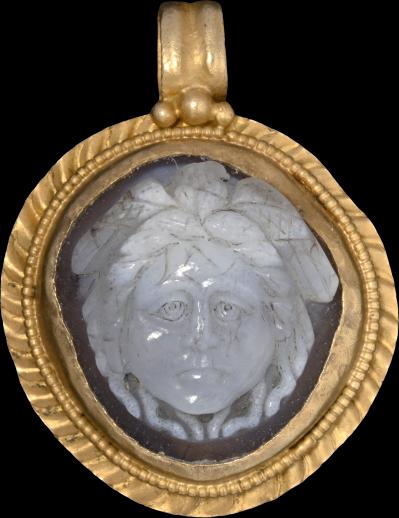
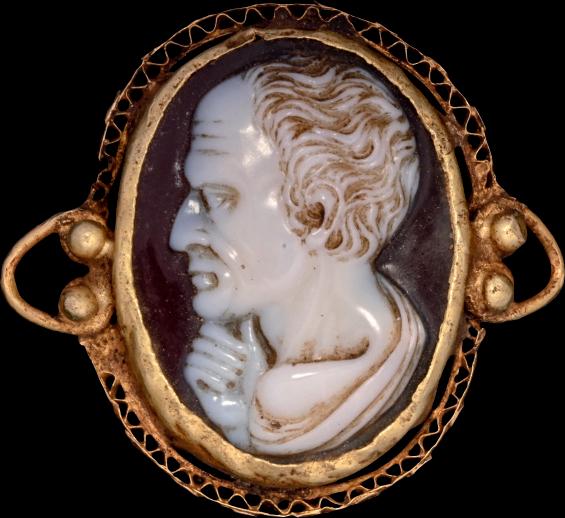
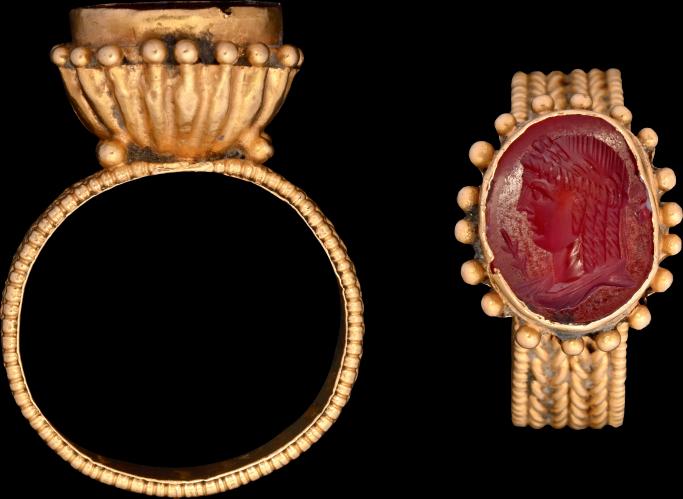
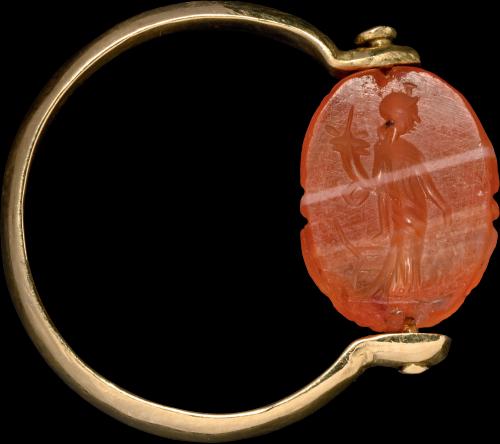
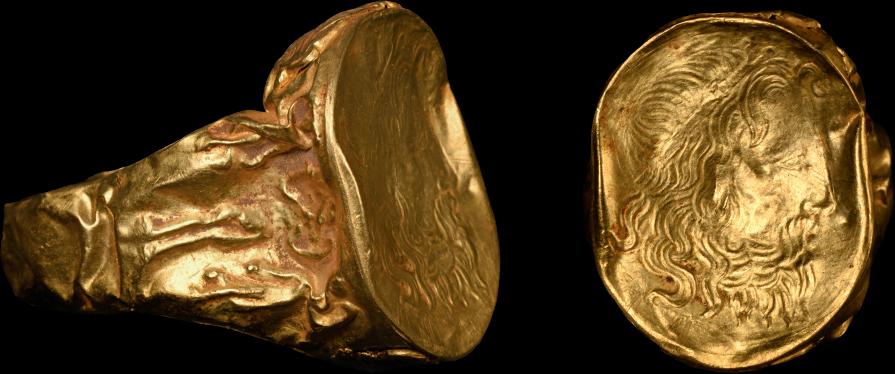
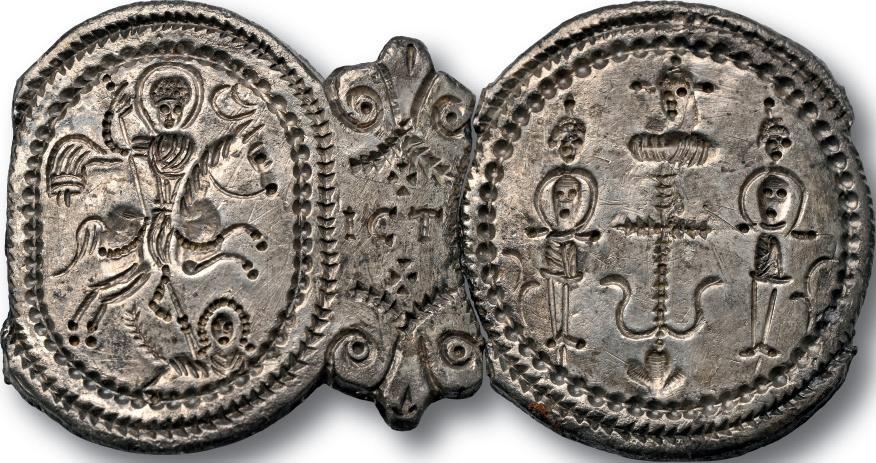

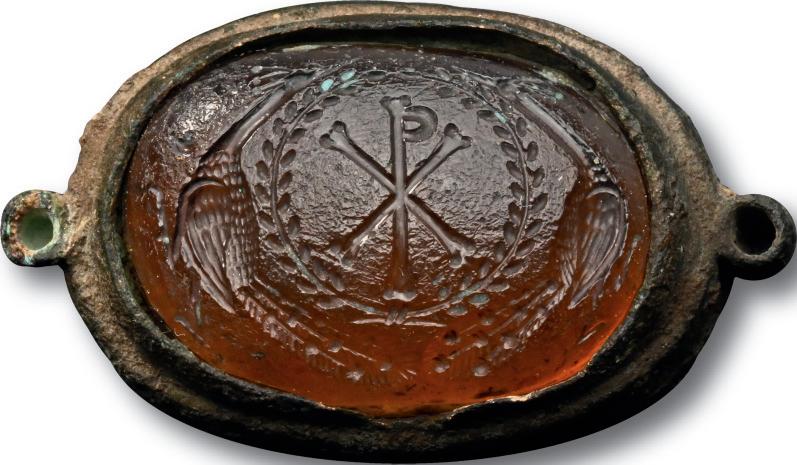

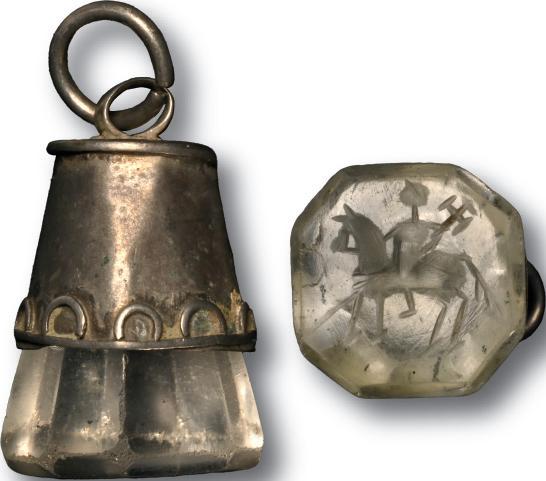

204
BYZANTINE SILVER BRACELET SECTIONS WITH WARRIOR SAINT AND CRUCIFIXION
6TH-7TH CENTURY A.D.
1 in. (9.67 grams total, 26 mm each)
Two fragments from a military bracelet (brachiolion) comprising: a disc with double border of pellets, at the centre two standing figures of the two robbers flanking a stylised Stavrosis (crucifixion), composed of a stylised cross surmounted by the nimbate head of Christ; the other an ellipsoid panel and portion of the shank with peltashaped motifs flanking ‘ICT’ (IesouC Theou = Jesus son of God) legend, the panel with double border of pellets enclosing image of nimbate Saint George on horseback with scale armour and spearing the dragon with a long spear (doru). [2]
£1,800 - 2,400
PROVENANCE:
Ex private Dorset, UK, collection circa 1980s. Property of a London, UK, antiquarian.
Accompanied by an academic report by Dr Raffaele D’Amato.
205
BYZANTINE ORANGE GLASS GEMSTONE WITH CHI RHO MONOGRAM AND PEACOCKS IN LAUREL WREATH
5TH-7TH CENTURY A.D.
1½ in. (14.15 grams, 37 mm)
Ellipsoid cell with tubular finials to accept connecting links; inset glass cabochon with central Christogram within a wreath flanked by perching peacocks.
£2,500 - 3,500
PROVENANCE:
UK private collection before 2000. Acquired on the UK art market. Private collection, London, UK.
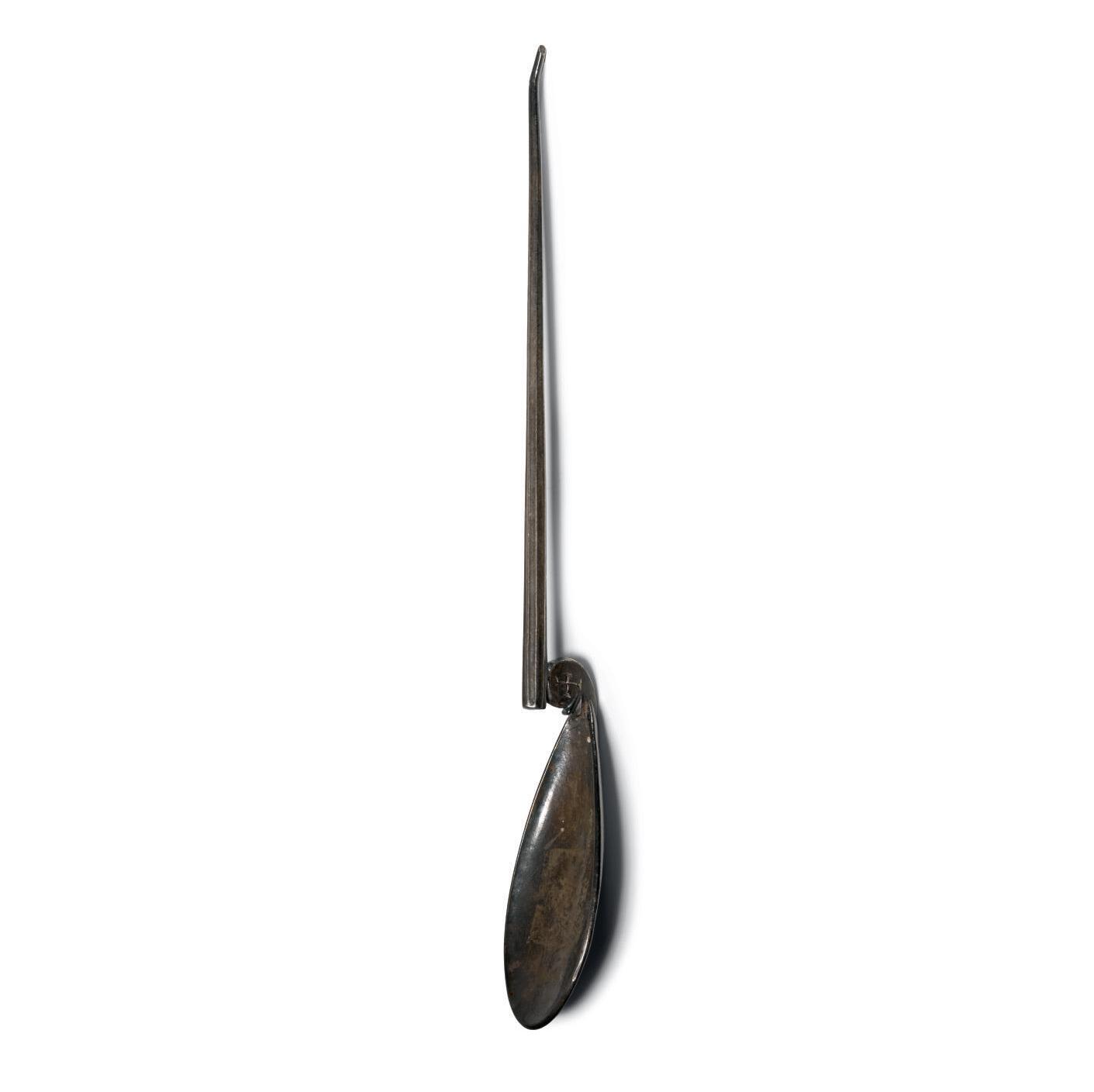
BYZANTINE ROCK CRYSTAL STAMP SEAL IN SILVER PENDANT WITH MILITARY SAINT ON HORSEBACK CIRCA 6TH-7TH CENTURY A.D.
With a tapering octagonal body, the military saint on horseback holding a long spear, the horse wearing a detailed harness; set in a conical silver frame with suspension loop and crenellated edge.
From an old New Zealand private collection. Acquired on the New Zealand art market circa 2014. Property of a New Zealand legal professional.
Accompanied by an academic report by Dr Raffaele D’Amato.
BYZANTINE SILVER SWAN-NECKED LIGULA
Shallow piriform bowl attached to a stepped baluster, hexagonalsection handle with spike finial; engraved cross potent to either side
Acquired on the French art market in 2011. Acquired by the present owner at the above.
The lateral incised cross motifs suggest that the spoon may have had a liturgical purpose, possibly associated with baptism.
208
BYZANTINE GOLD MARRIAGE RING WITH BUSTS
CIRCA 6TH-7TH CENTURY A.D.
1 in. (13.76 grams, 25.37 mm overall, 18.77 mm internal diameter (approximate size British Q, USA 8, Europe 17.49, Japan 16))
D-section hoop with carination, flat chamfered shoulders each with an engraved cross moline within a wreath; trumpet-shaped bezel with two facing busts and processional cross between, the bodies with inset carnelian studs; legend ‘OMONOIA’ (harmony) below.
£5,000 - 7,000
PROVENANCE:
From the collection of a late English gentleman, 1990s.
209
BYZANTINE GOLD RING WITH SAINT CIRCA 6TH-8TH CENTURY A.D.
in. (2.28 grams, 22.27 mm overall, 18.19 mm internal diameter (approximate size British O½, USA 7¼, Europe 15.61, Japan 15))
D-section hoop with domed square bezel, incuse bust with mantle draped from the right shoulder, cross to one side, lateral bands of punched pellets.
£1,200 - 1,700
PROVENANCE:
Ex collection of a late Christian gentleman, 1970s
210
EASTERN BYZANTINE AMETHYST GEMSTONE OF A MALE BUST WITH CROSS IN GOLD RING
4TH-5TH CENTURY A.D. OR EARLIER
1¼ in. (9.56 grams, 32.00 mm overall, 20.72 x 16.55 mm internal diameter (approximate size British P, USA 7½, Europe 16.23, Japan 15))
Intaglio with bearded profile bust facing left with a small possibly later added cross to the shoulder; set into a later hollow-formed gold ring.
£2,500 - 3,500
PROVENANCE: Acquired on the European art market. Private collection, England.
211
BYZANTINE GOLD STANDING FEMALE PENDANT
7TH-9TH CENTURY A.D.
1½ in. (3.44 grams, 39 mm)
Hollow-formed and modelled in the round, standing female wearing a palla around her hips, hands raised to her hair; applied mounting strip to reverse and wire stud to brow to mount a bead.
£2,500 - 3,500
PROVENANCE:
UK private collection before 2000. Acquired on the UK art market. Private collection, London, UK.
FOOTNOTES: The stance is based on the famous Venus Anadyomene image of the goddess emerging from the sea, as shown in the mosaic at Casa del Principe di Napoli in Pompeii.
212
BYZANTINE GOLD CROSS PENDANT 5TH-7TH CENTURY A.D.
1 in. (3.73 grams, 36 mm)
Sheet-gold with integral suspension loop, five large bosses, each within an encircling ring and four smaller bosses in the spandrels assembled into a cross; a marriage.
£1,200 - 1,700
PROVENANCE:
UK private collection before 2000. Acquired on the UK art market. Private collection, London, UK.
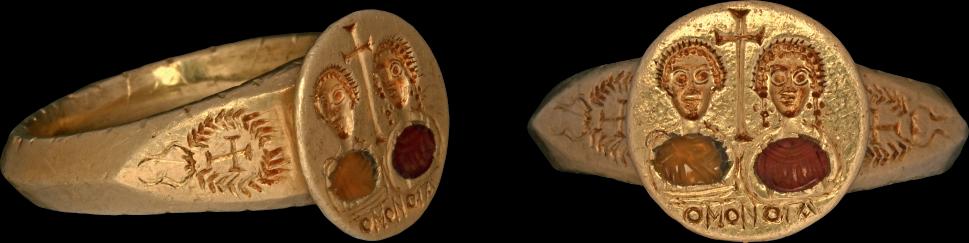
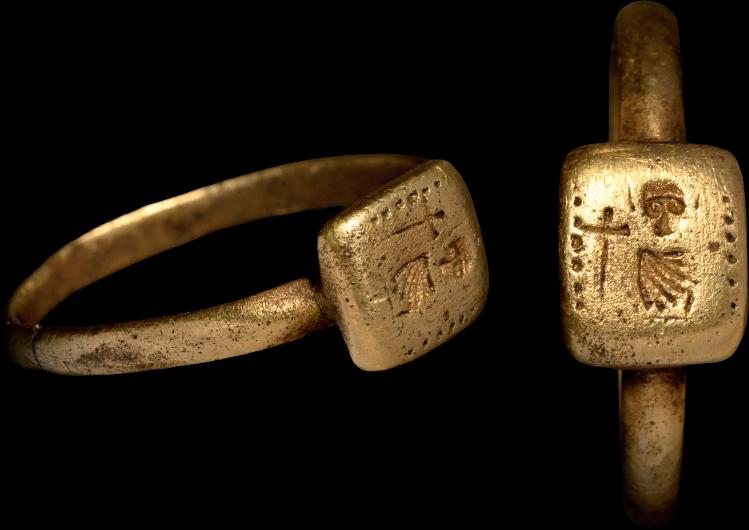
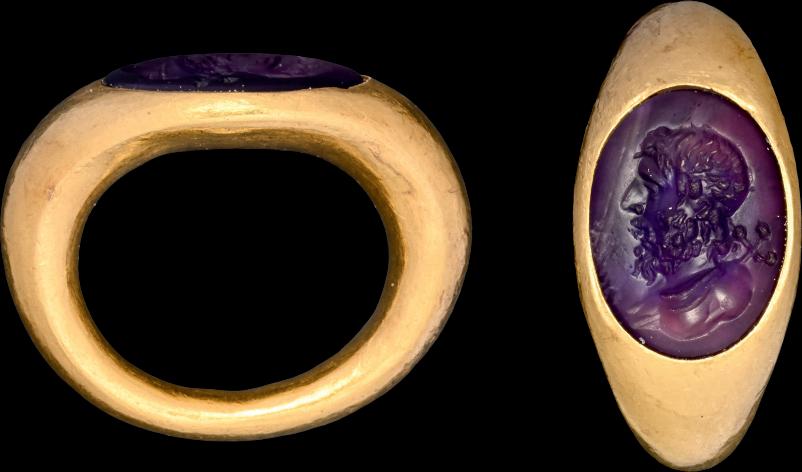
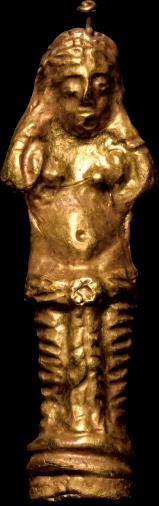
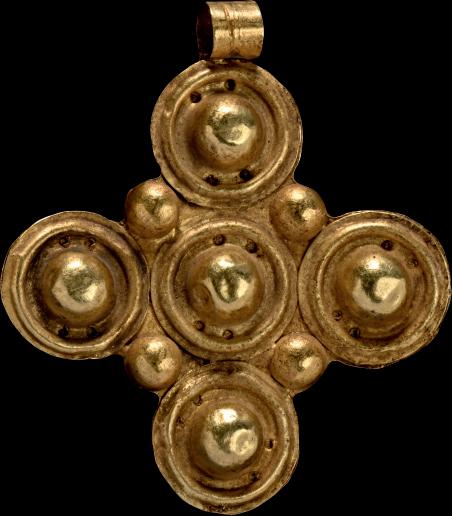
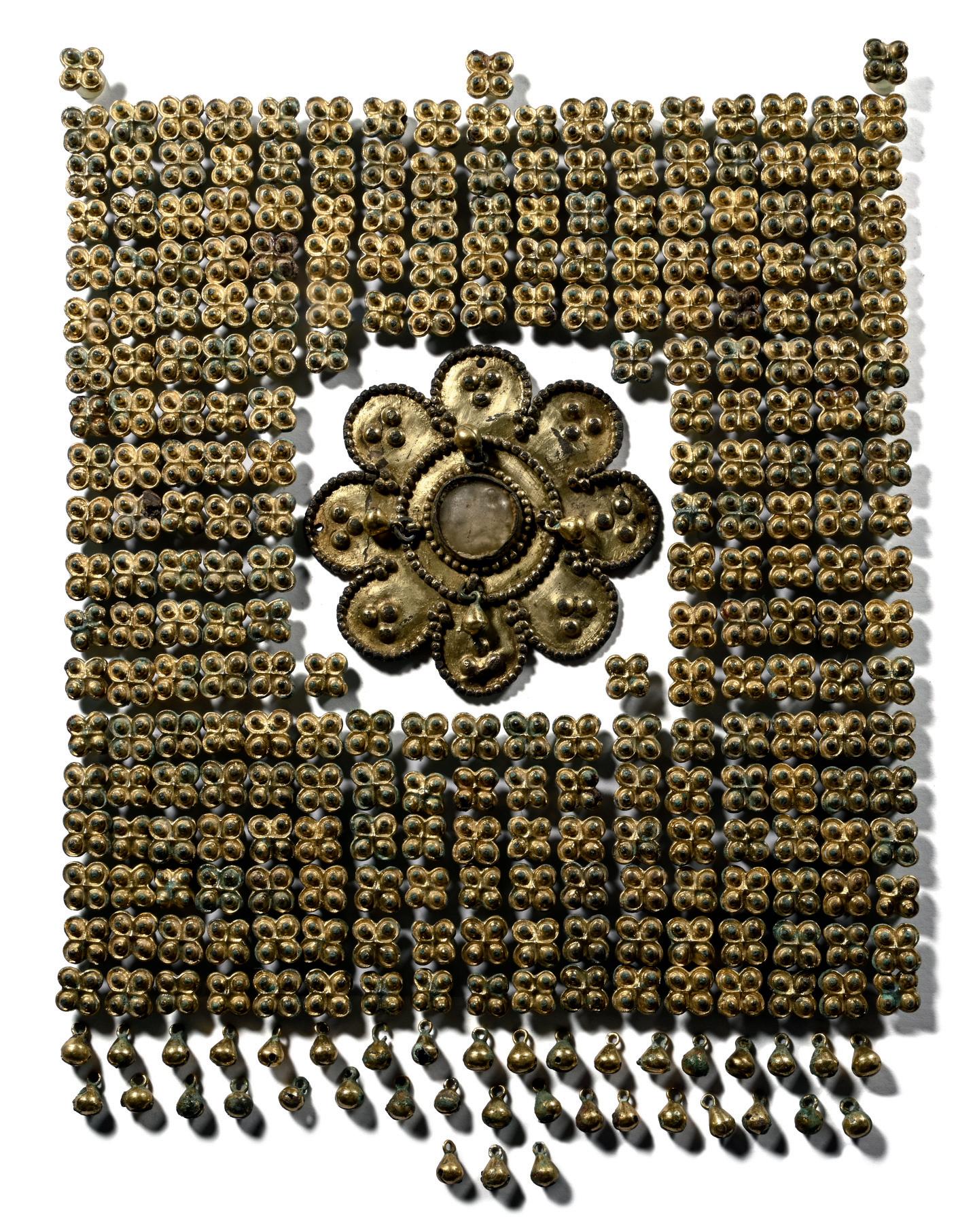

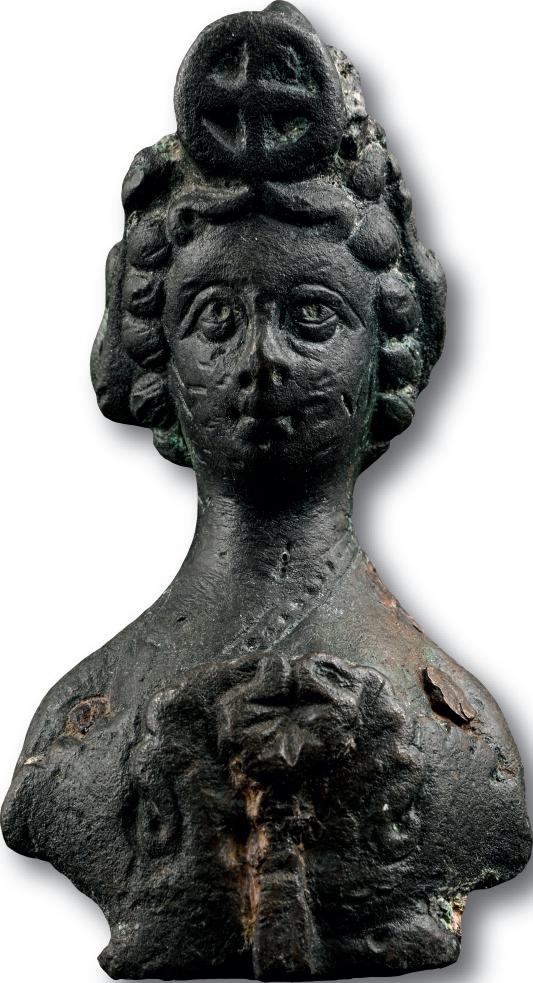
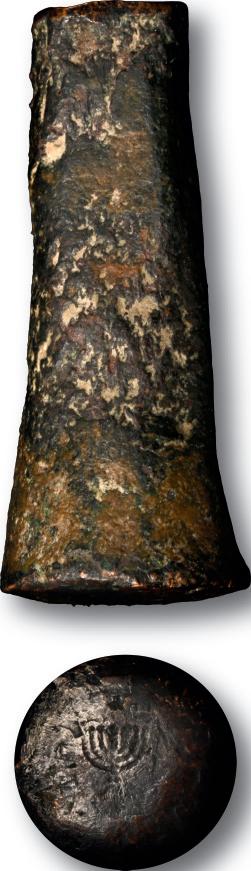
213
BYZANTINE GILT BRONZE HORSE HARNESS DECORATION SET
8TH-10TH CENTURY A.D. - 3 in. (556 grams total, 11-92 mm)
Comprising: a large octofoil harness frontal plate with beaded rim and granulation; studs with quatrefoil plates; bell-shaped dangles.
£1,200 - 1,700
PROVENANCE: From the private collection of a London gentleman, from his grandfather’s collection formed before the early 1970s.
214
BYZANTINE BRONZE EMPRESS MOUNT
5TH-6TH CENTURY A.D.
3¾ in. (192 grams, 97 mm)
Formed in the half-round as a youthful female bust, a cross in the middle of the high hair arrangement (propoloma).
£1,000 - 1,400
PROVENANCE: Ex law professor in Alexandria, prior to 1930. Ex collection of M. Bouvier, Switzerland (1901-1980). Private collection, UK.
FOOTNOTES: The image of the Roman empress during the late Roman Empire, was connected to Christianity by the figure of the Empress Helena. Constantine had several cities renamed Helenopolis in honour of his mother, Helena, and she gained the political verification of power with the status nobilissima femina in 318 A.D. and the rank of Augusta in 324 A.D. Alongside her social and political image, Helena also had a significant reputation as a good Christian who was a patron and took care of poor people. Owing to this powerful religious image that was created, all other Christian women during the Eastern Roman Empire were encouraged spiritually by the fact that Helena was the mother of the first Christian emperor, and the image of the Roman empress was connected to the Christian image of the Mother of God, and represented on weights, bronze appliques and, in this case, maybe as an upper mount of a tripod.
215

BYZANTINE BRONZE PUNCH WITH MENORAH AND HEBREW INSCRIPTION
CIRCA 5TH-6TH CENTURY A.D.
1¼ in. (18.8 grams, 31 mm)
Columnar stem with conical base extending to a square-section shank.
£900 - 1,200
PROVENANCE: From the collection of a gentleman, acquired on the London art market in the 1990s.
FOOTNOTES: Stamping in antiquity and in the Roman Empire, was under strict regulations, and it was not limited to food and liquid containers. Bricks and tiles used in construction were impressed with the names of magistrates, workshops, estate owners from whom the material came, and the names of individual makers. Among the myriad Late Roman stamps, a great number were to mark bread or containers holding flour and other foods, as well as a variety of liquids such as wine, oil, fish and fruits preserved in sauces, medical ointments, and even water. It is interesting to note as the Jewish symbols here engraved are very stylised: as mentioned by various scholars, the Jewish representations of shofar and lulav on this category of stamps degenerated in quality in Late Antiquity and this is why they are variously dated between the 4th and the 7th century.
216
BYZANTINE STEATITE ICON WITH MILITARY SAINT ‡
10TH-12TH CENTURY A.D.
2¾ in. (60 grams total, icon: 72 mm high)
Fragment of an icon depicting a facing saint modelled in the half-round within an arch; an ellipsoid low-relief face with hatched collar-length hair, lentoid eyes with pointillé pupils flanking a long nose; wearing a lamellar cuirass (klivanion); stylised sword (spathion) to the shoulder with lobe pommel, piriform blade with hatched median bar and undulations to the flanks (simulating damascening); arch resting on a balustered column with shallow fixing socket above the saint’s head; mounted on a custom-made stand.
£8,000 - 10,000
PROVENANCE:
Jacques and Henriette Schumann collection, Paris, France. with Christie’s, Paris, France, 30 September 2003, no.248.
European private collection.
Accompanied by a copy of French passport no.061301, dated 3 September 2003.
Accompanied by an academic report by Dr Raffaele D’Amato.
FOOTNOTES: Jacques and Henriette Schumann were distinguished Parisian collectors known for their discerning taste and passion for antiquities and decorative arts. Their collection, assembled over several decades, reflected a deep appreciation for cultural heritage and historical significance. Works from their collection have been included in major European auctions and are recognised for their provenance and quality.
217
BYZANTINE STEATITE MOUNT WITH SAINT JOHN THE THEOLOGIAN ‡
12TH CENTURY A.D. OR LATER ¾ in. (2.52 grams, 19 mm)
Showing a bust of a man dressed in a cloak and with his head turned to look over his right shoulder, possibly depicting St John; rectangular in plan with rounded corners.
£600 - 800
PROVENANCE: Acquired from Artemis Gallery, 2003. Private collection, Europe.
218
BYZANTINE GREEN GLAZED SGRAFFITO FOOTED BOWL ‡
13TH CENTURY A.D. 5 in. (372 grams, 13 cm)
Carinated in profile with narrow flared base, green-glazed upper body; to the inner face a central roundel with zigzag fill and a zigzag band above the gallery, to the outer face horizontal zigzag band to the shoulder; old Christie’s label with ‘144/2 5540’.
£500 - 700
PROVENANCE:
Ex Charles Gillot (1853-1903). with Christie’s, Paris, 2008. European private collection.
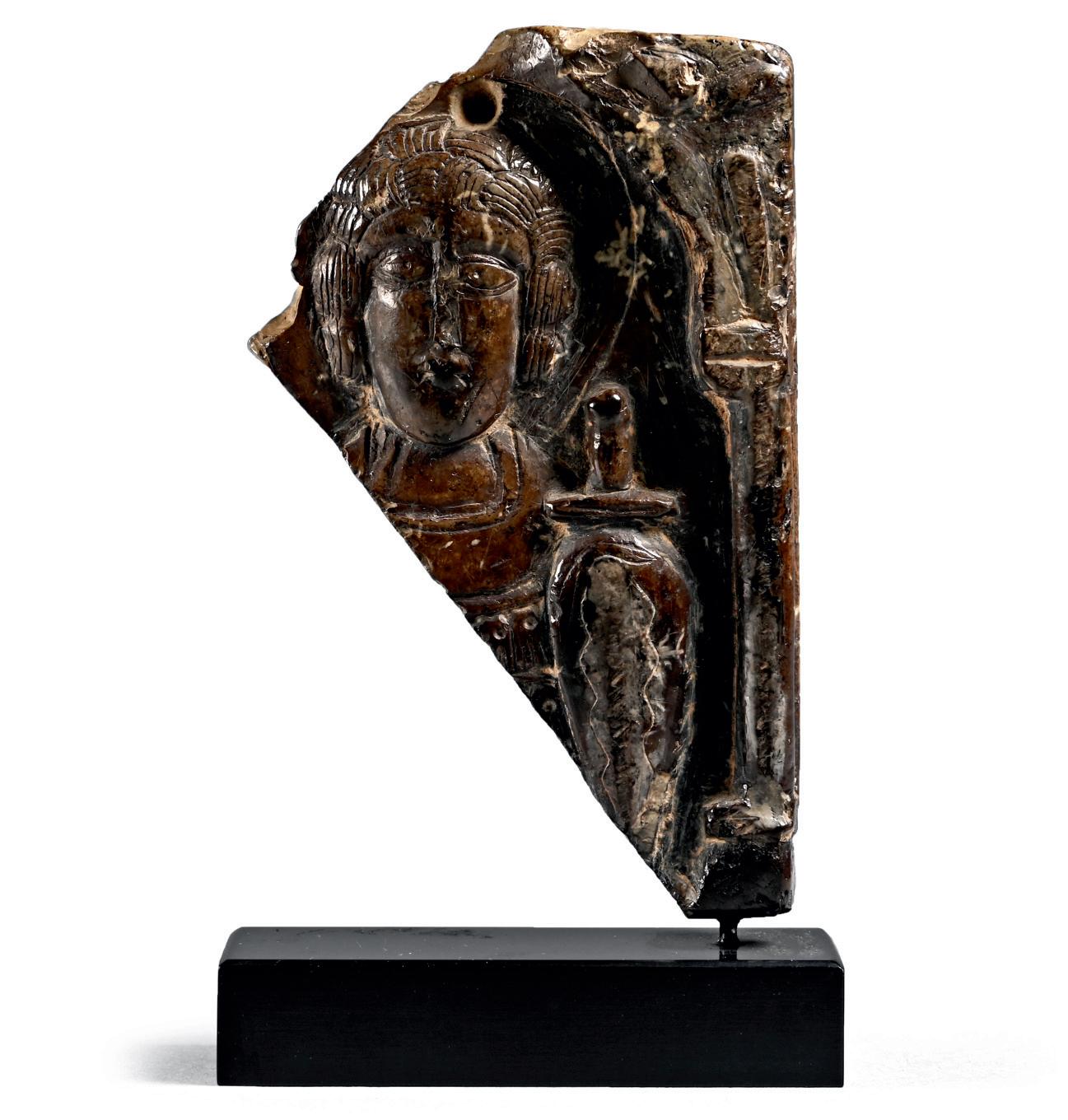
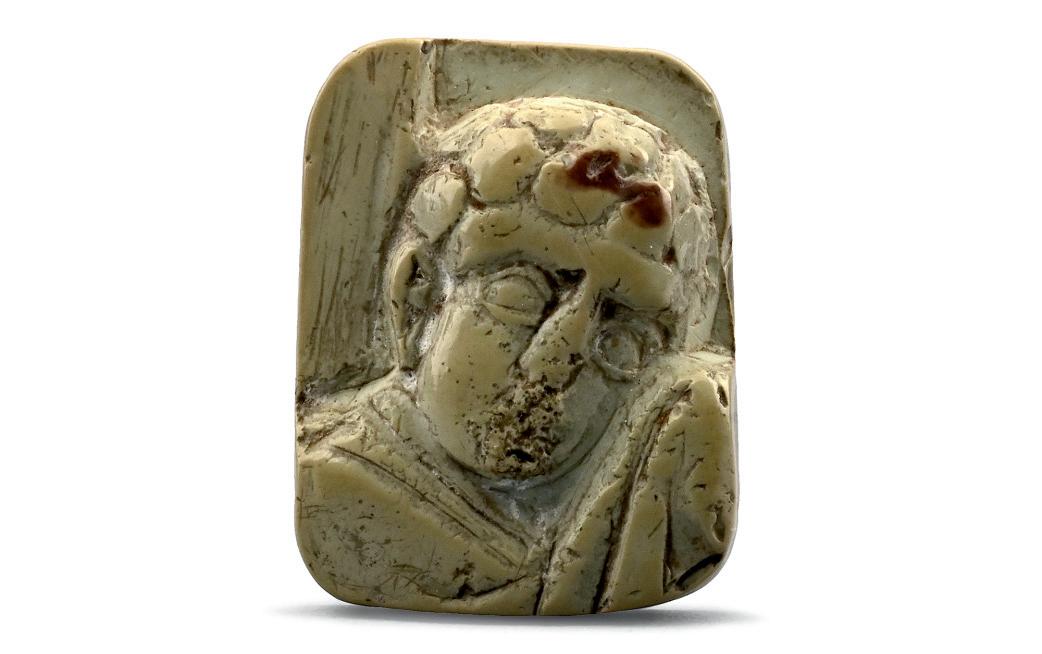
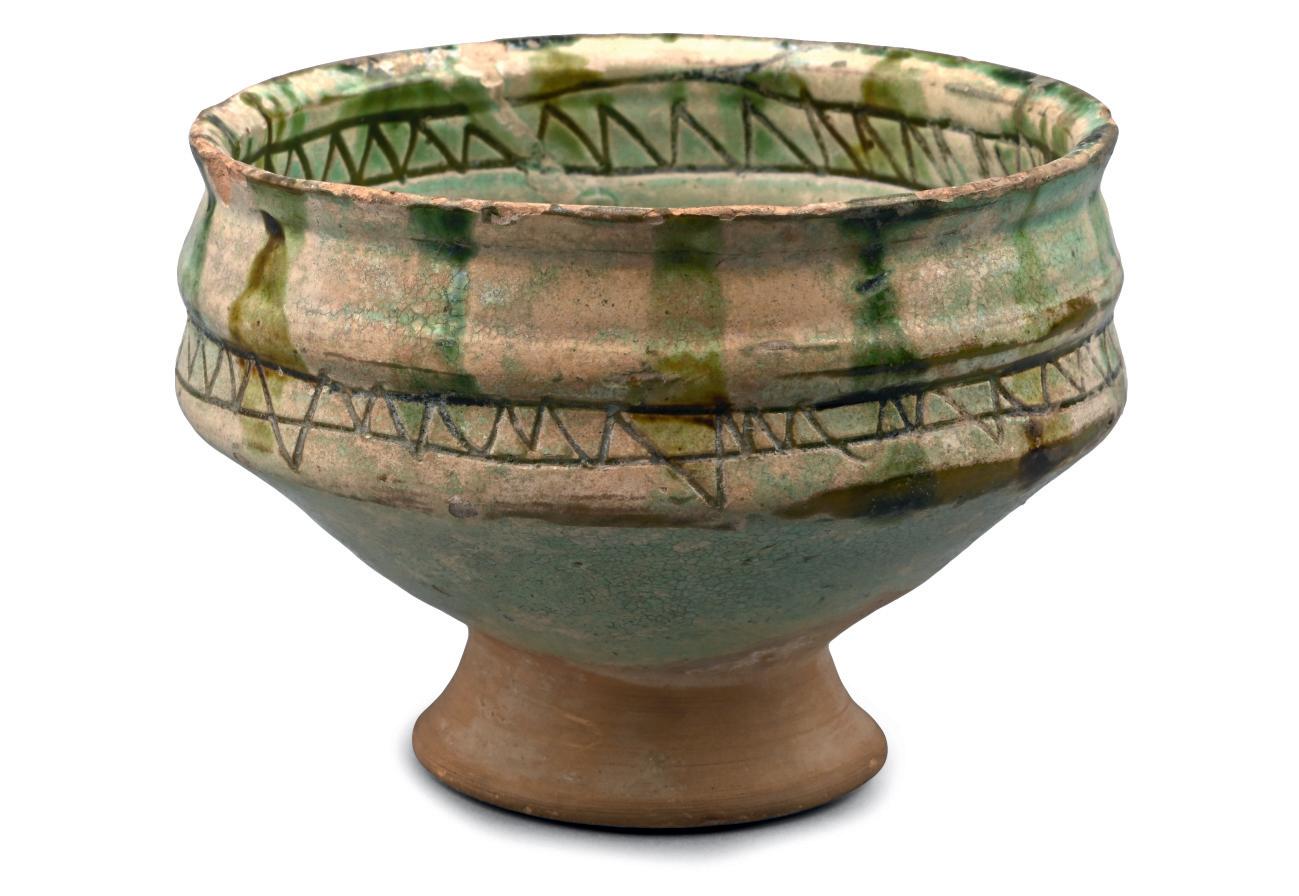
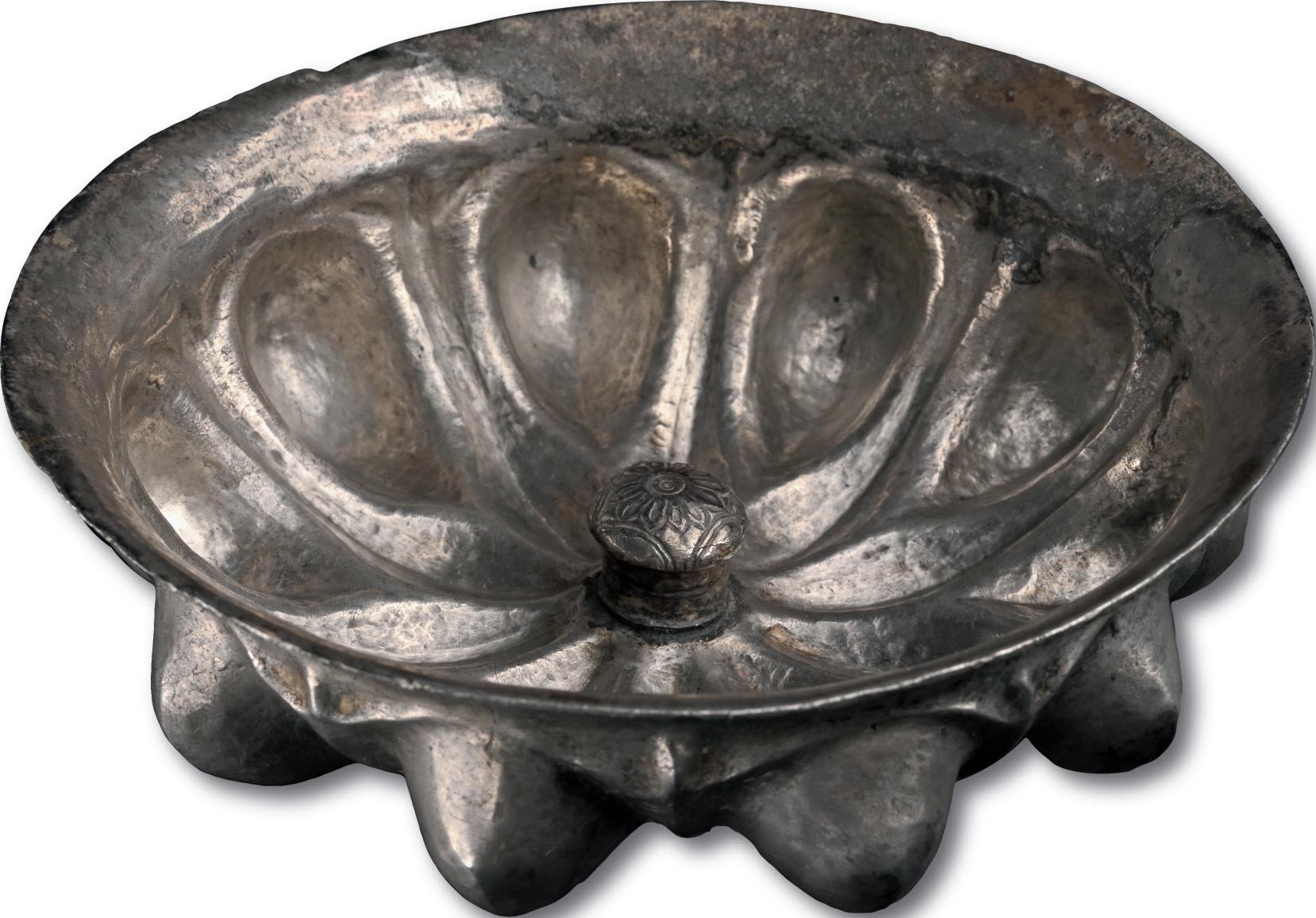

219
ACHAEMENID SILVER PHIALE WITH CENTRAL ROSETTE
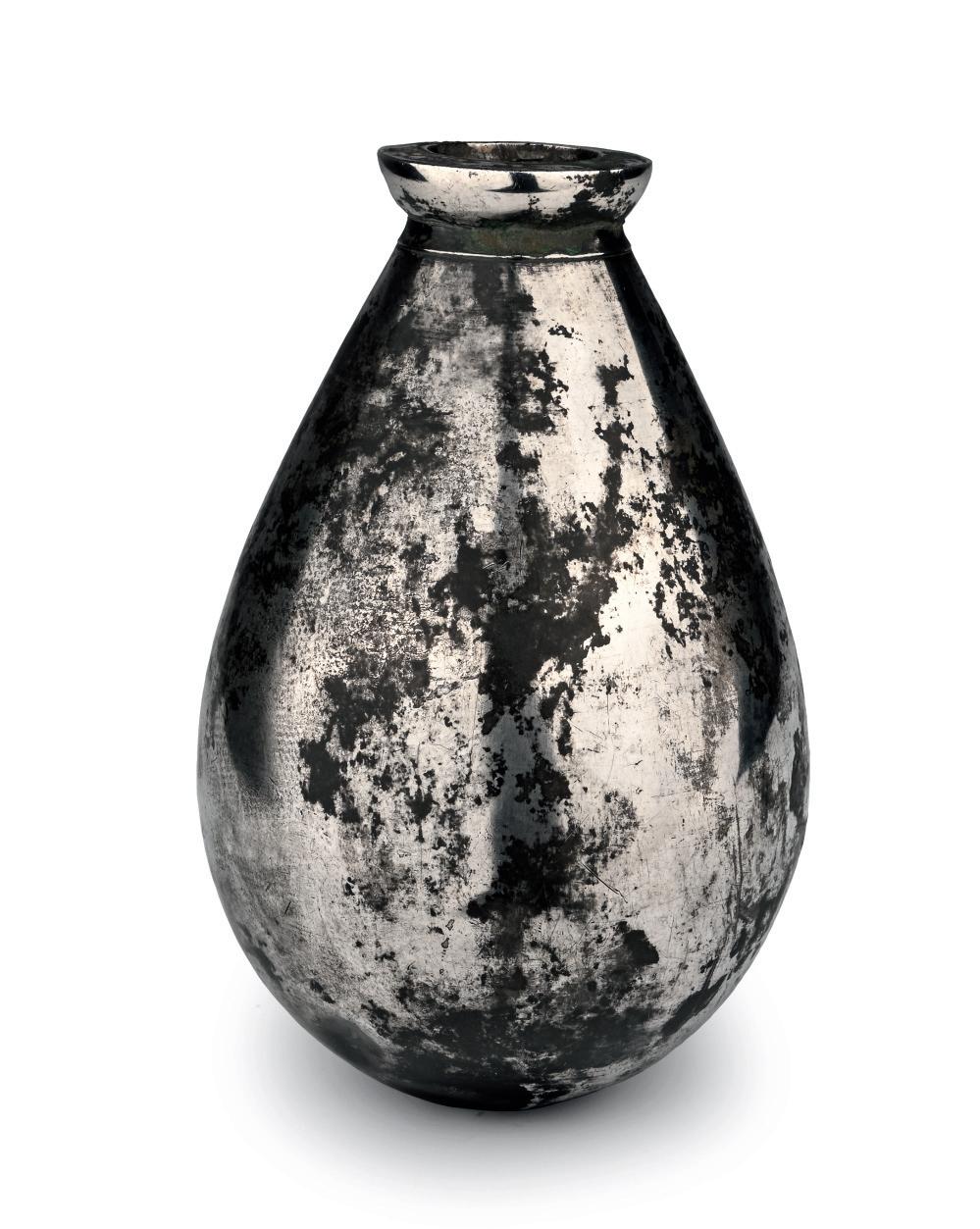
5TH CENTURY B.C.
5 in. (240 grams, 13.7 cm wide)
Squat lotiform bowl with wide everted rim, central domed mesomphalos with rosette detailing, some restoration to the rim; with custom-made box.
£3,000 - 4,000
PROVENANCE:
Ex London, UK gallery, 1971-early 2000s. Private collection, London, UK.
FOOTNOTES:
This bowl is possibly part of a set of nearly identical vessels, probably used at the table of a high-status household, potentially that of a satrap. Persian governors (satrapes) used banquets to display their wealth and power by imitating royal banquets. It was a great honour for them to receive a drinking vessel such as this as a gift from the King of the Kings, thereby establishing their status as royal dinner guests. No doubt it took practice to drink adeptly from a vessel like this, yet the omphalos in the base would have made it easier to hold with one hand, with the middle finger hooked inside the indentation and the thumb stretched out to grip the vessel at or near the rim.
220
SASANIAN SILVER BULB-SHAPED VESSEL
5TH-6TH CENTURY A.D.
6 in. (480 grams, 16.8 cm)
Ovoid in profile with a short neck and a flat rim, pierced at the bottom; minor dents to the surface.
£5,000 - 7,000
PROVENANCE:
London, UK gallery, 1971-early 2000s. Private collection, London, UK.
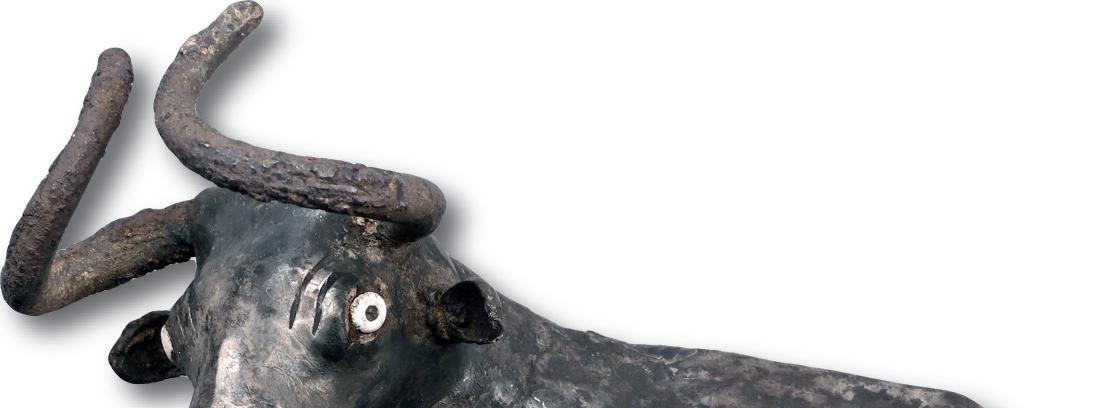
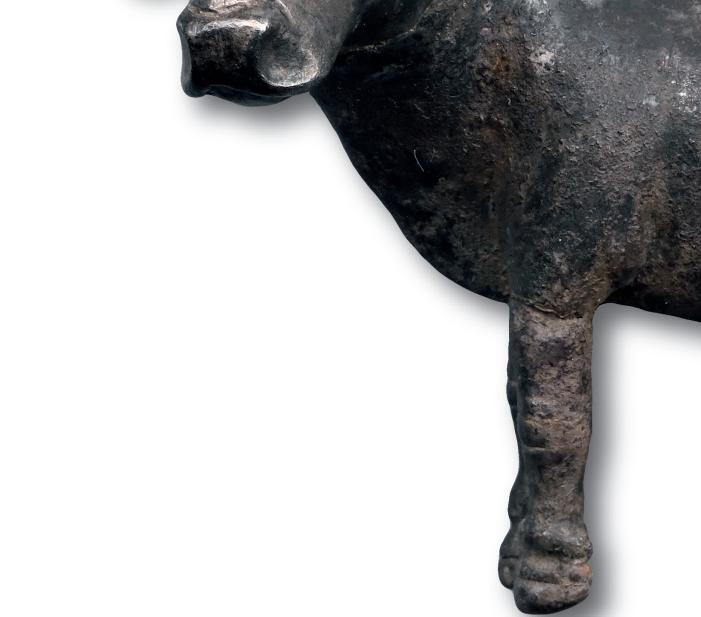
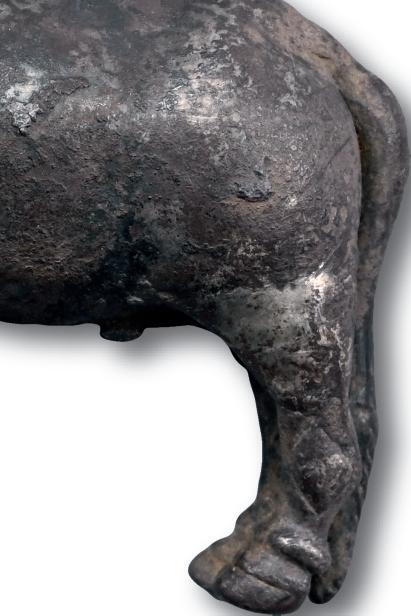
221
EARLY PROTO-ELAMITE SILVER HORNED BULL STATUE WITH INLAID EYES
3100-2900 B.C.
2¾ in. (54.5 grams, 70 mm wide)
Representing an exquisite bull figure standing with his head turned dramatically to the left, depicted with large curled horns and inlaid white stone eyes, formed from thin hammered silver sheet in repoussé, depicting the bull as a hollow pendant, with the interior filled with natural bitumen; traces of an original suspension loop on the shoulder.
£20,000 - 30,000
PROVENANCE: with Mahboubian Gallery, New York, acquired prior to 1969.
FOOTNOTES:
Objects of this type are understood to be ritual or votive pendants, produced not for everyday wear but primarily for dedication in temple contexts.
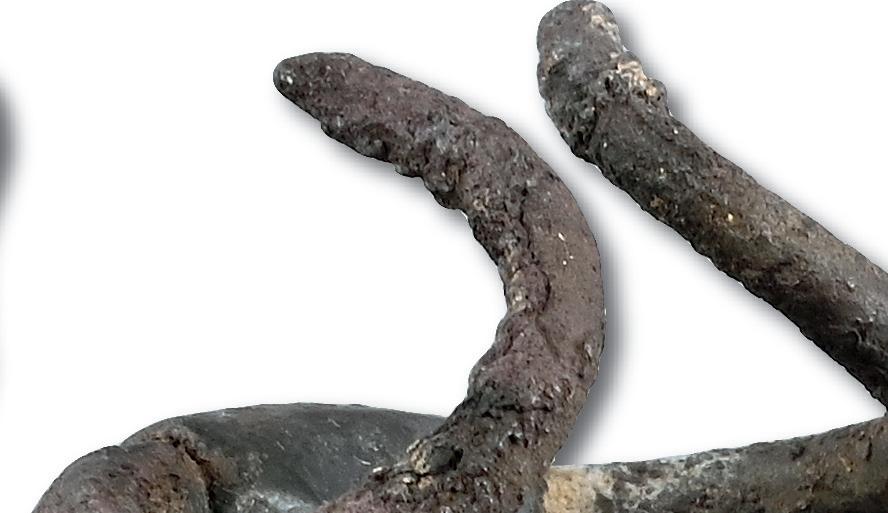
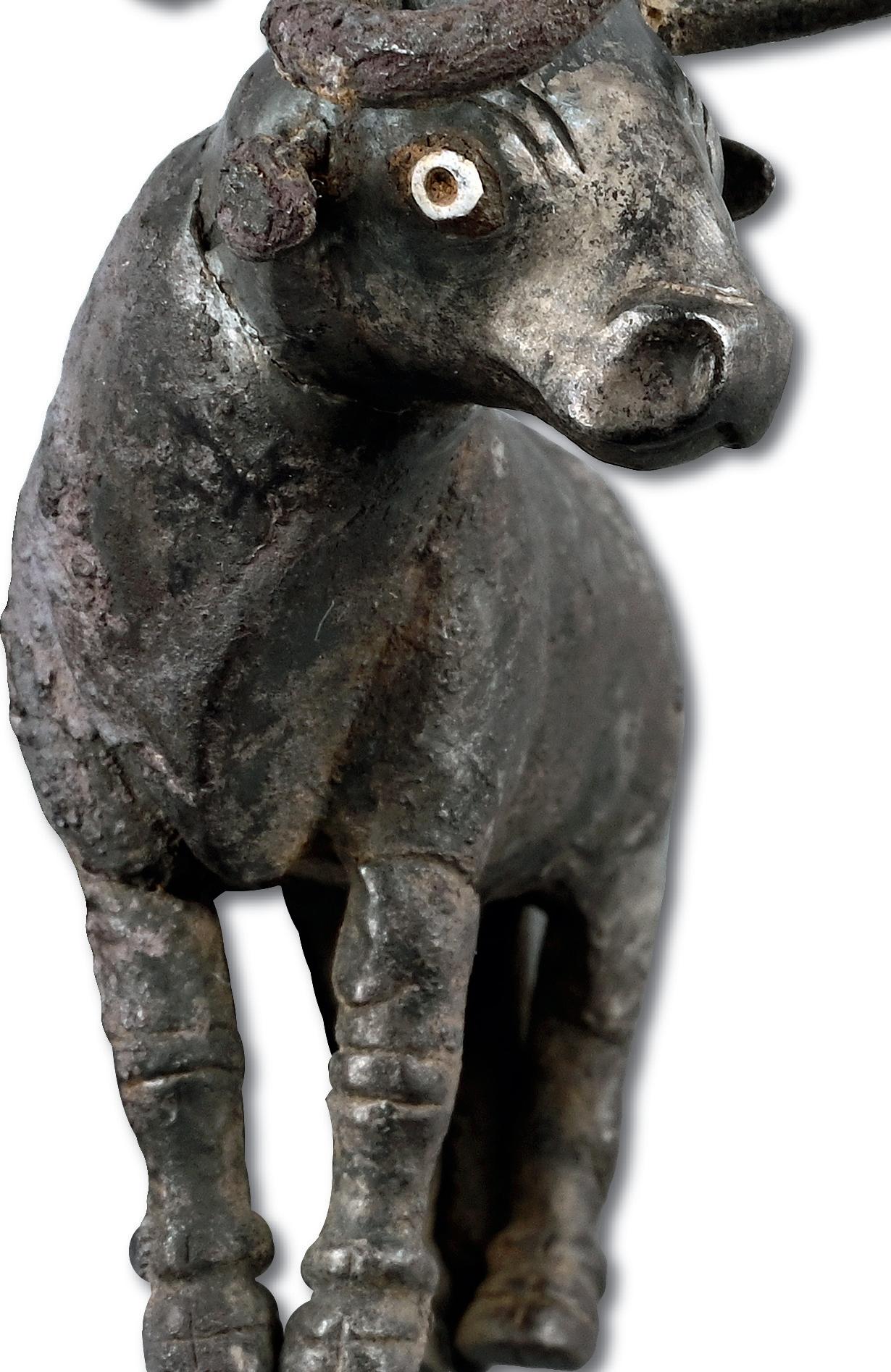

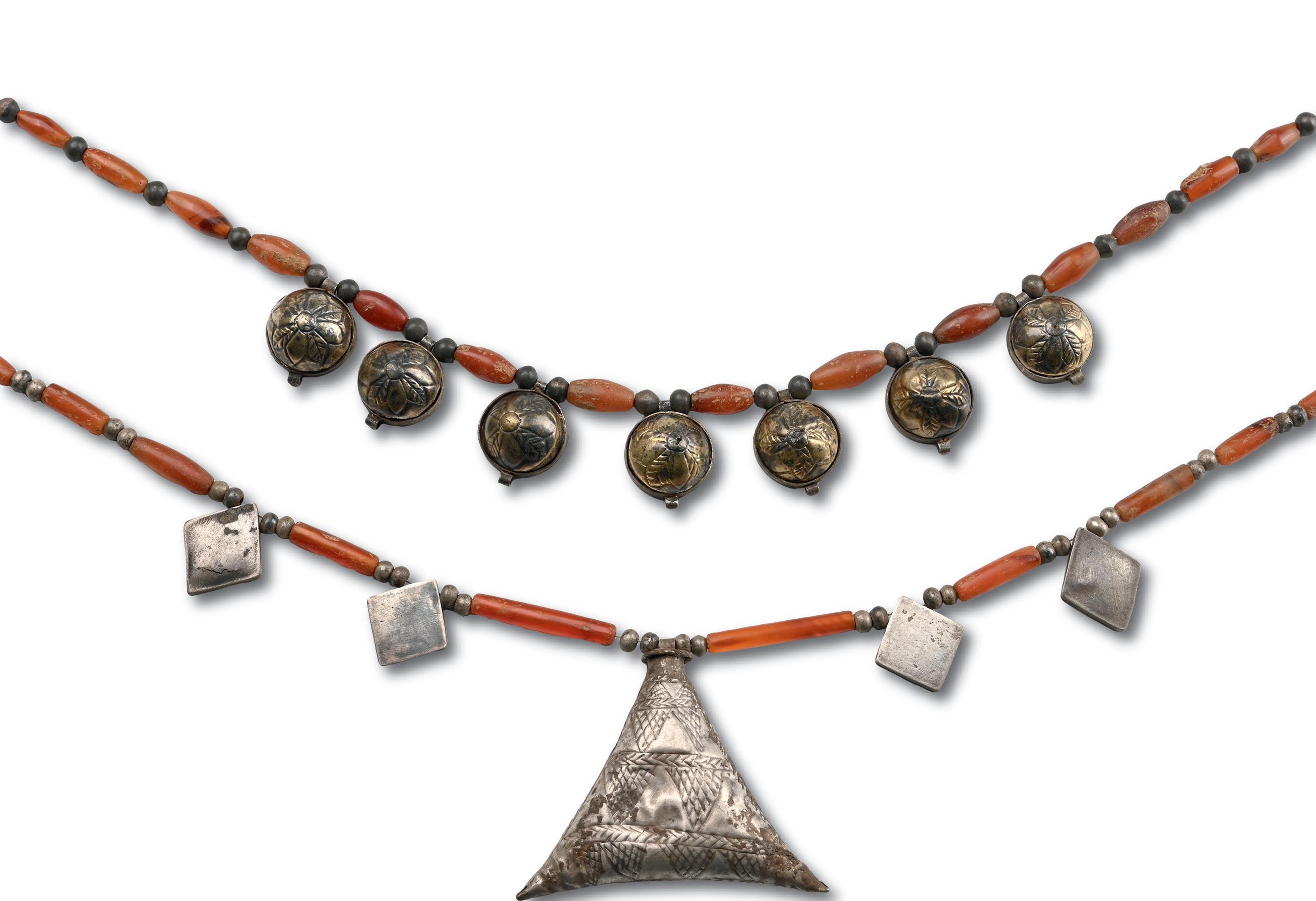

222
ELAMITE SILVER-GILT PENDANTS WITH CARNELIAN BEADS
3RD-2ND MILLENNIUM B.C.
22½ in. (54.53 grams, 57 cm)
Restrung group comprising fusiform carnelian beads, silver spacer beads, hollow-formed domed pendants with rosette detailing, second loop beneath for use on a two-tiered necklace.
£700 - 900
PROVENANCE:
Acquired before 1983.
Ex London gallery, 1990s. Private collection, London, UK.
223
ELAMITE CARNELIAN NECKLACE WITH LARGE SILVER TRIANGULAR PENDANT
3RD-2ND MILLENNIUM B.C.
18¼ in. (62.2 grams, 46.5 cm)
A restrung necklace composed of carnelian beads and biconvex silver beads, with four lozengiform silver pendants and a hollow-formed bifacial silver triangular pendant, decorated with four rows of interlocking hatched and blank triangles between bands of chevrons on one face, and central floral motif on the other, with a flanged top and suspension loop; with later clasp.
£800 - 1,000
PROVENANCE:
Acquired in the mid-1980s to early 1990s. Private collection, London, UK.
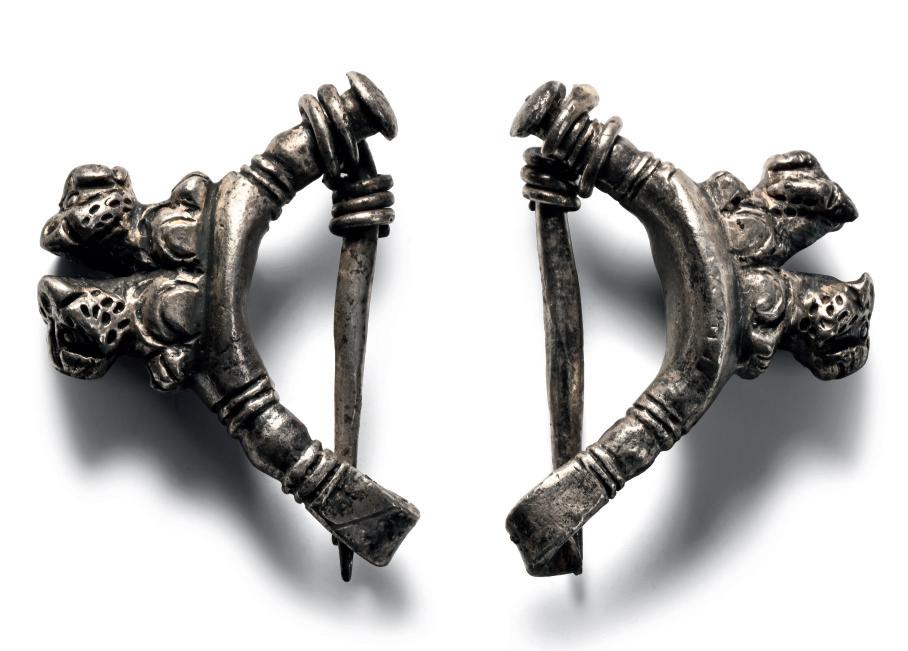
224
ACHAEMENID SILVER LION BROOCH PAIR
6TH-4TH CENTURY B.C.
1 in. (22.3 grams total, 30 mm each)
Each a bow with balustered arms ending in a knop finial and curved catchplate; round-section pin with coiled wire collar; apex of each bow with the addorsed forequarters of two felines with stylised markings and facial features. [2]
£1,500 - 2,000
PROVENANCE:
Acquired before 1983.
Ex London gallery, 1990s. Private collection, London, UK.
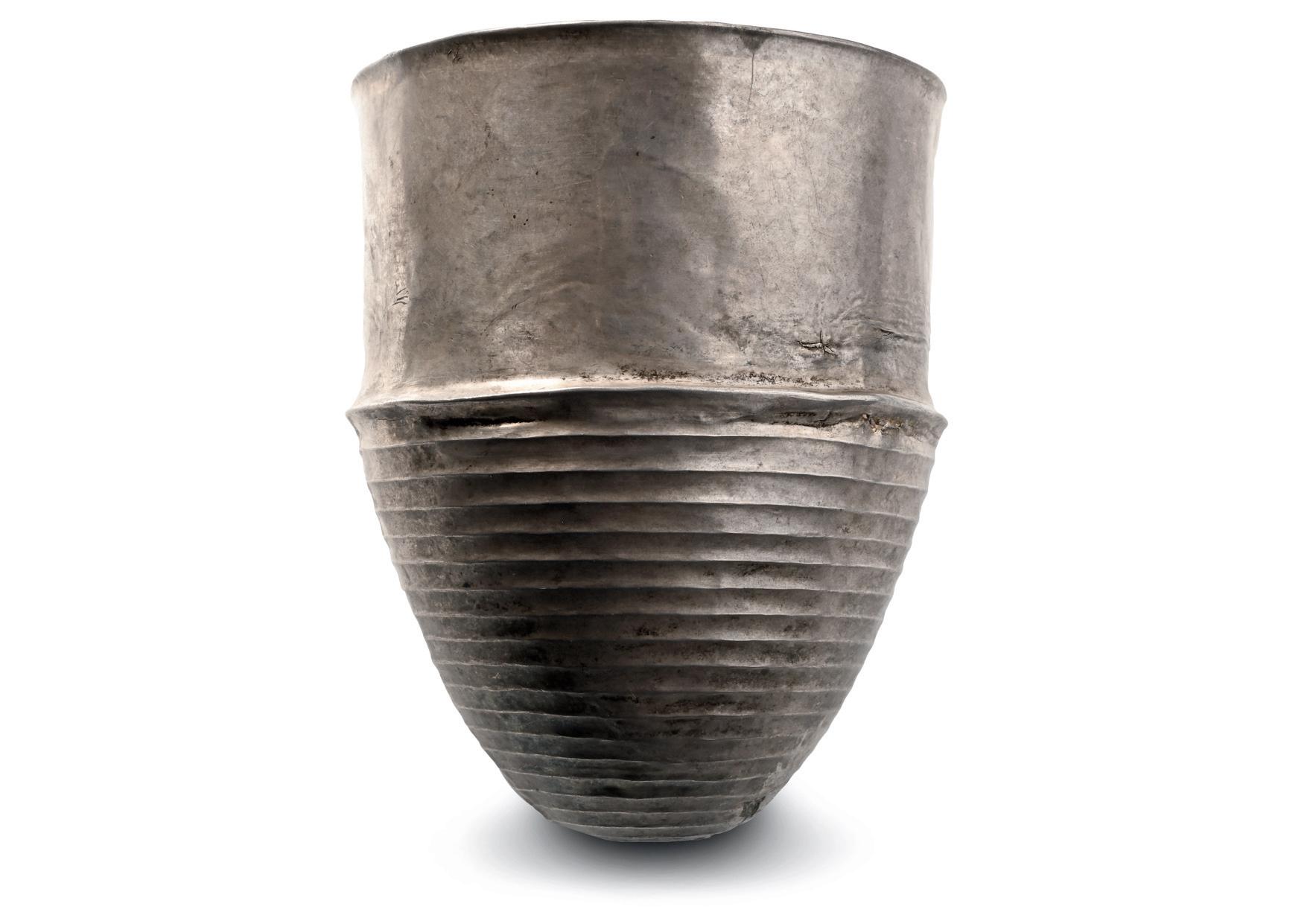
225
INDO-PARTHIAN SILVER CARINATED CUP
CIRCA LATE 1ST CENTURY B.C.-EARLY 1ST CENTURY A.D.
4 in. (95 grams, 10.4 cm)
Formed from a single sheet, the ovoid base carinated with plain upper portion, slightly flared lip to the rim.
£2,000 - 3,000
PROVENANCE:
Acquired from a private UK collection prior to 1979. Ex Julian Sherrier collection, a leading figure in Gandharan art. with Christie’s, New York, sale 2337, 14th September 2010, no.56A (part).
FOOTNOTES:
The taste for beautifully decorated cups and drinking vessels was a hallmark of the later Seleucid Empire and early Arsacid Dynasty. Various beakers and cups were used by the Parthians according to the style of the Hellenized East.
226
BACTRIAN SILVER PYXIS WITH BEASTS
3RD-2ND MILLENNIUM B.C.
1¼ in. (32.3 grams, 32 mm)
Hollow-formed and drum-shaped with rounded rim; the sidewall with low-relief motifs of beasts and vegetation; underside pierced.
£1,000 - 1,400
PROVENANCE: Acquired before 1990. Ex London gallery, 1990s. Private collection, London, UK.
227
PROTO-ELAMITE SILVER DOUBLE BIRD PENDANT
LATE 4TH-EARLY 3RD MILLENNIUM B.C.
2¾ in. (19.91 grams, 71 mm)
Plano-convex in section with gilt convex body panels each with hatched bands, addorsed bird-heads with inset eyes and suspension tube above.
£1,500 - 2,000
PROVENANCE: Acquired in the mid-1980s to early 1990s. Private collection, London, UK.

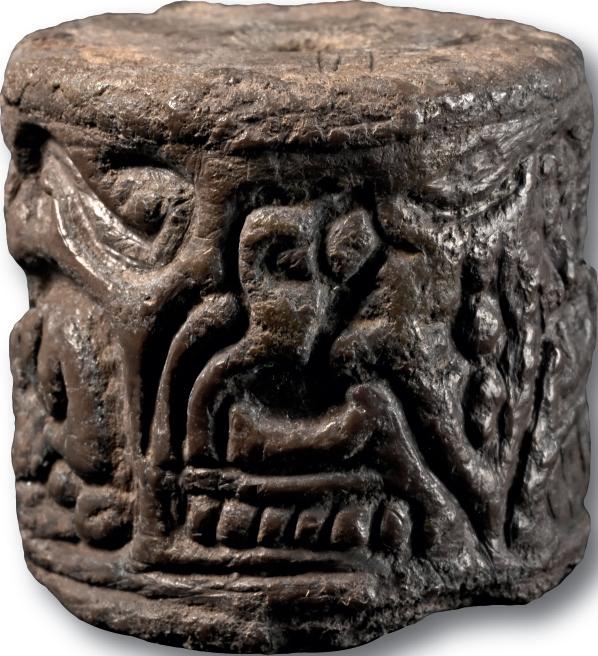

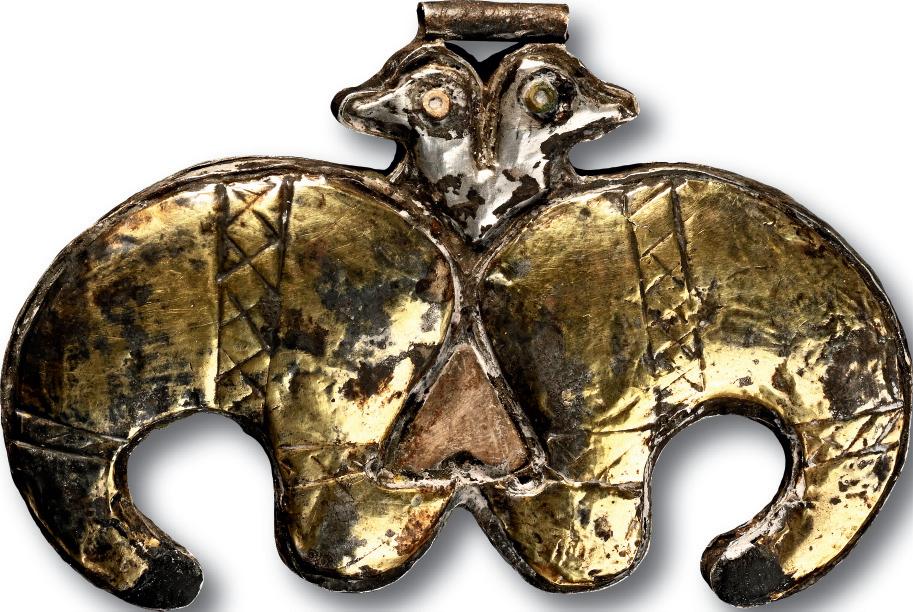
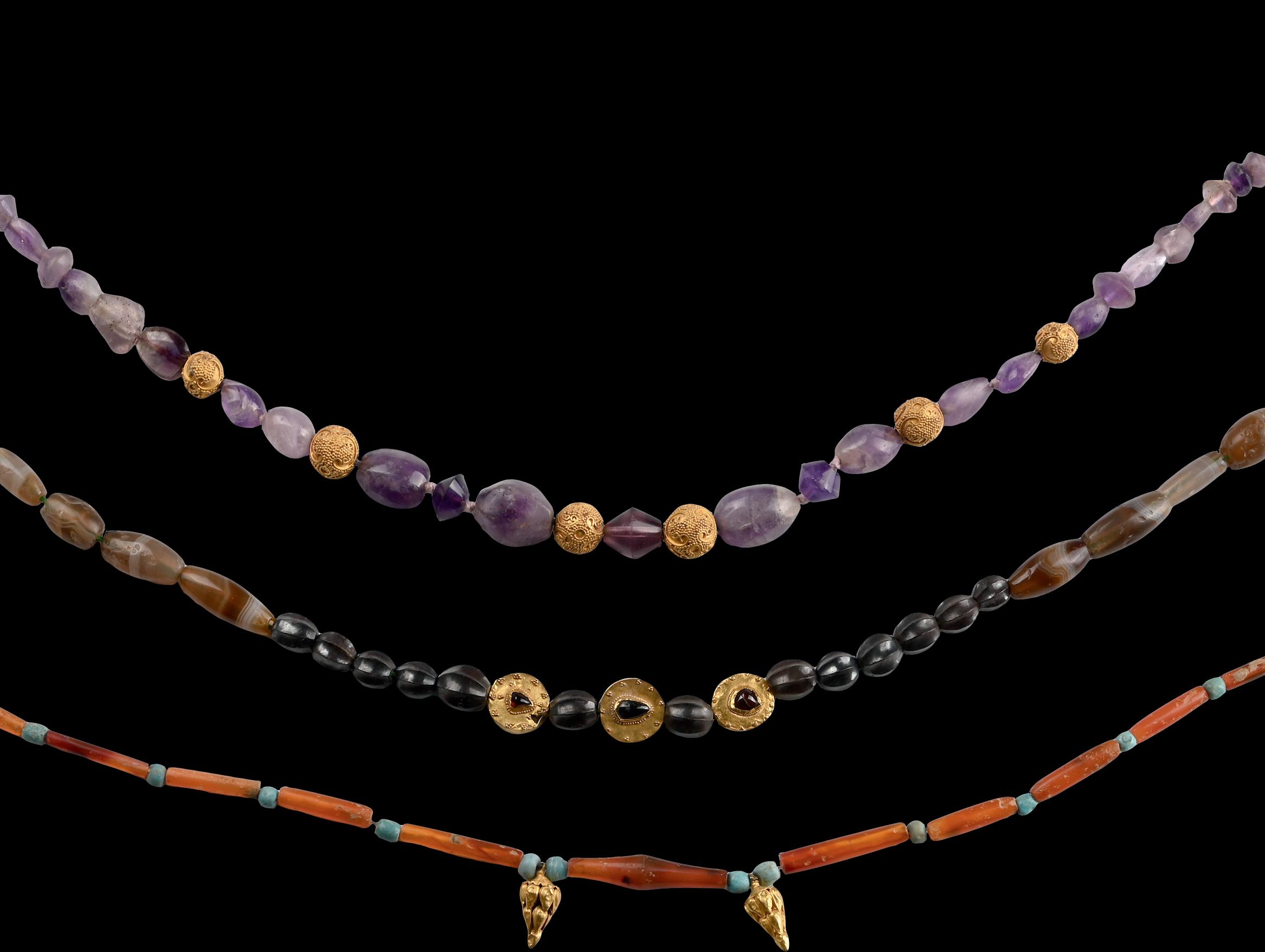
228
WESTERN ASIATIC AMETHYST BEAD NECKLACE WITH GOLD BEADS
CIRCA 4TH-2ND CENTURY B.C.
20¾ in. (69.6 grams, 52.5 cm)
A designer necklace composed of forty amethyst beads of various shapes and six gold spheres, decorated with granulation and spirals, forming opposed pelta patterns; with later openwork clasp.
£2,500 - 3,500
PROVENANCE:
Acquired on European art market, 1990s. Private collection of Mr K.A., France. with Kallos Gallery, London.
FOOTNOTES:
Amethyst was widely used in Graeco-Roman Egypt. We know that the amethyst mines of Abu Diyeiba, near Semna, were in use from the time of Ptolemy VI through to the Roman era. Pliny says that Indian amethysts were the best, but he also refers to amethysts from Egypt. The Egyptian amethysts are typically flawed and of a pale, almost pink, hue. They were seldom set in gold and were most usually made into beads. Ptolemaic and Roman inscriptions and artefacts have been found at amethyst mines in Egypt’s eastern deserts.
229 WESTERN ASIATIC NECKLACE WITH GOLD BEADS ‡ 1ST MILLENNIUM B.C. AND LATER
13 in. (46.45 grams, 34 cm)
Restrung group of fluted melon and other beads with three later hollow-formed gold drum-shaped panels, each with an inset cabochon garnet to the upper face, and granule clusters.
£3,000 - 4,000
PROVENANCE: Private collection, Jerusalem, assembled in the 1960s. with Holy Land Antiquities, Jerusalem. European private collection, acquired 2001.
230
WESTERN ASIATIC GOLD NECKLACE WITH CARNELIAN BEADS AND GOLD GRAPE PENDANTS
1ST-2ND CENTURY A.D.
23 in. (26.12 grams, 59.5 cm)
Restrung group of tubular carnelian beads and turquoise spacer beads, with biconical centrepiece and two hollow-formed gold cluster drops.
£1,000 - 1,400
PROVENANCE: Acquired before 1983. Ex London gallery, 1990s. Private collection, London, UK.
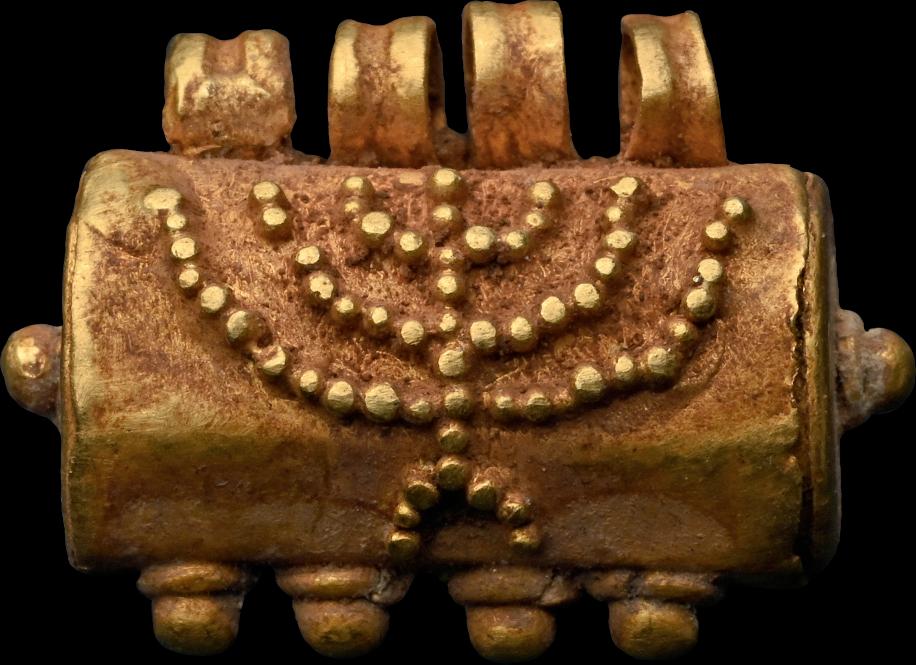
231
JUDAEAN GOLD AMULET CASE WITH MENORAH 4TH CENTURY A.D.
¾ in. (3.74 grams, 19 mm)
Hollow-formed sheet-gold pendant with suspension loops to upper edge, collared granules to lower edge and each end, granulated menorah motif to obverse.
£5,000 - 7,000
PROVENANCE:
From and important collection of a London, UK, gentleman, 1990s.
232
JUDAEAN GOLD PENDANT WITH MENORAH 3RD-4TH CENTURY A.D. in. (1.19 grams, 17 mm)
Foil disc with integral suspension loop, repoussé menorah motif in pointillé technique. [No Reserve]
£800 - 1,000
PROVENANCE: Private collection formed in Europe in the 1980s. Westminster collection, central London, UK.
233
SASANIAN GOLD PENDANT WITH THREE REGISTERS ‡ 6TH-7TH CENTURY A.D.
1¾ in. (3.47 grams, 45 mm)
Ovoid in plan with loop to the narrow end, repoussé pellets to the rim, star-and-crescent motifs, and ropework borders.
£800 - 1,000
PROVENANCE: Acquired by a Swiss family in the mid-1980s to late 1990s, thence by descent. Private collection, Switzerland, since the late 1990s.
234
WESTERN ASIATIC GOLD BREAST COVER 3RD-2ND MILLENNIUM B.C.
2 in. (7.44 grams, 49 mm)
Sheet-gold dome with repoussé concentric ring detailing, inturned rim.
£800 - 1,000
PROVENANCE: Acquired before 1983. Ex London gallery, 1990s. Private collection, London, UK.
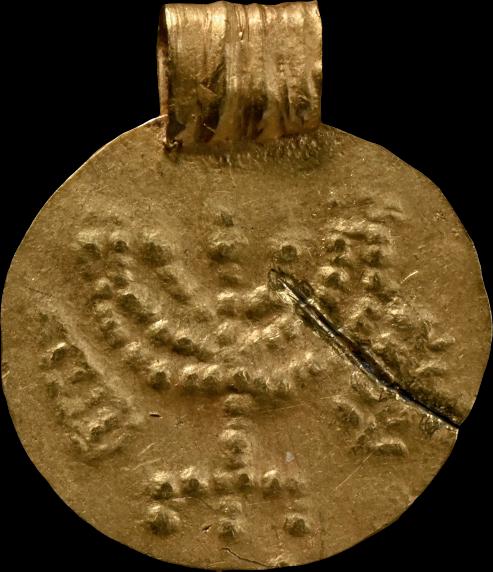
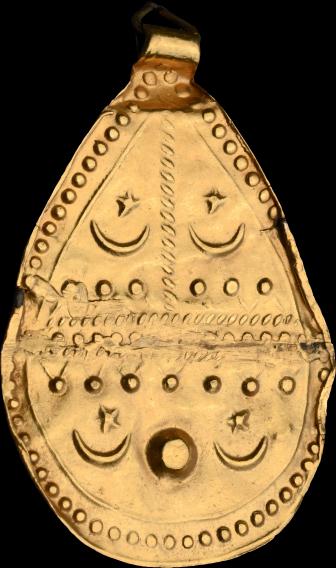
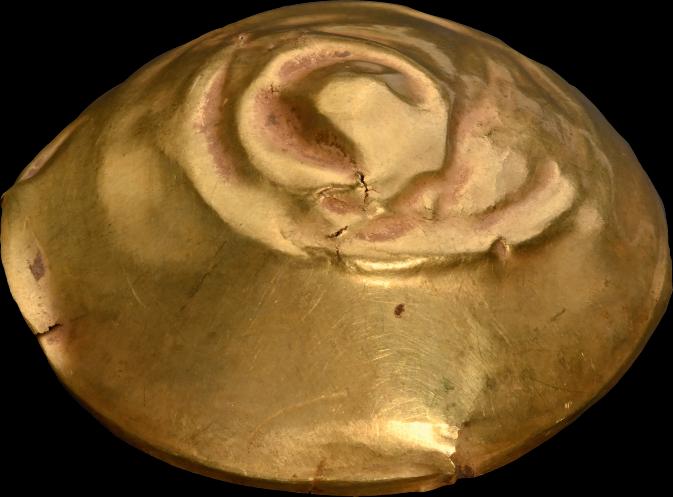
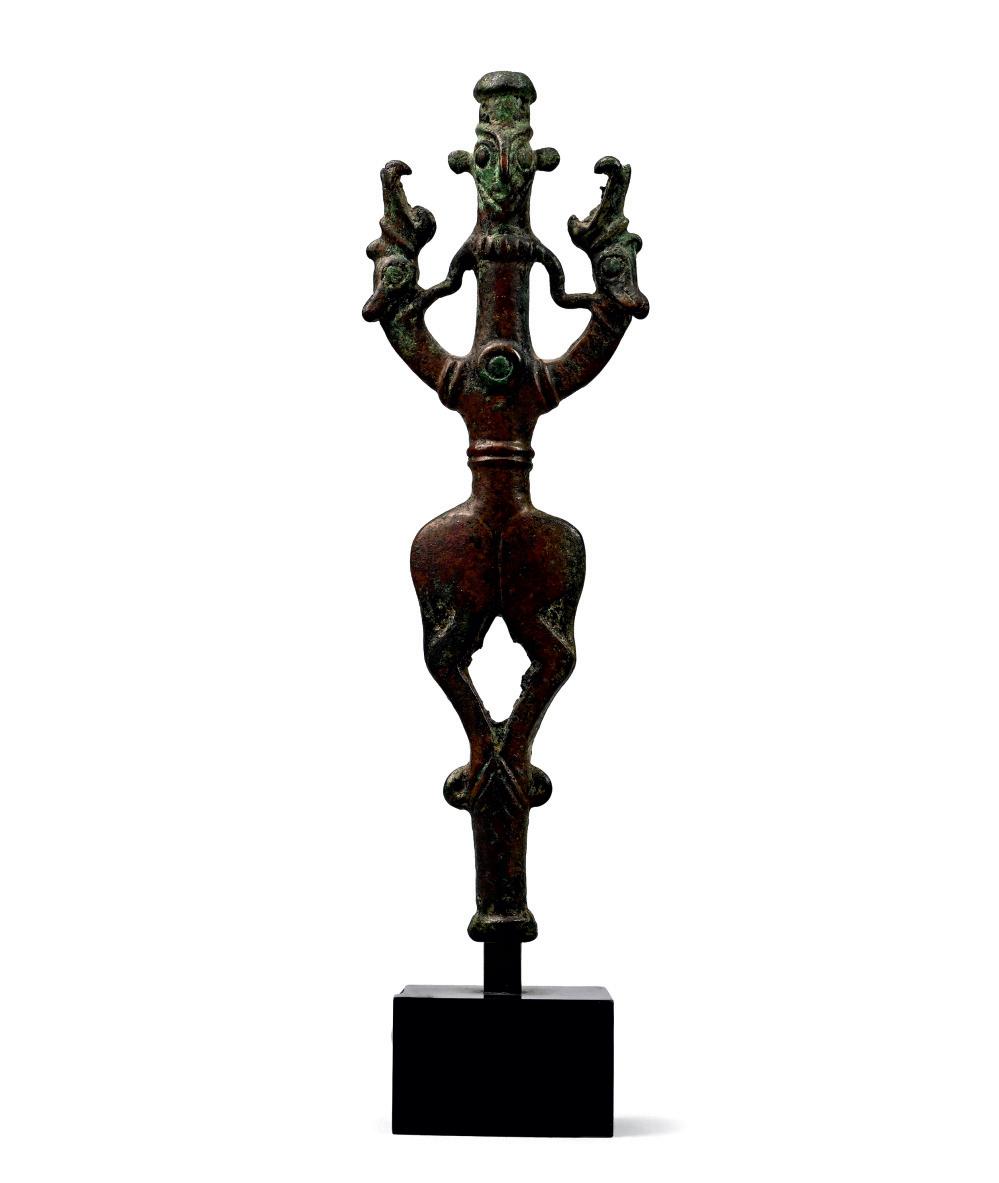

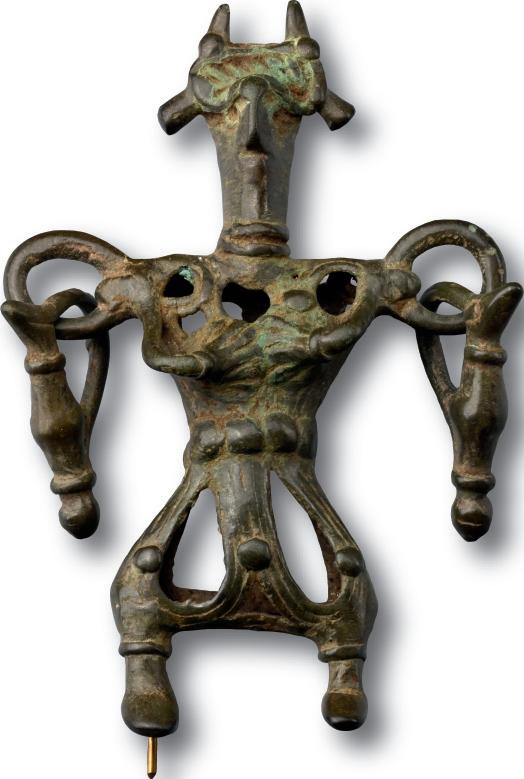

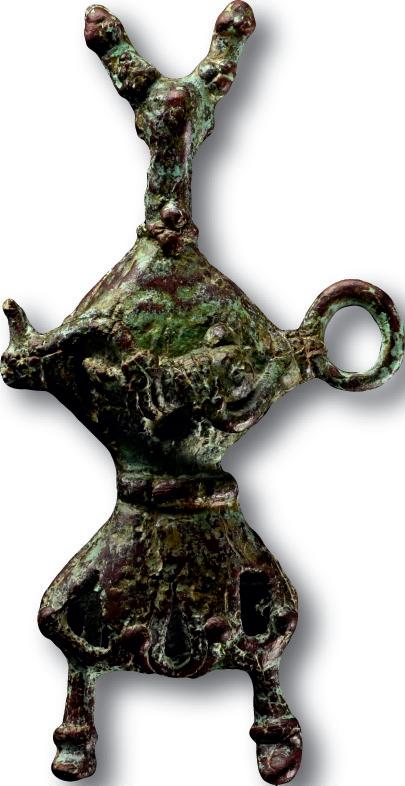
235
LURISTAN BRONZE FINIAL WITH MASTER OF ANIMALS ‡ 8TH-7TH CENTURY B.C.
7¾ in. (213 grams total, 19.7 cm including stand)
A bifacial sceptre head formed as a ‘Master of Animals’ atop a collared tubular stem, comprising two slender crescentic arms representing slender beasts with ridged backs and roaring mouths, each in the grip of the Master standing crowned between them; the Master with tubular body, animal-like ears, prominent nose above a small mouth and wearing a neck ring and domed headdress; mounted on a display stand.
£1,200 - 1,700
PROVENANCE:
Ex Captain Patrick Pakenham, Geneva, Switzerland, acquired in the 1960s1970s, thence by succession.
Private collection.
236
MARLIK BRONZE MATERNITY FIGURE ‡ 9TH-8TH CENTURY B.C.
3 in. (40 grams, 77 mm)
Openwork body with integral horned head, loops to the shoulders and breasts; separate arms mounted in the shoulder-rings, applied pellets and braid detailing.
£1,500 - 2,000
PROVENANCE:
Acquired in the 1980s.
Private collection, Switzerland, thence by descent.
Private collection, since the late 1990s.
237
AMLASH BRONZE FIGURE WITH CHILD ‡ 8TH-6TH CENTURY B.C.
4 in. (5 in.) (47 grams, 99 mm (90 grams total, 13 cm including stand))
Formed as a standing figure cradling an infant; stylised facial and anatomical detailing; openwork cage structure and remains of suspension loop to reverse; accompanied by a custom-made display stand.
£500 - 700
PROVENANCE: with Dr Amnon Rosenfeld, Jerusalem, Israel. European private collection, acquired in 2015.
238
BACTRIAN STONE COILED SNAKE AMULET ‡ 3RD-2ND MILLENNIUM B.C.
1 in. (5.68 grams, 26 mm)
Carved steatite pendant of a coiled serpent with central hole; lozenge and angled detailing to obverse.
£600 - 800
PROVENANCE: Private collection, 1999.
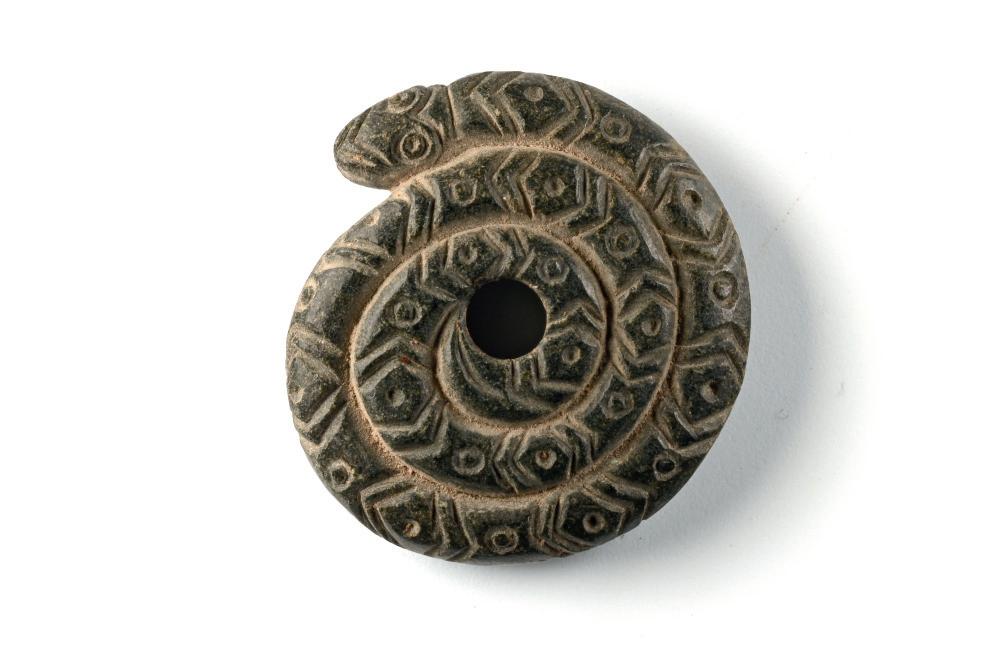
239
MESOPOTAMIAN SILVER STAMP SEAL WITH JANIFORM HEAD OF THE GOD PAZUZU
1ST MILLENNIUM B.C.
1 in. (25.80 grams, 36 mm)
Columnar in form with discoid base supporting a pair of stylised head with almond-shaped eyes, button nose, prominent elongated chin and triangular lobes; suspension loop to the top.
£3,000 - 4,000
PROVENANCE:
Ex Mayfair, London, UK, collection, 1979-1990s.
FOOTNOTES:
Pazuzu was an Assyrian and Babylonian demonic god who was represented with a canine head, scaly body, a snake-headed penis, the talons of a bird, and usually four wings. He is often regarded as an evil underworld demon, but he seems also to have played a beneficent role as a protector against pestilential winds; a bronze figure of Pazuzu in the Louvre, (accession number MNB 467) is inscribed, ‘I am Pazuzu, son of Hanpa, king of the evil spirits of the air which issues violently from mountains, causing much havoc.’ His close association with Lamashtu, a fierce demon goddess responsible for child mortality, resulted in him being used to counter her powers and send her back to the underworld. Amulets of Pazuzu were positioned in dwellings to act as protective barriers to evil powers, or were often in the form of just a head, as in this example, and were hung around the necks of pregnant women. Pazuzu is popularly known today as the demon from the 1973 film ‘The Exorcist’.
240
MESOPOTAMIAN WINGED FIGURE OF THE GOD PAZUZU
8TH CENTURY B.C.
4 in. (225 grams, 11 cm)
Modelled in the round with spread wings and snarling facial expression; ferrous mounting spike below.
£2,000 - 3,000
PROVENANCE:
UK private collection before 2000. Acquired on the UK art market. Private collection, London, UK.
241
SOUTH ARABIAN NAKED COUPLE IN EROTIC EMBRACE ‡
1ST CENTURY B.C.-1ST CENTURY A.D.
5¼ in. (380 grams total, 13.3 cm including stand)
Modelled in the round as two figures embracing, the upper figure with a pseudo inscription to the back; mounted on a custom-made stand.
£5,000 - 7,000
PROVENANCE: Formerly in the collection of Mr K. Ex collection of Mr H., acquired in Switzerland in the early 2000s. Private collection, Switzerland, acquired in 2010.
242
URARTU COPPER FIGURE OF A GODDESS ‡
8TH-7TH CENTURY B.C.
3 in. (3¾ in.) (115 grams, 76 mm (130 grams, 95 mm including stand))
Columnar in form with bulbous hairstyle descending to a tapering tail; stub arms to the sides and small right-angled feet; impressed herringbone texture to the hair; robe with hatched detailing to the collar, belt and hem, rosette and other detailing; supplied with a custom-made display stand.
£5,000 - 6,000
PROVENANCE: Private collection, Europe. Acquired in 2003.

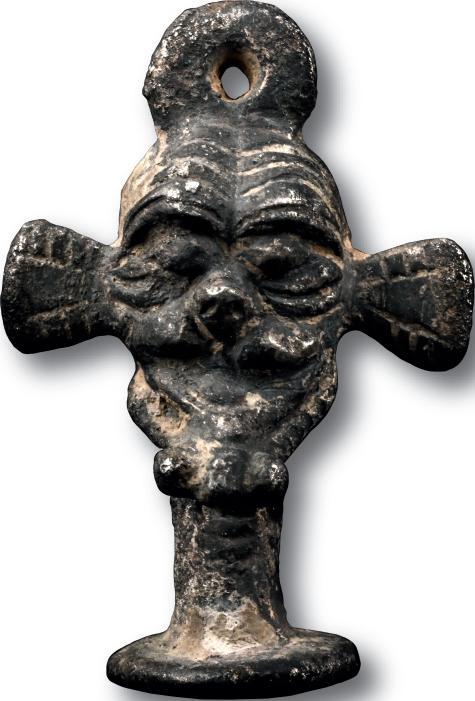

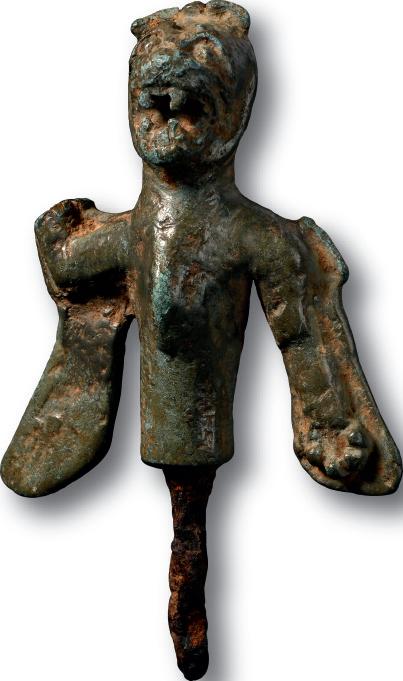

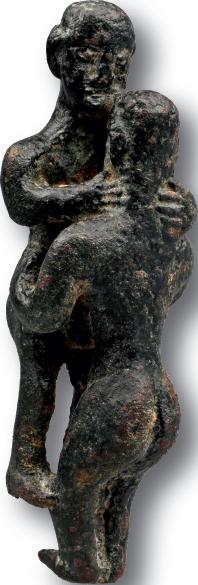
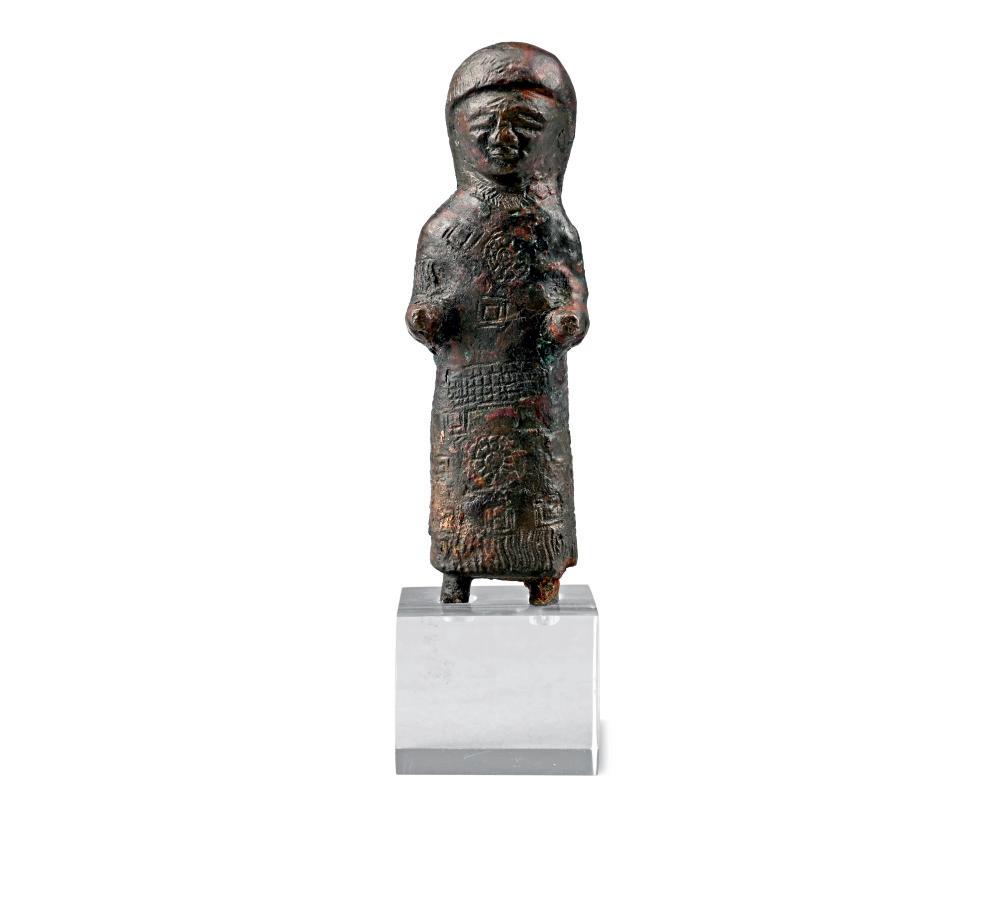

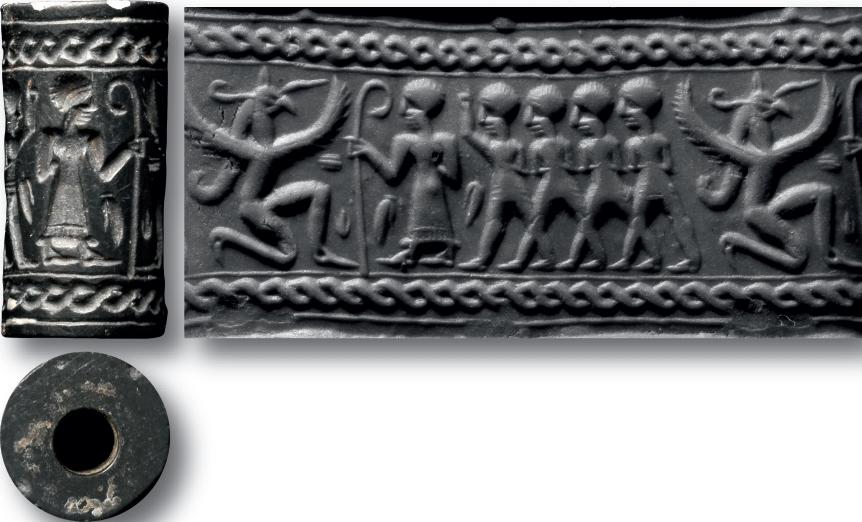

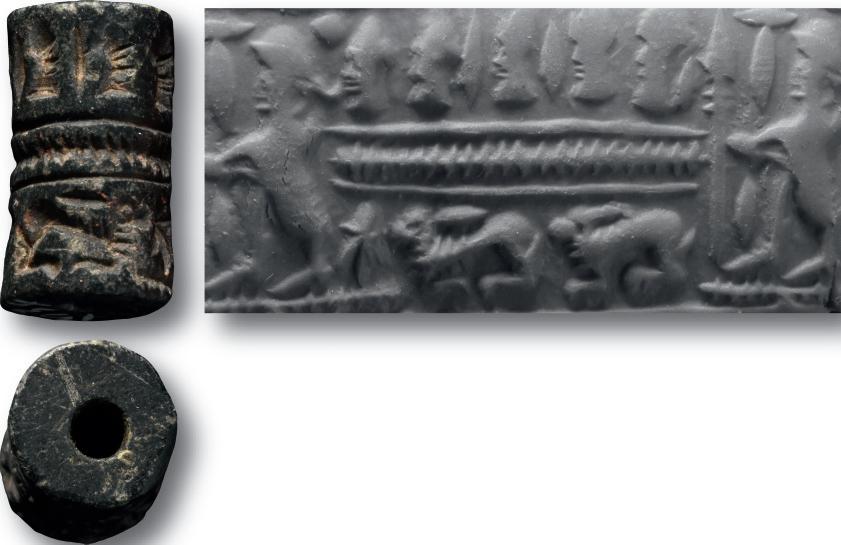
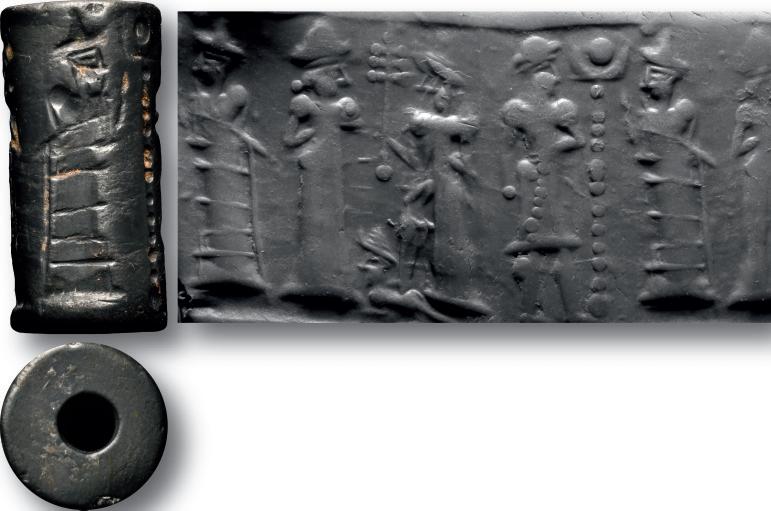


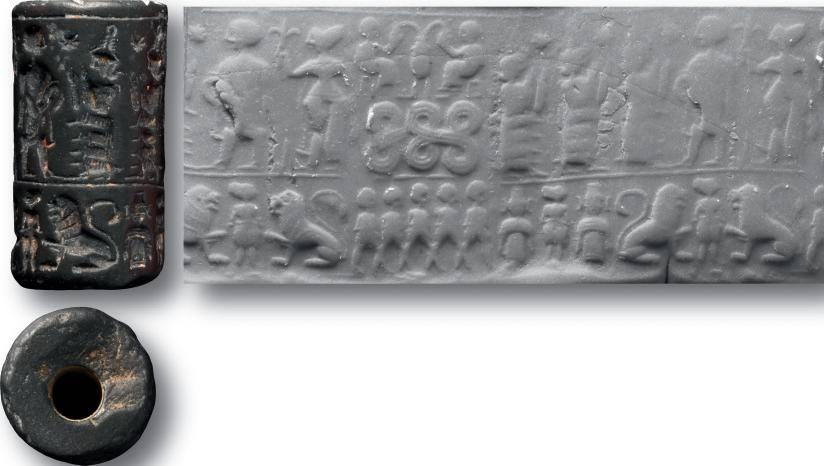
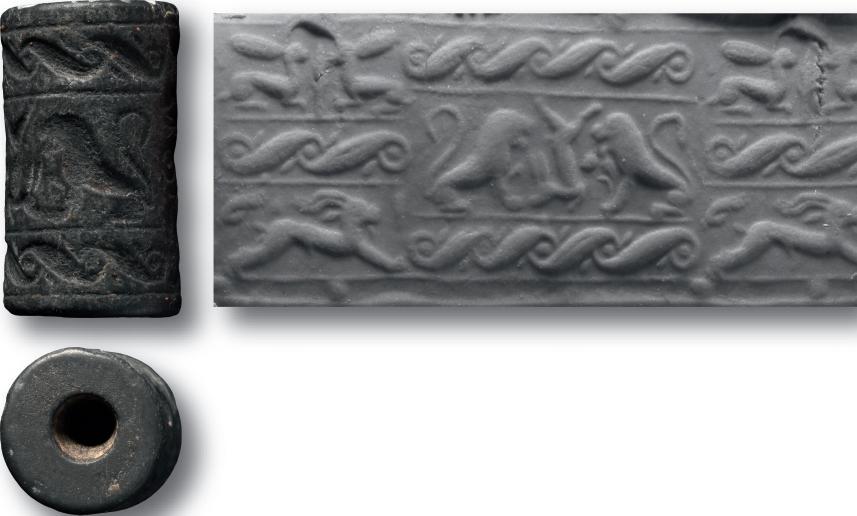
243
SYRIAN HAEMATITE CYLINDER SEAL WITH FIGURES
CIRCA 1800-1600 B.C. in. (2.93 grams, 17 mm)
With standing and kneeling figures; accompanied by a copy of an old scholarly note, typed and signed by W.G. Lambert, late Professor of Assyriology, University of Birmingham, 1970-1993; accompanied by a museum quality impression and a pair of red stone beads.
£400 - 600
PROVENANCE:
Private collection, London, UK.
244
SYRIAN BLACK STONE CYLINDER SEAL WITH HEADS AND ANIMALS
CIRCA 1900-1800 B.C.
¾ in. (5.20 grams, 21 mm)
With standing figure holding spear and two rows animals and human heads; accompanied by a copy of an old scholarly note, typed and signed by W.G. Lambert, late Professor of Assyriology, University of Birmingham, 1970-1993; accompanied by a museum quality impression and a pair of red stone beads.
£400 - 600
PROVENANCE:
Private collection, London, UK.
245
OLD BABYLONIAN HAEMATITE CYLINDER SEAL WITH LAMMA GODDESS
CIRCA 1700-1600 B.C.
1 in. (11.86 mm, 25 mm)
With four standing figures, including Lamma; accompanied by a copy of an old scholarly note, typed and signed by W.G. Lambert, late Professor of Assyriology, University of Birmingham, 1970-1993; accompanied by a museum quality impression and a pair of red stone beads.
£400 - 600
PROVENANCE:
Private collection, London, UK.
246
SYRIAN HAEMATITE CYLINDER SEAL WITH GODDESS AND DRINKING SCENE
CIRCA 1900-1700 B.C.
¾ in. (5.75 grams, 19.80 mm)
With two rows of human and animal figures, including three Lammas; accompanied by a copy of an old scholarly note, typed and signed by W.G. Lambert, late Professor of Assyriology, University of Birmingham, 1970-1993; accompanied by a museum quality impression and a pair of red stone beads.
£400 - 600
PROVENANCE: Private collection, London, UK.
247

SYRIAN HAEMATITE CYLINDER SEAL WITH ANIMALS
CIRCA 1700-1600 B.C. in. (8.98 grams, 22 mm)
With lions and horned animals between scrolls, accompanied by a copy of an old scholarly note, typed and signed by W.G. Lambert, late Professor of Assyriology, University of Birmingham, 1970-1993; accompanied by a museum quality impression and a pair of red stone beads.
£400 - 600
PROVENANCE: Private collection, London, UK.
248
MITANNI HAEMATITE CYLINDER SEAL WITH FIGURES AND ANIMALS
CIRCA 1500-1200 B.C. 1 in. (7.98 mm, 24 mm)
With beasts and male figures; accompanied by a copy of an old scholarly note, typed and signed by W.G. Lambert, late Professor of Assyriology, University of Birmingham, 1970-1993; accompanied by a museum quality impression and a pair of red stone beads.
£400 - 600
PROVENANCE: Private collection, London, UK.
249
OLD BABYLONIAN HAEMATITE CYLINDER SEAL WITH GOD AMURRU
1900-1700 B.C. (11.06 grams, 27 mm)
Showing three standing figures dressed in long robes, and two columns of cuneiform inscription; accompanied by a copy of an old scholarly note, typed and signed by W.G. Lambert, late Professor of Assyriology, University of Birmingham, 1970-1993; accompanied by a museum quality impression and a of pair of red stone beads.
£400 - 600
PROVENANCE: Private collection, London, UK.
250
MESOPOTAMIAN HAEMATITE CYLINDER SEAL WITH STANDING FIGURES
1900-1600 B.C. in. (3.30 grams, 16 mm)
Cylinder with standing figures and animals; accompanied by a copy of an old scholarly note, typed and signed by W.G. Lambert, late Professor of Assyriology, University of Birmingham, 1970-1993; accompanied by a museum quality impression.
£400 - 600
PROVENANCE: Anonymous French sale. Private collection, London, UK.
251
SYRIAN HAEMATITE CYLINDER SEAL WITH STORM GOD 2ND-1ST MILLENIUM B.C. ¾ in. (3.38 grams, 20 mm)
With three standing figures including the storm god standing on two mountains, and animals; accompanied by a copy of an old scholarly note, typed and signed by W.G. Lambert, late Professor of Assyriology, University of Birmingham, 1970-1993; accompanied by a museum quality impression and a pair of red stone beads.
£400 - 600
PROVENANCE: Anonymous French sale. Private collection, London, UK.
252
SYRIAN STONE CYLINDER SEAL WITH STORM GOD AND FERTILITY GODDESS
CIRCA 1800-1700 B.C.
¾ in. (6.58 grams, 21 mm)
With standing figures including the storm god and the goddess of fertility, and animals, accompanied by a copy of an old scholarly note, typed and signed by W.G. Lambert, late Professor of Assyriology, University of Birmingham, 1970-1993; accompanied by a museum quality impression and pair of red stone beads.
£400 - 600
PROVENANCE: Anonymous French sale. Private collection, London, UK.

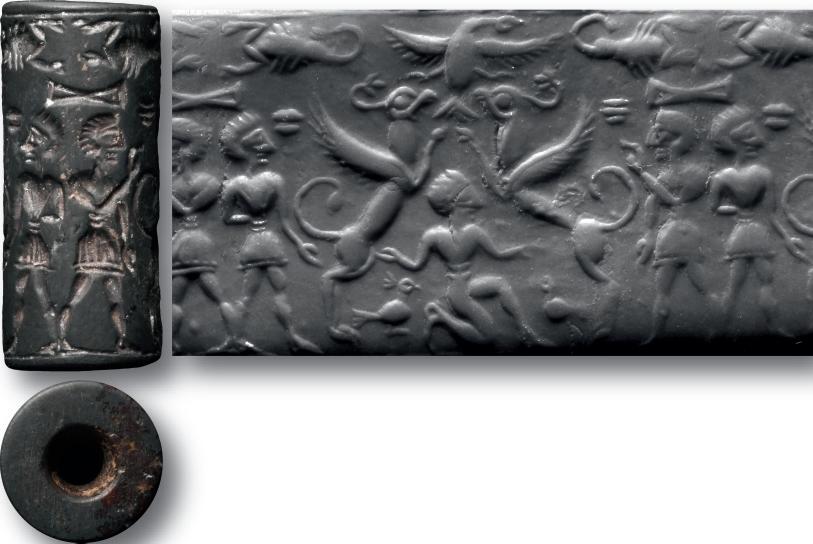

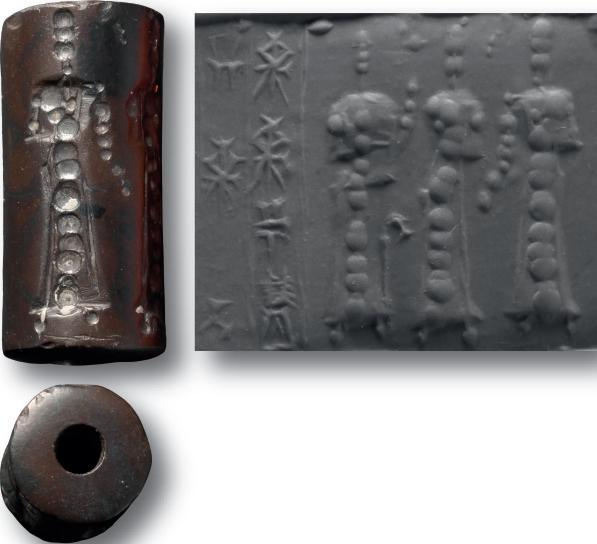
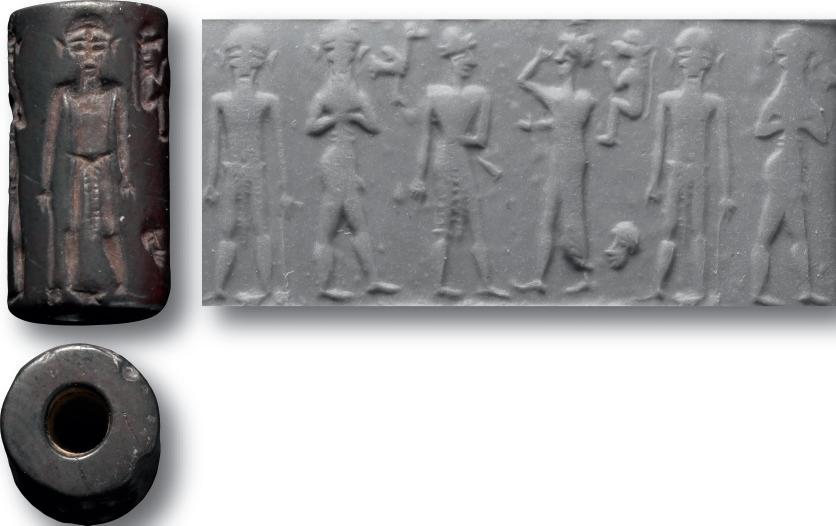

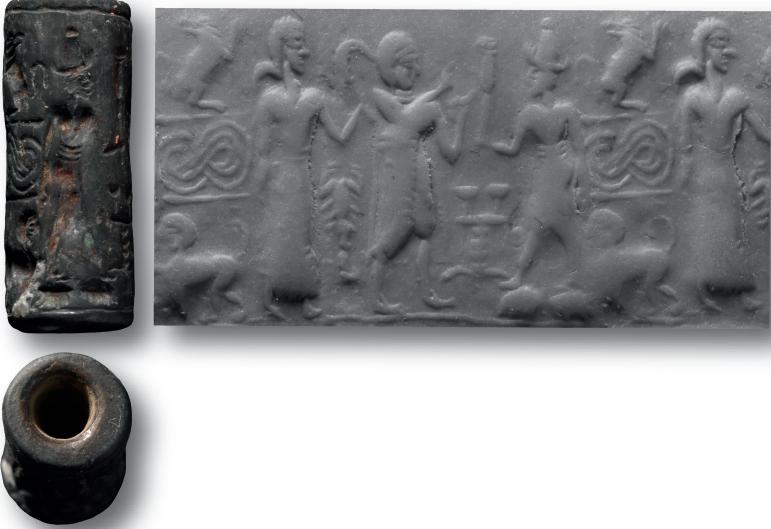

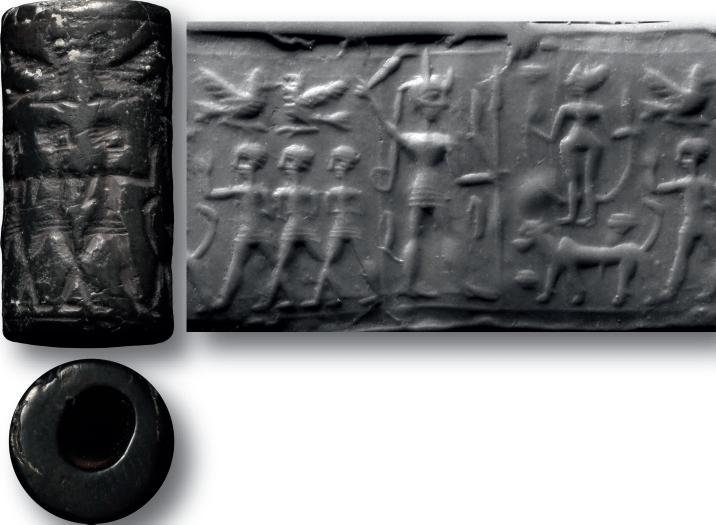

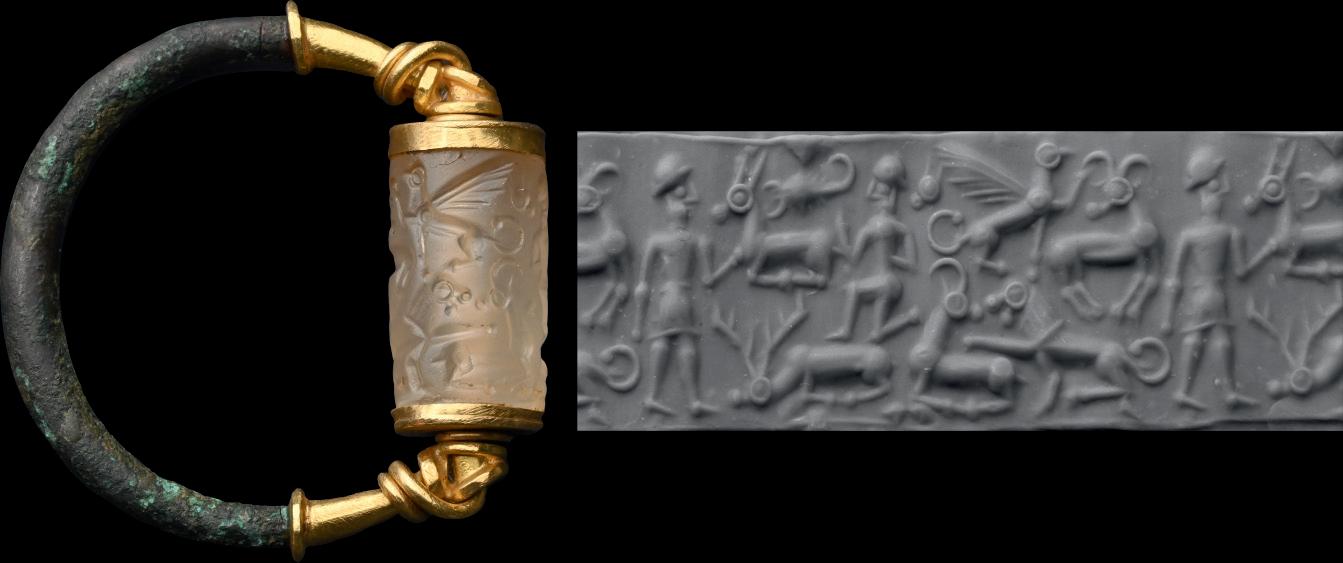
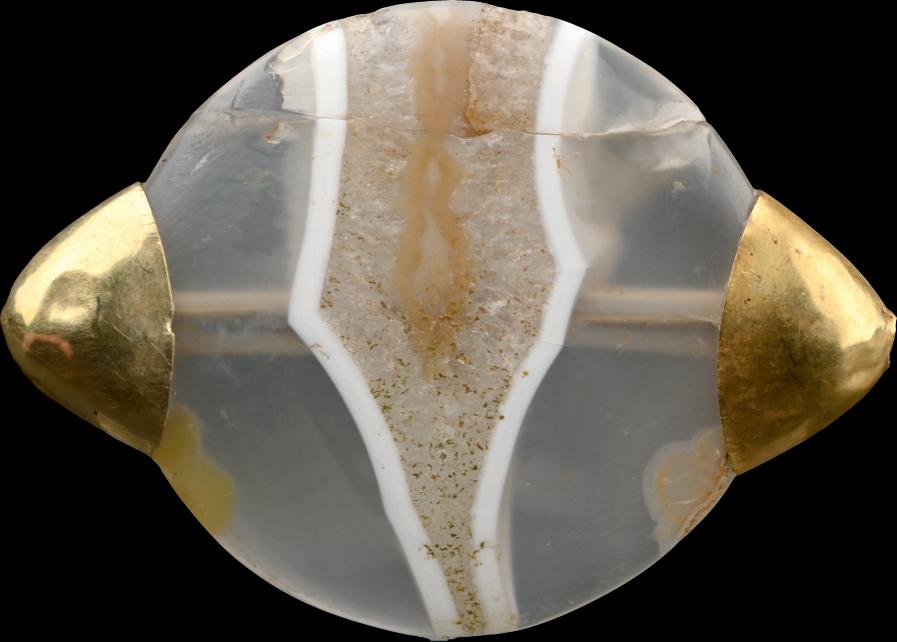
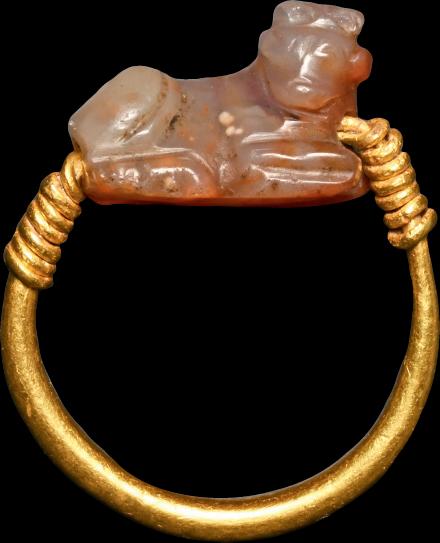
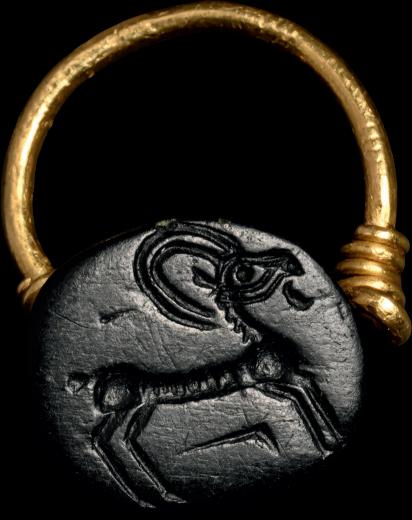
253
MITANNI CYLINDER SEAL WITH ANIMALS IN GOLD MOUNTING
CIRCA 1500-1300 B.C.
1½ in. (16.40 grams, 39.56 mm overall, 23.03 x 31.30 mm internal diameter (approximate size British Z+6, USA 15¼, Europe 36.34, Japan 34))
Chalcedony cylinder seal with ancient bronze ring depicting a deer, a sphinx, an ibex, a scorpion and two profile male figures; set into a later gold mounting.
£4,000 - 6,000
PROVENANCE:
Ex Manfred Schwarz, acquired on the German art market before 1970.
Private collection, England.
254
WESTERN ASIATIC BANDED AGATE BEAD ‡
2ND-1ST MILLENNIUM B.C.
3¼ in. (88 grams total, 84 mm wide including stand)
Discoid in plan and pierced transversely with later D-shaped gold caps to each end; mounted on a custom-made stand.
£2,500 - 3,500
PROVENANCE:
Private collection, acquired on the UK art market, 2000. Private collection, Switzerland.
255
ACHAEMENID GOLD RING WITH AGATE BULL
CIRCA 500 B.C.
1 in. (4.71 grams, 27.98 mm overall, 19.07 mm internal diameter (approximate size British N, USA 6½, Europe 13.72, Japan 13))
Comprising a round-section swivel ring set with a carved Apis bull depicted recumbent with its head turned to the right.
£5,000 - 7,000
PROVENANCE: Private collection, UK.
256
ANATOLIAN BLACK STEATITE GEMSTONE IN GOLD RING
2ND-1ST MILLENNIUM B.C.
1¼ in. (8.66 grams, 31.12 mm overall, 19.63 mm internal diameter (approximate size British Q, USA 8, Europe 17.49, Japan 16))
Discoid plano-convex stamp-seal with transverse piercing, incuse profile image of an ibex with angular motif below the flank; set into a later sympathetic gold swivel ring.
£1,000 - 1,400
PROVENANCE: with Gorny and Mosch, Munich, 12 December 2019, no.657 (Part). Private collection, England.
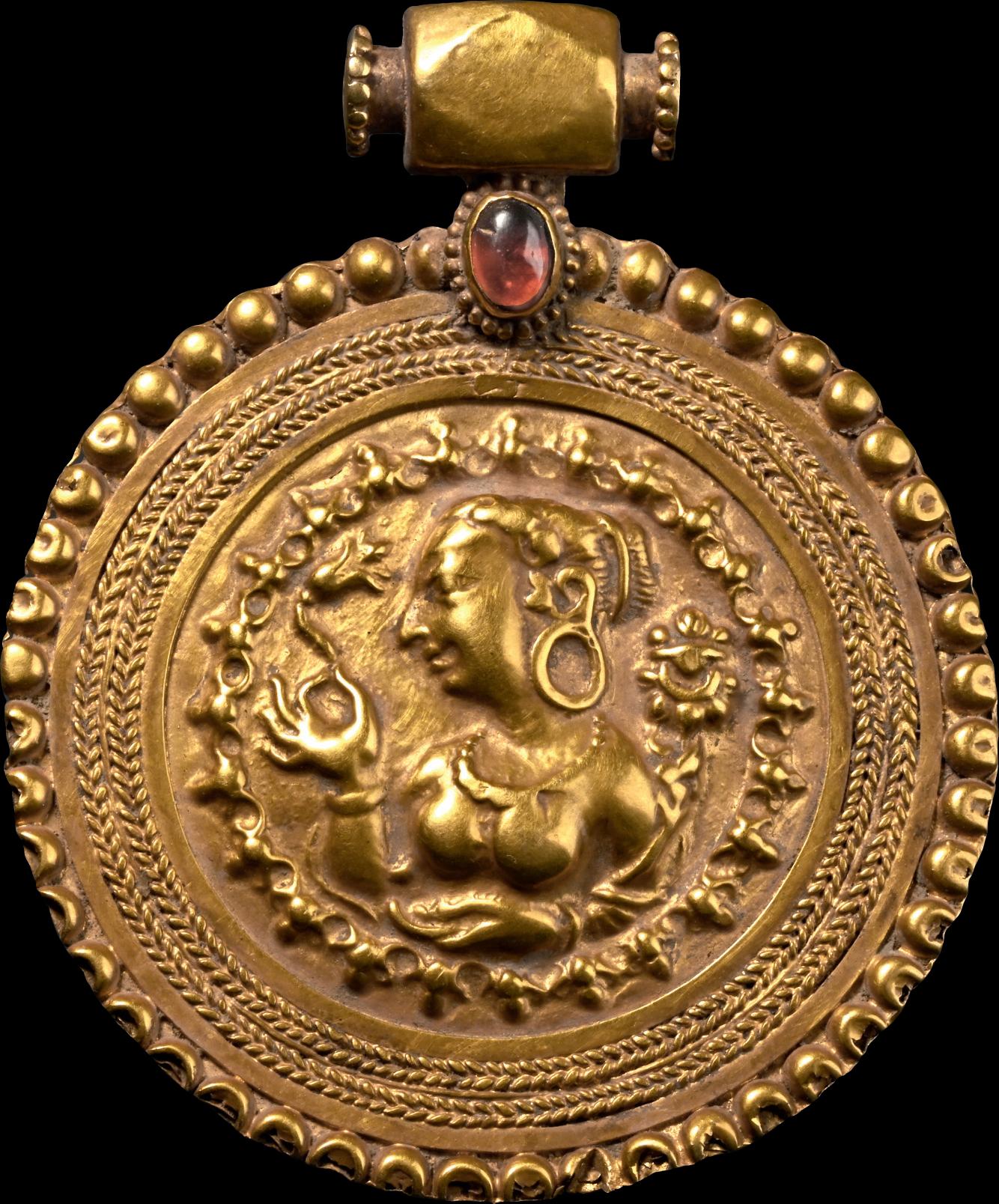
257
LARGE KUSHAN GOLD PENDANT WITH BUST OF A GODDESS ‡ CIRCA 4TH CENTURY A.D.
2¾ in. (22.11 grams, 71 mm)
A late Kushan or Hephthalites Dynasty discoid pendant with a female deity, possibly Nana, at the centre holding a lotus flower in her right hand, hair elaborately dressed and wearing large earrings, necklace and bracelets; enclosed by a border of stylised bull heads and a double-plaited border, the outer edge with raised bosses; later applied polygonal suspension loop with granulated collars and an oval garnet cabochon.
£12,000 - 17,000
PROVENANCE:
Acquired by a Swiss family in the mid-1980s to late 1990s, thence by descent. Private collection, Switzerland, since the late 1990s.
Accompanied by an academic report by Dr Raffaele D’Amato.
FOOTNOTES: Nana (Kushan Greek: , , , Sogdian Nni) was a Bactrian female deity, a variation of the pan-Asian Nana, a fusion of the SumeroBabylonian Inanna-Ishtar with a local deity, in her Kušan form with the local (Zoroastrian) Harakhvati Aredvi Sura Anahita. Such syncretism was common among Kušan deities. She was an important patron deity in the Kušan Empire and the most important deity worshipped by Emperor Kaniška (c. 127-150 A.D.).
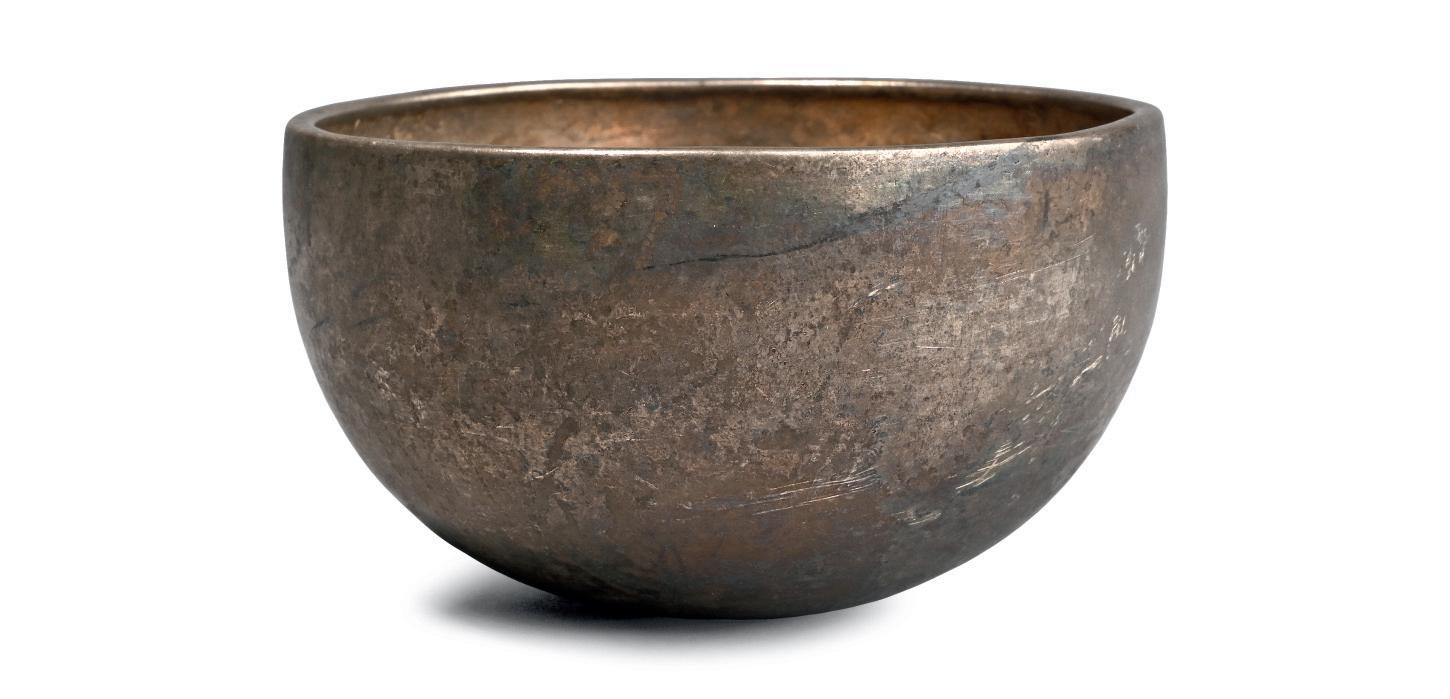
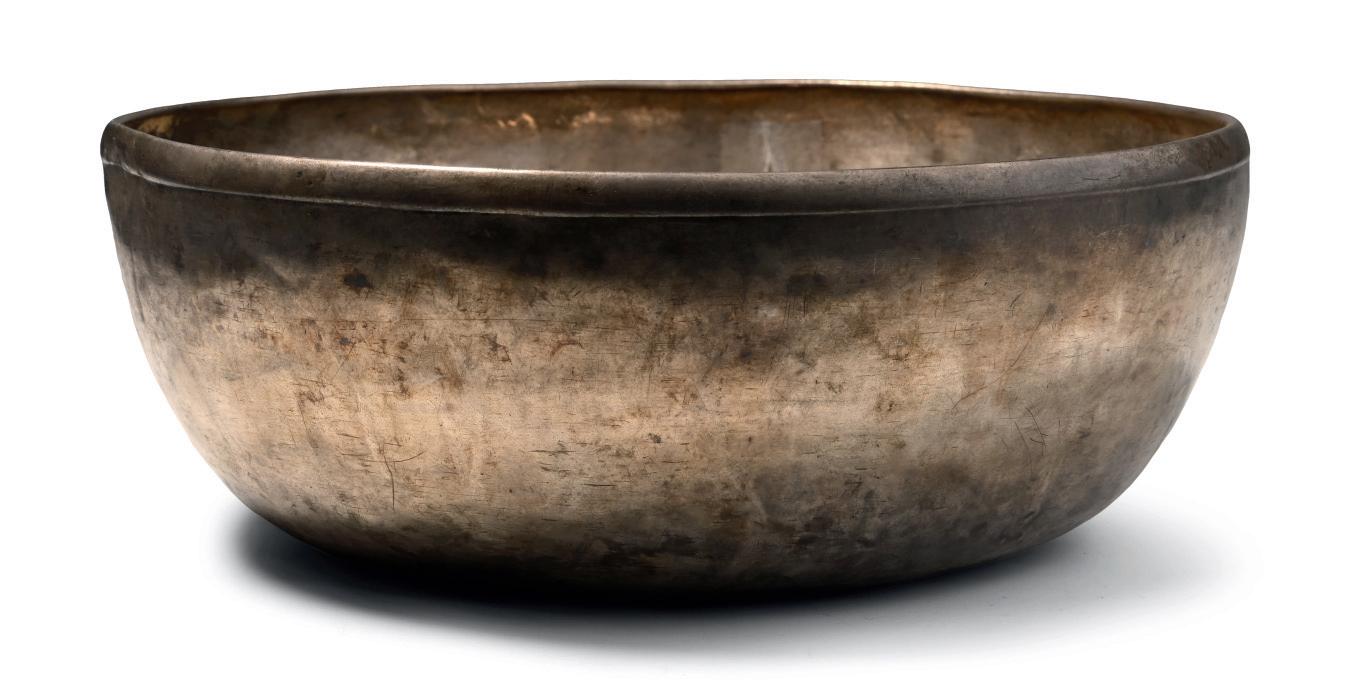
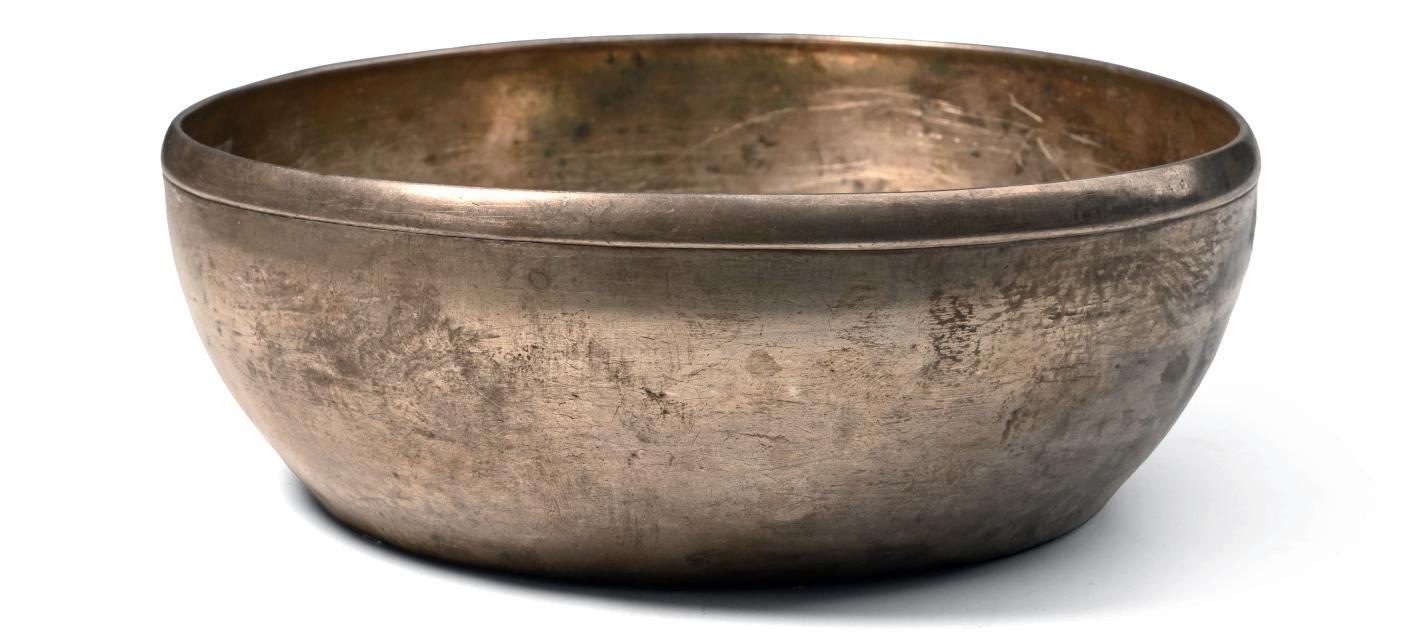
258
INDO-PARTHIAN SILVER CUP
CIRCA LATE 1ST CENTURY B.C.-EARLY 1ST CENTURY A.D.
4½ in. (232 grams, 11.4 cm)
Hemispherical in profile with rounded underside, thickened rim.
£1,200 - 1,700
PROVENANCE:
Acquired from a private UK collection prior to 1979.
Ex Julian Sherrier collection, a leading figure in Gandharan art. with Christie’s, New York, sale 2337, 14th September 2010, no.41 (part).
Accompanied by the original Christie’s lot ticket.
259
INDO-PARTHIAN SILVER BOWL
CIRCA LATE 1ST CENTURY B.C.-EARLY 1ST CENTURY A.D.
7 in. (233 grams, 18.1 cm)
Squat in profile with gently domed base, curved sidewall with carination below the rim.
£1,200 - 1,700
PROVENANCE:
Acquired from a private UK collection prior to 1979.
Ex Julian Sherrier collection, a leading figure in Gandharan art. with Christie’s, New York, sale 2337, 14th September 2010, no.51 (part).
260
INDO-PARTHIAN SILVER FLAT-BOTTOM BOWL
CIRCA LATE 1ST CENTURY B.C.-EARLY 1ST CENTURY A.D.
6¾ in. (244 grams, 17 cm)
Squat in profile with a gently domed base, curved sidewall with carination below the rim.
£1,200 - 1,700
PROVENANCE:
Acquired from a private UK collection prior to 1979.
Ex Julian Sherrier collection, a leading figure in Gandharan art. with Christie’s, New York, sale 2337, 14th September 2010, no.51 (part).
261
MESOPOTAMIAN STEATITE BOWL WITH ANIMALS AND PALM TREES ‡ 3RD MILLENNIUM B.C.
9 in. (5.3 kg, 24.5 cm wide)
Drum-shaped steatite vessel with broad flat rim; low-relief frieze to the outer face: dense vegetation panels with hatched treetrunks and fronds, resting quadrupeds, each with the legs folded beneath the body.
£12,000 - 17,000
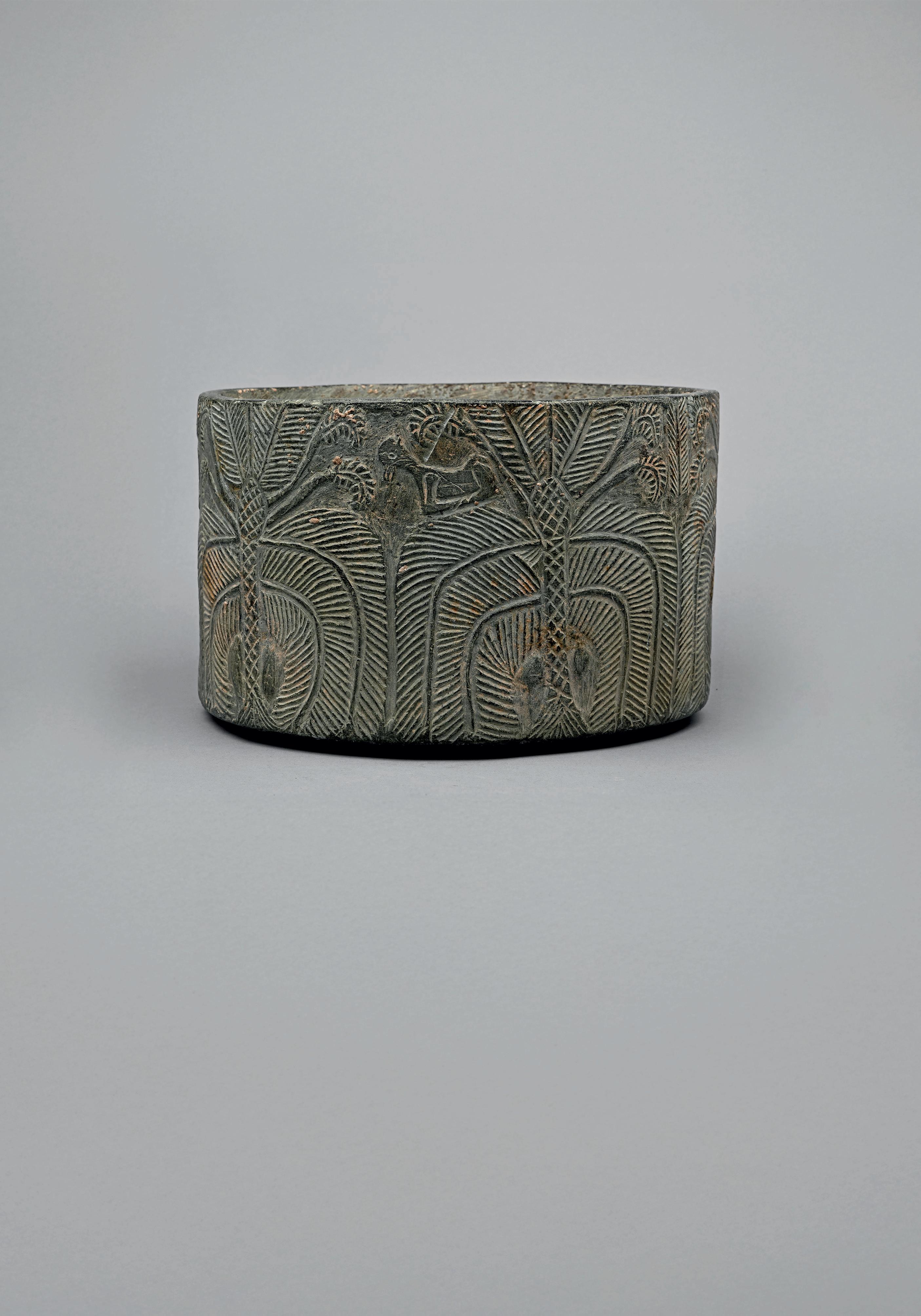
PROVENANCE: Acquired by a Swiss family in the mid-1980s to late 1990s, thence by descent. Private collection, Switzerland, since the late 1990s.
Accompanied by an academic report by Dr Raffaele D’Amato.
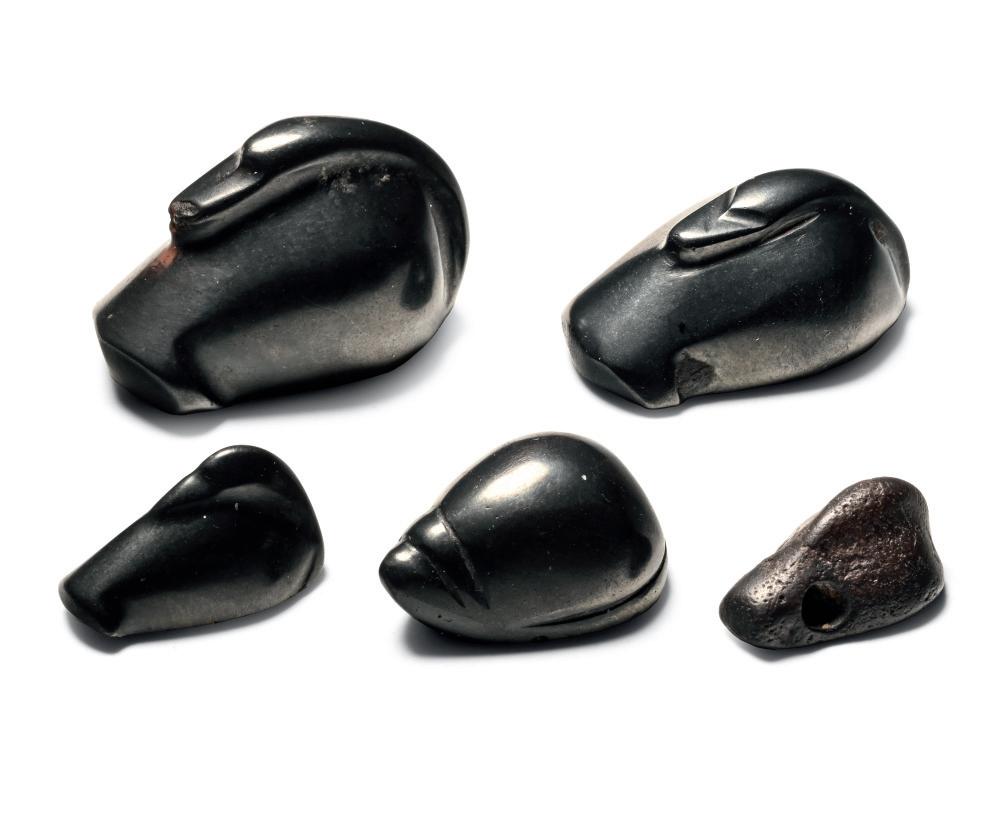
263
NEO-BABYLONIAN AGATE DUCK WEIGHT COLLECTION ‡
CIRCA 700-600 B.C.
- in. (6.67 grams total, 17-22 mm)
Each carved in the round as a duck with its head laid back along its spine. [2]
£800 - 1,000
PROVENANCE:
Private collection, Israel. with Holy Land House of Antiquities, Jerusalem, 1990s. Private European collection, acquired from the above in 2001.

265
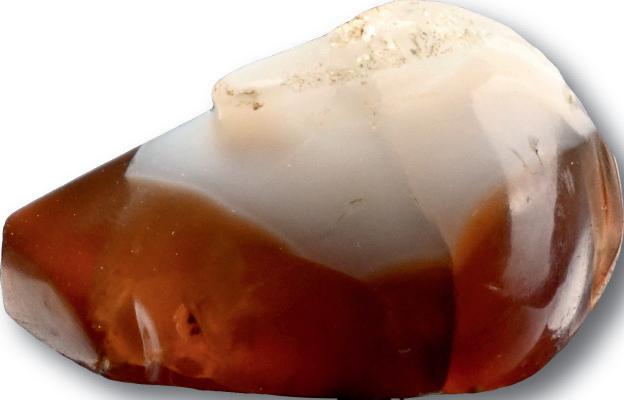
HITTITE HAEMATITE STAMP SEAL WITH ANIMALS
17TH–16TH CENTURY B.C.
1 in. (22 grams, 24 mm)
Finely carved with a tubular loop, discoid plaque to the underside with an incuse image of horned animals hunted by lions.
£1,000 - 1,400
PROVENANCE:
From a pre-1992 collection, Geneva and London.
262
NEO-BABYLONIAN HAEMATITE DUCK WEIGHT COLLECTION
CIRCA 700-600 B.C.
½ - in. (24.61 grams total, 14-22 mm)
A set graduating in size, each modelled in the round and polished. [5]
£1,000 - 1,400
PROVENANCE:
Gorny and Mosch, Munich, 12 December 2006, no.209 (Part). Private collection, England.
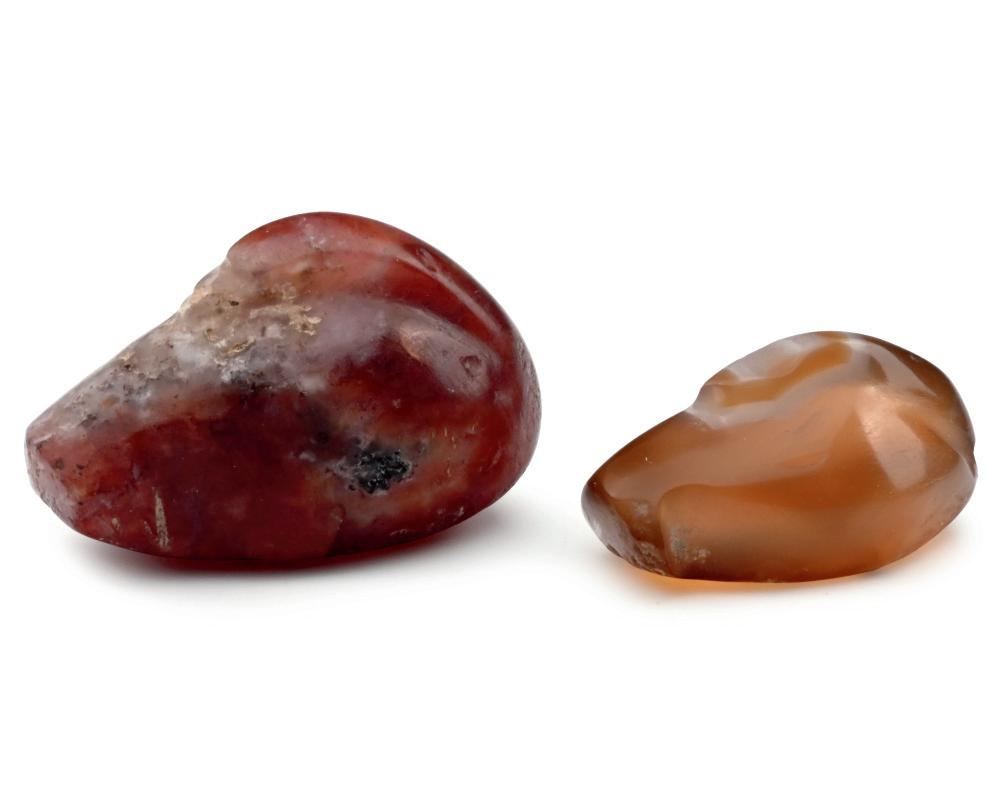
264
NEO-BABYLONIAN AGATE DUCK WEIGHT ‡
CIRCA 700-600 B.C.
1 in. (4.76 grams, 23 mm)
Carved in banded agate so that the head and upper back are in opaque white stone, the rest in translucent orange-tan stone.
£500 - 700
PROVENANCE: Acquired in 1996.
Private collection, Switzerland, thence by descent. Private collection, since the late 1990s.

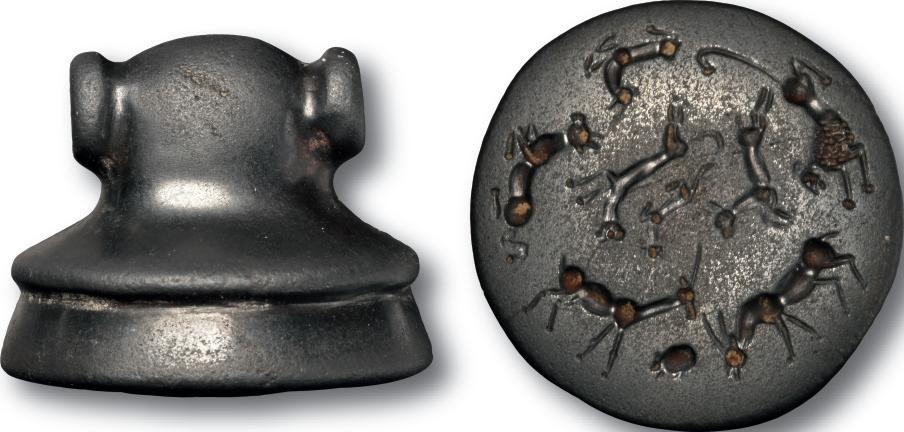
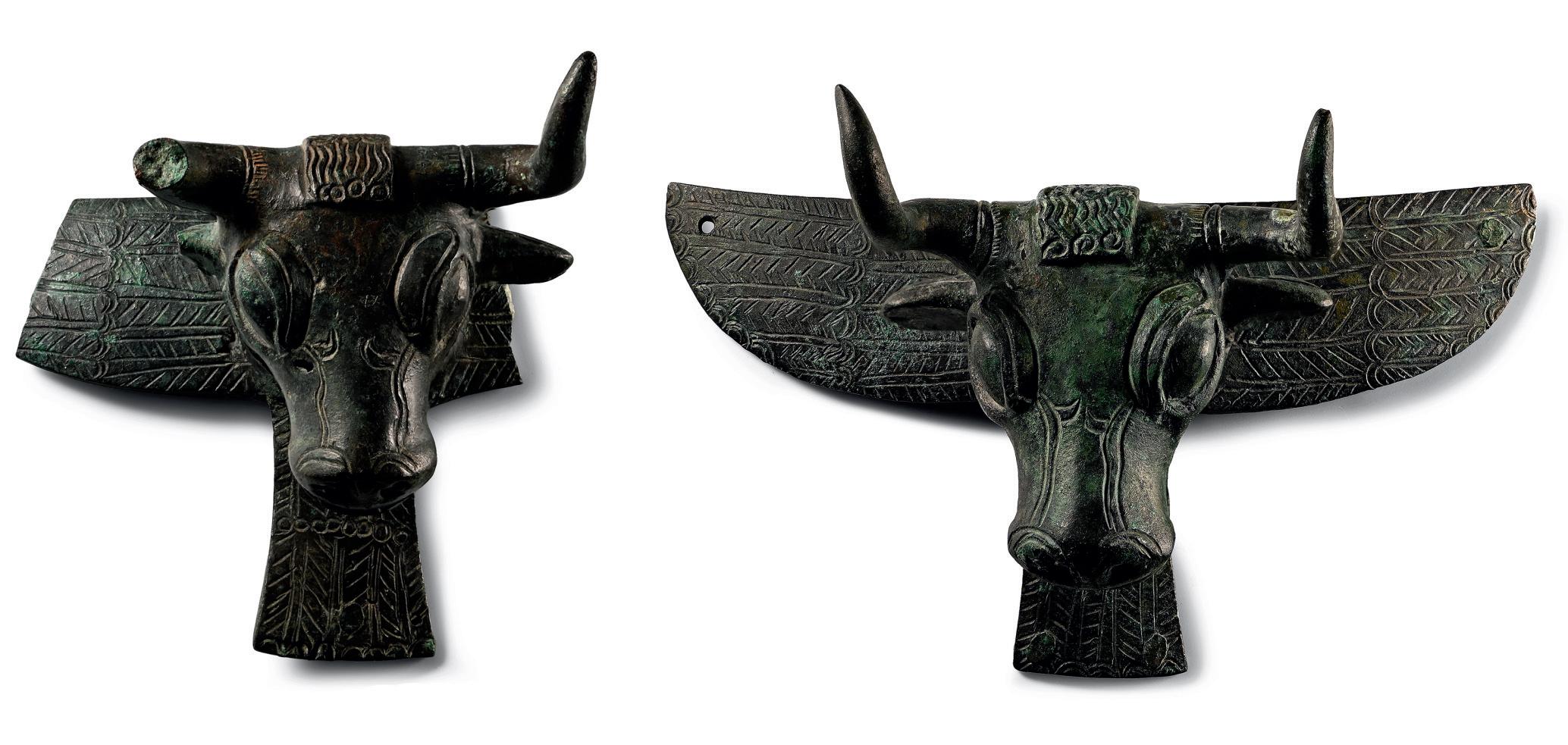
266
URARTU BULL-HEADED BRONZE CAULDRON APPLIQUE PAIR ‡
8TH CENTURY B.C.
3 - 5 in. (790 grams total, 8-13 cm wide)
Matched pair of bovine-head mounts, each formed as a pair of Dshaped wings and a tail with low-relief feather detailing and holes to accept rivets; central head and neck of a bull with prominent horns, bands of curly hair to the pate and throat, large scaphoid eyes, incised contour detailing to muzzle, socket to reverse. [2]
£15,000 - 20,000
PROVENANCE:
From the warehouse of Lane Hope Ltd, London, UK, 1980s (company dissolved December 1991).
Private collection, UK; anonymous sale, Gorny & Mosch, Munich, Auction 206, 20 June 2012, no.85.
European private collection, acquired at Gorny & Mosch, 2012.
267
ELAMITE BRONZE SPOUTED VESSEL WITH FLORAL DESIGN
2ND-1ST MILLENNIUM B.C.
6¼ in. (349 grams, 16 cm)
With a hollow-formed biconvex body, tiered rim and short straight spout, repoussé octofoil motifs to the shoulder, trumpet-shaped stepped base.
£1,800 - 2,400
PROVENANCE: Acquired before 1983. Ex London gallery, 1990s. Private collection, London.
Accompanied by an academic report by Dr Raffaele D’Amato.
268
ELAMITE BRONZE SPOUTED VESSEL WITH DECORATIVE DESIGN
3RD-2ND MILLENNIUM B.C.
5 in. (218 grams, 13 cm)
With hollow-formed bulbous body, a tiered rim and spout, diagonal fluting to the body, and a trumpet-shaped stepped base.
£1,500 - 2,000
PROVENANCE:
Acquired before 1983. Ex London gallery, 1990s. Private collection, London, UK.
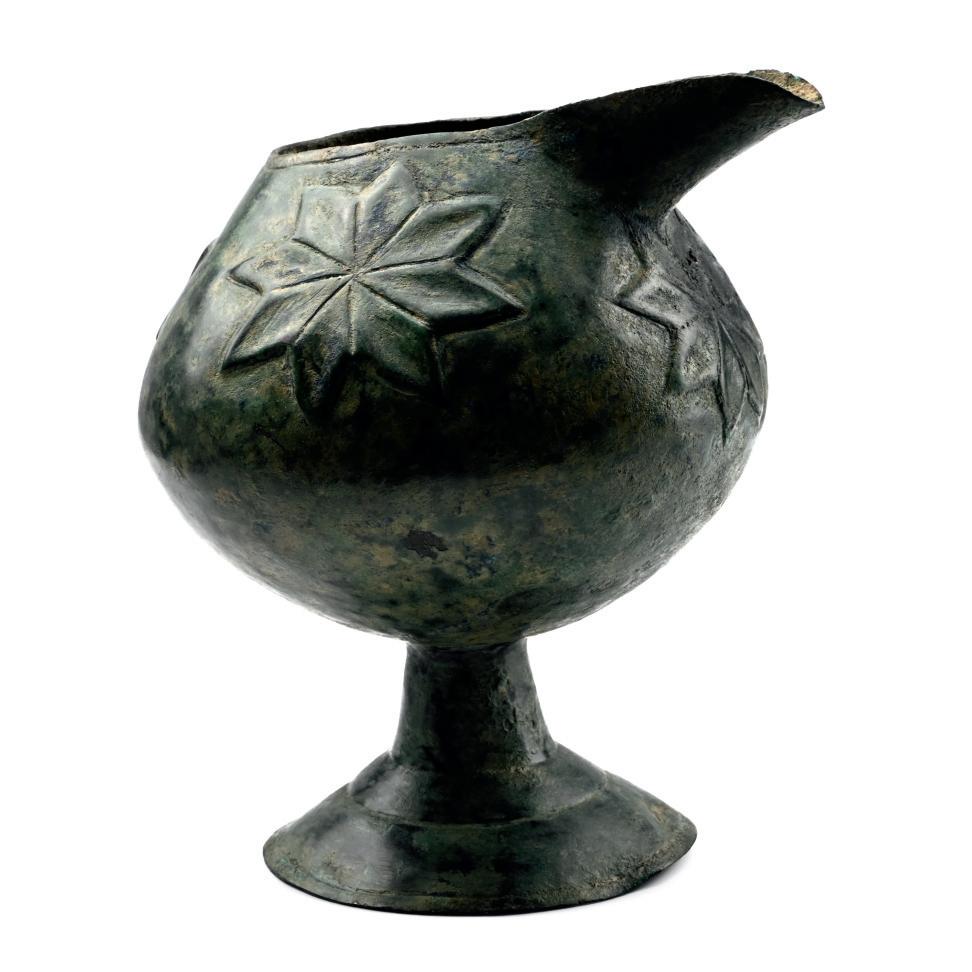
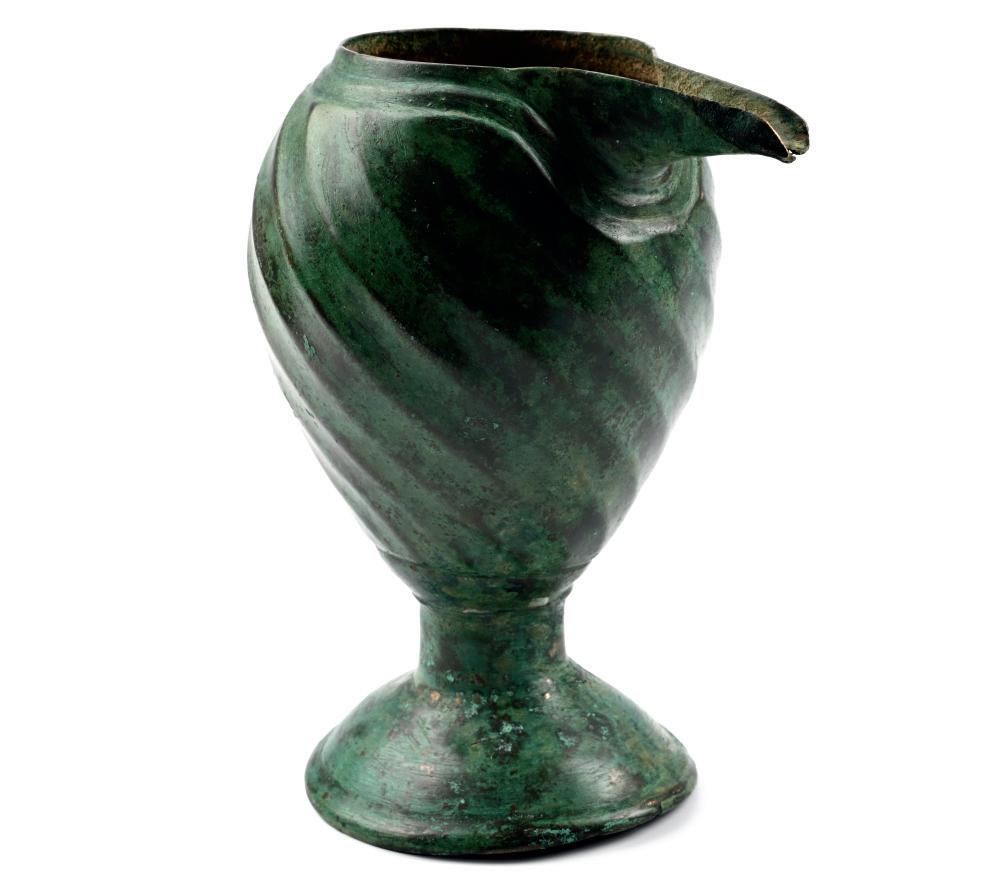
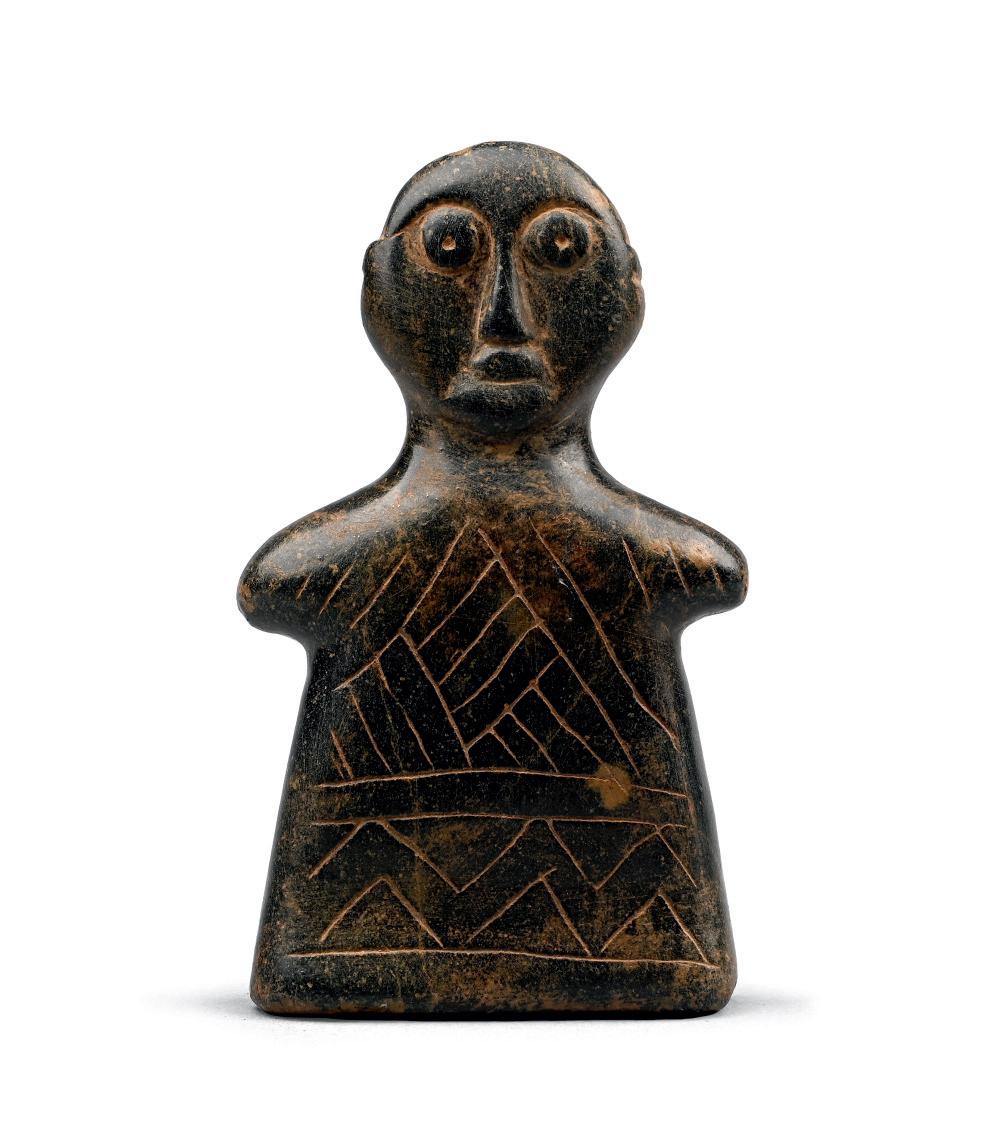
270
SUMERIAN GREEN STONE EYE IDOL ‡
3RD MILLENNIUM B.C.
1 in. (13.2 grams, 41 mm)
Carved in the round as a rectangular block with a slit to the upper edge, vertical spike with two annulet ‘eyes’; pierced for suspension.
£3,000 - 4,000
PROVENANCE: with M. Petropoulos, Zurich, early 1990s. with Rhéa gallery.
Private collection, acquired in 1999.
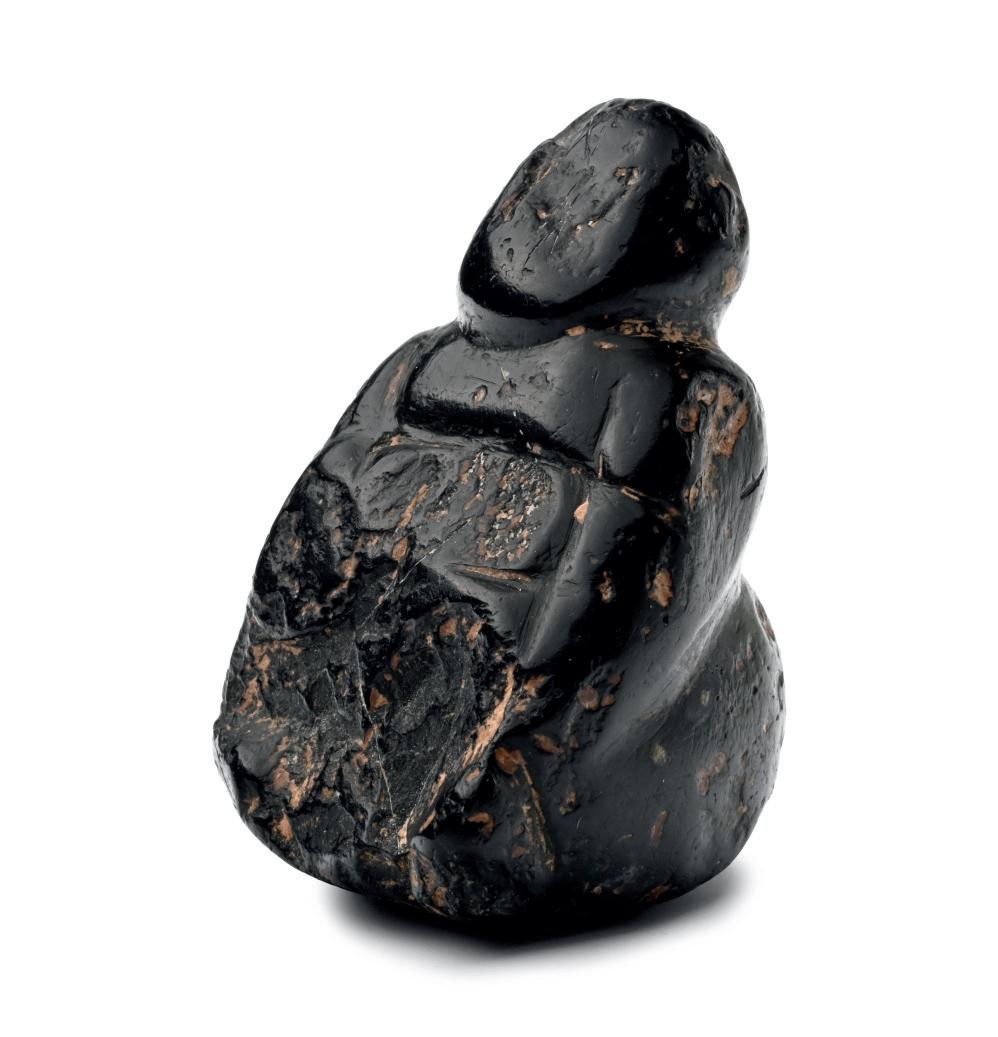
269
ANATOLIAN BLACK STONE IDOL ‡
3RD MILLENNIUM B.C.
4 in. (156 grams, 10.1 cm)
Carved in the half-round with hatched detailing to the tunic and belt, discoid head with reserved annulet eyes and trapezoidal nose, lateral stub ears.
£2,500 - 3,500
PROVENANCE:
Ex Swiss collection, 1980s. Private collection, 1994.
Private collection, since the late 1990s.

271
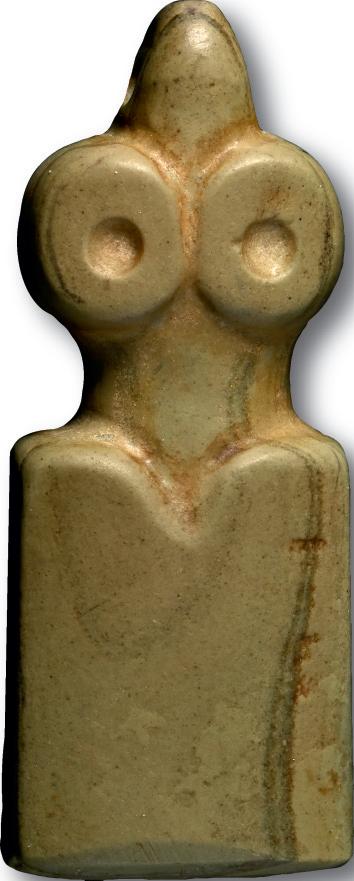
ANATOLIAN OBSIDIAN IDOL ‡
5TH-4TH MILLENNIUM B.C.
1¾ in. (48.4 grams, 46 mm)
Squat and rounded in profile with hands resting on the knees.
£1,000 - 1,400
PROVENANCE:
Private collection, Austria. Private collection, Europe.
272
LARGE AMLASH TERRACOTTA IDOL ‡
1ST MILLENNIUM B.C.
9 in. (386 grams total, 23 cm including stand)
Comprising a thin, extended neck developing into a largely unmarked face, represented only as a low-relief oval across its width; small arms folded into the chest emerging just beside two raised breasts; body curving inwards to suggest a feminine waist, before widening dramatically at the hips and buttocks; legs tapering gradually towards the base, with small marks delineating toes; mounted on a custommade stand.
£3,000 - 4,000
PROVENANCE:
Dr Werner Alder, Carona, Switzerland, acquired in the 1960s. Private collection M.R., Lugano, Switzerland.
Accompanied by an academic report by Dr Raffaele D’Amato. Accompanied by a thermoluminescence analysis report no.N126a11 from Oxford Authentication.
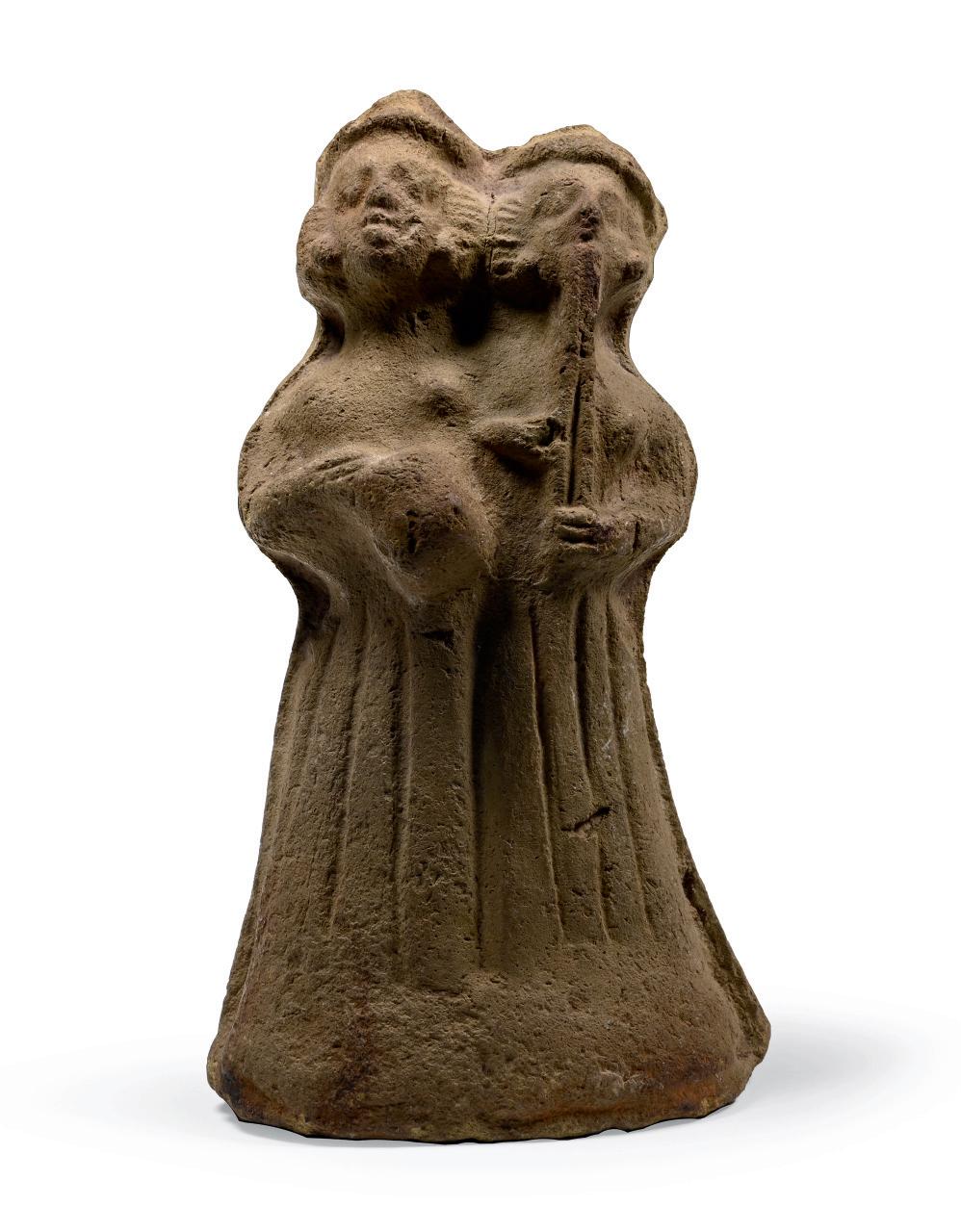
274
SYRO-HITTITE TERRACOTTA HORSE AND RIDER
EARLY 1ST MILLENNIUM B.C.
6 in. (317 grams total, 15 cm high including stand)
Modelled standing facing, with stub legs, ears pinned backwards, stylised detailing to the eyes and muzzle; the rider shown mounted sideways indicating a female rider, holding the horse’s cropped mane with the left hand, the right hand extended outwards, pinched face with applied circular eyes, detailing to conical headpiece; mounted on a custom-made display base. [No Reserve]
£800 - 1,000
PROVENANCE: Collection of a deceased London gentleman, 1979-1999, by descent. From the private collection of John Meredith, acquired since the 1990s; thence by descent.
Accompanied by a copy of a thermoluminescence analysis report no.N122k29 from Oxford Authentication.
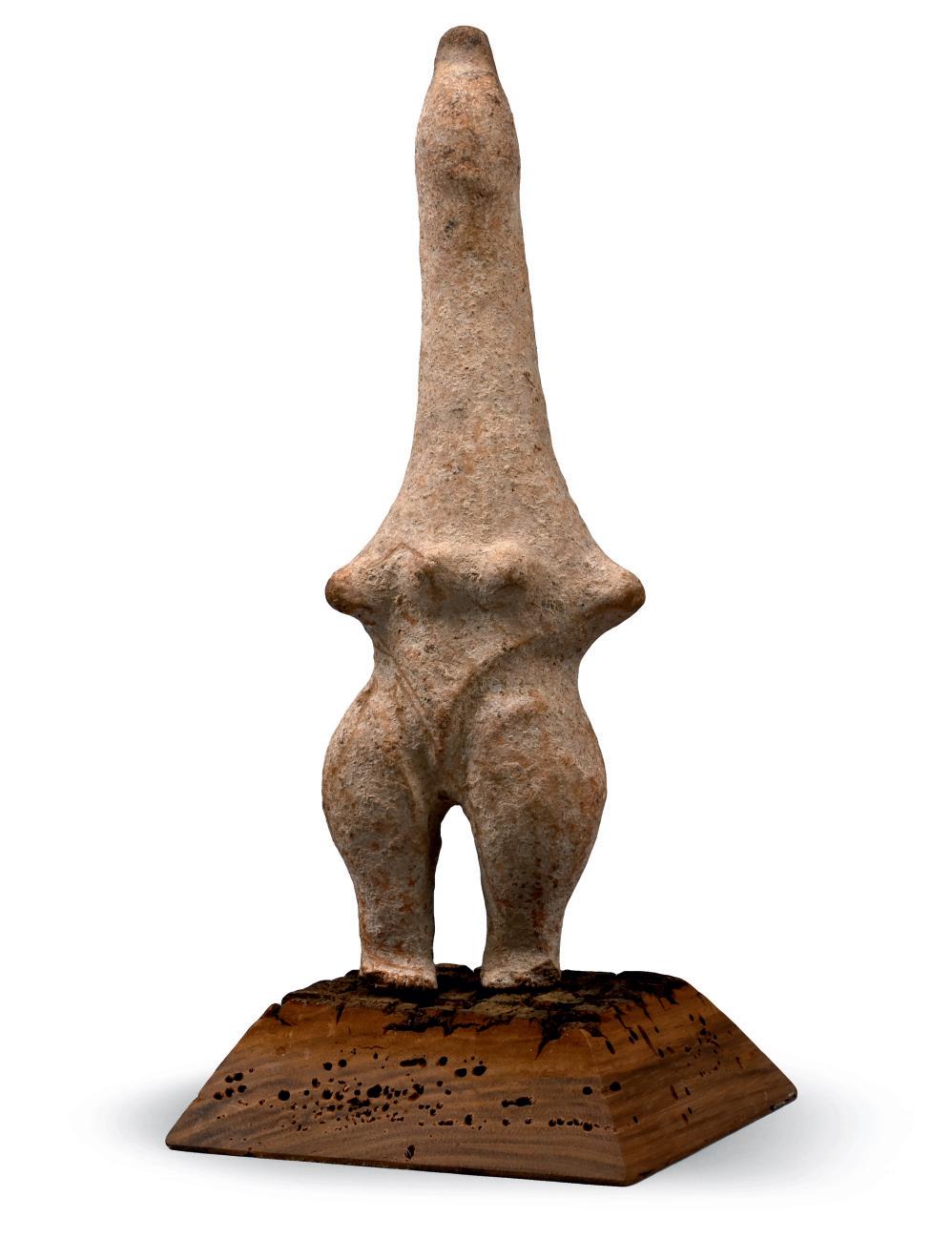
273
GRAECO-PARTHIAN TERRACOTTA FIGURE OF MUSICIANS
3RD CENTURY B.C.-1ST CENTURY A.D.
4 in. (118 grams, 10.2 cm)
Modelled in the round as a joined pair of musicians dressed in long skirts wearing conical caps, one playing tambourine and the other oboes.
£600 - 800
PROVENANCE: Ex Monique Sancey collection, Neuchâtel, Switzerland. with Bonhams, 14 May 2003, no.229. European private collection. Private collection, UK.
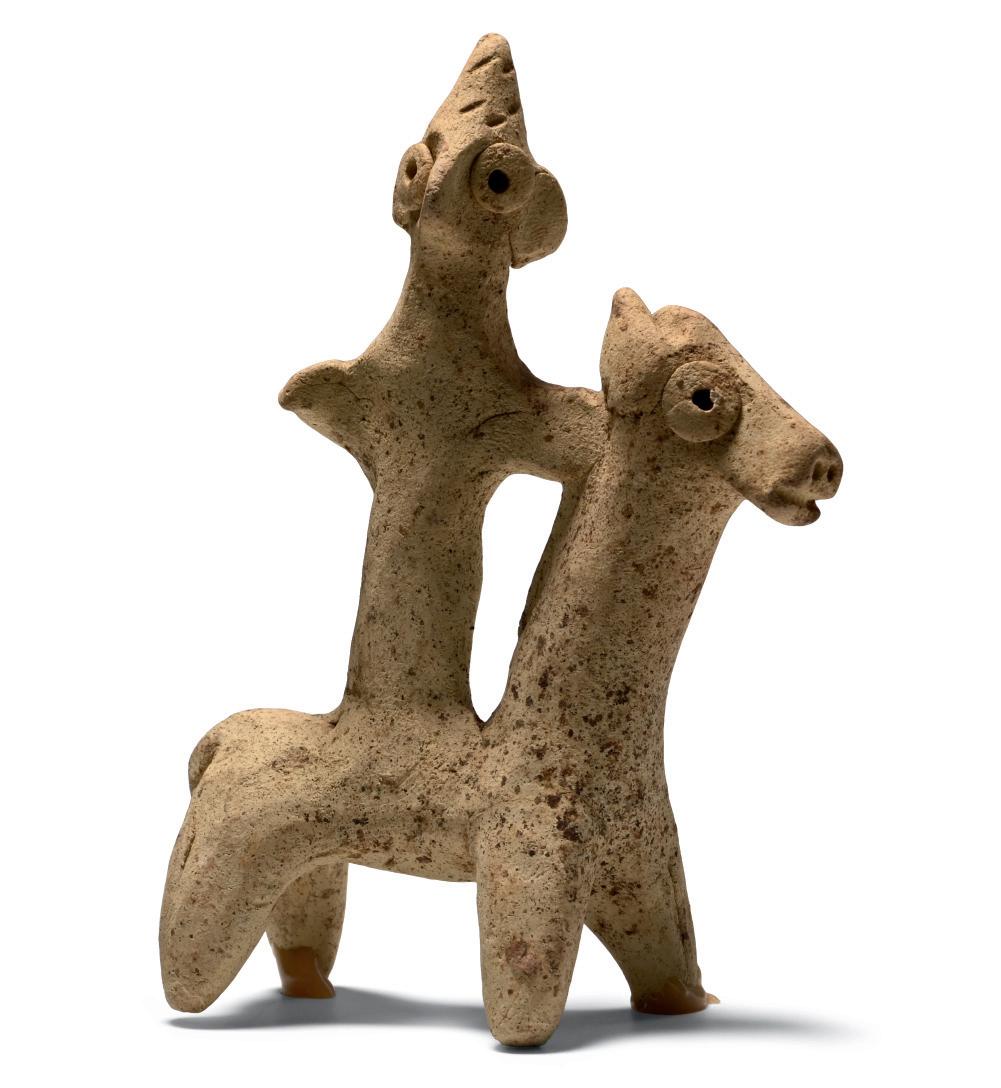

276
OLD BABYLONIAN TERRACOTTA CUNEIFORM TABLET FOR AN INTEREST FREE LOAN FROM THE MOON GOD NANNA ‡ 1834-1823 B.C.
1 in. (55 grams, 47 mm)
A pillow-shaped tablet, with cuneiform text to the broad faces and an edge, reading:
’12 shekels of interest-free silver, from (the moon-god) Nanna, debt of Bitanum.
Before Qišti-Enlil
Before Dadiya
Before Sîn-šemi
In the month of Innana, the 5th.
The year (the king) built the temple of Ninug... inside (the city of) Maškan-šapir.’
£1,500 - 2,000
PROVENANCE:
Ex private collection.
with Bonhams, Antiquities, London, 21 October 1999, no.260 (Part).
Private central European collection.

275
SUMERIAN TERRACOTTA BULLA
4TH MILLENNIUM B.C.
2 in. (147 grams, 60 mm)
A bulla with oval stamped impression of two animals.
£1,000 - 1,400
PROVENANCE:
Specialised collection of cuneiform texts, the property of a London gentleman and housed in London before 1988.
Thence by descent to family members.
Examined by Professor Wilfrid George Lambert FBA (1926-2011), historian, archaeologist, and specialist in Assyriology and Near Eastern archaeology, in the late 1980s and early 1990s.
The collection is exceptional for the variety of types, including some very rare and well preserved examples.

277
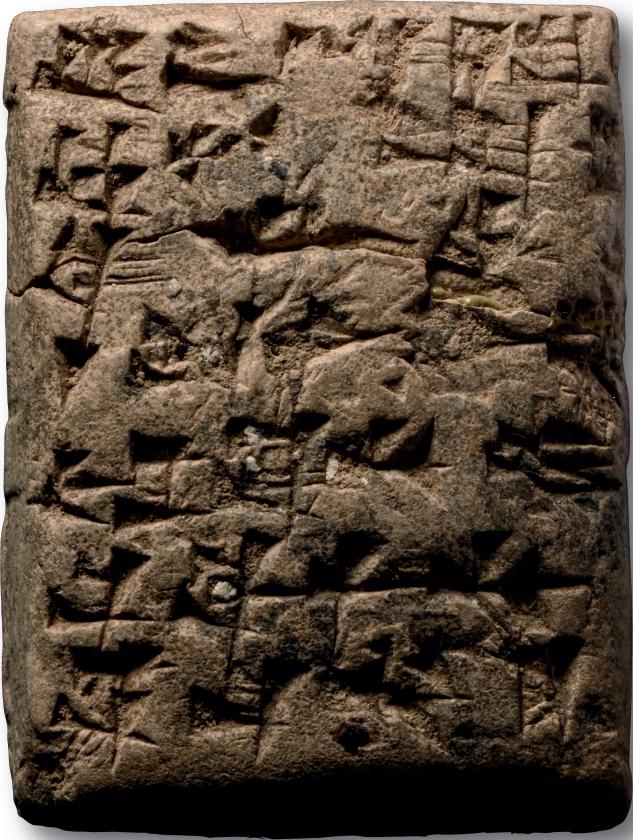
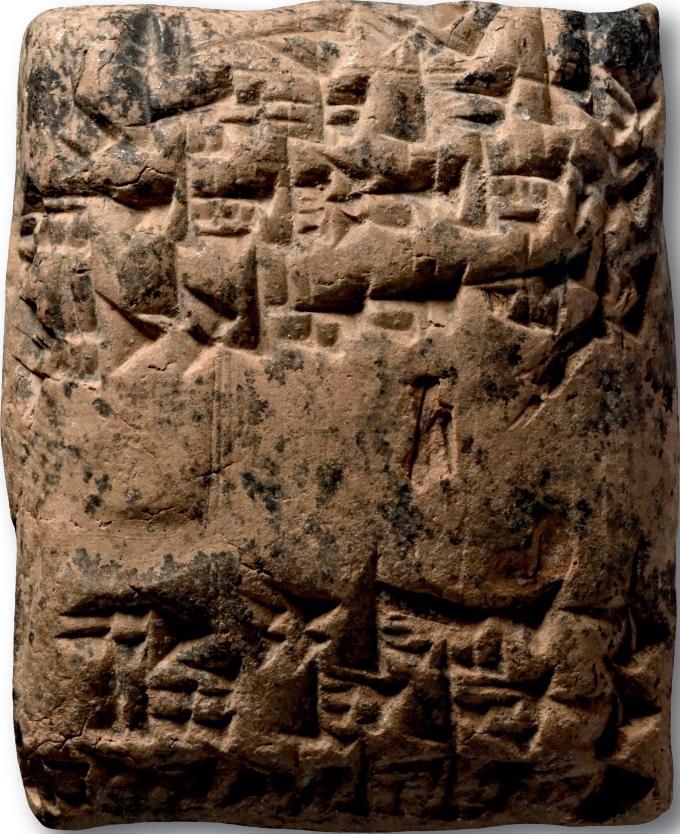
OLD BABYLONIAN TERRACOTTA CUNEIFORM TABLET FOR THE LOAN OF MONEY DURING THE REIGN OF SIN-IQIŠAM KING OF LARSA ‡ 1840-1836 B.C.
2¼ in. (85 grams, 59 mm)
A pillow-shaped tablet, with cuneiform text to the broad faces and an edge, reading:
’Idnin-Sîn and Sutitum have obtained from the god Šamaš (a loan of) 5/6 mine 5 shekels of silver, the silver (has) an interest of 4 shekels 1/3. He° will have to repay the money at the time of sowing. Before (the god) Ea, Before (the goddess) Sugallitum
Before (the god) Nanna
Before Dani
Seal of one (of the) witnesses...
In the month of Tebitum
The year of Sin-iqišam the king.’
£1,500 - 2,000
PROVENANCE:
Ex private collection.
with Bonhams, Antiquities, London, 21 October 1999, no.260 (Part).
Private central European collection.
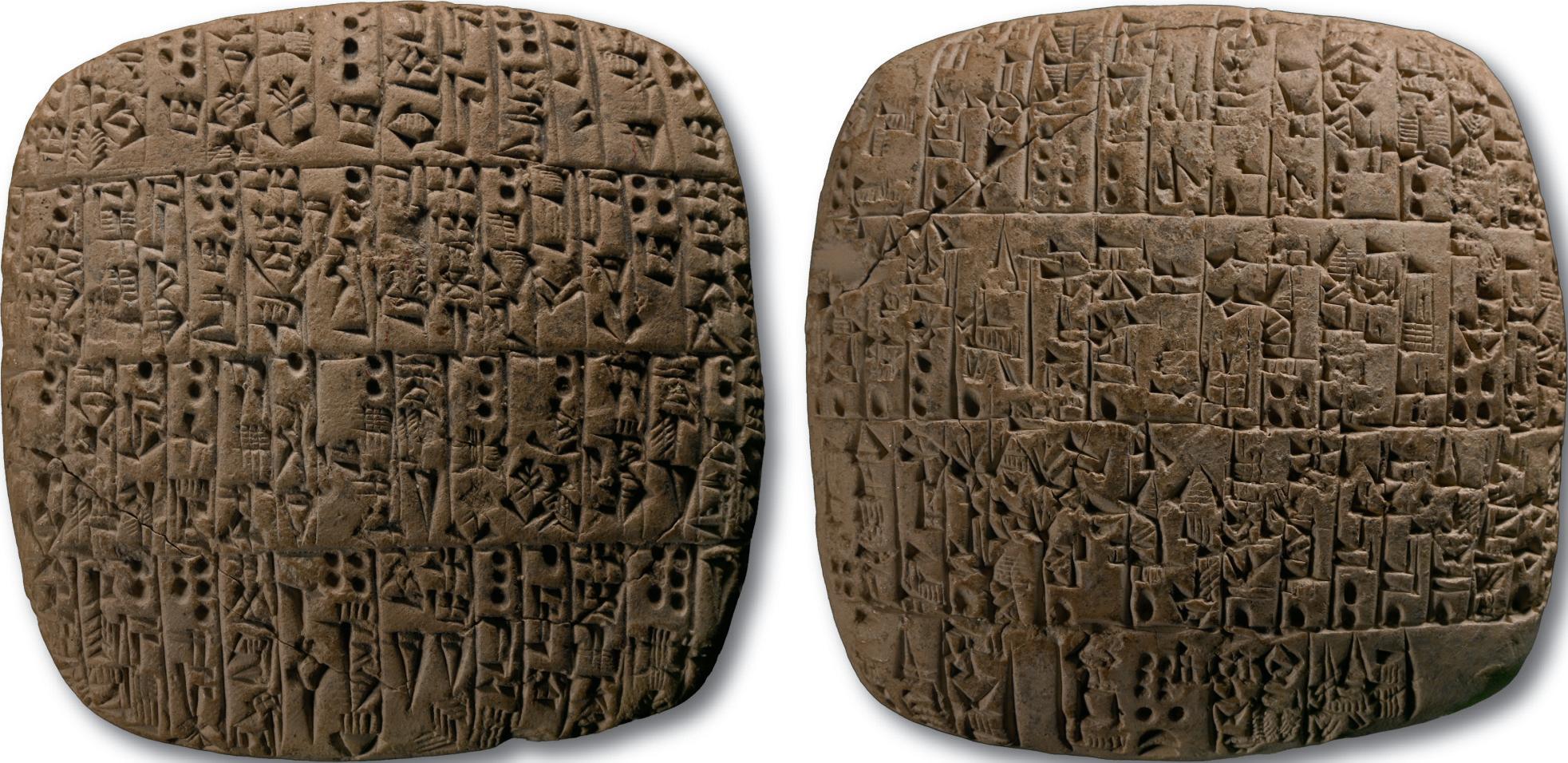

278
EARLY DYNASTIC TERRACOTTA ADMINISTRATIVE CUNEIFORM
TABLET RECORDING LIVESTOCK AND THEIR OWNERS ‡
IIIB, 2400-2340 B.C.
3 in. (202 grams, 78 mm)
Pillow-shaped tablet with dense cuneiform text to two broad faces and one edge, concerning the listing of 146 sheep and their owners or shepherds.
£18,000 - 24,000
PROVENANCE:
with Laemmle Gallery, San Vicente Boulevard, Los Angeles, USA. Acquired from the above in the early 1970s. with Bonhams, London, 13 April 2011, no.133. Private central European collection.
COLUMN I
5 SHEEP, PIRIGNI, KOR 2?
6 MALE SHEEP, UR-UR OF UMMA
3 SHEEP, ZAG-MU, KI NI MU ZU
5 SHEEP, X X-GI
4 MALE SHEEP …
COLUMN II
UR-ISHKUR, HERDER OF ABDU
4 SHEEP, URGU (OF) E-RU
2 … , HERDER IL, SCRIBE
3 GIMNI, HERDER CHIEF GALLAOFFICIAL
5 MALE SHEEP, UR-LU, ..
2 SHEEP LU-RA, HERDER…
COLUMN IV
2 UR-…DUA
6 ZAGMU, HERDER OF MESANNE
URTUL
GISH.MI, HERDER OF ILUMSU?NI
LUGAL-SHALASU ADDA, SINGER?
ALMU
COLUMN VII
…SI-TEXESZ3
LUGAL
URMES
URDAM
AKADU, ADDA…
COLUMN III …, HERDER
2 MALE SHEEP, AKADU, SON OF LUGAL-SANGA
2 SHESH-ZIMU
3 ZAGMU, AKADU
2 EKALSI
1 GIMDU, SON OF EKAL
2 MASHDA 1 … GUZI…
2 …KAM … NA
REVERSE COLUMN V 3 LUESHLA 2 UR-… NE-RA
CAPTAIN
NUESH-OFFICIANT
SHESHPADDA, OVERSEER
KI-BI
COLUMN VIII 2 … -NIE-U? (SPACE)
DINGIR-URMU 1 PIRIGNI
UR-NINSHAZA, WIFE OF U-U
LUGALLU, HERDER OF LUGALLA…, MAJORDOMO 5 …IGI-EN … 1 LUGAL-E…NISICOLUMN VI
ITS TOTAL: 146 SHEEP, PIRIGNI (IS) KUSH-OFFICIAL.
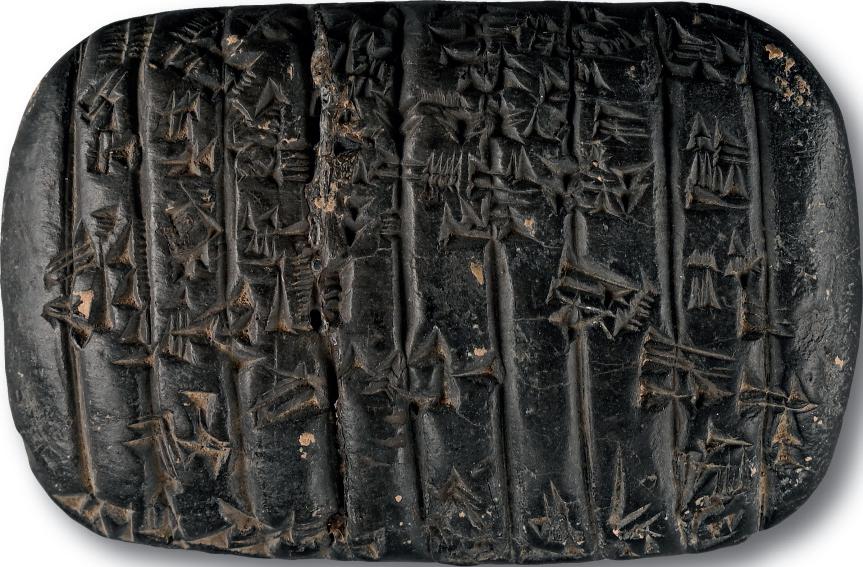

280
OLD BABYLONIAN TERRACOTTA CUNEIFORM TABLET FOR THE SALE OF A PALM GROVE DURING THE REIGN OF NUR-ADAD
KING OF LARSA ‡ 1865-1850 B.C.
2¼ in. (52 grams, 56 mm)
A pillow-shaped tablet, with cuneiform text on the broad faces and an edge, reading:
‘50 sar of orchard, planted with palm trees, next to Kunia, next to Amurutu, on the first small side: Rabutum. Sîn-pilah bought from Huzalum. He paid him its full price of 1/3 silver mine. He swore in the name of Nur-Adad the king that no one would constest in the future. In front of Itišumum In front of Sinennam
Before Sugalum
Before Kurušum
Before Aw l-Amurrim the scribe
In the month of šabatu, the year Nur-Adad (offered) a throne of justice (?) ...’
£1,500 - 2,000
PROVENANCE:
Ex private collection.
with Bonhams, Antiquities, London, 21 October 1999, no.260 (Part). Private central European collection.
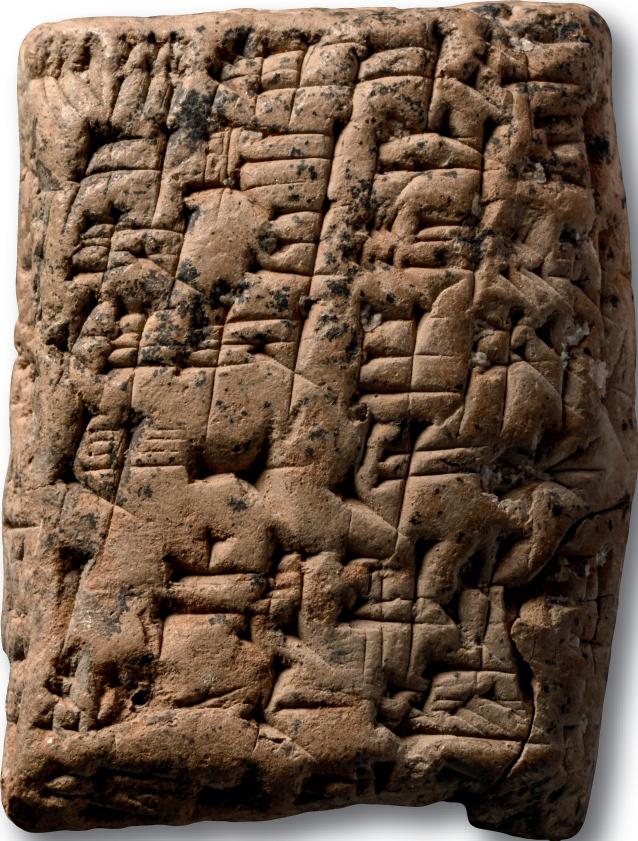
279
WESTERN ASIATIC TERRACOTTA CUNEIFORM TABLET ‡ 2ND MILLENNIUM B.C.
2½ in. (57.2 grams, 63 mm)
Pillow-shaped with columnar ribbing to the broad faces, dense cuneiform text in the columns.
£1,500 - 2,000
PROVENANCE:
Private collection of Mr K., Maryland, USA. Private collection, Switzerland, acquired in 2000.

281

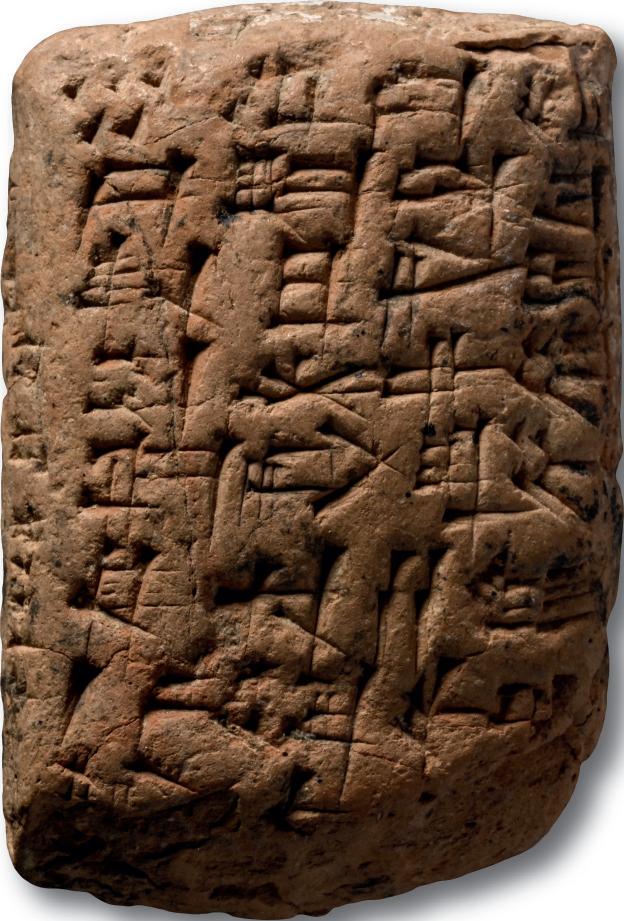
OLD BABYLONIAN TERRACOTTA CUNEIFORM TABLET FOR THE SALE OF A PALM GROVE DURING THE REIGN OF SUMU-EL ‡ 1894-1866 B.C.
1 in. (39 grams, 47 mm)
A pillow-shaped tablet, with cuneiform text to the broad faces and an edge, reading:
’36 sar of orchard, planted with palm trees, next to Batuli and next to Kutanum, Sin-pilah bought from Bedi-el. He paid its full price 10... of silver. He swore in the name of the king that in the future no one would dispute.
Before ...
Before Sîn Dayan
In front of Naqimum
In front of Damu
In front of Munakum
In the month of Kislimu, the 4th year of the priest of Nanna.’
£1,500 - 2,000
PROVENANCE:
Ex private collection.
with Bonhams, Antiquities, London, 21 October 1999, no.260 (Part).
Private central European collection.
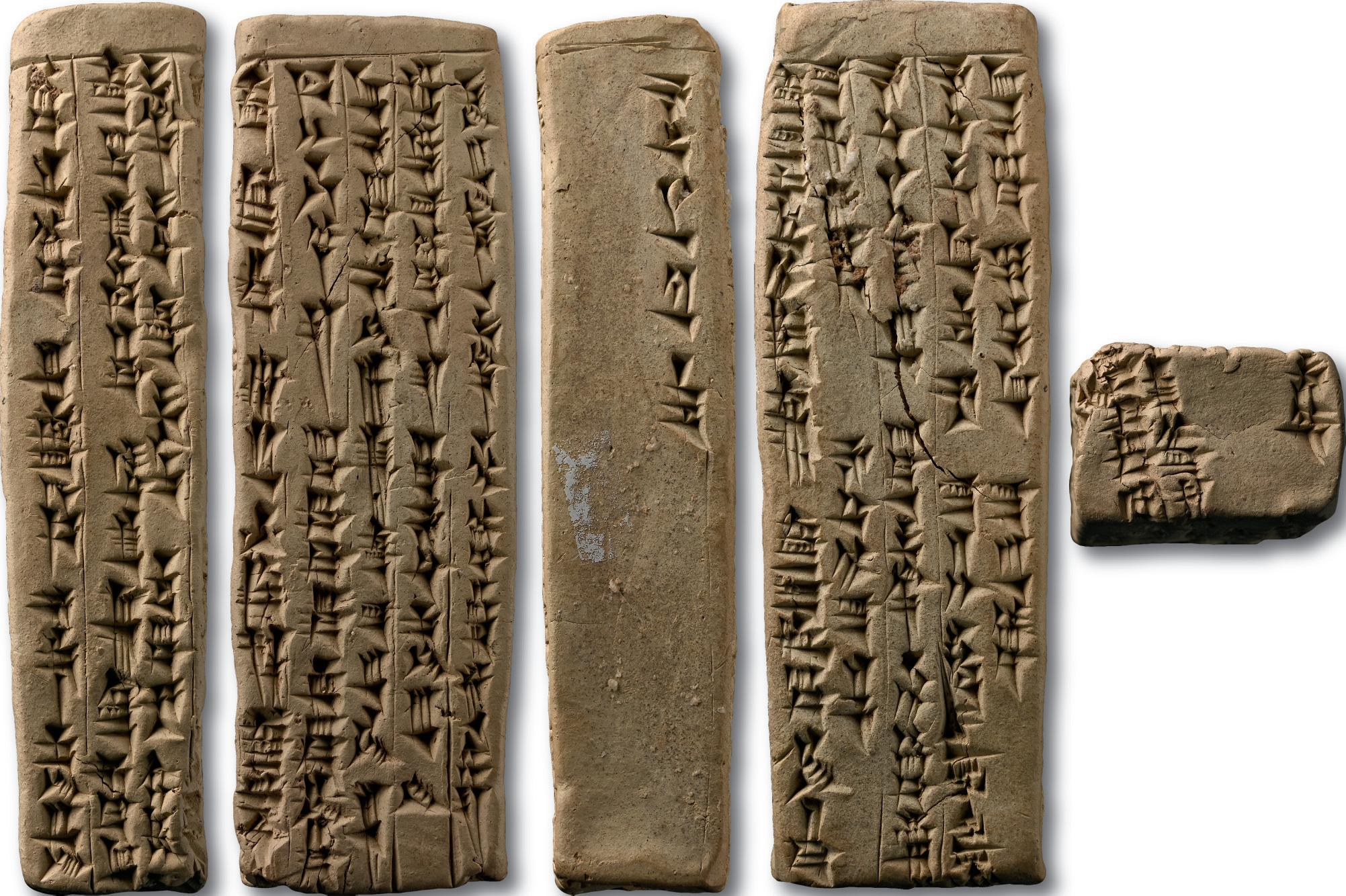

MIDDLE ASSYRIAN BRICK-SHAPED TABLET WITH FUNERARY INSCRIPTION FOR ADAD-SHUMU-LESIR’S TOMB ‡ 1363-912 B.C.
5 in. (333 grams, 14.3 cm)
A rectangular brick-shaped tablet, inscribed in cuneiform script across three vertical faces, with a single column to the fourth and a continuation of text across the top surface; the inscription a funerary curse relating to the tomb of Adad-šumu-lešir, warning against interference with the burial, reading in part:
’As for a stranger, or somebody who would approach that tomb, or would bring up a corpse out of it and bury his own within, or would touch the silver inside - Adad, Šamaš, or Nergal will fill his house and field with shortage, collapse, and murder. He will repay the property
of that tomb sevenfold, dedicating it to Šuriha. For the offspring of Adad-šumu-lešir he shall be undone for taking out and bringing down objects in the tomb, and for burying another body within it. Month Kalmartu, third day, eponymy of Aššur-mušezib.’
£5,000 - 7,000
PROVENANCE: Acquired in 1996.
Private collection, Switzerland, thence by descent.
Private collection, since the late 1990s.
FOOTNOTES:
Funerary inscriptions of this type are extremely rare survivals, serving both as legal texts and spiritual safeguards, invoking the major deities Adad, Šamaš, and Nergal to enforce the curse.
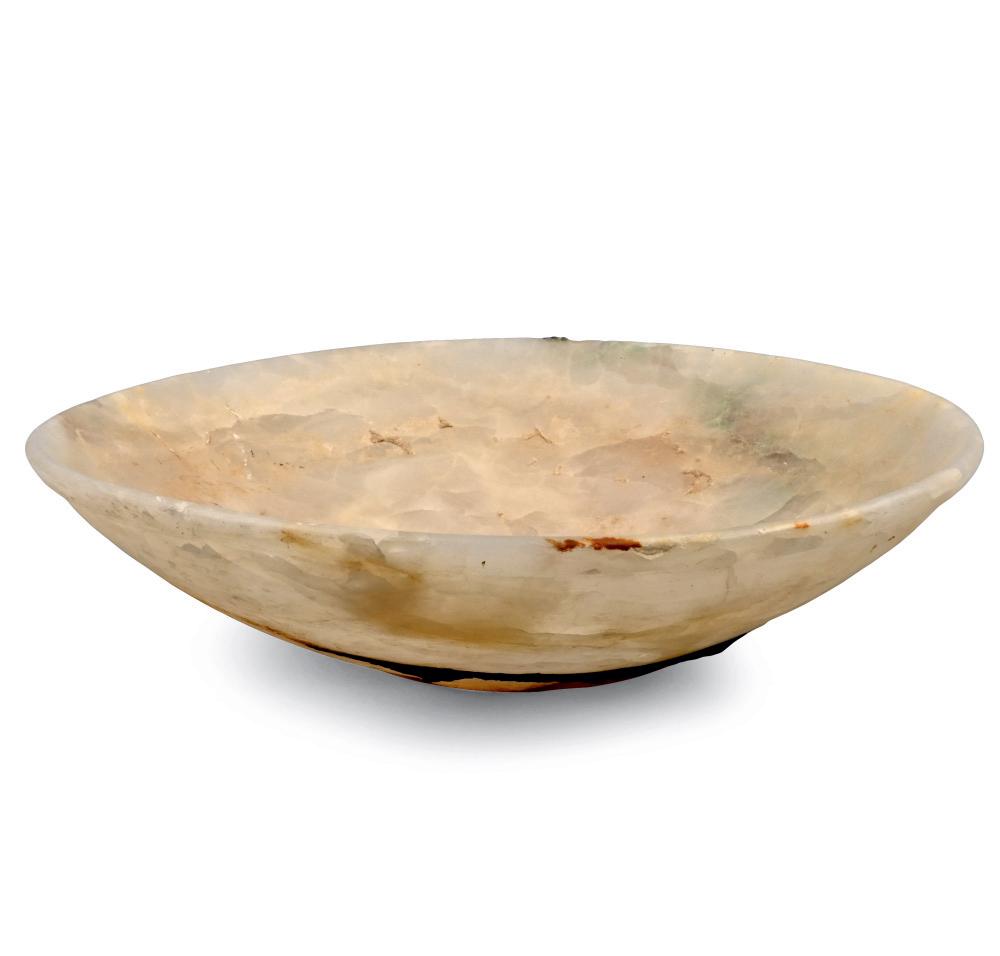
283
LARGE BACTRIAN ALABASTER BOWL WITH BRONZEENCRUSTED BASE
3500-3100 B.C.
11¾ in. (2.21 kg, 30 cm wide)
Broad shallow bowl with integral basal ring, carination below the rim, encrusted bronze circle to the underside. [No Reserve]
£600 - 800
PROVENANCE: Private collection, Kent, UK.
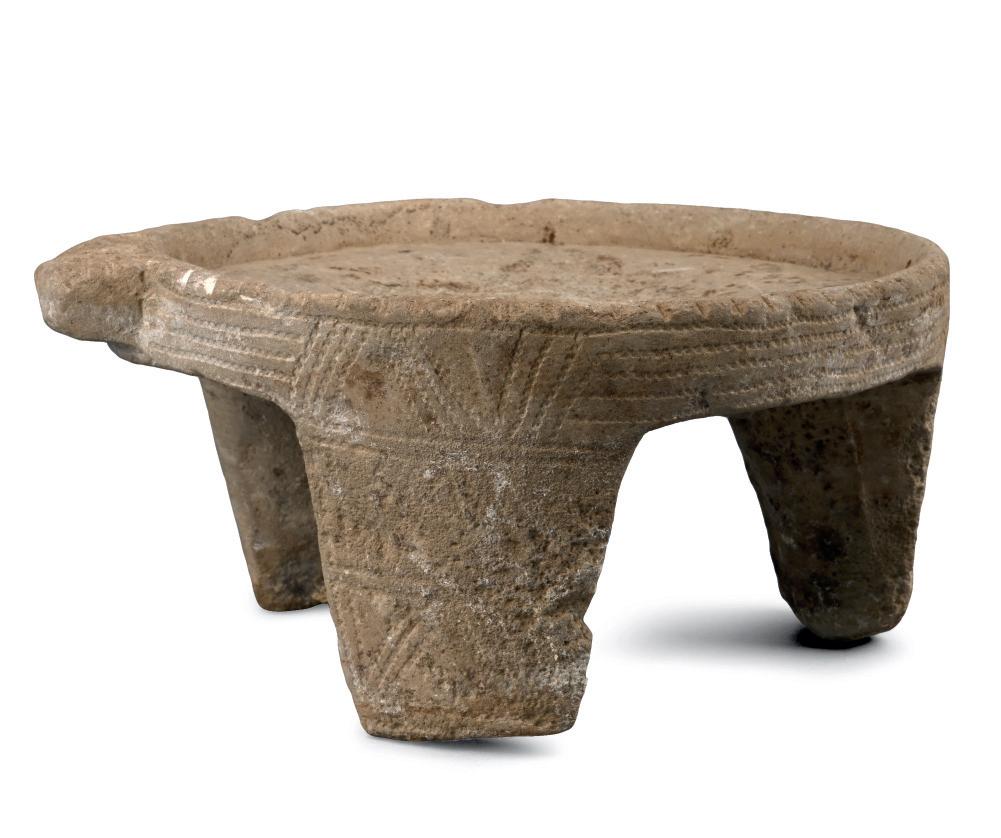
285
HITTITE LIMESTONE ALTAR ‡
2ND-1ST MILLENNIUM B.C.
10 in. (3.5 kg, 26.3 cm wide)
Carved from a limestone block with three trapezoidal stub legs, horizontal dished centre with notched edge to the raised rim and Usection pouring lip; panel of geometric linear ornament to the outer face of the body and legs; integral T-shaped reinforcing arms to underside.
£600 - 800
PROVENANCE: Private collection, Israel. with Archaeological Centre, Auction 59, no.433.
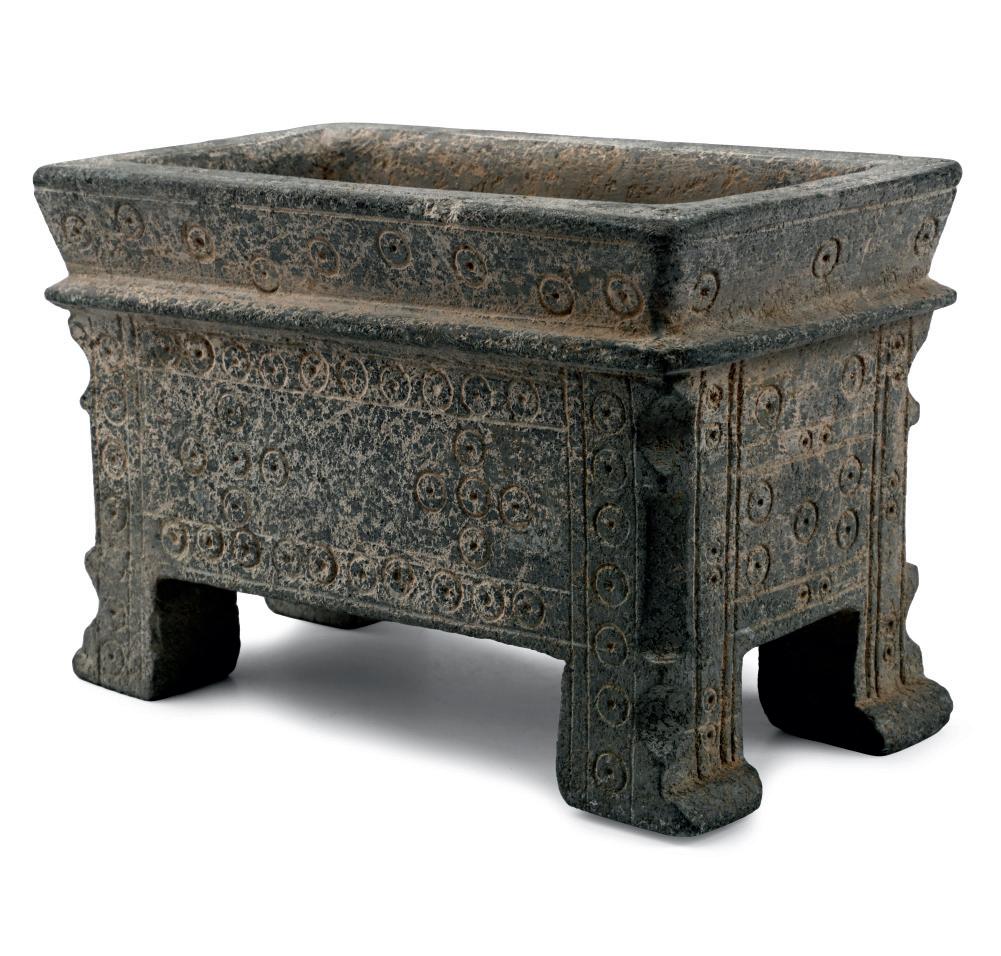
284
WESTERN ASIATIC RECTANGULAR STONE VESSEL
1ST MILLENNIUM B.C.
5¾ in. (1.37 kg, 14.7 cm)
Rectangular-section body on four feet, slightly flared rim with a band, with ring-and-dot markings to the outer face.
£700 - 900
PROVENANCE:
From a West London collection and formerly in a Mayfair gallery.
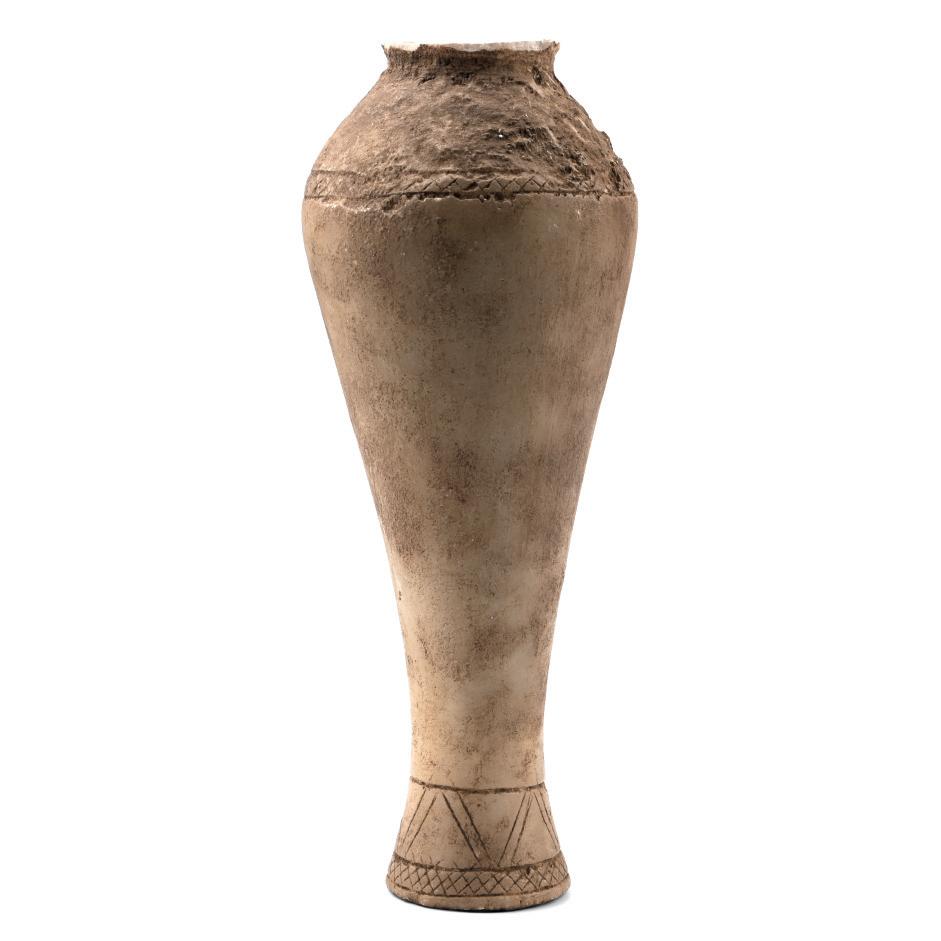
286
WESTERN ASIATIC STONE VESSEL WITH INCISED DECORATIONS
1ST MILLENNIUM B.C.
8 in. (354 grams, 20.3 cm high)
Slender and piriform in profile with a broad shoulder, low rim, slightly flared foot; hatched panel to the shoulder, zigzag band above hatching to the foot.
£700 - 900
PROVENANCE: Acquired before 1990. Ex London gallery, 1990s. Private collection, London, UK.
287
SOUTH ARABIAN ALABASTER MALE HEAD ‡
LATE 2ND-3RD CENTURY A.D.
7 in. (1.17 kg total, 18 cm high including stand)
Carved in the round with deep-set eyes and broad aquiline nose; hair and short beard modelled with stippled surface; slender neck; mounted on a custom-made display stand.
£4,000 - 6,000
PROVENANCE:
Formerly private European collection. with Christie’s, New York, 7 December 1995, no.116.

289
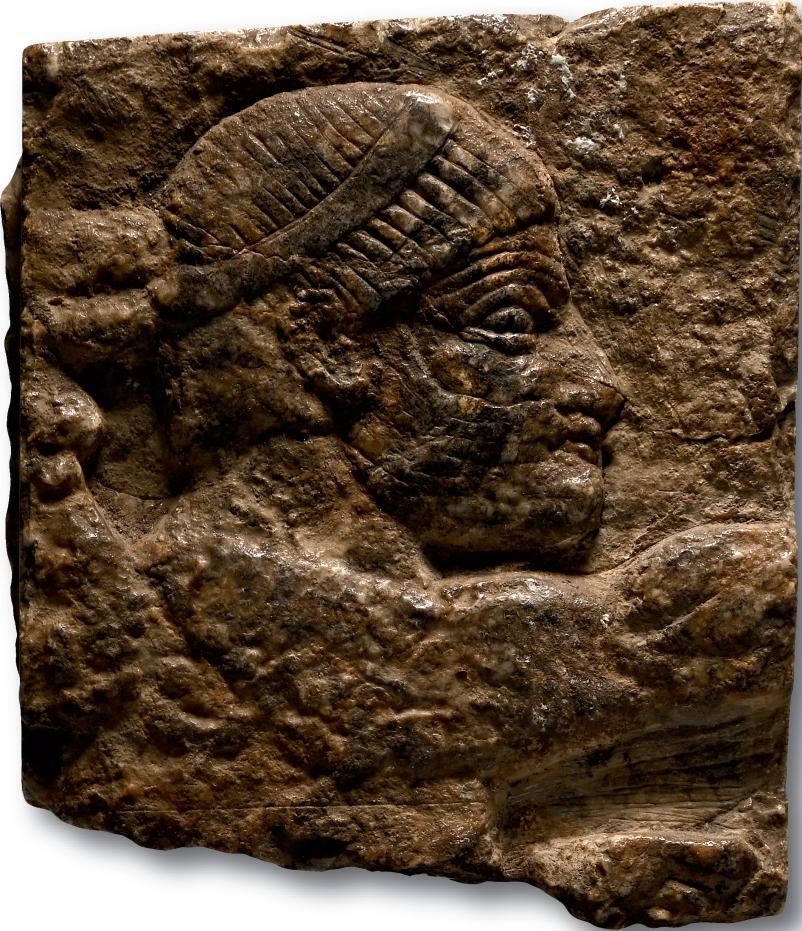

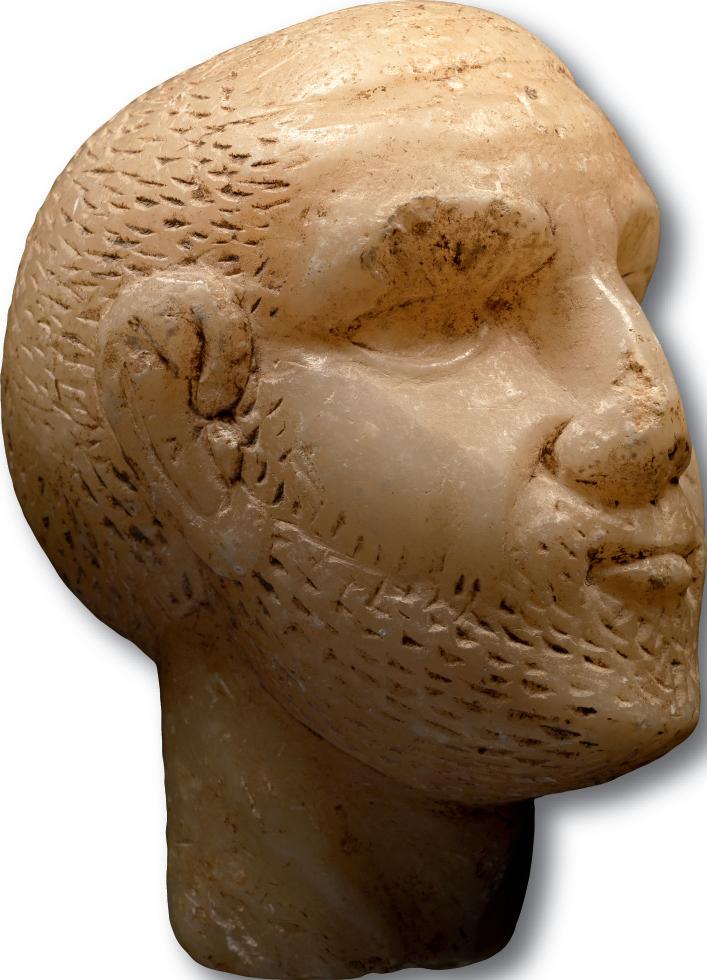
ASSYRIAN GYPSUM RELIEF WITH HEAD OF A BEARDED MAN ‡
704-681 B.C.
4½ in. (530 grams total, 11.6 cm including stand)
Rectangular frieze fragment with low-relief carving of a profile bust with short straight hair confined by a brow-band, segmented curls forming the beard, furrowed brow, one arm extended; handwritten label to rear ‘from the Koyunjik palace of Sennacherib at Nineveh and incised legend ‘KOUYUNJIK’ and ‘A’; mounted on a custom-made stand.
£8,000 - 10,000
PROVENANCE: Allegedly found in the Koyunjik Palace of Sennacherib. Ex property of a gentleman, UK, acquired in the 1970s. Ex private collection, Oxfordshire, UK, 1988.
Anonymous sale, Christie’s, London, 7 December 1994, no.235. Art market, New York.
Ex private collection, Tokyo, Japan.
Private European collection, 2009.
NEO-ASSYRIAN STONE RELIEF WITH STANDING FIGURE ‡
9TH-8TH CENTURY B.C.
9 in. (2.81 kg, 24.3 cm)
Corner fragment from a high-relief pictorial panel with raised border; domed dais with low-relief scaled detailing; lower legs and sandaled feet in advancing pose with ankle-length open-fronted robe, horizontal woven texture and curled fleece; high-relief stele with flared base, bulbous upper and sugar-loaf finial; pitted surface, with tooling to reverse.
£4,000 - 6,000
PROVENANCE: Ex German collection, c.1980. with Toufic Arakji, Hamburg, 1997. Private collection, Europe.
Accompanied by an academic report by Dr Raffaele D’Amato.
FOOTNOTES:
Stylistically, the figure seems to be linked to the kingdom of Ashurnasirpal II (883-859 B.C.) or his son Shalmaneser III (858-824 B.C.). The exposed lower leg with exaggerated musculature is seen in many Assyrian and Babylonian depictions of divine and heroic figures. The position of the figure, corresponding to some reliefs kept in the Louvre, where a spirit is worshipping a poppy flower (Houston, 1954, pl.V.1), and the high-relief carving, strongly refer to a cult scene.
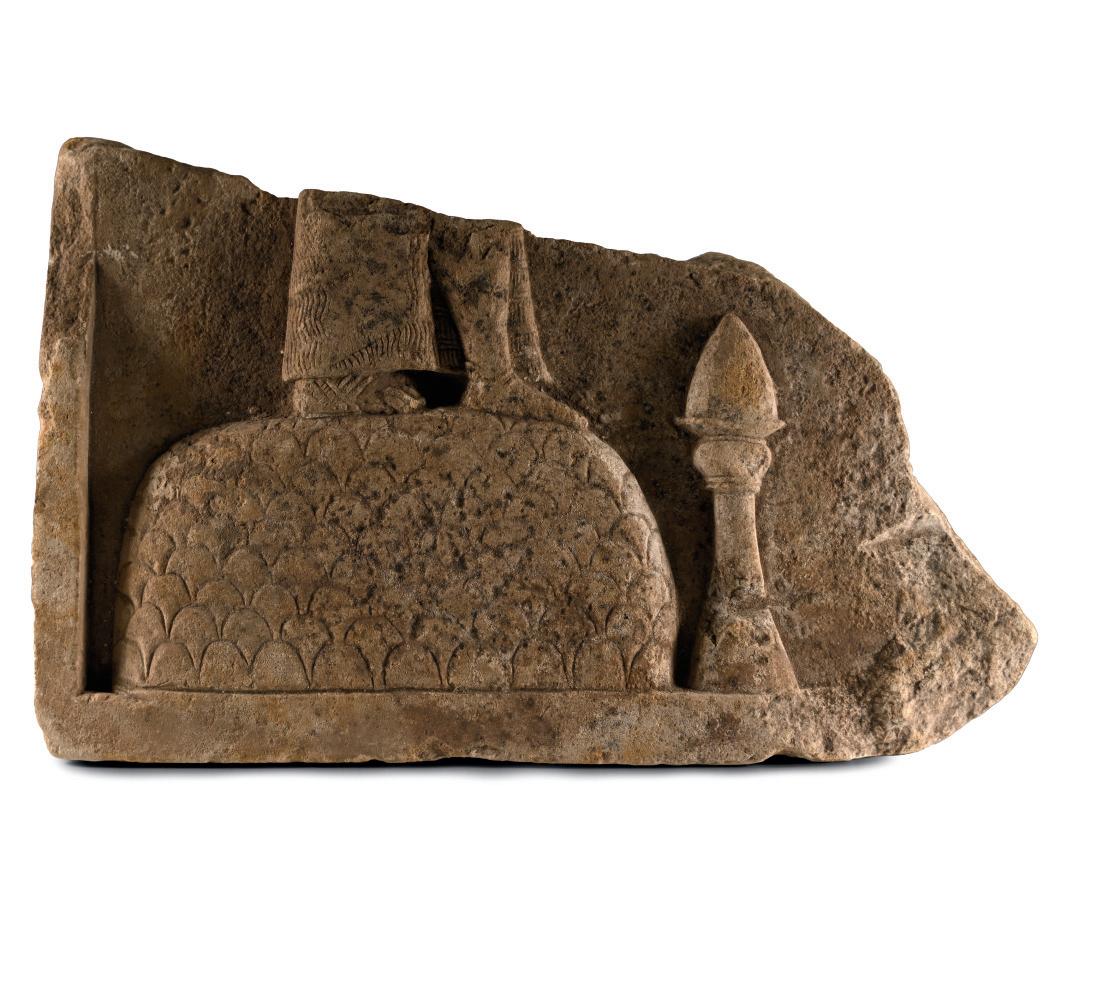
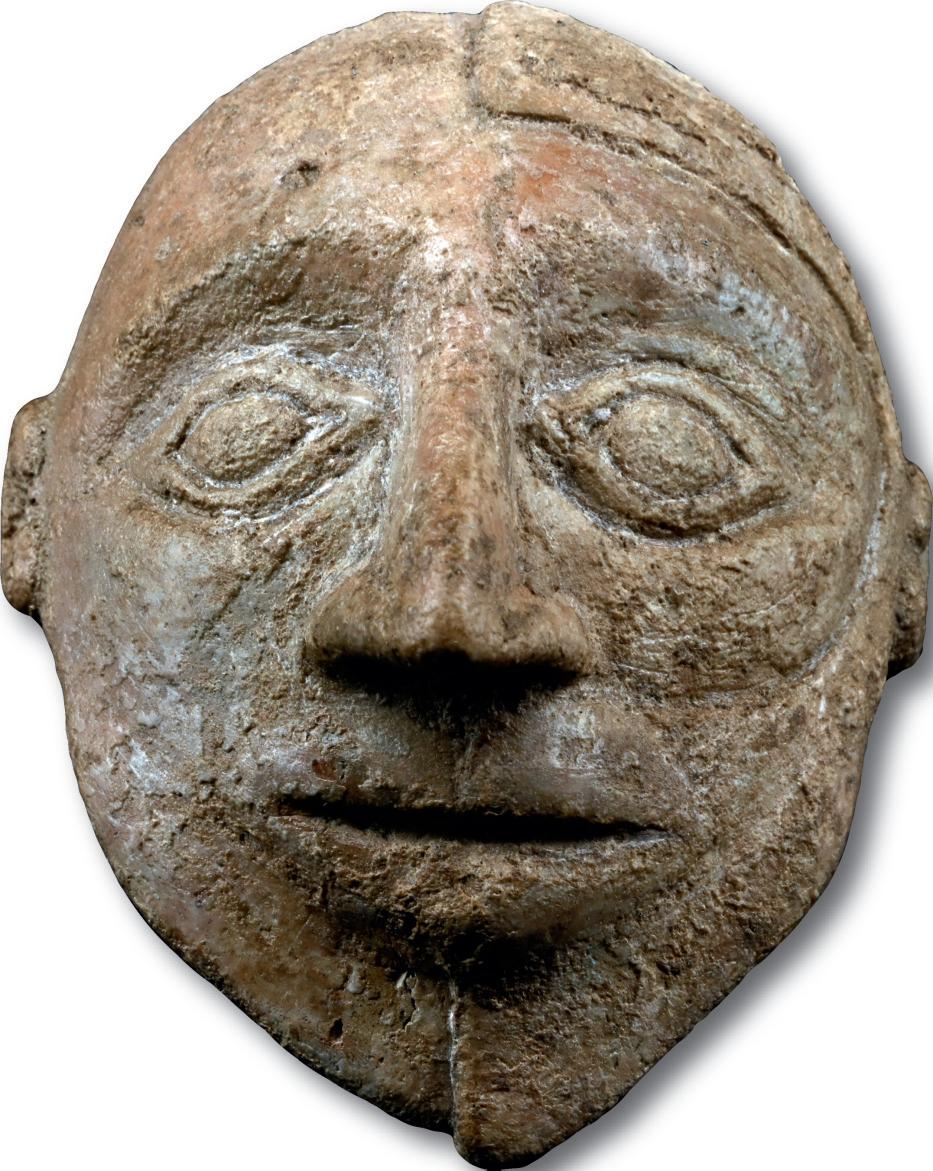

290
OLD BABYLONIAN TERRACOTTA HEAD OF A DEMON ‡ 1900-1800 B.C.
3 in. (191 grams, 87 mm)
Modelled in the round, depicting the (severed?) head of a Mesopotamian demon, with iconic facial features in relief; hollow with a vent to the neck; produced from a two-piece mould, with a median seam through the facial features.
£1,200 - 1,700
PROVENANCE: Private collection, Israel. with Holy Land House of Antiquities, Jerusalem, 1980s. Acquired by the current owner from the above, 2001.
FOOTNOTES:
Within traditional Mesopotamian religion, Humbaba was a creature regarded as the guardian of the cedar forest and the brother of Pazuzu. He was represented as a giant who had been raised by the sun god, Shamash. However, this head could also refer to another deity or demon, like one of the heads found in the Kish excavations.
291
ANATOLIAN TERRACOTTA RAM RHYTON ‡ 19TH-18TH CENTURY B.C.
8 in. (578 grams, 20.5 cm)
Ovoid in plan with ram-head finial and spout, filling-hole to the centre back and stub tail forming a handle; hatched panels to the sidewall with reserved running zigzag, radiating bands of impressed point ornament, head with forward-facing curled horns.
£3,000 - 4,000
PROVENANCE: with Artemis gallery, Münich. Acquired by the present owner from the above in 1992.
Accompanied by a thermoluminescence analysis report no.N126a13 from Oxford Authentication.
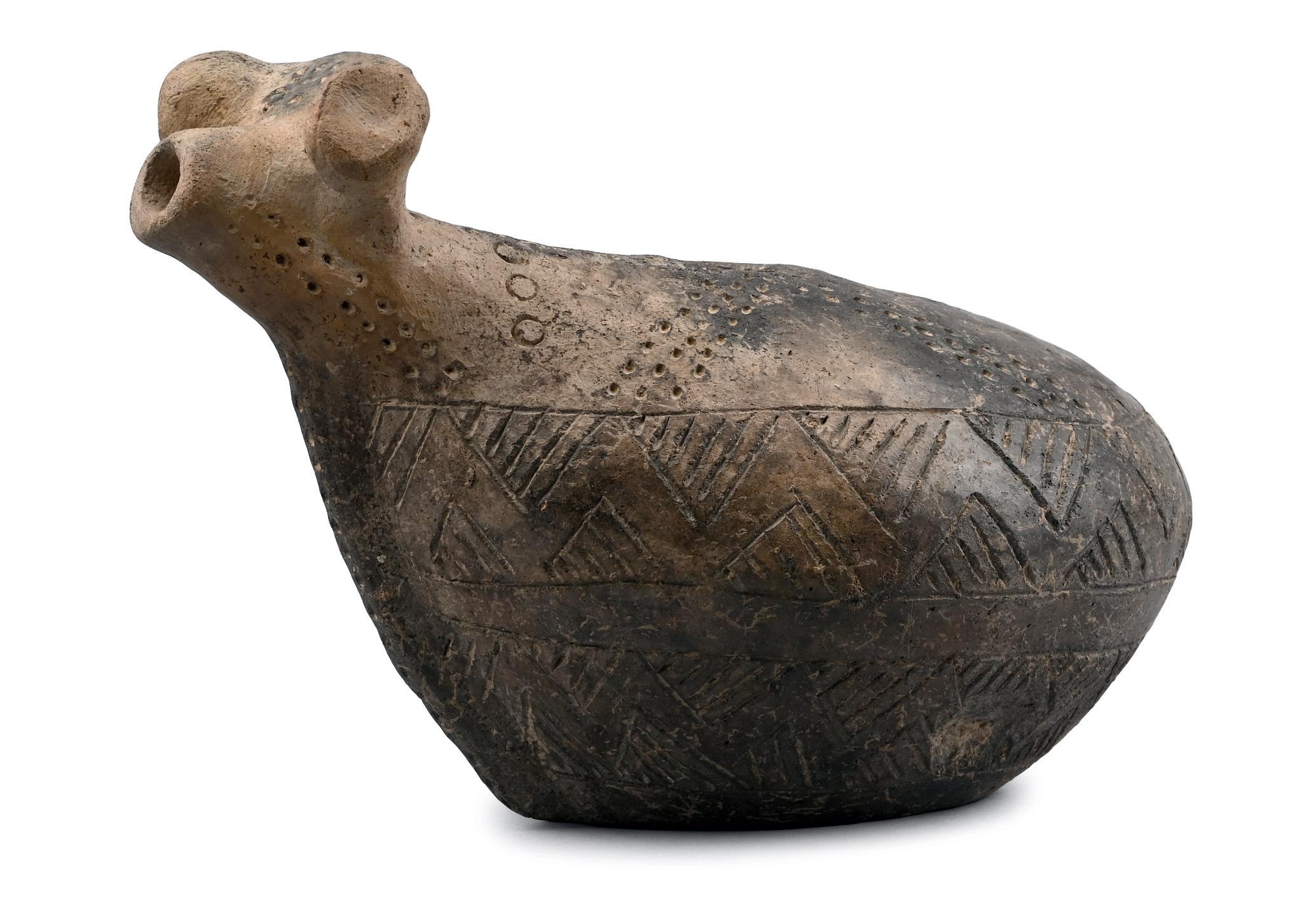
AMLASH TERRACOTTA HORSE RHYTON
10TH CENTURY B.C.
14½ in. (2.1 kg, 37 cm)
Hollow-formed rhyton with four splayed legs, curved neck with tall mane, loop handle forming the tail; filler hole to the middle of the back, spout to the chest; incised hatched bands to the mane and flank.
£6,000 - 8,000
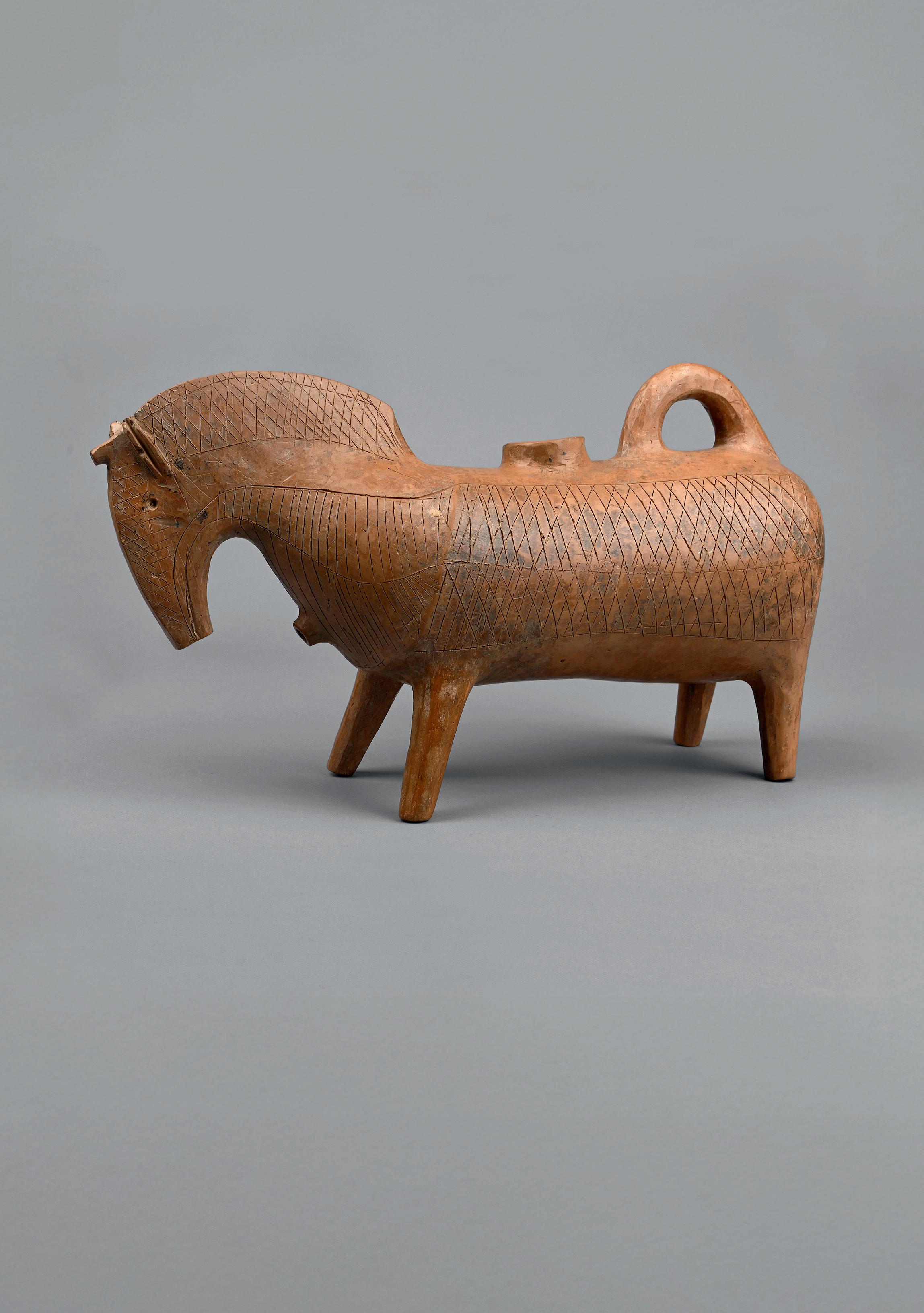
PROVENANCE: Sakae Art Gallery, Nagoya, Japan, 1982. with Aaron Gallery, acquired from the above.
Accompanied by thermoluminescence analysis report no.N121q65 by Oxford Authentication.
FOOTNOTES: Amlash terracotta rhytons, significant objects of this culture, are ancient Near Eastern terracotta vessels, dating back to around 1000 BC, often in the shape of animals, particularly zebu bulls. Rhytons were used for holding and drinking wine or other liquids, and characterised by their detailed animal forms and often featuring incised details.

293
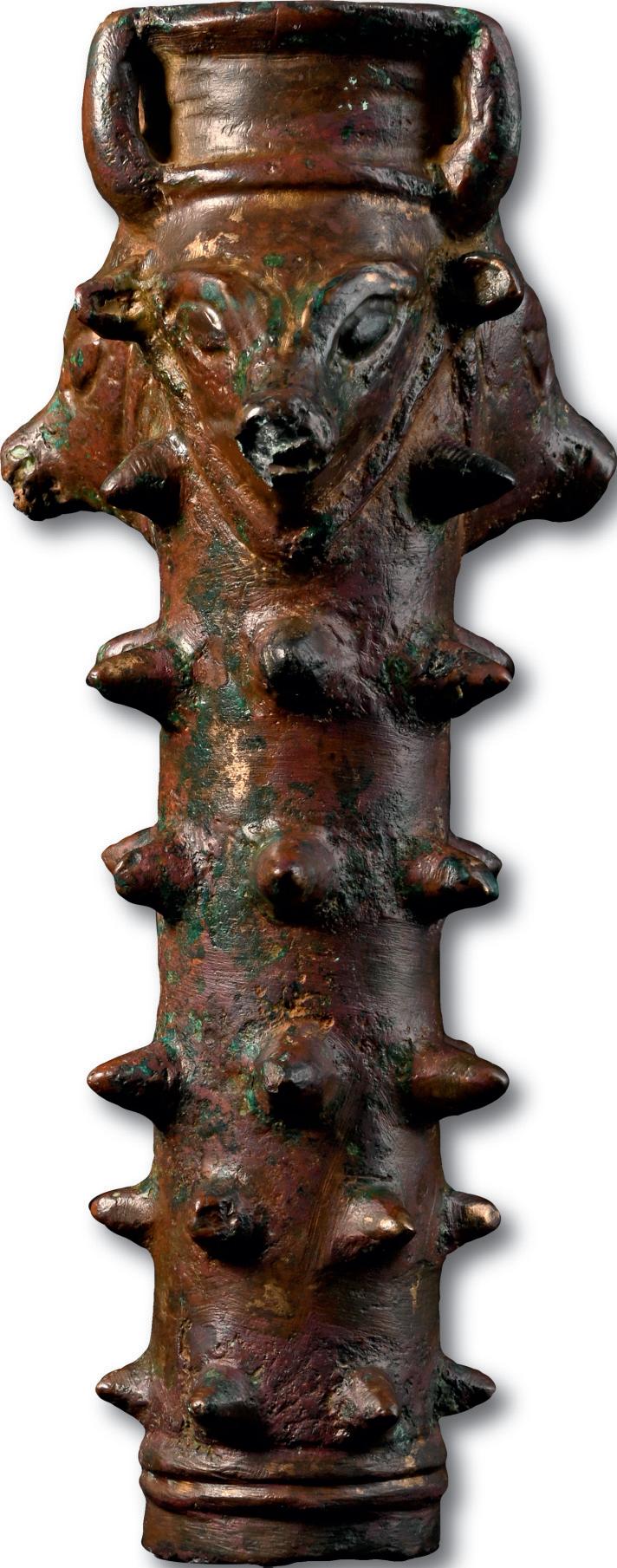
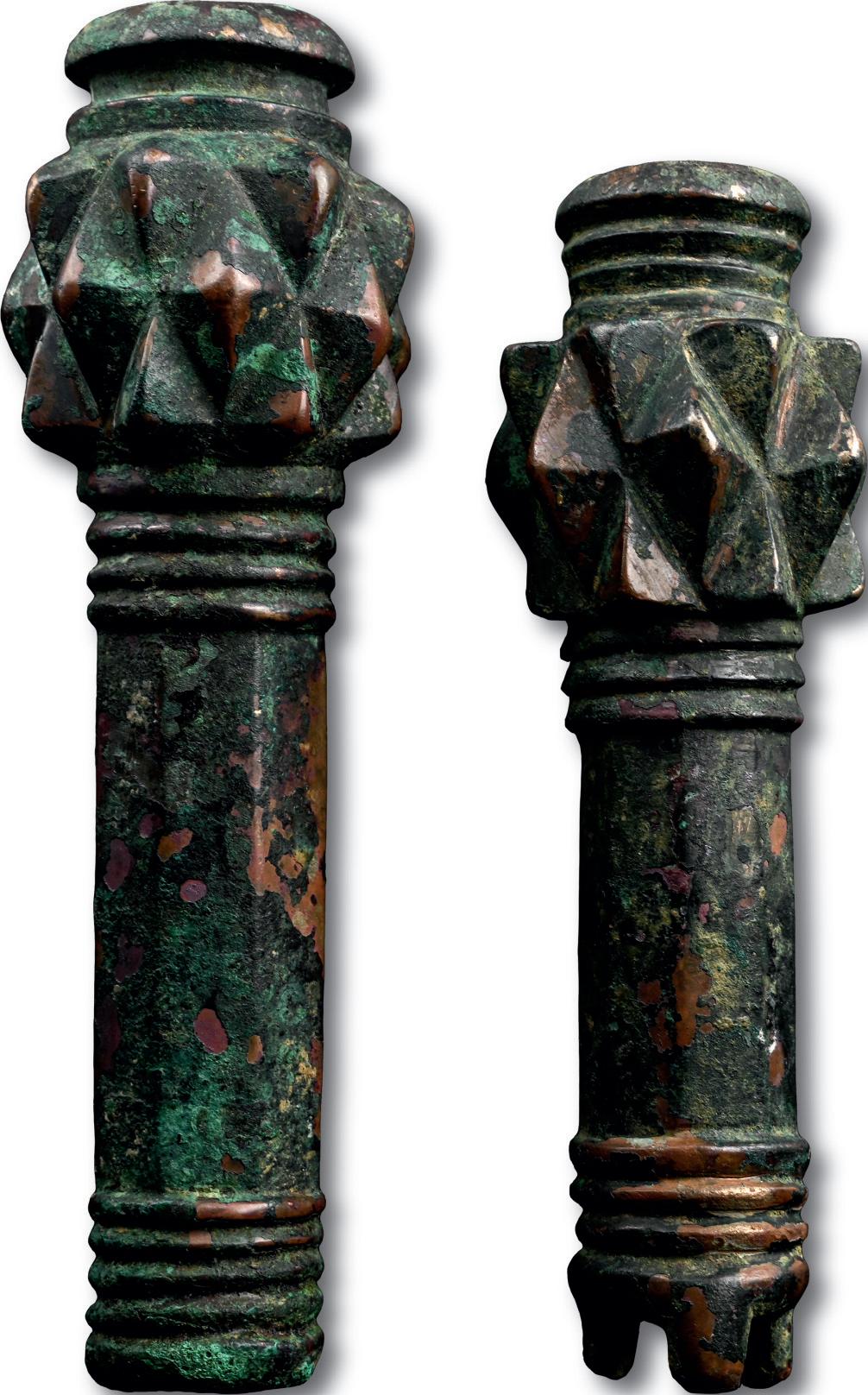

294
ELAMITE SAR-E-GORZ SPIKED BRONZE MACEHEAD
LATE 2ND-EARLY 1ST MILLENNIUM B.C.
7 in. (443 grams total, 18 cm including stand)
With three adjoining bull heads in high-relief to the top, with three ears and three horns serving all three heads; the horns curving towards the rim of the closed top; the shaft adorned with vertical rows of pointed spikes; hollow socket tube with ring collar at the base; mounted on a collector base.
£1,800 - 2,400
PROVENANCE: London, UK gallery, 1971-early 2000s. Private collection, London.
Accompanied by an academic report by Dr Raffaele D’Amato.
LURISTAN BRONZE MACEHEAD COLLECTION
CIRCA 900-800 B.C. 6 - 6¾ in. (876 grams total, 15.5-17.3 cm)
With long septagonal and octagonal shank, rounded knobs around the swollen head, flanked by horizontal bands. [2]
£1,200 - 1,700
PROVENANCE: UK private collection before 2000. Acquired on the UK art market. Private collection, London, UK.
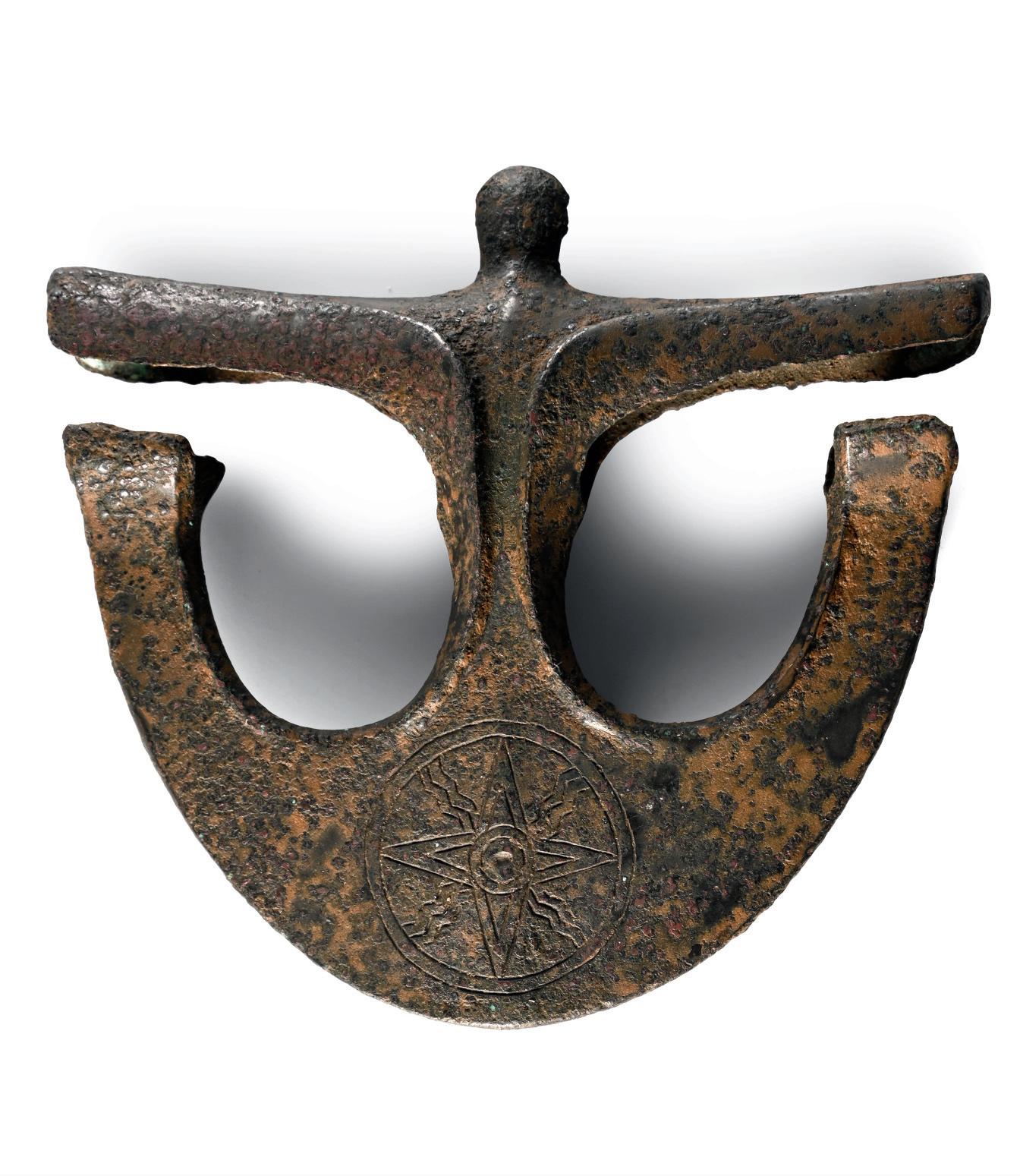
295
MESOPOTAMIAN BRONZE ‘ANCHOR’ AXEHEAD WITH INCISED STAR SIGN OF THE SUN GOD SHAMASH LATE 3RD MILLENNIUM B.C.
5 in. (294 grams, 12.7 cm)
Comprising a crescentic blade with two spurs at each end intended to brace against the shaft, a narrow neck, flared socket with vertical spurs and a knop finial projecting from the rear; ribbed decoration on the rear edge; one side of the blade incised with a symbol of the god sun Shamash, depicted as a four-pointed star with wavy rays alternating with straight rays, a winged solar disc inside.
£3,000 - 4,000
PROVENANCE:
UK private collection before 2000. Acquired on the UK art market. Private collection, London, UK.
Accompanied by an academic report by Dr Raffaele D’Amato.
FOOTNOTES:
This specific type of weapon is called an ‘anchor’ axe because of its shape. Anchor axes have been excavated in Egypt, at Byblos and Ur. Many of them have been said to come from Iran as well, especially from the area of Gilan. The present specimen, in which the shaft hole is joined to the blade by the central tang, is of the same specific type as that excavated in Ur. According to Calmeyer, these axes developed in Mesopotamia. Moorey further explains that the large numbers of these axes reported from Iran could derive from Mesopotamian imports. The Mesopotamian origin of our axe could be further confirmed by the incised motif on the blade, the symbol of the sun god Shamash. The ‘star of Shamash’, typically represented as a four-pointed star with wavy lines placed between the points, is attested as early as the period of Sargon of Accad, who dominated Mesopotamia in 2200 B.C. This symbol can be visible on various Mesopotamian artworks, like the ‘Kudurru’ of Ritti-Marduk at the British Museum; however, dated to 1125-1104 B.C. Another representation is visible on the Tablet of Shamash at the BM, dated 800 B.C. It is also possible, therefore, that the symbol of Shamash was incised on the axe in a later period, but not later than 800 B.C.

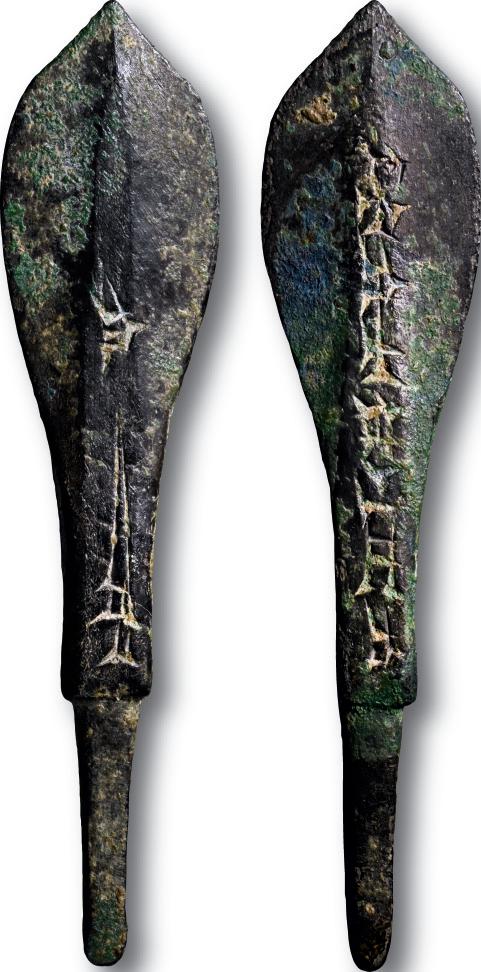
296
BABYLONIAN BRONZE ARROW OWNED BY EULMAS-SAKINSUMI, KING OF BABYLON LATE MIDDLE BABYLONIAN PERIOD, 1004-988 B.C.
2 in. (9.37 grams, 66 mm)
A two-edged leaf-shaped blade and square-section tapering tang, on one side inscribed in Akkadian cuneiform text: ‘Eulmaš-š kin-šumi’; and the other side inscribed in Akkadian cuneiform text: ‘É-ul-mašGAR-MU’; reading (property) ‘Of Eulmash-shakin-shumi, king of the world’; there are now seventeen known examples compared to fourteen known in 1968.
£3,000 - 4,000
PROVENANCE:
UK private collection before 2000. Acquired on the UK art market. Private collection, London, UK.
FOOTNOTES:
King Eulmash-shakin-shumi was the founder of the 6th Dynasty of Babylon, named the B t-Bazi Dynasty after the Kassite tribal group from which its leaders were drawn. They were possibly situated near the juncture of the Diyala River and the Tigris River. There are discrepancies in the information surviving about his reign; whilst the Dynastic Chronicle states that he ruled for fourteen years, the King List A suggests a rule of seventeen years. The events leading to the king’s rise to power unfolded in the context of the chaotic close of the Second Sealand Dynasty, and in the midst of the turmoil inflicted by the famine-induced Aramean migrations. During this period, Eulmaš-š kin-šumi appears to have seized the throne and possibly moved his capital to Kar-Marduk, a hitherto unknown location, and easily defensible. Upon his death, King Eulmash-shakinshumi was buried in the Palace of Kar-Marduk, the dynastic capital. A 9th century stele relating to temple endowments at Sippar relates that the king restored food offerings to Shamash, and entrusted a garden plot in a part of Babylon known as the ‘New City’ to the then high priest there. The weapons unearthed with inscriptions such as the one offered here were likely votive, as opposed to military pieces.

297
SAXON SACRIFICED IRON SPATHA WITH BRONZE CHAPE
5TH-6TH CENTURY A.D.
30¾ in. (630 grams total, 78 cm long)
Double-edged long sword (spatha) of type Osterburken-Kemathen; the blade with squared shoulders, broken into two parts for sacrificial reasons, tapering towards the point; sturdy tang partially preserved; wooden traces of the scabbard and hilt still visible; accompanied by a bronze outer rim of a scabbard; restored. [3]
£1,200 - 1,700
PROVENANCE:
From the private collection of a London gentleman, from his grandfather’s collection formed before the early 1970s.
FOOTNOTES:
The deliberate fragmentation of a sword, often into three pieces, was a symbolic act of ‘killing’ the weapon, which was then placed as a grave good or offered in a ceremonial context. This was a Germanic custom already visible in the Vandal Przeworsk culture around the 3rd or 4th century A.D., which continued in Northern European areas until the 5th and the 6th centuries A.D.
298
MEROVINGIAN IRON PATTERN-WELDED SWORD
CIRCA 6TH CENTURY A.D.
34 in. (694 grams, 86.5 cm)
A double-edged spatha with a lentoid parallel-sided blade and pointed tip; evidence of battle nicks on both cutting edges; long tang and traces of wooden scabbard on the blade; signs of damask pattern running along the length of the blade, especially on the upper part; cleaned and conserved.
£800 - 1,000
PROVENANCE:
From the private collection of a London gentleman, from his grandfather’s collection formed before the early 1970s.
Accompanied by an academic report by Dr Raffaele D’Amato.
299
VIKING IRON PATTERN-WELDED SWORD
8TH-9TH CENTURY A.D.
33 in. (809 grams, 85.5 cm)
Double-edged cutting sword of Petersen type A with a finely tapering blade, showing pattern-welding; upper and lower guards with strongly curved sides; the cross-guard boat-shaped with an acute tapering tang; the pommel attached with two nails to the original boat-shaped upper guard.
£4,000 - 6,000
PROVENANCE:
From the private collection of a London gentleman, from his grandfather’s collection formed before the early 1970s.
Accompanied by an academic report by Dr Raffaele D’Amato.
FOOTNOTES:
Petersen originally individuated eight examples of this sword’s typology, one of the first categories of Viking swords, although these swords were also widely used in the Carolingian Empire and widespread among the Italic population as well (frescoes from the Necropolis of S.Andrea Priu, Sardegna, 8th or 9th century AD), where specimens are still attested in the 10th century A.D (D’Amato-Salimbeti, 2020, p.23). The evenly wide, three-sided pommel, narrower than the guard, was the most characteristic element of such swords, and in some cases it was divided into three segments, or even seven segments (swords from Neri, Opstryn s., Stryn, Nordfjord). Thes tend to be confused with the similar pommels of the swords of H typology (Petersen, 1919, pp.89ff.), but in these latter swords the guards are wider and with an elliptical cross-section.
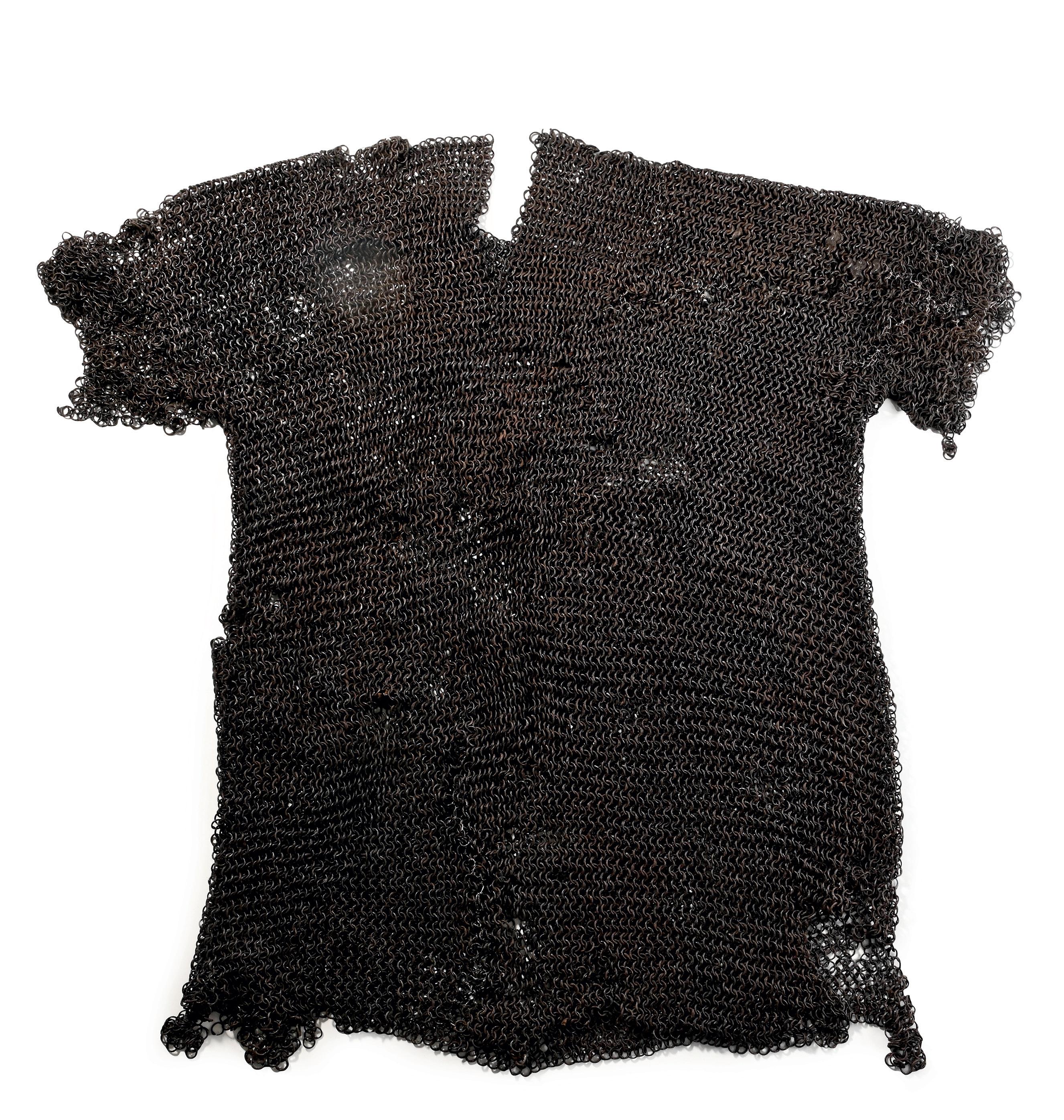
FRANKISH WARRIOR’S IRON BYRNIE CHAIN MAIL ARMOUR NORTHERN EUROPE, CIRCA 6TH-10TH CENTURY A.D.
25½ x 29½ in. (4.71 kg, 65 x 75 cm)
A nearly complete short-sleeved ring armour composed of interlocking links in the four-through-one formation with alternating rivetted rings.
£5,000 - 7,000
PROVENANCE:
From the private collection of a London gentleman, from his grandfather’s collection formed before the early 1970s.
Accompanied by an academic report by Dr Raffaele D’Amato.
FOOTNOTES:
The rings are arranged in rows, and the links within the same row do not join. Instead, each ring connects to two rings in the row above and two in the row beneath. A great majority of all-rivetted mail comes from Southern Scandinavia and Northern Europe, notably Sweden, northern Germany and Poland. Allrivetted mail already occurs there during the Roman Iron Age, and continues into the Migration, the Vendel, and then the Viking periods. Rivetted rings were usually fabricated by shaping metal wire into a circle with the ends overlapping several mm. Here, the riveted rings seem to be of reshaped oval form.



301
MEDIEVAL KNIGHT’S IRON HAND-AND-A-HALF SWORD WITH INSCRIBED BRONZE POMMEL
GERMANY, 14TH CENTURY A.D.
44½ in. (1.25 kg, 113 cm)
Longsword of Oakeshott’s Type XVa, cross style 8, bronze pommel style J (recessed); strongly tapering, pointed blade of ‘flattened diamond’ section, cross style tapering gradually outward to sharply downturned tips; long grip with slight taper, disc pommel with chamfered edges and a potent cross in the centre surrounded by an inscription (on both sides) ‘+ IH SU + AAWM’. [No Reserve]
£4,000 - 6,000
PROVENANCE: From the private family collection of a lady, UK; acquired in Germany mid 20th century.
Accompanied by an academic report by Dr Raffaele D’Amato.
FOOTNOTES:
Some wheel pommels of this date have engraved, or inset roundels with armorial or devotional emblems, and a number of sword blades of this date bear religious inscriptions in the form of a prayer. The inscription on the pommel between the two potent crosses is intriguing. The letters ‘IH SU’ are a clear reference to the name of the Saviour, and can be translated as Ihesu-Jesus, or also Ihesu Merci (Jesus have mercy), a simple prayer for the person carrying the sword. The letters ‘A.A. W.M.’ could refer to the name of the owner of the sword (WM = Wilhelm) or the maker of the weapon. It is difficult to consider the letters as an abbreviation of the prayer ‘Ave Maria’, usually shortened in the German medieval inscriptions as A.M.
302
MEDIEVAL KNIGHT’S IRON HAND-AND-A-HALF SWORD WITH ICOSIKAIDIGON POMMEL
EUROPE, 14TH-15TH CENTURY A.D. 45 in. (1.43 kg, 114.5 cm)
Longsword of Oakeshott’s Type XVIII b, cross style 11, pommel style I1, with a strongly tapering pointed blade with a shallow ‘flattened diamond’ cross-section without fullers; the edges straight and tapering without curving to the point; guard characterised by a well-defined cross-guard with knobbed ends, long grip slightly tapering towards the facetted pommel. [No Reserve]
£3,000 - 4,000
PROVENANCE:
From the private family collection of a lady, UK; acquired in Germany, mid 20th century.
Accompanied by an academic report by Dr Raffaele D’Amato.



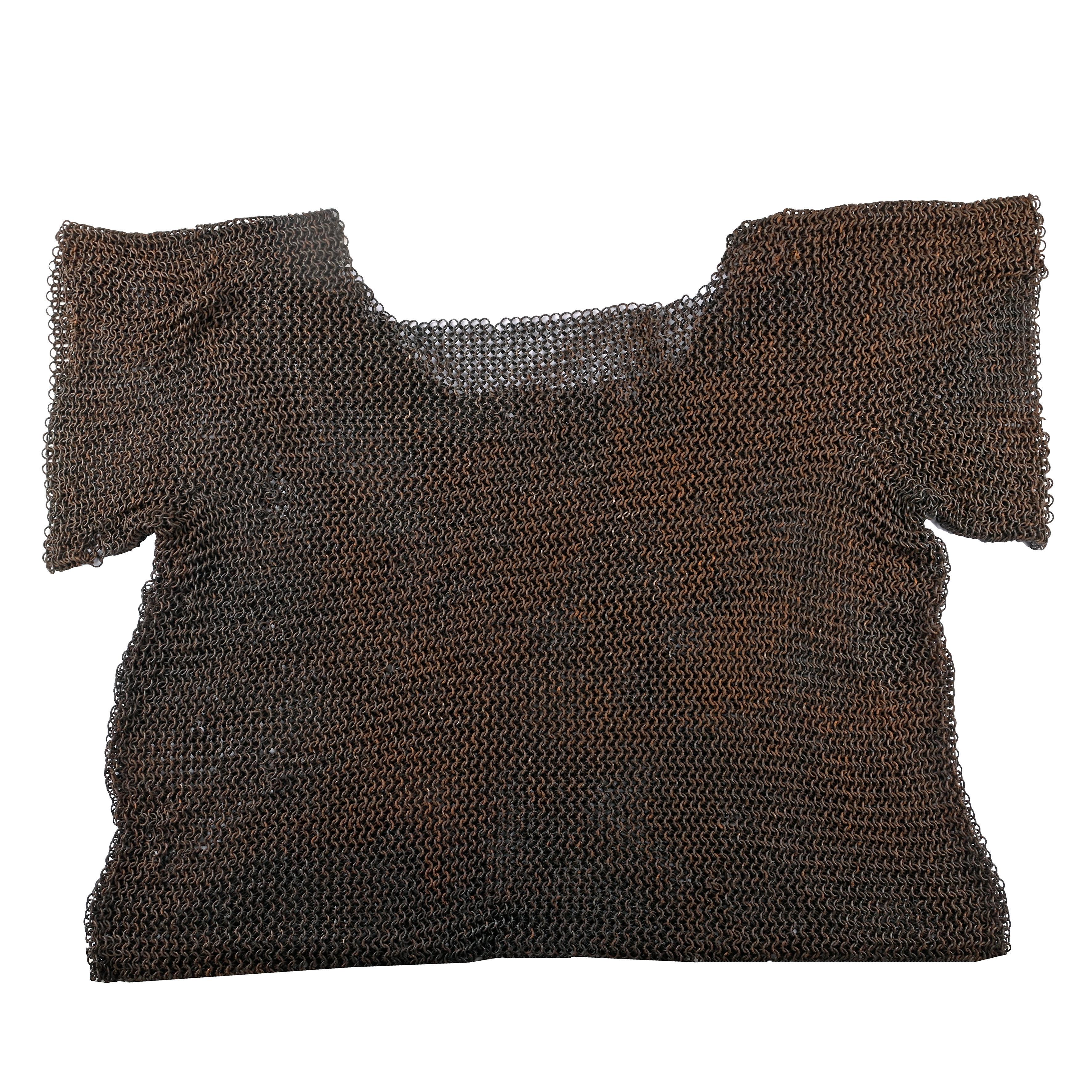
PROVENANCE: Acquired on the German art market before 2000. Private collection, South Germany.
30¼ x 22 in. (9.93 kg, 87 x 56 cm)
A butted short-sleeved chainmail shirt made of thick oval rings assembled in the usual system of one-to-four; in an excellent state of preservation, with over 95% of the rings intact, very few broken or corroded, with no later additions.
£3,000 - 4,000
Accompanied by an academic report by Dr Raffaele D’Amato.
FOOTNOTES:
In the German-manufactured ring mail armours, in the 15th century A.D., the rings protecting the breast were very thick, whereas the sleeved mail armours were thinner. Master armourers from Nuremberg were famous for this production across Europe.
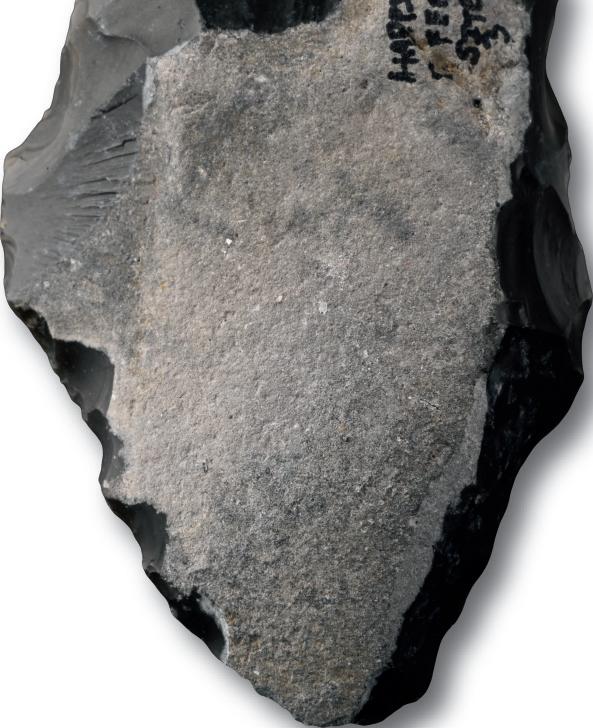
306
STONE AGE HOMO HEIDELBERGENSIS UNIFACE FLINT HANDAXE FROM HAPPISBURGH
LOWER PALAEOLITHIC PERIOD, CIRCA 600,000-250,000 B.P. 4 in. (237 grams, 10.3 cm without stand)
Formed from a cobble and marked ‘Happisburgh March 2019 AP Site 3 by Defences’; mounted on a custom-made stand.
£300 - 400
PROVENANCE:
Found by Mr Anthony Pryke in Happisburgh, Norfolk, UK, March 2019, near site 3.
FOOTNOTES:
Discovery by Mr A Pryke after the ‘Beast from the East Storm’, which stripped the beach of the sand and helped to erode the Palaeolithic artefacts from the ancient Thames river bed. During the time the artefacts were dropped, the Thames ran through North Norfolk and what is now Happisburgh before it was pushed down to its current position in London via the Ice Age glacial melts. The site of Happisburgh in Norfolk has helped to push the history of inhabitation of the British Isles back by 200,000 making it a site of special importance.
307
STONE AGE DANISH TYPE 1 DAGGER
NEOLITHIC PERIOD, CIRCA 2400-2050 B.C. 6 in. (62 grams, 15.3 cm)
Long and biconvex in section, willow-leaf shaped and bifacially worked; thick neck.
£800 - 1,000
PROVENANCE:
Jones & Jacob Limited, Oxfordshire, 12 November 2025, no.180. Private collection, UK.
304
‘BRITISH MUSEUM RECORDED’ STONE AGE HOMO HEIDELBERGENSIS FLINT HANDAXE FROM HAPPISBURGH
LOWER PALAEOLITHIC PERIOD, CIRCA 600,000-250,000 B.P. 3 in. (100 grams, 79 mm)
Small sub-cordate handaxe of Wymer’s type G, of glassy black flint with a few paler inclusions towards the butt; strip of light grey cortex remaining to the dorsal face at this end; flake scars appearing to be soft hammer struck with quite thin and invasive removals.
£800 - 1,000
PROVENANCE:
Found Happisburgh, Norfolk, UK, Tuesday 1st October 2019 - Saturday 30th November 2019.
Acquired from the finder Mr P Macro.
Accompanied by a copy of the British Museum’s Portable Antiquities Scheme (PAS) report no.NMS-3AE638.
305
STONE AGE HOMO HEIDELBERGENSIS FLINT HANDAXE FROM HAPPISBURGH
LOWER PALAEOLITHIC PERIOD, CIRCA 600,000-250,000 B.P.
3½ in. (99 grams, 89 mm without stand)
Ovate in plan with concave underside; marked ‘Happisburgh 7 Feb 19 Site 3 AP’; mounted on a custom-made stand.
£300 - 400
PROVENANCE:
Found by Mr Anthony Pryke in Happisburgh, Norfolk, UK, February 2019 near site 3.
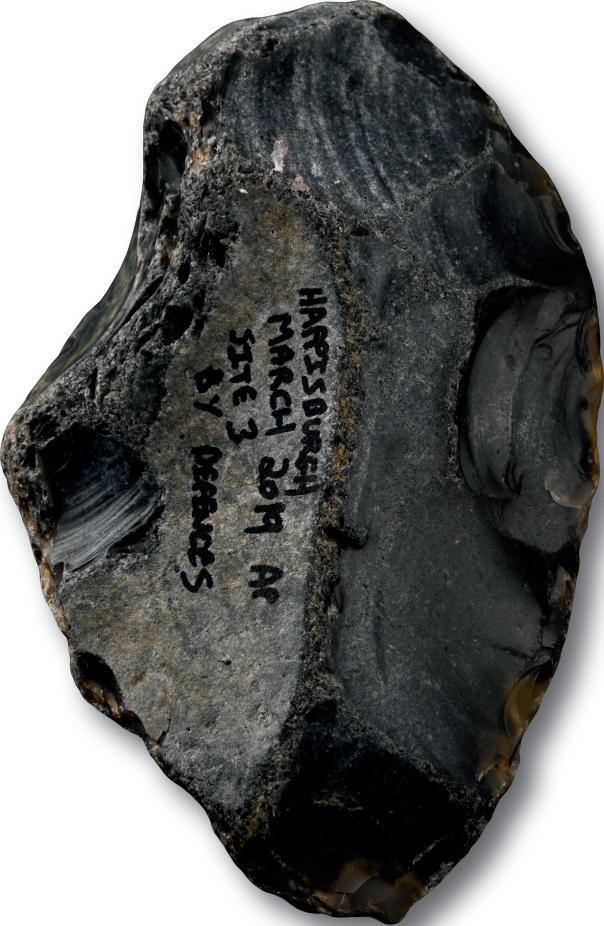


308
LARGE STONE AGE ACHEULEAN OVATE FLINT HANDAXE
LOWER PALAEOLITHIC PERIOD, CIRCA 600,000-350,000 B.P.
6 in. (719 grams, 17.5 cm without stand)
Substantial and well-made handaxe with thick butt and rounded cutting edge; marked ‘St Même FR’; likely made by Homo Heidelbergensis; mounted on a custom-made display stand.
£600 - 800
PROVENANCE:
From the well regarded long closed quarry site of St Meme, Charente, France.
From an old large French collection. Acquired on the European art market.
From a UK private collection.
309
HUGE STONE AGE ACHEULEAN OVATE FLINT HANDAXE
LOWER PALAEOLITHIC PERIOD, CIRCA 600,000-350,000 B.P.
8¼ in. (1.54 kg, 21.1 cm without stand)
Extremely large example of a chopping tool, likely made by Homo Heidelbergensis; mounted on a custom-made display stand.
£500 - 700
PROVENANCE:
From the well regarded, long closed quarry site of St Meme, Charente, France.
From an old large French collection. Acquired on the European art market.
From a UK private collection.
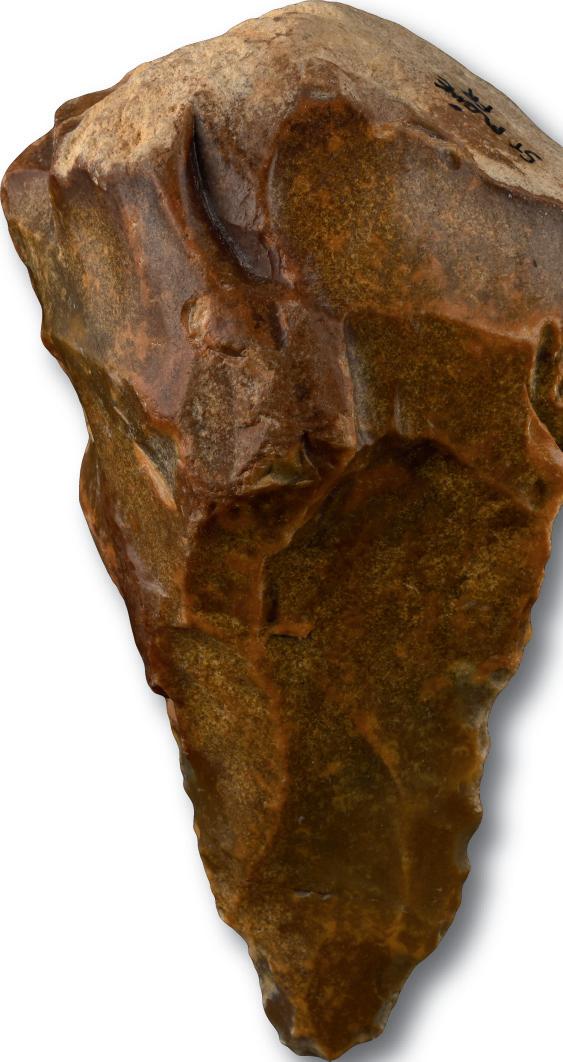

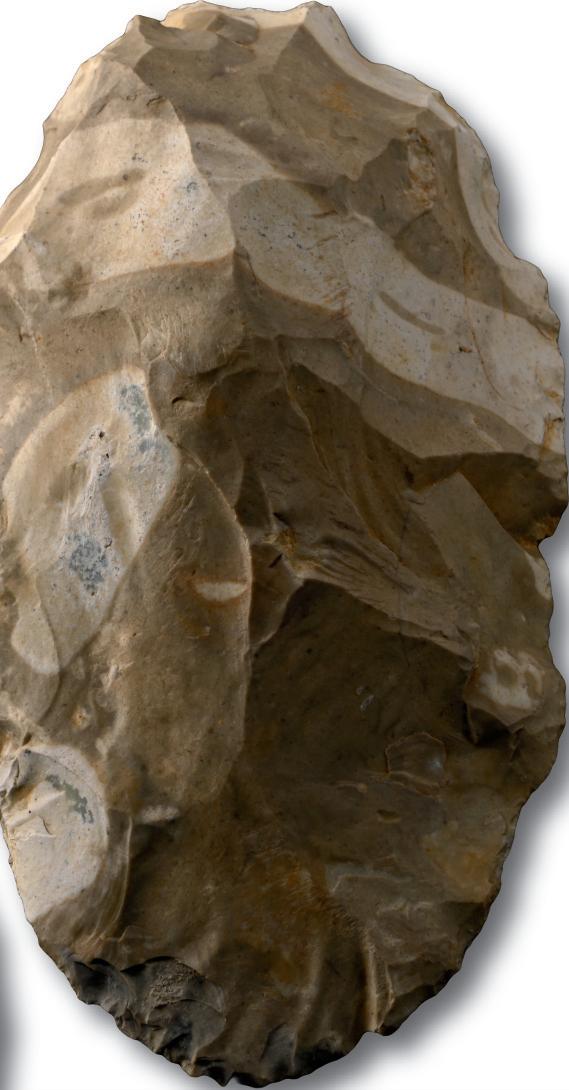
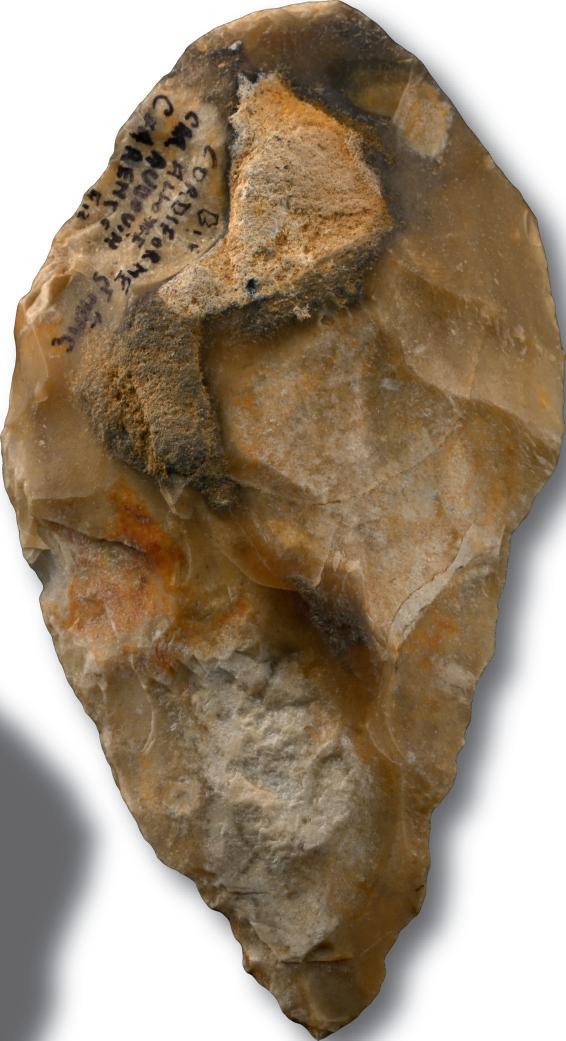
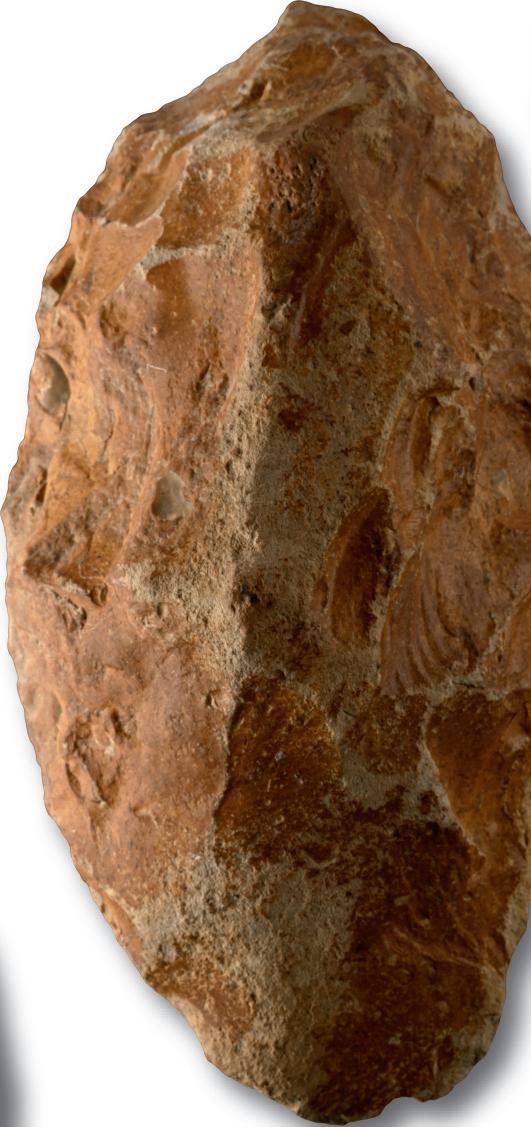
310
STONE AGE ACHEULEAN FLINT HANDAXE


LOWER PALAEOLITHIC PERIOD, CIRCA 600,000-350,000 B.P. 5 in. (235 grams, 13 cm without stand)
Well made with a thin sharp profile, likely made by Homo Heidelbergensis; marked at the butt ‘Bif Cordiforme Allonge St. Même Audoin Charente’; mounted on a custom-made stand.
£300 - 400
PROVENANCE:
From the well regarded long closed quarry site of St Meme, Charente, France. From an old large French collection. Acquired on the European art market.
From a UK private collection.
311
STONE AGE ACHEULEAN FICRON FLINT HANDAXE
LOWER PALAEOLITHIC PERIOD, CIRCA 600,000-350,000 B.P.
5¼ in. (418 grams, 13.4 cm without stand)
Well made with a ficron shape, the tip snapped in a clean break (this has been professionally glued back into place); likely made by Homo Heidelbergensis; marked to butt ‘ST Même FR’; mounted on a custom-made stand.
£400 - 600
PROVENANCE:
From the well regarded long closed quarry site of St Meme, Charente, France.
From an old large French collection. Acquired on the European art market.
From a UK private collection.
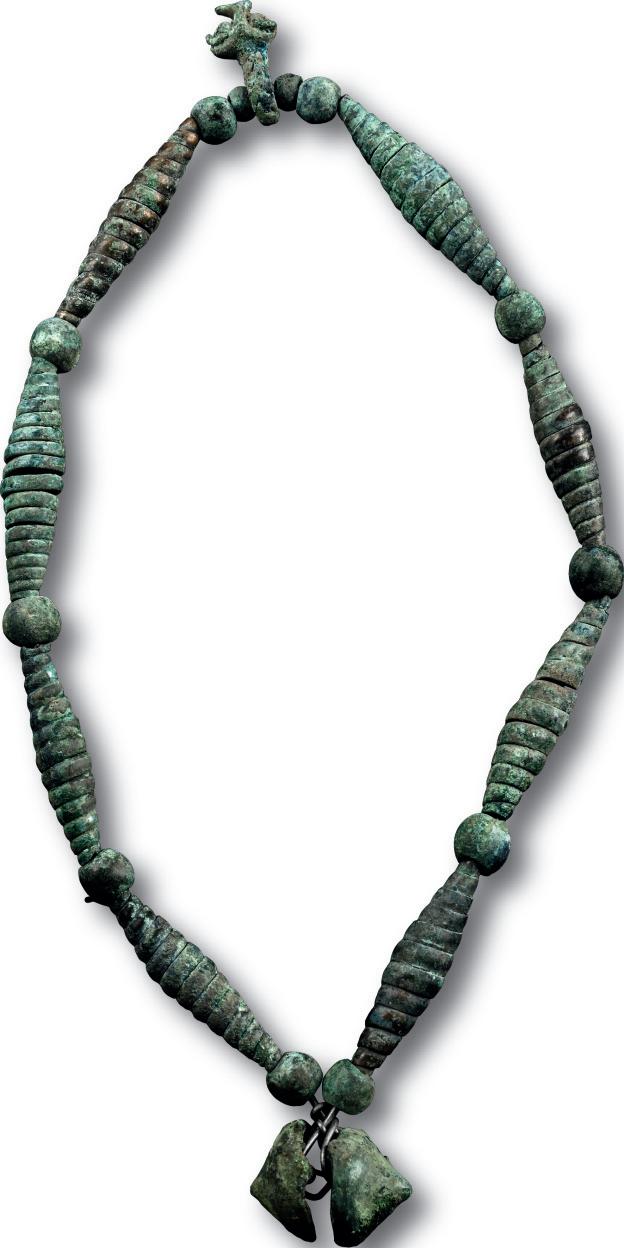
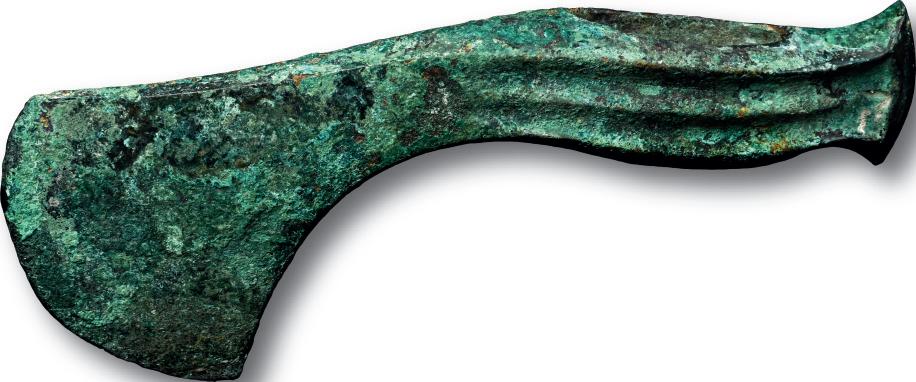
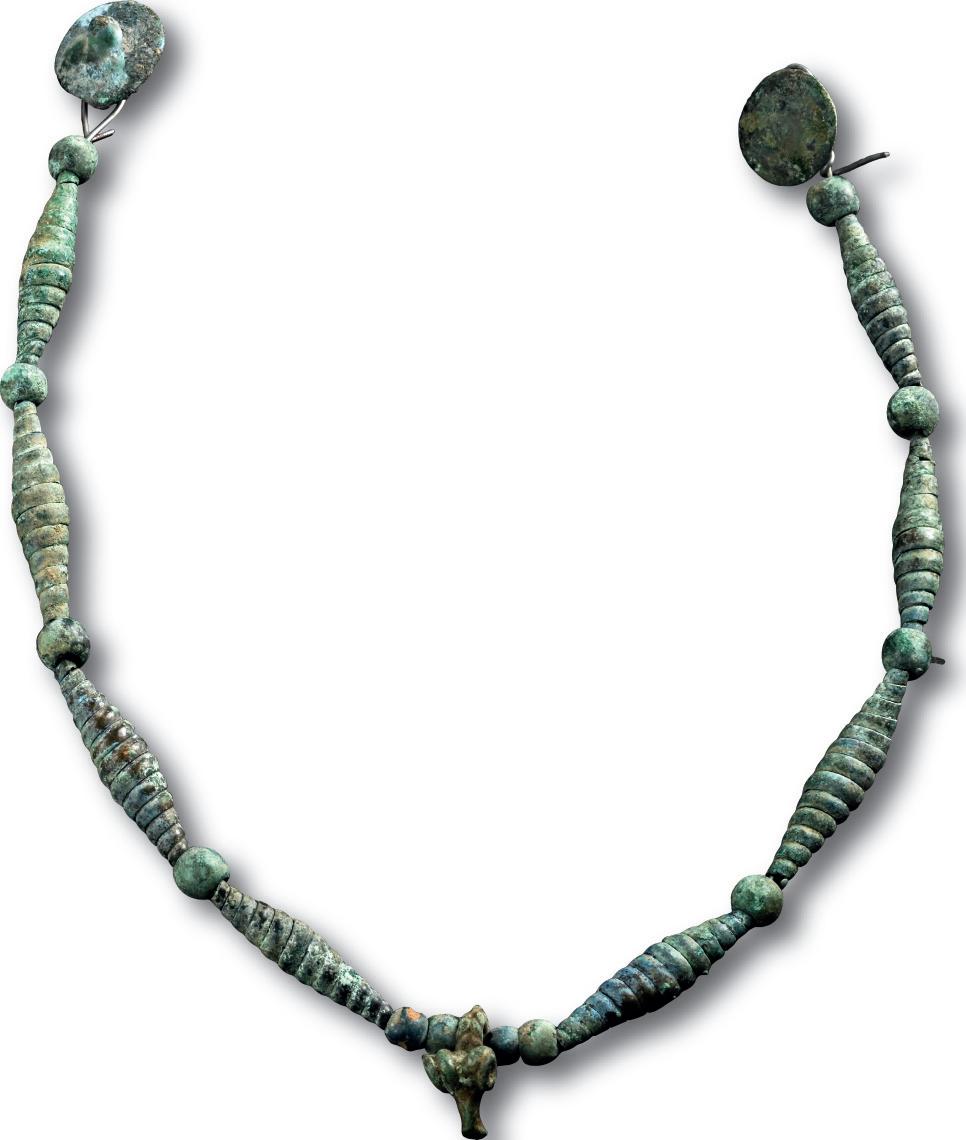

312
BRONZE AGE COILED BEAD NECKLACE WITH PENDANTS
12TH-8TH CENTURY B.C.
19¾ in. (116 grams, 50 cm)
Restrung necklace of fusiform beads, each formed with a coil of flatsection bronze strip; interstitial oval beads with conical bosses at each finial; centrepiece a lobed stud.
£500 - 700
PROVENANCE:
Private European collection, 1990s. Private collection, London, UK.
313
BRONZE AGE COILED BEAD NECKLACE WITH PENDANTS
12TH-8TH CENTURY B.C.
20½ in. (116 grams, 52 cm)
Restrung necklace of fusiform beads, each formed with a coil of flatsection bronze strip; interstitial oval beads with conical bosses at each finial; centrepiece a lobed stud.
£500 - 700
PROVENANCE:
Private European collection, 1990s. Private collection, London, UK.


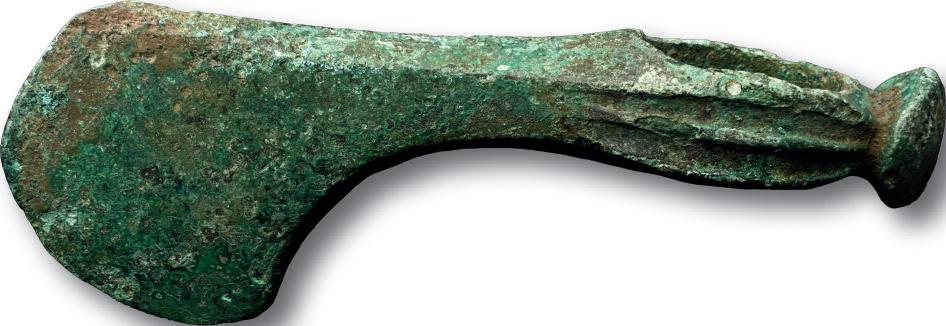
314
LARGE BRONZE AGE SOCKETTED AXEHEAD
KOBAN CULTURE, 12TH-8TH CENTURY B.C.
7¼ in. (458 grams, 18.5 cm)
Substantial hexagonal-section neck developing to a broad blade with rounded edge and scooped underside; ellipsoid-section socket with three lateral ribs to each face, flared edge to rear.
£600 - 800
PROVENANCE:
Private European collection, 1990s. Private collection, London, UK.
315
LARGE BRONZE AGE SOCKETTED AXEHEAD
KOBAN CULTURE, 12TH-8TH CENTURY B.C.
8 in. (732 grams, 20.8 cm)
Substantial hexagonal-section neck developing to a thick blade with rounded edge and scooped underside; ellipsoid-section socket with three lateral ribs to each face, carinated knop to rear.
£600 - 800
PROVENANCE:
Private European collection, 1990s. Private collection, London, UK.
316
BRONZE AGE GOLD TRIPARTITE PENANNULAR RING
MIDDLE BRONZE AGE, CIRCA 1300-1550 B.C.
½ in. (6.30 grams, 13.30 mm overall, 8.15 mm internal diameter)
Penannular in form, composed of three individual rods soldered into a single unit.
£1,500 - 2,000
PROVENANCE:
Found on 29th December 2022 from Bawdsey, Suffolk, UK.
Declared as treasure and subsequently disclaimed as 2023 T70.
Recorded and accompanied by a copy of the British Museum’s Portable Antiquities Scheme (PAS) report no.SF-5342CD.
317
BRONZE AGE DECORATED BOWL WITH LOOP HANDLE ‡
CIRCA 1000 B.C.
6 in. (182 grams, 15.2 cm wide)
With carinated profile, and flared rim, ancient rivetted repair to central base; strap handle to rear over ancient crack, with evidence of previous repairs.
£700 - 900
PROVENANCE:
Acquired in Austria in 2000. Acquired by the present owner from the above.
318 BRONZE AGE CEREMONIAL DAGGER WITH CHAIN ATTACHMENT
EASTERN EUROPE, 1ST MILLENNIUM B.C.
20 in. (526 grams, 51 cm including chain)
Comprising: a long triangular blade with scooped shoulders, lentoid in section and with rounded tip; integral waisted hilt formed as three conjoined lobes and loop between the upper arms; short length of bronze chain formed from D-section forged and butted links.
£700 - 900
PROVENANCE:
From the private collection of a London gentleman, from his grandfather’s collection formed before the early 1970s.
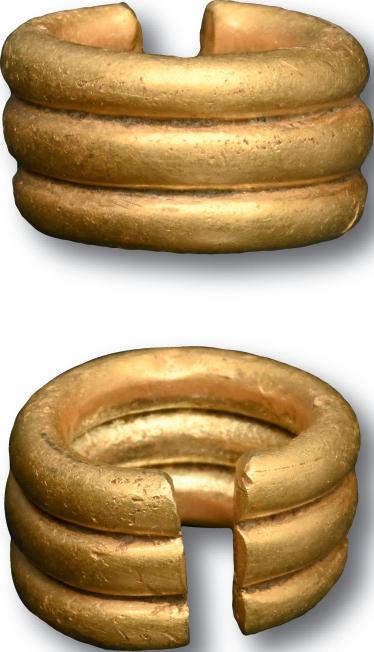
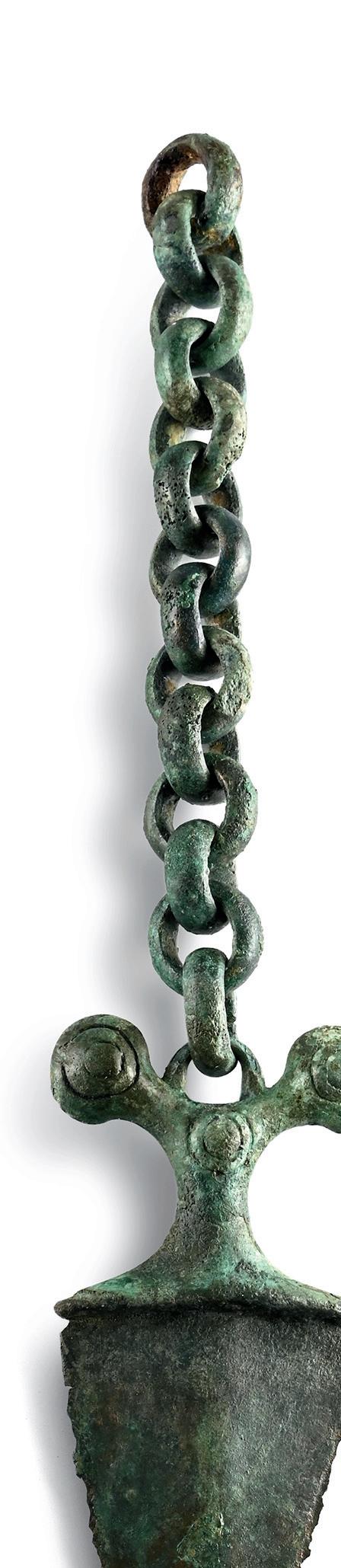
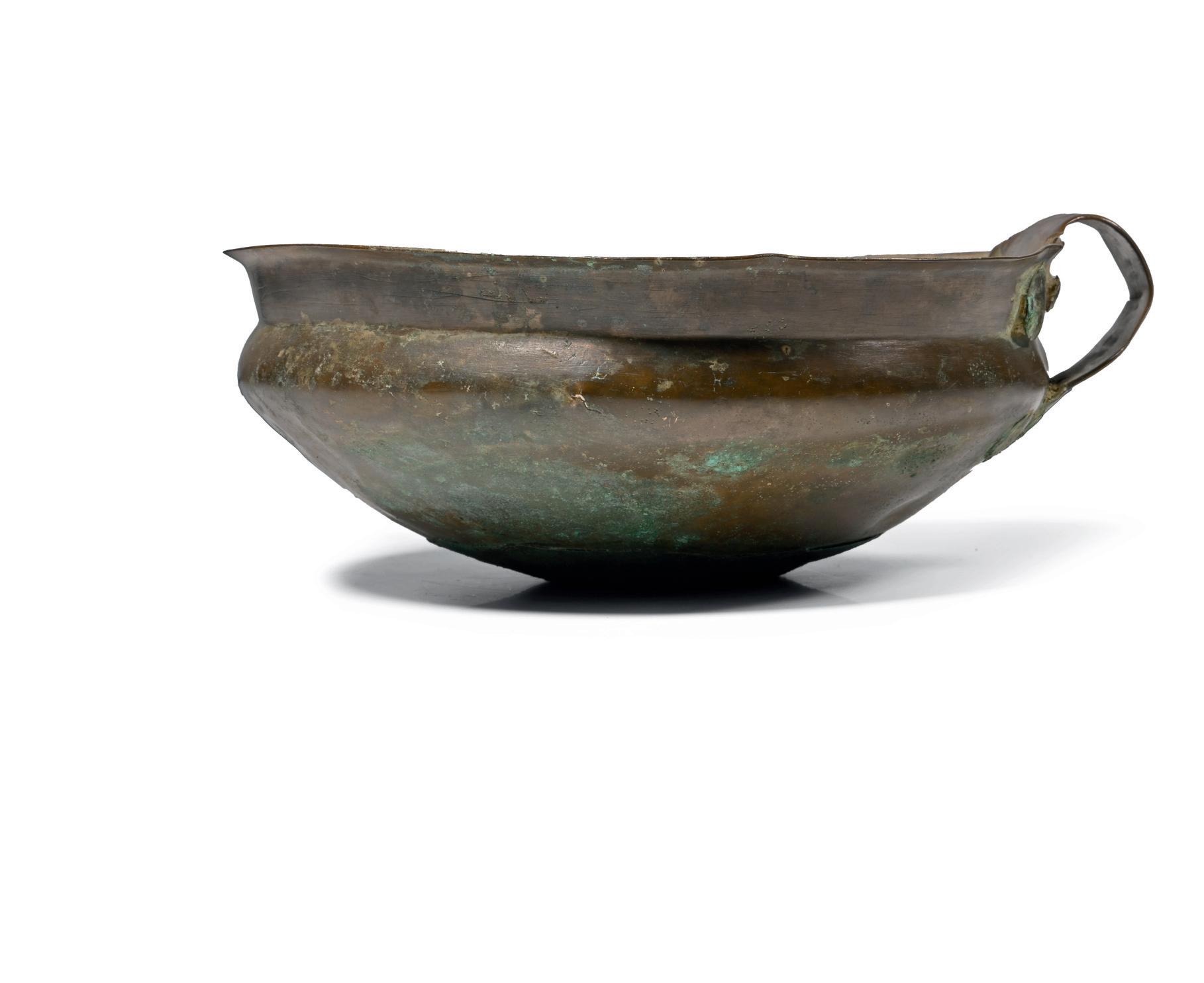
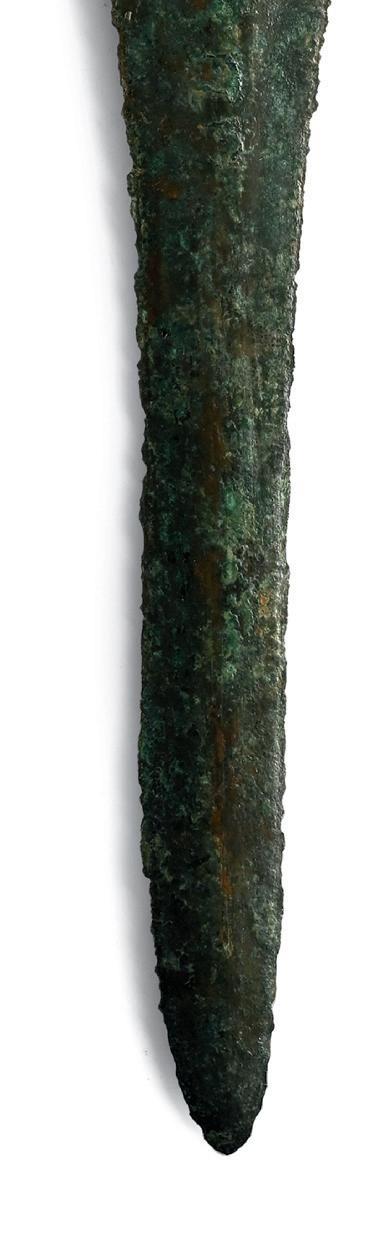
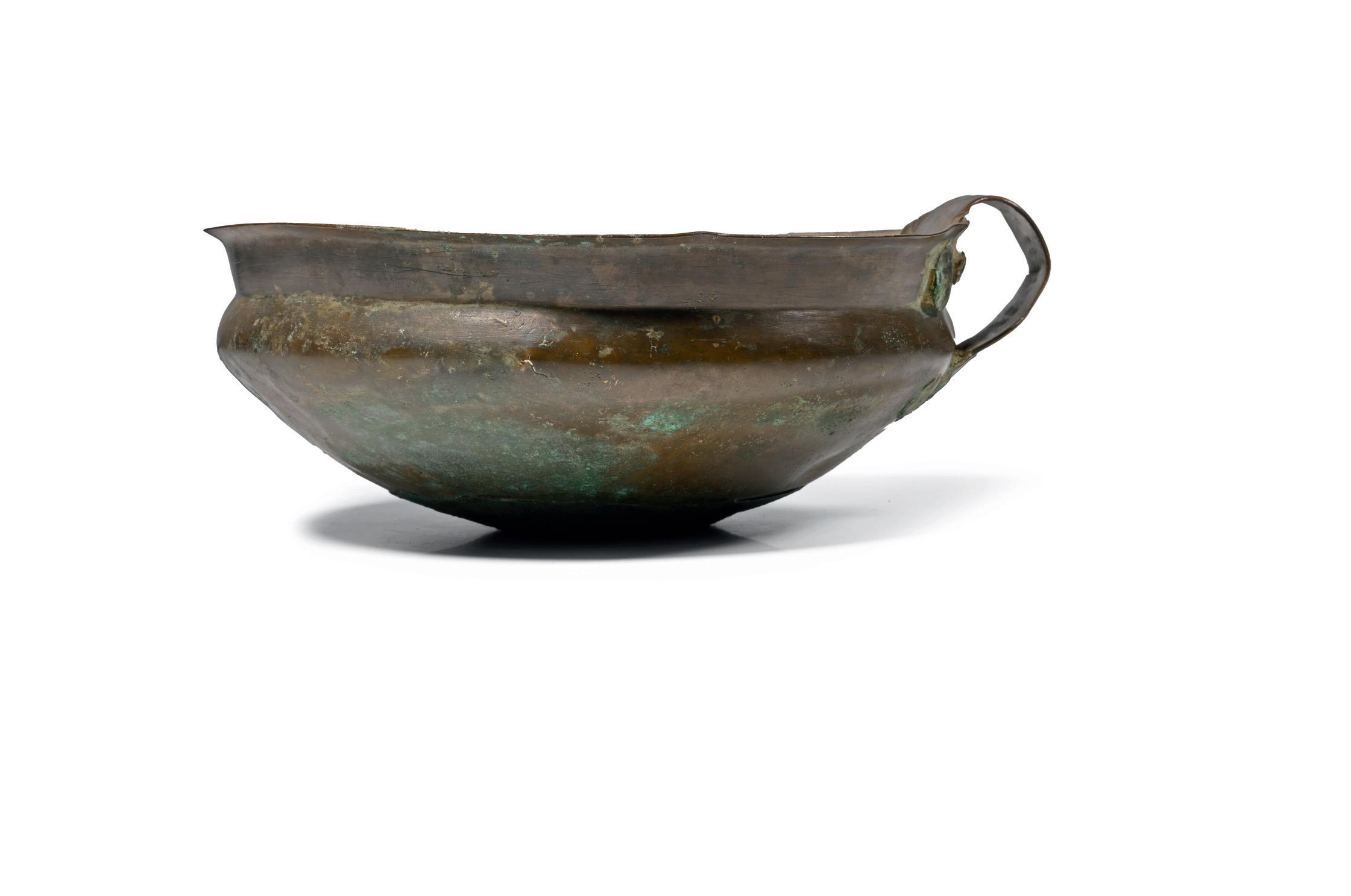



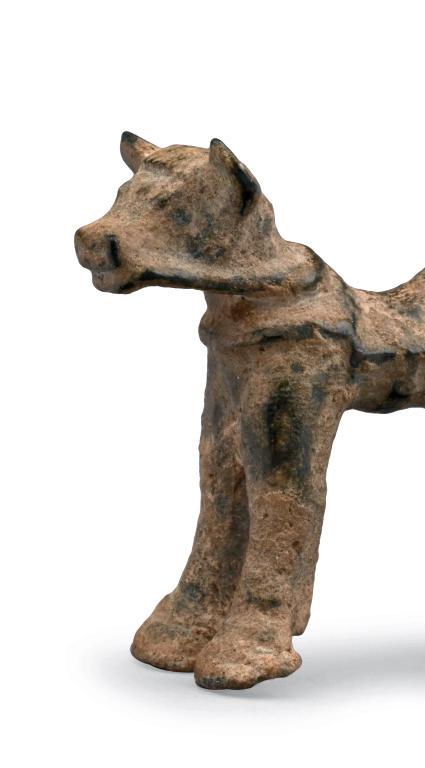
319
6 in. (149 grams, 15.4 cm)
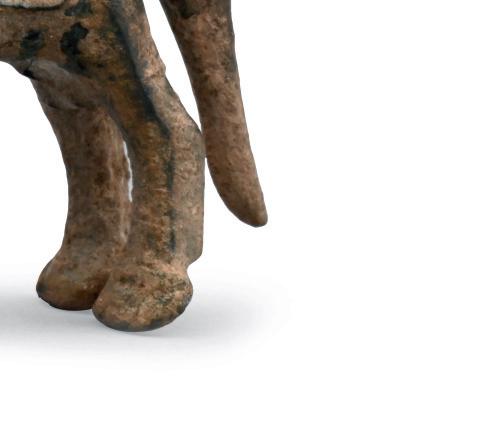
FRENCH CELTIC BRONZE NECK TORC IRON AGE, 4TH-3RD CENTURY B.C.
Round-section collar with La Tène scrolls and bosses to the upper face, bulbs flanking the centrepiece of three discoid cells with inset glass segmented bosses, each surmounted by a domed stud; bosses replaced; handwritten note by Philippe Chauchoy stating ‘Torque celtique en bronze garanti authentique, avec cabochons refaits - Fin du IVe-début IIIe siècle av[ant] J.C.’ [No Reserve]
£400 - 600
PROVENANCE:
Ex Philippe Chauchoy, Amiens, Northern France, 1994. From the private collection of a West Midlands lady collector.
Accompanied by an original handwritten and signed information card from Philippe Chauchoy, dated 6th June 1994.
320
3RD-1ST CENTURY B.C.
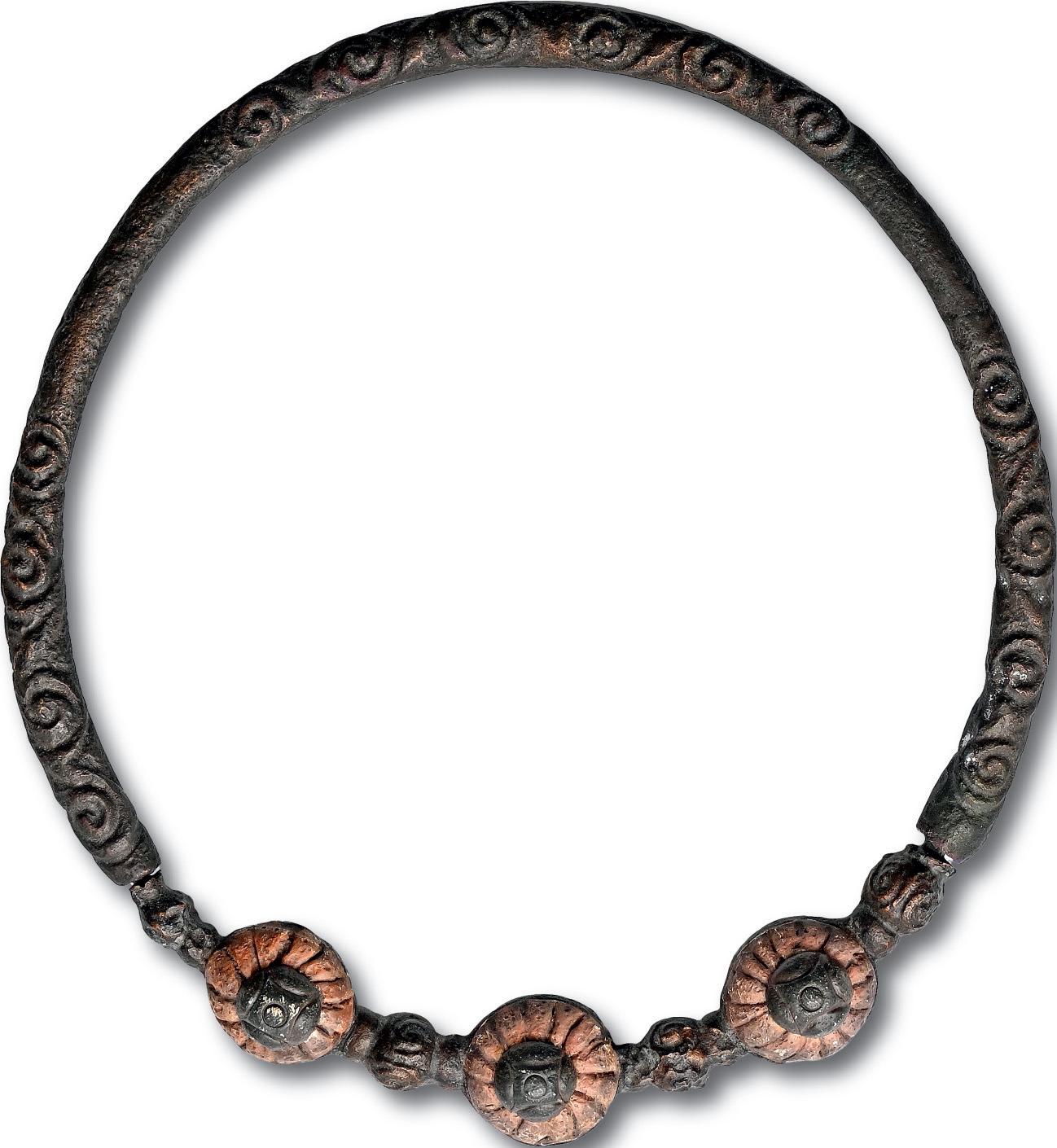
IBERIAN BRONZE BULL STATUETTE
‡
2 in. (48.6 grams, 54 mm long)
Modelled as a bridled and saddled bull, naturalistically rendered with well-defined facial planes, lending a vivid and expressive character
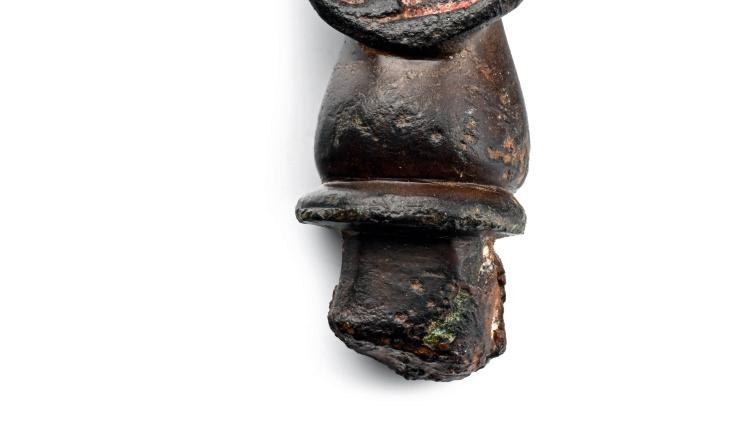
to the figure; the edge of the saddle adorned with a delicate row of incised circles, broad hollowed out hooves.
£1,800 - 2,400
PROVENANCE: Frank Sternberg collection, Zurich, 1980s. Private collection, acquired from Frank Sternberg in 1992.
FOOTNOTES:
The statuette likely served as a votive offering (ex-voto) at a sanctuary or temple, and closely parallels numerous Iberian examples recovered from sacred sites in Alicante, Valencia, and particularly in Andalusia. In Iberian culture, the bull was a potent symbol of strength, virility, and martial power—frequently associated with warrior deities. The inclusion of a saddle and bridle suggests domestication, and it is plausible that such animals, being more docile than horses, may have been ridden or equipped in ritual or ceremonial contexts. 321
CELTIC ENAMELLED BRONZE CHARIOT LYNCH PIN TERMINAL 1ST CENTURY B.C.-1ST CENTURY A.D.
2 in. (64.8 grams, 54 mm)
Square-section shank with flange and tapering bulb, disc finial with reserved comma-trumpet design and red enamelled field.
£400 - 600
PROVENANCE: Found Norfolk, UK.
IRON AGE BRONZE-HILTED SWORD
8TH-6TH CENTURY B.C.
30¾ in. (2.2 kg total, 78 cm including stand)
A broad iron sword with tapering blade and rounded shoulders, bronze hilt with crescentic pommel and apotropaic eye motifs to both sides; accompanied by bronze scabbard or baldric elements including a pair of eyelets with suspension loops, four circular appliqués with conical tips and ropework borders, and a scabbard chape with two opposing ibexes; mounted on a custom-made display stand.
£3,000 - 4,000
PROVENANCE:
From the private collection of a London gentleman, from his grandfather’s collection formed before the early 1970s.
Accompanied by an academic report by Dr Raffaele D’Amato.
FOOTNOTES:
The sword belongs to the Caucasian culture of the Colchis and represents a very rare typology. A similar blade was found together with early Scythian arrows during excavations at Karmir-Blur. A similar combination found at Kulanurkhva’s excavations suggests that the appearance of such blades in Abkhazia is linked to the Scythian campaigns in Near Eastern Asia.
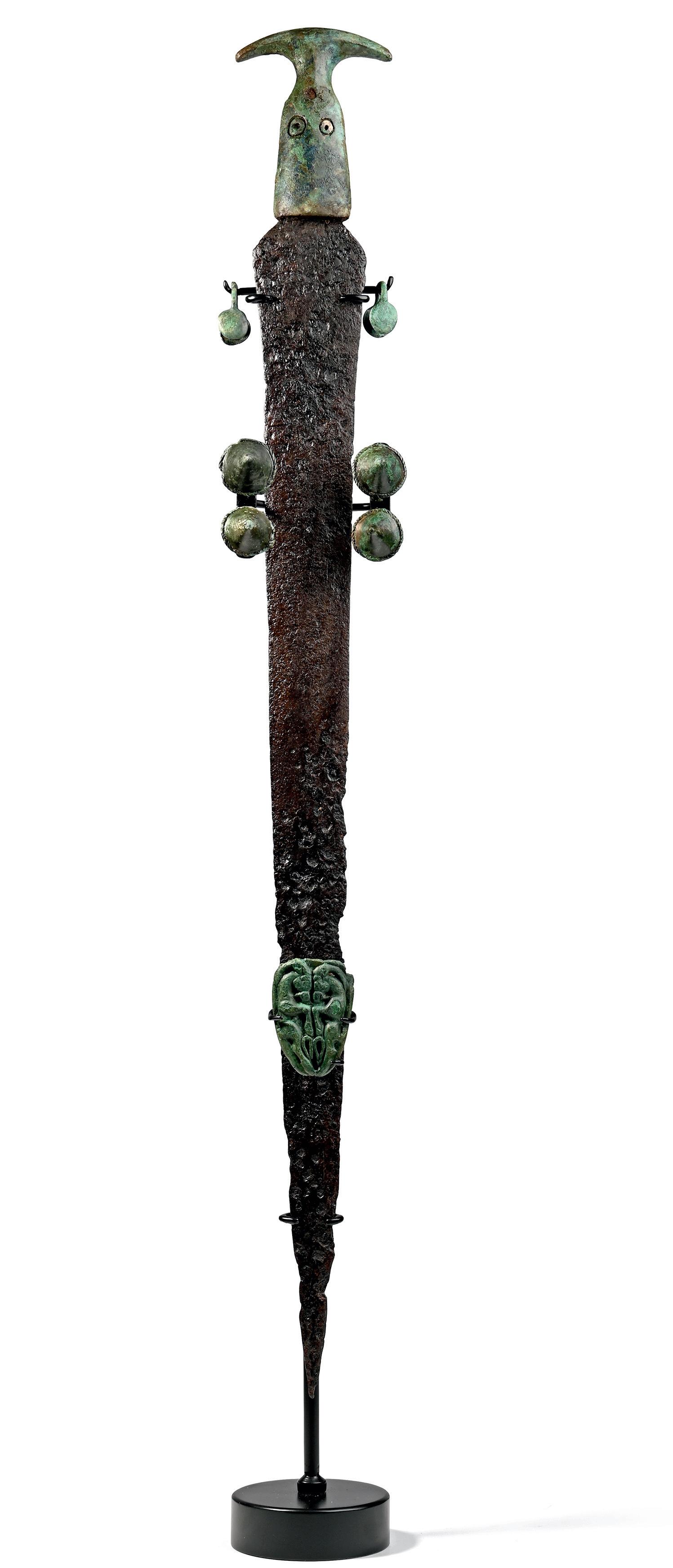
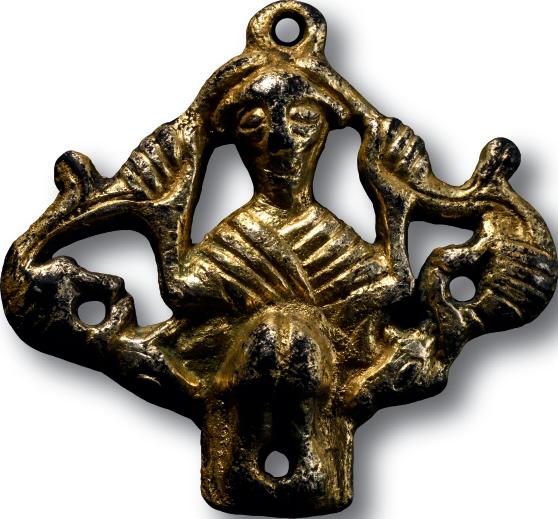

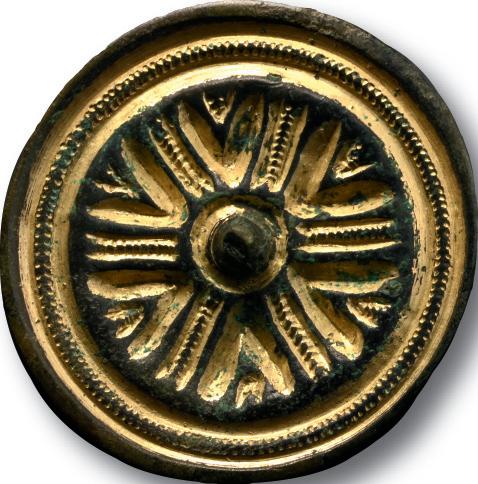

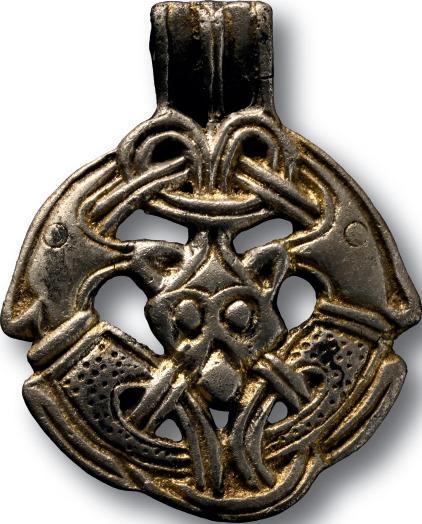

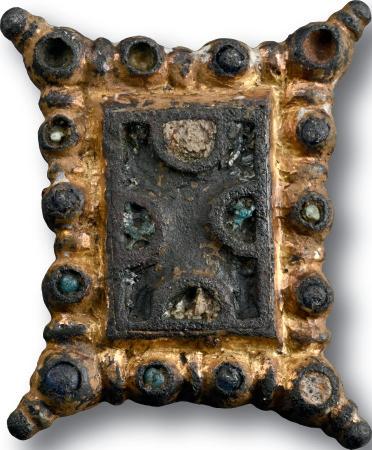


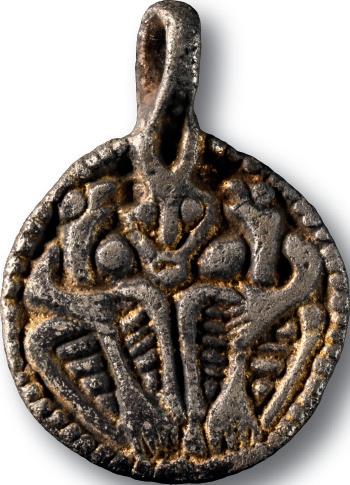
323
VIKING SILVER-GILT SEATED FREYJA MOUNT
CIRCA 9TH-10TH CENTURY A.D.
1¾ in. (30.6 grams, 46 mm)
A parcel-gilt plaque pendant with facing seated figure, probably the goddess Freyja, modelled in the half-round; the hands raised to grip lateral ribbed strands of hair, the garment formed as two crossed bands on the chest, the knees prominent and feet placed together; emerging from each strand of hair, a feline with curled tail, ribbed body, foreleg curled over the neck, notched fingers and triangular face with lappet and snubbed snout; loop above the head, three holes to the edges. [No Reserve]
£3,000 - 4,000
PROVENANCE:
Private collection formed in Europe in the 1980s. Westminster collection, central London, UK.
FOOTNOTES:
The figure represents a seated female accompanied by two cats. In the Icelandic poem Gylfaginning (The Deceiving of Gylfi), Freyja is said to be seated in her chariot drawn by two cats. Her hall in heaven is called Sessrumnir, meaning ‘with room for many seats’. She is also associated with a high seat from which prophecy is made, similar to that of Odin.
324
LARGE ANGLO-SAXON GILT BRONZE SAUCER BROOCH LATE 5TH-6TH CENTURY A.D.
1 in. (20.4 grams, 37 mm)
Discoid in plan with raised rim and inner ridge decorated with notches, six radiating arms with notch detailing and interstitial chevrons; central knop rivetted from reverse; remains of catch to reverse.
£1,000 - 1,400
PROVENANCE:
Found Seaham, Co Durham, UK.
Property of a Durham private collector.
325
VIKING AGE SILVER BEAST PENDANT CIRCA 9TH-11TH CENTURY A.D.
1½ in. (7.09 grams, 39 mm)
Openwork panel in the form of two opposed beasts with their open jaws interlaced to form a loop; central facing mask; ribbed suspension tube above. [No Reserve]
£600 - 800
PROVENANCE:
Private collection formed in Europe in the 1980s. Westminster collection, central London, UK.
326
ANGLO-SCANDINAVIAN GILT BRONZE RECTANGULAR JEWELLED BROOCH 11TH CENTURY A.D.
1½ in. (21 grams, 38.8 mm)
Rectangular in plan with incurved edges; the border a series of graduated lobes, the larger ones each with a cell to accept a gemstone, with some still present; central panel with a D-shaped cell to each inner edge to accept enamel; lugs and catch to reverse.
£200 - 300
PROVENANCE: Found Norfolk, UK.
327
VIKING AGE SILVER PENDANT WITH ODIN AND RAVENS
CIRCA 9TH-11TH CENTURY A.D.
1 in. (2.98 grams, 22 mm)
A discoid pendant with integral loop, beaded border enclosing a lowrelief gilded image of a male facing mask between two birds embraced at the necks. [No Reserve]
£800 - 1,000
PROVENANCE:
Private collection formed in Europe in the 1980s. Westminster collection, central London, UK.
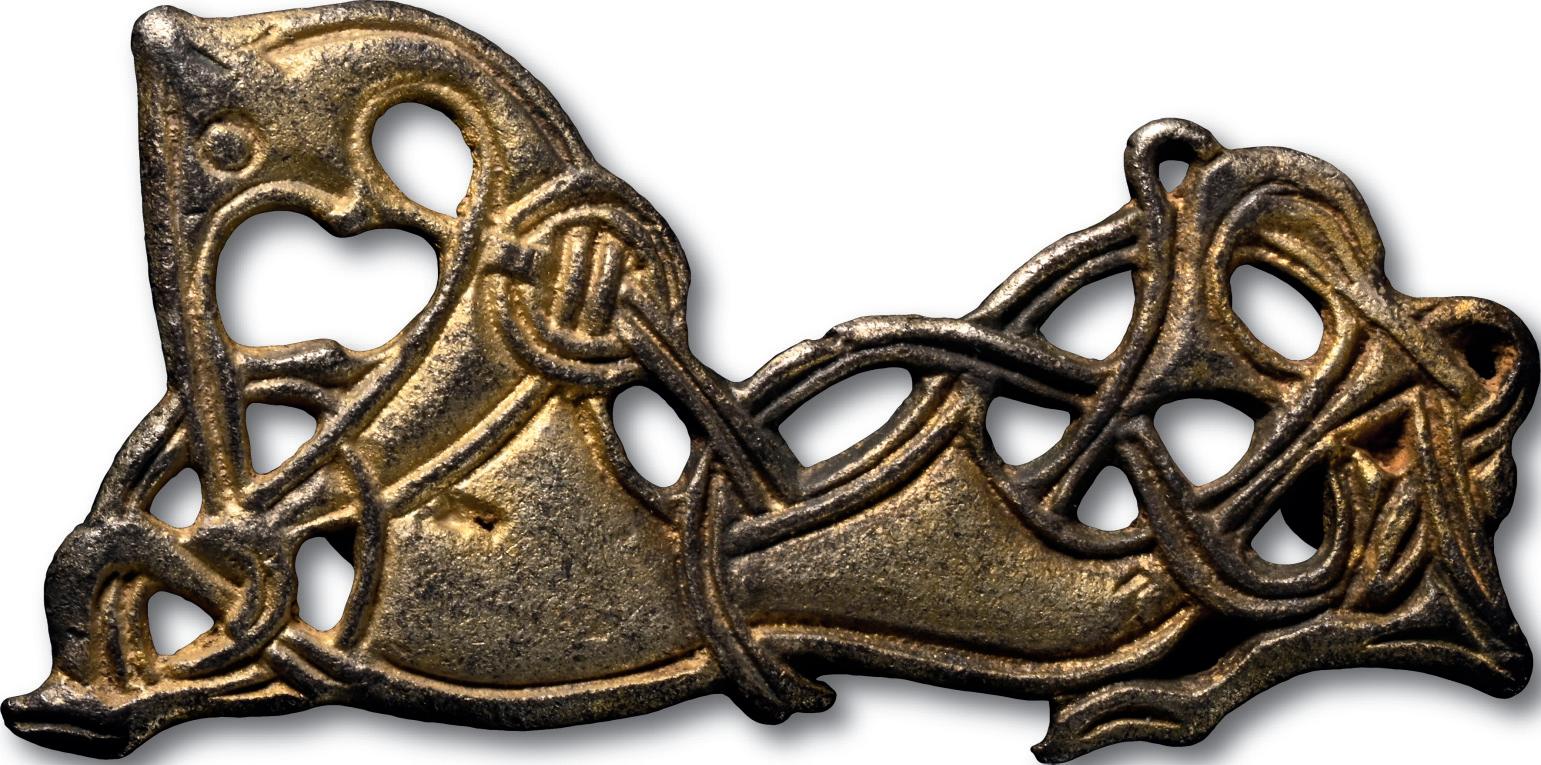

328
SCANDINAVIAN VIKING SILVER-GILT OSEBERG STYLE BROOCH
9TH CENTURY A.D.
2 in. (8.88 grams, 50 mm)
Plate brooch formed as an advancing animal executed in early Oseberg Style with looped tendrils around the body; pin-lugs and catch to reverse. [No Reserve]
£6,000 - 8,000
PROVENANCE: Private collection formed in Europe in the 1980s. Westminster collection, central London, UK.
FOOTNOTES: Remarkably similar to the famous brooch from Lamøen, Vestfold, Norway, the brooch retains much of its original gilding.
329
LARGE ANGLO-SAXON GILT BRONZE GREAT SQUARE-HEADED BROOCH
LATE 5TH-6TH CENTURY A.D.
5¼ in. (83 grams, 13.5 cm)
Comprising a rectangular headplate with outer concentric bands of punched points, inner of Style I animals, raised border, and inner panel of scrolls; bow with three raised vertical ribs; footplate with lateral lappets featuring profile horse-heads; median bar with punched points, lozenge panels with scrolled border and rounded lateral and finial lugs; pin-lugs and catch to the reverse.
£4,500 - 6,500
PROVENANCE: Found Seaham, Co Durham, UK. Property of a Durham private collector.
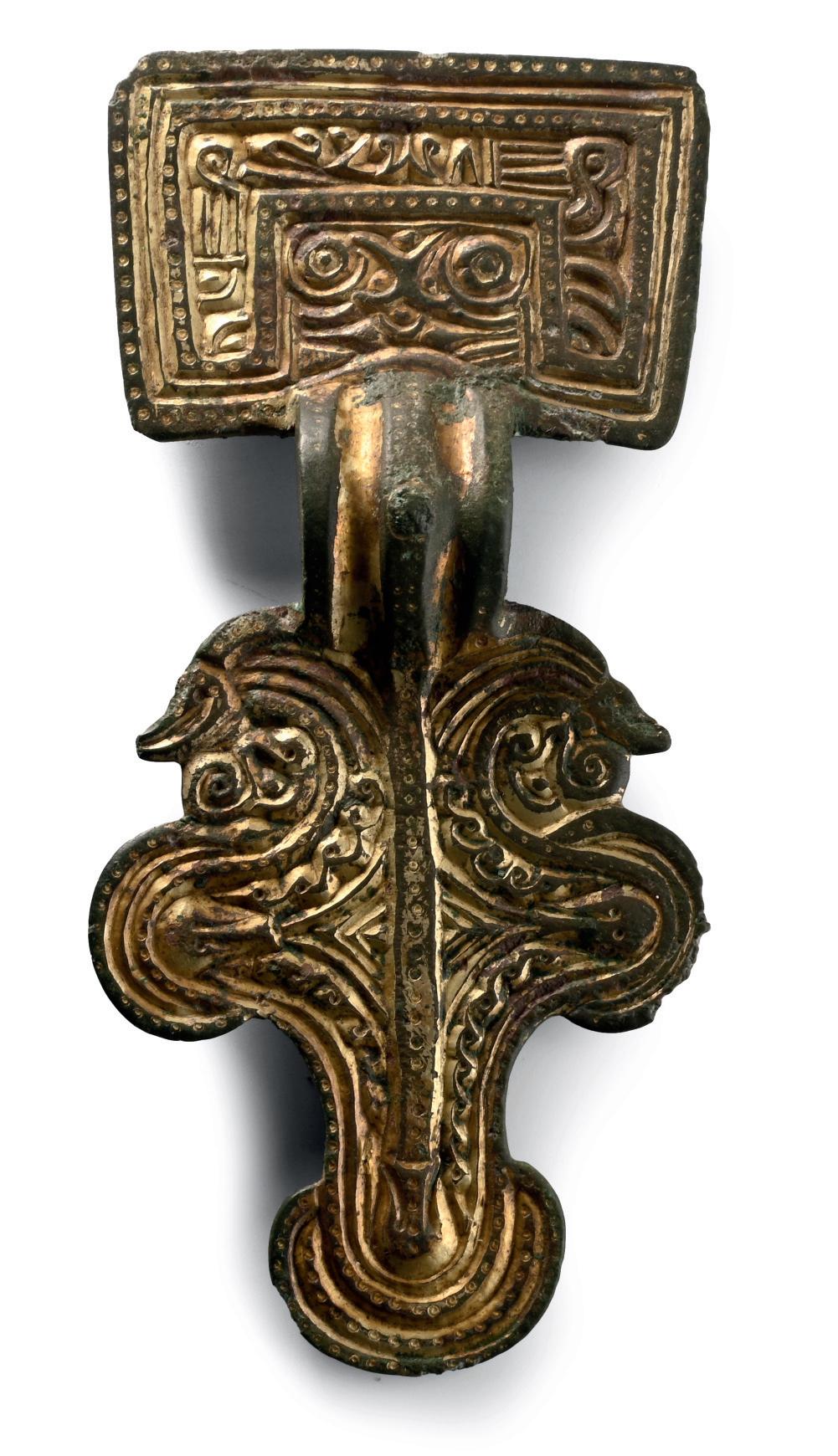
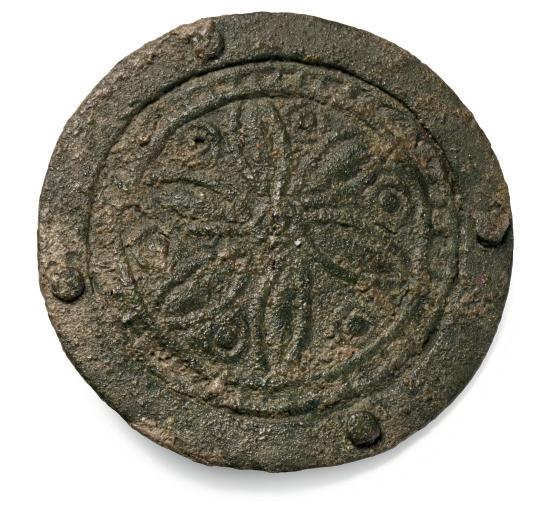
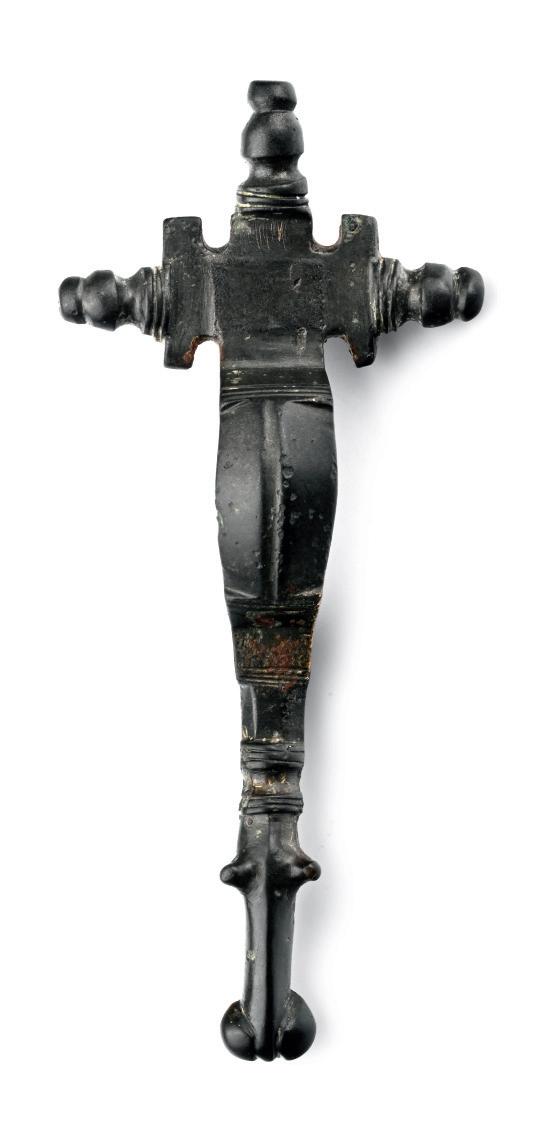
330
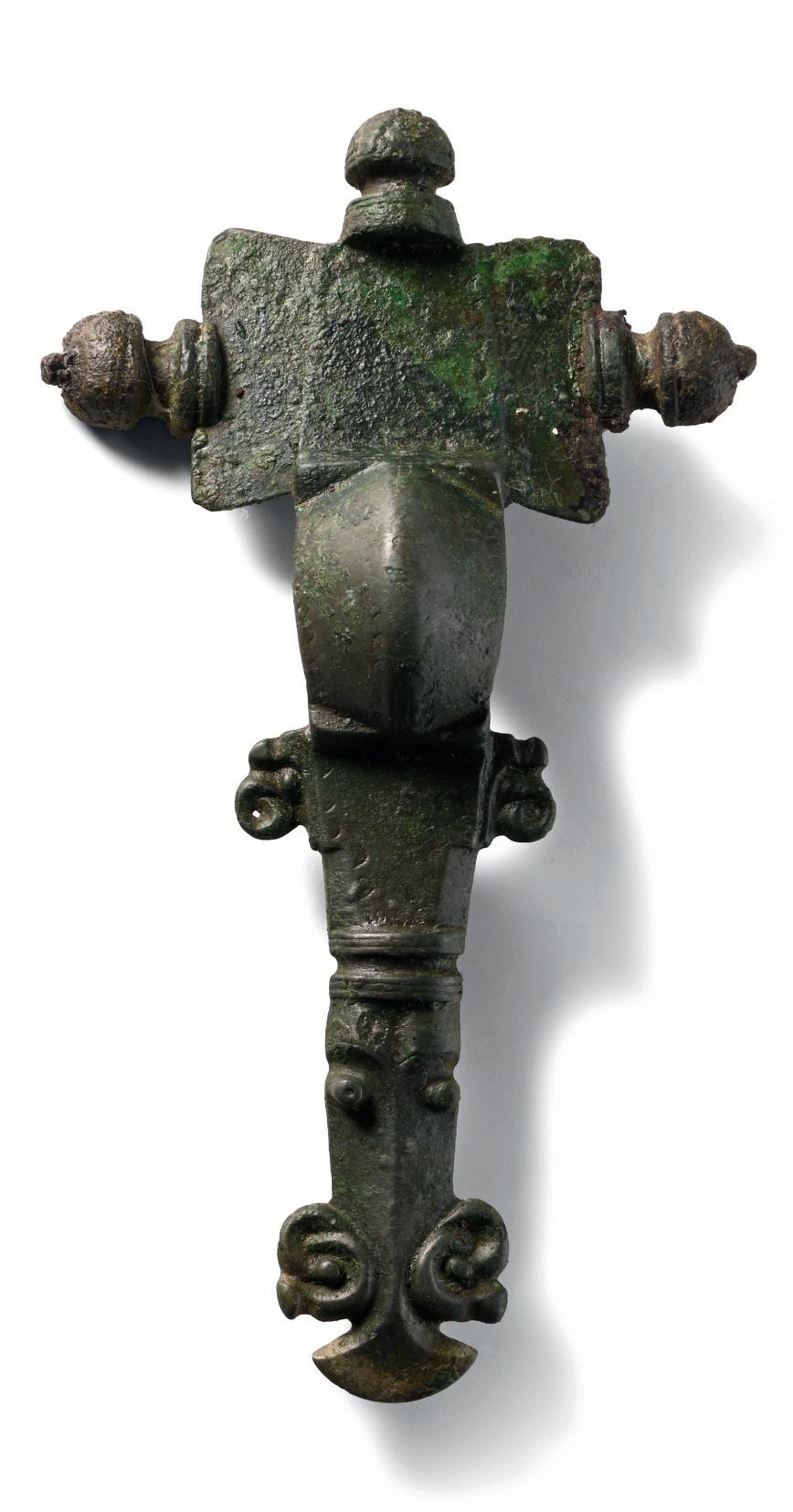
ANGLO-SAXON BRONZE APPLIED DISC BROOCH
CIRCA 5TH-6TH CENTURY A.D.
1 in. (16.9 grams, 48 mm)
Discoid in plan with pin-lug, chord, pin and catch to the reverse; applied rim secured by four domed rivets; low-relief hexafoil motif with interstitial ring-and-dot motifs, segmented border. £300 - 400
PROVENANCE: Found Cambridgeshire, UK. Acquired on the UK art market in the 1980s. From the private collection of an Essex gentleman.
331
ANGLO-SAXON BRONZE CRUCIFORM LONG BROOCH
6TH CENTURY A.D.
3 in. (19.2 grams, 80 mm)
Comprising a rectangular headplate and three radiating knops, broad bow and horse-head footplate with scrolled nostril, suspension loop to the reverse; accompanied with note reading: ‘Anglo-Saxon, Bronze Cruciform Brooch, C. 6th century AD, Bronze cruciform brooch of fine quality. Features an integral top & side with semi-circular knobs & moulded collars. it has short wings & a high arched bow with a central groove & faceted corners, with a fine zoomorphic foot. Provenance: M. O’Bee collection, found in Lincolnshire in the 1970’s.’
£300 - 400
PROVENANCE:
Found in Lincolnshire, UK, in the 1970s. M. O’Bee collection.
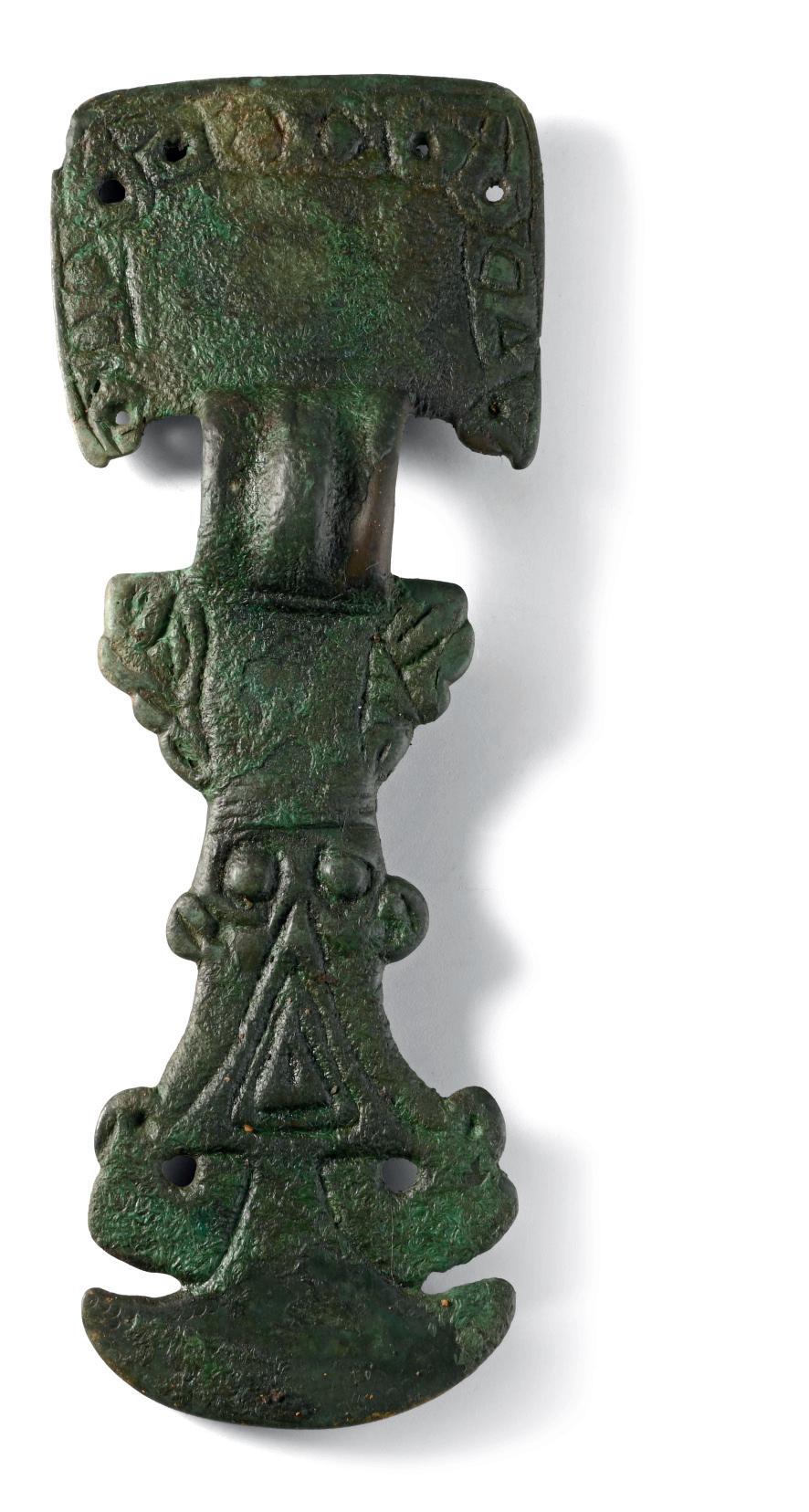
332
LARGE ANGLO-SAXON BRONZE CRUCIFORM BROOCH
LATE 5TH-6TH CENTURY A.D.
5 in. (68 grams, 12.6 cm)
Comprising a rectangular headplate with a central trapezoidal panel, three radiating collared D-section knops; a deep carinated bow with chamfered step at each end; trapezoidal foot with lateral coiled lappets; gusseted collar and carinated horse-head finial with scrolled nostrils; ferrous mass to reverse with impressed fabric, catchplate.
£600 - 800
PROVENANCE: Found Seaham, Co Durham, UK.
Property of a Durham private collector.
333
LARGE ANGLO-SAXON BRONZE GREAT SQUARE-HEADED BROOCH
LATE 5TH-6TH CENTURY A.D.
5½ in. (72 grams, 13.9 cm)
Comprising a rectangular headplate with openwork masks to the outer edge, imprint of fabric to the central panel; shallow bow with three vertical ribs; lappets below the bow, footplate developing to a triangular facing mask with domed eyes and concentric triangles, openwork finial with pelta-shaped panel; pin-lug and catch with ancient repair to the reverse.
£800 - 1,000
PROVENANCE:
Found Seaham, Co Durham, UK.
Property of a Durham private collector.
334
LARGE
GOTHIC SILVER-GILT FIBULA ‡ BOSPHOREAN CULTURE, 5TH CENTURY A.D.
8 in. (67 grams, 20.7 cm)
Comprising: a semi-circular headplate with a ram-head knop at the apex and applied gilt projections at the sides forming part of the spring mechanism; deep keeled bow with a petalled finials; keeled subrectangular footplate with a rounded finial and a tapering catchplate below.
£3,500 - 4,500
PROVENANCE:
L. De Clercq collection, Belgium, 1980s. Ex private European collection.
Accompanied by an academic report by Dr Raffaele D’Amato.
FOOTNOTES:
These types of fibulae were mainly found in female burials and were placed on the right side of the chest and on the left shoulder. It was from this period that the custom of wearing wide belts with buckles and a pair of brooches on the shoulders spread along the south-western Black Sea coast, having originated among the Germanic tribes of the western Roman provinces.
335 DARK AGE SILVER BOAR BOW BROOCH ‡ 5TH-7TH
CENTURY A.D.
2½ in. (28 grams, 65 mm)
Comprising a circular headplate with pointillé tendril ornament, and three radiating lugs, each with a flared collar below; deep D-section bow with boar-head modelling including open mouth and tusks, bristles and pricked ears; parallel-sided chamfered edges, recurved finial with dog-head detailing and teardrop dangle in the mouth; spring and pin to the reverse.
£1,200 - 1,700
PROVENANCE: with Artemis Gallery, Münich, before 1998. Acquired by the present owner from the above in 2001.
Accompanied by an academic report by Dr Raffaele D’Amato.
FOOTNOTES:
As the boar’s mouth is modelled open, it is likely that it also had a dangle similar to that of the dog’s head. The artistic effect of the brooch is to symbolise the chase, with the boar fleeing and the hound in close pursuit behind. This kind of fibula was used by the Romano-British people of Britannia, as attested by specimens found in Britain (BM inventory no.PRB 1954.12-6.1).
336
VIKING SILVER-GILT BRONZE BOAR-HEADED BROOCH CIRCA 9TH-11TH CENTURY A.D.
2½ in. (4 in.) (140 grams, 65 mm (220 grams total, 11 cm including stand))
Hollow-formed with an applied backplate; the heavily decorated body with upstanding ears and a clubbed end to the muzzle; a narrow median raised band separating the face into two panels, each decorated with interlaced ornament in low relief depicting serpents locked in combat, their bodies dramatically entwined; the rear panel with four ‘forearm and hand’ motifs surrounding a central lozenge with pellet; rectangular guilloche to the lower borders, muzzle-band, rear panel and median upper band; Jellinge Style scrollwork to the outer and upper faces of the conical ‘ears’; a hinged pin to the underside with curved catch, applied plate to the underside with two bands of punched lozenge decoration; mounted on a custom-made stand.
£3,000 - 4,000
PROVENANCE:
Private collection, New York, USA. with Artemis Gallery, Colorado, USA, 15 February 2018, no.58.
Private American collection, New York, USA.
TimeLine Auctions, 5 March 2024, no.391.
Private collection, London.
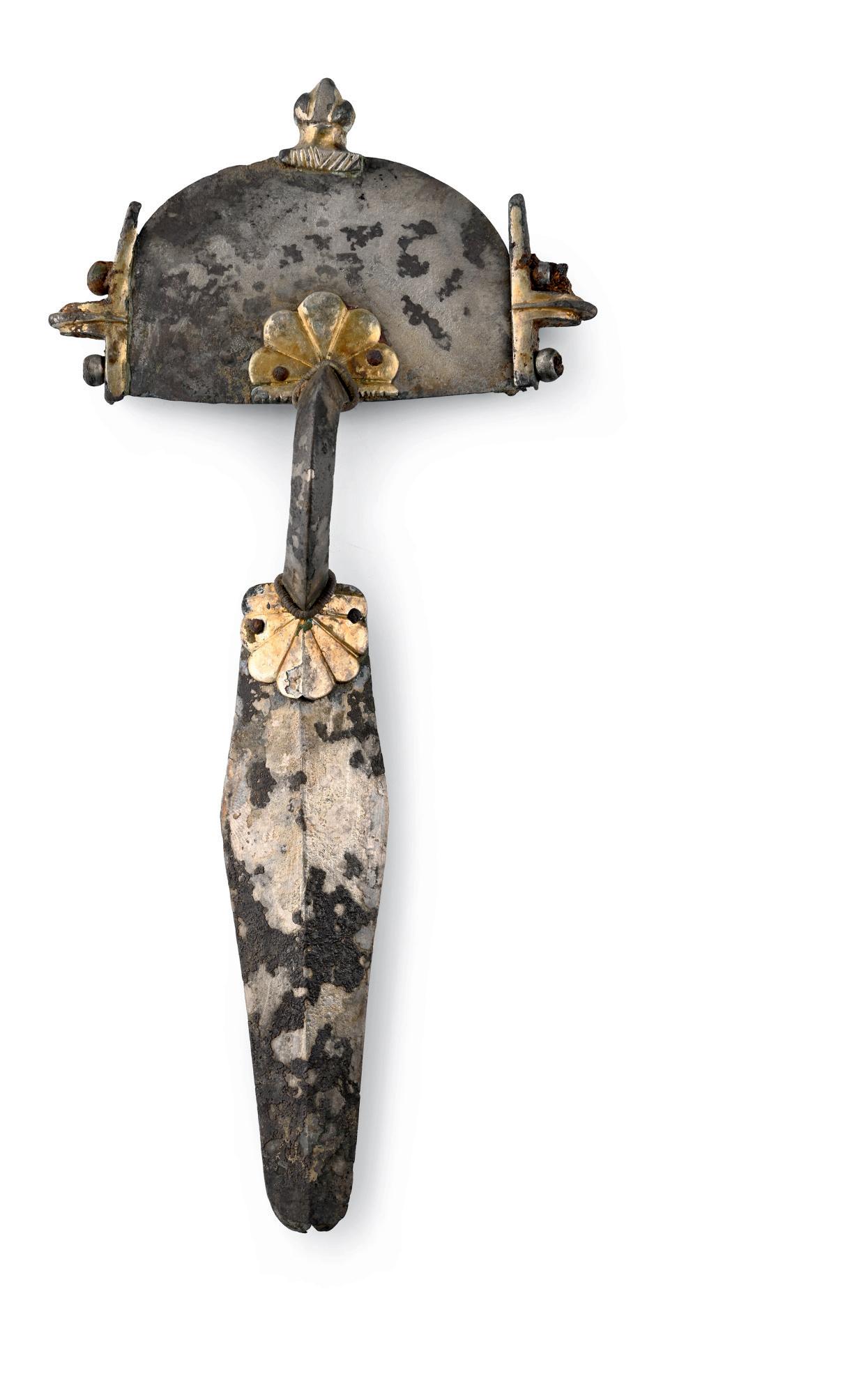


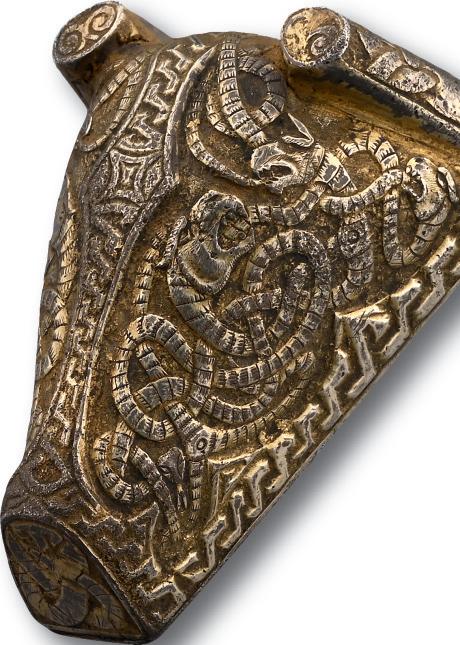

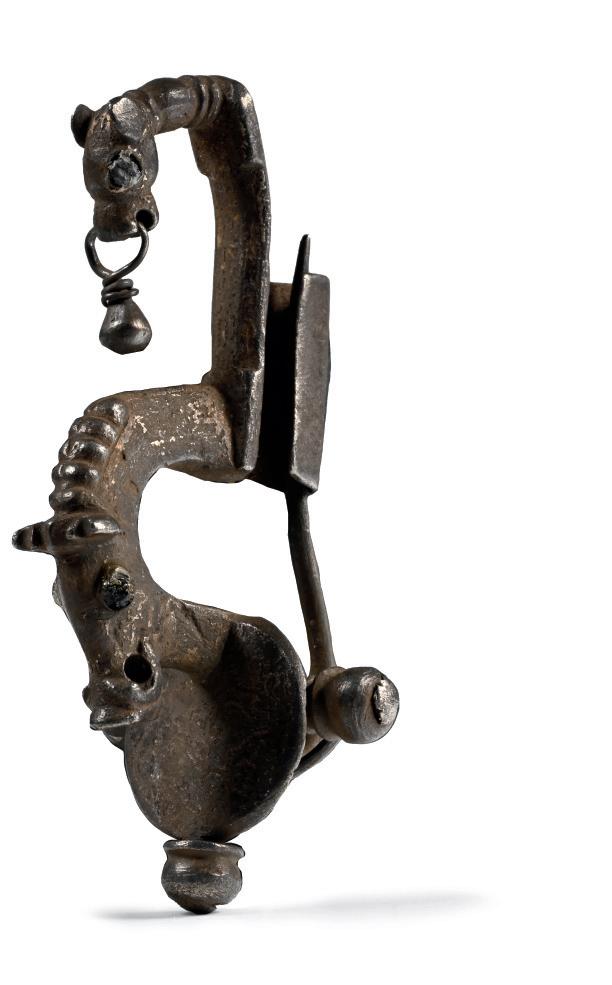




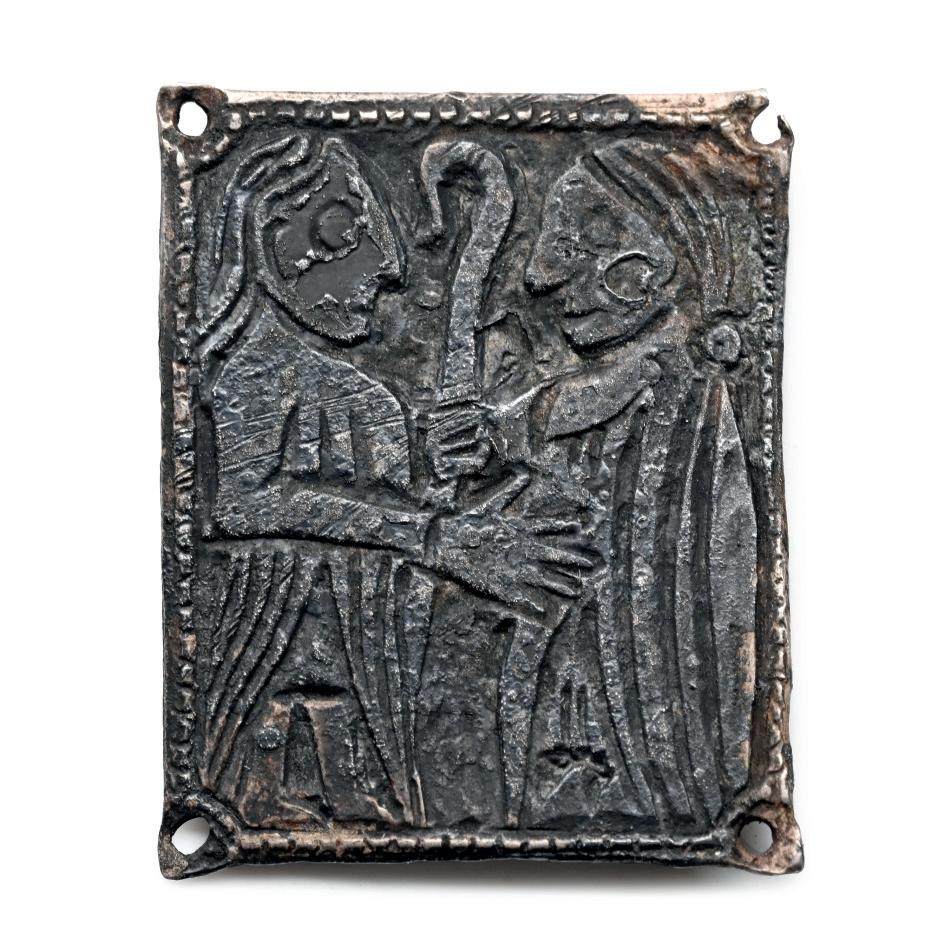

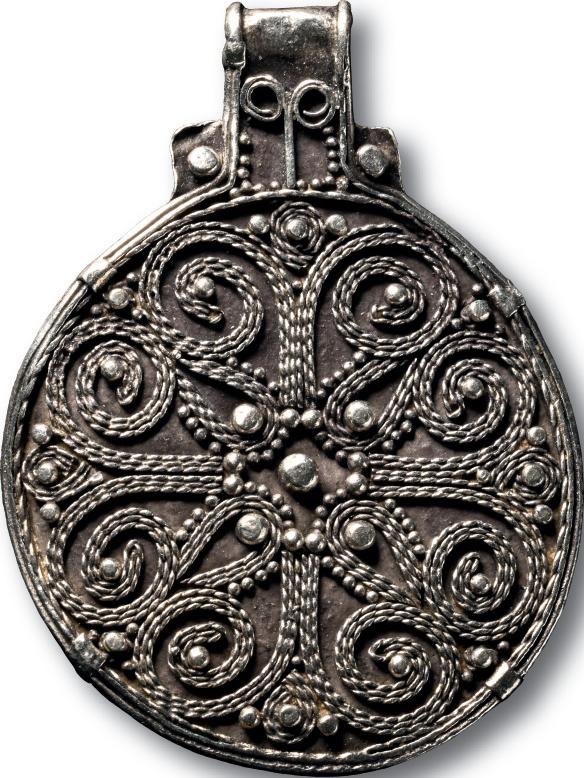

337
VIKING SILVER FREYR AND FREYJA CASKET MOUNT
9TH-10TH CENTURY A.D. in. (2.39 grams, 22 mm)
Rectangular with beaded border and pin-hole to each corner; lowrelief scene of a male standing left wearing an open-fronted coat extending his arms towards an opposed female in floor-length robe, holding a hooked staff and with her long hair draped to her rear.
£1,500 - 2,000
PROVENANCE:
Ex Paul Revell, circa 1985.
From a private UK collection, 1980s onwards.
338
VIKING AGE SILVER FILIGREE PENDANT WITH SCROLL CROSS
CIRCA 9TH-11TH CENTURY A.D.
1 in. (4.1 grams, 40 mm)
Discoid with applied filigree looped bands, granules and other detailing; cleaned and polished. [No Reserve]
£500 - 700
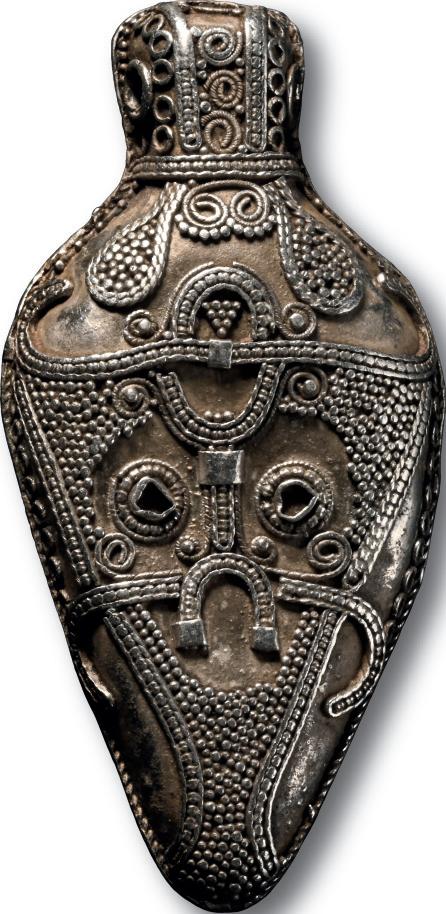

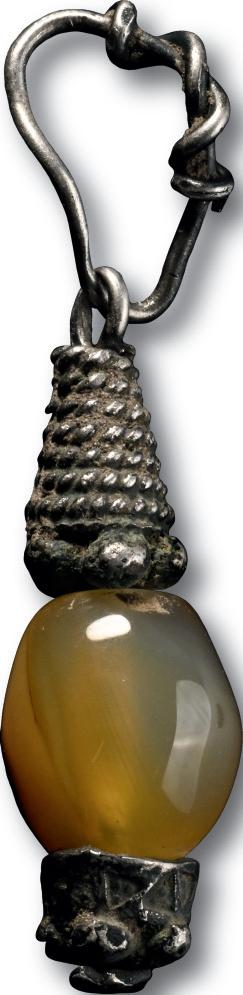

PROVENANCE:
Private collection formed in Europe in the 1980s.
Westminster collection, central London, UK.
339
VIKING AGE SILVER FILIGREE TEARDROP PENDANT
CIRCA 9TH-11TH CENTURY A.D.
2 in. (5.34 grams, 51 mm)
Hollow-formed with integral suspension lug above, applied granulation and filigree forming a stylised face; cleaned and polished. [No Reserve]
£600 - 800
PROVENANCE:
Private collection formed in Europe in the 1980s.
Westminster collection, central London, UK.
340
VIKING AGE SILVER PENDANT WITH AGATE BEAD
CIRCA 9TH-11TH CENTURY A.D.
2¼ in. (10.4 grams, 57 mm)
Comprising a conical braided band with suspension loop above, oval agate bead, silver cap below. [No Reserve]
£600 - 800
PROVENANCE:
Private collection formed in Europe in the 1980s.
Westminster collection, central London, UK.
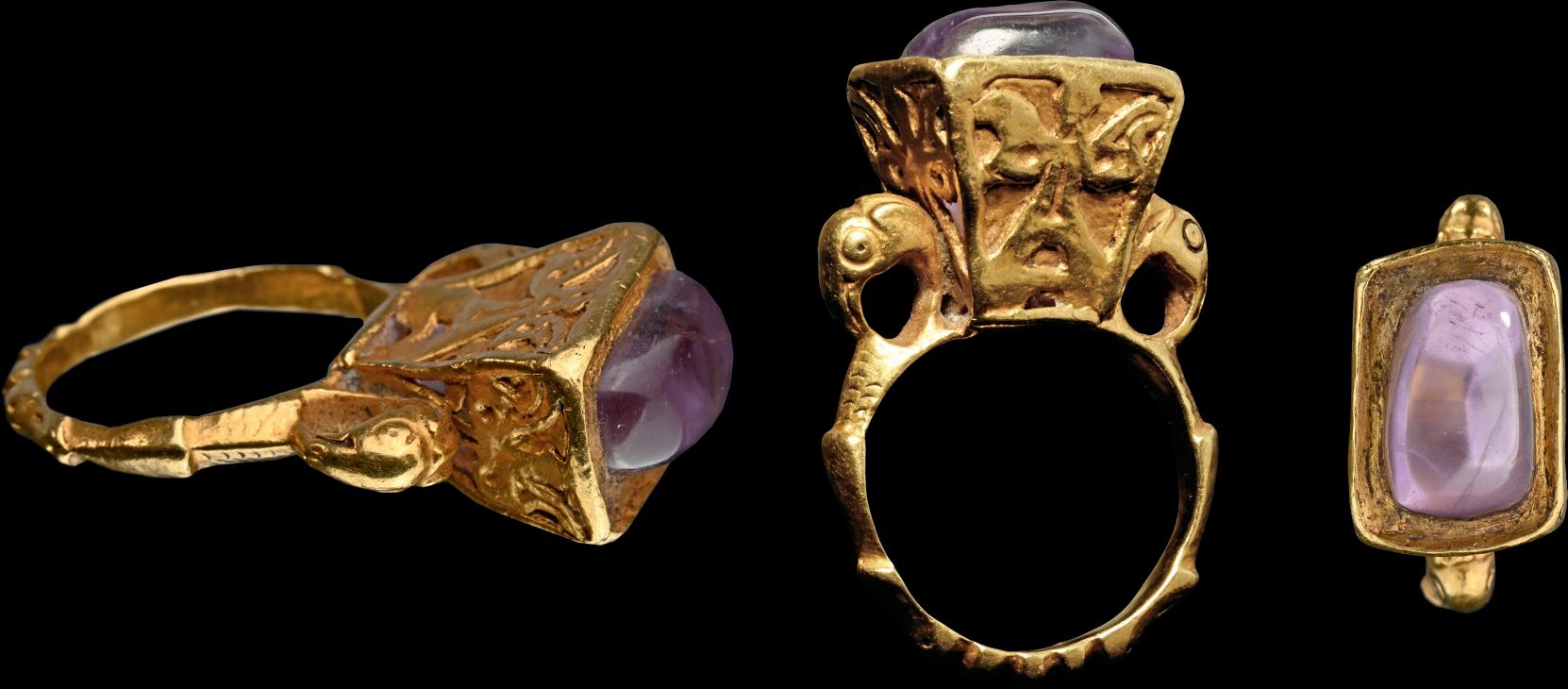
341
LANGOBARDIC GOLD BISHOP'S RING BEZEL WITH LARGE AMETHYST
7TH-8TH CENTURY A.D.
1 in. (11.38 grams, 34.70 mm overall, 17.74 mm internal diameter (approximate size British M 1/2, USA 6 1/4, Europe 13.09, Japan 12))
Square-section inverted pyramid bezel with ornamented faces, set with a polished amethyst pebble; restored hoop, flanked by outwardfacing birds with hooked beaks and large ring-and-dot eyes; keeled decorative hoop with three integral collars at the base.
£12,000 - 17,000
PROVENANCE:
Private English collection, formed between the late 1970s and early 1990s. Private collection, UK.
342
VIKING AGE GOLD PENDANT WITH AMBER 9TH-11TH CENTURY A.D.
1 in. (4 grams, 24 mm)
A flat discoid pendant with pelletted border, raised bezel to the centre with a pelletted border and an amber insert; applied attachment loop to the top, some repairs.
£800 - 1,000
PROVENANCE: Acquired on the UK art market before 2000. Property of an Essex, UK, gentleman.
343 PRE-VIKING GOLD AROMA BUCKET PENDANT 4TH-7TH CENTURY A.D. in. (0.72 grams, 15 mm)
Miniature drum-shaped vessel covered in filigree bobbles with strap handle. [No Reserve]
£400 - 600
PROVENANCE:
Private collection formed in Europe in the 1980s. Westminster collection, central London, UK.
344
VIKING AGE SILVER MAIDEN PENDANT CIRCA 10TH CENTURY A.D.
1¼ in. (5.2 grams, 33 mm)
Profile image of a female in floor-length robe with mantle to the shoulders, stylised headdress and long band of plaited hair to the rear edge; pierced lug to the reverse. [No Reserve]
£600 - 800
PROVENANCE:
Private collection formed in Europe in the 1980s. Westminster collection, central London, UK.
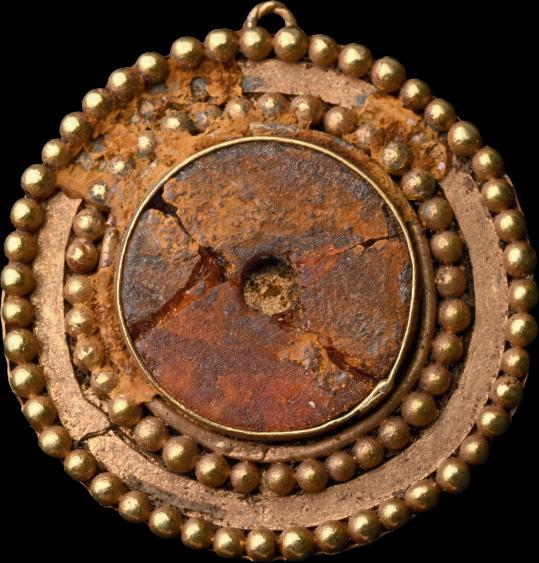
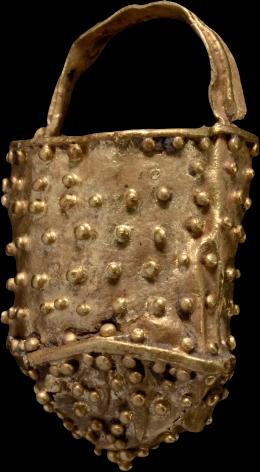
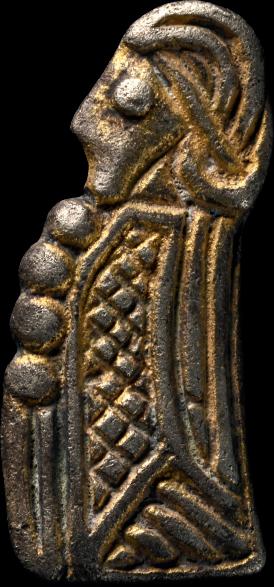
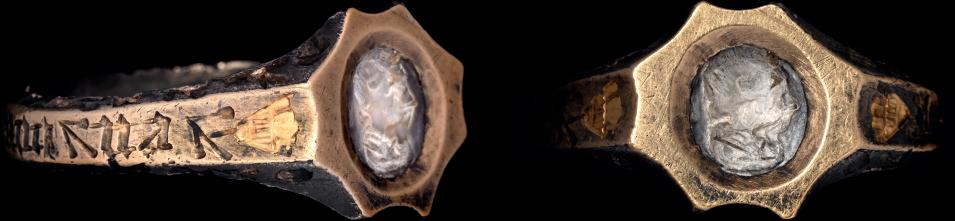
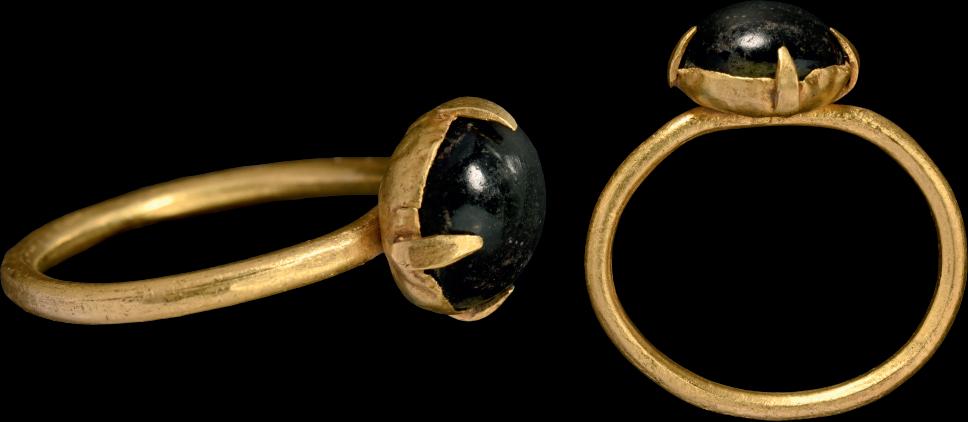
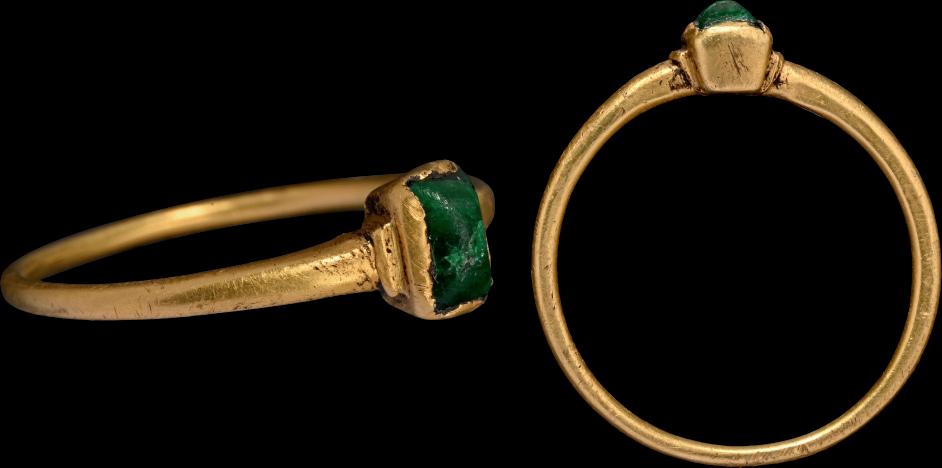
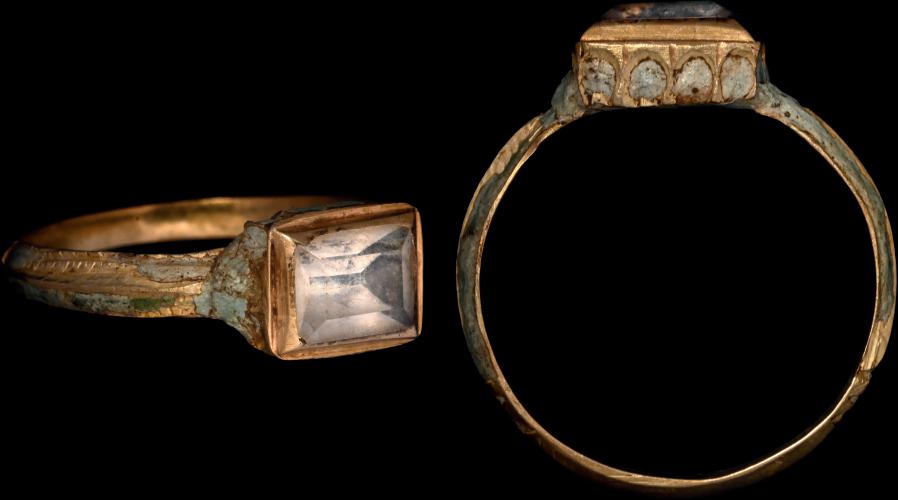

345
MEDIEVAL SILVER-GILT RING WITH MALE HEAD GEMSTONE AND INSCRIPTIONS
15TH CENTURY A.D.
1 in. (4.72 grams, 23.64 mm overall, 20.45 mm internal diameter (approximate size British R½, USA 8¾, Europe 19.38, Japan 18))
With applied outer layer of gold engraved with flowers and the words, ‘en bon an’ (twice) (‘a good year’); the flat bezel with a recessed centre set with a medieval mother-of-pearl intaglio depicting a male bust in profile.
£2,500 - 3,500
PROVENANCE:
Found whilst searching with a metal detector in Dorset, UK, on Sunday, 30th December 2018.
Acquired on the English art market.
Accompanied by a copy of the British Museum’s Portable Antiquities Scheme (PAS) report no.DEV-5E4EDA.
346
MEDIEVAL GOLD RING WITH CABOCHON CIRCA 12TH-14TH CENTURY A.D. in. (3.3 grams, 23.81 mm overall, 15.35x18.64 mm internal diameter (approximate size British L, USA 5¾, Europe 1.24, Japan 10))
Slender round-section hoop with bezel formed as a cup with claw setting for a dark blue gemstone.
£500 - 700
PROVENANCE:
Ex German art market, 2000s.
Acquired from an EU collector living in London.
From the collection of a Surrey, UK, gentleman.
347
MEDIEVAL GOLD RING WITH GREEN CABOCHON 13TH-14TH CENTURY A.D.
1 in. (2.61 grams, 24.57 mm overall, 18.62 mm internal diameter (approximate size British Q½, USA 8¼, Europe 18.12, Japan17))
Hoop of slender profile with cup bezel, inset green glass cabochon.
£1,000 - 1,400
PROVENANCE:
Formerly the property of a lady, acquired Brussels, Belgium.
From a Bristol, UK, collection.
Ex Buckinghamshire, UK, collection.
Accompanied by an illustrated certificate of authenticity signed by J. Murray.
348
STUART PERIOD ENAMELLED GOLD RING WITH TABLE-CUT ROCK CRYSTAL
ENGLAND, 17TH CENTURY A.D.
¾ in. (2.17 grams, 21.88 mm overall, 16.84 mm internal diameter (approximate size British M, USA 6, Europe 12.46, Japan 12))
D-section hoop with enamel panels to the shoulders, arcade to the rectangular bezel with inset table-cut crystal.
£1,800 - 2,400
PROVENANCE:
Found whilst searching with a metal detector near Harlaxton, Lincolnshire, UK, on Wednesday 17th November 2021.
Acquired on the English art market.
Accompanied by a copy of the British Museum’s Portable Antiquities Scheme (mPAS) report no.LIN-CCA6D4.
349 GOLD FEDE RING
ENGLAND, 16TH-17TH CENTURY A.D.
1 in. (3.71 grams, 23.07 mm overall, 20.14 mm internal diameter (approximate size British T, USA 9½, Europe 21.26, Japan 20))
Slender shank and expanding shoulders formed as lace cuffs, the bezel a pair of clasped hands gripping a heart.
£1,500 - 2,000
PROVENANCE: Private collection, Europe. Acquired on the English art market.
350
MEDIEVAL ICONOGRAPHIC GOLD RING WITH MARY, JESUS AND SAINT CATHERINE
15TH CENTURY A.D.
in. (6.17 grams, 21.27 mm overall, 16.93 x 17.98 mm internal diameter (approximate size British N, USA 6½, Europe 13.72, Japan 13))
The lower shank with twisted ropework detailing and carinated bands, the shoulders with raised median beaded bands flanked by flowers; the bezel in two panels, each with a reserved standing figure, a female saint in floor-length robe; Virgin Mary on the left panel holding infant Jesus; St Catherine supporting her attribute, a wheel.
£5,000 - 7,000
PROVENANCE:
From a South London family collection of religious artefacts formed in the late 1970s to mid 1980s; thence by descent.
Accompanied by an academic report by Dr Raffaele D’Amato.
351
‘THE DUMMER’ MEDIEVAL KNIGHT’S HOSPITALLER GOLD RING ENGLAND, CIRCA 1500-1540 A.D.
¾ in. (1.21 grams, 18.40 mm overall, 16.62 mm internal diameter (approximate size British L½, USA 6, Europe 11.87, Japan 11))
Featuring a sub-circular integral bezel decorated with an eight-armed Maltese cross with some incised decoration in its foils and a subcircular border with traces of enamel in the field; the moulded shoulders bordered by a long triangle terminating with a long suboval indentation, slightly raised and decorated with two parallel lines and two circles with lines through the middle, possibly a stylised letter ‘G’, the shoulders tapering slightly to the narrowest section of the now straightened narrow and undecorated band.
£1,500 - 2,000
PROVENANCE: Found Dummer, Basingstoke and Deane, Hampshire, UK; declared as Treasure under the Treasure Act and disclaimed.
Accompanied by a copy of a letter explaining that the Crown’s interest in this find has been disclaimed.
Accompanied by a copy of the Report on find of Potential Treasure for H M Coroner no.2023 T292.
Accompanied by a copy of the British Museum’s Portable Antiquities Scheme (PAS) report no.HAMP-463CD7.
352
LARGE MERCHANT’S SEAL RING ENGRAVED WITH ‘BG’ AND SHIELD GERMANY, 16TH CENTURY A.D.
1 in. (20.03 grams, 28.33 mm overall, 23.00 x 18.47 mm internal diameter (approximate size British T½, USA 9¾, Europe 21.89, Japan 21))
Engraved with the owner’s initials ‘B G’ above a tilting shield with flanche; merchant’s mark motif of capital ‘A’ and a cross.
£6,000 - 8,000
PROVENANCE: Private collection, Europe. Acquired on the English art market.
353
LARGE ‘PROVIDENCE DIVINE HATH MADE THEE MINE’ GOLD POSY RING CIRCA 18TH CENTURY A.D.
in. (5.12 grams, 22.51 mm overall, 19.59 mm internal diameter (approximate size British T, USA 9½, Europe 21.26, Japan 20))
D-shaped in section with minuscule italic inscription to inner face ‘prouidence deuien hath made thee mine’.
£1,000 - 1,400
PROVENANCE: From a collection which predates 1982. Property of a Somerset collector, UK, since circa 2013.
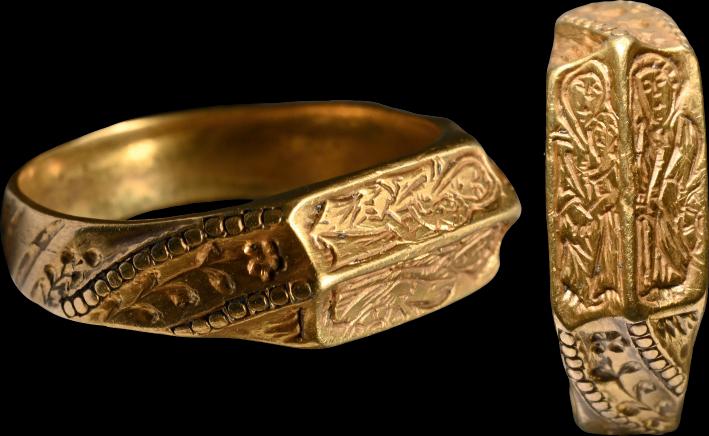
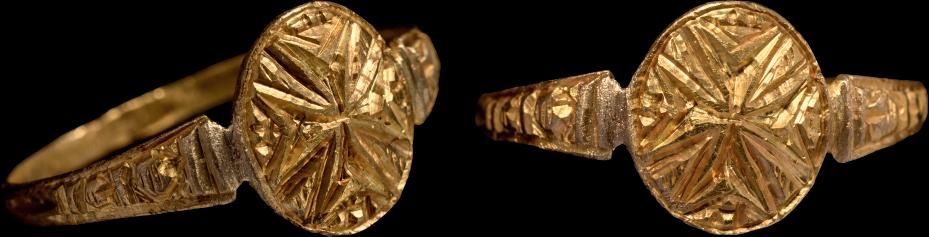
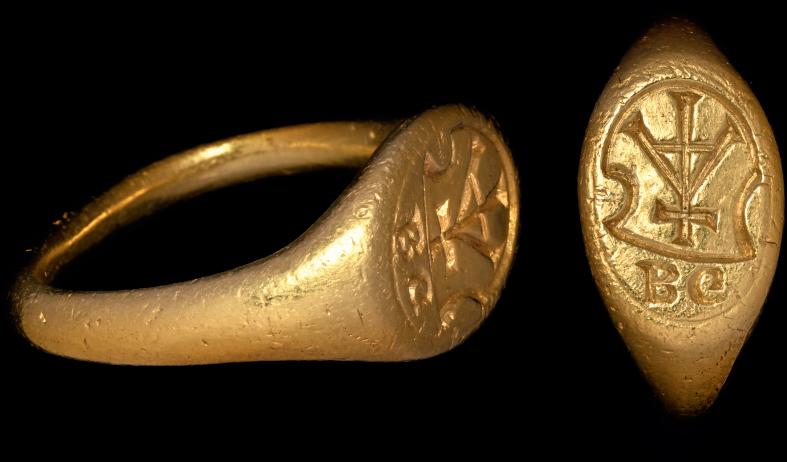
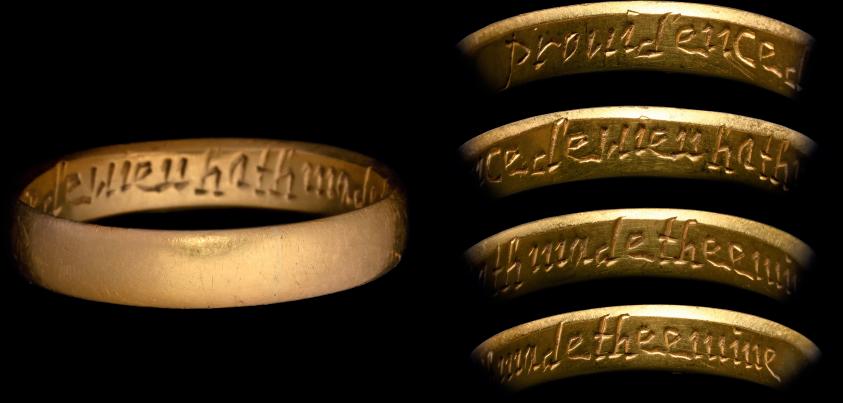
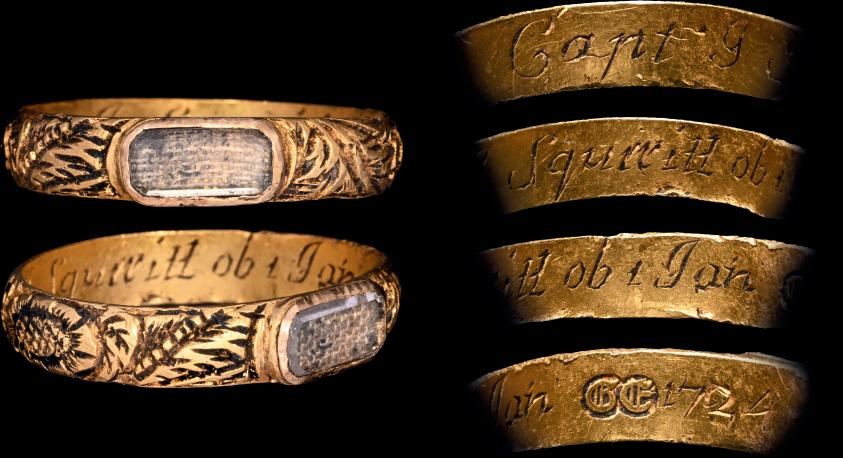
354
STUART PERIOD GOLD MOURNING RING WITH ROCK CRYSTAL GEMSTONE
ENGLAND, 18TH CENTURY A.D.
¾ in. (3.33 grams, 20.04 mm overall, 17.17 mm internal diameter (approximate size British M, USA 6, Europe 12.46, Japan 12))
Decorated with black enamelled foliate engraving; bezel set with a table cut rock crystal compartment containing some hair of the deceased; inner face engraved ‘Capt(ain). G Squrritt ob 1 Jan 1724’ and the maker’s mark ‘GE’.
£2,000 - 3,000
PROVENANCE: Private collection, Europe. Acquired on the English art market.
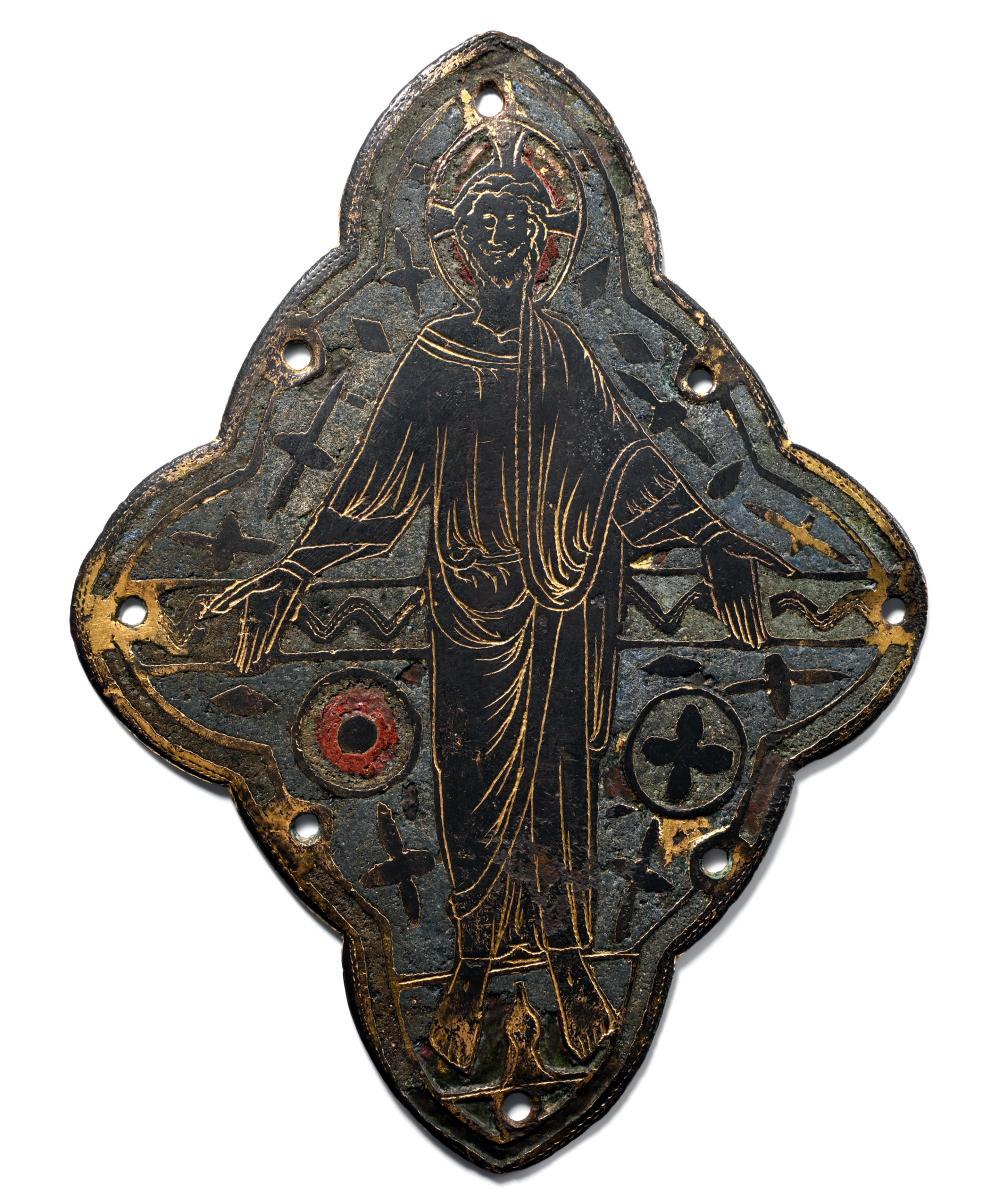
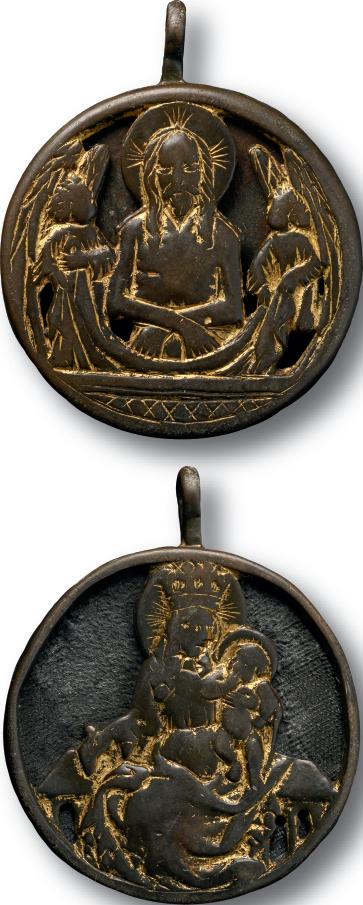


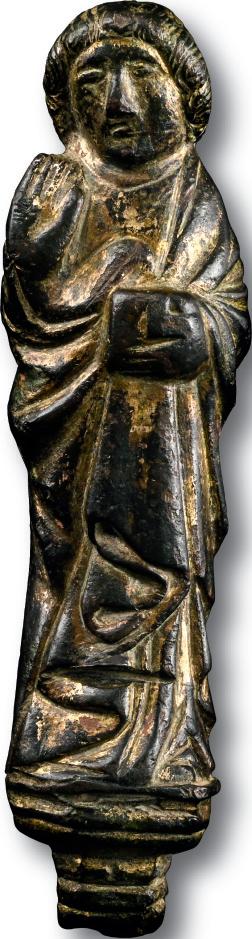
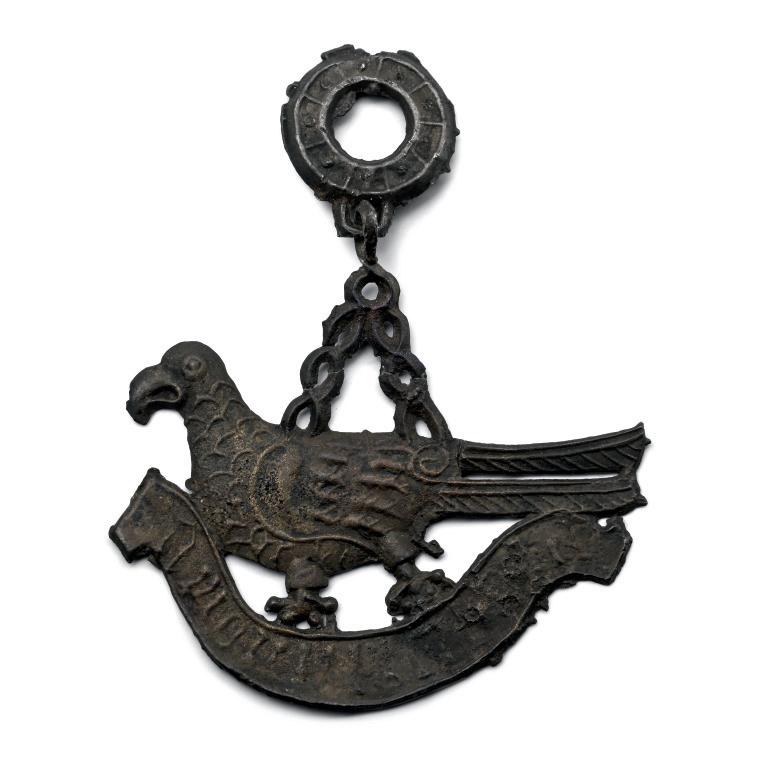
355
LARGE MEDIEVAL GILT BRONZE CHAMPLEVÉ PLAQUE DEPICTING CHRIST IN MAJESTY LIMOGES, 13TH CENTURY A.D.
6 in. (124 grams, 15.2 cm)
Decorated in blue, green and red champlevé enamel, displaying the engraved figure of a standing Christ, his hands gesturing outwards towards the viewer; traces of original gilding; originally the central panel of a processional cross.
£2,500 - 3,500
PROVENANCE:
Private collection, Europe. Acquired on the French art market.
FOOTNOTES:
From the 12th to 14th century, there was a large industry producing metal objects decorated in enamel using the champlevé technique, of which most of the survivals and probably most of the original production, are religious objects such as reliquaries, crosses and statues of saints.
356
MEDIEVAL GILT COPPER DEVOTIONAL RELIQUARY PENDANT
GERMANY, 15TH CENTURY A.D.
2¼ in. (57.2 grams, 57 mm)
A large circular openwork pendant with a fitted lid, the lid depicting Christ between two angels holding a shroud; the reverse with seated and crowned Virgin Mary holding infant Jesus on her lap.
£500 - 700
PROVENANCE:
Private collection, UK.
357
MEDIEVAL GILT BRONZE FIGURE OF SAINT JOHN THE EVANGELIST
15TH CENTURY A.D.
4 in. (230 grams total, 10.1 cm including stand)
Modelled in the round columnar figure with right hand raised and left hand holding a book; wearing a floor-length robe, standing on a tiered hexagonal base; mounted on a custom-made stand.
£500 - 700
PROVENANCE:
Private collection, Europe. Acquired on the English art market.
358
LARGE MEDIEVAL PEWTER ‘LOVE CONQUERS ALL’ SECULAR BADGE
CIRCA 14TH-15TH CENTURY A.D.
3 in. (11 grams, 76 mm)
Formed as a standing bird (dove or popinjay) facing left with elongated tail and curved beak, standing on a scroll with partially faded inscription ‘AMOR VINCIT OMNIA’ (love conquers all), attachment ring to the top; complete and undamaged.
£500 - 700
PROVENANCE:
Ex European collection.
Ex Cambridgeshire, UK, collection.

359
LARGE MEDIEVAL LIMOGES GILT COPPER
PROCESSIONAL CROSS
FRANCE, EARLY 13TH CENTURY A.D. AND LATER 29 in. (3.55 kg, 74.6 cm)
A substantial and finely worked crucifix, of elongated proportions, the surface retaining traces of original mercury gilding, with the arms of the cross enriched by inset red, blue and green cabochons arranged in the manner of a crux gemmata; on the obverse, a slender corpus with clearly defined ribs, a gently inclined head, and a well-articulated drapery falling from the gathered perizonium, the face exhibiting serene, introspective expression, over the crowned head a rhomboid appliqué with Gothic inscription in red enamel ‘HIS XRS’ (Iesus Hominum Salvator = The Saviour Jesus Christ), four lobed appliqués on the arms, each with a large central cabochon flanked by smaller cabochons in high settings; the reverse with the surface decorated with rosettes and other vegetal motifs enamelled in champlevé on the four arms, central circular appliqué with rich floral decoration and numerous cabochons. [No Reserve]
£12,000 - 17,000
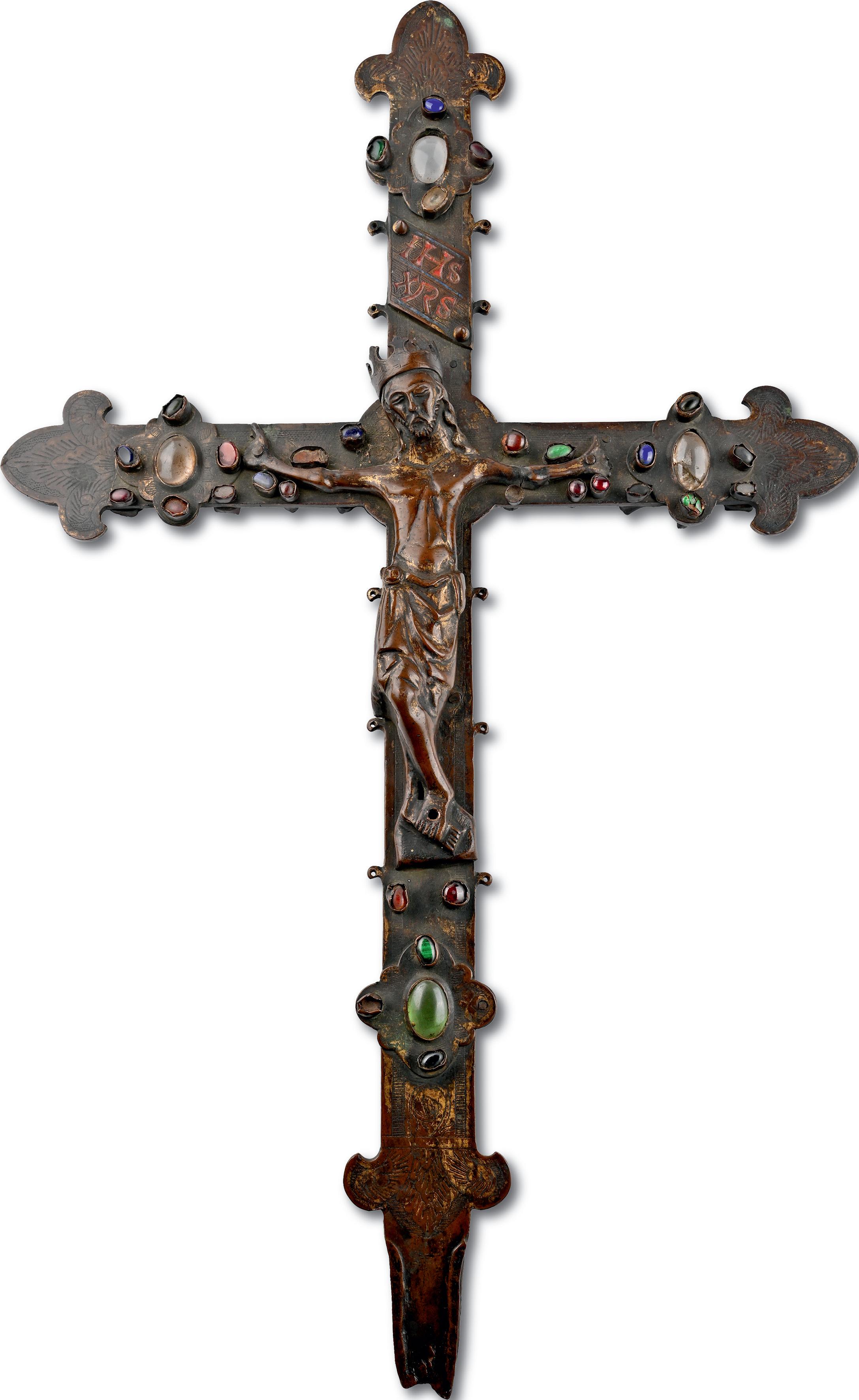
PROVENANCE:
Maintained within a family’s ancestral country residence, where it formed part of a small group of inherited ecclesiastical objects retained in private hands throughout the 19th and 20th centuries, thence by descent to the present owner.
Accompanied by an academic report by Dr Raffaele D’Amato.
FOOTNOTES:
A distinguished item of enduring Northumbrian heritage, preserved within the same local family household for several generations. By established family tradition, the crucifix is thought to possess early devotional associations with the Raymes Chapel of St Andrew’s Church, Bolam, a site historically connected with notable gentry of the district. The cross is an exceptional example of Late Romanesque art, combining champlevé enamel appliqués - flat panels with geometric ornament – and the arms of the cross decorated in champlevé. However, this piece is a composite artwork: the circular floral plaque from Limoges, on the reverse, dates from the second quarter of the 13th century, while the facade plaques, of similar origin, come from the end of that same century; the figure of Christ from Central France seems to belong to a later medieval period.
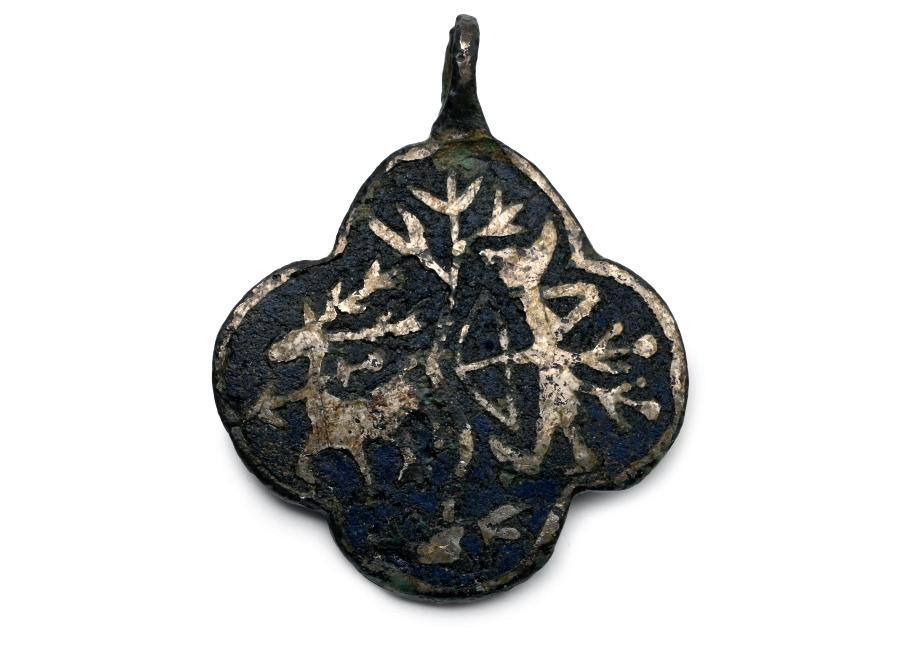

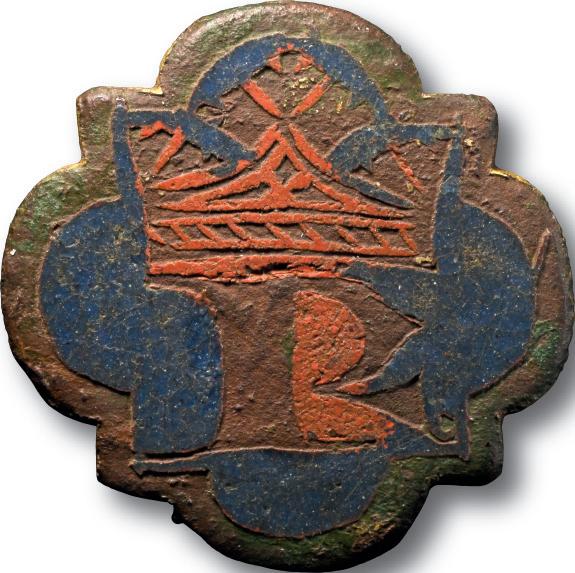

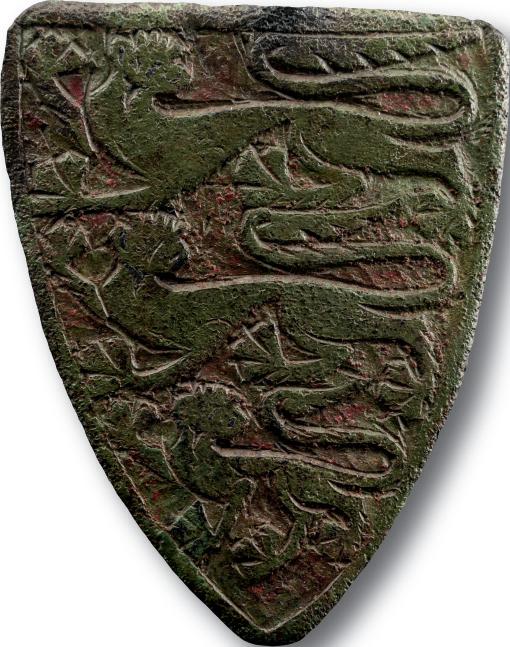
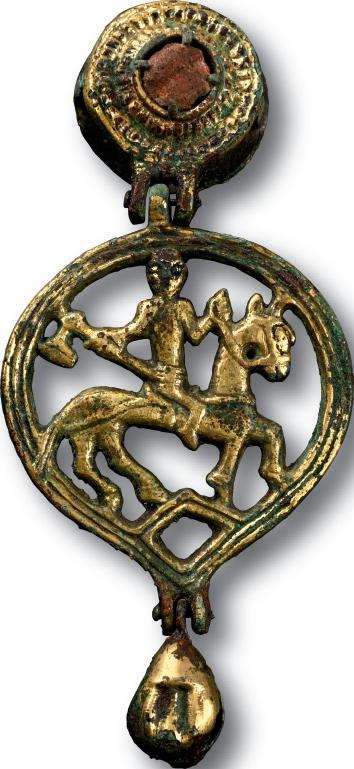
360
MEDIEVAL KNIGHT’S HERALDIC HORSE HARNESS PENDANT WITH ROYAL HUNTING SCENE
13TH CENTURY A.D.
1½ in. (11.36 grams, 38 mm)
Quatrefoil-type with integral loop and broad lobes; niello surface with reserved image of a bowman (right) with arrow nocked and one arm bent, advancing towards a stag (left) with tined antlers, an arrow having pierced it through the neck; scene divided by a median vertical tree with three radiating boughs.
£500 - 700
PROVENANCE:
Found by Robert Wiseman in Longdon, Worcestershire, UK, circa 2015, next to a trackway leading to St John the Baptist church that was built by the military order of the Knights Hospitaller in the 12th century.
Recorded with Mark Lodwick of the National Museum of Wales, Cardiff, UK.
PUBLISHED:
Accompanied by a copy of the hard-backed book: Eldersfield, Knights & Pilgrims, where this pendant is published on p.18 under the section titled “The Sport of Kings”
FOOTNOTES:
Described by Phil Parkes, the conservator at the National Museum of Wales, as the best of its type that he had ever seen or worked on to clean and preserve, in 30 years.
361
LARGE MEDIEVAL ENAMELLED BRONZE ‘CROWNED R’ STUD
15TH CENTURY A.D.
1 in. (24.4 grams, 42 mm)
Quatrefoil type with interstitial points, reserved capital ‘R’ on a blue enamelled field, reserved crown above.
£400 - 600
PROVENANCE:
Found Norfolk, UK.
362
LARGE MEDIEVAL KNIGHT’S BRONZE ROYAL HERALDIC HORSE HARNESS MOUNT
13TH-15TH CENTURY A.D.
2 in. (34.6 grams, 70 mm)
Heater-shaped with low relief of three lions passant guardant. [No Reserve]
£600 - 800
PROVENANCE:
From the private collection of the late Graham Slater (1927-2024), Cambridge, UK, acquired 1980s-1990s.
363

MEDIEVAL KNIGHT’S GILT BRONZE HORSE HARNESS PENDANT AND HANGER WITH AXE-WIELDING RIDER
11TH-12TH CENTURY A.D.
4 in. (29 grams, 10.2 cm)
Comprising: discoid plate with two concentric pelleted bands and central cell with claw setting, glass insert, attached to backplate by four shot bars; hinge below connected to an openwork teardrop pendant with profile image of a horseman advancing on a chevron baseline, his upper bdy turned to face the viewer, holding a large axe braced against his hip; hinge below connected to a bulb dangle with corrugated detailing.
£3,000 - 4,000
PROVENANCE:
From the private collection of a London gentleman, from his grandfather’s collection formed before the early 1970s.

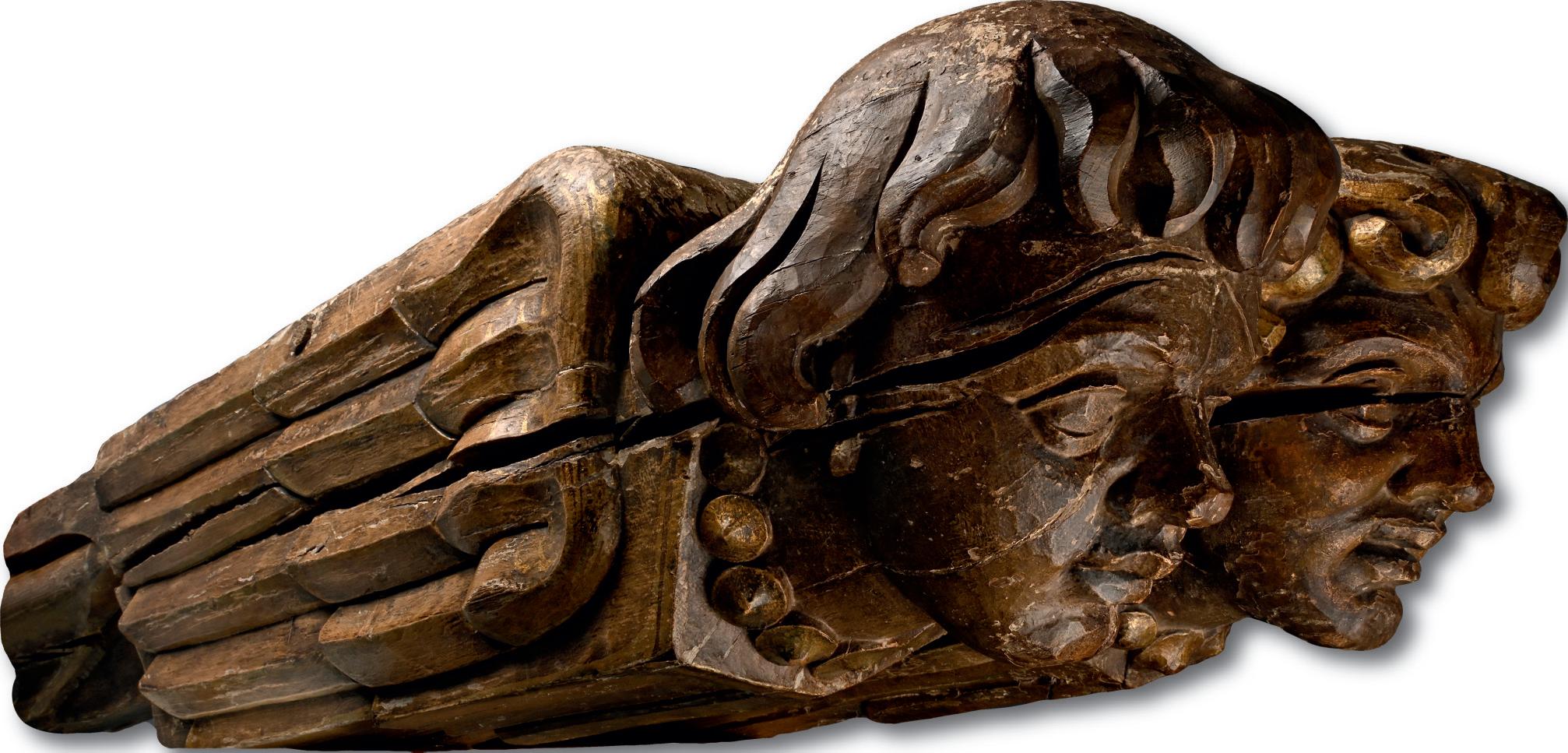
MASSIVE MEDIEVAL GILT OAK HAMMER BEAM ROOF ANGEL PAIR
POSSIBLY EAST ANGLIA, 1470-1500 A.D.
55 in. (80.5 kg total, 142 cm each)
Comprising a matched pair of substantial hammer beams from a truss roof, each with a longitudinal slot in the upper face at the rear and socketted brace; slightly tapering square-section body with tiered feather carved detailing, collar of domed bosses on the neck of an angelic head with flounced curls of hair, fleshy facial details with carved eyes and pupils; drilled to accept trennels, some in place; some gilding and pigment present; some longitudinal splitting. [2]
£6,000 - 8,000
PROVENANCE:
From a family collection for over 60 years.
From a late friend of Mr Robin Cox of Newark, UK.
Accompanied by an academic report by Dr Raffaele D’Amato.
365
MEDIEVAL WOODEN BENCH FINIAL IN THE FORM OF AN ELEPHANT AND CASTLE
ENGLAND, 15TH CENTURY A.D.
13½ in. (1.31 kg total, 34.2 cm including stand)
Carved stylised elephant with elongated ears supporting a palanquin in the form of a caste with a carved cross, foliage motif to the reverse; mounted on a velvet-covered stand.
£3,500 - 4,500
PROVENANCE:
Private collection, Europe.
Acquired on the English art market.
FOOTNOTES:
The image of an elephant carrying warriors in a howdah originated from Alexander the Great’s battle against King Porus’s war elephants at the Battle of Hydaspes in 326 BC. This motif became widely known in European art through the spread of Bestiaries which were medieval texts combining natural history with moralising Christian stories. One of the most well known was Matthew Paris’s imagined depictions of elephants, most notable in this case is his war elephant illustrated in Chronica maiora II, circa 1240-1255 (Cambridge, Corpus Christi College, MS 016II). Another well known manuscript - The Rochester Bestiary, circa 1230-1240 (British Library, London, Royal MS 12 F.xiii) contains a miniature with a war elephant in the midst of battle, above another image of elephants supposedly in their natural habitat. Since very few live elephants were seen in Europe during the medieval period, their representations were often more imaginative than realistic. Other Medieval bench end carvings of elephants in English churches are known, amongst them are: St Peter and St Paul, Tuttington, Norfolk; St Andrew, South Lopham, Norfolk; St Edmund, South Burlingham, Norfolk; St Andrew, Holme Hale, Norfolk. Elephants can also be found on misericords, some examples can be found at: Cathedral Church of Saint Peter, Exeter; Cathedral Church of St Peter, Gloucester; and St Mary’s Church, Beverley.
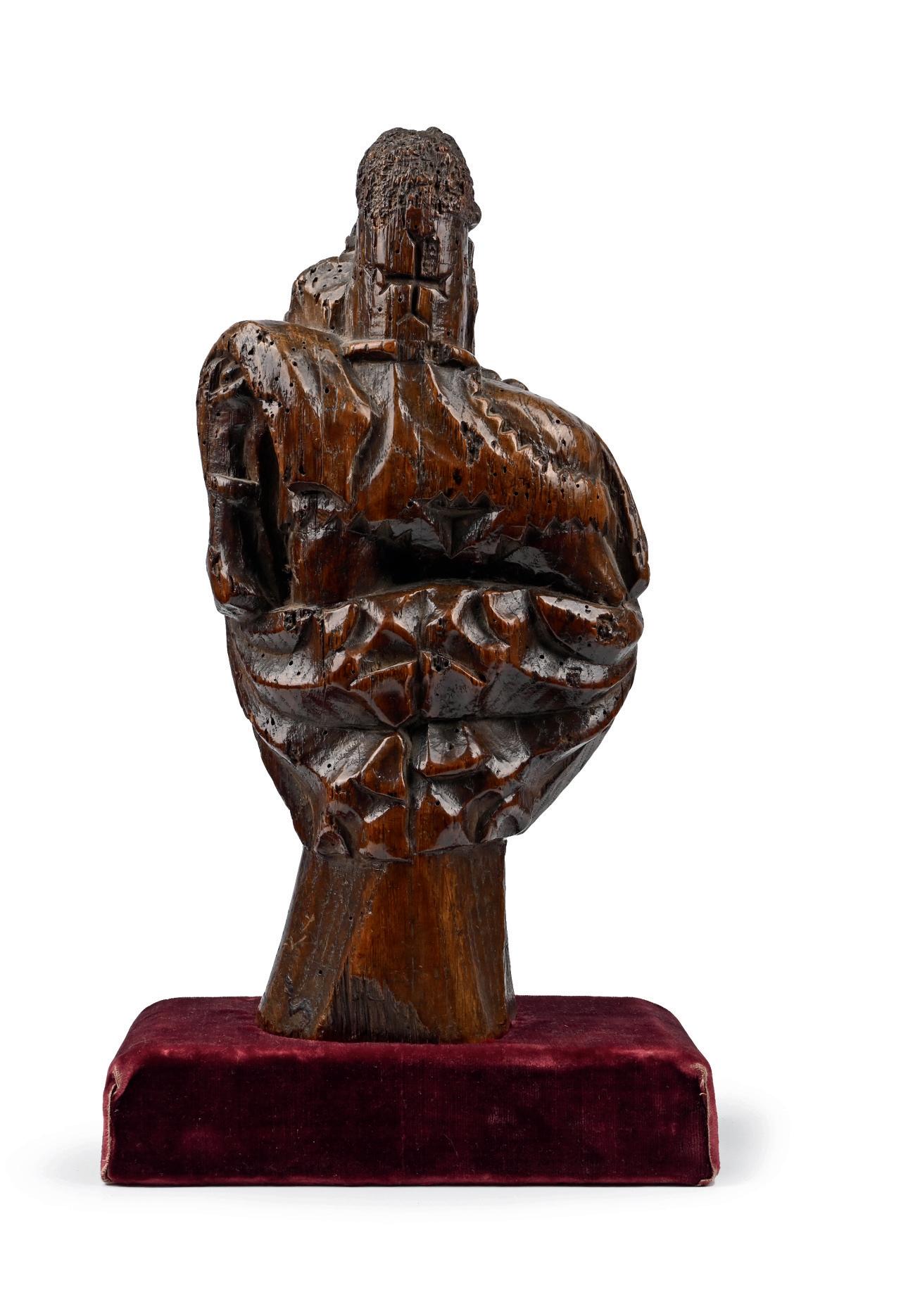
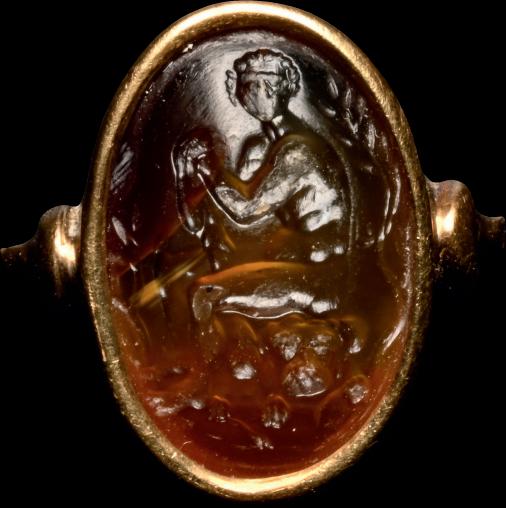
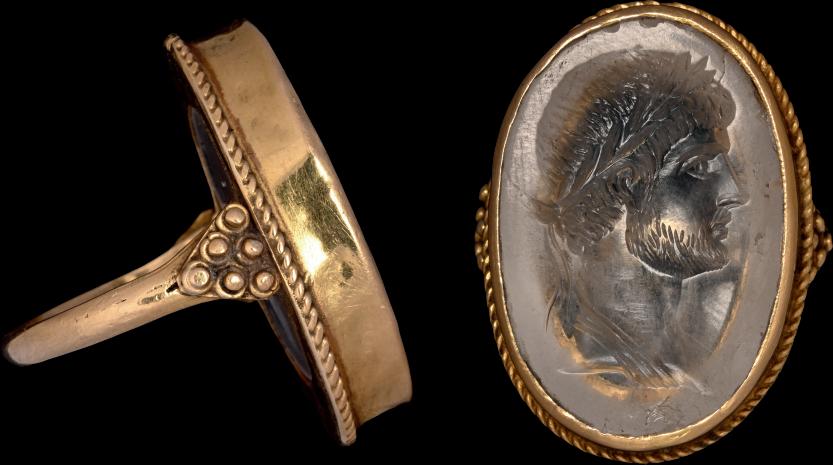
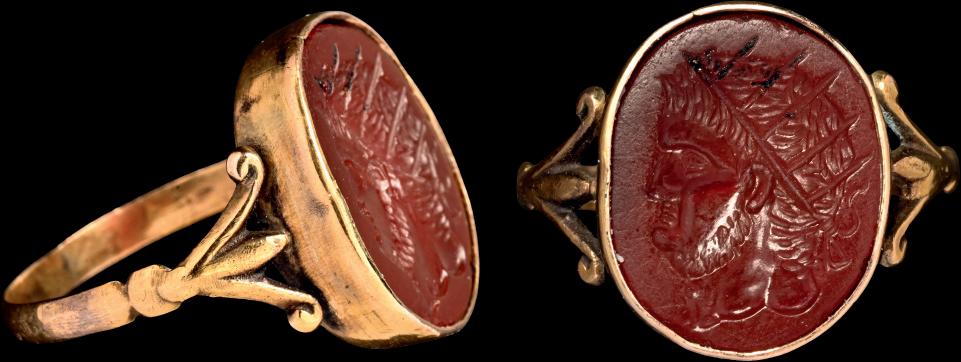
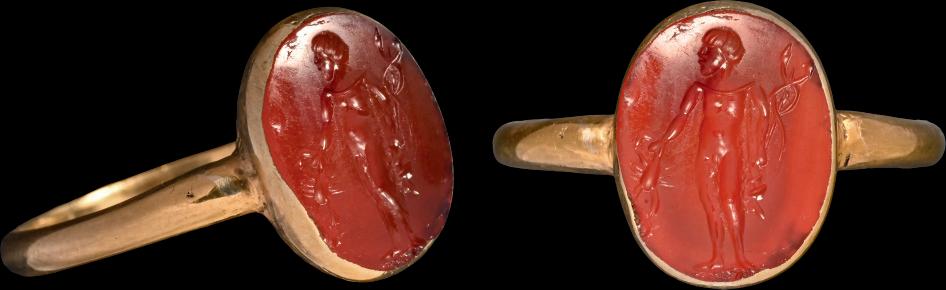
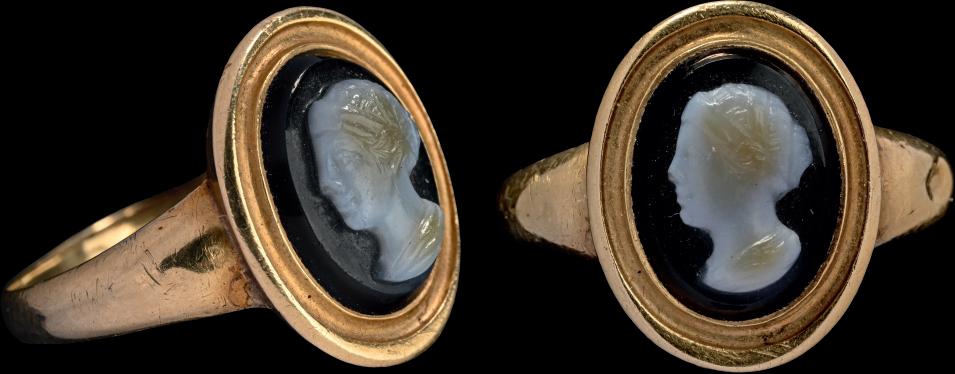
366
RENAISSANCE CARNELIAN GEM IN GOLD MOUNT 16TH CENTURY A.D. AND LATER ¾ in. (3.78 grams, 18 mm)
Ellipsoid in plan with cast glass intaglio seated figure with foliage; in later gold swivel mount.
£500 - 700
PROVENANCE: French art market. with Desmet Fine Arts, Belgium. Private collection, England.
367
POST-CLASSICAL ROCK CRYSTAL GEMSTONE WITH BUST OF THE EMPEROR HADRIAN 17TH CENTURY A.D. OR LATER
1¼ in. (12.68 grams, 31.18 mm overall, 20.40 mm internal diameter (approximate size British R, USA 8½, Europe 18¾, Japan 18))
Ellipsoid in plan with incuse profile bust of Emperor Hadrian, bearded and wearing a laurel wreath on his brow; in an antique mount open to the underside.
£2,500 - 3,500
PROVENANCE:
Acquired on the French art market. Private collection, England.
368
RENAISSANCE CARNELIAN INTAGLIO OF THE ROMAN EMPEROR NERO IN GOLD RING ITALY, 16TH-17TH CENTURY A.D. in. (3.64 grams, 22.23 mm overall, 20.44 mm internal diameter (approximate size British P, USA 7½, Europe 16.23, Japan 15))
With narrow shank and fleur-de-lys to each shoulder supporting an ellipsoid cell with inset carnelian intaglio profile bust of Nero with solar crown.
£1,500 - 2,000
PROVENANCE: Private collection, Europe. Acquired on the English art market.
369 RENAISSANCE CARNELIAN GEMSTONE DEPICTING THE GOD MERCURY IN GOLD RING 16TH-17TH CENTURY A.D.
1 in. (4.63 grams, 24.38 mm overall, 18.99 mm internal diameter (approximate size British R½, USA 8¾, Europe 19.38, Japan 18))
Cloison with incuse figure of Mercury standing with caduceus and marsupium; set into a later gold ring.
£1,000 - 1,400
PROVENANCE: Private collection, Europe. Acquired on the English art market.
370 BANDED AGATE CAMEO OF A WOMAN IN GOLD RING
18TH CENTURY A.D.
¾ in. (3.17 grams, 21.26 mm overall, 17.72 mm internal diameter (approximate size British L, USA 5¾, Europe 11.24, Japan 10))
Hollow-formed with pie-dish bezel and inset cameo.
£700 - 900
PROVENANCE:
Private collection, Europe. Acquired on the English art market.
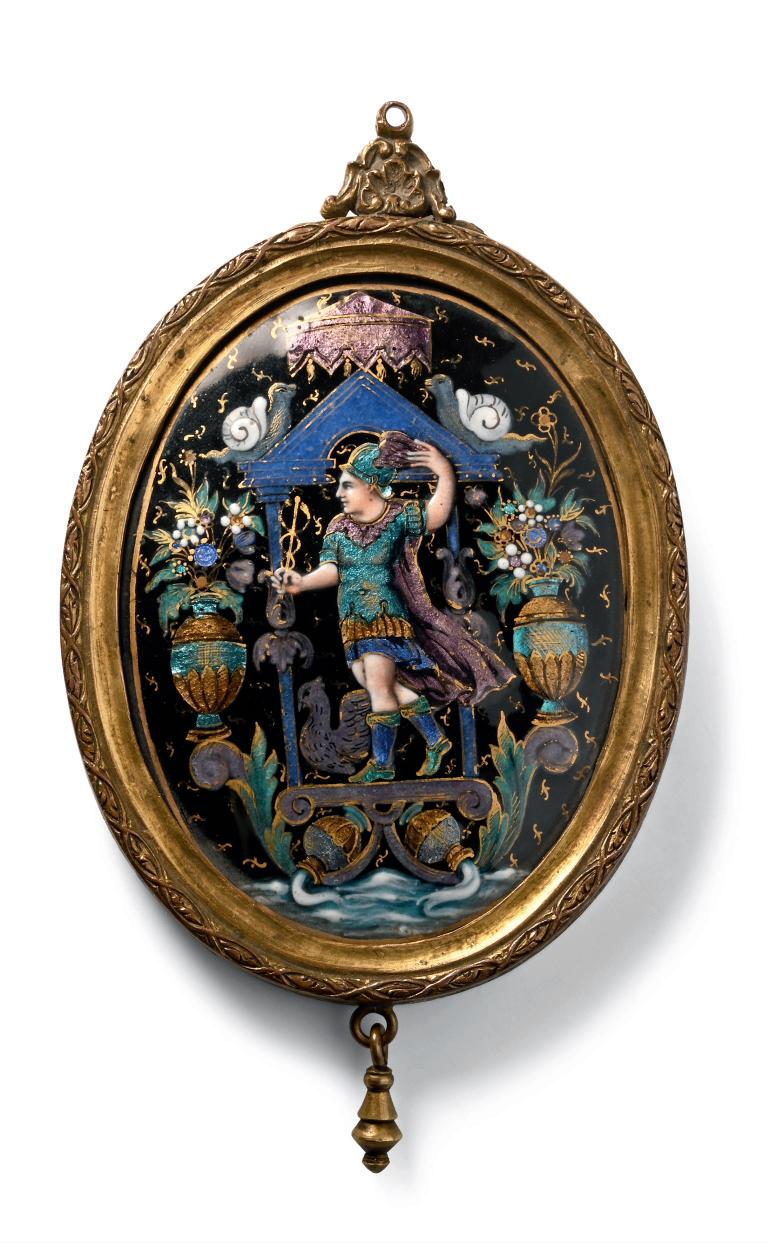

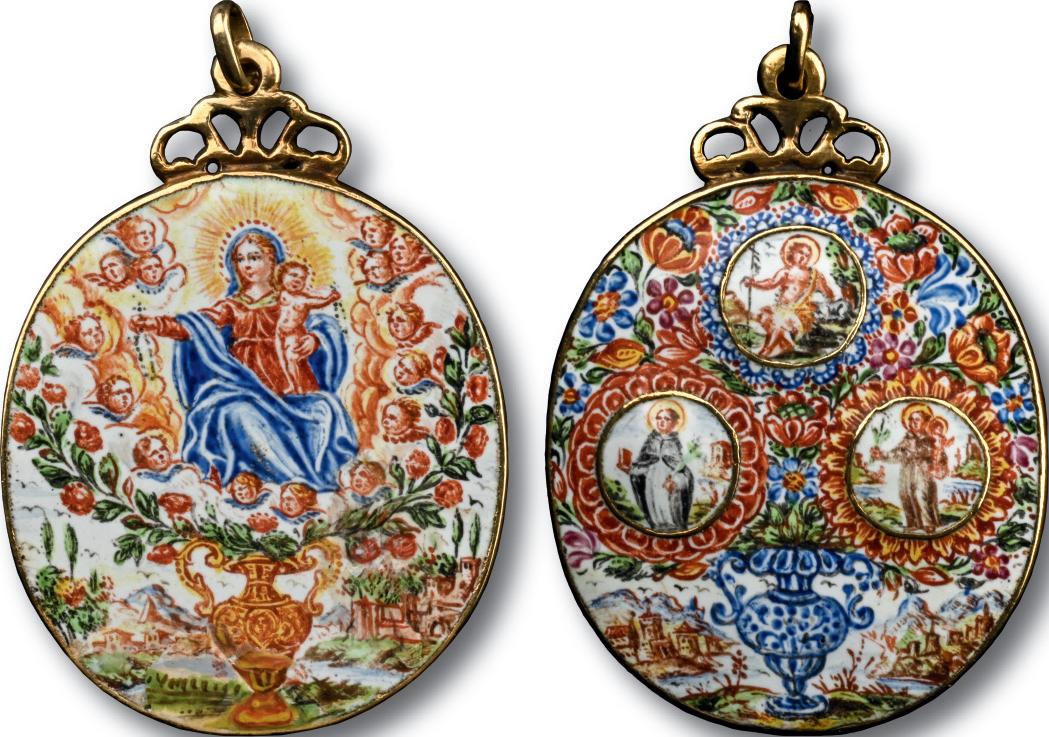
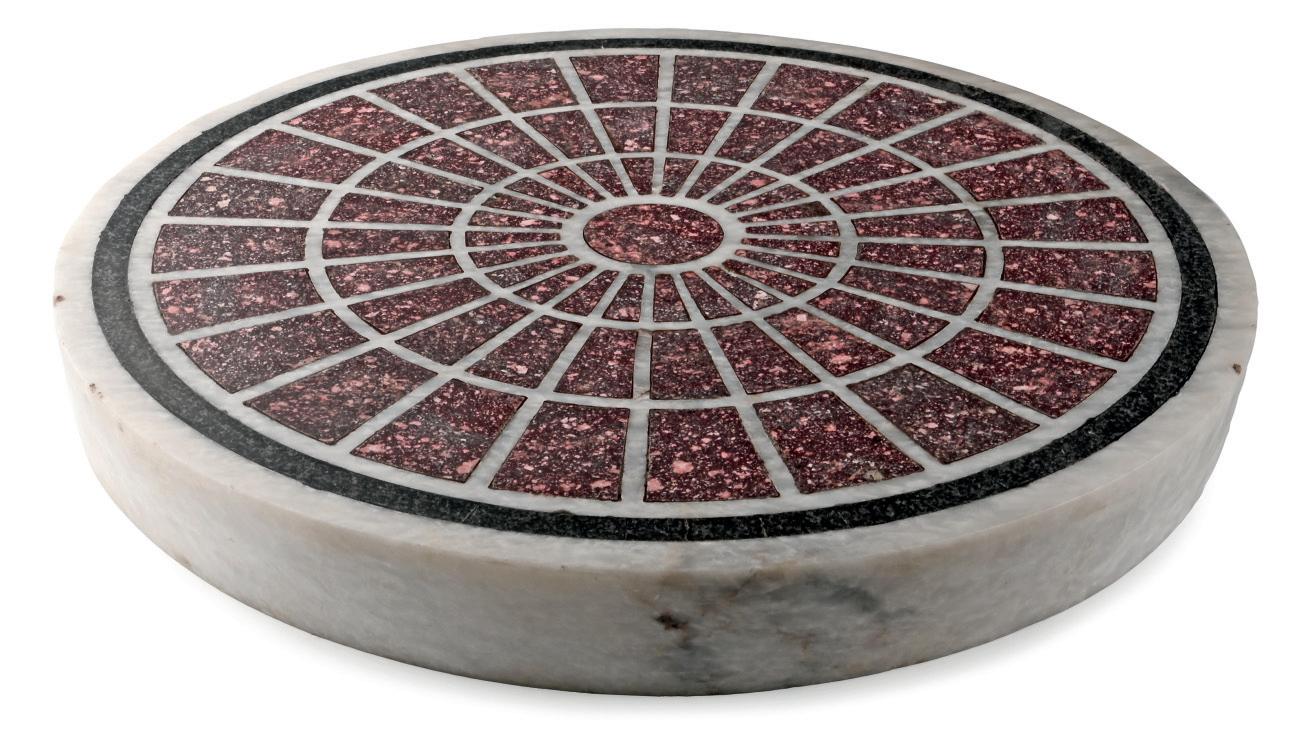
371
GILT ENAMELLED MIRROR CASE DEPICTING THE ROMAN GOD MERCURY
LIMOGES, EARLY 17TH CENTURY A.D.
5 in. (168 grams, 14.4 cm)
Oval in plan with a vivid polychrome enamel scene on a black ground to the upper face of the lid, within a gilt-copper frame: Mercury, identifiable by his winged helmet and caduceus, standing beneath a classical arch flanked by stylised columns and vases of flowers; above the entablature, a canopy held aloft by two snails, with twin ewers crowning the upper corners and issuing stylised streams; the architectural and ornamental elements highlighted with translucent and opaque enamel, highlighted with gilding and intricate punchwork; the frame with a guilloche border, surmounted by a pierced rocaille loop with a scallop motif, and terminating below in a turned pendant finial; the sides of the frame engraved with a delicate foliate frieze, the reverse flat-chased with three vases of stylised flowers issuing from scrolled supports, framed above by draped swags, butterflies, and a winged cherubic mask; the case hinges open at the top, the interior, originally fitted with mirrored glass, now partially oxidised but retaining areas of reflection.
£3,000 - 4,000
PROVENANCE: Private collection, France. Private collection, UK.
FOOTNOTES:
The enamel composition is directly derived from a print by Étienne Delaune (1518/19-1583), from his series Grotesques à Fond Noir, Dieux et Déesses, created in France c.1550-1572, before he departed for Strasbourg. Delaune’s engravings were a principal source for Limoges enamellers of the late 16th and early 17th centuries, particularly in the production of oval mirror plaques for personal toilette or cabinet display.
372
ENAMELLED GOLD PENDANT DEPICTING THE VIRGIN AND CHILD WITH SAINTS
SICILY, 17TH-18TH CENTURY A.D.
2 in. (24 grams, 61 mm)
Decorated to obverse with a vase abundant with flowers in a mountainous landscape, with reserved roundels containing the images of Saints Anthony of Padua, John the Baptist and Saint Dominic de Guzmán; reverse with another vase in a landscape emitting a rose garland supporting an image of the Virgin and Child in Majesty, amidst clouds and angels.
£3,000 - 4,000
PROVENANCE: Private collection, Europe. Acquired on the French art market.
FOOTNOTES: The pendant is decorated in the manner of Giuseppe Bruno who was an enameler from Messina, Sicily (active c.1652-82).
373
IMPERIAL PORPHYRY SPECIMENS FROM THE GRAND TOUR SET INTO A MARBLE TABLE TOP LATE 19TH-EARLY 20TH CENTURY A.D. 15½ in. (14.75 kg, 39.3 cm)
Porphyry specimens set into a circular marble ‘table top’ with a black band border similar to items from the workshop of Francesco Sibilio. £1,000 - 1,400
PROVENANCE: Acquired from Diana Steel in Suffolk around 2000. From the private collection of a Somerset gentleman.
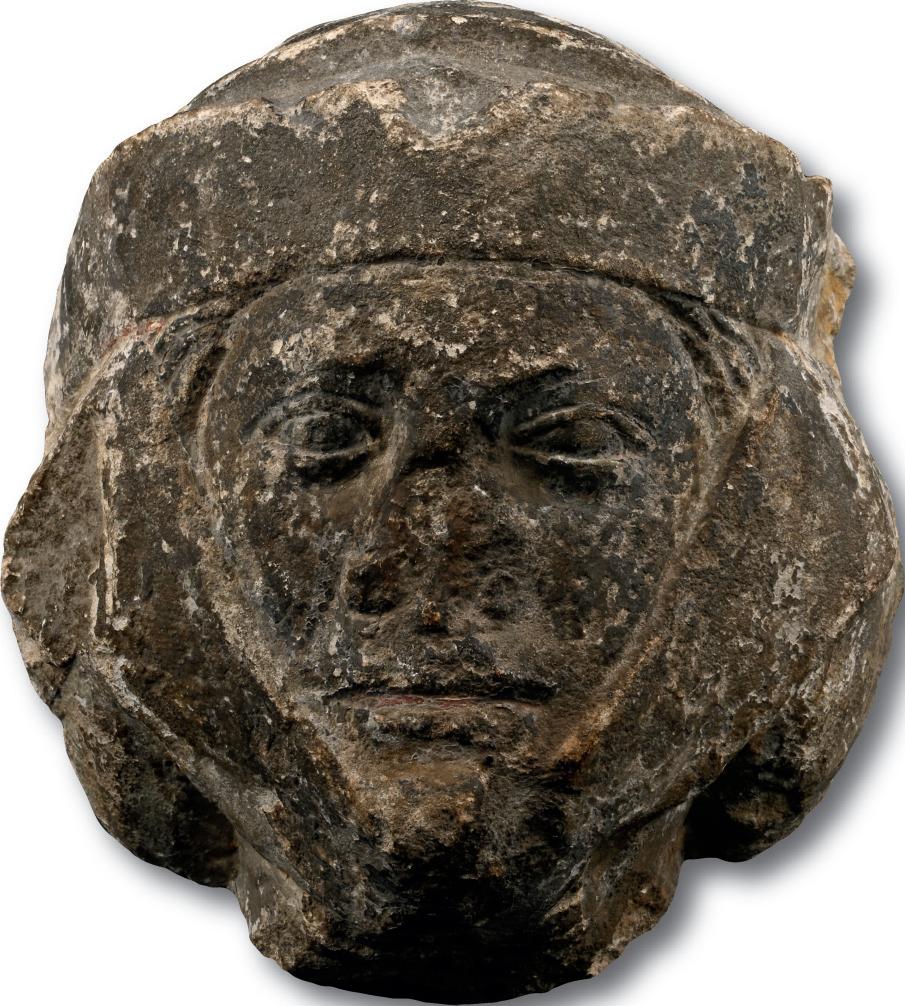

LARGE MEDIEVAL CRUSADER PERIOD CARVED BASALT CAPITAL
LEVANTINE, 12TH-13TH CENTURY A.D.
18 in. (118.4 kg, 46 cm)
Architectural column capital modelling with curled acanthus leaves rising from a narrow central stem, splayed and with scrolled tendril detailing; pierced to accept locating studs.
£1,000 - 1,400
PROVENANCE:
Acquired 1970s-1996.
Property of a North American collector. London collection, 2016. Private collection, UK.
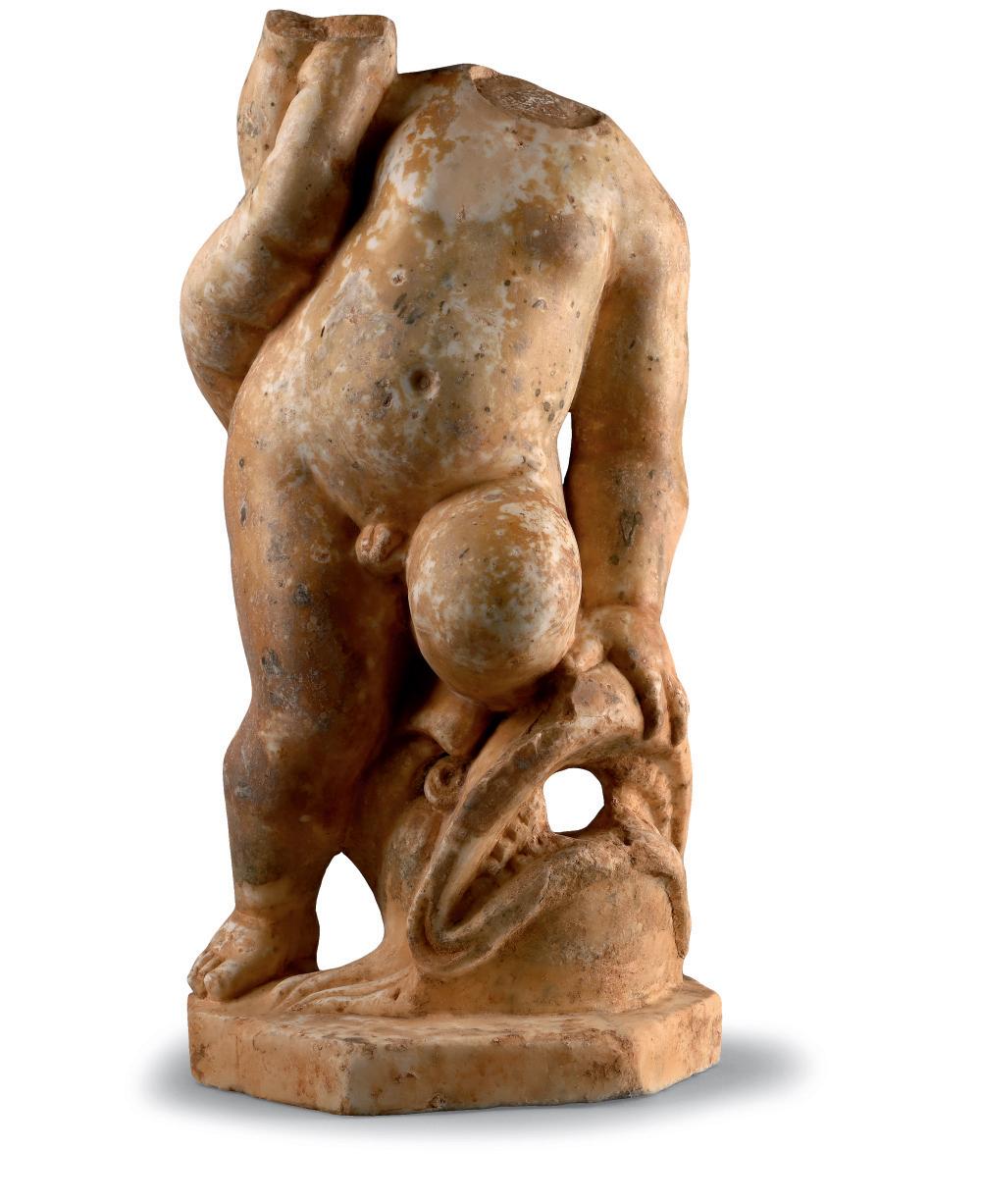
374
MEDIEVAL STONE FEMALE HEAD
FRANCE, 14TH CENTURY A.D.
9½ in. (3.11 kg total, 24 cm high including stand)
Carved in the half-round with filet brow-band and chin-band; narrow triangular face with slit mouth and lentoid eyes; lateral bunches of hair beneath the wimple; mounted on a custom-made stand.
£700 - 900
PROVENANCE: Private collection, UK.

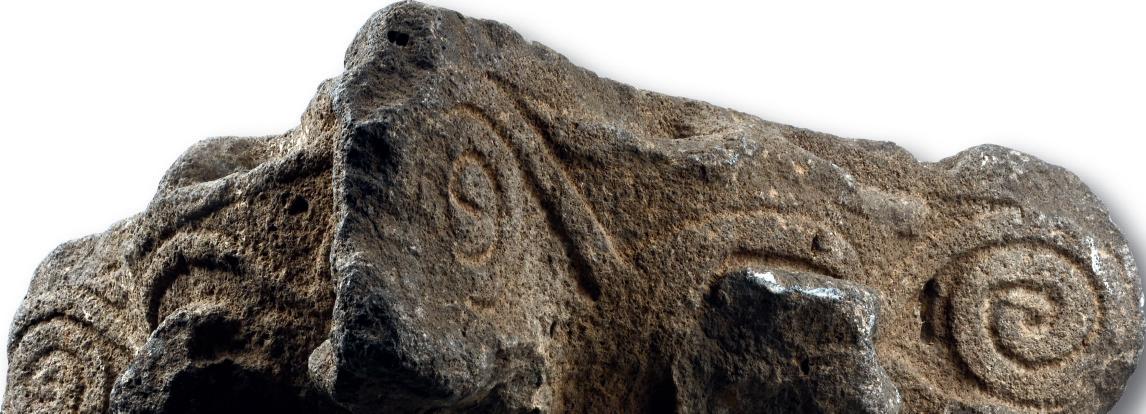
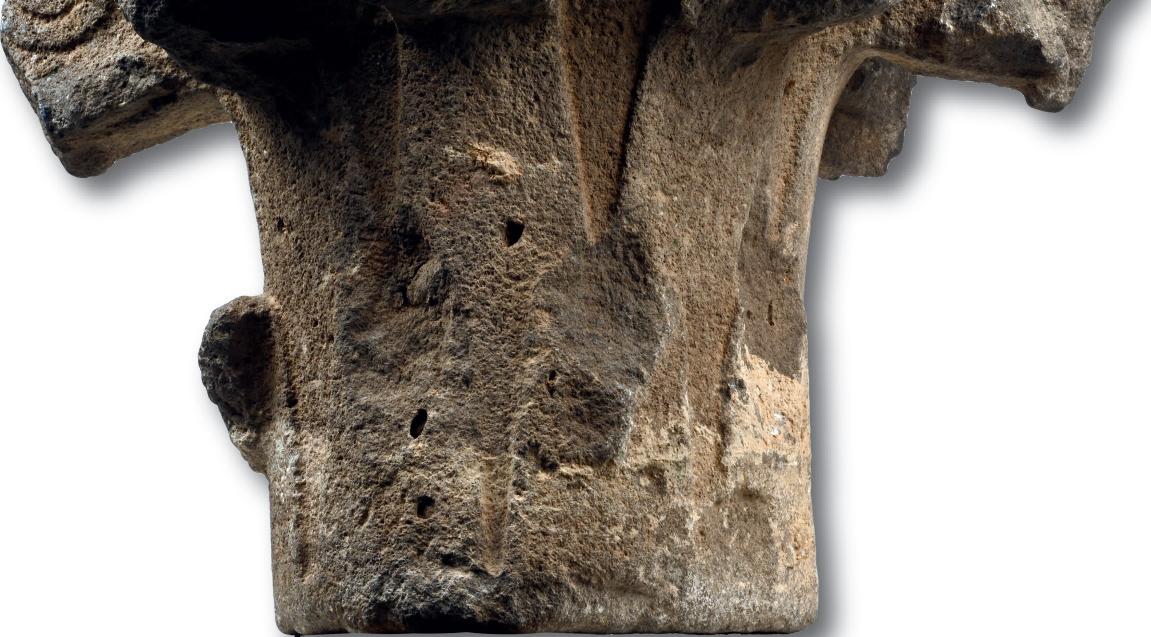


BAROQUE, 17TH CENTURY A.D.
18 in. (20.75 kg, 48 cm)
Standing on an angular base resting his left knee on the open jaws of a fish, his left arm holding the jaws open, the body and tail held upright be the raised right hand (partly absent); with heavy sulphured patina.
£5,000 - 7,000
PROVENANCE:
Acquired prior to 1970.
From the estate of a Swiss gentleman, Ticino. Private collection, Zurich, Switzerland.
377
MARBLE PORTRAIT OF A MAN
17TH-18TH CENTURY A.D.
16 in. (35.1 kg, 41 cm high including stand)
Modelled in the round with a frowning expression, a triangular face with angular features and thick banded hair; recessed to the top of the head.
£5,000 - 7,000
PROVENANCE: Private collection, England.
FOOTNOTES:
From the late 17th century until around the 1760s, classical nostalgia and the viewing and recording of classical remains became major occupations for aristocratic young men who went on the ‘Grand Tour’. In Rome, for example, some British visitors counted and measured the huge number of ancient columns and obelisks still visible in the city. The wealthiest brought back antiquities, including stones with Latin inscriptions, and redesigned their gardens to display them. More significantly, such travels also encouraged those who went to redefine their own origins and native identities within a wider European context. The taste for the reproductions of ancient monuments involved also the sculptures of Middle Age.
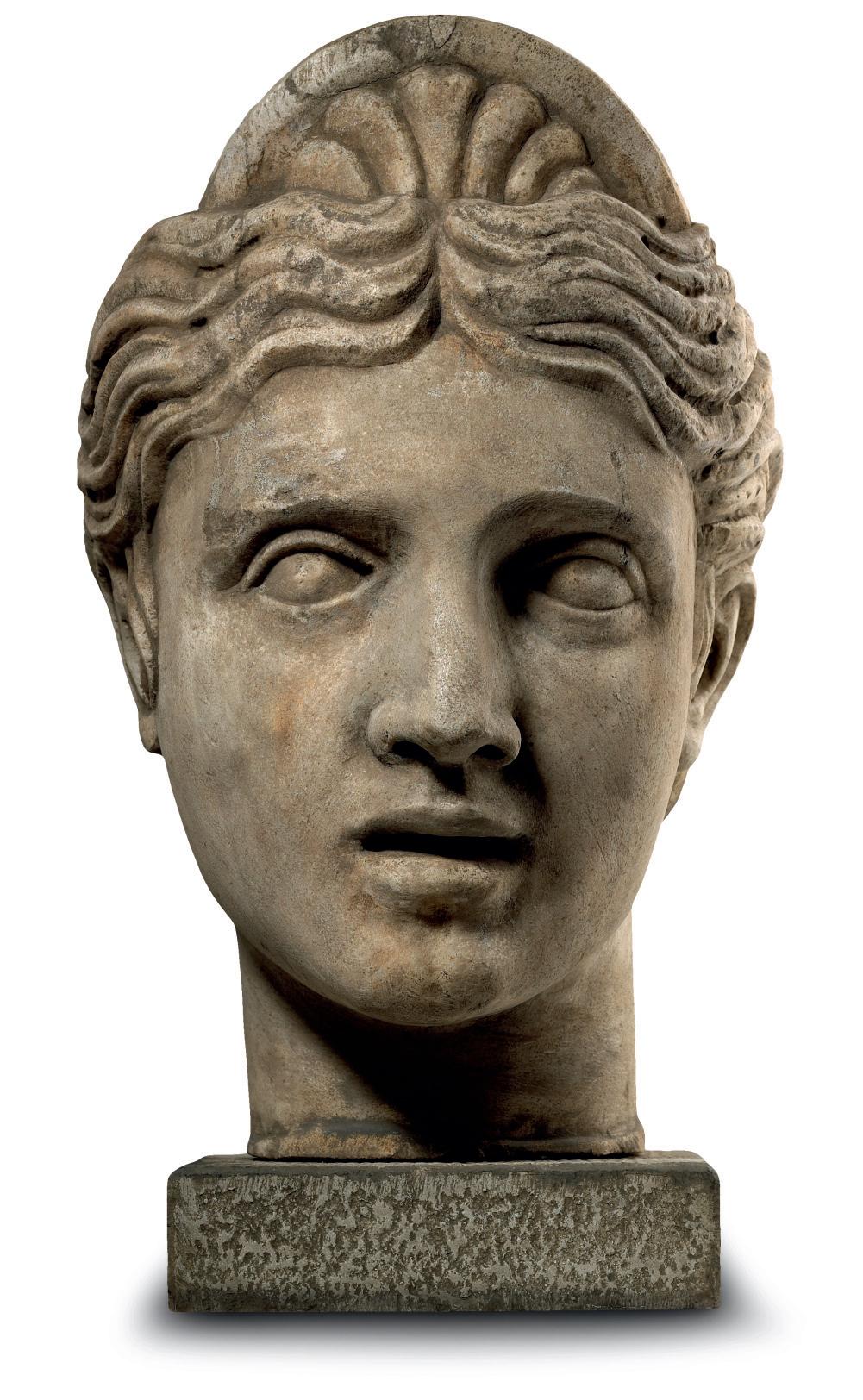
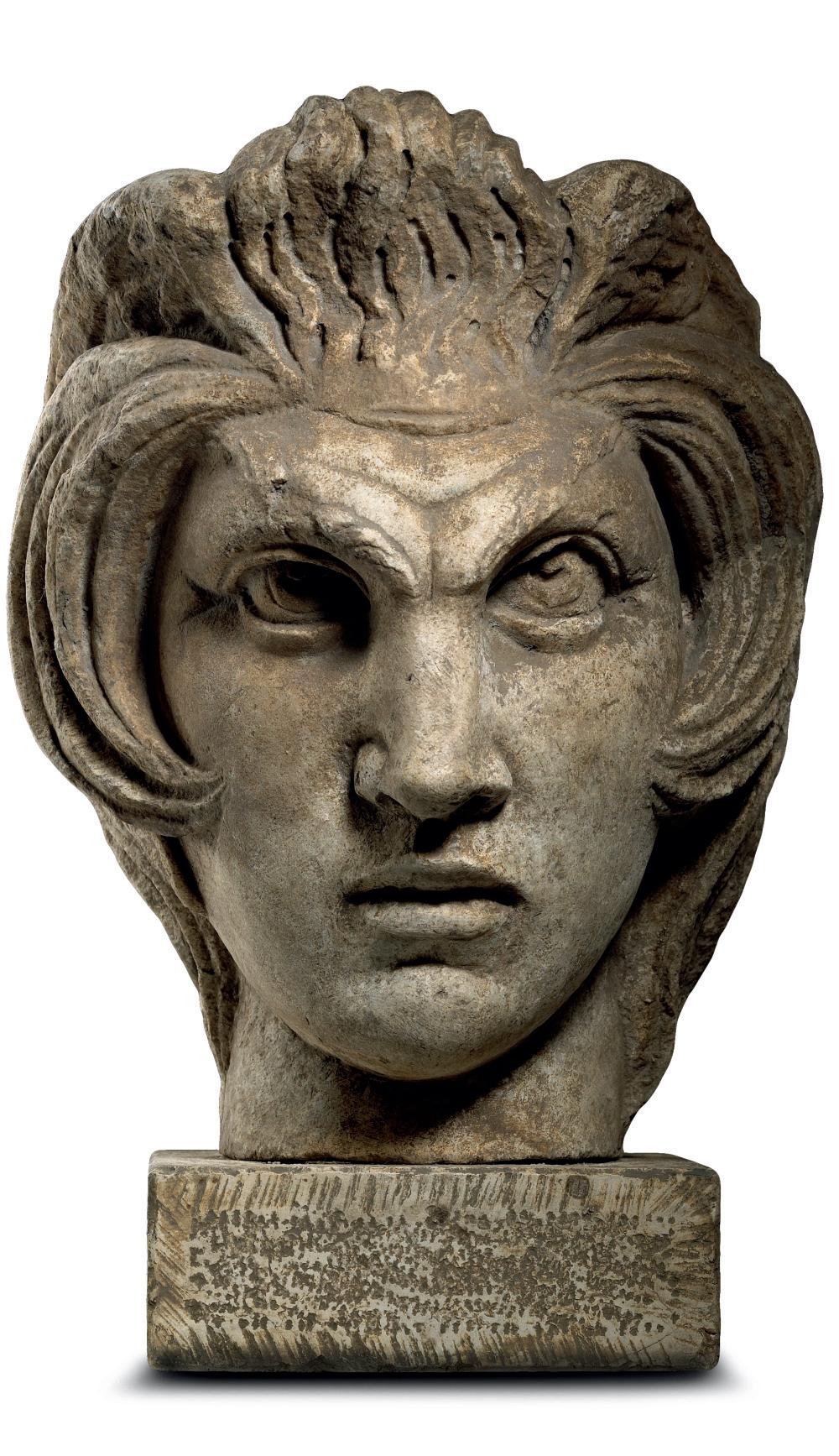
378
MARBLE PORTRAIT OF THE GREEK GODDESS HERA
17TH-18TH CENTURY A.D.
16½ in. (32 kg, 42 cm high including stand)
Modelled in the round with gracile features, braided hair, arched diadem to the brow.
£5,000 - 7,000
PROVENANCE: Private collection, England.
FOOTNOTES:
The type of sculpture seems to be inspired by the type of the Barberini Hera, a Roman copy from the imperial age, today in the Chiaramonti Museum (Vatican Museums). The sculpture was discovered by the antiquarian Leonardo Agostini in the late 17th century, during excavations on the Viminal Hill. The site was located beneath the convent affiliated with the church of San Lorenzo in Panisperna, an area known to have hosted the ancient Baths of Olympiades. Its identification as the Barberini Hera was established by its early owner, Cardinal Francesco Barberini.
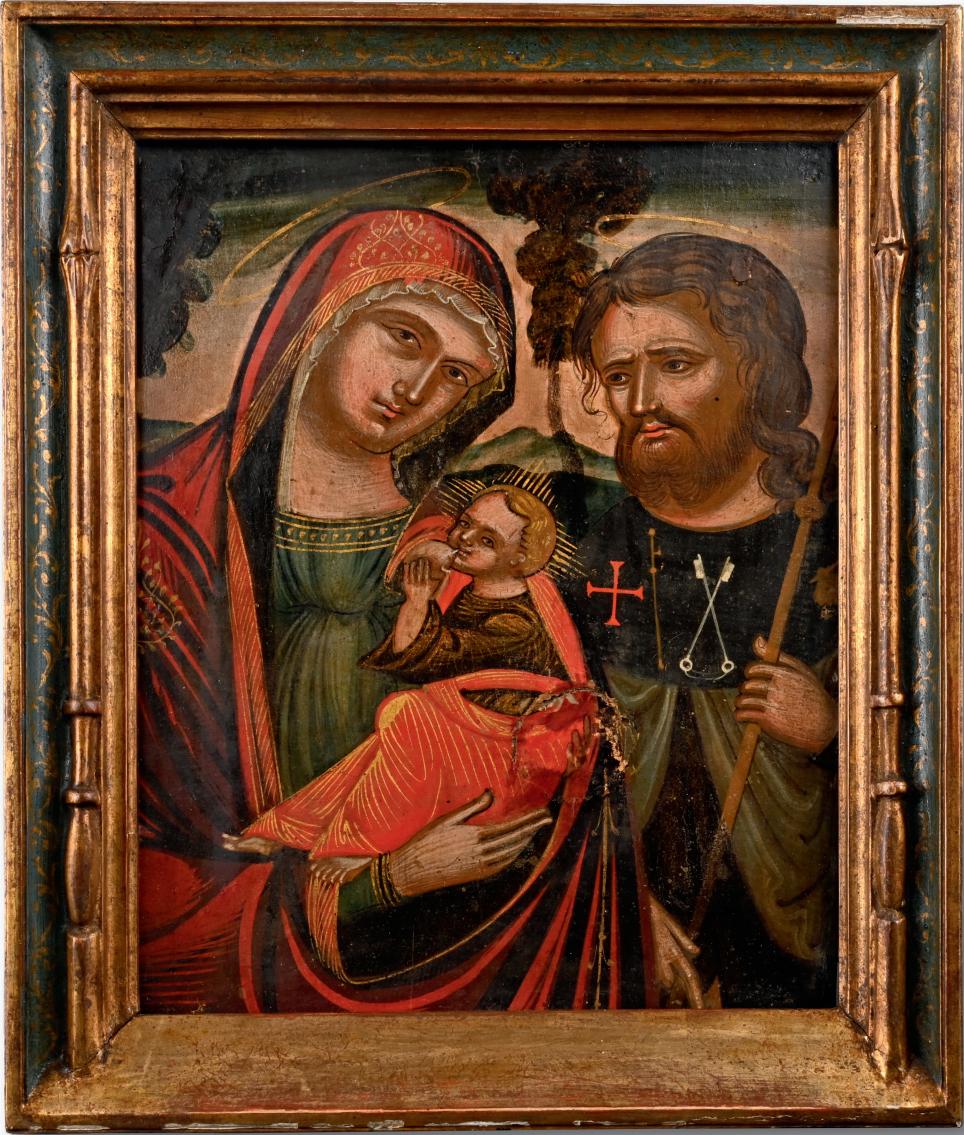

379
VENETO-CRETAN ICON OF NURSING MADONNA WITH ST ROCK
17TH CENTURY A.D.
12¾ x 10 in. (857 grams, 32.5 x 27.5 cm)
Executed in oil and tempera on a slightly curved wooden panel base depicting the Theotokos (Mother of God), the infant Jesus and Saint Rock on a natural background; Mary with head bowed left wearing a red maphorion mantle over a dark blue robe, with elaborate golden saltires on the shoulders and head of the mantle, fine gold brocade to the hem of the blue robe, nursing the child; the infant Jesus facing away to left, supported on Mary’s right arm and dressed in gold tunic, wrapped in a red shawl with gold highlights to folds, both hands holding the mother’s breast; the long-haired Saint Rock covered in a black tabarrino marked with his attributes, the red cross, the pilgrim’s staff, the scallop shell and the keys, holds his walking stick in his hand; trees and mountain profiles in the background; gilded wooden frame surrounded by a blue indigo border with gold arabesques; from the Veneto-Cretan guild.
£3,500 - 4,500
PROVENANCE:
Acquired on the European art market. Private collection, London, UK.
Accompanied by an academic report by Dr Raffaele D’Amato.
PUBLISHED:
Korban, H.K., Icons from the Orthodox World, London, 2013, pp.76-77.

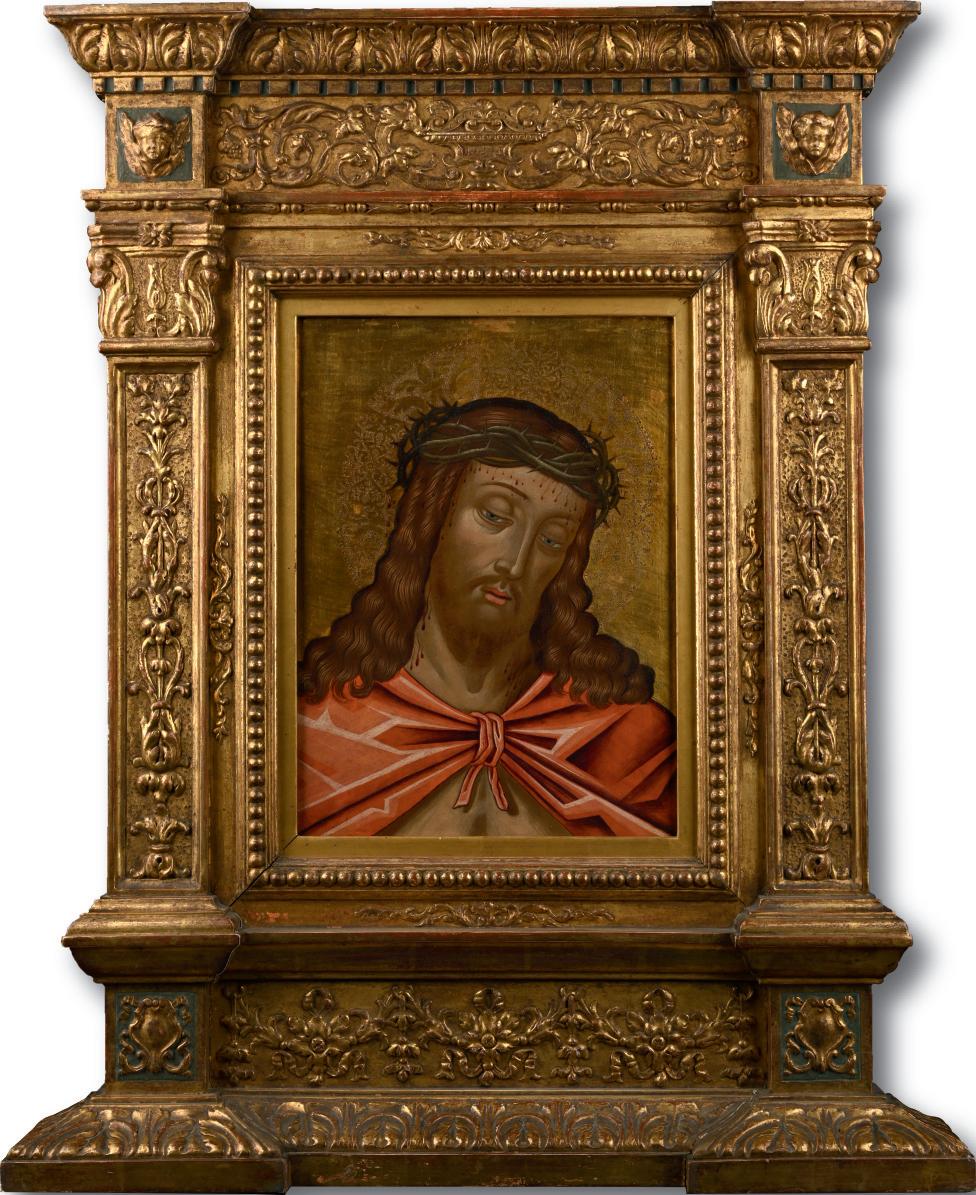
17TH CENTURY
31 x 23 in. (7.75 kg, 79 x 58.5 cm)
With the portrait of Christ in tempera and gold on wood panel, with mounting slots to reverse; gessoed board with gilt surface, reserved portrait bust in three-quarters view on a textured field with tendrils, scrolls and other ornament within the nimbus; Christ shown with shoulder-length auburn hair and short beard wearing a scarlet cloak fastened at the centre of the neck and crown of thorns on his head; facial expression of suffering and pain, with drops of blood on his forehead; the icon set in a carved gilded wooden frame with a beaded edge, flanked by two small pillars with rich vegetal decoration and angel heads in the upper part.
£8,000 - 10,000
PROVENANCE:
Acquired on the European art market. Private collection, London, UK.
Accompanied by an academic report by Dr Raffaele D’Amato.
FOOTNOTES:
This splendid specimen represents Christ as ‘Ecce Homo’, when Pilate, in the desperate attempt to save Jesus from Crucifixion, presented him to the people of Jerusalem dressed in a red cloak and wearing the crown of thorns (John, XIX,5).
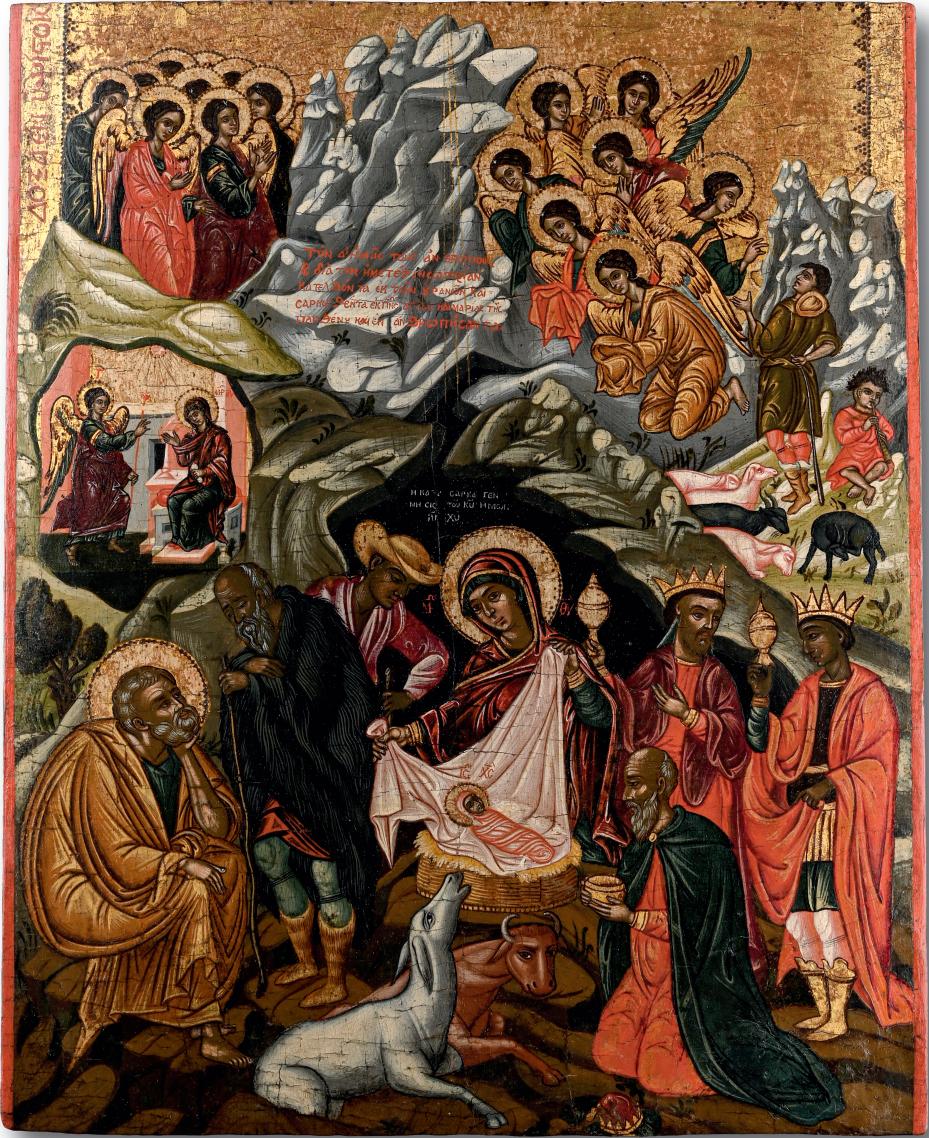

381
VENETO-CRETAN ICON WITH NATIVITY OF CHRIST ATTRIBUTED TO THE WORKSHOP OF THEODORE POULAKIS
17TH-18TH CENTURY A.D.
16 x 13½ in. (1.59 kg, 42.2 x 34.2 cm)
Divided into two separate scenes: in a small panel on the right side, the Annunciation with the archangel Gabriel standing with the messenger’s staff in his left hand, his right hand extending towards the Virgin in a sign of greeting and homage; the archangel dressed in a blue ankle-length garment (sticharion) with a red mantle (himation); Mary in a floor-length blue robe and crimson mantle, holding a scroll; above the two figures inscriptions in Greek letters, ‘ ( )’ over the Archangel and ‘ ’(Mother of God) over the Virgin Mary; on the main field a representation of the Nativity, according the typical Byzantine iconography: standing Mary beneath a rocky landscape above a cave, wearing a red maphorion mantle over a dark blue robe, with elaborate golden threads of fine gold brocade at the hem, showing baby Jesus to the three wise men, dressed as kings and bearing gifts of gold, incense and myrrh; a shepherd wearing a long, shaggy cloak, leaning on his staff, converses amicably with thoughtful Saint Joseph, seated on rocks; an ox and a donkey beneath the cradle; in the upper part, two ranks of singing angels, dressed in gold, blue, and red robes, while among the ranks of angels on the right, one of the celestial creatures announces the good news to the shepherds, inviting them to worship the heavenly child; Greek inscription from the Creed in red within the angels: ‘ ’ μ
π μ , μ
π , π ’ (Who because of us men and because of our salvation came down from the heavens, and was incarnate from the Holy Spirit and the Virgin Mary and became man), another above the Virgin Mary: ‘
’ (The Birth in flesh of our Lord Jesus Christ), also the letters ‘ ’(Mother of God), over the head of Jesus, ‘ C ’ (Jesus Christ); tempera on wood panel, on the reverse old label ‘Kunstausstellung Kühl’.
£18,000 - 24,000
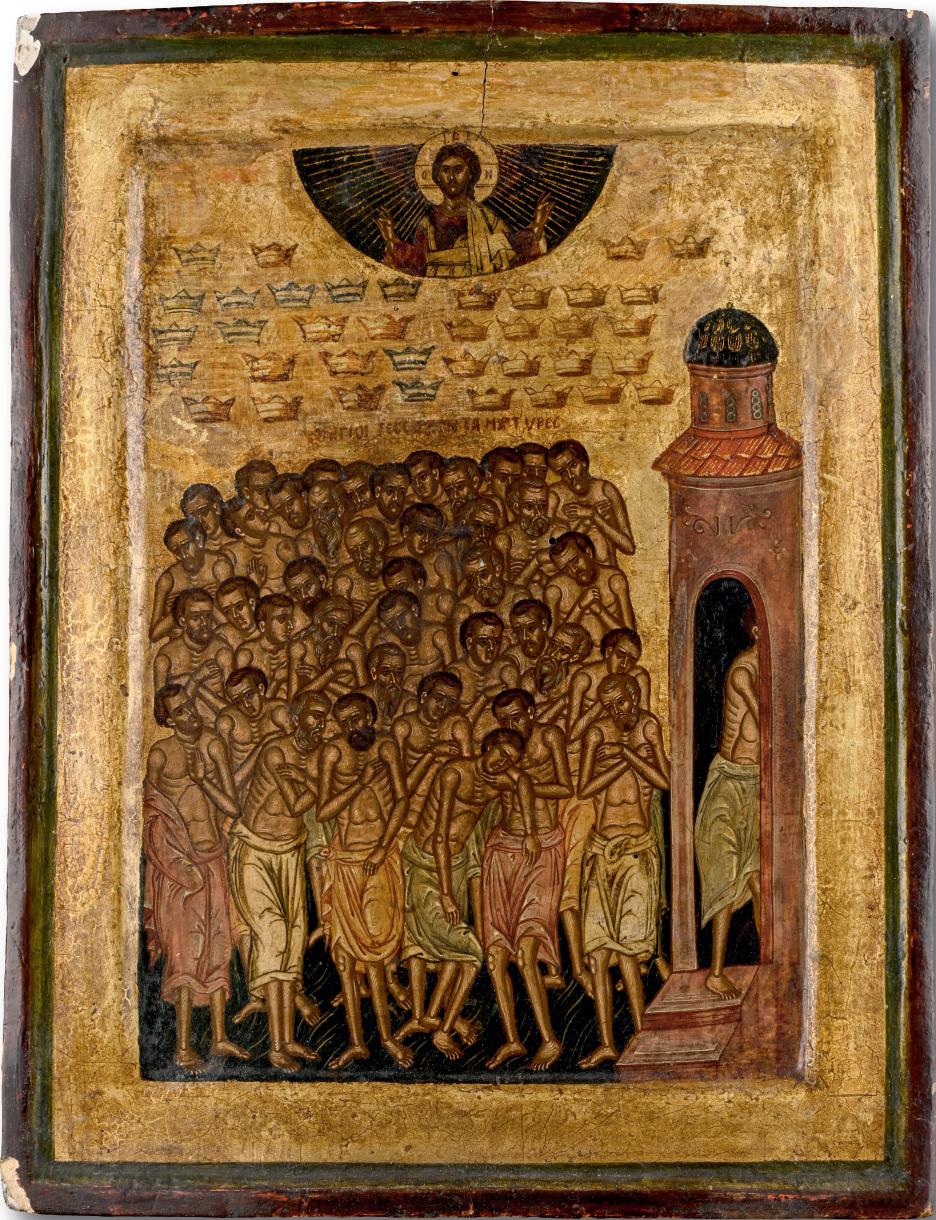

PROVENANCE: Acquired on the European art market. Private collection, London, UK.
Accompanied by an academic report by Dr Raffaele D’Amato.
FOOTNOTES: Theodoros Poulakis (1622-1692) was a key figure of the Cretan School, known for his religious icon paintings. He blended Byzantine and Venetian styles, especially after moving to Venice following the Ottoman conquest of Crete. His vivid, detailed icons are highly regarded in both religious and artistic circles. Here, the artist combines narrations of the birth of Jesus Christ in Matthew 1:182:12 and Luke 2:1-2:20.
382
VENETO-CRETAN ICON WITH FORTY MARTYRS OF SEBASTE 17TH CENTURY A.D.
11¾ x 8 in. (810 grams, 30 x 22.5 cm)
Depicting the martyrs freezing to death in a lake in Cappadocia, clad only in their undergarments (esophoria); Jesus above, dressed in gold and red, offering the crowns of martyrdom as a sign of reward; a tower to the side of the martyrs; Greek inscriptions: inside the gold nimbus ‘O N’ (= The Only One who always exists), the inscription above the martyrs reading: ‘ = The Saint Holy 40 Martyrs’.
£6,000 - 8,000
PROVENANCE: Acquired on the European art market. Private collection, London, UK.
Accompanied by an academic report by Dr Raffaele D’Amato.
FOOTNOTES:
The icon depicts the martyrdom of the 40 soldiers of the Legio XII Fulminata, who died in a frozen lake in Cappadocia in 320 AD. The drama experienced by these courageous men, nourished by their faith in Christ, is evocatively expressed. Their frozen bodies are painted in ochre and olive green, reflecting the stages of their agony. Christ is offering them crowns of glory from heaven as a sign of reward. The cult of the 40 Martyrs spread rapidly, first in Constantinople, where several churches were dedicated to them, then in the Balkans and Russia.
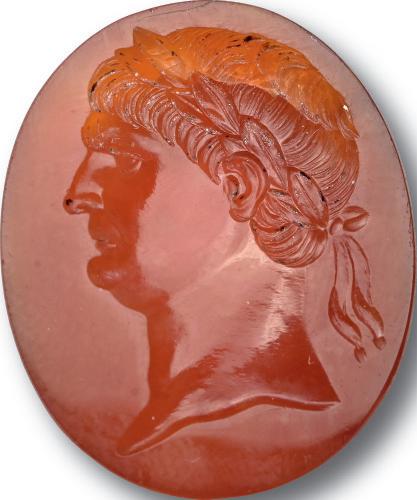

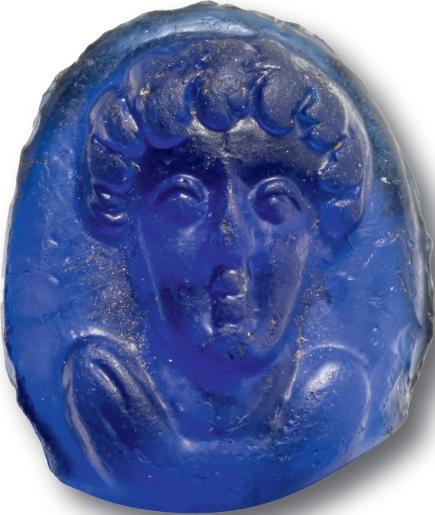

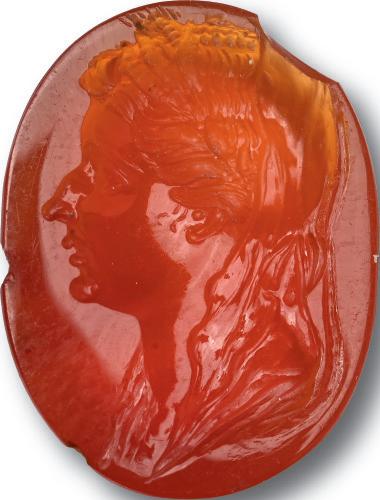

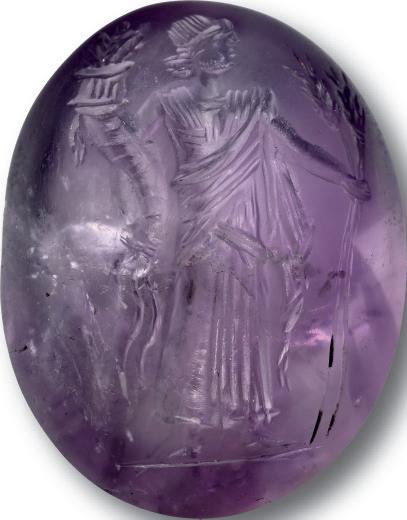

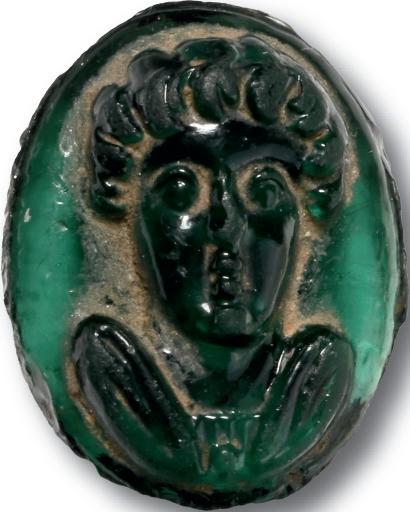

383
NEOCLASSICAL CARNELIAN GEMSTONE OF ROMAN EMPEROR TRAJAN
ITALY, 18TH CENTURY A.D. in. (3.01 grams, 21 mm)
Intaglio profile bust with short hair and laurel wreath.
£1,000 - 1,400
PROVENANCE:
Private English collection, formed between the late 1970s and early 1990s. Private collection, London, UK.
384
POST-CLASSICAL BLUE GLASS CAMEO OF A MAN 19TH CETNURY A.D. OR EARLIER
½ in. (0.64 grams, 12 mm)
Discoid in plan with facing bust with tousled hair.
£500 - 700
PROVENANCE:
Private English collection, formed between the late 1970s and early 1990s. Private collection, London, UK.
385
NEOCLASSICAL CARNELIAN GEMSTONE WITH BUST OF THE ROMAN EMPRESS LIVIA AS THE GREEK GODDESS CERES
ITALY, 18TH CENTURY A.D.
¾ in. (1.51 grams, 19 mm)
Intaglio profile bust of Empress Livia with laurel wreath to her long hair, presented in the guise of Charis.
£500 - 700
PROVENANCE:
Private English collection, formed between the late 1970s and early 1990s. Private collection, London, UK.
FOOTNOTES:
Livia Drusilla (59 B.C.-A.D. 29) was Roman empress from 27 B.C.-A.D. 14 as the wife of Emperor Augustus. She was known as Julia Augusta after her admission into the Julian family in AD 14. Charis (Greek: meaning ‘Grace’) was a goddess in Greek mythology, one of the ‘Charites’ or ‘Graces’ associated with charm, beauty, nature, creativity and fertility.
386
POST-CLASSICAL AMETHYST GEMSTONE OF THE ROMAN GODDESS FORTUNA
19TH CENTURY A.D. OR LATER
1 in. (6.15 grams, 24 mm)
Biconvex in section with intaglio Fortuna standing in ankle-length robe on a baseline, supporting a cornucopia in one arm and holding two stems.
£1,000 - 1,400
PROVENANCE:
Private English collection, formed between the late 1970s and early 1990s. Private collection, London, UK.
387
POST-CLASSICAL GREEN GLASS CAMEO OF MAN
19TH CENTURY A.D. OR EARLIER
½ in. (0.72 grams, 13 mm)
Modelled in the half-round bust of a youth with curly locks of hair.
£500 - 700
PROVENANCE:
Private English collection, formed between the late 1970s and early 1990s. Private collection, London, UK.
388
EASTERN POST-CLASSICAL AGATE GEMSTONE OF A DIONYSIAC BULL WITH VINE LEAF IN ANCIENT SILVER PENDANT 19TH CENTURY A.D. AND EARLIER 1¼ in. (14.81 grams, 32 mm)
Silver cell with beaded band to the equator, fragment of suspension loop; inset sardonyx gemstone with possibly later intaglio profile bull on a baseline with head lowered.
£3,000 - 4,000
PROVENANCE:
Private English collection, formed between the late 1970s and early 1990s. Private collection, London, UK.
389
NEOCLASSICAL CITRINE GEMSTONE WITH PUTTO AND GOOSE 18TH-19TH CENTURY A.D. ½ in. (1.32 grams, 12 mm)
Plano-convex type with incuse scene of a putto kneeling on an arrow with one leg extended over it, holding the flight-feather of a bird in one hand and encouraging a goose to feed from the other hand; with traces of copper tooling.
£800 - 1,000
PROVENANCE:
Private English collection, formed between the late 1970s and early 1990s. Private collection, London, UK.
FOOTNOTES:
Perhaps the putto is encouraging the goose to approach him so that he can pluck its flight-feathers for use on the shafts of his arrows.
390
POST-CLASSICAL GLASS PASTE CAMEO OF SAINT DEMETRIUS
17TH-18TH CENTURY A.D. OR EARLIER 1¼ in. (9.43 grams, 31 mm)
Discoid inlay with facing figure modelled in the half-round, clad in reticulated armour with pauldron and pteruges, cloak to the shoulders, small targe-type shield with cross in circle motif, grasping a spear held across the body; bare-headed with curly hair and beaded nimbus surrounding; legend in the field ‘ C’ (Dimitrios).
£2,000 - 3,000
PROVENANCE:
Private English collection, formed between the late 1970s and early 1990s. Private collection, London, UK.
391
NEOCLASSICAL AGATE GEMSTONE OF A LATE ROMAN EMPEROR ITALY, 17TH-18TH CENTURY A.D. in. (1.75 grams, 21 mm)
Intaglio profile bust with heavy jewelled diadem to the brow, ties to the rear, mantle clasped at the shoulder with a small disc brooch.
£1,000 - 1,400
PROVENANCE:
Private English collection, formed between the late 1970s and early 1990s. Private collection, London, UK.
392
LARGE POST-CLASSICAL AGATE GEMSTONE WITH ZEUS SERAPIS ALLEGORY
17TH CENTURY A.D. OR LATER 1½ in. (14.4 grams, 40 mm)
Ellipsoid in plan with chamfer to reverse edge; incuse scene comprising a baseline with fluted column at each surmounted by an inward-facing profile; at base, a perching eagle with head turned and wreath in its beak; above, profile bust of Serapis with modius, crescent moon and sunburst.
£800 - 1,000
PROVENANCE: Private collection, England.

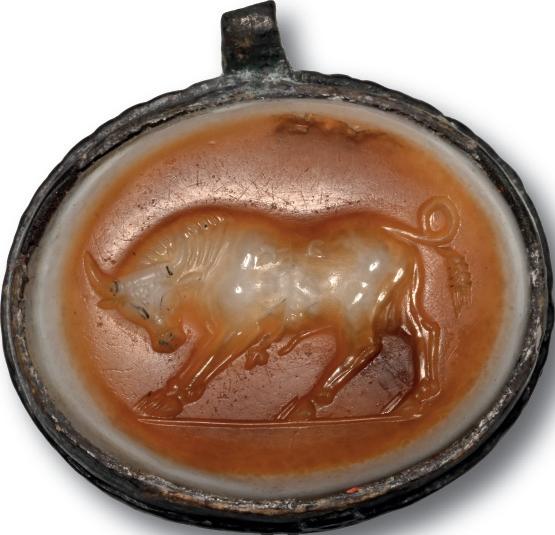

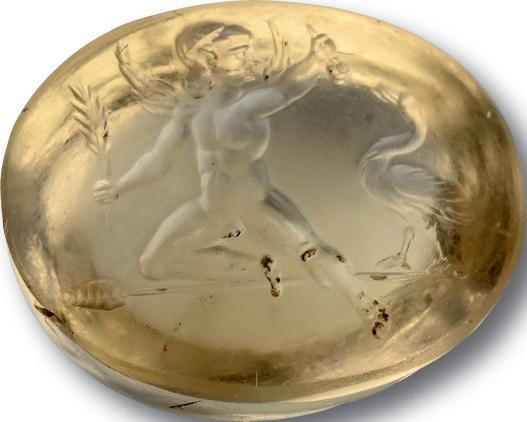
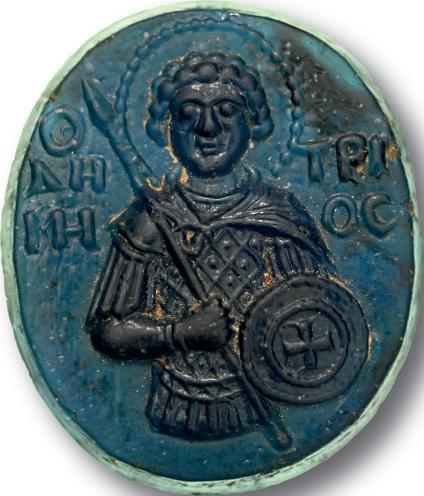

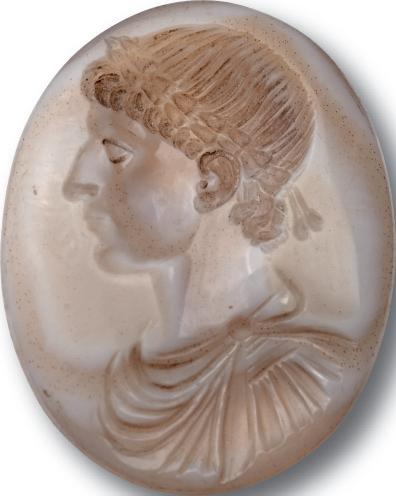

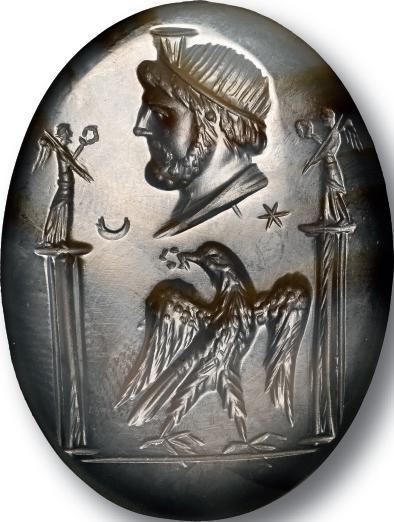

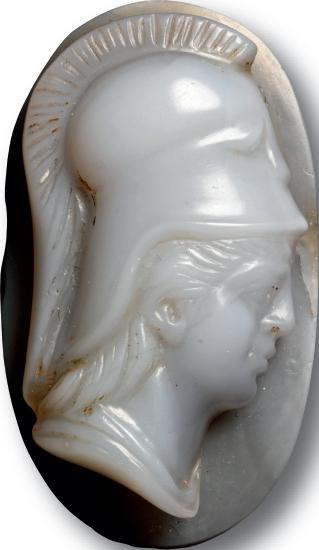

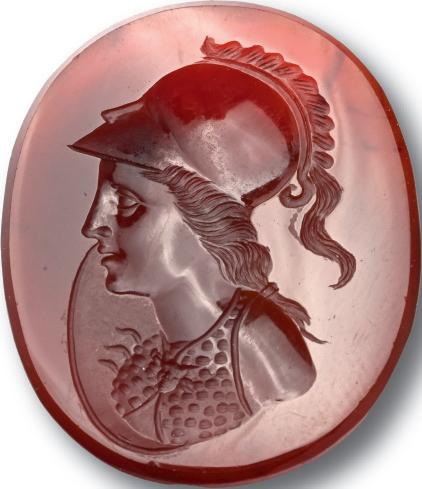

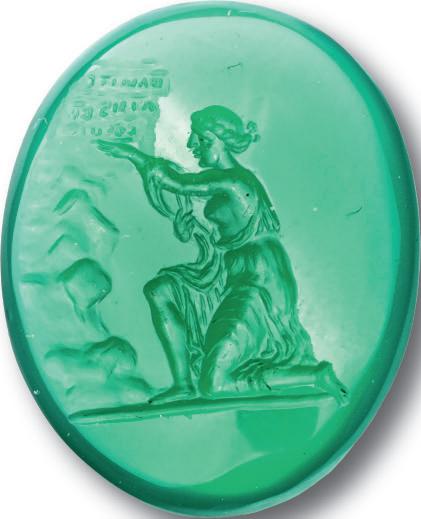

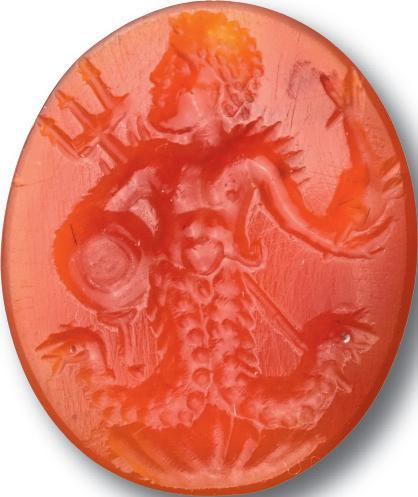

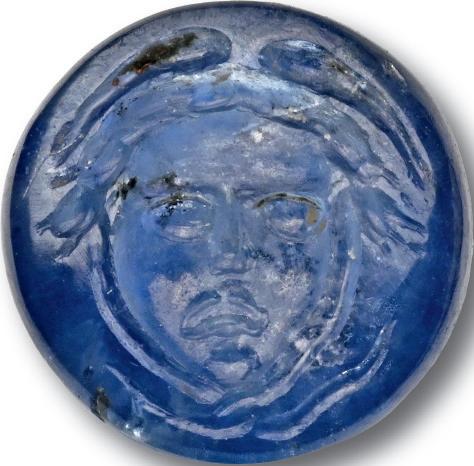

393
POST-CLASSICAL AGATE CAMEO WITH THE GODDESS MINERVA 18TH-19TH CENTURY A.D.
1 in. (12.3 grams, 35 mm)
Ellipsoid in plan with helmetted bust of Minerva; deep undercuts to the edges.
£1,000 - 1,400
PROVENANCE: with Hindmann, Chicago, 21 March 2023, no.221. Private collection, England.
394
LARGE NEOCLASSICAL AGATE GEMSTONE WITH BUST OF THE HELMETTED GREEK GODDESS ATHENA
19TH CENTURY A.D.
1 in. (4.4 grams, 27 mm)
With incuse bust wearing a crested helmet, and the rear of the shield to her shoulder.
£2,000 - 3,000
PROVENANCE:
Acquired on the European art market. Private collection, England.
395
NEOCLASSICAL TINTED GREEN AGATE GEMSTONE WITH A VOTIVE SCENE
18TH CENTURY A.D.
¾ in. (2.07 grams, 20 mm)
Intaglio votive scene with female figure kneeling before a flaming altar; upper right, three lines of enigmatic inscription.
£1,000 - 1,400
PROVENANCE: Acquired on the European art market. Private collection, England.
396
RENAISSANCE CARNELIAN GEMSTONE WITH ROMAN GOD NEPTUNE
16TH-17TH CENTURY A.D. in. (0.89 grams, 16 mm)
With incuse anguipedal Neptune holding a trident and with a dolphin.
£500 - 700
PROVENANCE: Acquired on the European art market. Private collection, England.
397
ANCIENT STYLE SAPPHIRE GEMSTONE WITH HEAD OF MEDUSA
18TH-19TH CENTURY A.D. in. (0.37 grams, 6 mm)
Incuse gorgoneion with writhing snakes.
£1,000 - 1,400
PROVENANCE: Acquired on the European art market. Private collection, England.
398
POST-CLASSICAL AGATE GNOSTIC GEMSTONE WITH ANGUIPED
18TH-19TH CENTURY A.D. OR EARLIER
1 in. (3.41 grams, 23 mm)
Incuse motif of serpent-legged rooster facing left holding a shield and solar whip; enigmatic agical inscriptions surrounding.
£500 - 700
PROVENANCE:
Collection of Mr and Mrs V.A., Monte Carlo, 1960s. Acquired on the European art market. Private collection, England.
399
LARGE POST-CLASSICAL AGATE GEMSTONE DEPICTING A DOUBLE PORTRAIT OF HELLENISTIC RULERS
19TH CENTURY A.D. OR EARLIER
1¼ in. (7.37 grams, 31 mm)
Intaglio jugate busts of a bearded male with browband in the foreground and female bust to the rear with diadem.
£500 - 700
PROVENANCE: with Hotel des Ventes de Monte-Carlo, 2022. Private collection, England.
FOOTNOTES:
The image portrays human rulers as Zeus and Hera/Jupiter and Juno.
400
NEOCLASSICAL AGATE GEMSTONE WITH THEATRICAL MASK
19TH CENTURY A.D.
1 in. (3.22 grams, 23 mm)
Plano-convex in section with deeply incised facing female mask with ringlets and diadem.
£500 - 700
PROVENANCE: with Hotel des Ventes de Monte-Carlo, 2020. Private collection, England.
401
AGATE CAMEO WITH SCENE FROM THE OLD TESTAMENT 19TH-20TH CENTURY A.D.
2 in. (50 grams, 66 mm)
Ellipsoid panel with thick outer rim, the inner panel with scene carved in high-relief depicting a bearded figure enthroned extending one hand towards a group of eight attendants, one holding up an empty garment; Hebrew legend beneath.
£500 - 700
PROVENANCE: French art market, 2023. Private collection, England.
402
POST-CLASSICAL CHALCEDONY GEMSTONE WITH TWO FACING BUSTS OF THE DIOSCURI 19TH CENTURY A.D. OR LATER ¾ in. (2.17 grams, 19 mm)
Incuse male profile busts with stars in the background and other objects in the field.
£600 - 800
PROVENANCE: Acquired on the French art market. Private collection, England.

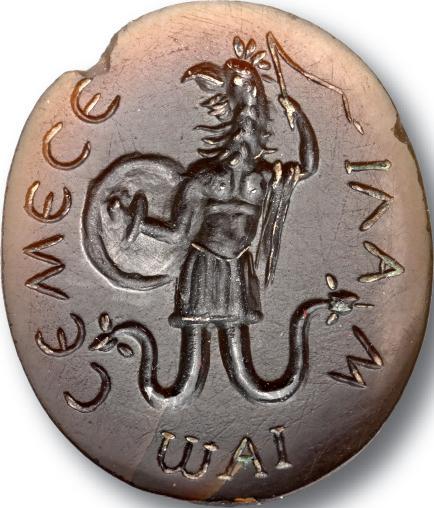
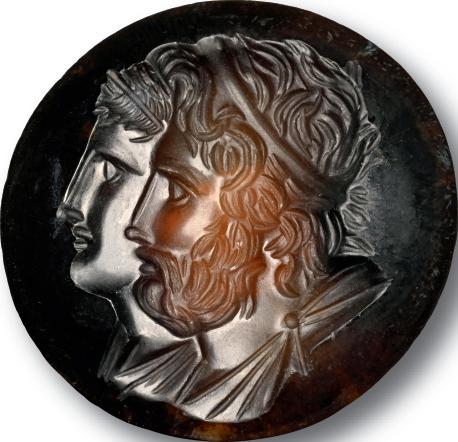

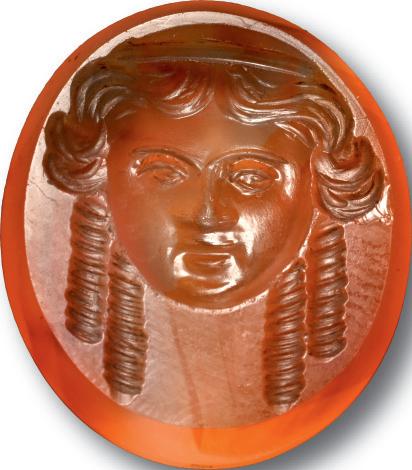

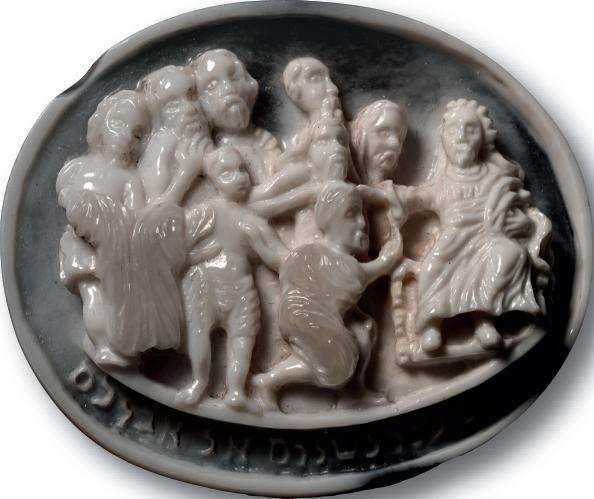


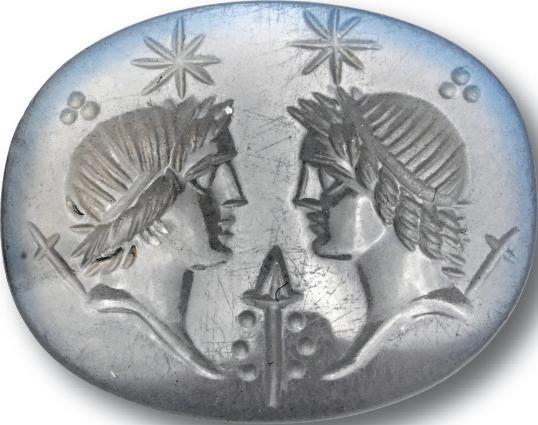
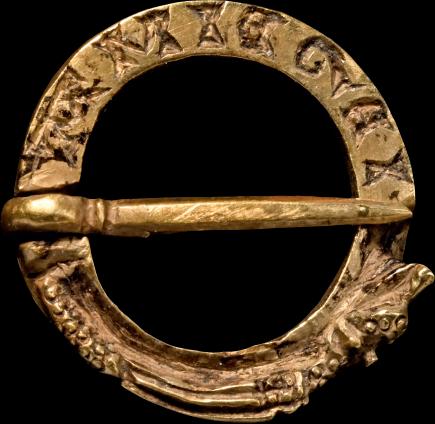
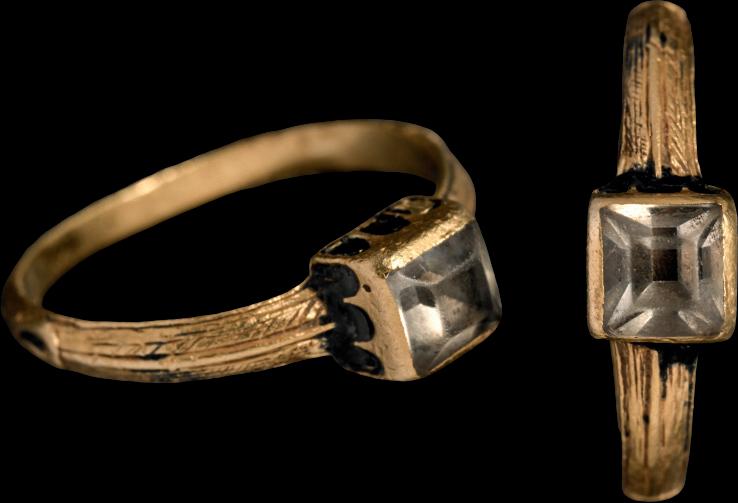
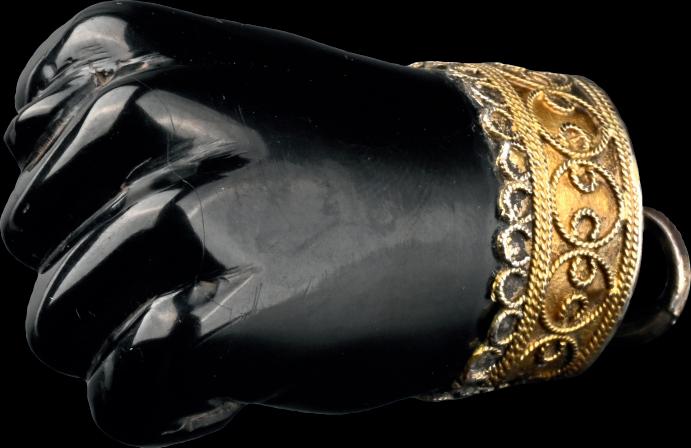
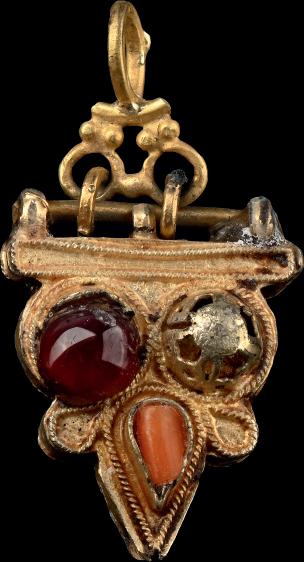
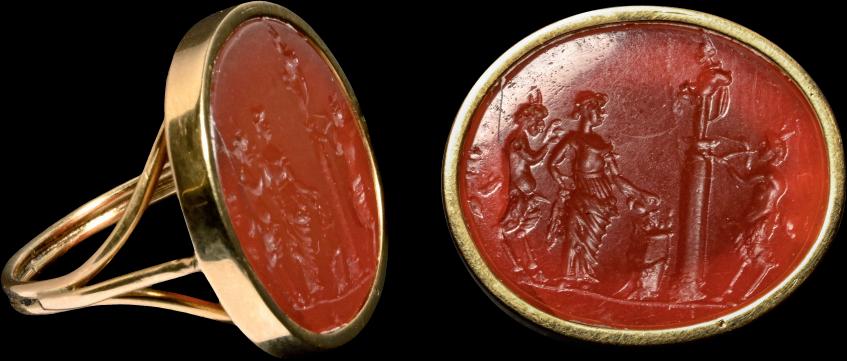
403
MEDIEVAL GOLD DRAGON RING BROOCH WITH INSCRIPTION
CIRCA 14TH CENTURY A.D. in. (1.13 grams, 11 mm)
Annular type with serpent or dragon modelled in the lower segment and legend in Lombardic capitals ‘AMIE GEI’ with the second word abbreviated for ‘GEINT(E).’
£600 - 800
PROVENANCE:
From a UK private collection since the 1970s.
FOOTNOTES:
'Amie geint(e)' means ‘beautiful lover (fem.)’, or ‘noble lover’ (gei as a spelling for gai, which, if permissible, would yield an unabbreviated inscription meaning ‘happy/cheerful beloved’, has not been noted – there are no spellings with -erecorded).
404
ENAMELLED GOLD RING WITH TABLE-CUT ROCK CRYSTAL GEMSTONE
NETHERLANDS, 17TH CENTURY A.D.
1 in. (3.10 grams, 23.84 mm overall, 17.41 mm internal diameter (approximate size British N½, USA 6¾, Europe 14.35, Japan 13))
D-section hoop with carinated profile, ribbing to the shoulders, square bezel with arcade detailing to the base, and inset table-cut crystal.
£1,000 - 1,400
PROVENANCE:
By repute from Maastricht, Netherlands. Acquired on the European art market.
405
SILVER-GILT MOUNTED JET ‘FIGA’ AMULET
SPAIN, 17TH CENTURY A.D.
2¼ in. (19.6 grams, 56 mm)
Formed as a hand showing figa gesture, silver mount with applied twisted wires; attachment loop and ring to the top.
£700 - 900
PROVENANCE: Private collection, Europe. Acquired on the English art market.
406
MEDIEVAL GOLD PENDANT WITH GEMSTONES
14TH-16TH CENTURY A.D.
1¼ in. (3.7 grams, 32 mm)
Triangular plaque with two plano-convex cabochon gemstones and a third tubular carnelian bead in a teardrop cell; articulated suspension ring with granulated detailing.
£500 - 700
PROVENANCE:
From the collection of a late Japanese gentleman, 1970-2000s.
407
GEMSTONE DEPICTING BACCHANALIAN SACRIFICE IN GOLD RING
ITALY, 18TH CENTURY A.D.
1 in. (9.36 grams, 25.97 mm overall, 19.15 mm internal diameter (approximate size British N, USA 6½, Europe 13.72, Japan 13))
Intaglio engraved with satyr playing aulos behind a tall column with statue on the top, a woman in long robe and satyr standing in front of an altar; set into a later gold ring with hoop formed from three roundsection wires holding an oval bezel.
£1,500 - 2,000
PROVENANCE:
Private collection, Europe. Acquired on the English art market.
408
RENAISSANCE GOLD RING WITH AGATE CAMEO OF THE PRESENTATION OF CHRIST AT JERUSALEM ITALY, CIRCA 1600 A.D.
1 in. (8.91 grams, 24.68 mm overall, 19.41 x 17.44 mm internal diameter (approximate size British P½, USA 7¾, Europe 16.86, Japan 16))
Ellipsoid bezel with flange rim, inset cameo with a group of four adults holding an infant on a plinth; a rare subject for depiction.
£3,000 - 4,000
PROVENANCE:
Private collection, Europe.
Acquired on the English art market.
409
RENAISSANCE NICOLO GEMSTONE WITH BUST OF THE GREEK GOD PAN IN GOLD RING 17TH CENTURY A.D. OR LATER in. (5.40 grams, 23.72 mm overall, 21.99 x 17.07 mm internal diameter (approximate size British P½, USA 7¾, Europe 16.86, Japan 16))
Ellipsoid nicolo plaque with intaglio profile bust of Pan with thick hair and beard, goat’s horns on the brow; in a later sympathetic gold ring.
£3,000 - 4,000
PROVENANCE:
Private collection, England.
410 RENAISSANCE GOLD RING WITH TABLE-CUT HESSONITE GARNET
WESTERN EUROPE, 16TH CENTURY A.D.
1 in. (7.07 grams, 27.56 mm overall, 19.87 x 19.76 mm internal diameter (approximate size British U, USA 10, Europe 22.52, Japan 21))
Tiered hoop and shoulders supporting a cup bezel with scallop detailing, inset with an octagonal cloison.
£3,000 - 4,000
PROVENANCE:
Private collection, Europe. Acquired on the English art market.
411 GOLD MEMENTO MORI RING WITH SKULL 17TH-19TH CENTURY A.D.
¾ in. (7.73 grams, 21.01 mm overall, 19.06 x 18.44 mm internal diameter (approximate size British R, USA 8½, Europe 18¾, Japan 18))
Ellipsoid plaque with wreath border enclosing an incuse skull in threequarter view and initials ‘RW’ below.
£3,000 - 4,000
PROVENANCE: Private collection, Europe. Acquired on the English art market.
412
DIAMOND LOCKET RING SET WITH EMERALD INTAGLIO OF EROS, THE GREEK GOD OF LOVE, PLAYING AULOS LATE 19TH CENTURY A.D.
1 in. (5.82 grams, 23.60 mm overall, 16.50 mm internal diameter (approximate size British L½, USA 6, Europe 11.87, Japan 11))
Comprising a segmented hoop with scroll-shaped shoulders, a hinged oval bezel with a secret compartment, and a bezel decorated with twelve cut diamonds around a central green stone intaglio of a winged figure on a pillar playing an aulos
£1,500 - 2,000
PROVENANCE: Private collection, Europe. Acquired on the English art market.
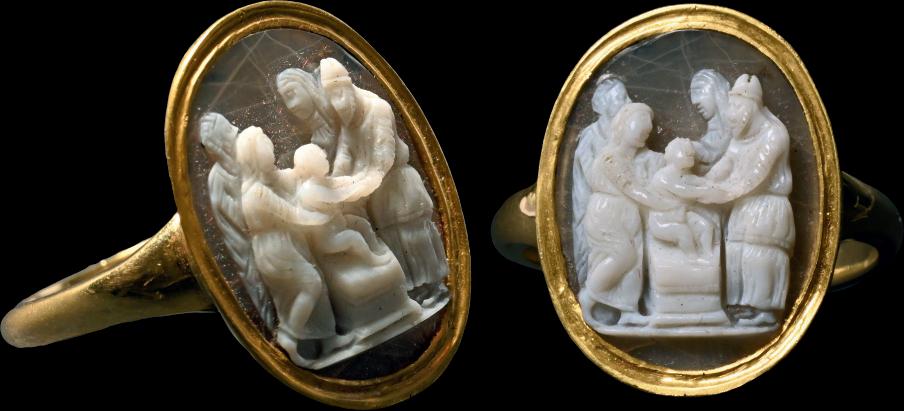
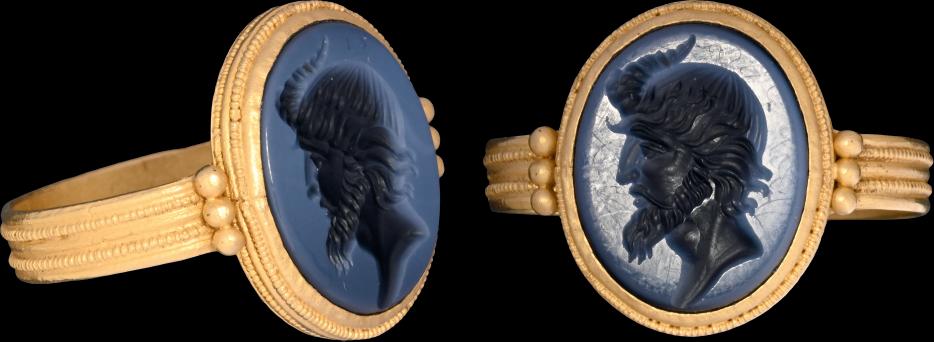
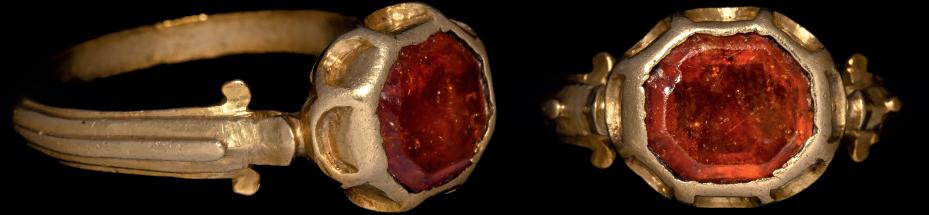
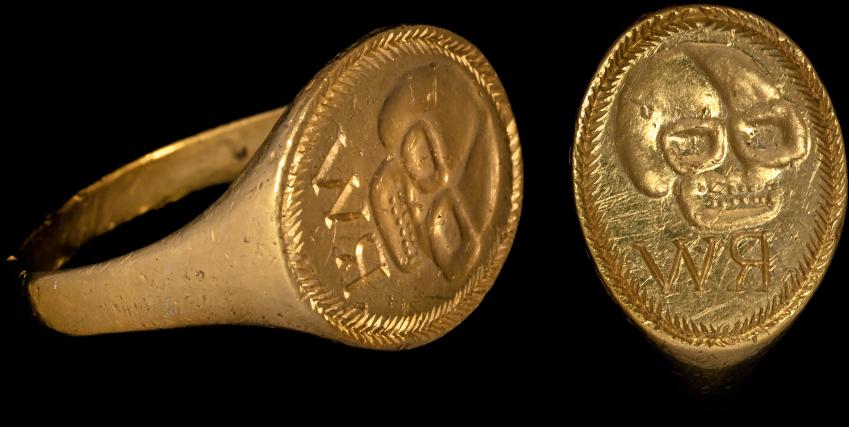
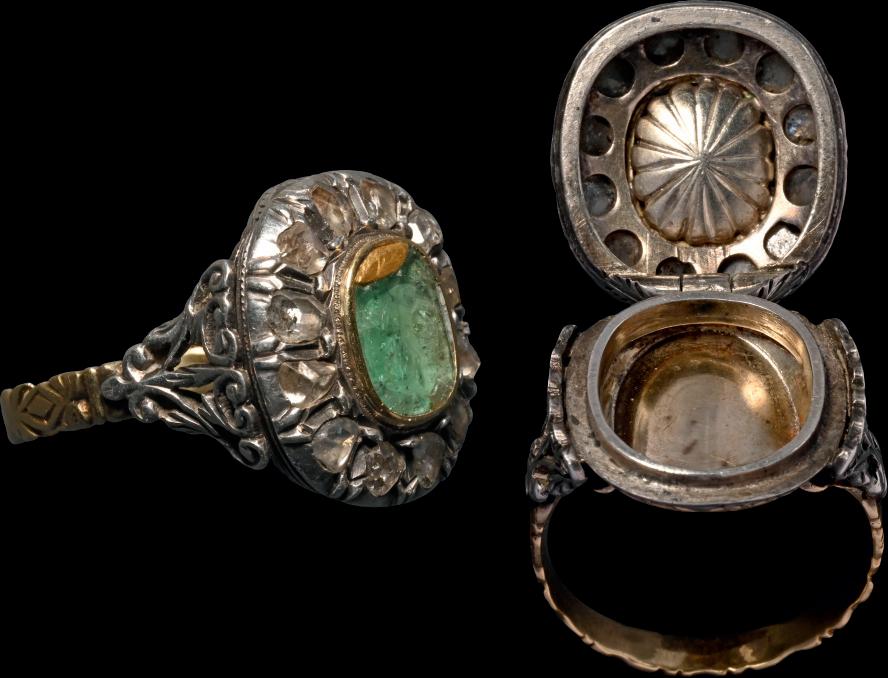
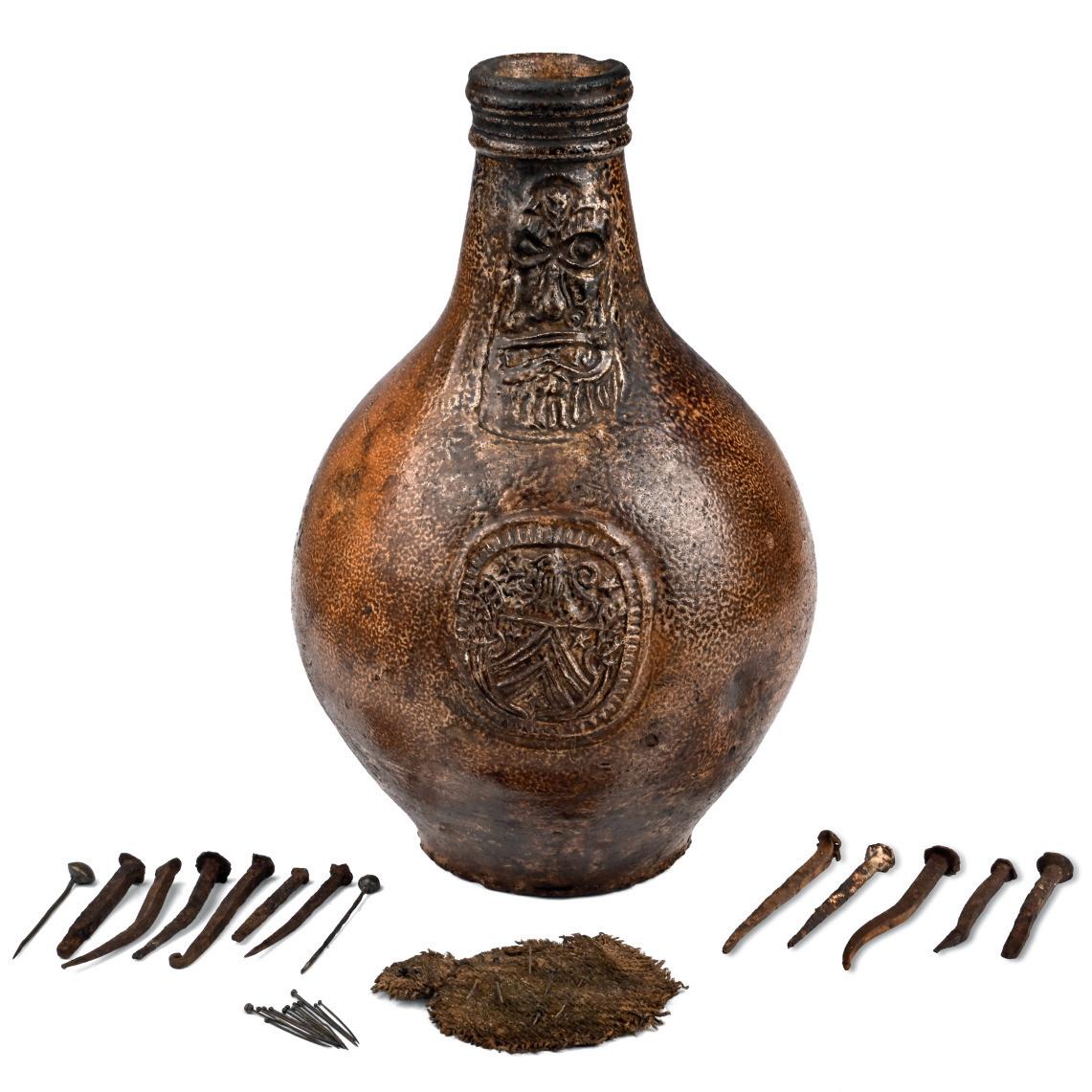

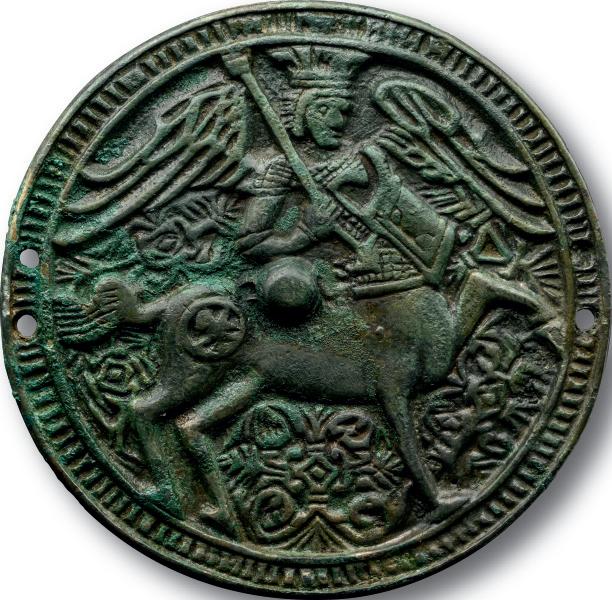
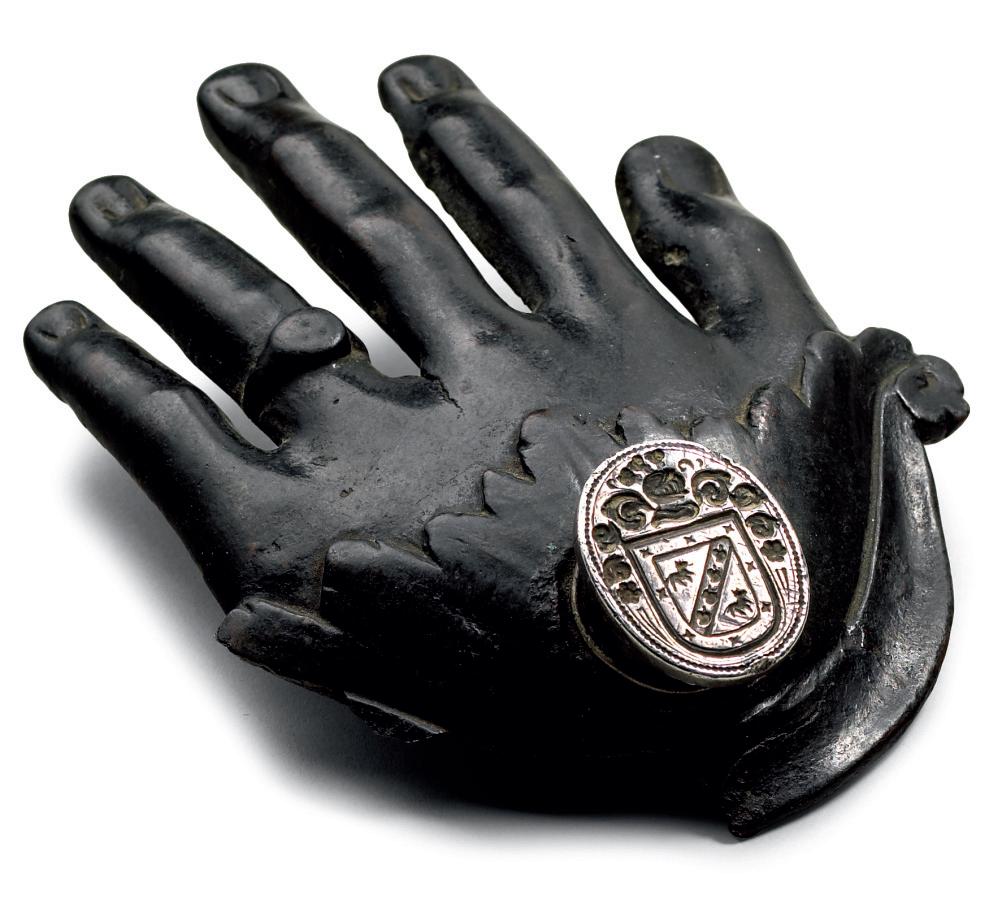
413
VERY LARGE GLAZED BELLARMINE WITCH’S BOTTLE WITH CONTENTS
LATE 16TH-EARLY 17TH CENTURY A.D.
10 in. (1.7 kg total, bottle: 26.5 cm)
Vessel of squat spherical form with a broad cylindrical neck, strap handle and foot with rolled rim, bearded face (Bartmann ‘mask’) and other detailing; with original contents comprising: eight iron clout nails with square-section shank and domed head; three similar with flat head; base metal dress pin with hollow-formed spherical head; similar with biconvex head; fragment of coarse-woven textile with five pins in situ; thirteen unassociated pins. [No Reserve]
£600 - 800
PROVENANCE:
From the private collection of a London, UK, gentleman.
FOOTNOTES:
Witch bottles were a response to the common belief in witchcraft, which was feared in the Puritan culture of those times. The process involved heating the victim’s urine in a bottle, mixed with human hair and metal nails and pins, sometimes inserted into a cloth panel representing the victim’s heart. The bottle was then either buried under the hearth of a house (East Anglian tradition) or thrown into a river (London tradition). The heating of the bottle was supposed to transfer to the body of the witch who had caused the victim to be afflicted.
414
MIRROR WITH CENTAUR ‘KITOVRAS’
16TH-17TH CENTURY A.D.
4 in. (153 grams, 10.1 cm)
Discoid with ribbed border and central raised pellet, motif of a winged centaur holding a square shield and a staff(?), foliage motif to the background; pierced three times to the rim.
£800 - 1,000
PROVENANCE:
From the private collection of a London gentleman, from his grandfather’s collection formed before the early 1970s.
FOOTNOTES:
This version of a centaur was known as ‘kitovras’, an old Russian version of the word ‘kentauros’. He is typically portrayed with the body of a horse and the torso and head of a man, often featuring prominent wings and wearing armour. Kitovras is best known from a legend, ‘The Tale of Solomon and Kitovras’, in which he is tricked into building the temple for King Solomon. While held in captivity, Kitovras tells Solomon how to obtain the stone needed to build the temple and stays with him through its completion. When Solomon doubts Kitovras’ strength, Kitovras throws him to the edge of the Promised Land, but the king eventually returns and takes back the throne.
415
ITALIAN BRONZE HAND-SHAPED DESK SEAL
17TH CENTURY A.D.
5¼ in. (453 grams, 13.5 cm)
Formed as a left hand with flange rim to the cuff and wrist, ring to the third finger; stud to the reverse with geralfic seal, heater shield with helmet and lambrequin, underside with stud and profile bust.
£2,000 - 3,000
PROVENANCE:
Acquired on the UK art market. Private collection, England.
FOOTNOTES:
In the 17th century, Italian noble seals were crucial heraldic instruments, depicting family crests, often surmounted by crowns (counts, marquises, princes) or helmets, and enriched with family specific symbols (e.g., vines for the Panevinos), portraits on horseback, or elements linked to ecclesiastical offices (papal keys) to authenticate documents, reflecting the prestige and authority of noble houses and civic patricians.
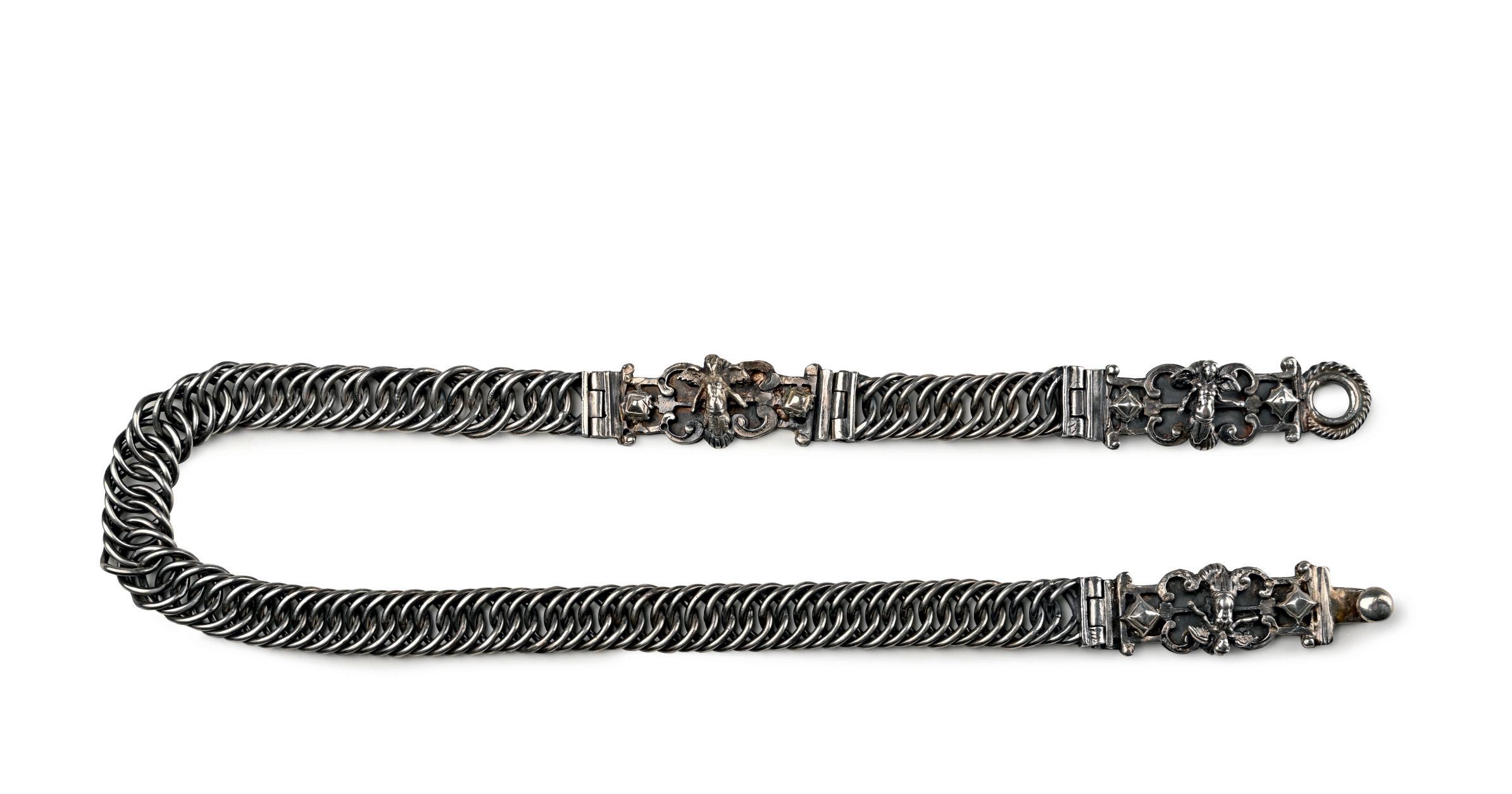
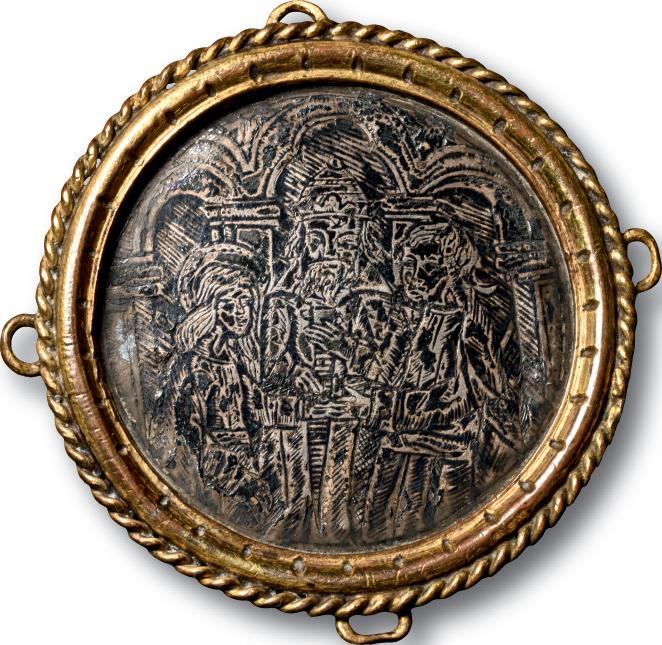

416
RENAISSANCE SILVER INTERLINKING NECKLACE
GERMANY, 16TH CENTURY A.D.
19¼ in. (110 grams, 49 cm)
Comprising interlinking flat loops with pierced spacers decorated with Renaissance motifs, winged telamon and ‘jewels’; sturdy hook-andeye closure.
£2,000 - 3,000
PROVENANCE: Private collection, Europe. Acquired on the English art market.
FOOTNOTES:
Such chains were known as a ‘Sivlonot’ in German Jewish tradition dating from the 16th century, in a custom whereby silver or gold chains were sent as a gift by the bridegroom to his future bride. They were worn under the bridal canopy and throughout the following week, then often brought out again for holidays and ceremonial occasions.
417
MEDIEVAL GILT AND NIELLO HAT BADGE WITH MARRIAGE OF THE VIRGIN
ITALY, CIRCA 1500 A.D.
1¾ in. (10.8 grams, 46 mm)
Niello plaque depicting the marriage ceremony between Mary and Joseph, set in a gilt brass mount with a rope twist border, four loops for attachment.
£1,000 - 1,400
PROVENANCE: Private collection, Europe. Acquired on the Belgian art market.
FOOTNOTES:
Niello is a black mixture, usually of sulphur, copper, silver and lead. It is used as an inlay on engraved or etched metal, especially silver. It is added as a powder or paste, then fired until it melts or at least softens and flows or is pushed into the engraved lines in the metal. Men began wearing hat ornaments on their caps from the late fifteenth century, which could be either purely decorative or symbolic. Symbolic examples are traditionally known as enseignes, as they conveyed the wearer’s personal intent or a visible message. These jewels trace their origins to the medieval pilgrim badge, usually massproduced in base metal. It is believed that this fashion shift to a stylish male accessory began when French king Charles VIII entered Naples in February 1495, wearing a gold circular jewel on his cap, while his men had similar, though not gold, jewels on their caps or sleeves. Italians quickly adopted this trend, which then spread to most European courts. However, this fashion declined in the late sixteenth to early seventeenth century, giving way to the popularity of aigrettes.
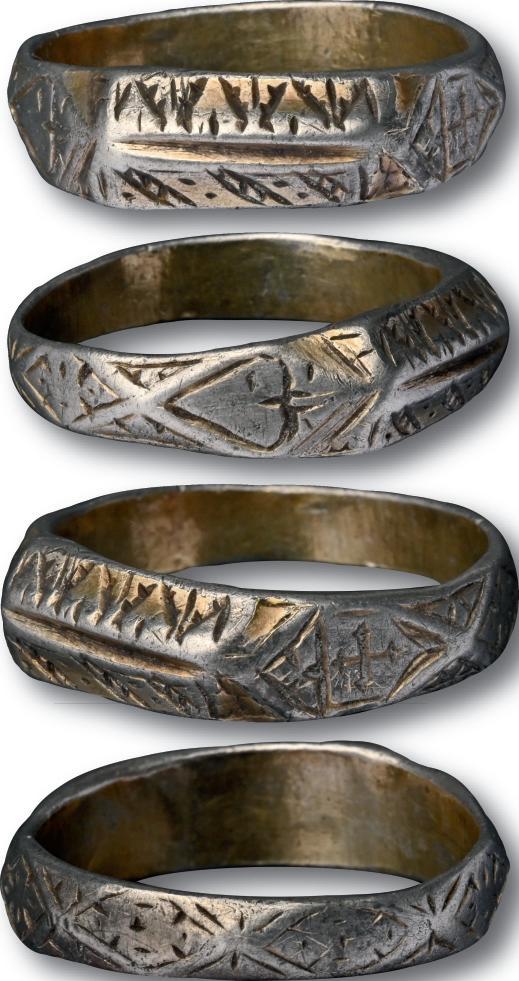


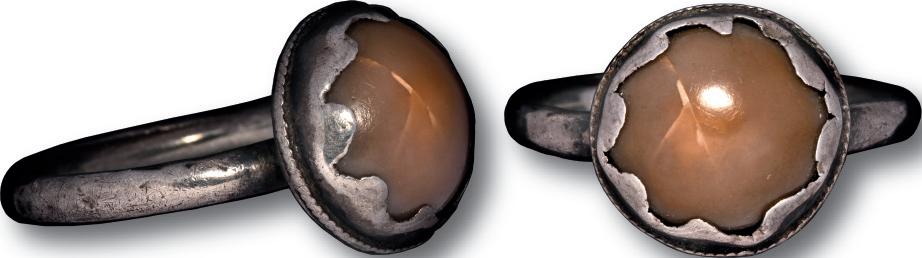

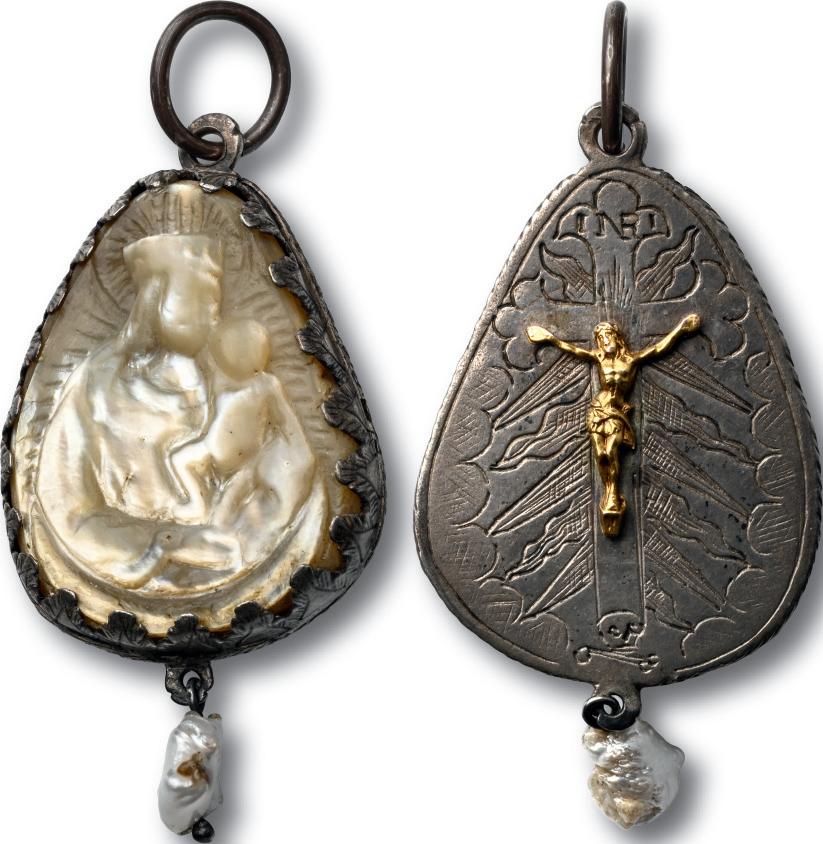
418
MEDIEVAL SILVER ICONOGRAPHIC TYPE RING WITH HEART AND CROSS
15TH CENTURY A.D.
in. (4.13 grams, 22.85 mm overall, 19.78 mm internal diameter (approximate size British S½, USA 9¼, Europe 20.63, Japan 19))
The lower shank with facets, each with a reserved cross pommee; the shoulders each with a heater-shaped panel, one with a cross moline and the other with a heart; the bezel in two panels, one with a row of hearts, the other with ropework; traces of gilding to the bezel.
£400 - 600
PROVENANCE: Acquired on the UK art market in the 1980s.
From an East Anglian private collection.
419
TUDOR PERIOD SILVER RING WITH ‘AMULETIC’ TOAD STONE WESTERN EUROPE, 16TH CENTURY A.D.
1 in. (4.53 grams, 29.85 mm overall, 20.51 mm internal diameter (approximate size British T, USA 9½, Europe 21.26, Japan 20))
Round-section hoop supporting a discoid bezel, claw setting with inset ‘toadstone’ amulet.
£2,000 - 3,000
PROVENANCE:
Private collection, Europe. Acquired on the French art market.
FOOTNOTES:
William Shakespeare’s As You Like It, circa. 1599; ‘Sweet are the uses of adversity, Which, like the toad, ugly and venomous, Wears a precious jewel in his head yet’. Toadstones are mythical stones that were thought to be found inside the head of a toad. They were believed to sweat, change colour or even heat up in the presence of poison. It was thought that a toadstone placed on bites from snakes, insects, spiders and shrews would extract poison from the wound. They were thought to bring good luck and ward off evil, whether in the present life or in the afterlife. The Book of Secrets from the 13th century recommends swallowing the stone to ‘cleanse the bowels of filth and excrements’. The stone could then be retrieved and used again. They were often set as amulets and talismans, a practice that continued in Europe until the 18th century. Toadstones are actually the button-like fossilised teeth of Lepidotes, an extinct genus of fish common in the Jurassic and Cretaceous Periods, 200 to 100 million years ago.
420
MEDIEVAL SILVER PENDANT WITH MOTHER-OF-PEARL SCENE OF VIRGIN AND CHILD GERMANY, 15TH CENTURY A.D.
2¾ in. (20.5 grams, 70 mm)
Tear-shaped frame with loop and irregular dangle below; carved nacre relief of the Virgin and Child; Mother of God shown crowned and in profile, tenderly supporting the Christ Child on her lap; applied gold Corpus Christi to reverse.
£1,800 - 2,400
PROVENANCE:
Private collection, Europe. Acquired on the German art market.
FOOTNOTES:
The carving, with its luminous iridescence and softly modelled planes, captures both the sacred intimacy of the subject and the shimmering qualities of the material. The mount is worked in silver with chased foliate detail and suspends a natural baroque pearl drop. The reverse is finely engraved with radiating rays, clouds, and the inscription INRI, centred by a parcel-gilt figure of the Crucified Christ affixed to the ground. This juxtaposition of the Virgin and Child with the Passion underscores the dual themes of Incarnation and Redemption, reflecting late medieval devotional practices.
MARBLE HEAD OF THE GREEK GODDESS APHRODITE
18TH-19TH CENTURY A.D.
15¾ in. (12.6 kg, 40.5 cm)
Modelled in the round as a bust of a youthful female, possibly Aphrodite with her hair bound by a narrow filet tied at the nape of the neck and the tails retained by a flat ribbon at the rear; the face perhaps modelled on the statue ‘Aphrodite of Knidos’ by Praxiteles; socket to crown of the head for attachment of a nimbus (now absent); mounted on a socle base.
£4,000 - 6,000
PROVENANCE: Acquired on the Los Angeles art market. Private collection, England.
FOOTNOTES:
This magnificent head of a woman with an elaborate hairstyle is in perfect harmony with the artistic works of several neo-classical sculptors of 18th century, yet subtly different from it in stylistic terms, like Giovanni Marchiori, and to the so-called stone Venus or Flora in the Museo Civico di Treviso.
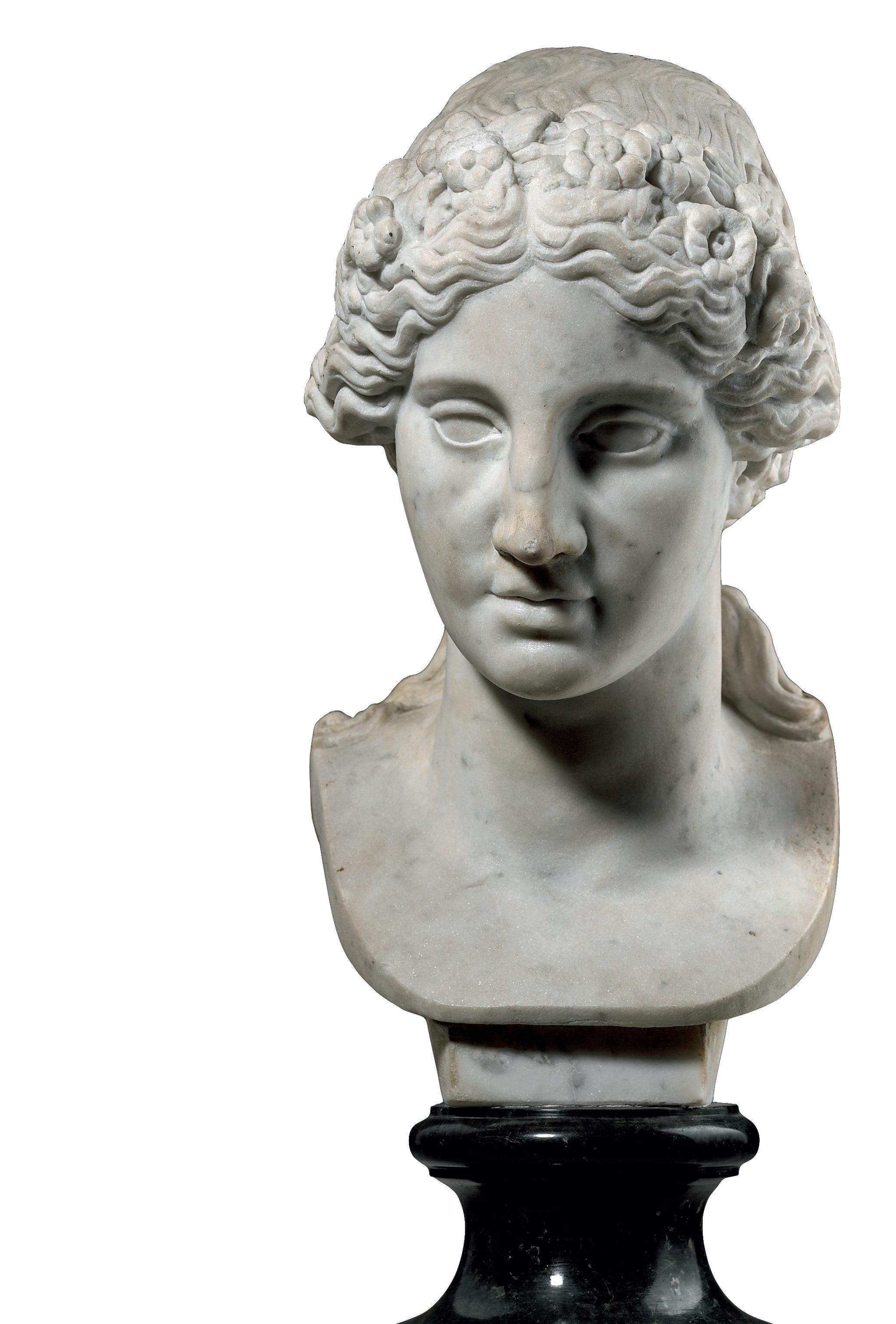
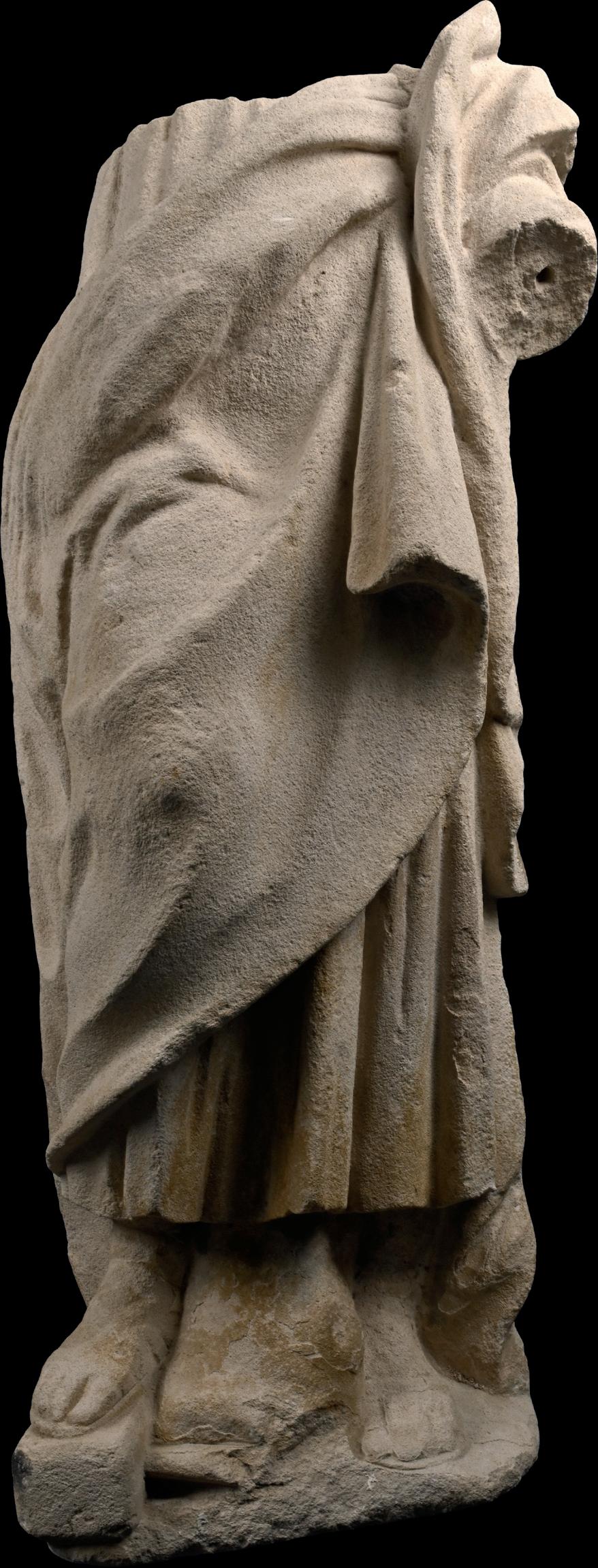
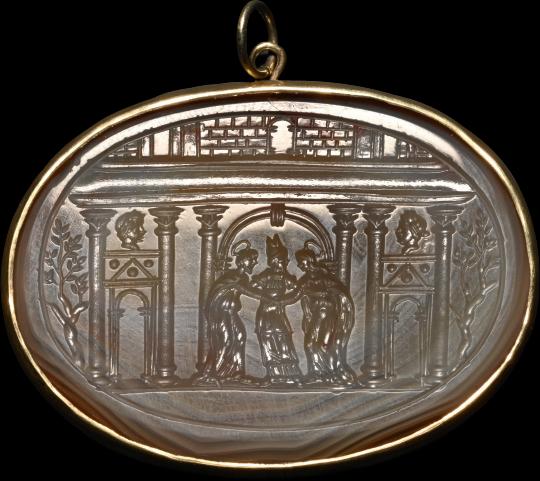
422
LARGE RENAISSANCE STONE STATUE OF STANDING MALE NORTHERN ITALY, 16TH-17TH CENTURY A.D.
39½ in. (87 kg, 100 cm)
Modelled in the round wearing a long tunic and a palla draped over his left shoulder, leather sandals with straps on his exposed feet.
£2,500 - 3,500
PROVENANCE: Private collection, France. Private collection, London.
FOOTNOTES:
The statue, certainly intended for ecclesiastical decoration, most likely represents one of the apostles or prophets, or an Evangelist. These are Mannerist statues, executed with great sculptural skill, intended to adorn the large tomb complexes of wealthy families housed in the Catholic cathedrals of Renaissance Europe.
423
LARGE AGATE GEMSTONE WITH THE MARRIAGE OF THE VIRGIN ITALY, LATE 17TH CENTURY A.D.
2 in. (19.61 grams, 54 mm)
Plaque with narrow border enclosing a figural scene with a colonnade and façade flanked by olive trees; central arch with two nimbate and robed figures clasping hands with a third figure behind them wearing a headdress; set in a gold frame with suspension loop.
£1,500 - 2,000
PROVENANCE:
Private collection, Europe. Acquired on the French art market.
FOOTNOTES: The subject is the marriage ceremony between Mary, ‘the Virgin’, and Joseph.
424
AGATE CAMEO OF A CLASSICAL MUSE IN GOLD MOUNT ITALY, 18TH CENTURY A.D.
1½ in. (7.8 grams, 38 mm)
Gold cell with suspension loop, inset banded agate panel with reserved female profile bust with hair in a chignon.
£800 - 1,000
PROVENANCE:
Private collection, Europe. Acquired on the English art market.
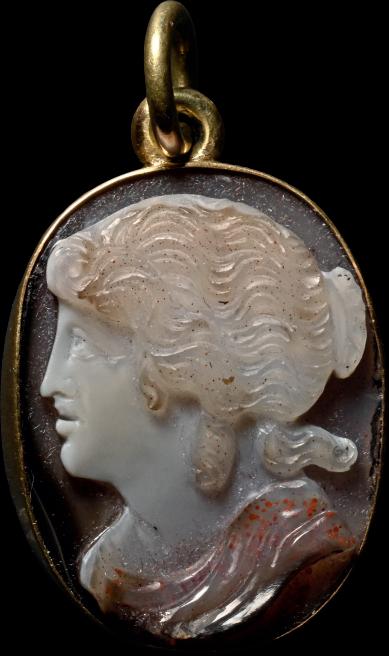
425
AGATE CAMEO OF A LADY IN GOLD PENDANT
19TH CENTURY A.D.
1 in. (6.40 grams, 36 mm)
Carved in low-relief, a female profile bust wearing a straw hat and mantle.
£1,000 - 1,400
PROVENANCE: Private collection, Europe. Acquired on the English art market.
426
ROMAN STYLE GOLD PENDANT WITH NUDE FEMALE
19TH CENTURY A.D. OR EARLIER
1 in. (10.48 grams, 42 mm)
Ellipsoid plaque with incuse standing female supporting a cornucopia on one arm and a victoriola in the other hand; altar with knop finial behind her, perching eagle at her feet.
£2,000 - 3,000
PROVENANCE:
Private collection, Swiss. with Geneve Encheres, 14 December 2017, no.1024. Private collection, England.
427 AGATE CAMEO WITH PROFILE PORTRAIT OF THE MADONNA ITALY, 19TH CENTURY A.D.
1 in. (2.77 grams, 34 mm)
Carved in low relief, nimbate profile bust with palla £500 - 700
PROVENANCE: Private collection, Europe. Acquired on the English art market.
428 GOLD RING WITH CARNELIAN GEMSTONE DEPICTING THE ROMAN GOD NEPTUNE ITALY, 19TH CENTURY A.D.
1¼ in. (15.19 grams, 31.43 mm overall, 19.60 mm internal diameter (approximate size British R, USA 8½, Europe 18¾, Japan 18))
Depicting Neptune advancing nude from a scallop shell, holding a trident in one hand and pointing with the other; billowing banner to his rear.
£1,800 - 2,400
PROVENANCE: Private collection, Europe. Acquired on the English art market.
FOOTNOTES:
Throughout Europe, and far beyond, talented gem-cutters were at work in the 19th century. Neptune was appreciated by Neoclassical cutters, as shown by a carnelian gemstone with the profile of Neptune, his face serene amidst a storm, by the American engraver George Hewitt Cushman (1814-1876).
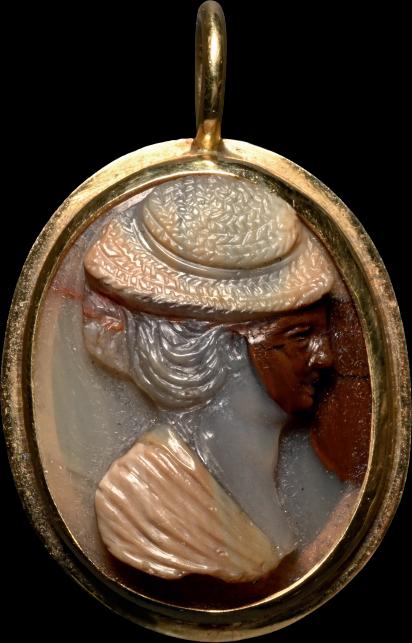
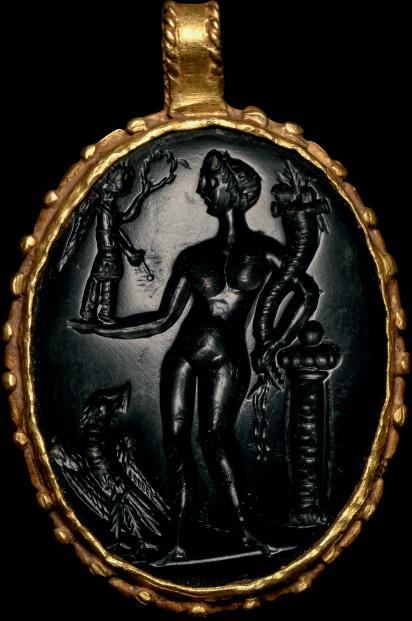
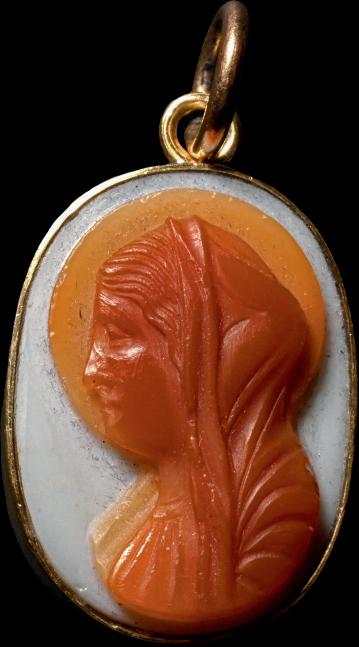
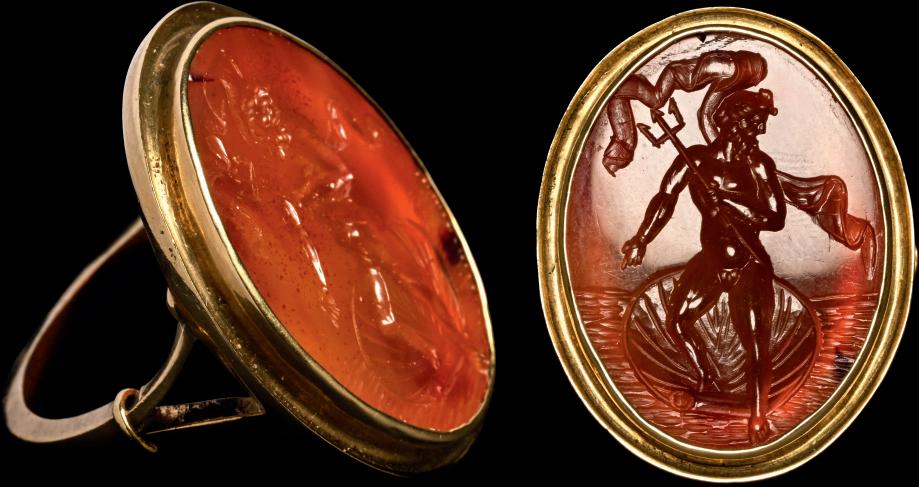
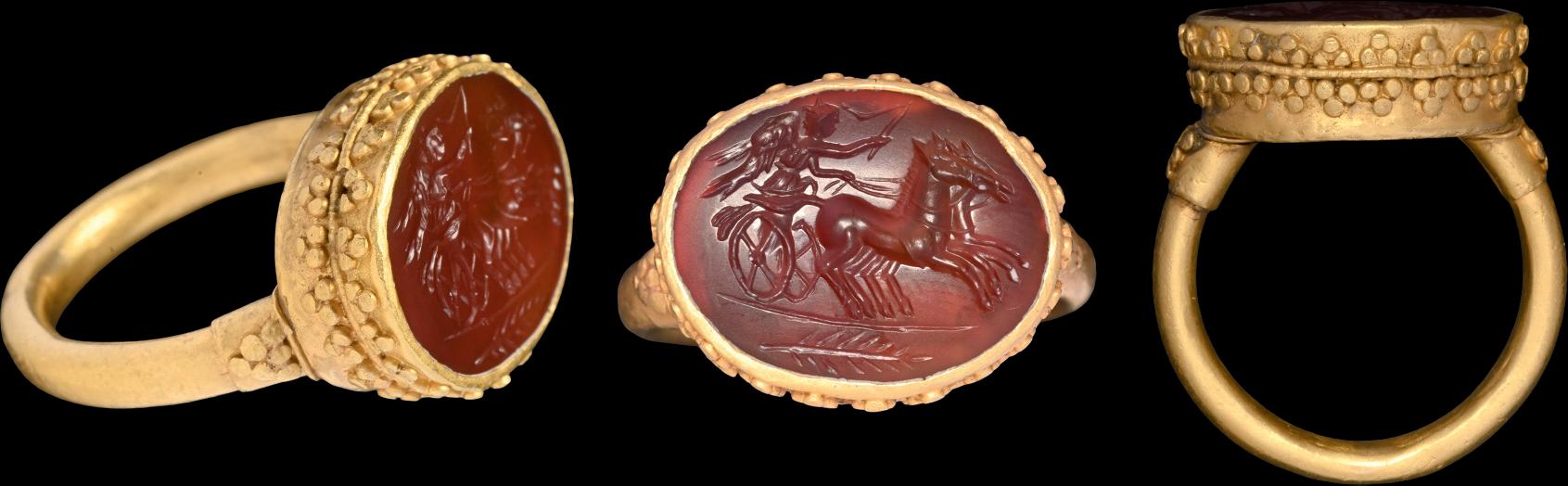
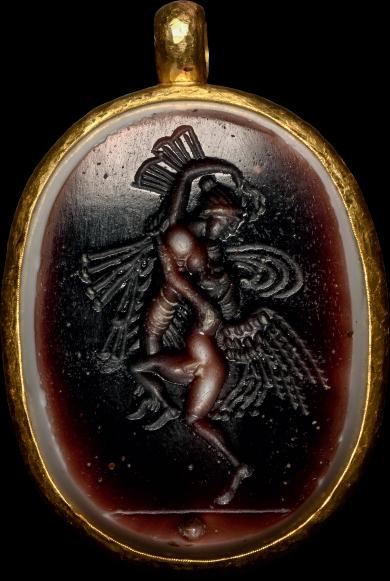
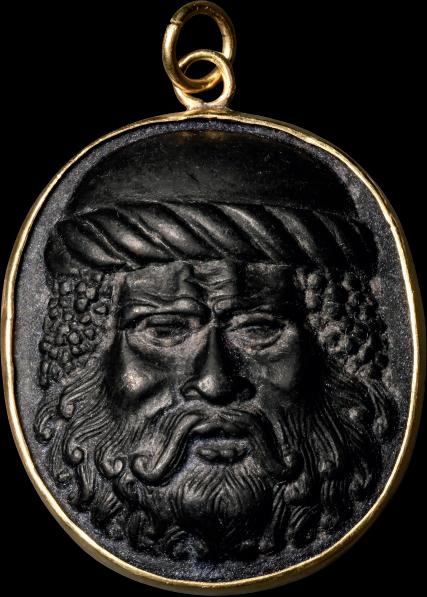
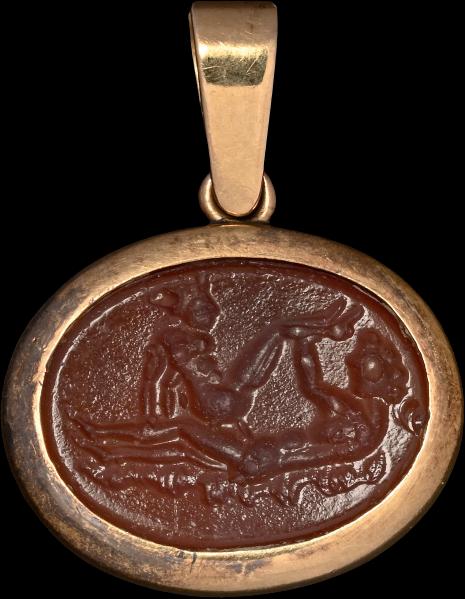
429 GOLD RING WITH GEMSTONE REPRESENTING A WINGED VICTORY CHARIOTEER
19TH-20TH CENTURY A.D.
1 in. (11.35 grams, 30.04 mm overall, 19.68 x 20.16 mm internal diameter (approximate size British U, USA 10, Europe 22.52, Japan 21))
Plano-convex carnelian cloison with incuse image of a biga on a baseline with charioteer; frond in exergue.
£2,000 - 3,000
PROVENANCE:
Private collection, England.
430
LARGE POST-CLASSICAL GLASS GEM WITH DANCING FIGURES IN GOLD MOUNT
19TH-20TH CENTURY A.D.
2 in. (34.6 grams, 55 mm)
Ellipsoid plaque with incuse winged figures embracing; gold frame and loop.
£500 - 700
PROVENANCE:
Acquired on the UK art market.
Private collection, England.
431
GOLD PENDANT WITH GLASS HEAD
19TH CENTURY A.D.
1¾ in. (11.5 grams, 44 mm)
In low-relief, facing bust with braided band to his brow and bunch of grapes to each temple.
£600 - 800
PROVENANCE: Private collection, Europe. Acquired on the English art market.
432
POST-CLASSICAL GEM WITH EROTIC SCENE IN GOLD MOUNT
19TH CENTURY A.D.
1¼ in. (7.12 grams, 30 mm)
Ellipsoid in plan, glass intaglio with scene of two lovers; gold frame and bale.
£500 - 700
PROVENANCE:
Acquired on the French art market.
Private collection, England.
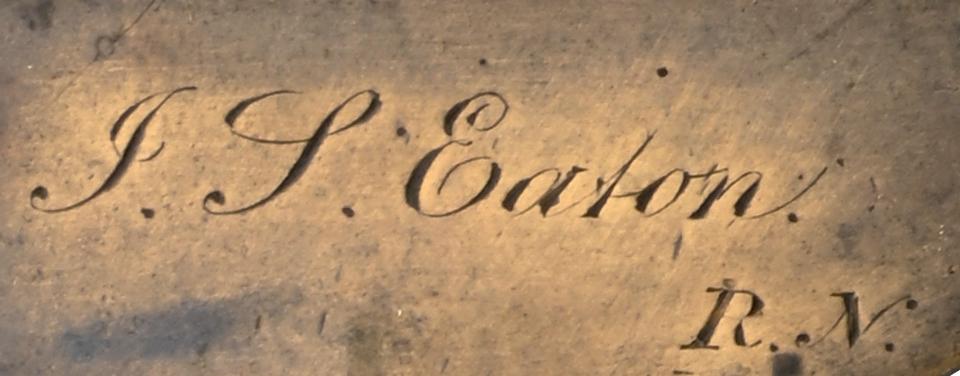
ROYAL NAVY OFFICER’S SWORD FOR BATTLE OF TRAFALGAR MIDSHIPMAN (LATER COMMANDER) JAMES EATON
1827 PATTERN
37 in. (1.31 kg, 95 cm)
A solid half-basket-hilt with folding guard, engraved ‘J.S. Eaton, R.N.’ in copperplate; lion-head pommel with knuckle-bow entering through the lion’s mouth, ‘ray-skin’ grip and retaining wires; sword-knot tied through slot in the knuckle-bow (now in protective velvet pouch); pipebacked single-edged blade with etched crown-and-anchor design to one face and heraldic helm to the other, ricasso with reserved sixpointed star and inset gold disc with blackletter ‘D’; black leather scabbard with three brass fittings (locket, middle and chape) and two suspension rings; suspension cord with decorative braided banded keepers.
£4,000 - 6,000
PROVENANCE:
Believed to have been owned by James Eaton, famed for serving at the battle of Trafalgar, and in later life, Commander. Ex Newbury antique emporium.
Property of a Berkshire, UK, gentleman collector.
Accompanied by copies of various online biographical research information.
FOOTNOTES:
The sword is believed to have belonged to Eaton in later life, when he had been promoted to the rank of Commander. The Trafalgar Roll (p.53) and other sources record his career in some detail. James Eaton was born in London in 1783 and entered service in the Royal Navy in 1799, aged 16, aboard the Quebec stationed in the West Indies, and in 1800 he was appointed Midshipman to the vessel La Prompte. He was in the mizentop of the Hannibal in the action off Algeciras, Spain, in 1801 when she was obliged to surrender, having sustained losses of 81 men killed and 62 wounded; he was then in an exchange of prisoners and returned to Britain aboard the San Antonio which had been captured from the Spanish in battle at Cadiz. As a midshipman in 1803, he served on the Atalante intercepting enemy smuggling and supply vessels near St. Gildas in the bay of Quiberon, Brittany. Eaton was the Signal Midshipman of the Téméraire at the battle of Trafalgar in 1805 and was the first signal officer to repeat Nelson’s famous message ‘England expects that every man will do his duty’ to the rest of the fleet, an illustrious and important achievement: J.M.W. Turner created a magnificent painting of the Téméraire which is now featured on United Kingdom £20 notes. This ship took part in the thick of the action at Trafalgar - she came alongside and was lashed to the French ships Fougeux and Redoutable, the crew of which was about to board Nelson’s flagship, HMS Victory until a broadside was delivered which caused a huge loss of life and saved Nelson’s vessel from the hands of the French. He was promoted to lieutenant the following year and appointed to the Lion where he served for six years. He sustained wounds in an action aboard the Lion while escorting a convoy to China and took part in 1811 in the invasion of Java mounted against the Dutch East India Company. In 1813, he was aboard the Beaver when she rescued the crew of a Swedish merchant vessel and received a distinction for his part in the action. He retired in 1842 with the rank of Commander with the Naval General Service Medal and two clasps in recognition of his distinguished career. He finally settled in West Bromwich; he died fifteen years later. Less glorious, perhaps, is his nickname ‘Snotty’ Eaton - the normal term in those days used to describe any midshipman. The vendor has been told by Will Heppa, curator at the Royal Navy Museum, that there appears to be only one ‘J Eaton’ in the records of the appropriate period; there is thus every reason to accept that the sword did belong to the Eaton of Trafalgar fame.
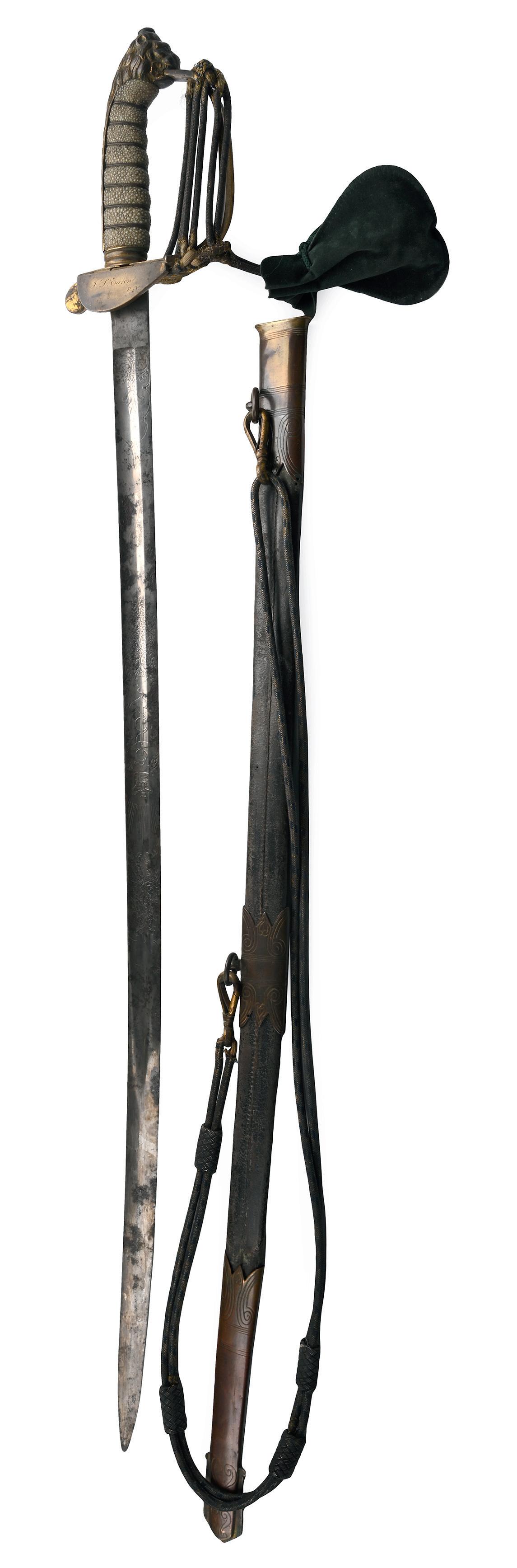
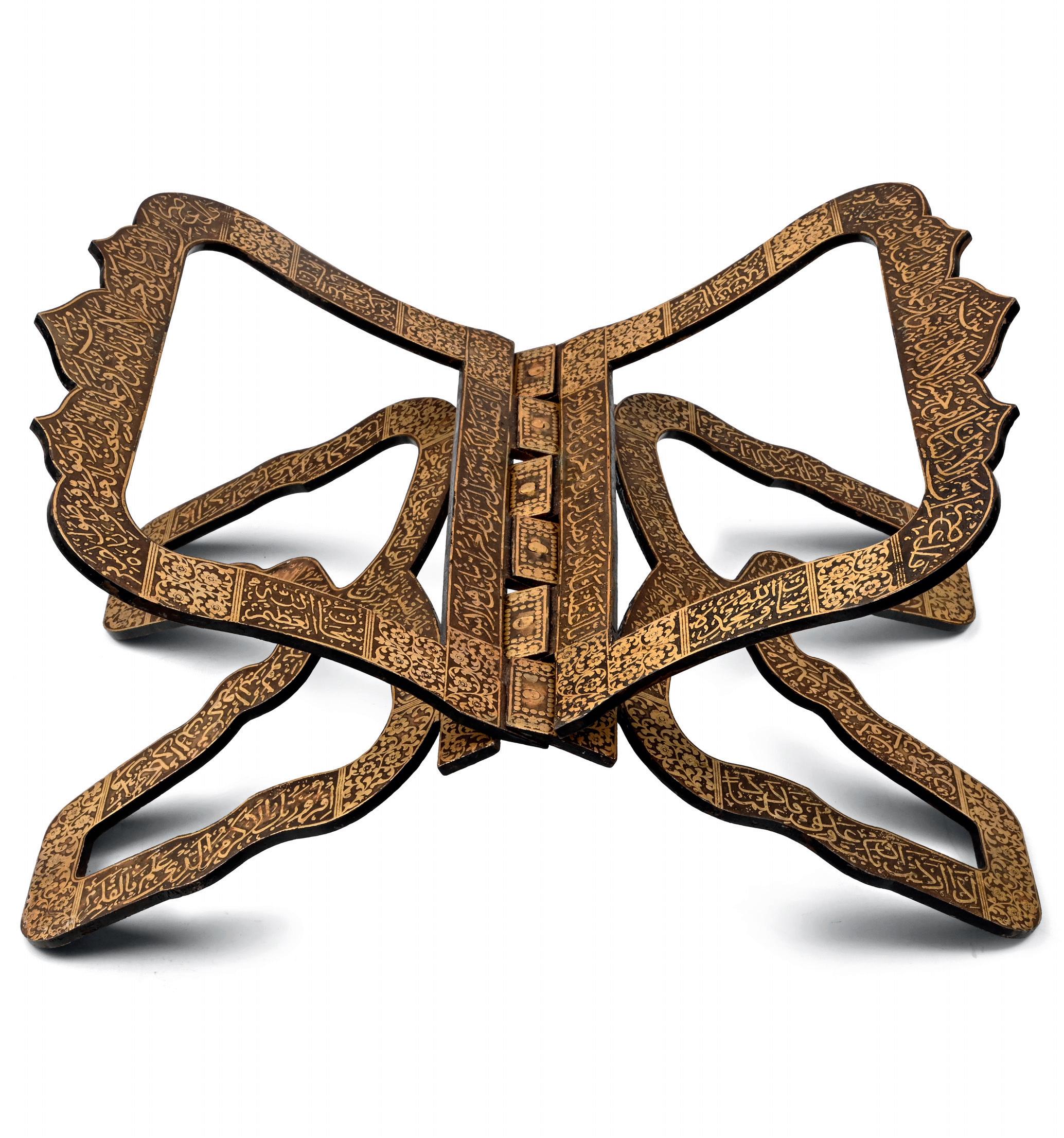
14¾ in. (3.3 kg, 37.5 cm)
Formed as two hinged folding leaves, the lower sections pierced with rounded voids and the upper with a subrectangular slot; the entire surface decorated with inlaid floral panels and passages of calligraphic text.
£4,000 - 6,000
PROVENANCE: Private collection, London, UK.
435
AMETHYST CRYSTAL GEODE WITH CALCITE ROSETTES
CRETACEOUS PERIOD, CIRCA 120-140 MILLION YEARS B.P.
9 x 9½ x 4 in. (6.9 kg, 23 x 24 x 10 cm)
Beautifully prepared section with polished edges and two natural ‘windows’, a thick blanket of prismatic amethyst crystal lining the interior, two calcite rosettes at the centre and aggregates of darker crystals.
£1,200 - 1,700
PROVENANCE: From Artigas, Uruguay. Property of a London lady.
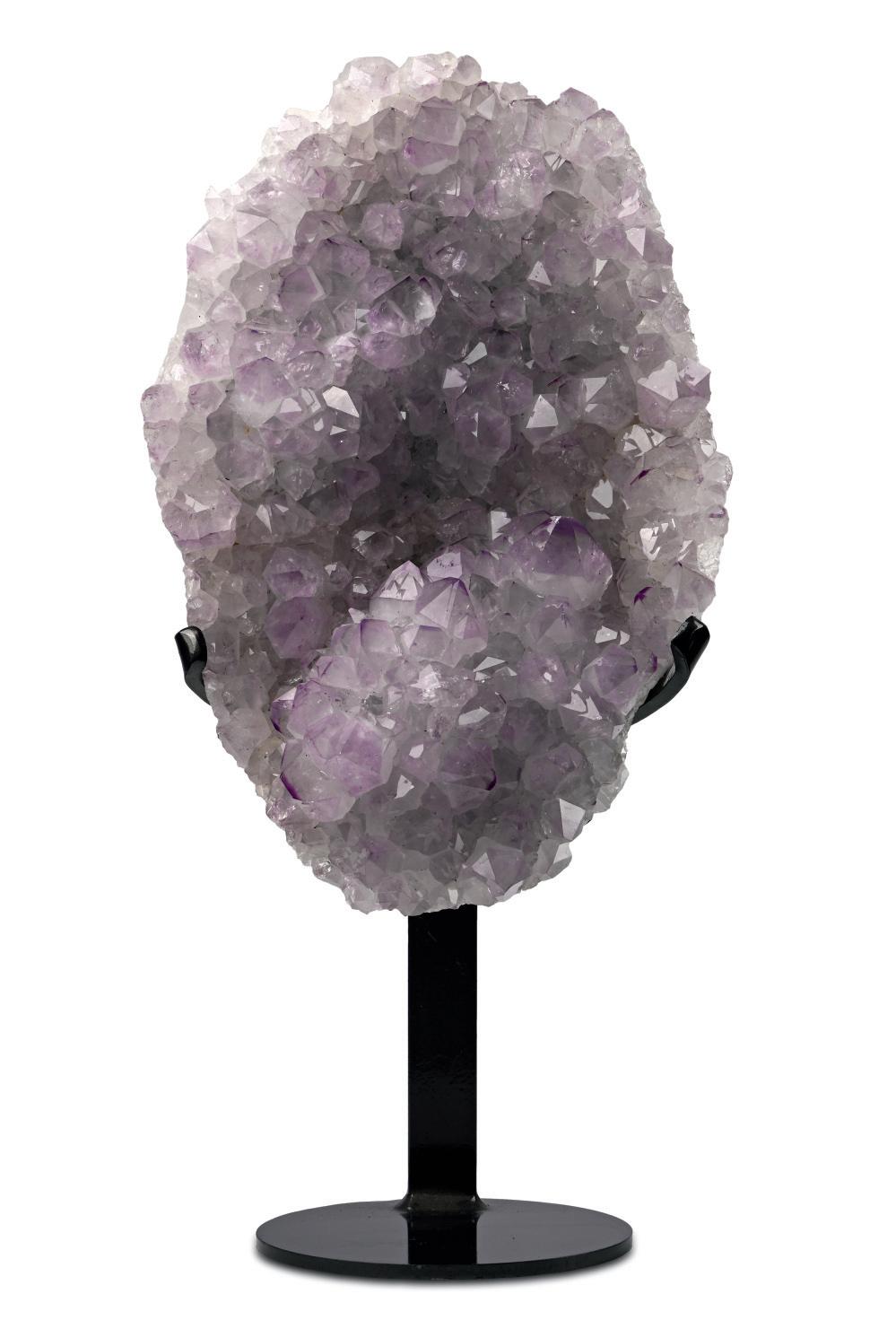
437
WHITE QUARTZ GEODE SLICE WITH AMETHYST CORE
CRETACEOUS PERIOD, CIRCA 120-140 MILLION YEARS B.P.
13 x 9¾ x¾, 20½ in. (4.54 kg, 34 x 25 x 2cm, 52 cm including stand)
Cut and polished slice showing dense intergrown layer of white quartz crystals, the centre with groups of small lavender-coloured amethyst crystals; mounted on a custom-made display stand.
£1,000 - 1,400
PROVENANCE: From Artigas, Uruguay. Property of a London lady.
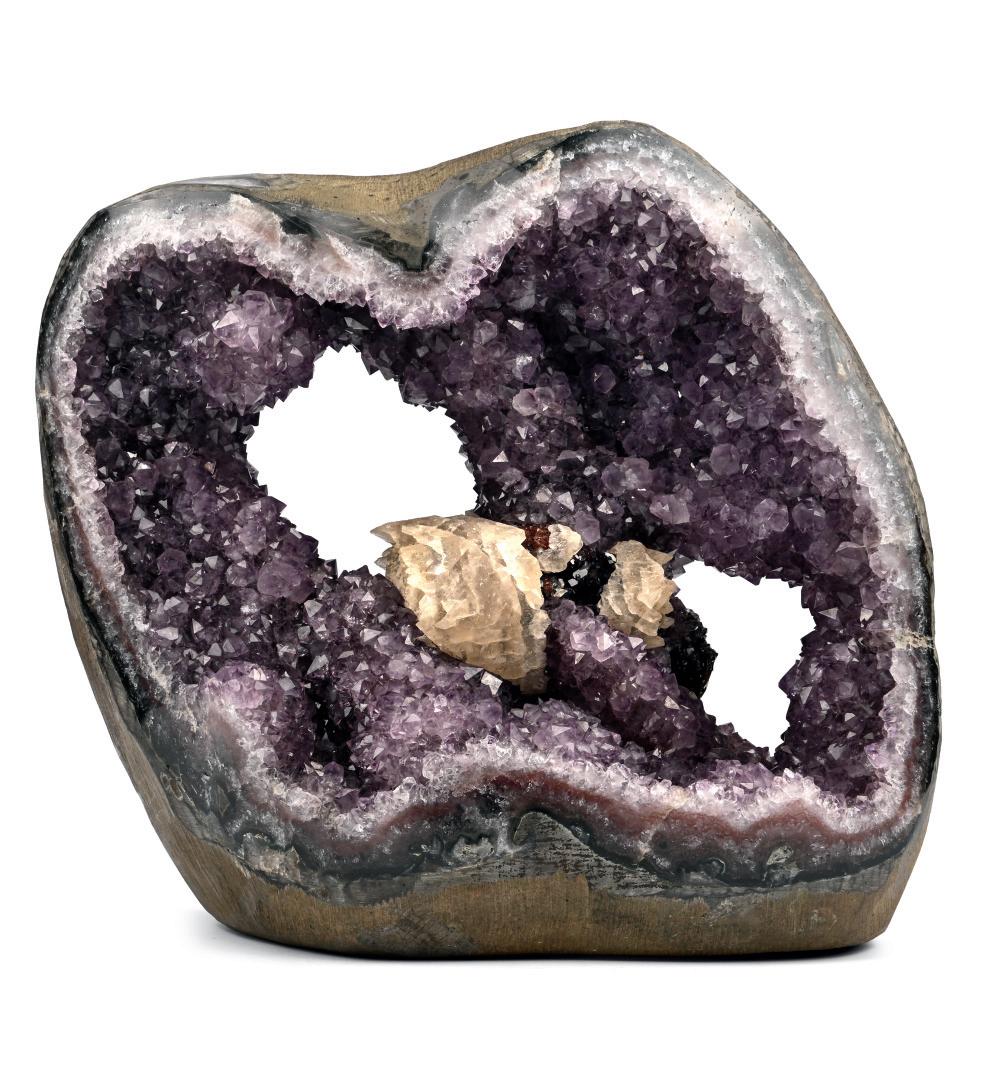
436
LARGE AMETHYST AND QUARTZ CRYSTAL DISPLAY
CRETACEOUS PERIOD, CIRCA 120-140 MILLION YEARS B.P.
14¾ x 9¾ x 6 in, 20½ in. (14.75 kg, 37.5 x 25 x 17 cm, 52 cm including stand)
An ovoid geode section with large prismatic quartz and light purple amethyst crystals with colour concentrations at the peak of the terminations; mounted on a custom-made display stand.
£2,500 - 3,500
PROVENANCE: From Artigas, Uruguay. Property of a London lady.
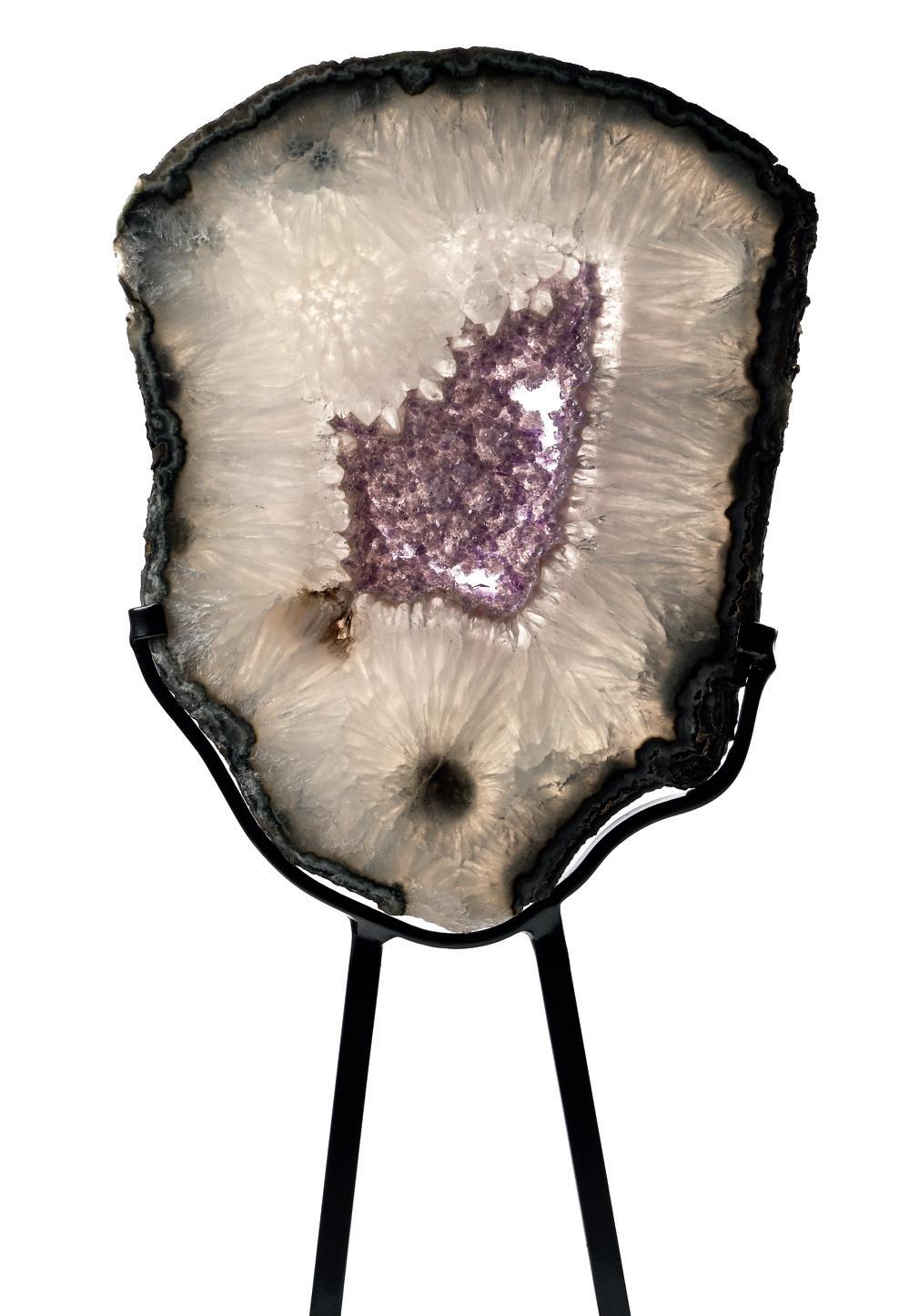
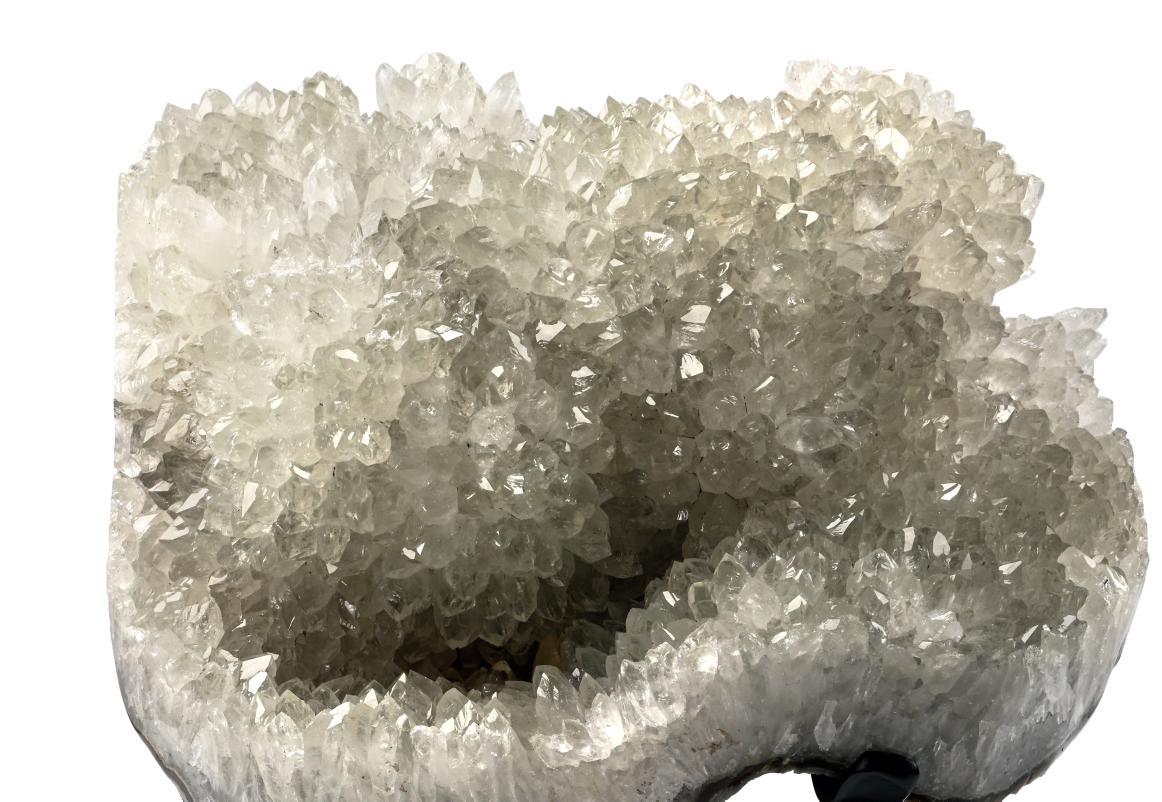
438
WHITE QUARTZ CRYSTAL DISPLAY
CRETACEOUS PERIOD, CIRCA 120-140 MILLION YEARS B.P.
11¾ x 13 x 9, 13¾ in. (16.4 kg, 30 x 34 x 23 cm, 35 cm including stand)
A polished geode section with large prismatic quartz crystals in flower-like radiating clusters; mounted on a custom-made display stand.
£1,200 - 1,700
PROVENANCE: From Artigas, Uruguay. Property of a London lady.

439
LARGE FREEFORM LAPIS LAZULI SCULPTURE
PRECAMBRIAN PERIOD, CIRCA 2.4 - 2.7 BILLION YEARS B.P.
10 8/8 x 20 x 4 in. (25.15 kg, 53 x 29 x 10 cm)
A thick, architectural slab of lapis lazuli with white calcite veins and pyrite flecks, polished to a high sheen and mounted on a custommade display stand.
£5,000 - 7,000
PROVENANCE: From Afghanistan. Property of a London lady.
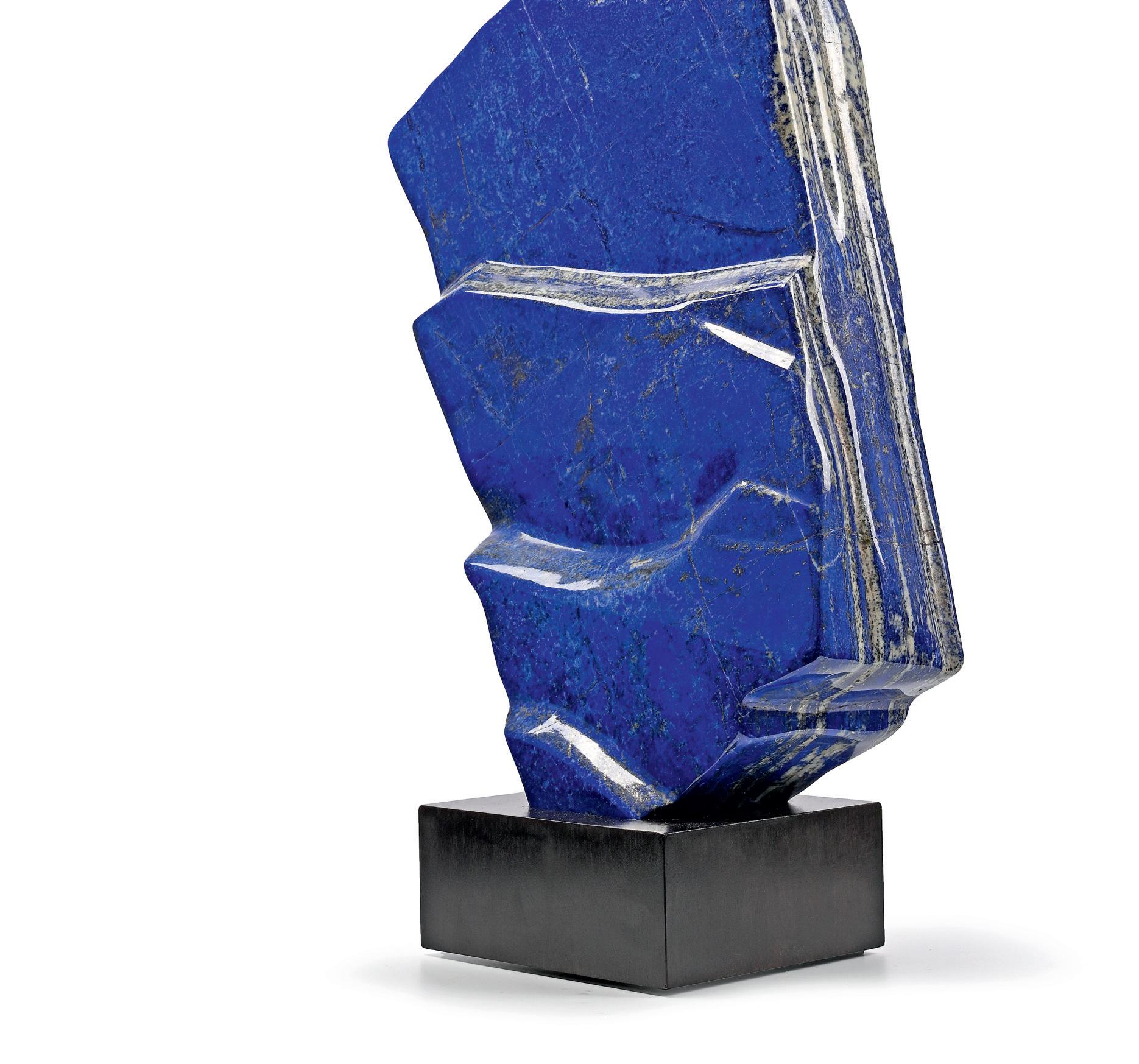
440
MASSIVE DEEP PURPLE AMETHYST CRYSTAL GEODE DISPLAY
CRETACEOUS PERIOD, CIRCA 120-140 MILLION YEARS B.P.
24¾ x 28¼ x 14½ in. (177 kg, 63 x 72 x 37 cm)
A large freestanding geode display with polished edges, the interior lined with rich, deep purple amethyst crystals.
£6,000 - 8,000
PROVENANCE:
From
Uruguay.
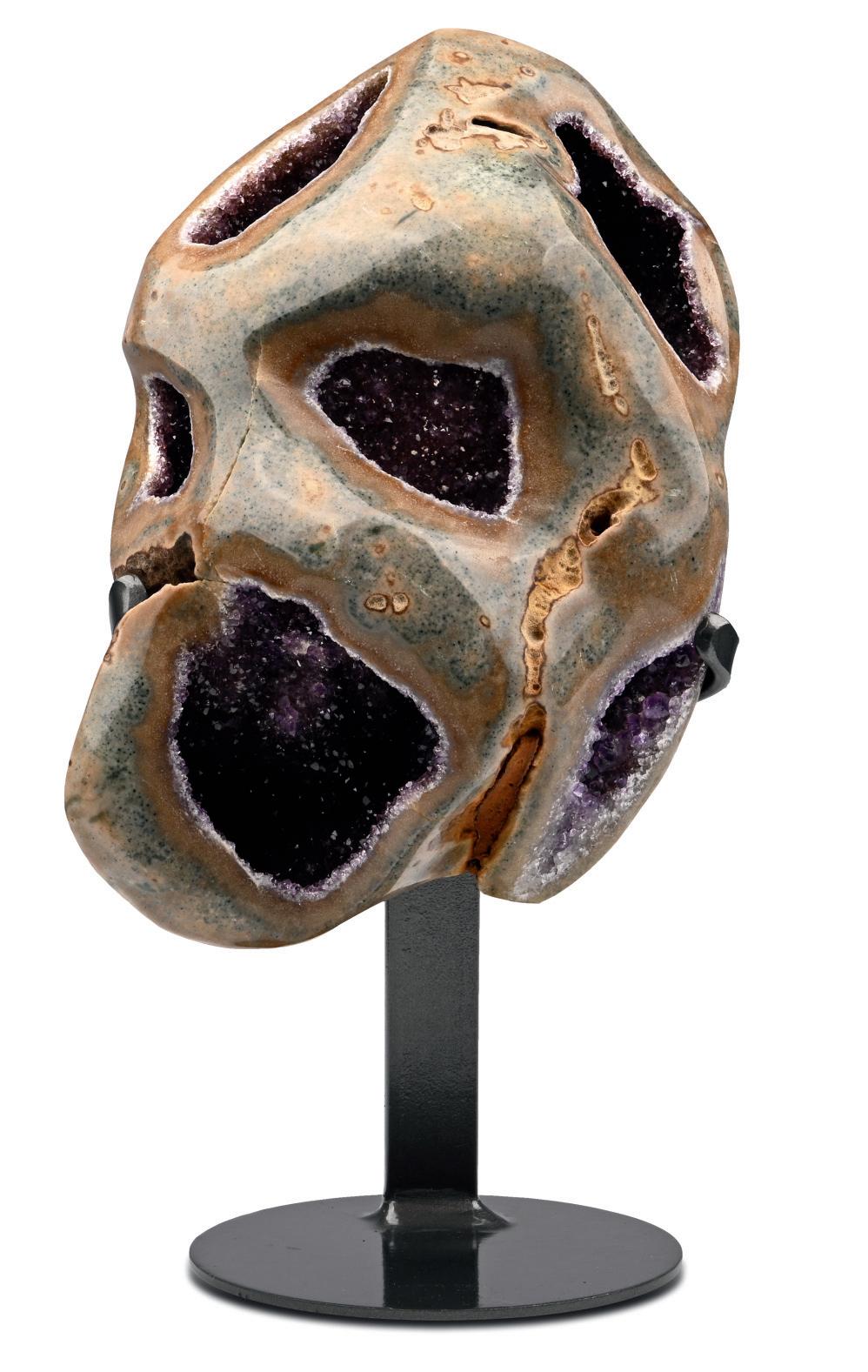
442
POLISHED LABRADORITE SPHERE
PRECAMBRIAN PERIOD, PAN-AFRICAN OROGENY, CIRCA 600-500 MILLION YEARS B.P.
4 in. (2.04 kg, 10.5 cm)
A large, polished sphere of labradorite showing characteristic, mainly blue labradorescence.
£800 - 1,000
PROVENANCE:
From Madagascar. Property of a London lady.
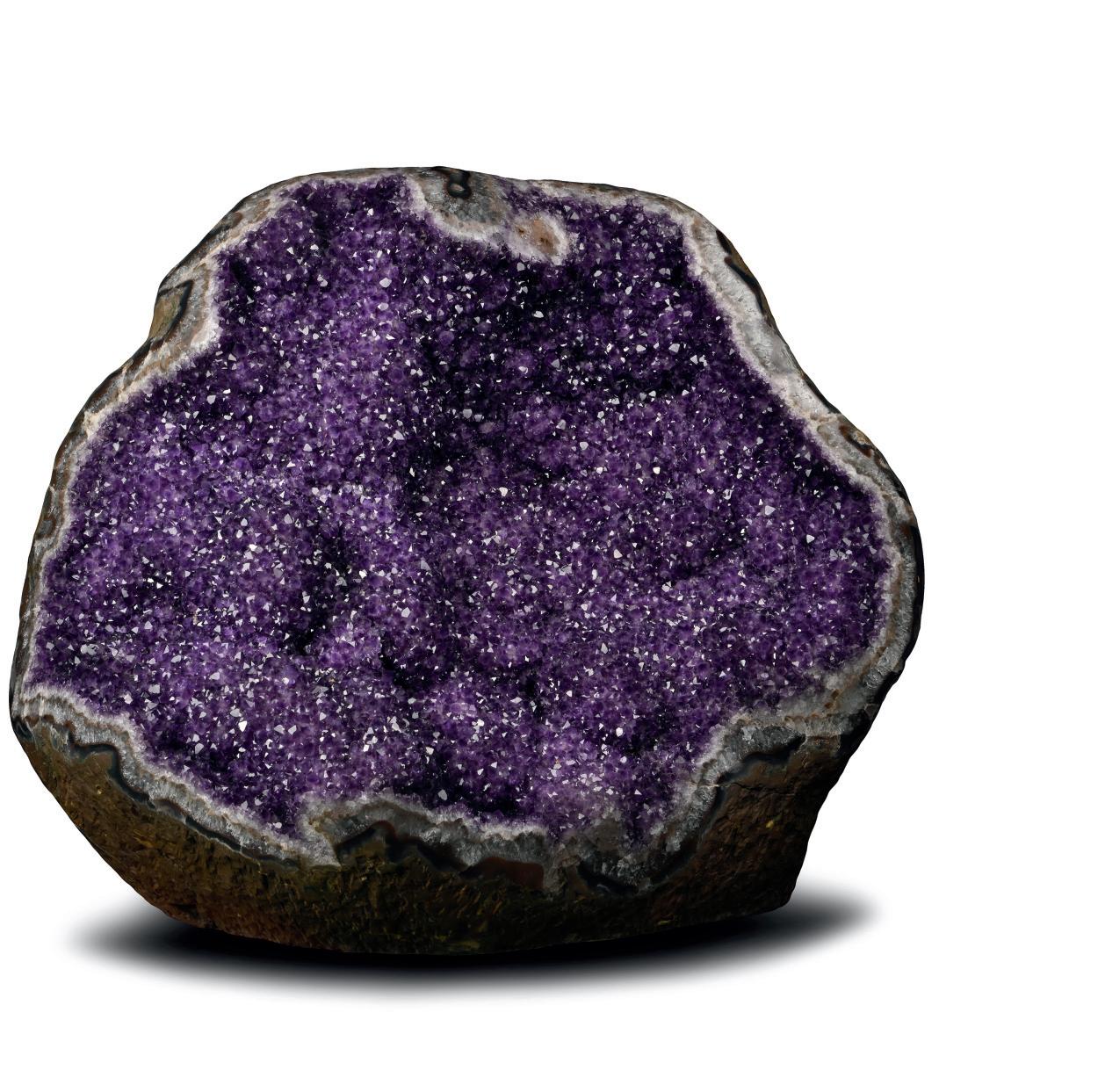
441
AGATE AND AMETHYST ‘WINDOW’ DISPLAY
CRETACEOUS PERIOD, CIRCA 120-140 MILLION YEARS B.P.
9 x 6¼ x 4¼, 14 in. (3.15 kg, 24.5 x 16 x 11 cm, 35.5 cm including stand)
Polished geode section with six rounded openings creating windows to the inside of the geode, the internal walls lined with vibrant purple amethyst crystals; mounted on a custom-made display stand.
£2,000 - 3,000
PROVENANCE: From Artigas, Uruguay. Property of a London lady.
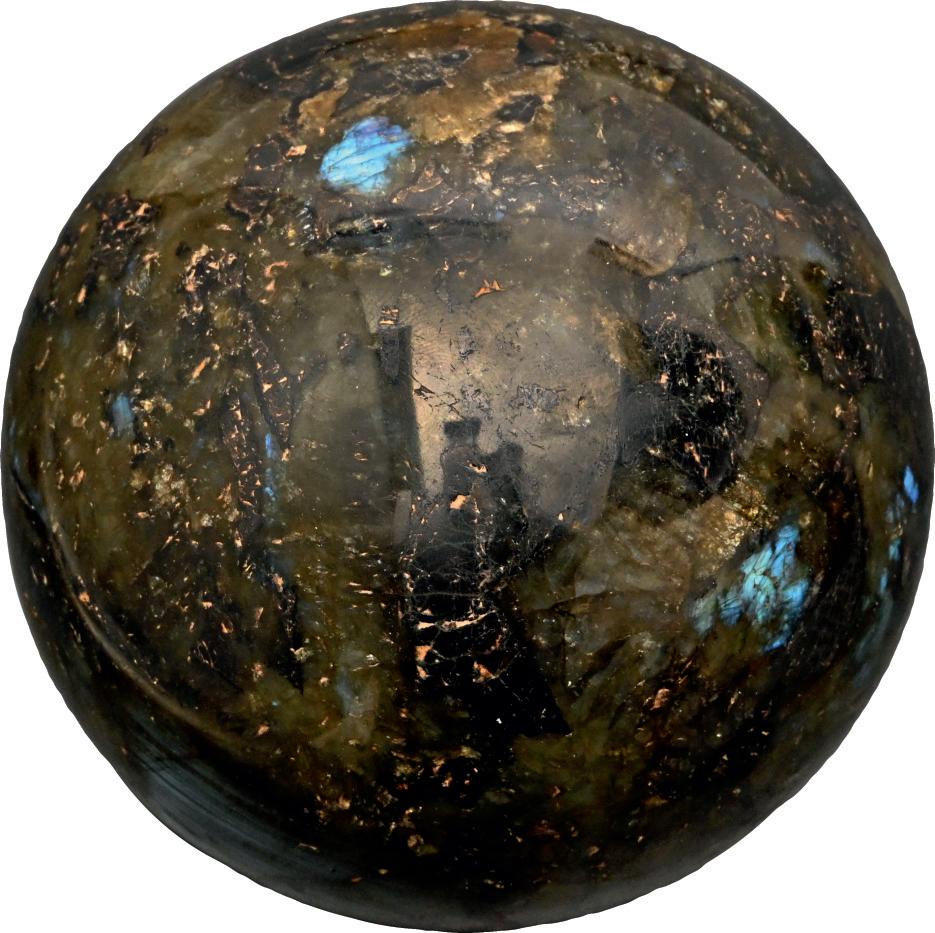
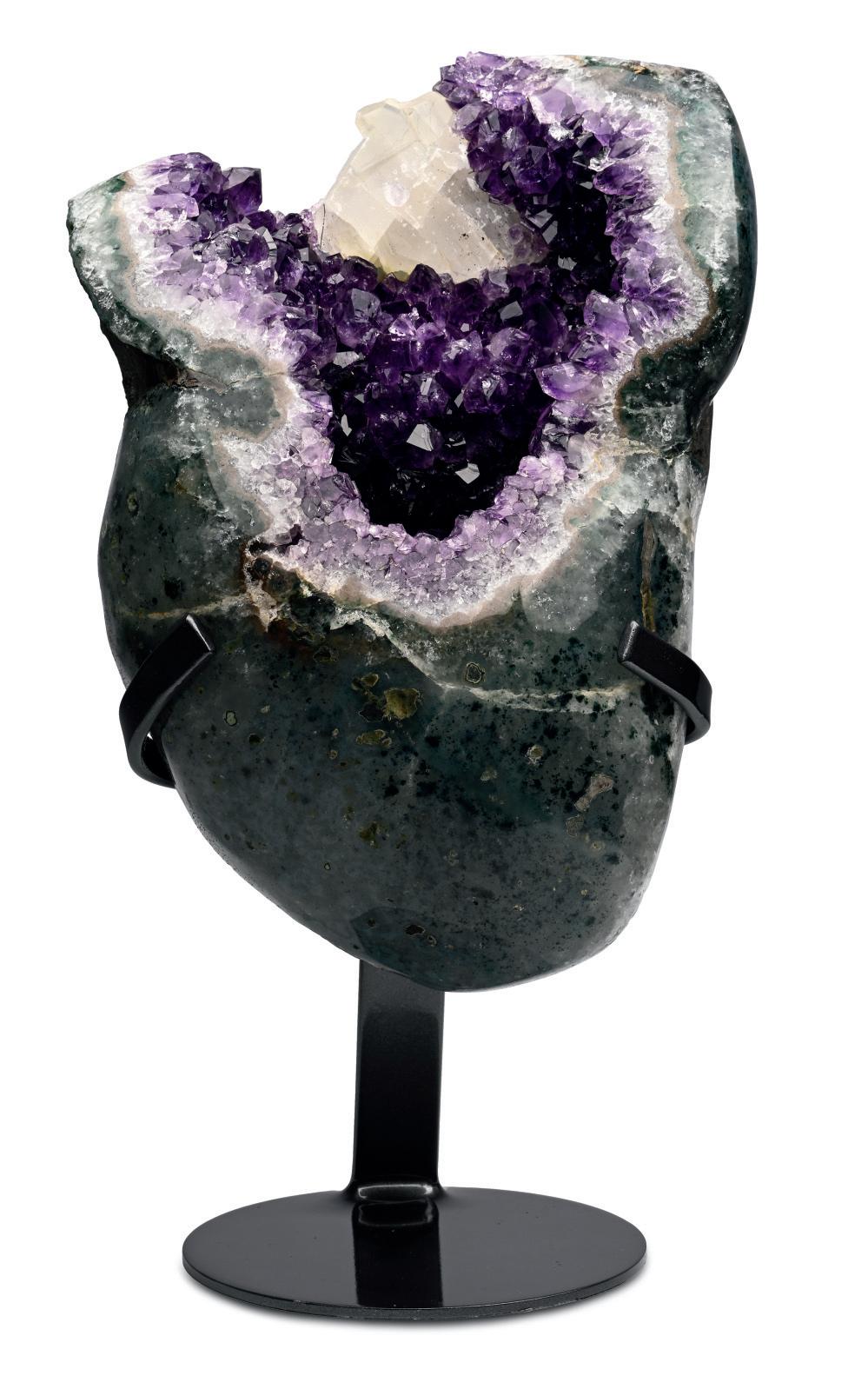
444
DRUZY QUARTZ CRYSTAL GEODE DISPLAY
CRETACEOUS PERIOD, CIRCA 120-140 MILLION YEARS B.P.
10¼ x 8 x 4, 12½ in. (4.13 kg, 26 x 22 x 10 cm, 32 cm including stand)
Cut section of geode lined with dark grey to almost black druzy quartz crystals, creating a shimmering effect; two cut stalagmites with polished upper face showing attractive dark banding; mounted on a custom-made display stand.
£1,200 - 1,700
PROVENANCE:
443
POLISHED AMETHYST CRYSTAL GEODE DISPLAY WITH CALCITE
CRETACEOUS PERIOD, CIRCA 120-140 MILLION YEARS B.P.
10 x 7 x 4 in. (5.68 kg, 27 x 20 x 10 cm)
The outer layer of green celadonite beautifully polished, the interior with dark purple prismatic amethyst crystals, and at the top, an aggregate of white rhombohedral calcite crystals; mounted on a custom-made display stand.
£1,200 - 1,700
PROVENANCE:
From Artigas, Uruguay.
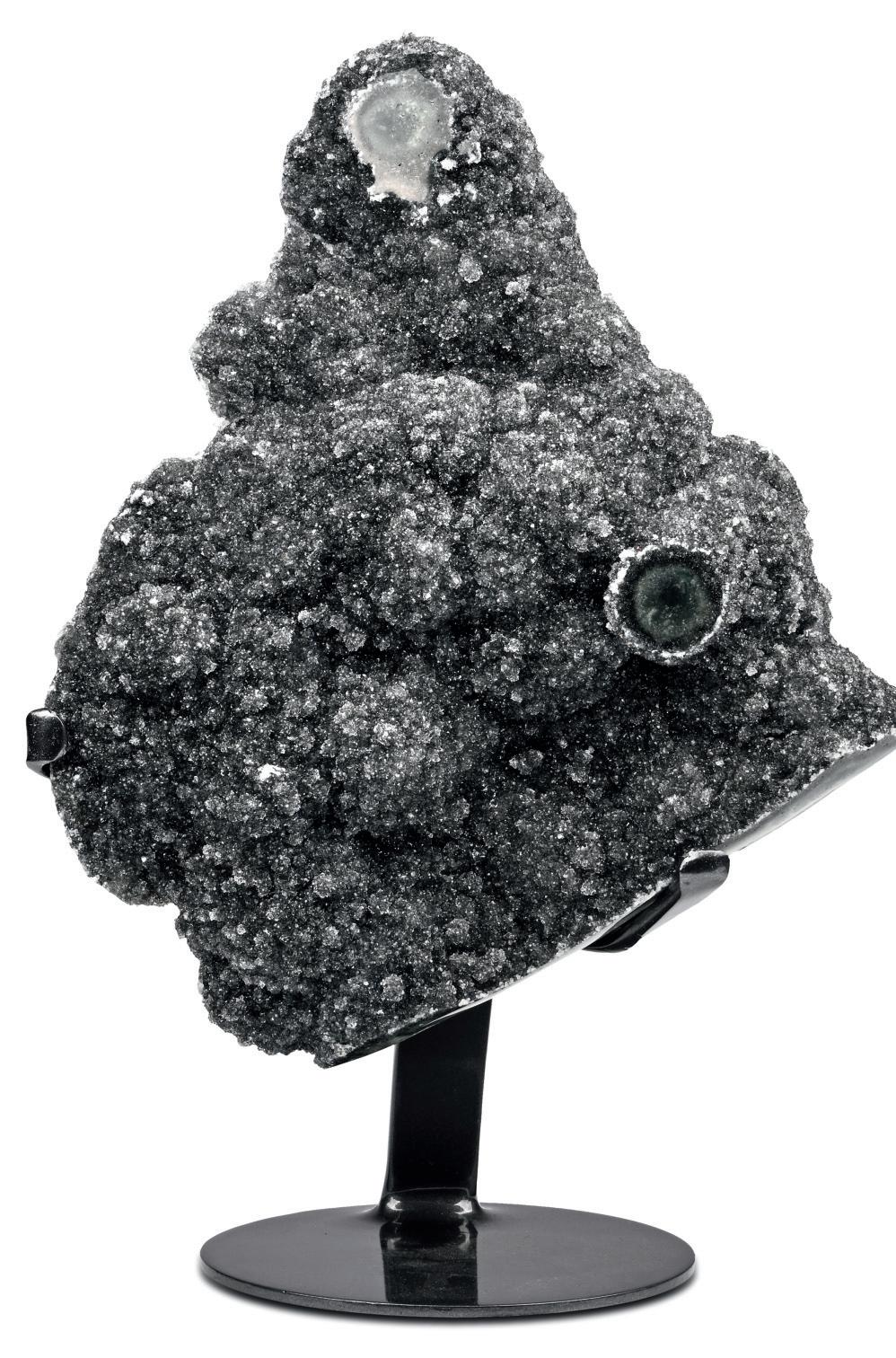
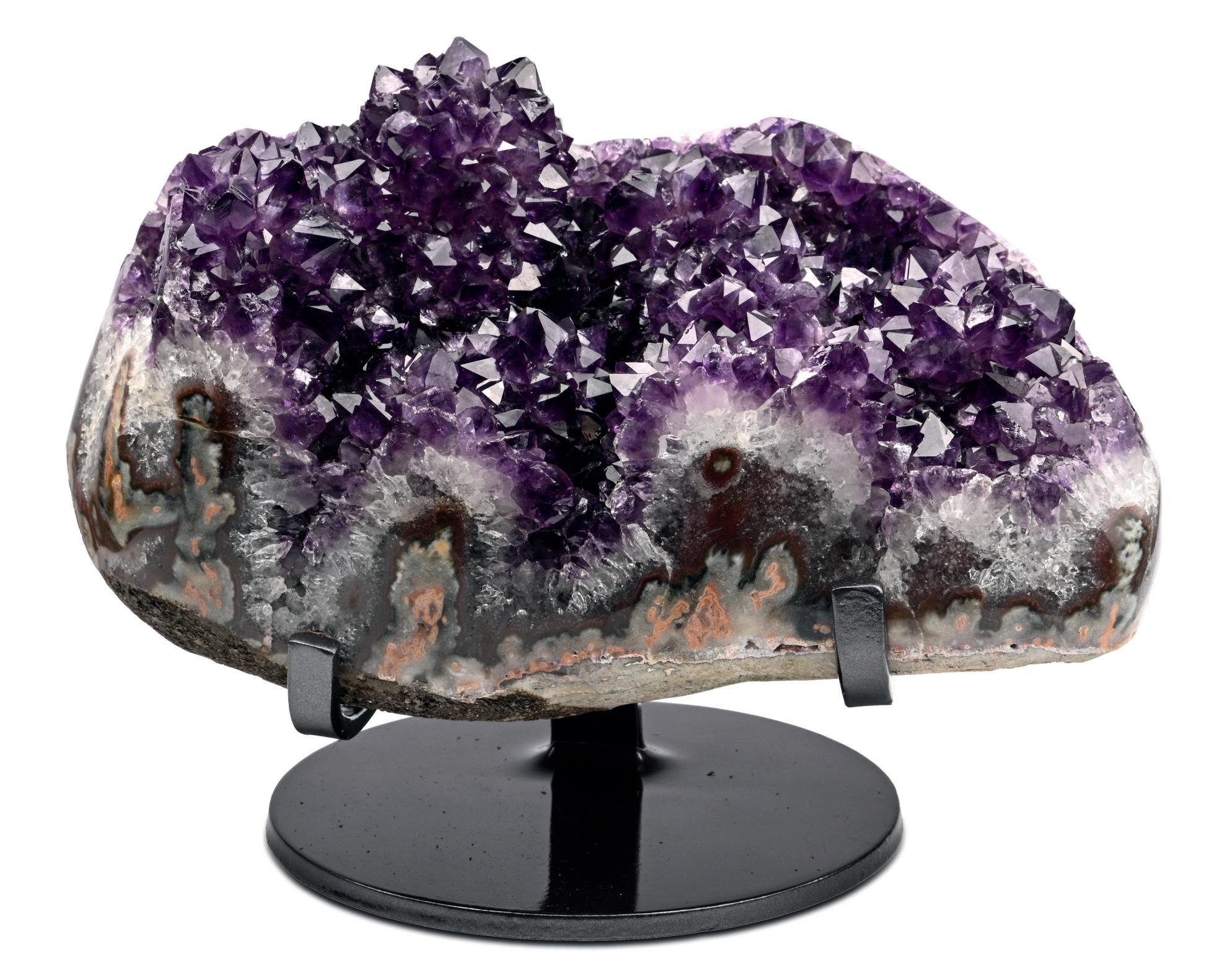
445
AMETHYST CRYSTAL GEODE DISPLAY
CRETACEOUS PERIOD, CIRCA 120-140 MILLION YEARS B.P.
10¼ x 8 x 4, 12½ in. (10.65 kg, 26 x 22 x 10 cm, 32 cm including stand)
Polished section of a geode lined with large, deep purple amethyst crystals in flower-like formations; mounted on a custom-made display stand.
£1,500 - 2,000
PROVENANCE:
From Artigas, Uruguay. Property of a London lady.
446
DRUZY QUARTZ GEODE DISPLAY
CRETACEOUS PERIOD, CIRCA 120-140 MILLION YEARS B.P.
9 x 7 x 5 , 11 in. (3.85 kg, 23 x 18 x 15 cm, 29 cm including stand)
An exquisite formation of grey and white druzy quartz on a geode section, a pair of cut stalagmite ‘eyes’ on one side with polished upper face showing the layered structure; mounted on a custom-made display stand.
£1,200 - 1,700
PROVENANCE:
From Artigas, Uruguay. Property of a London lady.
447
LARGE DEEP PURPLE AMETHYST CATHEDRAL DISPLAY
CRETACEOUS PERIOD, CIRCA 120-140 MILLION YEARS B.P.
33 x 15 x 6 , 44 in. (38.6 kg, 84 x 38 x 17 cm, 112 cm including stand)
A complete half of a pyramidal geode, showing deep purple amethyst crystals with tan-coloured druzy quartz; mounted on a custom-made display stand.
£2,500 - 3,500
PROVENANCE:
From Artigas, Uruguay. Property of a London lady.
448 AGATE GEODE DISPLAY WITH PINK DRUZY QUARTZ
CRETACEOUS PERIOD, CIRCA 120-140 MILLION YEARS B.P.
6 x 6 x 3 , 9½ in. (2.88 kg, 17.5 x 17 x 8 cm, 24 cm including stand)
With thick agate borders and an interior window revealing pink druzy coating over nascent stalactites; mounted on a custom-made display stand.
£1,000 - 1,400
PROVENANCE:
From Artigas, Uruguay. Property of a London lady.
449
TEARDROP-SHAPED AMETHYST CRYSTAL GEODE DISPLAY
CRETACEOUS PERIOD, CIRCA 120-140 MILLION YEARS B.P.
7 x 6¼ x 4, 11 in. (4.14 kg, 20 x 16 x 10 cm, 29 cm including stand)
The inner surface lined with vibrant dark purple amethyst crystals, and an area of brown-orange druze quartz, the polished edges of the geode displaying vibrant banding; mounted on a custom-made display stand.
£1,200 - 1,700
PROVENANCE:
From Artigas, Uruguay. Property of a London lady.
450 BROWN DRUZY QUARTZ STALAGMITE GEODE DISPLAY
CRETACEOUS PERIOD, CIRCA 120-140 MILLION YEARS B.P.
5 x 11¾ x 6 , 7 in. (6 kg, 15 x 30 x 17cm, 20 cm including stand)
A polished underside of a geode containing upward-reaching stalagmites covered in druzy brown quartz and small, sparkling white quartz crystals; mounted on a custom-made display stand.
£1,200 - 1,700
PROVENANCE:
From
Uruguay.
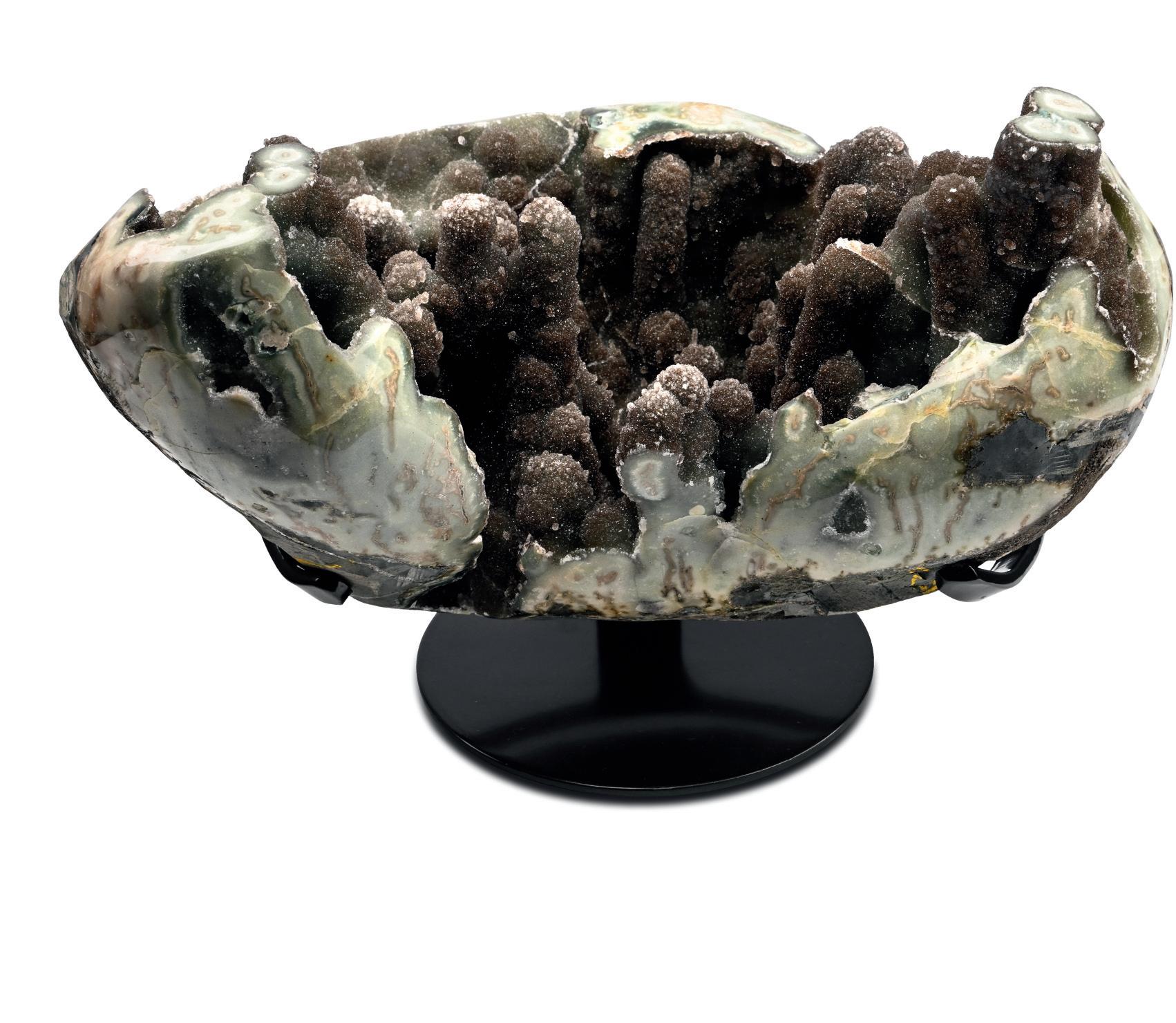
Bidder/Buyer Terms and Conditions
1. Interpretations and Definitions: the following terms generally apply within these Terms and Conditions; other terms are defined within specific sections following:
Auctioneer – the firm TimeLine Auctions Ltd (“TimeLine” hereafter) or its authorised auctioneer, acting as Agent for the Seller.
TimeLine is a company registered in England and Wales (company no: 06873501) with registered office at The Court House, 363 Main Road, Harwich, CO12 4DN, UK. The website and telephone number are https://timelineauctions.com and +44 (0) 1277 815121.
Agent – a person or body acting on behalf of another.
ALR – Art Loss Register - All lots with an upper estimate value of £1,500 and above and all ancient Western Asiatic lots are searched against the Art Loss Register database.
Auction – a sale event whether taking place live in real-time or of extended duration (Timed Auction).
Bid – a sum offered by a Bidder to purchase the Lot.
Bidder – the person offering a Bid.
Buyer – the Bidder who the Lot is Knocked Down to.
Buyer’s Premium – the percentage of the Hammer Price payable by the Buyer to TimeLine in accordance with clause 21.
CITES - Convention on International Trade in Endangered Species.
Data Protection Legislation –all applicable data protection and privacy legislation in force from time to time in the UK including the General Data Protection Regulation ((EU) 2016/679) (83) (GDPR); the Data Protection Act 2018; the Privacy and Electronic Communications Directive 2002/58/EC (as updated by Directive 2009/136/EC) and the Privacy and Electronic Communications Regulations 2003 (SI 2003/2426) as amended, and any and all applicable national data protection laws made under or pursuant to the GDPR, as may be amended or superseded from time to time.
Date of Sale – the date on which the Auctioneer Knocks Down the Lot. Group – any Lot comprising more than one item.
Hammer Price – the amount of the winning bid when Knocked Down by the Auctioneer to a Bidder.
Knock(ed/ing) Down – the act of the Auctioneer in bringing the Hammer down to complete the contract for the sale of the Lot to the Bidder submitting the highest bid.
Lot – the goods for sale.
Purchase Price – the total sum due for any Lot, including the Hammer Price, the Buyer’s Premium, any internet bidding fees, any shipping charges, taxes, duties or any other costs payable to TimeLine.
Registered Bidder –a Bidder who has registered with TimeLine for the purpose of taking part in any Auction. Reserve Price –the minimum Hammer Price at which a Lot may be Knocked Down.
Seller – the person offering the Lot for sale. Terms – means these Terms and Conditions. Title – legal rights of ownership of the Lot.
2. Application: the singular includes the plural and vice versa and any reference to ‘he’, ‘she’ or ‘it’ applies to all of them.
3. Basis of Contract:
a. These Terms and Conditions apply to the exclusion of any other terms that the Bidder/Buyer seeks to impose or incorporate, or which are implied by trade, custom, practice or course of dealing.
b. Each Buyer is required to carefully read the Terms and Conditions before offering a Bid. When a Buyer makes a Bidhe/she acknowledges that he/she has read, understood and accepted these Terms. c. TimeLine does not act for or give any advice to Bidders/Buyers.
4. Dimensions, weights and colour: All dimensions and weights (including ring sizes) are approximate and are for general guidance only; a single dimension given is normally the greatest dimension for the piece(s). Although TimeLine have made every effort to precisely display the colours and condition of a Lot, TimeLine does not guarantee or represent that a device displays them accurately. The Lot may vary slightly from those images.
5. Condition: A condition statement for Lots
is not given in the catalogue, printed or online. This does not infer that any Lot is free from faults and prospective Bidders must satisfy themselves entirely as to the fullcondition of each piece before placing Bids. Condition Reports may be requested for any lot but are given only for general guidance and are inevitably subjective in character. Requests for Condition Reports should be made as early as possible; requests received at a late time may not be available before the lot is offered. Bidders are encouraged to carefully examine in person any Lot(s) for which they intend or do Bid for. It is not possible to note all marks or defects and neither TimeLine or the Auctioneer make any guarantee as to the physical quality or condition of any Lot(s).
6. Dating: Dates may be given in several forms, as examples below:
527 AD - an item that bears a date upon it or that can otherwise be dated with precision; 6th century AD - an item that can be dated with considerable confidence to a specific period;
Circa 6th century AD - an item that can be approximately dated by comparison with other pieces;
Probably 6th century AD - an item that is likely to be of this period in the light of similar pieces; Possibly 6th century AD - an item that might be of this period by comparison with items of a broadly similar character; and Undated - no date is known or suggested for the piece.
6th Century AD or later – an item is dated to a specific period but may also be a revival of style of a later date.
7. Attributions: Works of art attributions may be given in several forms, as examples below:
Signed – a work bearing the signature of the named artist;
Attributed to – a work of the period of the artist which may be in whole or in part the work of the artist named;
Circle of – a work of the period of the artist and showing his influence; Follower of – a contemporary or nearly so work executed in the style of the artist; Manner of – a work executed in the style of the artist but of a later date; and After – a copy of any date of a work of the artist.
8. Other Descriptive Matters: Some other words or phrases are used descriptively, as examples below:
Style - an item made in the style of an earlier age but thought to be probably of later date.
Archaistic - an item made in the style of a much earlier age; Grand Tour - an item usually of some age but in the style of an earlier age; After the Antique - an item made as a reproduction, usually of quite modern date; and Faux - used descriptively when the material used is probably imitative in character.
9. Lots including Archaeological or Cultural Property: A UK export licence from the Department for Digital, Culture, Media and Sport, is required for Lots originating from UK soil or territory leaving the UK and for such Lots of non-UK origin when leaving the UK. TimeLine will make applications for the necessary Cultural Property Export Licence as a ‘free of charge’ service to Buyers, where the Export Licence is legally required. If a Buyer requests for TimeLine to apply for an Export Licence where this is not legally required, an additional fee of £24 (VAT inclusive) will be invoiced to the Buyer. Buyers are advised to check concerning any Regulations applicable in their country of residence regarding importation and to enquire prior to bidding. The deferment of any Export Licence shall not be reason to cancel any bid nor to delay payment.
10. Compliance with Cultural Goods Regulation: Each Bidder/Buyer acknowledges that the importation of cultural goods into the EU is subject to EU Regulation 2019/880, effective from 28 June 2025. Each Bidder/Buyer agrees to comply fully with all applicable laws and regulations governing the importation, including but not limited to:
a. Obtaining any required import licence (for Category B items: archaeological objects or items >250 years old).
b. Submitting a valid importer statement for
Category C items (objects >200 years old valued ≥ €18,000).
c. Providing proof of lawful export from the country of origin (including the UK) where applicable.
11. TimeLine’s limited obligation in relation to the Cultural Goods Regulation: TimeLine shall, to the extent it has received from the Seller and the Buyer has paid in full the due Purchase Price in accordance with clause 30, provide supporting documentation to each relevant Bidder/Buyer, relating to:
a. Provenance and ownership of the relevant Lot.
b. Customs export declaration from the UK.
c. Any UK cultural property export licences (if required under the UK’s own export control regime).
However, TimeLine shall not be liable to any Bidder/Buyer for:
i. Delays in EU customs clearance.
ii. The Bidder’s/Buyer’s failure to obtain the required import documentation or statements.
iii. Any seizure, forfeiture or return of Lots by EU customs or authorities.
iv. Delays caused by the Seller’s failure to provide any requested information. TimeLine makes no representation or warranty that the Lot(s) will be accepted for import by the EU authorities, and shall not be liable for any rejection, seizure, or delay once the Lot(s) have left the UK.
12. Lots including materials from Endangered Species: Buyers are responsible for obtaining a CITES licence when required for the export from the UK of any item(s) made of or containing materials such as ivory, tortoiseshell, rhinoceros horn, whalebone, etc.
13. Import Licences: Buyers are responsible for checking and ensuring compliance with any regulations applicable in their country of residence regarding importation.
14. Copyright: all cataloguing text, images and other material published by TimeLine whether physically or electronically is the property of TimeLine and may not be reproduced, stored in any retrieval system or otherwise transmitted in any form or by any means, electronic, mechanical, photocopying, recording or otherwise without the prior written consent of TimeLine.
15. General Conduct of Auction: TimeLine shall have absolute discretion as to lots offered for sale, lots withdrawn and the conduct of any Auction. TimeLine shall have absolute discretion to refuse entry, decline bids and expel any person from the Auction whether present in person or by agent or proxy or attending by way of any electronic media or telecommunications.
16. Viewing: all Lots are available to view. All prospective Bidders are advised to view any Lot(s) prior to bidding and the Bidder must form their own opinion before bidding. Public viewing arrangements will be advised in advance of the Date of Sale and private viewing can be arranged at the TimeLine premises by appointment.
17. Lot Descriptions: all Lots are offered ‘as seen’ and ‘as is’ and are available for inspection. The Buyer is obligated to make all and any enquiries he wishes as to the accuracy and authenticity of any sale description (including Condition, Dating and Attributions, as set out in clauses 7-9).The principle of caveat emptor applies except where expressly excluded by operation of law. While materials (such as catalogues) are vetted by an external committee of experts, TimeLine do not make or give any guarantee, warranty or representation or undertake any duty of care in relation to the description, illustrations or photographs of any Lot, including condition, quality, provenance, authenticity, background, style, period, age, origin, value and estimated selling price. TimeLine undertakes no obligation to examine, investigate or carry out any tests either in sufficient depth or at all to establish the accuracy or otherwise of any description or opinions given by TimeLine whether in the catalogue or elsewhere. Lots comprising Groups are sold strictly subject to them not being returnable for any reason whatsoever; the provisions set out under clause 45 are specifically excluded in respect of such Lots. For coins that have been authenticated, graded and
encapsulated ('slabbed') by an independent grading company, no guarantee of any kind is offered by TimeLine. Buyers should note that removal or attempted removal from any slab will immediately void any independent guarantee that might have been offered by that grading company.
18. Condition Reports: All Lots are available for inspection. TimeLine will provide a report on the physical condition of any Lot on request. Bidders should note that reports are provided as a free service to interested Bidders. Descriptions therein are not warranties and all Lots are offered ‘as seen’ and ‘as is’.
19. Estimates: estimates are for general guidance only and Lots may sell outside their indicated range(s). Bidders must make their own assessment as to the value of any Lot and conduct their bidding accordingly.
20. Reserves: Lots may be subject to a Reserve Price set by the Seller, at a level not exceeding the low estimate, below which bids cannot be accepted; TimeLine reserves the right to bid on behalf of a Seller, up to the amount of any Reserve Price.
21. Buyer’s Premium: the Buyer’s Premium is 30% of the Hammer Price [inclusive of VAT] for all successful Bidders. Use of the TimeLine Auctions online in-house bidding service is free of additional charge. For those using any other internet bidding platforms, the provider’s normal charges at up to 6% (inclusive of VAT) will be payable by the Buyer in addition to the Buyer’s Premium.
22. Registration and Bidding: all prospective Bidders must register their personal details with TimeLine before bidding and a Bidder Number will be allocated for their use in relation to a specific sale; prospective Bidders will be asked to provide proof of identity and address. TimeLine reserves its right to refuse any Bidder or any Bid at its discretion. A deposit in accordance with clause 29 may be required before accepting any Bid(s). The Bidder Number must be shown by Bidders to the Auctioneer when placing a bid and by the successful Bidder when the Lot is Knocked Down. The auctioneer shall conduct the Auction at his sole discretion for all matters, accept Bids from any source and may exercise bids on behalf of absent Bidders or on behalf of Sellers up to any Reserve Price. Bidding shall be in pounds sterling only and generally in accordance with the increments set out below:
1. £0 to £99 – in increments of £5
2. £100 to £199 – in increments of £10
3. £200 to £499 – in increments of £20
4. £500 to £999 – in increments of £50
5. £1000 to £1999 – in increments of £100
6. £2000 to £4999 – in increments of £200
7. £5000 to £9999 – in increments of £500
8. £10000 to £19999 – in increments of £1000
9. £20000 to £49999 – in increments of £2000
10. £50000 to £99999 – in increments of £5000
11. £100000 to £249999 – in increments of £10000
12. £250000 and up – in minimum increments of £20000
23. Absentee Bidding/Auto Bidding: Registered Bidders may leave absentee/auto Bids in advance of a live Auction directly through the TimeLine website or in writing by mail, email, fax or other delivery means and will be automatically exercised at the Reserve Price or at one bid increment above any competing Bid up to the submitted maximum Bid amount.
24. Commission Bidding: while Bidders are advised to attend the Auction and to bid in person, TimeLine will accept written instructions in advance of a live Auction from a Registered Bidder to personally execute bids on behalf of the Bidder up to a stated maximum. Unlimited bids or bids to ‘buy’ will not be accepted. In the event of identical bids being received from more than one Bidder, the earliest received will have priority. TimeLine offers this as a free service for live Auctions but] no liability is accepted for any errors in bidding or in the event that a Bid is not placed. A deposit may be required In accordance with clause 29.
25. Internet Bidding: live, real-time bidding is available to Bidders through the TimeLine website for all live Auctions. Bidders intending to use any other internet bidding service must Register in advance with that service and the provider’s normal charges at up to 6% (VAT inclusive) will be payable in addition to the Buyer’s Premium. It is entirely the responsibility of the Bidder using any bidding service to ensure that Bids are made accurately; Bids cannot be retracted once made and are binding on the Bidder in all circumstances. TimeLine are not responsible for any technical or other failure which results in Bids not being received.
26. Telephone Bidding: facilities for telephone bidding are available at live Auctions at the discretion of TimeLine for Bidders on Lots with a low estimate in excess of £250 and must be booked and confirmed in advance. It is a condition for acceptance by TimeLine of any telephone bidding request that the Bidder undertakes to execute a minimum Bid at the low estimate sum. TimeLine offers telephone bidding as a free service but no liability is accepted for any errors or in the event that a connection cannot be made or is interrupted before the Lot is Knocked Down.
27. Agents: all Bidders making Bids through any means shall be deemed to be acting as principal in their bidding and shall be directly and fully liable for all Bid amounts, Buyer’s Premium and any other charges or costs. If any prospective Bidder wishes to appoint a person to bid on their behalf, then this must be agreed and authorised in writing by TimeLine in advance of the Auction. A deposit may be required in accordance with clause 29.
28. Value Added Tax and Duties: VAT is charged on an inclusive basis, under the Auctioneer’s Margin Scheme on all Buyer's Premiums and other charges and is not claimable as Input VAT. For some items, such as investment gold, modern jewellery and gemstones, where marked with a ‘dagger’ (†) symbol, VAT on the Hammer Price will be payable in addition. Where import duties are payable, these lots are marked with symbols ‡ or Ω and are payable by all buyers at the corresponding rates; for overseas buyers, a refund of import duty will be payable or credited, provided that the item(s) have left the UK within 30 days of date of payment.
29. Deposits: Timeline reserves the right to request a deposit in certain circumstances. The amount of the deposit will be set by Timeline. If a Bid is not placed the deposit will be paid back within a reasonable timeframe after the close of the auction. In case of a successful bid, the deposit will be reduced from the Purchase Price payable by the Buyer.
30. Payment: the Purchase Price becomes due and payable when the Lot is Knocked Down by the Auctioneer. Requests and Statements detailing the purchase information will be sent out by email or post; Bidders may be telephoned or otherwise contacted when payment is not received promptly or where there are queries in any respect.
a. The full Purchase Price must be paid in Pounds Sterling and can be made by bank transfer (for transfers from outside the UK, subject to payment of an additional £10 overseas bank transaction fee), by cash up to the value of £7,000, by cheque from a UK bank (subject to clearance) or by bank debit card or credit card (up to a maximum of £500). It is the responsibility of the Buyer to ensure that TimeLine receives the correct amount payable.
b. Unless agreed by TimeLine in writing in advance of the Auction, the Buyer must pay the Purchase Price in full in cleared funds to TimeLine by no later than 4.30pm on the third working day following the Date of Sale. In case of delayed payment, clause 34 applies.
31. Title, Risk and Insurance: Title to any Lot is retained by the Seller until the Purchase Price and all other sums payable by the Buyer have been paid in full in cleared funds to TimeLine; at this point, Title will transfer from the Seller to the Buyer. Risk for the Lot passes to the Buyer at the time the Lot is Knocked Down to the Bidder. TimeLine does not hold property insured after the Lot has been Knocked Down. In addition, risk and
responsibility for compliance with EU cultural goods import laws (or any other equivalent laws affecting the import of the Lot(s))shall transfer to the relevant Bidder/Buyer upon(i) delivery to the carrier at the UK export point or (ii) collection by the Buyer (or their agent), from that point forward, the relevant Buyer assumes full responsibility for securing the Lots lawful entry into the EU or non-UK country.
32. Collection of Lots and Storage: Once the Buyer has paid the Purchase Price in full, TimeLine will release the Lot to the Buyer for collection. The Buyer must collect, or arrange the collection of, all purchases from the location advised by TimeLine by 4.30pm on the seventh working day following the Date of Sale. The Buyer must present photographic ID for any collection. If a third party is collecting on behalf of the Buyer, please contact TimeLine in writing to provide prior written authorisation confirming the third party who would be collecting on the Buyer’s behalf. The third party will need to present their photographic ID for collection also.
TimeLine may provide the Buyer with a quotation and contact details for the services of Mail Boxes Etc on TimeLine documentation (any storage/shipping contract is between the Buyer and Mail Boxes Etc). The Buyer may arrange a service of their choice for collection, packing and shipping services. Lots not collected by the seventh working day following the Date of Sale will be moved to storage at a transfer cost of £20 plus VAT per Lot and storage charges will thereafter be applied at the rate of £1.90 plus VAT per Lot per day until collected; no Lots may be removed/released to the Buyer until all storage and transfer costs have been paid in full. In the event that the accrual of storage charges reaches 50% of the Hammer Price paid or after the expiration of three months from the transfer date, whichever occurs first, Timeline reserve the right to re-sell any and all Lots stored without notice and in any manner at their sole discretion and to apply any proceeds in defrayment of such costs. The Buyer will be entitled to receive any credit balance above the amount of the costs on request but will remain liable for any deficit.
33. Delivery by TimeLine: at the absolute discretion of TimeLine, TimeLine may, on request, directly arrange delivery of certain Lots to the address registered to the Buyer, on payment by the Buyer to TimeLine of any advised handling and delivery charge.
34. Remedies for Buyer’s Failure to Make Payment and/or Remove Lots: if the Purchase Price and/or all sums payable are not paid in full when they fall due and/or the Lot is not removed in accordance with these terms, TimeLine may without further notice to the Buyer be entitled to exercise one or more of the following rights:
a. To terminate the agreement immediately for breach of contract;
b. To retain possession of the Lot;
c. To remove and/or store the Lot at the Buyer’s expense, as detailed at clause 32 at a cost to the Buyer of £20 + VAT for the transfer per Lot plus a daily cost of £1.90 plus VAT per Lot for the storage;
d. To take legal proceedings against the Buyer for payment of any sums due to TimeLine by the Buyer;
e. To be paid interest on any monies due to TimeLine at the annual rate of 8% per annum from time to time to be calculated on a daily basis from the date upon which such monies became payable until the date of actual payment;
f. To sell the Lot without a Reserve Price at Auction or by any other means and apply any proceeds against the amount owing by the Buyer to TimeLine;
g. To apply any monies received from the Buyer in payment or part payment of any sums due from the Buyer to TimeLine under these terms;
h. To refuse to allow the Buyer to register for a future Auction or to reject a bid from the Buyer at a future Auction.
35. Limitation of Liability: The Auctioneer has obtained insurance cover in respect of its own legal liability for individual claims. The limits and exclusions in this clause reflect the insurance cover the Auctioneer has been able to arrange and the Buyer is responsible for making his own arrangements for the insurance of any excess loss.
Timeline will under no circumstances be liable to the Buyer, whether in contract, tort (including negligence), breach of statutory duty, or otherwise, arising under or in connection with the contract for:
a. any loss of profits, sales, business or revenue
b. loss of business opportunity
c. an indirect or consequential loss.
Our total liability to you for all losses arising under or in connection to the contract, whether in contract, tort (including negligence), breach of statutory duty, or otherwise, will in no circumstances exceed £500.
Nothing in the Contract limits any liability which cannot legally be limited, including but not limited to liability for:
a. death or personal injury caused by negligence;
b. fraud or fraudulent misrepresentation; and
c. breach of the terms implied by section 12 of the Supply of Goods and Services Act 1979 (title and quiet possession).
The sale and purchase of the Lot(s) that is completed under these Terms and the delivery to the carrier at the UK export point or collection by the Buyer (or their agent), shall not be subject to rescission, return, or non-payment due to:
a. Unforeseen EU customs measures;
b. Reclassification of the item by import authorities;
c. Non-issuance or denial of import licence; and
d. Delay in clearance, inspection, or release.
Failure by the Bidder/Buyer to comply with the requirements set out at clause 10 shall not constitute grounds to terminate, cancel, or void the contract of sale.
This clause 35 shall survive termination of the Contract.
36. Buyer’s Indemnity: The Buyer agrees to indemnify and hold TimeLine harmless on a full indemnity basis all claims and all direct, indirect or consequential losses (including loss of profits, loss of business, depletion of goodwill and similar losses), costs, proceedings, damages and expenses (including legal and other professional fees and expenses) awarded against or incurred or paid by TimeLine as a result or in connection with as a result of:
a. TimeLine taking steps under clause 35; b.the Bidder’s/Buyer’s failure to comply with EU import requirements;and c. incorrect or false importer statements.
37. Use of your personal information: TimeLine will only use the Seller’s personal information as set out in their privacy policy. TimeLine may amend this policy from time to time. Where Timeline processes any personal data, it will comply with the requirements and obligations under the Data Protection Legislation.
38. Anti-Money Laundering: TimeLine’s AntiMoney Laundering Policy sets out TimeLine’s policy for ensuring compliance anti-money laundering legislation that applies to some of TimeLine’s activities. TimeLine may amend this policy from time to time.
39. Sale of Goods Act: The terms implied by sections 13 to 15 of the Sale of Goods Act 1979 are, to the fullest extent permitted by law, excluded.
40. Severance: If any provision or partprovision of these terms and conditions is or becomes invalid, illegal or unenforceable, it shall be deemed modified to the minimum extent necessary to make it valid, legal and enforceable. If such modification is not possible, the relevant provision or partprovision shall be deemed deleted. Any modification to or deletion of a provision or part-provision under this clause shall not affect the validity and enforceability of the rest of the terms and conditions.
41. Amendments: TimeLine may amend these Terms and Conditions from time to time. Please check our website for our latest terms and conditions.
42. No waiver: No failure or delay by TimeLine to exercise any right or remedy provided under the these Terms and Conditions or by law shall constitute a waiver of that or any other right or remedy, nor shall it prevent or restrict the further exercise of that or any other right or remedy.
43. Third-Party rights: These Terms & Conditions are between Timeline and a Seller. No other person shall have any rights to enforce any of these terms.
44. Governing Law: these terms and conditions and any dispute or claim arising out of or in connection with them or their subject matter or formation (including noncontractual disputes or claims) shall be governed by, and construed in accordance with, the law of England and Wales.
45. Jurisdiction: the Bidder irrevocably agrees that the courts of England and Wales shall have exclusive jurisdiction to settle any dispute or claim arising out of or in connection with these terms and conditions or its subject matter or formation (including non-contractual disputes or claims). At the sole discretion of TimeLine, the auctioneer may instigate any proceedings within the jurisdiction of the bidder's country of residence.
46. Disputes: in the event that the Buyer has any dispute in relation to any Lot, not being a Lot described as a Group, Collection or other term indicating that the lot comprises more than one object, (such lots being sold cannot be returned in accordance with clause 17), which has been sold, that dispute must be notified to TimeLine in writing within 14 days following the Date of the Sale in order that TimeLine can hold the proceeds pending resolution of the dispute. In the event of deliberate forgery being claimed for any Lot, the Buyer shall submit two opinions in writing from recognised experts for consideration; the inability of different experts to agree shall not be sufficient grounds. No liability is accepted by TimeLine for any costs/losses of the Buyer, including but not limited to fees, shipping, loss of profit, consequential costs or any other matters beyond the Hammer Price and Buyer's Premium. In all cases, any item must be returned to TimeLine, strictly in the condition it was in at the date of the sale being held; Buyers are advised that any form of destructive examination or testing undertaken will result in claims being rejected; claims resulting from results of tests under a scientific process not generally accepted for use at the Date of the Sale or which were unreasonably expensive in relation to the estimates for the lot or impractical or likely to have caused damage to the Lot at the Date of the Sale will not be allowed.
TimeLine will have no liability to the Buyer after a period of 14 days as then TimeLine will release monies and make payments to Sellers.
47. Import restrictions: Auction lots (or individual item/s within any given lot) of either Persian or Iranian origin are subject to United States trade restrictions which currently prohibit their import into the US, without exception. Buyers should be aware that similar (or other) restrictions may apply to other categories of items offered for sale. It is the sole responsibility of the buyer to satisfy themselves that any lot/s purchased at auction can be legally imported into the desired shipping destination prior to bidding.
Seller’s Terms and Conditions
1. Interpretations and Definitions: the following terms generally apply within these Terms and Conditions; other terms are defined within specific sections following: Auctioneer – the firm TimeLine Auctions Ltd (“TimeLine” hereafter) or its authorised auctioneer, acting as Agent for the Seller. TimeLine is a company registered in England and Wales (company no: 06873501) with registered office at The Court House, 363 Main Road, Harwich, CO12 4DN, UK. The website and telephone number are https://timelineauctions.com and +44 (0) 1277 815121. Agent – a person or body acting on behalf of another.
ALR – Art Loss Register - All lots with an upper Estimate value of £1,500 and above and all ancient Western Asiatic lots are searched against the Art Loss Register database.
Auction – a sale event whether taking place live in real-time or of extended duration (Timed Auction).
Bid – a sum offered by a Bidder to purchase the Lot.
Bidder – the person offering a Bid.
Buyer – the person who the Lot is Knocked Down to.
Date of Sale – the date on which the Auctioneer Knocks Down the Lot.
Data Protection Legislation –all applicable data protection and privacy legislation in force from time to time in the UK including the General Data Protection Regulation ((EU) 2016/679) (83) (GDPR); the Data Protection Act 2018; the Privacy and Electronic Communications Directive 2002/58/EC (as updated by Directive 2009/136/EC) and the Privacy and Electronic Communications Regulations 2003 (SI 2003/2426) as amended, and any and all applicable national data protection laws made under or pursuant to the GDPR, as may be amended or superseded from time to time.
Estimate – the estimate for any Lots as set out in the Property Receipt.
Group – any Lot comprising more than one item.
Hammer Price – the amount of the winning bid when Knocked Down by the Auctioneer to a Bidder.
Knock(ed/ing) Down – the act of the Auctioneer in bringing the Hammer down to complete the contract for the sale of the Lot to the Bidder submitting the highest bid. Lot – the goods for sale.
Net Proceeds-the Hammer Price less the Selling Commission and any charges or expenses levied at Timeline’s discretion in accordance with these Terms and Conditions.
Purchase Price – the total sum due for any Lot, including the Hammer Price, the Buyer’s Premium, any internet bidding fees, any shipping charges, taxes, duties or any other costs payable to TimeLine.
Reserve Price – the minimum Hammer Price at which a Lot may be Knocked Down Seller – the person offering the Lot for sale.
Selling Commission – the sum due to TimeLine from the Seller in accordance with clause 11.
Timed Sale –in relation to an unsold Lot, a 28 day timeframe to allow a sale post Auction in accordance with clause 16.
Title – legal rights of ownership of the Lot. Unsold Fee – 6% (VAT inclusive) of the Reserve Price.
Withdrawal Fee – the fee payable to TimeLine in the event the Seller withdraws a Lot in accordance with clause 15, which shall be 6% (VAT inclusive) of the low Estimate or Reserve Price, whichever is higher.
2. Application: the singular includes the plural and vice versa and any reference to ‘he’, ‘she’ or ‘it’ applies to all of them.
3. Basis of Contract:
a. These terms and conditions apply to the exclusion of any other terms that the Seller seeks to impose or incorporate, or which are implied by trade, custom, practice or course of dealing.
b. Each Seller is required to read the terms and conditions attached to the Property Acceptance/Receipt and acknowledges that he/she has read, accepted and acknowledged the terms of such attachment, in advance of signing the same.
c. As auctioneer, TimeLine acts solely for, and in the interest of, the Seller.
4. Copyright: all cataloguing text, images and other material published by TimeLine (including in relation to any Lot) whether physically or electronically is the property of TimeLine and may not be reproduced, stored in any retrieval system or otherwise transmitted in any form or by any means, electronic, mechanical, photocopying, recording or otherwise without the prior written consent of TimeLine. Timeline does not guarantee that a device accurately displays the colours and condition of a Lot.
5. Rights to Photographs, Illustrations and Documents: the Seller grants to Timeline full and absolute right to photograph or illustrate any Lot and to use such photographs or illustrations, and any photographs, illustrations or documents provided by the Seller, at any time and at TimeLine’s absolute discretion (whether or not in connection with any Auction).
6. Title, Risk and Insurance: Title to any Lot is retained by the Seller until the Purchase Price and all other sums payable by the Buyer have been paid in full in cleared funds to TimeLine; at this point, Title will transfer from the Seller to the Buyer. Risk for the Lot
passes to the Buyer at the time the Lot is Knocked Down to the Bidder. TimeLine does not hold any Lot insured after the Lot has been Knocked Down.The relevant Seller shall indemnify and hold harmless TimeLine against all and any claims, fines, penalties, or losses (including legal fees) arising from, (i) the Seller’s failure to comply with EU import requirements; (ii) incorrect or false importer statements; (iii) misrepresentation of the Lot’s origin, age, value, or cultural classification.
7. Compliance with Cultural Goods Regulation:The Selleracknowledges that the importation of cultural goods into the EU is subject to EU Regulation 2019/880, effective from 28 June 2025. The Seller agrees to comply fully with all applicable laws and regulations governing the importation, including but not limited to:
a. Obtaining any required import licence (for Category B items: archaeological objects or items >250 years old).
b. Submitting a valid importer statement for Category C items (objects >200 years old valued ≥ €18,000).
c. Providing proof of lawful export from the country of origin (including the UK) where applicable.
The Sellerwarrants and represents to TimeLine and it shall carry out reasonable due diligence of the Lot(s) in line with industry standards, and shall:
a. discloseto TimeLine in writing any known export restrictions or provenance concerns;
b. consent to TimeLine notifying any potential Bidder/Buyer if the Lot may fall under Categories B or C under EU Regulation 2019/880; and
c. provide to TimeLine all and any supporting documentation and consent to the same being shared with any potential Bidder/Buyer.
8. Seller’s Representations and Warranties: in submitting any Lot for sale, the Seller warrants and represents to TimeLine the matters set out in the Property Acceptance/Receipt and Seller’s statement of provenance. The Seller will be asked to provide proof of identity and address.
9. Limitation of Liability: The Auctioneer has obtained insurance cover in respect of its own legal liability for individual claims. The limits and exclusions in this clause reflect the insurance cover the Auctioneer has been able to arrange and the Seller is responsible for making his own arrangements for the insurance of any excess loss.
Timeline will under no circumstances be liable to the Seller, whether in contract, tort (including negligence), breach of statutory duty, or otherwise, arising under or in connection with the Contract for: a. any loss of profits, sales, business or revenue;
b. loss of business opportunity; and c. an indirect or consequential loss.
TimeLine’s total liability to the Seller for all losses arising under or in connection to the Contract, whether in contract, tort (including negligence), breach of statutory duty, or otherwise, will in no circumstances exceed £500.
Nothing in these terms and conditions limits any liability which cannot legally be limited, including but not limited to liability for:
a. death or personal injury caused by negligence;
b. fraud or fraudulent misrepresentation; and c. breach of the terms implied by section 12 of the Supply of Goods and Services Act 1979 (title and quiet possession). The sale and purchase of the Lot(s) that is completed under these Terms, shall not be subject to rescission, return, or non-payment due to:
a. Unforeseen EU customs measures;
b. Reclassification of the item by import authorities;
c. Non-issuance or denial of import licence; and
d. Delay in clearance, inspection, or release. This clause 9 shall survive termination of the Contract.
10. Seller’s Indemnity: The Seller shall indemnify and hold TimeLine harmless from all claims and all direct, indirect or consequential losses (including loss of profits, loss of business, depletion of goodwill and similar losses), costs, proceedings, damages and expenses (including legal and other professional fees
and expenses) awarded against or incurred or paid by TimeLine as a result or in connection with:
a. any breach of the warranties referred to in clause 8;
b. any claim made against TimeLine concerning the authenticity of any Lot;
c. any alleged or actual infringement, whether or not under English law, of any third party’s Intellectual Property Rights or other rights arising out of the Auction or sale of the Lot;
d. any failure of the Seller’s to comply with EU import requirements;
e. incorrect or false importer statements made to TimeLine that are shared with any potential Bidder; and f. misrepresentation of the Lot’s origin, age, value, or cultural classification.
11. Selling Commission: The standard rate of selling commission payable to TimeLine shall be 18% of the Hammer Price (VAT inclusive).
12. Additional Charges: TimeLine may levy additional charges regarding:
a. Collection of goods from Seller’s premises, storage of goods submitted for sale by a Seller and storage of Lots unsold in accordance with clause 16;
b. Further charges at the discretion of TimeLine on advance warning to the Seller for any unusual research, special or additional imaging, testing, consultation with external specialists, conservation, cleaning or other services concerned with presenting the Lot, including VAT or other taxes or duties as applicable.
c. All items submitted for sale in the 'Western Asiatic' category (other than items designated as 'style') and all lots over £1000 will incur an administration charge of £6.00 (VAT inclusive) per item for additional checking, including searches against the ALR.
13. Lots: all goods submitted to TimeLine will be lotted, catalogued and offered by live auction sale, limited timed auction sale, 'buy it now' direct sale or other method at the sole discretion of TimeLine; antiquities, antiques and collectables Lots with a low Estimate of £200 or less and coin Lots with a low Estimate of £100 or less will not normally be illustrated in any printed catalogue and printed text entries may be minimised (images and full text will always be shown on the TimeLine website); Estimates are provided for information only and Hammer Prices may differ from the estimated range.
14. Reserve Price: The Seller may set a Reserve Price on any Lot where the low Estimate exceeds £120 subject to agreeing that an Unsold Fee will become payable to Timeline for any such Reserved Lot which fails to sell; in addition the Seller agrees that the auctioneer may accept a bid received at one bid increment or 10% of the Reserve Price (whichever is higher) below the Reserve Price sum if necessary to sell the Lot.
15. Withdrawal of Lots: Once entered for sale, Lots may be withdrawn by the Seller only upon the agreement of TimeLine and payment to TimeLine of the Withdrawal Fee; a Withdrawal Fee will also be payable should any post-Sale offer be received in accordance with clause 15 but not accepted by the Seller. TimeLine reserves the absolute right to withdraw any Lot from sale for any reason in which circumstance no Withdrawal Fee will be payable. The Seller is thereafter responsible for collection of any Lot which has been withdrawn and clause 16 applies.
16. Unsold Lots and Storage: in the event that a Lot is not sold no Selling Commission is payable unless the Lot was subject to a Reserve Price in which case a sum of 6% (VAT inclusive)of the Reserve Price is payable by the Seller to TimeLine. TimeLine shall retain possession of unsold Lots for a period of twenty-eight days from the date of any Auction for entry into any Timed Sale or against the possibility of receiving post-Sale offers for such Lots. The Seller is thereafter responsible for collection of any unsold goods immediately after this period and Lots will be released after any charges due have been paid in full. Lots not removed by 4.30pm on the seventh working day after the due date will be moved to storage at a transfer cost of £20 plus VAT per Lot and storage charges will thereafter be applied at
the rate of £1.90 plus VAT per Lot per day until collected; no Lots may be removed until any storage or other amounts due to TimeLine have been paid in full. In the event that the accrual of storage charges reaches 50% of the Reserve Price or after the expiration of three months from the transfer date, whichever occurs first, Timeline reserve the right to re-sell any and all Lots stored without notice and in any manner at their sole discretion and to apply any proceeds in defrayment of such costs. The Seller will be entitled to receive any credit balance above the amount of the costs on request but will remain liable for any deficit.
17. Payment to Sellers: the Net Proceeds of the Auction will become due and payable to the Seller 30 days following the Date of Sale provided that TimeLine have received cleared payment of the Purchase Price in full from the Buyer. The Seller agrees and accepts that TimeLine shall not payable the Net Proceeds to the Seller until it has received in cleared funds the sum equal to the Purchase Price from the Buyer.
18. Use of your personal information: TimeLine will only use the Seller’s personal information as set out in their privacy policy. TimeLine may amend this policy from time to time. Where Timeline processes any personal data, Timeline will comply with the requirements and obligations under the Data Protection Legislation.
19. Anti-Money Laundering: TimeLine’s AntiMoney Laundering Policy sets out TimeLine’s policy for ensuring compliance with antimoney laundering legislation that applies to some of TimeLine’s activities. TimeLine may amend this policy from time to time.
20. Sale of Goods Act: The terms implied by sections 13 to 15 of the Sale of Goods Act 1979 are, to the fullest extent permitted by law, excluded.
21. Severance: If any provision or partprovision of these terms and conditions is or becomes invalid, illegal or unenforceable, it shall be deemed modified to the minimum extent necessary to make it valid, legal and enforceable. If such modification is not possible, the relevant provision or partprovision shall be deemed deleted. Any modification to or deletion of a provision or part-provision under this clause shall not affect the validity and enforceability of the rest of the terms and conditions.
22. Amendments: TimeLine may amend these Terms and Conditions from time to time. Please check our website for our latest terms and conditions.
23. No waiver: No failure or delay by TimeLine to exercise any right or remedy provided under the these Terms and Conditions or by law shall constitute a waiver of that or any other right or remedy, nor shall it prevent or restrict the further exercise of that or any other right or remedy.
24. Third-Party rights: These Terms & Conditions are between Timeline and a Seller. No other person shall have any rights to enforce any of these terms.
25. Governing Law: these terms and conditions and any dispute or claim arising out of or in connection with them or their subject matter or formation (including noncontractual disputes or claims) shall be governed by, and construed in accordance with, the law of England and Wales.
26. Jurisdiction: each party irrevocably agrees that the courts of England and Wales shall have exclusive jurisdiction to settle any dispute or claim arising out of or in connection with these terms and conditions or its subject matter or formation (including non-contractual disputes or claims); however, Timeline may, at its sole discretion, elect to institute proceedings in a different court or jurisdiction, including that of the country of residence of any party, in connection with any dispute or claim.