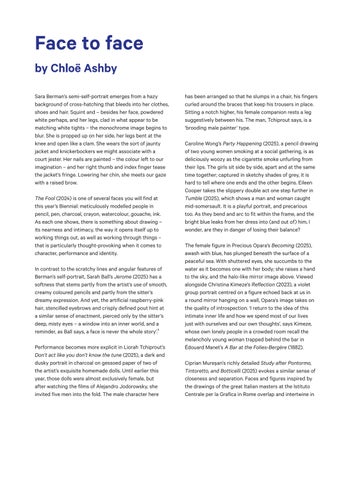
Face to face by Chloë Ashby Sara Berman’s semi-self-portrait emerges from a hazy background of cross-hatching that bleeds into her clothes, shoes and hair. Squint and – besides her face, powdered white perhaps, and her legs, clad in what appear to be matching white tights – the monochrome image begins to blur. She is propped up on her side, her legs bent at the knee and open like a clam. She wears the sort of jaunty jacket and knickerbockers we might associate with a court jester. Her nails are painted – the colour left to our imagination – and her right thumb and index finger tease the jacket’s fringe. Lowering her chin, she meets our gaze with a raised brow. The Fool (2024) is one of several faces you will find at this year’s Biennial: meticulously modelled people in pencil, pen, charcoal, crayon, watercolour, gouache, ink. As each one shows, there is something about drawing – its nearness and intimacy, the way it opens itself up to working things out, as well as working through things – that is particularly thought-provoking when it comes to character, performance and identity. In contrast to the scratchy lines and angular features of Berman’s self-portrait, Sarah Ball’s Jerome (2025) has a softness that stems partly from the artist’s use of smooth, creamy coloured pencils and partly from the sitter’s dreamy expression. And yet, the artificial raspberry-pink hair, stencilled eyebrows and crisply defined pout hint at a similar sense of enactment, pierced only by the sitter’s deep, misty eyes – a window into an inner world, and a reminder, as Ball says, a face is never the whole story’.1 Performance becomes more explicit in Liorah Tchiprout’s Don’t act like you don’t know the tune (2025), a dark and dusky portrait in charcoal on gessoed paper of two of the artist’s exquisite homemade dolls. Until earlier this year, those dolls were almost exclusively female, but after watching the films of Alejandro Jodorowsky, she invited five men into the fold. The male character here
has been arranged so that he slumps in a chair, his fingers curled around the braces that keep his trousers in place. Sitting a notch higher, his female companion rests a leg suggestively between his. The man, Tchiprout says, is a ‘brooding male painter’ type. Caroline Wong’s Party Happening (2025), a pencil drawing of two young women smoking at a social gathering, is as deliciously woozy as the cigarette smoke unfurling from their lips. The girls sit side by side, apart and at the same time together; captured in sketchy shades of grey, it is hard to tell where one ends and the other begins. Eileen Cooper takes the slippery double act one step further in Tumble (2025), which shows a man and woman caught mid-somersault. It is a playful portrait, and precarious too. As they bend and arc to fit within the frame, and the bright blue leaks from her dress into (and out of) him, I wonder, are they in danger of losing their balance? The female figure in Precious Opara’s Becoming (2025), awash with blue, has plunged beneath the surface of a peaceful sea. With shuttered eyes, she succumbs to the water as it becomes one with her body; she raises a hand to the sky, and the halo-like mirror image above. Viewed alongside Christina Kimeze’s Reflection (2023), a violet group portrait centred on a figure echoed back at us in a round mirror hanging on a wall, Opara’s image takes on the quality of introspection. ‘I return to the idea of this intimate inner life and how we spend most of our lives just with ourselves and our own thoughts’, says Kimeze, whose own lonely people in a crowded room recall the melancholy young woman trapped behind the bar in Édouard Manet’s A Bar at the Folies-Bergère (1882). Ciprian Mureşan’s richly detailed Study after Pontormo, Tintoretto, and Botticelli (2025) evokes a similar sense of closeness and separation. Faces and figures inspired by the drawings of the great Italian masters at the Istituto Centrale per la Grafica in Rome overlap and intertwine in