










Edited by Lynne Cooke with Ethel Brooks
Noëlig Le Roux
Ulrike Müller
Laura Hoptman
For Ceija Stojka, memory was a history that had yet to be told, and she took it upon herself to tell it through writing, advocacy, activism, and, most importantly, art. It was with this last form of expression that Stojka began to give compelling visual form to her stories of persecution, incarceration, and torture during the Holocaust, or, as Roma and Sinti people call it, the Porajmos. 1 In our current moment, when fascism has resurged around the globe, Stojka’s witness to the depredations enacted upon her, her family, and fellow Roma has resonance beyond the beauty and horror depicted in the artworks themselves.
Born in Vienna in 1933, Stojka’s childhood, spent traveling with her family of horse traders, was destroyed when, in 1943, at the age of nine, Stojka, her mother, and her siblings were swept up with other Viennese Roma and transported to a series of concentration camps. These included Auschwitz-Birkenau, Ravensbrück, and, finally, Bergen-Belsen, from where she was liberated. Stojka never forgot or, for that matter, forgave the perpetrators who tried to extinguish not only her family but also an entire culture.
Her childhood memories spurred her to make art about the persecution of the Roma and Sinti peoples, and her stark expressions of the struggles of internees to survive make up more than half of her artistic production. Stojka’s tableaus are fascinating but also deeply disturbing, and the heartrending victimization she depicts is tempered by (and was produced in concert with) a wholly different body of work celebrating the joys and beauties of traditional Roma life. Within this latter group of works, scenes of family and community join jubilant depictions of fields of sunflowers surrounding bright red caravans or peaceful, verdant
mountain valleys where children play and a lone rider wrangles an unruly horse.
Although there are roughly one million people of Roma or Sinti heritage living in the US—with a history in the Americas that stretches back to 1498—Roma and Sinti cultural production remains virtually unknown and (with a few notable academic exceptions) widely unstudied. Exotic figures in the American imagination, the Roma and Sinti presence in our culture exists primarily through clichés accrued over the centuries, rendering them less a part of history and, thus, less real to our contemporary experience. Most brutally, their very real story of persecution during World War II—where it is estimated that between 250,000 and 500,000 Roma and Sinti people died at the hands of Adolf Hitler and his henchmen—often goes unrecorded in national or official histories of the Holocaust.
It was Stojka’s artistic aim to universally correct this historical omission. To honor her with a comprehensive presentation of her work at The Drawing Center seems like a worthy, if not timely thing to do—not just to positively contribute to, and perhaps complicate, the mainstream history of culture through the lens of drawing (our institution’s mission), but also to engage and move our audience. Stojka, powered by the urgency of her project, was a brilliant artist whose compositions hold their own as art as well as information. She valued both equally, and viewers of Ceija Stojka: Making Visible will leave the show with an unforgettable aesthetic experience, as well as a fuller understanding of the Roma and Sinti during the lifetime of one of their most respected spokespeople.
The Drawing Center has the eminent curator Lynne Cooke to thank for bringing the work of Stojka to us. Along with her co-curator, Noëlig Le Roux, Cooke has created a visually beautiful exhibition rife with difficult, sometimes terrible content. The accompanying catalog, edited by Cooke, contains essays by the curators, as well as Dr. Ethel Brooks, Associate Professor in Women’s and Gender Studies and Sociology at Rutgers, and the wonderful Austrian artist Ulrike Müller. We thank them all for their contributions. Both the exhibition and the catalog could not have been produced without the help of Rebecca DiGiovanna, Assistant
Curator at The Drawing Center, who, from the very beginning of this project, expertly created and managed the infrastructure we needed to realize the best exhibition and publication possible. Stojka’s family, including Hodja, Nuna, Santino, and Manolo Stojka, has been generous with their time and knowledge. We thank them for sharing the work of their illustrious relative with the American public. We would also like to thank the institutional and individual lenders to the show, including Moritz Pankok, Artistic Director of Galerie Kai Dikhas; Lorely French, who also assisted with funding from the Austrian Government through the Ceija Stojka International Association; and Antoine de Galbert and Arthur Toqué of Fondation Antoine de Galbert for so generously lending a key group of works from the Foundation’s unrivaled collection. The Memorial Museum of Ravensbrück in Germany loaned work, and we thank Dr. Andrea Genest, Director, and Hannah Sprute, Head of the Museological Department, for their generous help with curatorial research. Dolores Zinny and Juan Maidagan helped facilitate Cooke’s visit to the Ravensbrück Concentration Camp Memorial. We also thank the Brandenburg Memorials Foundation and Aaron K. Roth, Administrative Director.
Thanks are also due to Marcus Meier; Antoine Frérot; Laurent, Lilah, and Elie Nebot; Xavier Marchand; Frédérique Pélissier; Florence and Daniel Guerlain; Stanislas Ract-Madoux; Galerie Christophe Gaillard; Lith Bahlmann; Marin Karmitz; Guillaume Lointier; and Caroline Bourgeois and Morgane Mauger at the Pinault Collection. The curators are also grateful to Franziska Helmreich and Matthias Reichelt for their research support. Finally, we thank the Wien Museum, where Andrea Glatz and Gerhard Milchram provided research support as well as loans.
From the outset of this project, filmmaker Karin Berger has been enormously supportive and kindly allowed us to show her documentaries featuring Stojka during the show. For the films, we must thank Navigator Film and Monika Lendl and Constantin Wulff for providing licensing. Ursula Pokorny provided translation services for the curators’ visit with the Stojka family in Vienna and assisted with research for Cooke’s essay. At The Drawing Center, in addition to DiGiovanna, thanks must be given to Olga Valle
Tetkowski, Sarah Fogel, and Aaron Zimmerman for facilitating all aspects of the exhibition, from loans to installation; Rebecca Brickman and Tiffany Shi for their fundraising finesse; Allison Underwood, Isa Riquezes, Aimee Good, and Neal Flynn for their marketing and programming ideation; Valerie Newton and Anna Oliver for their design work and careful choice of bespoke retail merchandise; and Curatorial Fellows Gonçalo Preto and Rebecca Bonini for their crucial research support.
Support for Ceija Stojka: Making Visible is provided by Phileas – The Austrian Office for Contemporary Art; the Robert Lehman Foundation; the Republic of Austria’s Federal Ministry of Housing, Arts, Culture, Media and Sport (BMWKMS); and the Gladys Krieble Delmas Foundation. Support for the exhibition catalog is provided by Furthermore: a program of the J. M. Kaplan Fund. The Drawing Center is enormously grateful to these visionary funders. We extend a special thanks to the Ceija Stojka International Association for their help and advice, with thanks to Carina Kurta and Lorely French.
1. The Roma, or Romani (sometimes spelled Romany), are a diverse ethnic group historically associated with itinerant lifestyles. The Romani population is generally understood to comprise several major groupings, each encompassing numerous subgroups or communities with distinct languages, customs, and traditions. Roma more narrowly refers to Romani populations historically based in eastern and southeastern Europe, though outside German-speaking countries the term Roma is often used as an umbrella designation for the Romani people as a whole. The term Sinti refers to Romani groups that settled in present-day Germany and neighboring regions beginning in the early fifteenth century.
Lynne Cooke
“Pictures want equal rights with language, not to be turned into language.”
—W. J. T. Mitchell, “What Do Pictures Want?” (2005)
In 1998, on the death of her partner, Kalman Horvath, Ceija Stojka transformed their capacious Vienna apartment into a live-work studio. For almost a decade, she had produced her artworks on the kitchen counter; now, she spread out, and her relationship between her life and studio practice began to change. Family would continue to center her, but, for the first time, she was living alone. Haunted by memories of her Roma childhood and the traumatic years she spent in Nazi concentration camps, Stojka grew increasingly alarmed by the rise of far-right extremism at home and abroad. In the mid-eighties, following the election of former Nazi Kurt Waldheim to the Austrian presidency, Holocaust deniers were emboldened. By the nineties, widespread xenophobia, which scapegoated ethnic and racial minorities as the cause of social and economic problems, had taken hold.
Stojka had made her living selling carpets in Vienna for some thirty years before she began to write and, then, in the later eighties, to publish her memoirs. On the cusp of the nineties, she turned to painting. As she grew into the physical and conceptual space provided by her new living conditions, paintings and drawings gradually filled the apartment. While many attested to her charged vision—her conviction that “Auschwitz was only sleeping”—others, including exuberant fields of poppies, expressed her belief in nature’s regenerative powers. 1 In retrospect, the late 1990s mark a watershed in her professional and personal life.
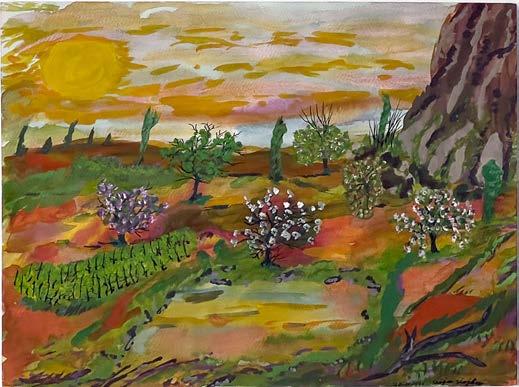
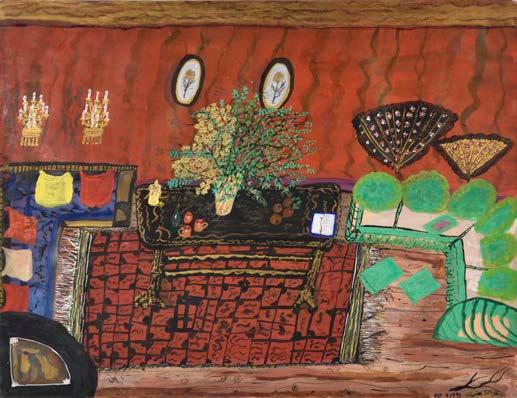
Stojka’s turn to painting was fortuitous. While on a cultural trip to Japan in 1989, she visited a kindergarten, where she met with a group of children who were making art. Hoping to break down the language barrier, she promised to send examples of her granddaughters’ paintings on returning home.2 When they baulked at the task, she picked up their brushes. Among her earliest experiments is a delicate watercolor, The day is still young. Trees are in blossom in the Wachau (20.10.1990) (fig. 1), which depicts a region where her extended family had deep roots. A year later, as seen in an untitled work from 1991 (fig. 2), she took up gouache, a medium better suited to the painstaking rendering of her living room with its carefully coordinated furnishings. By 1992, she had settled on acrylic, a fast-drying medium that facilitated looser, more expressive ways of working. Untitled (Ravensbrück Women’s Camp) (30.04.1992) (PL. 01) offers a panoptic overview of the women’s concentration camp where, as a ten-year-old, she was interned from August 1944 through January 1945. Flattening the barracks that surround the vast courtyard, the elevated vantage requires the viewer to surveil the site of daily roll calls, brutal punishments, and sundry industrial -scale operations that, between 1939 and 1945, constrained and choreographed the lives of some 145,000 female workers. Vividly rendered, the icy ground and lowering, dun-colored sky conjure the freezing conditions in which they spent grueling hours standing at attention. Painted three years later, a second Ravensbrück image (PL. 14) dispenses with that quasi-cartographic treatment in favor of a spatialized pictorialism. Now fully in her stride, Stojka centers the sinister black form of SS auxiliary Dorothea Binz, infamous for her cruelty. Seen from behind, whip in hand and dog at the ready, she inspects a huddle of ashen internees.
Formally and stylistically, the 1991 gouache detailing the interior of her living room (fig. 2) aligns with a series of fifteen paintings made by Josette Molland, which focus on her experiences while interned in Ravensbrück following her arrest in 1944 as a member of the French Resistance (fig. 3).3 Although she was academically trained, Molland created these teaching aids in a faux naif style because she believed it would be more legible in a
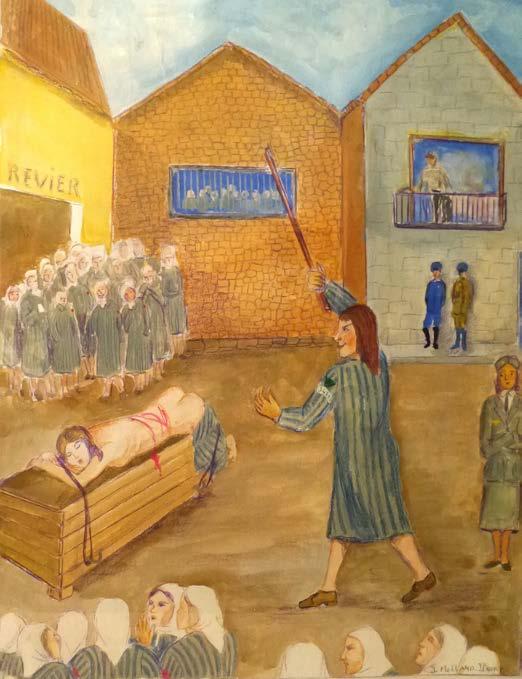
classroom context, and so make her stories of Nazi atrocities more comprehensible to students.
From 1992 to 2012, Stojka regularly met with young people in workshops she organized annually at Amerlinghaus, an arts center in Vienna dedicated to presenting the culture of minorities—the Roma, above all. Unlike Molland, she did not customize her works on camp subjects to serve a pedagogical end. The paintings that followed her meticulously rendered gouache subsume information in favor of a more emotive realism. On first sight, these distanced observations of sites of terror appear to be psychically as well as physically detached. Closer inspection, however, undermines the impression of dispassionate testimony. The sense of unease troubling the scenes depends, above all, on her nuanced rendering of the elements—weather, season, time of day—as if the natural world manifested empathetically with the plight of the prisoners. With no formal training, Stojka schooled herself through experimentation and invention. As her range of pictorial modes— landscape, genre scenes, still life, surrealistic visions, and so on— widened, she prioritized process, improvising tools, and using her fingers in place of conventional brushes. On the rare occasions that she explicitly assumed a child’s perspective, the images bear no trace of the tenuous unreliability of remembered childhood, nor the quirks of subjectivity. Artfully constructed, they are designed to optimize a viewer’s engagement. In written accounts of her life in the camps, Stojka obsessively references the SS officers’ polished boots, so different from the ill-fitting, mismatched pairs of worn shoes supplied to prisoners. Whenever they neared, quivers of fear would run through her body.4 In a series of still-life paintings, of which an untitled work from 2001 (PL. 25) is the acme, she transforms the Nazis’ glossy footwear into synecdoches— shorthand signifiers of implacable authority. In these visual artworks, the lively anecdotes that animate her memoirs yield to a distilled charge, generated by the viewing conditions she imposes to control and structure the spectator’s relationship to the image. Here, the observer’s one-on-one encounter with the isolated, monumentalized subject makes palpable the frightened child’s sense of powerlessness.
The bucolic landscapes Stojka painted in the nineties offer a counterpoint to the camp scenes replete with sublimated fear and horror. Set in the expansive farming country of Burgenland and Styria, in Lower Austria, through which she traveled with her family of Lovara horse traders, her pastorals evoke an idyllic childhood. Standouts include a seasonal cycle of untitled works painted between 1995 and 1996: (PL. 16), (PL. 17), (PL. 18), and (PL. 19). Appropriately, it is in winter (PL. 16) that this traditional communal life is shattered. On the pristine ground, close by hastily abandoned caravans, a Nazi flag leaves a bloody gash. Neither that scene, nor a related one from the same year, depicting the round-up of Roma encamped on the outskirts of Vienna (“Where are our Roma?” Laaerberg 1938, 1995. fig. 5, pg. 77), were events that she herself witnessed. Seeking to compose a pictorial pantheon that richly bore witness to her community’s fate under Nazi occupation, Stojka drew on the memories of her extended family.
Juxtapositions of what she would later call her “dark” and “light” subjects within that artistic corpus prove telling.5 For example, the representation of summer in this seasonal cycle (PL. 18) presents a view of Lake Neusiedl on the Austro-Hungarian border, a camping place dear to her mother, Sidonie. As the sun sets, it traces a path across the lake; men fish and groom the horses; women prepare the evening meal. In 1945, Ravensbrück, 1995 (1995) (PL. 15), painted the same year, the vantage point is reversed. Viewers now look across a path of floating petals toward the shore, where Stojka and her daughter-in-law, Nuna, cast flowers into Lake Schwedt, which links the labor camp to the town of Fürstenberg opposite.
In 1995, on a return visit to the site she had escaped fifty years earlier, Stojka was able to take stock of the specifics of the location for the first time. Purpose-built in 1939, Ravensbrück fulfilled Heinrich Himmler’s plan to situate internment camps in places of natural beauty. The picturesque lake borders the holiday resort of Fürstenberg, from where it is still possible to see the outer wall of the camp. In Stojka’s distillation of that loaded visit, eerie golden light from the low sun provides a foil to the ravens and withered trees on the horizon; a lone sailor skims the water’s dark
depths, where ashes, retrieved from the adjacent crematorium, were dumped; the two women commemorate the dead. The text on the painting’s reverse reads: “I can’t believe the people who live there today catch fish out of this lake where our souls are resting in ash.”
These nineties’ landscapes and genre scenes show the artist at the peak of her powers as a realist painter. Rooted in seventeenth-century Dutch precedents, by the twentieth century, those compositional structures had become mainstays of vernacular painters. Other works from this decade originate in the well-established genre of the fantastical and visionary: Revivified by late-nineteenth-century Symbolists, it was later diffused via Surrealism into mass culture. A prime example, an untitled work from 1995 (PL. 10), depicts an omnipotent green eye, its sclera scarred by insignia of death—ravens, a swastika-branded chimney, and a skull. In Decay (Rot) (1995) (PL. 11), eyes sprout amid shards of barbed wire and rotting flesh strewn across the ground: Like the cosmos, the earth, too, bears witness to unspeakable atrocity. Subtitled SS, a second small acrylic from 1995 (PL. 13) confirms that horrifying visions had long haunted the artist’s imaginary. Its focal point is a blazing fire into which the naked bodies of women and children are falling. Only when the viewer takes into account the shadowy figure of a looming Nazi guard, seen from a low vantage point close by, does it become clear what likely triggered Stojka’s ghastly vision.
In her self-appointed role as witness, Stojka felt no need to be comprehensive. Subjects relating to forced labor, for instance, are absent from the lexicon of images of Ravensbrück, where, for a time, she was compelled to join the grueling shifts of seamstresses who made uniforms for prisoners in camps throughout Nazi-controlled territories. Rather, her selective repertoire homes in on ritualized acts of degradation, violence, and humiliation that, beginning with the deportation trains, were strategically designed to strip prisoners of their identities and sense of selfhood—rendering them, in Nazi ideology, nonhuman and, hence, expendable. That said, contemporary sociopolitical and cultural events that threatened to erase historical memory could
also become triggers. Consider, Untitled (14.05.1993) (PL. 02), which records Stojka’s response to a proposal, initially approved by civic authorities, to erect a supermarket on the AuschwitzBirkenau campsite. Its source was a photograph, published in mass media coverage of the ensuing protests, that shows the ruins of the camp, the crematoria chimneys still intact.6 Yet others were generated by hearsay, notably 1945 Bergen-Belsen, (1994) (PL. 05), a grotesque incarnation of the tale of a Nazi guard who sought to escape detention by donning the rags shed by fleeing internees.
From the outset, Stojka’s painting practice laid claim to an overarching thematic—her life as a Romni in Austria. While consistent with this encompassing project, in the aughts, her work underwent a series of formal, stylistic, and conceptual shifts that proved profound. Thus, the late nineties may be read as an inflection point. They mark a reorientation from painting to graphic work and from pictorial typologies congruent with nineteenth-century models (above all, those of landscape and genre) toward a diverse range of modernist modes: an expressionist etiolation of form into abstract mark-making, and a fusion of text/image, notable among them.
Two paintings from 1999 forecast that pivot. One, dated 18.04.1999 (PL. 22), signals an end to her numerous depictions of nature as a refuge harboring the travelers.7 Notably spare, the composition features a stand of three trees, which offer shelter to birds flying low to the ground. In her memoirs, Stojka recalls a favorite campsite, an arbor of three trees where the family liked to park their wagons during their long summer travels. Silhouetted in golden light, this copse, with its sturdy trunks, takes on an elegiac tenor presaged in paintings by Caspar David Friedrich. However, in contrast to the religiosity of the German Romantic’s naturebased spirituality, the registers of loss and longing in Stojka’s work are personal and communal: the recent death of her partner and the dispossession, as Moritz Pankok writes, “of a culture, a traditional way of life.”8

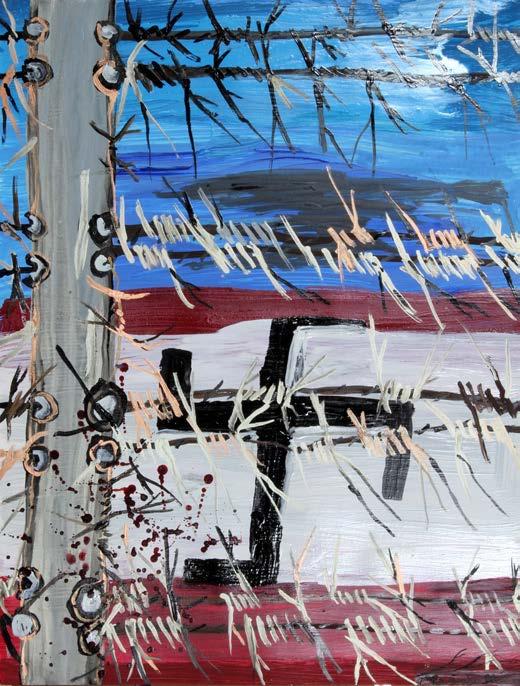
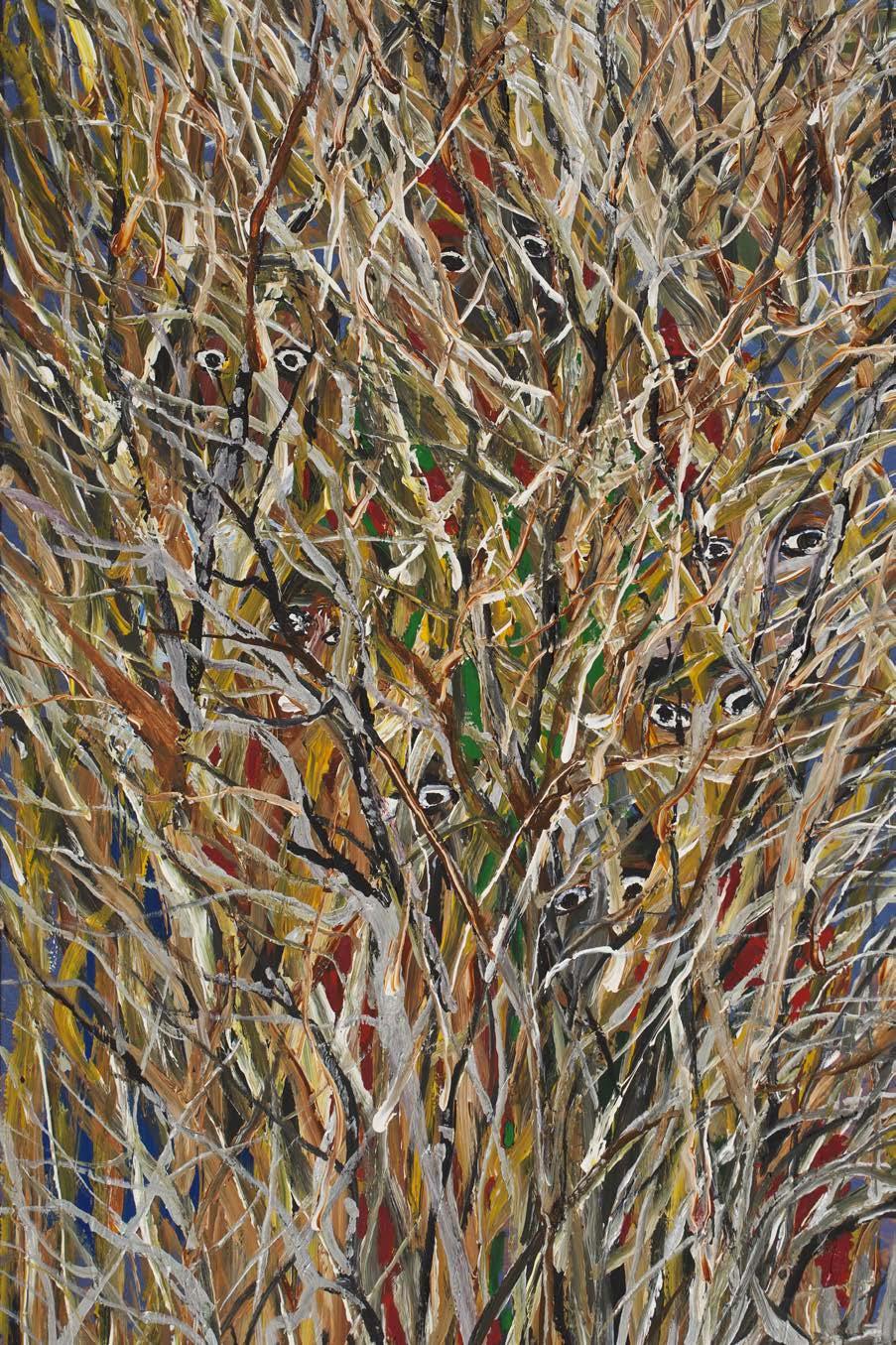
At a hundred and twenty by one hundred centimeters, the second key painting from that transitional year (fig. 4) is the largest known work in Stojka’s oeuvre. Where its companion was retrospective, this monochromatic picture, dated 20.07.1999, portends future developments. Strokes of thinned black acrylic conjure a group of barely legible figures, their gender unclear, who crowd the indeterminate space. A dark shape occupies the lower right corner. Two parallel lines, bisecting the composition horizontally, establish a barrier between the spectator and the etiolated bodies.9 In the lower left corner, a row of fingerprints indicates others, outside the frame, who reach up toward the cohort. Smears of brownish-red pigment suggest blood seeping from unseen wounds or orifices. Stojka’s recourse to a large format to evoke those murdered as part of what, in Nazi terminology, was called The Final Solution had no issue going forward. Thereafter, she would work on small sheets of paper that offer the viewing subject a certain privacy when confronted with the enormity of the meticulously planned genocide. In 1995, she penned a deeply personal meditation that compared death’s relation, respectively, to Christianity and Nazi ideology. This text was written on the reverse of an untitled work from 1995 (fig. 5), a painting featuring a section of the electrified barbed-wire fence that secured the perimeter of Auschwitz.10 Splattered drops of paint stain the snow-covered ground that stretches into the bleak distance. Read associatively—as blood—they transform the black swastika, wedged between the wires held by fixtures to the uprights, into a ghastly marker of a suicide or a failed escape:
The crucifix and Death belong together. But Death does not know the swastika. Even if Mr Death is older than the crucifix, he still has his cross to bear with humanity. But this hooked cross [the swastika], what does it do? People do not pray before it. This kind of cross botches, botches up my work. There are millions of dead beneath the swastika. No, no, never am I Death to blame. Ceija, 18.08.1995. Even Death is terrified of Auschwitz. Ceija
As the aughts unfolded, death would become her persistent subject. To that point, Stojka had made relatively few drawings, most in pen and ink. Subsequently, she would privilege a range of graphic mediums.11 Representative of her early ventures are three studies from 1993 (PLs. 40, 39, 38) in an angular, scratchy, expressionist style, one enlivened with touches of color, which isolate male figures spewing vitriol (PL. 38). A fourth, a large untitled work from 1995 (PL. 41), situates a crowd of tiny figures between a firing line of massive assailants and the void of an unrelieved black expanse.
Post-2000, she homes in on the victims’ plight. Images of humiliation, shame, and suffering are counterpointed by others of maternal care and tenderness. Consider Untitled (We are ashamed. Auschwitz 1944. Ame Lažas amme) (29.03.2003) (PL. 49), a pen-and-ink reprise of the great 1999 painting; or Untitled (Auschwitz, 1944. Without words) (14.02.2006) (PL. 56), in which the spectral group is limned in ink thinned to a wash. In Untitled (To the Crematorium) (08.09.2003) (PL. 46), prints of the artist’s ink-laden fingers conjure a crowd moving to their end. Dead (n.d.) (PL. 47), a sheet with the same dimensions, comprises a field of black marks suggestive of ashes: at its center, the word TOT [DEAD]. In Corpses (2007) (PL. 28), the ravens are hard to distinguish from the swastikas that infiltrate their airspace.
Exceptionally, in Z.B. [Zyklon B] Gas Chamber on 02.08.1944 in Auschwitz. The Final Liquidation, (02.02.2006) (PL. 55), Stojka reverted to a visionary idiom to address the murder of the last contingent from the segregated Roma camp established within Auschwitz in 1939. Viewed as if through a portal, two “air bubbles” containing ravens/souls rise above the massed figures below—some several thousand fellow Rom who perished on the night of August 2, 1944. She and her mother narrowly escaped the same fate. Several days earlier, they were judged fit for forced labor and transported to Ravensbrück. In January 1945, they were transferred to Bergen-Belsen.
With the Germans retreating under Allied advances, the end of the war seemed inevitable. Evidence of the breakdown in control mounted daily. Piles of corpses, scattered throughout the
camp, became refuges for the young Stojka—places to play and shelter—as she recounts in The Green Green Grass Beneath (2005), a harrowing documentary directed by filmmaker and close friend Karin Berger. Safety—liberty—was far from certain, as Untitled (THEN: 1945/I WAS/THEN/IN THE/MIDDLE/UNDER THEM/ PROTECTED BY MY/MAMA./FROM THE OUTSIDE/THERE CAME/NO HELP./WHY? S CS) (22.01.2003) (PL. 48) makes clear. The interstices between the words, a cry for help that was not met, are filled with the ubiquitous ravens.12 Toward the end of the decade, Stojka’s output appears to escalate, as if propelled by a growing sense of urgency; even her full signature is truncated to the initials “C.S.” Hastily rendered, subject to erasure and blurring, as seen in an untitled work from 2009 (PL. 59), the cursory graphic formulations speak eloquently of the chaos and destruction that followed the implosion of the German war machine.
In Untitled (Smeared with blood, that’s how Mama and I left Bergen-Belsen) (PL. 63), a small undated acrylic on cardboard, Stojka introduces a saturated palette of intense scarlet and crimson, enlivened with touches of yellow and sky blue. Rivulets and marks blot out pre-existing forms, fugitive figures against an undefined ground. Were it not for the text, which provides the title, this anomalous work would remain cryptic. On several occasions, including in the annotation that provides the title for Untitled (Mama, Mamooo. We Are Free. We Didn’t Have Any Faces Yet), (20.02.2004) (PL. 51), Stojka alluded to the loss of faces.13 Unforgettable, her metaphor suggests that individuals become merely specimens when shorn of identity, a thesis elaborated upon in 2000 by renowned social theorist Zygmunt Bauman. In the afterword to his foundational text, Modernity and the Holocaust, he argues:
Abstraction is one of the modern mind’s principal powers. When applied to humans, that power means effacing the face: whatever marks remain of the face serve as badges of membership, the signs of belonging to a category and the fate metered out to the owner of the face is nothing more yet nothing less either than the treatment reserved
for the category of which the owner of the face is but a specimen. The overall effect of abstraction is that rules routinely followed in personal interaction, ethical rules most prominent among them, do not interfere where the handling of the category is concerned.
Himself a victim of antisemitic purges, Bauman concludes: “For genocide to be possible, personal differences must first be obliterated and faces must be melted into the uniform mass of the abstract category.”14
Even before World War II ended, the “question of the figurable” was at the heart of debates concerning representation of the unprecedented atrocities. In 1985, the release of Claude Lanzmann’s epic film, Shoah, revivified the discourse centered on the unimaginability and, hence, indescribability of the Holocaust. Almost ten hours long, Shoah presents interviews the director made with perpetrators, survivors, and bystanders during visits to camps and other Holocaust sites in Poland over some eleven years. Rejecting documentary imagery from the period, Shoah served as a rebuttal to Alain Resnais’s revelatory Nuit et Brouillard, which had shocked viewers upon its release in 1956 by intercutting tranquil shots in color of the then-deserted campsites with black-and-white archival footage.
In 2002, the publication of Georges Didi-Huberman’s controversial text, “Images in Spite of All: Four Photographs from Auschwitz,” rekindled the simmering debate. Birthed in a discourse centered on photography and film, the argument quickly spread to the fine arts. By the early twenty-first century, as Mark Godfrey demonstrates in Abstraction and the Holocaust, nonobjective visual languages were ascendant as the most appropriate—and most compelling—idiom for addressing the issue.16 No longer a signifier of the impossibility of representation, abstraction, Godfrey contends, today makes meaning in alternate ways. Yet, even as Stojka’s work shifted in concert with current thinking in Holocaust studies, for her, that binary remained moot. Amplified by text when needed, her art bears witness associatively and metaphorically; as much by material and processual means as via description.
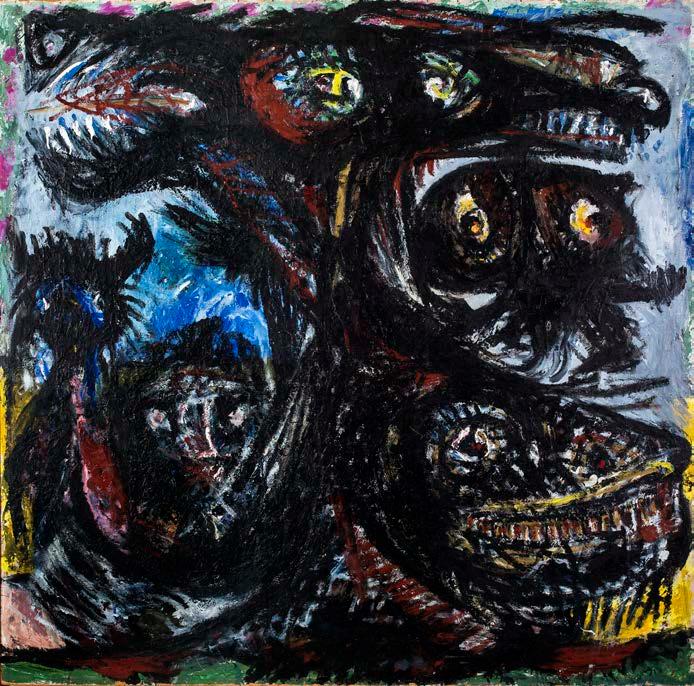
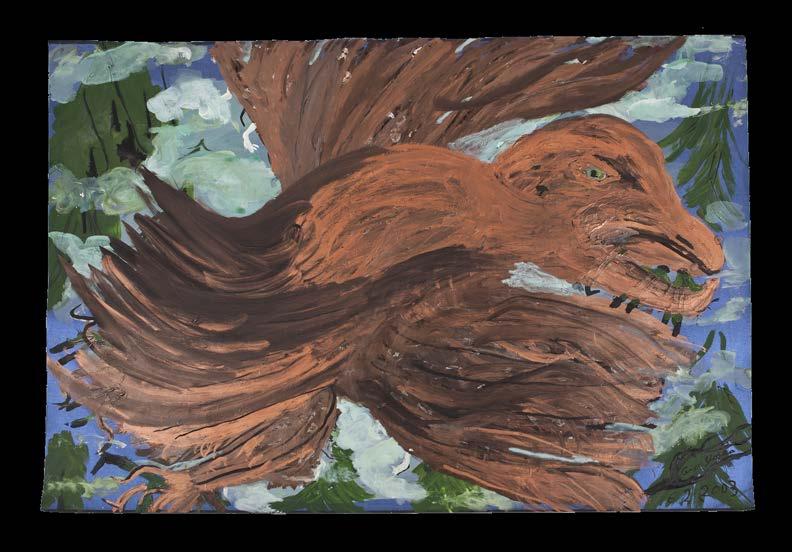
The visits Stojka made to various campsites, some five decades after the carnage ended, were milestones that she recorded both in texts and in her art: in 1994, to Dachau, where her father was interned (prior to his murder at Schloss Hartheim; see Dachau Concentration Camp (1994) (PL. 04); in 1995, to Ravensbrück, as discussed above; and in 2003, to Bergen-Belsen. The night before she returned there, she dreamed that corpses rose from the mass graves to constitute a “human grave bird.” The nightmarish image she materialized in an untitled painting from February 6, 2003 (PL. 27) resonates with the ancient heraldic symbol of power that is the subject of Asger Jorn’s Le droit de l’aigle (The Power of the Eagle) (1951) (fig. 6). Part of a series he titled War Visions, Jorn conceived this iconic work in Copenhagen, where he had remained during the Nazi occupation between 1940 and 1945.17
Almost certainly, Stojka was unaware of the Danish artist’s signature statement and that of other postwar vanguard artists, not least Morris Louis, who confronted his catastrophic heritage in the later 1950s in Charred Journals: Firewritten, a little-known series of small, black-and-white paintings.18 Setting aside questions of influence or appropriation in favor of congruence, Stojka’s work can be productively situated in relation to that of peers who shared her commitment to political and ethical vigilance in the wake of unprecedented devastation and horror. In bridging boundaries often considered non-negotiable between figuration and abstraction, or between image and text, her art complexifies art histories founded in siloed lineages.
While committed to keeping alive knowledge of the Porajmos [the Devouring], during which an estimated five hundred thousand Roma and Sinti died, Stojka was highly attuned to the possibility of future predations.19 Between circa 1993 and 2005, she created a small group of paintings that track with the heightened violence and persecution accorded the Roma under Austria’s neo-nationalist government, heir to Nazi policies and values. Rarely exhibited, these polemical works radically revise the syntax and address of her concurrent works based on the camps. Pared to the most basic formulations, politics here pre-empt poetics. Among the earliest is one from 1993, the year in which the Austrian government belatedly
acknowledged the Roma as an ethnic minority. Set against a scarlet backdrop, a blond-headed, goose-stepping stick figure models a disjointed swastika. In 1995, that untitled work served as the frontispiece to an exhibition catalog, which, mimicking Stojka’s recto/verso play with image and text, included an epigraph on the final page: “Ein Pferd hat vier Beine und kommt auch zu Fall” [A horse has four legs and also falls].
The year 1995 was a turning point in Austrian history. In the aftermath of a racist bombing in Oberwart that killed four Roma and left many others injured, survivors of the Porajmos began to receive restitution from public funds. Victory to our Führer! (06.08.2001) (PL. 26), a more confrontational work, expands her rogues’ gallery, mixing fear and fury in the face of ascendant fascist forces. Inscribed “Sieg Heil, unerer [sic] Führer,” the monochrome field supports a schematic couple, accompanied by ravens and swastikas. The text on the reverse provides a key to Stojka’s motivations: “When the toads free themselves from their holes beneath the ground, I always think of my grandma [Mami] and all of those who died that way. Where are they, they about whom nobody talks, as if they had never been born? Where did they die?” It ends, “In God’s nature I can at least think of you all. The guilty, who knows where they are?” Rhetorical indictments of their moment, these little-known works resonate today with renewed force.
Nature, long foundational in Stojka’s vision, remains a through line in her late work in acrylic and gouache. Untethered from signs of human presence, radiant visions of the natural world replace the veristic representations from the nineties of the symbiotic bond that once bound traditional Roma life to the rural milieu.20
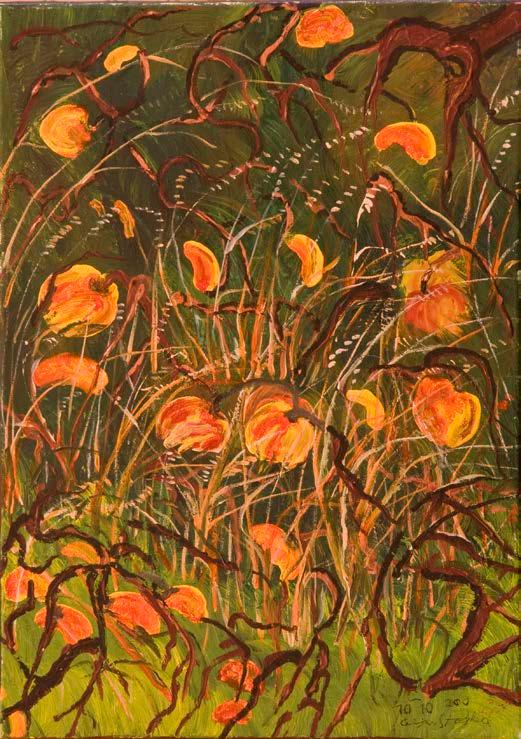
The Fallen Apple/The Fruit of Rebirth (2000) (fig. 7), rendered in an autumnal palette of greens, browns, oranges, and warm yellows, is emblematic of this revision. Close-cropped, the humble subject reveals full-blown blossoms amid a tangle of grasses and branches: As if stirred by a breeze, they shed golden petals.
In 2004, the Jewish Museum in Vienna presented

fig. 8—Installation view of Ceija Stojka: Leben! (Ceija Stojka: Life!) On view December 2004-March 2005 at the Jewish Museum, Vienna
a solo exhibition of Stojka’s work. More explicitly than Amerlinghaus’s earlier exhibitions in 1991 and 1993, this venue situated her work in relation to the Shoah. The wide-ranging checklist included small sculptures, in salt dough, of members of her extended family, several of whom perished in the Porajmos (fig. 3, pg. 56). Dominating the gallery was an ebullient group of sumptuous flower paintings; installed salon-style along a window wall, their brilliant hues charged the space (fig. 8). Whether roadside outliers or blossoms cultivated for oil and seeds, as seen in an undated, untitled work (PL. 36), Stojka’s varietals have no place in the domestic contexts—gardens and interior settings— favored by such masters of the genre as Emil Nolde.21 Absent the refinement required for bouquets and wreaths—too wild, in short, to be tokens of commemoration—her blooms embody a dynamic life force, rhapsodic in affect. Neither sentimental nor respectful of vanguard art’s orthodoxies, their excessive, disorienting abundance transcends stereotypes.22
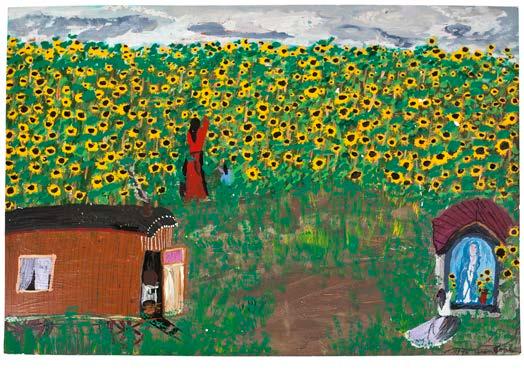
Yet, unsettling glimpses of the dark side of nature never fully disappear from her oeuvre. See, for example, an untitled work (05.01.2006) (PL. 32), which features sunflowers, the emblem of the Roma. Flanking the lush crop, rendered palpable in thick, juicy pigment, are bare trees and a distant treachery of ravens. To Stojka, for whom these celebrations of nature at her most bountiful represented hope for the future, the preference of audiences for her “dark” over her “light” subjects was disappointing. Curators and writers, for whom the ostensibly cloying subject lacks criticality, continue to dismiss them.
The retrospectives (and accompanying catalogs) devoted to Stojka’s art since her passing in 2013 have typically sequenced her works by reference to major periods in her life. Doubtless designed to aid viewers unfamiliar with the subject’s biography and historical context, this way of organizing her oeuvre encourages a reading of the artworks as illustrations to an exceptional life story; it also masks the sidelining of disfavored bodies of work. At odds with
normative museological practices, it is also at variance with standard art-historical methodologies, which order an artist’s production chronologically.23 Tracking an artist’s unfolding practice over time illuminates shifts in aesthetic concerns, foregrounds milestones in a stylistic evolution, and spotlights recursive formulations, whether of subject matter or medium.24 Further, it reveals the work’s porousness to world events and debates, often obscured in biographically based presentations that isolate it from both the contemporary sociopolitical and cultural context, as well as the work of peers.25 Not least, it downplays visually-based considerations, whether of the material process of making, or the formal and emotional registers of the work, in favor of verbal information based on the motifs depicted and the underlying chronicles. Argueably, it has also contributed to the shortfall in substantive art-historical scholarship on Stojka’s work to date.
Like any artist deeply engaged with their practice, Stojka explored formal issues, experimented with a variety of mediums, supports, and processes, and, when revisiting earlier iterations, benefited from her deepening experience. Irrespective of whether a work was initiated by a dream, a resurgent traumatic memory, or a current event, she was intentional and deliberative in crafting the finished result. Her supplemental annotations, a form of commentary, record her thinking during and after the process of creation.26 In her text/image works, that partnership becomes codependent. Never, however, are her pictures simply pretexts. Through her embrace of selective detail, viewpoint, metaphorical abstraction, careful delineation, and nuanced brushwork, she simultaneously depicts the shape and emotional tenor of places and events in her own life and in the lives of her Romani compatriots.
The author would like to thank Ulrike Müller for illuminating conversations about Ceija Stojka and her art over the years, as well as her invaluable comments on an earlier draft of this text. Ann Reynolds has generously commented on a later draft. Rebecca DiGiovanna has provided crucial editorial assistance and research. Karin Berger offered indispensable advice and information.
1. “Nature is my life. I like to hold onto a tree,” quoted in Simona Anozie, “I know a tree in this place is not like any other. My Grandmother,” in Roma Artist Ceija Stojka: What Should I Be Afraid Of? (Hirmer Verlag, 2023), 15.
2. In the spring of 1989, Stojka was invited by Susanne Baranyai/Horvath, a Roma activist from Oberwart, to join her on a cultural mission to Japan. The contents of the package she sent back to Japan are not known.
3. Adam Nossiter, “Survivor Whose Raw Painting Showed Horror of Nazi Camp,” The New York Times, March 8, 2024, A1, 6, 26. Prior to her arrest, Molland worked as a designer in the silk industry. After the war, she became a professional artist.
4. In Stojka’s memoir, published in 1988 with the assistance of documentary filmmaker Karin Berger, the Germans’ boots become a constant refrain. Wir Leben im Verborgenen: Erinnerungen einer Rom-Zigeunerin [We Live in Secrecy: Memories of a Romni-Gypsy], ed. Karin Berger (Picus Verlag, 1988).
5. Stojka’s use of these terms is quoted in Lith Bahlmann and Matthias Reichelt, introduction to Ceija Stojka: Sogar der Tod Hat Angst Vor Auschwitz/ Even Death Is Terrified of Auschwitz, ed. Bahlmann and Reichelt (Verlag für moderne Kunst, 2014), 11.
6. On the reverse, Stojka wrote: “It gets to them, they are ashamed of it. This monument must stay here forever, forever, because it is the grave of our dead, who will hopefully be left in peace. Digging work must never take place here. That’s final. Ceija Stojka.” The irony of the plan to erect a food hall on a site where internees were literally starved to death would not have escaped her. See the text on the reverse of her untitled work from March 15, 2003 [PL. 29], where she writes: “Auschwitz [is] a place without fruit. Dear God, where is the bread and sausage? There was none of that [in] Auschwitz.”
7. Lorely E. French, “Ceija Stojka’s Memory Pictures of Lovara Roma Life Before World War II,” in Roma Artist Ceija Stojka: What Should I Be Afraid Of?, 27.
8. Moritz Pankok, Ort des Sehens: Kai Dikhas/Place to See 2, ed. Pankok (Galerie Kai Dikhas, Berlin, 2012), np. In mood and composition, the work bears a relation, perhaps unconscious, to a calvary. Excepting the wayside shrines dedicated to Mary, Mother of God (whom Stojka venerated), found throughout the farmlands where she traveled as a child with her family, overt Christian imagery has little place in her art.
9. Ulrike Müller suggests that the two parallel lines are imprints of the stretcher bars supporting the canvas, noting that Stojka, who rarely used canvas, preferred cardboard because it provided her with a firm surface to paint on. (Ulrike Müller, personal communication with the author, September 10, 2025.) A related drawing in ink on paper, Untitled (We are ashamed. Auschwitz 1944. Ame Lažas amme) (29.03.2003) [PL. 49], reworks this element.
10. The motif of the fence offers fascinating insight into her working process. Returning to it over several years, she created a series of works, four of which were painted on cardboard measuring sixty-five by fifty centimeters. Dated January 1, 1994, in what may be its first iteration, an electrified, barbed-wire fence frames a bare expanse of ground that gives way on the horizon to a line of conifers silhouetted against a blue sky. Two months later, on March 5, 1994, Stojka elaborated on the subject, darkening the mood by adding more trees, more wires, and a flock of ravens, or “ambassadors to God.” A day later, its wires now differently configured, the fence was reprised in a snowscape with a deportation train bearing the Nazi insignia in the distance. Four days later, March 10, 1994, stripped of the fir trees and train, the snow now melted and the ground exposed, it reemerged as a moonlit scene. In 1995, the ensnared swastika dominates what has again become a winter scene, identified, per the inscription quoted above, as
Auschwitz-Birkenau. That same year, it provides the template for a large painting, a hundred by seventy centimeters, in which a figure, up to its chest in snow, confronts the viewer through the fence. The inscription on the back reads: “I’m dying of starvation.” On May 27, 1996, in what might be the final version, Stojka again created a large picture depicting a snowy landscape. A woman on her knees, holding a child, stares through the partition. Both of these monumental works are identified as depicting Bergen-Belsen by Bahlmann and Reichelt, introduction to Ceija Stojka, 11. The rarity of a representation of a female subject on this scale has prompted some critics to propose that these are self-portraits. No other sequence of this type is known to this author.
11. Distinctions between painting and drawing are far from absolute in Stojka’s art, not least because her preferred supports were cardboard and paper. The designation “drawing” here refers primarily to graphic works in ink, gouache, and watercolor on paper. Most are modest in size; some originate in sketchpads. The notebooks she kept from the early eighties to the end of her life combine sketches with various written forms, including lists, poems, etc.
12. In English, the text reads: “THEN: 1945/I WAS/THEN/IN THE MIDDLE/UNDER THEM/PROTECTED BY MY/MAMA./FROM THE OUTSIDE/THERE CAME/ NO HELP./WHY? S CS”
13. In Fatelessness (1975), his celebrated novel based on his experiences as an internee in several camps, Imre Kertész also engages this issue.
14. Zygmunt Bauman, afterword to Modernity and the Holocaust (Polity, 2000), quoted in Mark Godfrey, Abstraction and the Holocaust (Yale University Press, 2007), 7.
15. Written in 2000, the text was published in the catalog Mémoire des camps: Photographies des camps de concentration et d’extermination nazis (1933–1999), ed. C. Cheroux (Marval, 2001), 219–41. A second part was written in 2003. An English edition combining the two texts was published by the University of Chicago in 2008. The phrase quoted above appears on page 26 of the 2012 University of Chicago edition.
16. Godfrey, introduction to Abstraction and the Holocaust, 1–22.
17. There is no evidence that Stojka visited art galleries or museums. What she knew of Modernist and Western art history likely came via mass media, above all through public broadcast television, which she kept on constantly in her apartment. Berger, who supplied this information, noted that there were very few books in the apartment. Müller suggests television served “as a continuation and extension of close social living in the caravans.” She notes that in the 1980s and nineties, one of the two Austrian television stations followed the evening news with fifteen minutes of cultural news. Ulrike Müller, email to the author, August 10, 2025. While Modernist masters, van Gogh, and the Surrealists were likely subjects for such programming, so, too, was Caspar David Friedrich, whose work, recuperated from its co-optation by Nazi ideology, became the subject of wellreceived exhibitions and revisionist scholarship in Germany and beyond. Though known to have been antisemitic and a Nazi supporter, Emil Nolde long remained a well-regarded, highly visible artist in the German-speaking world. Only after Stojka’s passing did the intersection of his politics and art become a subject of scholarly analysis.
18. Charred Journals: Firewritten takes as its point of departure the public book burnings in Germany in 1933. See Godfrey, ch. 2 in Abstraction and the Holocaust, 22–49.
19. In 1988, with the publication of her taboo-breaking memoir, Wir leben im Verborgenen [We Live in Secrecy], Stojka had become a vocal advocate for the Roma. In 1999, the national broadcast of Ceija Stojka, a ninety-minute documentary directed by Berger, consolidated her reputation as an activist.
20. Stojka’s identification with nature was rooted in the collective—part of Roma lore— and the personal. She believed that, as a result of sucking the resin and eating the leaves of a sapling growing untended in the Bergen-Belsen camp yard, she survived the internment. She paid homage to her lifesaver by sketching a tree
branch and signing her name with a twig in the lower right-hand corner of each of her artworks.
21. Though Nolde made numerous works featuring flowers, including poppies and sunflowers, throughout his career, they became his preferred subject in the 1940s. An antisemite and avid Nazi supporter, he was, nonetheless, strongly represented in the Degenerate Art show in Munich in 1938 and forbidden to exhibit or sell his work and buy art materials. Working clandestinely, he made studies of blooms in his garden and bouquets he arranged for his home, which found a ready market among patrons happy to trade art supplies for his paintings of innocuous motifs. Cut flowers are notably absent from Stojka’s floral lexicon.
22. Comparison with the nostalgic representations of an idealized, bygone, rural world made late in life by American autodidact Anna Mary Robertson (Grandma Moses) supports this claim. See Stephanie Buchmann, “The Art of Ceija Stojka Contextualized,” in Roma Artist Ceija Stojka: What Should I Be Afraid Of?, 65–79.
23. Floral subjects and the small polemical paintings from around 1993 to 2005 are largely absent from retrospectives of her art.
24. This must, ultimately, remain somewhat speculative in the absence of a catalog raisonné that documents and sequences the roughly one thousand works in her oeuvre.
25. The inappropriate designation of Stojka as a “self-taught” artist—an outmoded nomenclature that models a solipsistic, inner-directed creator indifferent to community and context—reinforces a tendency that, by treating her work as sui generis, siloes and marginalizes it.
26. So elaborated are several, such as Untitled (Mama was our nest. The boys were ashamed in front of the crematorium. 1944. Before the final liquidation. The SS were at the end of their tether. The waiting and the howling Alsatians whining terribly. They pulled at their leads. The heat was also torture for them. The sirens wailed so loudly that the animals, despite their absolute obedience [?]. The crematorium smoked terribly.) (20.05.2004) [PL. 53], that they are treated as works in their own right, and exhibited accordingly. Stojka’s preoccupation with calling out the present vis-à-vis the past manifests, too, in the double dating of works such as 1945, Ravensbrück, 1995, as well as in her habit of noting the specific day on which a work was executed.
Ulrike Müller
Ceija Stojka forged her artistic forms in contact with those closest to her. As a young child, she learned the art of storytelling from her grandmother; after becoming a grandmother herself, she began to draw and paint alongside her granddaughters. One of the first things I noticed as I sat down to begin this text was that storytelling streams powerfully back and forth between Stojka’s visual work and her writing. Stojka’s language contains images, and her images are thick with language. Images spill beyond their frames, memories refuse to stay on the page. Deeply intertwined, they pull back into story as a living format.
When she put pen to paper, Stojka went against what was expected of her. She was one of the first of her people to publicly address the Nazi genocide of the Roma and Sinti. By doing so, she broke with traditional gendered roles in her community, as well as with a latent understanding that it might be best to let the horrors of the concentration camps rest and move on with life. In the mid-1980s, four decades after the war, the Waldheim affair stirred up a public debate in Austria and beyond that equivocated the Nazi past of a high-ranking politician and amplified the voices of Holocaust deniers.1 Around that time and troubled by frequent nightmares, Stojka decided: “I have to write it all down, so that my children—no, their children, not my own, but my children’s children and grandchildren—that they, too, know what we had to suffer and what happened. I wrote it down for them, for the grandchildren of my grandchildren, for them to know what had happened.”2
Writing in 1936, when Stojka was three years old and being raised in the oral tradition of the Lovara people, Walter Benjamin mourns, in the disappearance of storytelling, the loss of “the securest among our possessions . . . the ability to exchange experiences.”3 Deeply attuned to the destructive forces of modernity, he distinguishes story from information, describing the art of keeping:
a story free from explanation as one reproduces it. . . . The most extraordinary things, marvelous things, are related with the greatest accuracy, but the psychological connection of these events is not forced upon the reader. It is left to him [sic] to interpret things the way he [sic] understands them, and thus the narrative achieves an amplitude that information lacks.4
Stojka’s older brother, Mongo, remembers Roma storytelling around the campfire in the early 1930s, which included talk about poverty and World War I, alongside scary stories that made his hair stand on end. In the flow of voices he describes, the present and the past, experience and myth are not separated but jointly contribute to an ever-shifting idea of the world and the Rom’s place in it:
These are the stories, the old stories of the Rom, that still ring in my ear today. In the meantime, many Rom have written something down, but in German, and it’s not like writing it down in Romanes. When you say “forest” in German, it’s different from when you say: o vejs. When I say o vejs, I see it in front of me and I smell it! When I say “forest,” I just see a forest.5
Caravan in Forest Clearing (1992) (fig. 1) depicts a Roma encampment—two wagons under tall trees, people and horses nearby. In this peaceful scene, one can see and feel the warmth of an early summer day, and it’s not hard to imagine the sound of rustling leaves mingling with human and animal voices. The pictorial means are simple, right there in the open. Brown vertical brushstrokes on a yellow-ocher ground make tree trunks, stippled dabs of vivid
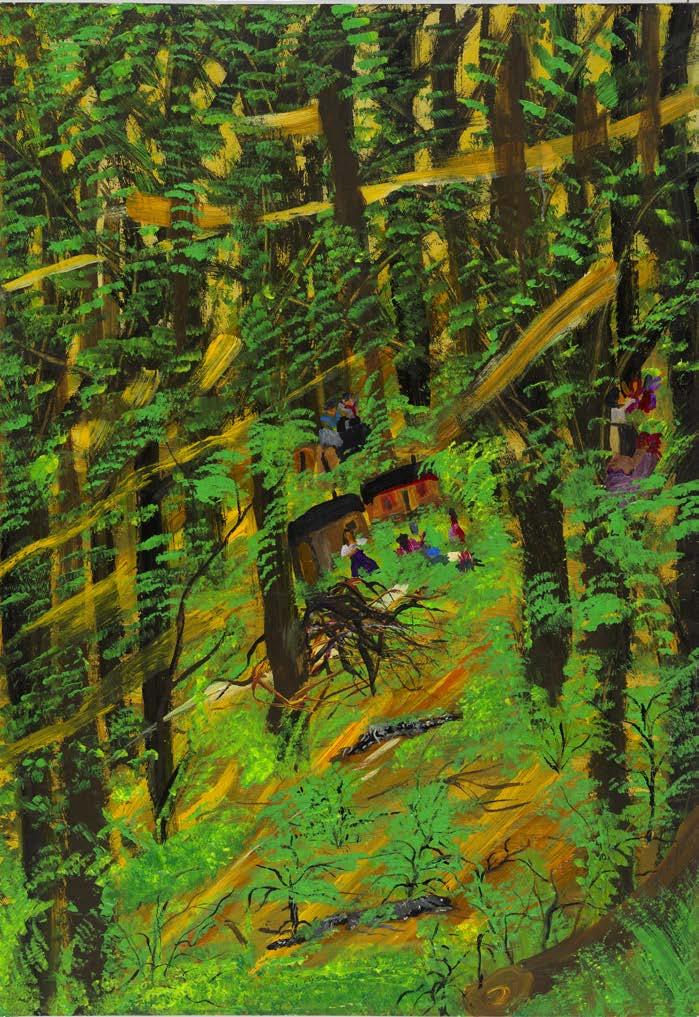
green foliage, and yellow-orange marks cutting across diagonally from the top left set the scene ablaze with sunlight.
Sad Earth (28.01.1998) (PL. 21) sets a very different tone and temperature: It shows a roll call in a concentration camp, with groups of prisoners standing outside on a gray winter day overseen by two capos in blue uniforms wielding whips. Again, there is both attention to detail and a stunning economy of simple means used to great effect: vertical brushstrokes in muddled greens and browns with sparse dabs of color—a blue hat, a red headscarf—depict the ragged prisoners, slashes of pink indicate exposed hands, arms, and feet with a great sense of vulnerability and foreboding. A flat red figure cast across the icy snow in the foreground remains a mystery to me—a dead body, a shadow cast from beyond the picture’s frame, or perhaps this is Sad Earth personified—but the bitter cold wind gusting through from left to right is palpable. It is depicted by thin, white, horizontal marks made with a dry brush that condense into a vortex at the painting’s lower-right edge, above which, behind barbed-wire fencing, towers the chimney of a crematorium bearing a swastika.
In the company of her mother, a worldly-wise and psychologically smart person who was also illiterate, Stojka survived three concentration camps.6 After their liberation from Bergen-Belsen, they returned to Vienna, where Stojka signed herself up for grade school. She was thirteen and shared a class with children half her age; on her left forearm, the tattooed registration number from Auschwitz. This tattoo, which she carried for the rest of her life, marked her body as written in the most cruel terms before she herself became literate. Perhaps this connection to humiliation and death is why, for her, writing as a technique could never be normalized: When she began to jot down her memories on sheets of paper she kept in a kitchen cabinet, she chose to do so phonetically in her Viennese dialect, privileging the spoken word and disregarding the rules of German grammar and Rechtschreibung (orthography; literally “right writing”).
Z 6399 (1994) (PL. 09) depicts a left arm from the elbow down, bright red and prominently marked with Stojka’s camp tattoo. The painted hand rests on the lower-left side of the support, much
as the painter’s hand would when working on the flat surface of a table, while the right hand holds a pen or brush. In the image, the tattooed number appears flipped onto its head, as it would from Stojka’s point of view. It seems that she turned the sheet around to write the characters, a practical move but also one that establishes the painter as an active entity on either side of an imaginary table. I imagine that fifty-one years earlier, upon arrival at Auschwitz, someone, most likely a fellow prisoner commanded to this task, must have sat across from Stojka to ink her skin with the number. In the painting, the red arm sits on a dark background, torn open by a brushy diagonal of white paint that widens and connects to the upper-right corner—it seems that the right hand, holding the brush, has painted itself out of the frame.
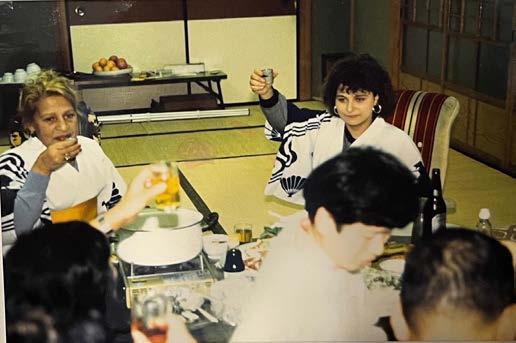
In a notebook entry, Stojka describes the origin of her visual art practice: In 1989, during a trip to Japan (fig. 2), she met with a group of kindergartners. Lacking a shared language, she promised to send them pictures by her granddaughters, Simona and Sidi, with whom she had been drawing and painting. Back home in Vienna, she found herself looking at an unfinished watercolor by Sidi:
The half-finished picture lay on the table. I found it really beautiful. I picked up the paintbrush somewhat tentatively, stroked from blue to green, red, and brown, the paints played along. And so, two pictures were made. My first, and I sent them to Japan as promised. . . . However, the many colorful paints would not let me go. Here was something that accepted me patiently, [and] the paper stretched itself out in front of me.7
The artist and architect Friedl Dicker-Brandeis taught children’s drawing classes in the Theresienstadt ghetto from 1942 until, in 1944, she was taken to Auschwitz and murdered, like many of her students. For these Jewish children, the past seemed unreal and far away, like a fairy tale: “By drawing this fairy tale in all its intricacies—the furnishings of the flat, the clock on the wall, the market stall opposite the house—they gave the past real contours again, moved closer to it and gradually rebuilt a connection to it.
The boundaries between past and present were becoming more fluid.”8 Picking up her granddaughter’s brush, Stojka steps into her own past and into the point of view of her earlier self. She applies the kind of focus and accuracy observed in drawings from DickerBrandeis’s class to both idyllic early memories and to the Nazi terror that she was subjected to in the camps.
Often working at night, Stojka confronted nightmares and trauma. In some aspects, her practice resonates with techniques of somatic trauma therapy, where the grown-up self is put in touch with inner-child parts formed under duress, belonging to the past but active in the present. To me, there seems to be a significant difference between drawing like a child (as an appropriation) and the ability to draw as a child—stepping out of clock time and numerical age and into the continuous presence of the psyche, which contains earlier versions of the self.
In an untitled work from 1994 (PL. 07), an SS officer in uniform bends over and peers backward between his legs, his face upside down in the cynical appropriation of a playful gesture. The pinks, purples, and browns of his rough-skinned cheeks are disturbingly complemented by yellow-blond eyelashes, brows, and hair. His bright blue eyes are bloodshot, the wide grin of his lips chapped with a row of X-marks—the kind Stojka also uses in the depiction of barbed wire. Porajmos, the Romanes word for the Nazi genocide, literally translates to “the Devouring.” Making eye contact at child-level and blocking access to a pretty flower meadow in the background, the threat of being swallowed alive appears in human form.
Stojka protested the selective attention given to her work: “Why does everyone want to see my dark pictures, the light ones are so much nicer?”9 As if to thwart attempts at one-sided reception, she sometimes drew flowers on the verso of concentration camp scenes: Dandelions on a drawing annotated with “the final liquidation, 01.08.1944, took place right in front, where the SS canteen was;” branches with rose hips on the drawing of a pile of corpses, inscribed with “Mama, why are you dead? Bergen-Belsen, 1945.”
Working across media and creating both light and dark pictures, Stojka honed her ability to tell stories that share
experiences as they are lived in the present tense. It seems to me that, in doing so, she is neither looking backward nor illustrating memories but, rather, activating feelings stored within—giving form to the stories she lives with. Joy and sadness alternate, scenes are repeated, and she is not proceeding chronologically but, rather, externalizing the images that push into her consciousness. Thus, she avoids the pitfalls of the survivor’s story as one with a happy ending and opens a narrative field in which she becomes a character, both uniquely herself and exemplary of a larger collective experience.10
1. In March 1986, it became known that Kurt Waldheim, former Secretary-General of the United Nations and presidential candidate of the Austrian People’s Party, had concealed his wartime past in the Nazi German Wehrmacht. His evasions made the Waldheim affair a turning point in the memory of Nazi crimes and brought questions about Austria’s shared responsibility to the forefront for the first time.
2. Ceija Stojka, “Sostar gelem angle: Kotor katar ek intervjuo la Ceijasa Stojka,” interview by Mozes F. Heinschink, Oral Literature, Vienna, Rom Archive website, May 24, 1998, https://www.romarchive.eu/en/collection/ sostar-gelem-angle-kotor-katar-ek-intervjuo-la-ceijasa-stojka/.
3. Walter Benjamin, “The Storyteller,” in Illuminations, ed. Hannah Arendt, trans. Harry Zohn (Schocken, 1969), 83.
4. Benjamin, “The Storyteller,” 89.
5. Mongo Stojka, “Amari purani luma / Unsere alte Welt [Our old world],” in Te na dikhas sunende . . . Lovarenge paramiči, tertenetura taj gila / Fern von uns im Traum . . . Märchen, Erzählungen und Lieder der Lovara [Far from us in a dream . . . fairy tales, stories and songs of the Lovara] (Drava, 2001), 266–67. Translated into English by the author.
6. Stojka’s mother was a skilled fortune-teller and textile salesperson. Before the war, while on the road, she supplemented the family’s income by going door-todoor, which resulted in a deep understanding of the minds of sedentary mainstream Austrians.
7. Ceija Stojka, “The Origins of My Pictures,” quoted in Carina Kurta, “It Is Difficult to Write About Some Things, But It Has to Be,” in Roma Artist Ceija Stojka: What Should I Be Afraid Of? (Hirmer Verlag, 2023), 58–60. The observation that direct verbal communication was not possible due to language barriers is Karin Berger’s, from a conversation with the author on March 6, 2025.
8. Elena Makarova, “Art Therapy After Friedl Dicker-Brandeis,“ in Friedl DickerBrandeis (Hirmer Verlag, 2022), 91.
9. Lith Bahlmann and Matthias Reichelt, introduction to Ceija Stojka: Sogar der Tod hat Angst vor Auschwitz, ed. Bahlmann and Reichelt (Verlag für moderne Kunst, 2014), 412–11.
10. “Now comes the problem of this survivor story, as of all such stories: We start writing because we want to tell about the great catastrophe. But since, by definition, the survivor is alive, the reader inevitably tends to separate, or deduct this one life, which she has come to know, from the millions, who remain anonymous. You feel, even if you don’t think it: well, there is a happy ending after all. Without meaning to, I find that I have written an escape story, not only in the literal but in the pejorative sense of the word.” Ruth Klüger, Still Alive: A Holocaust Girlhood Remembered (The Feminist Press, 2003), 137–38.
Noëlig Le Roux
On a page of her journal dated October 13, 1991, Ceija Stojka recalls the day painting seized her while she watched her granddaughter Sidi paint freely, as children do, improvising shapes and colors on the paper. It was December 1989 or very early 1990—the exact date is not specified. Struck by the spontaneity of the child’s gestures, Stojka took up a brush herself and began applying color to the sheet. “The painting loved it,” she wrote.1 “I immersed myself in the painting as if it had been created for me. It absorbed me completely. Memory images sprang up—I didn’t need to search for them . . . I had so many in my mind. . . . The sheets of paper piled up, and I thought: my children will look at these one day, and that’s how they’ll know where I was and what I was doing when I traveled with my mother.”2
Three years earlier, Stojka had published her first book, Wir Leben im Verborgenen: Erinnerungen einer Rom-Zigeunerin (We Live in Secrecy: Memories of a Romni-Gypsy) (1988), with the assistance of documentary filmmaker Karin Berger.3 She felt invested with a political and artistic mission that would never leave her. Yet, the writing that had brought her recognition no longer seemed enough to convey the images Stojka carried in her mind, to translate the memories, dreams, and visions that haunted her from years of internment in the concentration camps of Auschwitz, Ravensbrück, and Bergen-Belsen, for “dreams do not let us go, we victims.”4
Although she had no formal training, within a year, Stojka had established the foundations of her graphic and artistic language
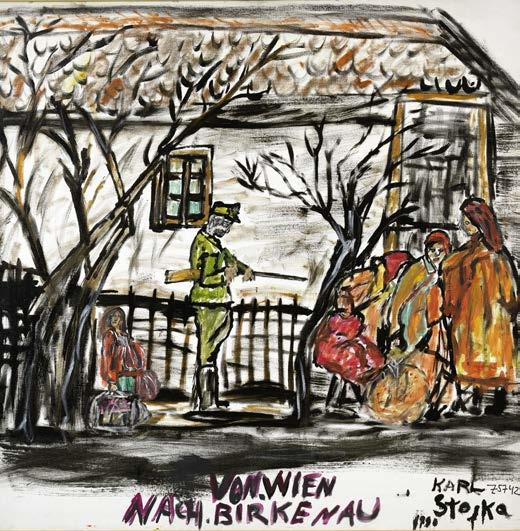
and chosen a limited number of materials and formats suitable for working within the domestic space of her apartment. Karl (1931–2003), her older brother, preceded her on this artistic path by a few years. He lived in the same building as his sister, making it easy for Stojka to watch him at work and sharpen her own eye for art. Since the mid-1980s, Karl had been painting the hell of the concentration camps, which he, too, had miraculously survived (fig. 1). The same impulse to bear witness motivated the siblings.
Faith also nourished the imagination Stojka brought into her work: representations of Mary, the figure of the saving mother (fig. 2); birds as the souls of victims escaping into the sky; the all-seeing eye of the Creator; the reconciliatory rainbow; trees; lightning. These symbols, drawn from Christian and vernacular culture, lent her works a surreal, penetrating, allegorical dimension.
Less than a year later, her works were exhibited for the first time at the cultural center, Amerlinghaus, in Vienna.5 The exhibition marked a turning point in the recognition and circulation of her work. During the exhibition, Stojka met Christa Stippinger, founder of Exil publishing and organizer of popular education programs at Amerlinghaus. Like Berger ten years earlier, Stippinger became a close friend to whom Stojka confided her troubles, as well as a traveling companion. In 2008, she published Auschwitz ist mein Mantel [Auschwitz is my overcoat], a collection of stories and poems by Stojka, illustrated with her works.6 The title was taken from one of the poems Stojka recited in front of Stippinger in the artist’s Kaiserstrasse apartment, which Stippinger jotted down on the spot.
Inseparable from her artistic practice, the transmission of Roma and Sinti history was an imperative from which Stojka never wavered: “I must tell how [they] lived, how they live [today], and what happened to them.”7 Stippinger, Stojka, and Nuna Stojka, the artist’s daughter-in-law, would host workshops for teenagers for twenty years. More than 12,500 young Viennese came to listen, discuss, and even paint with this charismatic woman, who had become a spokesperson for Romani culture.8 She would end their encounters by declaring: “You are our protective coat, ensuring that something so terrible will never happen again.”9
Stojka’s artistic, literary, and activist involvements quickly became a full-time occupation; her previous trade, selling rugs at market stalls, became a sideline venture thereafter. Her daughter, Silvia (1951–2012), her granddaughter, Simona, and her daughterin-law, Nuna, accompanied Stojka in her public speaking, while her husband, Kalman Horvath (d. 1998), and her sister, Katharina Kaslov (1927–1999), supported her both materially and psychologically in carrying out the mission she set for herself.
Stojka also surrounded herself with academics, journalists, and public figures, who were often involved in defending minority rights. Many among this supportive community were women. The ethnologist Miriam Wiegele (1946–2022), cofounder of the first Austrian Roma association, the Roma Association of Oberwart, and an early activist for the Roma cause, became close to the Stojka family and introduced them in 1986 to her fellow student, Berger, who, in turn, encouraged Stojka to speak out.10 As Berger points out, “The publication of Ceija’s book, We Live in Secrecy . . . acted as a catalyst. [The Roma] founded various associations in Vienna, Burgenland and Upper Austria, and in 1993 the Roma and Sinti were recognized as an ethnic group in Austria.”11 The articles, broadcasts, books, and research produced by the intellectual and activist circles around Stojka nourished a Roma community that was becoming organized and unified, and built a bridge to the non-Roma world.
With respect to her artistic practice, Stojka found non-Roma allies who would support her creation, both in terms of production (financing the purchase of materials) and of dissemination (organizing exhibitions and publishing a book on her work). The actress Krista Stadler, who remembers being won over by the artist’s personality from their first meeting at the Amerlinghaus, introduced her to two of her closest friends: Patricia Meier and Franziska Helmreich. The trio quickly became supporter-patrons, curators, and editors. In 1995, the year of the fiftieth anniversary of the liberation of the Nazi regime’s extermination camps, Meier and Helmreich published Ceija Stojka: Bilder und Texte 1989–1995 [Ceija Stojka: Pictures and texts 1989–1995].12
In 1999, when Meier and Helmreich organized an exhibition in the Austrian Parliament, Stojka used the occasion as a platform
to defend the Roma cause, speaking with the President of the Austrian National Council, Dr. Heinz Fischer (Social Democratic Party, SPÖ), and the Chair of the Culture Committee and former Council President, Heide Schmidt (Freedom Party, FPÖ).13
In 2000, the Bavarian Council awarded Stojka the Josef Felder Prize, recognition perhaps encouraged by the progress of Roma and Sinti activism in Germany, led by the charismatic figure of Romani Rose since the early 1980s.14 While Germany acknowledged the racial persecutions of Sinti and Roma as early as 1982, it was not until 1991 that Austrian Chancellor Franz Vranitzky—whom Stojka would meet the following year—recognized the responsibility of the Austrian state and people for the suffering inflicted on other peoples and nations during World War II.15
In Austria, Stojka’s work reached a new milestone in 2004 with a major exhibition at the Jewish Museum in Vienna (fig. 3).16 This was followed in 2006 by a show in the foyer of the Old Town Hall in Linz.17 In 2009, two American scholars, Lorely French of Pacific University, Oregon, and Michaela Grobbel of Sonoma State University, California, organized a solo show for their universities’ galleries, which then toured to an art center in Vermont.18 Comprising some hundred works, the exhibition was accompanied by a catalog with short descriptions by the artist of individual pieces. The US exhibition was the first to present her work in venues specifically dedicated to art. Nevertheless, the recognition of this work emphasized its historical value rather than its artistic qualities.
In 2011, the exhibition Reconsidering Roma: Aspects of Roma and Sinti Life in Contemporary Art, curated by Matthias Reichelt and Lith Bahlmann in Berlin, marked her debut on the contemporary European art scene, exhibiting her work for the first time alongside other contemporary artists—Roma and non-Roma—from several generations.19 The curators aimed to not only reconsider representations of Sinti and Roma and deconstruct the stereotypes that stigmatize them but also to highlight how the genocidal experience they endured and transmitted through words and images remains neglected in collective memory. A series of photographs by Reichelt in the catalog showing the unfinished, temporarily abandoned state

fig. 3—Installation view of Ceija Stojka: Leben! (Ceija Stojka: Life!) On view December 2004–March 2005 at the Jewish Museum, Vienna
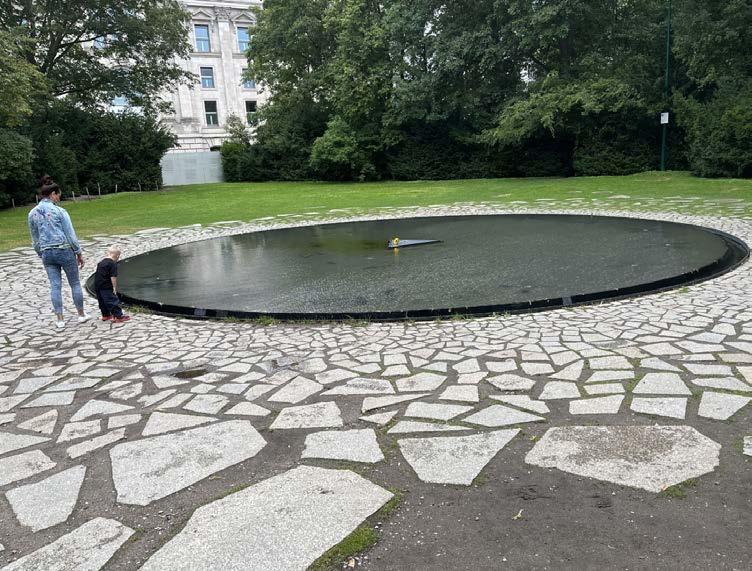
4—Roma and Sinti Memorial, Berlin Initiated in 1992, completed in 2012
of the Berlin memorial dedicated to the Sinti and Roma murdered under the Nazi regime illustrated, not without bitterness, that work needed to be done in order to correct this neglect (fig. 4).20
That same year, Moritz Pankok opened Galerie Kai Dikhas in Berlin, the first gallery dedicated to Roma artists. In his first exhibition devoted to Stojka’s work, the gallerist juxtaposed it with works by his grandfather, Otto Pankok (1899–1966), known for his portraits of the Sinti of Düsseldorf, made shortly before their deportation by the Nazi regime. The third exhibition Pankok held took place in Berlin in May 2012, during the 7th Berlin Biennale, curated by Artur Żmijewski and Joanna Warsza, which echoed the call of the European Roma Cultural Foundation to complete the memorial to the Sinti and Roma.21
When, on January 28, 2013, Stojka died, Stippinger paid her a final tribute through an event organized at the Amerlinghaus, while, at the same time, a new series of exhibitions launched by Galerie Kai Dikhas opened: one in Berlin, and the second at Gallery8 in Budapest—the contemporary art center of the European Roma Cultural Foundation, founded in 2010 in Budapest and directed by Roma curator and scholar Tímea Junghaus.22 Junghaus was among the contributors to the publication Ceija Stojka (1933–2013): Sogar der Tod hat Angst vor Auschwitz/ Even Death is Terrified of Auschwitz, edited by Bahlmann and Reichelt, the most comprehensive monograph on the artist’s paintings and drawings.23 On the occasion of the book’s release, Bahlmann and Reichelt exhibited 180 works in ink and gouache under the title Even Death is Terrified of Auschwitz (using the words written by Stojka on the back of one of her 1995 paintings) at Berlin’s Kunstverein Tiergarten and Galerie Nord, and a selection of paintings at the Kulturhaus Schwartzsche Villa.
These exhibitions and the accompanying publication were formative in establishing Stojka’s status as an artist. Irène Bazinger, writing for the Frankfurter Allgemeine Zeitung, noted that, despite her fame, Stojka “was rarely recognized as an independent artist.”24 She also pointed out the political character of Bahlmann and Reichelt’s project, quoting Kunstforum’s reviewer, Vera Tollmann: “Taking an interest in the heritage and culture of the Sinti and Roma
remains political work in the service of a minority deprived of its own institutions to represent itself.”25
In 2004, Stojka attended the first commemoration in Vienna of the liquidation of the Roma camp at Auschwitz on August 2, 1944; ten years later, a square in Vienna was named after her. Every year since, on August 2, the Roma community pays tribute to the “Romni who was not afraid to speak out [and dared] to face danger.”26 That same year, the Wien Museum, dedicated to the presentation and collection of Vienna’s history, acquired the largest institutional collection to date of the artist’s works. The following year, the museum organized Romana Thana, in cooperation with the Burgenland State Museum, the Initiative Minderheiten (Minorities Initiative), and the Romano Centro (the Austrian Roma and Sinti Center).27
In France, Stojka’s work was first exhibited in 2016 in a group show in Belfort and Montbéliard, with some fifty-three artists, that addressed the question of art in the face of the Nazi genocide (Retour sur l’abîme – l’art à l’épreuve du genocide [Return to the abyss: Art in the face of genocide]).28 In 2018, a solo show was staged at La Maison Rouge – Fondation Antoine de Galbert, the most consequential to date. The exhibition was initiated by Xavier Marchand, director of the theater company Lanicolacheur, based in Marseille. While working on a project on Roma culture, Marchand saw images of Stojka’s work in the journal Etudes Tsiganes and then in Bahlmann and Reichelt’s seminal publication. When he shared his discovery with the collector and patron Antoine de Galbert plans were laid for a large retrospective at their respective venues: La Friche la Belle de Mai in Marseille and La Maison Rouge.29
Prior to the opening, Florence Aubenas previewed the project for Le Monde. 30 Upon seeing the work for the first time, several critics, noting that the artist lacked formal academic training, struggled to classify it. “Her art is not art brut, if it must be defined, it is more like essential art, in the sense that it penetrates the heart of life and death,” argued Johanna Lasry in La Quinzaine littéraire. 31 “Naive art, art brut, marginal art? The qualifiers are of little importance, all beside the point,” commented Roger Pierre Turine, who added that “Stojka’s art . . . is an expression of tragedy
in its most revolting and, therefore, noblest form. It would take a book to describe this exhibition.”32 Several books by Stojka were translated into French, and in 2020, French history textbooks at elementary, middle, and high school levels began to include the Roma genocide and to quote Stojka.33
The retrospective then traveled to the Netherlands, Madrid, and Malmö.34 At each venue, translations of Stojka’s texts were published and events organized. The New York Times hailed the Madrid presentation as one of the hundred best exhibitions of the year.35 New York Times critic Jason Farago, for his part, saw it as “not only a testimony to an occluded genocide, Stojka’s art also stood up for the possibility—even the necessity—for human creativity to represent, and take ownership of, the darkest chapters of history. . . . Rare are the artists who can answer that question convincingly.”36 He continues, “Stojka was one of them, establishing a living archive for those not yet born. You don’t paint for yourself; you paint for the world you want to see, to silence the blind nationalists and denialists who have been given a new lease on life.”37
Birgitta Rubin considered the Swedish version to be the most important exhibition in the history of the Malmö Konsthall.38 As before, it was accompanied by a program of visits, conferences, and other activities aimed at raising awareness of Roma history and culture and fighting discrimination and racism. The Roma Information and Knowledge Center (RIKC) contributed a timeline of Roma history within the Swedish context. A publication containing quotes and reproductions of Stojka’s works was given to Malmö’s middle school students.39
In 2024, the city of Łódź, the site of a former concentration camp (1940–44), presented another version of the retrospective, Stojka’s first in Poland.40 The context was a festival celebrating the cultures long present in the city: Polish, German, Jewish, and Russian. The inclusion of Roma culture spoke to the history of the 5,007 Roma who were imprisoned from October 1941 to January 12, 1942, in appalling conditions, within the Jewish ghetto itself, none of whom survived. Minister of Culture Hanna Wróblewska, who attended the opening of the exhibition, took part in the launch of the project.
Since 2018, the Ceija Stojka International Association has helped extend the artist’s legacy. Today, Stojka’s art is represented in the collections of such prestigious European institutions as the Museo Reina Sofía in Madrid, the Moderna Museet in Stockholm, and the Museum Ludwig in Cologne, together with the Warsaw Ghetto Museum and the National Museum of Immigration History and the Shoah Memorial in Paris.
The author would like to thank Karin Berger, Christa Stippinger, Lorely French, Matthias Reichelt, Franziska Helmreich, Marcus Meier, Krista Stadler, Nuna and Hojda Stojka, and Moritz Pankok for the interviews and exchanges they granted to support this text.
1. Ceija Stojka, notebook (1995), n.p. Collection Hojda Willibald Stojka, Vienna.
2. Stojka, notebook, n.p.
3. Ceija Stojka, Wir Leben im Verborgenen: Erinnerungen einer Rom-Zigeunerin [We Live in Secrecy: Memories of a Romni-Gypsy], ed. Karin Berger (Picus Verlag, 1988).
4. Ceija Stojka,“Es war mein Traym und die Träume, die lassen mich, uns Opfer, nicht los.” English translation by Translated. As written on [PL. 27].
5. Bilder aus dem Leben der “Romni” Ceija Stojka [Pictures from the life of the “Romni” Ceija Stojka], 1991, curated by Christa Stippinger, Galerie im Amerlinghaus, Vienna.
6. Christa Stippinger, ed., Ceija Stojka: Auschwitz ist mein Mantel: Bilder und Texte [Ceija Stojka: Auschwitz is my overcoat: Pictures and texts] (Edition Exil, 2008).
7. Stippinger, Auschwitz ist mein Mantel, 32.
8. Ceija Stojka, The Memoirs of Ceija Stojka, Child Survivor of the Romani Holocaust, ed. and trans. Lorely French (Camden House, 2022), 3.
9. Ceija Stojka, as quoted by Christa Stippinger, “My years of work with Ceija Stojka 1991–2012,” trans. Mina Lunzer, RomArchive, accessed December 8, 2025, https:// www.romarchive.eu/en/literature/work-ceija-stojka/.
10. Founded in Austria in 1989, the Roma Association of Oberwart was the first association for the defense of Roma rights.
11. In particular, the Austrian Roma Cultural Association (1991) and Romano Centro (1991) were both founded in the wake of Stojka’s publication. Karin Berger, introduction in Wir leben im Verborgenen: Aufzeichnungen einer Romni zwischen den Welten [We Live in Secrecy: Notes of a Romani Woman Between Worlds], ed. Karin Berger (Picus Verlag, 2013), 9.
12. Patricia Meier-Rogan, ed. Ceija Stojka: Bilder und Texte 1989–1995 [Ceija Stojka: Pictures and texts, 1989–1995], (Graphisches Kunstanstalt Otto Sares, 1995). The year 1995 was also marked by the racist bombing in Oberwart, which killed four Roma and left many injured. After the official recognition of the Roma as a minority in 1993, this event marked a turning point for the Austrian Roma victims of the Nazi regime, who would begin to be compensated by public funds.
13. Ceija Stojka: ...ja, aber damals geschah es doch [Ceija Stojka: ...yes, but it happened back then], 1999, Austrian Parliament, Vienna. “Kunst, Die Zum Nachdenken Anregt” [Art that prompts thinking], Parlament Österreich, accessed December 8, 2025, https://www.parlament.gv.at/aktuelles/pk/jahr_1999/pk0405.
14. In 1995, the Bavarian SPD regional association created the Josef Felder Prize “for the common good and civic courage.” For more on the prize-giving in 2000, see Lars von Törne, “Politik: Josef Felder: Der letzte noch lebende Reichstagsabgeordnete wird 100,” Tagesspeigel, August 23, 2000, https://www. tagesspiegel.de/politik/josef-felder-der-letzte-noch-lebende-reichstagsabgeordnete-wird-100-705892.htm. Romani Rose was president of the Central Council of German Sinti and Roma (founded in 1982).
15. On July 8, 1991, Franz Vranitzky declared to the National Council for the first time: “There is a responsibility for the suffering that not Austria as a state, but the citizens of this country have inflicted on other peoples and nations. . . . We acknowledge all the actions of our history . . . and just as we claim our good deeds, we have a duty to apologize for the bad ones—to the survivors and descendants of the dead.” Franz Vranitzky, “Stenographic Report: 35th Session of the 18th Legislature of the National Council of the Republic of Austria,” July 8–9, 1991, © Parliamentary Directorate, https://www.parlament.gv.at/dokument/XVIII/ NRSITZ/35/imfname_142026.pdf.
16. Ceija Stojka: Leben! [Ceija Stojka: Life!], 2004–2005, curated by Gerhard Milchram, Museum Judenplatz/Jewish Museum, Vienna.
17. Ceija Stojka: Ich bin eine Wurzel aus Österreich [Ceija Stojka: I am a root from Austria], 2006, Grand Foyer, Old Town Hall, Linz.
18. Ceija Stojka: Live—Dance—Paint, 2009, curated by Lorely French and Michaela
Grobbel, Sonoma State University, Rohnert Park, CA; Pacific University, Forest Grove, OR; West Branch Gallery and Sculpture Park, Stowe, VT.
19. Reconsidering Roma: Aspects of Roma and Sinti Life in Contemporary Art, 2011, curated by Matthias Reichelt and Lith Bahlmann, Kunstquartier Bethanien, Berlin. The exhibition included work by Karl Stojka, Daniel Baker, Bankleer (Karin Kasböck and Christoph Leitner), Eduard Freudmann and Ivana Marjanović, Tamara Grcic, Sanja Iveković, Delaine Le Bas, Tamara Moyzes, Eliza Petkova, Nihad Nino Pušija, Dávid Szauder, Norbert Szirmai, Rosa von Praunheim, and Christoph Wachter and Mathias Jud. The exhibition featured the films Ceija Stojka (1999) by Karin Berger, and VERMÄCHTNIS. LEGACY (2010–11) by Marika Schmiedt, in which the videographer explores the history and traumatic legacy of the Austrian Roma and Sinti through Stojka and her descendants. The latter film had been screened a few months earlier in the Roma pavilion of the 54th Venice Biennale. Stojka was absent from the first Roma pavilion of the Venice Biennale in 2007, Paradise Lost, Palais Pisani, curated by Tímea Junghaus.
20. The memorial commissioned from artist Dani Karavan was inaugurated on October 24, 2012, in the presence of German Chancellor Angela Merkel.
21. Ceija Stojka: Wind.Erinnerungen [Ceija Stojka: Wind.Memories], 2012, Galerie Kai Dikhas, Berlin.
22. Ein romaleben in bildern [A Roma’s life in pictures], 2014, Amerlinghaus, Vienna; Die hellen Bilder [The bright pictures], 2013–2014, Galerie Kai Dikhas, Berlin; We Were Ashamed, 2014, curated by Moritz Pankok, Gallery8, Budapest.
23. Lith Bahlmann and Matthias Reichelt, eds., Ceija Stojka (1933–2013): Sogar der Tod hat Angst vor Auschwitz/ Even Death Is Terrified of Auschwitz (Verlag für moderne Kunst, 2014).
24. Irène Bazinger, “Schreiden, um zu schreien” [Screaming to scream], Frankfurter Allgemeine Zeitung, July 31, 2014, 10.
25. Vera Tollmann, “Ceija Stojka,” Kunstforum International, no. 228 (August/ September 2014), https://www.kunstforum.de/artikel/ceija-stojka/.
26. Ceija Stojka as quoted in Nous vivons cachés: Récits d’une Romni à travers le siècle [We Live in Secrecy: Stories of a Roma Woman Through the Century], trans. Sabine Macher (Éditions Isabelle Sauvage, 2018), 251.
27. Romana Thana presented works by Stojka that dealt with concentration camps and arrests, but—importantly—also with Romani life before and after the war.
28. Retour sur l’abîme: L’art à l’épreuve du génocide [Return to the abyss: Art in the face of genocide], 2016, curated by Philippe Cyroulnik and Nicolas Surlapierre, 19 CRAC Montbéliard and the museums of Belfort. Victims and witnesses of the genocide were included among the fifty-three exhibiting artists. They presented work alongside other contemporary artists such as Mirosław Bałka, Henryk Beck, Christian Boltanski, Otto Freundlich, Petr Ginz, Maryan, Felix Nussbaum, Wilhelm Sasnal, Gela Seksztajn, and Benjamin Swaim.
29. La Maison Rouge – Fondation Antoine de Galbert, Paris, presented numerous international private collections as well as monographic and thematic exhibitions from 2004 to 2018, including: Ceija Stojka: Une artiste Rom dans le siècle [Ceija Stojka: A Roma artist of this century], 2018, curated by Antoine de Galbert and Xavier Marchand. In Paris, a compilation of Karin Berger’s films was shown on a loop in the exhibition, and events involving the Stojka family were organized. A timeline of Roma history within the French context rounded out the exhibition.
30. Florence Aubenas, “A la découverte d’une artiste rom et déportée” [Discovering a Roma and deported artist], Le Monde: M le magazine, February 24, 2017. The journalist opens her article by sharing with readers the revelation of Antoine de Galbert, patron, collector, and founder of La Maison Rouge, upon discovering the work: “In the life of an art lover, it only happens once and, again, not always: to discover an artist, a great one, and reveal them to the world.”
31. Johanna Lasry, “La dimension universelle d’une oeuvre” [The universal dimension of a work], La Quinzaine littéraire, April 16, 2018. See also Maurice Ulrich,
“Une œuvre puissante entre le goût de la vie et de la mort” [A powerful work between the taste of life and death], L’Humanité, March 27, 2018.
32. Roger Pierre Turine, “Les peintures tragiques de Ceija Stojka” [The tragic paintings of Ceija Stojka], La Libre Belgique, May 9–15, 2018.
33. In addition to Sabine Macher’s Nous vivons cachés, Stojka’s publications in French include Je rêve que je vis? Libérée de Bergen-Belsen [Am I dreaming that I am alive? Liberated from Bergen-Belsen], trans. Sabine Macher (Editions Isabelle Sauvage, 2016); a collection of poems: Ceija Stojka, Auschwitz est mon manteau et autres chants Tsiganes [Auschwitz is my overcoat and other Romani songs], trans. François Mathieu (Bruno Doucey, 2018); a collection of quotes: Ceija Stojka: Paroles d’artistes [Ceija Stojka: Words from artists] (Fage, 2017); Ceija Stojka: TOT [Ceija Stojka: Death] (Editions du Dernier cri, 2017).
34. Ceija Stojka (1933–2013): War Memories of a Roma, 2019, curated by Paula Aisemberg, Noëlig Le Roux, and Xavier Marchand, Het Valkhof Museum, Nijmegen, the Netherlands; Ceija Stojka: Esto ha pasado [Ceija Stojka: This has happened], 2019–2020, curated by Paula Aisemberg, Noëlig Le Roux, and Xavier Marchand, Museo Reina Sofía, Madrid. Ceija Stojka: The paper is patient, ed. Francois Piron (Paraguay Press, 2021) was published to coincide with the exhibition Ceija Stojka, curated by Noëlig Le Roux and Xavier Marchand, Malmö Konsthall, 2021.
35. See Jason Farago, “The Most Important Moments in Art in 2020: Pictures from a Crisis,” The New York Times, December 4, 2020, https://www.nytimes. com/2020/12/04/arts/important-art-moments-2020.html.
36. Jason Farago, “The Survivor of Auschwitz Who Painted a Forgotten Genocide,” The New York Times, January 27, 2020, https://www.nytimes.com/2020/01/27/arts/ design/ceija-stojka-auschwitz-paintings.html.
37. Farago, “The Survivor of Auschwitz.”
38. See Birgitta Rubin, “Skakande konst om den romska Förintelsen,” Dagens Nyheter, February 17, 2021, https://www.dn.se/kultur/ skakande-konst-om-den-romska-forintelsen/.
39. Subsequently, the Konsthal hosted a small presentation of Stojka’s works curated by artist, writer, and TV personality Sannah Salameh and Roma rights activist Lacky Daniely.
40. Ceija Stojka (1933-2013): Nie mogę zapomnieć [Ceija Stojka (1933-2013): I cannot forget], 2024, curated by Noëlig Le Roux, Łódź City Museum, Poland.
Ethel Brooks
auschwitz is my overcoat are you afraid of the dark?
i’ll tell you where the path is free of people, so you don’t need to be afraid.
i’m not afraid. my fear remained in auschwitz and in the camps.
auschwitz is my overcoat, bergen-belsen my dress and ravensbrück my vest. what should I be afraid of?
In 1949, Theodor Adorno wrote, “To write poetry after Auschwitz is barbaric. And this corrodes even the knowledge of why it has become impossible to write poetry today.”1
In 2014, the Iranian-American professor Hamid Dabashi asked whether it was possible to write poetry after Gaza.2 Now, eighty-one years after the liquidation of the Roma camp at Auschwitz, the genocide of Rom*nja and Sint*ezza3 in the Holocaust continues to be seen as an afterthought, a footnote, when it is not outright ignored; in Gaza, the genocide against Palestinians
is ongoing and has long been unrecognized.4 Is writing poetry, making art, after Auschwitz, after Gaza, an impossibility? Could it be, alternatively, a form of witnessing, of testimony, of protest, of reclaiming, of possibility?
Nearly fifty years after surviving Auschwitz, Ravensbrück, and Bergen-Belsen, Ceija Stojka (Romni) took up poetry, painting, testimony, and writing. Stojka’s life and art serve as examples by which to live, to write, to create; she provides a model for surviving, protesting, knowing, speaking, and opening new worlds and possibilities for repair.
There has never been a reckoning for the Romani communities lost in the Holocaust, where more than five hundred thousand Rom*nja and Sint*ezza were murdered. At the Nuremberg Trials, no Romani people were asked to testify. Instead, as so often occurs with genocides, the victims are blamed: in Gaza today, Cambodia in 1975, Biafra in 1967, Europe in 1938, the Americas in 1492. In the aftermath of the Holocaust, Rom*nja and Sint*ezza survivors often returned to the very communities that had deported them, to the sites of betrayal, and to neighbors who had been complicit with the Nazi regime.
Reparations for Romani communities were woefully inadequate, or, for the most part, nonexistent, and those who survived had little access to housing, education, or employment. Neither the international community, individual nation-states, judicial systems, nor banks have had to face up to their roles in the murder and loss of so many members of our community. Instead, our community—our artists, writers, activists, and elders—has held its own neighbors and the world at large to account.
As we continue to live in the wake of the Romani genocide— as waves of violence, persecution, and marginalization of Rom*nja and Sint*ezza unfold before our very eyes—it becomes clear that all we do, all the forms of counting, photographing, witnessing, writing, and painting, are carried out in a larger context and history of denial. After the half-million Romani lives taken during the Holocaust and the more-than-sixty-thousand-and-counting lives taken in Gaza, Stojka’s question, “what should I be afraid of?” haunts us.5
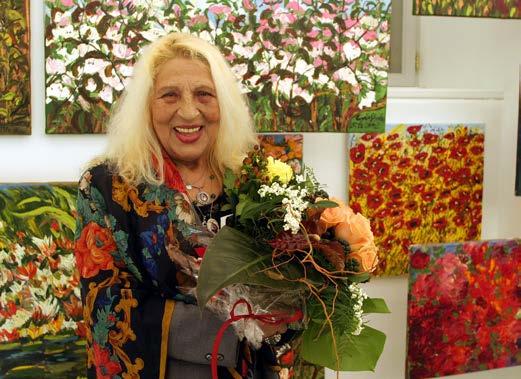
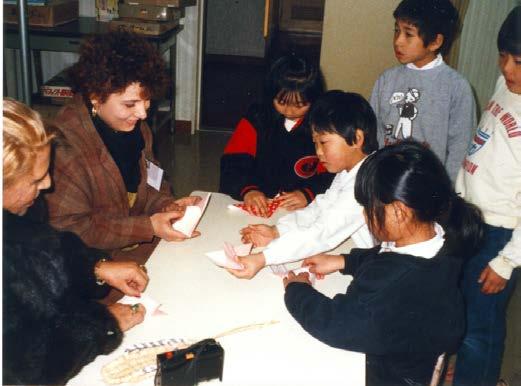
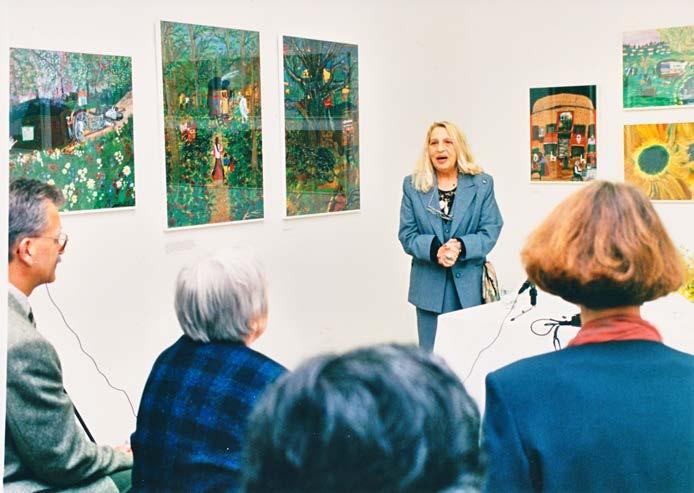
Stojka stood up to tyranny and understood the necessity of acting, writing, and speaking against injustice. She was unafraid. She faced the enormity of genocide as a survivor, as someone who lost family and community, as a leader, an activist, an artist, a writer, as simply a person living in the world, as a Romni. Stojka spoke out and told her story when most Rom*nja and Sint*ezza were afraid to speak openly about who they were, when very few of our people were listened to (fig. 1).
It is impossible to communicate the immense stature of Stojka in the Romani community.6 She was a role model and foremother to artists, activists, scholars, and intellectuals globally. She was a tireless advocate for Romani people and stood in solidarity with all those oppressed, persecuted, and marginalized. During Stojka’s first trip to Japan on a cultural exchange in late 1989/early 1990, she met children in a kindergarten, which was part of what inspired her to take up painting (fig. 2). And when she returned in 2001, on a subsequent human rights visit, she met and worked with Japan’s Buraku minority, a segregated, outcast group, which has been marginalized since the feudal era.7 This experience with the Buraku pointed to parallels with the Rom*nja and Sint*ezza, bringing a more global context to Stojka’s work, extending it beyond Europe. Stojka has also been an inspiration to contemporary Romani artists and curators—from Małgorzata Mirga-Tas to Delaine Le Bas, Emília Rigová, Tímea Junghaus, and Daniel Baker—and was one of the first Rom*nja to give her testimony of survival. She was also a central catalyst and founder of the Romani movement internationally, playing a crucial role in Austria recognizing Rom*nja and Sint*ezza as an official minority in 1993, and inspiring Romani rights defenders across Europe. Stojka, one of the first contemporary Romani artists to gain international recognition, also produced more than a thousand works of art and was awarded prizes for her books and advocacy (fig. 3), and, in 2012, Stojka was named a Romani Elder.
Stojka broke community taboos by speaking openly about death, persecution, and survival. She broke through the denial and silence
of state-sponsored racism and exclusion of Rom*nja and Sint*ezza. She pointed out the complicity of Austrian officials and everyday people with the Nazi regime. She called out the contemporary nationalist politics as the inheritor of Nazi policies and beliefs that murdered her family and decimated the Romani community. Stojka’s warning and lament, “I’m afraid that Europe is forgetting its past and that Auschwitz is only sleeping. Antigypsyist threats, policies and actions worry me greatly and make me very sad,” is as relevant today as it was when she first started writing, painting, and advocating.8
Stojka began painting at the age of fifty-six as a way of showing, understanding, and sharing the scale of a genocide that had been denied for decades. After telling her story in memoir form, she painted Auschwitz, Bergen-Belsen, and Ravensbrück, the camps, and her suffering and that of her family. Her paintings illustrate life before and during the Holocaust; they show the dehumanization that Rom*nja and Sint*ezza were subjected to at the hands of the SS and Gestapo.
In the documentary A People Uncounted, Stojka describes the roundup and imprisonment of her family:
I was born in Kraubath in the Steiermark in 1933 on the 23rd of May—’33 was already, of course, a bad year. It was when Hitler became strong. They picked us up at our home and brought us to the Rossauer Kaserne here in Vienna, to the barracks. [In] this building, gray on gray, [there] were 2,800 people. . . . They herded all of us together. . . . An SS officer with a megaphone [shouted] “Everyone step back. You pigs, step back. You scoundrels!” At some point, they herded us from Rossauer Kaserne . . . onto the train that was headed for Auschwitz.9
The paintings are a documentation of a genocide ignored for decades. They are also a political practice that points to the continuation of antigypsyism across Europe and the threat it poses
to everyone—not just Rom*nja and Sint*ezza.10 Stojka points out the long history of dehumanization and marginalization: “We weren’t allowed to own any property . . . like houses, banks, cafes.”11
Stojka published her autobiography in 1988, and had her first exhibition at Amerlinghaus in 1991, when nationalism was resurging in Austria and Europe as a whole, former Nazi Kurt Waldheim was President of Austria, and racism, continued marginalization, segregation, and persecution of Rom*nja and Sint*ezza were increasing. It is not a coincidence that the first Romani associations founded in Austria—the Association Roma Oberwart, the Cultural Association of Austrian Roma, and Romano Centro, all established in the late 1980s and early 1990s and inspired and mentored by Stojka—became the foundation for the Austrian Roma Movement, which has been active for nearly forty years.12
She was born into a Lovara family of horse traders and grew up in a Romani community with her brothers, sisters, and extended family (fig. 4).13 Her mother told fortunes; her family traveled for work with the horses and wagons and were at home in both the countryside and the city. Those who survived Nazi persecution included Stojka, her mother Sidonie, her sisters Kathi and Mitzi, and brothers Karl and Mongo, reuniting in Vienna in 1945.14 Stojka became a single mother, textile seller, and rug seller, and she and her family rebuilt their lives as best they could after so much loss, so much destruction, and without resources.
Stojka’s life, for me and many Rom*nja, is at once recognizable and feels like home. She is, for us, Aunt, Mother, Sister, Grandmother. Bibi Ceija. Her survival was resistance and living proof of Romani existence, our place in the world, family, community, and home; her survival, along with that of her family, was proof of life.15 Stojka’s painting, poetry, memoirs, and testimony are living proof. As such, they offer the possibility of repair, reparations, and recognition that have been denied by the state, by the world, by history. The Romani civil rights movement is one of Stojka’s many legacies. For Rom*nja and Sint*ezza around the world, Stojka is us. She left us a legacy of remembrance,

knowledge, history, and stories. Stojka left us a legacy of resistance and visibility.
All of you. I love you as you are together
So bring flowers, forget-me-nots and do that too together
For together we have learned to live life
Yes, I know you will say, You, Mama wasn’t like that
But life with my people was glorious And it was like that. And one other thing I was 16, 18, 22 when I bore you
Don’t think that you are so young
You will soon also visit me
Your Mama, Mami, Your Sister, Ceija16
Stojka also lovingly painted her family, the larger Lovara community, and the countryside, including the flowers, caravans, rivers, and individual people. These paintings document Lovara life before the roundups and destruction, before genocide, before the Samudaripen, the Porajmos, the Holocaust.17 Stojka’s sunflowers and her portrayal of Romani life and livelihood move away from stereotypes and victimhood to reveal the richness of Romani culture, the beauty of everyday life, and the closeness and love of family.
“We are traveling musicians,” she once explained, “And, to this day, we are proud musicians.”18 Along with her writing and painting, in 2000, Stojka recorded Me Diklem Suno [I Had a Dream], an album of Romani music. Her brothers Karl and Mongo were musicians (and artists and writers), as well as her nephew, Harri Stojka, who is a famous jazz musician, and her son, Jano, was a jazz musician before his death.19
In Karin Berger’s 1999 film titled after the artist, Stojka describes a painting depicting each family member, whom she describes and names individually.20 This moment, of lingering over each face in the painting, sharing the names and stories of the people featured, is a form of repair—a practice of humanizing her family, of showing how precious each person, each life, is—and they
become part of our collective memory, our family. It is a political act, an intervention against regimes of dehumanization, of death, in which Rom*nja and Sint*ezza were identified by the tattoos cruelly inked onto their forearms.
For us, Stojka is a hero. Even as she worked to humanize us, tell our stories, and share the burden of our loss and the beauty of our people with the world, Stojka bore her tattoo, her number, her time in the camps, as her armor, her strength. She was one of many brave Rom*nja, from Alfreda Markowska to Papusza to Katarina Taikon; and the Romani Elders Initiative, created by Junghaus and a team of Romani and non-Romani feminist scholars and activists, recognized and honored the Elders: Stojka, along with Rosa Taikon, Romani Rose, Nicolae Gheorghe, Ágnes Daróczi, Hans Caldaras, and Sandra Jayat.
We need Stojka’s bravery, even today. She found her voice and shared her stories with the world when all seemed lost to history. Stojka spoke out when the political moment, as she understood it, required it of her. She chose visibility when it was much easier to remain quiet, to live out the rest of her life without being targeted or afraid. Stojka was never scared, never ashamed. She showed the world, and she showed us, Rom*nja and Sint*ezza, what resistance looked like, what it meant to take our stories seriously, and to hold the world accountable. In A People Uncounted, Stojka showed her tattoo, saying: “And I have black and white on my hand. ‘Z’ for G*psy [Zige*ner] 6399. I stood twice in front of the crematorium myself. But the Zyklon-B they needed was empty.”21
It was Stojka’s own city of Vienna that pushed her to speak out, write, paint:
I was walking around the city alone. I sat down, and there were some young people behind me. They saw my number and immediately started screaming: “Such a lie! Auschwitz does not exist. My grandfather was the best person! And
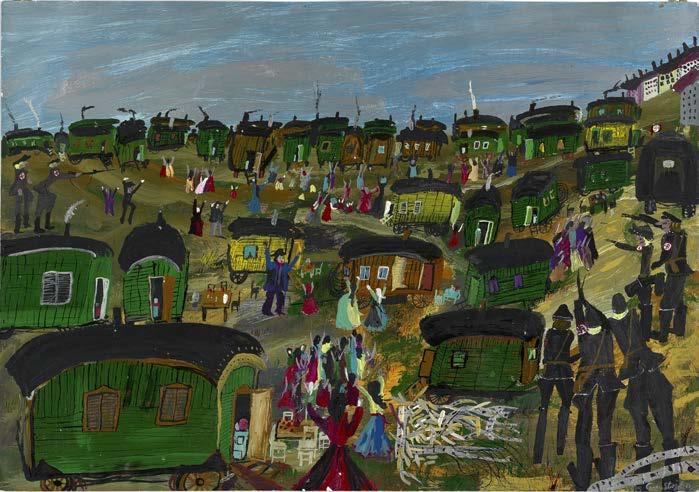
today, they lie about Auschwitz. These pigs that have this tattooed on their hand.” I looked up, and I saw a lot of young people. I got scared. But when I was home, it hurt me deeply because of my baby brother, my father, my family. Where did they go? (fig. 5) We did not dream all of that. And that was the impulse to start writing. I created this book in 1987.22 Then I had my first exhibition. That was 1991.23
Stojka showed the world what it means to bring politics to poetry, to art, to memory. She spoke out about a genocide denied. And her demand for recognition for Rom*nja and Sint*ezza, for what we have lost, is the same demand for recognition, for stopping the destruction, that we demand for Gaza. Thank you, Bibi Ceija. For all you have done, for us, Rom*nja and Sint*ezza, for those who have perished without recognition, for those who continue to fight, for Auschwitz, for Gaza, for all of us, everywhere. From all of us, everywhere. Najs tuke. With love.
1. Theodor Adorno, “Kulturkritik und Gesellschaft,” in Prismen: Kulturkritik und Gesellschaft (Suhrkamp Verlag, 1980), quoted in Eva Revesz, “Poetry After Auschwitz: Tracing Trauma in Ingeborg Bachman’s Poetic Work,” Monatshefte 99, no. 2 (2007): 194.
2. Hamid Dabashi, “Gaza: Poetry After Auschwitz,” Al Jazeera, August 8, 2014, https://www.aljazeera.com/opinions/2014/8/8/gaza-poetry-after-auschwitz.
3. I am Romni, and throughout this essay (and all my writing), I use endonyms (the names by which we call ourselves)—Romni is the Romani term for Romani woman; Rom*nja and Sint*ezza refer to Romani and Sinti people of all gender identities— acknowledging diversity and different gender identities and expressions of identity among Romani people, while foregrounding the specificity of Romani femme perspectives and experiences. The exonyms by which Rom*nja and Sint*ezza have been known and called have also been the names by which we have been persecuted; the pejoratives “G----” and “Z---------” are regarded by many Rom*nja and Sint*ezza as slurs and, therefore, have no place in this piece or elsewhere.
4. At the time of the writing of this text, on October 2, 2025, the total death toll was 66,225, with 168,938 injuries since October 2023. Gaza City has been razed, and those continuing to flee to the south have been targeted by military attacks on the way. Israel threatened those staying in Gaza City with “a forced order to leave, saying that it was their ‘last opportunity’ to leave or face the ‘full force’ of Israel’s assault.” Farah Najjar, Al Jazeera, October 2, 2025, https://www. aljazeera.com/news/2025/10/2/israel-threatens-all-staying-in-gaza-city-kills-atleast-13-in-enclave .
5. “Death Toll in Israel’s War on Gaza surpasses 60,000,” Al Jazeera, July 29, 2025, https://www.aljazeera.com/news/2025/7/29/ death-toll-in-israels-war-on-gaza-surpasses-60000.
6. For more complete biographical timelines, see the following biographies for Stojka: on the Ceija Stojka International Association’s website, https://www. ceijastojka.org/biography; the “Roma Heroes” page from the European Roma Institute of Arts and Culture, https://eriac.org/wp-content/uploads/2021/01/ MARGARETE-CEIJA-HORVATH-STOJKA.pdf; and the RomArchive, https:// www.romarchive.eu/en/collection/p/ceija-stojka/.
7. Sam Jones, “She Worked Against Forgetting: Holocaust Survivor’s Art Goes on Display,” The Guardian, December 2, 2019, https://www.theguardian.com/ artanddesign/2019/dec/02/ceija-stojka-holocaust-survivor-art-goes-on-display.
8. Tímea Junghaus, “‘Auschwitz Is Only Sleeping’: On Shame and Reconciliation in the Roma Context,” Akademie der bildenen Künste Wien, https://arepository.akbild.ac.at/view.php?uid=11049&t=8b1327344badffb2516e552b42f2fa50&org=/eyeba se.data/dokumente/1024/3/00010893_m.pdf.
9. Aaron Yeger, A People Uncounted (Urbinder Films, 2011).
10. “[Antigypsyism] is the specific form of racism directed against Roma, Sinti, Travelers, Manush, Balkan Egyptians, Ashkali, Yenish and others who are stigmatized as ‘gypsies’ in the public imagination.” Jonathan Lee, “A Beginner’s Guide to Antigypsyism,” European Roma Rights Centre, October 19, 2025, https://www.errc.org/news/a-beginners-guide-to-antigypsyism.
11. Yeger, A People Uncounted
12. See Erika Thurner, “Roma Movement in Austria—The Long Shadows of the Past,” RomArchive, https://www.romarchive.eu/en/roma-civil-rights-movement/roma-movement-austria/; and Lauren Moya Ford, “The Artist Who Survived Three Concentration Camps and Captured Her Trauma in Art,” Artsy, January 17, 2020, https://www.artsy.net/article/ artsy-editorial-artist-survived-three-concentration-camps-captured-trauma-art.
13. The Lovara were traditionally horse traders, part of the larger Vlach Roma, descendants of the groups enslaved in Wallachia (modern-day Romania). Along with Lovara, there are Kalderash, Manouche, Sinti, Romanichals, Gitanos, and other subgroups of Rom*nja across the Romani diaspora. See, for example, “Roma Groups,” rroma.org, https://rroma.org/the-roma/rroma-groups/; and “Roma,” RomArchive,” https://www.romarchive.eu/en/terms/roma/.
14. See “Biography,” in Thurner, “Roma Movement in Austria”; Ford, “The Artist Who Survived”; and Ceija Stojka International Association website.
15. Elsewhere, I have theorized living proof as “the offering of life stories, subjectivities, bodily materialities, and practices by women as acts of courage and political claim staking.” Ethel Brooks, Unraveling the Garment Industry: Transnational Organizing and Women’s Work (University of Minnesota Press, 2007), 138.
16. Ceija Stojka, “To My Children, Grandchildren, and Greatgreatgreatgreat Grandchildren,” in Ceija Stojka Roma Artist: What Should I Be Afraid Of? (Hirmer Verlag, 2023), 80–81.
17. Widely used Romani terms for the Roma genocide during the Holocaust include Samudaripen, meaning “murder of all,” or “mass murder,” and Porajmos, meaning “the Devouring.” For a discussion of the politics and meanings of the terms, see Karola Fings, “Genocide, Holocaust, Samudaripen, Porajmos,” in Voices of the Victims, RomArchive, https://www.romarchive.eu/en/voices-of-the-victims/ genocide-holocaust-porajmos-samudaripen/.
18. Yeger, A People Uncounted.
19. See Harri Stojka, “A Song for My Daddy,” Elbphilharmonie Concert, March 24, 2024, https://www.elbphilharmonie.de/en/archive/ harri-stojka-a-song-for-my-daddy/19130.
20. Karin Berger, Ceija Stojka (Navigator Films, 1999), featured in the RomArchive, https://www.romarchive.eu/en/collection/ceija-stojka-1/.
21. Yeger, A People Uncounted.
22. Stojka’s memoir, We Live in Secrecy: Memories of a Romni-Gypsy, was published in 1988.
23. Yeger, A People Uncounted.
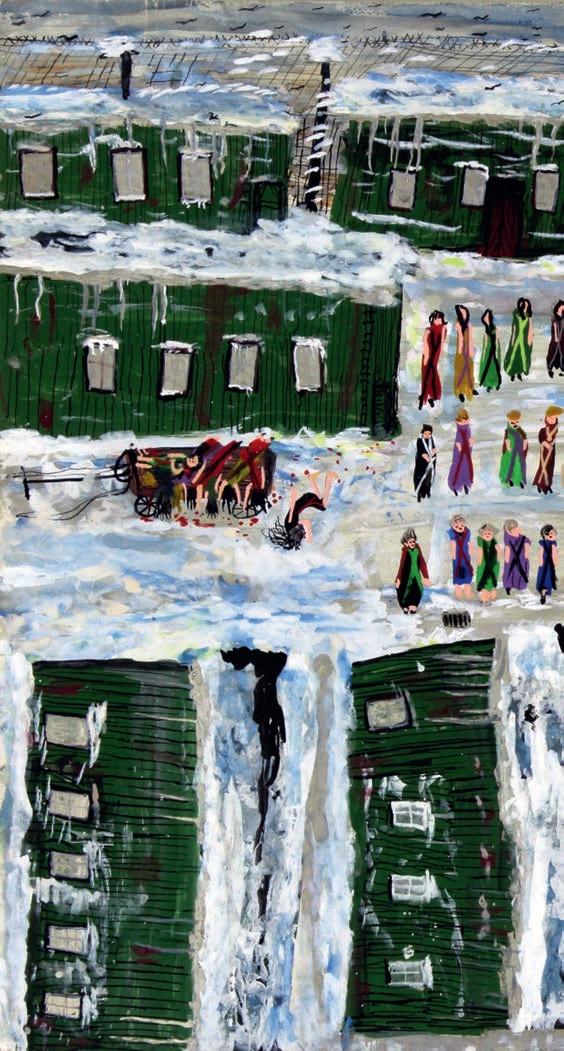
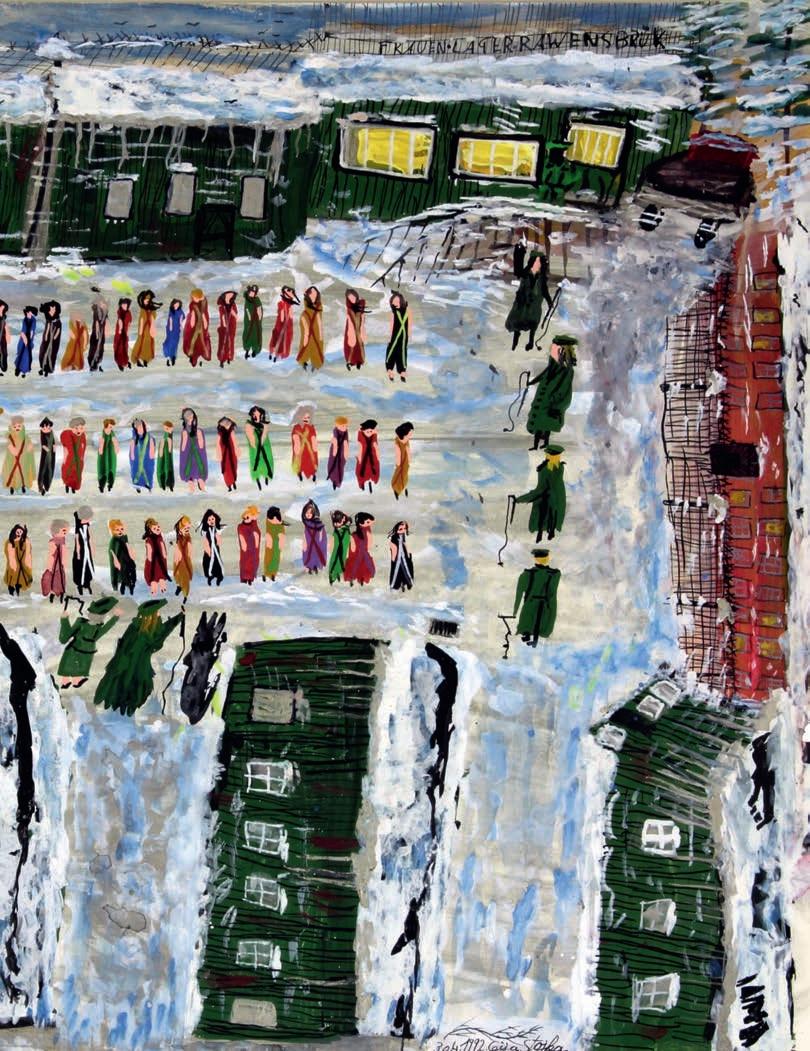
PL. 01, Untitled (Ravensbrück Women’s Camp), 30.04.1992
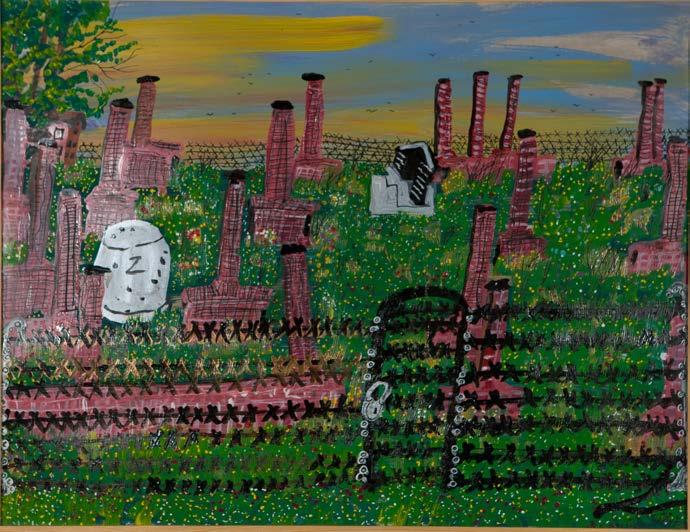
PL. 02, Untitled, 14.05.1993
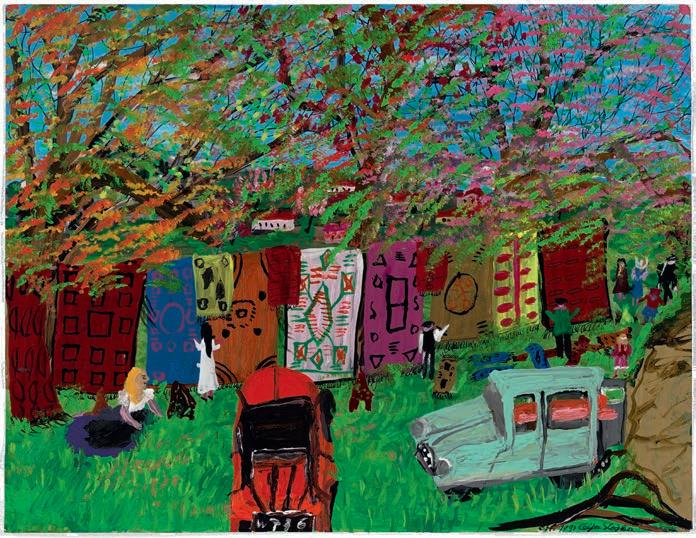
1993
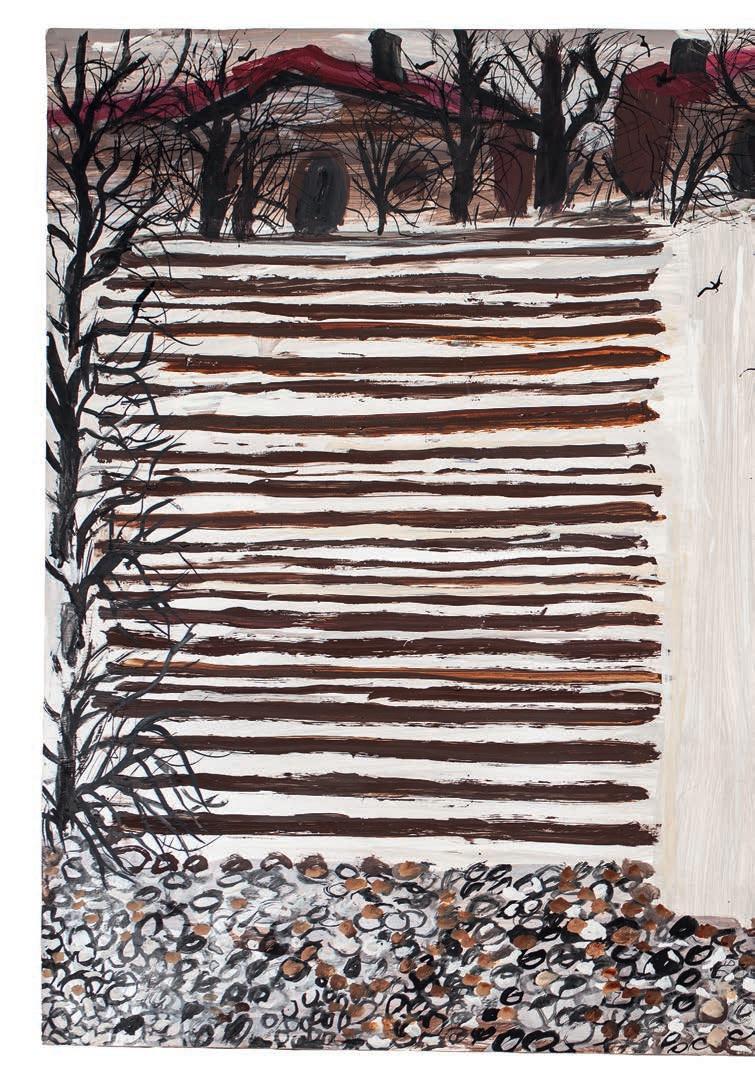
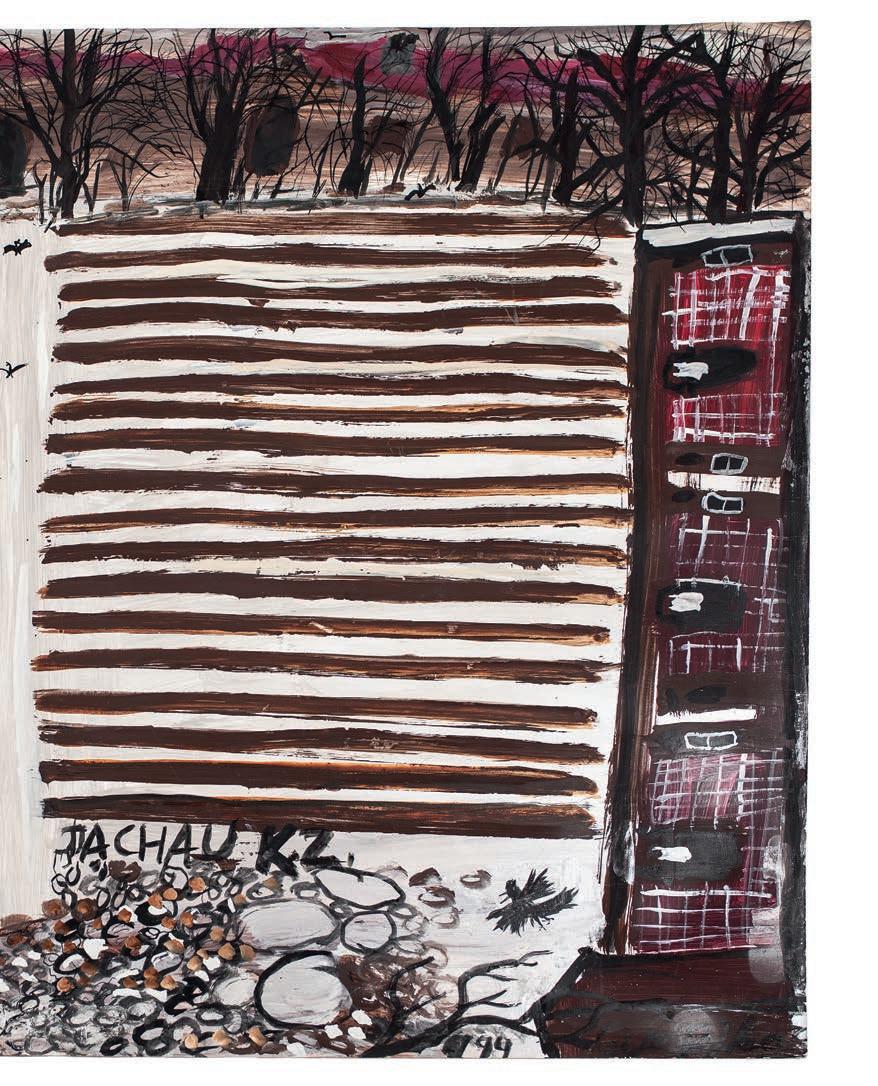
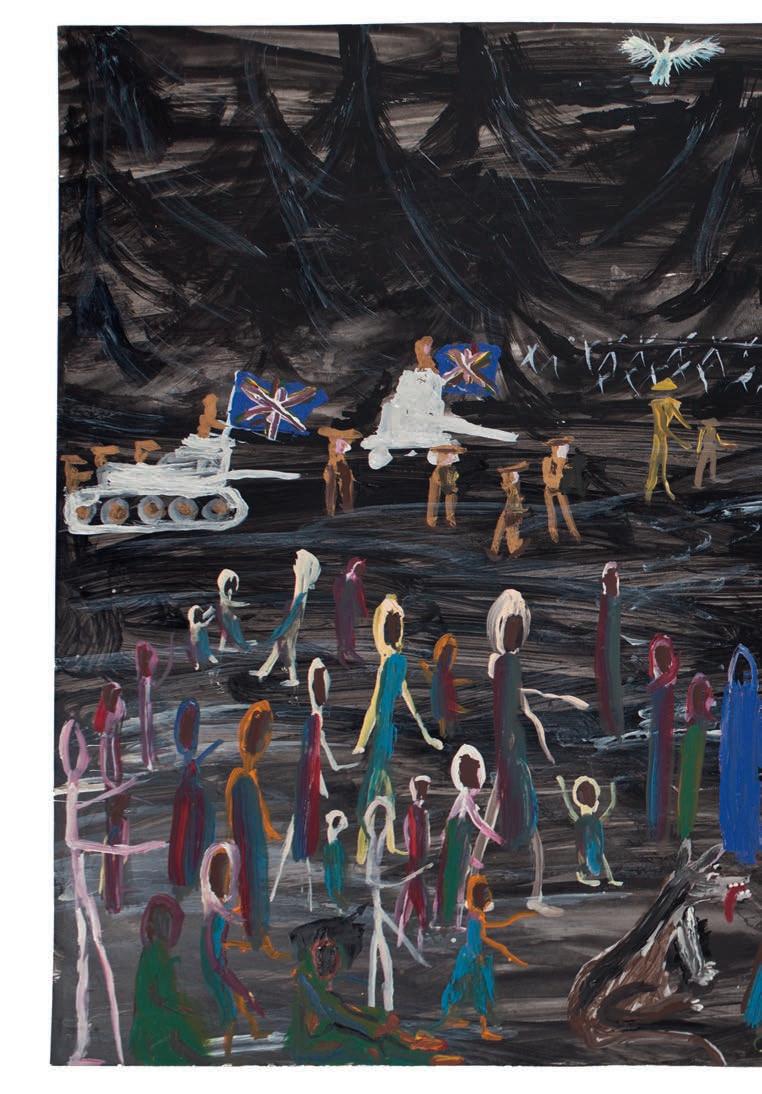
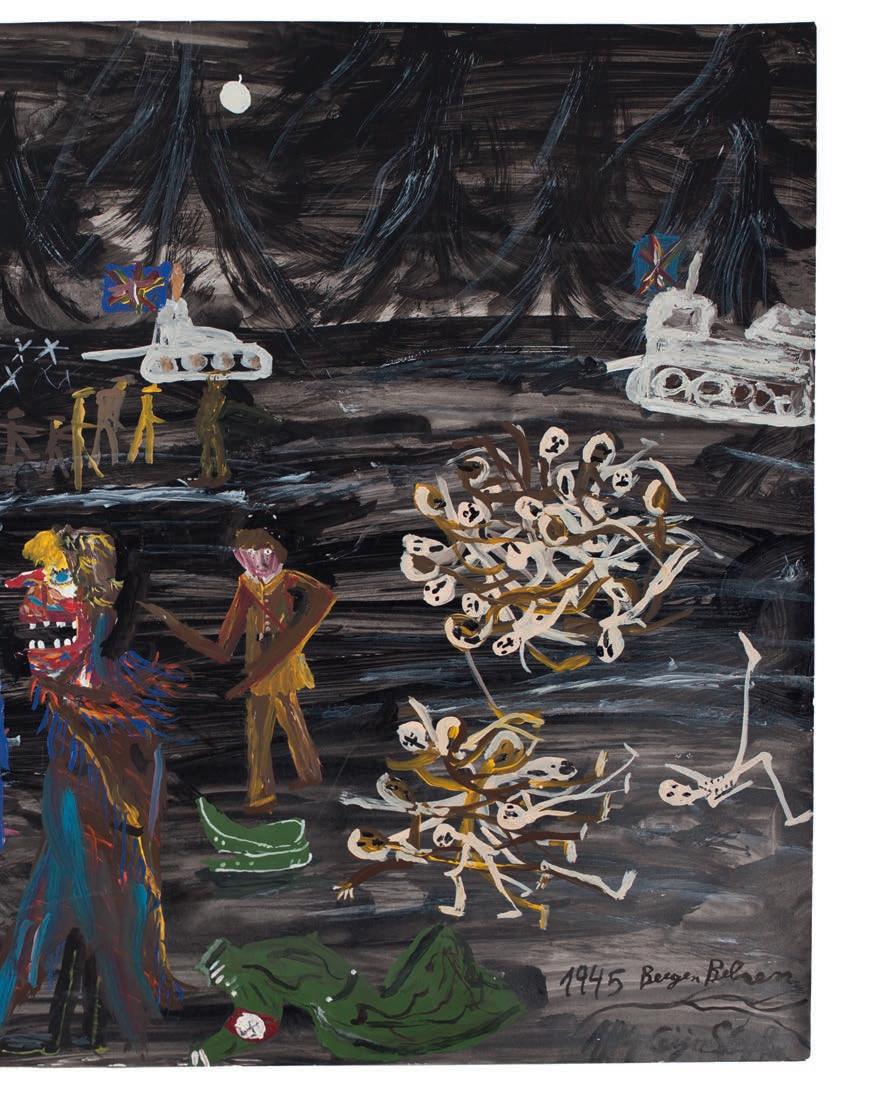
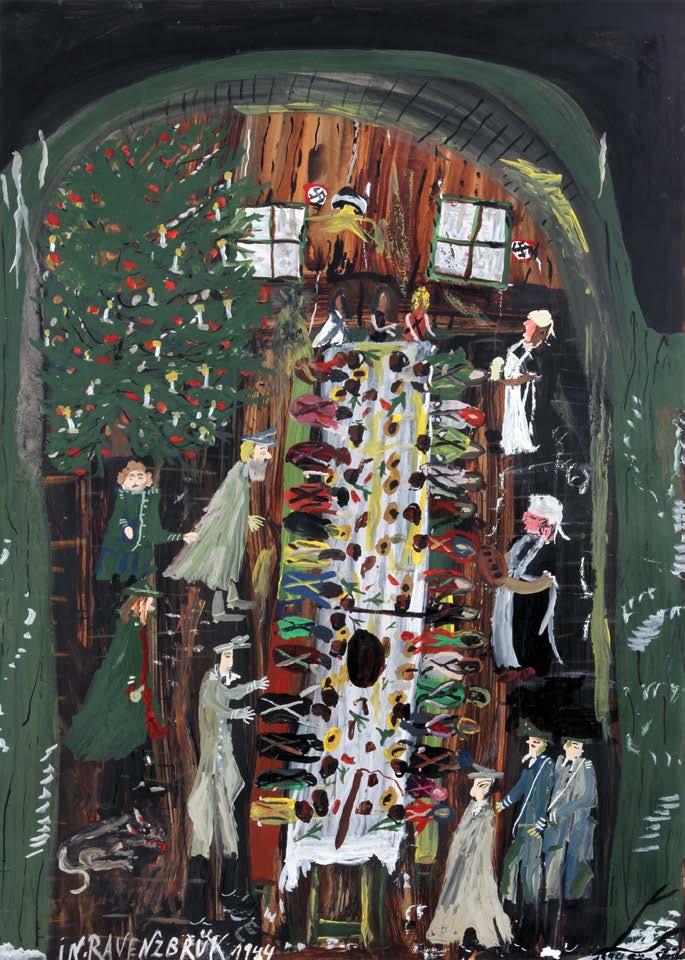
PL. 06, In Ravensbrück, 1944, 1994
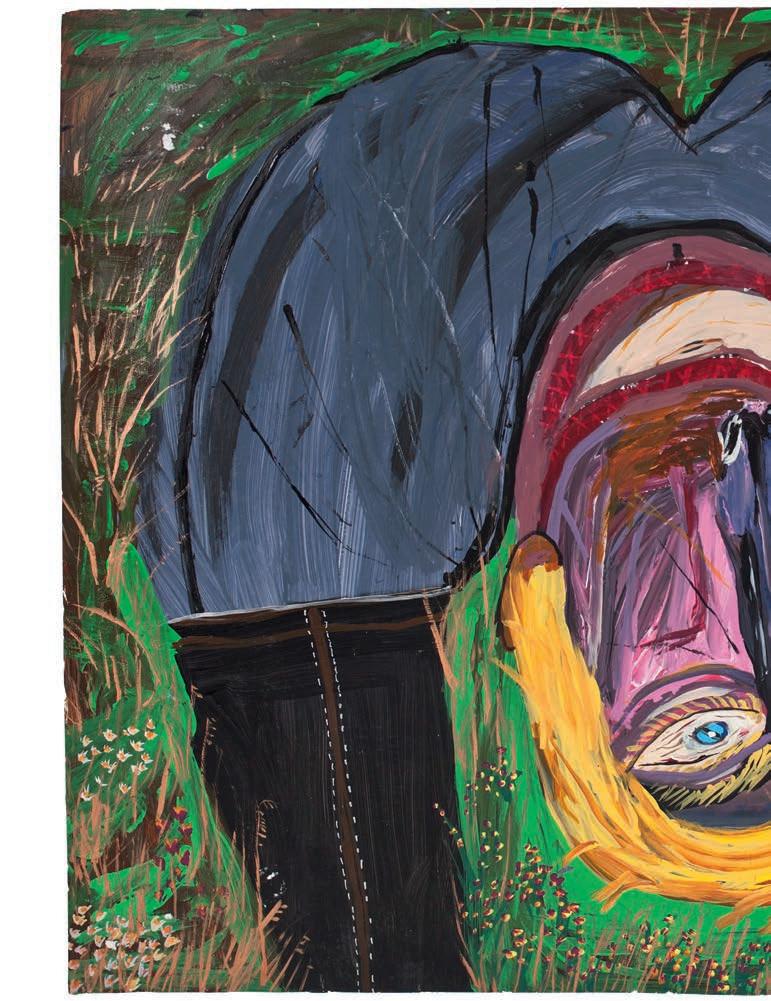
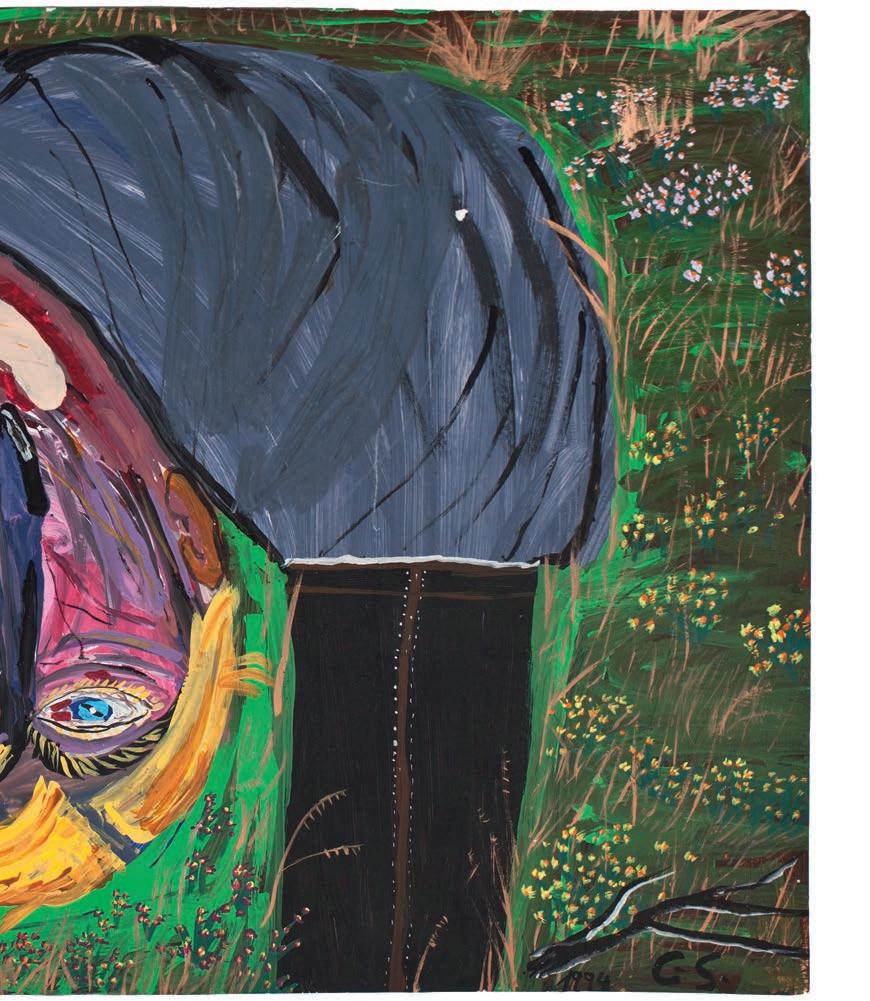
PL. 07, Untitled, 1994
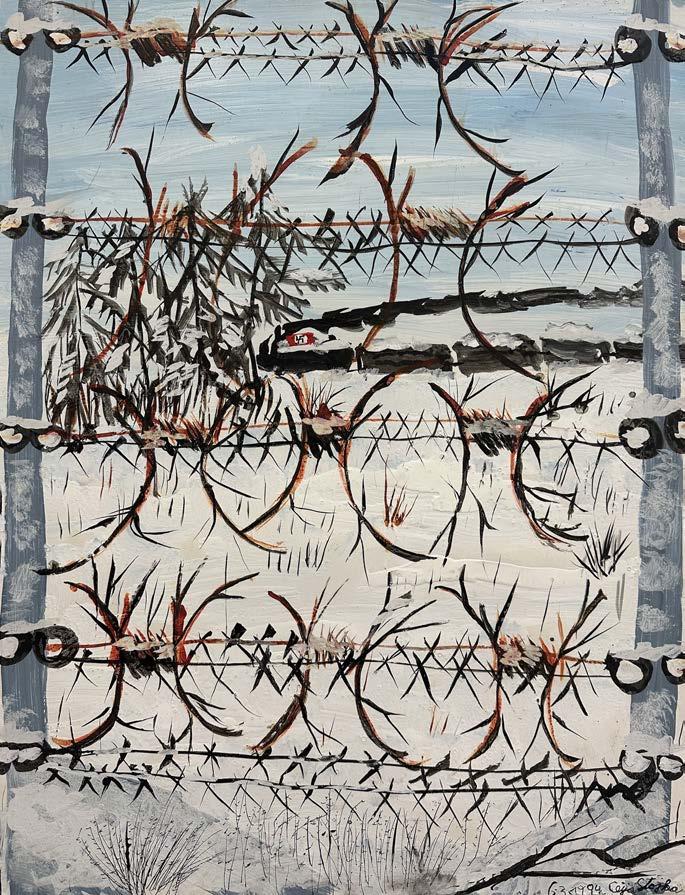
08, Untitled, 06.03.1994
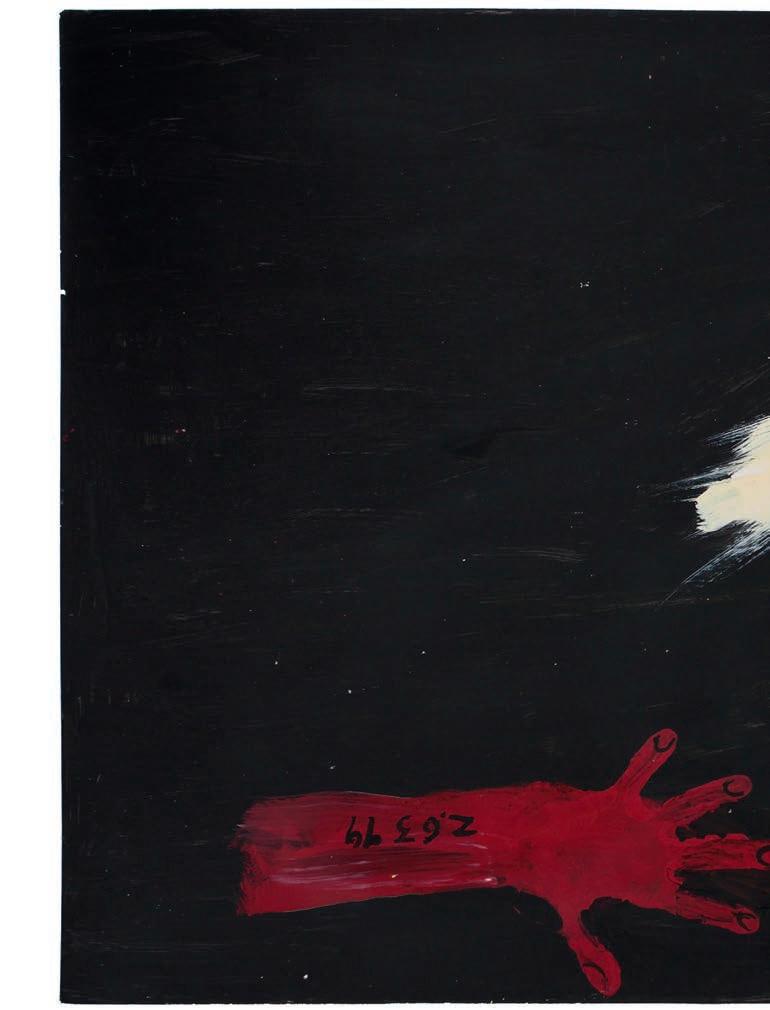
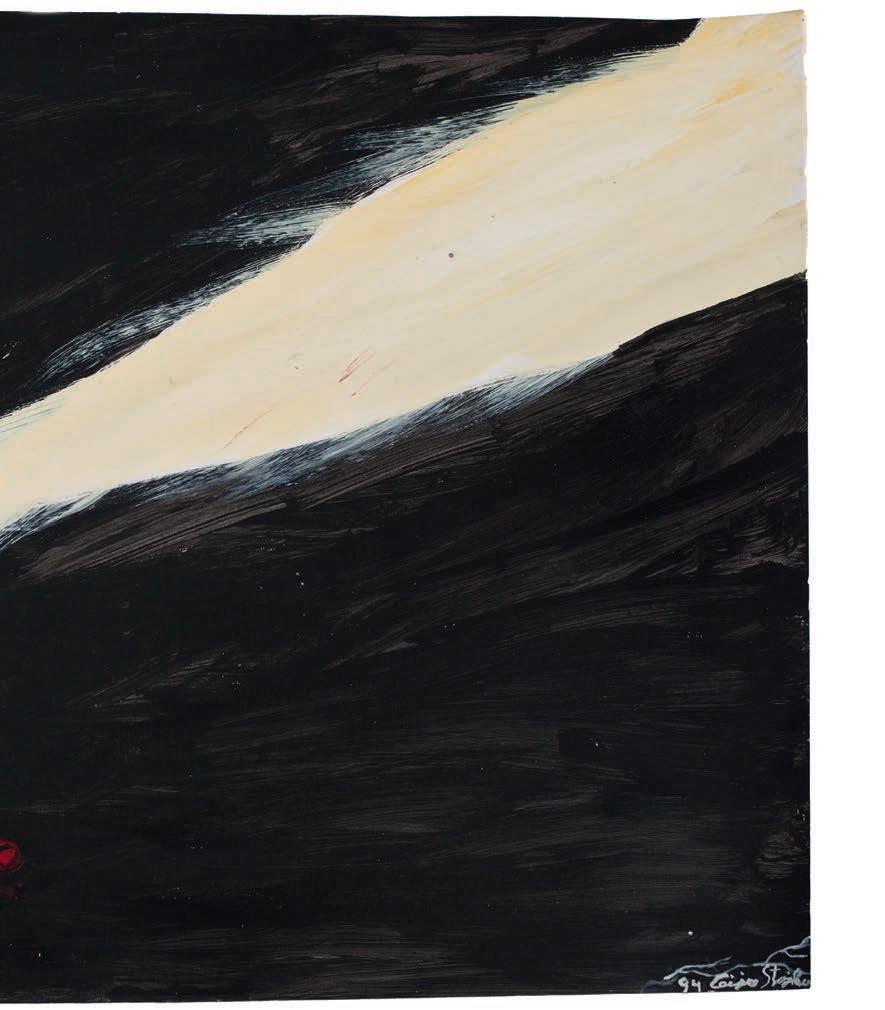
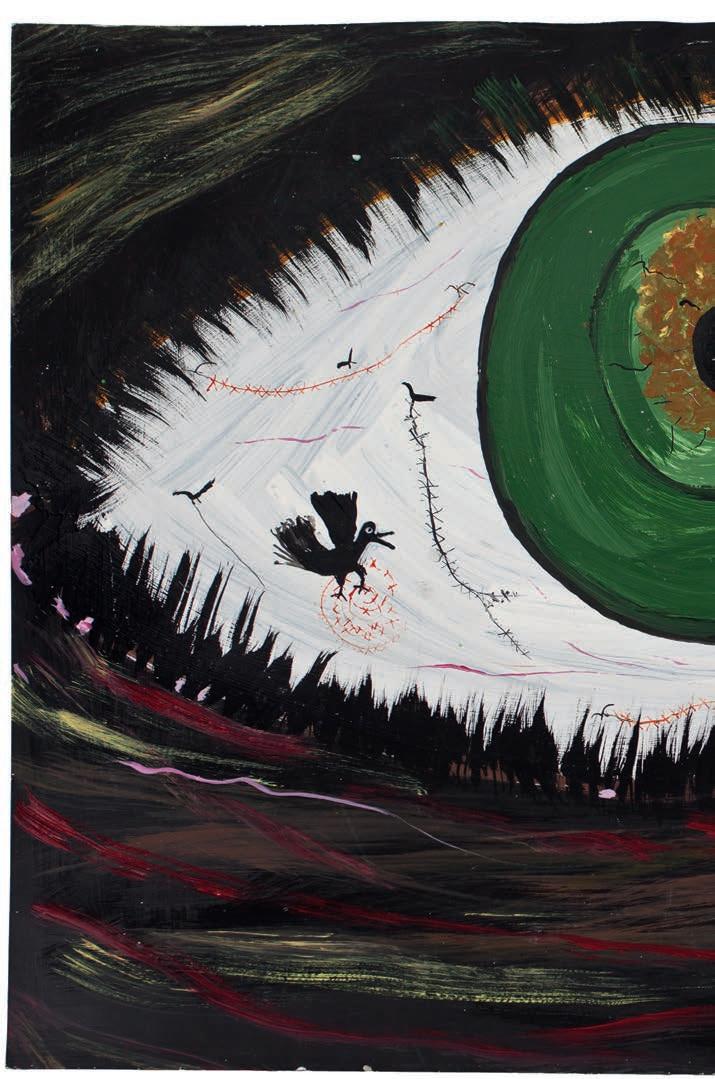

PL. 10, Untitled, 1995

PL. 11, Decay (Rot), 1995
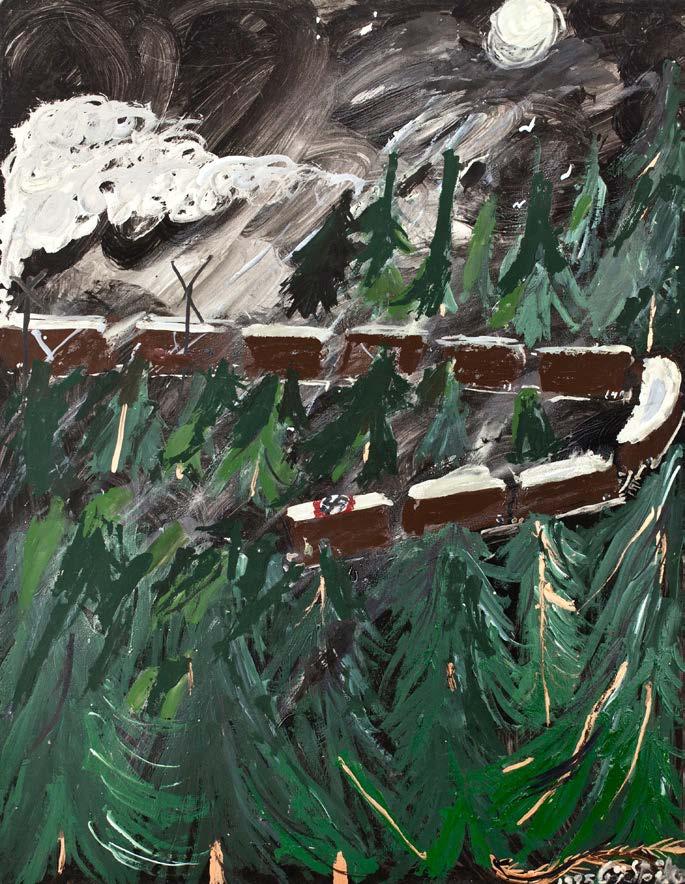
PL. 12, Untitled, 1995
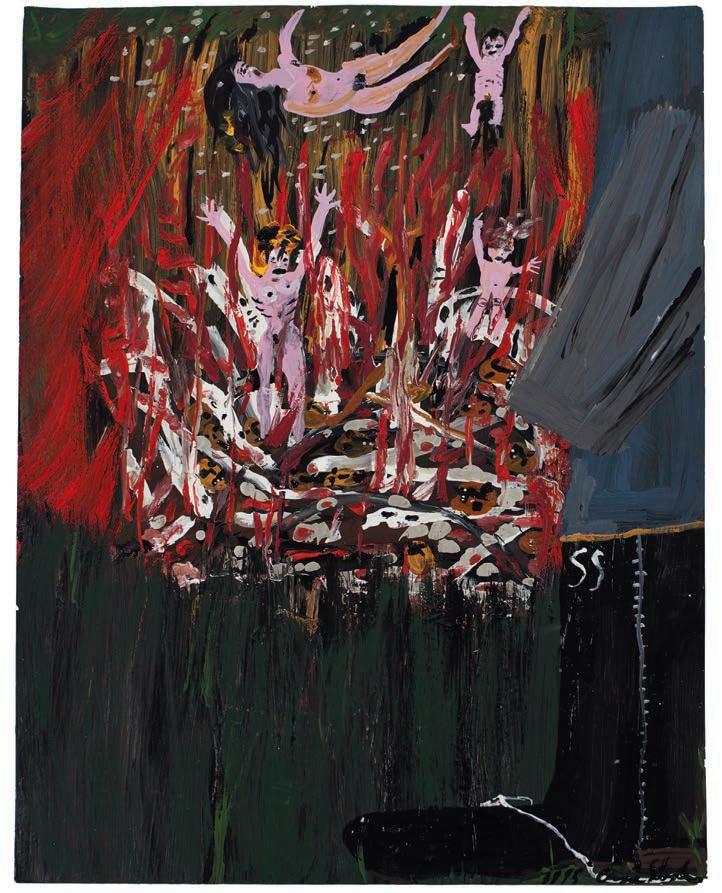
PL. 13, Untitled (SS), 1995
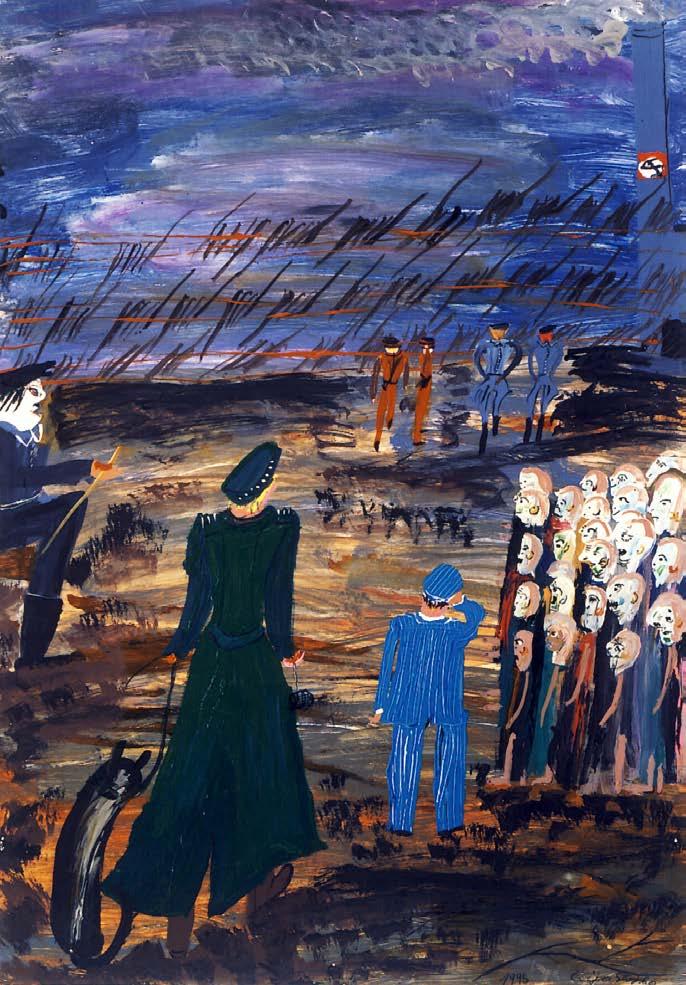
PL. 14, Roll call. Be obedient, attention, answer to your name., 1995
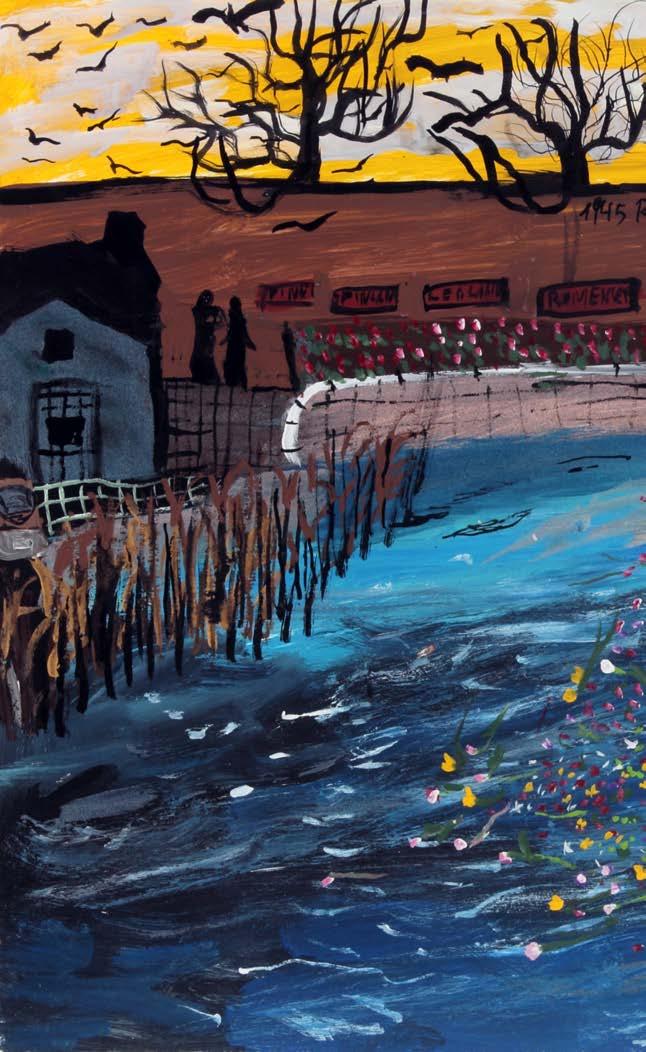
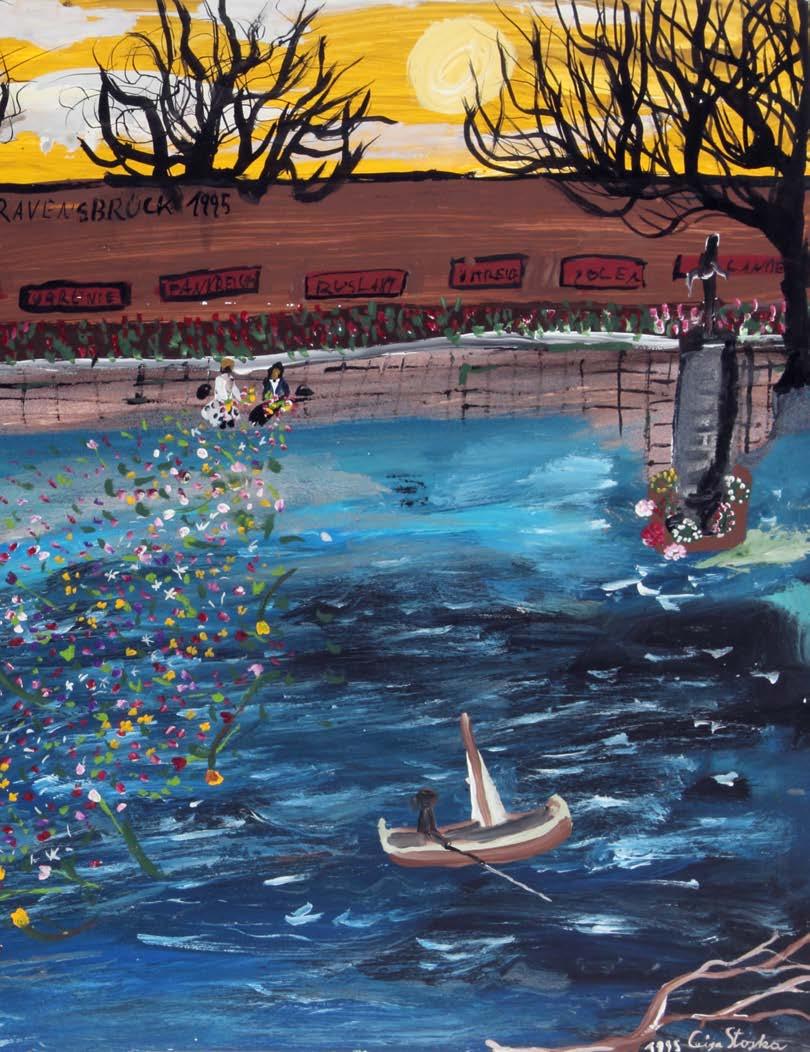
PL. 15, 1945, Ravensbrück, 1995, 1995
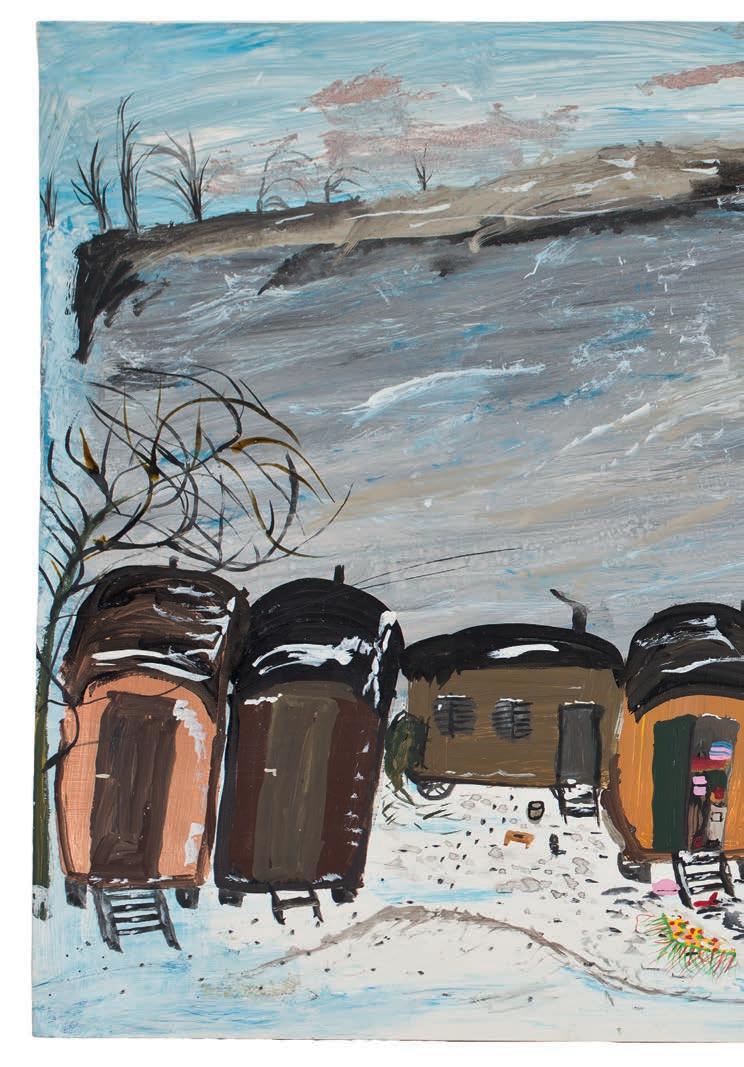
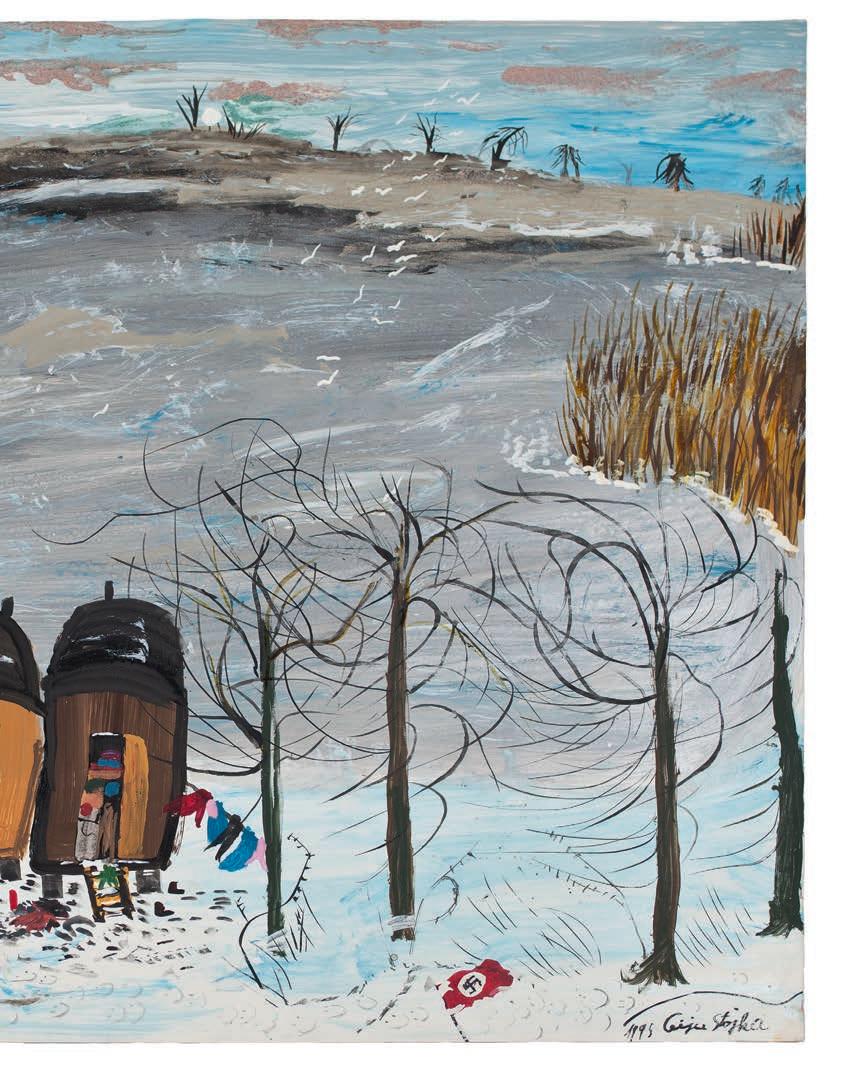
PL. 16, Untitled, 1995
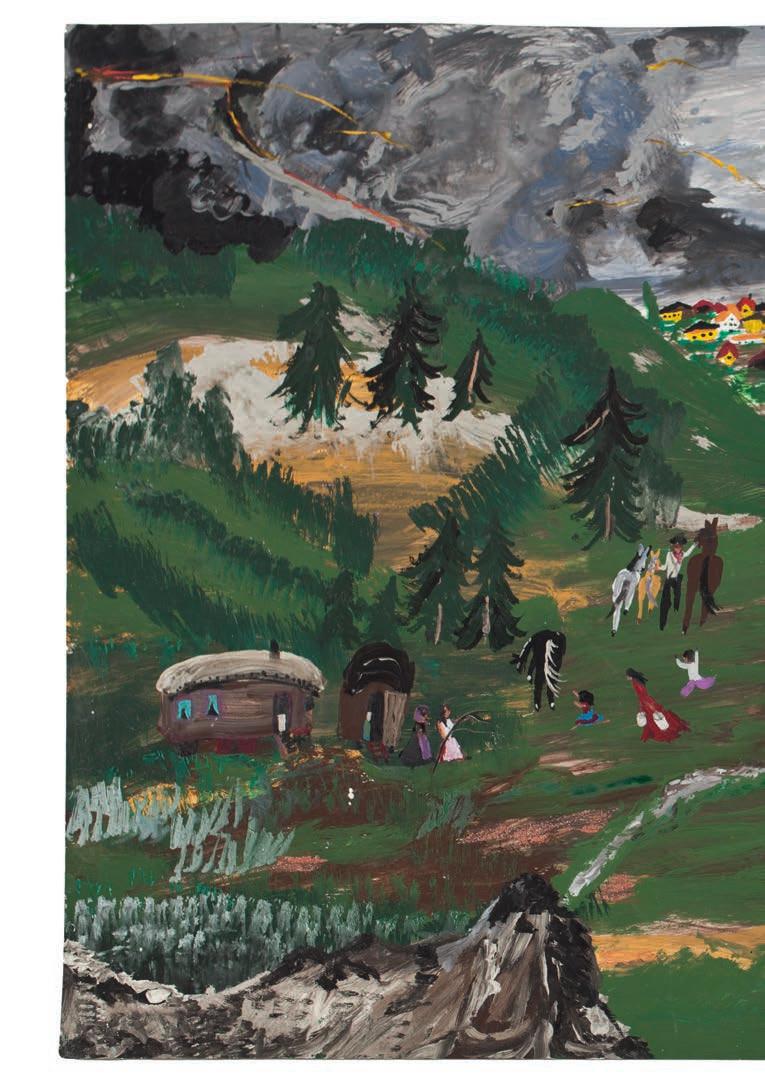
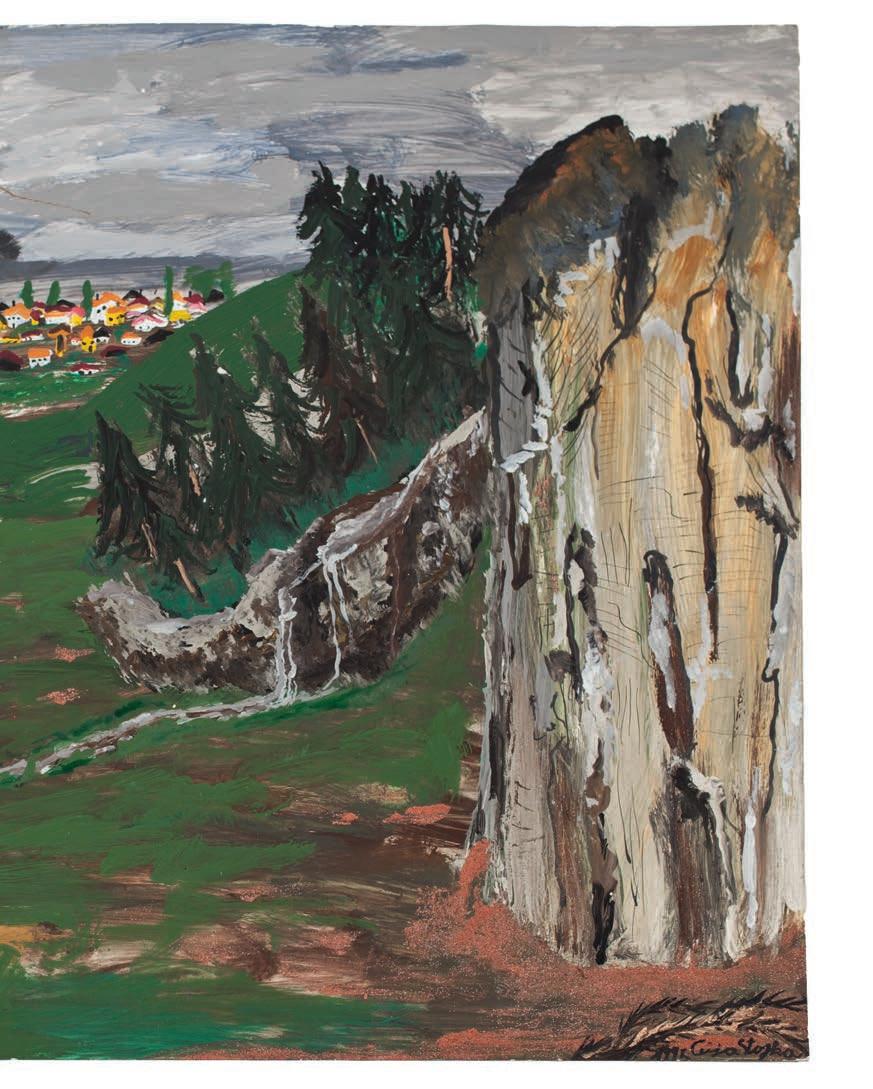
PL. 17, Untitled, 1995
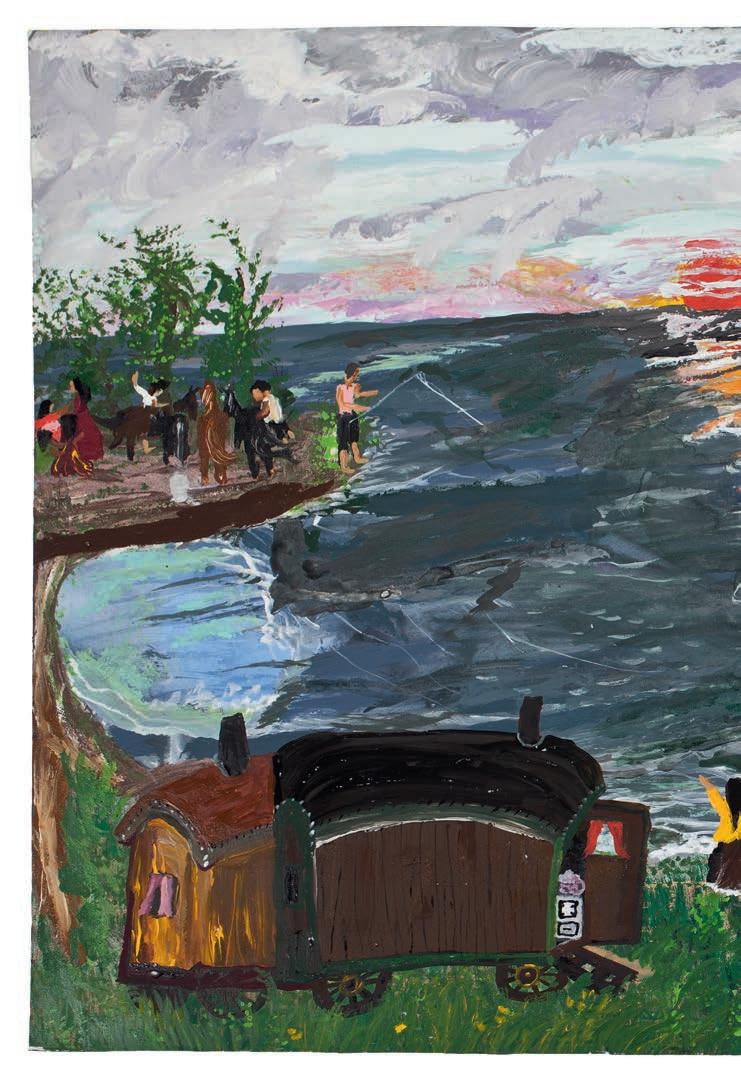
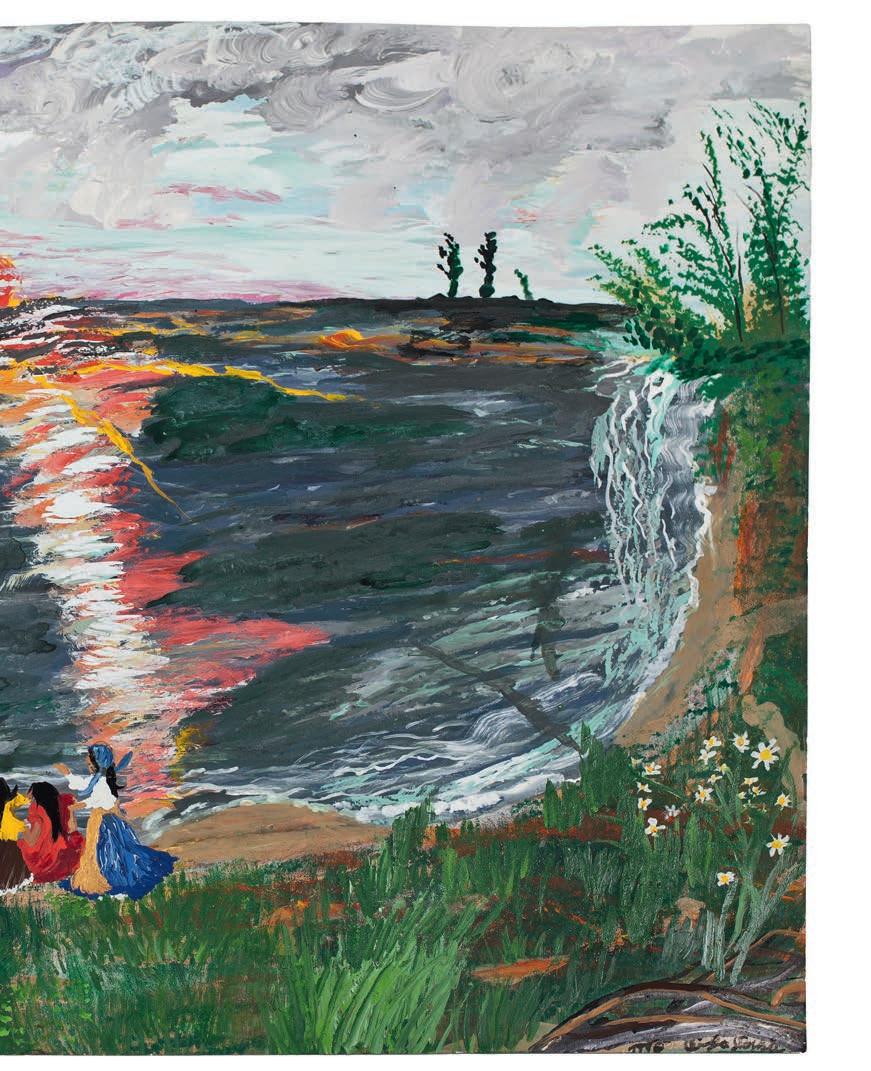
PL. 18, Untitled, 1995
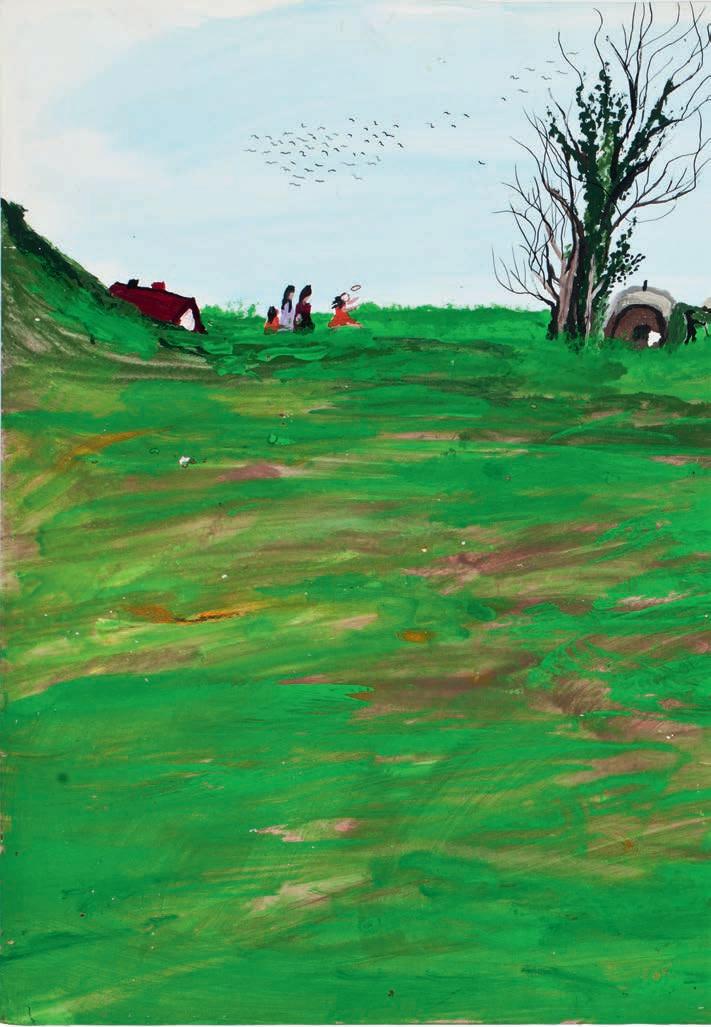
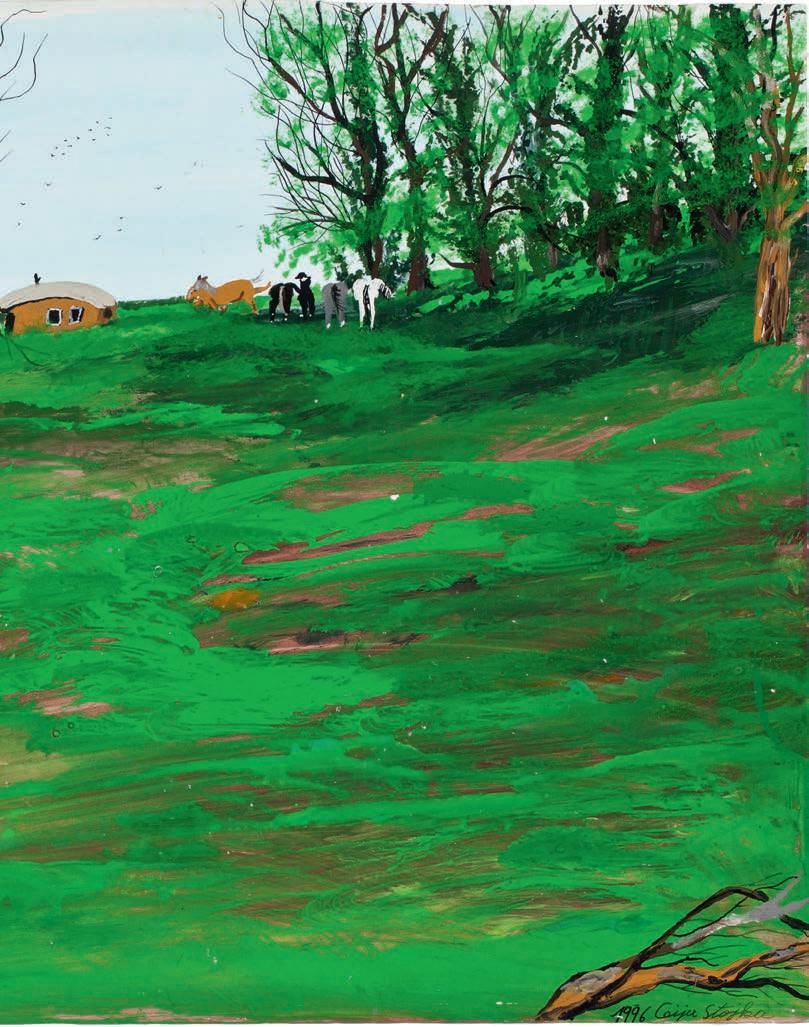
PL. 19, Untitled, 1996
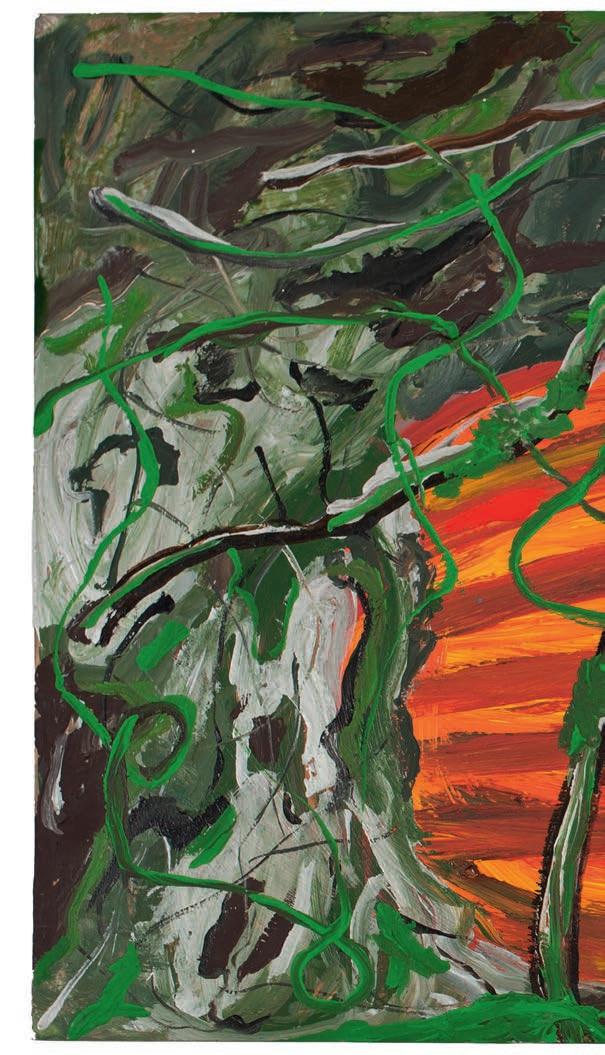
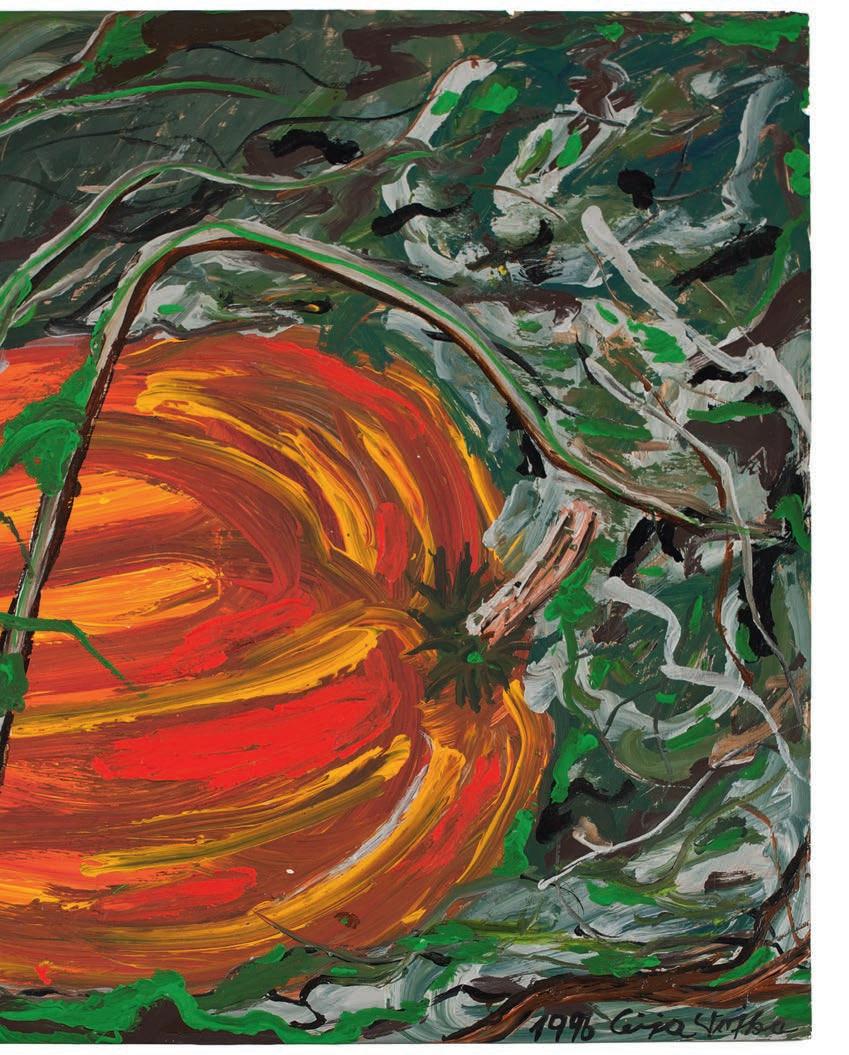
PL. 20, Untitled, 1996
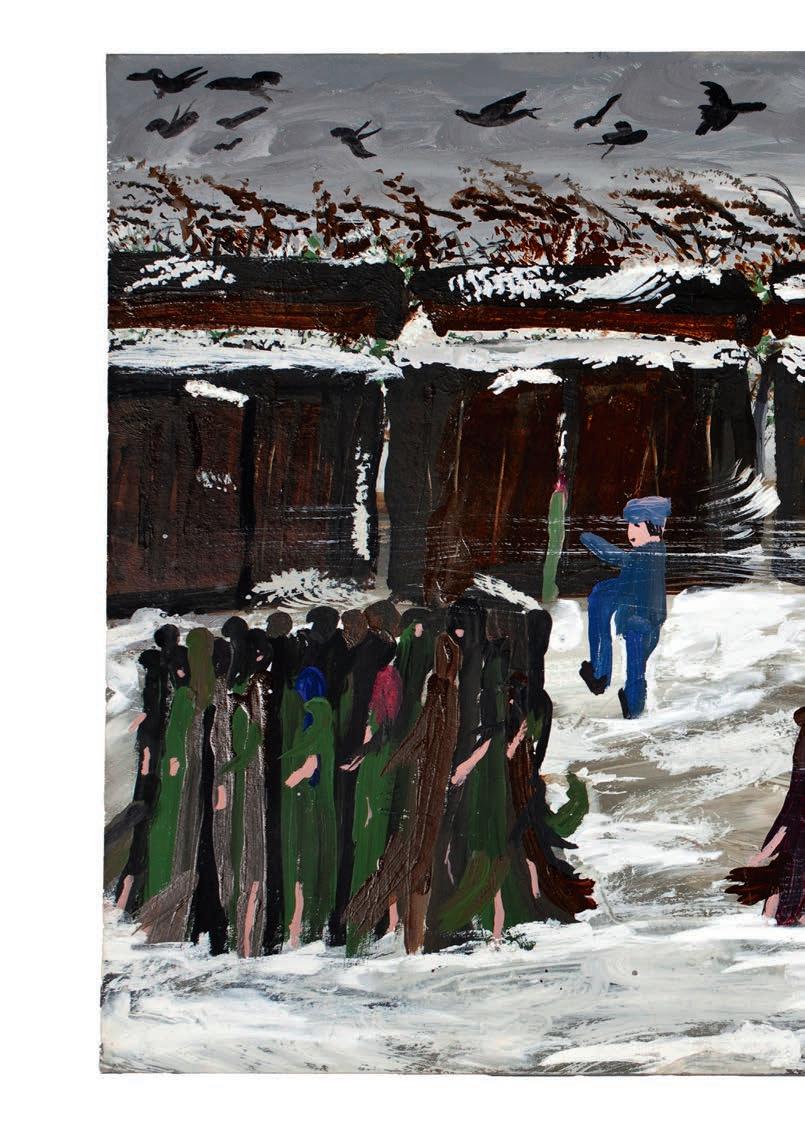
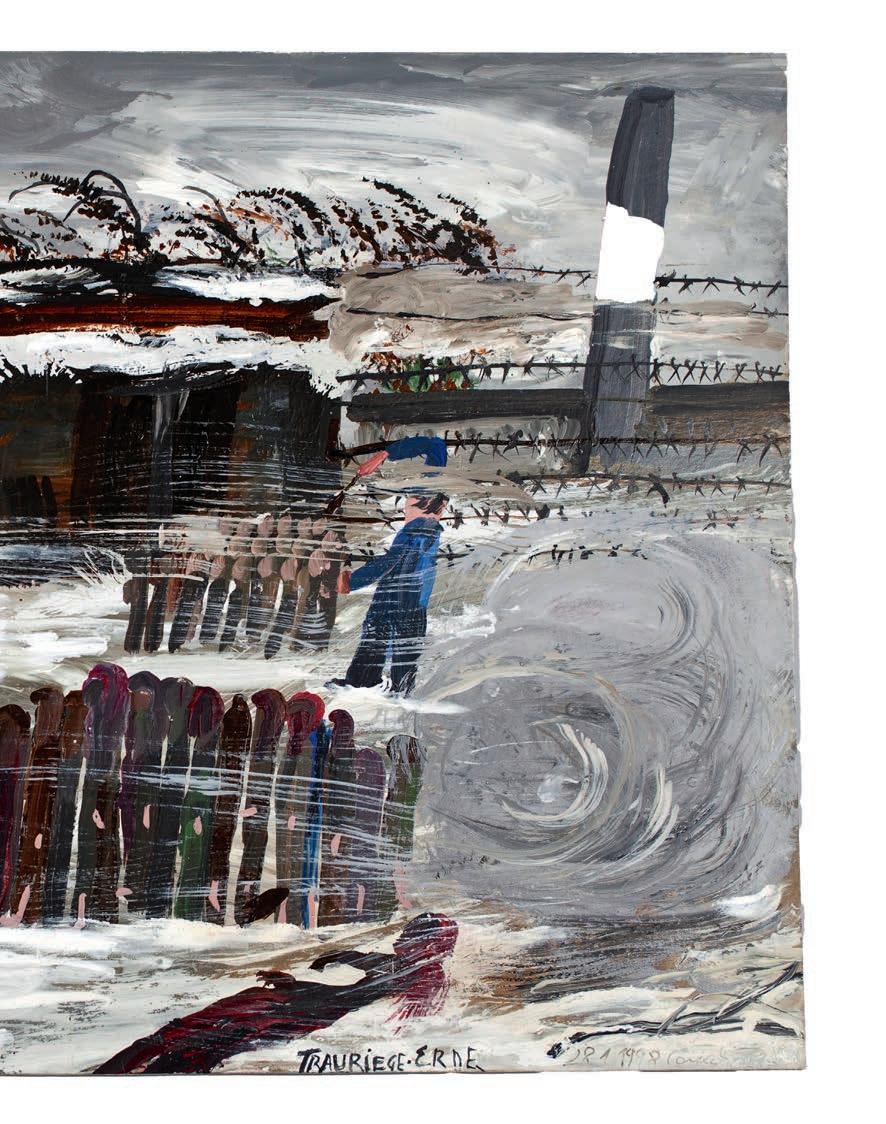
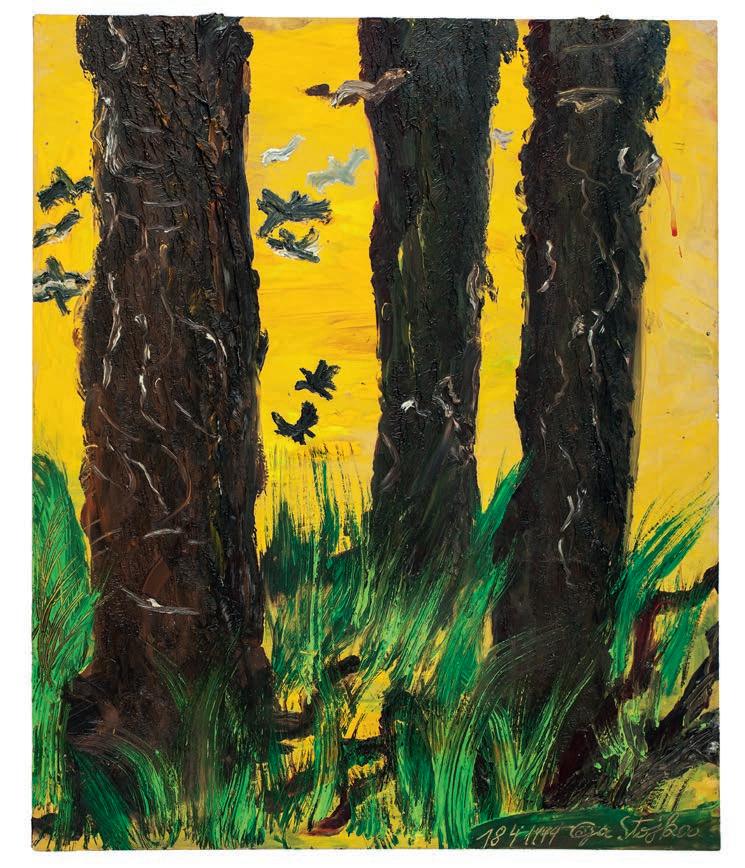
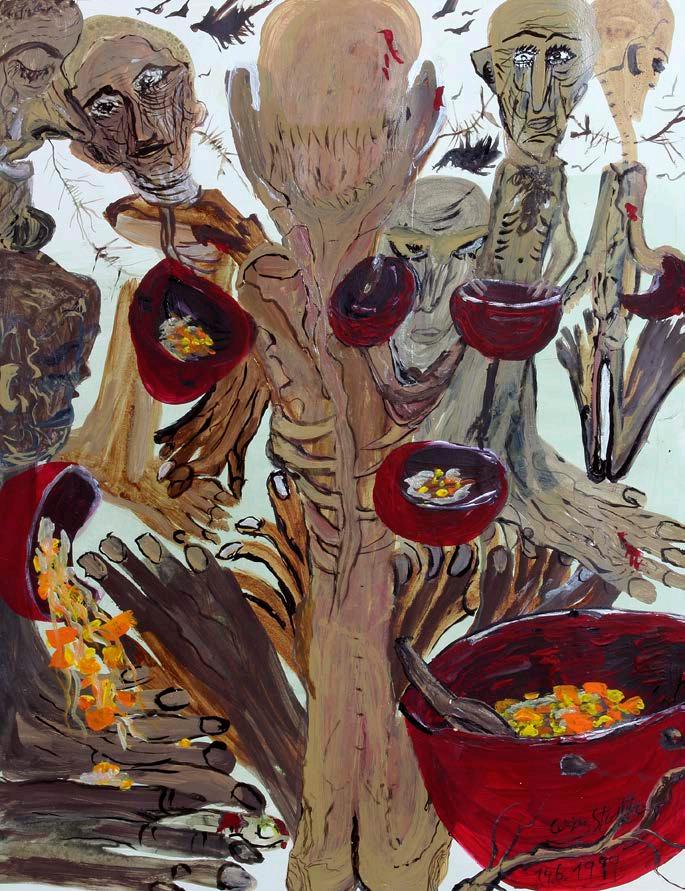
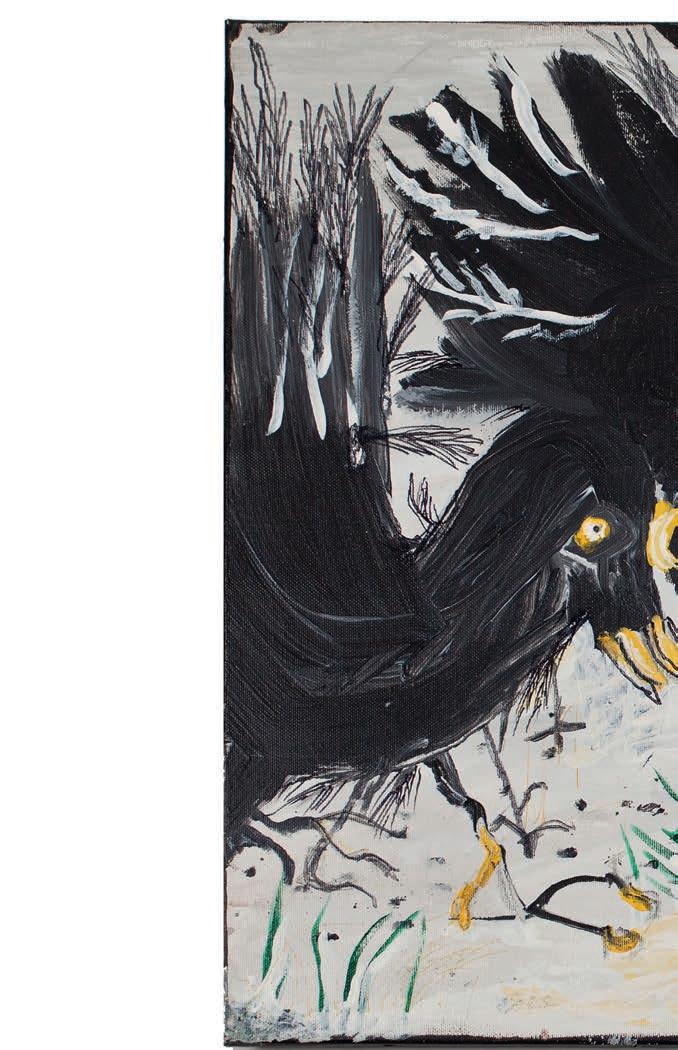
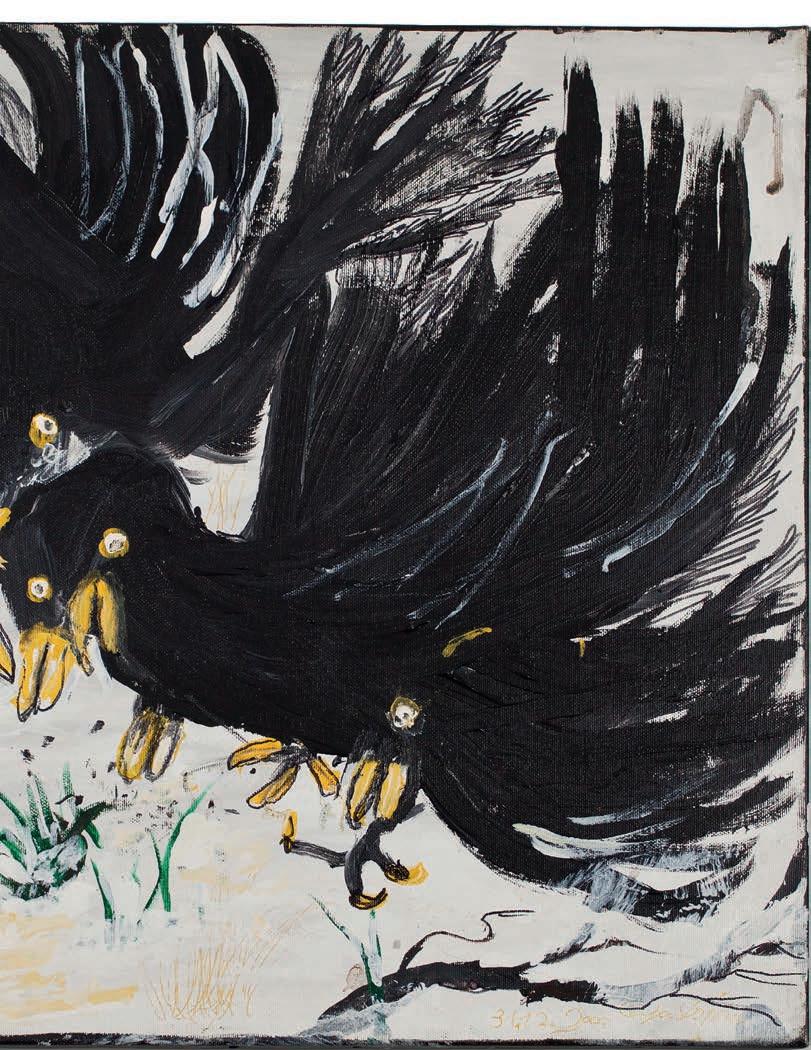
PL. 24, Untitled (I sent the ravens to our dear God so that they could pray in Auschwitz.) [Title handed down by word of mouth], 31.12.2000
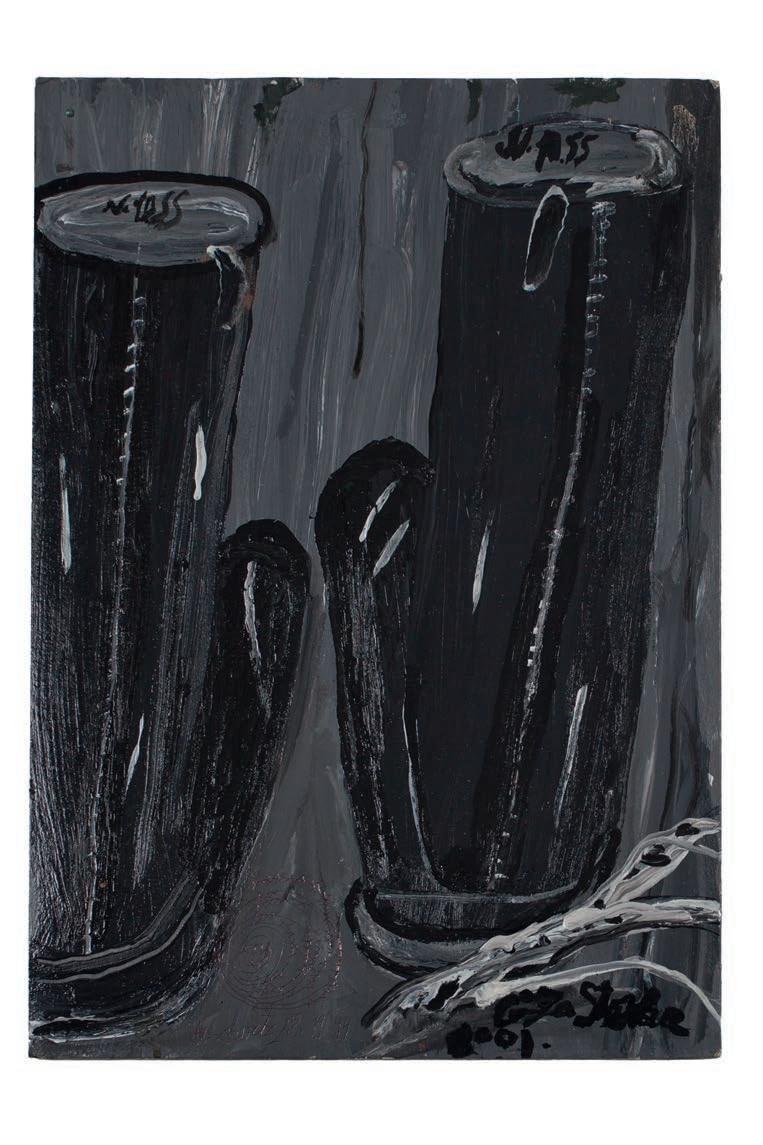
PL. 25, Untitled, 2001
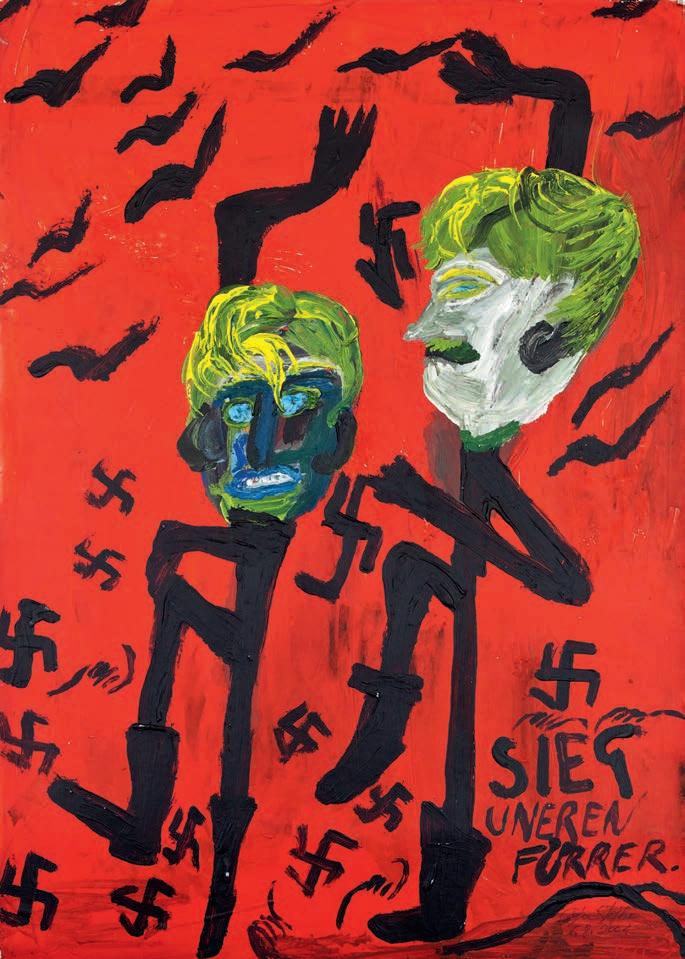
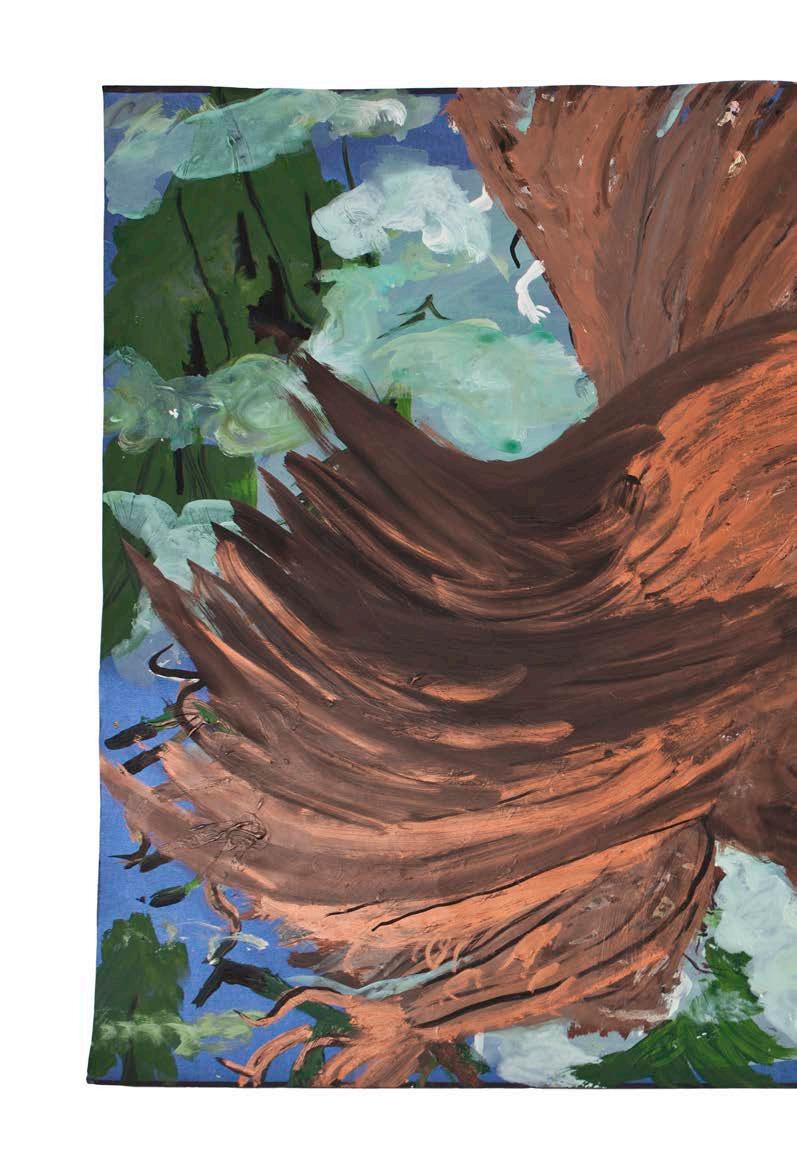
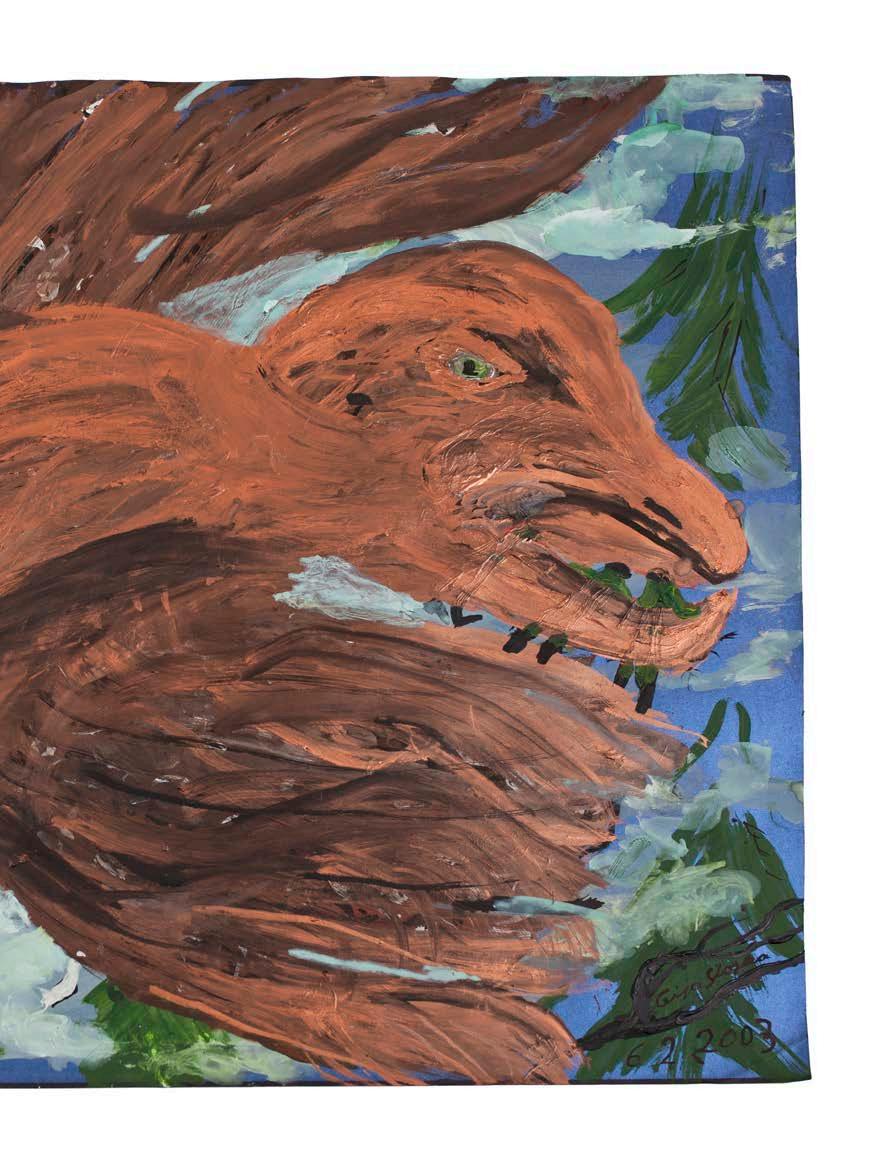
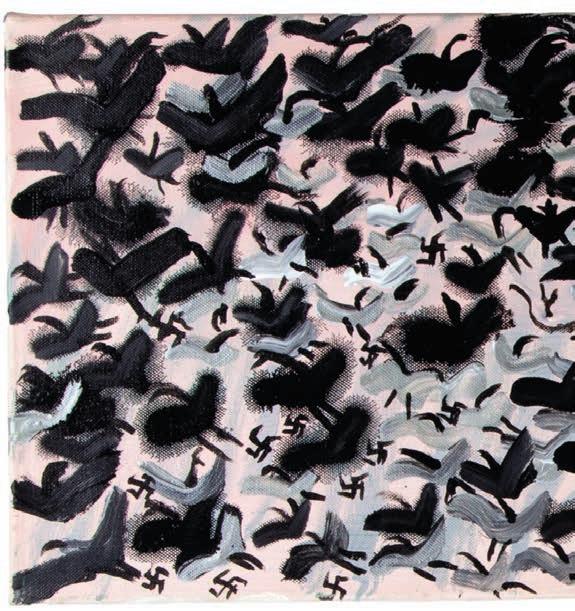
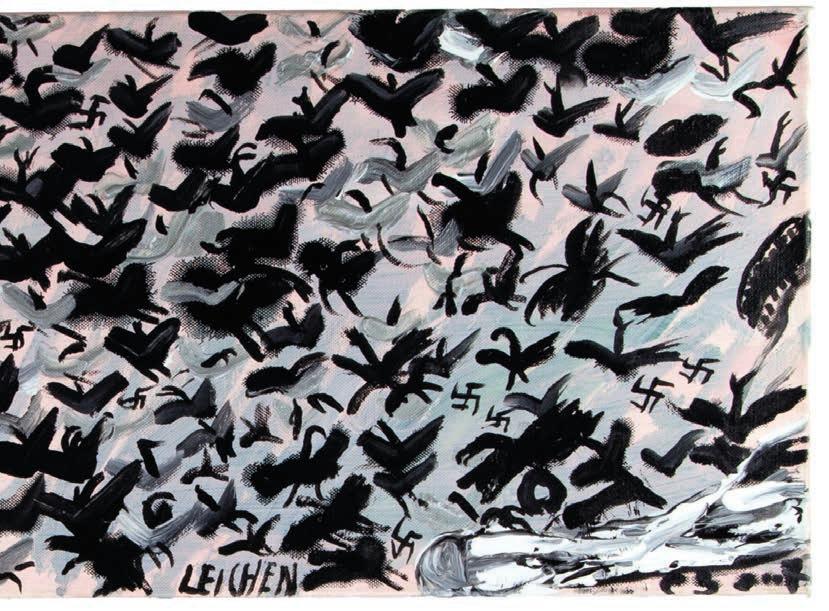
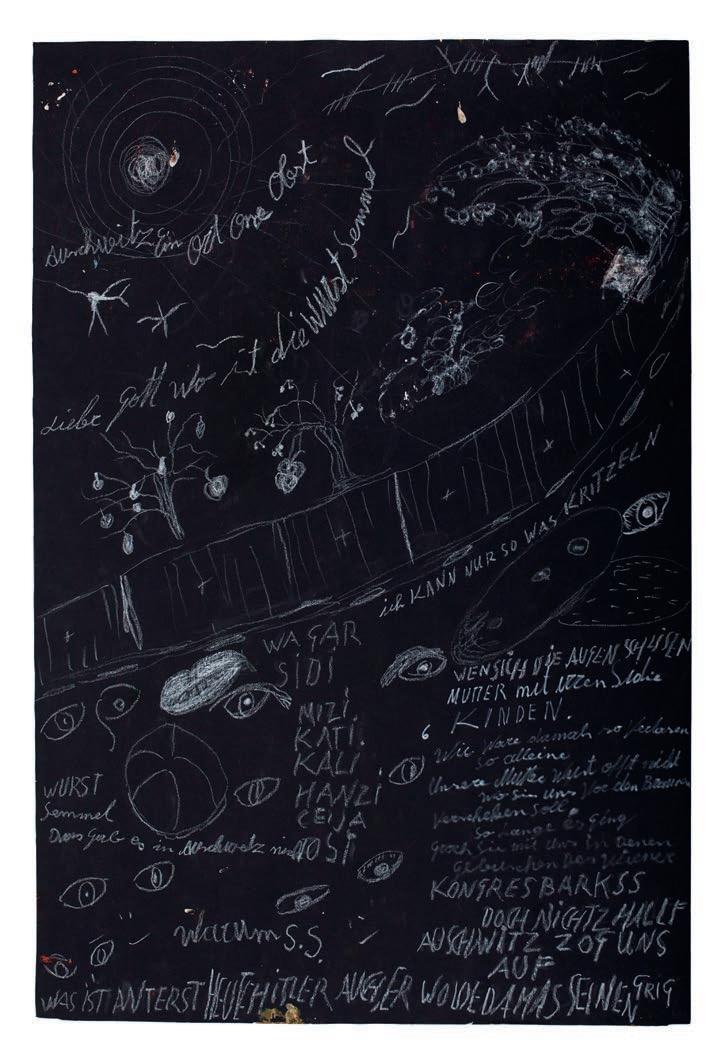
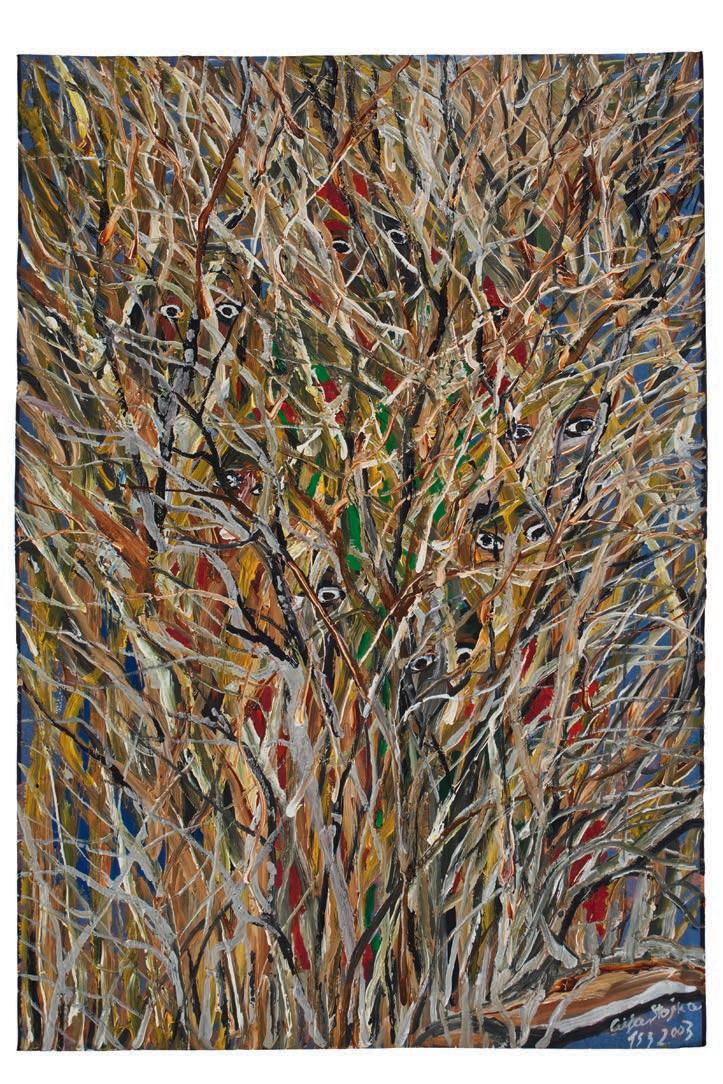
PL. 29, Untitled, 15.03.2003, verso and recto
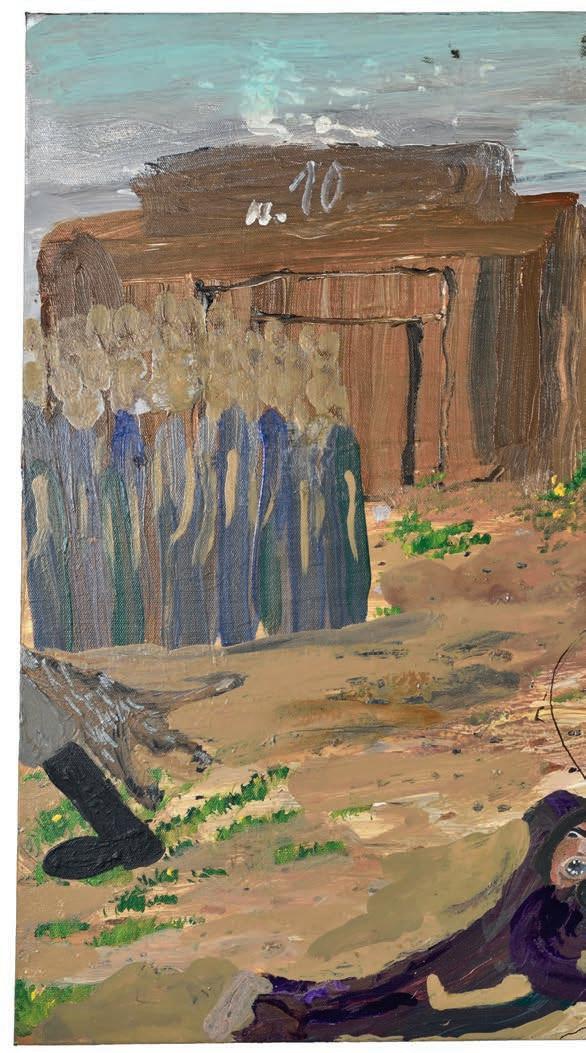
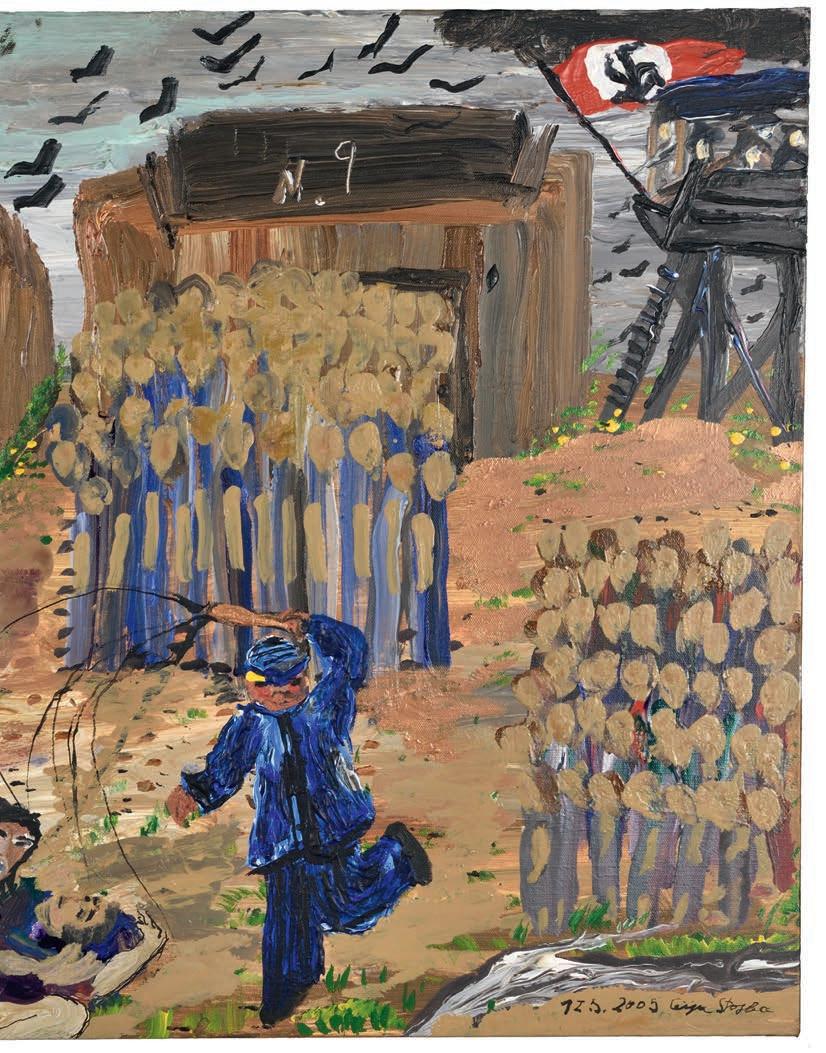
PL. 31, Untitled (No. 10, No. 9), 12.05.2005
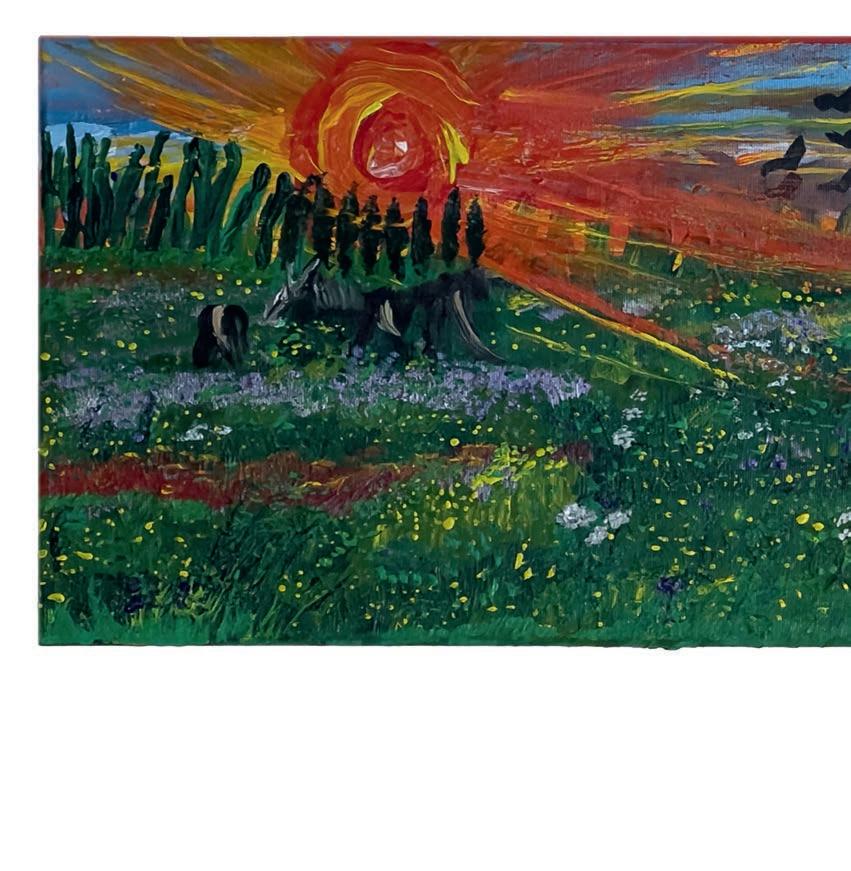
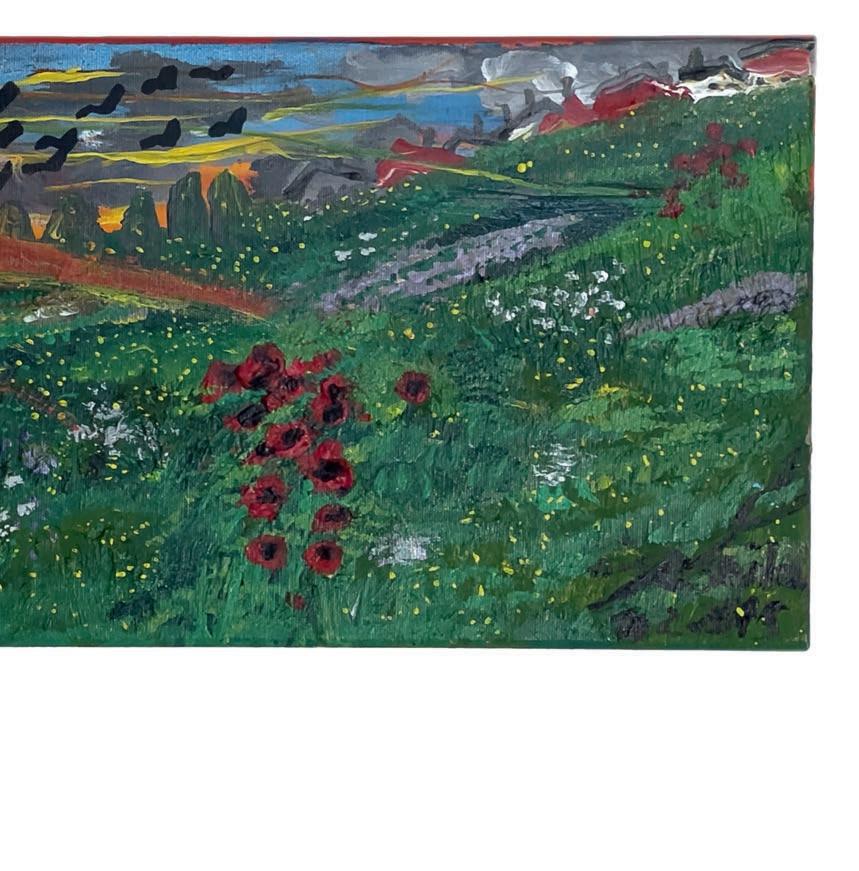
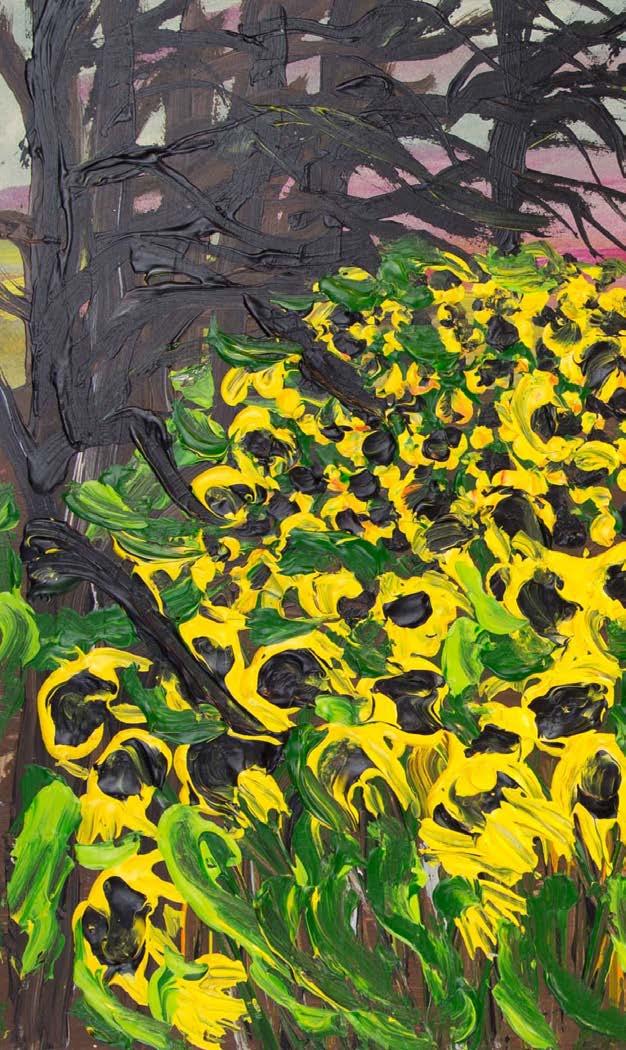
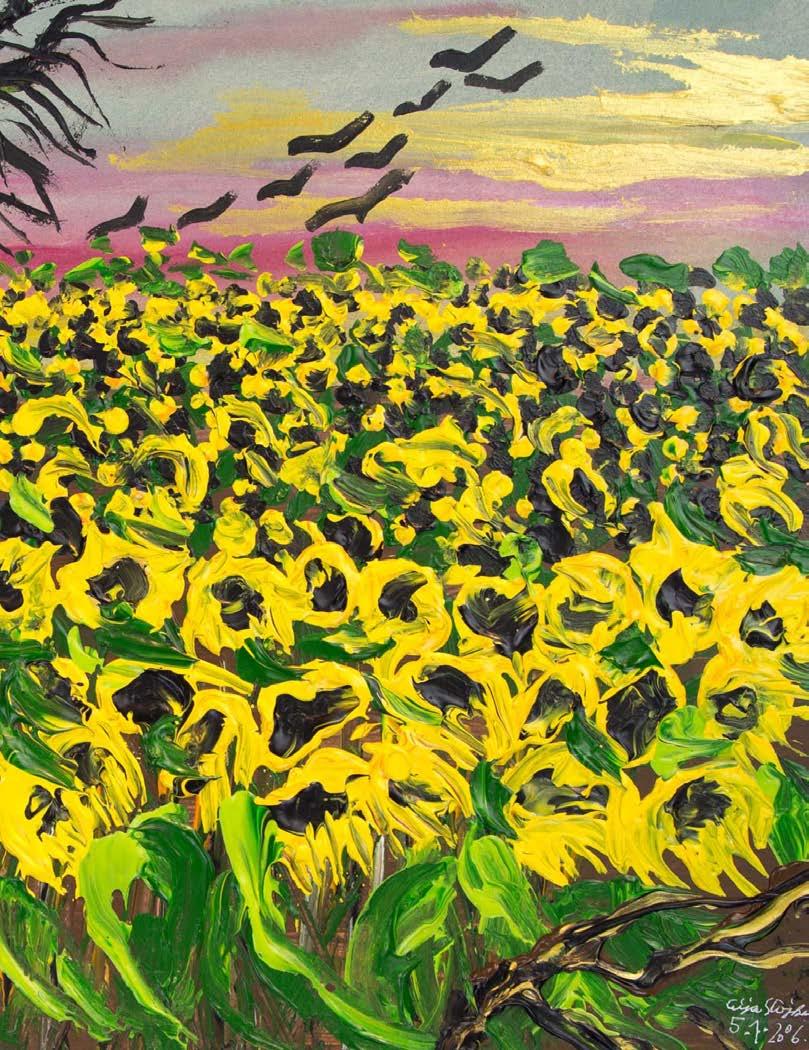
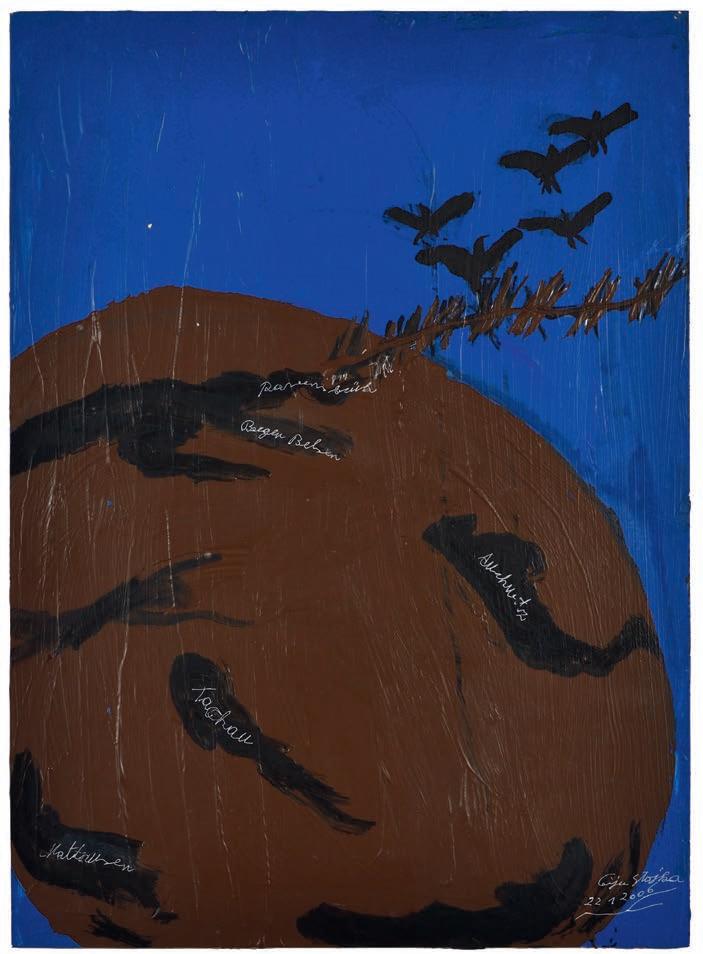
PL. 33, Untitled (Ravensbrück, Bergen-Belsen, Auschwitz, Dachau, Mauthausen), 22.01.2006
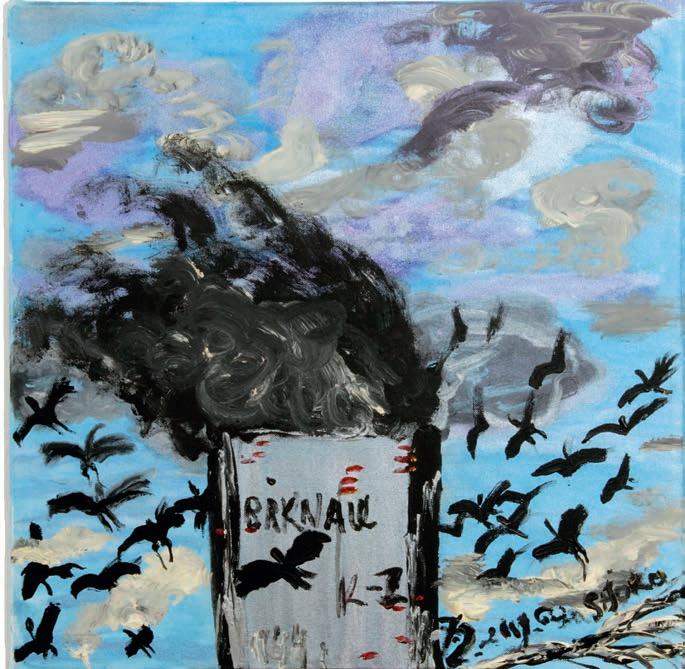
PL. 34, Birkenau Concentration Camp, 1944, 07.02.2009
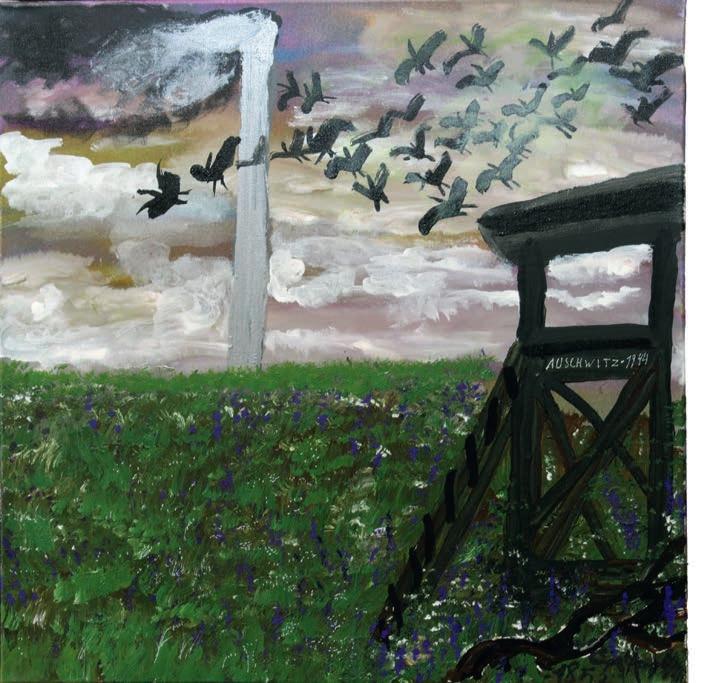
PL. 35, Auschwitz, 1944, 18.05.2009

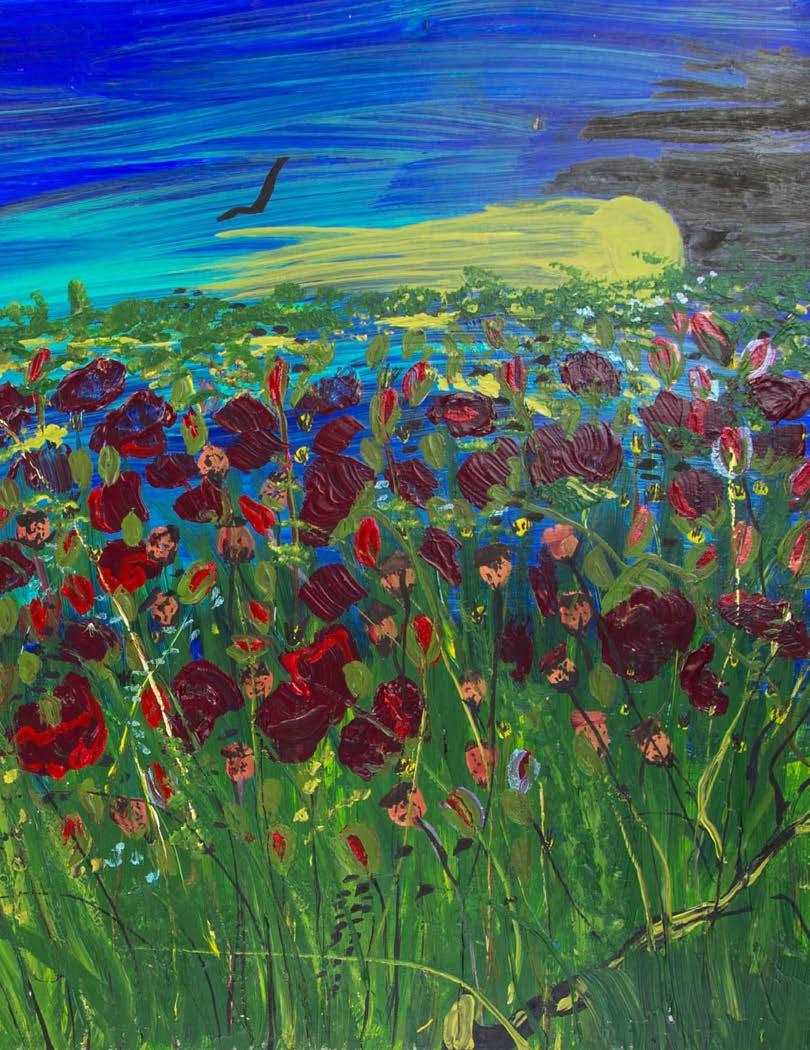
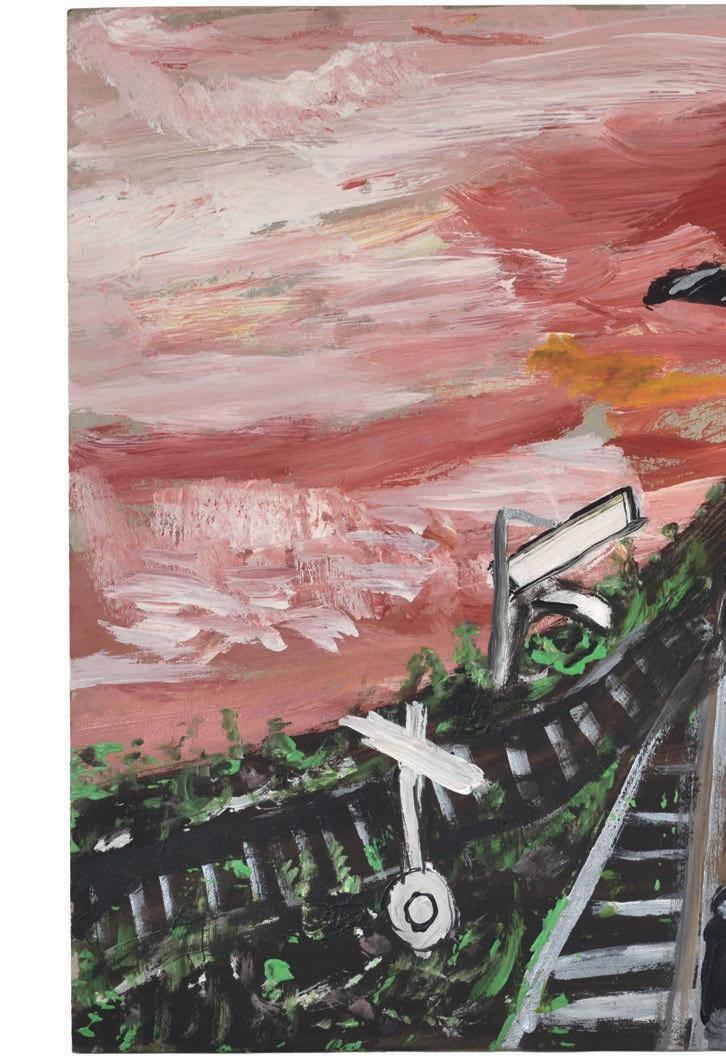
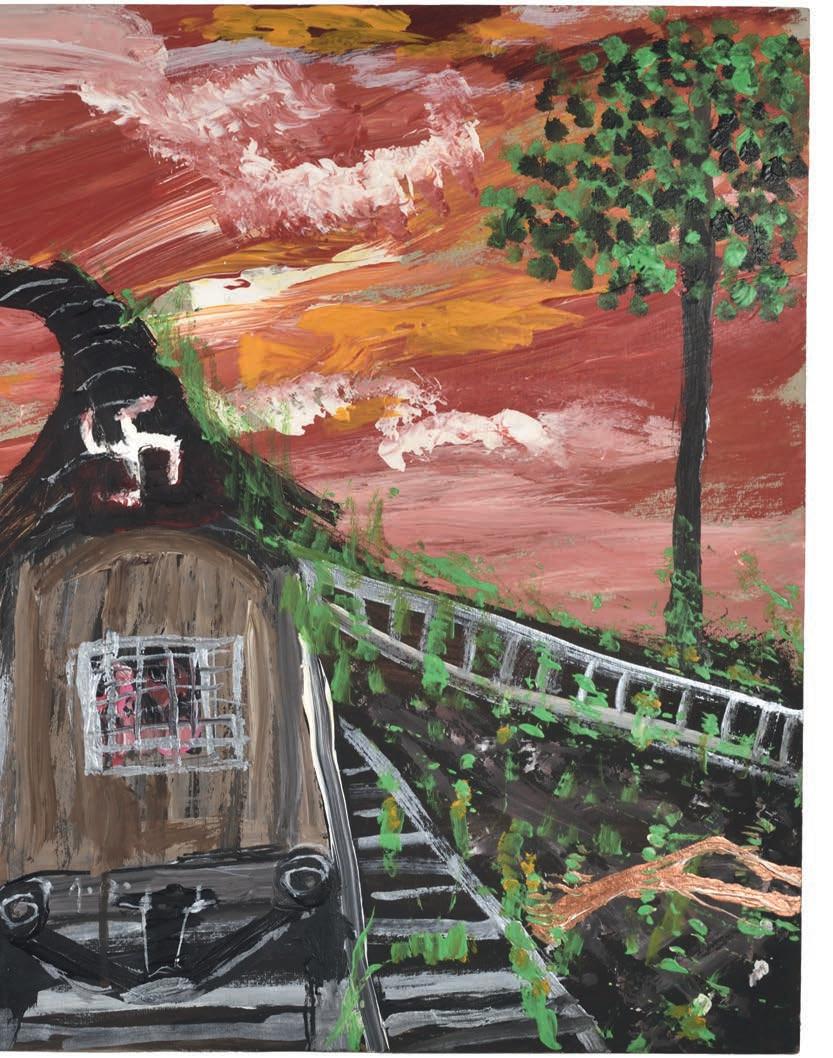
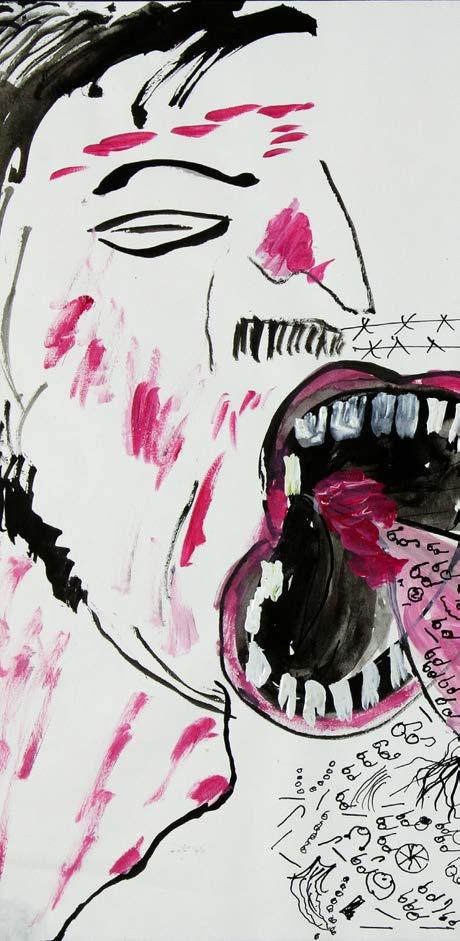
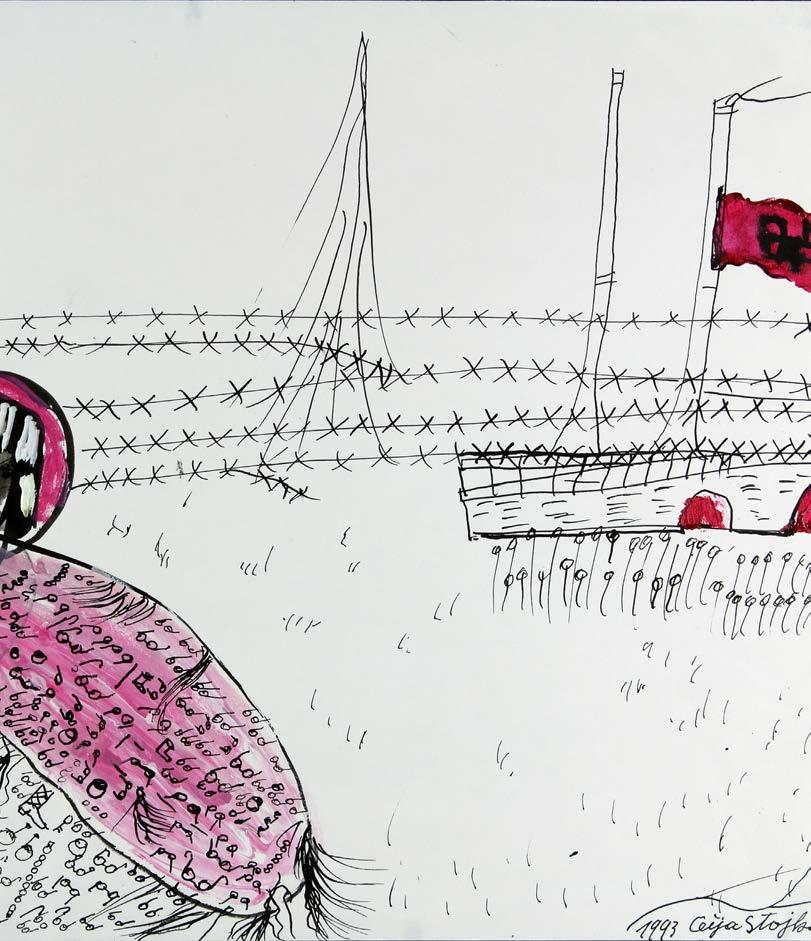
PL. 38, Untitled, 1993

39, Untitled (You've had it now. Heil ! We're coming), 1993
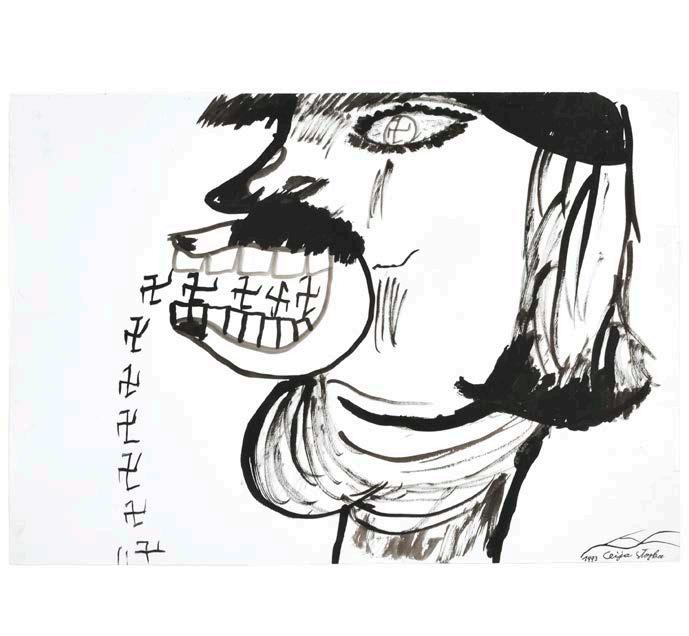
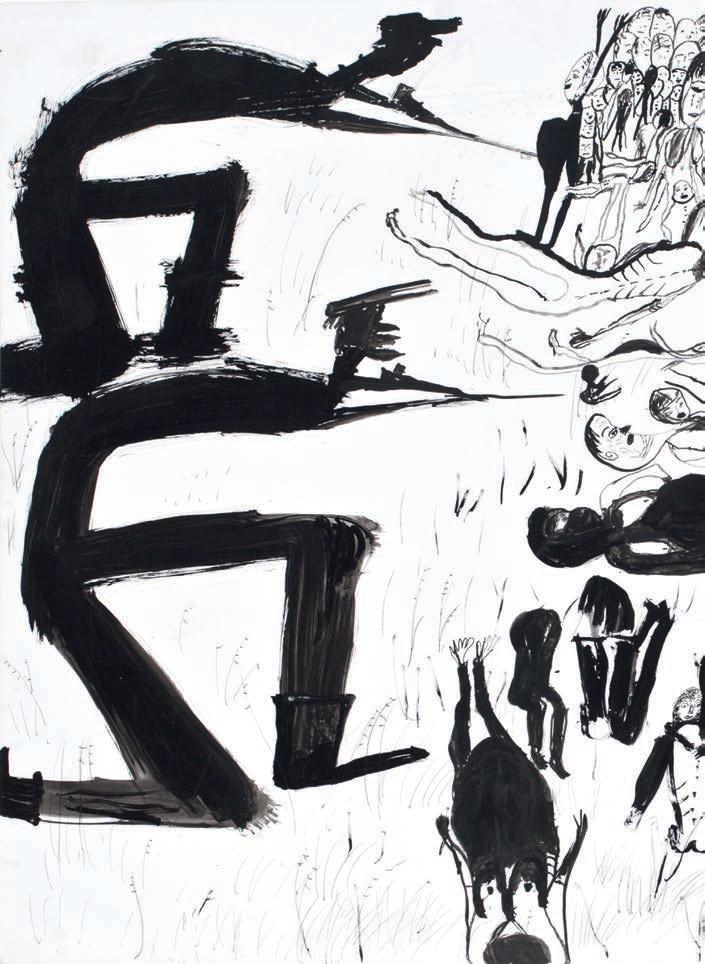
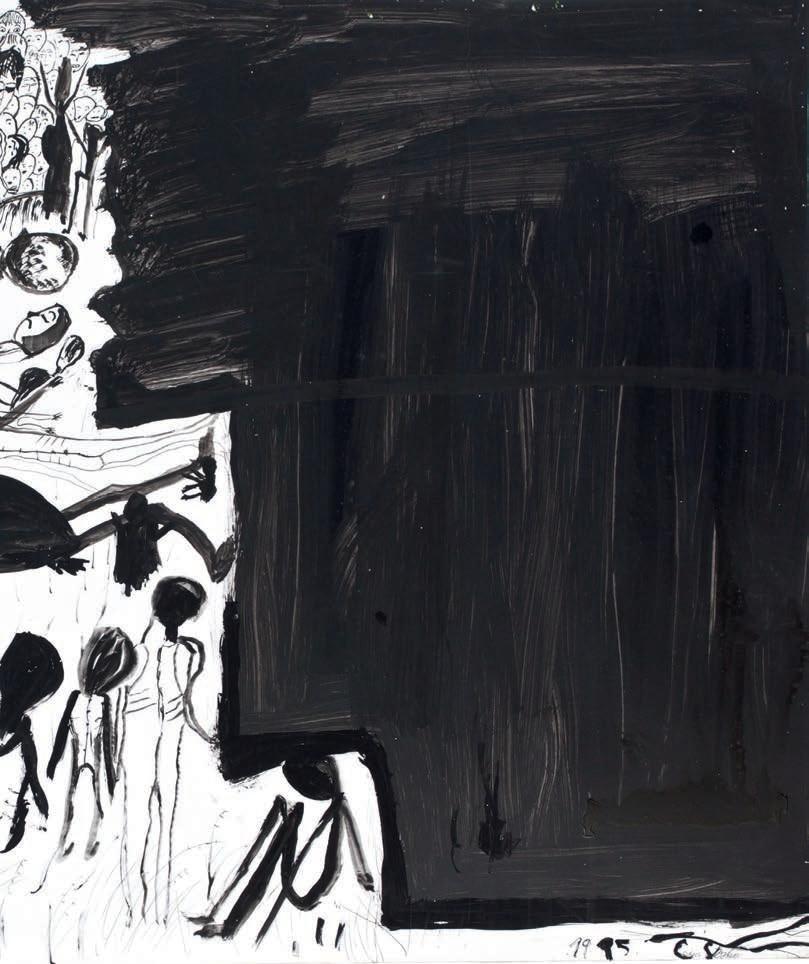
PL. 41, Untitled, 1995
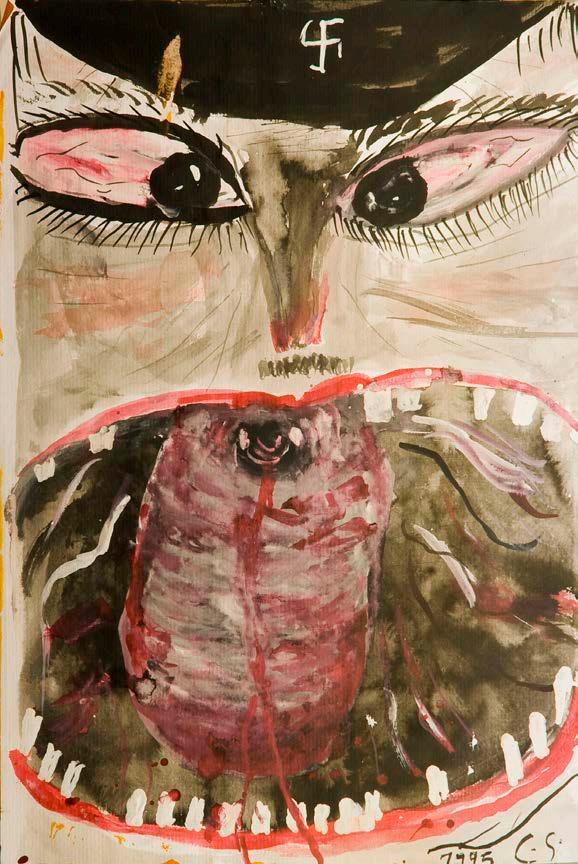
PL. 42, They Devoured Us, 1995
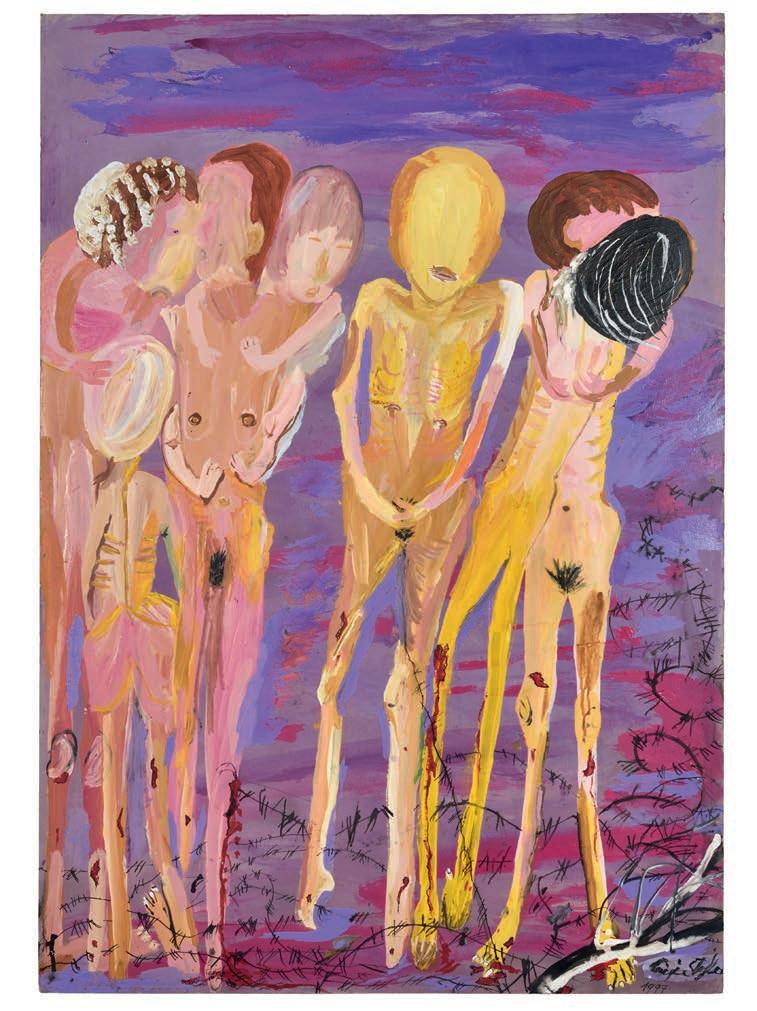
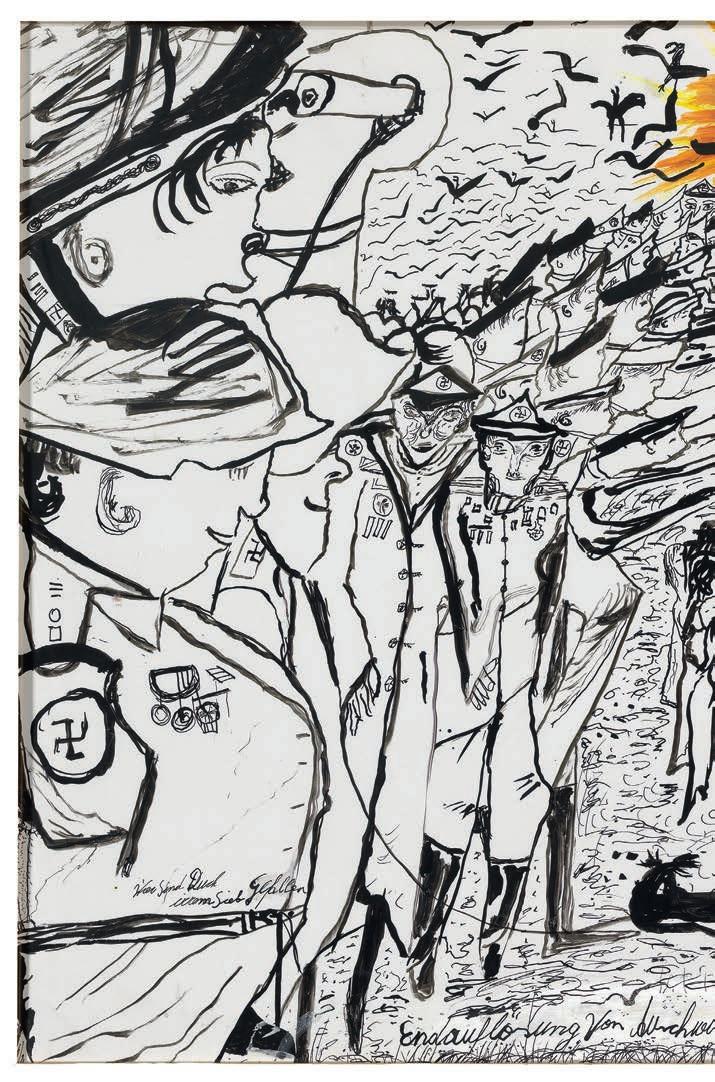
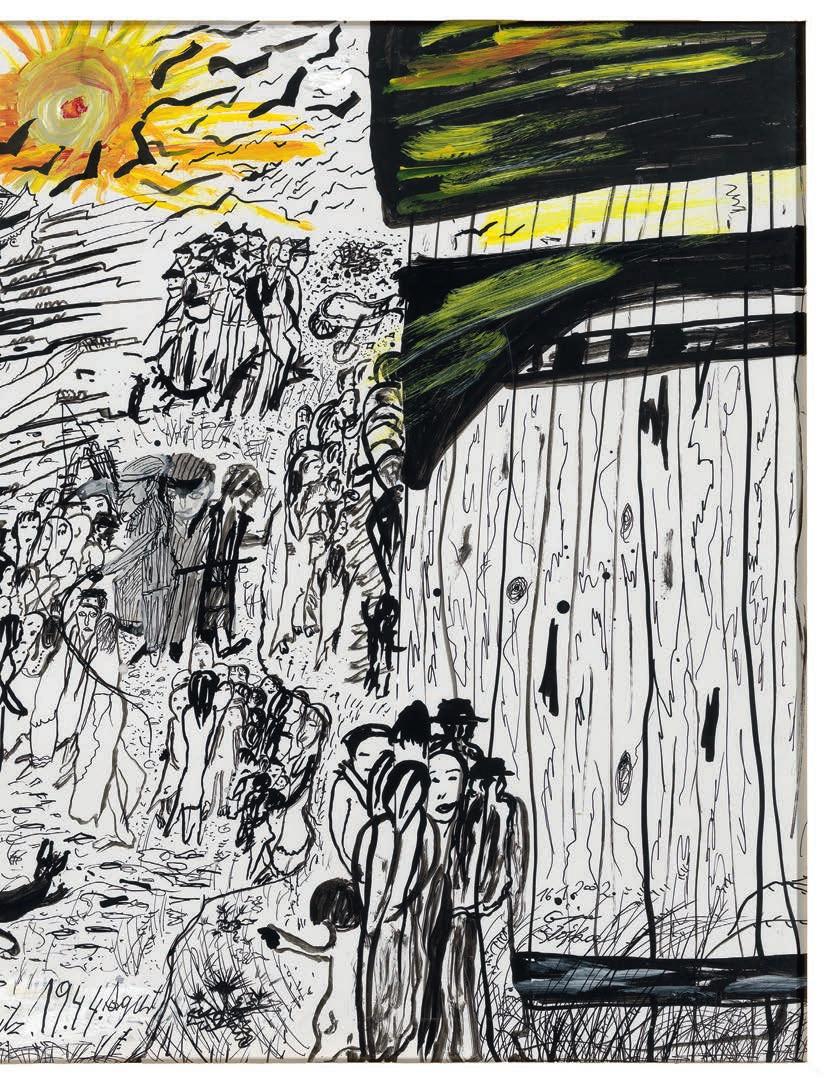
PL. 44, Final liquidation in Auschwitz, August 1944. We fell through their nets, 16.01.2002
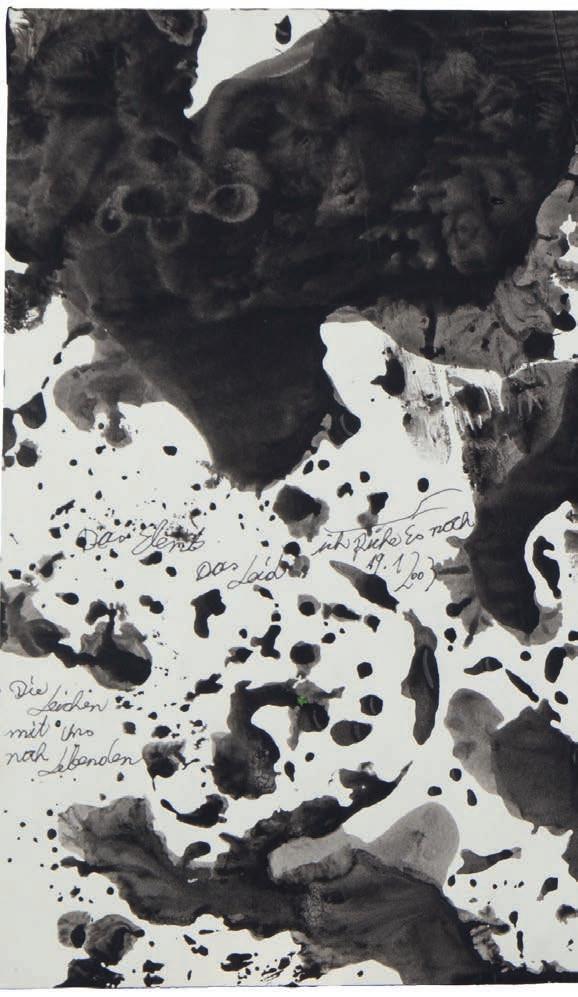

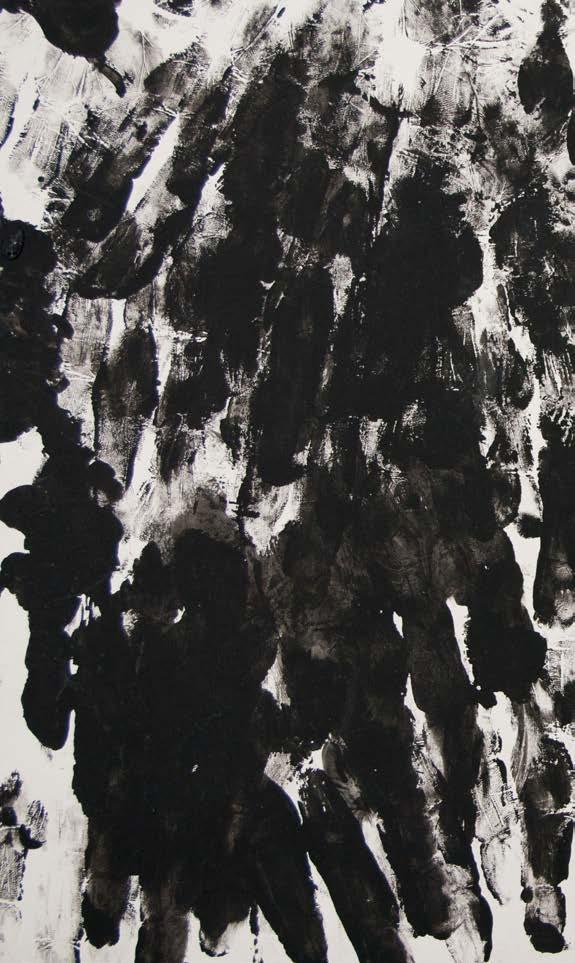
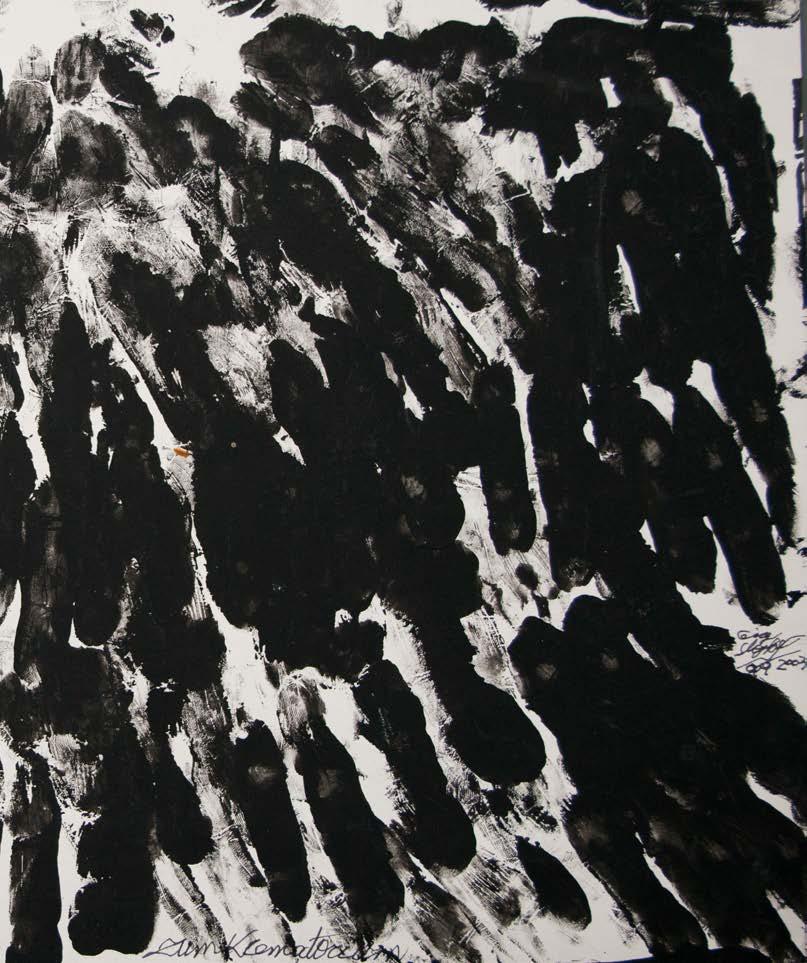
PL. 46, Untitled (To the Crematorium), 08.09.2003
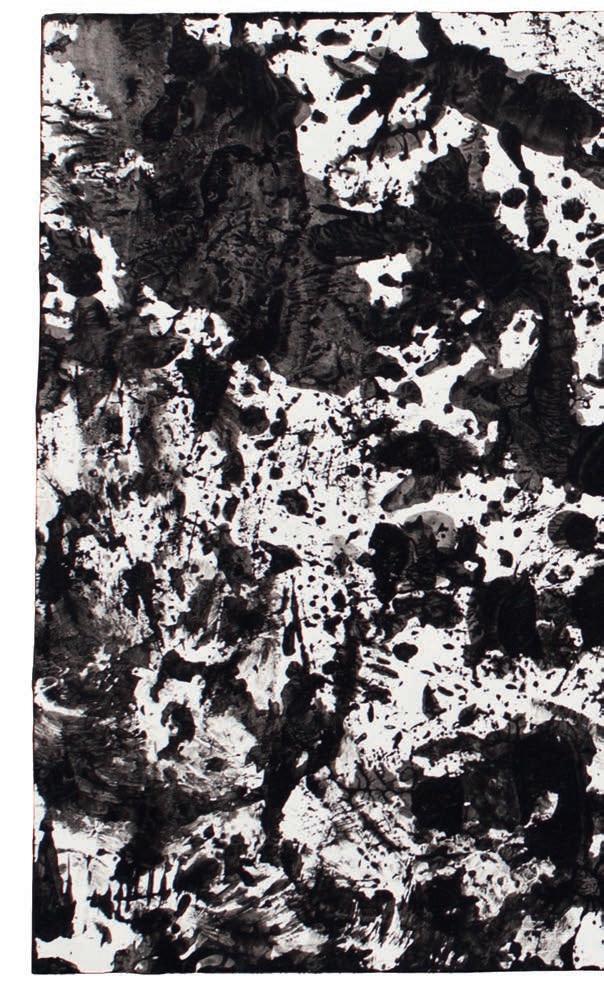
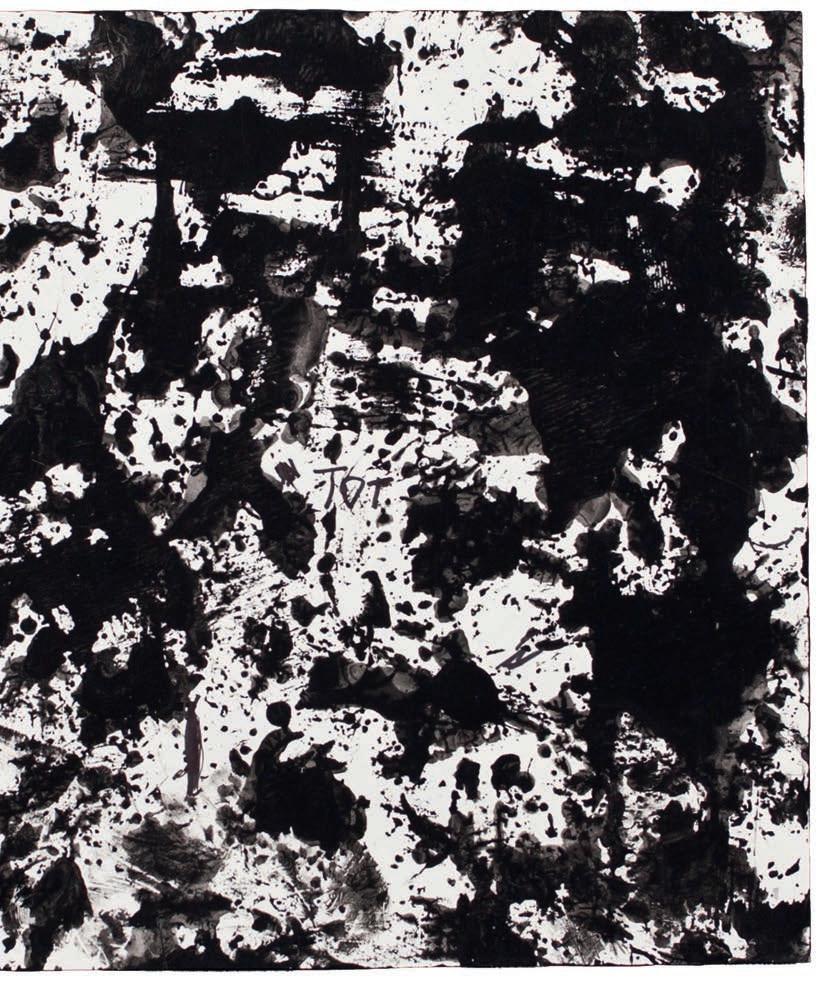
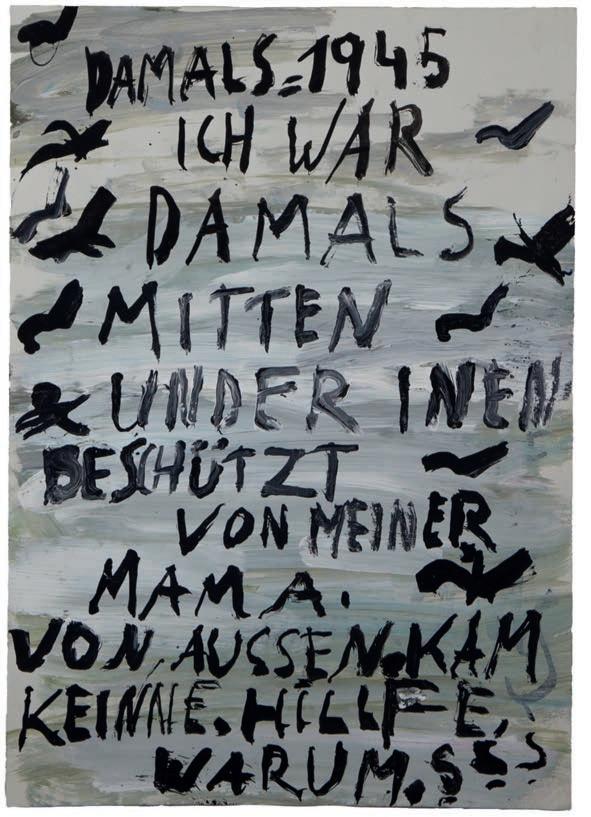
PL. 48, Untitled (THEN: 1945 I WAS THEN IN THE MIDDLE UNDER THEM PROTECTED BY MY MAMA. FROM THE OUTSIDE THERE CAME NO HELP. WHY? S CS), 22.01.2003
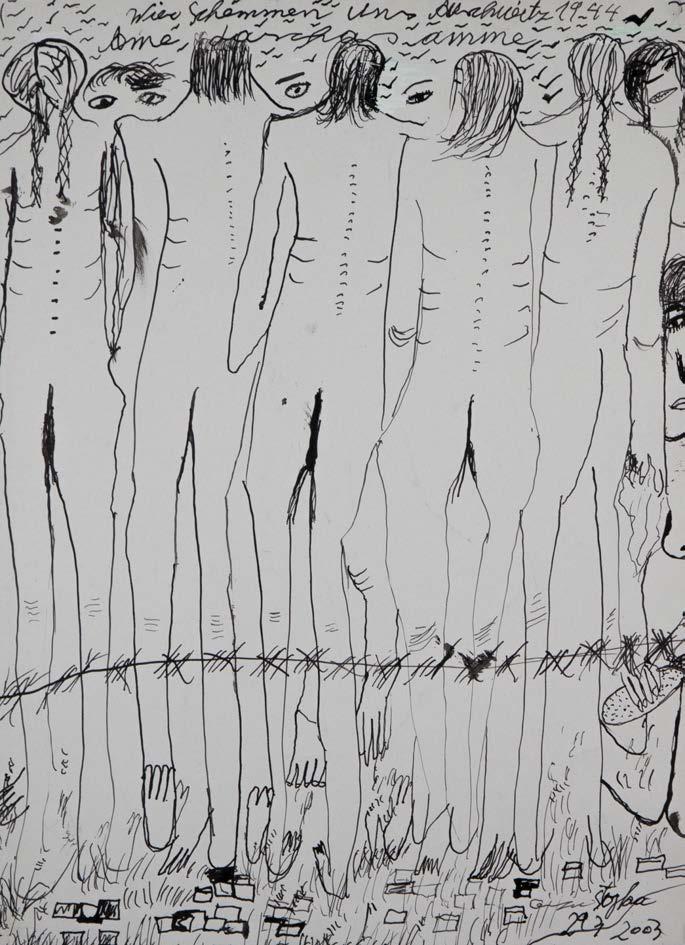
PL. 49, Untitled (We are ashamed. Auschwitz 1944. Ame Lažas amme), 29.03.2003

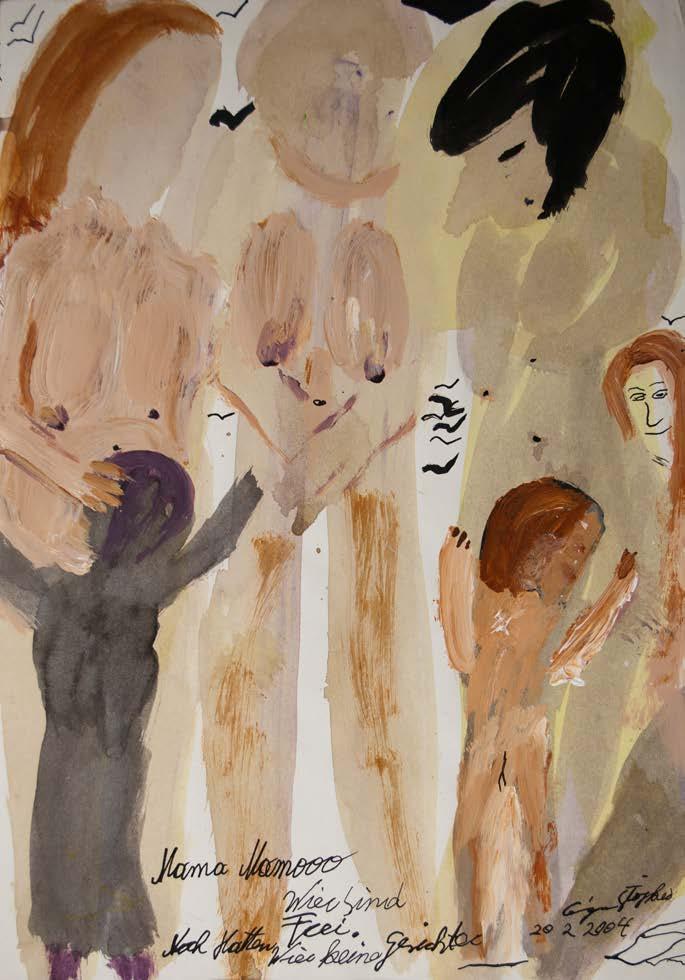
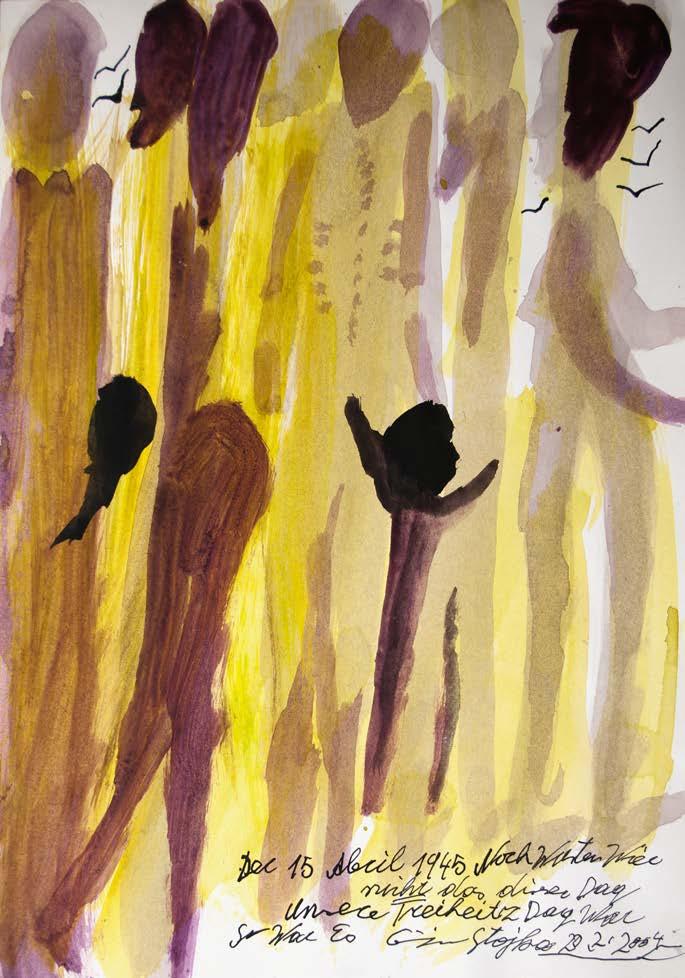
PL. 52, Untitled (The 15th of April 1945. We didn’t yet know that this day was to be our Liberation Day. That’s the way it was), 20.02.2004
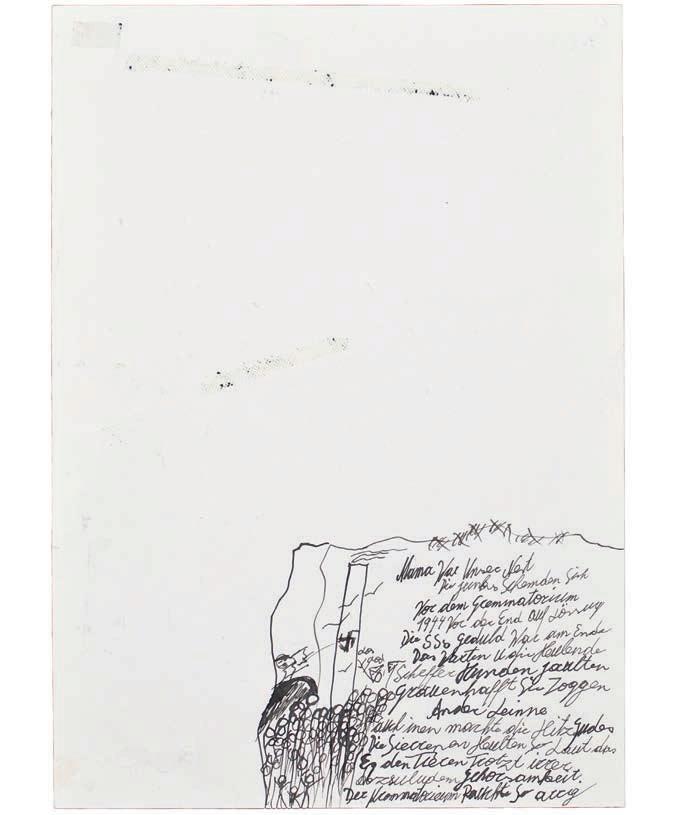
PL. 53, Untitled (Mama was our nest. The boys were ashamed in front of the crematorium. 1944. Before the final liquidation. The SS were at the end of their tether. The waiting and the howling Alsatians whining terribly. They pulled at their leads. The heat was also torture for them. The sirens wailed so loudly that the animals, despite their absolute obedience [?]. The crematorium smoked terribly.), 20.05.2004
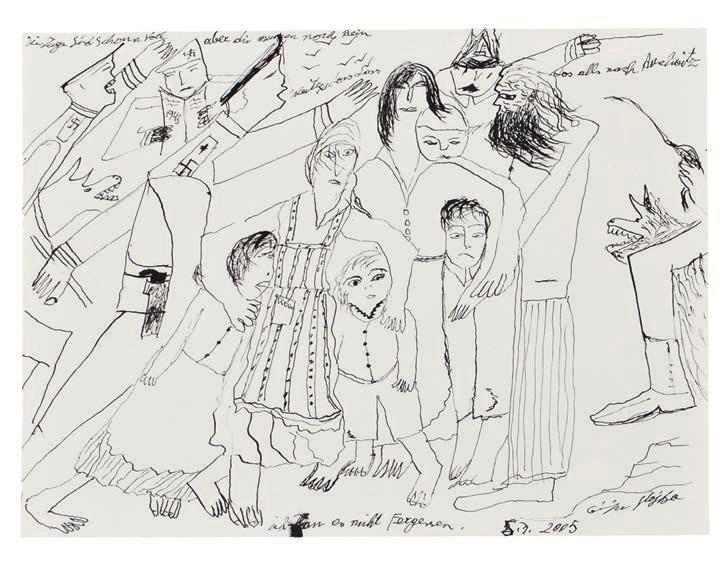
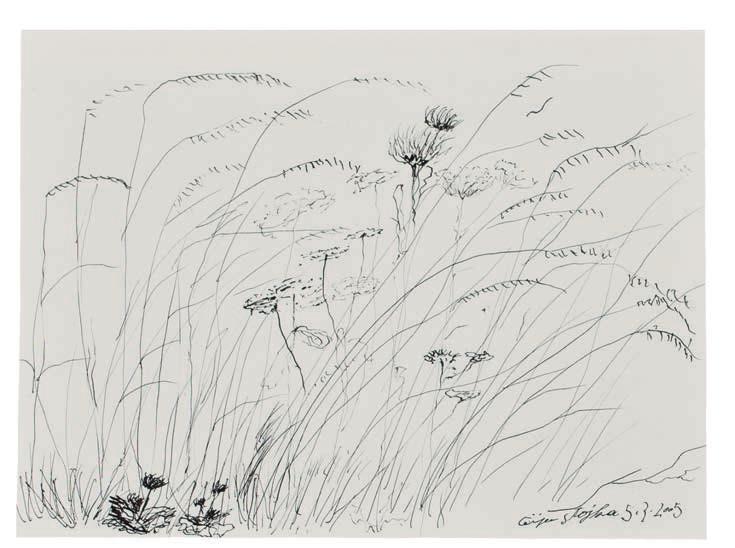
PL. 54, Untitled, 05.03.2005, verso and recto
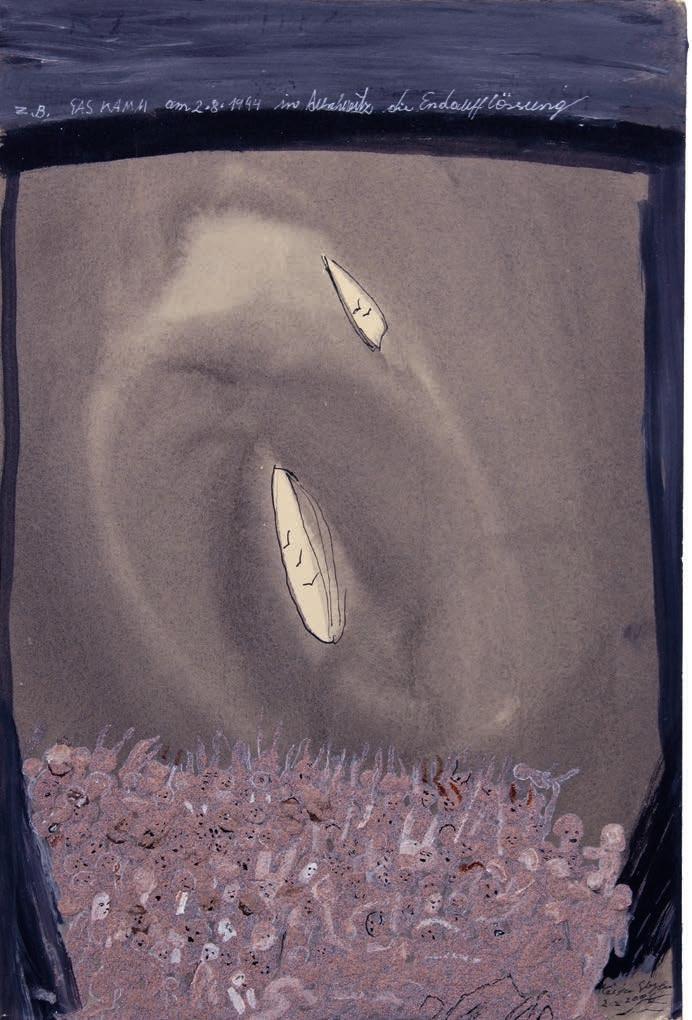
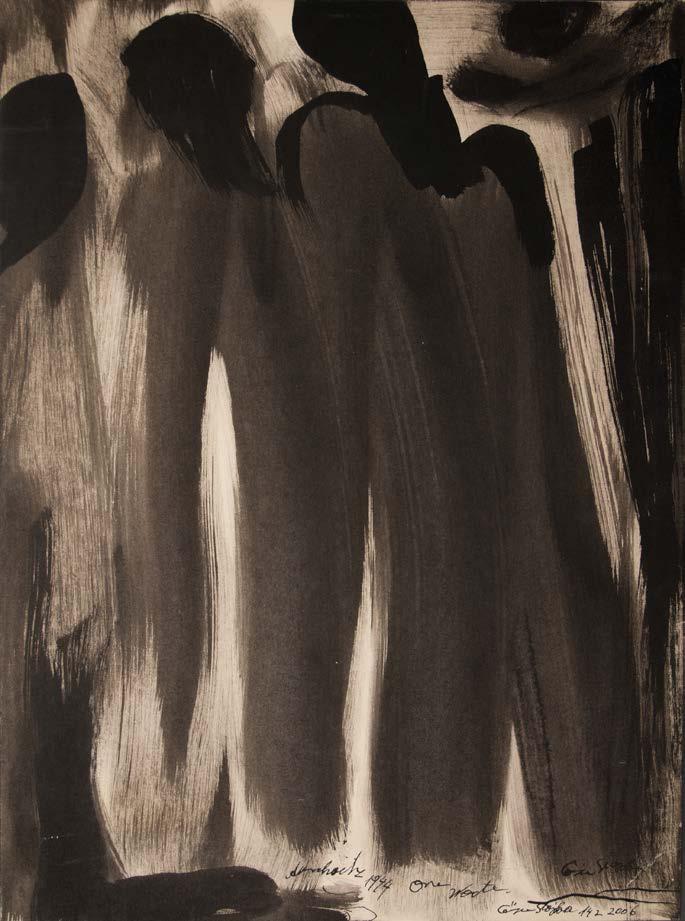
PL. 56, Untitled (Auschwitz, 1944. Without words), 14.02.2006
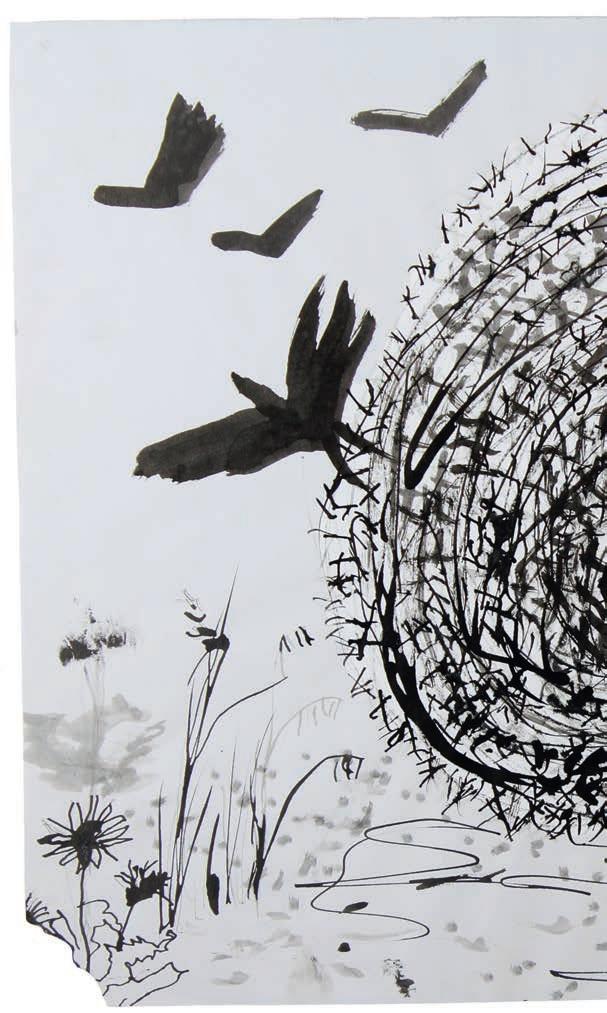
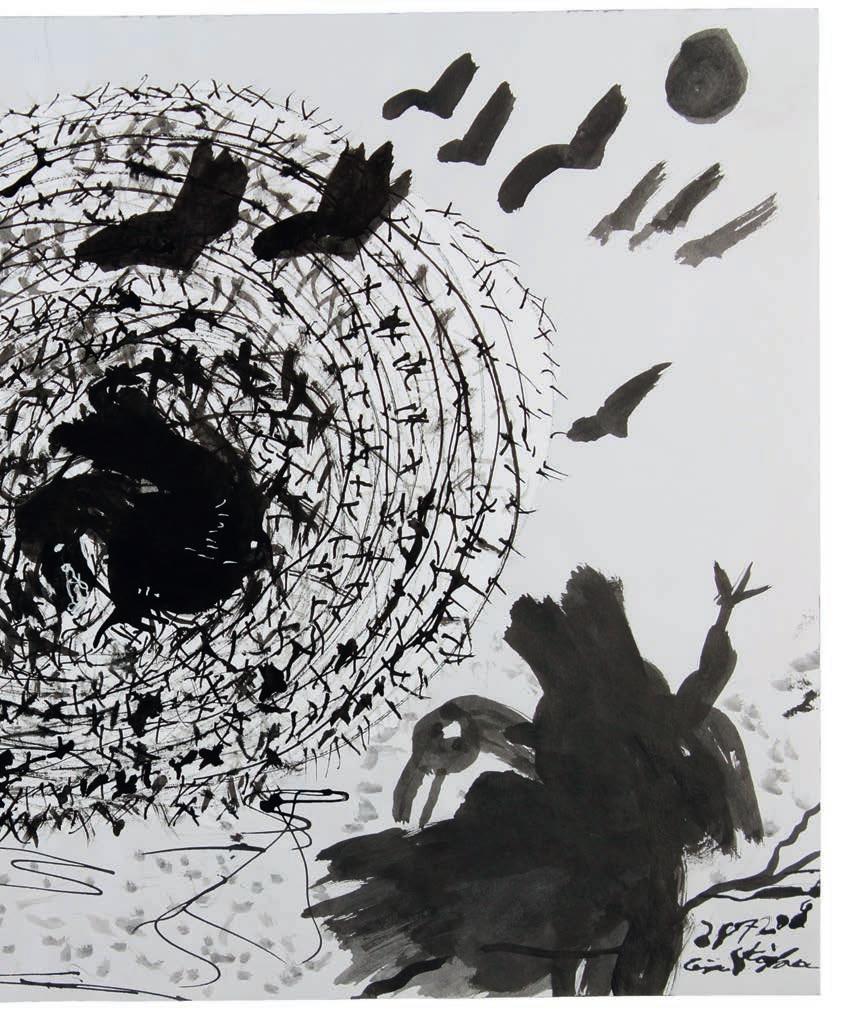
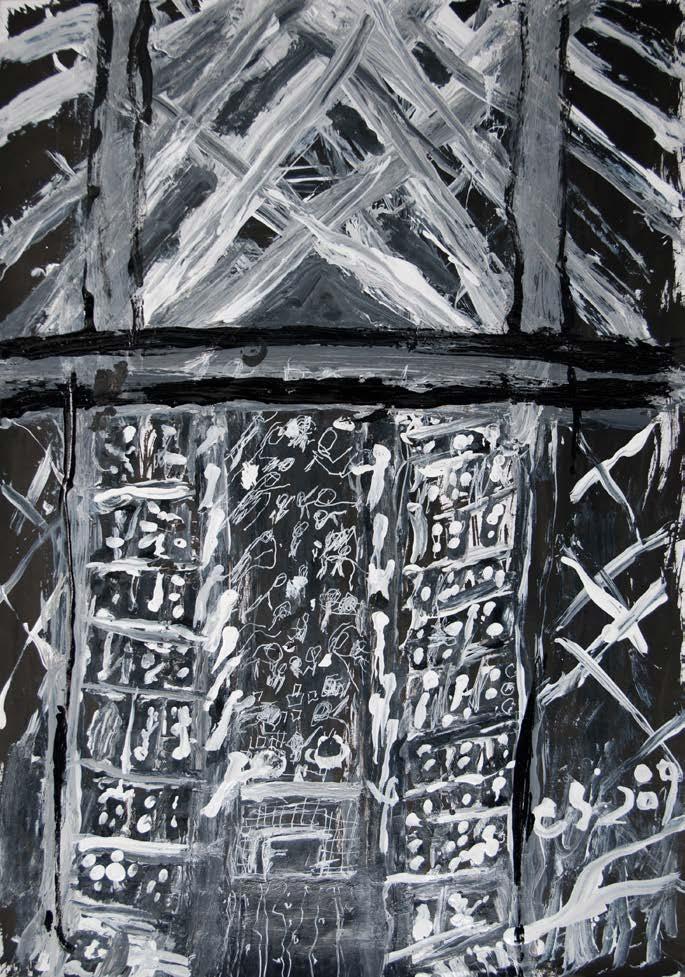
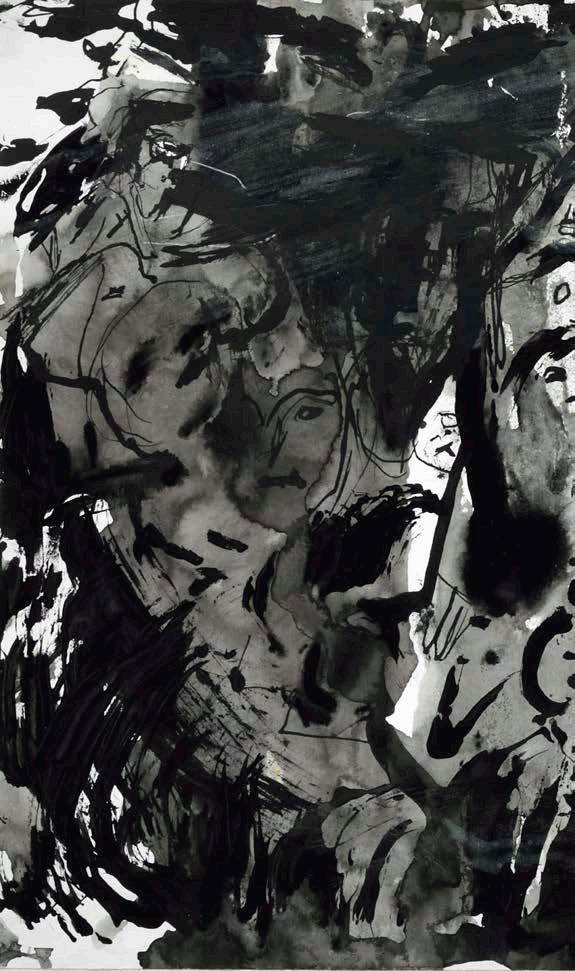
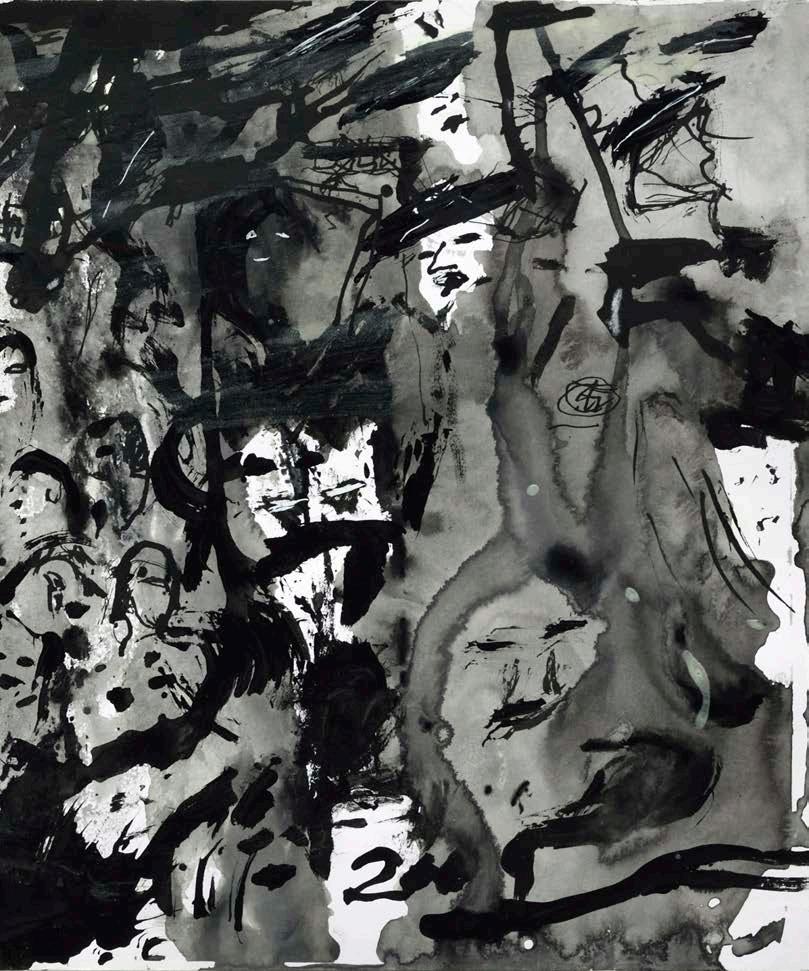
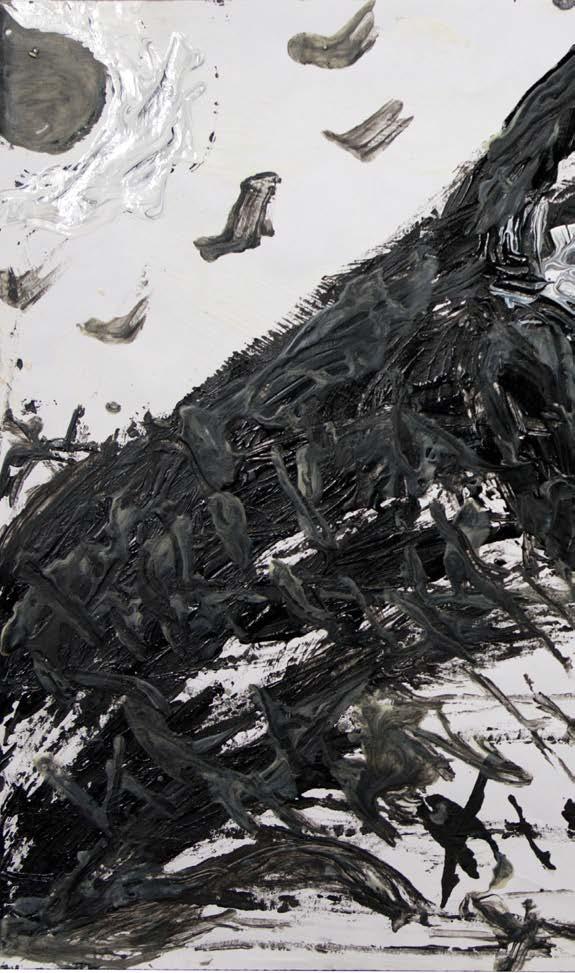
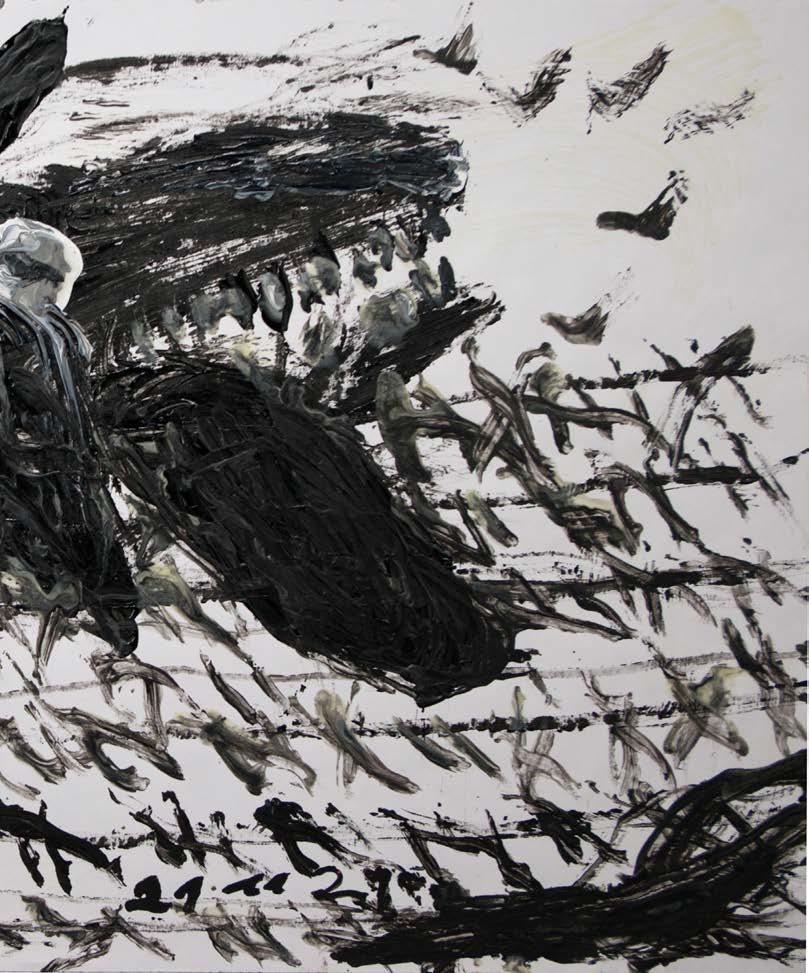
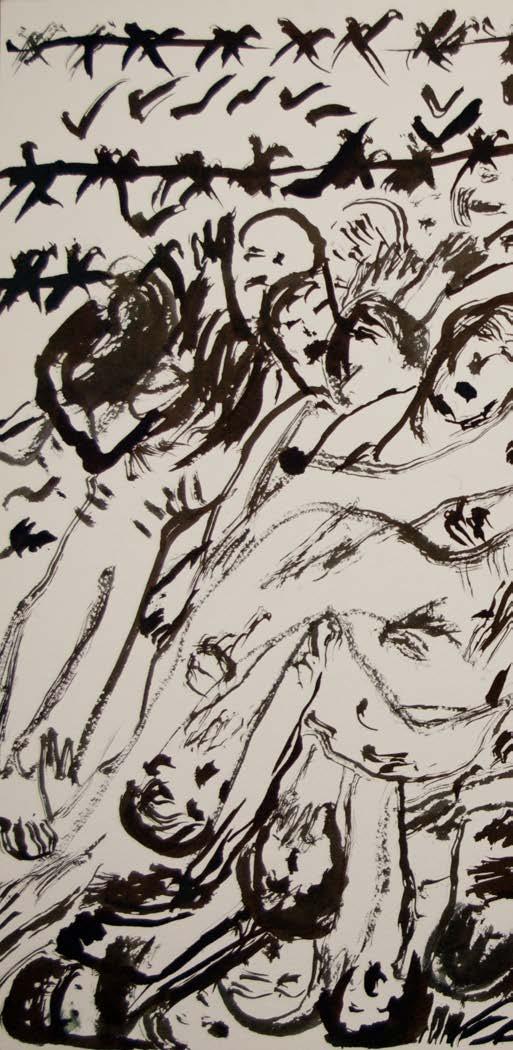
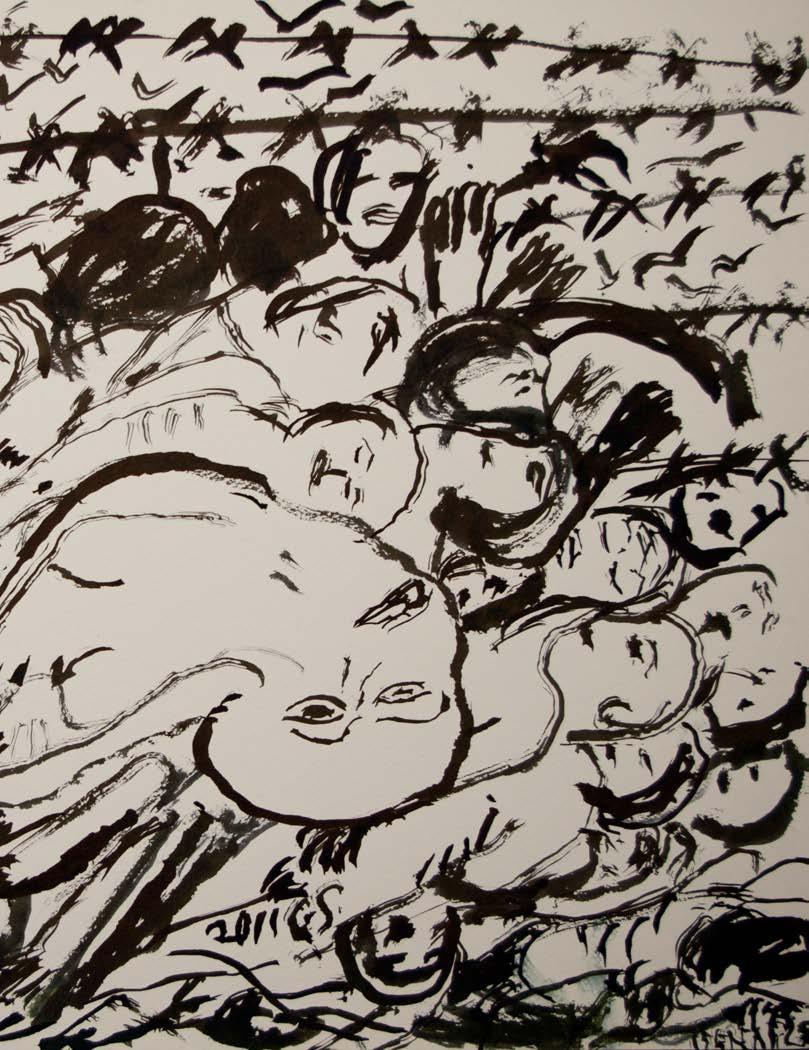

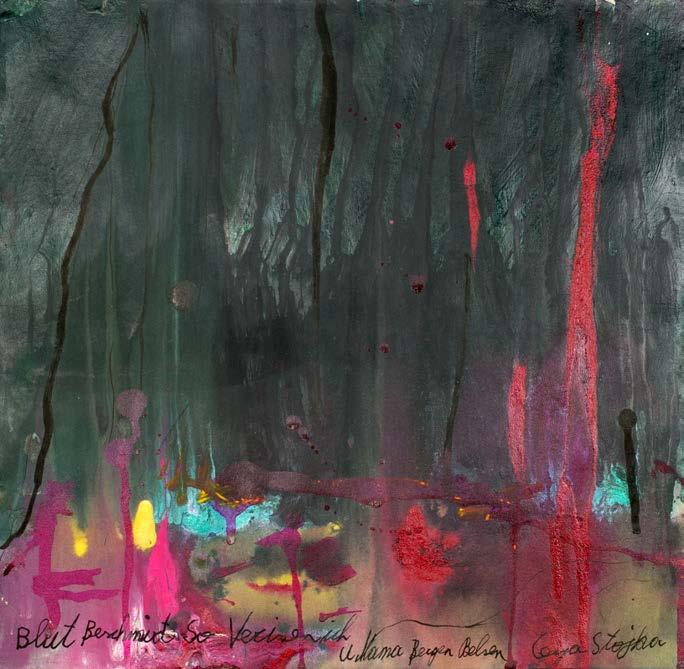
Though no definitive separation can be made between paintings and drawings in Stojka’s oeuvre— not least because her preferred support was paper or cardboard—the works fall loosely into those two categories. Beginning with paintings, each group is ordered chronologically, with undated works listed at the end. Dates are given according to the European convention (day.month.year).
Untitled (Ravensbrück Women’s Camp), 30.04.1992 [PL. 01]
Acrylic on cardboard
19 5/8 × 25 5/8 inches (50 × 65 cm)
Courtesy of The Brandenburg Memorials Foundation on behalf of the Memorial Museum Ravensbrück, V3849 L2
© 2026 Artists Rights Society (ARS), New York / Bildrecht, Vienna
Untitled, 14.05.1993 [PL. 02]
Acrylic on paper
19 5/8 × 25 3/8 inches (50 × 64.5 cm)
Collection of Marcus Meier
Photo: Marcus Meier
© 2026 Artists Rights Society (ARS), New York / Bildrecht, Vienna
The Carpet Market, 1993 [PL. 03]
Oil on cardboard
19 5/8 × 25 5/8 inches (50 × 65 cm)
Courtesy of the Wien Museum
Photo: Wien Museum
© 2026 Artists Rights Society (ARS), New York / Bildrecht, Vienna
Dachau Concentration Camp, 1994 [PL. 04]
Acrylic on cardstock
27 3/8 × 39 inches (69.5 × 99 cm)
Collection of Antoine de Galbert, Paris
Photo: © Célia Pernot
© 2026 Artists Rights Society (ARS), New York / Bildrecht, Vienna
1945 Bergen-Belsen, 1994 [PL. 05]
Acrylic and silver paint on cardstock
27 1/2 × 39 3/8 inches (70 × 100 cm)
Collection of Antoine Frérot
Photo: © Célia Pernot
© 2026 Artists Rights Society (ARS), New York / Bildrecht, Vienna
In Ravensbrück, 1944, 1994 [PL. 06]
Acrylic on cardboard
39 3/8 × 27 1/2 inches (100 × 70 cm)
Courtesy of The Brandenburg Memorials Foundation on behalf of the Memorial Museum Ravensbrück, V1616 L2
© 2026 Artists Rights Society (ARS), New York / Bildrecht, Vienna
Untitled, 1994 [PL. 07]
Acrylic on cardboard
27 1/2 × 39 3/8 inches (70 × 100 cm)
Collection of Marcus Meier
Photo: © Célia Pernot
© 2026 Artists Rights Society (ARS), New York / Bildrecht, Vienna
Untitled, 06.03.1994 [PL. 08]
Mixed media on cardboard
25 5/8 × 19 5/8 inches (65 × 50 cm)
Courtesy of Galerie Christophe Gaillard
Photo: Diego Castellano Cano
© 2026 Artists Rights Society (ARS), New York / Bildrecht, Vienna
Z 6399, 1994 [PL. 09]
Acrylic on cardboard
27 1/2 × 39 3/8 inches (70 × 100 cm)
Pinault Collection
Photo: © Célia Pernot
© 2026 Artists Rights Society (ARS), New York / Bildrecht, Vienna
Untitled, 1995 [PL. 10]
Acrylic on cardstock
27 3/8 × 39 inches (69.5 × 99 cm)
Collection Antoine de Galbert, Paris
Photo: © Célia Pernot
© 2026 Artists Rights Society (ARS), New York / Bildrecht, Vienna
Decay (Rot), 1995 [PL. 11]
Acrylic on cardboard
9 1/2 × 15 inches (24 × 38 cm)
Courtesy of Galerie Christophe Gaillard
Photo: © Rebecca Fanuele, image courtesy of Galerie Christophe Gaillard.
© 2026 Artists Rights Society (ARS), New York / Bildrecht, Vienna
Untitled, 1995 [PL. 12]
Acrylic on cardboard
25 5/8 × 19 5/8 inches (65 × 50 cm)
Collection of Marin Karmitz
Image courtesy of Galerie Christophe Gaillard
© 2026 Artists Rights Society (ARS), New York / Bildrecht, Vienna
Untitled (SS), 1995 [PL. 13]
Acrylic on cardstock
25 3/8 × 19 5/8 inches (64.5 × 50 cm)
Collection of Marin Karmitz
Photo: © Célia Pernot
© 2026 Artists Rights Society (ARS), New York / Bildrecht, Vienna
Roll call. Be obedient, attention, answer to your name., 1995 [PL. 14]
Acrylic on cardboard
39 3/8 × 27 1/2 inches (100 × 70 cm)
Courtesy of The Brandenburg Memorials Foundation on behalf of the Memorial Museum Ravensbrück, V1619 L2
Photo: Matthias Reichelt
© 2026 Artists Rights Society (ARS), New York / Bildrecht, Vienna
1945, Ravensbrück, 1995, 1995 [PL. 15]
Acrylic on cardboard
27 1/2 × 39 3/8 inches (70 × 100 cm)
Courtesy of The Brandenburg Memorials Foundation on behalf of the Memorial Museum Ravensbrück, V2207 L2
© 2026 Artists Rights Society (ARS), New York / Bildrecht, Vienna
Untitled, 1995 [PL. 16]
Mixed media on paper
27 3/8 × 39 3/8 inches (69.5 × 100 cm)
Collection of Xavier Marchand
Photo: © Célia Pernot
© 2026 Artists Rights Society (ARS), New York / Bildrecht, Vienna
Untitled, 1995 [PL. 17]
Acrylic and colored sand on cardboard
27 3/8 × 39 1/8 inches (69.5 × 99.5 cm)
Collection of Xavier Marchand
Photo: © Célia Pernot
© 2026 Artists Rights Society (ARS), New York / Bildrecht, Vienna
Untitled, 1995 [PL. 18]
Acrylic and sand on paper
27 3/8 × 39 1/8 inches (69.5 × 99.5 cm)
Private collection
Photo: © Célia Pernot
© 2026 Artists Rights Society (ARS), New York / Bildrecht, Vienna
Untitled, 1996 [PL. 19]
Acrylic on silver paper
27 1/2 × 39 3/8 inches (70 × 100 cm)
Collection Antoine de Galbert, Paris
Photo: © Célia Pernot
© 2026 Artists Rights Society (ARS), New York / Bildrecht, Vienna
Untitled, 1996 [PL. 20]
Acrylic on cardboard
19 5/8 × 25 3/8 inches (50 × 64.5 cm)
Collection of Marcus Meier
Photo: © Célia Pernot
© 2026 Artists Rights Society (ARS), New York / Bildrecht, Vienna
Sad Earth, 28.01.1998 [PL. 21]
Mixed media on cardboard
27 1/2 × 39 3/8 inches (70 × 100 cm)
Collection Antoine de Galbert, Paris
Photo: © Célia Pernot
© 2026 Artists Rights Society (ARS), New York / Bildrecht, Vienna
Untitled, 18.04.1999 [PL. 22]
Acrylic on particleboard
23 5/8 × 19 5/8 inches (60 × 50 cm)
Collection of Xavier Marchand
Photo: © Célia Pernot
© 2026 Artists Rights Society (ARS), New York / Bildrecht, Vienna
Untitled, 14.06.1999 [PL. 23]
Acrylic on cardboard
25 5/8 × 19 5/8 inches (65 × 50 cm)
Collection of Matthias Reichelt
Photo: Matthias Reichelt
© 2026 Artists Rights Society (ARS), New York / Bildrecht, Vienna
Untitled (I sent the ravens to our dear God so that they could pray in Auschwitz.)
[Title handed down by word of mouth],
31.12.2000 [PL. 24]
Acrylic on canvas
19 5/8 × 23 5/8 inches (50 × 60 cm)
Collection of Mylène & Guillaume Lointier, Paris, France
Photo: © Rebecca Fanuele, image courtesy of Galerie Christophe Gaillard
© 2026 Artists Rights Society (ARS), New York / Bildrecht, Vienna
Untitled, 2001 [PL. 25]
Acrylic and ballpoint pen on paper
19 5/8 × 13 5/8 inches (50 × 34.5 cm)
Collection of Marin Karmitz
Photo: © Célia Pernot
© 2026 Artists Rights Society (ARS), New York / Bildrecht, Vienna
Victory to our Führer!, 06.08.2001 [PL. 26]
Acrylic on cardboard
27 1/2 × 19 5/8 inches (70 × 50 cm)
Collection of Antoine Frérot
Photo: © Rebecca Fanuele, image courtesy of Galerie Christophe Gaillard
© 2026 Artists Rights Society (ARS), New York / Bildrecht, Vienna
Untitled, 06.02.2003 [PL. 27]
Acrylic on paper
27 1/2 × 39 3/8 inches (70 × 100 cm)
Collection of Marin Karmitz
Image courtesy of Galerie Christophe Gaillard
© 2026 Artists Rights Society (ARS), New York / Bildrecht, Vienna
Corpses, 2007 [PL. 28]
Mixed media on canvas
11 3/4 × 27 1/2 inches (30 × 70 cm)
Collection of Antoine de Galbert, Paris
Photo: © Célia Pernot
© 2026 Artists Rights Society (ARS), New York / Bildrecht, Vienna
Untitled, 15.03.2003 [PL. 29]
Recto and verso
Acrylic and chalk on paper
39 3/8 × 27 1/2 inches (100 × 70 cm)
Private collection
Photo: © Célia Pernot
© 2026 Artists Rights Society (ARS), New York / Bildrecht, Vienna
Untitled (No. 10, No. 9), 12.05.2005 [PL. 30]
Acrylic on canvas
23 5/8 × 31 1/8 inches (60 × 79 cm)
Pinault Collection
Photo: © Rebecca Fanuele, image courtesy of Pinault Collection
© 2026 Artists Rights Society (ARS), New York / Bildrecht, Vienna
Untitled, 10.02.2005 [PL. 31]
Acrylic on canvas
11 3/4 × 31 1/2 inches (30 × 80 cm)
Courtesy of Karin Berger
Photo: Joerg Burger
© 2026 Artists Rights Society (ARS), New York / Bildrecht, Vienna
Untitled, 05.01.2006 [PL. 32]
Acrylic on cardboard
20 1/2 × 27 1/2 inches (52 × 70 cm)
Collection Kai Dikhas, Foundation Kai Dikhas, Berlin
Photo: Diego Castellano Cano
© 2026 Artists Rights Society (ARS), New York / Bildrecht, Vienna
Untitled (Ravensbrück, Bergen-Belsen, Auschwitz, Dachau, Mauthausen), 22.01.2006 [PL. 33]
Acrylic on cardboard
25 5/8 × 19 5/8 inches (65 × 50 cm)
Private collection, courtesy of Galerie Christophe Gaillard
Photo: © Rebecca Fanuele, image courtesy of Galerie Christophe Gaillard
© 2026 Artists Rights Society (ARS), New York / Bildrecht, Vienna
Birkenau Concentration Camp, 1944, 07.02.2009 [PL. 34]
Acrylic on canvas
23 5/8 × 23 5/8 inches (60 × 60 cm)
Collection Antoine de Galbert, Paris
Photo: Matthias Reichelt
© 2026 Artists Rights Society (ARS), New York / Bildrecht, Vienna
Auschwitz, 1944, 18.05.2009 [PL. 35]
Acrylic and silver paint on canvas
23 5/8 × 23 5/8 inches (60 × 60 cm)
Collection Antoine de Galbert, Paris
Photo: Matthias Reichelt
© 2026 Artists Rights Society (ARS), New York / Bildrecht, Vienna
Untitled, n.d. [PL. 36]
Gouache and acrylic on cardboard
27 1/2 × 39 3/8 inches (70 × 100 cm)
Collection Kai Dikhas,
Foundation Kai Dikhas, Berlin
Photo: Diego Castellano Cano
© 2026 Artists Rights Society (ARS), New York / Bildrecht, Vienna
Untitled (Vienna-Auschwitz), n.d. [PL. 37]
Acrylic on cardboard
19 5/8 × 27 1/2 inches (50 × 70 cm)
Courtesy of Galerie Christophe Gaillard
Photo: © Rebecca Fanuele, image
courtesy of Galerie Christophe Gaillard
© 2026 Artists Rights Society (ARS), New York / Bildrecht, Vienna
Untitled, 1993 [PL. 38]
Acrylic and ink on paper
11 5/8 × 16 1/2 inches (29.5 × 42 cm)
Courtesy of Lith Bahlmann
Photo: Matthias Reichelt
© 2026 Artists Rights Society (ARS), New York / Bildrecht, Vienna
Untitled (You’ve had it now. Heil!
We’re coming), 1993 [PL. 39]
Ink on paper
11 5/8 × 16 1/2 inches (29.5 × 42 cm)
Collection Antoine de Galbert, Paris
Photo: © Célia Pernot
© 2026 Artists Rights Society (ARS), New York / Bildrecht, Vienna
Untitled, 1993 [PL. 40]
Ink on paper
11 3/8 × 16 1/8 inches (29 × 41 cm)
Collection of Antoine Frérot
Photo: © Rebecca Fanuele, image
courtesy of Galerie Christophe Gaillard
© 2026 Artists Rights Society (ARS), New York / Bildrecht, Vienna
Untitled, 1995 [PL. 41]
Ink on cardboard
27 1/2 × 39 3/8 inches (70 × 100 cm)
Courtesy of Galerie Christophe Gaillard
Photo: © Rebecca Fanuele, image
courtesy of Galerie Christophe Gaillard
© 2026 Artists Rights Society (ARS), New York / Bildrecht, Vienna
They Devoured Us, 1995 [PL. 42]
Watercolor on paper
11 3/4 × 8 1/4 inches (30 × 21 cm)
Courtesy of Lorely French
Photo: Bill Carrigan
© 2026 Artists Rights Society (ARS), New York / Bildrecht, Vienna
The Beautiful Women of Auschwitz, 1997 [PL. 43]
Acrylic on cardboard
40 1/2 × 28 3/4 inches (103 × 73 cm)
Courtesy of Galerie Christophe Gaillard
Photo: © Rebecca Fanuele, image courtesy of Galerie Christophe Gaillard
© 2026 Artists Rights Society (ARS), New York / Bildrecht, Vienna
Final liquidation in Auschwitz, August 1944. We fell through their nets., 16.01.2002 [PL. 44]
Acrylic on cardboard
27 1/2 × 39 3/8 inches (70 × 100 cm)
Courtesy of the Wien Museum
Photo: Wien Museum
© 2026 Artists Rights Society (ARS), New York / Bildrecht, Vienna
Untitled (The Destitution/ The Suffering/ I Feel It Still/ 19.01.2003/ The Corpses/ Near Us/ The Living), 19.01.2003 [PL. 45]
Ink on paper
11 3/8 × 16 1/2 inches (29 × 42 cm)
Collection Antoine de Galbert, Paris
Photo: Diego Castellano Cano
© 2026 Artists Rights Society (ARS), New York / Bildrecht, Vienna
Untitled (To the Crematorium), 08.09.2003 [PL. 46]
Ink on paper
11 3/4 × 16 1/2 inches (30 × 42 cm)
Collection Antoine de Galbert, Paris
Photo: Diego Castellano Cano
© 2026 Artists Rights Society (ARS), New York / Bildrecht, Vienna
Dead, n.d. [PL. 47]
Ink on paper
11 5/8 × 16 1/2 inches (29.5 × 42 cm)
Collection Antoine de Galbert, Paris
Photo: © Célia Pernot
© 2026 Artists Rights Society (ARS), New York / Bildrecht, Vienna
Untitled (THEN: 1945/ I WAS/ THEN/ IN THE MIDDLE/ UNDER THEM/ PROTECTED BY MY/ MAMA./ FROM THE OUTSIDE/ THERE CAME / NO HELP./ WHY? S CS), 22.01.2003 [PL. 48]
Acrylic and gouache on paper
16 3/8 × 11 1/2 inches (41.7 × 29.4 cm)
Collection Antoine de Galbert, Paris
Photo: Diego Castellano Cano
© 2026 Artists Rights Society (ARS), New York / Bildrecht, Vienna
Untitled (We are ashamed. Auschwitz 1944. Ame Lažas amme), 29.03.2003 [PL. 49]
Ink on paper
16 1/2 × 11 5/8 inches (42 × 29.5 cm)
Collection Kai Dikhas, Foundation Kai Dikhas, Berlin
Photo: Diego Castellano Cano
© 2026 Artists Rights Society (ARS), New York / Bildrecht, Vienna
Untitled, 19.05.2004 [PL. 50]
Mixed media on paper
16 1/2 × 11 5/8 inches (42 × 29.5 cm)
Collection of Florence and Daniel Guerlain
Photo: Rebecca Sammele
© 2026 Artists Rights Society (ARS), New York / Bildrecht, Vienna
Untitled (Mama, Mamooo. We Are Free. We Didn’t Have Any Faces Yet), 20.02.2004 [PL. 51]
Mixed media on paper
16 1/2 × 11 5/8 inches (42 × 29.5 cm)
Courtesy of Lilah and Elie Nebot
Photo: Kai Dikhas
© 2026 Artists Rights Society (ARS), New York / Bildrecht, Vienna
Untitled (The 15th of April 1945. We didn’t yet know that this day was to be our Liberation Day. That’s the way it was), 20.02.2004 [PL. 52]
Mixed media on paper
16 1/2 × 11 5/8 inches (42 × 29.5 cm)
Collection Antoine de Galbert, Paris
Photo: Diego Castellano Cano
© 2026 Artists Rights Society (ARS), New York / Bildrecht, Vienna
Untitled (Mama was our nest. The boys were ashamed in front of the crematorium. 1944. Before the final liquidation. The SS were at the end of their tether. The waiting and the howling Alsatians whining terribly. They pulled at their leads. The heat was also torture for them. The sirens wailed so loudly that the animals, despite their absolute obedience [?]. The crematorium smoked terribly.), 20.05.2004 [PL. 53]
Ink on paper
16 1/2 × 11 5/8 inches (42 × 29.5 cm)
Collection Antoine de Galbert, Paris
Photo: © Célia Pernot
© 2026 Artists Rights Society (ARS), New York / Bildrecht, Vienna
Untitled, 05.03.2005 [PL. 54]
Recto and verso
Ink on cardboard
9 1/2 × 12 5/8 inches (24 × 32 cm)
Private collection
Photo: © Célia Pernot
© 2026 Artists Rights Society (ARS), New York / Bildrecht, Vienna
Z.B. [Zyklon B] Gas Chamber on 02.08.1944 in Auschwitz. The Final Liquidation, 02.02.2006 [PL. 55]
Ink, acrylic, and colored sand on cardboard
19 × 12 3/4 inches (48.5 × 32.5 cm)
Collection Antoine de Galbert, Paris
Photo: Matthias Reichelt
© 2026 Artists Rights Society (ARS), New York / Bildrecht, Vienna
Untitled (Auschwitz, 1944. Without words), 14.02.2006 [PL. 56]
Ink on cardboard
19 5/8 × 14 1/2 inches (50 × 37 cm)
Collection Kai Dikhas, Foundation Kai Dikhas, Berlin
Photo: Diego Castellano Cano
© 2026 Artists Rights Society (ARS), New York / Bildrecht, Vienna
Untitled, 28.07.2008 [PL. 57]
Ink on paper
11 5/8 × 16 1/2 inches (29.5 × 42 cm)
Collection Kai Dikhas, Foundation Kai Dikhas, Berlin
Photo: Diego Castellano Cano
© 2026 Artists Rights Society (ARS), New York / Bildrecht, Vienna
Barrack 10, 2009 [PL. 58]
Gouache on paper
16 1/2 × 11 3/4 inches (42 × 30 cm)
Private collection
Photo: Kai Dikhas
© 2026 Artists Rights Society (ARS), New York / Bildrecht, Vienna
Untitled, 2009 [PL. 59]
Acrylic on paper
11 5/8 × 16 1/2 inches (29.5 × 42 cm)
Collection of Marin Karmitz
Photo: © Rebecca Fanuele, image courtesy of Galerie Christophe Gaillard
© 2026 Artists Rights Society (ARS), New York / Bildrecht, Vienna
Untitled, 21.11.2009 [PL. 60]
Gouache on paper
11 5/8 × 16 1/2 inches (29.5 × 42 cm)
Collection Kai Dikhas, Foundation Kai Dikhas, Berlin
Photo: Diego Castellano Cano
© 2026 Artists Rights Society (ARS), New York / Bildrecht, Vienna
Untitled, 2011 [PL. 61]
Ink on paper
15 3/4 × 19 5/8 inches (40 × 50 cm)
Collection Kai Dikhas,
Foundation Kai Dikhas, Berlin
Photo: Diego Castellano Cano
© 2026 Artists Rights Society (ARS), New York / Bildrecht, Vienna
Untitled, n.d. [PL. 62]
Gouache and ink on paper
16 1/2 × 11 3/4 inches (42 × 30 cm)
Collection of De Bueil & Ract-Madoux, Paris
Photo: Kai Dikhas
© 2026 Artists Rights Society (ARS), New York / Bildrecht, Vienna
Untitled (Smeared with blood, that’s how Mama and I left Bergen-Belsen), n.d. [PL. 63]
Acrylic on cardboard
13 × 13 3/8 inches (33 × 34 cm)
Collection Kai Dikhas, Foundation Kai Dikhas, Berlin
Photo: Diego Castellano Cano
© 2026 Artists Rights Society (ARS), New York / Bildrecht, Vienna
LYNNE COOKE, “CEIJA STOJKA: CONTEMPORARY ARTIST”
fig. 1—Ceija Stojka, The day is still young. Trees are in blossom in the Wachau, 20.10.1990
Watercolor on paper
11 3/4 × 15 7/8 inches (29.8 × 40.2 cm)
Courtesy of Karin Berger
Photo: Joerg Burger
© 2026 Artists Rights Society (ARS), New York / Bildrecht, Vienna
fig. 2—Ceija Stojka, Untitled, 1991
Gouache on cardboard
19 3/4 × 25 5/8 inches (50.2 × 65.1 cm)
Courtesy of Galerie Christophe Gaillard
Photo: Noëlig Le Roux
© 2026 Artists Rights Society (ARS), New York / Bildrecht, Vienna
fig. 3—Josette Molland, Cinquante coup de “gummi” (Fifty Blows of “Gummi”), c. 1980s
Gouache on paper
Approximately 31 1/2 × 23 5/8 inches (80 × 60 cm)
Image courtesy of Roger Dailler and Monique Mélinand
fig. 4—Ceija Stojka, Untitled, 20.07.1999
Acrylic on canvas
47 1/4 × 39 3/8 inches (120 × 100 cm)
Photo: Matthias Reichelt
© 2026 Artists Rights Society (ARS), New York / Bildrecht, Vienna
fig. 5—Ceija Stojka, Untitled, 1995
Acrylic on cardboard
25 3/8 × 19 5/8 inches (64.5 × 50 cm)
Photo: Matthias Reichelt
© 2026 Artists Rights Society (ARS), New York / Bildrecht, Vienna
fig. 6 Asger Jorn, Le droit de l’aigle (The Power of the Eagle), 1951
Oil on masonite
48 1/4 × 48 7/8 inches (122.5 × 124 cm)
Kunsten Museum of Modern Art Aalborg
Photo: Niels Fabaek
© 2026 Donation Jorn, Silkeborg / Artists Rights Society (ARS), New York / VISDA
fig. 7—Ceija Stojka, The Fallen Apple/The Fruit of Rebirth, 2000
Acrylic on stretched canvas
27 3/8 × 19 1/2 inches (69.5 × 49.5 cm)
Photo: Bill Carrigan
© 2026 Artists Rights Society (ARS), New York / Bildrecht, Vienna
fig. 8—Installation view of Ceija Stojka: Leben! (Ceija Stojka: Life!), on view December 2004–March 2005 at the Jewish Museum, Vienna Image courtesy of Gerhard Milchram
ULRIKE MÜLLER, “FOR THEM TO KNOW WHAT HAPPENED: CEIJA STOJKA’S ART OF STORYTELLING”
fig. 1—Ceija Stojka, Caravan in Forest Clearing, 1992 Oil on cardboard
39 3/8 × 27 1/2 inches (100 × 70 cm)
Photo: Wien Museum
© 2026 Artists Rights Society (ARS), New York / Bildrecht, Vienna
fig. 2—Ceija Stojka with host during 1989 Japan trip Image courtesy of the Stojka family
LE ROUX, “BECOMING
VISIBLE: RECEPTION AND RECOGNITION OF CEIJA STOJKA’S ART”
fig. 1—Karl Stojka, Die Verhaftung (The Arrest), 1990 Oil on canvas
39 3/8 × 39 3/8 inches (100 × 100 cm)
Photo: Wien Museum
© 2026 Artists Rights Society (ARS), New York / Bildrecht, Vienna
fig. 2—Ceija Stojka, Untitled, 1995
Acrylic and sand on cardboard
27 1/2 × 39 3/8 inches (70 × 100 cm)
Photo: © Célia Pernot
© 2026 Artists Rights Society (ARS), New York / Bildrecht, Vienna
fig. 3—Installation view of Ceija Stojka: Leben! (Ceija Stojka: Life!), on view December 2004–March 2005 at the Jewish Museum, Vienna Image courtesy of Gerhard Milchram
fig. 4—Roma and Sinti Memorial, Berlin Initiated in 1992, completed in 2012
Photo: Lynne Cooke
fig. 1—Ceija Stojka at the opening for Ceija Stojka: Leben! (Ceija Stojka: Life!) at the Jewish Museum, Vienna, on December 2, 2004 APA-Images / brandstaetter images / Votava
fig. 2—Ceija Stojka folding origami with children during 1989 Japan trip
Photo: Taichiro Kajimuro
Image courtesy of Ceija Stojka International Association
fig. 3—Ceija Stojka at the opening for Ceija Stojka: Bilder und Texte (Ceija Stojka: Pictures and Texts) at the Ravensbrück Memorial Museum on April 26, 1996
Photo: Heinz Heuschkel
fig. 4—Ceija Stojka, Lost, 2002 Oil, metal coins, photos, and crucifix on board
40 1/8 × 7 7/8 inches (102 × 20 cm)
Photo: Birgit und Peter Kainz, Wien Museum © 2026 Artists Rights Society (ARS), New York / Bildrecht, Vienna
fig. 5—Ceija Stojka, “Where are our Roma?” Laaerberg 1938, 1995
Acrylic paint, sand, and glitter on paperboard
27 1/2 × 39 3/8 inches (70 × 100 cm)
Photo: Birgit und Peter Kainz, Wien Museum
© 2026 Artists Rights Society (ARS), New York / Bildrecht, Vienna
MAY 23, 1933
Margarete/Margaretha “Ceija” Rigo Stojka is born in an inn in Kraubath an der Mur, Styria. Stojka is one of six children in a Lovara Roma horse-trading family. Her father is Karl (nicknamed “Wackar”) Horvath, and her mother is Maria “Sidi” (Sidonie) Rigo Stojka. In Romani usage, children commonly take the mother’s family name, so she is recorded as Stojka and usually referred to as Ceija.
1935
The Nuremberg Race Laws institutionalize Nazi racial categories and strip Jews of citizenship rights; measures directed specifically at Sinti and Roma intensify through the late 1930s.
1936
The Federal State of Austria, also referred to as the Ständestaat, establishes the Internationale Zentralstelle zur Bekämpfung des Zigeunerunwesens [International Central Office for Combating the Gypsy Nuisance]. These administrative measures prefigure and are absorbed into Nazi policing after the Annexation.
MARCH 1938
The Annexation (referred to as the Anschluss) of Austria by Nazi Germany. After the Anschluss, anti-Roma measures accelerated. In Burgenland, in southeastern Austria, provincial officials, such as Tobias Portschy, circulate memoranda on the “Gypsy question.”
MAY–JUNE 1938
Local measures in annexed Austria include school bans, roundups of Roma in parts of Burgenland, and transfer to concentration camps, including Dachau and Buchenwald. During this time, Stojka’s father and older sisters continue to work in a factory; the younger siblings attend school.
OCTOBER 17, 1939
While traveling in Styria, Stojka and her family learn that a decree has been passed that forbids all Roma
from leaving their place of abode. They decide to move to Vienna, where their father rebuilds their wagon into a small hut on a friend’s property.
1941
Stojka’s father is arrested, deported to Dachau, and, in 1942, murdered at Schloss Hartheim, the Hartheim euthanasia center in Upper Austria.
16, 1942
SS Chief Heinrich Himmler issues the so-called “Auschwitz Decree,” ordering the deportation of all Roma and Sinti (“Gypsies” in the language of the decree) to Auschwitz-Birkenau. This directive marks the beginning of the systematic deportation of Romani families from across the Reich and occupied Europe.
JANUARY 29, 1943
A decree specifies AuschwitzBirkenau as the destination for “Gypsy” family transports, leading to the establishment of the “Gypsy family camp” (B II e) in Birkenau.
MARCH 1943
Stojka, her mother, and her siblings are arrested in Vienna, held at the Rossauer Lände police prison, and deported to the B II e section of Auschwitz-Birkenau. Upon arrival, Stojka is registered and tattooed with the prisoner number Z-6399. That same year, approximately five thousand Austrian Roma and Sinti are deported to the Łódź Ghetto and later murdered at the Chełmno extermination camp.
JULY-AUGUST 1944
Stojka, along with her mother, sister, and an aunt, are transferred from Auschwitz-Birkenau to the Ravensbrück women’s concentration camp. On August 2, all remaining Roma and Sinti prisoners in the so-called “Gypsy family camp” at Auschwitz are murdered in the gas chambers. It is estimated that more than four thousand Roma and Sinti were killed that night.
1945
Stojka and her mother are transferred to Bergen-Belsen. They are transported part of the way by truck and forced to walk the remaining distance to the camp.
APRIL 15, 1945
The liberation of Bergen-Belsen. Of the roughly two hundred members of Ceija Stojka’s extended family, only Stojka, her mother, and four siblings survive. Of approximately eleven thousand Austrian Roma and Sinti, only about two thousand survive the genocide (referred to as the Porajmos, or “the Devouring,” by Roma and Sinti people). After the liberation, Stojka and her family return briefly to Vienna before resuming aspects of their itinerant life.
SEPTEMBER 20, 1948
The Austrian Ministry of the Interior, headed by Oskar Helmer, issues a decree on the “Gypsy Nuisance,” which orders the expulsion of stateless Roma.
1949–55
Stojka bears three children: Hojda, Silvia, and Jano.
1959
Stojka acquires a trade license to sell carpets at markets throughout Austria. Up to 1984, she also sells fabrics door-to-door in Vienna.
1961
Austrian Roma and Sinti are granted reparations as a result of pressure from victim associations.
1985
Stojka’s brother, Karl Stojka, who left Austria for the United States in 1968, returns to Vienna and begins painting based on his experiences in the Nazi camps. In the 1990s, his work is exhibited, and, in 1997, several paintings are acquired by the Vienna Museum.
1986
Stojka meets documentary filmmaker and editor Karin Berger; Berger encourages her to record her childhood memories and subsequently edits and transcribes the manuscripts. This relationship proves pivotal to the publication of her three memoirs: in 1988, 1992, and 2003. It is also foundational to the two documentaries Berger would later produce.
1986–92
Former Nazi Kurt Waldheim is elected to the Austrian presidency, emboldening neo-Nazi sympathizers and fostering the growth of an extreme-right, xenophobic nationalism in the 1990s.
1988
Publication of Stojka’s first book, Wir leben im Verborgenen: Erinnerungen einer Rom-Zigeunerin [We Live in Secrecy: Memories of a Romni-Gypsy]. This memoir is among the first Austrian Romani testimonies, that reveal the persecution and extermination in the camps, to be made public. It catalyzes public discussion and Romani activism in Austria.
1989–90
Stojka begins to draw and paint seriously. She and Romani singers, such as Ruža Nikolić-Lakatos, perform Lovara Roma songs publicly.
1989
The first Roma association in Austria is founded in Oberwart. Stojka’s testimony and activism help spur Roma associations and public recognition in Austria.
1991
The Romano Centro and the Cultural Association of the Austrian Roma in Vienna are established, marking a significant step in organizing and advocating for the Austrian Roma community. These organizations aim to preserve Romani culture, promote education and social support, and raise awareness of the history and experiences of Roma in Austria, including their legacy within the Holocaust.
MARCH 4–29, 1991
Stojka’s first exhibition, Bilder aus dem Leben der “Romni” Ceija Stojka [Pictures from the life of the “Romni” Ceija Stojka], is held at the cultural center, Amerlinghaus, in Vienna. Curator: Christa Stippinger.
1992
Publication of Stojka’s second book, Reisende auf dieser Welt: Aus dem Leben einer Rom-Zigeunerin [Travelers in this world: Stories from the life of a Rom-Gypsy], which describes her life after the war.
1993
Stojka receives the Bruno Kreisky Prize for political books (for Wir leben im Verborgenen [We Live in Secrecy] ); she becomes an outspoken advocate for Roma and Sinti recognition and for reparative justice, both within Austria and throughout Europe.
DECEMBER 24, 1993
The Austrian government recognizes the Roma as an official ethnic group.
1994
The Minority Education Act in Burgenland permits teaching in the Romani language.
FEBRUARY 4, 1995
Four members of the Roma community from Oberwart, in the province of Burgenland, are targeted and killed in a bomb attack.
1995
The catalog Ceija Stojka: Bilder und Texte 1989–1995 [Ceija Stojka: Pictures and texts 1989–1995], is published by Graphische Kunstanstaldt Otto Sars.
1996–97
Stojka’s paintings and writings are exhibited at the Mahn- und Gedenkstätte Ravensbrück memorial, the site of a former concentration camp, in Fürstenburg, Germany.
1999
The film Ceija Stojka, a documentary by Karin Berger, is released and then broadcast on ARTE, a Franco-German television station dedicated to cultural and public affairs programming, in 2000.
The right-wing feminist Freedom Party of Austria (FPÖ) forms a coalition government with the conservative Austrian People’s Party (ÖVP).
Stojka is awarded the Josef-FelderPreis for civic merit; her album Me Dikhlem Suno [I had a dream] (songs in Romani, some composed/written by her and performed with her son Hojda) is also released this year.
Stojka is awarded the Gold Medal of Merit by the Federal State of Vienna. She gives talks in Japan, England, and Germany. Her paintings are exhibited in Kiel, Germany.
The collection of poems Meine Wahl zu schreiben–ich kann es nicht: Gedichte (romanes, deutsch) und Bilder = O fallo de isgiri–me tschischanaf les [My choice is to write–I cannot do it: Poems (Romani, German) and pictures] is published by Emirgan Yayinlari Editions.
The exhibition Ceija Stojka: Leben! [Ceija Stojka: Life!] is presented at the Jewish Museum, Vienna Curator: Gerhard Milchram.
Unter den Brettern hellgrünes Gras (The Green Green Grass Beneath), Karin Berger’s second documentary featuring Stojka, is released. Stojka’s book Träume ich, dass ich lebe? Befreit aus Bergen-Belsen [Am I dreaming I’m alive? Liberated from Bergen-Belsen] is published by Picus Verlag. She is awarded a gold medal for merit by the Federal State of Upper Austria.
The Austrian Federal Minister for Education, Arts, and Culture awards Stojka an order of merit. Publication of the exhibition catalog Ceija Stojka: Auschwitz ist mein Mantel: Bilder und Texte [Ceija Stojka: Auschwitz is my overcoat: Pictures and texts] by Edition Exil.
2009
Stojka receives the honorary title of Professor from the Austrian Federal Minister for Education, Arts, and Culture.
2009–10
The monographic exhibition, Ceija Stojka: Live—Dance—Paint, is shown at Sonoma State University, Rohnert Park, California; Pacific University, Forest Grove, Oregon; and West Branch Gallery, Stowe, Vermont. Curators: Lorely French and Michaela Grobbel.
28, 2013
Ceija Stojka dies in Vienna.
2014
Stojka’s first posthumous solo exhibition, Ceija Stojka (1933-2013): Sogar der Tod hat Angst vor Auschwitz/ Even Death Is Terrified of Auschwitz, is presented at the Kunstverein Tiergarten, Berlin; Galerie Schwartzsche Villa, Berlin; Kulturamt Steglitz-Zehlendorf, Berlin; and Mahn- und Gedenkstätte Ravensbrück, Fürstenberg/Havel. Curators: Lith Bahlmann and Matthias Reichelt.
2014
A new square on Lerchenfelder Strasse in Vienna is named “Ceija-Stojka-Platz.”
2017
Launch of ERIAC (European Roma Institute for Arts and Culture). An important European institution for Roma arts/cultural recognition, it works with artists’ legacies, including Stojka’s.
2018
The retrospective Ceija Stojka: Une artiste rom dans le siècle [Ceija Stojka: A Roma artist of this century], opens at La Maison Rouge, Paris, conceived and curated by Antoine de Galbert and Xavier Marchand. Different versions are presented at Friche la Belle de Mai, Marseille (Ceija Stojka: Artiste rom [Ceija Stojka: Roma artist], 2018, curated by Xavier Marchand and Antoine de Galbert); Museum Het Valkhof, Nijmegen, the Netherlands (Ceija Stojka: War Memories of a Roma, 2019, curated by Paula Aisemberg, Noëlig Le Roux, and Xavier
Marchand); Museo Reina Sofía, Madrid (Ceija Stojka: Esto ha pasado [Ceija Stojka: This has happened], 2019–20, curated by Paula Aisemberg, Noëlig Le Roux, and Xavier Marchand); Malmö Konsthall, Sweden (Ceija Stojka, 2021, curated by Noëlig Le Roux and Xavier Marchand); and the Museum of the City of Łódź, Poland (Ceija Stojka (1933–2013): Nie mogę zapomnieć [Ceija Stojka (1933–2013): I cannot forget], 2024, curated by Noëlig Le Roux).
On International Romani Day, the Instituto Cultura de Gitana awards the Premio de Bellas Artes (Fine Arts Award) posthumously to Stojka.
The exhibition What Should I be Afraid of? Roma Artist Ceija Stojka at the Austrian Cultural Forum, in New York, opens on what would have been Stojka’s ninetieth birthday. Curators: Stephanie Buhmann, Lorely French, and Carina Kurta.
This chronology was compiled in consultation with the Austrian Cultural Forum’s exhibition catalog, Roma Artist Ceija Stojka: What Should I Be Afraid Of? (Hirmer Verlag, 2023), and the digitally published chronology from the Ceija Stojka International Association.
• Alonso-Buenaposada, Marta, ed. Ceija Stojka: Esto ha pasado [Ceija Stojka: This has happened]. Museo Nacional Centro de Arte Reina Sofía, 2019.
• Bahlmann, Lith, and Matthias Reichelt, eds. Ceija Stojka: Sogar der Tod hat Angst vor Auschwitz/ Even Death Is Terrified of Auschwitz. Verlag für moderne Kunst, 2014.
• Bársony, János, and Ágnes Daróczi. Pharrajimos: The Fate of the Roma During the Holocaust. English edition. International Debate Education Association, 2008.
• Berger, Karin. “Ceija Stojka–Lebensorte: Zum Leben und Schreiben Ceija Stojkas (1933–2013)” [Ceija Stojka–Places of Life: On the life and writing of Ceija Stojka (1933–2013)]. In Romane Thana: Orte der Roma und Sinti [Romane Thana: Places of the Roma and Sinti], edited by Andrea Härle et al. Czernin Verlag, 2015.
• Buhmann, Stephanie, Lorely French, Susanne Keppler-Schlesinger, and Carina Kurta, eds. Roma Artist Ceija Stojka: What Should I Be Afraid Of? Hirmer Verlag, 2023.
• Cyroulnik, Philippe, and Nicolas Surlapierre, eds. Retour sur l’abîme: L’art à l’épreuve du génocide [Return to the abyss: Art in the face of genocide]. Mare & Martin, 2015.
• French, Lorely, “Live—Dance—Paint: Ceija Stojka’s Life and Art.” In Ceija Stojka: Live—Dance—Paint. West Branch Gallery and Sculpture Park, 2009.
• French, Lorely. The Memoirs of Ceija Stojka: Child Survivor of the Romani Holocaust. Camden House, 2022.
• French, Lorely, and Marina Ortrud M. Hertrampf, eds. Approaches to a “New” World Literature: Romani Literature(s) as (Re-)Writing and Self-Empowerment. AVM Editions, 2023.
• de Galbert, Antoine, and Xavier Marchand, eds. Ceija Stojka: Une artiste rom dans le siècle [Ceija Stojka: A Roma artist of this century].
La Maison Rouge, Éditions Fage, 2018.
• Gembik, Taras, Małgorzata Kołaczek, and Joanna Talewicz, eds. Ceija Stojka: I Have Freedom/Mam wolność. Fundacja Stronę Dialogu, 2024.
• Härle, Andrea, Cornelia Kogoj, Werner Michael Schwarz, Michael Weese, and Susanne Winkler, eds. Romane Thana: Orte der Roma und Sinti [Romane Thana: Places of the Roma and the Sinti]. Czernin Verlag, 2015.
• Helm, Sarah. Ravensbrück: Life and Death in Hitler’s Concentration Camp for Women. Anchor Books, 2016.
• Meier-Rogan, Patricia, ed. Ceija Stojka: Bilder und Texte 1989–1995 [Ceija Stojka: Pictures and texts 1989–1995]. Graphische Kunstanstaldt Otto Sars, 1995.
• Piron, François, ed. Ceija Stojka: The Paper Is Patient. Paraguay Press, 2021.
• Popova, Jovanka, ed. All That We Have in Common. Museum of Contemporary Art Skopje, 2023.
• Stanley, Maureen Tobin, and Gesa Zinn, eds. Female Exiles in Twentieth- and Twenty-First-Century Europe. Palgrave Macmillan, 2007.
• Aubenas, Florence. “Ceija Stojka: À la découverte d’une artiste rom et déportée” [Discovering a Roma and deported artist]. Le Monde, February 24, 2017. https://www.lemonde.fr/m-actu/ article/2017/02/24/ceija-stojka-a-la-decouverte-d-une-artiste-rom-et-deportee_5085087_4497186.html.
• Ford, Moya. “The Artist Who Survived Three Concentration Camps and Captured Her Trauma in Art.” Artsy, January 17, 2020. https://www.artsy. net/article/artsy-editorial-artist-survived-three-concentration-camps-captured-trauma-art.
• French, Lorely. “An Austrian Roma Family Remembers: Trauma and Gender in Autobiographies by Ceija, Karl, and Mongo Stojka.” German Studies Review 31, no. 1 (Feb. 2008): 64–86. http://www. jstor.org/stable/27668450.
• French, Lorely. “‘If We Didn’t Have This Story, We Would Not Have This Day’: Roma ‘Gypsy’ Stories as Sustenance in Difficult Life Stages.” Pacific Coast Philology 49, no. 1 (2014): 5–24. https://muse.jhu.edu/ article/542634.
• Grigore, Cristiana. “10 Contemporary Roma Artists You Should Know.” Hyperallergic, October 8, 2025. https:// hyperallergic.com/1047958/10-contemporary-roma-artists-you-should-know/.
• Grigore, Cristiana. “Liberation of Auschwitz: Growing Recognition of Roma Holocaust Reminds Us of the Power of Solidarity Among Minorities.” Newsweek, January 27, 2020. https://www.newsweek.com/auscwitz-holocaust-jewish-roma-memorial-solidarity-1484242.
• Junghaus, Tímea. “‘Life!’: The Art of Ceija Stojka,” virtual lecture, March 5, 2023. Anne Hill Blanchard Uncommon Artists Lecture, American Folk Art Museum. https://vimeo. com/805201967.
• Topuzovski, Tihomir, ed. “Special Issue: Romani (In)visibility.” The Large Glass Journal of Contemporary Art, Culture, and Theory 33/34 (2022).
• Donert, Celia, and Eve Rosenhaft. The Legacies of the Romani Genocide in Europe Since 1945. Routledge, 2022.
• French, Lorely. “‘It Was Really Difficult for Us to Carry This Entire Story by Ourselves’: Ceija Stojka’s Stories as a Child Survivor of the Porajmos/Samudaripen.” In Exploring Anne Frank and Difficult Life Stories, edited by Kirsten Kumpf Baele, Waltraud Maierhofer, and Doyle Stevick. Routledge, 2024.
• French, Lorely. Roma Voices in the German-Speaking World. Bloomsbury Academic, 2015.
• Saul, Nicholas, and Susan Tebbutt, eds. The Role of the Romanies: Images and Counter-Images of “Gypsies”/ Romanies in European Cultures Liverpool University Press, 2004.
• Stippinger, Christa, ed. Ceija Stojka: Auschwitz ist mein Mantel: Bilder und Texte [Ceija Stojka: Auschwitz is my overcoat: Pictures and texts]. Edition Exil, 2008.
• Stojka, Ceija. Meine Wahl zu schreiben–ich kann es nicht: Gedichte (romanes, deutsch) und Bilder = O fallo de isgiri–me tschischanaf les. [My choice is to write–I cannot do it: Poems (Romani, German) and pictures]. Emirgan Yayinlari Editions, 2003.
• Stojka, Ceija. Reisende auf dieser Welt: Aus dem Leben einer Rom-Zigeunerin [Travelers in this world: Stories from the life of a Rom-Gypsy], edited by Karin Berger. Picus Verlag, 1992.
• Stojka, Ceija. Träume ich, dass ich lebe? Befreit aus Bergen-Belsen [Am I dreaming I’m alive? Liberated from Bergen-Belsen]. Picus Verlag, 2005.
• Stojka, Ceija. Wir leben im Verborgenen: Erinnerungen einer Rom-Zigeunerin [We Live in Secrecy: Memories of a Romni-Gypsy]. Picus Verlag, 1988.
• Stojka, Ceija. Wir Leben in Verborgenen: Aufzeichnungen einer Romni zwischen den Welten [We Live in Secrecy: Notes of a Romani Woman Between Worlds]. Picus Verlag, 2013.
• Sybil, Milton, ed. The Story of Karl Stojka: A Childhood in Birkenau. United States Holocaust Memorial Council, 1992.
• Berger, Karin, dir. Ceija Stojka. Vienna, Austria: Navigator Film, 1999.
• Berger, Karin, dir. Unter den Brettern hellgrünes Gras (The Green Green Grass Beneath). Vienna, Austria: Navigator Film, 2005.
LAURA HOPTMAN is the Executive Director of The Drawing Center, a post she has held since 2018. She came to The Drawing Center after eight years as a curator in the Department of Painting and Sculpture at The Museum of Modern Art, an institution where she also began her career in the 1990s as a curator with a specialty in drawing.
LYNNE COOKE is a curator and writer living in New York. She has held positions at the following institutions: 1991–2008 Curator, Dia Art Foundation, New York; 2008–2012 Deputy Director and Chief Curator, Museo Reina Sofía, Madrid; 2012–2014 Andrew W. Mellon Professor, Center for Advanced Studies in the Visual Arts, and 2014–2025 Senior Curator, both at the National Gallery of Art, Washington DC. In 1991 she co-curated the Carnegie International; in 1996 she helmed the Sydney Biennale. Her most recent shows include Outliers and American Vanguard Art, 2018, and Woven Histories: Textiles and Modern Abstraction, 2023. Cooke has published extensively on modern and contemporary artists, including Alighiero e Boetti, James Castle, Sonia Delaunay, Zoe Leonard, Agnes Martin, Francis Alys, and Rosemarie Trockel.
ULRIKE MÜLLER’s expanded notion of painting mobilizes vocabularies of color and shape that are politically and emotionally charged and encourage figurative readings. Her work extends into social and architectural space and moves between different publics and contexts. Alongside small-scale paintings in vitreous enamel, Müller also produces expansive murals, textiles, and prints.
NOËLIG LE ROUX served as Head of Exhibitions at La Maison Rouge— Fondation Antoine de Galbert in Paris from 2002–2018, where he co-organized numerous exhibitions. Since 2018 he has worked as a writer, editor, and independent curator, organizing exhibitions in France, Portugal, and Belgium. Le Roux has played a key role in advancing the reputation of Ceija Stojka (1933–2013), co-curating retrospectives of her work in the Netherlands, 2019, Spain, 2020, Sweden, 2021, and Poland, 2024. In 2021, he contributed a text to Ceija Stojka: The Paper is Patient, Paraguay Press.
ETHEL BROOKS is Professor and Chair of Women’s, Gender and Sexuality Studies at Rutgers University and author of the award-winning “Unraveling the Garment Industry: Transnational Organizing and Women’s Work.” Brooks is a Tate-TrAIN Transnational Fellow at the University of the Arts London, where, in 2011–2012, she was the US-UK Fulbright Distinguished Chair. Brooks was appointed under President Obama to the United States Holocaust Memorial Council from 2015–2020 and she is Chair of the Board of the European Roma Rights Centre. In 2022, Brooks was curator for “One Day We Shall Celebrate Again,” the RomaMoma/OffBiennale contribution to Documenta 15, and she contributed art and performance to Documenta 15 and to the Venice Biennales in 2012, 2022 and 2019.
Co-Chairs
Valentina Castellani
Hilary Hatch
Treasurer
Jane Dresner Sadaka
Secretary
Iris Z. Marden
Dita Amory
Frances Beatty Adler
David R. Baum
Brad Cloepfil
Andrea Crane
Stacey Goergen
Amy Gold
Harry Tappan Heher
Priscila Hudgins
KAWS
Rhiannon Kubicka
Adam Pendleton
David M. Pohl
Nancy Poses
Steve Pulimood
David Salle
Curtis Talwst Santiago
Joyce Siegel
Rirkrit Tiravanija
Barbara Toll
Jean-Edouard van Praet d’Amerloo
Waqas Wajahat
Linda Yablonsky
Emeritus
Eric Rudin
Executive Director
Laura Hoptman
Deputy Director
Olga Valle Tetkowski
Director of Development
Rebecca Brickman
Assistant Curator
Rebecca DiGiovanna
Education Associate
Neal Flynn
Registrar
Sarah Fogel
Director of Education and Community Programs
Aimee Good
Assistant Curator of Research
Isabella Kapur
Director of Retail and Vistor Services
Valerie Newton
Bookstore Manager
Anna Oliver
Visitor Services Associate
Nona Poydras
Communications and Marketing Associate
Isa Riquezes
Burger Collection and TOY Meets Art Curator
Olivia Shao
Development Manager
Tiffany Shi
Vistor Services Associate
Nathaniel Steen
Director of Communications and Marketing
Allison Underwood
Operations Manager & Head Preparator
Aaron Zimmerman
Ceija Stojka: Making Visible The Drawing Center
Ceija Stojka: Making Visible is made possible by Phileas – The Austrian Office for Contemporary Art; the Robert Lehman Foundation; the Republic of Austria’s Federal Ministry of Housing, Arts, Culture, Media and Sport (BMWKMS); and the Gladys Krieble Delmas Foundation.
Support for the exhibition catalog is provided by Furthermore: a program of the J. M. Kaplan Fund.
Special thanks to the Ceija Stojka International Association.
Publication © 2026
Texts © 2026
Graphic Design: Pacific
Copyeditor: Sarah Stephenson
Proofreader: Annie Ochmanek
In reproducing the images contained in this publication, The Drawing Center obtained the permission of the rights holders whenever necessary and possible. All reasonable efforts have been made to credit the copyright holders, photographers, and sources when known. If any errors or omissions are noted, please contact The Drawing Center so that corrections can be made in subsequent editions.
ISBN 979-8-9876009-9-3