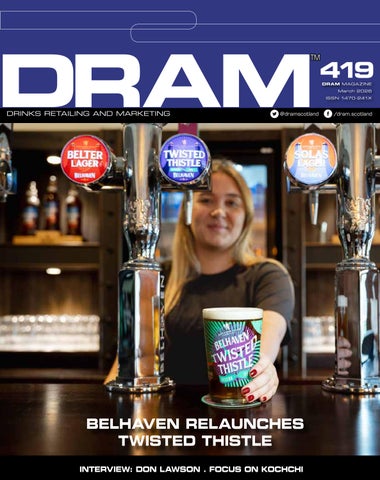
Dram 419 February

Page 1


WELCOME

Welcome to this issue of DRAM –news aplenty and lots more too.

I paid a visit to Inverness to catch up with the legend that is Don Lawson. As usual, it was non-stop chat, and he certainly had plenty to say about the state of the trade. Read what he has to say on page 14.

I also asked a few key people from around Scotland some questions that I feel are pertinent at the moment regarding how the Scottish Government is running the country and what they are doing to help hospitality.

I don’t think their views will be a surprise to anyone, but what struck me was the feeling that we have reached a tipping point. I do hope that Ivan McKee reads what they have to say.

I can’t say I was ever a fan of BrewDog, but you have to admire how two men persuaded more than 200,000 to invest – we review its history, and hope the new owners have more success.

This issue, our design focus is on Kochchi Glasgow, but we have a bumper issue of new bars in the next edition. Also, look out for a new Ad and PR campaign – it aims to put pressure on the Scottish Government to stop the rates re-evaluations. If you want to get involved, get in touch via the email below.

See you next month.

Susan Young, Editor susan@mediaworldltd.com dramscotland.co.uk

What do you think? Scotland’s licensees give us their view.

OLD TOWN TO GET BOSTON BAR

Encore Bars Group has opened a second Edinburgh location of The Boston Bar shortly, bringing the Irish-American concept to the city’s Old Town for the first time. The venue, formerly The Globe, on Niddry Street, is a late-night neighbourhood bar with a focus on live music and sport.

The Group also runs late-night spot Freddy’s and Westside Rodeo on George Street, as well as the flagship Boston Bar on Hanover Street.

While the Old Town site has the same relaxed, sociable feel as its sister venue, its layout gives it a different character. The company say that the series of low-level rooms and two large arches, means the interior lends itself to cosy snugs and smaller spaces in keeping with the traditional Irish bars that inspired the concept.

Edward Fox, Director of Encore Bars, said, “What excites us most is seeing the space come to life and become part of the Old Town community. There’s something special about opening a venue in such a historic part of the city and giving it a new role as a modern gathering place.”

NEW OWNERS FOR THE CAVENS ARMS

The Cavens Arms in Dumfries has changed hands for the first time in over two decades, with ownership passing from long-time operators Gary and Faye Jeffries to local couple Shona and Jimmy Hair.

The Cavens Arms is well known for its food offer and real ale, having collected 15 CAMRA Real Ale awards over the years. Following the handover, new owner Shona Hair shared a message of thanks writing, “Can I just thank everyone who has supported Jimmy, myself and Pam with the takeover of the Cavens Arms. The staff and the customers have been amazing beyond expectations. We hope to carry out the same expectations as Gary and Faye Jeffries did with much success.”

Gary and Faye Jeffries also shared a farewell message after their final shift, saying, “So after 22 years it’s time for us to say goodbye to Cavens Arms. Huge thank you to all our customers and amazing staff. Or should I say friends—as that’s what you all are. An incredible last night with music, laughter and a few tears. Wishing new owners Shona and Jim the very best of luck and hope they enjoy the experience of running Cavens as much as we have.” The sale was handled by Christie & Co.

Did you know?

Irish pub-themed operator Katie O’Brien’s is preparing to enter the Scottish market with a new venue in Glasgow’s Merchant City. It secured approval to amend the premises licence at the former Bar Soba site in Merchant Square. The project is reported to involve investment of around £400,000 and is expected to create approximately 40 jobs once completed.

Investment

Brings New

Lease of Life to The Beehive

The Beehive in Edinburgh’s Grassmarket has reopened following a £1 million refurbishment, marking a significant milestone in Belhaven’s 2025 investment programme. The operator has pledged more than £5 million across 20-plus pubs this year, with The Beehive one of its flagship projects.

Positioned at the foot of Edinburgh Castle, the historic pub has been upgraded internally and externally, with the aim of refreshing the venue while preserving its long-standing character. The works have also created new front and backof-house roles, reinforcing the pub’s contribution to the local economy.

Inside the first floor now offers an open-plan dining area and a dedicated whisky bar, while the top floor includes enhancements to the popular Comedy Attic and the addition of new meeting rooms. Externally, the terrace has been revamped, with plans to install a stretch tent in the rear garden.

The reopening coincides with a refreshed food menu, including steak pie and fish and chips, alongside an expanded draught range featuring Belhaven Black and the recently relaunched Twisted Thistle IPA.

Belhaven said the investment reflects its commitment to sustaining heritage pubs while navigating ongoing cost pressures across the sector.

Leiper’s Attic Reopens at Cottiers

Leiper’s Attic has re-opened at Cottiers after a seven year hiatus. Situated within the former Dowanhill Parish Church, the distinctive space will trade from Thursday to Saturday evenings from 5pm, with Sunday service from noon. The reopening marks a new chapter for the venue, which has been refreshed with a renewed focus on Scottish-led food and drink.

David Robertson, director at Cottiers, said, “Leiper’s Attic is a truly unique venue for Glasgow, with an exciting and fresh new offering for the westend. It was a joy to see the place back to life and buzzing at our launch night and we’re now immensely proud to be able to reopen Leiper’s Attic for everyone to enjoy. A warm welcome is guaranteed every weekend from Thursday through to Sunday.”

Bistro format for Eleanore

Eleanore in Leith will reopen in March with a new neighbourhood bistro format, marking a shift in direction for the restaurant from Roberta Hall-McCarron and Shaun McCarron.

The relaunch sees the evening tasting menu dropped in favour of a more flexible à la carte approach, a nod back to the site’s original identity as The Little Chartroom.

Head chef Hamish McNeill will lead the kitchen, focusing on seasonal Scottish produce through a changing two or threecourse menu, snacks and rotating sharing dishes, with Sundays dedicated to a collaborative lunch across the group’s kitchens. Alongside a kitchen refit, the space will be reworked to include a dedicated bar, with wine taking a more central role as Eleanore aligns more closely with sister sites The Little Chartroom and Ardfern.

“We wanted to take Eleanore back to its roots, giving guests the freedom to shape their own experience, from how long they stay to what they spend,” said Roberta Hall-McCarron.

NEWS

BUZZWORKS GEARS UP FOR NEXT PHASE OF GROWTH

Buzzworks has reported an 8.4% rise in revenue to £37.3m for the 53 weeks to 4 May 2025, as the family-led group continues to invest in its portfolio and gear up for its next phase of growth.

The increase from £34.4m in the previous year highlights steady performance across the estate, despite ongoing cost pressures and a challenging trading environment for the sector.

Underlying EBITDA for the year stood at £3.32m, compared to £3.77m in FY24, a figure that benefitted from insurance income. Over the same period, Buzzworks invested £2.4m into new openings and refurbishments, including Lido Musselburgh and a new Herringbone venue in Barnton, alongside upgrades at Lido Prestwick and The Longhouse in Kilmarnock.

June 2025 marked a major milestone for the business, with Managing Director Kenny Blair leading a management buyout backed by Londonbased Alchemy Partners. The partnership provides strategic and financial backing to accelerate expansion

plans, including the addition of venues with accommodation.

He commented, “Growing revenue in the current business climate is a real credit to our teams and the loyalty of our guests.

We’ve continued to trade strongly while absorbing significant cost pressures. We’re operating against a tough backdrop in Scotland, from energy and labour increases to a non-domestic rates system that can disproportionately penalise hospitality businesses when they invest.

“Hospitality is a major economic contributor, supporting jobs, supply chains and town centres. We want to strengthen Scottish hospitality and help make our country an even better place to visit. To do this, we need a rates approach that properly recognises that value and supports investment, rather than holding it back. He concluded, “Looking ahead, the investment from Alchemy Partners is a catalyst for our next phase, giving us backing to enhance our estate and accelerate expansion, including venues with accommodation.”

Michelin Bib Gourmand for Sebbs

Sebb’s, the Glasgow restaurant and bar on Miller Street, has been awarded a Michelin Bib Gourmand, representing a major achievement for the venue less than a year after opening. The accolade, which highlights restaurants offering ‘good food at moderate prices’, was announced ahead of the MICHELIN Guide Ceremony for Great Britain and Ireland.

Sebb’s is one of the newest additions to the list for 2026, and was recognised for quality and value. The subterranean restaurant and bar opened under the Scoop Restaurant Group banner and was first

n Amber Taverns launched its latest Scottish pub with the opening of The Comet in Helensburgh in January.

The premises on James Street, previously home to The Logie Baird and briefly known as The Dapper Dug, had remained empty since 2019. Before then, the building housed the town’s La Scala cinema and an amusement arcade.

Now fully refurbished, The Comet has been designed as a wet-led community and dog-friendly pub with pool table, two dartboards and multiple Sky boxes to cater for live sport.

Operator Ashleigh Turner, has worked in the trade for over a decade. Her lat fouryear tenure was at Amber Taverns’ Paisley site, The Northern Way. She said she hopes the new venture will become a social hub for the town, offering a welcoming atmosphere for locals and visitors alike.

n First Minister, John Swinney, has officially opened Luss Distillery, the new multi-million-pound distillery and visitor experience by Loch Lomond Group, located in the heart of one of the country’s busiest tourism destinations.

listed in the Michelin Guide just five months after launch. It now sits alongside sibling venues Ox and Finch, Ka Pao, and Margo - all of which also hold Bib Gourmands.

Jonathan MacDonald, Managing Director of Scoop Restaurants, said, “From day one, Sebb’s has been a team effort. Everyone involved has poured an enormous amount into getting it right - from how the space feels, to how the food and drinks come together on a busy night. To see that work resonate beyond Glasgow, and to reach this point just a year after opening, means a great deal to all of us.”

NEWS

£170k Revamp as Kilderkin becomes

The Parliament Arms

Lomond Leisure is set to relaunch Kilderkin on Edinburgh’s Royal Mile as The Parliament Arms after a £170,000 refurbishment in partnership with Star Pubs. Work is under way, with reopening scheduled for mid-March. The project is expected to create around 20 jobs and will reposition the venue as a smarter, traditional-style pub in keeping with its historic surroundings. Externally, the building will benefit from new signage and lighting. Inside, Scottish provenance will take centre stage. The bar will showcase an expanded range of Scottish gins and whiskies, supported by tastings and events with local producers. The kitchen will focus on Scottish dishes with a twist, using locally sourced ingredients. Planned menu highlights include seafood, venison, pies, Cullen skink and haggis.

Lomond Leisure said strong like-forlike sales across its estate had given it confidence to grow, while maintaining a cautious approach to expansion, with site selection remaining critical. With the addition of The Parliament Arms, the group will operate six venues across Scotland, joining its existing sites in Glasgow, Tarbet and Edinburgh. Star Pubs said the refurbishment aims to ensure the pub reflects both its prominent location and the strength of Scotland’s hospitality offer.

UNCLE TIGER ROARS INTO EDINBURGH’S LATE-NIGHT SCENE

Uncle Tiger is set to join Edinburgh’s late-night scene when it opens at 3 Bristo Place with a distinctly after-hours edge. It is the latest offering from Ôir Group - the company behind Lucky Yu, Bodega and The Captain Darling.

Uncle Tiger channels retro Asian canteen aesthetics through a supper-club lens, pairing rotating menus and cocktails with a carefully curated soundtrack designed to carry the night. Every six-weeks the food offering will highlight a different Asian food culture, giving the kitchen freedom to evolve while keeping the experience fresh for returning guests.

Edinburgh chef Cameron Laidlaw (pictured left) – best known for award-winning street food venture Junk, has been brought in to develop the menus and shape the food offer from the ground up. Ôir Group director John Howard (right) said, “When we saw the site, we knew that we needed to look at a different format to what we have done elsewhere and treating it more like an event space gives us enormous creative flexibility. It allows us to keep things fresh and exciting, giving guests a reason to return for something new every time.”

A bao bun station at the front of the venue will also operate daily, serving handmade bao to eat in or take away. A converted shipping container at the rear has also been fitted out as a private dining room for up to 14 guests.

Hendersons Heads West to Glasgow’s Southside

Edinburgh vegetarian restaurant Hendersons, is opening its first site outside the capital, taking over the former Seven21 space at Pollokshaws Road in Glasgow’s Southside.

Founder Barrie Henderson says the move is a return to the family’s roots. “Coming to Glasgow feels like returning to my gran’s home city and where some of the original recipes came from,” he says. His grandmother, Janet Henderson, opened the original restaurant in 1962. After the Edinburgh site closed in 2020, Barrie rebuilt the business in 2021, keeping the family recipes and ethos alive.

Head chef Anna Czapiewska will lead both sites, aligning menus while letting each venue maintain its own approach.

The Southside restaurant will serve coffee, drinks, and food from day to evening, with table service for casual meals and gatherings. Hendersons continues its focus on local suppliers, sustainable practices, and reducing single-use plastic.

Savills has reported another record year for Glasgow city centre food and beverage in 2025, with 38 new openings delivering 87,000 sq ft of restaurant space. The agency said this was the highest annual volume since 2018 and around 10% higher than 2024. The make-up of deals shifted, with national and international brands taking a larger share of activity. Larger operators accounted for 25% of transactions, up from 10% the previous year, when independent concepts dominated. New arrivals included Sticks’n’Sushi and Dishoom on Nelson Mandela Place.

BRAND NEWS

WILLIAM GRANT’S RELEASE NEW PERMANENT ADDITION TO HENDRICK’S RANGE

William Grant & Sons have released the first permanent addition to the Hendrick’s Gin range in nine years, Housed in a striking white bottle, this gin fuses classic Hendrick’s cucumber and rose with cacao beans, delicate orange blossom, and subtle citrus notes for a velvety, smooth finish.

Master Distiller Lesley Gracie, inspired by her love of chocolate and flowers, crafted this unique gin by combining velvety cacao with Hendrick’s signature flavours. Global Brand Managing Director Nora Torpey describes it as more than a line extension: it’s a dynamic, culturally resonant evolution, set to redefine premium gin.

WHISKY

In February 2026, Glenfiddich, also owned by William Grant & Sons, unveiled a bold new visual identity. Drawing on five generations of family archives, the redesign honors the brand’s 139-year legacy while signaling a new era.

Central to the refreshed look is the iconic stag, inspired by Sir Edwin Landseer’s 1851 painting, reimagined to reflect the whisky’s character and framed by the distillery’s founding year, 1887. The reworked Grant Family Crest, embossed on packaging with the motto “Stand Fast,” emphasises the family’s custodianship and commitment to craft.

Glenfiddich remains deeply rooted in Speyside traditions, using pristine Robbie Dhu spring water, while embracing innovation under Malt Master Brian Kinsman. The redesign also aligns with global luxury partnerships, including Aston Martin Formula One™ Team, and will roll out worldwide from April 2026, setting the stage for the brand’s next chapter.

BELHAVEN RELAUNCHES TWISTED THISTLE

Scotland’s oldest working brewery, Belhaven, kicked off 2026 in style with the relaunch of its iconic Twisted Thistle IPA, now sporting a bold new look and a refreshed recipe. Twisted Thistle IPA has long been a favourite among drinkers, and the new recipe, at 4% ABV, is carefully crafted to enhance its refreshing flavour while staying true to the bold character that made the beer previously popular in Belhaven’s portfolio. The relaunch also introduces a vibrant new visual identity for the beer to give it a more modern appeal and embrace the vision of the wider portfolio, which has been evolving over the last few years. The refreshed branding reflects the beer’s flavoursome spirit but balances this with the brewery’s heritage including the brewery’s chimneys within the branding. The launch of Twisted Thistle follows the successful introduction of Belter, 4% ABV golden lager, which landed in pubs across Scotland last September. Belter has been warmly received by customers and praised for its refreshing, subtly sweet flavour and eye-catching design which also has a nod to Belhaven Brewery.

Suzie Carlaw, Marketing Manager for Belhaven Brewery, said, “We’re excited to bring Twisted Thistle IPA back with a fresh new look and a refreshing taste and as we get into the new year we felt it was right for us to officially launch this well-loved beer at the beginning of 2026 and begin with an exciting portfolio of beers.

“The relaunch is part of our ongoing mission to evolve our range while celebrating all of the great things that Belhaven Brewery is known for. Twisted Thistle has always had a positive reception from drinkers, and now it’s even better.”

The Wanlockhead Inn in Biggar, the highest pub in Scotland, was one of the first pubs to install Twisted Thistle on the bar.

Dean McKelvey, the landlord of the Wanlockhead Inn said, “We were thrilled to be one of the first in the country to get the relaunched Twisted Thistle and it has always been a cracking classic, but the new recipe takes it to a new level. It’s already been greatly received by our customers and it’s brilliant to add another Scottish beer in to our range.” Twisted Thistle IPA is now available to order for venues across Scotland. For more information, visit www.belhaven.co.uk.

IS THE SCOTTISH GOVERNMENT LISTENING?

WE ASKED PUB OPERATORS FROM AROUND THE COUNTRY WHAT THEY THOUGHT OF THE SCOTTISH GOVERNMENT’S PERFORMANCE - FROM DUNDEE TO EDINBURGH - HERE IS WHAT THEY HAD TO SAY.

ADRIAN GOMES

10 Dollar Shake Aberdeen

How would you rate the Scottish Government’s approach to non-domestic rates (NDR) for hospitality businesses, and the recent re-evaluation… what has/will be the biggest impact - positive or negative - on your operations?

ScotGov’s approach has always been a mystery. Retail and office space can be calculated based on rent or floor space, and hospitality seems to be based on what the Scottish Assessors think the revenue should be (or they compare it to similar-sized venues, without taking the concept or customer demographic into consideration). If those who have worked in the industry for decades can’t accurately predict the revenue of a venue, how are property surveyors supposed to? It’s a finger-in-the-air black magic. The biggest impact is the uncertainty - appeals take years, during which time you have to pay the higher rate. It’s bureaucracy at its worst.

How confident are you that the current governing party can create a positive environment for Scotland’s hospitality sector to thrive in the years ahead, and what would increase that confidence?

Part of me genuinely believes there is a segment within the current governing party who are advocates for temperance. They don’t follow suit with the UK government when it comes to rates relief, nor are they pro-actively supporting businesses in general. Look at oil and gas - given that North Sea revenues played a massive part in their independence, they have turned their back on it - and the fact is rural Scotland still runs on fossil fuels. I should know, I have an oil tank and a wood-burner and I couldn’t survive a winter without them.

Do you think the Scottish Government is listening or do you think they are paying lip service until after the election?

It’s election time which means it’s time to roll out the voter bribes. The two parties that will likely form a coalition, should Reform gain a lot of seats, both voted against the Scottish Parliament motion. I think that sums up who’s listening, and who isn’t.

What is the most important ask right now?

I think the main ask is don’t do to us what you did to the oil and gas industry. Tax revenue is not a never-ending magic pipeline.

LISTENING?

How long have you been in the How would you rate the Scottish Government’s approach to nondomestic rates (NDR) for hospitality businesses, and the recent reevaluation… what has/will be the biggest impact - positive or negative - on your operations?

I find the Scottish Government’s approach to hospitality NDR disgusting. This isn’t about party politics – I’m not party political, I have seen the disdain with which hospitality businesses have been treated for years. All of the support Ivan Mckee lists will barely affect us, even wee Ox and Finch has an RV of £160k, well out with the scope for most of the support. We’re seeing a 73% increase at Ka Pao and 136% increase at Margo & Sebb’s, everywhere we operate we’re the highest in the neighbourhood.

worst, I’ve seen many examples of national fast food and coffee chains seeing modest increases, whilst independent restaurants that cook fresh food, employ armies of people and add real value to their local area get hammered.

How confident are you that the current governing party can create a positive environment for Scotland’s hospitality sector to thrive in the years ahead, and what would increase that confidence?

The dismissive and deflecting tone of the Scottish Government is appalling, jobs and peoples hours are being cut right now, businesses will continue to close, this will have a negative impact on the overall tax take and increase unemployment.

What is the most important ask right now?

High-turnover, lower margin, food focussed businesses like ours seem to get hit the

The Fort Hotel Broughty Ferry

How would you rate the Scottish Government’s approach to non-domestic rates (NDR) for hospitality businesses, and the recent re-evaluation… what has/will be the biggest impact - positive or negative - on your operations?

The Scottish Government have not yet made it clear on their intentions where we will actually stand when April comes. The impact the increase will have on my business will have major long term damage. Our business is split over six properties. The increases are as follows: a £72,600 increase, bringing the rate to £147,750; a £2,100 increase, bringing the rate to £4,150; a £1,800 increase, bringing the rate to £3,550; a £1,100 increase, bringing the rate to £2,200; a £1,650 increase, bringing the rate to £3,300;

The valuation methodology is broken, none of our RVs are anywhere close to our rents, they say their system is supposed to value market rent, it doesn’t, and that is an easily demonstrable fact.

and a £1,500 increase, bringing the rate to £2,950.The smaller rates are annexes, which make up part of the hotel.

On the back of these proposed increases we have taken the decision to start closing down parts of the Hotel with immediate effect. We have already put two of the apartments on the private rental market and are putting in for change of use on another of the annexes in the hope to turn this into office space. Over the next 2 years we will look to downsize another 2 annexes and convert into rentals. These rentals, if and when we get them rented out will not be extra income but a portion of the money we need to pay the new proposed rates. Over the next 2 years this will also impact at least 4 Jobs. The 2 apartments going to the private rental will pay less rates than I’m paying now and the office space will drop below the value where they actually pay no rates, so in turn every time we decrease what we do the government will actually be getting less. This latest stunt will have more impact on our trade than COVID. We are still a busy business and employ over 60 staff but we can not sustain these increases year on year.

How confident are you that the current governing party can create a positive environment for Scotland’s hospitality

The most important ask is a fair and transparent non-domestic rates system that accurately reflects market rent, rather than penalising high-turnover, lower-margin, food-focused hospitality businesses. Every operator I speak to has had their profitability squeezed in recent years.

sector to thrive in the years ahead, and what would increase that confidence?

We have all talked about action over the years but it’s mainly been talk and not enough action. If our trade is to survive we really need to see change.

Do you think the Scottish Government is listening or do you think they are paying lip service until after the election?

If we personally go to the press the public turns against us, but do people really realise how big a part of what we do helps the economy to survive. We are a trade, we are real people and not just simply a taxing tool!

What is the most important ask right now?

The most important ask right now is - Scrap the new rates, bring our rates into line with other businesses and stop the rateable value going on turnover, turnover is not profit! Reduce the VAT to 10% and have all businesses pay VAT. Scrap the living wage and have minimum and skilled wages. Reduce the NI they hammered us with last year. If they don’t start to change, the hole they have put us in is only going to get bigger. Do they work for us or do we work for them?

JOHN BLACK
JONATHAN MACDONALD Scoop Restaurants, Glasgow

IS THE SCOTTISH GOVERNMENT LISTENING?

How would you rate the Scottish Government’s approach to NDR for hospitality businesses, and the recent revaluation? What has been the biggest impact on your operations?

Stuart Fraser: The current approach to Non Domestic Rates is fundamentally disconnected from the operational reality of hospitality in Scotland.

The revaluation has hit established, higher rateable value businesses particularly hard. Businesses like ours at The Oak Tree Inn in Balmaha have invested heavily over a 30 year period to build something sustainable and significant. That success now appears to count against us. Because we have a higher rateable value, we fall outside most relief schemes. We are effectively penalised for having grown.

In our case we are facing an increase approaching 79 percent. That level of uplift bears no relationship to profitability. Turnover growth is not profit growth. Rising revenue is being entirely consumed by wage inflation, food cost increases, energy volatility, regulatory pressure and now a year round visitor levy. The biggest impact is not simply financial.

It is the collapse of confidence. We are currently mothballing multiple development projects because the risk profile no longer makes sense. We have shifted from expansion and job creation into survival mode.

As directors, we have not taken additional remuneration in over a decade because the business cannot sustain it. At the same time, our management team and even new starters now effectively earn more than we do once all obligations are met. That is not a complaint about paying staff fairly. It illustrates how distorted the cost base has become. When long term owner operators are effectively absorbing the strain personally while fixed government costs continue to rise unchecked, it is no surprise that businesses are folding at the rate we are now seeing across Scotland.

How confident are you that the current governing party can create a positive environment for Scotland’s hospitality sector to thrive in the years ahead? What would increase that confidence?

At present, confidence is extremely low. Hospitality does not feel like a strategic growth sector. It feels like a revenue stream. Businesses of our size are too large to qualify for meaningful relief yet too small to absorb repeated structural cost shocks. We are consistently excluded from support while carrying increasing tax burdens.

Confidence would improve immediately if we saw:

• An immediate pause on rates increases similar to Northern Ireland

• Transitional caps on extreme revaluation jumps

• A meaningful review of NDR that reflects margins rather than rateable value alone

• An immediate VAT reduction for hospitality

• A proper cumulative impact assessment of rates, wage policy, energy costs and the visitor levy

An immediate VAT reduction and a pause on rates would send a clear signal that government understands the urgency.

Without that, investment will remain stalled.

Do you think the Scottish Government is listening, or paying lip service until after the election?

At this stage, it is difficult to argue that government is genuinely listening.There have been consultations, industry meetings and submissions. However, when policy outcomes repeatedly move in the opposite direction of overwhelming sector feedback, the only reasonable conclusion is that those views are not influencing decisions.

On the visitor levy, for example, strong and consistent opposition was expressed by many operators, particularly to a year round model. It proceeded regardless.

The perception across the industry is no longer that government is weighing up feedback. The perception is that decisions are being made and consultation is taking place afterwards to legitimise them.

That is deeply damaging to trust. Businesses need to see policy adjusted in response to evidence. At present, we are not seeing that happen.

What is the most important ask right now?

The most important ask is immediate intervention to restore stability and confidence.

Specifically:

• An immediate pause on Non Domestic Rates increases

• Transitional protection for extreme uplifts

• An immediate VAT reduction for hospitality

• A full review of cumulative cost burdens

We currently have multiple projects ready that would create jobs and enhance our local economy around Loch Lomond. They are mothballed. Not because demand is absent, but because policy risk and fixed cost escalation make forward planning irresponsible.

Right now, hospitality businesses are not looking to grow. They are trying to survive. If government wants confidence, it must demonstrate that it is prepared to change course. Until then, the sector will remain cautious and defensive.

STUART FRASER & SANDY FRASER
- The Oak Tree Inn, Balmaha

LISTENING?

“No sensible government would choose to implement, on many tourism businesses, over a 100% plus increase in any other form of tax and expect them to survive. Please do not naively think that they do not have control over the NDR rating system.

“The fact that ministers in the Scottish Parliament appear to think that, because Edinburgh is constantly over-busy with tourism, the same logic should be applied across Scotland is complete madness.

“There is virtually no business support for higher rateable value hospitality businesses, which now means all projects cancelled and a move to survival mode. I can categorically say I regret persuading my children to make a future in the

hospitality/tourism sector.

“I am very aware that it is generally accepted that the Non-Domestic Rates system is not fit for purpose, and the promise of a review and, sadly, some positive action will be too late to save an industry once the envy of the world.

“I fear that there are so many other issues going on in the Scottish Government that we just are not important enough, and they see it as an easy revenue earner. I really wish we were a bit more like the farmers, who without doubt have improved their position with their recent on-going actions.

The visitor levy is a good example. We talked to umpteen businesses, and we did not find one that supported the proposal

in the Stirling area, and yet Stirling Council claimed the proposals were supported by many businesses.

“The damage is already done, with pubs closing on a daily basis, hotels only managing part opening, and eventually closing. You would really think that the hospitality tourism sector, being of such importance to Scotland, would merit a Minister specifically.”

Star Hotel Kingussie
New Turban Restaurant, Giffnock
Sandy Fraser, father, and founder of the Oak Tree Inn, also had this to say:

COMPANY NEWS AND PEOPLE

LISINI GAIN WELLNESSCHARTER

Lisini Pub Company has been awarded the Wellness Charter by Scottish charity Hospitality Health, in recognition of its commitment to staff wellbeing across its venues.

The Wellness Charter, recognises hospitality and tourism businesses that are actively supporting the mental and emotional wellbeing of their workforce. It was founded in 2018 to drive a shift in how the industry approaches mental health, and the Charter now serves as a benchmark for best practice.

Training Manager at Lisini, Martine Tumilty, accepted the award on behalf of the group. She said, “We are delighted to be awarded the Charter from Hospitality Health. Focusing on the wellbeing of our staff, we have mental health first aiders, wellness training, welfare meetings and development training for all staff.

“Taking great care of our team is such a vital aspect of our business. After all, we expect them to take great care of our guests.”

The company has put in place a programme of staff support that not only responds to the pressures of the working environment but also recognises the broader impact of work-life balance.

staff

Independent hospitality group Manorview has announced that this year team members will share in a £135,766 Heartcount profit share.

Dani Fraser, Head of People at Manorview, said, “We are very proud of our Heartcount profit share scheme. Everyone, regardless of role, makes a positive contribution to Manorview and it’s only right that they then receive something in return. We are pleased that we’ve been sharing profits for 7 years now, and to date over £968,000 has been shared fairly with our committed and caring team.”

The scheme is designed to be as fair as possible, with individual payments calculated using hours worked rather than job title or pay which means team members receive the same amount for the same hours, regardless of whether they are a director, housekeeper, manager, spa therapist, finance manager, chef or kitchen porter.

Heartcount is Manorview’s only monetary bonus, after the group moved away from performance or targetrelated bonuses for managers or sales teams several years ago. Fraser added, “Fairness is the heart of so many of our decisions, and the fact is it’s not just senior or sales team who make things happen here, this is why we structure Heartcount in the way we do.”

Pics: Marc Carruthers

PEOPLE

The annual BEN Dinner took place at the start of February and as usual it was a sell-out. A great opportunity to catch up with friends and colleagues old and new.

Pics Craig Young

UNSTOPPABLE DON

I’VE KNOWN INVERNESS LICENSEE DON LAWSON FOR MORE YEARS THAN I CARE TO REMEMBER, AND WHEN WE CAUGHT UP RECENTLY AT HIS JIMMY BADGERS BAR, AS USUAL, HE WAS FIREFIGHTING ON BEHALF OF THE TRADE.

Don Lawson is a man who doesn’t do things by halves, and he certainly doesn’t pull his punches when he feels the industry is being unfairly targeted.

But almost before I had sat down, he was regaling me with an issue that had his hackles up - a local news report suggesting spiking was on the rise in Inverness. Don was indignant. “I’ve been on a mission today,” he tells me. “This horrific story came out yesterday from an owner of a local security company, who’s never worked on any of my doors. Bear in mind, I’m Chairman of Inverness Pubwatch and have been for years. He suggested to our local newspaper, that spikings were on the increase in Inverness and also drugs use. I couldn’t believe what I was reading.

Then the STV news carried it last night, despite the fact that in my view, it was fake news.”

Don isn’t one to let a slight against the city’s reputation slide. “I spoke to the source of the story, I asked him where he got his information from.

“Apparently, there was an incident a couple of Saturdays ago on Union Street. A girl collapsed, and she said she’d been spiked. I told him that there had not been a confirmed spiking in the past two months, nor the previous 12 months, or the previous 12 months before that.

“There is a protocol for spiking in terms of police and tests. If someone had got in touch with me, I would have given them the facts.”

them - over the last 12 years. The majority for drug related offences, in my opinion there has been no increase, in fact there is probably a decrease, For we have a zero-tolerance on drugs.

“We are definitely going to put some good vibes out there regarding the Night-time Economy.”

Don is an industry veteran – before he opened Johnny Foxes in 1997 he had spent 14 years honing his craft at Stakis Hotels and five years as Chief Executive of Aviemore Mountain Resort. That high-level corporate pedigree gave him the operational backbone to go out on his own when he opened Johnny Foxes, followed by The Den in 2008 and Jimmy Badgers in 2022, he has also been involved in various other hospitality venues in the Highlands too particularly in Aviemore. He is also a former Ross County director, Past President of Inverness, Highlands and Islands Licensed Trade Association, founded the Publican Party to fight the smoking ban, and is the long-standing Chairman of Inverness Pubwatch and a director of the Inverness BID.

I once asked him the secret of his success, he told me it was to give people what they wanted. Ever since I have done just that.

Don’t get Don wrong - he isn’t dismissive of public safety; quite the opposite. He’s taking the fight to the editors to ensure the truth is heard. He says “Next week I am having a meeting with the news journalist, the licensing standards officer, and the local BID board. We’re going to put a real good story out, because we work hard in the business and we’ve got a lot of successes in terms of making Inverness a safe environment for our customers. There’s been approx.110 people banned for life by our Pubwatch premises -all 42 of

DON LAWSON

He doesn’t just talk the talk, he walks it - his business ethos,has always been about more than just moving volume; it is about social responsibility and creating a safe, thriving city and standing up for hospitality. Validated by numerous industry awards.

From spiking, we moved swiftly on to GDPR - another issue which Don has a bee in his bonnet about. It’s a classic case of red tape hampering commonsense policing. He explains, “Currently, we have 20 people banned from 42 Inverness pubs by our Pubwatchbut they don’t know they are barred, because despite the fact they have been arrested by the police, the police won’t give us their addresses to let them know. They tell us it’s because of GDPR and they have also refused to pass on any correspondence to them, telling us it is not “policy”. This is crazy. And if we can’t find a solution to this issue, it could mean the death of Pubwatches around the country.”

Don is so frustrated by the impasse that he’s prepared to take drastic measures. “I’m even considering a judicial review at my own expense. We have a very successful Pubwatch and

UNSTOPPABLE DON

that’s why Best Bar None, organised by the Inverness BID, is so successful here. I can’t understand why the police cannot have a liaison officer who deals with our LSO and who can give our ban letter over. I know that in Newcastle the Pubwatch there give the letters to the police and they send them. It’s so frustrating. It feels like the partnership that used to exist between the police and the trade has been eroded. It’s not only us, but the other Pubwatches in Scotland are having the same issue.”

Another subject which gets his back up is his rates re-evalation notice, which he only got the day before we met. To Don, it feels like a tax on success. “It’s gone up 33% while Primark next door has had no increase and the other places around me have seen a 10% increase.” He smiles wryly, “I put it down to the fact that Johnny Foxes to my mind is probably the busiest pub in Inverness. And I reckon I’m getting penalised because of that. I’ve left it with my surveyor and I will be appealing.”

We shifted gears to talk about his other great commercial passion: the Tartan Army. Don, and pal Bob Shields have owned the rights to the name since 2002. Says Don, “We own the name Tartan Army,it’s a trademark and as you would imagine we are very busy at the moment. We’ve just done a deal with an Edinburgh whisky company run by Finn Thomson. The deal with him is to create a Tartan Army whisky, so that’s going to be launched probably at the end of April.”

on his COVID walks, which was closed down, he opened Jimmy Badgers to appeal to the females in Inverness. It is proving just as popular as Johnny Foxes which is a powerhouse of a venue, but after nearly three decades at the helm, Don did consider hanging up the kilt last year.

It isn’t just about the trademark, though; it’s about the fans. Don has also been known to organise travel for the fans - he famously chartered a private plane for the Euro 2024 tournament to transport the Highland Tartan Army to Germany. It was a massive logistical undertaking, but that’s the kind of thing Don thrives on. He is also heading out to the USA this year for the World Cup but the only travel he is co-ordinating this time is his own. His business interest in the Tartan Army means that he is often in Glasgow meeting up with business partner and pal Bob Shields Daily Record Legend, who owns the Twa Dugs in Ayr. Says Don, “It is my favourite pub. I was there last week and I will be there next week because we’re very busy at the moment. And we always have lunch when I’m in Glasgow - always at the Ho Wong. But I enjoy catching up with lots of people in the trade and when I am in Edinburgh or Glasgow go out of my way to have a coffee with folk to find out what is going on with them. I have a great deal of respect for people like James Mortimer, Donald Macleod, John Carrigan, Joe Gillan and Graeme Arnott.”

Certainly the longevity of Johnny Foxes is a testament to Don’s ability to adapt. Launched in 1997 in a former steakhouse on Bank Street, next to the River Ness, the venue has grown both physically and operationally. In 2008, the business expanded with the addition of the adjoining nightclub, The Den, taking the total capacity to 550. While in 2022, after passing a premise everyday

He explains, “I decided to put Johnny Foxes on the market - it went on the first week in June 25, at the same time I had my senior team out on a sailing trip. Which I do every year. We go to Mallorca, from Sunday to Friday ; and on the Sunday night at dinner, I told them all that Foxes was going on the market. I warned them not to look at social media. Anyway, it went Viral! We got lots of enquiries, and I whittled them down from 16 to 6 - ruling out big pub companies and such like, but I didn’t get an offer - so I took it off the market in August. Rather than being disappointed, Don seems invigorated by the “failed” sale. “I do enjoy coming to work every day still. And maybe the universe is saying, Don, it’s not your time yet to hang up your boots? That’s what I think. But the good thing is that now people know that I would consider a sale and if somebody is interested, perhaps they will knock on my door. It remains a very successful and profitable business, but I would have liked to be taking it a bit easier. Sail off into the sunset, that sort of thing.”

But don’t expect him to be sitting in a rocking chair anytime soon. In the very next breath after talking about sailing into the sunset, he dropped a bombshell. He’s is considering a new business venture on foreign shores. It seems that for Don, the only way to “retire” is to find a new market to conquer.

Don got his business mantra from former boss Sir Reo Stakis. He tells me, “I once asked him what was the secret of his success, “ he told me Never try and Educate your Customers, just give them what they want ! Ever since, I have done just that. I also took another leaf out of his book and have always focussed on ‘costs’ rather than GP. Although I do insist on high standards and I drill into my management team how important they are.

“ There are 8 definitions of ‘Standard ‘ in the Collins Dictionary, the one I follow and preach is…. ‘A Degree of Excellence for a Particular Purpose‘. Its never let me down.

“I am a taskmaster but I also like to think that we provide a great working environment for the team... and we certainly have some fun along the way.”

As we finished our drinks at Jimmy Badgers, it was clear that Don Lawson is far from stepping back. Whether he’s battling the local press over spiking stories, taking on the police over GDPR, or launching a new whisky for the Tartan Army, he remains one of the most driven men in the Scottish licensed trade. The “Fox” might have been on the market for a minute, but the man behind it is still very much on the hunt.

KOCHCHI

KOCHCHI has opened its first standalone restaurant in Glasgow’s West End, expanding from its early presence at Bonnie & Wild in Edinburgh.

The £500,000 investment transforms a corner of Ruthven Lane into a two-floor restaurant with around 80 covers and a heated balcony, integrating a dedicated bar and offering a menu that blends Sri Lankan tradition with contemporary dining.

The layout is designed to balance intimacy and social interaction. The ground floor centers on a bar that functions as both focal point and gathering area. Brass and timber detailing defines the space, complementing a drink list inspired by Sri Lankan flavors. The bar establishes a rhythm that carries through the restaurant, guiding diners from arrival to seating.

Upstairs, the atmosphere shifts. Wooden beams and a ceiling fan introduce a vertical sense of space, while French doors open onto the balcony, connecting the interior with the street. The layout encourages movement and pause, offering areas for conversation and observation.

Materials are central to the interior. Timber, handwoven cane, and brass create tactile contrasts and reference Sri Lankan craft and heritage. Timber surfaces suggest coastal interiors, cane highlights traditional weaving, and brass introduces a subtle reference to historical hotels. The combination provides warmth suited to Glasgow’s climate and a consistent material language throughout the restaurant. Light is used to define zones. Rather than uniform overhead

illumination, pools of light accentuate textures and finishes, highlighting woven surfaces, timber grain, and ceramics. Color choices reflect the cuisine: ochre, red, and amber appear in upholstery, wall treatments, and decorative elements, reinforcing the connection between food and interior.

The menu and spatial design operate together. Koththu, the central street-food dish of hand-chopped flatbread, vegetables, and curry, is prepared in full view of diners, creating a visual rhythm mirrored in the restaurant’s layout. Short eats, hoppers, curries, and sambols extend this sense of shared experience. Communal tables and flexible seating support both small and larger groups, encouraging interaction and observation.

Details are purposeful. Wall panels, brass fittings, and selected furniture provide texture and tactility without distraction. Each element contributes to a sense of activity and engagement, ensuring that the space responds to diners rather than feeling staged.

The restaurant manages contrasts carefully: heritage and contemporary, interior and exterior, social bustle and quieter moments. KOCHCHI Glasgow presents diners with more than a meal. The space encourages movement, observation, and interaction. Materials, light, and spatial sequencing provide a backdrop for the cuisine, allowing diners to experience textures, flavors, and social energy together. The result is a restaurant that translates Sri Lankan tradition into a setting that is functional, welcoming, and carefully composed.

8 Ruthven Lane, Glasgow

FROM HYPE TO HANGOVER - THE STORY OF BREWDOG

MARTIN DICKIE AND JAMES WATT WERE MAVERICKS WHO PUT THE ATTITUDE INTO CRAFT BEER - HOWEVER THIS MONTH IT APPOINTED RESTRUCTURING ADVISORS ALIXPARTNERS TO OVERSEE A SALE. IN THIS FEATURE WE TAKE A LOOK AT ITS RISE... AND REVEAL SOME INTERESTING FACTS.

When BrewDog launched in 2007 in Ellon, Aberdeenshire, it was two men, a small kit, and roughly £20,000 scraped together through loans and overdrafts. James Watt handled sales, marketing and provocation. Martin Dickie, a trained brewer, handled the beer. They bottled by hand and sold at markets. There was no grand strategy document - just a clear enemy: bland lager and large corporates.

From the beginning, BrewDog wasn’t merely brewing IPA. It was brewing attitude. Punk IPA became shorthand for a new kind of British craft beer - louder, hoppier, less polite. The tone was confrontational and calculated. Watt understood early that attention scaled faster than distribution.

Equity,

not just equity story

In 2009 came “Equity for Punks,” a move that changed the company’s trajectory. BrewDog invited drinkers to become shareholders. And opened its first pub in Aberdeen. Over successive rounds, 7 in total, it is estimated that £75m was raised with more than 200,000 people holding shares at its peak.

It was capital raising, yes - but it was also brand engineering. Investors received bar discounts and perks. They felt ownership. BrewDog didn’t just build customers; it built evangelists. And they were invited to an AGM that was in reality a beer festival.

Controversy = free PR

In 2010 it released “The End of History,” a 55% ABV beer packaged in taxidermied animals. Only 12 bottles were produced. Animal welfare groups criticised it; global media covered it. BrewDog stated the animals were not killed for the product. Instead they were reportedly roadkill or already deceased But the controversy travelled further than any advertising campaign could have. That same year, BrewDog entered an ABV escalation battle with German brewery Schorschbräu, releasing “Sink the Bismarck!” at 41% ABV in a contest over the title of world’s strongest beer. It was theatrical, slightly absurd - and effective. Then came the tank delivery to Westminster during a protest over beer duty. And the trademark dispute over “Elvis Juice.” When the estate of Elvis Presley challenged the name, Watt and Dickie temporarily changed their first names to Elvis by deed poll. The issue was later resolved; the beer remains a core line. These moments weren’t accidents. They were strategic spikes in visibility.

A £231m deal

The growth that followed was rapid. Bars opened across the UK and internationally. Export markets expanded and in 2017, a minority stake was sold to TSG Consumer Partners. By 2018, the company was reportedly valued at

around $1 billion. In just over a decade, BrewDog had moved from fishing town start-up to dollar unicorn.

Today TSG’’s investment would be due £801m if it was sold. The deal was not just a capital injection; it came with strings. TSG acquired roughly 21–22% for its £213 million, with preferential rights guaranteeing an 18% annual compound return on exit.

Watt and Dickie sold part of their shares in a secondary sale, pocketing allegedly £100 million between them, but it also meant that in any future sale TSG would be paid first. It gave the company the title of a dollar “unicorn’.

The same year BrewDog opened a major brewery in Columbus, Ohio. It was a statement of intent - an anchor for US growth, complete with taproom and later a hotel concept. However their timing was off - The American craft market, was becoming more crowded and growth was slowing. The opportunity remained, but it was no longer the wide-open frontier of earlier years.

Back home and across Europe, BrewDog’s bar estate passed 100 sites. The rebel brand was now a significant global operator. The anti-corporate rhetoric sat alongside private equity backing, complex supply chains and international governance.

Punks with purpose

In 2021, more than 60 former employees published an open letter under the name “Punks With Purpose,” alleging a culture of fear and burnout. The claims were widely reported. For a brand that had traded heavily on values and authenticity, the impact was sharp. James Watt issued a public apology, stating he was “ultimately responsible for the culture” and that the issues raised were “100% my fault.” BrewDog commissioned an independent review and pledged change. He also pledged shares to the employees up to 20%.

Environmental positioning also came under examination. BrewDog promoted itself as carbon negative. In 2022, the UK’s Advertising Standards Authority ruled that certain claims were misleading because the basis of calculation was not made sufficiently clear. BrewDog amended its advertising.

The shift from insurgent to incumbent meant a new level of regulatory and reputational exposure.

The end of the founder era

In 2024, James Watt stepped down as CEO after 17 years, moving into a non-executive role. It marked a symbolic shift. BrewDog had been closely associated with his personality - combative, outspoken, relentless.

While Martin Dickie remained as co-founder and board member until August 2025, when he decided to step down from the company ending his 18-year tenure.

What’s next?

BrewDog has not collapsed. It continues to brew at scale, operate internationally and maintain a substantial bar estate. But it is now up for sale.

The company released this statement: “Following a year of decisive action in 2025, which saw a focus on costs and operating efficiencies, we have appointed Alix Partners to support a structured and competitive process to evaluate the next phase of investment for the business.”

However in 2024 BrewDog’s revenue sat around £357 million, suggesting it was only worth £420–560 million. But with £239 million in net debt, there’s no scenario where the remaining cash would cover TSG’s payout of roughly £801 million. For the early crowdfunders, staff beneficiaries, and even some long-serving employees - including those earmarked to receive part of Watt’s pledged 20% share allocation - a sale would likely yield nothing. BrewDog’s story is not simply one of rise and fall. It is the story of what happens when a challenger brand wins. When the outsider becomes established.

From hand-bottling in Aberdeenshire to billion-dollar valuation and global reach, BrewDog reshaped British craft brewing. The question now is not whether it can make headlines - it is whether it can sustain legacy, and that will only happen if a buyer is found. Whatever the outcome there is no doubt about it that Martin Dickie and James Watt did an incredible job. They sold the world a story, and it was believed in the main, although there were also skeptics who could see beneath the fluff.

The fantastic story has come down to earth with a crash due to sheer ambition,vanity, ego and of course the pot of gold at the end of the rainbow which Martin Dickie and James Watt have got in spades - but not its Equity for Punks shareholders...or its employees - and that is a great pity.

At a glance

Industry reporting outside of BrewDog’s official marketing pages says that when you add up all seven crowdfunding rounds from 2009 to 2021, the total raised across those rounds was about £75 million combined.

More than 200,-000 individual investors subscribed to Equity for Punks.

In 2014 BrewDog launched a fake campaign encouraging marketing hopefuls to pitch ideas - only to reveal it was a stunt to expose “lazy advertising.” Many felt it exploited applicants’ time for PR. It was also one of the first signs that their confrontational marketing style could alienate the very people they were targeting.

In 2017 BrewDog took private equity money with strings attached - investor TSG was promised an 18% return before anyone else got paid and for the privilege they paid £231m which valued BrewDog at a billion dollars.

Controversy was part of the its marketing strategy. They deliberately picked fights with regulators and also mocked big beer companies and mass market lagers. They even Rebranded as an “anti-sponsor of the World Cup.”

Advisors AlixPartners were appointed administrators on 2nd March, and promptly did a £33m deal with American wellness and beverage group Tilray Brands. Tilray agreed to take on 11 Brewdog pubs, its UK brewing brewing assets and global brand IP. A further deal is expected for Australian and US assets.

AlixPartners immediately closed the remainder of the Brewdog estate - 38 pubs - and announced 484 redundancies.

“Irwin D. Simon, Chairman and Chief Executive Officer, Tilray Brands, stated, “BrewDog is one of the most iconic, mission-driven craft beer brands in the UK. It helped redefine modern craft beer through bold innovation, fearless creativity and an unwavering commitment to great beer. What makes BrewDog truly special has always been its brewers, its brewpubs and its passionate community of beer fans. As we begin a new chapter for this great brand, our priority is to refocus BrewDog on the craft beer excellence that made it beloved in the first place and strategically invest to return the operations to profitable growth. BrewDog’s future is bright, and we are committed to ensuring the brand continues to lead and inspire the global craft beer movement.”

OBITUARY

KATHLEEN HOOD

28TH MAY 1944 - 17 DECEMBER 2025

Kathleen Hood, co-founder of the Lisini Pub Company and one of Lanarkshire’s most respected hospitality figures, died recently following a short illness at the age of 81. For more than six decades, Kathleen dedicated her life to the licensed trade, helping to build a family business that would become one of the most recognised and enduring hospitality groups in the west of Scotland. Alongside her late husband, Harry, she established Lisini Pub Company in 1969, laying the foundations for a portfolio that today includes the Angels Hotel and Castle Rooms in Uddingston, Dalziel Park in Motherwell, and the Parkville Hotel in Blantyre. Born in Glasgow in 1944, Kathleen was raised in a family steeped in the licensed trade. Her parents operated Tony’s Bar in the Gorbals during the late 1950s, and from an early age she developed an understanding of both the hard work and the community spirit that defined the public house at its best. Growing up in a household that combined service, diligence, and a welcoming spirit instilled in Kathleen the values that would guide her throughout her life: commitment to excellence, loyalty to community, and a belief in the transformative power of hospitality.

After leaving school, Kathleen went on to study commerce at the University of Strathclyde. However, the sudden death of her father altered the course of her life. She returned home to support her family and help sustain the family business, stepping fully into the trade that would become her vocation. Those early experiences shaped her approach to hospitality: grounded in resilience, attentive to detail, and rooted in the belief that a venue succeeds when it becomes part of its community. They also forged the determination and commercial awareness that would underpin Lisini’s future growth.

It was during these formative years that Kathleen met Harry, who would become the love of her life and lifelong business partner. Their paths crossed through mutual friends and shared connections in Glasgow’s community circles. They quickly discovered a shared passion for people, hospitality, and enterprise. Harry’s energy and ambition complemented Kathleen’s practical judgment and keen business sense, forming a partnership that was both personal and professional. Together, they built more than a business; they built a community, a workplace, and a family that reflected their values. That partnership, founded on mutual respect and complementary talents, became the foundation of the Lisini Pub Company and a model of collaboration, vision, and shared achievement.

In 1969, Kathleen and Harry purchased the Sherwood Manor in Viewpark, marking the formal beginning of Lisini Pub Company. They were young, ambitious, and willing to take risks. What began as a single premises developed steadily over the decades into a respected hospitality group known for quality, professionalism, and a distinctive family ethos. Their vision was simple yet enduring: to create venues where people felt welcome, where service was genuine, and where attention to detail reflected the care and pride of the proprietors.

The Lisini portfolio expanded to include the Angels Hotel and Castle Rooms in Uddingston, a venue that has become synonymous with weddings, events, and fine dining in Lanarkshire; Dalziel Park in

Motherwell, a landmark leisure and golf destination; and the Parkville Hotel in Blantyre, widely regarded for its contemporary style, welcoming atmosphere, and commitment to high standards. Each development bore Kathleen’s influence, particularly in standards of presentation, service, and operational discipline. She was the unseen hand who ensured that excellence was never compromised and that each venue reflected the Lisini ethos.

While Harry was often the public face of the business, Kathleen was widely acknowledged as its driving force behind the scenes. She possessed a sharp commercial instinct and an unwavering commitment to excellence. Colleagues recall that little escaped her attention: from the presentation of a dining room to the tone of customer service, she believed that details defined reputation. In every aspect of operations, Kathleen combined intuition with analysis, always keeping the guest experience at the heart of decisions.

At a time when the hospitality industry was still largely male-dominated, Kathleen established herself as a formidable businesswoman. She combined warmth with authority, creating environments where guests felt valued and staff felt supported, while understanding the importance of high standards. Her leadership style was instinctive rather than ostentatious. She preferred substance over display and results over recognition, and she earned the respect of peers, colleagues, and competitors alike.

Over the years, Lisini evolved from a hands-on family operation into a structured limited company, reflecting both growth and long-term vision. Kathleen played a central role in that transition, ensuring that the business retained its family character while adopting the governance and systems required for expansion. Even as responsibilities were gradually shared with the next generation, she remained closely involved in day-to-day operations, offering guidance and oversight drawn from decades of experience. Her influence helped ensure that the company’s values—integrity, consistency, and respect for staff and customers—remained constant through periods of growth and change.

In 2018, Kathleen and Harry were presented with a joint Lifetime Achievement Award at the DRAM Awards, by myself and Stuart Ross, becoming the first couple to be honoured in that way. The accolade reflected not only the commercial success of their business but also their contribution to Scotland’s wider hospitality sector. Under their stewardship, Lisini became known for investing in its properties, nurturing talent, and maintaining a consistent commitment to quality. Their achievements set a standard within the industry and inspired others to follow their example.

Beyond balance sheets and bricks and mortar, Kathleen understood that hospitality is fundamentally about people. Many who worked within the Lisini group built long careers there, crediting her steady leadership and clear expectations for fostering professional pride. Suppliers and industry peers regarded her as principled and fair, a businesswoman whose word carried weight. Her ability to combine empathy with accountability created workplaces where staff were encouraged to flourish while consistently upholding high standards.

Kathleen was also a fabulous mother. She balanced the demands of running a growing business with raising her children, Siobhan, Nicky, and her late daughter Lisa, creating a home filled with warmth, laughter, and curiosity.

Even after Harry’s death in 2019, Kathleen’s connection to the company remained strong. Though she formally retired as a director in June of this year, she continued to take an active interest in its progress, offering advice, encouragement, and perspective drawn from decades of experience. Her resilience in the face of personal loss, particularly following the death of her daughter Lisa, was characteristic: composed, practical, and quietly determined. She faced each challenge with dignity and unwavering commitment. There were countless small moments that reflected her warmth and generosity. She loved hosting family and friends at the Angels Hotel, where she would personally welcome guests to weddings and events, offering guidance and reassurance with her trademark calm and charm. Staff remember her walking through a dining room to quietly adjust a place setting or check that every detail was perfect, but always with a smile and a word of encouragement. She celebrated successes with champagne and humour, making even the most challenging days feel lighter.

Those who encountered Kathleen often remarked on her sense of style and presence. She carried herself with assurance and grace, equally at ease welcoming guests, negotiating business matters, or supporting charitable initiatives linked to the company’s venues.

There was a natural elegance to her approach, coupled with an ability to put others at ease. Yet behind the warmth was a steely resolve that had been honed from her earliest days in the trade. Her instincts, judgment, and attention to detail set her apart and ensured that Lisini remained a model of excellence in hospitality.

Her life spanned a period of significant change within Scottish hospitality, from traditional community pubs to contemporary destination venues. Through those changes, Kathleen remained adaptable. She embraced new ideas where they enhanced standards but held firmly to core principles: quality, consistency,

and genuine service. She believed that innovation should never come at the expense of care and integrity, a principle that became a cornerstone of the Lisini brand.

She is survived by her daughter Siobhan and her son Nicky, along with her wider family. They inherit a set of values shaped by hard work, loyalty, and pride in one’s craft, as well as the enduring example of a mother who lived with courage, grace, and vision. Kathleen Hood’s contribution to Scottish hospitality extends far beyond the properties that bear the Lisini name. She exemplified the best traditions of the licensed trade: resilience in adversity, ambition tempered by responsibility, and an unwavering focus on the guest experience. Her passing marks the end of an era for a business she helped to found nearly six decades ago, but her influence endures in its standards, culture, and continued success.

In Lanarkshire and beyond, she will be remembered as a pioneering businesswoman, a respected industry figure, and a gracious ambassador for hospitality. Her legacy is one of strength, professionalism, and enduring commitment to excellence.

On a personal note, she was a woman of great warmth and spirit. Her laughter could light up a room, her enthusiasm was infectious, and her observations were often delivered with a wit that disarmed and delighted in equal measure. She offered wise counsel when it was needed most and steady encouragement in moments of challenge.Kathleen was more than a businesswoman or a community figure- she was a radiant presence in the lives of everyone who knew her. A loving mother, a devoted friend, and a guiding light, she had the remarkable ability to make every person feel seen, valued, and cherished. Her laughter could fill a room, her hugs could comfort a troubled heart, and her zest for life—often celebrated with a glass of bubbly in hand - was utterly contagious. She leaves behind a legacy not only of excellence in hospitality but of love, warmth, and joy that will be felt in every family gathering, every shared meal, and every memory she helped create. Those who knew her will carry her spirit in their hearts forever.

I@dramscotland

/dram.scotland

SUE SAYS

have been writing about rates for more years than I care to remember. We have all known the Methology does not work for years. But I cannot ever remember the strength of disappointment and dismay directed at the re-evalutions. They really are outrageous. That is not an exaggeration. There needs to be a Pause. Any sensible Government would follow the example of Ireland - who obviously listened to the concerns of the hospitality industry and almost immediately ‘Paused their planned increases. I cannot imagine why the ScotGov hasn’t done so too? So lookout for a campaign to persuade the powers that be to ‘Do the right thing’ and Stop ’. I hope you will give it your support and share the social media images. There has been too much talk and not enough action. We are about to change that.

Someone else taking action is Dean Banks in order to demonstrate to customers how much of their meal is VAT - he decided to take it off to let customers see how much their meal would reduce. He did if over a February weekend which saw diners get 20 per cent off food all weekend at Haar St Andrews, Dune, and Edinburgh’s Dulse Leith, Dulse West End and 1925 at the Pompadour.

The TV chef is concerned many don’t realise why the complex rules around VAT on buying and selling food are such an issue, and hopes his ongoing social media videos will help alongside this deal explain why restaurant owners want the VAT on food reduced.

Dean said, “Of course everyone pays tax and we are happy to do that – but it works differently with VAT on food. “When we buy food in, there’s no VAT on it but we have to add 20 per cent VAT to sell the food on to customers.”

Dean is desperate to get this message across and he feels the lack of understanding is causing division between the public and business owners.

“We are acting as tax collectors because we don’t have a choice but we are not allowed to show this cost on a menu – we can’t display costs with and without VAT. I don’t understand why that is.”

I attended the recent BEN Dinner and it was super to catch up with so many people. The Dinner is probably one of the key events in the calendar for networking. But the last few years the speakers have not been able to hold the audience - partly because there are 1,000 people there and the folk at the back probably feel a bit remote from what is happening at the front of room. So the folk at the front feel embarrassed at the volume coming the back, and the speakers are not used to this sort of rabble and seem just to give up. But I’m not sure we really need 2 speakers when the majority of the room is there to talk to each other. It would also be nice to to have a speaker from the industry - hearing from someone that people genuinely respect because of their influence on the industry I personally think would keep the attention of the audience far longer.

A huge congratulations to Ally Shaw, Head of Drinks at Scoop Restaurant Group, if you ever needed proof that cocktails are a serious business, just ask the MICHELIN Guide - they just awarded Ally the first Exceptional Cocktails Award for his work at Sebb’s. Not only did Sebb’s scoop the drinks honour, the Miller Street venue also secured a Michelin Bib Gourmand. Ally who joined Scoop in early 2024 and has quietly - and sometimes not so quietly - been redefining what a restaurant bar can be and he credits his maths degree (who knew!)

He said: “I started working in bars while I was studying maths at Glasgow University back in 2011. I didn’t end up using the degree in the way I thought I would, but it definitely still feeds into how I think about drinks.

“Cocktails are actually quite mathematical: there’s science behind it, ratios and balance. You still need the confidence to take risks and keep pushing things forward. I also get plenty of use out of my degree when tallying up the tills at the end of the night.

“It’s surreal to be recognised by the Michelin Guide, if I’m honest. I’ve learned most of what I know by getting stuck in, working in bars and restaurants, and being around people who really care about what they do, and that’s very much how the drinks at Sebb’s have come together.”

Ally was also one of our early Bar Apprentices. I couldn’t be more proud of him.

DRAM DRINKS RETAILING AND MARKETING

PUBLISHED BY MEDIA WORLD LIMITED e: news@mediaworldltd.com w: dramscotland.co.uk

Publisher-Editor Susan Young; Digital Editor: Nicola Young, Advertising: Anne Campbell, Sylvia Forsyth

• Admin Diane McConville

The publishers, authors and printers cannot accept liability for errors or omissions. Any transparencies or artwork will be accepted at owner’s risk. All rights reserved. No part of this publication may be reproduced in any form without the written permission of the copyright holder and publisher, application for which should be made to the publisher. Articles published in this magazine do not necessarily reflect the opinions of the publishers. © Media World Limited 2026.

Turn static files into dynamic content formats.

Create a flipbook