Scholarly Research Journal for Interdisciplinary Studies, Online ISSN 2278-8808, SJIF 2016 = 6.17, www.srjis.com UGC Approved Sr. No.45269, JULY-AUG 2017, VOL- 4/35
EFFECTIVENESS OF CO-OPERATIVE LEARNING STRATEGIES ON THE PROFESSIONAL SKILLS OF B. ED STUDENTS Wadhe Pritesh Rama & Rajendra Prasad, Ph. D. 1
Ph.D Research scholar, Department of Education, Shri Jagdishprasad Jhabarmal Tibrewala
University, Jhunjhunu, Rajasthan 2
Associate professor, Department of Education, Shri Jagdishprasad Jhabarmal Tibrewala
University, Jhunjhunu, Rajasthan
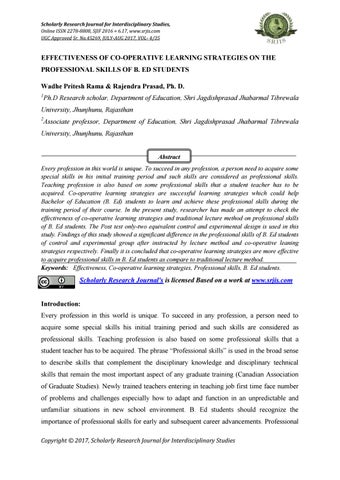
Abstract Every profession in this world is unique. To succeed in any profession, a person need to acquire some special skills in his initial training period and such skills are considered as professional skills. Teaching profession is also based on some professional skills that a student teacher has to be acquired. Co-operative learning strategies are successful learning strategies which could help Bachelor of Education (B. Ed) students to learn and achieve these professional skills during the training period of their course. In the present study, researcher has made an attempt to check the effectiveness of co-operative learning strategies and traditional lecture method on professional skills of B. Ed students. The Post test only-two equivalent control and experimental design is used in this study. Findings of this study showed a significant difference in the professional skills of B. Ed students of control and experimental group after instructed by lecture method and co-operative leaning strategies respectively. Finally it is concluded that co-operative learning strategies are more effective to acquire professional skills in B. Ed students as compare to traditional lecture method. Keywords: Effectiveness, Co-operative learning strategies, Professional skills, B. Ed students.
Scholarly Research Journal's is licensed Based on a work at www.srjis.com
Introduction: Every profession in this world is unique. To succeed in any profession, a person need to acquire some special skills his initial training period and such skills are considered as professional skills. Teaching profession is also based on some professional skills that a student teacher has to be acquired. The phrase “Professional skills” is used in the broad sense to describe skills that complement the disciplinary knowledge and disciplinary technical skills that remain the most important aspect of any graduate training (Canadian Association of Graduate Studies). Newly trained teachers entering in teaching job first time face number of problems and challenges especially how to adapt and function in an unpredictable and unfamiliar situations in new school environment. B. Ed students should recognize the importance of professional skills for early and subsequent career advancements. Professional Copyright © 2017, Scholarly Research Journal for Interdisciplinary Studies
Wadhe Pritesh Rama & Dr. Rajendra Prasad (Pg. 6097-6102)
6098
skills required in teaching profession in constructivist classrooms like Communication Skill, Classroom management skill, Presentation skill, Information Communication Technology skill, Planning skill, Counseling skill, Leadership skill, Social skill , Problem solving skill and Information retrieving skill. Cooperative learning could help the teacher training students to develop the professional skills to cope up with the worst situations and incoming challenges. Cooperative learning strategies are defined under social constructivism which is one of the main streams of constructivism. In this, students work in a small group and collectively for better learning and achievement. Every Student gets a chance for the active participation in the teaching learning process unlike in traditional lecture method where student act like a passive listener. Cooperative learning is an educational approach that aims to organize classroom activities in to academic and social learning experiences. In 1994 Johnson and Johnson published the 5 elements i.e. Positive interdependence, Individual accountability, Face to Face interaction, Social skills and group processing essential for effective group achievement, effective group learning and higher order social, personal and cognitive skills ( e.g. Problem solving, Decision making, Reasoning, Planning, Organizing and reflecting) Several of cooperative learning strategies are practiced at various levels of education. Some cooperative learning strategies utilize students pairing, while other utilize small group of four and more students. Hundreds of techniques have been practiced to use in different topics of subject like Think Pair share, Jigsaw, Three step interview, Jigsaw II, Reverse Jigsaw, Reciprocal Teaching, Problem Based Learning (PBL), Student Teams Achievement Divisions (STAD), Team Game Tournament (TGT), Group investigation Need of the study: Teacher education is a comprehensive training program concern with holistic development of student teachers to prepare for the opportunities and challenges of teaching profession. Overall developments of professional skills are needed than concentrating on core-teaching skills appreciated with great extends in last few decades. Due to the over importance given to core teaching skills, B. Ed students are not aware about overall professional skills and ways to develop them. Efforts are needed to aware B. Ed students about different professional skills and their importance in teaching profession development. Professional skills can be learnt better in a group rather than a traditional way of lecture method. Past researches have shown that skills can be studied and developed more effectively in co-operation and collaboration. Teacher education program provides a nice platform to students to work in coCopyright Š 2017, Scholarly Research Journal for Interdisciplinary Studies
Wadhe Pritesh Rama & Dr. Rajendra Prasad (Pg. 6097-6102)
6099
operation to achieve some skills including core teaching skills and pedagogical concepts. Cooperative learning strategies could play a major role in development of professional skills. Importance of the study: In B. Ed classrooms, instructions are given by using lecture method which is not sufficient to develop necessary professional skills in students hence, it is very important to teach the syllabus by using co-operative learning strategies. Use of co-operative learning strategies could help B. Ed students to remove classicalness of teaching learning process and can make it full of fun, enjoyable and more interesting. Co-operative learning strategies are more interactive which can engage students in actual process of learning. It is very important for B. Ed students to understand the kind of professional skills they required in this profession and how to develop them by learning co-operatively. Review of related literature: In the present research study, review of related literature was taken from institutional libraries and online resources. The material was obtained from there such as from books, research Journals, ERIC and M. B. Much volumes and Ph.D dissertations were mentioned in the chapter review of related literature. Objectives of the present research study: 1. To prepare lessons plans based on co-operative learning strategies and Lecture method on a selected unit of Science and Technology Education subject of B. Ed course. 2. To implement the lesson plans based on co-operative learning strategies and Lecture method on a selected unit of Science and Technology Education subject of B. Ed course on B.Ed students 3. To check the effectiveness of co-operative learning strategies and lecture method on the development of professional skills of B. Ed students. Hypothesis: Ho.: There is no significant difference in the effectiveness of Lecture Method and Co-operative Leaning Strategies on the development of professional skills of B.Ed students of control and Experimental group. Assumption: Skills can be learned perfectly in groups and co-operative learning is a best way to learn in a group. Collaborative work provides opportunities for teachers to work together to make those connections through examining their practice, consulting with colleagues, and developing their skills. (Ferrer L.M, 2004) Copyright Š 2017, Scholarly Research Journal for Interdisciplinary Studies
Wadhe Pritesh Rama & Dr. Rajendra Prasad (Pg. 6097-6102)
6100
Delimitations and limitations of the Present Research: 1. This study is delimited to B. Ed students who are studying curriculum of S.N.D.T. Women’s University, Mumbai 2. This study is delimited to Science and Technology Education subject content only. 3. This study is delimited to experimental method of research 4. This study is delimited to 16 female students of B.Ed course 5.
This study is delimited to professional skill scale as a tool of data collection.
Design of the study Methodology- The present study is a quantitative research. The Experimental method was adopted for the present study. “Equivalent Group only Post Test Design” was used for the present study. Research variables: 1. Independent Variables: For Experimental Group: Instruction through Co-operative learning strategies (Think Pair Share + Context/Problem Based Learning (C/PBL) +Student Teams Achievement Divisions) (STAD) For Control Group: Instruction through lecture method. 2. Dependent Variables: Professional skills are the dependent variable in the present study. Sample: In the present research work, researcher selected one college by purposive sampling technique of non probability sampling method. B. Ed. students of Science and Technology method were selected from selected college by Incidental Sampling technique of NonProbability Sampling Method The sample taken for this study was small and previous researches has proved that small sample is more useful in the context of co-operative learning based experimental studies
Number of students
Control group
08
Experimental group
08
B.Ed
No. of Selected B. Ed students Tool of data collection: Copyright © 2017, Scholarly Research Journal for Interdisciplinary Studies
Total Students 16
Wadhe Pritesh Rama & Dr. Rajendra Prasad (Pg. 6097-6102)
6101
Professional skill scale was used as a tool of data collection to know the exact effect of cooperative learning strategies and Lecture method on the development of professional skill of B. Ed students Detailed literature on professional skills was done and also visited several experts in the field of Teacher Education for preparing a professional skill scale. The item analysis procedure has been introduced and the split half co-efficient of reliability measures is 0.54. There were 30 items in the final draft of professional skill scale. Tool of data analysis: In the present research t- test is used to study whether there were significant difference in the means of the score of control and experimental group after implementation of lessons plans based on co-operative learning strategies and lecture method Data analysis: The analysis was done by using raw data collected by the researcher by using descriptive and inferential statistics Group
Control Experimenta l
N
Mean
S.D
08
118.75
7.76
08
129.13
4.58
Obtaine Table t Level of significance (0.05) Two tailed d t - value value 3.2566
2.145
Highly significant
Findings: From the above table it can be seen that the t-value was significant at 0.05 level. Hence, the null hypothesis is rejected. Therefore, there is a significant difference in the effectiveness of Lecture Method and Cooperative Leaning Strategy on the development of professional skills of B.Ed students of control and experimental group. Conclusion: Co-operative learning strategies are more effective in developing professional skills in B, Ed students as compare to traditional lecture method. Contribution to knowledge: This study has been done by keeping in mind the importance of co-operative learning strategies at teacher education level. An attempt was also made to create an interest in B. Ed students for co-operative learning strategies. Researcher has tried to explain the importance of co-operative learning strategies to B.Ed students and its usability in developing professional skills among them. Copyright Š 2017, Scholarly Research Journal for Interdisciplinary Studies
Wadhe Pritesh Rama & Dr. Rajendra Prasad (Pg. 6097-6102)
6102
References Barkley, E.F., Cross, K.P., & Major, C.H. (2005). Collaborative Learning Techniques: A Handbook for College Faculty. San Francisco: Jossey-Bass. Best, J.W. (2004), Research in Education. Prentice Hall of India Private Ltd. New Delhi Ferrer L.M, (2004) “Developing Understanding and Social skills Through Cooperative Learning” Journal of Science and Mathematics Education in S.E. Asia Vol. 27, No. 2, 45-61 Johnson, D.W., & Johnson, R. (1994). Leading the cooperative school (2nd ed.). Edina, MN: Interaction Book Co. Robert E. Slavin (1991) “Student Team Learning: A Practical Guide to Cooperative Learning” (3rdEdition) Sharma S.P.(2003) Teacher Education-Principals, Theories and Practices, Kanishka Publishers, Distributors, New Delhi. Tiwari S (2003). Education in India, New Delhi Atlantic Publishers Pvt Ltd. Ventimiglia Laura M. (1993) “Co-operative Learning at the College Level” The NEA Higher Education, Journal 5
Copyright © 2017, Scholarly Research Journal for Interdisciplinary Studies